Cup-and-Ring Stone (lost): OS Grid Reference – NX 529 528
Also Known as:
Bardriston
Archaeology & History
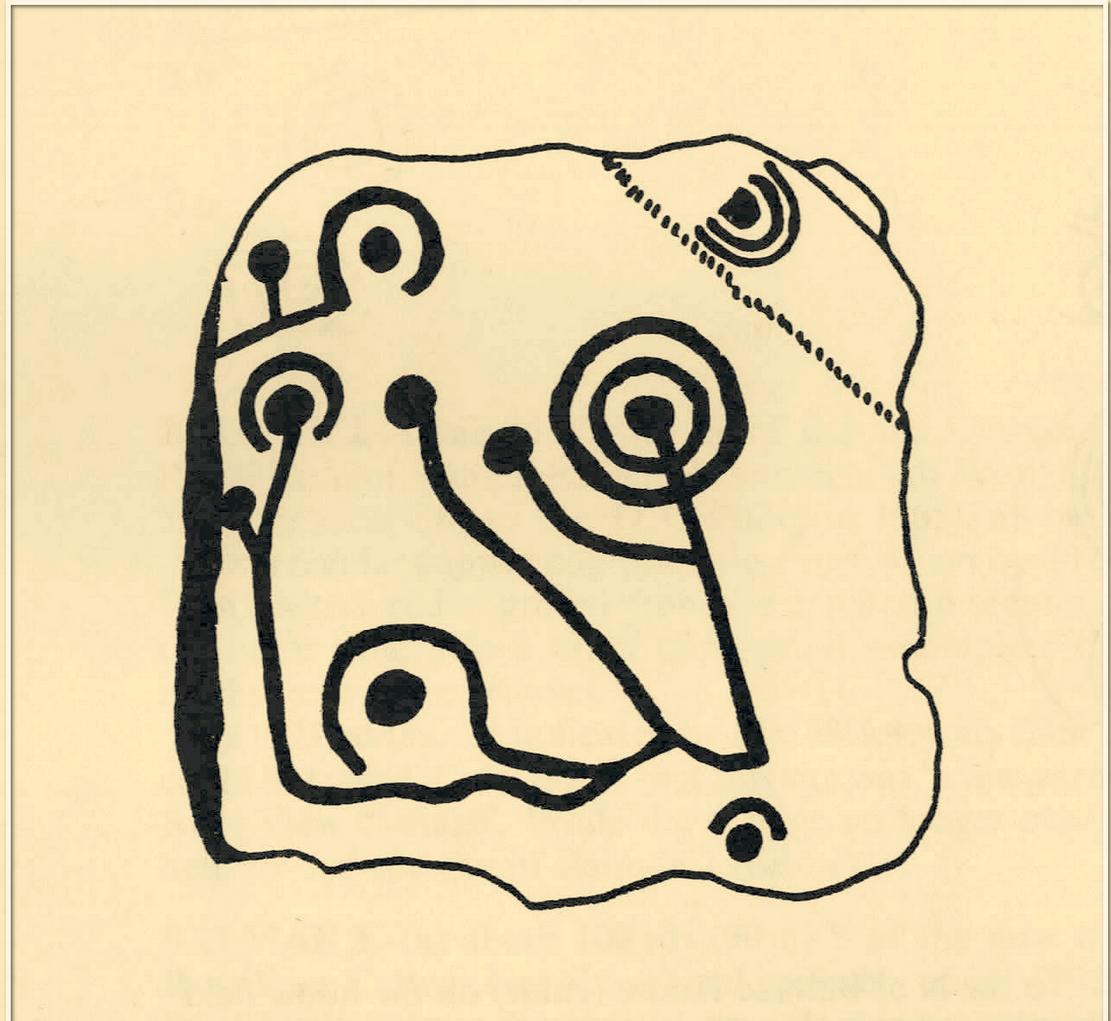
In a region possessed with a good number of cup and ring stones, this one on the lower slopes of Barholm Hill may have once been part of a prehistoric tomb, or cist cover. A fairly decent design had been carved onto a small flat slab of stone which, when uncovered in the 19th century, doesn’t seem to have been in its original position. As the great Fred Coles (1894) told us:
Coles’ 1895 sketch
“The Bardristan slab…was removed from amongst the stones of an old drain in 1889, and, through Mr Kinna’s care, it is now preserved at Bardristan. The evident attempt to square the stone itself; the extreme smallness of the rings ; the direct connection of the grooves, in all cases but one, with cups; and lastly, the vivid sharpness of the whole sculpturing, in which the tool-work is clear much beyond the ordinary, all combine to render this Bardristan slab unusually interesting and valuable.”
Less than twenty years after Coles’ description, the Royal Commission (1914) lads visited the site hoping to make their own assessment, but the carving had already been lost. Referring to Coles’ account, they told how,
“inquiry there failed to elicit information concerning it, and it appears to have been lost. Mr Coles’ illustration…shows in the general intercommunication of the various cups a feature which characterises the stone at Kirkclaugh, about ¼ mile to the south of Bardriston.”
In the subsequent commentaries on this carving by Ron Morris (1967; 1979) and A.E. Truckell (1961), its whereabouts remained a mystery and, to this day, we know not what became of it…
Morris, Ronald W.B., “The Cup-and-Ring Marks and Similar Sculptures of South-West Scotland,” in Transactions of the Ancient Monuments Society, volume 14, 1967.
Morris, Ronald W.B., The Prehistoric Rock Art of Galloway and the Isle of Man, Blandford: Poole 1979.
Royal Commission Ancient & Historical Monuments & Constructions of Scotland, Inventory of Monuments and Constructions in Galloway – volume 2: County of the Stewatry of Kirkcudbrightshire , HMSO: Edinburgh 1914.
Truckell, A.E., “Cup-and-Ring-Marked Slabs in the Cairnholy and Auchinlarie Area,” in Transactions of Galloway & Dumfriesshire Natural History & Antiquarian Society, volume 40, 1961.
Acknowledgements:Huge thanks for use of the Ordnance Survey map in this site profile, reproduced with the kind permission of the National Library of Scotland.
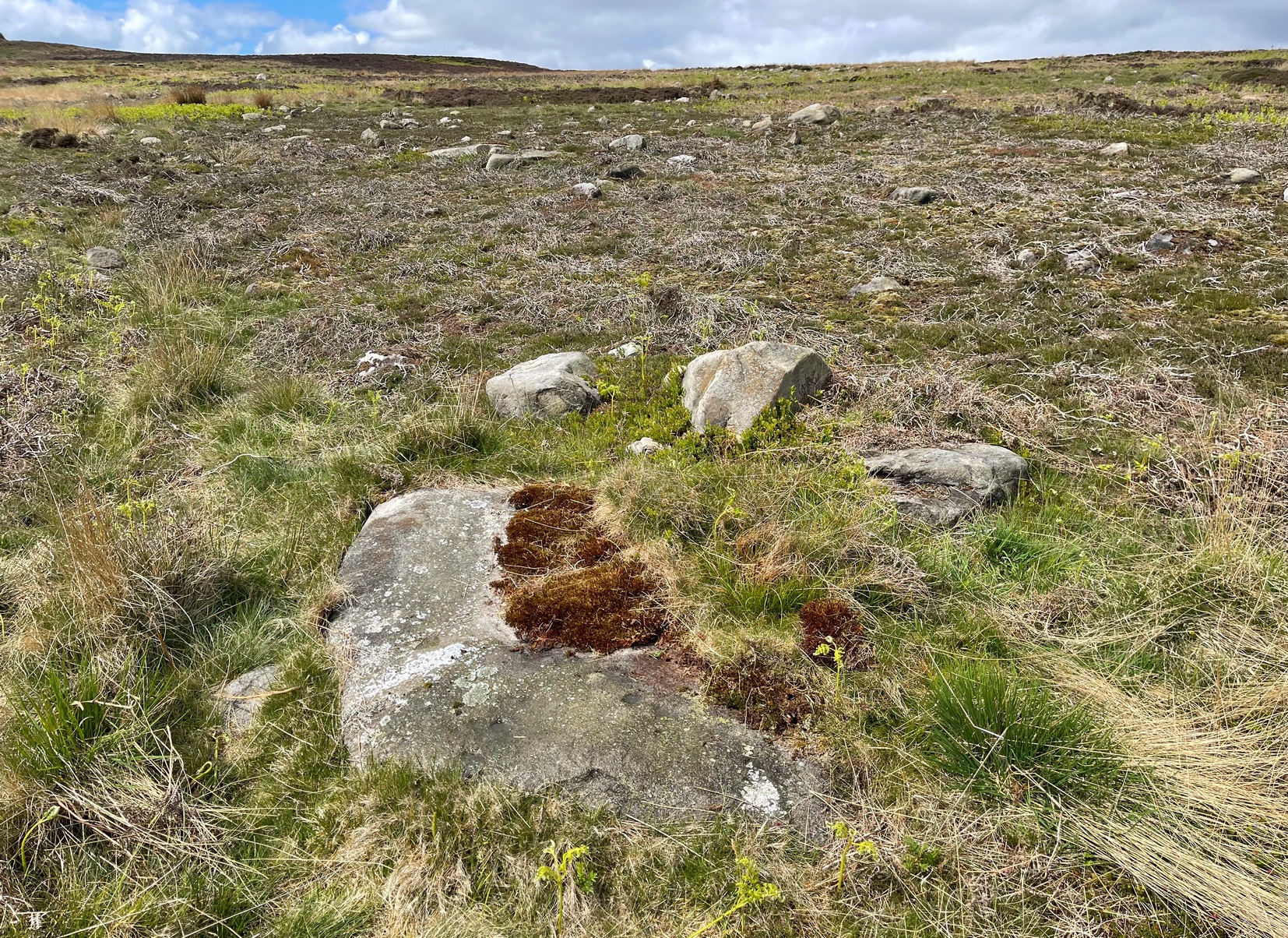
If you’re looking for this carving, you’ll have been to the impressive Tree of Life stone first. From there, you need to walk further away from the walling, 30-35 yards southwest, across the other side of the footpath. There’s a scattered mass of stones all over the ground here: you’re looking for a low-lying long curved stone—longer than most of them hereby. If the heather’s grown back over the stone, it might take some finding!
Archaeology & History
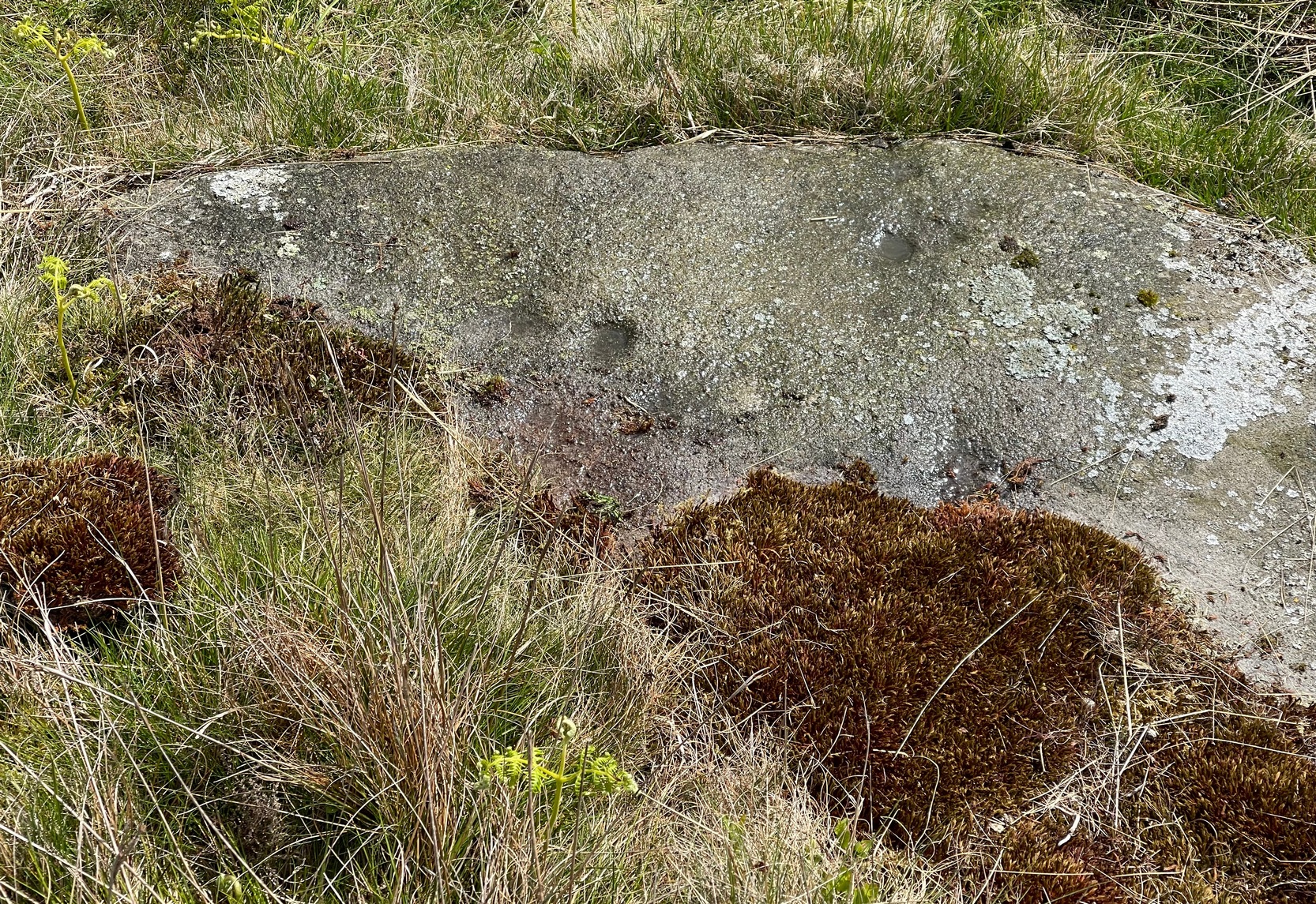
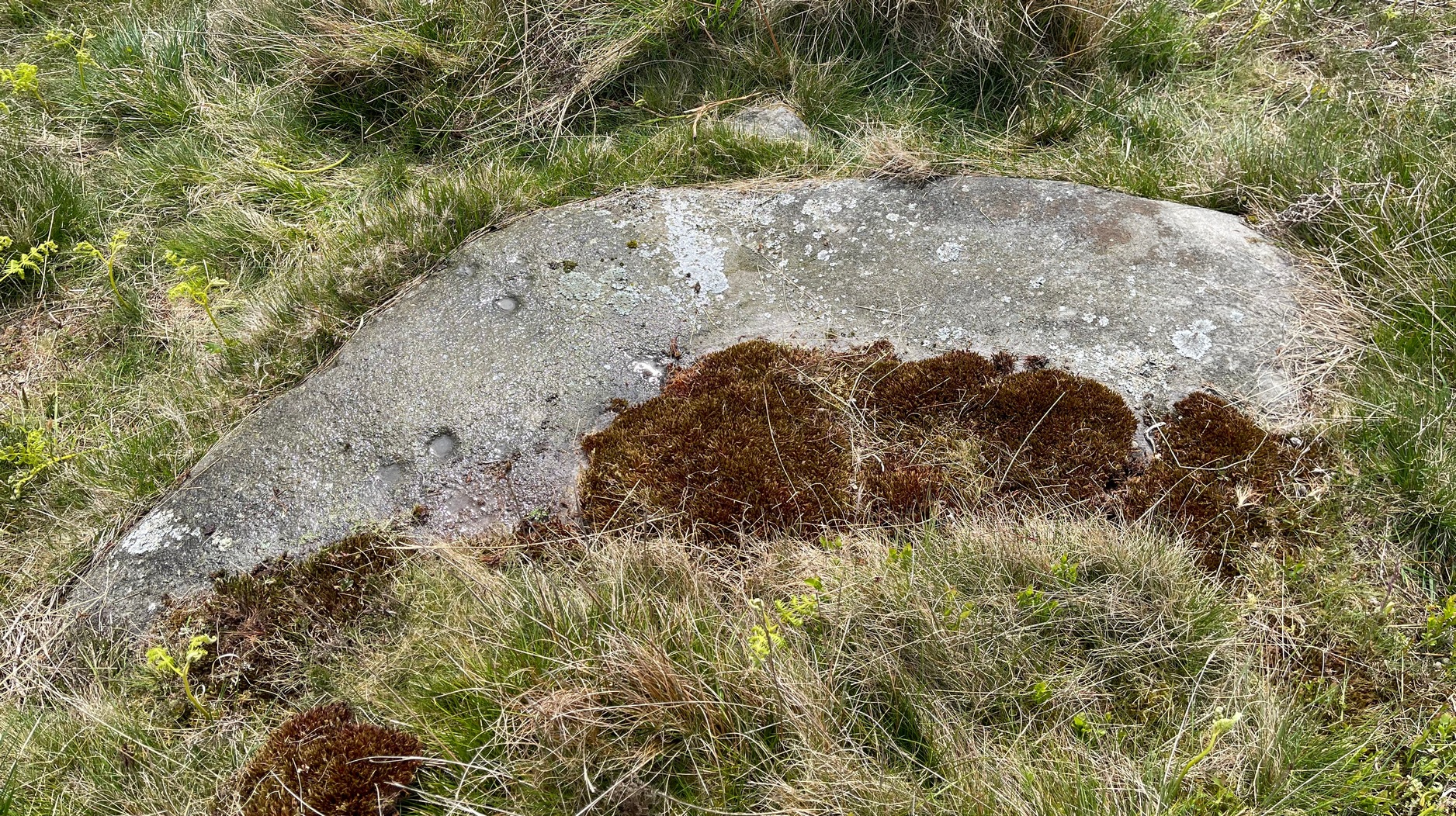
Close to a line of prehistoric walling (seemingly a section of a settlement), this typically curvaceous female stone is possessed of two pairs of faint cup-marks on the eastern side of the rock. It was included in Boughey & Vickerman’s (2003) survey where they described the carving as being, “two small cups visible and two further cups under heather.” A third possible cup exists close to one of the pairs. The carving is found in an area rich in untouched prehistoric remains.
References:
Boughey, Keith & Vickerman, E.A., Prehistoric Rock Art of the West Riding, WYAS 2003.
In Hawksworth village, less than 100 yards past the primary school, take the footpath on your left into the open fields. 200 yards down the fields, go over the stile on your right, into the next field and walk diagonally across it (SW) for 250 yards until you reach the wall; then walk alongside it, west, for another 150 yards where the walling goes due south and walk down here for 135 yards, going through the gate at the bottom into the next field and, at the bottom of this one go through the gate and bear right. OK, now walk along the wall-side for 55 yards and you’re just about standing on it! Alternatively you can reach it via the Hawksworth Spring (1) and (4) carvings, following the wall along for roughly 150 yards till you reach the gate. Go through here and walk diagonally NNW across the field for nearly 150 yards where you’ll see the stone stuck out in front of the wall.
Archaeology & History
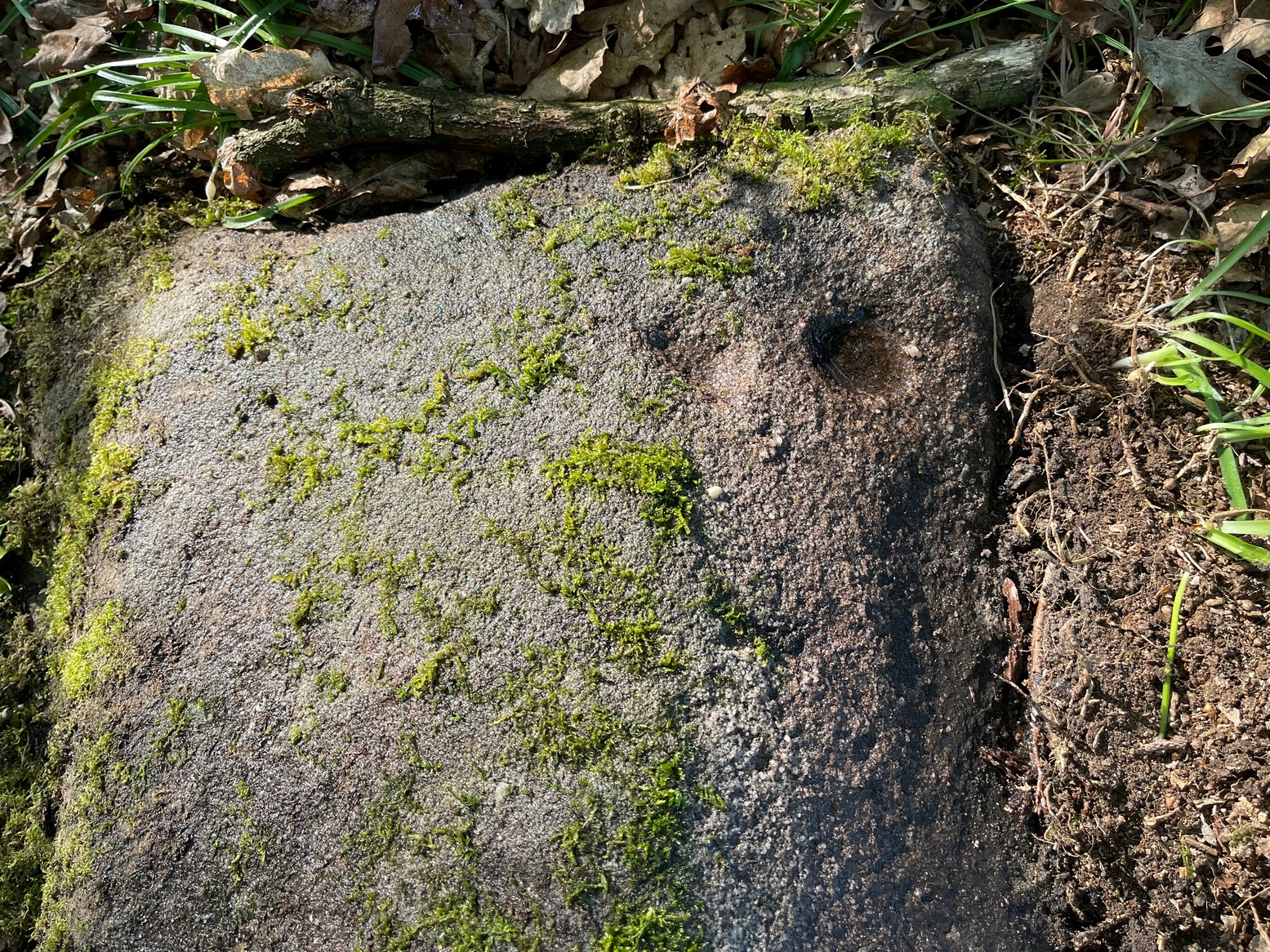
My first sight of this came about as I walked alongside the walling. Approaching the stone, I noticed what looked like a recent cup-like marking with a curved line emerging from it on its eastern surface; but it didn’t look too old and was more like the scratch-marks you see sometimes when farmers have been dragging rocks along to be used in walling. So I shrugged in slight disappointment—until the far-side, the western-side of the stone came into view.
Line of cups
Main scatter of cups
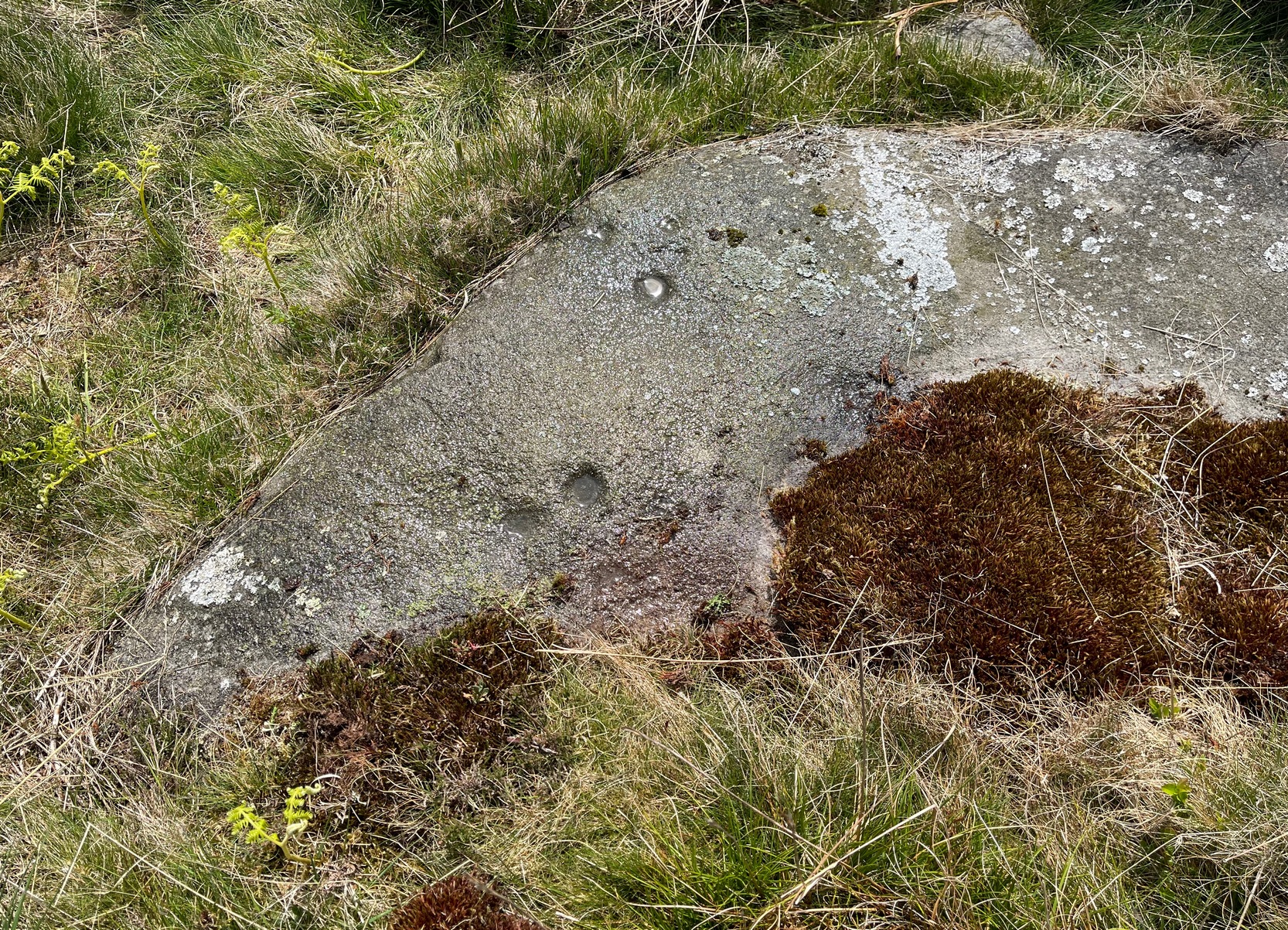
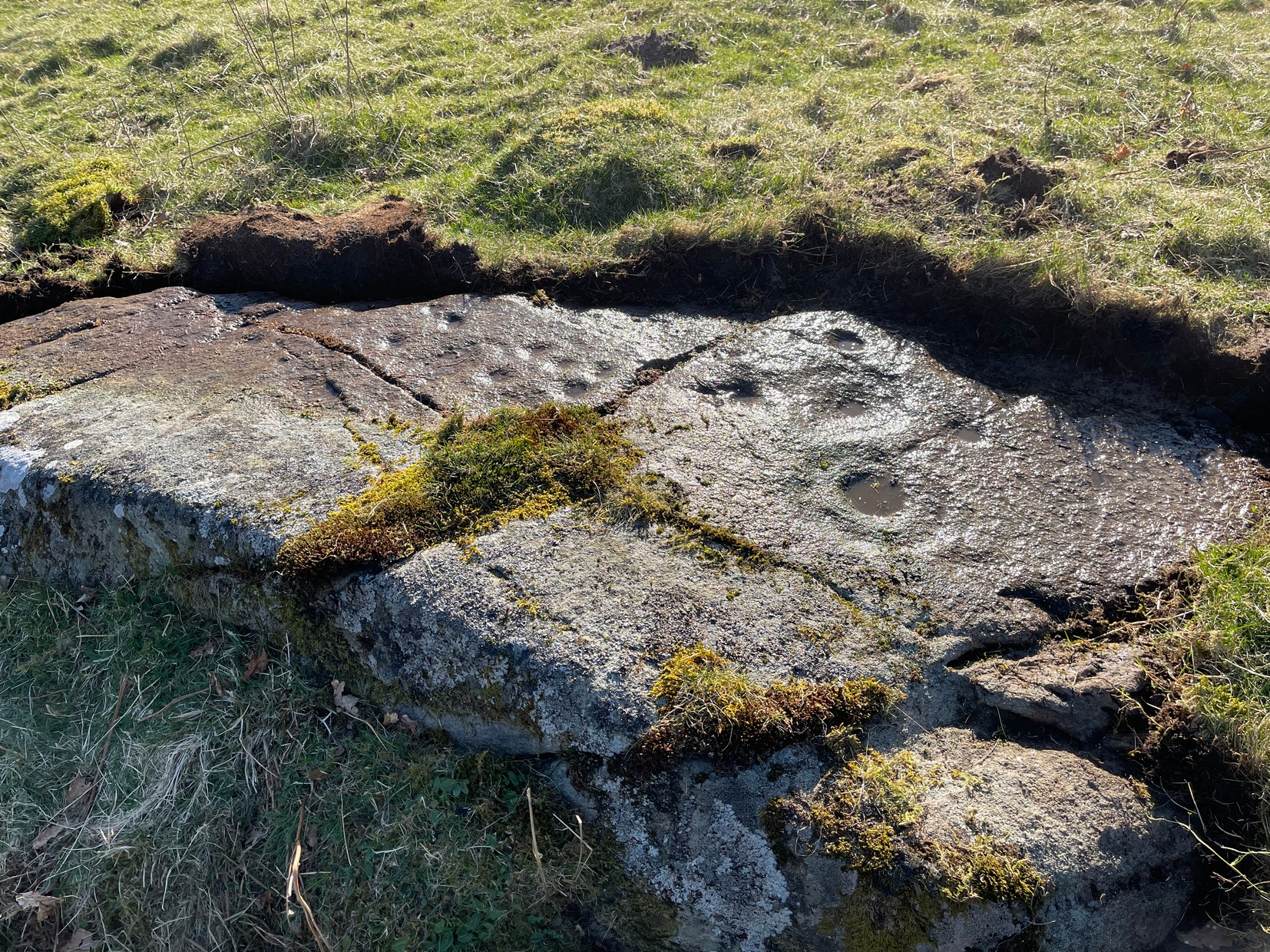
Sloping ever-so-slightly down into the ground, the surface of the stone had a cluster of quite worn, shallow, but distinct cup-markings between one and two inches across, four of which ran in a line from the top to the edge of the stone in a slight curve. As I walked round it, looking from different angles, it became obvious that two or three other cups existed—mainly from the top to the western side of the rock. One seemed to exist near the edge, whilst two other faint ones sat to the side of the line-of-four—almost creating a square formation. From some angles it looked as if there may be faint lines running between some of the cups but (as usual) the sunlight didn’t really help highlight them and they could just be faded erosion lines.
Looking down at the cups
Water & sunlight & cups
It was obvious that a section of the stone on its southern edge had been broken off in the not-too-distant past, raising the idea that the design may originally have been larger than its present form. This thought returned when I walked another 60 yards west along the wall and came across a broken section of stone that had been placed into it, pretty recently, and on its vertical face noticed a single cup-mark in a good state of preservation, indicating that it had either been cut recently or instead been dug out of the ground not too long ago and shown intself to the world after a sleep of several millenia. Look at it when you have a gander at the main carving here and make up your own mind….
Take the same directions as if you’re going to visit the Hawksworth Spring (1) carving. From here, the small footpath at its side keeps going uphill, curving to the right and following the line of walling. After about 20 yards where the land begins to level out, keep your eyes peeled for a small elongated earthfast rock, less than three feet long, just to the left of the path and only three or four yards away from the wall. If the leaves have covered the stone, get on your hands and knees and scrub around a bit. You’ll find it!
Archaeology & History
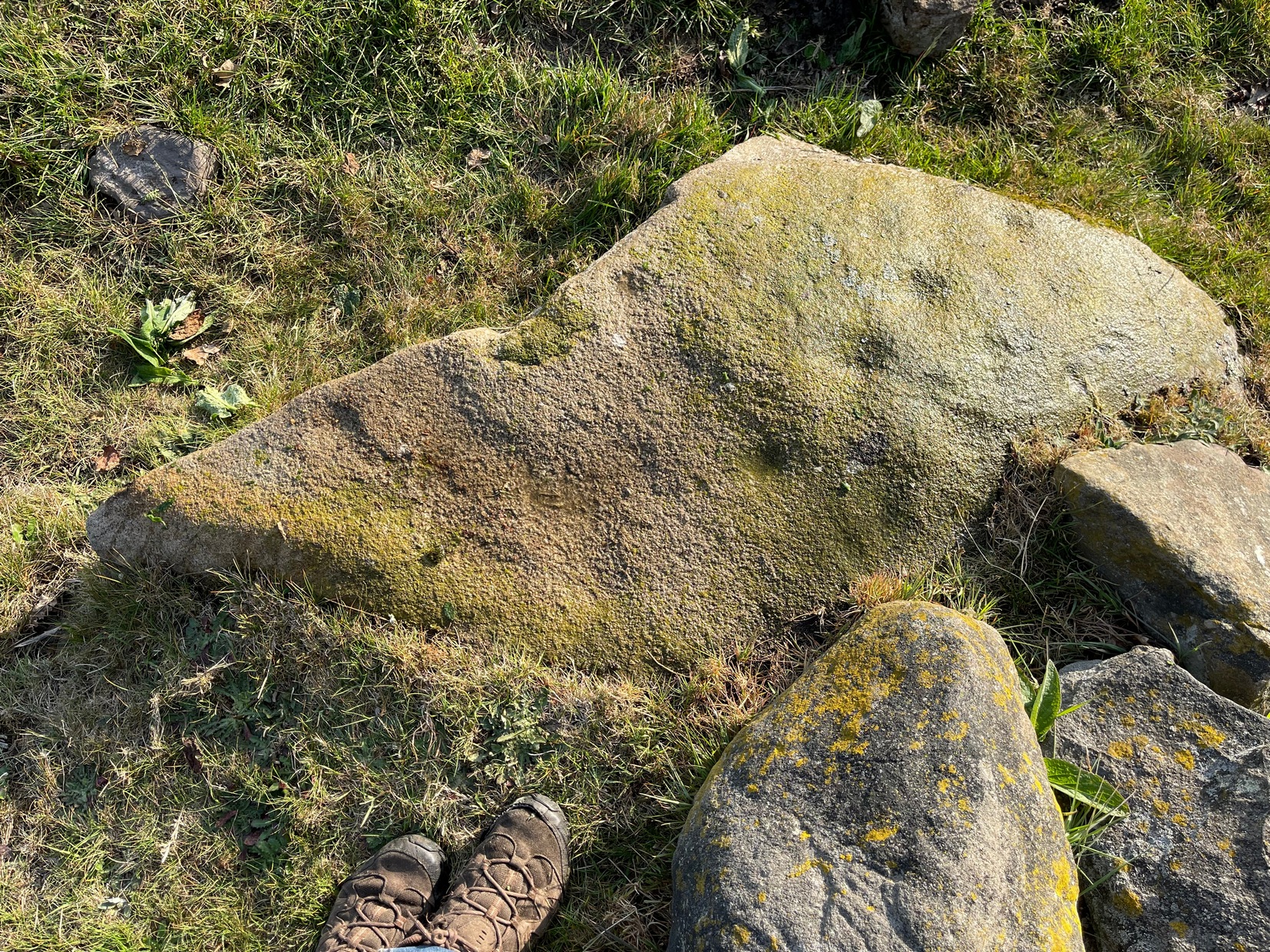
Primary cup-marking
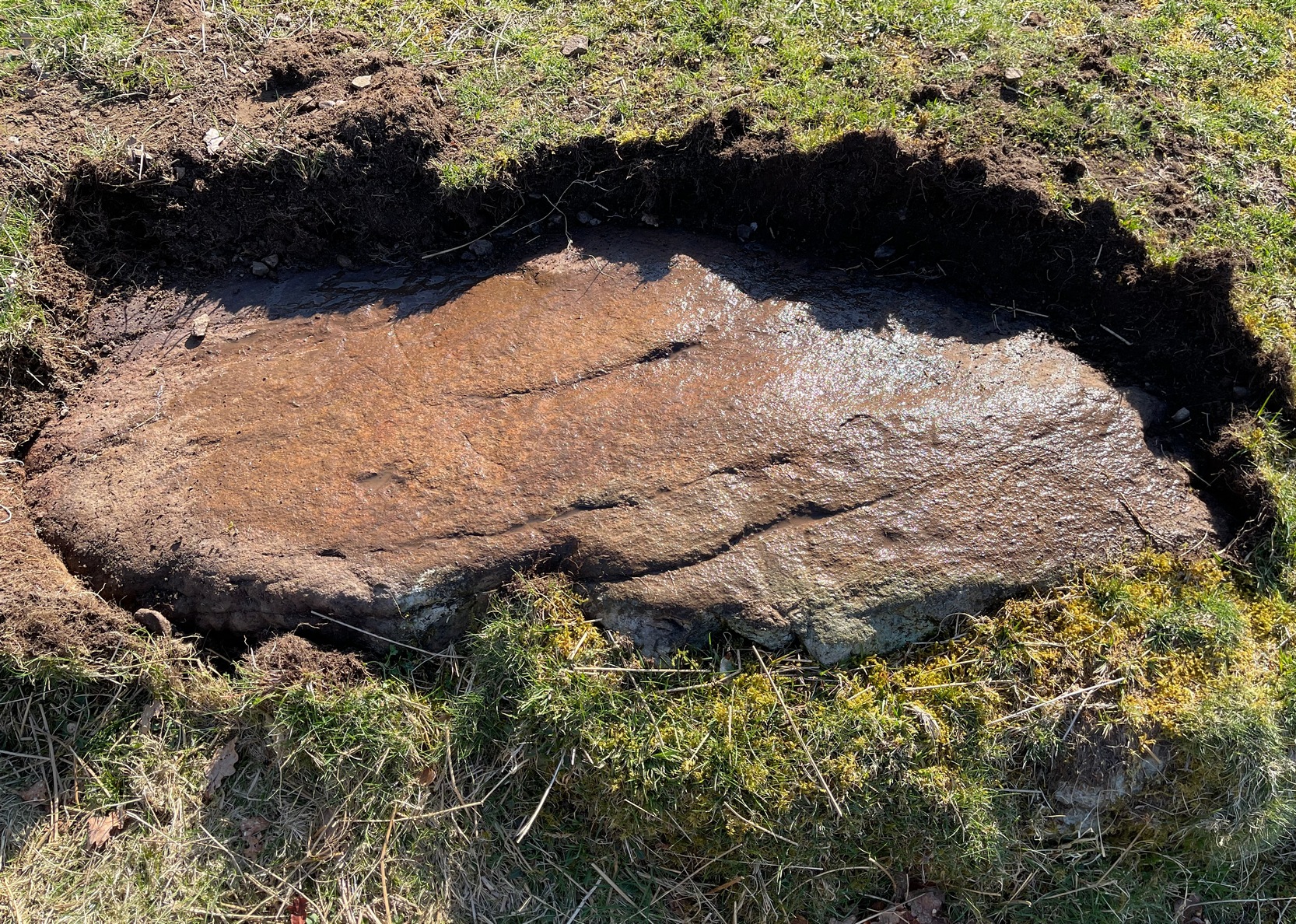
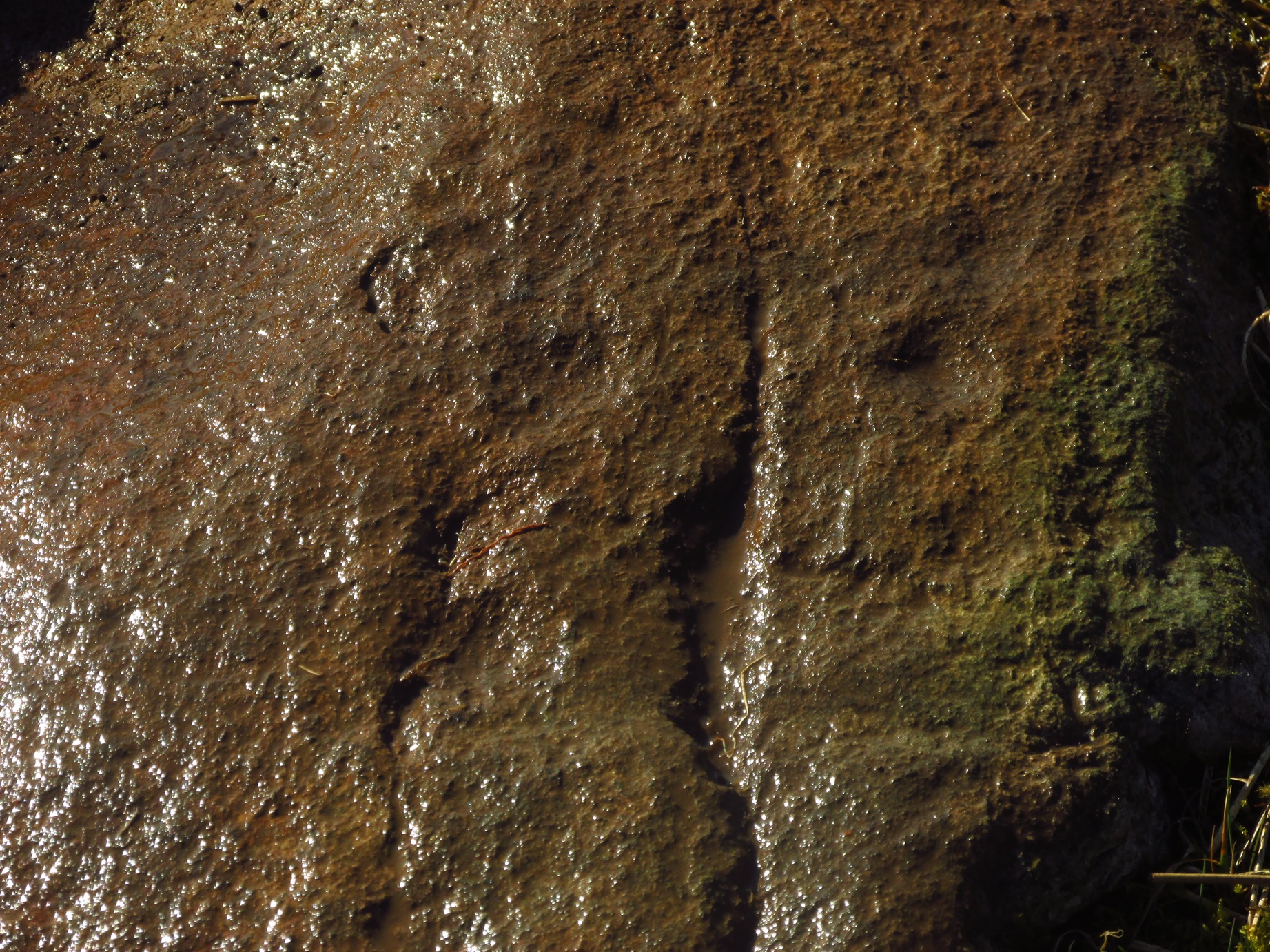
This was a frustrating find as there are several elements on the stone, only one of which I could be 100% certain about – and that’s the singular cup-marking on the top-left of the stone. Just next to this is what looks to be another one, unfinished, cut into a natural fissure in the rock—but the daylight was frustrating, allowing only glimpses of visual clarity on the stone. At the other end of the stone, as the photo shows, are what stand out as two or three more cup-marks, but these seem geophysical in nature—although examples such as these scatter the works of Boughey & Vickerman (2003; 2018) as authentic, which shows the problem we all have as rock art students. Anyhow, at least one of these cups is the real deal. I’ll let the computer-tech lads sort the rest of it out for us…
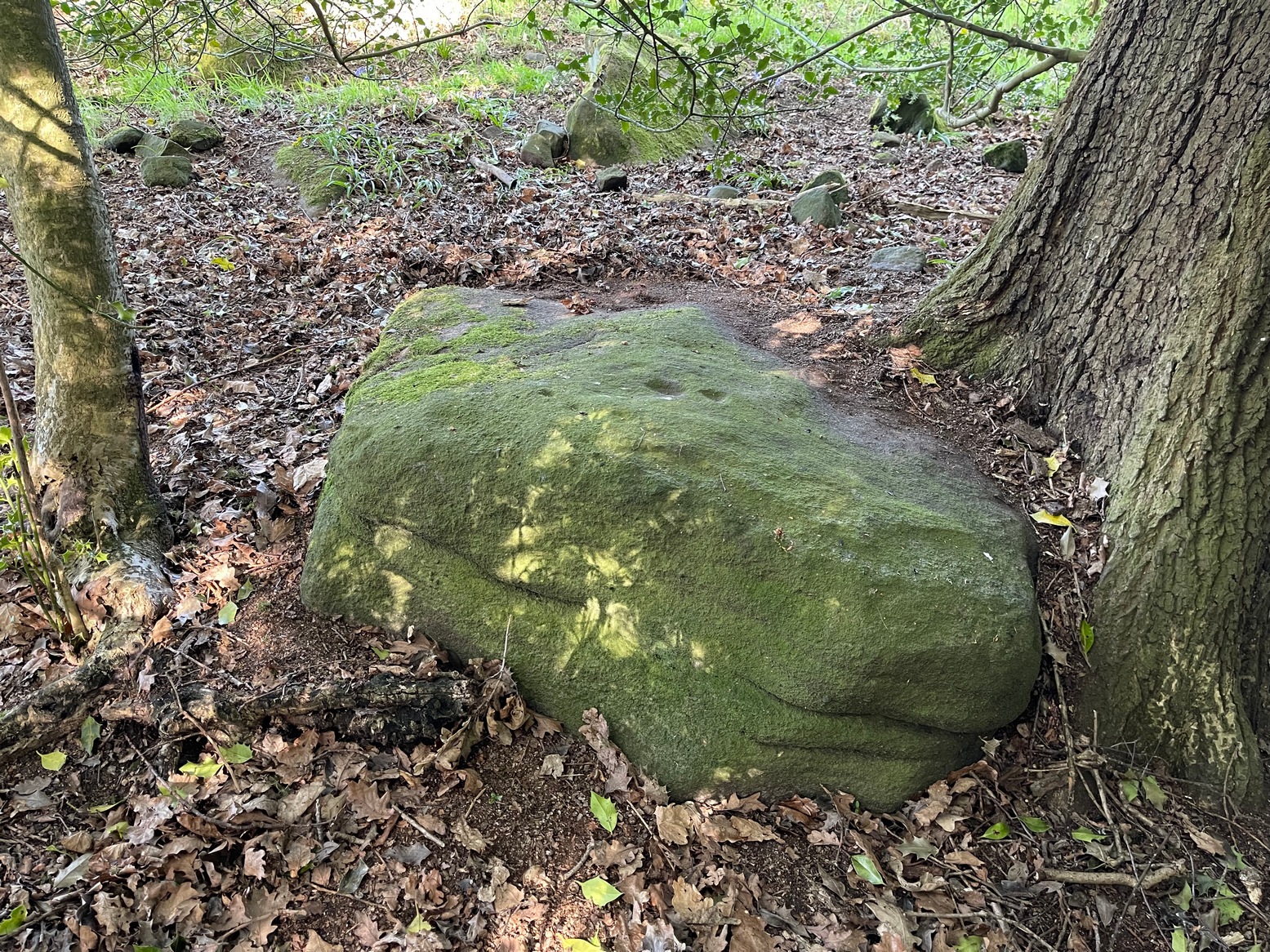
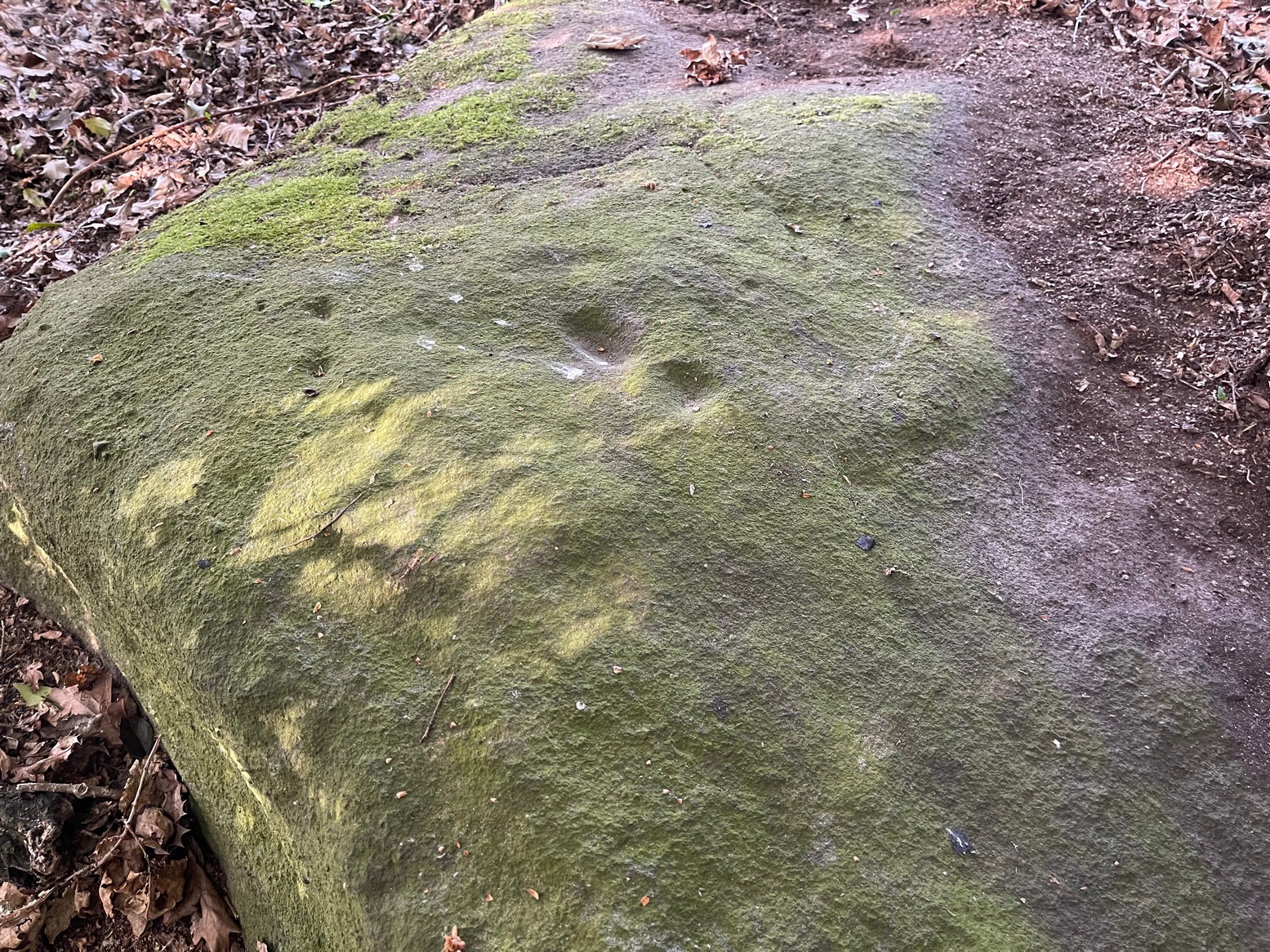
Once you’ve located the carvings of Hawksworth Spring (1) and (2), walk up the slope towards the topmost section of the walling where the land begins to level out. Hereby you’ll see the Hawksworth Spring (4) carving (if it’s not covered in leaves) several yards below the wall. Turn around and look diagonally to your left, into the trees, where you need to walk into and beneath the overhanging holly branches. Here you’ll reach the large earthfast rock whose edge rests up against the trunk of a larger tree. You can’t miss it!
Archaeology & History
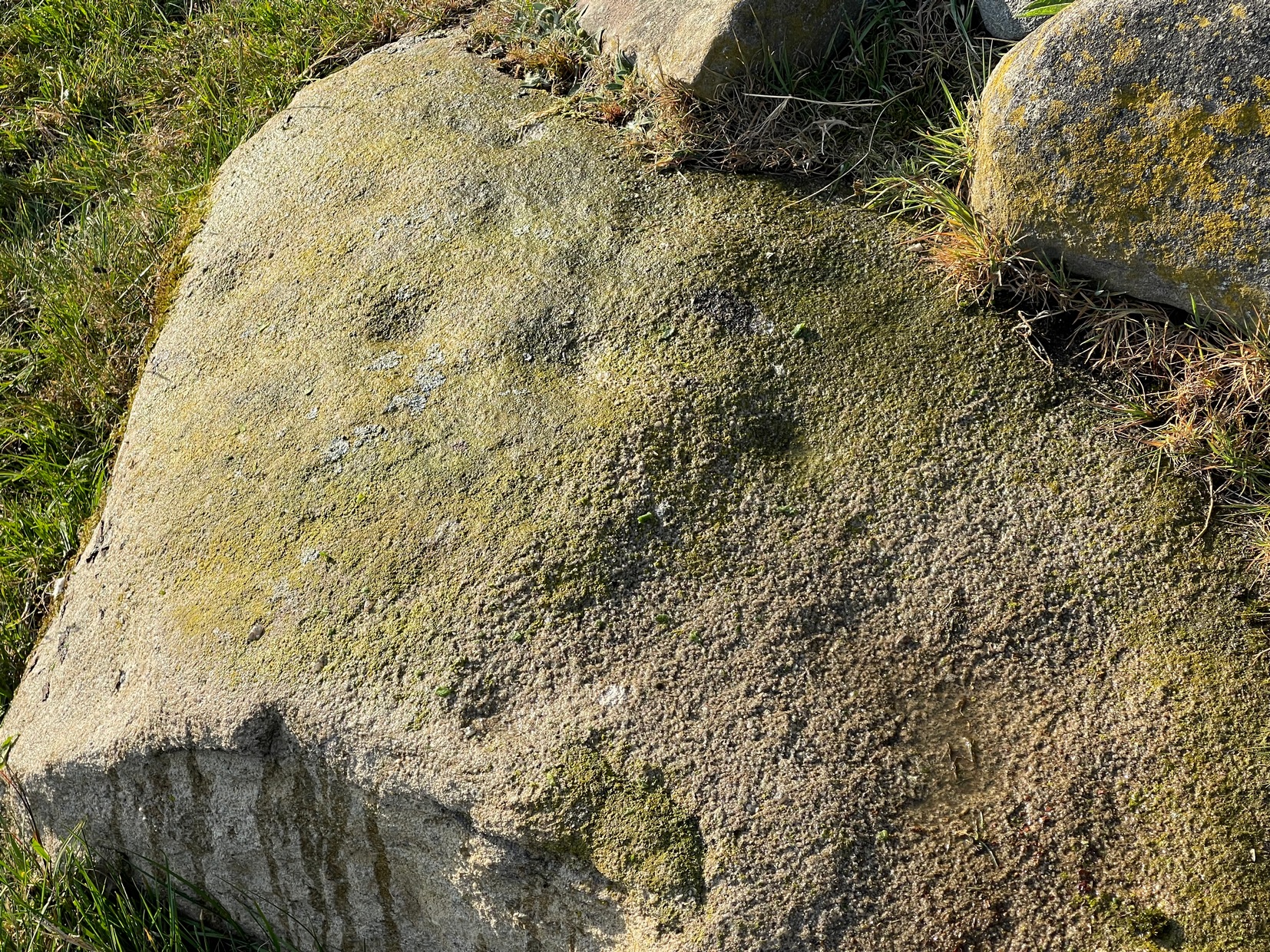
Notable curious “cups”
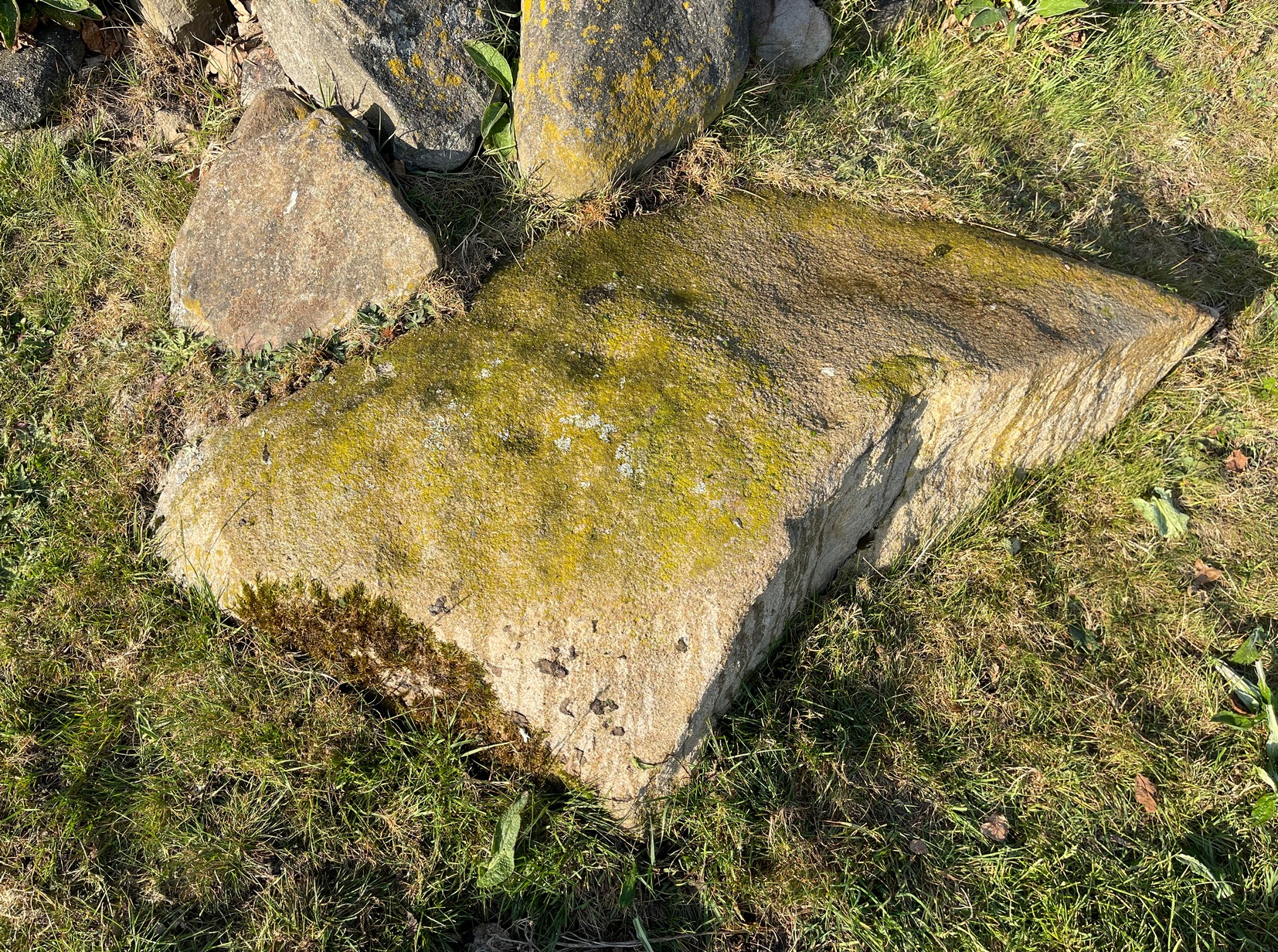
I’m not 100% convinced that this a prehistoric design, despite it being listed as such in Boughey & Vickerman’s (2003) survey—although, to be fair, they do suggest it as being “doubtful.” The two most notable so-called “cups” have more of a recent hallmark to them and the other elements are troublesome to see with any certainty, but they may be geophysical in nature. Their description of it told us this was a “fairly large fine-grained rock with some included pebbles. Two pairs of cups, one pair connected by groove”. Make of it what you will….
References:
Boughey, Keith & Vickerman, E.A., Prehistoric Rock Art of the West Riding, WYAS: Wakefield 2003.
Cup-and-Ring Stone (lost): OS Grid Reference – SE 1347 3882
Also Known as:
Carving no.143 (Boughey & Vickerman)
Archaeology & History
In Johnnie Gray’s (aka Harry Speight) early work on Airedale (1891), he described a number of the prehistoric sites on and around Baildon Moor and Shipley Glen. Almost all of the things he wrote about have been identified, but a cup-and-ring stone at “Glen gate” (as he called it) remains elusive. He wrote:
“After crossing the stream from the Glen gate, and going about thirty paces, we come upon…an incised stone, whereon are a number of circling lines and cup-like cavities — one at each corner, with a long line branching off to the north-east; but this stone unfortunately has got broken, and lying on the main path is much defaced.”
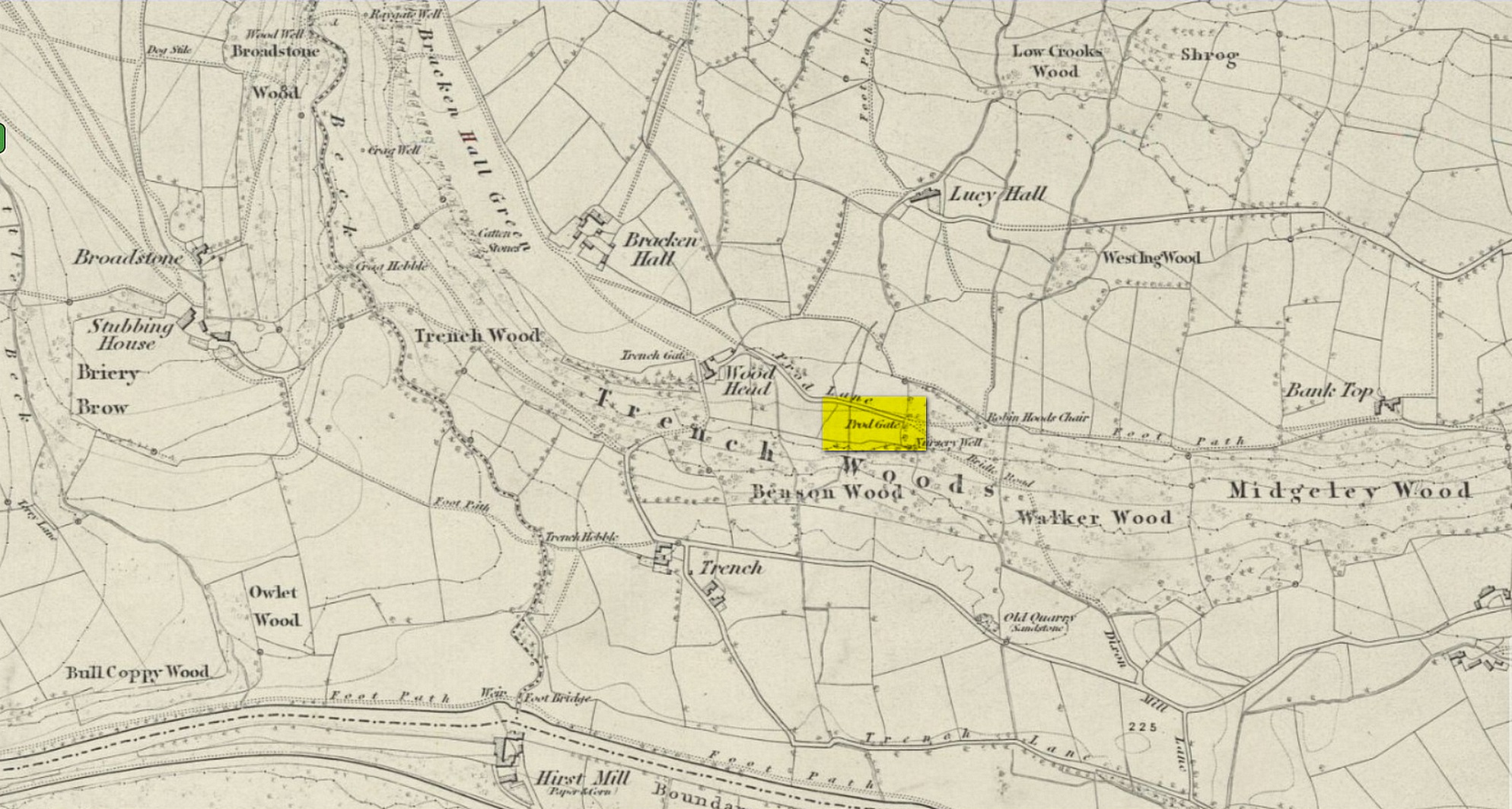
Prod Gate on 1852 map
The exact location of this has proven difficult as the name ‘Glen gate’ was obviously a local one as it wasn’t included on the Ordnance Surveys of the period. There are two named “gates” hereby: one is Prod Gate at the east end of Prod Lane, and the other is Trench Gate a few hundred yards west at the other end of Prod Lane. But the most likely gate of the two would be Prod Gate. When Speight wrote his words, a stream existed that crossed the track about 70 yards west of Prod Gate, whereas no such water-course existed anywhere close to Trench Gate. And so we assume that he was writing about “the stream from the Glen (Prod) Gate.”
Having said all that, there are no known petroglyphs like the one that Speight described anywhere hereby. There are a couple of so-called “carvings” that have been included in so-called official surveys (Boughey & Vickerman 141 and 142; aka ERA- 2445 and ERA-2446) another 150 yards or so on the left-side of the road that could have been regarded as contenders, but these stones have just a mix of modern and natural markings and can be discounted. In all likelihood, this impressive-sounding petroglyph was broken up and destroyed when the proper road was laid in the middle of the 20th century; or perhaps broken up and stuck into one of the garden walls along the roadside. Either way, the carving seems long lost.
References:
Boughey, K.J.S. & Vickerman, E.A., Prehistoric Rock Art of the West Riding, WYAS: Leeds 2003.
Gray, Johnnie, Through Airedale from Goole to Malham, Walker & Laycock: Leeds 1891.
Acknowledgements:Huge thanks for use of the Ordnance Survey map in this site profile, reproduced with the kind permission of the National Library of Scotland.
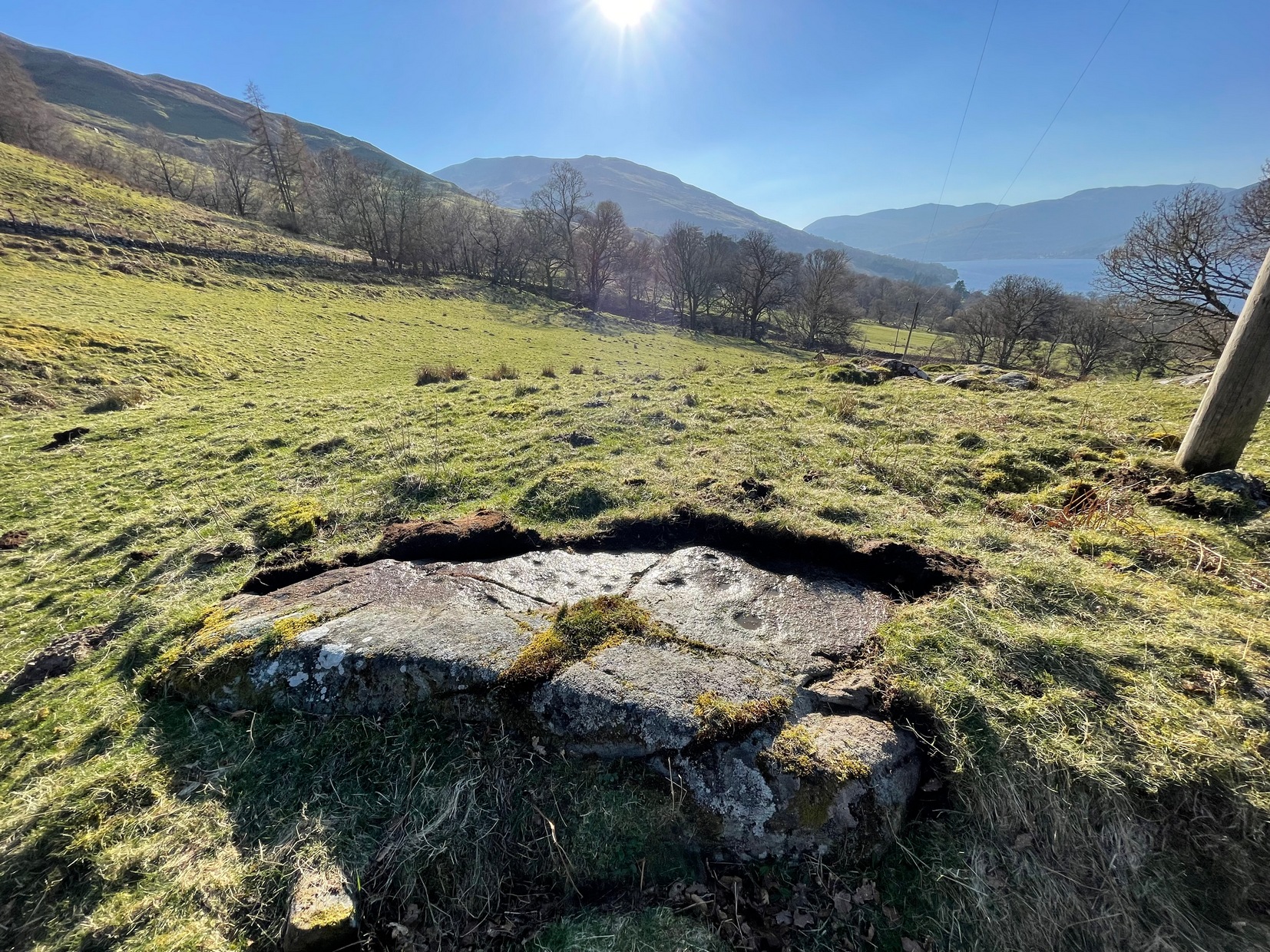
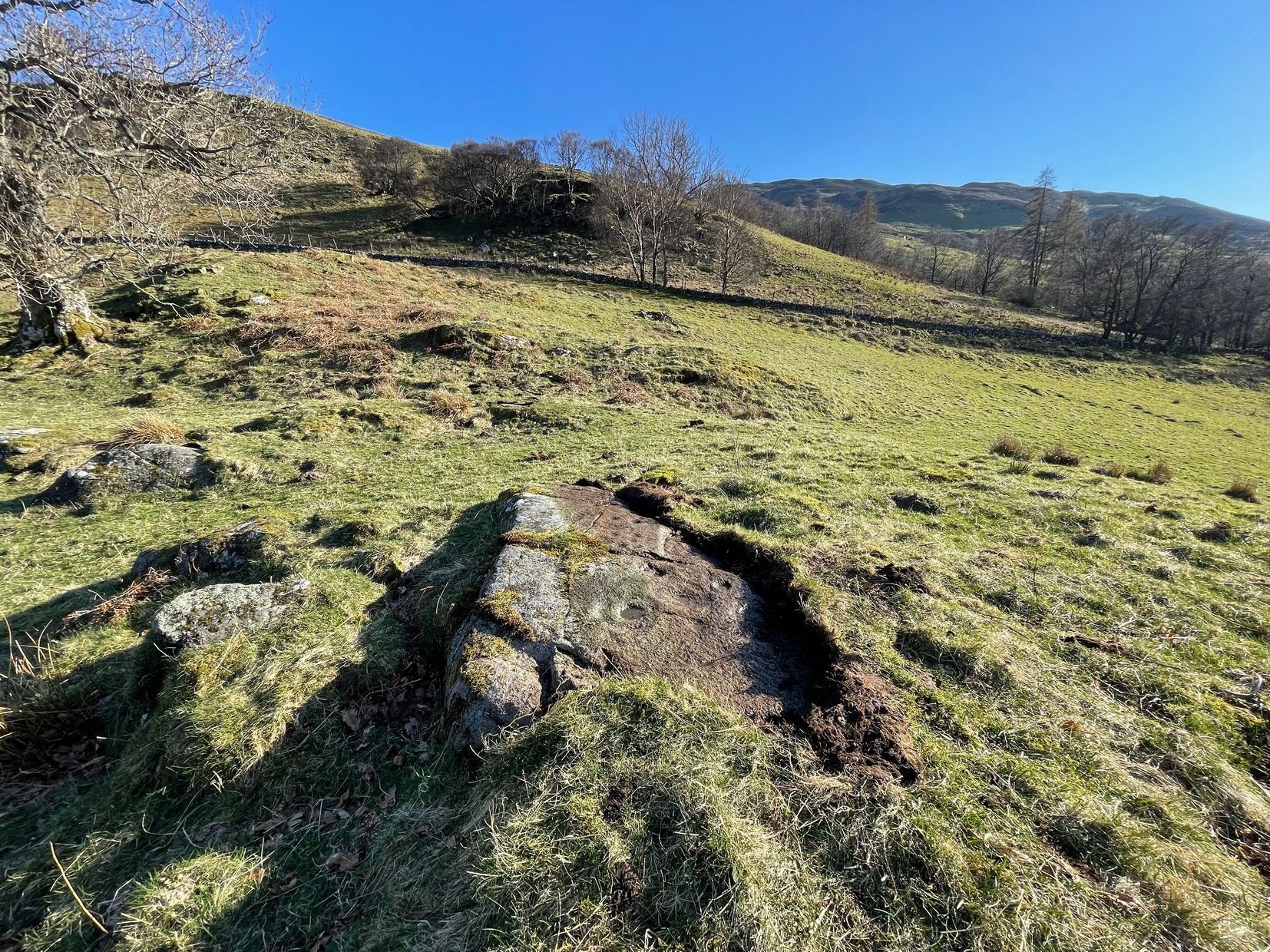
Loch Earn (between the villages of Lochearnhead and St Fillans) has a road running on each side: the north-side is the A85, the south-side is a minor single-track road. You need to be on the south-side. Roughly halfway along the loch, there’s rough parking near Ardvorlich House; and from the track to Ardvorlich, keep on the lochside road, walking east for about 400 yards and then go up the dirt-track on your right. Walk up here for 450 yards until your reach the cottage. There’s a field above you to the left with some small crags near the top: walk uphill (through the gate) for 175 yards and on the topmost crags you’ll see a telegraph pole. The cup-and-ring stone is right next to it!
Archaeology & History
The first and only reference to this stone followed its rediscovery by George Currie (2011) in one of his many bimbling forays seeking out these old carvings. He told, in his usual minimalist manner that,
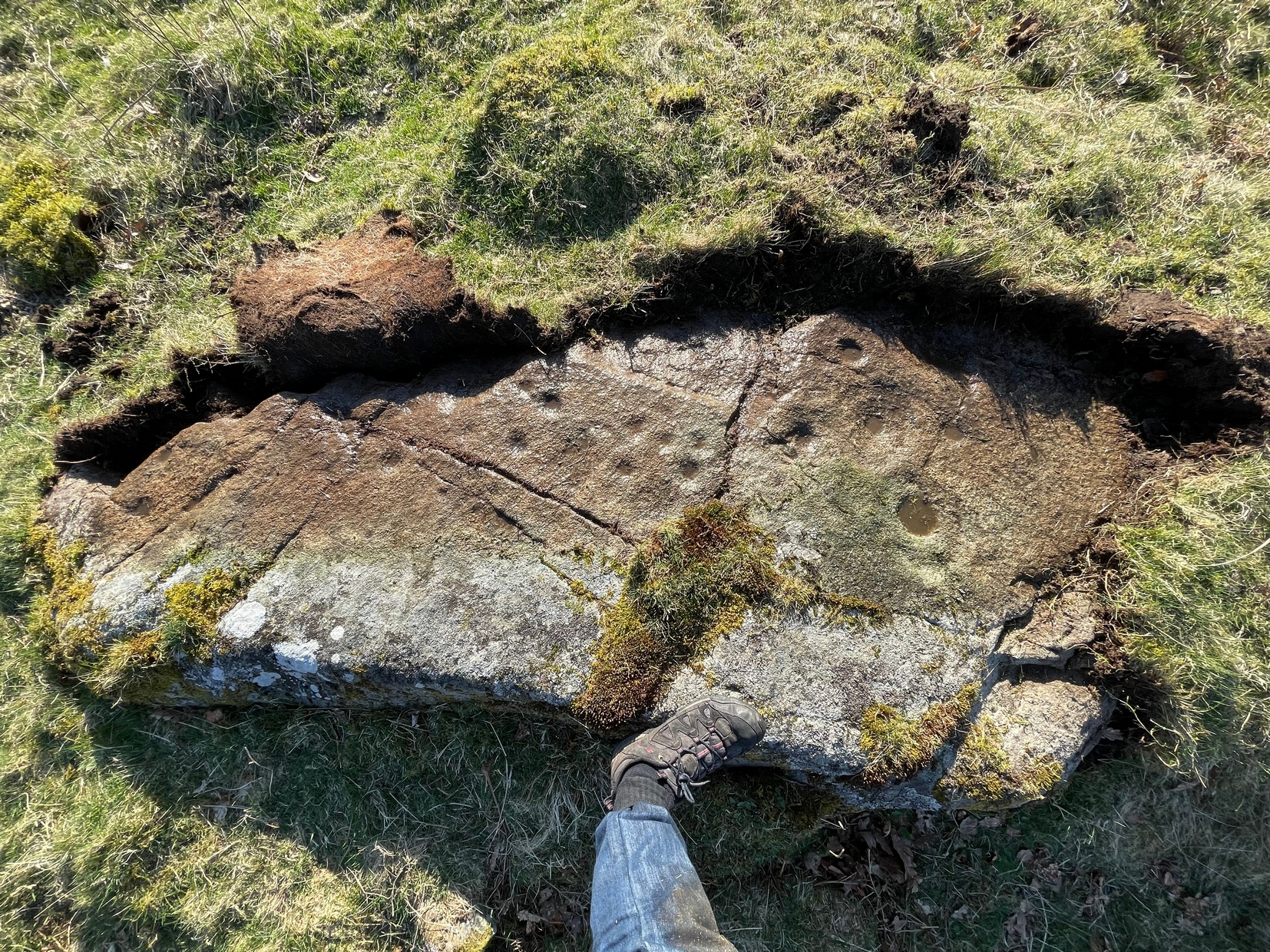
“A stretch of bedrock adjacent to a telegraph pole on a terrace above Balimeanach farmhouse bears thirteen cup marks, at least two of which have single rings, including the largest at 70 x 25mm.”
Line of cup-and-rings
View from above
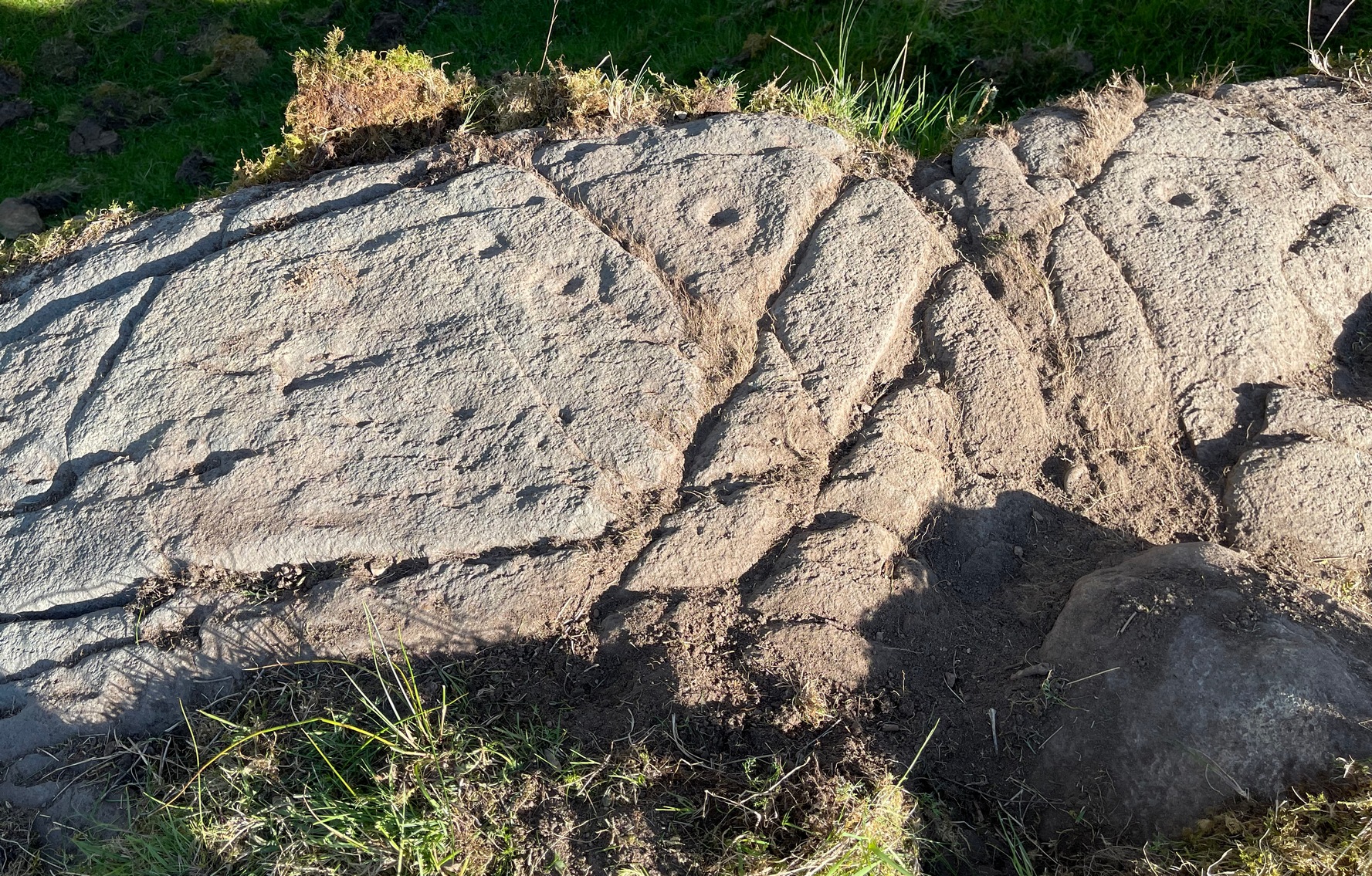
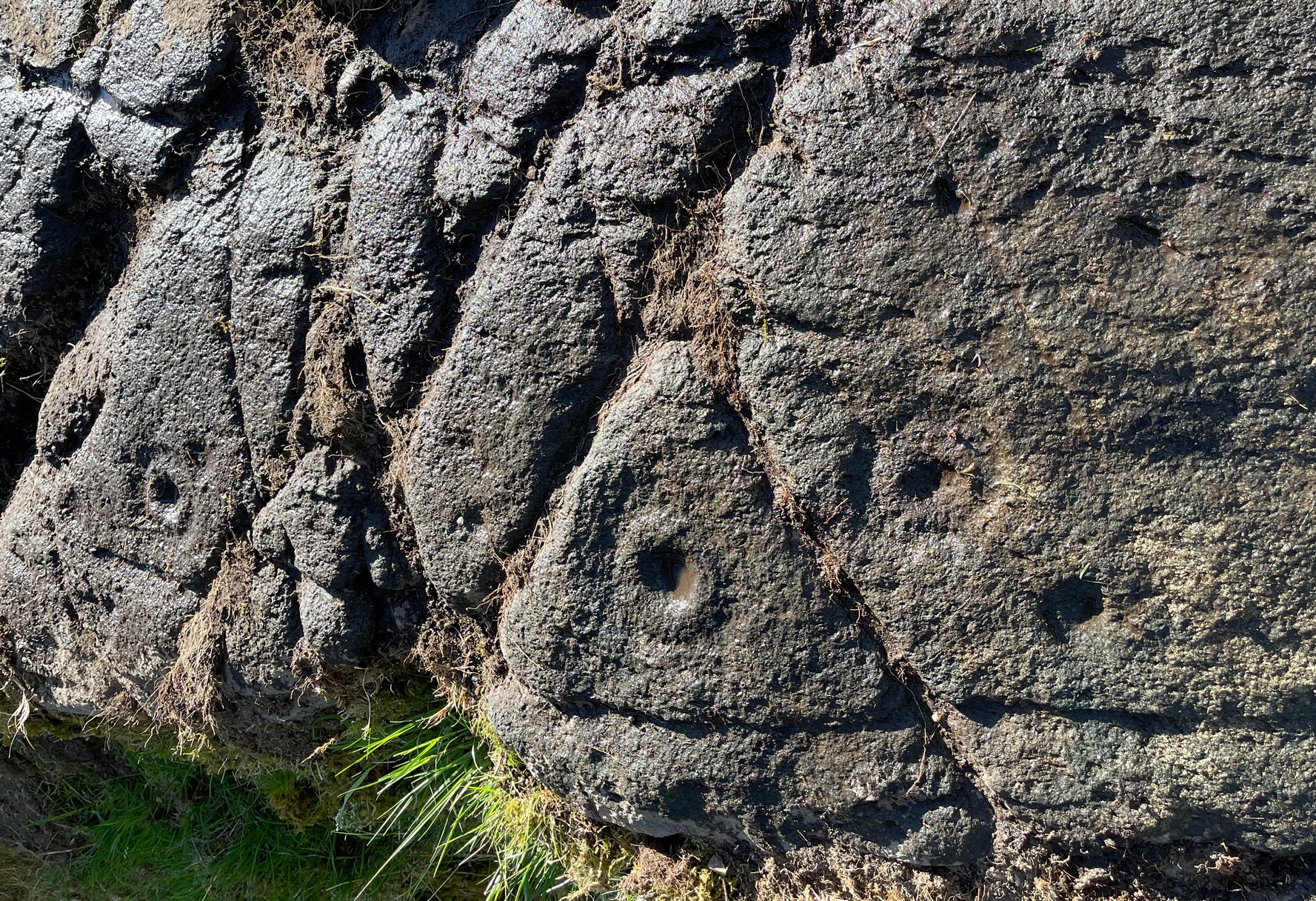
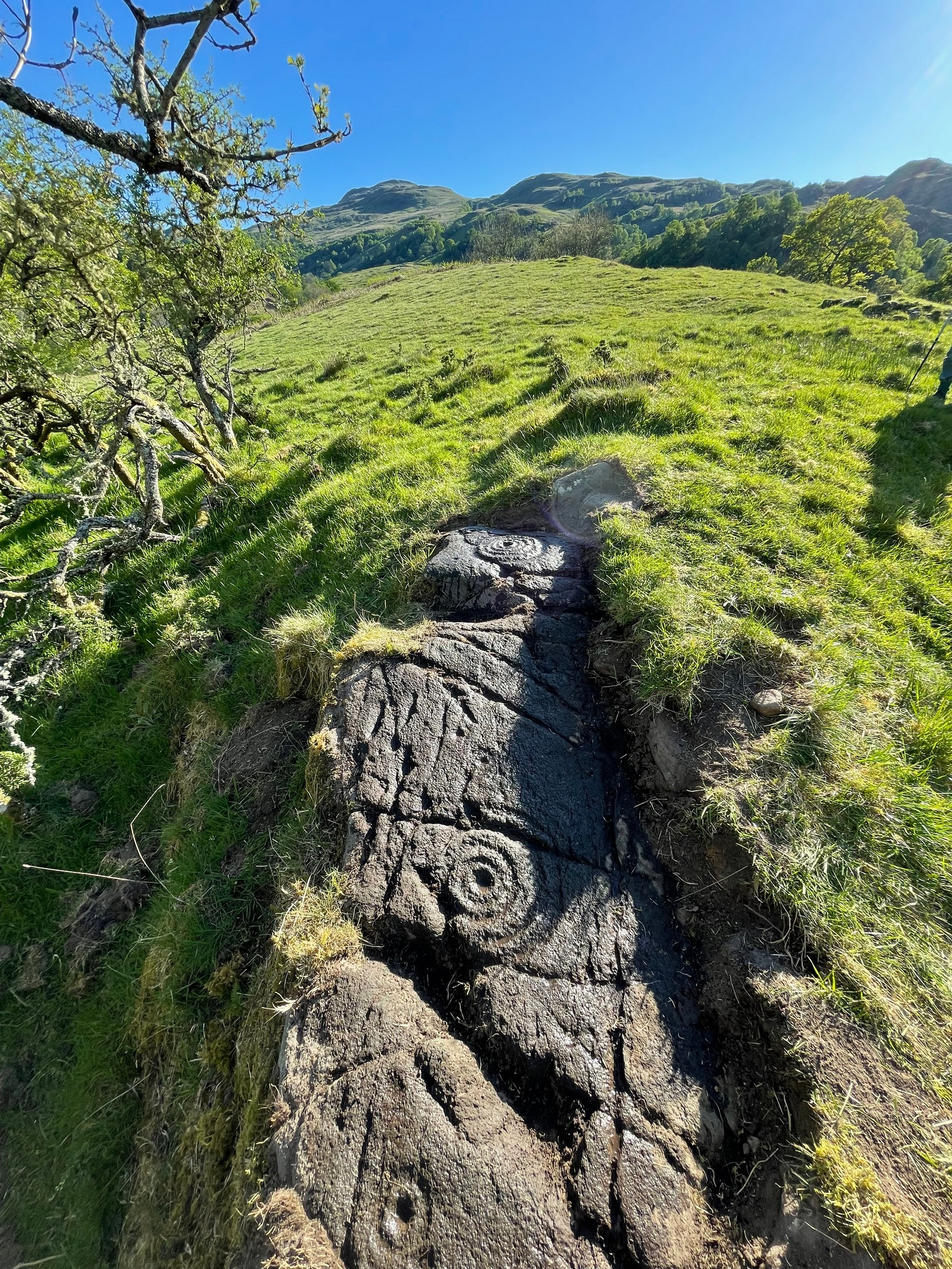
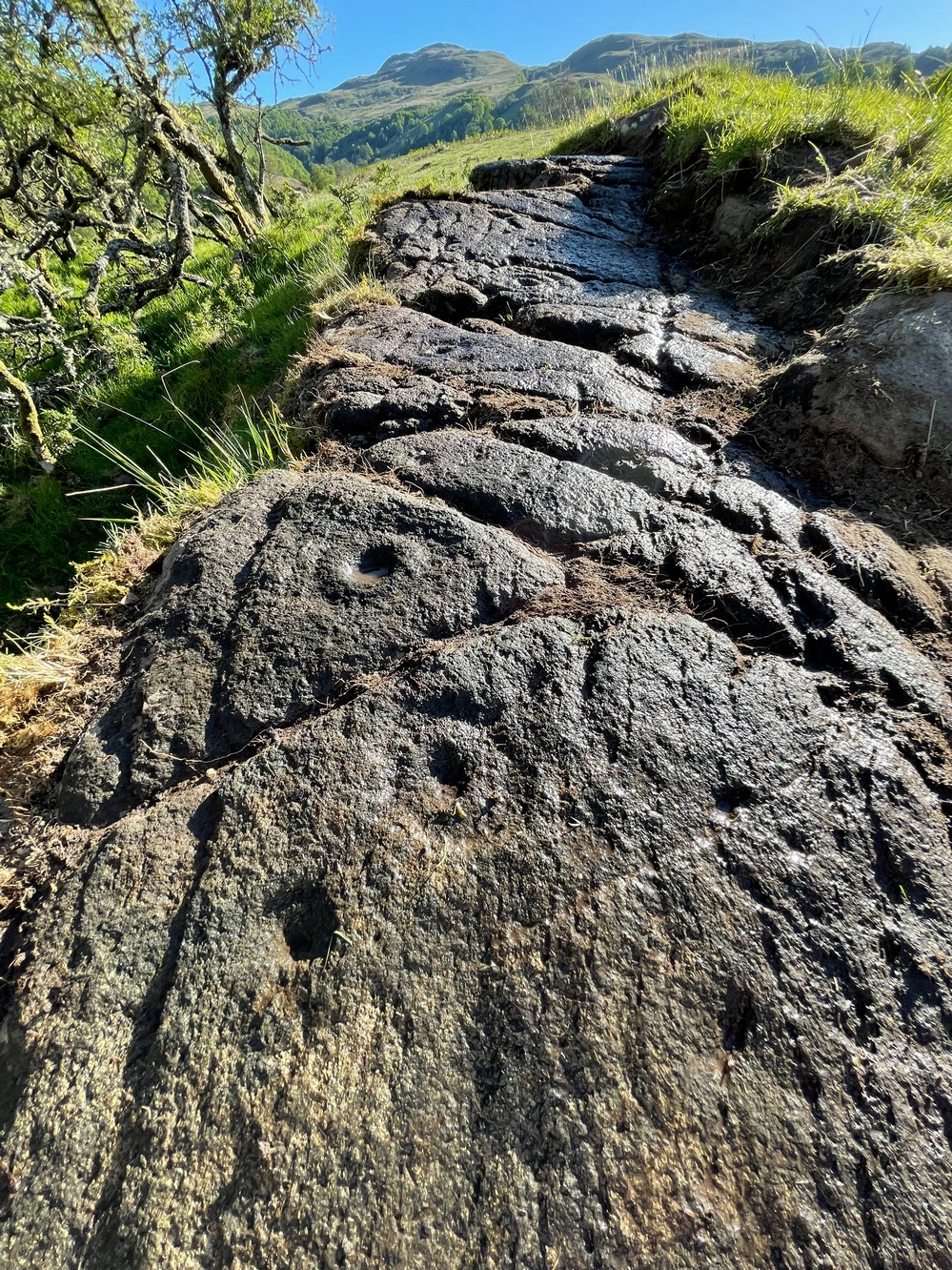
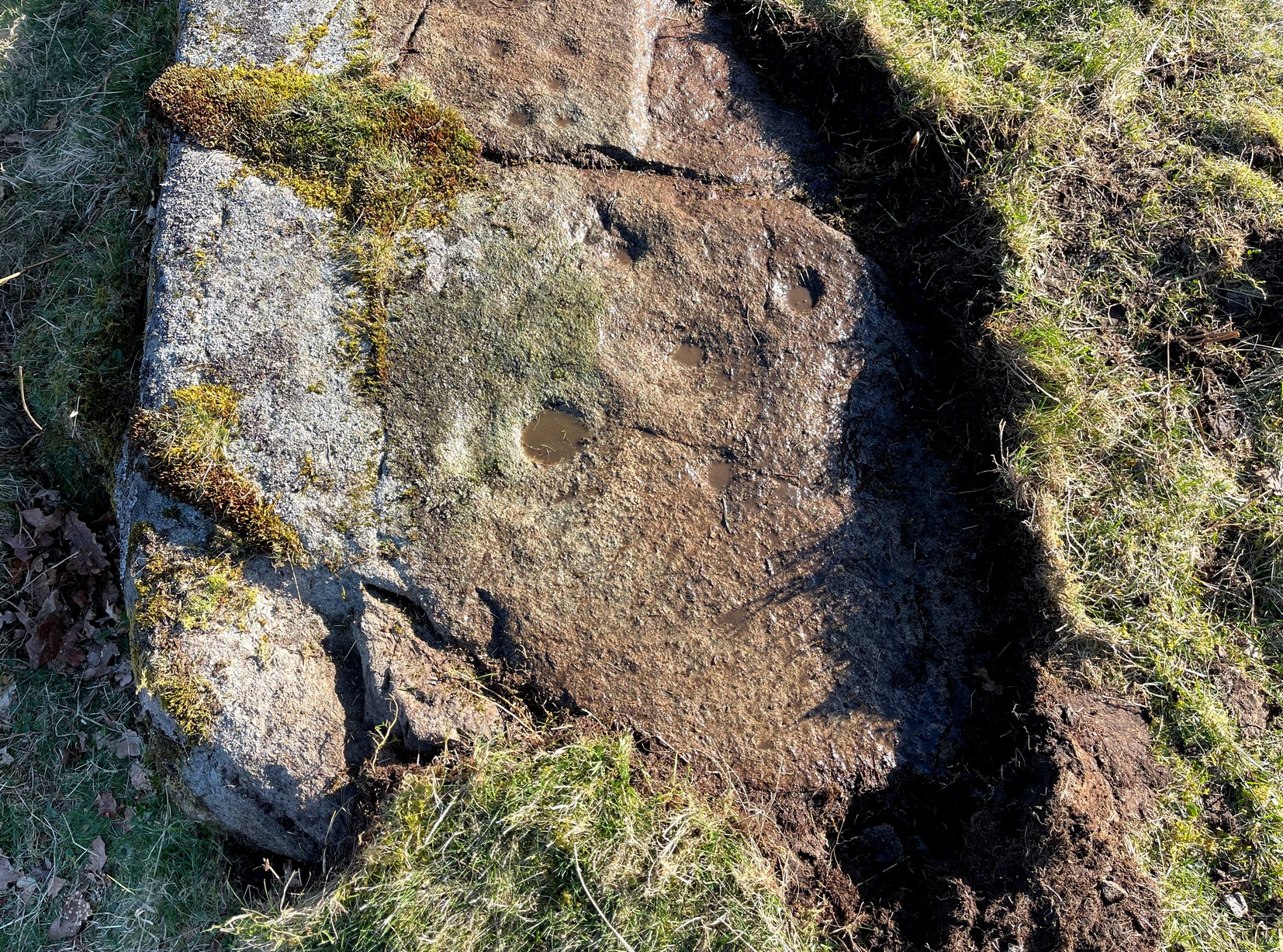
The two cup-and-rings are next to each other on the northen side of the stone, with one based on a small concave depression in the rock itself; but next to this is what seems to be another, third and very faint incomplete cup-and-ring (you can see it in some of the photos here). We walked round and round this and whilst it seems quite obvious, some elements of it appear to be based on natural cracks in the stone, accentuated with minimal pecking by the artist. These three cup-and-rings are next to each other in a veritable Orion’s Belt formation, with a single cup hanging down from the middle.
Carving, looking south
Looking across the design
The other main section of the carving consists of a series of plain cups, scattered in a typically chaotic form and clustering mainly round the centre of the stone; whilst on its southern tip a single cup sits quietly.
When we peeled the turf back to see the entire carving, we found there was a considerable scatter of broken quartz all along the western edge of the stone. This element was also found at the Balimeanach (2) carving less than ten yards away and we’ve found this at a number of other petroglyphs in Perthshire and beyond. Even more intriguing was a large carved stone spearhead covered in soil alongside the quartz scatter! We left this where we found it.
In all probability, there are other carvings that remain undiscovered beneath the turf all along this ridge. Get y’ gardening gloves out!
References:
Currie, George, “Comrie: Balimeanach (BC 3), Cup-marked Rock”, in Discovery & Excavation Scotland, New series – volume 12, 2011.
Less than ten yards south of the Balimeanach (3) petroglyph, this innocuous-looking cup-marked stone can be seen. Paul Hornby and I came across it when looking for the adjacent carving. Comprising of between three and five very faint shallow cups, when we peeled some of the turf over we found a broken hand axe resting on the rock itself. We assumed that this had been the instrument that had been used to knock the cups into being. There were also many small shards of quartz crystal all along the inner edge of the stone: a feature that we and others have found at quite a number of carvings in the Scottish mountains. We left the ruined hand axe where we found it.
4? faint cups in a square
The impression we got here is that the cups are so shallow because the design was never actually completed. Instead, perhaps, they turned to look at the stone ten yards away and thought it was a better choice to cut a more ornate design… Perhaps… It seems pretty likely that other unrecorded carvings will be found close by on the many turf-covered rocks in this area.
Acknowledgements:Huge thanks to Paul Hornby for use of his photo in this site profile.
Cup-and-Ring Stone (lost): OS Grid Reference – NY 3851 8149
Archaeology & History
A petroglyph that was rediscovered as recently as 2003, by J. Ward, has, it would seem, already been lost. In all likelihood it has become hidden beneath vegetation. Found near the Petrifying Well, the carving is archetypal, consisting of a single cup surrounded by two rings, on a low flat piece of rock on the south-side of the Tarras burn, only a few hundred yards above the road. I’ve added the site here in the hope that a diligent petroglyph hunter can find it again and leave it open to the elements for us all to see. Let us know if you find it.
Along the A81 road from Port of Menteith to Aberfoyle, watch out for the small road in the trees running at an angle sharply uphill, nearly opposite Portend, up to Coldon and higher. Keep going, bearing right past Mondowie and stopping at the dirt-track 100 yards or so further up on the left (ignore the english fuckers up here who tell you it’s a pwivate road and they don’t want you parking there—unless you’re blocking the road obviously!). Walk up up here for ⅔-mile, as if you’re visiting the Over Glenny (5) carving, but as you get close to the defining sycamore tree, walk past it for about 60 yards towards the ruinous buildings. You’re looking for a reasonably large earthfast rock with a notable bowl about 12-inch across at the edge of the stone. That’s your defining feature.
Archaeology & History
Arty sketch of the design
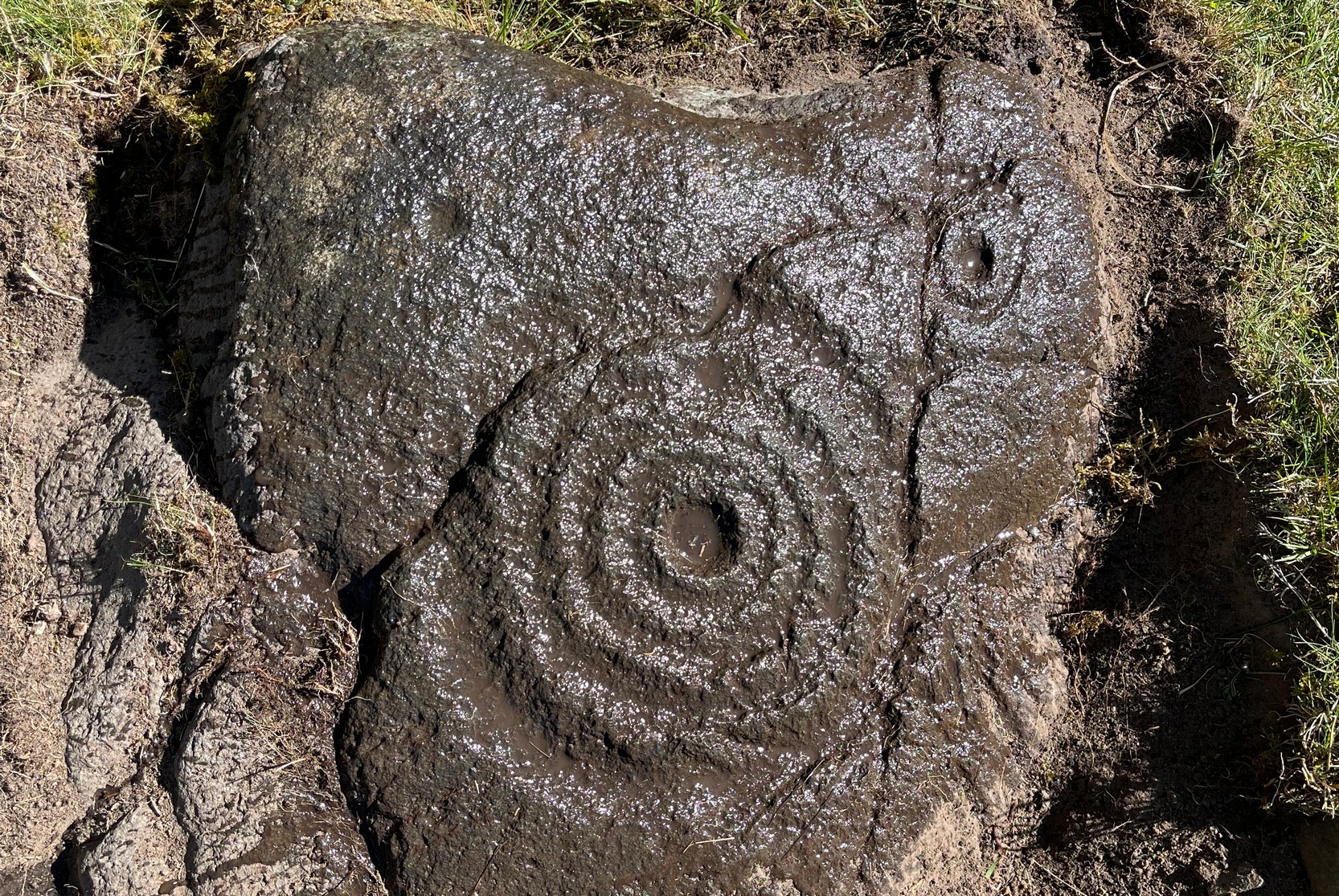
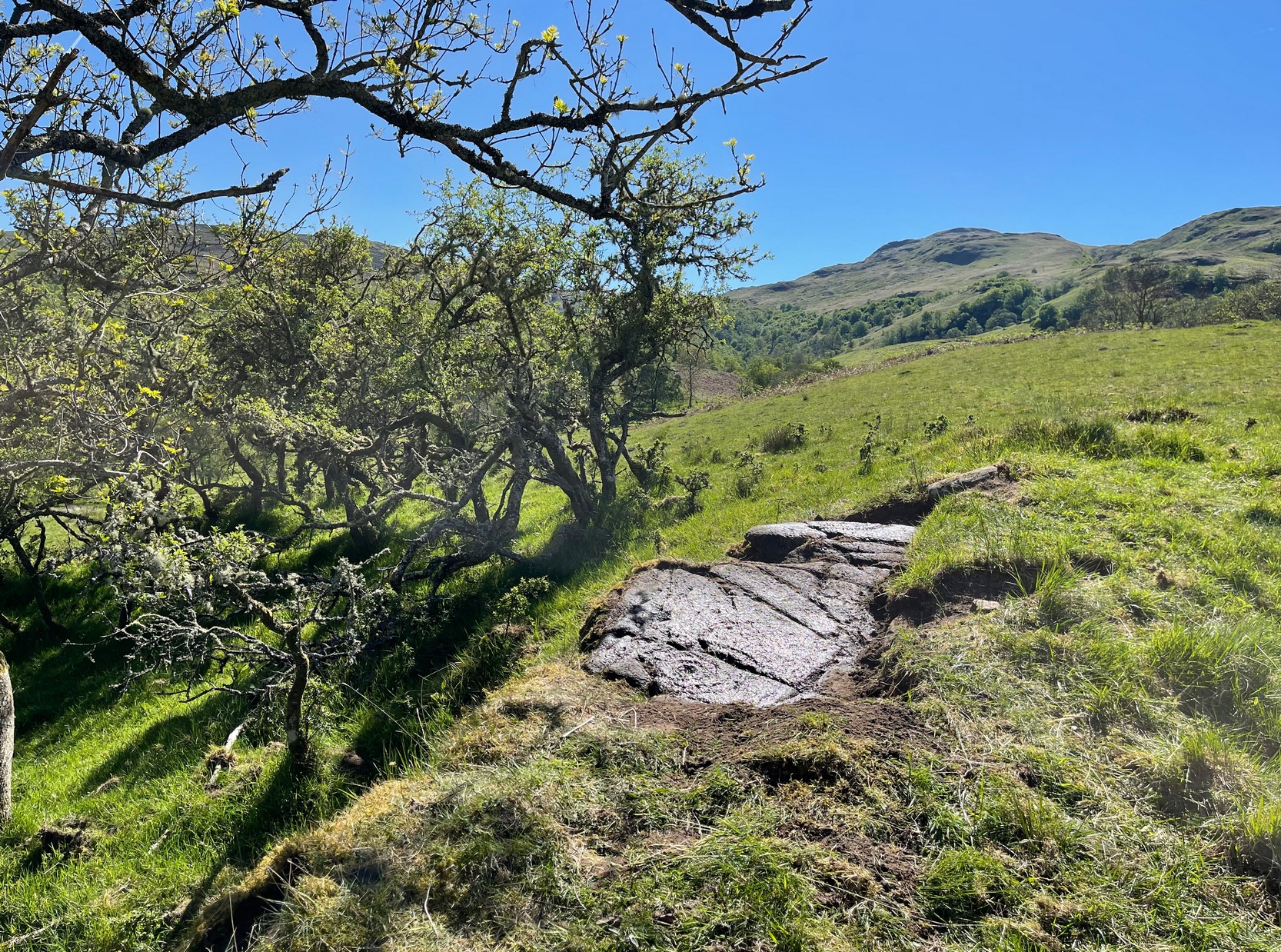
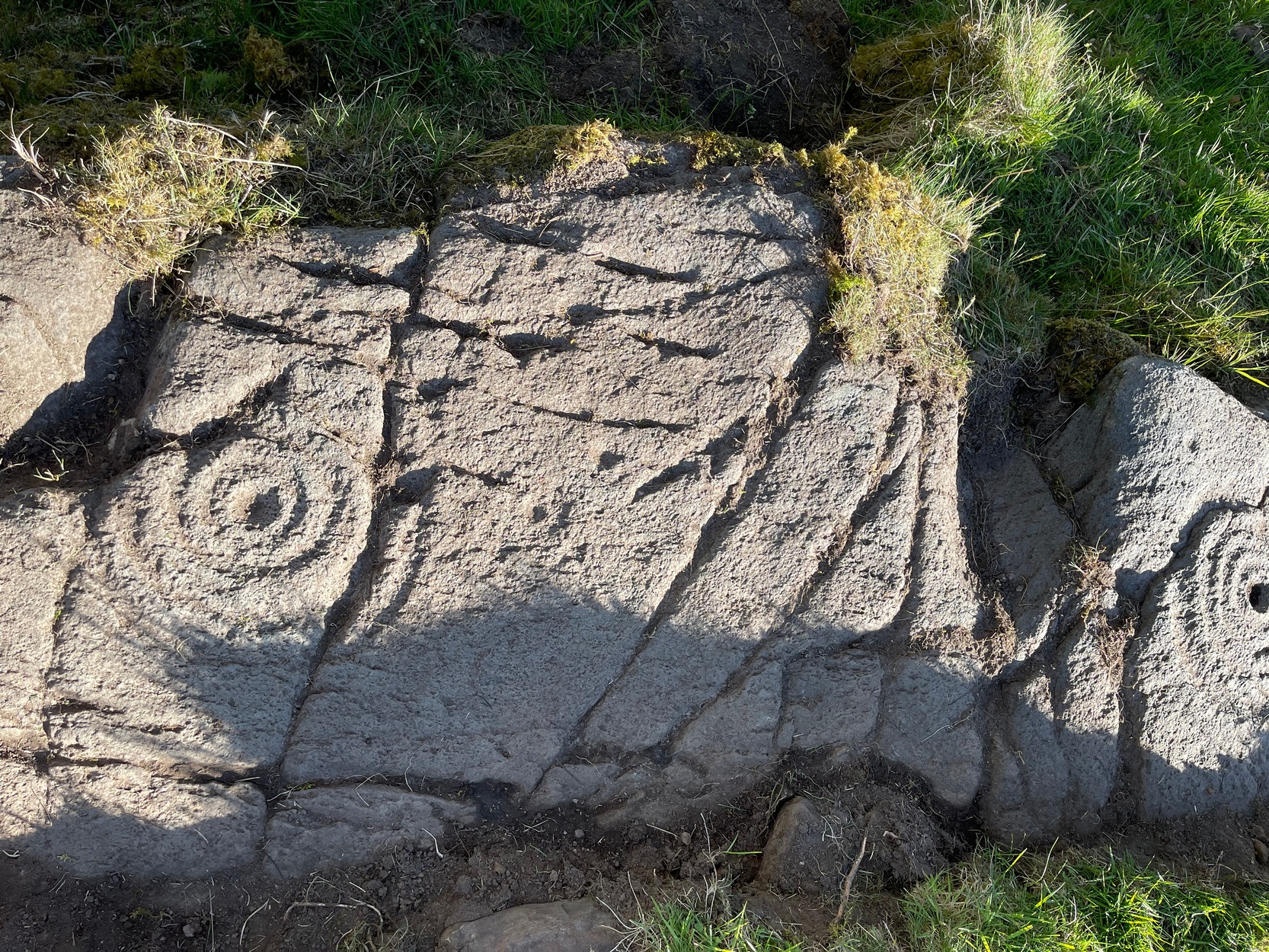
This is another decent design in the mass of petroglyphs on this plain overlooking the Lake of Menteith. On our first visit here ten yeas ago, only one half of the rock was visible—and half of that was covered with grasses! But with patience, we slowly rolled back the turf and slowly uncovered more and more, eventually seeing the main elements you can see in these photos and the arty sketch I’ve made here. (the Over Glenny [14] carving a few yards further east may be just be a continuation of this design)
Full length of the stone
The triple cup-and-ring
When the carving was first noticed by George Currie (2010), he only noticed “a cup mark surrounded by two penannulars, an arc and a single radial”—ostensibly meaning, a cup-and-triple ring, with the outer ring incomplete, and a line running out from the central cup. But there’s more, obviously. On our second visit, a very faint but distinct cup-and-double-ring was noticed in low light on the same section of the rock where the triple-ringed element is carved. We weren’t able to get a photo that showed it, as the light wasn’t doing as we needed, but I’ve highlighted it on the sketch, where it’s to the right of the large ‘bowl’ at the very edge of the rock. This ‘bowl’ probably had utilitarian functions, whether it was for just crushing herbs or grains, or to make organic paints: and this function most likely had some relationship with the petroglyph—but we know not what! It’s possible that the people who lived in the adjacent ruin, several centuries ago, may also have made use of this.
East-end of the design
East-end angular pose
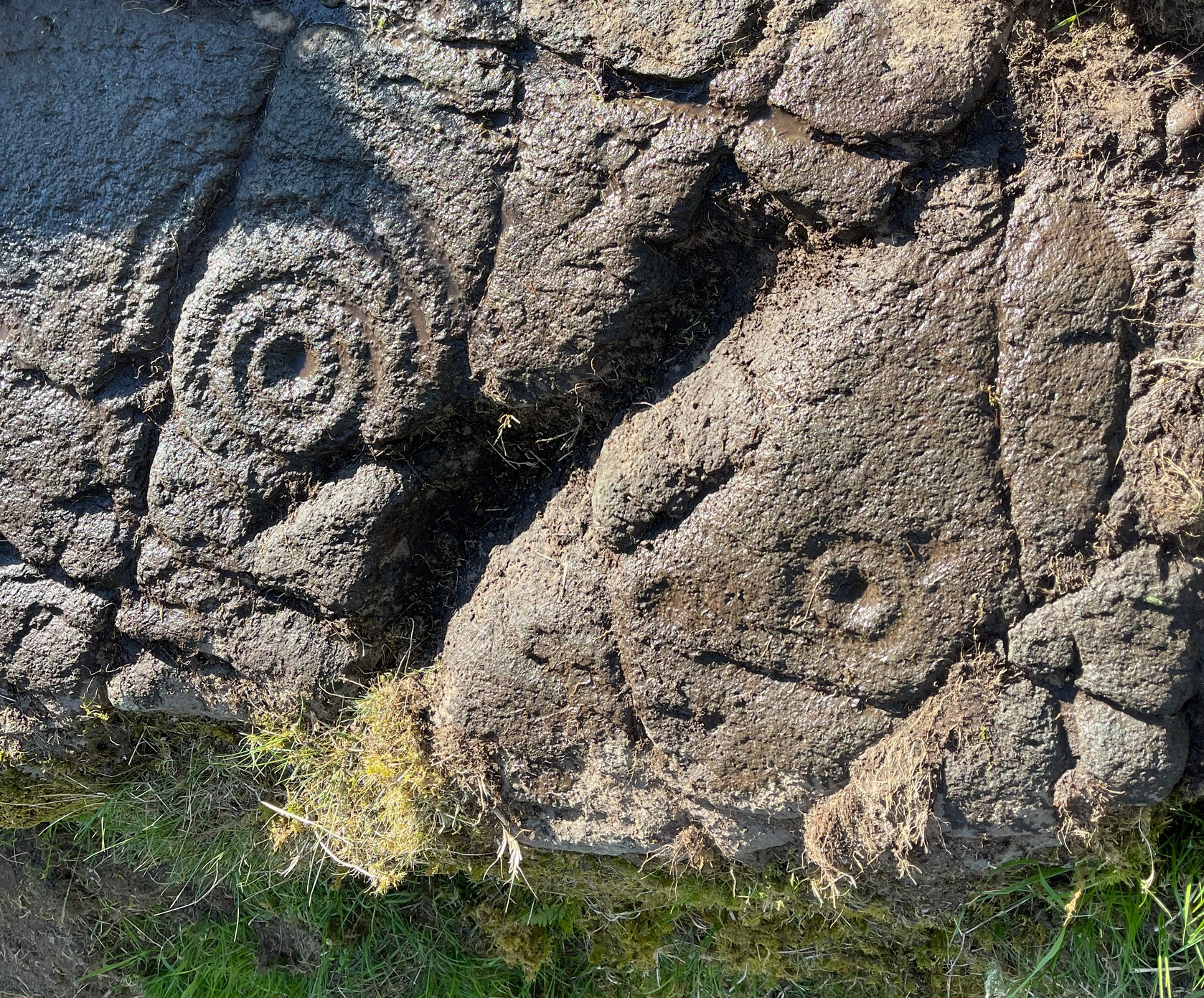
When we exposed the other half of the carving, a very well-cut and well-preserved cup-and-ring sat beside another much more eroded partner, which was almost impossible to see from some angles. You can just make it out in the photos here. You’ll also notice a scatter of several other cup-marks and elongated ‘cups’ on the same section of rock. It was difficult to work out whether some of these marks in the stone were Nature’s handiwork, or the result of human hands. Some were obviously man-made, but we need to look at it again when the daylight conditions are good, so that we can make a more accurate assessment.
Currie, George, “Port of Menteith: Upper Glenny (UG 1), Cup-and-Ring Marked Rocks”, in Discovery & Excavation, Scotland, New Series – volume 11, 2010.
Acknowledgements:Huge thanks to the crew: Paul Hornby, Lisa Samson & Fraser Harrick in making this carving come to life, and for use of a photo or two.