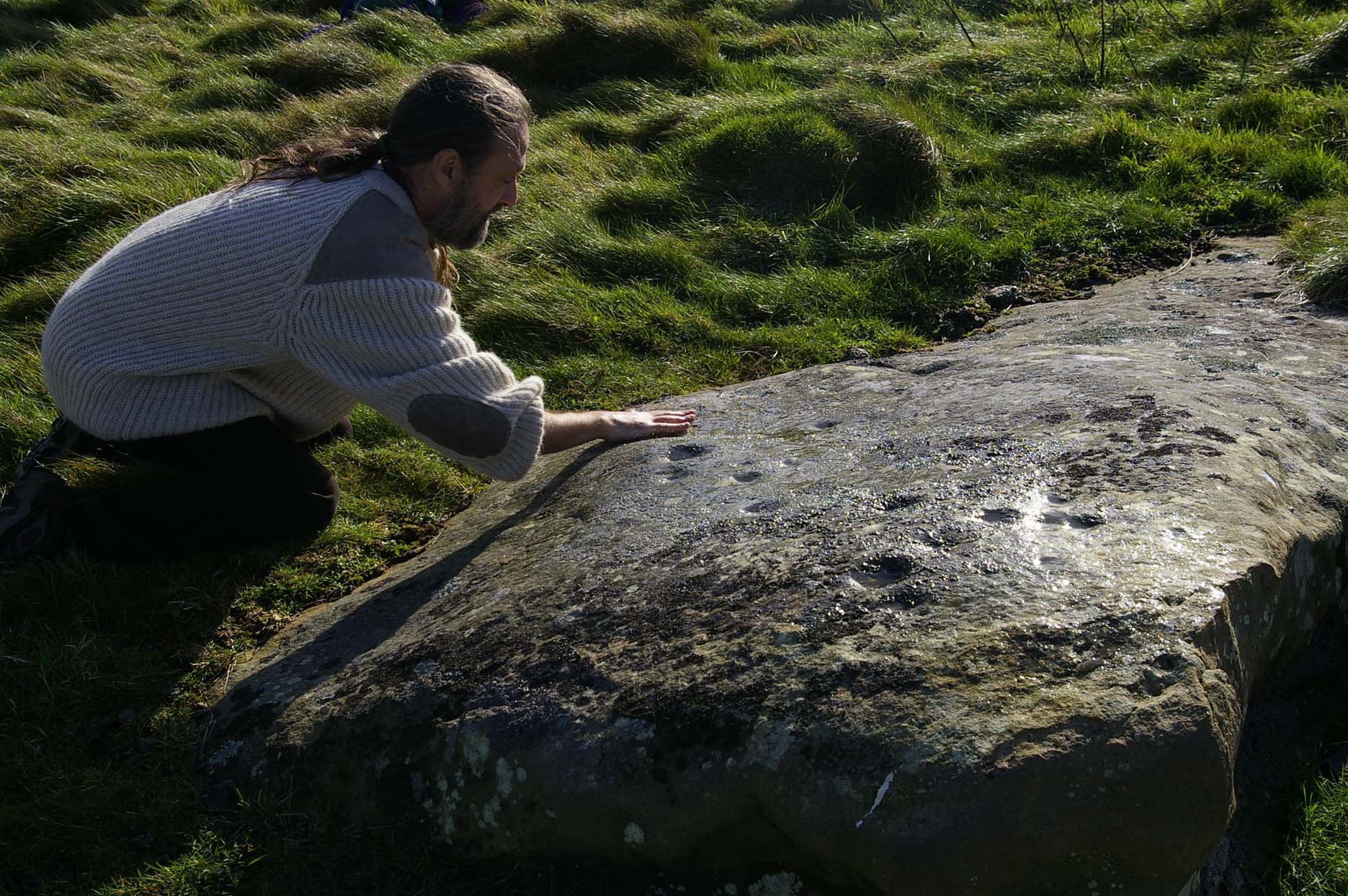
Fyfield Down, Avebury, Wiltshire

Cup-Marked Stone:  OS Grid Reference – SU 1343 7152

Getting Here
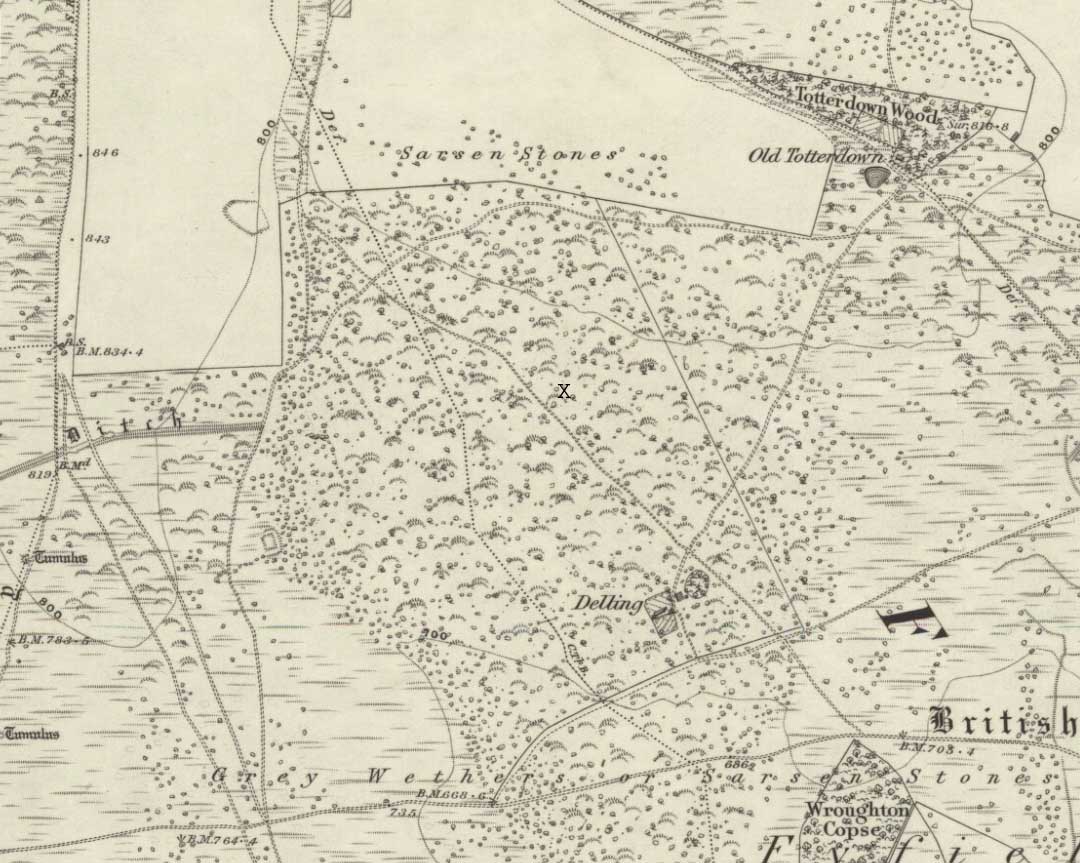
‘X’ roughly marks the spot

We were fortunate and taken here by the renowned local megalith authority, Pete Glastonbury – but without Pete’s help you might be ambling here and there for quite a while.  It’s on the eastern side of The Ridgeway, down the slope past the stone known as The Polisher, across the flatland sea of many rocks until it begins rising again a few hundred yards east.  Where a long straight embankment rises up a few feet (a boundary line), the rock’s just a few yards above it.  Walk back and forth around here and you’ll eventually find it!

Archaeology & History
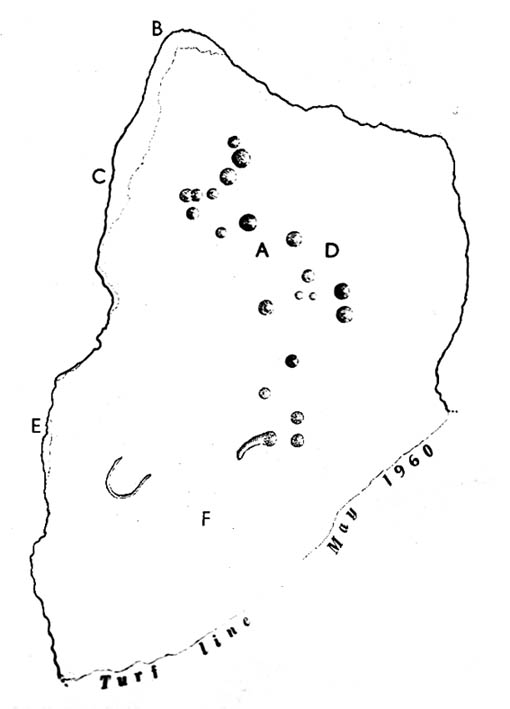
Lacaille’s 1962 sketch of the carving

Archaeologist A.D. Lacaille (1962) appears to have been the first person to have written about this little-known site, describing it as being “between the south-western corner of Totterdown Wood and Delling Cottage.”  Here is what he described as, “a cluster of unmistakably artificial and mostly well-preserved cup-markings on the smooth south-easterly sloping surface of a recumbent sarsen.”
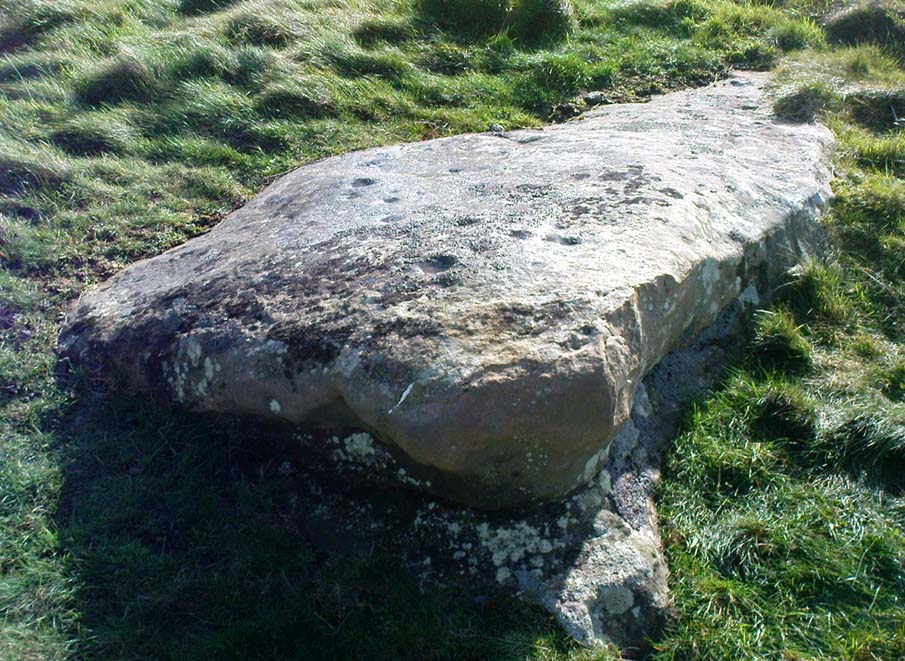
Fyfield cup-markings (© Pete Glastonbury)

And from the photos accompanying Lacaille’s article, it obviously looked a decent carving as well — and so it has transpired.  Lacaille (1963) briefly mentioned the carving again a year later in his lengthier essay on the nearby Polisher Stone up the slope a few hundred yards away.  But then Wiltshire’s only known cup-marked stone was all-but ignored by archaeologists and left in the literary wilderness until, years later when rock art became a fad in such circles, regional archaeologists Pete Fowler & Ian Blackwell (1998) described the carving as “a cluster of several round depressions…each about two inches across”; though incorrectly ascribed it as the “southernmost example” of cup-marked stones outside of Cornwall.¹  Another rock-art student known as Mr Hobson, following his excursion to the site with the regional authority Pete Glastonbury, wrote:

“The cups themselves are very smoothed out, and fit the bill from the drawing. The horseshoe is very evident, as is the ‘slug’ mark, possibly a half-finished groove from one of the cups near the horseshoe. There are also some angular, yet serpentine (?) grooves at turf level on the south side of the stone. These look like they might be enhanced natural marks in places.”

The rock itself isn’t in its original position, having been moved from another point very close by (probably only yards away).  It is sited on the edge of an old boundary line — which made me wonder whether the ‘U’- or ‘C’-shaped ingredient in the carving was a later addition, perhaps of one of the old land-owners hereabouts.  The cups however, seem typical of the thousands that we find in northern Britain.
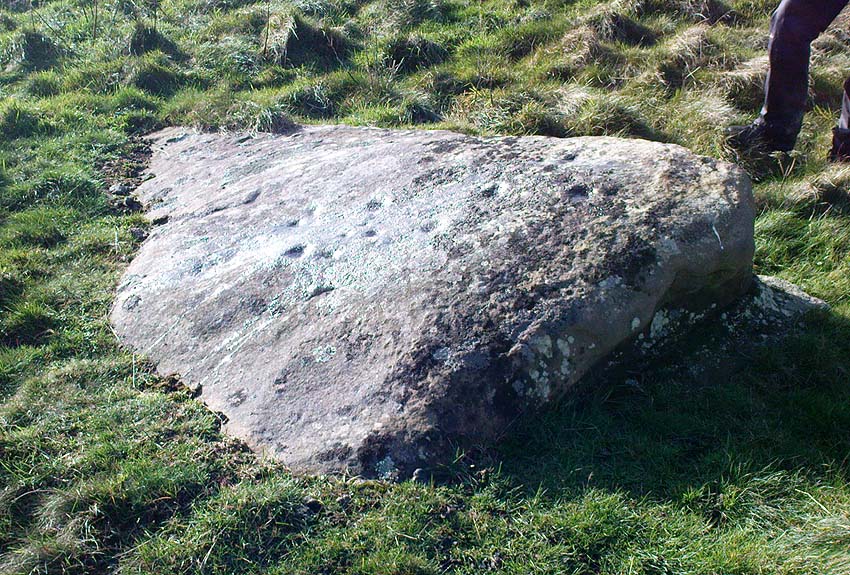
and from another angle (© Pete Glastonbury)
Primitive man & stone (© Pete Glastonbury)

The isolation of this carving is rather anomalous.  Others should be in the area but archaeo-records are silent (though the majority of Wessex archaeologists are academically illiterate when it comes to identifying such carvings).  The carving may simply be the product of nomadic northerners, showing what their tribes do ‘up North’, so to speak.  However, considering the tough nature of southern sarsen stones, it’d have taken ages to etch just this one stone.  You can visualise it quite easily: southern tribal folk looking on, somewhat perplexed, as a northern traveller tried to convey what they etch on their stones in the northern lands, only to struggle like hell with cup-marks they’d do with ease on the softer rocks of their homelands.  Wessex tribes-folk may have watched, seen the trouble their traveller had over such inane and (perhaps) meaningless carvings, and didn’t see the mythic point s/he was trying to convey…
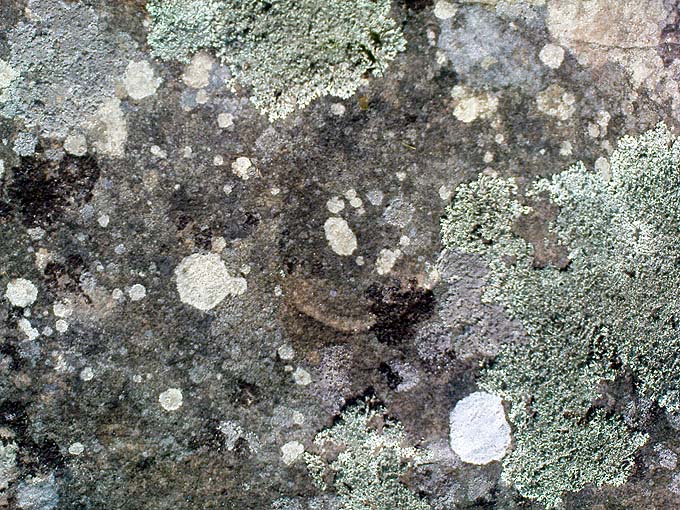
Curious ‘U’ or ‘C’-shaped feature

Or maybe not!

The lesson with rock-art tends to be simple: where there’s one carving, others are nearby.  The rule aint 100% of course — but when we were here the other day I was wanting to dart here, there and everywhere to check the many thousands of outcrop rocks that scatter this entire area.  Us rock-art nuts tend to do things like that.  It’s a madness that afflicts…

There were one or two stones with ‘possible’ single cup-markings on them, but I wasn’t going to start adding them to any catalogues.  They were far too questionable.  I was wanting something a bit more decent than that.  And then, when Mikki, June, Pete, Geoff and I got to the collapsed long barrow known as the Devil’s Den a few hundred yards further down this rock-strewn sea of a valley, there was something with a bit more potential that we came across…

Folklore

In recent years this cup-marked stone has already attracted imaginative notions, with little foundation.  Archaeologists Fowler & Blackwell (1998), in their otherwise fine book, think this carving was related to goddess worship, describing how,

“On Dillion Down…the Great Mother’s help was permanently invoked by patiently indenting a special stone with symbols of her potency.”

Adding that this “was a new idea brought in from the North, and Fyfield was the only place to have such a stone.”  Weird!  I could’ve sworn there were plenty of other rocks between here and there!

References:

  1. Fowler, Peter J., Landscape Plotted and Pieced: Landscape History and Local Archaeology in Fyfield and Overton, Society of Antiquaries London 2000.
  2. Fowler, Peter & Blackwell, Ian, The Landscape of Lettice Sweetapple, Tempus: Stroud 1998.
  3. Lacaille, A.D., ‘A Cup-Marked Sarsen near Marlborough, Wiltshire,’ in Archaeological Newsletter 7:6, 1962.
  4. Lacaille, A.D., ‘Three Grinding Stones,’ in Antiquity Journal, volume 43, 1963.

¹ Along with the cup-markings atop of Devil’s Den a few hundred yards to the south, across in Somerset we had the Pool Farm example; there are a number of examples in Dorset, including the Badbury Rings carving; plus others in Devon, etc.

* Pete Glastonbury is a Wiltshire-based photographer specialising in Landscapes, Astronomy, Archaeology, Infra-Red, Experimental Digital Photography and High Dynamic Range Panoramic photography.

© Paul Bennett, The Northern Antiquarian

East Adderbury Cursus, Banbury, Oxfordshire

Cursus: OS Grid Reference – SP 473 372

Also known as:

  1. Bodicote Cursus

Found a few miles south of Banbury and running in a southeast to northwest alignment, Paul Devereux wrote that,

“the crop marks of this cursus fragment were first photographed by James Pickering in 1972…between the villages of East Adderbury and Bodicote…close to the River Cherwell.  The southeast end is square; the other terminus is unknown.”

References:

  1. Pennick, Nigel, & Devereux, Paul, Lines on the Landscape, Hale: London 1989.

© Paul BennettThe Northern Antiquarian 2016


Druid’s Stone, Bungay, Suffolk

Legendary Rock:  OS Grid Reference – TM 337 898

Folklore

Described in 1926 by local antiquarian and early ley-hunter, W.A.  (1926), as “a fallen monolith” — this old stone is probably just a glacial erratic.  Found in the churchyard of St. Mary’s, tradition tells that in ages past young girls danced twelve times around this old stone, then placed their ears upon it to hear the answers to their questions and wishes. A similar legend tells how children danced around the stone seven times on a certain day of the year to conjure up the devil.  Mr Dutt thought the great rock may have been “a ley or direction stone.”

References:

  1. Dutt, W.A., The Ancient Mark-Stones of East Anglia, Flood & Sons: Lowestoft 1926.

© Paul Bennett, The Northern Antiquarian


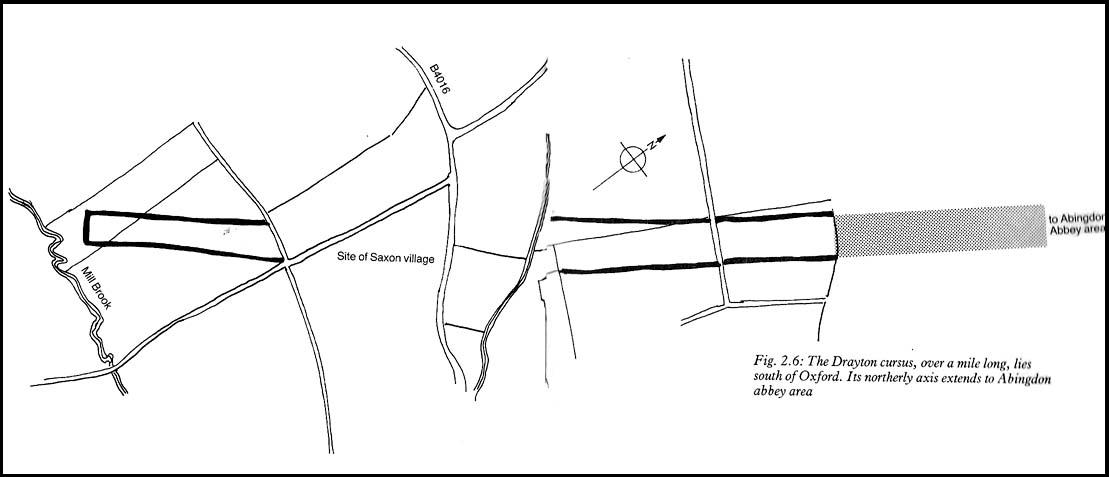
Drayton Cursus (north), Abingdon, Oxfordshire

Cursus Monument:  OS Grid Reference – SU 490 941SU 492 950

Drayton Cursus alignment (courtesy Paul Devereux)

Archaeology & History

This minor cursus monument was etched into the landscape in neolithic times.  Found to the south of Abingdon and close to the River Thames, one report showed finds from the site dating from 2900 BC.  There is also a neolithic henge monument very close to its northern terminus and a plethora of other Bronze Age remains all round.  Paul Devereux (1989) described how crop marks revealed,

“a substantial former cursus immediately to the east of Drayton: its crop marks extend southwest to northeast for a little over a mile, and are 225 feet (68 metres) wide. The cursus has a squared south end, but the northern terminus has not been found. The crop marks are not evident in the middle portion of the cursus, as it was formerly overlaid by a Saxon village. There is a plethora of other crop marks within and around the cursus… The northern section…which has a slightly different orientation to the southern segment, points squarely to the ancient heart of Abingdon.”

References:

  1. Ainslie, R. & Wallis, J., ‘Excavations on the Cursus at Drayton, Oxon’, in Oxoniensis 52, 1987.
  2. Barclay, A., Lambrick, G., Moore, J. & Robinson, M., Lines in the Landscape, OAU: Oxford 2003.
  3. Loveday, Roy, Inscribed Across the Landscape, Tempus: Stroud 2006.
  4. Pennick, Nigel & Devereux, Paul, Lines on the Landscape, Hale: London 1989.

© Paul Bennett, The Northern Antiquarian

Dorchester Cursus, Oxfordshire

Cursus:  OS Grid Reference – SU 569 958SU 581 948

Also Known as:

  1. Dorchester-on-Thames Cursus
  2. Overy Cursus

Archaeology & History

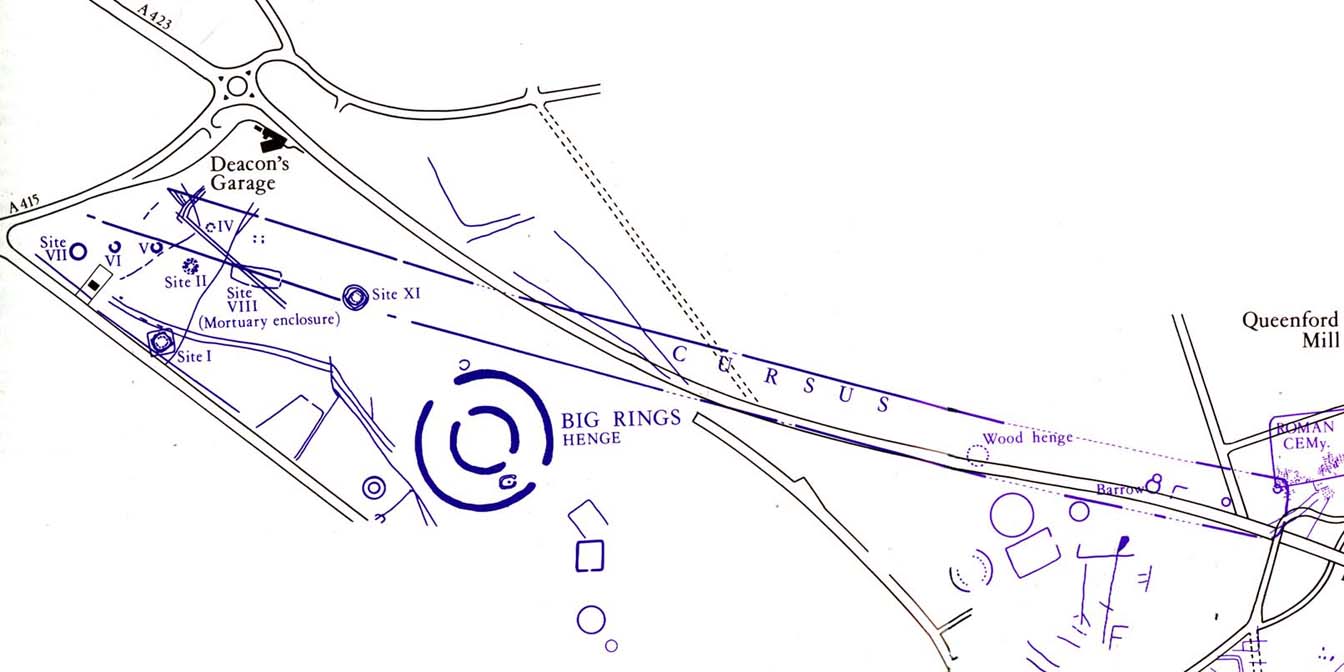
Dorchester cursus (after Atkinson)

Nowadays marked on modern Ordnance Survey maps as part of a ‘Neolithic Sacred Complex,’ this linear monument was part and parcel of the Dorchester Big Rings henge complex and was associated with a  number of other important prehistoric sites, many of which have been destroyed by ecological disfigurement projects in recent years.  In Gordon Copley’s (1958) description of the monument, not long after its initial discovery, he said that this “was a cursus which consists of parallel ditches some 4000 feet long with 210 feet between them.”  In more recent times Paul Devereux (1989) described how the cursus here,

“ran for three-quarters of a mile (1.2km) in a northwest to southeast direction on the north side of the Thames and was 210 feet (64 metres) wide. The cursus was part of a complex of crop marks, the most notable being” the henge. “The northwest end of the cursus remains unknown; the southeast end was rounded. The southeast segment…was on a slightly skew alignment compared to the rest of the feature, though it may have been the earliest part of the monument – bones found there were radio-carbon dated to around 3000 BC. The southern ditch of the cursus ran through and connected two earlier sites which shared a different alignment. Deposits of cremated bones, a stone arrowhead, fragments of pottery, a polished flint axe, and a circle of pits, probably the remains of a ‘woodhenge’ structure, were all found with the cursus.”

Dorchester cursus plan 1985

Jean Cook (1985) told that later excavations on the site in 1981, found that the shallow ditch which surrounded the entire cursus, “was interrupted by a central entrance on the southeast side.  The southeastern terminal ditch respected a small prehistoric monument which has been dated to approximately 2000 BC.”  This and other factors has led to the thought that the cursus may not all have been built at the same time.  And indeed excavations at other sites scattering the northwestern ends of the cursus (shown in the plan here, Ed.) proved that a D-shaped enclosure “pre-dates the rest of the structure.”  Other mortuary sites scattered the edges of the cursus that were added in the centuries which followed, but which need excavation work to uncover their secrets.  Although much of this was done in the Atkinson digs, they were summarised well by Jean Cook (1985), who told:

“Site VIII, excavated in 1948, was a monument known as a mortuary enclosure.  Sometimes such structures take the form of long barrows, but this one was a rectangular enclosure bounded on all four sides by a ditch with an internal bank.  There were narrow entrance gaps on the two longer sides and a wider entrance in the centre of the shorter southern side.  It is dated by the substantial sherds of Ebbsfleet ware (pottery) which were found in the upper filling of the ditch; part of a human jaw from within the enclosure helps to confirm the mortuary function.

“Site XI, excavated in 1949, consisted of three or more concentric ditches, of different dates, enclosing an incomplete ring of 14 pits.  The middle ditch seems to have surrounded an oval barrow or enclosure and to have then been converted to a circular plan.  Some of the pits contained animal bones, one contained an antler pick and one contained a complete human cremation, but there were no accompanying grave goods.

“Both these sites were in existence before the cursus was built. (my italics, Ed.)  This is shown by the fact that the southernmost ditch of the cursus cuts through Site VIII and abuts Site XI.  These two earlier sites seem to share the same alignment, but once the cursus was constructed it set a new alignment which may have been of significance until the end of the 3rd millenium BC.  Three monuments built after the construction of the cursus were located inside it, two of them being along the central axis, and two others were just outside the southernmost ditch of the cursus but shared the same general alignment.

“Sites IV, V and VI, which were also excavated in 1949, have a similar overall plan and all of them contained a number of cremation deposits suggesting that amongst other things they acted as cemeteries.  All three sites had a circular plan and consisted of an outer bank, to define the central area, and an inner ditch, the purpose of which seems to have been to provide earth for the bank.  In Site IV the ditch was made up of eight oval pits, enclosing an area of about six metres in diameter.  There was a broad entrance gap on the southeast side.  Inside the enclosed area there were 25 deposits of cremated bones.  An arrowhead was found with one of the cremations.  Site V was very similar in construction, except that the entrance gap was on the northwestern side and contained 21 cremation deposits.  No grave goods were found.  Site VI again had a similar plan with the entrance gap to the north.  There were 49 cremation deposits , one accompanied by a flint fabricator, an arrowhead and burnt flint flakes.

“Site 1 was excavated in 1946 and consisted of a small square ditch, enclosing another more or les circular ditch with an internal bank.  Inside this ditch were 13 holes, forming a ring with an entrance gap on the western side.  There were no entrances in the surrounding ditches.  A crouched burial was found within the entrance to the ring of holes but there were no accompanying grave goods.  Four cremations were found, two accompanied by fragmentary bone pins, in or besides four of the central holes.  At a later stage in the neolithic period, parts of the ditch may have been enlarged to make temporary shelters: it is not clear to which period of use the cremations belong.

“Site II, also excavated in 1946, consisted of a causewayed (interrupted) ring ditch which was enlarged on two occasions.  The third ditch had an internal bank in which were 19 cremation deposits.  Two more cremations were found at the centre of the enclosed area.  There was no evidence for any gap.  Bone pins were found with four of the cremations as were flint fragments.  In addition, antlers and other flint fragments were found, as well as pieces of pottery.

“In 1981 a small semi-circular enclosed ditch was excavated within the southeast terminal of the cursus.  Though sited off-centre, the ditch shared the same alignment with the cursus.  An antler (dated to c.2000 BC) was found close to the bottom of the ditch.  After the ditch had virtually filled up with silt, the surviving low central mound was used for cremation deposits, one of them associated with a heavily burnt flint blade.”

Paul Devereux (1989) pointed out how one of the archaeologists studying this site found that if the axis of the monument was extended southeast, across the river, it lined up perfectly with another set of perfectly straight lines which were thought “likely to be a Roman trackway.”  Unfortunately much of this area has been destroyed through the self-righteous ignorance of modern industrialism.

References:

  1. Atkinson, R.J.C. et al, Excavations at Dorchester, Oxon, Department of Antiquities: Oxford 1951.
  2. Barclay, A., Lambrick, G., Moore, J. & Robinson, M., Lines in the Landscape, OAU: Oxford 2003.
  3. Cook, Jean, “The Earliest Evidence,” in Dorchester through the Ages, Oxford University 1985.
  4. Cook, Jean & Rowley, Trevor (eds.), Dorchester through the Ages, Oxford University 1985.
  5. Copley, Gordon J., An Archaeology of South-East England, Phoenix House: London 1958.
  6. Loveday, Roy, Inscribed Across the Landscape, Tempus: Stroud 2006.
  7. Pennick, Nigel & Devereux, Paul, Lines on the Landscape, Hale: London 1989.

© Paul Bennett, The Northern Antiquarian

St. Osyth’s Well, St. Osyth, Essex

Holy Well:  OS Grid Reference – TM 116 166

Archaeology & History

This spring of water is in the edge of Nun’s Wood on the north side of the Dolphin Pond pool and is covered by a small stone building, from which issues a small stream into the lake.  Remains of an old nunnery in the woods are said to be the oldest such monastic remains in England.

Folklore

This holy well, the woods in which it’s found, and the old straight road leading to the chapel,* are all said to be haunted by the headless ghost of old St. Osyth, beheaded — in one legend — by the Danes who came here in the 7th century.  At the spot where she’s said to have received her final fatal blow, the waters from this now bricked-up old well gushed forth from the Earth. (Prior to this, folklore tells how St. Osyth was ‘killed’ several times, and each time came back to life – just as in shamanic lore, from which such early christian tales were glossed onto.)

Of it medicinal virtues, Robert Charles Hope (1893) told us that St. Osyth’s Well had been blessed by many a sufferer who found there a medicine for his ills, and at that time, “continues to this day as a sovereign remedy for many diseases.”

References:

  1. Hope, R.C., Legendary Lore of the Holy Wells of England, Elliott Stock: London 1893.

* I’m presuming that the old road to the chapel here is the long straight grove of trees which ran from St. Osyth’s Chapel and up towards the well. Anyone know for sure?

© Paul Bennett, The Northern Antiquarian

Serpent’s Well, Chipping Norton, Oxfordshire

Sacred Well:  OS Grid Reference – SP 31 27?

Archaeology & History

This legendary-sounding spring of water was described in field-name listings from the 1770 Enclosure Acts, but nothing seems to have been written about it since.  To me at least, there seems little doubt that this site would have been a sacred or legendary water-site. Curiously it is in William Henderson’s collection of northern folk-tales where we find a mention of further dragon lore from the township, albeit briefly, where he wrote:

“Near Chipping Norton, in Oxfordshire, A.D. 1349, was a serpent with two heads, faces like women, and great wings after the manner of a bat.”

In Nigel Pennick’s (1997) overview of dragon legends he copied Henderson’s earlier note, but neither of them gave specific indications relating the legend with our Serpent’s Well.  So, to those of you who live in and around Chipping Norton (where I spent two very good years living with Sir Wilson at the Rollright Stones) – what has become of it?  Where exactly is it?  And does anyone know anything more behind this tale and any further history behind the ‘Serpent’s Well’?

References:

  1. Gelling, Margaret, The Place-Names of Oxfordshire, Cambridge University Press 1953-54.
  2. Henderson, William, Notes on the Folk-lore of the Northern Counties of England and the Borders, Folklore Society: London 1879.
  3. Pennick, Nigel, Dragons of the West, Capall Bann: Chieveley 1997.

© Paul Bennett, The Northern Antiquarian


Fornham All Saints, Bury St. Edmunds, Suffolk

Cursus:  OS Grid Reference – TL 8406 6732 to TL 8291 6876

Also known as:

  1. All Saints Cursus
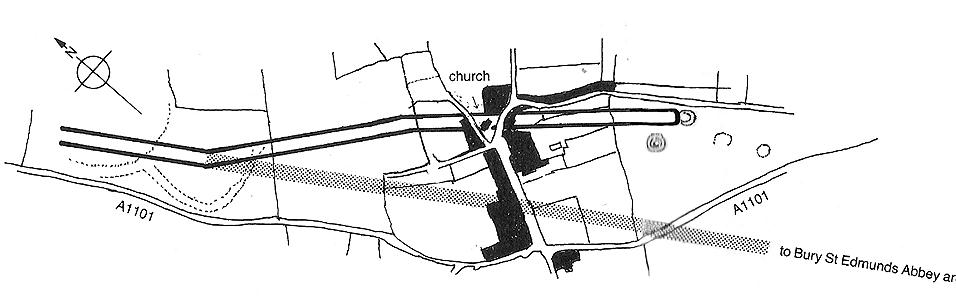
The Forham All Saints Cursus (image courtesy, Paul Devereux)

Archaeology & History

The remains of this cursus can be found in the valley of the Lark.  In Paul Devereux’s (1989) survey of these gigantic neolithic features he described how today we can only see it as crop-markings, stretching in a

“roughly northwest to southeast direction for about a mile; its width approximately 140 feet (42.5 metres). It is comprised of three straight lengths, each at slightly different orientations – there is no way of telling at present (c.1988) whether or not these segments were built at different times, as is believed to be the case at certain other cursuses where changes of direction occur. The northmost terminus has not been located, but the southern one is visible from the air and is next to a circular crop-mark.”

Some 350 yards further on from the end of the cursus is the village church of All Saints, whose old festival date centred around Halloween, or the old pre-christian New Year.

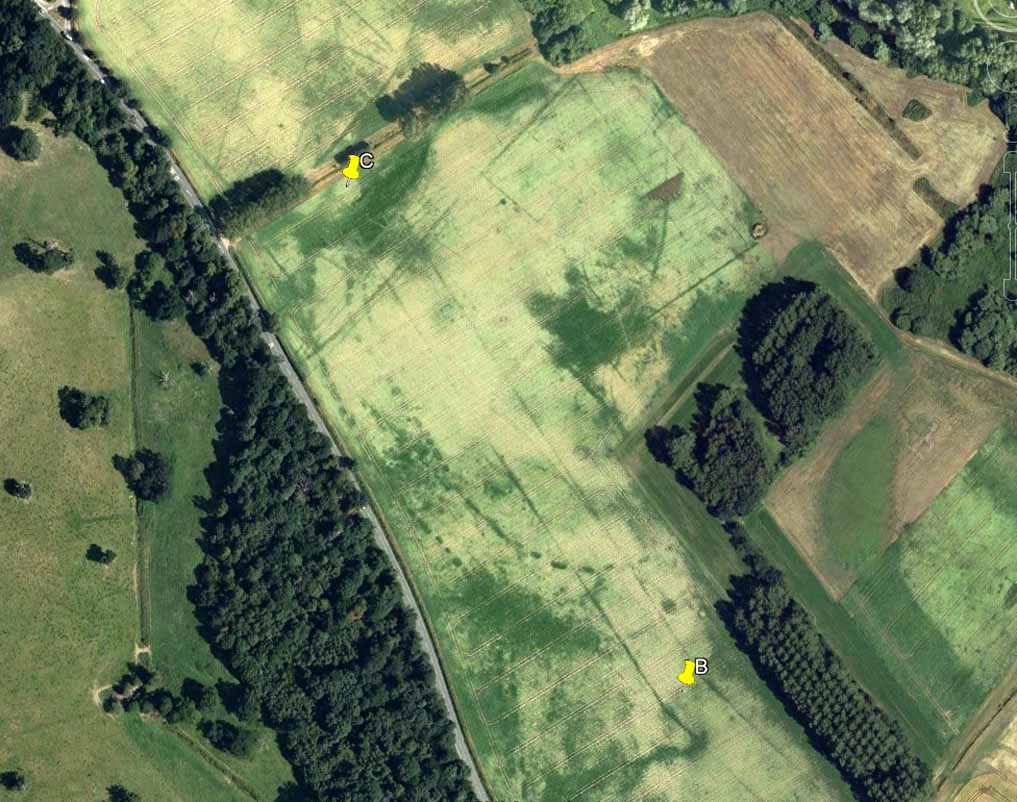
Central section of cursus

Starting at the southern end of the cursus (A), it headed northwest for more than 650 yards (0.6km) before it took its first slight change of direction.  Almost all of this first section has been built over by the village; but we can see it in aerial views again on the north side of the village at the edge of the field, at TL 8365 6774 (B).  Changing direction slightly, it moves more NNW for another 590 yards (539m) and then kinks again slightly more NNW at TL 8325 6809 (C), before heading onto its final change in direction 464 yards (424m) away at TL 8299 6843 (D).  From this point, more recent surveys have shown it to continue further onwards, with another minor alteration in its direction to the north.  It goes in a dead straight line for another 336 yards (334.5m), seemingly terminating a short distance before the old Mill Farm at Hengrave, at TL 8291 6876.  Just as at the start of the cursus at point ‘A’, where the terminus is curved in a slight arc, so the northern terminus was also curved.  The total length of this monument is 1.2 miles (1.9km).

As can be seen in the aerial view (above), a faded double-line of earthworks exists immediately west (left) of the cursus, intersecting and going across the monument.  This is the Fornham All Saints causewayed enclosure: another early neolithic monument which may or may not be earlier than the cursus itself.

A curious architectural coincidence (?) can be seen roughly 500 yards west of the central section of the cursus. Running roughly parallel with the prehistoric earthwork is another dead straight avenue leading out, southeast, from Hengrave Hall and, near its terminus, kinks slightly left, just as the cursus monument does about 550 yards away. Fascinating…

References:

  1. Loveday, Roy, Inscribed Across the Landscape, Tempus: Stroud 2006.
  2. Oswald, A., Dyer, C. & Barber, M., The Creation of Monuments, English Heritage: Swindon 2001.
  3. Pennick, N. & Devereux, P., Lines on the Landscape, Robert Hale: London 1989.

© Paul BennettThe Northern Antiquarian