Snowden Carr, Askwith, North Yorkshire

Cairnfield:  OS Grid Reference – SE 1777 5099

Getting Here
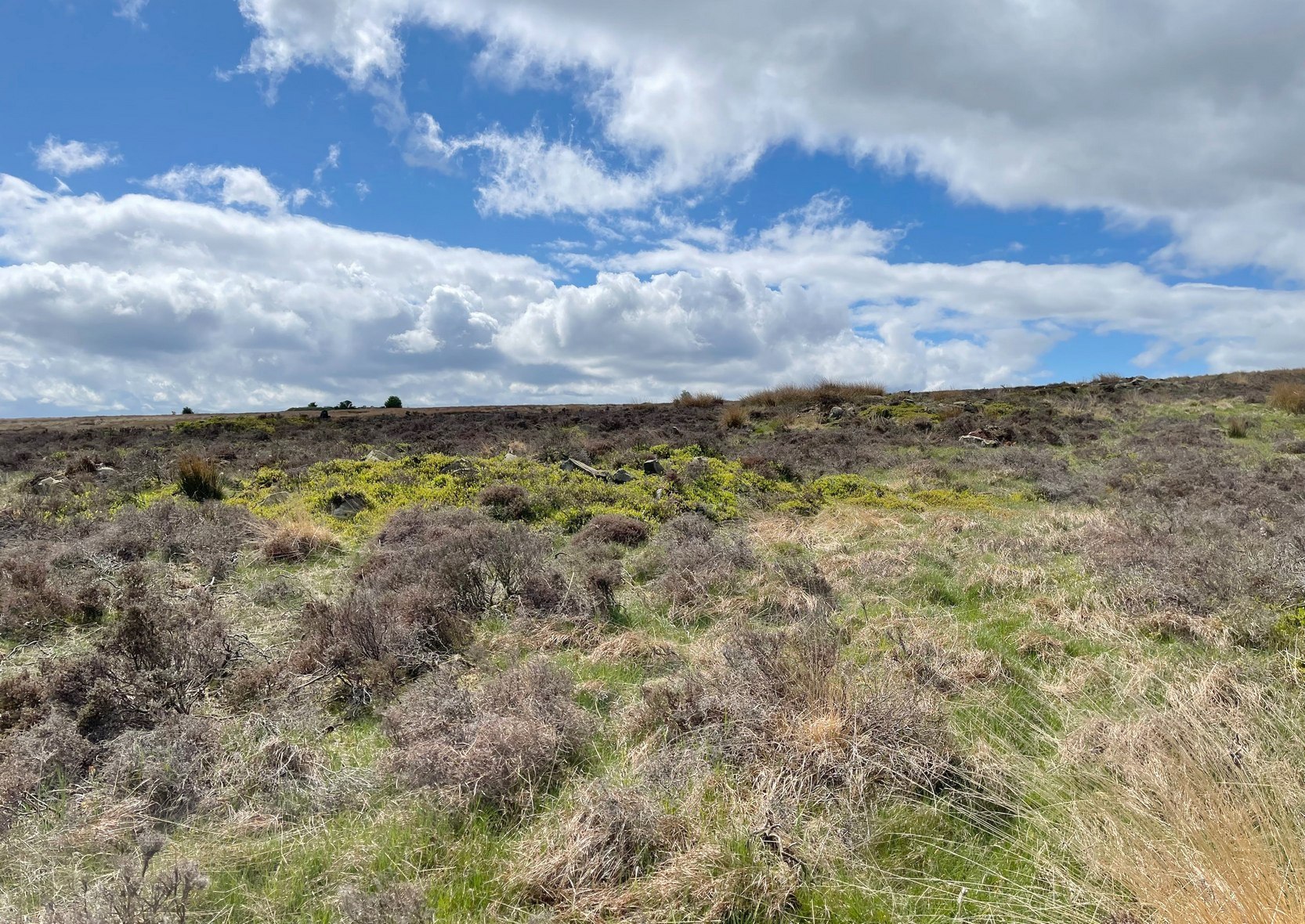
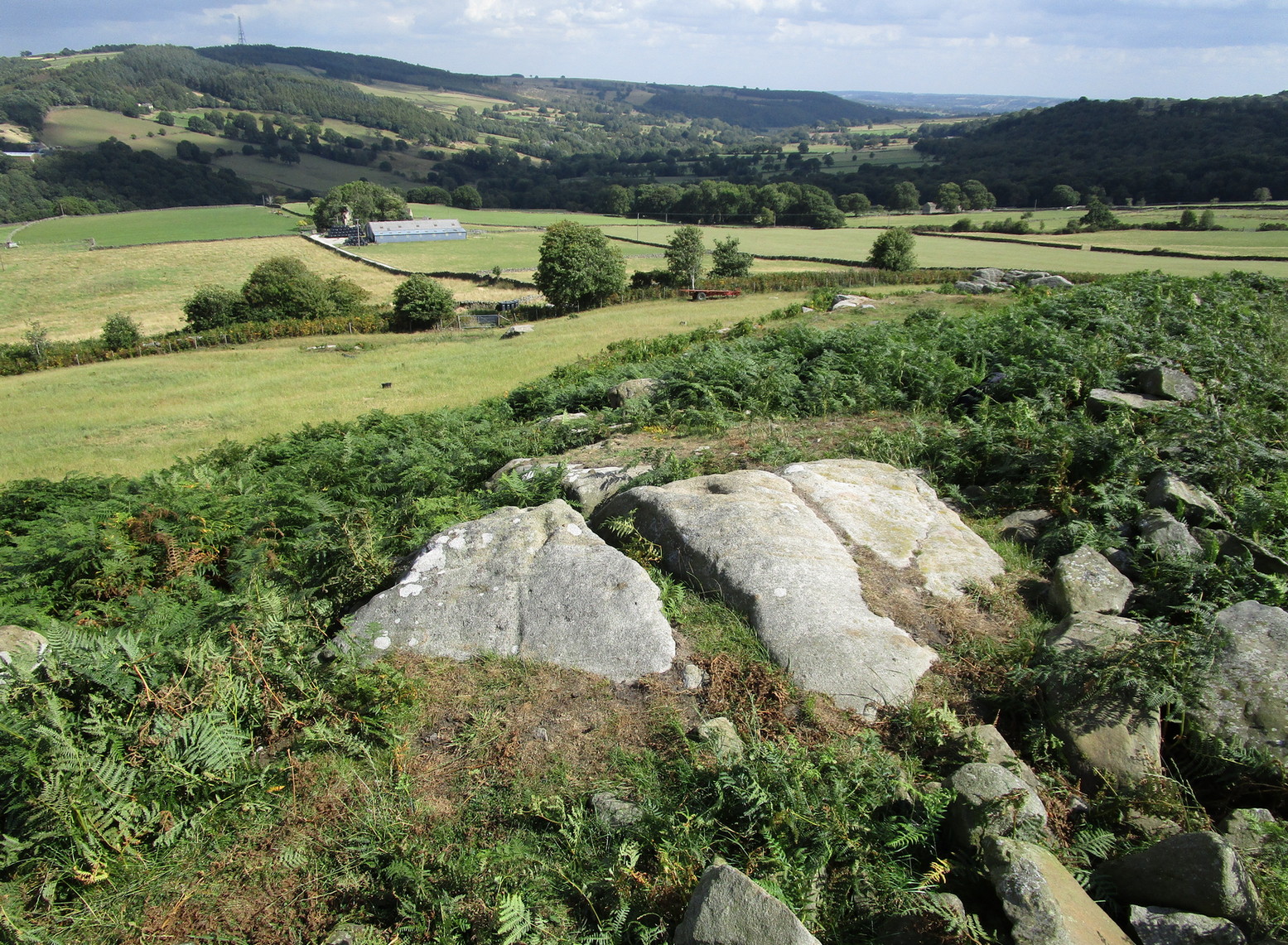
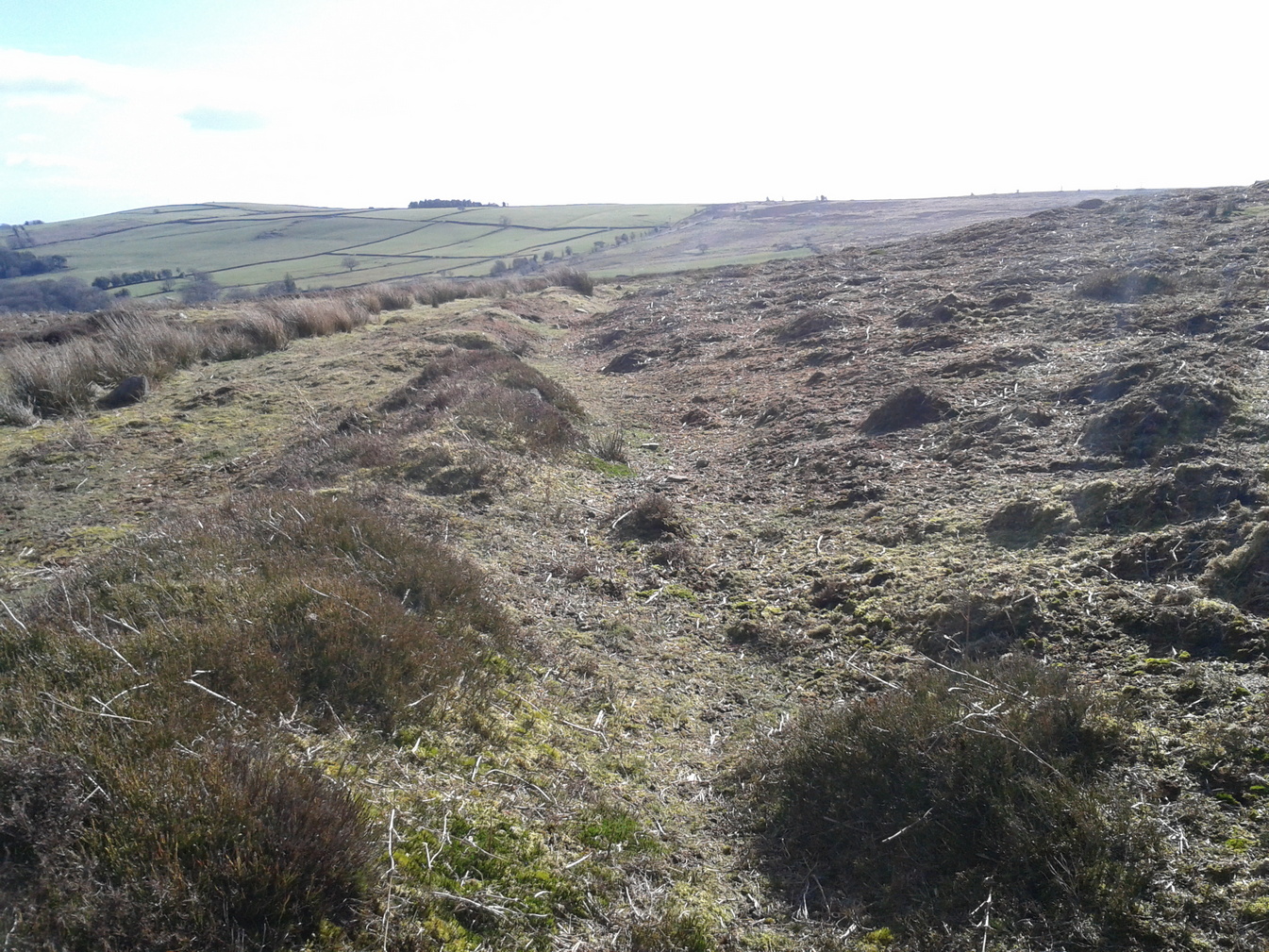
Cairns, front & rear

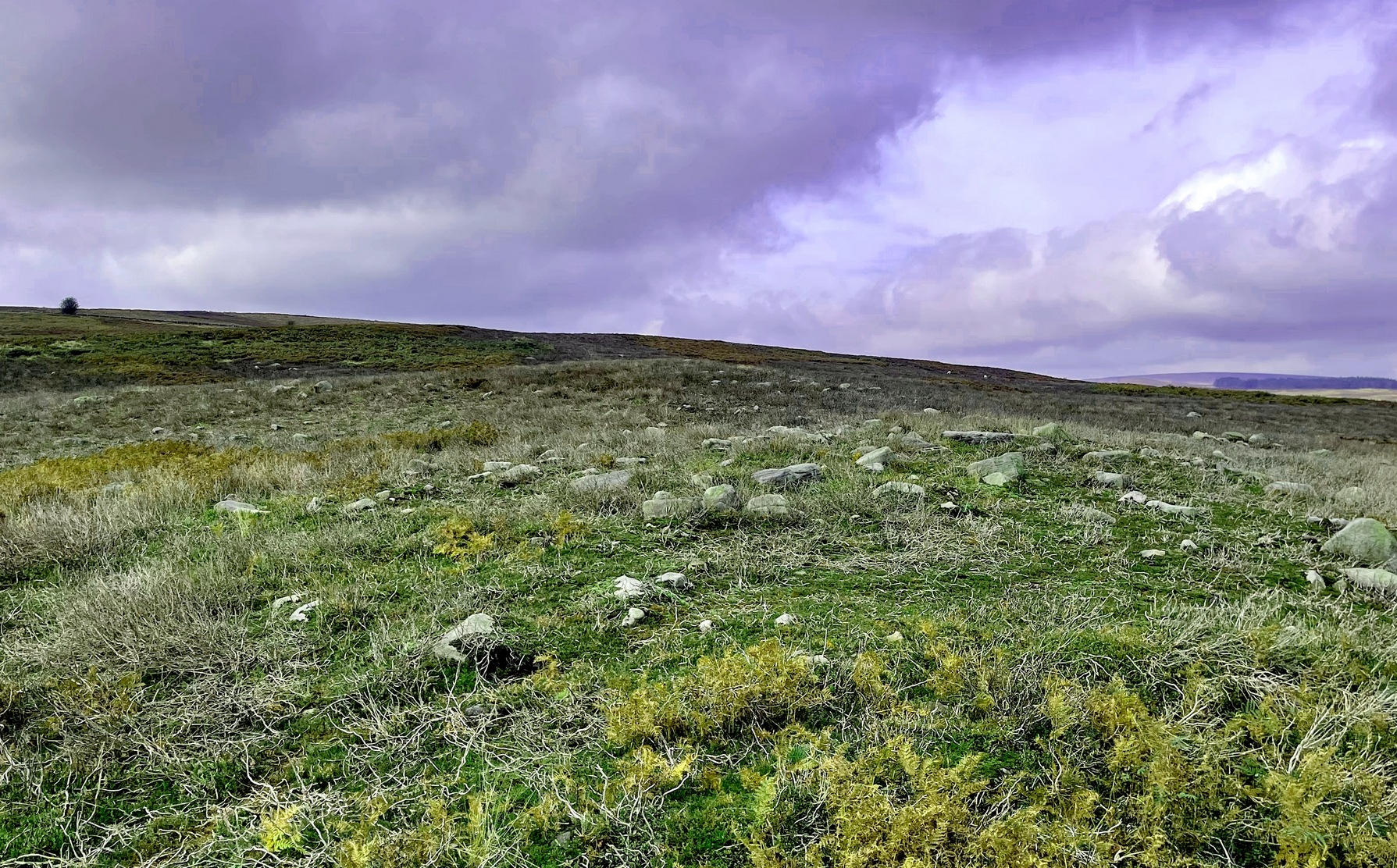
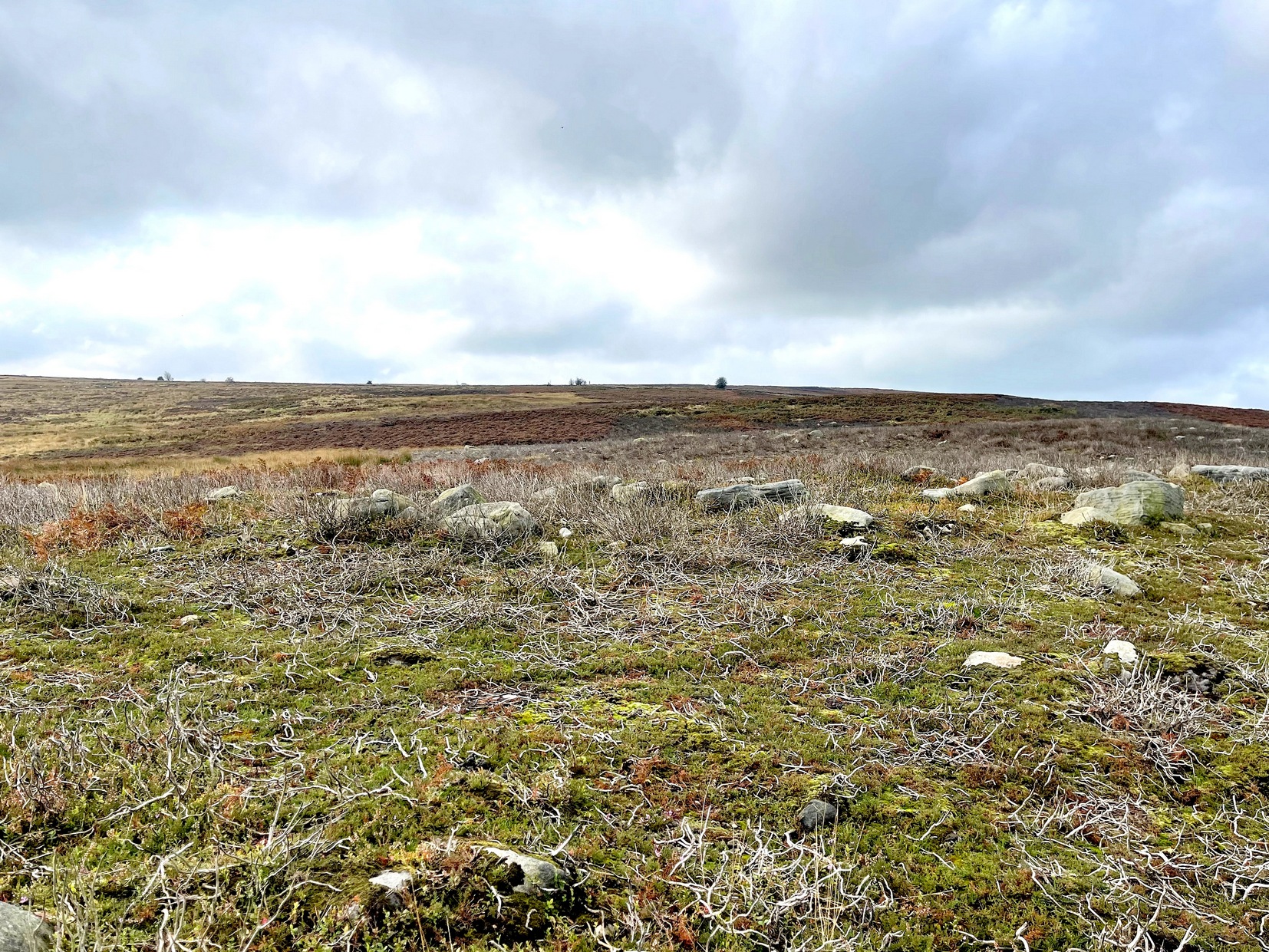
Park up at the singular dusty car-park on the east-side of Askwith Moor Road.  If you walk to the sloping eastern edge of the car-park and then go down and over the collapsed fence onto the moorland immediately east, walk in the direction of the Tree of Life Stone to the north-east (be aware that there’s no footpath here and it’s boggy as fuck in places) .  Just over halfway towards the carving, nearly 400 yards from where you’ve parked, you’ll begin to see various ruinous piles and scatters of stone.  You can’t really miss them!

Archaeology & History
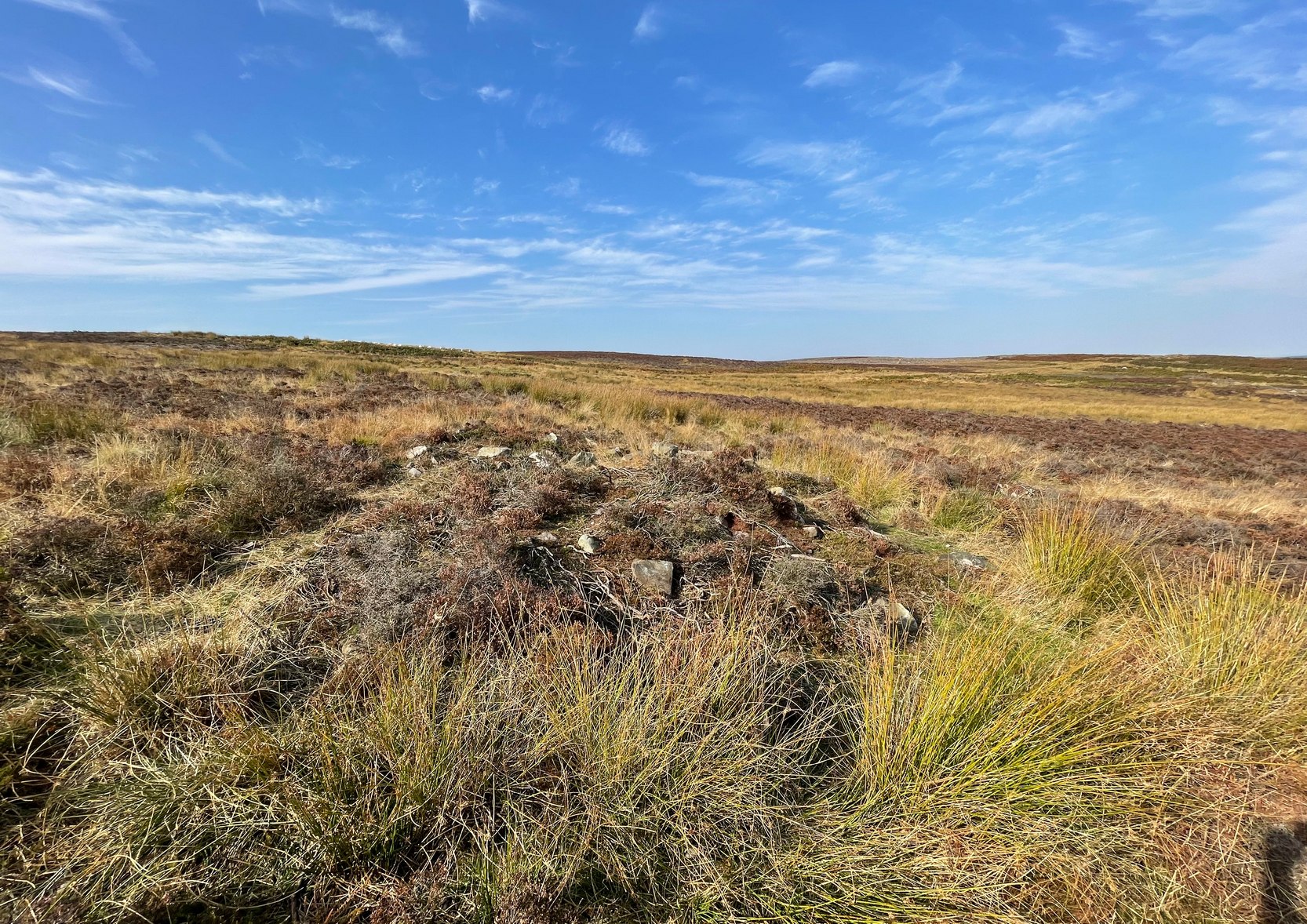
Cairn, looking north

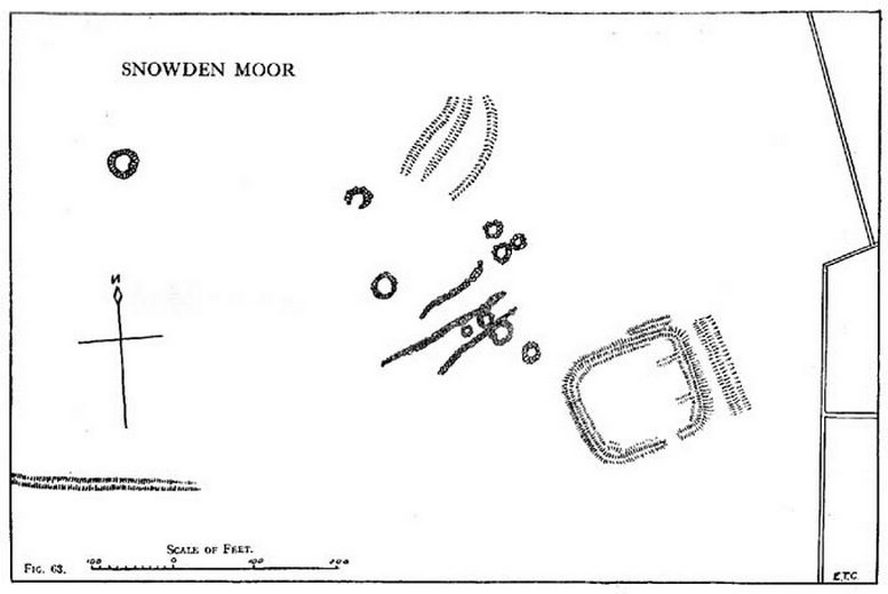
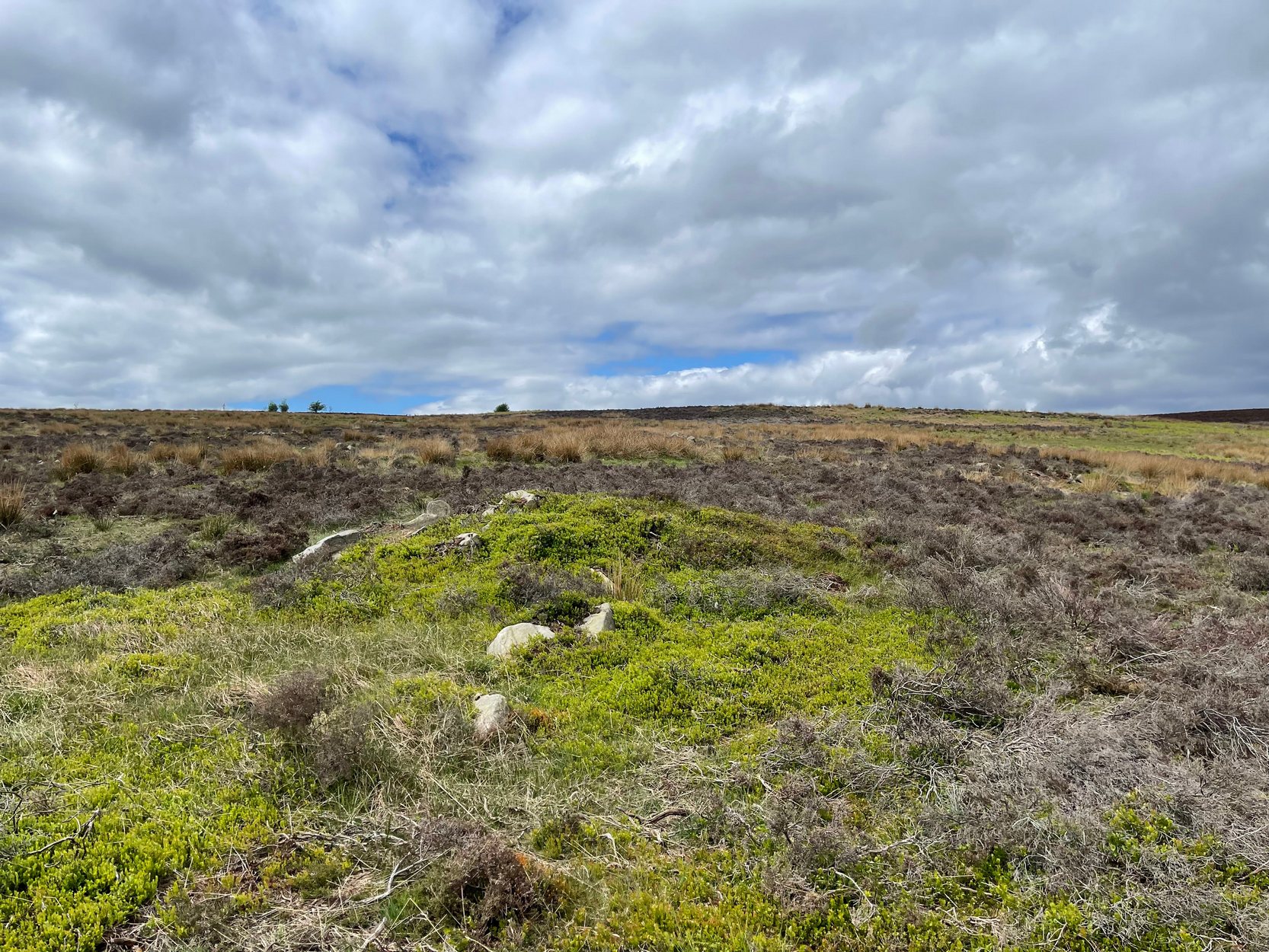
In a region teeming with prehistoric sites, the great Eric Cowling (1937) seems to have been the person who stumbled across this “barrow group”, as he called it, during one of his rock art forays in this neck o’ the woods.  Little has been written of them since.  Not to be confused with the Snowden Moor cairnfield more than 350 yards to the north, at this place we find at least a dozen quite distinct cairns scattered around the grid-reference cited, most of them much larger in size than the cairns to the north, ranging between five to twelve yards across and up to three feet high.  They have all been opened and robbed, with considerable disturbance on the largest of the ‘barrows’.  We know not who may have done this, but there’s been a history of quarrying close by and it may have been some of the workmen who did the damage, knowingly or otherwise.
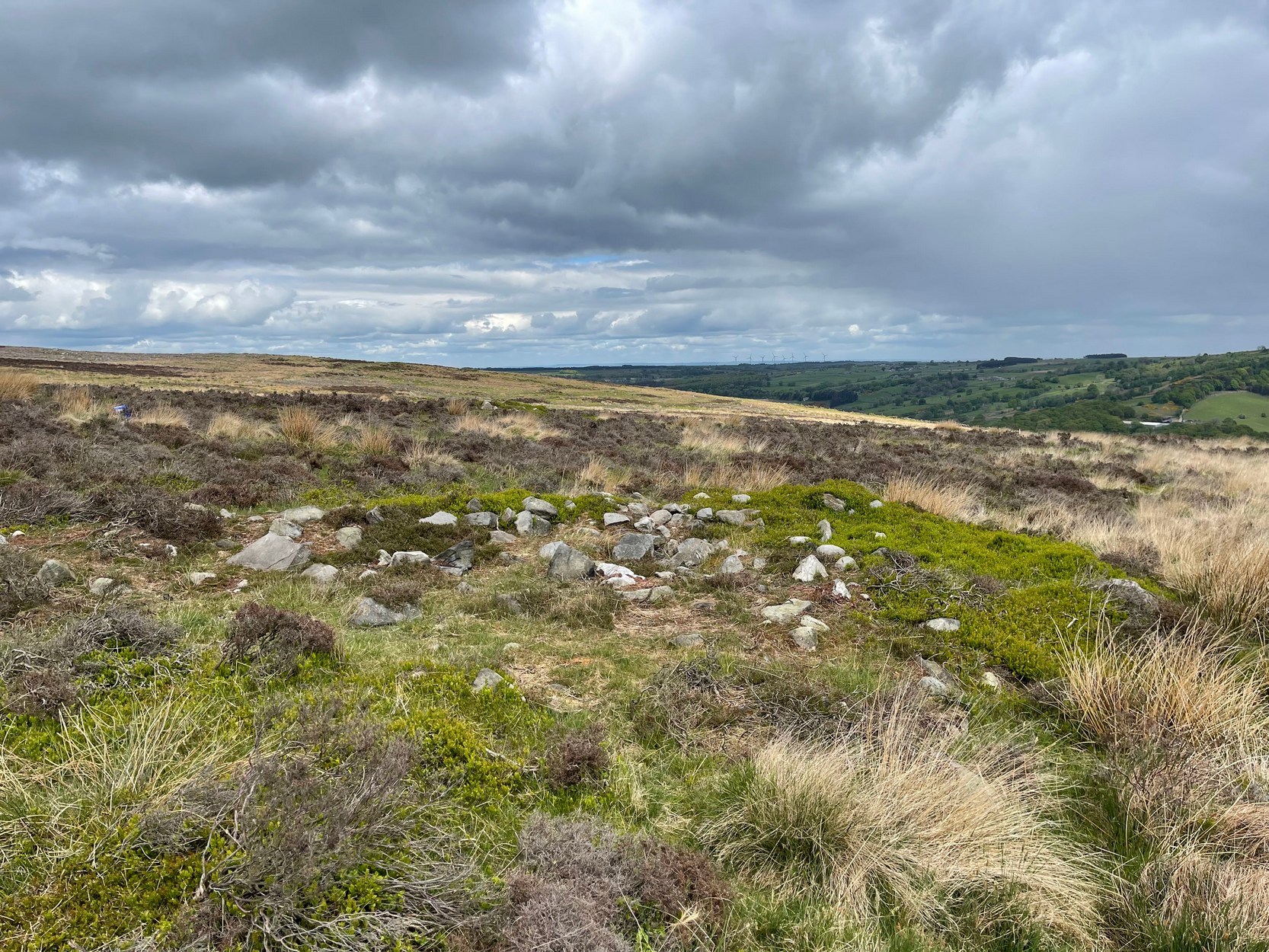
Large scatter of cairn-spoil
Cairn covered in bilberries!

As far as I’m aware, no burial or funerary remains have been found here—but there’s been negligible archaeological attention given to any of the sites on this moorland, meaning that we can draw no real conclusions about the nature of the cairns.  They seem to be far too large to be clearance cairns; and the proximity of large scale prehistoric settlements and rock art all round here would strongly suggest they possessed a funerary nature.  Several impressive petroglyphs exist right at the edge of this group, literally yards away from them.  Check them all out out the next time you see the Tree of Life stone

References:

  1. Cowling, Eric T., ‘Cup and Ring Markings to the North of Otley,’ in Yorkshire Archaeological Journal, volume 33 (part 131), 1937.
  2. Cowling, Eric T., Rombald’s Way: A Prehistory of Mid-Wharfedale, William Walker: Otley 1946.

© Paul BennettThe Northern Antiquarian
Snowden Carr (596), Askwith Moor, North Yorkshire

Cup-Marked Stone:  OS Grid Reference – SE 17959 51141

Getting Here

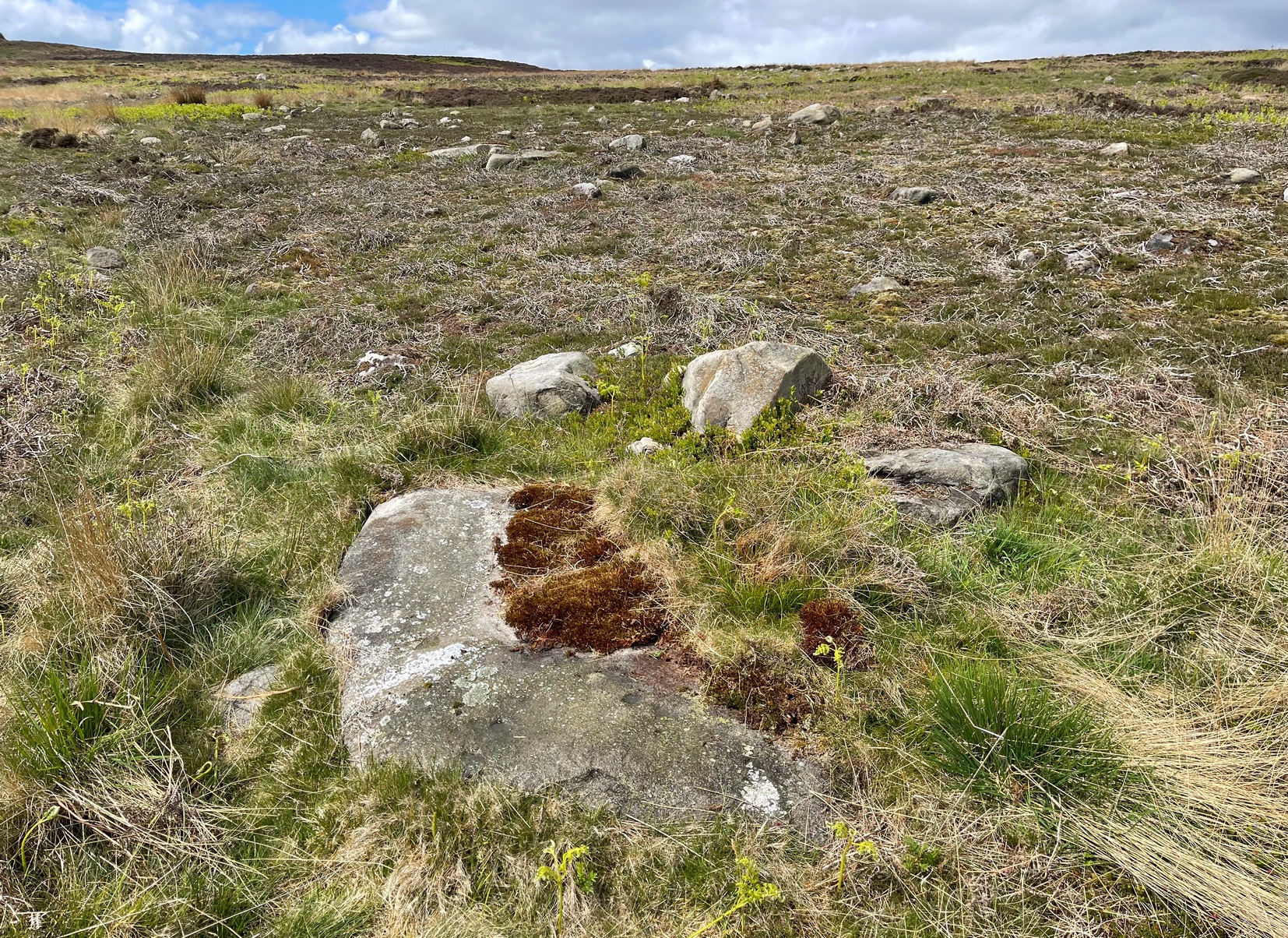
Carved stone in foreground

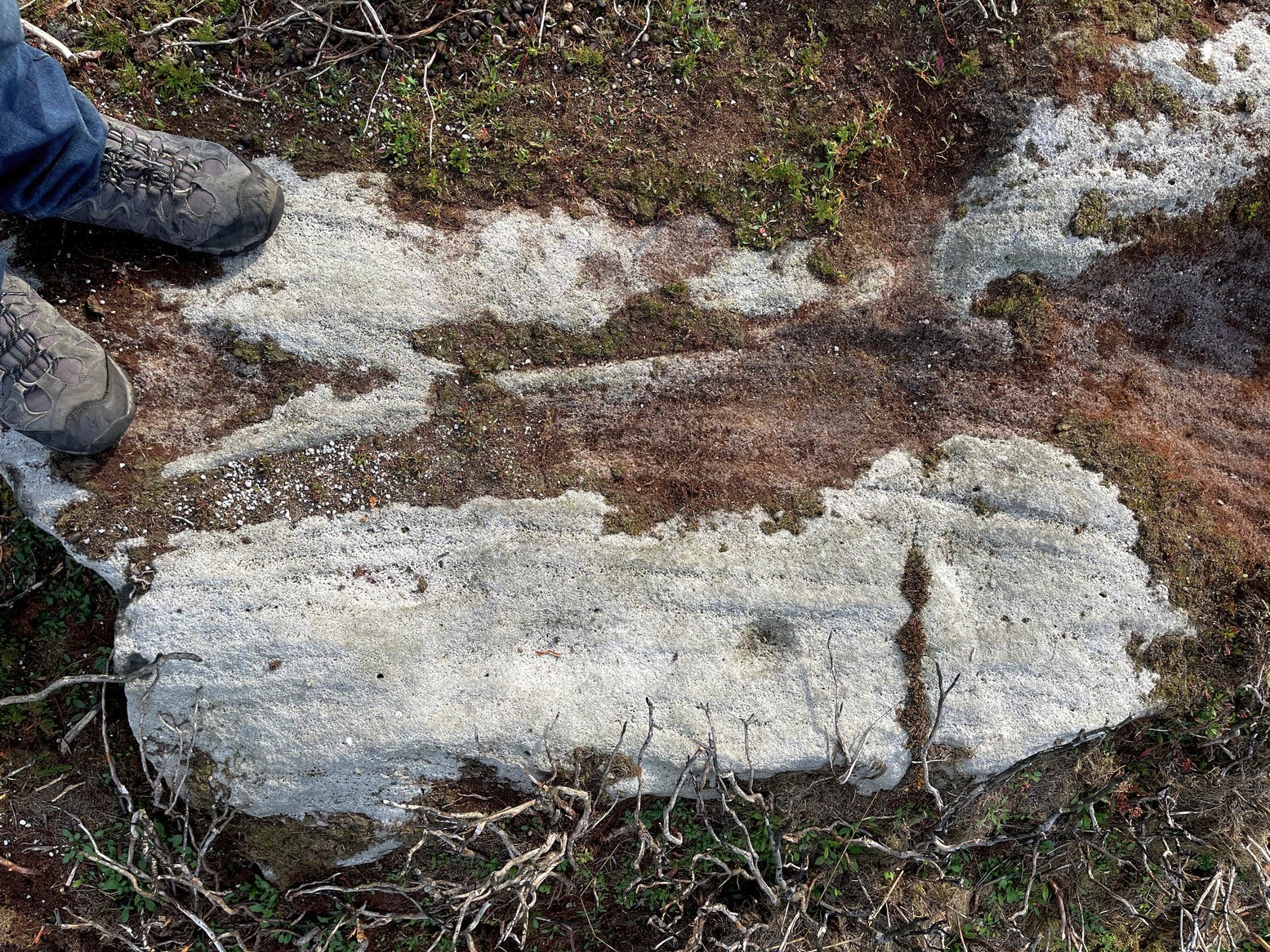
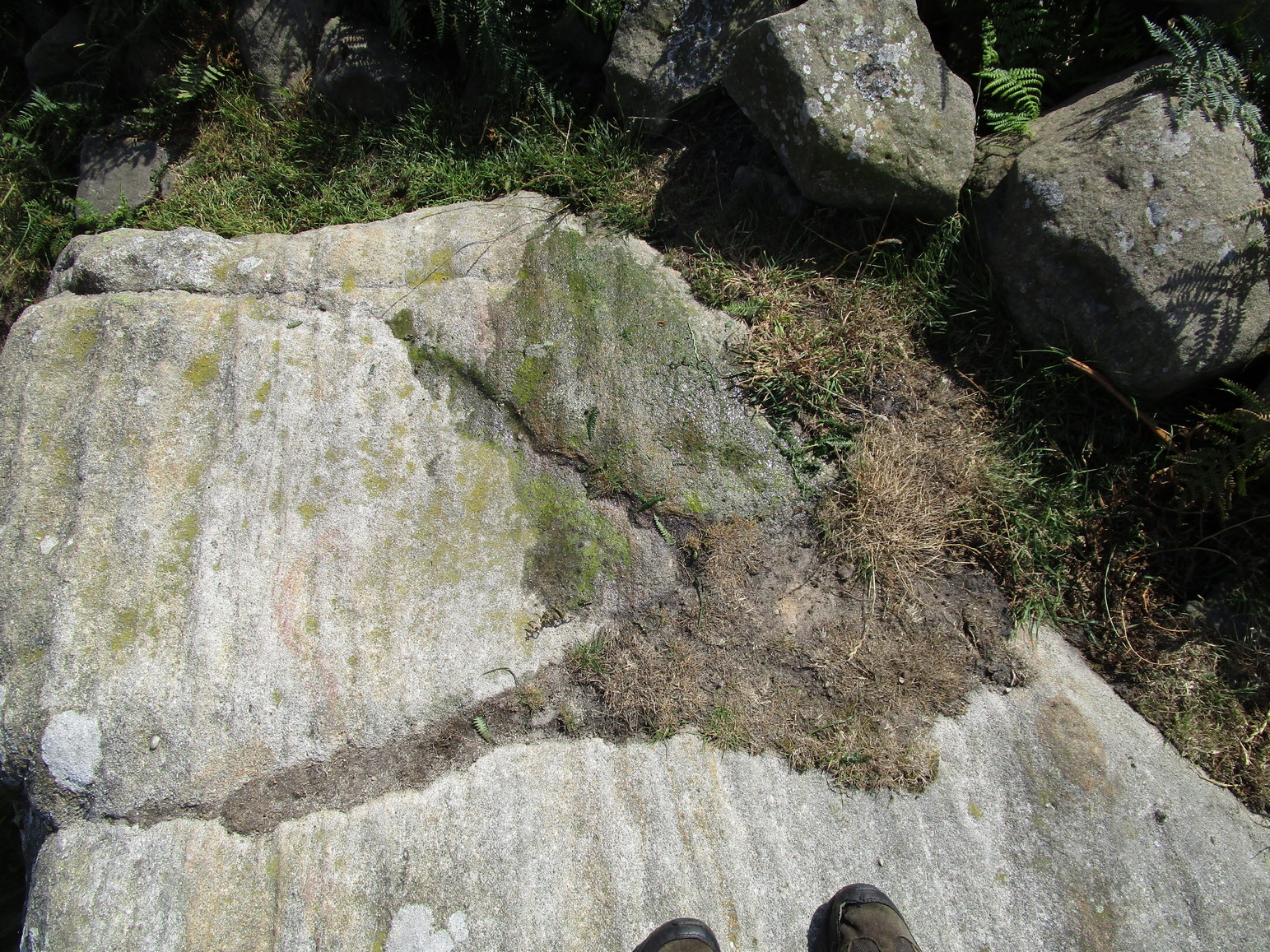
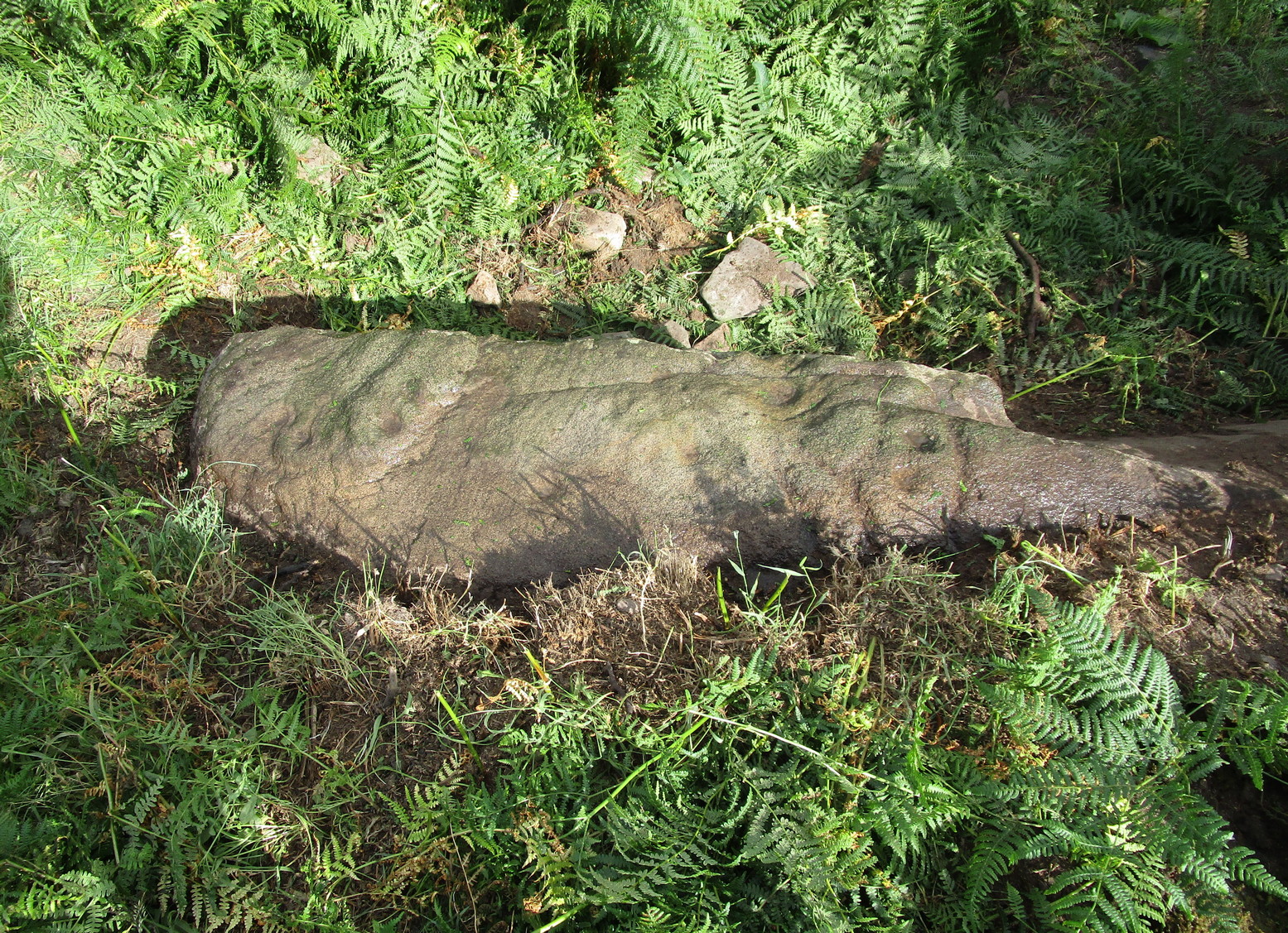
If you’re looking for this carving, you’ll have been to the impressive Tree of Life stone first.  From there, you need to walk further away from the walling, 30-35 yards southwest, across the other side of the footpath.  There’s a scattered mass of stones all over the ground here: you’re looking for a low-lying long curved stone—longer than most of them hereby.  If the heather’s grown back over the stone, it might take some finding!

Archaeology & History

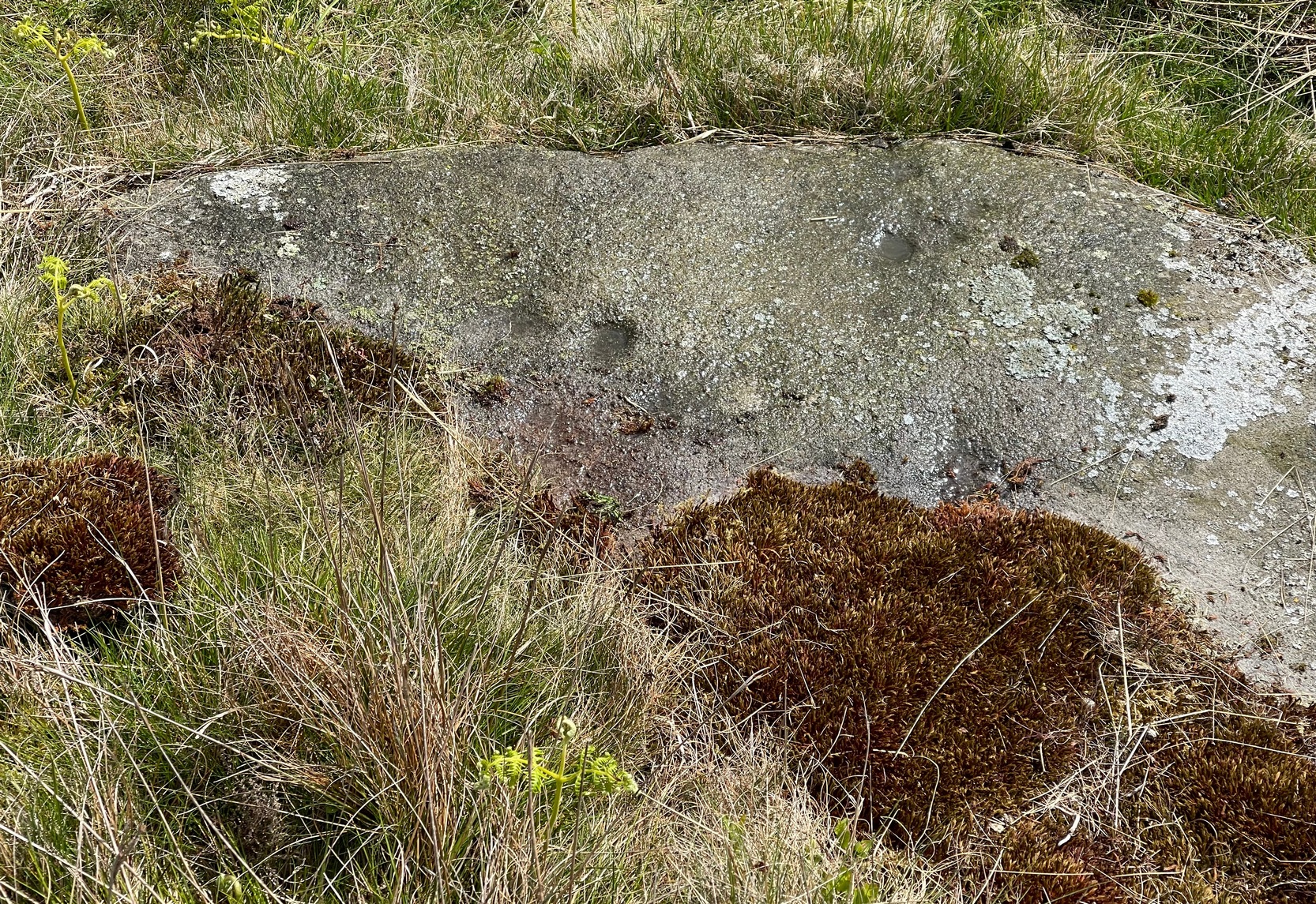
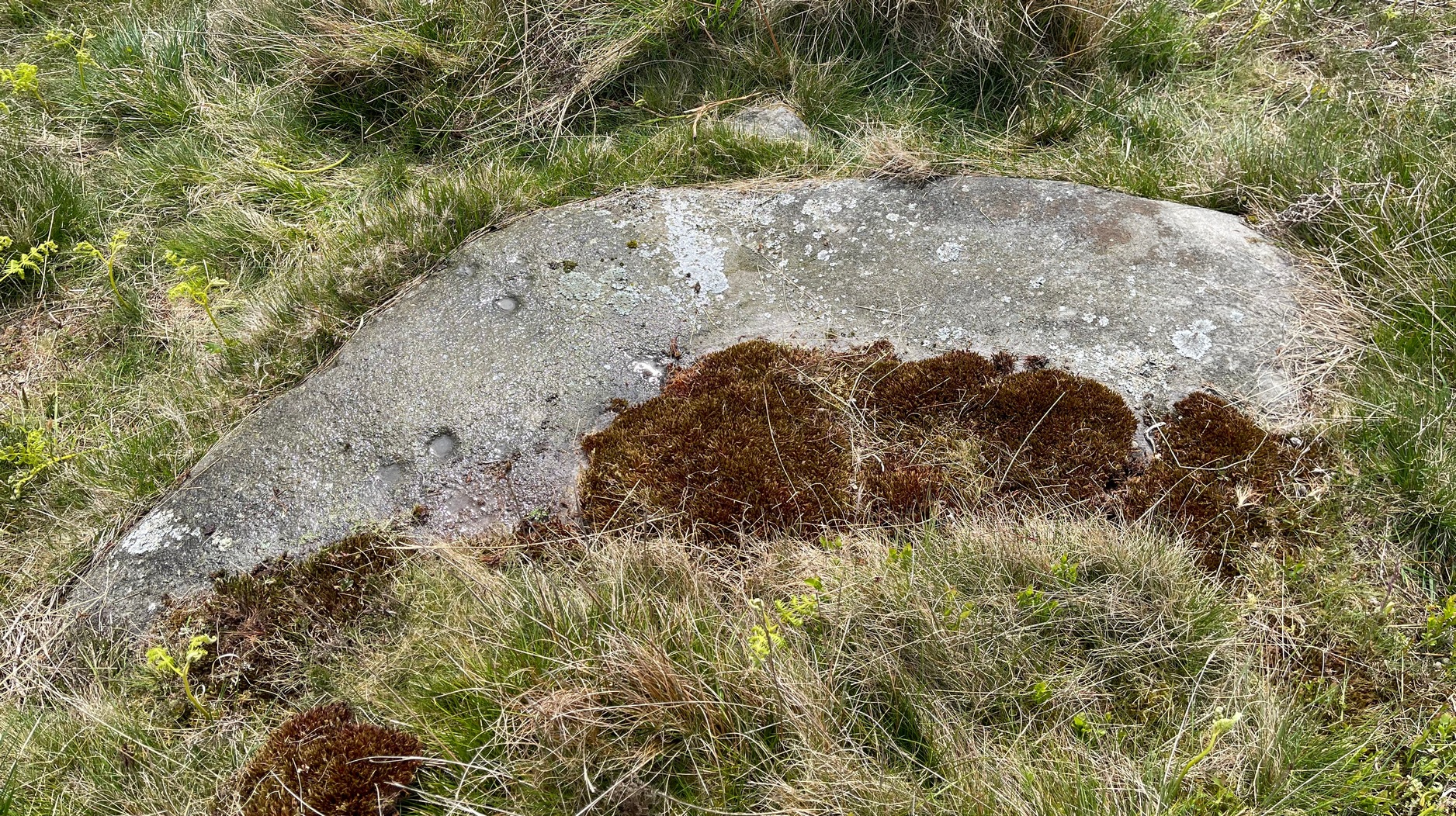
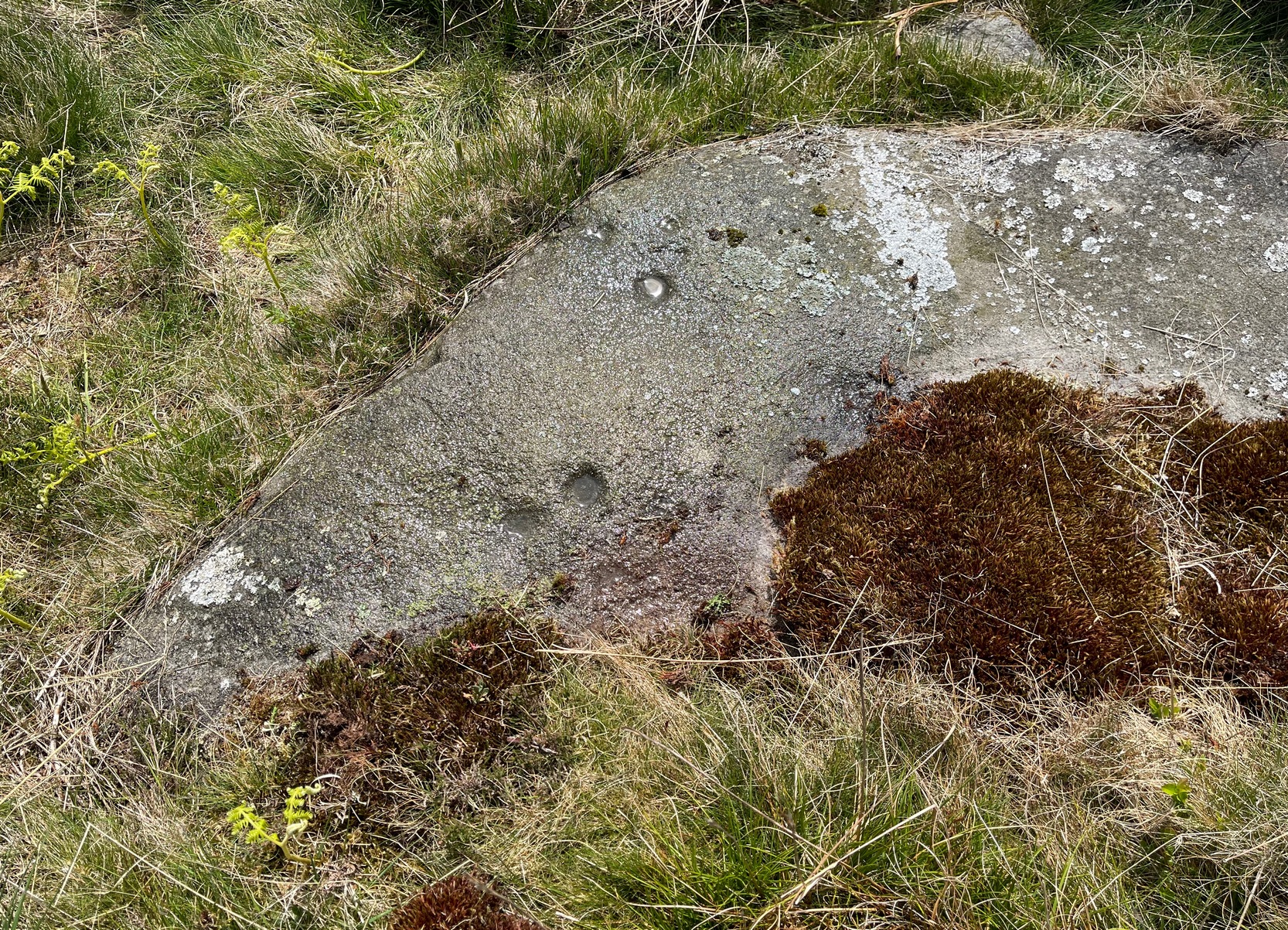
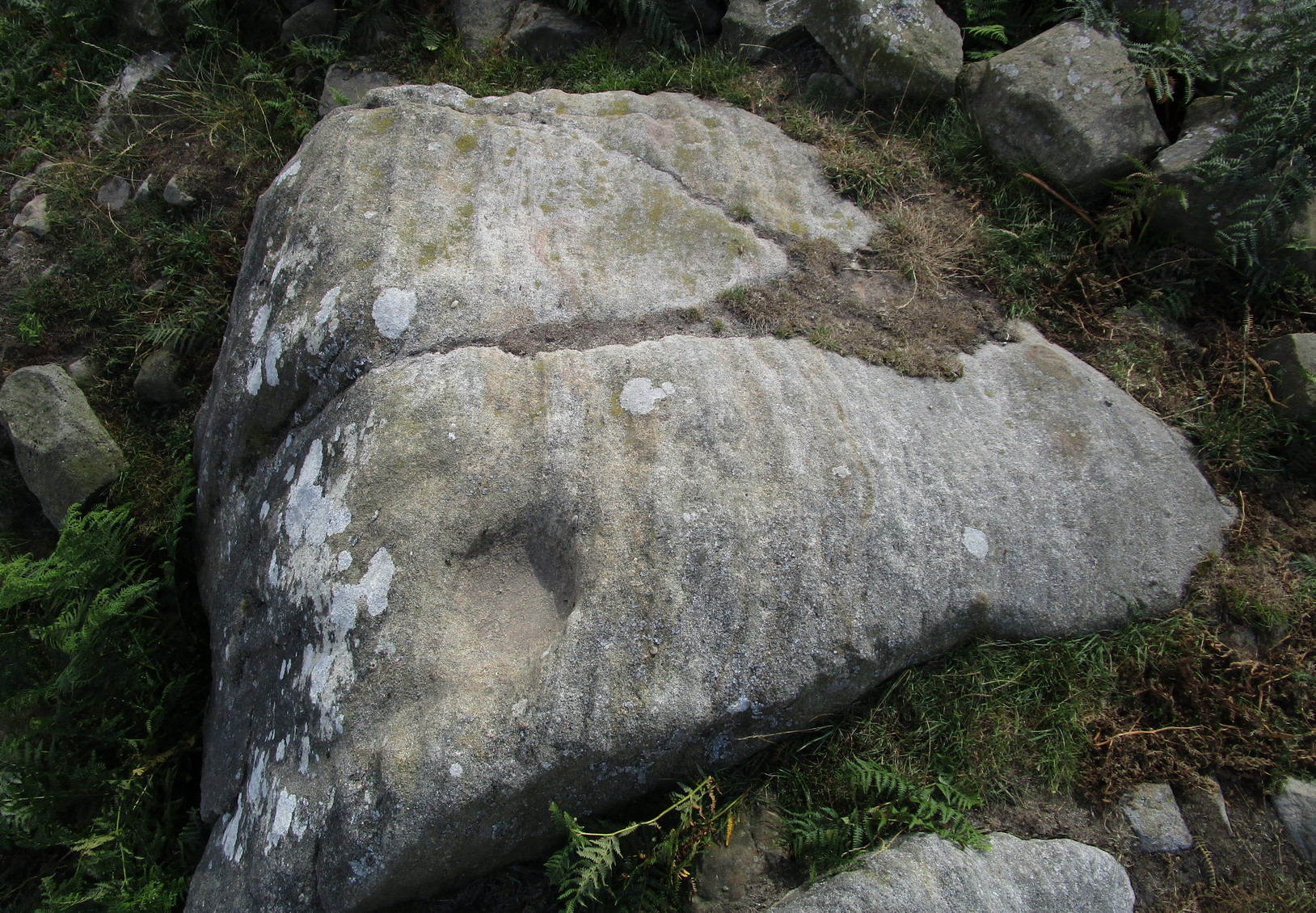
Close to a line of prehistoric walling (seemingly a section of a settlement), this typically curvaceous female stone is possessed of two pairs of faint cup-marks on the eastern side of the rock.  It was included in Boughey & Vickerman’s (2003) survey where they described the carving as being, “two small cups visible and two further cups under heather.”  A third possible cup exists close to one of the pairs. The carving is found in an area rich in untouched prehistoric remains. 

References:

  1. Boughey, Keith & Vickerman, E.A., Prehistoric Rock Art of the West Riding, WYAS 2003.

© Paul BennettThe Northern Antiquarian
 

Snowden Carr (570a), Timble, North Yorkshire

Cup-Marked Stone:  OS Grid Reference – SE 1777 5128

Getting Here

The stone in question

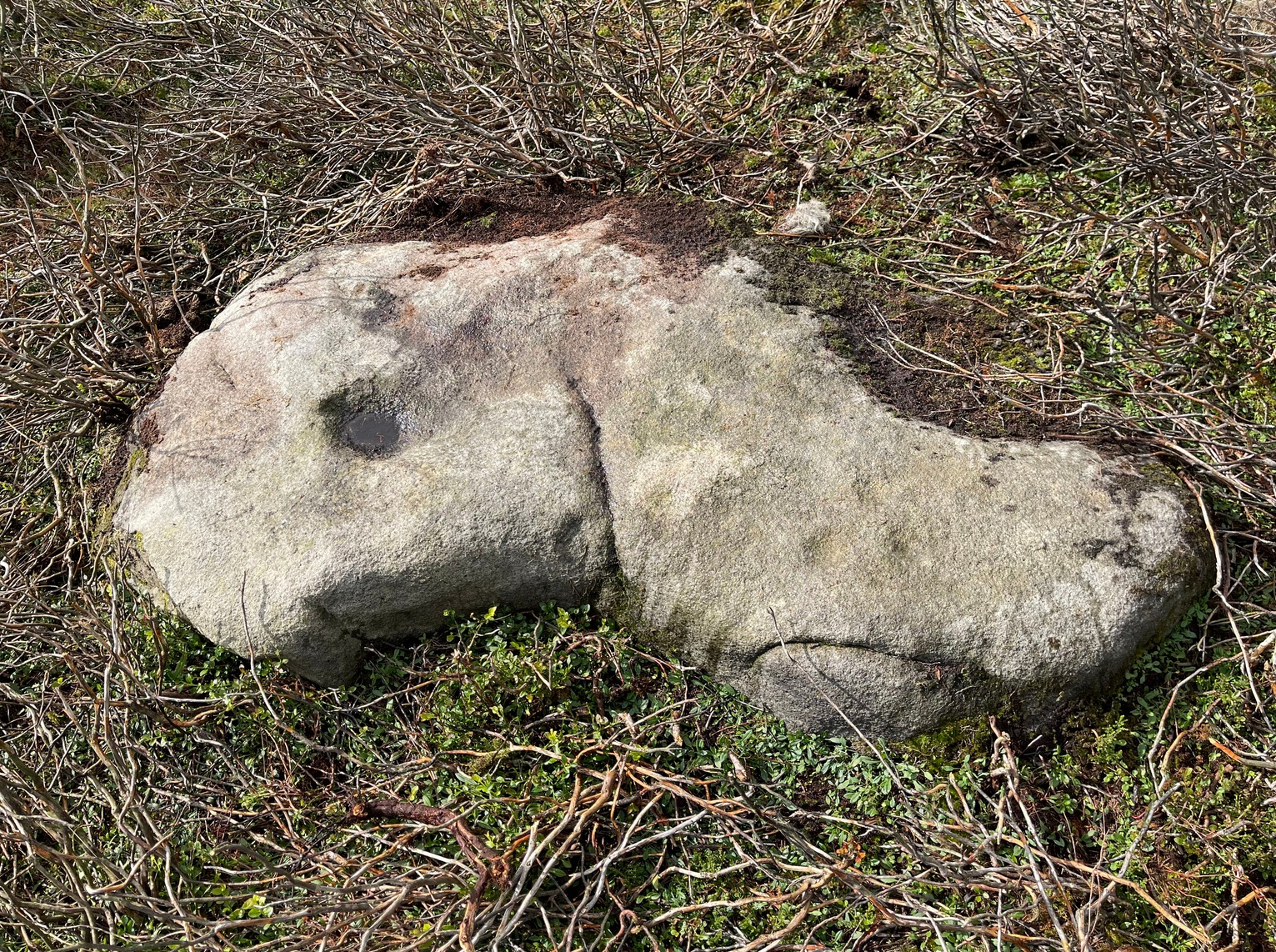
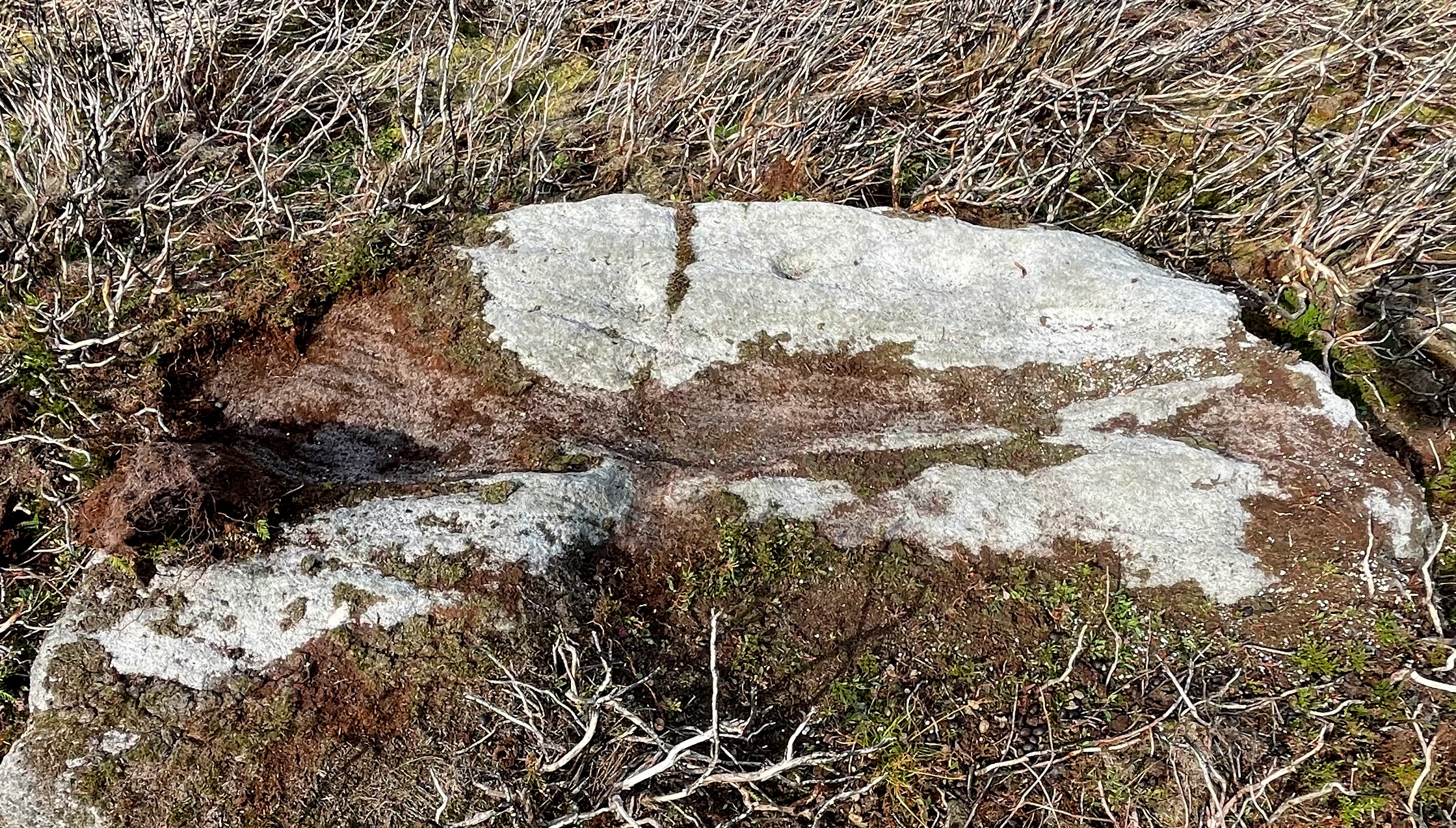
From the Askwith Moor car-park (SE 1757 5067), walk along the road north for a few hundred yards until you reach the gate on your right and head through the heather to the Death’s Head carving.  From here walk in a northwesterly direction up the gentle slope for 50-60 yards and, before reaching its crown, keep your eyes peeled for a low flat stone with a curvaceous crack running roughly halfway across it.  If the heather’s deep, you might not have a cat in hell’s chance of finding it!

Archaeology & History

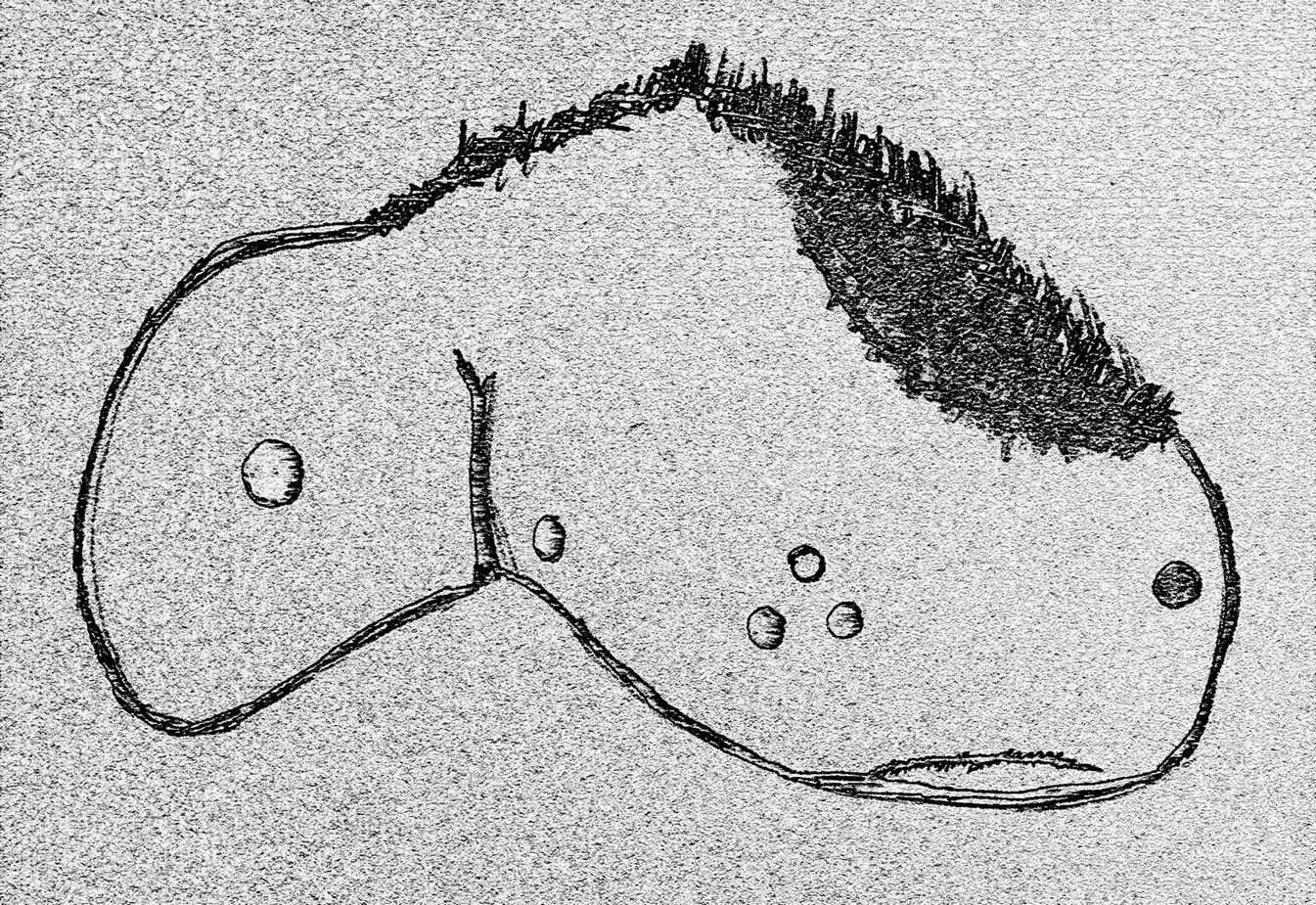
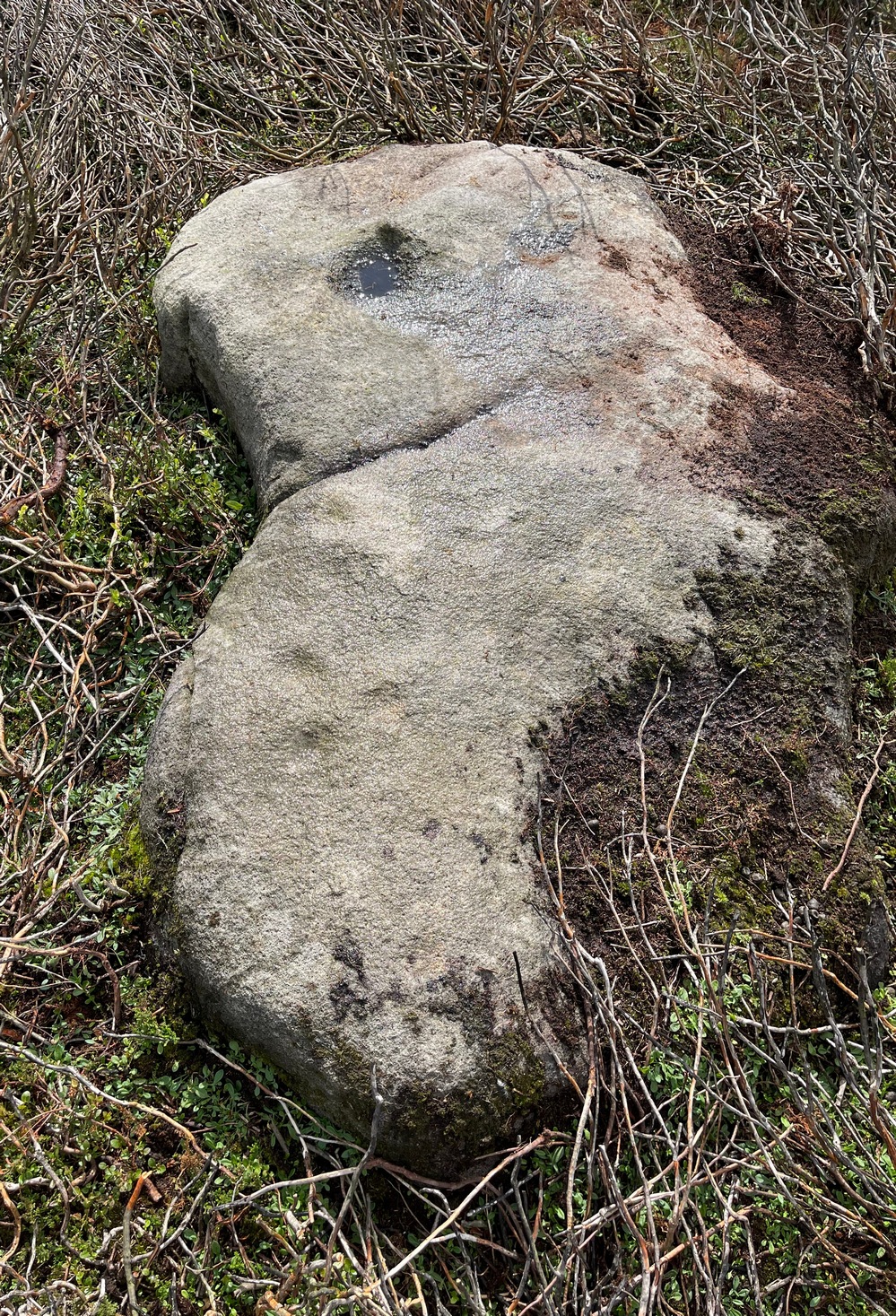
This carving isn’t much to look at on two levels: i) it’s a pretty simplistic design with no rings, and (ii) it’s very faint and almost impossible to see until the light is just right—except for one of the cups, which itself might be natural (there are a few like that amidst the Askwith complex).  It’s very much a carving for the purists among you, as I always say.  Nonetheless, for the record:

Crap sketch of design

Faint cups visible

The most notable element is the single “cup mark” on the more easterly section of the stone, on one side of the natural crack.  It catches your eye and is what makes you give the stone a little more attention, although I couldn’t make up my mind whether this was Nature’s handiwork or humans.  It may be a bit of both.  On the other side the crack we can see a small group of very faint eroded cup-marks — just!  What seems to be three of them cluster in a small triangle formation, but one of these may be natural (tis hard to say for sure), with another isolated cup closer to the crack, and a final one further to the outer edge of the stone.  All are very faint but stood out when the sun was low on our recent visit here.  Give it your attention when you’re next having a look at the settlement and cairnfield close by.

© Paul BennettThe Northern Antiquarian
Snowden Carr, Askwith Moor, North Yorkshire

Ring Cairn:  OS Grid Reference – SE 1786 5129

Getting Here

Low remains of cairn mass

From the Askwith Moor car-park (SE 1757 5067), walk along the road north for several hundred yards and go through the gate on your right.  Head northeast through the heather to the Death’s Head carving and keep along the same direction for barely another hundred yards onto the ever-so-slight crown of a small hillock.  This is a hut circle you’re standing in/on.  A few yards away just to the southeast of where you’re standing is the very denuded remains of this ring cairn.

Archaeology & History

Low remains of rubble wall

Not visible when the heather’s in full growth, it’s nonetheless worth visiting if you’re trying to get a picture of the prehistoric landscape hereby.  Less than 10 yards southeast of the notable hut circle on the small crown of a hill, it was first noticed by Sarah Walker on a group visit here recently.  Roughly 12 yards across, the most notable section of the circle is the remains of the rubble bank on its east and southeastern sides, raised a few feet above ground level.  The majority of the monument comprises of a scatter of various rocks and small stones within and round the edges of the circle.  There’s a lot of scattering from other adjacent remains, such as the hut circle and nearby walling, that give the initial impression of it being little more than a spurious mess of stone; but the more you walk around and inside it, the more you come to recognize its structure.

It has that Bronze Age hallmark look about it, but without an excavation this is just educated guesswork.  It might actually be older.  The widespread mass of prehistoric remains all round here shows that it was once a mass of activity in prehistoric times.  It’s a brilliant area, even if you can’t find this particular site!

© Paul BennettThe Northern Antiquarian
Snowden Carr (566a), Timble, North Yorkshire

Cup-Marked Stone:  OS Grid Reference – SE 17724 51258

Getting Here

The 2 cups, top-middle

Easiest way is to park up at the Askwith Moor car-park spot, turn right and walk along the road for about 350 yards until you reach the gate on the right (not the one across the road!).  You then need to head to the Death Head’s Stone carving about 450 yards across the moor to the east. It’s pretty conspicuous.  From here, walk through the heather 80-odd yards northwest.  You’ll walk past some extensive rubble walling (whose nature yet eludes us) before you get there.

Archaeology & History

Looking down at the cups

Discovered recently by Sarah Walker on a venture to see the extensive settlement and graveyard around Snowden Crags, this petroglyph is a simple basic design cut into a relatively large flat stone just above ground level.  Found less than 100 yards east of the dubious Snowden Carr (565) carving, there are two large cup-marks on this one: one of them is an inch deep and two-inches across and may originally have been geophysical in nature, but has subsequently been worked by human hands.  To its side is another much fainter and shallower cup-mark about the same width.  On some photos there’s what appears to be a very faint large ring surrounding the faint cup, but until visits are made at low sun and the stone brushed with water, we cannot be sure whether it’s real or just a trick of the light.  There may be more cups on this stone beneath the peat.  We didn’t brush it all off.

Some 30-40 yards to the east is the rubble of an extensive prehistoric man-made structure, the nature of which has yet to be discerned.  The Snowden Moor cairnfield begins immediately to the northwest, with the first tomb barely 50 yards away.

© Paul BennettThe Northern Antiquarian
Mixing Stone, Low Snowden, Askwith, North Yorkshire

Cup-and-Bowl Stone:  OS Grid Reference – SE 18074 51241

Getting Here

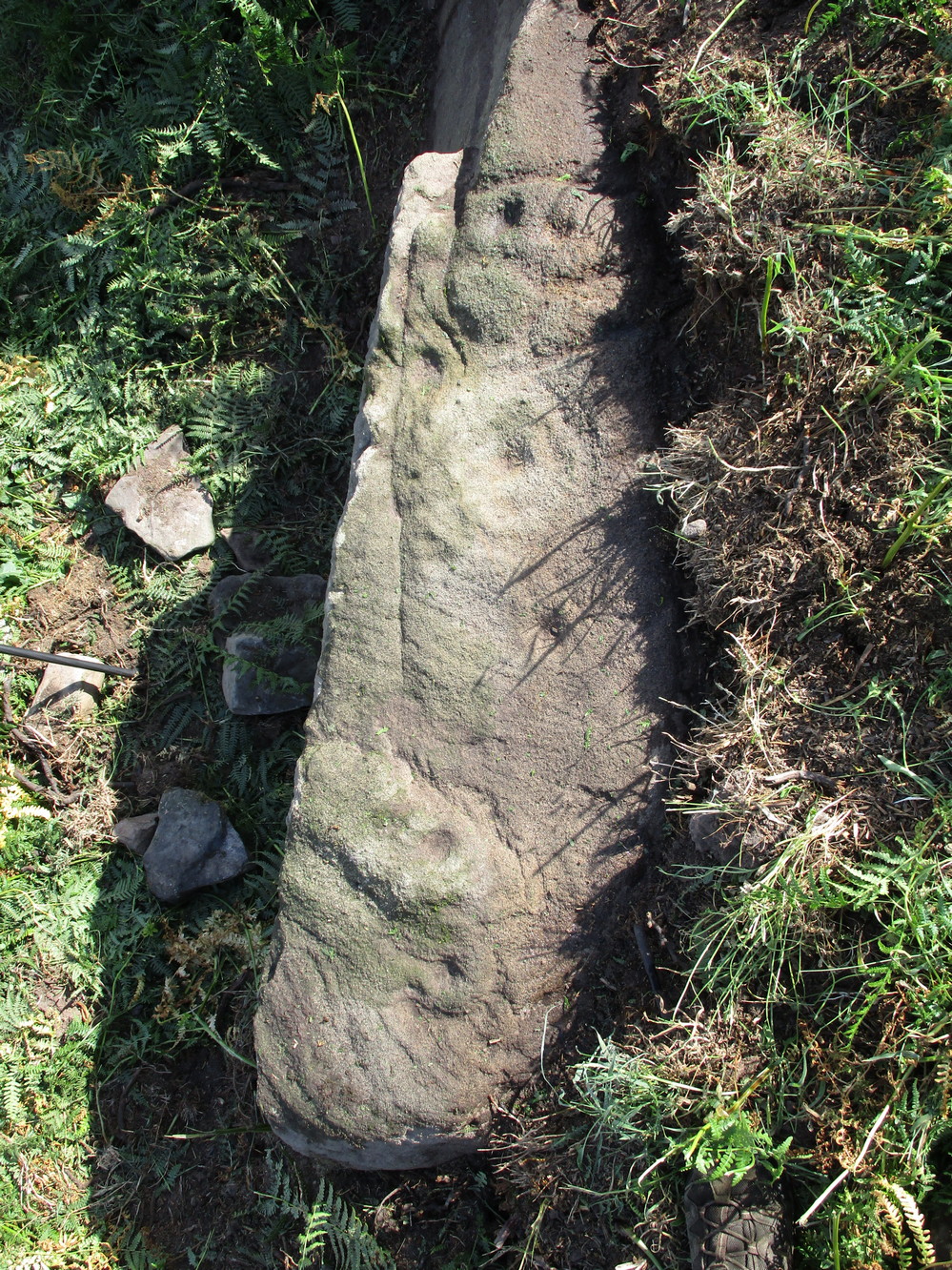
Follow the directions to reach the Ancestors’ Stone and the Sunrise Stone; and there, roughly halfway between them, right by the edge of the old collapsed walling, you’ll see this rise of a stone with a large ‘bowl’ on top.  That’s it!

Archaeology & History

Mixing Stone, looking E

Laid upon the same geological ridge as our Ancestors’ and Sunrise carvings, there are one, possibly two faint cup-marks visible on the low flat surface near the edge of this rock, barely visible unless the light’s right.  But the important element here, perhaps regardless of the cup-marks, is the ‘bowl’ or rock basin on top of the stone.  Internally, it’s smoothed equally on all sides and, due to being in-between the two impressive petroglyphs, may well have had a practical function to it.  Bear with me on this one…

The Mixing Stone’s bowl

Stone ‘bowls’ or cavities—natural and otherwise—have been made use of in many cultures for simple functional purposes, such as grinding flour, herbal mixes, etc.  We find such traditions in some of the bullauns of Ireland and Scotland; whereas in similar stone bowls known as cat troughs in nearby Haworth, milk was poured to appease the spirits of the land (this tradition was still being maintained in 2001!).  Folklore and traditions of such rock basins spread far and wide beyond the UK: one of the German terms for rock basins is Opferkessel, meaning ‘sacrificial basin’ and suggests ritualistic usage by early societies.  Elsewhere on Earth there are numerous accounts of the ritual use of petroglyphs in which indigenous peoples tell of their use of plant- or rock-based paints (in many cases red ochre) to decorate the carvings.  And it’s this element that I’m interested in here.

Water-painted cupmarks

The Sunrise and Ancestors’ Stones 10-15 yards either side of this Mixing Stone are ideal candidates for such petroglyphic paintings using early ochre and other stone or plant-based agents.  Such activities would always have been ritualised, either in honour of ancestors, genius loci, calendrical rites, or whatever the pertinent ingredient was at that place and time.  I’m suggesting simply that the rock basin on the Mixing Stone was used for just such purposes.  This is no spurious suggestion, but at the same time it’s important to recognise that my thoughts here represent merely an idea, nothing more—not a fact.  Whilst we know full well that these carvings were imbued fundamentally with animistic properties—a simple ‘fact’—this functional idea is just that—an idea.  Students and petroglyph-nuts need to understand this.  And the faded cup-marks at its edge are perhaps merely incidental…. though I don’t buy that misself!

© Paul BennettThe Northern Antiquarian 
Ancestors’ Stone, Low Snowden, Askwith, North Yorkshire

Cup-and-Ring Stone:  OS Grid-Reference – SE 18083 51229

Also Known as:

  1. Carving no.606 (Boughey & Vickerman)

Getting Here

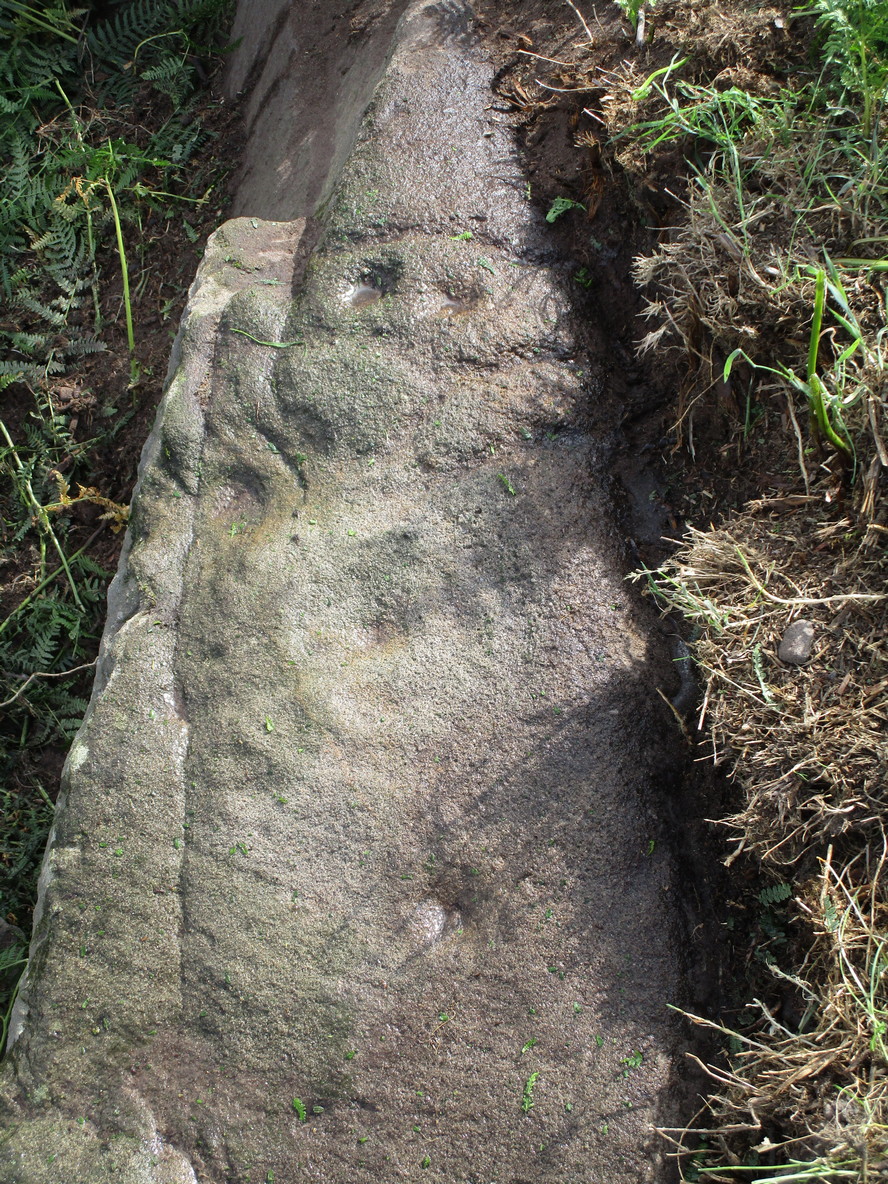
The Ancestors Stone

If you’re coming up from Otley or Askwith, take the same directions as if you’re going to visit the impressive Naked Jogger Carving (stone 612), not far from the well-known Tree of Life Stone.  From the Naked Jogger carving, walk up to the small outcrop of rocks that bends above you.  There’s a small collapsed line of walling just behind the outcrop.  Walk along this up the slope as if you’re heading for the Sunrise Stone carving, but only 30 yards along, low down and right into the edge of the wall itself, you’ll see this elongated piece of stone.  That’s the spot!

Archaeology & History

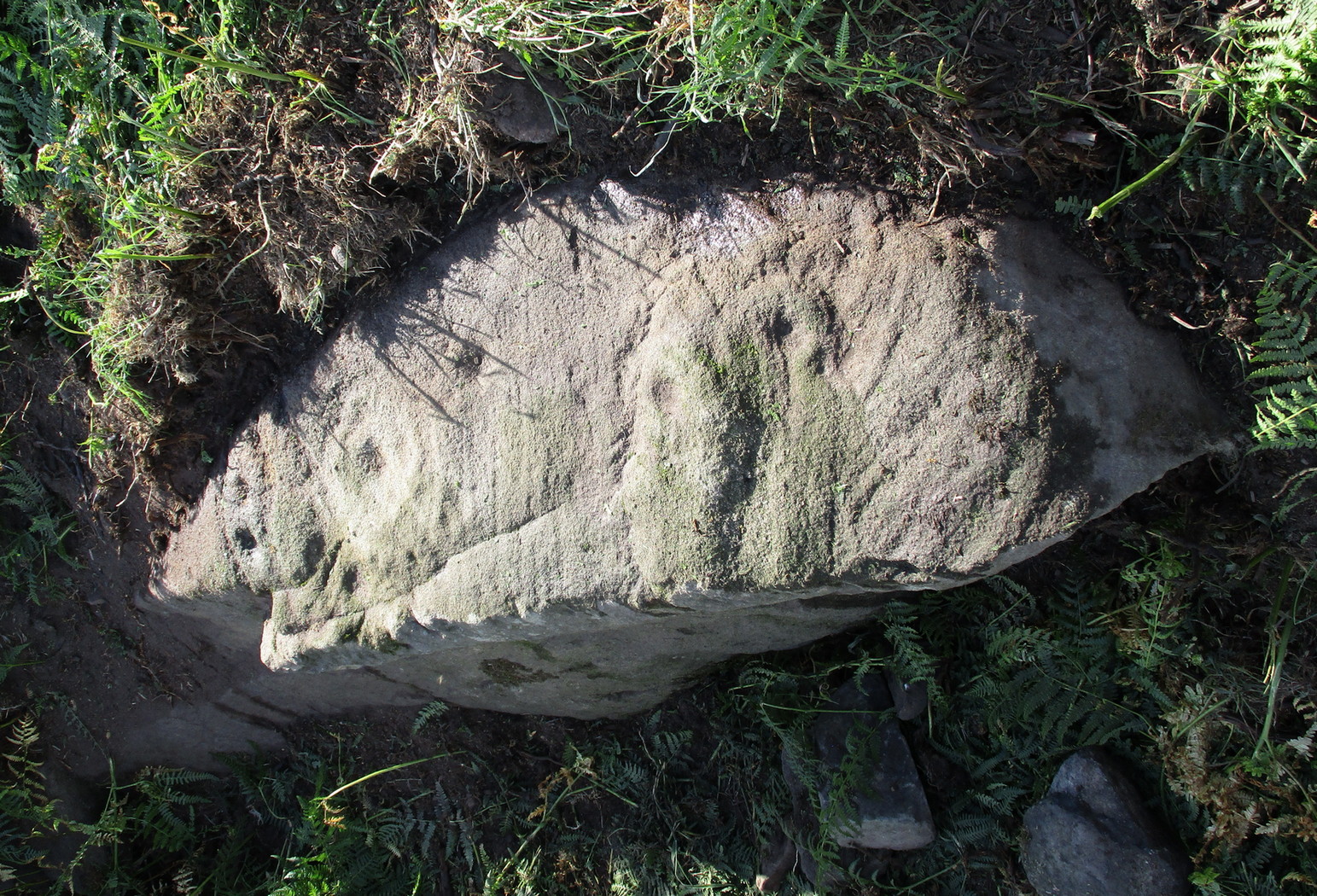
If you’ve caught the petroglyph-bug, you’ll like this one!  It received its name from the curious fusion of natural cracks with the man-made pecked lines that shows, quite distinctly when the light is right and the stone is wet, the outline of two humanesque forms joined to each other.  Figurative rock engravings of ancestors in the UK are extremely rare and when we came across this example, we noticed how the design could be interpreted as two Askwith Moor ancestor figures. Figurative rock art images elsewhere in the world such as the magnificent Wandjina paintings and the extensive galleries of figures engraved at Murujuga (Burrup Peninsula) in Western Australia, might provide an initial comparison, though more specific work needs to be done to better understand this unique petroglyph.

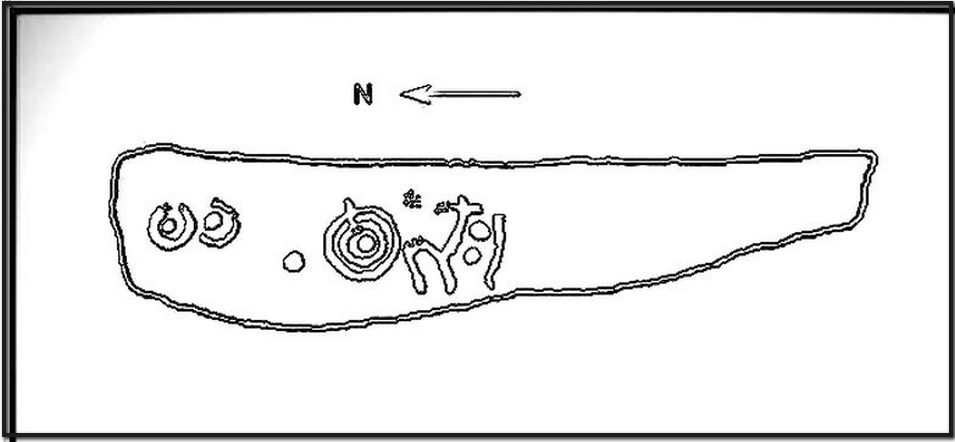
Sketch of the carving

You can almost make out the figures in the above photo: the upper torsos of two beings on the right-hand side of the rock, almost fused together.  And the carved shapes of these “ancestral beings” are morphically similar to some elements in the Sunrise Stone just 50 yards away – which themselves remind me of a Northumbrian carving near Doddington known as West Horton 1a. (Beckensall 1991)  But we should’t get too carried away by the idea because—as we can see here in the sketch of the carving—when looked at from a different angle above, we could infer the right-hand carved elements to be representative of an animal: a deer, perhaps.  Rorscharch’s once more tickle the exploring mind….

The rock has been quarried into at same time in the past (just like the nearby Sunrise Stone), leaving us to wonder what the complete carving might have looked like.  No doubt some pieces of it will be in the collapsed walling either side of the stone.  All we have left to see are the two unfinished cup-and-rings above the natural cracks that give rise to the “ancestral being” appearance.  The faint double cup-and-ring has curious linear arcs to its side, with two well-defined cups enclosed by two of them.  It’s a nice-looking carving when the light is good.  The petroglyph was carved over a long period of time, as evidenced by the differing levels of erosion in different sections of the design.  It’s a common attribute.  The oldest section is the faint double cup-and-ring, whose mythic nature was added to / developed at a much later date, perhaps even centuries later.

In the always-expressive archaeocentric description of Boughey & Vickerman’s (2003) otherwise valuable tome, they told this carving to be,

“Long, narrow, thick rock of medium grit. Six cups, one with a double ring with a tab out and two with at least partial single rings, grooves.”

Evocative stuff!

It’s very likely that this carving had some mythic relationship with its close neighbours either side of it, probably over a very long time period and I’m inclined to think it somehow related to the rising of the sun, just like its solar companion further up the slope.  Please note how I emphasize this ingredient in the site profile of its neighbour, the Mixing Stone 10-15 yards away—roughly halfway between this and the Sunrise Stone.   A distinct place of ritual was happening in this close-knit cluster of carvings…

References:

  1. Beckensall, Stan, Prehistoric Rock Motifs of Northumberland – volume 1, 1991.
  2. Boughey, Keith & Vickerman, E.A., Prehistoric Rock Art of the West Riding, WYAS: Leeds 2003.
  3. Reeder, Phil, “Snowden Carr Rock Carvings,” in Northern Earth Mysteries, no.40, 1990.

© Paul BennettThe Northern Antiquarian
Shooting House East, Askwith Moor, North Yorkshire

Hut Circles:  OS Grid Reference – SE 17401 50967

Getting Here

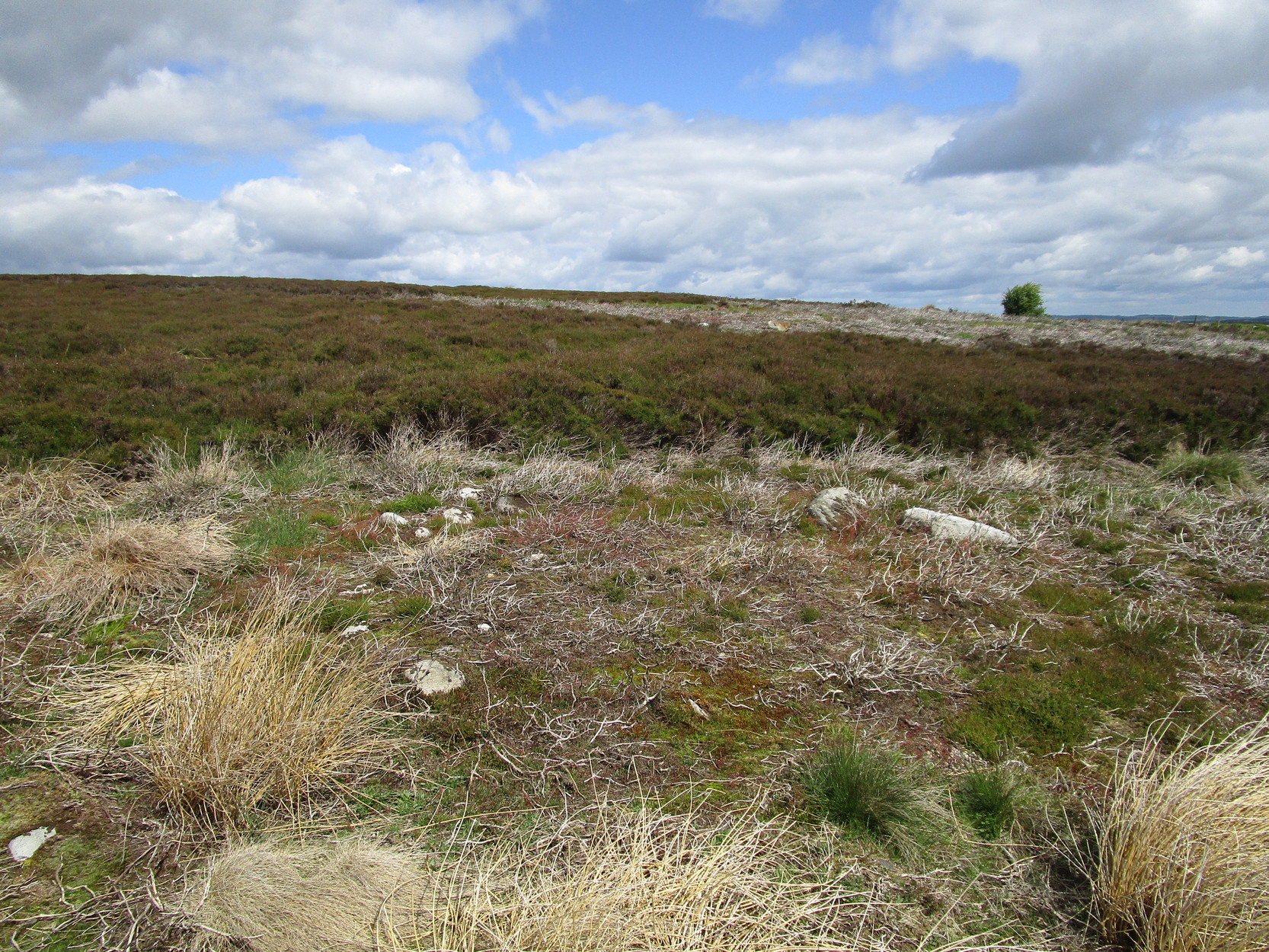
Askwith Moor hut circle (1)

Along the only road that crosses Askwith Moor, park up at the single carpark on the east-side of the road.  Walk up the road for 350 yards and through the gate on the left-hand (west) side of the road onto the moorland.  Once through the gate, walk directly west into the heather immediately below the path for some 25-30 yards.  Look around!

Archaeology & History

Rediscovered by Helen Summerton in May 2022 are at least two simple hut circles on this level piece of land close to the roadside, amidst this much wider and impressive prehistoric landscape.

The small ring of stones (SE 17430 50978) closest to the road is slightly more troublesome to make out due to it being more deeply embedded in the peat than its companion about 30 yards away.  Comprising of typically small rubble walling, this first circle is only 4 yards across and would certainly have been fine for one person or, at a push, perhaps a small family.

Askwith Moor hut circle (2)

Askwith Moor hut circle (2)

Its companion immediately west (SE 17401 50953) is somewhat larger and slightly more elongated in shape, being 10 yards along and 5-6 yards across, as well as being in a better state of preservation.  This larger hut circle has been raised on a notable artificial earth-and-rubble plinth, being one or two feet higher than the surrounding peatland.  A notable internal stretch of walling only a yard or two in length exists within the southeastern side of the construction, whose nature can only be discerned upon excavation: an issue we can say applies to the many prehistoric settlements and tombs across this small moorland.  It’s very likely that other settlement remains will be found close to these two hut circles.

The remains of another hut circle can be found closer to Shooting House Hill, several hundred yards away; whilst five hundred yards southwest we find a small but impressive cairnfield.  There are also a good number of petroglyphs close by and on much of the surrounding landscape.

Acknowledgments:  Huge thanks to Helen Summerton (not Winterton) for finding these ‘ere remains – and for the photos accompanying this site profile.

© Paul BennettThe Northern Antiquarian
Cowling’s Enclosure, Askwith Moor, North Yorkshire

Enclosure:  OS Grid Reference – SE 1793 5127

Getting Here

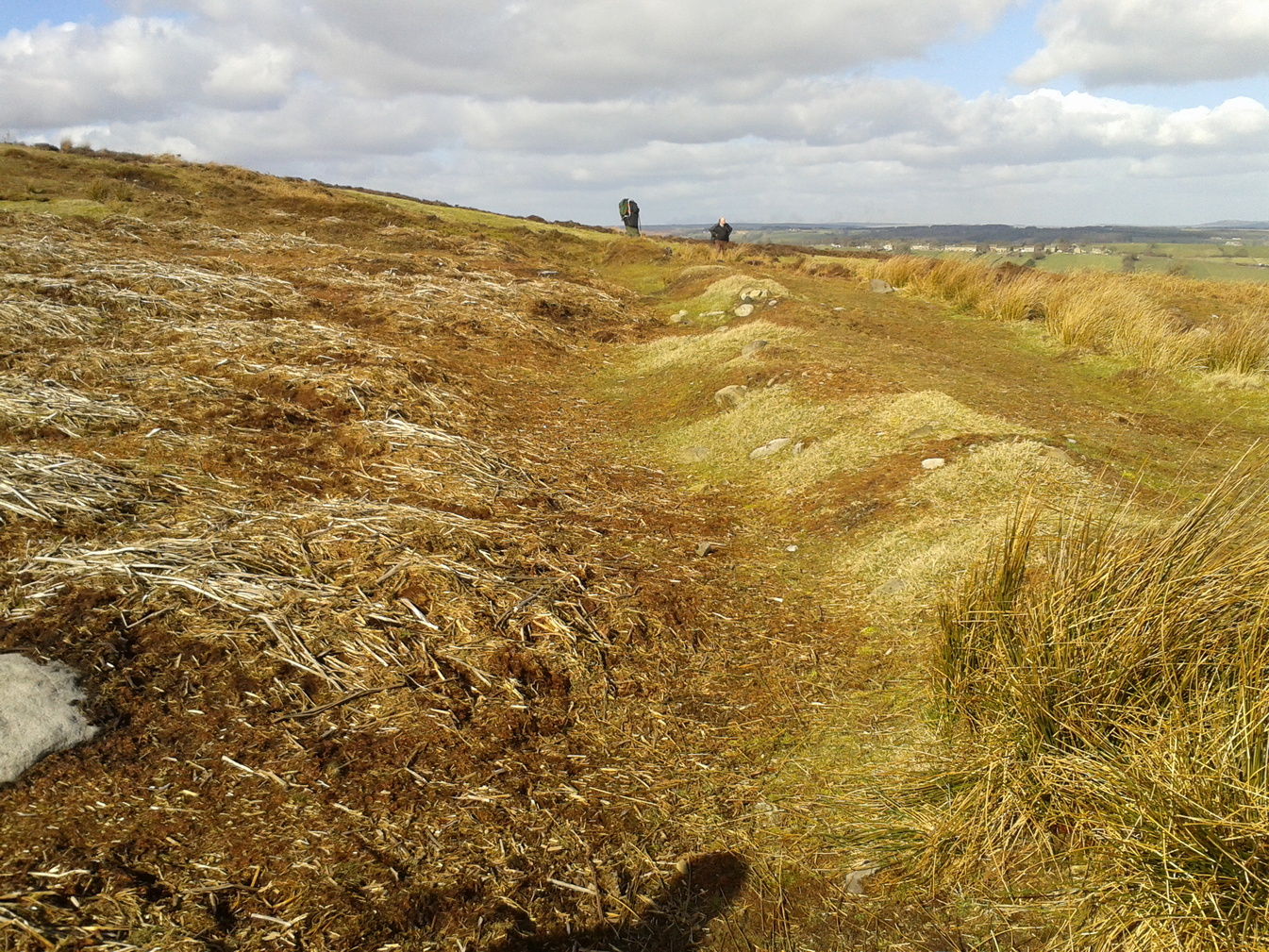
Danny, James & Paul on the NE corner, for scale

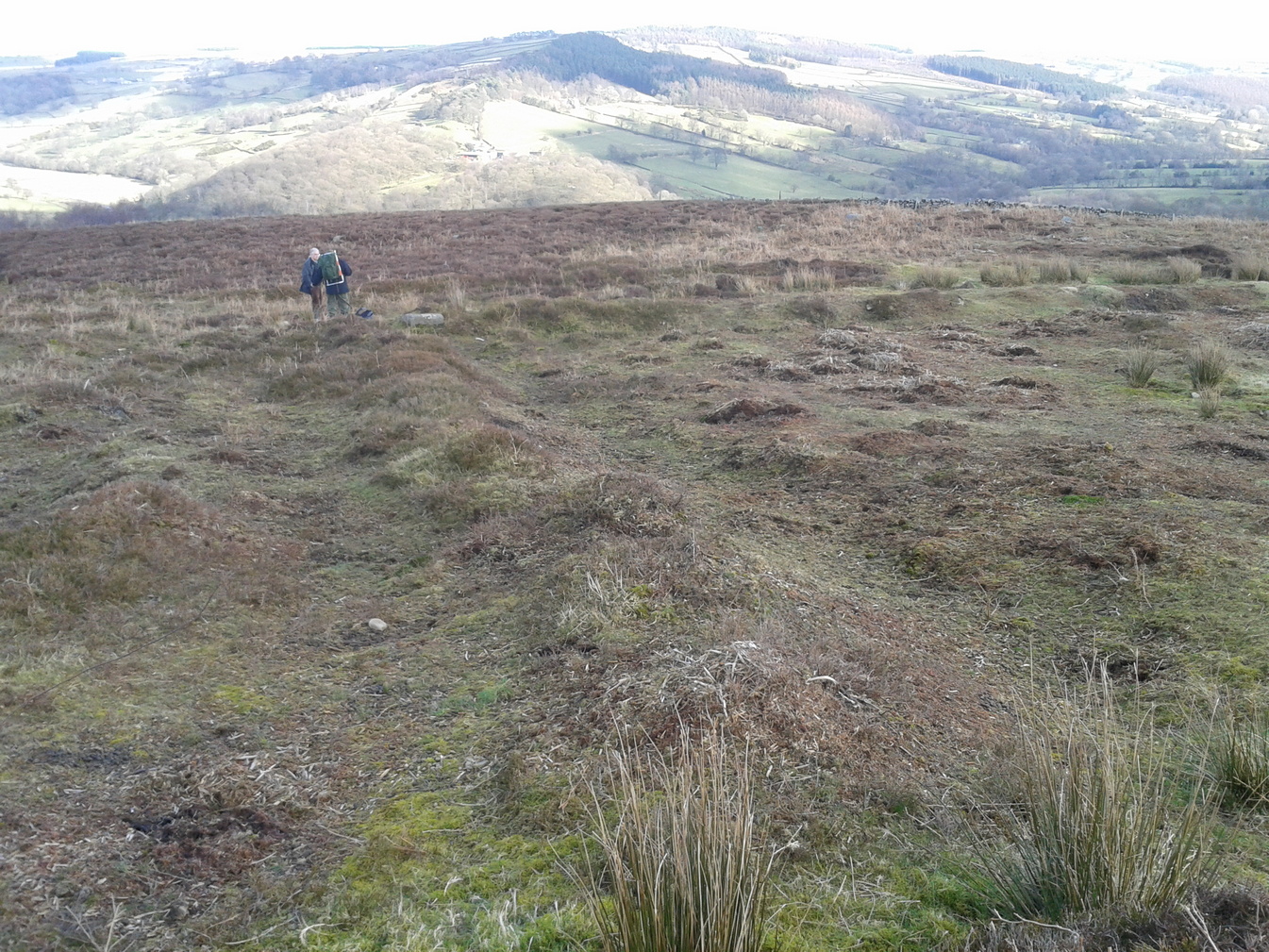
Coming up from Otley, make your way up to the Askwith Moor road (the only one that goes across the moors) and park up on the rough parking spot on the right-side (east) of the road.  You can’t really miss it.  From here walk up the road for less than 500 yards until your reach the rickety gate and the path onto the moors.  From here I walked 600 yards east, thru the heather until I reached the wall (close to the Tree of Life Stone) and then followed the wall up for 150 yards, then back up (west) onto the moor again and, about 50 yards along at the foot of the slope, keep your eyes peeled for the earthworky undulations beneath your tiny feet!

Archaeology & History

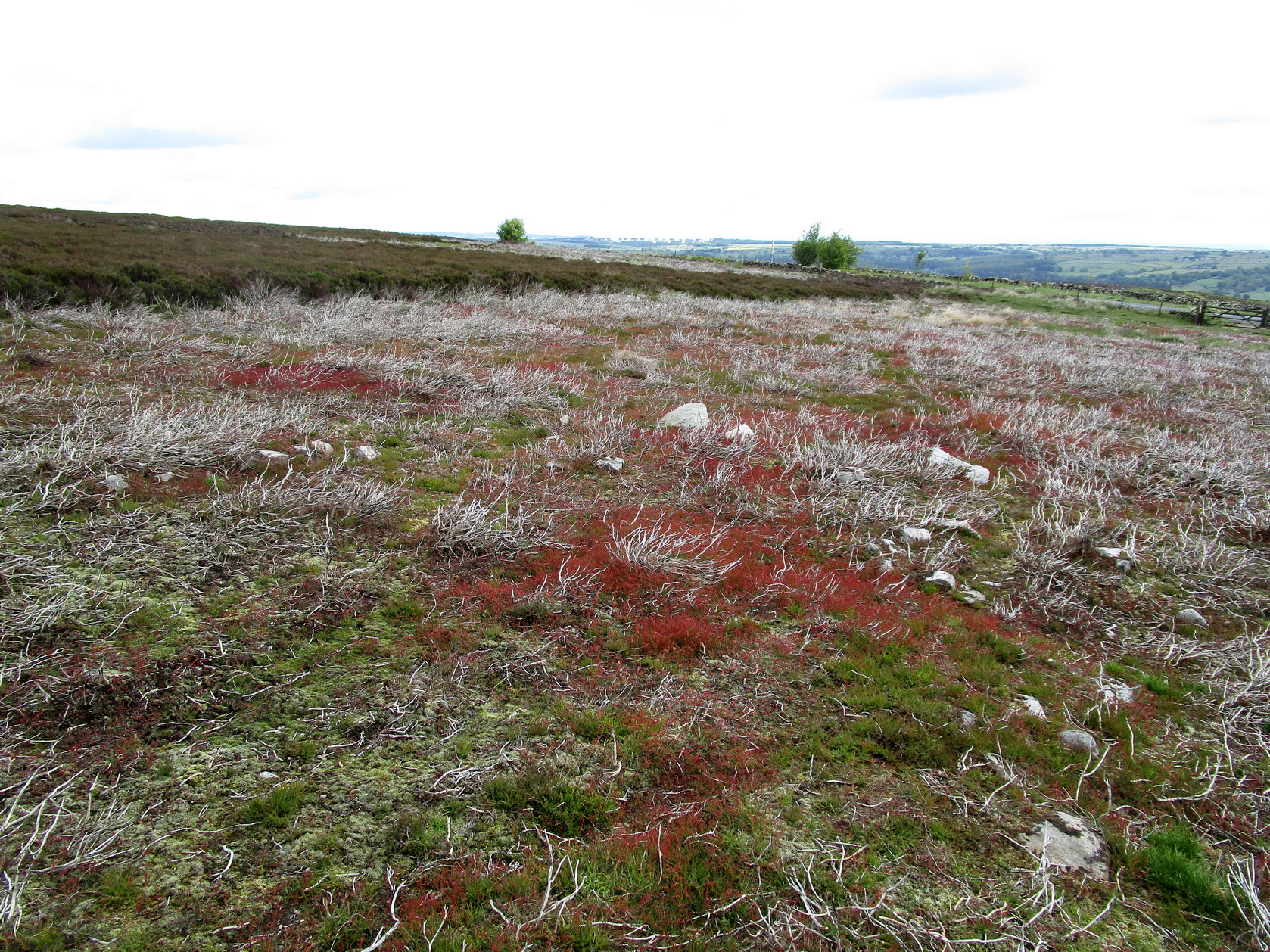
Just below the scattered Snowden Moor settlement we find this curious large structure, first described 75 years ago by the northern antiquarian Eric T. Cowling (1946). Since then, apart from a cursory overview, archaeologists haven’t really paid it much attention.

Eastern ditch, looking N

Eastern ditch, looking S

It’s a large site – and one which Cowling thought was constructed in the Iron Age.  He may have been right, but there’s such a profusion of ancient sites on this small moorland area—dating from Neolithic times onwards—that it could be earlier than he thought.  It’s an odd site too!  Unlike the prehistoric D-shaped enclosure and settlement on the top of the slope less than 100 yards away, and an equivalent D-shaped enclosure to the south, the area inside Cowling’s enclosure ostensibly is on quite sloping ground, with barely a flat level area anywhere inside it.  As a result of this, we can safely conclude that it wasn’t where people lived; and the complete lack of any inner hut circles (which you’d expect in a standard enclosure of this size) encourages this view.  It’s a bit of a puzzle!  Cowling opted for the idea that it was built to enclose cattle – which may be right; but again, even this must be questioned, as there is ample space on more level ground where this could have been done.  His description of the site is as follows:

“The most prominent feature (on these moors) is a D-shaped enclosure which covers the nose of the spur; the area is eighty feet from north to south and seventy feet from east to west. The enclosing bank is of piled boulders, three feet high and eight feet wide.   Cuttings across the north side revealed no evidence of dry walling, but rather a bank to carry a heavy stockade.  A shallow trench runs inside the bank, which is doubled where it is overlooked by higher ground at the northeast corner.  A second outer bank at the eastern side has an outer trench. Along the ridge to the east are circles of varying size, probably a hut group.  A larger circle (?) of heavy material, some thirty feet in diameter, is isolated on the shelf above Snowden Crags to the west.  Strips of wall and remains of enclosures of circular shape abound.”

Cowling’s plan of the site

Northern bank, looking E

Cowling’s initial measurements of the site underestimated its real size, as the bank and ditch that runs roughly north-south is close to 52 yards—nearly twice as long!  The same was found along its east-west size: being 56 yards, which is more than twice what Cowling measured.  Altogether, the enclosure measures approximately 225 yards around its outer edges.  In fairness, Cowling’s error was probably due to it being covered in vegetation when he came to do his measurements here.  …So, if you’re gonna check this place out, make sure you do it in the winter or early spring months, before the bracken encroaches.

There’s a real abundance of prehistoric sites all over this part of the moor, from more settlement remains, cairns, ring cairns and petroglyphs.  Make a day out of it.

References:

  1. Cowling, Eric T., Rombald’s Way, William Walker: Otley 1946.

© Paul BennettThe Northern Antiquarian
Summer Stone, Blubberhouse Moor, North Yorkshire

Cup-Marked Stone:  OS Grid Reference – SE 15564 54039

Getting Here

Cupmark stone, looking W

It’s probably easiest to start from the Green Plain settlement, from here crossing the Sun Bank Gill stream and walking east through the scattered heather and grasslands for 450 yards to the right-angled edge of the woodland.  Keep walking eastwards alongside the woods for about another 250 yards, then walk into the grasslands north for about 140 yards or so.  Zigzag about – you’re damn close!

Archaeology & History

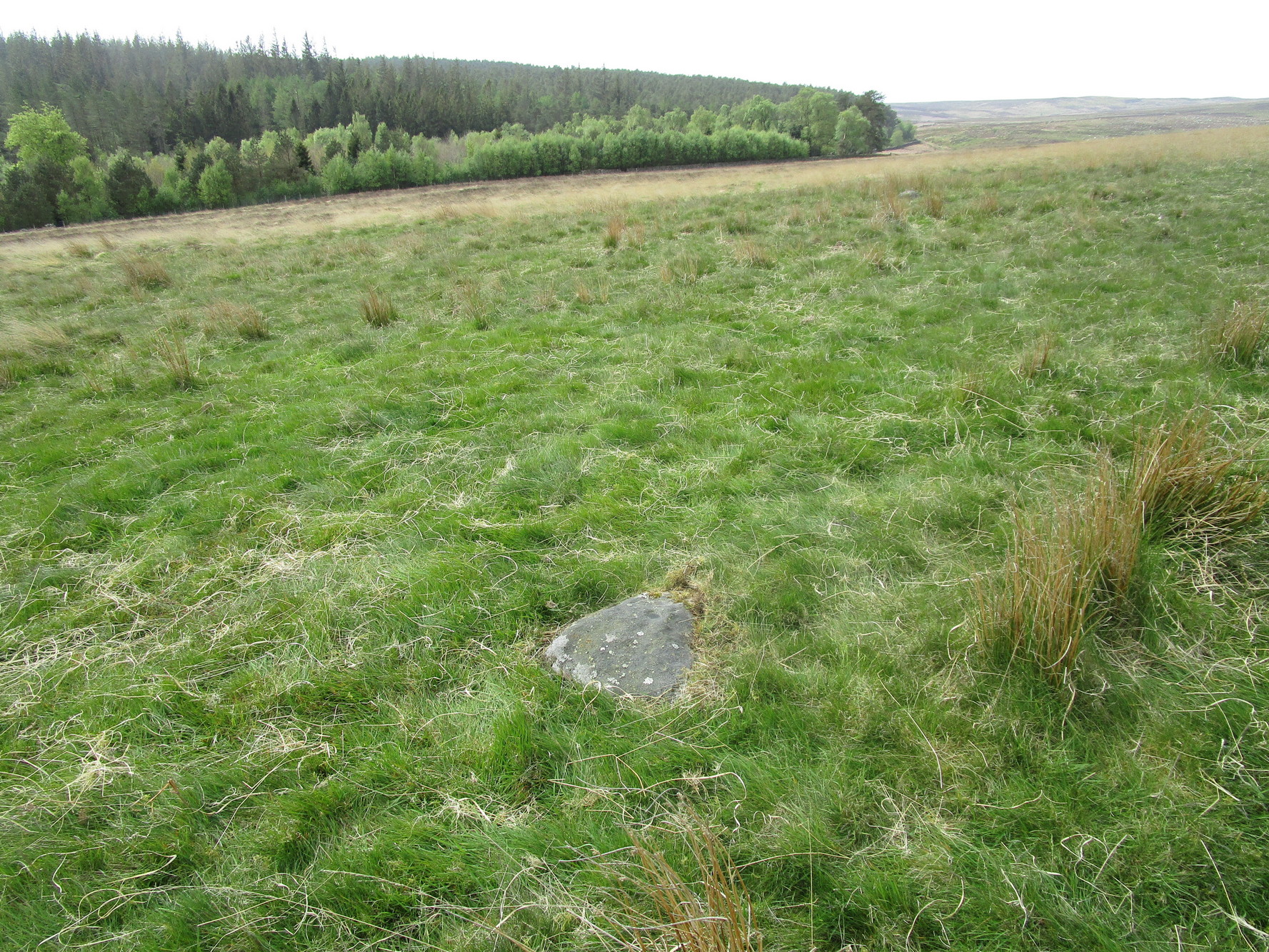
Only for the purists amongst you.  This is a simple small triangular stone, with a single notable cup-mark near the middle.  It would seem to be in isolation as we could find no others in the immediate vicinity.  An early marker no doubt.

Acknowledgements:  With thanks to Helen Summerton, who helped with location on this fine day.

© Paul BennettThe Northern Antiquarian