Haulgh, Bolton, Lancashire

Tumulus (destroyed):  OS Grid Reference – SD 7242 0899

Archaeology & History

This single-grave burial — described by Barnes (1982) as a kerbed or revetted cairn — close to the very centre of modern-day Bolton, was once an impressive prehistoric tomb.  It was described by a local historian, Matthew Dawes, amidst a variety of prehistoric remains in and around Bolton, most of which have long-since been forgotten.

“Near Haulgh, about a quarter of a mile south-east from Bolton Parish Church, on a piece of high flat land, on the east bank of the Croal, and about fifty feet above the river, was a tumulus, about thirty feet in diameter, and four feet deep, consisting of small boulders… It was discovered in September, 1826, in forming a branch of the new road leading from Bolton to Bury. It was probably much depressed in its formation and was covered with a few inches of mound. The cop or fence crossed it in a north and south direction. About the centre of this tumulus was a cist-vaen, about four feet six inches long and one foot deep, formed of four upright stones and a coverer, and its length was nearly north and south. In this cist-vaen was a skeleton, with the legs doubled up, and the head to the north. Near the head, and on the west side, was found an urn, inverted, four and a half inches in the widest diameter, and three and a quarter inches high, and perforated by four small holes in the widest part. On the other side of the head was a bronze spear-head, four and three-eighths inches long, and one and three-eighths inch wide, of which the point was bent back, and a piece of the side chipped away. The urn and spear-head were taken to the Countess of Bradford, the Earl of Bradford being the owner of the land.”

Intriguingly, if you’re from the Bolton region, Mr Dawes also told that, “A man in the employ of the Earl of Bradford, the superintendent of the work, who made the discovery, informs me (1862) that two other tumuli were found shortly after the one just described, a few yards to the south of it, in the same fence.”  As yet I have no more information about these other tombs (gimme time though!)

References:

  1. Barnes, Bernard, Man and the Changing Landscape, Unversity of Liverpool 1982.
  2. Dawes, M., ‘British Burial Places near Bolton,’ in Trans. Hist. Soc. Lancs & Cheshire, volume 4, 1852.
  3. Scholes, James C., History of Bolton, Daily Chronicle: Bolton 1892.

© Paul Bennett, The Northern Antiquarian

St. Helen’s Wells, Whittle-le-Woods, Lancashire

Holy Wells:  OS Grid Reference – SD 5856 2242

Getting Here

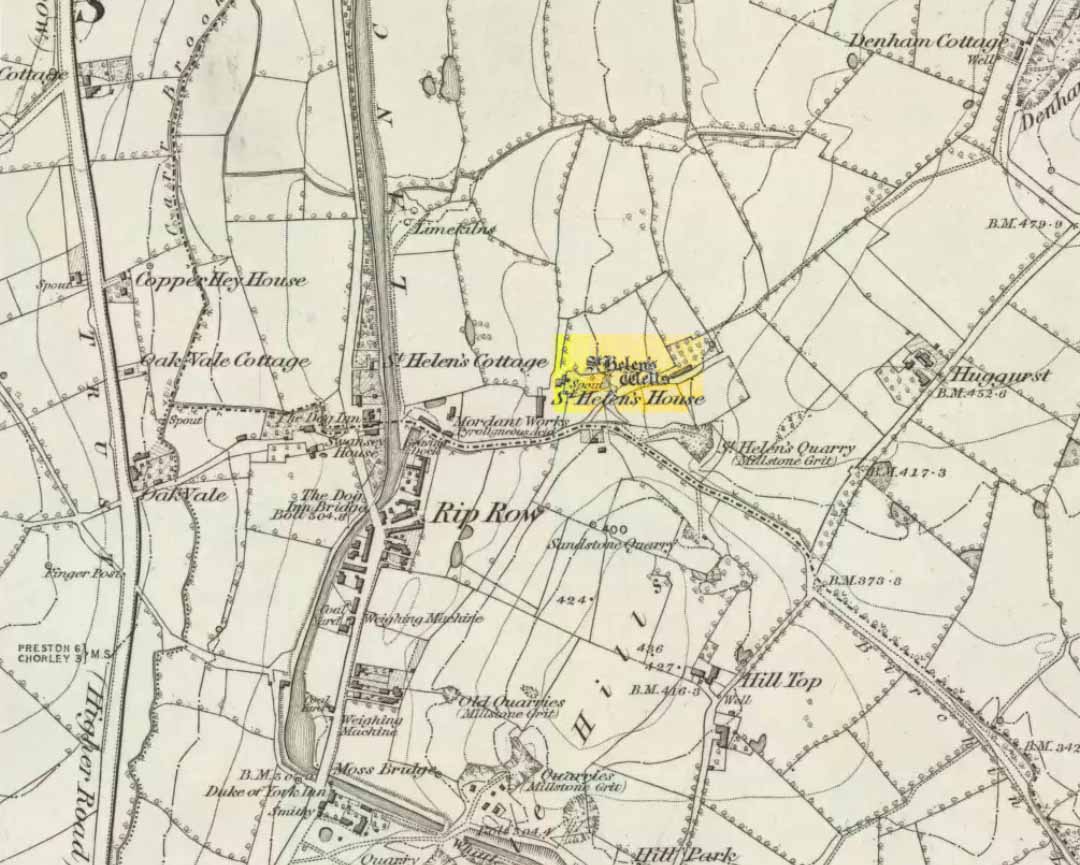
St Helen's Well on 1848 map
St Helen’s Well on 1848 map

Destroyed when the M6 motorway was built – but if you’re a really fanatic and wanna see the setting, simply get to the bridge that crosses the M61 north of the town, leading to Birchin Lane and Denham Lane. (To be honest though, if I lived nearby, I’d have to make 100% certain, and have a look in the trees between the west-side of the M6 and the trees at the end of the Wells Close Fold cul-de-sac, just in case its waters are there. If you find anything, let us know!)

Archaeology & History

St. Helen's Well (after Taylor 1906)
St Helen’s Well (Taylor 1906)

Highlighted on the very first OS-map of the region in 1848, this was one of many examples of a site dedicated to an important pre-christian deity which was eventually morphed into the character of Saint Helen.   Several sites nearby were all named after the saint, including the quarries, a cottage, house and the wells themselves.

When Henry Taylor (1906) came here, he wrote the following about this once important site:

“This celebrated well is situated in a wild, rugged and hilly part of the hundred, in the south of the parish of Brindle… The water, brilliantly clear and sparkling, bubbles up through white sand at the bottom of a stone-lined pit, about seven feet square and four feet deep.  On the southerly side of this pit, a few feet from it, is another similar stone-lined pit of about the same size.  An old inhabitant tells me that formerly both pits — now nearly empty — were filled to the brim; and this was clearly the case, as an open stone channel is in situ, provided to carry the overflow water from the southernmost pit, the water dropping from it down into the valley.  These structures are clearly of considerable antiquity, but the stones are somewhat displaced through neglect.  The water now comes underground, through a pipe, into a farmyard about one hundred yards south of the well in a splendid crystal stream.  Drinking water appears to be scarce in this district, for we met carts full of barrels which were apparently being taken to the neighbouring villages for sale from this spring.”

Folklore

Local folk visited here and dropped crooked pins into the well in the hope of wishes and future blessings one report saying such practices were done by local catholics!

References:

  1. Taylor, Henry, The Ancient Crosses and Holy Wells of Lancashire, Sherratt & Hughes: Manchester 1906.

© Paul Bennett, The Northern Antiquarian

Fair Haia, Carlton, North Yorkshire

Legendary Tree (destroyed?):  OS Grid Reference – SE 614 270

Getting Here

From Carlton, take the western Hirst Road to Temple Hirst village, then turn right once you’re in the village and go up Common Lane up for about a mile.  There’s a footpath on your left leading you to the Fair Oaks farmhouse. This was the spot!

Archaeology & History

This is fascinating sounding place which marked the central point of three old township boundaries nearly 1000 years ago.   I first found it mentioned in Morrell’s History and Antiquities of Selby (1867: 36-7), where this once famous tree is described in land sale transactions.  Morrell told:

“At Carlton the (Selby) abbey had considerable property, which was sold to the neighbouring priory of Drax.  The boundary of the property sold was a certain oak tree, called Fair-haia, in Burn Wood, which Adam de Bellaqua gave for this purpose, binding himself and his heirs never to cut it down or root it up, sub poena anathematis.”

But we found a more detailed outline in Dugdale’s Selby Abbey in Yorkshire, where the premises and townships given to Selby Abbey in the 12th and 13th centuries are listed.  In the township of ‘Carleton’ (as it was then spelt) Dugdale wrote:

“Peter de Brus gave the grange here, which the monks had held of Agnes, late wife of Ranulph FitzSwain.  Richard abbat of Selby granted to Robert prior of Drax all the tithe from the north part of the oak called Fair-haia, in the wood of Birne, or Berlay, through the middle of the marsh to Hundolfsweith; and from thence by the strait ditch directly to Espholm, and all the tithe from Espholme to Appletreholme, as the ditch goes to the new fosse or ditch of Carleton: and the prior granted to the abbat all the tithes on the south to the new ditch, and from thence to the river Ayre.  And Adam de Bellaqua gave this oak tree, called Fair-haia, as a boundary, never to be cut down (ad standum in perpetuum et non rescindendum), binding himself and his successors never to cut it down or root it up.”

One wonders: are there any remains left of this once great tree?  Has anyone actually transgressed and uprooted it in times past?  Is any other lore known of it?  And who was Adam de Bellaqua?

One of the most intriguing elements to this site is its name, for the word ‘haia’ literally means ‘god of the land’ — but whether we can take this meaning seriously is questionable, as it’s of Sumerian origin.  However, no local dialect words throw any light on the word and it may aswell be the name of the spirit of the tree as anything else.  Does anyone know owt more about this place?

References:

  1. Dugdale, William, Monasticon Anglicanum – volume 3, Longman, Hurst, Rees, Orme & Brown: London 1817.
  2. Morrell, W.W., The History and Antiquities of Selby, W.B. Bellerby: Selby 1867.
  3. Philpot, J.H., The Sacred Tree, MacMillan: London 1897.

© Paul Bennett, The Northern Antiquarian

St. Cuthbert’s Well, Waverbridge, Cumbria

Holy Well:  OS Grid Reference – NY 21479 48615

Also Known as:

  1. Haly Well
  2. Helly Well

Getting Here

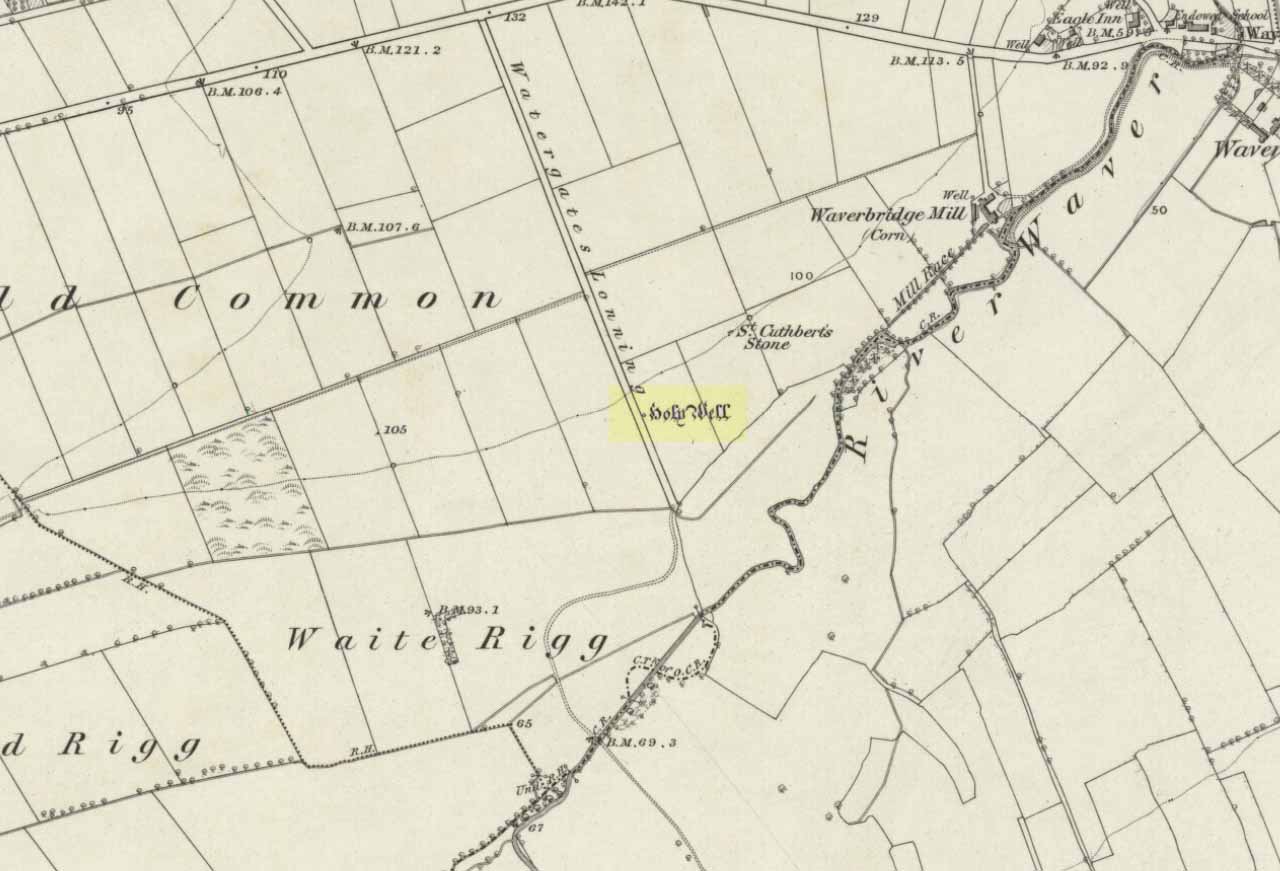
St Cuthberts Well on 1868 map

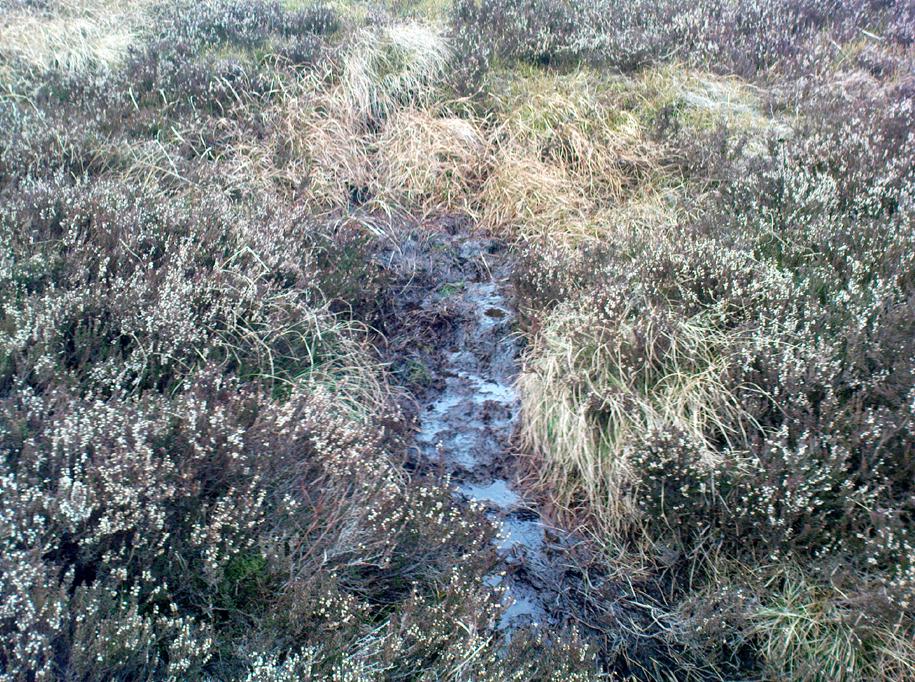
A mile east of Waverbridge, turn down the track called Watergates Lonning. Before you reach the bottom, on the left side of the straight track is a spring of water. This is the old holy well.

Archaeology & History

Although much used in bygone times, very little of it can be seen nowadays.  When John Musther (2015) wrote about it recently, he told that although it was

“Once known for its copious amount of remarkably pure and sweet water, it is now only a trickle by a tree.”

Nearly three hundred yards away across the fields northeast of this small spring of water, was once seen “a pretty large rock of granite, called St. Cuthbert’s Stone“, whose mythic history will have been intimately tied to the holy well.

Folklore

In the second volume of William Hutchinson’s History of the County of Cumberland (1794), he tells that the St. Cuthbert’s Well,

“is a fine copious spring of remarkably pure and sweet water which…is called Helly-well, i.e. Haly or Holy Well. It formerly was the custom for the youth of all the neighbouring villages to assemble at this well early in the afternoon of the second Sunday in May, and there to join in a variety of rural sports. It was the village wake, and took place here, it is possible, when the keeping of wakes and fairs in the churchyard was discontinued. And it differed from the wakes of later times chiefly in this, that though it was a meeting entirely devoted to festivity and mirth, no strong drink of any kind was ever seen there, nor anything ever drunk but the beverage furnished by the Naiad of the place. A curate of the parish, about twenty years ago (c.1774), on the idea that it was a profanation of the Sabbath, saw fit to set his face against it; and having deservedly great influence in the parish, the meetings at Helly-well have ever since been discontinued.”

References:

  1. Hutchinson, William, The History and Antiquities of the County of Cumberland, volume 2, F. Jollie: Carlisle 1794.
  2. Musther, John, Springs of Living Waters: The Holy Wells of North Cumbria, J.Musther: Keswick 2015.

© Paul Bennett, The Northern Antiquarian

Rawthey Bridge, Fell End, Ravenstonedale, Cumbria

Stone Circle (destroyed):  OS Grid Reference – SD 714 978

Archaeology & History

This is yet another stone circle that’s been destroyed. It seems to have been described first by Nicolson & Burn (1777) — as “a circle of large stones, supposed to be a monument of druid worship” — but a century later when Reverend Nicholls (1877) came to describe it, he was talking of it in the past tense, saying:

“Fifty years ago there was a circle of stones on the high road leading from Kirkby Stephen to Sedbergh, near Rawthey Bridge, supposed to be a monument of Druid worship.  These stones, I have been informed by Mr. William Alderson of Brigg, were blocks of limestone, about three feet high, and were inconsiderably removed for the purpose of helping to build the abutment on the Ravenstonedale side of the present bridge which spans the Rawthey, and bears (the) date 1822.  The holes in which the stones stood are, however, yet visible, although overgrown with grass.  Collectively they form a circle.”

One writer later (1967) told that the site “seems to have stood on the moor to the left of the road opposite the confluence of the Sally Beck with the Rawthey.”  As far as I’m aware, little more is known of the site. Omitted from Burl’s magnum opus, it was included in Waterhouse’s (1985) fine survey of Cumbrian megaliths, but with no further details.  But another Victorian writer (Thompson 1892) thought it more likely that the ‘circle’ here was, in fact, more likely a barrow or grave-mound.  Sadly, we’ll probably never know…

References:

  1. Anon., Sedbergh, Garsdale and Dent, Reeds: Penrith 1967.
  2. Nicholls, Rev. W., The History and Traditions of Ravenstonedale, John Heywood: Manchester 1877.
  3. Nicolson, J. & Burn, R., The History and Antiquities of the Counties of Westmorland and Cumberland, London 1777.
  4. Thompson, Rev. W., Sedbergh, Garsdale and Dent, Richard Jackson: Leeds 1892.
  5. Waterhouse, John, The Stone Circles of Cumbria, Phillimore: Chichester 1985.

© Paul Bennett, The Northern Antiquarian


Market Cross, Keighley, West Yorkshire

Cross: OS Grid Reference – SE 06042 41002

Getting Here

Dead easy this one!  Go along North Street in Keighley, towards the main church in the middle of town (a St. Andrew’s church, previously St. Pete), by the once-infamous Lord Rodney pub, and the old stone edifice stands outside by the Green.  The much better Red Pig public house is across the road from here.

Archaeology & History

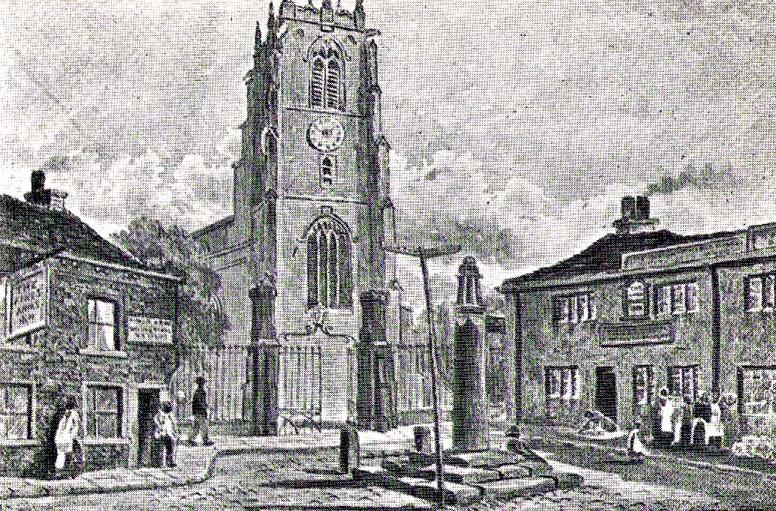
Keighley's Town Cross, 1847 - illustrated on a painting by Edwin Riby
Keighley’s Town Cross, 1847 – on a painting by Edwin Riby

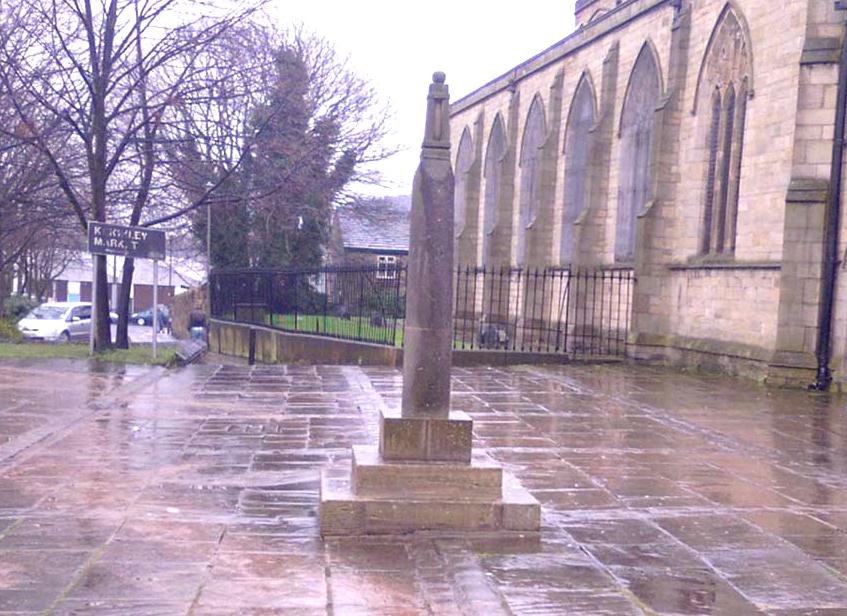
For a relatively trivial archaeological site, it’s got a bittova history.  Not that this is an old site either!  We’re not sure just when this cross was made, but it’s certainly no more than 300 years old.  Before standing in its present position outside St. Andrew’s Church, sometime before 1840 it was said to have been a few hundred yards away above the present roundabout on Oakworth Road; and one record tells that it originally came from nearby Utley, a mile to the north.  Due to lack of decent records, we’re not sure about its early status as a market cross, nor when it was first erected.  Indeed, even the steps on which the cross presently stands are clearly more recent than the ones illustrated on Edwin Riby’s 1847 portrait, reproduced here.

Keighley Cross, on a grey wet day!

It would be good to get a complete history of this archaeological relic but it’s difficult with artifacts such as these; and although gaining access to the church now takes less time and effort than it used to (the vicar here used to be quite unhelpful, but has recently changed his ways – which is good!), it’s only open at certain times of the week.*  Friday afternoons seem OK to have a look round.  Please – if folk begin having trouble gaining access to the Church once more, let us know on here so we can make complaints about it.  The Church is paid for by local tax-payer’s cash, and so needs to be open to all of us.  Let’s hope this humble ingredient can be maintained for the good of all in this otherwise regressive social community (Keighley, that is…).

There’s also some very curious folklore to be added here in relation to the market and its cross, but its tale is gonna have to wait…

References:

  1. Gray, Johnnie, Through Airedale, from Goole to Malham, Elliott Stock: London 1891.
  2. Keighley, William, Keighley, Past and Present, R. Aked: Keighley 1858.

* There isn’t even a notice giving information, email or phone numbers, telling you who you can contact if you want to know anything about the history of the church, or visit it — which is quite dreadful considering how much money they get paid by tax-payers for their supposed socio-spiritual duties.

© Paul Bennett, The Northern Antiquarian

Dymond Stone, Burley Moor, West Yorkshire

Cup-Marked Stone:  OS Grid Reference – SE 12629 45206

Also known as:

  1. Carving no.118
  2. Carving no. 275

Getting Here

Dymond Stone, Ilkley Moor

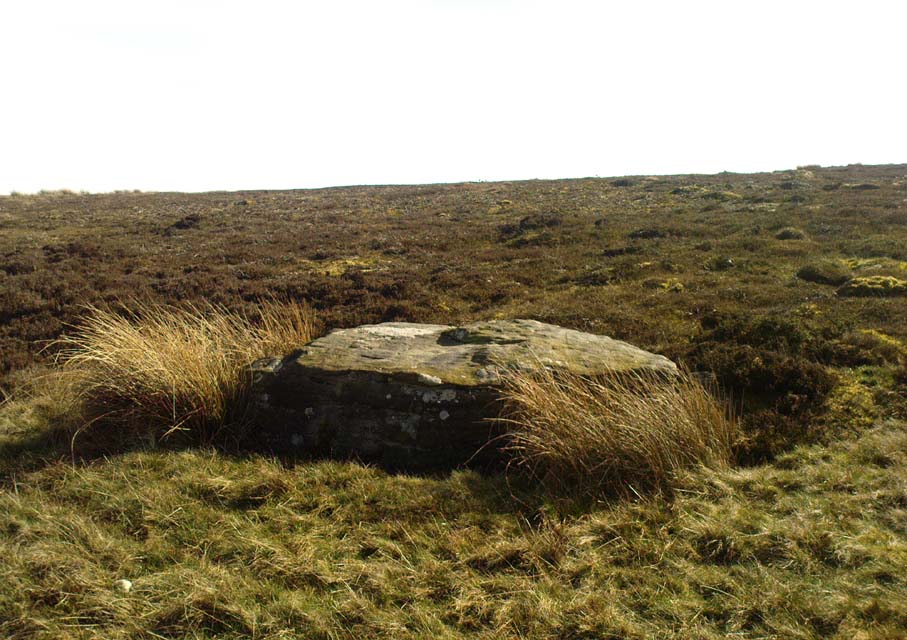
It’s not too far from the main footpath from Ilkley to the Twelve Apostles stone circle.  As its discoverer C.W. Dymond (1880) said, “It lies alone, on and near the foot of a steep slope, about a furlong, or less than five minutes’ walk, north from the ruins of a small stone-circle (Twelve Apostles) which crowns the crest of the pass leading south-south-east from Ilkley to Eldwick, and just one mile and three-quarters from the former place.  If approached therefrom, it will be easily found about two hundred yards to the east of the point where the road surmounts the steep, to enter upon the upper plain.”  Otherwise, walk through the Twelve Apostles from the main footpath and out the other side, following the land where it slopes down and, near the bottom, you’ll see this large stone sitting quietly on its own…

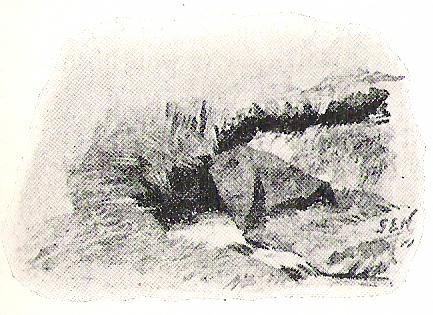
1880 image of Dymond's carving
Dymond’s 1880 sketch

Archaeology & History

Not too sure about the veracity of this one to be honest.  It was first described by archaeologist C.W. Dymond (1880) as “a stone marked with a striking group of cups” – but these are small and untypical of the usual markings.  “The stone is 9 ft. 6 ins. in length, 6 ft. 3 ins. in breadth, and about 2 ft. in thickness; its upper surface dipping a little, with the ground, toward the north. Upon it may be seen a group of small cups, for the most part about half an inch in diameter,” he said.

Dymond thought that the design on the rock may have represented parts of the night sky, saying, “here we may have a rude attempt to portray the starry heavens spanned by the galaxy ; and that the outlying groups may have been intended to represent two of the constellations perhaps Orion, and another not so easily identified.”  But I think we can take this with a pinch of salt.

Included in Hedge’s (1986) survey without comment, Boughey and Vickerman (2003) correctly thought that the “small peck marks which are not typical cup-marks” might be “doubtful”.

References:

  1. Boughey, Keith & Vickerman, E.A., Prehistoric Rock Art of the West Riding, West Yorks Archaeology Service 2003.
  2. Dymond, C.W., ‘Cup Marks on Burley Moor,’ in Journal of the British Archaeological Association, volume 36, 1880.
  3. Hedges, John, The Carved Rocks of Rombalds Moor, WYMCC: Wakefield 1986.

© Paul Bennett, The Northern Antiquarian

Doubler Stones, Ilkley Moor, West Yorkshire

Cup-and-Ring Stones:  OS Grid Reference – SE 0723 4652

Also Known as:

  1. Carving Nos. 41 & 42 (Boughey & Vickerman)
  2. Carving Nos. 6 & 7 (Hedges survey)
  3. Doublestones
  4. The Fire Stones

Getting Here

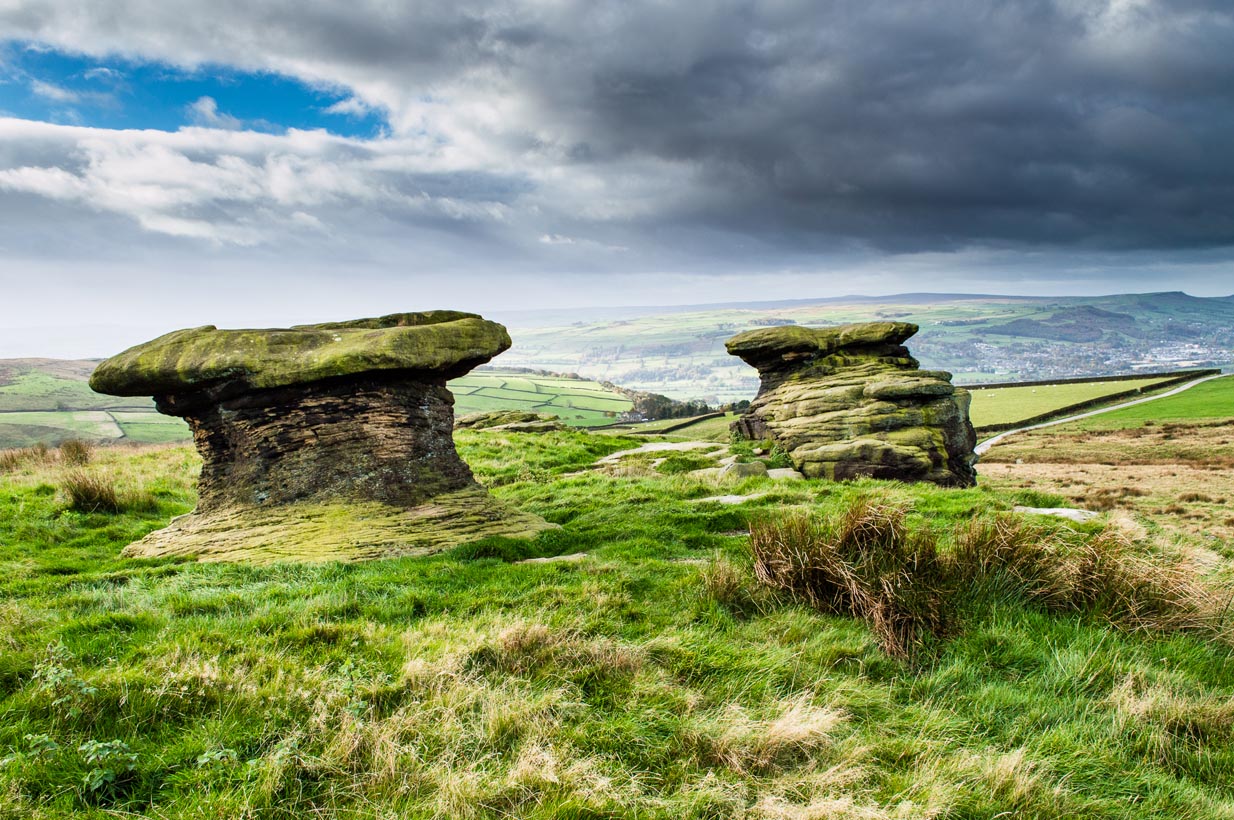
The great Doubler Stones (photo, James Elkington)

Various ways to get here, but the 2 most common are: (1) from Brunthwaite village, above Silsden, following the road uphill for a mile, then turning right (west) onto the moorland dirt-track to Doubler Stones Farm.  Just before here there’s a footpath uphill (north) for 200 yards to the stones.  (2) follow the Millenium Way footpath south up Addingham Moorside, onto Addingham High Moor.  Keep going on the same path another 500 yards and they’ll appear ahead of you.

Archaeology & History

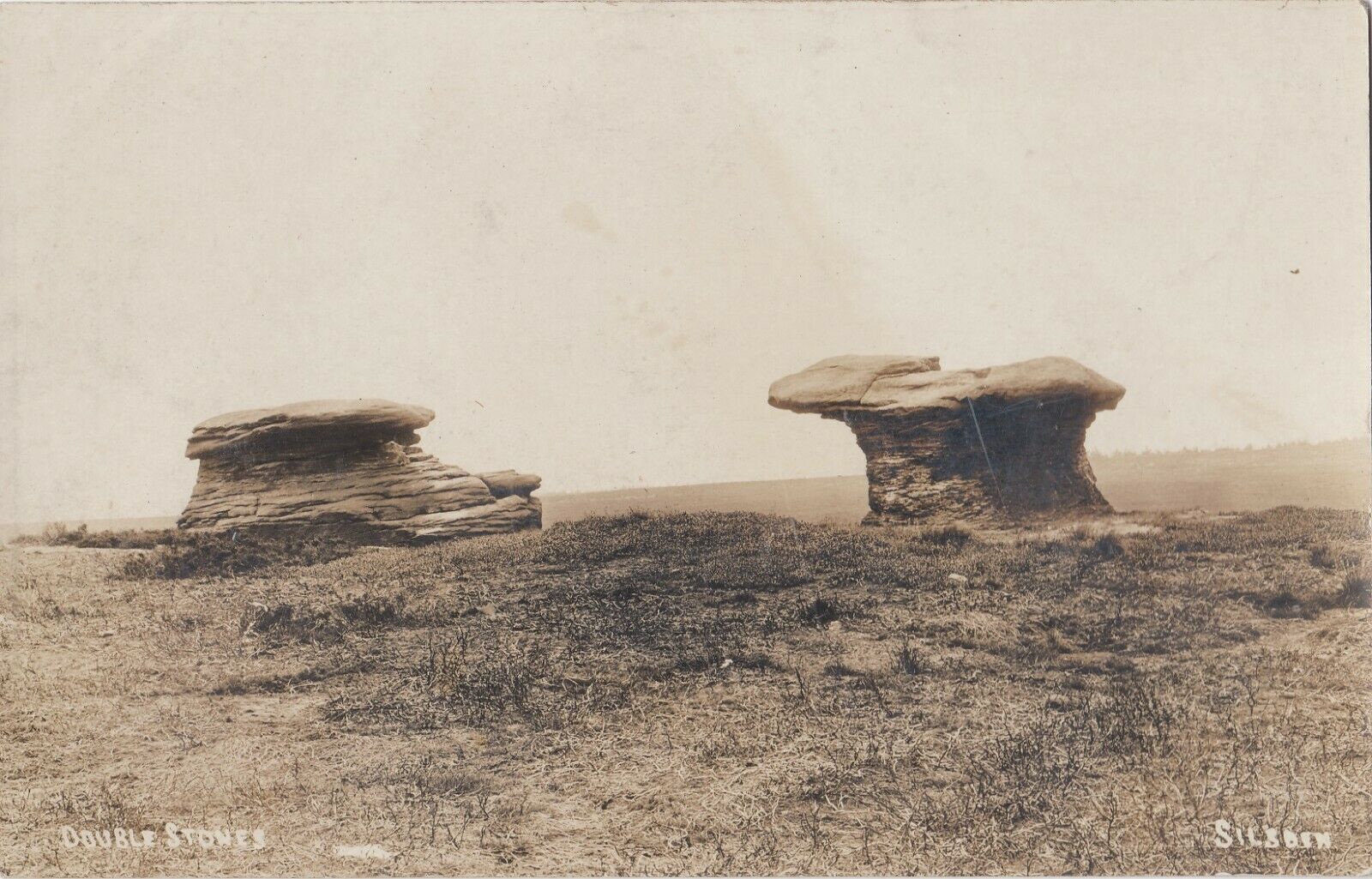
First described as the ‘Doublestones’ in the local Addingham parish records of 1786, these great mushroom-shaped rocks were later brought to the attention of archaeologists by J. Romilly Allen in 1879 and they greatly intrigued numerous Victorian antiquarians, who puzzled as much about their exotic forms as the cup-marks on their tops!  Allen wrote of them:

Cowling’s old drawing
Hedges (1986) sketch of the design

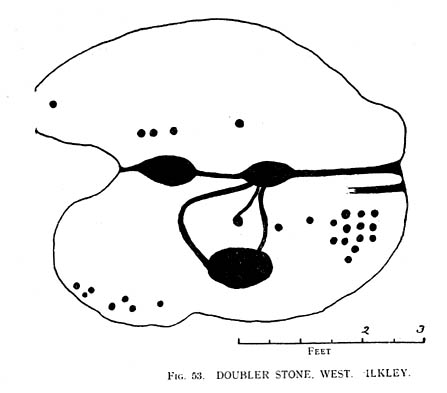
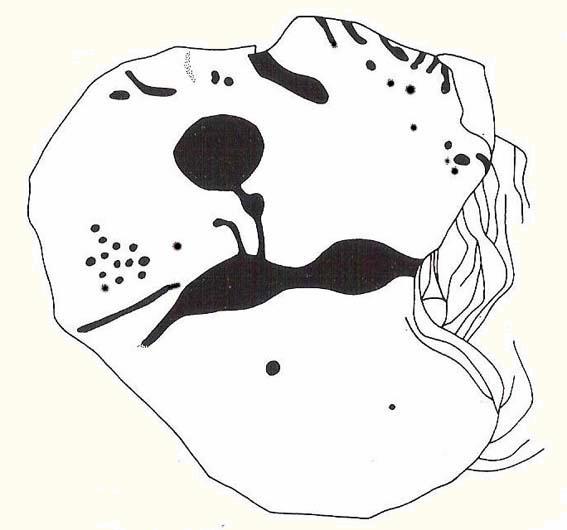
“These rocks are by far the most remarkable freaks of Nature to be seen in the district. They occupy a prominent position, perched on the extremity of a rocky knoll which juts out into the valley; and as seen from below, with their weird forms standing out clear and sharp against the background of blue sky, they present so extraordinary an appearance that they would at once attract the attention of even the most unobservant.  In general outline they resemble gigantic toadstools; and I presume that they are called Doubler Stones from the fact of their shapes being almost identical.  They may be appropriately described as Nature’s Twins.  The upper surface of the cap of one of these stones has three large basin-shaped cavities in it.  Two of these lie along the central axis of the stone, and measure respectively 1ft 3in by 2ft 9in deep, and 1ft 9in by 1ft 3in by 9in deep.  They are united by a deep groove, a continuation of which runs out over the edge of the stone at each end.  There is another basin lying to the west side of the two central ones, with one of which it is connected by grooves.  It measures 2ft by 1ft 9in and is 9in deep.  There is no direct evidence that these basins are artificial; but it is quite possible that they may have been so originally, and have been enlarged by natural agencies.  But in addition to the basins, are twenty-six cup-markings of distinctly artificial origin.  They vary in diameter from 2 to 4 in.  One group of cups appears to be arranged in parallel rows.”

Doubler Stones, c.1890

Although the writer thought there were no artificial cup-markings on the other Doubler Stone (the one on the left in the photo), John Hedges (1986) and Boughey & Vickerman (2003) cite there to be at least two cup-markings on this rock.  Other writers have given different numbers for the respective cup-marks thought to be on these rocks down the years.

If you’re into prehistoric rock-art, check this place out.  If you’re a geologist and aint been here, you’ll be even more impressed!

Folklore

Approaching the Doublers (photo – James Elkington)

In Nicholas Size’s Haunted Moor (1934) he described the Doubler Stones as being the abode of ghosts and a place of sacrificial rites in ancient days. While in Guy Ragland Phillips’ Brigantia, we find that the word ‘doubler’ itself “is a large shallow dish, bowl or plate” – which we find on top of the greater one of these two well-worn-weirdoes.  As well as being haunted, there is some other little-known, though not unexpected folklore here, which told these old stones to be the meeting place of witches in previous centuries.

In addition to this, we are told that the witches of Fewston valley to the west used to meet up with the more famous Pendle witches at these stones.  One historian proclaimed that this notion was spurious, as it would be too far for the Pendle witches to walk – which says more about the historian in question than the people of previous centuries.  The distance from Pendle to the Doublers can be traversed in a day and is an ideal meeting spot, away from the prying eyes of a wrathful Church, that sought war against the animistic practices of our ancestors.

References:

  1. Allen, J. Romilly, ‘The Prehistoric Rock Sculptures of Ilkley,’ in Journal of the British Archaeological Association, volume 35, 1879.
  2. Allen, J. Romilly, ‘Notice of Sculptured Rocks near Ilkley,’ ibid, volume 38, 1882.
  3. Bennett, Paul, The Old Stones of Elmet, Capall Bann: Chieveley 2001.
  4. Boughey & Vickerman, Prehistoric Rock Art of the West Riding, West Yorkshire Archaeology Service 2003.
  5. Cowling, Eric T., Rombald’s Way, William Walker: Otley 1946.
  6. Hedges, John, The Carved Rocks on Rombalds Moor, WYMCC: Wakefield 1986.
  7. Jennings, Hargrave, Archaic Rock Inscriptions, A. Reader: London 1891.
  8. Phillips, Guy Ragland, Brigantia: A Mysteriography, RKP: London 1976.
  9. Size, Nicholas, The Haunted Moor, William Walker: Otley 1934.

Acknowledgements:  Massive thanks to landscape photographer, James Elkington, for use of his images in this site profile.  Thanks mate! 

© Paul Bennett, The Northern Antiquarian

Tadpole Stone, Eastwoods Rough, Dacre, North Yorkshire

Cup-and-Ring Stone:  OS Grid Reference – SE 18601 61644

Also known as:

  1. Eastwoods Rough II Carving
  2. IAG638b (Boughey)

Getting Here

Tadpole Stone, Dacre

To get here, follow the same directions as if you’re going to the Morphing Stone.  This carving is in the same field, but about 100 yards SSW of there, just to the south-side of the Nidderdale Way footpath.  There’s plenty of rocks about, but with a bit of patience or a natural rock-art dowser’s nose, you’ll find the carving easily enough!

Archaeology & History

Tadpole Stone plan
Tadpole Stone plan (© Richard Stroud)

This is another relatively recent find — though I wonder whether the nearby ‘Fertility Stone’ (about 500 yards north, in some walling) should switch names with this carving, as this one gives the distinct impression of sperm fertilizing the egg!  Don’t you agree!?  The name of the Tadpole Stone was given to it by Michala Potts — and the photograph and design are used, courtesy of Richard Stroud.  In the next field from here, towards Eastwoods Farm, we find the Eastwoods Cross base and cup-markings and adjacent cup-marked stone.  Not far away are other carvings, aswell as a number of other Bronze- and Iron-Age sites.

This design was described in Keith Boughey’s (2007) article on the rock art around Eastwoods Farm, telling how it

“was discovered by Kevin Cale and reported to the N.Y.C.C. SMR back in 2001… A low profile moss-covered earthfast rock a little over 1m in diameter in any one direction immediately S of the Nidderdale Way about 100m east of the end of Monk Ing Road and S of Eastwoods Farm at SE 18601 61643 and 172m O.D. Its domed surface carries a somewhat unusual design interestingly reminiscent of the design carved at the previous site which lies in the same field and landscape 160m to the north-west… An oval or egg-shaped groove enclosed up to six cups; a groove or channel, often referred to as a ‘comet tail’ in rock art motif vocabulary, runs from the central group of the six out beyond the enclosing groove, bends sharply and continues down over the sloping face of the rock.  A wide groove at the base of the rock running into the present turf line may be a further element of the carving.”

References:

  1. Boughey, K., “Prehistoric Rock Art: Four New Discoveries in Nidderdale,” in Prehistoric Research Section Bulletin, no.44, Yorkshire Archaeological Society 2007.

© Paul Bennett, The Northern Antiquarian

Holy Well, Todmorden, West Yorkshire

Holy Well:  OS Grid Reference – SD 9344 2441

Getting Here

Now I aint been here for a few years, but it’s hopefully still where I last left it!  You need to get into the trees behind the Christ’s Church just out of the town centre, along the south-side of the Burnley valley road. (A646)  When you get to the footpath which runs just above the tree-line in the woods (it’s known locally as the ‘Lover’s Walk’ path), wander along for just a couple of hundred yards.  You’ll eventually get to the small spring of water and the tiny stream which runs down the slope, just to the left of the path. According to the old map I’ve got – that’s it!

Archaeology & History

This long-lost sacred well originally emerged a little bit further up the hill from where it is today.  Almost nothing is known about it.  Seemingly first highlighted in 1852, my first “discovery” of the place came as a result of going through some local old maps I’d had the fortune of obtaining.  In Victorian days when the site was much more prominent, the old road that took you into the woods was called Holy Well Lane.  Now, its memory has been subdued, and the old road is known simply as ‘Well Lane.’

A local writer, J.W. Crowther, mentioned the site in his local place-name survey, where he told that the Holy Well was a “name given to a well of excellent spring water” — but nothing more.  It was later mentioned in an article by J.A. Heginbottom [1988] who wrongly reported it as being “destroyed.”

Folklore

Local tradition told that ‘memaws’ (offerings such as rags, coins, flowers, etc) used to be left here by local people in olden times, as offerings to pacify or give respect to the waters; although what time of the year these were left, and the nature of the resident deity, has all been forgotten.  In very recent years however, it seems that some modern NewAge-types are now visiting the place once again.

References:

  1. Crowther, J.W., Place Names of Todmorden, privately printed: Todmorden (n.d.)
  2. Heginbottom, J.A., ‘Early Christian Sites in Calderdale’, in PHAS 1988.

© Paul Bennett, The Northern Antiquarian