Craig Hill cluster (3), Kenmore, Perthshire

Cup-and-Ring Stone:  OS Grid Reference – NN 81307 44419

Getting Here

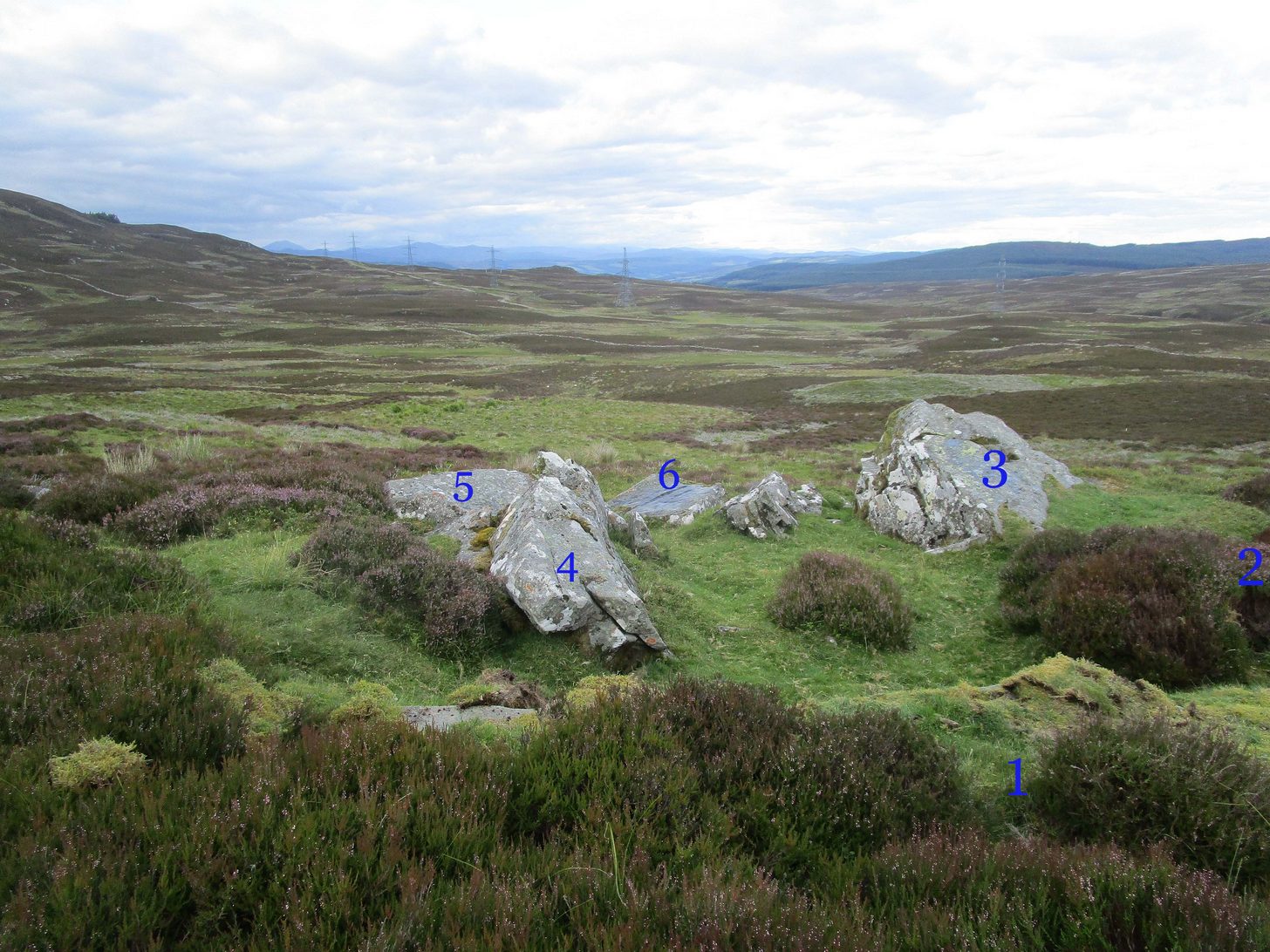
Craig Hill petroglyph cluster

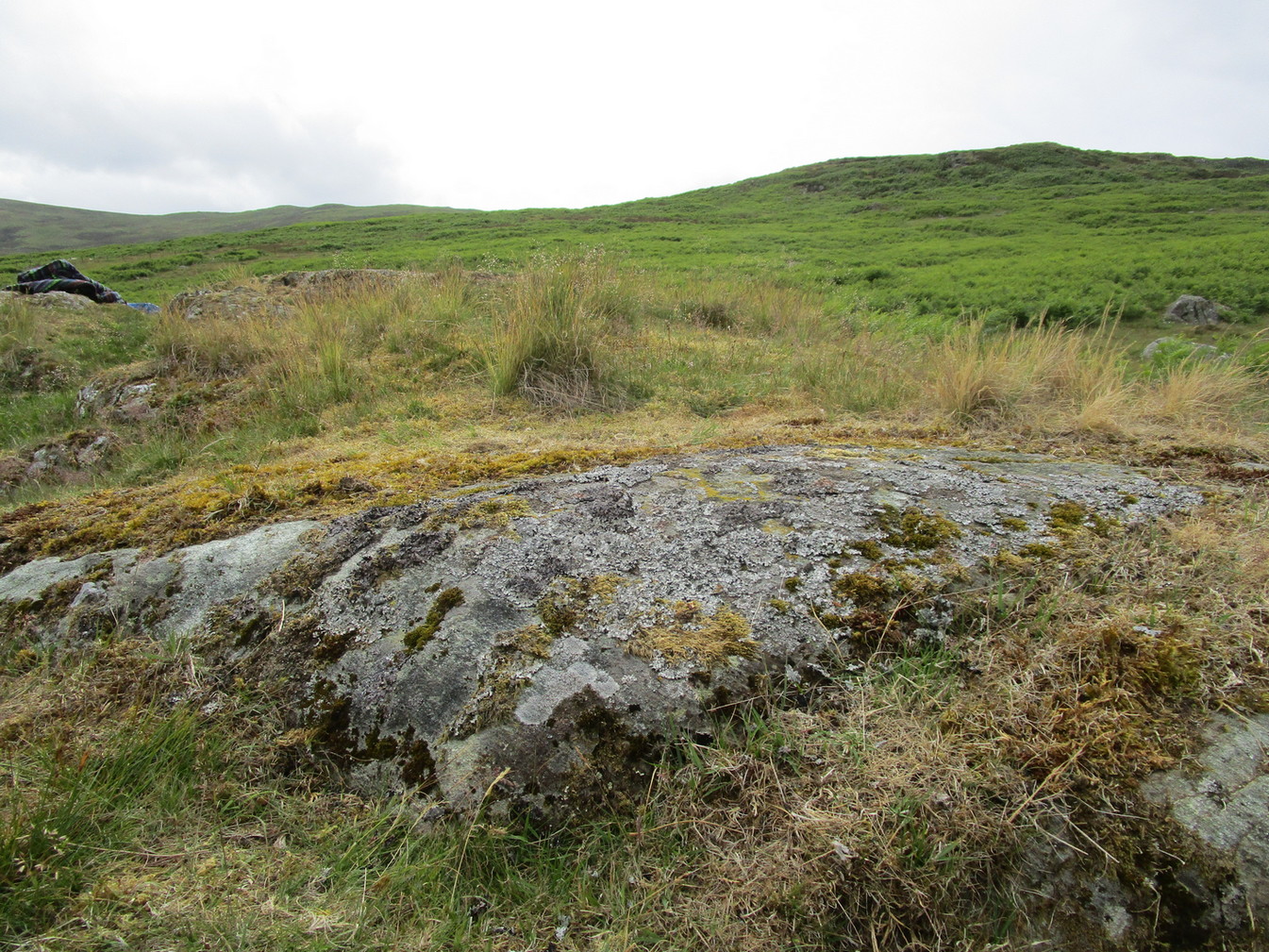
From Kenmore go east up the steep mountain road towards Glen Quaich, or if you’re coming from Amulree, go west along the same glen.  After 2½ miles (4km) up the Kenmore route (nearly 9 miles on the Amulree route) you’ll reach a small lochan on your left (you’ve got a very small parking spot a coupla hundred yards before the loch).  A gate and stile past the loch takes you east along a track into the moors.  More than a mile on, the track splits, but you need to keep to the left and follow the track along the wallside for another 400 yards or so, where you’ll see a small crag of rocks 100 yards down the slope on your right. That’s your target!

Archaeology & History

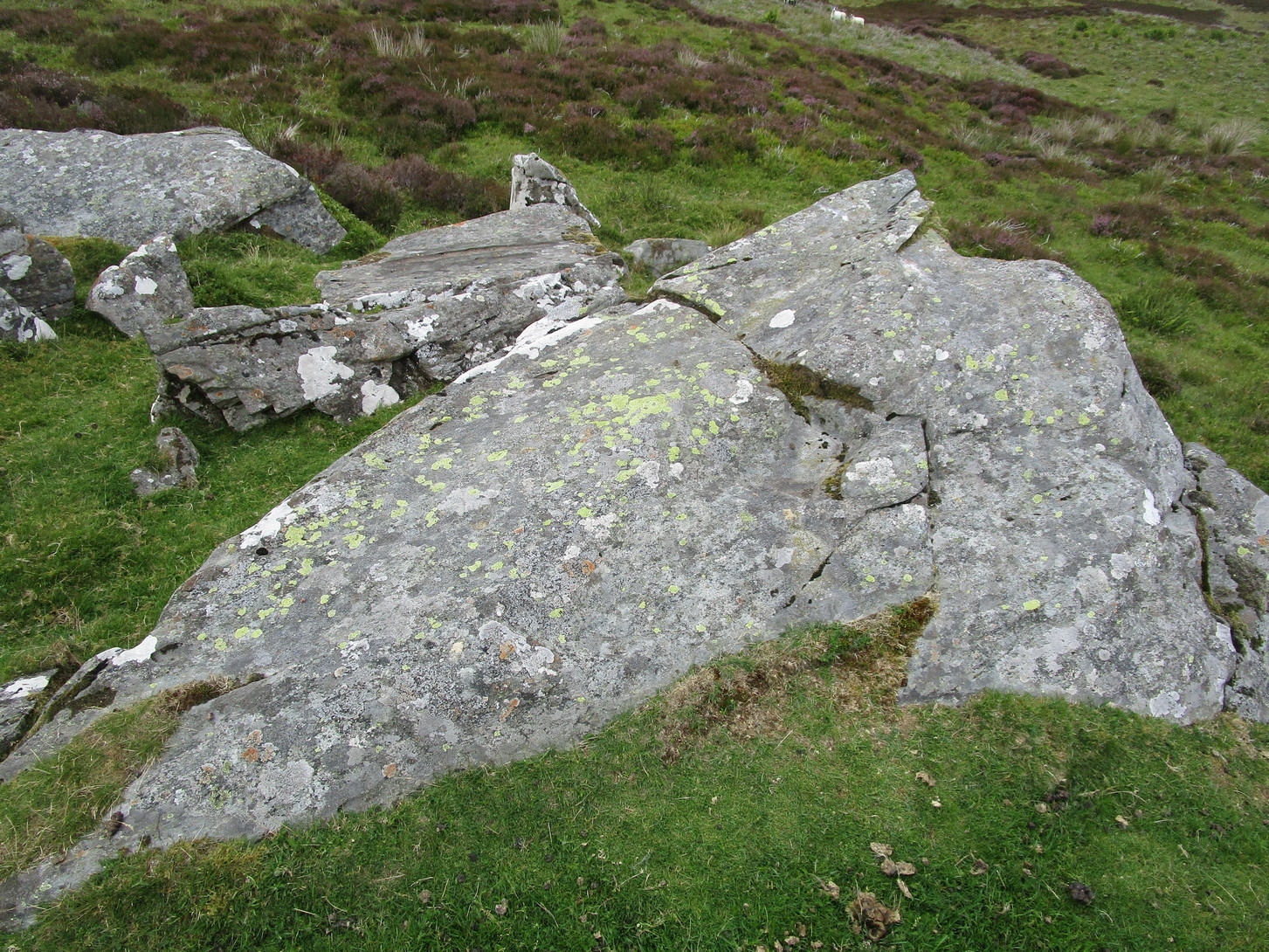
The stone in question

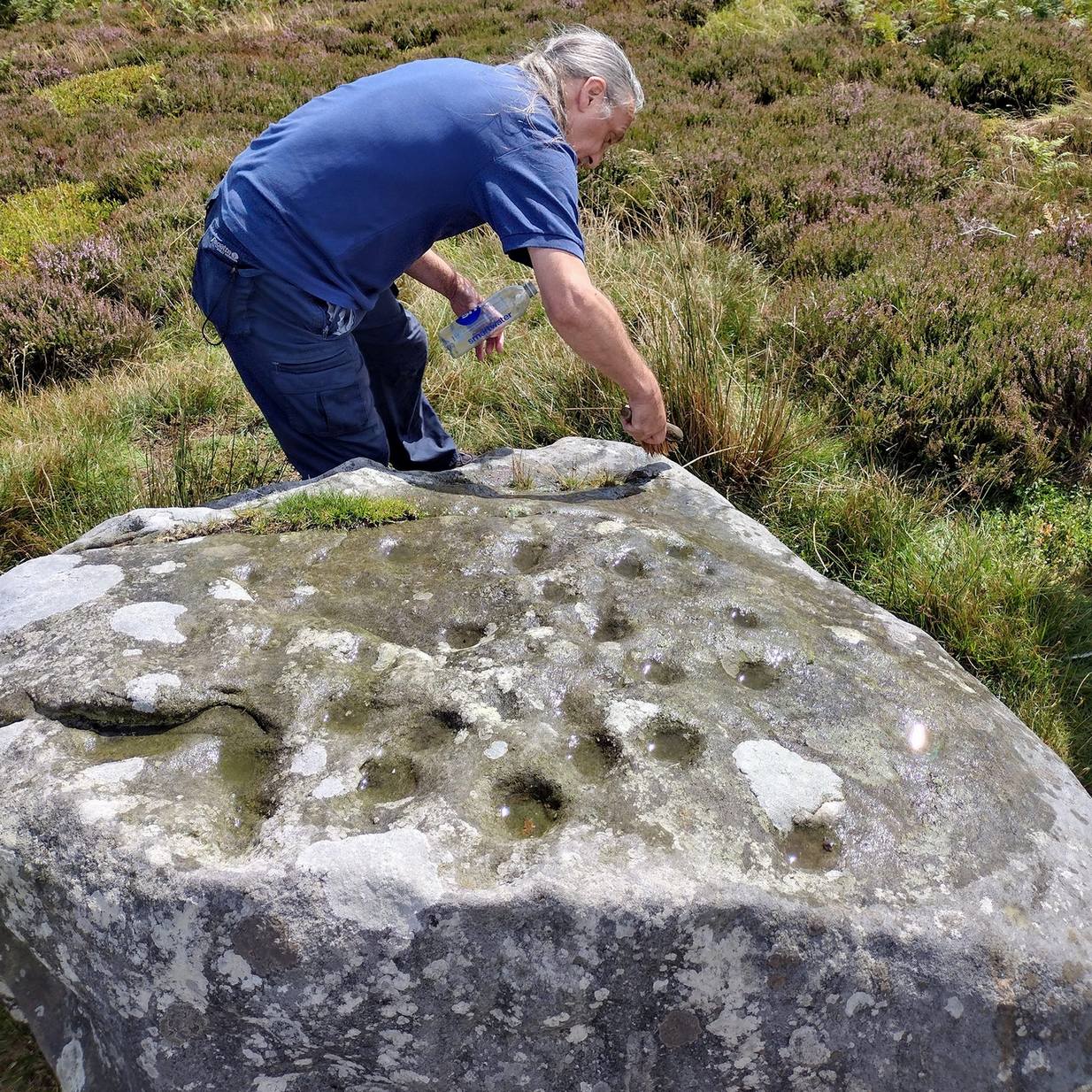
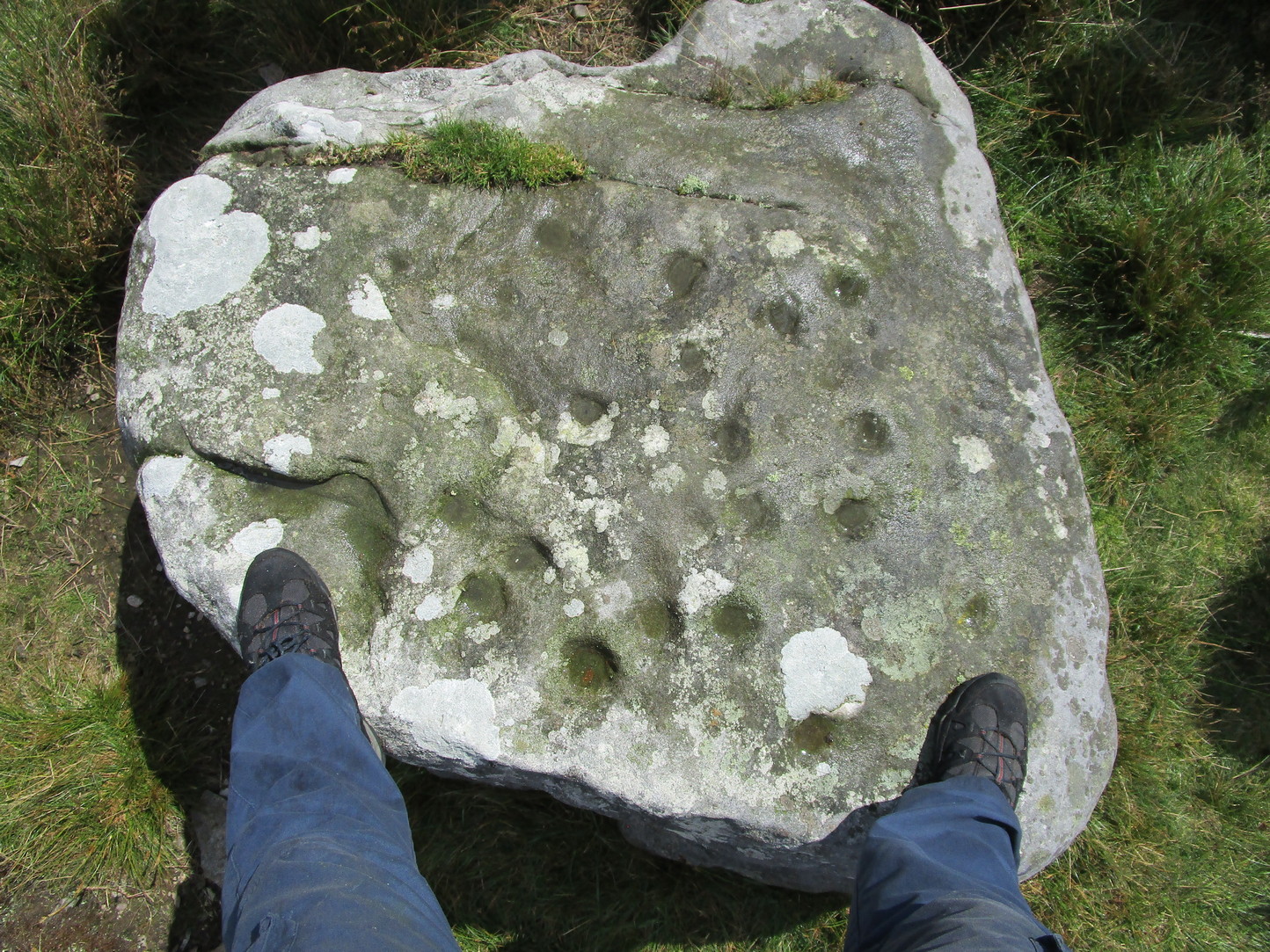
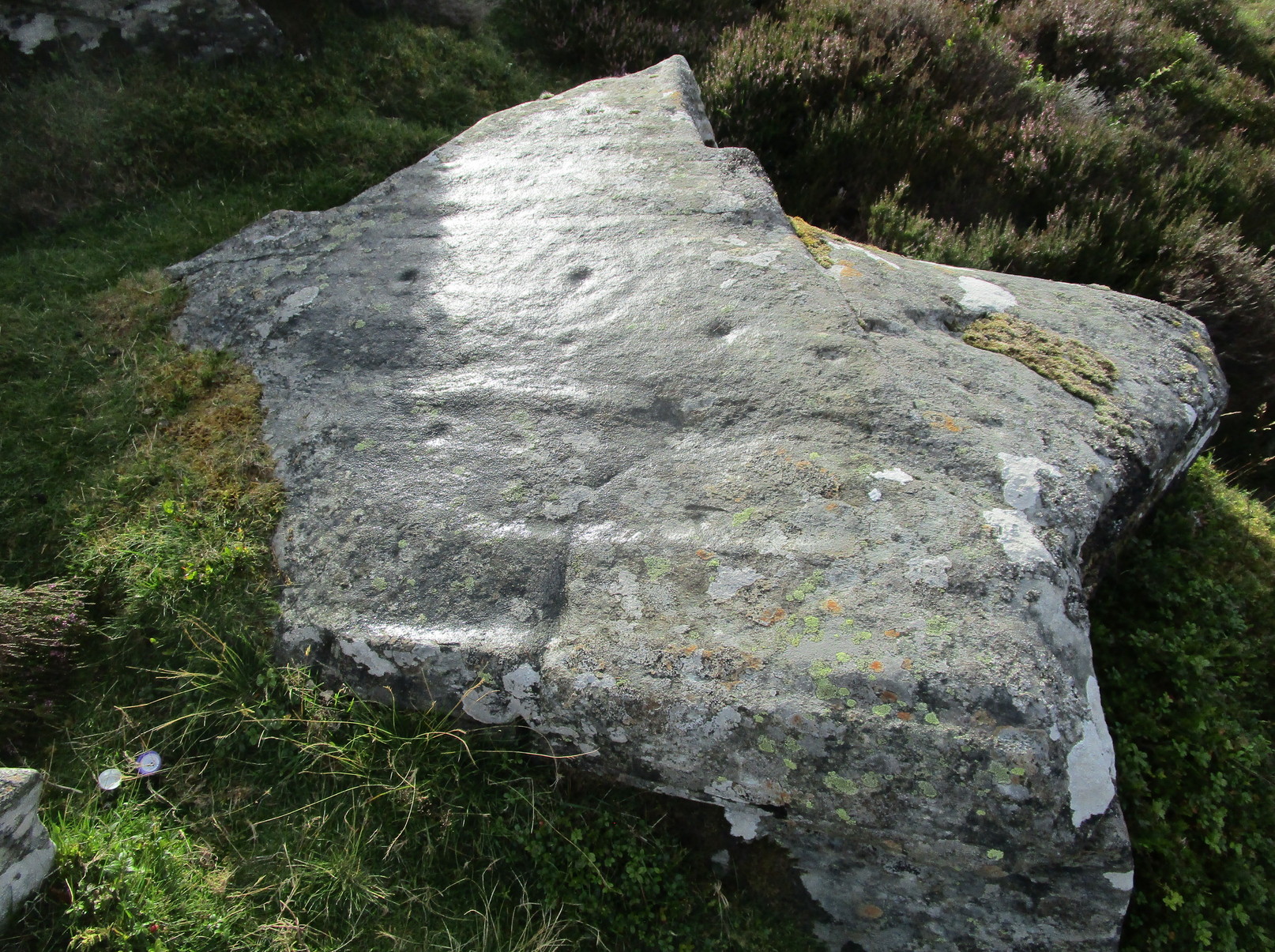
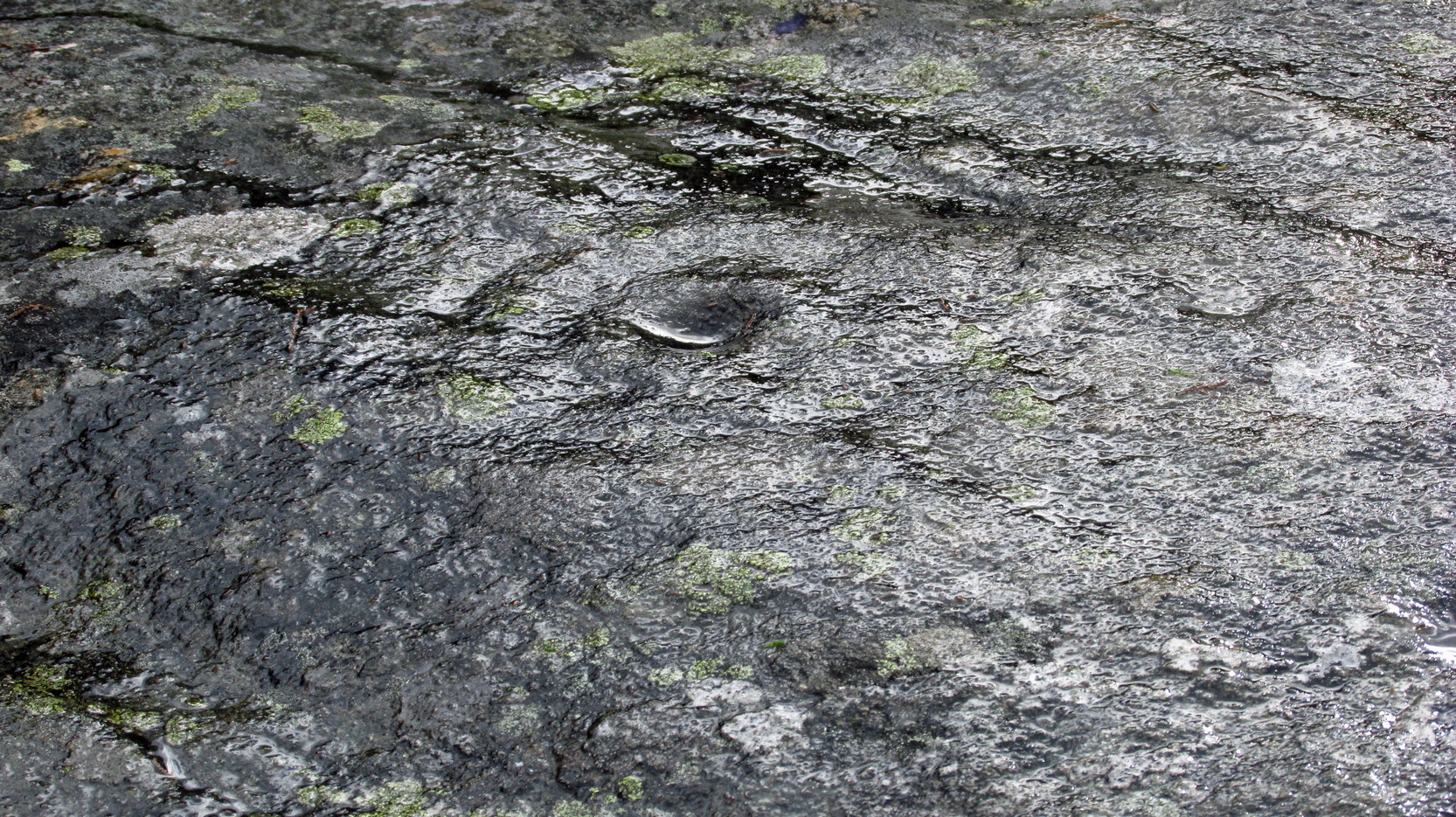
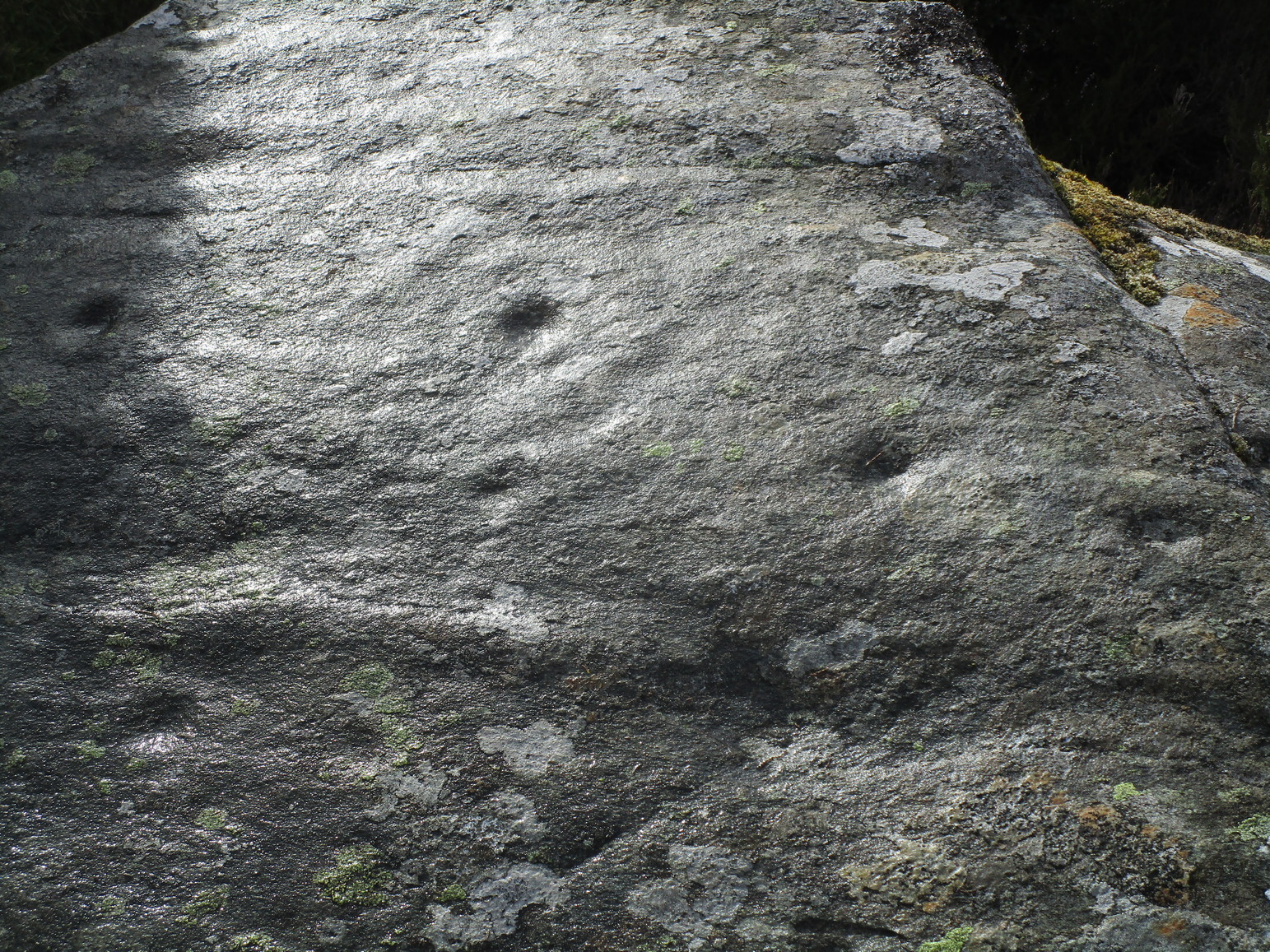
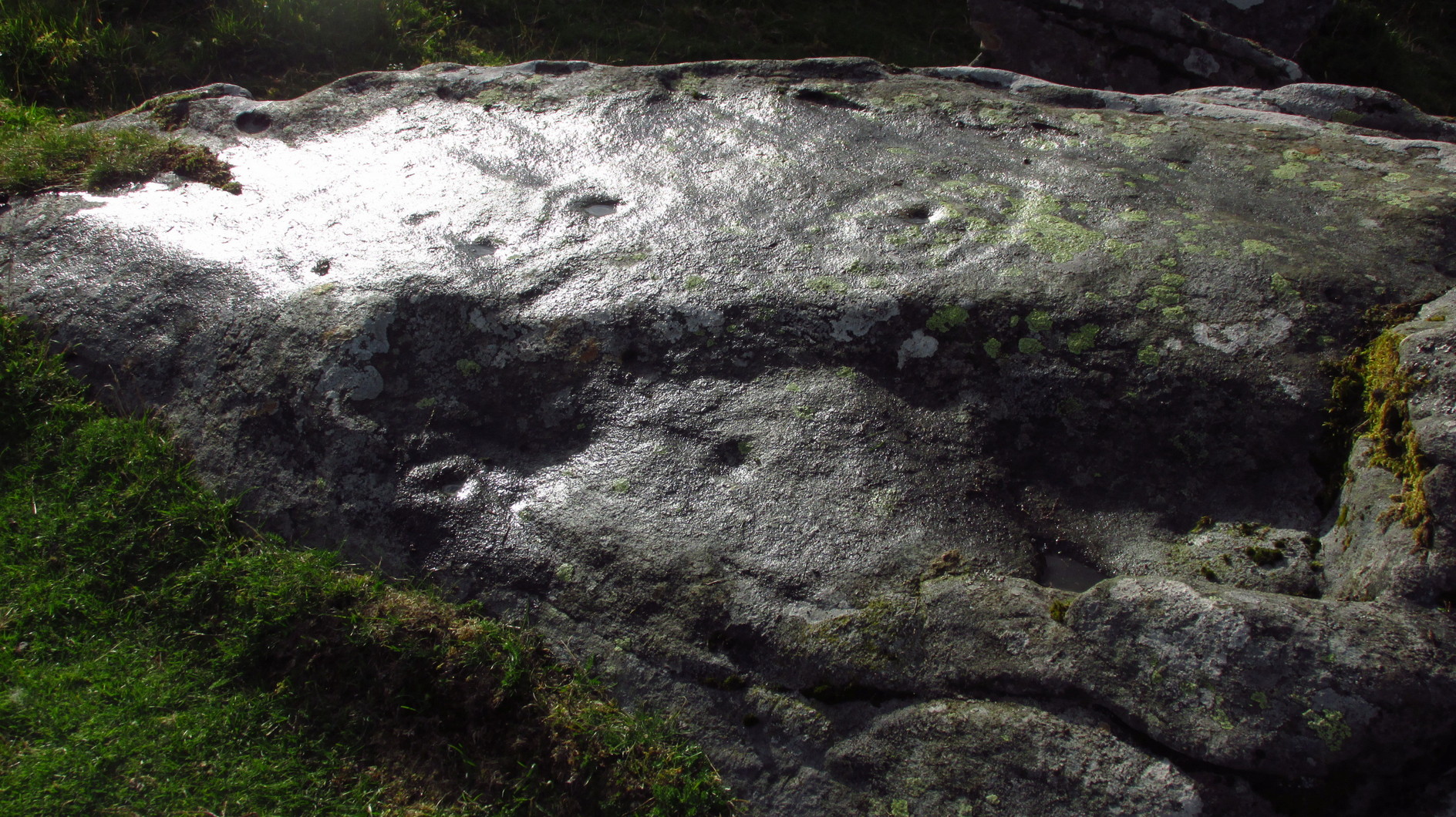
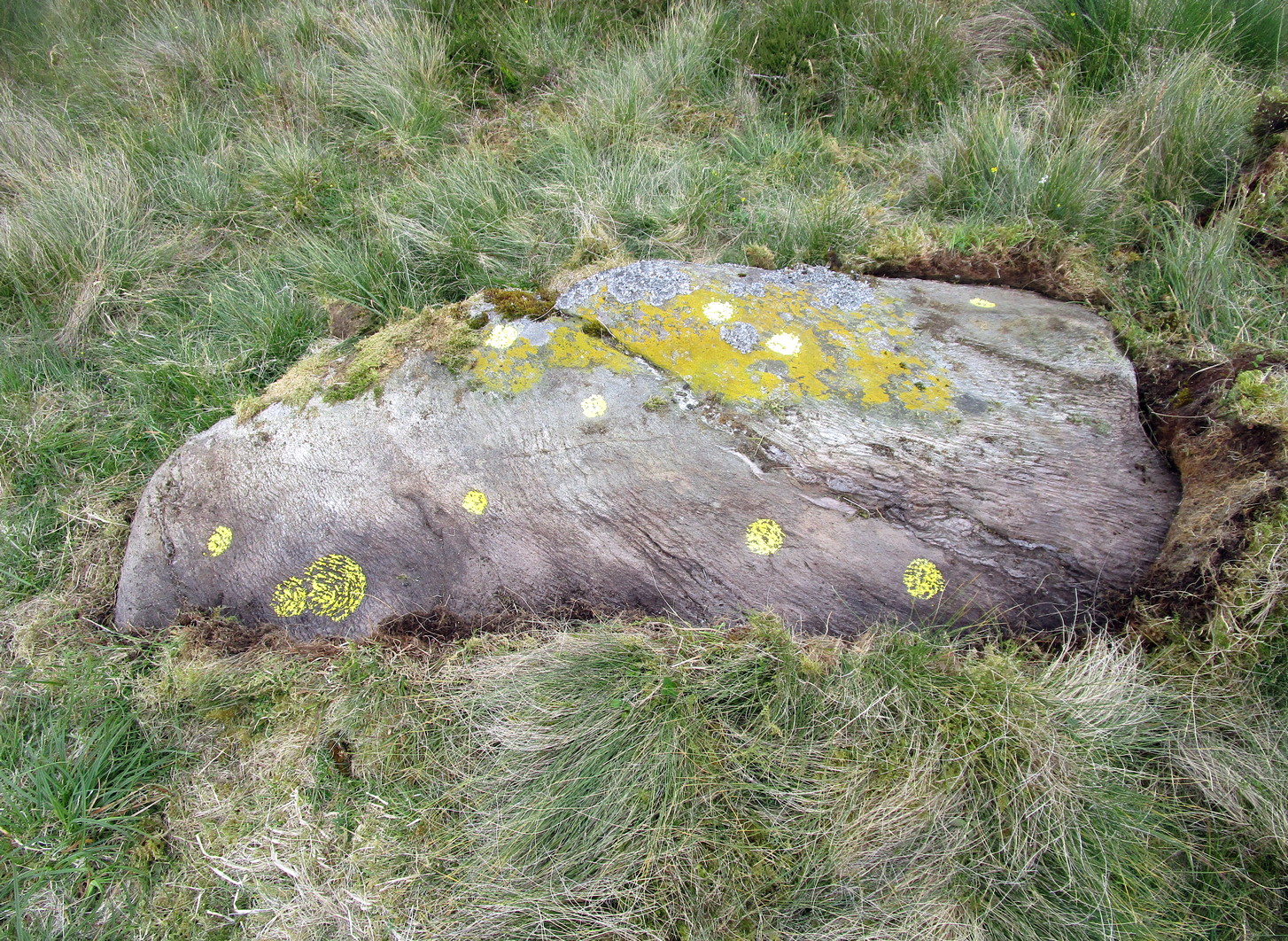
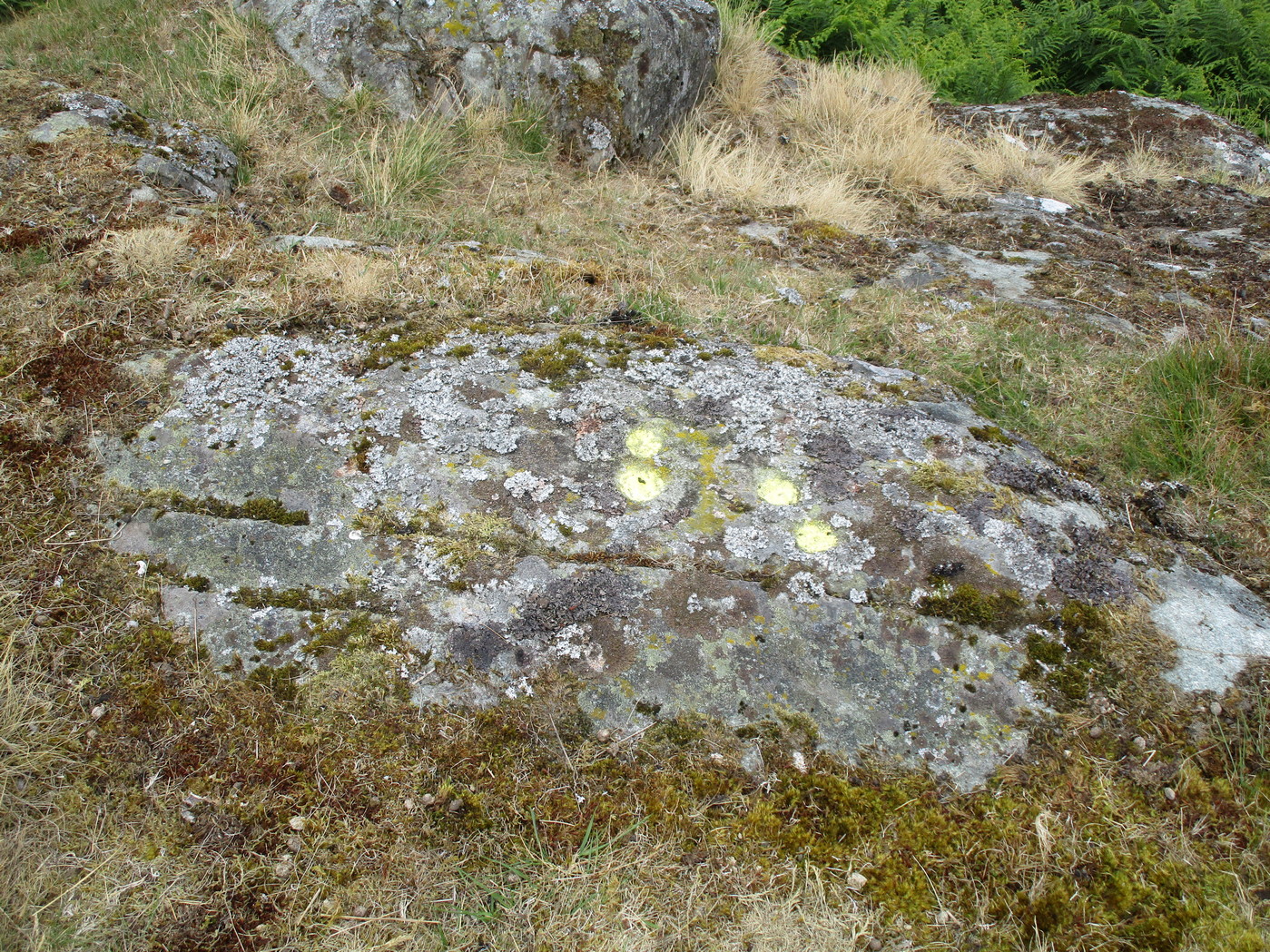
One of at least six rocks next to each other that possess cup-and-rings, this is the most notable of the bunch inasmuch as it’s the one that stands out above all the others.  At first sight it doesn’t look impressive: a shallow scatter of nine or ten cup-marks can be seen when the light’s alright, but that’s about it.  This is what George Currie (2005) noticed when he first came across it in 2004, describing it simply as “a boulder with 10 cups” a few yards away from one of it’s fellow petroglyphs (CR19, or the Craig Hill cluster-2 carving).  But there’s much more to it than that.  Unfortunately when we visited here, we weren’t blessed with good daylight, so were unable to get a decent appraisal of the entire design and have most probably missed some elements.

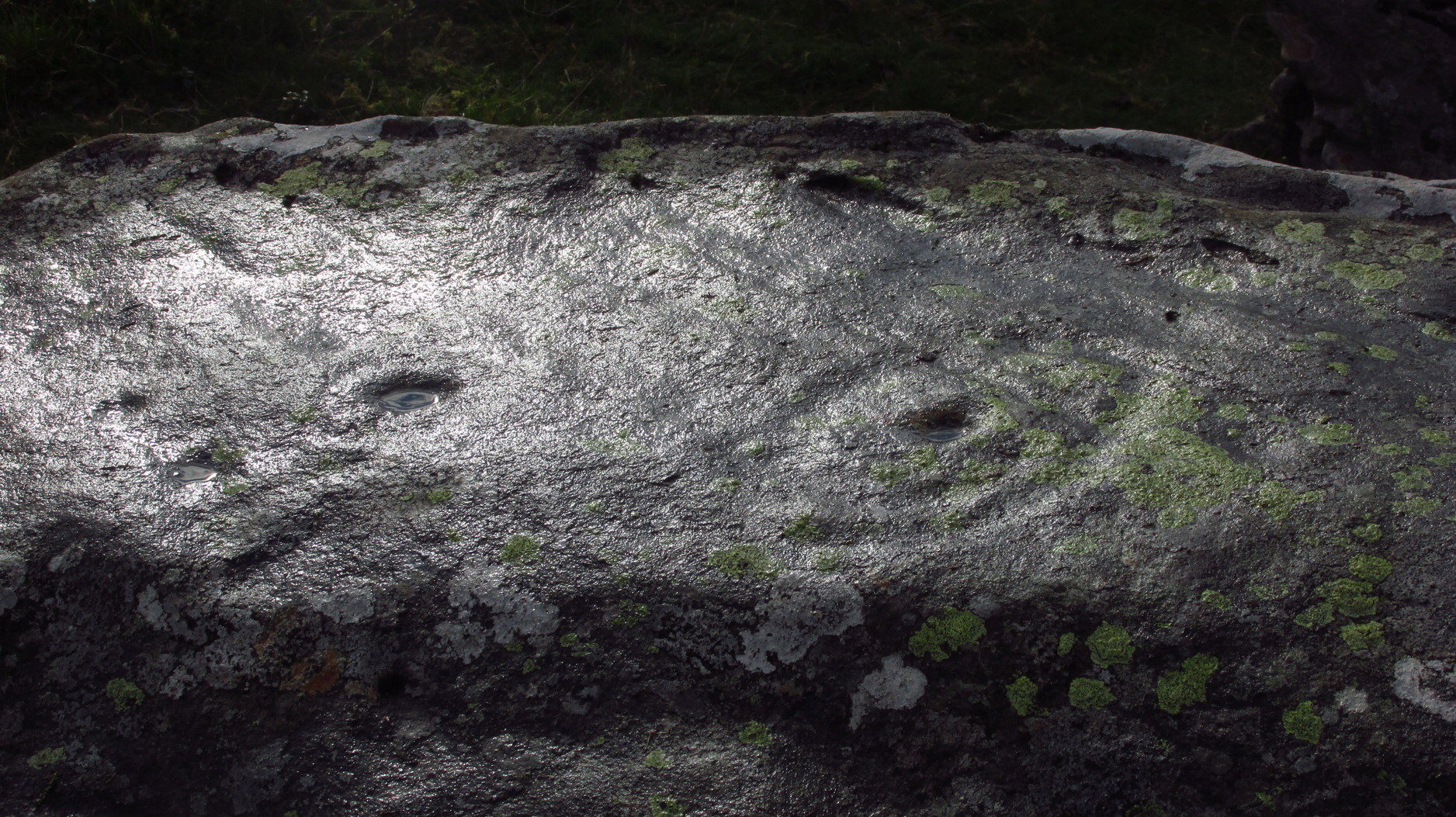
Curious double-ringed eye
General overview of design

On the top sloping surface are  six or seven cup-marks; another two or three are on a secondary lower level of the stone.  Of those on the top, at least two of them have surrounding rings: one with a carved line coming out to the south-east; the other having a more extravagant appearance, surrounded by what looks like a secondary outer “oval”, or eye-shaped design.  It’s unusual.  Other lines intersect these cup-and-rings, but it was difficult to say with any certainty whether they were Nature’s handiwork, or had been modified by humans.  Below these on a slightly lower level are two or three single cup-marks, one of which, close to the edge of the rock, appears to have an incomplete ring round it—but this might have just been a trick of the light.  Another visit is required for a better appraisal…

References:

  1. Currie, George, “Craig Hill (Dull parish): Cup-and-Ring Marked Rocks,”in Discovery & Excavation Scotland, NS Volume 6, 2005.

Acknowledgements:  Huge thanks to Prof Paul Hornby for use of his photos in this site profile; and to Myrna Hurley for getting us up there.  Cheers doods. 😉

© Paul BennettThe Northern Antiquarian

Balgay Hill, Dundee, Angus

Cup-and-Ring Stone (removed):  OS Grid Reference – NO 378 308

Archaeology & History

Cup & ring stone of Balgay Hill

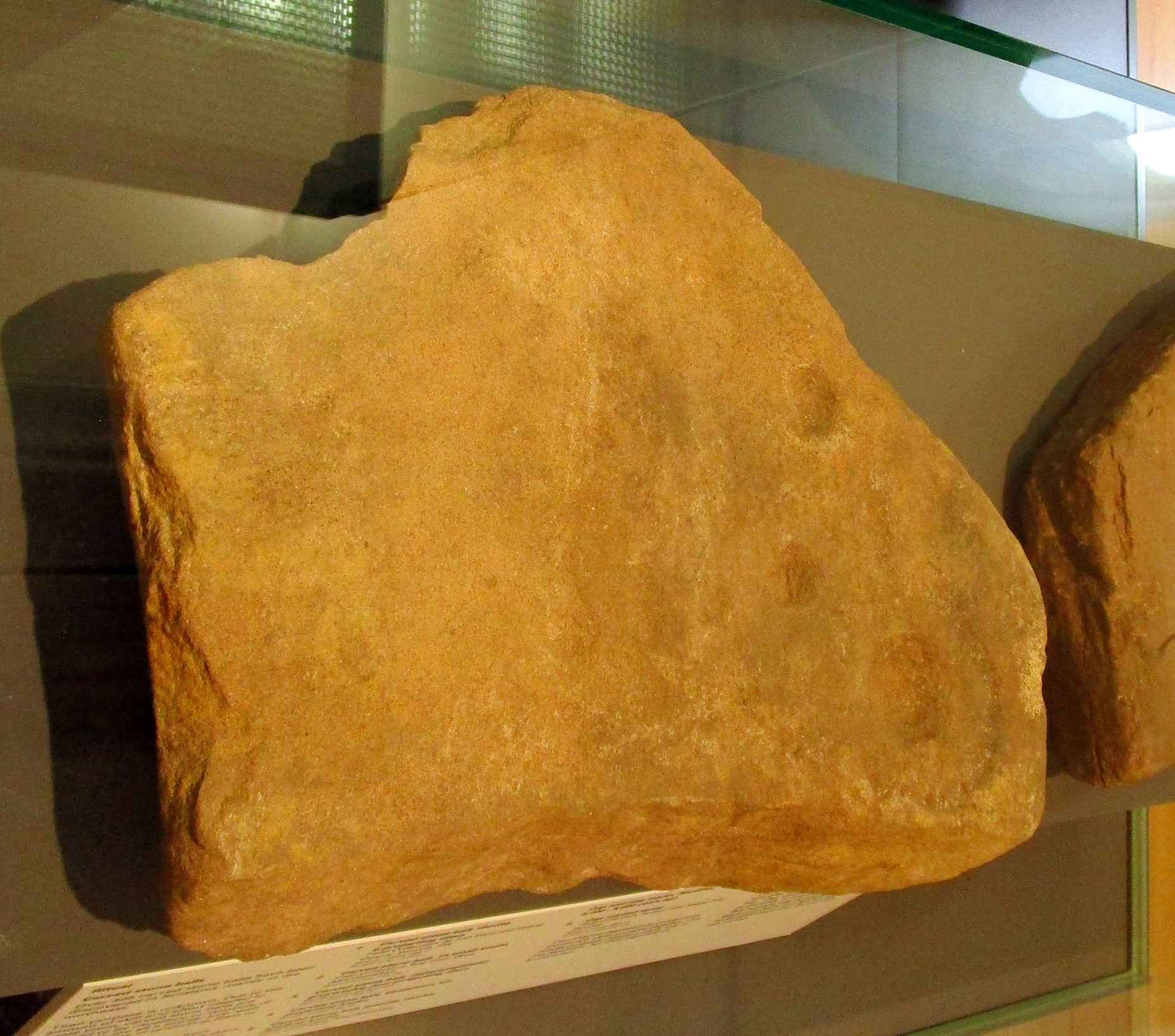
This little-known cup-and ring stone was found at ground level sometime around 2003, near the top of Balgay Hill.  A small portable stone that may have been broken from a larger slab, it has what seems to be two if not three cup-and-rings, accompanied by two or three single cup-marks.  One of the rings seems to have a faint line coming out of it.  Unfortunately none of this is clear in the photos I took (the one attached here is the best), as it lives under glass in Dundee Museum, so it was very difficult to get decent images.  It is now housed in the McManus Museum in Dundee (a damn good place, with very helpful staff) and well worth checking out if you’re in the area.

© Paul BennettThe Northern Antiquarian

Finavon, Oathlaw, Angus

Cup-and-Ring Stone (removed):  OS Grid Reference – NO 5061 5565

Archaeology & History

Finavon carving, now in Dundee Museum

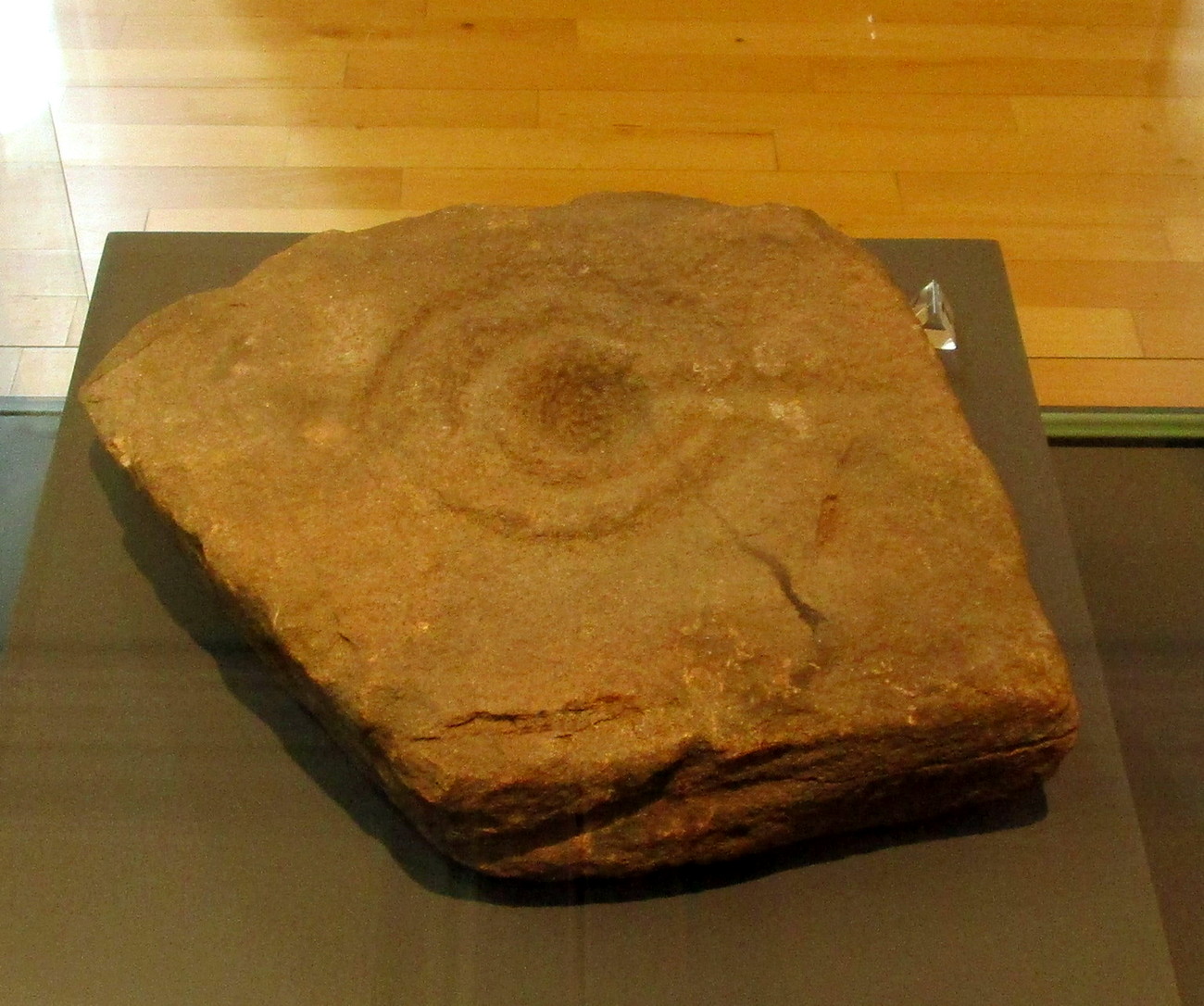
Close to the western walls of the Finavon Iron Age hillfort this small (portable?) cup-and-ring stone was found at ground level in 1987.  It was probably knowingly reused in the construction of the hillfort, but whether it was just deemed as an innocuous carving thrown into the mass, or whether it held a place of importance cannot be known.

The primary design consists of a cupmark surrounded by a double-ring, with a line coming out of the central cup towards the edge of the stone.  The stone itself—measuring 12 inch by around 10 inch—has been cut from a larger piece, meaning the original design may have been larger.  It is now housed in the McManus Museum in Dundee (a damn good place, with very helpful staff).

References:

  1. Sherriff, John, “Prehistoric Rock-Carving in Angus,” in Tayside & Fife Archaeological Journal, volume 1, 1995.
  2. Zealand, A., “Fanavon (Oathlaw Parish): Cup-and-Ring Stone,” in Discovery Excavation Scotland, CSA: Edinburgh 1988.

© Paul BennettThe Northern Antiquarian

Corrymuckloch (14), Amulree, Perthshire

Cup-Marked Stone:  OS Grid Reference – NN 89253 35346

Getting Here

Looking to the SE

Take the A822 road to the northeast of Crieff and head 4-5 miles along until you enter the Sma’ Glen.  You go past Ossian’s Stone and after crossing the river the road starts to go uphill.  Nearly 2 miles up, the road levels out and at the left-side of the road is a small thin car-parking spot. Keep your eyes truly peeled for that!  Go through the gate and turn right (north), up the grassy slope.  Follow this footpath (known as General Wade’s road) straight past Corrymuckloch Farm until, about 250 yards on, the track splits.  Take the left track and nearly 500 yards along walk up the embankment on your left and look around (if you reach the gate you’ve gone too far).

Archaeology & History

Corrymuckloch (14) stone

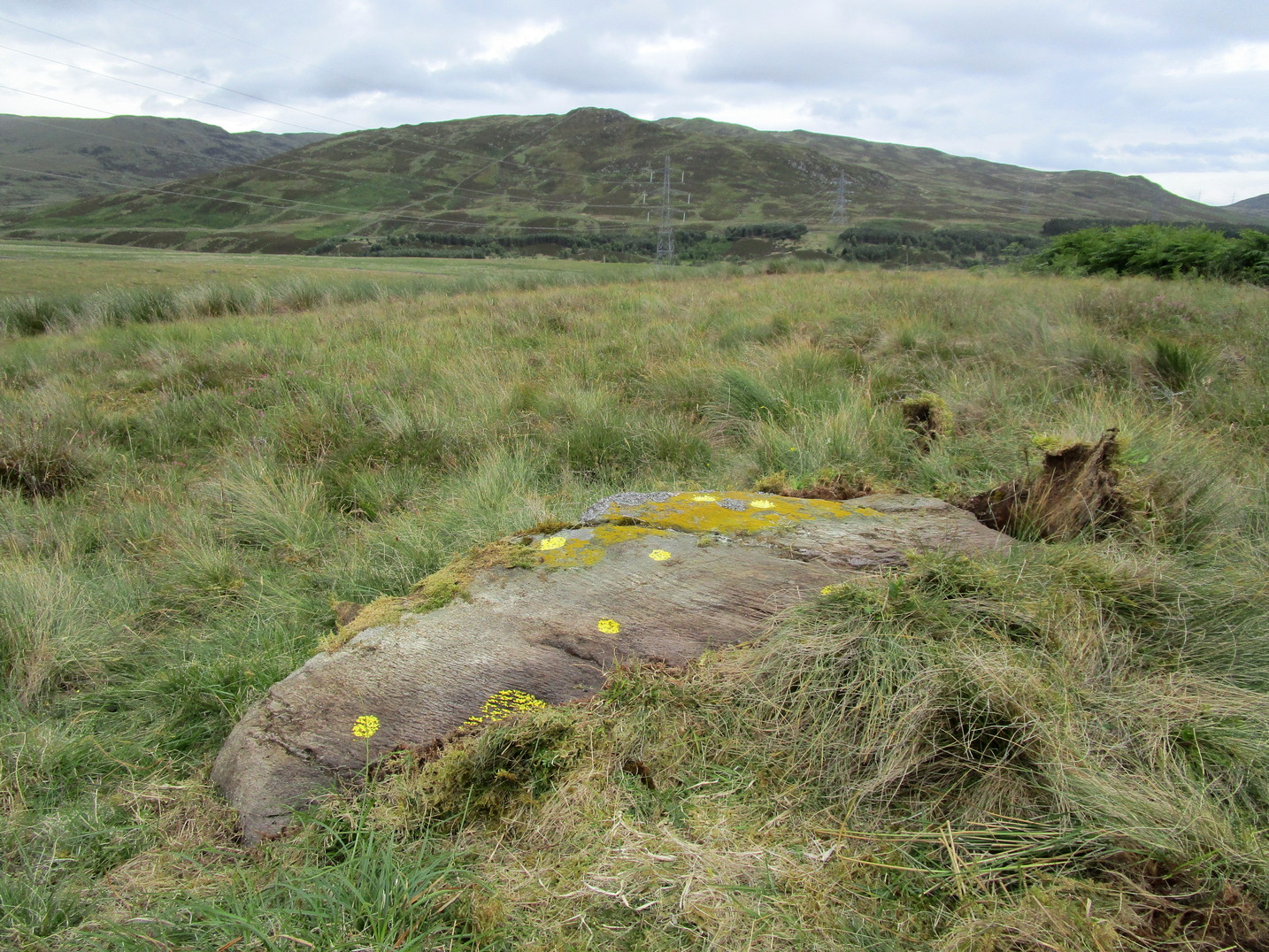
This stone was rediscovered in July 2023 during a cursory survey of other carvings in the Corrymuckloch cluster (17 and counting!).  Most of the stone was covered in vegetation when first found, with just a single cupmark near its crown ensuring it got more attention.  Altogether there are 10 or 11 cup-marks of varying levels of erosion across the length and breadth of the rock.  The most notable one is on the northwest side of the stone, it being twice the size of the others and of much greater depth.  It may originally have been a natural depression that was enhanced when the stone was carved.  This larger cup has a smaller one attached just above it.

An intriguing find was noted all along the western edge of the rock, where upwards of a hundred small pieces of quartz—the majority of it crystal clear—were scattered between the stone edge and the soil.  This is  an ingredient that’s been noted at a number of petroglyphs in Scotland.

© Paul BennettThe Northern Antiquarian

Corrymuckloch (2), Amulree, Perthshire

Cup-Marked Stone:  OS Grid Reference – NN 89037 34706

Getting Here

Corrymuckloch (2) stone

Take the A822 road to the north-east of Crieff and head 4-5 miles along until you enter the Sma’ Glen.  You go past Ossian’s Stone and after crossing the river the road starts to go uphill.  Nearly 2 miles up, the road levels out and at the left-side of the road is a small thin car-parking spot. Keep your eyes truly peeled for that! Walk through the gate and along the track (west) for 300 yards until you reach the fence.  Once here, walk right (north) and go through the gate less than 50 yards away.  Less than 300 yards ahead of you you’ll see a small rock outcrop.  Get to it!

Archaeology & History

Rediscovered in July 2023, on this small rock outcrop it seems that only the lower east section has been carved, and it can be pretty difficult to see beneath the old layers of lichen that’s been painted across its surface.  Comprising of just four cup-marks close to each other on the top of the stone, there’s a possible fifth cup to be seen on its northeast length.  It’s nowt special to look at to be honest, but it’s worth checking out when you’re looking at the others in this cluster.  In truth, this is another that’s only gonna be of interest to the real geeks amongst you!

© Paul BennettThe Northern Antiquarian

Briery Wood, Ilkley, West Yorkshire

Cup-and-Ring Stone (lost):  OS Grid Reference – SE 0965 4797

Archaeology & History

In Ronald Morris’ (1989) gazetteer of British petroglyphs, he included this curious entry but gave no real details regarding its appearance or history.  Listed by the Royal Commission lads, it would seem to have been located immediately south of the dismantled railway where it used to cross the Addingham-Ilkley road, but no one seems to have seen it either before or since Morris’ description.  Any help regarding its whereabouts would be appreciated.

References:

  1. Boughey, Keith & Vickerman, E.A., Prehistoric Rock Art of the West Riding, WYAS: Wakefield 2003.
  2. Morris, Ronald W.B., “The Prehistoric Rock Art of Great Britain: A Survey of All Sites Bearing Motifs more Complex than Simple Cup-marks,” in Proceedings of the Prehistoric Society, volume 55, 1989.

© Paul BennettThe Northern Antiquarian

Laighwood, Butterstone, Dunkeld, Perthshire

Cup-Marked Stone (lost):  OS Grid Reference – NO 074 458

Archaeology & History

In J. Romilly Allen’s (1882) lengthy essay on rock art in Scotland, he mentions a singular boulder that was “found by Dr Rattray” at Laighwood, near Butterstone—but, unlike him, he gave no further details regarding its appearance or exact whereabouts.  It was included in the Royal Commission (1990) survey of the area, with no additional details.  It remains lost.  In the event that you manage to rediscover it, grab some good photos of it and stick ’em on our Facebook group. (the grid-reference to this site is an approximation)

References:

  1. Allen, J. Romilly, “Notes on some Undescribed Stones with Cup Markings in Scotland,” in Proceedings of the Society of Antiquaries Scotland, volume 16, 1882.
  2. Royal Commission on the Ancient & Historical Monuments of Scotland, North-East Perth: An Archaeological Landscape, HMSO: Edinburgh 1990.

Acknowledgements:  Huge thanks for use of the Ordnance Survey map in this site profile, reproduced with the kind permission of the National Library of Scotland

© Paul BennettThe Northern Antiquarian

Lour Fort, Drumelzier, Peeblesshire

Cup-Marked Stone (lost): OS Grid Reference – NT 179 356

Archaeology & History

In Sir George Douglas’ (1899) brief sketch of prehistoric remains in Peeeblesshire, he described coming across a petroglyph somewhere near the top of the Iron Age hillfort east of Stobo Castle, near Drumelzier (King Arthur country).  He told that,

“on a flat stone lying on the slope of the fort at Lour, are two “cups,” measuring 2¾ inches in diameter and an inch in depth, and exhibiting perfect symmetry in their form and position on the stone: they have been thought to be genuine examples of “rock-markings”.”

The carving hasn’t been seen since and it’s presumed that vegetation has covered the stone. (the grid-reference for this site is an approximation)

References:

  1. Douglas, Sir George, A History of the Border Counties: Roxburgh, Selkirk, Peebles, W. Blackwood: Edinburgh 1899.

© Paul BennettThe Northern Antiquarian

Soonhope, Peebles, Peeblesshire

Cup-and-Ring Stone (lost): OS Grid Reference – NT 269 419

Also Known as:

  1. Kittlegairy Burn

Archaeology & History

Fred Coles’ 1898 sketch

An apparently isolated cup-and-ring stone was found on the hills north of Peebles at the end of the 19th century by the renowned Scottish megalith explorer, Fred Coles. (1899)  He was having a look at some of the hillforts in the area and—as some of us tend to do—he began meandering off-track, down streams, through bogs and as a result came across the carving that’s illustrated here.  It’s subsequently become “lost” in the hills, but it shouldn’t be too difficult to locate, as the description he gave of its whereabouts is a pretty good one.  He told us:

“A very little over one mile and a quarter up the valley, measuring from the road at Kerfield Cottage, a tiny rivulet called Kittlegairy Burn trickles down from the SE into the main stream.  On the hill to its east, and about 450 feet higher, are the remains of a fort, one of a series of three crowning prominent heights along this side of the valley.  Down the main stream from Kittlegairy Burn is a large ruined sheep-shelter called Soonhope.  Nearly midway between these two points a deep curve has been hollowed out of the E. bank; and, at the foot of this rather high gravel bank, half immersed in the stream, lies the block of stone with the cup-and ring-marks.  They were discovered, 14th September 1896, by my daughter, Helen, on crossing the stream; and we at once proceeded to make a measured drawing, a reproduction of which is given here….  The depth of the rings in proportion to their width is the one most noticeable feature; next, the extreme thinness of the intervening ‘neck’; but, on a minute and careful examination of the nature of the stone itself, taking into consideration that its angularity and sharpness of edge and the absence of moss or even of confervoid growths on its surfaces went against the possibility of its being truly waterworn.”

The rock had obviously fallen from its original position above the burn.  Today, the entire area where this stone exists has been covered by a huge forestry plantation, but if any rock art fanatics from the Peebles area get bored one day and have nothing to do…..

References:

  1. Coles, Fred, “Notices of the Discovery of a Cist and Urns at Juniper Green, and of a Cist at the Cunninghar, Tillicoultry, and of some Undescribed Cup-marked Stones’, in Proceedings Society Antiquaries, Scotland, volume 33, 1899.
  2. Morris, Ronald W.B., “The Cup-and-Ring and Similar Early Sculptures of Scotland; Part 2 – The Rest of Scotland except Kintyre,” in Transactions of the Ancient Monuments Society, volume 16, 1969.
  3. Morris, Ronald W.B., “The cup-and-ring marks and similar sculptures of Scotland: a survey of the southern Counties – part 2,” in Proceedings of the Society of Antiquaries, Scotland, volume 100, 1969.
  4. Morris, Ronald W.B., The Prehistoric Rock Art of Southern Scotland, BAR: Oxford 1981.

© Paul BennettThe Northern Antiquarian

Harelawside, Grantshouse, Berwickshire

Cup-and-Ring Stone (removed): OS Grid Reference – NT 807 659

Archaeology & History

A carving that no longer exists in its place of origin, but can now be seen in the National Museum of Antiquities in Edinburgh.  It was discovered by a Mr James Craw (1931), who gave us the following account of his find:

“In 1910 my attention was attracted by some markings on a boulder on the top of a field wall, ¼-mile NNW of Grant’s House church and at an elevation of some 550 feet above sea level.  The stone was a rounded and somewhat flattened slab of greenstone, measuring 22 inches by 17 inches by 4 inches… It bore a small cup ½-inch in diameter, surrounded by two rings of shallow incision, the outer being 3 inches in diameter.  From the cup a duct, partly natural, led across the stone, and another cup, without rings, had also a short duct.  Adjacent to these markings was a curious grid design of shallow lines, a series of parallel lines ¼-inch apart, being crossed at right angles by lines 2½ inches apart.”

1930 photo of the carving

Across a section of the stone there may also be a curving pecked line which Craw didn’t appear to notice.  The parallel lines would appear to have quite separate origins, with those running below the cup-and-ring seeming to be ancient, whereas the others have the appearance of being cut with metal tools and seem much more like modern scarring.

Shortly after finding the stone, Mr Craw took the petroglyph to the National Museum in Edinburgh, where he was told that they didn’t think it “as being of early workmanship, the cups and rings being of much smaller proportions than the typical markings of the Bronze Age and the grid design having no known parallel.”  They were wrong on both accounts of course, although I for one still remained unconvinced by one set of parallel lines that run along to the edge of the stone.  That said, there are similar carvings of parallel lines at the impressive Traprain Law 15 miles northwest of here, so I may be wrong.

The wall in which this carving was found was obviously not its place of origin.  It most likely came from one of the cairns that was reported by J. Hardy to have been destroyed in this field in 1882.

References:

  1. Craw, James H., “An Inscribed Boulder from Grants House,” in History of Berwickshire Naturalists Club, volume 27, 1931.
  2. Edwards, Arthur J.H., “Rock Sculpturings on Traprain Law,” in Proceedings Society of Antiquaries, Scotland, volume 69, 1935.
  3. Morris, Ronald W.B., “The Cup-and-Ring and Similar Early Sculptures of Scotland; Part 2 – The Rest of Scotland except Kintyre,” in Transactions of the Ancient Monuments Society, volume 16, 1969.
  4. Morris, Ronald W.B., “The cup-and-ring marks and similar sculptures of Scotland: a survey of the southern Counties – part 2,” in Proceedings of the Society of Antiquaries, Scotland, volume 100, 1969.
  5. Morris, Ronald W.B., The Prehistoric Rock Art of Southern Scotland, BAR: Oxford 1981.

© Paul BennettThe Northern Antiquarian