Baildon Moor Carving (130), West Yorkshire

Cup-Marked Stone:  OS Grid Reference – SE 13077 40097

Also Known as:

  1. Carving no.11 (Hedges)
  2. Central Design Stone

Getting Here

Baildon Moor carving

Baildon Moor carving

Take the directions to find the Glovershaw Quarry carving,or the Baildon Moor 126 carving and the newly-found Toad Stones circle, and zigzag about in the bracken when it’s down at the end of Winter (forget it from summertime onwards!).  You’re damn close.

Archaeology & History

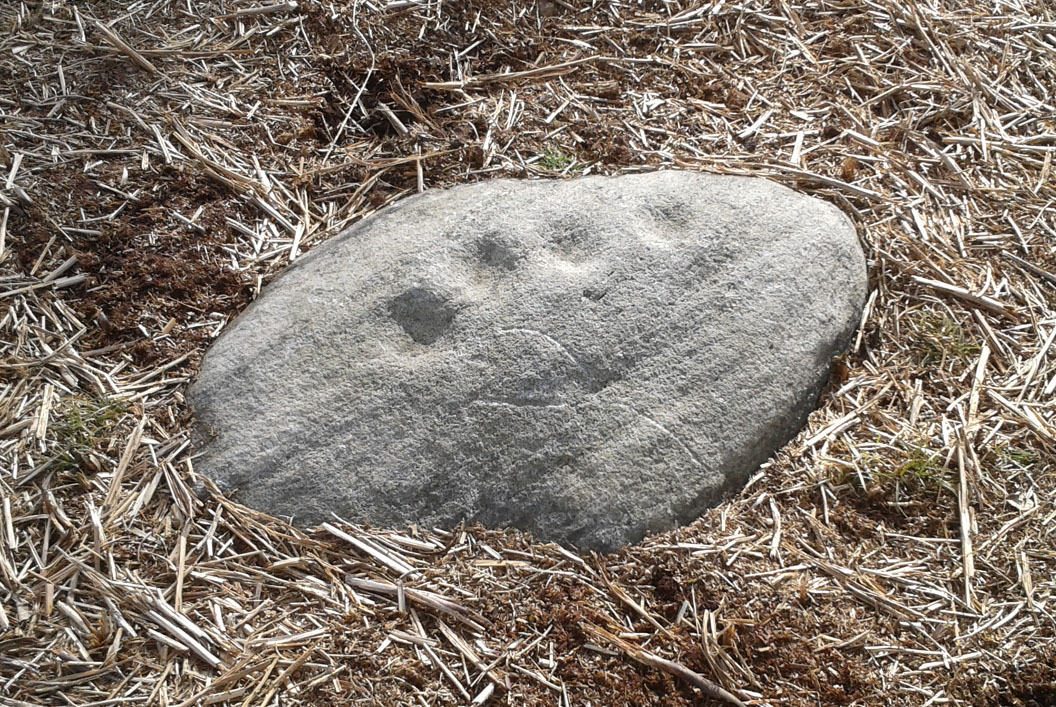
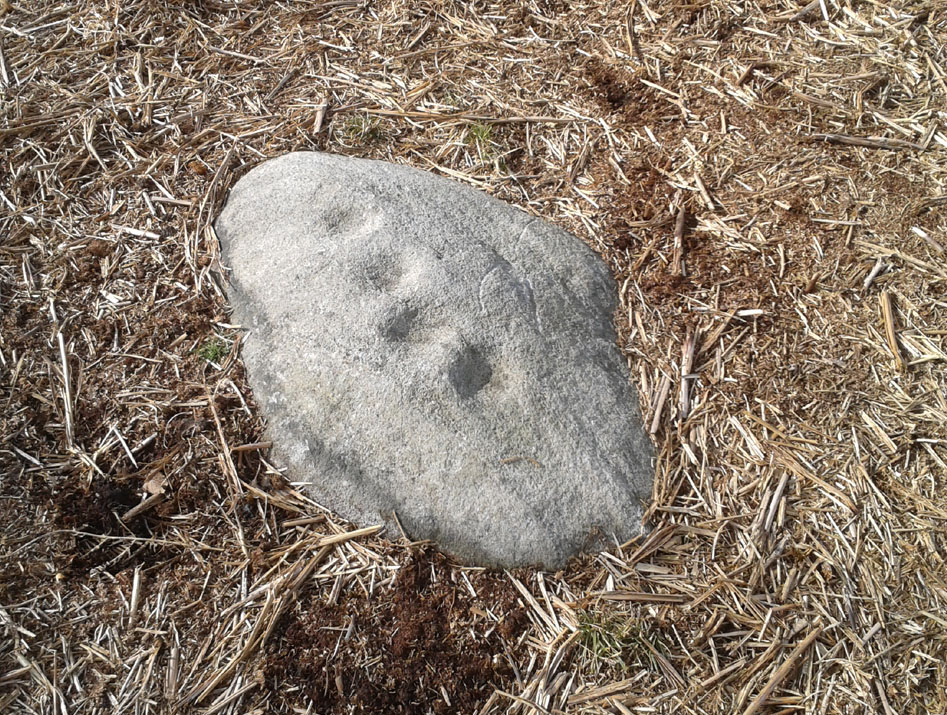
A carving that I first visited when I was a child – but one which, curiously, caught my attention.  The small arc of four cup-marks that you can see on the stone was an integral feature of other carvings in this particular region—though not all, of course.  It seemed to me at the time that it had symbolic significance, as the arc occurred in a number of other Baildon petroglyphs.  Astronomy was my fetish at that time and so I saw the arc as solar or stellar movements across the sky, represented by the cup-markings.  It was one of many fascinating Rorschach’s that I encountered, just as rock art students across the world do when looking at these ancient carvings. However, the simple symbolism of this and similar nearby carvings has stuck and plays under my skin somewhat: one of those curious non-egoic tickles, constantly nudging away, as if there’s something in it, but being looked at from the wrong angle…
CR130dr

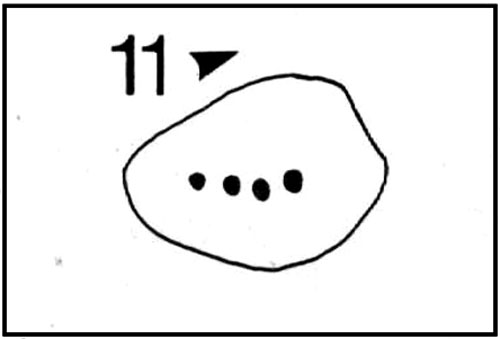
John Hedges 1986 sketch

Looking down at the cups

Looking down at the cups

Anyway… All we have here is a primary design of four cup-marks reaching across a small earthfast stone.  Other simple carvings are found close by and there are the remains of several prehistoric cairns circles within a few hundred yards.  Beneath the deep bracken-mass, it is highly probable that other ancient remains remain hidden.

The carving was first recognised in one of Sidney Jackson’s (1958) archaeology bimbles in the 1950s with his bunch of northern antiquarians from Cartwright Hall, Bradford. It later found its way into the survey of John Hedges (1986) where he described it, simply:

“Small, lozenge-shaped, smooth grit rock, sloping NW-SE into grass and bracken, four symmetrical cups in slight curve.”

References:

  1. Baildon, W. Paley, Baildon and the Baildons – parts 1-15, Adelphi: London 1913-1926.
  2. Bennett, Paul, Of Cups and Rings and Things, unpublished: Shipley 1981.
  3. Bennett, Paul, Megalithic Ramblings between Ilkley and Baildon, unpublished: Shipley 1982.
  4. Boughey, Keith & Vickerman, E.A., Prehistoric Rock Art of the West Riding, WYAS: Leeds 2003.
  5. Cowling, Eric T., Rombald’s Way, William Walker: Otley 1946.
  6. Hedges, John, The Carved Rocks on Rombald’s Moor, WYMCC: Wakefield 1986.
  7. Jackson, Sidney, “Cup-Marked Boulders, Baildon Moor,” in Cartwright Hall Archaeology Group Bulletin, 3:2, 1958.

© Paul BennettThe Northern Antiquarian


Cratcliff West Enclosure, Harthill, Derbyshire

Enclosure:  OS Grid Reference – SK 2259 6238

Getting Here

Site of Cratcliff West enclosure

Site of Cratcliff West enclosure

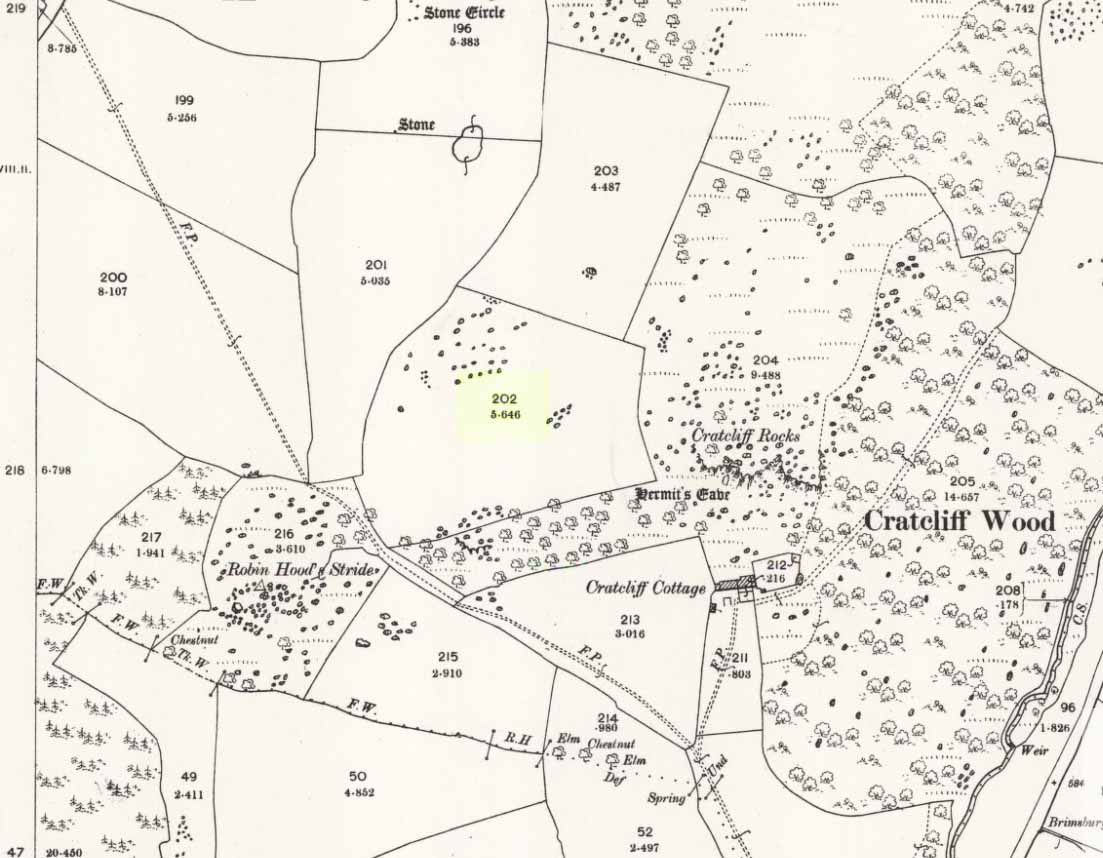
Taking the roughly north-south road betwixt the village of Elton and the town of Youlgreave, rising up to see the great rock outcrop of Robin Hood’s Stride, park-up by the roadside and walk down the path towards the impressive rocky rise of Robin Hood’s Stride.  Keep to the fields below the Rise on its north side and head for the next wooded rise 2-300 yards west.  In the field you’ll cross (field number 202 in on the map, right) before this wooded crag [Cratcliffe Rocks], the outline of the enclosure is beneath your very feet.

Archaeology & History

Aerial image of the Ninestone Ring enclosure

Aerial image of the Ninestone Ring enclosure

This blatantly obvious oval-shaped enclosure or settlement ring has had very little said of it in archaeological circles as far as I can tell. (please correct me if it has!)  I found it quite fortuitously during aerial surveys of the nearby Nine Stones circle.  It’s certainly quite large.  With a general circumference of roughly 285 yards (260.5m), the relative diameters of this enclosure are—from north to south—91 yards (83m) and—east to west—80 yards (73.25m).  The ditch alone is quite wide all the way around, almost giving it a ‘henge’ quality.  Its southern section is nearly 10 yards across at one point!

The northwest section of the enclosure has been built into, or upon a small natural outcrop of rocks.  But also at this point—as seen clearly in the aerial photo—on the other side of the wall just past the raised natural outcrop, is a long straight parallel linear feature, very probably man-made, running away to the northwest for at least 174 yards (159m).  It too is quite large, averaging  more than 13 yards (12m) across all along the length of this “trackway”: twice as wide as the nearest road and similar in form to the smaller cursus monuments that scattered neolithic Britain.

The site seems to be typical in form and structure to general Iron Age, or perhaps late Bronze Age settlements – but without a proper ground appraisal, this is a purely speculative appraisal.  Any further information or images of this site to enable a clearer picture of its nature would be most welcome.

Acknowledgements:  With thanks in various way to Pete Woolf, Dave Williams, Geoff Watson & Martin Burroughs.

© Paul BennettThe Northern Antiquarian 


Ing Well, Allerton, Bradford, West Yorkshire

Healing Well (destroyed): OS Grid Reference – SE 1174 3443

Archaeology & History

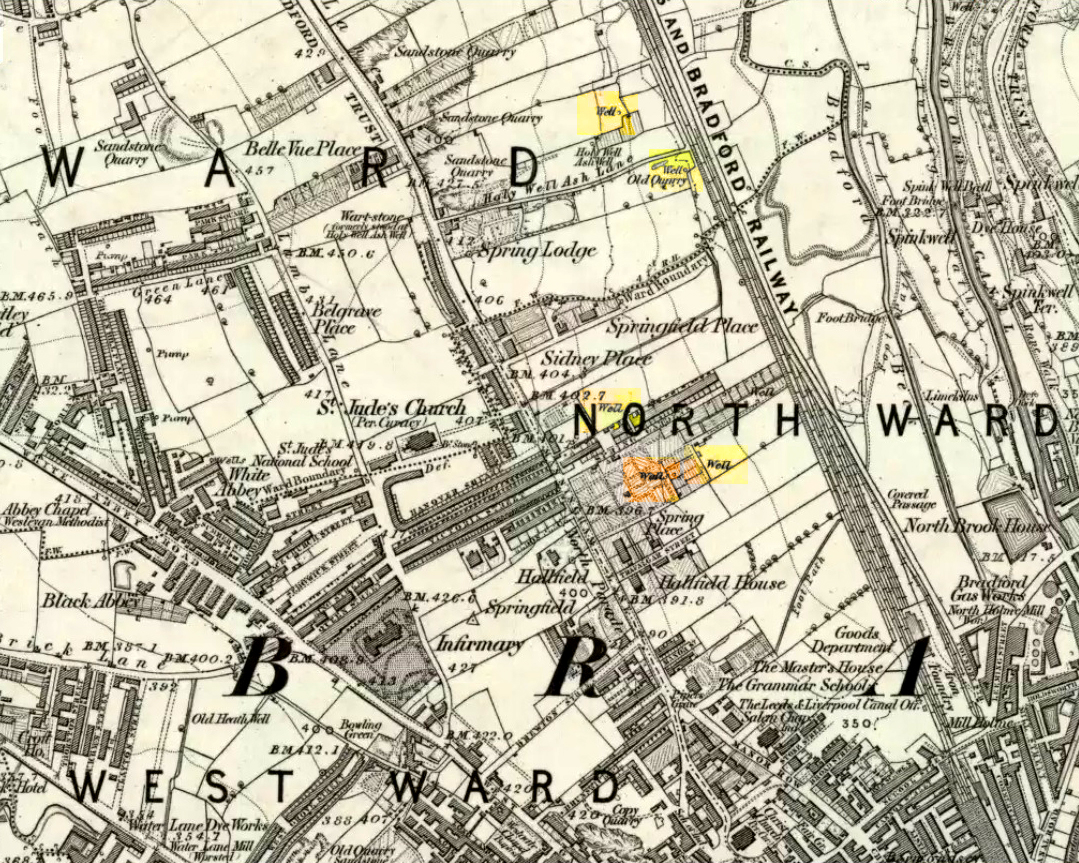
Ing Well on 1852 map

This ‘Well of the Meadow”, or Ing Well, is one of countless springs in and around the Bradford metropolis that have been destroyed by that thing they call ‘development’.  It was one of the main water sources for the villagers of Allerton village in the 19th century and earlier.  Highlighted on the 1852 OS-map of the region, a singular footpath once led to the waters and no further.  There appear to be no antiquarian or historical references detailing its traditions or medicinal qualities—unless of course, you know different.

The name Ing Wells is one of the most common of all titles given to water supplies in England, meaning having the same meaning and general history just about everywhere it occurs.  The place-name itself was given extensive attention in two separate studies by Eilert Ekwall (1962) and Sigurd Karlstrom (1927).

References:

  1. Ekwall, Eilert, English Place-Names in -Ing, Lund: Uppsala 1962.
  2. Karlstrom, Sigurd, Old English Compound Place-Names in -Ing, Lund: Uppsala 1927.

© Paul Bennett, The Northern Antiquarian

Cruckles Well, Manningham, Bradford, West Yorkshire

Sacred Well (lost):  OS Grid Reference – SE 160 339

Archaeology & History

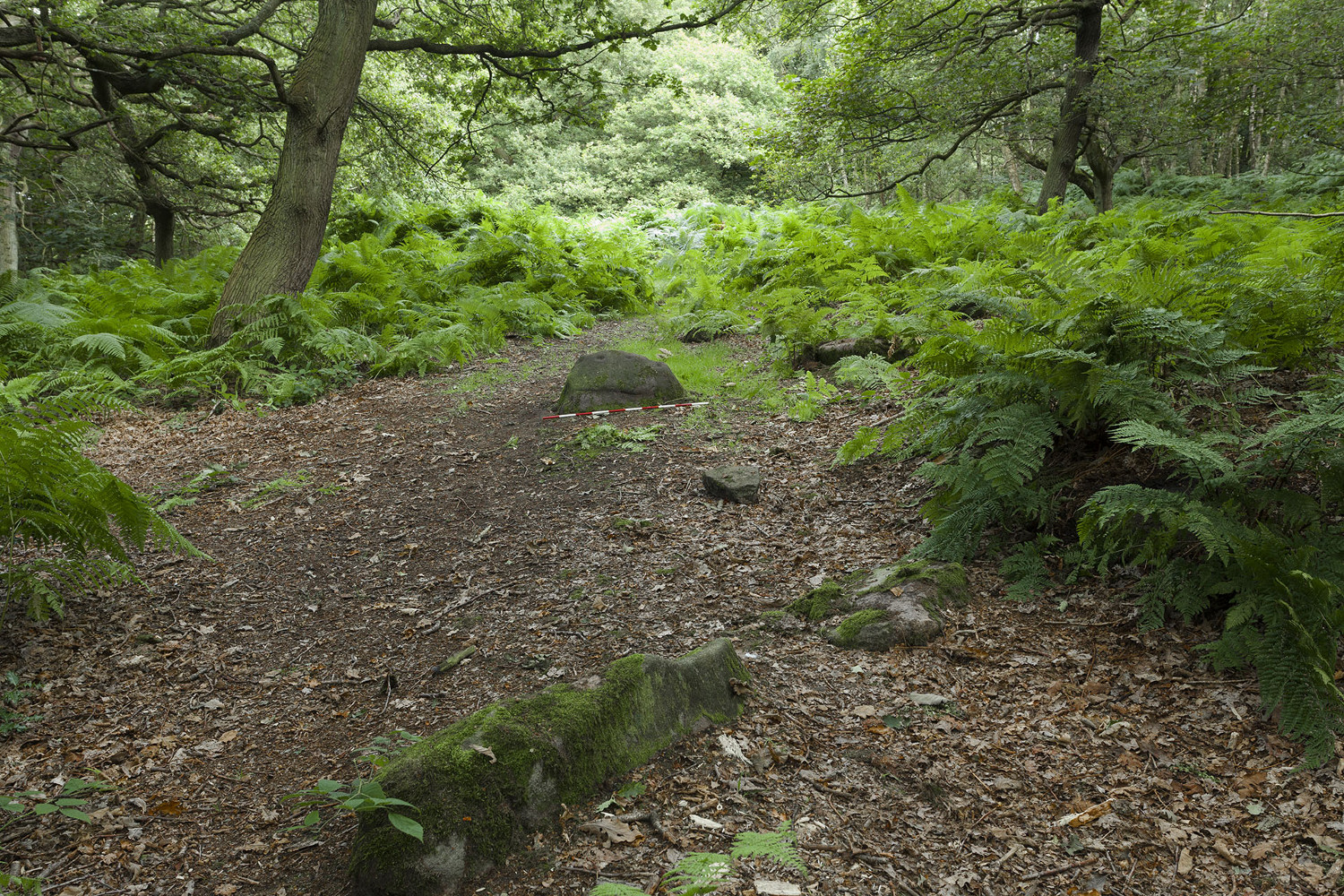
Which one is the Cruckleswell?

In an essay by great regional historian Harry Speight (1912) on the ancient tracks of Bradford and district, he mentions this “Cruckleswell” which was first described in 1602.  Mentioned again in 1612 land deeds and several times thereafter, the site has long gone (been built over), but may have been a place where local people ascribed there being water spirits, or naiads.

Although the local historian W.E. Preston (1932) described the place as being in fields between Manningham Stoop (an old boundary stone, now lost) and Hallfield Cross (perhaps an old stone cross site, also lost), a more detailed article appeared a few years later by Wilfrid Robertshaw (1935), telling of its approximate location.  He wrote:

“The interesting field-name of Cruckleswell occurs in 1664.  Cruckleswell was situated between Manningham Stoope and Hallfield Cross.  The latter name is here applied to some closes of land near the Bradford-Manningham boundary and not to a monument; but from this qualifying statement must not be inferred the opinion that a stone or wooden cross of the name never existed.  From Manningham Stoope, whose location I have not traced, a lane led to Fair Gapp, which was just within the town of Bradford; but in 1686 there was a close called the Stoope, which adjoined Manningham Lower Lane on the left-hand side from Bradford to Manningham.  The occupiers of Cruckleswells were ordered by the jurors of the Bradford Manor Court to take in the water which ran by their premises.  The occurrence of a water-course thereabouts, together with the name, Cruckleswell, suggests that here, as in the Panewell Feilde, was a holy well of a kind.  Perhaps the derivation of the name may be found in the Yorkshire dialect word ‘crukle,’ meaning to make crooked, or to bend or twist.  In a sense, therefore, Cruckleswell was another pin well, into which bent of ‘cruckled’ pins were cast.  Cruckleswells, or Crookewells, as the three closes of land were called in a deed of 1658, were then granted by Tempest Brighouse, of Bilbie in the county of Nottingham, to James Mitchell of Bradford, yeoman.  But…I have found a deed of sale by Christopher Pighells of Bradford, yeoman, to John Nicholls of Horton, clerk, of the close of land called Cruckleswell… Nicholls purchased Cruckleswell in 1612, the year before Saxton produced his plan, on which the small field is shown adjoining others belonging to Pighells.  Thus the plan fixes the location of Cruckleswell; it adjoined the east side of the highway leading from Bradford to Frizinghall and was just within the Manningham township.”

This would put it close to the Holy Well Ash well and its long-lost standing stone.  The 1852 OS-map of this area shows an unnamed well between the Holy Well Ash and the boundary line, as highlighted above; but another unnamed well is to the north of the holy well.  If we cross over the boundary line south and out of Manningham, three other wells existed less than 200 yards away.  Anyone of these may have been the Cruckleswell.

Mr Robertson’s idea on the word ‘cruckle’ is echoed in A.H. Smith’s (1961) place-name analysis of the site, where he relates how the word is “possibly connected with the obsolete crookle, ‘to crook, bed.'”  This is shown to be the case in Thomas Wright’s (1898) gigantic tome. And as “cruckling” pins was a common animistic practice in earlier centuries, this derivation of it—as being a well where offerings were given to the spirit of the waters—is not unlikely.

References:

  1. Preston, W.E., ‘Some Local Holy Wells,’ in Bradford Antiquary, June 1932.
  2. Robertshaw, Wilfrid (ed.), West Yorkshire Deeds (2 volumes), Bradford Historical & Antiquarian Society 1936.
  3. Shepherd, Val, Historic Wells of Bradford, Heart of Albion: Wymeswold 1995.
  4. Smith, A.H., The Place-Names of the West Riding of Yorkshire – volume 3, Cambridge University Press 1961.
  5. Speight, Harry, ‘Ancient Streets and Lanes of Bradford as Portrayed in the Manor Court Rolls,’ in Bradford Antiquary, New Series 3, 1912.
  6. Wright, Thomas, English Dialect Dictionary – volume 1, Henry Frowde: Oxford 1898.

© Paul Bennett, The Northern Antiquarian 


Calverley Woods Stone Circle, Leeds, West Yorkshire

Stone Circle:  OS Grid Reference — SE 20 37

Archaeology & History

Having lived close to these woods in the past, I have searched extensively for any remains of the stone circle described by a Miss Alice Wells in the very first issue of the Cartwright Hall Archaeology Group Bulletin, but to no avail.  A meeting to examine this site was supposed to have taken place in September 1953, “but as Miss Wells was unavoidably absent this was not seen.”  And still to this day it remains hidden [or non-existent, whatever the case may be].  There is ample evidence that prehistoric man roamed this region, as finds of cup-and-ring stones and iron age walling indicate.  A possible contender for this stone circle could be the small ring of rocks seen near the bottom of the wooded hill beneath the giant Hanging Stone, close to grid reference SE 2003 3748.  About 10 yards across, this looked like a smaller version of the Roms Law circle several miles west, but is much overgrown and not visible beneath the undergrowth of summer vegetation.

The presence of prehistoric cup-marked stones in this woodland clearly indicates Bronze Age activity here and—as such petroglyphs have a tendency in West Yorkshire to be associated with tombs and death in many cases—may indicate the lost site was indeed a cairn circle and not a true stone circle. Seems likely to me. If anyone has any photos of this site, or can ascertain its exact whereabouts, please let us know and all credits will be given for its rediscovery.

References:

  1. Bennett, Paul, The Old Stones of Elmet, Capall Bann: Milverton 2001.
  2. Jackson, Sidney (ed.), “Calverley Wood,”in Cartwright Hall Archaeology Group Bulletin, 1:1, July 1954.

© Paul Bennett, The Northern Antiquarian

Calverley Woods 03, Leeds, West Yorkshire

Cup-Marked Stone:  OS Grid Reference – SE 20370 37925

Getting Here

Cup-Marked Stone near centre (courtesy Mike Short)
Cup-Marked Stone near centre (photo, Mike Short)

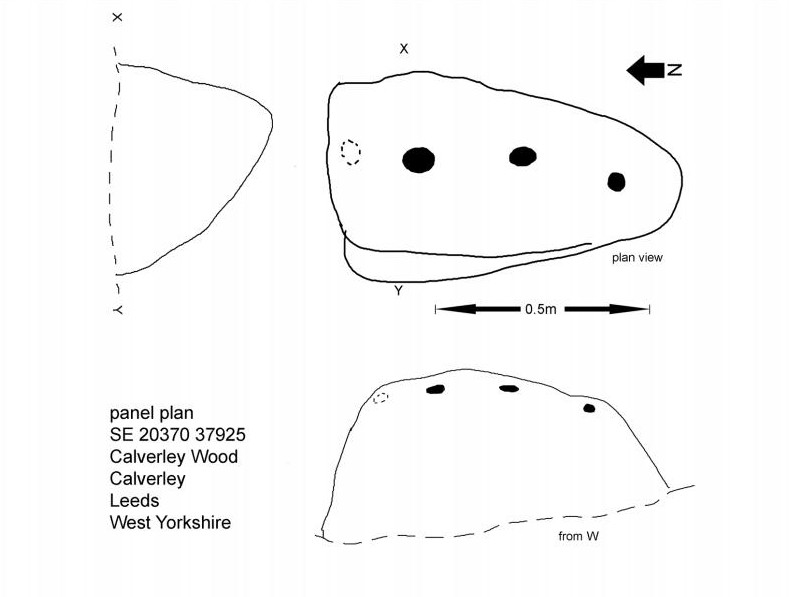
Mike Short tells: Walk ENE along Thornhill Drive (no vehicular access) to gate across road at the last house on the Drive and continue on for approx 475m where road starts to narrow slightly, becomes a little steeper and gently turns to E.  Thornhill Drive is now cut into the hillside at this point with an upwards sloping bank on the S side of the path. After approx 25m further on at approx SE 20375 37950 look out on the S side of the path for a pile of boulders sitting on bedrock on top of the bank and a large rectangular tabular rock on the side of the bank.  Ascend the bank and from the boulder pile the panel is approx 22m 200º(T) in the middle of an ephemeral E-W path more defined to W.

Archaeology & History

The profile (and ‘How to Get There’) for this recently discovered cup-marked stone was forwarded to me by fellow rock art explorer, Mike Short.  The carving is another basic design found in Calverley Woods, between Leeds and Bradford, nearly halfway between the missing petroglyphs of West Woods 2 and Sidney Jackson’s Calverley Woods Stone.  Rediscovered by Lisa Volichenko some time ago, Mike described the new carving here as follows:

Sketch of the carving
(courtesy Mike Short)
Cup-Marked Stone nr centre (courtesy Mike Short)

“Panel is carved on W sloping face of a sub-triangular earthfast coarse-grained sandstone boulder 0.81m X 0.50m X 0.38m, the longest axis lying almost exactly N-S. Carving consists of 3 cups, the most N of which is elliptical approx 65mm X 55mm; the central cup is elliptical approx 50mm X 40mm and the most S is circular diameter approx 40mm. On the N edge of the W face is a shallow elliptical depression thought to be of natural origin. There is an area of damage along the ‘crest’ of the boulder close to its S end.

“Carved rock is the most E of five rocks, measuring between 0.70m and 1.15m in length, in very close proximity forming an arc, 3 of which are in the footpath and one of which is resting on a large slab of rock almost completely covered by soil and vegetation.”

And so the small number of cup-marked stones in this woodland slowly grows.  One wonders how many more are hidden beneath the roots of the trees—and are all of the lines and cups atop of the great Hanging Stone, a short distant away, all Nature’s handiwork…?

Acknowledgements:  Huge thanks for Mike Short for the data, photos and sketch of this carving.

© Paul Bennett, The Northern Antiquarian

West Woods 02, Calverley, Leeds, West Yorkshire

Cup-and-Ring Stone (lost):  OS Grid Reference –SE 1956 3734

Getting Here

Old photo of lost carving

Although now seemingly lost, it’s location is damn close to this: Along the A657 between Greengates and Bradford, where the New Line meets Carr Road, the dirt-track takes you into Calverley Woods, down Eleanor Drive. About 250 yards along (just before you get to the field on the left), take the footpath down the embankment towards the stream where it bends to the left and where the land levels out (don’t cross the stream). It’s somewhere round there!

Archaeology & History

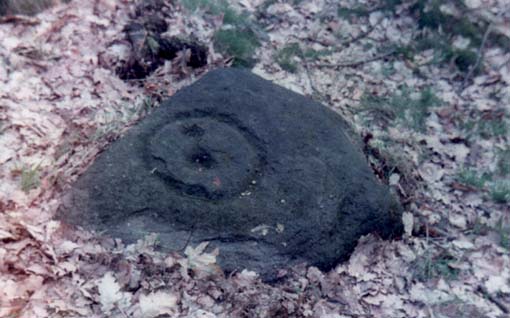
This was one of two previously unrecognised carvings we came across sometime in 1985 (see West Woods 1 stone), when we were seeking out another missing carving in the same woods.  It was clear and well-defined as the faded photo here shows; but having been back to try find it twice in the last two years in the hope of getting better photos, I’ve been unable to locate it.  The carving was described in an article I did in an old earth mysteries magazine.  It comprises simply of a large ring surrounding and enclosing two deep cups, which were linked to each other by a connecting carved line.  Parts of the stone had been chipped in parts—including a section of the large ring— due to some industrial workings that had happened here in the past. Thankfully I managed to find the old photo and hopefully, perhaps, some local explorer could try and seek out where it’s hiding beneath the trees and other vegetation.

References:

  1. Bennett, Paul, “The Undiscovered Old Stones of Calverley Woods,” in Earth no.2, 1986.

© Paul Bennett, The Northern Antiquarian

Spink Well, Bradford, West Yorkshire

Healing Well:  OS Grid Reference – SE 1653 3410

Getting Here

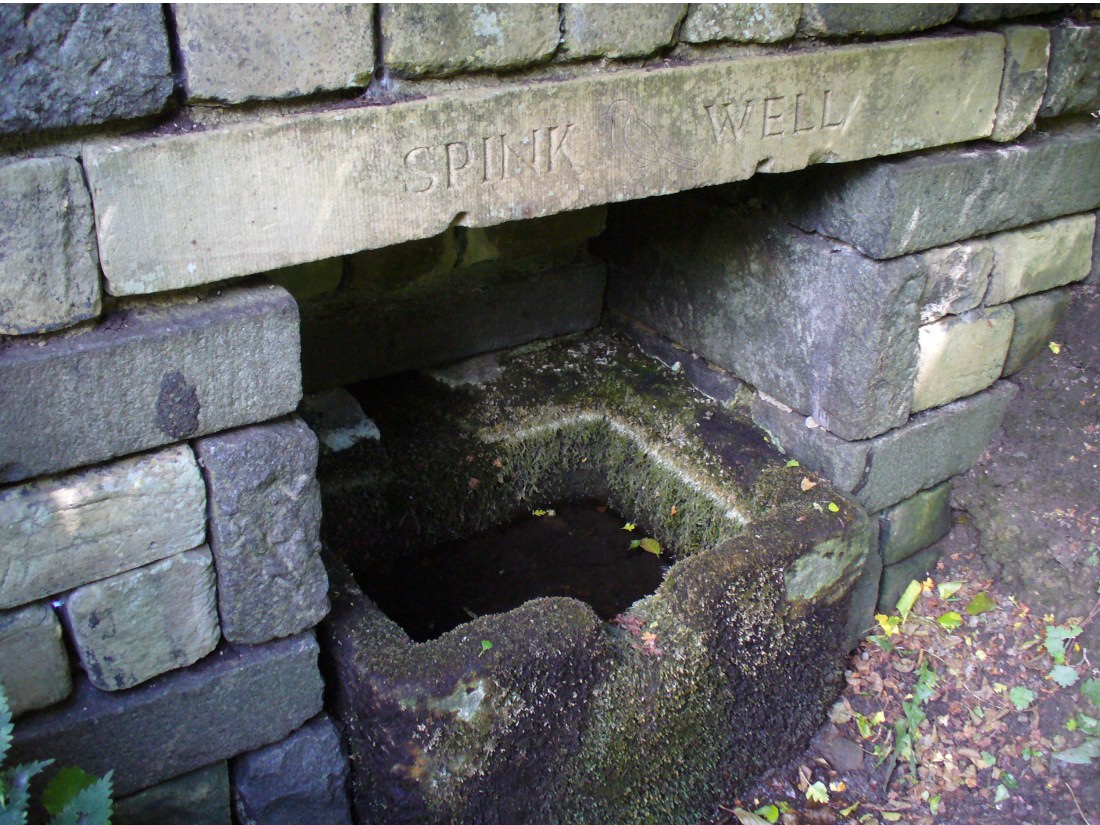
The Spink Well, Bradford

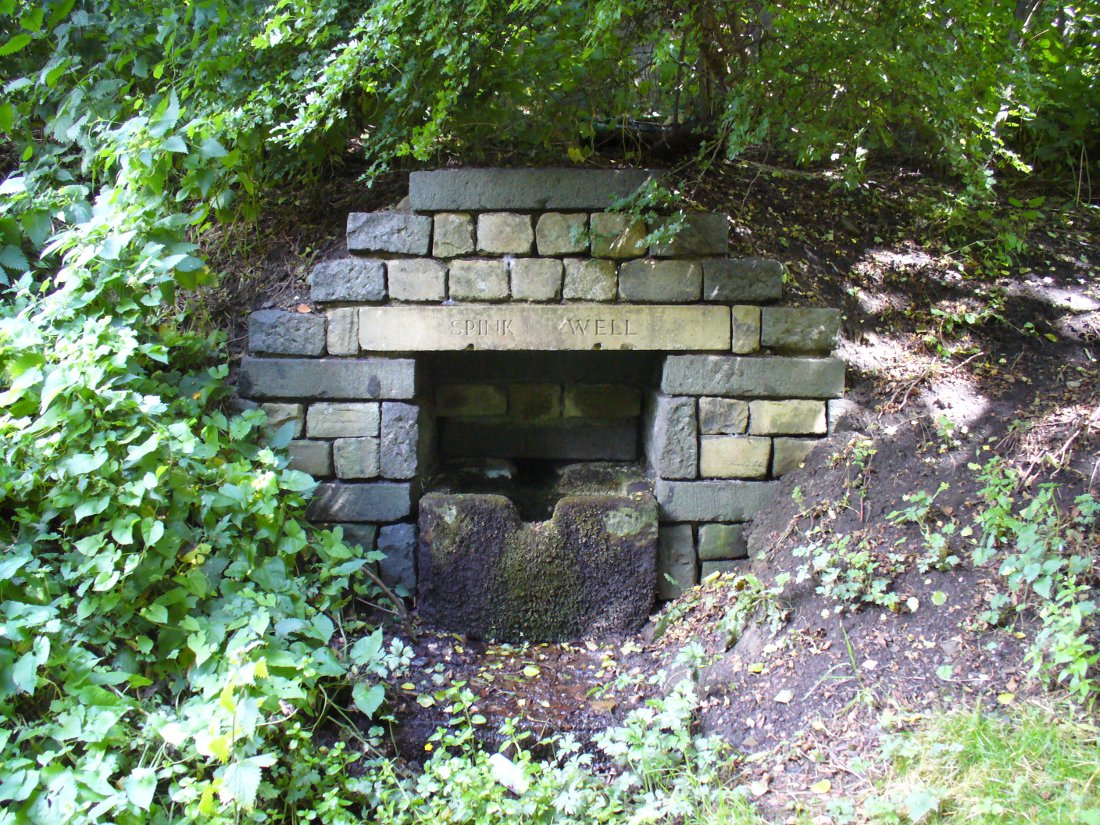
From Bradford city centre go up Bolton Road (crossing the big A650 dual carriageway) until, a couple of hundred yards further you meet with, at an angle, Wapping Road on the right. Where these roads meet, note a small footpath going down into the trees on the Bolton Road side. Go down here till it bends to the right at the bottom. Walk along here for less than 100 yards, keeping your eyes peeled for the small stone-lined well above the path on your right.

Archaeology & History

The Spink Well was highlighted on the 1832 boundary commission report map of Bradford; then listed in the 1850 Tithe Awards; and of course featured on the earliest Ordnance Survey map a few years later.  In 1788, below the spring itself, a Spinkwell House was built which advertised health-giving cold baths and used the waters from this well to supply people with its health-giving virtues.  This Spink Well house also had a most curious history: the gravestones of those who died in the plague of 1645 were built into the walls of the well-house here! They were uncovered during the construction of Peel Park in the 19th century, a short distance away.  Then, for a long time thereafter, the waters and the stonework surrounding this well fell into disrepair—especially when the Industrialists appeared in what was, at the time, the world’s centre for such people.

The muddy waters of the well

The name ‘Spink Well’ is the most common of all the wells named after animals in West Yorkshire (and elsewhere in Yorkshire for that matter), with ten examples of them that I’ve come across locally.  The word ‘spink’ is the local dialect word for the finch.  A veritable profusion of them scatter our region, although not much folklore is known about this little bird.  The various types (gold finch, bull finch, etc) are all said to be birds of good fortune and one of its calls is said to tell of the coming of rain.

This particular Spink Well is very close to Bradford city centre and although now only a trickle of muddy water fills the trough into which it once ran freely, at least it’s still here!  Many other sites close to the city centre were destroyed without care by the ignorant Industrialists.  The well was evidently a place of some importance in ages past, as the 1852 OS-map shows eight spots hereby named after the place!  The local historian Roger Storrs (1888) wrote that—along with the Holy Well Ash Well a short distance from here—these sites “were long ago famous wells.”  No specific medicinal properties have been remembered for this place.

Folklore

Folklore tells that a huge boar—which gave its name to the Boar Well just 100 yards along the same path from here—also drank the waters here at Spink Well.

References:

  1. Storrs, Roger, ‘Legends and Traditions of Wells,’ in J.H. Turner’s Yorkshire Folklore Journal, 1888.
  2. Whelan, Edna & Taylor, Ian, Yorkshire Holy Wells and Sacred Springs, Northern Lights: Dunnington 1989.

© Paul Bennett, The Northern Antiquarian 

Sweet Willy Well, Wrose, Shipley, West Yorkshire

Healing Well: OS Grid Reference – SE 16561 36440

Also Known as:

  1. Lin Well
  2. Silver Stream
  3. Sugar Stream

Getting Here

Sweet Willy Well, Eccleshill

Whether you’re coming here from Wrose or Eccleshill, go along Wrose Road and turn down Livingstone Road at the traffic lights. Down here, when the road splits, head to your right until you meet with those stupid road-block marks (where you can only get one car through). Just here, walk down the slope and path on your right, and before you hit the bottom of the slope, walk down the small valley for about 20 yards until you see the small stream appear from beneath some overgrown man-made stone lintels. That’s it!

Archaeology & History

When I was a kid I used to play down this tiny valley when the waters here still had small fish swimming away (we used to call them ‘tiddlers’). The fish seem to have gone, but there are still waterboatmen on the surface, indicating that we still have fresh water here – and on my most recent visit, I cautiously tasted the waters and found them OK (the prevalence of broken bottles and beer cans from locals doesn’t inspire you to drink here though).

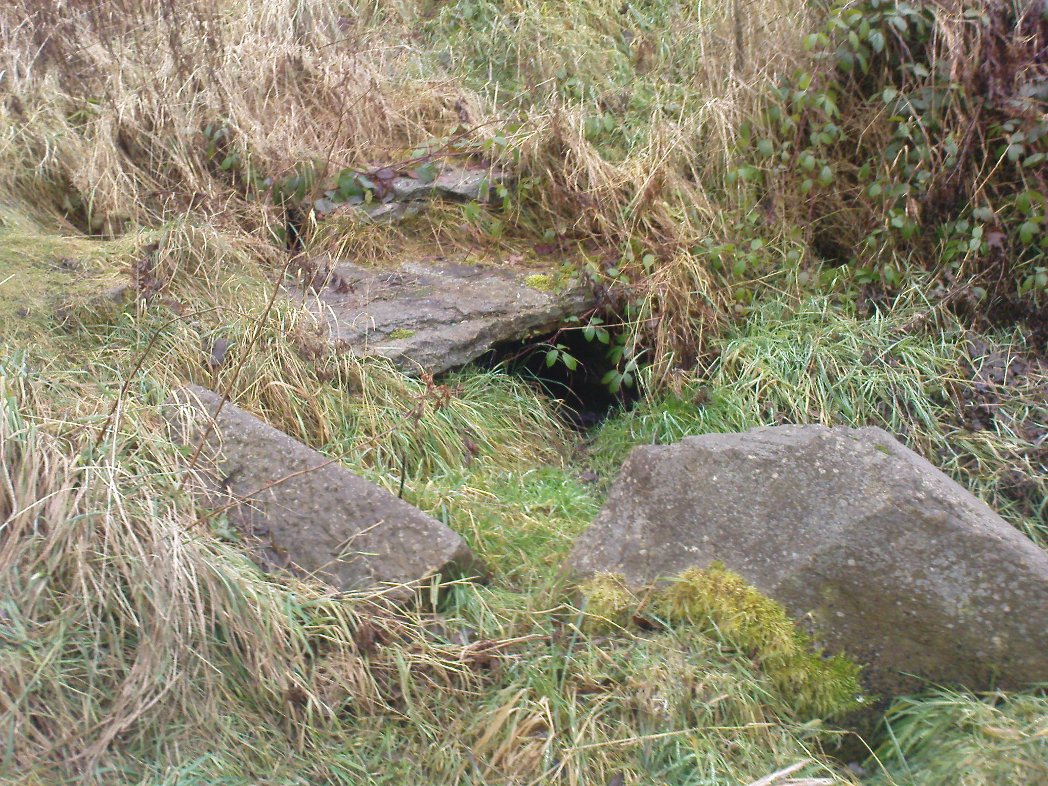
Initially located on the local boundary line between Eccleshill and Wrose, the waters used to be found running into a trough about 100 yards further up the small valley, but this has been lost and housing now covers its original site.  You can see how the stream has cut the valley further upstream, but now it bubbles up from beneath the rocks shown in the photo.  Bradford historian Robert Allen (1927) described the site in his survey as originally being between North Spring and South Spring Wood.

Although the name Sweet Willy Well remains a mystery, one of its other titles — the Lin Well — relates to the presence of linnets that used to be found in great numbers here.  The ‘Sugar Stream’ name is one we knew it as locally as children, due to the once sweet taste of the waters.  It is likely to have had medicinal properties, but these have been forgotten.  No archaeological survey has ever been done of this site.

References:

  1. Allen, Robert C. (ed.), The History Of Bolton In Bradford-Dale; with Notes on Bradford, Eccleshill, Idle, Undercliffe, Feather Bros: Bradford 1927.

© Paul Bennett, The Northern Antiquarian


Northcliffe Woods, Shipley, West Yorkshire

Cup-and-Ring Stone: OS Grid Reference – SE 13642 36608

Getting Here

Shipley FieldsCR518
Cup-and-ring stone at Northcliffe

Takes a bit of finding this one, and isn’t that impressive, so is probably only of value to the real enthusiasts. From Shipley, head up to Northcliffe and take the walk into the woods. Walk along the valley bottom, past the old train line at the bottom of the valley, and keep going for a few hundred yards until you meet with the small pond or damn on your left. Somehow cross over the stream and walk up the overgrown hill right above the pond. You’ll notice a single rock, on the right-hand side of the tiny stream running down the slope you’re walking up, just on the top of the ridge near the tree-line about 20 yard or so before the golf course. That’s it!

Archaeology & History

NorthcliffCR dr
Drawing of the Northcliff carving

This little-know cup-and-ring stone, seemingly in isolation just over the northern edge of the golf-course about 20 yards into the woods at the top of the ridge, cannot be contextualized with any adjacent monuments as the area has been badly damaged by the industrialists, as usual, with both quarrying and the golf course – much like the damage done at Pennythorn Hill, above Baildon.

This rock has what seems to be at least five cup-markings: two quite prominent, the others smaller and more faded.  Earlier surveys by the likes of Sidney Jackson (1962) saw another two cups on the stone, but these seem to be natural.  A curious large ring runs around the cup near the top of the stone, but this is pretty faint nowadays.  One of the cups along the edge of the stone also looks like it may have had an arc carved around the top of it, but this needs exploring at different times of day and in different lighting conditions to verify or deny this.

References:

  1. Jackson, Sidney, “Cup-Marked Rock, Northcliff Wood,” in Cartwright Hall Archaeology Group Bulletin, 7:6, 1962.

© Paul Bennett, The Northern Antiquarian