Holy Well (destroyed): OS Grid Reference – TQ 6538 7081
Also Known as:
St. Thomas’ Well
Shingle Well
Archaeology & History
Sadly the site is gone no longer in existence it was in the roadway along the Roman Watling Street, at its junction with Church Lane, where it joins the relatively recently named Hever Road with Mailings Cross.
Local opinion, erroneously believes that its name derives from there only being one well in the district, but it originates from its substrate, being once called ‘Shinglewell’ describing the substrate. It ended its days as a traditional winch well, with a depth of 150 yards. Watt (1917) described the draw well as having a sign, reading ‘This water is not fit for drinking’— the result of contamination by a nearby stagnant pond. This wooden framework was removed during the First World War, when the well was filled in and domed over. Later, in 1935, a granite slab inscribed with: ‘Site of the Ancient Well, Singlewell Parish or Ifield’ was placed there. Unfortunately, this was removed by the County Council in 1952, and along with the combination of road improvements, the site was largely forgotten.
Folklore
Recorded in a Latin MS and translated by the Rector of Ifield between 1912-1935, the Rev K. M. Ffinch tells of a tradition in great detail, and the following is a brief resume. The legend involves a village girl called Salerna, who is said to have ‘thrown’ herself down the well after being accused of stealing some cheese. Yet, as she fell, she cried out for St. Thomas to save her from her impending doom, and upon finishing her plea, landed on some planks lying at the bottom of the well. They broke her fall, and thus saved her from her dreadful fate. She was then subsequently rescued and because of the ‘miracle’ the well was dedicated to the saint.
The incident is said to have occurred soon after St. Thomas’s martyrdom, and is said to have been one of his first miracles. The name ‘Salerna’ suggests a Roman origin, supported by its location along Watling Street, a Roman Road. Bayley (1978), using a low-land British dialect, which he believed survived until this century, states that ‘Salire Naias’ is ‘the water nymph, who springs forth and runs down’. Consequently, the story of St. Thomas miracle may have been introduced to remove the pagan tradition and refocus the beliefs of the people using a local saint.
References:
Bayley, M.,(1978) Ancient, and Holy and Healing Wells of the Thames Valley, and their Associations.
Ffinch, K.M., (1957) The History of Ifield and Singlewell
Parish, R.B., (1997) “The Curious Water-lore of Kent II: Ghosts, Fertility and Living Traditions”, in Bygone Kent, Volume 18, pp.427–32.
Watt, F., (1917) Canterbury Pilgrims and their Ways
(Extracted from the forthcoming book Holy Wells and Healing Springs of Kent)
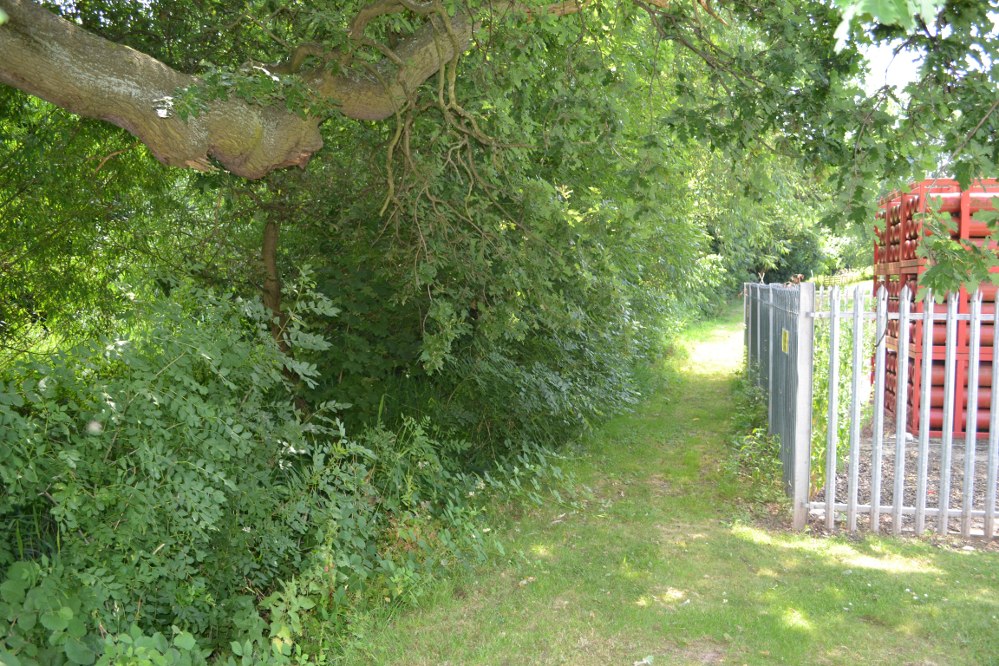
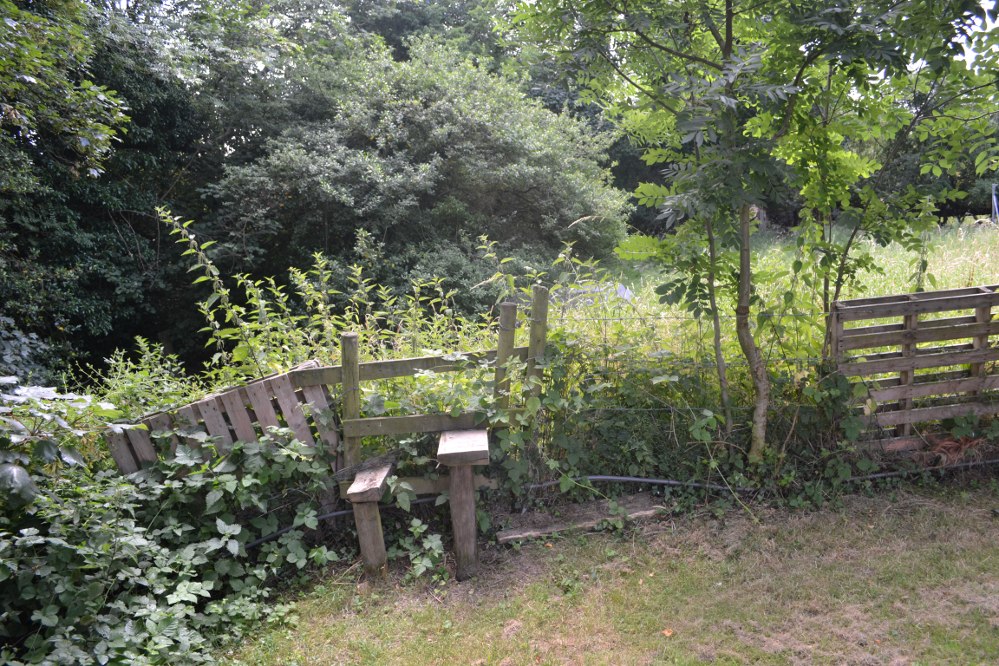
On the outskirts of Loughborough is an area called Holywell, but pronounced ‘holly’. The holy well can be found at the furthest north west part of the park, behind the large Garendon block of the Holywell complex. Here behind some hydrogen cylinders (!) follow the brook on the left until you reach a stile. Climb over this and the well in front of you. It is unclear what the access rights are, but there are no private signs.
Archaeology & History
The stile with the well in the background
Virtually swallowed up by Loughborough University is the estate of Holywell Haw, the present farmhouse taking its name from a spring nearby. Of the house itself: it probably began life as a hostel for those lost in the most substantial Charnwood Forest, which has since retracted around it. However by 1180, it had become a hermitage owned by Garendon Abbey and is then first noted by the name of ‘Holywell Haw’, the latter word deriving from haw meaning enclosure, the same origin as hawthorn. Potter, in his History and Antiquities of Charnwood Forest (1842), notes it was mentioned in a grant by Robert de Jort to the abbey, with the site being described as heremitorium de Halliwellhaga.
Later, the 13th century Testa de Nevill, records ‘a dairy, with a small wood, called Haliwelle Hawe’, which by the 14th century the Leicester Abbey purchased from a Henry Lord Beaumont “a certain parcel of wood called Holy-well Haw for £28.” It was they who appeared to have developed the area to what can be seen today: fishponds and moats, and probably used the site as a grange and possible a diary. What remains today is mainly 15th century, with fragments of a medieval structure such as gothic doorways and timbers. Whether it was Holywell Haw or Hall is unclear. This discrepancy has been blamed on the Ordnance Survey—and indeed, some blunders have been done by them in the past. However, it is possible that a 19th century owner, March Philips, had some sort of pretensions for the building and thought the name was better. By the 18th century, the name Holywell Dyke was an eighteenth-century boundary mark for Charnwood Forest.
The spring is icy cold and never run dry, and produces—according to Bob Trubshaw (1990)—20,000 galloons a day and is one of the only non-incorporated spring in the Severn Trent catchment classed as A1 Drinkable.
The Site Today…
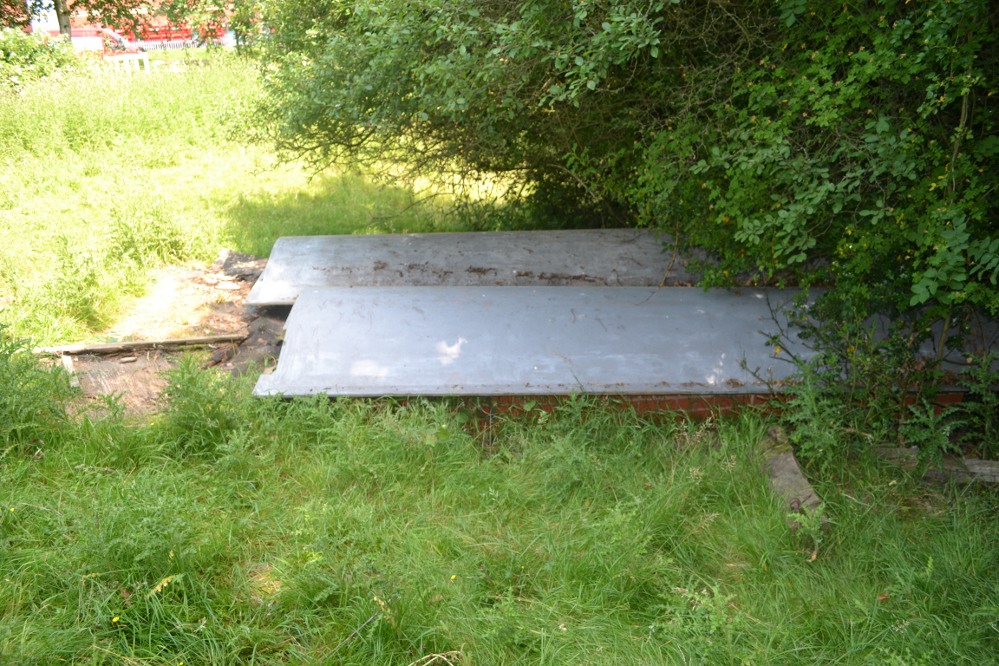
The not-very-interesting looking site today
Despite a leaflet mentioning the well from the University (available as a pdf-file), it is a little reticent as regards to whether it can be visited. However, exploring around the back of the enormous Holywell complex, a small path passes some gas cylinders and then to a stile. No keep out signs are present so I assumed it was okay to jump over. There almost in front of me is a large brick chamber covered by two large fibre glass up turned boats. These appear to cover the well.
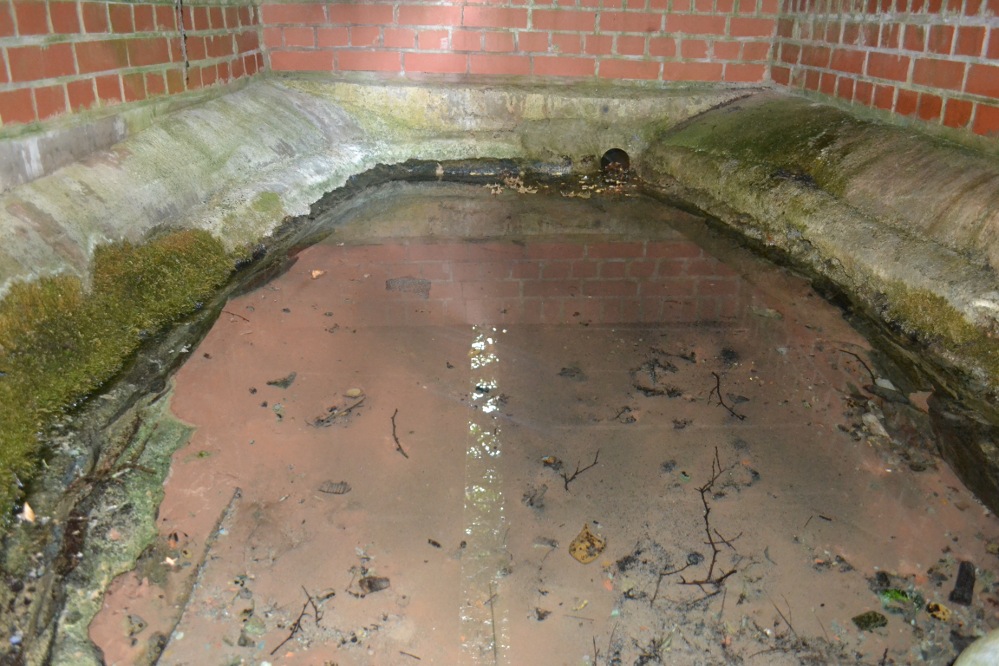
Within, with natural rock & medieval stonework?
Peering between a gap however, this rather unpromising edifice reveals something more interesting. The brick chamber encloses an elliptical natural stone or possibly medieval basin, into which a copious flow enters and fills and then flows through a pipe into the brook below. Despite the rather ugly surrounds there is still something ancient and mysterious about this most well-known of Leicestershire sacred springs. The local farm, the Holywell Haw, still apparently uses the water and it is regularly checked by the University authorities. One hopes it can get a better cover. Surely the university could afford a metal grid more worthy of this venerable site.
Folklore
Local tradition states that it has medicinal qualities. Nichols (1795–1815) notes:
“The excellent spring is yet preserved.”
Potter (1852) notes that it:
“derives part of its name from a well, to the waters of which, even in recent times, considerable virtues have been attributed.”
However, its most famous legend is said to date from the 15th century. Potter (1852) notes that:
“The popular idea seems to be, that the Comyns (of Whitwick Castle) were great giants. One of them, said my informant, attempted to carry off one of the Ladies of Groby Castle, who left that place for security, intending to take sanctuary at Grace Dieu. Going, however, by a circuitous route, to avoid Charley and Whitwick, she was benighted, and would have perished in the Outwoods, but for one of the Monks of the Holy Well.”
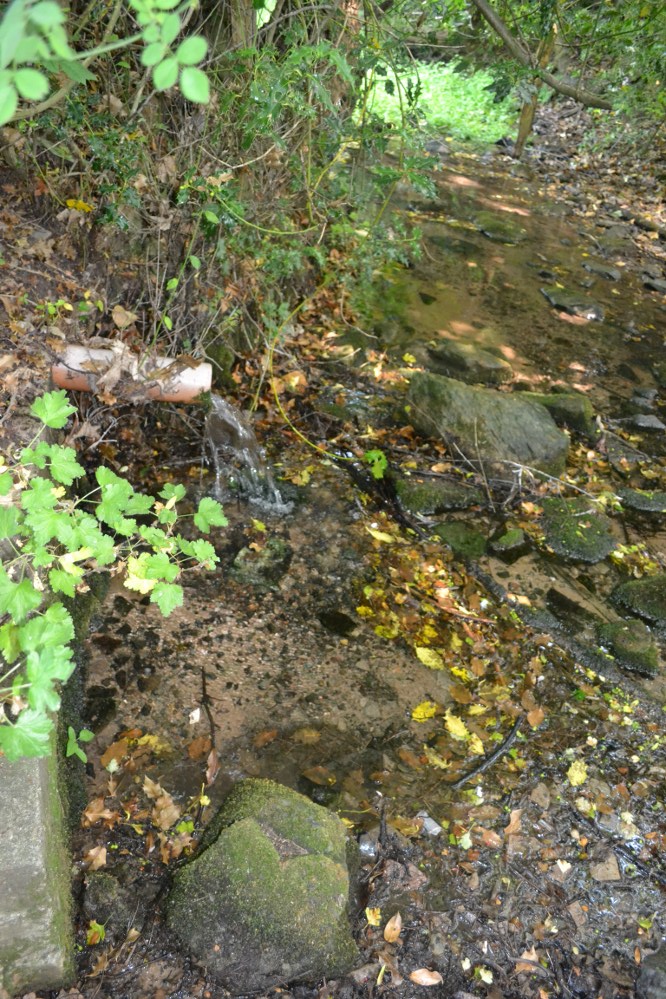
The overflow runs into a delightful brook
The legend tells how after a considerable pursuit, she upon reaching the hermitage, collapsed and died. A monk then used the water to bring her back to life. Potter (1942) tells the story in verse:
“The oaks of the forest were Autumn-tinged,
And the winds were at sport with their leaves
When a maiden traversed the rugged rocks
That frown over WOODHOUSE EAVES.
The rain fell fast – she heeded it not
Though no hut or home appears;
She scarcely knew if the falling drops
Were rain drops or her tears.
Onward she hied through the OUTWOODS dark
(And the Outwoods were darker then)
She feared not the Forest’s deepening gloom She feared unholy men.
Lord Comyn’s scouts were in close pursuit,
For Lord Comyn the Maid had seen,
And had marked her mother’s only child
For his paramour, I ween.
A whistle, a whoop from the BUYK HYLLS side,
Told Agnes her foes were nigh:
And screened by the cleft of an aged oak,
She heard quick steps pass by.
Dark and dread fell that autumn night:
The wind-gusts fitful blew:
The thunder rattled: – the lightning’s glare
Showed BEACON’s crags to view.
The thunder neared – the lightning played
Around the sheltering oak;
But Agnes, of men, not God afraid,
Shrank not at the lightning’s stroke!
The thunder passed – the silvery moon
Burst forth from her cave of cloud,
And showed in the glen “Red Comyn’s” men,
And she breathed a prayer aloud:-
“Maiden mother of God! Look down
List to a maidens prayer:
Keep undefiled my mother’s sole child
The spotless are thy care”
The sun had not glinted on BEACON HILL
Ere the Hermit of the HOLY WELL
Went forth to pray, as his wont each day,
At the cross in Fayre-Oke dell.
Ten steps had he gone from the green grassy mound
Still hemming the HOLY WELL HAW,
When, stretched on the grass – by the path he must pass
A statue-like form he saw!
He crossed himself once, he crossed himself twice,
And he knelt by the corse in prayer:
“Jesu Maria! cold as ice –
Cold – cold – but still how fair!”
The Hermit upraised the stiffened form,
And he bore to the HOLY WELL:
Three Paters or more he muttered o’er,
And he filled his scallop shell.
He sprinkled the lymph on the Maiden’s face,
And he knelt and he prayed by her side
Not a minute’s space had he gazed on her face
Ere signs of life he spied…..
Spring had invested the CHARNWOOD oaks
With their robe of glistening green,
When on palfreys borne, one smiling morn,
At the HOLY WELL’s HAW were seen.
A youth and a Lady, passing fair,
Who asked for the scallop shell:
A sparkling draught each freely quaffed,
And they blessed the HOLY WELL.
They blessed that Well, and they fervently blessed
The Holy Hermit too;
To that and to him they filled to the brim
The scallop, and drank anew.
“Thanks, Father! Thanks! – To this well and thee,”
Said the youth, “But to Heaven most,
I owe the life of the fairest wife
That CHARNWOOD’s bounds can boast.
“The blushing bride thou seest at my side.
(Three hours ago made mine)
Is she who from death was restored to breath
By Heaven’s own hand and thine”.
“The Prior of ULVERSCROFT made us one,
And we hastened here to tell
How much we owe to kind Heaven and thee,
For the gift of the HOLY WELL”.
“In proof of which – to the HOLYWELL HAW
I give as a votive gift,
From year to year three fallow deer,
And the right of the Challenge drift”.
“I give, besides, of land two hides,
To be marked from the Breedon Brand:
To be held while men draw from the Well in this Haw
A draught with the hollow hand”.
The Hermit knelt, and the Hermit rose,
And breathed “Benedicite!
And tell me”, he said, with a hand on each head,
“What heaven sent pair I see!”
“This is the lost de Ferrers’ child,
Who dwelt at the Steward’s Hay;
And, father, my name – yet unknown to fame
Is simply EDWARD GREY”.
It is thought that after being revived she gave her name to God and became a prioress and some historians link it to a real life account of Eleanor Ferrars whose was carried off. It also has similarity to legends associated with Essex’s Running Well and Kent’s St. Thomas’s well at Singlewell.
References:
Hope, R. C, 1893, Legendary Lore of the Holy Wells of England, London: Elliot Stock.
Nichols, J.,1795-1810, History and Antiquities of the County of Leicester, London: Nichols
Potter, C.1985, ‘The holy wells of Leicestershire and Rutland’, in Source, 1st series, 1:15–17.
Potter, T. R 1852, History and antiquities of Charnwood Forest
Rattue, J., 1993, ‘An inventory of ancient, holy and healing wells in Leicestershire’, Tr. of the Leicestershire Arch. & Hist. Soc. 67: 59–69. Richardson, L. R., 1931, Wells and Springs of Leicestershire, Memoirs of the Geological Survey.
Trubshaw, B., 1990, Holy Wells and Springs of Leicestershire and Rutland, Heart of Albion, Wymeswold.
Take the A823 road up from Gleneagles to Glendevon and at the top of the long hill, where the road starts to level out and slightly drop, where the two glens meet up, take the right turn (west) and park up by the cattle-grid. Walk back onto the A823 and walk about 200 yards south towards Glendevon, to the small copse of trees past the cottage. As you get to the trees, look by the fencing and you’ll see one archetypal rounded standing stone, with another one next to it. You’re here!
Archaeology & History
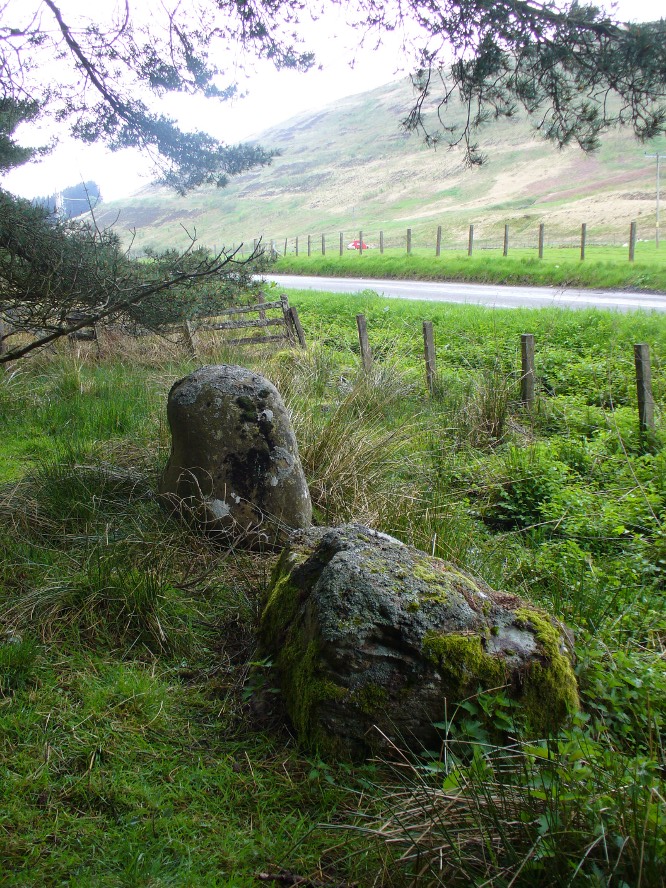
Stones by the roadside at Fourstanes
At long last my huge nose is twitching back to its authentic sniffing-out lost sites in the landscape. During a visit to the St. Mungo’s Well a few days ago, on the way back to the car I kept saying to my fellow antiquarian Paul Hornby that “there’s something missing round here.”
“Wotcha mean?” he said.
“Summat missing Paul. It feels there should be a four-poster or summat like that here — where the two glens meet up. I can smell it. Summat should be here, or was here in the past.”
I said it several times as we walked back along the old track to the car. We took the photos and he set off to give me a grateful lift back home. But as we got back onto the road, we noticed a couple of upright stones just set back at the edge of a small copse of trees. One was very rounded and about four-feet tall, with a smaller companion next to it. But we didn’t stop to check them out as it was getting late.
A few days later Paul rang me to ask if I’d had a look at the old maps of the region where we’d visited and seen the old place-name where we’d been.
“No, why?”
“It’s known as the ‘Four Stanes’,” he said. “And right where those stones were standing by the trees!”
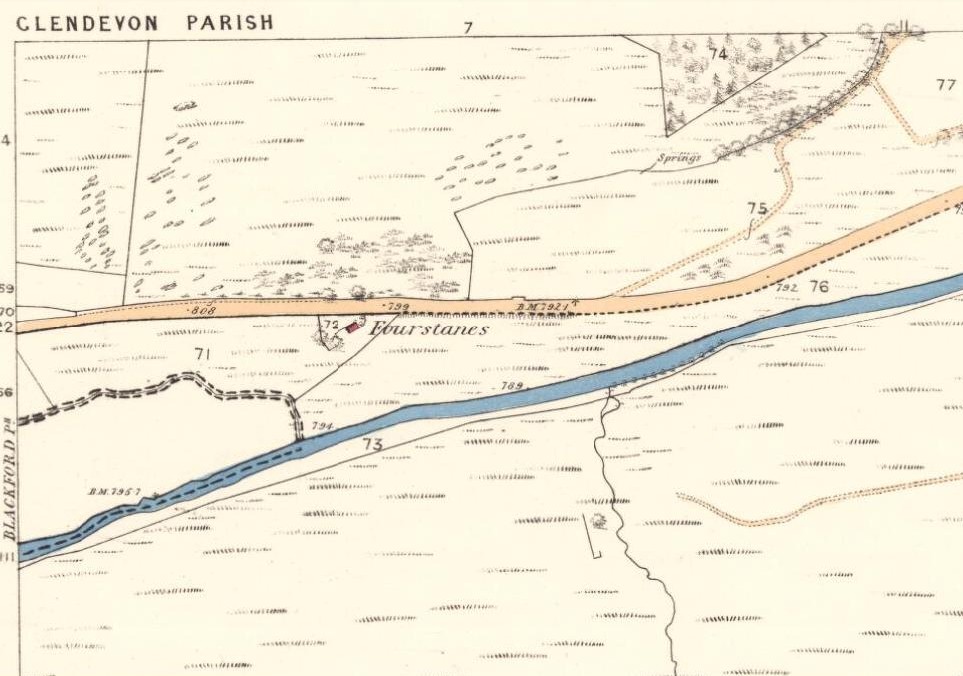
A few happy expletives came out, as usual for me. So I sought out the map he was talking about and, as we can see above, the “Fourstanes” (or Stones) are right where my ‘feelings’ and the stones were seen.
On the 1860 Ordnance Survey map of the area, a small building is shown and named as ‘Fourstanes’ right by the roadside, on the south side. It was also named as such in an earlier account of 1851 and was told to be inhabited by a Mrs Foote in 1866. Sometime after this the cottage appears to have been left to neglect and no trace of it now remains. According to evidences of the place-name societies in England and Scotland and the studies of Smith (1956), Scott (2004) and others, unless the term derives from the Gaelic fuar, meaning cold or chilly, it is usually evidence of ‘four stones’ in relation to megalithic remains like those found from Shetland to the more southerly counties in England. Dr Aubrey Burl (1988) shows clearly in his textbook of the same name, that “four poster stone circles” are common megalithic architectural features in the Perthshire landscape — where this happens to be! He also states that such place-names should be listed and checked as possible “sites of destroyed four posters.” So we did just that!
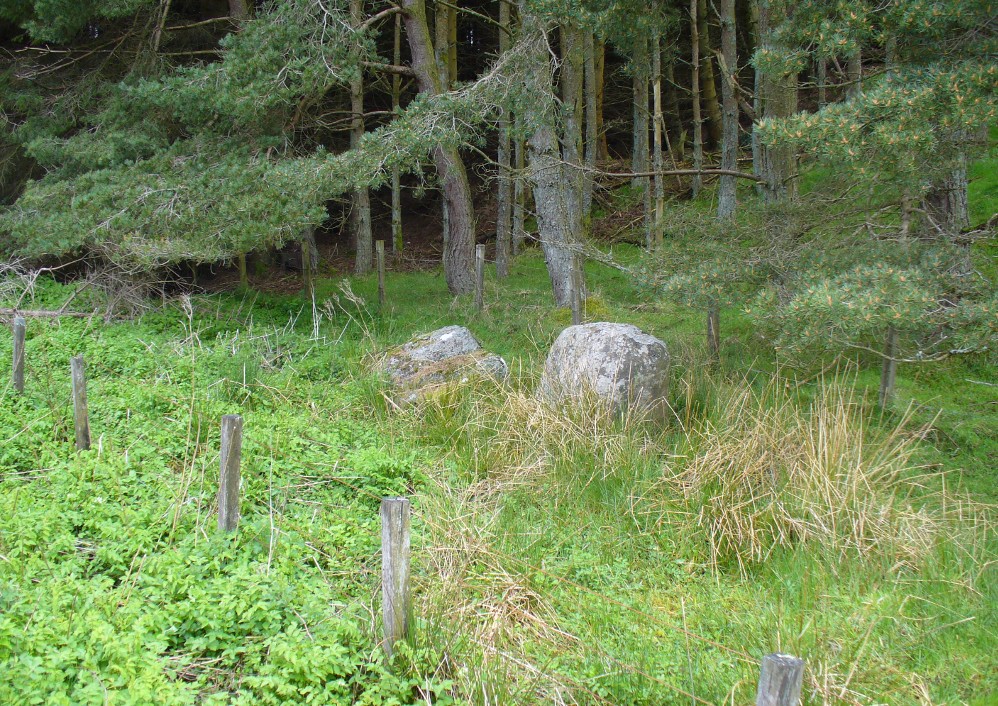
Although the stones look very good contenders in the photos and also when you first see them close up, there are some elements here that need highlighting that throw a more sceptical view of them as authentic megaliths. The larger of the two stones—very rounded and worn, typical of other four-poster remains—is three feet high. The lichen vegetation covering it on all sides is old—except on its back (northern) upright face, where there is almost no vegetation at all. Indeed, this face is almost entirely clear of any natural plant growth, showing it was moved into this position from a lower horizontal level and pushed upright, I would say within the last century. The smaller, lower stone next to this upright oddity, is laid down and covered on all sides by an excess of vegetation expected of a monolith that has been in this position for several centuries at least. The lichen growth on this stone is very old.
Both of these stones occur along the line of an old wall and may have originally been a part of such a structure, instead of any four poster megalithic feature. However, the road that runs past here replaced the earlier track (which you can still walk along on the other side of the river 100 yards away) running through Glen Devon and into Glen Eagles. This “new road” as it was then, was made sometime in the 19th century. It may be that, upon the construction of the new road, the ‘fourstanes’ themselves were “in the way of Progress” (as they like to say) and so were rolled down the side of the new road and into the position they now occupy. It’s difficult to say.
There is one additional element that needs exploring. The hill immediately above Fourstanes is called ‘The Law.’ Although this word can be a simple “hill”, there are additional historical factors to a place-name. In Laurence Gomme’s (1880: 260-77) excellent work on the subject, he illustrates time and again across Scotland that heathen gatherings, tribal meetings and early court sessions or ‘moots’ were held at places with this place-name element. It should come as no surprise then, that at other megalithic sites in Britain called the Four Stones, ancient pagan moot were also held there. (Gomme 1880; Grinsell 1936, 1976)
We’re going back onto The Law itself in the next week or two, just to see if these ‘fourstanes’ are hiding away in the heather on the tops, where oh so many megalithic rings tend to be found….
…to be continued…
References:
Burl, Aubrey, Four Posters: Bronze Age Stone Circles of Western Europe, BAR 195: Oxford 1988.
Dwelly, Edward, The Illustrated Gaelic-English Dictionary, Gairm: Glasgow 1973.
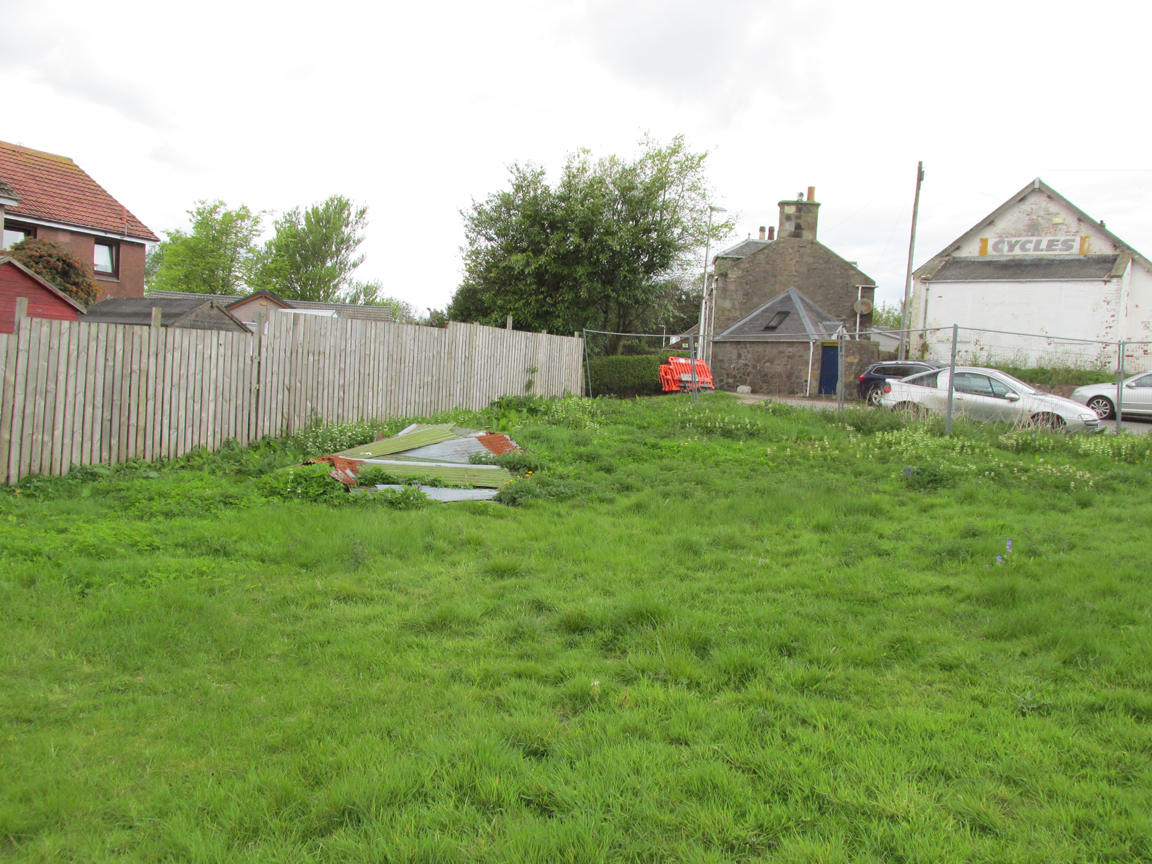
If travelling from Dundee or Newport, turn right into Meadow Road, the last turning before the roundabout in the middle of the town. On the right is a large white-painted building where bicycles are sold. The site of St Bunyan’s Well is on the patch of empty land opposite, to the left nearest the road.
Archaeology & History
Site of St Bunyan’s Well
The Well is named in conjunction with the ninth century Culdee chapel of St Bunyan on the nearby Temple Hill, now known as School Hill. St Bunyan has been remembered by various alternative names: Bunoc, Bonac, Bonoc, Bonnoch, Bunan, Bernard and Bennett, and W. Reid noted in 1909,
“A crown charter of 1539 refers to a yearly market on St. Bonoc’s Day, and a further reference to the Chapel of St Bonach occurs in the confirmation of a charter by James VI.”
Forbes’ Kalendars of Scottish Saints records, under the entry for Saint Bonoc that one of the Endowments of Saint Fergus at St Andrews was the jawbone of Saint Bonoc, given by Bishop David Rhynd.
The mid nineteenth century Ordnance Survey Name Book correspondents Messrs. Pillans and Keddie described the well: “In the village of Leuchars. A excellent Spring Well in the village of Leuchars it is built round with cut stones, and is Kept in good repair by the inhabitants. the date when it was first Constructed is not known but it said to have been before the reformation, dedicated to St. Bunyan hence its name.”
The Reverend Kettle in the Old Statistical Account for Leuchars adds: “There is a most excellent well flowing with an abundant Stream of Soft water near the west en of the village (for the village is now extending westward) called by the name of the saint to whom the Chapel was no doubt consecrated.”
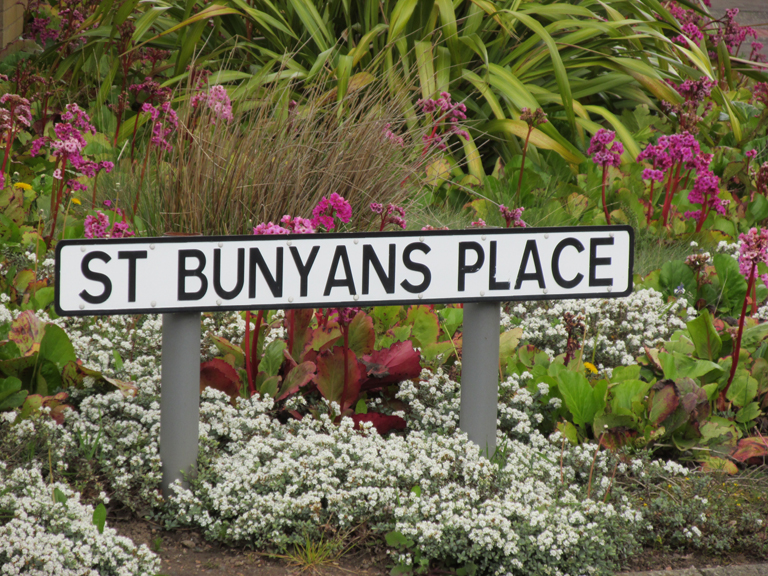
An elderly couple whom I met remembered a small well-house, but I didn’t ask them when it was demolished. The Saint is remembered in Leuchars by the road name of a modern development in St Bunyan’s Place. St Bunyan’s Well probably dried up as a result of the increased water demand following the establishment of RAF Leuchars in 1920. The Saint now has his waters extracted by Scottish Water’s Meadow Road Pumping Station.
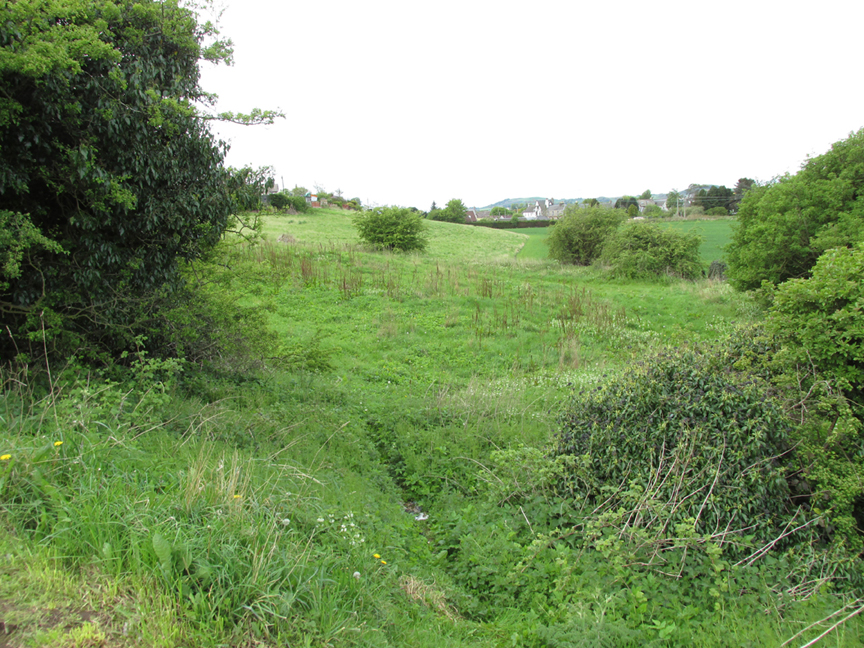
Entering Leuchars from Dundee or Newport go straight ahead through the roundabout; entering from Cupar or St.Andrews turn right at the roundabout, then up School Hill and bear left up the Pitlethie Road, then immediately past a long terrace of bungalows, turn left up an unmade road opposite the school, where you can park up. Walk down the track, noting the Castle Knowe Motte across the fields ahead and follow the track to the right, and there at the bottom of the slope, below modern housing, is the site of the Lady’s Well.
Archaeology & History
There seems to be only minimal information about Lady’s Well. To the south lies the ancient church of St Athernase, described architecturally as the second finest Romanesque church in Britain (after Durham Cathedral) and apparently built by some of the same masons who built Durham. Prior to the building of St Athernase, a ninth century Culdee church, dedicated to St Bonoc (also known as St. Bennet or St. Bonach or St.Bernard) stood on the School Hill which rises over Leuchars. School Hill was anciently known as Temple Hill, perhaps indicating a connection with the Knights Templar.
Writing in the Old Statistical Account for Leuchars in the 1790s, the Reverend Kettle wrote:
“A little north of the east end of the village, to the convenience and comfort of the inhabitants, there is another well of equal excellence, called the Lady well, no doubt consecrated to the Blessed Virgin”
The mid nineteenth century Ordnance Survey name book has the following entry referring to the Lady’s Well, contributed by a Messrs Pillans and David Keddie:
“The site of a Spring Well in a small piece of open ground adjoining the Village of Leuchars. It ran dry before the year 1843 from some unaccountable reason. and in that year A New well was sunk and opened a short distance from it. which since supplys its place. This last was done by subscription by the inhabitants of the village the original well was sunk and opened for use by a Lady of the name of “Carnegie” who formerly Lived at “Leuchars Castle” hence the name “Lady’s Well” it was never resorted to as a holy Well.”
Despite this, we must bear in mind the Kirk’s powerful post Reformation antipathy to holy wells, which may be reflected in the story given by the above two correspondents.
While your writer was bimbling around Leuchars, a chance (?) meeting led to him being introduced to probably the oldest residents in the town (mid- to high-90s). They only remember the Lady’s Well site being known as ‘The Well Green’ where the old Fife County Council waterworks were once situated, and there we may have the reason for the Well’s physical demise: modern water extraction to serve Leuchars RAF Station and its ancillary barracks and housing has lowered the water table, leading to the spring drying up as it passes from living memory
ON the A59 Harrogate to Skipton road, right on top where it crosses the barren moors, get to the parking spot right near where the road levels out at the highest point. Walk up the footpath from here onto the moors (south) for about 200 yards till you notice a small black pool ahead of you. From here, walk left (east) offpath and into the heather, roughly along the ridge for about another 150-200 yards. Zigzag about and keep looking. You’re damn close!
Archaeology & History
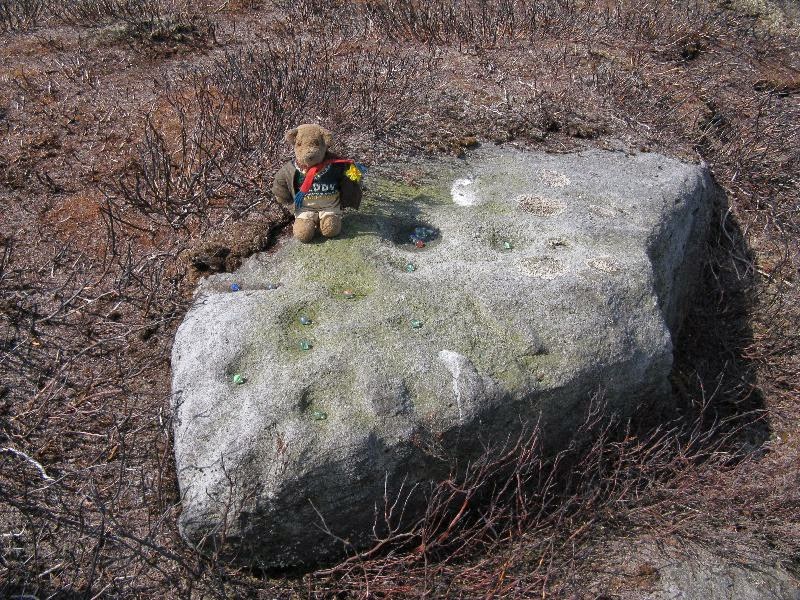
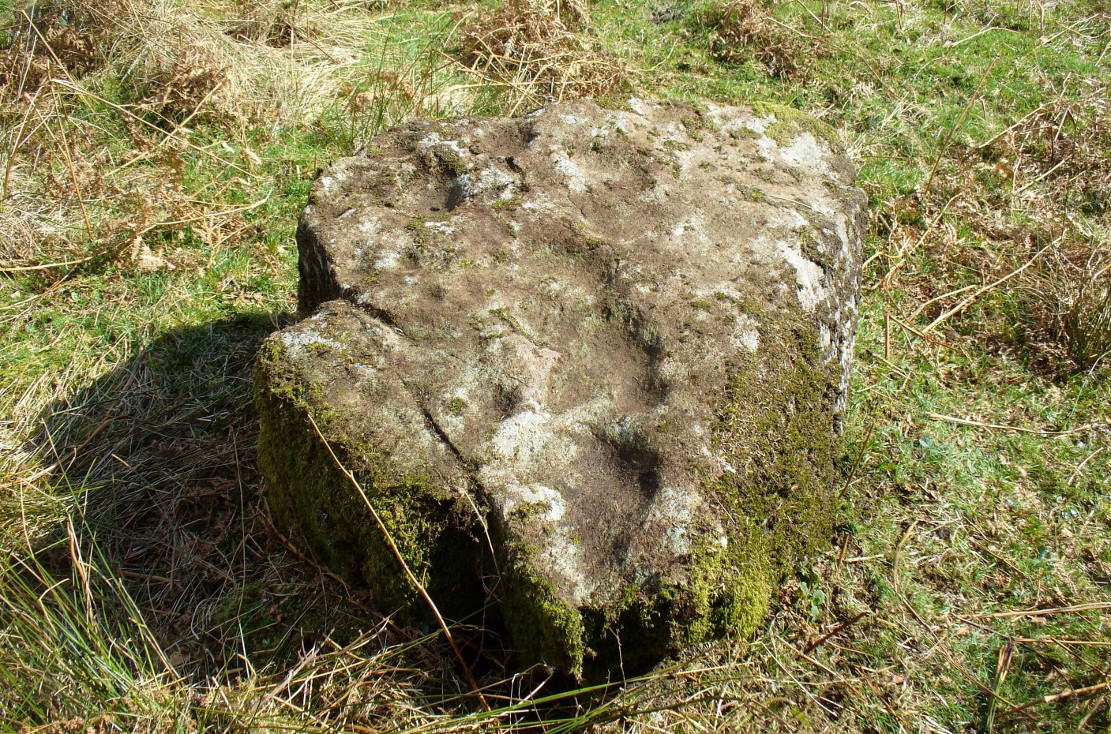
Close-up of some of the cups
Not far from the Gill Head stone and walling, another previously unrecorded cup-marked rock was discovered on the afternoon of Saturday, May 3, 2014, by Danny Tiernan and his famous teddy bear! The stone seems to have been previously well-covered, but was made visible thanks to the annual heather-burning on this part of the moor. He came across it during an exploratory Northern Antiquarian wander to examine a cluster of other neolithic remains hidden on this moor. The carving consists of a series of plain cup-markings, between eight and twelve in number, running along the middle of the rock and outwards nearer to the edges. The cups are between 1-2 inches across and a half-inch deep at the most. The design was first highlighted on Danny’s walking blog, Teddy Tour Teas — and is gonna be difficult to find once the heather’s grown back.
Follow the same directions described to reach the Druidsfield 1 and 2 carvings. This one is the larger upright block right next to them!
Archaeology & History
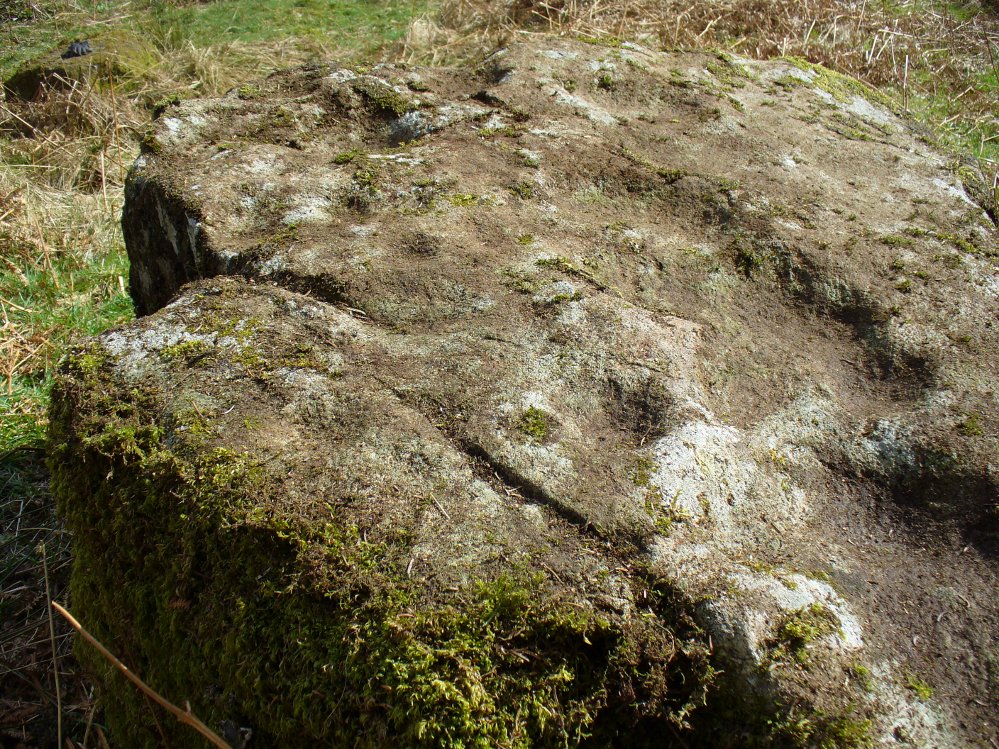
Several of the faint cups visible
Contextually relevant to the two adjacent carvings, this is the largest of the three stones and comprises of a number of natural deep marks associated with between eight or ten man-made cup-markings. They’re not all immediately apparent, but stand out more as and when natural lighting conditions change. All of them are on the north and northwestern section of the stone, and measure between 1-3 inches across. This is the least visually impressive of the stones in this petroglyph cluster.
Folklore
The carvings here were said by one of the locals to have been part of a “druid’s circle, which we played in as children, and were always told had been a special place of the druids in ancient times.”
Haggart, D., “Notice of the discovery of a stone cup and cup-marked stones at Lochearnhead,” in Proceedings of the Society of Antiquaries, Scotland, volume 22, 1888.
Acknowledgements – Huge thanks to Paul Hornby for help and use of his photos.
The best way here is to walk a mile to find it. All the way up the road from Gleneagles Standing Stones to Glendevon, right at the very top where the two glens meet, there’s a small road heading to the Fishery. 100 yards along, park up. Then take the old green road back down the Glen, north towards Gleneagles, parallel with the new road. A mile or so down you’ll reach the farmhouse, but a coupla hundred yards before this, in a wooden gap in the electric fence, you can walk straight downhill to the large pool below you. Y’ can’t really miss it!
Archaeology & History
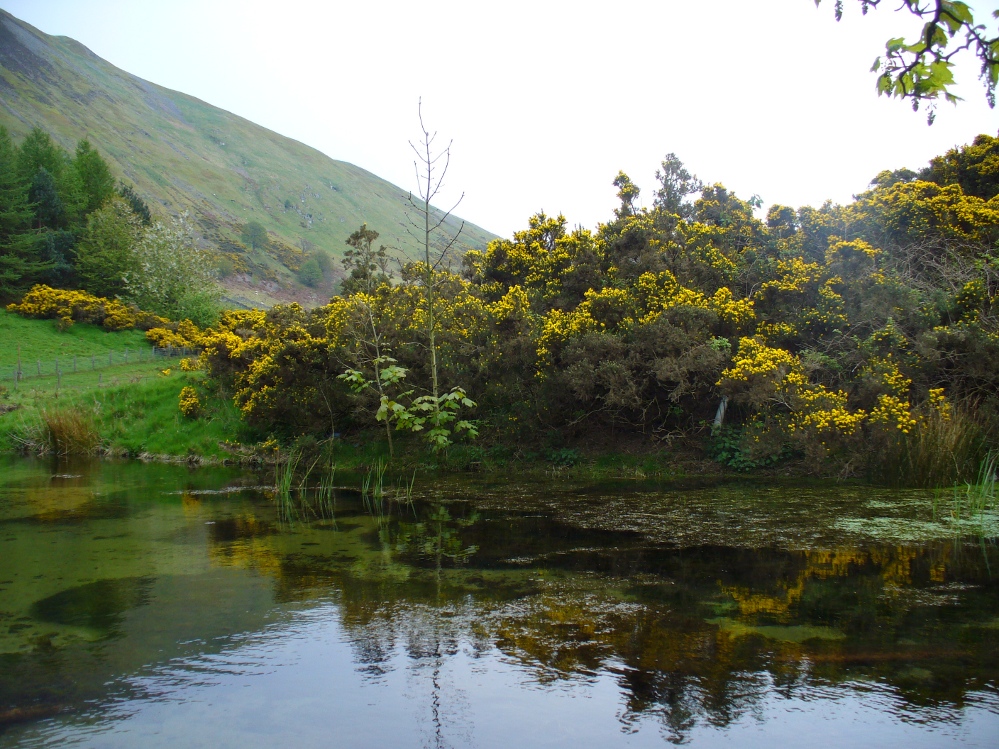
The strong cold spring of water known as St Mungo’s Well, now gathers into a large crystal clear pool and is gorgeous to drink and very refreshing! All around the edges are the brilliant yellow masses of gorse, held amidst widespread vivid hues of green in this most rocky of landscapes. Tis a gorgeous setting here….
St Mungo’s Well, 1860 map
Unfortunately there is no literary information that tells us why this spring of water, amongst the many others all around these hills, gained the ‘blessing’ of one of those roaming christians and was deemed to be ‘holy’. The greatest likelihood, as usual, is that the waters had some important heathen association which our peasant ancestors would have been able to tell us about if their animistic tales hadn’t been outlawed and demonized by the incoming cult — but we’ll probably never know for sure. As a result, we know nothing now of its medicinal qualities or old stories.
The transference of its old name (whatever it may have been) to their ‘St. Mungo’ may date from when the character was wandering with his christians in the 7th century, but we have no literary account proving as such. The name ‘St Mungo’ was an alternative name (a nickname if y’ like) of St. Kentigern — or at least that’s what the church historians tell us. There is no history of Kentigern or St Mungo up the glen, but we do have a more prosaic account that tells of a Mr Mungo Haldane of Gleneagles, a member of the Scottish parliament in 1673 onwards; he was succeeded by another Mungo Haldane MP in 1755. However, it’s highly unlikely that these political characters gave their name to the well.
The clear waters, looking southCrystal clear perfect drinking water
Even the Scottish holy wells surveys are pretty silent on this beautiful site. It was mentioned in Morris’ (1981) survey, but with no real information. The earliest account seems to come from an article written in the Perthshire Advertiser in 1856, and thankfully reproduced in the otherwise tedious genealogical history of the Haldane (1880) family; but even here, the narrative simply mentions the presence of the well and no more. Described in a walk up Gleneagles, it told:
“Journeying westward along the desolate moor…we soon came in front of Gleneagles, a narrow picturesque glen in the Ochils, through which the old road from Crieff leads into Kinross-shire. The hills here, as throughout the whole range, are strictly pastoral, but in no place more so than Gleneagles. Crowning the heights on both sides of the glen, we have craigs ragged and bare enough; but their show of beetling hard sterility is as nothing to the winding receding mass of grassy heights that bound the view. In looking on that quiet, sunny, Sabbath-like retreat, one would be apt to deem the name a misnomer, and yet it is not much above a hundred years since the monarch of birds had a home among its cliffs. There, too, the Ruthven Water that dashes past Auchterarder has its rise — not in a scarcely seen bubbling spring almost covered with moss, but issuing at once into daylight at the bottom of yonder steep in volume sufficient to drive a mill. In ancient times, as now, it must have been an object of mark, as it is called St. Mungo’s Well; but who this St. Mungo or St. Magnus was — whether the ghostly patron of Glasgow, Auchterarder old chapel, or the guardian saint of this particular spot, we cannot tell. But he seems to have relished cold water; and it is satisfactory to know that he must have got his fill of it there, if his cell happened to be in the vicinity.”
The well was mentioned in passing in the Object Name Book in 1860 and shown on the earliest Ordnance Survey maps.
Folklore
Apart from the fact that the waters here never run dry, we have no other folklore. However it should be noted that St. Mungo’s Day was January 14th — which may have been when the qualities of the spring were deemed most efficacious, or when olde rites were enacted here. However, a hundred yards down we pass the stream known as Bride’s Burn, probably in honour of the heathen Queen St. Brigit, whose name and myths are integral to our great Earth goddess, the Cailleach and whose celebration date is only two weeks later than that of Mungo. Hmmmmmmm…..
References:
Attwater, Donald, Penguin Dictionary of Saints, Penguin: Harmondsworth 1965.
Haldane, Alexander, Memoranda Relating to the Family of Haldane of Gleneagles, C.A. MacKintosh: London 1880.
MacKinlay, James M., Folklore of Scottish Lochs and Springs, William Hodge: Glasgow 1893.
A variety of ways to get here, all depending on which directions you’re coming from, obviously! Simply get to the sleepy old hamlet of Brunton, SW of Creich Castle ruins, and at the north end of the village where the road hits a T-junction, turn left and stop at the next house (hidden amongst trees) a coupla hundred yards along on the right-hand side. Knock on the door of The Manse (marked as such on the OS-maps) and ask. The fella who we met here, Liam, was very helpful and guided us to the site up the far end of his garden.
Archaeology & History
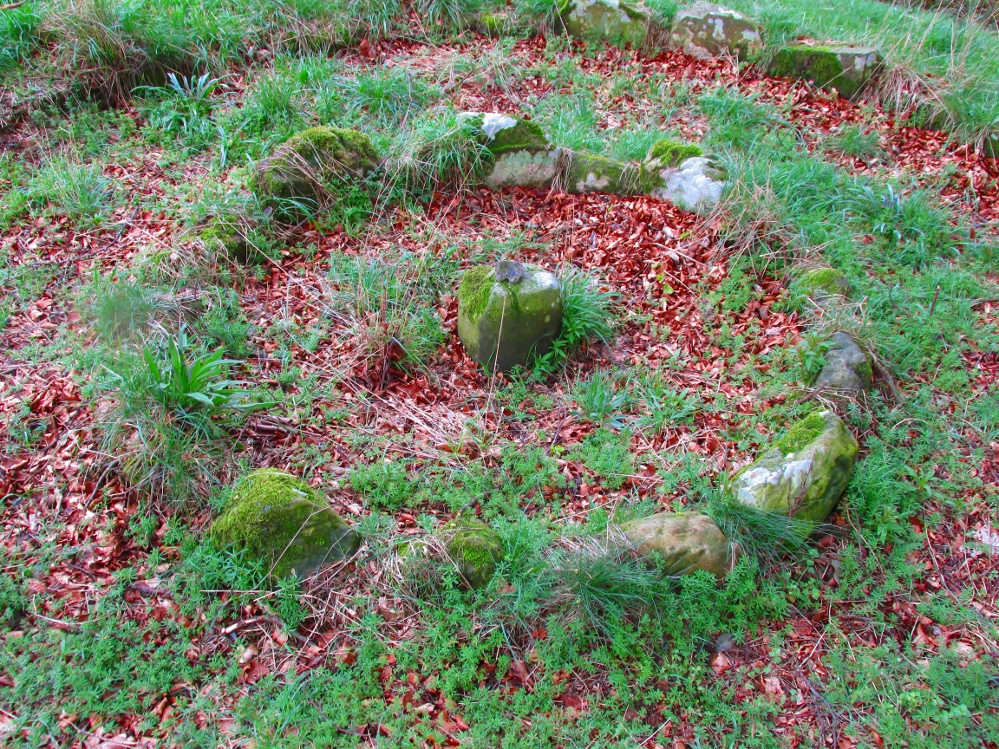
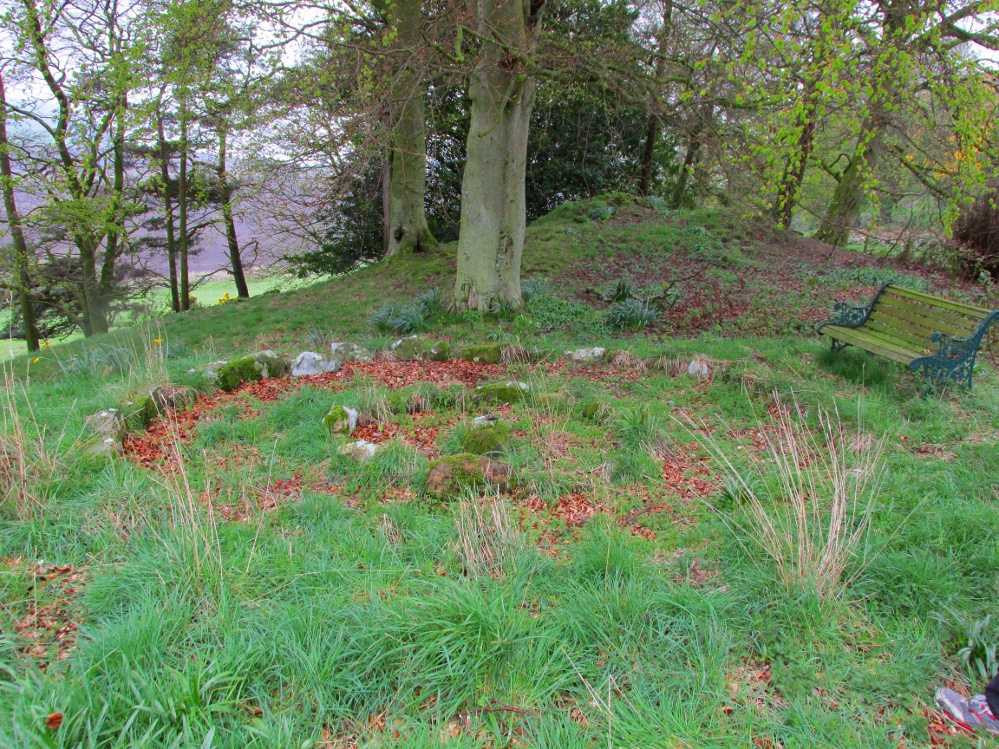
The small central ring
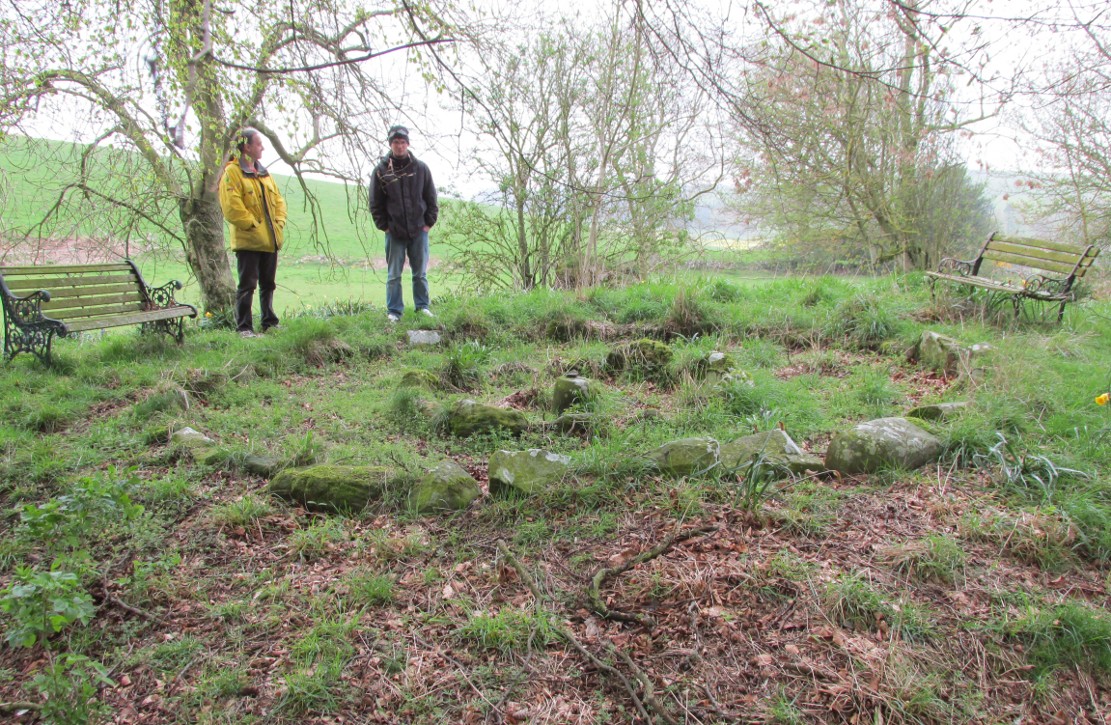
A truly fascinating and enigmatic arena for a host of reasons. The small and well-preserved ring of stones up the slope behind Creich Manse — looked after and recently cleared of covering vegetation by the present tenant — wasn’t born here, but originally lived more than a mile to the southwest, on the grounds of Luthrie House near the OS grid-reference NO 313 195. They were apparently under threat of being damaged and so, as James Taylor (1875) told, a “Mr Lawson got them removed, and placed them in a wood behind his manse in the very form in which they were found.”
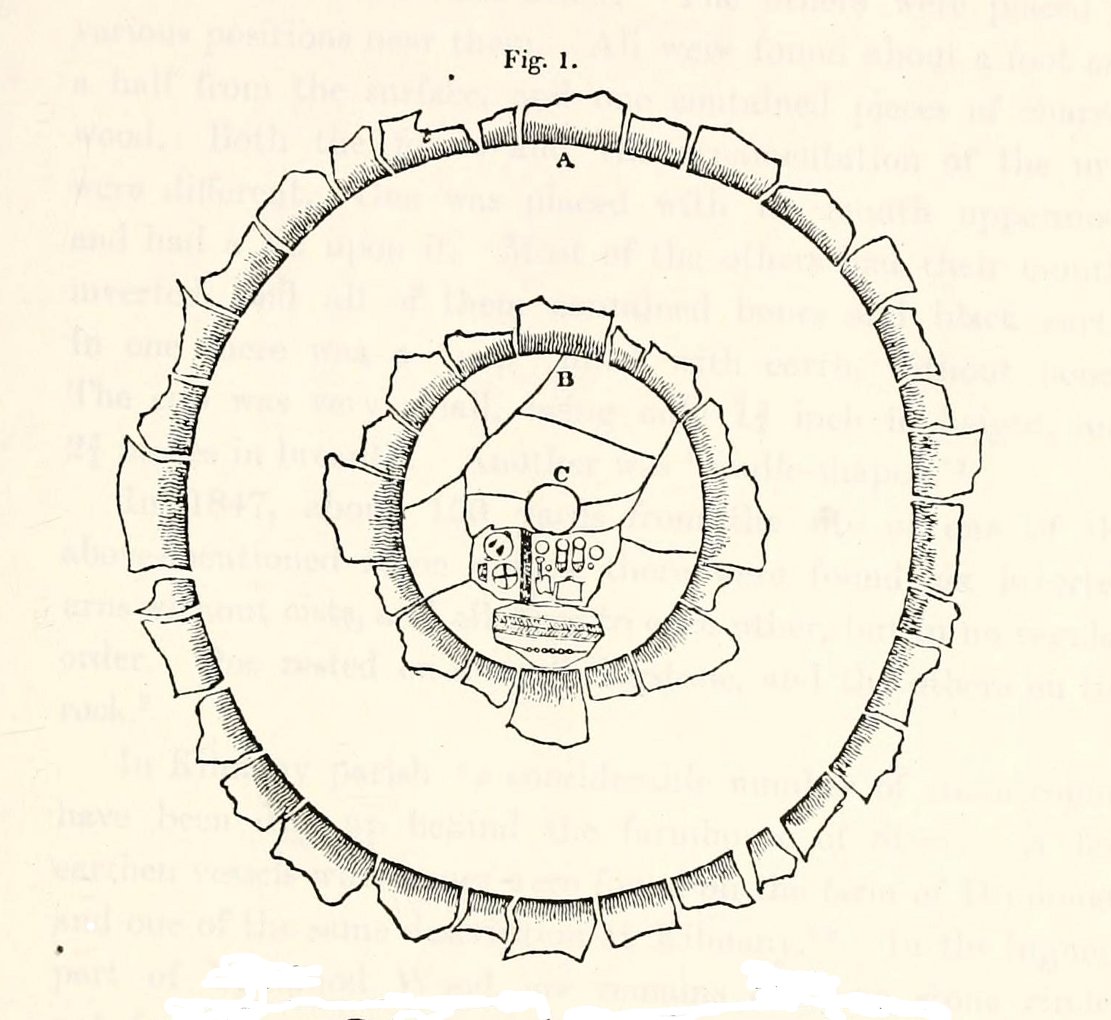
Curiously omitted from the giant surveys of Aubrey Burl (2000) and other modern academics, the place was first mentioned in the New Statistical Account of the parish by Alexander Lawson. It told that in 1816 “trenching operations” were being undertaken in Luthrie village when, at some point, the men came across a curious group of stones that seemed to have faint carvings upon them — in the centre of a ring of stones! The land-owner and parish minister were called to the site and they found that a double stone circle had been unearthed. The account told:
“In the centre was placed, in an upright position, a cylindrical sandstone, one foot two inches high, and having the diameter of its base one foot. Around this stone, as a centre, at the distance of three feet, were sixteen other stones, placed also in an upright position, and in the form of a circle. The stones of which it was composed were of various sizes, from fifteen to twenty inches in height; from eight to eighteen in breadth, and from four to nine in thickness. Due south of the centre, and between it and the inner circle, there were placed in a horizontal position, two stones containing hieroglyphics in alto relievo, very entire. The remaining space between the centre and the circle was laid with pavement. At the distance of seven feet and a half from the same central pillar, there was another circle of stones, thirty-two in number, placed in an upright position, and very much resembling those of the inner circle. The stones in both circles were placed close together. Between the circles there was neither pavement nor stone of any description. Neither were perfect circles, the diameter of one from north to south, being fifteen feet one inch, while its diameter from east to west was only fourteen feet nine inches; in the same manner, the diameter of the other, from east to west, was five feet ten inches, while from north to south it was it was six feet one inch.”
Ground-plan of the circleCreich ring, looking west
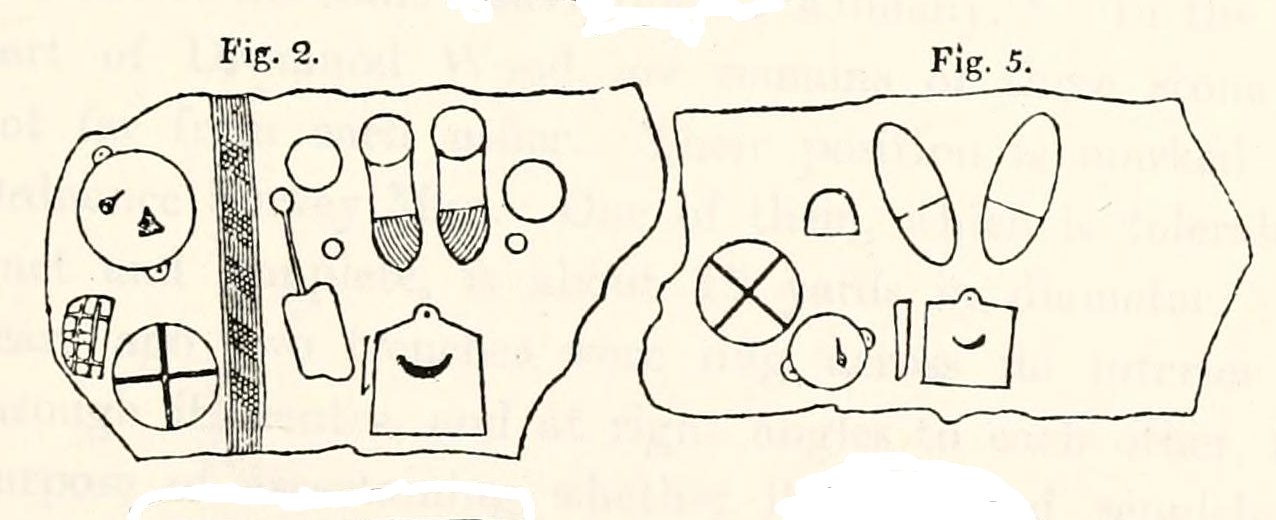
The account went on to describe there being a deposit of “burned human bones and charcoal” at the centre, below the larger of the two petroglyphs. Additionally, in one of those peculiarly common traits found at a number of megalithic remains, the Royal Commission (1933) lads pointed out that “it is remarkable that all the stones of the inner circle were of sandstone, which is not found nearer than Cupar, seven miles away, while those of the outer circle were of the local whinstone.”
Another description of the site was given in James Campbell’s (1899) updated and revised magnum opus on the parish of Balmerino, where some additional remarks were made about the petroglyphs. He told:
“Under one of the sculptured stones were found small burnt human bones and ashes. They were not enclosed in a cist, nor was there any building under the surface. Certain of the figures cut on one of the slabs of this monument are very similar to the figures on the sculptured slab of the one already mentioned. There are what appear to be representations of the soles of a pair of shoes, a circle with a cross within it — the limbs of the cross being: at right angles to each other — which may be intended to represent a wheel. On one of the stones is the figure of a spade. What the other figures represent is more uncertain. The sculptures raise difficult questions in regard to the time of the erection of these monuments. It is evident that cremation had been then practised at Creich, though the degree of culture and art indicated by the sculptures seems to point to a time subsequent to the abolition of this pagan custom elsewhere.”
Creich Circle petroglyphsCreich Ring, looking east
The carvings illustrated here are pretty unique in terms of them being standard prehistoric petroglyphs, as they seem to comprise more of a mix of Iron Age and Romano-British designs – though potentially we must take into account that they could be a form of Pictish. This region is littered with the remains of Picts, in place-names, folklore and archaeology. As such, it would be very helpful if someone qualified in Pictish studies could examine these designs. We do find petroglyphs of similar forms to this in Bronze Age Scandinavia and Iberia − but not Fife!
Folklore
In the only account of any folklore relating to this site, James Campbell (1867) told that local people said the place was “supposed to have marked the tombs of distinguished chiefs.”
References:
Burl, Aubrey, The Stone Circles of Britain, Ireland and Brittany, Yale University Press 2000.
Campbell, James, Balmerino and its Abbey – Volume 1, William Blackwood: Edinburgh 1899.
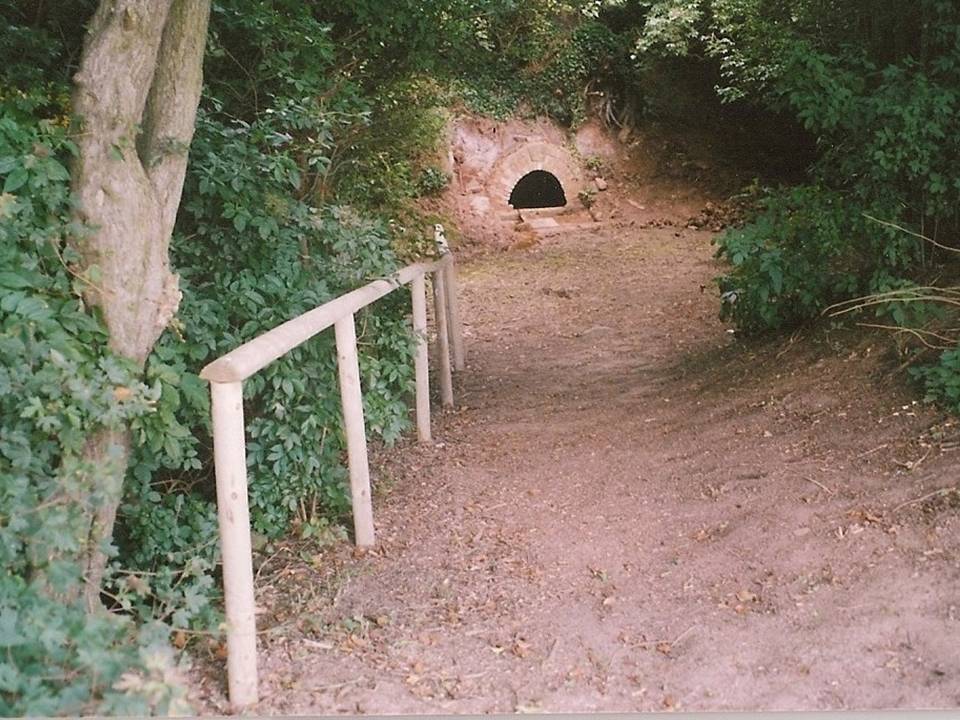
Follow the road around from Headon village to the Ladywell estate and on the left hand side is a small copse and footpath. It is near the junction of Greenspotts Lane and Lady Well Lane. Park carefully near here and walk down the small ravine to the well.
History & Archaeology
Close-up of the well
Only two dates can be confirmed of this site. One a reference in County records of mending a bridge to a ‘Ladyewell‘ in the nearby Markham parish, but this could easily be another site. A better date is that 1718 which is carved on its arch. It was used as a source of water until the 1930s. One of the most atmospheric and pleasantly situated sites, the spring is located in a small wooded dell and arises from the rock in a small alcove or cave. This is fronted by a red brick arch, and the water fills a trough set partly into the ground with a small overflow lip and a channel to fill it, presumably this was for animals. On the key stone of the arch are the initials ‘HW’ and a date which possibly reads 1718.
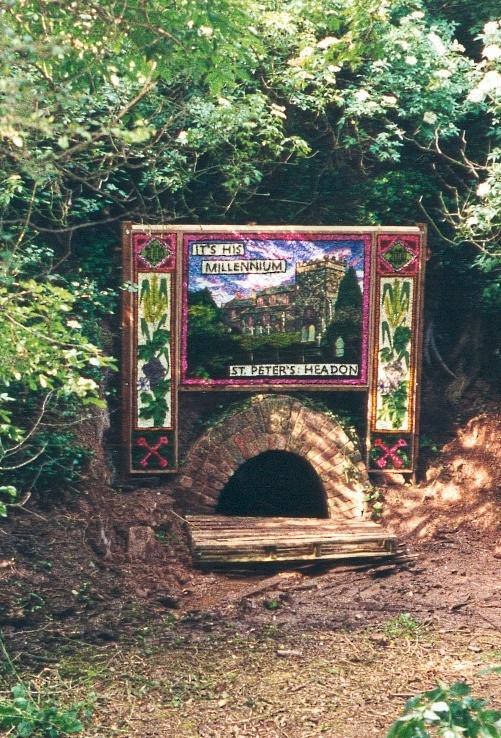
Dressed for 2000AD
Folklore
I have found no traditions of healing or other folk belief. However, the site was one of the few Nottinghamshire well dressing sites. This began in 1981 and continued until 1991, and there was a one-off occurred in 2000 AD. It was done on the weekend of the churches Patronal festival—St. Peter’s—and was used to use to pay for the church repairs. The well dressing boards were of a Derbyshire tradition, as can be seen here to the right.