Balnadrum, Moulin, Pitlochry, Perthshire

Souterrain (lost):  OS Grid Reference – NN 9447 5890

Archaeology & History

In Hugh Mitchell’s (1923) survey of prehistoric sites in the Pitlochry district, this long lost souterrain was thankfully captured by his pen.  Two years later John Dixon (1925) also mentioned the site, but he was ostensibly copying what Mitchell had written.  We were told:

“About 50 yards west of Balnadrum Farmhouse there is a weem or underground Pict’s house, which was revealed a good many years ago by the plough lifting one of the stone covers.  The exact position of this weem has been lost site of, but could be found without much trouble.  It was about 50 feet long, slightly curved, having an inside width of about 3½ feet and a height of about 5½ feet.  Nothing was found in it and the cover was carefully replaced.”

The site was included in Wainwright’s (1963) standard survey, where he opted for some slight scepticism regarding its nature as a souterrain due to it being about 30 miles away, or, as he said, “far withdrawn from the main concentration (of souterrains) in Angus.”  A minor point to be honest…  Nevertheless, he gave attention to the words of a Mr William McLaughlan who was the farmer at Balnadrum until the end of World War 2:

“He was born in 1873 and he estimates that the discovery was made about 1885.  He also confirms the site—it is about 150 feet west of Balnadrum, or directly across the road from the gate which leads to the farmhouse.  This spot is now covered by modern houses and/or their gardens.  To this point there is no conflict in the evidence.  Mr McLaughlan however, does not remember a 50-foot passage, and he thinks that the structure was removed.”

Nonetheless, all are agreed that an underground structure of some sort existed at this spot.  Whether or not it still hides deep beneath the soils, filled in, or whether it was destroyed when the houses were built, we know not…

References:

  1. Dixon, John H., Pitlochry Past and Present, L. Mackay: Pitlochry 1925.
  2. Mitchell, H., Pitlochry and District: Its Topography, Archaeology and History, L. Mackay: Pitlochry 1923.
  3. Wainwright, F.T., The Souterrains of Southern Pictland, RKP: London 1963.

© Paul BennettThe Northern Antiquarian

Warsett Hill, Brotton, North Yorkshire

Round Barrows (destroyed):  OS Grid Reference – NZ 692 214

Archaeology & History

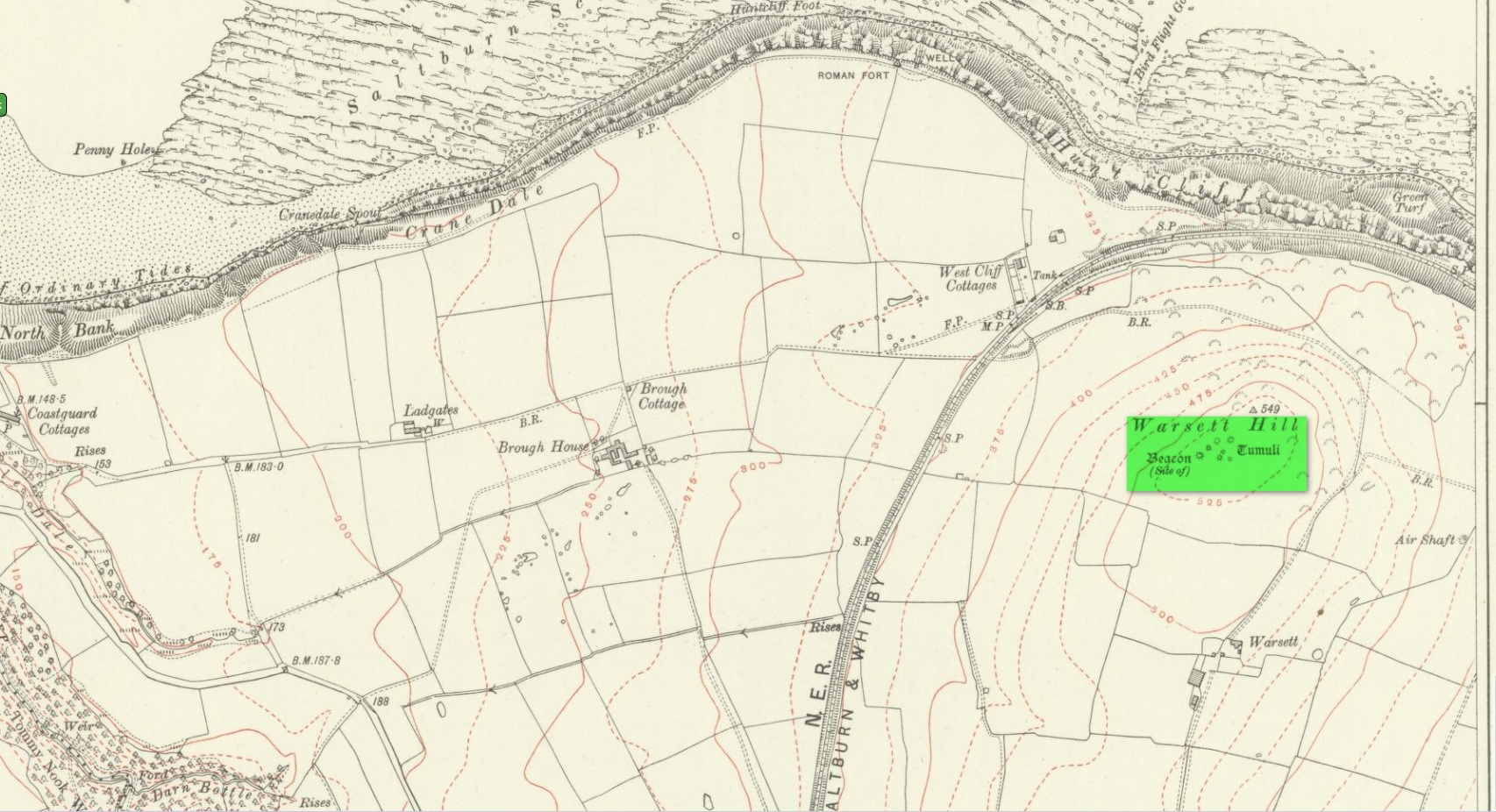
Tumuli shown on 1920 map

On top of the large plateau that is Warsett Hill, on the southwest side of the old trig-point, could once be seen a cluster of at least seven burial mounds or tumuli.  The mounds are shown on the first OS-map of the area, but merely as mounds.  It wasn’t until there’d been a subsequent investigation here by local historian J.C. Atkinson in the 19th century that they were highlighted on the 1920 map as “Tumuli.”  Sadly, since then, they’ve all been destroyed.

Very brief notes were written on six out of the seven tombs here by William Hornsby (1917), with only one of them receiving any real attention.  “Of the other six,” Crawford (1980) wrote,

“there is very little information; all were excavated by Atkinson prior to 1893, but his excavations revealed no finds and he stated that all of the mounds had been previously disturbed.  They were later dug by Hornsby, who stated that although he found no sepulchral deposits, all the mounds contained flints.”

In medieval times this became a beacon site, where bonfires were lit.  I can find no further information about this. (NB: This site should not to be confused with another Warsett Hill that exists two miles southeast of here above Skinningrove.)

References:

  1. Crawford, G.M., Bronze Age Burial Mounds in Cleveland, Cleveland County Council 1980.
  2. Hornsby, William & Stanton, R., “British Barrows near Brotton,” in Yorkshire Archaeological Journal, volume 24, 1917.

Acknowledgements:  Huge thanks for use of the Ordnance Survey map in this site profile, reproduced with the kind permission of the National Library of Scotland

© Paul BennettThe Northern Antiquarian

Cnoc Dubh, Moulin, Pitlochry, Perthshire

Stone Circle (destroyed):  OS Grid Reference – NN 9424 5871

Archaeology & History

Missing from the primary surveys of Burl (2000) and Barnatt (1989), a mention of this long lost site was made by local historian Hugh Mitchell (1923) in his survey of the area.  He told that,

“On the east side of the Moulin road beyond the Hydro Hotel a knoll and a clump of trees will be noticed on the right, inside the Hydropathic grounds; this knoll is known as the Cnoc Dubh, or “Black Knoll” and still bears an uncanny reputation as being an old site of Pagan worship.  There was at one time a stone circle on it, but the stones are said to have been broken up, fully 100 years ago, to build the old farmhouse of Balnadrum.”

Something ancient was there, obviously, as it was mentioned in another earlier account—albeit just a tourist guide of Atholl—which said that, on

“the knoll known as Knock-Dhu, within the (Pitlochry Hydro) grounds, are the remains of a pre-historic fort, now overgrown with pine trees.”

References:

  1. Anon., Atholl Illustrated, L. Mackay: Pitlochry c.1910.
  2. Dixon, John H., Pitlochry Past and Present, L. Mackay: Pitlochry 1925.
  3. Mitchell, H., Pitlochry and District: Its Topography, Archaeology and History, L. Mackay: Pitlochry 1923.

Links:

  1. Canmore

© Paul BennettThe Northern Antiquarian

Cairney Mount, Carluke, Lanarkshire

Standing Stone (destroyed):  OS Grid Reference – NS 855 507

Archaeology & History

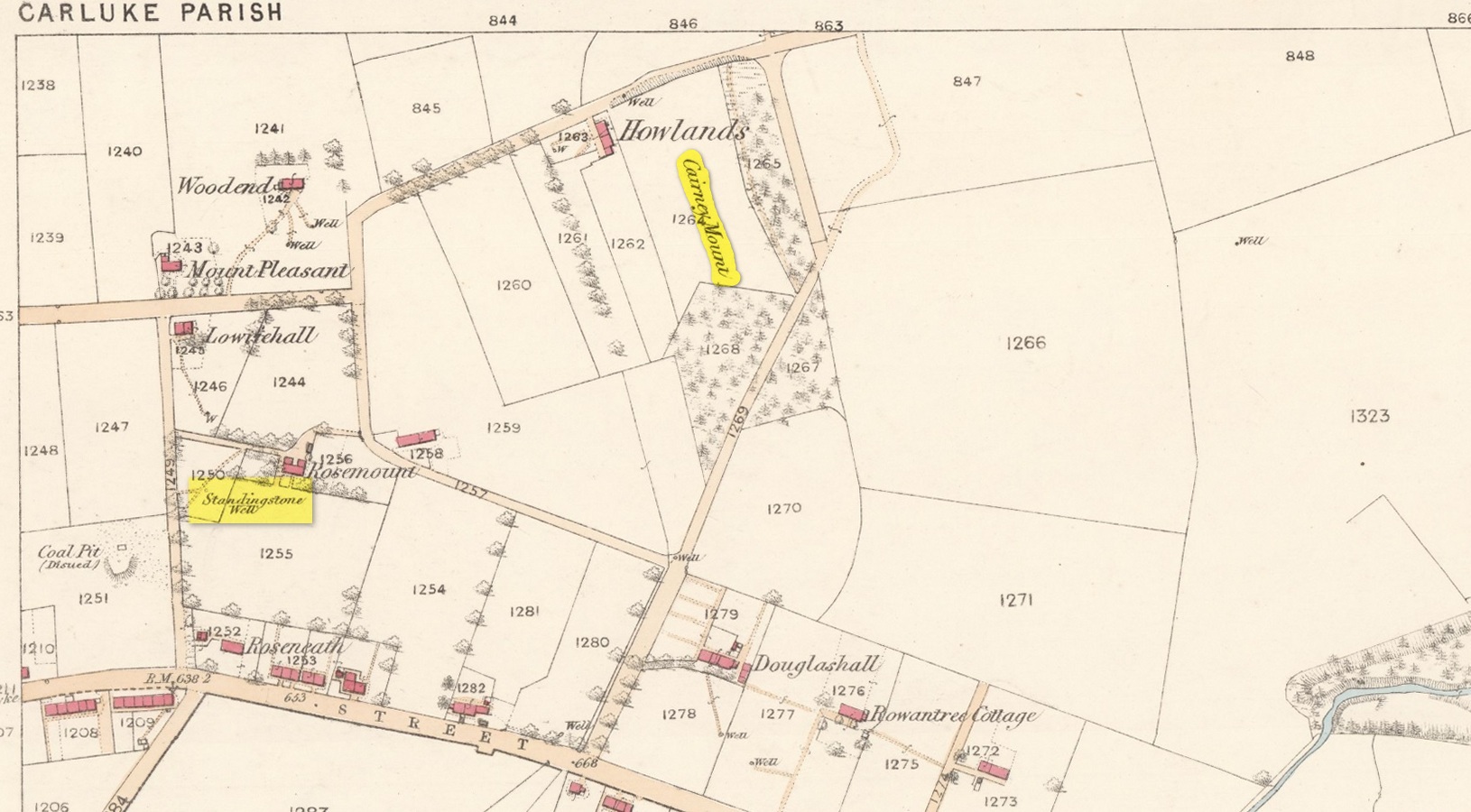
The Well & the field-name on the 1860 OS-map

An ancient standing stone on the eastern side of Carluke isn’t something that most local people are aware of.  Sadly it’s long gone, but we find what seems to be a reference to it, both in the place-name Stanistone Road and the adjacent Standing Stone Well.  The monolith would seem to have stood immediately east of the well, as a description of it by Rev John Wylie (1845) in the New Statistical Account (1845) indicates.  Wylie told us that:

“Till lately, one of those remarkable monuments of antiquity, called standing stones, stood at Cairney Mount; but the hope of finding a hidden treasure induced some rude hand to destroy it.”

Cairney Mount is a field-name 300 metres east of the well, so it would seem highly likely there was an association between them, and the stone obviously stood somewhere between these two points.

References:

  1. Royal Commission on the Ancient & Historical Monuments of Scotland, Lanarkshire: An Inventory of the Prehistoric and Roman Monuments, HMSO: Edinburgh 1978.
  2. Wylie, John, “Parish of Carluke,” in New Statistical Account of Scotland – volume 6: Lanarkshire, William Blackwood: Edinburgh 1845.

© Paul BennettThe Northern Antiquarian

Livister, Whalsay, Shetland Isles

Standing Stone (destroyed):  OS Grid Reference – HU 5577 6237

Archaeology & History

Site shown on 1882 map

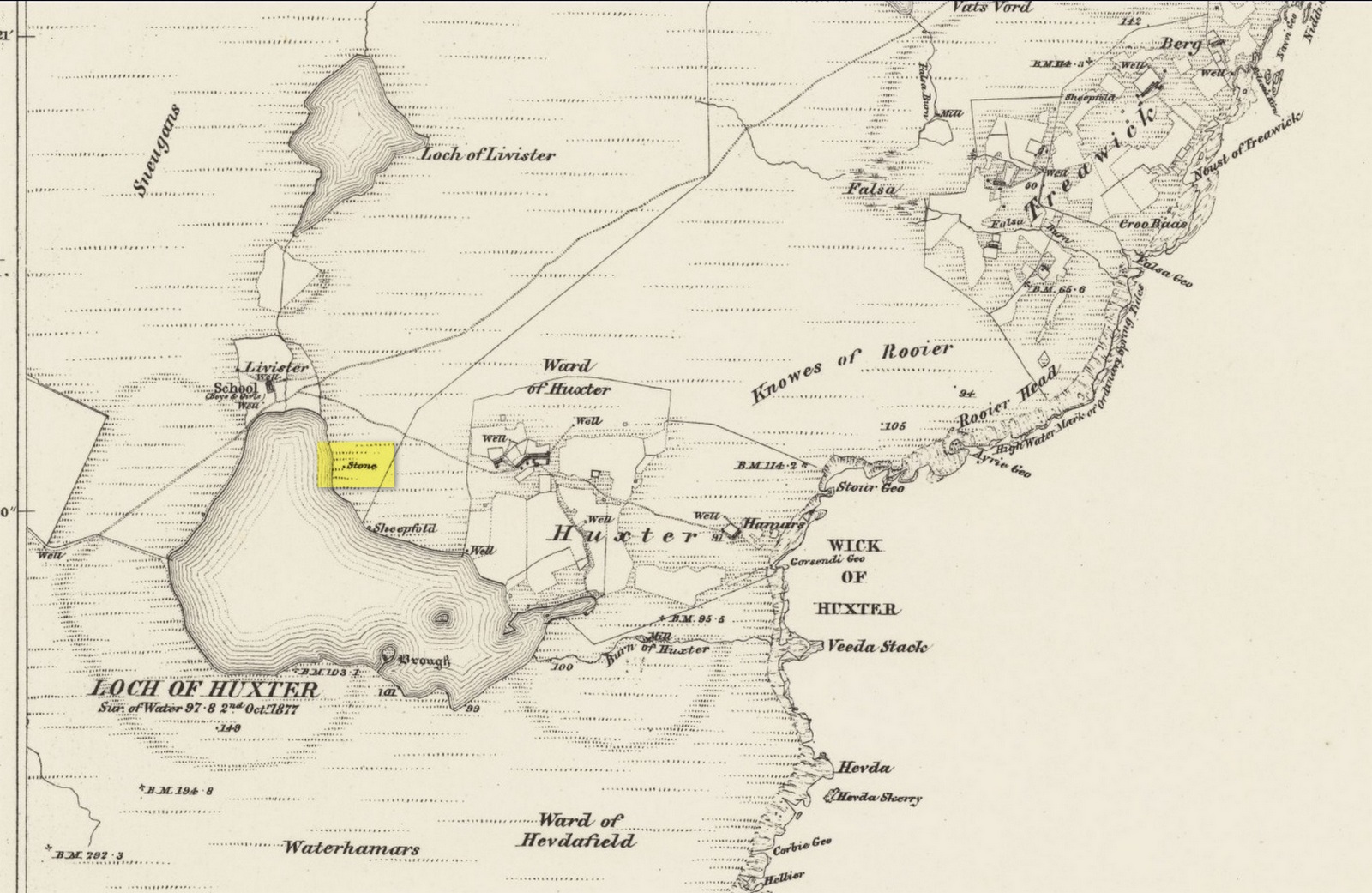
Highlighted on both the 1880 (25-inch) and 1882 (6-inch) Ordnance Survey maps, this is another one of our ancient stones that has bitten the dust, so to speak.  Local folk said that it stood about five feet tall, but when the Royal Commission doods visited the place in 1935, it had gone.  They were told that it had been “broken up for building purposes in about 1912.”  No traditions were known of it.

References:

  1. Royal Commission Ancient & Historical Monuments, Scotland, Inventory of the Ancient Monuments of Orkney and Shetland – volume 3, HMSO: Edinburgh 1946.

© Paul BennettThe Northern Antiquarian

Whiteglen, Hoy, Orkney Isles

Standing Stone (destroyed):  OS Grid Reference – HY 2435 0221

Archaeology & History

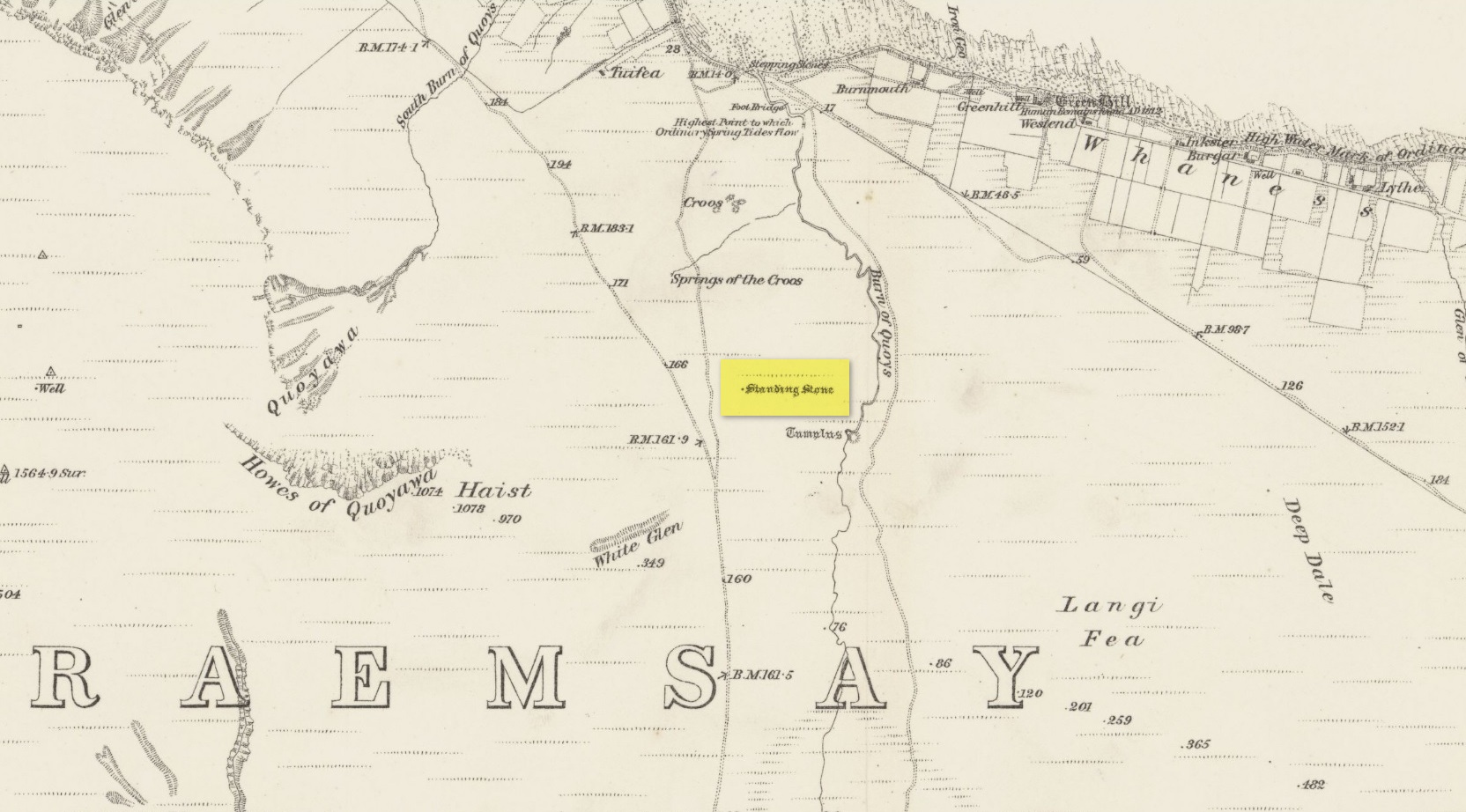
Highlighted on the 1882 Ordnance Survey map of the region (right), it was recorded in the Name Book a couple of years earlier as simply “a small unrecorded standing stone.”  When the Royal Commission (1946) lads visited the site in 1929 they found that “this stone has been removed.” It had stood close to a prehistoric burial mound.  Enquiries with local people about the stone proved unsuccessful.  Does anyone know more about this?

References:

  1. Royal Commission Ancient & Historical Monuments, Scotland, Inventory of the Ancient Monuments of Orkney and Shetland – volume 2, HMSO: Edinburgh 1946.
  2. Royal Commission Ancient & Historical Monuments, Scotland, The Archaeological Sites and Monuments of Hoy and Waas, Edinburgh 1989.

© Paul BennettThe Northern Antiquarian

St. Tredwell’s Chapel, Papa Westray, Orkney Isles

Standing Stones (destroyed):  OS Grid Reference – HY 497 509

Archaeology & History

These long lost standing stones most probably played a part in some ritual acts performed by the Orkney people until relatively recent times.  Whilst their simple description doesn’t tell us this, the folklore of the adjacent body of water strongly suggests it.  The stones were visited at the end of the 17th century by the antiquarian John Brand (1701) from whom we gain the only known account.  He told that,

“At the north-east side of (St Tredwell’s) loch, nigh to the chapel, there is a high stone standing, behind which there is another stone lying hollowed in the form of a manger, and nigh to this there is another high stone standing with a round hole through it, for what use these stones served, we could not learn; whether for binding the horses of such to them as came to the chapel, and giving them meat in the hollow stone, or for tying the sacrifices to, as some say, in the times of Pagan idolatry, is uncertain.”

Several other hold stones are found in Orkney, some of which had lore that was thankfully recorded.  We don’t know when these stones were torn down, but there is the possibility that they may have been cast into the loch alongside which they stood.

Folklore

An intriguing piece of folklore relates to the adjacent St Tredwell’s Loch, right next to the stones.  The loch was known of far and wide as possessing great healing properties which Mr Brand told to be distinctly pagan in nature.  St Tredwell’s church had a cairn of stones by its side and those who visited here would pick one up and cast it into the loch as an offering (some folk would cast money), so that its waters would heal that person’s ailment.  According to Brand and the local minister, such cures were numerous.  The narrative is truly fascinating.  Brand told us that,

“nigh to the east end of which this chapel is, is held by the people as medicinal, whereupon many diseased and infirm persons resort to it, some saying that thereby they have got good; as a certain gentleman’s sister upon the isle, who was not able to go to this loch without help, yet returned without it; as likewise a gentleman in the country who was much distressed wifh sore eyes, went to this loch, and washing there became sound and whole, though he had been at much pains and expense to cure them formerly.  With both which persons he who was minister of the place for many years was well acquainted, and told us that he saw them both before and after the cure.  The present minister of Westra told me that such as are able to walk, use to go so many times about the loch as they think will perfect the cure, before they make any use of the water, and that without speaking to any, for they believe that if they speak this will marr the cure: also he told that on a certain morning not long since he went to this loch and found six so making their circuit, whom with some difficulty he obliging to speak, said to him they came there for their cure.”

The reason that I’ve included this folklore to the site profile of the monoliths is that, at some time in the early past the stones would most almost certainly have played some part in the ritual enacted at the loch by which they stood.  The building of Tredwell’s chapel was, quite obviously, an attempt to mark the place as christian in nature; but in such a remote region, old habits truly died hard.  Of particular interest in the rituals described here is the element of silence.  It’s fascinating inasmuch as it’s an integral ingredient in various ritual magick performances in different parts of the world.  Even in some modern magickal rites, this is still vitally important.  It’s a tradition also found at other lochs in Scotland and at lakes in many other parts of the world.

References:

  1. Brand, John, A Brief Description of Orkney, Zetland, Pightland Firth and Caithness, George Mosman: Edinburgh 1701.
  2. Royal Commission Ancient & Historical Monuments, Scotland, Inventory of the Ancient Monuments of Orkney and Shetland – volume 2, HMSO: Edinburgh 1946.

© Paul BennettThe Northern Antiquarian

Traquair Churchyard, Traquair, Peeblesshire

Cup-Marked Stone (lost):  OS Grid Reference – NT 3202 3347

Archaeology & History

In 1974, Ordnance Survey reported the existence of “a large piece of sandstone containing two depressions resembling cup marks” in the churchyard wall which, tradition told, originally came from the ruined 12th century parish church (long gone) more than 300 yards to the southwest (at NT 3185 3328).  However, in recent years the cup-marks seem to have disappeared and may be hiding behind the overgrowth of ivy in the boundary wall.  It needs to be recovered.

Halfway between the location of the original church and the present one, waters from the heathen St Bryde’s Well used to flow, but it had already been drained by 1856.

© Paul BennettThe Northern Antiquarian

Bu of Orphir, Orphir, Orkney Isles

Standing Stone (destroyed?):  OS Grid Reference – HY 3347 0450

Archaeology & History

Very little seems to be known of this long lost standing stone, that appears to have been described just once in 19th century notebooks of the Orcadian lawyer and antiquarian, George Petrie.  Therein he told how,

“Mr Balfour of Balfour and Trenabie described to me a ball of freestone found close to a Standing Stone on the farm of the Bu of Orphir and near to the churchyard.”

Despite being reported as “destroyed” by the Royal Commission (1946) lads, recently a local man claims to have found what he thinks might be the missing stone, about 400 yards to the southwest, very close to the coast and standing some six feet tall.  We await a secondary local report on this.

References:

  1. Royal Commission Ancient & Historical Monuments, Scotland, Inventory of the Ancient Monuments of Orkney and Shetland – volume 2, HMSO: Edinburgh 1946.

© Paul BennettThe Northern Antiquarian

Kethesgeo Stone, Stenness, Orkney Isles

Standing Stone (destroyed):  OS Grid Reference – HY 3035 1136

Archaeology & History

Very little is known of this standing stone that existed just a half-mile south of the major Stones of Stenness (to which it may have had some archaeo-linear relationship; or perhaps with the Brodgar circle a further half-mile away).  It was destroyed sometime around 1860, with no description of its dimensions or appearance.  When it was mentioned briefly by J. Fraser (1926), he told us that the position of the stone had subsequently been marked “by a wooden stake in the boggy land close to and north-east of Kethesgeo.”

References:

  1. Fraser, J. “Antiquities of Stenness Parish”, in Proceedings Orkney Antiquarian Society, volume 4, 1926.
  2. Royal Commission Ancient & Historical Monuments, Scotland, Inventory of the Ancient Monuments of Orkney and Shetland – volume 2, HMSO: Edinburgh 1946.

© Paul BennettThe Northern Antiquarian