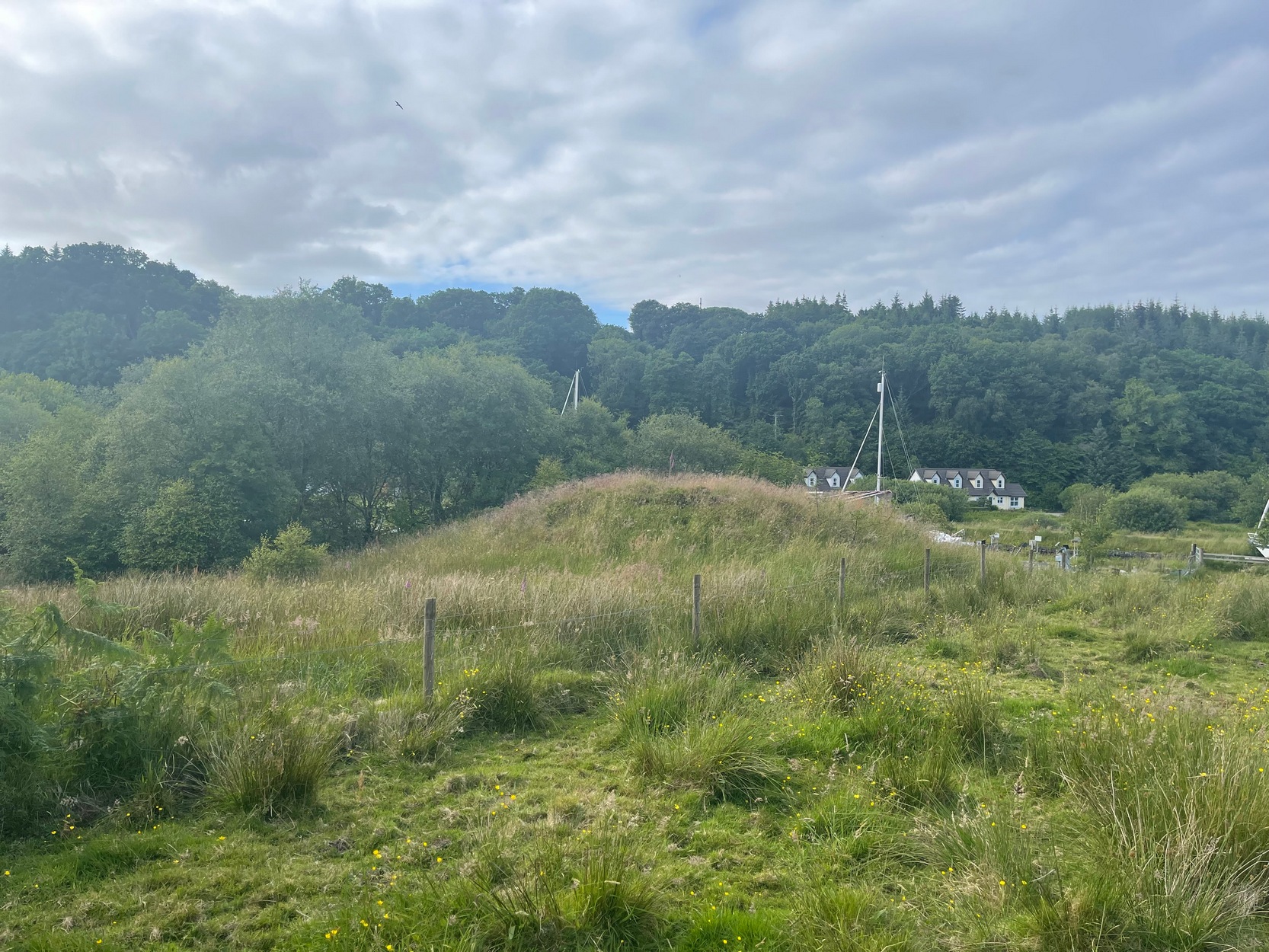
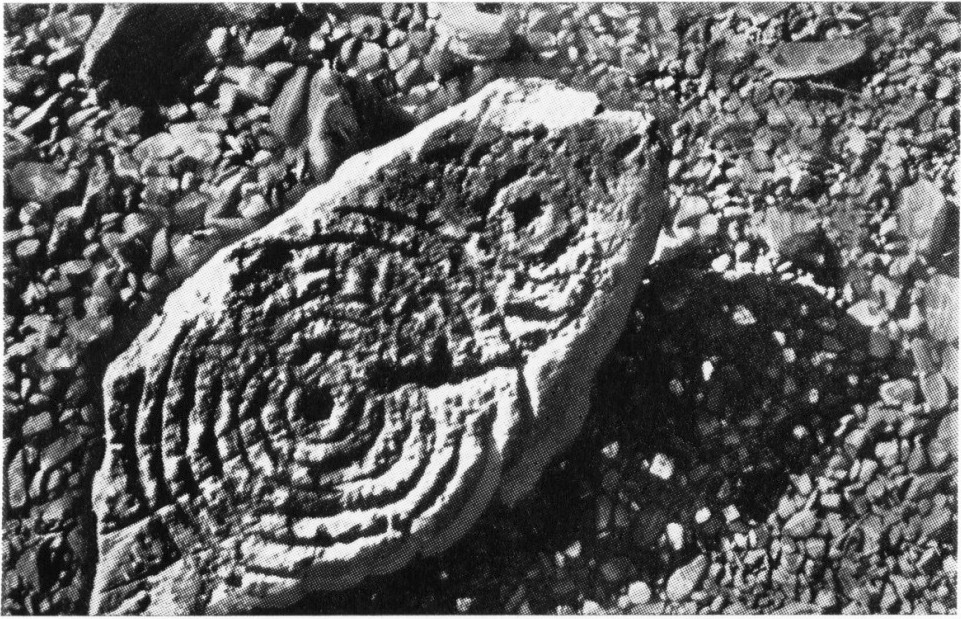
Urlar Burn (6), Aberfeldy, Perthshire

Cup-Marked Stone:  OS Grid Reference – NN 82540 45022

Getting Here
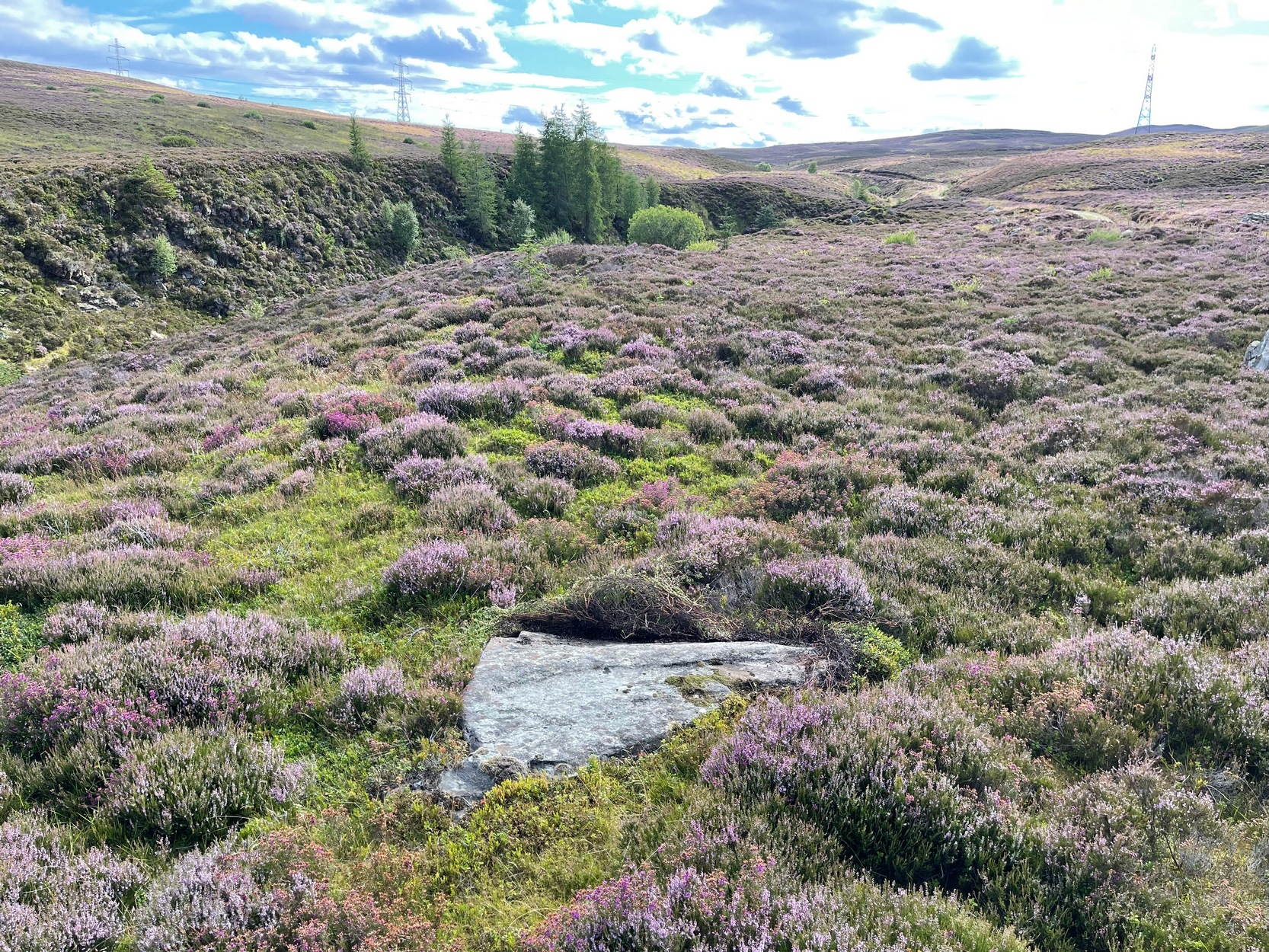
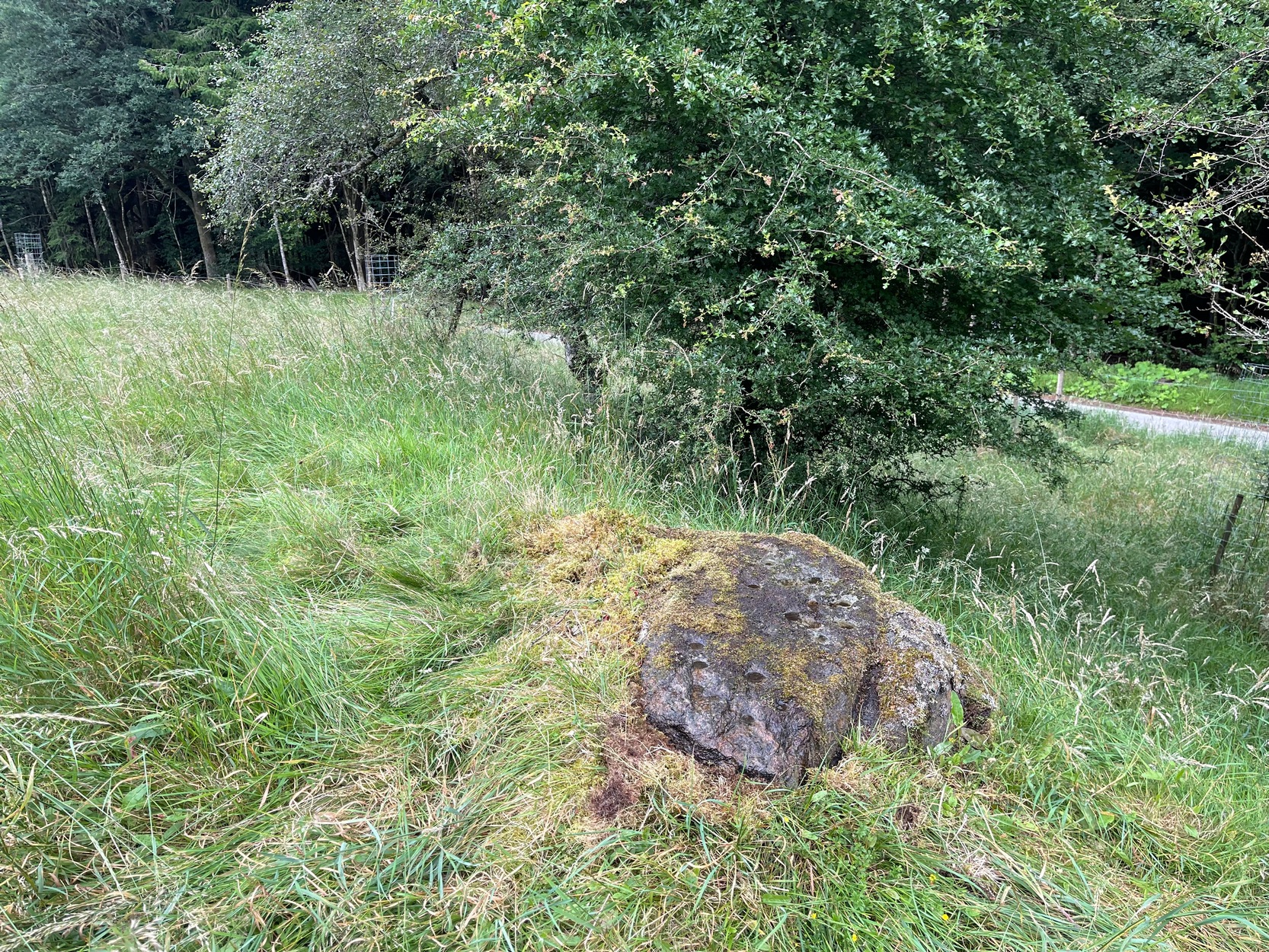
Urlar Burn (6) stone

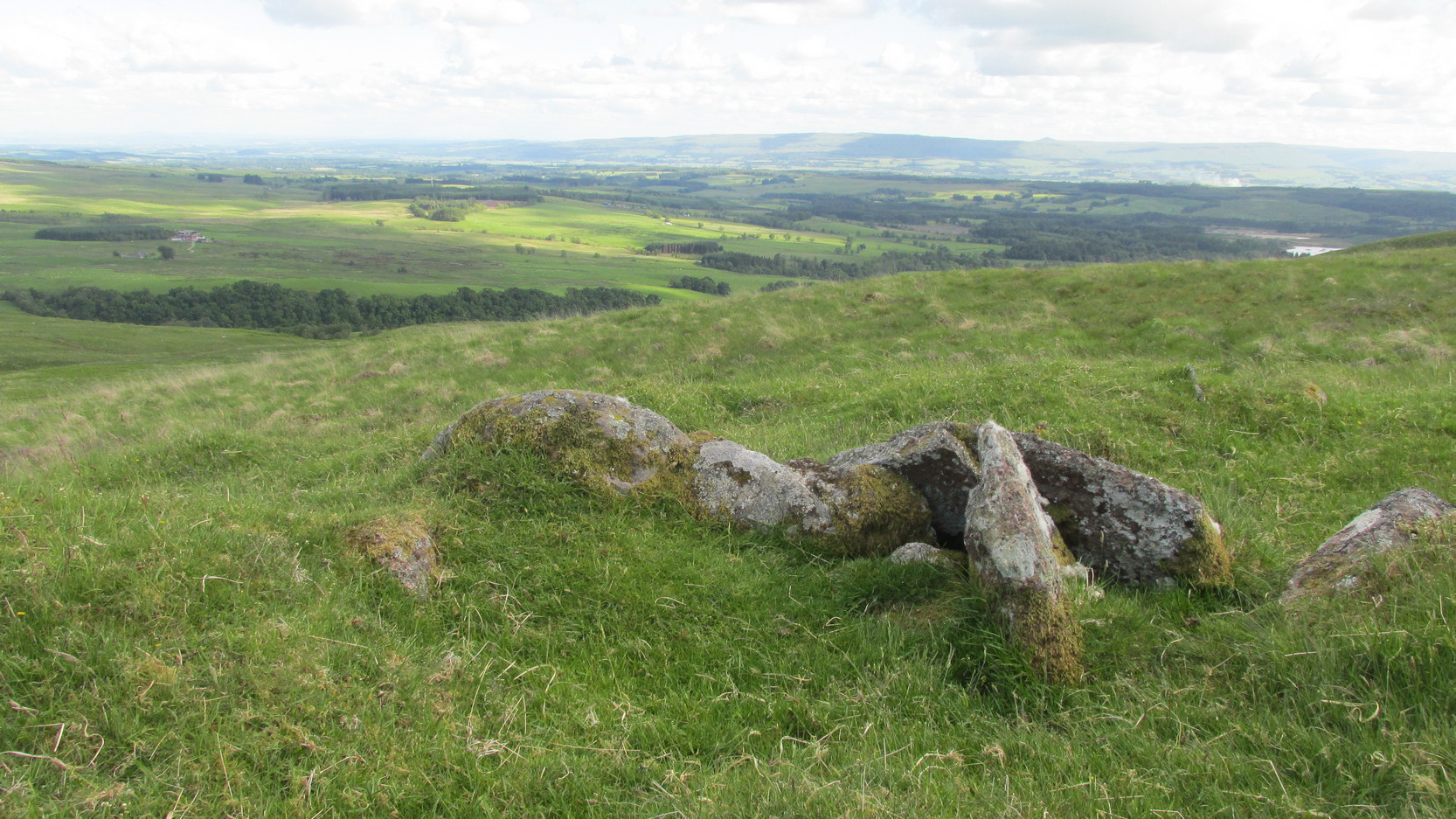
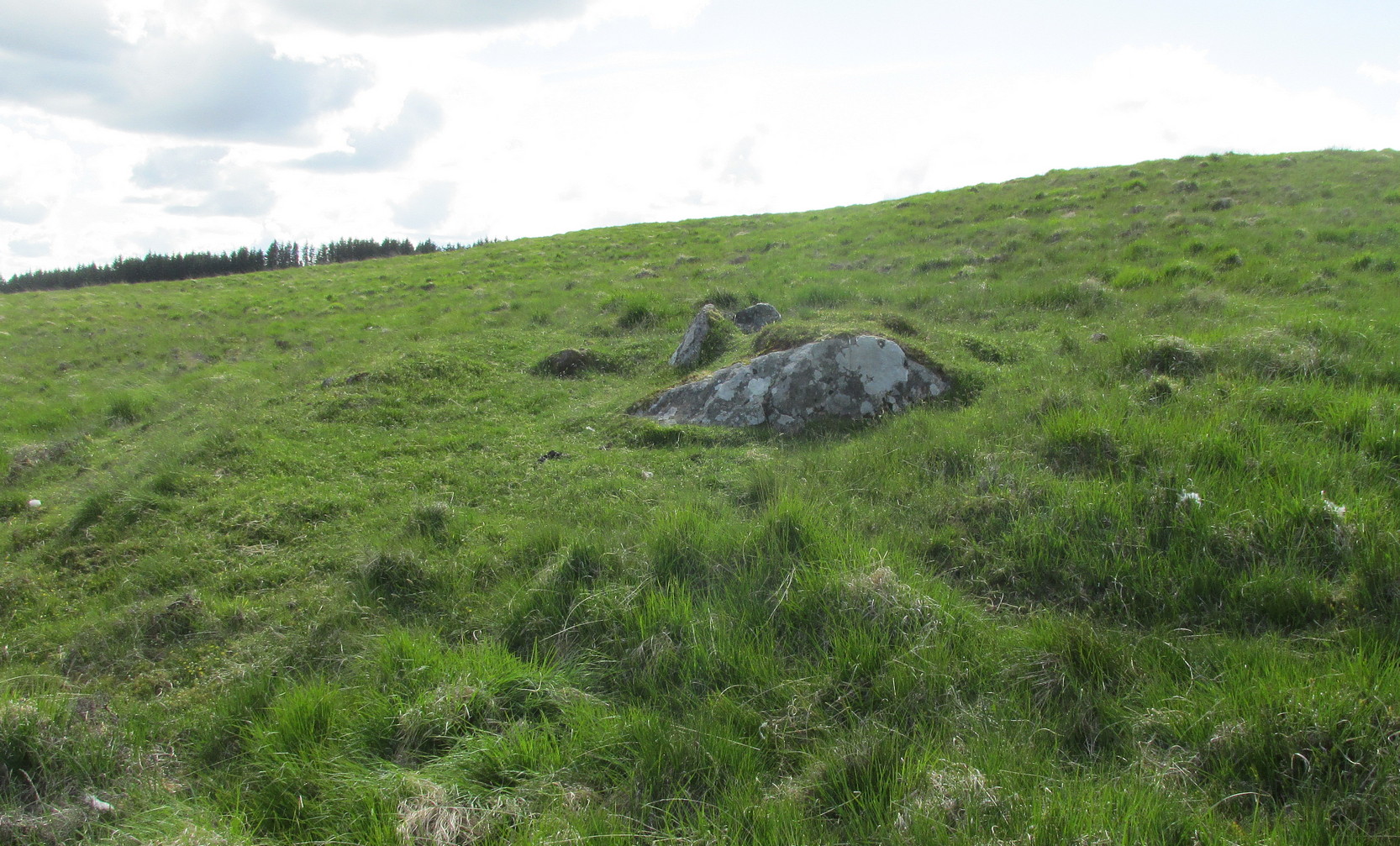
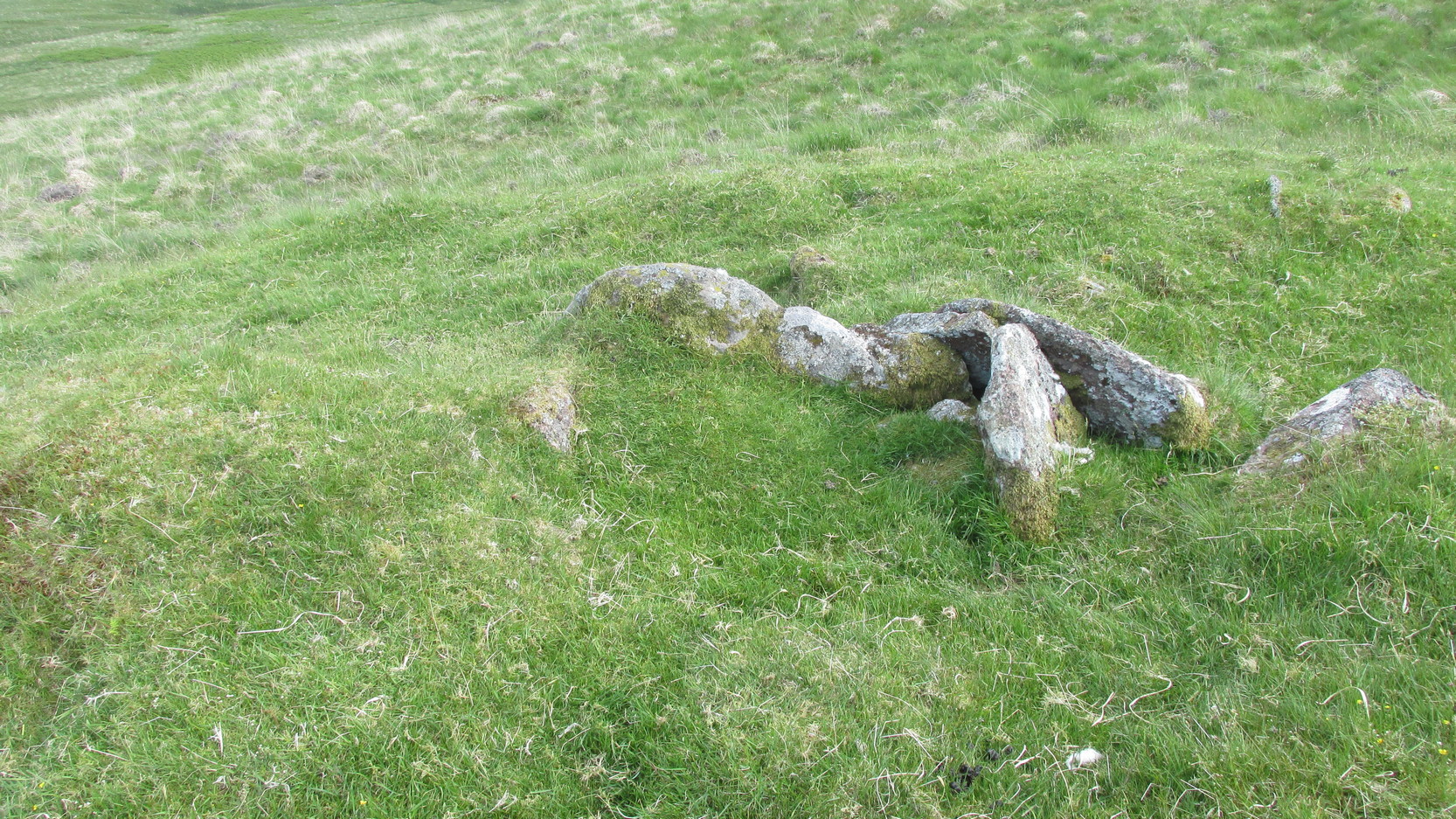
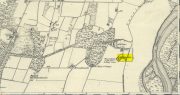
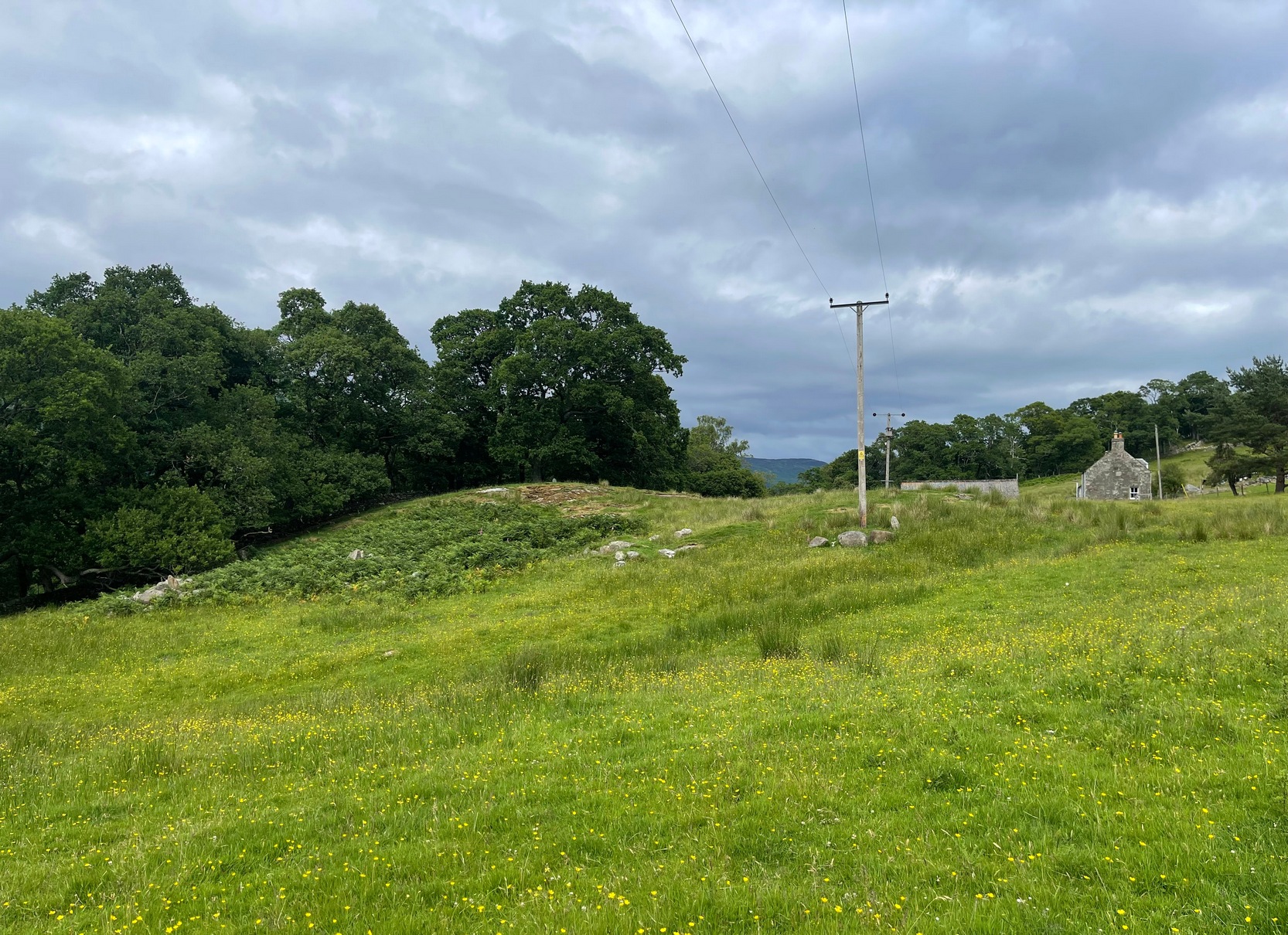
Take the A826 Crieff Road uphill for 275 yards then turn right up the Urlar Road.  It’s a long uphill walk from here, up the private road, through and past Urlar Farm and along the track (keeping to the west-side of the burn), past the impressive Urlar Burn (8) carving, until you eventually reach the bothy, 3¼ miles (5.2km) up from where you first turned off the A826.  Walk 70 yards past the bothy then into the heather on your left where a large couch-shaped boulder stands.  The carved rock is a couple of yards on the floor in front of you.

Archaeology & History

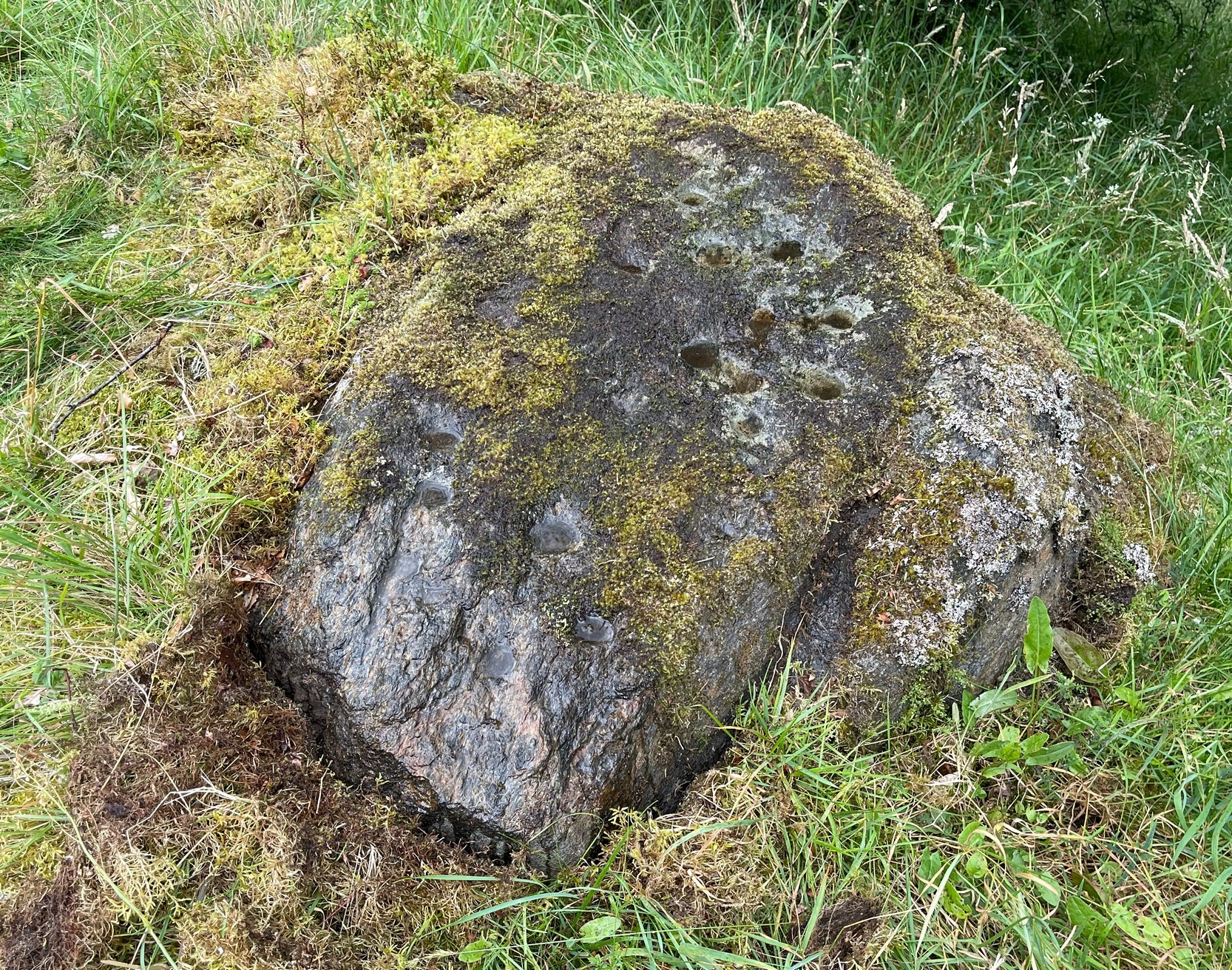
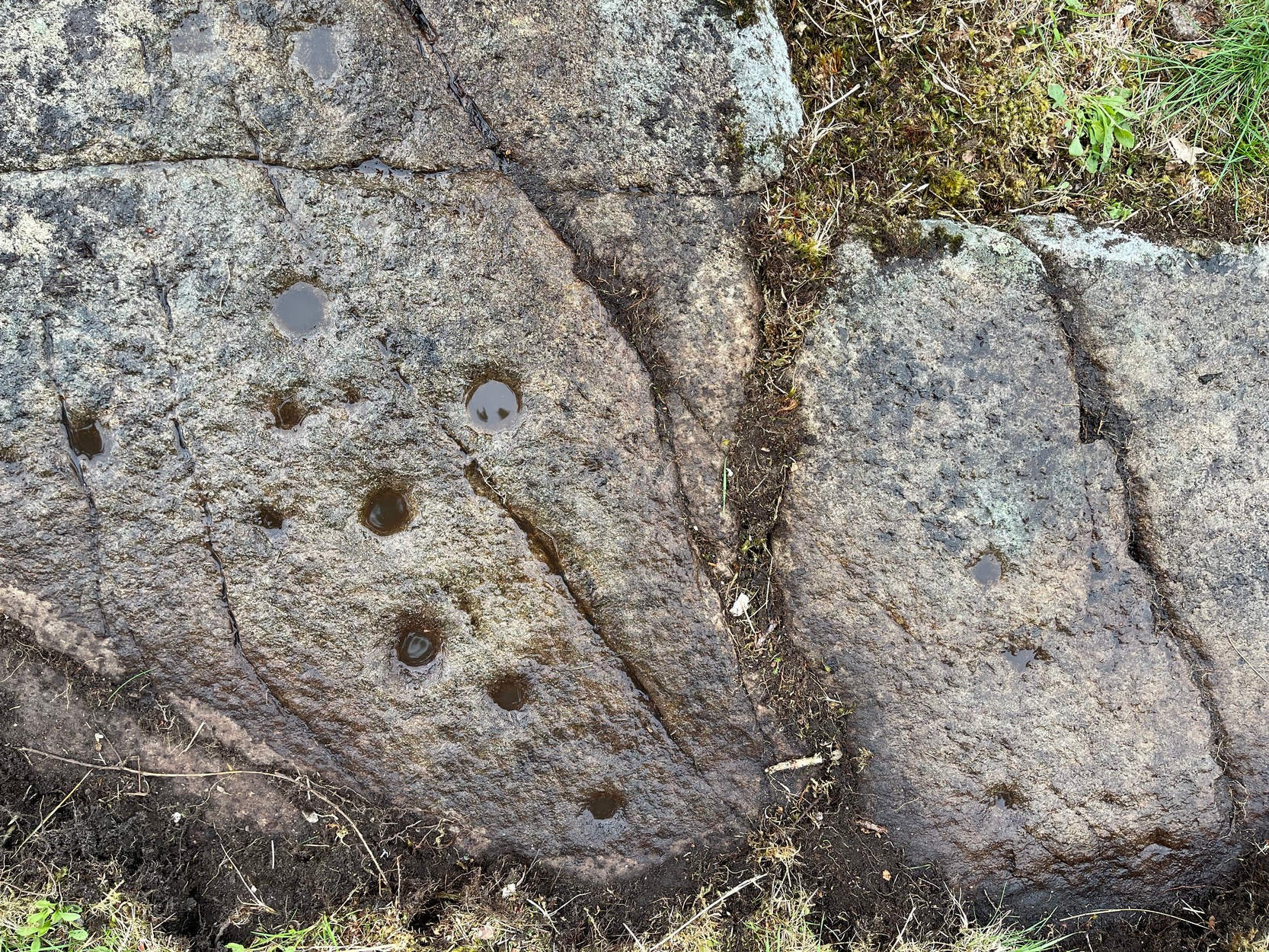
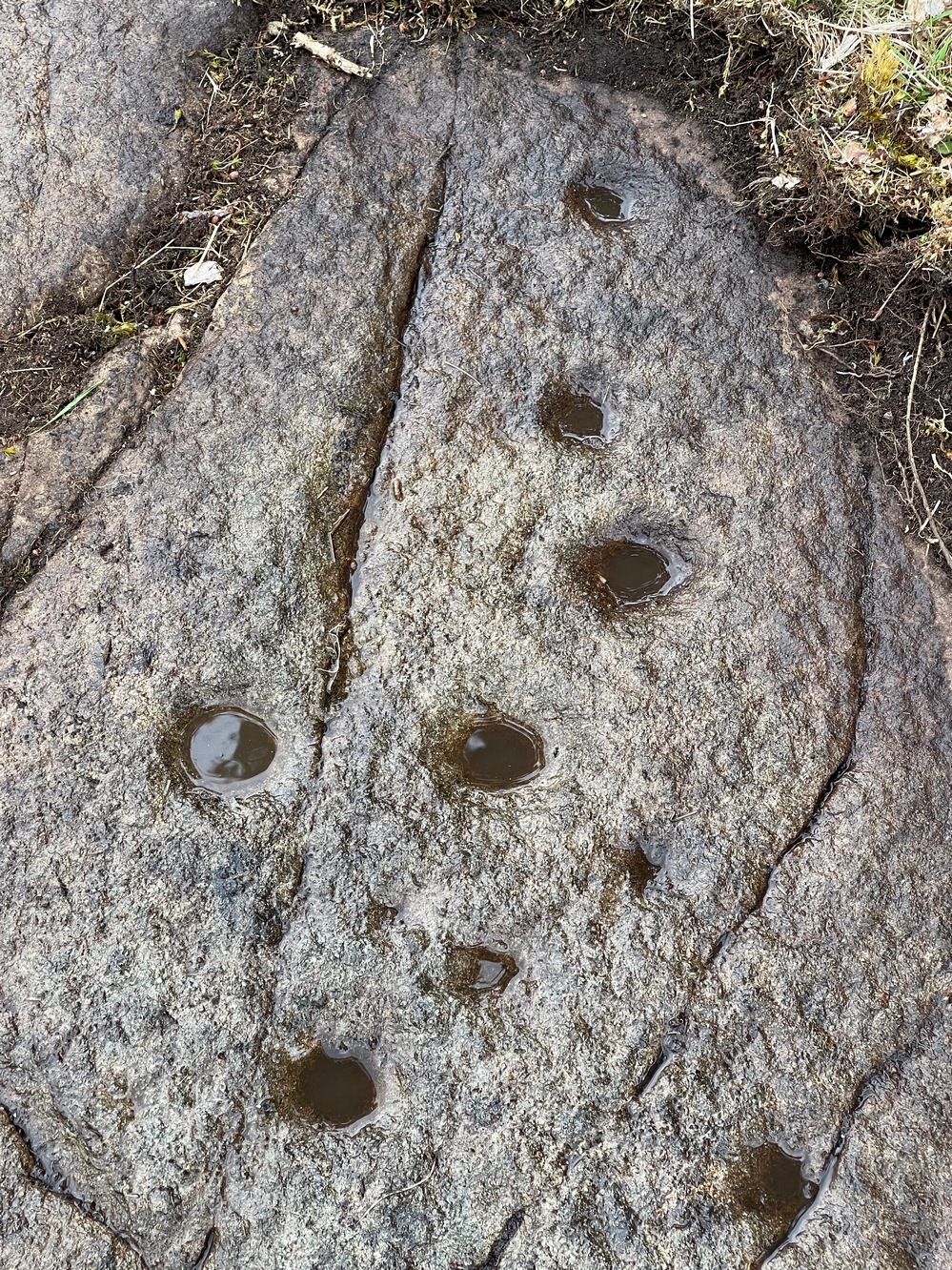
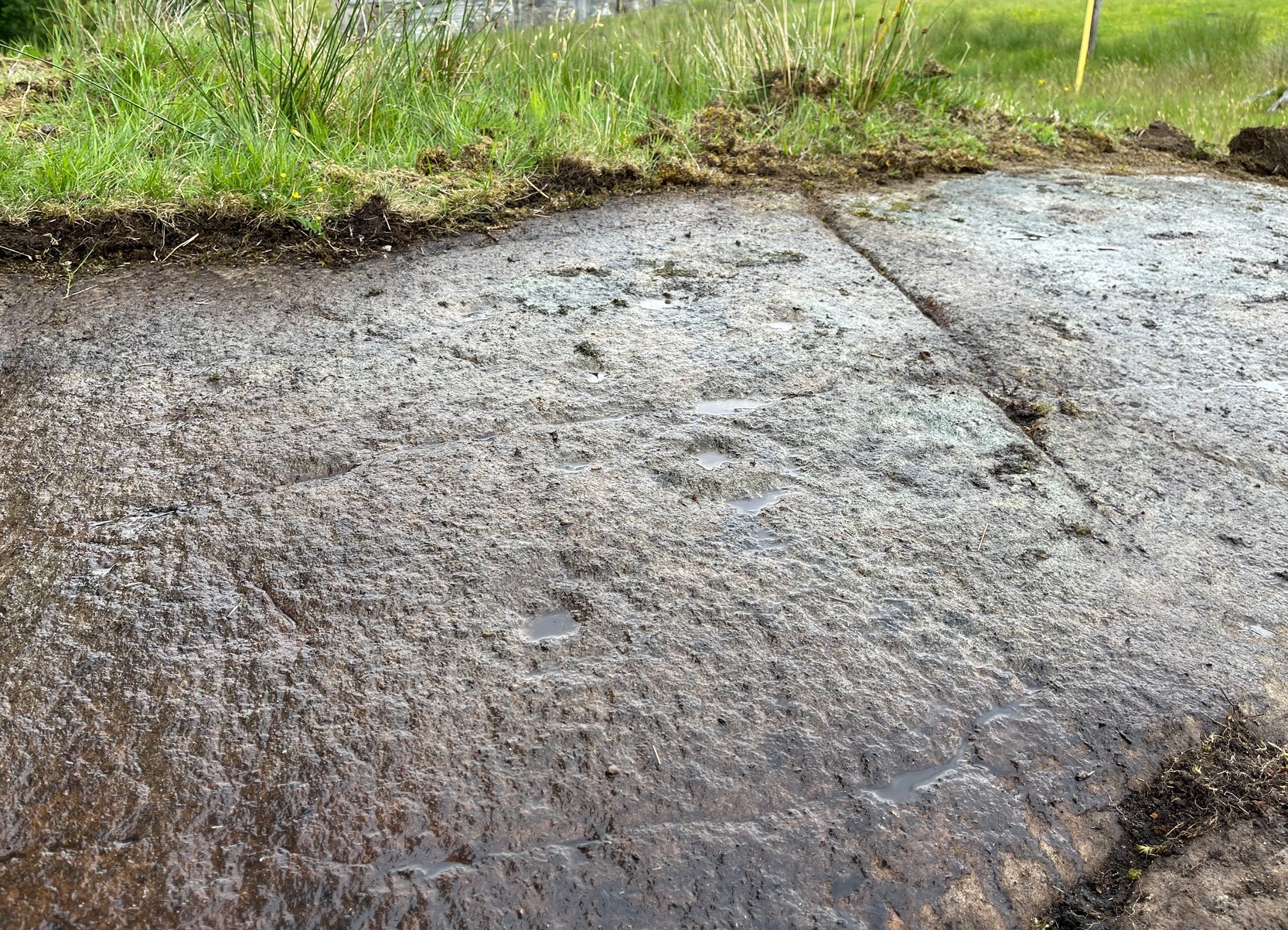
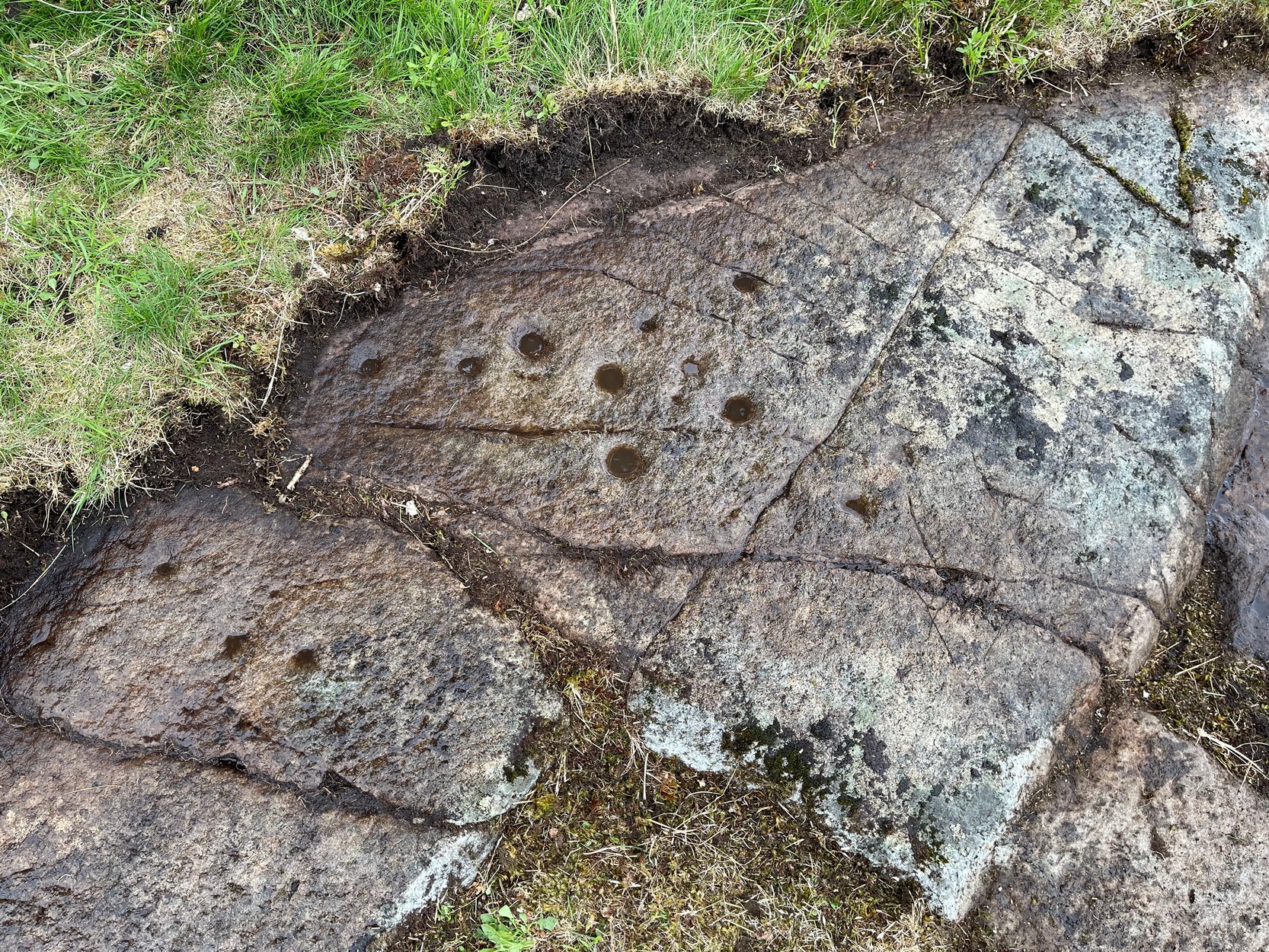
An unimpressive faint cup-marked stone consisting of between two and five shallow cups that are difficult to make out unless lighting conditions are good – and even then they’re troublesome!  It was first noted by George Currie (2009) how described it simply as: “a rock 2.0 x 1. x 0.2m between Urlar Burn and Hill Park track bears five cup marks.”  There are much more impressive carvings in this neck o’ the woods that you’ll want to see ahead of this one!

Folklore
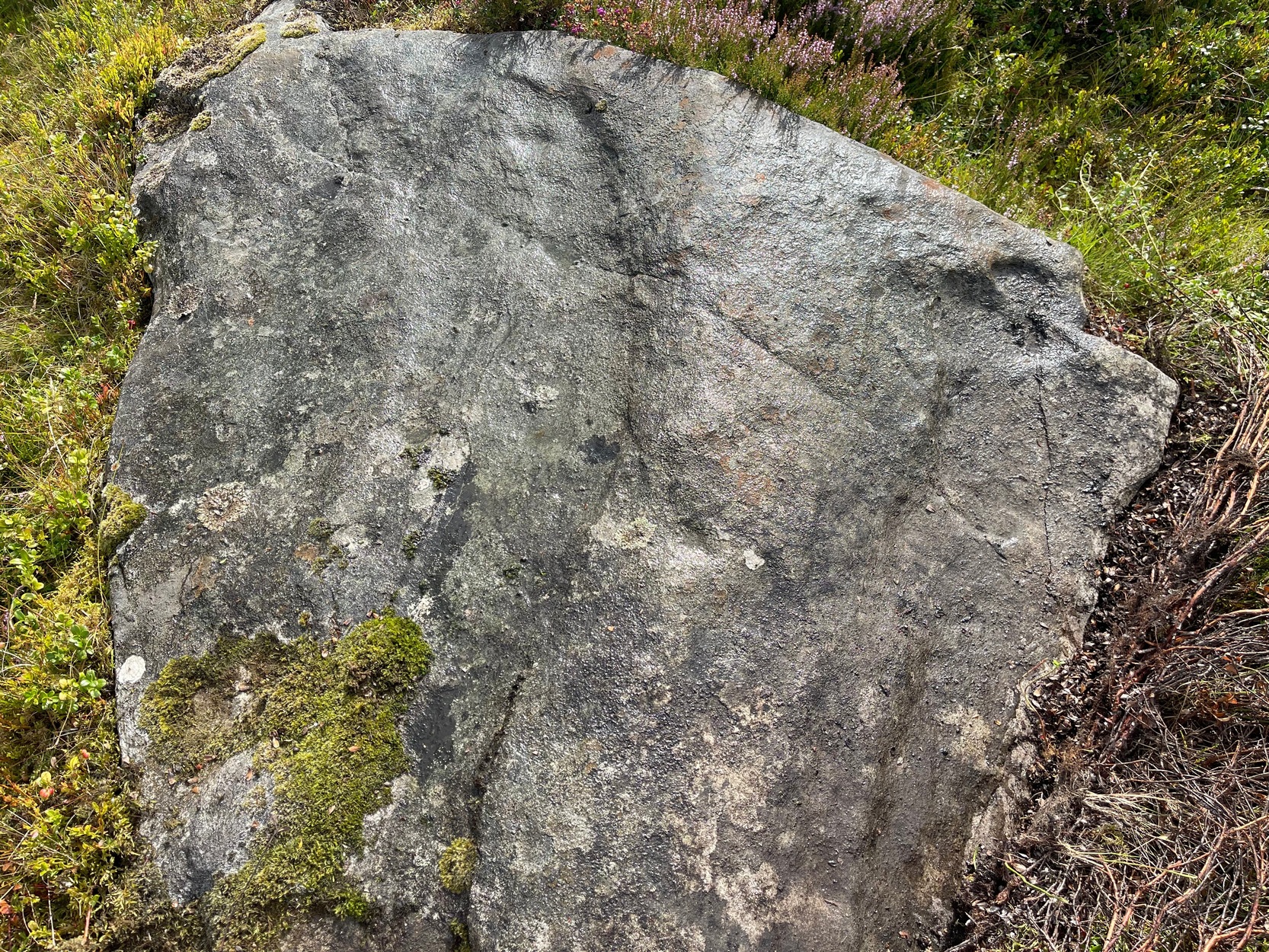
Shallow cups: top-middle; centre-middle

Although there’s nothing specific about this stone, the burn to the side of the carving was haunted by an old urisk in times gone by: an elemental creature from Scottish fairy lore who inhabited lonely streams and waterfalls. The urisk of Urlar Burn was known as Brunaidh an Easain (his brother, Peallaidh, of greater renown, lived in the gorge of Moness close to Aberfeldy) and was likely to have lived further downstream from here.  They are associated in some places with cup-marked stones, where offerings of milk were given to placate them.

References:

  1. Currie, George, “Perth and Kinross: Dull: Urlar Burn (3),” in Discovery & Excavation Scotland (new series), volume 10, 2009.

© Paul BennettThe Northern Antiquarian

Balrobbie, Killicrankie, Perthshire

Cup-Marked Stone:  OS Grid Reference – NN 90884 62571

Getting Here

The Balrobbie Stone

Roughly halfway between Blair Atholl and Pitlochry on the B8079 road is the village of Killiecrankie where, at the junction, you should take the road which leads you over the River Garry.  Crossing the river, follow the minor road swerving to the right and after nearly 200 yards bear left up the very minor road.  200 yards up there’s a hairpin bend; keep going up for about another 150 yards then walk into the overgrown grassland on your right where, just above an old hawthorn, a single notable rock protrudes.  Y’ can’t really miss it!

Archaeology & History

Some of the cups visible in poor light

On my visit here recently, the day was grey and overcast which, in tandem with there being a reasonably decent cover of mosses living on the stone, prevented me from seeing the complete design of this petroglyph.  I was thankful that it’s not an overly impressive one, so couldn’t be too disappointed.  It was was rediscovered in recent years by George Currie (2005) on one of his many forays, which, in his typically evocative language, he described as: “Rock, 1.5 x 0.9 x 0.7m, a few metres W of the Tenandry road; 24 cups, largest 50 x 18mm.”  Most of the cup-marks are a good depth and easy to see when you’re stood next to it.  Sadly my photos didn’t manage to capture them too well.

A notable hut circle can be seen a short distance away up the slope, barely visible in the summertime.  The carving may have been executed by the people living there.  This is the only recorded cup-marked stone anywhere near here which, as rock art junkies will tell you, is unusual.  Where there’s one, others tend to be living close by.  Happy hunting!

References:

  1. Currie, George, “Perth and Kinross: Balrobbie,” in Discovery & Excavation Scotland, volume 6 (New Series) 2005.

Acknowledgements:  Huge thanks for use of the Ordnance Survey map in this site profile, reproduced with the kind permission of the National Library of Scotland

© Paul BennettThe Northern Antiquarian

Ledard Burn (2), Kinlochard, Aberfoyle, Perthshire

Cup-Marked Stone:  OS Grid Reference – NN 459 035 (?) 

Archaeology & History

In Miss Maitland’s (1935) article on the Ledard Stone carving, she also made a brief mention of “another cup-marked stone (that) lies on the edge of the burn, beyond the one described, above Loch Ard.”  She gave no further information about this second stone.  It remains lost and sounds to be only a short distance further uphill and on the west-side of the burn.  If any local explorers are able to find this carving please let us know and, if possible, add some info and photos of it on our Facebook page. (the grid-reference for this site profile is an approximation)

References:

  1. Maitland, Mrs, “Cup Marked Stones”, in The Scottish Country Woman, 1935.

© Paul BennettThe Northern Antiquarian

Ledard Burn (1), Kinlochard, Aberfoyle, Perthshire

Cup-Marked Stone:  OS Grid Reference – NN 458 033

Also Known as:

  1. Ledard Stone

Archaeology & History

Ledard Stone, 1935

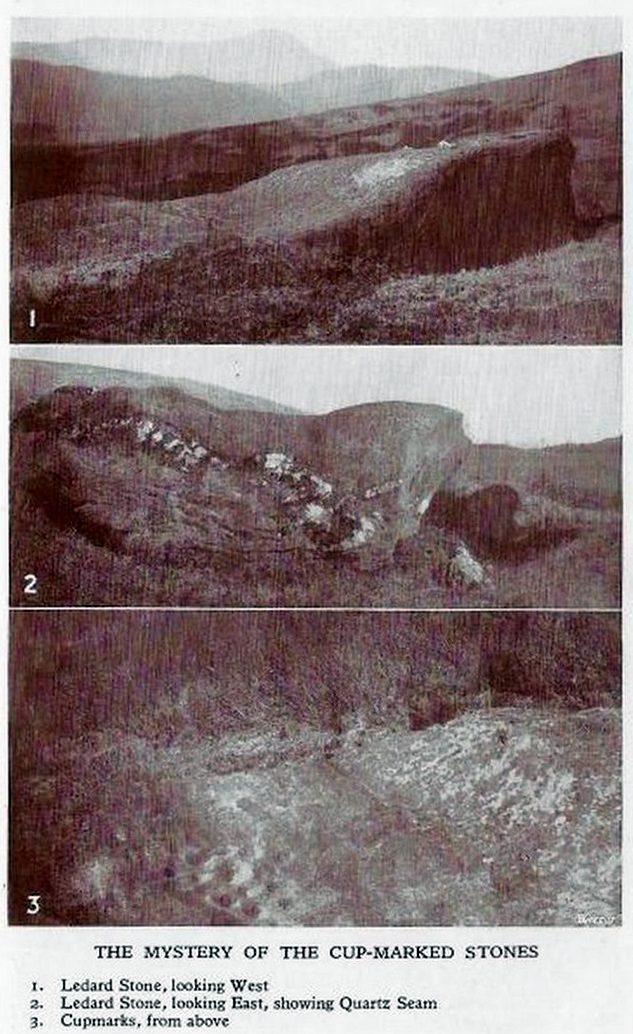
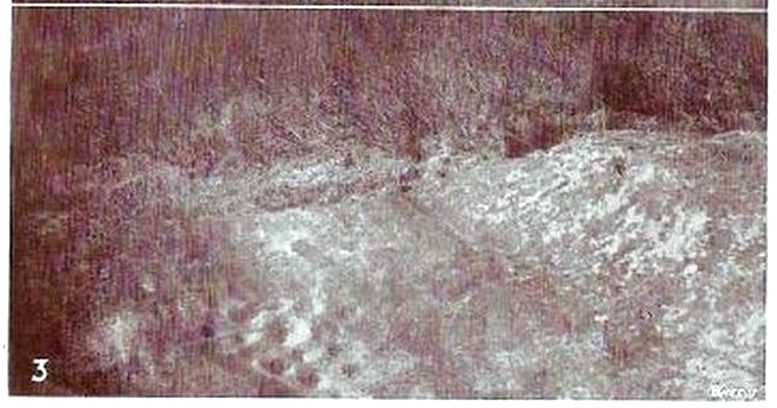
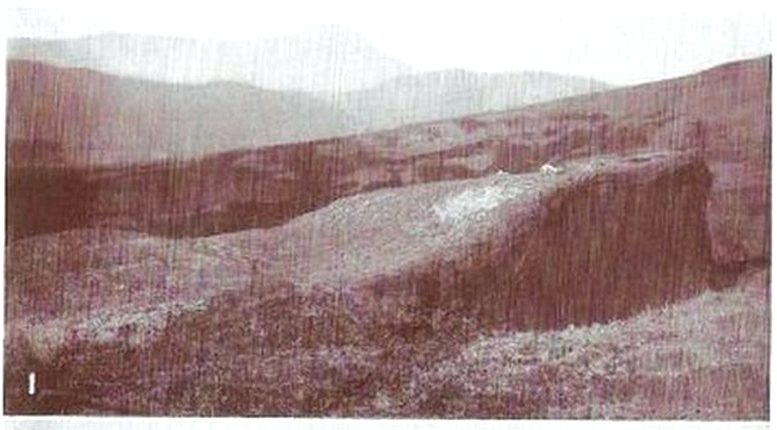
This carving hasn’t seen the light of day, seemingly, since it was first reported by a local lady, a Miss Maitland in the 1930s—and who, it transpires, uncovered a number of petroglyphs in this neck of the woods.  She found it on one of her many forays in the mountains hereby and took some old photos of it—although they’ve not reproduced too well for the sake of the site profile. (apologies)

Since Miss Maitland’s days, the hillside has been covered in forestry plantation, making it extremely difficult to locate the carving.  However, due to the reasonably large size of the stone, it should still be there (smaller cup-and-ring stones have been damaged and destroyed by forestry over the years); and as we can see in the middle photo, a long thick vein of quartz runs roughly along the middle of the stone—an ingredient which may have been significant for the people who carved the stone.  In her article in the Scottish Country Woman magazine, Miss Maitland told:

cup-marks, bottom left
Ledard Stone

“On the hill directly behind Ledard, on the north side of Loch Ard, a little to the west of the burn and a little to the east of the first grouse-butt, exactly 700 feet above sea level, lies a large boulder.  Ice has smoothed and fashioned it and on the worn surface may be seen twenty-one, or so, small round hollows, varying in size and depth.  The pattern made is roughly diamond-shaped, pointing directly east and west.  I saw them for the first time as the sun was setting on New Year’s Eve, 1932.  It was a solemn moment, for as far as I know no one else had looked upon them with such joy, and even awe, for perhaps a thousand years!”

She may have been right.  And by the sound of her words, she’d certainly caught the petroglyph bug!

Anyhow, the carving doesn’t appear to have been seen since then.  A “cup-marked boulder” was noted in the Royal Commission’s (1979) listings, but with no further details. We assume it must be the same carving, although they never visited it.  It’s also possible that they were referring to another lost cup-marked stone a short distance further up the hill from here.  If any local explorers are able to re-locate the carving, please let us know, and maybe add some info and photos of it on our Facebook page.

References:

  1. Maitland, Mrs, “Cup Marked Stones”, in The Scottish Country Woman, 1935.
  2. Royal Commission Ancient & Historical Monuments of Scotland, Archaeological Sites and Monuments of Stirling District, Central Region, Society of Antiquaries of Scotland 1979.

© Paul BennettThe Northern Antiquarian

West Bracklinn, Callander, Perthshire

Chambered Cairn:  OS Grid Reference – NN 65017 09796

Also Known as:

  1. Tom Dubh

Getting Here

Ruins of Bracklinn cairn

Along the A84 road as you’re heading into Callander, just 300 yards before you reach the the Keltie Bridge caravan park, take the tiny road on your left (north) and barely 100 yards along where a small crossroads can be said to exist, go straight forward up the tiny single-track road ahead of you.  Keep all the way up for a mile until you reach Bracklinn Farm (when you meet a split in the road, keep left – and make sure you have parked way further down track of here).  Walk up the track past Bracklinn Farm for just over a mile (1.85km), until where the track and the large burn runs roughly alongside each other (past the small Eas Uilleam cairn up to your right) and go through the gate.  From here, go immediately left (SW) and walk alongside the dead straight fence for just over 300 yards, then slowly zigzag up the sloping hill.  If you reach the derelict walling, you’ve gone too far.

Archaeology & History

West Bracklinn from below

For a site marked as ‘Chambered Cairn’ on the OS-maps, you might be expecting a little bit more when you get here.  Sadly, it’s not what it once was.  Much of the covering stones from the cairn have been severely robbed and obviously used in the old and curiously-named ruin of Bothan na Plaighe below, and the large sheep-fold structures barely 50 yards to the north.  All that’s really left to see here is the internal chamber, aligned roughly east-west, which seems to have originally been split into two sections.  The remaining overgrown edges of the monument, barely two feet high at the most, measures roughly 8 yards by 9 yards, but is much denuded and can really only be noticed when you’re almost stood on top of it!

The landscape reaching out from here takes the eyes way way into the distance along the fading horizon, from north-east to south-east.  This expansive view, this reaching landscape, may have been an important element in the placement of the tomb – and it’s certainly something to behold on a good day.  It might be a bit of a walk to get here, but if you want some good countryside, scenery and a bit of ancient history, this is one helluva good place to go!

References:

  1. Royal Commission Ancient & Historical Monuments of Scotland, Braes of Doune: An Archaeological Survey, RCAHMS: Edinburgh 1994.

Acknowledgements:  Huge thanks for use of the Ordnance Survey map in this site profile, reproduced with the kind permission of the National Library of Scotland

© Paul BennettThe Northern Antiquarian

Lochend Stone, Newbridge, Kirkliston, Midlothian

Standing Stone:  OS Grid Reference – NT 1266 7263

Also Known as:

  1. Newbridge Stone

Getting Here

The stone by the building

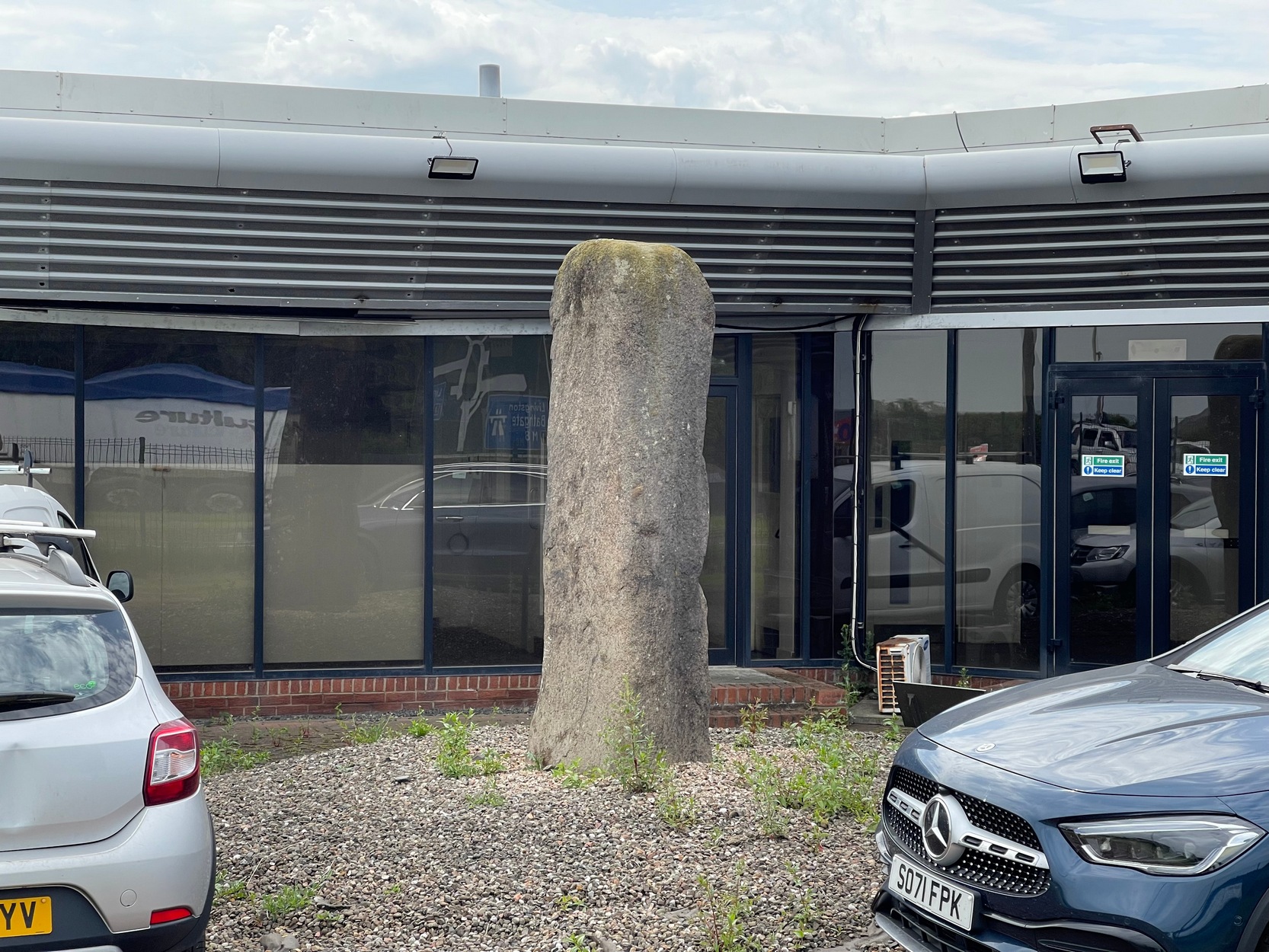
Coming out of Edinburgh along the main A8 Glasgow road, literally yards before you join the M9 near Ratho Station, on the left-side of the road where the last building stands (a company called Element), you need to look through their high metal fence.  Just in front of the large windows, you’ll see this tall standing stone (if you’re coming here via public transport, there’s a bus-stop less than 100 yards away on both sides of the dual carriageway).  Y’ can’t really miss it!

Archaeology & History

A prehistoric site which, today, has lost all value in terms of its original ambience.  The traffic and aircraft noise here is non-stop and prevents all forms of quietude and refection.  Added to this is the fact that it’s behind the high fencing of the warehouse, stopping you getting close to it.  But, I suppose, at least it’s still standing after all these centuries.  In many other parts of Britain, it would have been destroyed long ago…

It seems to have been mentioned for the first time, albeit briefly in John Smith’s (1862) early survey of the local prehistoric sites.  He told it to be a,

“large standing stone…of coarse greenstone,” which “bears no inscription or sculpturing of any kind, and measures about 10 feet in height from the surface of the ground.”

Old stone, new home

Many years later when the Royal Commission (1929) this way ventured, they weren’t much more descriptive, but postulated, not unreasonably I might say, that it functioned as a deliberate outlier from the impressive Newbridge megalithic complex 350 yards to the west.  They may be right.  “In shape it is an irregular four-sided prism,” they wrote, “measuring 9 feet 3 inches in height and 10 feet 6 inches in girth.”  The local megalith surveyor Adam MacLean (1977) pointed out that, relative to the prehistoric complex 350 yards away, “it is in the right position to act as an equinox sunrise marker.”

References:

  1. MacLean, Adam, The Standing Stones of the Lothians, Megalithic Research Publications: Edinburgh 1977.
  2. Royal Commission Ancient & Historical Monuments of Scotland, Inventory of Monuments and Constructions in the Counties of Midlothian and West Lothian, HMSO: Edinburgh 1929.
  3. Smith, John Alexander, “Additional Notes in Reference to the Inscribed Stone found near Yarrowkirk, Selkirkshire,” in Proceedings of the Society of Antiquaries Scotland, volume 4, 1862.
  4. Swarbrick, Olaf, A Gazetteer of Prehistoric Standing Stones in Great Britain, BAR: Oxford 2012.

Acknowledgements:  Huge thanks for use of the Ordnance Survey map in this site profile, reproduced with the kind permission of the National Library of Scotland

© Paul BennettThe Northern Antiquarian

St. Mary’s Well, Inchberry, Moray

Holy Well:  OS Grid Reference – NJ 3238 5520

Also Known as:

  1. Chapel Well
  2. Lady’s Well
  3. Well of Grace

Getting Here

Site on the 1874 OS-map

On the west-side of the River Spey from Fochabers, follow the road-signs taking you south on the B9015, and near Inchberry is a tiny road on your right (careful not to miss it).  Go along here to the end of the long straight road and turn right, down the track.  When you reach the trees, bear left along the track to St Mary’s, Orton, marked “Private road”. 🙂  Parking is limited to one car only but very quiet.

Archaeology & History

St Mary’s Well, Inchberry (21st Century Pict)

Set in a stunning location next to the river Spey with a magnificent view of Ben Aigan to the south, St Mary’s Holy Well and Pool is easy to find behind the Chapel / Mausoleum wall, dedicated to the Duff Family.  There is a small stone basin in the wall which may have been the Chapel font.  At the time of my visit the weather has been dry and sunny for some time.  The pool below the iron grate has been recently cleared of leaves before my visit, with no standing water but the stones on the bottom of the pool looked damp.  And with the cemetery above and behind the wall, perhaps it was for the better.

It was clear and running, said J.F.S. Gordon (1880) at the end of the 1700s, but when he came to write about it the flow “has ceased for many years, and is now only a feeble, filthy, stagnant Driblet for the use of cattle.”  Pilgrimages were made here on the first Sunday in May, and water collected from the site was kept for a year, in return for an offering (usually a stone or other inanimate object) that enabled the magickal spirit of the well to enact cures.

Folklore

A site described by Watson (1868) as being “long held in superstitious reverence”, the well was said to cure whooping cough, eye problems and joint conditions.  It had thoroughly un-christian shennanigans practised here by local folk, much to the consternation of the usual culprits!  Visited extensively by people from far and wide, Mr & Mrs Morris (1981) told,

(21st Century Pict)

“The visits displeased the Kirk and there were various summonses to the Session for “going supersticiously to a Vell at Speyside” and of persons who “kneillit about the chappell and drank the water.”  The minister at Ruthven reported that a large number had gone to the chapel well “thrie Saturdays before Lambas and thrie efter called the six silie Saturdayes, and that the conventions wer on the night or before day in the morning.”  And “quhairas zierlie about Lambnes, the ignorantes repaired to ane wel at this kirk, called Our Ladie Wel, superstitiouslie, and kneeled about the said kirk, it is reportit that the evil is removed.”  This may be the well associated with the White Witch, Dame Aliset, who cured a fairy child with simples and the well water.”

References:

  1. Bord, Janet, Holy Wells in Britain – A Guide, HOAP: Wymeswold 2008.
  2. Cope, Phil, Holy Wells Scotland, Seren: Bridgend 2015.
  3. Gordon J.F.S., The Book of the Chronicles of Keith, Grange, Ruthven, Cairney and Botriphnie, Robert Forrester: Glasgow 1880.
  4. Longmuir John, Speyside — Its Pictureseque Scenery and Antiquities, Lewis & James Smith: Aberdeen 1860.
  5. Mackintosh, Herbert B., Pilgrimages in Moray, W.R. Walher & Co.: Elgin 1924.
  6. Morris, Ruth & Frank, Scottish Healing Wells, Alethea: Sandy 1982.
  7. Watson, J.& W., Morayshire Described, Russell & Watson: Elgin 1868.

Acknowledgements:  Huge thanks for use of the Ordnance Survey map in this site profile, reproduced with the kind permission of the National Library of Scotland

© 21st Century Pict & Paul Bennett, The Northern Antiquarian
Balimeanach (4), Loch Earn, Comrie, Perthshire

Cup-and-Ring Stone:  OS Grid Reference – NN 63874 23005

Getting Here

Balimeanach (4) site

Go along the minor single-track road on the south-side of Loch Earn (between Edinample and the ugly Lochearn Leisure Park) and roughly halfway along the loch, there’s rough parking near Ardvorlich House (the starting spot for walking up Ben Vorlich).  Walk east past the track to Ardvorlich, staying on the lochside road, for about 400 yards and then go up the dirt-track on your right.  Walk up here for about 200 yards and, before you reach the trees, notice a small gate in the walling above you on your right, about 70 yards up the slope. Go through here and bear immediately left, up to the large oak on the large dome of rock.  From the oak, with your back to the wall, take about 10 steps forward.  You’re here!

Archaeology & History

Deep cups & faint rings

The singular short reference to this impressive design was by George Currie (2011) who told us that it “bears at least 17 cup marks, three of which have single rings.”  But there are in fact six of them with rings, possibly seven—with a few additional cup-marks scattered across the wider rock surface.  It’s quite impressive, although on our visit here the daylight was gray and so the photos I have of the site do not do it justice.  The sun popped out a couple of times, but only for a few minutes and we weren’t able to take advantage of it quickly enough.

The distinctive section of this petroglyph are the deep cup-marks on its northern side: fourteen of them, three of which have faded shallow rings around them—or rather, uneven oval-shaped surroundings. The cup-marks have obviously been worked and re-worked over the centuries, whereas the rings were given less repetitive attention, for whatever reason.  This is a pattern found at a great number of cup-and-ring stones across the country.

Shallow cups, faint rings
Another angle of deep cups

From this cluster of deep cups, walk two or three yards south onto the slightly lower smooth rock surface, where we find a much less pronounced scatter of several shallow cup-marks—may be five, may be six—but three of them have faint rings around them. They were difficult to see on our visit here due to the poor light.  There’s what may be another incomplete cup-and-ring another two or three yards further along on the same rock face: a cup, certainly; the faint ring, perhaps.  We need to revisit this in better light.

The rock surface continues for quite some distance all round here in the shape of a large dome, much of it covered in vegetation of varying depths.  There are openings showing the bare rock and, at several other spots there are several other cup-marks, although none are as deep as the ones we’ve just described.  On the edge of one piece, about three yards north of the deep cups, a couple of worn cup-marks are near the edge of one rise; two others are clearly notable a yard or so WNW of the deep cups; whilst there are several other single cups near and not-so-near of the main design. It all requires a lot more work before we see the entire picture.

It’s a gorgeous site: silent with the feel of winds and waters and the scree of buzzards touching the senses: elements that, at some petroglyphs, had mythic relevance…

References:

  1. Currie, George, “Comrie: Balimeanach (BC 2), Cup-marked Rock”, in Discovery & Excavation Scotland, New series – volume 12, 2011.

Acknowledgements:  Huge thanks for use of the Ordnance Survey map in this site profile, reproduced with the kind permission of the National Library of Scotland

© Paul BennettThe Northern Antiquarian
Carn Ban, Cairnbaan, Lochgilphead, Argyll

Cairn:  OS Grid Reference – NR 84009 90709

Also Known as:

  1. Cairnbaan
  2. White Cairn

Getting Here

Misty mound of Carn Ban

Take the A816 out of Lochgilphead and head north as if you’re going to Kilmartin.  Nearly 2 miles along, take the left turn along the B841 Crinan road.  A few hundred yards along, go over the canal bridge and about 70 yards along there’s a left turn onto the track into the Knapdale Forest.  Go along here (there’s a parking spot) for 200 yards until your reach the grasslands on your left.  If you walk into this bit of scrubland, you’ll see the rounded fairy-mound over the fence in the adjacent field, almost overlooking the canal.  Y’ can’t really miss it.

Archaeology & History

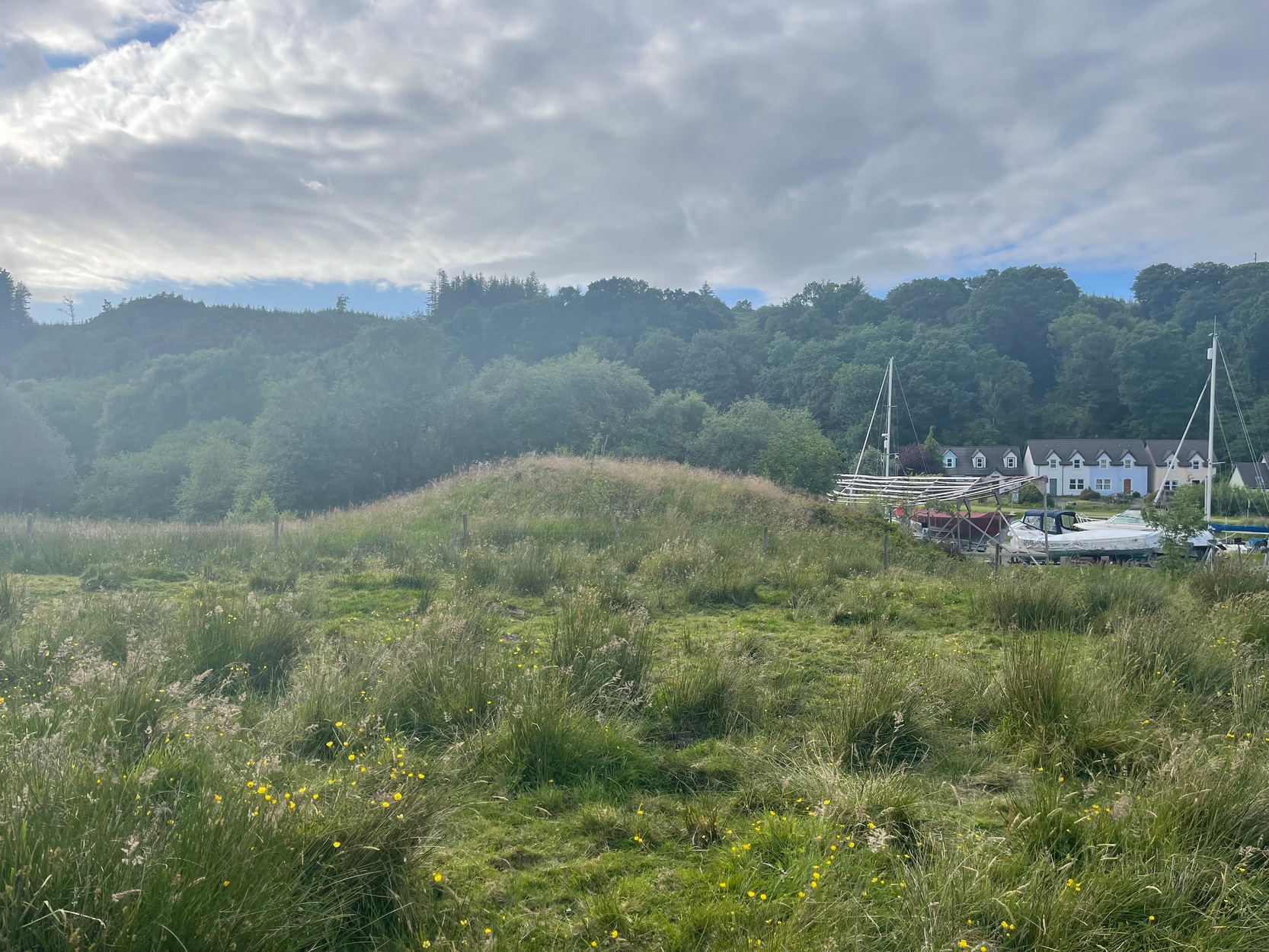
Carn ban, or the White Cairn, from which the hamlet of Cairnbaan gets its name, is a good-sized round cairn, now much overgrown in vegetation, though is still accessible and easy to see.  Just above the water-line of the Crinan Canal, the mound is about ten yards across and more than six feet high and is in a good state of preservation.  Originally, according to J.H. Craw (1930), the tomb was 12 feet high and 40 feet across!

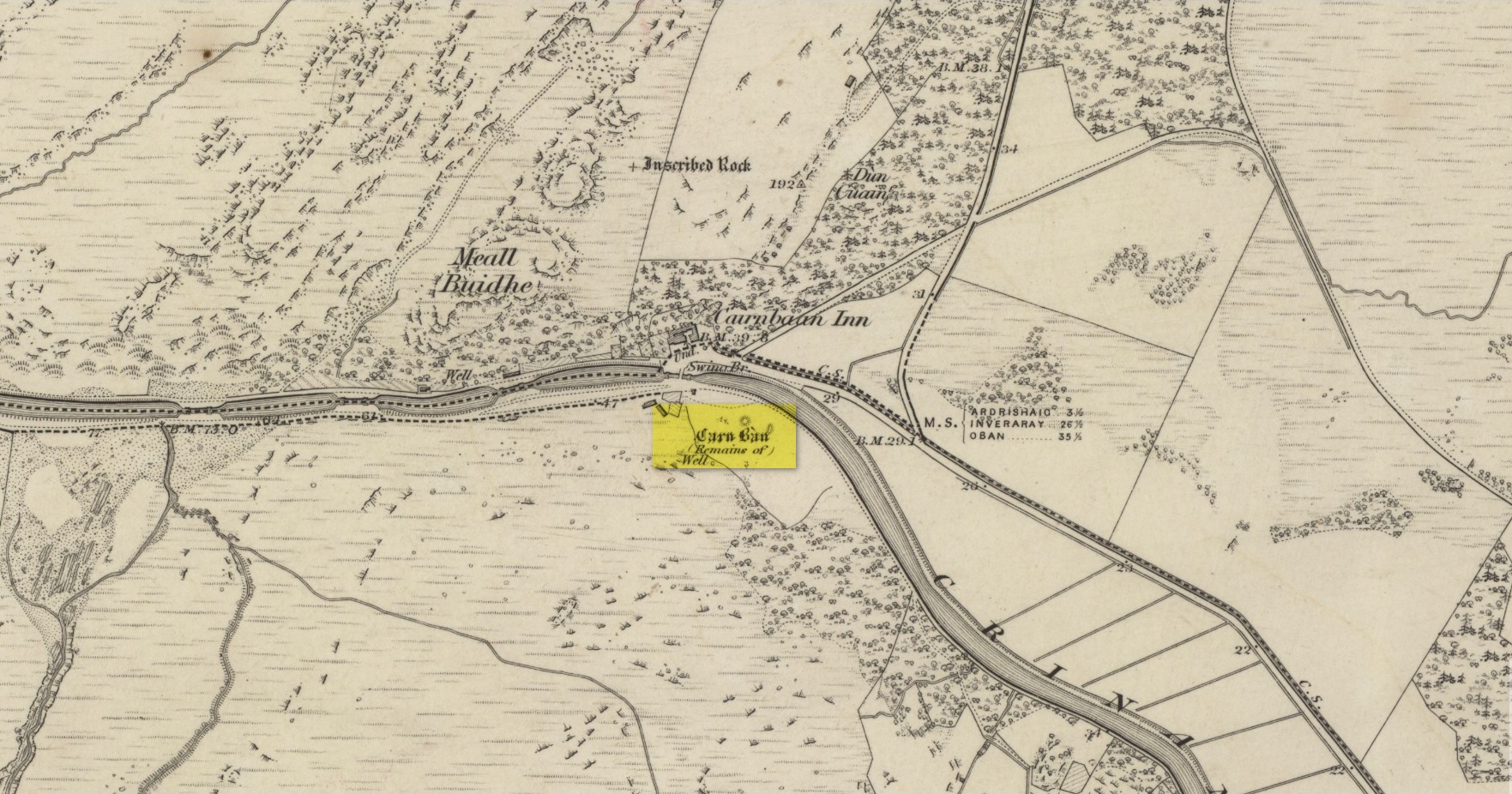
Carn Ban on 1873 map

Carn Ban, looking NE

In the 1850s, the site was examined by a Dr Hunter of Lochgilphead, and Mr Richardson Smith of Achnaba, and a cist that had been built straight on top of the bare rock was uncovered near the centre of the cairn, nearly four feet long and aligned northeast to southwest.  Inside it a thin slab of stone—“2 feet long, 17 inches broad, and 2½ inches thick”—had been slid up against the western end of the chamber and on it was a curious petroglyph design comprising “several incised diamond-shaped figures, one within the other”—five altogether, and the commencement of a sixth—similar to ones found at Newgrange in Ireland.  This carving was removed and given to the Scottish National Museum where it still resides.  Inside the cist, Hunter and Smith found a deposit of some “yellow sand with some black charcoal and several burnt bones lying upon its bottom”, and a subsequent search unearthed some flint fragments.

The Carn Ban is a good site—but if you’re wanting something bigger, something more impressive, I suggest heading just a few miles north…

References:

  1. Beckensall, Stan, The Prehistoric Rock Art of Kilmartin, Kilmartin Trust: Kilmartin 2005.
  2. Campbell, Marion & Sandeman, M.L.S., “Mid-Argyll: A Field Survey of the Historic and Prehistoric Monuments”, in Proceedings of the Society of Antiquaries, Scotland, volume 95, 1964.
  3. Craw, J. Hewat, “Excavations at Dunadd and at other Sites on the Poltalloch Estates, Argyll”, in Proceedings of the Society of Antiquaries, Scotland, volume 64, 1930.
  4. MacBrayne, David, Summer Tours in Scotland, D. MacBrayne: Glasgow 1886.
  5. Royal Commission Ancient & Historical Monuments of Scotland, Argyll – volume 6: Mid-Argyll and Cowal, HMSO: Edinburgh 1971.
  6. Simpson, J.Y., “On Ancient Sculpturings of Cups and Concentric Rings,” in Proceedings of the Society of Antiquaries, Scotland, volume 6, 1866.
  7. Simpson, James, Archaic Sculpturings of Cups, Circles, etc., Upon Stones and Rocks in Scotland, England and other Countries, Edmonston & Douglas: Edinburgh 1867.

Acknowledgements:  Huge thanks for use of the Ordnance Survey map in this site profile, reproduced with the kind permission of the National Library of Scotland

© Paul BennettThe Northern Antiquarian
Laggan Farm, Anwoth, Kirkcudbrightshire

Cup-and-Ring Stone (removed):  OS Grid Reference – NX 546 530

Archaeology & History

A.E. Truckell’s 1961 photo (TGDNHAS, 1961)

A small multiple-ringed archetypal design consisting of a central cup-mark with seven consecutive rings emerging from it, with a second outlying, incomplete cup-and-double-ring that nearly touches the outer edge of the seven-rings, was found by a Mr Sproat “in the bed of a shallow stream on Laggan farm” in 1960.  The design, as the old photo (right) shows, is very well preserved, suggesting that it cannot have been in the stream for too long, as the erosion on the carving isn’t in anyway excessive.  In all likelihood it originally came from a nearby prehistoric tomb: of which, there are several upstream from the farm.

Described by A.E. Truckell (1961) as “a particularly fine example”, the carving is on a particularly small and thin piece of stone, measuring 18 inch by 8 inch amd just 2 inches thick, with one edge of it snapped-off. It’s obviously no longer in situ and, I presume, is still resting somewhere in the Kirkcudbright museum.

References:

  1. Morris, Ronald W.B., The Prehistoric Rock Art of Galloway and the Isle of Man, Blandford: Poole 1979.
  2. Morris, Ronald W.B. & Bailey, Douglas C., “The Cup-and-Ring Marks and Similar Sculptures of Southwestern Scotland: A Survey,” in Proceedings of the Society of Antiquaries, Scotland, volume 98, 1967.
  3. Morris, Ronald W.B., “The Cup-and-Ring Marks and Similar Sculptures of South-West Scotland,” in Transactions of the Ancient Monuments Society, volume 14, 1967.
  4. Truckell, A.E., “A Group of Separate Cup-and-Ring-Marked Slabs in the Cairnholy-Auchinlarie District,” in Transactions Galloway & Dumfriesshire Natural History & Antiquarian Society, volume 40, 1961.

© Paul BennettThe Northern Antiquarian