Fiscary (3), Farr, Sutherland

Cairn:  OS Grid Reference – NC 73222 62484

Also Known as:

  1. Canmore ID 6446
  2. Pict’s House

Getting Here

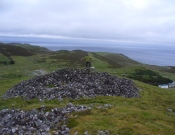
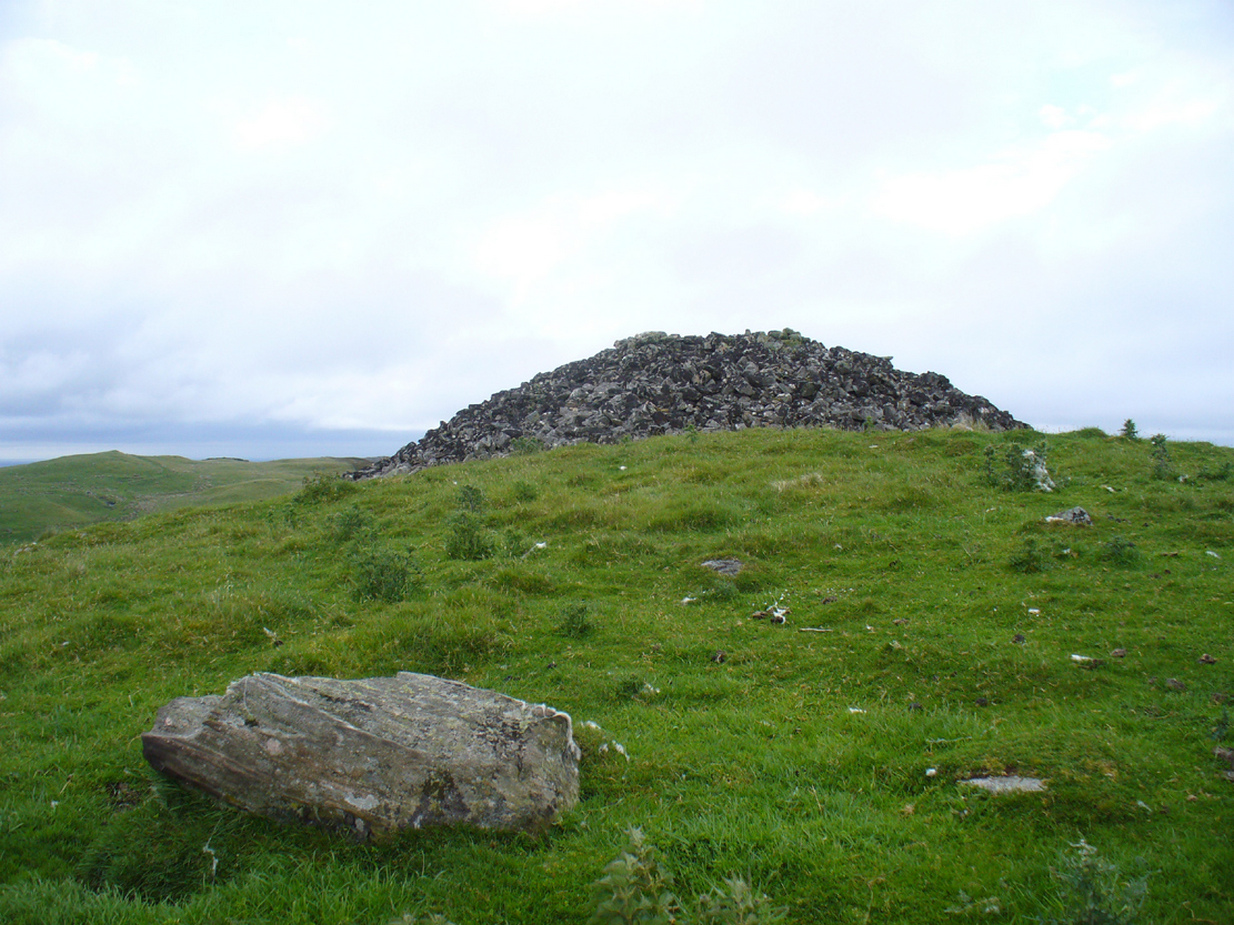
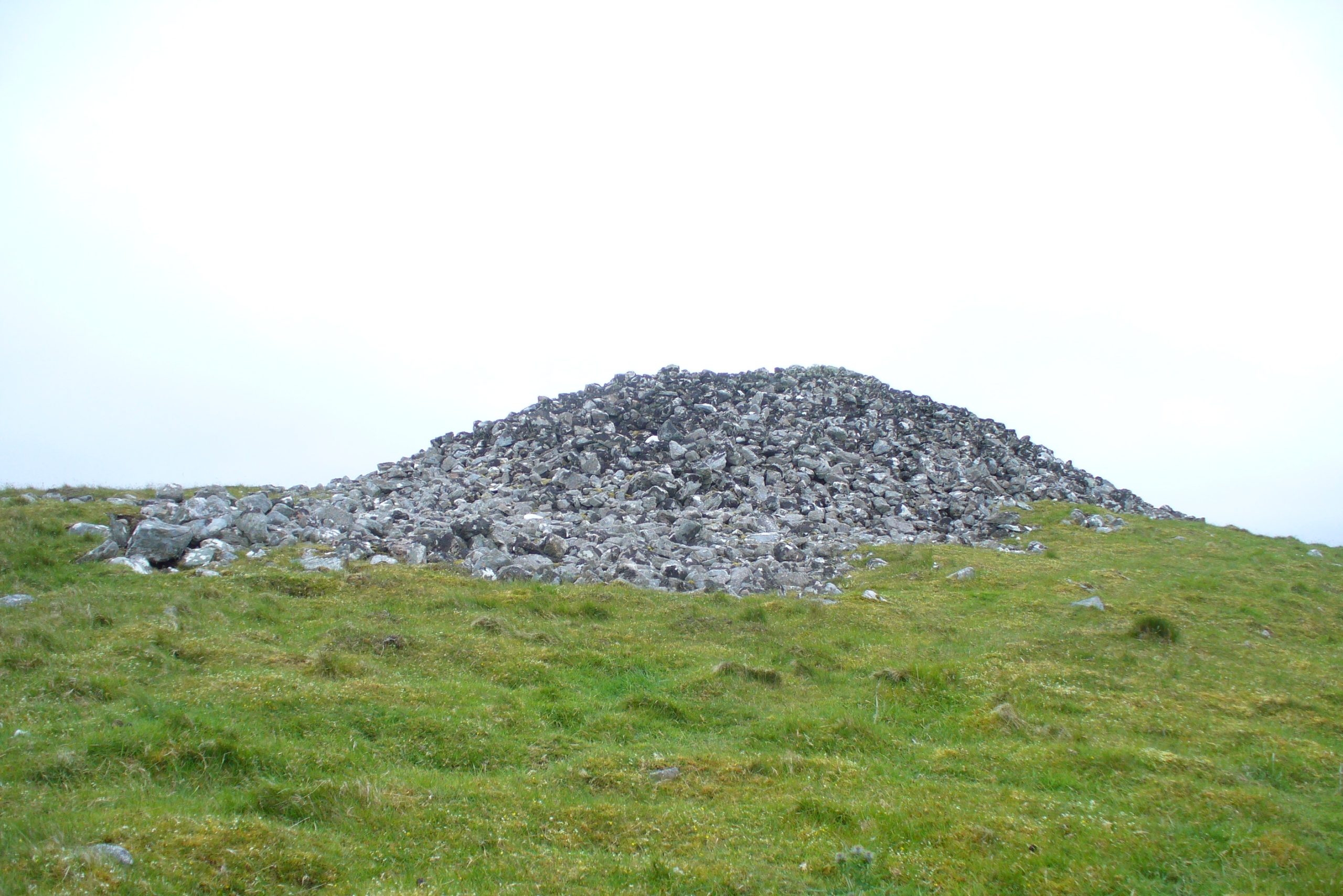
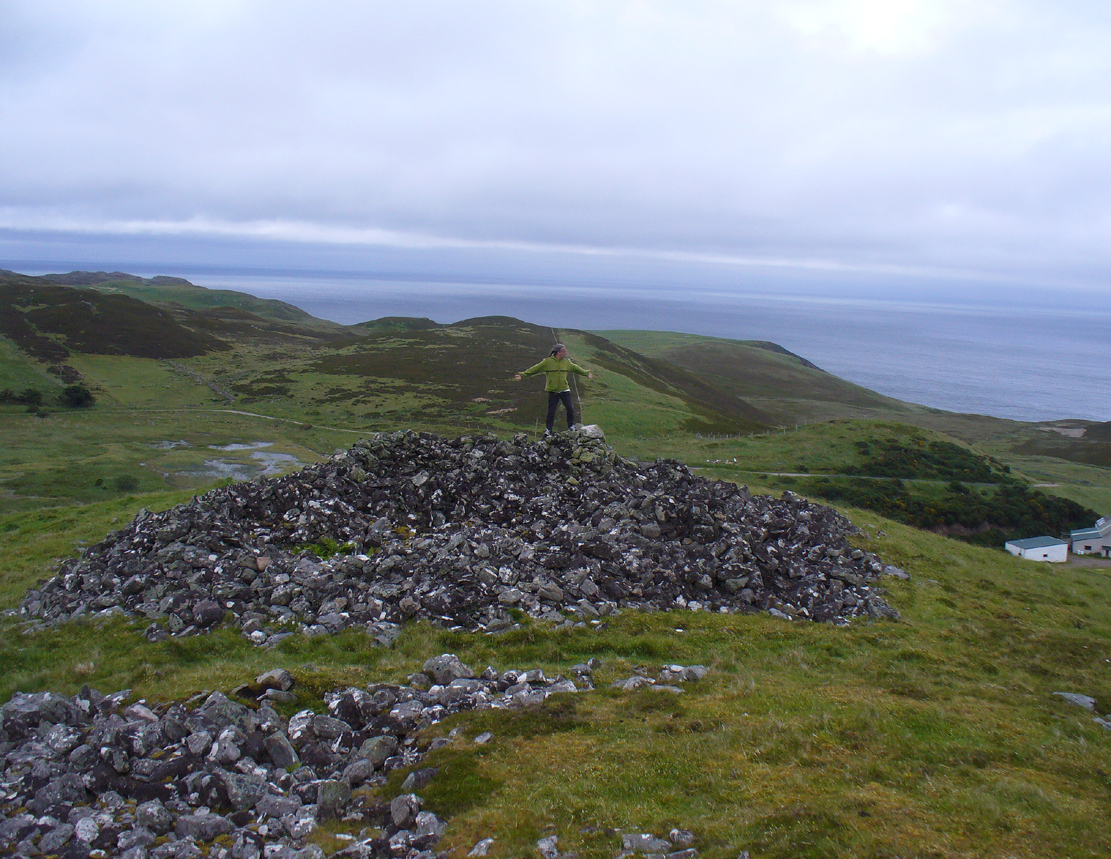
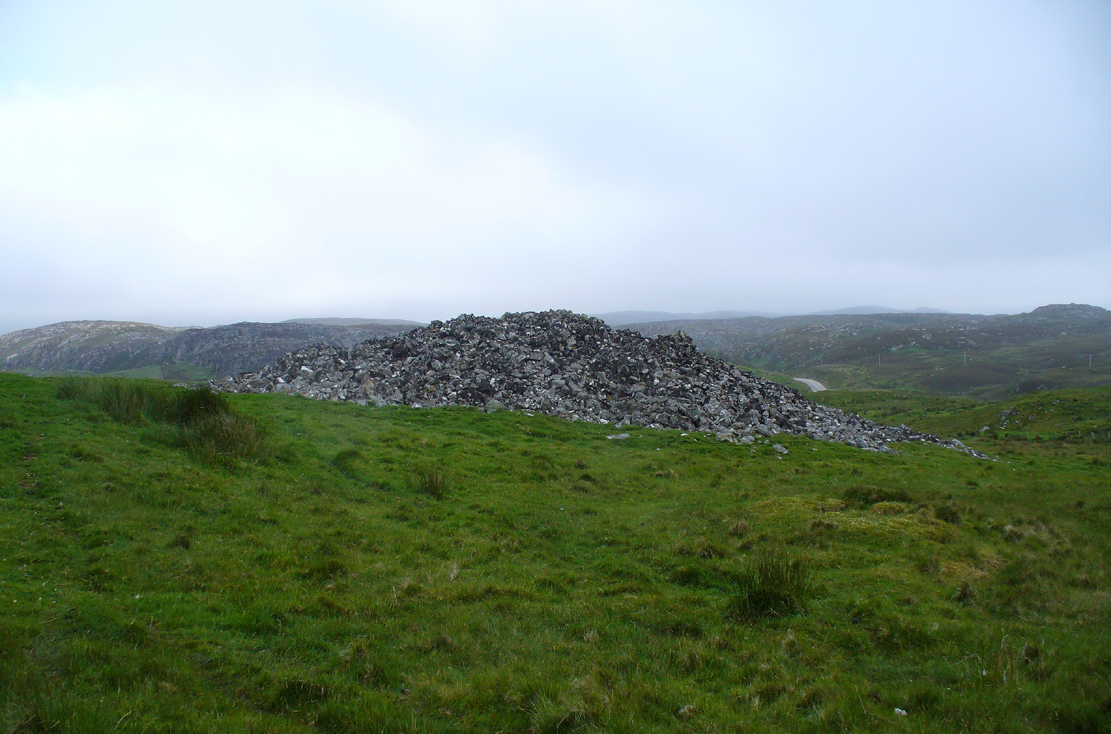
Fiscary 3 giant cairn, looking west

Fiscary 3 giant cairn, looking west

Along the A836 road from Bettyhill to Thurso, a mile east of the village keep your eyes peeled to your left (or to the right if you’re coming the other way!), looking north, and you’ll see some very large piles of stones a few hundred yards away. Go through the gate onto the rough grasslands and the first one you reach is the cairn in question. Y’ can’t miss it!

Archaeology & History

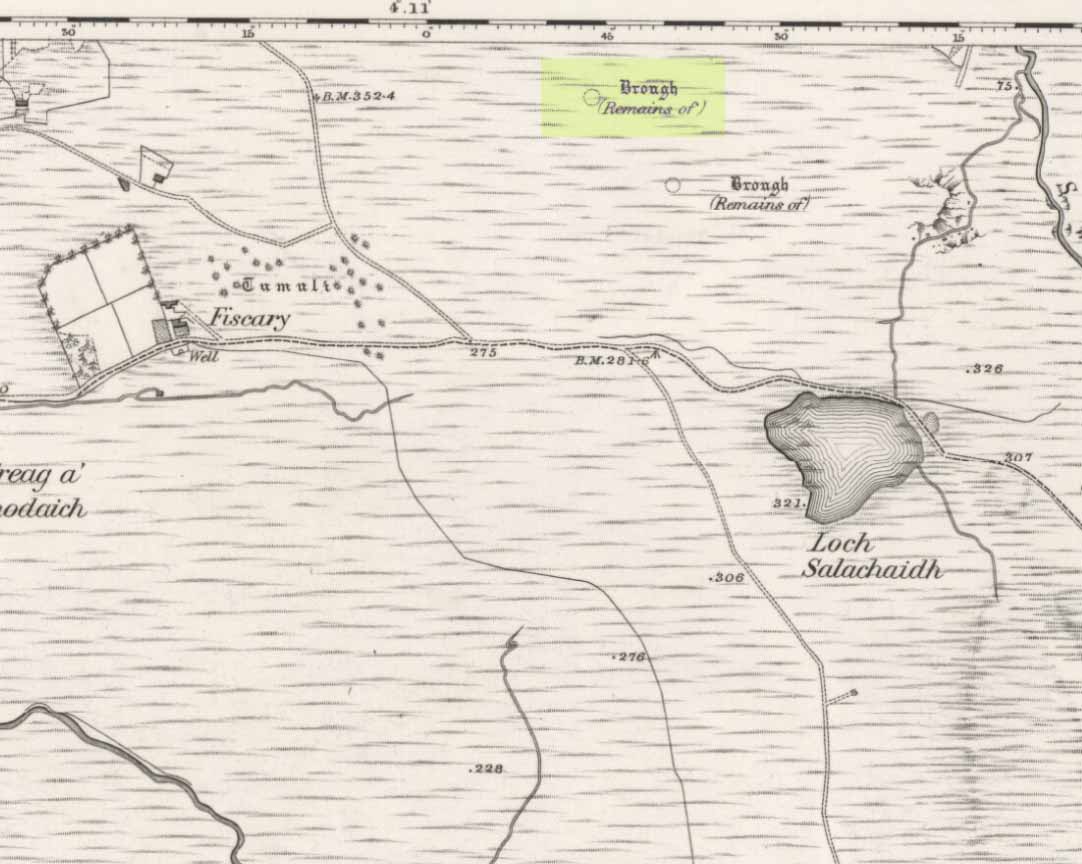
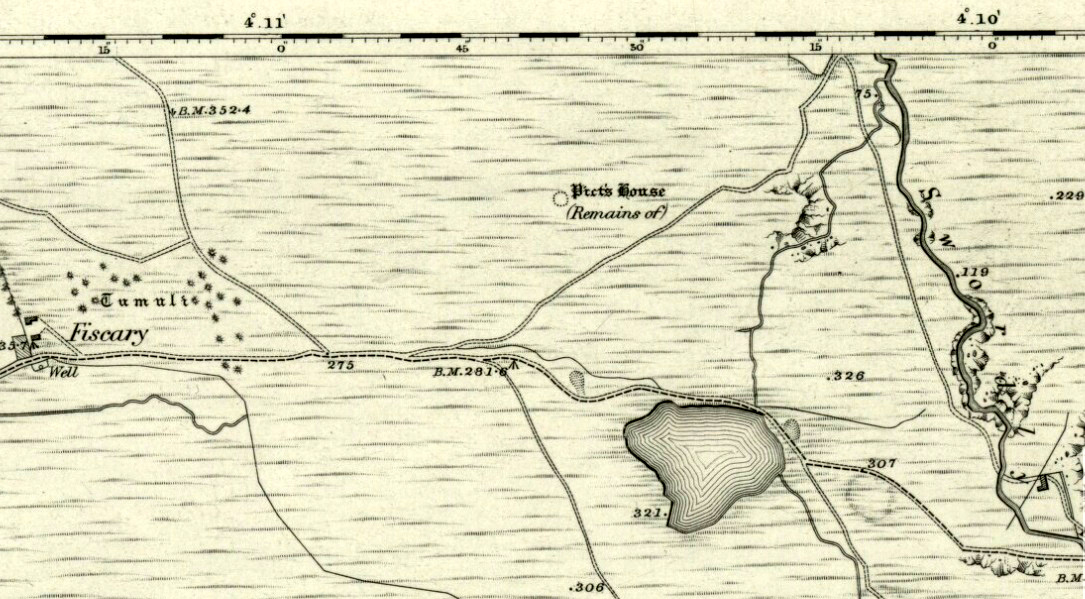
On 1878 OS-map as Picts House

On 1878 OS-map as Picts House

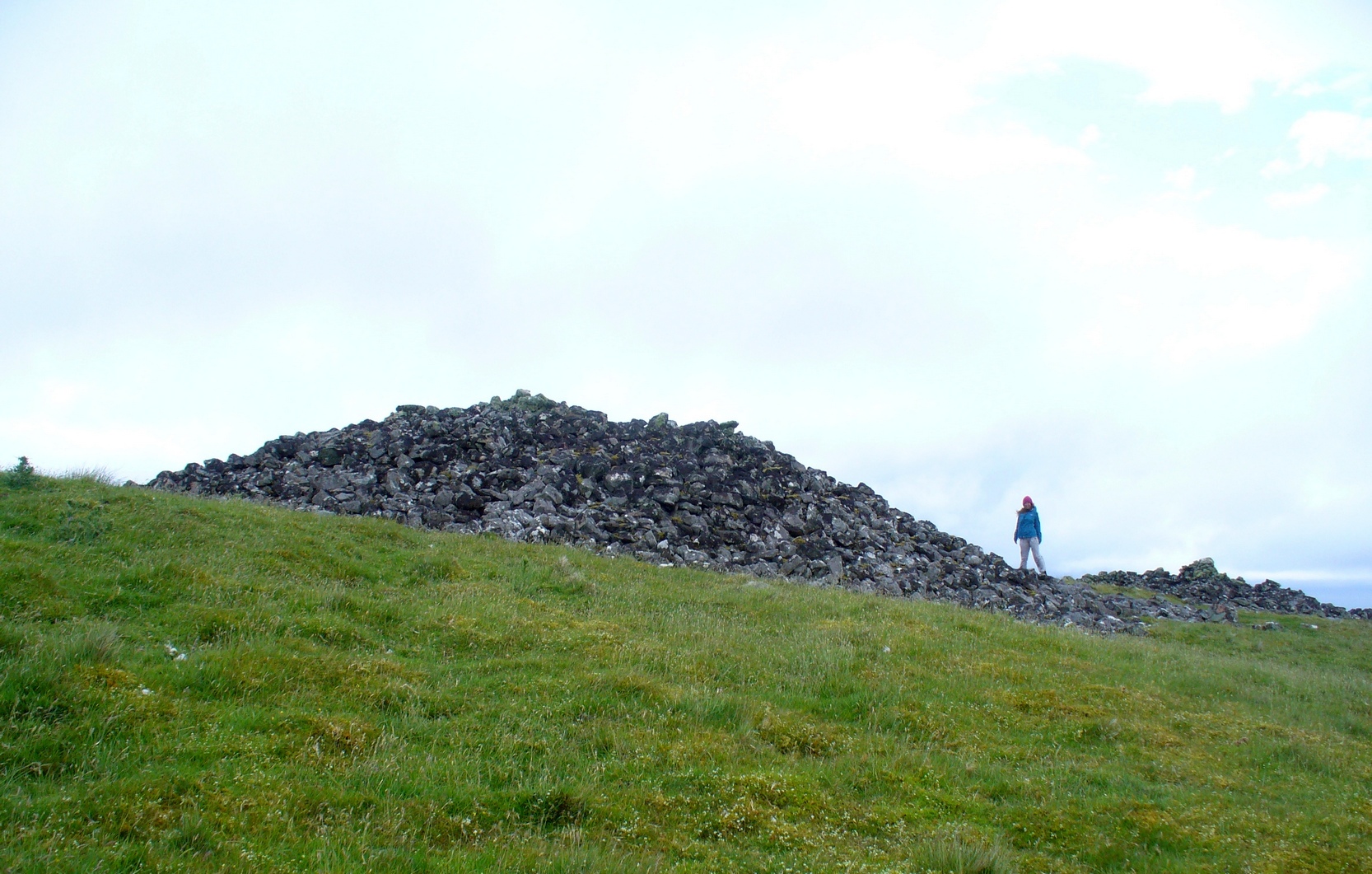
Close to the Fiscary 1 and Fiscary 2 tombs, this is the third and southernmost of the three giant cairns on this moorland hillside and is the second largest of the trio.  Curiously it was the only one highlighted by the Ordnance Survey lads in their cartographic analysis here in 1873—they somehow missed the others—when they told it to be a ‘Pictish House’, or broch.  A few years later when the Royal Commission (1911) fellas got their noses up here, they said that this,

“which is the most easterly, is circular in form, is about 68ft in diameter, and 15ft 6in to the apex, on which a small pile of stones has recently been erected.  The cairn does not appear to have been excavated, but the stones in several places have been pulled out, probably in attempts to discover the chambers or in pursuit of rabbits.”

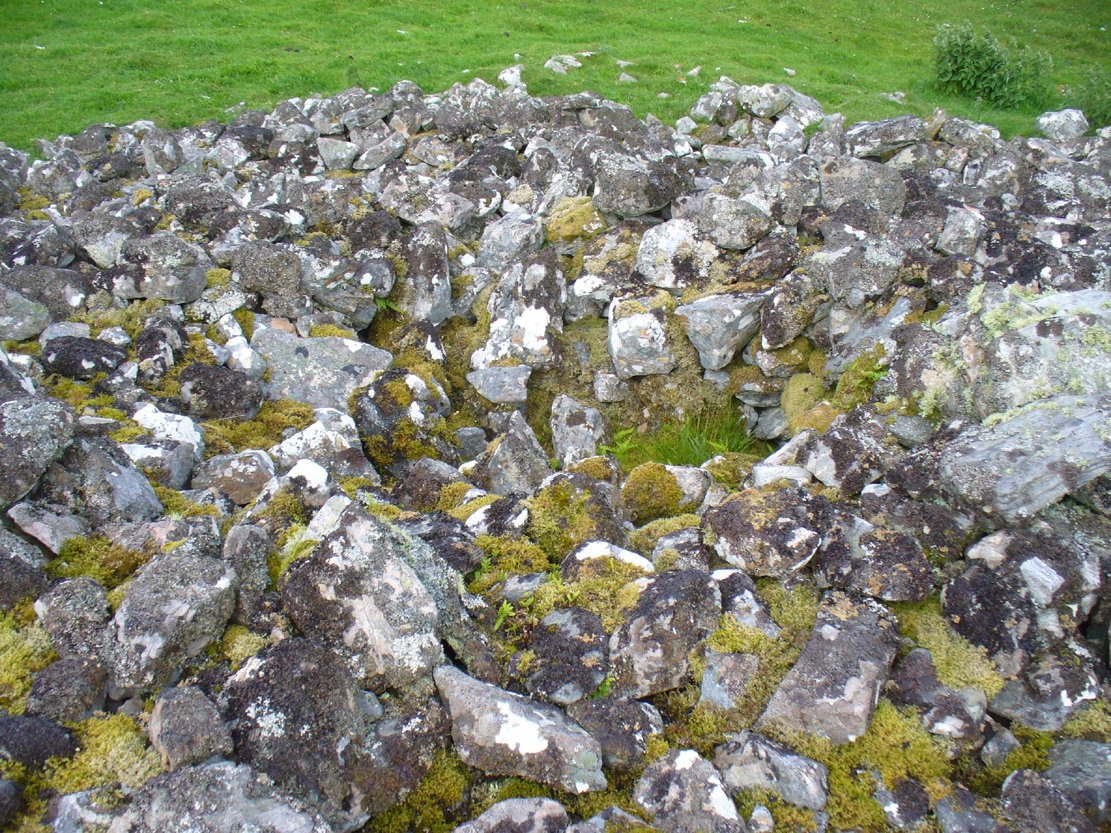
Looking into its centre

Looking into its centre

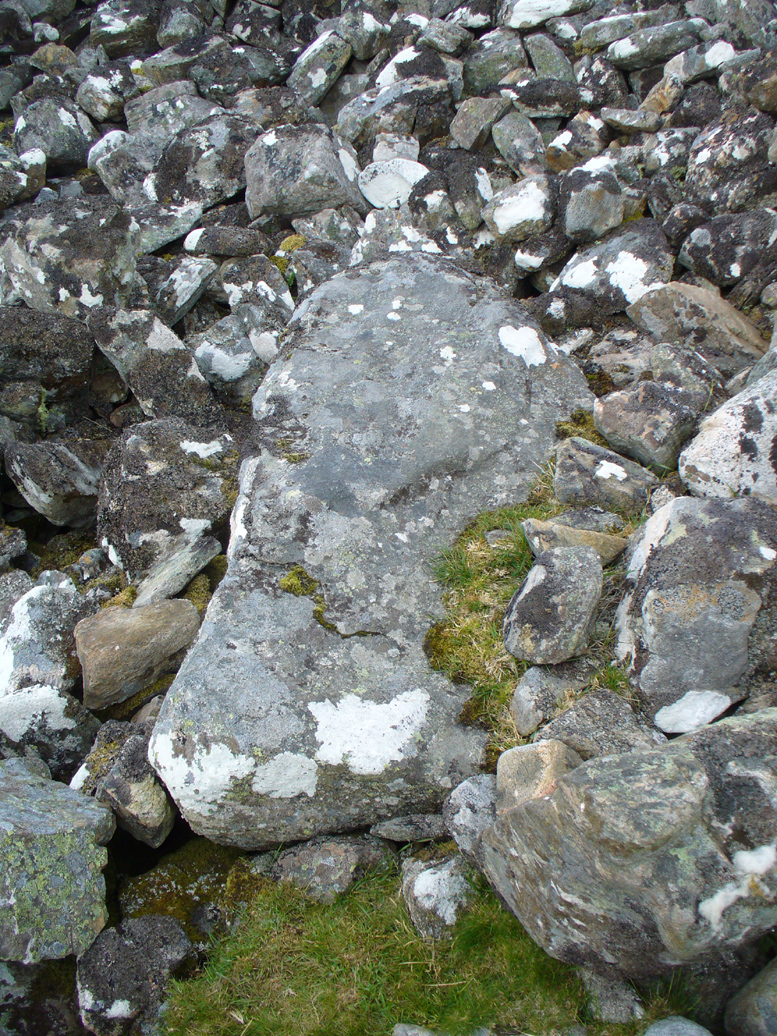
Long stone at southern edge

Long stone at southern edge

Considering the size of this giant cairn and its close association with is neighbours 150 yards northwest, I’m surprised at the lack of attention it’s been given.  Within the collapse of stones on its southern-side we find an elongated stone which seems to have stood upright at some point in the past, either at the very edge of the cairn, or just inside it.  It may even have been a covering stone to a collapsed entrance, but without an excavation we’re not gonna know for certain.

The fact that this cairn is on the slopes south of the crowning cairns of Fiscary 1 and Fiscary 2 implies that this was built some centuries later than them.  Also notable here is that the view to the north is blocked and we are instead only looking across a panorama east, south and west.

Folklore

Looking across into the east

Looking across into the east

Local tradition told that this was a Pict’s house, or broch (it may well have been) and is shown as such on the first Ordnance Survey account of the region in 1878.  Otta Swire (1963) told that this landscape was once peopled by giants who made the land and played a part in the creation of some of the giant tombs around here.  One time local school-teacher at Bettyhill, Alan Temperley (1977) also told us how the fairy folk lived close to the giant tombs of Fiscary.

References:

  1. Gourley, Robert, Sutherland: An Archaeological Guide, Birlinn: Edinburgh 1996.
  2. Henshall, Audrey S., The Chambered Tombs of Scotland – volume 1, Edinburgh University Press 1963.
  3. Henshall, Audrey S., “The Distant Past,” in The Sutherland Book (edited by Donald Omand), Northern Times: Golspie 1991.
  4. Henshall, Audrey S., The Chambered Cairns of Sutherland, Edinburgh University Press 1995.
  5. Lelong, Olivia C., “Writing People into the Landscape: Approaches to the Archaeology of Badenoch and Strathnaver,” University of Glasgow 2002.
  6. o’ Reilly, Kevin & Crockford, Ashley, What to See Around Bettyhill, privately printed 2009.
  7. Royal Commission on Ancient & Historical Monuments, Scotland, Second report and inventory of monuments and constructions in the county of Sutherland. HMSO: Edinburgh 1911.
  8. Sutherland, George, Folk-lore Gleanings and Character Sketches from the Far North, John o’ Groats Journal: Wick 1937.
  9. Temperley, Alan, Tales of the North Coast, Research Publishing Company: London 1977.

Acknowledgments:  HUGE thanks to Aisha Domleo and for getting me up here.

© Paul BennettThe Northern Antiquarian

Fiscary (2), Farr, Sutherland

Chambered Cairn:  OS Grid Reference – NC 73112 62604

Also Known as:

  1. Canmore ID 6445
  2. Carn Chaoile

Getting Here

A mile east of Bettyhill along the A836 road, watch out for the large piles of rocks up on the hill on your left (north).  Go through the gate, past the Fiscary 3 cairn and 150 yards northwest you’ll reach the crowning cairn on the hilltop itself – the Fiscary 2 cairn.

Archaeology & History

Fiscary 2 cairn, looking NW

The second of the three giant chambered cairns on this moorland hillside is the largest (only just!) of them all.  Positioned right on top of the small hill, this great mass of rocks stands out from the roadside a quarter-mile to the south quite blatantly, yet it somehow evaded the eyes of the early Ordnance Survey lads in their visit here in 1873 (though the nearby Fiscary 3 cairn was plotted).  Odd…

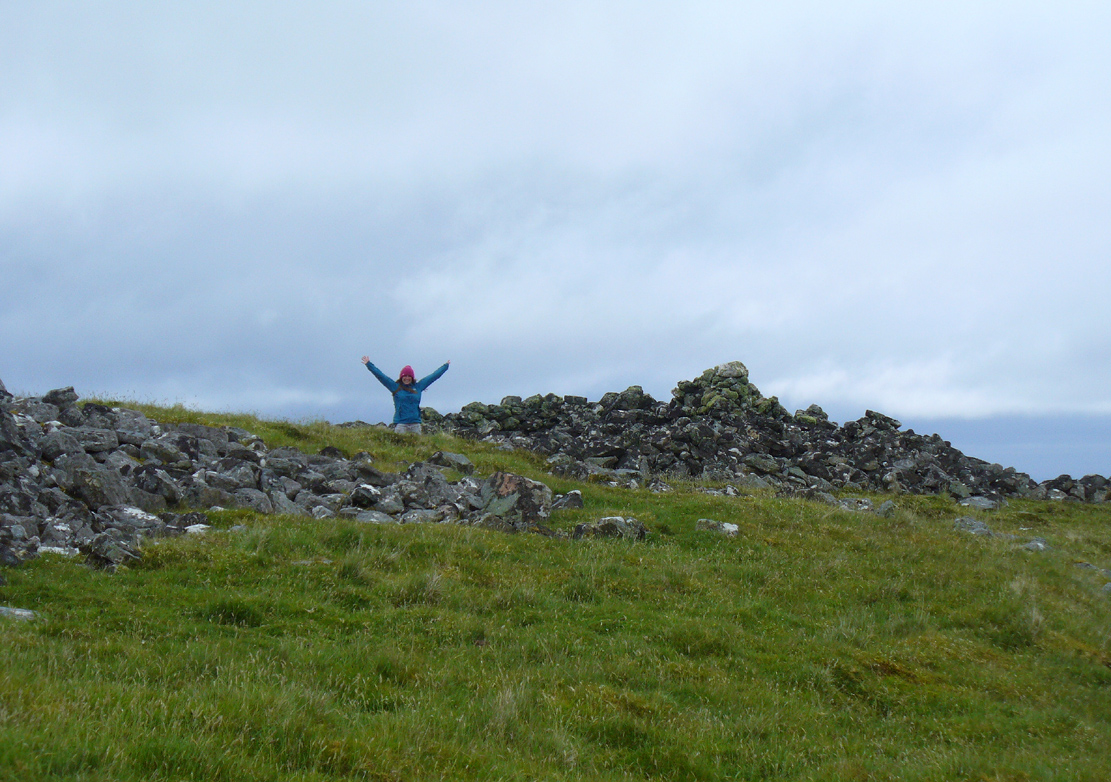
Aish by the side o’ the cairn

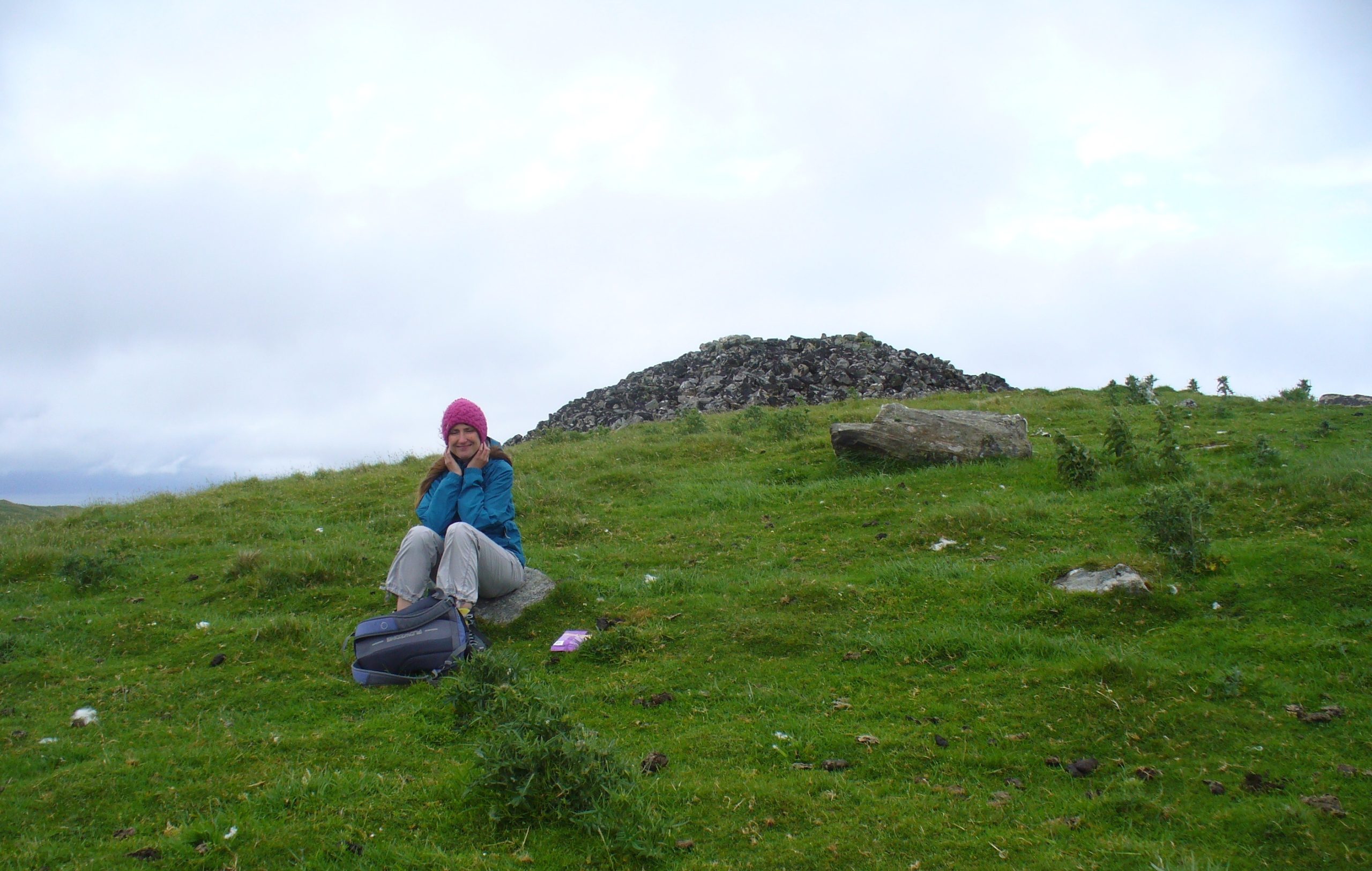
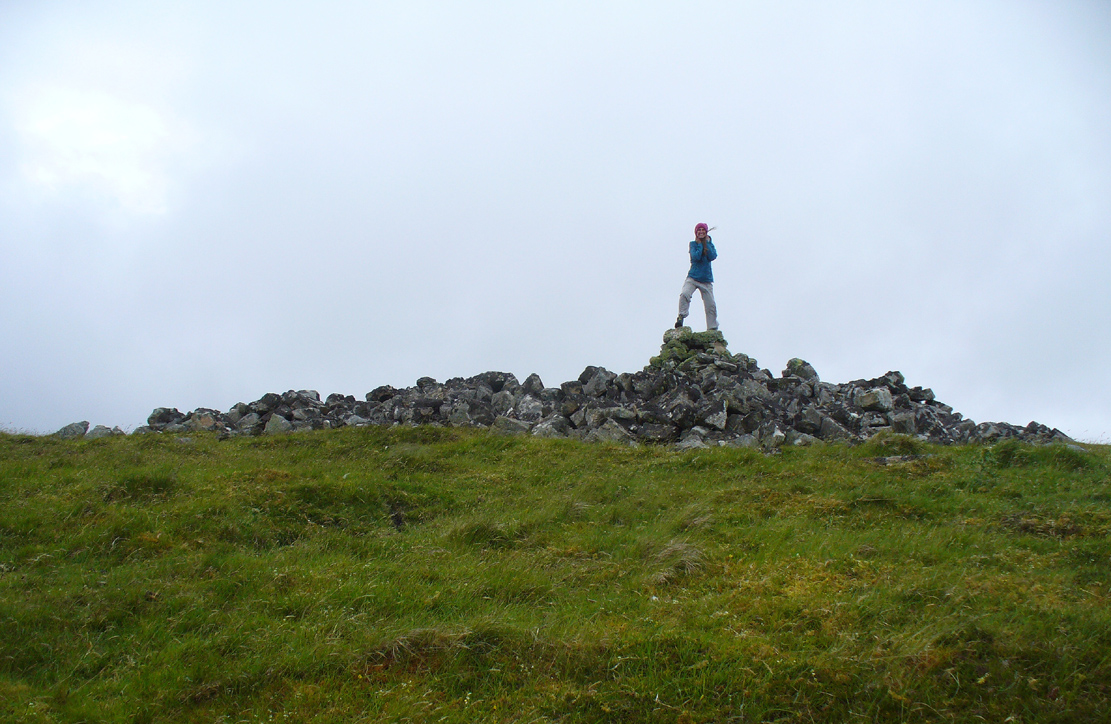
When I came here with Aisha and her clan a few weeks ago Nature was blasting us with full gales and so half her bunch returned after a short while, leaving us to get thrown about in the winds!  Even just trying to stand upright on this and its associated tomb proved difficult.  But despite this and the low grey clouds—typical of northern Scottish weather—it was obvious that the views from here would be superb, seeing far into the distance with a 360º view.  I have little doubt that other important prehistoric sites would be speaking with this giant neolithic cairn, but there is nothing in the archaeology accounts to help us on such matters.

The giant tomb is almost linked to its companion—Fiscary 1—by a low scatter of rocks running between them, with only a yard or two separating their disturbed masses.  Several archaeology students have posited that the two seemingly separate sites were, many thousands of years ago, perhaps one elongated chambered tomb, just like the ones found nearby at the Coille na borgie and Long Skelpick cairns; but it seems unlikely in this case…

Fiscary (2) on 1908 map
Fiscary (2), looking SE

Although Adam Gunn (1893) mentioned the “four large cairns” at Fiscally (the fourth and smallest is 262 yards to the west), the first real description I can find of the place comes from an article by a local man called Cathel Kerr (1892) who told us it was “about 220 feet in circumference, and 15 or 16 in height”; but most of his article dealt with his excavation into the adjacent Fiscary 1 tomb, which he noticed was connected by a stone platform that ran between the two sites.  This was the first mention of such a connecting platform—and a curious feature it is indeed.  When the Royal Commission lads came here in May 1909 they also noted this connecting platform.  They found that the cairn itself,

“does not appear to have been excavated.  It is circular with a diameter of about 52ft and is some 10ft high to the top of the modern pile of stones on its apex.  It presents a peculiar feature.  At the north end is clearly visible a broad platform of stones extending to a distance of 25ft from the base of the cairn and, though largely overgrown with turf, traceable by the outline of stones almost entirely around it.  This platform has been described as a neck connecting the two cairns (Fiscary 1 and 2, PB), but in reality it stops 7ft distant from the adjacent cairn.”

In strong gales at Fiscary 2
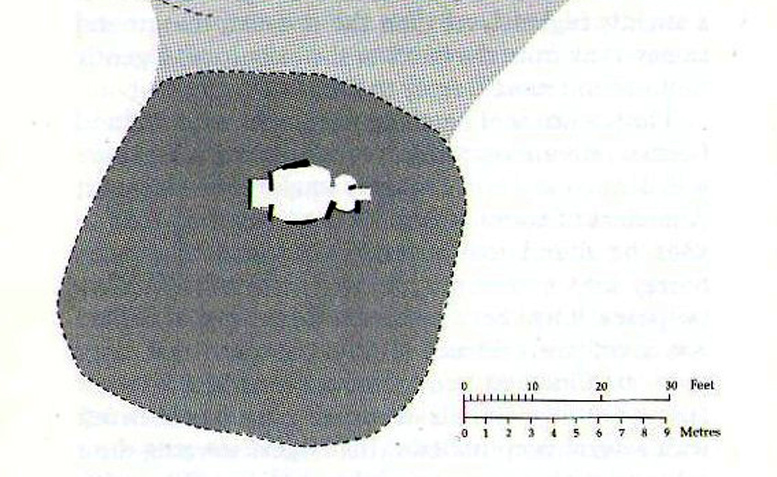
Henshall’s plan of Fiscary 1 & 2

Indeed, this “platform” seems to have been either deliberately constructed with the hilltop cairn positioned on top of it, or has been set around the tomb.  It’s difficult to say with any certainty without further excavation.

The great Audrey Henshall (1963; 1995) wrote extensively about this ancient monument in her works, finalizing her site entry in The Chambered Cairns of Sutherland (1995).  After describing in some detail the obvious archaeological association this site has with Fiscary 1, she gave us a detailed description on this one and wrote:

“The larger south cairn (Fiscary 2, PB) is bare, steep-sided, and has been little disturbed.  The diameters are between 19.5 to 21.5m, and the height is 5.5m measured from the NW.  The edge is clear for about half of the circuit.  The surrounding platform is quite low and is partly covered with peat and deep heather which in places obscure the edge.  The platform varies in width from 4.8 to 7.3m.  On the SE side the cairn edge is clear and there is no sign of the platform.  It appears on the NE side where it is largely free of heather, and the cairn material merges into its stones.  This part of the platform is edged by a rough kerb which fades away westwards into the spread of stones which links the two cairns.  In the area between the cairns the stones are mainly covered by peat on which grow turf and heather.  The spread of stones appears to be thin, but on the NW side of the cairn, where there is evidently a drop in ground level, breaks in the peat cover show that here the stone spread has considerable depth.  Round the W side the platform is heather-covered, and along the SW part, where the hill drops away steeply, there is a rough kerb at a lower level than elsewhere, within which the surface of the platform rises to the base of the cairn.  The S end of the platform, which here is bare stones, seems to turn sharply towards the S edge of the cairn, though the actual edge of the platform is indefinite.”

The likelihood is that this cairn is the oldest of the cluster of three found here, most likely constructed in the neolithic period.  Its position in the landscape would indicate that the site would have been built to commemorate the spirit of a local tribal elder, a King or Queen.  It’s a superb site and I’ll be visiting it again very soon indeed!

Folklore


Bouncy elven sprite flies by

The folklorist Otta Swire (1963) told that this region was once peopled by giants who created the landscape itself around here (a common attribute of giants the world over), and they also played a part in the creation of this and other giant tombs in the area.  The one time local school-teacher at Bettyhill, Alan Temperley (1977), also told us that the fairy folk lived close to the giant tombs of Fiscary.

References:

  1. Gourley, Robert, Sutherland: An Archaeological Guide, Birlinn: Edinburgh 1996.
  2. Gunn, Adam & Mackay, John, Sutherland and the Reay Country, John Mackay: Glasgow 1893.
  3. Henshall, Audrey S., The Chambered Tombs of Scotland – volume 1, Edinburgh University Press 1963.
  4. Henshall, Audrey S., “The Distant Past,” in The Sutherland Book (edited by Donald Omand), Northern Times: Golspie 1991.
  5. Henshall, Audrey S., The Chambered Cairns of Sutherland, Edinburgh University Press 1995.
  6. Kerr, Cathel, “Notice of the Excavation of a Chambered Cairn in the Parish of Farr, Sutherlandshire,” in Proceedings Society of Antiquaries, Scotland, volume 26, 1892
  7. Lelong, Olivia C., “Writing People into the Landscape: Approaches to the Archaeology of Badenoch and Strathnaver,” University of Glasgow 2002.
  8. o’ Reilly, Kevin & Crockford, Ashley, What to See Around Bettyhill, privately printed 2009.
  9. Sutherland, George, Folk-lore Gleanings and Character Sketches from the Far North, John o’ Groats Journal: Wick 1937.
  10. Temperley, Alan, Tales of the North Coast, Research Publishing Company: London 1977.

Acknowledgments:  To the beautiful Aisha Domleo, for her images, bounce, spirit and madness – as well as getting me up to see this cluster of sites. And a Huge thanks for use of the Ordnance Survey map in this site profile, reproduced with the kind permission of theNational Library of Scotland

© Paul BennettThe Northern Antiquarian

Fiscary (1), Farr, Sutherland

Chambered Cairn:  OS Grid Reference – NC 73102 62629

Also Known as:

  1. Canmore ID 6445
  2. Carn Chaoile
  3. SUT 29 (Henshall)

Getting Here

Fiscary 1 cairn - from Fiscary 2

Fiscary 1 cairn – from Fiscary 2

A mile east of Bettyhill on the A836 road, watch for the large piles of rocks up on the hill on your left (north).  Go through the gate, past the Fiscary 3 cairn and 150 yards northwest you’ll reach the crowning cairn of Fiscary 2 on the hilltop itself.  Fiscary 1 is just a few yards in front of you.

Archaeology & History

Although this is the smallest of the Fiscary cairns, it is the one that has had been investigated more than the others in this cluster—and you can tell as it’s been dug into.  However, saying that, when Aisha and me were here a few weeks ago, the wind was blowing with such strength that we could give it little more than a cursory overview, as we were both getting blown about like a pair o’ puffters in the gale that was raging in from the sea!  Twas quite overwhelming…
Fiscary 1 to the rear

Fiscary 1 to the rear

One of the first things you notice is how this cairn is inextricably linked, both physically and otherwise, to its close partner on the hilltop only yards away: the Fiscary 2 cairn.  Fiscary 2 reaches outwards towards where we now stand—slightly below the larger tomb immediately north (the airt of Death itself): almost as if an ancient Queen and Her King were resting still hand-in-hand in their respective burial sites.

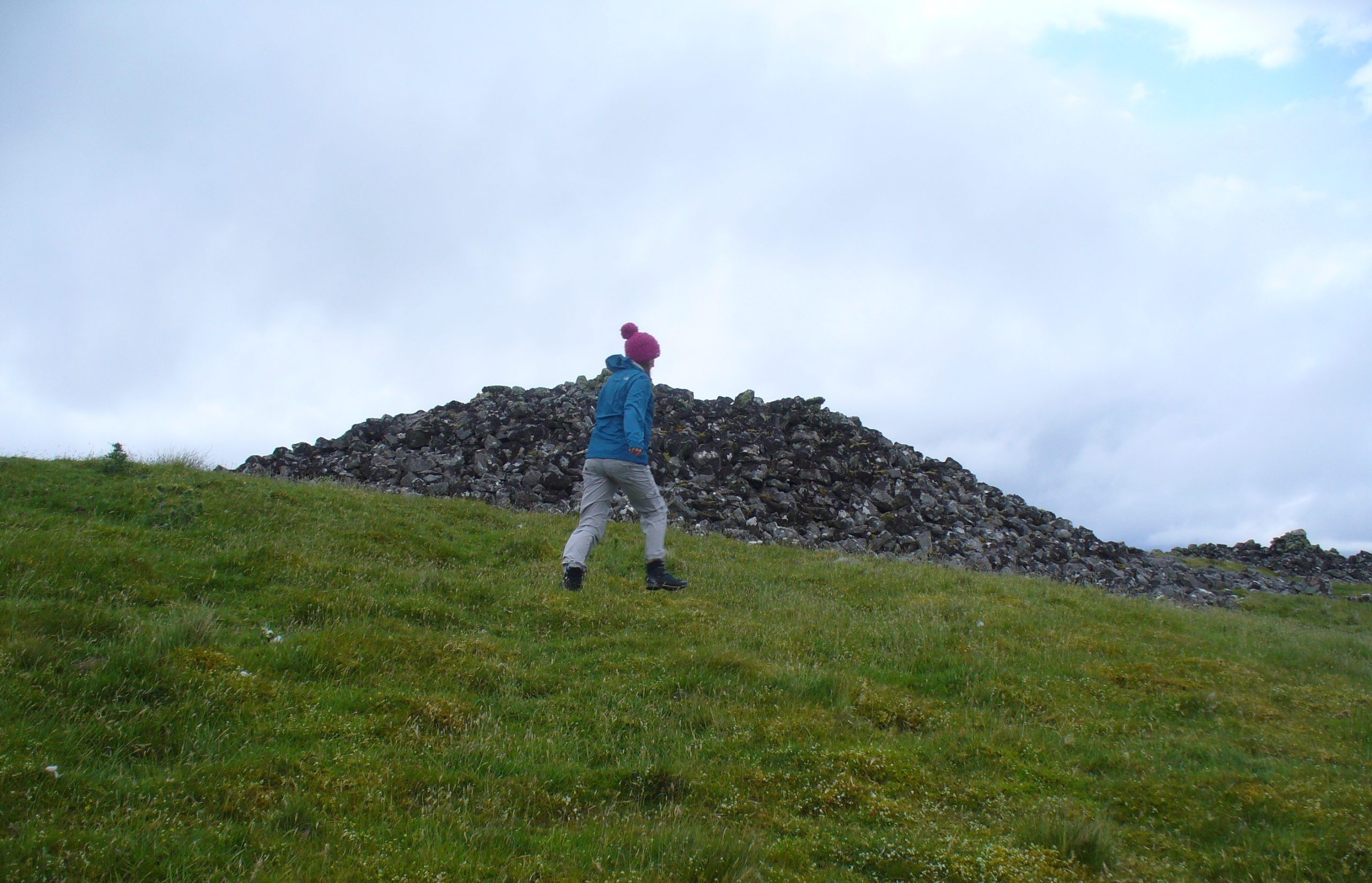
Aisha on top!

Aisha on top!

…And although such romance may seem nothing more than that, recall that we are probably looking at two giant archaic monuments whose birth emerged in the neolithic: when time was measured by night, not day; when the Moon was Prima Mater’s aide and portender; and patriarchy had yet to be borne…. Giant hilltop cairns were the places of our ancient shaman-kings, queens and tribal elders, whose integral relationship with the cycles of the world to which we are (still) bound, were culturally very different in some fundamental ways, before rites of passage were disposed of…. But I’m moving away from the modern history of the Fiscary tomb…. Soz!

Around the time when some of the indigenous northerners up here were seeing the fading lights of their animistic cosmology disappear into the emergence of ‘history’, when the traditional tales were ebbing, Fiscary 1 was at least being written about—albeit in a detached way, as a museum piece, a piece of architecture.  It’s the way things have become.  The tomb was excavated by a local man called Cathel Kerr in the latter half of the 19th century, although he reported that it had already been dug into a few years earlier.  Kerr told that some of the stones had been taken by an unnamed local for building purposes (not good!).  “It had been opened from the top” he said—continuing:

“and there was abundant evidence around the cairn, that large slabs of stone had been removed from the interior.  A little observation showed that there was the appearance of an internal chamber… The…cairn is about 150 feet in circumference and about 9 or 10 feet in height, and between it and (Fiscary 2) there is what seems to me to be a neck of stones joining the two cairns… Most of the neck joining the two cairns is covered over with turf, but a very slight observation reveals the fact that underneath it the mass of stones is continuous.  The apparent depth of stones is from 3 to 4 feet. It is most unlikely that this neck could have been formed by stones falling from the top of the cairns.

“The chamber, when opened, proved to be tripartite.  The entrance is from the west or northwest side, between two upright stones, with a large heavy slab thrown across them.  The passage is only 3 or 4 feet long, and about 3 feet high, and nearly the same in width.  This leads into a small chamber measuring about 6 feet by 3 feet.  In front of it, on the north side, a large upright slab projects, and helps to form part of the end of the inner chamber and a division between the two on the south side.  In all likelihood the stone corresponding to that one has been removed, so that there is nothing to mark the division between the chambers on that side.  The larger chamber measures 6 feet 4 inches by 7 feet 9 inches.  The sides are made up of large upright slabs and masonry, built up between the slabs.  The corners are all rounded and there is the appearance of vaulting by the stones overlapping one another.  The height of this chamber at present is about 5 feet.  The end of the chamber is made up by two upright stones, with nearly 2 feet of an entrance between them, leading into the innermost chamber.  This chamber is a very irregular oblong; indeed the ends are rounded.  On an average it is 5 feet 9 inches long, by 33 inches wide, and 3 or 4 feet in height.  It had the appearance of being covered over with slabs, some of which stood on edge inside; but of this I am not very sure, as the roofing of all the chambers has been interfered with.

“Inside there lay on the floor a large quantity of broken stones and black earth.  Underneath there was what seemed a mixture  of ashes and earth, with numerous pieces of charred wood, but no charred bones as far as I could see.  Underneath that layer there was ordinary gravel.  I found some fragments of bones on the innermost part, and some in the larger chamber.  They do not appear to me to be of very great antiquity.  A small vitrified mass was found on the floor.”

When the Royal Commission (1911) lads turned up to see the site in 1909 they reported—in a rather exaggerated manner—that the cairn “is now completely destroyed” and then in the next sentence said,

“The chamber is half filled-up with debris and only two or three large slabs remain, the others having disappeared.  Its diameter has been about 46ft, and its height 4ft to 5ft.”

If the Royal Commission believe that’s an example of something being “completely destroyed”, they should turn their eyes and attention to sites like the Nixon’s Station cairn on top of Ilkley Moor which, when I was young, was larger than any of the Fiscary cairns; but somehow under the watchful eyes of the regional archaeologists in the 1980s and ’90s, was levelled to the ground – i.e., properly destroyed!

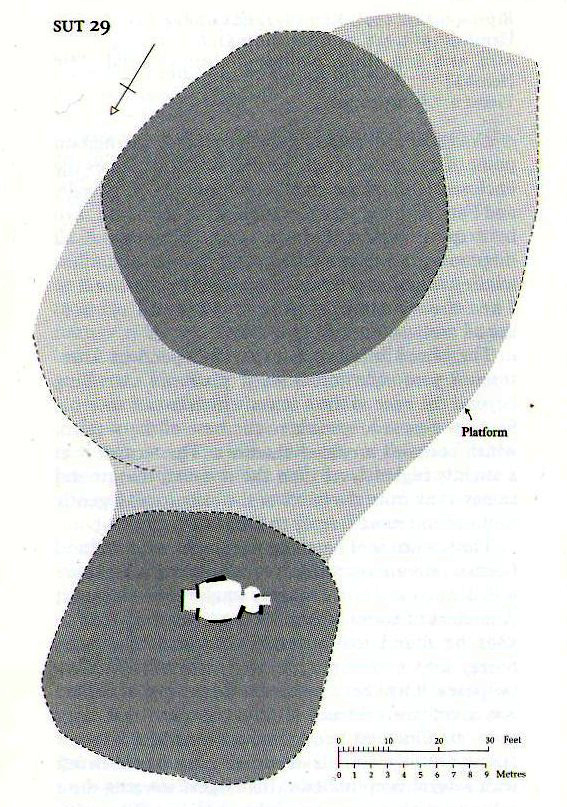
Audrey Henshall's ground plan

Audrey Henshall’s ground plan

In more recent years the cairn has received the honourable attention of the great Audrey Henshall (1963; 1995) who, in her updated site profile of Fiscary 1, told us not much more about the site than her predecessor Kerr.  Contextualizing the place with its partner Fiscary 2 and the platform upon which it rests, she wrote:

“The paired cairns appear to be independent structures 8.5m apart, though a platform extending beyond the base of the south cairn, which has no internal features exposed, spreads to the base of the north cairn, which contains a ruined chamber… The north cairn is of bare angular stones with turf and heather only encroaching over the edges.  Its limits are well-defined and give a roughly square plan with short diameters of 16.5m… Kerr exposed the roofless tripartite chamber, and most of the structure which he recorded was visible in 1955 (Henshall 1963).  Less could be seen in 1992 as the chamber had been largely filled by loose stones…”

Much like the situation as it is today.  More recently a small pile of stones has been added to the top of the cairn, from whence the view is excellent to the north, east and west.  The larger Fiscary 2 cairn blocks the view directly south.

Folklore

Otta Swire (1963) not only told that this landscape was once peopled by giants who made the land and played a part in the creation of some of the giant tombs around here.  The one time local school-teacher at Bettyhill, Alan Temperley (1977), also told us that the fairy folk lived close to the giant tombs of Fiscary.

References:

  1. Eliade, Mircea, The Myth of the Eternal Return, RKP: London 1955.
  2. Gourley, Robert, Sutherland: An Archaeological Guide, Birlinn: Edinburgh 1996.
  3. Gunn, Adam & Mackay, John, Sutherland and the Reay Country, John Mackay: Glasgow 1893.
  4. Henshall, Audrey S., The Chambered Tombs of Scotland – volume 1, Edinburgh University Press 1963.
  5. Henshall, Audrey S., “The Distant Past,” in The Sutherland Book (edited by Donald Omand), Northern Times: Golspie 1991.
  6. Henshall, Audrey S., The Chambered Cairns of Sutherland, Edinburgh University Press 1995.
  7. Kerr, Cathel, “Notice of the Excavation of a Chambered Cairn in the Parish of Farr, Sutherlandshire,” in Proceedings Society of Antiquaries, Scotland, volume 26, 1892
  8. Lelong, Olivia C., “Writing People into the Landscape: Approaches to the Archaeology of Badenoch and Strathnaver,” University of Glasgow 2002.
  9. o’ Reilly, Kevin & Crockford, Ashley, What to See Around Bettyhill, privately printed 2009.
  10. Royal Commission on Ancient & Historical Monuments, Scotland, Second report and inventory of monuments and constructions in the county of Sutherland. HMSO: Edinburgh 1911.
  11. Sutherland, George, Folk-lore Gleanings and Character Sketches from the Far North, John o’ Groats Journal: Wick 1937.
  12. Temperley, Alan, Tales of the North Coast, Research Publishing Company: London 1977.

Acknowledgments:  Huge thanks to beautiful Aisha Domleo again, for help with some of the photos – and adding your elegant spirit and energy to the place – as well as getting me up here in the first place! 

© Paul BennettThe Northern Antiquarian

Butter Well, Dollar, Clackmannanshire

Sacred Well:  OS Grid Reference – NN 9610 0018

Getting Here

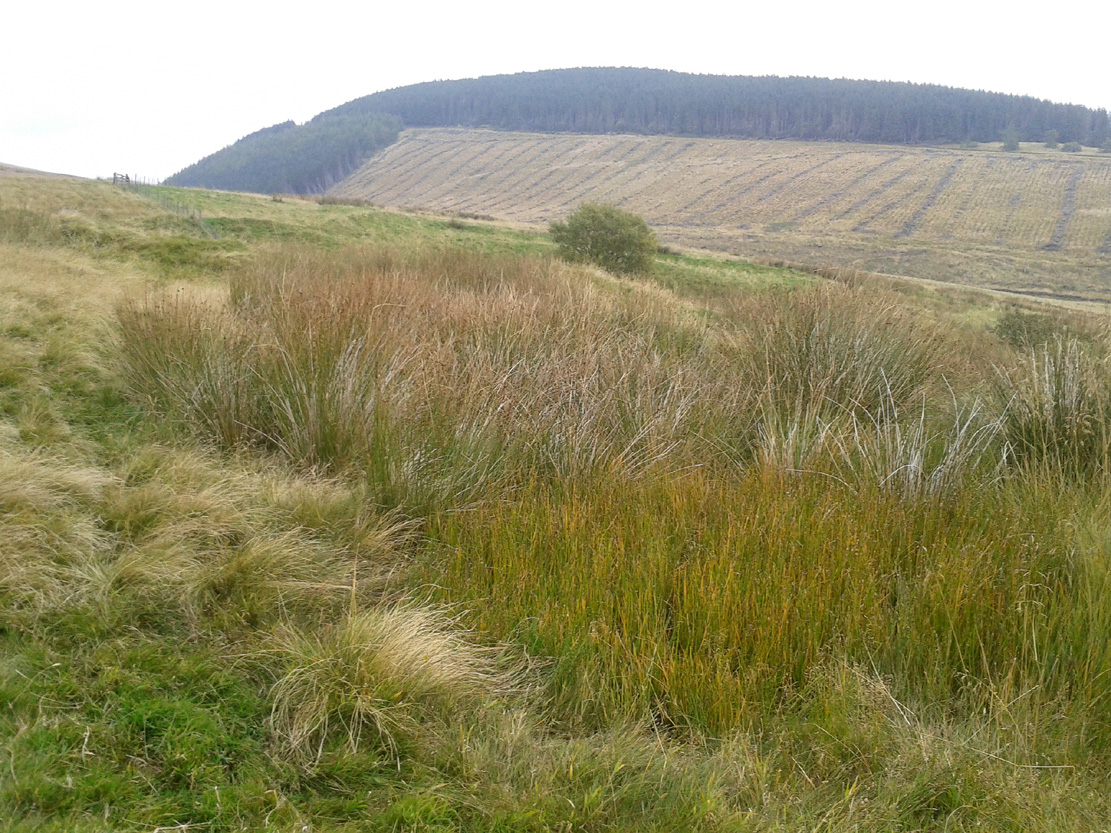
The marshland of the Butter Well

The marshland of the Butter Well

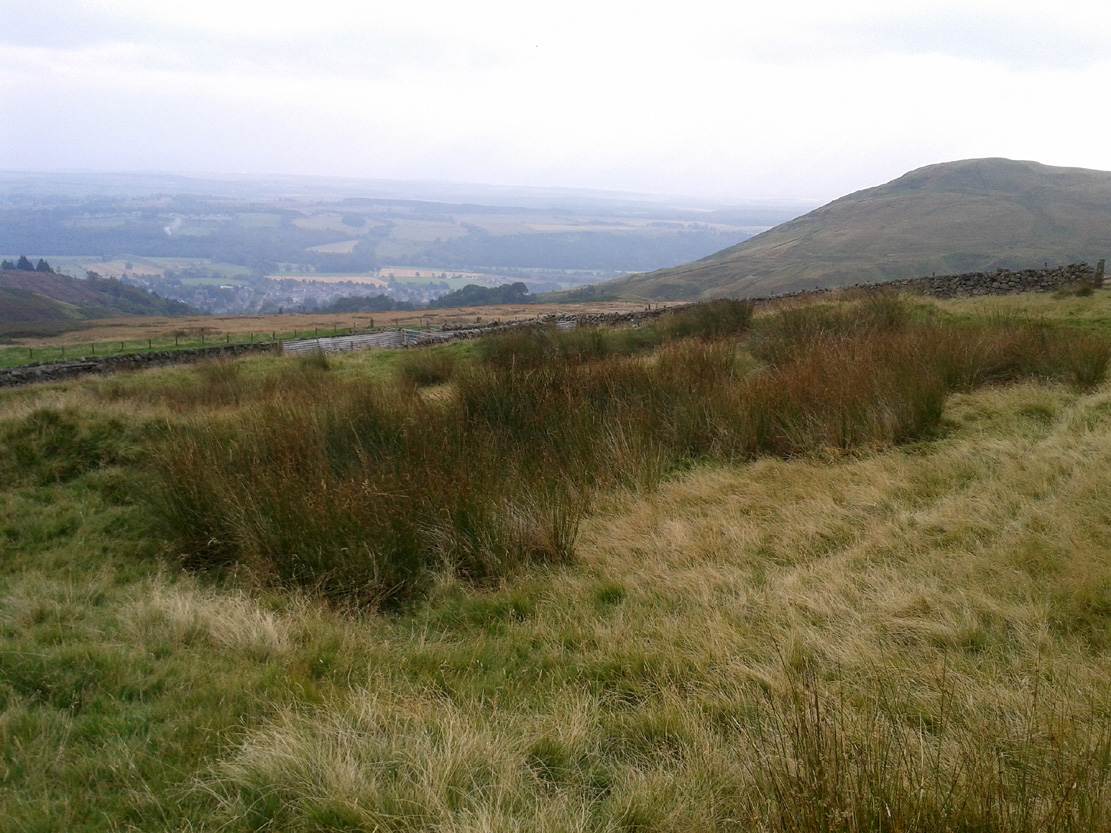
Take the long uphill road to Castle Campbell and park up at the top.  From here, bear to your right and walk up the footpath onto the hills.  A few hundred yards along you’ll reach a gate and you have the choice of continuing along the path, or dropping down into the small glen and up the other side, towards the ruins of an old settlement called Craiginnin, whose walls you can see from here.  Head there, keeping to the path that leads you to it, going through the first couple of gates and out the other side.  Just above the burn, some very overgrown walling is evident (possibly Iron Age in nature), where excessive Juncus reeds are growing. Amidst this is a boggy pool.  Unless the boggy-land across the burn is the place in question, this is probably the spot!

Archaeology & History

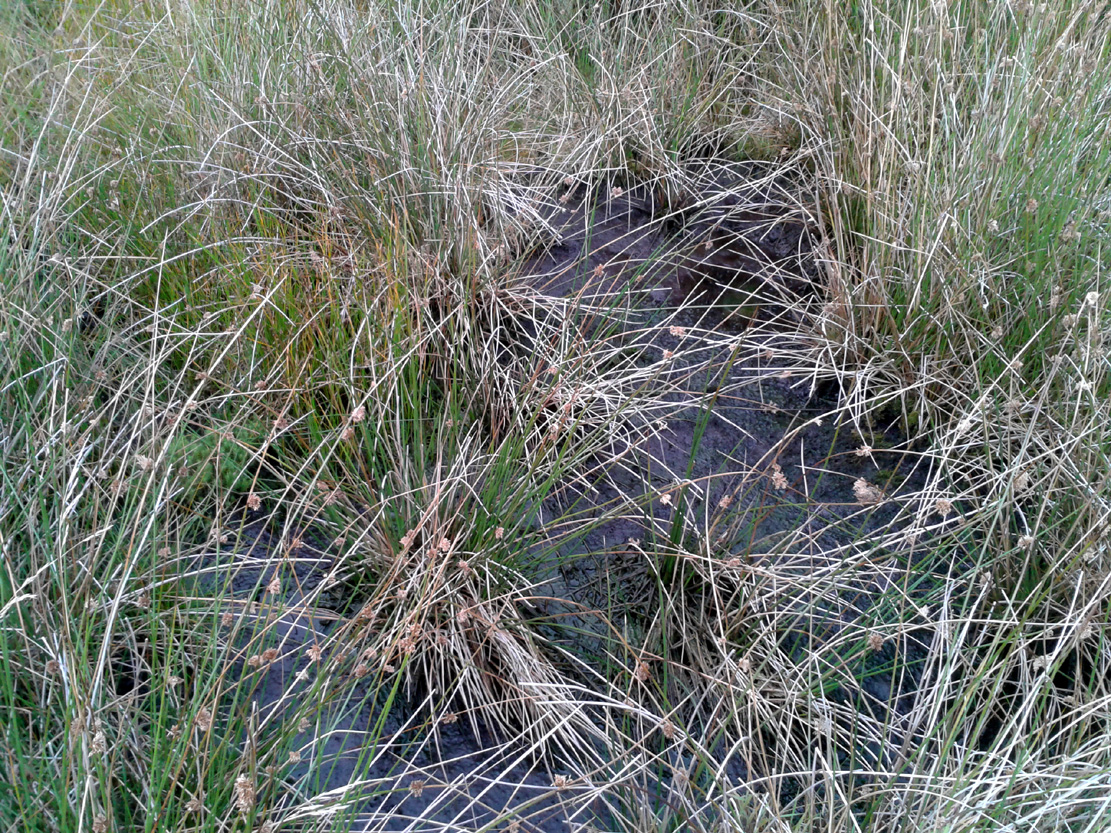
The boggy waters of the well

The boggy waters of the well

There’s very little to see here today other than a murky boggy pool, indicating it hasn’t been used for a long time; although when we visited the place there were several animal tracks into the edge of the pool, indicating that they still drink here.  This implies it has/had some medicinal virtues, but even I wasn’t going to try drinking this!  If there was ever a stone trough here, it too has gone (probably nabbed by a farmer in bygone years) and there seems to be no archaeocentric reference to the place.  The well was described in place-name and folklore accounts, where its waters were used by the people living at this settlement to clean and prepare the butter made by the farmer.

Folklore

The hills, glens and burns of the Ochil range were well-known haunts of fairy folk—and Craiginnan was no exception.  In an early article in the Scottish Journal of Topography, a pseudonymous “J.C.” of “13 Dalrymple Place” (who was it?) told of several dying traditions and, amidst it all, the story behind the Butter Well above Castle Campbell:

“The meadow of Craiginnan, in the vicinity of these hills, was (and still is) famous for the quantities of hay it yearly produces.  Nearly seventy years ago, David Wright rented the farm of Craiginnan.  His servants on cutting the grass of the meadow, were in the custom of leaving it to the management of the fairies.  These aerial beings came from Blackford, Gleneagles, Buckieburn, etc., and assembling on the summit of the Saddlehill descended to their work among the hay.  From morning till evening they toiled assiduously.  After spreading it out before the sun, they put it into coils, then into ricks, when it was conveyed into the adjacent farm-yard, where they built it into stacks.  This kindness of the fairies David Wright never forgot to repay, for, when the sheep-shearing came round, he always gave them a few of the best fleeces of his flock.  He flourished wonderfully, but finding his health daily declining, and seeing death would soon overtake him, he imparted to his eldest son the secret of his success and told him ever to be in friendship with the “gude neebors.”

“The old man died and was succeeded by his son, who was at once hard, grasping and inhospitable.  The kind advices and injunctions given him by his father were either forgotten or unattended to.  Hay-making came round, but young Wright, instead of allowing the “green-goons” to perform what they had so long done (thinking thereby to save a few fleeces), ordered his servants to the work.  Things went on very pleasantly the first day, but on going next morning to resume their labour, what was their surprise to find the hay scattered in every direction.  Morning after morning this was continued, until the hay was unfit for use.  In revenge for this, he destroyed the whole of their rings, ploughed up their green knolls, and committed a thousand other offences.  He had soon reason, however, to repent of these ongoings.

“One day the dairymaid having completed the operation of churning, carried the butter, as was her wont, to the butter well on the east side of the house, to undergo the process of washing, preparatory to its being sent away to the market.  No sooner had she thrown it into the well, than a small hand was laid upon it, and in a second the bright golden treasure disappeared beneath the crystal waters!  The servant tried to snatch it; but alas! it was lost—irrecoverably lost forever! and as she left the place a voice said:

“Your butter’s away’
To feat our band
In the fairy ha’.”

“The horses, cows and sheep sickened and died; and to complete all, Wright, on returning from a Glendevon market, night overtook him in the wild pass of Glenqueich.  He wandered here and there, and at last sunk into a “well-e’e”, in which he perished.  After his death the farmhouse went gradually to demolition and its bare walls are now only to be seen.”

Butter Well site, looking west

Butter Well site, looking west

The place-name ‘Craiginnan’ is thought to derive from the somewhat banal “crags by the anvil-shaped land”, which is grasping at some desperate straws if you ask me!  But it’s also been suggested by Angus Watson (1995) to possibly derive from the “Gaelic Creag Ingheann, maiden crag”, which would acquaint it with the nearby Maiden’s Well and Maiden’s Castle a mile northeast of here—both of which are possessed of their own fairy-lore.  Makes a lot more sense too!

References:

  1. “J.C.”, “Rhymes and Superstitions of Clackmannanshire,” in Scottish Journal of Topography, Antiquities & Traditions, volume 2, Jul 1, 1848.
  2. Simpkins, John Ewart, County Folklore – volume VII: Examples of Printed Folk-Lore Concerning Fife, with some Notes on Clackmannan and Kinross-Shires, Folk-Lore Society: London 1914. p.312
  3. Watson, Angus, The Ochils: Placenames, History, Tradition, PKDC: Perth 1995.

© Paul BennettThe Northern Antiquarian


An Sithean, Lawers, Kenmore, Perthshire

Legendary Hill:  OS Grid Reference – NN 6806 3976

Getting Here

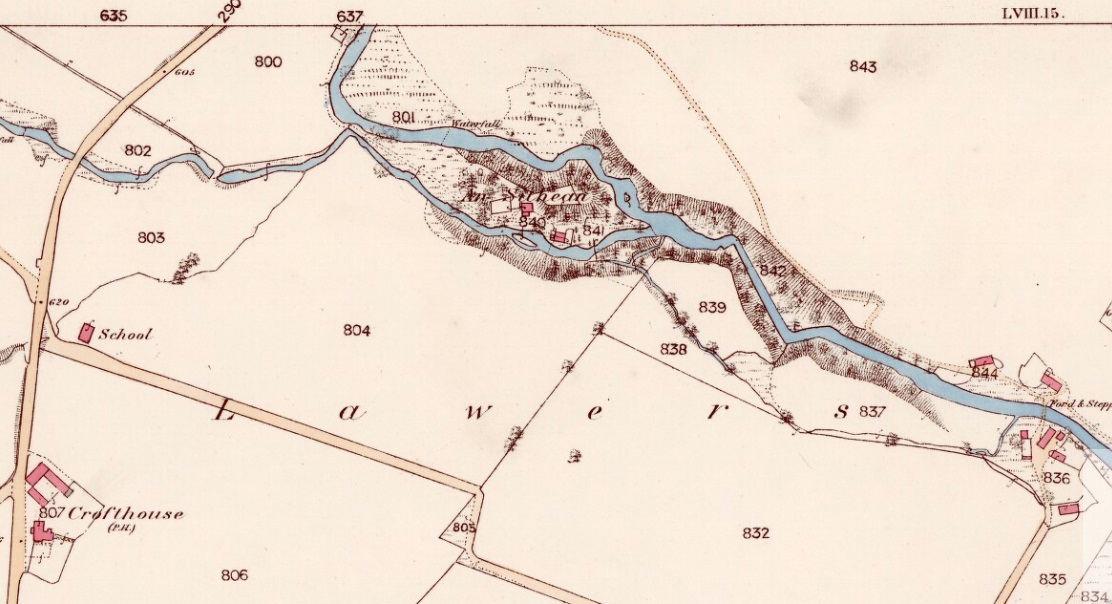
An Sithean on 1862 OS-map

Take the A827 road on the north-side of Loch Tay between Killin and Kenmore, and roughly halfway along you’ll find the tiny hamlet of Lawers.  Go down into the hamlet itself and, amidst the remains of the old trees where now are houses, nestled on a rise in the land with burns (streams) on either side, remains of the fairy mound of An Sithean still lives…

Folklore

Remnants of the legends of little people are legion in the Scottish mountains.  Sadly, many of them died when the English arrived and culled the population in ‘The Clearances’ of the 19th century – none moreso than in the area surrounding Loch Tay.  But thankfully, in the latter-half of the 19th century, a local man called James MacDiarmid (1910), took it upon himself to write down many of the old stories told by the remaining locals – as well as narrate those he remembered as a boy, as told by the elders around him.  Whilst tales of ‘fairies’ and other such creatures are thought by city-minds to be little other than fantasies, mountain-folk cosmologies differ greatly to those who are disconnected from the natural world.  Genius loci abound, and animism is the basic plinth integral to communities in the hills, where the world is much much more real.  This is one such tale…

“Not many years ago there lived in the neighbourhood of Killin a man who was in the habit of recounting his wonderful adventures with the white horse of the fairies.  When coming home one night from Kenmore market, and just as he was passing Sithean, Lawers, he heard most enchanting music proceeding from the knoll.  Unable to resist the temptation, he gradually went nearer and nearer the fairies’ place of abode, till at last he was fairly among them.  They received him most kindly, and on parting gave him one of their white horses to carry him home.  His steed went through the air at a speed almost equalling that of lightning, and in a few minutes he found himself above a house at Clifton, Tyndrum, some twenty-five miles westward from Lawers.  Happening to shout “ho!” when he was right above the chimney, the fairy horse threw him off its back, and down he dropped feet foremost through the wide, old-fashioned chimney, and alighted in the midst of a wedding party, much to their surprise and alarm. He continued in their pleasant company till daylight, when he returned home at his leisure, thanking the fairies for the pleasure they had so unexpectedly given him!”

Usually, tales such as this relate to the existence of prehistoric cairns or tumuli (burial sites), but no such archaeological remains have ever been known to live here.  Equally curious is how the man in this tale wasn’t kept in the timeless realms, beloved of faerie-land, where reveries with them would take decades from a man’s life, even though it only felt like one night.  This would imply

I’ve come across old locals who still speak, not just of the little-folk, but of other hauntings in this beautiful part of Loch Tay.  May the land not be cursed by the fools who put their idea of ‘development’ in front of the genius loci here; lest madness and ill-fortune will prevail…

References:

  1. MacDiarmid, James, “More Fragments of Breadalbane Folklore,” in Transactions of the Gaelic Society Inverness, volume 26, 1910.

© Paul Bennett, The Northern Antiquarian
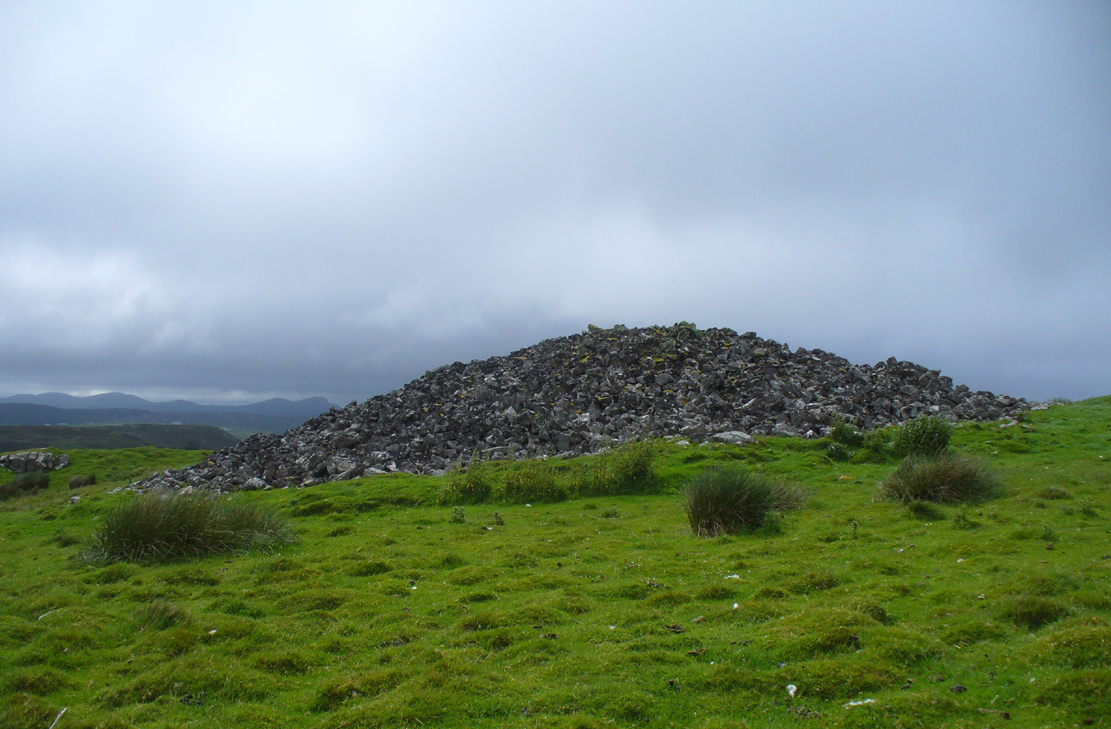

Tobair na h-oige, St. Kilda, Outer Hebrides

Sacred Well (lost):  OS Grid Reference – NA 100 000

Also Known as:

  1. Well of Eternal Youth

Folklore

An old story told in previous centuries by the indigenous folk of Hirta (St. Kilda) described a long-lost well that was thought to be an abode of the little people, known as the Well of Eternal Youth.  Not to be confused with the Well of Virtues near the Amazon’s House less than a mile west, the rough whereabouts of this site is cited by J. Sands (1878) in the folklore section of his otherwise historical account on these faraway Atlantic islands.  He wrote:

“Once on a time an old fellow, in going up Connagher with a sheep on his back, observed a Well which he had never seen or heard of before.  The water looked like cream, and was so tempting, that he knelt down and took a hearty drink.  To his surprise all the infirmities of age immediately left him, and all the vigour and activity of youth returned. He laid down the sheep to mark the spot, and ran down the hill to tell his neighbours. But when he came up again neither sheep nor well were to be found, nor has any one been able to find the Tobair na h-oige to this day.  Some say that if he had left a small bit of iron at the well—a brog with a tacket in it would have done quite well—the fairies would have been unable to take back their gift.”

Explorations of old maps and texts has failed to show with certainty where this legendary well may have been (the grid-ref is an approximation), but it was reported in Mrs Banks’ Scottish Calendar Customs (1937) to have been “issuing out of the face of a rock on the north-side of the east bay…only accesible by the inhabitants, no stranger daring to climb the steep rock.” Some of us would try!

References:

  1. Banks, M. MacLeod, British Calendar Customs: Scotland – volume 2, Folklore Society: London 1937.
  2. Sands, J., Out of the World; or Life in St. Kilda, Maclachlan & Stewart: Edinburgh 1878.

© Paul Bennett, The Northern Antiquarian

Bogle’s Well, Glasgow, Lanarkshire

Sacred Well:  OS Grid Reference – NS 597 650

Archaeology & History

Of all the ancient wells in the city of Glasgow, this has to be one of the most intriguing! Descriptions of it are few and far between, but it is the name of the site which is of interest, to folklorists and occult historians alike.  For the word ‘Bogle’ is another term for a ‘boggart’ or goblin of some sort!  The well is mentioned in Andy MacGeorge’s (1880) excellent study in his description of ancient wells in the city. Citing notes from the 17th century, amidst many sites,

“Another was Bogle’s Well, in regard to which there is a minute of the town council “that Bogillis Well should be assayed for bringing and convoying the water of the same to the Hie street according to the right the town hes thereof,” and the magistrates are recommended to arrange for having this done “by conduits of led.””

…Obviously in the days when they were clueless about lead-poisoning!  The word ‘bogillis’ is the early plural form of the bogle, or bogill (Grant 1941:201).  But where exactly was this old well?  Are there any other records hiding away to help us locate its original position?  It seems to have been one in a cluster of legendary and holy wells in a very small area scattered between Glasgow’s cathedral, down the High Street and to the northern banks of the River Clyde… (the grid-reference given for this site is an approximation)  In a less esoteric fashion, the occult historian Jan Silver suggested that the name of the Well may relate to the family name, ‘Bogle’.

Folklore

Traditionally ascribed in the lower counties of England to be an evil malicious sprite, in more northern counties and in Scotland the creature was said by Katherine Briggs (1979) to be a more “virtuous creature”, akin to the helpful brownies or urisks of country lore.  This was said to be the case in William Henderson’s (1868) Folklore of the Northern Counties. Whether this well was haunted or the home of a bogle, we do not know as the folklore of this site appears to be lost; so I appeal to any students who might be able to enlighten us further on the place.  The Forteans amongst you might have a cluster of ‘hauntings’ hereby, perhaps….

References:

  1. Bennett, Paul, Ancient and Holy Wells of Glasgow, TNA 2017.
  2. Briggs, Katharine, A Dictionary of Fairies, Penguin: Harmondsworth 1979.
  3. Grant, William (ed.), The Scottish National Dictionary – volume 2, SNDA: Edinburgh 1941.
  4. Henderson, William, Notes on the Folklore of the Northern Counties of England and the Borders, W. Satchell: London 1879.
  5. MacGeorge, Andrew, Old Glasgow, Blackie & Son: Glasgow 1880.
  6. MacKinlay, James M., Folklore of Scottish Lochs and Springs, William Hodge: Glasgow 1893.
  7. Steele, Joyce, Seeking Patterns of Lordship, Justice and Worship in the Scottish Landscape, Glasgow University 2014.

© Paul Bennett, The Northern Antiquarian

Balinshoe, Kirriemuir, Angus

Standing Stone (destroyed):  OS Grid Reference – NO 4164 5219

Also Known as:

  1. Canmore ID 33871
  2. The Stannin Stane of Benshie

Archaeology & History

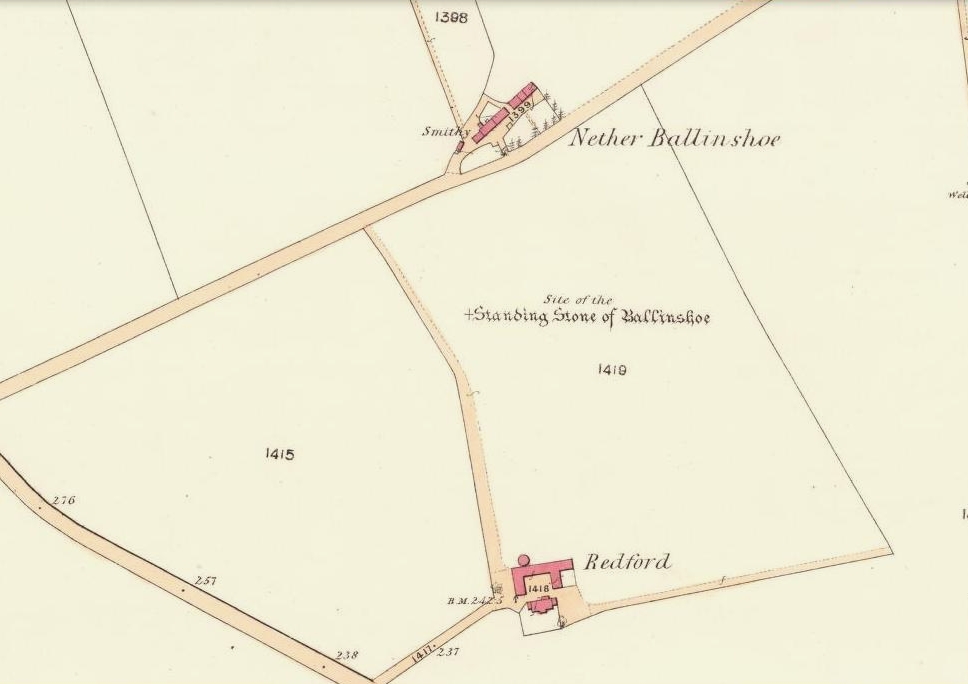
Site of the standing stone on 1865 OS-map
Stone on the 1865 OS-map

In a region that is full of prehistoric remains, we find here another example of another megalithic site that was sadly destroyed, not too long ago by the scale of things.  Found in association with a large prehistoric urn, we are thankful to have a couple of early local history accounts that describe the place.  The stone was obviously of some considerable height and bulk, though I can find no specific references to the dimensions of the monolith.  It was described effectively in the middle-half of the 19th century by Andrew Jervise (1853), who told us:

“‘The Stannin Stane of Benshie’, which stood for unknown ages…was demolished by gunpowder about half a century ago, and the spot is now covered by luxuriant crops of corn. This rude monument of antiquity is supposed to have been about twenty tons in weight; and at a considerable depth below it, a large clay urn, measuring about three feet in height and of corresponding circumference, was found containing a quantity of human bones and ashes.  Like its rude protector, however, the urn was broken to pieces; and, beyond the mere fact of its discovery, nothing authentic, as to either the style of its manufacture, or the precise nature or state of its contents, is preserved.”

More than 30 years later, A.J. Warden (1884) and then J.G. MacPherson (1885) all but copied Mr Jervise’s words, adding no further information.

From some reason, a small chapel dedicated to St. Ninian (NO 41567 51932) was built about 100 yards or so to the southwest of the old standing stone.  Its ruins are still to be seen. Whether this was an attempt to divert local people away from their animistic ecocentricism at the stone, into the more ecocidal egocentricism of the incoming christian cult (as was/is their common practice), we may never know for sure.

Folklore

The local name of this stone, ‘The Stannin Stane of Benshie’, indicates simply that this was “the standing stone at the hill of the faerie folk” (or variations thereof) and suggest it stood upon or next to a mound. I can find no immediate reference to stories of the little people here, and their whisper may have faded into unconscious memory.  Does anyone know more about this place?

References:

  1. Jervise, Andrew, The History and Traditions of the Land of the Lindsays in Angus and Mearns, Sutherland and Knox: Edinburgh 1853.
  2. MacPherson, J.G., Strathmore: Past and Present, S. Cowan: Perth 1885.
  3. Royal Commission on the Ancient & Historical Monuments of Scotland, The Archaeological Sites and Monuments of Central Angus, Angus District, Tayside Region, Edinburgh 1983.
  4. Warden, Alex J., Angus or Forfarshire: The Land and People – Descriptive and Historical – volume 4, Charles Alexander: Dundee 1884.

© Paul Bennett, The Northern Antiquarian

Fairy Knowe, Gairneybank, Kinross, Kinross-shire

Tumulus (destroyed):  OS Grid Reference – NT 1230 9874

Also Known as:

  1. Canmore ID 51067

Archaeology & History

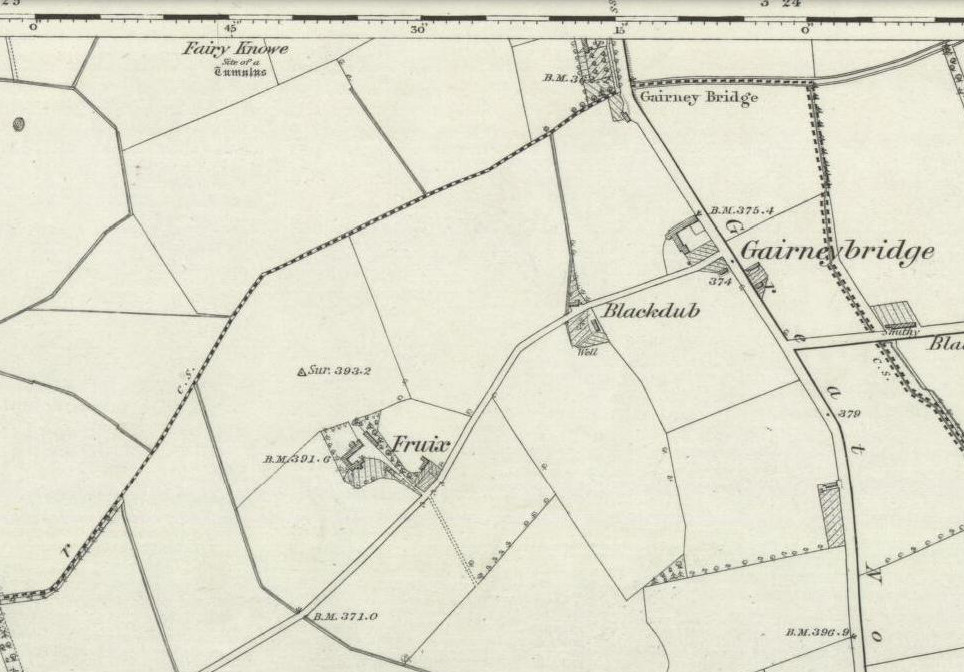
This is one of two sites in the county of Kinross-shire that were known as the ‘Fairy Knowe’, both of which have been destroyed through uncaring agriculture practices.  Very little is known about it.  The place was described in a lengthy footnote in the Old Statistical Account of Scotland (volume 6), which told us that,

Site shown on 1856 OS-map

“a tumulus or mound, composed mostly of earth, with some stones intermixed, on the east of Annofreuch, was opened a few years ago and a coffin found therein formed of rough flat stones, set on edge at the sides and ends, and a large one above; within which were some bones and many pieces of burnt wood interspersed.  In the memory of some old people, it was called the Elf-hillock, but is now known by the name of the Fairyknow.”

The site was listed in the Royal Commission (1933) archaeological county survey, but with no further details.

Folklore

Although the site was a resort of the little people, or faerie-folk, we have no extant tales telling us anything more.

References:

  1. Royal Commission on the Ancient & Historical Monuments, Scotland, Inventory of Monuments and Constructions in the Counties of Fife, Kinross and Clackmannan, HMSO: Edinburgh 1933.

© Paul Bennett, The Northern Antiquarian
MacRee’s Cairn, Glen Meurain, Fortingall, Perthshire

Cairn:  OS Grid Reference – NN 3959 4375

Also Known as:

  1. Canmore ID 23899
  2. Gleann Meran

Getting Here

MacRee's Cairn, looking south
MacRee’s Cairn, looking south

Get to Pubil at the top of Glen Lyon, then walk on the track on the north side of Loch Lyon.  Several miles along you turn up Glen Meurain. When you reach the crossing of the stream, follow the waters up Allt Meurain for about 3-400 yards until you find a small flat section of marshland right by the streamside. You’ll notice rocky undulations of human remains here, and a distinct small cairn of rocks near the top of this section. Have a good rest here (and I’d advise avoiding the place in the summer months).

Archaeology & History

Remote indeed is this small cairn—less than 3 feet high and 4 feet across—sitting by the burn-side in a place many miles from any human habitation.  It is found amidst a small cluster of other archaeological remains close to each other, as if indicating a settlement of sorts, abandoned probably around the time of the Highland Clearances.  Although it is highlighted on modern OS-maps in antiquated lettering, the cairn here looks like it is only a few centuries old.  A larger mass of rubble stone is found adjacent to the small pile of rocks, from which it may originally have been taken.  Without archaeological analysis we will not know for certain the real age of this old tomb.

MacRee's Cairn & adjacent rubble
MacRee’s Cairn & adjacent rubble

Folklore

The small grassy hillside immediately across the trout stream here is known as Sith Trom’aidh – the Sad Fairy mound, whose history appears to have been lost.  Alexander Stewart (1928) told that this cairn was the burial place of one of Colin Campbell’s dairymaids, found and slain here during a skirmish with cattle raiders in the 16th century.

References:

  1. Stewart, Alexander, A Highland Parish; or, The History of Fortingall, Alex MacLaren & Sons: Glasgow 1928.

© Paul Bennett, The Northern Antiquarian