Graffa Plain, Hartwith, North Yorkshire

Tumuli (destroyed?):  OS Grid References – SE 211 642
Getting Here

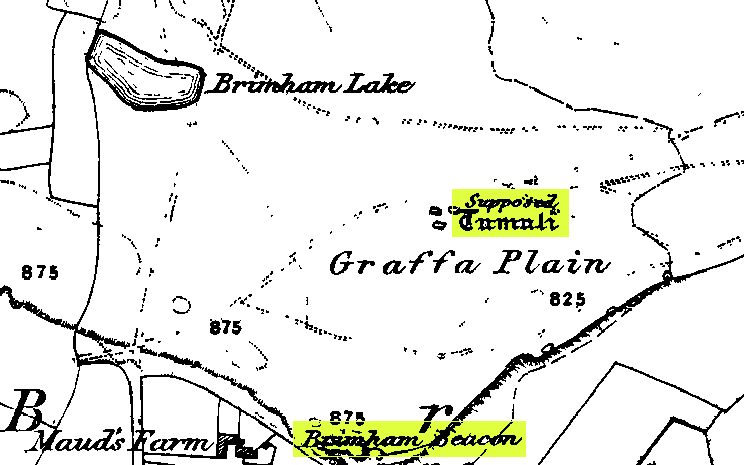
Early OS-map showing ‘tumuli’

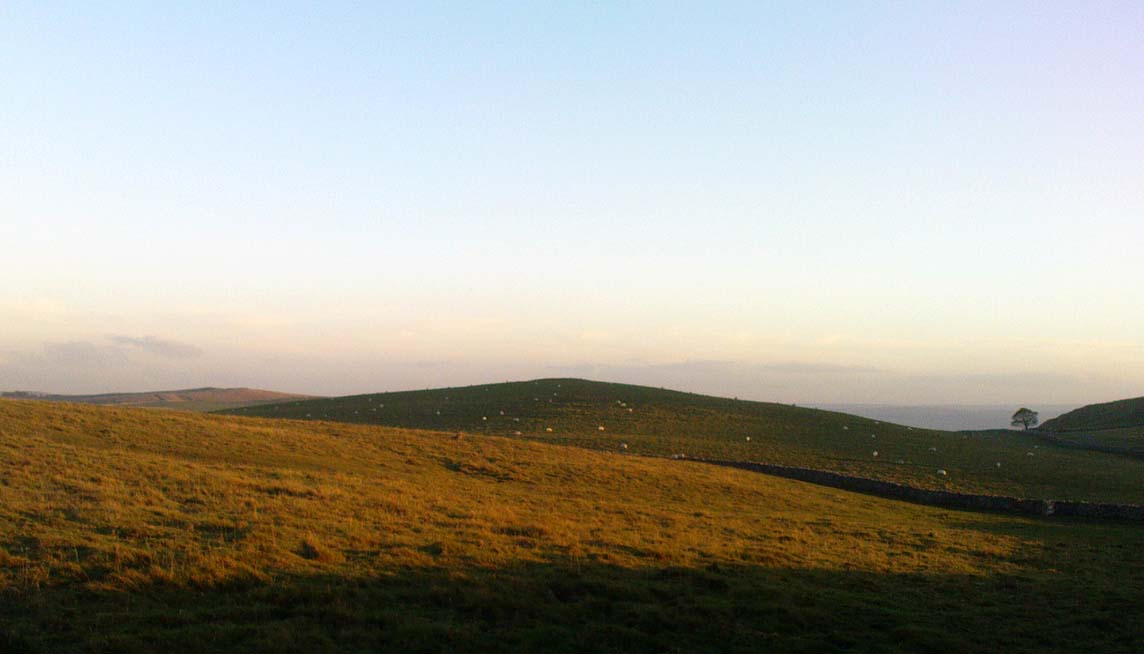
Take the road up to Brimham Rocks from Summerbridge; crossing the little crossroads, then keep your eyes peeled for the singular farmhouse on your right.  Just beyond this, on your right, you’ll notice some small moorland opens up and reaches gently down the slope for some distance.  Go along the footpath for 100 yards or so, then into the heather to your right, for 60 yards or so (as if you walking towards the farmhouse and small crags).  This is where the following sites could be found. (when we visited Brimham recently, unfortunately sunfall stopped us having a proper wander here, so the status of the site/s remains unknown to us)

Archaeology & History

This little-known and possibly destroyed prehistoric site — less than a mile north of Standing Stone Hill and just a coupla hundred yards south of the legendary Brimham Rocks — has been described by several antiquarians from the early 19th century onwards.  It’s an intriguing place, deserving of much greater antiquarian attention.  Ely Hargrove (1809) appears to be the first who mentions prehistoric tombs here, though his sense of direction implies another site (unless he just got that part of it wrong?).   Along with “several small tumuli or carns” near another section of Brimham Rocks themselves, he told there to be,

“Several large tumuli; one of which about 80 yards west of the great Cannon, measures 150 feet in circumference. It is worth remarking that the place where most of these tumuli are found is, at this day, called Graffa Plain, i.e., the Plain of Graves.”

These ‘tumuli’ were again mentioned briefly in passing by one ‘D.N.H.’ in the Gentleman’s Magazine of November 1823.  The great Knaresborough historian William Grainge also described cairns here.  They were then highlighted on the very first Ordnance Survey of the region in the 1850s and shown as “Supposed tumuli.”   Eventually, at the turn of the 20th Century, they were explored at the behest of the local land-owner by Mr L.A. Armstrong.  His description of what they found here is intriguing and well worth reproducing in full:

“By permission of the Right Hon. Lord Grantley, I was enabled to make a careful examination of two of the ancient burial mounds of ‘ Graff a Plain,’ Brimham Moor, on Tuesday, August 4th, 1908.

“Mound No. 1, of circular form, and about 12′ o” in diameter, is situated about 150 yards north-west of the first large group of rocks, upon the south-eastern boundary of the moor, and about 50 yards south-east of the trackway leading to ‘ Riva Hill Farm,’ and it occupies the summit of a slight hillock, upon a comparatively level portion of the heath, which rises rapidly to the south of it in a bold sweep, terminating in the outstanding rocks of Graffa Crags and Brimham Beacon.

“The entire absence of any heather upon the mound, and the profusion of bright green bilberry plants which covered it and at the same time rendered its outline more noticeable, told plainly of a different character of subsoil from that of the surrounding moor ; but prominent as the mound appeared, its actual elevation was deceptive, being barely two feet above the natural level, and the uneven character of the upper surface suggested previous disturbance to be more than probable. A few attempts to pierce the crown, however, proved it to be a cairn, constructed of large stones, and accounted for the prolific growth of the rock-loving bilberry which overspread it, as well as for the uneven character of the surface.

“The thick green covering was carefully stripped off in lengths and placed on one side, and the few inches of vegetable earth removed, revealing the cairn in an almost perfect state, formed of a series of large stones placed methodically in concentric rings, each stone slightly inclined towards the centre, and the whole mass interlocked together by their own weight. Large stones were placed around the outside forming the enclosing circle, which is almost invariably found in the case of earth-built tumuli, and a few of these had been visible before the covering was stripped.

“The construction of the cairn rendered it necessary to remove the stones from the outer ring first, and to work gradually towards the centre where the burial, if such existed, might be expected to lie. This proved no easy task, as the stones were so tightly wedged, and had each apparently been specially selected for the purpose. Almost without exception, they were about a foot in diameter, oblong or oval in form, and three to five inches in thickness, with flat surfaces and rounded edges. No marks of tools were visible on any, but all alike were either water-worn, or had been especially rubbed to their present form. The stone itself was the Millstone Grit of the surrounding moor, but fragments of stone of the form composing the cairn are not now to be found thereon readily, although a careful search might reveal such. Personally I am inclined to think that they have been transported from a considerable distance; that great care has been exercised in their selection is indisputable.

“When nearing the inner radius of the cairn, small fragments of charcoal were noticeable, but they were by no means in large quantities. There was also a layer of fine grey sand an inch or two in depth, which had apparently been spread over the natural surface of the ground, and the stones bedded therein.  Sand of this kind is abundant in the vicinity of the rocks upon the moor.

“In the centre, large pieces of stone were piled around a rough circle of about 3′ 6” extreme diameter, and within these, large and small stones, all of the form previously noticed, were laid more or less upon their flat surfaces, and amongst them the grey sand and charcoal were very evident; pieces of the latter up to an inch square, being found.

“Upon the gradual removal of this central mass of stones, the presence of the unmistakable black ‘barrow earth’ became evident in a slight layer, perhaps an inch or an inch and a half in thickness, and spread over the whole area within the inner ring, the bottom of which had been paved with large flat stones. Amongst this earth very slight traces of a greyish white paste-like substance were”] visible, probably the decomposed remains of the bones after calcination. The deposit was carefully gathered together. Its removal bared the large stones forming the bottom of the grave, and these proved to be two in number, the largest being about 2′ o” across, and of a somewhat angular form ; strikingly different to those composing the cairn itself, for the edges were rough fractures, not rounded in any way. Apparently the surface soil had been removed from the ground upon which the cairn was built, for the upper face of the two stones forming the bottom was level with the natural ground surface adjoining, so far as could be ascertained, and these had apparently been laid down for the reception of the deposited remains.

“As there was every reason to believe that some portion of the ashes might have been placed in an urn, efforts were made to raise the stones above mentioned in hopes of a discovery.  This was by no means easy, but by care and perseverance, it was at last accomplished, but only to meet with disappointment. Immediately beneath was a slight layer of ashes upon the natural ground surface, which latter showed very evident signs of fire, the bright yellow sand composing the substratum being calcined to a dark red colour for quite 2” in depth. This sand was very stiff and compact. The most diligent search failed to reveal any trace of a hole or other disturbance at any point, or of any implements which might have accompanied the body, either upon the surface or amidst the cairn.

“One stone found amidst those immediately covering the deposit, was remarkable because entirely different from all the remainder composing the cairn, and appeared to have been shaped with some definite object in view. It was a fragment of hard sandstone, in the form of a truncated pyramid, the sides and top being roughly fractured to shape, but the base was quite smooth, and bore marks of friction. The base measured 6″ x 5″, and the height about 4½”.  This might have been used as a crushing and grinding stone for grain, or for rubbing purposes, but careful search failed to reveal its companion slab.  With this exception, nothing was found that could be considered as having been fashioned for use, and there was nothing to throw any light upon the probable period of the cairn’s erection.

“The second tumulus examined is situated about 100 yards south-west of the first. It was of rather irregular shape, and appeared to have been somewhat disturbed, but the original diameter had probably been about 9′ o”. Upon examination, it also proved to be of the cairn type, and apparently similar to that previously opened, but it had been disturbed throughout at some distant period, and no trace of the deposit could be found, although the yellow sand forming the subtratum was noticeable, calcined over the whole area as before. There were also traces of charcoal. It is remarkable that amidst the smaller stones of this cairn another ‘ rubbing stone ‘ was found, almost identical with that in the former one, and similarly, this proved to be the only ‘ find ‘ of any description bearing certain traces of man’s handiwork.

“Although somewhat disappointing not to be able to assign the erection of these cairns to any definite period, yet their examination proves valuable for two reasons. First it places beyond any question the nature of the mounds scattered over this portion of Brimham Moor, which is known by the name of ‘ Graffa Plain,’ a name which the late Mr. William Grange translates as ‘ the place of graves ‘ — significant in itself, though he at the same time casts a doubt upon the formation of the mounds in question being anything other than natural. The identity of the grave mounds being established, they prove that a settlement of primitive man of no small magnitude must have been located somewhere in the vicinity.”

The word ‘graffa’ seems to be the plural for ‘graff’, which the english dialect magus, Joseph Wright (1900), convincingly assures us to derive from the old english, “græf, a grave, trench.”  This seems confirmed by the common finding of ‘graff’ in regional dialects from Yorkshire, Lancashire and other northern counties, where it relates specifically to ‘graves.’  A variation on the word, as cited above, finds ‘graff’ occasionally relating to “a ditch or trench; a channel, cutting; a hole, pit or hollow.”  The usually helpful A.H. Smith (1961-63) was curiously silent on this place-name; but local historians Grainge, Walbran and others tell us that Graffa Plain is simply “the plain of the graves.”

I know of no other accounts that have explored this site.  Does anyone have any further information about this place?

References:

  1. Armstrong, A. Leslie, “Two Ancient Burial Cairns on Brimham Moor, Yorkshire,” in The Naturalist, March 1909.
  2. Hargrove, Ely, The History of the Castle, Town and Forest of Knaresborough, Hargrove & Sons: Knaresborough 1809.
  3. Smith, William, “Yorkshire Place-Names,” in W. Smith’s Old Yorkshire – volume 1 (Longmans, Green & Co.: London 1881).
  4. Wright, Joseph (ed.), English Dialect Dictionary – volume 2, Henry Frowde: London 1900.

© Paul Bennett, The Northern Antiquarian

Rudston ‘A’ Cursus, East Yorkshire

Cursus:  OS Grid Reference — TA 0998 6577 to TA 1016 6802

Also known as:

  1. Beacon Cursus
  2. Rudston Cursus 1
  3. Woldgate Cursus

Archaeology & History

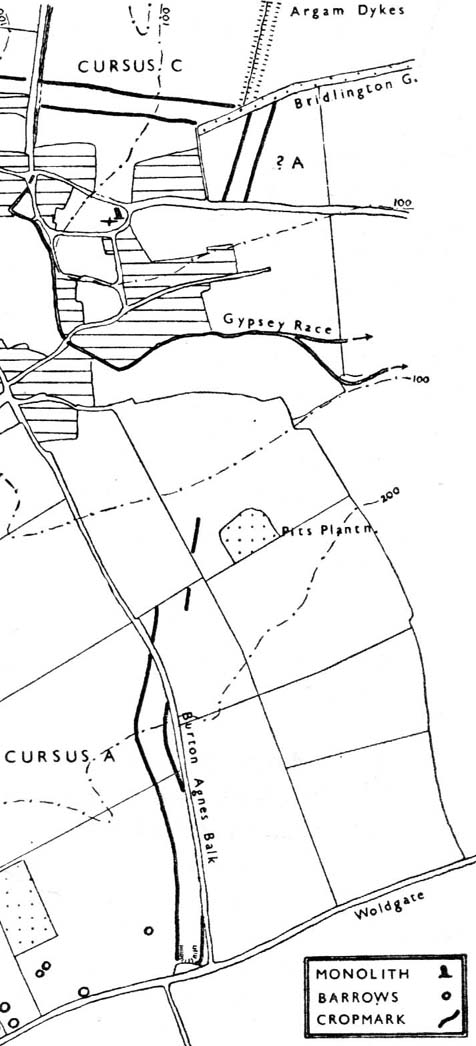
The site has been known about for nearly 150 years, albeit mistakenly as a series of prehistoric barrows that William Greenwell (1877) told were “near the division between the parishes of Rudston and Burton Agnes” near the crest of the hill.  He further told the place to be,

“Two long mounds, almost parallel, their northern end gradually losing themselves in the surface-level, but connected together at the southern end by another long mound.”

South end of Cursus A (after D.P. Dymond)
Early photo of Cursus A (after J.K.St Joseph)

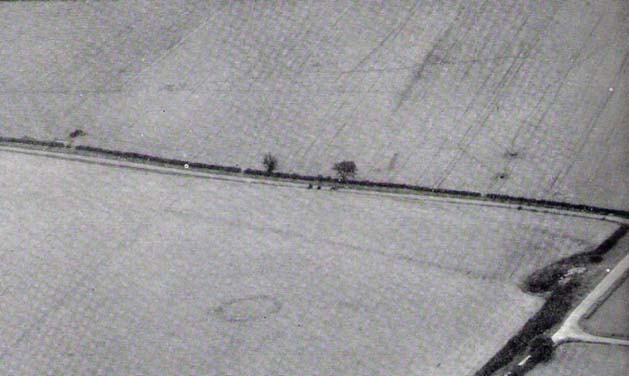
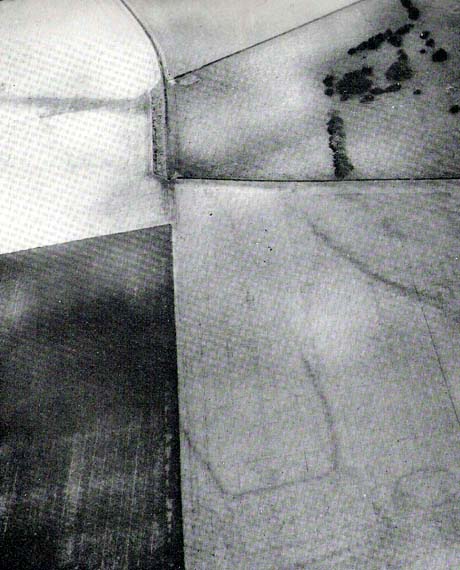
Then in 1958 when C. & E. Grantham of Driffield did the first modern excavation here across a section of the western ditch, they found that the long embankment went on much further than ever previously anticipated, for more than half-a-mile downhill in the direction of Rudston village.  It wasn’t a long barrow or tombs of any sort, they found!  Then in 1961 when Dr. J.K. St. Joseph did aerial survey work over the area, he and his colleagues established that this monument consisted of extensive parallel ditches stretching for at least 1½ miles towards and past the eastern side of Rudston village.  It’s nature as a cursus monument was rediscovered after several thousand years in the wilderness… (on St. Joseph’s survey, two other cursus monuments were also found in the vicinity, being Rudston Cursus B and Cursus C)  Readers will hopefully forgive me for quoting at some length Mr Dymond’s (1966) article on the site (with minimal editing!):

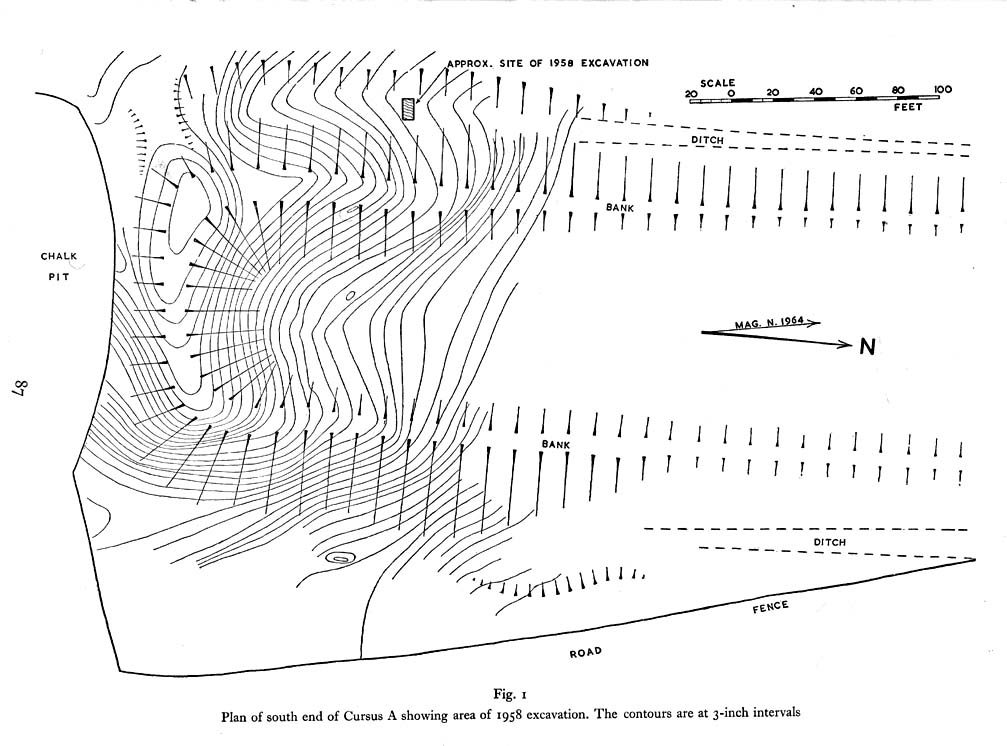
“The southern end of the cursus lies in the western angle of two roads, Woldgate and Burton Agnes Balk.  In plan it is square with rounded corners and consists of a bank with outer ditch.  Although the bank has been ploughed for many years, it still remains substantial; it stands up to 4 feet high from the outside and 1-2 feet wide from the inside.  The east and west banks decline in height northwards and are now at their greatest height where they join the southern end.  The profile of each bank is smooth and rounded and merges on the outside with the broad shallow depression of the silted-up ditch.  The south bank is now 170 feet long overall, and spread to a width of 60-80 feet.  It stands higher at both ends than in the middle.  This fact was noted by Greenwell, who also recorded that at the southwest angle “there was the appearance of a round barrow raised upon the surface of the long mound.”  There is no surface evidence today to suggest a secondary round barrow, and to some extent at least the greater height at the angles is probably due to the concentration of upcast inside a fairly sharp corner.

“The south arm of the ditch has been largely destroyed by a chalk-pit, but the southeast turn is quite clear on air-photographs.  There is no suggestion on the ground or from the air that the cursus had ever extended further to the south.

“The cursus begins its descent in a due northerly direction, and loses its eastern side for approximately 600 feet under the enclosure road, Burton Agnes Balk.  The ditch can be traced intermittently on the western and eastern verges.  It then swings gently NNW around the head of a small slack draining northwest.  Thus far the cursus is traceable on the ground.  The ditches are the most consistent feature, showing as broad shallow depressions 20-40 feet wide and 70-80 yards apart, which when in fallow attract a dark coarse vegetation (particularly thistles and nettles.  The banks inside the ditches are sometimes visible in relief though considerably spread.  Where the banks have been almost entirely ploughed out, a chalk spread usually marks their position.

“There is a suggestion on the ground that the banks and ditches may have been separated by berms, particularly on the east side near the square end.  This appears to be confirmed by the silting of the ditch in the excavated section…

“Proceeding further downhill in the direction of Rudston village, the cursus quite suddenly swings north-NNE, finally crosses Burton Agnes Balk, and passes to the west of Pits Plantation.  On the west of the road both banks and ditches are still visible in relief, and the ditches produce a firm crop-mark.  East of the road no surface traces are discernible, and only the eastern ditch shows intermittently as a crop-mark.

“For ½-mile across the floor of the Great Wold Valley, there is no trace of the cursus.  The area has been ploughed since medieval times, and there is in addition a considerable Romano-British settlement.  It is worth noting that in this length, the cursus must have crossed the stream of the Gypsey Race, surely a fact of some importance in any discussion of the function of cursuses.

“Two parallel ditches c.60 yards apart, visible on air photographs in a field immediately north of the modern Rudston-Bridlington road, seem to represent the continuation of the cursus.  The ditches travel for approximately 300 yards and end at the Bridlington Gate Plantation.  There are no surface traces in the field, but a depression in the plantation may represent the eastern ditch.  This depression is crossed obliquely by the remains of a low bank and ditch running along the length of the plantation WSW and ENE.  This latter (part) is probably part of the supposedly Iron Age entrenchment system, and has certainly been used as a road from Rudston to Bridlington, as the name of the plantation implies.

“The northern end of the cursus cannot be traced.  Possibilities are that the end was in the plantation and has been destroyed by the later earthwork, or that the cursus proceeded NNE for an unknown distance.  If the latter hypothesis is accepted, the western ditch must be under the Argam Dykes, a double entrenchment which appears to terminate at the northern side of the plantation, and the eastern ditch is indistinguishable  from ploughing lines to which it is parallel…

“Cursus A has its southern end at a height of 254 feet OD, on the forward face of a long chalk ridge running WSW and ENE.  From this point the course of the cursus is visible, except for that part west of Pits Plantation.  The last known part in Bridlington Gate Plantation, 1½ miles off, is clearly visible.  Seen against the contours of the area, the cursus has one end resting on a high ridge, crosses a broad valley, and climbs at least in part, the far side.  It appears to pass approximately 300 yards east of the monolith in Rudston churchyard.”

Line of Rudston A

The presence of this and three other cursus monuments close by (Rudston B, C and D) indicates that the region was an exceptionally important one in the cosmology of our prehistoric ancestors.  Four of these giant linear cursus monuments occur in relative proximity, and there was an excess of ancient tombs and, of course, we have the largest standing stone in the British Isles stood in the middle of it all.  A full multidisciplinary analysis of the antiquities in this region is long overdue.  To our ancestors, the mythic terrain and emergent monuments hereby related to each other symbiotically, as both primary aspects (natural) and epiphenomena (man-made) of terra mater: a relationship well known to students of comparative religion and anthropology who understand the socio-organic animistic relationship of landscape, tribal groups and monuments.

References:

  1. Dymond, D.P., “Ritual Monuments at Rudston, E. Yorkshire, England,” in Proceedings of the Prehistoric Society, volume 32, 1966.
  2. Eliade, Mircea, The Sacred and the Profane, Harvest: New York 1959.
  3. Greenwell, William, British Barrows, Clarendon Press: Oxford 1877.
  4. Hedges, John & Buckley, David G., The Springfield Cursus and the Cursus Problem, Essex County Council 1981.
  5. Nicholson, John, Beacons of East Yorkshire, A. Brown & Sons: Hull 1887.
  6. Pennick, Nigel & Devereux, Paul, Lines on the Landscape, Hale: London 1989.

Links: – ADS: Archaeology of the Beacon Cursus, or Rudston A – Notes on the cursus which has been given the most attention to date.

© Paul Bennett, The Northern Antiquarian

Rudston B Cursus, East Yorkshire

Cursus:  OS Grid Reference – TA 0805 6697 to TA 0944 6755 

  1. Rudston Cursus 2

Archaeology & History

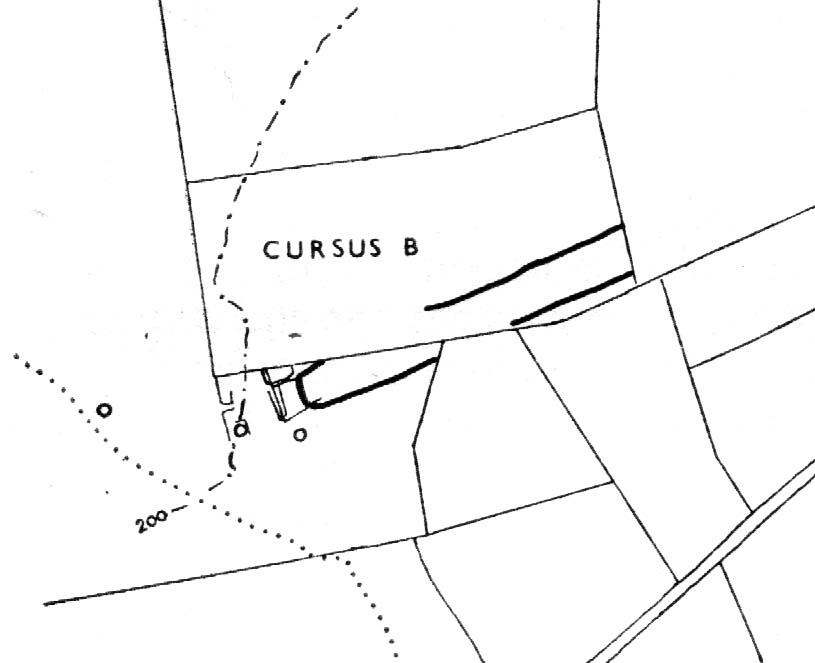
One of the four (known) cursus monuments around Rudston: this one stretches between the Ordnance Survey coordinates TA 081669 near Kilham Grange on the southwestern edge of Rudston, then heads northeast towards the village itself at TA 094675.  Described briefly in D.P.Dymond’s essay on (mainly) Cursus A, he said how Cursus B was part of,

Early ground-plan (after D.P. Dymond)
Early photo of Rudston B (after J.K.St Joseph)

“a large complex of crop marks.  The largest feature is the squared, tapering end of Cursus B, which can be traced for 700 yards in a north-easterly direction.  No surface remains seem to survive in an area intensively ploughed, except for a swelling under a hedge on the line of the south-eastern bank (at TA 0834 6703).  West of the square end and partly overlying it, are several small rectangular enclosures, which are probably part of a later (?Romano-British) settlement and field-system.  Also in this tangle of crop-marks there are four roughly circular shapes, which may well be barrow circles associated with the end of the cursus.  On certain barrow just south of the end of the cursus has an inner ring of pits.  Where the cursus is lat visible to the north-east, it is headed roughly for the monolith ¾-mile away.  The width of Cursus B is approximately 90 yards between ditch centres.  It has its square end on the forward slope of a ridge (like Cursus A) at a height of 180 feet OD, and descends towards the village, which is visible from the end, through a shallow valley.”

Dymond’s note about the alignment feature of this cursus, towards the gigantic Rudston monolith, was one echoed in the Hedges & Buckley (1981) survey.  They noted:

“At Rudston, the B cursus extended eastwards aligns upon the Rudston monolith in Rudston churchyard. Destruction of standing stones elsewhere may have removed similar associations between the stones and cursuses.”

This alignment feature was also confirmed by cognitive archaeologist and alignment specialist, Paul Devereux (Pennick & Devereux 1989) in his survey of cursus monuments.

Typical of these fascinating antiquities, nothing of any worth has been found along the length of the cursus that can give us any clues to its nature and function.  However, the presence of this and three others close by indicates that the region was an exceptionally important one in the cosmology of our prehistoric ancestors.  Four of these giant linear cursus monuments occur in relative proximity, and there was an excess of ancient tombs and, of course, we have the largest standing stone in the British Isles stood in the middle of it all.  A full multidisciplinary analysis of the antiquities in this region is long overdue.  To our ancestors, the mythic terrain and emergent monuments hereby related to each other symbiotically, as both primary aspects (natural) and epiphenomena (man-made) of terra mater: a phenomenon long known to comparative religious students and anthropologists exploring the animistic natural relationship of landscape, tribal groups and monuments.

References:

  1. Dymond, D.P., “Ritual Monuments at Rudston, E. Yorkshire, England,” in Proceedings of the Prehistoric Society, volume 32, 1966.
  2. Eliade, Mircea, The Sacred and the Profane, Harvest: New York 1959.
  3. Hedges, John & Buckley, David G., The Springfield Cursus and the Cursus Problem, Essex County Council 1981.
  4. Pennick, Nigel & Devereux, Paul, Lines on the Landscape, Hale: London 1989.

Links:

  1. ADS: Archaeology of Rudston B – Brief archaeological notes on the cursus to the southwest of Rudston.

© Paul Bennett, The Northern Antiquarian 

West Lodge, Touch, Cambusbarron, Stirling

Cairn:  OS Grid Reference – NS 7501 9315

Also Known as:

  1. Canmore ID 46240

Getting Here

The mound of the cairn

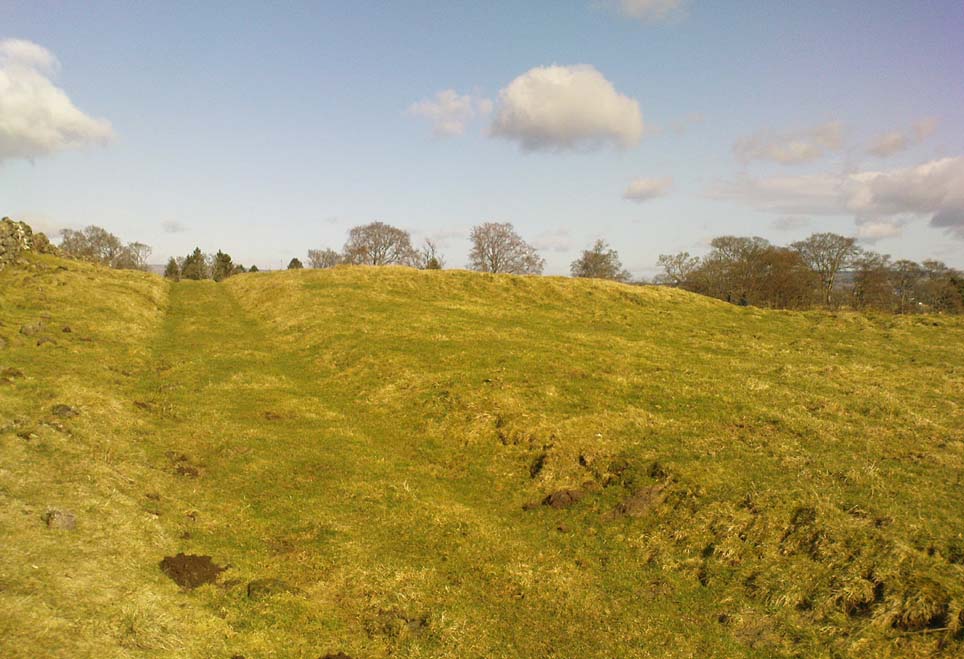
Go west outta Stirling along the Cambusbarron road and along the Main Street until it meets up with Touch Road.  Go along here for a couple of miles, past Touch House and Seton Lodge until you reach the small West Lodge cottage where the road bends.  From here go left up the footpath onto the fields immediately south.  About 200 yards on, where the field rises to the crest of the hill, you’ll note the small mound right next to the track.  If you start walking back down the slope again, you’ve walked past it!

Archaeology & History

Possible peristalith ruins

There’s not too much to see here as the site is very much overgrown, but it’s in a lovely spot looking across to the Ochil Hills eastwards.  And if  records are anything to go by, it’s a pretty isolated prehistoric site with no companions close by — though a prehistoric food vessel was located a short distance to the east on the Touch House Estate grounds many years ago.  It’s quite a large, roughly circular mound.  Several long stones are visible, laid down, on top of its western side, which archaeologists believe may represent the remains of an encircling stone ring that was built to define the cairn.  As far as I’m aware the site remains unexcavated and its condition is still much as it was when the Scottish Royal Commission fellas visited the place in 1956.  Following their brief excursion, they later (1963) wrote the following notes:

“It is circular on plan, measures 65ft in diameter at the base and stands to a height of 2ft 6in.  Now covered with fine pasture, it appears to have been formerly under cultivation, and the flat top measures 50ft in diameter.  The mound may represent a denuded cairn and three earthfast boulders which protrude through the turf near the W edge may be the remains of a peristalith.  The largest stone has a bench-mark carved on it (125.9).”

A later brief report by the Royal Commission (1979) commented that the site was a cairn measuring 20m across and 0.7m high.

References:

  1. Royal Commission on the Ancient & Historical Monuments Scotland, Stirling – volume 1, HMSO: Edinburgh 1963.
  2. Royal Commission on the Ancient & Historical Monuments of Scotland, Archaeological Sites and Monuments of Stirling District, Central Region, Society of Antiquaries of Scotland 1979.

© Paul Bennett, The Northern Antiquarian 

Pleasington Cemetery, Blackburn, Lancashire

Tumulus:  OS Grid Reference – SD 650 272

Getting Here

The site is situated in a natural hollow just above a steep sided ravine known as Scotsman’s Wood through which a stream flows. The location in the hollow obscures all surrounding views of the East Lancashire Pennines and the Billinge Hill massif. The near surrounding area is on a natural sandbank created by the western shore of the post-glacial ‘Lake Accrington’.

Archaeology & History

During the early spring of 1996, grave digger Grant Higson, whilst excavating a new grave, uncovered course fragments of pottery displaying a herringbone pattern and other material. Grant stopped work immediately and alerted Blackburn Museum worker Maggy Simms, who gathered together the shattered remains and brought in Lancaster University Archaeological Unit for identification. They identified the fragments to be a Bronze Age Urn some 12 inches in height, decorated with a herringbone pattern and containing bones and ashes of several cremations, some stained green by some copper object that had disintegrated over the years. The burial was assigned to c. 1500 BC, a period of history referred to as the Bronze Age. The urn and its contents are now held by Blackburn Museum. A geo-physical survey was undertaken by the Unit on the surrounding areas that displayed undulation of the ground surface but nothing was found, the undulations deemed natural features.  No archaeological report or radiocarbon dating has been made to date by Blackburn Museum Service, the Lancaster University Archaeological Unit being now defunct.

During August 2009, I visited the site and was fortunate to meet with Grant Higson who not only showed me the location of the find, but also described the geological formation of the cemetery area.

The urn found is typical of the well developed Pennine urns recovered from the Anglezarke, Bleasdale and Burnley districts and a date of 1500+250 BC is more than likely cet. par.

Given the ‘sheltered’ location of the find I would ascribe the site as one of a primary domestic nature, the burial being a secondary feature: primary tumulus burials in prominent locations being the sole preserve of the ruling aristocracy. What we are looking at is a hearth burial within a communal living hut: following the Indo-European custom, the dead were given to the Earth inside the human habitation. The dear departed, who had been so close to the family group in life, had to remain among them in death also and share the family’s joys and struggles, food and drink. While living they had enjoyed nightly rest under the roof of the communal hut, dead they slept the eternal slumber beneath the domestic heart.

This site is noted by ’TheElf’ on The Modern Antiquarian. ‘TheElf’ goes on to mention, “I saw what could possibly be a standing stone, some 200 metres north east of the cemetery.”   I located this stone (SD 648 273) and found it to be a broken 17th century gate-stoop for pole fence – a gate post with a series of holes used to create a ‘heck’, being an adjustable series of pole bars in lieu of a gate.

Article contribution courtesy of John Dixon – © John Dixon 2009.


Intake Lodge, Yearsley, North Yorkshire

‘Tumulus’ (destroyed):  OS Grid Reference – SE 592 737

Archaeology & History

Bronze Age pottery (after YAJ 1963)

A curious entry inasmuch as it’s difficult to categorize the site correctly.  Added to this is the fact that the place has been built over!  But despite these misgivings (if that’s the right word!), the site’s deserving of a posthumous entry…

There used to be a curious-looking mound here, immediately east of Intake Lodge, that “was due to be bulldozed so that a field of rough pasture could be brought under cultivation”, killing the indigenous wildlife that was living here.  However, before this was done, some inspectorate dood who worked for the Ancient Monuments Commission and the Ministry of Works “decided to excavate”, as he believed that an ancient burial mound was in the field.  Mr I.M. Stead (1963) takes up the story, telling:

“”This mound was about 75ft by 90ft diameter and 6ft high, on ground sloping away to the south-east.  It had every appearance of being a barrow.

“The excavation, in October 1961, was supervised by the writer (and) assisted by Mr A.L. Pacitto.  A trench on the east side revealed layers of sand which appeared to be natural, and a second trench, on the west side, uncovered a capping of stone which confirmed that this was not a barrow.  However, it seems that the writer was not the first person to mistake it for an artificial burial mound.  A disturbed area in the centre, some 15ft diameter, where there had been an old water-tank, produced a fragment of Bronze Age pottery and a sherd from another Bronze Age vessel was found in a disturbance on the side of the mound.  A small area near the centre was cleared in the hope of finding an undisturbed burial, but shortage of funds did not permit more extensive stripping.  Judging from the type of pottery (see image) and its situation on the mound, there can be little doubt that one two occasions Bronze Age people placed secondary burials in the natural mound.”

This tells us that although the mound wasn’t a tomb or burial mound in a traditional religious sense, it was instead a sacred hill of the dead for the local people at one time or another in ancient days.   And, if Mr Stead had been a decent archaeologist and continued to excavate here without pay (as he should do if he loves his subject), we may have found more beneath this now-lost sacred mound.  Unfortunately this didn’t happen and we lost vital clues and information.

References:

  1. Stead, I.M., “An Excavation at Yearsley, North Riding, 1961,” in Yorkshire Archaeological Journal, part 161 (volume 41), 1963.

© Paul Bennett, The Northern Antiquarian

Mutlow Hill, Great Wilbraham, Cambridge

Tumulus:  OS Grid Reference – TL 5466 5437

Archaeology & History

This once-impressive Bronze Age tomb is now much denuded and stands besides the legendary Fleam Dyke.  The name of Mutlow was first used to describe this site in the 1812 Enclosure Act and means, literally, an “Assembly Hill” or Assembly burial mound.  Reaney (1943) told that it was situated “at the junction of the boundaries of Great Wilbraham (Staine Hundred), West Wratting and Balsham (Radfield Hundred) and Fulbourn (Flendish Hundred)”, and was obviously an important moot spot where local tribal and council laws were made.

The great Cambridge archaeologist, Tom Lethbridge (1957) briefly described the place in his fascinating survey of the nearby hill-figures, Gog and Magog, saying:

“The hill itself is a Bronze Age barrow which was dug by the Hon. R.C. Neville about a hundred years ago.  In it were, amongst other things, glass beads brought to Britain from the eastern Mediterranean in the fifteenth century before the birth of Christ.  The barrow, which was presumably the site of a moot in Saxon times, seem to have been used as a sighting point for the construction of the Fleam Dyke… A circular Roman building, either a temple, or possible a signal station, stood close to Mutlow Hill.”

Lethbridge pointed out that another lesser-known trackway — “known in Saxon times as ‘the Street'” — also passed here, saying:

“When the land is ploughed and the light is right, you can see the numerous dark lines on the soil, all converging on Mutlow Hill.  These are the old hollow ways of the Icknield Way and the Street.”

Folklore

One legend here speaks of a golden chariot that is reputedly buried either inside, or near to the old tumulus.  Lethbridge (1957) again told of hearing this tale, though narrated, “it was said to be buried in Fleam Dyke near Mutlow Hill.”  When he asked a local lady about the tale,

“She replied that she had always heard that it was not in the dyke itself, but in the road which passed the dyke and went on to West Wratting and the southeast.”

References:

  1. Lethbridge, T.C., GogMagog: The Buried Gods, RKP: London 1957.
  2. Reaney, P.N., The Place-Names of Cambridgeshire and Isle of Ely, Cambridge University Press 1943.

© Paul Bennett, The Northern Antiquarian

Shaw Hill, Skircoat, Halifax, West Yorkshire

Tumulus (destroyed):  OS Grid Reference – SE 094 242

Archaeology & History

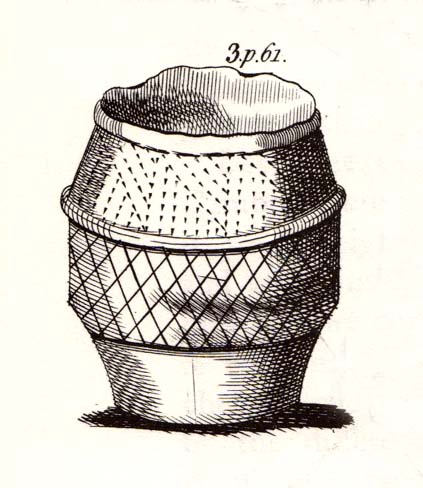
Shaw Hill urn

The remains here have long since succumbed to that self-righteous advance of industrial civilization.  Even when the Halifax historian John Watson (1775) first described what had been here, the burial mound had gone; but thankfully he was fortunate in getting details regarding the whereabouts and contents of the remains. Three burial urns were found next to each other —  presumably in the same tumulus —  one of which was in a reasonably good state of preservation, as shown from the illustration which I reproduce here.  We have no description of the burial mound, only of the urns, of which Mr Watson told us:

“It was found, with two others, at the gates, at the bottom of the walk near Shaw Hill, leading to the house in Skircoat, called Heath.  They lay in a line, one yard deep and one yard asunder, with their mouths downwards.  This contained calcined bones, and dust; the two others were broken in pieces.  It is eight inches deep, stands upon a bottom of four inches diameter and, where there is no moulding, is from twenty-one inches, or thereabouts, to twenty-three inches in circumference.”

It was of similar size and design to burial urns found at Tower Hill a couple of miles west of Halifax.  In Prof Watson’s (1952) work on the prehistoric sites of Calderdale, he assigned this burial mound and pottery to have been from the Bronze Age.

References:

  1. Leyland, F.A., The History and Antiquities of the Parish of Halifax, by the Reverend John Watson, M.A., R.Leyland: Halifax n.d. (c.1867)
  2. Roth, H. Ling, The Yorkshire Coiners, 1767-1783; and Notes on Old and Prehistoric Halifax, F.King: Halifax 1906.
  3. Watson, John, The History and Antiquities of the Parish of Halifax, T. Lowndes: London 1775.
  4. Watson, Geoffrey G., Early Man in the Halifax District, HSS: Halifax 1952.

© Paul Bennett, The Northern Antiquarian


Seaty Hill, Malham Moor, North Yorkshire

Tumulus:  OS Grid Reference – SD 90693 65374

Also Known as:

  1. New Close tumulus

Getting Here

From Malham village go over the lovely old bridge and follow the road up and round, keeping to the left (not up the Gordale Lane) where the junction appears a few hundred yards along.  Follow this steep and winding road all the way to the top for a couple of miles until you hit a junction seemingly in the middle of nowhere.  Park up somewhere to the left and notice the hillock which you’ve just passed on your right (east) with a bittova flat top to it.  Cross the stile and go up to it!

Archaeology & History

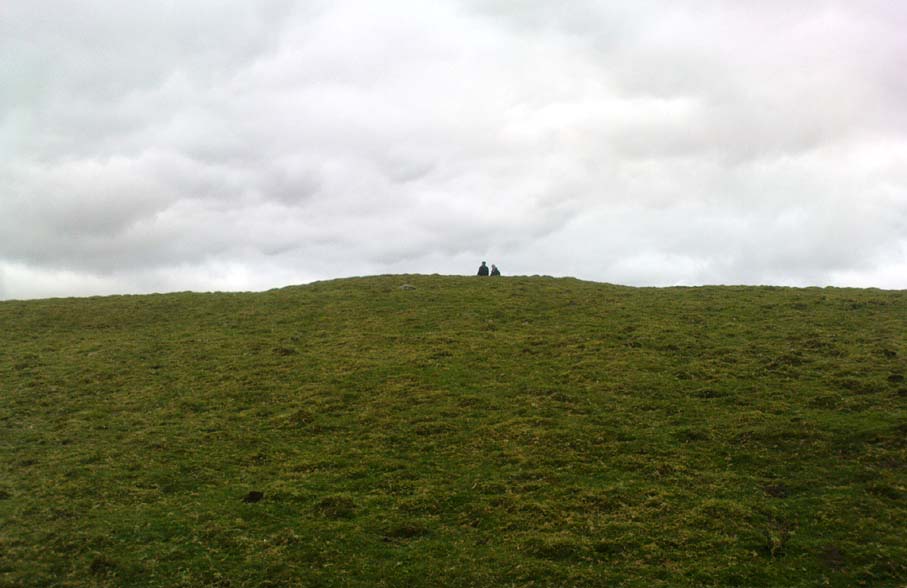
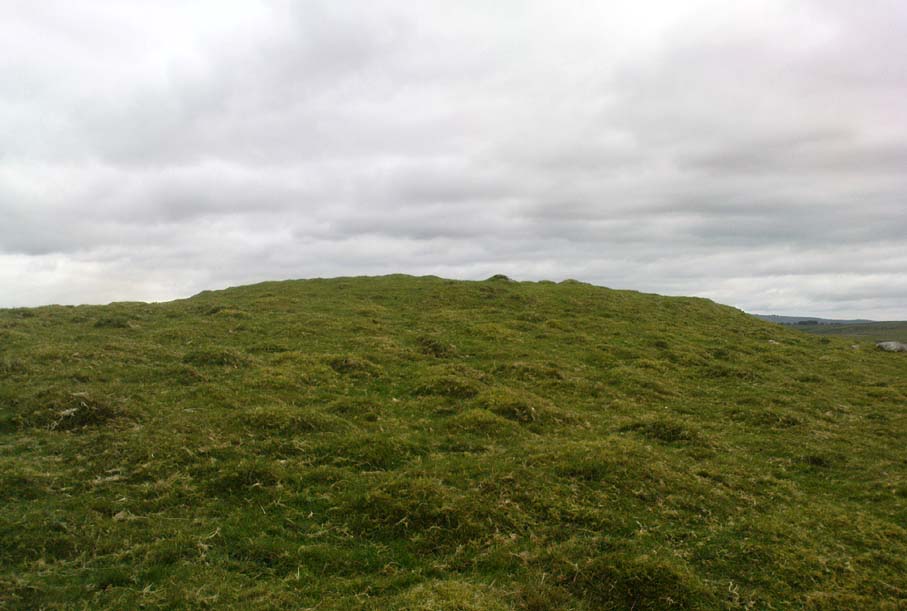
Although somewhat overgrown thanks to the persistence of Nature, this good-sized burial mound on top of this, one of many small hills in and around the moors hereby, is a fine specimen to behold and a fine place to sit and drink in the view.  Although not quite having the grandeur of the Great Close Hill tomb a mile to the north, the countryside hereby is still impressive and was of obvious importance in the mythic landscape of our Bronze Age ancestors.  If you think otherwise, there’s obviously summat wrong with you.

Approaching the tumulus
Seaty Hill tumulus

Although we can only see the remains of one singular round tomb today, at least two other tumuli were once in evidence in this large open field but they were dug out many years back.  There were probably even more of them, but any trace has long since gone.  Thankfully this one was given the attention of decent archaeologists some fifty years back, when Arthur Raistrick (1962) and his mates got stuck into the place.  His initial account of the place told us how it was,

“…surrounded by a shallow ditch and bank enclosing a low mound 66 feet diameter, rising about 4 feet above the ditch bottoms.  In the original surface of the hill top there had been dug two holes, circular and partly impinging on one another, both 3ft 6in deep.  In the northwesterly one of these a skeleton had been carefully placed in a sitting position, with knees drawn well up, and was facing the second hole  which is to the southeast.  This hole was almost filled by a carefully built cairn of limestone boulders, but nothing was found either in or beneath it.  No artifact of any kind was found with the skeleton.  Both holes had been filled in with fine sandy and gravelly loam to the natural ground level and then covered with a low mound, 15 feet in diameter and 1 foot high, of coarser gravel and small boulders.  The second mound, 66 feet diameter, of limestone rubble and boulder clay and 3 feet high above ground level, was put over this and provided with a kerb of large limestone boulders buried in the toe of the mound.  A shallow ditch was then dug and its spoil thrown outwards to form a shallow bank.

“In the surface of the large mound there were not less than 13 secondary burials of early Iron Age, each in a small saucer-shaped depression filled in with gravelly loam.  These burials are extremely fragmentary and are more like token burials than complete ones.  In three of them, beads were found, one of jet, one of blue glass and one of carved limonite.  In a burial nearly over the central older burial, a skeleton was arranged with a bone (musical) pipe between the knees, where also there were several small bones of hand and wrist and part of an iron knife.  The (musical) pipe was made from the tibia of a sheep, perforated  with three finger holes, with a well-shaped speaking lip and mouthpiece.  The pipe was playable… A full account of this unique instrument has been published elsewhere… In two of the burials there were recognizable fragments of iron knives, and in two others pieces of iron of unrecognized use, all in positions which could have been under the knee of a more primitive skeleton.  By analogy and style the primary burial has been assigned to the Early Bronze Age, and the Iron Age burials to the period first century BC to the first century AD.”

It would be intriguing to ascertain how many people from this period were playing flute-like instruments such as the one found here, and whether (as with other musical instruments in all other tribal cultures on Earth) magickal virtues were assigned to it, or the music it liberated.  Certainly in a great number of places around this very area where this instrument was found, many natural sites still abound with the hugely underrated virtue of silence; and upon the still air amidst which music would be cast, the echoes or else faint sense of such sound would evoke a marvel — curious or dreamt — to those upon who it fell.  If you think otherwise, there’s definitely summat wrong with y’!

References:

  1. Raistrick, Arthur & Holmes, Paul F., Archaeology of Malham Moor, Headley Bros: London 1961.

Links:

  1. Articles on the Malham Iron Age Pipe, by Arthur Raistrick, etc

© Paul Bennett, The Northern Antiquarian


Nanny Howe, Kildale, North Yorkshire

Tumulus:  OS Grid Reference – NZ 599 103

Archaeology & History

Plan of Nanny Howe (after R.H. Hayes)

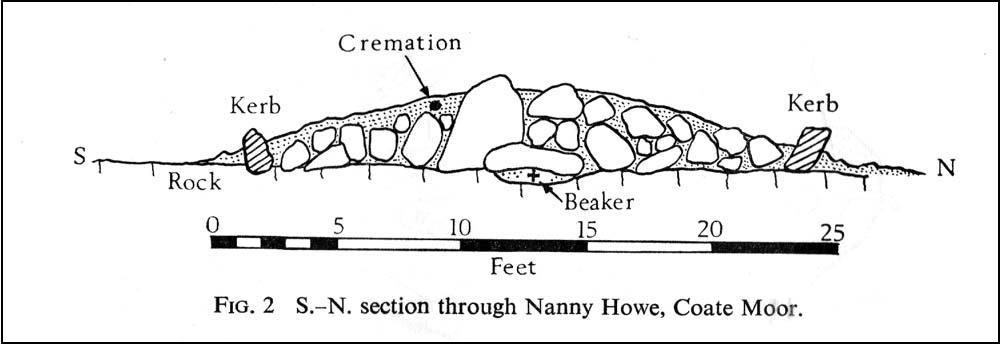
The Nanny Howe burial mound was one of a group of at least three tumuli that could be found on what is now the wooded hilltop of Coate Moor, a mile east of Great Ayton.  Large and conspicuous in previous centuries, the site was described briefly in Elgee’s (1933) archaeological survey as being in association with a prehistoric settlement, which itself appears to have long since succumbed to forestation.  An essay on the state of this apparent Bronze Age burial mound was written by Mr Hayes (1966), who told us:

“The kerb of the barrow was exposed and noticed by J.N Grayson whilst excavations were in progress on Great Ayton Moor.  S.V. Morris, A.N. Pacitto and the writer examined the site.  It was a cairn of about 30ft diameter and 3ft high in the centre, with a strong kerb of stones set on edge of 25ft diameter.  Its construction, of massive stones was similar to the chambered cairn on Great Ayton Moor, one mile to the north, and very like the food vessel-urn tumulus on Danby Rigg which also had a kerb of the same diameter…

“When the heather and turf were removed on the south-east side of Nanny Howe, a mass of cremated bones with part of the rim and side of a typical Iron Age ‘B’ jar were found only 6-9in under the turf.  This was clearly a secondary burial long after the cairn was built.  The sherd may have been a token offering, but more probably the remainder of the pot so near the surface of the mound had been eroded.  No other secondary burial was found, although almost all the cairn was removed.

“Under large boulders in the central area was a shallow pit or depression… Only minute specks of charcoal and some small burnt stones distinguished its filling  from natural sand.  It was about 3ft in diameter and not more than 9in deep… In it were the broken sherds, more than 80 in number, of a beaker… There were no signs of bones or cremation, although presumably a contracted skeleton had accompanied the beaker.  In the acid sand all bones would perish quickly… No other relics were found in the cairn.”

To which Mr Hayes and his team concluded the Nanny Howe tomb  was an example of a typical “beaker burial” as they used to like calling them, set within a ring of stones over which the cairn was piled; and long after this, seemingly the Iron Age, a secondary cremation was inserted.

Folklore

Folklore ascribed the entire settlement here to have heathen origins, with Nanny Howe also standing out with folklore of its own.  As Mr & Mrs Elgee (1933) wrote:

“Half a mile east of Captain Cook’s monument…on Easby Moor is the Devil’s Court, where, according to tradition, witches congregated under the presidency of their lord and master.  We therefore examined the Court and found what we expected, a typical moorland Bronze Age settlement site, with stone-walled enclosures, shallow pits, flint implements and many barrows, one of which is named Nanny Howe, after a famous witch, it is said, who also frequented Nanny Nook, a right-angled bend in a stone wall near Wayworth Farm, Commondale, marking another settlement site.”

Another tale of this legendary witch was narrated by folklorist and historian Richard Blakeborough in one of his many tomes, where he told:

“Again, old people of Great Ayton still aver that on a certain night a once noted witch, Nanny Howe, may be seen riding astride on a broomstick over Howe Wood just at midnight. This witch, so mounted, is said once to have chased the devil for miles — on this occasion the two must have fallen out ; perhaps at that time honest folk got their due. Howe Wood is near Kildale.”

Whatever the source of such stories, the respective archaeologists of Elgee and Hayes wondered if they derived from some pre-christian rites and events.  Hayes asked:

“Was the person interred in Nanny Howe a famous witch?  Or were the witch and the devil legends connected with the site faint echoes of ceremonials and rites held here?”

It would seem likely that the local peasant communities hereby were, thankfully, not inflicted with the empty spirituality of the christian cult when it tried taming the souls of the villagers living in and around here.  The folklore would seem to reflect simple peasant gatherings and celebrations, frowned upon by those weird clergy-folk, no doubt striving to get the local children into their more demonic pastimes…

References:

  1. Blakeborough, Richard, Wit, Character, Folklore and Customs of the North Riding of Yorkshire, W. Rapp: Saltburn 1911.
  2. Elgee, Frank & Harriet, The Archaeology of Yorkshire, 1933.
  3. Gutch, Mrs E., Examples of Printed Folklore Concerning the North Riding of Yorkshire, David Nutt: London 1899.
  4. Hayes, R.H., “Nanny Howe, Coate Moor, Cleveland,” in Yorkshire Archaeological Journal, part 164, 1966.

© Paul Bennett, The Northern Antiquarian