Hangie’s Well, Cargill, Perthshire

Healing Well: OS Grid Reference – NO 15858 35587

Also Known as:

  1. Canmore ID 28478
  2. Gallowshade

Getting Here

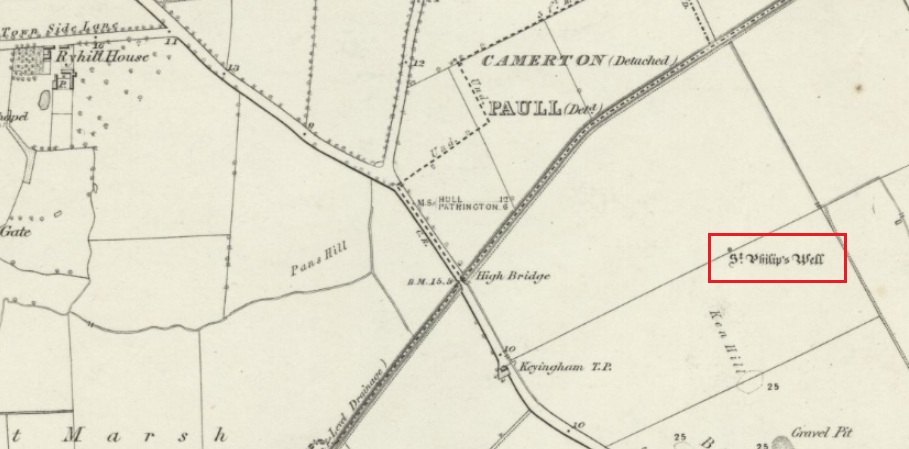
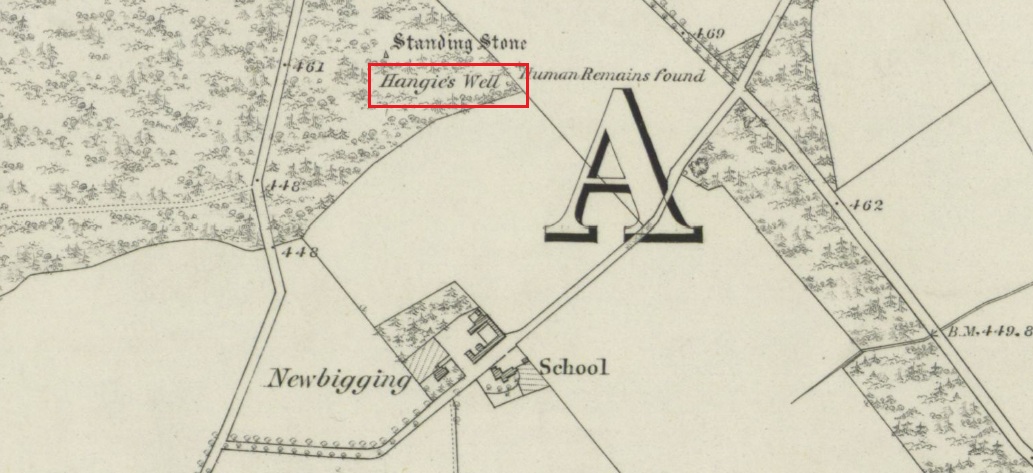
Hangie’s Well on 1867 map

Turn right off the A93 at Cargill onto the side road by Keepers  Cottage and up the hill to Gladsfield Wood at the top on your right. Park up at the top side of the Wood and walk straight along the narrow track for around 450 yards until you get to where another track crosses it and turn left along this track and head for the electricity pylon. The well is immediately to the left (north-east) of the pylon.

Archaeology & History

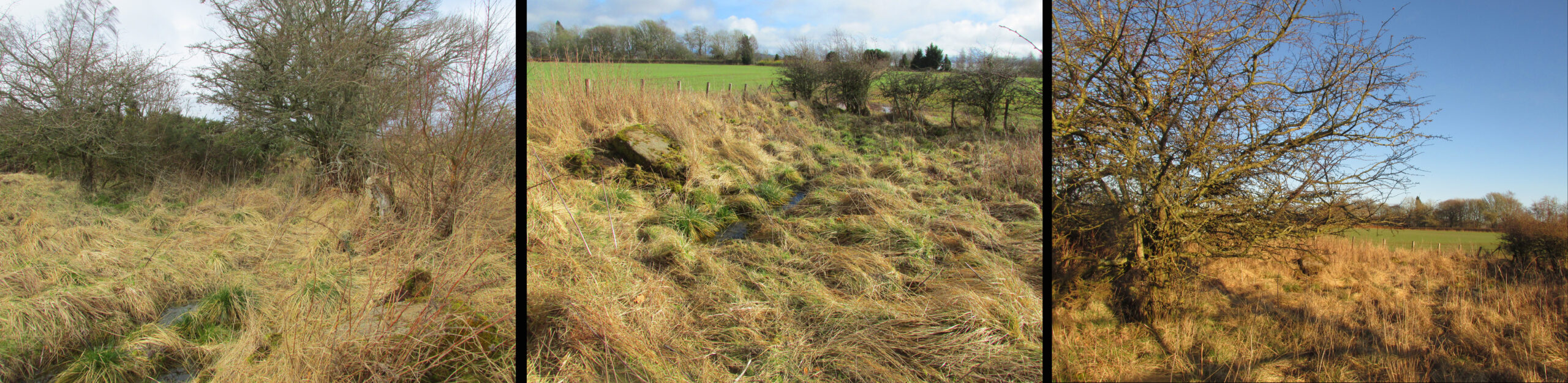
On my first visit I got the impression this weed-choked pool may once have been a holy well.  There are stones on the north east side of the pool, some of which look to have been shaped, which may have formed part of a walled enclosure or part of the adjacent Roman road; or they may only be field clearance boulders.  There is the tell-tale gnarled hawthorn tree with the thick stump of a what has been a much larger hawthorn next to it. And folklore of a hangman to explain the ‘Hangie’s’ name.

Andrew Jervise, writing in 1863, told that,

“About three hundred yards from the Parish schoolhouse, an old well, now partly filled up, Hangie’s Well, near which, it is said, the parish hangman dwelt, and where, some fifty or sixty years ago, a quantity of human bones were discovered”

But what was going on here before this hangman stalked the land? The well—a spring actually—is at the top of the ridge above the Tay beside the Muthill to Kirriemuir Roman road (the most northerly Roman road in the Empire apparently, says Ivan Margary), and so would have been a welcome stopping point for men and horses using that road; and this being the Roman Empire, the well may have acquired some cultic significance.

In the mediaeval period the Cistercian monks of Coupar Angus built their own Abbey Road adjacent to the well which went from their Tayside estate at Campsie to the Abbey, and which would again have been a welcome stopping point for monks and pilgrims.  In the parish there was a local cult of a St Hunnand, this name being thought to be a corruption of Adamnan (and if Adamnan can be corrupted through oral tradition to ‘Hunnand’ then Hunnand can be corrupted to ‘Hangie’?).  If this was once a holy well that continued to be venerated after the Reformation, did the wily Presbyterians ‘taint’ it by coming up with a tale of an executioner using it to wash the blood of his victims off his hands? But enough of this speculation, in the absence of proof it must just remain plain old Hangie’s Well!  When you’re in the area, give it a look and see what you think.

The Well showing the adjacent stones and the Hawthorn bush.

Folklore

This story was given by the locals to the Ordnance Survey inspectors around 1860:

‘A small well a little to the south west of Gallowhill. According to the tradition of Mrs. Manson & Boyd the Executioner made use of this well for washing his hands after he had performed his duty towards criminals that were condemned to be executed on Gallowshade.’ 

William Rose writing in the New Statistical Account of 1845:

‘Near the Village of Gallowhill is a field called the Gallowshade, which was a place of execution under the feudal system. And in a field about 100 yards north from the school house is a well, said to have been used by the executioner for washing his hands after being engaged in his bloody work, and which still goes by the name of  “Hangie’s Well.”‘

References:

  1. Bannerman, J.P., Parish of Cargill, The Statistical Account of Scotland, Vol. XIII, 1794
  2. Forbes, Alexander P., Kalendars of Scottish Saints, Edmonston & Douglas, Edinburgh, 1872
  3. Jervise, Andrew, Memorials of Angus & Mearns, A & C Black, Edinburgh, 1861
  4. Mackinlay, James M., Folklore of Scottish Lochs and Springs, William Hodge, Glasgow, 1893
  5. Map of Monastic Britain – North Sheet, Ordnance Survey, 1955
  6. Margary, Ivan D., Roman Roads In Britain, 3rd. Edition, John Baker, London, 1973
  7. .Ordnance Survey Name Book Perthshire Vol. XV, 1859-62
  8. Rose, William C. Parish of Cargill, New Statistical Account of Scotland, Vol.X, 1845

Acknowledgements:  Big thanks for use of the 1st edition OS-map in this site profile, Reproduced with the kind permission of the National Library of Scotland

© Paul T Hornby, 2021

St. Brendan’s Well, Abernethy, Perthshire

Holy Well (lost):  OS Grid Reference – NO 191 161

Also Known as:

  1. Brendan’s Well
  2. Brendi’s Well

Archaeology & History

In 1897, when Butler wrote his history of the village, he told that a certain well, “adjacent to the Gattaway stream” (thought to be the Nethy Burn which passes Gattaway farm) was known to old locals as Brendan’s Well, with the name still surviving as ‘Bredni Well’.  There were a number of large boulders around it that had been scattered by blasting, but which Butler thought were, “in all probability placed originally near the wall as a guide for pilgrims.”

The site was included in Ruth & Frank Morris’ (1982) survey, adding simply that the site was named “after the saint who lived here in the seventh century.”  In the christian calendar, St. Brendan’s day was May 16.

When the local antiquarian Paul Hornby looked for the well, a local lady told him that she thought an occasional but regular boggy patch that appeared in her garden was due to the underground waters from St Brendan’s Well.

References:

  1. Butler, D., The Ancient Church and Parish of Abernethy, Edinburgh 1897. Page(s): 102
  2. Morris, Ruth & Frank, Scottish Healing Wells, Alethea: Sandy 1982.

© Paul BennettThe Northern Antiquarian

Lambeth Wells, Lambeth, London, Surrey

Healing Wells (destroyed):  OS Grid Reference – TQ 3094 7889

Also Known as:

  1. Lambeth Spa
  2. Near Well and Far Well

Archaeology & History

This once famous healing or spa well has long gone.  It was located where the buildings that now constitute 104-105 Lambeth Walk presently stand: an area which the great London historian William Thornbury (1878) told was already “a favourite resort of Londoners, and celebrated for the variety of sweet-smelling flowers and medicinal herbs growing there,” complementing the healing waters before and during the spa craze.  The great herbalist John Gerard did his collections here.

I can find no information regarding its early use by our peasant ancestors, so its written history simply begins when it had been appropriated by those well-to-do up-market types who took this medicinal spring for their commercial gain in the early days of the trendy spas.  Supplied by two separate springs known as the Nearer and Farther Wells respectively, the Well House built here was “formally opened in April 1696” and subsequently had almost daily accompaniments of music, including French and country dancing!  But as the popularity of the Lambeth Spa increased, so did its problems.  Phyllis Hembry (1990) told that by July 1715, one visitor to the spa,

“was so depressed to find that the many people there were mostly rakes, whores and drunkards, idlers such as Guard officers, or young pleasure-seeker like attorneys’ clerks, mingling with loose women of the the meanest sort.  The Lambeth Wells also became a public nuisance, so a dancing license was refused in 1755.”

The so-called Great Room which had been the place of great occasions by spa users ended up being the meeting place “for Methodist meetings.” Oh how the winter nights must have flown by…..

There was a decided improvement in the years that followed and social events at the spa increased again.  It became what Thornbury said “was another place of amusement.”  The Lambeth Wells, he wrote,

“were held for a time in high repute, on account of their mineral waters, which were advertised as to be sold, according to John Timbs, at “a penny a quart, the same price paid by St. Thomas’s Hospital.” About 1750, we learn from the same authority, there was a musical society held here, and lectures, with experiments in natural philosophy, were delivered by Dr. Erasmus King and others. Malcolm tells us that the Wells opened for the season regularly on Easter Monday, being closed during the winter. They had “public days” on Mondays, Thursdays, and Saturdays, with “music from seven in the morning till sunset; on other days till two!” The price of admission was threepence. The water was sold at a penny a quart to the “quality” and to those who could pay for it; being given gratis to the poor.  We incidentally learn that there were grand gala and dancing days here in 1747 and 1752, when “a penny wedding, in the Scotch manner, was celebrated for the benefit of a young couple.”

By this time, a rival St. George’s Spa of had been created a short distance away on the parish boundary and with it, the popularity and attendance at Lambeth Wells began to decline.  By the end of the 18th century, the rot had truly set in and its days were finally numbered.

As for the medicinal properties of these wells, little seems to have been recorded.  Aside from repeating the common description of them being mineral waters, William Addison (1951) simply added that they were also purgative.

References:

  1. Addison, William, English Spas, Batsford: London 1951.
  2. Allen, Thomas, The History and Antiquities of the Parish of Lambeth, J. Allen: London 1827.
  3. Allen, Thomas, A History of the County of Surrey – volume 1, Isaac Taylor: London 1831.
  4. Foord, Alfred Stanley, Springs, Streams and Spas of London: History and Association, T. Fisher Unwin: London 1910.
  5. Hembry, Phyllis, The English Spa 1560-1815, Athlone Press: London 1990.
  6. Nichols, John, The History and Antiquities of the Parish of Lambeth, J. Nichols: London 1786.
  7. Rattue, James, The Holy Wells of Surrey, Umbra: Weybridge 2008.
  8. Sunderland, Septimus, Old London Spas, Baths and Wells, John Bale: London 1915.
  9. Thornbury, William, History of Old and New London – volume 6, Cassell: London 1878.

Links:

  1. Lambeth Wells on the Vauxhall History website

© Paul BennettThe Northern Antiquarian

Thistle Brig, Stanley, Perthshire

Legendary Rock: OS Grid Reference – NO 10842 32040

Getting Here

The easiest way to see the site is to stop at the car park at Craighall on the B9099 south of Stanley, and follow the path to the river.  The remains of the Brig will be seen on the other side of the Tay from the riverside walk.

Archaeology & History

The Thistle Brig was described in the nineteenth century Ordnance Survey Name Book as:-

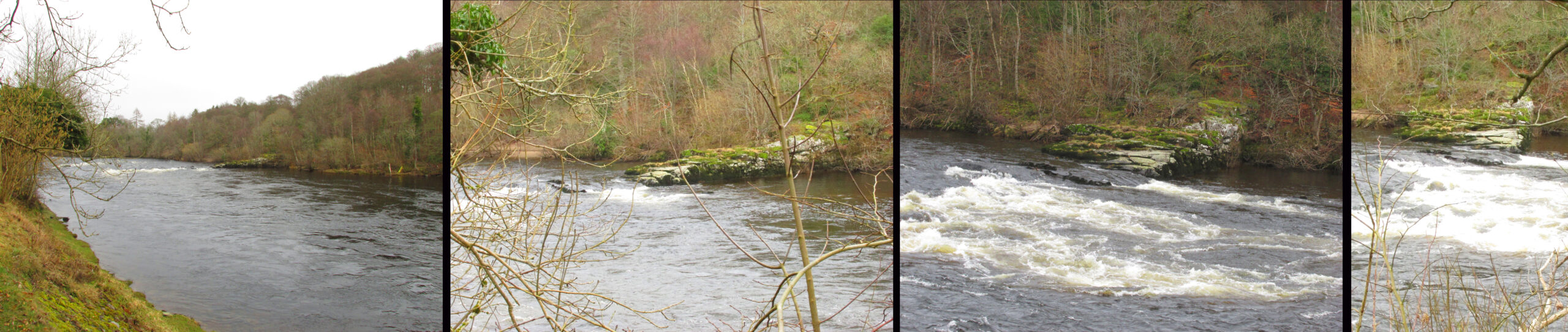
‘A remarkable spot in the River Tay, when the breadth of the river becomes suddenly narrow by the protrusion of a bed of trap rock which crosses it at this place.’

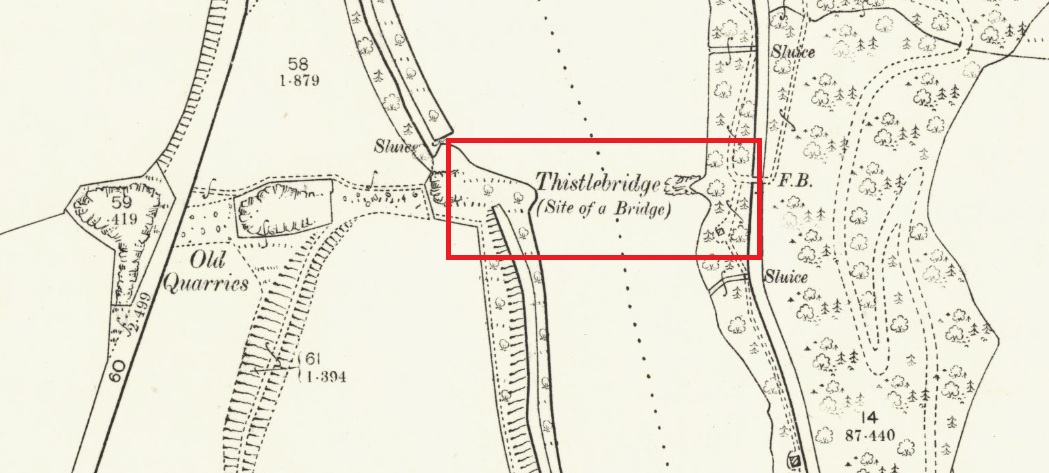
Thistle Brig & the quarries for its hard stone on the 1901 25 in OS-map

According to local historian Alexander Scott, the Thistle Brig formed a convenient place to ford the Tay until  much of it was blasted away by explosives some time in the mid-nineteenth century in order to improve the flow of the river.  Old maps imply that an actual bridge may have spanned the Tay hereabouts at some time in the past.  The seemingly little known folklore of this site relates to an invasion by the Danes in the early mediaeval period. Elsewhere there are similar stories, so the truth or otherwise depends on where you are in Scotland, but this one may have more validity as the tale seems to give its name to the place!

The name ‘Thistle Bridge’ has been applied on old postcards to a stone footbridge over a side channel or lade between the road and the River Tay to the south of the Brig, and is not the subject of this profile.

The remains of the Thistle Brig – a hard basalt dyke on the east bank of the River Tay

Folklore

Alexander Scott, writing of the Brig:-

“…tradition holds that here the thistle received the distinction  of becoming the national emblem of Scotland.  In one of the many invasions the country suffered from foreign armies, the Danes, on one occasion, having landed on the east coast sacked the town of Montrose and continued on their march across the country, burning and pillaging as they went.  While crossing the Tay at this ford at night, the incident occurred of one of the leading soldiers arriving on the opposite side suddenly coming in contact with a thistle with his bare leg, which caused him to emit a shreik of pain.

“The noise was heard by the Scots, who had been encamped nearby, and the alarm thus given was the means of securing a victory over their enemies. The thistle was thereafter honoured as the national badge.”

Reference:

  1. Scott, Alexander, St Martins and Cambusmichael, A Parochial Retrospect, Munro & Scott 1911.

Link:

  1. Ordnance Survey Name Book

© Paul T Hornby 2021

Blind Well, Sutton-in-Holderness, East Yorkshire

Healing Well:  OS Grid Reference – TA 1204 3306

Archaeology & History

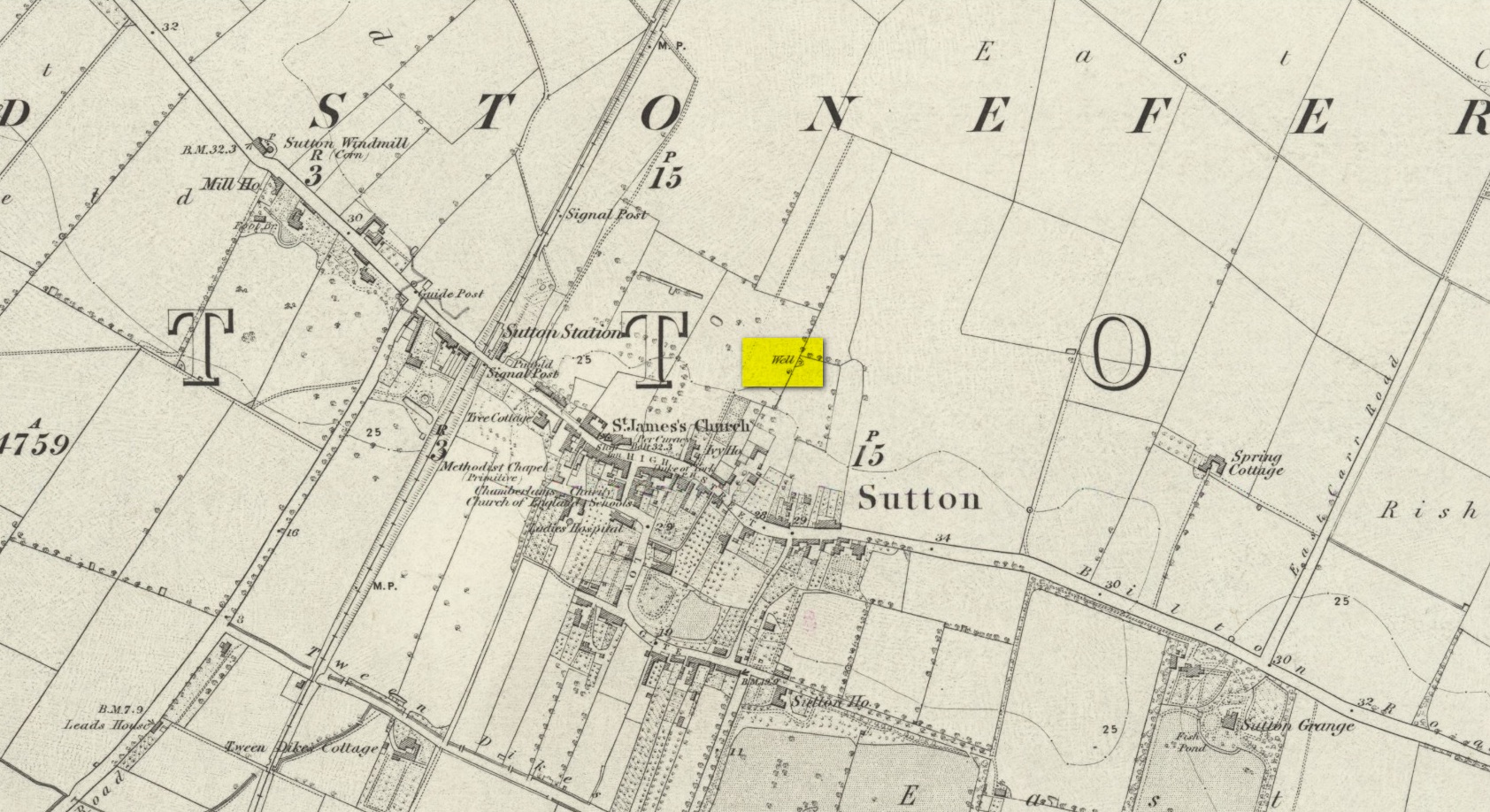
Site of well on 1855 map

We don’t know for certain the precise whereabouts of this long lost healing well, but it would seem to be the one highlighted here (right) on the 1855 OS-map.  However, I think it equally possible that the small unnamed building, roughly halfway between the highlighted ‘Well’ and Spring Cottage, where the walling meets, could be the site in question.  It’s one or the other!

Folklore

When Thomas Blashill (1896) wrote of the Blind Well in his standard history work of the area, memory of it was already falling away.  In discussing where local people could wash and look after their health, he told that

“There was one place in the parish where washing seems to have been practised as a curative measure.  Down in the East Field, near to Spring Cottage Farm, was the Blindwell, to which the people had access. If they used its waters freely when suffering from sore eyes, their faith would probably be rewarded.”

References:

  1. Blashill, Thomas, Sutton-in-Holderness, William Andrews: Hull 1896.

© Paul BennettThe Northern Antiquarian

St Everilda’s Well, Everingham, East Yorkshire

Holy Well (destroyed):  OS Grid Reference – SE 80528 42531

Also Known as:

  1. St Everildis Well

Archaeology & History

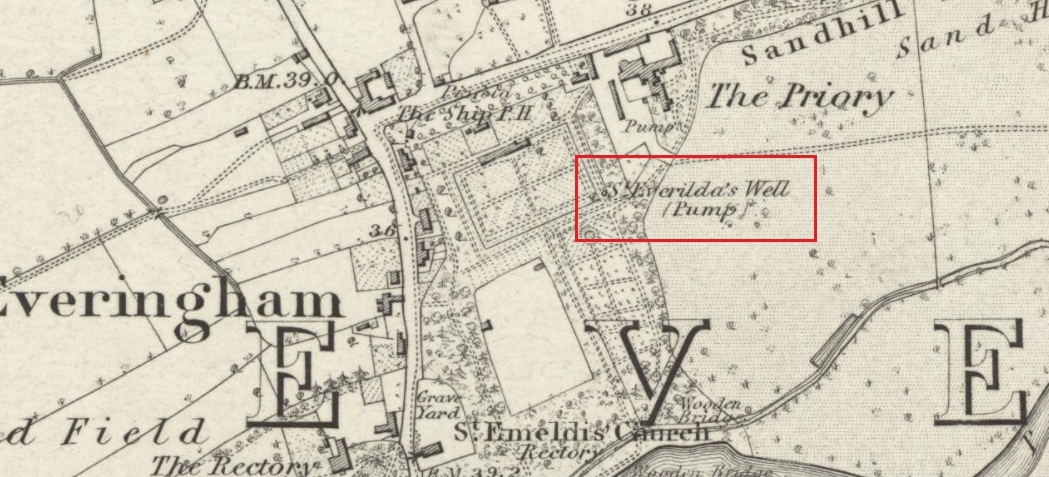
Shown on the 1855 Ordnance Survey map as a ‘pump’, in the grounds of Everingham Priory, the ‘seat’ of the lord of the manor, it was in an enclosure formerly open to the people of the village. It was filled in prior to 1923. The water was described as ‘abundant and excellent.’ Graeme Chapman, in his Yorkshire Holy Wells website states:

‘A few metres to the south of the site of the well the modern OS map marks the start of a stream (SE 8055 4250) which could be the original source of the Holy well’s water.’ 

The well shown on the 1855 6″ OS Map.

The present writer has not been able to verify this from the materials available to him.

Everilda, also known as Everild and Averil, is recorded in the York Breviary, printed in 1493. She was a mid Yorkshire Saint who died around 700 CE.  According to this source she was of a noble Wessex family who went to Yorkshire with companions Bega and Wulfreda, settling on land called Bishop’s Farm, an estate of the Bishop of York, St Wilfrid , which he gave to them, the place being then called Everildisham. There they established a nunnery, of which all trace is now lost. Her Saint’s day is July 9th. The name of St Everilda has been changed to ‘Emeldis’ in the dedication of the church at Everingham. Some historians claim the village is not named after her, but as a derivation of ‘ham of Eofor’s people’. The only other church known to be dedicated to her is at Nether Poppleton, some 17 miles north west of Everingham.

Folklore

The water of the village and the mothers of Everingham are said to have been blessed by St Everilda, and the Reverend Smith wrote that over a fifty year period, no mother had died in childbirth.

References:

  1. Farmer, David, The Oxford Dictionary of Saints, Oxford University Press, Oxford, 1987
  2. Raine, James, The Dedications of the Yorkshire Churches, The Yorkshire Archaeological and Topographical Journal, Vol II, 1873
  3. Salisbury, Matthew Cheung, The Use of York: Characteristics of the Medieval Liturgical Office in York, Borthwick Institute, York, 2008
  4. Smith, Rev William, Ancient Springs & Streams of the East Riding of Yorkshire, A.Brown & Sons, London, Hull & York, 1923
  5. Stanton, Richard, A Menology of England & Wales.., Burns and Oates, London, 1887

Link:

  1. St Everilda’s Well on Yorkshire’s Holy Wells

© Paul T Hornby 2021

Parsonage Well, Manchester, Lancashire

Holy Well (destroyed):  OS Grid Reference – SJ 836 985

Archaeology & History

Long since lost beneath the metal and concrete of modern times, even references to this forgotten place are very faint indeed.  I expected to find something of it in Henry Taylor’s (1906) giganteum, but it even slipped through his considerable work; and, even where mention of it exists, it is only in passing.  In William Proctor’s (1874) survey of early Manchester, he found deeds relating to the land and its early owners wherein the one and only mention of this well appears.  It was located near the middle of the city centre, between the Law Courts and Manchester cathedral, in the area known today as the Parsonage Gardens on the east-side of the River Irwell.  In earlier centuries this was the abode of a Christian minister, or parson, and the water from this well supplied his religious abode.  Proctor wrote:

“Crossing over to the Parsonage, we find that, in 1780, one of its residents was Mr John Quincey, linen-draper, uncle to the English Opium-Eater.  In the previous year Mr Quincey was married to Miss Martha Goodyear, of Ardwick.  His residence was bounded, it seems, on the north and west by “a narrow street or passage called Black Fryars”; while on the other points of the vane his prospect is thus shown by an extract from a lease dated 1758: — “The orchard or garden plot adjoining the river; it is now fenced out with hedges and ditches.”  Some years earlier mention is made of a summer-house, fruit trees, and plants in abundance, with “free liberty of way to the spring or well called the Parsonage Well.”  In 1686, Thomas Heyrick of Manchester, gentleman, leased a “tenement and parcel of land abutting upon a messuage and garden heretofore in the possession of George Tipping, deceased, and now the dwelling-house of the warden [Richard Wroe] of the said College; bounded on the east part with the old Parsonage ditch adjoining to the tenement of Mr John Oldfield.  Close by are or were the residences of John Nield, Hugh Boardman, Richard Haworth, Esq., and lately Jane Haworth, his widow.”  A worn parchment proves the existence, in 1698, of “Parsonage Croft;” another of “Parsonage Pool;” and an order of the Court Leet, 1594, required the tenants to “go along the hedge-side, keeping the footway towards the Parsonage style, for their fetching of water from the river.”  In 1765, an advertisement in the Mercury mentions “the sign of the Grey Horse in or near Parsonage Brow.” St Mary’s Church covers the ground once known as the Parsonage Green.”

References:

  1. Proctor, Richard W., Memorials of Manchester Streets, T. Sutcliffe: Manchester 1874.
  2. Taylor, Henry, The Ancient Crosses and Holy Wells of Lancashire, Sherratt & Hughes: Manchester 1906.

© Paul BennettThe Northern Antiquarian

Holy Well, Halifax, West Yorkshire

Holy Well (destroyed):  OS Grid-Reference – SE 100 254

Archaeology & History

This sacred site seems to have been destroyed sometime at the end of the 19th century.  It was located on the great slopes heading up to Beacon Hill.  In 1787, a property survey showed six houses here called Holy Well Cottages and on the 1852 OS-map a “Well” is highlighted at the bend in the pathway of the Old Bank as you’re going uphill, which is the place in question.  On my last visit here about thirty years ago, its position was preserved under a large manhole. 

References:

  1. Heginbottom, J.A., “Early Christian Sites in Calderdale”, in Proceedings Halifax Antiquarian Society 1988.

© Paul BennettThe Northern Antiquarian

St Loy’s Well, Tottenham, London

Holy Well (destroyed): OS ReferenceTQ 3370 8999

Also Known as:

  1. Old Tottenham Well
  2. St. Eloy’s Well

Getting Here

The site of the well, which was in the historic county of Middlesex, appears to have been on the west side of the present Moorefields Road just north of the junction with St Loy’s Road. The OS reference is an approximation.  The restored circular well house to the south of the High Cross at the High Road – Philip Lane junction now popularly known as ‘The Old Well’ or ‘The Old Pump’ by Tottanham Green has been referred to as being ‘St Eloy’s Well’ but this is not the historic well described in this profile.

Archaeology & History

Likely position of the well on the 1873 6″ OS Map

The well was still in existence in 1876, but by the time of the revision of the OS map around 1894, it had been destroyed following building of the Great Eastern Railway’s Enfield branch line and the construction of terraced housing along the new St Loy’s Road.

So where was the well? The 1873 6″ OS map shows a field on parts of which the railway line and St Loy’s Road are now built, and a small area of water is shown in this field which is the likely position of St Loy’s Well on the eve of its destruction, when it was described as a dirty pool of water full of mud and rubbish. If this was the position of the well then it has now been completely built over…

It was described by Robinson in his 1841 History of Tottenham as being:

‘..in a field….on the western side of the High Road…surrounded by willows…it is bricked up on all sides, square and about 4 feet deep..’ ‘ In Bedwell’s time [it was]…always full of water, but never running over; the water of which is said to exceed all other near it.’.. ‘the properties of the water are similar to the water of the Cheltenham springs’.

Thomas Clay ‘s 1619 map of Tottenham, illustrated in Robinson’s book shows a field north west of Tottenham High Cross called ‘Southfeide at St Loys’. The Tottenham historian Wilhelm Bedwell described the well in 1631 as:

“nothing else but a deep pit in the highway, on the west side thereof;”….”it was within memory cleaned out, and at the bottom was found a fair great stone, which had certain letters or characters on it; but being broken or defaced by the negligence of the workmen, and nobody near that regarded such things, it was not known what they were or meant.’

This fair great stone with its ‘certain letters or characters that no one knew what they were or meant’ is intriguing especially in view of the well’s proximity to the Roman Ermine Street (Now the High Street). Were those mysterious characters spelling out an undecipherable Latin inscription on a Roman stone? We shall never know, but  it hints at a pre-Christian origin or veneration of the well. Another hint is that before the Reformation there was nearby a chapel of St Eloy known as the Offertory*, which may have been originally built to ‘Christianise’ a pre-existing heathen sacred spring. The Roman origins of the well are also hinted at (probably erroneously) by W.L. Bowles in 1830, writing of a ‘Druidical Tour’ that one Sir Thomas Phillipps undertook on the continent, first quoting Phillipps before adding his own conclusion:

“Near Arras in France, are found the mount of St. Eloi and the very name of a place, Tote. I have no doubt Druidical remains will be found there, if this be not the very country of Carnutes.”

Now let me observe, that Tote is Taute —Tot—Thoth, latinized into Tewtates by Lucan, &c. the chief deity of the Celts. St. Eloi is neither more nor less than the Celtic word Sul, turned into the Greek the Sun; and Elios, turned into the Catholic St. Eloi, as at Tottenham, Middlesex, anciently Tote-ham, the ham of Taute or Tent, where is also the sacred well of St. Eloi, or ‘Helios’, the Sun !’

Saint Eloi / Eloy /Loy / Eligius, is the patron saint of those who work in the alchemists’ metal of the sun – goldsmiths! He is also the patron saint of blacksmiths, farriers, and all who earned their livings from horses, and lived from around 588 to 660 to become Bishop of Noyon and the evangelising apostle for much of modern day Belgium. His feast day is 1st December, and he had a widespread cult in mediaeval Europe, including England. In addition to being a healing well for humans, one writer hints that the well’s waters may have been employed for healing horses…they certainly would have drunk from it with its proximity to what is now the High Street.

Around 1770, an artist called Townsend (the sources are unsure as whether it was a Mrs or Mr) produced a romanticised drawing of the well, which was exhibited at the Royal Academy in 1770-1. It depicts a hermit beside the well (the Hermitage of St Anne stood to the south of High Cross prior to the Reformation) receiving an offering from a lady. It was engraved and sold as a print, and may be the only image of the well before its demise.

Folklore

In 1819 – 20, John Abraham Heraud wrote a poem about St Loy’s Well, set in the time of St. Edward the Martyr, (the late 970s), entitled ‘ Stanzas in the Legend of St Loy‘ of which the most relevant verses are;

‘TOTEHAM! the Legend of thine olden day,
To the last note hath on thine echoes died;
But the Bard’s soul still lingers o’er the lay,
To muse upon thy transitory pride
The pride of times that hath been — blank and void—
When all was Nature, big with many a song
Of Chivalry and Fame, with Love allied—
But Time both changed the scene — now houses throng
Where once was solitude — and people crowd along.

Where now thy WOOD, that spread its misty shade
O’er twice two hundred acres? — past away!
And vain its PROVERB, as the things that fade,
Earth, sun, moon, stars, that change as they decay!
The lonely CELL, the tenor of the lay,
Its grove, which hermit tendance loved to rear;
And, St. LOY, mouldering to Time’s gradual sway,
Thy rites, thy OFFERTORY disappear;—
Forgot thy SPRING OF HEALTH no votary worships there!

Forgot, neglected — still my harp shall dwell
On thee, thou blest BETHESDA of ST. LOY!
As Fancy muses o’er the vital WELL
On years of storied yore, with grief and joy,
Exults they were — weeps Truth should e’er destroy!
Thrice I invoke the Spirit of the Stream
With charm she may not question, or deny,
And, like a Naiad, o’er the watery gleam
She rises to my voice, and answers thus the theme:— ‘

Heraud wrote a further poem mentioning the well, his ‘Tottenham‘ of 1820, the relevant verse being:

‘St. Loy! here is this fountain—emblem pure
Of chaste unostentatious charity—
Never in vain intreated, ever sure ;
Yet o’er the marge thy waters fair and free
Ascend not, overflowing vauntingly,
But in thy bounty humble as unfailing,
In grief, disease, and sickness, visit thee.
But part in joy, changed by thy holy healing
To manhood, strength, and life, thy far renown revealing.
There is thy offertory, and thy shrine,
Simple, inartificial ; nor of fame,
Nor any honour, save that it is thine,
And all its glory centres in thy name !’


*Footnote – Brian Spencer’s book on mediaeval pigrim badges recovered by archaeologists in London refers (p222) to a distinct ‘London pattern’ of St Eloi badge – is this a hint that the Offertory was a local shrine to St Eloi where such badges were sold to pilgrims? Further research is needed to try to verify this speculation.

References:

  1. Baker, T.F.T. & Pugh, R.B. (eds.), Victoria County History – A History of the County of Middlesex, volume 5, VCH: London 1976.
  2. Bowles, W.L., Tottenham High Cross, Gentleman’s Magazine, Vol C, April 1830.
  3. Breeze, Andrew, Chaucer, St Loy and the Celts, Reading Medieval Studies 17, 1991.
  4. Foord, Alfred Stanley, Springs, Streams and Spas of London: History and Association, T. Fisher Unwin: London 1910.
  5. Heaword, Rose, “Holy Wells and Lost Waters,” in London Earth Mysteries Journal, 2, 1990.
  6. Heraud, John Abraham, Stanzas in the Legend of St Loy, …
  7. Hope, Robert Charles, Legendary Lore of the Holy Wells of England, Elliott Stock: London 1893.
  8. Robinson, William, The History and Antiquities of the Parish of Tottenham, Nichols & Sons: London 1840.
  9. Spencer, Brian, Pilgrim Souvenirs And Secular Badges – Boydell Press in association with Museum of London, new edition, 2010
  10. Sunderland, Septimus, Old London Spas, Baths and Wells, John Bale: London 1915.
  11. Thornbury, Walter & Walford, Edward, Old and New London – volume 5, Cassell: London 1878.
  12. Walford, Edward, Old and New London, Vol. V,  Cassell, Petter & Galpin: London, 1878.

Links:

  1. St. Eloy’s Well on The Megalithic Portal

© Paul T. Hornby 2020

St John’s Well, Dunrobin, Golspie, Sutherland

Holy Well:  OS Grid Reference – NC 8505 0081

St Johns Well, 1879 map

Archaeology & History

Very little has been written of this site due to the fact that little seems to known about it.  A few of the usual ‘official’ on-line catalogues mention it but information on the site is truly scant.  It is shown on the earliest Ordnance Survey map of the region and the same cartographers describe it in the Ordnance Name Book (1873), saying briefly how St John’s Well,

“Applied to a very deep pump well situated in the court of the ancient portion of “Dunrobin Castle”.  No information respecting the dedication or origin of this name can be obtained in the District.”

But an earlier reference than this is cited in Fraser’s (1892) work, telling us that,

“In the midst of the court within the castle there is one of the deepest draw-wells in Scotland, all lined with ashlar-work, which was built and finished before the house was begun.  The well was known as that of St. John.  In the year 1512 sasine (i.e. delivery of feudal property) of the earldom and castle was taken at the well.  At other times sasine was taken at the castle, at its gates, or near the well.”

Subsequent to this, we read in Cumming’s (1897) definitive folklore work of the region how,

“(it) looks as if there had been a chapel of St. John on Drumrabyn.  In that case it may have been one dependent upon Kileain (=Kirk of John) on Loch Brora, which was only ½ a mile further than Kilmalin.”

Having not visited the castle, I’m unsure whether or not the well can still be seen.  Does anyone know…?

References:

  1. Cumming, Anna & Bella et al, Golspie – Contributions to its Folklore, David Nutt: London 1897.
  2. Fraser, William, The Sutherland Book – volume 1, Edinburgh 1892.

Acknowledgements:  Big thanks for use of the 1st edition OS-map in this site profile, Reproduced with the kind permission of the National Library of Scotland

© Paul BennettThe Northern Antiquarian