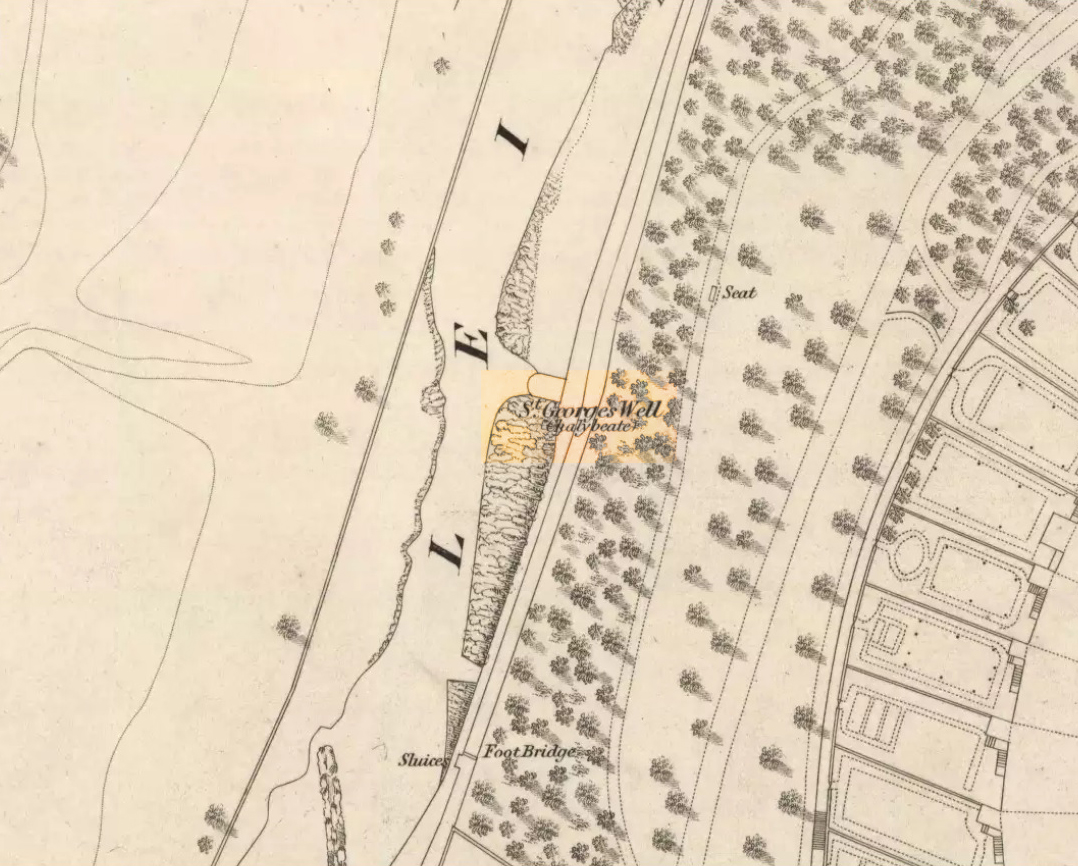
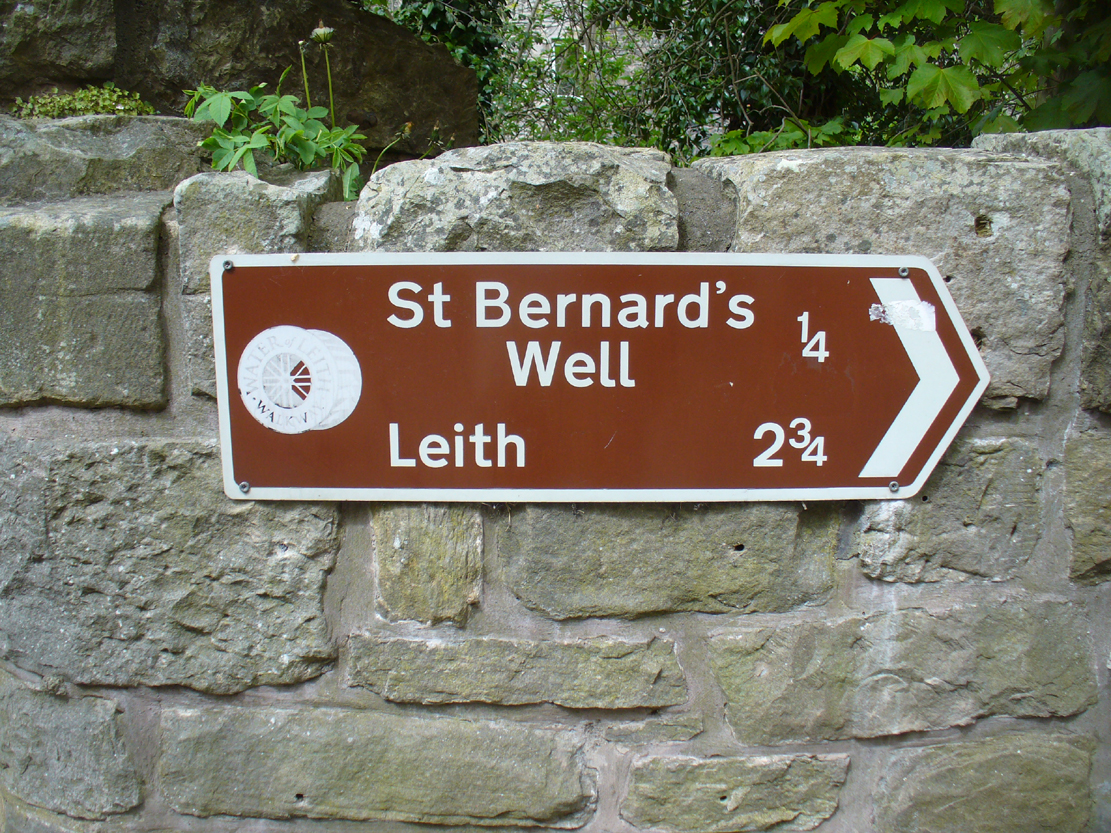
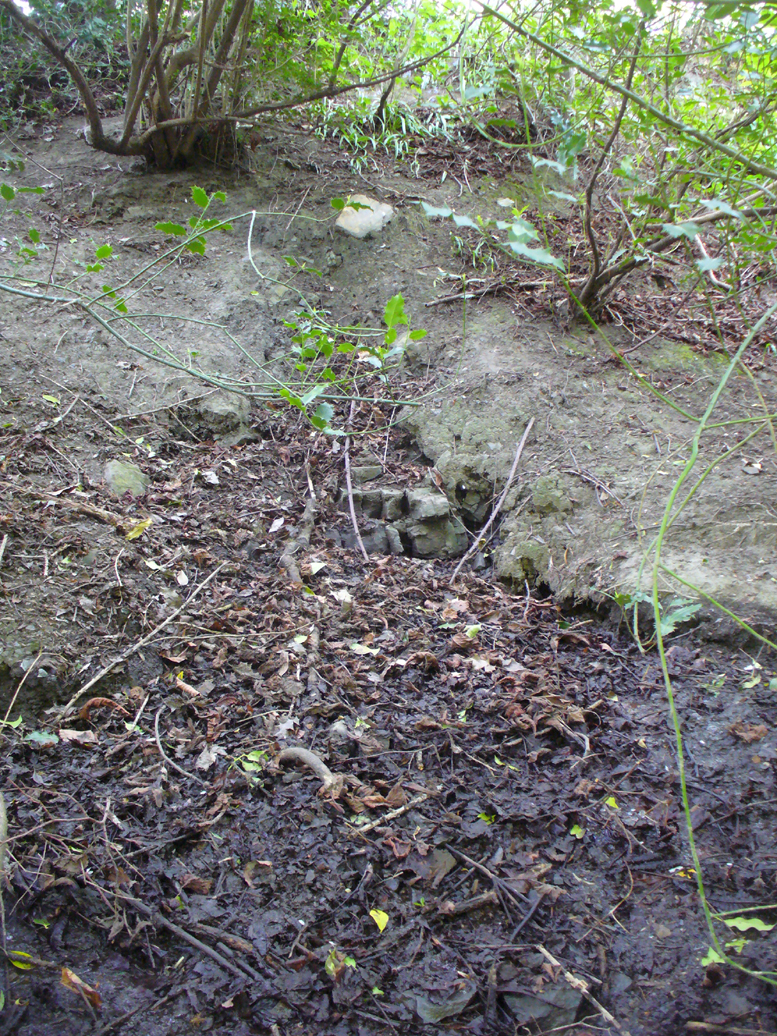
In Edinburgh, get to the west-end of Princes Street (nearest the castle), and where there’s the curious mess of 6 roads nearly skewing into each other, head down Queensferry Street for 450 yards until, just before you go over the bridge, walk down Bells Brae on your left, then turn right down Miller Row where you’ll see the sign to St. Bernard’s Well. St. George’s Well is the small, dilapidated spray-painted building right at the water’s edge 200 yards before St. Bernard’s site.
Archaeology & History
Compared to its companion holy well 200 yards downstream, poor old St. George’s Well is a paltry by comparison, in both historical and literary senses. The site was said to have been “set up in competition with St Bernard’s Well but never achieving its purpose”, wrote Ruth & Frank Morris (1982)—which is more than a little sad. Not on the fact that it failed, but on the fact that some halfwits were using local people’s water supply to make money out of and, when failing, locked up the medicinal spring and deny access to people to this day!
In Mr Grant’s Old & New Edinburgh (1882), the following short narrative was given of the site:
“A plain little circular building was erected in 1810 over (this) spring that existed a little to the westwards of St. Bernard’s, by Mr MacDonald of Stockbridge, who named it St. George Well. The water is said to be the same as the former, but if so, no use has been made of it for many years…”
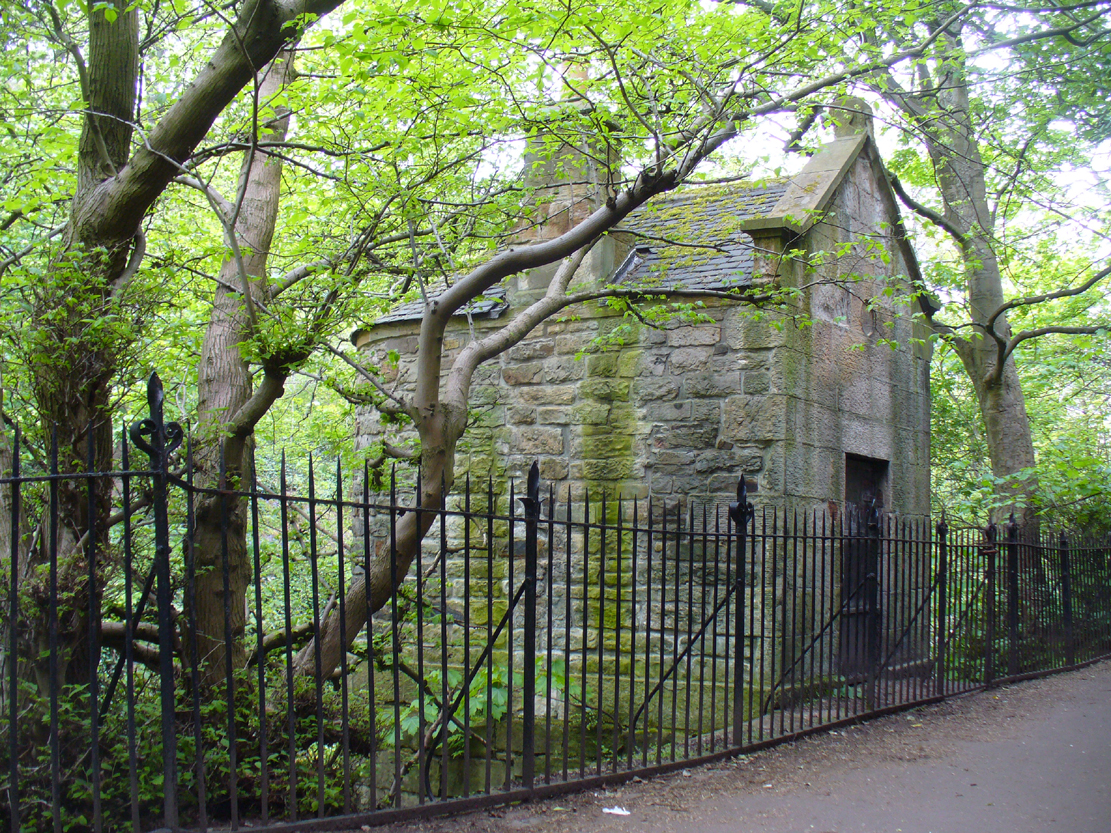
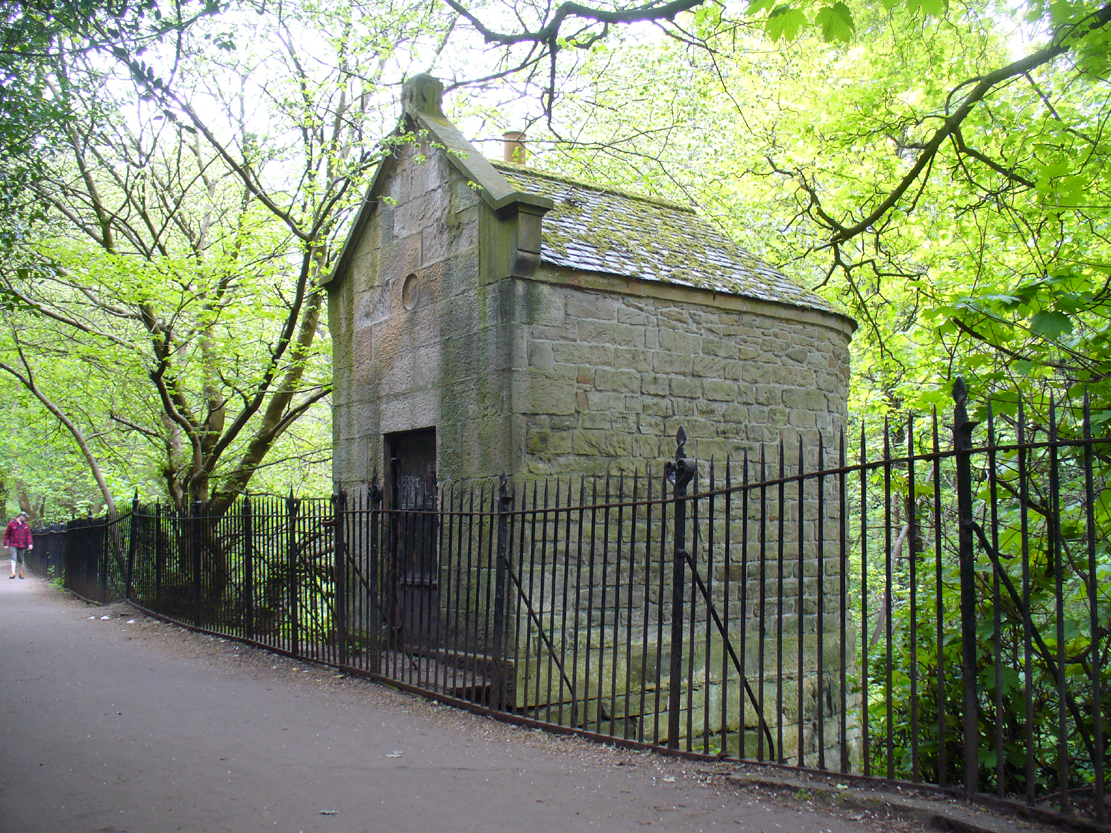
St George’s Well, looking NSt George’s Well, looking SW
The association to St. George was in fact to commemorate the jubilee of King George III that year. If you visit the place, the run-down little building with its grafitti-door has a small stone engraving etched above it with the date ‘1810’ carved.
As the waters here were found to possess mainly iron, then smaller quantities of sulphur, magnesia and salts, it was designated as a chalybeate well. Its curative properties would be very similar to that of St. Bernard’s Well, which were very good at,
“assisting digestion in the stomach and first passages … cleansing the glandular system, and carrying their noxious contents by their respective emunctories out of the habit, without pain or fatigue; on the contrary, the patient feels himself lightsome and cheerful, and by degrees an increase to his general health, strength and spirits. The waters of St. Bernard’s Well operates for the most part as a strong diuretic. If drunk in a large quantity it becomes gently laxative, and powerfully promotes insensible perspiration. It likewise has a wonderfully exhilarating influence on the faculties of the mind.”
Royal Commission on the Ancient & Historical Monuments, Scotland, Inventory of the Ancient & Historical Monuments of the City of Edinburgh, HMSO: Edinburgh 1951.
So you’re in Edinburgh. Get to the west-end of Princes Street (nearest the castle), and where there’s the curious mess of 6 roads nearly skewing into each other, head down Queensferry Street for 450 yards until, just before you go over the bridge, walk down Bells Brae on your left, then turn right down Miller Row to the river where you’ll see the sign pointing the way! Walk alongside the river, past St George’s Well for another coupla hundred yards until you reach the large Romanesque domed building right by the riverside on your left. Steps take you down to it.
Archaeology & History
St Bernard’s Well, 1790
When J. Taylor (1790) wrote his singular book on St Bernard’s Well, this sacred site could be seen in landscape that was described as “a wild, romantic, and very pleasant appearance.” How things change! Although the waters of Leith below which the well arises give the region, still, that air of romanticism that Taylor described, on either side of the waters the stone buildings of the Industrialists have grown, denouncing Nature. But to be honest, it’s still a fine place, considering it’s near the middle of a city!
Small spring above the well
In the shrubs and small trees on the slopes just above the architectural edifice that now covers St Bernard’s Well, after rainy days you can see several small springs of water running down the slope and onto the modern path. In earlier centuries there were six of these springs next to each other which ran a short distance down the slope and converged into two, which then ran into a small stone trough. Local people used these fresh waters, not only for basic needs, but for medicinal purposes too.
It seems that the earliest mention of what Stuart Harris (1996) called “this fancy name” of St. Bernard’s Well appeared in an article in The Scots Magazine of September 1760. It clearly shows how the Scottish Freemasons played their part in bringing the waters of this healing well to the fore:
“A mineral well has lately been discovered between the village and the Water of Leith and Stockbridge, about half a mile north of Edinburgh, which is said to be equal in quality to any of the most famous in Britain. To preserve the well from the injury of the weather, and prevent its being overflowed by the Water of Leith, on the banks of which it is situated, a stone covering is to be erected over it. The foundation-stone of this building was laid September 15th (by a deputation from the Earl of Leven, the present Grand Master of Scotland), by Alexander Drummond, brother of Provost Drummond, lately British Consul at Aleppo, and Provincial Grand Master of all the Lodges in Asia and in Europe, out of Britain, holding of the Grand Lodge of Scotland. He was attended by many of the brethren, in their proper clothing and insignia, preceded by a band of music, and the ceremony was performed in the presence of a great number of spectators. It is called St. Bernard’s Well.”
The following year, the poet James Wilson Claudero wrote a poem about the laying of the foundation stone at the well, in which the medicinal virtues of the waters were described. A section of the poem is as follows:
“When heaven propitious to grant his desire
To the utmost extent his heart could require,
For the health of the poor sent this sanative well,
A blessing to all that around it do dwell;
This water so healthful near Edinburgh doth rise
Which not only Bath but Moffat outvies.
Most diseases of nature it quickly doth cure.
“It cleans the intestines and appetite gives
While morbific matter it quite away drives.
Its amazing effects can not be denied,
And drugs are quite useless where it is applied,
So what doctors can’t cure is done by this spring
Preserved till this year of great Drummond’s reign.”
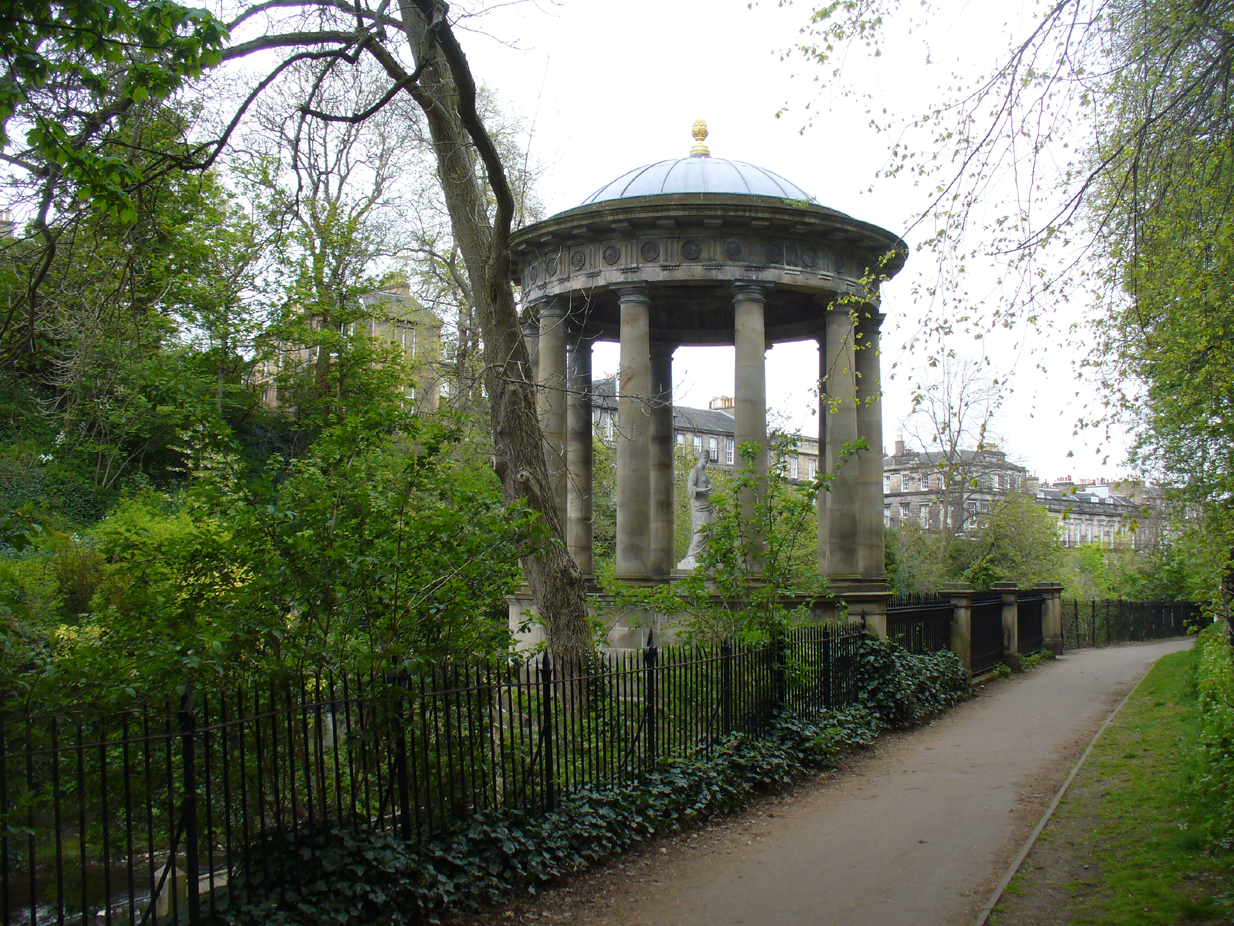
St Bernards Well, looking NSt Bernards Well, looking SW
A few years later in 1786, the construction we see today which now covers the medicinal waters, began to be built. The ‘fashion’ of the rich and wealthy acquiring healing wells used by local people was in vogue at the time and the place became frequented by the usual snooty class of doods who played their social gatherings here. The Scots Magazine gave a brief resumé of what unfolded—intriguingly at Beltane (perhaps the day when its waters were of greatest repute, as is the case at the majority of sacred wells), telling:
“On the 1st of May, the foundation-stone of the mineral well of St Bernard’s, in the vicinity of Edinburgh, was laid in the presence of several gentlemen of the neighbourhood. A plate of metal was sunk into the stone, with the following inscription:
Erected For the benefit of the public at the sole expense of Francis Garden, Esq. of Troop A.D. 1789 Alexander Nasmith, Architect, John Wilson, Builder.
This building is erected in the most picturesque spot in the neighbourhood of Edinburgh, and when finished, from the elegance of the plan, and the excellent quality of the materials, will long be an ornament to the city, and prove a lasting monument of the refined taste, liberality, and public spirit of the honourable founder.”
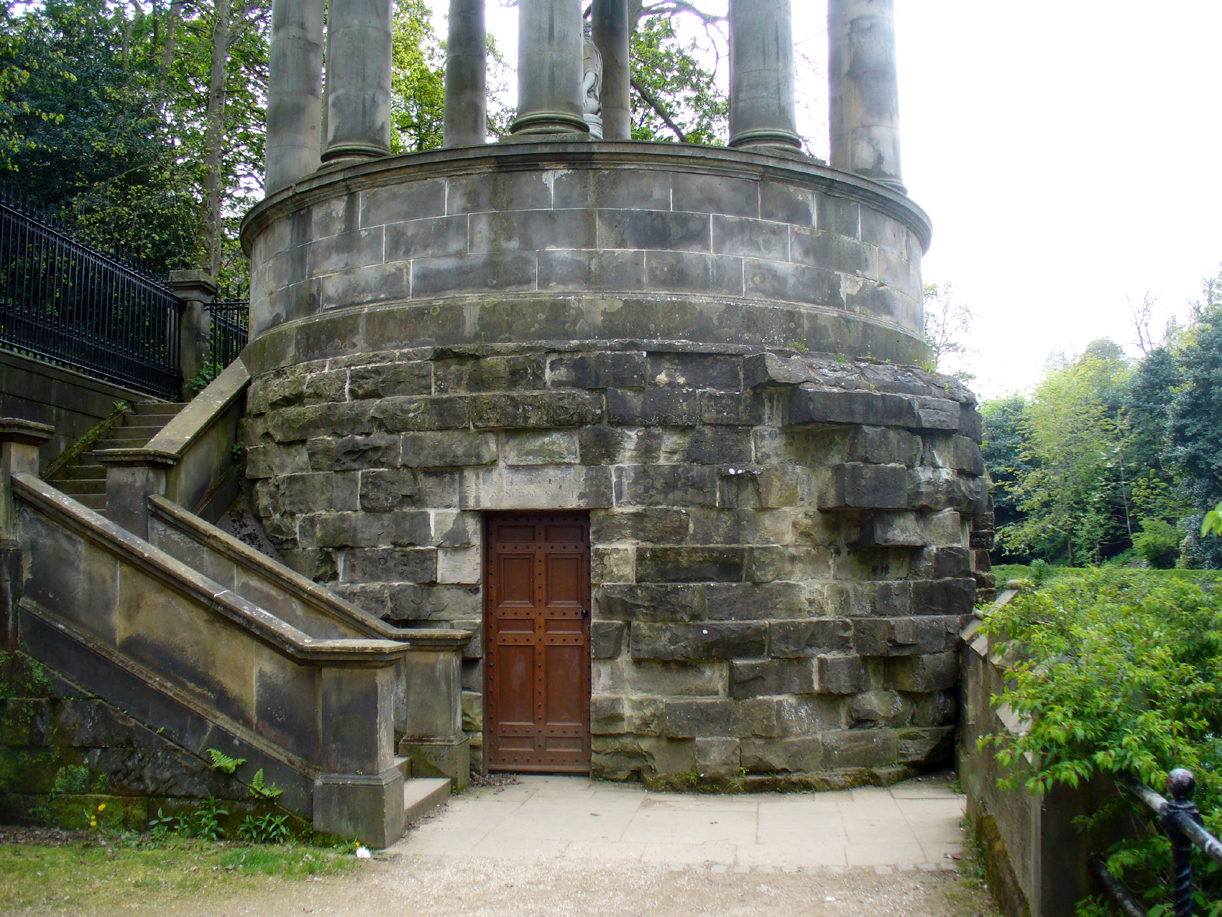
As the reputation of the place spread amongst those who could read and had money, so the day-to-day habits of local people, who kept drinking the waters and collecting them for domestic use, became increasingly frowned upon. Some rich doods bought the land and, thereafter, local people were only allowed to use the well at certain times and in certain ways. I kid you not! This is a familiar tale at a lot of city sites. After the construction of the Romanesque building that still covers the well (based on an ancient temple at Tivoli, Italy, with a statue on top of the goddess of Health, Hygeia) which, to this day, hides the waters inside behind lock and key, the land-owner Lord Gardenstone appointed and paid a ‘keeper of the well’. The ‘keeper—George Murdoch of Stockbridge —had a series of rules to abide by, for which he got paid a tidy sum. Gardenstone wrote to him:
“George — From long experience I entertain a very favourable opinion of your honesty and decent manners. I, therefore, am resolved to make a trial of your capacity to perform properly the duties of a trust which is of a public nature, and requires good temper, patience, and discretion.
“I hereby authorise and appoint you to be Keeper of St Bernard’s Well during pleasure, and you are to observe punctually the following directions and rules, or such other regulations as may be found more expedient and may be hereafter prescribed:
“I. You are to furnish proper glasses and cups for drinking the water.
“II. During the proper season you are to attend the well, at least from six till nine, every morning. During the above period none shall have access to drink or use the water but those who shall pay at the moderate rates subjoined.
“III. Such as choose to subscribe for the season, from the 1st of May to the 1st of October, shall pay down, before they begin to drink, at least five shillings sterling.
“IV. Persons who do not choose to subscribe, but choose at their pleasure to drink the water any time of the morning period, occasionally, shall pay before they begin to drink every morning — for grown persons each one penny, and for children each one halfpenny; or at the rate of sixpence and threepence per week respectively.
“V. For water drawn from the well to be used at a distance, in bottles or other vessels in the mornings, payment must be made at the rate of one halfpenny for every Scots pint.
“VI. No person shall be allowed, on any pretence, to bathe their limbs or sores at, or in sight of, the well during the morning period.
“VII. All persons who are either unable or unwilling to pay as above, shall have free access to the use of the waters from ten to one every forenoon; and those who have once paid may return and use the waters at any time of the day.
“VIII. The keeper shall attend from five to seven o’clock in the afternoon for the service of all who have paid; and after seven for all without distinction.
“IX. Upon a proper certificate from any regular physician, surgeon, or apothecary of Edinburgh, the keeper shall supply poor persons with water at any time prescribed.
“X. The proper and customary method of drinking at mineral waters is, that persons after drinking a glass or cup of water retire immediately and walk about, or take other exercise for an interval of at least five minutes, both as a benefit to themselves, and to make way for other water drinkers. A contrary practice prevails at St Bernard’s, and sometimes a crowd of people continue at the well till they have drunk their quota. Hereafter every person must retire as above, and the keeper must require them to do so, this regulation being very necessary.
“XI. Another irregularity, prejudicial to the credit and use of the waters, has prevailed and must also be corrected, which is that quantities of the water are carried to distant parts in open vessels. All mineral waters should be transported in well- corked bottles or other close vessels. The keeper must strictly adhere to this regulation, and suffer no water to be carried off in open vessels.
“Hints and observations for the better regulation and public use of those waters will be thankfully received by the proprietor.
“Some accounts of the virtues of this mineral water, and of certain remarkable cures performed by the proper use of it, will soon be published by a medical gentleman of character and experience.
“N.B. — The effects of this water when used in making either tea or punch are remarkably agreeable.
St Bernards Well on the 1819 Kirlands map
This must have caused some friction amongst locals, and no doubt given Mr Murdoch problems at times, as he would be denying the people who were born and bred here access to their drinking and medicinal spring. And so a missive was written on July 4, 1810, which instructed the keeper “to supply the poor with water gratis each day from eleven to twelve o’ clock noon.” Sensible…..
By now, the properties and reputation of the waters were widespread among the elitists and money-addicts. St Bernard’s Well was being compared with the famous healing waters of Bath, Harrogate, Strathpeffer and more. Its cause was encouraged by a series of scientific reports that showed a variety of health-giving minerals in good quantities; and many cases of ‘cures’ were reported by those who drank here. When the local doctor, J. Taylor (1790) opened his treatise on this very issue, he began,
“In the course of my practice, having occasion to visit most of the families in Stockbridge, especially of the poorer sort, I was informed that St Bernard’s Well had been of great benefit to people that resorted to it for various complaints…”
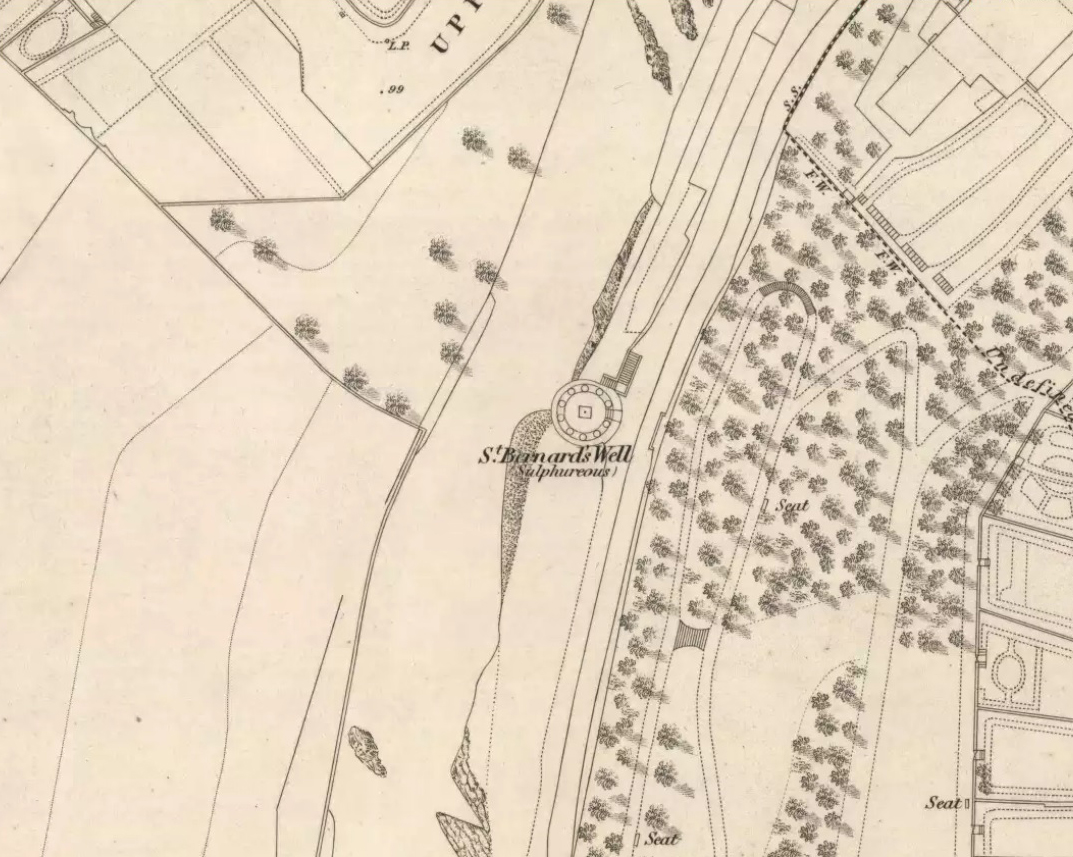
Entrance to the wellSt Bernards Well on 1851 map
Many more cases were to follow. It was the chemical constituents in St. Bernard’s waters that did the trick—although most modern folk would squirm at the very look and whiff of them, as Taylor reported how “the peculiar odour of this water is somewhat nauseous”! That’s because they are primarily sulphurous in nature, along with good traces of iron, magnesia and salts. I’ve drank such waters at some of Yorkshire chalybeates and found them damn invigorating – but most folk won’t touch them with a barge-pole! (chlorinated flouridated tap-water seems most folk’s preference these days) Dr Taylor told how St. Bernard’s Well was very good at,
“assisting digestion in the stomach and first passages … cleansing the glandular system, and carrying their noxious contents by their respective emunctories out of the habit, without pain or fatigue; on the contrary, the patient feels himself lightsome and cheerful, and by degrees an increase to his general health, strength and spirits. The waters of St. Bernard’s Well operates for the most part as a strong diuretic. If drunk in a large quantity it becomes gently laxative, and powerfully promotes insensible perspiration. It likewise has a wonderfully exhilarating influence on the faculties of the mind.”
He thereafter cited a number of cases of people with various ailments whose illnesses were cured by these waters. I recommend a perusal of his work and the other references below for specifics on such matters. The writings on this one sacred site are plentiful indeed, and the bibliographic references are but a morsel of works that describe it.
Folklore
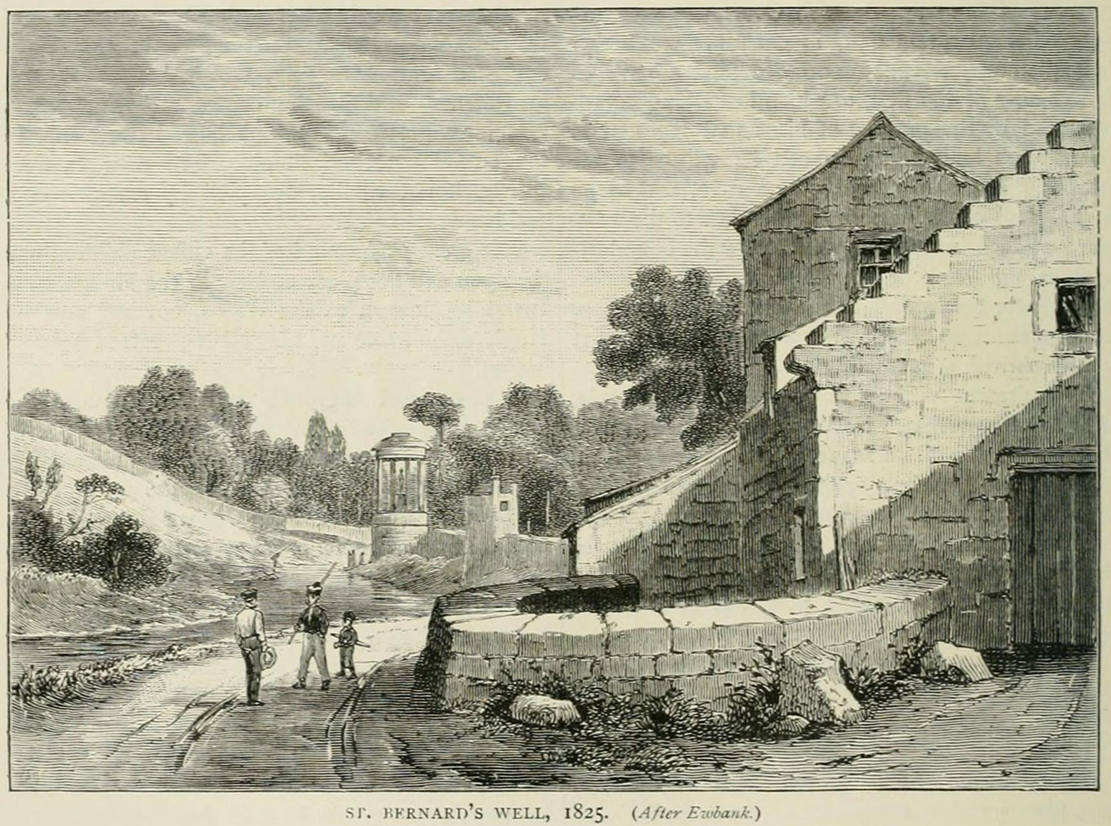
St Bernards Well in 1825
Local tradition ascribed the discovery of the medicinal waters here by three local boys from Heriot, years before the legendary St. Bernard got in on the act; and, despite the wishes of many, St. Bernard of Clairvaux was not in any way related to the legendary Nursie of Blackadder fame (can anyone find a short link so as to educate the unenlightened on this matter?). His hagiography (biography of a saint) tells that his saint’s day was August 20, and his symbols were: a white dog, a chained demon and beehives. Whether any of these symbols related to any indigenous myths at the site is difficult to say.
Mr Cumberland Hill (1887) told the story of how this spring acquired its christian title:
“There is an ancient oral tradition in the district (we read of it also in an old book when we were young) that St Bernard visited Scotland. There are different ways of telling the legend, but the following appears to be the general version. St Bernard, while preaching the second crusade in France and Germany, was advised to go to Scotland as a country rich in faith and fighting men. He was disappointed with his reception at court. In grief, aggravated by ill-health, he withdrew and lived in a cave in the neighbourhood of the spring. There certainly was a cave of considerable dimensions in the steep cliffs to the westward. Its entrance was covered up by the building of the wall that bounds the back of Randolph Crescent, but when it formed part of Lord Moray’s grounds we, and the other boys of Stockbridge, knew that cave well. The saint’s attention was attracted by the number of birds that resorted to the spring. He drank of its healing waters, and, soothed by the sound of the river and the beauty of the scenery — the valley, still very beautiful, must then have been surpassingly fair — his health and serenity of mind returned. He called the inhabitants of the district to the spring, revealed to them its virtues, and, after bestowing upon the people his blessing, he returned to his place of public duty. Christendom concurs that this was the blessing of a good man. He was canonised by the Roman Catholic Church, but as canonisation is growing to be an invidious distinction, we quote Luther’s opinion: “If there ever lived on the earth a God-fearing and holy monk, it was St Bernard of Clairvaux.” We give the tradition as a tradition, not as history, though it is as credible and certainly more creditable than many of the legends of the saints.”
Royal Commission on the Ancient & Historical Monuments, Scotland, Inventory of the Ancient & Historical Monuments of the City of Edinburgh, HMSO: Edinburgh 1951.
Sacred Well (lost): OS Grid Reference – SE 160 339
Archaeology & History
Which one is the Cruckleswell?
In an essay by great regional historian Harry Speight (1912) on the ancient tracks of Bradford and district, he mentions this “Cruckleswell” which was first described in 1602. Mentioned again in 1612 land deeds and several times thereafter, the site has long gone (been built over), but may have been a place where local people ascribed there being water spirits, or naiads.
Although the local historian W.E. Preston (1932) described the place as being in fields between Manningham Stoop (an old boundary stone, now lost) and Hallfield Cross (perhaps an old stone cross site, also lost), a more detailed article appeared a few years later by Wilfrid Robertshaw (1935), telling of its approximate location. He wrote:
“The interesting field-name of Cruckleswell occurs in 1664. Cruckleswell was situated between Manningham Stoope and Hallfield Cross. The latter name is here applied to some closes of land near the Bradford-Manningham boundary and not to a monument; but from this qualifying statement must not be inferred the opinion that a stone or wooden cross of the name never existed. From Manningham Stoope, whose location I have not traced, a lane led to Fair Gapp, which was just within the town of Bradford; but in 1686 there was a close called the Stoope, which adjoined Manningham Lower Lane on the left-hand side from Bradford to Manningham. The occupiers of Cruckleswells were ordered by the jurors of the Bradford Manor Court to take in the water which ran by their premises. The occurrence of a water-course thereabouts, together with the name, Cruckleswell, suggests that here, as in the Panewell Feilde, was a holy well of a kind. Perhaps the derivation of the name may be found in the Yorkshire dialect word ‘crukle,’ meaning to make crooked, or to bend or twist. In a sense, therefore, Cruckleswell was another pin well, into which bent of ‘cruckled’ pins were cast. Cruckleswells, or Crookewells, as the three closes of land were called in a deed of 1658, were then granted by Tempest Brighouse, of Bilbie in the county of Nottingham, to James Mitchell of Bradford, yeoman. But…I have found a deed of sale by Christopher Pighells of Bradford, yeoman, to John Nicholls of Horton, clerk, of the close of land called Cruckleswell… Nicholls purchased Cruckleswell in 1612, the year before Saxton produced his plan, on which the small field is shown adjoining others belonging to Pighells. Thus the plan fixes the location of Cruckleswell; it adjoined the east side of the highway leading from Bradford to Frizinghall and was just within the Manningham township.”
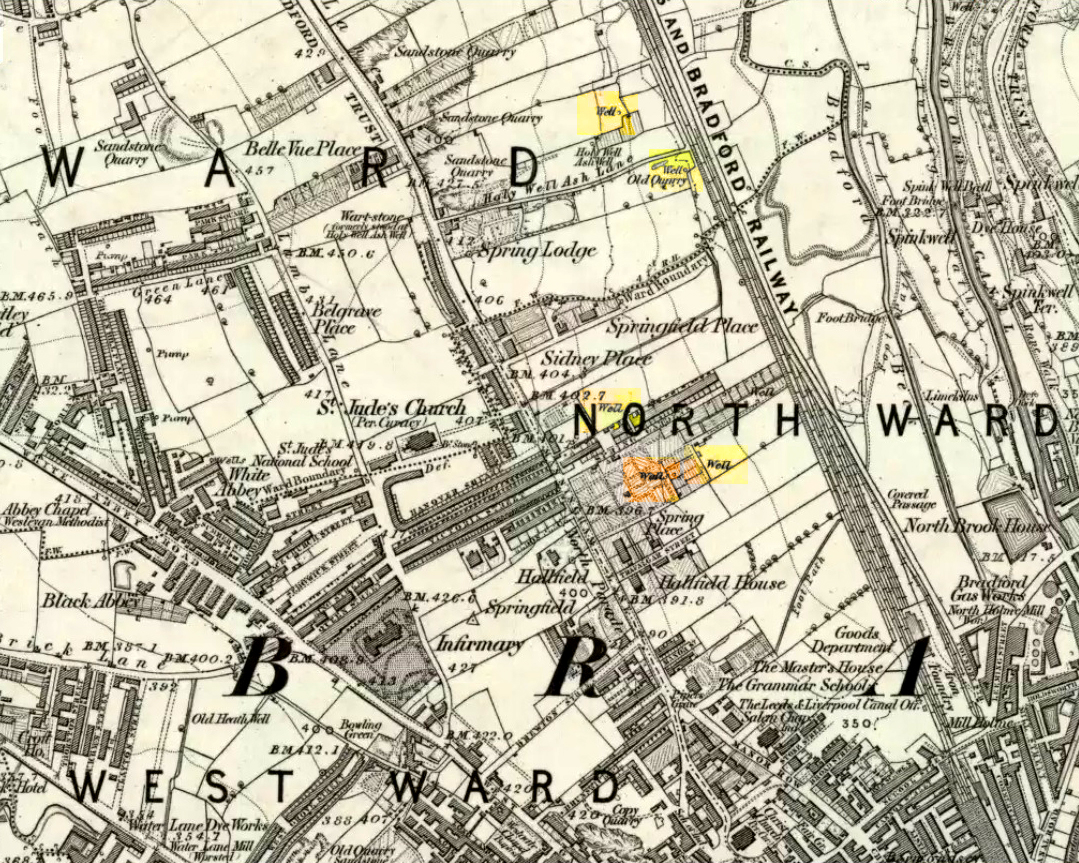
This would put it close to the Holy Well Ash well and its long-lost standing stone. The 1852 OS-map of this area shows an unnamed well between the Holy Well Ash and the boundary line, as highlighted above; but another unnamed well is to the north of the holy well. If we cross over the boundary line south and out of Manningham, three other wells existed less than 200 yards away. Anyone of these may have been the Cruckleswell.
Mr Robertson’s idea on the word ‘cruckle’ is echoed in A.H. Smith’s (1961) place-name analysis of the site, where he relates how the word is “possibly connected with the obsolete crookle, ‘to crook, bed.'” This is shown to be the case in Thomas Wright’s (1898) gigantic tome. And as “cruckling” pins was a common animistic practice in earlier centuries, this derivation of it—as being a well where offerings were given to the spirit of the waters—is not unlikely.
References:
Preston, W.E., ‘Some Local Holy Wells,’ in Bradford Antiquary, June 1932.
Robertshaw, Wilfrid (ed.), West Yorkshire Deeds (2 volumes), Bradford Historical & Antiquarian Society 1936.
Shepherd, Val, Historic Wells of Bradford, Heart of Albion: Wymeswold 1995.
Smith, A.H., The Place-Names of the West Riding of Yorkshire– volume 3, Cambridge University Press 1961.
Speight, Harry, ‘Ancient Streets and Lanes of Bradford as Portrayed in the Manor Court Rolls,’ in Bradford Antiquary, New Series 3, 1912.
Wright, Thomas, English Dialect Dictionary – volume 1, Henry Frowde: Oxford 1898.
Healing Well (destroyed): OS Grid Reference – NS 5619 6654
Archaeology & History
Along the B808, between Beith Street and Byres Road, where it meets the main Dumbarton Road, the memory of Cooper’s Well is preserved in the street-name. It was one of more than a dozen springs in the area, but was one of the most renowned by local people.
Although not shown on the early OS-maps, thankfully the local historian and folklorist—and early environmentalist, it must be said!—James Napier (1873), gave a good account of it in his excellent work on the traditions of the area:
“Cooper’s Well was situated on the side of the road at the north-west end of Well Street, at the corner of where the Gas-work wall now is. It was about three feet deep, and had two steps leading down to the water from the road. Two sides and back were walled up higher than the road, and covered with a stone slab. It was celebrated in the neighbourhood as a drinking water, being strongly chalybeate, and therefore could not be used for cooking purposes. Although shallow, it was never frozen during winter (so that it must have come from a considerable depth), and it was cold in summer. On a warm summer Sunday evening we have seen people, not only from all parts of the village, but from the gentle houses in the neighbourhood, carrying water from the Cooper’s Well to drink. It is from this well the street has its name. The Gas-work dried up the well. There was a story current of some Glasgow people who were visiting at Mr. Sharp’s of Horslethill. Mrs. Sharp had been baking some oatcakes with butter or dripping in them, which caused them to be very fine and short. The Glasgow gentlemen were anxious to know how they were baked, and were told that they were baked with the Cooper’s Well water, some of which they had got a drink of. Shortly after some of the gentlemen sent out their servants to Partick for a supply of the water, but the servants could not succeed in making the cakes so nice as those got from Mrs Sharp. For long after this, butter-cakes were known in and around Partick as Cooper’s Well bread.”
I have to admit I’ve not visited this site, but presume that all trace of the site has disappeared.
Holy Well (destroyed): OS Grid Reference – NS 6451 5981
Archaeology & History
Site shown on 1864 map
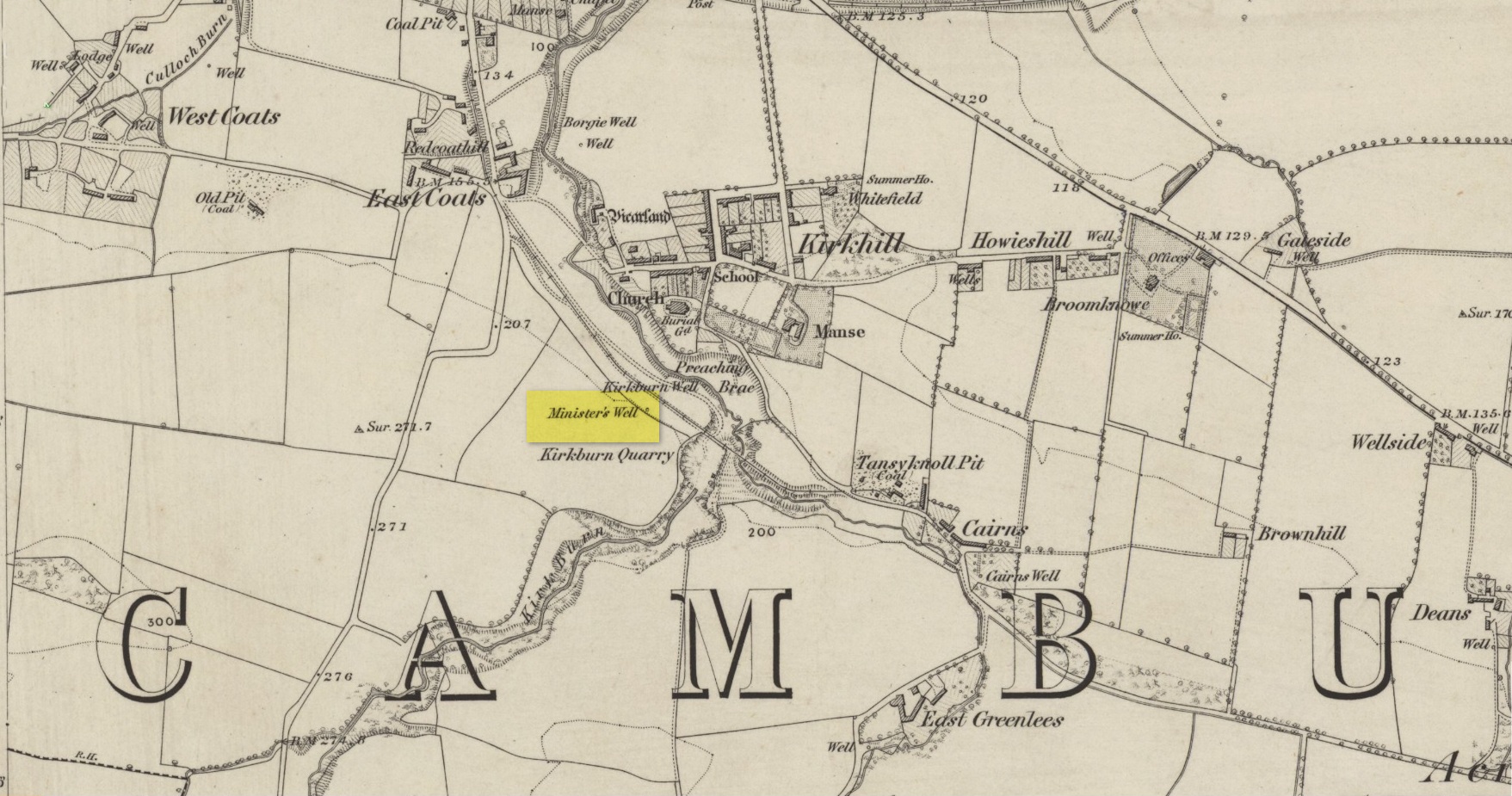
Illustrated on the earliest OS-map of the region, this is one of four holy and healing wells within half-a-mile of each other—including the legendary Borgie Well in the Borgie Glen. The waters from here emerged above the rise, close to the end of Mansefield Avenue, from where you look down onto the wooded burn. When it was visited by the Ordnance Survey chaps in the 19th century, they told simply that water here “is taken from pipes being laid from it to the Manse to supply the Minister.”
Acknowledgements:Huge thanks for use of the Ordnance Survey map in this site profile, reproduced with the kind permission of the National Library of Scotland.
Healing Well (lost): OS Grid Reference – NT 654 993
Archaeology & History
Wells that are dedicated to sheep are none-too-common—and this one on the remote Isle of May between Edinburgh and Fife only received its commemoration, tradition tells, not too many centuries back. It is described singularly in John Dickson’s (1899) fine work, where he informs us that,
“The Sheep Well lies to the west of the lighthouse. Said to have got its name from a sheep having been drowned in it. Its water is useless for household purposes, and it occasionally becomes dry during the hot season.”
Its present condition and precise location is unknown. If an islander chances upon this site and knows its present condition, please get some photos and let us know how it’s fairing.
References:
Dickson, John, Emeralds Chased in Gold; or, The Isles of the Forth, Oliphant: Edinburgh 1899.
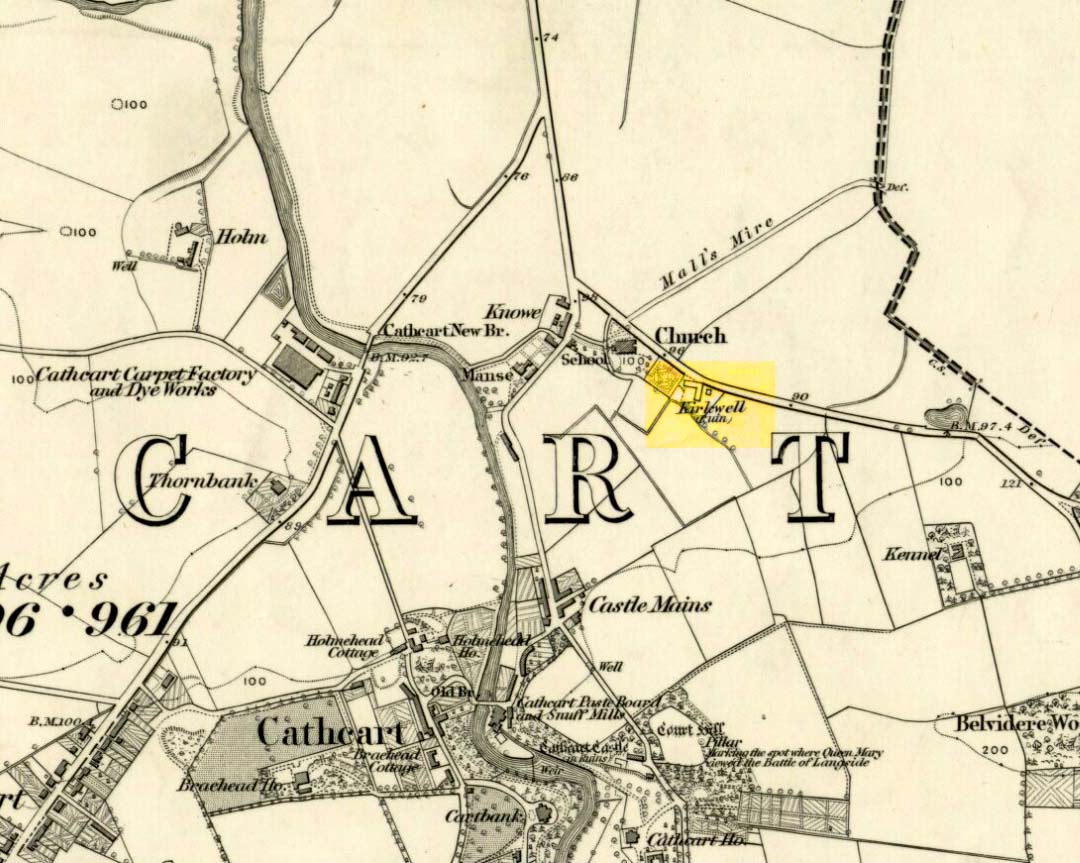
St. Oswald’s Well was described in Hew Scott’s (1920) magnum opus as being beside the parish church of the same name, but other references to it are scant. An old well-house was built besides or over the waters, which subsequently became known as the Kirk Well due to its proximity to the church, 125 yards to the northwest. All trace of it appears to have gone. The road to the west of the site also 125 yards away, called Kirkwell Road, seems to be the last piece of folk memory that remains.
St. Oswald himself was a British tribal leader of Northumbrian descent who, legend tells, went to Iona and became a christian. He had to leave the island eventually and go back into Yorkshire to bring peace back into the northern counties. Whether this Well of his was dedicated to him as a result of his journey from back south from Iona, we do not know. His saint’s day is August 5—very close indeed to that old heathen celebration time of Lughnasadh or Lammas. Most likely this is not just a coincidence, but will have related to what local folk were doing before the christian impositions.
The name of this site alone insisted that I bring it to people’s attention! If it was a healing well relating to its name, I wonder what it was used for! It’s described just once in the New Statistical Account (1845) for Lanarkshire, where Pete Brown said briefly:
“On the south side of the road from Auchinloch to Glasgow, there is still the Cockplay Well, over which many proprietors and feuars have a servitude.”
Two roads came out of the village at the time of the NSA notes: one to the immediate west and the other to the south. None of the maps cite the place-name ‘Cockplay’, but two ‘wells’ occur on the outgoing western road. One is in the village itself, behind some cottages; this is not likely to be the site in question, as the description would surely have stated that the well was in the village. However, “on the south side of the road” one mile west of the village, roughly halfway between Wallace’s Well and Cardyke there is a ‘Well’ shown on the early OS-maps. This has to be the most likely contender.
The etymology may revolve around variants on the word old english word cocc, which in this instance is likely to be ‘bird/s’ or a cock, as a in the male domestic fowl; effectively making it the ‘well where the birds played.’ More help and information on it would be good.
Get onto the A763 road several miles east of Glasgow city centre and go along Gardenside Avenue onto the Carmyle estate. A few hundred yards on, turn right down Carmyle Avenue, then left onto River Road. Follow the footpath along the edge of the River Clyde for nearly a mile—past the recently destroyed John’s Well—until you hit the remnants of Kenmuir Woods. You’ll reach some large polluted pools and when you reach the gap between the first and second pool, walk into the trees above the river and the Well is there.
Archaeology & History
The decaying remains of this old well can still be seen, incredibly, in the small copse of trees that are Kenmuir Woods, just a few yards above the River Clyde, 160 yards below the M8 and the same distance west of the Daldowie sewage treatment works, with polluted water treatment pools just yards away! Not the sort of place you’d take a partner for any sort of marriage ceremony whatsoever nowadays! But it wasn’t always like this of course. Only since the Industrialists stamped their mark…
When Hugh MacDonald (1860) wrote the finest narrative of this arena in the middle of the 19th century, his evocative words painted the entire landscape with a veil untouched since his days. Indeed, it is truly like another world compared to the sacrilege of what we see today:
“It is a wild and bosky scene, covered with a picturesque profusion of timber, and is the habitat of flowers innumerable. The weaver herbalists of Camlachie and Parkhead find it a perfect storehouse of medicinal rarities; and on Sundays they may be seen in sickly groups prying into every green recess in search of plants which old Culpepper would have loved for their rare qualities, or carrying them home in odorous bundles, confident of having obtained a mastery over “all the ills that flesh is heir to.” The botanist may also occasionally be seen lurking here, vasculum in hand, or on bended knee, examining the structure of some strange flower. But even the mere general lover of flowers will here find much to reward his attention. At present the May-flower (Caltha palustris), the wild hyacinth, the craw-flower of Tannahill, the red campion (Lychnis dioica), the odorous woodruff (Asperula oderata), the globe-flower or lucken gowan (Trollius europœus), and many others are in full bloom, and so thickly strewn that even as the poet says, “You cannot see the grass for flowers.”
“At the foot of the bank, near its upper extremity, there is a fine spring, which is known by the name of the ‘Marriage Well,’ from a couple of curiously united trees which rise at its side and fling their shadows over its breast. To this spot, in other days, came wedding parties, on the day after marriage, to drink of the crystal water, and, in a cup of the mountain-dew, to pledge long life and happiness to the loving pair whom, on the previous day, old Hymen had made one in the bands which death alone can sever. After imbibing a draught of the sacred fluid from the cup of Diogenes, we rest a brief space on the margin of the well.”
One wonders how far back in time the attribution of ‘Marriage Well’ from the animism of the trees went; and whether marriage ceremonies were performed here, quietly, away from the prying eyes of the Church and invading english in centuries much earlier under the guidance of the Moon. It’s probable…
Nature’s cloak was still intact here when, many years after Hugh MacDonald’s visit, the local writer Dan McAleer (1930) informed us that,
“Shy bridesmaids and their groomsmen used to visit after a wedding to drink the mystic waters of the Marriage Well. Certain places about the woods were well adapted for picnics, etc. After tea and refreshments the lads and lassies passed hours in amusement trying to step over the well and anyone soiling the water in any way while stepping across it would not get married that year.”
Much of the beauty of the landscape and Her waters, and the rich romance that arises from Her cyclical forms are long gone from here now… Cold ‘progress’ bereft of the necessity of Nature’s sanctity is no progress at all… Although the genius loci of the place may have long since gone, at the very least the regional council—or decent locals, if the council can’t be arsed—could erect some memorial and save the failing Marriage Well from what seems to be its close and final demise….
References:
Carpenter, Edward, Civilization: Its Cause and Cure, George Allen & Unwin: New York 1914.
Holy Well (destroyed): OS Grid Reference – NS 6029 6547
Also Known as:
Minister’s Well
Archaeology & History
Site of the Priests Well in 1865
A ‘holy well’ with a bit of a difference when it was designated as such, however many centuries ago. Found on the southern slopes below Glasgow ‘s Cathedral, just a few yards west above the Molendinar Burn (upon which Wishart Street now sits), this was deemed to be a well only to be used by the christian ministers or priests from above. Local people were not supposed to drink here it seems! Instead, they were supposed to either drink from the burn, or walk a short distance down to the Lady Well (now badly polluted) 175 yards to the southeast. I don’t expect many Glasgow folk paid that much attention to such arrogant ministerial laws!
Shown on the earliest OS-map, simply as a ‘Well’, this is one of at least four water sources within a square mile of the Cathedral (including St. Mungo’s and Lady Well) that were deemed as ‘sacred’. It truly makes you wonder what on Earth was here before the christians came along and built their huge temple on the rocks above…. What animistic heathen rites and traditions were suppressed around this natural landscape before the toxic blanket of christianity was imposed upon us?