Killarow, Kilchenzie, Argyll

Cist:  OS Grid Reference – NR 6625 2818

Archaeology & History

Halfway between the standing stone of Tangy Glen and the cup-marked stone of Allt a’ Ghoirtein, is a rounded hill that has for a long time been turned to farming.  On top of here in the 1950s, the President of the Kintyre Antiquarian Society, a Mr Duncan Colville, came across the remains of an ancient burial cist, roughly 200 yards north of Killarow Farm.  A short account of the find was written by Mr & Mrs Scott (1957) based on Colville’s description. They wrote:

“The cist, 3ft 8in long by 1 ft 11in wide at maximum, and about 2ft deep, had a stone-lined bottom and was covered by a slab originally 5ft 6in by 3ft in size, but now split into two.  The cover slab lay not far below the surface, and there was no sign of a cairn.  The cist had obviously been rifled, for a layer of clay at the bottom contained fragments of coal and modern glass; on the other hand, a few pieces of cremated bone may have been part of the original burial.”

When the Royal Commission (1971) dudes visited the site a few years later, they could find no remains of it.  The cist is believed to have been covered over and remains hidden underground.

References:

  1. Royal Commission Ancient & Historical Monuments of Scotland, Argyll – volume 1: Kintyre, HMSO: Edinburgh 1971.
  2. Scott, Mr & Mrs J.G., “Argyllshire: Killarow, Kintyre” in Discovery & Excavation Scotland, 1957.

© Paul BennettThe Northern Antiquarian

Craigpark, Ratho, Midlothian

Cup-Marked Stone (removed):  OS Grid Reference – NT 128 709

Archaeology & History

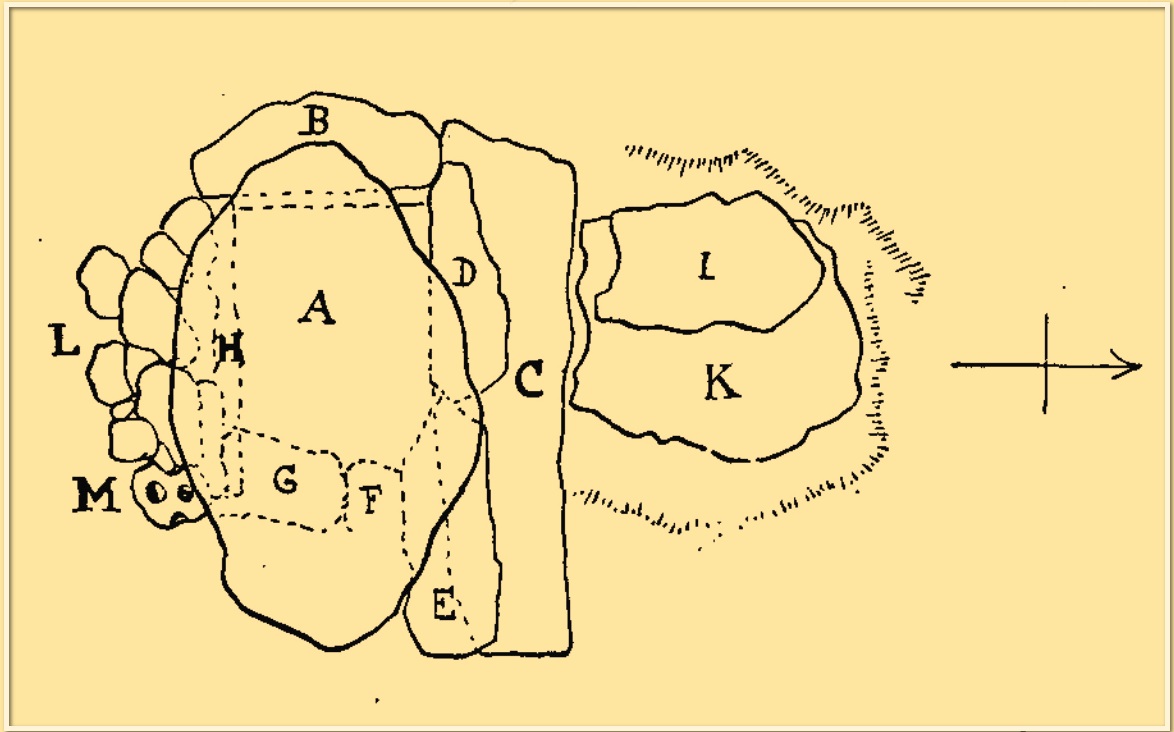
“M” marks the cupmark

A simple cup-marked stone was located inside a prehistoric burial cist that was discovered by quarry workmen in November 1897.  The cist was subsequently excavated by Fred Coles (1898) who found therein (amongst other things) a simple cup-marked stone whose present locale is a box somewhere in Edinburgh’s National Museum (could someone send us a photo please?).  The carving comprises simply of two complete cups and portion of a third, all close to each other on a small stone that was located on the south-side of the cist (see ‘M’ in the attached diagram).  Coles described the carving thus:

“During the removal of (some) small stones, one, when the damp soil was rubbed of, showed two cup-marks, about 1½ inch wide each and ½ inch apart.  The stone itself measures 5 inches by 4¾, and appears to be but a fragment of a larger one, one edge showing part of a third cup.  The cups all show the tool-marks usually noticed on these mysterious sculpturings.”

References:

  1. Coles, Fred, “Notice of the Discovery of a Cist with a Double Burial at Ratho Quarry”, in Proceedings Society Antiquaries, Scotland, volume 32, 1898.
  2. Morris, Ronald W.B., “The Cup-and-Ring Marks and Similar Sculptures of Scotland: A Survey of the Southern Counties – part 2,” in Proceedings of the Society of Antiquaries, Scotland, volume 100, 1969.

© Paul BennettThe Northern Antiquarian

Amble Links, Amble, Northumberland

Tumuli (destroyed):  OS Grid Reference – NU 273 046

Archaeology & History

In a lengthy letter describing the cist burial at Cliff House, its author, Mr W. Dunn (1857) told that there were additional prehistoric remains nearby, that had only recently been destroyed.  He told:

“It appears that, a few years ago, in the immediate proximity of the present discovery (at Cliff House, Ed.) two or more tumuli were found which contained urns and bones; and flint arrow heads of elaborate finish have been occasionally met with.”

I can find no additional information about these sites.

In the same article, a Mr Kell told that during the construction of the Amble piers a half-mile to the west, “some years ago, he was sojourning in the neighbourhood, and …human remains were found on the removal of sand by the waves in a violent gale from the East.”  What else is known of this place?

References:

  1. Dunn, W., “Ancient Sepulchral Remains,” in Proceedings Society of Antiquaries Newcastle-upon-Tyne, volume 1, no.34, 1857.

© Paul BennettThe Northern Antiquarian

Cliff House, Amble, Northumberland

Cist (destroyed):  OS Grid Reference – NU 2730 0486

Archaeology & History

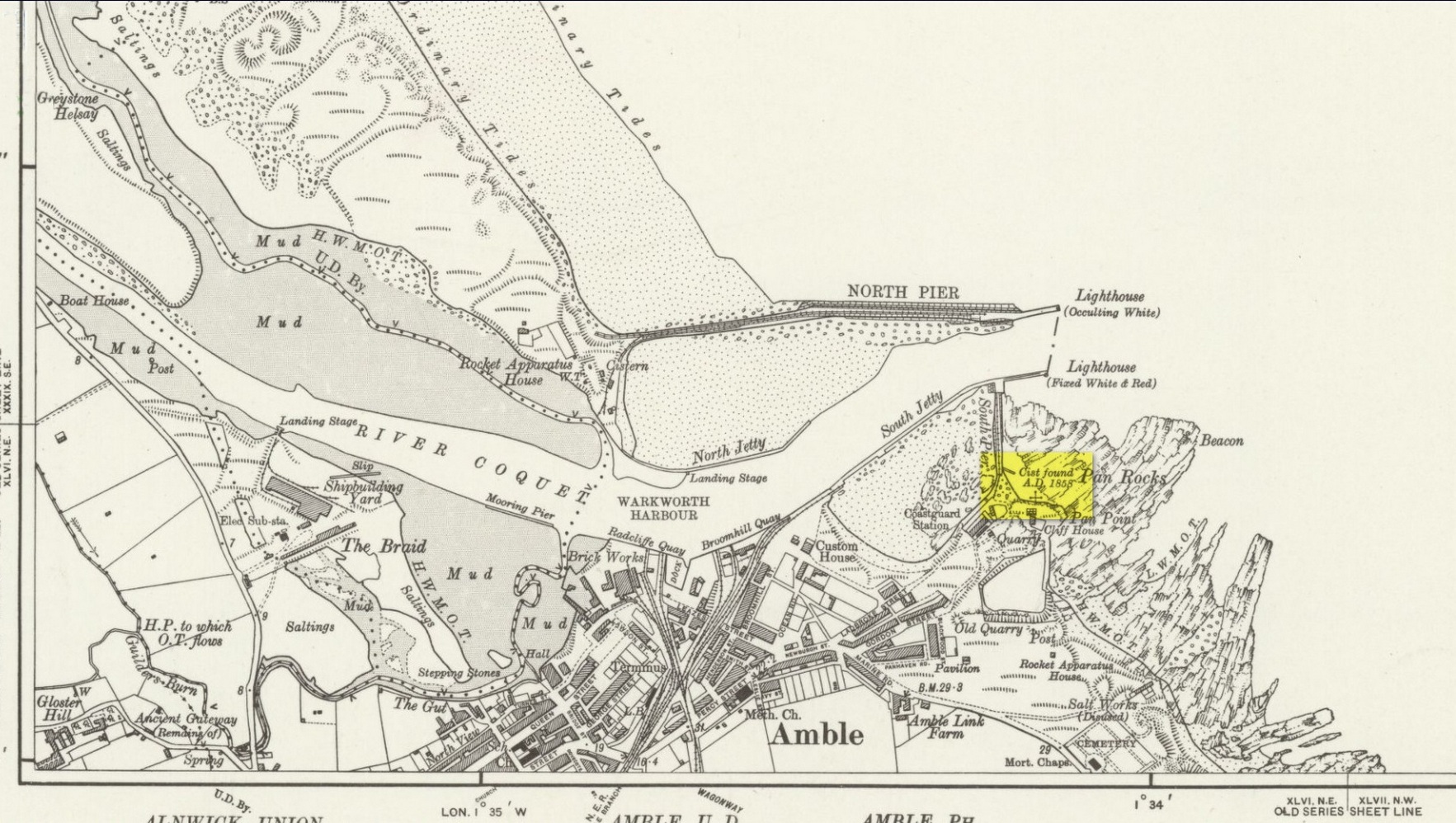
Site location on 1926 map

In November 1857, Collingwood Bruce read out a paper that had been sent to him by the Rector of Warkworth village (Rev. W. Dunn), describing “ancient sepulchral remains” that had been found near the cliff-edge above Pan Rocks near Amble’s lighthouse.  It was a lengthy account which, in passing, also mentioned several other prehistoric sites close by that have long since been destroyed and which we have very little information about.  Mr Dunn’s (1857) letter told:

“In the middle of April last, about 50 yards NE of the Cliff House, Amble, and about 20 yards from the end of what is called Warkworth South Pier, the pilots came upon a long upright stone, standing out of the shale to the height of twelve or fourteen inches,which had been laid bare by the recent heavy gales, but which, from its rude appearance, did not afford the idea of anything beyond a mere accidental tilting.  Alongside this upright stone was a large unwrought slab, which, on being raised, was found to be the covering of a cist or sepulchral chamber containing a perfect skeleton. The figure was lying on its left side, with the head to the south-west, having the knees much doubled and with the right arm thrown back.  By its side stood an urn of unbaked clay.  This urn, now in the Museum of the Duke of Northumber­land, resembles in size and shape that which was found a few years since at Hawkhill, and which is preserved in the Museum of the Antiquarian Society of Newcastle.  It contained a small quantity of dark earth.

“Having given this general outline of the discovery, I shall proceed to offer such observations as I have been able to make,and have considered worth recording. I grieve to say that before the period of my visit the spoiler had been busy with these venerable remains. The skull had been broken up, the jaws smashed, every tooth appropriated, and the bones indiscriminately mingled, after many a century of undisturbed repose.

“The cist or chamber containing the remains was composed of four slabs inserted edge-wise in a cavity which appeared to have been dug out of the friable shale which lies upon the harder rock in this locality. It ranged south-east and north-west, and measured as follows: depth, 18½ inches; width, 26 inches; length at bottom, 4 feet; at top, 3 ft 4 in.; the difference between top and bottom measurements being accounted for by the shrinking of the ends.  The cavity in the shale was much larger than the cist, and the space between the slabs and the shale was closely filled-in with stones, roughly broken, commingled with earth and larger stones.  The side slabs projected somewhat beyond the ends.  The bottom of the cist was covered to the depth of about half an inch, with dark, unctuous mould.  Amongst the rubbish comprising the filling-up of the space above-mentioned, was found an angular piece of silex, probably an unfinished arrow­head; and in the south-west corner of the cist lay a large, smooth cobble stone, which, when considered in conjunction with the flint flake, the imagination may easily construe into the club of this ancient denizen of our shores.  The slab which constituted the cover of the cist was of great size and extended in every direc­tion considerably beyond it; and the upright stone was set up, not at one of the ends, but along its length.  It is remarkable that a close inspection of these stones gave no trace of chisel-marks in any part.  In order that the cover might lie level, pieces of shale, flags, etc., were laid on the uprights which formed the cist, wherever an irregularity presented itself.

“Within the memory of man, the rock ran out from this point for some yards into the sea at a considerable elevation; but the construction of a pier in the immediate neighbourhood has caused the removal of much of the stone, and the spray of our wild sea waves now dashes over the spot which for countless generations may have been peacefully tenanted by these nameless bones.  At the same time, it does not appear probable that at any period there has been at this particular point a very deep covering of the sand and bent-grass which are found thick and rank upon the adjacent links.

“The skull must have been very characteristic, having attracted general observation from the extraordinary lowness of the frontal region, the great development of the occipital portion of the head, and the width and length of the lower jaw from its anterior junction to the articulation of the temporal bone.  One person observed that during life the man “must have measured as much to the top of his eyebrows as to the top of his head.”  The teeth are said to have been very beautiful and regular, and quite sound.  With the exception of a front tooth, which was missing in the lower jaw, they were perfect.  The thigh-bone measured 19½ inches, indicating a man of large size; whilst the porous internal organization of the bones gave probable evidence of comparative youth.

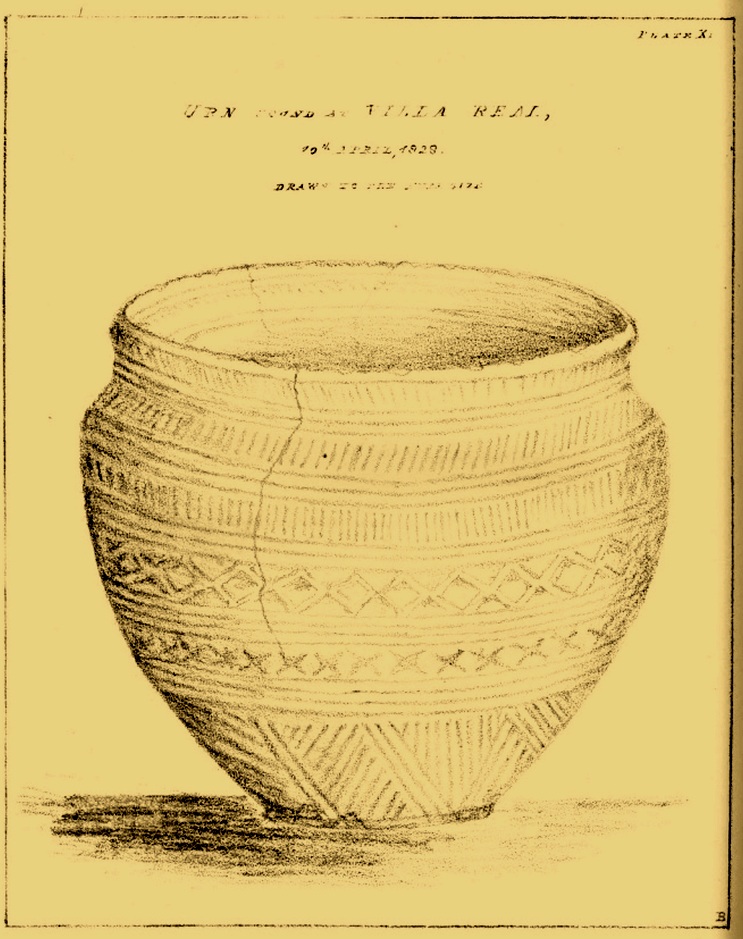
“The urn is unbaked, of a light clay colour, and measures in height 8 inches, in depth 7¼ inches, and in diameter 5½ inches.  It is ornamented with zigzag scoring, alternating with dotted lines,and upright (and sometimes slanting) scorings, which appear to have been made with some rude instrument whilst the clay was moist.  The scorings are continued over the edge of the rim.  On being rather roughly seized by one of the men, it being expected that it contained treasure, a piece was broken off; but no material injury has been occasioned.  The stone found in the cist does not resemble any that one may pick up on the neighbouring shore, and attracted attention from its bearing no assignable relation to what I may call the masonry of the tomb.  I have since learnt that stones are not infrequently found in Teutonic graves on the Continent, and that recently a singular oval stone was found in a tumulus on Petersfield Heath.”

All trace of this site has disappeared.  Mr Bruce posited the idea that the round stone in the cist may have been the one that ended the life of the buried man!  An intriguing thought.  And that the urn “no doubt, contained some portion of the feast prepared on the occasion of his funeral.”
References:

  1. Dunn, W., “Ancient Sepulchral Remains,” in Proceedings Society of Antiquaries Newcastle-upon-Tyne, volume 1, no.34, 1857.

© Paul BennettThe Northern Antiquarian

Beauly Avenue, Downfield, Dundee, Angus

Cup-Marked Stone (lost):  OS Grid Reference – NO 3975 3340

Also Known as:

  1. Magdalen’s Kirkton Stone

Archaeology & History

In the mid-1890s, workmen ploughing one of the fields near the steading at Magdalen’s Kirkton farm hit a large stone beneath the soil.  It turned out to be the covering stone of a prehistoric burial, or cist, that was aligned east-west.  Whilst the remains in the cist had all but turned to dust, the covering stone had a number of cupmarks on it.  It was described only briefly by R.N. Kerr (1896), who told that,

“The stone forming the lid of the cist is cup-marked.  It weighs 5 cwt., 1 qr., 21½ lbs., and its thickness varies from 9 to 12 inches.  There are 40 or more cup-markings on it, varying from 1 to 3 inches in diameter.”

It would seem that no sketches were made of this carving and I’ve been unable to find any more details about it. Help!

References:

  1. Kerr, R. N., “Notice of a Burial Cist found on the Farm of Magdalen’s, Kirkton, on the Estate of Balmuir, near Dundee,” in Proceedings Society Antiquaries, Scotland, vol. 30, 1896.

© Paul BennettThe Northern Antiquarian

Denny Bridge, Denny, Stirlingshire

Cist (destroyed):  OS Grid Reference – NS 808 830

Archaeology & History

A small and seemingly prehistoric grave, or cist, destroyed sometime around 1840, once existed on the top of a large hillock close to the River Carron where the bridge leads from Dunipace to Denny.  Thankfully, memory of its existence was preserved by Robert Watson (1845) in his short description of Dunipace parish.  He first began by talking of some large natural mounds on the eastern side of the township which, folklore told, gave rise to the place-name Dunipace; but from those mounds,

“About two miles to the westward of these hills, there was a very beautiful one about forty feet in height, and covering nearly three roods of ground, said also to be artificial.  This hill was mutilated, from time to time, for the purpose of repairing roads and other purposes.  It was entirely removed about six years ago, to form an embankment on the turnpike road near Denny bridge. The strata of which this hill was composed, were carefully observed during its removal. These were so regular, and as if rising out of, and gradually returning again to similar strata in the circumjacent level ground, as to afford conclusive evidence that the hill was not the work of man.  On the top of this hill, and about three feet below the surface, was found a coffin or tomb, composed of five large un wrought stones, in which were the bones of a human body, scull and teeth not much decayed.  Along with these, was a vase of coarse unglazed earthenware, containing a small quantity of material resembling the lining of a wasp’s nest, probably decayed paper or parchment, which in the lapse of ages had assumed that appearance.  No conjecture could be formed about the individual here interred, tradition being entirely silent on the subject ; but this circumstance corroborates the opinion of some writers, that the hills of Dunipace might have been used as burying-places for ancient chiefs.”

The site was included in the Royal Commission’s (1963:1) Inventory, but they found no additional data about it.

References:

  1. Royal Commission on the Ancient & Historical Monuments Scotland, Stirling – volume 1, HMSO: Edinburgh 1963.
  2. Royal Commission on the Ancient & Historical Monuments of Scotland, Archaeological Sites and Monuments of Stirling District, Central Region, Society of Antiquaries of Scotland 1979.
  3. Watson, Robert, “Parish of Dunipace,” in New Statistical Account of Scotland – volume 8, William Blackwood: Edinburgh 1845.

© Paul BennettThe Northern Antiquarian 

Hough Hill, Bramley, Leeds, West Yorkshire

Tumulus (destroyed):  OS Grid Reference – SE 234 336

Archaeology & History

Today, Hough Hill has almost completely given way to modern housing; but in bygone centuries, this hilltop once housed a prehistoric burial mound—albeit an inconspicuous one.  It was mentioned briefly in Faull & Morehouse’s (1981) magnum opus, but we know very little of its overall appearance and stature.  Its existence was recorded posthumously thanks to the antiquarian John Holmes, without whose notes it would have been lost to history.

During quarrying operations at Hough Hill in December 1879, an ornamental urn was found,

“filled with calcined bones (that) was placed on a dish shaped hollow, some two or three feet deep, with charcoal and burnt earth.”

Holmes compared some markings that were upon this urn to one that was uncovered in Acrehowe Hill above Baildon by J.N.M. Coll in 1845.  Unfortunately the Hough Hill urn was broken into fragments shortly after being uncovered.  All remains of the burial mound have been completely destroyed.

References:

  1. Faull, M.L. & Moorhouse, S.A. (eds.), West Yorkshire: An Archaeological Guide to AD 1500 – volume 1, WYMCC: Wakefield 1981.
  2. Holmes. John, “A Sketch of the Pre-Historic Remains of Rombalds Moor,” in Proceedings of the Yorkshire Geological & Polytechnic Society, volume 9, 1886.
  3. Wardell, James, Historical Notes of Ilkley, Rombald’s Moor, Baildon Common, and other Matters of the British and Roman Periods, Joseph Dodgson: Leeds 1869. (2nd edition 1881).

© Paul BennettThe Northern Antiquarian

St. Serf’s Water, Crieff, Perthshire

Cist:  OS Grid Reference – NN 8488 2344

Also Known as:

  1. Canmore ID 25503

Archaeology & History

Were it not for the valuable records in the Scottish Statistical Accounts, we’d have lost all knowledge of this site.  It was described in notes by by Colin Baxter (1793), where he told us:

“About 200 yards west from the church of Monivaird, a barrow was opened some years ago, in which two urns were found, each containing a stone of a bluish colour, very hard about four inches long, and of a triangular shape, somewhat resembling the head of an axe.”

The site was subsequently mentioned in the Ordnance Survey Name Book of the parish, with some additional bits of information:

“In the year 17–, there was found, about one hundred yards to the westward of the old church of Monzievaird, a barrow containing a stone-coffin, in which were inclosed two coarse earthen urns, the one filled with burnt bones, the other containing the bones of the head.  Of these, the under jawbone and the teeth were very entire.  In the stone coffin was also found a stone hatchet, bluish-coloured, very hard, about four inches long, and of a triangular shape, a remain which proves the barrow of very remote antiquity – prior to the use of iron. The stone hatchet is preserved at Ochtertyre.”

No traces remain of the site; and although the stone axes came to be in the possession of Sir William Murray of Ochtertyre, the urns and other remains have long since been lost.

Folklore

The name of ‘St Serf’s Water’ derives from it this area being dedicated to St Servanus in early times; the holy well of St Serf could be found a short distance south from where this tomb was built.

References:

  1. Baxter, Colin, “United Parishes of Monivaird and Strowan,” in Statistical Account of Scotland – volume 8, William Creech: Edinburgh 1793.
  2. Porteous, A., “Extracts from a History of the Parishes of Monivaird and Strowan“, in Archaeologia Scotica, volume 2, 1822.

© Paul BennettThe Northern Antiquarian

Cowpasture Road, Ilkley, West Yorkshire

Cist (destroyed):  OS Grid Reference – SE 1192 4759

Archaeology & History

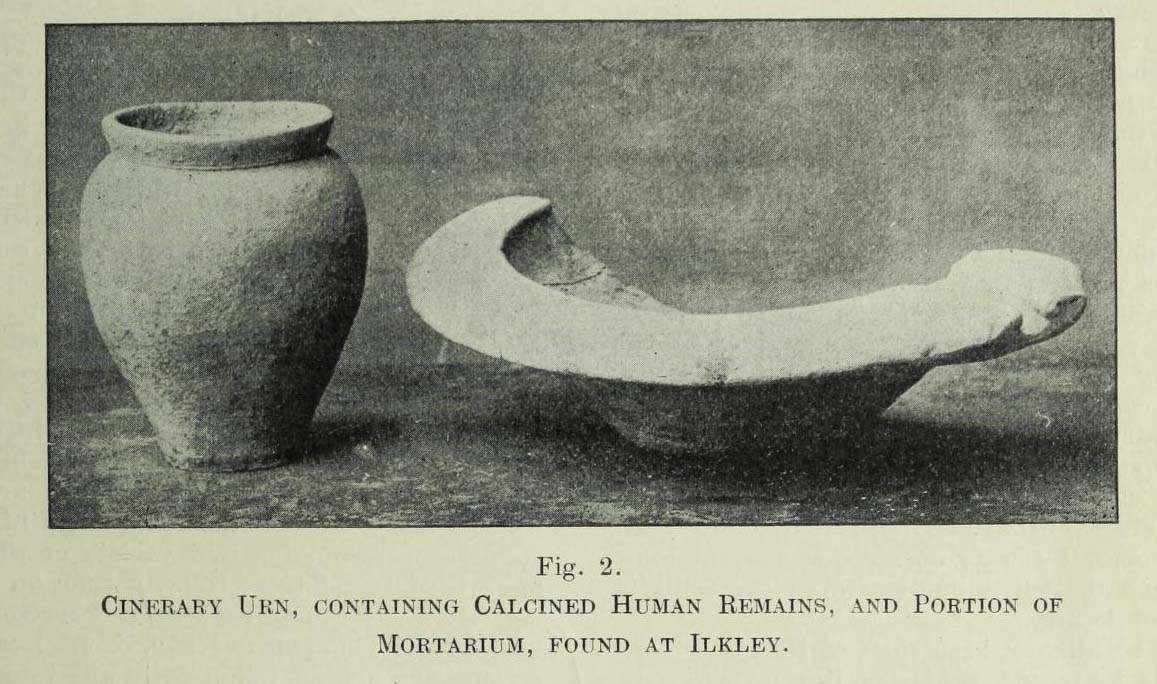
Urn found below Cowpasture Rd in 1874

In a lecture given by Frank Hall at the Ilkley Library in February, 1910, he described a number of prehistoric remains found in the area—including the remnants of a “cinerary urn, containing calcined human remains” and more, as illustrated in the old photo here.  He contextualized the findings as being typical of the remains found “under a large heap of earth and stones which we now call a ‘barrow’, ‘cairn’ or ‘tumulus'” and believed that one must have existed here in bygone times.  The urn, he told us,

“was found within a few yards of these premises, for it was dug up when the excavations were being carried out for the erection of Messrs Robinson and Sons’ buildings on the opposite side of Cowpasture Road, in March 1874.”

Although we list this site as a cist, we don’t know for sure; but due to the lack of descriptive and historical data about a mound of any form in this area, it is most likely to have been a cist burial and not a tumulus or barrow which Mr Hall inferred.  Its location near the valley bottom is unusual when we consider the huge number of cairns on the moors above here; but a cist was found in a similar low-lying geographical position on the south side of the moors near Bingley, 5.8 miles due south, when construction of local sewage works were being done.

References:

  1. Hall, Frank, The Contents of Ilkley Museum, William Walker: Otley 1910.

© Paul BennettThe Northern Antiquarian


Torrnacloch, Dalbog, Edzell, Angus

Stone Circle (destroyed):  OS Grid Reference – NO 5871 7189

Also Known as:

  1. Canmore ID 35190

Archaeology & History

‘Site of’ stone circle, 1865

When the Ordnance Survey lads visited this area in 1860, they stood upon this small knoll that was known as Torrnacloch – or the Knoll of the Stone.  They were informed that a ring of stones had stood here, but had been destroyed about 1840, apparently by a local farmer.  The stones were described as being about 3 feet high.  They subsequently added it on the earliest OS-map of the area, but also made note that a cist was found within the site.  The circle was included and classed as a stone circle in Aubrey Burl’s (2000) magnum opus, but had previously been classed as a cairn with “a kerb of large boulders” by the Royal Commission doods. (1983)  They based their assessment on the appearance of some of the stones found on a gravel mound behind the farm which had apparently been removed from the circle when it was destroyed.  Andrew Jervise (1853) gave us the following account:

“The Chapelry of Dalbog was on the east side of the parish, due west of Neudos.  The time of its suppression is unknown; and though no vestige of any house remains, the site of the place of worship is still called the “chapel kirk shed” by old people, and, in the memory of an aged informant, a fine well and hamlet of houses graced the spot.  This field adjoins the hillock of Turnacloch, or “the knoll of stones,” which was probably so named, from being topped in old times by a so-called Druidical circle, the last of the boulders of which were only removed in 1840.  Some of them decorate a gravel mound behind the farm house; and, on levelling the knoll on which they stood, a small sepulchral chamber was discovered, about four feet below the surface. The sides, ends, and bottom, were built of round ordinary sized whinstones, cemented with clay, and the top composed of large rude flags.  It was situate on the sunny side of the knoll, within the range of the circle; but was so filled with gravel, that although carefully searched, no relics were found.”

The emphasis on this place being where a stone circle stood is highlighted in the place-name Torrnacloch, or the hillock of stones/boulders.  Both Dorwood (2001) and Will (1963), each telling it to be where a stone circle stood; with Will adding that parts of the circle “may yet be seen in rear of the steading of Dalbog.”  If this had been where a cairn existed, some variant on the word carn would have been here.

References:

  1. Burl, Aubrey, The Stone Circles of Britain, Ireland and Brittany, Yale University Press 2000.
  2. Dorwood, David, The Glens of Angus, Pinkfoot: Balgavies 2001.
  3. Jervise, Anrew, The History and Traditions of the Land of the Lindsays in Angus and Mearns, Sutherland & Knox: Edinburgh 1853.
  4. MacLaren, A. et al, The Archaeological Sites and Monuments of Central Angus, RCAHMS: Edinburgh 1983.
  5. Will, C.P., Place Names of Northeast Angus, Herald: Arbroath 1963.

Acknowledgements:  Big thanks for use of the 1st edition OS-map in this site profile, Reproduced with the kind permission of the National Library of Scotland

© Paul BennettThe Northern Antiquarian