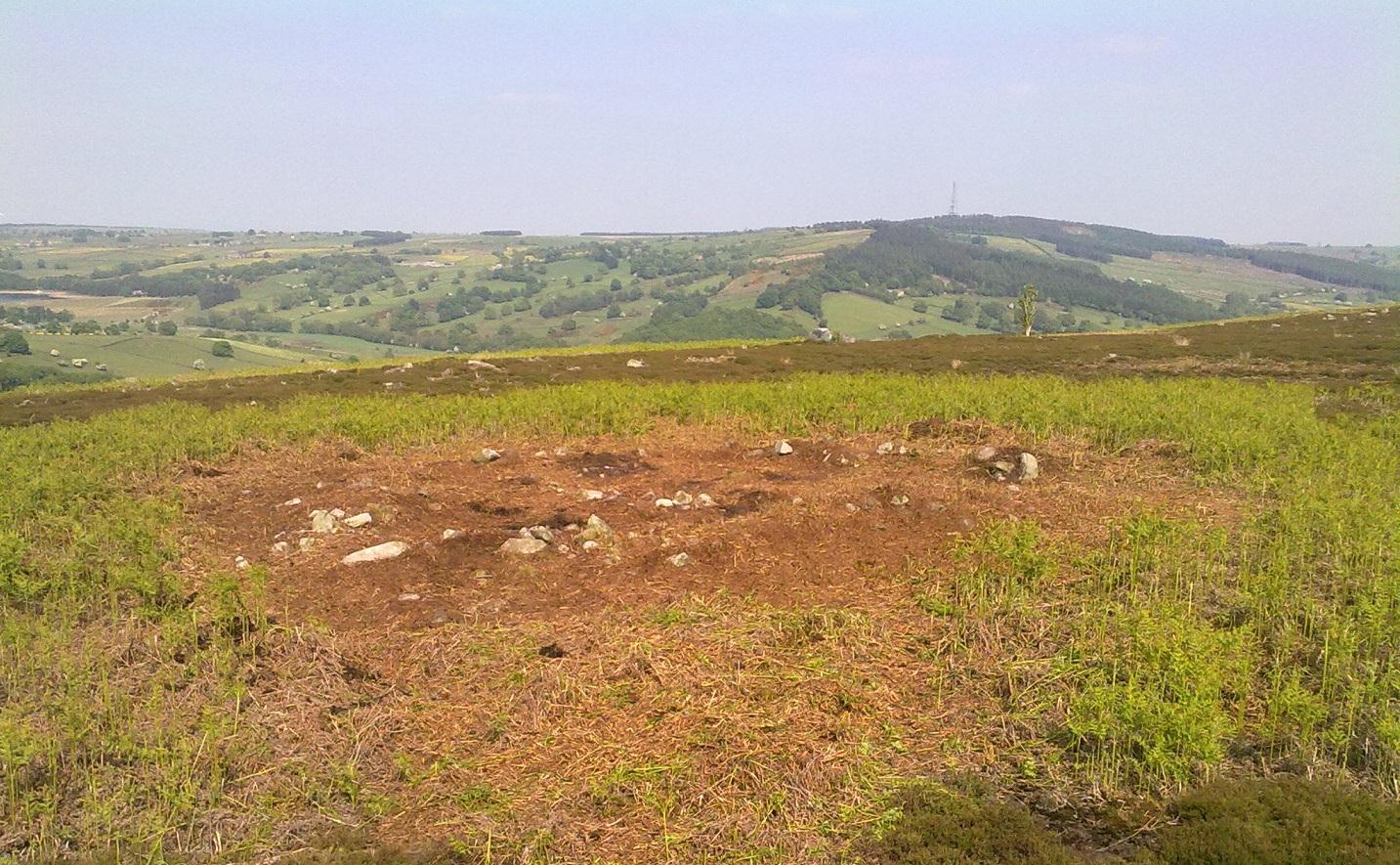
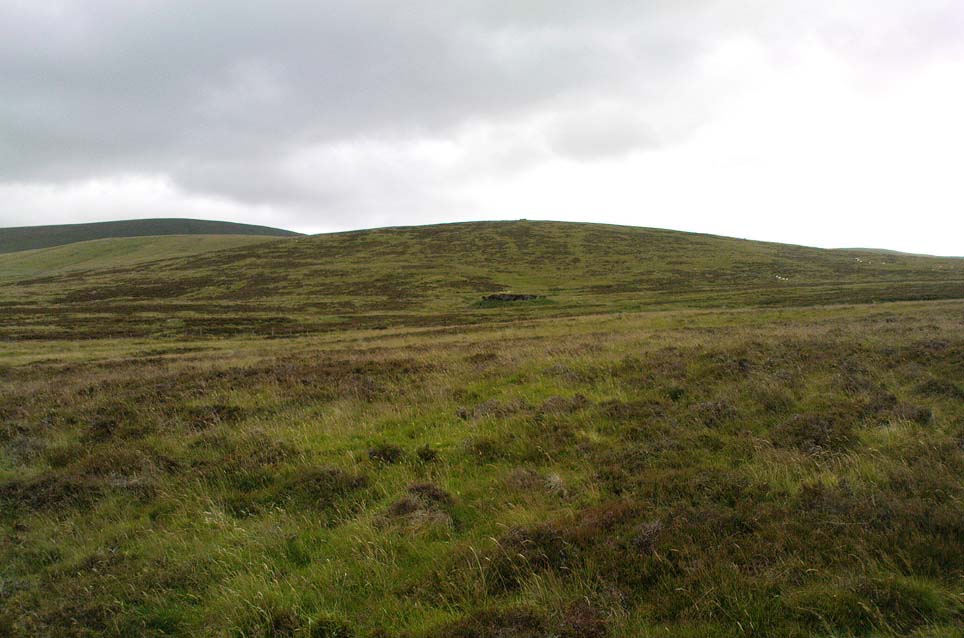
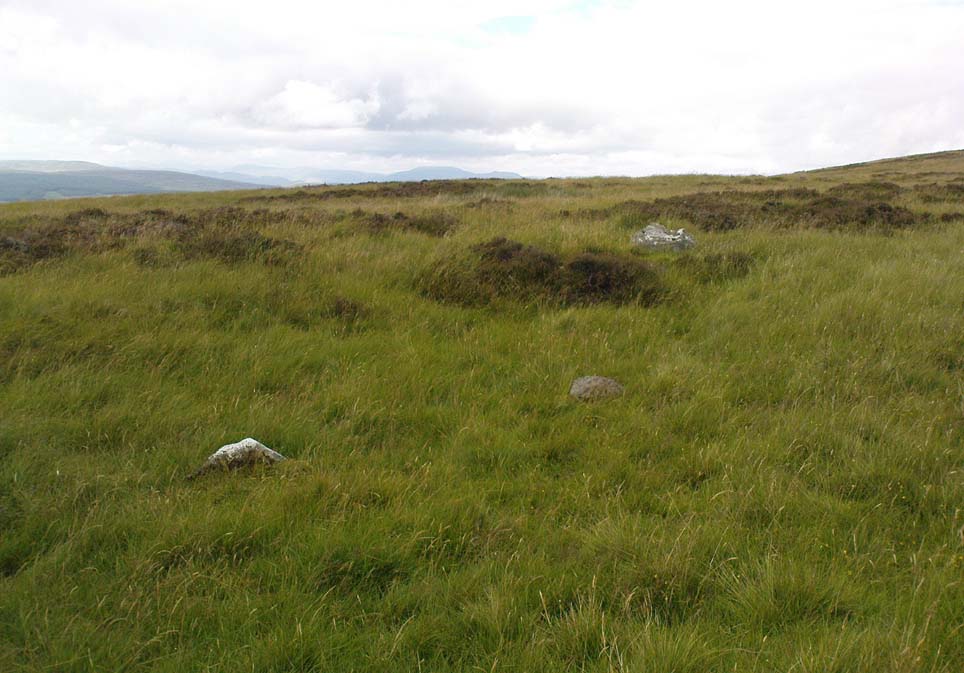
Blackheath Circle, Todmorden, West Yorkshire

Ring Cairn:  OS Grid Reference – SD 9433 2543

Also Known as:

  1. Frying Pan Circle
  2. Roman Barrow

Getting Here

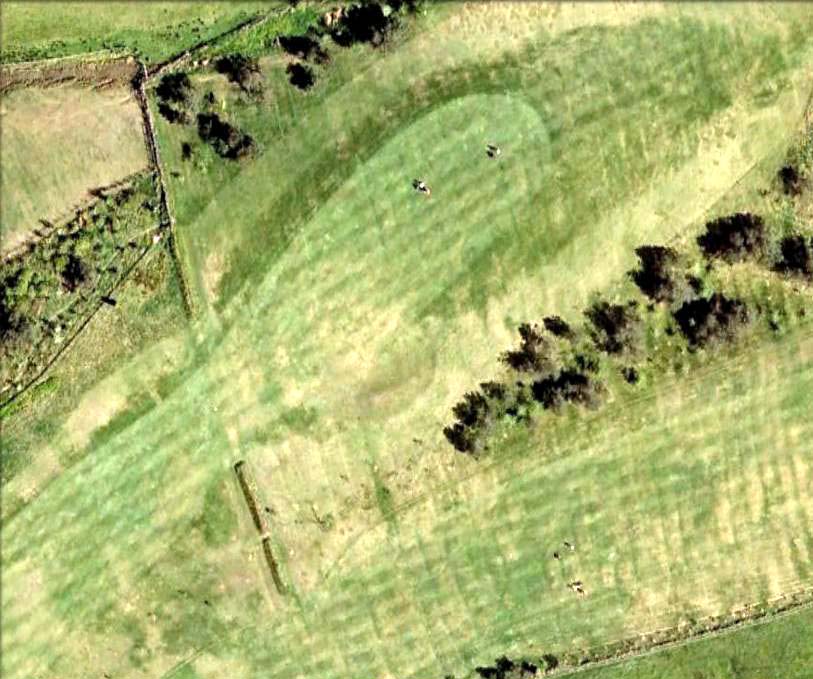
Aerial image showing faint outline of Blackheath circle

From Todmorden, take the road to Hebden Bridge (A646) less than half-mile outta town and just as road goes uphill, watch for the left turn up to Cross Stone.  This is one helluva superb steep, winding road if you aint been up it before (which, somehow, I used to be able to cycle up without a break!).  As you reach the hamlet of Cross Stone, bear uphill again (left) until you reach the top-end of the golf course, where you’ll see a footpath on your left that runs alongside the course.  Walk on this until it reaches a stile.  Walk up the wallside and onto the course itself – and there, in front of you, in the middle of the damn golf course, you’ll see the very denuded remains of a once fine prehistoric monument (it’s situation, quite frankly, is a disgrace – and any pagans or historians who feel similarly should complain to Calderdale Council about the lack of preservation here; as the more of us who do, the more they’ll have to pay attention and perhaps do something about it).

Archaeology & History

Very little can be seen of this once important site thanks to the important golf course built right on top of this once sacred site.  Thankfully we have an extensive description of the place that was done by J. Lawson Russell (1906) from which this profile account — and every other account for that matter! — draws heavily upon.  It was included in Aubrey Burl’s magnum opus (2000) as a stone circle, but this isn’t strictly correct and is more accurately a cairn circle or ring cairn monument.
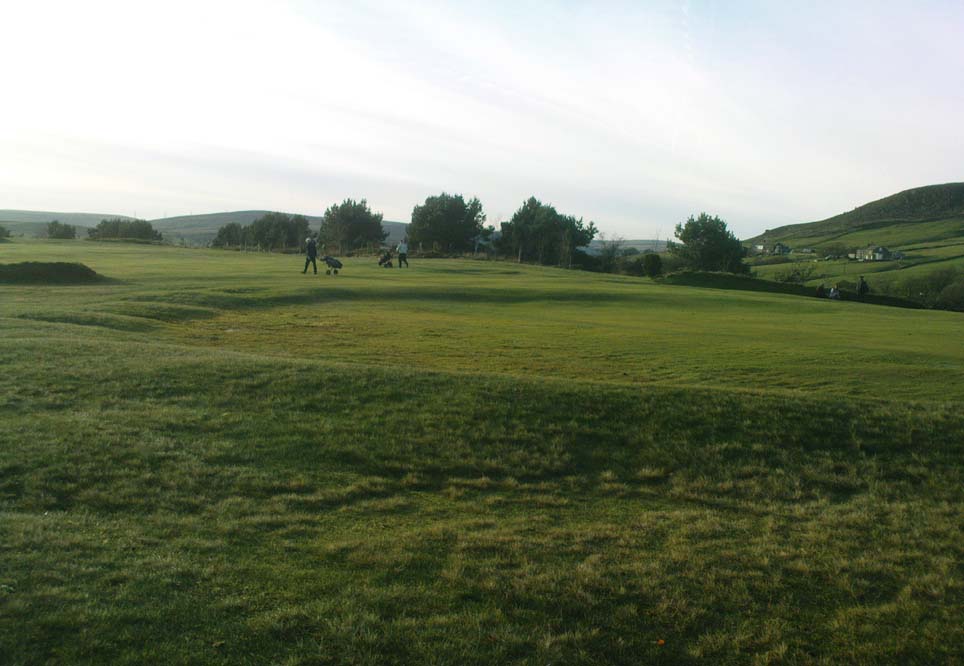
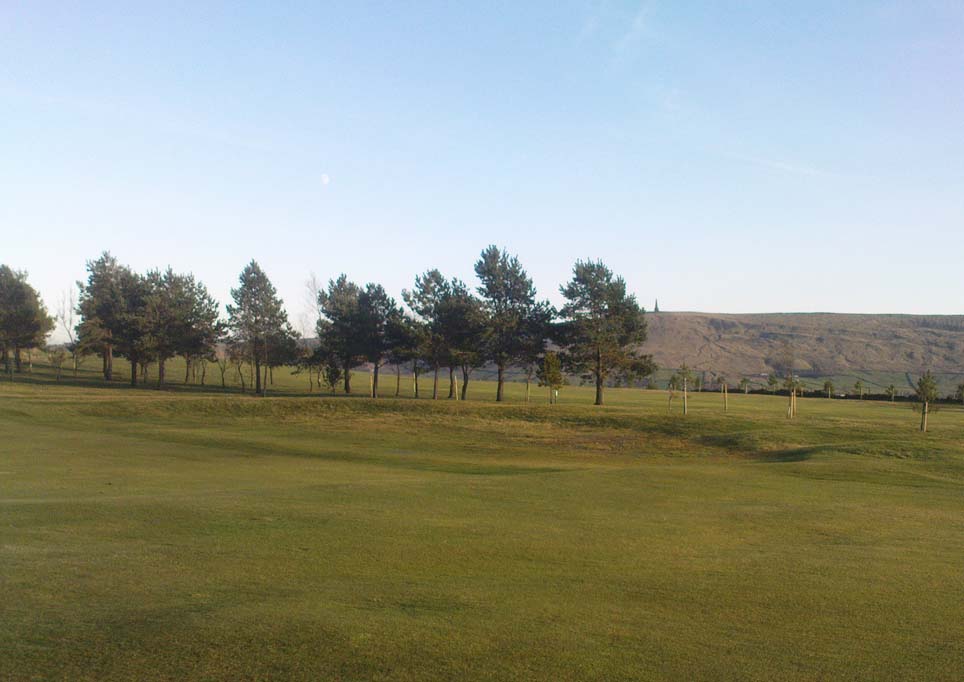
Blackheath Circle’s shallow semicircular bank
Blackheath circle, looking SE

It was thought in times past to have been a monument built by the Romans (hence the earlier title of ‘Roman Barrow’), but its origins were much earlier than those scruffy incomers! Its other local folk name, the “Frying Pan Circle” is, like its namesake at Morley, an etymological curiosity relating to the flat ground left in the wake of its shape: flat, circular, with raised edges surrounding it, not unlike a frying pan.

It was accurately described for the first time by Robert Law (1897), who later broadened his account of the site a year later in a paper he wrote for the Yorkshire Geological Society (1899) after an excavation here.  Mr Law and others explored the centre of the ring where they believed it most probable to find remains of some form or another — and they weren’t to be disappointed!  The following is taken directly from his lengthy article:

“On Thursday, July 7th of this year (1898), a very interesting and important archaeological discovery was made on a portion of land known as Higher Cross Stone Farm, belonging to Mr. Sutcliffe, of Todmorden.  In a field on this farm, called Black Heath, a ring circle, made of earth, has long been known to exist, and has gone by the name of the “Frying Pan.”  No history or tradition exists as to the origin of this circle, and various speculations have from time to time been indulged in by the residents.  Some have called it a Roman Camp, others a fairy circle, others a circus ring, made to break in horses; but the excavations prove it to be a burial place of prehistoric times.  Mr. Tattersall Wilkinson, of Burnley, a well-known archaeologist of considerable experience on ring circles, along with the writer of this article, came to the conclusion, on hearing of this circle, that it probably contained human remains, and an excavating party was organised to meet on the spot on the day above mentioned. This party met at the appointed time, and the plan of operations was to find the centre of the circle, by means of a tape, then to dig a circular trench about three feet from the centre, in which space it was thought the remains would lie.  The ring was nearly a perfect circle.  It was raised conspicuously above the ground. The rim of raised earth was about three feet wide, and the diameter of the whole circle was thirty yards.  After the digging had been going on for a short time, burnt soil and charcoal were met with, and the top of an urn was exposed to view.  The diggers then went to work with the greatest possible care, and very soon a beautiful urn was laid bare exactly in the centre of the ring.  The urn was embedded in charcoal and calcined bones. It was ten inches high and nine inches at the top, tapering to about three inches wide at the bottom. There was a rim or collar in the upper part of the um about three inches deep, which stood out about one inch in relief from the lower part of it. The collar was ornamented, probably by a pointed stick, with the herring-bone pattern. The outer part of the um was plain. In clearing away the debris from the urn another one was discovered, different in pattern and less in size, but in a very perfect state of preservation.

“About two feet from this, on the opposite side of the central urn, another um was discovered and laid bare, by carefully digging round it with a trowel.  This urn was also in a good state of preservation, and about the size of the second one, but differently ornamented.  These smaller urns were the same shape as the larger central one, but the ornamentations were not so fine, and they were made of inferior clay.  On the south side of the circle, about two feet from the centre, another urn was discovered, but it appeared to be insufficiently baked when manufactured, and had decomposed and crumbled into dust.  From the inside of this urn a large quantity of calcined human bones and charcoal was dug up, but the bones were very fragmentary, and the sex of the person to whom the bones belonged could not be determined.  Several portions of cranium, rib bones, and lower and upper leg bones were found among the debris.

“Within a few inches of this urn two small (so called) incense cups were found.  One of them was very perfect and in an excellent state of preservation and was beautifully ornamented all over. These cups were about three inches in height and three and a half inches in diameter, but tapered a little at the bottom.  Indications of three other urns were observed, but they were so much decomposed that little or nothing could be made of them.  The others seemed to be arranged about the large central urn and about two feet apart.  When the earth had been cleared away from the three perfect urns, and before they had been removed, several photographs were taken of them in situ.  One of the smaller urns leaned a little to the south.  Several pieces of flint and chert were dug out of the excavation.  The urns and incense cups being removed were put into baskets and conveyed to Todmorden, where they were re-photographed and placed in the Free Library for their safe keeping.

“On July 13th, six days after the “find,” the urns were opened at the Co-operative Hall, Todmorden, before a very large gathering of scientific ladies and gentlemen drawn from the surrounding districts.  Mr Tattersall Wilkinson, Dr. Crump of Burnley, and the author were entrusted with the opening of the urns.

“The largest one, which was of superior make to the other, was the first to be operated  upon. The work was tedious and was done in the most careful way possible.  Each operator commenced to pick out by means of a small pocket knife the substances deposited in the urns, and the material was closely examined as it fell out on the table.  For the first half-hour or so nothing particular was found.  The contents which had been so far dug out were portions of broken urns of a similar pattern to the urn that was being examined, but were not portions of it and must have been placed there as filling-in material.  Along with these urn fragments there was some dark brown sand, which appeared to have been burnt, quantities of bituminous soil, small fragments of bones, and bits of charcoal.  As the examining party dug deeper into the urn human bones became more numerous and in larger fragments and of a more determinable character, and this went on until the urn had been half emptied.  The rest of the contents of the urn then showed signs of being almost entirely calcined bones, and bone after bone was picked out, examined, and laid on the table.  Among these bones were fragments of various sizes: of cranium, portions of scapula, pelvic bones, femur, tibia and other bones of the legs.  Besides these there were fragments of ribs and perfect toe bones.

“Presently a small cup was laid bare inside the urn, and a few pokes with the knife so far emptied it of its contents that an ancient relic could be seen which differed from any that had yet been found. A moment later a piece of metal was picked out of the cup resembling a spear head.  It was about 2½ inches long and 1¼ inches wide at one end, and tapered to a point at the other.  It was thin and flat and sharp at the sides and point.  It contained a rivet at the two extremities and another one about half way up one side. A bronze pin was also found about the same time as this piece of metal, and on careful examination the metal and the pin were made out to be a bronze brooch, the pin having probably been detached in extracting it from the bones in the cup.  Besides this brooch about a dozen beads of a necklace were found, which were chiefly of a rounded shape and about half an inch in diameter. Some of the beads seem to have been made of jet, and some of bone, and were more or less rudely carved.  A bone pin was next brought to light.  It was almost two inches in length and the eighth of an inch in diameter at one end, tapering towards a point at the other.  It was cylindrical in form and slightly curved.  The fact of all these ornaments having been carefully placed in the cup and buried with the urn point to the cup having been used as a utensil in which to preserve what was considered of great value.  Several human teeth were also found in this cup.

“The opening of the two inferior urns proved that they contained nothing more than the sweepings up of the funeral pile which probably took place after the calcined bones had been placed in the more important urn.

“Since this discovery was made a beautifully-formed flint arrowhead of the leaf-shaped pattern has been found in the same hole from which the urns were dug. There have also been two or three more urns discovered within the same circle, but their contents have not yet been disclosed.”
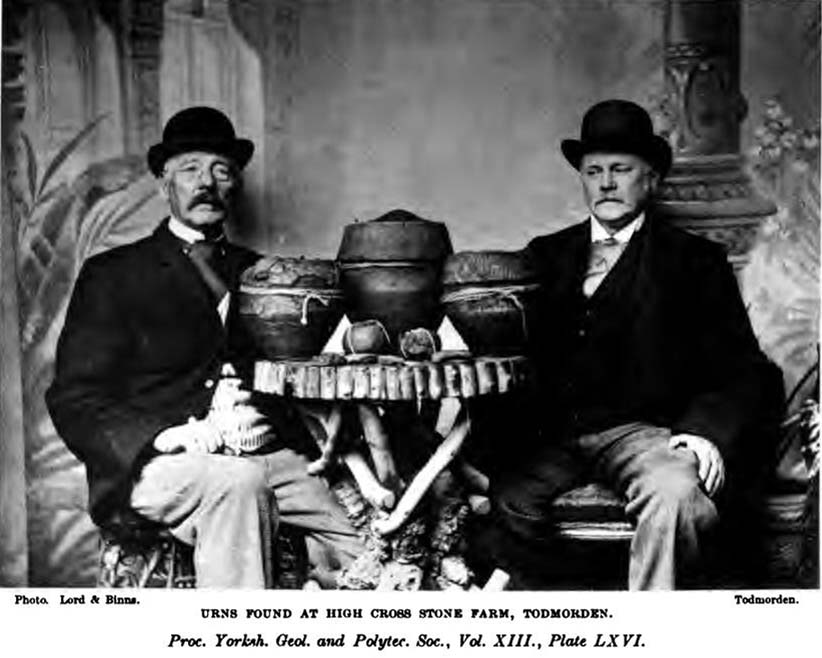
Early 1899 photo of the Blackheath urns
Blackheath urns on display, c.1911

They had to wait a few more years before a more complete account described the contents of the “two or three more urns” at Blackheath’s circle.  That duty fell to Mr J. Lawson Russell (1906), who, after further excavations, wrote the most detailed and complete account of the place.

Following the successful discoveries in 1898, Messrs. Russell, Law, Wilkinson and others made a “further systematic examination of the whole circle”, which was then subsequently wrote up in Ling Roth’s Prehistoric Halifax.  The following is a detailed account of that second dig:

“The first step in the systematic examination was the breaking up of the circle into quadrants. This we did by running deep trenches north, east, south and west.  The turf was then removed and these quadrants dealt with seriatim. The diameter of the circle was as nearly as possible 100ft (30.5m), i.e. measuring from ridge to ridge, but the slight mound which marked the circumference sloped gently further into the general level of the field.  Eight or nine deep furrows ran through the circle, from north to south, cutting the vallum up into segments and ploughing the enclosed area with their parallels. The method we followed was to trench till we came to soil which had never been disturbed. Generally about two spade grafts brought us to stiff glacial (?) clay. When we came upon an urn its position was carefully observed with reference to the centre and noted on a plan ; the earth was removed by trenching round the um, which was photographed in situ when sufficiently defined. The urns were not deeply placed, some of them being only six inches from the surface, none deeper than from 18in to 2ft (46 cm to 61 cm), and all of them without exception were set in the ground upright on their bases, not inverted.  There was in the centre an urn, and this was surrounded at a radius of 2ft by a ring of deposits; two having urns, the others either having no urn at all or showing signs only of disintegrated pottery. At a distance of about 10 ft. from the centre another series of deposits was radially arranged, but all to the east side of the north to south centre line. It will be seen that, if we leave out of account the urn found in the vallum in the north-west quadrant, all the urns and deposits save one have been placed to the east of the north to south centre line.

“An extensive floor of charcoal, sometimes an inch to two inches in thickness, was defined to the north of the centre, and two deep pits were located about 16ft (4-9 m) from the centre, one in the north-east and one in the south-east quadrant. Close to that deep spot in the south-east quadrant we found a curiously baked surface which we attempted to photograph.  A group of urns, one of which was a fine covered specimen, lay in line going due east from the centre ; and this group had placed all round it flat stones of no great size, set on edge, as if to protect the urns or mark them off from others.

“In the northern half of the circle and lying largely in the NE quadrant, was a considerable area showing a closely beaten, hard baked red floor, with pieces of charcoal speckled amongst the general red.  Somewhat similar areas occurred at the west and at the east sides of the circle, that at the west being most marked, the whole floor in that quarter looking like disintegrated pottery closely trodden together.

“Lying NW by W, from the centre, we found in the vallum a large stone with an urn set right in its middle. Other stones lay near, as if they might have been set round this urn in kist fashion. All about this spot the ground seemed to be made up of shivers of sand stone and pounded sand. Over-lying this sand for a considerable area going northwards was a thick layer of charcoal.  Curious cairns of stone had been placed just inside the vallum, and these, we soon discovered, accurately marked the cardinal points — N, E, S and W., the most curious of these cairns being that which lay exactly south. The stones here were in the form of a semi-circle, having an armchair -like arrangement in its middle, the back of the chair looking due south, i.e., by the sun at mid-day.  In the turf over-lying this strange assemblage of stones a portion of the base of an urn was found, and there was abundance of charcoal at the westerly horn of the semi-circle. Many of the stones in the other cairns lay in groups of three pointing in one direction. Some of the groups looked as if they had been upright at one time and thrown down. At the western point the stones lay in an imbricated fashion, inclined at an angle of about 45°, placed in two rows, about 2½ft (76 cm) apart, five in one row, four in the other. A large flat stone lay near, and by it one which probably was the fifth of the second row. Between these rows of stones, and all around them, lay great quantities of what looked like partly baked clay or disintegrated pottery.  In the southwest quadrant lay an incomplete ring of stones, which possibly marked an interment.  This incompleteness is interesting and may have had some significance t Other large stones were found set into the vallum at more or less regular intervals. Some of these are still in situ, the further examination of the vallum having had to be abandoned. Close by all these stones charcoal was found, and the upper surface of one, at least, that in the SE quadrant, SE of centre, was blackened as if by fire.

“In removing the stones forming the four cairns I examined all of them for signs of markings, but none was seen except one deeply scored line drawn across the large flat stone in the cairn at the eastern point. This line may have been grooved into the stone by the over-passing plough, but I am rather of opinion that it was purposely graved there. What was the purpose of these cairns and large stones in the vallum? The fact of one large um having been found as already stated, on a stone in the vallum, while part of another urn was found near the southern cairn, suggests a probable explanation for some of these arrangements of stones. They may have been rude kists enclosing urns, or at least they may be regarded as stone-marked interments. The presence of charcoal close beside these stones may point to the performance of funeral rites.”
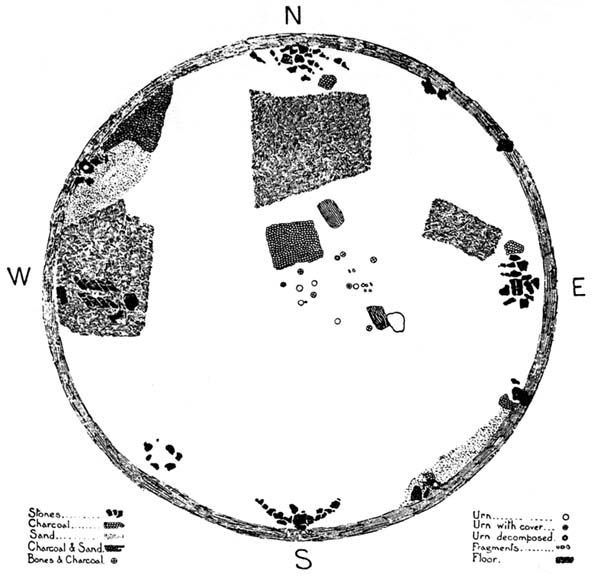
J.L. Russell’s 1906 ground-plan

Mr Russell then went into considerable details describing the urns, flints, carved bones and other objects recovered from the site (those who would like further info, find a copy of H.L. Roth’s Yorkshire Coiners for the full account).  It was his opinion that the site was used primarily as a place for the dead.  There was no evidence here of domestic activity or settlement of any kind.  And particularly intriguing were the four cairns placed inside the circle: each one at the cardinal points north, south, east and west. This would indicate a ritual evocation of the airts, or spirits of the four directions, with obvious correlates in relation to spirits in the land of the dead.  This was very obviously an important sacred site to the people who built this… Oh such a pity it’s now in the state it is…

One other point of intrigue here is: according to the archaeological records there are no other prehistoric sites nearby, nor any settlement remains that could account for the existence of this once important ritual site.  That doesn’t make sense…

Folklore

Old lore told that this site was once the abode of the fairy folk.   The old game of Knurr and Spell used to be played here; which is a game played with a wooden ball (the knurr) which is released by a spring from a small brass cup at the end of a tongue of steel (the spell). When the player touches the spring, the ball flies in the air and is struck with a bat.  In J.L.Russell’s (1906) account of the excavations here, he reported finding several very old balls in the circle, indicating that Knurr and Spell or variants of this game had been played here for many centuries.

Even weirder was the UFO encounter here. In 1982, the landowner’s wife reported seeing an earthlight right next to the spot, as she looked from her bedroom window.  The next thing she knew, she was laid outside prostrate on the ground right next to this ancient monument.

…to be continued…

References:

  1. Abraham, John Harris, Hidden Prehistory around the North West, Kindle 2012.
  2. Bennett, Paul, The Old Stones of Elmet, Capall Bann: Milverton 2001.
  3. Burl, Aubrey, The Stone Circles of Britain, Ireland and Brittany, Yale University Press 2000.
  4. Fishwick, Henry, “Discovery of Ancient British Barrow in Todmorden,” in The Reliquary, New Series volume 9, 1903.
  5. Holden, Joshua, A Short History of Todmorden, Manchester University Press 1912.
  6. Law, Robert, “Evidences of Prehistoric Man on the Moorlands in and around the Parish of Halifax, in Halifax Naturalist, volume 2, April 1897.
  7. Law, Robert, “The Discovery of Cinerary Urns at Todmorden,” in Halifax Naturalist, volume 3, August 1898.
  8. Law, Robert, “On Recent Prehistoric Finds in the Neighbourhood of Todmorden,” in Proceedings of the Yorkshire Geological & Polytechnic Society, volume 13, 1899.
  9. Roth, H. Ling, The Yorkshire Coiners, 1767-1783; and Notes on Old and Prehistoric Halifax, F.King: Halifax 1906.
  10. Russell, J. Lawson, “The Blackheath Barrow,” in Ling Roth’s Yorkshire Coiners (Halifax 1906).
  11. Watson, Geoffrey G., Early Man in the Halifax District, Halifax Scientific Society: Halifax 1952.

© Paul Bennett, The Northern Antiquarian
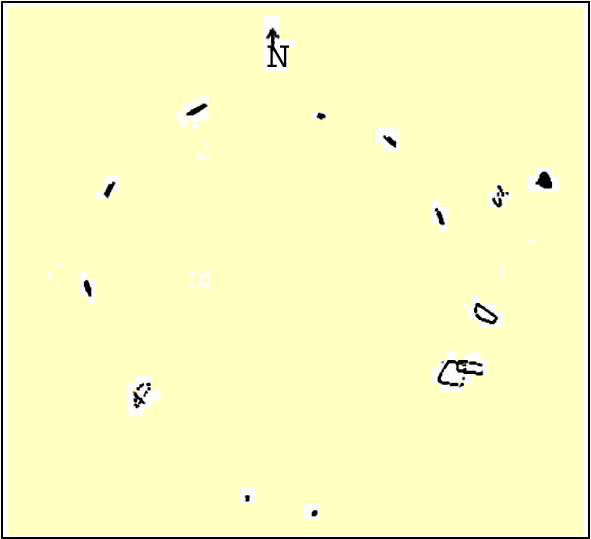

Mudbeck Ring, Arkengarthdale Moor, North Yorkshire

Stone Circle:  OS Grid Reference – NY 95626 07618

Also Known as:

  1. Arkle Beck Stone Circle
  2. Thom L6/5

Getting Here

Truly takes some finding this one and you’ve got those energy-depleting tribbles (tussocks) to contend with in your journey here!  But if you’ve good ankles and enjoy bouncing the moors, it aint too bad.  It’s 4 miles east of Tan Hill, some 700 yards west of the confluence of Mud Beck and Arkle Beck, and some 300 yards north of Arkle Beck amidst the grassy open moorland.  Look around and you’ll find it!

Archaeology & History

Located on a prominent position on a ridge at the head of a pass into Upper Arkengarthdale, this site was first found in 1982 by local Shepherd William Stubbs, who informed Tim Laurie, who then contacted Archibald Thom – son of the legendary Alexander Thom – who went on to survey the site in 1983.  Thom “recorded five stones in the ring, one slab buried on the line of the perimeter, and a small stone just inside the ring.” He reckoned the outlying stone 55 yards ENE was also part of the original complex. His survey found its geometry to be a perfect circle in design.  And, in good old-fashioned Alex Thom fashion, measured the diameter of the circle at precisely 22.53 megalithic yards; that’s about 20 yards to you and me!

All the stones in the ring are pretty small and unassuming and the site gives more an impression of having burial associations, but I’m unaware of any such finds.  There are other little known sites scattering this region and we need a few ventures scouting around to see what more can be found…

References:

  1. Curtis, Ronald, ‘The Geometry of Some Megalithic Rings,’ in Records in Stone (edited by Clive Ruggles), Cambridge University Press 1988.

© Paul Bennett, The Northern Antiquarian

Stannary, Halifax, West Yorkshire

Stone Circle (destroyed):  OS Grid Reference – SE 088 256

Archaeology & History

The place-name authority A.H. Smith (1961), in searching for the meaning behind the old region in Halifax known as “stannary”, just west of the town centre, was puzzled by its implications and found it wanting, so he took the most likely option as he saw it, writing,  “probably it is a stone circle,” from the archaic verbs stan (stone) and hring (ring).

First recorded in the Halifax Court Rolls of 1575 as “Stannerying”, this implied it to be a place where tin-ware was sold in a field, “though that word belongs rather to Cornwall,” he said, and it appeared out of place at the time it was written.  So he looked elsewhere.  The Halifax Parish Registers of 1578 didn’t help much, describing the place as “Stanerye.”  However, the Halifax Rent Records of 1588 named it as “Standeringe”, which is much closer to Smith’s idea.  With each written instance we certainly find the old English stan, but the suffix in two instances is difficult to assess with firm conviction.

If we could locate additional folklore or other historical data that might throw further light on this, it would be an important find.  The finding of prehistoric burial remains less than a mile south of Stannary on the other side of town shows that ancient man was in Halifax, but it would be good if we could find more…

References:

  1. Smith, A.H., The Place-Names of the West Riding of Yorkshire, Cambridge University Press 1961-63.

© Paul Bennett, The Northern Antiquarian


Broad Stones, Clatford, Wiltshire

Stone Circle (destroyed):  OS Grid Reference – SU 161 684

Also Known as:

  1. Clatford Stone Circle

Archaeology & History

John Aubrey’s early drawing (soz about the crap quality)

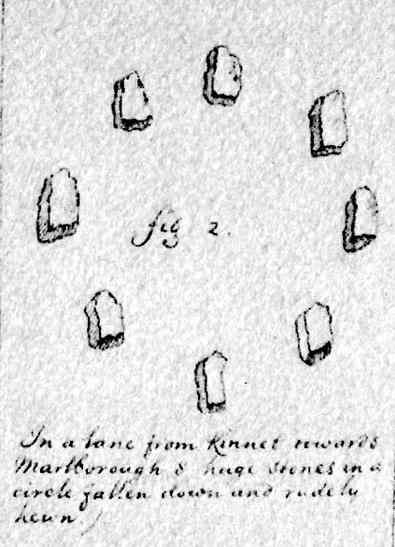
Also known as the Clatford Circle, it was described by both of the old pioneers, John Aubrey and William Stukeley: Aubrey saying the monument could be found “in a lane leading from Kennet to Marlborough… (consisting) of eight huge large stones, roughly hewn… in a circle, which never could be by chance.”  Will Stukeley reckoned that four other stones close by, “may possibly have been the beginning of an avenue.”  We might never know for sure.

The local Avebury authority, Pete Glastonbury, showed us a spot which he thinks may have been the where the circle stood, and where a couple of decent-looking stones lay by the side of the track that could have once been a part of this circle.  It looked as good a contender as anything else.  Has all trace of this monument truly been destroyed?

References:

  1. Burl, Aubrey, Prehistoric Avebury, Yale University Press 2002.

© Paul Bennett, The Northern Antiquarian

Tigh Stallar, Boreray, St. Kilda

Stone Circle:  OS Grid Reference – NA 153 050

Archaeology & History

The isle of Boreray is four miles northeast of Hirta and here once lived, according to legend, a christian hermit.  However in the reverend Kenneth Macaulay History of St. Kilda (1764), he told us that the character was actually a druid.   Take your pick!  The druid lived at Stallir House, adjacent to which, said Macaulay, was

“a large circle of huge stones fixed perpendicularly in the ground, at equal distances from one and other, with one more remarkable regular in the centre which is flat in the top and one would think sacred in a more eminent degree.”

In a later article by F.L.W. Thomas (1867) he also mentioned this ‘stone circle’, though indicated its decline.  Additional information on this little known stone is sparse due to its somewhat remote position on one of the uninhabited isles of St. Kilda.  I wouldn’t mind spending a month or two there, roughing it, to see what’s what!

References:

  1. Macaulay, Kenneth, The History of St. Kilda. Containing a Description of This Remarkable Island; the Manners and Customs of the Inhabitants; the Religious and Pagan Antiquities There Found, T. Becket: London 1764.
  2. Thomas, F.L.W., “On the Primitive Dwellings and Hypogea of the Outer Hebrides,” in Proceedings of the Society of Antiquaries of Scotland, volume 7, 1867.

© Paul Bennett, The Northern Antiquarian

Dumpit Hill B, Hebden, Grassington, North Yorkshire

Stone Circle:  OS Grid Reference – SE 0307 6406

Getting Here

Follow the directions to reach the Dumpit Hill A circle.  From here walk about 100 yards ENE till you see an arc of small upright stones.  If the heather’s in full growth it’s highly unlikely you’ll see anything; but if the heather’s been burnt away, the site’s worth looking at.

Archaeology & History

As with the small companion Dumpit Hill A circle more than 100 yards to the southwest, this site of similar dimensions was first reported by Arthur Raistrick in 1963, and then described — albeit briefly — in H.G. Ramm’s “Yorkshire Archaeological Register” for 1964, as “33ft in diameter. One third of the circle robbed but other stones standing.”  And apart from that (with a repeat of the same info in Burl’s [2000] magnum opus) little else has been said.  But there’s quite a bit more to this place than what our mentors have written…

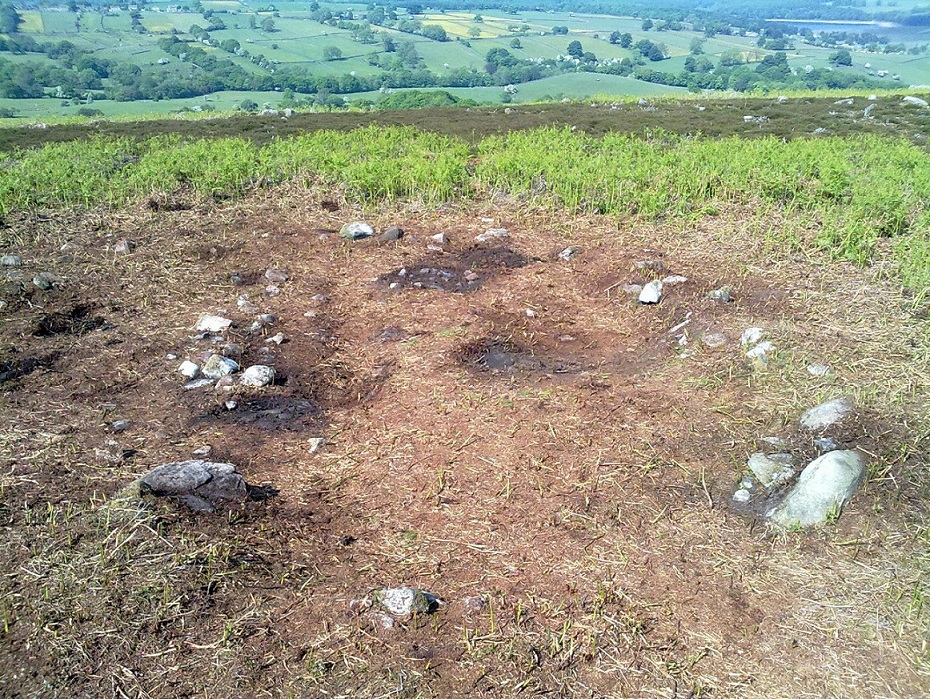
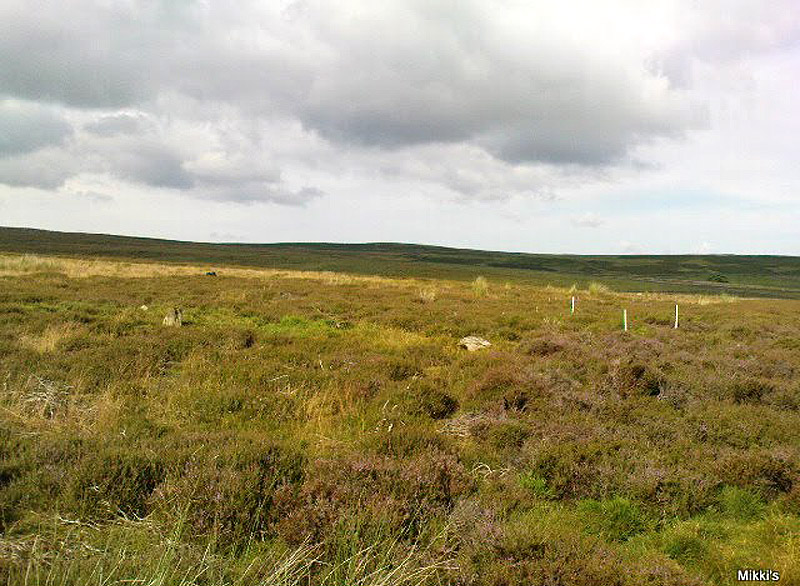
Northern arc of circle, with stones A, B, C & D
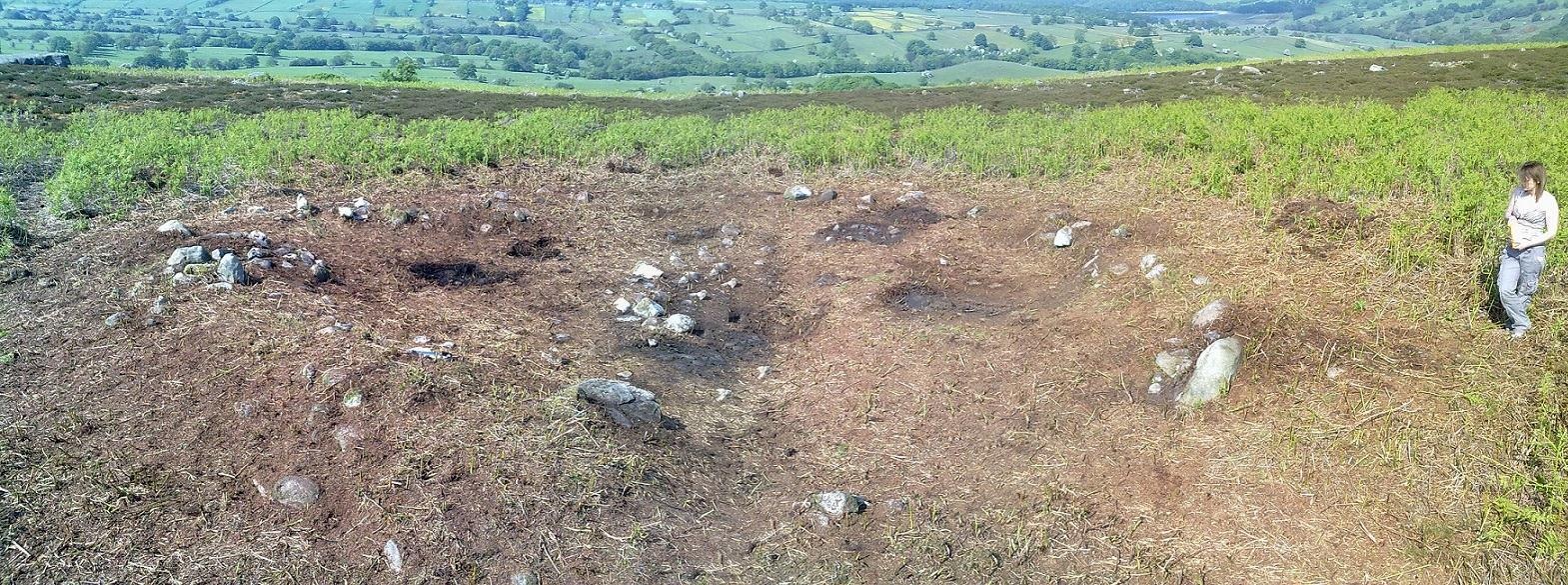
Dumpit B Stone Circle (white sticks showing position of stones)

In a team visit to the site last week, it was Paul Hornby who called our attention to Dumpit Hill B.  Thankfully the heather had been burnt back several months earlier, fortunately allowing us a better assessment of the place than Mr Raistrick’s initial survey forty years ago.  Instead of just the 3 stones that he found here, we uncovered a near-complete ring of eight stones, arranged in a pretty decent circle (Alexander Thom would have classed it as a Type 1 circle).  Paul’s attention was first drawn to an arc of three obvious upright stones and another laid down along the same arc.  This arc then turned out to be a semicircle when he found another stone laid half-covered in the peat.

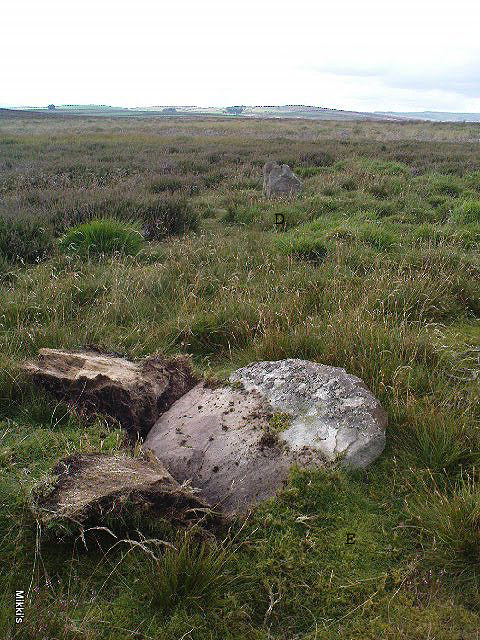
Western stones D & E
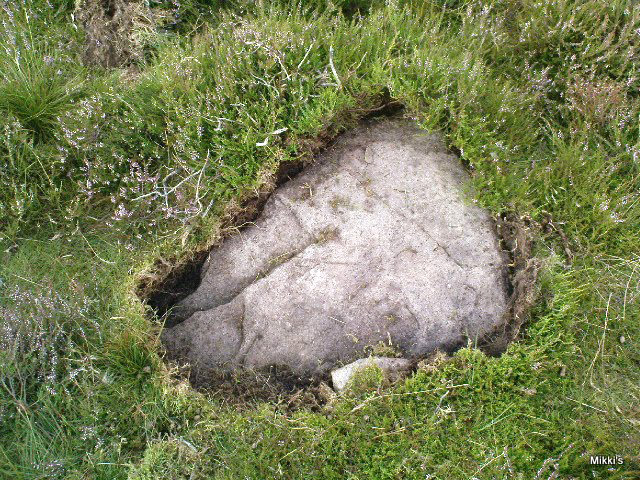
Stone F

But then it seemed, if this was an authentic stone circle, we were gonna struggle to see the rest of it as the deep heather had grown up over the southern side of this semi-circle of stones.  But thankfully, with just a little bit of stomping on the ground in the right areas, three other stones of similar size and stature were located and within just a few minutes this small arc of stones had become a full prehistoric ring — except perhaps on the eastern side, where there was a distinct gap in the monument.  Michala Potts and Paul did come across a couple of stones in this “missing” section, but they were just small rocks and didn’t account for an expected 9th stone.  If such a stone ever stood at this eastern point in the circle, it remains unfound.

Two of the stones (G & H) that were initially covered in heather, after we’d carefully peeled the vegetation back, had what seems like small packing stones at one end, where it seemed obvious they had stood upright.  It was tempting to carefully stand each stone back up into position, but we managed to overcome the temptation!  None of the stones are higher or longer than 3 feet.  At least three of them seemed to have been set along their longer axis rather than being set in the tall upright position — but again, this needs verifying by excavation.  (With good evidence, some students posit that upright stones are male; rounded, wider stones are female — though such a lay-out here seems unlikely)

Stone G
Stone H

An additional curiosity was found in the middle of the circle, where there was a small but distinct scattering of stones, very much like a denuded cairn.  If this turns out to be the case (as seems likely) it’d mean a new classification for this monument.  We could do with having another look at this place the next time the heather’s been burnt away, enabling us to find out more about its nature and function.

…And if you walk west down the slight slope, over the couple of small drainage-ditch streams (which they really should stop cutting into our moorlands) and then up the slight slope towards the trackway, stopping some 20 yards before it, you’ll find you’ve walked right into the middle of a previously undiscovered Bronze Age enclosure, or settlement: the Dumpit Hill enclosure.  It’s pretty impressive aswell! (more on that in due course)

References:

  1. Burl, Aubrey, The Stone Circles of Britain, Ireland and Brittany, Yale University Press 2000.
  2. Ramm, H.G., “Yorkshire Archaeological Register, 1964,” in Yorkshire Archaeological Journal, part 163, 1965.

ACKNOWLEDGEMENTS: Huge thanks again to Dave Hazell, Paul Hornby and Michala Potts in seeking out & helping with this and the adjacent sites!

© Paul Bennett, The Northern Antiquarian

Dumpit Hill A, Hebden, Grassington, North Yorkshire

Stone Circle:  OS Grid Reference – SE 0299 6399

  1. Hebden Stone Circle
  2. MYD4403

Getting Here

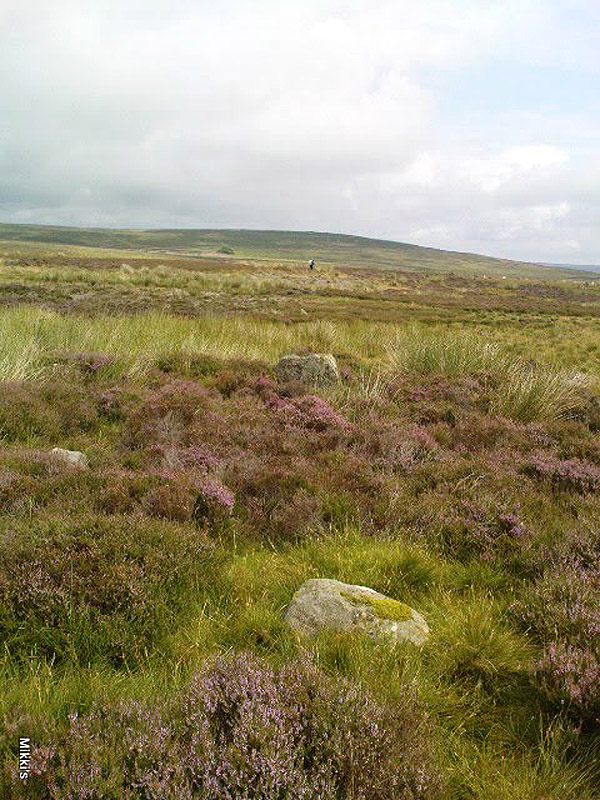
Main stone in this circle

From Grassington, head east along the B6265 road for a mile or so, thru the hamlet of Hebden and, once up the hill on the other side of the village, take the track up your left and walk up until the land just about levels out and the moorland opens up on the right-hand side of the track.  If you’ve got the trackway which takes you to Scar Top House on your left (where the walling breaks), head straight into the heather and walk about 150 yards NE, keeping your eyes peeled for a singular upright, less than 3ft high.  Once here, check the small overgrown ring you should be stood in!

Archaeology & History

A relatively small site that can be difficult to see when the moorland heather’s in full growth — but it’s in a lovely setting, with a hidden view of the hills for nearly 360°, yet quietly hidden from prying eyes until you’re all but upon the place.  Although it has a likely Bronze Age pedigree (it aint yet been excavated), it was ignored by the confines of written history until Arthur Raistrick brought it back to life in a brief note in the Yorkshire Archaeological Journal of 1965 when Mr H.G. Ramm told what he’d found, described it simply as,

“32ft in diameter, 5 stones still stand leaving spaces where other stones have been taken for walling.  A large stone is flat at the centre.”

Alignment east: ring, outlier, human, hill!

And that’s that!  No doubt the remarks about some stones taken from here to be used in some walling were told Raistrick by a local, but he says no more about this.

The main feature to see in this small ring is the flattish, wide upright, less than three-feet high, on the eastern side.  A smaller upright stands in half-boggy Juncus grasses as you spin round towards the north, with a smaller stone laid on the ground in between.  Originally it appears there were at least eight standing stones making up this circle.  If you walk around it you’ll make out several of the other stones laid down.  About 30 yards due east of the tallest upright in the ring is another small outlying standing stone.  And, less than 100 yards northeast from this outlier, we come across the equally small, little-known stone circle of Dumpit Hill B

References:

  1. Burl, Aubrey, The Stone Circles of Britain, Ireland and Brittany, Yale University Press 2000.
  2. Dixon, John & Phillip, Journeys through Brigantia: volume 2 – Walks in Ribblesdale, Malhamdale and Central Wharfedale, Aussteiger: Barnoldwick 1990.
  3. Raistrick, Arthur, Prehistoric Yorkshire, Dalesman: Clapham 1972.
  4. Ramm, H.G., “Yorkshire Archaeological Register, 1964,” in Yorkshire Archaeological Journal, part 163, 1965.

© Paul Bennett, The Northern Antiquarian

Snowden Crags Circle, Askwith Moor, North Yorkshire

Ring Cairn:  OS Grid Reference – SE 1770 5136 

Getting Here

From the Askwith Moor Road parking spot, walk up the road for about 500 yards and head to your right (east) onto the moor.  Walk past the upper side of the disused quarry and through the heather for about 200 yards until the moorland slopes down and you’re on another flat moorland ridge.  You should now be stood on the edge of the Snowden Crags Necropolis or cairnfield.  There’s a large patch of bracken near the top of Snowden Crags in the middle of the prehistoric cemetery.  That’s the spot!

Archaeology & History

Very little has been written of this site and for years several of us have wondered whether or not a stone circle was the antiquity that was being described in the only singular reference of the place, mentioned almost in passing in Mr Cowling’s (1946) fine survey of this area more than fifty years back, where he reported:

“A large circle of heavy material, some thirty feet in diameter, is isolated on the shelf above Snowden Crags to the west.”

But despite the various explorations of me and a number of other students on these moors over the last 20-30 years, Cowling’s curious singular reference (which some have taken as an error of judgement on his behalf) has remained a mystery.  Until now!

South & west portion of the ring (photo credit: Geoff Watson)
The complete circle, looking NW (photo credit: Geoff Watson)

Thankfully, with the help and attention of the hardworking Keighley volunteer Michala Potts on Thursday, 20 May, 2010, this large and very well-defined antiquity has been relocated — and a damn fine find it is indeed!  It would appear (unless someone has notes to the contrary) that when Cowling did his extensive walkabouts on these and adjacent moors, this Snowden Crags Circle was much overgrown in heather and bracken; and I think we can safely assume this due to him making no further remarks regarding the site.  Indeed, it would seem that Cowling’s consequent silence on the matter would lend us to think he never caught good sight of this “large circle” ever again.  And upon these moors, that’s easily done when the heather gets deep up here! (numerous cup-and-ring stones on these and other northern moors still lay hidden amidst moorland undergrowth, awaiting rediscovery as a consequence of the deep vegetation)  But thankfully now we have a good view of the place.

Wrongly ascribed by Neil Redfern of English Heritage to be a part of Scheduled Monument Record number 28065: Cairnfield, Enclosures, Boulder Walling, Hollow Way and Carved Rocks (it’s actually a short distance north of SMR 28065), the site here was relocated during one of The Northern Antiquarian exploratory walks, assessing the extensive walling, settlement pattern and prehistoric graveyard that scatters the central and northwestern section of the moors here.  Michala Potts stopped and shouted for Dave Hazell and I to come and have a look at something she’d found whilst we were carefully peeling turf back from a previously unrecorded site about 100 yards away.

“What is it?” I asked; expecting just another small tomb or new cup-and-ring stone.  But her tone of voice was different this time.

“I think you’d better take a look at this,” she emphasized.

As we walked through the shallow heather towards her, it became obvious she was standing in a rough circle of dead bracken, unbroken by the lack of rain over the previous months.  We’d actually walked past it a couple of times the previous week and gave it no attention due to the depth of the dead vegetation covering the area.  But this time it was different.  I got within 50 yards of where Mikki was stood and my footsteps slowed; a couple more steps perhaps; then I stopped dead in my track.  My arms lifted up and I held my head gazing at what she appeared to be stood in.

“Aww my god….” I said — transfixed at what was in front of me (I’m easily pleased aswell!).

Snowden Crags circle, looking west (photo credit: Geoff Watson)

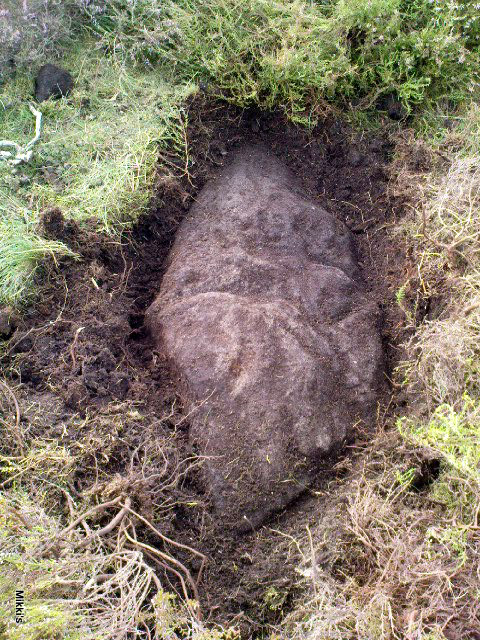
I’m not quite sure how long I stood there with my head in my hands.  Ten seconds or so.  I couldn’t really say.  I think it was when Dave caught up to where I stood, rooted, and appeared at my side.  We walked a bit closer to make sure that what we could see wasn’t just another one of those curious shapes in the landscape that you find when seeking out prehistoric sites and turn out to be bugger all — but it wasn’t.  Instead, Mikki Potts had stumbled upon an average-sized ring of stones, between 1-3 feet tall, and about 13 yards across, with what seemed like an entrance on its southern side, seemingly untouched in the middle of the mass of decaying bracken!  It was an exciting find — as it’s not everyday that you come across a previously unrecorded stone circle.  But, once we’d calmed down and walked round and round the site to make sure that something man-made was under our feet, we decided to make our way home (we’d been on the moors all day) and get back up to have a more detailed look at the place in a few days time.  On Tuesday, May 25, we went back up for a second time and had a better look at the place…

It was another lucky day.  For before we even reached Askwith Moor, Mikki pointed out what looked like a small cup-marking on a stone yards from the edge of the River Wharfe.  We brushed off a bit of the dusty earth and were greeted the single cup-marked stone we’ve named the Riverbank Stone.  It sat there all alone and dusty and we were very tempted to look for more potential carvings along the riverbank, but the Snowden Crags site was calling for attention and so up the hill we walked.

The ring of stones was still covered in a carpet of dead bracken and also had the new shoots of Spring emerging from the Earth, so we spent the next few hours picking up much of the dead bracken and carrying it beyond the outskirts of the circle, hence enabling us to see with greater clarity the monument Mikki had found a few days previously.  The hot sun shone down on us all day and it took longer than we expected to shift all the bracken; but eventually, once we’d done it, we were looking at a very distinct man-made circular monument, measuring 13 yards by 12 yards across and, at its highest point, not even three feet above the present ground level.  But today’s ground level is certainly much higher than it was when these stones were first placed here — at least 12 inches higher.

Rubble bank, NE-SE section (photo credit: Geoff Watson)

When Mikki first clapped eyes on the place, only a few small upright stones were sticking up amidst the mass of compacted bracken, but once all this had been brushed off we could see the stony earthworks averaging 18 inches high around the edges; and in places this outer ring is nearly 6 feet across.  The ring consists mainly of smaller packing stones (perhaps thousands of them) between a number of larger upright stones  — a dozen of them  — making up the perimeter; but much of this perimeter is still considerably overgrown in compacted vegetation that’s prevented us seeing the ring in its proper glory: what archaeologists in the past have called a rubble bank.  On its southern side is what appears to be an entrance, i.e., in this part of the circle there are no larger stones at all and only a handful of small stones have been noticed; but we must take into account the fact that we’ve done no excavation work here and this “entrance” may in fact be illusory, as the centuries of compacted vegetation (in all probability at least 12 inches deep) could be overlaying an unseen portion of the ring.  This “entrance” is about 2 yards across.

The circle has similarities in size and design to the better-known site of Roms Law on Ilkley Moor.  The difference between the two however is Roms Law has been robbed, whilst the Snowden Crags circle hasn’t even been catalogued.  Yet there is a distinct anomaly here.

As we walked through the southern “entrance” and into the circle, we noticed what seemed to be some form of internal walling running roughly north-to-south.  This “walling” started about three yards between the southern “entrance” and the inside of the ring, but then it ran roughly through the centre and all the way to the northern perimeter.  This was indicated by a distinct rise in the ground which, as you walked over and stomped your feet, proved to be a mass of numerous small stones seemingly a few inches under the ground, some of which were poking through the Earth’s surface.   This ingredient alone made me stop and wonder about the nature of the site.  Had we come across a cairn circle of some sort?  Or were we in fact stood in the middle of a small walled enclosure, which itself sits in the middle of this prehistoric graveyard?  Indeed, was this walled enclosure a potential living quarter: some sort of large hut circle with a wall through the centre splitting it in two?  It was hard to say for sure.  On another visit to this site a couple of weeks later, in the company of Geoff Watson, Paul Hornby and Dave Hazell, this potential internal walling was given a bit more scrutiny.

We were dying to get our hands and feet digging at the heart of this ring of stones but — as yet! — we’ve managed to restrain ourselves.  Although carrying off the mass of dead bracken has dislodged a couple of the small fist-sized stones at the edge of the ring (we carefully placed ’em back into position; yet it was only as much as you’d unintentionally disturb if you walked over the place a few times), we needed to use a couple of small brushes to have a look at this apparent internal walling running through the middle of the ring.  But after carefully brushing off the dry dead earth, we found this “walling” was nothing of the sort!  Instead, it seemed, someone at some time in the past had beaten us to this place!  The central walling was, in fact, where someone had dug into the central region of the circle — probably looking for treasure or other wealthy valuables — and in doing so had dislodged a great number of the small stones that were initially in the middle of the ring, and in doing so pushed them up into small piles of stones, away from their original central position, creating an obvious long line of rocks which, once covered with dead vegetation, gave the impression of it being a length of walling.  We also found that the mass of rocks that were around the centre of the ring also spread outwards covering all of the ground inside the outer kerb of stones — probably thousands of them.  Geoff called this trench in the middle, the Robber’s Trench!

This begged the question: who the hell had been here, dug out a trench in the middle of this cairn circle (possibly taking out whatever remains were in the middle) centuries before the site had even been catalogued?  It didn’t seem like it could have been Mr Cowling, as the covering vegetation was much more than a mere 50 years of age; and Cowling would very likely have reported any finds that he might have made here.  So it is a mystery that needs solving.* Again, an accurate archaeological excavation would be invaluable here — but I wouldn’t hold your breath.  Archaeological officials don’t seem interested in helping here.  I was informed by Neil Redfern of the archaeology department of English Heritage for North Yorkshire that they are unable to support any funding that might help towards any decent analysis of this important archaeological arena (probably spent all their cash on prawn sandwiches and tedious autocrats, as usual).

So what we have so far is this: a large flattened circle consisting of at least a dozen upright stones that define the edges.  Between these uprights are hundreds, perhaps thousands of smaller stones, making a rubble bank of a near unbroken circle, apart from where there seems a small entrance on its southern side.  Inside the circle is a scattered mass of many small stones, typical of cairn material, filling the entirety of the monument; but the central region has been dug into at some time in the past, by persons unknown.  It sits on a flat plain of moorland amidst the Snowden Crags Necropolis with around 30 other small cairns.  But this particular site is several times larger than all the others, probably indicating that whoever was buried/cremated here was of some considerable importance in the tribal group: a local king, queen, tribal elder or shaman.  Whoever it was that this monument was made for, the landscape reaching northwards from here looks across to the giant morphic temples of Brimham Rocks and the heavenly landscape beyond and above them.  It is very likely that the Lands of the Ancestors this way beckoned…

References:

  1. Cowling, Eric T., Rombald’s Way: A Prehistory of mid-Wharfedale, William Walker: Otley 1946.

LINKS:

  1. Wharfedale & Airedale Observer – Archaeologists find ‘Tomb of Tribal King’ Hidden on Moor

ACKNOWLEDGEMENTS

Huge thanks for the help, assistance and photographs of this newly discovered site — and others nearby — to Michala Potts, Dave Hazell, Paul Hornby and Geoff Watson.

* There is a legend that tells of gold and treasure found at a nearby pre-christian well, but this site is a mile to the north of here.  Another nearby treasure legend is that of a chap called “Robinson”, who came upon tons of wealth from an unknown source, enabling him to build the eloquent Swinsty Hall a mile northwest of here (though such a chap didn’t actually build Swinsty!).  Perhaps there’s some grain of truth somewhere down the line about someone finding some treasure hereby…perhaps here…perhaps not!

AN APPEAL TO SOME DECENT RICH CHAP FOR SOME MONEY TO ENABLE EXCAVATION HERE!

This site and the surrounding monuments have received no archaeological attention of any worth.  If it wasn’t for the fact that us amateurs had explored these (and adjacent) moors, this cairn circle would remain unknown, many of the cup-and-rings upon these moors would remain unknown, the extensive enclosures and walling (of indeterminate age and function) would remain unknown, many prehistoric tombs would remain unknown, etc.  It is clearly evident that we have quite extensive domestic and ritual remains covering this small moorland region, from the neolithic period onwards.  In the event that anyone reading this with a healthy financial backing behind them could work out a financial strategy enabling us to accurately excavate this and the adjacent monuments, please get in touch.  We need an archaeologist to be paid for in order that we can do the duties correctly, but there is a group of a dozen volunteers willing to put a lotta work in to do the right job in this and the surrounding sites.  Is there anyone out there who has the finance to enable this?  I’m serious!  Or are these important sites merely going to be left alone for the elements to consume and disappear over time?  Surely there are one or two rich antiquarians left in this country who, as in times of old, are willing to help in the investigation of our country’s ancient monuments?  Does anyone out there know how we can get the ball rolling?

© Paul Bennett, The Northern Antiquarian

Harperstone Circle, Dunblane, Stirlingshire

‘Stone Circle’:  OS Grid Reference – NN 838 032

Archaeology & History

An intriguing entry inasmuch as we don’t know the full history and nature of the site.  Whether this site was the “druidical circle” mentioned in the 1791 Old Statistical Account of Scotland ” upon the heights of Sheriffmuir,”(vol.3, p.210), we cannot be sure.  The site was certainly described by Mr Hutchinson (1893) more than a century ago as a “stone circle”, but earlier still in a short piece in the Stirling Journal of May 5, 1830.  It read:

“About eight miles from Stirling by the Sheriffmuir Road, near a place called Harperstone, there is a remarkable circle of stones, supposed to have been a druidical place of worship of old.  The site of this circle is rather uncommon in this country — being on the back summit of a high hill, one of the Ochils called the Black Hill, and exposed to every wind that blows.  It is about two english miles south of the present roadway.”

The writer’s notes then told of some curious finds by this circle, giving the impression that it may have had another function: perhaps a cairn of sorts; perhaps an ancient building — we may never know.  Nevertheless, his information is intriguing.

“Tradition records two remarkable circumstances connected with this druidical circle, which may perhaps be worthy of being preserved.  About the middle of last century (c.1750) there were dug up at the foot of the larger stones three vessels of clay of antique shapes, containing coins of very ancient date, which were long preserved by Monteath of Park, but are now, we regret to say, lost.  So late as 1770, these coins were, it is said, to be seen at Park House, all of gold.  About the year 1715, some stones on which had been engraved inscriptions were dug up at the same place; and at a previous period specimens of ancient Pictish armour were dug up from the bowels of this hill, which had been carefully deposited of yore some feet below the surface in crypts of curious description.”

When Mr Hutchinson came to explore this region in search of the stone circle, his nose took him to a site a few hundred yards north of nearby Harperstone Farm, where he found a large stone:

“It is 9 feet long by 6 feet across on the top, is 3 feet thick and measures 26 feet round.   This appears to have been a centre stone, and a surrounding circle is traceable more or less distinctly — moreso to the west and north, less so to the east and south.  The radius of the circle is about 15 yard, and a similar distance separates each of the larger stones yet traceable in the circle.  The ground beside the great central stone appears to have been excavated…”

Black Hill, Sheriffmuir, looking east
Arc of 3 stones in large ellipse

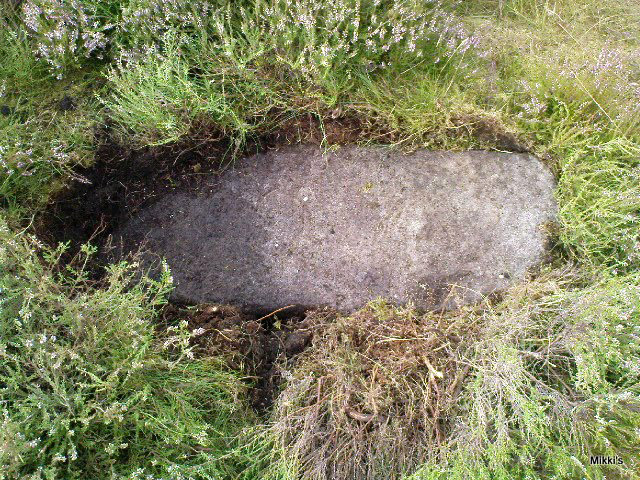
But it would seem that Hutchinson’s site and the one described in the Stirling Journal of 1830 are two distinctly separate items if their relative topographical descriptions are to be accepted.  No doubt — like many a-local who’s found these same written accounts — when we visited and wandered back and forth over the Black Hill site in Autumn 2010, we were as puzzled as others before us in finding nothing on the named Black Hill.  Nothing that could remotely be viewed as the circle described was anywhere in evidence.  The only thing that we found of any potential was on the flat below the southern ridge of the hill, heading towards the small copse of trees, where is a possible ring of seven stones, albeit a low one, in an ellipse formation.  The ground was much overgrown and a spring of water emerged from the edge of where might have been an eighth stone.  The photo shown here was the best we could get of the site.  It’s unlikely to be the place which Messrs Hutchinson and company wrote about.

A more detailed examination of the landscape around this ‘Harperstone Circle’ is needed.

References:

  1. Hutchinson, A.F., “The Standing Stones of Stirling District,” in The Stirling Antiquary, volume 1, 1893.

© Paul Bennett, The Northern Antiquarian

Cultoon, Portnahaven, Islay, Argyll

Stone Circle:  OS Grid Reference – NR 1956 5697

Also Known as:

  1. Cultoun

Archaeology & History

Following excavation work on this denuded megalithic ring in 1974 and 1975 under the joint auspices of the Islay Historical Works Group (IHWG) and the Hunterian Museum of the University of Glasgow, under the direction of archaeologist Dr Euan MacKie (1976), with the intent of actually restoring the site to what they thought was its former glory by resurrecting the fallen monoliths in this ring of stones, some intriguing facts came to light.  Dr MacKie wrote:

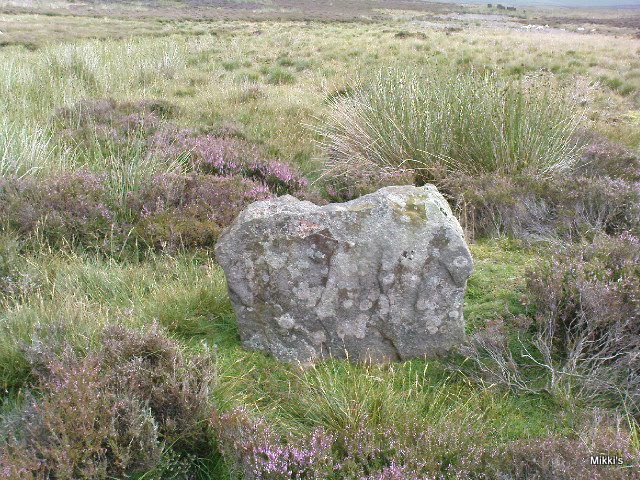
“This site stands on a low, shallow knoll about a mile from the sea and with an extensive peat bog to the west.  Before excavation the stone ring consisted of a rough oval of two standing stones and ten fallen ones, the latter being partly or nearly completely buried under the turf.  The dimensions of the ring were about 45 by 40 yards.  The excavations were based on a 6m grid and the ain was to explore as much as possible the perimeter of the ring and part of the interior.  In this way it was hoped to identify the sockets from which the prone monoliths were assumed to have fallen and thus to discover the exact positions at which they were to be re-erected…

“It soon became clear that the prone monoliths had not in fact fallen out of their sockets.  All of them lay on the old ground surface under the peat which had evidently begun to grow — in the 8th century BC according to one C-14 date — after the site had reached its present condition.  Some stones had no socket next to them and a number of sockets were found without adjacent stones.  Several stones lay next to sockets in such a position as to make it clear that they had never been set up.  The site had evidently been abandoned in the middle of construction and those sockets already dug were allowed to fill slowly with rubble and silt.  One socket was discovered which had been deliberately filled up, confirming that some change of plan had occurred before the final abandonment.  Cultoon is the only stone circle apart from two phases of Stonehenge to have revealed evidence of never having been completed. (my italics, Megalithix)

“The finds were few and consisted of mesolithic flint microliths and some larger, presumably neolithic flints.  The former were all on and in the buried topsoil — the circle builders’ ground surface — while the latter were on the land surface and in the lower part of the peat; these last included scrapers and are hollow-based points of Bronze Age type.  Of particular interest was the discovery of caches of flint flakes in the peat next to the two standing stones.  They appear to be deliberate offerings and suggest that the site retained its sanctity for some centuries after its abandonment.”

…to be continued…

References:

  1. MacKie, Euan, “Cultoon, Islay,” in Glasgow Archaeological Society Bulletin, No.2, 1976.

© Paul Bennett, The Northern Antiquarian