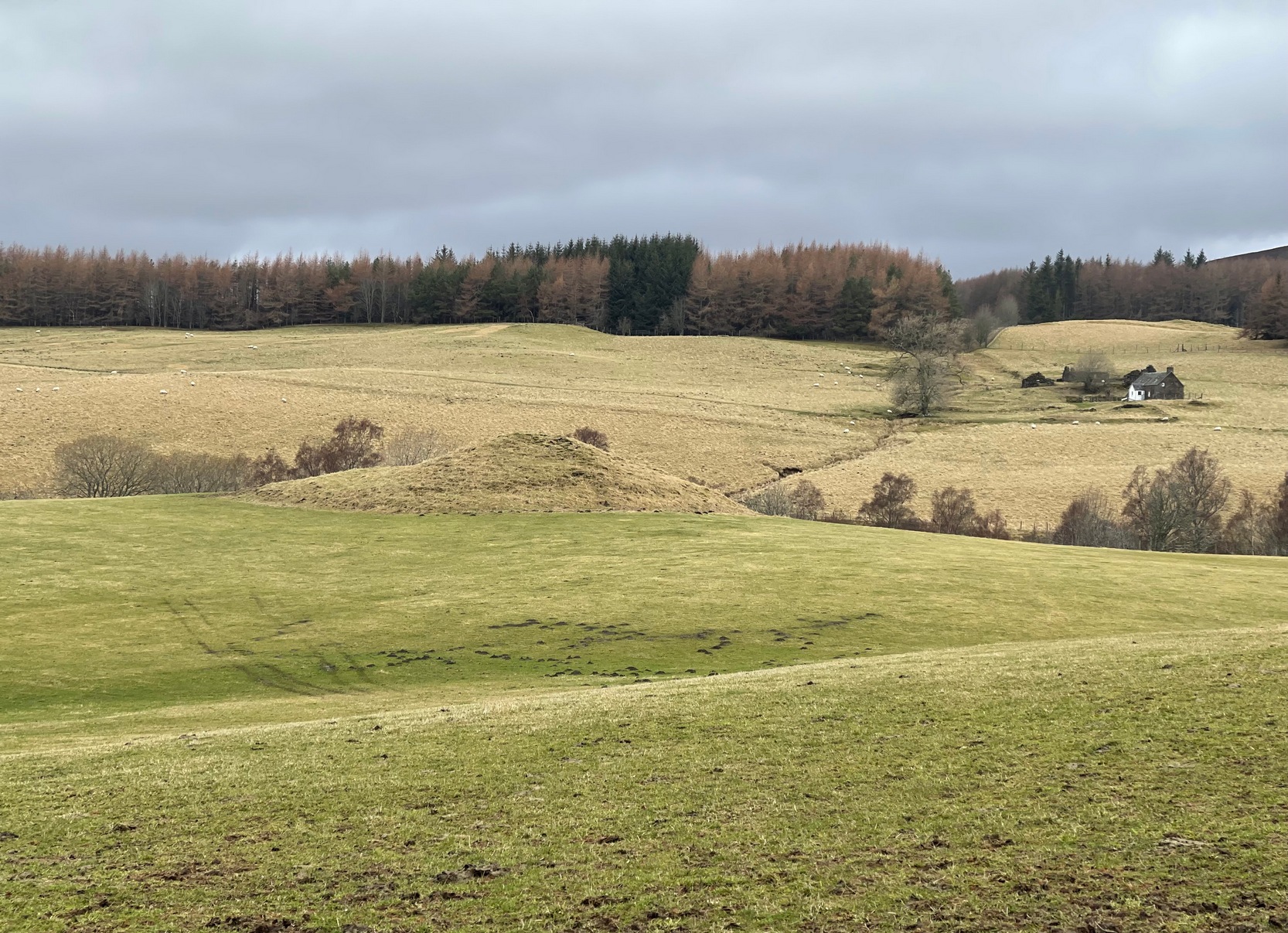
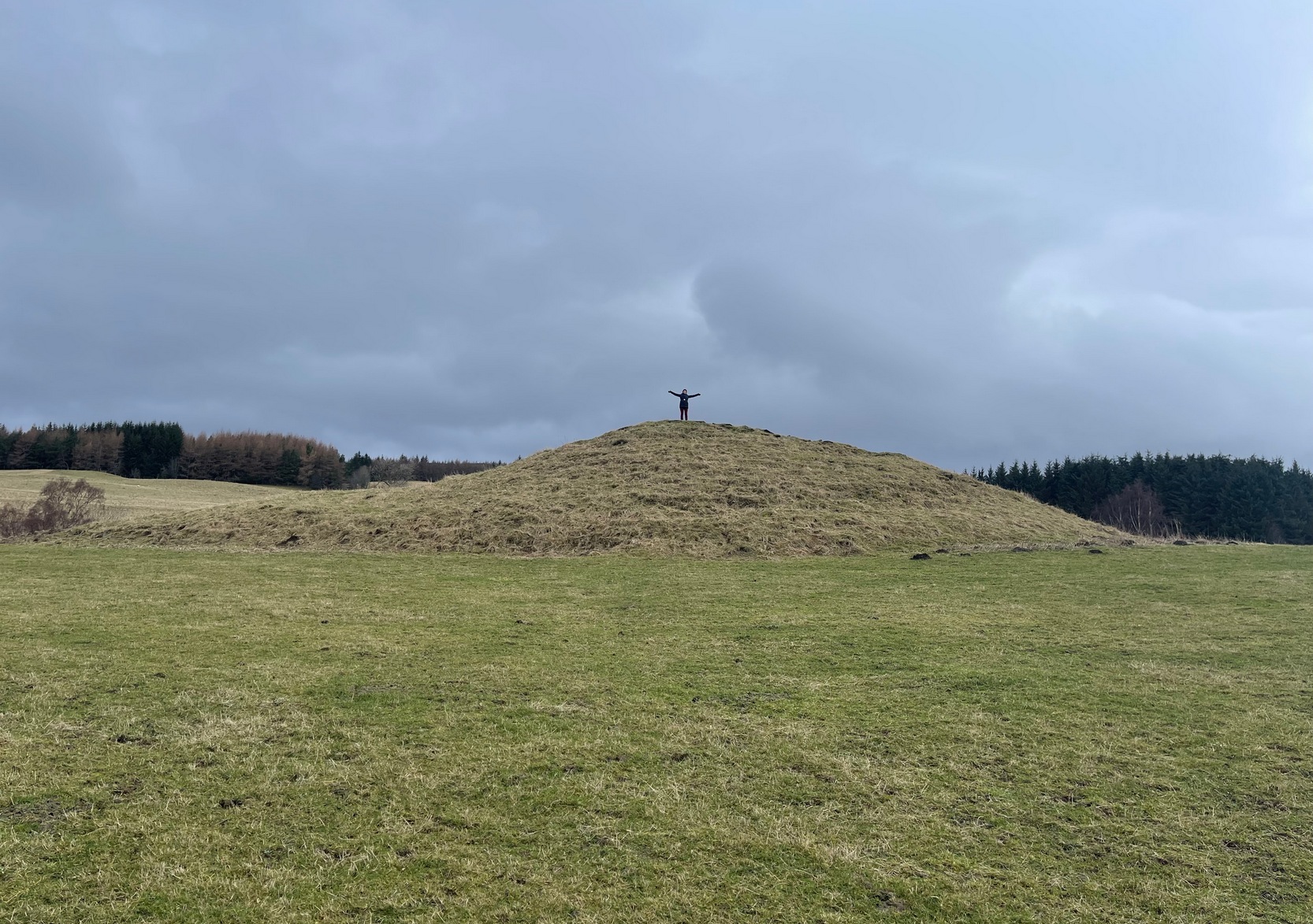
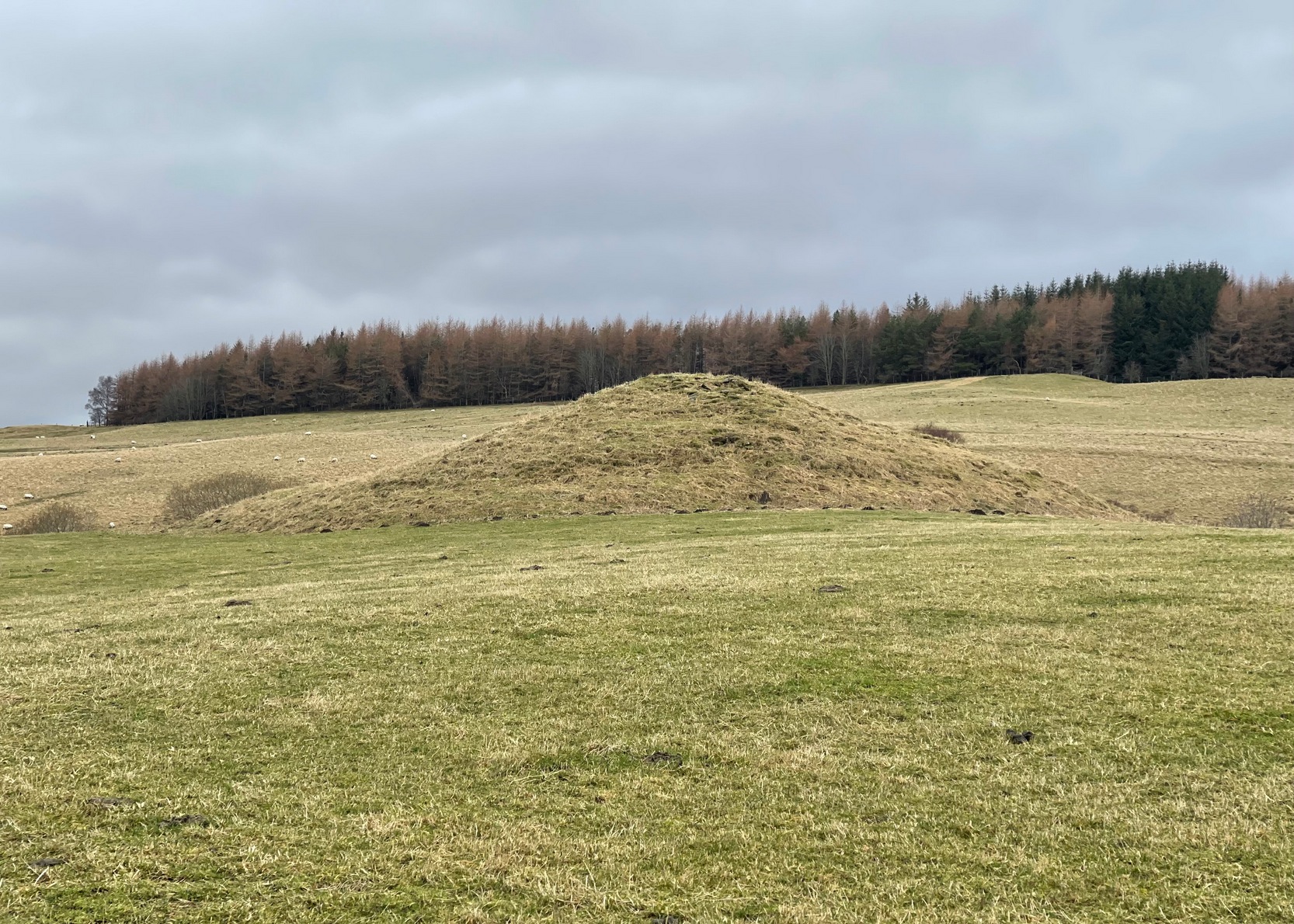
Kilravock, Croy, Nairnshire

Cup-Marked Stone (lost):  OS Grid Reference – NH 814 503

Archaeology & History

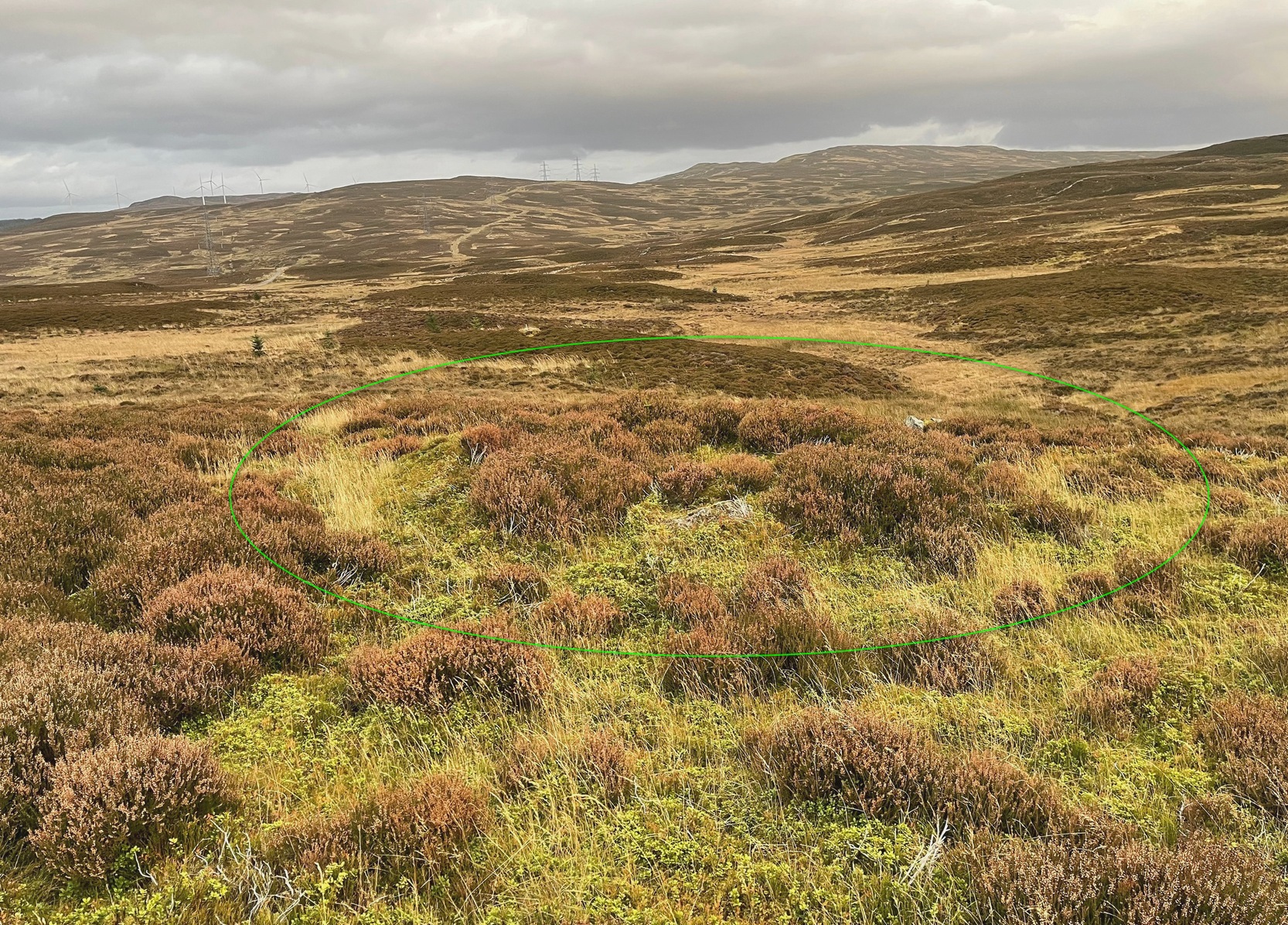
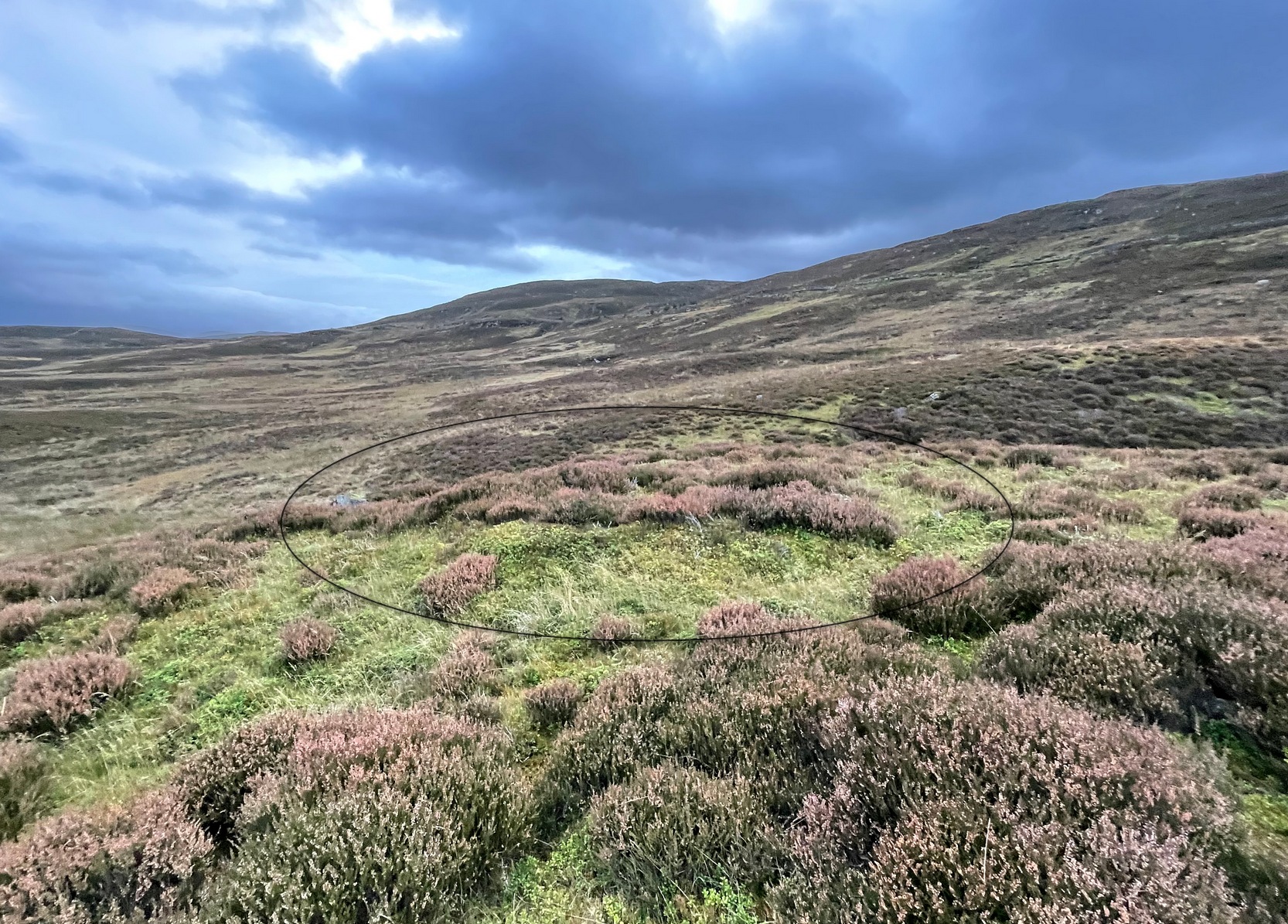
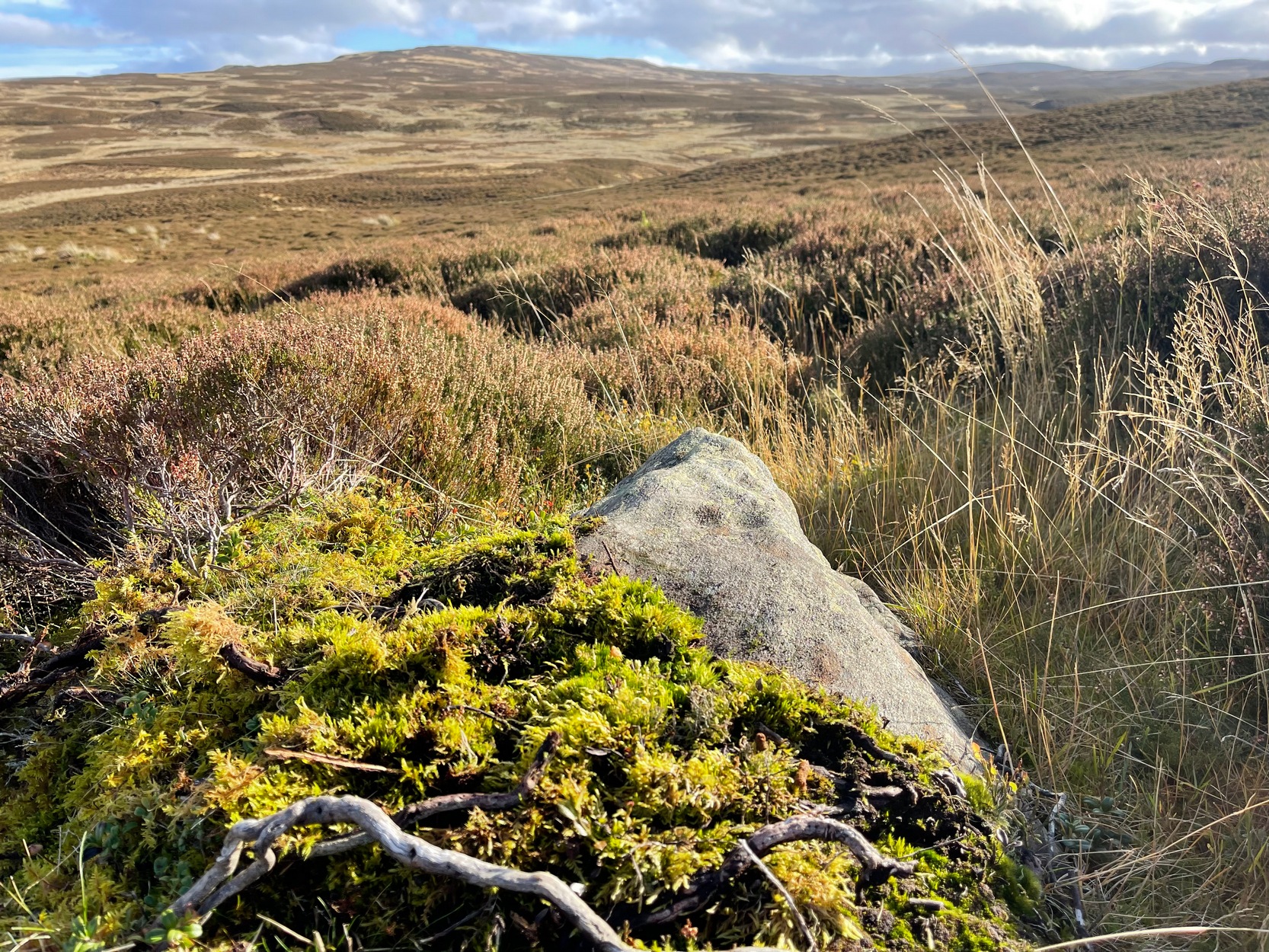
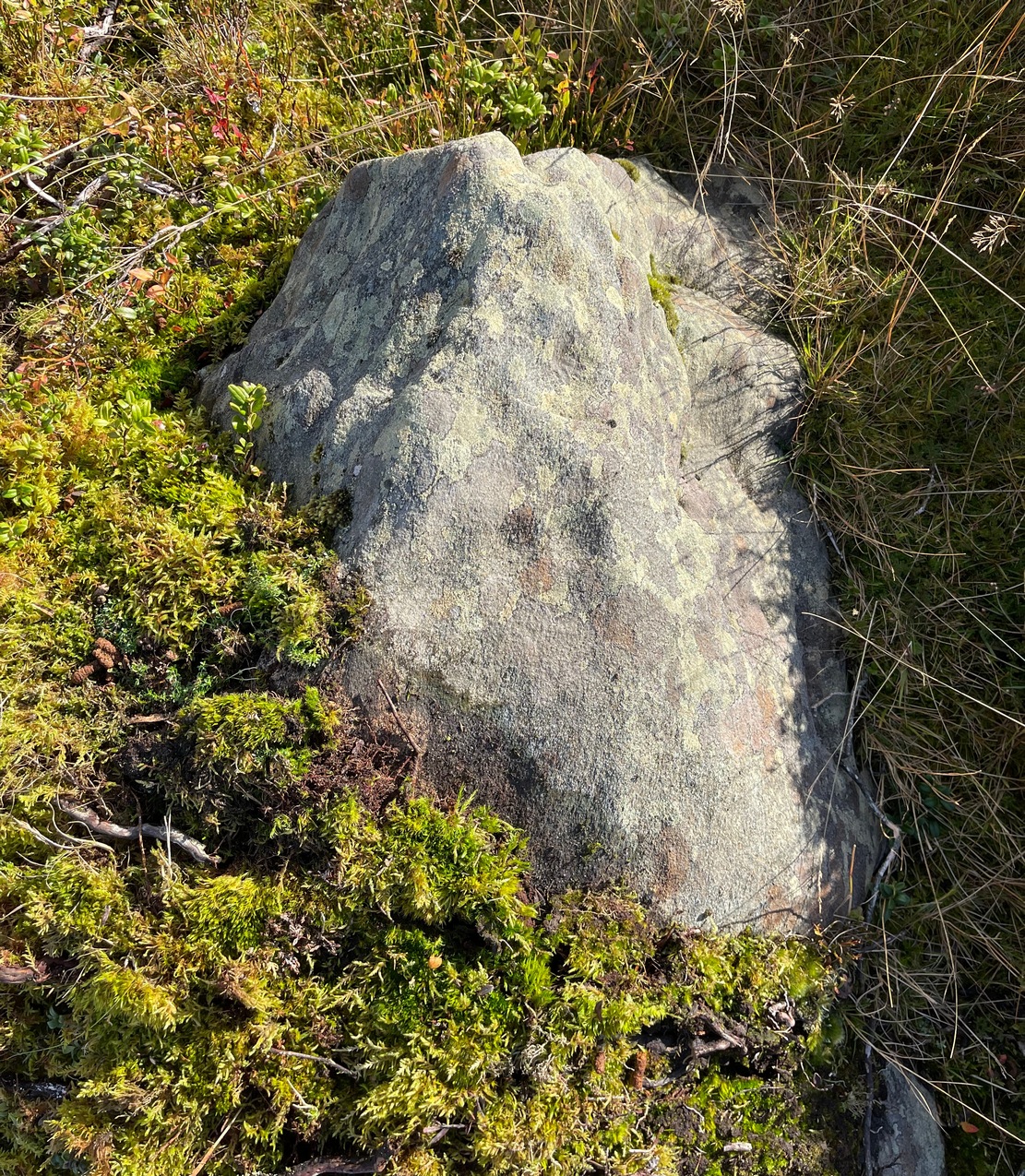
Somewhere on the outskirts of Kilravock Castle grounds sat (or still sits, hopefully) one of our country’s legendary healing stones bound within the animistic veil of a cup-marked stone.  It seems to have fallen off the archaeological registers (if it was ever included!) and so I add it here in the hope that someone can locate it and let us know of its present condition.

Described during a meeting of the Inverness Scientific Society by a Dr Grigor in a short presentation on cup-marked stones at Nairn in July 1884, the matter of some faint traditions concerning a tiny number of cup and ring stones in Scotland was mentioned, and,

“Dr Grigor said he would be able, next day, at the roadside on the Kilravock property, to point out a large rounded stone of gneiss, in the centre of which is a large cut cup-mark of a diameter of six or seven inches which, fifty years ago, was resorted to by many, and water was taken from it long distances.  The water was believed to cure skin diseases, but it was principally used for washing warts on the human subject, which it was believed the water quickly removed.  It was also particularly in repute for removing warts from cow’s teats.”

The custom described here sounds very similar to others found at so-called ‘Wart Stones’ in England and Scotland (there was one that existed a short distance from where I grew up near Eccleshill, West Yorkshire).  Several miles west of here is the cluster of prehistoric carvings in the Clava complex, but this one at Kilravock seems to have fallen off the radar. Does anyone know if it can still be seen? (the grid-reference given to this site is an approximation)

References:

  1. Grigor, Dr, “Cup Marked Stones,” in Transactions Inverness Scientific Society Field Club, volume 3, 1884.

Acknowledgements:  Huge thanks for use of the Ordnance Survey map in this site profile, reproduced with the kind permission of the National Library of Scotland

© Paul BennettThe Northern Antiquarian

Druim An Rathaid, Glenbarr, Kintyre, Argyll

Cairn:  OS Grid References – NR 66926 38320

Also Known as:

  1. Glencreggan Cairn

Archaeology & History

First described in the Object Name Book* of 1867 as being “the remains of a cairn in which D MacMillan of Glenbarr says a cist was found”, this prehistoric tomb was subsequently going to be destroyed in the 1950s by the farmer when local researchers Mr & Mrs J.G. Scott (1958) took to checking the place out before its demise.  And it was a damn good job they did!  The cairn still remains to this day—albeit in a very dilapidated state.  The assistant editor of The Prehistoric Society journal, Ian Longworth (1959), wrote an account of the findings, telling:

“A small mound, apparently the remains of a cairn, was excavated on the farm of Glencreggan by Mr and Mrs J.G. Scott.  The mound was roughly oval in shape, about 20 feet by 14 feet in size, and about 2 feet in height, with its longer axis lying almost E-W.  A large stone slab, about 8 by 3 feet in size, lay against its N corner.

“The cairn was found to consist of a small and fairly compact core of stones intermixed with sand and clay, surrounded by a rather ill-defined outer ring of boulders, the intervening space being largely filled with earth.  Remains of a cremated burial were found beneath the centre core, but there was no trace of a cist, and the bones seemed to be scattered, giving the impression that the cairn might mark the spot where the cremation took place.  Apart from a flint flake, the only finds were two small boulders, each bearing a single cup-mark, which were incorporated in the material of the centre core.”

Of the two cup-marked stones found beneath the cairn, they’re presently living in some box somewhere in the Kelvingrove Museum, Glasgow, who are very approachable when it comes to viewing them if you make an appointment.  I have to say though, one of them may be natural, as it has the distinct look of being the creation of molluscs, who live in profuse numbers just off the coast hereby.  Nonetheless, they were left in the tomb as offerings to the ancestral spirits here. 

References:

  1. Bede, Cuthbert, Glencreggan – 2 volumes, Longman Green: London 1861.
  2. Longworth, Ian, “Notes on Excavations in the British Isles, 1958,” in Proceedings of the Prehistoric Society, volume 25, 1959.
  3. Royal Commission Ancient & Historical Monuments of Scotland, Argyll – volume 1: Kintyre, HMSO: Edinburgh 1971.
  4. Scott, Mr & Mrs J.G., “Argyllshire: Glencreggan, Glenbarr, Kintyre,” in Discovery & Excavation, Scotland, 1958.
* The Object Name Book website recently got “upgraded”, to make it better, smilier, user-friendly, and the usual buzzwords we all hear when things are just gonna get worse.  The website is now a real pain-in-the-arse to use since those halfwit management-types upgraded the site, making it much more hard work to find anything.  Fucking idiots! Who pays these morons?!

© Ian Carr, The Northern Antiquarian
Tabar Ruadh, Heaste, Skye

Healing Well:  OS Grid Reference – NG 66091 19694

Also Known as:

  1. Chalybeate Well

Archaeology & History

Chalybeate Well, Heaste road

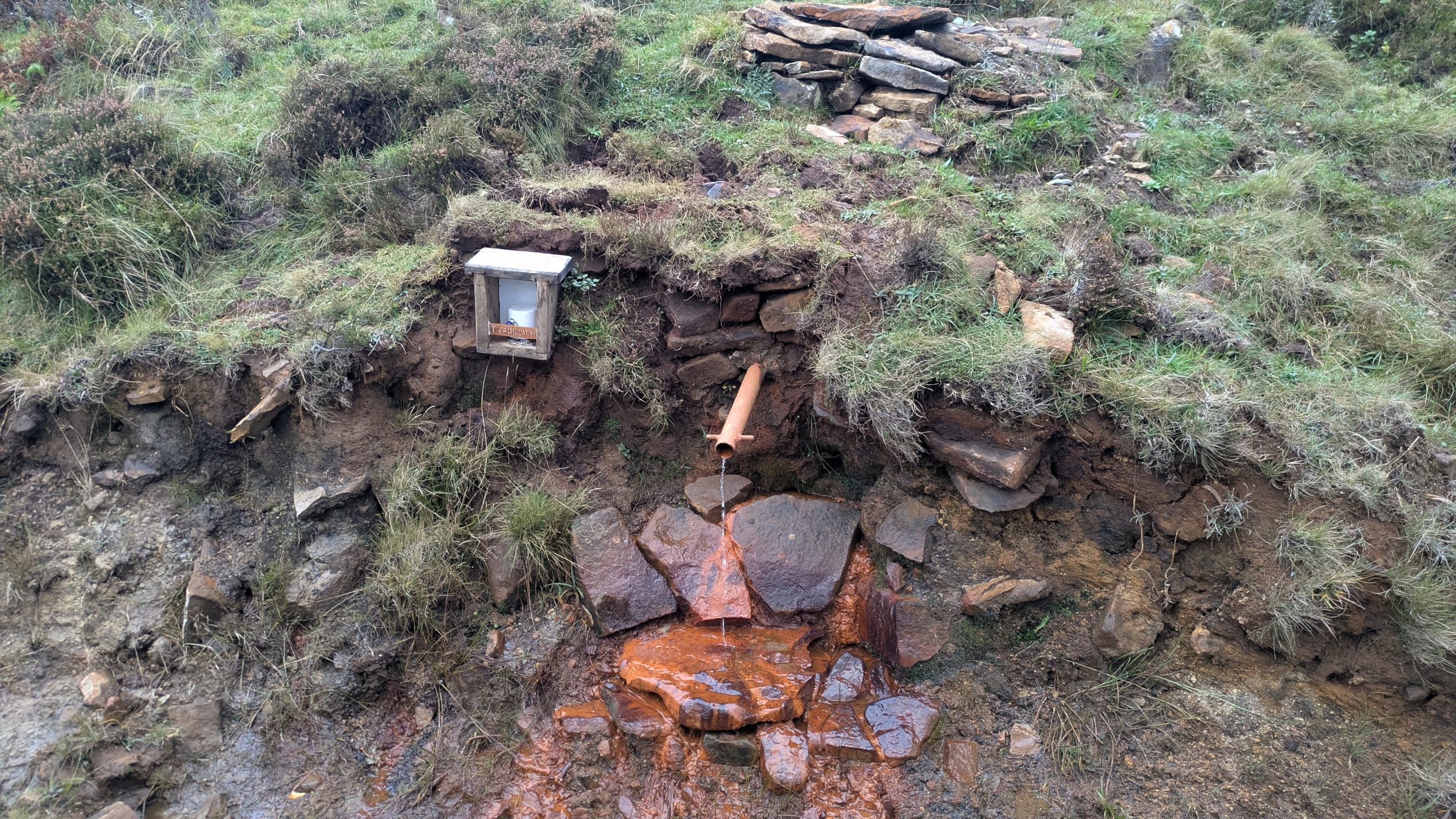
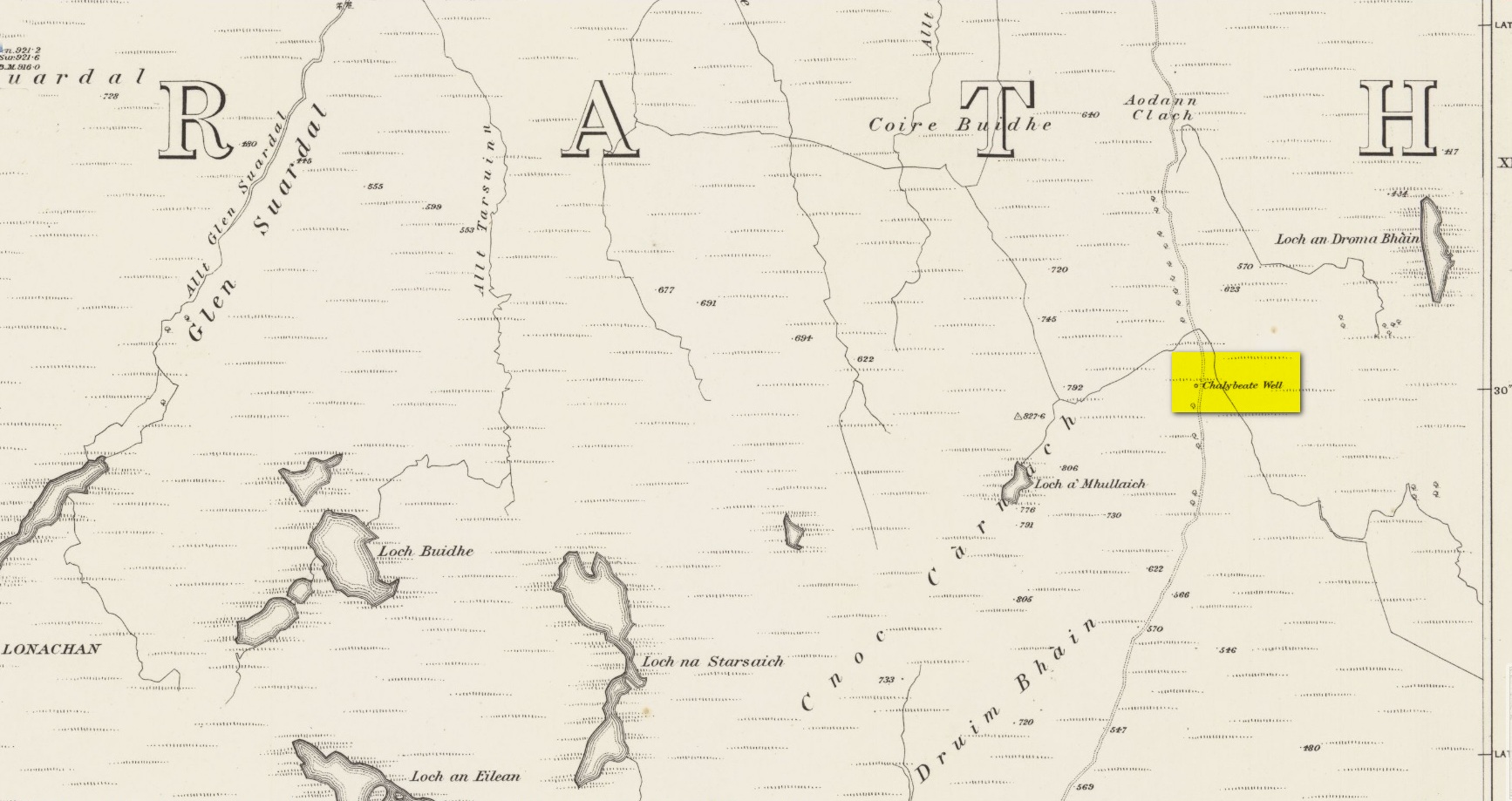
Highlighted on the earliest Ordnance Survey maps of the island, roughly halfway along the Broadford to Heaste road on the right (west) side you will come across the Tabar Ruadh (Gaelic for “Red Well”).  For many generations at this point was a Chalybeate well where villagers would stop and drink in a pewter mug from outlet of cast iron pipe which connected to the stone well some nine feet from the road.  It was a major stopping point for their horses and ponies to take a drink too.

This set up was functioning in the early 1980’s.  At that time I talked to Heaste locals who remembered fishermen from their village taking bottles of this water to pregnant women in the village of Elgol.  It was known then for it’s healing properties; this was the early 20th century.  The pewter mug was stolen and with road widening and the pipe removed, the site was becoming increasingly overgrown and in danger of being lost for ever.

Site shown on 1881 map
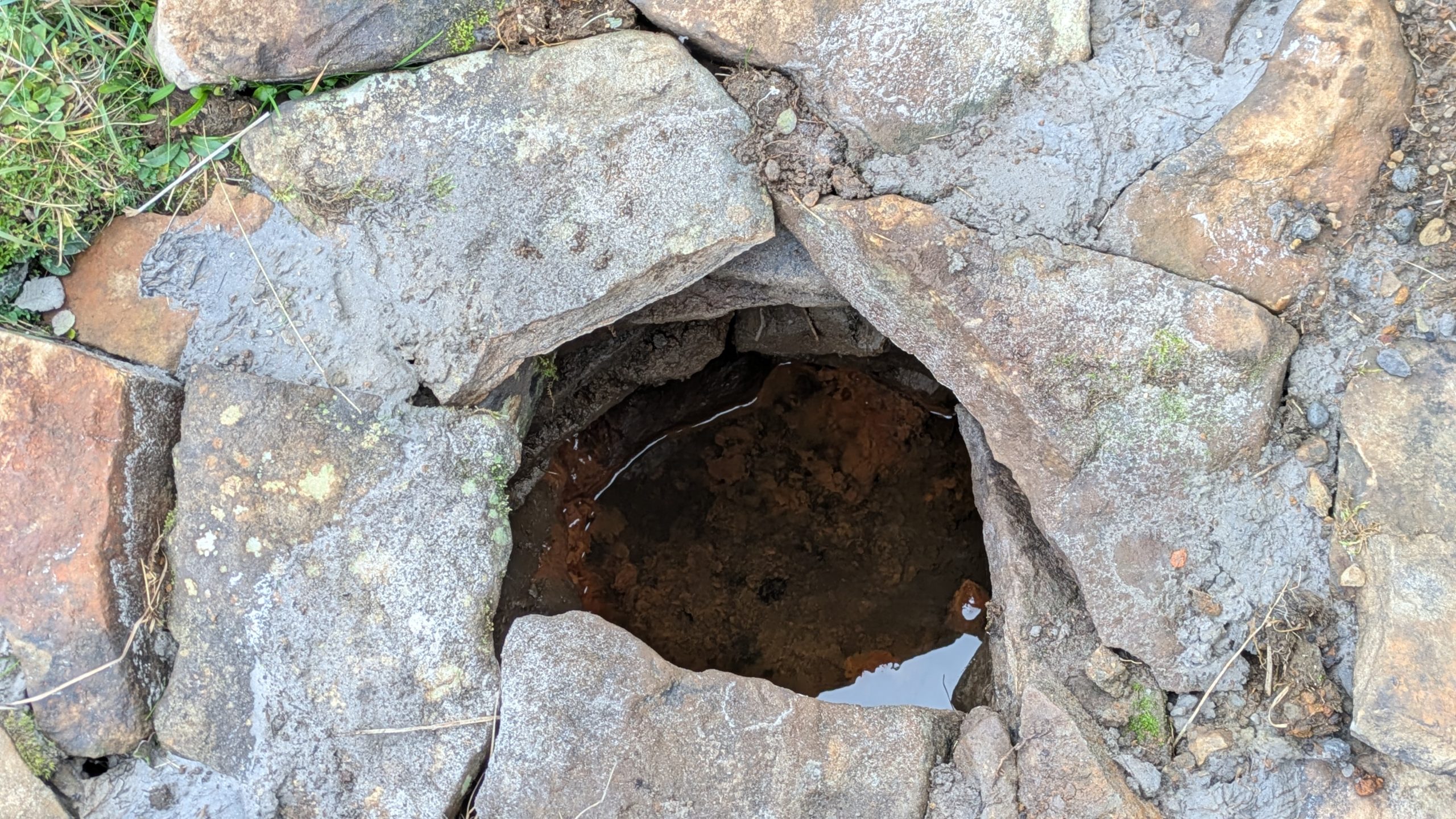
Water under the well cover

For the last fifteen years I have been walking this road and had made it a determination to find this well.  Success this summer! — and the hidden overgrown well was cleaned out a new steel pipe added.  Chalybeate water now flows and a wooden box is at the roadside with a tin mug.  On a wet roadside ditch this red water is very obvious where it joins the road.

Acknowledgements:  Huge thanks for use of the Ordnance Survey map in this site profile, reproduced with the kind permission of the National Library of Scotland

© John Gilbertson, The Northern Antiquarian
Craig Hill, Kenmore, Perthshire

Hut Circle:  OS Grid Reference – NN 81327 45039

Getting Here

Craig Hill hut circle

From Kenmore village, just as you’re going out of the village towards Aberfeldy (A827 road), turn right as if you’re going on the minor road on the south-side of Loch Tay.  Almost immediately on this road, turn left and take the tiny, steep road uphill towards Amulree.  After 2½ miles uphill, the road begins to level out and a small loch is on your left (north).  Just past it, on the same side, a track runs onto the moors.  Walk along here for nearly a mile where the track splits: keep to your left and the track follows the line of walling.  Now’s the hard bit: after literally ⅔-mile, walk downhill and cross the burn (stream), then less than 50 yards up the slope on the other side, zigzag around…

Archaeology & History

Craig Hill circle looking SW

Overlooking a small (unnamed) burn immediately to the right and a large wide marshy hollow to the front, is this small and seemingly singular hut circle, in a good state of preservation, surrounded by the scattered mass of cup-and-ring stones—some complex, some very plain—all over this moorland slope.  It’s a very long journey to take just to visit a single hut circle, but I’d assume that you’d be wanting to see the petroglyphs surrounding it too—so mebbe have a look at this whilst you’re fondling the rock art!

Internally this is quite a small circle, measuring barely 5 yards (east-west) by 6 yards (north-south), seemingly with its entrance on the north.  Its small size suggests it was constructed for the use of just one person; two at the very most.  The structure is still in very good condition considering its age (possibly Bronze Age), with minimal damage apart from Nature’s wind and weathering.  The circle is made up primarily of a number of large rocks with many filling stones, with the walling being a yard or so wide all round.  In all likelihood, the rest of the building would have been made of timber, with a typical tented roof.  It’s an excellent spot to base yourself to explore all the cup-and-ring stones on these slopes.  Perhaps, just perhaps, this might have been a shaman’s hut, looking over the ancestral images on the rocks hereby…. ♥

© Paul BennettThe Northern Antiquarian
Urlar Burn (4), Aberfeldy, Perthshire

Cup-Marked Stone:  OS Grid Reference – NN 81875 44068

Getting Here

The cup-marks, looking S

Take the long steep zigzag road from Kenmore to Amulree, and just where the road begins to level out, park up near the isolated hut by the roadside at the side of the lochan.  Just past here, a track on your left takes you onto the moors, past the lochan.  Nearly a mile along the track splits: bear to the right, uphill slightly, then it’ll wind downhill and you’ll pass another track on your right. Ignore it, keep walking along and where you find a grassy little passing-place on your right—stop!  Now walk uphill, onto the moor, through the heather for 175 yards and the land has levelled out.  Look around!

Archaeology & History

Cupmarks from above

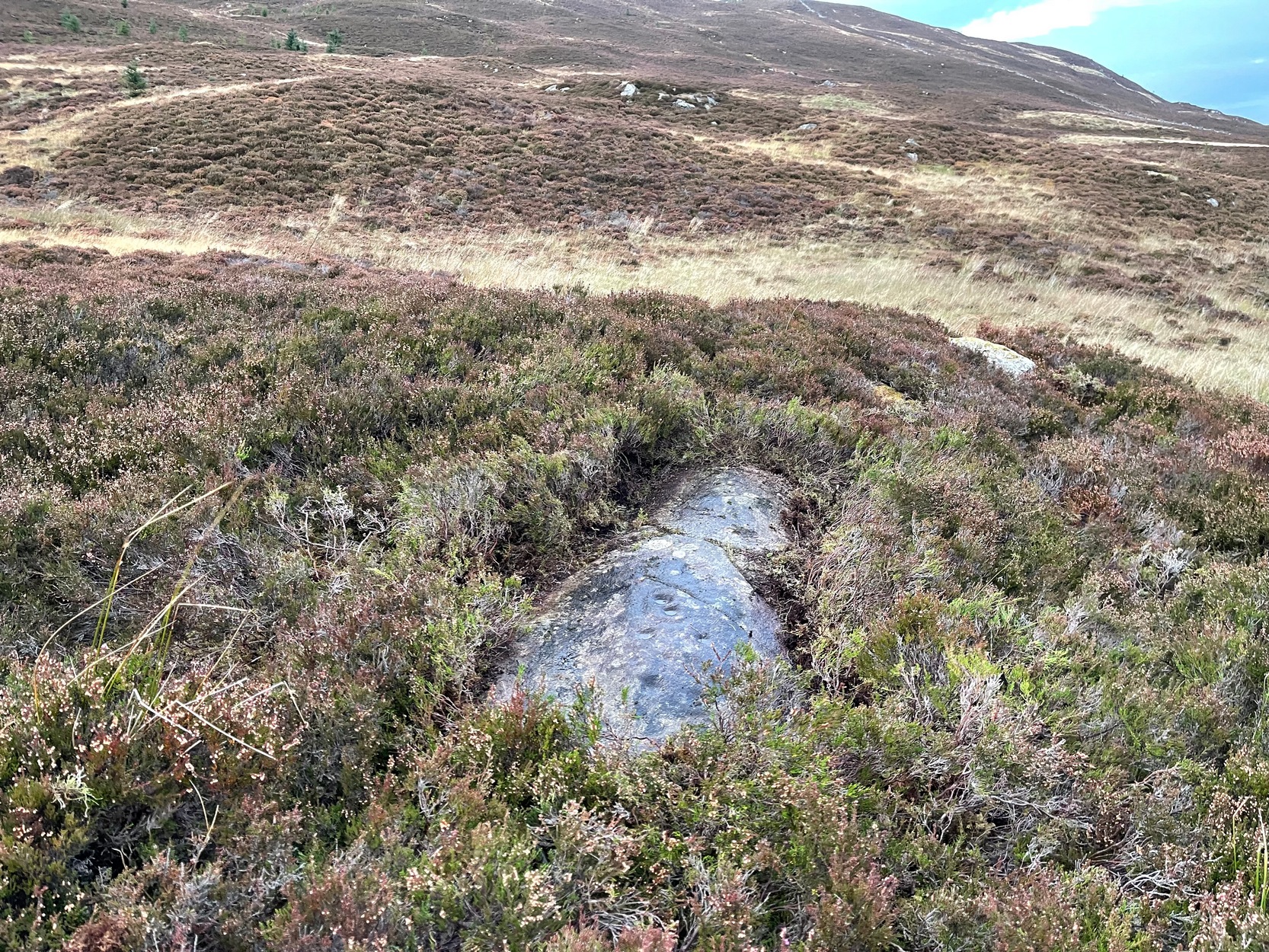
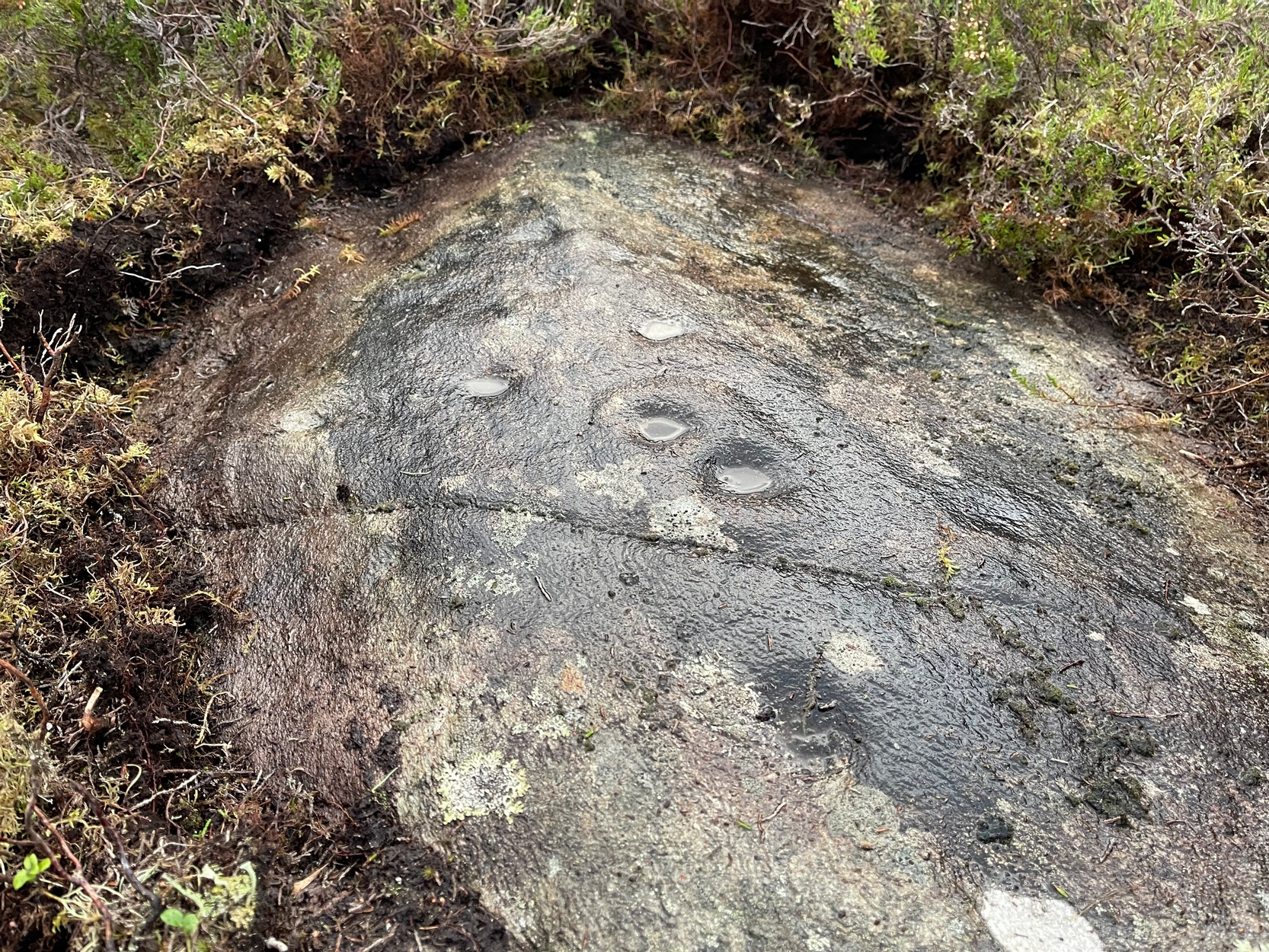
I came across this very basic carving when checking out a couple of others close by and found that it hadn’t been recorded before. It’s nothing special to look at, but is an outlier of the main Craig Hill cluster of carvings a few hundred yards to the west.  The design consists of at least two cup-marks that have been etched near the top of the rock, although when I wet the stone it seemed as if a third one was next to the other two, as if in a line.  The sun was at its peak when I found it, which meant that I couldn’t get any decent photographs to illustrate this—even when I watered the olde thing!  It’s another carving that will only be of interest to the real petroglyph fanatics amongst you.

© Paul BennettThe Northern Antiquarian

St. Bride’s Well, Pitlochry, Perthshire

Holy Well (destroyed):  OS Grid Reference – NN 9397 5770

Archaeology & History

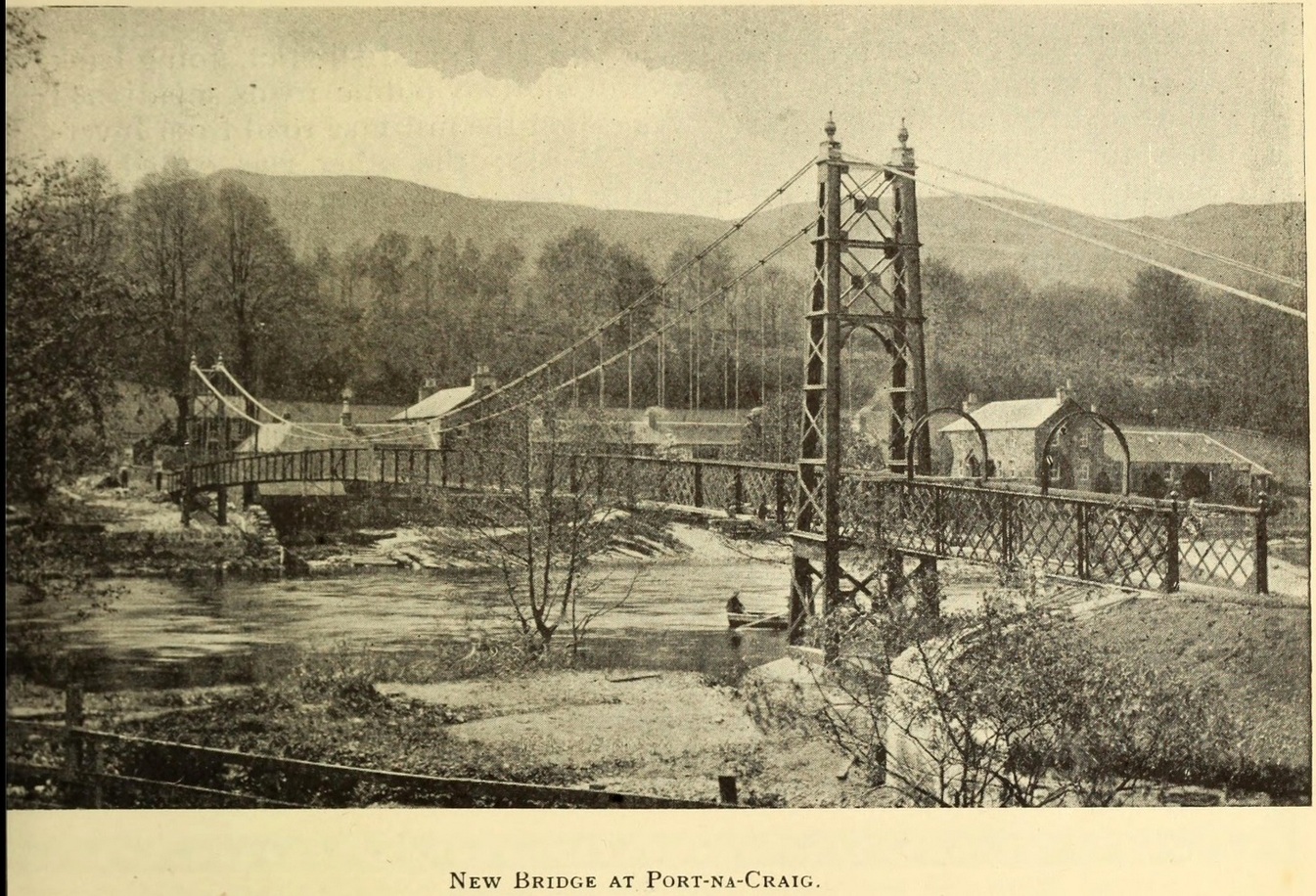
It was more than a hundred years ago that the waters of this sacred well fell back to Earth.  They emerged above the eastern side of the River Tummel, close to the bridge where previous there had been a local ferry at the site known as Port-na-Craig.  The mythic history of the ferry and the holy well went hand-in-hand, according to local tradition.  Its lore was was spelled out by the local author and historian Hugh Mitchell in a speech he gave when a new bridge was opened here in 1913.  He said:

The Well was on the far side of the bridge

“The ferry at Port-na-Craig, though not as old as many ferries in Scotland, bears the respectable antiquity of something like eight hundred years.  It was established by the monks of Coupar Angus when they got a gift of the lands of Fonab, and as Coupar Angus lay on the north side of the river Tummel, they established the ferry in order to have communication.  In those days the ferry boat was made of skins stretched on branches or twigs, so it was somewhat dangerous to cross in, and the monks thought that they would improve the occasion by dedicating the well near the old ferry to St. Bride, so that people, when they ventured across the ferry, might propitiate the saint.  It was customary for people to drop either a small coin or a brass pin into the well.  He was afraid that brass pins rather prevailed, and no doubt, St. Bride, being a lady, would find them more useful.  The well remained until recent times, when it had, unfortunately, to be filled up, on account of being contaminated by neighbouring fields.”

For “fields”, read sewage—for that was the actual reason it was closed.  Mr Mitchell (1923) told as much in his subsequent history of Pitlochry, saying that “sewage was percolating into it.”  John Dixon (1925) echoed the same thing a few years later.

The curative and magickal properties of St Bride’s Well had considerable renown for local people.  Mitchell told that:

“It had a great reputation at one time for cases of lung disease… Pins and coins were dropped into the well as votive offerings, and the bushes above it were hung with rags to call the attention of the saint to the sufferer.”

A few miles north from here, at the back of Blair Castle, an old church is dedicated to St. Bride, whose celebration date is February 1.  “The day was known as Candlemas in the Highlands,” wrote Mrs Banks, saying, in commemoration of the Celtic Brigit, “Feill Bride, the festival of Bride, displaced the festival of Mary.”

References:

  1. Dixon, John H., Pitlochry, Past and Present, L. Mackay: Pitlochry 1925.
  2. MacKay, L., Atholl Illustrated, L. MacKay: Pitlochry 1912.
  3. Mitchell, Hugh, Pitlochry District: Its Topography, Archaeology and History, L. Mackay: Pitlochry 1923.

© Paul BennettThe Northern Antiquarian

Mossyard, Anwoth, Kirkcudbrightshire

Cup-and-Ring Stone (removed):  OS Grid Reference – NX 550 520

Archaeology & History

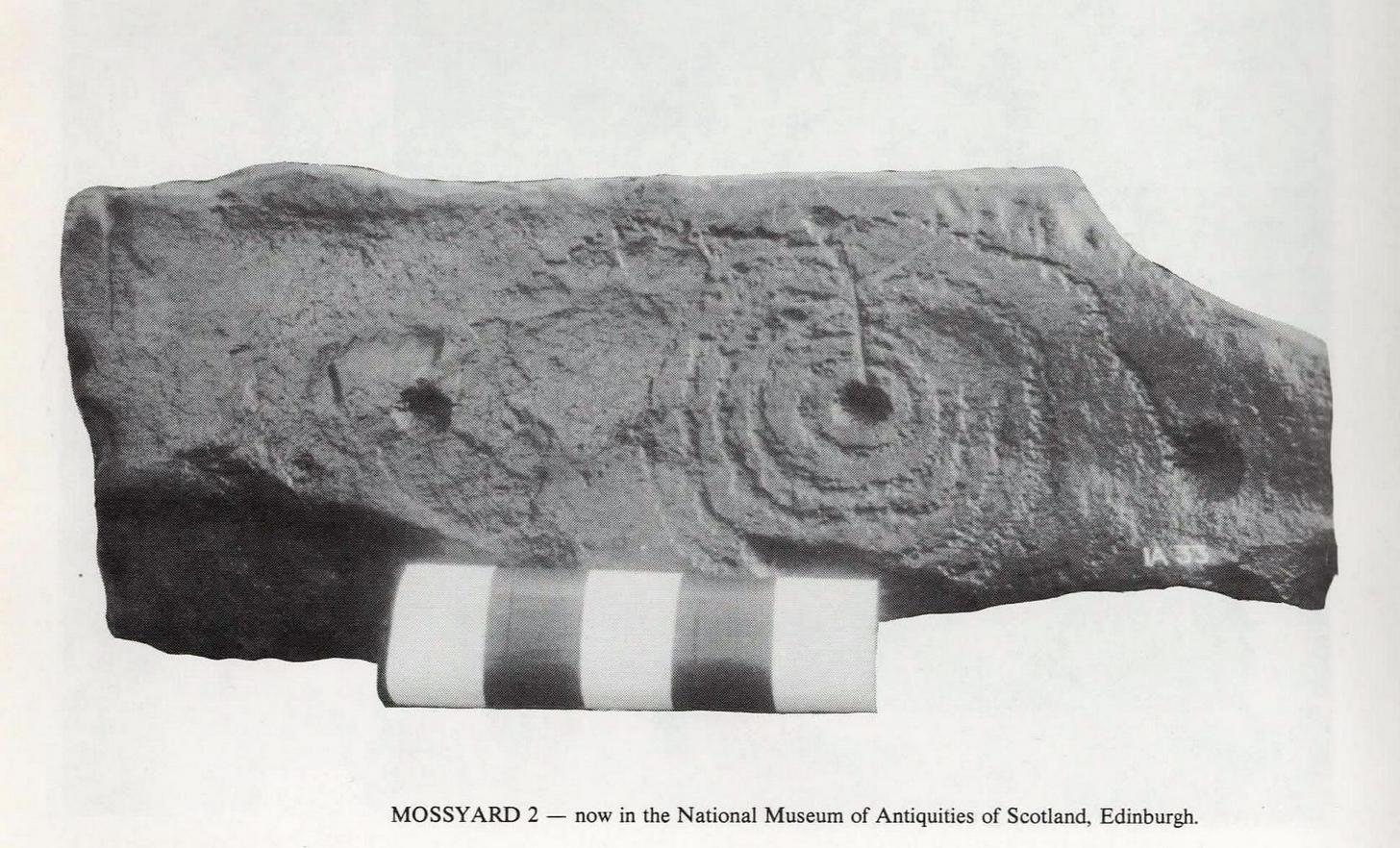
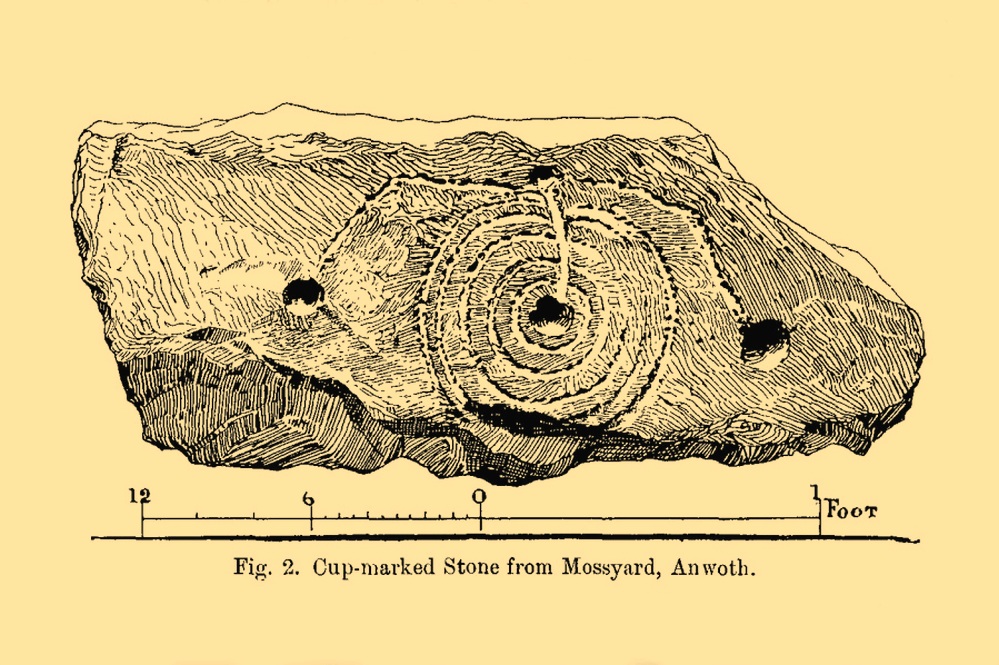
This impressive-looking carving was brought to the attention of the Scottish Society of Antiquaries by Sir Herbert H. Maxwell (1900), who thereafter moved it to the National Museum where, I presume, it still lives, in a box somewhere, sleeping gently.  Maxwell’s brief resumé of the stone was as follows:

“Cup and Ring-marked Slab…found in a dyke on the farm of Mossyard, Anwoth, Kirkcudbrightshire.  This cup-and ring-sculpturing is peculiar in having five rings round the central cup crossed by a gutter which ends in another cup from which gutters also proceed to right and left, each terminating in a cup.”

In Ron Morris’s (1979) survey he erroneously told how the carving had been found in a wall instead of the dyke from whence it came; but, that triviality aside, he described it as,

Morris’ 1979 photo
Maxwell’s 1900 drawing

“A cup-and-five-rings, the rings slightly flattened where a radial groove from the cup passes through them.  23cm (9½in) diameter, grooves connecting this with 3 other cups.  Carving depths up to ½cm (¼in).  The rings are rather lightly pecked though quite wide and well preserved.  All gapped, except the inner ring.”

If anyone is able to get any good photos of the carving, out from its museum hideaway, it would be good to see how it’s coping therein….

References:

  1. Maxwell, Herbert R., “Donations to the Museum and Library,” in Proceedings Society Antiquaries, Scotland, volume 35, 1901.
  2. Morris, Ronald W.B., The Prehistoric Rock Art of Galloway and the Isle of Man, Blandford: Poole 1979.

© Paul BennettThe Northern Antiquarian

Pitcorthie, Dunfermline, Fife

Standing Stone:  OS Grid Reference – NT 11389 86318

Also Known as:

  1. Easter Pitcorthie

Getting Here

Pitcorthie standing stone

If you’re coming south out of Dunfermline, or north towards Dunfermline, make sure you go along the A823 Queensferry Road.  About a mile short of the town centre you need to turn east along the B916 Aberdour Road.  Nearly 1 mile along here, shortly past the Tesco supermarket, turn left along Tweeddale Drive.  About 50 yards down here, turn left again along Walls Place.  About 120 yards along you’ll find a small ginnel/path that runs between two rows of flats on the council estate.  Walk down here for a short distance and the stone will magically appear on your right.

Archaeology & History

This is a bit of an odd one!  Early accounts of the monolith are scarce and, on my first visit here, I was somewhat sceptical of its prehistoric provenance.  To be honest, I still am.  The erosion levels on the stone give the impression that it’s a much more recent erection (calm down… 😉 ), almost as if it was only quarried a century or two ago.  Anyhow, that aside.  It’s a nice bulky standing stone, nearly six feet tall and erected where the rising land levels out in the middle of the modern housing estate.  It was included in the Royal Commission (1933) survey, who said of it:

Pitcorthie, looking SW
Pitcorthie, looking West

“About 200 yards north of the farm of Easter Pitcorthie, in a field adjoining the north side of the roadway from Dunfermline to Burntisland, stands a roughly rectangular block of sandstone, which presents the appearance of having been subjected to fire or heat.  It is set with its main axis due north and south on the crest of slightly rising ground… There are some indications that it has been packed at the base, but what appears to be packing may be no more than a collection of loose stones which have accumulated round it during the years in which the surrounding area has been cultivated. It rises to a height of 5 feet 10 inches above the ground level, but shows no traces of any sculpturings.  At 3 feet from the ground its girth if 11 feet 10 inches.”

It would be good if there were other prehistoric remains close by that could erode my slight scepticism about its age, but I think the nearest other Bronze Age monument is the cairn more than half-a-mile to the south-east.

References:

  1. Royal Commission on the Ancient & Historical Monuments, Scotland, Inventory of Monuments and Constructions in the Counties of Fife, Kinross and Clackmannan, HMSO: Edinburgh 1933.
  2. Swarbrick, Olaf, A Gazetteer of Prehistoric Standing Stones in Great Britain, BAR: Oxford 2012.

© Paul BennettThe Northern Antiquarian

Clach Mhor, Aberfeldy, Perthshire

Cup-Marked Stone (destroyed):  OS Grid Reference – NN 8575 4901

Also Known as:

  1. Clachmore

Archaeology & History

The Clach Mhor, or the Big Stone, is all but forgotten as an antiquarian relic in Aberfeldy.  It’s history is somewhat piecemeal.  First described in Hugh MacMillan (1884)’s essay on local cup-and-ring stones, he told that:

“A short distance above the village of Aberfeldy, where General Wade’s old road emerges from the houses, a huge stone, called the Clach Mhor, lies on the left-hand side in a slanting position half  erect, as if supported by the garden wall of which it forms a part. …In all likelihood it originally stood erect, and formed one of a group of similar stones, its companions having been broken up in the formation of the road. …On the upper face there are some small cup-markings, not quite so well formed as usual, owing to the hardness of the material… The fact that they occur on only one side of the stone, and are scattered indiscriminately all over its surface, are sufficient to convince any one who is skilled in the subject that they are genuine specimens of prehistoric sculpture.”

Nearly thirty years after this initial description, MacMillan (1901) found that it had previously been a part of The Tullich stone circle, and following its destruction the Clach Mhor was moved and used as “part of a garden wall on the old military road passing along its base.”

More than fifty years later, the Aberfeldy historian N.D. Mackay (1954) told that up to 1910 the Clach Mhor was a conspicuous object, standing “as it were overlooking and to some extent overhanging the roadway down near the Square.” However, it

“was blasted and broken up in 1910 in the course of road widening operations, but a considable part of it was built into, and still forms the lower corner of, the garden boundary wall, nearest The Square, of the house which bears its name, ‘Clachmhor’.  Its present position is slightly east of the site it occupied when I first knew it and, unless Wade’s men did actually move it, the site it occupied for centuries.”

Mackay also mentioned what he called the “indentations” on the stone which MacMillam deemed as cup-marks, but he pointed out that one Rev. John MacLean “believed they were made by the levers, jacks, etc, of (General) Wade’s men” when they cut the road into Aberfeldy in the 18th century, whilst

“A third solution was given by the son of a one-time local strong man called Big Robert, “What a strong man my father was,” he said, “he lifted that stone. Don’t you see the marks of his fingers on it?””

It’s not known what became of the Clach Mhor and whether it remains hiding in some walling, or whether it has met its demise….

References:

  1. Mackay, N.D., Aberfeldy Past and Present, Town Council: Aberfeldy 1954.
  2. MacMillan, Hugh, “Notice of Cup-Marked Stones near Aberfeldy”, in Proceedings Society of Antiquaries Scotland, volume 18, 1884.
  3. MacMillan, Hugh, The Highland Tay, Virtue: London 1901.

© Paul BennettThe Northern Antiquarian

Tormain Hill (8), Ratho, Midlothian

Cup-Marked Stone:  OS Grid Reference – NT 12907 69667

Also Known as:

  1. Tormain ‘H’ (Allen 1882)

Archaeology & History

Dodgy cups of Tormain-8

Found barely 12 inches east of the Tormain (7) carving, this ‘cup-marked stone’ is another somewhat dubious design in the Tormain cluster, but which I’m adding here for the sake of completeness.  It’s designated as authentic by the Scottish Rock Art Project—but I’m not convinced.  Consisting of just two cup-marks, Romilly Allen (1882) was the first to notice them and described them respectively as, “one 1 inch in diameter and the other 1½ inch across.”  The smaller of the two, I’m pretty sure, is geophysical in nature.


References:

  1. Allen, J. Romilly, “Notes on some Undescribed Stones with Cup Markings in Scotland,” in Proceedings of the Society of Antiquaries Scotland, volume 16, 1882.

© Paul BennettThe Northern Antiquarian