Monzie (3), Bridge of Tilt, Blair Atholl, Perthshire

Cup-Marked Stone:  OS Grid Reference – NN 90553 67894

Getting Here
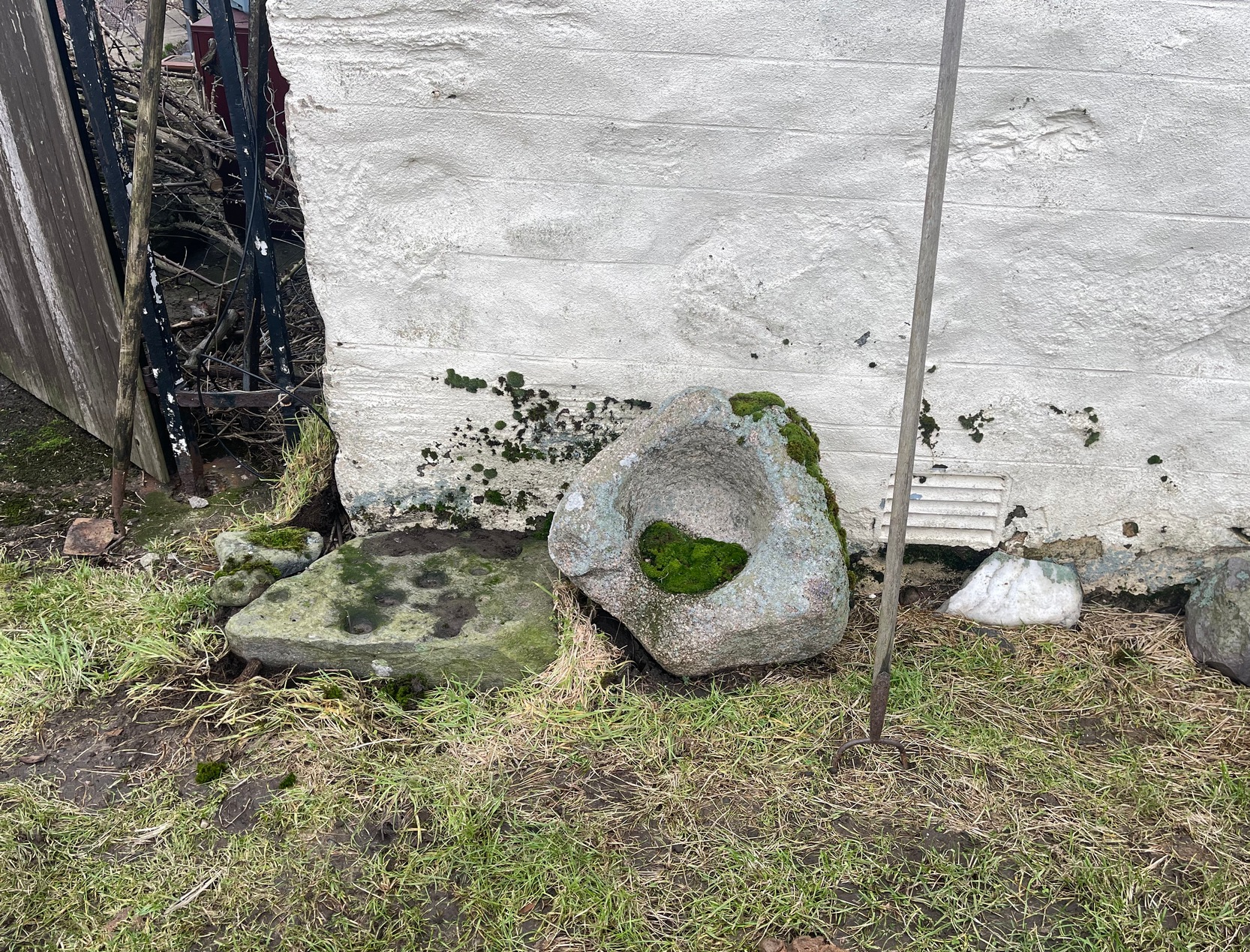
Monzie (3) stone, in situ

From Blair Atholl village along the B8079 road, take the minor road signposted to the Bridge of Tilt and go all the way to the top, taking the same directions as if you’re visiting the large prehistoric cairn of Monzie. As you walk towards Monzie farmhouse, you need to look at the large end-facing wall and on the ground at the bottom-left corner you’ll see this old cup-marked stone, next to an old bullaun.  It’s probably polite to knock and ask the farmer—who we found to be very helpful indeed. (huge thanks fella!)

Archaeology & History

This is an intriguing carving, inasmuch as its present habitat isn’t it original home.  When we visited the old stone recently, the farmer was very helpful and told us what he knew of it, which was, he said, “not much.”  In pointing out where it had originally come from, he pointed south, “past the fields – somewhere over there.  My dad knew about it,” he told, and thought that he may have been the one who found it.  Anyhow, it was his dad who brought it to the place where it now sits: right up against the edge of the house on its southeast corner.

“It looks like it might have come from a tomb,” I said, but he didn’t know about that.  The giant cairn in the fields past his farmhouse certainly wasn’t where it had come from.  Quite the opposite direction… And so it transpired when I looked at the very menial archaeological notes that have been written about it.
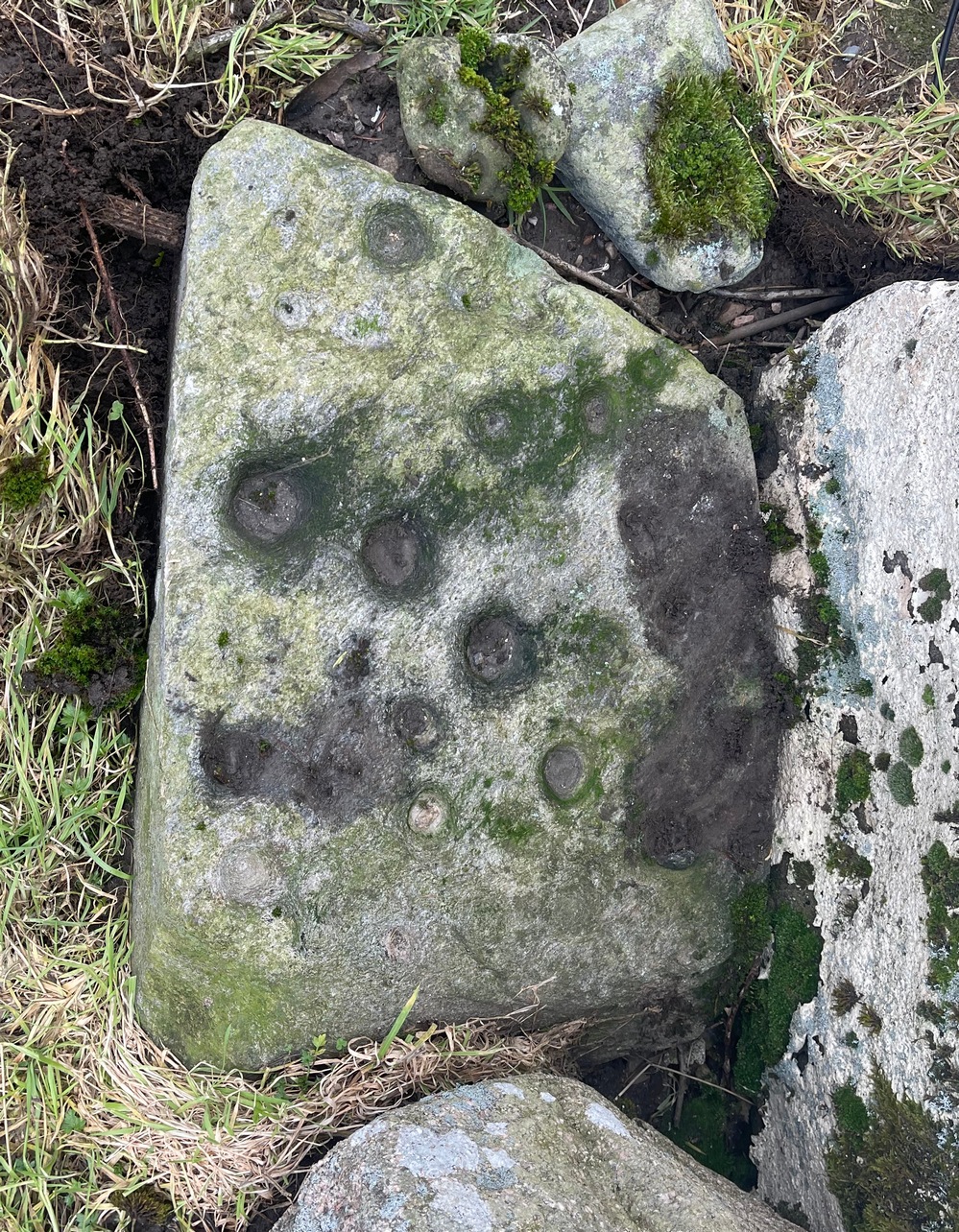
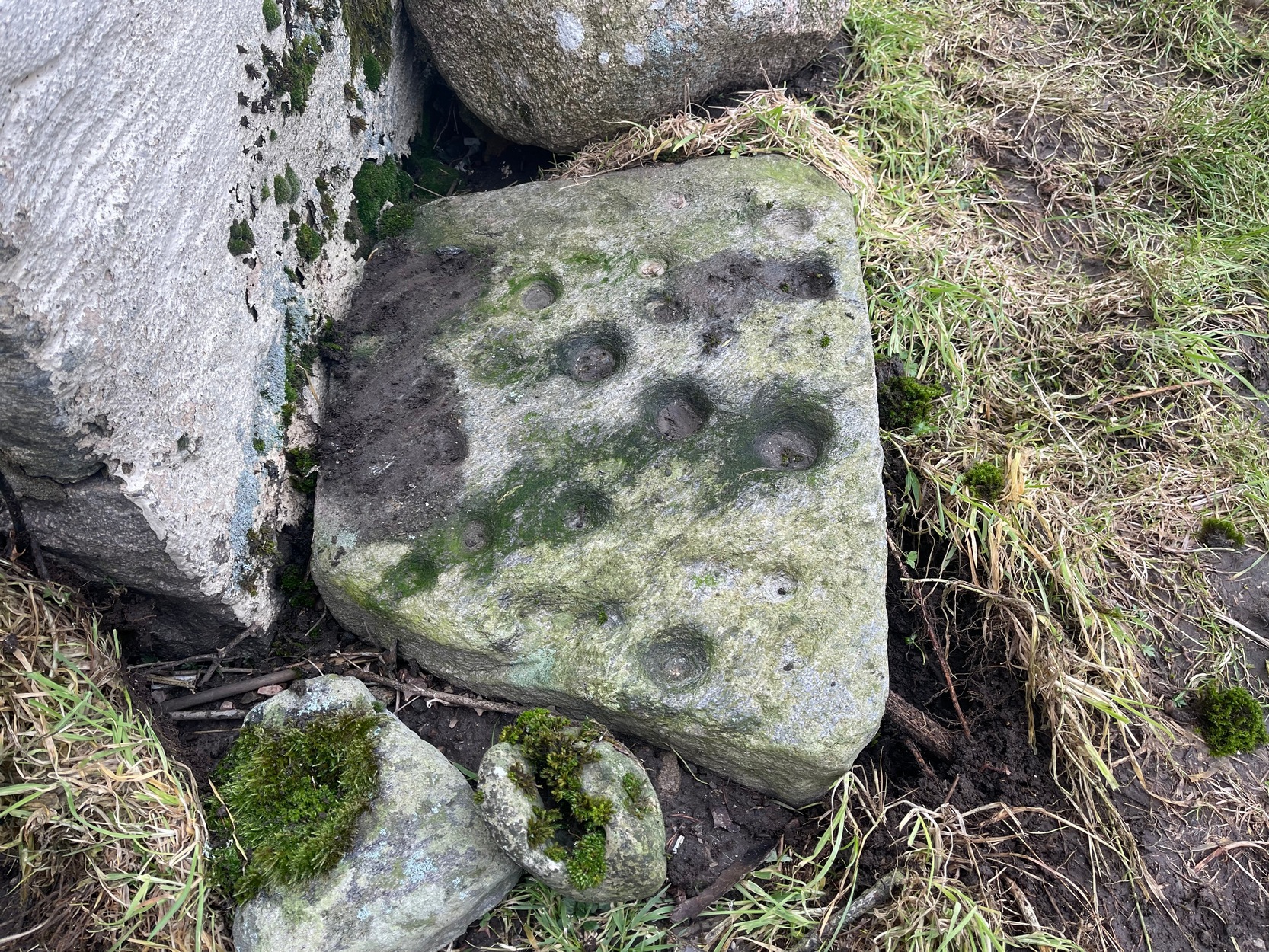
When archaeologist Margaret Stewart noted the carving in the 1960s, she told how the stone had reportedly been found in 1953 by the ruined lime-kiln (NN 9052 6672), just above the western shore of Loch Moraig. But what she didn’t know was that the lime-kiln was built at the edge of the prehistoric tomb that was known to local people as Carndeshal, or Cairn Deshal.  The word deshal means sunwise, or the direction taken by the sun, clockwise, as in the word deosil.  It is usually associated with a ceremonial procession.  The cup-marked stone probably came from this cairn when it had been demolished and was thankfully saved by the farmer.

Altogether there are 24 or 25 mainly well-defined cup-marks on this thin slab, covering most of the surface.  In a couple of places on the stone, two of the cups are conjoined.  There are apparently no cup-marks on the other side of the stone.

Acknowledgements:  To my awesome Naomi – for getting us up here.

© Paul BennettThe Northern Antiquarian

Loch Moraig, Bridge of Tilt, Blair Atholl, Perthshire

Hut Circles:  OS Grid Reference – NN 9047 6722

Getting Here

Hut circle, outlined

Along the B8079 road in Blair Atholl village, take the minor road signposted to the Bridge of Tilt.  After half-a-mile, where the road splits, keep to the right and head further uphill and, where the almost-track-like road splits again another quarter mile up, bear to the right again and just keep going uphill for nearly two miles until your reach the large car-park on the left.  Park here.  Note the long straight line of walling on the top-side of the car-park that runs to the NW.  Walk along the other side of the wall and, after 100 yards, you go down the marshy dip and, once it rises up onto the small rise, truly truly truly keep your eyes peeled to see what lays beneath your feet.  They’re there – honestly!

Archaeology & History

As the years drift by, the remains of these two hut circles—separated barely ten yards from each other—have become increasingly difficult to see.  Upon our visit here, the hillside vegetation was at its lowest at the end of the Winter, yet it was still difficult to see them clearly, even when we stood right in them!  The land here is marshy and it’s spreading more and more into the soil, slowly but surely taking these old circles back to Earth, where all things return….

It’s there, under your nose!

The circles—and their half-dozen companions on the far-side of the wall—were shown to the archaeologist Margaret Stewart in the 1960s by the farmer at Monzie, who made notebooks of various places and traditions in this area.  Both of them are between 12 and 13 yards across, with the outlining walls that define them still thankfully visible above ground level—just!  The hut circle that’s closest to the modern wall is more oval-shaped than its circular companion, both of whom have their respective doors or entrances on the southwestern sides—but these were equally difficult to make out when we came here.

To be honest, if you’re wanting to see the hut circles, I’d head for those on the other side of the wall, two or three hundred yards to the west, which are much easier to find and are in better condition.

Acknowledgements:  To my awesome Naomi – for getting us up here.

© Paul BennettThe Northern Antiquarian

Monzie, Bridge of Tilt, Blair Atholl, Perthshire

Cairn:  OS Grid Reference – NN 90266 68032

Getting Here

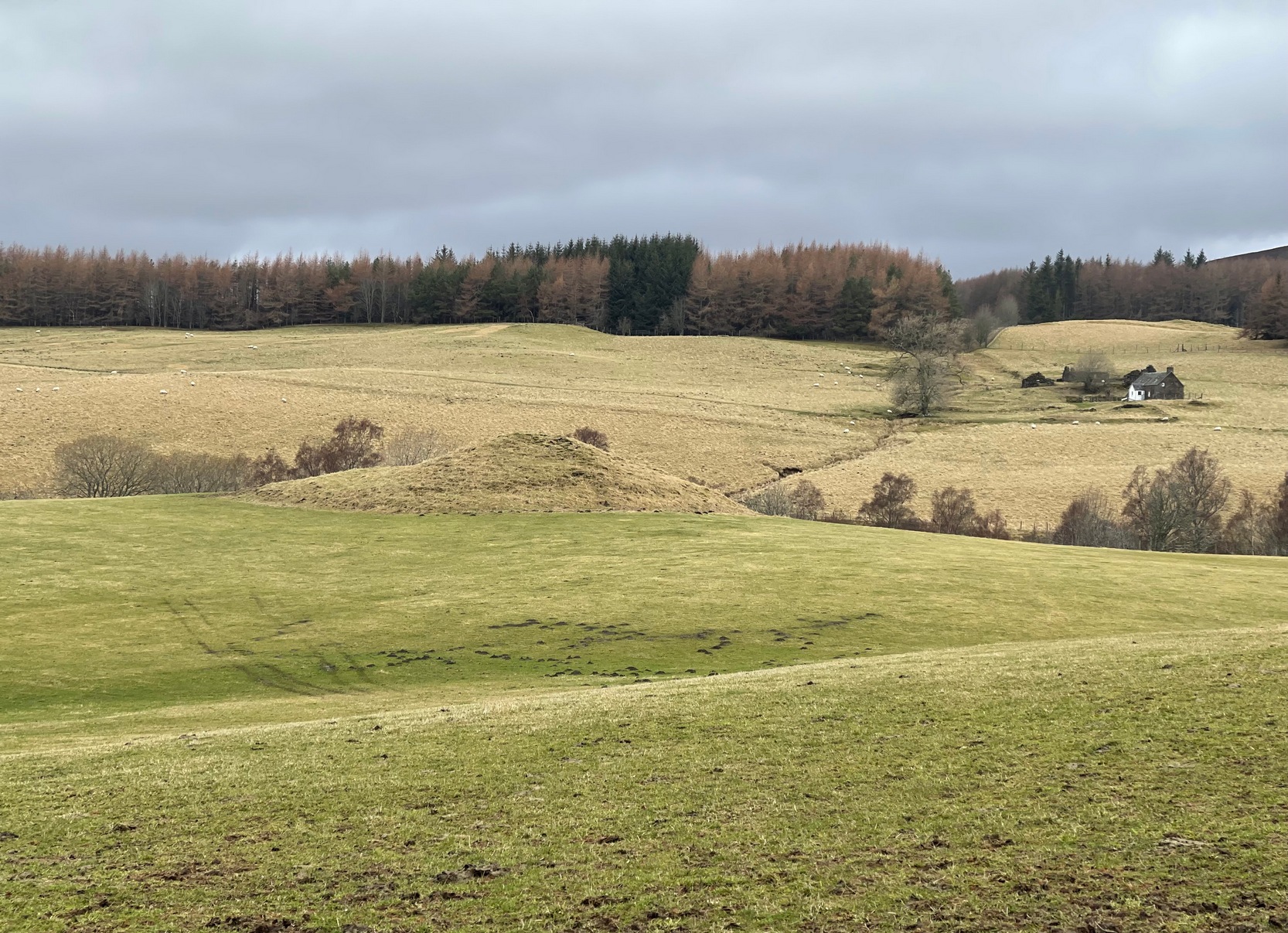
Approaching Monzie cairn

Along the B8079 road in Blair Atholl village, take the minor road signposted to the Bridge of Tilt.  After half-a-mile, where the road splits, keep to the right and head further uphill and, where the almost-track-like road splits again another quarter mile up, bear to the right again and just keep going uphill for nearly two miles until your reach the large car-park on the left.  Park here and then take the dirt-track to the farm (truly friendly helpful folk) where, in the field to the rear of the buildings, a large unmissable mound rises up!

Archaeology & History

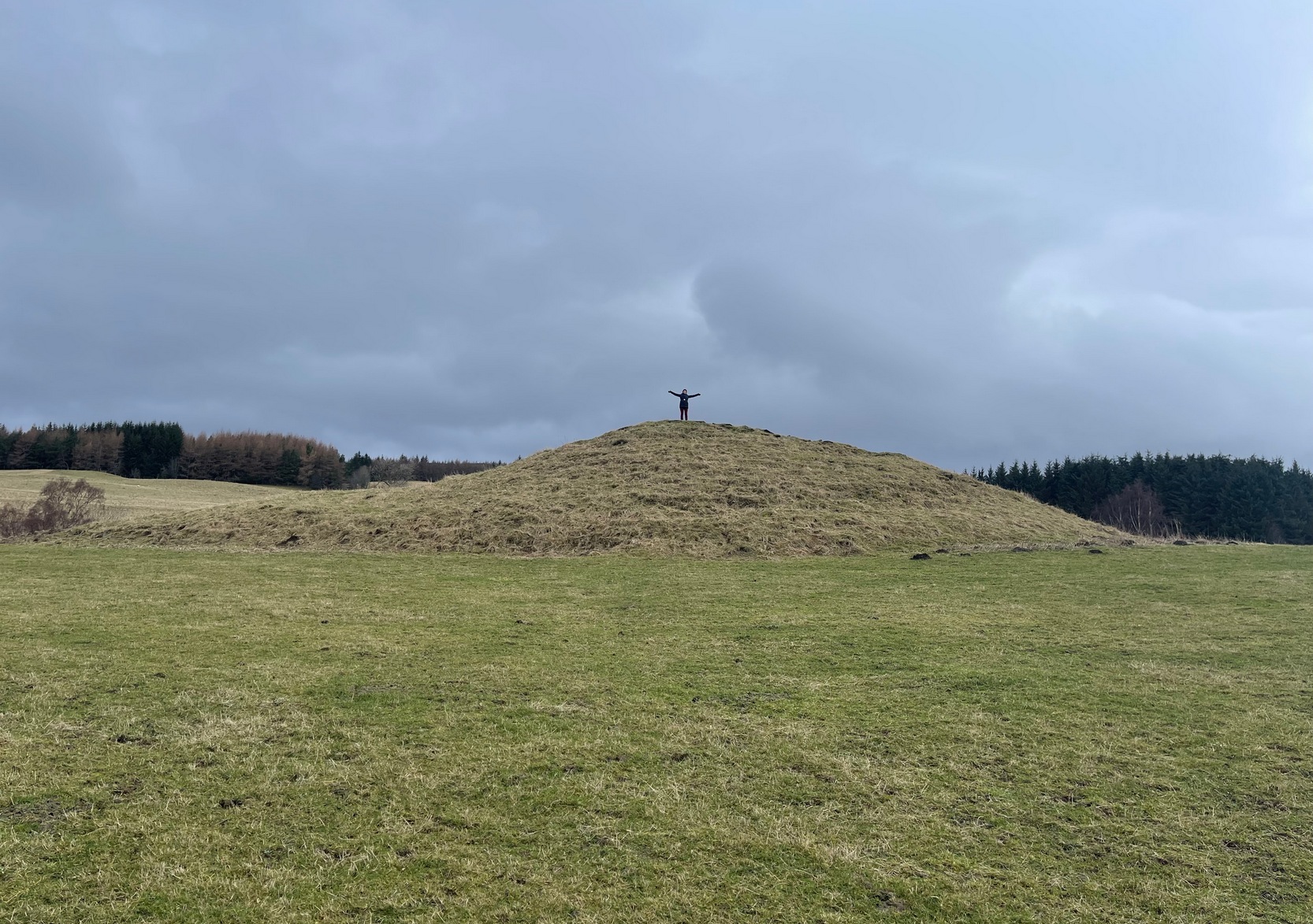
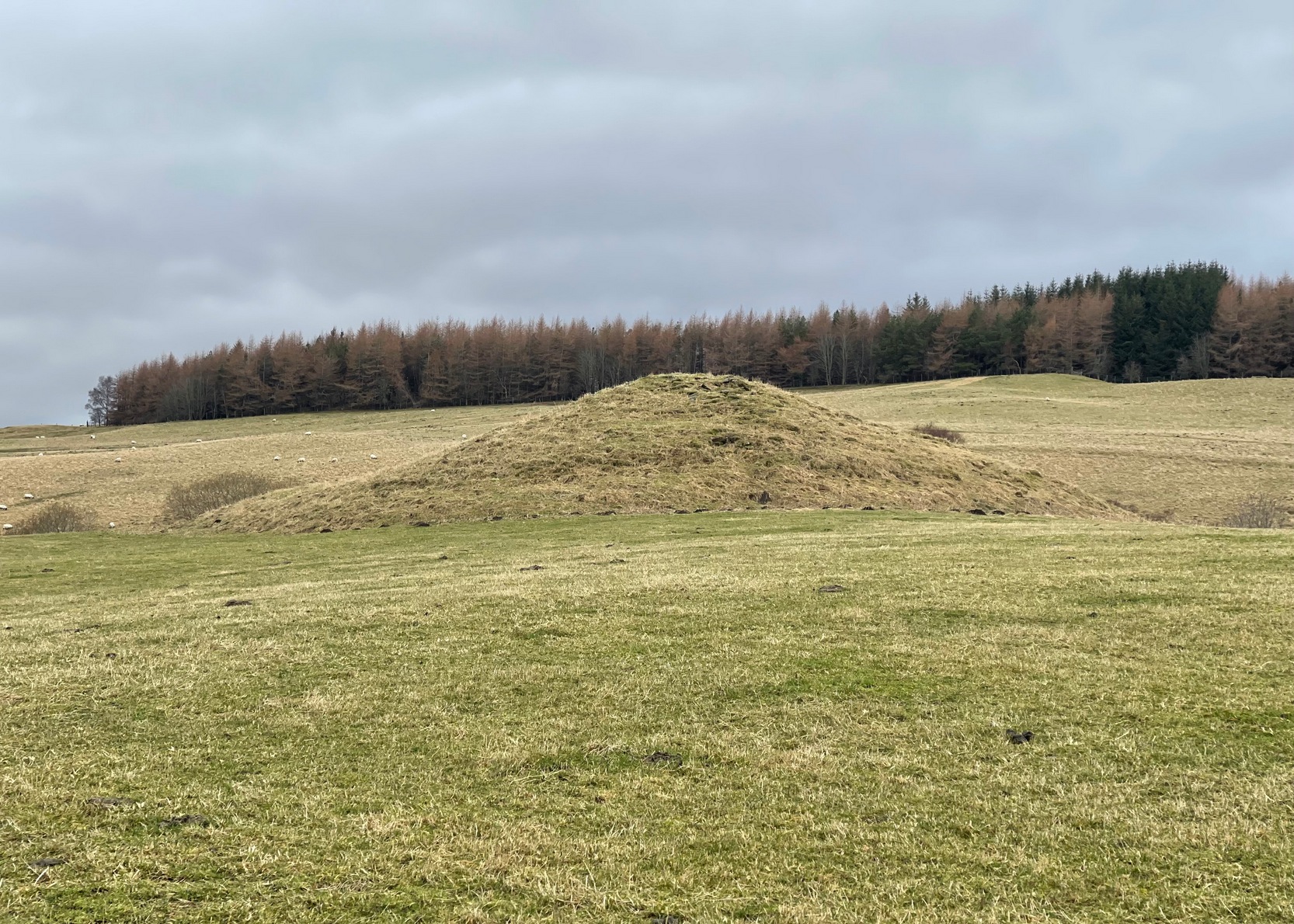
This is a bit of a beauty!  Hiding away on the southern edges of the Cairngorms we find this huge archetypal burial mound, 35 yards across and all but covered nowadays in deep layers of soil.  But it looks good.  When you walk onto its crown, about twelve feet up, you see and feel beneath you the scattered mass of small rocks and stones that comprise the monument as a whole, from top to bottom.  On its south-western side, the cairn is lower and elongated: this is due, on the whole, to where field clearance stones were pushed up against the monument many decades ago, making that side of it look bigger than it originally was.

Naomi on top for size!
Monzie cairn, looking W

Curiously perhaps, no archaeological attention of any worth has been give to the site apart from the usual estimates of its size and a guesstimate of it being neolithic or Bronze Age in nature (an easy thing to suggest).  On top, just beneath the grasses, is what may be the section of a small cist, but this may just be a fortuituous formation.  Excavation is required!  It’s one of a small number of old cairns and tombs in this locale, but this seems to be the biggest — unless, of course, the lost but legendary Carn Deshal, less than a mile to the south, stood larger…

Acknowledgements:  To my awesome Naomi – for getting us up here.

© Paul BennettThe Northern Antiquarian

Glen Cochill (01), Little Dunkeld, Perthshire

Cup-Marked Stone:  OS Grid Reference – NN 90800 39842

Also Known as:

  1. Canmore ID 87710

Getting Here

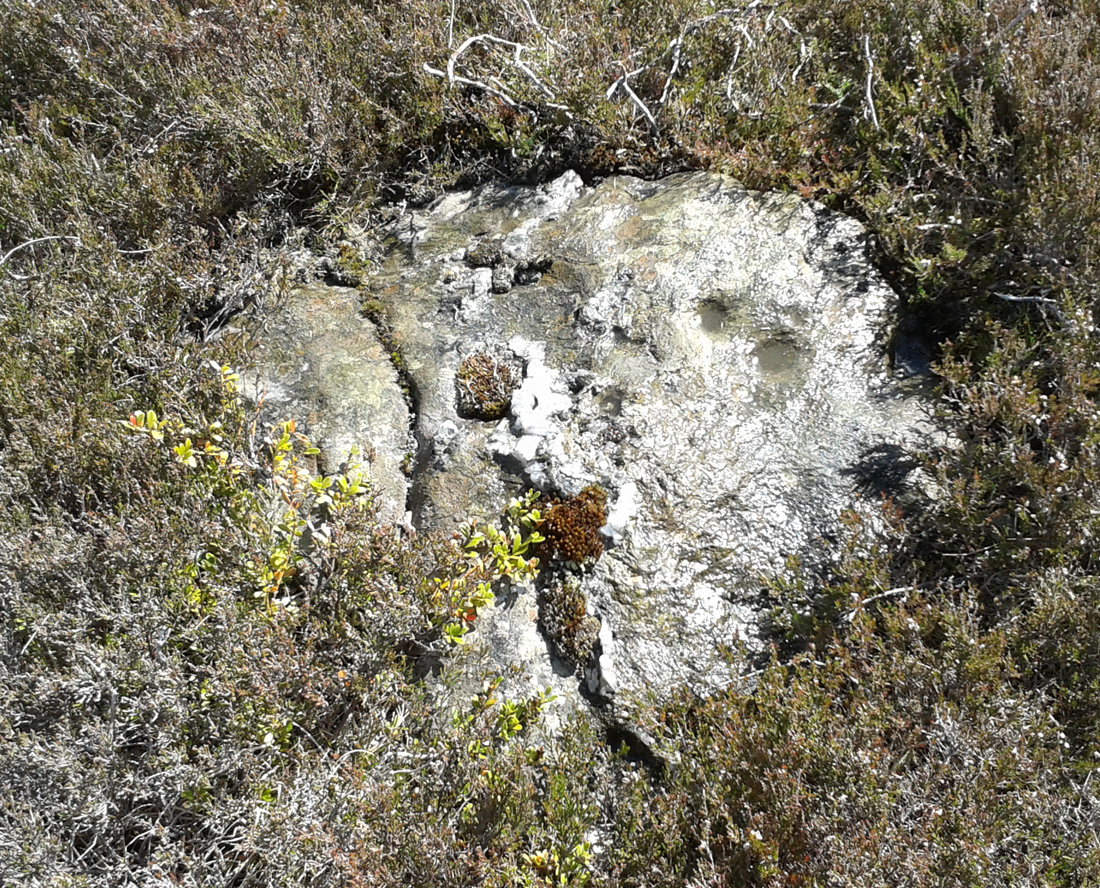
Glen Cochill's cup-marked stone

Glen Cochill’s cup-marked stone

Along the A826 road south out of Aberfeldy, make your way towards the impressive giant Carn Ban of Glen Cochill.  Nearly a mile past the cairn further down the road, keep yer eyes peeled for the straight line of walling reaching up onto the moors.  About 100 yards before the wall, go over a ruined metal gate by the roadside up and onto the moor.  Walk straight uphill for barely 50 yards until you’re on the level, then walk left for 50 yards or so again. Yer damn close!

Archaeology & History

3rd cupmark visible at bottom

3rd cupmark visible at bottom

Although this is a seemingly isolated carving, difficult to find and nowt much to look at, it is located in a region with massive amounts of prehistoric remains – much of it inadequately surveyed or not surveyed at all.  Amidst a collection of more than a dozen unexcavated Bronze Age cairns, this small flat earthfast stone bears two standard cup-markings, with a possible third at its edge.  It is not immediately connected with any of the nearby cairns.

© Paul BennettThe Northern Antiquarian