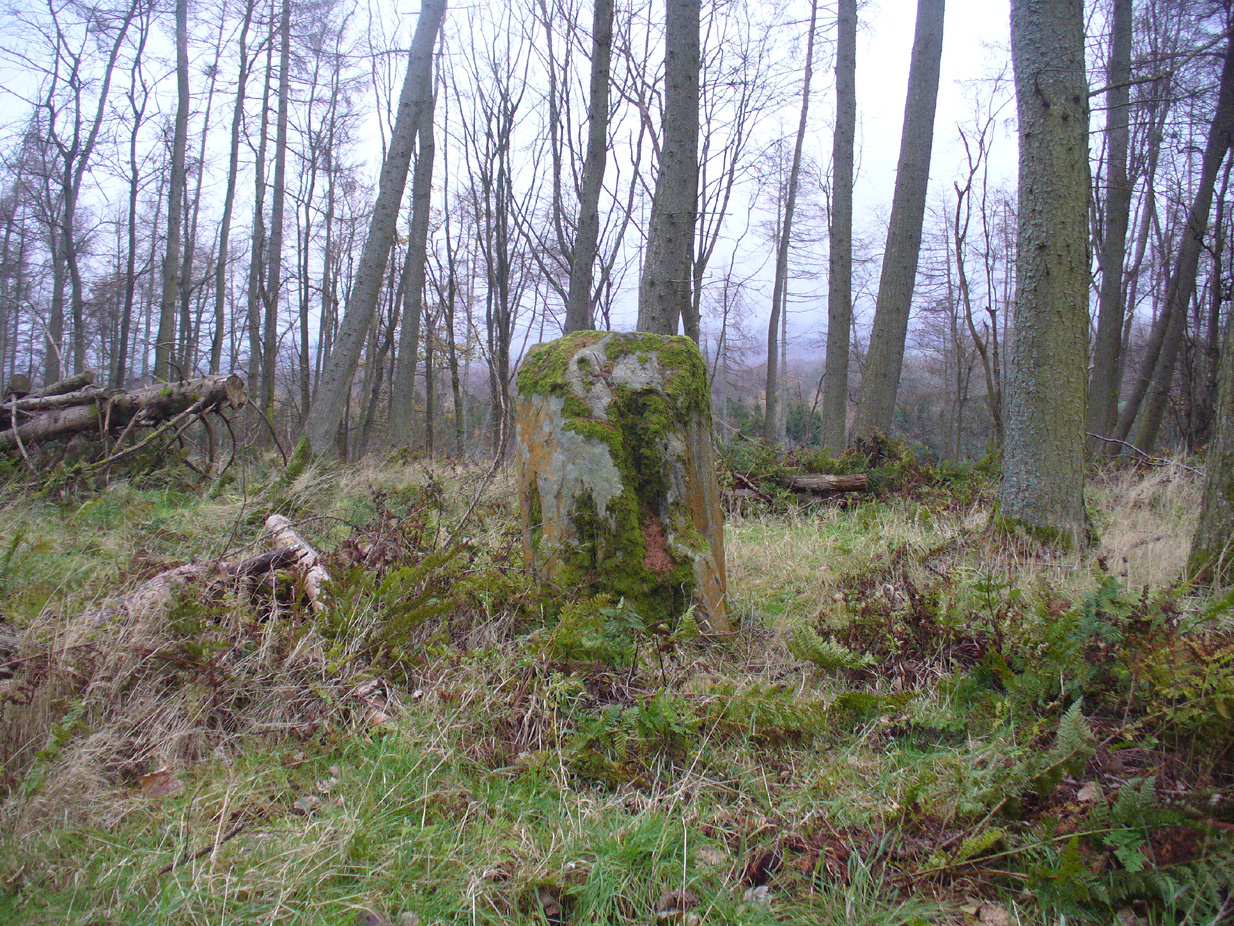
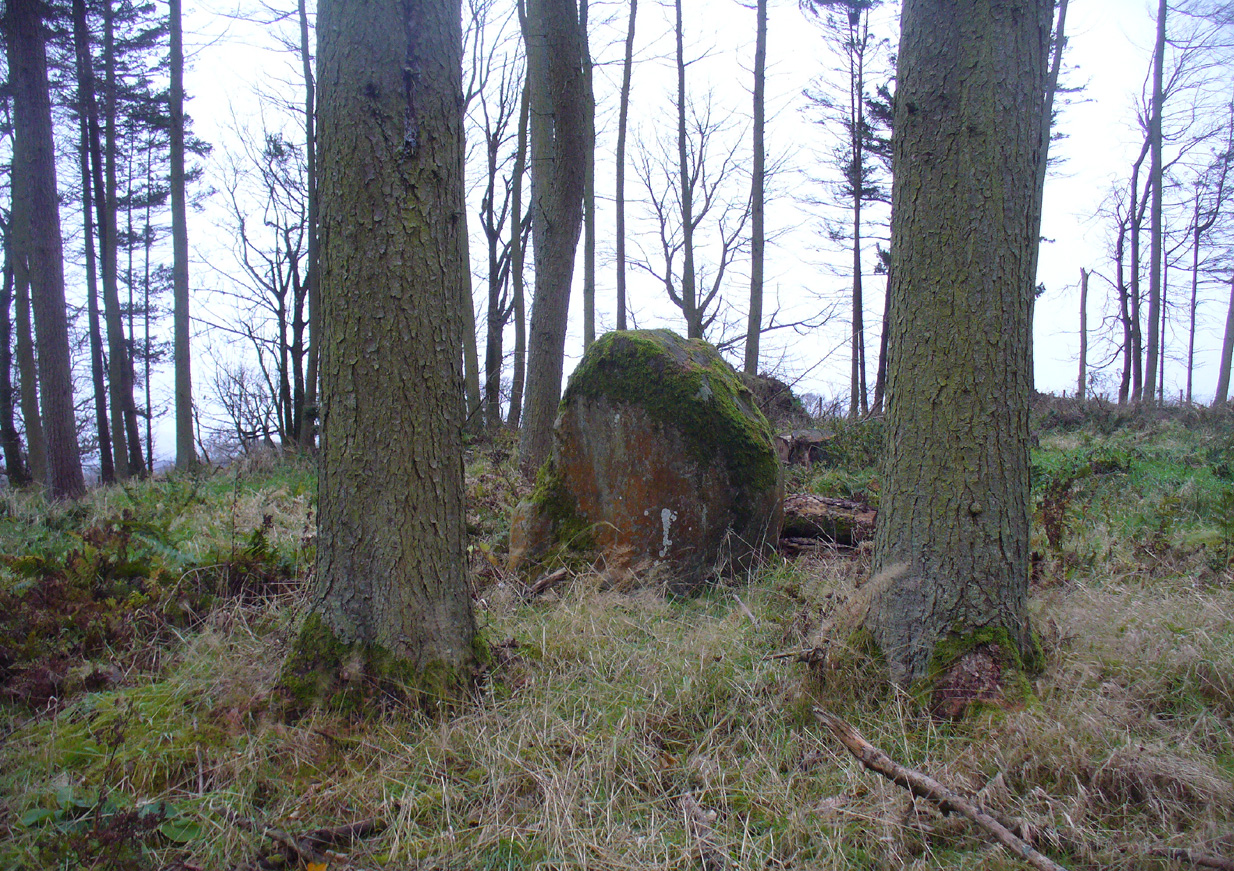
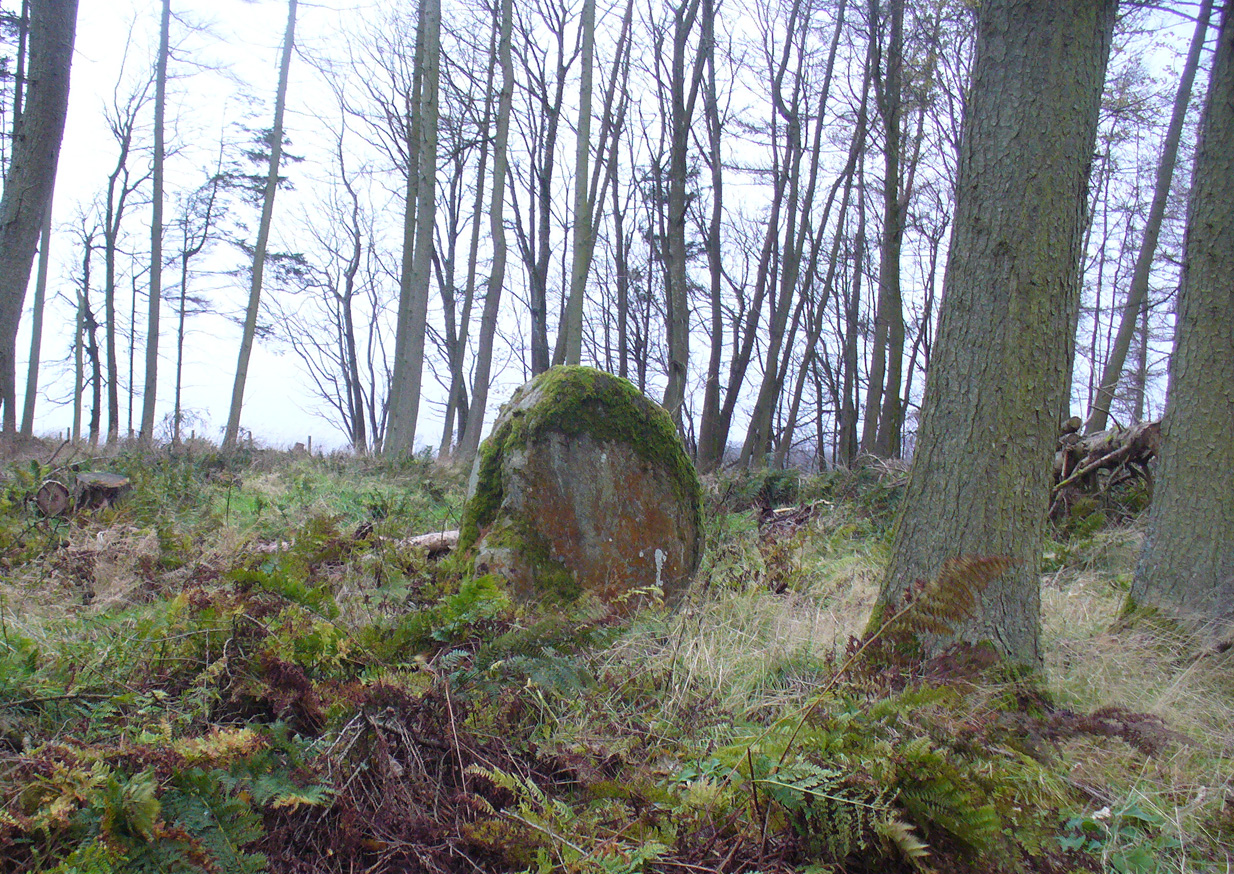
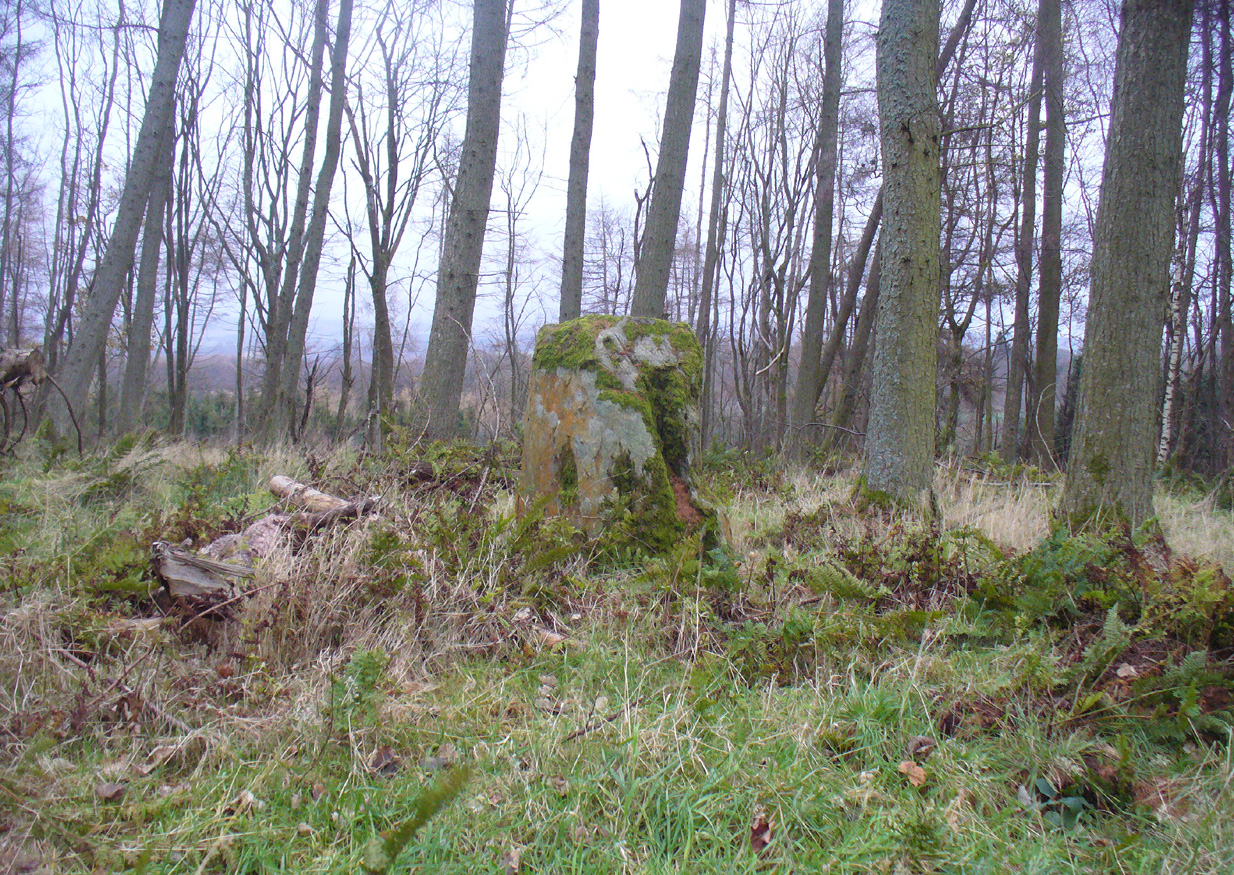
Take the B822 road between Kippen and Fintry, stopping at Balafark farm. On the other side of the road, above the farm, take the track into the forest. Naathen…. 1120 yards (1.02km) along, note the small green track, off the main central track, slightly up on the rise on your right. It bends round and then goes (eventually) straight to the edge of the forest. Once you reach the edge, go left all along the fence until it meets the large gate 800 yards WSW. 20 yards past the gate, a small stone is along the fence-line. This is the Carlin!
Archaeology & History
Carling Stone, looking east
Found along the same boundary line as another stone with similar mythic virtues (called the ‘Wife with the Bratty Plaid’), when Marion Grace Woolley and I visited the site earlier, we found only a small upright, barely a foot tall, right in line with the ancient boundary along a newly made fence. Thankfully, whoever built the fence, understood the nature of the stone, and left it in the ground where it belongs. We know not for sure exactly how old this stone might be, but it its name and position suggest very old – probably prehistoric.
The Carlin is another word for the Cailleach: the prima mater or great Earth goddess in Irish, Scottish and northern English animistic traditions. Her virtues are immense, representing the cycles of the natural world, a creation giant, healer and a whole host of other elements inherent to the natural world. Although She tends to be represented as the Winter hag, the Cailleach changes Her faces and attributes as the cloaks of the seasons go by, annually, cyclically, year after year after year. She’s as much the cloak of the Winter as She is the fertility of Spring, the warmth of the Summer and the fruits of Autumn.
Carling Stone, looking west
Whatever traditions there might have been at this small Carlin Stone are now long forgotten it seems. We find no bodach (Her husband) in immediate attendance. However, the existence of the small standing stone called the ‘Wife with the Bratty Plaid,’ several hundred yards to the east along the same ancient boundary line, implies there would have been a traditional perambulation along this boundary, and during such annual ritual walks, tales or words may have been said here. Does anyone know more…?
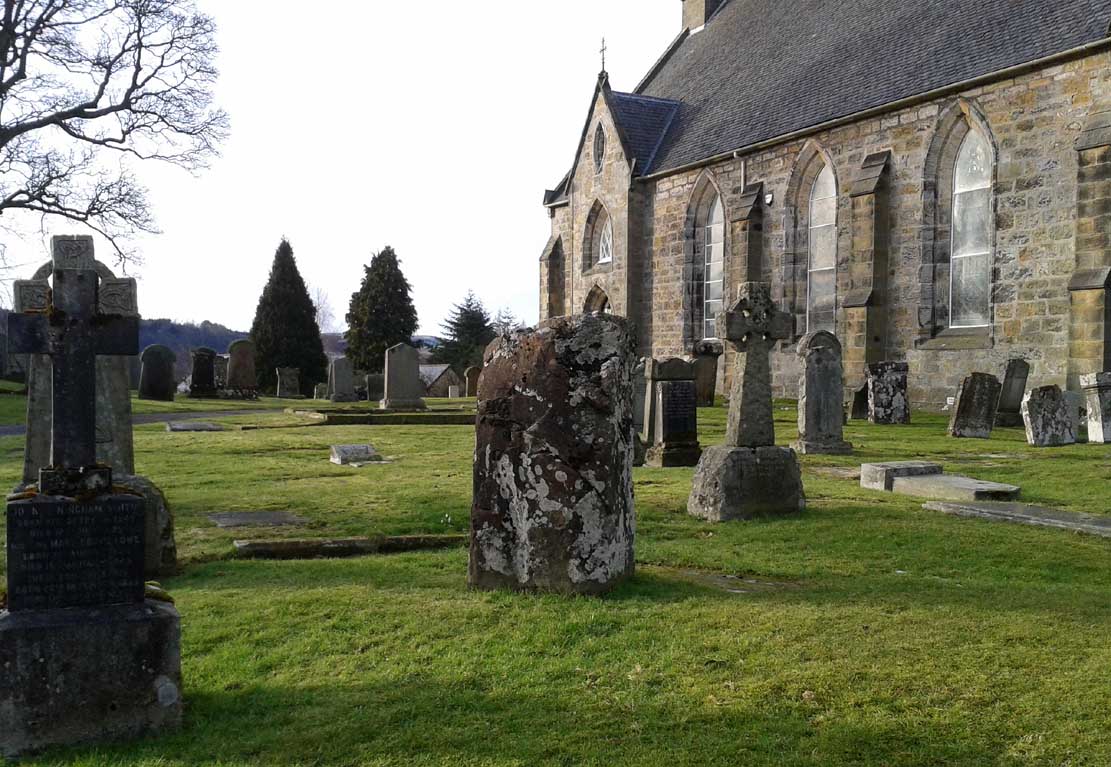
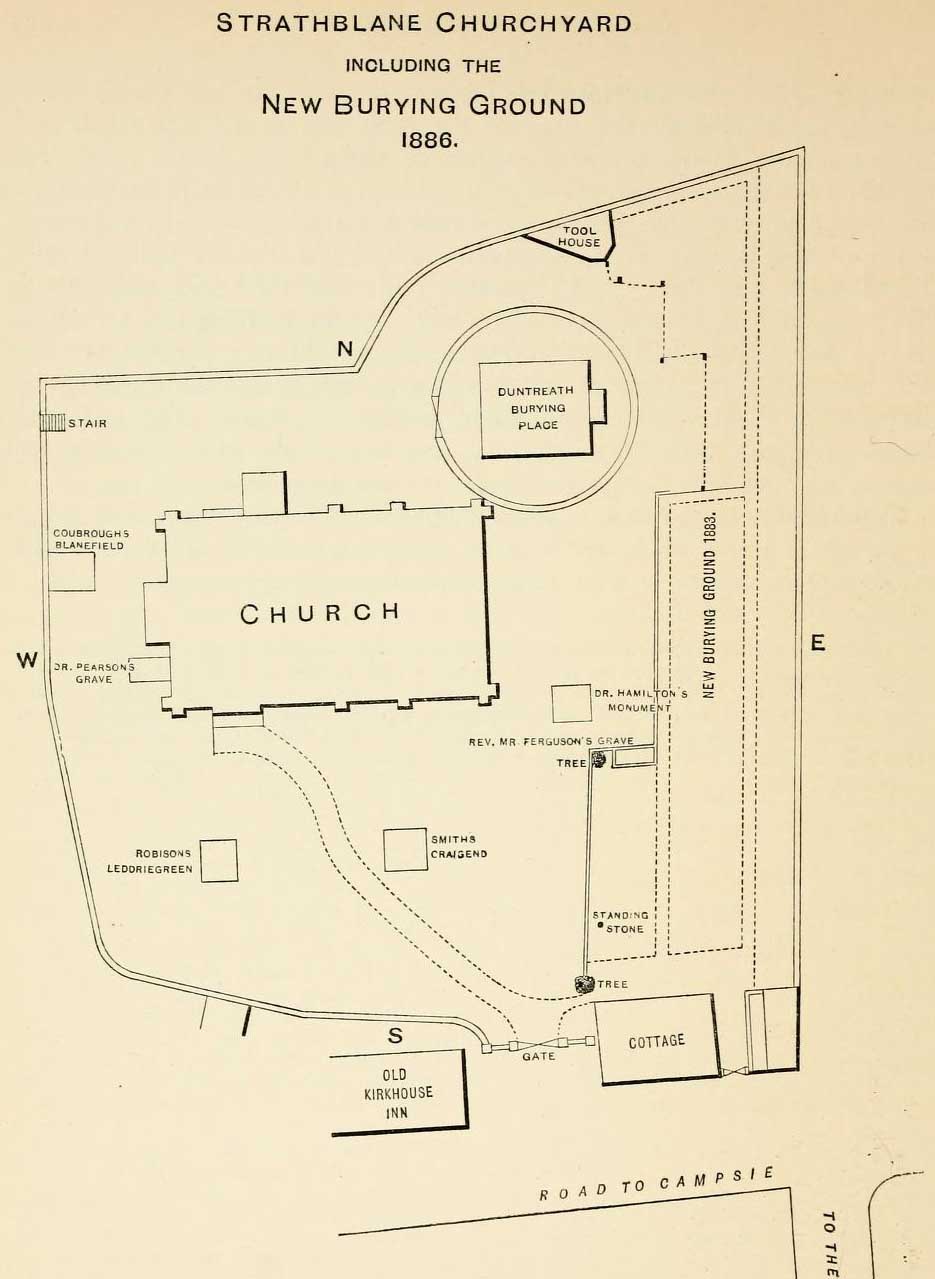
From whichever direction you’re coming from along the A81 into Strathblane, make sure you keep your eyes peeled for where the A891 turns off it to the east. Go and along there and barely 100 yards on the church is set back from the road. Walk into the graveyard, turn left and you can’t really miss it amidst the mass of modern graves.
Archaeology & History
Location of the stone, from Smith 1886
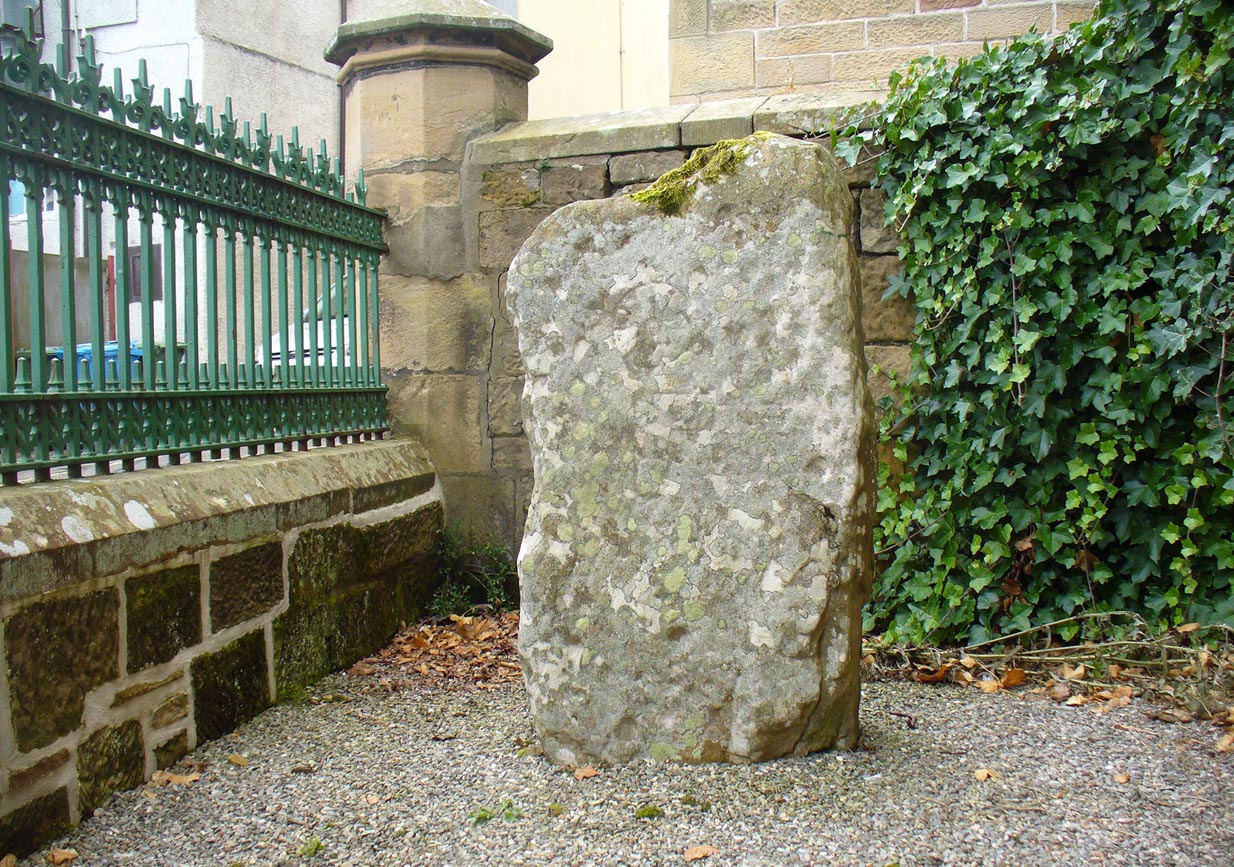
In accordance with the occasional tradition of standing stones in churchyards (such as the Rudston monolith and many others), a short stumpy monolith, less than four feet high, here stands alone in the christian burial ground surrounding Strathblane’s parish church. The top of the stone is quite flat and it’s possible that this once stood much taller, with the top of the stone being chopped off (such destruction has happened at the Cuckoo Stones and many other megalithic sites). It’s certainly worth looking at and stands amidst a cluster of other ancient sites—some gone, some still in evidence—in and around this lovely old village. Not much has been written about the stumpy little fella and its first literary reference seems to be in Mr Smith’s (1886) magnum opus on the area, where he tells:
“There is a very old standing stone in the churchyard, but most probably it was placed there long before there was any church in the parish.”
…Nothing else. Even the Royal Commission (1963) lads said little about it, merely telling us:
“A few yards within the entrance to the graveyard of Strathblane Parish Church…a standing stone appears among the monuments. It is a five-sided pillar, 3ft 9in high, with an uneven but flattish top. At ground level the sides range from 1ft 9ins to 2ft 3in in width.”
The stone, looking south
The stone, looking southeast
The fact that it stands by the church (rebuilt around 1803 out of its more ancient fabric) suggests that the site was a heathen temple or sacred site, redesignated by the invading christian priesthood. A short distant east and west have been found a number of prehistoric remains in the forms of burials, standing stones and giant cairns, indicating this site to have had particular mythic importance in earlier centuries. From the standing stone if we look southeast, we see the rise of Dunglass, but the view to the stones and great pyramid of Dumgoyach, northwest, is blocked by the rise of Cuilt Brae, which I found to be a little surprising.
References:
Royal Commission on the Ancient & Historical Monuments Scotland, Stirling – volume 1, HMSO: Edinburgh 1963.
Smith, John G., The Parish of Strathblane, James Maclehose: Glasgow 1886.
Ure, David, The History of Rutherglen and East Kilbride, Glasgow 1793.
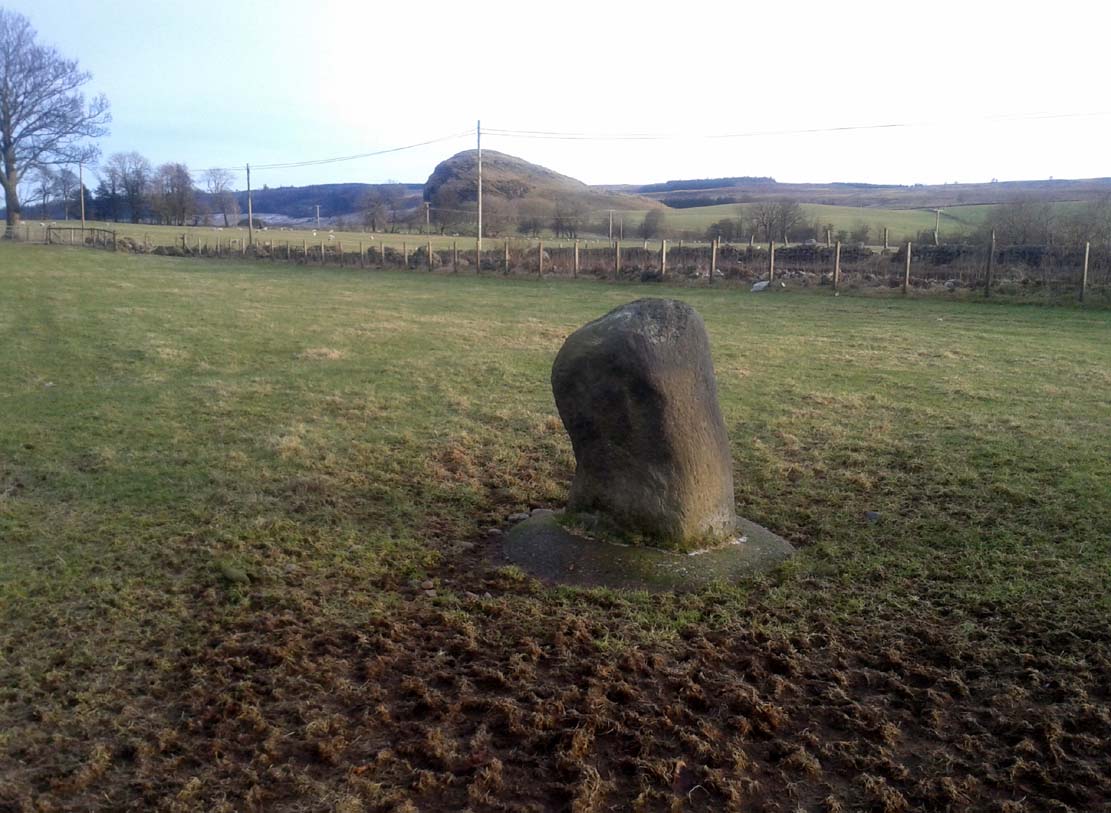
From Strathblane, take the A891 road eastwards out of the village, past the standing stone in the churchyard and the row of houses set back off the road until, a few hundred yards along, the fields open up on both sides of you. In the very first field on the north side of the road, you’ll see the standing stone, all alone, resting quietly. There’s a gate enabling you access into the field…
Archaeology & History
Broadgate Stone, with Dunglass SE
Found in close proximity to the destroyed chambered tomb of Broadgate, this small standing stone is presently set in a concrete base after an excavation here in 1982 located a cremation urn beneath the stone, confirming an old tradition that told as much. But there are some who think the stone isn’t a prehistoric one—the Royal Commission (1963) lads for one. In their brief resumé of the site they wrote:
“This stone stands just N of the road from Campsie to Strathblane, 140 yds E of Broadgate farmhouse. It is 4ft high and measures 2ft 3inches by 3ft at ground level. It may well be the stone referred to in the New Statistical Account as marking the spot where Mr Stirling of Ballagan was murdered in the 17th century and should therefore not necessarily be accepted as of prehistoric origin.”
And were it not for an excavation nearly twenty years later, this view may have been maintained. However, when Lorna Main (1982) told of what was found beneath the monolith, no mention was made of any recent remains. She wrote:
“Excavation at the base of the fallen standing stone was undertaken prior to its re-erection. A ledge had been cut on the south-west side of the shallow stone hole and fragments of the base survived and the diameter of the base is approximately 17cm. The urn contained a cremation and a small quantity of charcoal. It lay only 15cm below the ground surface and is in a poor condition.”
The very fragile state of the urn and the very eroded rounded stature of the rock itself would seem to indicate that this is more a prehistoric upright than a later 17th century one.
Folklore
There are legends of early battles in this region and J.G. Smith (1886) thought that perhaps “this great stone…mark the resting-places of Cymric heroes who did their share of the battle on the north side of the valley.”
References:
Main, Lorna, “Broadgate Farm – Standing Stone and Cinerary Urn,” in Discovery & Excavation Scotland, 1982.
Royal Commission on the Ancient & Historical Monuments Scotland, Stirling – volume 1, HMSO: Edinburgh 1963.
Smith, John G., The Parish of Strathblane, James Maclehose: Glasgow 1886.
Ure, David, The History of Rutherglen and East Kilbride, Glasgow 1793.
A once-impressive large prehistoric long cairn could be found close to the grid-reference given here, whose existence and destruction was recorded, thankfully, by local antiquarians in the 18th and 19th centuries respectively. There are remains of other prehistoric sites in and around the spot—including the standing stones of both Broadgate Farm and Strathblane Church—close to which Mr J.G. Smith (1866) described,
“towards the end of last century a mound was levelled at Broadgate near this spot, and many stone coffins, each containing an urn full of earth and burnt bones, were found.”
Smith himself refers to the lengthier description of the mound’s destruction in Ure’s History of Rutherglen (1793), in which the site was described as
“an ancient burying place, the origins of which is unknown, was 60 yards in length, 14 feet in height, and of a considerable breadth. It was composed of gravel, and lay east and west. In the bottom were a great many coffins of stone, placed in a row, and separated from one another by a single flag. Every coffin contained an urn, that was full of earth and burnt bones. Beside each urn was a pillar about 3 feet in height, and 8 inches in thickness. They were fragments of basaltic five-sided columns, a few rocks of which are found in the parish. Most of the pillars are built in a dyke adjoining to the church. The urns on being touched fell in pieces.”
Due to the seemingly extravagant lay-out of this cairn, Audrey Henshall (1972) took the site to be a chambered tomb of some considerable importance. She was probably right! In her magnum opus (1972) on the subject she wrote:
“The description of the ‘cists’ suggests a segmented chamber of Clyde type, but the mound composed of gravel (instead of being a cairn) suggests a natural feature. A long mound, probably natural, exists on Broadgate Farm in which a restricted excavation produced a cist of Bronze Age type. Possibly the Strathblane mound was similar; it may have contained a segmented chamber (…where a chamber has been built into a natural mound), or it may have contained cists of later type for single burials.”
Subsequent explorations by the Royal Commission (1963) and local historians to find any remains of the site have proved fruitless.
References:
Henshall, Audrey S., The Chambered Tombs of Scotland – volume 2, Edinburgh University Press 1972.
Royal Commission on the Ancient & Historical Monuments Scotland, Stirling – volume 1, HMSO: Edinburgh 1963.
Scott, J.G., “Inventory of Clyde Cairns,” in Megalithic Enquiries in the West of Britain,Liverpool University Press 1969.
Smith, John G., The Parish of Strathblane, James Maclehose: Glasgow 1886.
Ure, David, The History of Rutherglen and East Kilbride, Glasgow 1793.
Along the A84 Stirling-Doune road, watch out for the minor Cuthill Brae road to the caravan park. A couple of hundred yards before reaching the entrance to the caravan park, note the copse of trees more than 200 yards north, on the left, across the field. Walk into the trees and, near the centre, you’ll see the upright stone.
Archaeology & History
Looking to the west
On the very top of this flattened tree-covered hill between Doune and Stirling, a single upright monolith more than 5½ feet tall quietly rests, seemingly forgotten by just about everyone. The stone was marked on the earliest OS-maps in the 1860s, though in non-antiquated lettering, as if to question its archaic veracity—and this has continued to the present day, with the likes of Hutchison (1893) and Canmore upholding it as little more than a geological erratic. Yet as our photos here show, this stone has much greater credibility as an authentic standing stone than Nature’s handiwork.
In Mr Hutchison’s (1893) article on the megalithic remains of the area he said of this stone:
“This is a very fine boulder of Highland grit, stranded on a gravel mound near the official residences on the Blair Drummond estate. The knoll is wooded, leaving a clear space in the centre for the stone. It would thus appear to have been thought worthy of preservation for some reason or other. It has no appearance however, of having been erected as a standing stone. It measures about 6 feet in height, and 12 feet at its widest circumference.”
Looking northwest-ish
Looking northeast-ish
The position of the stone is intriguing, giving a 360° view through the trees to a much greater vista all round, and this does seems to be quite deliberate. In all honesty, this does look like an authentic standing stone, contrary to the earlier views cited. A large prehistoric tumulus occurs only 400 yards to the south (recently damaged and built onto by the present land-owner) and other standing stones are in the area.
There are a number of scratch marks on the upright faces of the stone, no doubt caused by the forestry actions here over the last century. No modern excavations have occurred here.
Folklore
A couple of centuries ago, the New Statistical Account told that,
“a very vague tradition represents it as having been a place of religious worship in superstitious times. There are no other remains near to confirm this opinion; but whether it be correct or not, it is evident that its site is a very important one, and may have been useful as a signal station, as it commands a view not only of the road across the Moss of Kincardine, but also of the line of Roman stations along the Forth and Teith in the direction of the camp at Ardoch.”
References:
Bennett, Paul, The Standing Stones of Stirling and District, TNA: Stirling 2020.
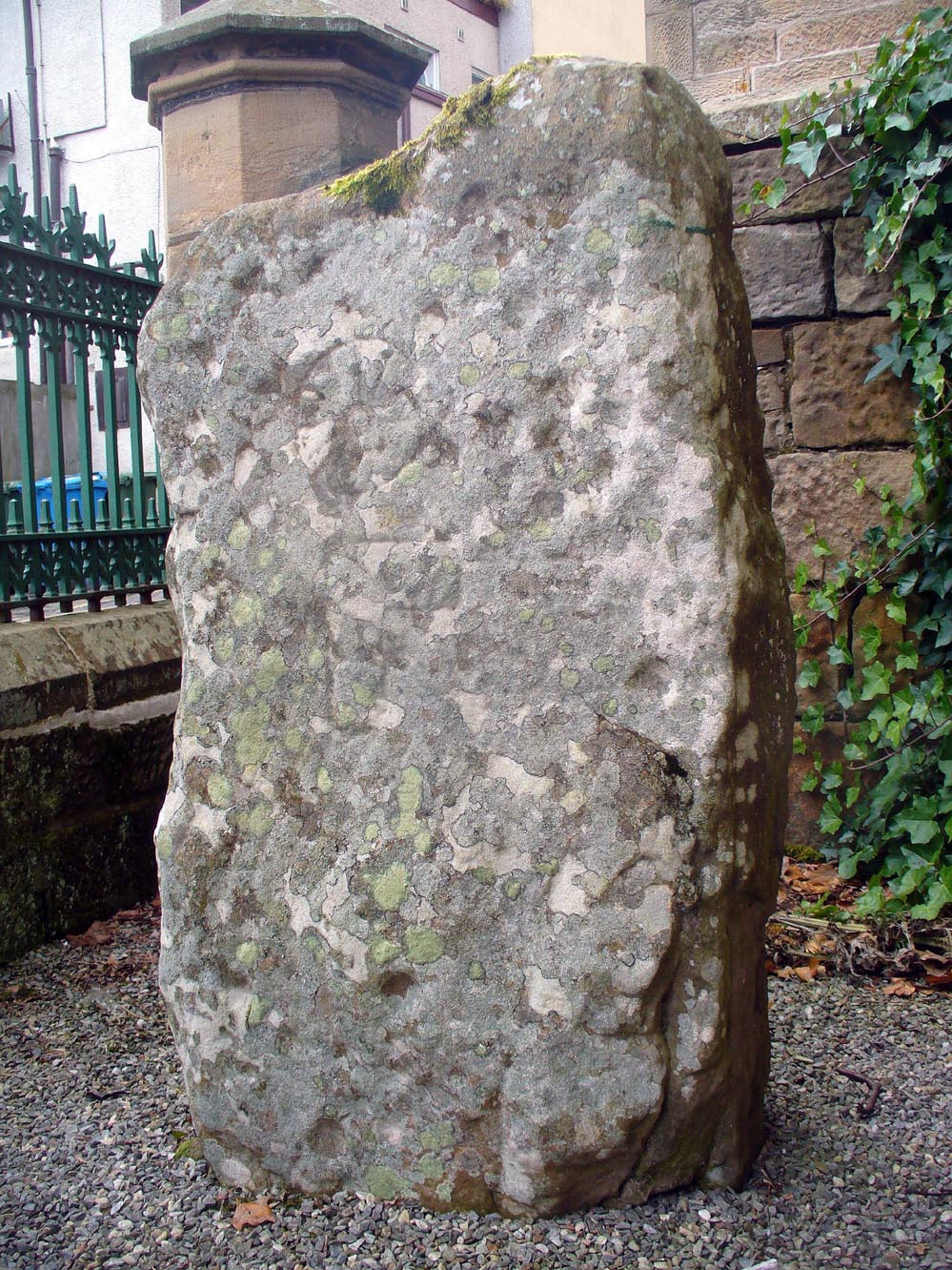
The stone is no longer in its original position (a few miles away), but can now be found if you visit the Tain & District Museum, just off Tower Street, in towards St Duthus’ Church. The stone is upright around the side of the adjacent buildings. It’s probably easier to access if you walk down Castle Brae, keeping your eyes peeled to your left. Otherwise, just ask the helpful people at the Museum and they’ll point you to the spot.
Archaeology & History
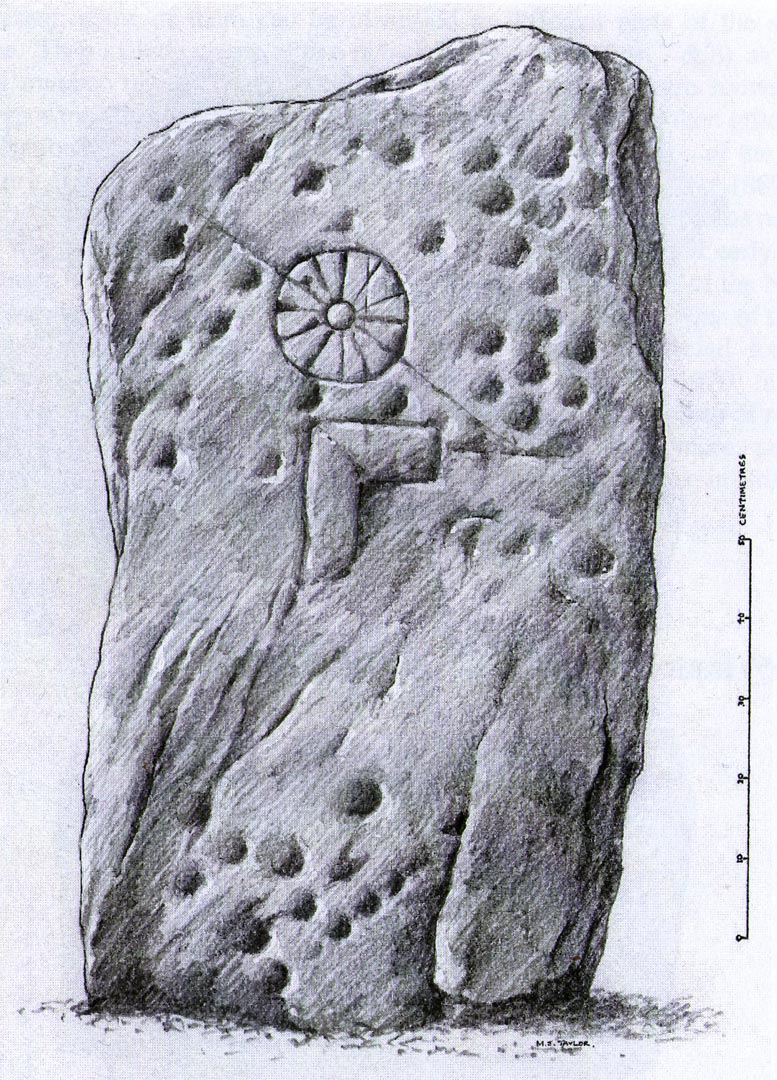
An intriguing stone with what may be a long and fascinating history behind it… It was only rediscovered in the 1960s, when the farmer at Ardjachie (2½ miles northwest of Tain town centre) came across it in one of his fields. It’s not large or notable in any way, other than it possessing a couple of really peculiar symbols etched amongst a mass of otherwise standard neolithic and Bronze Age cup-marks. These other symbols are (as seen in Mark Taylor’s drawing, right) a very distinct ‘spoked wheel’ and what looks like a right-angled ‘tool’ or set-square of some sort. These symbols have brought with them notions from academics who are claim it has Pictish provenance. However, we must be very cautious of this idea….
The first written account of the stone was by Ellis Macnamara (1971) who gave a detailed description of the carving:
Ardjachie Carving (after Mark Taylor 2004)
“Boulder found on Ardjachie Farm, now in Tain Museum. The boulder, of probably local old red sandstone, is uncut and very irregular in shape but has two principal faces; the maximum length is 1.7m; maximum width is 0.65m and on the maximum thickness is some 0.35m. The carvings are all on one face, which is much weathered; the opposing face is conspicuously less smooth so that it is possible that this stone was never set upright. The weathered face is covered with at least 30 ill-defined cup markings scattered over nearly the whole surface, though grouped towards one end; the average diameter of these cup markings is about 3 to 4cm, depth about 1.5cm. There are several indistinct lines among the cup markings and there is among the thickest cluster of cup markings a symbol like a ‘wheel’, with the outer ‘rim’ drawn as a fairly perfect circle, with a diameter at the outer edge of some 17cm. The ‘wheel’ has twelve ‘spokes’ and a single inner circle, or ‘hub’, with a diameter at the outer edges of about 4 or 5cm.”
Subsequent to Macnamara’s description, it’s been suggested that there are cup markings on both sides of the stone; but the ones on the other side are a little less certain. The stone itself almost typifies the cup-marked cist covers we find scattered all over the country—yet no burial or other structure was noted upon its discovery in the fields. It’s an oddity on various levels…
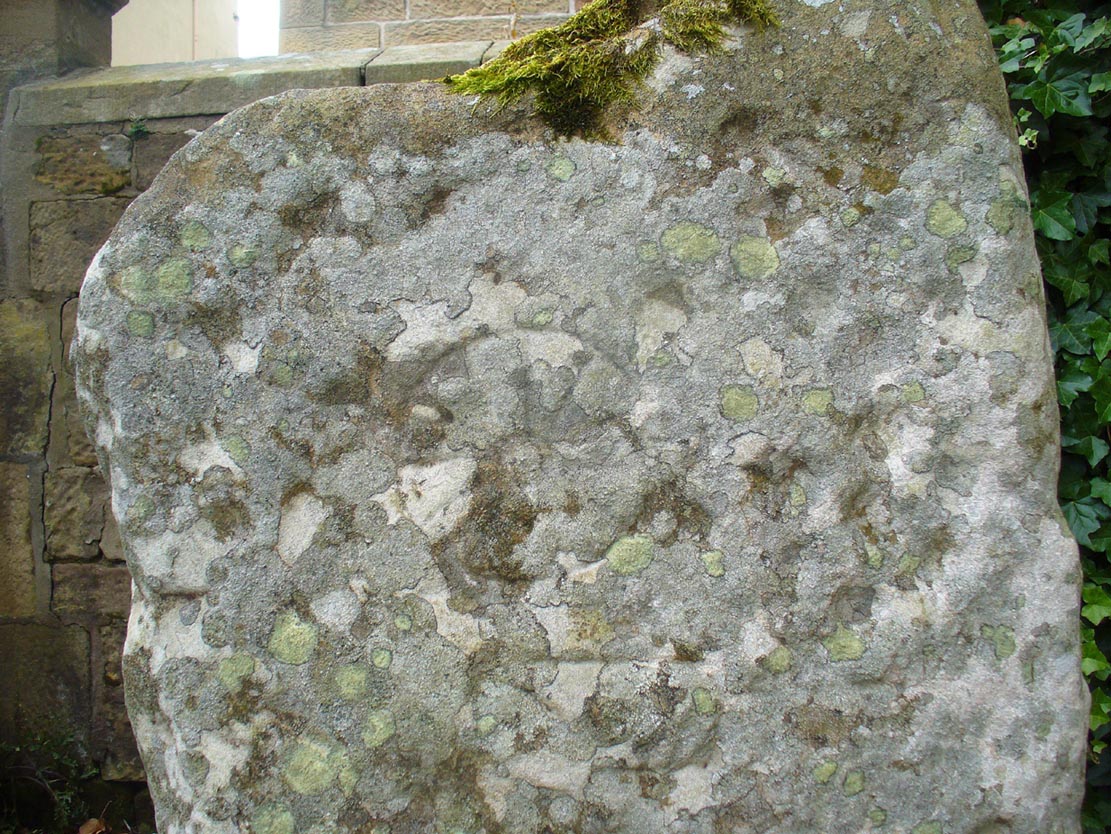
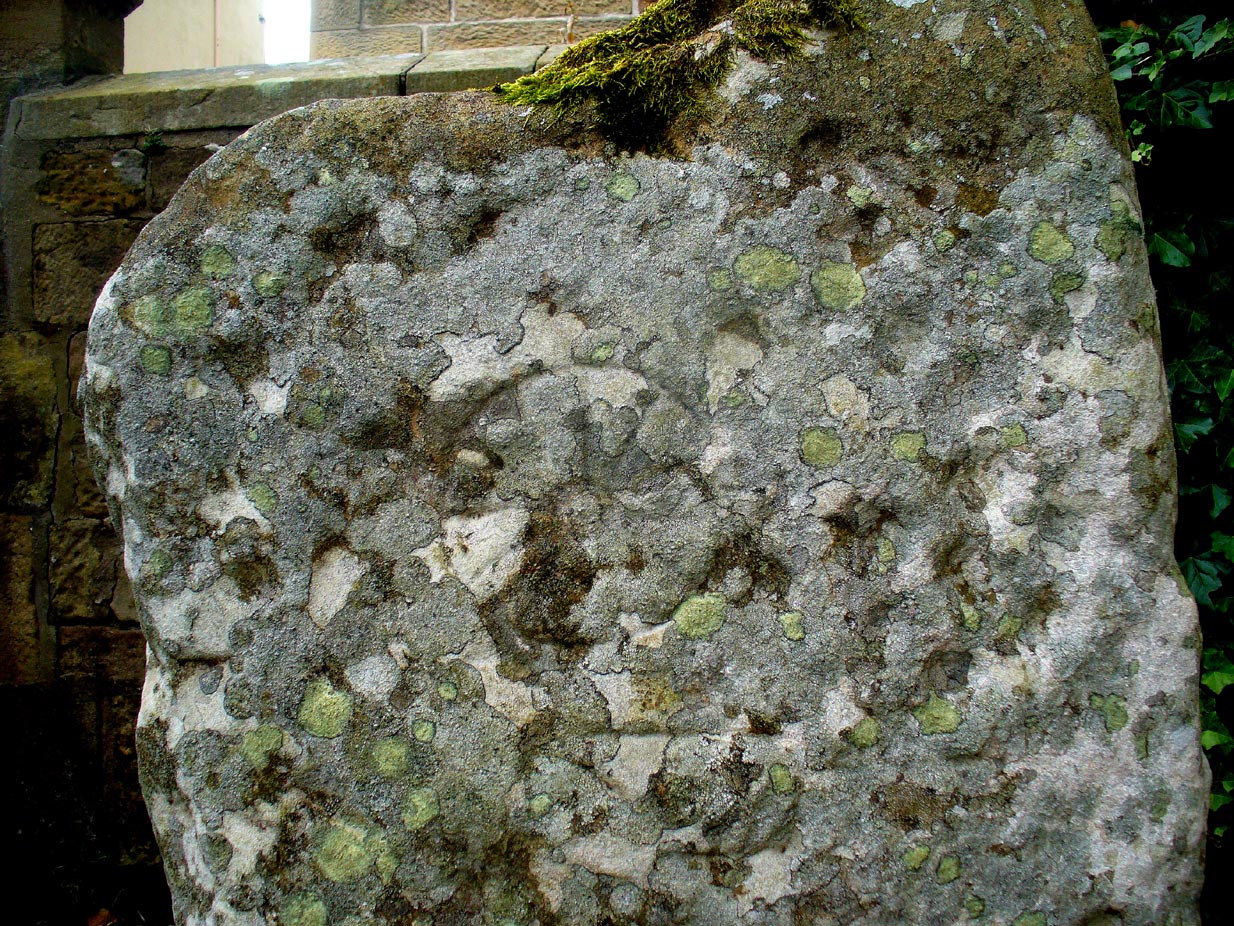
Close-up of spoked-wheelClose-up of spoked-wheel
The spoked-wheel symbol and, moreso, the right-angled element, have led some to speculate that the symbol was carved in Pictish times; but there are problems with this on two levels at least. The cup-marks we know are neolithic or Bronze Age in origin, and their design always inclines to abstract non-linear forms, screwing egocentric analysis. But the ‘spoked wheel’ is more linear in nature. But as acclaimed petroglyph researchers from George Coffey (1912) to Martin Brennan (1983) show, this spoked wheel occurs in neolithic Ireland; and the identical symbol occurs in prehistoric carvings at Petit Mont in France (Twohig 1981), at Cairnbaan in Argyll (Royal Commission 2008) and there’s even a partial spoked-ring on the Badger Stone on Ilkley Moor! We have no need to jump into Pictish times to account for its origin and unless we have direct archaeological evidence to prove this, the academic Pictish association must be treated with a pinch of salt. It is nevertheless scarce amongst neolithic and Bronze Age carvings in Britain. Maarten van Hoek (1990) suggested it to be a variant on the ‘rosette’ design, also neolithic in origin. On the whole the symbol is interpreted as being the sun—which it may well be.
If you look carefully at the images above you can see, to the right of the ‘wheel’, a cup-marking surrounded by a ring of six-cups. It is possible that this may be an older variant of the spiked-wheel solar symbol. All speculation of course. The other peculiar element here is the curious right-angled design, below the ‘sun’. This symbol in particular is quite different from the early cup-marks and may have been carved at a much later date. In which case, this raises the potential for a continuity of tradition here… which mightjust bring in the Picts!
A bittova closer look
But the general problem with a Pictish assignment is that of the Picts themselves. If we ascribe the current anglocentric belief that the Picts only existed between the 3rd and 9th centuries (because we only have written records of them during that period), we are assuming the rather naive philosophy that anything before written history did not exist: a sort of blind-man’s Schrodinger’s Cat ideology, only really accepted by pseudo-historians. But if the Picts didhave something to do with this carving, we may indeed be talking about a continuity of tradition from the ancient past into the written period. Such an idea would be no problem in developed tribal cultures with an animistic cosmology—and that’s assuming that this stone was deemed as ‘special’ in some form or another to the local people. But all these are uncertainty principles in themselves and we may never know for sure…
There are no adjacent monuments to where Ardjachie’s stone came from, and apart from a scatter of flints found a hundred yards or so closer to the beach, other archaeological remains are down to a minimal. Its isolation is peculiar. There are however, a number of springs of water a few hundred yards away, just across the main A9 road, two of which have left their old names with us as the Cambuscurrie Well and the Fuaran nan Slainte, or fountain/spring of Healing (the modern Glenmorangie whisky gets it waters hereby!). Although we must be careful not to assign every example of prehistoric rock art with the same material, the mythic association between petroglyphs and water cannot be understated, and although such an association at Ardjachie is conjectural, it cannot go unnoticed.
References:
Brennan, Martin, The Stars and the Stones: Ancient Art and Astronomy in Ireland, Thames & Hudson: London 1983.
Coffey, George, New Grange and other Incised Tumuli in Ireland, Hodges Figgis: Dublin 1912.
McHardy, Stuart, A New History of the Picts, Luath: Edinburgh 2012.
Mack, Alastair, Symbols and Pictures: The Pictish Legacy in Stone, Pinkfoot Press: Brechin 2007.
Macnamara, Ellen, “Tain, Ardjachie Farm: Cup Markings and Incised Symbol”, inDiscovery & Excavation Scotland, 1971.
Tale the A85 road between Comrie and Crieff and, roughly halfway between the two towns, take the minor road south to Strowan (it’s easily missed, so be aware!). A few hundred yards along, stop where the trees begin and walk into the fields immediately east. Keep walking, below the line of the trees, and you’ll get to it within five minutes.
Archaeology & History
Samson’s Stone, looking east
Mistakenly cited by some as a standing stone, the large boulder which rests here on the hillside just below the woodland is a glacial erratic. Highlighted on the 1866 OS-map of the region, I hoped that we might find some rock art on the stone, but cup-and-rings there were none. However, there is a curious ‘footprint’ on top of it, similar to the ones found at Dunnad, at Murlaganmore and other places (see Bord 2004); but I can find no previous reference to this carved footprint.
‘Footprint’ on top of stone
In 1863 the site was described in the local Name Book, where it was reported to be “a large oblong shaped stone lying on the surface, eight feet long, four wide, and three thick”; but, much like today, it was also reported that “There is no tradition respecting it in the neighbourhood. Supposed to have received the name in consequence of its great size.”
Most peculiar…..
References:
Bord, Janet, Footprints in Stone, Heart of Albion Press 2004.
From the centre of Meigle village, you need to head along the country lane south-west towards the village of Ardler (do not go on the B954 road). About three-quarter of a mile (1.25km) along—past the entrance to Belmont Castle—you’ll reach a small triangle of grass on your left, where a driveway takes you into the trees. Walk down the drive and past the very first house—behind which is the stone in question. A small path takes you through the trees allowing you to get round to it. You can’t really miss it!
Archaeology & History
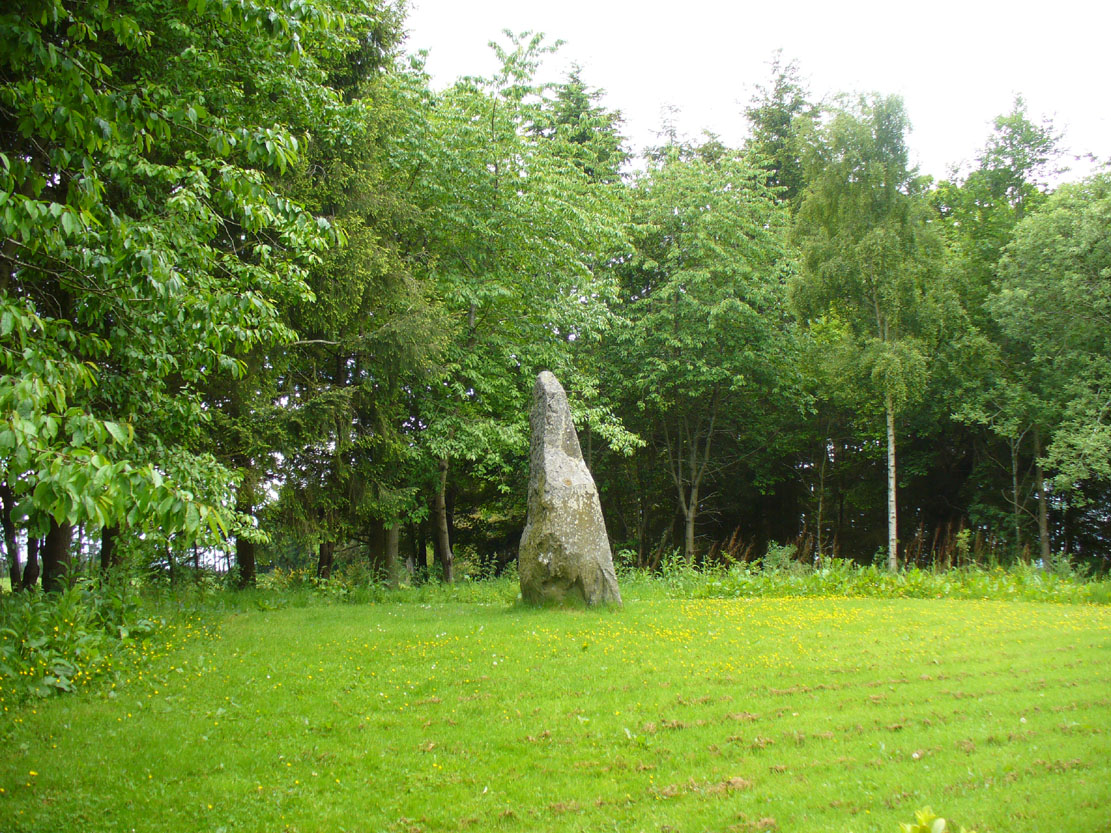
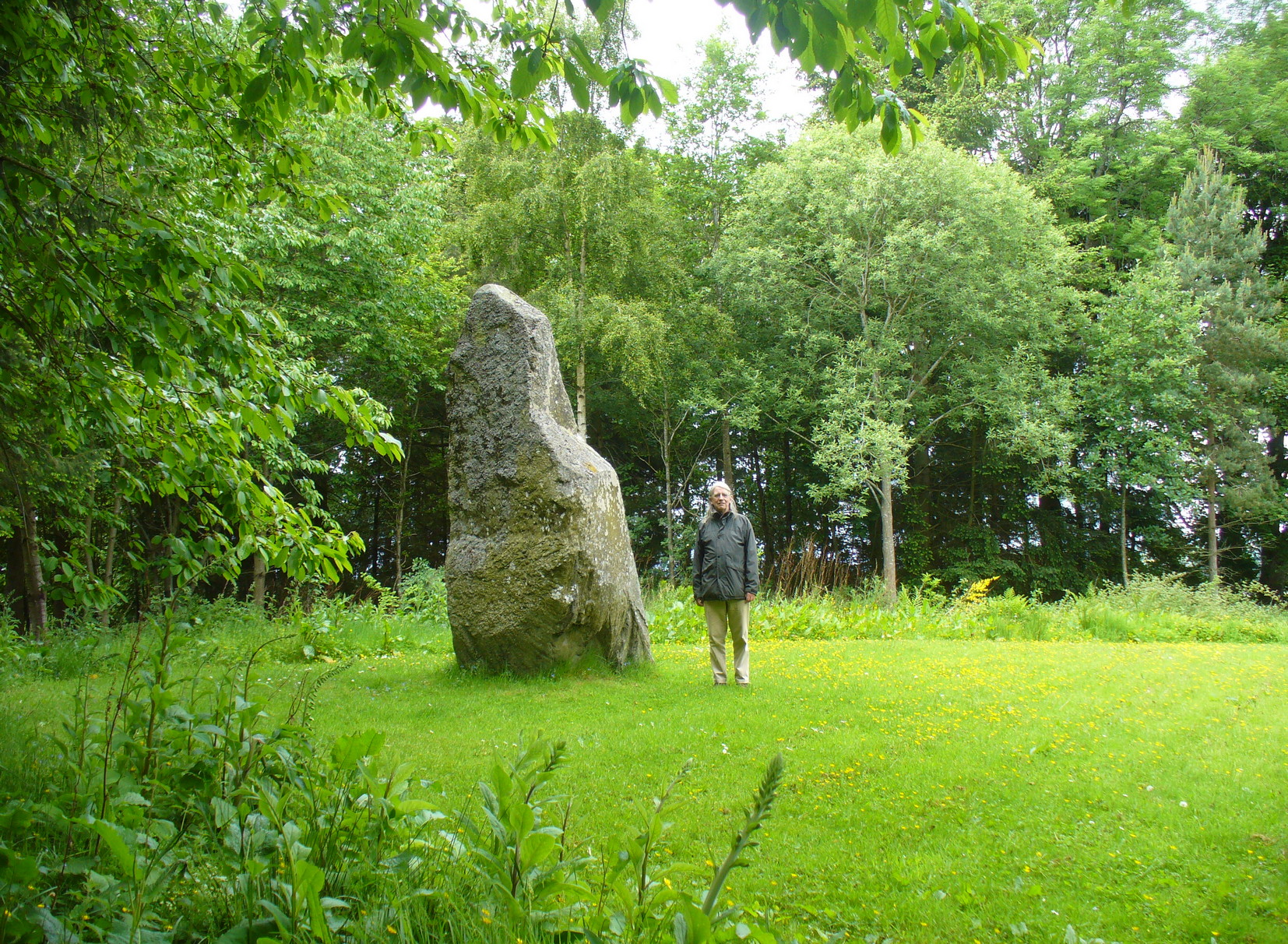
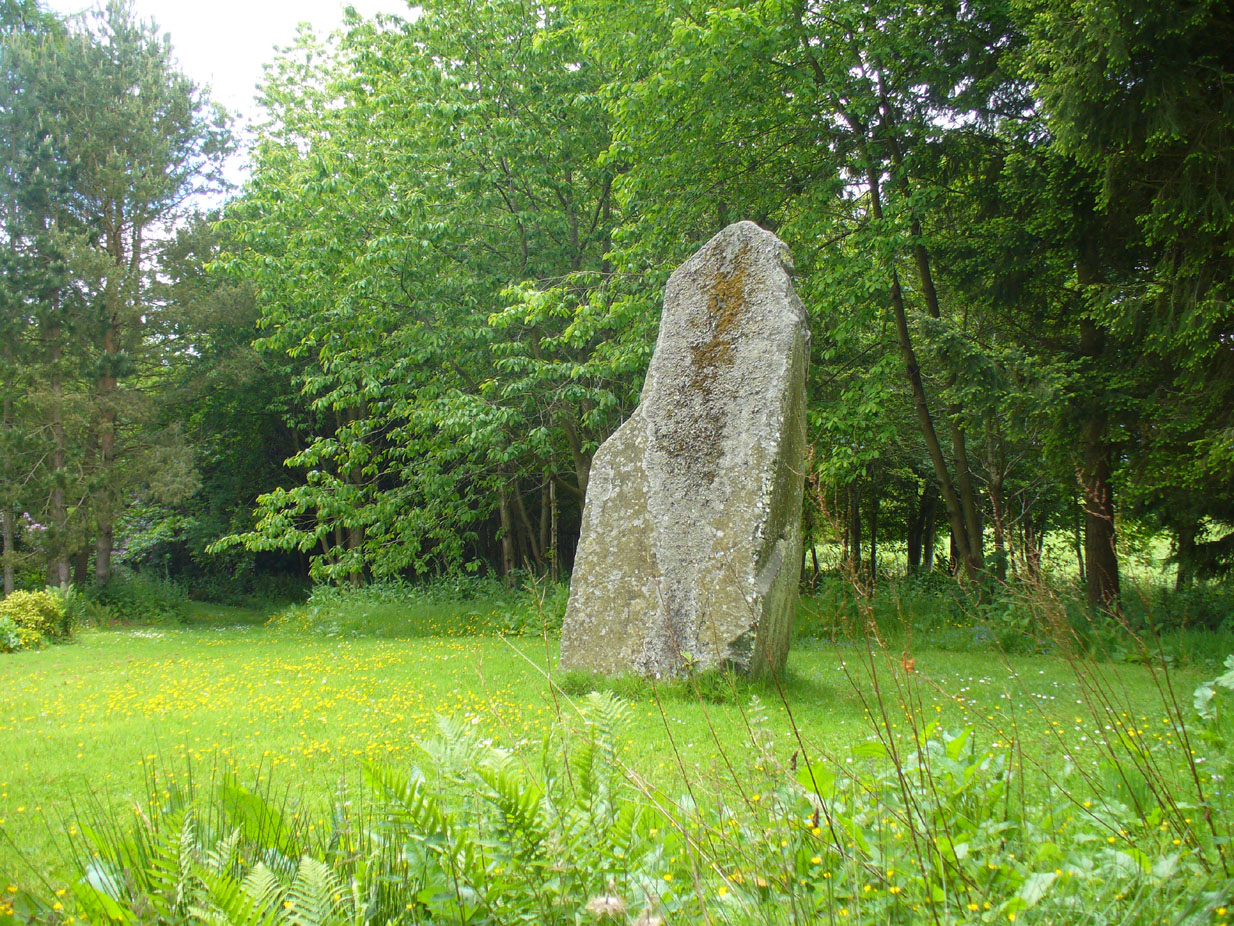
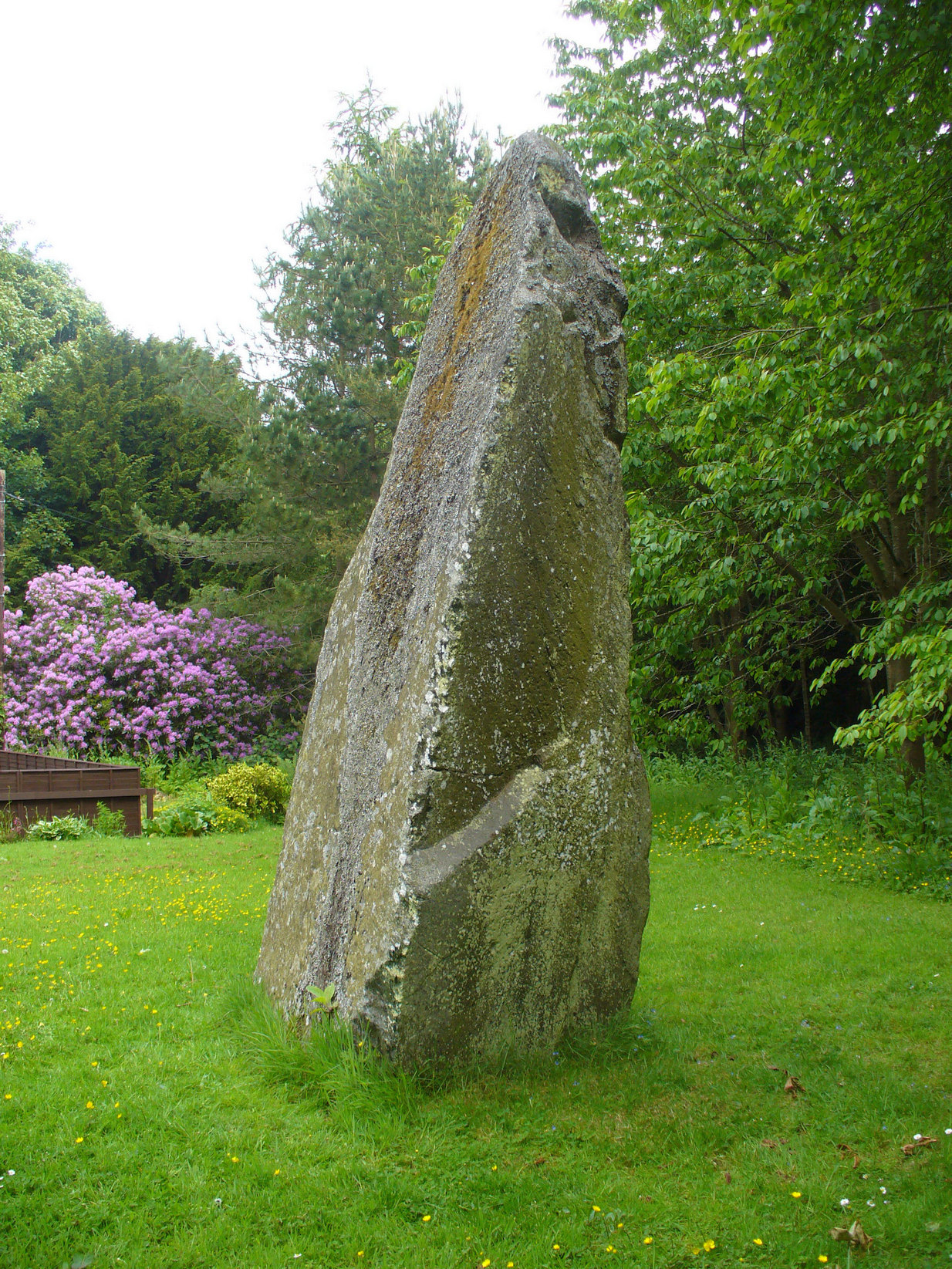
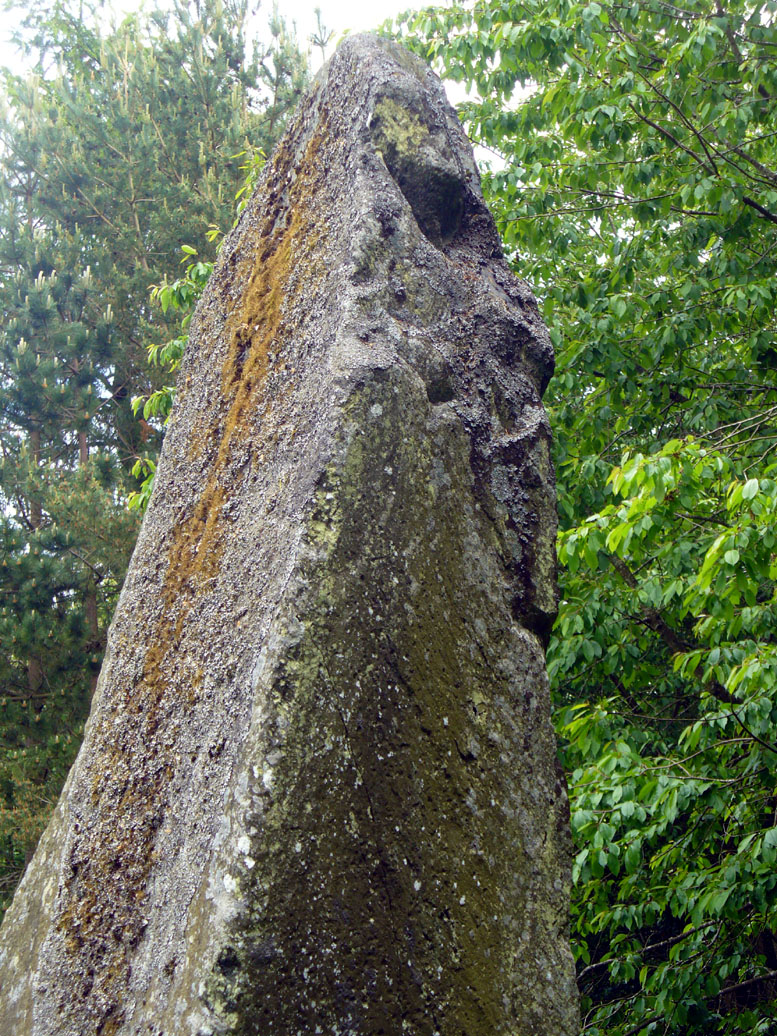
This is a magnificent site. A giant of a stone. Almost the effigy of a King, petrified, awaiting one day to awaken and get the people behind him! It has that feel of awe and curiosity that some of us know very well at these less-visited, quieter megalithic places. Its title has been an interchange between the Scottish King MacBeth and the witches who played so much in his folklore, mixed into more realistic local traditions of other heathen medicine-women of olde…
The first account of this giant standing stone came from the travelling pen of Thomas Pennant (1776) who, in his meanderings to the various historical and legendary sites of Meigle district, wrote that
“In a field on the other side of the house is another monument to a hero of that day, to the memory of the brave young Seward, who fell, slain on the spot by MacBeth. A stupendous stone marks the place; twelve feet high above ground, and eighteen feet and a half in girth in the thickest place. The quantity below the surface of the Earth is only two feet eight inches; the weight. on accurate computation amounts to twenty tons; yet I have been assured that no stone of this species is to be found within twenty miles.”
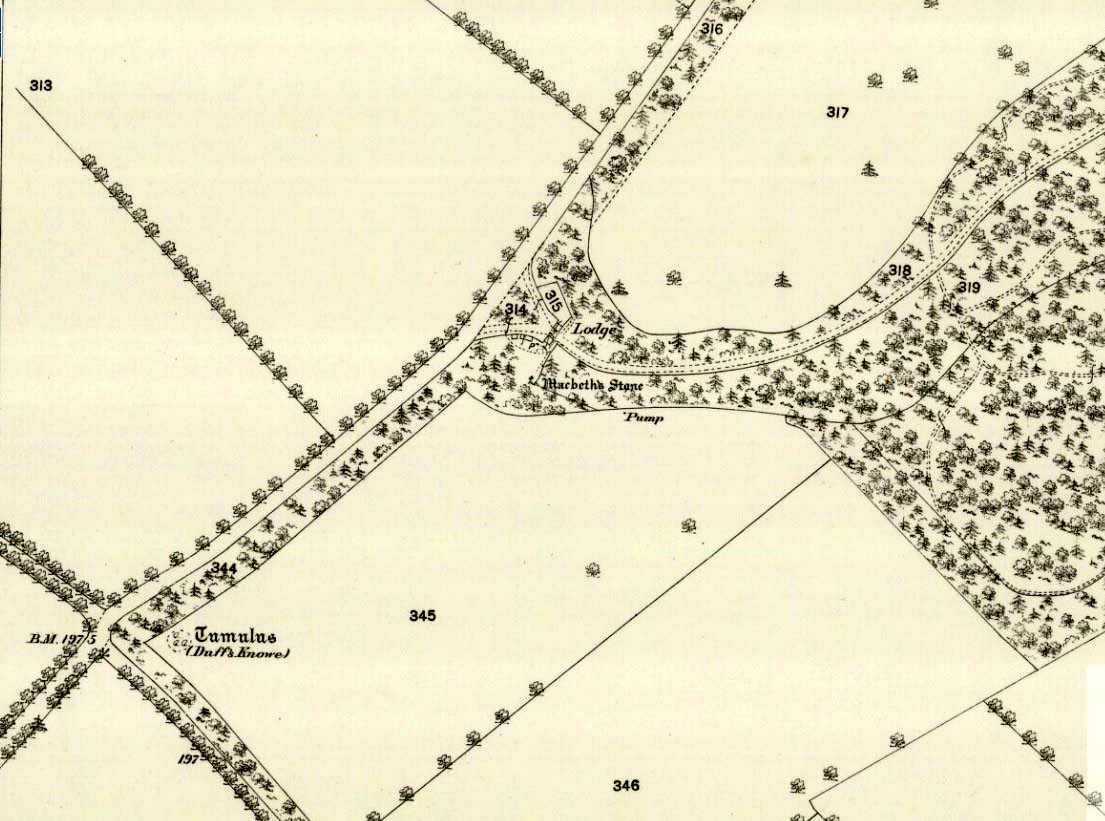
Site shown on 1867 mapA human & MacBeth!
It was visited by the Ordnance Survey lads in 1863, several years after one Thomas Wise (1855) had described the monolith in an article on the nearby hillfort of Dunsinane. But little of any substance was said of the stone, and this is something that hasn’t changed for 150 years, despite the huge size of this erection! Local historians make mention of it in their various travelogues, but the archaeologists haven’t really given the site the attention it deserves. Even the Royal Commission (1994) report was scant; and apart from suggesting it to have a neolithic provenance, they merely wrote:
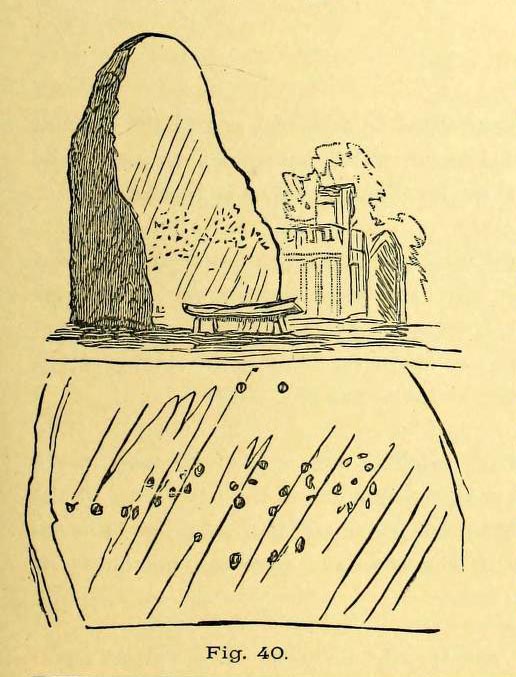
“Rectangular in cross-section, the stone tapers to a point some 3.6m above the ground; each of its sides is decorated with cupmarks, as many as forty occurring on the east face and twenty-four on the west.”
East face of MacBethMacBeth Stone (Wise 1884)
Thankfully, the fact that there are cup-markings on the stone has at least given it the attention it deserves amongst the petroglyph students. The first account of the cup-markings seem to have come from the pen of Sir James Simpson (1867) who mentions them, albeit in passing, in his seminal work on the subject. A few years later however, the same Thomas Wise visited MacBeth’s Stone again, and not only described the carvings, but gave us our first known illustration in his fascinating History of Paganism (1884). He told it to be,
“A large boulder, some 12 tons in weight, situated within the policies of Belmont Castle, in Strathmore, Perthshire…is supposed to have been erected on the spot where MacBeth was slain. Two feet above the ground this boulder has a belt of cups of different sizes, and in irregular groups. None of these cups are surrounded by incised circles or gutters. This boulder was probably intended for some sacred purpose, as it faces the SE.”
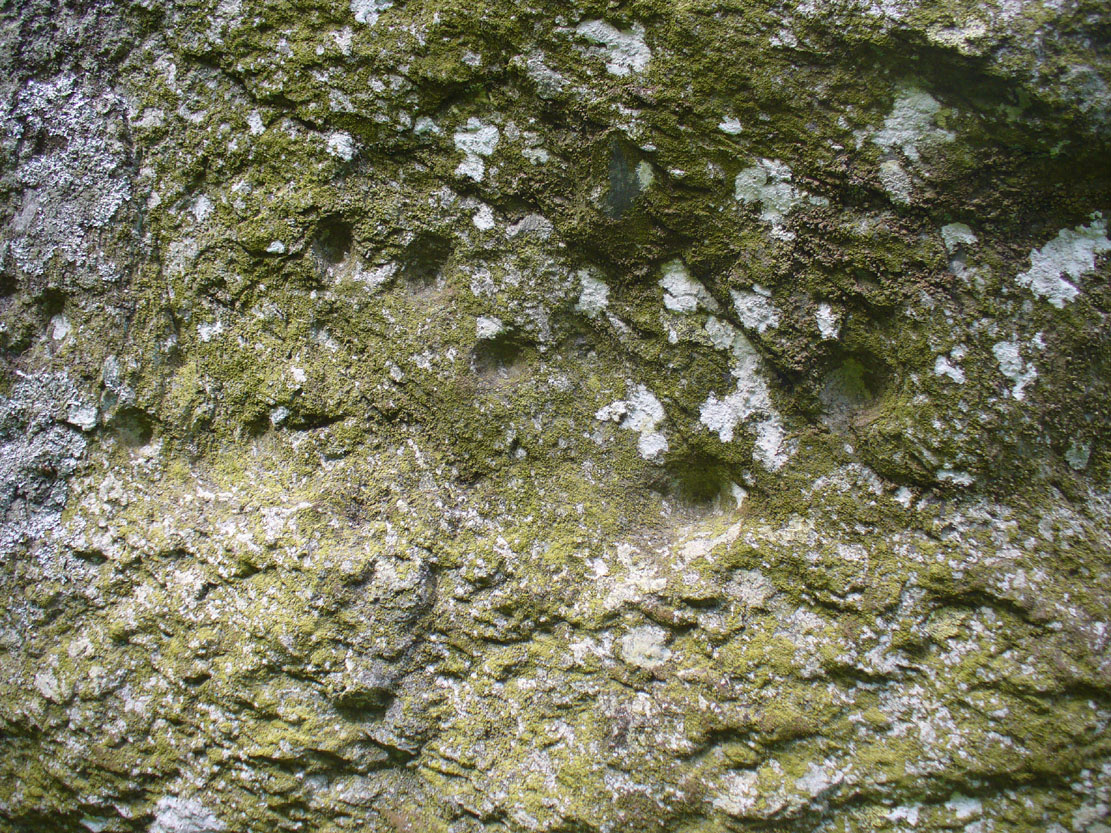
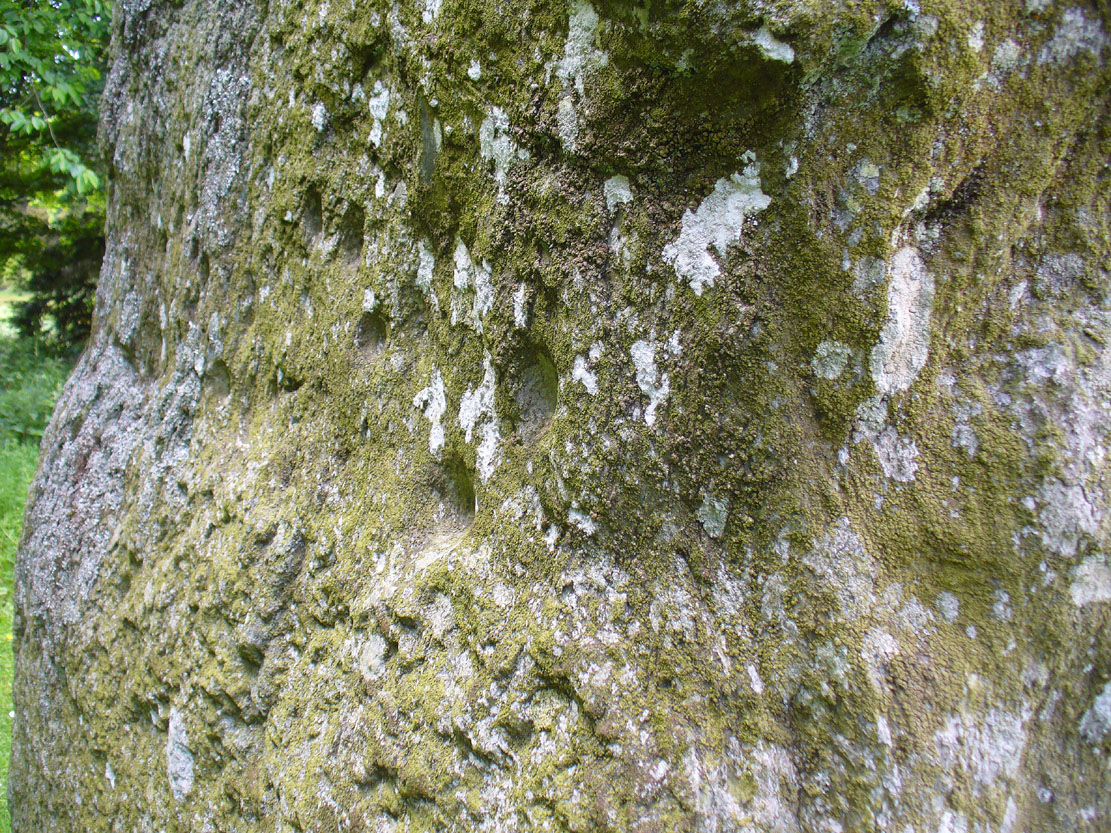
Running almost around the middle of the standing stone, on all four sides, are the great majority of the cup-markings (no rings or additional lines are visible). They were very obviously etched into the stone after it had been erected, not before. This is in stark contrast to the cup-and-rings found on the standing stones at Machrie, Kilmartin and elsewhere, where we know the carvings were done before the stones were stood upright.
Cup-marks on west sideCup-marks on west face
On the northern face of the stone is one possible cup-marking, and three of them are etched onto its south face; but the majority of them, forty, are on its western face, and twenty-five on its eastern side. The great majority of them on the east and west sides occur roughly in the middle of the stone, almost like a ‘belt’ running across its body. Those on the eastern face are difficult to discern as a thick layer of lichens covers this side, so there may be even more beneath the vegetation.
One of the notable features of the monoliths across this region, and echoed again here, is that one side of the standing stone is smooth and flat—and here in the case of MacBeth’s Stone, the flat face is the eastern one. Whether this feature was deliberately intended (it seems to have been) and what it might imply, we can only guess. It might simply relate to the geophysics of the stone, making it easy to crack horizontally….
The ‘face’ in the top of the stoneClose-up of Macbeth’s face
Another fascinating feature at this site was noticed by Nina Harris of Organic Scotland. Meandering around the stone in and out of the trees, she called our attention to a fascinating simulacra when looking at the upper section of the stone on its southern side. At first it didn’t seem clear – but then, as usual, the more you looked, the more obvious it became. A very distinct face, seemingly male, occurs naturally at the top of the stone and it continues as you walk around to its heavily cup-marked western side. It’s quite unmistakable! As such, it has to be posited: was this simulacra noticed by the people who erected this stone and seen as the spirit of the rock? Did it even constitute the reason behind its association with some ancestral figure, whose spirit endured here and was petrified? Such a query is neither unusual nor outlandish, as every culture on Earth relates to such spirit in stones where faces like this stand out.
But whatever your opinion on such matters, when you visit this site spend some time here, quietly. Get into the feel of the place. And above all, see what impression you get from the stony face above the body of the stone. Tis fascinating…..
Folklore
Known locally as being a gathering place of witches, the site is still frequented by old people at certain times of the year, at night. The stone’s association with MacBeth comes, not from the King himself (whose death occurred many miles to the north), but one of his generals. In James Guthrie’s (1875) huge work on the folklore of this region, he told that this giant
“erect block of whinstone, of nearly twenty tons in weight…(is) said to be monumental of one of his chief officers”,
which he thought perhaps gave the tale an “air of probability about it.” But Guthrie didn’t know that this great upright was perhaps four thousand years older than the MacBeth tradition espoused! However, as Nick Aitchison (1999) pointed out in his singular study of the historical MacBeth,
“another MacBeth was sheriff of Scone in the late twelfth century and it is possible that he, and not MacBeth, King of Scots, is commemorated in the name.”
He may be right. Or it the name may simply have been grafted onto the stone replacing a more archaic relationship with some long forgotten heathen elder. We might never know for sure.
When Geoff Holder (2006) wrote about the various MacBeth sites in this area, he remarked that the folklore of the local people was all down to the pen of one Sir John Sinclair, editor of the first Statistical Account of the area—but this is a gross and probably inaccurate generalization. Nowhere in Holder’s work (or in any of his other tomes) does he outline the foundations of local people’s innate subjective animistic relationship to their landscape and its legends; preferring instead, as many uninformed social historians do, to depersonalise the human/landscape relationships, which were part and parcel of everyday life until the coming of the Industrial Revolution. Fundamentally differing cultural, cosmological and psychological attributes spawned many of the old myths of our land, its megaliths and other prehistoric sites. It aint rocket science! Sadly, increasing numbers of folklore students are taking this “easy option” of denouncement, due to educational inabilities. It’s about time researchers started taking such misdirected students to task!
References:
Aitchison, Nick, MacBeth – Man and Myth, Sutton: Stroud 1999.
Coutts, Herbert, Ancient Monuments of Tayside, Dundee Museum 1970.
Royal Commission on the Ancient & Historical Monuments of Scotland, South-East Perth: An Archaeological Landscape, HMSO: Edinburgh 1994.
Simpson, James, Archaic Sculpturings of Cups, Circles, etc., Upon Stones and Rocks in Scotland, England and other Countries, Edmonston & Douglas: Edinburgh 1867.
Acknowledgements: With huge thanks to Paul Hornby for his help getting me to this impressive monolith; and to Nina Harris, for prompting some intriguing ideas.
A little-known, but once important site in the mythic history of Scotland, this Long Man’s Grave was said to be the spot where MacBeth—described by Aitchison (1999) as “Scotland’s foremost King”—died. It would seem that any remains of the stone which once stood here has gone. When Robert Chambers (1827) told of the site, he said that
“At the bottom of Dunsinnan Hill, on the east side, and near the west end of a drystone wall which runs along the side of the road from Baledgarno, is a large stone about eight feet in length, beneath which MacBeth is said to have been interred. It is usually called the Lang Man’s Graff, probably from a supposition that the stone was made to suit the length of the deceased.”
More than fifty years later when the Scottish historian Thomas Hunter (1883) wrote about the site, he thought that it had probably been a prehistoric one, telling that
“The tumulus, on being examined, proved to be a druidical stone that had toppled over, and no relic was discovered that could throw light on the tradition.”
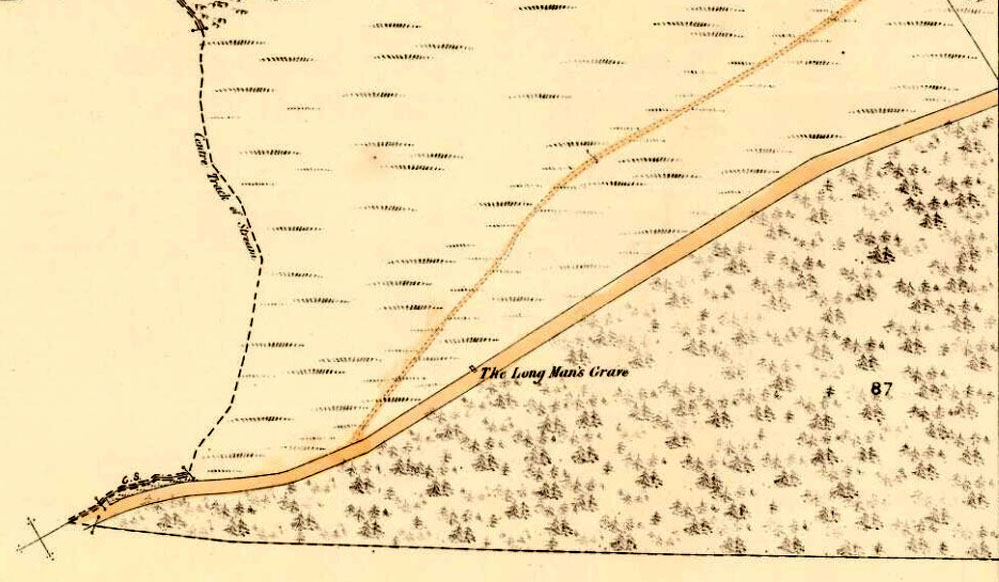
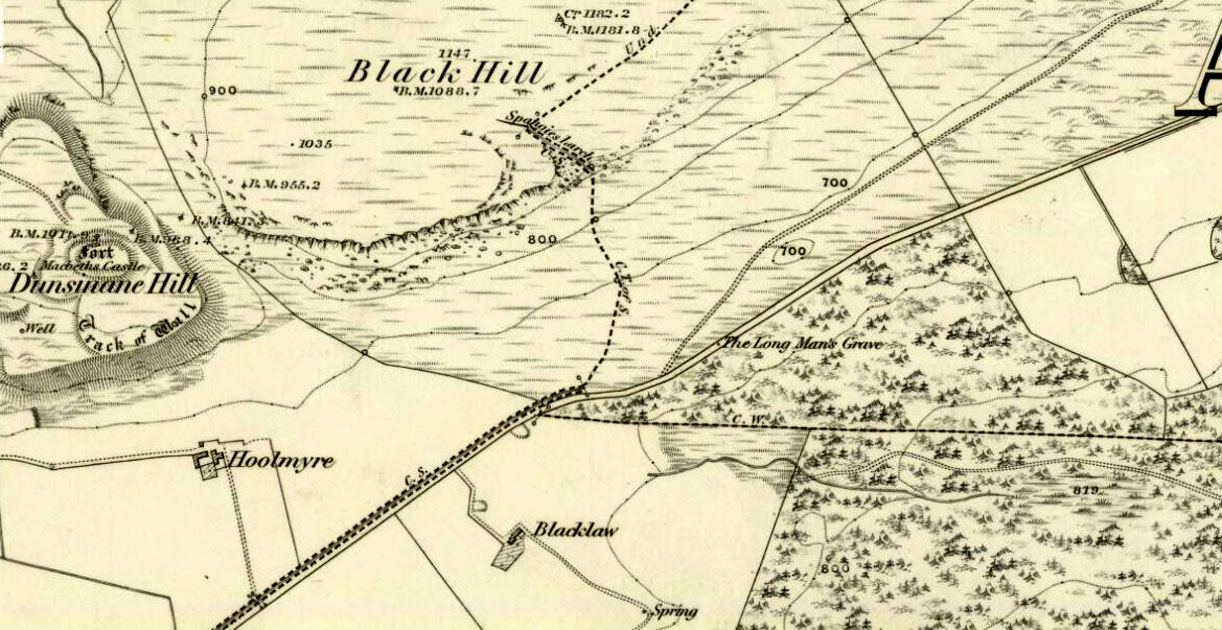
Long Man’s Grave on 1867 6-inch map
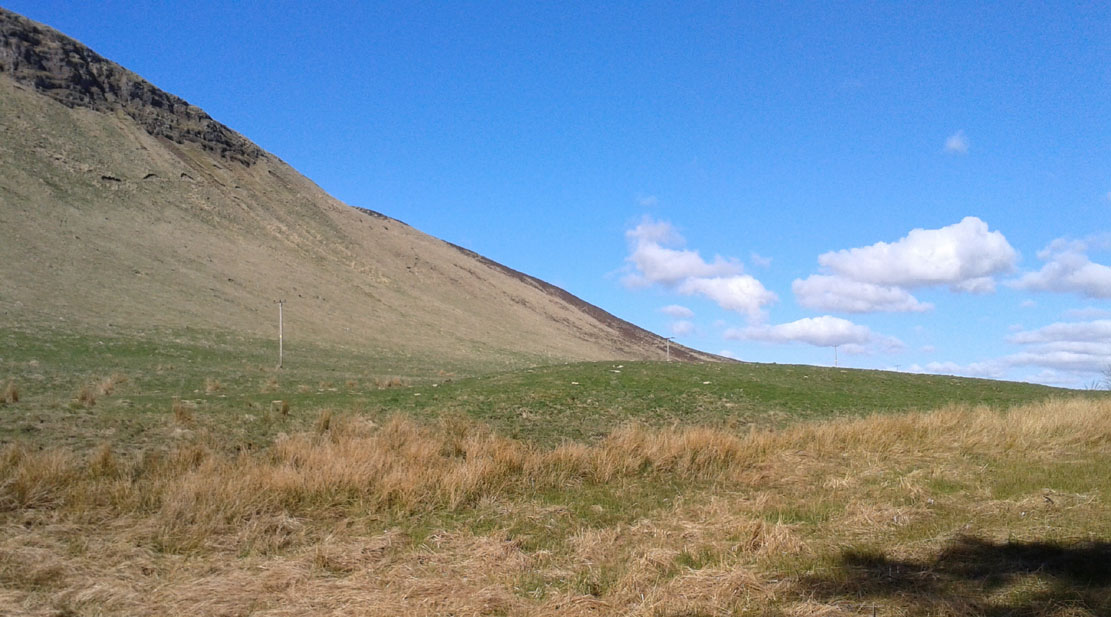
Site of the Long Mans Grave
The site was shown on the earliest OS-maps of the region (as highlighted here), but we don’t know for certain about the exact nature of the site. Although a bunch of lads from the Royal Commission popped along to see the place in 1969 and proclaimed (without excavation) that the stone was “probably a ‘grave slab’ and not a “standing stone” which has toppled over”, we have to treat their words with caution. Close by are the remains of Bronze Age stone circles; above us we have the prehistoric hillfort of Dunsinane, with even older neolithic remains being found within it; and we also have neolithic rock art remains nearby; other prehistoric tombs, and plenty more besides…
Folklore
Echoing the early folklore of the site as narrated by local people, Hunter (1883) told that,
“the tradition of the district is that MacBeth, finding it impossible to escape from MacDuff, threw himself from the top of the (Dunsinane) Hill, was killed upon the rocks, and buried at the ‘Lang Man’s Grave’.”
References:
Aitchison, Nick, MacBeth – Man and Myth, Sutton: Stroud 1999.
Take the A85 road between Comrie and Crieff. Nearly 1.7 miles (2.7km) east out of Comrie—or 4 miles (6.44km) west out of Crieff—keep your eyes peeled on the fields to the south-side of the road, below and across the mansion of Lawers House. Alongside a long but small plantation of trees you’ll see a large upright stone. You can walk along the track adjacent to the field and through the gate.
Archaeology & History
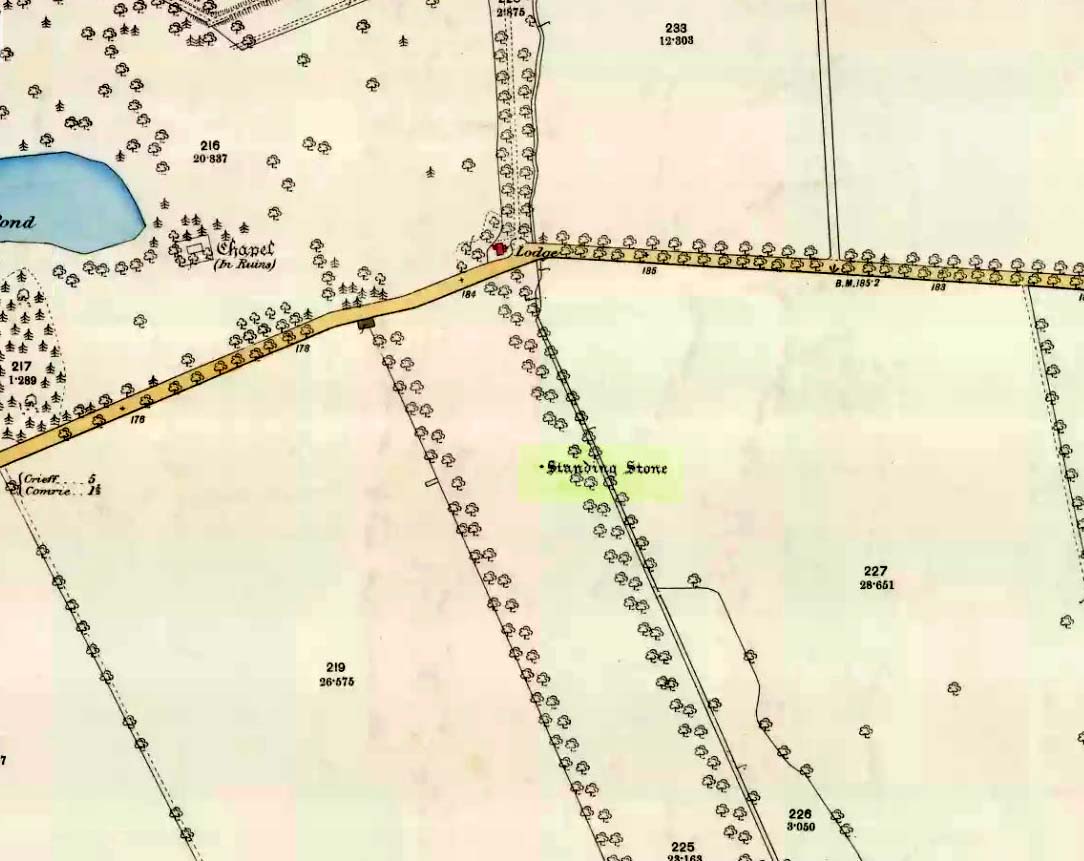
The stone on 1886 OS-map
Shown on the early Ordnance Survey maps of the area, this probably neolithic monolith was suggested by Fred Coles (1911) to have once been part of a larger megalithic circle—although Aubrey Burl (2000) didn’t consider it as a good enough contender to be listed as such in his gazetteer; and unless we can have some positive affirmation, either through folklore or excavation, we should maintain its status as a singular monolith. There is the possibility that it stood as an outlier or had some relationship with a nearby prehistoric tomb—but even this is contentious. Nevertheless, the stone itself is an impressive one!
Mr Coles curiously got the size of the old stone wrong too (although, we have to give him credit, as he did all of his work without electricity or any of our modern ‘stuff’). He wrote that:
“This massive boulder of whinstone is rounded at the base, where it girths 10 feet 3 inches, but tapers upwards to its apex of 5 feet 10 inches, with the eastern edge somewhat jagged and broken. Near its base on the west is a small slab-like fragment of stone, quite earthfast. The north and south surfaces are smooth and nearly vertical, and the longer axis is ESE 75º by WNW 75º.”
Fred Coles’ 1911 sketch
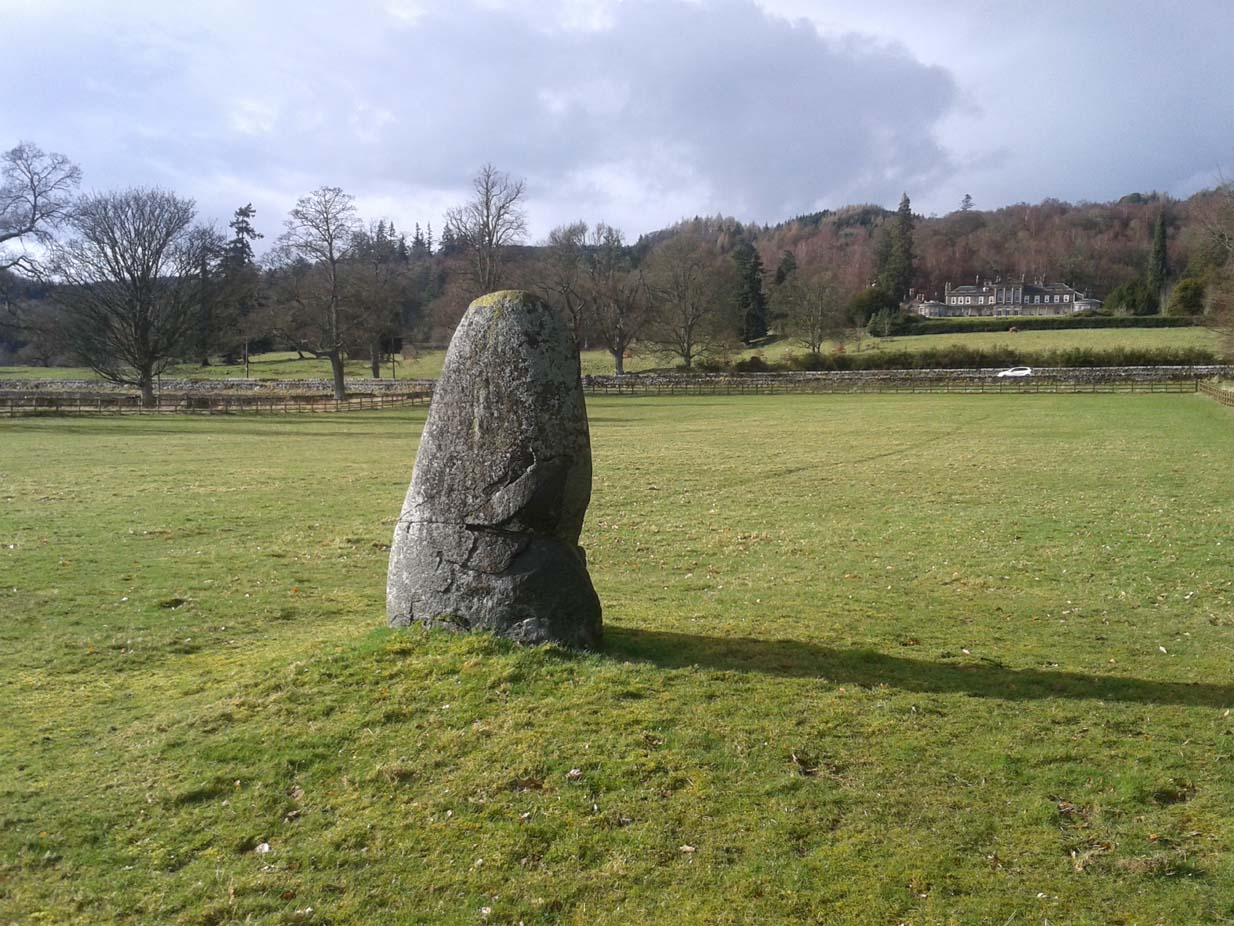
Lawers monolith, looking SE
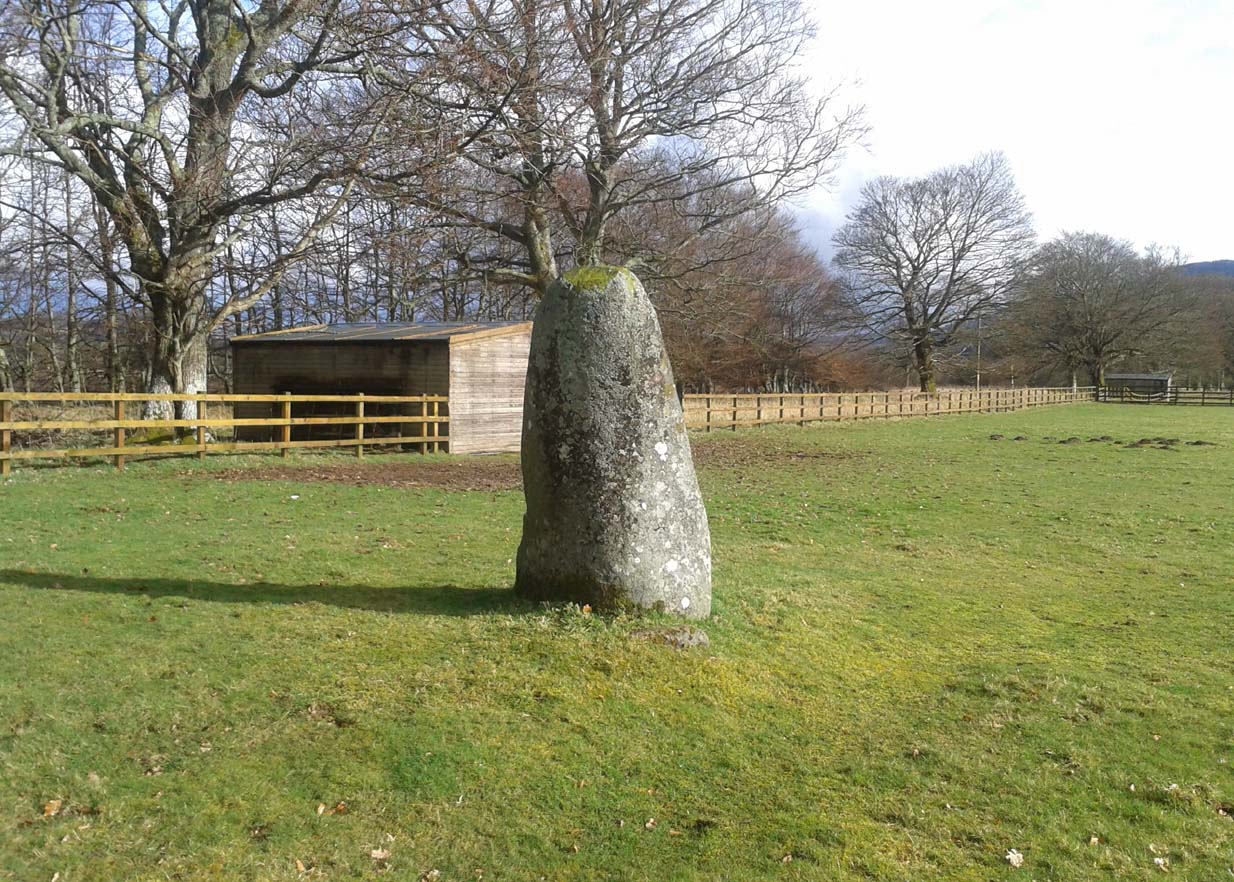
The stone is actually larger than Coles described, being more than 6 feet 6 inches tall. His sketch (right) “shows the stone from the east”, and is pretty much as we find it today. A notable crack in the stone along the southern face, about a third of the way up, suggests that the stone was broken at some time in the past.
Local architect Andrew Finlayson (2010) included the stone in his local megalith guide and noted how the axes of the stone, east-west, lines it up with Ben Halton to the west and The Knock to the east.
References:
Burl, Aubrey, The Stone Circles of Britain, Ireland and Brittany, Yale University Press 2000.