Ardoch (1), Fowlis Wester, Perthshire

Cup-and-Ring Stone:  OS Grid Reference – NN 91195 25511

Getting Here

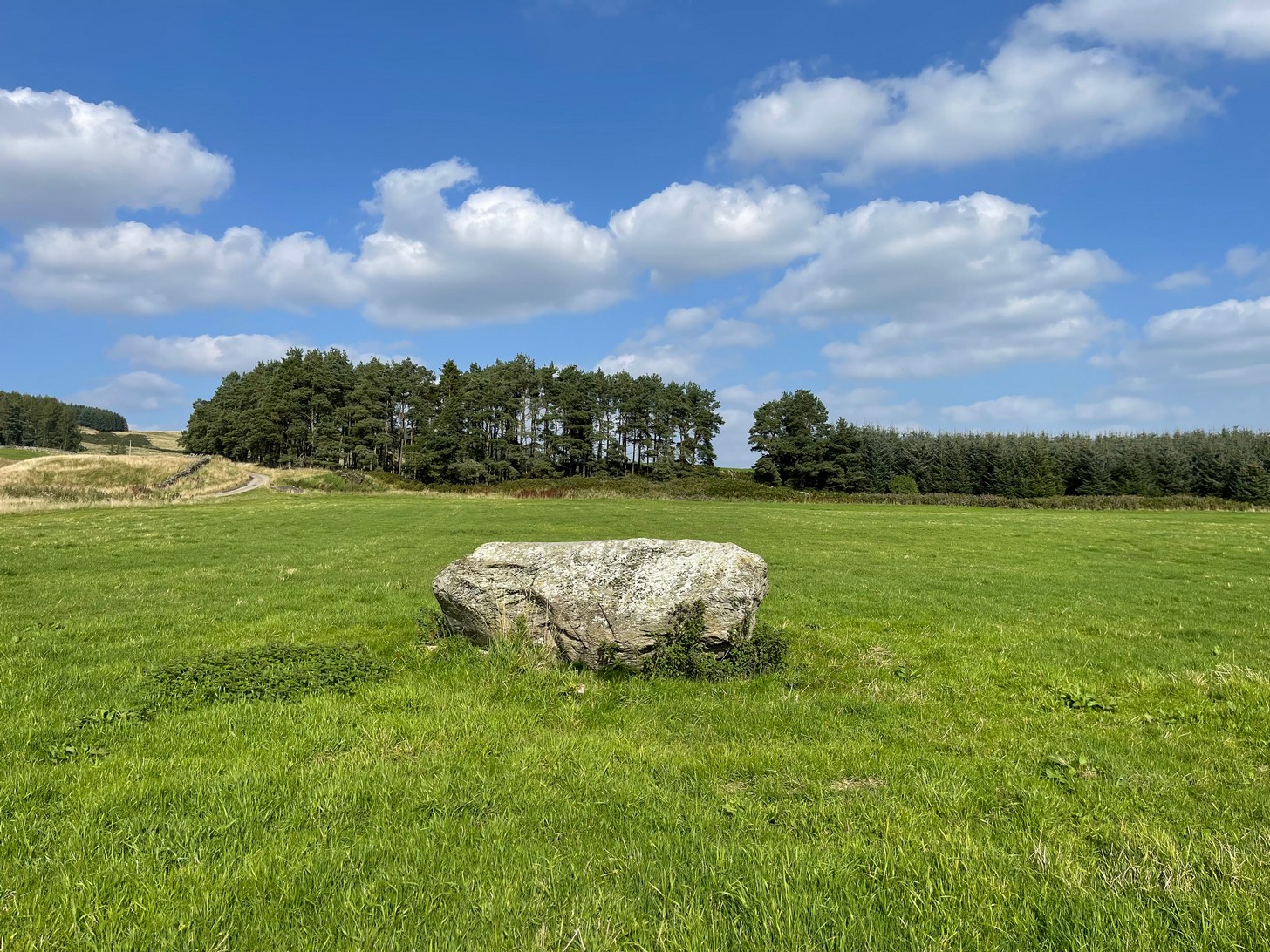
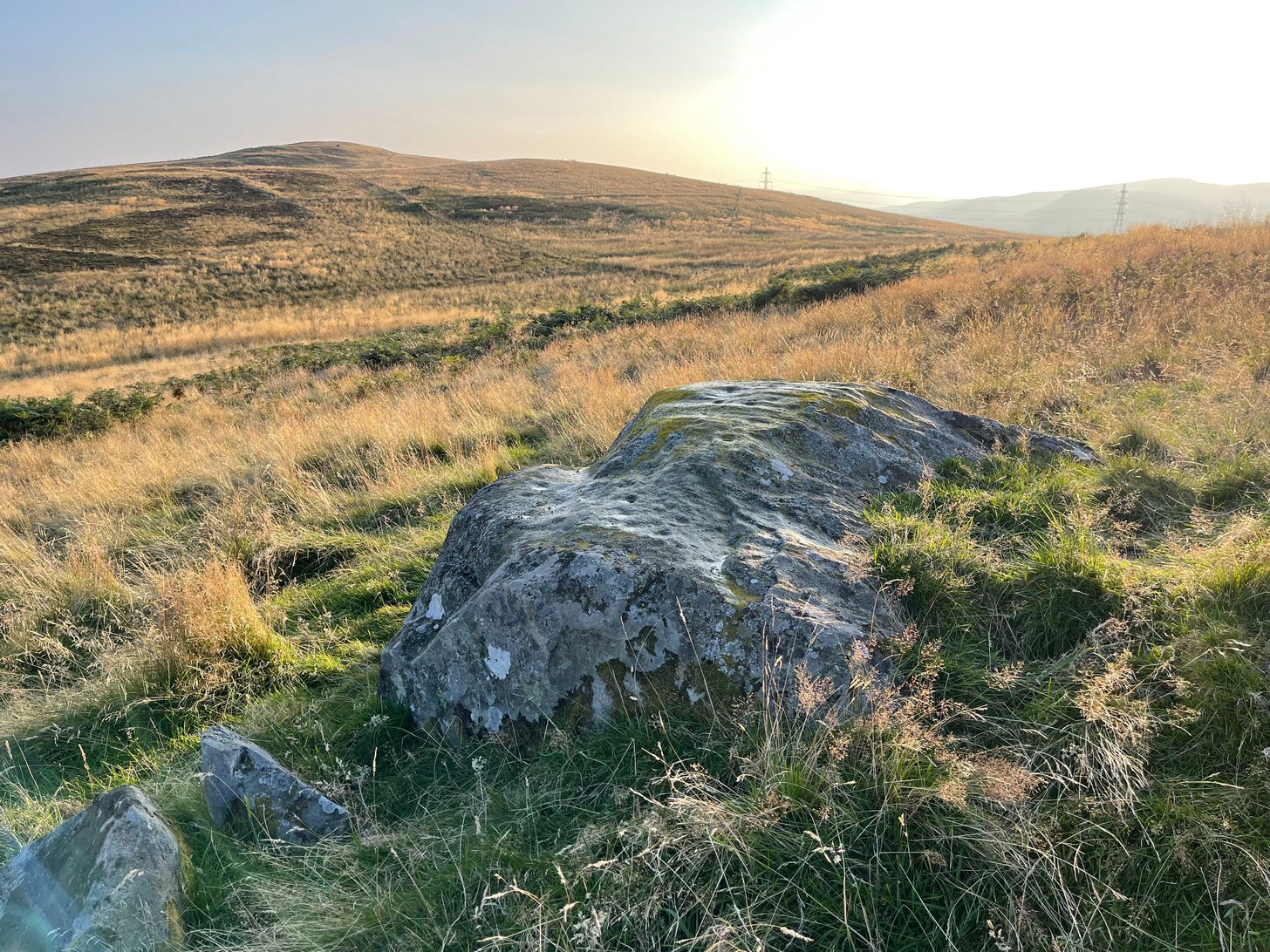
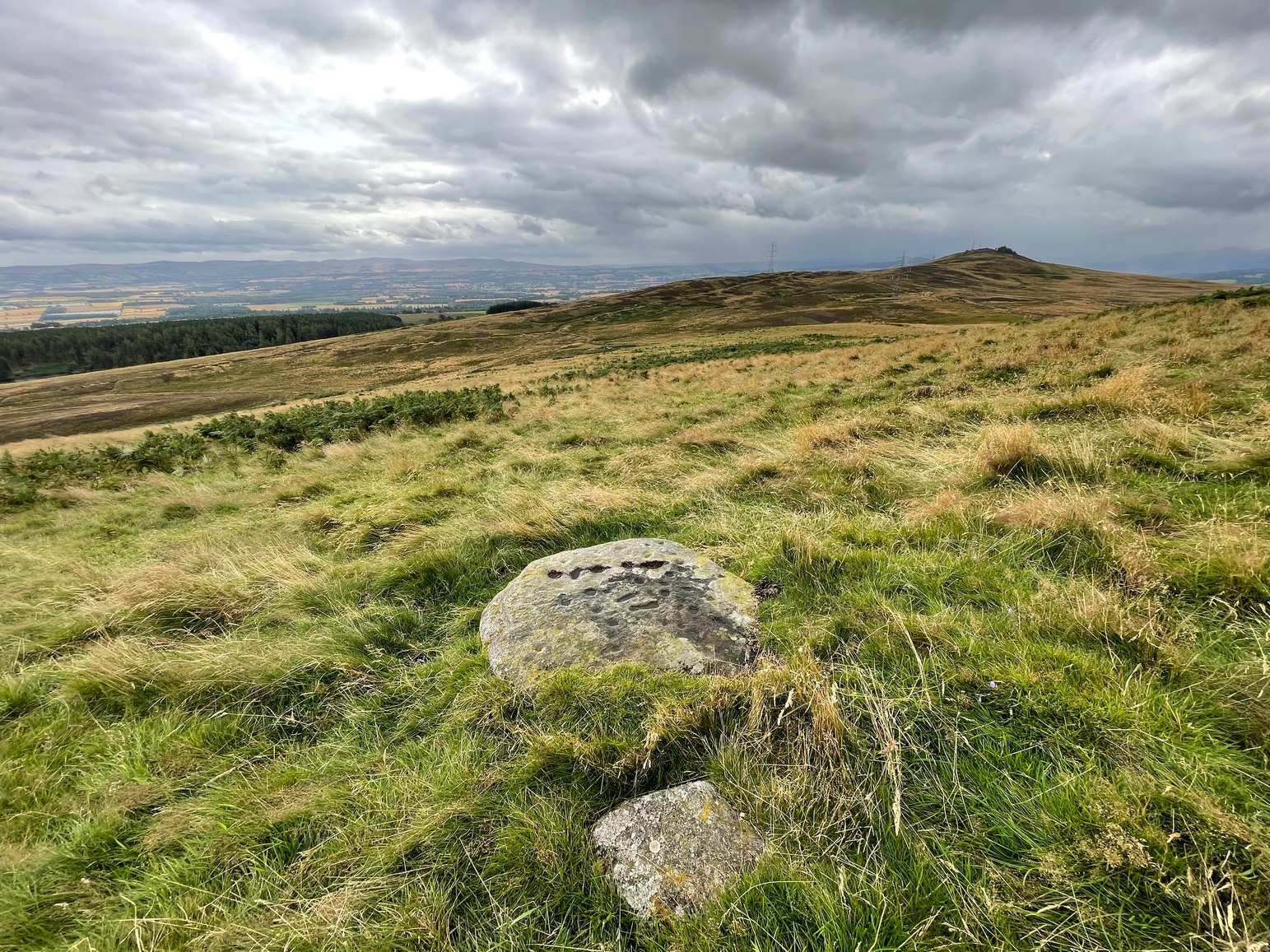
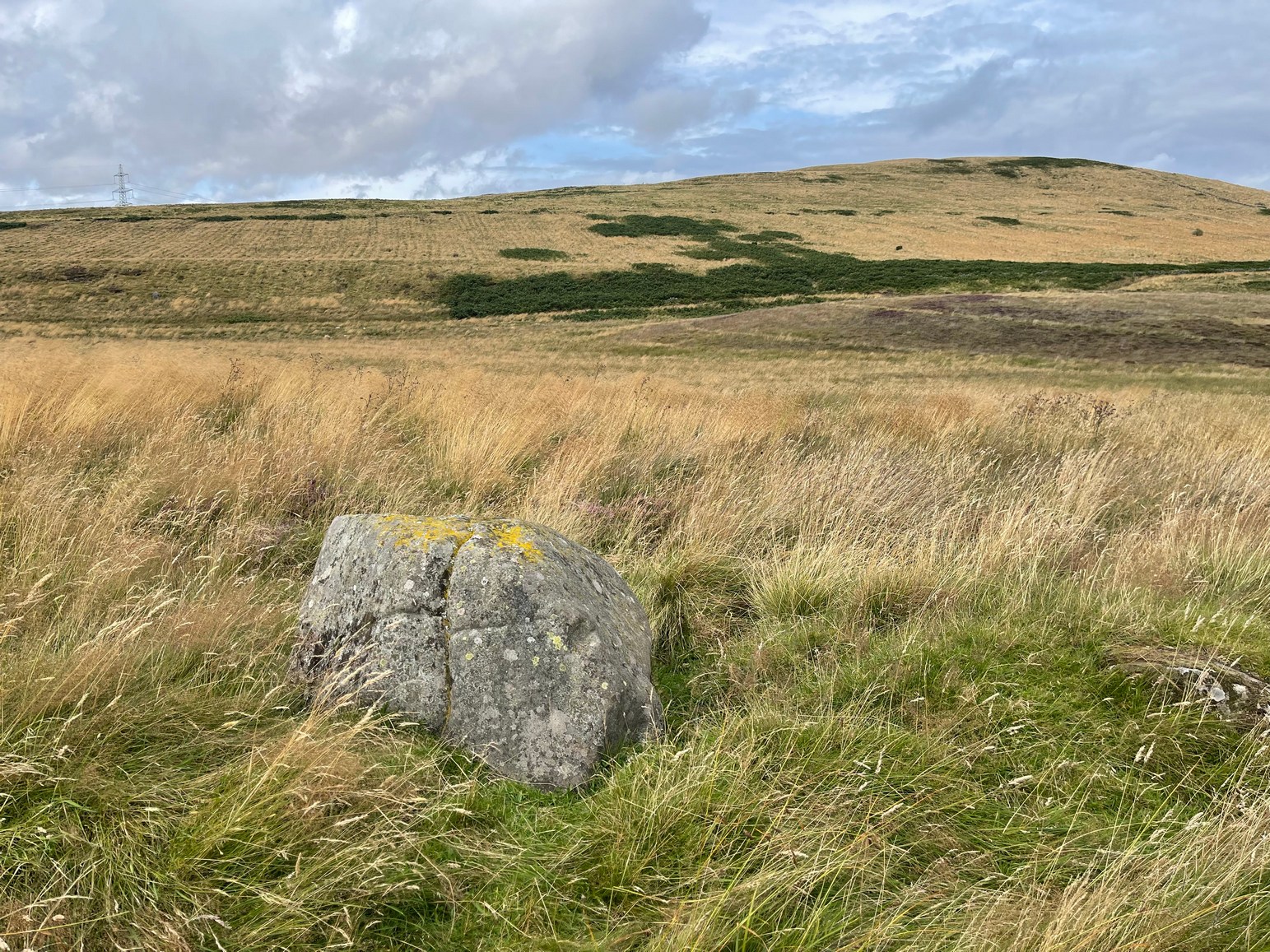
The Ardoch (1) stone

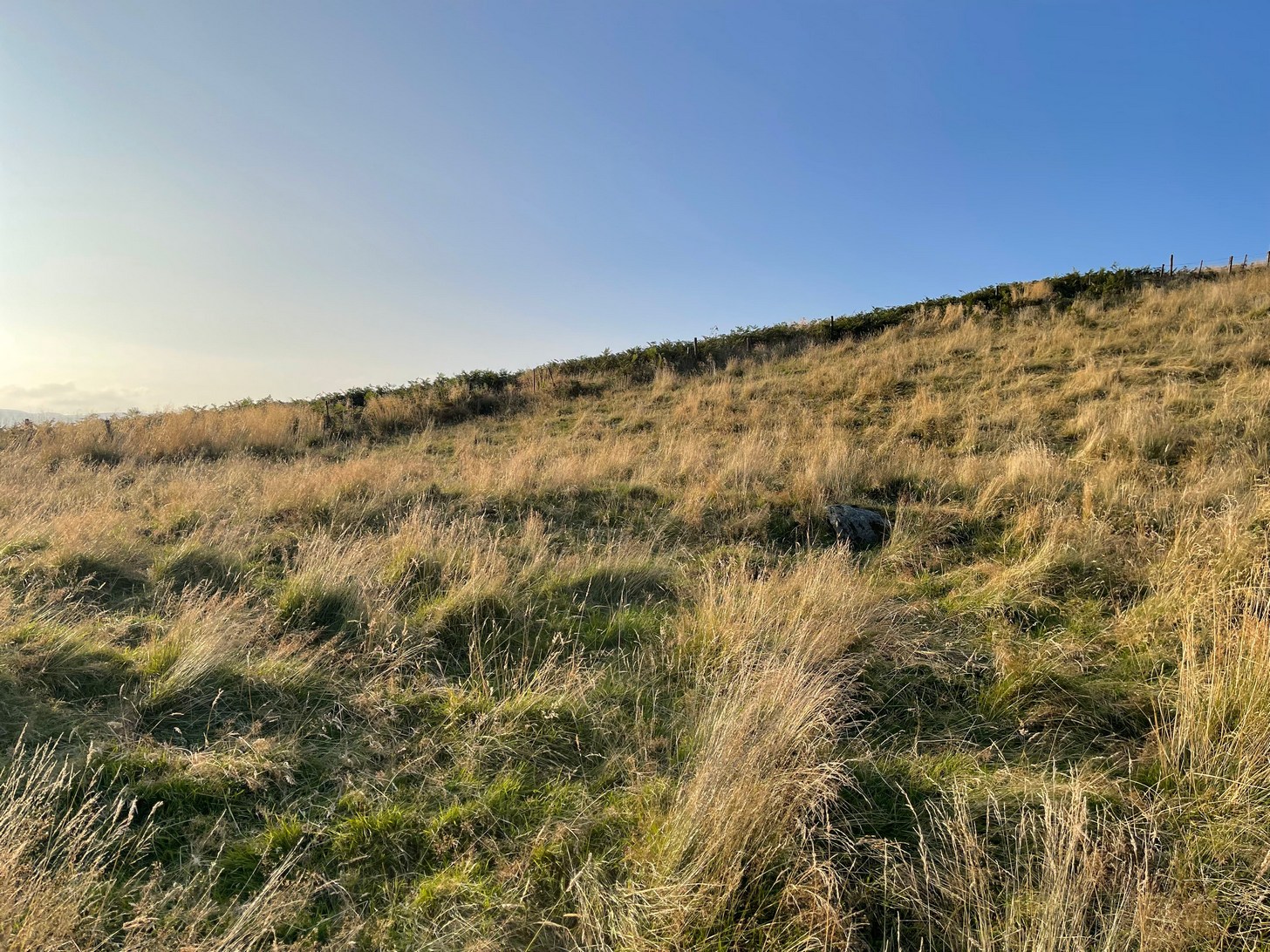
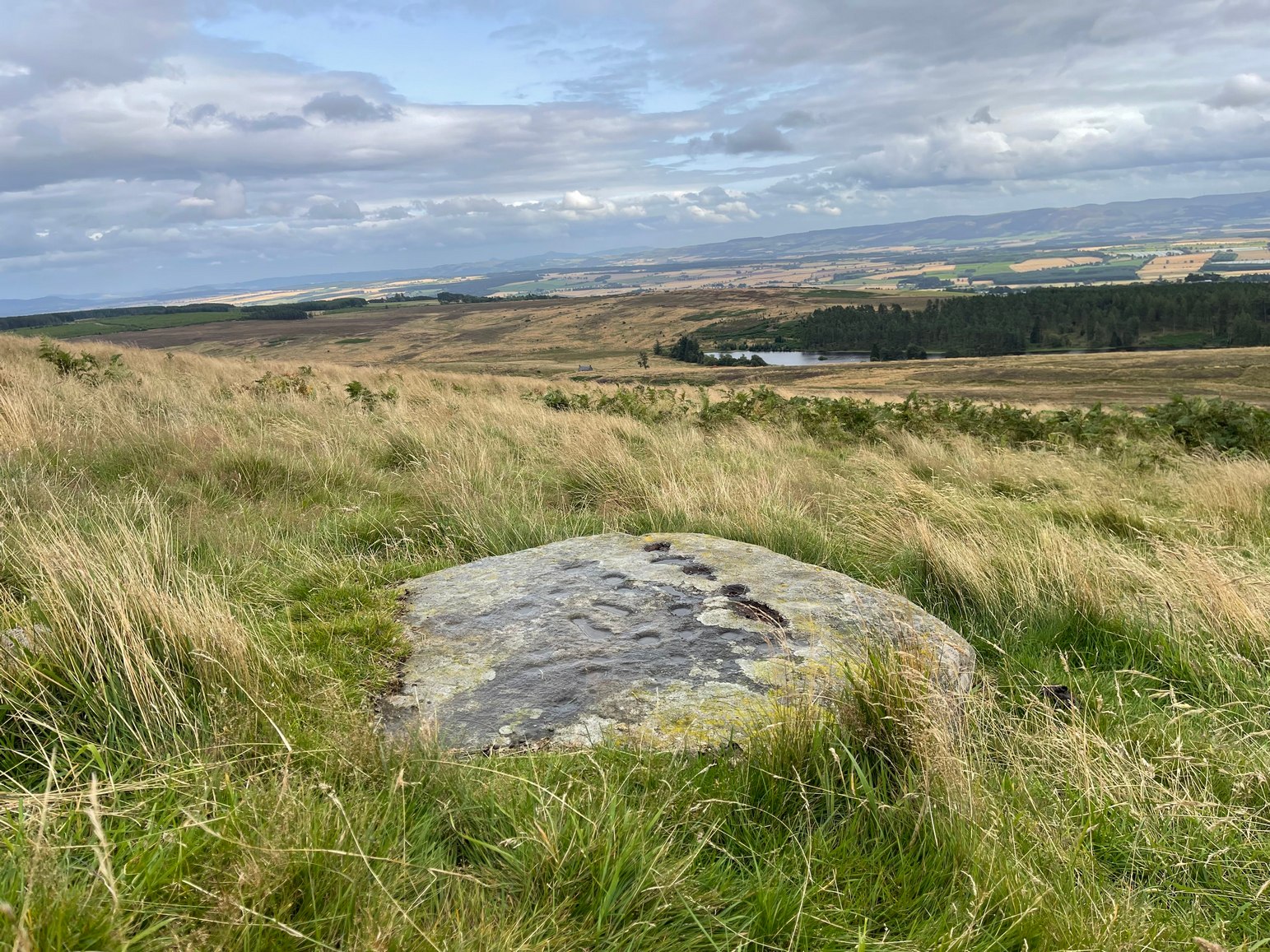
From Fowlis Wester village, head up the road for just over ½ a mile (veering sharp left at a junction) to the dusty car-park on the left-side of the road near the standing stones.  From here walk along the track, past the standing stones, veering right to go downhill and cross the burn by the loch near the ruins of Ardoch house; then keeping uphill on the track for another half-mile or so and, just before a split in the dirt-track, you’ll see a reasonably large rounded boulder just a few yards above the track on your right.  Y’ can’t really miss it!

Archaeology & History

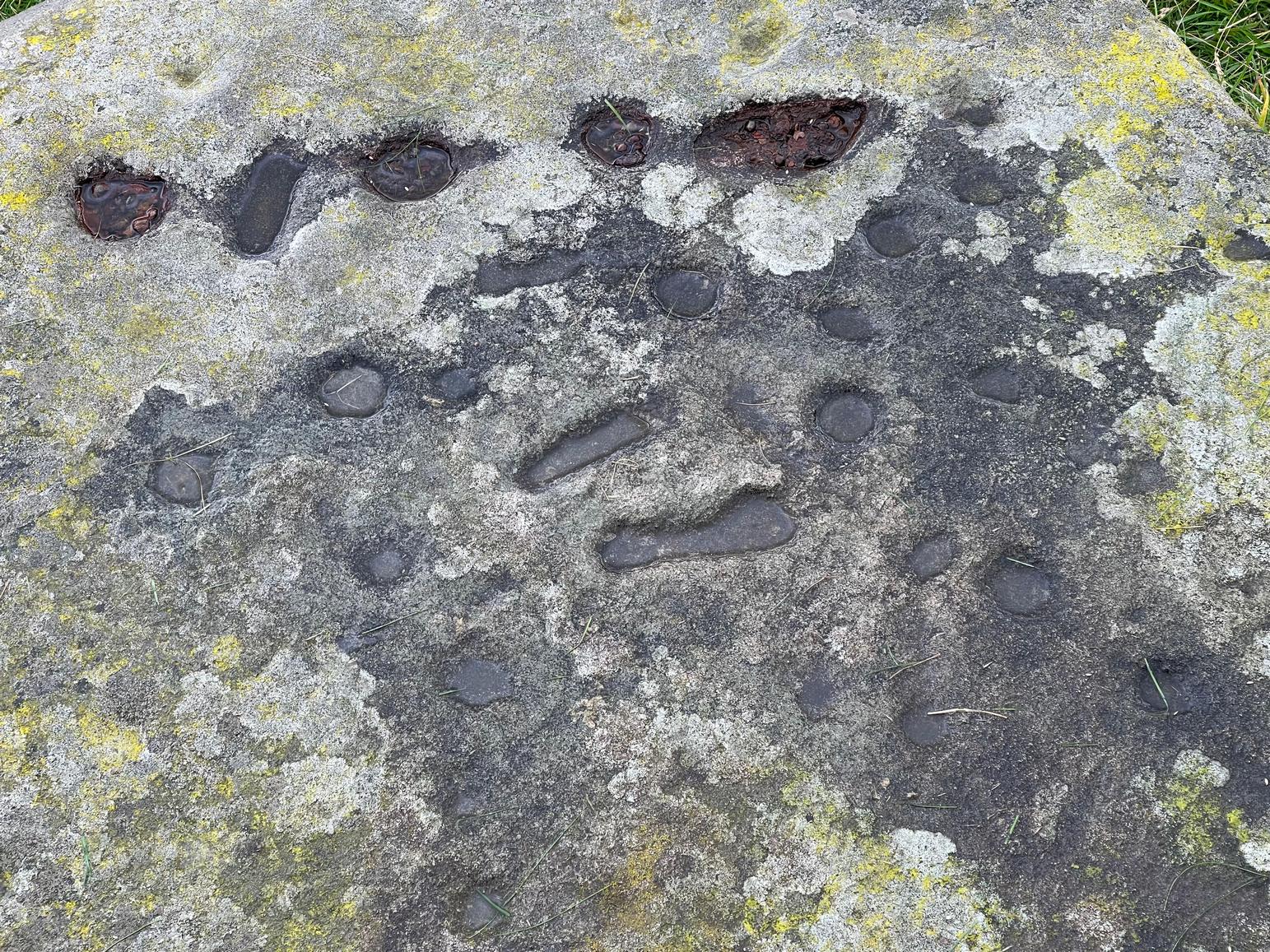
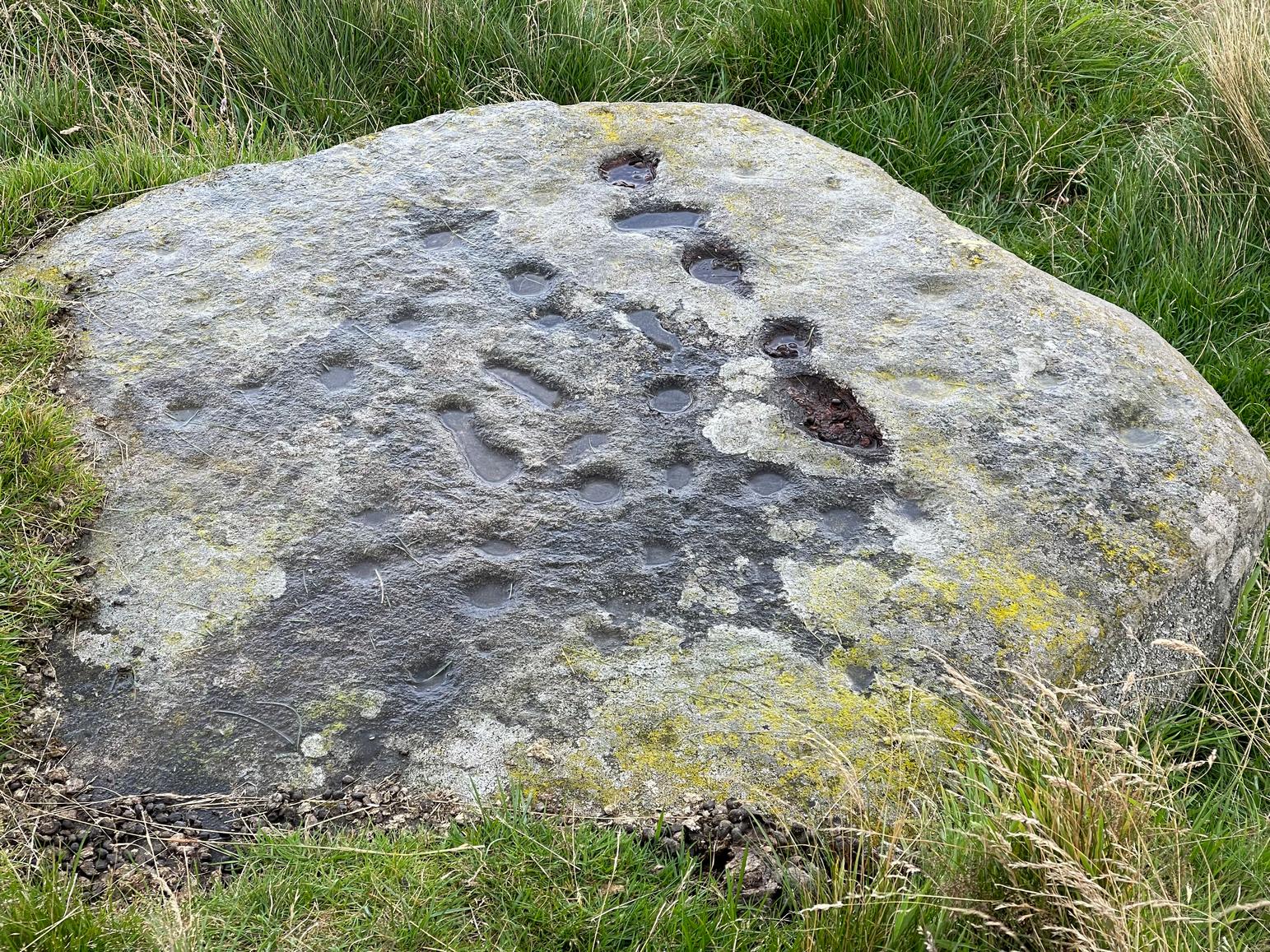
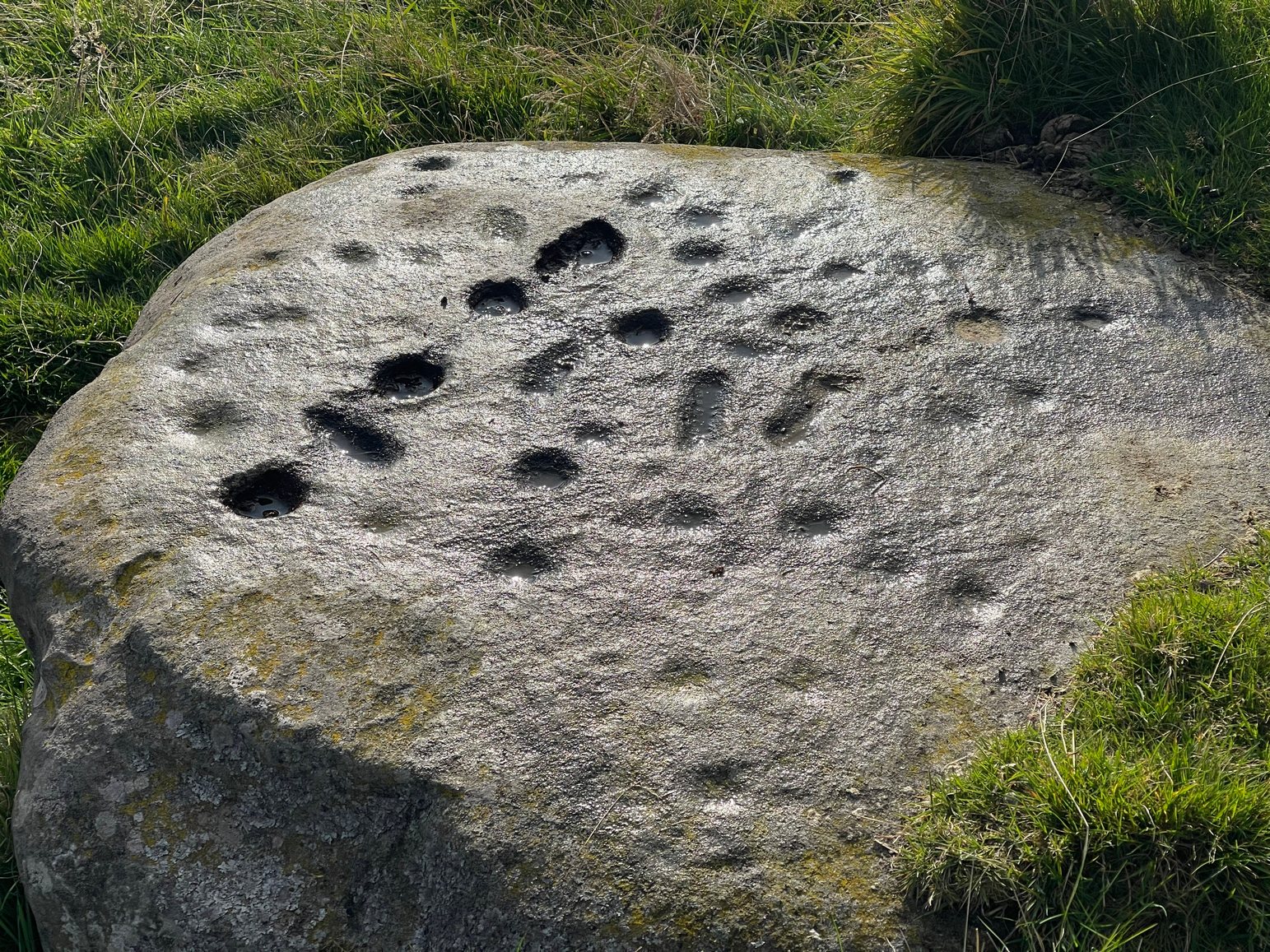
This previously unrecorded cup-and-ring carving was rediscovered a few years ago by local lady Fiona McLaren: an absolute fount of knowledge when it comes to ancient sites in this area. It’s a pretty basic carving but is certainly worth looking at on your way up to see the much more unusual petroglyph of Ardoch (2).

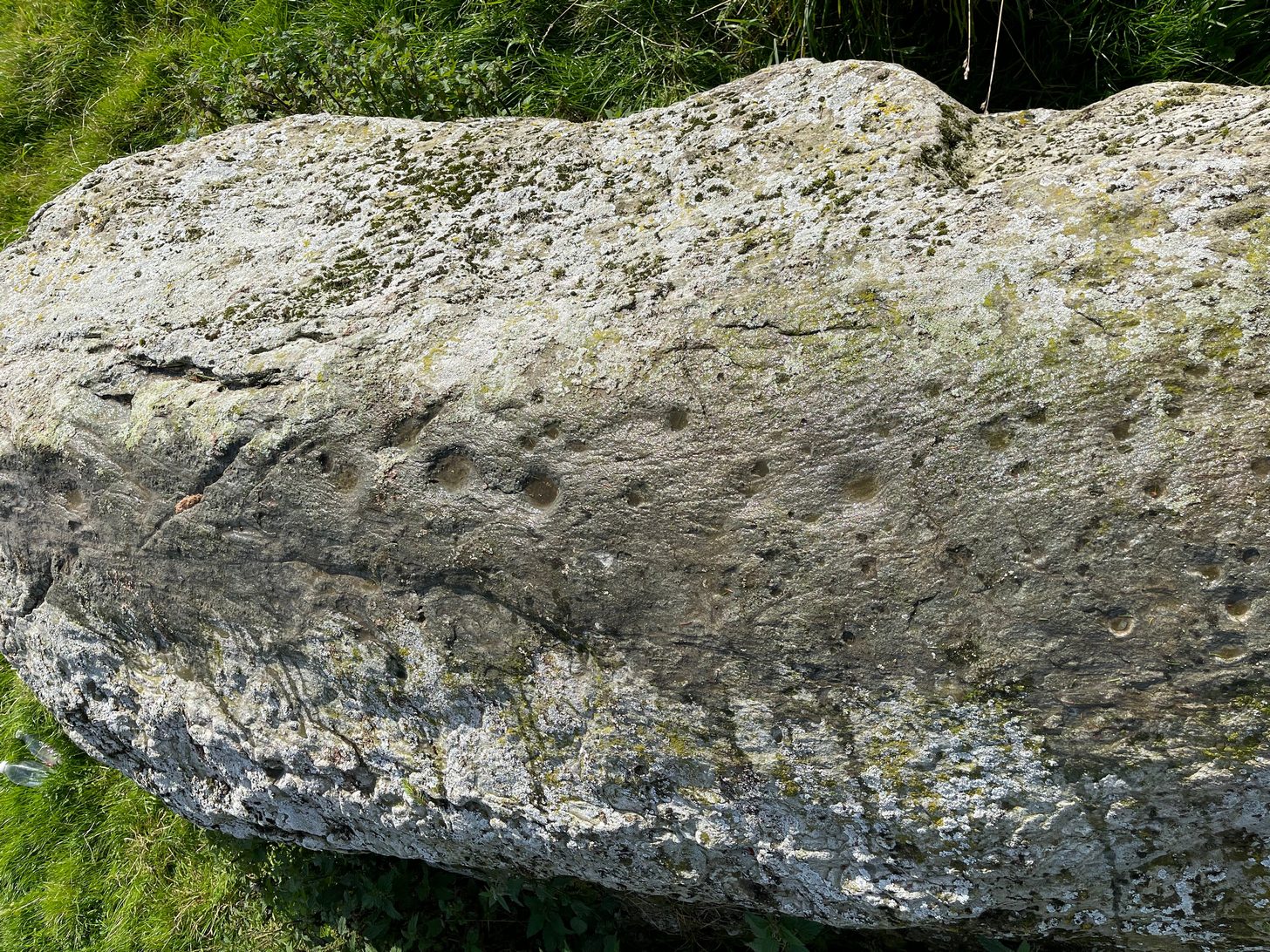
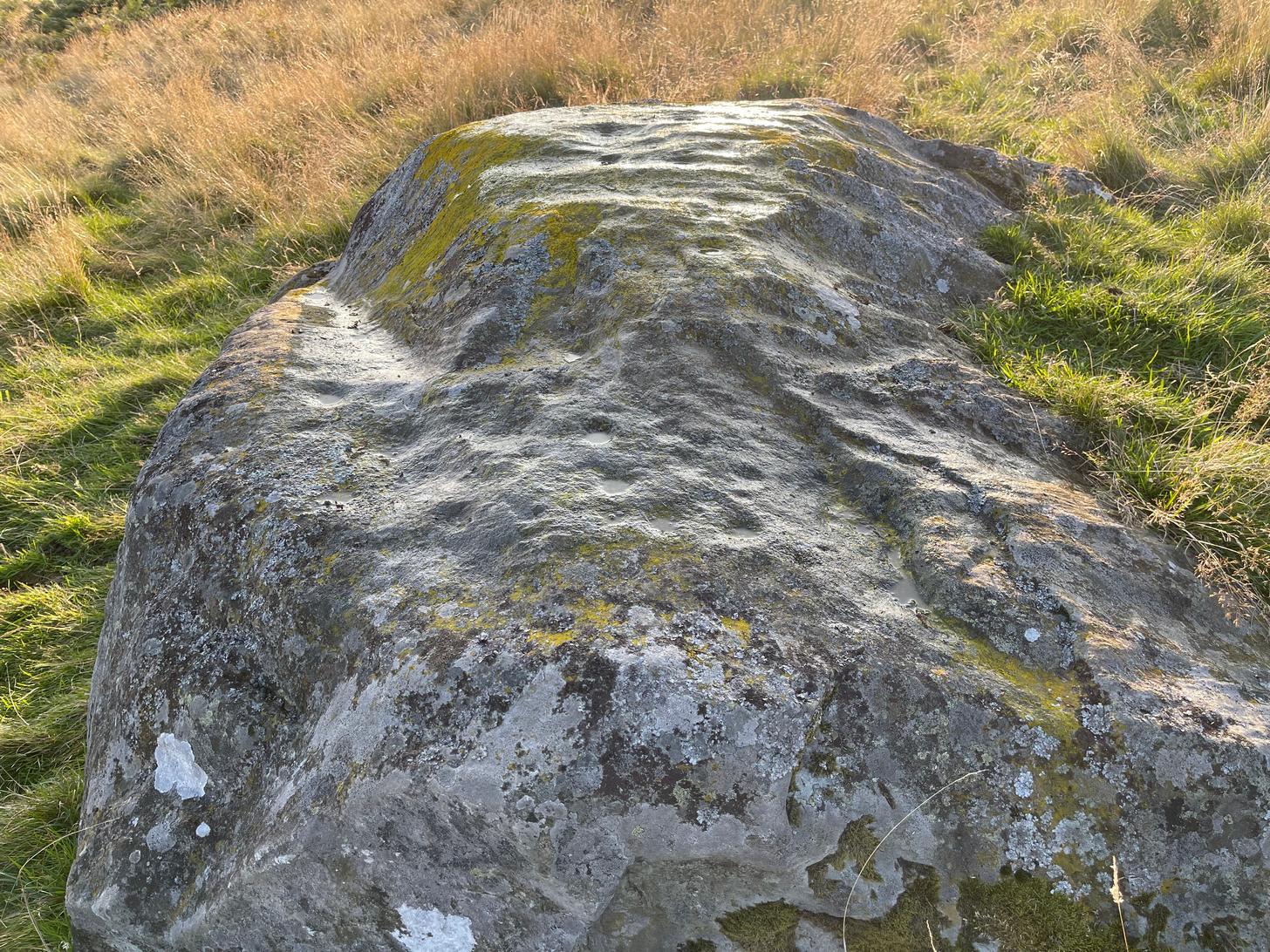
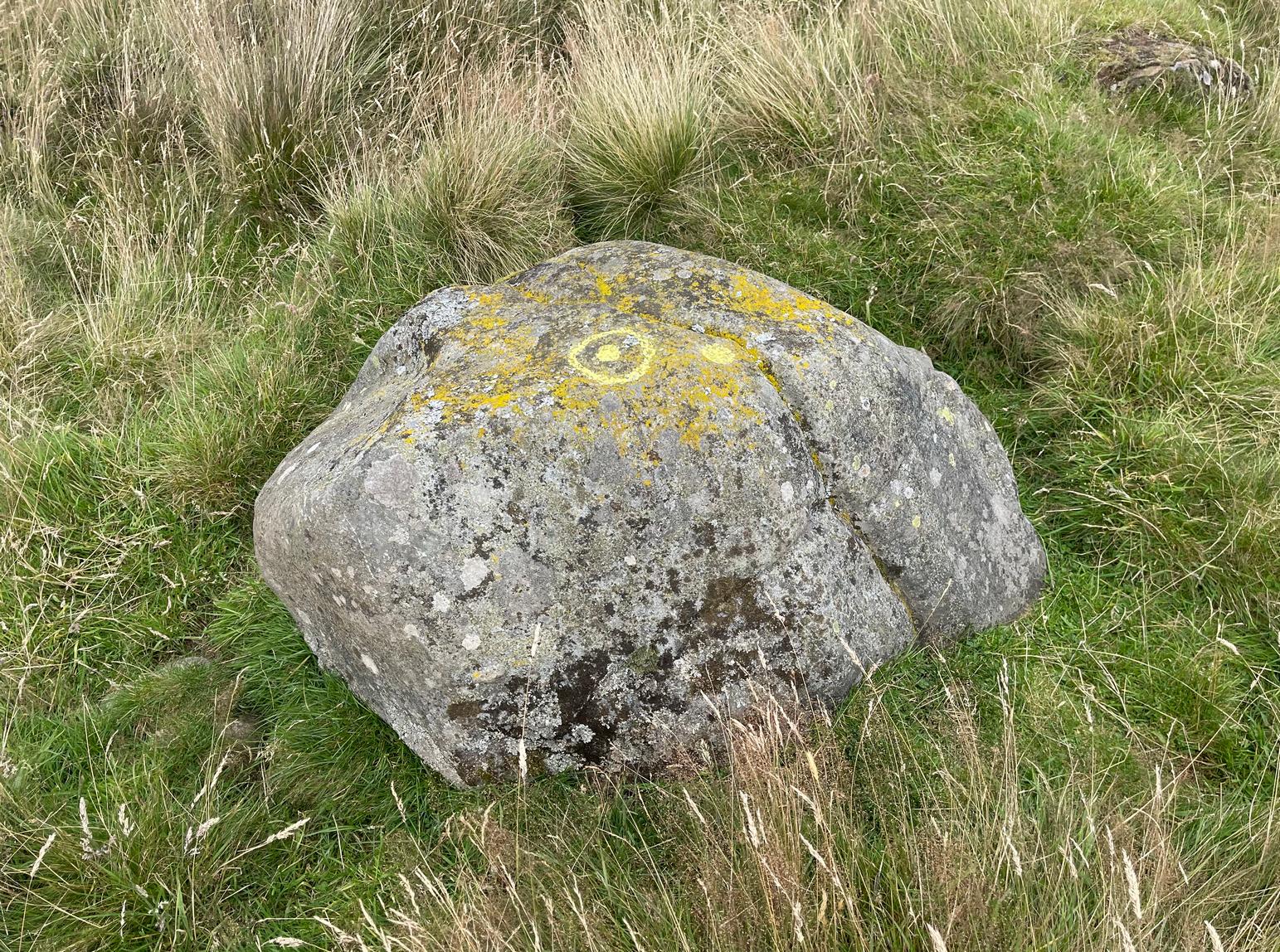
The cup&ring highlighted
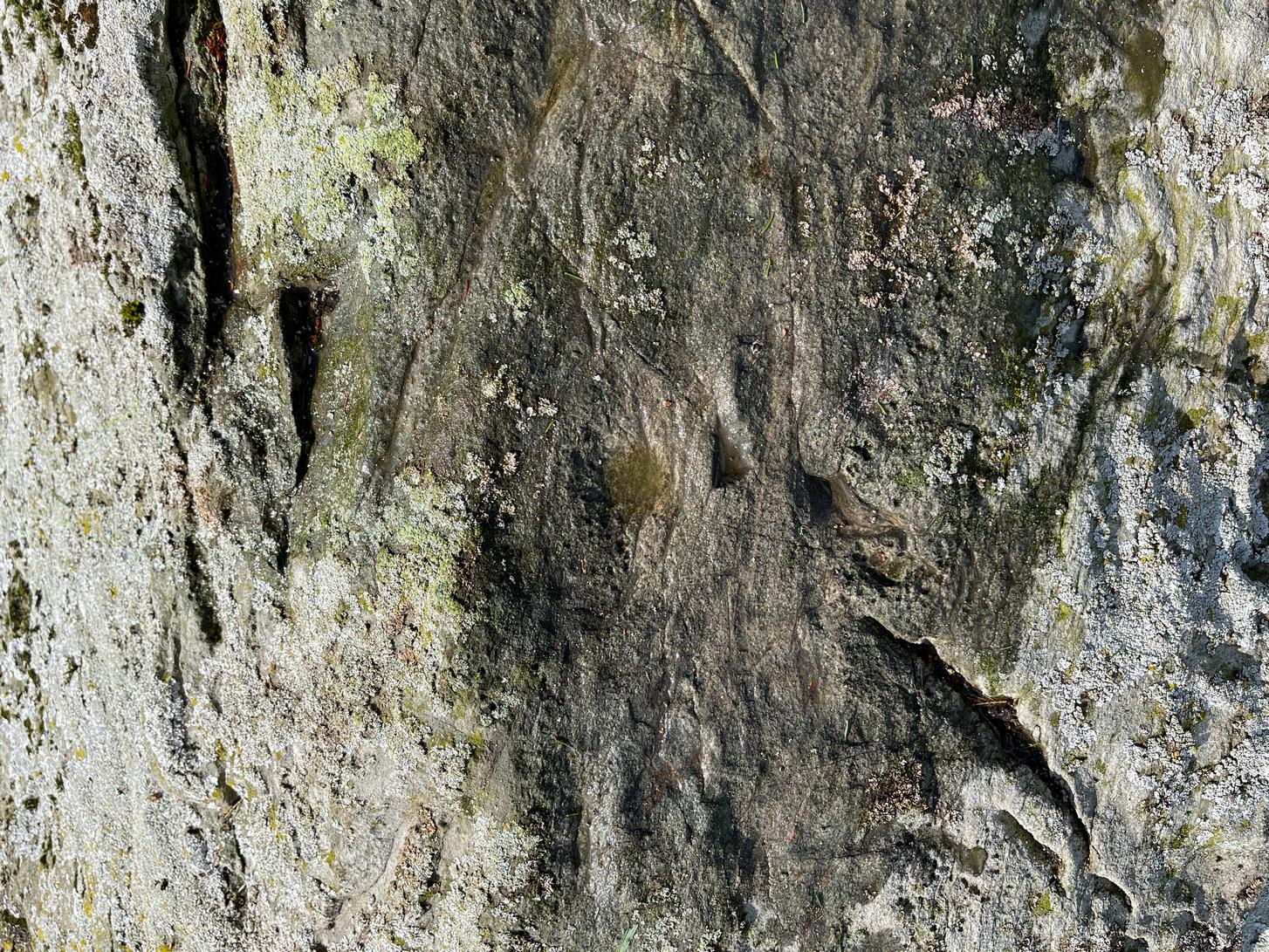
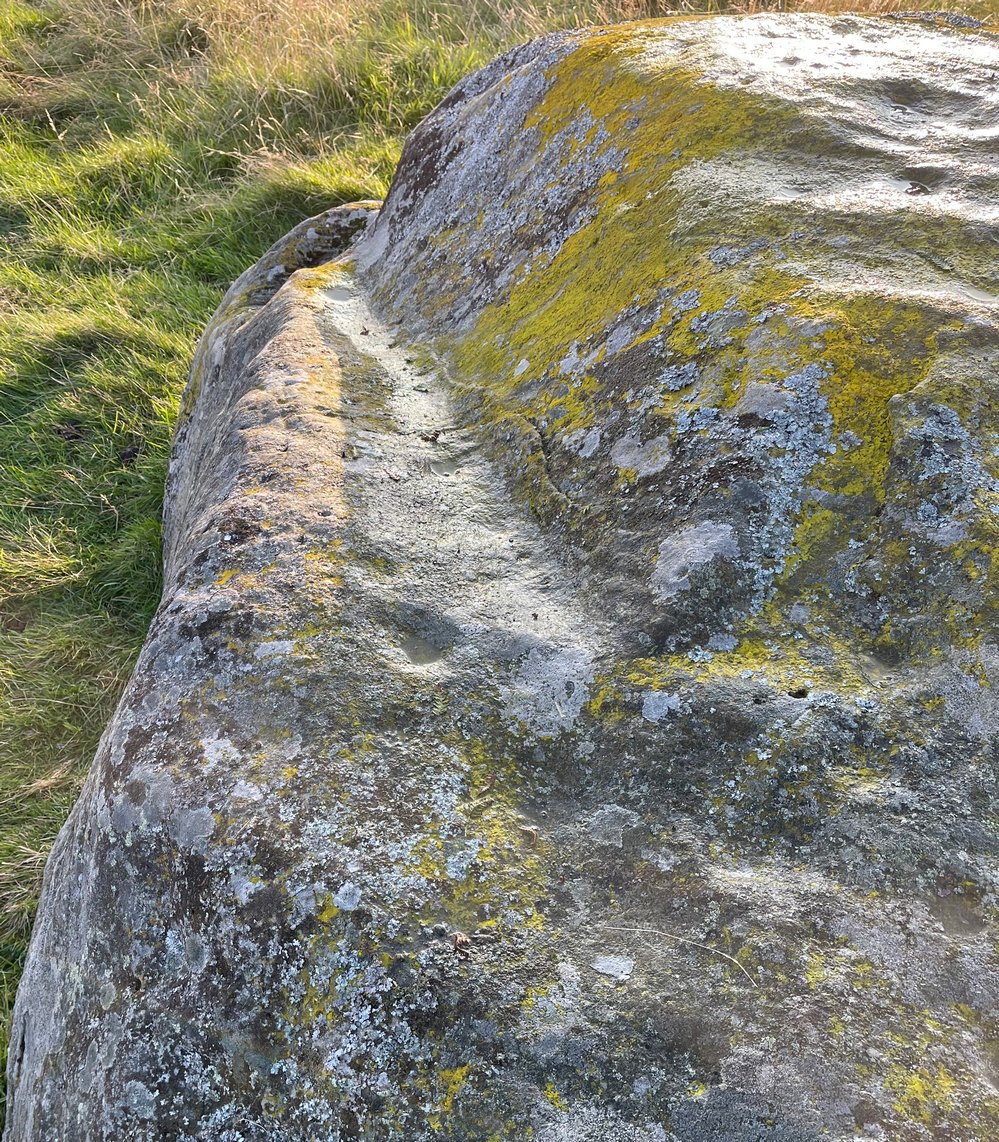
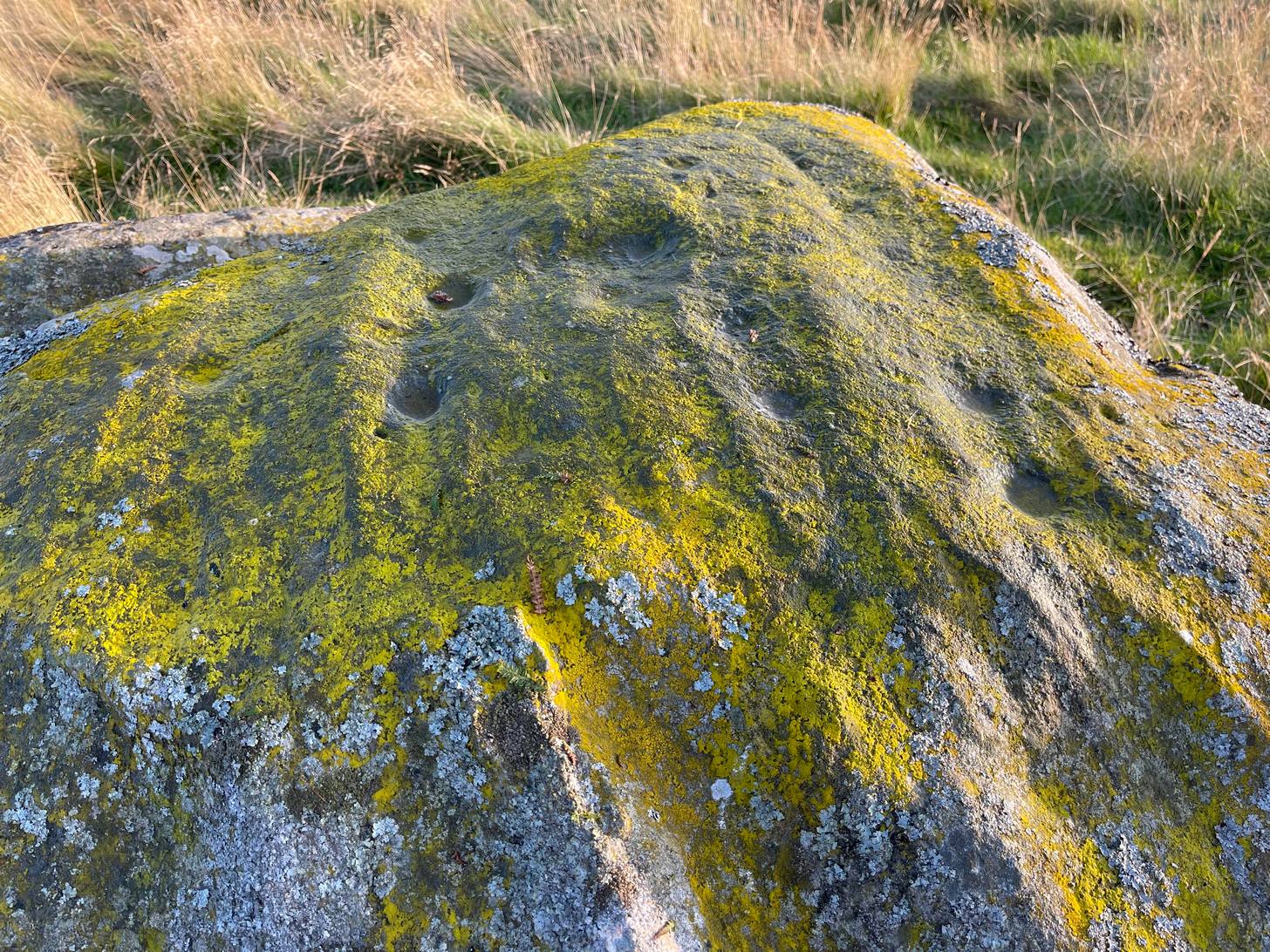
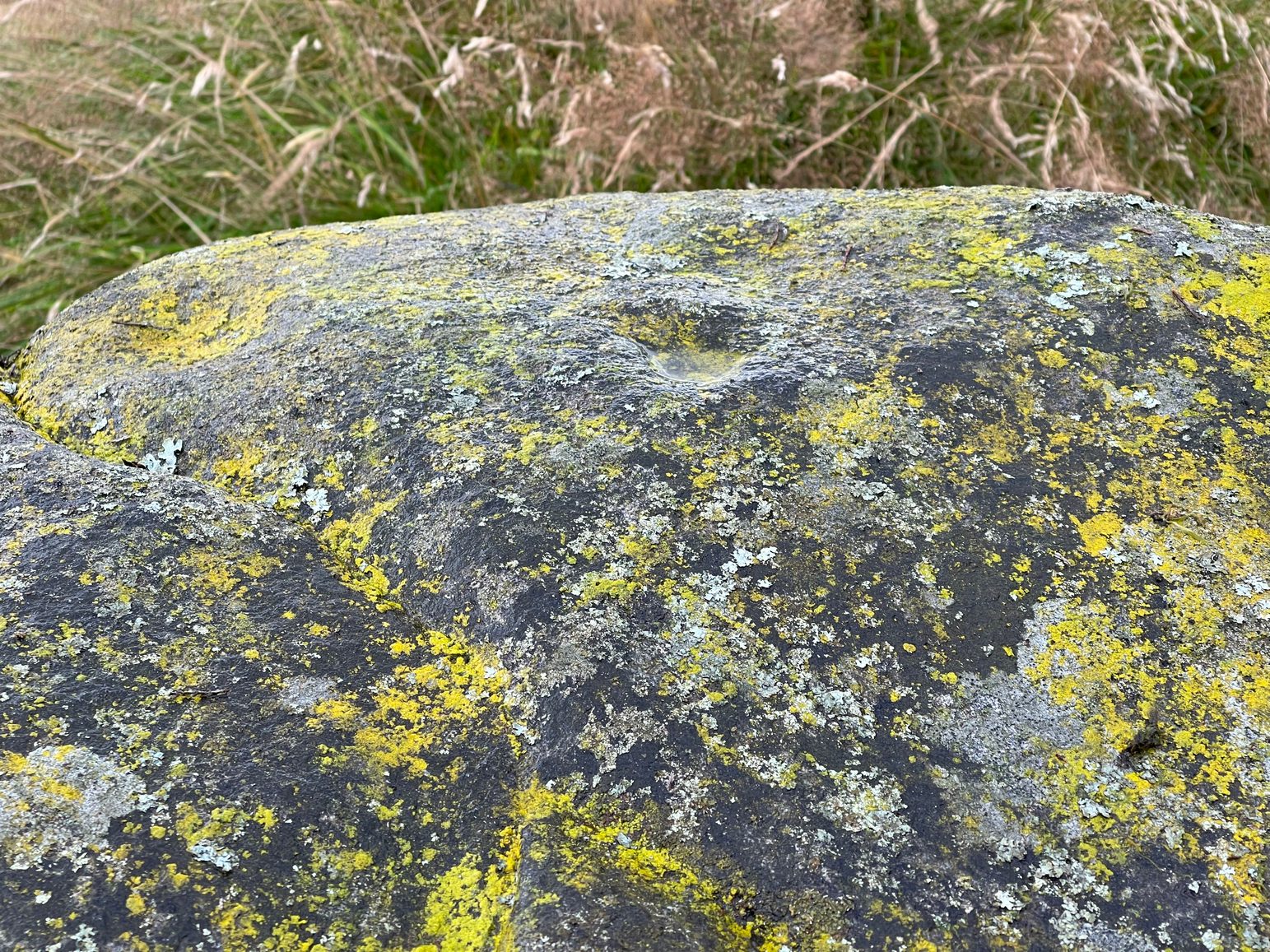
Close-up of the cup&ring

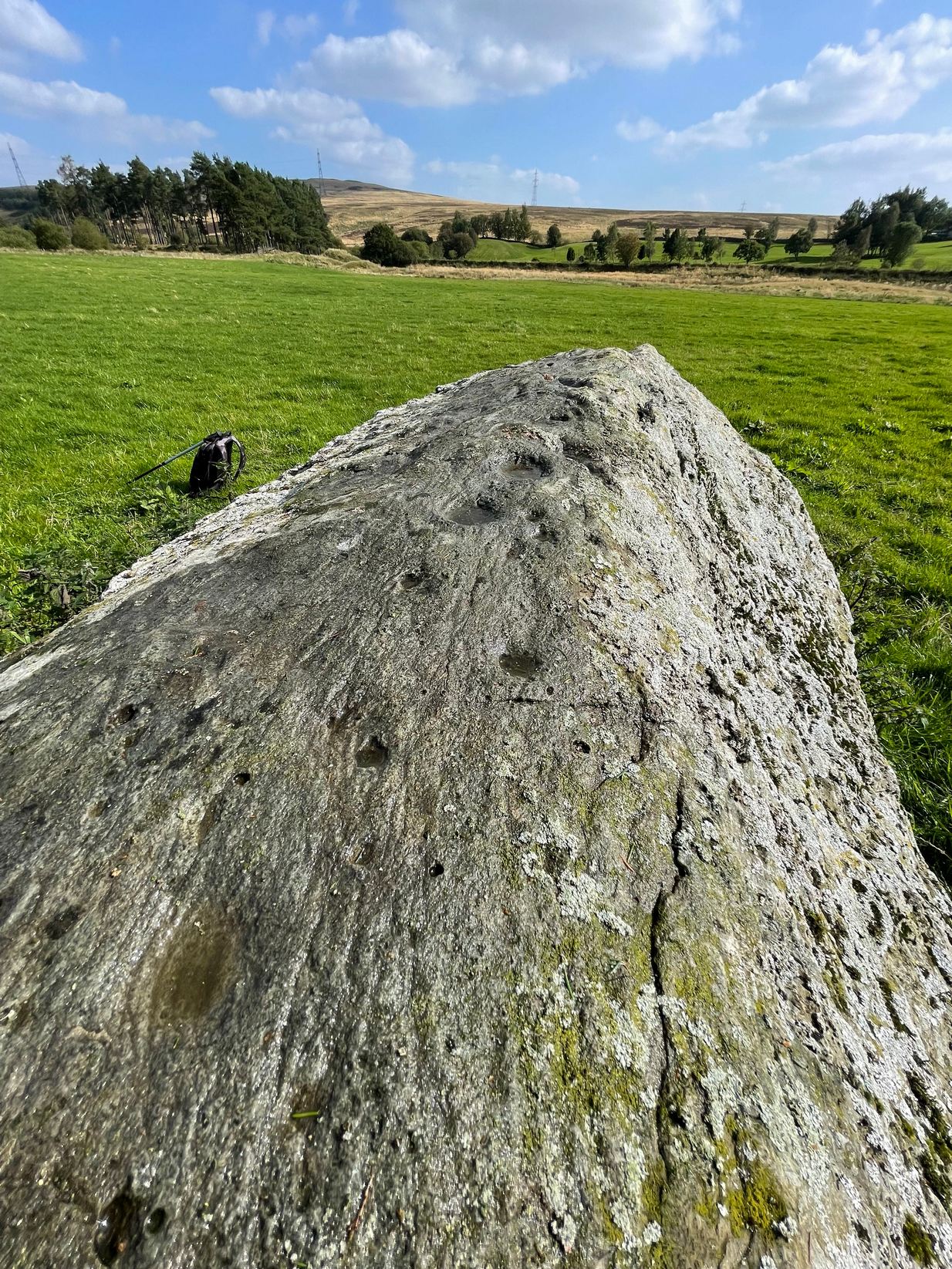
When we visited this stone for the first time recently, the design was difficult to make out due to the grey overcast skies.  The first thing you’ll notice is the single cup-marking on the left-side (west) of a natural crack near the top of the rock.  It’s pretty easy to make out.  But the cup-and-ring immediately left of this is much harder to see—or at least is was when we came here!  But spend a bit of time with it, adjusting your sight, wetting the stone and, slowly but surely, you’ll notice the shallow ring surrounding another smaller cup-mark.  You can make it out in the photo.  A possible smaller cup-mark on the sloping northern face seems more likely to have Nature’s signature on it.

AcknowledgementsHuge thanks to Fiona McLaren of Abercairney for first uncovering this carving and pointing us towards it.

© Paul BennettThe Northern Antiquarian
Killarow, Kilchenzie, Argyll

Cist:  OS Grid Reference – NR 6625 2818

Archaeology & History

Halfway between the standing stone of Tangy Glen and the cup-marked stone of Allt a’ Ghoirtein, is a rounded hill that has for a long time been turned to farming.  On top of here in the 1950s, the President of the Kintyre Antiquarian Society, a Mr Duncan Colville, came across the remains of an ancient burial cist, roughly 200 yards north of Killarow Farm.  A short account of the find was written by Mr & Mrs Scott (1957) based on Colville’s description. They wrote:

“The cist, 3ft 8in long by 1 ft 11in wide at maximum, and about 2ft deep, had a stone-lined bottom and was covered by a slab originally 5ft 6in by 3ft in size, but now split into two.  The cover slab lay not far below the surface, and there was no sign of a cairn.  The cist had obviously been rifled, for a layer of clay at the bottom contained fragments of coal and modern glass; on the other hand, a few pieces of cremated bone may have been part of the original burial.”

When the Royal Commission (1971) dudes visited the site a few years later, they could find no remains of it.  The cist is believed to have been covered over and remains hidden underground.

References:

  1. Royal Commission Ancient & Historical Monuments of Scotland, Argyll – volume 1: Kintyre, HMSO: Edinburgh 1971.
  2. Scott, Mr & Mrs J.G., “Argyllshire: Killarow, Kintyre” in Discovery & Excavation Scotland, 1957.

© Paul BennettThe Northern Antiquarian
Duchlage, Crieff, Perthshire

Standing Stone (destroyed):  OS Grid Reference – NN 8655 2079

Archaeology & History

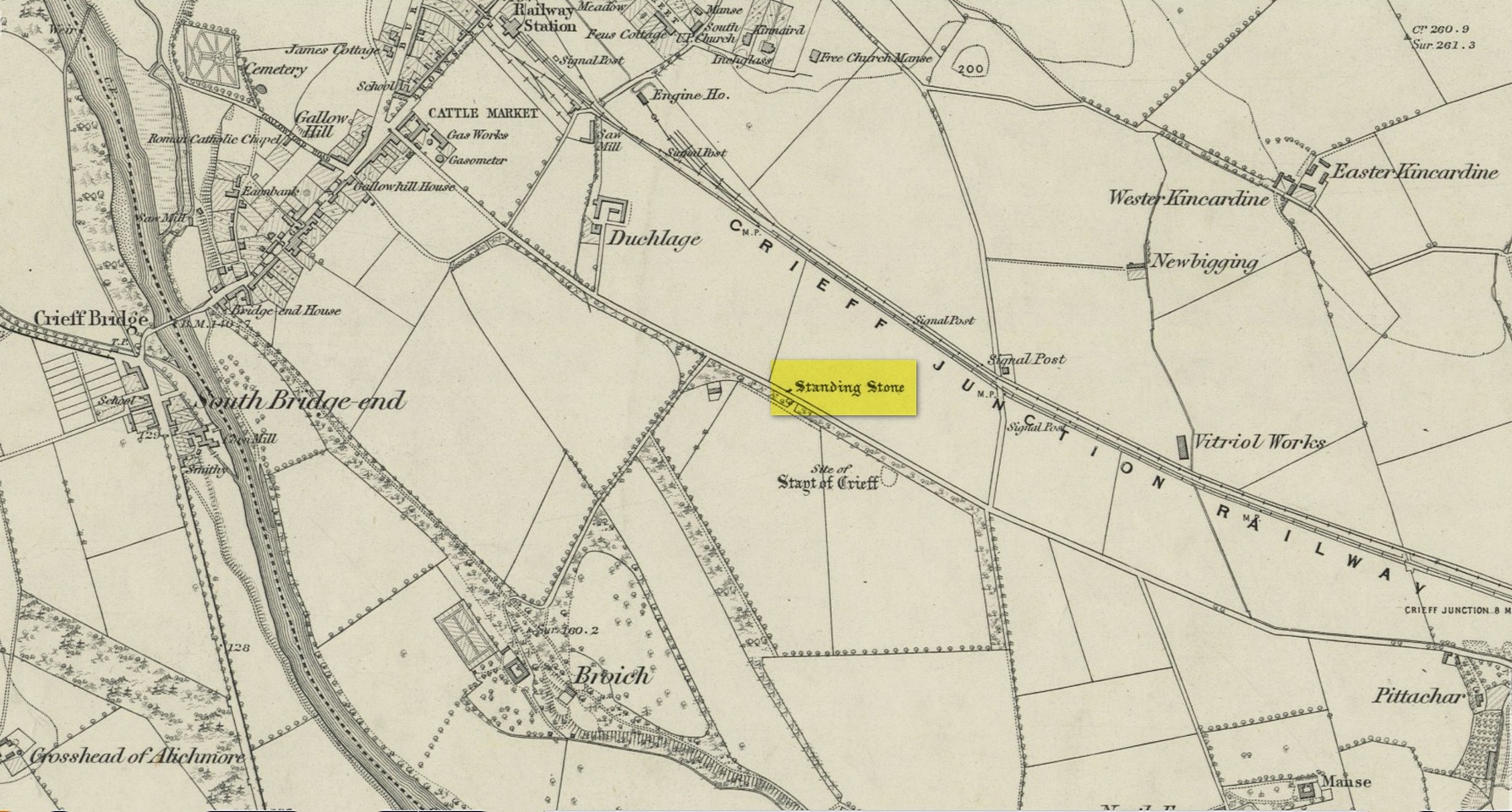
Site on the 1866 map

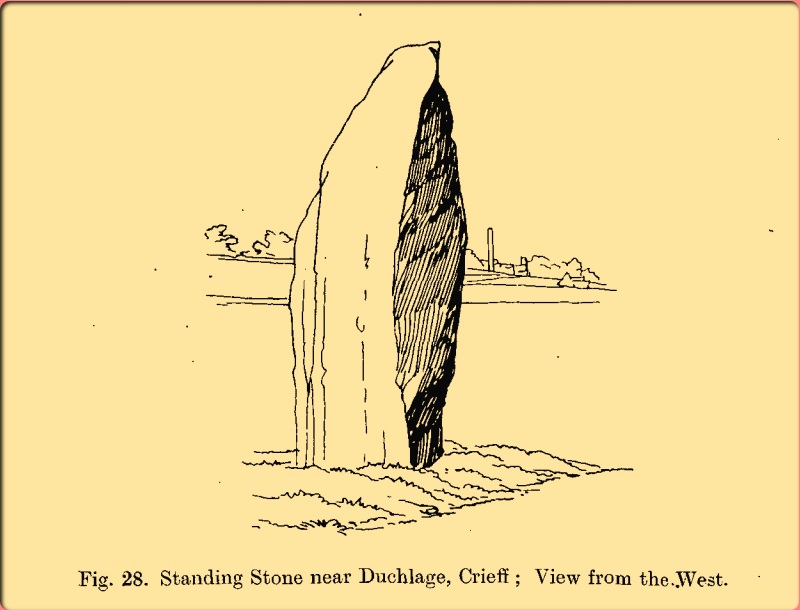
There is seemingly no trace left of this once impressive tall, slender standing stone that had lived for thousands of years on the south-side of Crieff.  It was destroyed by some retard in the middle of the 20th century (anyone know their name?).  Highlighted on the 1866 Ordnance Survey map of the area, it was visited and described by the late great Fred Coles (1911) when it still stood at the side of the road.  He told that it was,

“In shape a narrow rhomboid at the base, this Stone rises to an acute angle at a height of 6 feet.  Its longer axis is E.S.E. 52° by W.N.W. 52°, and in basal girth it  measures 8 feet 11 inches.”

Coles’ 1911 sketch

Some 200 yards to the south-east there used to be the curiously-named Stayt of Crieff burial mound which had been used as a court hill for many centuries.  This outlying standing stone may have been the “witness” on which oaths were sworn before the court.  Sadly the history of the Stayt of Crieff mound is also somewhat sparse and it too has, appallingly, been destroyed.  The destruction of these antiquities and their ancient traditions is nothing short of a fucking disgrace.

References:

  1. Coles, Fred, “Report on Stone Circles Surveyed in Perthshire, Principally Strathearn” in Proceedings of the Society of Antiquaries, Scotland, volume 45, 1911.
  2. Finlayson, Andrew, The Stones of Strathearn, One Tree Island: Comrie 2010.

Acknowledgements:  Huge thanks for use of the Ordnance Survey map in this site profile, reproduced with the kind permission of the National Library of Scotland

© Paul BennettThe Northern Antiquarian
Synton Mossend, Ashkirk, Selkirkshire

Cup-and-Ring Stone (lost):  OS Grid Reference – NT 482 214

Also Known as:

  1. Blackcastle Hill

Getting Here

Archaeology & History

Despite there being a number of references to this carving, it would seem to have been lost.  First described by James Elliot (1967) in the Discovery & Excavation journal , albeit briefly, he told that,

“A cup-marked stone which was found on this farm several years ago, has been recently identified as a “cup within a cup” type.  (It was) retained by finder.”

But there was some initial confusion about its general whereabouts when Ron Morris (1967) gave a brief note of what seemed to be an additional carving in the same edition of the 1967 journal, telling us that at nearly Blackcastle Hill there existed the following:

“Small gritstone boulder, truncated-cone-shaped, having on its top surface a “cup-and-ring”, composed of a “saucer” 4½in diameter, within its centre a much deeper and clearly defined “cup”, 2in diameter.  Depth 1¼in.  Now removed for safety by J. W. Elliot to Whinfield Sawmill yard, Whinfield Road, Selkirk.”

As it turned out, both Elliot and Morris’s separate entries were talking about the same stone.  Morris subsequently clarified this when he came to describe the petroglyph in his survey of Southern Scotland. (1981)  He reported then that the carving was “beside the house’s porch in the sawmill’s yard” — but it hasn’t been seen since.  Does anyone know what’s become of it, or where it might be?  If you happen to find it, see if you can get a good photo or two and let us know on our Facebook group.

References:

  1. Elliot, James W., “Synton-Mossend, near Ashkirk: Cup-Marked Stone,” in Discovery & Excavation, Scotland, 1967.
  2. Morris, Ronald W.B., “Blackcastle Hill: Cup Marks,” in Discovery & Excavation, Scotland, 1967.
  3. Morris, Ronald W.B., “The Cup-and-Ring Marks and Similar Sculptures of Scotland: A Survey of the Southern Counties – part 2,” in Proceedings of the Society of Antiquaries, Scotland, volume 100, 1968.
  4. Morris, Ronald W.B., “The Cup-and-Ring and Similar Early Sculptures of Scotland; Part 2 – The Rest of Scotland except Kintyre,” in Transactions of the Ancient Monuments Society, volume 16, 1969.
  5. Morris, Ronald W.B., The Prehistoric Rock Art of Southern Scotland, BAR: Oxford 1981.

© Paul BennettThe Northern Antiquarian

Seat Knowe, Fowlis Wester, Perthshire

Cairn:  OS Grid Reference – NN 93616 24689

Also Known as:

  1. Blairmore
  2. Murray’s Hill Wood

Getting Here

Seat Knowe, looking south

You need to hit the village of Fowlis Wester, which is easiest to approach from both east and west along the A85, between Crieff and Perth: nearly 3 miles east of Gilmerton and about 6½ mile west of Methven. Keep your eyes peeled and take the road up (north) where the large rounded tree-covered tumulus stands and up to the village.  Go through the village and uphill for literally ½ a mile (veering sharp left at a junction) where a gate on your right leads into the fields. (a large parking spot is 300 yards further uphill)  Walk ¼-mile east and through the other side of the small woodland, over the fence, you’ll see the mound of a typical tumulus.  That’s it!

Archaeology & History

If you’re going to visit the megalithic remains of Fowlis Wester ¾-miles to the west, the antiquarians amongst you might as well give this old burial mound your attention too.  It’s not grandiose by any means, but its position in the landscape is quite superb.  It’s built upon a long geological promontory with extensive views that reach from south-east to south to south-west for many miles into the distance with the Ochils framing the majority of the southern horizon, but also with the notable pap of the West Lomond hill 20 miles to the south-east mimicking the shape of the tomb itself.  It was obviously built here with the extended landscape having some ancestral importance. Visit it and see for yourself!

Despite being a notable mound, this tumulus-cum-cairn only seems to have been written about for the first time as recently as 1998, when archaeologist Ian Armit visited the site.  Roughly circular in form, it’s about 12 yards across and more than six feet in height.  A small pile of stones crowns the very top, placed here in much more recent times.  At ground level on its northern side, an arc of low lying stones define the edge of the tomb.  The stones probably continue all the way round the entire structure, but it’s overgrown by centuries of soil and vegetation and we lose sight of it as we walk round.  When Mr Armit (1998) wrote about the site, he and colleague wrote:

Seat Knowe, looking NW
Seat Knowe, looking north

“A grassed-over stony cairn lies on the highest point of Seat Knowe, a ridge commanding extensive views to the south.  The cairn has a diameter of c.10m and is up to 2m high.  A modern cairn occupies it summit.  The low turf foundations of a rectilinear structure, some 6 x 8m, occupy its south flank, and thee are extensive cultivation and field system remains in the vicinity.”

Check it out!  You won’t be disappointed.

Folklore

An interesting piece of relatively recent folklore about Seat Knowe, described in the Perthshire Name Book around 1862, told that,

“One of the Earls of Strathearn, desirous of having a church in the vicinity of his Castle, stood on an eminence, on which he had a summer seat, and resolved to erect it where the sun first shone, which was on the spot where it now stands.”

References:

  1. Armit, Ian & Hall, M., “Seat Knowe (Fowlis Wester parish): Cairn,” in Discovery & Excavation Scotland, 1998.

© Paul BennettThe Northern Antiquarian

Craggan Top, Hosh, Crieff, Perthshire

Cup-Marked Stone:  OS Grid Reference – NN 85602 24795

Getting Here

Craggan cup-marked stone

It’s a helluva zigzag to get here. Just out of Crieff along the A85 road to Comrie, turn right up the minor road to Hosh and Glenturret Distillery.  Just past the distillery, over the small river bridge, turn left and go up the tiny road for literally ⅔-mile (1.1km) and park up just before the cattle-grid. Naathen, up the slope into the trees at a diagonal behind where you’re parked, walk up and up for half-a-mile where the land levels out and you reach a gate (and my bath, in the undergrowth to your right).  A track goes up above the gate (not the one through it) and bends round where, 100 yards up, you reach a gate. Go over it and look at one of the stones in front of you!

Archaeology & History

Very faint cups

This is another one of those petroglyphs that only the purists amongst you will want to see.  On the lower section of this typically smooth female stone, you’ll see a singular cup-mark, half-natural half-carved, a couple of inches across, with a less discernible cup-mark of similar dimensions further up the rock, but entirely man-made.  When we visited here yesterday, the shadows of the trees above made it very difficult to get any decent photos of the cups.  Give it your eye on the journey up to the impressive standing stone of Stonefield a few hundred yards further up the hill; and if you manage to get any good photos, stick ’em on our Facebook group.

© Paul BennettThe Northern Antiquarian

Stonefield, Hosh, Crieff, Perthshire

Cup-Marked Stone:  OS Grid Reference – NN 8515 2484

Archaeology & History

Site of supposed cupmark

There’s little to see here.  In the 1990s, students from the Royal Commission found what they described as “a single cupmark”, 3 inches across by 1 inch deep, on a rock measuring 2-feet by 1½ feet, on the north side of this large (seemingly) natural mound with large scatters of field clearance stones all over its northern face.   When I visited the place yesterday (on my way to see the impressive Stonefield monolith 260 yards to the north-east), I zigzagged back and forth over the rocky mound and was unable to find it, although it may have been beneath the summer vegetation.  A winter visit may prove more fruitful.

© Paul BennettThe Northern Antiquarian

Connachan (7), Crieff, Perthshire

Cup-Marked Stone:  OS Grid Reference – NN 8806 2746

Getting Here

The small stone in question

You’re going from Crieff, up the A822 road from the Gilmerton junction and head up towards the Sma’ Glen.  And if you’re visiting this stone, you’ve already walked past the carvings of Connachan (2), (4), (5) and (6).  So just another 100 yards or so up the dirt-track past Connachan (4), (5) and (6), just where there’s a bend in the track, the land just about levels out (if you’ve reached the gate and fence you’ve gone too far). At this point walk onto the grassland on your right for barely 50 yards, just where the land sweeps back downhill.  Look around for a small stone at the edge of some very low indistinct walling.  You’ll find it!

Archaeology & History

Cluster of cups

A site that’s shown on the modern OS-map as a “cairn” but which is, by the look of things, actually a hut circle — and a somewhat indistinct hut circle at that!  You could very easily walk right through it without even noticing you’d done so.  However, the cup-marked stone on the outer edge of its southern wall does grab your attention!  Once you’ve found the stone, if you pace round a few times you’ll begin to see the vague outline of this prehistoric, probably Bronze Age abode.

at a slightly different angle

The carving was probably placed here after the hut circle had been built; or perhaps even built deliberately upon the petroglyph itself—but only an excavation would give us the answer.  Its incorporation in the hut circle was probably functional, somewhat like the Man Stone carving in North Yorkshire, which is found at the doorway there.  But this site is in such a state of neglect (and is somewhat overgrown) that I couldn’t ascertain whether it was at the entrance or not.  If it was, then most likely there was a mythic relationship between the design of the cups and the person who lived therein.  This relationship was probably a long standing traditional one attached to a particular family, or tribal leader, or even a shaman figure which no doubt stretched over many centuries. (as seems likely with the aforementioned Man Stone)

The carving itself is somewhat basic, as you can see, comprising of a small irregular cluster of between 18 and 20 tightly packed cups on a small stone.  The hut circle is about 14 yards across.  About 100 yards to the east is a severely robbed-out cairn.

References:

  1. Stewart, Margaret E.C., “Connachan, Crieff – Cup Marks and Hut Circle,” in Discovery & Excavation, Scotland, 1967.

© Paul BennettThe Northern Antiquarian

Loch Shurrery (north), Reay, Caithness

Cup-Marked Stone (missing):  OS Grid Reference – ND 04321 56794

Archaeology & History

When Alastair MacLaren (1955) first excavated an Iron Age hut circle just above the northern edge of Loch Shurrery, he found, “from the tumble of the wall came a cup marked stone.”  It emerged from southwestern side of this habitation site, on a small portable-sized stone, and consisted of just a single distinct cup-mark.  When the site came to be re-examined many years later, it had gone.  MacLaren was of the opinion that the stone had merely “served as core material and was of no other significance to the builders of the hut circle than just a handy bit of rubble to fill the space between the inner and outer faces.”  This may have been the case; although it may have originally been carried from one of the many chambered cairns in the region.

References:

  1. MacLaren, Alistair, “Caithness: Loch Shurrery,” in Discovery & Excavation, Scotland, 1955.
  2. MacLaren, Alistair, A Later Prehistoric House and Early Medieval buildings in Northern Scotland, Society of Antiquaries Scotland: Edinburgh 2003.

© Paul BennettThe Northern Antiquarian

Allt Thorrisdail (2), Torrisdale, Sutherland

Cup-Marked Stone:  OS Grid Reference – NC 66579 61817

Getting Here

Torrisdale (2) carving

Simply follow the same directions as if you’re going to the Allt Thorrisdail (1) petroglyph, and the large, roughly oval-shaped boulder just a few yards away is the one you’re after.  You can’t miss it!

Archaeology & History

This large, earthfast, ovoid ball of rock has a series of cup-marks on three of its curvaceous faces, some of which seem to be natural, with a number of them “enhanced” by human hands at some time in the long long ago….

Torrisdale (2) looking E
Oval “face” barely visible

The main cluster of these cups can be found on its near-vertical western-face: an unusual feature in itself!  There are several cups on its southern curve and, further round, low down on the east side of the rock we see a few more of them hiding away.  These, too, seem to have been Nature’s handiwork, then enhanced by the hands of wo/men.  The carving was described in Hew Morrison’s (1883) work as possessing two groups of cup-marks,

“similar to that on the neighbouring stone, one of eighteen small and one large cup, and another of eleven small marks.  There is a solitary mark on the summit of this stone, and its southern face is marked by lines crossing each other, but without any apparent order or design.”

On its northern face we see a large oval hollow, an inch or so deep throughout, that has all the hallmarks of being a primitive face.  There is a tradition of such a rock “face” carving somewhere close by, which seems to be lost—and this would seem to be culprit!  If you visit the place, let us know what you think!

One feature that stands out at this site is the nearby pyramidal hill whch, I think, had some mythic relationship with the carvings.  Impossible to prove, obviously, but the pyramid is such a dominant feature in this landscape that a relationship seems inevitable.  I can only echo what I’ve said in the site profile for the adjacent carving here: tis a ritual place indeed – without any shadow of doubt.  And I don’t say such things lightly.  This place is truly superb!

References:

  1. Mercer, R.J., Archaeological Field Survey in Northern Scotland 1976-1979, University of Edinburgh 1980.
  2. Morrison, Hew, A Tourist’s Guide to Sutherland and Caithness, D.H. Edwards: Brechin 1883.
  3. Royal Commission on Ancient & Historical Monuments, Scotland, Second Report and Inventory of Monuments and Constructions in the County of Sutherland. HMSO: Edinburgh 1911.

Acknowledgements:  Huge thanks to Sarah MacLean for her company and landscape knowledge in visiting this and other nearby antiquarian sites. And to Aisha Domleo, for getting me into this neck o’ the woods in the first place….where’er She may be….

© Paul BennettThe Northern Antiquarian