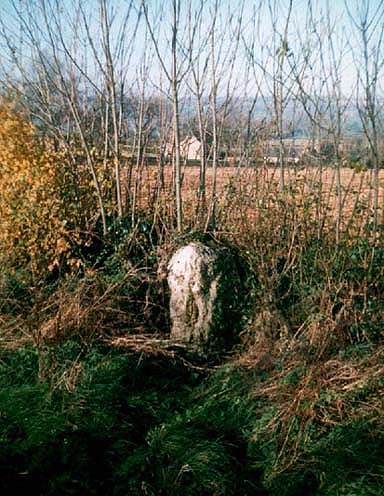
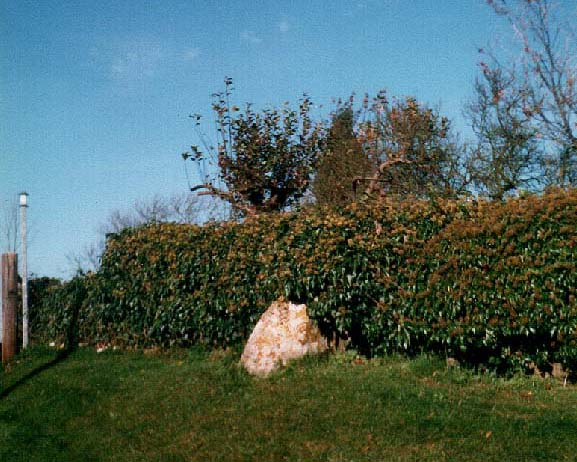
Enclosure (destroyed): OS Grid Reference – TQ 675 811
Archaeology & History
North Ring, Mucking (after Brown, 2001)
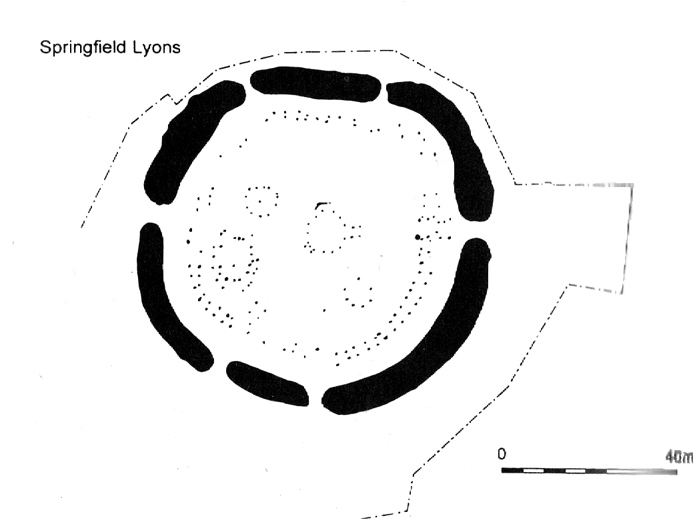
This large circular enclosure, measuring about 120 feet across, seemed to be a small settlement with several internal structures (fences, pits, cremations and a sunken-floored structure) that was first excavated in 1978 and described as a Bronze Age enclosure. Akin to a henge monument in some ways, this small settlement site had two entrances: one on the east and the other opposite on its west side. However, the main ‘entrance’ was on the eastern (sunrise) side, where post-holes laid a pathway over the ditch and into the structure itself.
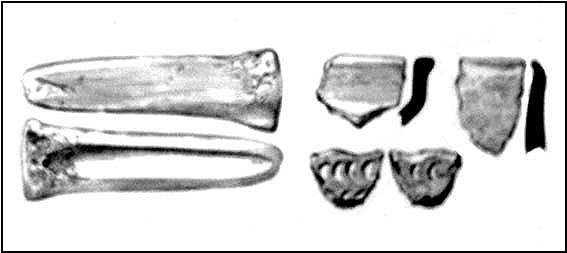
The excavation on the eastern side of site revealed two periods of construction with associated structures, including three circular buildings. Some excavations to the east produced evidence for a range of contemporary activities. The assemblage of Late Bronze Age material included pottery, metalwork, cremation remains, sickle moulds and equipment for salt production. For further info and imagery, see the Link below.
References:
Bond, Dermot, Excavation at the North Ring, Mucking, Essex, East Anglian Archaeology 1988.
Brown, N., “The Late Bronze Age Enclosure at Springfield Lyons in its Landscape Context,” in Essex Archaeology & History, volume 32, 2001.
We’ve known that there was an excessive number of prehistoric archaeological sites in and around the Chelmsford region for quite a long time now, but defining precisely the age and nature of the finds takes some doing! (as you’d expect) It hasn’t helped, of course, with the housing estates and other ecologically destructive building operations in and around the area, screwing up a more accurate and patient assessment of the material there. And this predicament was exemplified with the Springfield Lyons neolithic causewayed enclosure just as much as at the Springfield Cursus and other sites nearby.
Although excavations here found a large, deep ditch with impressive ramparts and entrance, in Oswald, Dyer & Barber’s (2001) survey of these giant monuments, they defined the remains here as “probable,” pending further investigations. But the site was primarily defined by the large deep ditch, broken in several places round its edges with the ’causeways’ built leading onto the site. The enclosure gave good views over the small valley from here and had streams running either side of it.
Adjacent to the site were the remains of a “small circular enclosure with multiple entrances,” saying that excavation here,
“has proved that it is of late Bronze Age date and might be interepreted variously as a defended settlement, or a ritual monument.”
This external small enclosure site was then conjectured, quite spuriously it’s gotta be said, to be a mini-version of the great causewayed enclosure monument, saying:
“Its siting and form both hint that it could have been a conscious imitation of, or re-invention of, the perceived form of the earthworks of the neolithic enclosure.”
I like the idea, it’s gotta be said — but without direct evidence we’ve gotta take this idea with a large pinch of salt!
…to be continued…
References:
Brown, N., ‘The Archaeology of Essex 1500 – 500 BC,’ in Bedwin, O. (ed.), The Archaeology of Essex, ECC: Chelmsford 1996.
Brown, N., “The Late Bronze Age Enclosure at Springfield Lyons in its Landscape Context,” in Essex Archaeology & History, volume 32, 2001.
Oswald, Alastair, Dyer, Caroline & Barber, Martyn, The Creation of Monuments: Neolithic Causewayed Enclosures in the British Isles, EH: Swindon 2001.
Priddy, D., ‘Excavations in Essex, 1987,’ in Essex Archaeology & History, 19, 1988.
Go up the nicely-named Wildcountry Lane at the staggered crossroads on the edge of Barrow Gurney for about a half-mile, watching out for the dip in the road where it crosses the stream. Walk up the stream here for a coupla hundred yards, keeping your eyes peeled for the small spring on your left just past where a footpath crosses the stream.
Archaeology & History
Little of historical nature is known of this site, found in the dip near the stream, though it was much frequented in bygone centuries as a curative place for sore eyes.
Folklore
Although named after the little people, Phil Quinn (1999) wrote that,
“even the oldest villager cannot remember how the fairies became connected with this well. All that is told is that the people would go to the well to bathe their eyes, for the water was believed to be good in the treatment of all eye complaints. A local woman remembers that her father, who worked the land in this neighbourhood, would always drink from the well using a cup which was never taken away or used for any other purpose.”
It is likely that the fairy association here derived from the proximity of a nearby prehistoric tomb, cairn or similar archaeological remain. The aptly-named Barrow Wood immediately east and other ‘barrow’ place-names nearby would add weight to this notion. (faerie-lore has widespread associations with prehistoric tombs and similar relics)
References:
Quinn, Phil, The Holy Wells of Bath and Bristol Region, Logaston: Almeley 1999.
There are several tumuli near the top of the hill here, but only one of them really stands out. Nick Thomas (1976) told it to be one “of the best preserved bowl barrows in Surrey.” A brief description of the relevant tombs, running north to south:
“the first is 75ft across and 6ft high; the second, which has a surrounding ditch 9ft wide, is also 75ft across, but is 8ft high. The third has a diameter of 42ft and a height of 4ft. The last is 54ft wide and 5½ft high. It has a surrounding ditch 8ft wide. ” (Thomas 1976)
None of the tombs had been excavated up to the early 1980s, but I’m not sure if anything has been found since then. There was also a potential “great stone” up here that was mentioned by John Aubrey in the late 17th century, but nothing has been seen of it since. In all probability this was a standing stone or the remains of some prehistoric tomb.
Folklore
Several hundred years ago the King’s antiquary, John Aubrey, told the curious tale of the great cauldron that was said to have been found here:
“In the vestry (of Frensham church, in Surrey), on the north side of the chancel, is an extraordinary great kettle or caldron, which the inhabitants say, by tradition, was brought hither by the fairies, time out of mind, from Borough-Hill, about a mile hence. To this place, if anyone went to borrow a yoke of oxen, money, etc., he might have it for a year or longer, so he kept his word to return it. There is a cave where some have fancied to hear music. On this Borough hill…is a great stone lying along, of the length of about six feet. They went to this stone and knocked at it, and declared what they could borrow, and when they would repay, and a voice would answer when they should come, and that they should find what they desired to borrow at that stone. This caldron, with the trivet, was borrowed here after the manner aforesaid, and not return’d according to promise; and though the caldron was afterwards carried to the stone, it could not be received, and ever since that time no borrowing there.”
In relation to the folklore that is generally attached to the tumulus on top of the hill here from which modern lore ascribes the cauldron to have originated, when A.G. Wade (1928) came to investigate the nature of the site and the folktale he found that,
“there are several folk-tales other than those given by Aubrey. One relates that it was dug up on Kettlebury Hill, south of Hankley Common, by the monks of Waverley Abbey, and that it was taken by them to Frensham for brewing ale. Another tale says that it was a loan from the fairies of Thursley — there are tumuli in this parish, south of Ockley Common — and that Mother Ludlam, a medieval witch who lived, according to tradition, in Ludlam’s Cave in Moor Park, was the owner and lender. The cave was dug by a monk of Waverley Abbey who, when the water supply of the Abbey failed, found that three springs joined here, and by enlarging their outlets and bringing them together he obtained a good supply of fresh drinking water…”
Mr Wade was also unable to satisfactorily show that the Borough Hill named in Aubrey’s survey and Frensham Common hilltop were one and the same.
References:
Aubrey, John, The Natural History and Antiquities of Surrey, E. Curll: London 1719.
Thomas, Nicholas, Guide to Prehistoric England, Batsford: London 1976.
Wade, A.G., “The Great Cauldron of Frensham,” in Antiquity, 2:6, June 1928.
Stone Circle (destroyed): OS Grid Reference – SP 470 464?
Also Known as:
Ringstone Well
Archaeology & History
In 1239 CE we find records of a field-name site called “Ringstoneswelle.” Although the place-name writer Margaret Gelling (1954) initially ascribed this as the watering-place of some dood called Hringstan, it is in fact the only record that I’ve found of a “stone circle by a well” in the village. This etymological root is confirmed in A.H. Smith’s English Place-Name Elements (vol.1, p.265) as a probable stone circle.
Folklore
There is also the curious field-name legend of a place in Cropredy called Kirk or Church Piece, where a christian church was being built, but in the morning all the stones had been uprooted & moved back from whence they came. This happened several times according to the folktale – a story that has with all the hallmarks of a megalithic site. (see Grinsell’s Folklore) To me it seems likely that the nearby Cup and Saucer Stone also had something to do with this lost stone circle.
In the same area we have another intriguing bit of folklore that was reported in an early edition of the Banbury Guardian (1932) which told that,
“on one of the top stones of a wall in front of one of the farmhouses is what is supposed to be the Devil’s footprint and there are nail-marks in the stone, but how it gots it name is a puzzle. At the back of the vicarage gardens is a small jetty called HellHole, the old ‘Old Man’ must have visited this village a time or two.”
Are there any local antiquarians or historians who can throw further light on this seemingly lost megalithic ring?
References:
Anonymous, ‘Cropredy and its Legends,’ in Banbury Guardian, December 29, 1932.
Bennett, Paul & Wilson, Tom, The Old Stones of Rollright and District, Cockley: London 1999.
Gelling, Margaret, The Place-Names of Oxfordshire – volume 2, Cambridge University Press 1954.
Grinsell, Leslie V., Folklore of Prehistoric Sites in Britain, David & Charles: London 1976.
Smith, A.H., English Place-Name Elements – Part 1, Cambridge University Press 1954.
Tumulus (destroyed): OS Grid Reference – TF 232 018
Archaeology & History
Very little was known about this now lost burial mound. It was one of several nearby but, thankfully, the local historian and archaeologist E. Thurnam Leeds (who once lived at the nearby Eyebury Farm) sent a letter to the Society of Antiquaries in London, describing some pottery and other remains that he’d found there:
“The small pot of a late Bronze Age type and the other sherds exhibited were found in a tumulus known as Oliver Cromwell’s Hill, at Eyebury, near Peterborough. As only a portion of the tumulus has been examined as yet, it is proposed to defer a full account of the excavations until further progres has been made. The tumulus is of the round type, about 40 yards in diameter and 5 feet high at the centre. On three sides traces of a ditch were met with, containing soil which had evidently been burnt. Close to the gravel in the centre of the tumulus there were two distinct layers of charcoal, and in two places apparently remains of hearths. The small pot was found only 1½ feet down on the south-eastern side of the mound, 39 feet from the centre. In the centre itself at various depths were found sherds, some of Bronze Age forms; but a pice of a rimmed vase found at a depth of 3 feet 6 inches, about 6 inches above the first charcoal layer, appears to be of Roman date, in which case the centre of the tumulus must have been disturbed in those times, though the charcoal floors were never pierced. Bones of various animals, including sheep, pig, dog and hare, and a large flint flake were also found.”
As far as I’m aware, no further detailed examinations took place at this curiously-named hillock, whose folktale I’ve yet to read.
References:
Leeds, E.T., ‘Letter,’ in Proceedings of the Society of Antiquaries, 22:1, 1910.
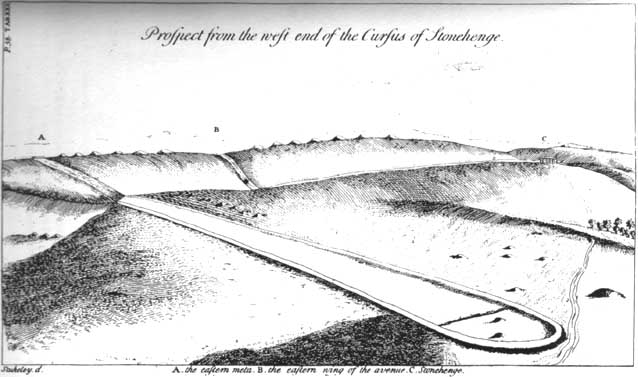
Not far south of the smaller Lesser Cursus monument, this huge linear earthwork was the very first cursus to be described, by William Stukeley no less, who thought it to be an old race-course for charioteers and the like! He stumbled upon this: a curious gigantic linear earthwork feature, stretching for nearly two miles roughly east-west and as wide a football field, cut into the Wiltshire Earth, betraying all notions of ‘primitive’ histories as proclaimed by the ‘intellectuals’ of his day. They were clearly wrong! This immense enigmatic structure, still baffles the same creed of intellectuals to this day — but at least our old ancestors have been granted greater abilities than previously believed. In his book on Stonehenge in 1740, Mr Stukeley described this,
“most noble work, contriv’ed to reach from the highest ground of two hills, extended the intermediate distance over a gentle valley; so that the whole cursus lies conveniently under the eye of the most numerous quantity of spectators. To render this more convenient for site, it is projected on the side of more rising ground, chiefly looking towards Stonehenge. A delightful prospect from the temple, when this vast plain was crowded with chariots, horsemen and foot, attending these solemnities with innumerable multitudes.”
Sir Norman Lockyer propounded its function as astronomical, aligning with the Pleiades around 2000 BC — a date we now know to be inconsistent with its construction, although as John North said in his Stonehenge (1997):
“Lockyer’s chronology was certainly better than the general archaeological consensus at the time.”
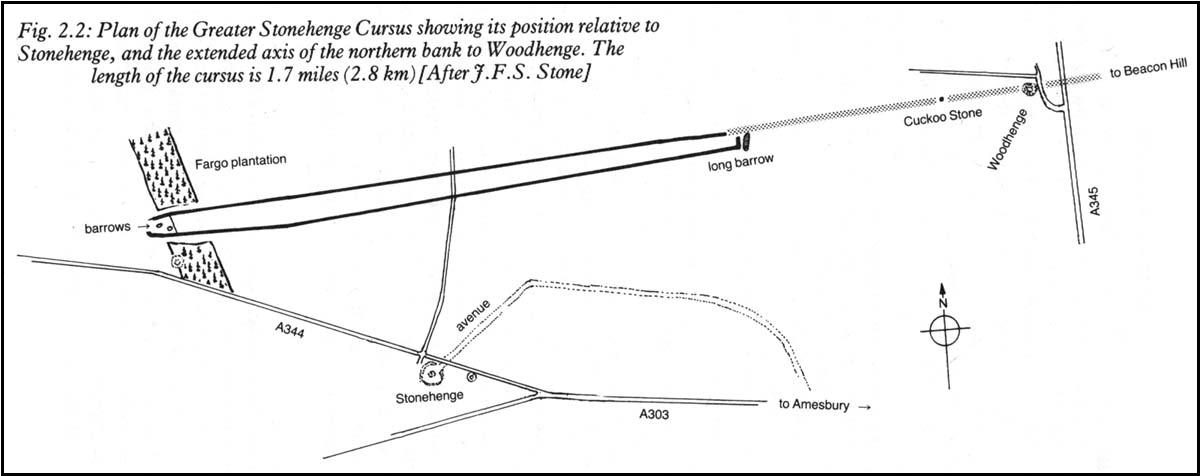
But further archaeological alignments and leys have been suggested running eastwards from here. And as Paul Devereux pointed out, “In the case of this cursus, archaeology got there first.” J.F.S. Stone, who carried out some excavations at the cursus in 1947, noted that
“its axis, if projected 1500 yards east, strikes Woodhenge and passes the Cuckoo or Cuckold Stone by the way.”
This was endorsed in 1981 by archaeologists John Hedges and David Buckley:
“In addition to aligning upon Woodhenge, the Greater Stonehenge cursus also sights upon the Cuckoo or Cuckold Stone.”
Alignment to Beacon Hill
In Roy Loveday’s (2006) survey of cursus monuments he told how this alignment goes much further, telling how it aligns “on the lower, northernmost prominence of Beacon Hill 8km away”, crossing Woodhenge on its way. Such suggestions used to bring outcries of derision from the archaeological fraternity, but it seems archaeologists themselves are making such claims more and more these days. At the forefront of modern alignment research in previous decades was Paul Devereux — and it was he who first noted the line-up with the distant Beacon Hill from the Great Cursus, telling:
“The course of the alignment can be extended eastwards a few miles beyond Woodhenge to cross the barrow-dotted ridge of Beacon Hill — a perfect example of a Wakins-style ‘initial point.’ The ridge is highly visible from Woodhenge. It disappears from view as one walks westwards down the cursus, but reappears clearly as the west end is approached. Indeed, the west end is so placed that it is at about the furthest point from which the Beacon Hill ridge , and the intermediate on which the eastern end of the cursus fall, can be seen together.”
…to be continued…
References:
Burl, Aubrey, A Brief History of Stonehenge, Robinson: London 2007.
Hedges, John & Buckley, David G., The Springfield Cursus and the Cursus Problem, Essex County Council 1981.
Loveday, Roy, Inscribed Across the Landscape, Tempus: Stroud 2006.
North, John, Stonehenge, Harper-Collins: London 1997.
Pennick, N. & Devereux, P., Lines on the Landscape: Leys and other Linear Enigmas, Hale: London 1989.
Stone, J.F.S., ‘The Stonehenge Cursus and its Affinities,’ in Archaeological Journal, 104, 1947.
Easy enough this one. Take the B4066 west of Woodchester past the Boundary Court and over the cattle grid for 100 yards or so. Note the fence up the slope to your left (south) up the field here head for the triangulation pillar. Once there keep walking for about another 100 yards. You can’t miss it!
Archaeology & History
The mad craniologist John Thurnam (1810-73) was one of several old-school fellas who helped to excavate this grand site on one occasion. Thinking that human sacrifice lay behind virtually all of the burial mounds, Thurnam was part of the Cotteswold Field Club group who investigated the place; and, because of his intellectual capacity in cranial investigations, was listened to by the budding archaeo’s of the day cos he was cleverer than them (hero worshipping). A bit naive of them, but such is the way of some folk! Yet their early account of this site (devoid of Thurnam’s weird notions) is quite invaluable, even today. Described in an address by their President in the Proceedings in 1865, the article tells:
“The Club met at Stroud. The principal work of the day was the opening of a ‘barrow’ on Bown Hill…which had formed the subject of discussion towards the end of the previous season when, the period of the year being too far advanced, the work of exploration was deferred. Workmen had been employed under Dr Paine and Dr Witchell on the two previous days; but beyond the discovery of the entrance to the sepulchral chambers no great progress had been made in the excavation of the mound which, from its size and solidity, proved to be a very laborious operation. In order, therefore, to expedite matters, a strong force of labourers, 22 in number, had been employed from an early hour on the day of the meeting. The mound, which measured about 60 yards in length by 17 in extreme width, was seen to be constructed of angular masses of stone, heaped together without any order or regularity, amongst which were scattered blocks of considerable size and weight.
“The excavators had opened a trench about 100 feet in length, in a direction due east and west by compass. The western extremity was the broadest, the mound gradually diminishing in width to the opposite end. The workmen had struck upon the entrance which, when exposed, showed a chamber formed of five large, unhewn stones, two on each side and one placed transversely, the dimensions of which were 4 feet in width by 8 feet 6 inches in length. There was no covering stone, but the entrance was flanked on either side by a wall of dry masonry, very neatly fitted, forming a segment of a circle, which, if completed, would have enclosed a well-like chamber in front of the entrance to the tumulus. This wall had been abruptly broken off; but there were amongst those present some who thought they detected signs of it having been at one time continuous. It was evident that the whole structure had been thoroughly ransacked and broken up by former explorers; and so completely had the work of devestation been accomplished that hardly one stone was left upon another. The chambers, with the one exception already noted, had been entirely demolished, and but a few bones scattered throughout the whole tumulus remained, all more or less in a fragmentary condition. These fragments comprised one fully developed frontal bone, male; portions of two male lower jaws, and portions of two female skulls; several thigh bones, and bones of the leg and foot, including the remains of children, but all much broken. There were found the remains of six indiiduals at the least, viz, two men, two women and two children, the latter between six and eight years of age. There were several bones of cattle and calves; teeth of horse and ox; a portion of the bones of the foreleg of a dog; several boar’s teeth, tusks and grinders, and parts of jaw bones; a bone ‘scoop’, formed of a shank bone of a horse; and a large quantity of a black unctuous substance, having the appearance of wood or animal charcoal; but no burnt bones. A small portion of a small flint flake was detected in the black paste. Besides the organic remains above enumerated, some pieces of rude pottery were found, which, with a Roman brass coin of the Emperor Germanicus, complete the list of objects yielded…”
Some of the remains found in Bown Hill’s long barrow
A few years later George Witts’ (1883) described the tomb but added little to the description above. When Crawford (1925) came here in December, 1920, the greatest height of the tomb was just ten feet and he described that “the extreme eastern end has been destroyed by quarrying.” He could clearly discern various trenches and the remains of previous excavations around the tomb, but added little further, apart from an important geomantic ingredient:
“It stands near the highest point (763 feet) of the hill and commands a magnificent view. South eastwards can be seen the Berkshire Downs (probably the White Horse Hill and Wayland’s Smithy); northwards May Hill and the Malvern Hills are visible; in the western distance are the Brecknock Beacons and the Black Mountains…”
Crawford later received further notes about the 1863 dig at Bown Hill from the son of Dr Paine that had been written following the original excavation. Although they convey little extra from the above account, I’ll add the notes to this entry in the near future.
References:
Crawford, O.G.S., The Long Barrows of the Cotswolds, John Bellows: Gloucester 1925.
Darvill, Timothy, Prehistoric Gloucestershire, Alan Sutton: Gloucester 1987.
Grinsell, L.V., The Ancient Burial Mounds of England, Methuen: London 1936.
Guide, W.V., ‘Address to the Cotteswold Naturalists’ Field Club,’ in Proceedings of the Cotteswold Naturalists’ Field Club, volume 3, 1865.
Witts, George, Archaeological Handbook of Gloucestershire, G. Norman: Cheltenham 1883.
This stone stands on the south-side of the B4450 just north of the crossroads, halfway between Churchill and Chipping Norton. Generally troublesome to see at first as it tends to get hidden in the hedgerow, so you may need to furrow into the but shrubbery to get to it, but it’s not too difficult to locate with a bit of patience.
Archaeology & History
This small standing stone seems to have been described for the first time in O.G.S. Crawford’s (1925) fine survey of the regions prehistoric remains following a letter he received from a local man, Mr A.D. Passmore, who first drew it to the attention of archaeologists. Crawford told:
“This stone is a little over a mile southwest of Chipping Norton station. It stands in the hedge on the northwest side of the road and is about four feet high… Nothing more is known about it, but it seems not unlikely that it may be of considerable antiquity.”
A few years later Leslie Grinsell (1936) mentioned it in his equally fine survey of prehistoric English tombs and associated remains, describing here, “a large stone which may be the remains of a megalithic monument.” Tom Wilson then illustrated it in our crappy little Old Stones of Rollright (1999) work (which really needs updating and expanding). It’s a cute little stone and may have once served as a companion to a prehistoric tomb as there are many others nearby. It is also quite close to one of the local boundary lines and, p’raps, might once have served as a marker hereabouts. We might never know…
References:
Bennett, Paul & Wilson, Tom, The Old Stones of Rollright and District, Cockley: London 1999.
Crawford, O.G.S., The Long Barrows of the Cotswolds, John Bellows: Gloucester 1925.
Grinsell, Leslie V., The Ancient Burial Mounds of England, Methuen: London 1936.
Just get to the top of the hill thru the village and where the sharp bend turns, you’ll find one of the monoliths up against the wall above the roadside (hard to find in the undergrowth sometimes!). The other stone is on the eastern side of the road through Lidstone from the A44, halfway into the village itself.
Archaeology & History
Lidstone monolith
There are two small stones to be found in the lovely little hamlet of Lidstone. The main one—Leodwin’s Stone—is at coordinate SP 35517 24656; and the smaller stone further up the hill is at SP 35487 24627. First described in a treatise from 1235 AD as Lidenstan, the great place-name writer Ekwall (1940) thought this derived from ‘Leodwine’s Stone.” A few years later Gelling (1954) told us that “there is a monolith at Lidstone”, which she thought gave rise to the place-name, and not some chap named Leodwine. Whichever it may be, we certainly have two small upright stones here — both worth having a look at if such things take your interest. (Tom Wilson and I included them in our short survey of the standing stones of the region in 1999) Further up at the top of the hill from here are the remains of an old tumulus.
Folklore
Said by Caroline Pumphrey (1990) to be the resting place of old King Lud, one of England’s last great pagan kings; another local writer Elsie Corbett (1962) also told a tale well-known to folklore students about this little monolith. She related how a local man they knew as Mr Hitchcock told them,
“that they used to kid the boys there by telling them that when the stone hears the clock strike twelve it goes down to the stream to drink, and that it was just a ‘catch’ because there was no striking clock in the first place; but it is a ‘catch’ tacked onto some tale that must have been told in the hamlet long ages before there were clocks at all.”
The said stream is a short distance due north of here, down the little valley. The tale may come from it once acting as a shadow-marker, highlighting midday when the sun was high in the sky due south. Makes sense of the folktale anyway!
References:
Bennett, Paul & Wilson, Tom, The Old Stones of Rollright and District, Cockley: London 1999.
Corbett, Elsie, A History of Spelsbury, Cheney & Sons: Banbury 1962.
Ekwall, Eilert, Oxford Dictionary of Place-Names, OUP: Oxford 1940.
Gelling, Margaret, The Place-Names of Oxfordshire – volume 2, Cambridge University Press 1954.
Pumphrey, Caroline, Charlbury of our Childhood, Sessions Books: York 1990.