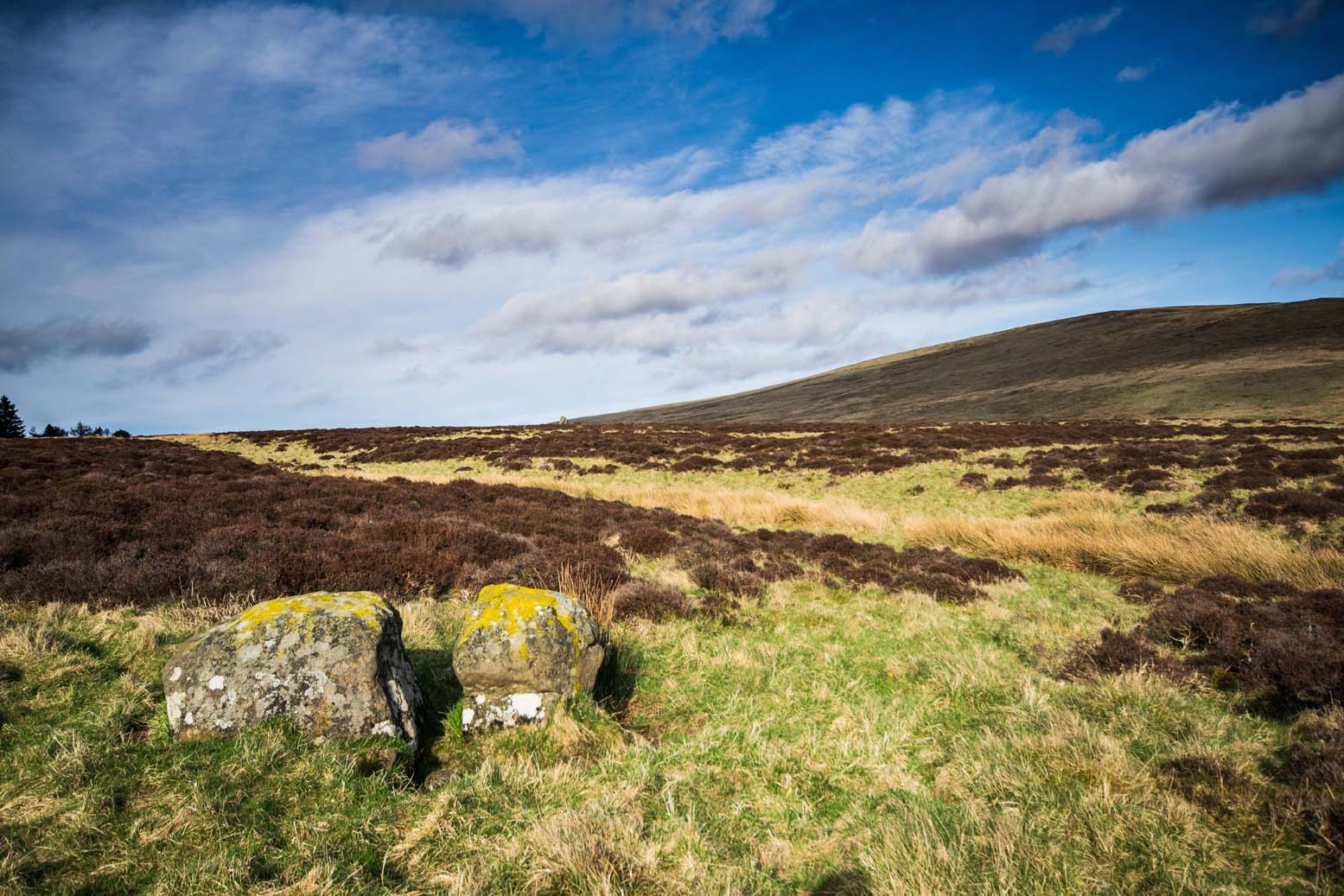
Pendreich Muir, Dunblane, Stirlingshire

Standing Stone:  OS Grid Reference – NS 81382 99686
Getting Here

The huge Pendreich Muir monolith, with Dumyat in the background

Nearly 600 yards west of the old Sheriffmuir Road (between Bridge of Allan to Greenloaning), you’re best approaching it up the zigzaggy lane from above Stirling Uni until it levels out beyond the main wooded area where the hills open up on either side of you.  There’s a little touristy parking spot further along the road, just below a small wooded bit.  Go past this and look out for the small peaked hill nearly a half-mile NW on your left.  Take whichever footpath you fancy (if you see one) and get to the top of that hill!

Archaeology & History

This is a wonderful spot, located at the highest point on this small moorland region on the western edge of the Ochil Hills.  I haven’t found too much written about this once proud, but now fallen monolith — which seems unusual considering its size, cos it’s huge!  It would have stood out and been visible for miles around.  Quite when it was felled, I cannot find.  The only info I’ve got here (Royal Commission 1963) tells:

“Lying recumbent on a grassy patch among the heather, it is a four-sided pillar measuring 13ft in length, a maximum of 4ft 6in across the wider side, and a maximum of 1ft 6in across the narrower side.”

In enquiring about the nature of this stone a few years ago, a local chap who called himself ‘Wharryburn’ wrote to say, “I believe the laid-out stone is a fallen standing stone. My grandfather was gamekeeper at Airthrey Estate and responsible for the shooting on the moor there he passed it to my father etc… It’s the local volcanic stone, not an ice-dropped erratic. There are also a few biggish stones at points around that I tried to make some sense out of a few years ago, but no luck.”

The great hill of Dumyat rises to its east; a short distance north is a megalithic stone row with its upright Wallace Stone; whilst the overgrown prehistoric cairns of Pendreich 1, 2 and 3 live on the small hillocks a few hundred yards to the south.

References:

  1. Royal Commission on the Ancient & Historical Monuments of Scotland, Stirlingshire – volume 1, HMSO: Edinburgh 1963.

© Paul Bennett, The Northern Antiquarian

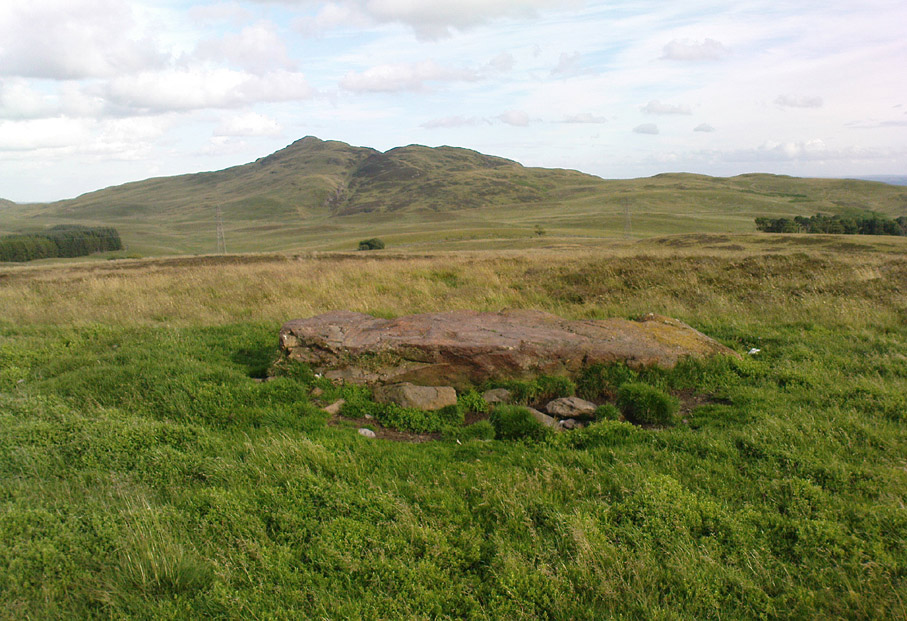
North Beachmore, Muasdale, Argyll

Cup-and-Ring Standing Stone:  OS Grid Reference – NR 6928 4184

Also Known as:

  1. Canmore ID 38589
  2. Gaigean

Archaeology & History

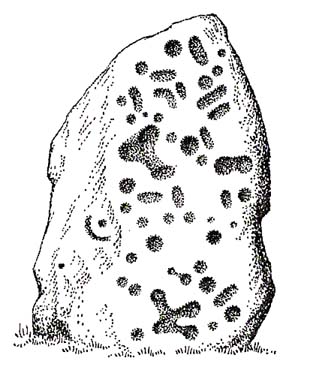
This lovely-looking 5-foot tall standing stone, marking an old boundary line in the Muasdale parish, is a curious one with elongated cups, some of which have the appearance of natural beach-side erosion caused by molluscs — unlikely though it may be.  It first appears to have been described in an early PSAS article by Duncan Colville (1930), who told us:

“The writer was informed by the Rev. D.J. MacDonald, the minister of the parish, of the existence of this cup-marked stone forming a gatepost in the boundary wall between the arable and hill ground on the farm of Gaigean.  The gate referred to is situated on the top of a steep bank on the south side of a small stream, a short distance uphill to the east of the farm steading of Gaigean.  The front of a stone is now set an angle of about 45° to the ground facing almost southwest (105° magnetic across the face).  Underneath the stone is another boulder similar in size, with several smaller stones wedged between the two, thus preventing further inspection.”

The North Beachmore stone

Some years later when the Scottish Royal Commission (1971) lads described the site in their Kintyre survey (monument no.97), they gave a more detailed description of the cup-and-rings, saying:

“The markings consist largely of plain cups, but one cup is accompanied by a partial single ring which measures 0.11m across.  At the foot of the lower half of the stone four cups linked by broad gutters form a curious branched pattern, and a similar combination of three cups and gutters occurs in the upper half, while in two other instances a pair of cups are joined by a short straight channel to form a dumb-bell figure.  The remainder of the markings comprise twelve oblong or kidney-shaped hollows measuring up to 0.15m in length by 0.064m in breadth, and thirty-one plain cups ranging from 0.038m to 0.076m in diameter, the largest being 0.019m deep.”

References:

  1. Colville, Duncan, “Notes on the Standing Stones of Kintyre” in Proceedings of the Society of Antiquaries, Scotland, volume 64, 1929-30.
  2. Royal Commission on the Ancient & Historical Monuments of Scotland, Argyll – volume 1: Kintyre, HMSO: Edinburgh 1971.

© Paul Bennett, The Northern Antiquarian
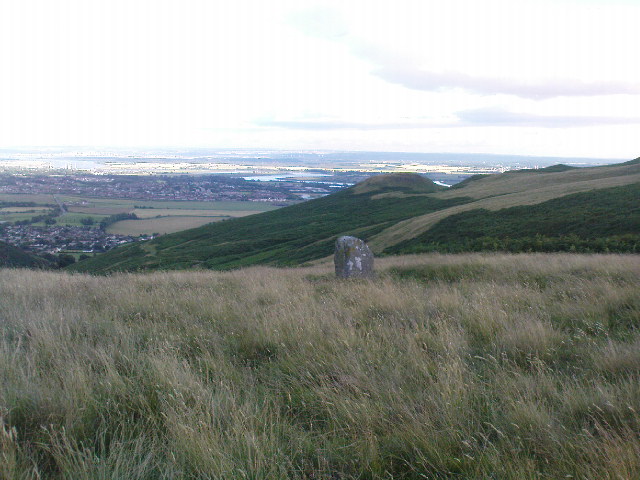

Lipney, Blairlogie, Stirlingshire

Standing Stone:  OS Grid Reference – NS 8436 9803

Also Known as:

  1. Canmore ID 145078

Getting Here

From Menstrie, walk up the path behind the post office and head up onto the hills, following the track that runs up alongside the Menstrie Burn.  After about 500 yards, crossing a stream, the path has a sort of hairpin kink and, shortly past this a smaller path leads off up into the grasslands on your left.  The standing stone can be seen up this path about 100 yards up.

Archaeology & History

The Lipney Stone

We came across this small standing stone, less than four feet high, after running and jumping down the steep eastern slope of Dumyat at some speed — or rather, Naomi came across the little thing and then told me about it after I’d run round and further down the slope towards the upper stretches of the Menstrie Burn (I was knackered!).

It’s a curious little thing inasmuch as it stands here alone, with no other companions close by; although there were a number of other stones scattering the grasslands hereabouts and other stones may await discovery.  Little seems to have been said of the site.  The Canmore record tells:

“It measures 1.1m in height, 0.7m in breadth and 0.4m in thickness, and is aligned with its long axis NE-SW. It rises with straight sides and leans to the SE.”

There are extensive remains of earthworks scattering the slopes hereby, though much of this seems medieval in nature.  Any further information about this old stone would be much appreciated!

© Paul Bennett, The Northern Antiquarian

Cornwell Stone, Salford, Oxfordshire

Standing Stone:  OS Grid References – SP 2770 2785

Getting Here

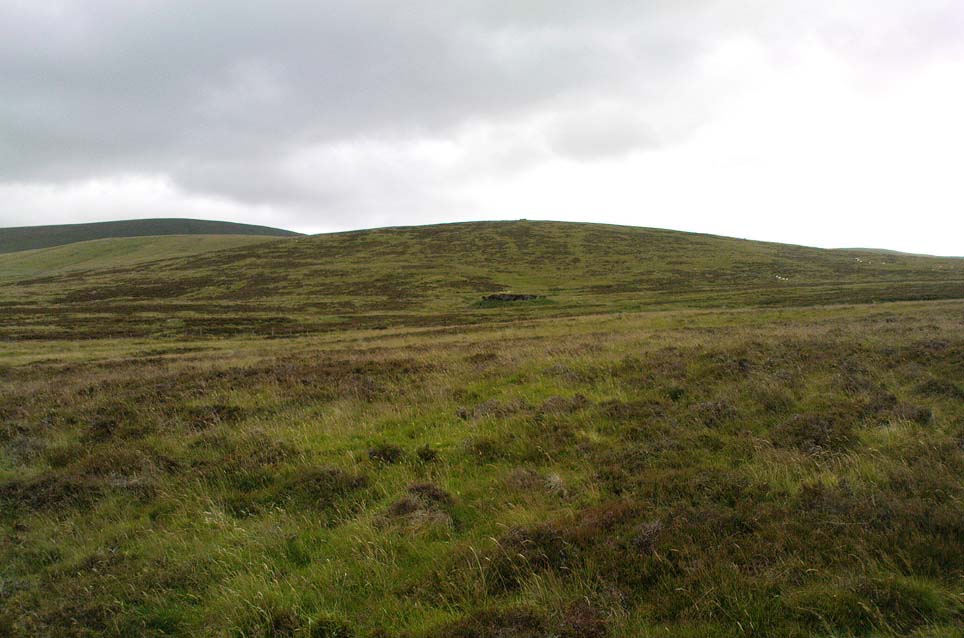
Go west along the A44 from Salford village ’til just before the crossroad with the A436. 100 yards before here there’s a small left turn, downhill, past Hollis Hill Farm and Park Farm. Before reaching Cornwell at the bottom, walk into the fields to your left and find the township boundary (on 1:25,000 OS maps), which is marked with old hedges.  It’s in here!

Archaeology & History

Walk along the line of old hedges, checking either side if it’s overgrown, until you find this well-worn three-foot tall standing stone (exact coordinate SP 2770 2785) standing in the hedgerow. It’s a cute little thing which may have marked the old boundary line, but it has a distinctly prehistoric feel and look to it, in a region where many old prehistoric remains still linger…

References:

  1. Bennett, Paul & Wilson, Tom, The Old Stones of Rollright and District, Cockley: London 1999.

© Paul Bennett, The Northern Antiquarian

White Stone, Dunblane, Stirlingshire

Standing Stone:  OS Grid Reference – NN 8063 0420

Also Known as:

  1. Glenhead
  2. MacGregor Stone
  3. NN80SW 3 (Canmore)
  4. Whittieston Stone

Getting Here

If you’re not into the walk, get the bus running NE between Dunblane and Greenloaning — the A9 — getting off at the Little Chef on the dual carriageway and cross the road, walking up the track to Upper Whiteston Farm (the owners here are very helpful).  As you walk up the track you’ll notice the large upright in the edge of the field a coupla hundred yards to your right.  That’s the one!

Archaeology & History

This is a mightily impressive site if you’re into yer megaliths!  When it was visited and measured by Mr Hutchinson (1893) in the 19th century he found it to be 9ft 4 in tall; and although it seems quite isolated at first sight, we find that there is another large stone companion laid down not far to the north of here which may have had some relationship with it .  But that aside…  There are also as many as eight cup-markings on the stone’s eastern face: one large one and seven smaller ones, in no particular order as usual!  It was these cup-marks that gave me the impression there was once a burial associated with the stone, but the archaeology records seem silent on such a matter; though folklore tradition tells another story…

Folklore

Mr Hutchinson (1893) told that the legend attached to this stone appears to be “of quite recent date.”  He said how,

“In the district the stone is known as the MacGregor Stone, and the tradition accounting for the name is to the effect that here a countryman was sacrificed by the followers of Rob Roy, when forming for the engagement on Sheriffmuir, in order to satisfy the ancient Highland superstition that first-blood was an infallible omen of success… The tradition is precise enough to state that a man of the name Dawson was seized in the adjoining hamlet of Whiteheadston (for such is the orignal name) as a whig, and therefore a foeman and proper victim.  Dawson, however, suspecting the intentions of the captors, vehemently professed himself a supporter of King James and was left off.  But another inhabitant of the hamlet not so acute or not so hypocritical, was immolated at the stone.”

Hutchinson however, doubts the accuracy of the tale and suggests that the local name of the MacGregor’s Stone derives from the fact that the monolith stands upon land once owned by the MacGregors of Balhaldies, countenancing that the stone “is of much earlier date than the MacGregors of Balhaldie or any other sept of the Children of the Mist.”  I think he’s got a point!

References:

  1. Hutchinson, A.F., “The Standing Stones of Stirling District,” in The Stirling Antiquary, volume 1, 1893.

© Paul Bennett, The Northern Antiquarian

Harperstone Circle, Dunblane, Stirlingshire

‘Stone Circle’:  OS Grid Reference – NN 838 032

Archaeology & History

An intriguing entry inasmuch as we don’t know the full history and nature of the site.  Whether this site was the “druidical circle” mentioned in the 1791 Old Statistical Account of Scotland ” upon the heights of Sheriffmuir,”(vol.3, p.210), we cannot be sure.  The site was certainly described by Mr Hutchinson (1893) more than a century ago as a “stone circle”, but earlier still in a short piece in the Stirling Journal of May 5, 1830.  It read:

“About eight miles from Stirling by the Sheriffmuir Road, near a place called Harperstone, there is a remarkable circle of stones, supposed to have been a druidical place of worship of old.  The site of this circle is rather uncommon in this country — being on the back summit of a high hill, one of the Ochils called the Black Hill, and exposed to every wind that blows.  It is about two english miles south of the present roadway.”

The writer’s notes then told of some curious finds by this circle, giving the impression that it may have had another function: perhaps a cairn of sorts; perhaps an ancient building — we may never know.  Nevertheless, his information is intriguing.

“Tradition records two remarkable circumstances connected with this druidical circle, which may perhaps be worthy of being preserved.  About the middle of last century (c.1750) there were dug up at the foot of the larger stones three vessels of clay of antique shapes, containing coins of very ancient date, which were long preserved by Monteath of Park, but are now, we regret to say, lost.  So late as 1770, these coins were, it is said, to be seen at Park House, all of gold.  About the year 1715, some stones on which had been engraved inscriptions were dug up at the same place; and at a previous period specimens of ancient Pictish armour were dug up from the bowels of this hill, which had been carefully deposited of yore some feet below the surface in crypts of curious description.”

When Mr Hutchinson came to explore this region in search of the stone circle, his nose took him to a site a few hundred yards north of nearby Harperstone Farm, where he found a large stone:

“It is 9 feet long by 6 feet across on the top, is 3 feet thick and measures 26 feet round.   This appears to have been a centre stone, and a surrounding circle is traceable more or less distinctly — moreso to the west and north, less so to the east and south.  The radius of the circle is about 15 yard, and a similar distance separates each of the larger stones yet traceable in the circle.  The ground beside the great central stone appears to have been excavated…”

Black Hill, Sheriffmuir, looking east
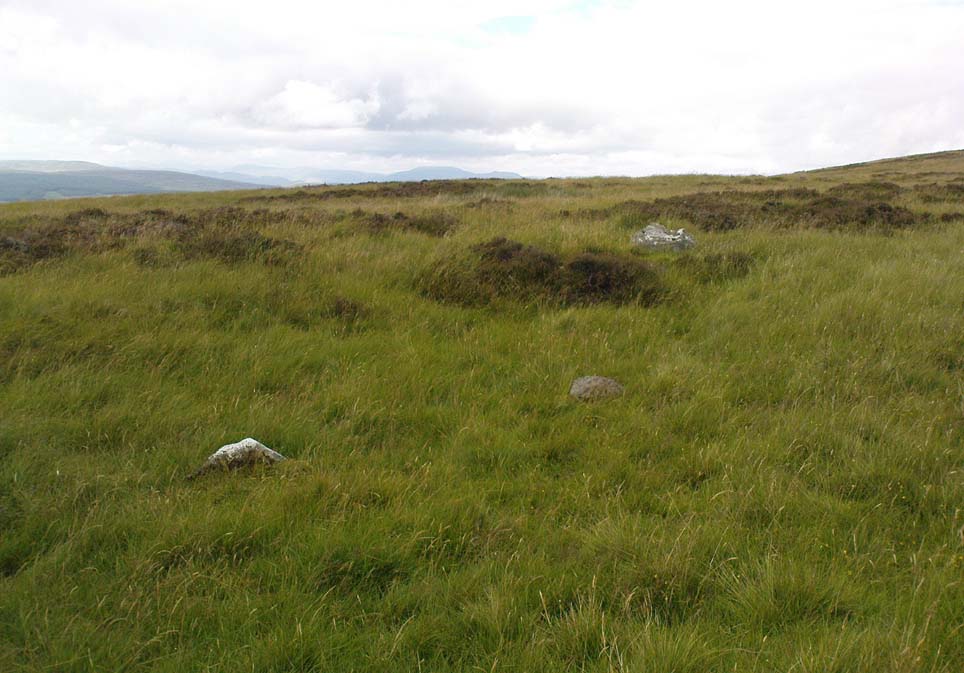
Arc of 3 stones in large ellipse

But it would seem that Hutchinson’s site and the one described in the Stirling Journal of 1830 are two distinctly separate items if their relative topographical descriptions are to be accepted.  No doubt — like many a-local who’s found these same written accounts — when we visited and wandered back and forth over the Black Hill site in Autumn 2010, we were as puzzled as others before us in finding nothing on the named Black Hill.  Nothing that could remotely be viewed as the circle described was anywhere in evidence.  The only thing that we found of any potential was on the flat below the southern ridge of the hill, heading towards the small copse of trees, where is a possible ring of seven stones, albeit a low one, in an ellipse formation.  The ground was much overgrown and a spring of water emerged from the edge of where might have been an eighth stone.  The photo shown here was the best we could get of the site.  It’s unlikely to be the place which Messrs Hutchinson and company wrote about.

A more detailed examination of the landscape around this ‘Harperstone Circle’ is needed.

References:

  1. Hutchinson, A.F., “The Standing Stones of Stirling District,” in The Stirling Antiquary, volume 1, 1893.

© Paul Bennett, The Northern Antiquarian

Cultoon, Portnahaven, Islay, Argyll

Stone Circle:  OS Grid Reference – NR 1956 5697

Also Known as:

  1. Cultoun

Archaeology & History

Following excavation work on this denuded megalithic ring in 1974 and 1975 under the joint auspices of the Islay Historical Works Group (IHWG) and the Hunterian Museum of the University of Glasgow, under the direction of archaeologist Dr Euan MacKie (1976), with the intent of actually restoring the site to what they thought was its former glory by resurrecting the fallen monoliths in this ring of stones, some intriguing facts came to light.  Dr MacKie wrote:

“This site stands on a low, shallow knoll about a mile from the sea and with an extensive peat bog to the west.  Before excavation the stone ring consisted of a rough oval of two standing stones and ten fallen ones, the latter being partly or nearly completely buried under the turf.  The dimensions of the ring were about 45 by 40 yards.  The excavations were based on a 6m grid and the ain was to explore as much as possible the perimeter of the ring and part of the interior.  In this way it was hoped to identify the sockets from which the prone monoliths were assumed to have fallen and thus to discover the exact positions at which they were to be re-erected…

“It soon became clear that the prone monoliths had not in fact fallen out of their sockets.  All of them lay on the old ground surface under the peat which had evidently begun to grow — in the 8th century BC according to one C-14 date — after the site had reached its present condition.  Some stones had no socket next to them and a number of sockets were found without adjacent stones.  Several stones lay next to sockets in such a position as to make it clear that they had never been set up.  The site had evidently been abandoned in the middle of construction and those sockets already dug were allowed to fill slowly with rubble and silt.  One socket was discovered which had been deliberately filled up, confirming that some change of plan had occurred before the final abandonment.  Cultoon is the only stone circle apart from two phases of Stonehenge to have revealed evidence of never having been completed. (my italics, Megalithix)

“The finds were few and consisted of mesolithic flint microliths and some larger, presumably neolithic flints.  The former were all on and in the buried topsoil — the circle builders’ ground surface — while the latter were on the land surface and in the lower part of the peat; these last included scrapers and are hollow-based points of Bronze Age type.  Of particular interest was the discovery of caches of flint flakes in the peat next to the two standing stones.  They appear to be deliberate offerings and suggest that the site retained its sanctity for some centuries after its abandonment.”

…to be continued…

References:

  1. MacKie, Euan, “Cultoon, Islay,” in Glasgow Archaeological Society Bulletin, No.2, 1976.

© Paul Bennett, The Northern Antiquarian

Coffin Stone, Sabden, Lancashire

Standing Stone:  OS Grid Reference – SD 7717 3830

Getting Here

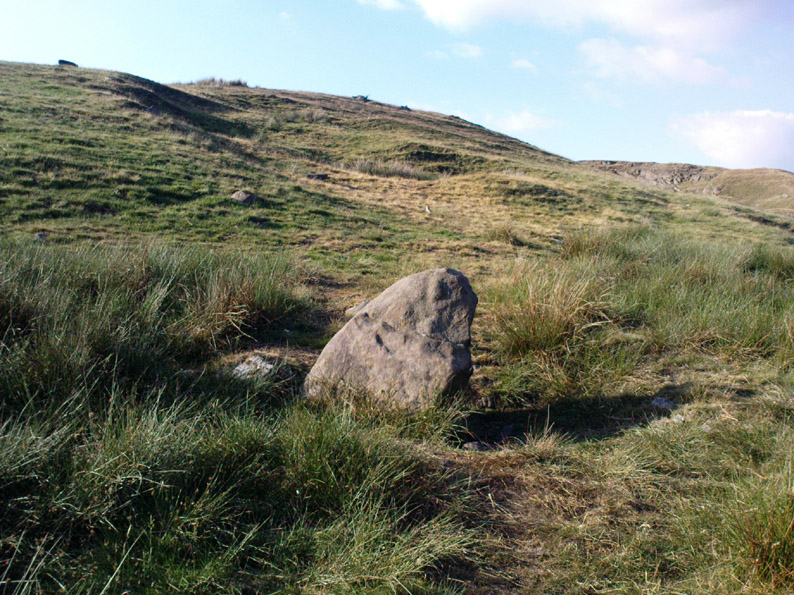
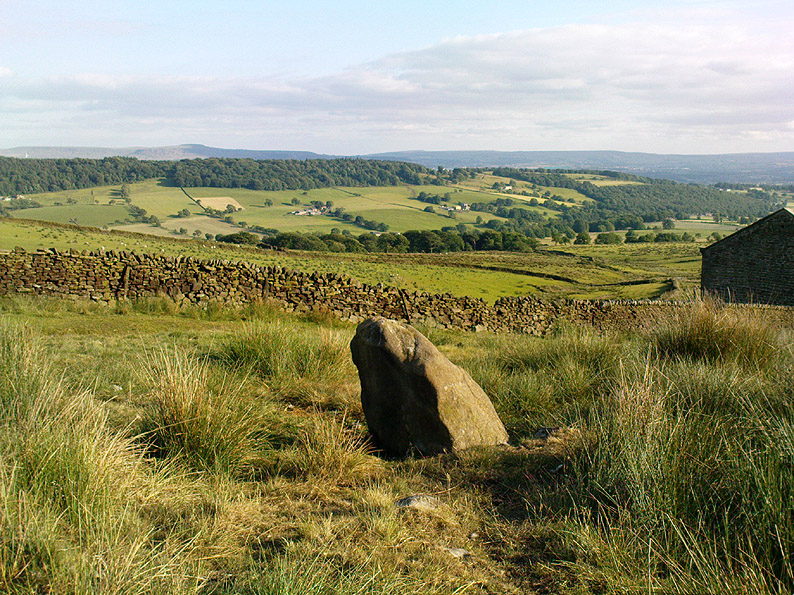
From Sabden village, walk up the Clitheroe Road towards the hairpin Nick o’ Pendle, but take the turning left 100 yards before the Nick.  Walk along the dirt-track for less than 100 yards, watching for the small upright on the right-hand side of the track. You can’t really miss it!

Archaeology & History

The Coffin Stone

To be found on the far southern flanks of Pendle Hill, the Lancashire writer and historian, John Dixon,* brought us to this little-known stone a few days back — and gave us the history of the place. (Dixon 1993)  He pointed out how it’s situated right alongside the legendary cross-Pennine prehistoric route that was labelled ‘Rombald’s Way’ by Eric Cowling. (1946): an important trackway which ran from coast to coast, allowing for the passage and transmission of flints, salt and early metals carried for barter and other uses.  What may be another standing stone is on the nearby skyline a couple of hundred yards east; and on the slopes either side of here are the prehistoric tombs of Jeppe Knave Grave and the Devil’s Apronful (amongst others).  A fine little standing stone!

Folklore

The name derives from it being a place where, in bygone days, when coffins were carried along the ancient routeway hereby, it was rested by this stone.  As John Dixon (1993) told:

“It was used to mark a resting point for coffins en route from Pendle Forest to Whalley, allowing the mourners to refresh and pray by the curative Marion well, in a time before the ‘Newchurch’ of St. Mary was established at Goldshaw Booth in 1544.”

…and from another angle

The Marion Well he mentions is more popularly known as Our Lady’s Well and can be found a hundred yards up the hillside above our Coffin Stone.  If you walk up the slope you’ll see the site emerging where a small boggy pool appears on the hillside, and the course of the small stream marked by the reeds growing down the grassy slopes.  Although it became very much a Roman Catholic practice to venerate the Virgin Mary by this old well, the ritual was of course a much older heathen one.

John has also reminded me to mention “the fossil markings on the side of the stone – some plant from a former age” which you can see curving up from the bottom of the upright.

References:

  1. Cowling, Eric T., Rombald’s Way: A Prehistory of Mid-Wharfedale, William Walker: Otley 1946.
  2. Dixon, John, Journeys through Brigantia – volume 9: The Ribble Valley, Aussteiger Publications: Barnoldswick 1993.
  3. Dixon, John, Pendle – A Mythic Landscape, Aussteiger Publications: Barnoldswick 2010.

* John is the author of many fine historical travel guides, including the Journeys through Brigantia series. See the titles in the Lancashire Bibliography and Yorkshire Bibliography for a more complete listing of all his books to date.  If you wanna buy any of his works, or make enquiries regarding them, email John at: lancashirebooks@fsmail.net – or write to him direct, at: John Dixon, Aussteiger Publications, 21 Lowergate, Clitheroe, Lancashire BB7 1AD.

© Paul Bennett, The Northern Antiquarian


Great Wood Laithe (019), Skipton, North Yorkshire

Cup-Marked Stone:  OS Grid Reference – SD 99620 50551

Also Known as:

  1. Carving no.3 (Hedges)
  2. Carving no.19 (Boughey & Vickerman)

Getting Here

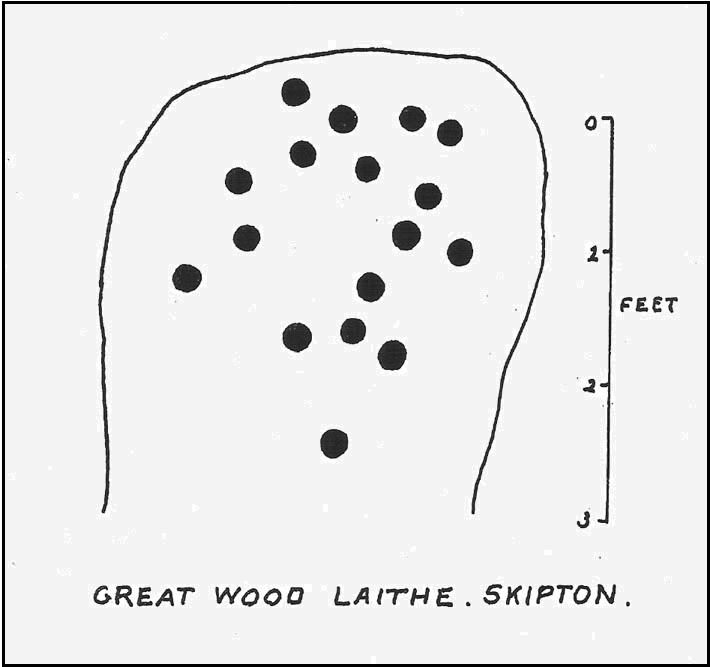
Cowling’s 1964 drawing

From Skipton centre get to the Horse Close estate on the southern side of the town and look up to the fields on the sloping hill above it with the small woods above ’em.  Head up towards the trees, but before you get there go into the fields on your right, and in one of them you’ll see what looks like a pile of rocks near the middle.  Head for it!

Alternatively, follow the directions to reach the Horse Close Hill enclosure, then walk down into the field on its western edge.  You can’t really miss it!

Archaeology & History

This carving first saw the light of pen-and-paper in the early 1960s, soon after the Yorkshire antiquarian Eric T. Cowling (he of Rombald’s Way fame) was led to the site by his wandering nose and the aid of local people.  He sent a letter to the editor of the Bradford archaeology group at the time (a certain Mr Sidney Jackson), which told:

“South-west of the wood which gives its name to the Great Wood Laithe at the western end of Rombalds Moor and overlooking Skipton from the east, is a cup-marked boulder: NGR – SD 99625055.  In the middle of the field alongside the wood is an outcrop of rock which has been almost levelled with the adjacent field surface by the dumping of boulders from the surrounding ploughlands.

“The top of the outcrop rises to a dome-shaped projection which bears simple cup-markings.  These average two in diameter and total 17 in number.  The whole surface of the stone is weathered, and suitable light may reveal more details.”

And, faded though it is, in better lighting conditions it seems there may be more than twenty cup-marks on the rock.  Certainly this is what the surveys of Hedges (1986) and Boughey & Vickerman (2003) concluded.  There are other carvings close by and, on the hillside immediately above you, the denuded remains of a very impressive prehistoric settlement site known as Horse Close Hill.  Well worth having a look at!

References:

  1. Boughey, Keith & Vickerman, E.A., Prehistoric Rock Art of the West Riding, WYAS: Leeds 2003.
  2. Cowling, E.T., “Cup-and Ring Boulders,” in Cartwright Hall Archaeology Group Bulletin, 9:5, May 1964.
  3. Hedges, John (ed.), The Carved Rocks on Rombald’s Moor, WYMCC: Wakefield 1986.
  4. Ramm, H.G., “Yorkshire Archaeological Register, 1964,” in Yorkshire Archaeological Journal, volume 41 (part 163), 1965.

© Paul Bennett, The Northern Antiquarian 

Wallace’s Stone, Dunblane, Stirlingshire

Standing Stones / Stone Row:  OS Grid Reference – NN 83259 02293

Also Known as:

  1. Lairhill Stones

Getting Here

Follow the same directions as to reach the cup-marked Sheriffmuir Carving, which is just a coupla hundred yards away to the southwest.  On a clear day you can see this standing stone from the pub by the roadside, a few hundred yards away!

Archaeology & History

Wallace Stone (photo credit – James Elkington)

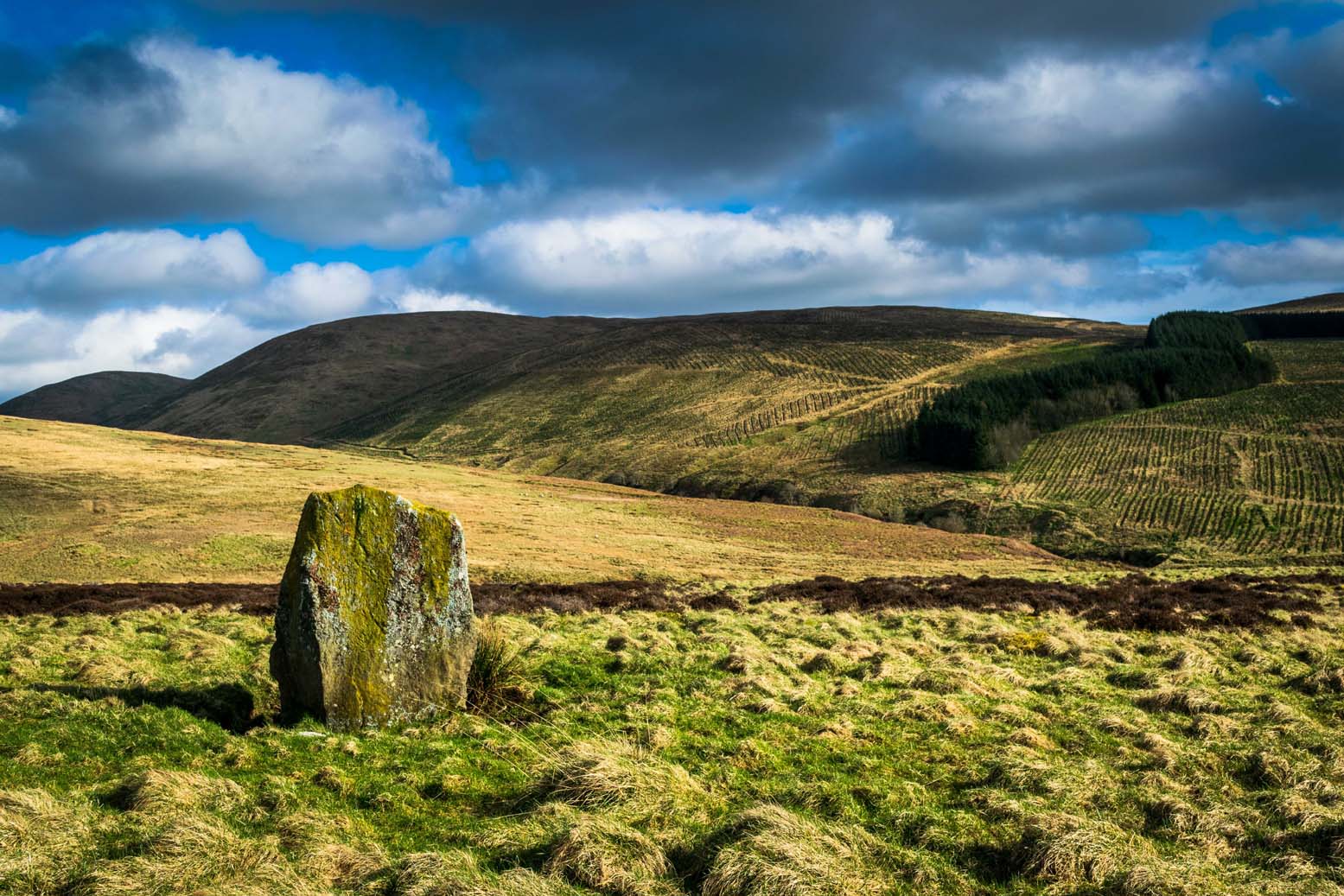
This is alleged to be just one standing stone in a straight line of five once-upright monoliths.  Starting at the southwestern end of this row we have the 7ft-long cup-marked Sheriffmuir Carved stone — which certainly looks as if it stood upright in the not-too-distant past — and as we move up the line we pass another that’s been split in half.  Another earthfast-looking rock is the next contender, before we reach our famous Wallace Stone, standing upright and proud on this moorland ridge.  It’s about 6ft tall and 3ft across at its widest and certainly acts as a marker for the line of stones that allegedly stood upright here.  And if we walk just a bit further up we have another big stone laid on the ground which is alleged to be a part of the same alignment.

The split stone (photo credit – James Elkington)

If it is an authentic megalithic row, it’s not included in either the Thoms’ (1990) two-volume work on the subject, nor Aubrey Burl’s (1996) compendium a few years later.  And though the alignment looks good, I’ve found ones just like this in the Pennines where we have just one upright left and then a line of other seemingly prostrate stones running dead straight either side of the singular upright (and have kept mi gob shut about ’em for sensible reasons), so I’m not too sure what to think.

But, alignment aside, the Wallace Stone itself is a damn good standing stone and well worth checking out.  It’s highly probable that other prehistoric remains still lurk, undiscovered, amidst these heaths…like the lost stone circle to be found nearby…

Folklore

A slight variation on a theme about this spot:  in both accounts the stone was named after the legendary Scottish independence fighter, Sir William Wallace.  The folklore tells that he and his fighting clans gathered here in 1297 preceeding the Battle of Stirling Bridge; whilst the variation tells that the stone here was actually erected around that time to commemorate the event.  This tale was first narrated by a local story-teller called Blind Harry and was found by local historian A.F. Hutchinson (1893) to be a case of mistaken identity!

References:

  1. Burl, Aubrey, From Carnac to Callanish: The Prehistoric Stone Rows and Avenues of Britain, Ireland and Brittany, Yale University Press 1993.
  2. Heggie, Douglas C., Megalithic science: ancient mathematics and astronomy in north-west Europe, Thames & Hudson: London 1981.
  3. Hutchinson, A.F., “The Standing Stones and other Rude Monuments of Stirling District,” in Transactions of the Stirling Natural History and Antiquarian Society, 1893.
  4. Royal Commission on the Ancient & Historical Monuments of Scotland, Archaeological Sites and Monuments of Stirling District, Central Region, Society of Antiquaries of Scotland 1979.
  5. Thom, A., Thom, A.S. & Burl, Aubrey, Stone Rows and Standing Stones – 2 volumes, B.A.R.: Oxford 1990.

Acknowledgements:  Big thanks as always to James Elkington for use of his photos in this site profile – prints of which are available from the man himself!

© Paul Bennett, The Northern Antiquarian