Murlaganmore 2, Killin, Perthshire

Cup-Marked Stone: OS Grid Reference – NN 5395 3455

Getting Here

Murlaganmore 2 - 01
Murlaganmore 2

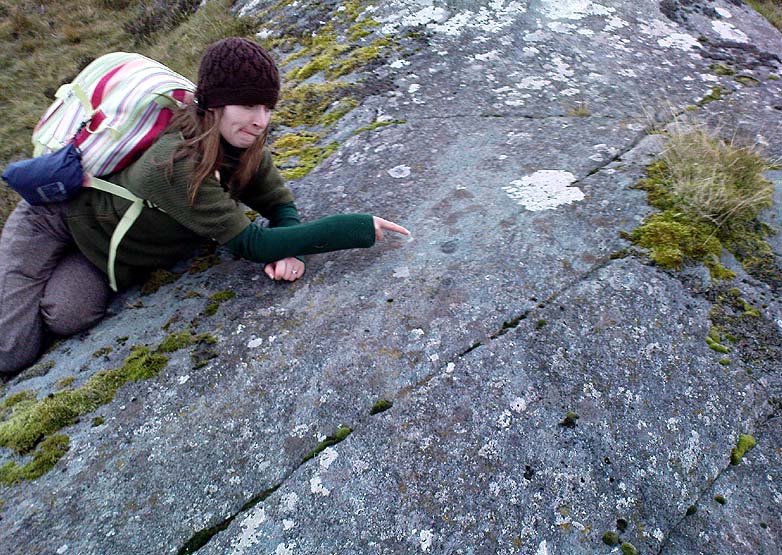
Take the same direction to reach the Murlaganmore Footprint, continuing up past the cottages. 100 yards on, where there’s a bend in the track, cross the field on your left and go thru the gate higher up the slope.  Stick to the small rough ‘path’, past the Murlaganmore 1 carving for nearly 100 yards, where a small rocking-stone-like rock is ahead of you. That’s it!

Archaeology & History

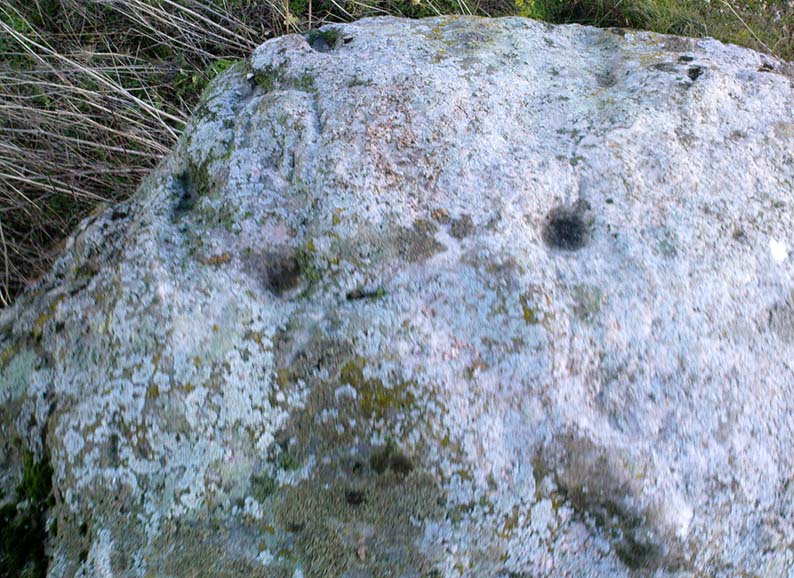
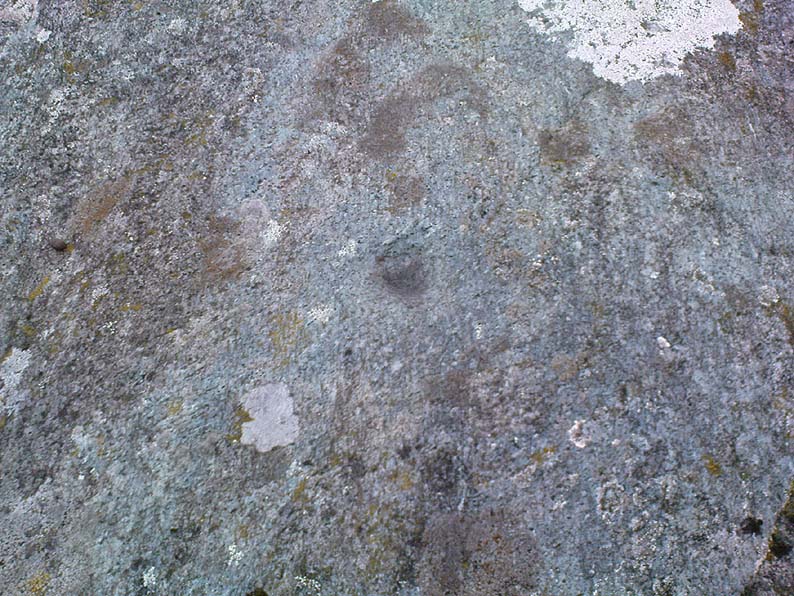
Close-up of cup-marks

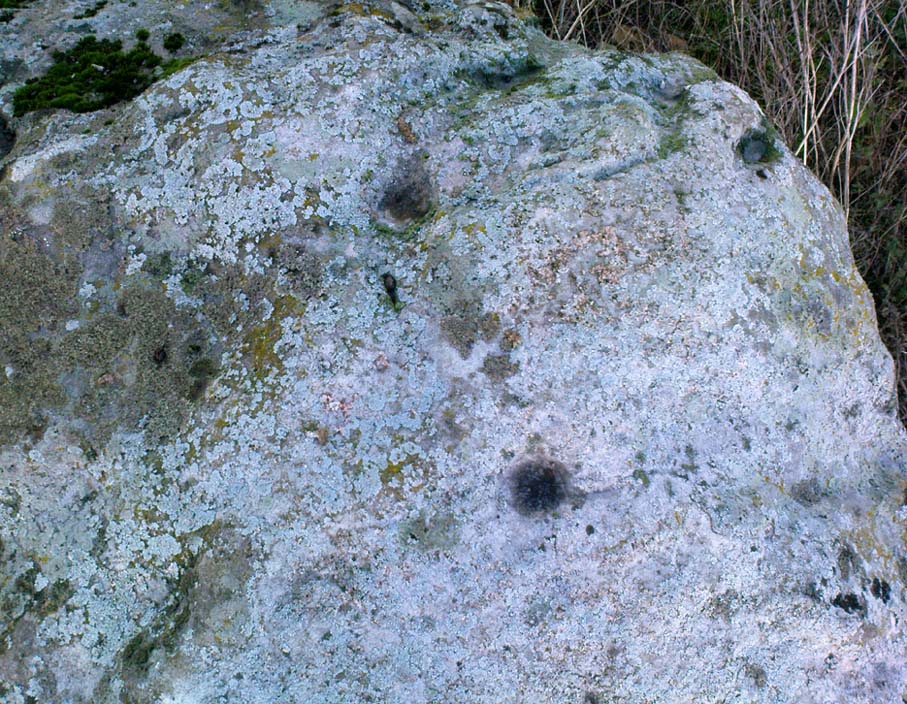
This stone’s in a lovely setting, with the craggy rise of Creag Mhor and the waterfall of Airigh an Fhraoich up the rich coloured slope behind it.  But the carving here is a simple one, with perhaps only 2 cup-markings etched on the stone’s upper surface, as the photo here shows.  Tis a lovely setting though, and there are other carved rocks living nearby which aint yet seen the pages of any record-books.

It was first mentioned in C.G. Cash’s (1912) essay on the antiquities of Killin and district, who told that here was “one well-cut cup, 3 inches in diameter and 1½ inches deep, and also a doubtful or faint one.”  The carving was later listed in the Royal Commission’s Stirling District report (1979) as simply “a boulder bearing cup-marks.”

References:

  1. Cash, C.G., ‘Archaeological Gleanings from Killin,’ in PSAS 46, 1911-12.
  2. Royal Commission on Ancient & Historical Monuments, Scotland, The Archaeological Sites and Monuments of Stirling District, RCAHMS: Edinburgh 1979.

© Paul Bennett, The Northern Antiquarian

Murlaganmore Footprint, Killin, Perthshire

Carved Rock:  OS Grid Reference – NN 54321 34840

Also Known as:

  1. CEN 16 (Morris 1981)
  2. Murlaganmore 3

Getting Here

From Killin, take the small road to the Moirlanich Longhouse, but keep on for another mile. Just before the road crosses the river, stop! In the fields above you to the left are a few trees and some rocks. Walk uphill till you’re nearly level with the cottages at Murlaganmore (the gate’s about 10-15 yards away) just above the gorze bushes and check out the long rock.  If you can’t see it at first, bimble about till you find it. You’re just about on it!

Archaeology & History

Murlaganmore footprint02
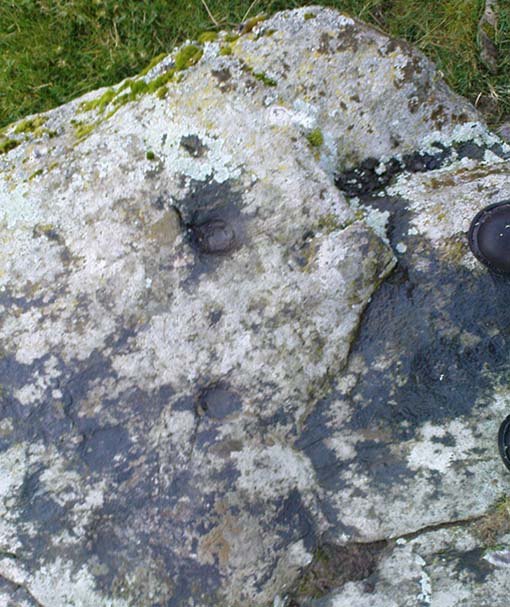
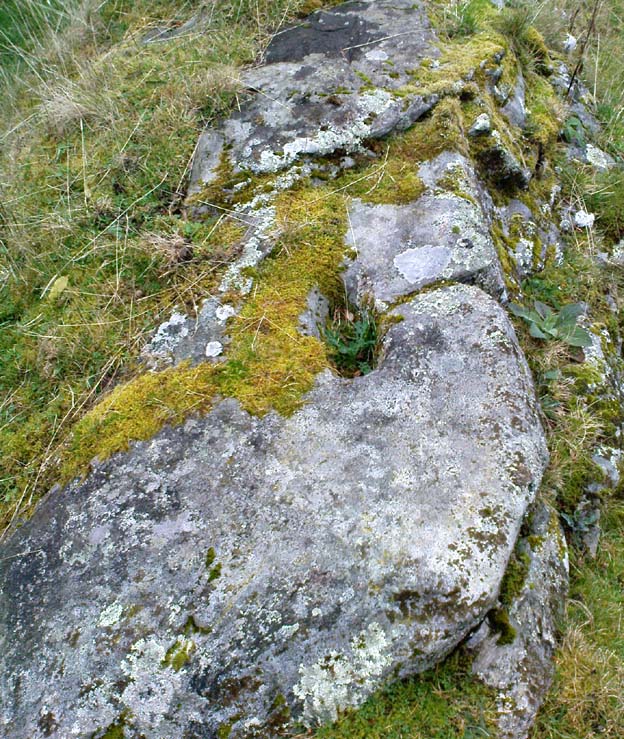
Murlaganmore’s ‘Footprint’ carving – probably Nature’s artwork

Although shown on modern OS-maps as a ‘Sculptured Rock’ and included in the Canmore survey, when we visited this site a few days ago I have to say that unless evidence to the contrary can be obtained, this ‘site’ should be declassified as an archaeological remnant of the prehistoric period.  It appears to be natural — though could have had some agricultural purpose or origin in centuries past.

The ‘footprint’ appears to have been described first of all by F.W.L. Thomas (1879) in his essay on the inaugural seat of Kings at Dunadd, where a similar footprint is found at the top of the fort.  Thomas thought that this curious footprint could have had a similar function — though even folklore hereabouts seems silent on such a matter.  The site is included in Ron Morris’ 1981 survey, where he too described it as “probably natural but just possibly man-improved.”

References:

  1. Morris, Ronald W.B., The Prehistoric Rock Art of Southern Scotland, BAR: Oxford 1981.
  2. Thomas, F.W.L., ‘Dunadd, Glassary, Argyllshire: The Place of Inauguration of the Dalriadic Kings’, in Proc Soc Antiq Scot, vol.13, 1879.

© Paul Bennett, The Northern Antiquarian


Allt na Ceardaich Knoll, Killin, Perthshire

Cup-Marked Stone:  OS Grid Reference – NN 564 364

Getting Here

Truly troublesome if you aint into walking.  Many ways up, but the easiest has to be the zigzagging trackway up from the valley bottom just by The Green a few hundred yards past Lochay Power Station, up the southern edge of Creag na Cailleach. At the end of the trackway, take the stream uphill for a few hundred yards and watch out for the rocky rise to your right (east).  Head for it and check out the rocks there.  You’ll find it!

Archaeology & History

Allt na Ceardaich01
Single cup-marked rock below Creag na Cailleach

I’m not sure that anything’s previously been written about this curious single cup-marked boulder. I say ‘curious’, simply because of the location and position of the clear cup-mark on this near-gigantic piece of embedded stone.  We walked upon the rocky outcrop south of Creag na Cailleach (above the tree-line where the land levels out) and first saw the cup-marking at the top-end of this huge rock (amidst a number of others) on the large rise a coupla hundred yards west of Allt na Ceardaich.  And as the carved cup was on the top-end of the boulder, I was expecting to find much more of the rock with other motifs scattering its body — but was amazed to find that this was the only single cup-marking on an otherwise huge stone.  A mixture of bewilderment and disappointment came over me as I shook my head in disbelief that only a single cup had been scribed into an otherwise massive rock.

Allt na Ceardaich02
Close-up of the cup-marking

However, the light was poor with low cloud and it was nearing sunset, so there may have been other aspects to this carving which we missed out on.  One other ‘possible’ cup-mark might have been done, but it seemed very dubious even in the poor light.  I was all for having another look at it the following day; but wandering halfway up a mountain just to see if this was the only cup-marking on this outcrop was summat my daughter wasn’t into doing!  So the site must await another mad cup-and-ring-crazed traveller on another day to get a more detailed inspection!  George – are you out there anytime soon!?

© Paul Bennett, The Northern Antiquarian

Littlestone, Bingley Moor, West Yorkshire

Cup-Marked Stone:  OS Grid Reference – SE 11209 43488

Getting Here

Follow the directions to reach the nice Big Rock carving.  Once here, walk up the gentle slope less than 100 yards eastwards.  Get here before the heather grows back, otherwise it’s unlikely you’ll find it!

Archaeology & History

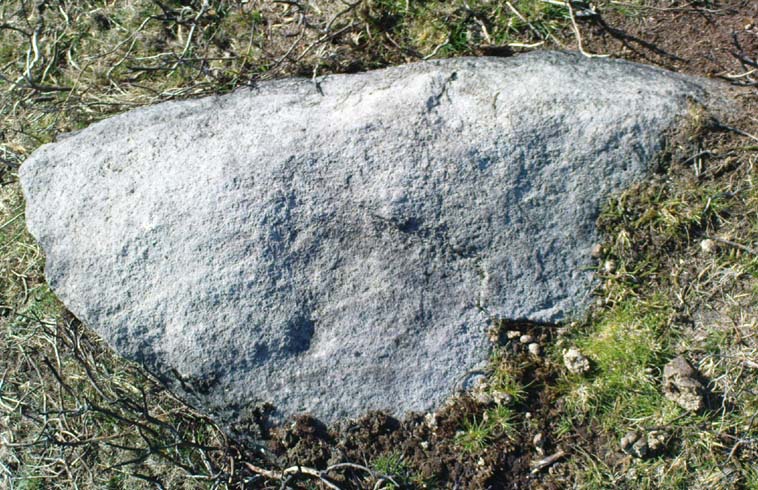
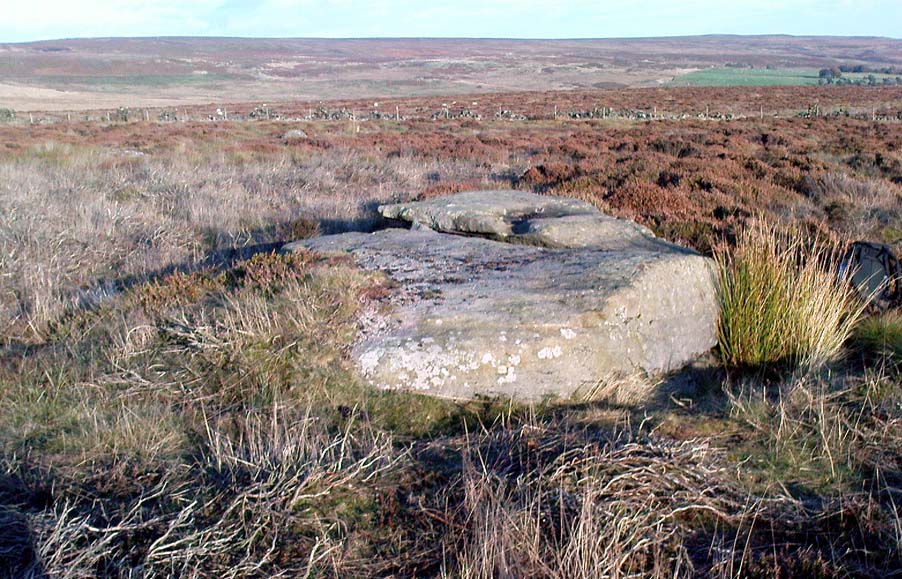
The Little Stone, Bingley Moor

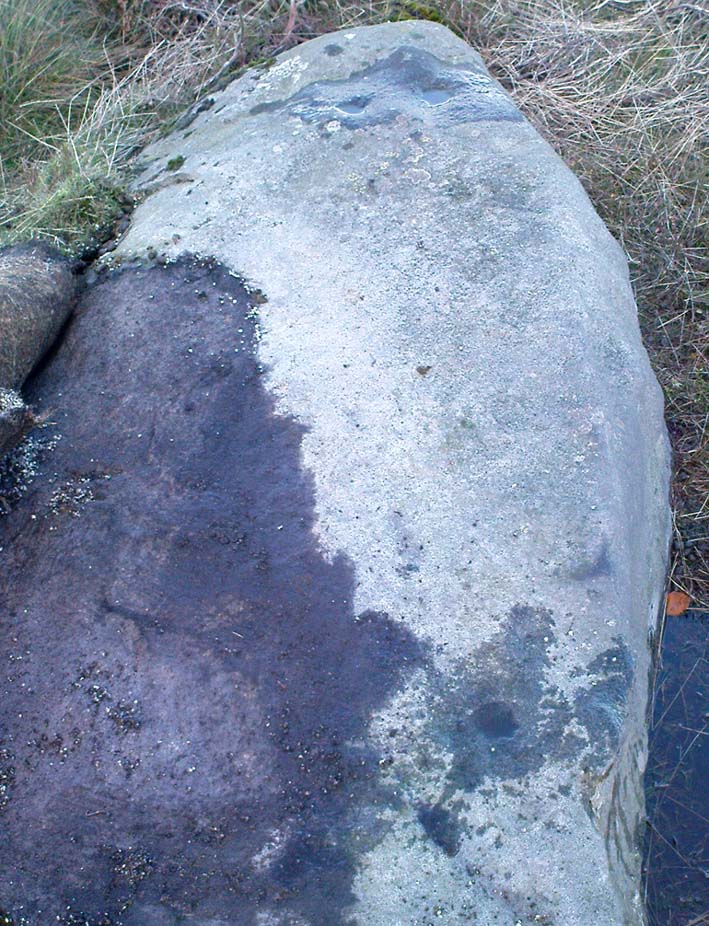
Not previously catalogued, this is just a small trivial little stone with just a single cup-marking on it.  There’s a somewhat debatable line which looks more likely on the photo than when you actually see it in situ.  As we had the Big Rock just down the slope from here, I thought this could be a little rock, or Little Stone (makes sense!).  It was found by your very own Paul and those of you with the wills to seek it out, don’t be disappointed as most are with such a Littlestone. It’s certainly not as rosy as those close by, but hey – it’s another carved rock!

© Paul Bennett, The Northern Antiquarian

Teaspoon Rock, Bingley Moor, West Yorkshire

Cup-Marked Stone:  OS Grid Reference – SE 10997 43357

Also Known as:

  1. Carving no.104 (Boughey & Vickerman)*

Getting Here

Follow the same directions to reach the Lunar Stone carving.  Once here, amble about a few yards to your immediate south and you’ll find it — assuming the heather aint grown back over and covered it!

Archaeology & History

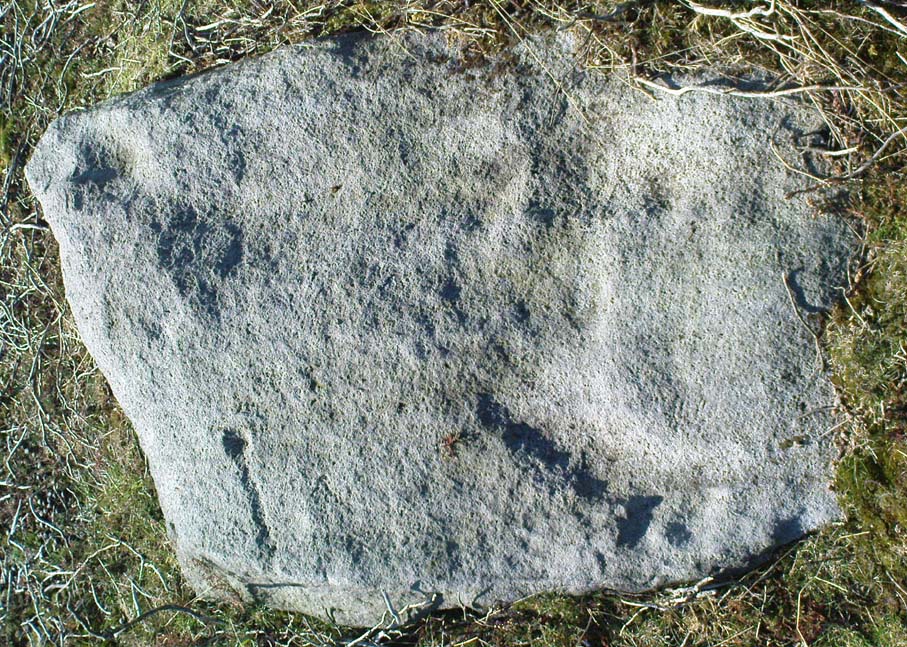
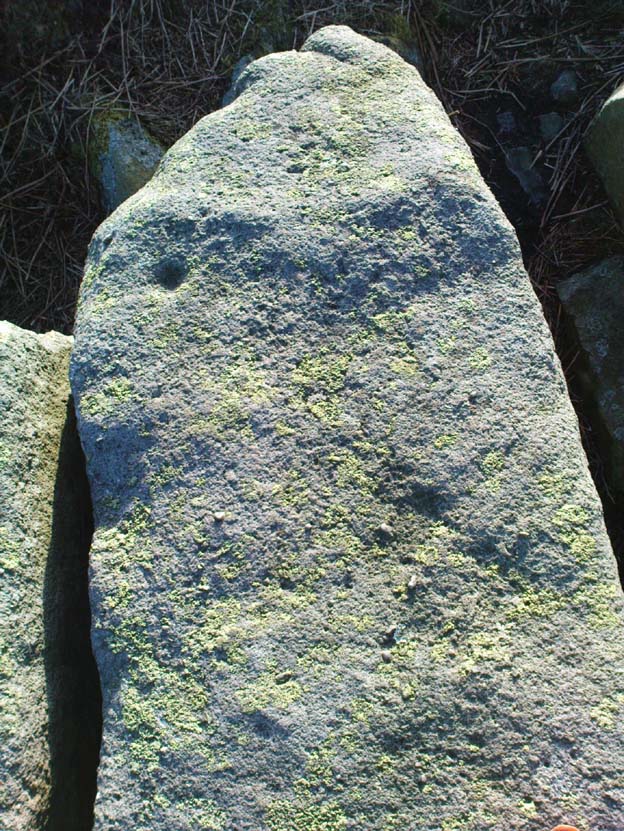
Teaspoon Rock, Stanbury Hill

This’d probably be another of those carvings first found by Stuart Feather in his amblings here in the 1970s, but we can’t say for sure.  In Boughey & Vickerman’s survey (2003), apart from attributing it as being in two separate positions (mistaking some reference from the English Heritage doods as some other carving – though that shouldn’t surprise anyone!),* they then correctly describe it as having “one cup with groove” running outwards — which we can see quite plainly (lending Michala Potts to say, “it reminds me of a teaspoon!” – hence the title!).  There may be as many as four other cups on this rock, though it’s hard to say for sure.  Two of them, perhaps, may have a very worn line linking them together (as you can slightly work out on the top-half of the carving) — but again, this is hard to say for sure.  Certainly this poor little carving aint quite as decorative as its nearby partners!

References:

  1. Boughey, Keith & Vickerman, E.A., Prehistoric Rock Art of the West Riding, WYAS 2003.

* In their survey this stone was also listed as carving no.98 by mistake, which should now be deleted from subsequent survey listings.

© Paul Bennett, The Northern Antiquarian

Ant’s Stone, Rivock, Keighley, West Yorkshire

Cup-Marked Stone:  OS Grid Reference – SE 0791 4422

Archaeology & History

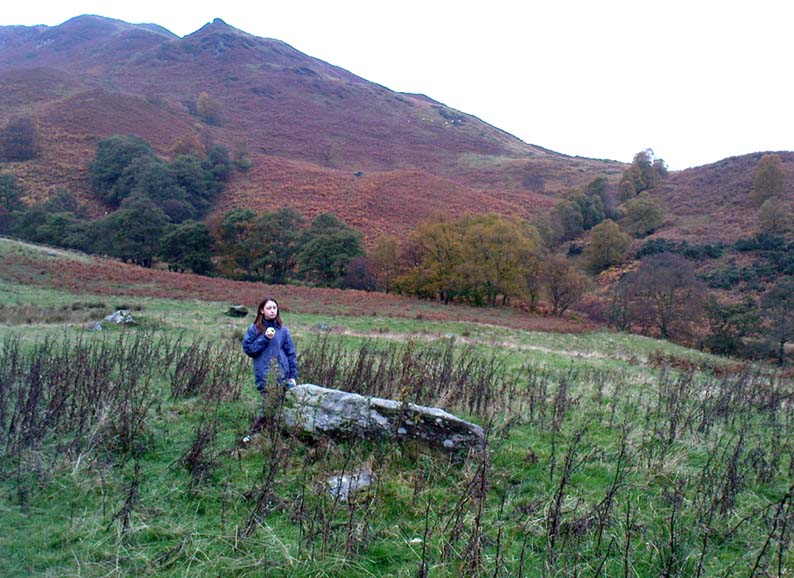
Ant Stone, uncovered

Discovered today, amidst a cluster of other carvings not previously catalogued.  This was hidden beneath a mass of vegetation, but after cutting and digging into the peat on top of the stone, several cup-marks became evident.  By the side of the rock, measuring roughly 8 feet by 5 feet, was a small ant’s nest — hence the convenient name of the carving.

Central design of the carving

The main feature is the large, perhaps natural cup-mark, about 3 inches across.  But three distinct artificial cup-markings were etched around the edges of this larger ‘cup’.  When we found this stone, the daylight was nearing its end and we were unable to ascertain any further features carved onto the rock.  Several other carvings were close by, none of which were included in the survey by Boughey and Vickerman. (2003)  After we’d finished here, we covered the stone back over with its peaty quilt and hoped that the ants weren’t too pissed off about us disturbing them…

© Paul Bennett, The Northern Antiquarian 
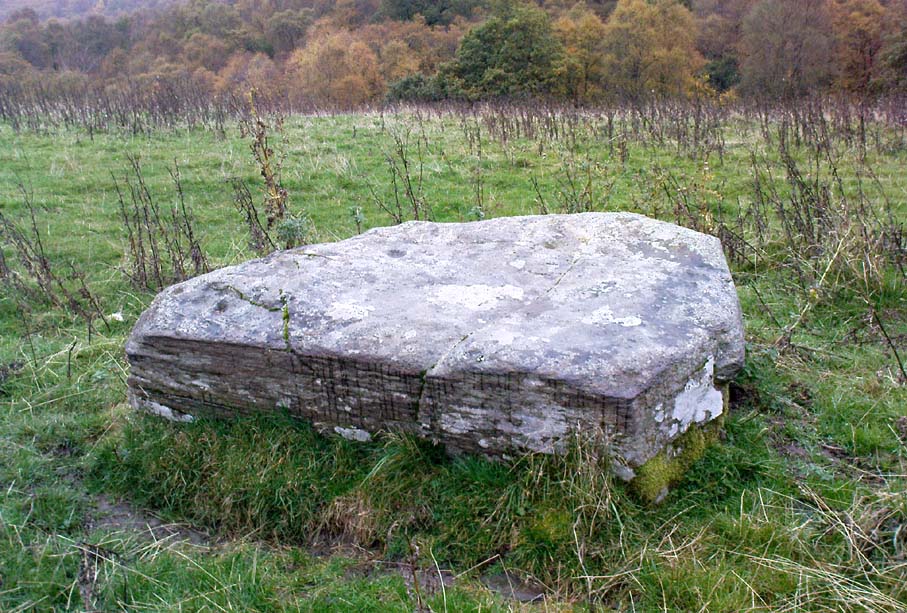

Abacus Stone, Holden, Silsden, West Yorkshire

Cup-Marked Stone (lost):  OS Grid Reference – SE 060 440

Getting Here

This carving is somewhere between Rivock’s western woodland edge, into the meadowlands next to it, down towards Robin Hood’s Wood.  Good luck if you find it!

Archaeology & History

The lost Abacus Stone design

I found this carved ‘design’ when I was but a nipper, as they say!  I was up all day, bimbling abaat checking out the stones and stuff, with notepad and pencil and found a number of cup-marked stones that I hadn’t come across in Stuart Feather’s surveys (the Hedge’s [1986] survey hadn’t been published at the time).   I’ve been back up round the Holden and Robin Hood’s Wood district several times in recent months, hoping to re-locate this carving — but without success.  I recall that when I found it all those years ago, how the design itself seemed almost ‘numeric’ in quality to look at (hence its title) and was hoping to come across it again, but the little fella’s hiding away somewhere!

The faded design was etched onto a small, slightly raised natural  stone, no more than 3ft x 3ft and about 2 feet high.  I thought that it might have been Boughey & Vickerman’s carving number 53 (Hedges survey, no.17), but it wasn’t to be. If anyone finds it again, I’d love to know!

References:

  1. Bennett, Paul, Ramblings of Archaeological Remnants in West Yorkshire, unpublished: Shipley 1984.

© Paul Bennett, The Northern Antiquarian


Ringtail Stone, Stanbury Hill, Bingley Moor, West Yorkshire

Cup-and-Ring Stone:  OS Grid Reference – SE 10970 43348

Also Known as:

  1. Carving no.96

Ringtail Stone carving

Getting Here

Follow the same directions to find the Lunar Stone.  Once here, walk just 20 yards southwest and keep your eyes peeled!  This is a long flat stone which can easily get overgrown in the heather, so you might need to search around till you find it.

Archaeology & History

Ringtail Stone - facing south
Ringtail Stone, Stanbury Hill

Thought to be another carving first located by Stuart Feather in 1978, though we can’t bne totally sure on that.  Curiously omitted from Hedge’s (1986) survey, this old glyph comprises of a single cup-mark near the western end of the stone and a complete cup-and-ring at the eastern-end.  It was first illustrated in Boughey & Vickerman’s (2003) fine survey, but they missed seeing a quite distinct line or ‘tail’ coming out the northern side of the cup-and-ring.  Nowt special in archaeological terms, but of obvious relevance to the dood who carved it! They thought there may have been two faint cups in the ring, but it isn’t clear by any means.

As with the other carvings nearby, we find it amidst a scattering of prehistoric walling and the remnants of old cairns.

References:

  1. Boughey, Keith & Vickerman, E.A., Prehistoric Rock Art of the West Riding, WYAS 2003.

© Paul Bennett, The Northern Antiquarian


Stanbury Hill Enclosure, Bingley Moor, West Yorkshire

Enclosures:  OS Grid Reference – SE 109 433

Getting Here

Follow the same directions as to find the Lunar Stone, Spotted Stone, etc.  Go thru East Morton village up the steep moorland road, east, and where the road levels out there’s a right turn and a trackway on your left which leads onto the moor.  Go ½-mile up this track till you hit a moorland ‘footpath’ signpost.  Stop here and walk due west (left) for a coupla hundred yards.  If the heather’s grown back you aint much chance of finding owt – but if there’s only low growth, amble about zigzagging – and keep your eyes peeled!

Archaeology & History

Section of cairn rubble & walling

Although there’s been no written record of the Stanbury Hill remains until very recently, it seems quite probable that Mr Stuart Feather would have come across at least parts of these remains when he uncovered the rock-art in the same vicinity, but he never made public his finds.  He was a diligent researcher and finder of cup-and-ring stones, nose to the ground sorta chap, and it would be odd for him to miss the other remains on this hill.  For as we now know, there are undeniable evidences of considerable neolithic and/or Bronze Age walling scattered along (mainly) the southern side of Stanbury Hill, running mainly along an east-west axis, but there are also examples of the walling running roughly north-south.  In at least one position near the western end of the ridge, halfway down the south-facing slope, is what seems to be the unmistakable trace of an enclosed hearth.  At the time of writing a series of archaeological digs are, slowly, being done hereabouts, so it will be good to read their final evaluations.

Very close to some parts of the walling we find the remains of old cairns, and at least one cup-and-ring stone has been carved along the axis of one line of walling (it reminded me very much of the Bronze Age settlement remains found at Snowden Moor, over the northerly horizon, in the Washburn Valley).  Several other previously unreported cup-marked stones have also been found here (we’ll highlight them on TNA in the coming weeks).

Upon first impression the remains found upon and around Stanbury Hill seem more related to mortuary practices than what we’d call ‘domestic’ living practices, as the prevelance of carvings and cairns indicates.  But we’ve gotta be cautious here, as in many sites the dead were kept with the living; and as we find in many traditional or aboriginal cultures, the land of spirits and that of the living are much more closely allied than in our profane ‘Western’ paradigm.

More from this site in due course…

© Paul Bennett, The Northern Antiquarian

Spotted Stone, Stanbury Hill, Bingley Moor, West Yorkshire

Cup-and-Ring Stone:  OS Grid Reference – SE 11025 43334

Also Known as:

  1. Carving no.84 (Hedges)
  2. Carving no.105 (Boughey & Vickerman)

Getting Here

General Plan of Spotted Stone

Same direction as the Lunar Stone: from East Morton village take the moorland road, east, up the steep hill.  Where the road levels out there’s a right turn and a trackway on your left which leads onto the moor.  Go up this track and keep walking till you hit a moorland ‘footpath’ signpost.  Stop here and walk due west (left) onto the gently sloping rise of Stanbury Hill.  Keep walking for a 250 yards or so, where the land has sloped gently down to the end of the spur; and just 50 yards before it drops down to the stream below, you’ll find a cluster of rocks scattered about.  One of the stones here is this one!

Archaeology & History

First reported by Stuart Feather in 1977, this is an excellent carving with an apt title suiting its appearence.  Just 13-14 yards west (towards the cluster of other carvings very close by) are the denuded remains of what looks like a robbed cairn.  Initially I thought that the archaeologists had been here and turned it over – but it seems not!

Spotted Stone - looking west
Spotted Stone – looking west
Close-up of NE section

There are between 55 and 61 cup-markings etched onto this stone, with several short lines and ringlets; with one small ridge of two curves ‘arching’ over a couple of cups giving the impression of owl’s eyes! (O.G.S. Crawford would have loved this one in his book, The Eye Goddess!)  The stone gave me the distinct impression that it had either once stood upright, or else was part of a burial; and the finding of a prehistoric cairn just a few yards to the west reinforced this thought (although, gotta be said, knowing that cup-&-rings and death is a common theme upon these moors, it’s likely to sometimes afflict my ability to see these carvings with fresh eyes each time I come across them). Added to this is that the carving is in a very good state of preservation, with a considerable lack of general erosion on the cup-marks (as found on the majority of carved rocks on these moors) adding considerably to the thought that this might have once served part of a tomb, or perhaps cist cover and only been brought to the surface in quite recent years.  This seems undeniable.

Unless, of course, this carving was etched sometime in the last century…

References:

  1. Boughey, Keith & Vickerman, E.A., Prehistoric Rock Art of the West Riding, WYAS 2003.
  2. Hedges, John (ed.), The Carved Rocks of Rombald’s Moor, WYMCC: Wakefield 1986.

© Paul Bennett, The Northern Antiquarian