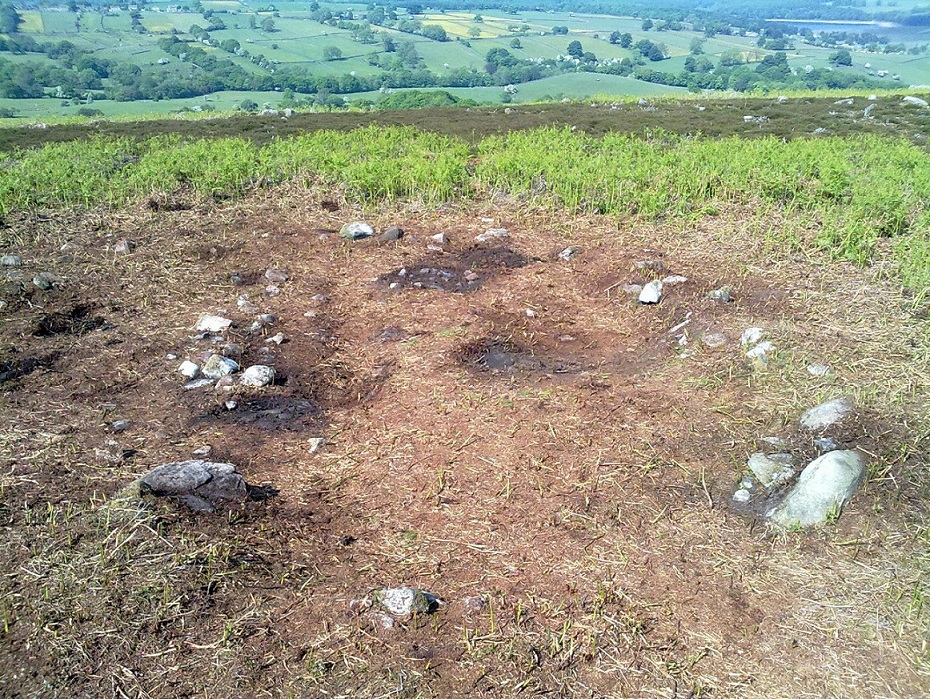
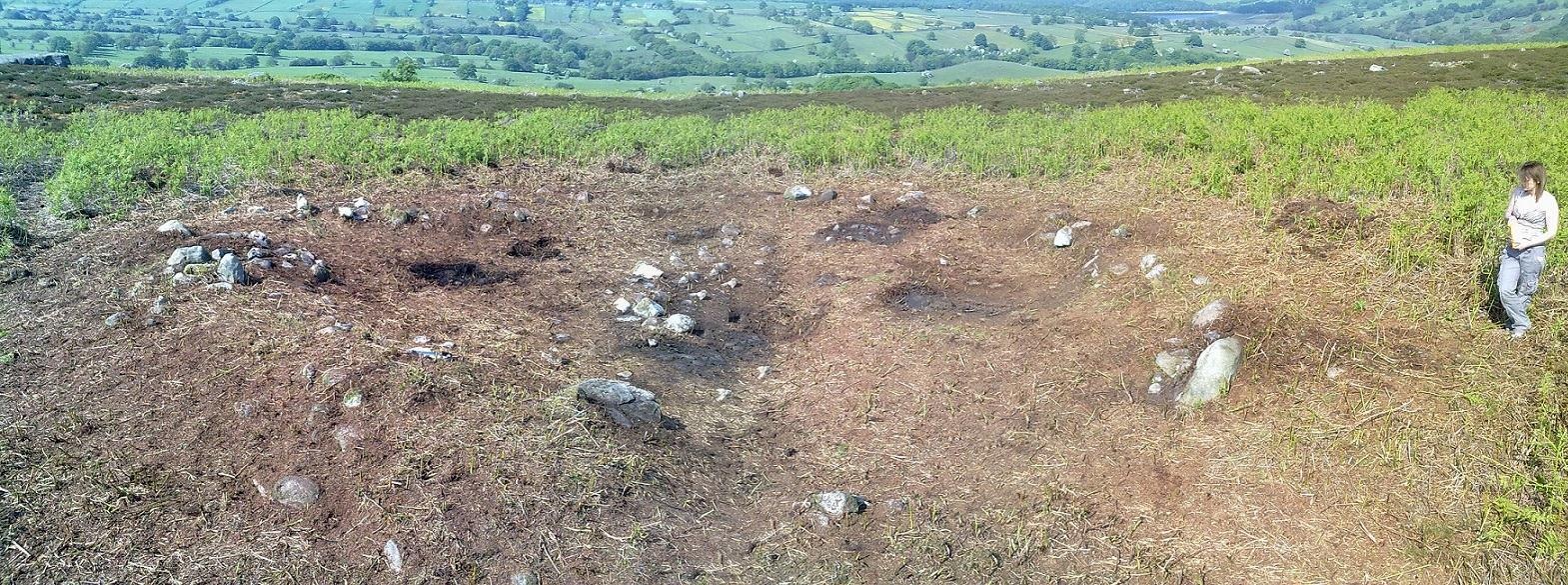
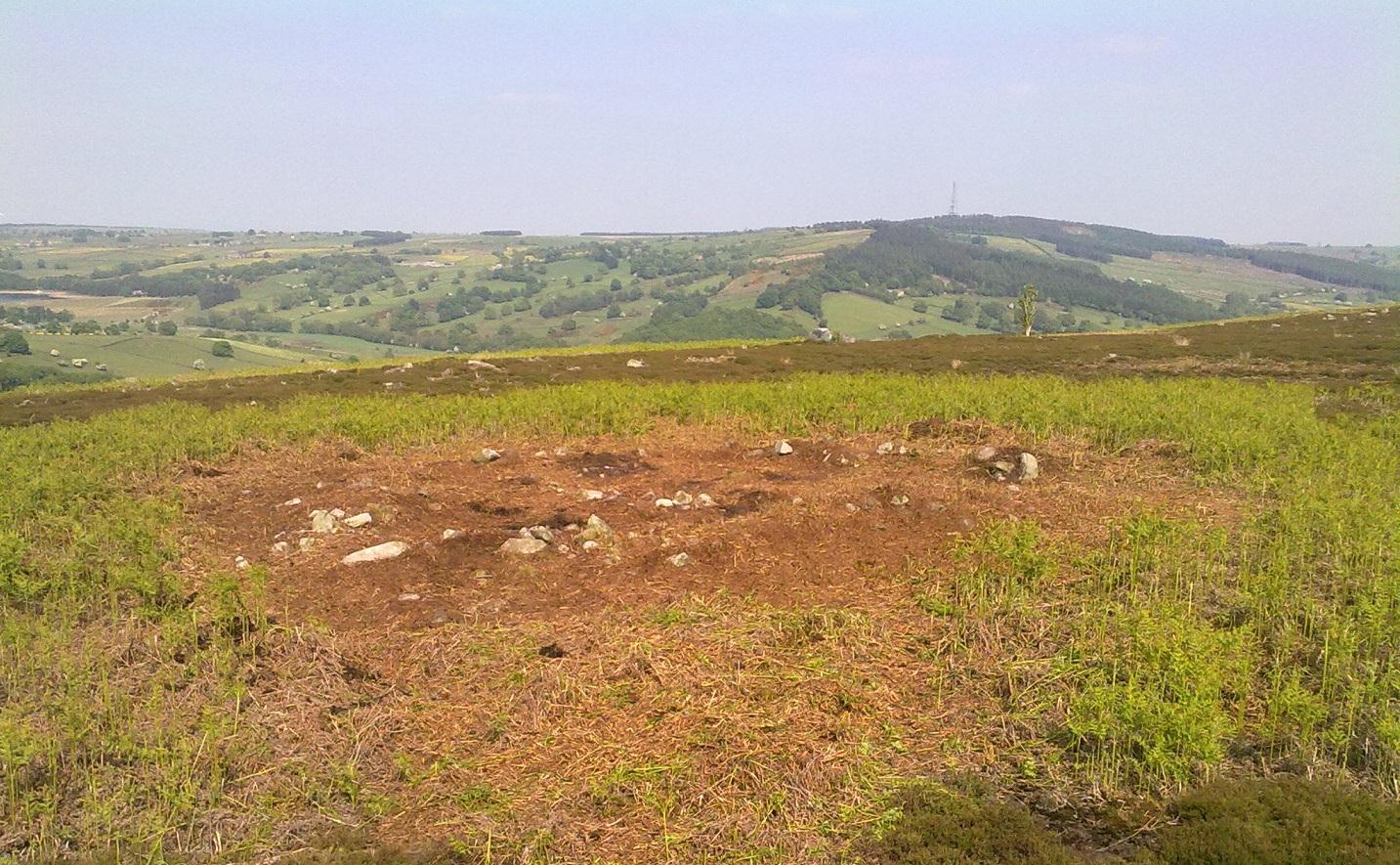
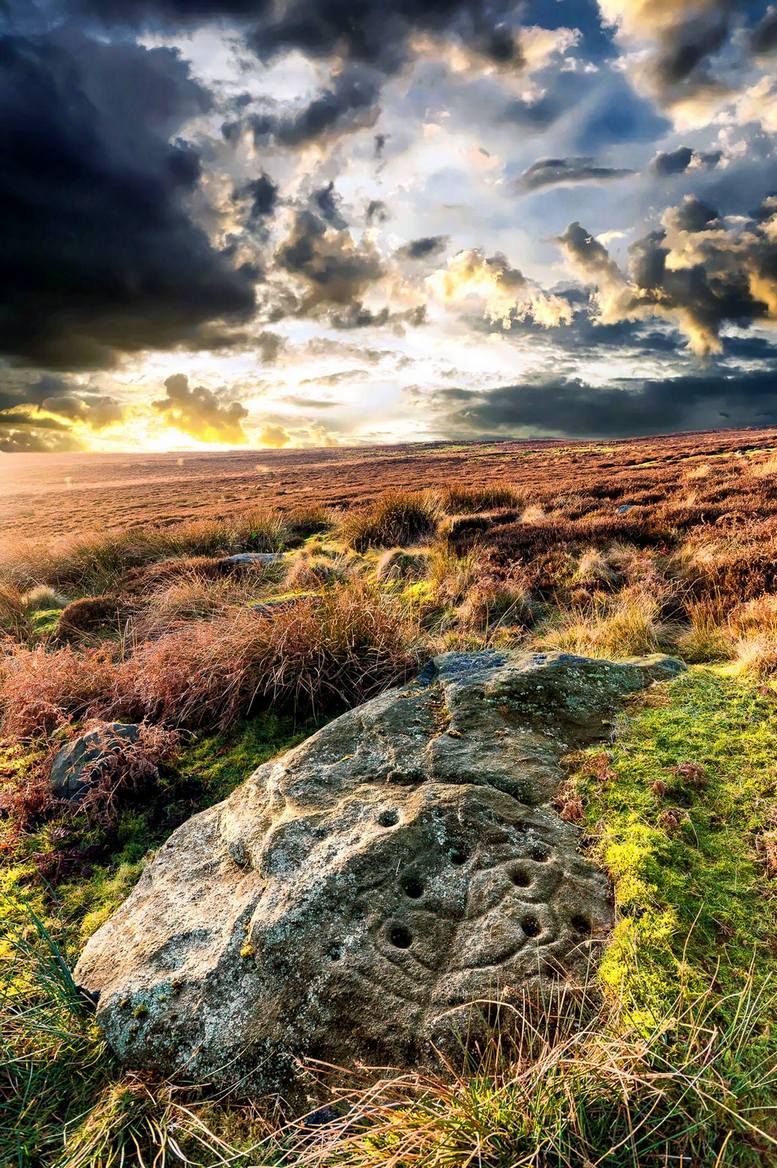
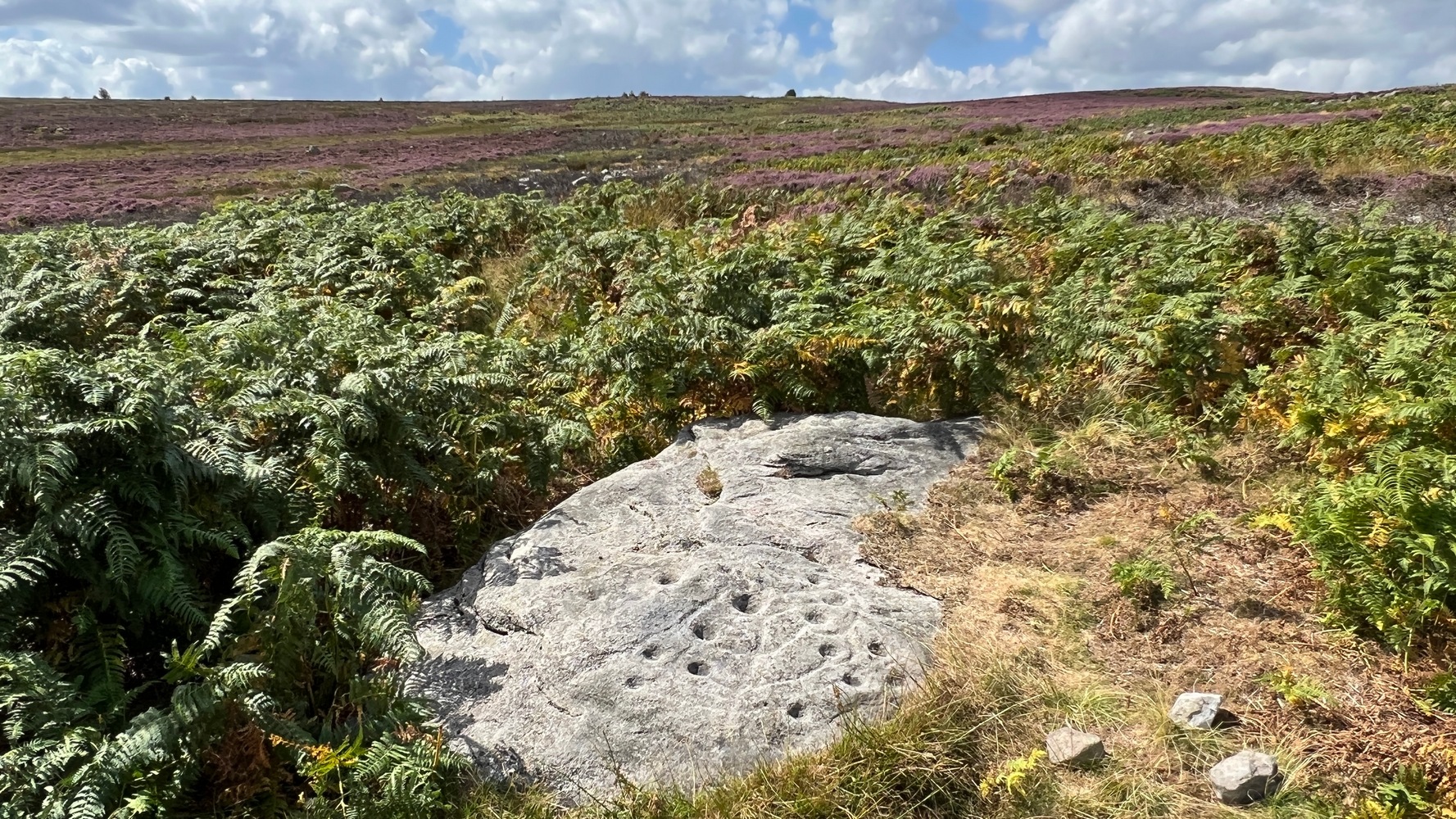
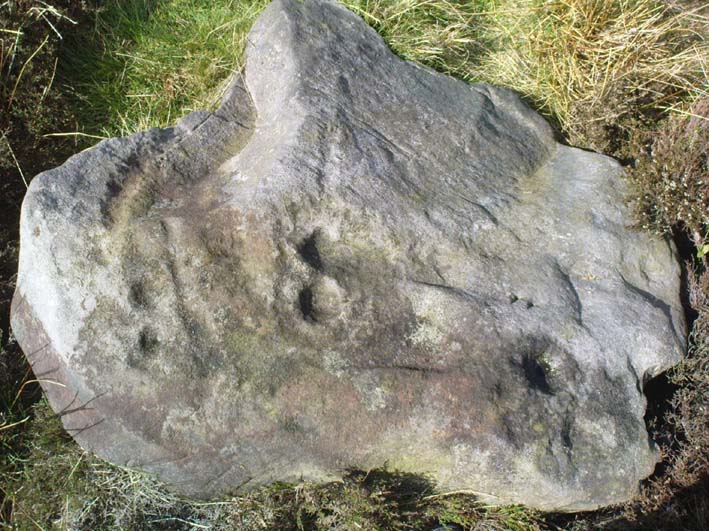
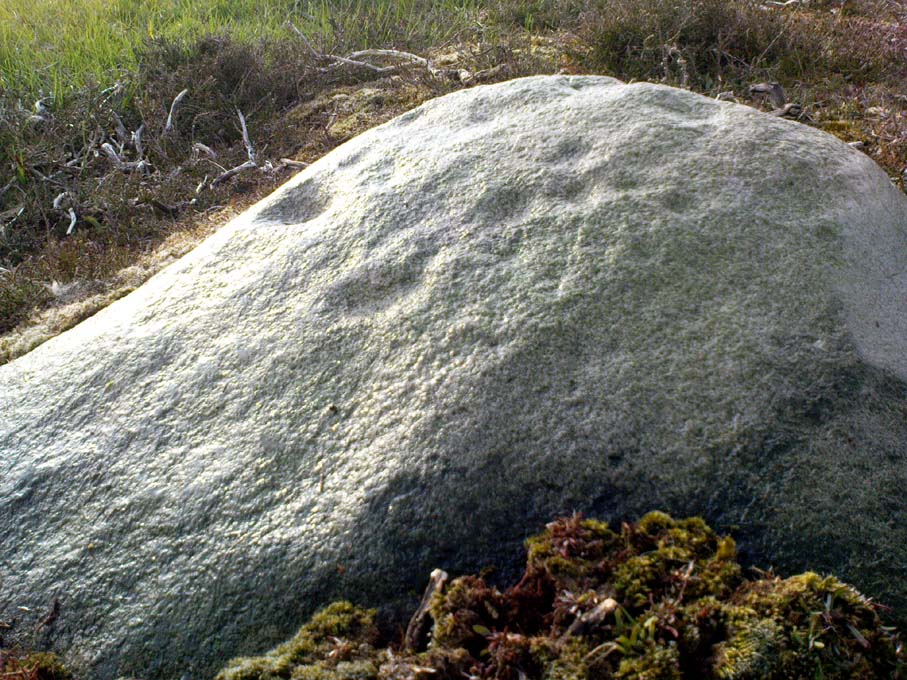
Coronation Cairn carving (270), Ilkley Moor, West Yorkshire

Cup-and-Ring Stone:  OS Grid Reference – SE 1226 4636

Getting Here

Walk up from Ilkley to the White Wells and keep following the footpath upwards, up the steps and onto the moor itself.  Once you’ve got to the top of the steps above the rocky valley, look straight up the slope in front of you and walk directly up the hill.  As you near the top, there’s a large cairn sat on the brow of the hill (known as the Coronation Cairn).  This ‘ere carving is just a few yards below it.

Archaeology & History

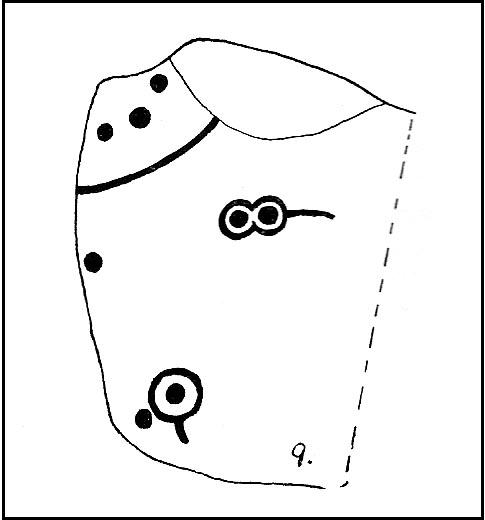
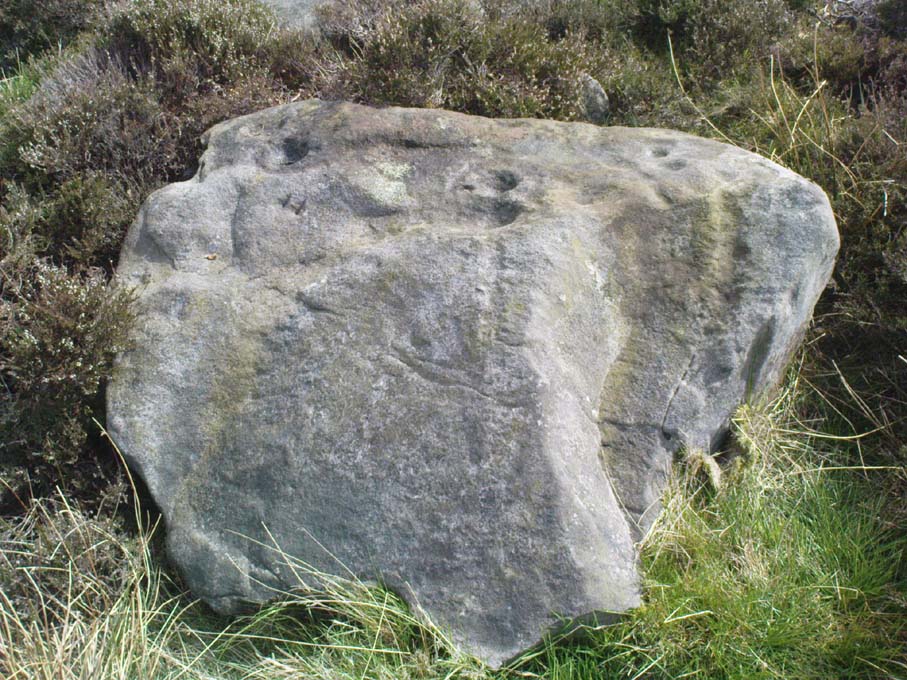
Very little has been written of this albeit innocuous carving — if indeed it is a carving!  Found on the large (though overgrown) flat stone just a few yards below the Victorian cairn, all that we appear to have here is a large cup-marking with a small arc pecked around its southern side and a distinct straight line running outwards from the cup (though the line doesn’t actually touch the cup-mark and does give the distinct impression of being pretty recent).  A sort of “cup-and-half-ring” with extended line is perhaps the best description!

Close-up of cup & lines
Carved Stone 270

It was first reported by some English Heritage archaeologist — which, as is generally acknowledged, isn’t necessarily a good pointer for authenticity when it comes to identifying prehistoric rock art.* But it’s certainly got a bit more about it than some “carvings” they’ve reported in the past!  Boughey & Vickerman (2003) made the following notes of this stone:

“”Low, flat gritstone rock quarried away on E side, fairly smooth but uneven.  One large cup and deep groove slightly curving round edge of cup.”

Which is about right.  I don’t really think too many of you will be into this unless you’re a real rock-art fanatic!

References:

  1. Boughey, Keith & Vickerman, E.A., Prehistoric Rock Art of the West Riding, WYAS: Leeds 2003.
  2. Hedges, John, The Carved Rocks on Rombald’s Moor, WYMCC: Wakefield 1986.

* A number of cup-marked stones identified by English Heritage archaeologists have transpired to be nothing more than natural erosion. 

© Paul Bennett, The Northern Antiquarian
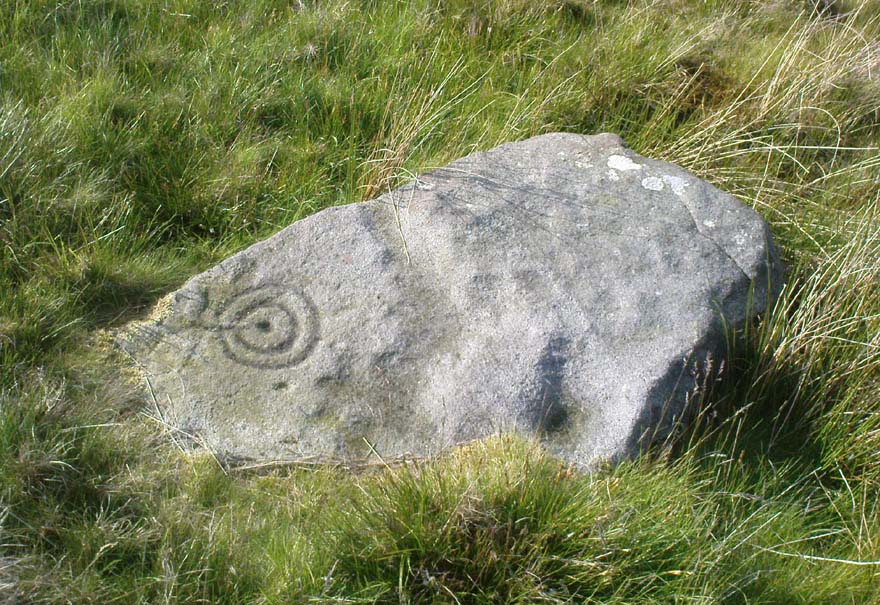

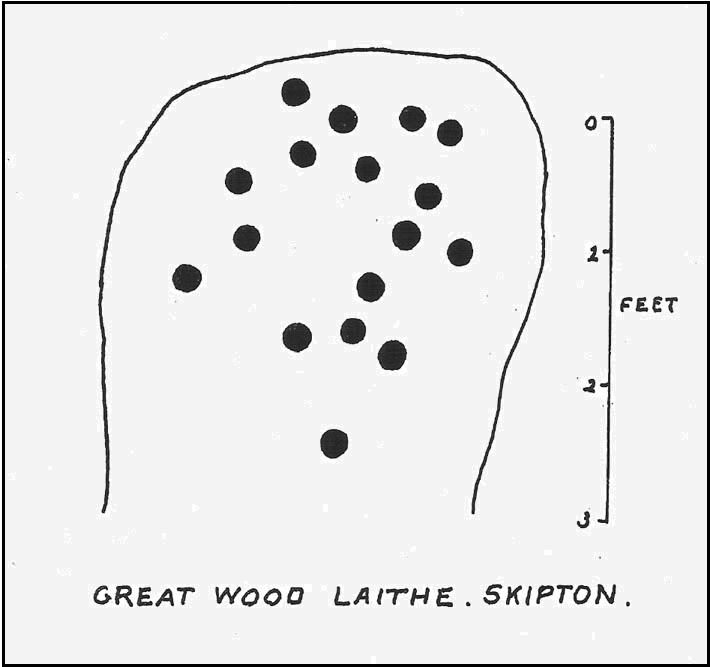
Great Wood Laithe (019), Skipton, North Yorkshire

Cup-Marked Stone:  OS Grid Reference – SD 99620 50551

Also Known as:

  1. Carving no.3 (Hedges)
  2. Carving no.19 (Boughey & Vickerman)

Getting Here

Cowling’s 1964 drawing

From Skipton centre get to the Horse Close estate on the southern side of the town and look up to the fields on the sloping hill above it with the small woods above ’em.  Head up towards the trees, but before you get there go into the fields on your right, and in one of them you’ll see what looks like a pile of rocks near the middle.  Head for it!

Alternatively, follow the directions to reach the Horse Close Hill enclosure, then walk down into the field on its western edge.  You can’t really miss it!

Archaeology & History

This carving first saw the light of pen-and-paper in the early 1960s, soon after the Yorkshire antiquarian Eric T. Cowling (he of Rombald’s Way fame) was led to the site by his wandering nose and the aid of local people.  He sent a letter to the editor of the Bradford archaeology group at the time (a certain Mr Sidney Jackson), which told:

“South-west of the wood which gives its name to the Great Wood Laithe at the western end of Rombalds Moor and overlooking Skipton from the east, is a cup-marked boulder: NGR – SD 99625055.  In the middle of the field alongside the wood is an outcrop of rock which has been almost levelled with the adjacent field surface by the dumping of boulders from the surrounding ploughlands.

“The top of the outcrop rises to a dome-shaped projection which bears simple cup-markings.  These average two in diameter and total 17 in number.  The whole surface of the stone is weathered, and suitable light may reveal more details.”

And, faded though it is, in better lighting conditions it seems there may be more than twenty cup-marks on the rock.  Certainly this is what the surveys of Hedges (1986) and Boughey & Vickerman (2003) concluded.  There are other carvings close by and, on the hillside immediately above you, the denuded remains of a very impressive prehistoric settlement site known as Horse Close Hill.  Well worth having a look at!

References:

  1. Boughey, Keith & Vickerman, E.A., Prehistoric Rock Art of the West Riding, WYAS: Leeds 2003.
  2. Cowling, E.T., “Cup-and Ring Boulders,” in Cartwright Hall Archaeology Group Bulletin, 9:5, May 1964.
  3. Hedges, John (ed.), The Carved Rocks on Rombald’s Moor, WYMCC: Wakefield 1986.
  4. Ramm, H.G., “Yorkshire Archaeological Register, 1964,” in Yorkshire Archaeological Journal, volume 41 (part 163), 1965.

© Paul Bennett, The Northern Antiquarian 
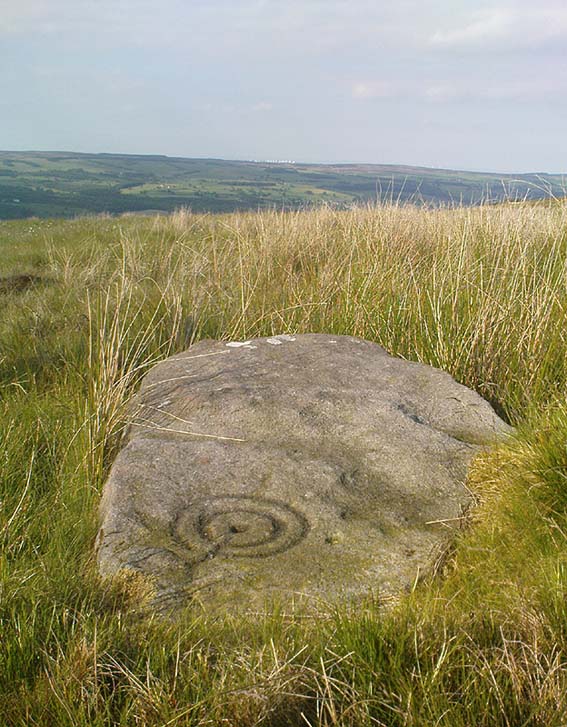

Death’s Head Carving (577), Askwith Moor, North Yorkshire

Cup-and-Ring Stone:  OS Grid Reference – SE 17795 51235

Also Known as:

  1. Carving no.577

Getting Here

Follow the directions to find the Tree of Life Stone, then follow the main footpath uphill from it.  Once on the level, look out for a couple of large rocks abaat 100 yards to your left.  Check ’em out, cos it’s on one of ’em!

Archaeology & History

This is another decent carving living on these prolific moors.  Found near the end of a lengthy line of prehistoric walling that runs east-west over this part of the moor, the general Rorsharch-response to this carving is of some sorta skull or screaming face.  My impression of it the other day was, “it looks like a pig!”

Although mentioned by numerous writers, the first description of it was in Eric Cowling’s (1937) essay on the cup-and-ring stones north of Otley, saying:

“On an isolated table stone, situated at the upper end of the shallow valley which drains Snowden Carr, the writer found a marking having a strangely skull-like appearance, but which is really a group of three large cups which are linked by inter-turning curved grooves.”

Close-up of main design
The Death’s Head Rock

He then strives to make links between this carving and the design on the Swastika Stone above Ilkley — which in some way is a little similar, i.e., as a three-armed triskele swastika; but the notion is perhaps as accurate as saying it represents a cloud, or a tree, or bird-flight, or any number of other natural phenomena.  Beckensall’s (1999) brief note of the stone — despite getting his grid-ref off by a few hundred yards — described it as “four cups linked and enclosed by grooves, unconvincingly suggesting a skull to some people.”  With Boughey & Vickerman (2003) saying:

“Fairly large, upstanding rock with surface sloping down to N. Figure of four cups linked by and enclosed by grooves: entire pattern resembles a skull, hence the name ‘Death’s Head Rock.'”

References:

  1. Beckensall, Stan, British Prehistoric Rock Art, Tempus: Stroud 1999.
  2. Boughey, Keith & Vickerman, E.A., Prehistoric Rock Art of the West Riding, WYAS 2003.
  3. Cowling, Eric T., “Cup and Ring Markings to the North of Otley,” in Yorkshire Archaeological Journal, part 131, 33:3, 1937.
  4. Cowling, Eric T., Rombald’s Way: A Prehistory of Mid-Wharfedale, William Walker: Otley 1946.

© Paul Bennett, The Northern Antiquarian


Pool Farm, Priddy, Somerset

Cup-and-Ring Stone / Tomb:  OS Grid Reference – ST 5375 5417

Getting Here

Dead easy this! (though a bittova cheat) Get to the Bristol City Museum and look inside.  This Google map should help those of you who don’t know Bristol too well.

Archaeology & History

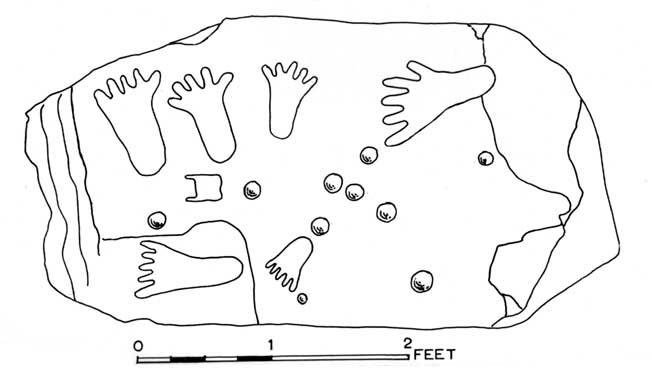
Grinsell’s drawing of the carved slab (PPS 1957)

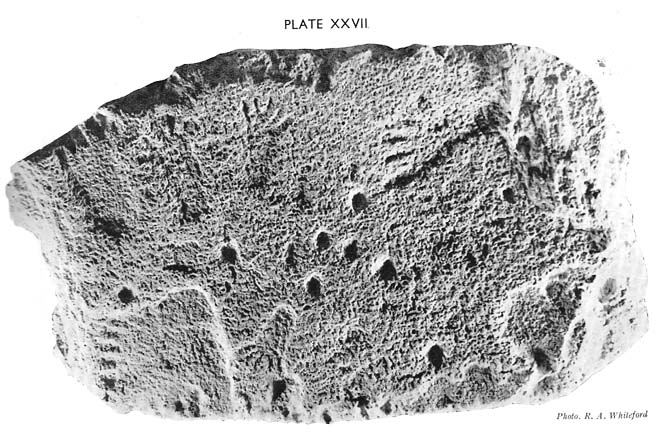
Found amidst a large cluster of other neolithic and Bronze Age remains—with the amazing line of the Priddy henges just a few hundred yards to the southeast—this is one helluva rare relic this thing: a carved stone, with seeming cup-marks and engraved “feet” no less, which was found when dug out of a prehistoric tomb way down South.  Obviously a buncha northern lads and lasses must’ve been on one helluva piss-up! (y’ never know…)  Although the tomb — a round barrow by all accounts — was well-known and excavated in 1930, the carving was somehow not noticed by the archaeologists when they dug here!  But it has to be said, at that period many archaeologists thought rock art to be insignificant and unworthy of study, so perhaps their ignorance stemmed from  the academic myopia of the time.

But at least they gave a reasonable description of the tomb itself.  It was due to be destroyed and the considerable mass of material from it was used for widening the nearby road!!!  Thankfully, for some reason, “the chamber or cist was left in situ” under the ground.  Leslie V. Grinsell (1957) takes up the tale:

“The barrow appeared to be about 100 feet in diameter and 3¾ feet high, but it had been spread and its height reduced by many ploughings. Excavation showed that the barrow, which was of the bowl type, was composed of fine mould throughout, and had never been enclosed by a ditch.  In the centre of the barrow, there was a stone chamber or cist, the external dimensions of which were 5½ feet long, 4½ feet wide, and 2½ feet high.  The floor, which was ‘crazy-paved’, was approximately on the ground-level.  The cist was placed with its long axis SE-NW.  The late Father Ethelbert Horne, who wrote the excavation report, stated that the south-eastern slab, which was inserted 6 inches deep into the floor, had the character of a ‘closing-slab’, and outside it were several packing stones.  There was a large cover slab of Dolomitic Conglomerate.  The small northwestern slab is of Carboniferous Limestone, and the south-eastern slab is of Liassic Chert, but the large south-western and north-eastern slabs are of sandstone derived from the vicinity.  The essential characteristics of this structure are therefore that is was abnormally large for a stone cist, had a strong suspicion of a ‘closing slab’ (implying some kind of entrance?) at the south-eastern end, and was above ground level, with its floor on that level.

“On the floor of this chamber or cist, at the foot of the approximate centre of the south-western slab, was a heap of burnt human bones, free from any admixture of charcoal.  As these bones had been broken small after being cremated, their determination was by no means easy.  Prof E. Fawcett…expressed the belief that they may have comprised the remains of an adult and a young person.”

But it was in 1956 that the carvings were noticed on the cist remains — by Mr Grinsell and his friend, C.S. Taylor.  At first they thought that some of the etchings were of human hands, but they later realised they were of human feet.  Grinsell wrote:

The Foot carvings: The feet shown are all single feet, no two forming a left-and-right pair of the same individual.  Nos. 1,2 and 3, in a row, are large, medium and small; no.4 is oblique in form; no.5 is on a slightly recessed portion of the slab; and no.6 represents the foot of a child between about 3 and 4 years old.  No.3 represents the foot of a child about 10-12 years of age.  Nos. 1,2,4 and 5 appear to represent the feet of adults.  No.7 is the symbol of uncertain meaning.  All these foot carvings show rounded heels and toes, in contrast to those on the Calderstones which are nearly all rectangular.  The toes are all splayed, and this carving is likely to be due partly to the nature of the stone and the tools with which they are carved, and partly to the fact that the feet represented are probably those of a people who did not wear shoes, or wore footwear that did not constrict the toes.

The Cup-marks: There are nine (possibly ten) cup-marks; their diameter ranges between 0.9 inches and 1.9 inches, and their depth between 0.1 inch and 0.3 inches… They are on the average about twice as deep as the foot-carvings.  The smallest cup-mark (no.17) is beside the smallest foot-carving; but there is no noticeable relationship between the other cup-marks and foot-carvings…”

Earliest known photo of the carving by R.A. Whiteford

An intriguing carved slab at the very least!  We can say with some certainty that this old tomb was of considerable importance to the people who built and lived around it in the centuries that followed (ancestral spirits and all that).  It may have been a tomb of an important tribal elder, shaman or queen — though we may never truly know.  But one thing which local archaeologists and antiquarians need to keep their eyes open for when opening any more burial sites in and around this region, are other examples of rock art, for the rule tends to be: where there’s one carving, others are close by!  So wherefore art the others…?

References:

  1. Coles, J., Gestsdottir, H. & Minnitt, S., “A Bronze Age Decorated Cist from Pool Farm, West Harptree: New Analyses,” in Proceedings of the Somerset Archaeological and Natural History Society, 144, 2000.
  2. Grinsell, Leslie V., “A Decorated Cist-Slab from Mendip,” in Proceedings of the Prehistoric Society, volume 23, 1957.

© Paul Bennett, The Northern Antiquarian
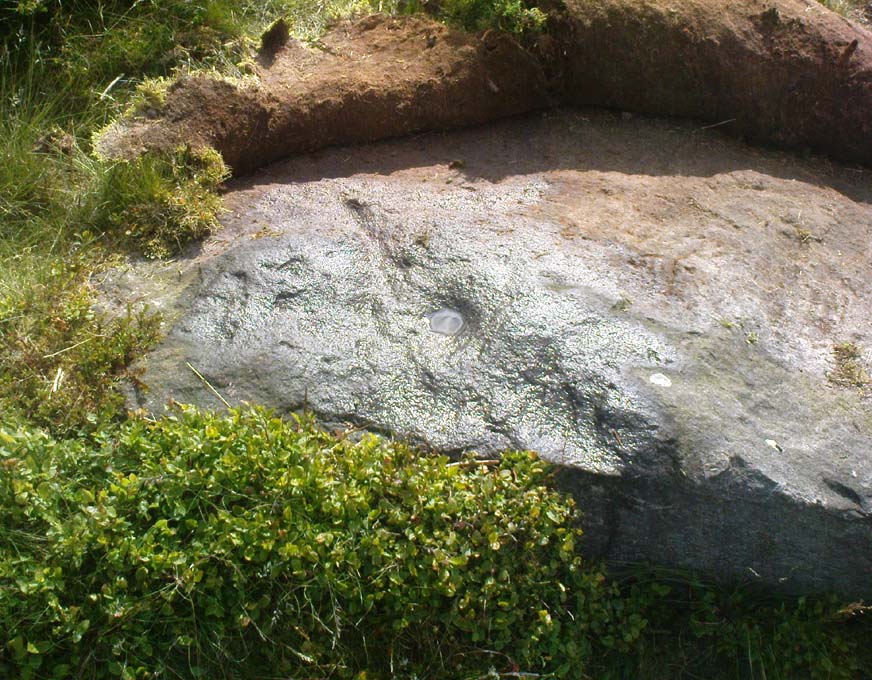

Snowden Carr Stone (612), Askwith, North Yorkshire

Cup-and-Ring Stone:  OS Grid Reference – SE 18120 51201

Also Known as:

  1. Naked Jogger Carving

Getting Here

Naked Jogger Stone

From Askwith village go up the Moor Lane and at the crossroads go straight across, down and along Snowden Carr Road until the road levels out and, watch carefully, for a small crag of rocks in the fields above on your left.  Keep a keen eye out for the gate into the field immediately below these rock, right by the roadside (it’s easily missed).  This carving is the large rock sticking out on the slope in front of you thru the gate (carving 613 is lower down to the right).

Archaeology & History

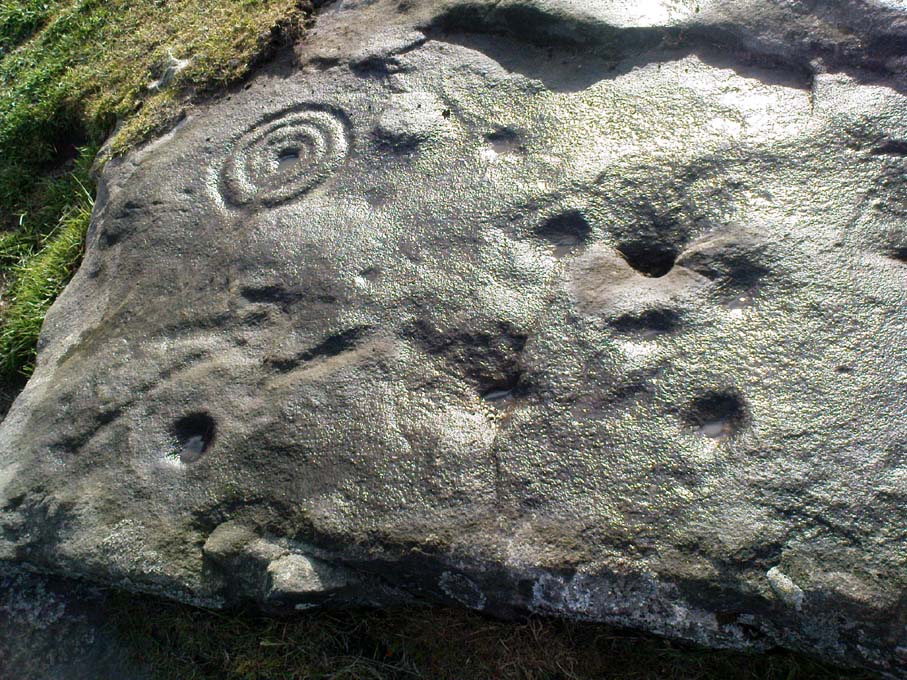
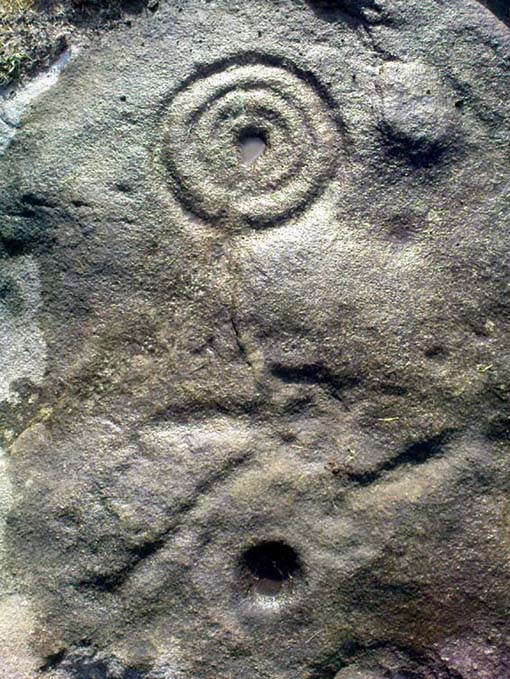
When seen in the right light, this carving’s a beauty!  What you could call, an archetypal cup-and-ring stone.  But the toll of time has played its part — on the uppermost section of the rock in particular.   It seems as if the top, higher section of the boulder has always been exposed to the elements, whereas the slightly lower part of the rock has only been unearthed and exposed to the elements in more recent decades — perhaps by Stuart Feather, who made notes of some carvings in this region in 1973.  This assumption is especially apparent when we look at the excellent, well-preserved multiple ringed design near the southern edge of the stone…and from where the carving gets its title, the Naked Jogger Stone.

Faint cup-and-rings
Boughey & Vickerman’s sketch

But let’s deal with the uppermost section of the stone first.  There are various natural undulations and cracks over its surface and, at first sight, they can interfere or confuse some of the man-made carved aspects to this stone.  But the main feature here — which becomes more and more noticeable the more you gaze and look — are at least two very faded multiple-rings surrounding faded central cups.  It’s unknown whether or not these rings ever completely surrounded the cups, or whether they were actually left deliberately unfinished.  The more faded of these two multiple-rings has between three or four cups around the outer ring at selected intervals (visible in the photo here).  A few feet away from this we can also make out the faded remains of another cup-and-half-ring design.  Several other cups have also been carved along this upper portion of the stone.  When you sit above and look across this from the grass to the side, one may be forgiven for adding a solar interpretation to this section of the carving!

Lower section of carving
Jogging male with large erection?

But another, more extrovert interpretation can be forgiven for the most notable aspect of this cup-and-ring stone.   Near the southern edge of this large rock is the well-preserved multiple-ring design, surrounding a single cup.  It’s impressive!  And when you first see this you get the impression that it was uncovered in the very recent past (turf dug away obviously) as it is in such an excellent state of preservation.  But there are other, odd-looking aspects below this primary feature: of cracks and lines and deep cups along this same level of the rock.  The majority of the cups and lines on this part of the stone are in a much better state of play than the artistic elements on the upper layer of the stone.  And one section of the carving in particular here gave me at least (pervert that I am!) the impression of a man running, with a distinctive hard-on sticking out in front as he’s jogging away!  Keep looking at it in the photo here and see if that’s what you see as well. Note that the torso section of the ‘body’ (between his cock and the multiple-ringed head) is made-up primarily of a natural crack in the rock, but this should not be seen as unusual; for in rock art across the world, many of the natural cracks and markings on stones are regularly utilized.  We know that such ‘cracks’ in rocks have been used by shamans as entrance points for their spirit to enter the rock itself.

Early carvings of humans in other parts of the world show bloke’s with hard-ons, either dancing or hunting — so why not here aswell, in deepest Yorkshire!? (check Dennis Slifer’s Serpent and the Sacred Fire for many North American examples)  It could, of course, be little other than my very simple minds response to non-linear etchings in the old Rorscharch ink-blot style.  Either way, it doesn’t really matter — unless of course you’re some academic or witchy character who’s after isolating early prehistoric fertility carvings for your thesis or religion.  Oh – and there’s the more renowned Tree of Life carving a bit further up this hill, about 150 yards away: alleged in folklore to have been a place for Beltane rites—wholehearted fertility no less!

In the important archaeo-academia files, little has ever been written of this fine, ornate petroglyph.  It was described by Boughey & Vickerman (2003) thus:

“About twenty cups, two very large, one cup having three rings and two more also having traces of three rings, with at least four others having parts of single rings, all very worn.”

Simple and to-the-point I suppose.  But this old carving has much more grace and mythic history embedded within its scarred surface.  It clearly speaks to other aspects of the landscape (as do some of the other carvings further up the hill, where oracular aspects predominate), but much more work is needed here before any archaeoholistic framework can be moulded.  Nonetheless, this is an excellent meditation site!

References:

  1. Boughey, Keith & Vickerman, E.A., Prehistoric Rock Art of the West Riding, WYAS 2003.
  2. Slifer, Dennis, The Serpent and the Sacred Fire: Fertility Images in Southwest Rock Art, Museum of New Mexico Press: Santa Fe 2000.

© Paul Bennett, The Northern Antiquarian
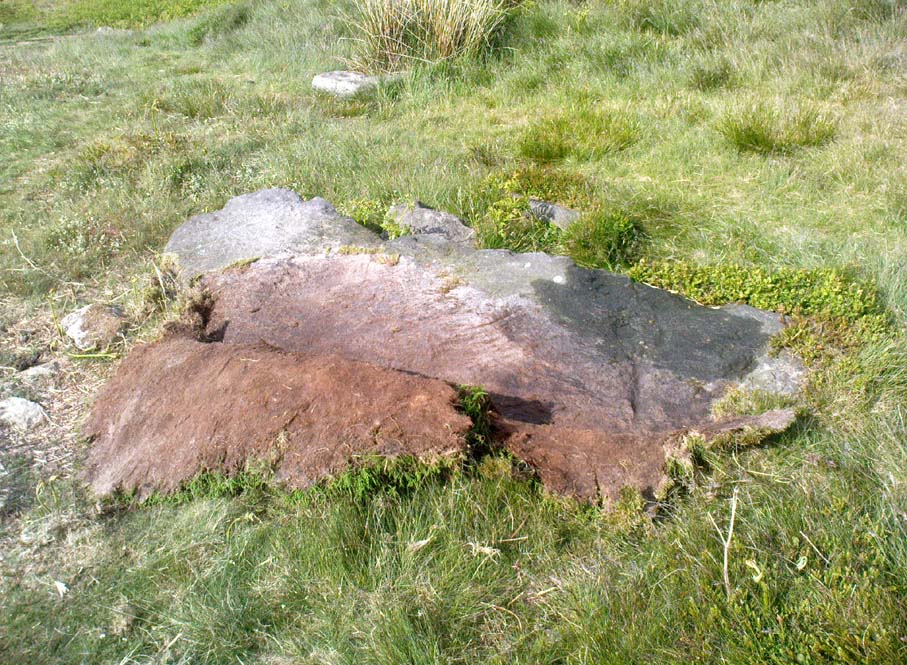

Tree Of Life Stone, Snowden Carr, Askwith, North Yorkshire

Cup-and-Ring Stone:  OS Grid Reference – SE 17978 51161

Also Known as:

  1. Carving no.598 (Boughey & Vickerman)

Getting Here

Tree of Life Stone (photo credit, Yorkshire Daz)

From Askwith village go up the Moor Lane and at the crossroads go straight across (Snowden Moor is to your left).  Go down and along Snowden Carr Road until the road levels out and, watch carefully, about 500 yards on from the crossroads on your left you’ll see a small crag of rocks in the fields above.  Stop and go through the gate walking up the field.  At the top is a gate: go thru this and turn right, up the footpath for 100 yards, keeping your eyes peeled!  You’re damn close!

Archaeology & History

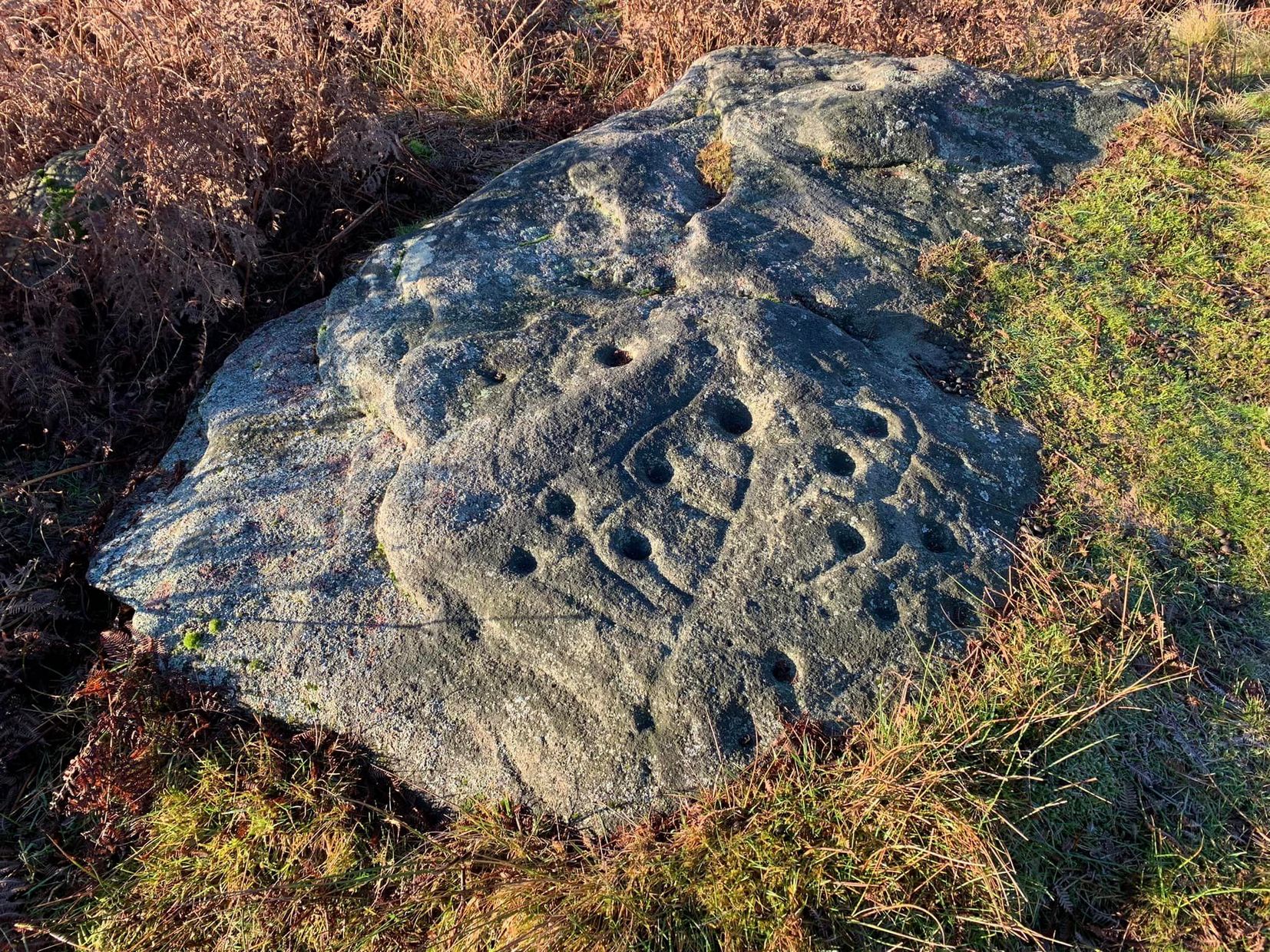
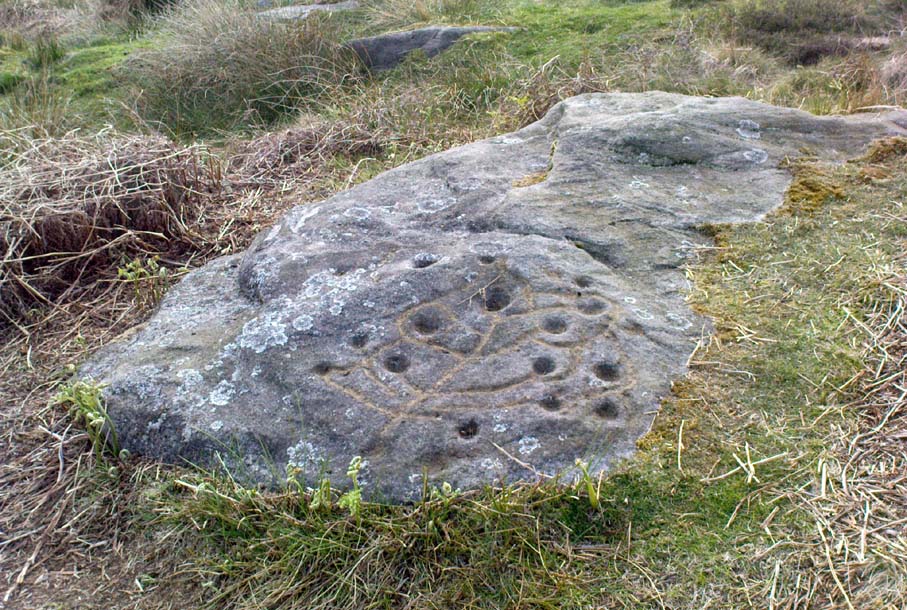
The most well-known and one of the more decorative of all the carvings in and around the Snowden Moor region is the Tree of Life Stone.  In the 1930s, Eric Cowling first reported how, “this fine marking is the only one which appears to be known to the people of the district,” due in part to it being a site of local social activities (though nothing is said of this place in William Grainge’s [1895] survey).  Cowling (1937) described the carving thus:

close-up of main features
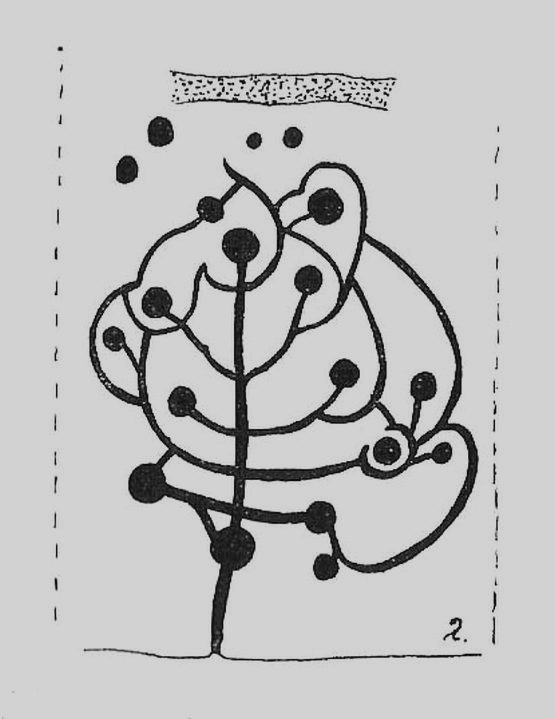
Eric Cowling’s sketch

“This stone lies alongside the bridle path which skirts the southwest corner of the enclosed moorland above the hamlet of Low Snowden.  A large flat rock surface at ground level has a number of cups joined together by a series of curved grooves, which in their turn are connected to a central straight groove.  Immediately above the design, a broad groove has been cut across a raised central area as though to isolate the markings from several scattered cups which are to be found on the remaining surface.”

The modern surveyors Boughey & Vickerman (2003) tell us that this highly ornate stone comprises of,

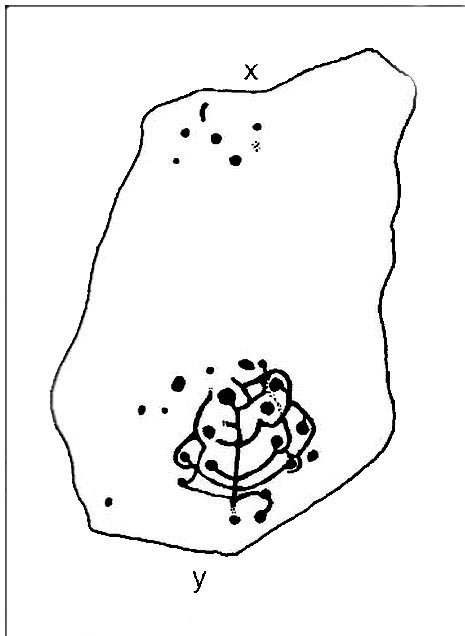
“about 25 cups, with a group at the highest…end and a few isolated, but most in complex design with enclosing grooves suggesting a tree in fruit: hence the name ‘Tree of Life Rock.'”

The Tree of Life Stone
Boughey & Vickerman’s sketch

The Coped Stone carving is just a few yards away and, on the slopes below here — as well as on the moor stretching above you — there is an excess of prehistoric remains: enclosures, hut circles, lengths of walling, cairns, other cup-and-ring stones — the vast majority of which has yet to be excavated in any formal sense (are any rich doods out there reading this who might wanna get things going…?).  It appears that both the Coped Stone and the Tree of Life carving may have been linked by some ancient walling that appears to run between them.

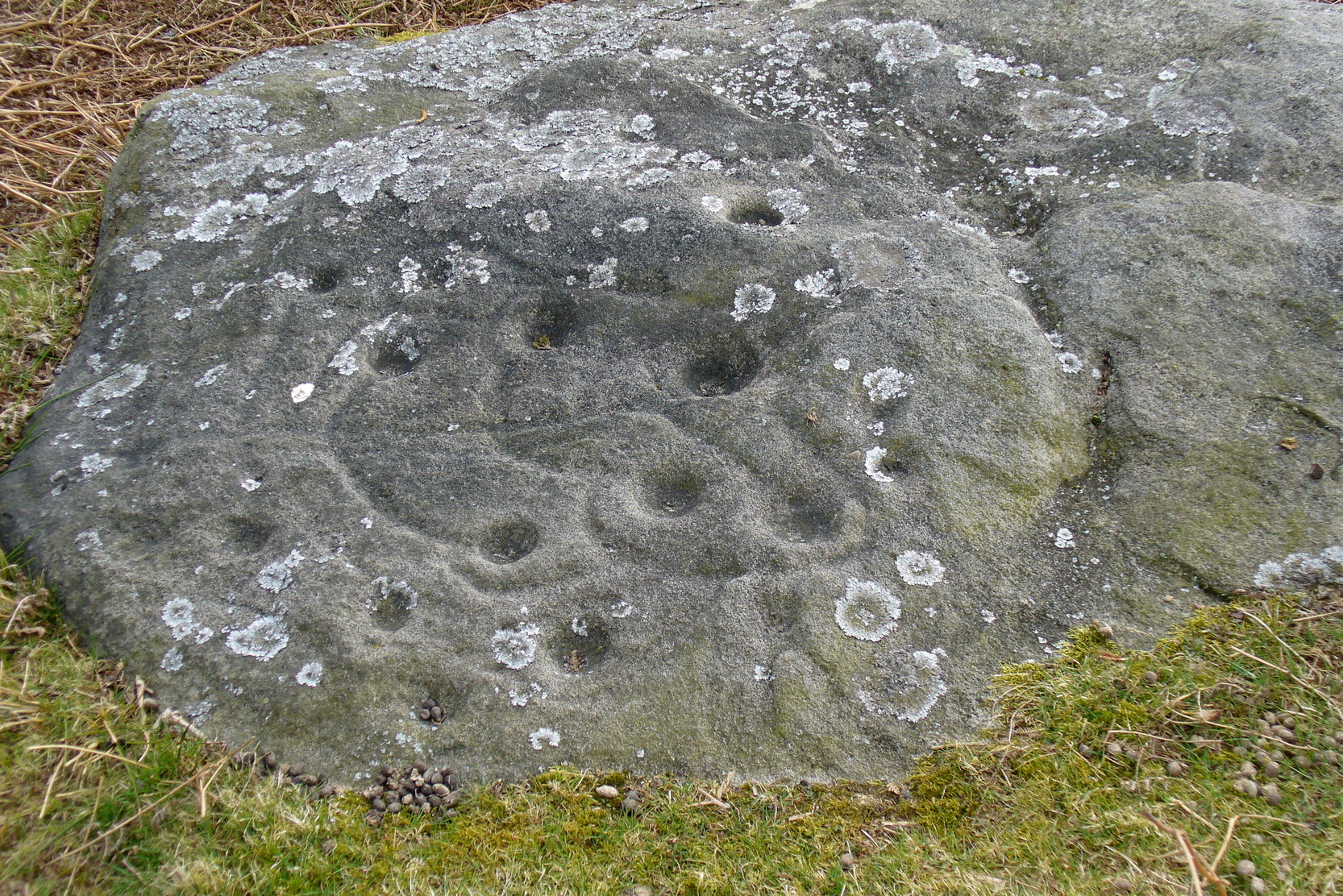
Another possible variant on the Tree of Life Stone has recently been uncovered on the outskirts of Ilkley; but on this newly-discovered example we find the central ‘trunk’ of the ‘tree’ is a natural crack that runs up the middle of the rock. Up the ‘trunk’ are several short branches with cup-marks on either side, not unlike apples on a tree.  Altogether there are at least 12 cups and one ring, with several curious lines, some of which seem geophysical in nature.  After several visits to the site, it’s obvious that the ‘tree’ design is more obvious and there are additional faint carved sections on the stone which weren’t visible when it was discovered in heavy rain and poor light.

Folklore

Tree of Life Stone (by James Elkington)

This is one of very few cup-and-ring stones with folklore attached.  Cowling (1937; 1946) reported it to be site of early morning Beltane (May 1) gatherings.  The title of the stone, the Tree of Life, was one he heard local people call this site, but “no reason is offered”, he said. About 100 yards below this we find a curious erectile, fertility image on the impressive carving 612, which (he says tenuously!) may (and that’s a dodgy “may”!) relate to the Beltane rites at the Tree of Life.

Tree of Life in situ

In more modern folklore, the old earth mysteries writer Guy Ragland Phillips (1976) suggested the Tree of Life Stone to be an important focal point along one helluva highly speculative ley line: running from the Irish Sea, across land and the Tree of Life stone, continuing way east until hitting the North Sea!  If this old ley did have any validity (it doesn’t!), the Tree of Life’s carved partners east and west of here — the Coped Stone and carving no.597 — would have also been on the same line.

References:

  1. Boughey, Keith & Vickerman, E.A., Prehistoric Rock Art of the West Riding, WYAS 2003.
  2. Cowling, Eric T., “Cup and Ring Markings to the North of Otley,” in Yorkshire Archaeological Journal, part 131, 33:3, 1937.
  3. Cowling, Eric T., Rombald’s Way: A Prehistory of Mid-Wharfedale, William Walker: Otley 1946.
  4. Phillips, Guy Ragland, Brigantia — A Mysteriography, RKP: London 1976.

Acknowledgements: Many thanks to James Elkington and to Yorkshire Daz for use of their photos.

© Paul Bennett, The Northern Antiquarian 

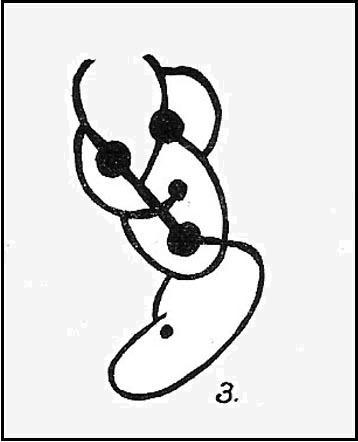
Snowden Carr Carving (582), Askwith, North Yorkshire

Cup-and-Ring Stone:  OS Grid Reference – SE 17803 51012

Getting Here

Cowling’s 1937 sketch

Not too difficult to locate if you don’t mind wandering to and fro in deep heather.  From the Askwith Moor Road parking spot, walk up the road (north) 300 yards until you see the disused quarry on the moor to your right.  From here, head onto the moor, straight down past the quarry for about 200 yards, angling slightly to your right.  You’ll notice some overgrown ‘lumps’ in the heather — deemed as a cairnfield by archaeologists — go just below these and watch out for some rocks emerging from the heather.  This carving (and its neighbours) is on one of ’em!

Archaeology & History

This curiously-shaped large rock has several worn cup-and-rings on its upper surface, with several cup-marks aswell.  Two deeply etched lines running down the edge of the rock have also been pecked away as part of the carving, in contrast to the distinguishing natural water-worn line that runs diagonally along and down to the bottom of the stone.

The site was first described by Eric Cowling (1937), who labelled it as Carving no.9 in his survey, saying:

Carving 582, looking SW
Carving from above

“At the eastern and lower end of the barrow group on Snowden Carr is a cluster of angular boulders, one of which has several markings cut on the upper surface.  There is a cup and ring on the highest, and alongside two rings are joined together and enclose separate cups. One corner of the area is isolated by a groove running from edge to edge, and within this enclosure are three cups.”

Catalogued as ‘stone 582’ in Boughey & Vickerman’s (2003) survey, their description of the carving was one with “fourteen possible cups, several with indications of a ring, some of which intersect; grooves.”

References:

  1. Boughey, Keith & Vickerman, E.A., Prehistoric Rock Art of the West Riding, WYAS 2003.
  2. Cowling, Eric T., “Cup and Ring Markings to the North of Otley,” in Yorkshire Archaeological Journal, part 131, 33:3, 1937.
  3. Cowling, Eric T., Rombald’s Way: A Prehistory of Mid-Wharfedale, William Walker: Otley 1946.

© Paul Bennett, The Northern Antiquarian

Stoup Hill Carving, Askwith Moor, North Yorkshire

Cup-Marked Stone:  OS Grid Reference – SE 177 501

Getting Here

Cup-marked stone, Stoup Hill

From the Askwith Moor car-park, walk down the road (south) for 2-300 yards until you reach the gate on the right-hand side of the road.  Go thru this and turn immediately left, following the fence along, parallel to the road for about 100 yards (if you reach the small disused quarry, you’ve gone 100 yards too far), then walk into the heath, up near the top of the little peak and walk down the other side of the slope for about 80 yards.  You’re getting damn close — look around!

Archaeology & History

First found on the afternoon of May 13, 2010, in the company of Dave Hazell — though at the time the light was poor and the sky was grey and overcast, not allowing for any decent images being made.  We returned here yesterday under a lovely clear sky for most of the day (and without the polluting roars of planes from the nearby airport, thanks to that great Icelandic volcano [keep it going!], making it even better) and got some decent photos this time.

Sketch of basic design
Close-up of some cups

It’s only a small low stone, slightly sloping (similar in size and form to carving no.535 about 100 yards west of here), and is gonna be very difficult to find when the heather is in full growth.  But thankfully when we found it last week, the heather had been burnt back. Whilst there are two large and very notable cups here — one on the west-facing vertical edge of the stone, the other on its south-facing slope — several others are more troublesome to see clearly, both through a mixture of age and erosion.  The other cups are a little smaller aswell, being very similar in status to the curious small cup-markings on the Lattice Stone carving (no.481).  One cluster of these smaller cups are arranged in a curved T-shape formation around the middle to eastern-side of the rock.  Below this are what seems to be a long singular cup, but upon feeling this — the Beckensall technique — the hardworking Keighley volunteer Michala Potts found it seemed to consist of three small cups all linked to each other.  Attached to this section, a small groove runs up to the aforementioned T-formation cluster.  Whilst at the top-end of the stone is what seems to be another larger cup-marking, but I’m not sure whether it’s Nature’s handiwork, or artificial.  A few more visits here might enable us to say one way or the other!

There are no other archaeological remains immediately adjacent.  Another “possible” cup-marked rock (more than twice the size of this stone) can be found about 30 yards further uphill, next to another large stone.  But one of the nice things about this small carving is its position in the landscape: an excellent view opens up of mid-Wharfedale below you, and the uphills of Rombald’s Moor is on the far side of the valley.  Make of it what you will…

References:

  1. Boughey, Keith & Vickerman, E.A., Prehistoric Rock Art of the West Riding, WYAS 2003.

© Paul Bennett, The Northern Antiquarian

Baildon Moor Carving (169), West Yorkshire

Cup-and-Ring Stone:  OS Grid Reference – SE 13838 40138

Getting Here

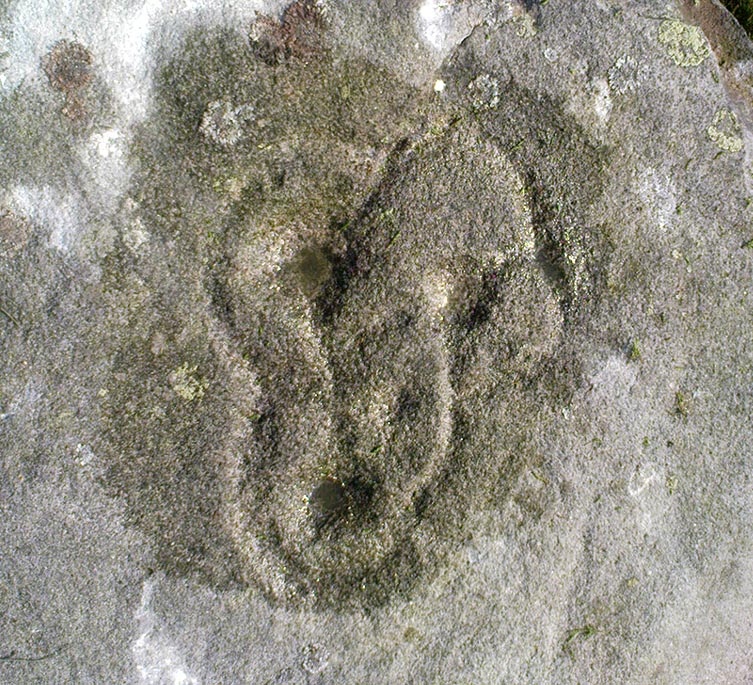
Basic cup&ring design

From Shipley Glen, walk up to the Dobrudden caravan park on the western side pof Baildon Hill and then in the long grasses immediately north of here, on the Low Plain, this old carving could once be found.  I’m told it’s been moved in recent years (but have a mooch round anyway – there’s a number of other old cup-and-rings in the locale).

Archaeology & History

This small carving is not in its original position, having been moved to where it now sits a short distance northeast of the Dobrudden caravan park.  It was first described briefly in Mr Baildon’s magnum opus here, seemingly omitted from the Hedges (1986) and reclassified as ‘stone 169’ by Boughey & Vickerman (2003).  I’m not 100% certain that the illustration here by Joseph Rycroft and carving no.169 are one and the same – but they seem incredibly alike.  If anyone knows for sure, one way or the other, please lemme know and I’ll amend as necessary!

References:

  1. Baildon, W. Paley, Baildon and the Baildons – part 7, Adelphi Press: London 1913.
  2. Boughey, Keith & Vickerman, E.A., Prehistoric Rock Art of the West Riding, WYAS 2003.
  3. Hedges, John (ed.), The Carved Rocks on Rombalds Moor, WYMCC: Wakefield 1986.

© Paul Bennett, The Northern Antiquarian

Castle Stead, Cullingworth, West Yorkshire

Earthworks:  OS Grid Reference – SE 067 354

Getting Here

C.F. Forshaw (1908) told us that “this Castlestead…lies on the high ground between Cullingworth and Denholme, about 300 yards east of the point where te Cullingworth Road meets the Halifax-Keighley Road in Manywells Height, and over looks Buck Park Woods and the beck flowing down a deep ravine to enter the head of Hewenden Reservoir.  A little to the north lies Moat Hill Farm…and the ancient burial place therewith associated.”  Very little remains of the site can be seen.

Archaeology & History

C.F. Forshaw's 1908 plan of this Castle Stead site
C.F. Forshaw’s 1908 plan of this Castle Stead site

Just over a mile southeast of the site of (virtually) the same name — the Castlestead Ring — this here Castle Stead site had me thinking that both sites were one and the same (poor research on my behalf I’m afraid).  At the moment, the archaeological period of when this site was constructed remains unknown.  Thought by Forshaw (1908) to be “almost certainly a hitherto unknown Roman entrenchment,” the very slight remains left here could be Iron Age or Romano-British.  In his lengthy article on the remains that could be seen here more than 100 years ago, Mr Forshaw told us:

“Several fields hereabouts bear the name Castlestead and one of these contains the entrenchment, which almost coincides within its area… The reason for the selection of this site is clear, for on no side is it commanded by higher ground: whilst one face has a natural fortification of a rock scar  impassable at most points and easily accessible at none.  Here very little art would make the position impregnable in primitive warfare, and it is noticeable that the most suitable part of the verge has been selected, and almost the whole of the scar has been included.  It is, however, only right to state that stone has been quarried here within living memory and this may have altered the ground considerably, and may account for several features mentioned hereafter.

“The accompanying plan (above) will make the outline of the fortification clear, and from it one can readily recognise the usual Roman form.  The moat and bank, the quadrangular shape with rounded corners and the entrances on three sides (and possibly on the fourth also) are characteristic.  The unusual point is the selection of a natural fortification for one (the south) side.

“The question at once arises: was this a permanent stone fort?  Clearly not, for the bank has been cut across at four places (A, D, H & L) and not only was no stone found — beyond such odds and ends as may be seen in any field — but the deeper, undisturbed layers of silt showed no signs of a trench in which foundations might have stood.  It is noticeable that there are more stones on the crown of the bank than elsewhere.  This I take to be the remains of what was thrown up in the bank.  The field has been cultivated many years, so that the bank has been much reduced in height and the moat filled up.

“The original height of the bank is difficult to guess, but the moat was about three feet deeper than at present at the point H, and from the amount of soil removed we may imagine the bank about five feet higher than it is now, and solid at that; this makes a total outside slope of about 10 feet, a very formidable obstacle to surmount in the face of opposition, especially is strengthened by a stockade, such as was possibly present.The remains of the bank are capped with a layer of some six inches of bluish, silty clay.  This was evidently placed there deliberately, and is in accordance with Roman work as seen elsewhere (e.g., at Castleshaw, near Oldham).  There is also some slight evidence that, as at Castleshaw, the moat was once faced with irregular pieces of flat stone.  The moat was some 18 feet across at the top, six feet at the bottom and five feet deep.  The east and west sides were probably less strongly entrenched.  Certainly the moat was much less, for rock lies only just below the sod, halfway along the western side.  When the southern face is examined there are more signs of stonework, however, for where the rock is deficient the gap is filled with the remains of a dry wall which has some peculiar characteristics.  In places the lower part of this wall is formed of roughly-shaped oblong blocks of large size (one has a face of 57 x 17 inches), arranged in definite tiers.  This is not like an ordinary field fence, and differs even more from the ancient wall marked (probably erroneously) as Denholme Park Wall on the Ordnance map, which it continues: so it is conceivable that it may be Roman work.  There is now little or no sign of a bank along the rocks bounding the southern side of the camp, but it is probable that something once existed to give cover to the defenders, and we may well imagine a low dry wall continuous with the fragments just described: and it is rather noticeable that there are more squared stones in the walls of this field than in others in the neighbourhood.

“There are no traces of buildings within the lines so far as the present investigations go, nor signs of prolonged occupation at the site.  I have dug at the points indicated (on the map above) and came upon rock or disturbed silt in each case.  The circular shallow hollow in the centre seems natural.  It is to be remarked that the average depth of surface soil in this field is unusual, more than one foot in fact.”

Mr Forshaw then goes on to ask a series of questions, followed by his own particular answers and theory relating to the nature of these earthworks.  Hopefully you won’t mind if I cite his ideas in full, despite him thinking that the remains here are of Roman origin (remains of which I don’t really wanna include on TNA).  He continued:

“Was this camp on the course of a Roman road?  One can only say that no definite road exists at the entrances now, but there seems some ground for thinking that a surface was prepared…at the western entrance for two reasons:

1. Just to the north the rock is covered with made soil only; but in the entrance itself irregular stones are packed in a level, solid manner, giving a strong impression of artificiality.  At the southern verge of the entrance this layer ends abruptly in a line at right angles to the bank, and here it is based not on rock, but on natural silt.

2. A slight hollow runs straight westward from it for some twenty yards through the next field. This may represent a destroyed road.”

Mr Forshaw then makes a few attempts to justify this idea, including notices of footpaths and linear features near the site, aswell as citing earlier historical sources that describe Roman roads — but the ones cited are some considerable distance from this site.  In summing up, he notes how no Roman finds were made here — nor indeed any finds from earlier periods — but he opted for the site being a temporary Roman outpost.  The more recent opinions of this place are that it was of late Iron Age or Romano-British origin.

References:

  1. Cudworth, William, Round about Bradford, Thomas Brear: Bradford 1876.
  2. Forshaw, C.F., ‘Castlestead, near Cullingworth,’ in Yorkshire Notes and Queries – volume 4, H.C. Derwent: Bradford 1908.
  3. Hindley, Reg, Oxenhope: The Making of a Pennine Community, Amadeus: Cleckheaton 2004.
  4. James, John, The History and Topography of Bradford, Longmans: London 1876.
  5. Keighley, J.J., ‘The Prehistoric Period,’ in Faull & Moorhouse’s, West Yorkshire: An Archaeological Survey to AD 1500 – volume 1, WYMCC: Wakefield 1981.
  6. Varley, Raymond, “The Excavation of Castle Stead at Manywells Height, near Cullingworth, West Yorkshire,” in Transactions of the Hunter Archaeological Society, volume 19, 1997.

© Paul Bennett, The Northern Antiquarian