Beadnell Caravan Park, Beadnell, Northumberland

Cup-Marked Stone (lost):  OS Grid Reference – NU 2299 2989

Archaeology & History

Tait’s 1971 sketch of the carving

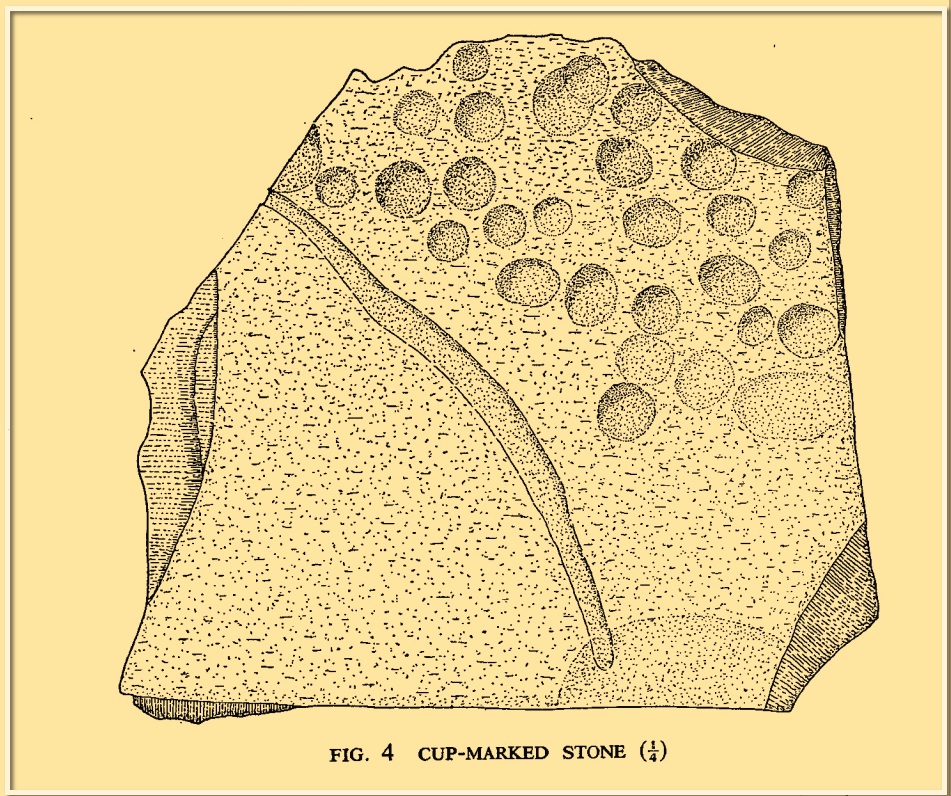
When the Beadnell Caravan Park was being constructed in 1970, in cutting into the Earth the workmen destroyed a couple of prehistoric tombs—but not before one of them (the northernmost one of the two) was thankfully excavated.  It was looked at by John Tait (1971), who described the covering cairn as measuring “nineteen feet in diameter and four feet high”.  Beneath it, within a cist that had been modified at two very different periods in time, were a large number of human remains that had been deposited over equally extended periods, suggesting it was a place of considerable importance to either one family lineage or the tribal lineage (unless it was just a dumping spot for any old Tom, Dick and Harry!).  Outside of the cist itself, but within the rocky mass of the cairn, this cup-marked stone was found (illustrated).  It had already been moved by the workmen before Tait came to excavate it, so he was unable to ascertain its precise position in the tomb.  Carved into a piece of sandstone were a number of odd-sized cup-marks, smaller than usual.  Tait wrote:

“It measures 38cm by 36cm and bears 29 small cup-marks and one slightly sinuous duct leading into what may be part of an earlier and larger cup. It also seems probable that additional cups  were added in antiquity, since some are distinctly more shallow than others and, in one instance, two cups impinge upon one another. The stone had been broken in antiquity and may have come from a larger inscribed slab, as is perhaps the case with some other “portable” stones of burials or cairns and other monuments of the second this nature.”

It is thought that the carving was laid back in the ground whence it was found.

References:

  1. Beckensall, Stan, Prehistoric Rock Motifs of Northumberland – volume 1, Abbey Press: Hexham 1991.
  2. Beckensall, Stan, Prehistoric Rock Art in Northumberland, Tempus: Stroud 2001.
  3. Tait, J. & Jobey,G., “Romano-British burials at Beadnell, Northumberland,” in Archaeologia Aeliana (4th series), volume 49, 1971.

© Paul BennettThe Northern Antiquarian

Carron Hill, Stenhousemuir, Stirlingshire

Cist (destroyed):  OS Grid Reference – NS 872 825 (approximation)

Antiquarian Notes

Writing in the “Transactions of the Stirling Natural History & Archaeological Society” in 1882, Mr Thomson told:

“About the middle of last month I was informed by Mr Bruce that the Council of the Field Club had asked the rector and myself to go and examine a cist alleged to have been discovered in a field near Stenhousemuir.  I arranged with the rector to go the following Saturday.  As he was suffering from cold, and it was stormy, he was unable to go.  I thought I would risk cold and storm, and at the station met Mr Taylor of Morrison & Taylor, who was just returning to Larbert.  Learning my errand he kindly promised me every assistance.  During tea Miss Taylor procured for me the account of the opening of the cist which had appeared in the Falkirk Herald.  It ran as follows:

“‘Discovery of Human Remains – On Tuesday last, the workmen employed by the Carron Company in excavating the Sand Hills, about a quarter of a mile to the south of the village of Stenhousemuir, made a discovery which has caused some excitement in the district.  At the depth of four feet from the surface the workmen came in contact with a stone coffin or grave, 3 feet 9 inches long by 2 feet broad, very substantially built, and containing the remains of a human body.  When the discovery was made, parts of the skull were in good preservation, but soon after being exposed to the air they  crumbled away.  The remains have been carefully collected, and are now in possession of the workmen at the hut at the Sand Quarry.  On Wednesday a great many people visited the place, prompted by a natural curiosity to see these relies thus suddenly brought to light, the history of which, it is to be feared, must ever remain a mystery. ’”

“After tea, Mr Taylor and I went to the place where the cist was railed off.  It is in the middle of a field acquired by the Carron Company to take sand for their castings from, and the excavation that revealed the cist had been made with a view of getting a new bed of sand.  About 200 yards west of the gate of Carron Park House, and close by a railway for waggons, where the workmen had been digging pits, partly with a view to find, as I understood, the lie of the sand, and partly also to arrange the course of a waggon railway for the new sand pit, they came upon traces of a disturbance in the sand.  On digging down they came upon some large stones.  On lifting them they found some bones, among the rest the top of the skull. The latter was injured somewhat by the spade, and it seems soon to have crumbled away.

“When I went along with Mr Taylor to the spot, which, as we have said, had been railed off by the kindness of Mr Cowan, the manager, we found that the cist had been somewhat dismantled, the upper large stones were lying about the side of the cist, and along with them several smaller ones.  We noted that the depth below the surface had been exaggerated in the Falkirk Herald, from the reporter having failed to notice that the earth had been heaped up on the spot when the present waggon railroad was made.  We measured the cavity carefully: the length was 3 feet 8 inches, the greatest breadth 16½ inches, and the least 14 inches, the greatest depth to the bottom of the stones still standing was 15 inches.  There were three large stones, each about 2 feet by 16 inches, which had been the roof of the cist.  A young man who had watched our movements with some curiosity, went and brought an old man who had been present when the cist was opened — he told us strange tales of how these three large stones had all been one but were “jist fair rotten.”  The fact that the stones showed no signs of ever having been one, and that their thicknesses being different — one being 5 inches, another 7½ inches, and a third 2½ inches — did not unduly disconcert him when questioned by Mr Taylor in cross-examination, but brought out from him the somewhat irrelevant information that he was seventy-nine and had been under “sax managers in Carron, and he should ken a’ aboot it.”  He further declared that the smaller stones had been one stone also.  This was even more difficult to believe, and when he proceeded to tell of a layer of fine powdered lime being laid between the stones we suspected his years had brought dotage, not increase of knowledge.  I learned that the bones had been removed from the hut, and were in the keeping of the manager, so Mr Taylor kindly took me to see him in his house some two miles or so from the place where the cist was found.  He told us that he had arranged for their safe custody, but had never seen them, and asked me to come some other day, not a Saturday.

“I went again on Friday week, and saw another of the workmen, and a gentleman from Carron works.  This other workman had not his friend’s great age, and admitted that the stones were not one originally, and that the small ones formed part of the sides.  If those small stones were built up on the existing walls of the cist, their height would be brought up to about 2 feet in all.

“I noted carefully that the joints were not filled up with clay, and that neglecting the variation of the compass, the cist lay due north and south.  The gentleman who had been sent by Mr Cowan, when asked about the bones, took out of his pocket what seemed a box for holding twelve gross of pens, and opened it; it was filled with a mass of small fragments of bone quite friable and utterly indistinguishable…”
Further Reading:

  1. Royal Commission on the Ancient & Historical Monuments Scotland, Stirling – 2 volumes, HMSO: Edinburgh 1963.
  2. Thomson, J., “The Cist at Stenhousemuir”, in Transactions Stirling Natural History & Archaeological Society, no.4 1882.

Bardristane (1), Anwoth, Kirkcudbrightshire

Cup-and-Ring Stone (lost):  OS Grid Reference – NX 529 528

Also Known as:

  1. Bardriston

Archaeology & History

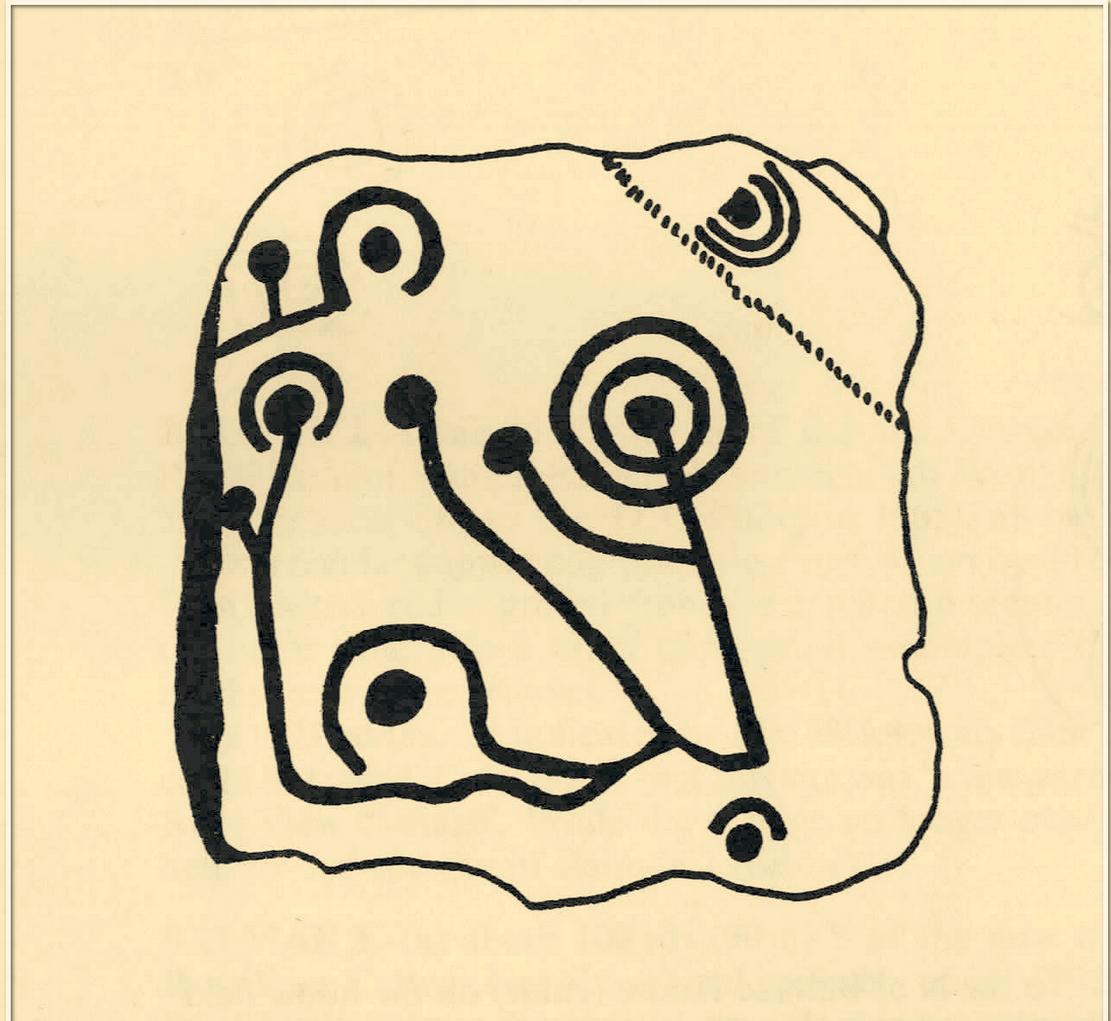
In a region possessed with a good number of cup and ring stones, this one on the lower slopes of Barholm Hill may have once been part of a prehistoric tomb, or cist cover.  A fairly decent design had been carved onto a small flat slab of stone which, when uncovered in the 19th century, doesn’t seem to have been in its original position.  As the great Fred Coles (1894) told us:

Coles’ 1895 sketch

“The Bardristan slab…was removed from amongst the stones of an old drain in 1889, and, through Mr Kinna’s care, it is now preserved at Bardristan.  The evident attempt to square the stone itself; the extreme smallness of the rings ; the direct connection of the grooves, in all cases but one, with cups; and lastly, the vivid sharpness of the whole sculpturing, in which the tool-work is clear much beyond the ordinary, all combine to render this Bardristan slab unusually interesting and valuable.”

Less than twenty years after Coles’ description, the Royal Commission (1914) lads visited the site hoping to make their own assessment, but the carving had already been lost.  Referring to Coles’ account, they told how,

“inquiry there failed to elicit information concerning it, and it appears to have been lost. Mr Coles’ illustration…shows in the general intercommunication of the various cups a feature which characterises the stone at Kirkclaugh, about ¼ mile to the south of Bardriston.”

In the subsequent commentaries on this carving by Ron Morris (1967; 1979) and A.E. Truckell (1961), its whereabouts remained a mystery and, to this day, we know not what became of it…

References:

  1. Coles, Fred R., “A Record of the Cup-and-Ring Markings in the Stewartry of Kirkcudbright,” in Proceedings of the Society of Antiquaries Scotland, volume 29, 1895.
  2. Morris, Ronald W.B., “The Cup-and-Ring Marks and Similar Sculptures of South-West Scotland,” in Transactions of the Ancient Monuments Society, volume 14, 1967.
  3. Morris, Ronald W.B., The Prehistoric Rock Art of Galloway and the Isle of Man, Blandford: Poole 1979.
  4. Morris, Ronald W.B. & Bailey, Douglas C., “The Cup-and-Ring Marks and Similar Sculptures of Southwestern Scotland: A Survey,” in Proceedings of the Society of Antiquaries, Scotland, volume 98, 1967.
  5. Royal Commission Ancient & Historical Monuments & Constructions of Scotland, Inventory of Monuments and Constructions in Galloway – volume 2: County of the Stewatry of Kirkcudbrightshire , HMSO: Edinburgh 1914.
  6. Truckell, A.E., “Cup-and-Ring-Marked Slabs in the Cairnholy and Auchinlarie Area,” in Transactions of Galloway & Dumfriesshire Natural History & Antiquarian Society, volume 40, 1961.

Acknowledgements:  Huge thanks for use of the Ordnance Survey map in this site profile, reproduced with the kind permission of the National Library of Scotland

© Paul BennettThe Northern Antiquarian

Snowden Carr, Askwith, North Yorkshire

Cairnfield:  OS Grid Reference – SE 1777 5099

Getting Here

Cairns, front & rear

Park up at the singular dusty car-park on the east-side of Askwith Moor Road.  If you walk to the sloping eastern edge of the car-park and then go down and over the collapsed fence onto the moorland immediately east, walk in the direction of the Tree of Life Stone to the north-east (be aware that there’s no footpath here and it’s boggy as fuck in places) .  Just over halfway towards the carving, nearly 400 yards from where you’ve parked, you’ll begin to see various ruinous piles and scatters of stone.  You can’t really miss them!

Archaeology & History

Cairn, looking north

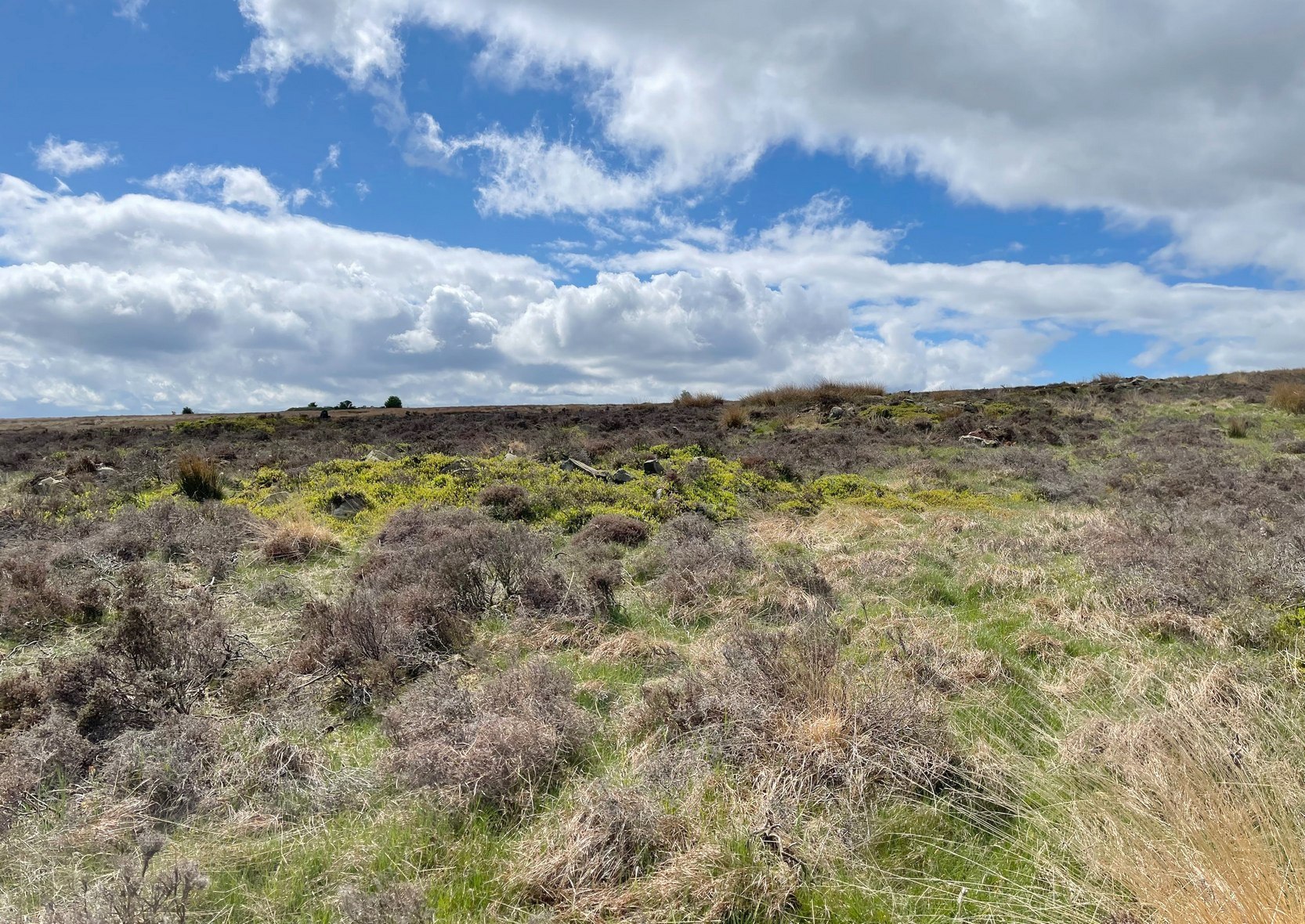
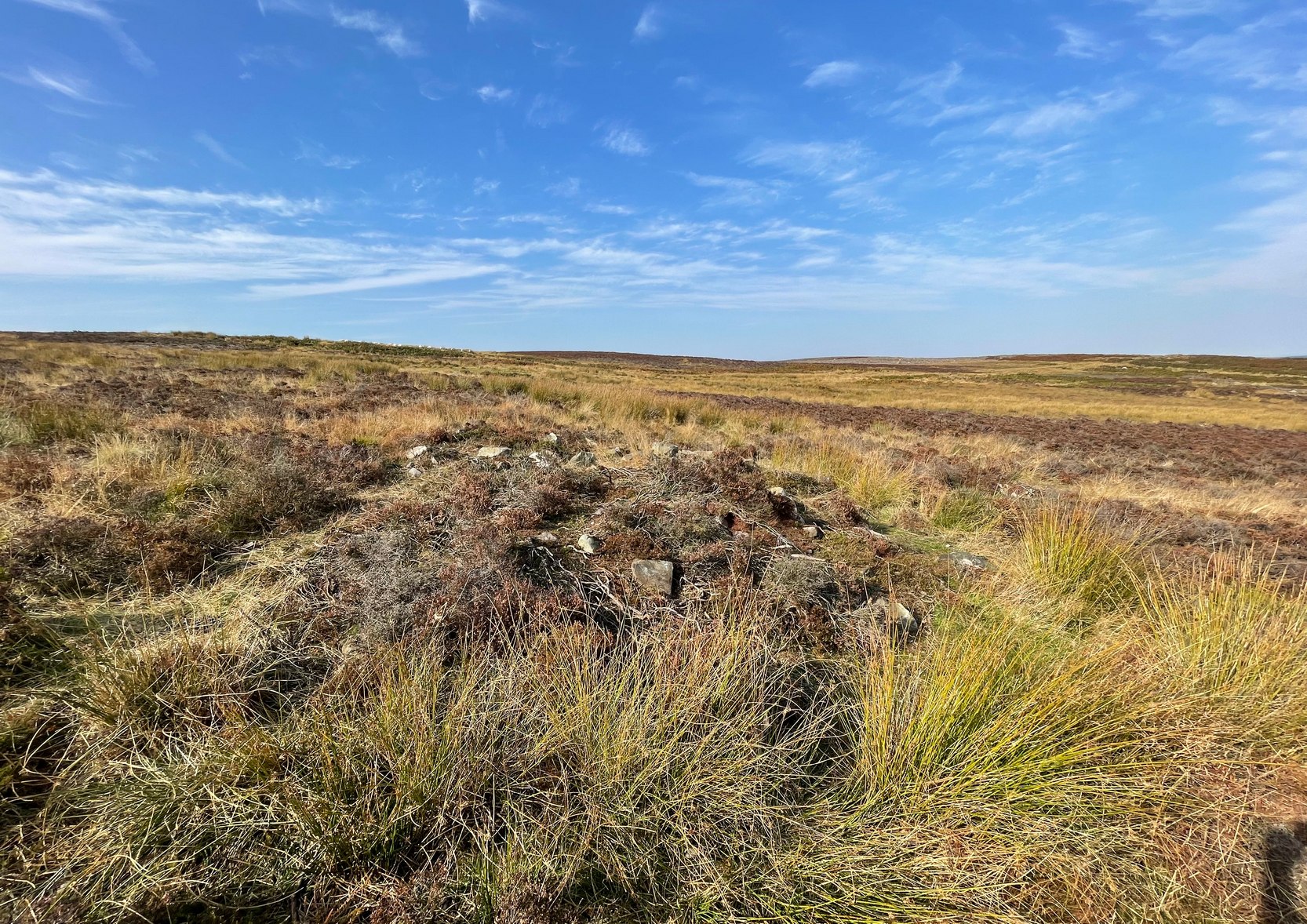
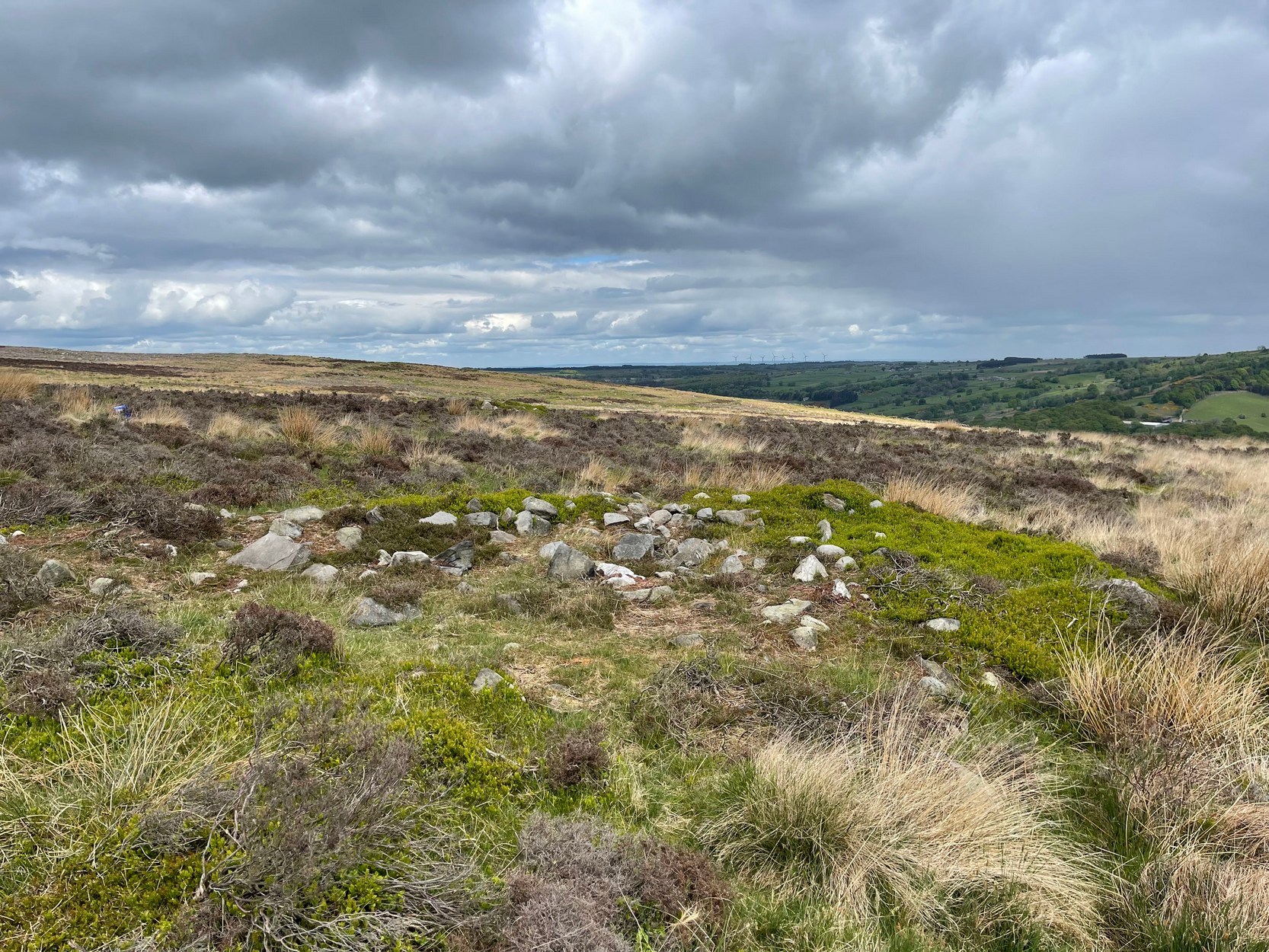
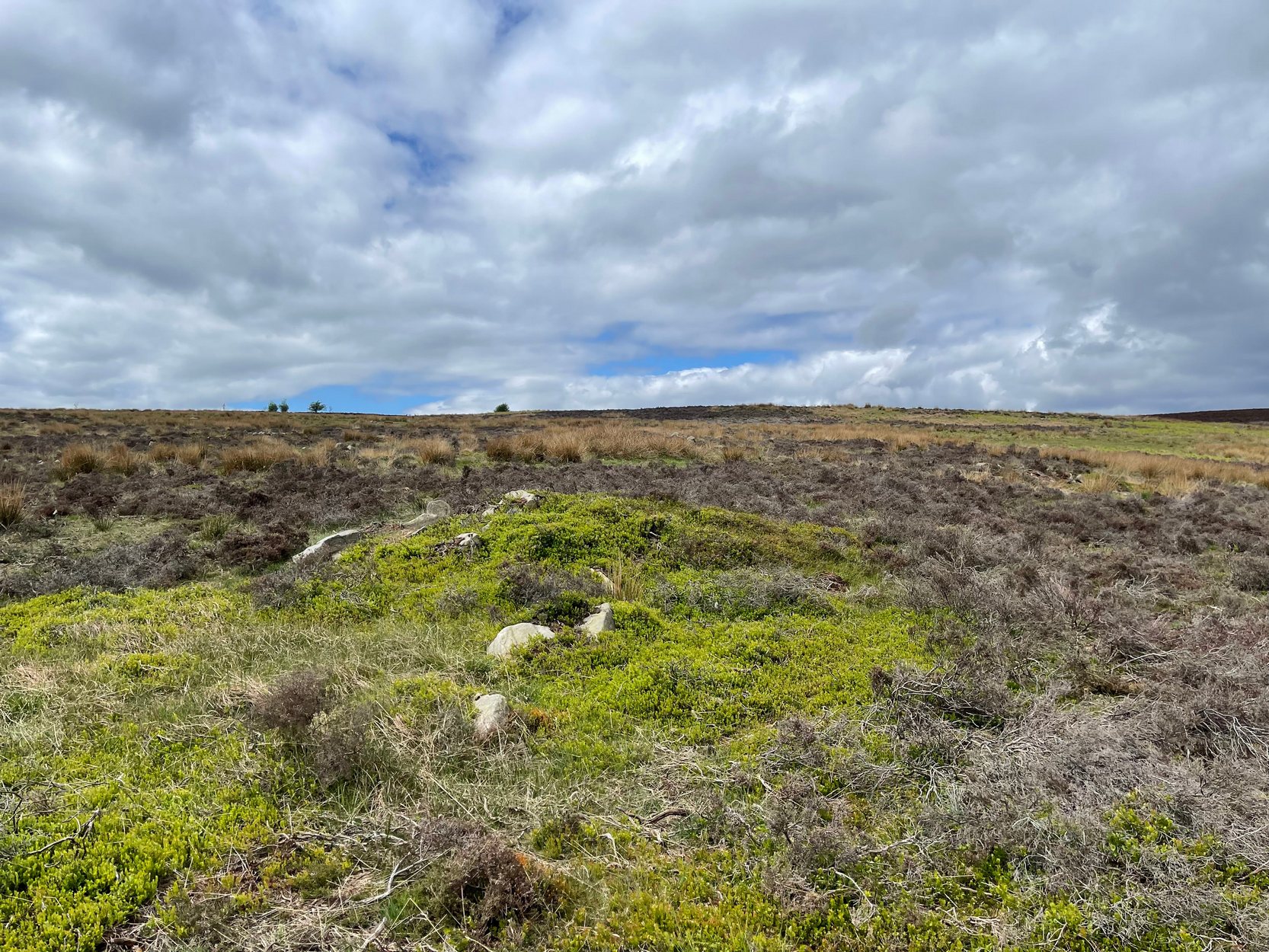
In a region teeming with prehistoric sites, the great Eric Cowling (1937) seems to have been the person who stumbled across this “barrow group”, as he called it, during one of his rock art forays in this neck o’ the woods.  Little has been written of them since.  Not to be confused with the Snowden Moor cairnfield more than 350 yards to the north, at this place we find at least a dozen quite distinct cairns scattered around the grid-reference cited, most of them much larger in size than the cairns to the north, ranging between five to twelve yards across and up to three feet high.  They have all been opened and robbed, with considerable disturbance on the largest of the ‘barrows’.  We know not who may have done this, but there’s been a history of quarrying close by and it may have been some of the workmen who did the damage, knowingly or otherwise.

Large scatter of cairn-spoil

Cairn covered in bilberries!

As far as I’m aware, no burial or funerary remains have been found here—but there’s been negligible archaeological attention given to any of the sites on this moorland, meaning that we can draw no real conclusions about the nature of the cairns.  They seem to be far too large to be clearance cairns; and the proximity of large scale prehistoric settlements and rock art all round here would strongly suggest they possessed a funerary nature.  Several impressive petroglyphs exist right at the edge of this group, literally yards away from them.  Check them all out out the next time you see the Tree of Life stone

References:

  1. Cowling, Eric T., ‘Cup and Ring Markings to the North of Otley,’ in Yorkshire Archaeological Journal, volume 33 (part 131), 1937.
  2. Cowling, Eric T., Rombald’s Way: A Prehistory of Mid-Wharfedale, William Walker: Otley 1946.

© Paul BennettThe Northern Antiquarian

Snowden Carr (596), Askwith Moor, North Yorkshire

Cup-Marked Stone:  OS Grid Reference – SE 17959 51141

Getting Here

Carved stone in foreground

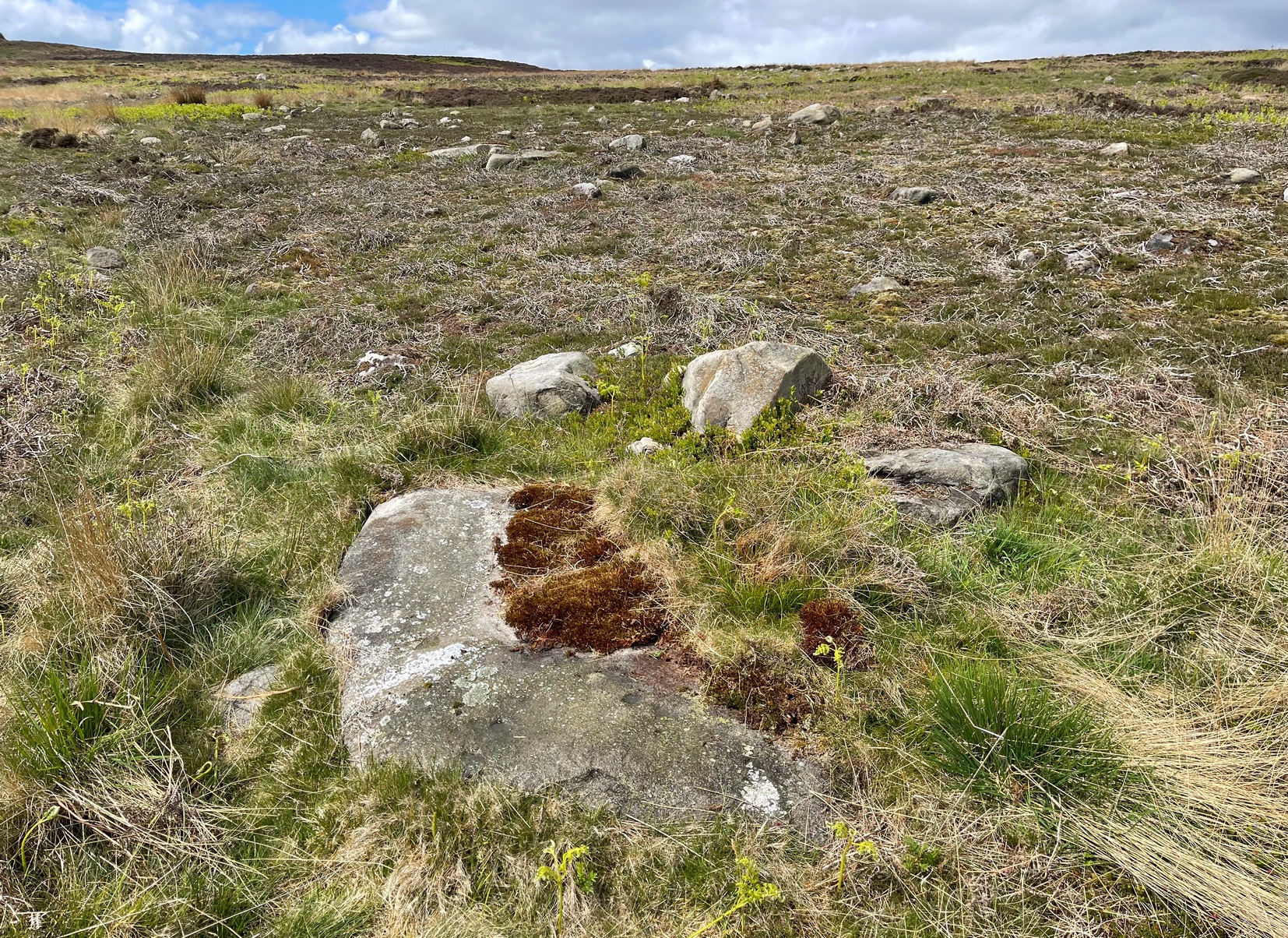
If you’re looking for this carving, you’ll have been to the impressive Tree of Life stone first.  From there, you need to walk further away from the walling, 30-35 yards southwest, across the other side of the footpath.  There’s a scattered mass of stones all over the ground here: you’re looking for a low-lying long curved stone—longer than most of them hereby.  If the heather’s grown back over the stone, it might take some finding!

Archaeology & History

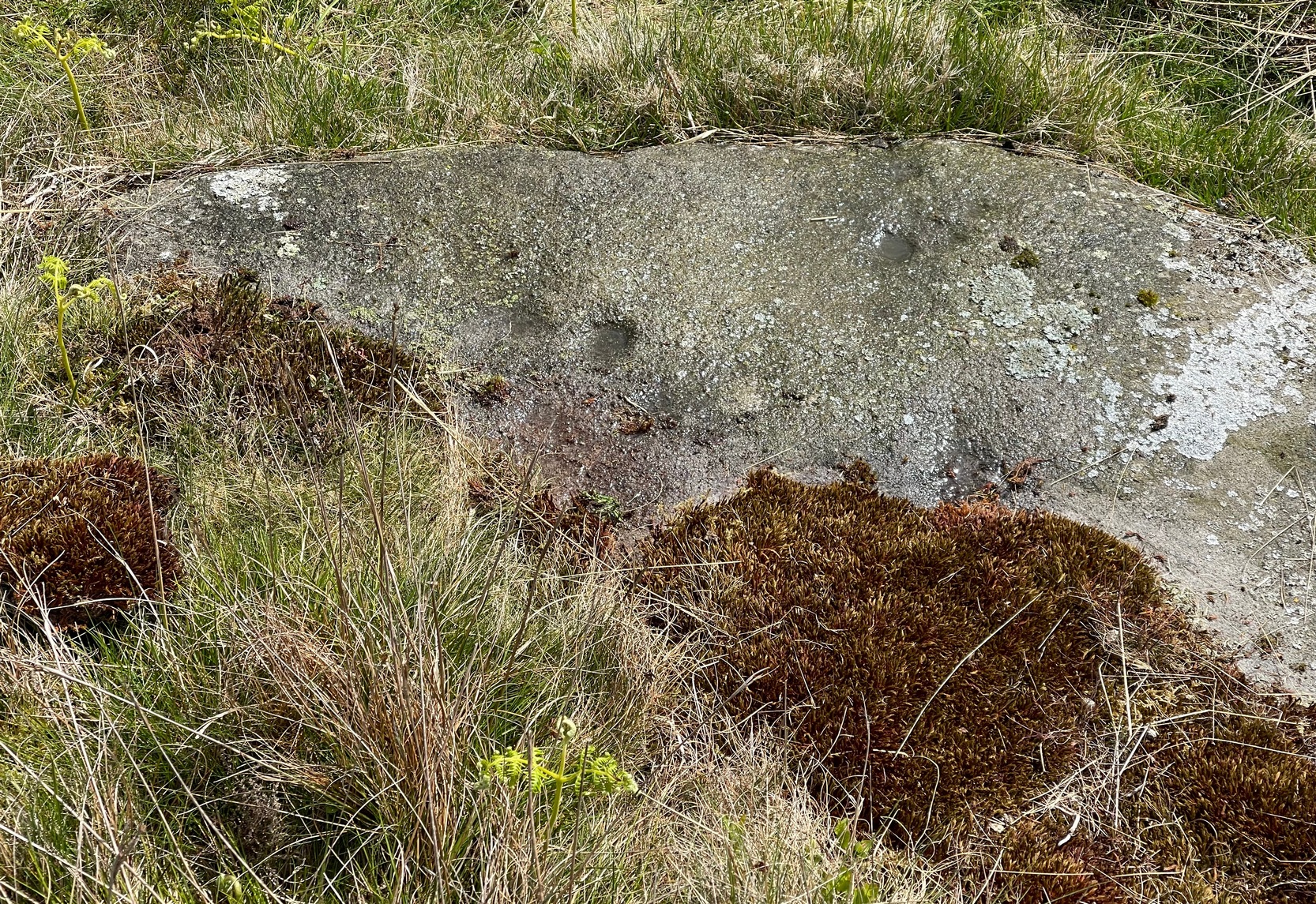
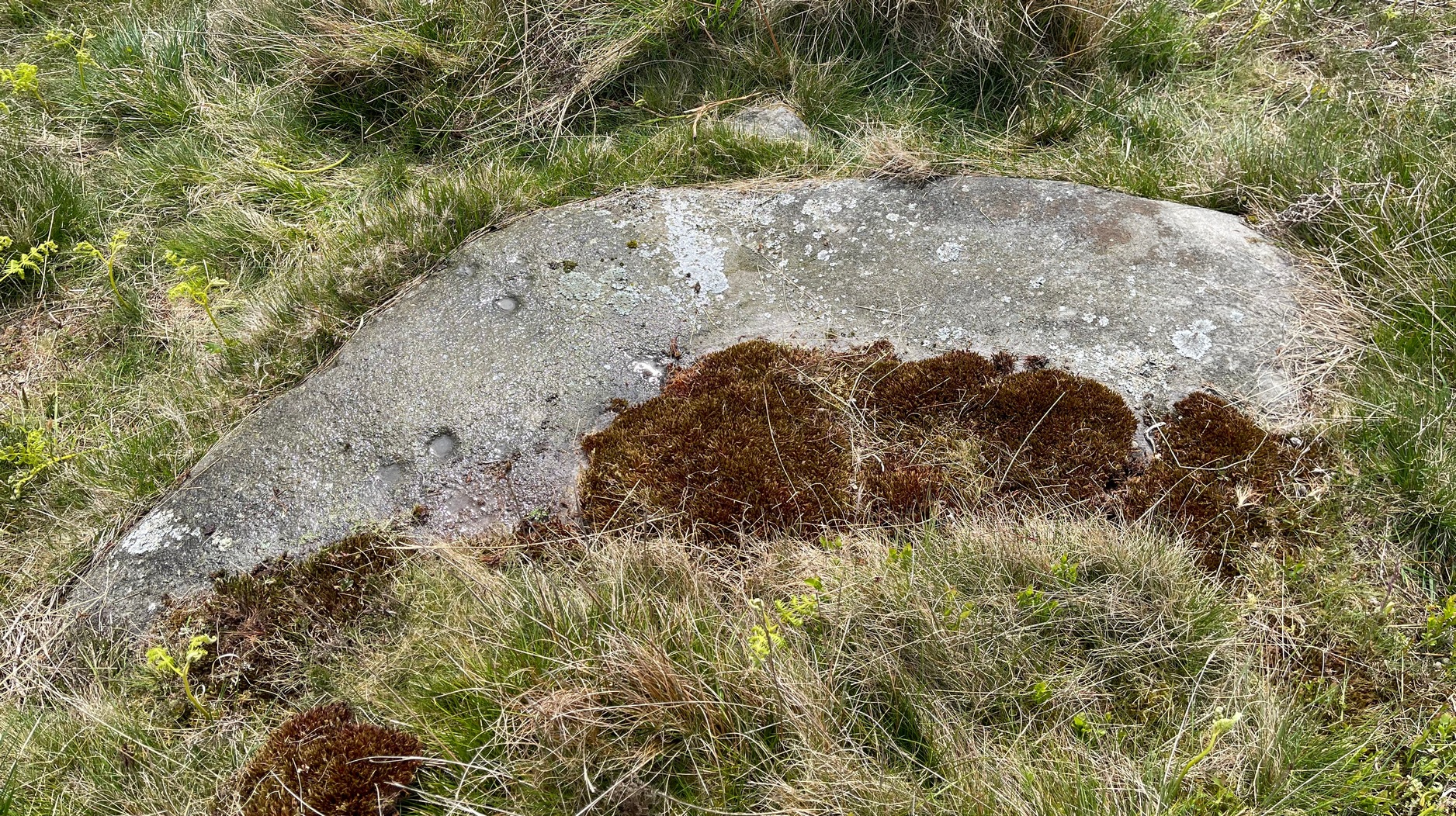
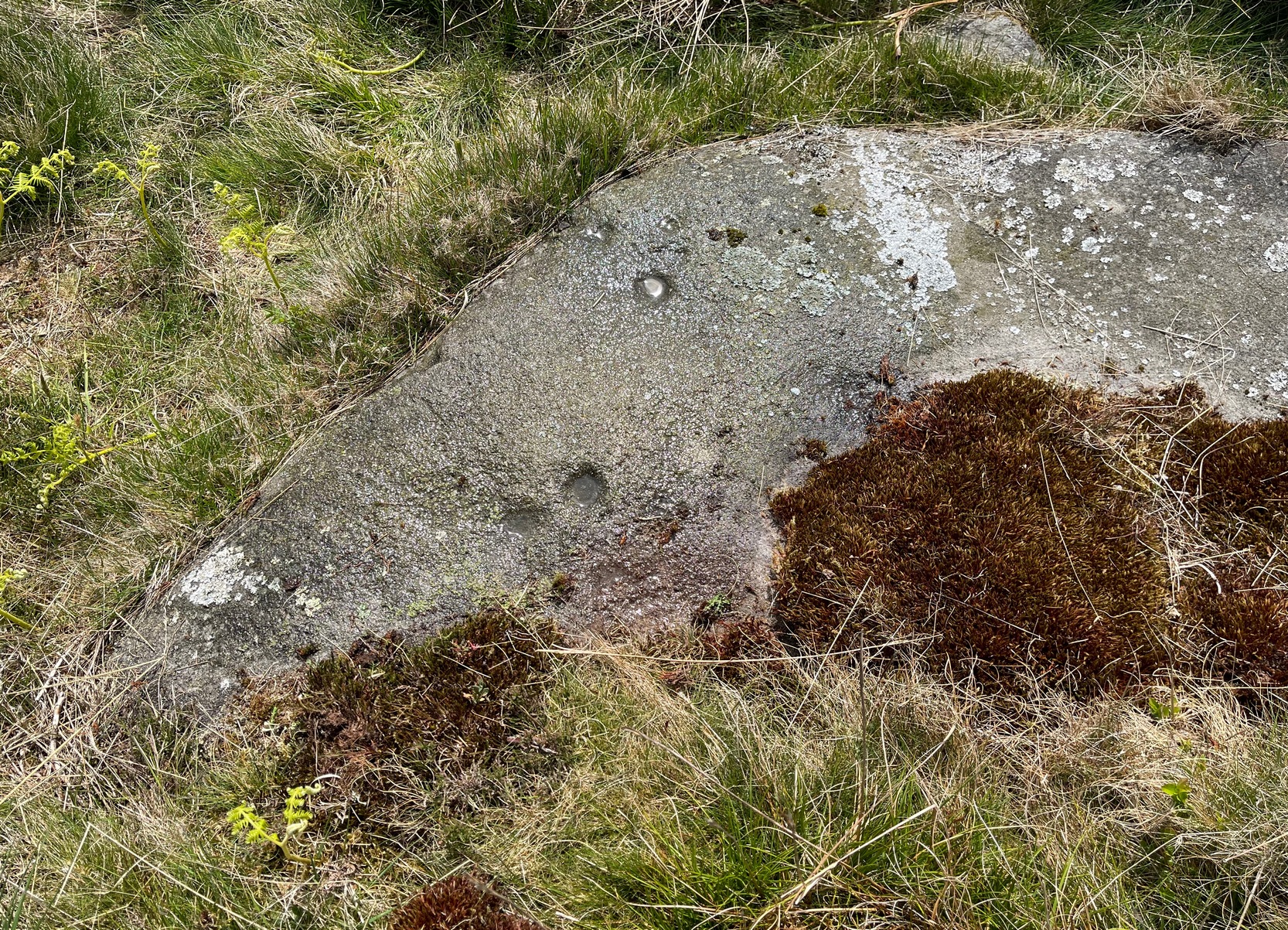
Close to a line of prehistoric walling (seemingly a section of a settlement), this typically curvaceous female stone is possessed of two pairs of faint cup-marks on the eastern side of the rock.  It was included in Boughey & Vickerman’s (2003) survey where they described the carving as being, “two small cups visible and two further cups under heather.”  A third possible cup exists close to one of the pairs. The carving is found in an area rich in untouched prehistoric remains. 

References:

  1. Boughey, Keith & Vickerman, E.A., Prehistoric Rock Art of the West Riding, WYAS 2003.

© Paul BennettThe Northern Antiquarian

Balnabroich, Kirkmichael, Perthshire

Cairn:  OS Grid Reference – NO 1008 5695

Getting Here

Balnabroich cairn

From Kirkmichael village take the A94 road 2 miles south to the Balnabroich standing stone and another 100 yards past it, on the left (east) take the dirt-track uphill, following the directions to reach the Balnabroich hut circles. You’ll see the large prehistoric rock pile of the Grey Cairn on the near skyline just above the huts and roughly on the same level, 50 yards away to the south, you’ll see this scruffy lumpy dump of a cairn, all overgrown.

Archaeology & History

The cairn, looking S

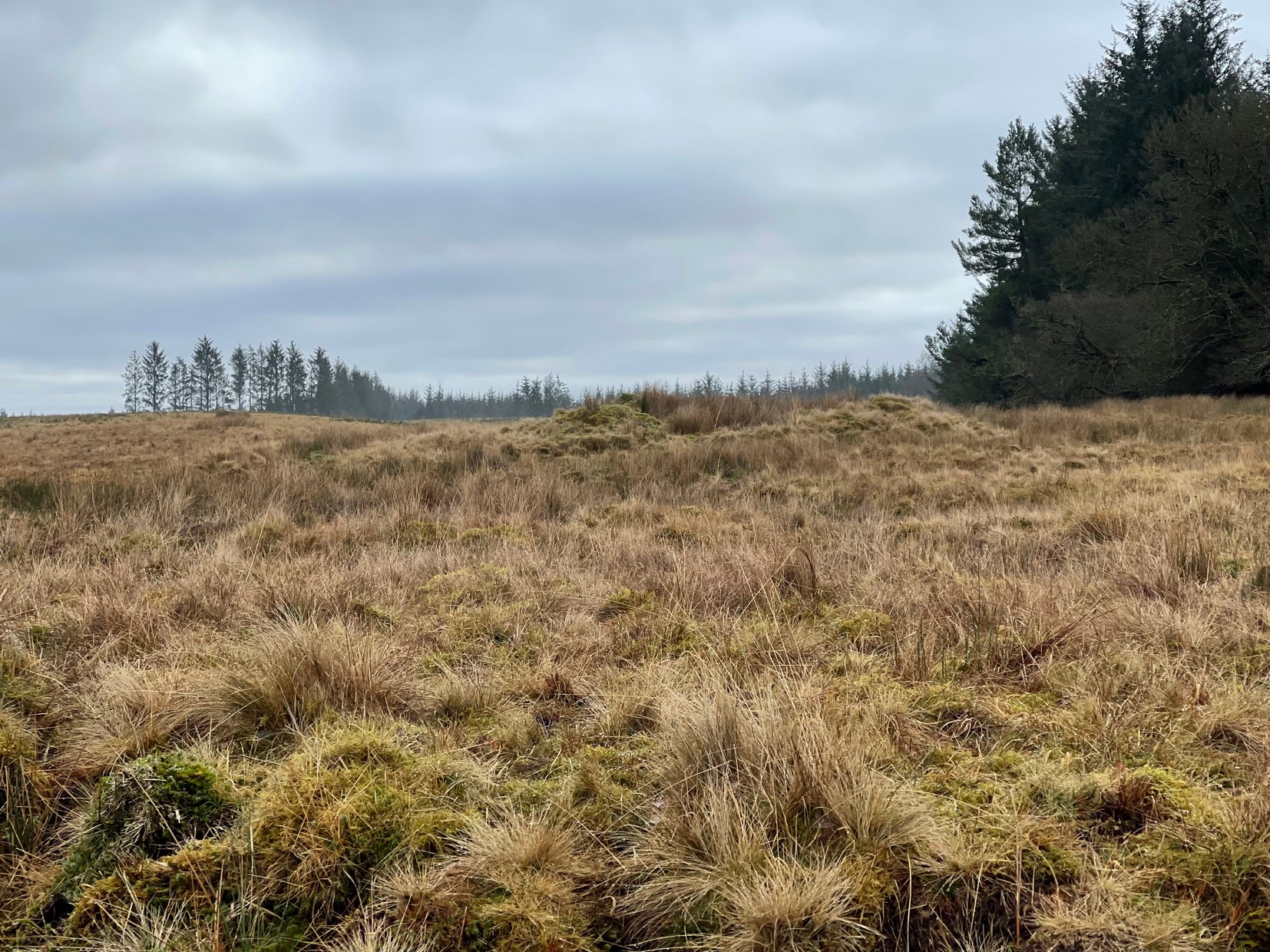
Amidst the veritable scatter of a thousand clearance cairns (yes, that’s the estimate), there are a few up here that had more funerary functions than the rest.  This being one of them.  When Allan Stewart (1795) wrote about them all in the Statistical Account, he couldn’t have missed this one—and yet he made no mention of it.  We had to wait another seventy years before the outside world became aware of its existence.  Then, along with “a band of between twenty and thirty workmen,” John Stuart (1865) set out to see what lay beneath the rocky pile.  In truth, much more attention was given to the huge Gray Cairn close by (understandably so), but at least some attention was given here.  Stuart described this cairn as,

“about 9 yards across, defined by large boulders, with a raised ridge around, and a cup in the centre. The raised ridges and centre were all formed of small stones and earth. A trench was cut through it from the southeast, which showed that in the centre, at a depth of 2 feet, a deposit had been made, of which the remains were charred wood and fragments of charred bone, with traces of blackish matter, which had filtered into the yellow subsoil, as in the case of the graves at Hartlaw.’ Many fragments of white quartz pebbles appeared near the centre, as in other cairns to the east.”

Indeed, at least one of the “cairns to the east” is made entirely of quartz stones!  Since Mr Stuart’s dig into the tomb, it has widened out slightly as rummaging cattle and other damage has been inflicted, and the grasses have coloured the tomb with their life.  Check it out when you’re up here!

References:

  1. MacLagan, Christian, The Hill Forts, Stone Circles and other Structural Remains of Ancient Scotland, Edmonston & Douglas: Edinburgh 1875.
  2. Ramsay, John S., Highways and Byways of Strathmore and the Northern Glens, Blairgowrie Advertiser 1927.
  3. Royal Commission on the Ancient & Historical Monuments of Scotland, North-East Perth: An Archaeological Landscape, HMSO: Edinburgh 1990.
  4. Stewart, Allan, “Parish of Kirkmichael,” in Statistical Account of Scotland – volume 15, 1795.
  5. Stuart, John, “Account of Excavations in Groups of Cairns, Stone Circles and Hut Circles on Balnabroch, Parish of Kirkmichael, Perthshire,” in Proceedings Society Antiquaries, Scotland, volume 6, 1865.

Acknowledgements:  Huge thanks for use of the Ordnance Survey map in this site profile, reproduced with the kind permission of the National Library of Scotland

© Paul BennettThe Northern Antiquarian

Black Park (3), Callander, Perthshire

Cairn:  OS Grid Reference – NN 66885 07447

Getting Here

Low-lying Black Park (3)

From Callander head east along the main A84 road and nearly 300 yards past the entrance to the Keltie Bridge caravan park, take the tiny road on your left (north) and barely 100 yards along turn right and go up here for exactly 1 mile.  Walk up the track from here and follow the directions to find the Black Park (1) cairn; and then the nearby small Black Park (2) cairn.  From here you need to walk north-east round the small rounded hillock in front of you, and cross a small burn (stream) up to the next small grassy rise.  Altogether this is about 200 yards from the Black Park (2) cairn.  On this grassy rise lives the Black Park (3) cairn!

Archaeology & History

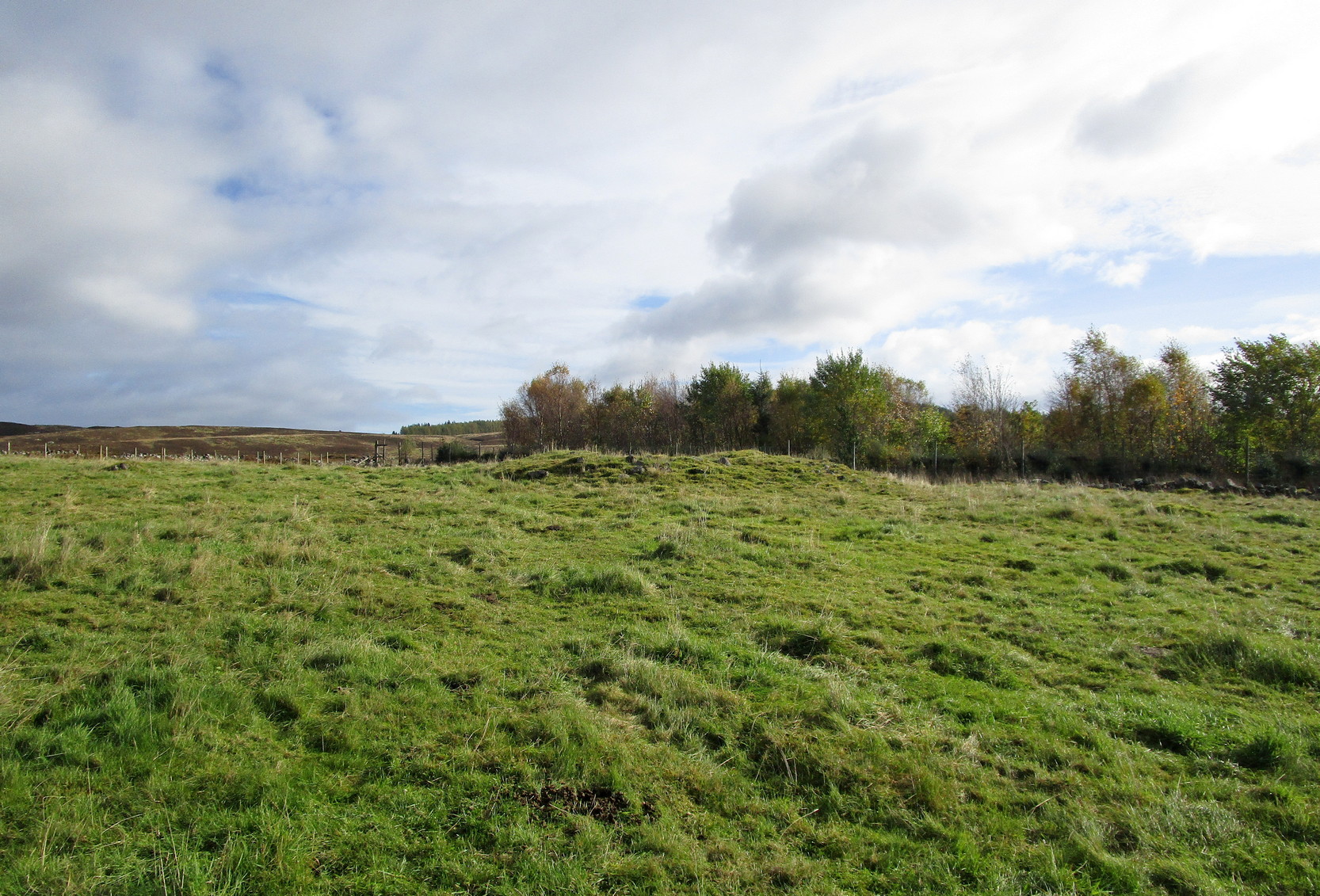
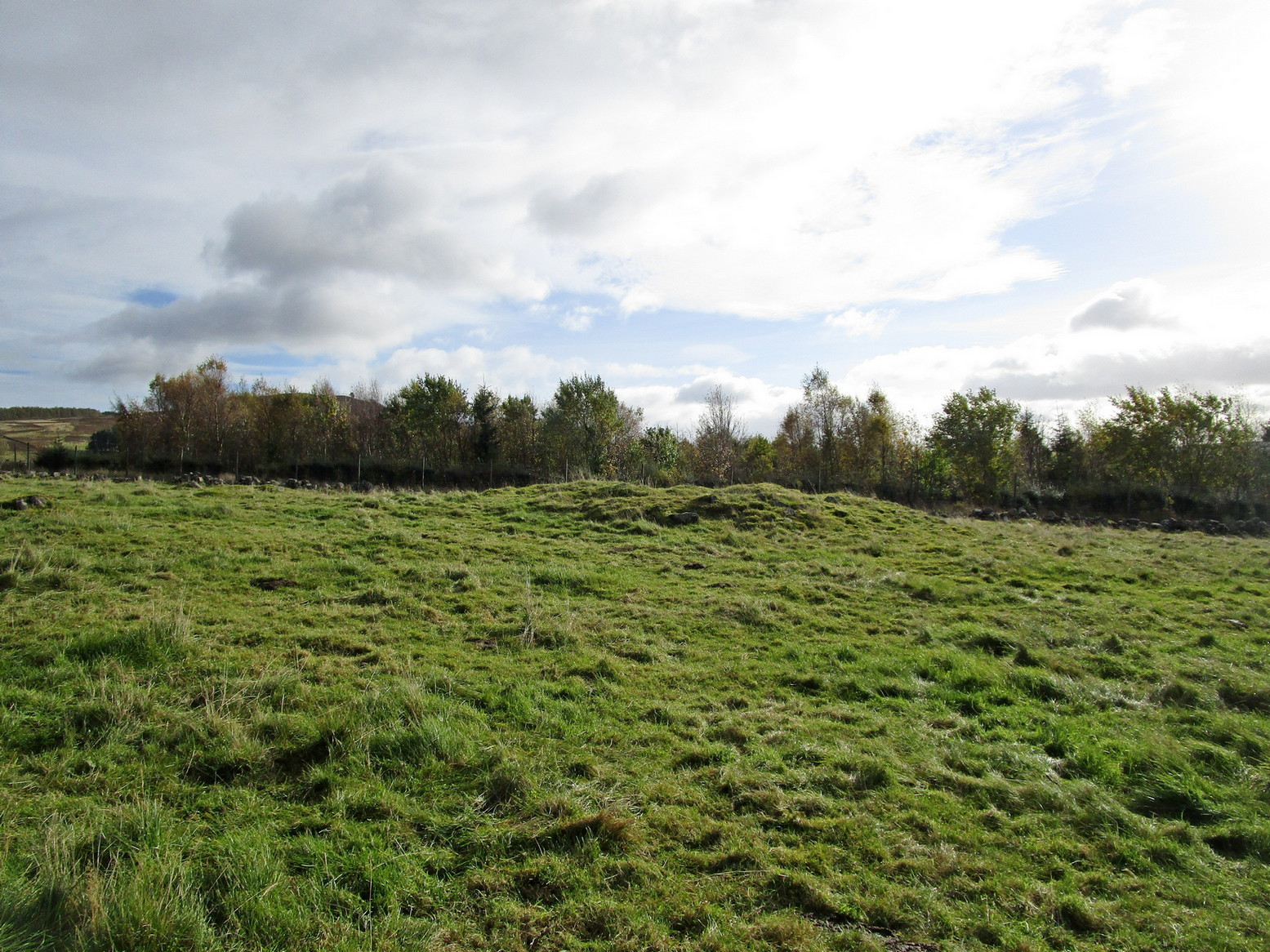
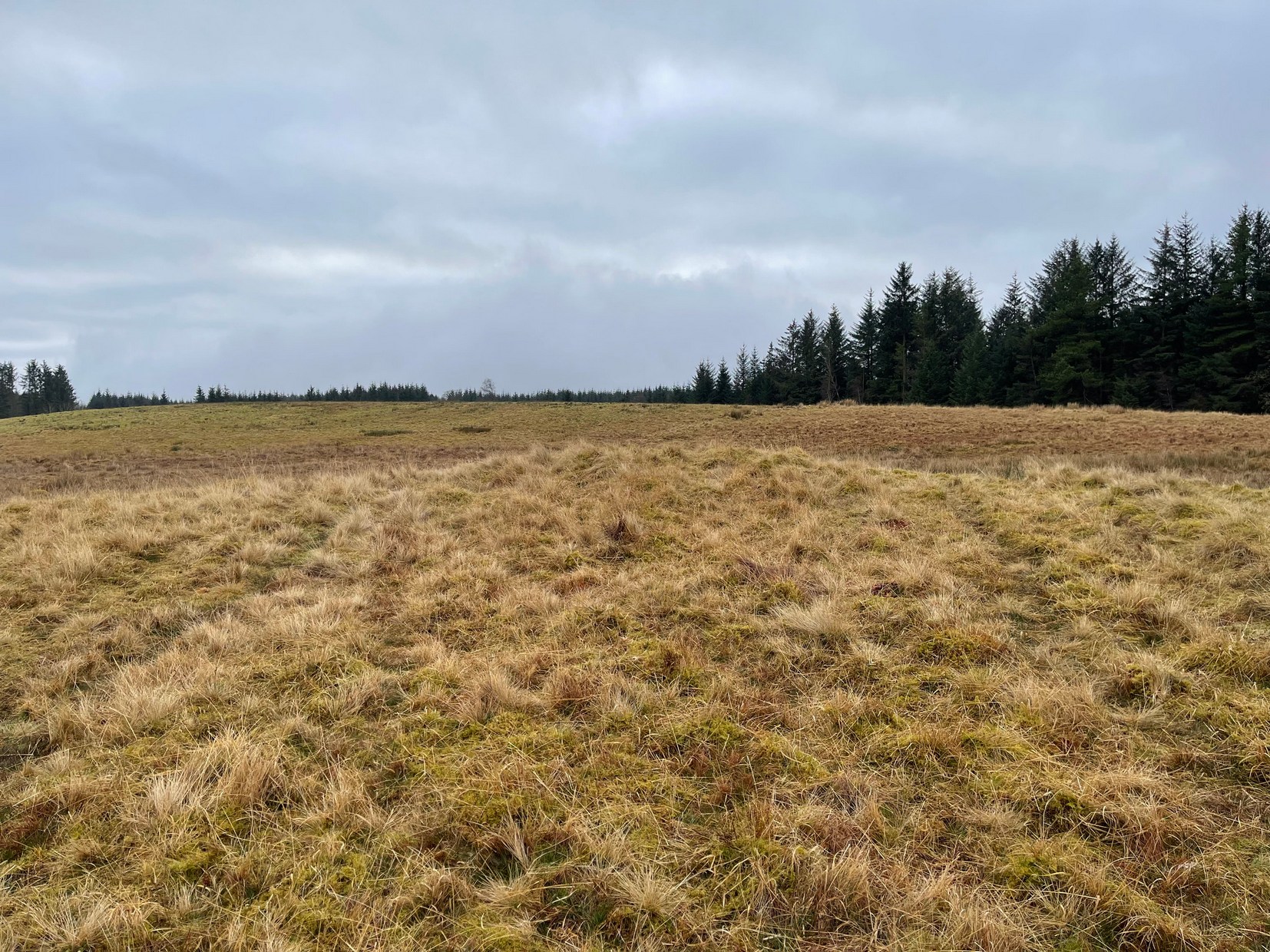
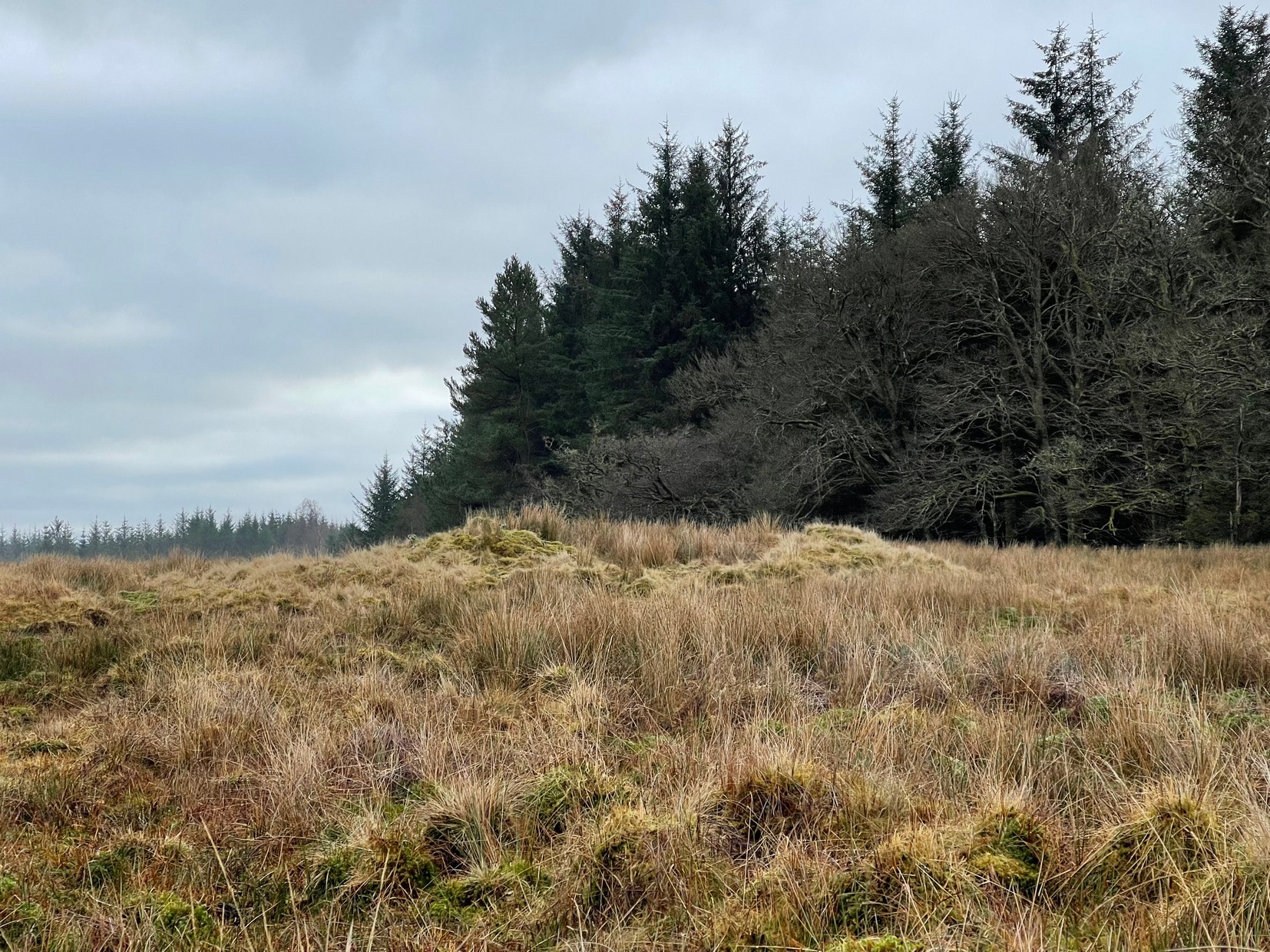
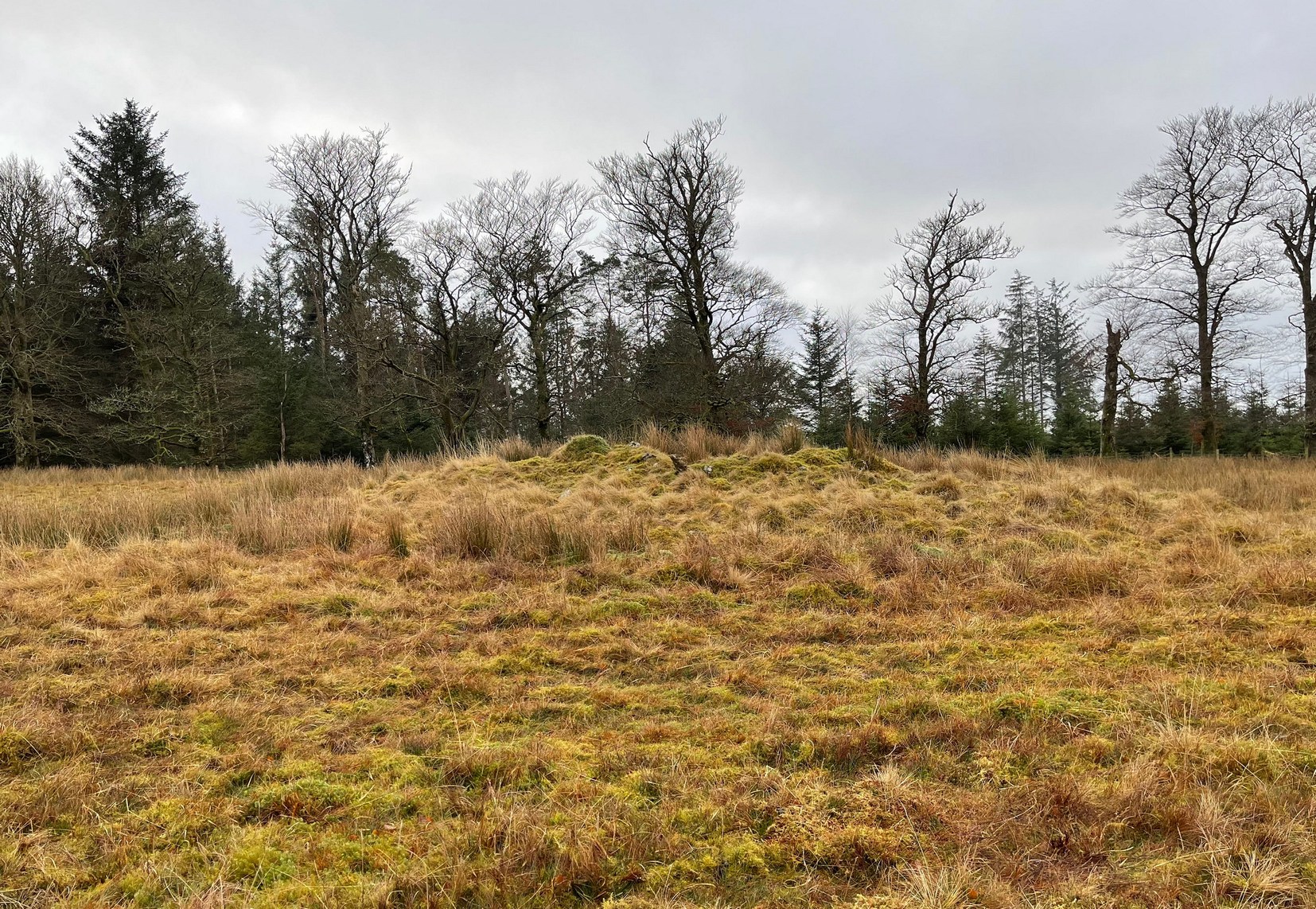
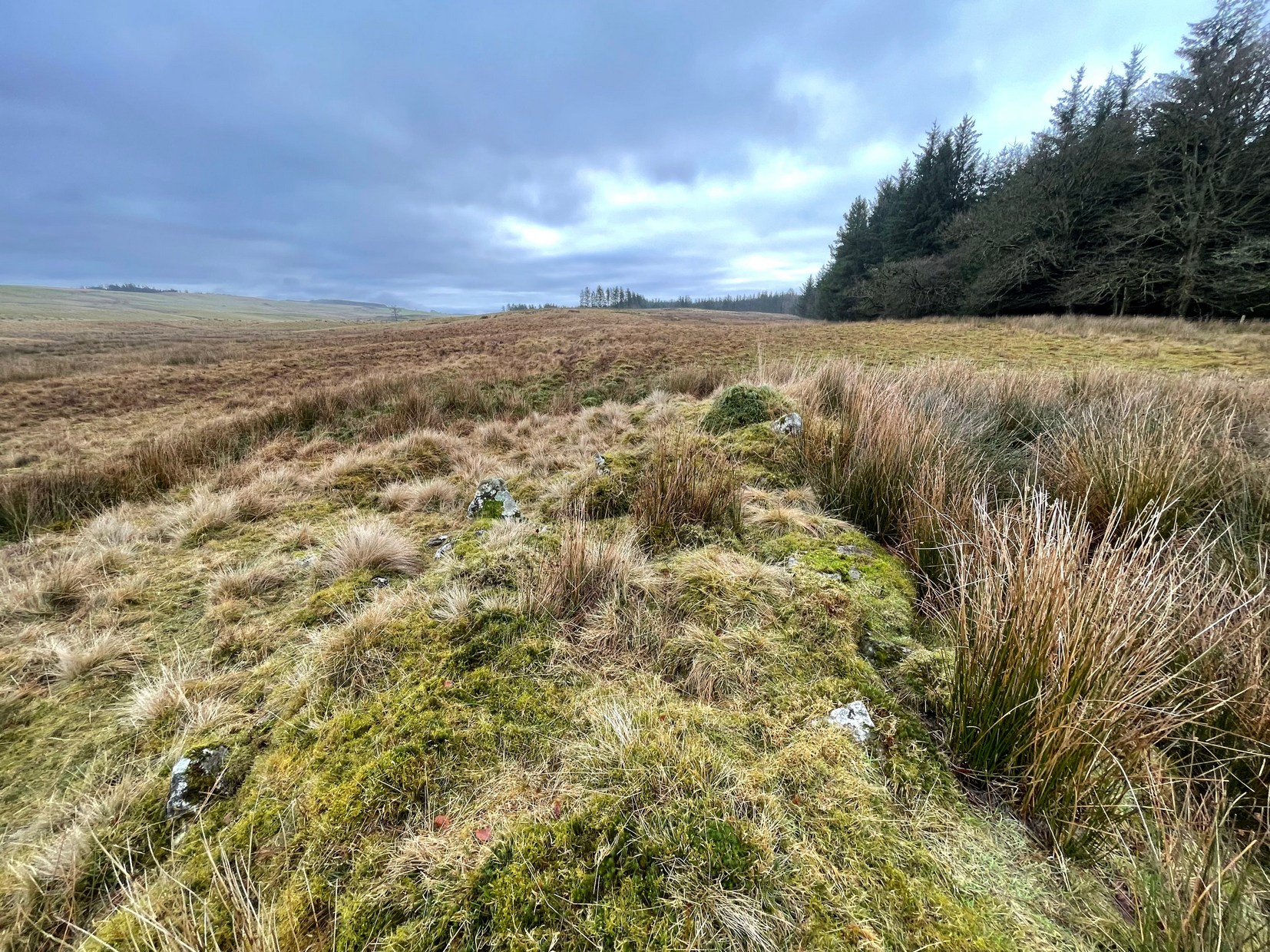
As with its compatriot Black Park (2) cairn 200 yards southwest, this can be hard to see.  It’s an overgrown small singular cairn (it looks like a tumulus now) of no great note to look at: probably the resting spot of an individual or just a small family.  Measuring some 5-6 yards across and less than a yard high at the most, its easily missed unless you’re really mean to find it. More impressive are the ones on the hill immediately above you to the east.  Head there next!

References:

  1. Royal Commission Ancient & Historical Monuments, Scotland, Braes of Doune: An Archaeological Survey, RCAHMS: Edinburgh 1994.

© Paul BennettThe Northern Antiquarian

Grey Cairn carving, Kirkmichael, Perthshire

Cup-Marked Stone:  OS Grid Reference – NO 10058 57013

Archaeology & History

When the Grey Cairn above Balnabroich, Kirkmichael, was explored in the second-half of the 19th century by John Stuart (1865) and a number of local labourers, they found the floor of the tomb had been paved with a number of large boulders.  Near its centre, along with finding remains of charred wood, they moved some of the rocks and,

“On turning over the stones a circular disc of stone with a hole in the centre was found, and also a small boulder with a cup on its flat face.”

Grey Cairn at sunfall

He made no further remarks about the carving and no intimation that it was removed, so we must presume it is still there, at the botton of the cairn.  Any visitors to the site might want to have a look at the massive scatter of surface stones that make up the cairn to see if any further cup-marks exist on them.  It’s not uncommon to find them on such giant tombs.

Folklore

A very curious folktale was known of the cairn in the 19th century, whose theme is recognized at numerous other prehistoric sites, but the mythic creature involved here is very much different from the ones we’re used to.  Mr Stuart told that,

“The popular belief is that a mermaid is buried beneath it. This mermaid used to throw stones at people who were coming from church at Kirkmichael, and she could only be seen through a hole in the knot of the pine tree.  At last she was chased to the hill at Balnabroch on her flight to the waters of Loch Marech, on the other side of the hill, and there killed, when the Grey Cairn was raised over her.”

References:

  1. Royal Commission on the Ancient & Historical Monuments of Scotland, North-East Perth: An Archaeological Landscape, HMSO: Edinburgh 1990.
  2. Stuart, John, “Account of Excavations in Groups of Cairns, Stone Circles and Hut Circles on Balnabroch, Parish of Kirkmichael, Perthshire,” in Proceedings Society Antiquaries, Scotland, volume 6, 1865.

Acknowledgements:  Huge thanks for use of the Ordnance Survey map in this site profile, reproduced with the kind permission of the National Library of Scotland

© Paul BennettThe Northern Antiquarian

Black Park (2), Callander, Perthshire

Cairn:  OS Grid Reference – NN 6672 0735

Getting Here

Black Park (2) cairn

Take the same directions as if you’re going to visit the large Black Park (1) cairn, and from here look down the slight boggy slope to your right (east) and, across the other side of a small burn (stream) you’ll see a slightly raised grassy knoll.  A curved dyke is to its left (west) side.  You’re there!

Archaeology & History

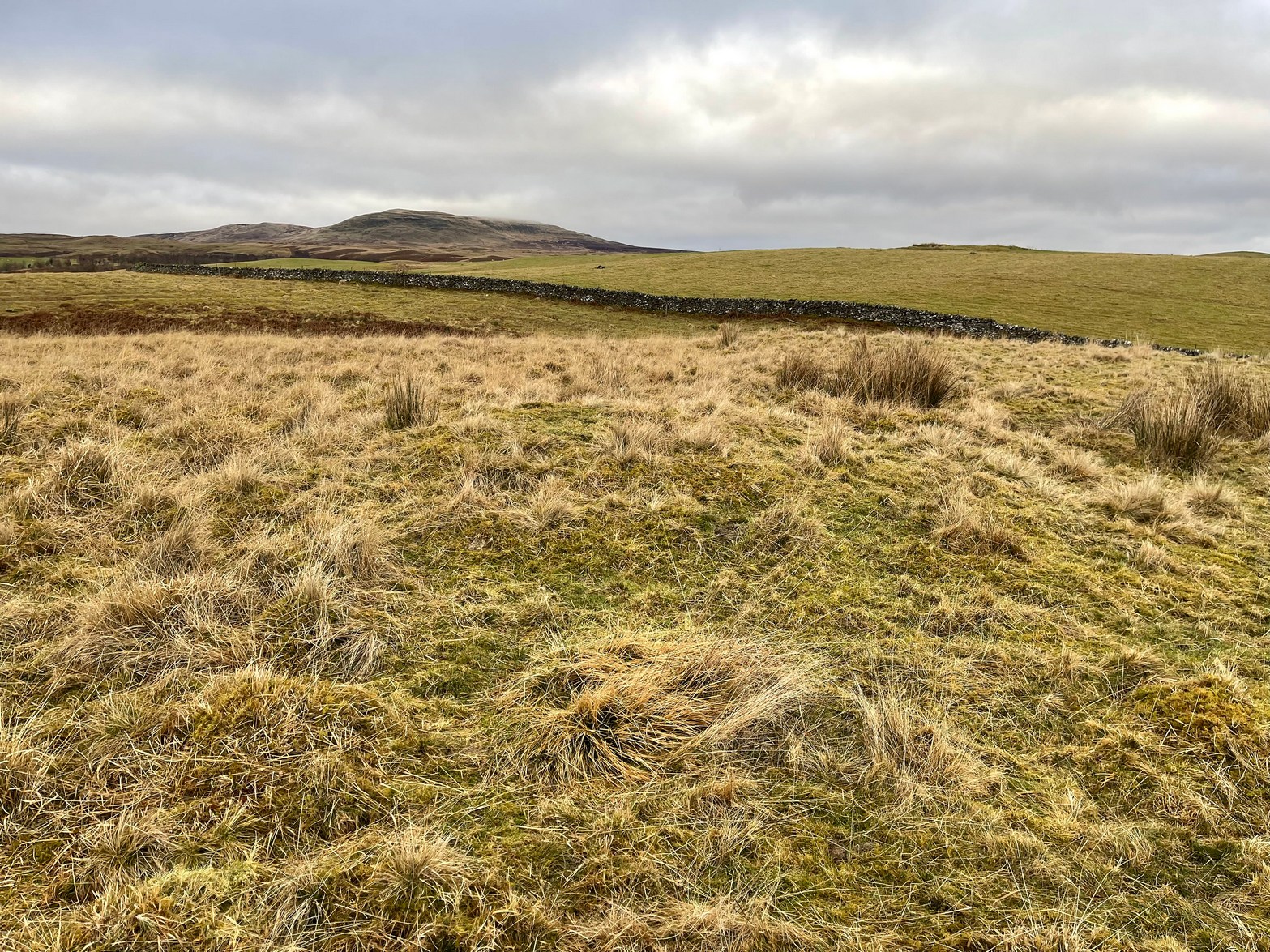
This small cairn, barely two feet high at the most, and five yards across, is deemed as a possible Bronze Age cairn on Canmore and in the Royal Commission (1994) report of the area.  There is certainly a pile of small stones here, but it may be a clearance cairn (I hope I’m wrong).  Only an excavation will tell us for sure.

References:

  1. Royal Commission Ancient & Historical Monuments, Scotland, Braes of Doune: An Archaeological Survey, RCAHMS: Edinburgh 1994.

© Paul BennettThe Northern Antiquarian

Black Park (1), Callander, Perthshire

Cairn:  OS Grid Reference – NN 66612 07349

Also Known as:

  1. Black Wood
  2. Sruth Geal

Getting Here

Black Park (1) cairn, looking south

Less than a mile east of Callander on the main A84 road, nearly 300 yards past the entrance to the Keltie Bridge caravan park, take the tiny road on your left (north) and barely 100 yards along turn right and go up here for excatly 1 mile (give or take a few yeards) where  track goes into the forest on your left and you can park-up here.  Walk up the track into the silence for just under a mile where, as the track splits and you kink to the right, a gate appears.  On the other side of the gate, turn immediately left, almost walking back on yourself, just above the curving waters of a burn, through boggy reeds, keeping to the fence-line until, less than 300 yards along, you’ll reach what you’re looking for.

Archaeology & History

Black Park (1), looking W

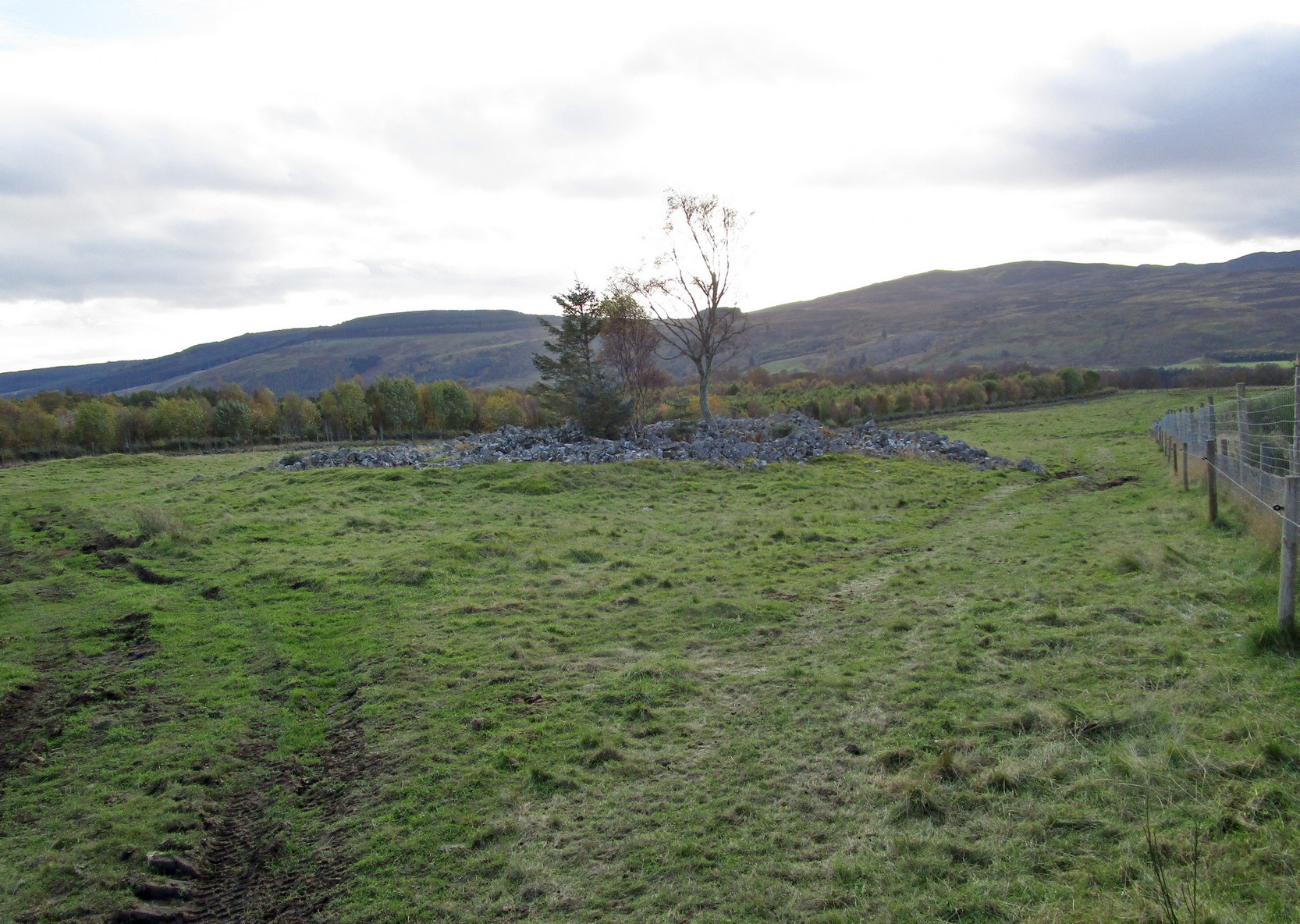
This reasonably large cairn and its neighbours (Black Park [2], [3], [4] and [5]) would appear to be relatively new discoveries as I can find nothing about it prior to the Royal Commission’s 1994 survey.  They are even absent from Moray MacKay’s (1953) excellent work on the area!  Hence, descriptions of it are scant and visitors to the place are few indeed (we did meet a local who knew about the old tomb, but said that nothing was known about it); but it is, nonetheless, a fine, albeit denuded and very overgrown cairn, living today amidst a quiet mass of reeds and surrounded by boggy ground—so make sure you’ve got your boots on!

Internal line of stonework

Black Park (1), looking SE

At its height, today, it stands less than four feet tall and measures roughly 16 yards across at its widest.  Through one section of the tomb there runs a raised line of stonework that almost looks like internal walling, which may have been where a chamber once existed.  It’s been hollowed out by someone in the not-too-distant past but, as I said, there are no records of such a thing, so whether or not that was a chamber or merely a fortuituous collapse of stone in a straight line, we can’t really say.  Along its more northern edges there seems to be a small raised wall of stone defining its edge, although once again it requires a more discerning examination to work out whether this is part of its original facade, or is a result of some of the stone mass falling to the edges.

Visit the old place and sit with its silence for a while…

References:

  1. Royal Commission Ancient & Historical Monuments, Scotland, Braes of Doune: An Archaeological Survey, RCAHMS: Edinburgh 1994.

© Paul BennettThe Northern Antiquarian