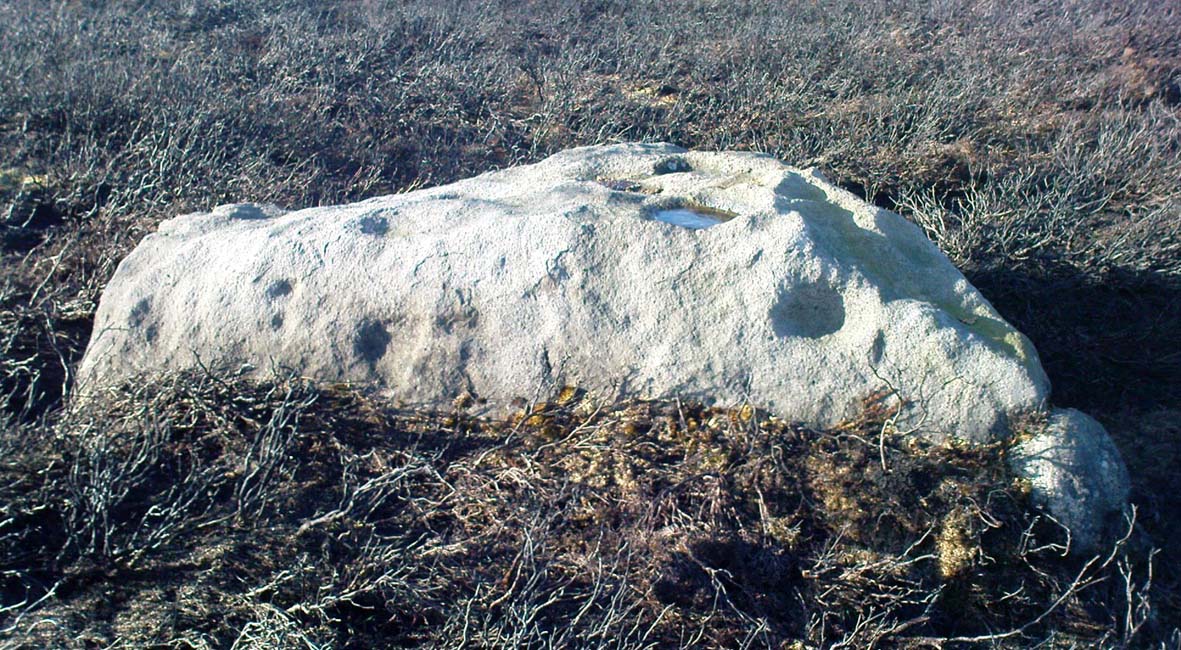
Haworth Moor Spa Wells, West Yorkshire

Healing Wells:  OS Grid Reference – SE 0041 3513

Getting Here

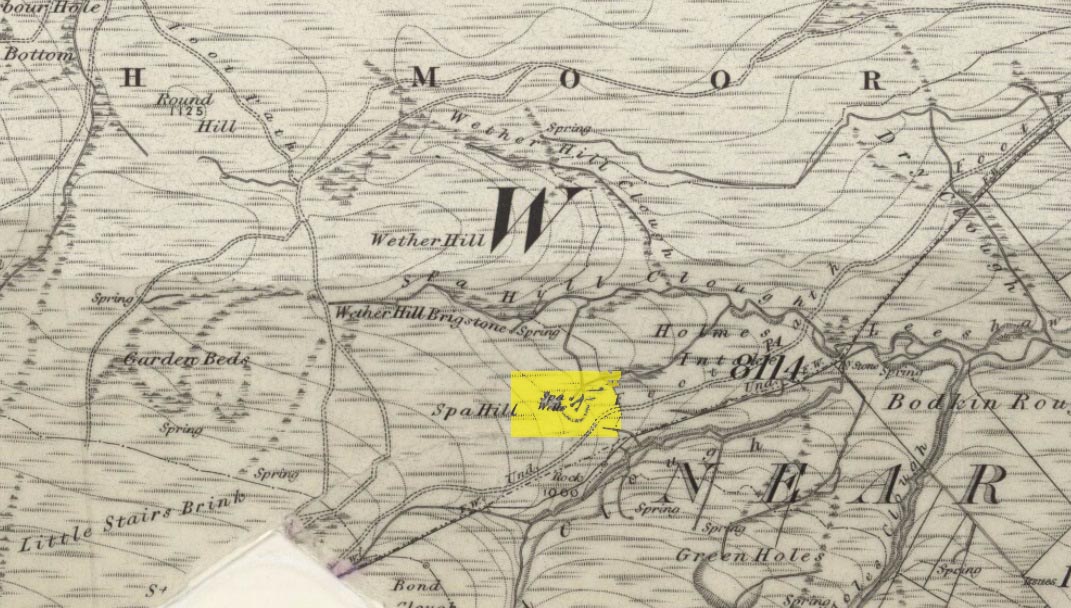
Spa Wells on 1852 map

Go through Haworth and head for the well-known Penistone Hill country park.  On the far western side of the hill up near the top of Moorside Lane, there’s a car-park.  Right across the road from this there are two footpaths: one heads you into the moor, whilst the other (going the same direction) follows the edge of walling onto the moors.  Take this path. Walk on and downhill, past the end of the reservoir, then the path continues uphill. You’ll hit a nice cheery tree beside the path a few hundred yards up.  Stop here, look into the boggy region with bits of walling on the moor in front of you.  That’s where you’re heading!

Archaeology & History

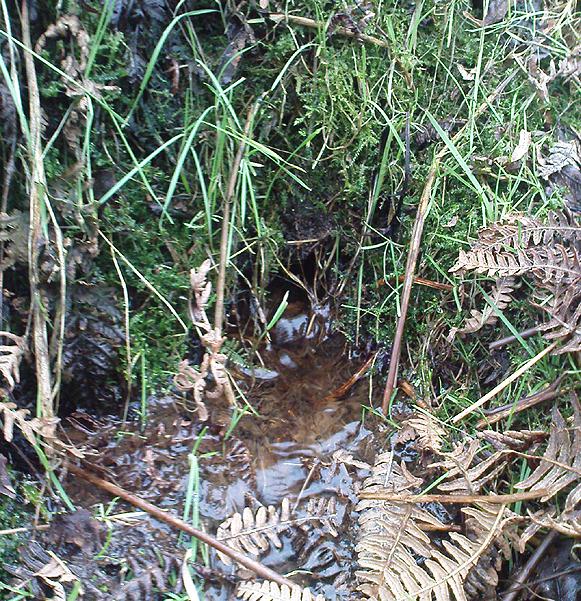
The first, weaker of the Spa Wells

This was a really curious spot to me, as I found absolutely nothing about the damn place!  But thanks to the assistance of local historian and writer Steven Wood (2009), that’s changed.  Shown on the 1852 OS-map, at least two springs of clear water trickle slowly from the wet slope above you into the boggy reeds.  Close by there are overgrown remains of old buildings, covered with the time of moorland vegetation, seemingly telling that the waters were collected for bathing rooms.  But who the hell even started the notion that they’d be able to get Victorian rich-folk up here at the crack-of-dawn to drink or bathe in the waters is seemingly forgotten.  And, as is evident from the lack of local history, the project was a failed one which seemed not to have lasted too long. 

Folklore

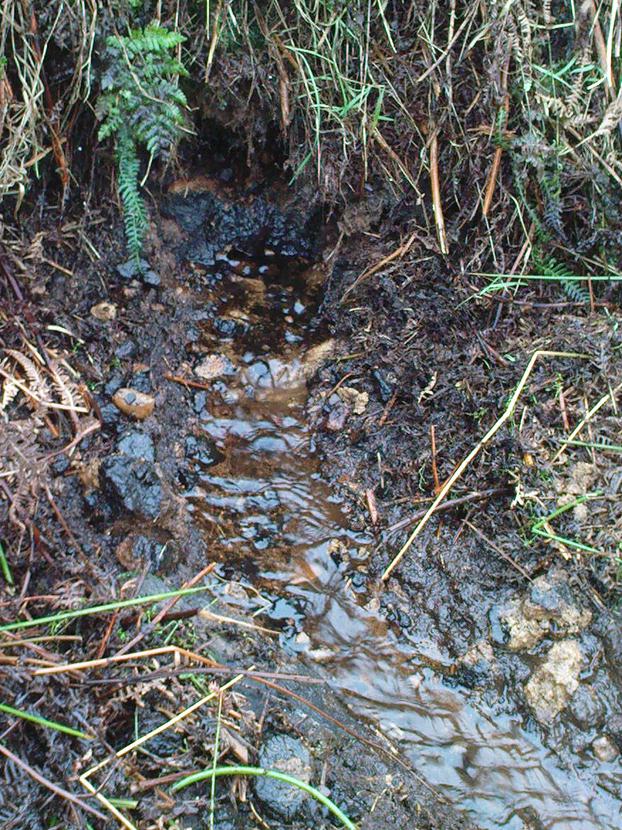
The stronger of the Spa Wells
The stronger Spa Well

It was quite obvious that of all the springs around here and despite the strong-flowing streams either side of these spa well, that the local animals drink here more than the other nearby springs of water, as there were literally hundreds of animal tracks all across the boggy ground of the spas.*  The waters also seem to have the usual ‘spa’ qualities of stinking, but once we’d cleaned out the overgrown springs — which looked as if they hadn’t been touched for 100 years or more the waters were clear and tasted good, and were curiously slightly warm!

Although my initial search for information on this site drew a blank, Steve Wood pointed us in the right direction for info on the place.  As with many other holy wells and spas in Yorkshire, it turned out that this was another spot much revered around Beltane, indicating strongly there would have been  earlier pre-christian rites practiced at this site.   Steve pointed me to Martha Heaton’s (2006) local history work, which told:

“For many years the first Sunday in May was a special day. It was known as Spa Sunday, for on this day people gathered up in the hills overlooking what is now Leeshaw Reservoir, here was a well, known as Spa Well, and the stream which now feeds the reservoir is known as Spa Beck. People came from Haworth, Oxenhope, Stanbury, and other villages sitting round the well, they sang songs, some bringing their musical instruments to accompany the singing. Children brought bottles with hard spanish in the bottom filling the bottle with water from the well, shaking it until all the spanish or liquorice had been dissolved. This mixture was known as ‘Poppa Lol’ and would be kept for weeks after a little sugar had been added, then it was used sparingly as medicine.  The custom seems to have died out when Bradford Corporation took over the water and made Leeshaw Compensation Reservoir in 1875, though up to about 1930 two men from Haworth would wend their way to the spot on the moor, the first Sunday in May. The men were John Mitchell and Riley Sunderland, better known, in those days as ‘Johnny o’Paul’s’ and ‘Rile Sun’.

It was a great day for many people, the Keighley News of May 1867 mentioned it, the report of local news reads thus: ‘A large assembly met on Spa Sunday on the moors about two miles from Haworth, and a party of musicians from Denholme performed sacred music’.

This locality was often visited during the summer months by the Bronte family.”

References:

  1. Heaton, Martha, Recollections and History of Oxenhope, privately printed 2006.
  2. Wood, Steven & Palmer, Ian, Oxenhope and Stanbury through Time, Amberley Publishing 2009.

Acknowledgements: – Huge thanks to Steven Wood for his help; and to Hazel Holmes for permission to quote from Martha Heaton’s work.

* A common creation myth behind many healing wells is that animals with breaks or illness drag themselves to drink from otherwise small or insignificant springs and wells, despite of the copious streams or rivers which may be nearer.

© Paul Bennett, The Northern Antiquarian

Robin Hood’s Well, Stanbury Moor, West Yorkshire

Sacred Well:  OS Grid Reference – SD 9795 3629

Robin Hoods Well on 1851 map

Getting Here

Follow the same directions to get to the nearby Ponden Kirk and, once on top of the rocks, overlooking the valley, walk on the footpath to your right.  It bends round and follows the stream up onto the moors.  About 100 yards along, walk up the heathery slope to the right and you’ll find several boggy watering holes on the top of the ridge.  In looking at the first OS-map of the area in 1853, it seems that the northernmost of six boggy springs is the Robin Hood’s Well – although we don’t know this for certain.  It’s one of them though!

Archaeology & History

Robin Hood’s Spring, above Ponden Kirk

There’s little to see here really: it’s little more than a small boggy spring of water emerging from the edge of the ridge, as the photo shows.  Curiously, descriptions of the site (and its neighbouring compatriots, Will Scarlett’s Well and Little John’s Well) are sparse aswell.  It was noted by the Ordnance Survey lads in 1848 and subsequently posted on the first OS-map of the area in 1851.  Both Horsfall Turner (1879) and Johnnie Gray (1891) mention the site passing, saying nothing of the place. However, several years after Gray’s work, Halliwell Sutcliffe (1899) ventured here and gave us the first real description of the place, telling:

“Half-hidden underground, and fringed with fern and bog-weed, lie the three wells which go by the names of Robin Hood, Little John and Will Scarlett.  One may stop to ask how they came by their birth-names, to wonder why a man should have troubled to fashion them in this out-of-the-way spot; but neither speculation nor questioning of the moor folk brings one nearer to an answer.”

Folklore

Halliwell Sutcliffe's scruffy quick sketch, circa 1898
Halliwell Sutcliffe’s scruffy quick sketch, circa 1898

Apart from this site being a spot where the legendary outlaw stopped and drank in ages past, the healing attributes of these waters have long since been forgotten.  Considering the proximity of the Ponden Kirk and its legendary association with fertility and marriage rites, I’d guess that such lore wold have centred around Beltane, or Mayday; and Robin Hood is very well known in folklore to have close associations with the same period.  So — and I’m guessing here — it’s likely that whatever might have occurred at this well, would have taken place around Beltane aswell.

References:

  1. Gray, Johnnie, Through Airedale from Goole to Malham, Walker & Laycock: Leeds 1891.
  2. Sutcliffe, Halliwell, By Moor and Fell in West Yorkshire, T. Fisher Unwin: London 1899.
  3. Turner, J. Horsfall, Haworth, Past and Present, Hendon Mill: Nelson 1879.

© Paul Bennett, The Northern Antiquarian

Fair Haia, Carlton, North Yorkshire

Legendary Tree (destroyed?):  OS Grid Reference – SE 614 270

Getting Here

From Carlton, take the western Hirst Road to Temple Hirst village, then turn right once you’re in the village and go up Common Lane up for about a mile.  There’s a footpath on your left leading you to the Fair Oaks farmhouse. This was the spot!

Archaeology & History

This is fascinating sounding place which marked the central point of three old township boundaries nearly 1000 years ago.   I first found it mentioned in Morrell’s History and Antiquities of Selby (1867: 36-7), where this once famous tree is described in land sale transactions.  Morrell told:

“At Carlton the (Selby) abbey had considerable property, which was sold to the neighbouring priory of Drax.  The boundary of the property sold was a certain oak tree, called Fair-haia, in Burn Wood, which Adam de Bellaqua gave for this purpose, binding himself and his heirs never to cut it down or root it up, sub poena anathematis.”

But we found a more detailed outline in Dugdale’s Selby Abbey in Yorkshire, where the premises and townships given to Selby Abbey in the 12th and 13th centuries are listed.  In the township of ‘Carleton’ (as it was then spelt) Dugdale wrote:

“Peter de Brus gave the grange here, which the monks had held of Agnes, late wife of Ranulph FitzSwain.  Richard abbat of Selby granted to Robert prior of Drax all the tithe from the north part of the oak called Fair-haia, in the wood of Birne, or Berlay, through the middle of the marsh to Hundolfsweith; and from thence by the strait ditch directly to Espholm, and all the tithe from Espholme to Appletreholme, as the ditch goes to the new fosse or ditch of Carleton: and the prior granted to the abbat all the tithes on the south to the new ditch, and from thence to the river Ayre.  And Adam de Bellaqua gave this oak tree, called Fair-haia, as a boundary, never to be cut down (ad standum in perpetuum et non rescindendum), binding himself and his successors never to cut it down or root it up.”

One wonders: are there any remains left of this once great tree?  Has anyone actually transgressed and uprooted it in times past?  Is any other lore known of it?  And who was Adam de Bellaqua?

One of the most intriguing elements to this site is its name, for the word ‘haia’ literally means ‘god of the land’ — but whether we can take this meaning seriously is questionable, as it’s of Sumerian origin.  However, no local dialect words throw any light on the word and it may aswell be the name of the spirit of the tree as anything else.  Does anyone know owt more about this place?

References:

  1. Dugdale, William, Monasticon Anglicanum – volume 3, Longman, Hurst, Rees, Orme & Brown: London 1817.
  2. Morrell, W.W., The History and Antiquities of Selby, W.B. Bellerby: Selby 1867.
  3. Philpot, J.H., The Sacred Tree, MacMillan: London 1897.

© Paul Bennett, The Northern Antiquarian

Market Cross, Keighley, West Yorkshire

Cross: OS Grid Reference – SE 06042 41002

Getting Here

Dead easy this one!  Go along North Street in Keighley, towards the main church in the middle of town (a St. Andrew’s church, previously St. Pete), by the once-infamous Lord Rodney pub, and the old stone edifice stands outside by the Green.  The much better Red Pig public house is across the road from here.

Archaeology & History

Keighley's Town Cross, 1847 - illustrated on a painting by Edwin Riby
Keighley’s Town Cross, 1847 – on a painting by Edwin Riby

For a relatively trivial archaeological site, it’s got a bittova history.  Not that this is an old site either!  We’re not sure just when this cross was made, but it’s certainly no more than 300 years old.  Before standing in its present position outside St. Andrew’s Church, sometime before 1840 it was said to have been a few hundred yards away above the present roundabout on Oakworth Road; and one record tells that it originally came from nearby Utley, a mile to the north.  Due to lack of decent records, we’re not sure about its early status as a market cross, nor when it was first erected.  Indeed, even the steps on which the cross presently stands are clearly more recent than the ones illustrated on Edwin Riby’s 1847 portrait, reproduced here.

Keighley Cross, on a grey wet day!

It would be good to get a complete history of this archaeological relic but it’s difficult with artifacts such as these; and although gaining access to the church now takes less time and effort than it used to (the vicar here used to be quite unhelpful, but has recently changed his ways – which is good!), it’s only open at certain times of the week.*  Friday afternoons seem OK to have a look round.  Please – if folk begin having trouble gaining access to the Church once more, let us know on here so we can make complaints about it.  The Church is paid for by local tax-payer’s cash, and so needs to be open to all of us.  Let’s hope this humble ingredient can be maintained for the good of all in this otherwise regressive social community (Keighley, that is…).

There’s also some very curious folklore to be added here in relation to the market and its cross, but its tale is gonna have to wait…

References:

  1. Gray, Johnnie, Through Airedale, from Goole to Malham, Elliott Stock: London 1891.
  2. Keighley, William, Keighley, Past and Present, R. Aked: Keighley 1858.

* There isn’t even a notice giving information, email or phone numbers, telling you who you can contact if you want to know anything about the history of the church, or visit it — which is quite dreadful considering how much money they get paid by tax-payers for their supposed socio-spiritual duties.

© Paul Bennett, The Northern Antiquarian

Dymond Stone, Burley Moor, West Yorkshire

Cup-Marked Stone:  OS Grid Reference – SE 12629 45206

Also known as:

  1. Carving no.118
  2. Carving no. 275

Getting Here

Dymond Stone, Ilkley Moor

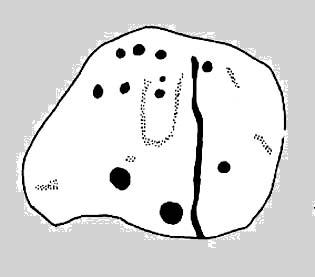
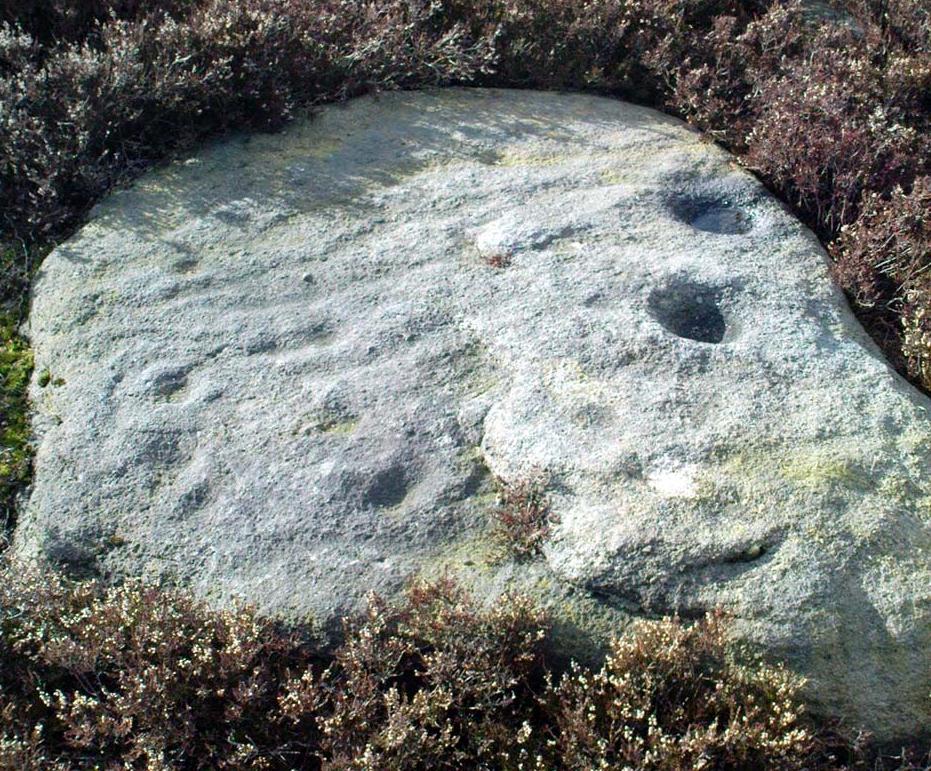
It’s not too far from the main footpath from Ilkley to the Twelve Apostles stone circle.  As its discoverer C.W. Dymond (1880) said, “It lies alone, on and near the foot of a steep slope, about a furlong, or less than five minutes’ walk, north from the ruins of a small stone-circle (Twelve Apostles) which crowns the crest of the pass leading south-south-east from Ilkley to Eldwick, and just one mile and three-quarters from the former place.  If approached therefrom, it will be easily found about two hundred yards to the east of the point where the road surmounts the steep, to enter upon the upper plain.”  Otherwise, walk through the Twelve Apostles from the main footpath and out the other side, following the land where it slopes down and, near the bottom, you’ll see this large stone sitting quietly on its own…

1880 image of Dymond's carving
Dymond’s 1880 sketch

Archaeology & History

Not too sure about the veracity of this one to be honest.  It was first described by archaeologist C.W. Dymond (1880) as “a stone marked with a striking group of cups” – but these are small and untypical of the usual markings.  “The stone is 9 ft. 6 ins. in length, 6 ft. 3 ins. in breadth, and about 2 ft. in thickness; its upper surface dipping a little, with the ground, toward the north. Upon it may be seen a group of small cups, for the most part about half an inch in diameter,” he said.

Dymond thought that the design on the rock may have represented parts of the night sky, saying, “here we may have a rude attempt to portray the starry heavens spanned by the galaxy ; and that the outlying groups may have been intended to represent two of the constellations perhaps Orion, and another not so easily identified.”  But I think we can take this with a pinch of salt.

Included in Hedge’s (1986) survey without comment, Boughey and Vickerman (2003) correctly thought that the “small peck marks which are not typical cup-marks” might be “doubtful”.

References:

  1. Boughey, Keith & Vickerman, E.A., Prehistoric Rock Art of the West Riding, West Yorks Archaeology Service 2003.
  2. Dymond, C.W., ‘Cup Marks on Burley Moor,’ in Journal of the British Archaeological Association, volume 36, 1880.
  3. Hedges, John, The Carved Rocks of Rombalds Moor, WYMCC: Wakefield 1986.

© Paul Bennett, The Northern Antiquarian
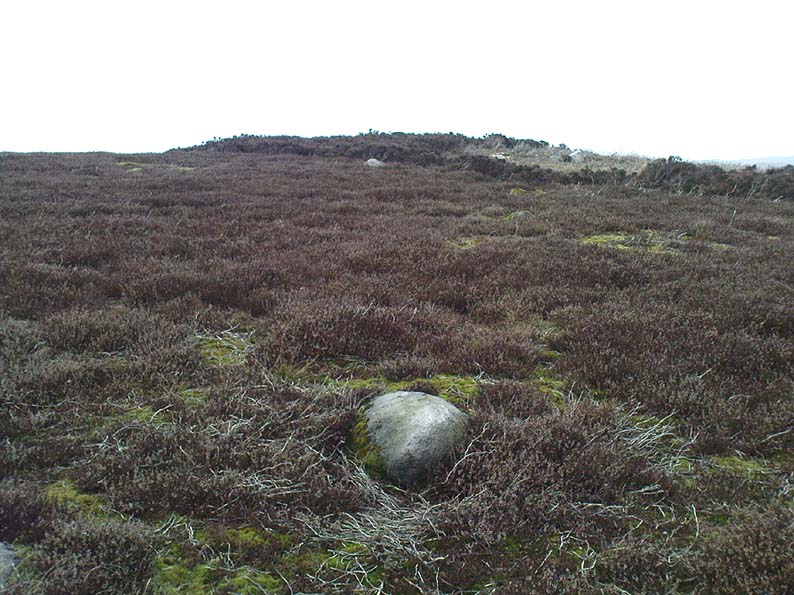

Doubler Stones, Ilkley Moor, West Yorkshire

Cup-and-Ring Stones:  OS Grid Reference – SE 0723 4652

Also Known as:

  1. Carving Nos. 41 & 42 (Boughey & Vickerman)
  2. Carving Nos. 6 & 7 (Hedges survey)
  3. Doublestones
  4. The Fire Stones

Getting Here

The great Doubler Stones (photo, James Elkington)

Various ways to get here, but the 2 most common are: (1) from Brunthwaite village, above Silsden, following the road uphill for a mile, then turning right (west) onto the moorland dirt-track to Doubler Stones Farm.  Just before here there’s a footpath uphill (north) for 200 yards to the stones.  (2) follow the Millenium Way footpath south up Addingham Moorside, onto Addingham High Moor.  Keep going on the same path another 500 yards and they’ll appear ahead of you.

Archaeology & History

First described as the ‘Doublestones’ in the local Addingham parish records of 1786, these great mushroom-shaped rocks were later brought to the attention of archaeologists by J. Romilly Allen in 1879 and they greatly intrigued numerous Victorian antiquarians, who puzzled as much about their exotic forms as the cup-marks on their tops!  Allen wrote of them:

Cowling’s old drawing
Hedges (1986) sketch of the design

“These rocks are by far the most remarkable freaks of Nature to be seen in the district. They occupy a prominent position, perched on the extremity of a rocky knoll which juts out into the valley; and as seen from below, with their weird forms standing out clear and sharp against the background of blue sky, they present so extraordinary an appearance that they would at once attract the attention of even the most unobservant.  In general outline they resemble gigantic toadstools; and I presume that they are called Doubler Stones from the fact of their shapes being almost identical.  They may be appropriately described as Nature’s Twins.  The upper surface of the cap of one of these stones has three large basin-shaped cavities in it.  Two of these lie along the central axis of the stone, and measure respectively 1ft 3in by 2ft 9in deep, and 1ft 9in by 1ft 3in by 9in deep.  They are united by a deep groove, a continuation of which runs out over the edge of the stone at each end.  There is another basin lying to the west side of the two central ones, with one of which it is connected by grooves.  It measures 2ft by 1ft 9in and is 9in deep.  There is no direct evidence that these basins are artificial; but it is quite possible that they may have been so originally, and have been enlarged by natural agencies.  But in addition to the basins, are twenty-six cup-markings of distinctly artificial origin.  They vary in diameter from 2 to 4 in.  One group of cups appears to be arranged in parallel rows.”

Doubler Stones, c.1890

Although the writer thought there were no artificial cup-markings on the other Doubler Stone (the one on the left in the photo), John Hedges (1986) and Boughey & Vickerman (2003) cite there to be at least two cup-markings on this rock.  Other writers have given different numbers for the respective cup-marks thought to be on these rocks down the years.

If you’re into prehistoric rock-art, check this place out.  If you’re a geologist and aint been here, you’ll be even more impressed!

Folklore

Approaching the Doublers (photo – James Elkington)

In Nicholas Size’s Haunted Moor (1934) he described the Doubler Stones as being the abode of ghosts and a place of sacrificial rites in ancient days. While in Guy Ragland Phillips’ Brigantia, we find that the word ‘doubler’ itself “is a large shallow dish, bowl or plate” – which we find on top of the greater one of these two well-worn-weirdoes.  As well as being haunted, there is some other little-known, though not unexpected folklore here, which told these old stones to be the meeting place of witches in previous centuries.

In addition to this, we are told that the witches of Fewston valley to the west used to meet up with the more famous Pendle witches at these stones.  One historian proclaimed that this notion was spurious, as it would be too far for the Pendle witches to walk – which says more about the historian in question than the people of previous centuries.  The distance from Pendle to the Doublers can be traversed in a day and is an ideal meeting spot, away from the prying eyes of a wrathful Church, that sought war against the animistic practices of our ancestors.

References:

  1. Allen, J. Romilly, ‘The Prehistoric Rock Sculptures of Ilkley,’ in Journal of the British Archaeological Association, volume 35, 1879.
  2. Allen, J. Romilly, ‘Notice of Sculptured Rocks near Ilkley,’ ibid, volume 38, 1882.
  3. Bennett, Paul, The Old Stones of Elmet, Capall Bann: Chieveley 2001.
  4. Boughey & Vickerman, Prehistoric Rock Art of the West Riding, West Yorkshire Archaeology Service 2003.
  5. Cowling, Eric T., Rombald’s Way, William Walker: Otley 1946.
  6. Hedges, John, The Carved Rocks on Rombalds Moor, WYMCC: Wakefield 1986.
  7. Jennings, Hargrave, Archaic Rock Inscriptions, A. Reader: London 1891.
  8. Phillips, Guy Ragland, Brigantia: A Mysteriography, RKP: London 1976.
  9. Size, Nicholas, The Haunted Moor, William Walker: Otley 1934.

Acknowledgements:  Massive thanks to landscape photographer, James Elkington, for use of his images in this site profile.  Thanks mate! 

© Paul Bennett, The Northern Antiquarian


Tadpole Stone, Eastwoods Rough, Dacre, North Yorkshire

Cup-and-Ring Stone:  OS Grid Reference – SE 18601 61644

Also known as:

  1. Eastwoods Rough II Carving
  2. IAG638b (Boughey)

Getting Here

Tadpole Stone, Dacre

To get here, follow the same directions as if you’re going to the Morphing Stone.  This carving is in the same field, but about 100 yards SSW of there, just to the south-side of the Nidderdale Way footpath.  There’s plenty of rocks about, but with a bit of patience or a natural rock-art dowser’s nose, you’ll find the carving easily enough!

Archaeology & History

Tadpole Stone plan
Tadpole Stone plan (© Richard Stroud)

This is another relatively recent find — though I wonder whether the nearby ‘Fertility Stone’ (about 500 yards north, in some walling) should switch names with this carving, as this one gives the distinct impression of sperm fertilizing the egg!  Don’t you agree!?  The name of the Tadpole Stone was given to it by Michala Potts — and the photograph and design are used, courtesy of Richard Stroud.  In the next field from here, towards Eastwoods Farm, we find the Eastwoods Cross base and cup-markings and adjacent cup-marked stone.  Not far away are other carvings, aswell as a number of other Bronze- and Iron-Age sites.

This design was described in Keith Boughey’s (2007) article on the rock art around Eastwoods Farm, telling how it

“was discovered by Kevin Cale and reported to the N.Y.C.C. SMR back in 2001… A low profile moss-covered earthfast rock a little over 1m in diameter in any one direction immediately S of the Nidderdale Way about 100m east of the end of Monk Ing Road and S of Eastwoods Farm at SE 18601 61643 and 172m O.D. Its domed surface carries a somewhat unusual design interestingly reminiscent of the design carved at the previous site which lies in the same field and landscape 160m to the north-west… An oval or egg-shaped groove enclosed up to six cups; a groove or channel, often referred to as a ‘comet tail’ in rock art motif vocabulary, runs from the central group of the six out beyond the enclosing groove, bends sharply and continues down over the sloping face of the rock.  A wide groove at the base of the rock running into the present turf line may be a further element of the carving.”

References:

  1. Boughey, K., “Prehistoric Rock Art: Four New Discoveries in Nidderdale,” in Prehistoric Research Section Bulletin, no.44, Yorkshire Archaeological Society 2007.

© Paul Bennett, The Northern Antiquarian


Holy Well, Todmorden, West Yorkshire

Holy Well:  OS Grid Reference – SD 9344 2441

Getting Here

Now I aint been here for a few years, but it’s hopefully still where I last left it!  You need to get into the trees behind the Christ’s Church just out of the town centre, along the south-side of the Burnley valley road. (A646)  When you get to the footpath which runs just above the tree-line in the woods (it’s known locally as the ‘Lover’s Walk’ path), wander along for just a couple of hundred yards.  You’ll eventually get to the small spring of water and the tiny stream which runs down the slope, just to the left of the path. According to the old map I’ve got – that’s it!

Archaeology & History

This long-lost sacred well originally emerged a little bit further up the hill from where it is today.  Almost nothing is known about it.  Seemingly first highlighted in 1852, my first “discovery” of the place came as a result of going through some local old maps I’d had the fortune of obtaining.  In Victorian days when the site was much more prominent, the old road that took you into the woods was called Holy Well Lane.  Now, its memory has been subdued, and the old road is known simply as ‘Well Lane.’

A local writer, J.W. Crowther, mentioned the site in his local place-name survey, where he told that the Holy Well was a “name given to a well of excellent spring water” — but nothing more.  It was later mentioned in an article by J.A. Heginbottom [1988] who wrongly reported it as being “destroyed.”

Folklore

Local tradition told that ‘memaws’ (offerings such as rags, coins, flowers, etc) used to be left here by local people in olden times, as offerings to pacify or give respect to the waters; although what time of the year these were left, and the nature of the resident deity, has all been forgotten.  In very recent years however, it seems that some modern NewAge-types are now visiting the place once again.

References:

  1. Crowther, J.W., Place Names of Todmorden, privately printed: Todmorden (n.d.)
  2. Heginbottom, J.A., ‘Early Christian Sites in Calderdale’, in PHAS 1988.

© Paul Bennett, The Northern Antiquarian


Idol Stone, Ilkley Moor, West Yorkshire

Cup-and-Ring Stone:  OS Grid Reference – SE 13265 45943

Also Known as:

  1. Carving no.322 (Boughey & Vickerman)
  2. Carving no.157 (Hedges)

Getting Here

Idol Stone carving (Allen 1882)

Take the directions to reach the Haystack Rock, then head onto the moor following the southeast footpath for a few hundred yards, towards where the moor slopes uphill.  20-30 yards before the uphill slope, a yard to the right of the path.  It accompanies the Young Idol Stone with its two small cups, just a few yards away.  Keep your eyes peeled and y’ can’t really miss it! If you hit the large slightly-pyramidal-shaped boulder with its well-worn lines running from its top (the Idol Rock), you’ve gone past it.

Archaeology & History

An intriguing carving this, and one which has always had me edging towards a manifest linear or logical myth underscoring its form.  It’s the almost binary or primal numeric system in the lay-out of the cups which seems to do it.  Few other carvings in the region exhibit this tendency.*  If you aint seen it ‘in the flesh,’ check it out.

First described by that old Victorian J. Romilly Allen (1882), he seemed equally impressed by it, calling it “the most beautiful specimen of prehistoric sculpture,” continuing:

“The stone is of grit, and measure 3ft 2ins, by 2ft 6ins.  Its upper surface is nearly horizontal, and has carved upon it cups varying in diameter from 2ins to 3ins.  A row of cups in the middle of the stone are entirely surrounded by a groove.  There is also a channel running round the outside.  Single cups are often found encircled by one or more concentric rings; but it is very exceptional indeed to find several cups surrounded by a single groove, or to find the cups so symmetrically arranged as in the present instance.”

Idol Stone - looking SW
Idol Stone – looking SW

Prehistoric walling runs very close to this and the adjacent rock carvings, with the well-known ‘enclosure’ just a short distance to the east on the same moorland plain.  This carving is very much on the edge of, or within, Green Crag Plain’s ‘Land of the Dead.’

This carving was one of several that Alan Davis (1983) measured in his exploratory survey on the validity of Alexander Thom’s ‘megalithic inch’ unit.  This issue absolutely fascinated me as a boy, as it brought the attention of these curious non-linear images into the domain of mathematics and the higher sciences, instead of the lowly social sciences within whose domain archaeology is embedded, with its many inaccuracies and falsehoods.  A number of astronomers and other academics did a great number of papers exploring potential units-of-length, surveying the carvings (and megalithic rings) in much greater detail than any previous archaeologist.  Much of it was excellent work.  However, the mythos of our ancient ancestors possessing great technical knowledge and mathematical ability was unfounded.  In Davis’ (1983) paper — edited and expanded a few years later (1988) — he found no evidence of mathematical units of measurement here; though left the option ‘open’ for further discussion and analysis on several others, where multiple units of megalithic inches were measured.  These findings however, are more likely the result of mere chance.

Idol Stone with “21st century informal unauthorised” art added

In 2011 some unnamed people visited the Idol Stone carving and vandalized it (this sadly happens more and more up here); but this form of vandalism is now being termed “twenty-first century informal unauthorised carvings” and is actually sanctioned by Ilkley Parish Council members, local businessman Tom Lonsdale and his affiliates as artistic “tradition”!  Indeed, the damage done here and vandalism done on some other ancient carved stones that have been redesignated by Tom Lonsdale and friends as “twenty-first century informal unauthorised carvings”, legitimizes and encourages others to follow in their shallow-minded ignorance, enabling others to add their own form of ‘art’ on these supposedly protected monuments, on a region with an alleged SSSI status. They even encourage supposedly ‘nice’ people — y’ know the sort — to etch poems and such things onto the stones on the moors, in violation of regulations that apply to the general public.  As a result, expect more vandalism — sorry…arty “twenty-first century informal unauthorised carvings” both here and elsewhere.  This same appalling debacle — sorry, “tradition” — has been encouraged on the Haystack Rock, Hanging Stones and other prehistoric carvings on the moor.

Folklore

The name ‘Idol Stone’ was an invention of one of the Victorian romanticists, who saw heathen idolatry and perversion all over these moors (you’ve gotta ask y’self, what the hell were these people up to!?).  Our old friend Nicholas Size (1934) told there to have been ghostly figures and druidic activities occurring at this site.

References:

  1. Allen, J. Romilly, ‘Notice of Sculptured Rocks near Ilkley, with some Remarks on Rocking Stones,’ in Journal of the British Archaeological Association, volume 38, 1882.
  2. Boughey, Keith & Vickerman, E.A., Prehistoric Rock Art of the West Riding, West Yorkshire Archaeology Service 2003.
  3. Cowling, Eric T., Rombald’s Way, William Walker: Otley 1946.
  4. Davis, Alan, ‘The Metrology of Cup and Ring Carvings near Ilkley in Yorkshire,’ in Science and Archaeology, 25, 1983.
  5. Hedges, John, The Carved Rocks on Rombalds Moor, WYMCC: Wakefield 1986.
  6. Hotham, John Paul, Halos and Horizons, Hotham Publishing: Leeds 2021.
  7. Jennings, Hargrave, Archaic Rock Inscriptions, A. Reader: London 1891.
  8. Size, Nicholas, The Haunted Moor, William Walker: Otley 1934.
  9. Speight, Harry, Upper Wharfedale, Elliott Stock: London 1900.

© Paul Bennett, The Northern Antiquarian 

Pancake Stone, Ilkley Moor, West Yorkshire

Cup-and-Ring Stone:  OS Grid Reference – SE 13404 46228

Also Known as:

  1. Carving no.167 (Hedges)
  2. Carving no.332 (Boughey & Vickerman)
  3. Pancake Rock

Getting Here

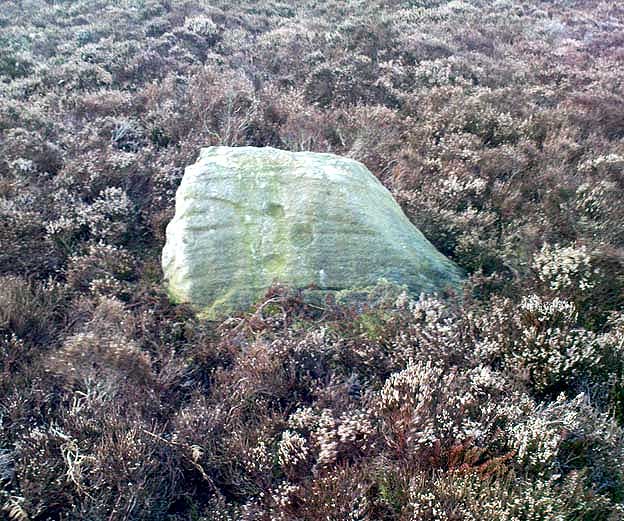
Pancake Stone, Ilkley Moor

We were up here again the other week: wind, hail and snow blowing like hell, thankfully keeping the place to ourselves! To get here, head up Cow Pasture Road from the train station and up to the Cow & Calf Hotel near the famous rocks.  Go past it a 100 yards or so and then look uphill onto the moors ahead of you.  You’ll see a great over-hanging rock on the slope above you which looks as though its may fall down at any moment. That’s the Pancake Stone!  Either walk up the steep path to get there quickly, or the longer route by taking the sloping diagonal path that runs eastwards until you’re on the same level.

Archaeology & History

Site shown  on 1851 map

Highlighted on the first Ordnance Survey map of the region in 1851, this prehistoric carved stone had been known as the Pancake Stone by local people long before any antiquarians gave it their literary attention to the place.  It would have had tales told of it, no doubt, but they were never written down.  It’s an impressive, some would say precarious piece of rock: an elongated thin wedge of stone resting gently on the cliff edge, much like a rocking stone to be honest, seemingly hanging onto the edge of the geological ridge awaiting its fall down the slope; but that’s not gonna happen for many more centuries yet.

J. Thornton Dale’s 1879 drawing

Much has been written about the petroglyph on the this wedge of stone, which covers much of its surface.  Although a Mr J. Thornton Dale did a fine series of quite accurate drawings of this stone (and others on the moors) between 1878 and 1880, the first literary description of the Pancake rock carving appears to have been by the renowned J. Romilly Allen in 1882 (who evidently visited the stone on a cloudy or overcast day), saying that:

“On its upper surface are several cup-markings much obliterated by the actions of the weather, but some of them sufficiently distinct to prove their origin artificial, and to show that this rock was noticed in ancient times, and very possibly considered an object either of worship or superstition.”

Close-up of cups & rings
Close-up of CnRs
Looking across the stone

This latter assumption is highly probable.  Strong animistic notions (moreso than usual) would be very evident here.  Its position on the land with its outward focus from here towards other notable points in the landscape (Almscliffe Crags is one obvious focus); as well as looking at the rock itself from other viewpoints, give the stone considerable ritual importance.  Sections of the moorland plain behind it—known as Green Crag—was the Land of the Dead in ancient times, and it is more than likely that death rites would have been enacted here — though we may never know what form they took.

Dale’s 1879 sketch

The stone has what seems to be at least 54 cup-markings on its upper face, with numerous grooves meandering and connecting other points.  In J. Thornton Dale’s 1879 drawing of the upper surface, you will note that a couple of the rings he included have all-but faded away and are not included in the more recent surveys.  Of the primary design, rock art students Boughey & Vickerman (2003) described there being “six complete and five partial rings” amidst the morass, but much of the design is very worn and, originally, there was probably a bit more to it all.  The rock upon which the main Pancake Stone rests also has some worn cup-marks etched on its surface, a couple of which can be made out in the top photo.

Folklore

Good old Nicholas Size (1934) added this site to his list as a place where he had visions of the old christian cult, upon whose bare face were enacted blood rites and sacrifice.  One Beltane Eve when he decided to amble up onto the moor edge, he could see a strange glow coming from behind the rock.  He continues:

“Then suddenly I noticed there was a figure dancing upon it.  The figure seemed to swirl round and round with floating draperies, grey or white, and I can only say that it looked very uncanny.  Stupidly, I wondered that anybody could be such a fool as to dance in the darkness upon that precarious footing…”

But such activities on these moors, at certain times of the year, have been enacted for many centuries.  It’s just kept quiet and, as more modern pagans (as they like to call ’emselves) keep coming up here and to other places, so the original folk move to their older and increasingly more secluded spots…  In the latter half of the 20th century the site was used as a focus by chaos magickians, shortly after the inception of that Current.

References:

  1. Allen, J. Romilly, ‘The Prehistoric Rock Sculptures of Ilkley,’ in Journal of the British Archaeological Association, volume 35, 1879.
  2. Allen, J. Romilly, ‘Notice of Sculptured Rocks near Ilkley, with some Remarks on Rocking Stones,’ in Journal of the British Archaeological Association, volume 38, 1882.
  3. Boughey, Keith & Vickerman, E.A., Prehistoric Rock Art of the West Riding, West Yorkshire Archaeology Service 2003.
  4. Cowling, Eric T., Rombald’s Way, William Walker: Otley 1946.
  5. Hedges, John, The Carved Rocks on Rombalds Moor, WYMCC: Wakefield 1986.
  6. Jennings, Hargrave, Archaic Rock Inscriptions, A. Reader: London 1891.
  7. Size, Nicholas, The Haunted Moor, William Walker: Otley 1934.
  8. Speight, Harry, Upper Wharfedale, Elliott Stock: London 1900.

© Paul Bennett, The Northern Antiquarian