Craig Hill cluster (6), Kenmore, Perthshire

Cup-and-Ring Stone:  OS Grid Reference – NN 81307 44422

Getting Here

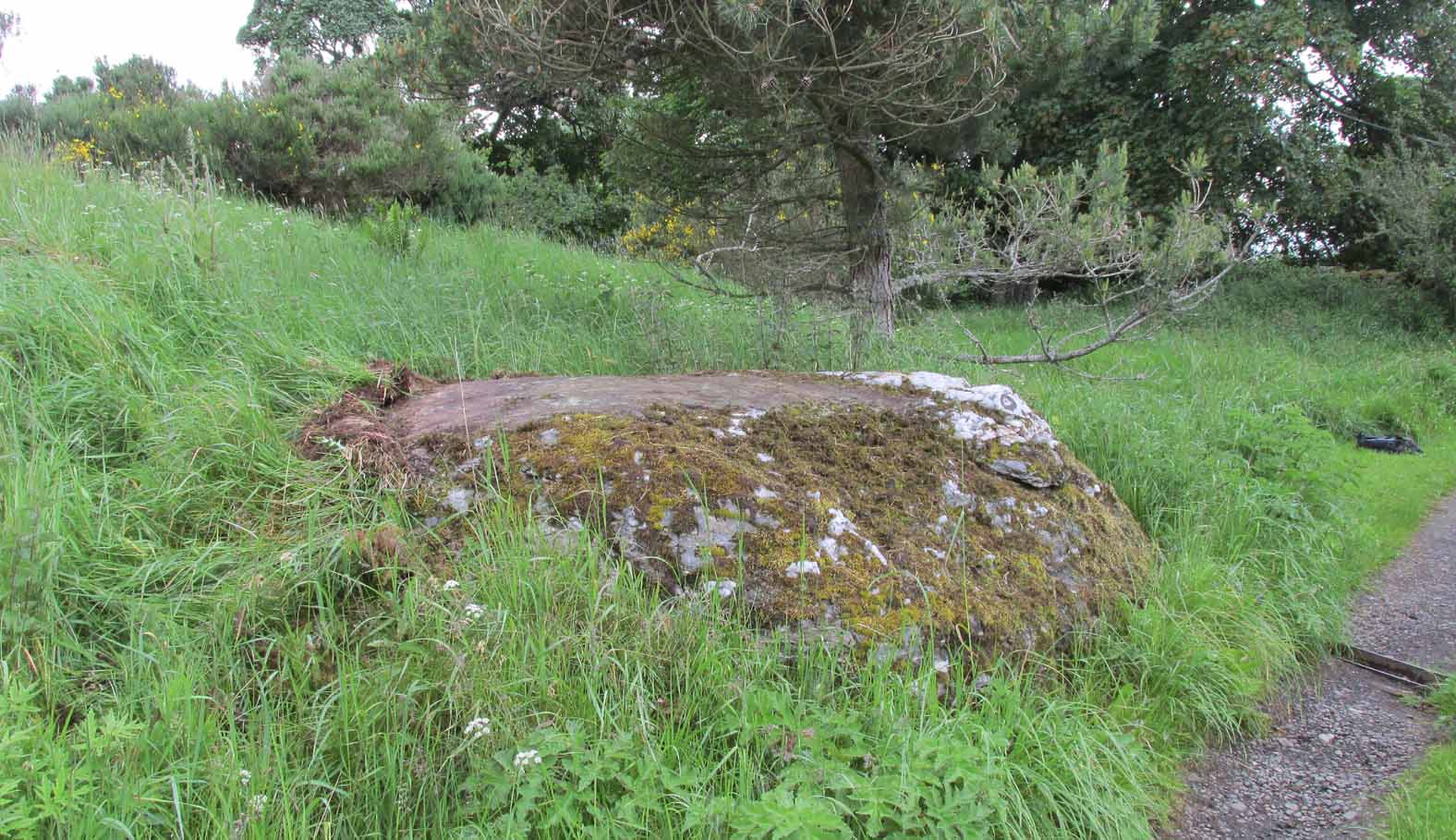
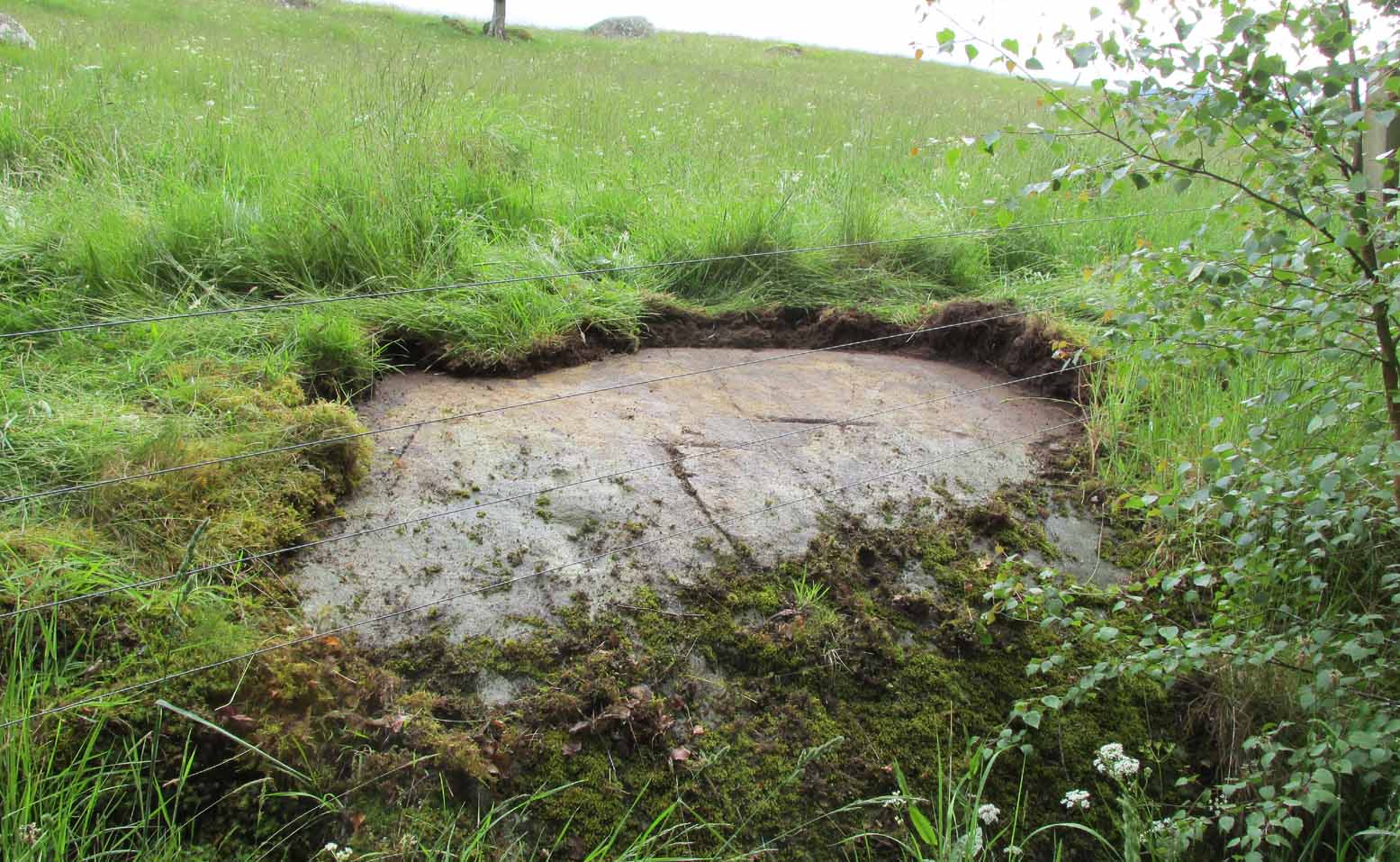
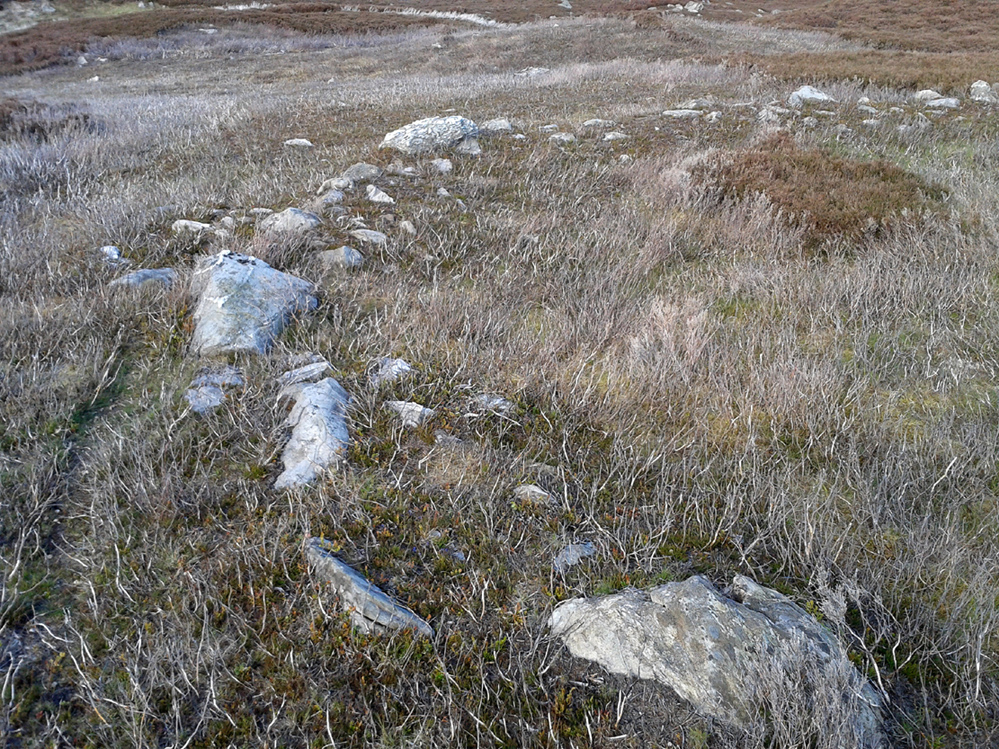
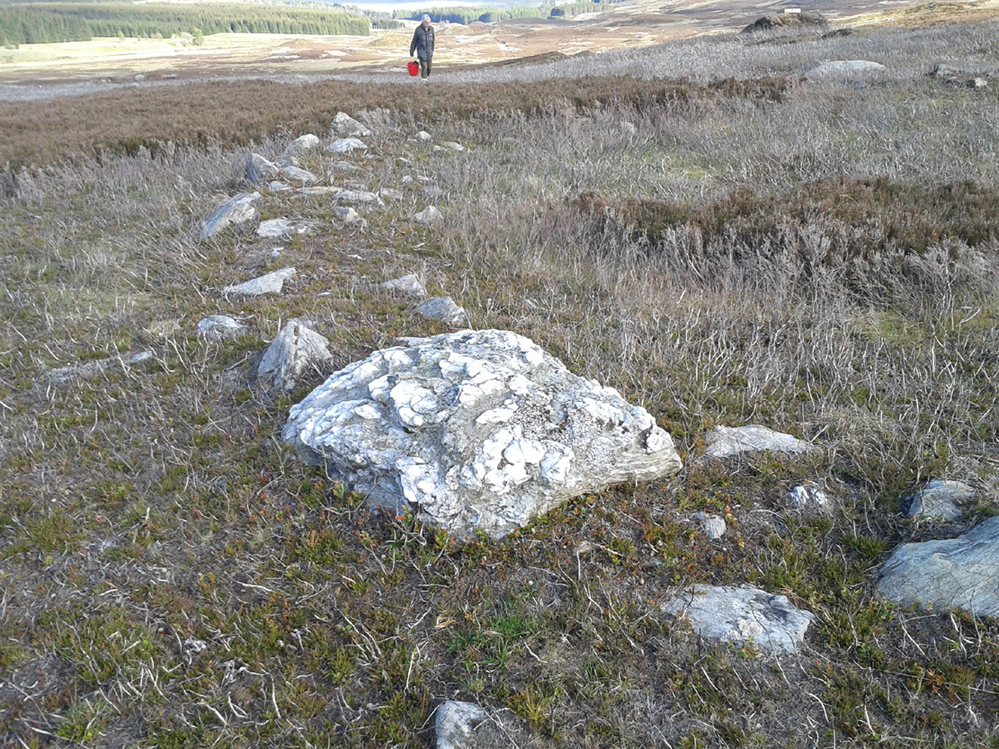
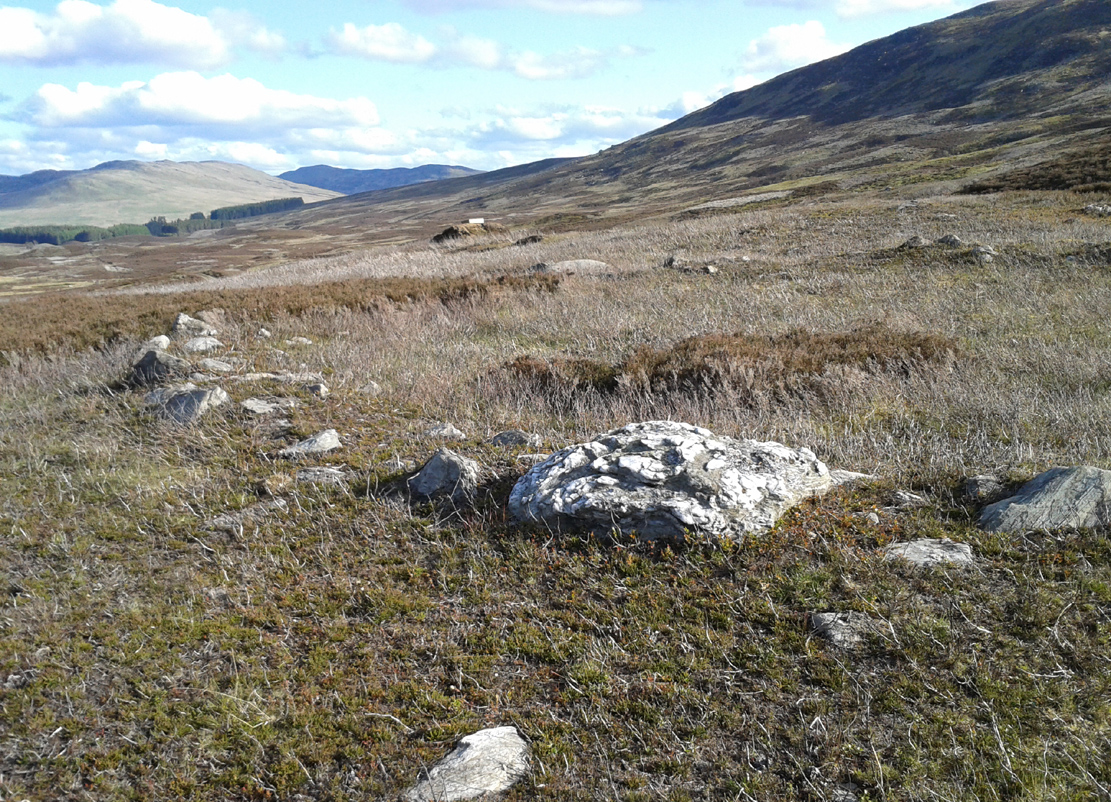
Craig Hill cluster (6) stone

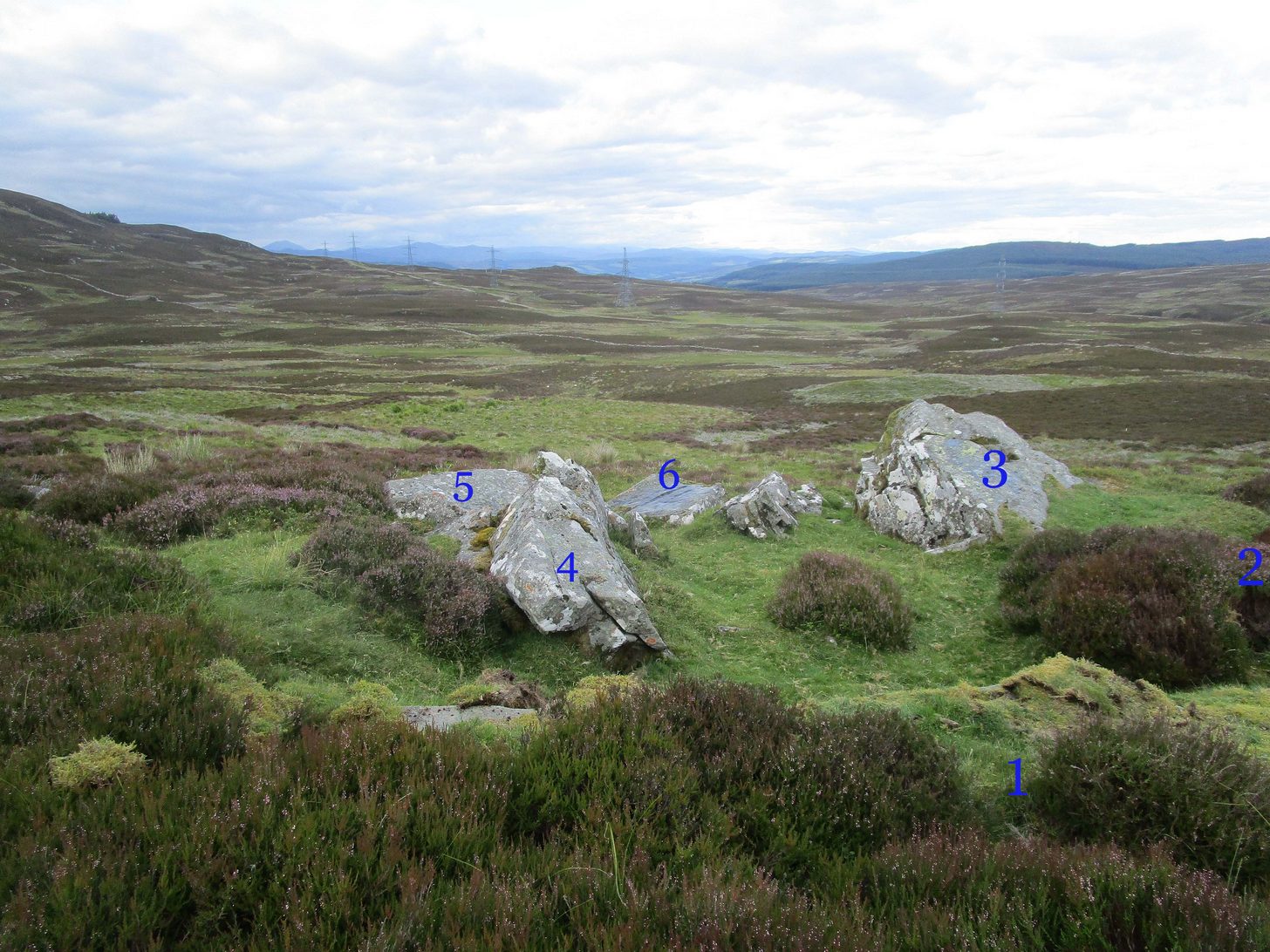
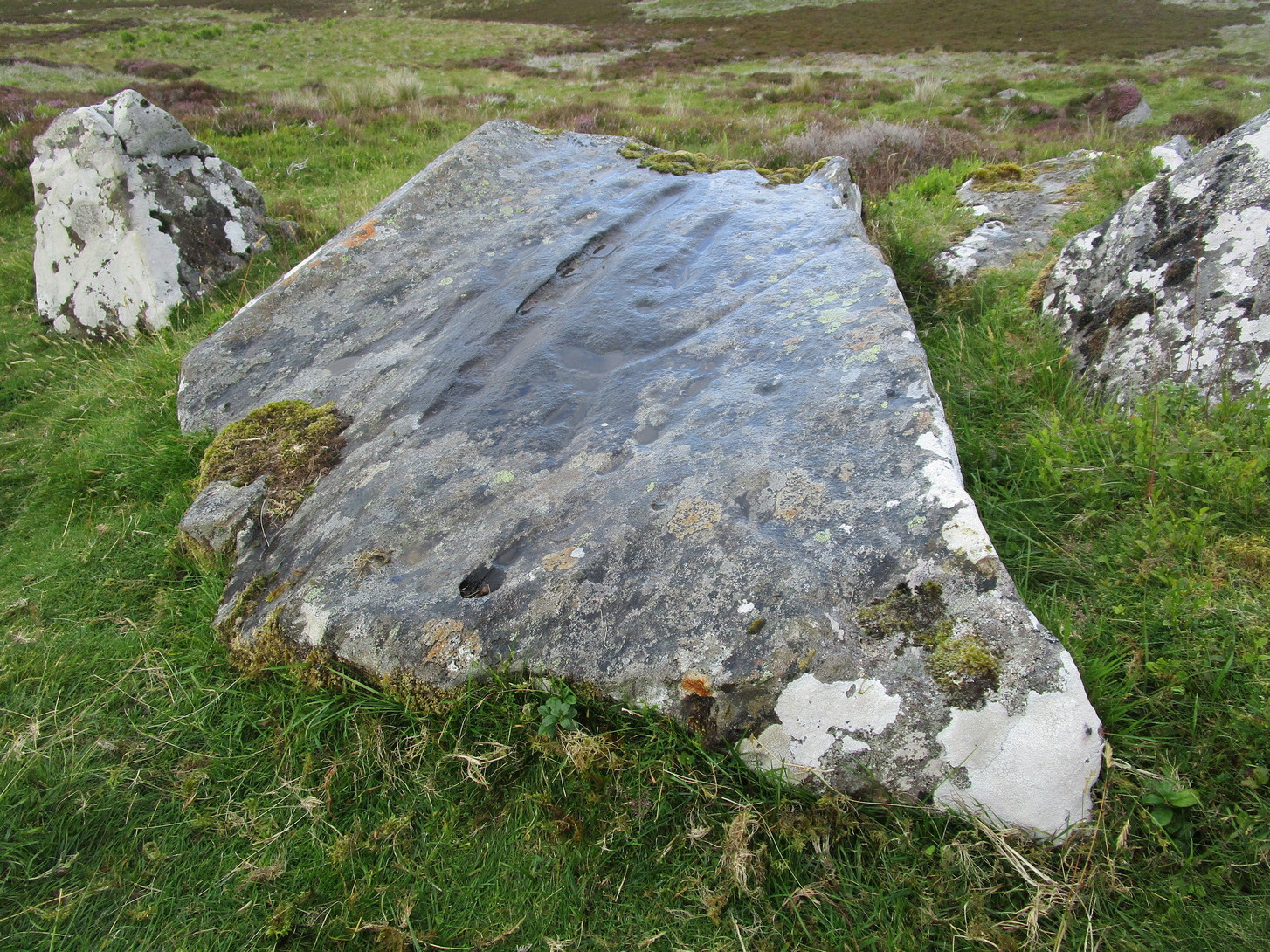
Follow the same directions to reach either the Craig Hill cluster (3), no.4 or no.5 carvings.  Once here, looking at the sloping moorland ahead of you, the elongated stone that’s closest to where the moorland slopes downhill is the one you’re after.  Y’ can’t really miss it!

Archaeology & History

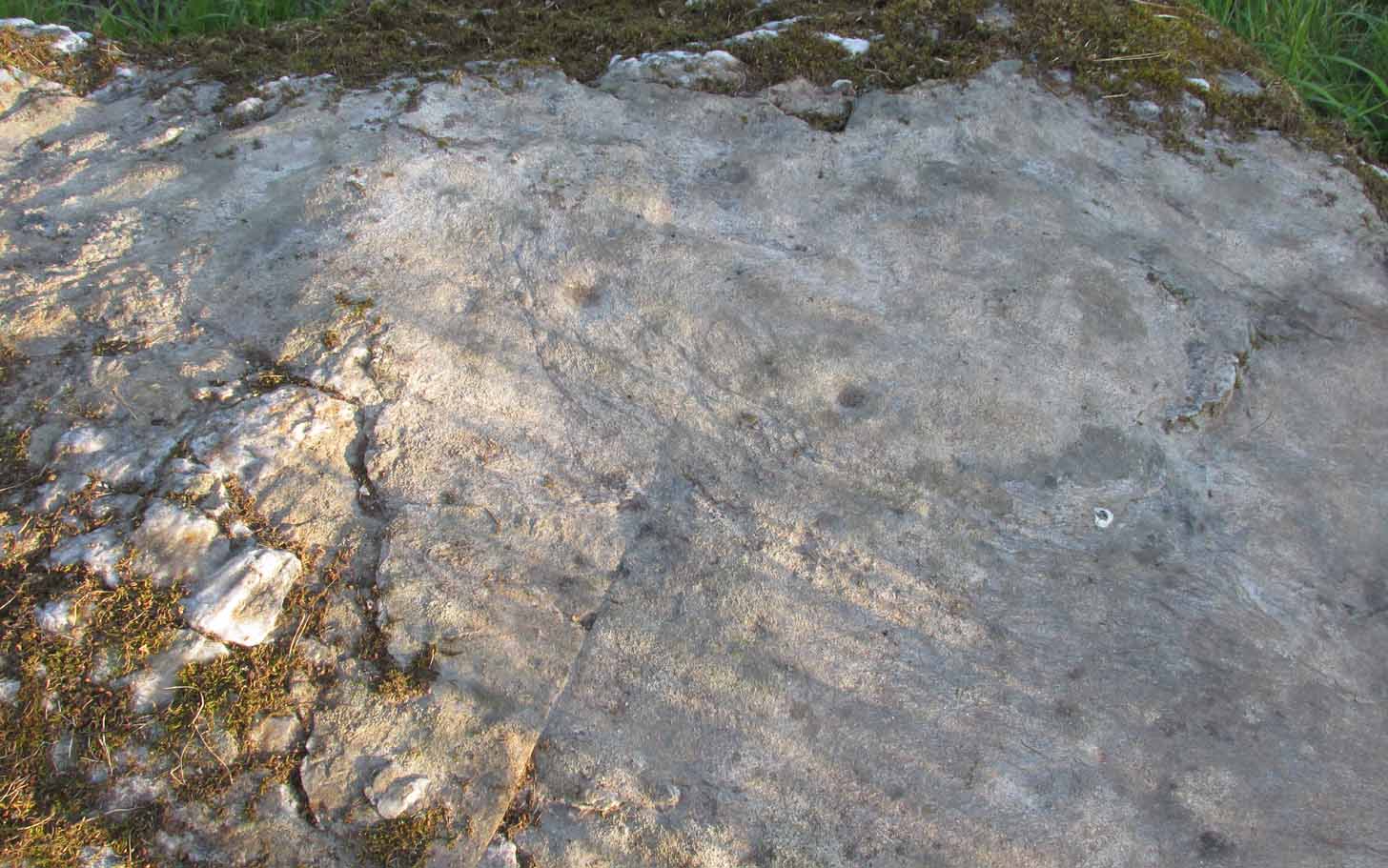
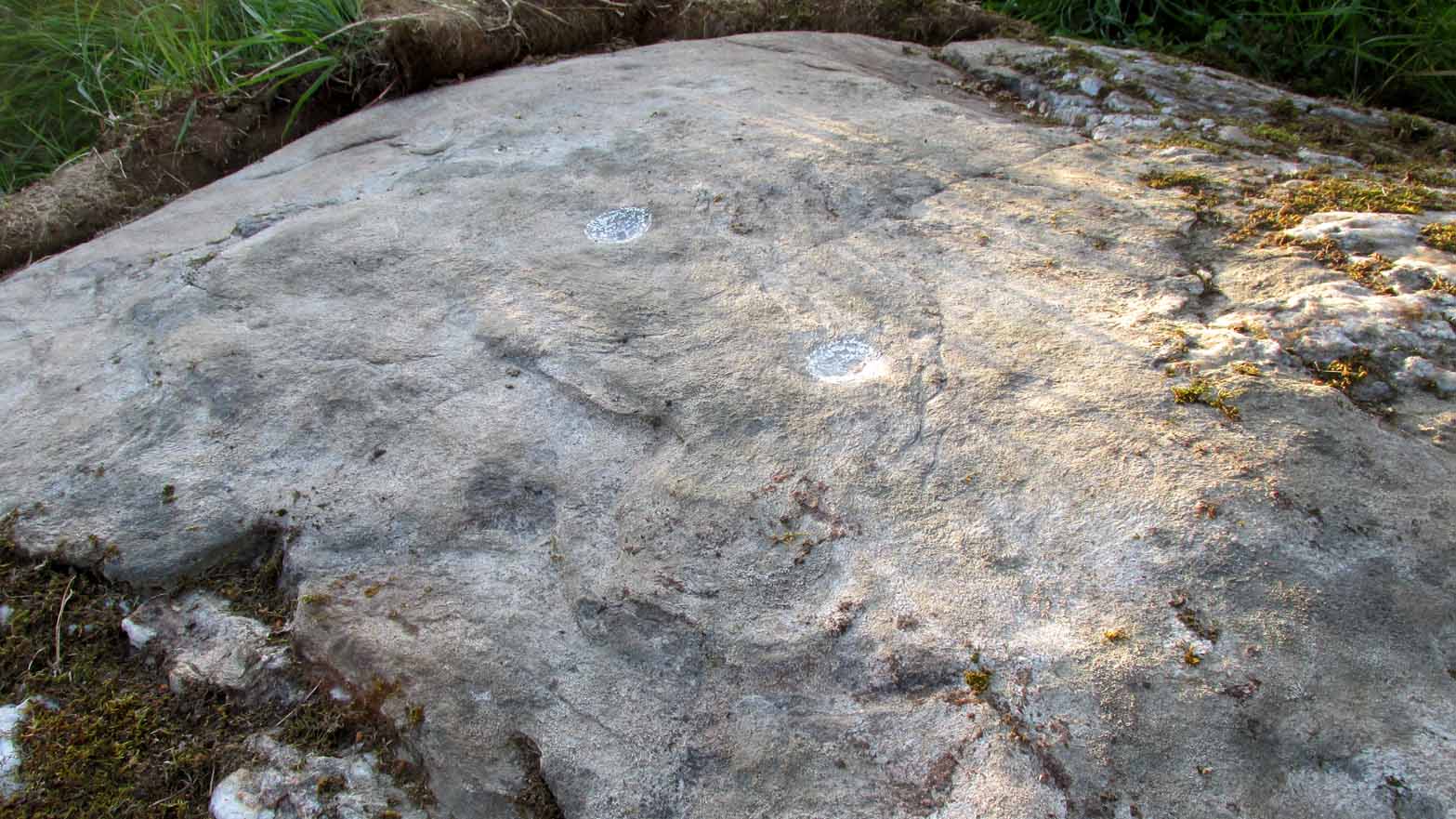
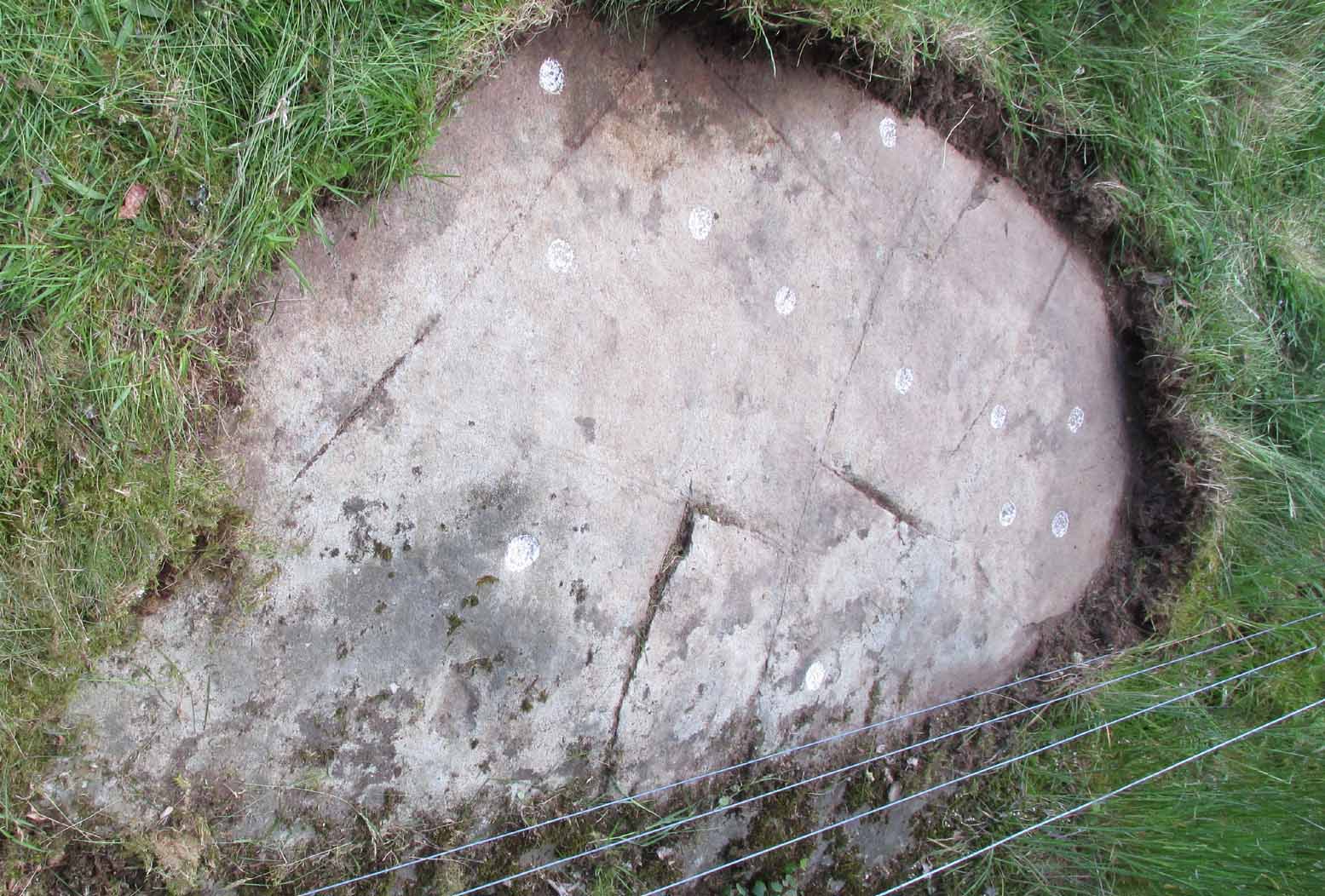
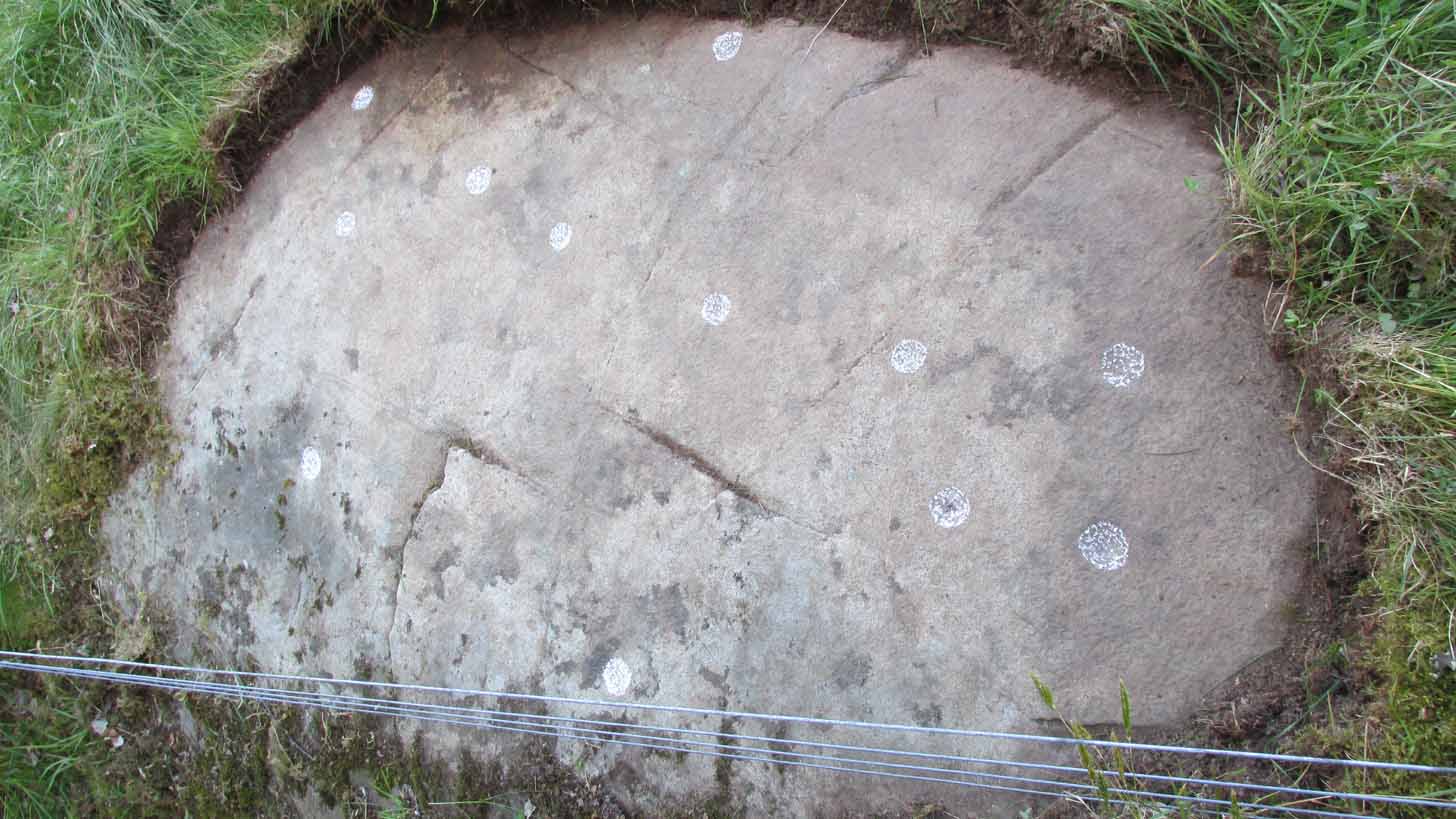
The sixth carving in this small close-knit cluster and, design-wise, the least impressive of the bunch.  There are three distinct cup-marks on the rock: two on its more southern side and one near the middle of the stone.  There may be another two cups, but these may have been part of the curious long, naturally-eroded line running along the length of the stone.  Other man-made elements may have been cut into the stone, but it needs to be seen in perfect low light to tell us one way or the other.

References:

  1. Currie, George, “Craig Hill (Dull parish): Cup-and-Ring Marked Rocks,”in Discovery & Excavation Scotland, NS Volume 6, 2005.

© Paul BennettThe Northern Antiquarian
Craig Hill cluster (4), Kenmore, Perthshire

Cup-and-Ring Stone:  OS Grid Reference – NN 81303 44419

Getting Here

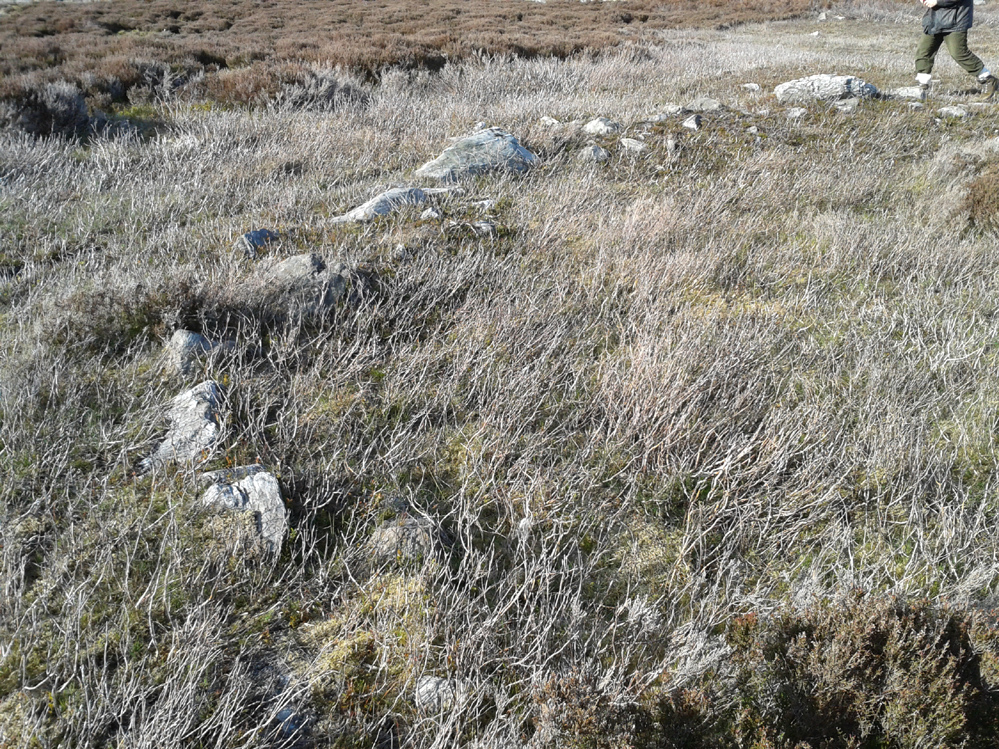
Craig Hill cluster (4) stone

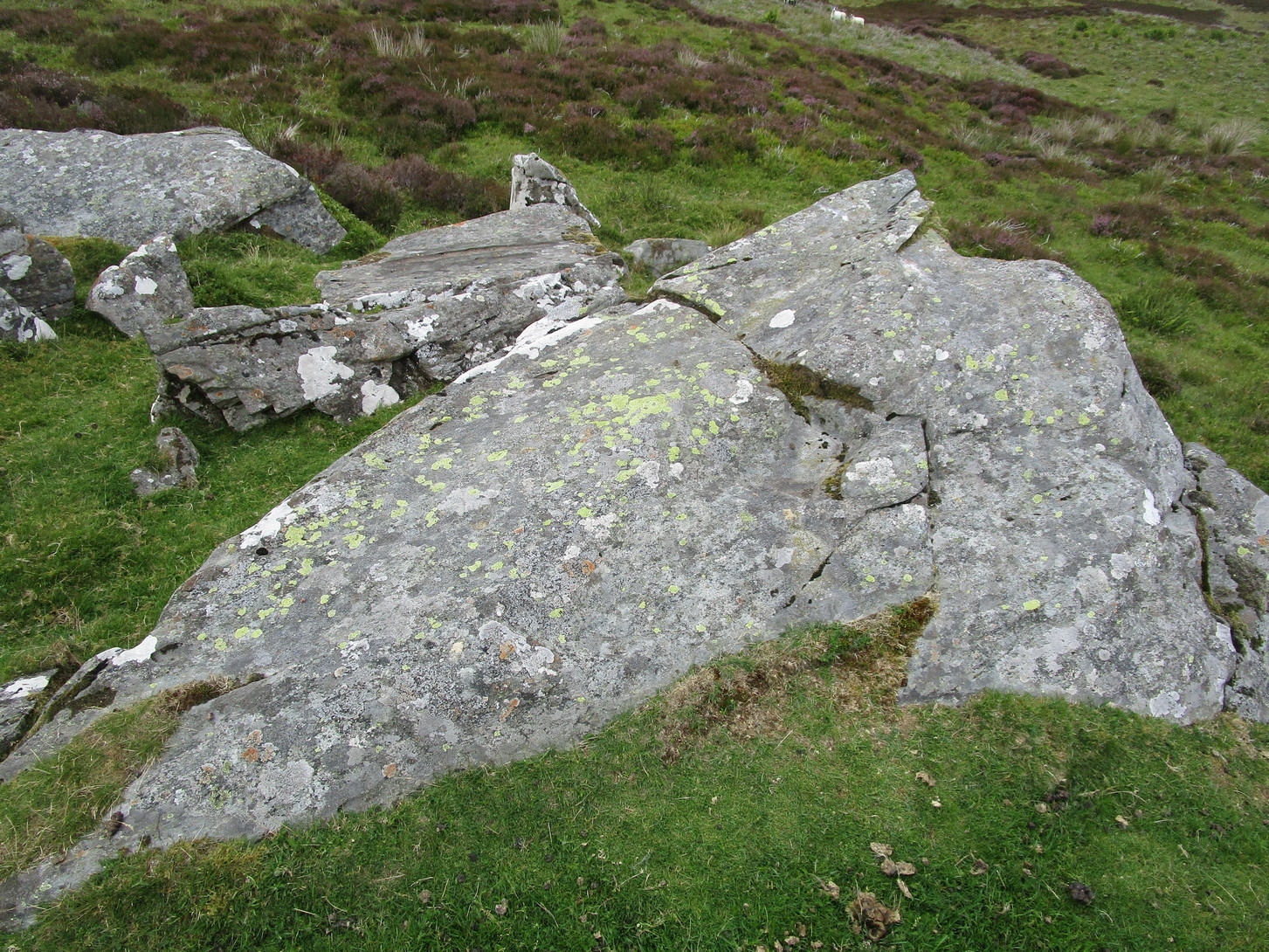
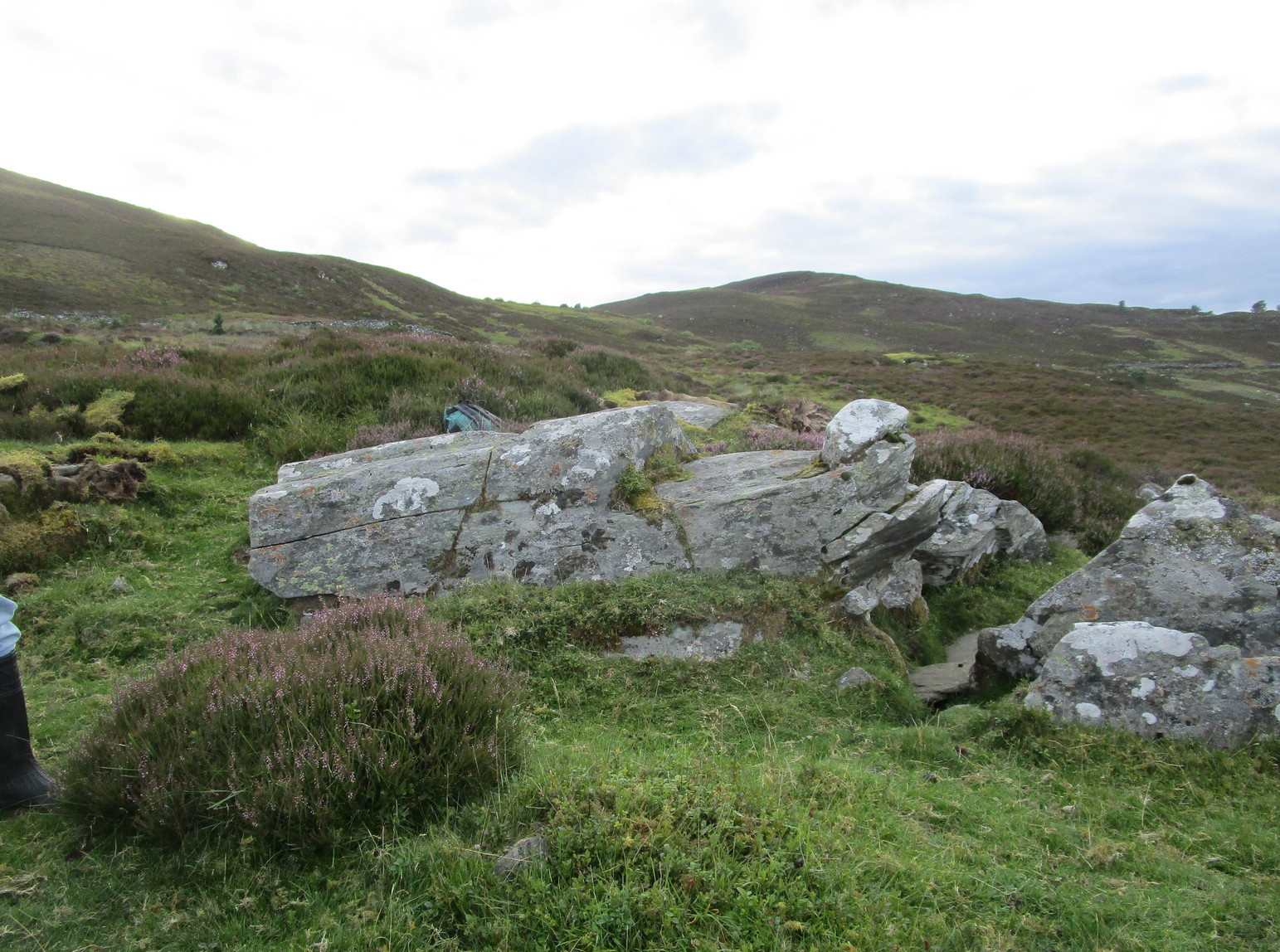
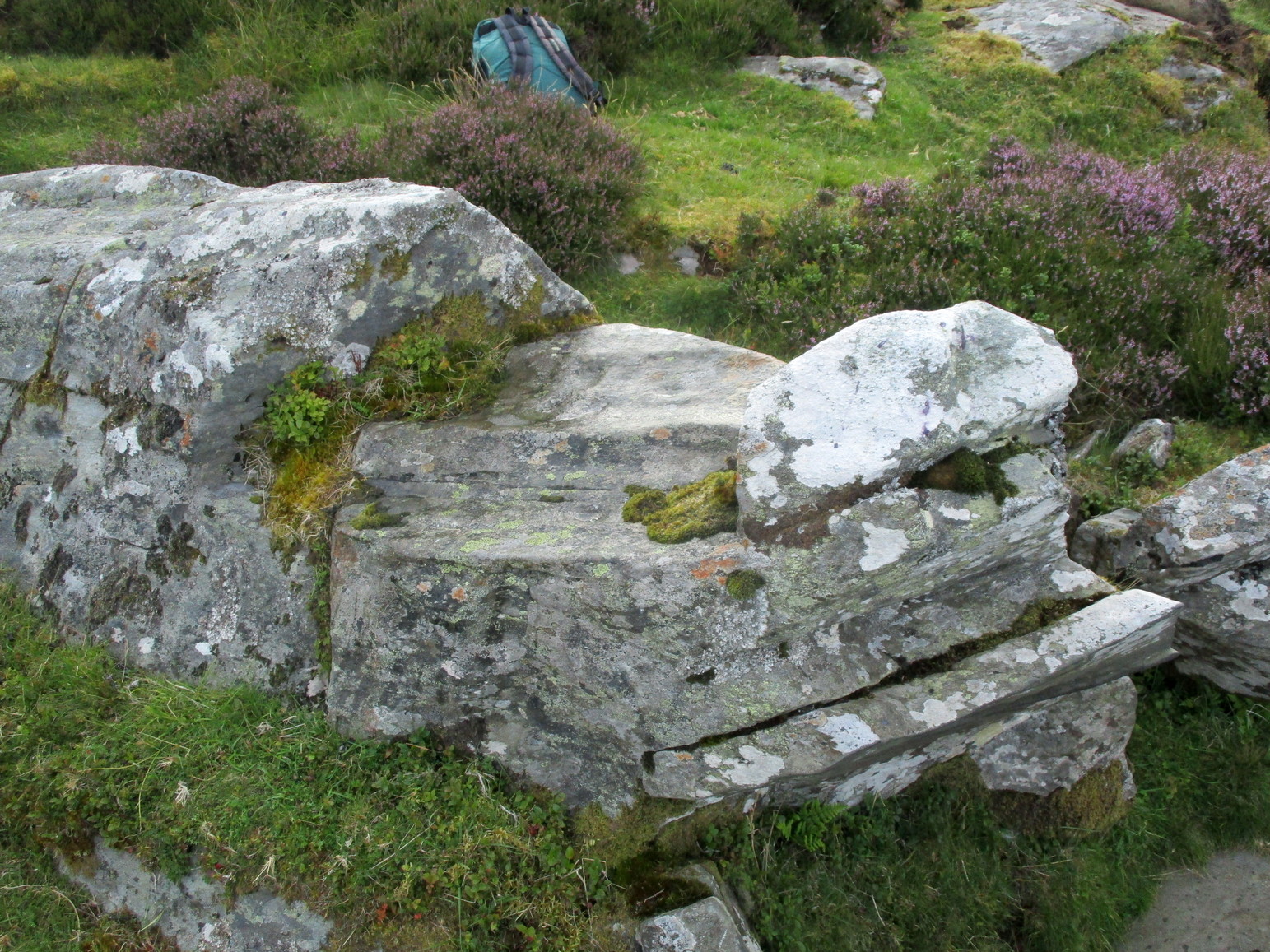
From Kenmore go east up the steep mountain road towards Glen Quaich, or if you’re coming from Amulree, go west along the same glen.  After 2½ miles (4km) up the Kenmore route (nearly 9 miles on the Amulree route) you’ll reach a small lochan on your left (you’ve got a very small parking spot a coupla hundred yards before the loch).  A gate and stile past the loch takes you east along a track into the moors.  More than a mile on, the track splits, but you need to keep to the left and follow the track along the wall-side for another 400 yards or so, where you’ll see a small crag of rocks 100 yards down the slope on your right. Once here, the elongated rock with a “seat” that you can sit in is the stone in question.

Archaeology & History

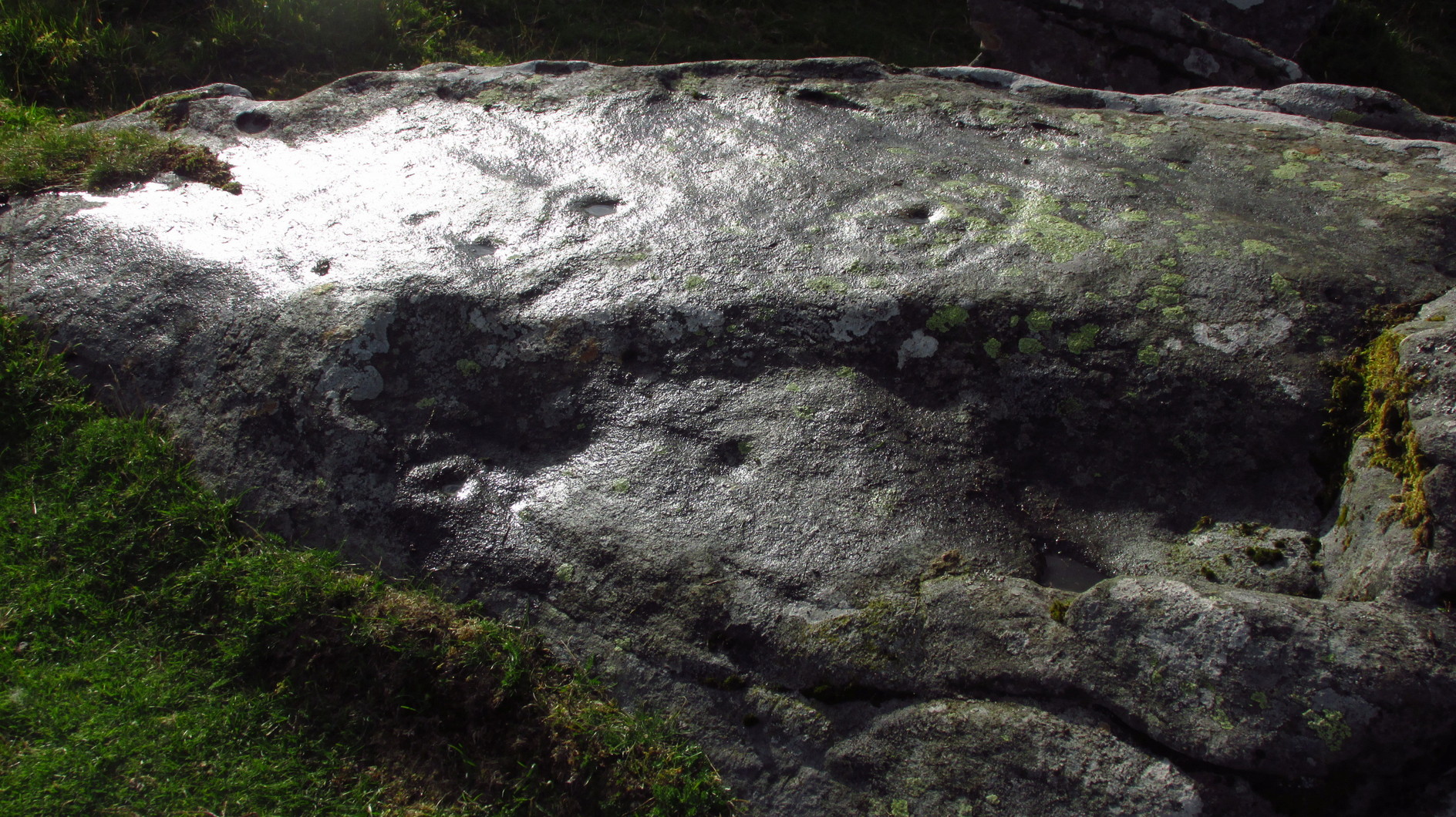
At first sight this stone doesn’t seem to have anything petroglyphic about it, and—as when we visited the other carvings in this Craig Hill cluster—the weather was grey and overcast, so it was difficult to discern anything at first.  But as we walked round and round inspecting the Craig Hill cluster-5 carving, a glance at this adjacent stone seemed to indicate one or two cup-marks within the curious chair-like aspect of the rock, but we couldn’t initially work out whether they were simple geophysical elements or not.

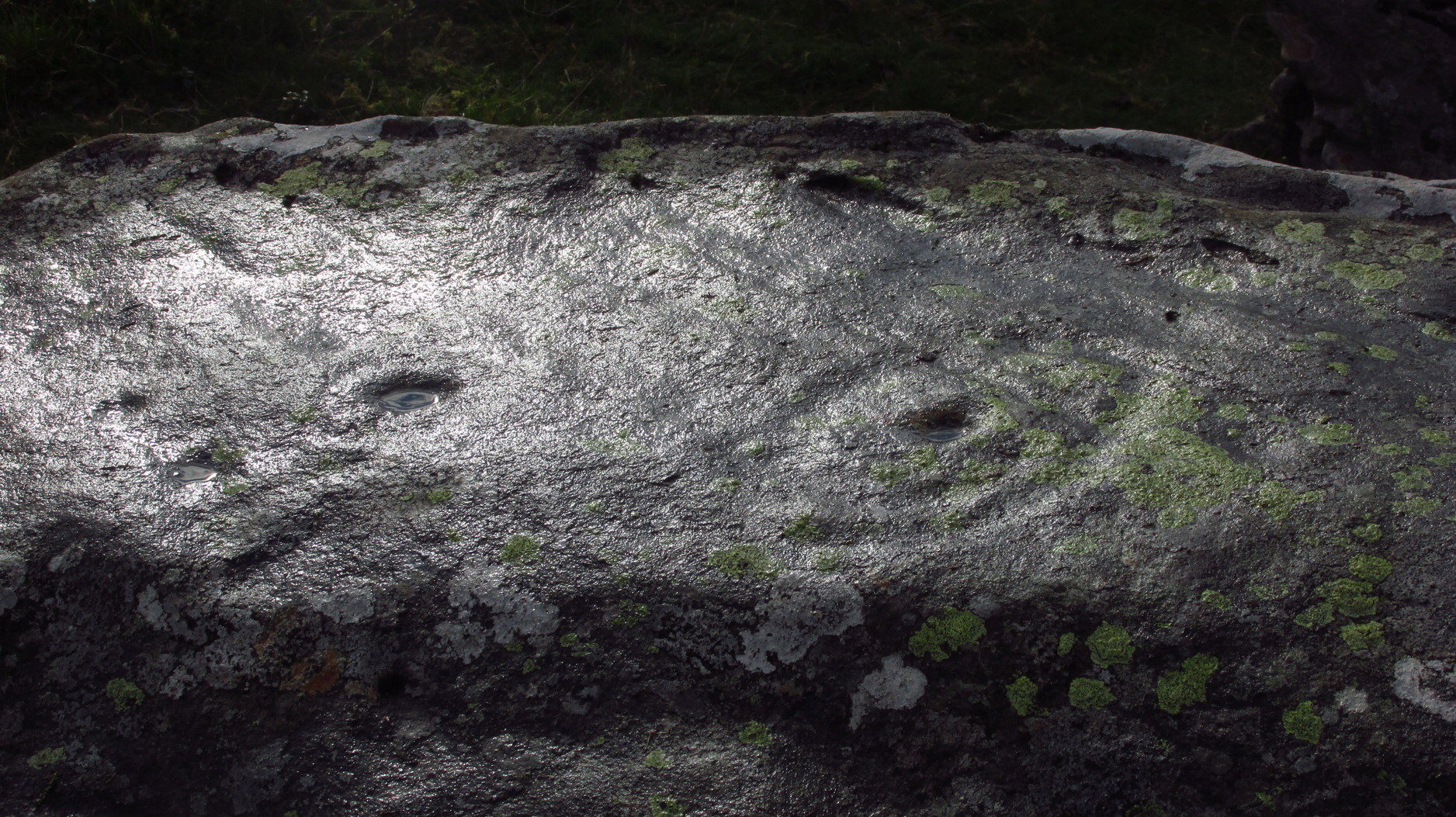
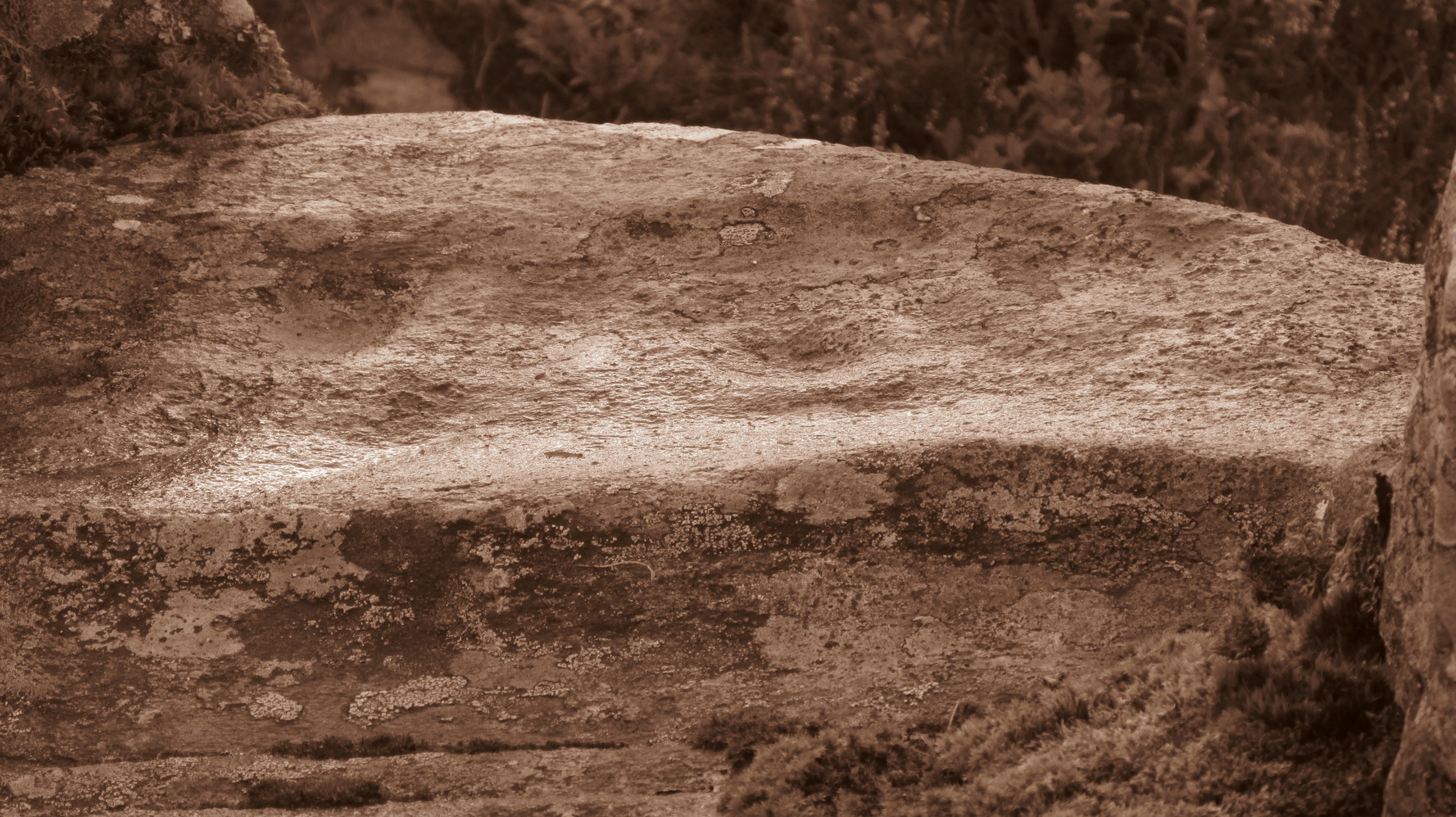
Very faint cup-&-half ring near the centre
Close-up of the C&R

So we poured water onto the stone in the hope that something might show up.  And the more we walked round and round, bending down, looking from as many angles as possible, not only did we see what looked like several cups, but one of them had a half-ring that curved round what may or may not be a natural cupmark.   You can see it pretty clearly in the attached photos.  In other photos that we took, the faint cup-and-half-ring seems to plays its part in a line of three or four other cups; although in order to ascertain whether these elements are man-made or not, we could do with the help of a good geomorphologist.

Acknowledgements:  Huge thanks to Prof Paul Hornby for use of his photos in this site profile; and to Myrna Hurley for getting us up there.  Cheers doods. 😉

© Paul BennettThe Northern Antiquarian
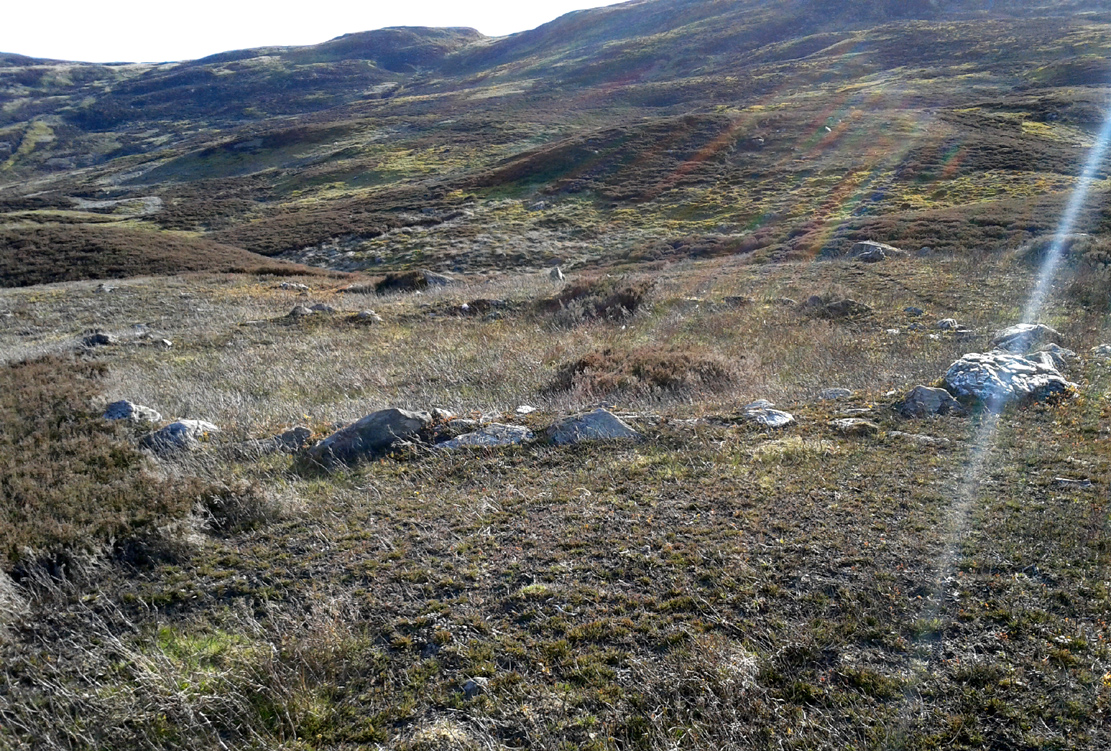
Brae of Cultullich (6), Aberfeldy, Perthshire

Cup-and-Ring Stone:  OS Grid Reference – NN 8818 4906

Getting Here

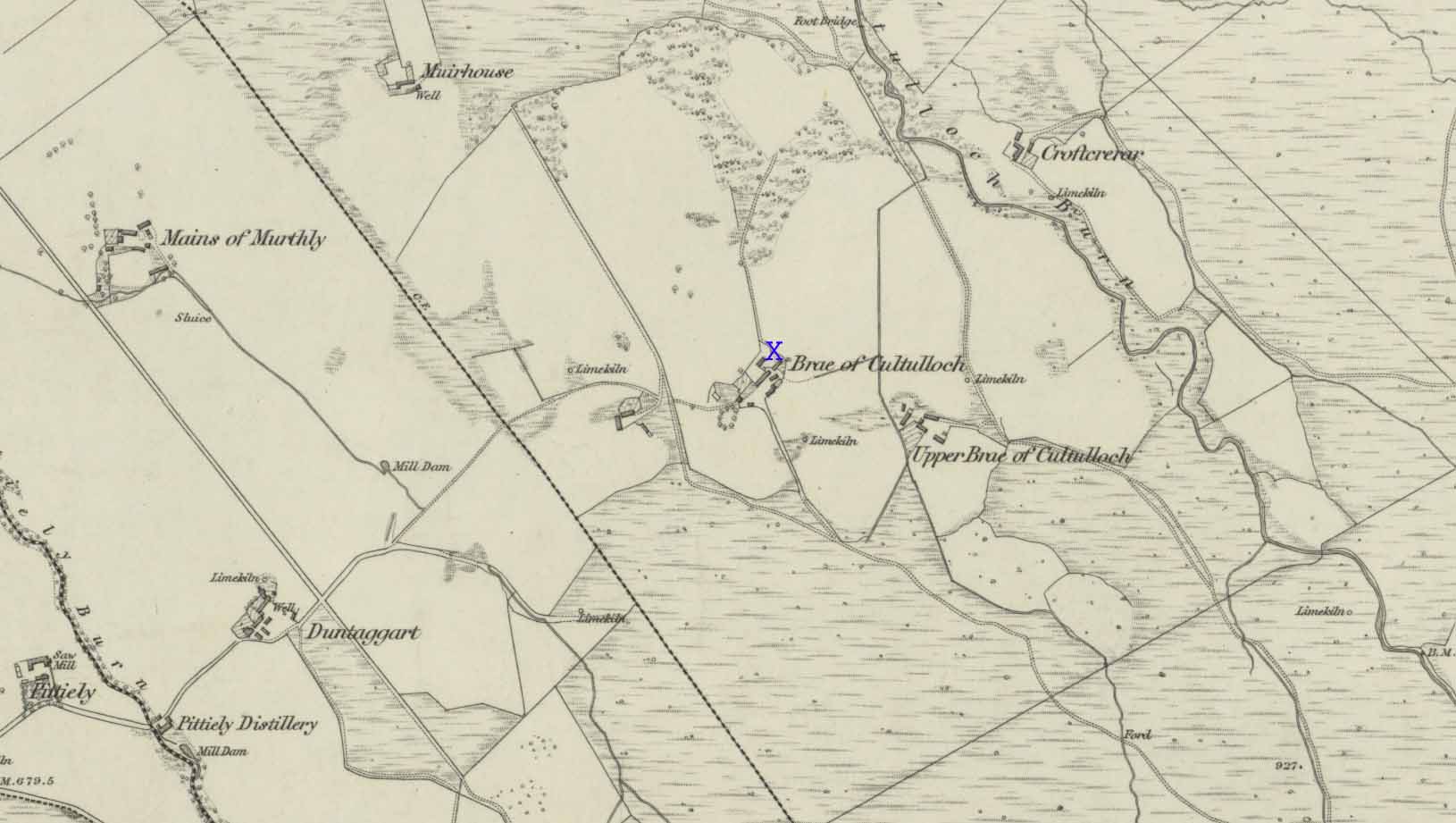
X supposedly marks the spot

Out of Aberfeldy, take the A826 road as if you’re going up Glen Cochill.  Not far up, just where the housing of Aberfeldy itself ends and the green fields open up either side of you, keep on the road for a half-mile where you meet a small copse of trees on your left, with a dirt-track that runs down the slope.  Go along the track for 0.8 miles (1.3km), past the Ursa Major Stone and where the track splits, go left past the Quartz Stone and follow the track through the farmyard.  It’s somewhere there – or is supposed to be!

Archaeology & History

On our visit here, we couldn’t locate the cup-and-ring stone that’s described in Sonia Yellowlee’s (2004) regional rock art survey.  She described it, as archaeologists always do, in the briefest manner, telling us simply:

“Leaning against a pile of rubble in the farmyard there is a split boulder bearing eighteen cupmarks, one of which is ringed.”

It may have been destroyed, as we were told by a couple of locals that there used to be “a real miserable sod” living there.  When we visited the place and tried to ask the present farm owner, sadly he wasn’t to be found.  If any rock art explorer manages to locate this seemingly lost cup-and-ring, please let us know – and mebbe send us some photos so that we can add them to this site profile. 😉

References:

  1. Yellowlees, Sonia, Cupmarked Stones in Strathtay, RCHAMS 2004.

Acknowledgements:  Big thanks to the crew – this time being Neens Harris, Paul Hornby & Frank Mercer.  And the stunning resource of Scotland’s 1st edition OS-maps is Reproduced with the kind permission of the National Library of Scotland

© Paul BennettThe Northern Antiquarian
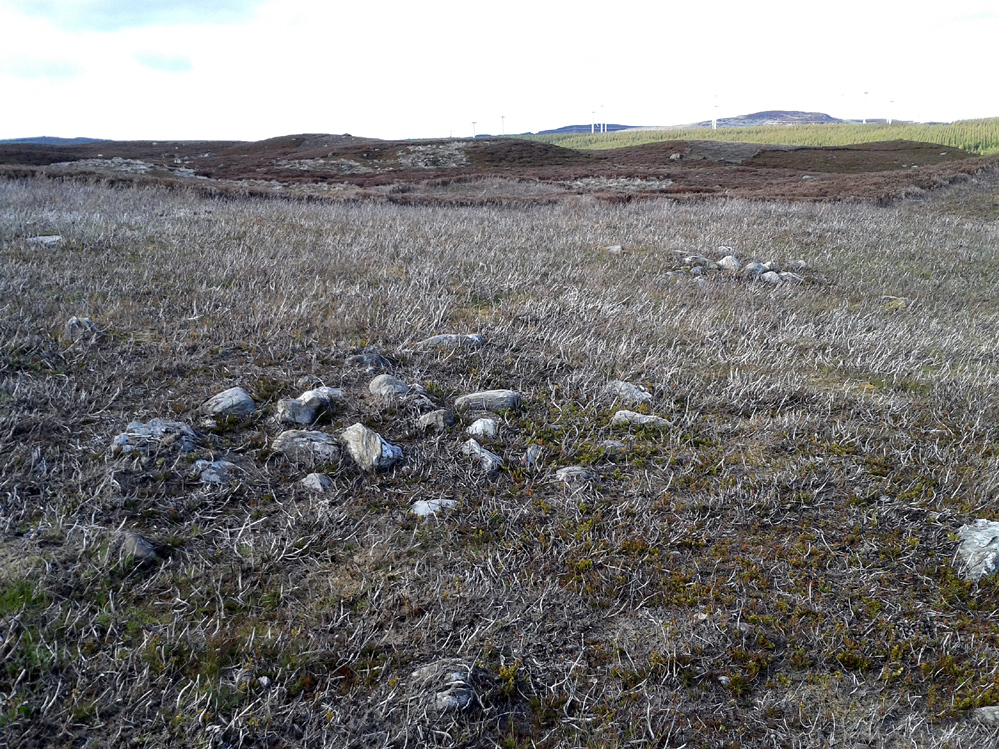

Quartz Stone, Brae of Cultullich, Aberfeldy, Perthshire

Cup-Marked Stone:  OS Grid Reference – NN 88104 49001

Also Known as:

  1. Brae of Cultullich (4)

Getting Here

The cupmarked Quartz Stone

Out of Aberfeldy, take the A826 road as if you’re going up Glen Cochill.  Not far up, just where the housing of Aberfeldy itself ends and the green fields open up either side of you, keep on the road for a half-mile where you meet a small copse of trees on your left, with a dirt-track that runs down the slope.  Go down here and follow the slightly meandering track for 0.8 miles (1.3km), a short distance past the Ursa Major Stone where the track splits.  Take the track to the left and there, less than 100 yards on you’ll hit a large boulder on your left.  That’s it!

Archaeology & History

Not previously recorded, this simple cup-marked stone will probably only be of interest to petroglyph aficionados, or those folk who are into  ‘energies’ at sites.  This latter aspect is due entirely to the carving being etched onto a huge rock, much of which is composed of quartz—which isn’t too unusual in this part of the world.  But that aside…

Looking down at the cups
The cupmarks highlighted

It is one in a group of carvings within a few hundred yards of each other, with its nearest neighbour 20 yards to the north.  That one’s covered in cups—but on this large Quartz Stone, only two of them exist, on the top near the centre.  Just a couple of inches across and half-an-inch deep, they’re pretty clear once you see them.  The raised piece of ground behind the stone is artificial and has variously been described by antiquarians and archaeologist alike, as either a prehistoric dun, or a stone circle.  Whatever it may be, some of it is certainly man-made.  Check it out – and mebbe ask the friendly fat fella who lives nearby and what he thinks.

© Paul BennettThe Northern Antiquarian
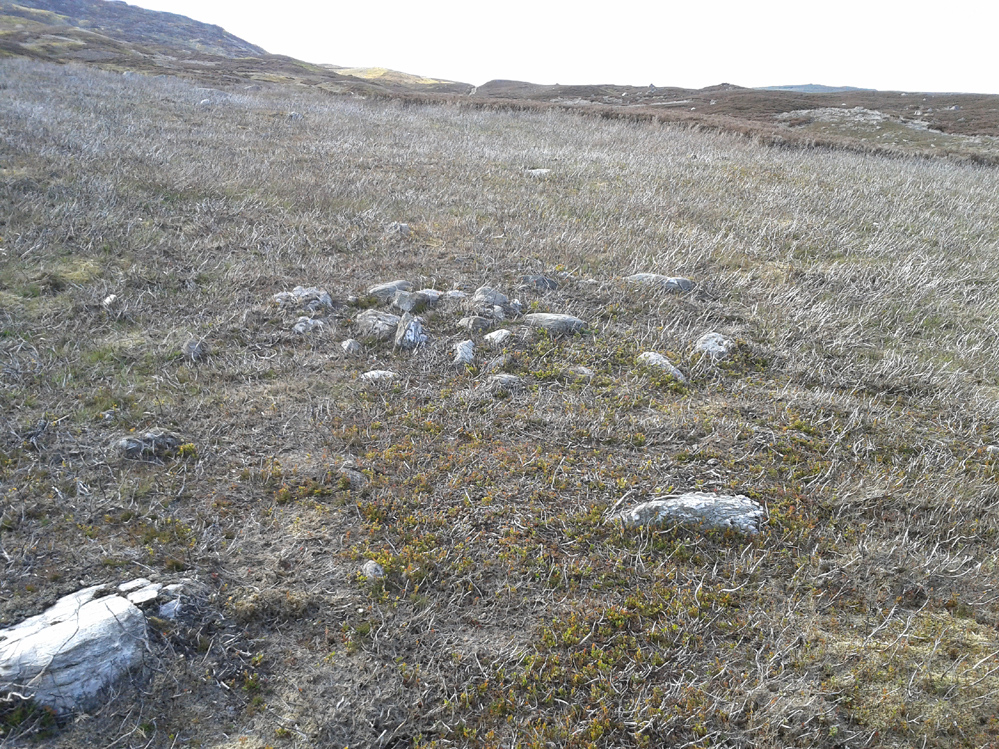

Ursa Major Stone, Brae of Cultullich, Aberfeldy, Perthshire

Cup-Marked Stone:  OS Grid Reference – NN 87958 49022

Also Known as:

  1. Brae of Cultullich (3)

Getting Here

The stone from the trackside

Out of Aberfeldy, take the A826 road as if you’re going up Glen Cochill.  Not far up, just where the housing of Aberfeldy itself ends and the green fields open up either side of you, keep on the road for a half-mile where you meet a small copse of trees on your left, with a dirt-track that runs down the slope.  Go down the track, bending to the right, then the left and then on for a quarter of a mile until the lines of trees appear either side of you.  Barely 200 yards along, the track swerves slowly to your right, and the field above you slopes uphill.  Keep your eyes peeled at the fencing on your right and you’ll see a stone sloping towards you right by the fence with faint cup-marks on it.  You’ll find it!

Archaeology & History

A truly fascinating cup-marked stone recently uncovered by Paul Hornby on another one of our TNA meanderings. Fascinating because of the curious arrangement of the cups on the stone.  Often, cup-marked stones have little to interest the causal visitor – but this one’s different.  As can be seen quite clearly, the cups are arranged in the shape of the constellation of the Great Bear, or Ursa Major – albeit with an extra ‘star’ in this design.  But it’s damn close!  In all likelihood (he says with his sceptical head on 😉 ), the design is fortuitous when it comes to the Ursa Major.  I know from many years experience how easy it is to see meaningful shapes and designs in the almost entirely abstract British petroglyphs, but the design is very close to the constellation we all got to know when we were kids.

Looking along the stone
Gazing down at Ursa Major

The stone itself slopes upwards at an angle of about 60º, before starting to level out as it rises.  All of the cup-marks have been pecked onto this sloping surface (the vast majority of carvings are found on top of stones).  Altogether, at least twelve faint and shallow cups were exposed when we looked at it—measuring the usual inch to inch-and-half across—but it is likely that more of them are hidden beneath the turf at the top of the stone.  We could discern no rings or other features in the design.

This is just one carving amidst a good cluster of petroglyphs within a few hundred yards of each other (the Quartz Stone being one of the nearest) that are well worth checking out if you like your rock art.  It may also be of interest to astronomy students, or those exploring archaeo-astronomy.

References:

  1. Yellowlees, Sonia, Cupmarked Stones in Strathtay, RCHAMS 2004.

© Paul BennettThe Northern Antiquarian
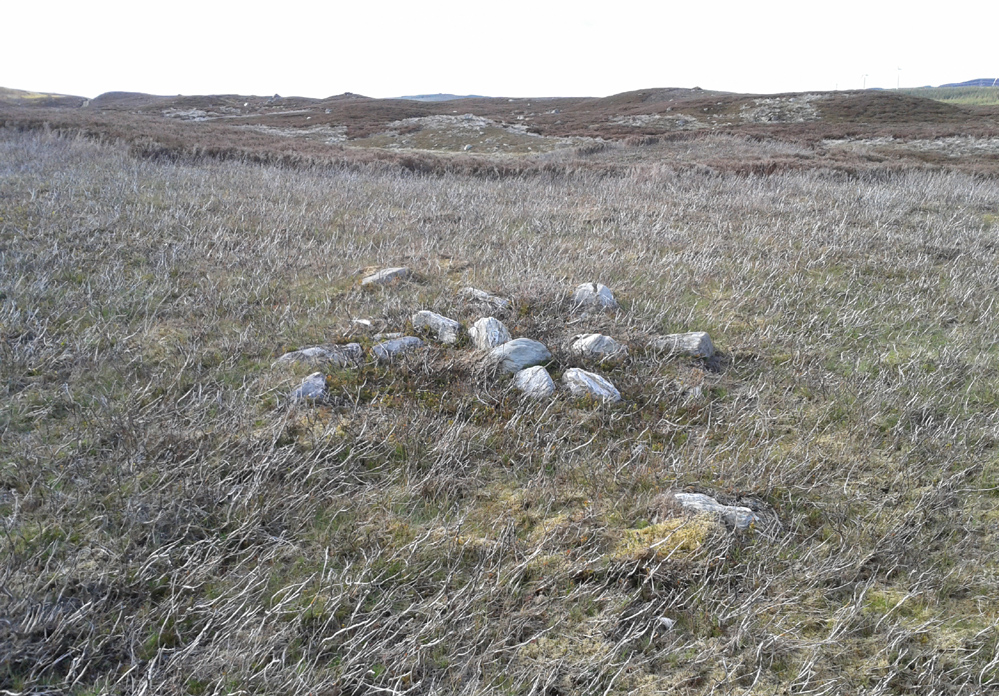

Glen Cochill Circle (01), Little Dunkeld, Perthshire

Hut Circle:  OS Grid Reference – NN 90324 41487

Getting Here

Glen Cochill Circle - No.1

Glen Cochill Circle – No.1

Take the same directions to reach the impressive Carn Ban prehistoric tomb.  From here, walk along the winding track past the giant cairn onto the moors for about 350 yards, until the track goes dead straight and heads NNW uphill.  Walk up here for another 350 yards keeping your eyes peeled on the rounded pyramidal hill with the large rock on top.  The circle is 20 yards off the track as you head up to the pyramidal hill stone.

Archaeology & History

Although this site is mentioned in notes by the Scottish Royal Commission and highlighted by Ordnance Survey, information thereafter is pretty scarce.  Which is surprising when you check this place out first-hand.  It’s bloody impressive!  David Cowley (1997) describes the area, but not in much detail.

Northern arc of walling

Northern arc of walling

Eastern arc of walling

Eastern arc of walling

The circle seems to have been rediscovered first of all by the dowser J. Scott Elliott (1964), who thought it was a cairn circle – which is understandable.  However, it has been classified by the Royal Commission lads as a “hut circle”, so we’ll stick with that for the time being.

An entrance to the circle doesn’t stand out.  There may be one on the southeastern side, but this isn’t clear; and what looked like a possible entrance on its northern edge was discounted, as a larger stone blocked this on the outside.  There was no immediate evidence of any internal structure, no hearth, no tomb – merely a small stone at its centre, deeply embedded in the peat.  This may, however, cover a central cist – which would make this a cairn circle and not a large hut circle.  But that’s guesswork on my behalf!

Arc of ring from east to south
WNW arc of walling

Never excavated, what we’ve got here is a very well-preserved, large ring of stones, more typical of Pennine and Derbyshire ring cairns than any standard hut circles.  But this is Scotland we’re talking about!  This impressive ring measures outer-edge to outer-edge 12 yards in diameter (north-south), by 11 yards (east-west), with the stone walling that defines the ring being between 3 and 4 feet across all round, and between 1-2 feet high.  And it’s in damn good nick!  More similar in structure to the likes of Roms Law, a number of notably large stones define the edges, but many hundreds of smaller packing stones build up the ring walls.  Of the larger rocks in the ring, the most notable one is a large white quartz crystal stone on its NNE side.

Quartz rock reflects the sun, looking W

Quartz rock reflects the sun, looking W

It’s an impressive site whatever it may be! – in very good condition for its age (Bronze Age by the look of it) and, whilst still visible above the heather, well worth checking out if you like your stone circles and prehistoric rings.  The small prehistoric graveyard 30-40 yards south and east, plus the extensive settlement systems all over these moors are all worth exploring if you visit this place.

References:

  1. Cowley, David C., “Archaeological Landscapes in Strathbraan,” in Tayside & Fife Archaeological Journal, volume 3, 1997.
  2. Scott-Elliot, J., “Kinloch House, Amulree,” in Discovery & Excavation in Scotland, 1964.
  3. Scott-Elliot, J., Dowsing – One Man’s Way, Neville Spearman: London 1977.

Links:

  1. Canmore notes on Glen Cochill

Acknowledgements:  Many thanks to Mr Paul Hornby for his help, as usual.  Cheers fella!

© Paul BennettThe Northern Antiquarian


Glen Cochill Cairnfield (01), Little Dunkeld, Perthshire

Cairns:  OS Grid Reference – NN 9035 4145

Getting Here

Two of at least five cairns hereby

Two of at least five cairns hereby

Take the A826 road south out of Aberfeldy, uphill, till you reach the White Cairn or Carn Ban, then follow the dirt-track for 700 yards onto the moors until you reach the Glen Cochill Circle 1.  From here, look at the large stone atop of the very notable rounded hillock barely 50 yards east (at NN 90367 41478) and meander on the slopes immediately below it on the south and west.  If the heather’s grown back, you don’t stand a chance!

Archaeology & History

As far as I’m aware, despite there being some brief notes of cairnfields in and around the rich prehistoric arena of Glen Cochill, I can find no data indicating that the five small single cairns a short distance south and southeast of the Glen Cochill Ring (01), have been described before.

Cairn 1 - looking north

Cairn 1 – looking north

Cairn 2 - looking north

Cairn 2 – looking north

Deeply embedded into the peat, they are only visible when the heather has been burnt away, as highlighted in the accompanying photos.  Each cairn is of roughly the same size and structure: 2-3 yards across and only a couple of feet above ground-level, consisting of the traditional small rounded stones, each probably constituting a single burial or cremation.

Cairn 4, below the hilltop rock

Cairn 4, below the hilltop rock

Of at least five cairns that we found here (there may be others beneath the covering heather), it was very notable that they’re on edges of a rounded pyramidal hillock, whose top is surmounted by a large pointed stone – probably a glacial erratic.  We looked at this rock in the hope of finding some cup-markings, but there were none.  However, it seemed as if the cairns and this crowning stone were related to each other, as if rites for the dead were proclaimed here for those in the tombs.  It may sound silly, but go there and take a look at it yourselves – before the heather grows back.  Just as a priests today, and shamans throughout history, have used an altar or plinth to make commemorations to the dead, so this crowning stone may equally have been used.  It makes sense.  And, as if to add validating ingredients: if we look east, past the crowning stone and across the River Cochill, we see the great rocks in the forest known as Creag a Bhaird, or the Crag of the Bard, from whence orations and tales were known to be told… But that’s another site with its very own story…

Acknowledgements:  Once again, thanks must be given to Mr Paul Hornby for his help in finding these sites.

© Paul BennettThe Northern Antiquarian
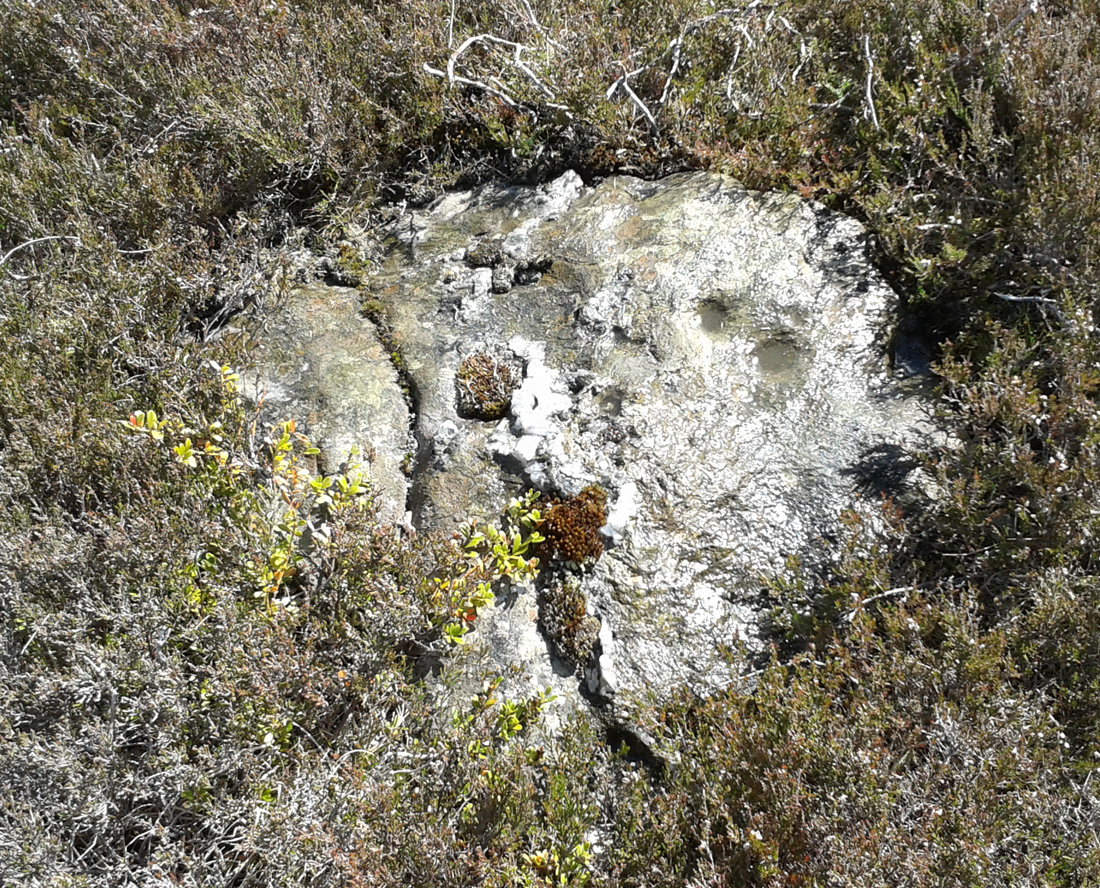

Glen Cochill (01), Little Dunkeld, Perthshire

Cup-Marked Stone:  OS Grid Reference – NN 90800 39842

Also Known as:

  1. Canmore ID 87710

Getting Here

Glen Cochill's cup-marked stone

Glen Cochill’s cup-marked stone

Along the A826 road south out of Aberfeldy, make your way towards the impressive giant Carn Ban of Glen Cochill.  Nearly a mile past the cairn further down the road, keep yer eyes peeled for the straight line of walling reaching up onto the moors.  About 100 yards before the wall, go over a ruined metal gate by the roadside up and onto the moor.  Walk straight uphill for barely 50 yards until you’re on the level, then walk left for 50 yards or so again. Yer damn close!

Archaeology & History

3rd cupmark visible at bottom

3rd cupmark visible at bottom

Although this is a seemingly isolated carving, difficult to find and nowt much to look at, it is located in a region with massive amounts of prehistoric remains – much of it inadequately surveyed or not surveyed at all.  Amidst a collection of more than a dozen unexcavated Bronze Age cairns, this small flat earthfast stone bears two standard cup-markings, with a possible third at its edge.  It is not immediately connected with any of the nearby cairns.

© Paul BennettThe Northern Antiquarian


Beltane Well, Kenmore, Perthshire

Sacred Well:  OS Grid Reference – NN 7867 4725

Also Known as:

  1. An Tobar
  2. Holy Well of Inchadney

Getting Here

An Tobar, or Beltane Well, on the 1867 map

An Tobar, or Beltane Well, on the 1867 map

From Kenmore village on the north-side of the river, over the bridge, take the small road on your right towards Dull.  After a very short distance the road runs alongside the woodland for nearly 1½ miles until, on your left, you’ll reach Drummond Cottage.  Across from here a dirt-track takes you into the trees.  Barely 100 yards along, watch for the overgrown path that runs down the slope on your left.  At the bottom a small stream has several feeds – one of which is surrounded by a ring of bright quartz stones.

Archaeology & History

Shown on the early Ordnance Survey maps as An Tobar (meaing simply “a well”), this somewhat nondescript title betrays a much more colourful folk history, albeit dissolved by those common culprits of Church and disrespectful incomers (which shows little sign of diminishing).

Lara by the Well

Lara by the Well

Close-up of quartz surround

Close-up of quartz surround

In the field immediately south, back up the slope above the well and through the trees, was once an ancient church whose existence has all but vanished.  Hereby was held an ancient fair known as Feill nam Bann Naohm, or the Fair of the Holy Women, named after a group of nuns whose lived here, who William Gillies (1938) and others proclaim were the legendary Nine Maidens, whose dedications at wells, trees and other sites scatter Scotland. But the fair was ended in 1575 and moved to Kenmore; then, several years later in 1579, the church also moved onto Eilean nam Ban Naomh (NN 7664 4536) on Loch Tay.

The old well however, after being left by the descendants of the Holy Women or Nine Maidens, continued to be frequented by local people.  Gillies (1938) wrote:

“The Holy Well of Inchadney is situated at the foot of the terrace, about five hundred yards to the north of the churchyard… Up to the middle of last century the well used to be visited by great numbers of people on the morning of Bealtuinn, the first day of May.”

In Ruth & Frank Morris’ survey (1981) they told how the site had become much overgrown and,

“The well was cleaned out in 1914 and among articles found was a stone 21 inches by 16 inches, with a rude St Andrew’s cross scratched on it, a George III farthing among other copper coins, a rudely made stone cup 2½ inches high and 7 inches in diameter, three metal buttons, a glass bead and six pins.”

No such offerings seemed in evidence when we visited a few weeks ago; but we were told that people are still seen visiting the well.

Looking down into the pure waters

Looking into the pure waters

A small stone-laid footpath runs towards the adjacent burn from the circular well, which is almost completely surrounded by large quartz rocks.  In the well itself was a small fish, showing how clean the waters are—or as would be deemed in times of olde: a ‘guardian’ of the waters.

We must also make note of the fact that, just two fields away to the north, according to the antiquarian Fred Coles (1910), a stone circle was once in evidence.  This old well sat neatly between the sites of megalithic ring and church.

Folklore

In the field in front of the well, Hilary Wheather (1982) told that there once lived a legendary water bull, but she lamented on his passing.  With the coming of the modern-folks and their unnatural ways,

“and having great timber lorries rumbling past your home every day is no fun for a peace-loving waterbull living in Poll Tairbh, the Bull’s Pool opposite the Holy Well.  Gone are the days when he was the revered Spirit of the Meadow, passed with trembling and fear by all the young maids of the Parish lest he should jump out and carry them off to his watery lair. Half the calves of the area were sired by him and it was always easily seen which cow had the attentions of the Great Waterbull.  Her calf was always the biggest and the best.  But he hasn’t been seen by his pool for many a year…”

The waters are cited by Geoff Holder (2006) to be good for toothache.

References:

  1. Coles, Fred, “Report on Stone Circles Surveyed in Perthshire (Aberfeldy District),” in Proceedings of the Society of Antiquaries, Scotland, volume 44, 1910.
  2. Gillies, William A., In Famed Breadalbane, Munro Press: Perth 1938.
  3. Holder, Geoff, The Guide to Mysterious Perthshire, History Press 2006.
  4. McHardy, Stuart, The Quest for the Nine Maidens, Luath Press: Edinburgh 2003.
  5. Miller, Joyce, Magic and Witchcraft in Scotland, Goblinshead: Musselburgh 2010.
  6. Morris, Ruth & Frank, Scottish Healing Wells, Alethea: Sandy 1982.
  7. Wheater, Hilary, Kenmore and Loch Tay, Appin Publications: Aberfeldy 1982.

Acknowledgements:  Big thanks to the bunch who got us here:  to Paul Hornby, Nina Harris, Aisha Domleo & Lara Domleo (ooh – and Leo too!).

© Paul BennettThe Northern Antiquarian


Croft Moraig Carving (02), Kenmore, Perthshire

Cup-Marked Stone:  OS Grid Reference – NN 79744 47263

Also Known as:

  1. Croft Moraig – Stone D

Getting Here

Follow the same directions for the Croft Moraig stone Circle.  Then check out the largest of the fallen or elongated stones on the northwest side of the ring, with a smoothed sloping surface, just at the side of the overgrown stone platform on which it rests.  Y’ can’t really miss it.

Archaeology & History

When William Gillies (1938) wrote about the carvings at the Croft Moraig stone circle, he told how, previously, Fred Coles,

“noticed that several of the upright stones…show cup-markings on their perpendicular surfaces. Some of these are quite distinct, but others are so worn through weathering that they can only be traced with the fingers.”

Stone D, with cupmarks
Stone D, with faint cups
Close-up of the cupmarks

This is one of them. Barely visible at the best of times, the cup-markings are faded and very hard to see unless daylight conditions are just right. As you can see in the photos, several distinct cup-like impressions are visible, but it only appears that two of them are cup-marks.  The others seem to be more geophysical in nature – but I’d love to be wrong!

At the SSW edge of the circle, 13 yards (11.75m) away, is the Croft Moraig cup-and-ring stone.

Folklore

Stone D on Fred Coles' plan
Stone D on Coles’ plan

The great northern Antiquarian Fred Coles (1910) noted that this particular stone (stone D in his ground-plan of the circle) had “been polished by the sliding of generations of children”.  This playful action on stones elsewhere in the UK and around the world sometimes relates to fertility rites (i.e., the spirit of the stone could imbue increased fertility upon the practitioner), but Mr Coles made no mention of such rituals here.

References:

  1. Coles, Fred, “Report on Stone Circles Surveyed in Perthshire,” in Proceedings of the Society of Antiquaries, Scotland, volume 44, 1910.
  2. Gillies, William A., In Famed Breadalbane, Munro Press: Perth 1938.
  3. Yellowlees, Sonia, Cupmarked Stones in Strathtay, Scotland Magazine: Edinburgh 2004.

Acknowledgements:  Many thanks to hardcore crew for our various visits here: to Paul Hornby, Lisa Samson, Fraser Harrick, James Elkington, Penny & Thea Sinclair.

© Paul Bennett, The Northern Antiquarian