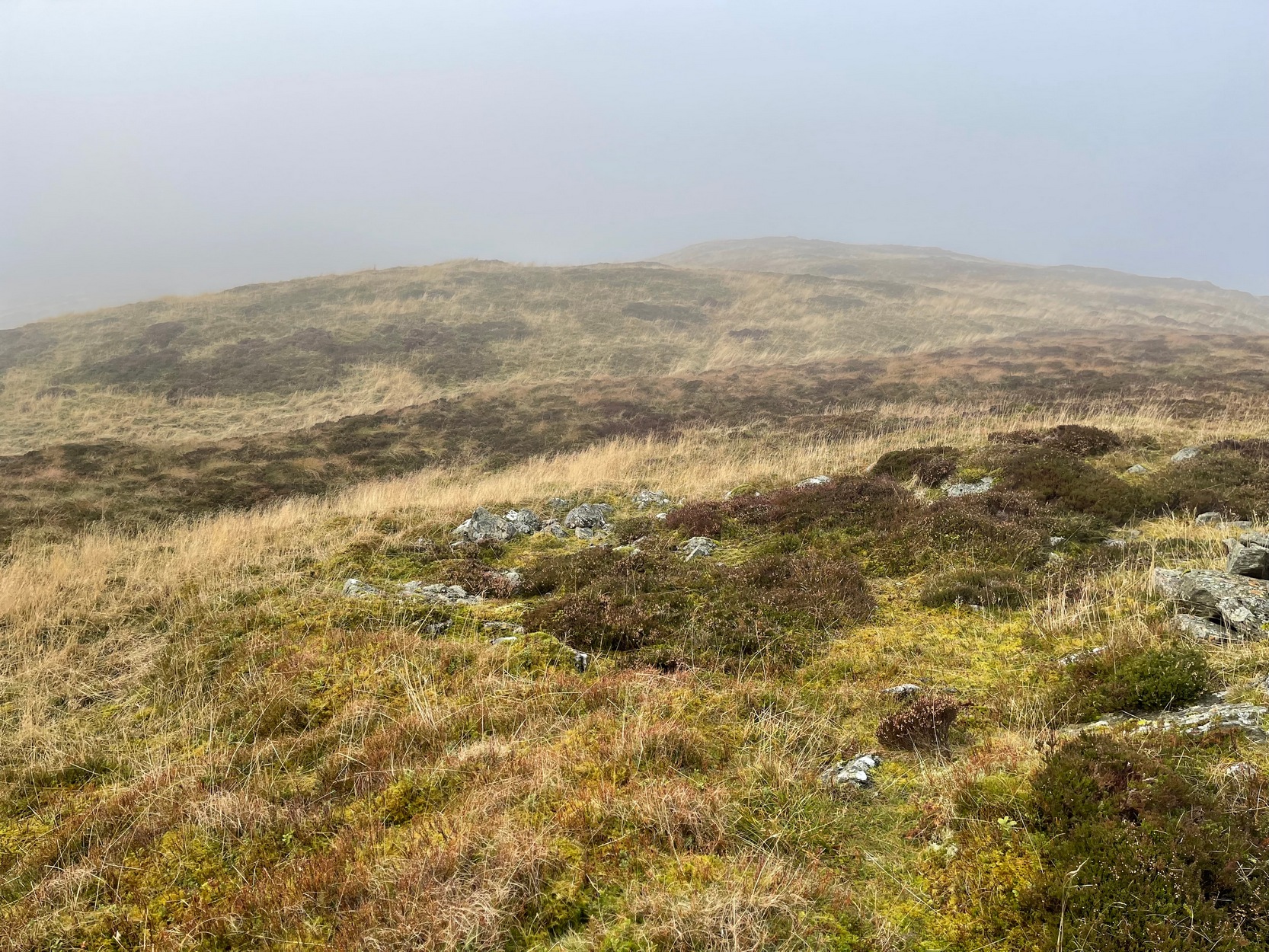
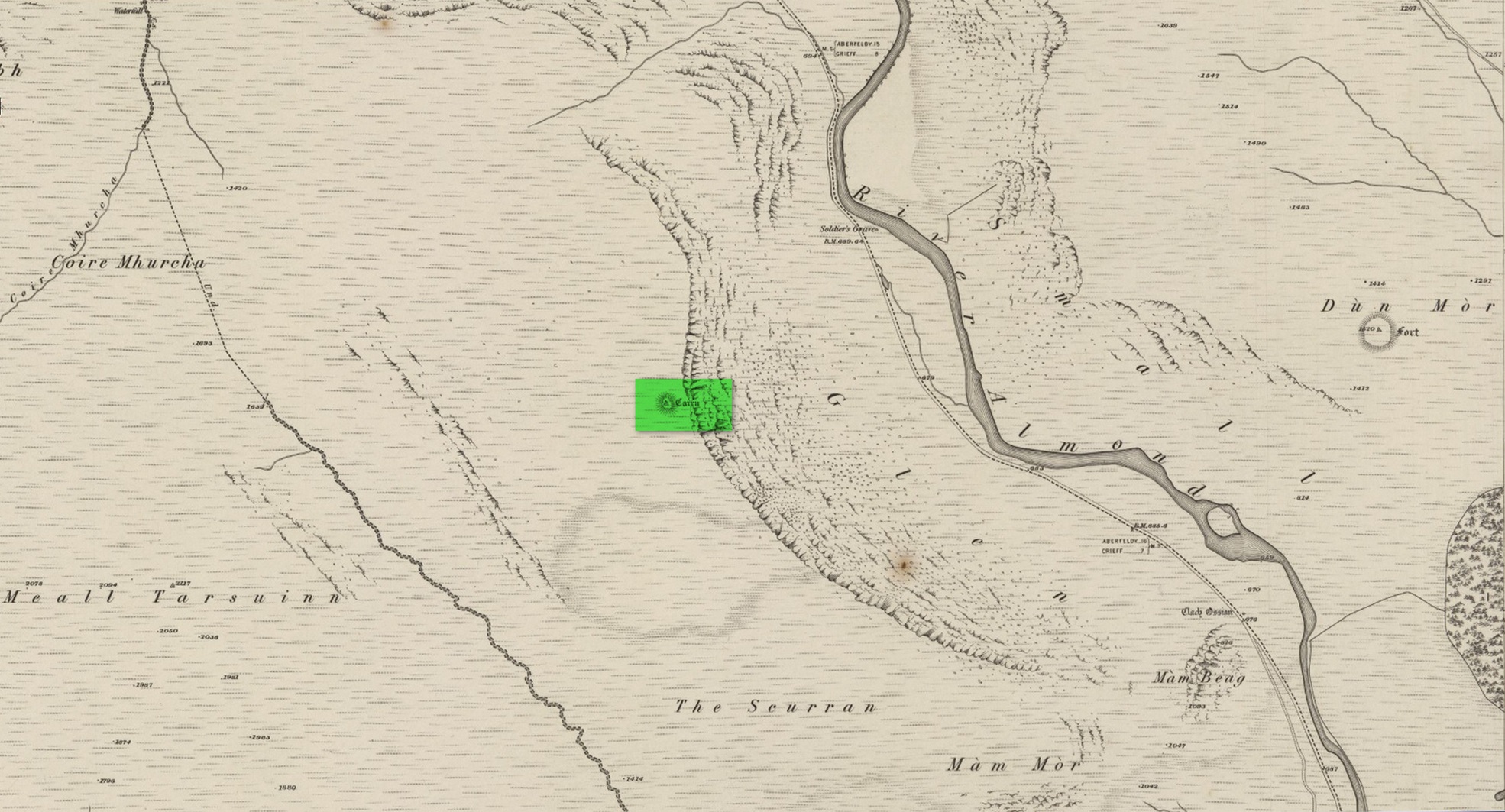
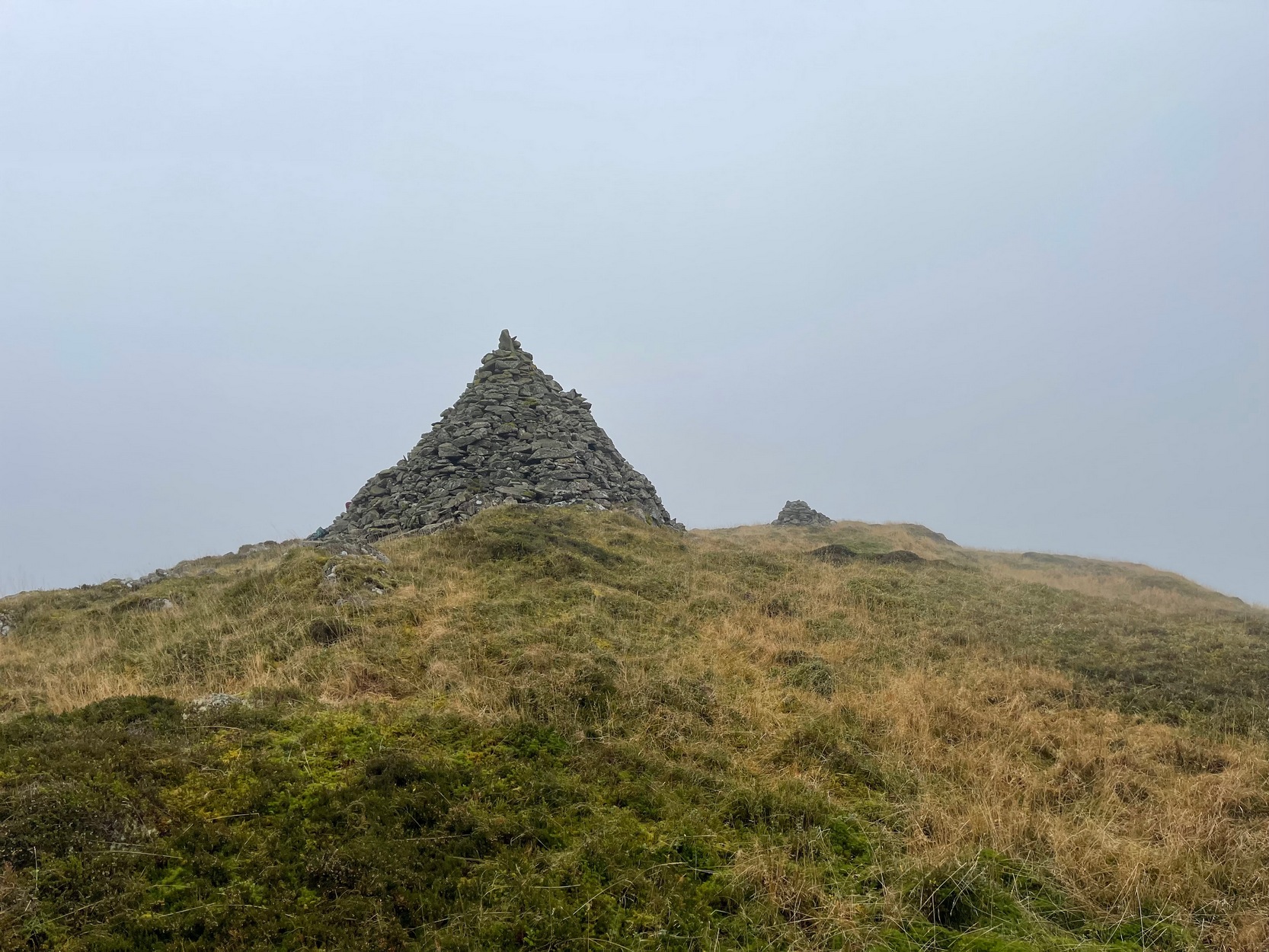
Craven Hall Hill (2), Hawksworth Moor, West Yorkshire

Ring Cairn:  OS Grid Reference – SE 14442 44281

Getting Here
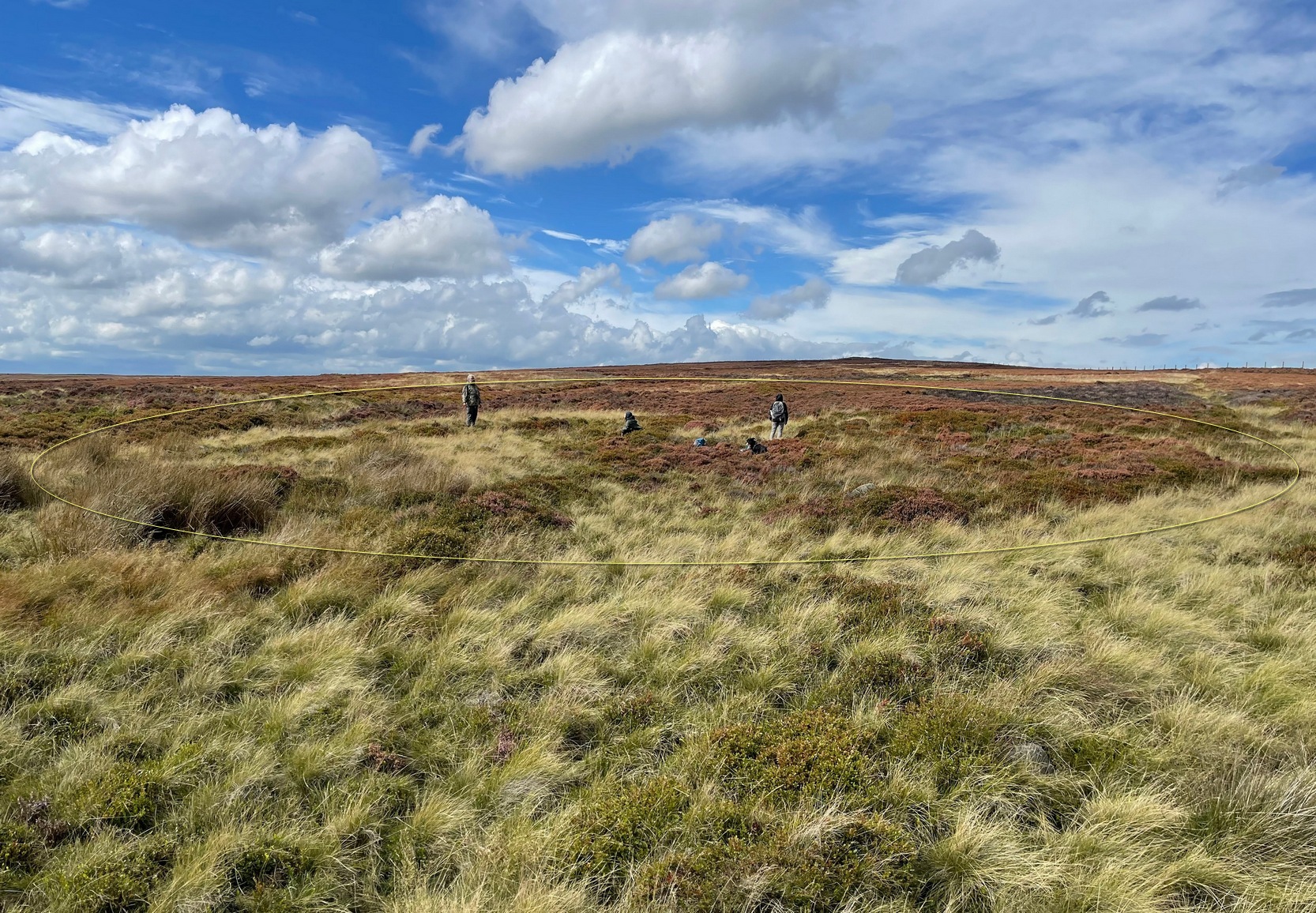
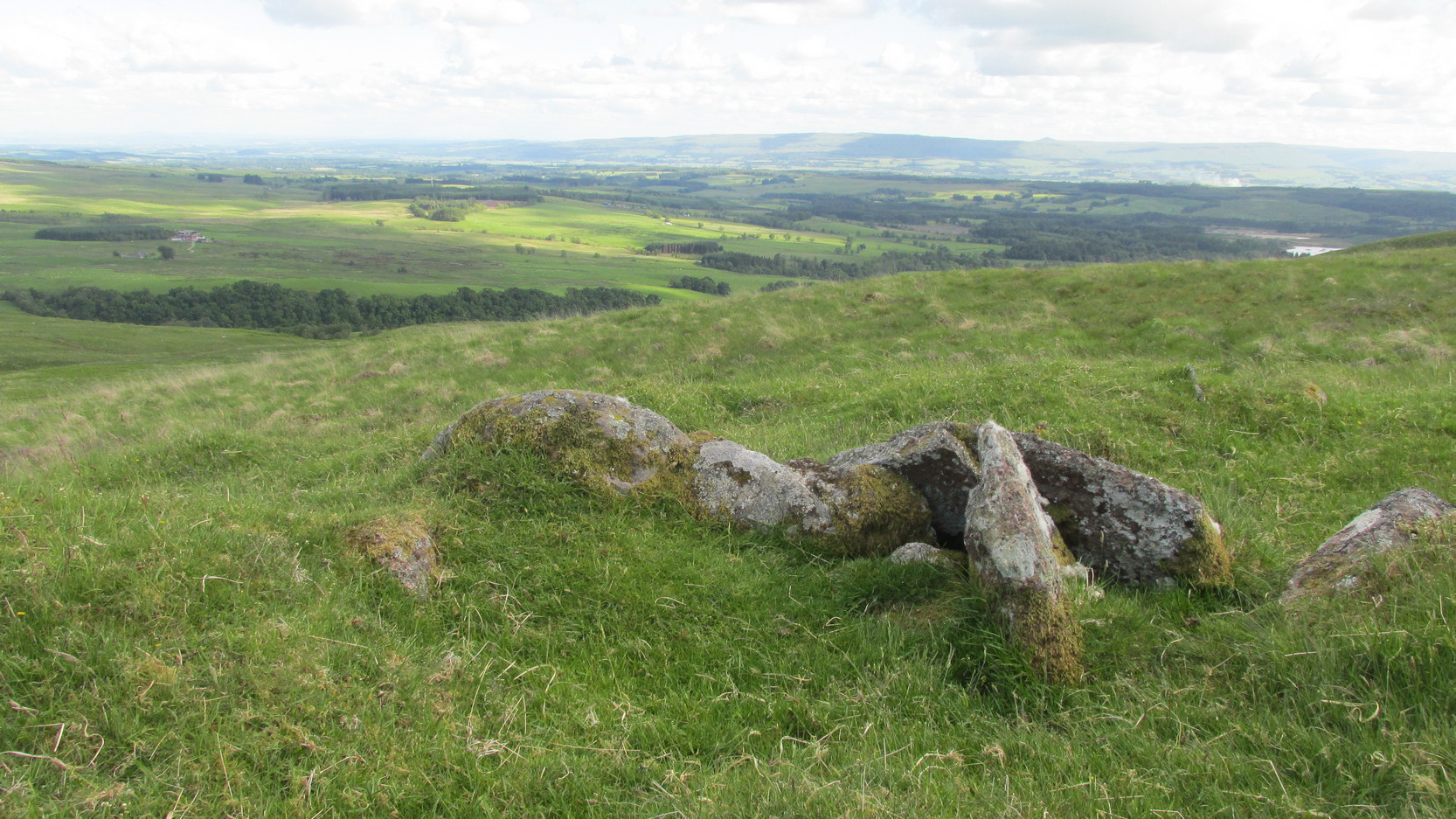
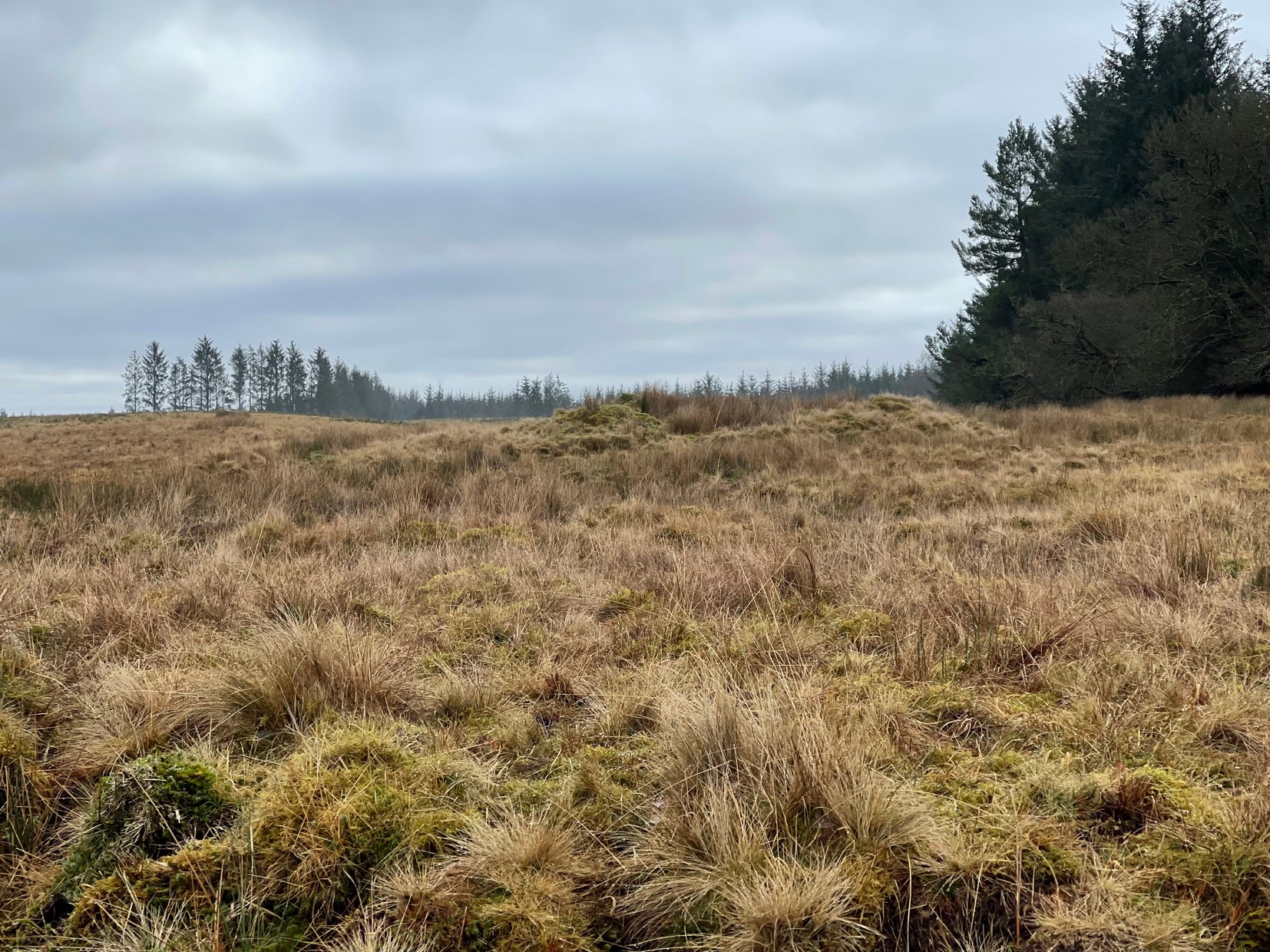
Craven Hall ring cairn

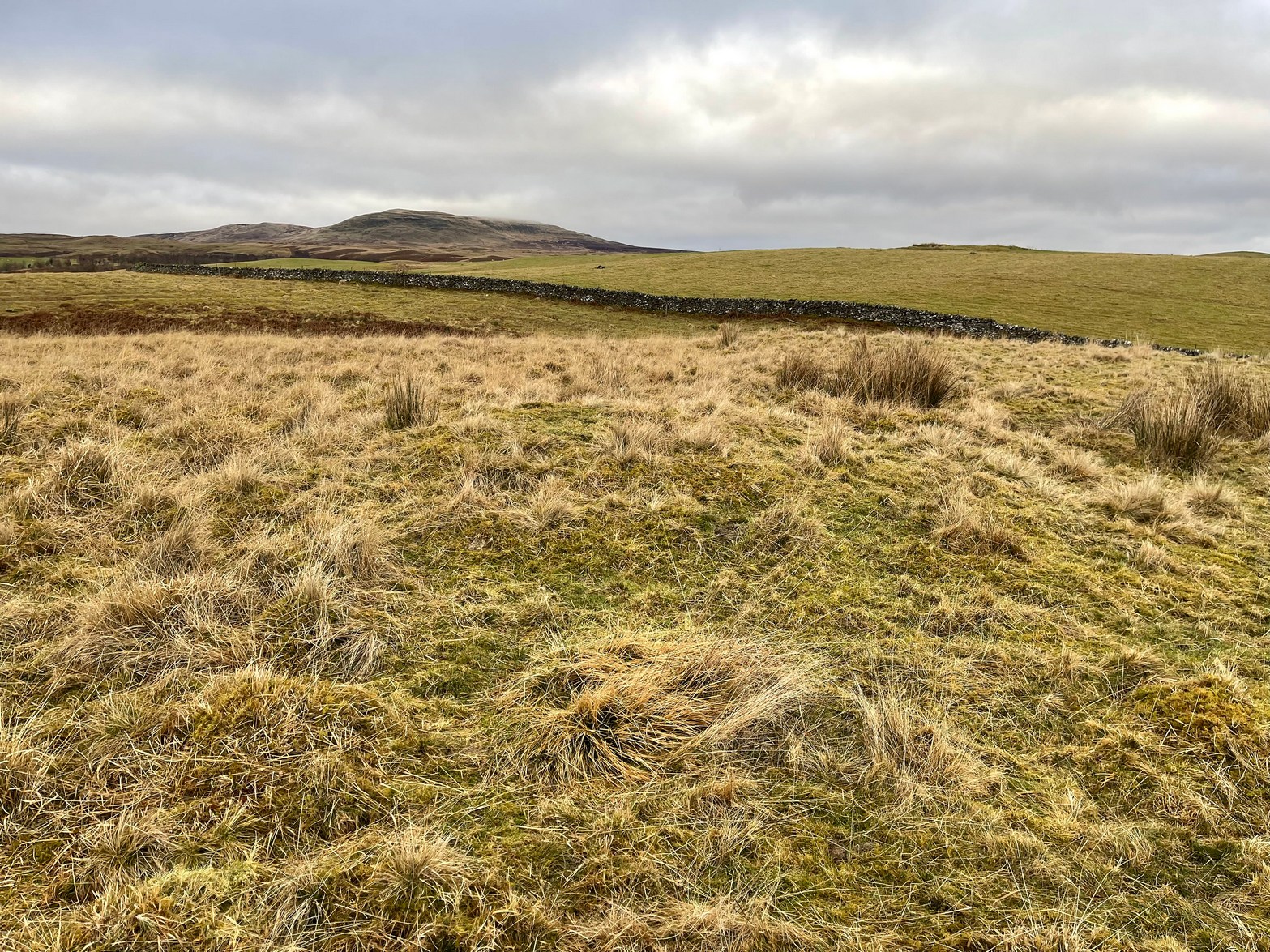
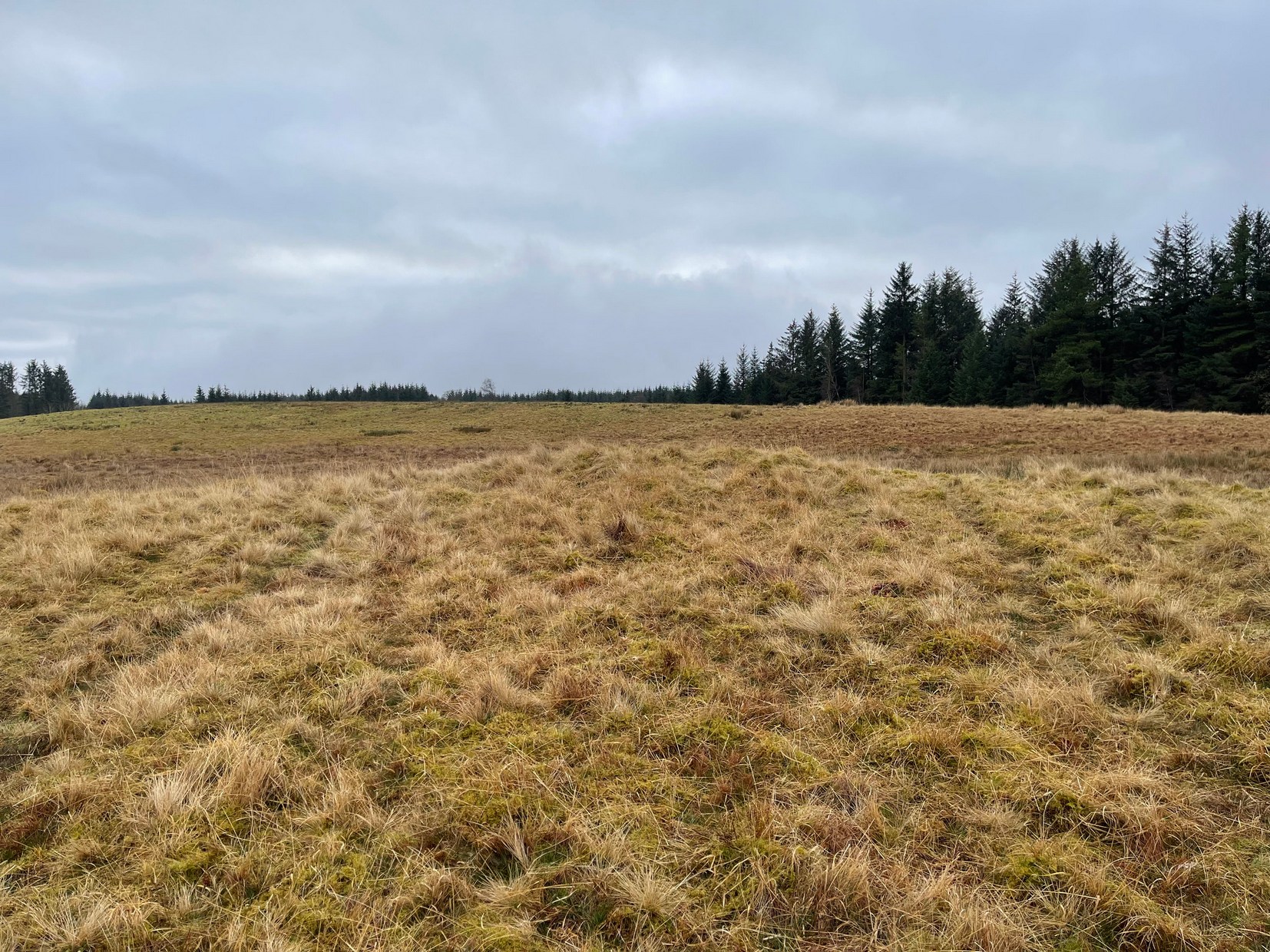
Your best starting point is from the Great Skirtful of Stones giant cairn.  From here follow the fencing that runs down the slope to your left (south-east) for roughly 160 yards (148m) – past the Great Skirtful Ring – until you reach the gate.  Go through it and keep walking down the same fence-line for 300 yards then walk south onto the moorland proper (there are no paths here).  You’ll pass over several undulations in the heather (some of these are the edges of ancient trackways) and 55-60 yards south from the fencing you’ll walk over and into this overgrown prehistoric ring.  It’s very difficult to see when the vegetation is deep, so persevere!

Archaeology & History
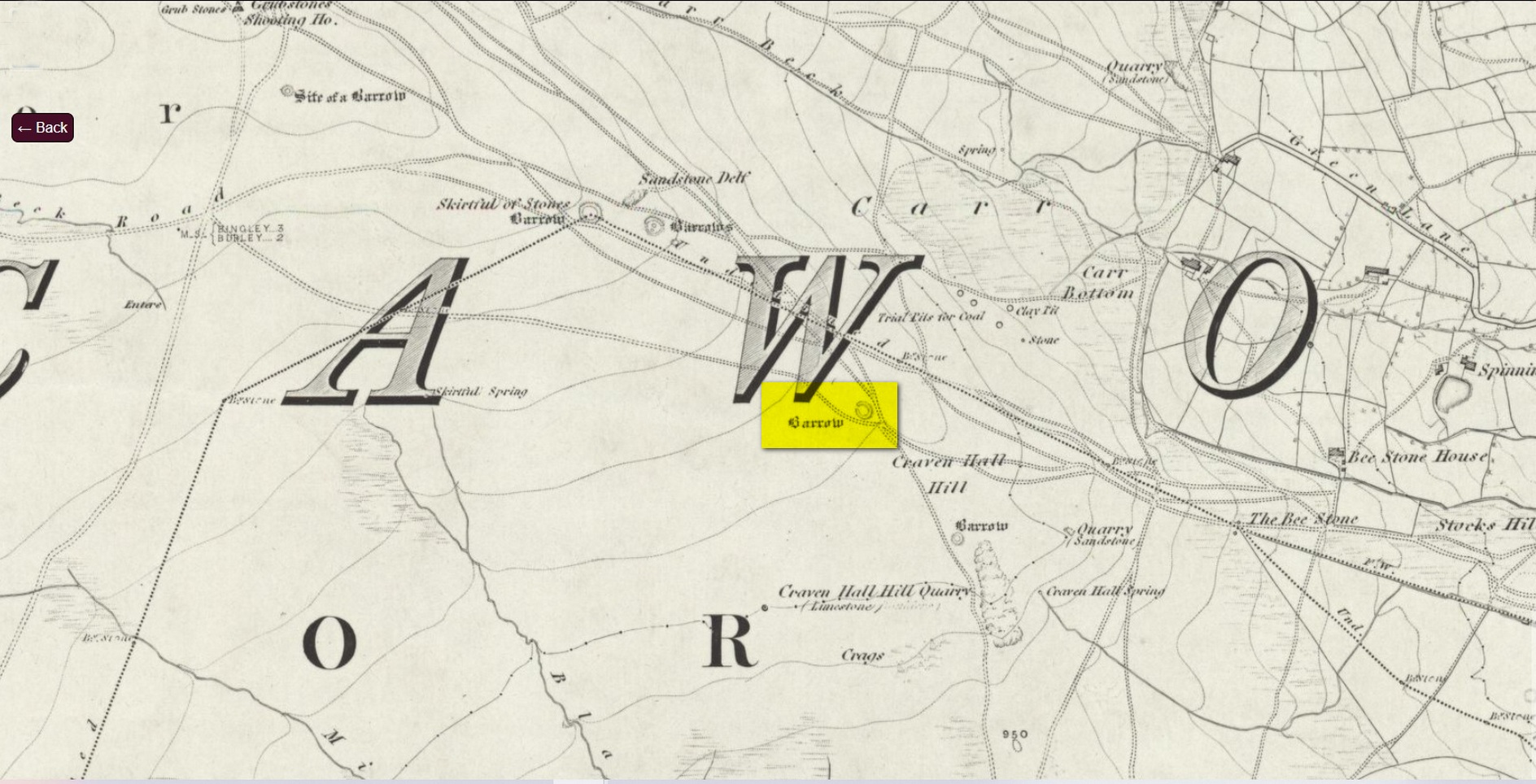
Site shown on 1851 map

This is an interesting site.  Marked on the 1851 Ordnance Survey map as a “barrow” (right), it is shown with trackways on either side of it to the north and south, and with an opening or entrance on its northwestern side.  Yet since that date, very little archaeological attention has been given to it and the site remains unexcavated, despite its location being repeated on all subsequent maps since then.  The designation of the site as a barrow or burial site, without being excavated, was educated guesswork at the time as the place seems to be what we today define as a ring cairn.  And whilst this seems likely, there are some oddities here.

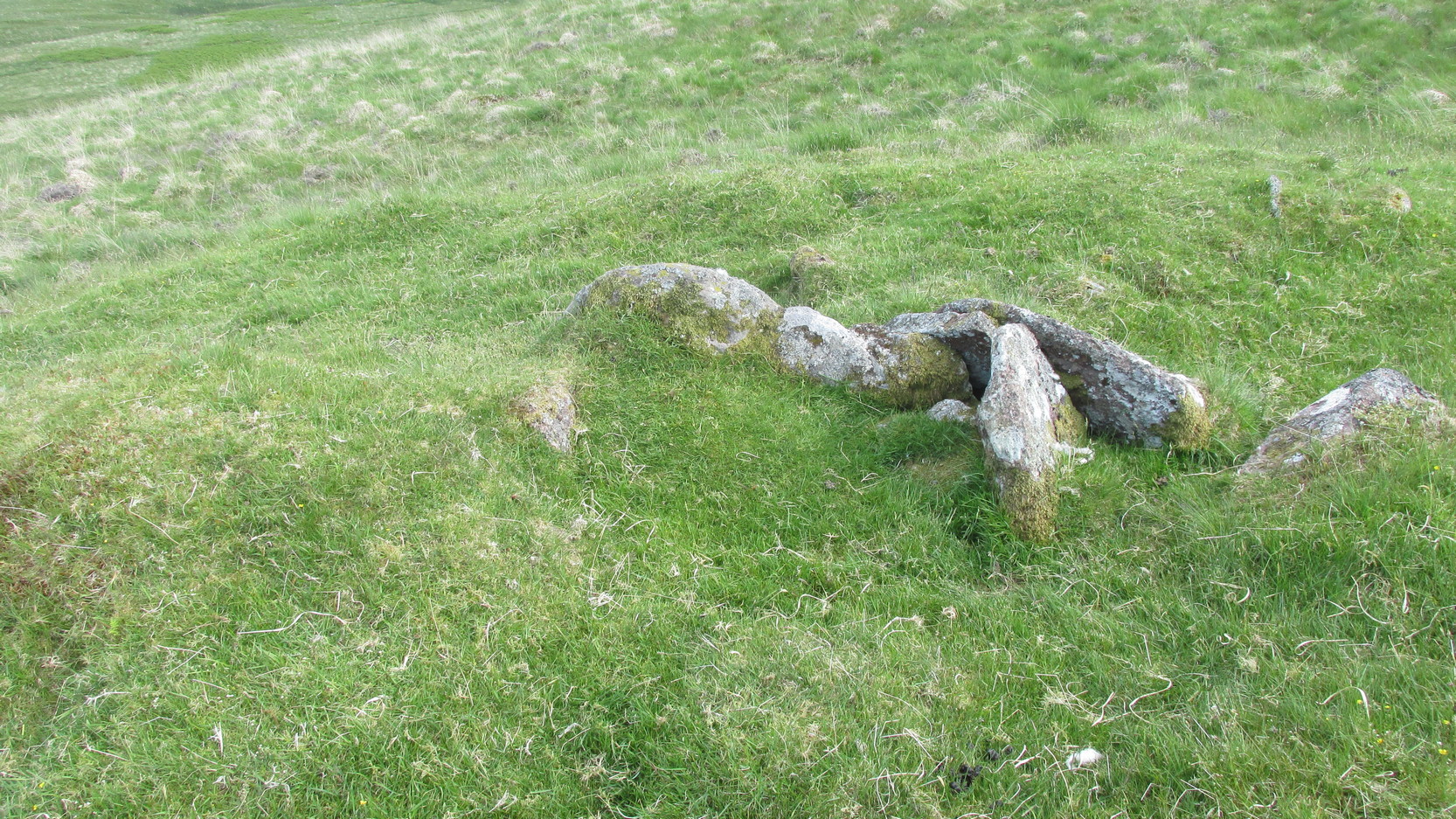
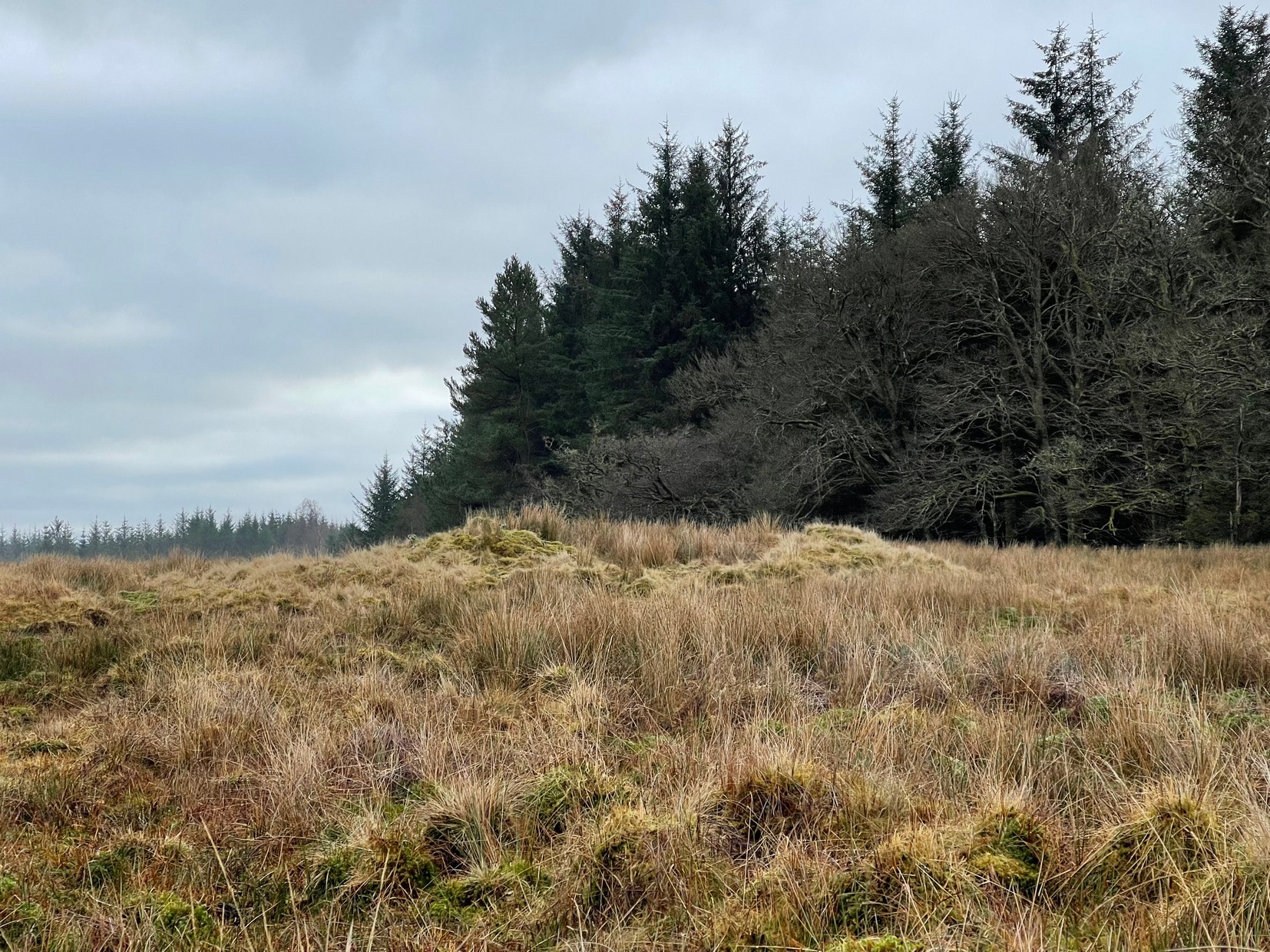
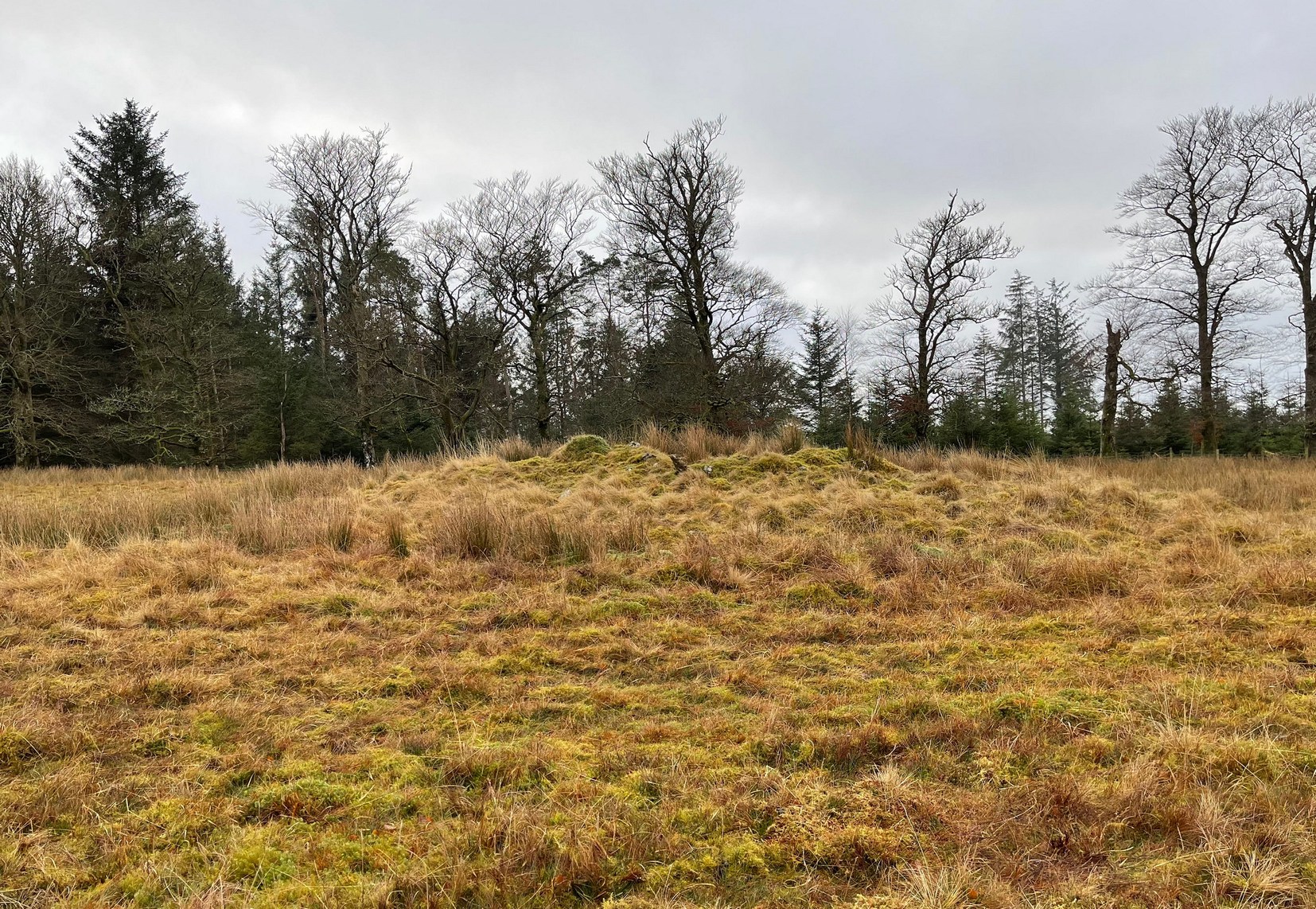
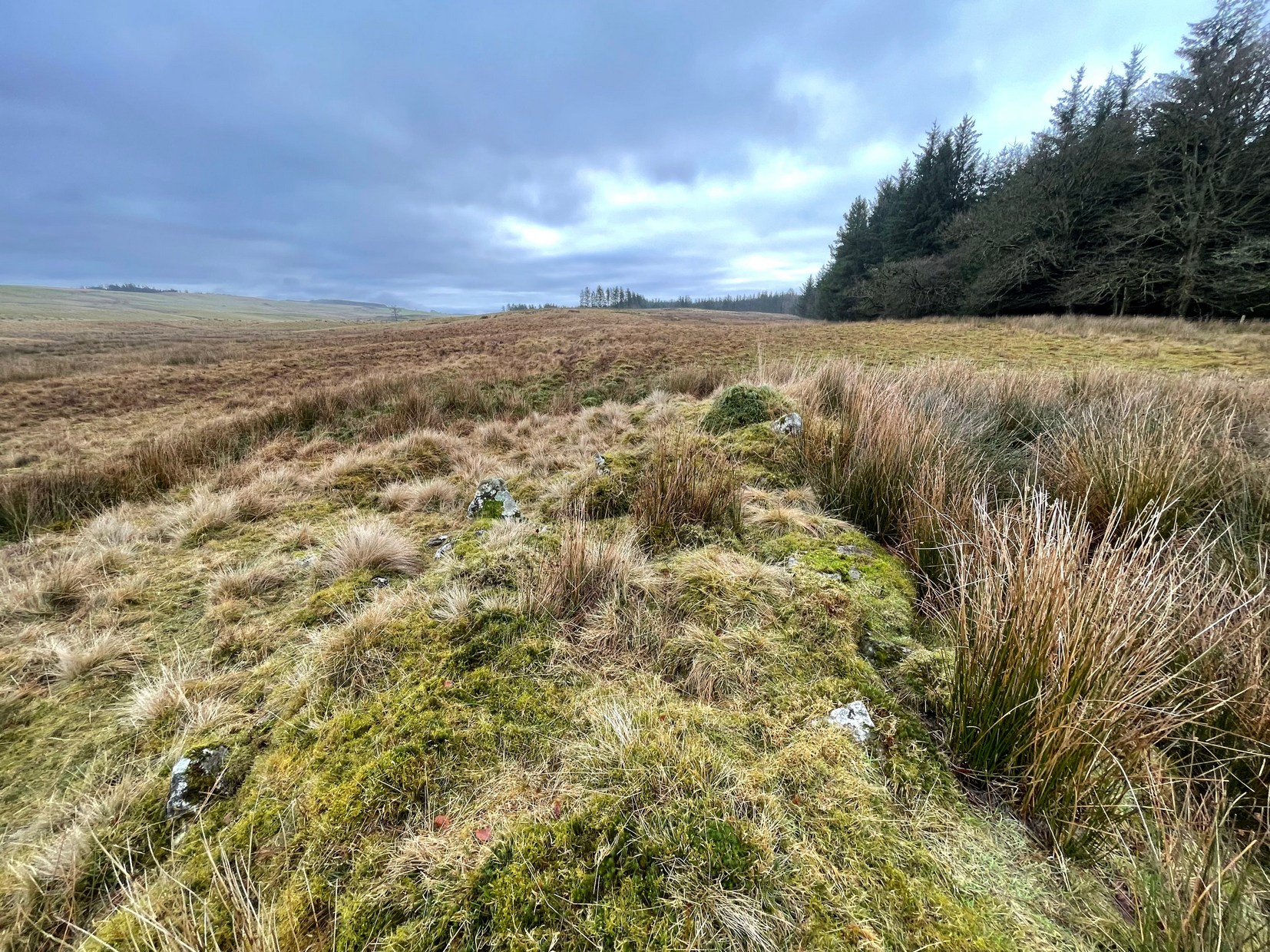
Measuring roughly 25 yards (SE – NW) by 21 yards (NE – SW), this overgrown oval ‘ring’ is a similar architectural structure to the more famous Roms Law circle more than half-a-mile northwest of here—but bigger!  And, unlilke Roms Law, this overgrown circle seems to have been untouched for many centuries.  The oval surrounding ‘ring’ itself is composed of thousands of small packing stones between, seemingly, a number of much larger upright stones, reaching a maximum height of more than three feet high at the northernmost edge.  The ‘ring’ ostensibly looks like a wide surrounding wall which measures two yards across all round the structure.
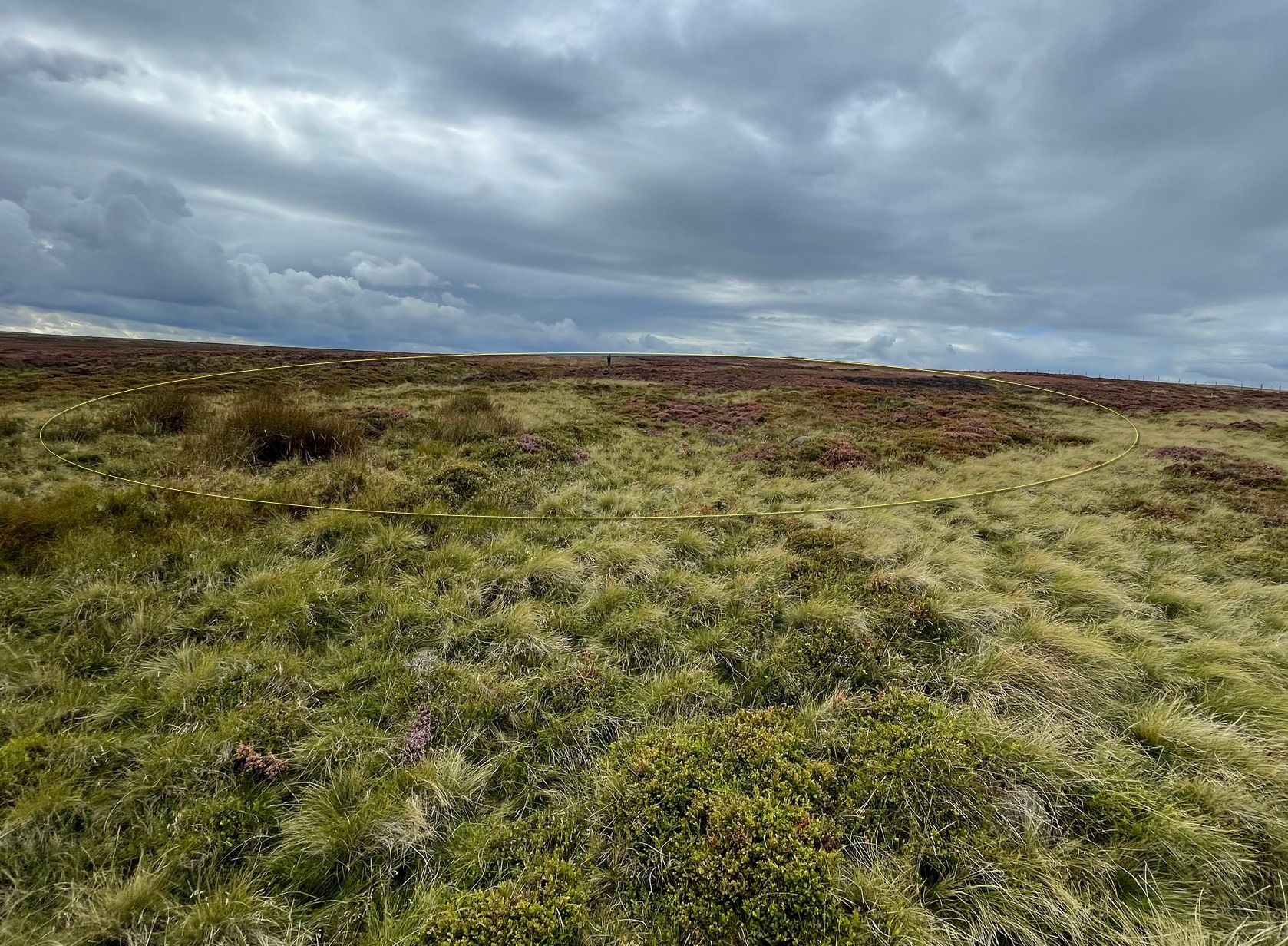
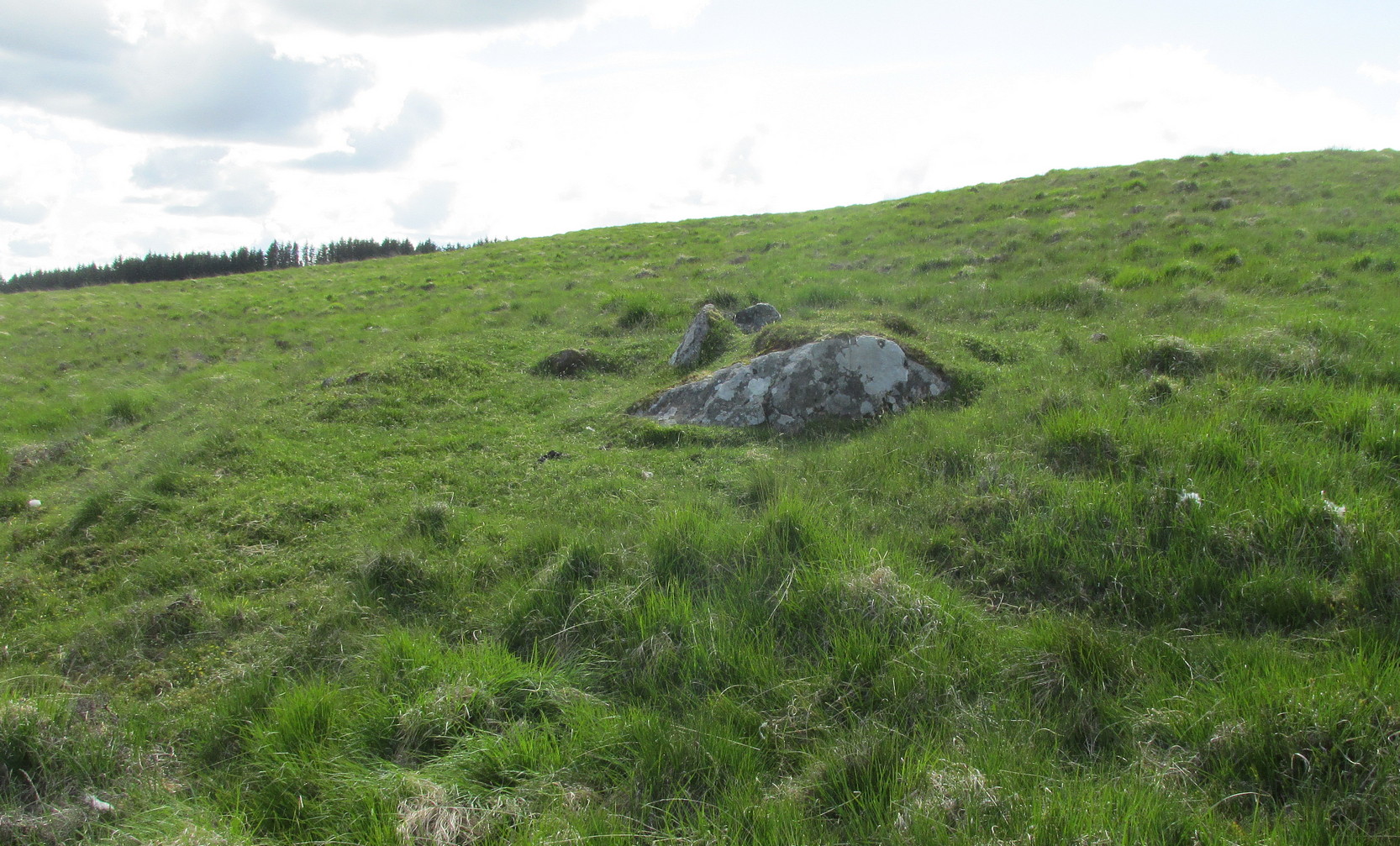
Track running into the ring
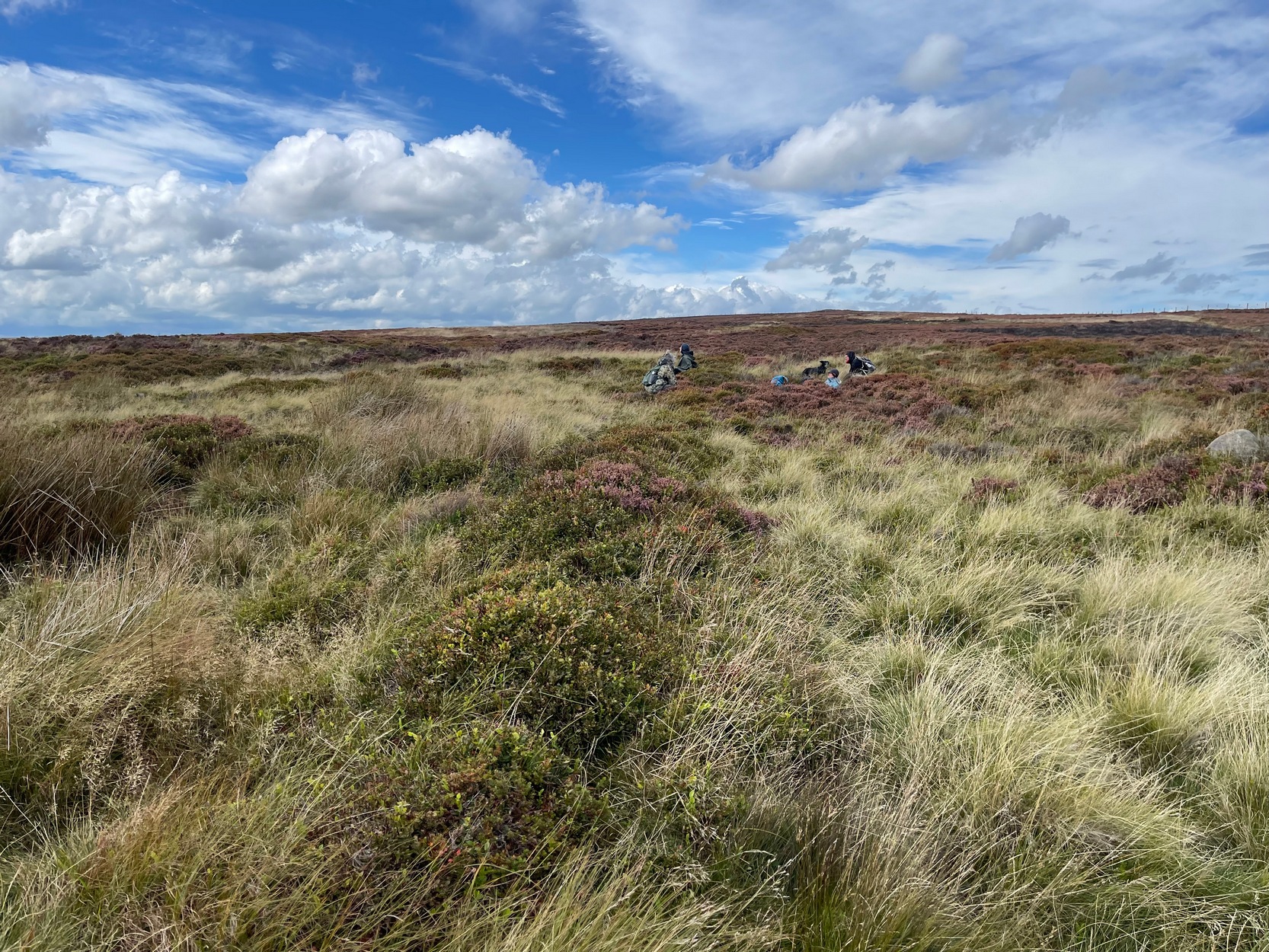
Raised line into the ring

Internally, there seems little evidence of a burial — although our recent visits here, as the photos indicate, took place when the moorland vegetation was deep and covered almost the entire site.  The outline of the site is obviously visible, even in deep heather, but the smaller details remain hidden.  But in addition to the main ring, another very distinct ingredient here is the existence of an extended length of man-made parallel walling, probably a trackway, that runs into the circle from the southeast all the way through the circle and out the other side and then continuing northwest heading roughly towards the Great Skirtful giant cairn on the horizon 500 yards to the northwest.
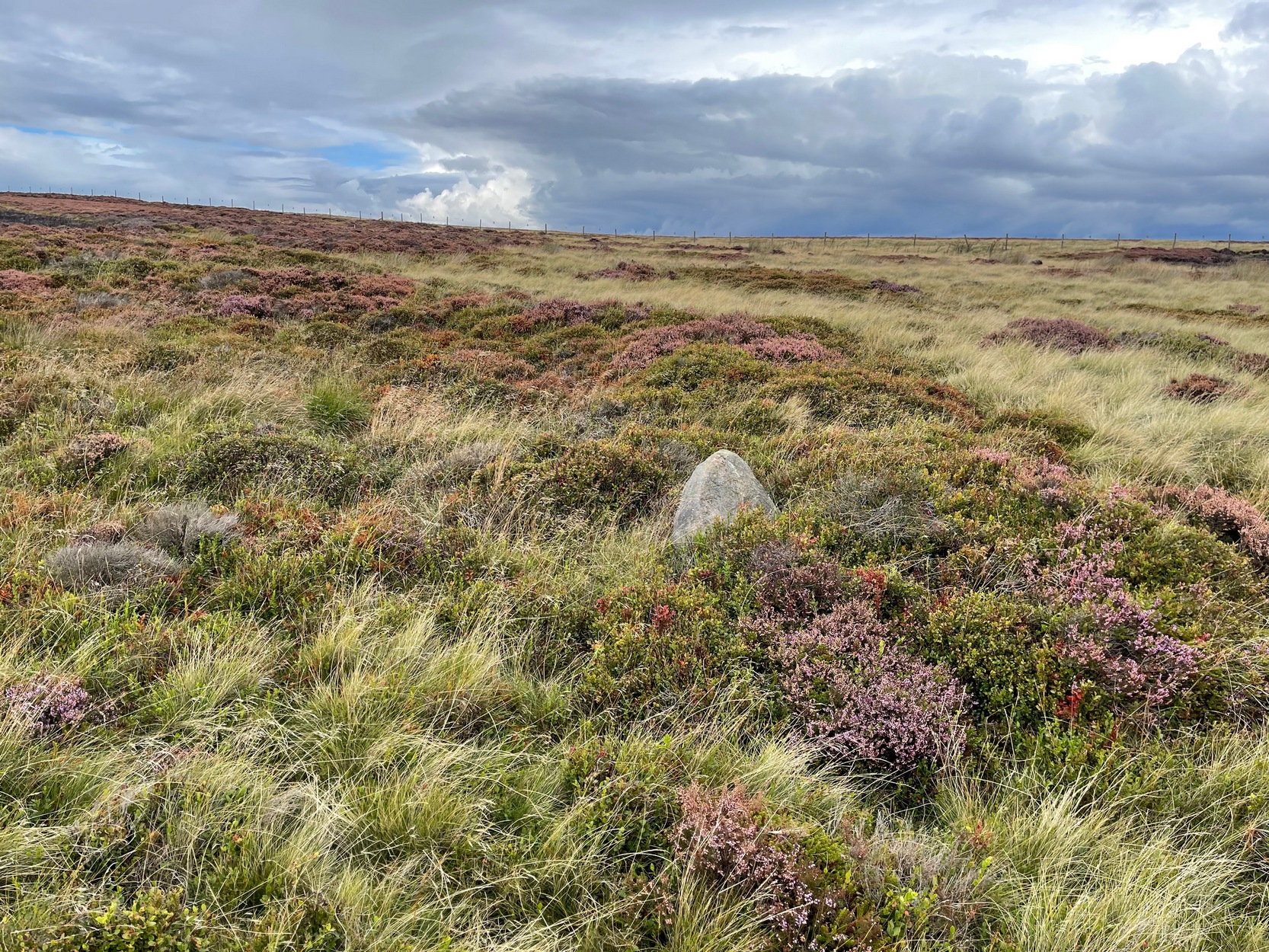
Stone at NE arc of walling

Due to the landscape being so overgrown, it’s difficult to ascertain where this ‘trackway’ begins and ends.  Added to this, we find that there are additional ‘trackways’ that run roughly parallel to the one that runs through the circle—and these ‘trackways’ are very old indeed, some of them likely have their origins way back in prehistory.  The one that runs through the middle of this ring cairn may be a ceremonial pathway along which, perhaps, our ancestors carried their dead.  If we follow it out from here and keep walking along the track 300 yards to the southeast, we eventually run right to the edge of the Craven Hall (3) circle.  Parallel to this is another ancient trackway that runs northwest to the edge of the Roms Law circle.  It seems very much as if we have ceremonial trackways linking sites to each other: ancestral pathways, so to speak.

Have a gander at this when you’re next in the area.  There are many other sites nearby that are off the archaeological radar.  In recent years, a number of northern antiquarians wandering over this landscape are finding more and more ancient remains: walling, circles, cairns, trackways.  It’s a superb arena—but sadly, most of it is hidden beneath deep moorland vegetation.

References:

  1. Faull, M.L. & Moorhouse, S.A. (eds.), West Yorkshire: An Archaeological Guide to AD 1500 – volume 1, WYMCC: Wakefield 1981.

Acknowledgements:  Huge thanks for use of the Ordnance Survey map in this site profile, reproduced with the kind permission of the National Library of Scotland

© Paul BennettThe Northern Antiquarian
West Bracklinn, Callander, Perthshire

Chambered Cairn:  OS Grid Reference – NN 65017 09796

Also Known as:

  1. Tom Dubh

Getting Here

Ruins of Bracklinn cairn

Along the A84 road as you’re heading into Callander, just 300 yards before you reach the the Keltie Bridge caravan park, take the tiny road on your left (north) and barely 100 yards along where a small crossroads can be said to exist, go straight forward up the tiny single-track road ahead of you.  Keep all the way up for a mile until you reach Bracklinn Farm (when you meet a split in the road, keep left – and make sure you have parked way further down track of here).  Walk up the track past Bracklinn Farm for just over a mile (1.85km), until where the track and the large burn runs roughly alongside each other (past the small Eas Uilleam cairn up to your right) and go through the gate.  From here, go immediately left (SW) and walk alongside the dead straight fence for just over 300 yards, then slowly zigzag up the sloping hill.  If you reach the derelict walling, you’ve gone too far.

Archaeology & History

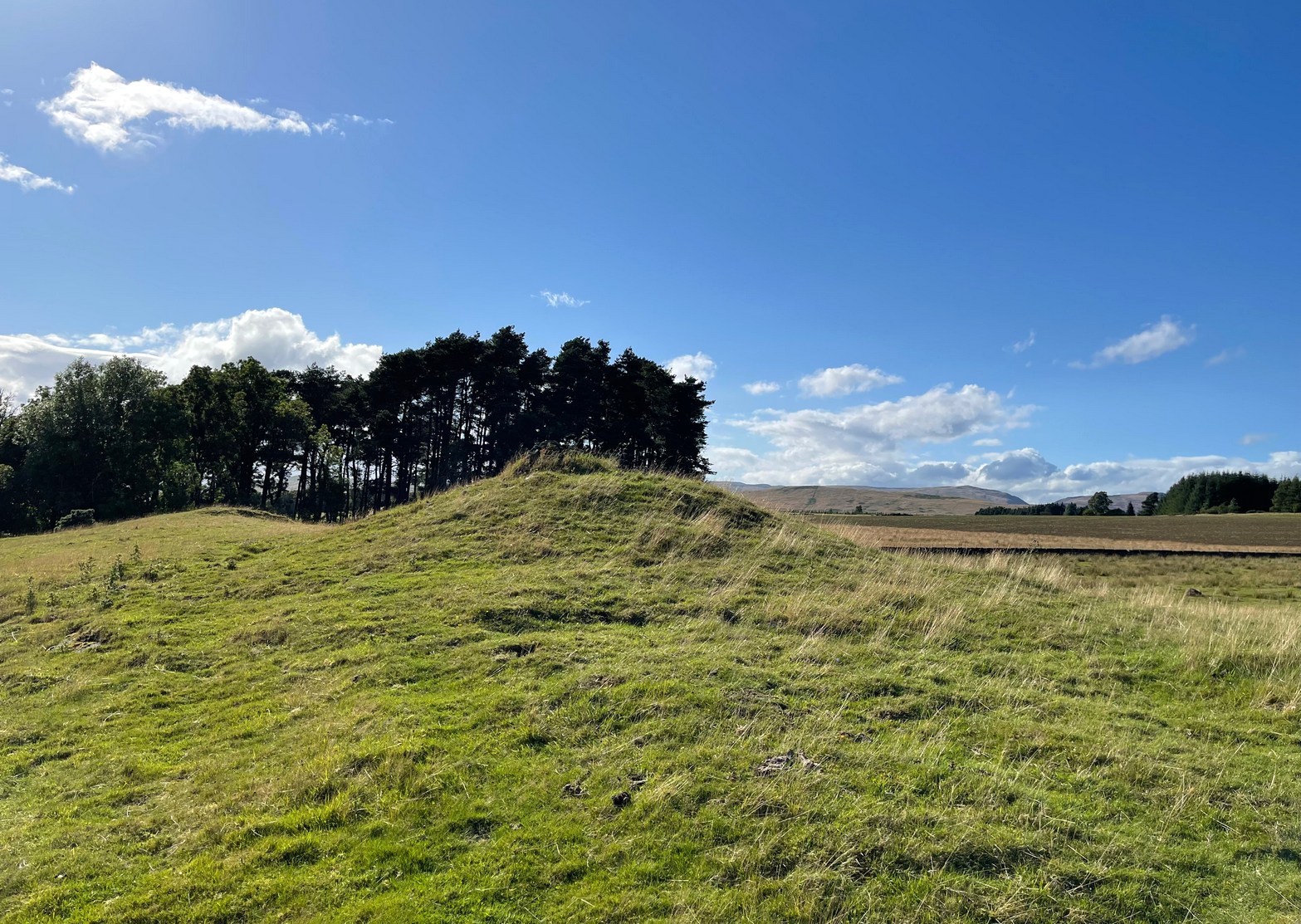
West Bracklinn from below

For a site marked as ‘Chambered Cairn’ on the OS-maps, you might be expecting a little bit more when you get here.  Sadly, it’s not what it once was.  Much of the covering stones from the cairn have been severely robbed and obviously used in the old and curiously-named ruin of Bothan na Plaighe below, and the large sheep-fold structures barely 50 yards to the north.  All that’s really left to see here is the internal chamber, aligned roughly east-west, which seems to have originally been split into two sections.  The remaining overgrown edges of the monument, barely two feet high at the most, measures roughly 8 yards by 9 yards, but is much denuded and can really only be noticed when you’re almost stood on top of it!

The landscape reaching out from here takes the eyes way way into the distance along the fading horizon, from north-east to south-east.  This expansive view, this reaching landscape, may have been an important element in the placement of the tomb – and it’s certainly something to behold on a good day.  It might be a bit of a walk to get here, but if you want some good countryside, scenery and a bit of ancient history, this is one helluva good place to go!

References:

  1. Royal Commission Ancient & Historical Monuments of Scotland, Braes of Doune: An Archaeological Survey, RCAHMS: Edinburgh 1994.

Acknowledgements:  Huge thanks for use of the Ordnance Survey map in this site profile, reproduced with the kind permission of the National Library of Scotland

© Paul BennettThe Northern Antiquarian
Black Park (3), Callander, Perthshire

Cairn:  OS Grid Reference – NN 66885 07447

Getting Here

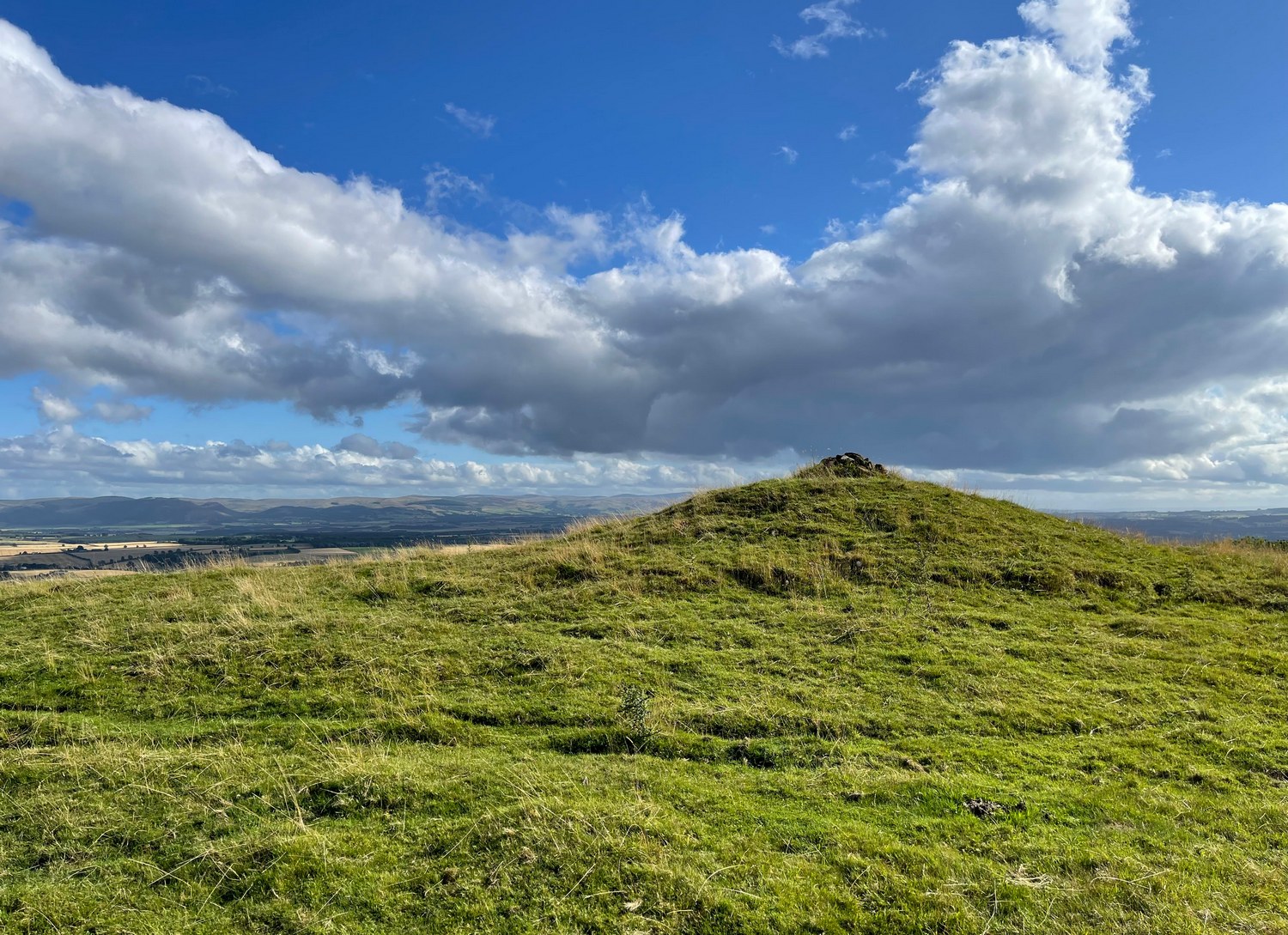
Low-lying Black Park (3)

From Callander head east along the main A84 road and nearly 300 yards past the entrance to the Keltie Bridge caravan park, take the tiny road on your left (north) and barely 100 yards along turn right and go up here for exactly 1 mile.  Walk up the track from here and follow the directions to find the Black Park (1) cairn; and then the nearby small Black Park (2) cairn.  From here you need to walk north-east round the small rounded hillock in front of you, and cross a small burn (stream) up to the next small grassy rise.  Altogether this is about 200 yards from the Black Park (2) cairn.  On this grassy rise lives the Black Park (3) cairn!

Archaeology & History

As with its compatriot Black Park (2) cairn 200 yards southwest, this can be hard to see.  It’s an overgrown small singular cairn (it looks like a tumulus now) of no great note to look at: probably the resting spot of an individual or just a small family.  Measuring some 5-6 yards across and less than a yard high at the most, its easily missed unless you’re really mean to find it. More impressive are the ones on the hill immediately above you to the east.  Head there next!

References:

  1. Royal Commission Ancient & Historical Monuments, Scotland, Braes of Doune: An Archaeological Survey, RCAHMS: Edinburgh 1994.

© Paul BennettThe Northern Antiquarian
Black Park (2), Callander, Perthshire

Cairn:  OS Grid Reference – NN 6672 0735

Getting Here

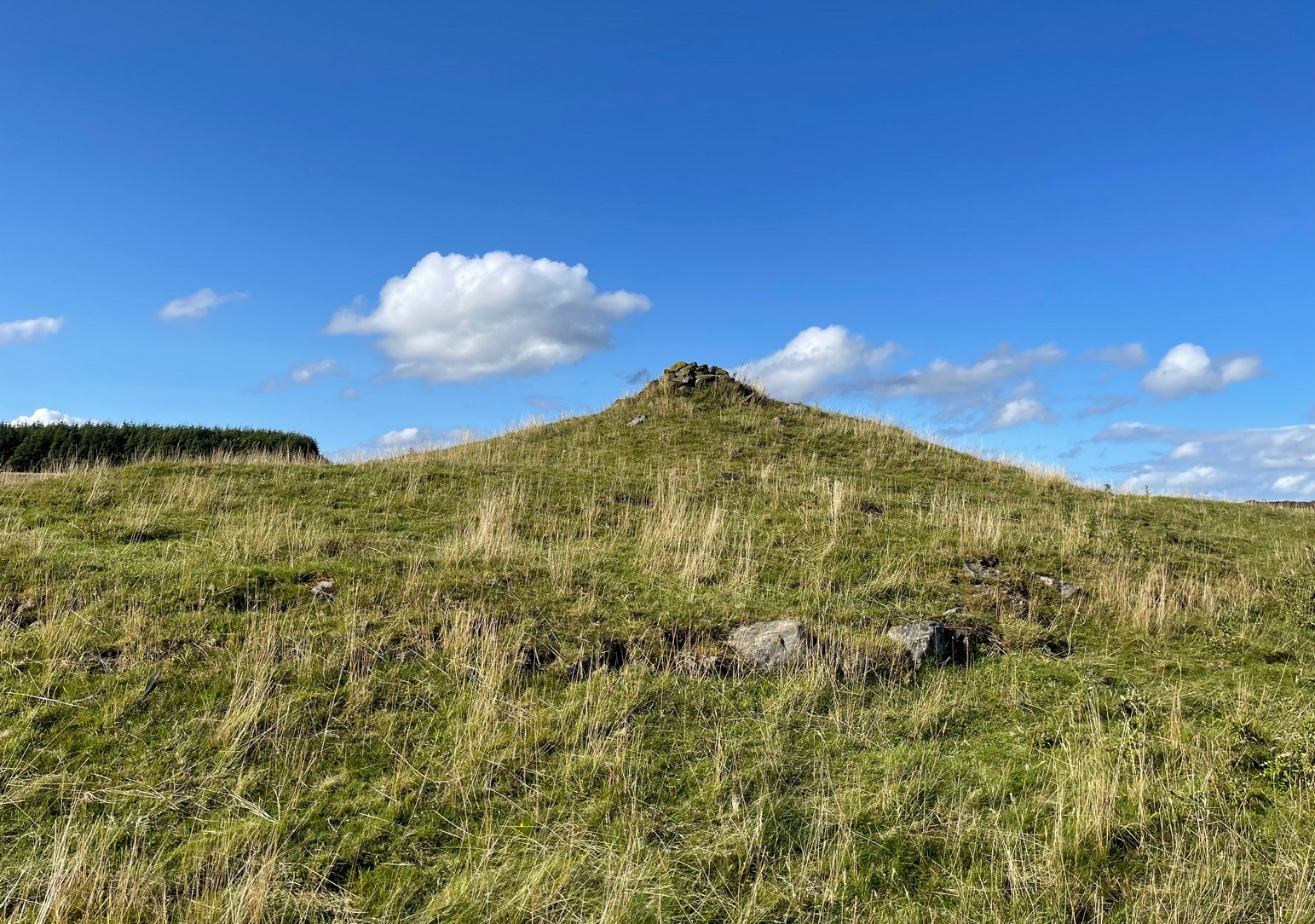
Black Park (2) cairn

Take the same directions as if you’re going to visit the large Black Park (1) cairn, and from here look down the slight boggy slope to your right (east) and, across the other side of a small burn (stream) you’ll see a slightly raised grassy knoll.  A curved dyke is to its left (west) side.  You’re there!

Archaeology & History

This small cairn, barely two feet high at the most, and five yards across, is deemed as a possible Bronze Age cairn on Canmore and in the Royal Commission (1994) report of the area.  There is certainly a pile of small stones here, but it may be a clearance cairn (I hope I’m wrong).  Only an excavation will tell us for sure.

References:

  1. Royal Commission Ancient & Historical Monuments, Scotland, Braes of Doune: An Archaeological Survey, RCAHMS: Edinburgh 1994.

© Paul BennettThe Northern Antiquarian
Black Park (1), Callander, Perthshire

Cairn:  OS Grid Reference – NN 66612 07349

Also Known as:

  1. Black Wood
  2. Sruth Geal

Getting Here

Black Park (1) cairn, looking south

Less than a mile east of Callander on the main A84 road, nearly 300 yards past the entrance to the Keltie Bridge caravan park, take the tiny road on your left (north) and barely 100 yards along turn right and go up here for excatly 1 mile (give or take a few yeards) where  track goes into the forest on your left and you can park-up here.  Walk up the track into the silence for just under a mile where, as the track splits and you kink to the right, a gate appears.  On the other side of the gate, turn immediately left, almost walking back on yourself, just above the curving waters of a burn, through boggy reeds, keeping to the fence-line until, less than 300 yards along, you’ll reach what you’re looking for.

Archaeology & History

Black Park (1), looking W

This reasonably large cairn and its neighbours (Black Park [2], [3], [4] and [5]) would appear to be relatively new discoveries as I can find nothing about it prior to the Royal Commission’s 1994 survey.  They are even absent from Moray MacKay’s (1953) excellent work on the area!  Hence, descriptions of it are scant and visitors to the place are few indeed (we did meet a local who knew about the old tomb, but said that nothing was known about it); but it is, nonetheless, a fine, albeit denuded and very overgrown cairn, living today amidst a quiet mass of reeds and surrounded by boggy ground—so make sure you’ve got your boots on!

Internal line of stonework
Black Park (1), looking SE

At its height, today, it stands less than four feet tall and measures roughly 16 yards across at its widest.  Through one section of the tomb there runs a raised line of stonework that almost looks like internal walling, which may have been where a chamber once existed.  It’s been hollowed out by someone in the not-too-distant past but, as I said, there are no records of such a thing, so whether or not that was a chamber or merely a fortuituous collapse of stone in a straight line, we can’t really say.  Along its more northern edges there seems to be a small raised wall of stone defining its edge, although once again it requires a more discerning examination to work out whether this is part of its original facade, or is a result of some of the stone mass falling to the edges.

Visit the old place and sit with its silence for a while…

References:

  1. Royal Commission Ancient & Historical Monuments, Scotland, Braes of Doune: An Archaeological Survey, RCAHMS: Edinburgh 1994.

© Paul BennettThe Northern Antiquarian
Ossian’s Cairn, Fowlis Wester, Perthshire

Cairn:  OS Grid Reference – NN 88987 30186

Also Known as:

  1. Jock’s Cairn

Getting Here

Cairn on the distant peak

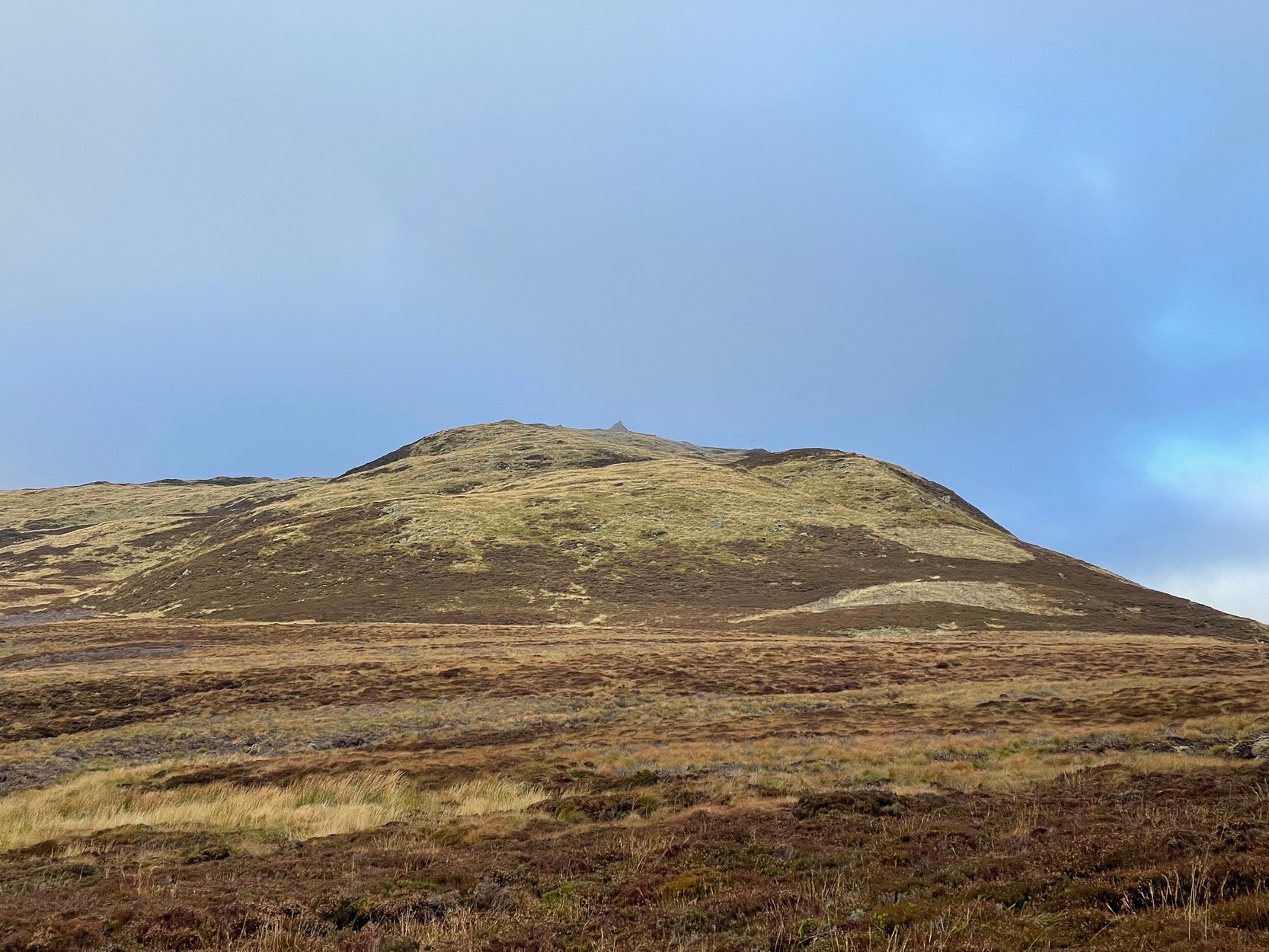
Make a day out for this one!  You could, of course, go barely half-a-mile straight up the hill (southwest) from Ossian’s Stone in the Sma’ Glen below – but it’s steep as fuck and I know that most of you wouldn’t do it.  So, park-up and take the gradual 3 mile walk into the mountains.  Coming via Crieff, along the A85 road east, turn left up the A822 Dunkeld road at Gilmerton.  2½ miles on, you reach the Foulford golf course on the right-hand side of the road, whilst directly across the road a dirt-track leads you into the fields, past the large Foulford cup-and-ring stone.  Keep along this track, bearing right just before Connochan Lodge and follow this dirt-track uphill on and on for another 2 miles where you’ll eventually see the cairn-peak in the distance. Another shallow track leads uphill after about 2 miles: we walked up to where the ground levels out, walked across the dodgy swamp-land and up again to the tomb. It’s well worth it!

Archaeology & History

Visible for many miles round here from the surrounding hills, this somewhat mutilated giant cairn, highlighted on the earliest Ordnance Survey map of the area in 1867, hasn’t fared well in archaeology tomes.  Apart from a passing note in Margaret Stewart’s (1966) summary article on prehistoric remains in central Perthshire—where she erroneously told it to be 400 feet lower down that it actually is—almost nothing has been said of this place.  Most odd.

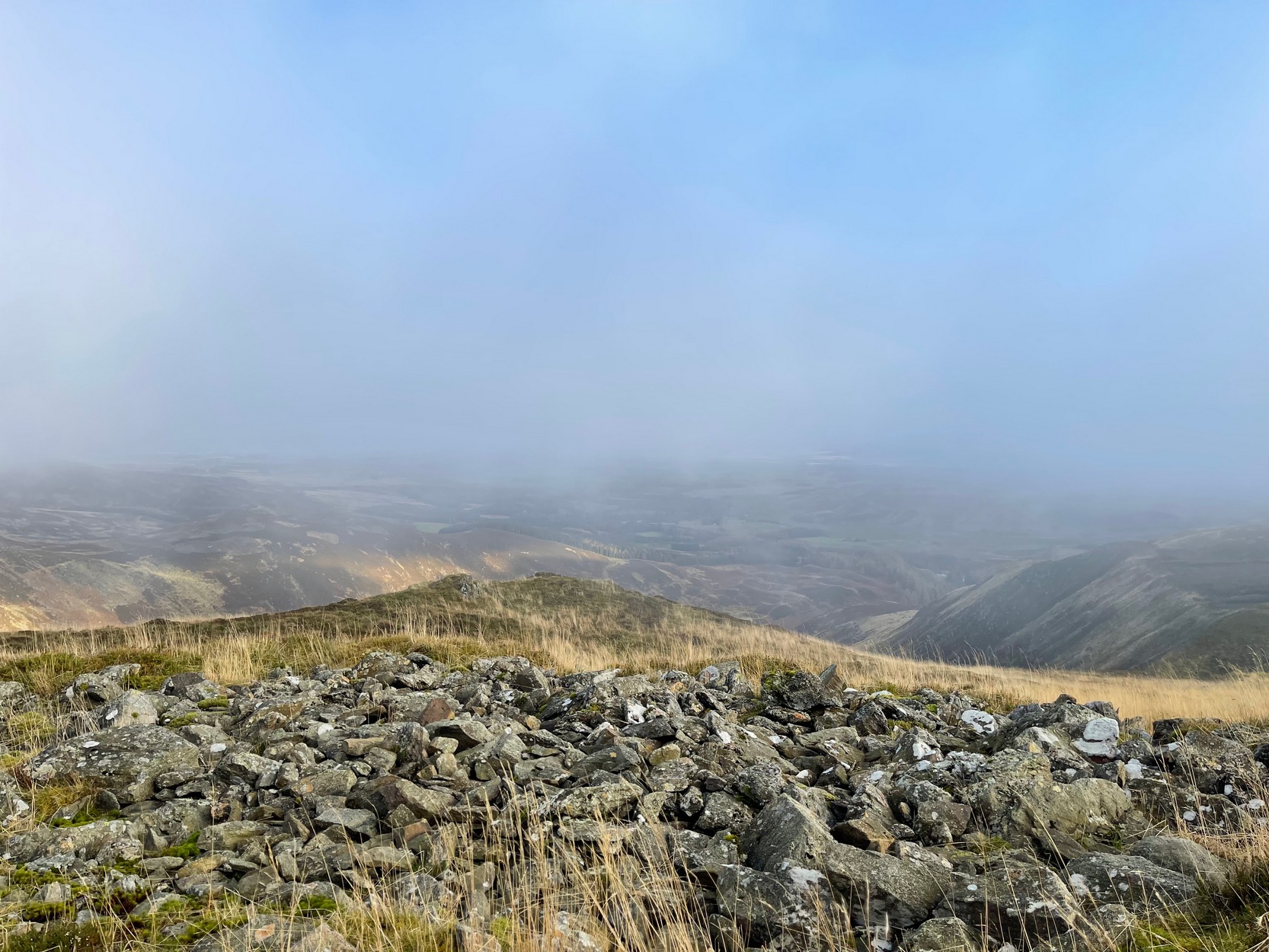
Cairn spoil, looking SE
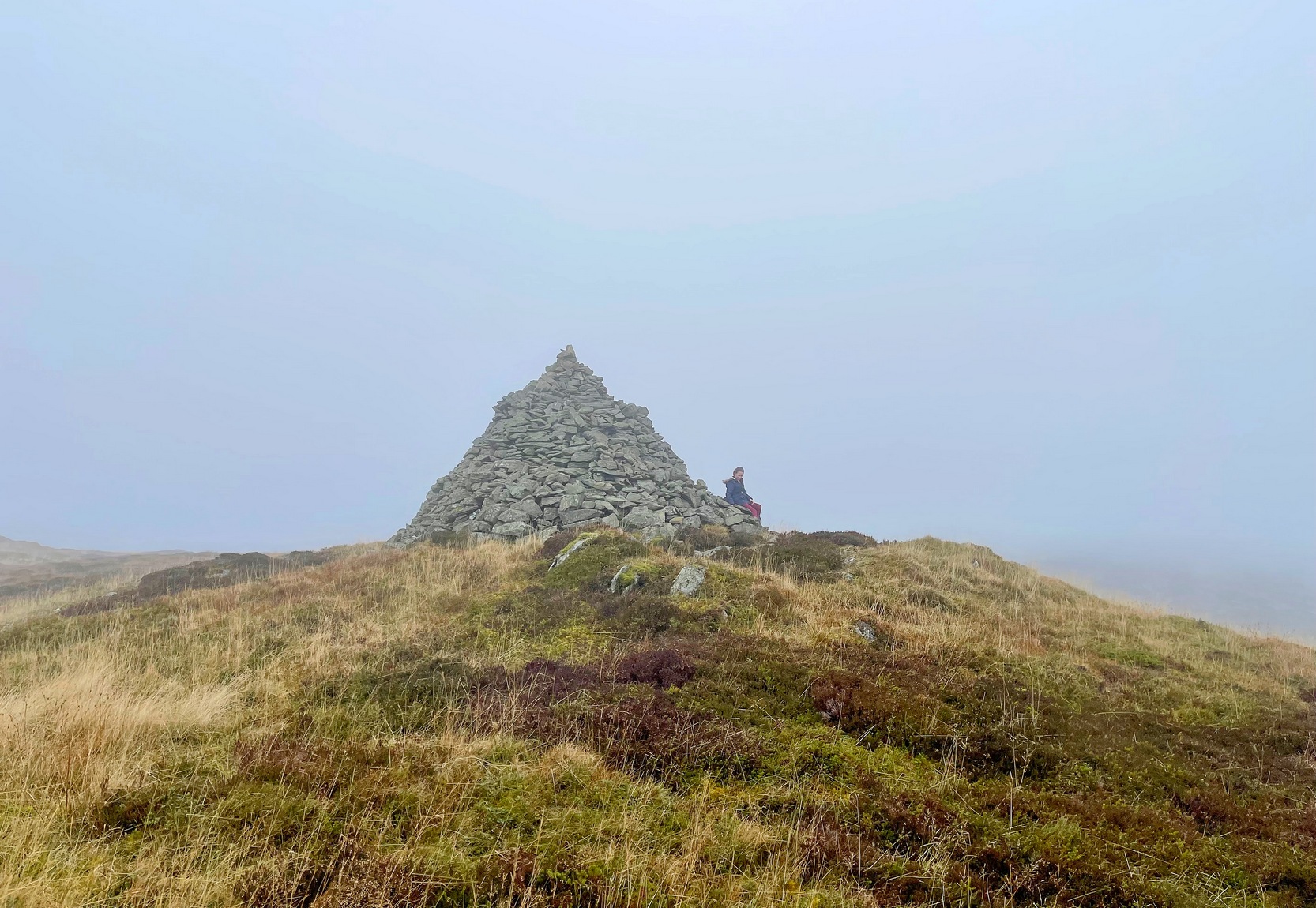
New cairn atop of the old

Despite it being ransacked over the centuries, it was obviously of some considerable size in its early days.  Today, surmounting it, is a very large walker’s cairn which, no doubt, has accrued some of its own foundations from the prehistoric tomb on which it sits.  To the side of this recent cairn, another one is growing, thanks to stones brought from near and not-too-far.  But the original creation can still be seen in outline and mass all around.  Indeed, as you walk all round the modern cairn, you’re walking over much of the early collapsed stonework sleeping gently beneath the moorland vegetation, and once you walk away and below the cairn mass itself, looking back up at it you’ll notice the very ancient raised plinth of stone on which our modern one now lives.

Low walling on NW side

Its amorphous shape is somewhat amoeboid, measuring more than 22 yards across east-west, by 15 yards north-south, with a curious arc of low walling, very old indeed, on its northwestern side.  Whether this walling outlines the original edge of the tomb, only an excavation will tell.  The most notable remaining mass of ancient cairn material reaches out on its south-east to eastern edges, where some of it is beginning to fall away down the edge of the mountain slope.

Folklore

Local tradition assigns this cairn to be where the bones of the great hero-figure Ossian was removed to, when they were disturbed by the unruly mob of General Wade and his cohorts in the middle of the 18th century. Notes of the event were written at the time by one of Wade’s mob, a Captain Edward Burt, who told,

“the Highlanders, they assembled from distant parts, and having formed themselves into a body, they carefully gathered up the relics, and marched with them, in solemn procession, to a new place of burial, and there discharged their fire-arms over the grave, as supposing the deceased had been a military officer.”

This was essential, said Burt, as

Site shown on 1867 map
New cairn on old, looking W

“they (the Highlanders) firmly believe that if a dead body should be known to lie above ground, or be disinterred by malice, or the accidents of torrents of water, &c. and care was not immediately taken to perform to it the proper rites, then there would arise such storms and tempests as would destroy their corn, blow away their huts, and all sorts of other mis-fortunes would follow till that duty was performed.  You may here recollect what I told you so long ago, of the great regard the Highlanders have for the remains of their dead…”

Oral tradition tells us that this cairn, high above Ossian’s Stone, is where the rites occurred.  It makes sense too.

References:

  1. Finlayson, Andrew, The Stones of Strathearn, One Tree Island: Comrie 2010.
  2. Stewart, M.E.C., “Strathtay in the Second Millenium BC“, in Proceedings of the Society of Antiquaries, Scotland, volume 92, 1961.

Acknowledgements:  Huge thanks for use of the Ordnance Survey map in this site profile, reproduced with the kind permission of the National Library of Scotland

© Paul BennettThe Northern Antiquarian

Seat Knowe, Fowlis Wester, Perthshire

Cairn:  OS Grid Reference – NN 93616 24689

Also Known as:

  1. Blairmore
  2. Murray’s Hill Wood

Getting Here

Seat Knowe, looking south

You need to hit the village of Fowlis Wester, which is easiest to approach from both east and west along the A85, between Crieff and Perth: nearly 3 miles east of Gilmerton and about 6½ mile west of Methven. Keep your eyes peeled and take the road up (north) where the large rounded tree-covered tumulus stands and up to the village.  Go through the village and uphill for literally ½ a mile (veering sharp left at a junction) where a gate on your right leads into the fields. (a large parking spot is 300 yards further uphill)  Walk ¼-mile east and through the other side of the small woodland, over the fence, you’ll see the mound of a typical tumulus.  That’s it!

Archaeology & History

If you’re going to visit the megalithic remains of Fowlis Wester ¾-miles to the west, the antiquarians amongst you might as well give this old burial mound your attention too.  It’s not grandiose by any means, but its position in the landscape is quite superb.  It’s built upon a long geological promontory with extensive views that reach from south-east to south to south-west for many miles into the distance with the Ochils framing the majority of the southern horizon, but also with the notable pap of the West Lomond hill 20 miles to the south-east mimicking the shape of the tomb itself.  It was obviously built here with the extended landscape having some ancestral importance. Visit it and see for yourself!

Despite being a notable mound, this tumulus-cum-cairn only seems to have been written about for the first time as recently as 1998, when archaeologist Ian Armit visited the site.  Roughly circular in form, it’s about 12 yards across and more than six feet in height.  A small pile of stones crowns the very top, placed here in much more recent times.  At ground level on its northern side, an arc of low lying stones define the edge of the tomb.  The stones probably continue all the way round the entire structure, but it’s overgrown by centuries of soil and vegetation and we lose sight of it as we walk round.  When Mr Armit (1998) wrote about the site, he and colleague wrote:

Seat Knowe, looking NW
Seat Knowe, looking north

“A grassed-over stony cairn lies on the highest point of Seat Knowe, a ridge commanding extensive views to the south.  The cairn has a diameter of c.10m and is up to 2m high.  A modern cairn occupies it summit.  The low turf foundations of a rectilinear structure, some 6 x 8m, occupy its south flank, and thee are extensive cultivation and field system remains in the vicinity.”

Check it out!  You won’t be disappointed.

Folklore

An interesting piece of relatively recent folklore about Seat Knowe, described in the Perthshire Name Book around 1862, told that,

“One of the Earls of Strathearn, desirous of having a church in the vicinity of his Castle, stood on an eminence, on which he had a summer seat, and resolved to erect it where the sun first shone, which was on the spot where it now stands.”

References:

  1. Armit, Ian & Hall, M., “Seat Knowe (Fowlis Wester parish): Cairn,” in Discovery & Excavation Scotland, 1998.

© Paul BennettThe Northern Antiquarian

Cat Nab, Brotton, North Yorkshire

Tumulus (destroyed):  OS Grid Reference – NZ 6692 2154

Archaeology & History

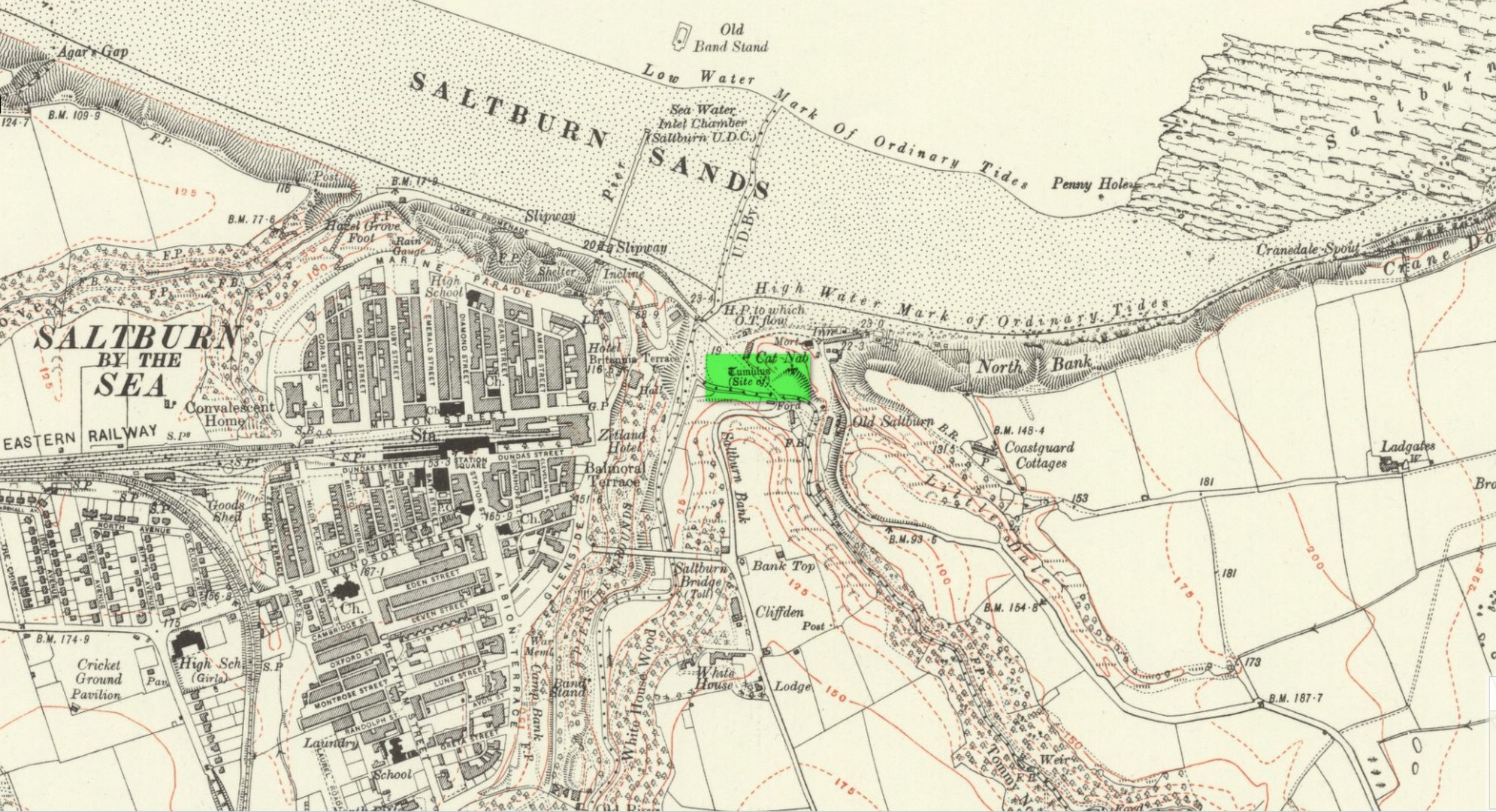
Location on 1930 OS-map

This long lost burial mound was first located by the local antiquarian William Hornsby in the early 20th century.  It had been constructed close to the summit of the prominent rise  of Cat Nab, immediately east above Saltburn.  Its position was shown on the 1930 OS-map of the area.  Destroyed by quarrying, it was thankfully excavated by Hornsby in 1913; and although his finds were never published, he left notes which told us that,

“there were two cremations and the sherds of at least three vessels: a collared urn, a pygmy cup and a vessel with an everted rim.” (Crawford 1980)

Crawford (1980) told that these finds could been seen in the Middlesborough Collection.

References:

  1. Crawford, G.M., Bronze Age Burial Mounds in Cleveland, Cleveland County Council 1980.

Acknowledgements:  Huge thanks for use of the Ordnance Survey map in this site profile, reproduced with the kind permission of the National Library of Scotland

© Paul BennettThe Northern Antiquarian


Way Hagg, West Ayton Moor, North Yorkshire

Cup-Marked Stones (lost):  OS Grid Reference – SE 9657 8840

Archaeology & History

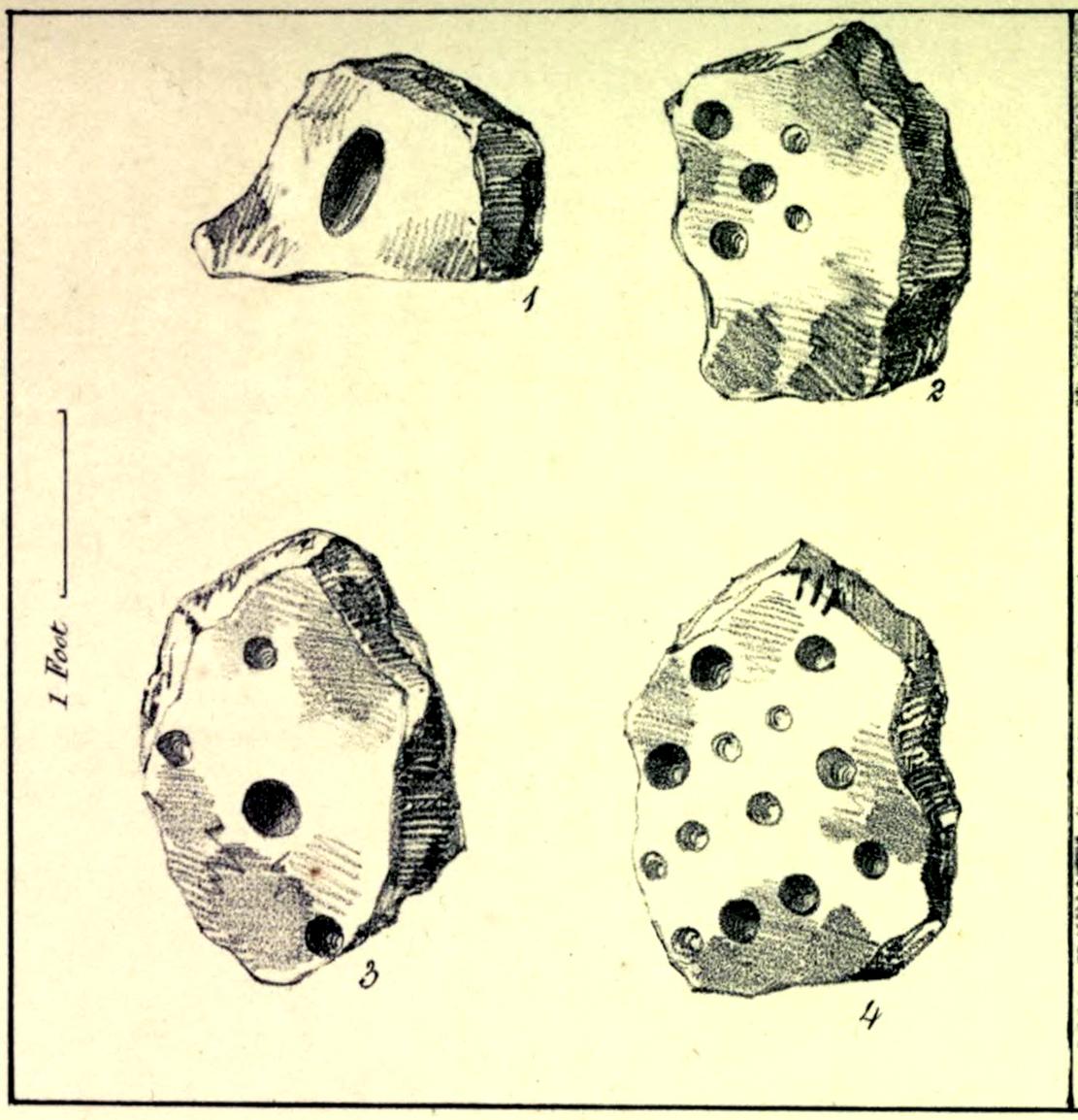
In the autumn of 1848, antiquarian John Tissiman (1850) and his associates took to uncovering two burial mounds amidst a large cluster of them on the eastern edge of West Ayton Moor.  This one at Way Hagg was quite a big fella, measuring 36 yards across.  When they cut into its northern edge towards the centre, 8-10 feet in, they came across an upright stone, nearly two feet high, on which five cup-marks had been cut. (see sketch, no.2)  Slightly beyond this were three other stones (in sketch, nos.1, 3 & 4), each with cup-marks on them, beneath which was a tall urn.  Whether or not the carvings had been deliberately positioned to cover the urn, we do not know. Nonetheless, we can be reasonably assured that these petroglyphs had some mythic association with death when they were placed here.

Tissiman gave us the following detailed measurements of the respective carvings:

1: Nearly even surface. Length, from 16 to 18 inches; breadth, 10 to 20 ditto; depth, 8 to 9 ditto; with large oval hole cut in the centre, 7½ inches long, 4 inches broad, and 3½ inches in depth.  On the opposite side are three holes, from 2 to 3 inches in diameter, and from 1 inch to 1½ deep.  2: Uneven surface. Length, 23 inches; breadth, 14 inches; depth, 13 inches; with five holes, from l½ to 3½ inches in diameter, and 1 to 1½ inches in depth.  3: Uneven surface. Length, 33 inches; breadth, 22 inches; depth, 10 inches, with four holes, the largest being 4½ inches in diameter and 3 inches deep; the others, from 1½ inches to 2 inches in diameter, and 1 to 1½ inches deep.  4: Uneven surface. Length, 27 inches; breadth, 23½ inches; depth, 10 inches, with 13 holes, from 1½ inches to 5 inches in diameter, and ¾ of an inch to 3 inches in depth; also three lines at the end of the stone.”

The carvings were included in Brown & Chappell’s (2005) fine survey, but they weren’t able to find out what happened to them after Tissiman’s excavation. They remain lost.  If anyone has any information as to where they might be, please let us know.

References:

  1. Brown, Paul & Chappell, Graeme, Prehistoric Rock Art in the North York Moors, Tempus: Stroud 2005.
  2. Tissiman, John, “Report on Excavations in Barrows, in Yorkshire,” in Journal British Archaeological Association, April 1850.

Acknowledgements:  Huge thanks for use of the Ordnance Survey map in this site profile, reproduced with the kind permission of the National Library of Scotland

© Paul BennettThe Northern Antiquarian

Chalkwell Hall, Southend-on-Sea, Essex

Tumulus (destroyed):  OS Grid Reference – TQ 861 862

Archaeology & History

Somewhere beneath the modern housing estate immediately east of Chalkwell Park was once a large prehistoric burial mound.  It was included in Wymer & Brown’s (1995) archaeological gazetteer (albeit at the wrong spot) without comment, but their reference led me to an early description of the place by Philip Benton (1867) whose description gave us the best info we have of the place.  He wrote:

“To the east of the present mansion, at the north-west comer of a field called Fishponds, is a tumulus or mound, probably Celtic.  This was first opened about thirty years ago, when bones, a few coins, and a piece of chain were discovered.  Since which period about eight feet of earth has been removed from the summit, when more bones were found, but as they were not inspected by any one competent to give an opinion, it is impossible to say whether they were those of man or beast.  The mound is still about four feet above the surrounding soil, and would probably repay further search.”

Wymer and Brown listed the site as being an “early Bronze Age” monument.

References:

  1. Benton, Philip, The History of Rochford Hundred – volume 2, Harrington: Rochford 1867.
  2. Wymer, J.J. & Brown, N.R., Excavations at North Shoebury, East Anglian Archaeology: Chelmsford 1995.

© Paul BennettThe Northern Antiquarian