Slaughter’s Well, Lechlade-on Thames, Gloucestershire

Healing Well (destroyed):  OS Grid Reference – SU 215 995

Archaeology & History

Not listed in the field-name surveys of the town, the name Slaughter Well was obviously a folk-name given to it by local people.  The place was mentioned in an unpublished manuscript that Adin Williams’ (1888) managed to lay his hands on, where it was mentioned in relation to the missing pyramidal Market Cross.  Its waters were “said to be medicinal.”  The name of the well was said to derive from a battle here between Oliver Cromwell’s men and the Royalists.  At this place,

“an officer was shot, and this incident gave the name ‘Slaughter’ to the well.”

References:

  1. Williams, Adin, Lechlade: Being the History of the Town, Manor and Estates, The Priory and the Church, E.W. Savory: Cirencester 1888.

© Paul BennettThe Northern Antiquarian

Lady Well, Dundee, Angus

Holy Well (destroyed):  OS Grid Reference – NO 4026 3072

Also Known as:

  1. Ladies Well
  2. Our Lady’s Well

Archaeology & History

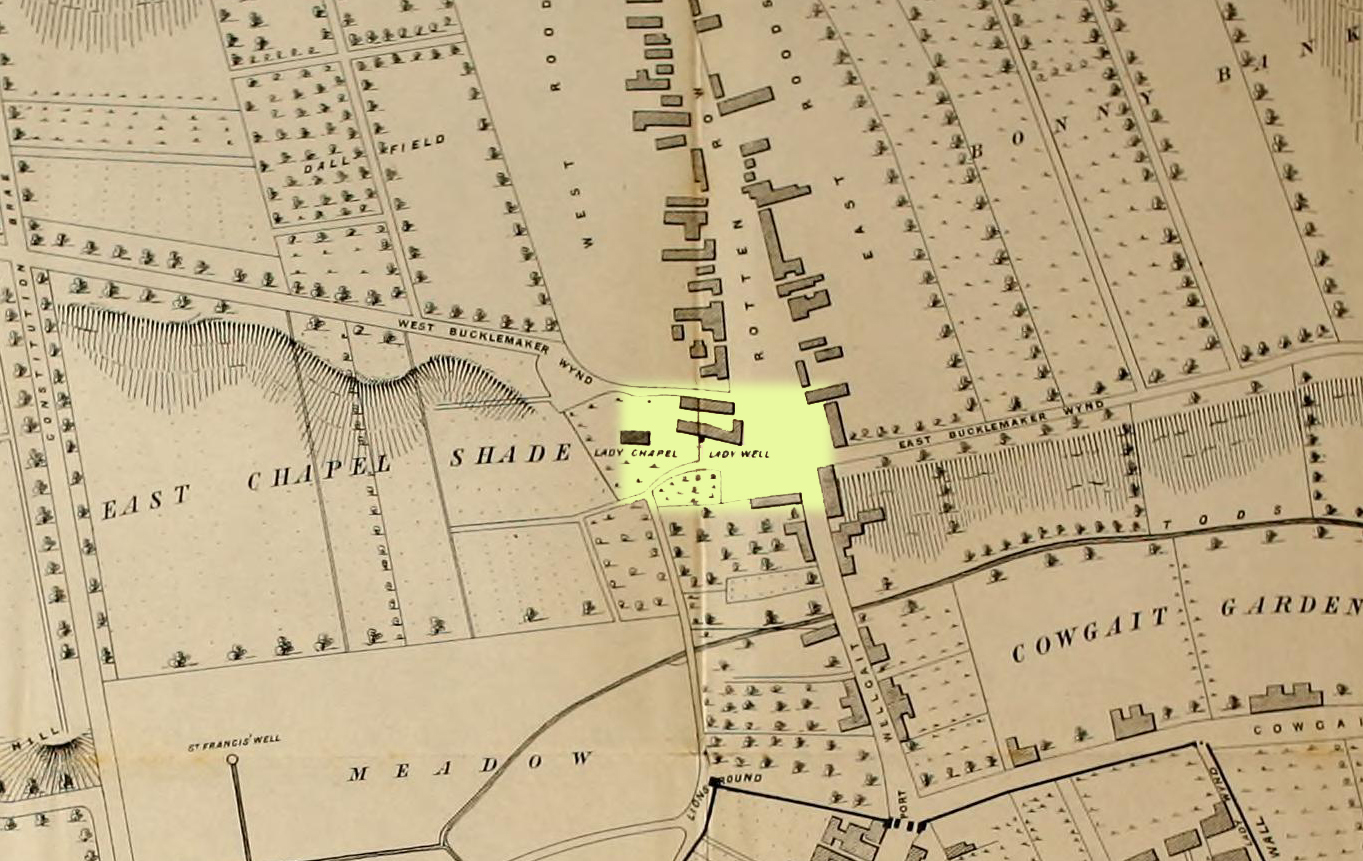
Lady Well on 1776 map

One of at least five sacred wells (see also St Francis’s Well, the Nine Wells, St Clement’s WellSt Mary’s Well and Sinavey Well) that could once be visited in Dundee: like its compatriots they have all fallen under the hammer of the Industrialists and flow no more.  Our Lady’s Well could once be seen near the ancient Chapel of our Lady, “flowing from under the Chapelshade Braes,” said Maxwell (1884), its waters “bright and sparkling,” but today it has been drained and laid to rest beneath the road.  Its memory however, has been preserved in the modern place-names of the Ladywell Roundabout and the nearby Ladywell Avenue.

The well was mentioned as far back as 1409 when, as Alex Lamb (1895) found, it was referred to in a contract between the Constable of Dundee and the burgesses.  It flowed freely until the beginning of the 18th century when, as Maxwell told us, “the water from the Lady well was impounded and conveyed in pipes for supplying other cisterns throughout the town.”  Nicoll (1923) thought there may have been a well-house built around it.  Previously, the water from here was one of many springs and burns that fed the larger Castle Burn down to the sea.

The generally approved idea that Lady Wells derive from St Mary was questioned in this instance in Colville’s (1822) survey, who thought, not unreasonably, that

“As a convent stood near the same place, it is more probable that it took the name of the Ladies-well, from the fair sisterhood, who must have been the guardians of it and of all the places near them.”

He may be right.  Colville also brought attention to a second water supply close by that seemed to be of equal importance in a pragmatic sense as the Lady Well herself.  In danger of being destroyed, the author brought attention to it and insisted on securing its survival.  He wrote:

“A little to the west, and adjoining to the Lady-well, is a large garden lying on a gentle declivity, called the Lady-well Yard,— in which there is a most abundant spring of excellent water, that was never known to fail in the driest summer, even when the Lady-well was so drained as not to afford supply to the inhabitants.  Should this be employed for a steam-engine in the present prosperous state of manufactures, a pit for the water would require to be sunk, which might materially injure the Lady- well.  It would certainly, therefore, be of advantage to the town, if the Magistrates could procure this property,— which would prevent the Lady- well being endangered; and the addition of this copious spring would at all seasons afford a plentiful supply of excellent water to the town.”

References:

  1. Colville, A., Dundee Delineated, A. Colville: Dundee 1822.
  2. Lamb, Alexander C., Dundee: Its Quaint and Historic Buildings, G. Petrie: Dundee 1895.
  3. Maxwell, Alexander, The History of Old Dundee, David Douglas: Edinburgh 1884.
  4. Nicoll, Alexander, The First History of Dundee, D. Winter: Dundee 1923.

© Paul BennettThe Northern Antiquarian

St. Mary’s Well, Dundee, Angus

Holy Well (lost):  OS Grid Reference – NO 401 301 (approximation)

Archaeology & History

Cited just once in the “Register of the Great Seal” (Registrum Magni Sigilli) in the year 1512 CE, this Fontis Beate Marie, or Well of St. Mary has long since disappeared.  Its exact location in the city has been forgotten, but it seems likely to have been close to St. Mary’s Church.  Further research is needed.

Links:

  1. Saints in Scottish Place-Names

© Paul BennettThe Northern Antiquarian

St. Clement’s Well, Dundee, Angus

Holy Well (destroyed):  OS Grid Reference – NO 4035 3024

Also Known as:

  1. Bishop’s Well
  2. Saint’s Well

Archaeology & History

One of at least five sacred wells (see also the Lady Well, the Nine Wells, St Francis’s WellSt Mary’s Well and Sinavey Well) that formerly existed in old Dundee, this one dedicated to St. Clement was associated with the ancient church, also of his name.  It could be found a short distance south of the church—itself long gone—”rising out of a knoll overhanging the river bank,” wrote Alexander Maxwell (1884) and possessing considerable renown to local people.  This great Dundee historian found several early references to it in old council registers: one of which, from 1589, described a conflict regarding the building of a school on land owned by Andro Renkyne.  And it was on this piece of land where St. Clement’s Well emerged.  The school was built and then Rankyne built a gable up to the edge of the school but, in doing so, cut off his own access to the holy well.  This somewhat short-sighted action of Renkyne’s was subsequently remedied in 1607 by Dundee Council.   Maxwell told us:

“The Council “grantit him licence to strike furth ane windok in the north side wall of his tenement in St. Clement’s kirkyard, near to the well in the schoolhouse closs, or within the bounds of the said well, to the effect he may draw water furth of the well to his awn service, with this provision that he hald the windok continually close, except at sic time as the water is drawn thereat, and that he close up the windok with stane wark quhenever he beis requirit.”

The waters—”reputed to have sovereign virtues”— were protected and covered by an old well-house.  When Alex Lamb (1895) came to write about it he told that it was of a circular form with “unmistakable traces of splendid workmanship.”  On its stone roof was what seemed to be a somewhat crude carving of a bishop and because of this it acquired the name “Bishop’s Well.”  Another title given it by some locals was the Saint’s Well.

In the middle of the 19th century the remains of the well-house could still be seen, albeit in a state of neglect between the school building and Renkeyne’s house.  But their end was nigh.  Maxwell continued:

“When the buildings were demolished a few years ago, the saint’s old well — its water yet pelucid and fresh — was discovered at the angle where the school joined to Andro’s house. Above it was the window which he struck furth for drawing water; but it had long before been built up and the purpose of it forgotten, and its curiously recessed position and uncouth masonry only served as a puzzle for ingenious antiquaries.”

Subsequently he lamented the demise of the well telling how it had “been covered over by the extension of the Townhouse.”

Folklore

Alexander Maxwell (1891) told how the church was used as a shrine by local people and fishermen, as St. Clement of Rome had been cast into the sea chained to an anchor and so became the patron saint of sailors.  He thought such properties, “would, no doubt, be in request for the supply of ships.”

St. Clement himself was a very early, first century saint, said to have died in 99 CE.  His festival date is 23 November.

References:

  1. Lamb, Alexander C., Dundee: Its Quaint and Historic Buildings, G. Petrie: Dundee 1895.
  2. Maxwell, Alexander, The History of Old Dundee, David Douglas: Edinburgh 1884.
  3. Maxwell, Alexander, Old Dundee, David Douglas: Edinburgh 1891.

Links:

  1. Canmore notes on St Clement’s Well

© Paul BennettThe Northern Antiquarian

Chalybeate Well, Blockley, Gloucestershire

Healing Well (destroyed):  OS Grid Reference – SP 166 350

Archaeology & History

This is one of several iron-bearing wells (chalybeates) that used exist in and around the village.  Mentioned briefly in Alfred Soden’s (1875) history of the parish, he told that,

“years ago, there were several chalybeate springs here, very strongly impregnated.  One of these was at the lower end of Westmacott’s Lane: of this spring there is now no visible trace, it having been built over.”

Although Mr Soden said nothing about the healing properties of this well, due to the mineral composition of chalybeates they always tend to be good fortifiers or pick-me-ups, being good for the blood.  And in this case, as the waters were “very strongly impregnated” they would have possessed some considerable local renown.

References:

  1. Soden, Alfred J., The History of Blockley, J.W. Parbury: Coventry 1875.

© Paul BennettThe Northern Antiquarian

Blind Well, Blockley, Gloucestershire

Healing Well (destroyed):  OS Grid Reference – SP 163 347

Archaeology & History

It would seem that there’s no longer any trace of a healing well of some renown that once existed on the south side of Blockley village.  It is mentioned briefly in Alfred Soden’s (1875) history of the parish, where he wrote:

“At the back of what is called “Bath Orchard,” now belonging to Mr. John Herbert, there was a well called “Blind Well;” the medicinal properties of the water being considered to be remedial in cases of weak eyesight.  The writer has been informed that persons would come from a considerable distance to fetch water from this well for the purpose of bathing the eyes.”

References:

  1. Soden, Alfred J., The History of Blockley, J.W. Parbury: Coventry 1875.

© Paul BennettThe Northern Antiquarian

Sore Eye Well, Eldwick, West Yorkshire

Healing Well (destroyed):  OS Grid Reference – SE 1286 4007

Also Known as:

  1. Loadpit Well

Archaeology & History

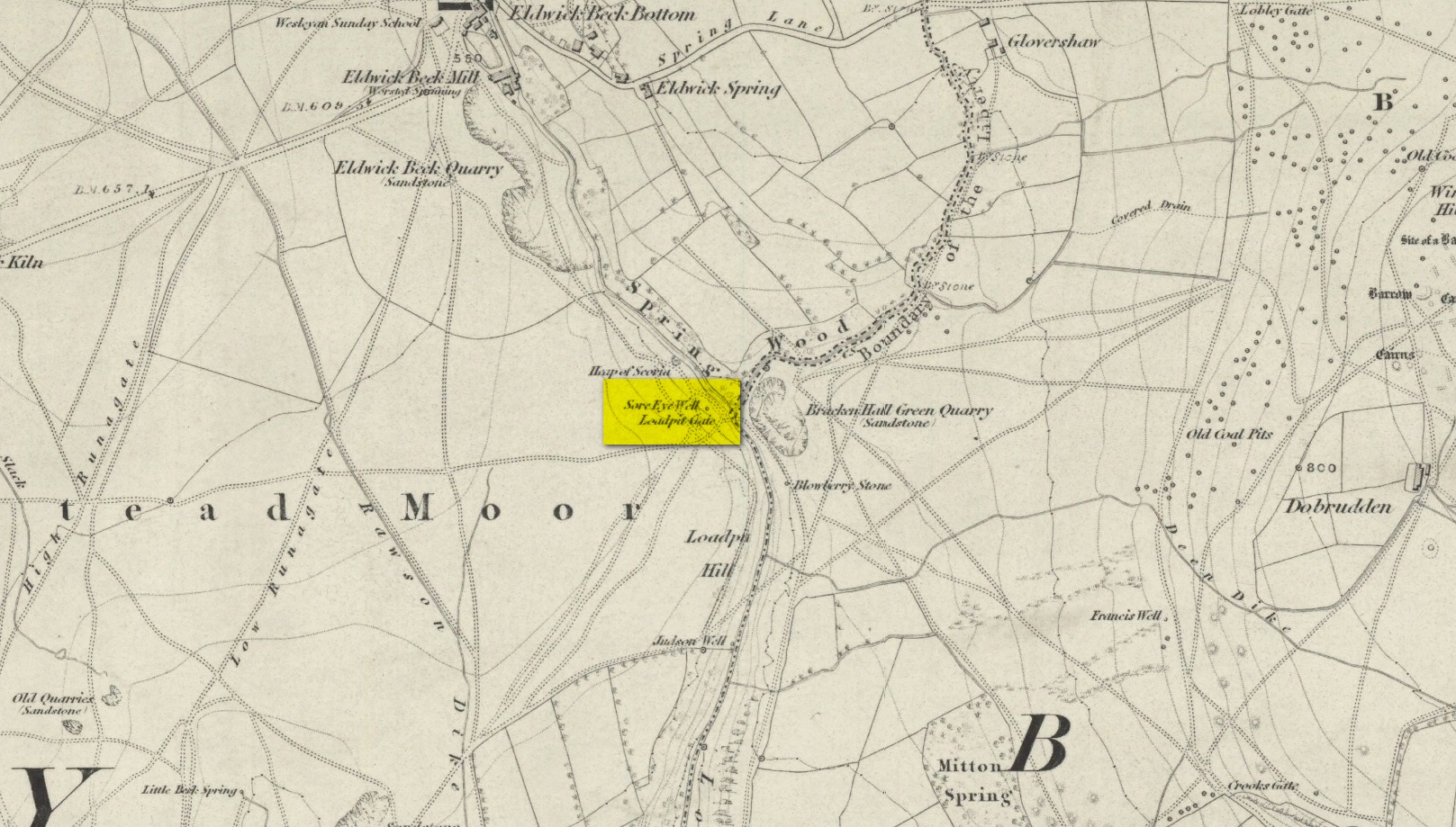
Sore Eye Well on 1852 map

Descriptions of this site are few and far between, despite it having a meaningful name.  First recorded on the 1852 OS-map, in the folklore of our ancestors this was a well that local people frequented to wash their face and it was said that the waters would take away the ills of those suffering poor eyesight or other ocular problems.  Rags were left hanging over an old rowan tree as offerings to the spirit of the water, in return for curing the afflicted eyes.

When I first came looking for this as a boy, I was frustrated to encounter the water authority’s metal cover ruining the site completely, leaving nothing of the old well as it once was.  Around the metal-cover was evidence of a small rock enclave that would have defined the spring as it emerged from the earth—although it was barely noticeable.  The remnants of a small path just to the right of the main footpath that reaches up the hillside is apparent, leading to the well.  Below it were the remains of a large, water-worn flat rock, with other stones set to its sides, where the water used to flow and be collected, but today everything’s dried up and there’s little evidence of it ever being here.

References:

  1. Shepherd, V., Historic Wells in and Around Bradford, Heart of Albion: Wymeswold 1994.

© Paul BennettThe Northern Antiquarian

Eyebright Well, Leeds, West Yorkshire

Healing Well (destroyed):  OS Grid Reference – SE 2986 3331

Archaeology & History

First mentioned in the 1715 magnum opus of Ralph Thoresby, this old healing well has long since fallen victim to the careless Industrialists.  In his day, the well was there for all to use, saying:

“Eye-bright Well on a declining Ground, near the Monk-Pits, discovers its Virtues in the Name, being, long-ago, esteemed a Sovereign Remedy against Sore-Eyes.”

This note was subsequently copied in in Hope’s (1893) classic survey, with no additional comment.  In all probability, the name of the well derived from the presence of the herb Eyebright (Euphrasia officinalis) which, as is well known, is the best herb for ailments of the eye.  The water from the well, in combination with the herb that grew around it, no doubt increased its ocular healing abilities.

By the middle of the 19th century, the rise of Leeds city brought an end to its ancient flow and its location was eventually forgotten.  In Bonser’s (1979) survey of Leeds’ wells, he told how,

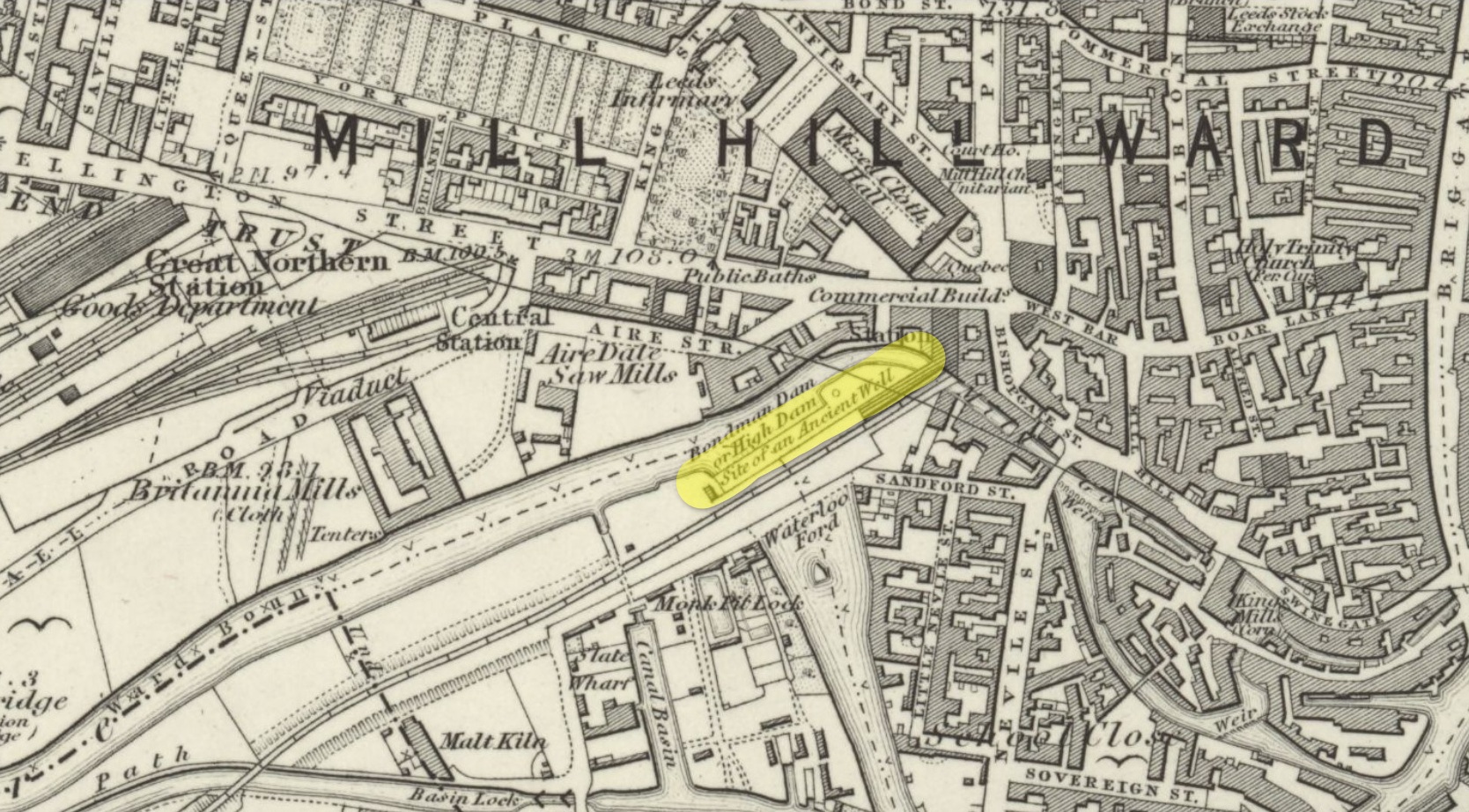
“the position of this well can be accurately determined: it was situated on sloping ground between Wellington Street and Aire Street, as clearly indicated on the 1847 (1850) OS 5ft to 1 mile (map).”

Location of Eyebright Well on 1852 map

However, in the much earlier survey of Leeds, Edward Parsons (1834) told us that this well was a hundred yards to the south, “near the line of the new road to the iron bridge across the Aire at the Monk Pits.”  And although it isn’t named, it should be noted that immediately across the River Aire, where Parsons stated, the 1852 OS-maps showed the “Site of an Ancient Well.”  This is very likely to be where it was.  Parson’s also echoed the local lore of the time, telling us that the Well was “a sovereign remedy for soreness of the eyes.”

References:

  1. Bonser, K.J., “Spas, Wells and Springs of Leeds,” in The Thoresby Miscellany – volume 16, Leeds 1979.
  2. Hope, Robert Charles, Legendary Lore of the Holy Wells of England, Elliott Stock: London 1893.
  3. Parsons, Edward, The Civil, Ecclesiastical, Literary, Commercial and Miscellaneous History of Leeds, Halifax, Huddersfield, Bradford, Wakefield, Dewsbury, Otley – volume 1, Frederick Hobson: Leeds 1834.
  4. Thoresby, Ralph, Ducatus Leodiensis, Maurice Atkins: London 1715.
  5. Whelan, Edna & Taylor, Ian, Yorkshire Holy Wells and Sacred Springs, Northern Lights: Dunnington 1989.

© Paul BennettThe Northern Antiquarian

Wallace’s Well, Dunfermline, Fife

Healing Well:  OS Grid Reference – NT 08782 87275

Also Known as:

  1. Spa Well
  2. Wallace Spa

Archaeology & History

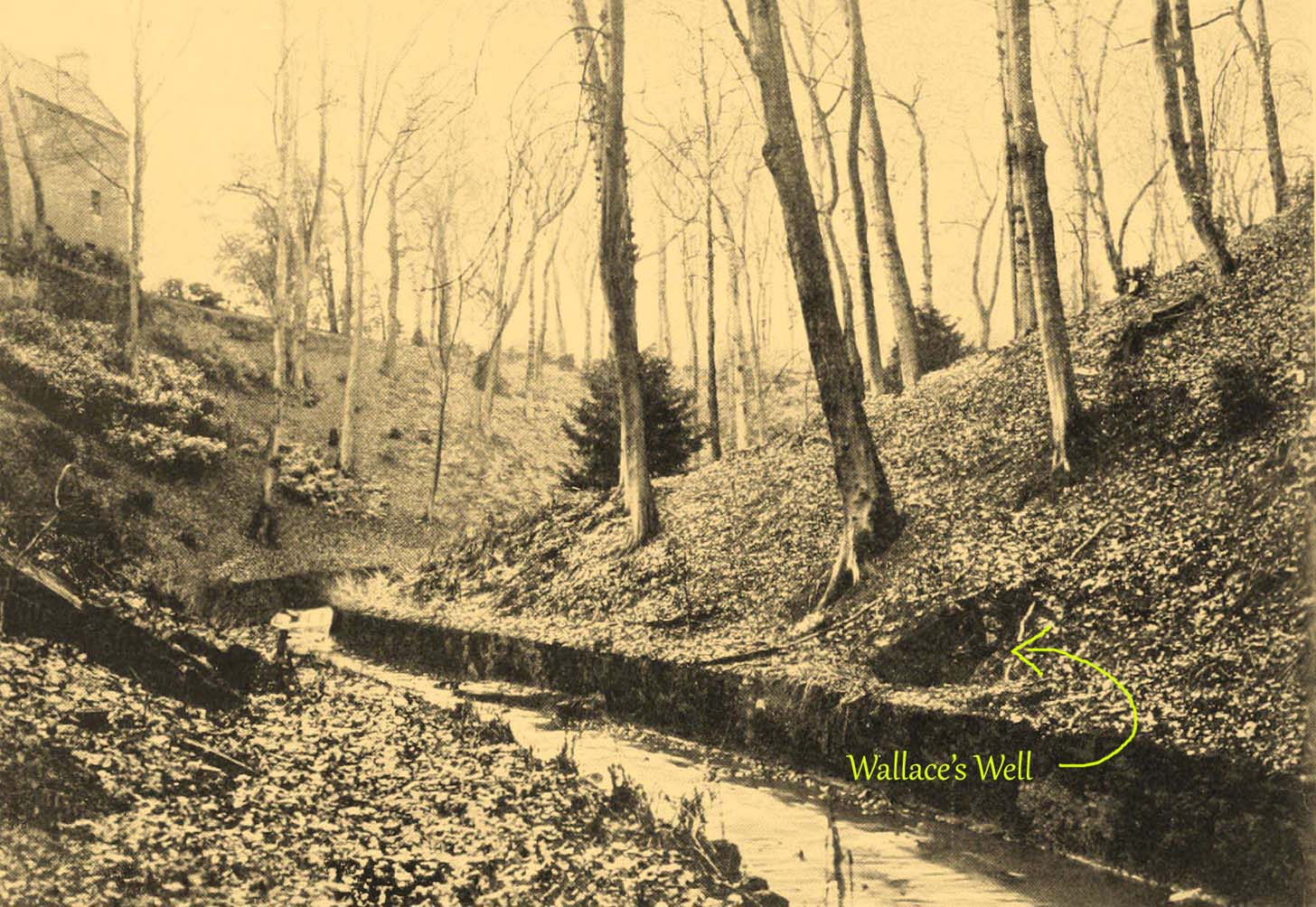
The ruins of this little-known site, dedicated to the legendary Sir William Wallace, can still be seen in the form of an overgrown stone ruin just off the footpath that runs through the Pittencrieff Glen out of the town centre.  In earlier times the waters were evidently of some repute, as a Council meeting in May 1773 reported with some disdain the closure of the waters by a Mr Chalmers:

“This Day the Council considering that the entry from the Town to the Well of Spaw is now shut up by Mr. Chalmers, which was a particular privilege to ye Inhabitants of the Burgh, Do hereby appoint the Provost to intimate to Mr. Chalmers that the Town will not give up that privilege, and to require him to oppen an entry thereto as formerly.”

We don’t know whether the miserable Mr Chalmers gave access to the well, as there seem to be no Council meeting notes telling us the outcome.  My guess would be that the local people got their way, hopefully at Chalmers expense!  More than 70 years later, another Mr Chalmers (1844) wrote about the well in a more respectful light:

“On the north edge of the rivulet, a little below this bridge, at the foot of the Tower Hill, there is a famous well, named the Wallace Spa, or well of Spa, which was formerly much resorted to by the inhabitants of the town for its excellent water, but which has been long since disused. It is noticed here simply on account of the traditionary antiquity of its name, Sir William Wallace, it is said, having once, in the haste of a flight, drank a little of it, out of the palm of his hand.”

In spite of there being local folklore of William Wallace, the local historian Ebeneezer Henderson (1879), in his giant work on Dunfermline, thought there was a more prosaic origin to the well’s name. He told,

“This well is still in existence, about fifty yards south of the ruins of Malcolm Canmore’s Tower — Tower Hill.  The water is reported as being “very cold at all times.” The water should be analysed.  The well during the period of its being used was known as the “Spaw Well,” and the ” Well of Spaw,” and, by and by an easy, natural transition, ” Wallace Spa;” and thus the name of the well has sometime been connected with that of the great Scottish hero.”

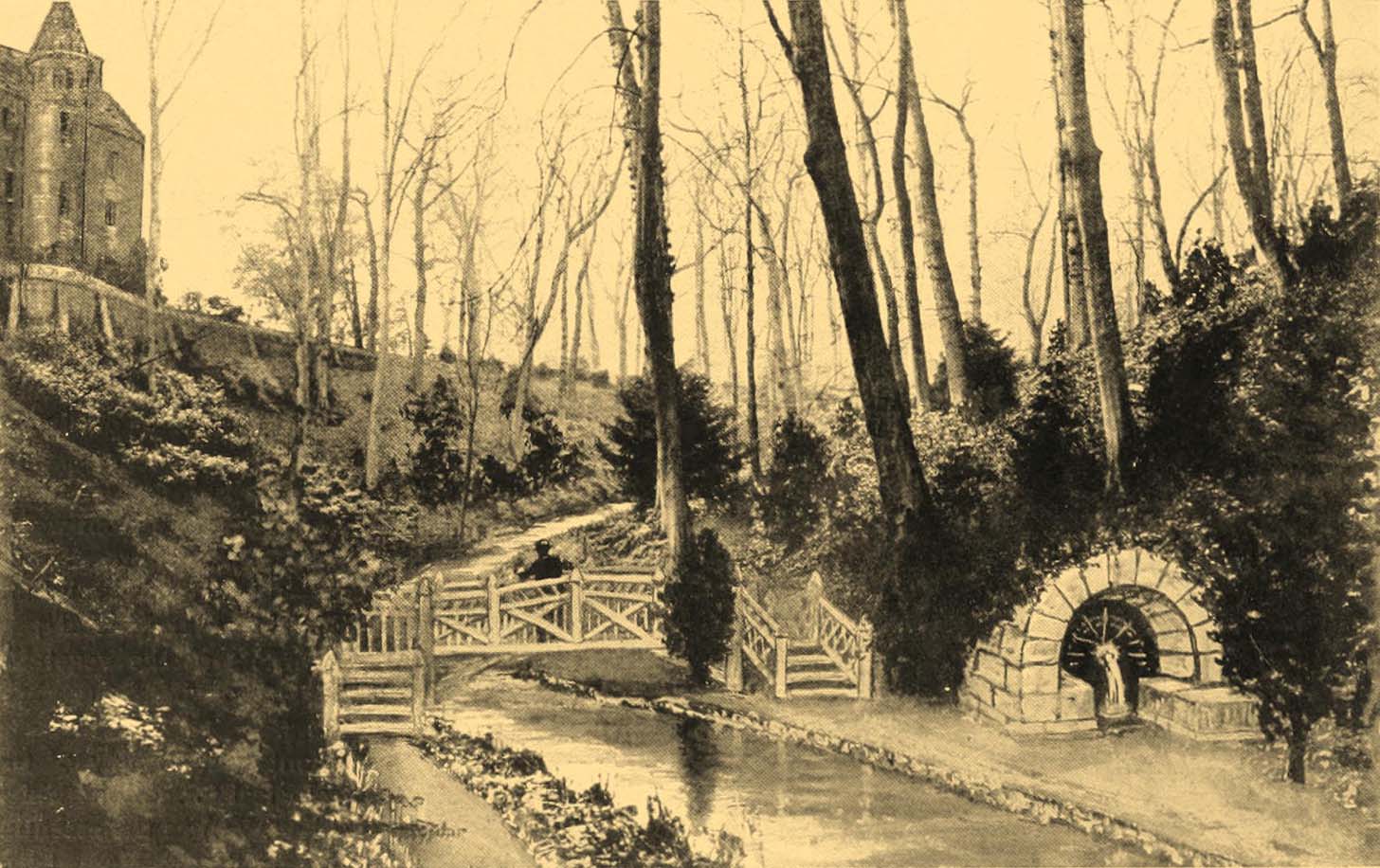
The Well after 1900
pre-1900 image

By the end of the 19th century, the well had become almost buried by earth and foliage, but was subsequently brought back to life following architectural improvements of the glen around the turn of the 20th century.  In Patrick Geddes’ (1904) work he gives us “before and after” portraits (attached here) showing how it had been restored.  He also mentioned “its tradition of medicinal value”, but could give no further information regardings the ailments it was reputed to cure…

References:

  1. Chalmers, Peter, Historical and Statistical Account of Dunfermline, William Blackwood: Edinburgh 1844.
  2. Geddes, Patrick, City Development: A Study of Parks, Gardens and Culture-Institutes, St George Press: Birmingham 1904.
  3. Henderson, Ebenezer, The Annals of Dunfermline, John Tweed: Glasgow 1879.

© Paul BennettThe Northern Antiquarian

Lambeth Wells, Lambeth, London, Surrey

Healing Wells (destroyed):  OS Grid Reference – TQ 3094 7889

Also Known as:

  1. Lambeth Spa
  2. Near Well and Far Well

Archaeology & History

This once famous healing or spa well has long gone.  It was located where the buildings that now constitute 104-105 Lambeth Walk presently stand: an area which the great London historian William Thornbury (1878) told was already “a favourite resort of Londoners, and celebrated for the variety of sweet-smelling flowers and medicinal herbs growing there,” complementing the healing waters before and during the spa craze.  The great herbalist John Gerard did his collections here.

I can find no information regarding its early use by our peasant ancestors, so its written history simply begins when it had been appropriated by those well-to-do up-market types who took this medicinal spring for their commercial gain in the early days of the trendy spas.  Supplied by two separate springs known as the Nearer and Farther Wells respectively, the Well House built here was “formally opened in April 1696” and subsequently had almost daily accompaniments of music, including French and country dancing!  But as the popularity of the Lambeth Spa increased, so did its problems.  Phyllis Hembry (1990) told that by July 1715, one visitor to the spa,

“was so depressed to find that the many people there were mostly rakes, whores and drunkards, idlers such as Guard officers, or young pleasure-seeker like attorneys’ clerks, mingling with loose women of the the meanest sort.  The Lambeth Wells also became a public nuisance, so a dancing license was refused in 1755.”

The so-called Great Room which had been the place of great occasions by spa users ended up being the meeting place “for Methodist meetings.” Oh how the winter nights must have flown by…..

There was a decided improvement in the years that followed and social events at the spa increased again.  It became what Thornbury said “was another place of amusement.”  The Lambeth Wells, he wrote,

“were held for a time in high repute, on account of their mineral waters, which were advertised as to be sold, according to John Timbs, at “a penny a quart, the same price paid by St. Thomas’s Hospital.” About 1750, we learn from the same authority, there was a musical society held here, and lectures, with experiments in natural philosophy, were delivered by Dr. Erasmus King and others. Malcolm tells us that the Wells opened for the season regularly on Easter Monday, being closed during the winter. They had “public days” on Mondays, Thursdays, and Saturdays, with “music from seven in the morning till sunset; on other days till two!” The price of admission was threepence. The water was sold at a penny a quart to the “quality” and to those who could pay for it; being given gratis to the poor.  We incidentally learn that there were grand gala and dancing days here in 1747 and 1752, when “a penny wedding, in the Scotch manner, was celebrated for the benefit of a young couple.”

By this time, a rival St. George’s Spa of had been created a short distance away on the parish boundary and with it, the popularity and attendance at Lambeth Wells began to decline.  By the end of the 18th century, the rot had truly set in and its days were finally numbered.

As for the medicinal properties of these wells, little seems to have been recorded.  Aside from repeating the common description of them being mineral waters, William Addison (1951) simply added that they were also purgative.

References:

  1. Addison, William, English Spas, Batsford: London 1951.
  2. Allen, Thomas, The History and Antiquities of the Parish of Lambeth, J. Allen: London 1827.
  3. Allen, Thomas, A History of the County of Surrey – volume 1, Isaac Taylor: London 1831.
  4. Foord, Alfred Stanley, Springs, Streams and Spas of London: History and Association, T. Fisher Unwin: London 1910.
  5. Hembry, Phyllis, The English Spa 1560-1815, Athlone Press: London 1990.
  6. Nichols, John, The History and Antiquities of the Parish of Lambeth, J. Nichols: London 1786.
  7. Rattue, James, The Holy Wells of Surrey, Umbra: Weybridge 2008.
  8. Sunderland, Septimus, Old London Spas, Baths and Wells, John Bale: London 1915.
  9. Thornbury, William, History of Old and New London – volume 6, Cassell: London 1878.

Links:

  1. Lambeth Wells on the Vauxhall History website

© Paul BennettThe Northern Antiquarian