Holy Ash Well, Bradford, West Yorkshire

Holy Well (destroyed):  OS Grid Reference SE 15942 34208

Also Known as:

  1. Ash Well
  2. Holy Well Ash Well
  3. Pin Well

Archaeology & History

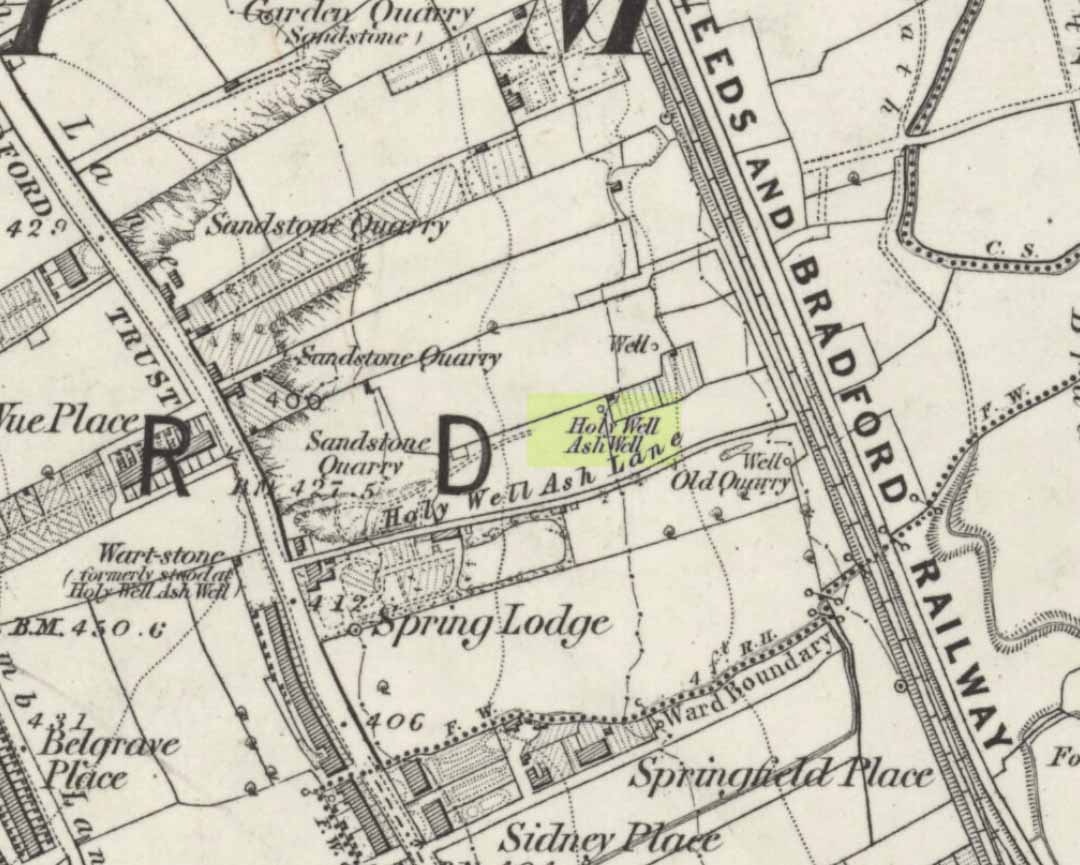
Holy Well Ash on 1852 map

Either right next to, or perhaps now beneath Bradford City’s Valley Parade football ground, was once a very important sacred well site.  Known as the Holy Ash Well and variants thereof, this healing spring was of considerable renown to people all around Bradford district in bygone days.  The site was illustrated on the 1852 OS map, and there was also a sacred stone adjacent to the well known as the Wart or Pin Stone, which had some animistic healing properties related the waters.

The old well was described by local historian Abraham Holroyd (1873) who said that:

“In Manningham Lane there is a fine well, in old deeds called Hellywell, i.e., holy well, in a field now called Halliwell Ash, now a stone quarry… Near this is the ancient Pin Stone.”

A few years later, in Robert Charles Hope’s (1893) monumental study, he described how,

“This holy well, not far from Manningham Lane, probably derived its name from having at some time been dedicated to some saint.  The inhabitants of Bradford were wont in ancient times to resort on Sundays to these wells as a common place of meeting, to drink of the waters and partake of their preternatural virtues.”

Which was another was of saying that he didn’t really know too much about the place!

The Bradford historian William Preston (1933) described this site in one of his early essays, where he informed us that local people knew the accompanying rock hereby as the Ash Stone, due to its proximity and ritual relationship to a great old ash tree (Fraxinus excelsior) that grew next to the well.  The mythic history of this particular tree should not be understated: it was a Creation deity par excellence in northern and Viking myths, but whatever old tales and power might once have been had here, in Bradford, they’ve long since been forgotten.  But it was the industrial historian William Cudworth (1896) who told the most of this all-but forgotten site, saying:

“On the sloping ground between Belle Vue and the Midland Railway there once existed a spring of water, supposed to have preternatural virtues. The name it bore within present recollection is probably a corruption of Holy-well. The holy wells of England as elsewhere had not all the same virtues attached to them. Some were blessed if used for baptisms, to others were attributed curative properties, especially for sore or weak eyes, while others were supposed to possess mystical powers, insomuch as any article dipped in them became charms or safeguards against witchery.  Any traditions associated with the spring at Halliwell (or Holywell) Ash are lost, but certainly in the early part of the present century the place was a favourite resort of the townspeople on Sundays.

“The derivation of the name is doubtful. In the survey of 1638 a close called ” Helliwell Ash” is mentioned as containing 2a. 3r. 26p., but without any indication as to its locality. The spelling of the name is of little moment.  Mr. James, in his “History of Bradford,” states that he had seen the place referred to in old deeds as “Helly-well.” By his will, dated May, 1685, Thomas Lister, of Manningham, devised to his two daughters, Juliana Lambrecht and Elizabeth Stapleton, equal shares in two closes of land called “Holywell Ash” and ” Delf Close,” besides other lands in Manningham. In the will disposing of the possessions of Juliana Lambrecht, her moiety of “Holywell Esh” was bequeathed to Francis Stapleton, her nephew.  In due course the lands in question were inherited by Francis Sharp Bridges, and have latterly belonged to Sir Francis Sharp Powell, M.P., in whose writings the form of spelling is given as ” Halliwell Ash.”

“Upon the ground in question there used to be a fine well of water issuing out of the higher ground, to which tradition assigned healing virtues. Might not the name of “holy” come from this circumstance?  Sufficient importance attaches to the tradition, however, to have led the farmers of the recent ordnance plan of Manningham to preserve the name, although the widening of the Midland Railway below Thorncliffe Terrace has almost obliterated the site.”

A more recent updated overview of the site was written by one of my old school-mates, Dave Pendleton (1997), who said of the place:

“Prior to 1886 the only feature of any real note in the Valley Parade environs was a holy well that emerged near the corner of the football grounds Midland Road and Bradford End stands; hence the road Holywell Ash Lane. Today the site of the well is covered by the football pitch.

Only the road name survives as a reminder of what was apparently one of the district’s foremost attractions. On Sundays and holidays people would gather to take the waters and leave pins, coins, rags and food as offerings to the spirit that resided in the waters.

Accounts suggest that the well was covered and had a great ash tree standing over it (hence ‘holy ash’). There was also a standing stone called the wart stone of unknown antiquity. The stone had a carved depression that collected water. It was believed that the water was a miraculous cure for warts. Indeed, as early as 1638 the Holy Well had been credited with healing powers.

The well suffered a decline in popularity during the late nineteenth century and its keepers resorted to importing sulphur water from Harrogate, which they sold for a half penny per cup. The well disappeared under the Valley Parade pitch during the summer of 1886 and the wart stone was moved to the top of Holywell Ash Lane – which then ran straight up to Manningham Lane. The stone was still there as late as 1911 but thereafter it seems to have disappeared into the mists of time.”

A night-club adjacent to the Valley Parade football ground—called Bibby’s—was said to have had an old well in its cellar, which the owner of the place, Mr Pearl Gladstone Minott, said was ‘haunted’.

Unfortunately I’ve not been able to find any old photos or drawings of this lost holy well – though I imagine that some local, somewhere must be able to help us out with this one.  Surely there’s more of this site hidden away somewhere….?

References:

  1. Bennett, Paul, The Old Stones of Elmet, Capall Bann: Milverton 2001.
  2. Cudworth, William, Manningham, Heaton and Allerton, W. Cudworth: Bradford 1896.
  3. Holroyd, Abraham, Collecteana Bradfordiana, Saltaire 1873.
  4. Hope, R.C., The Legendary Lore of the Holy Wells of England, Elliot Stock: London 1893.
  5. Pendleton, David & Dewhirst, John, Along the Midland Road, Bradford City AFC 1997.
  6. Preston, W.E., ‘Some Bradford Holy Wells’, in Bradford Antiquary, volume 7, 1933.

© Paul Bennett, The Northern Antiquarian 

Baildon Moor (151), West Yorkshire

Cup-Marked Stone:  OS Grid Reference – SE 13736 40227

Also Known as:

  1. Baildon carving no.23 (Hedges)

Getting Here

As with many of the other Baildon Moor carvings, get up to Dobrudden caravan park and walk into the grasses immedietaly northeast onto the Dobrudden necropolis plain for 100 yards or so. It’s not far from the track and one of the many bell-pits is very close by.  Look around!

Archaeology & History

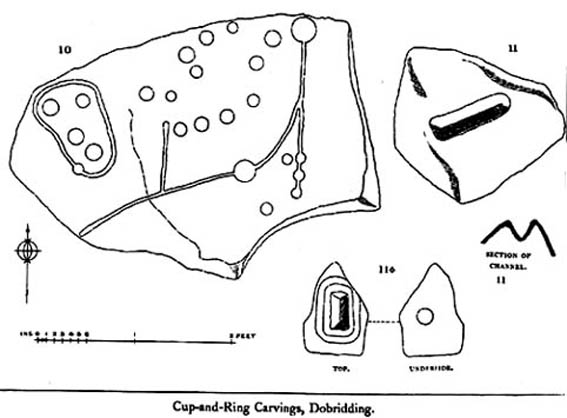
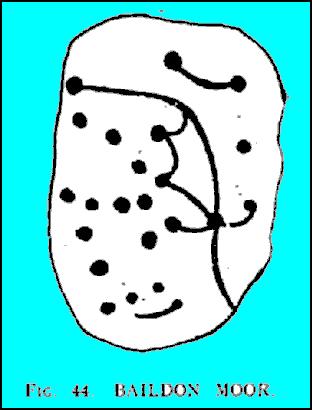
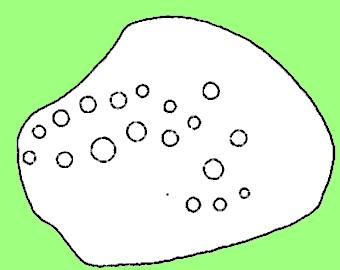
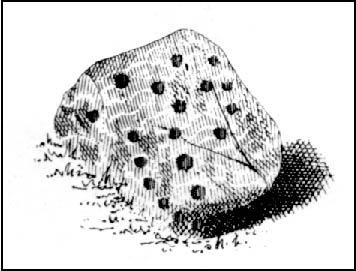
A lovely little carving (sad aren’t I…?), first recorded and illustrated in Glossop’s (1888) famous essay on the ancient sites of Baildon Moor.  He described there being 18 cups etched onto this rock — a fact echoed a few decades later in Mr Baildon’s (1913) magnum opus.  The modern surveys thankfully still count 18 cups here.

Mr Baildon’s 1913 image
Glossop’s 1888 drawing

This is another one of the Baildon Moor carved stones included in Mr Holmes’ (1997) astronomical survey, where he thought the cup-markings here represented stellar maps and other prehistoric astronomical events. A damn good investigative notion, but it sadly aint true.  However, those self-same ‘central design’ curves found at a large proportion of other carvings on and around Baildon Moor are plain here for all to see…

References:

  1. Baildon, W. Paley, Baildon and the Baildons (parts 1-15), St. Catherines Press: Adelphi 1913-26.
  2. Boughey, K.J.S. & Vickerman, E.A., Prehistoric Rock Art of the West Riding, WYAS: Leeds 2003.
  3. Colls, J.N.M., ‘Letter upon some Early Remains Discovered in Yorkshire,’ in Archaeologia, 31, 1846.
  4. Cowling, Eric T., Rombald’s Way, William Walker: Otley 1946.
  5. Cudworth, William, ‘Baildon Moor & its Antiquities,’ in Bradford Antiquary 3, 1900.
  6. Glossop, William, ‘Ancient British Remains on Baildon Moor,’ in Bradford Antiquary No.1, 1888.
  7. Hedges, John (ed.), The Carved Rocks of Rombald’s Moor, WYMCC: Wakefield 1986.
  8. Holmes, Gordon, 2000 BC – A Neolithic Solstice Odyssey, SASRG 1997.

© Paul Bennett, The Northern Antiquarian

Baildon Moor (158), West Yorkshire

Cup-Marked Stone:  OS Grid Reference – SE 13781 40259

Also Known as:

  1. Baildon Stone 29 (Hedges)

Getting Here

Takes a bitta finding this one, mainly cos it’s only a small stone – but worth the walkabout. It’s on the Low Plain, north of Dobrudden, about 10 yards down the path from the caravan park.

Archaeology & History

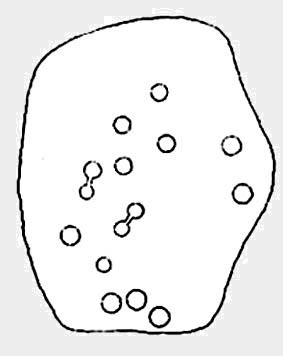
W.P. Baildon’s 1913 drawing

As with other stones on this roughland plain, it was first recorded and drawn by the local historian W. Paley Baildon (1913), who counted at least 15 cups here, with one complete cup-and-ring.  Some of the cups have very distinct half-rings upon them; whilst others are connected by faint lines (as his drawing clearly shows).  The later surveys of Hedges (1986), and Boughey & Vickerman (2003) counted 17 cups on this stone.  This was another of the carvings which local astronomer Gordon Holmes (1997) thought may have been based on the constellation of Cassiopeia (like the nearby Cassiopeia Stone, found on the same moorland plain).

References:

  1. Baildon, W. Paley, Baildon and the Baildons (parts 1-15), St. Catherines: Adelphi 1913-26.
  2. Boughey, Keith & Vickerman, E.A., Prehistoric Rock Art of the West Riding, WYAS 2003.
  3. Glossop, William, ‘Ancient British Remains on Baildon Moor,’ in Bradford Antiquary, 1888.
  4. Hedges, John (ed.), The Carved Rocks on Rombalds Moor, WYMCC: Wakefield 1986.
  5. Holmes, Gordon T., 2000 BC – A Neolithic Solstice Odyssey, SASRG Press 1997.

© Paul Bennett, The Northern Antiquarian


Baildon Moor (160), West Yorkshire

Cup-Marked Stone:  OS Grid Reference – SE 13787 40274

Also Known as:

  1. Carving no.33 (Hedges)

Getting Here

W.P. Baildon’s sketch

Best way to find this is to get up to the Dobrudden caravan site on the edge of Baildon Hill, near the cinder-dump, then follow the same directions as for the Baildon Moor carving no.171.  It’s on the same plain amidst the grasses – but you’re gonna have to zigzag about for a while before you find it!

Archaeology & History

A simple plain cup-marked stone which Boughey & Vickerman (2003) reckoned to have 14 of the little babies etched on its surface.  Ninety years earlier, the reliable Mr W.P. Baildon (1913) — who seems to have been the first person to describe this carving — showed there to be 15 cups when he came here.

This was one of the many carved rocks that astronomer Gordon Holmes (1997) looked at in his attempt to give a celestial explanation for the designs.  I’m not too sure misself…

References:

  1. Boughey, Keith & Vickerman, E.A., Prehistoric Rock Art of the West Riding, WYAS 2003.
  2. Hedges, John (ed.), The Carved Rocks on Rombalds Moor, WYMCC: Wakefield 1986.
  3. Holmes, Gordon T., 2000 BC – A Neolithic Solstice Odyssey, SASRG Press 1997.

© Paul Bennett, The Northern Antiquarian


Acrehowe Circle, Baildon Moor, West Yorkshire

Ring Cairn:  OS Grid Reference – SE 14245 40686

Also Known as:

  1. Coll’s Burial Mound
  2. Rerehowe

Getting Here

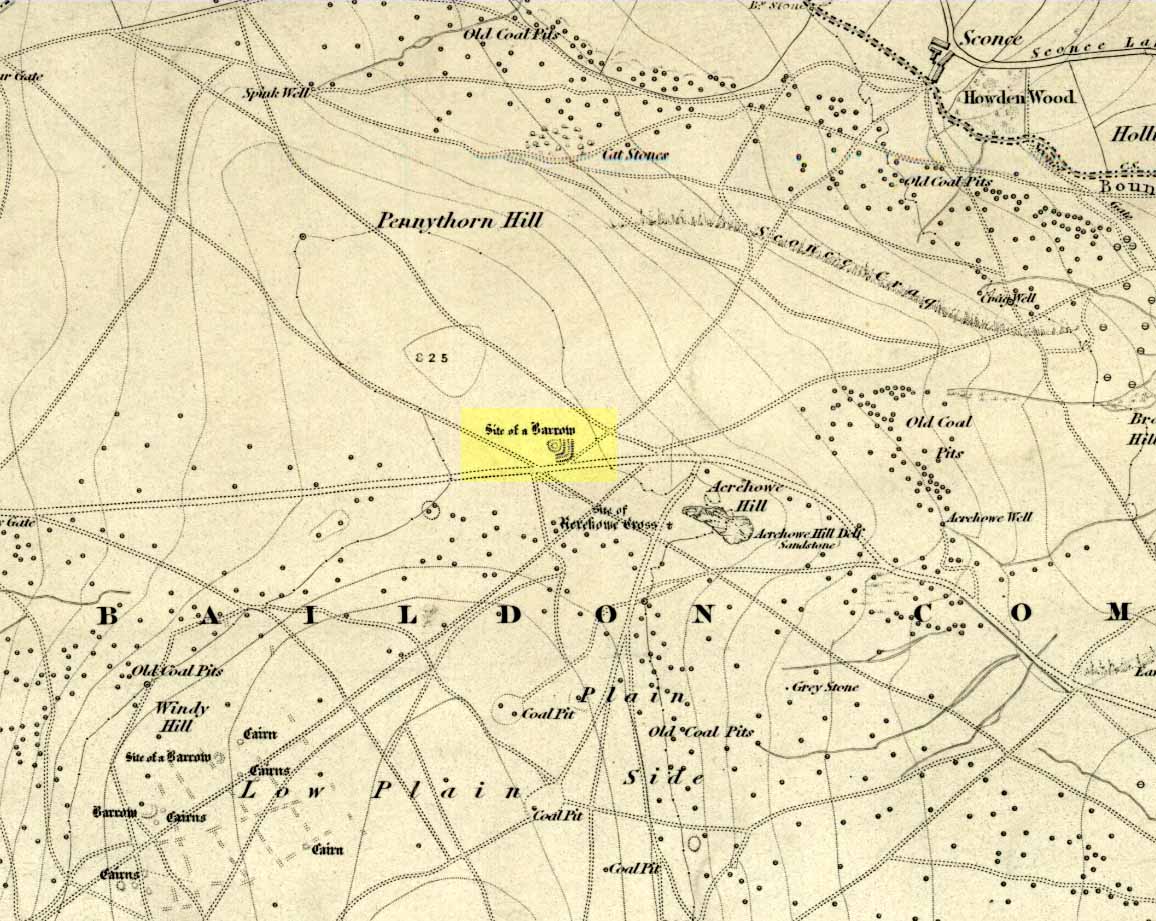
Acrehowe site on 1852 map

Go up through Baildon centre and head onto the moors. Crossing the cattle-grid, a coupla hundred yards further up, turn left. Past the small reservoirs on your left, another 100 yards or so and you reach the brow of the hill.  As you begin going down the road, there’s a small car-park right by the roadside.  The curious remains of the earthworks at the side of the old circle are discernible in the grassland right to its side.

Archaeology & History

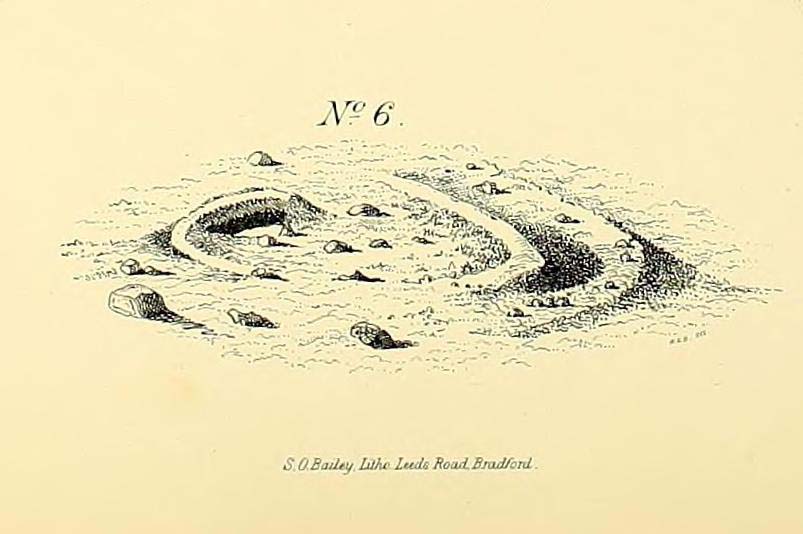
Illustrated on the 6-inch OS-map of 1852 as “Site of a Barrow” (similar to how it appears in the image drawn here by Mr. C.N.M. Colls) a short distance below Pennythorn Hill top, there are still considerable traces of the earthworks surrounding the east and southern sides of what was once some form of ring cairn or tumulus that was once at this prominent place in the landscape.

Aerial view of siteThe site was first explored by Mr Colls in 1843 (his results were reported a few years later), who found a loose double-ring of stones, fifty feet across, surrounded by a shallow trench which was most notable on the south and east sides. Two urns were also uncovered near the centre of the ring, nearly two feet down, containing the cremated remains of people.  A few years later, the Leeds historian James Wardell (1869) told a most fascinating note about what happened during their excavation, saying:

“This…examination was attended by a circumstance not soon to be forgotten by the persons engaged therein (on the excavation). They had almost reached the place where the broken urn and bones were deposited when, at once, such a fearful storm of thunder, lightning and rain came on, that they were not only considerably alarmed, but driven from the Common to seek shelter in the village.”

Colls’ 1846 sketch

We hear this sorta thing at many of our ancient places!

Colls 1846 plan

One anonymous writer in 1955 described the site as a ‘stone circle’, and a number of subsequent archaeologists copied this without question; but in all probability this site was more typical of an old cairn circle or ring-cairn, similar in size and design to the Roms Law circle two miles north of here.  However, the earthworks at its side give the impression of some sort of exaggerated hengiform enclosure.

The place-name element howe strongly indicates a burial site and is a suffix found at many prehistoric tombs across northern England.  The prefix ‘acre’ may relate to “a plot of arable or cultivated land, a measure of land (an acre) which a yoke of oxen could plough in a day” (Smith 1956), or may be a corrupted form of the Old English word, ‘acen’, relating to oak trees.  Early literary examples of the place-name would enable a clearer understanding of the prefix element here.

References:

  1. Anonymous, Colls’ Burial Mound Stone Circle, Baildon Moor, Museum Leaflets: Bradford 1955.
  2. Baildon, W. Paley, Baildon and the Baildons (parts 1-15), St. Catherines: Adelphi 1913-26.
  3. Barnes, Bernard, Man and the Changing Landscape, Eaton: Merseyside 1982.
  4. Bennett, Paul, The Old Stones of Elmet, Capall Bann: Milverton 2001.
  5. Colls, J.N.M., ‘Letter upon some Early Remains Discovered in Yorkshire,’ in Archaeologia, 31, 1846.
  6. Collyer, Robert & Turner, J.H., Ilkley: Ancient and Modern, William Walker: Otley 1885.
  7. Smith, A.H., English Place-Name Elements – volume 1, Cambridge University Press 1956.
  8. Wardell, James, Historical Notes of Ilkley, Rombald’s Moor, Baildon Common, and other Matters of the British and Roman Periods, Joseph Dodgson: Leeds 1869. (2nd edition 1881)

© Paul Bennett, The Northern Antiquarian

Cassiopeia Stone, Baildon Moor, West Yorkshire

Cup-and-Ring Stone:  OS Grid Reference – SE 13771 40235

Also Known as:

  1. Carving no.28 (Hedges)
  2. Carving no.156 (Boughey & Vickerman)

Getting Here

If you wanna find this carving, you’ll find it near several others on the Low Plain, 40 yards east of the footpath north of Dobrudden Farm.  Look around in the tribbly grass!

Archaeology & History

This was first described and illustrated in a short article by William Glossop in the Bradford Antiquary in 1888, and reproduced by W. Paley Baildon (1913) – who drew his own impression of the carving. Tis one of my favourites from this moor. Dunno why – I just like it.

W.P. Baildon’s accurate 1913 drawing
Cowling’s 1946 drawing

Local astronomer and writer Gordon Holmes (1997) posited the theory that a part of this carving represented the constellation of Cassiopeia — hence its title!  He told of finding the same pattern of cups at four other carvings on the moors and assigned astronomical meanings to them.  He may be right, though I doubt it to be honest.  Having looked and looked at the many carvings here, and many other places, the star-reflection hypothesis doesn’t tend to work (as the heavenly bodies have moved somewhat since the days when the cups were first carved).  Along with this, when I was young I used to think cup-and-rings did have an astronomical basis — only to find, after constant analysis, that the theory didn’t work.

There are perhaps 20 cup-markings here, with various linking-lines and curves between and around the cups.  Perhaps the most accurate of the early drawings was Mr Paley Baildon’s 1913 image, where he highlighted the faint surrounding ring enclosing the 4 or 5 cups near the bottom of the stone.

References:

  1. Boughey, Keith & Vickerman, E.A., Prehistoric Rock Art of the West Riding, WYAS 2003.
  2. Cowling, Eric T., Rombald’s Way, William Walker: Otley 1946.
  3. Glossop, William, “Ancient British Remains on Baildon Moor,” in Bradford Antiquary, 1888.
  4. Hedges, John (ed.), The Carved Rocks on Rombalds Moor, WYMCC: Wakefield 1986.
  5. Holmes, Gordon T., 2000 BC – A Neolithic Odyssey, SASRG Press 1997.

© Paul Bennett, The Northern Antiquarian

Cliffe Castle Carving, Keighley, West Yorkshire

Cup-and-Ring Stone:  OS Grid Reference – SE 0577 4210

Also Known as:

  1. Carving no.144 (Boughey & Vickerman)

Getting Here

Dead easy!  Avoiding Keighley (as common sense dictates), but going to its outskirts, get to the huge Cliffe Castle (tis free) on the northern outskirts of the town. Go inside and look around!

Archaeology & History

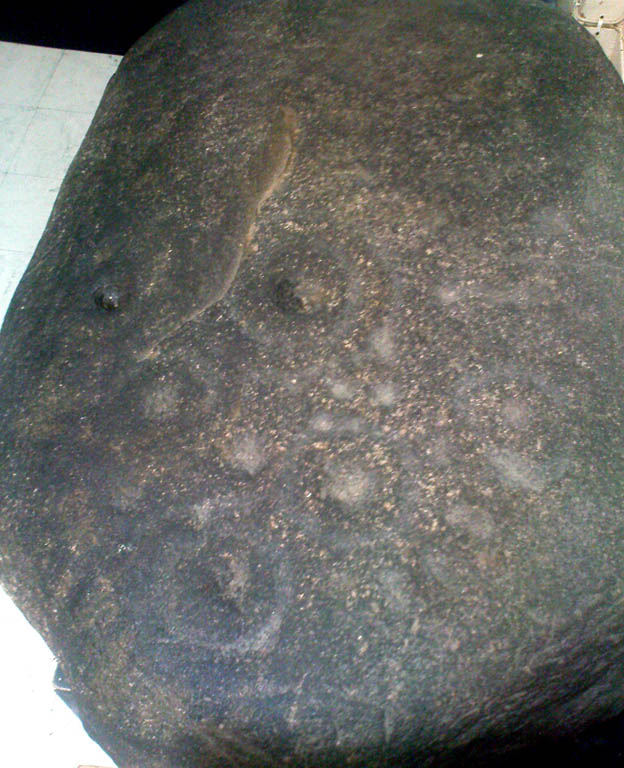
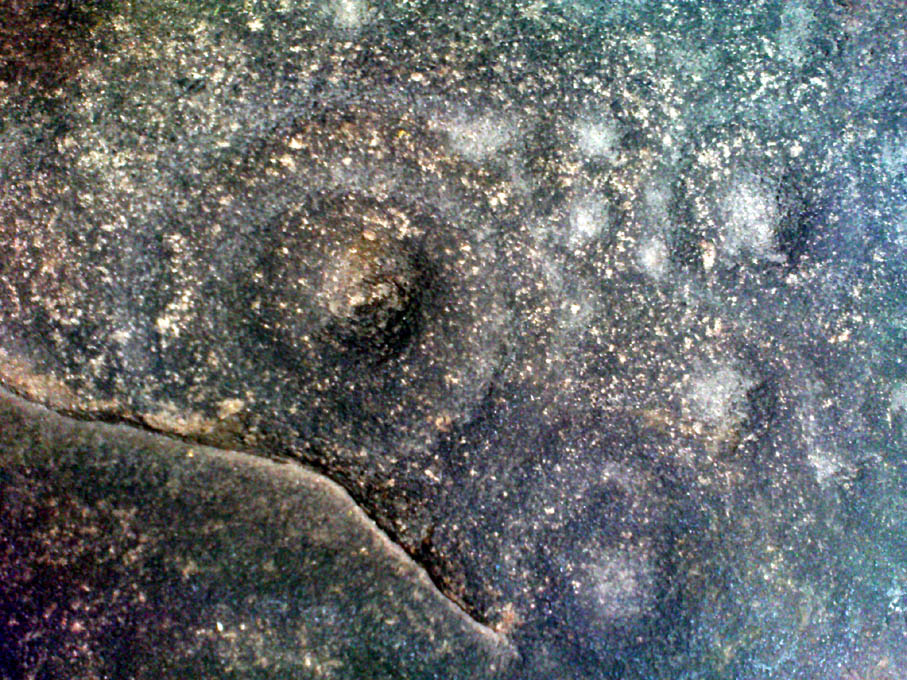
Carving in Cliffe Castle Museum
Close-up of cups & rings

Initially located in the ground a few yards south of Dobrudden caravan park amidst a large gathering of other carved rocks, this grand-looking cup-and-ring stone is no longer in situ.  As with a several other carvings, this has been on a bittova wander in the last century!  It was first uprooted from the Earth and archaeologically transferred to Bradford’s Cartwright Hall Museum sometime after World War 2, where it lived peacefully for a number of years, before being moved to Cliff Castle Museum, where it still lives, quietly (along with another prehistoric carved rock, the Comet Stone, that was nabbed from the uplands near the Roms Law circle).

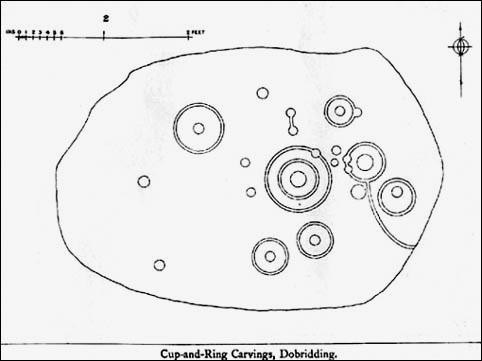
Baildon’s 1913 drawing

As we can see from the photos (taken in poor lighting in the museum – sorry…) there are five cup-and-rings with one cup-and-2-rings standing out (plus about another 10-12 cups scattered here and there); though when W. Paley Baildon drew a picture of the stone around 1913, he could clearly see another cup-and-ring etched onto the stone, but this has faded somewhat in the last century. Messrs Boughey & Vickerman (2003) were unable to see it.

References:

  1. Baildon, W. Paley, Baildon and the Baildons – parts 1-15, Adelphi: London 1913-1926.
  2. Boughey, Keith & Vickerman, E.A., Prehistoric Rock Art of the West Riding, WYAS: Leeds 2003.
  3. Hedges, John, The Carved Rocks on Rombald’s Moor, WYMCC: Wakefield 1986.
  4. Jackson, Sidney, ‘Cup and Ring Boulders of Baildon Moor,’ in Bradford’s Cartwright Hall Archaeology Group Bulletin, 1, 1955.

© Paul Bennett, The Northern Antiquarian

Esholt Lane Carving, Esholt, Bradford, West Yorkshire

Cup-Marked Stone:  OS Grid Reference – SE 1743 3975

Also Known as:

  1. Carving no.10 (Boughey & Vickerman)

Getting Here

Seemingly not visible anymore, but directions given by a Miss N. Hutchinson in the early 1960s worked for me and Dave Pendleton when we checked this out at the end of our teens.  We had to look around till we found it, based on the following directions.  The carving was found “on top of a low dry wall on Esholt Lane, Esholt…on the stretch of road from the junction of Gill Beck with the River Aire to the stone-built barn on the left-side of the road, that is, going towards Esholt.”

Archaeology & History

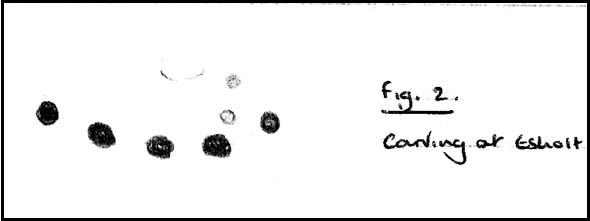
Esholt Lane Carving, Bradford

First described by Miss Hutchinson in a letter she sent to Sydney Jackson (1964), editor of Bradford Archaeology group newsletter.  When we first found this small carving (not far from where we grew up) we were at the end of our teens, and followed the directions cited in the Cartwright Hall Archaeology Group Bulletin (see above).  The carved design was typical of the primary arcs found in many of the Baildon Moor cup-and-ring carvings a bit further up the hill, but with two other small faint cup-markings on it.  According to Boughey & Vickerman (2003), the carving’s now been hidden in a section of walling that’s been rebuilt.  The drawing here is from one of my unpublished notebooks. (1984)

References:

  1. Bennett, Paul, Ramblings of Archaeological Remnants in West Yorkshire, unpublished: Shipley 1984.
  2. Boughey, Keith & Vickerman, E.A., Prehistoric Rock Art of the West Riding, WYAS 2003.
  3. Jackson, Sydney, ‘Cup-Marked Rock – Esholt Discovery,’ in Bradford Cartwright Hall Archaeology Group Bulletin, 9:4, 1964.

© Paul Bennett, The Northern Antiquarian

Hope Farm, Baildon, West Yorkshire

Cup-and-Ring Stone (lost):  OS Grid Reference – SE 142 396

Archaeology & History

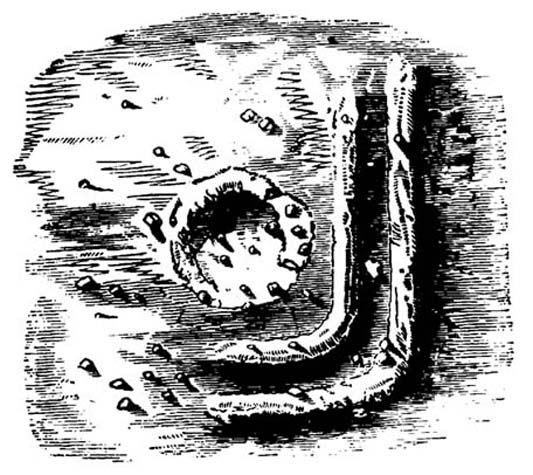
Listed in Boughey & Vickerman’s (2003) survey as ‘stone 186,’ I first came across a reference to this carving when I was young, in a short article by Sidney Jackson (1964) in his Cartwright Hall archaeology journal.  A letter was sent to Mr Jackson in 1963 by a Mr Bernard Stubbs of Baildon, who wrote:

“This morning I visited Hope Farm, Baildon, where Mr Jim Bell, the farmer, told me of a cup-and-ring boulder which he had discovered while digging a hole to bury a sheep, in the polt of land at the rear of the farmhouse… He stated that the hole was covered with cup-and-ring markings.  Unfortunately, the hole has been filled and concreted over.”

And no one has seen it since then!  Damn!  Recently we discovered a cup-marked stone carved on a now-upright stone in old walling in one of the fields immediately west of the farm, but it’s obviously a different one from that described in Mr Stubbs’ letter.  There are several other carvings in this region that are not in the official records, but this particular ‘lost’ stone remains lost for the time being!

References:

  1. Boughey, Keith & Vickerman, E.A., Prehistoric Rock Art of the West Riding, WYAS: Wakefield 2003.
  2. Jackson, Sidney, ‘New Cup-and-Ring Boulder,’ in Cartwright Hall Archaeology Group Bulletin, 9:1, 1964.

© Paul Bennett, The Northern Antiquarian

Hirst Woods, Saltaire, West Yorkshire

Cup-and-Ring Stone (destroyed?):  OS Grid Reference – SE 129 379

Archaeology & History

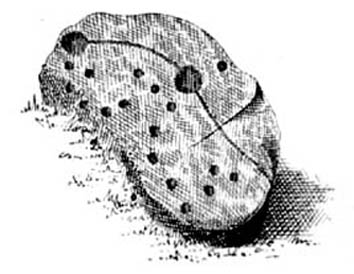
Over the years, many of us have looked for this site but without any success.  If it hasn’t actually been destroyed, it could be in someone’s garden wall, probably without them even knowing about it.  Indeed, even the grid reference given here is only an approximation (mine differs from the one cited by Boughey & Vickerman, who put the carving closer to SE 126 381) and the stone could have been a few hundred yards either side of here.  The main description of it comes from a letter written by a Mr T.P. Noble in 1964, which was cited in Sidney Jackson’s article ‘Hirst Wood Cup-and-Ring Boulder,’ in Bradford’s Cartwright Hall archaeology journal, where Mr Noble wrote:

“Mr Cooper, who built these houses (Hirst Wood housing estate) about 1935, once told me that there was a perfect example of a cup-and-ring stone here, but later, when he came to search for it, he couldn’t find it.  It appears it must have been removed and possibly broken-up when the foundations of the houses were excavated.”

Of course, as we don’t know the exact whereabouts of the carving, nor have we been left with an illustration of the stone, it’s difficult to say whether the description given by the great archaeologist Sir Mortimer Wheeler in 1958, is referring to the same carving.  Wheeler told us that one day in his childhood when he was out walking with his father, R.M. Wheeler, they came across a seemingly unknown prehistoric carving, saying,

“On one memorable day in the woods beyond Saltaire, we found an unrecorded cup-marked stone (later, I believe, recorded by my father in a British Association Handbook)” – that work being the Handbook to Bradford and Neighbourhood (1900), edited by R.M. Wheeler.

Naathen…if there are any people from the Hirst Wood area reading this and who might know of an old carved rock stuck in some old garden walls nearby, let us know.  You’ll be credited as the person who re-discovered this long lost carving – and we can get the story in the local newspaper.

References:

  1. Boughey, Keith & Vickerman, E.A., Prehistoric Rock Art of the West Riding, WYAS: Wakefield 2003.
  2. Jackson, Sidney, ‘Hirst Wood Cup-and-Ring Boulder,’ in the Cartwright Hall Archaeology Group Bulletin, 9:2, February 1964.

© Paul Bennett, The Northern Antiquarian