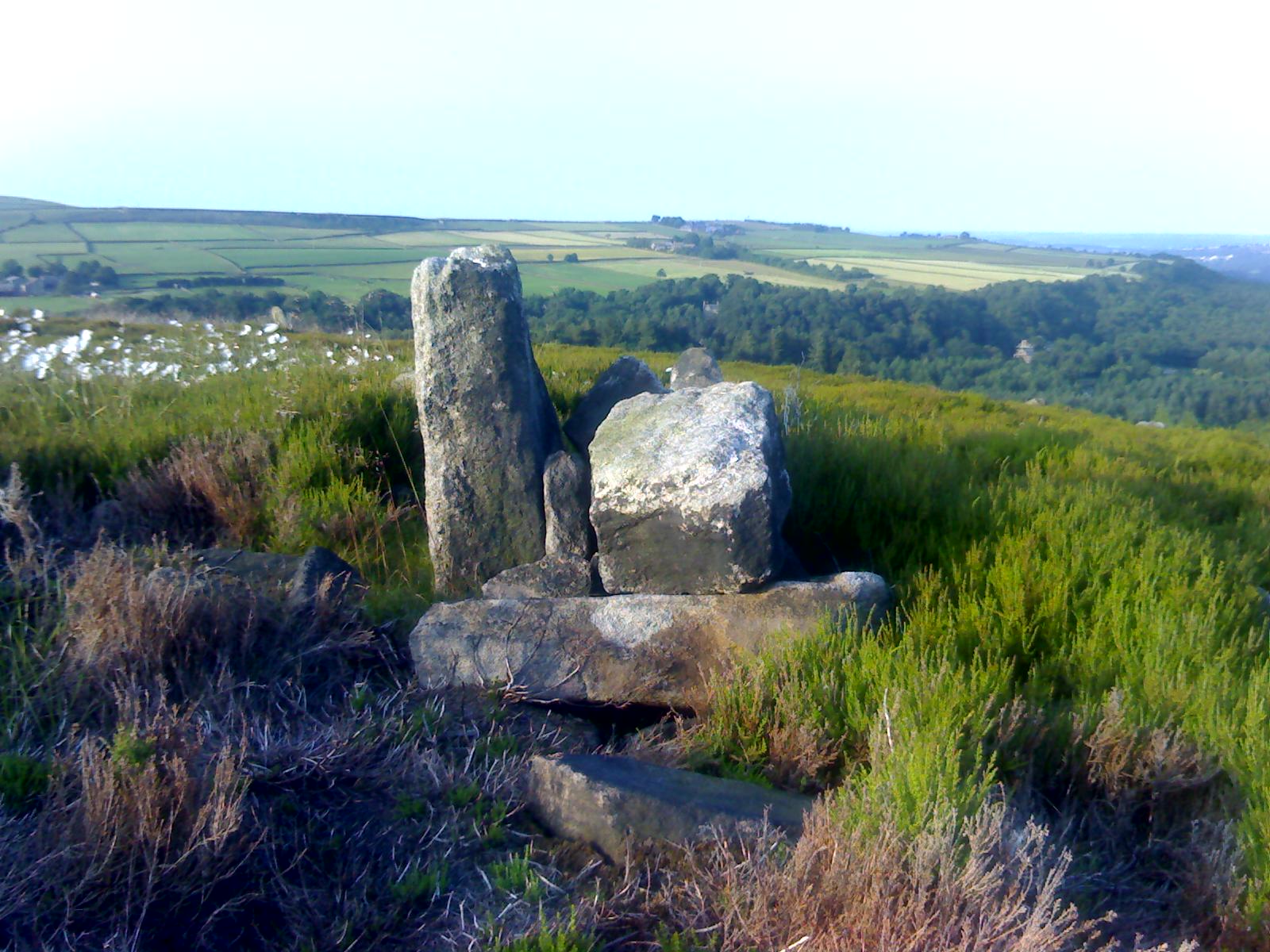
Nine Stones Monolith, Harthill, Derbyshire

Standing Stone:  OS Grid Reference – SK 2253 6256

Getting Here

Taking the roughly north-south road betwixt the village of Elton and the town of Youlgrave, rising up to see the great rock outcrop of Robin Hood’s Stride, park-up by the roadside and walk down the path across the fields to the Nine Stone Close stone circle. Once at the circle, look at the wall immediately south of here (looking towards the great Robin Hood’s Stride rock towers) about 100 yards away and you’ll see a large, nicely-worn ‘standing stone’ in the walling, with another a few yards to its side.

Archaeology & History
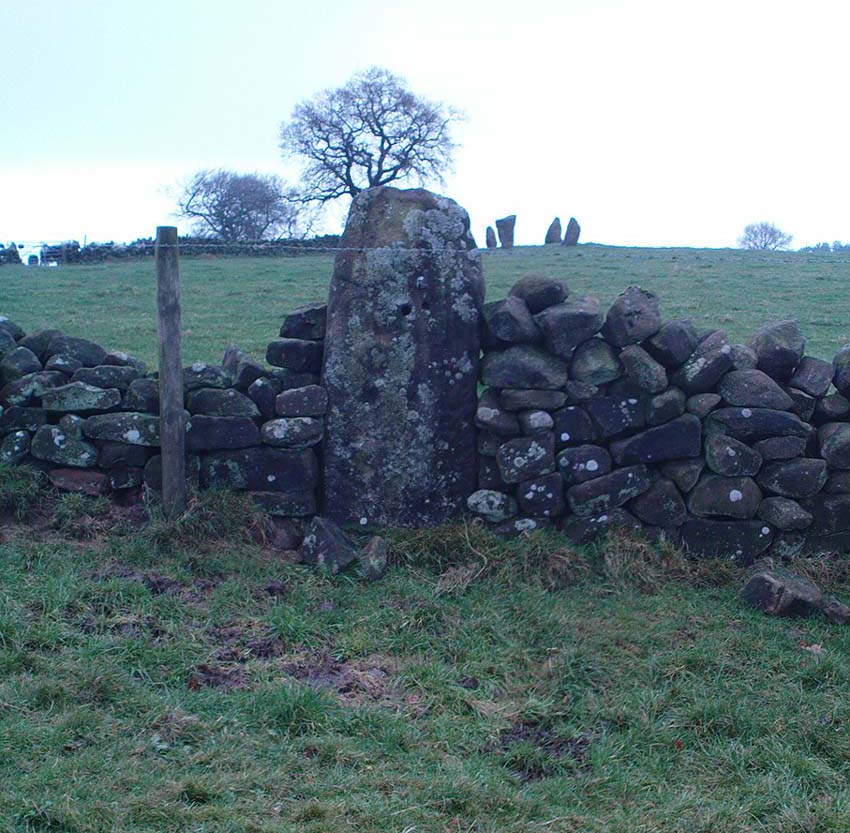
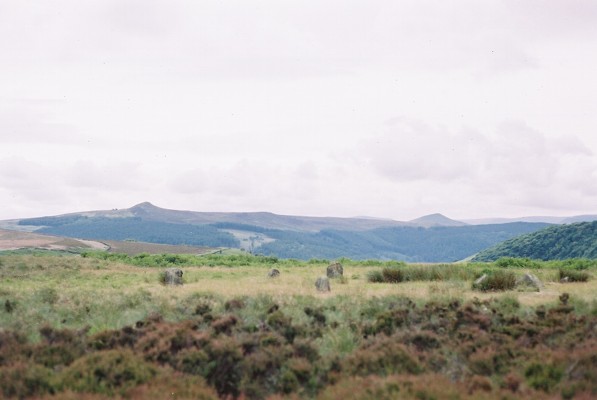
Nine Stones monolith, with stone circle behind

It seems like there’s been quite a lot written of this particular stone — much of it deeming, or speculating, that it once had summat to do with the stone circle of Nine Stones Close (which you can see in the background on one of the photos). The local archaeologist and writer, J. Percy Heathcote (1947) told us that around 1819, a Mr Glover said that this stone and a companion stood next to each other, but Mr Heathcote thought that,

“Judging from its size alone, only one of these is large enough to be compared to the stones in the circle.”
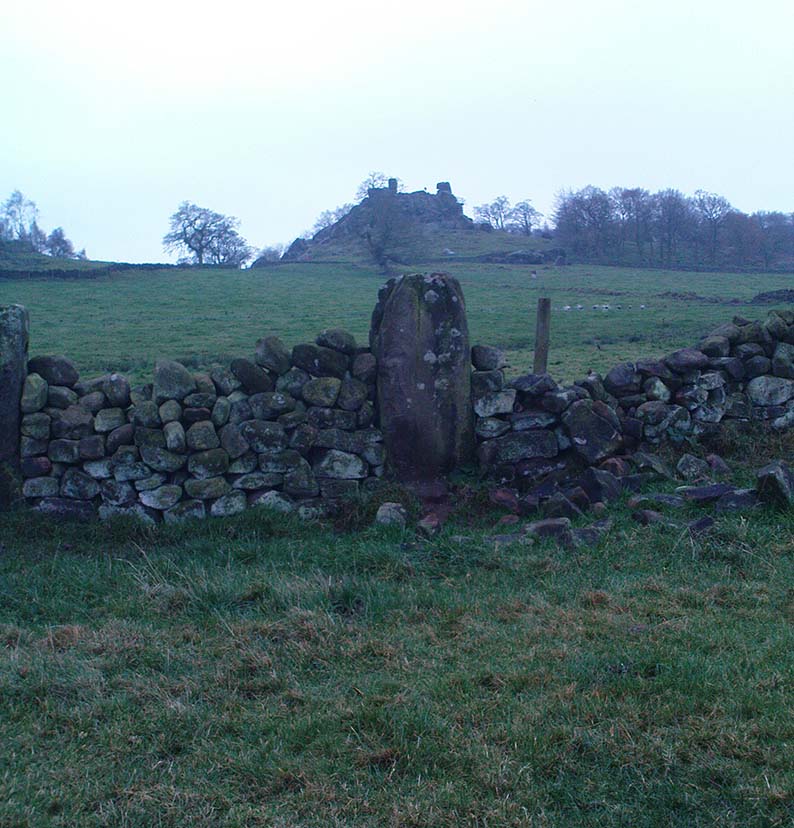
Standing Stone and Robin Hood’s Stride in background

Heathcote continued:

“Dr Phillips apparently assumes this stone to be connected with the circle in the same way as the similarly placed King Stone was connected with the Nine Ladies (Stanton Moor).  However, it seems more reasonable to suppose that the stone was brought by a farmer into the wall and not that he built the wall up to the standing stone.”

In more modern times however, John Barnatt (1978) thought that this stone was originally in the circle, but “has been moved across the field to the south to act as a gatepost.”

It’d be hugely improbable that it didn’t have summat to do with the stone circle, but exactly what, we can only speculate.

References:

  1. Barnatt, John, Stone Circles of the Peak, Turnstone: London 1978.
  2. Heathcote, J. Percy, Birchover – Its Prehistoric and Druidical Remains, Wilfrid Edwards: Chesterfield 1947.

© Paul Bennett, The Northern Antiquarian
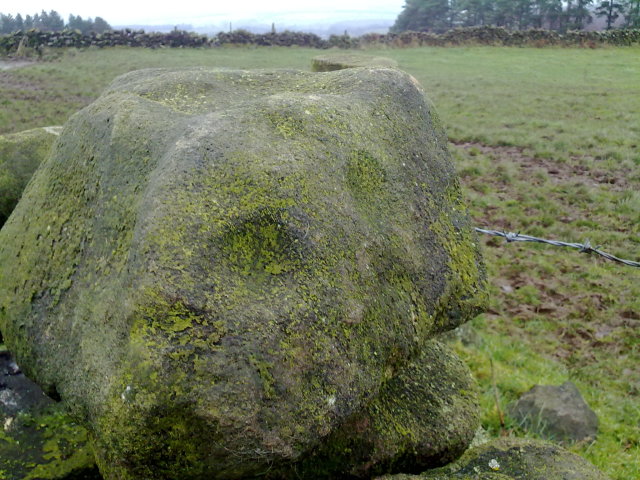

Nine Stones Cup-Mark, Harthill, Derbyshire

Cup-Marked Stone:  OS Grid Reference – SK 2254 6284

Getting Here

Taking the roughly north-south road betwixt the village of Elton and the town of Youlgrave, rising up to see the great rock outcrop of Robin Hood’s Stride, park-up by the roadside and walk down the path across the fields to the Nine Stone Close stone circle. Once at the circle, the walling closest to the stones runs along a bit (north), then downhill. Follow it. About 25 yards before hitting more walling that crosses your path, there’s a break in the wall to a field immediately left. Just below this gate opening, in the same wall, a few yards down, look for the stone!

Archaeology & History


This small carved stone, typical of the size you get in drystone walls all over the country, was discovered for the first time on November 29, 2009, by Geoff Watson, during an ambling foray exploring the megalithic sites in and around the Birchover district.  Not quite sure how his nose picked this little fella out, but once seen (and eyes adjusted!) it was obviously a portable cup-marked stone.  Though what, we first wondered, was it doing in the walling here?

Similar in size and form to the Bent Head cup-marked stone found in drystone walling near Todmorden, West Yorkshire, the proximity of the Nine Stone Close megalithic ring further up the slope from this example illustrated that prehistoric man found this location of some importance; but as the cup-markings — two definites, perhaps a third — had been etched onto a small portable rock, typical of those found in prehistoric tombs, we wondered whether or not a prehistoric grave had once stood close by. Thankfully, a persual of Barry Marsden’s (1977) catalogue later proved fruitful.  For in the adjacent field below where this carved stone sits in its wall, at SK 2255 6286, there’s a scattered mass of loose rocks and smaller stones (akin to the one here with its cup-markings), which Marsden listed as a prehistoric tomb.  It seems probable that this cup-marked ‘portable’ originally came from this much denuded burial spot.

Likelihood is — there’ll be more of ’em hiding in walling and elsewhere hereby…

NB – Please note – the images we took of the stone aint too good as the sky was grey, cloudy and overcast all day. We await a better visit on a finer day, when conditions allow for better images. As we all know, gerrin’ decent photos of cup-markings and their ilk can be a pain in the arse even on the best of days!

References:

  1. Heathcote, J. Percy, Birchover – Its Prehistoric and Druidical Remains, Wilfrid Edwards: Chesterfield 1947. (see MegaDread’s comment, below)
  2. Marsden, Barry, The Burial Mounds of Derbyshire, privately printed: Bingley 1977.

© Paul Bennett, The Northern Antiquarian
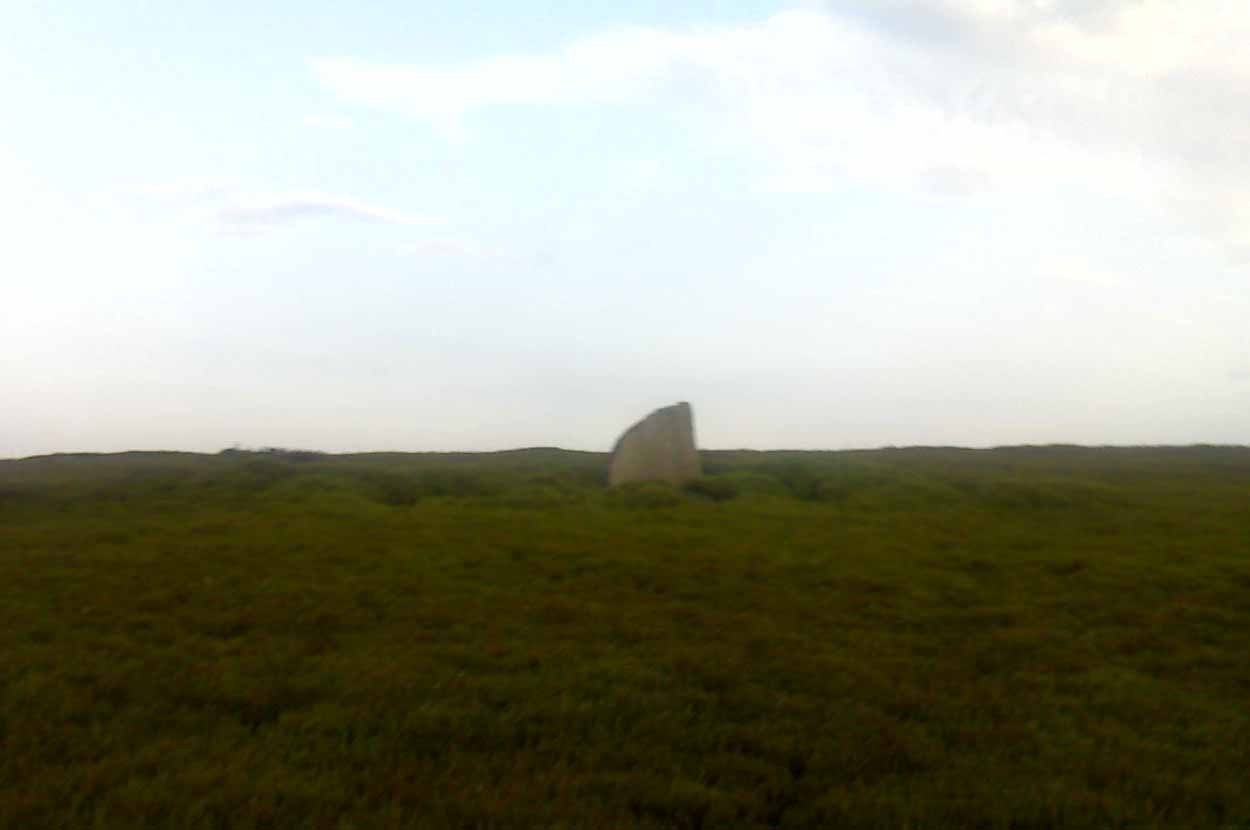

New Hagg Standing Stone, Hallam Moors, South Yorkshire

Standing Stone:  OS Grid Reference – SK 25815 87058

Getting Here

New Hagg Stone
New Hagg Stone

From Redmires Road, follow the path on the opposite side of the road from the reservoirs that follows the “conduit”: a man-made dyke marked on the map at SK 2601 8578.  You’ll need to follow this for about 1km till you come to a junction with a path crossing a small bridge on your left, and a path to your right onto the moor.  You need to take the latter for about 200 metres downhill.  The standing stone is roughly 100 metres onto the moor in a NNE direction.

Archaeology and History

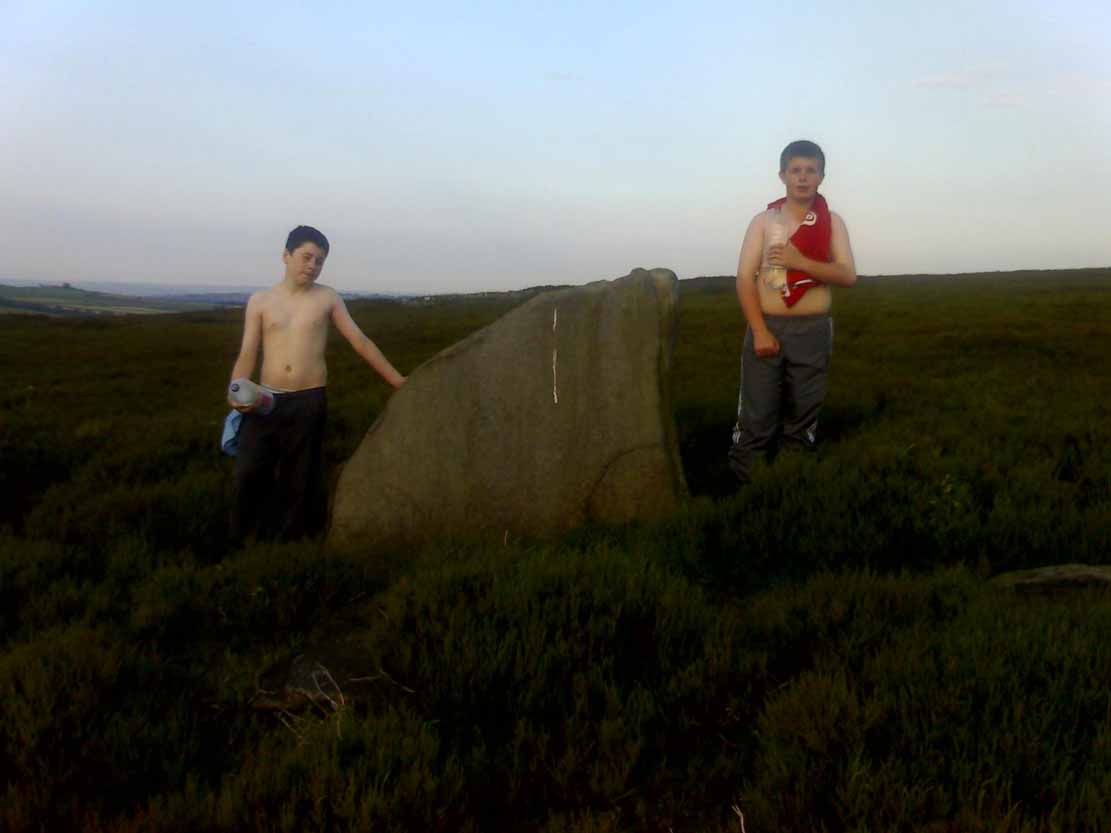
New Hagg, with kids for scale

None that I know of!  I didn’t know of its existence until I found it whilst wandering the moor one day.  Though I can find no record of it anywhere, the weathering on its top in comparison with other authentic standing stones suggest that it’s been stood for a very long time and probably since prehistory.

Four feet tall, the stone stands roughly half a kilometre SSE from the Headstone which can be seen from here – and roughly half a kilometre from the Reddicar Clough Long Cist, ESE of here.

© Geoff Watson, The Northern Antiquarian


Handsome Cross, High Bradfield, South Yorkshire

Cross (destroyed):  OS Grid Reference – SK 2612 9417

Also Known as:

  1. Hanson Cross

Archaeology & History

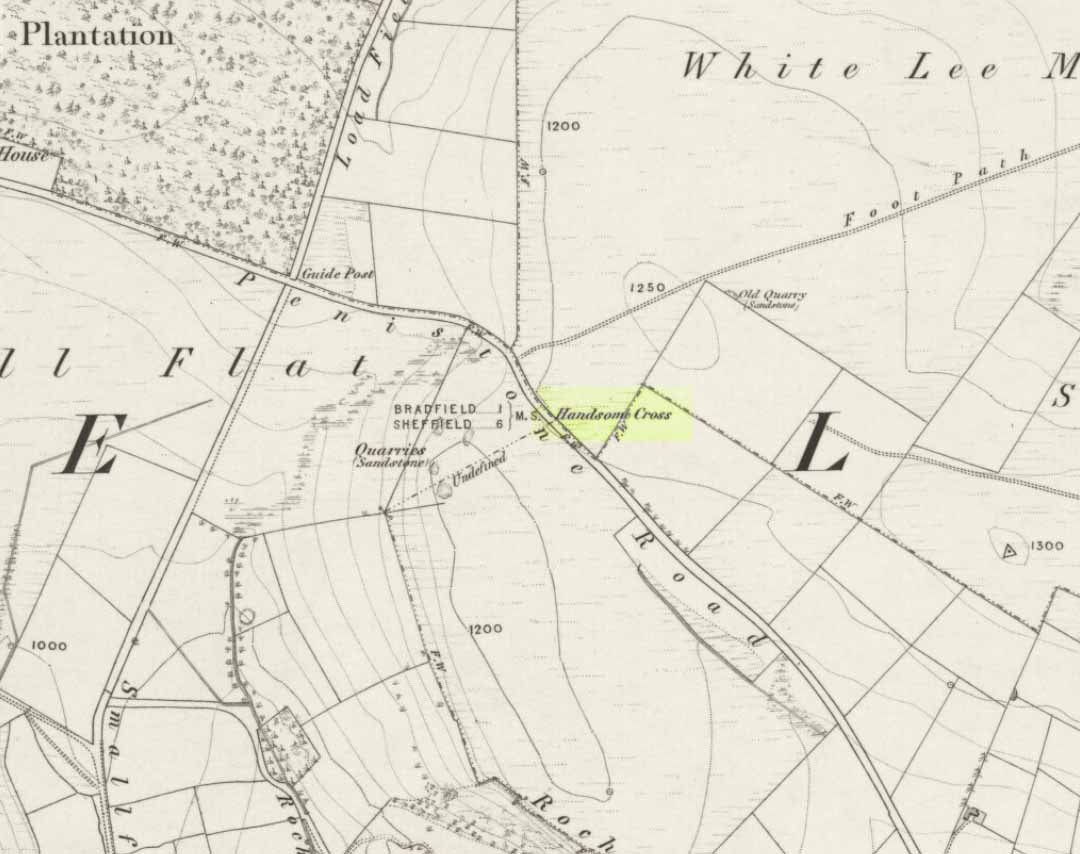
Handsome Cross on 1855 map

Described in Joseph Hunter’s (1819) rare work as being close to a now-lost stone circle, this wayside cross is shown on the earliest Ordnance Survey map of 1855 as being at the side of the old Penistone road, across from the guide-stoop which can still be seen.  The cross stood at a peak on the roadside which allowed it to be visible from either direction and probably stood on the ancient township boundary line.

In Neville Sharpe’s (2002) fine survey he found an early account of this lost relic from writings ascribed to one John Wilson, who lived between 1719 and 1783, which told that,

“Ann Hawley, an old woman who lived at Broomhead in 1700, says she remembers Hanson Cross having a head and arms.  The head is still there, but the arms I do not remember.”

References:

  1. Hunter, Joseph, Hallamshire: The History and Topography of the Parish of Sheffield, Lackington: London 1819.
  2. Sharpe, Neville T., Crosses of the Peak District, Landmark: Ashbourne 2002.
  3. Smith, A.H., The Place-Names of the West Riding of Yorkshire – volume 1, Cambridge University Press 1961.

© Paul Bennett, The Northern Antiquarian

Hordron Edge Stone Circle, Moscar Moor, Derbyshire

Stone Circle:  OS Grid Reference – SK 2152 8685

Also Known as:

  1. The Seven Stones of Hordron

Getting Here

Park up at Cut Throat bridge on the A57 or alternatively  at the huge parking area that’s signposted a little further uphill. Either way, the easiest access point is at Cut Throat Bridge – though be aware the route between the two areas is the narrow grassy verge of the road: take care, kids and dogs on a very short rein!  There are many ways to access the circle but I’ll deal with only two here: one, a scramble up the steep bank of the edge; and the other, a longer route which takes in a quite a steep path, but is much easier than the first option if you’re not up for a scramble!


Route 1: The shorter scrambly route – Climb the stile into the wooded area & follow the path till your out of the wood, carry on for another 100 metres then head to your left & up the banking.  The circle is thereabouts 40 metres onto the moor in the grassland, not the heather.

Route 2: The longer way but following a relatively easy path – Access the moor via the stile and just follow the path for around ½-mile till it veers to the left at Jarvis Clough & takes a steep route uphill.  You then need to head left along the edge for around ¼-mile till you see the circle off to your right in the grassland.

Archaeology and History

Don’t let the bastardization of this site’s name fool you!  The seven stones actually number between 9 and 24, depending on the season and the growth around them.  They’re laid out in a rough free standing circle around 15.5 metres in diameter.

Hordron Edge looking across to Lose Hill

One of the largest stones to the SW is said to mimic the profile of Lose Hill — which it does sort of if you have a vivid imagination.  But it’s not half as close as the top of the stone matches the profile of Lose hill off to your right.  It is a complete coincidence of course.  The stone has suffered much weathering over the millennia and I’m in no doubt it wasn’t an intended original feature. (see pic, right)

Previously, and at some time  preceding the 1992 excavations at the site by John Barnatt, the circle was “tampered” with, leading to a thorough investigation that unearthed several more buried stones, one of which was re-erected.

All in all a fantastically preserved circle and one of the best examples in Derbyshire that’s well worth the effort of a visit.  Watch the weather though; as on all but one of my visits I’ve been drenched!.  The “wow” factor of this site however, makes that a small price to pay for such an awe-inspiring excursion.  With Win Hill and Lose hill looming large to the southwest, Stanage Edge off to the southeast and the great outcrop of Ladybower Tor with it’s rock art to the west, this circle has some of the best scenery of any the circles in Derbyshire.

Folklore

The stone that alleges to line-up with Lose Hill is also known by some of the more imaginitive as the Fairy Stone and there have been reports of strange lights and other phenomena reported around it.  I’ve been up here on probably a dozen occasions and never witnessed anything strange — but then I’m often accused of being closed-minded.  Another way of saying “non gullible” in my book!

References:

  1. Armitage, Harold, Early Man in Hallamshire, Sampson Low: London 1939.
  2. Barnatt, John, Stone Circles of the Peak, Turnstone: London 1978.
  3. Burl, Aubrey, The Stone Circles of Britain, Ireland and Brittany, Yale University Press 2000.
  4. Thom, A., Thom, A.S. & Burl, Aubrey, Megalithic Rings, BAR 81: Oxford 1980.

© Geoff Watson, The Northern Antiquarian


ancient

Ciceley Low, Houndkirk Moor, South Yorkshire

Ring Cairn:  OS Grid Reference – SK 27535 80800

Getting Here

Located just off Hathersage Road, by Parsons House outdoor pursuits centre with parking in a roadside layby. Don’t Park at Parsons House – they won’t like it!  Head up the old road besides Parsons house and take the entrance onto the moor about 100 metres past the pursuits centre track.  If memory serves me correct, it’s by the second wall on the right. Follow the post-and-mesh fence to the end of the wall and turn right, following the wall for around 70 metres down hill and you’ll be able to see the cairn’s bank before you in the heather.  The stone pictured lays in the banking by the entrance which faces NNW.

History and Archaeology.

There’s no excavation taken place here that I know of, but the site is well known and mentioned in an old report I found Here.   The article also contains an old map of the area showing the site.

Also mention is made of a stone referred to as the Fingeram stone.  There is a stone laid flat in the position marked on the map,  but I’m unsure whether it’s the standing stone mentioned.  According to the old text the ring cairn has a diameter between 83ft and 95ft.  Directly to the north and roughly 50 metres onto the moor, in line with the wall, is an interesting egg-shaped  and weather-worn boulder that’s also worth a look at.  This whole area is a sea of sandstone.

© Geoff Watson, The Northern Antiquarian


Wyming Brook Shelter, Redmires, Sheffield, South Yorkshire

Rock Shelter / Cave:  OS Grid Reference – SK 2715 8630

Getting Here

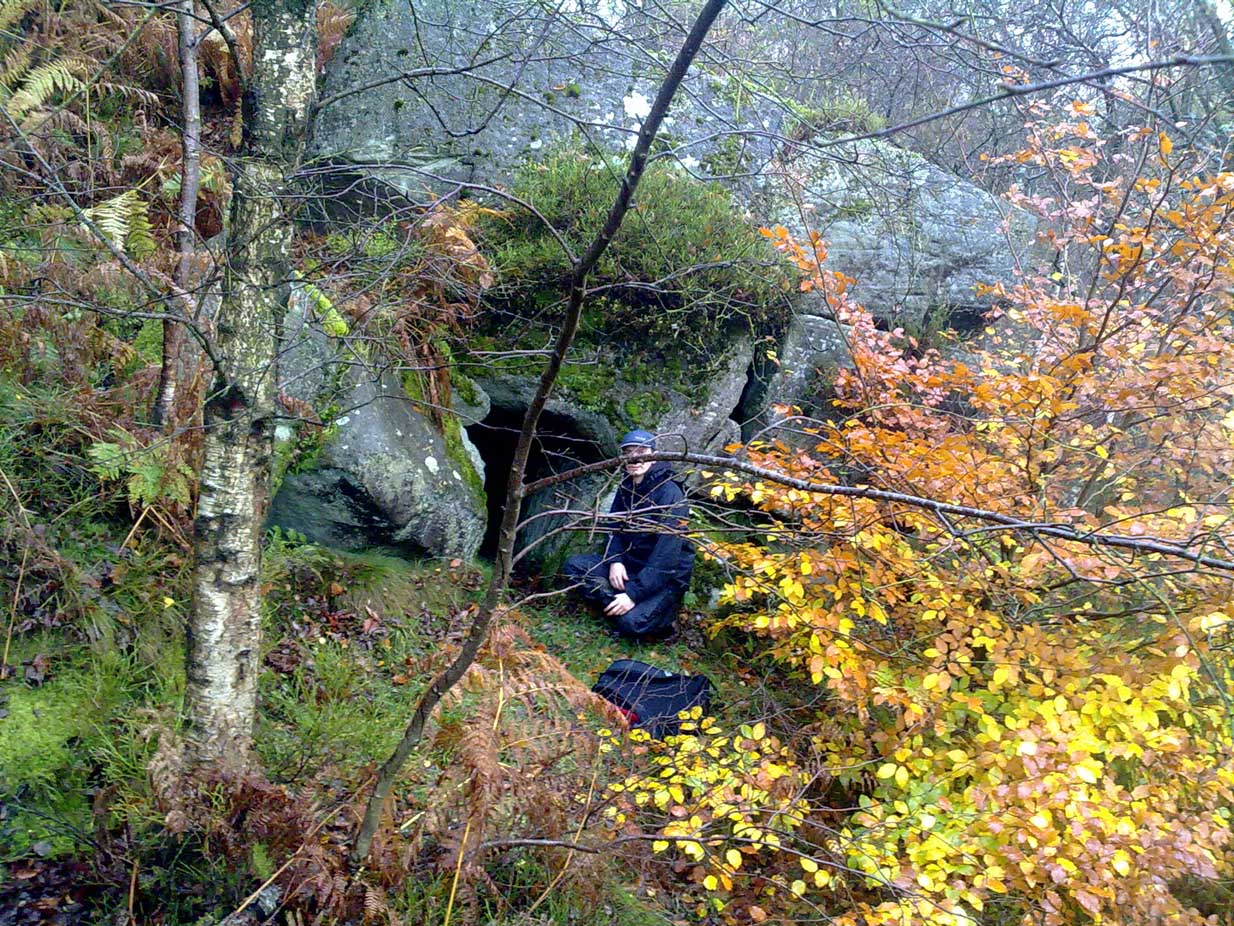
Geoff at the entrance

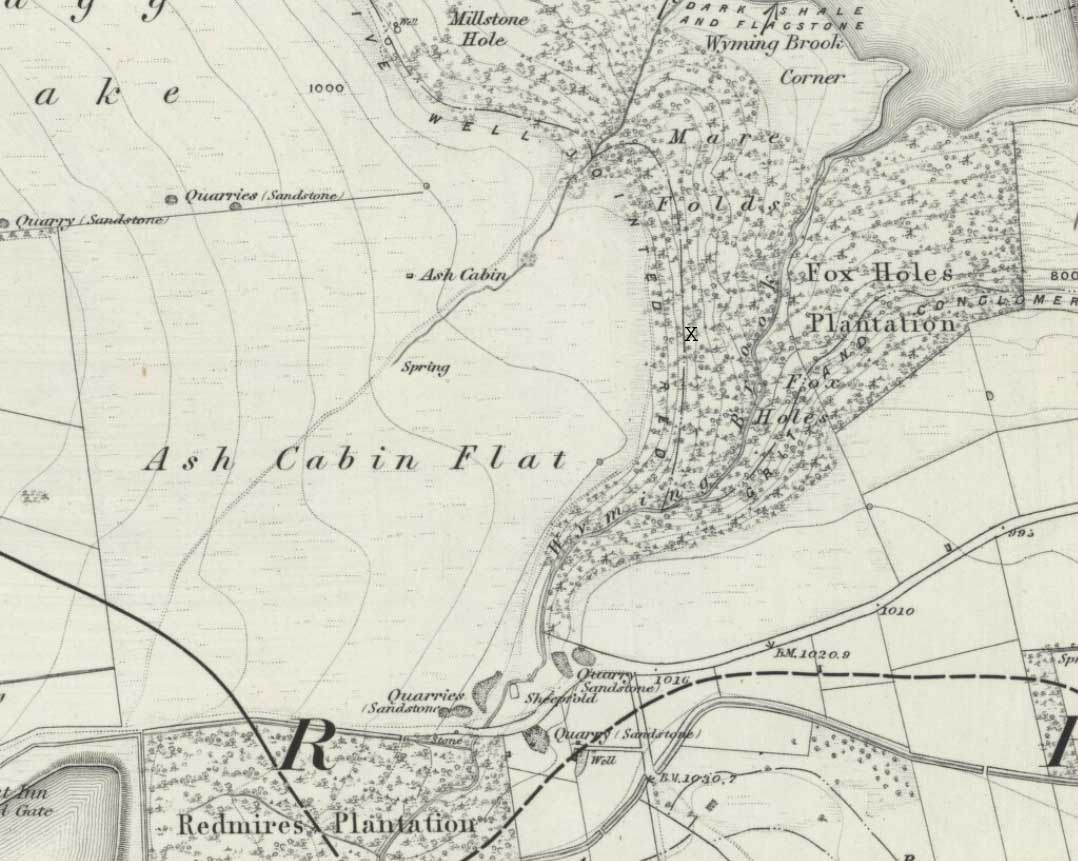
Park at Wyming Brook nature reserve car park off Redmires road and head off up the steps to the right of the notice board. Turn immediately right through the trees and you’ll soon pick up the path running along the ridge above Wyming Brook drive. Stay on the obvious path for around ½-mile passing “Big rock” to your right and the views it offers over Rivelin Valley and the dams.  A short way further along the path steps down a couple of feet and turns to the right before straightening again, this is where you need to start looking down the edge to your right for a large rock that resembles a Chesterfield sofa which makes up part of the shelters roof.

Once you’ve located the site a short scramble will be needed to gain access to the entrance and this is where care is needed. It’s not difficult but has the potential to be deadly due to the steep nature of the edge so please take care and keep any kids on a very short rein.

Head down to the right of the “sofa” and jump down the 3ft drop holding onto the rather handy bracken and saplings if needed and the entrance is right there to your left.

Archaeology & History

Errr……..yeah, it’s history! — Well I’ve yet to find anyone else that actually knows about this cave, let alone it’s past!  There are obviously locals who know of it’s existence but after half a dozen visits there I’ve not seen anyone except a brave old lady, 70 if-a-day, who was there looking for the supposed wartime carvings and that was on my first visit.

I have tried every possible avenue i know to reveal the caves past but as yet nothing, I’d be grateful if you could enlighten me at all.

I did e-mail John Barnatt with hope he’d have some information but alas no, though it is admittedly just outside his patch being on the Sheffield side of the Derbyshire / Sheffield border.

The shelters entrance is around 3ft high but once inside the roof quickly gains height and tops out at around 7ft so standing is easy.  Beware half way along the interior by the small opening though — you’ll crack your head if  your attention is drawn to the light beaming in through the side! There’s quite a bit of occupation rubbish within the cave due to someone making their home there: a sleeping bag, old tin cans, bottles, etc, is evidence enough, but the stuff’s quite old and no one resides their now.

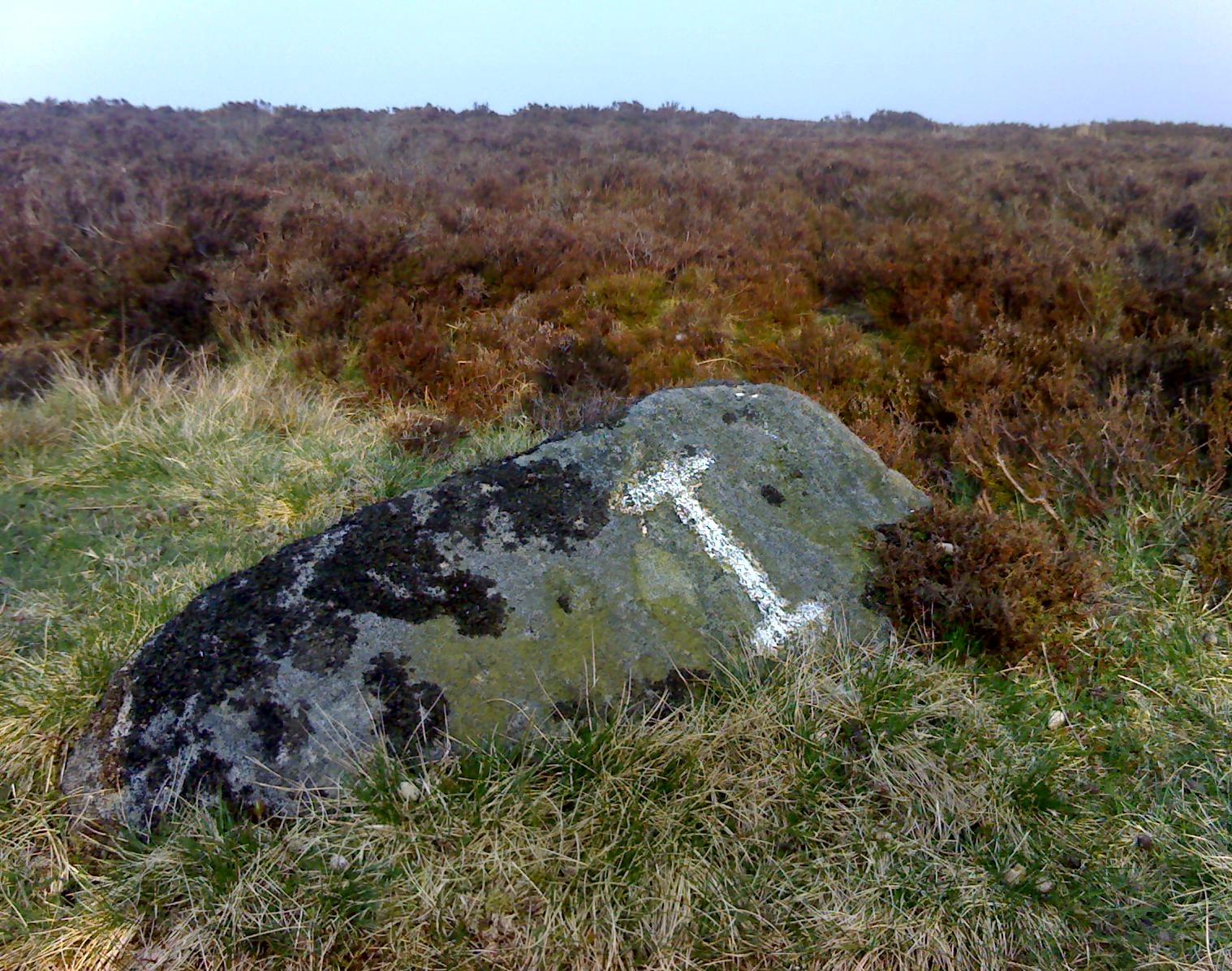
“X” marks the spot!

At the far end of the shelter is a small chimney like opening and it’s just possible to squeeze between the fallen rocks and make your way out, it would also make an excellent outlet for smoke if you chose to have a warming fire inside.

You probably won’t notice on your way in but coming out and on the rocks by the entrance to your left are carvings dated to 1944 said to have been inscribed by German prisoners of war held in the area but I’ve yet to substantiate that.

© Geoff Watson, The Northern Antiquarian


Reddicar Clough, Hallam Moor, South Yorkshire

Long Cist:  OS Grid Reference – SK 2624 8688

Also Known as:

  1. Ash Cabin Long Cist

Getting Here

Despite a footpath being marked on the OS map, there’s none I could find and the only way to get there is to make your way through the heather.  Park at the Wyming Brook nature reserve car park on Redmires road, take the signposted path besides the notice board and follow the line of the dry stone wall. Go through the gate and continue till you come to the end of the wall where a path leads off to your left through the broken wall, follow the path through the boggy bit and head uphill till you get to the highest point of the path by another wall with a path the other side.  From here it gets a little tricky! You’ll now need to go off path heading NNE and down hill till you come to the post-and-wire fencing where you should pick up a slight path heading WNW (your left) and head for the high point about half a mile in front of you. Just before you come to the high point you’ll have to cross the stream (easily done). The cist lays on the flat ground just beyond the brow of the rise.

Archaeology & History

A long cist around 3 feet wide and 6 feet long in a well preserved condition aligned almost — but not quite — East/West on a prominent position on Hallam Moor, commanding views over Ash Cabin flat, Rivelin Valley and the A57 road.  The only restricted view is to the northwest, where the moor rises then drops down again towards the Headstone.

There are 3 side-stones still in situ: the largest around 1 metre tall, the others still in place being about 70cm.  The stones that would have made up the rest of the walls lay close by.

When you’re at the site it’s obvious why it’s in this location: the views are spectacular and afford excellent views of the surrounding area.  A burial site with a vista truly fit for a king!

Archaeologically there’s not much info kicking around that I can find and I’m indebted to Stubob for alerting me to it’s presence.  It’s very unlikely you’d be walking this area for any reason other than to visit the site, as there are decent paths across the moor to the most popular site in this area, the Headstone off to the North West.  Remains of the Ash Cabin Flat stone circle are about 750 yards southeast of here.

A real gem of a site and a “must see” if your in the area.

© Geoff Watson, The Northern Antiquarian


Ash Cabin Flat, Hallam Moor, South Yorkshire

Embanked Stone Circle:  OS Grid Reference – SK 26940 86268

Getting Here

Follow Redmires road till you come to Wyming brook nature reserve and use the free parking facilities there.  From the car park you need the signposted path to the right of the notice board, the first one not the one by the metal barrier; climb the rocky steps and follow the line of the dry stone wall to your left, and after around 50 metres you’ll pass through a wooden gate.  You then continue following the wall as it heads downhill and the wall becomes broken.  Here you should notice a path that goes through the broken wall off to your left: don’t take it but continue another 50 metres or so, then turn 90° to your right facing the moorland.  The circle is around 50 metres into the heather.

Ash Cabin Flat Stone Circle – as of 26/5/09

Archaeology & History

A fairly well preserved late neolithic or early Bronze age embanked stone circle located in a sea of heather on Ash Cabin Flat on the Western outskirts of Sheffield and rediscovered in 1981 due to the moor being burnt back.

The site is oval in shape and around 9m x 7m diameter to the outer edge of the bank.  The banking is well preserved and shows there was no entrance to the interior.

There are around a dozen stones within and on top of the bank but it’s uncertain whether they are circle stones or packing stones from the bank.  English Heritage have recorded 5 of the stones, 2 still standing, as stones that once stood making up the circle.

If you visit any time soon (23/11/09) you’ll find the moor has been burnt back again giving an excellent view of the site, when the heather is in full flow it’s as high as the highest stones making not only finding the circle nigh on impossible to find but also defining the site very difficult.

Additional Notes:

Editor – 1.12.9. – Following a visit to this site in the company of Megadread recently, we found what appears to be a number of other cairns on the flat moorland plain around this seeming cairn-circle site.  There also appeared to be distinct evidence of ancient walling. Further archaeological evaluations are required here.

References:

  1. Burl, Aubrey, The Stone Circles of Britain, Ireland and Brittany, Yale University Press 2000.

© Geoff Watson, The Northern Antiquarian


Fearby Cross, Masham, North Yorkshire

Cross: OS Grid Reference – SE 1984 8127

Getting Here

Take the road from Masham into this lovely hamlet and, as you reach the staggered crossroads, you’ll see a small village green with a single tree at where the four roads meet.  In the grass below the tree is this forgotten monument!

Archaeology & History

Fearby Cross remains

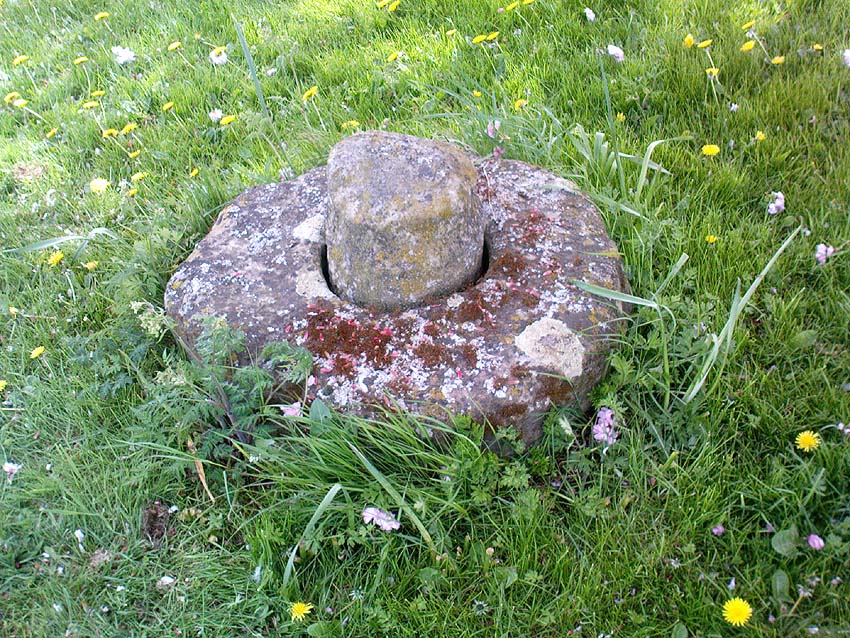
Found at the meeting point of five old lanes, little has been written about the old cross remnants here, which is barely a foot high and rests on its roughly circular stone base.  It sits where five old tracks meet and is thought to be medieval in origin.  Speculation alone pronounces the site to have been a place where local council proclamations occurred, and where funerals stopped and the dead were rested.

One intriguing piece of information narrated by Edmund Bogg (1906) that may have had some relevance to the siting of this old cross, told that between here and the hamlet of Healey a mile west,

“there were formerly circles of upright stones and other relics suggestive of druidical origin.”

Any historical information or folklore relating to these apparent megalithic remains needs to be uncovered!

References:

  1. Bogg, Edmund, Richmondshire and the Vale of Mowbray, James Miles: Leeds 1906.

© Paul Bennett, The Northern Antiquarian