Rushbank Hill, Carleton-in-Craven, North Yorkshire

Cup-Marked Stone (lost):  OS Grid Reference – SD 950 488

Archaeology & History

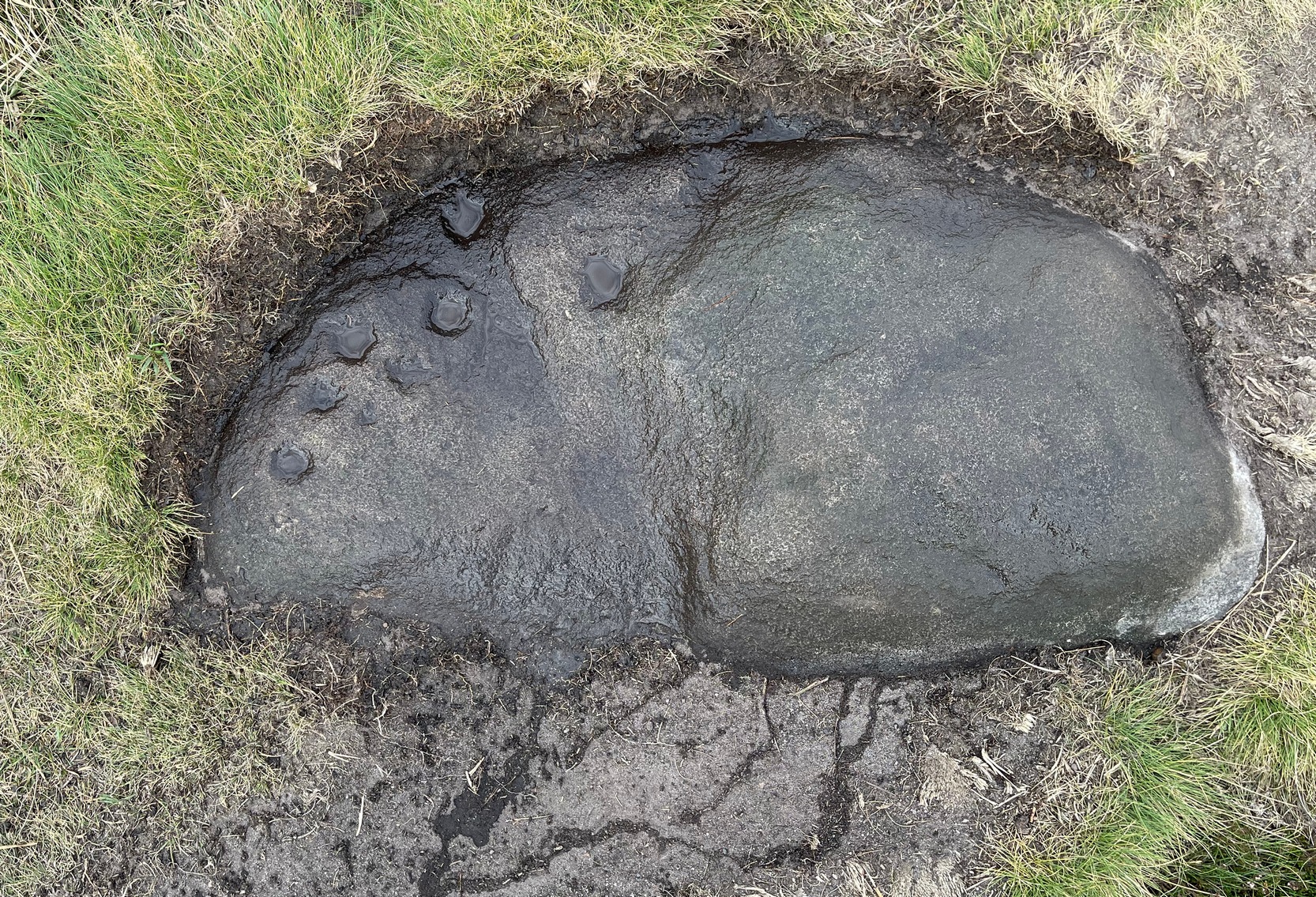
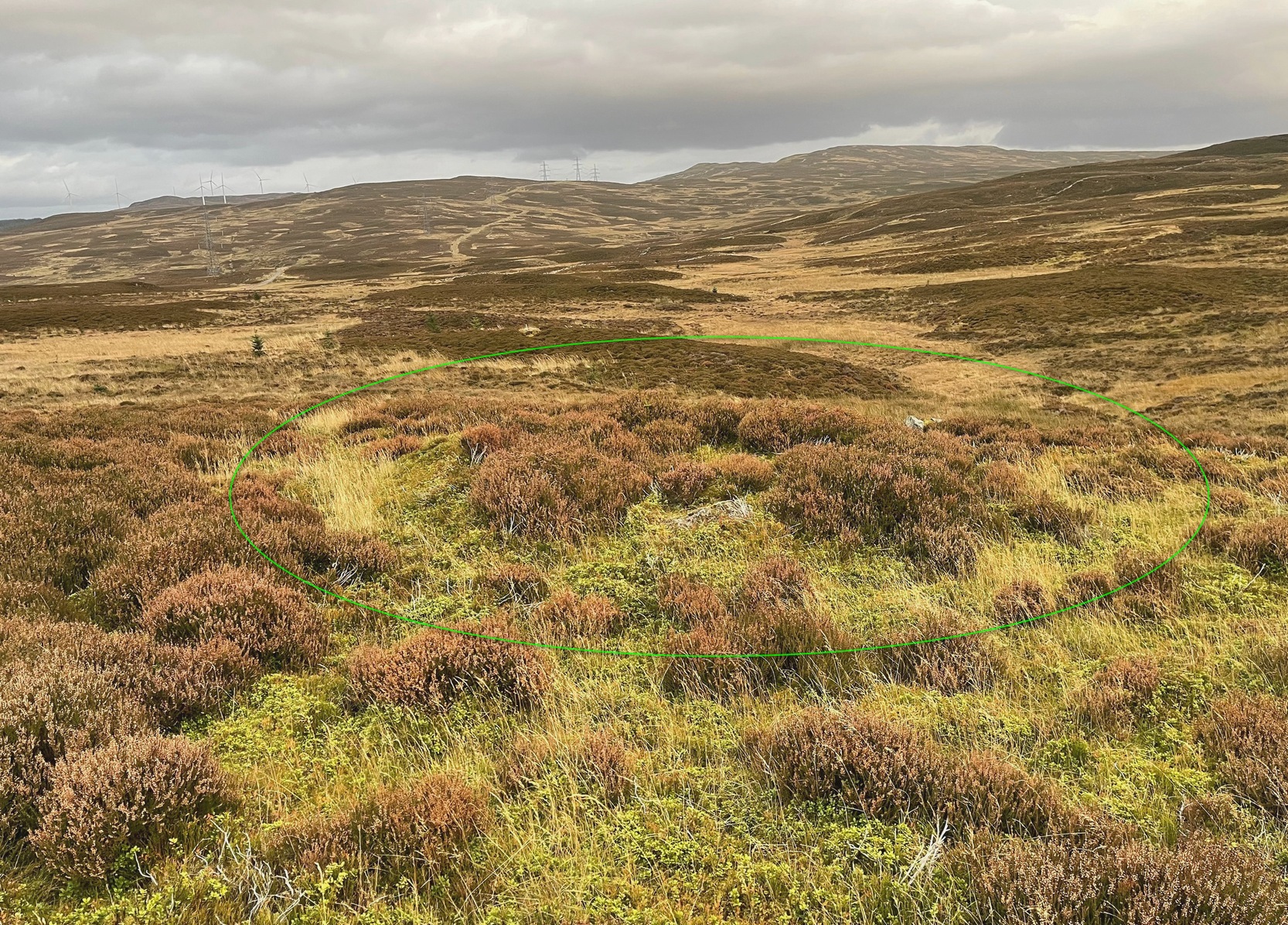
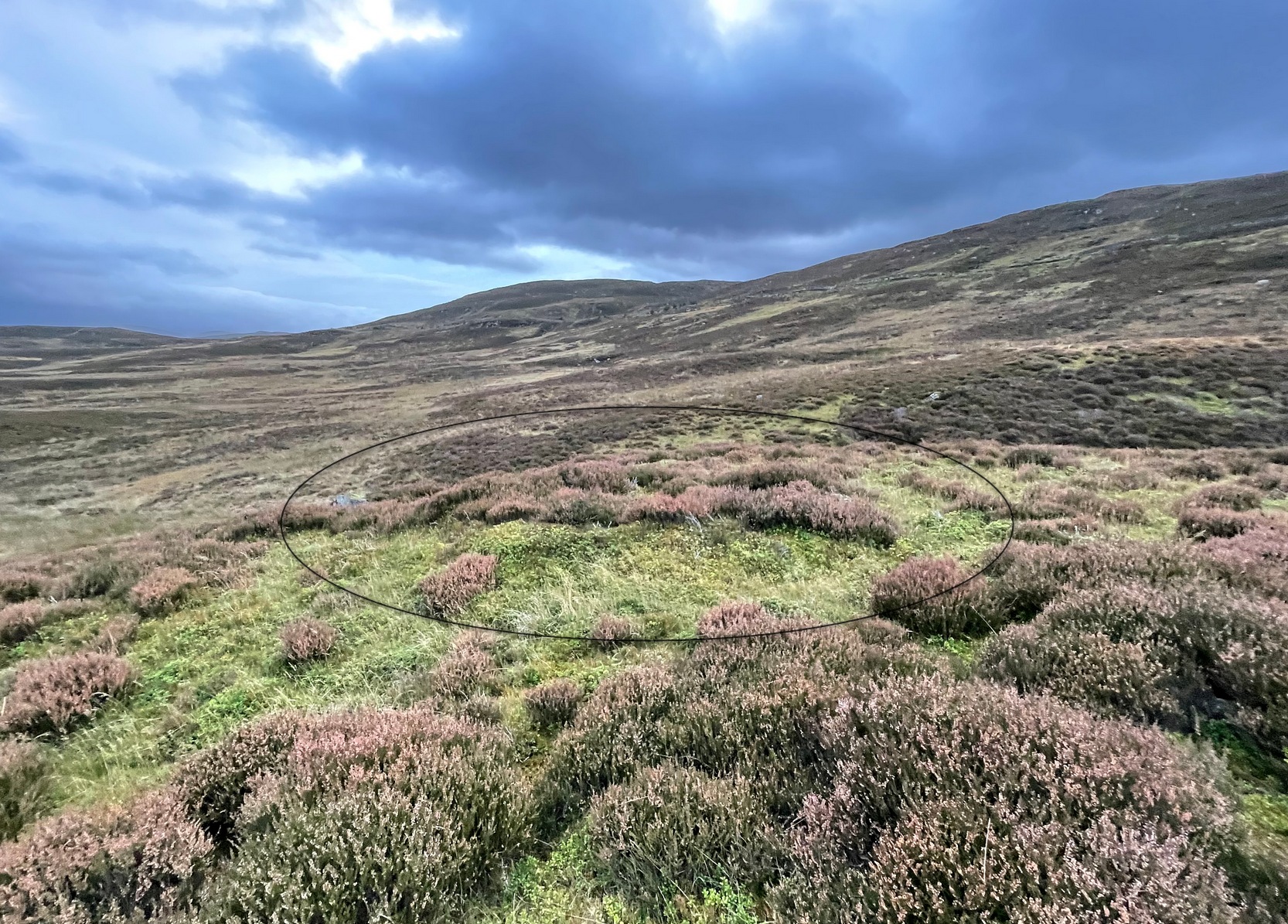
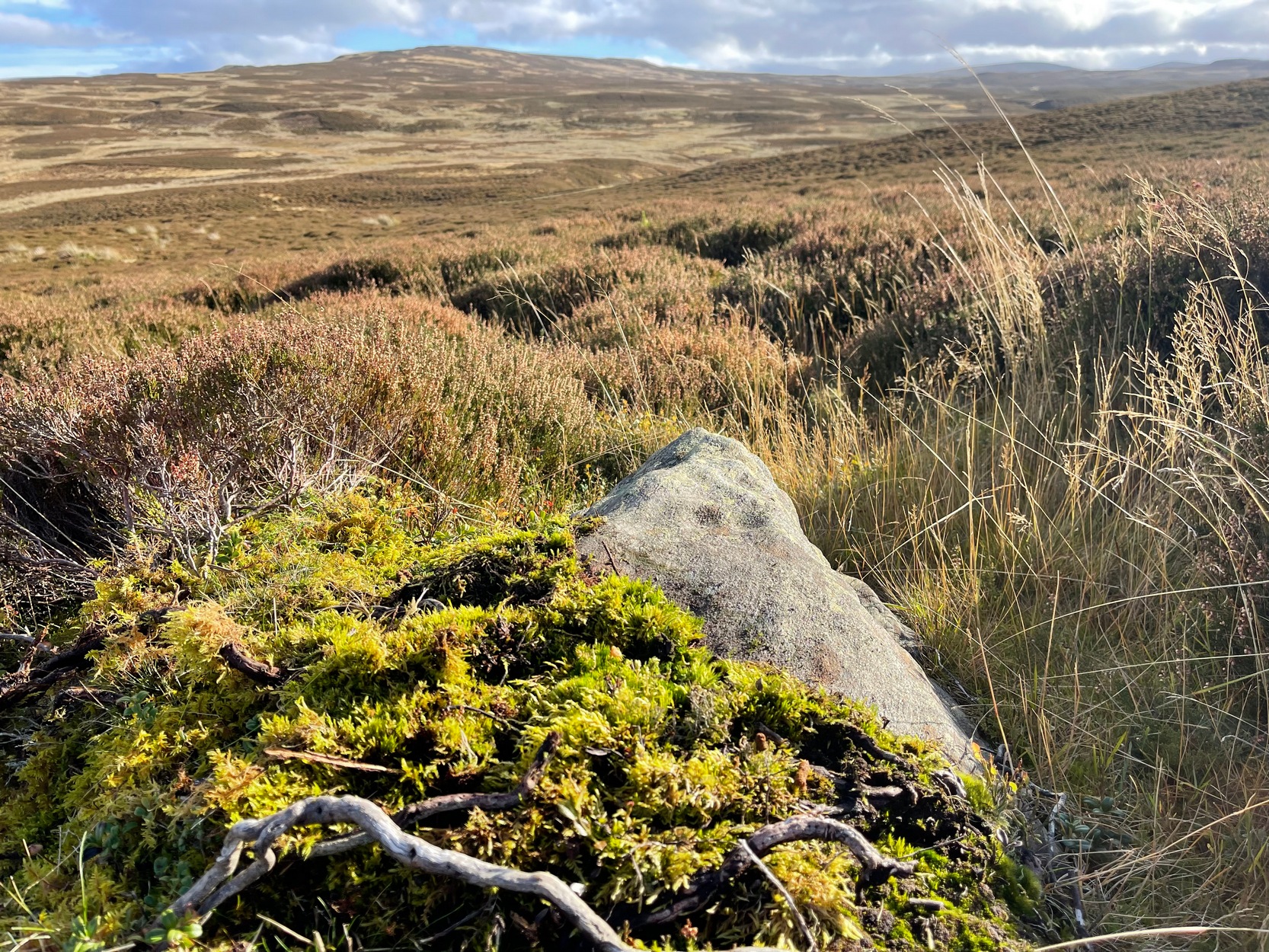
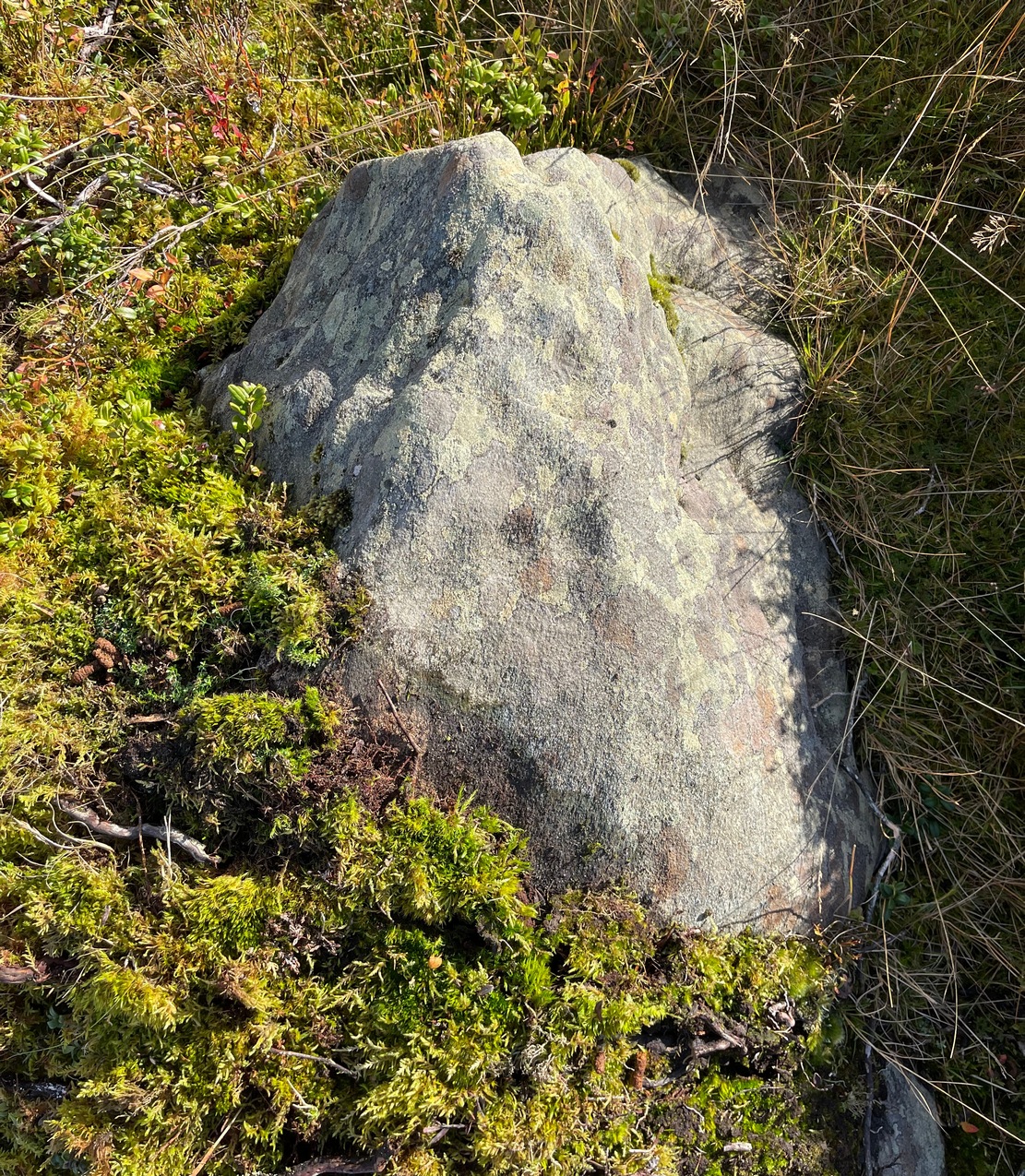
When the archaeology assistant Stuart Feather ventured over to look at the prehistoric enclosure on the northwest slope of Raygate Hill, a mile or so south-west of Carleton, like any good petroglyph explorer he looked out for any rock art and—like y’ do sometimes—came across a cup-marked stone that hadn’t been recorded before.  He wrote down his finds at home and, following his death, those records were thankfully sent to the Manor House Museum in Ilkley, from where these brief notes are taken.  There was at the time of his visit, he said, a

“Rock outcrop with two cup-marks, on August 6th 1960 this outcrop was intact.  On a second visit the top layer of the rock had become detached and split into two.  The pieces were then removed for preservation.”

By “removed for preservation”, he meant that he took it home to Fernbank Avenue in Keighley (he did this with a few of our old cup-and-rings).  However, this one has not been found since and  it may simply have been buried in his garden. Does anyone know more about it?

He described another less likely contender of a carving a little closer to the enclosure, telling briefly: “Cup-marked rock, cups only possibly man-made.  In close proximity, 75 yards, to (the) earthwork marked on the 6” O.S. map.”

© Paul BennettThe Northern Antiquarian
Low Plain, Baildon Moor, West Yorkshire

Cup-Marked Stone:  OS Grid Reference – SE 13909 40371

Getting Here

The low-lying petroglyph

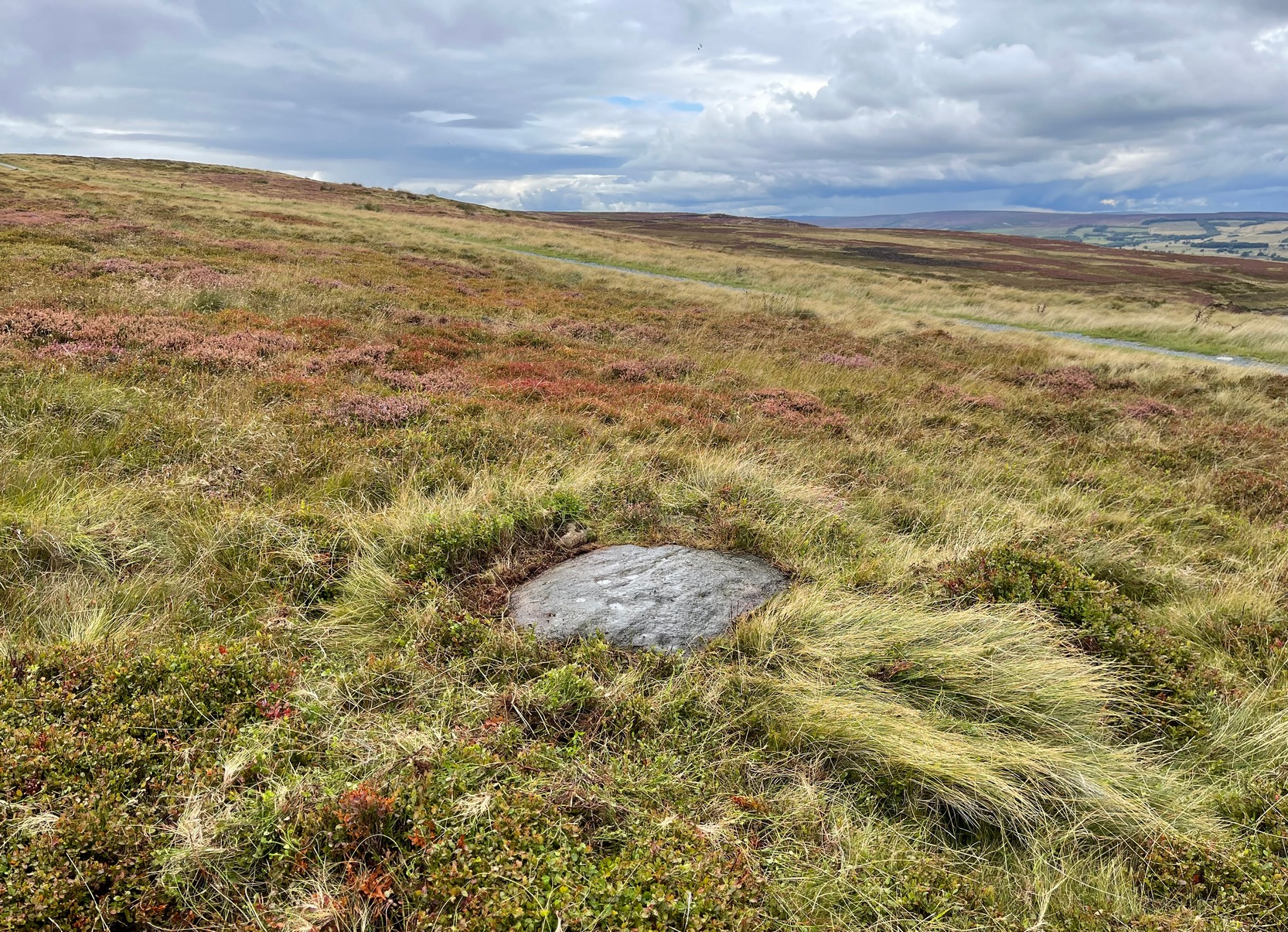
Probably best if you start from the car-parking spot at Acrehowe, by taking the road up through Baildon village, across at the roundabout up Northgate and up onto the moor, then after a few hundred yards turn left on the Bingley Road.  The Acrehowe parking spot is a half-mile up on your right.  From here, cross the road and bear right to take the footpath that follows the contour at the edge of the hillside, walking past the Baildon Moor (184) carving on the way.  About 250 yards past this carving, on the right-side of the track as you’re heading to Dobrudden, is this low-lying almost innocuous stone.  Keep your eyes peeled and you’ll see it.

Archaeology & History

The carving looking W
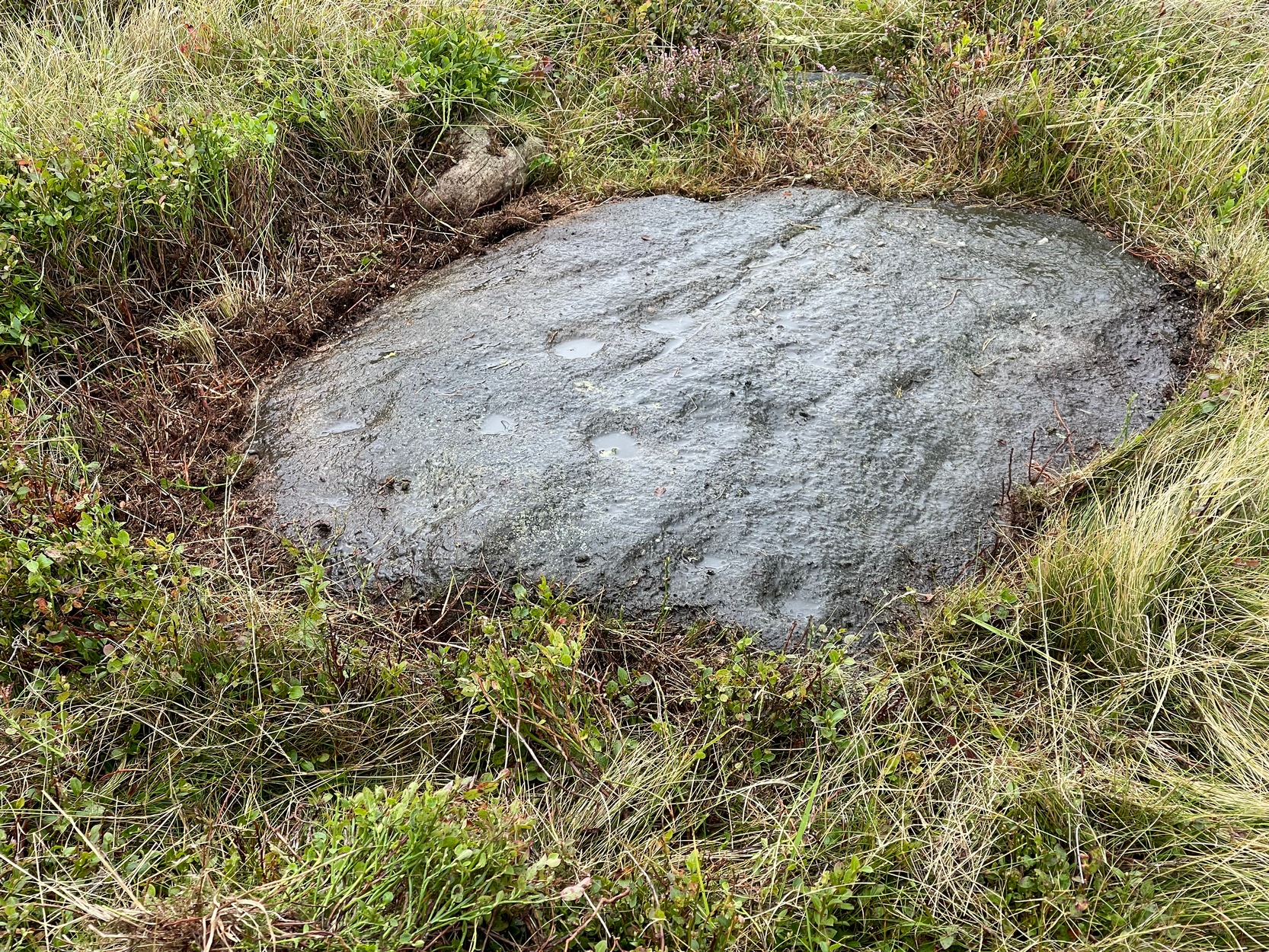
Cup-marks clearly visible

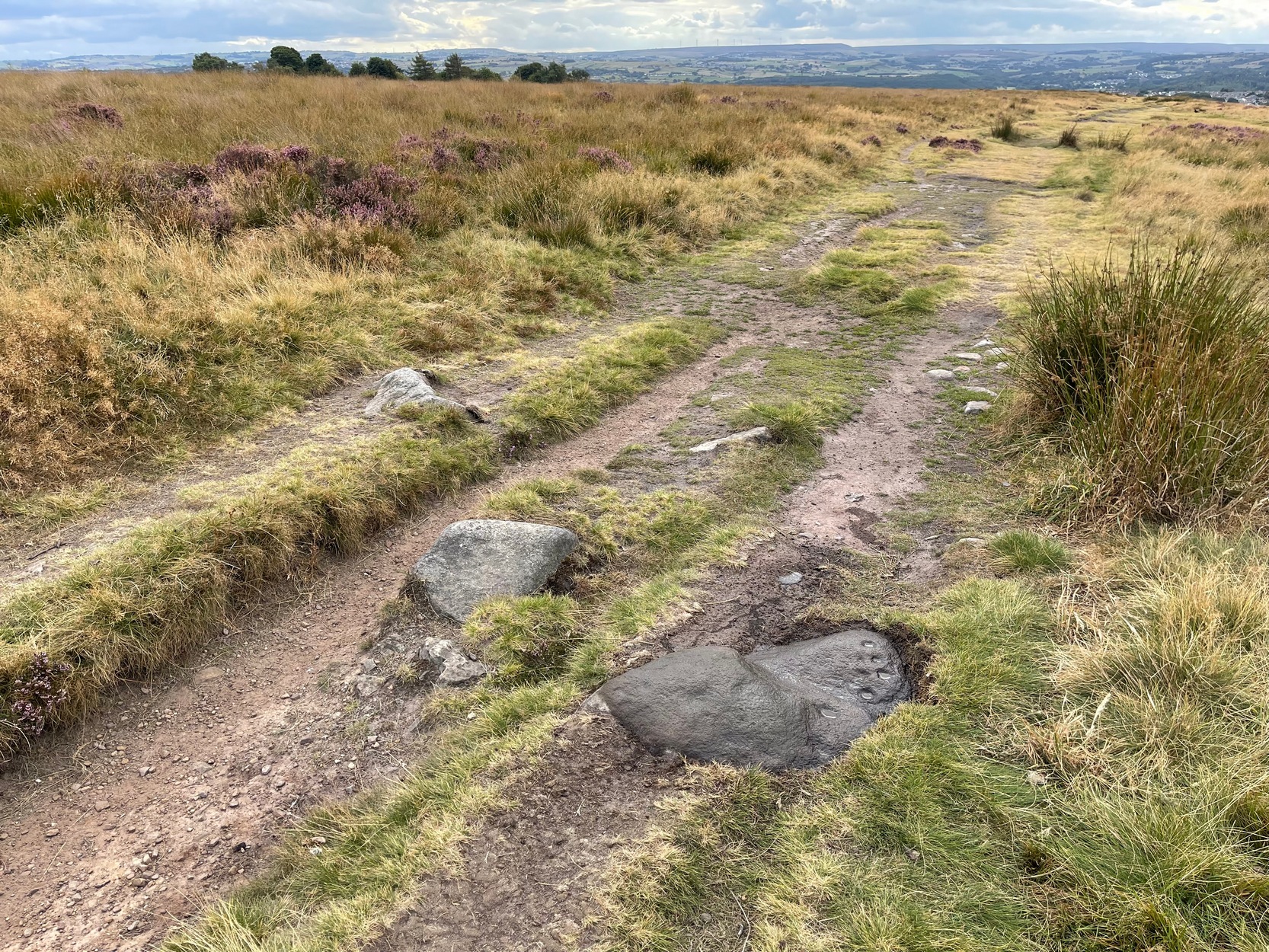
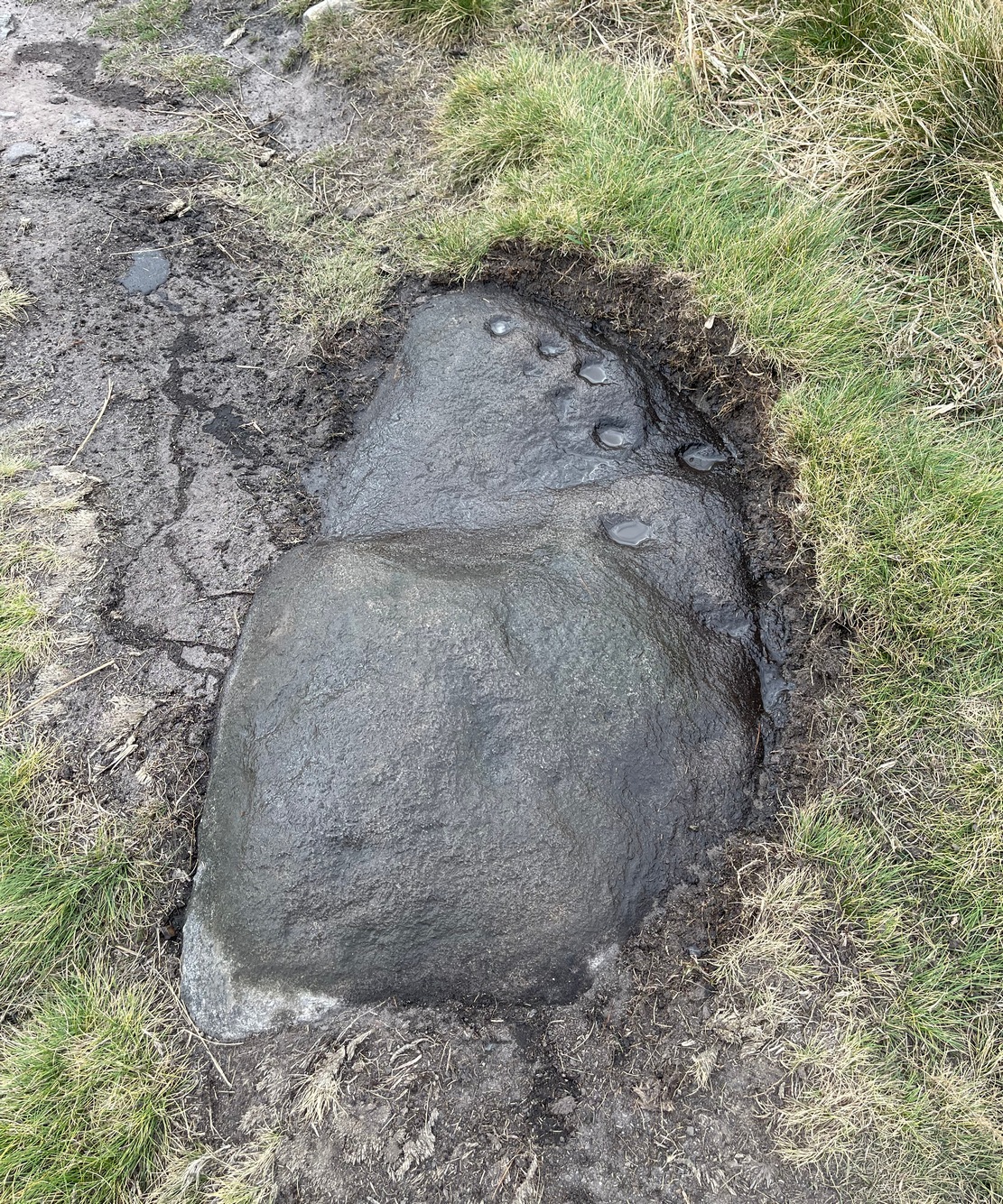
This cup-marked stone was first unearthed by fellow rock art explorers Mike Short and Dave Spencer in 2012 after they’d been looking at some of the other carvings hereby.  In peeling back the turf on the stone, otherwise hidden cups—perhaps nine in all—were uncovered that had been hidden for centuries.  Most of them are quite distinct, but it seems that a couple of the cups may have been left unfinished, as their size isn’t consistent with the others on this and other carvings close by.

The carved stone—located on the northern edge of the Low Plain prehistoric cemetery—is one in a line of several low earthfast rocks that crosses the track hereby and it’s possible that it was part of some prehistoric walling.  Linear remains of walls and ditches were reported here in the 19th century and some of them can still be seen in some places on this part of the hill, but much of it has been destroyed.

© Paul BennettThe Northern Antiquarian

Kilravock, Croy, Nairnshire

Cup-Marked Stone (lost):  OS Grid Reference – NH 814 503

Archaeology & History

Somewhere on the outskirts of Kilravock Castle grounds sat (or still sits, hopefully) one of our country’s legendary healing stones bound within the animistic veil of a cup-marked stone.  It seems to have fallen off the archaeological registers (if it was ever included!) and so I add it here in the hope that someone can locate it and let us know of its present condition.

Described during a meeting of the Inverness Scientific Society by a Dr Grigor in a short presentation on cup-marked stones at Nairn in July 1884, the matter of some faint traditions concerning a tiny number of cup and ring stones in Scotland was mentioned, and,

“Dr Grigor said he would be able, next day, at the roadside on the Kilravock property, to point out a large rounded stone of gneiss, in the centre of which is a large cut cup-mark of a diameter of six or seven inches which, fifty years ago, was resorted to by many, and water was taken from it long distances.  The water was believed to cure skin diseases, but it was principally used for washing warts on the human subject, which it was believed the water quickly removed.  It was also particularly in repute for removing warts from cow’s teats.”

The custom described here sounds very similar to others found at so-called ‘Wart Stones’ in England and Scotland (there was one that existed a short distance from where I grew up near Eccleshill, West Yorkshire).  Several miles west of here is the cluster of prehistoric carvings in the Clava complex, but this one at Kilravock seems to have fallen off the radar. Does anyone know if it can still be seen? (the grid-reference given to this site is an approximation)

References:

  1. Grigor, Dr, “Cup Marked Stones,” in Transactions Inverness Scientific Society Field Club, volume 3, 1884.

Acknowledgements:  Huge thanks for use of the Ordnance Survey map in this site profile, reproduced with the kind permission of the National Library of Scotland

© Paul BennettThe Northern Antiquarian

Craig Hill, Kenmore, Perthshire

Hut Circle:  OS Grid Reference – NN 81327 45039

Getting Here

Craig Hill hut circle

From Kenmore village, just as you’re going out of the village towards Aberfeldy (A827 road), turn right as if you’re going on the minor road on the south-side of Loch Tay.  Almost immediately on this road, turn left and take the tiny, steep road uphill towards Amulree.  After 2½ miles uphill, the road begins to level out and a small loch is on your left (north).  Just past it, on the same side, a track runs onto the moors.  Walk along here for nearly a mile where the track splits: keep to your left and the track follows the line of walling.  Now’s the hard bit: after literally ⅔-mile, walk downhill and cross the burn (stream), then less than 50 yards up the slope on the other side, zigzag around…

Archaeology & History

Craig Hill circle looking SW

Overlooking a small (unnamed) burn immediately to the right and a large wide marshy hollow to the front, is this small and seemingly singular hut circle, in a good state of preservation, surrounded by the scattered mass of cup-and-ring stones—some complex, some very plain—all over this moorland slope.  It’s a very long journey to take just to visit a single hut circle, but I’d assume that you’d be wanting to see the petroglyphs surrounding it too—so mebbe have a look at this whilst you’re fondling the rock art!

Internally this is quite a small circle, measuring barely 5 yards (east-west) by 6 yards (north-south), seemingly with its entrance on the north.  Its small size suggests it was constructed for the use of just one person; two at the very most.  The structure is still in very good condition considering its age (possibly Bronze Age), with minimal damage apart from Nature’s wind and weathering.  The circle is made up primarily of a number of large rocks with many filling stones, with the walling being a yard or so wide all round.  In all likelihood, the rest of the building would have been made of timber, with a typical tented roof.  It’s an excellent spot to base yourself to explore all the cup-and-ring stones on these slopes.  Perhaps, just perhaps, this might have been a shaman’s hut, looking over the ancestral images on the rocks hereby…. ♥

© Paul BennettThe Northern Antiquarian

Urlar Burn (4), Aberfeldy, Perthshire

Cup-Marked Stone:  OS Grid Reference – NN 81875 44068

Getting Here

The cup-marks, looking S

Take the long steep zigzag road from Kenmore to Amulree, and just where the road begins to level out, park up near the isolated hut by the roadside at the side of the lochan.  Just past here, a track on your left takes you onto the moors, past the lochan.  Nearly a mile along the track splits: bear to the right, uphill slightly, then it’ll wind downhill and you’ll pass another track on your right. Ignore it, keep walking along and where you find a grassy little passing-place on your right—stop!  Now walk uphill, onto the moor, through the heather for 175 yards and the land has levelled out.  Look around!

Archaeology & History

Cupmarks from above

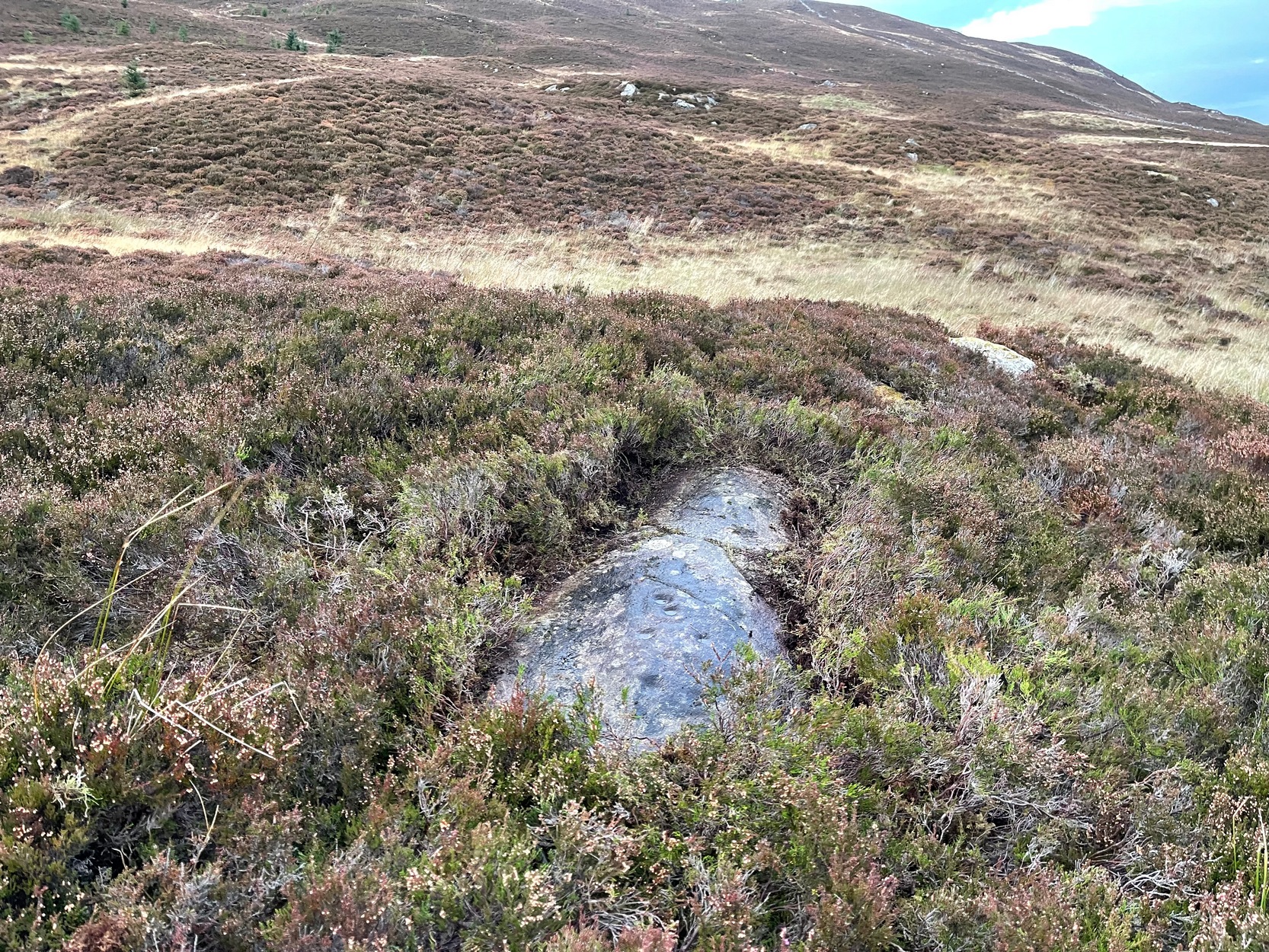
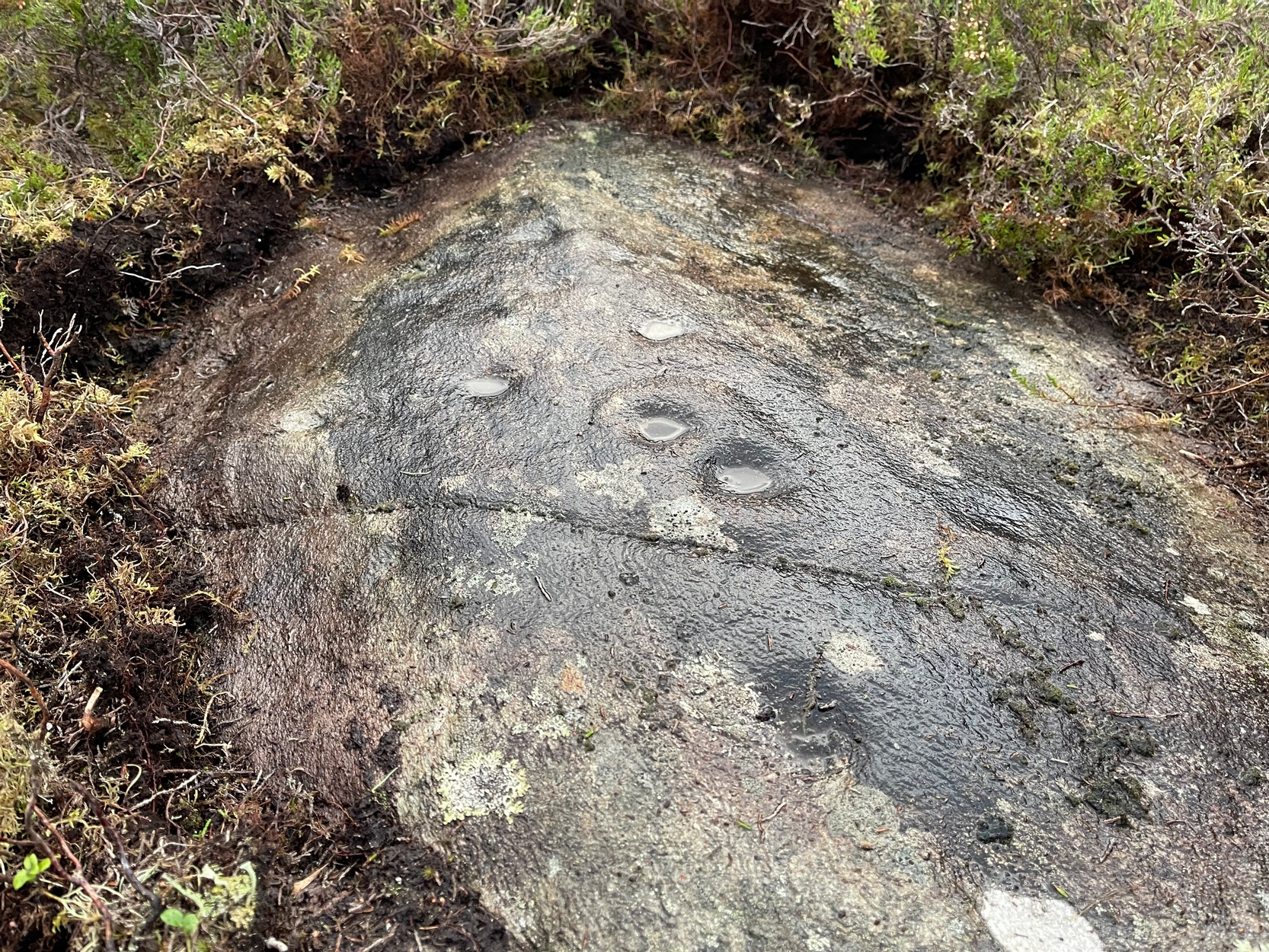
I came across this very basic carving when checking out a couple of others close by and found that it hadn’t been recorded before. It’s nothing special to look at, but is an outlier of the main Craig Hill cluster of carvings a few hundred yards to the west.  The design consists of at least two cup-marks that have been etched near the top of the rock, although when I wet the stone it seemed as if a third one was next to the other two, as if in a line.  The sun was at its peak when I found it, which meant that I couldn’t get any decent photographs to illustrate this—even when I watered the olde thing!  It’s another carving that will only be of interest to the real petroglyph fanatics amongst you.

© Paul BennettThe Northern Antiquarian

Craven Hall Hill (2), Hawksworth Moor, West Yorkshire

Cup-Marked Stone:  OS Grid Reference – SE 14620 44272

Getting Here

Craven Hall Hill carving

You can walk up from Menston, up Moor Lane north-west towards the moor, then turning left when you hit the moorland road of Hillings Lane.  Nearly 350 yards along, turn right up the track known as Occupation lane onto the moor.  More than half-a-mile up, past the gate at the Bee Stone, where the track splits, keep to the left and head further uphill, roughly parallel with the fence on your left.  Literally ¼-mile (0.4 km) up from the split, you’re looking almost straight down at the reservoir; but to your left, walk towards the fence.  Zigzag about!  You can also approach it from the Grubstones and Great Skirtful area, by following the Occupation Lane track eastwards down the slope until you’re roughly level with the same reservoir.

Archaeology & History

On this somewhat isolated stone on the northern sloping edge of Craven Hall Hill we find a small cluster of shallow cup-marks, first noted in the 1980s and eventually mentioned in a survey by Boughey & Vickerman (2003) where they described it as a,

“Low, medium striated rock lying in slope of hill.  SE end carries possibly up to eleven cups, possibly two sets grouped in arcs running into natural striations of rock, one of which may have been artificially enhanced by pecking.”

Shallow cup-marks

The view from here is quite something: gazing east to the heathen hilltop of Otley Chevin (Beltane rites and rock art — albeit not much), north-east to the far uplands of the White Horse of Kilburn, then across the northern panoramas of Askwith and Denton Moors, and beyond.  Some archaeologists have started to believe that such vistas may have had relevance with such carvings, sometimes.  They’ve caught up at last! 🙂  Anyhow, the carving itself is pretty simplistic and probably only of interest to the real petroglyph nuts amongst you – although it’s mebbe worth checking out if you’re visiting the Great Skirtful giant cairn and its very impressive hengi-form neighbour.

References:

  1. Boughey, Keith & Vickerman, E.A., Prehistoric Rock Art of the West Riding, WYAS: Wakefield 2003.
  2. Boughey, Keith & Vickerman, E.A., Prehistoric Rock Art of the West Riding – Supplement, YAS 2018.

Acknowledgements:  With thanks to Tom Cleland for help in relocating the site on a recent visit.

© Paul BennettThe Northern Antiquarian

Reva Hill (2), Hawksworth, West Yorkshire

Cup-Marked Stone:  OS Grid Reference – SE 15002 43155

Getting Here

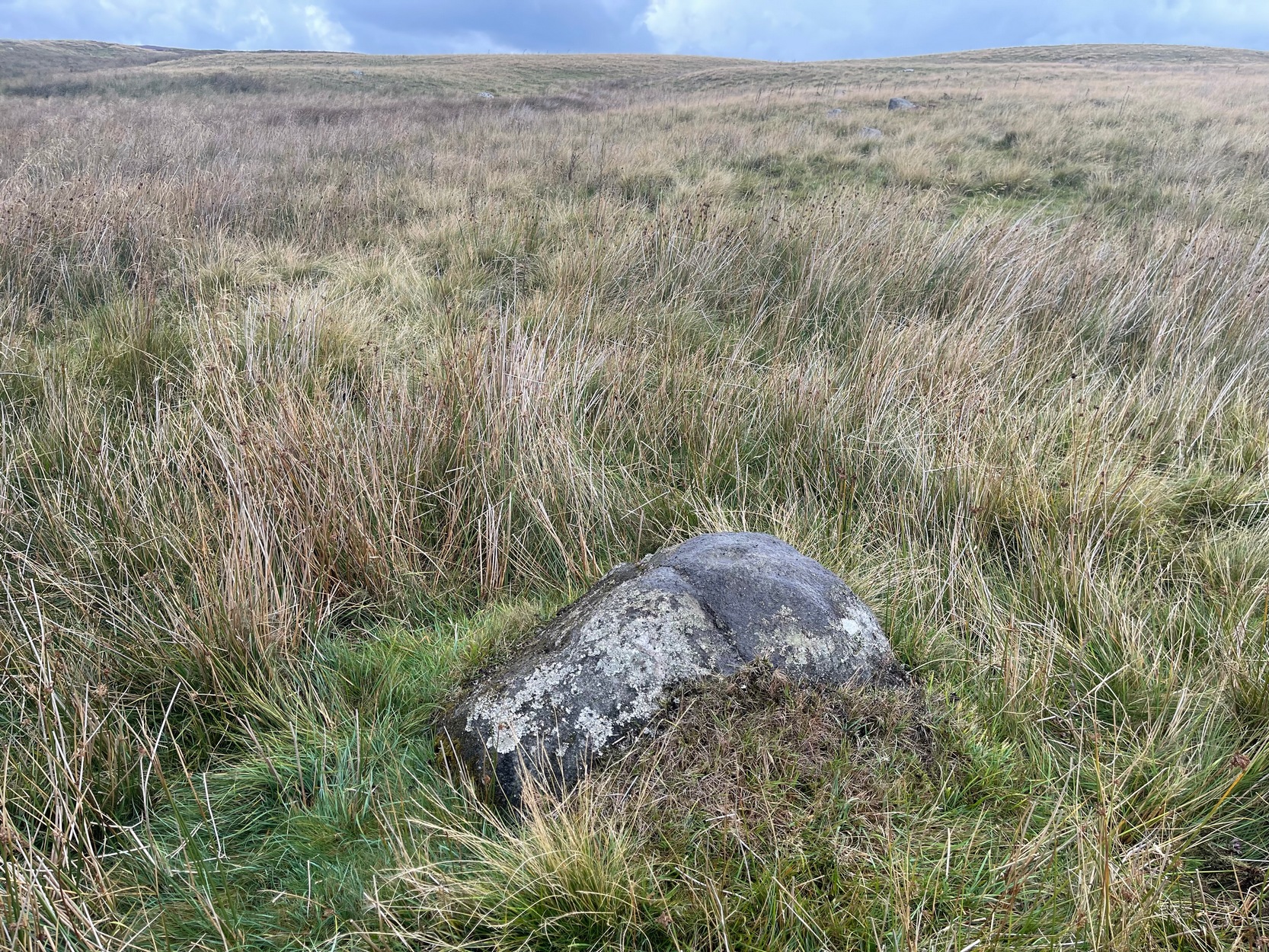
The stone in question

Numerous ways to get here: probably the easiest (direction wise) is if you’re coming from Dick Hudson’s public house on the southern road surrounding Rombalds Moor. From the pub, head left (east) along Otley Road (passing Weecher reservoir) for 1.9 miles (3.1km) until you reach Reva reservoir where a track leads you to the waters.  A small parking spot is on the left-side of the road. From here, go through the gate and along the footpath across the field for nearly 300 yards to the next gate.  Go through here and immediately follow the walling down to your left for about 135 yards to the edge of the rushes.  It’s there!

Archaeology & History

Single cupmark nr the top

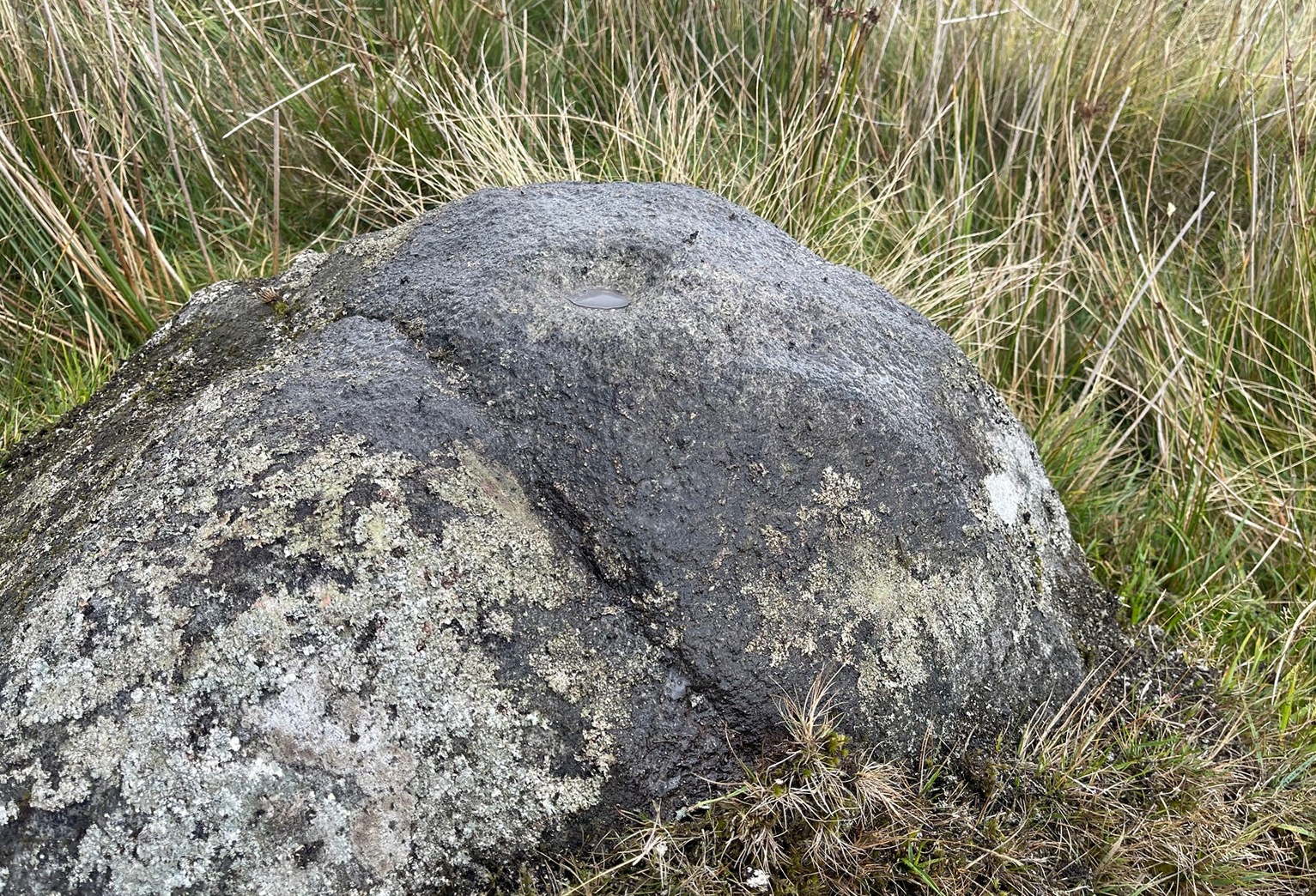
On a recent visit to the Fraggle Rock carving, Tom Cleland foraged about at the edge of what was, in centuries gone by, a good flowing stream below the west slope of Reva Hill.  An old pathway cut across one section of it near where the walling now runs, covered these days in the mass of Juncus reeds, typical of mashy grounds.  And here, just where folk would cross the waters, Tom found a good sized stone with a single deep cup-mark on its crown, calling through a feast of lichens to be seen once more.  There may be a second cup-mark by its side, but the light wasn’t good when we were here, so that’ll be worked out  some other day.  Anyhow, this one’s probably only for the crazy petroglyph hunters out there.  It’s the Fraggle Rock and its companios that you’re gonna be looking for, nearby….

© Paul BennettThe Northern Antiquarian

Gazing Stone, Steeton, West Yorkshire

Cup-and-Ring Stone:  OS Grid Reference – SE 03420 43572

Getting Here

Gazing Stone of Steeton

In Steeton, walk up the High Street and after a hundred yards or so, turn right to go up to Quarry House (opposite Falcon Cliffe), up past Quarry Cottages to the end where it turns into a track.  Follow the track for 200 yards, where it bends left, then immediately right go into the field, following the wall along for 450 yards where you’ll go through a gate to another rocky steep hill-slope.  Walk up by the side of the walling here, at the edge of the trees and, once at the top, bear right and a few yards along keep your eyes peeled.  You’re virtually on top of it!

Archaeology & History

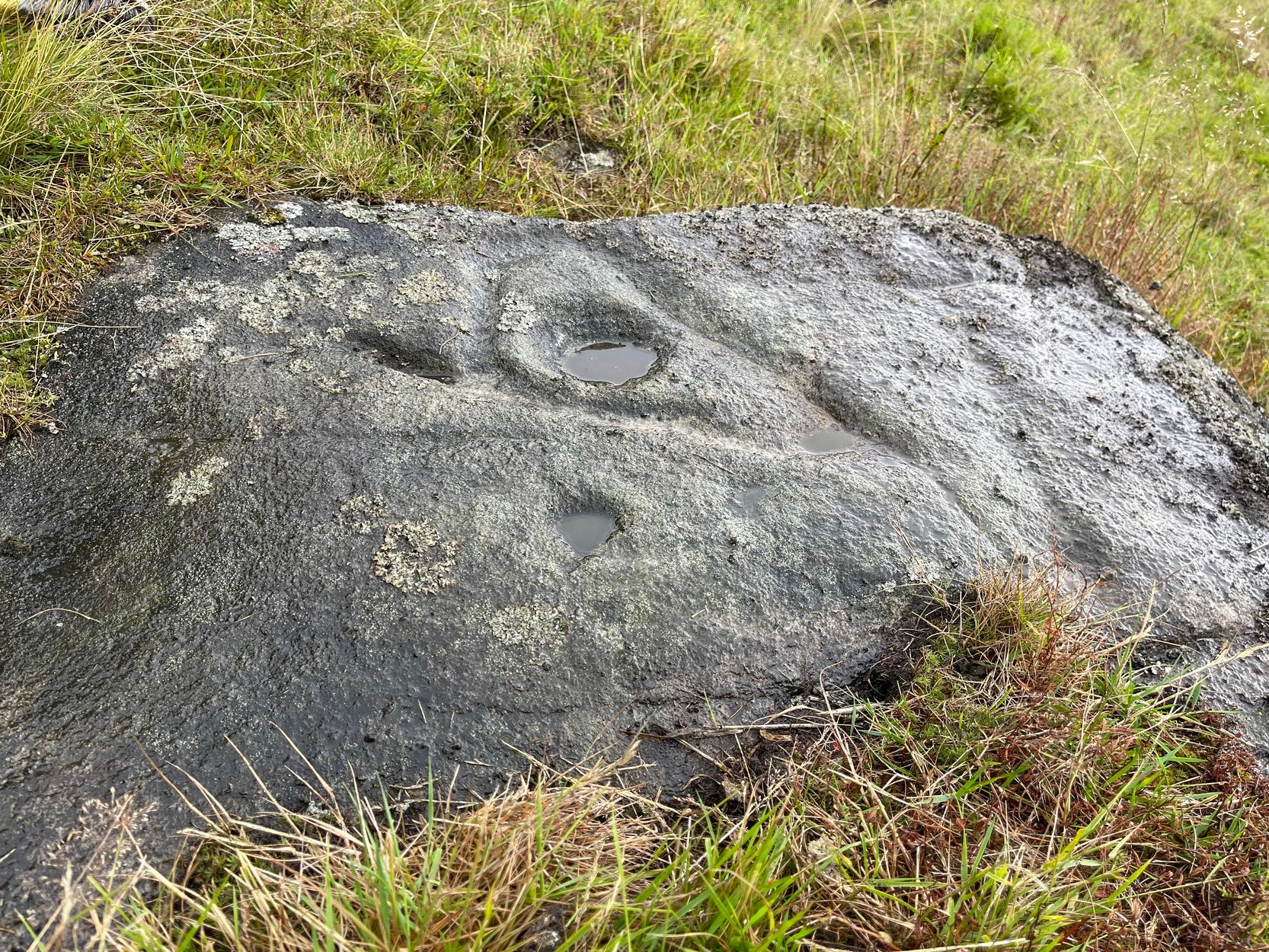
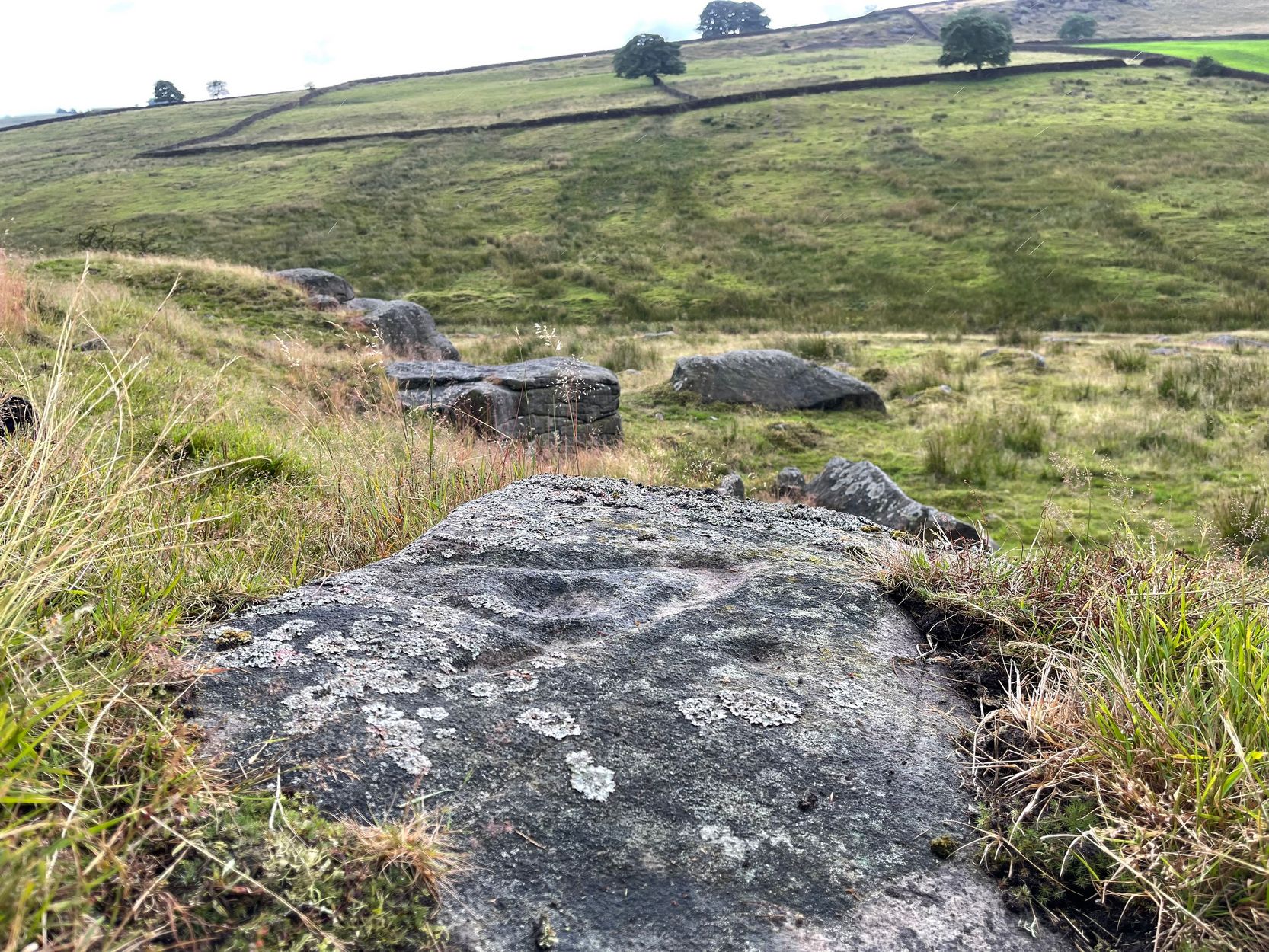
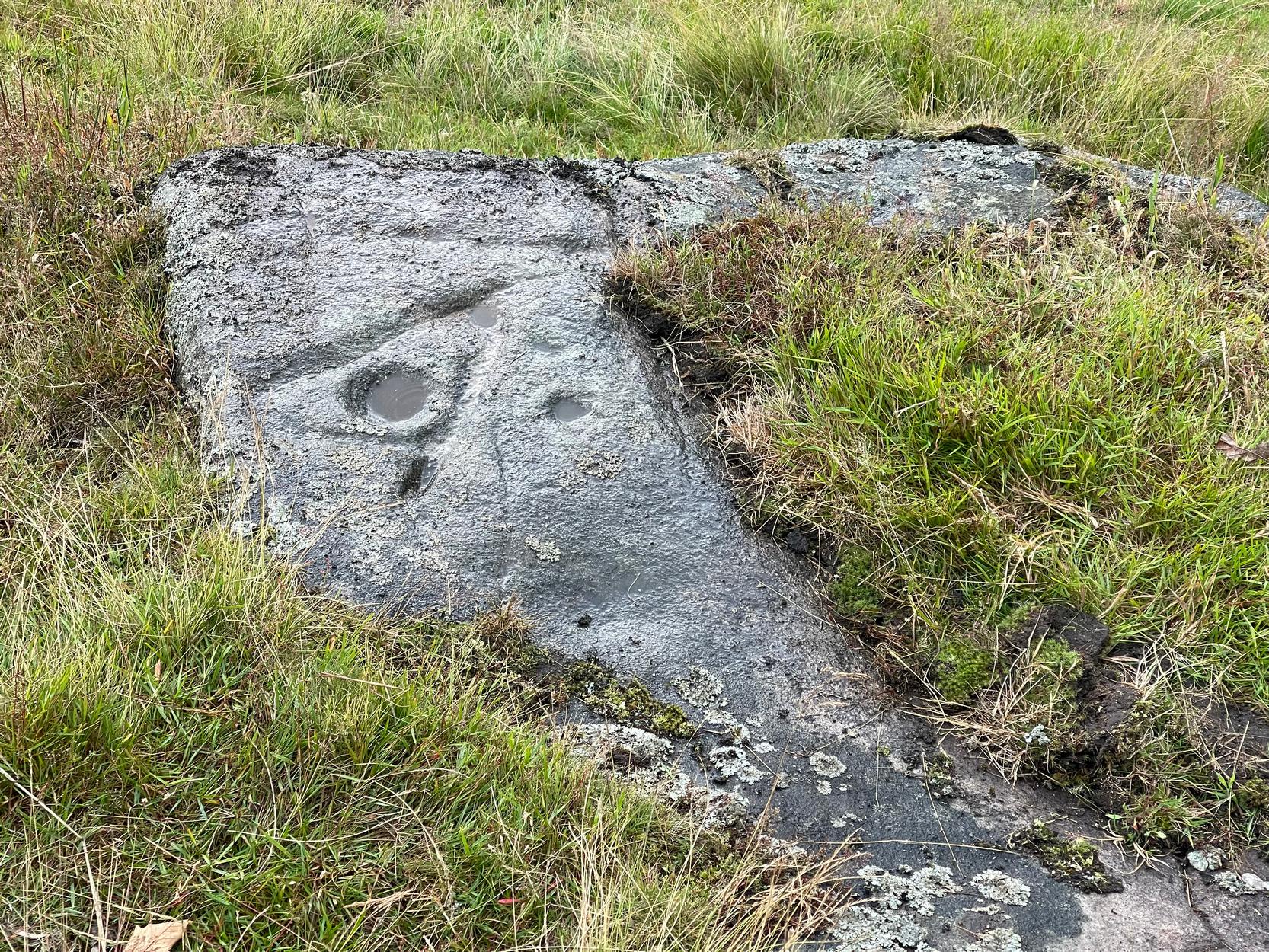
Not previously recorded, this is an unusual design: unusual in more ways than one.  Firstly, it’s not entirely ‘ancient’; and secondly, the linearity in some of the carved lines around the cup-marks is unusual.  It reminded me a little of the Hanging Stones above Ilkley, with its deeply cut lines, swerving around cup-marks, whose lack of ‘ancient’ guise is somewhat betrayed by the fact that Victorian quarry operations uncovered them—much like happened here…

It was first noticed in 2024 by Collette Walsh during a petroglyphic foray in the area.  She noticed the distinct cup-marks on the rock surface, but then when she noticed a distinct quarrying mark, she dropped the idea that it was prehistoric.  But this distinct quarry or stone-mason mark—executed sometime in the 19th century when the Industrialists were working here—shouldn’t take our attention away from the cup-marks; nor indeed all aspects of the other carved lines that swing round the edges of the deepest of the three cups, which is surrounded by a long curved triangle, some of which was carved into a natural crack, highlighting it more. The single outlying cup looked, from some angles when wet, that it may have had a partial ring around it—but we were unsure and it may have just been a trick of the light, along with our desire to see more than there actually is.  Anyhow, it’s worth seeing.  But we could do with a stonemason to check it out, enabling us a better assessment of which bits of this design are old and which are not-so-old.

Acknowledgements:  To Collette Walsh for uncovering this design; and to Tom Cleland for showing me where it lives!

© Paul BennettThe Northern Antiquarian

Mossyard, Anwoth, Kirkcudbrightshire

Cup-and-Ring Stone (removed):  OS Grid Reference – NX 550 520

Archaeology & History

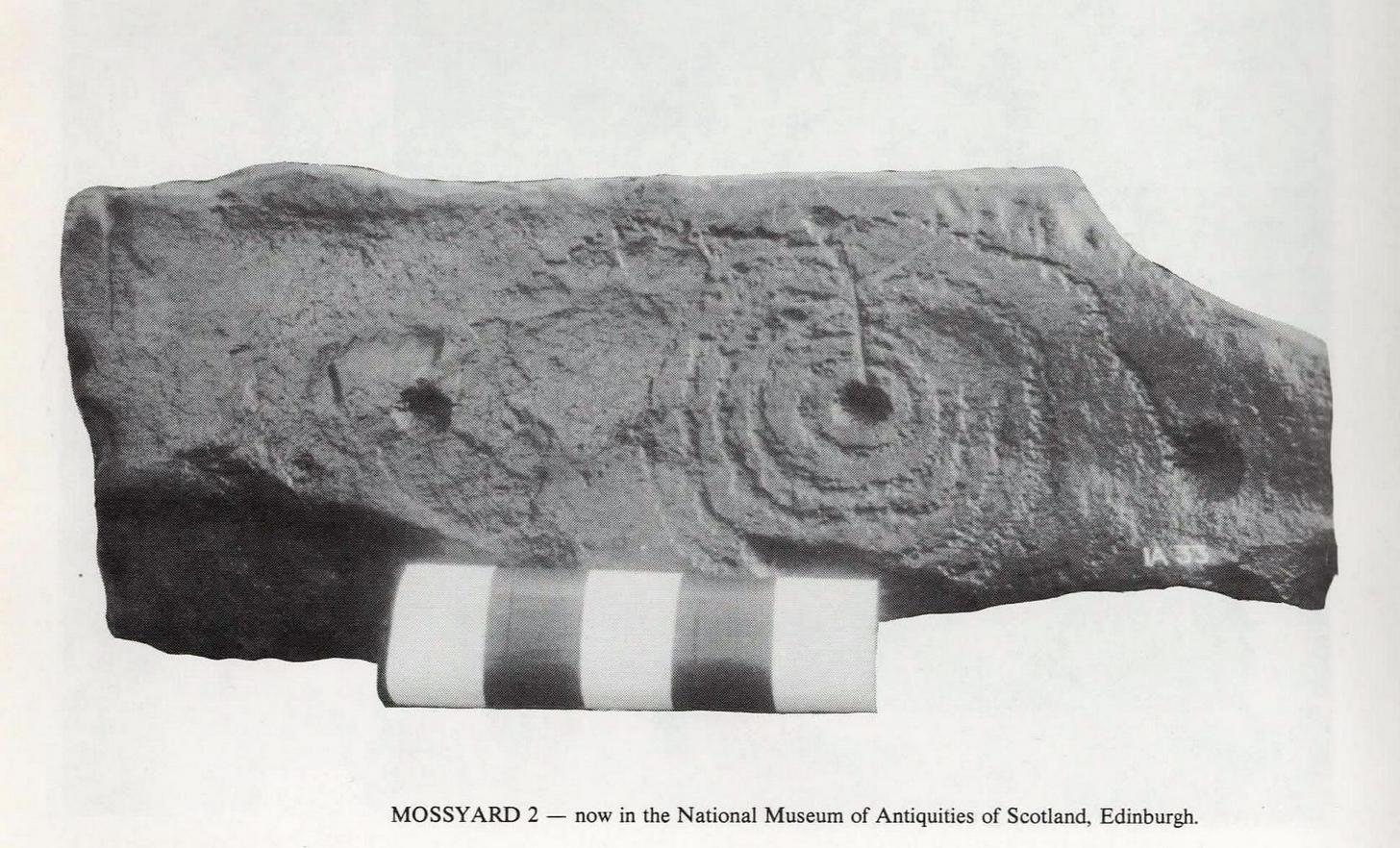
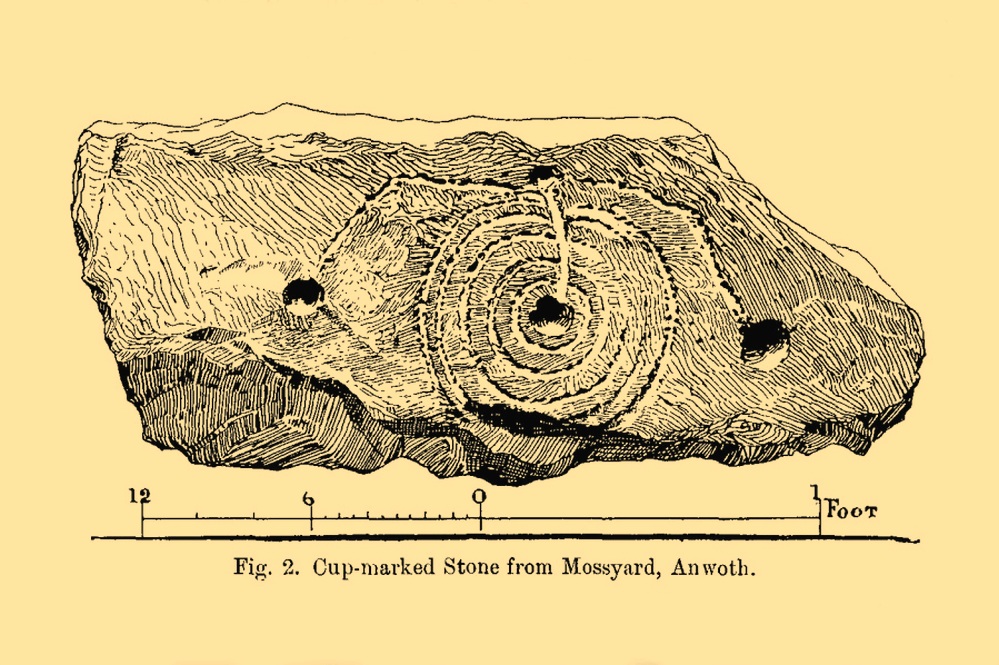
This impressive-looking carving was brought to the attention of the Scottish Society of Antiquaries by Sir Herbert H. Maxwell (1900), who thereafter moved it to the National Museum where, I presume, it still lives, in a box somewhere, sleeping gently.  Maxwell’s brief resumé of the stone was as follows:

“Cup and Ring-marked Slab…found in a dyke on the farm of Mossyard, Anwoth, Kirkcudbrightshire.  This cup-and ring-sculpturing is peculiar in having five rings round the central cup crossed by a gutter which ends in another cup from which gutters also proceed to right and left, each terminating in a cup.”

In Ron Morris’s (1979) survey he erroneously told how the carving had been found in a wall instead of the dyke from whence it came; but, that triviality aside, he described it as,

Morris’ 1979 photo
Maxwell’s 1900 drawing

“A cup-and-five-rings, the rings slightly flattened where a radial groove from the cup passes through them.  23cm (9½in) diameter, grooves connecting this with 3 other cups.  Carving depths up to ½cm (¼in).  The rings are rather lightly pecked though quite wide and well preserved.  All gapped, except the inner ring.”

If anyone is able to get any good photos of the carving, out from its museum hideaway, it would be good to see how it’s coping therein….

References:

  1. Maxwell, Herbert R., “Donations to the Museum and Library,” in Proceedings Society Antiquaries, Scotland, volume 35, 1901.
  2. Morris, Ronald W.B., The Prehistoric Rock Art of Galloway and the Isle of Man, Blandford: Poole 1979.

© Paul BennettThe Northern Antiquarian

Clach Mhor, Aberfeldy, Perthshire

Cup-Marked Stone (destroyed):  OS Grid Reference – NN 8575 4901

Also Known as:

  1. Clachmore

Archaeology & History

The Clach Mhor, or the Big Stone, is all but forgotten as an antiquarian relic in Aberfeldy.  It’s history is somewhat piecemeal.  First described in Hugh MacMillan (1884)’s essay on local cup-and-ring stones, he told that:

“A short distance above the village of Aberfeldy, where General Wade’s old road emerges from the houses, a huge stone, called the Clach Mhor, lies on the left-hand side in a slanting position half  erect, as if supported by the garden wall of which it forms a part. …In all likelihood it originally stood erect, and formed one of a group of similar stones, its companions having been broken up in the formation of the road. …On the upper face there are some small cup-markings, not quite so well formed as usual, owing to the hardness of the material… The fact that they occur on only one side of the stone, and are scattered indiscriminately all over its surface, are sufficient to convince any one who is skilled in the subject that they are genuine specimens of prehistoric sculpture.”

Nearly thirty years after this initial description, MacMillan (1901) found that it had previously been a part of The Tullich stone circle, and following its destruction the Clach Mhor was moved and used as “part of a garden wall on the old military road passing along its base.”

More than fifty years later, the Aberfeldy historian N.D. Mackay (1954) told that up to 1910 the Clach Mhor was a conspicuous object, standing “as it were overlooking and to some extent overhanging the roadway down near the Square.” However, it

“was blasted and broken up in 1910 in the course of road widening operations, but a considable part of it was built into, and still forms the lower corner of, the garden boundary wall, nearest The Square, of the house which bears its name, ‘Clachmhor’.  Its present position is slightly east of the site it occupied when I first knew it and, unless Wade’s men did actually move it, the site it occupied for centuries.”

Mackay also mentioned what he called the “indentations” on the stone which MacMillam deemed as cup-marks, but he pointed out that one Rev. John MacLean “believed they were made by the levers, jacks, etc, of (General) Wade’s men” when they cut the road into Aberfeldy in the 18th century, whilst

“A third solution was given by the son of a one-time local strong man called Big Robert, “What a strong man my father was,” he said, “he lifted that stone. Don’t you see the marks of his fingers on it?””

It’s not known what became of the Clach Mhor and whether it remains hiding in some walling, or whether it has met its demise….

References:

  1. Mackay, N.D., Aberfeldy Past and Present, Town Council: Aberfeldy 1954.
  2. MacMillan, Hugh, “Notice of Cup-Marked Stones near Aberfeldy”, in Proceedings Society of Antiquaries Scotland, volume 18, 1884.
  3. MacMillan, Hugh, The Highland Tay, Virtue: London 1901.

© Paul BennettThe Northern Antiquarian