Lawers, Comrie, Perthshire

Standing Stone:  OS Grid Reference – NN 80102 22666

Also Known as:
  1. Canmore ID 25535

Getting Here

Lawers01 (9)

Lawers standing stone, Comrie

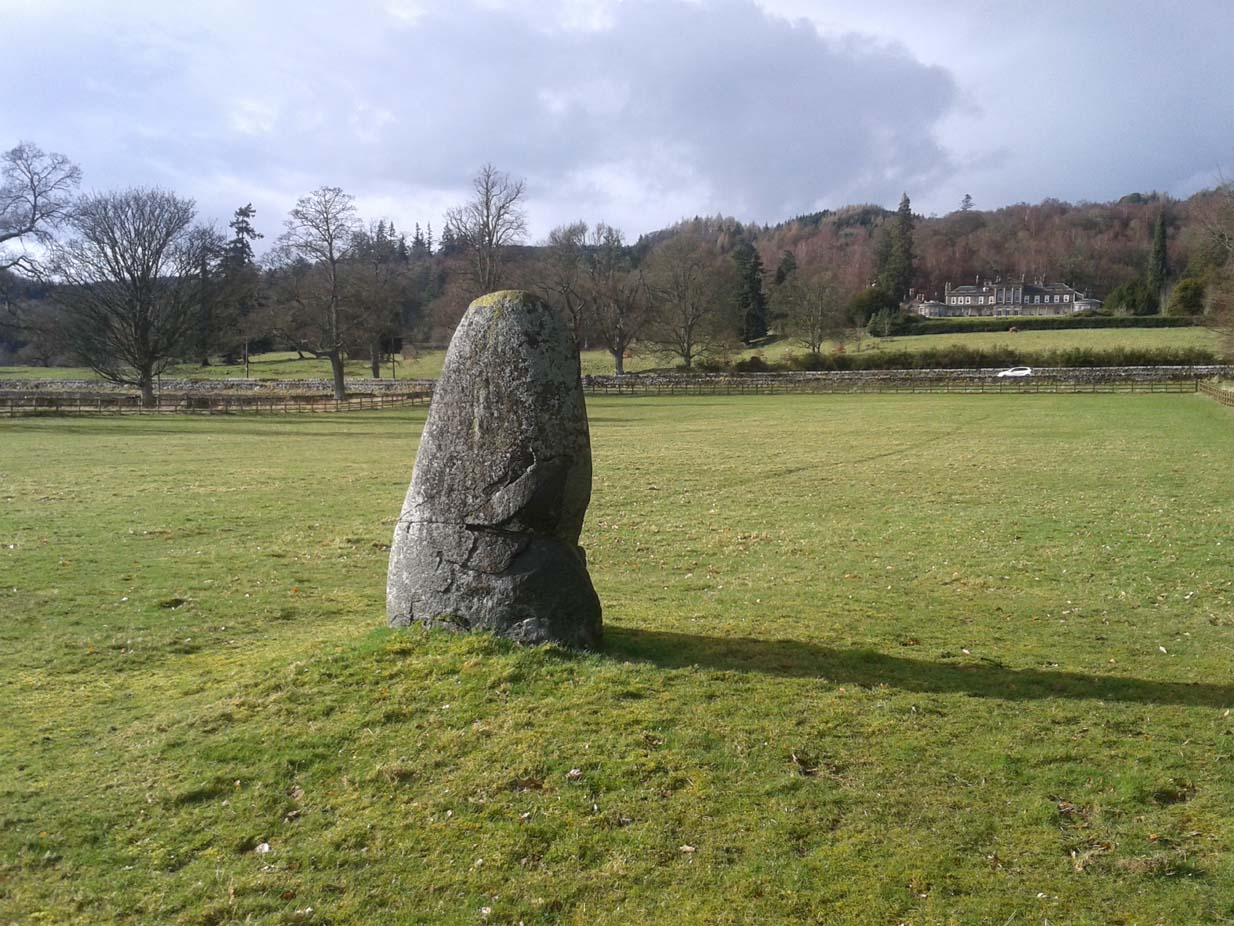
Take the A85 road between Comrie and Crieff.  Nearly 1.7 miles (2.7km) east out of Comrie—or 4 miles (6.44km) west out of Crieff—keep your eyes peeled on the fields to the south-side of the road, below and across the mansion of Lawers House.  Alongside a long but small plantation of trees you’ll see a large upright stone.  You can walk along the track adjacent to the field and through the gate.

Archaeology & History
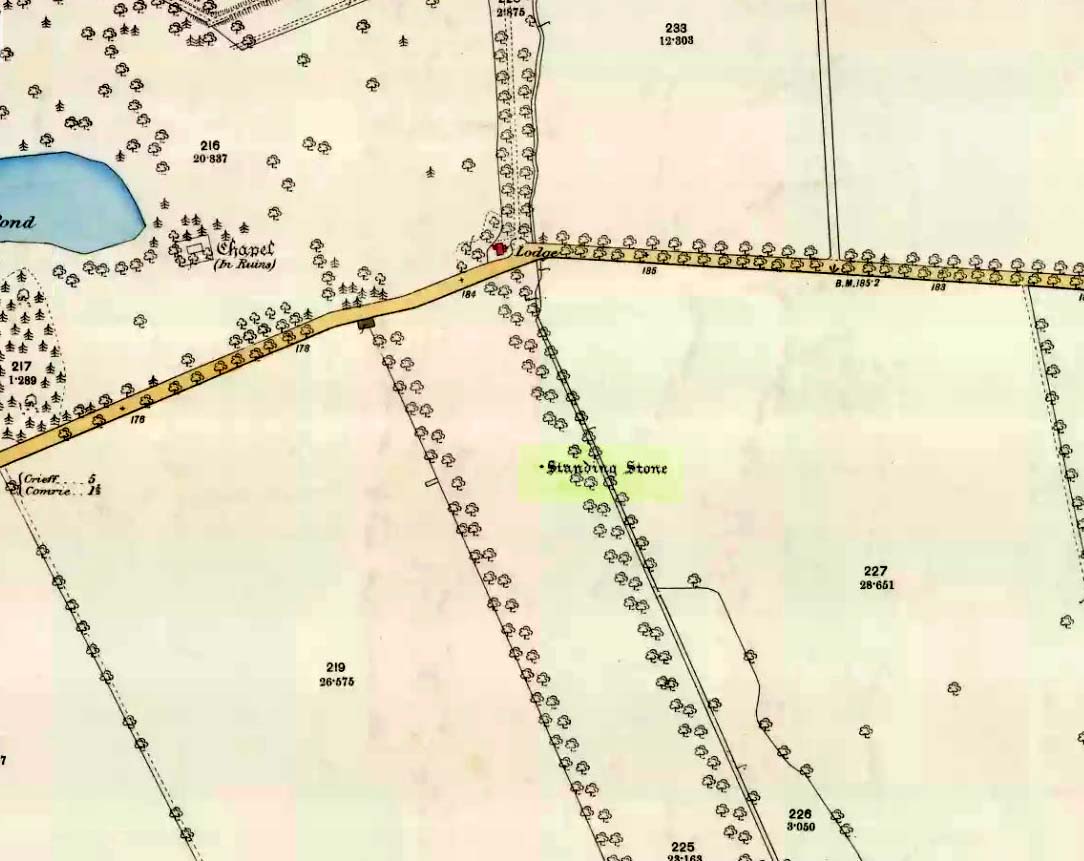
The stone on 1886 OS-map

The stone on 1886 OS-map

Shown on the early Ordnance Survey maps of the area, this probably neolithic monolith was suggested by Fred Coles (1911) to have once been part of a larger megalithic circle—although Aubrey Burl (2000) didn’t consider it as a good enough contender to be listed as such in his gazetteer; and unless we can have some positive affirmation, either through folklore or excavation, we should maintain its status as a singular monolith.  There is the possibility that it stood as an outlier or had some relationship with a nearby prehistoric tomb—but even this is contentious.  Nevertheless, the stone itself is an impressive one!

Mr Coles curiously got the size of the old stone wrong too (although, we have to give him credit, as he did all of his work without electricity or any of our modern ‘stuff’).  He wrote that:

“This massive boulder of whinstone is rounded at the base, where it girths 10 feet 3 inches, but tapers upwards to its apex of 5 feet 10 inches, with the eastern edge somewhat jagged and broken.  Near its base on the west is a small slab-like fragment of stone, quite earthfast.  The north and south surfaces are smooth and nearly vertical, and the longer axis is ESE 75º by WNW 75º.”

Fred Coles' 1911 sketch

Fred Coles’ 1911 sketch

Lawers monolith, looking SE

Lawers monolith, looking SE

The stone is actually larger than Coles described, being more than 6 feet 6 inches tall.  His sketch (right) “shows the stone from the east”, and is pretty much as we find it today.  A notable crack in the stone along the southern face, about a third of the way up, suggests that the stone was broken at some time in the past.

Local architect Andrew Finlayson (2010) included the stone in his local megalith guide and noted how the axes of the stone, east-west, lines it up with Ben Halton to the west and The Knock to the east.

References:

  1. Burl, Aubrey, The Stone Circles of Britain, Ireland and Brittany, Yale University Press 2000.
  2. Coles, F.R., “Report on stone circles in Perthshire principally Strathearn,” in Proceedings of the Society of Antiquaries, Scotland, volume 45, 1911.
  3. Finlayson, Andrew, The Stones of Strathearn, One Tree Island: Comrie 2010.

© Paul BennettThe Northern Antiquarian

Gray Stone, Dunning, Perthshire

Standing Stone:  OS Grid Reference – NO 02182 11809

Also Known as:

  1. Big Stane
  2. Canmore ID 26681
  3. Grey Stone
  4. Maormar‘s Stone

Getting Here

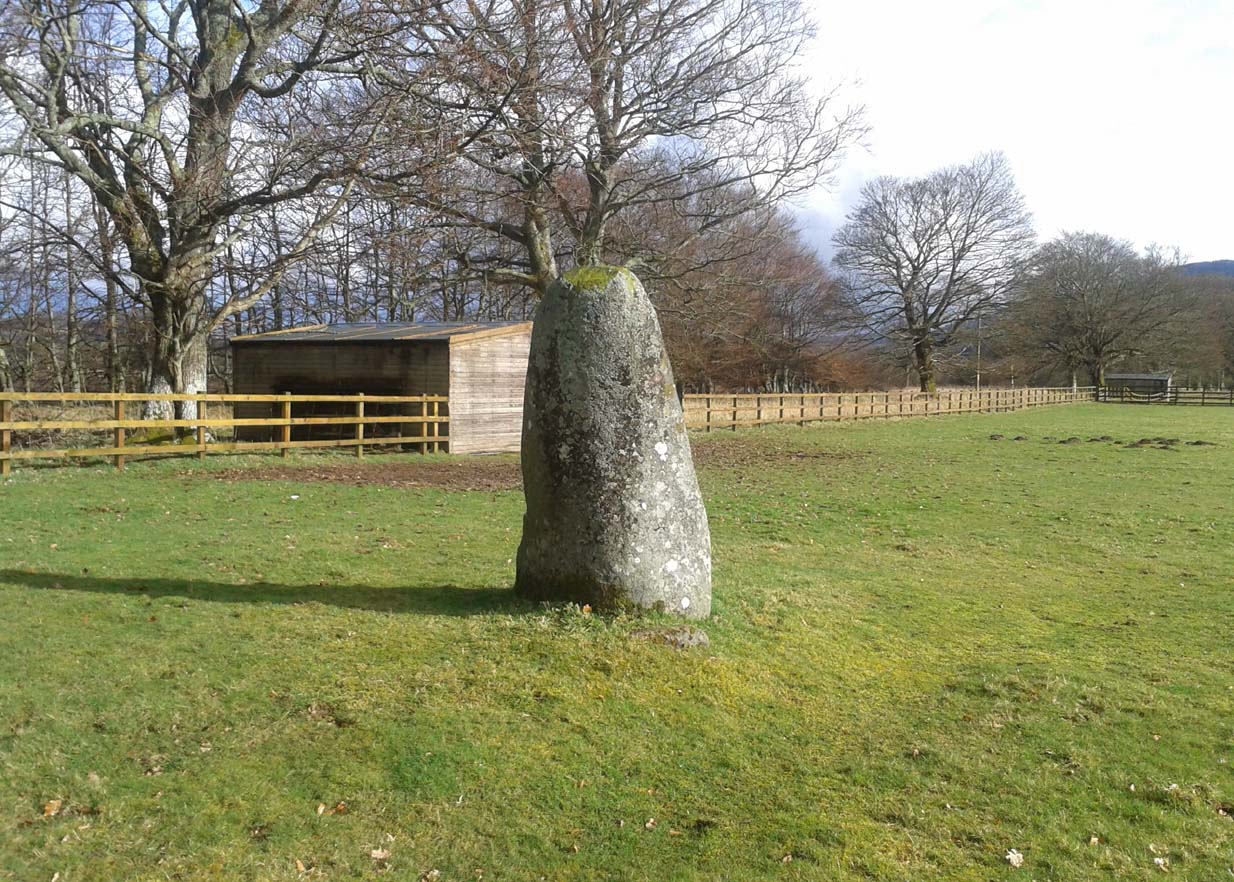
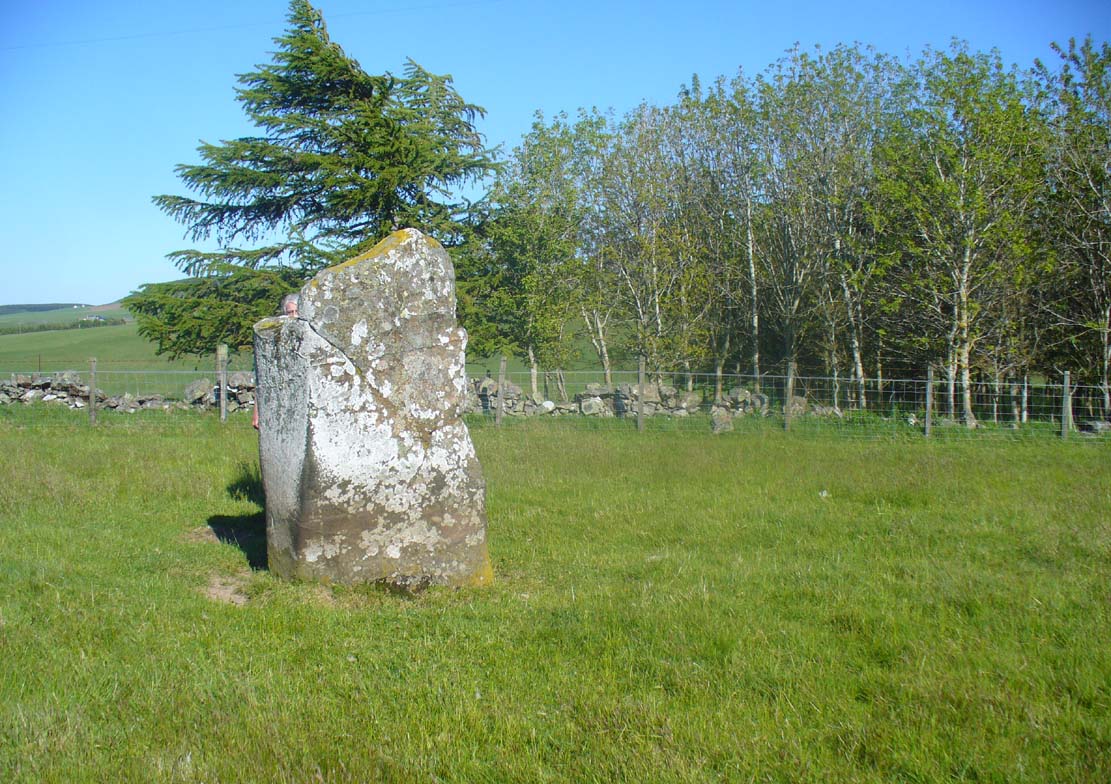
Grey Stone, looking NE

Take the B934 road south, uphill, out of Dunning, for 2.1 miles (3.4km), past Kippen, past Pitmeadow and past Quilts.  It’s the track to Knowes that you’re after!  Along this track, keep to the field-side on your right, following the edge of the fencing until you reach the small copse of trees.  At the far side of the trees a gate takes you into the field with the standing stone, which is just over 100 yards to the north. You can’t miss it!

Archaeology & History

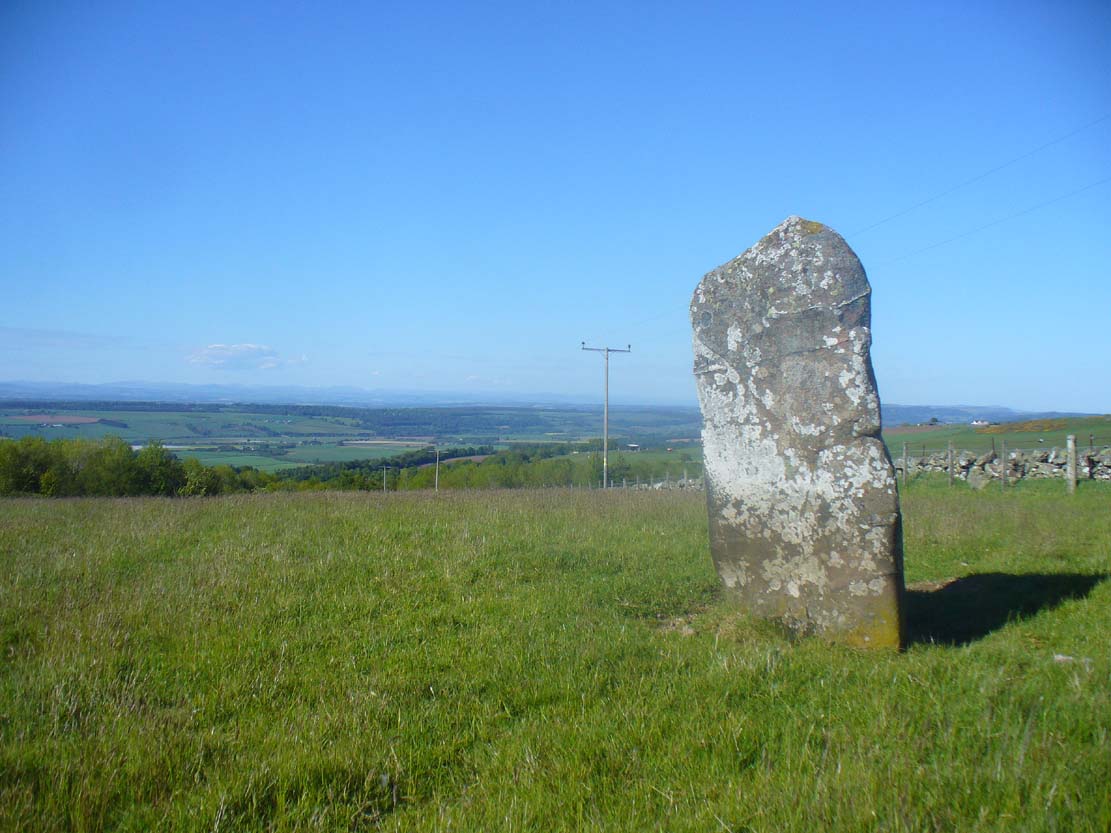
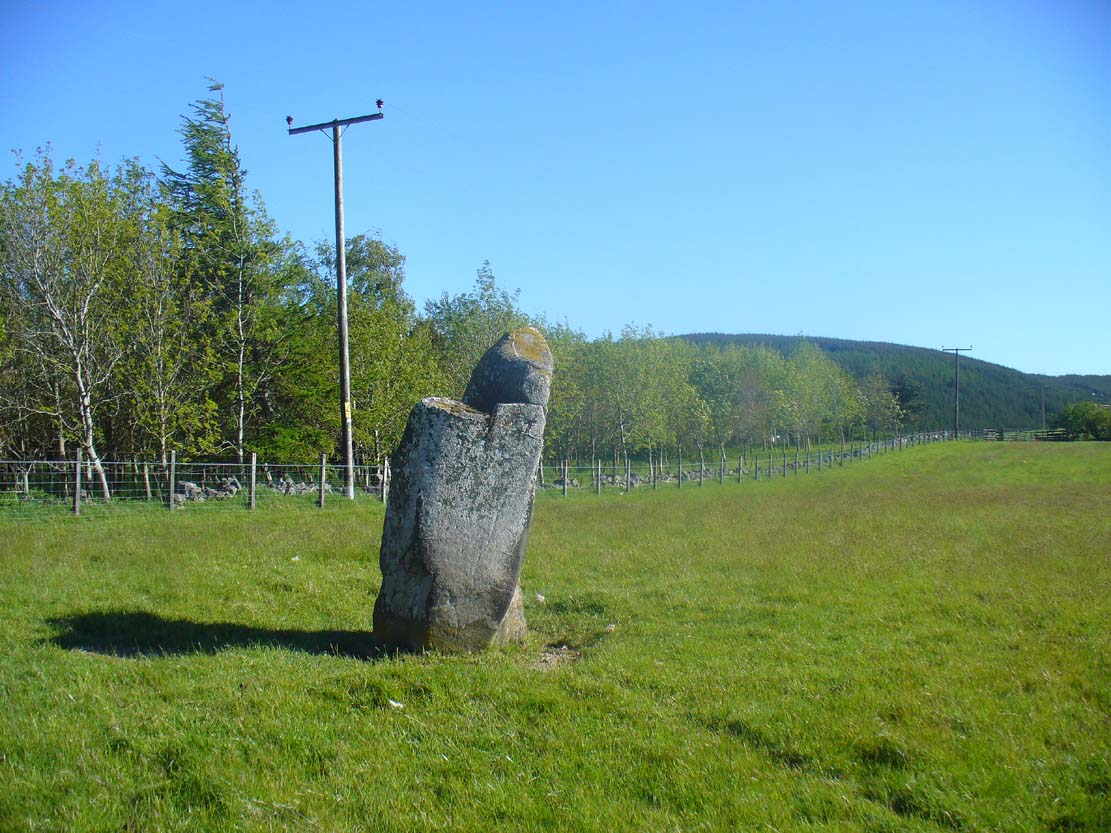
Although mentioned in several folklore works and just a couple of archaeology tomes, almost nothing has been written about this large upright standing stone.  A very bulky stone nearly seven feet tall, it has been broken into pieces at sometime in the recent past but, thankfully, good locals put the stone back together and placed it upright once again.  Its position in the landscape is quite superb, overlooking the lowlands of Tayside below and then far into the rising mountains of Perthshire and beyond, easy fifty miles or more.


Grey Stone, looking south
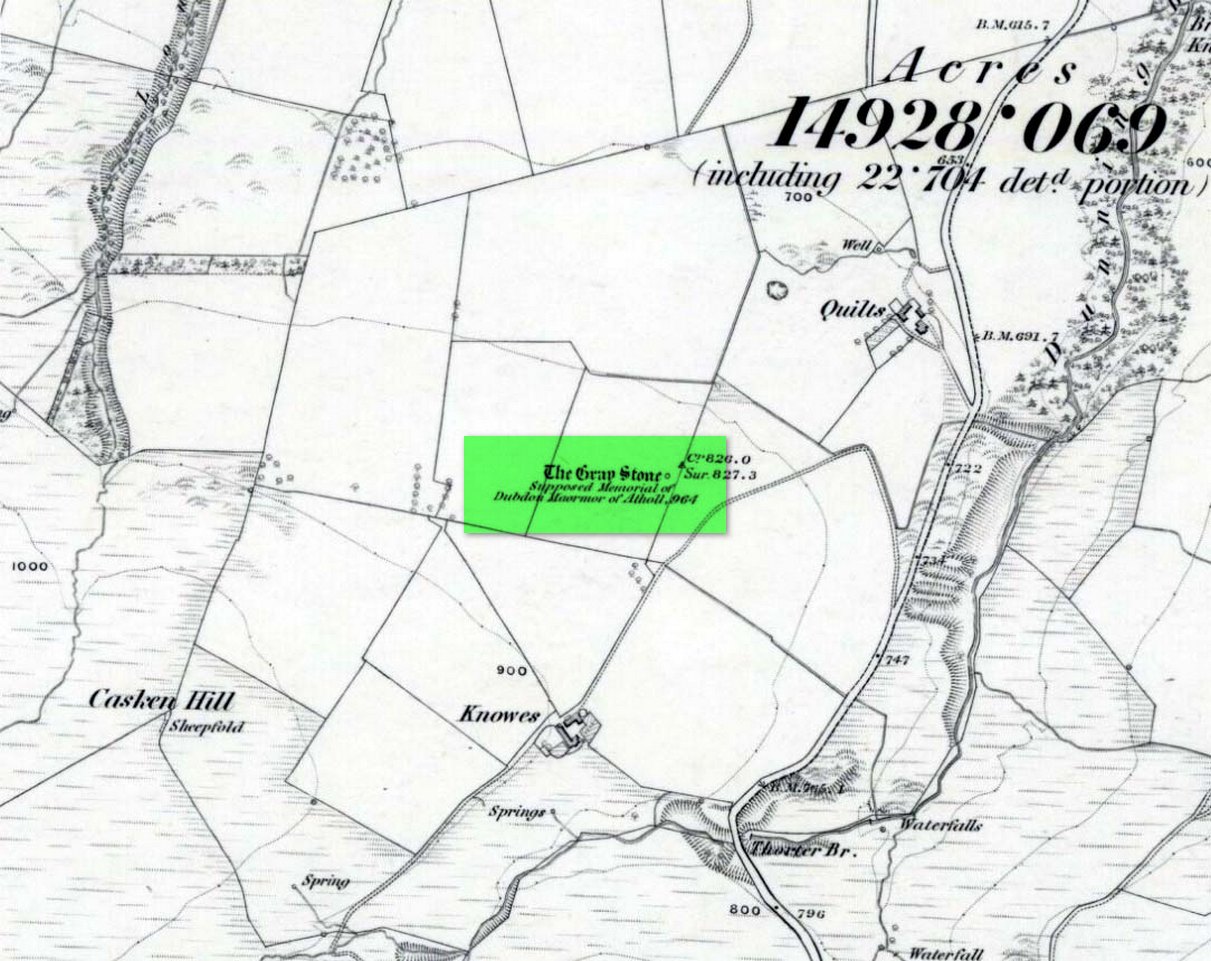
Gray Stone on 1866 map

Shown on the earliest Ordnance Survey map of the area, the name of the stone is somewhat of a puzzle, for in a lot of cases ‘gray’ stones are found on local boundary lines—indeed, the name gray stone and boundary stone are interchangeable in many cases—yet the nearest boundary from here is some distance to the east.  It may simply relate to the colour of the rock (although this is unlikely).  Whatever its reason, it’s an impressive stone and is well worth checking out!

Folklore

Gray Stone, looking east

The local farmer told that the field where the Grey Stone lives was known as the Big Stane Field.  Makes sense!  Legend has it that the Gray Stone was the burial place of Maormor, the Steward of Atholl in the Battle of Duncrub, after dying in Thanes Field (Watson 1995), on land to the north of Dunning village in 964-5 CE.

References:

  1. Holder, Geoff, The Guide to Mysterious Perthshire, History Press 2006.
  2. McKerracher, Archie, Perthshire in History and Legend, John Donald: Edinburgh 1988.
  3. Swarbrick, Olaf, A Gazetteer of Prehistoric Standing Stones in Great Britain, BAR: Oxford 2012.
  4. Watson, Angus, The Ochils: Placenames, History, Tradition, PKDC: Perth 1995.

© Paul BennettThe Northern Antiquarian

Druim Mor, Callander, Perthshire

Standing Stone:  OS Grid Reference – NN 63542 09721

Getting Here

The Druim Mor stone

The small Druim Mor stone

Along the A84 Callander road, just going out on the east side of town, take the signposted road up and up and towards the car-park for the Bracklinn Falls.  Another mile past here, keep your eyes peeled for the Wishing Well sign on the right-hand side of the road.  From here, walk straight up the hillside for 150 yards (137m) and zigzag about.  You’ll see it!

Archaeology & History

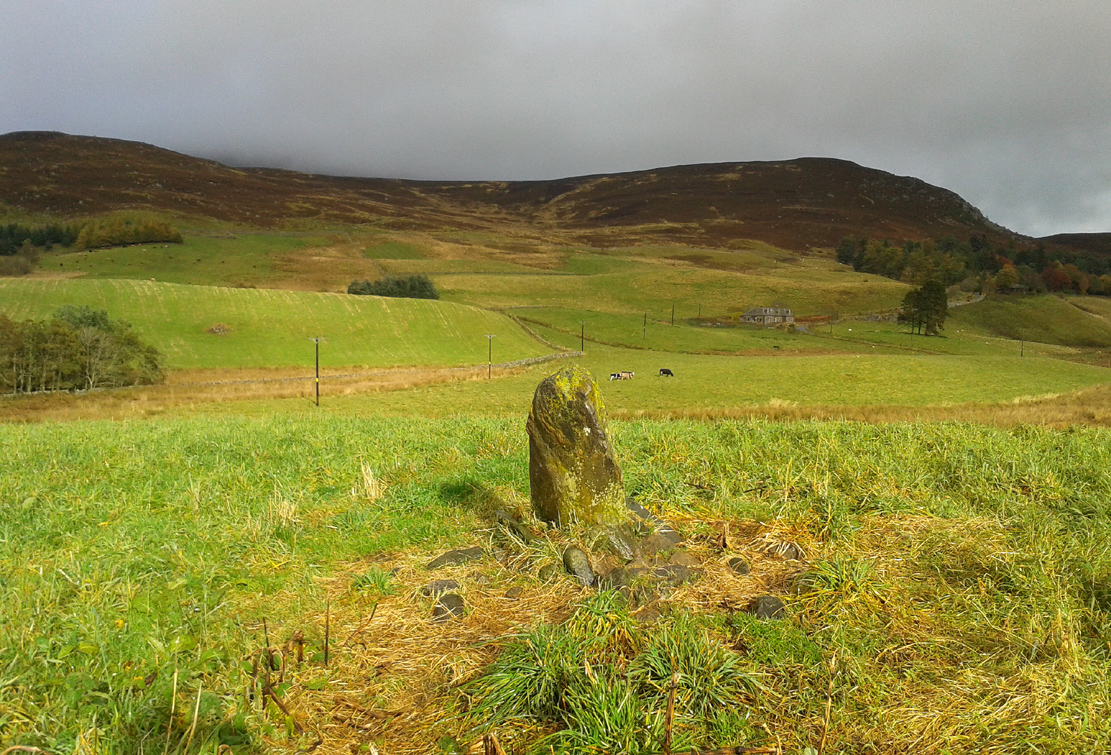
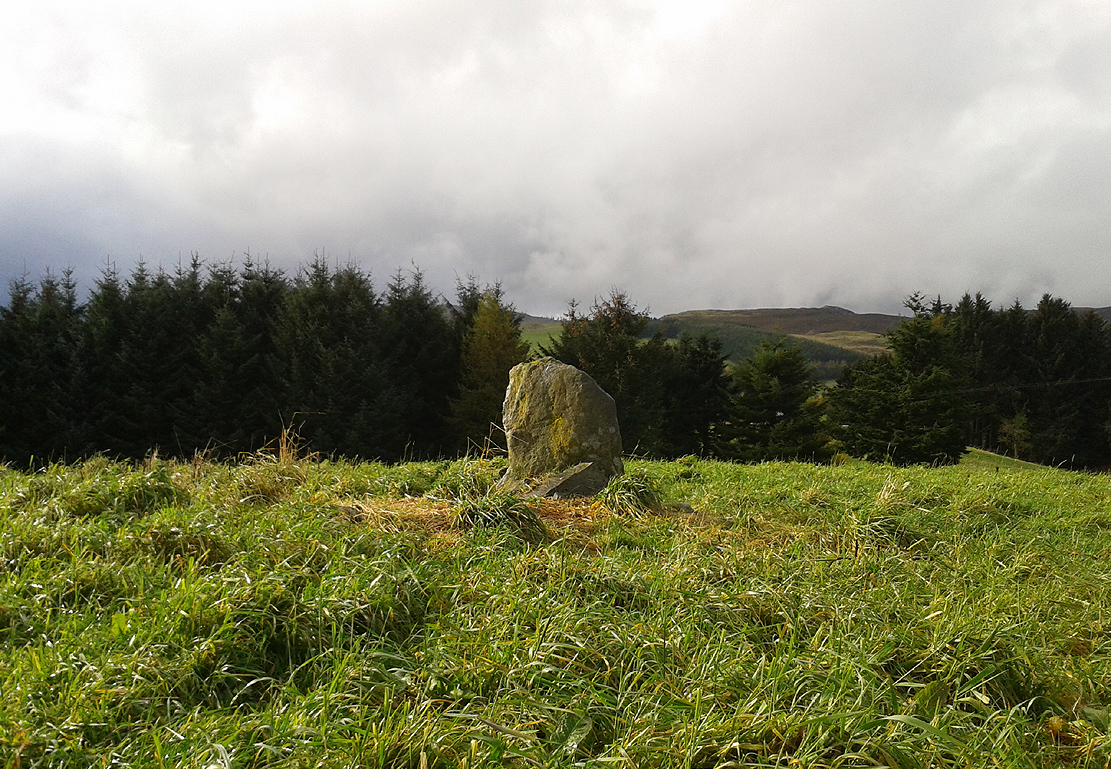
This small standing stone (not previously recorded) hides away up on the hillside not far from the old Tobhar na Cailleach (nowadays demoted as a just a Wishing Well), with its history and traditions seemingly long forgotten.  About 3 feet high and barely a foot thick, it may once have had a companion standing just a few yards away by its side, where now lays a moss-covered stone.  It reminded me a little of the stone pairing called the Cuckoo Stones near Wuthering Heights at Haworth, West Yorkshire.

Possible fallen stone

Possible fallen stone

Druim Mor stone, looking N

Druim Mor stone, looking N

Slightly higher up the grassy slope, 15-20 yards away, we find a low line of ancient walling that runs slightly uphill and then across a slightly level piece of land for about 40 yards, before turning back down the hillside and towards the road below.

Folklore

Although we have no recorded traditions of this stone, it needs to be highlighted that the waters, the woods and the slopes below this stone are dedicated to the Cailleach – the great prima Mater of Scottish and Irish traditional history.

Acknowledgements:  Many thanks to Nina Harris and Paul Hornby for their help on the day of this find.

© Paul BennettThe Northern Antiquarian

Witches Stone, St. Martin’s, Perthshire

‘Standing Stone’:  OS Grid Reference – NO 15927 31609

Also Known as:

  1. Canmore ID 28628

Getting Here

The Witches Stone of MacBeth

Going north-eastish from the city of Perth, take either the A93 or A94, turning west along the A93 a mile south of Guildtown, or east at Balbeggie on the A94, until you reach St. Martin’s hamlet and park up just below the church opposite the old cottages. Walk up the track below the cottages (not the one above them!) for ⅘-mile (1.35km) [past the ruined Cupar Stone Circle], and where the land has levelled out and in the huge flat field on your left, you’ll eventually reach a gate and see the odd-looking ‘rock’ about 250 yards away in the middle.

Archaeology & History

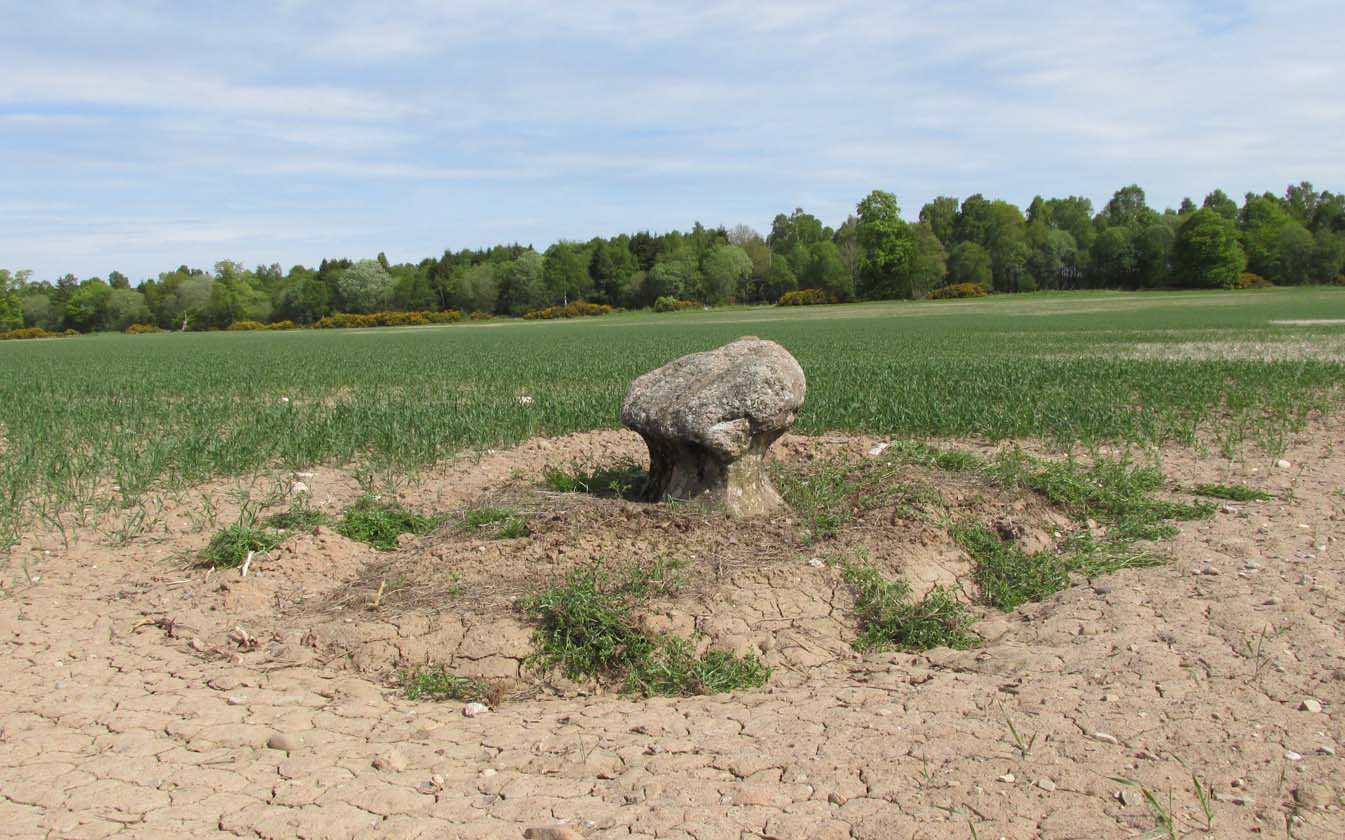
A fungal morel turned to stone

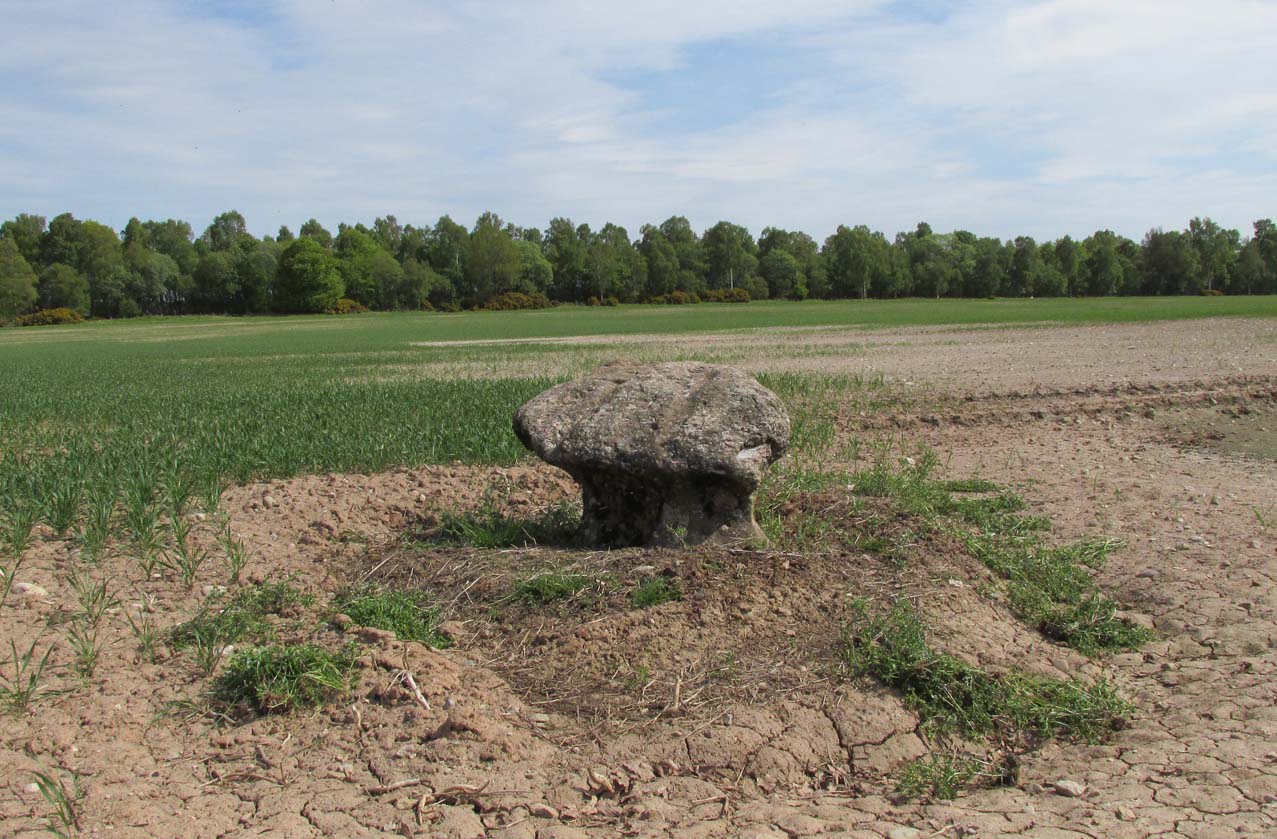
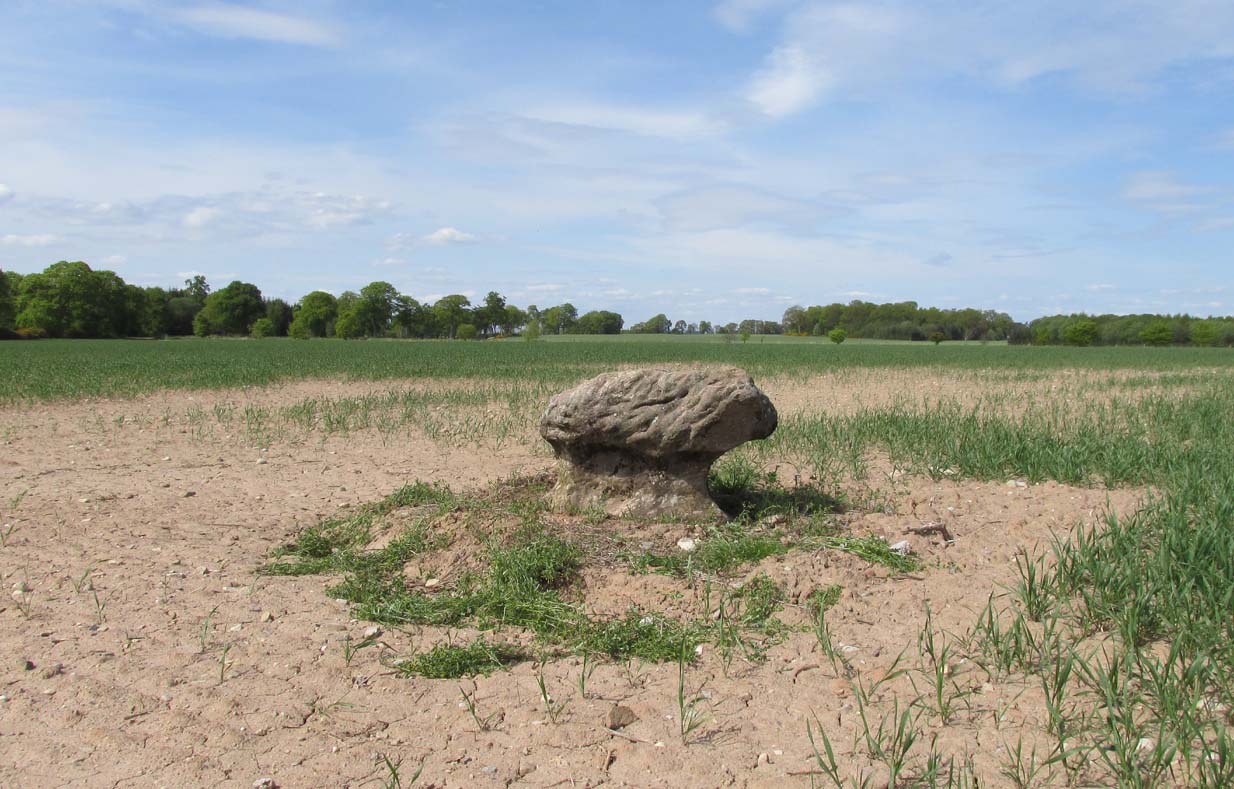
In a quiet and little-known parish that was once littered with about a dozen stone circles, there remains a most curious and fascinating stone which, in earlier days, was to be seen on the open moorlands at this spot.  The area was then forested and then the agriculturalists came with their farming and destroyed the forests, leaving the old stone as it presently stands, isolated, above the hamlet of St. Martin’s to the south.  Although it was described in the 19th century as being “four feet high”, it stands barely three feet tall, is very curiously-shaped—just like a morel mushroom from some angles—and in the middle of an extensive piece of flatland where the crops barely grow.

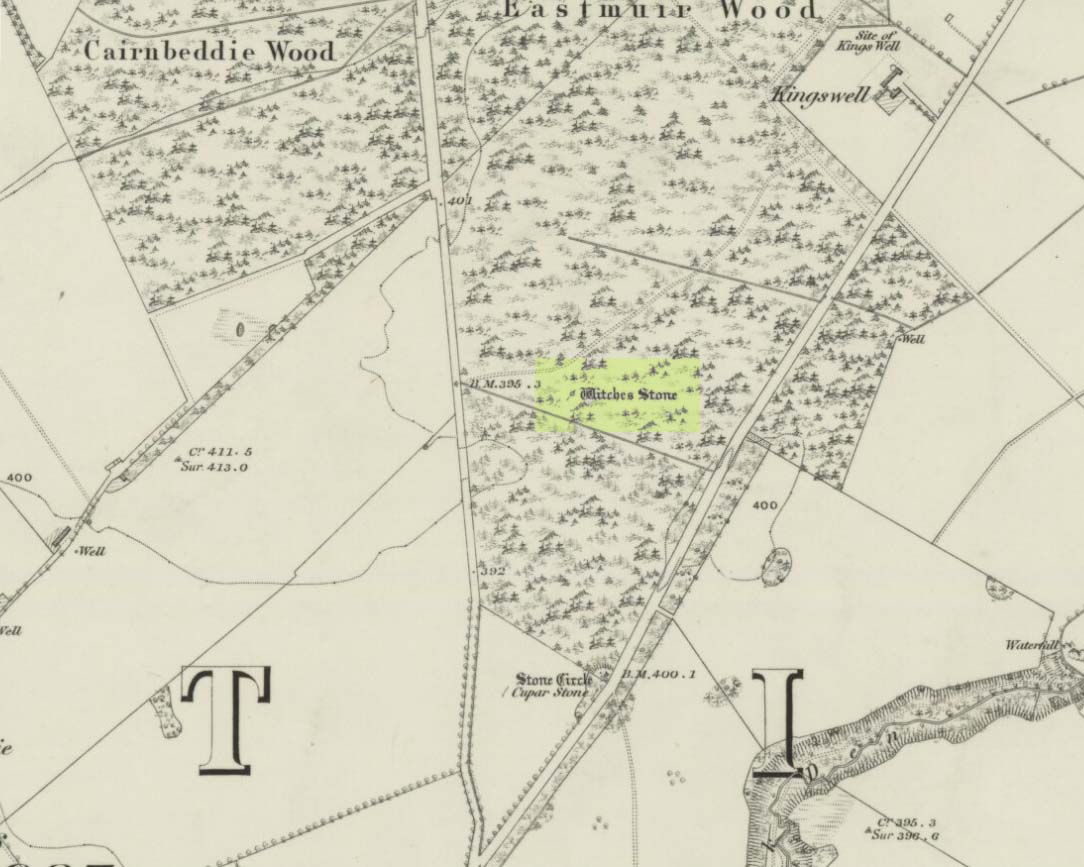
Witches Stone on 1866 map

Witches Stone, looking west

The stone was highlighted on the first OS-map of the parish in 1866, showing it in the woodland plantation of Eastmuir.  It may have been some sort of northern outlier related to the now-destroyed stone circle of Cupar 400 yards south; and if this was the case, its position in the landscape relative to the circle would give the Witches Stone an airt (virtue ascribed to cardinal directions) in the cycle of the year that relates to darkness and death. (Perhaps oddly—perhaps not—the name of parish St. Martin’s relates to that dark period in the calendar, as St. Martin’s day in the old calendar was Samhain or Halloween: old New Year’s Day, when the spirits of the dead moved across both land and skies.)

It was erroneously described by the Canmore lads as being little more than “a glacial erratic”, but the stone here is quite earthfast; and their idea that “its peculiar shape has probably been caused by wind erosion”, is also somewhat dubious considering the shape of other monoliths and megalithic rings in the region.  The stone has an appearance similar to some Bull Stones, where the animal was chained to rocks such as this and then baited by dogs, although I can find no such lore here. Indeed, the history and archaeology of the stone seems all but silent.  Its folklore however, would have the Shakespearian romanciers amongst you flocking to the place…

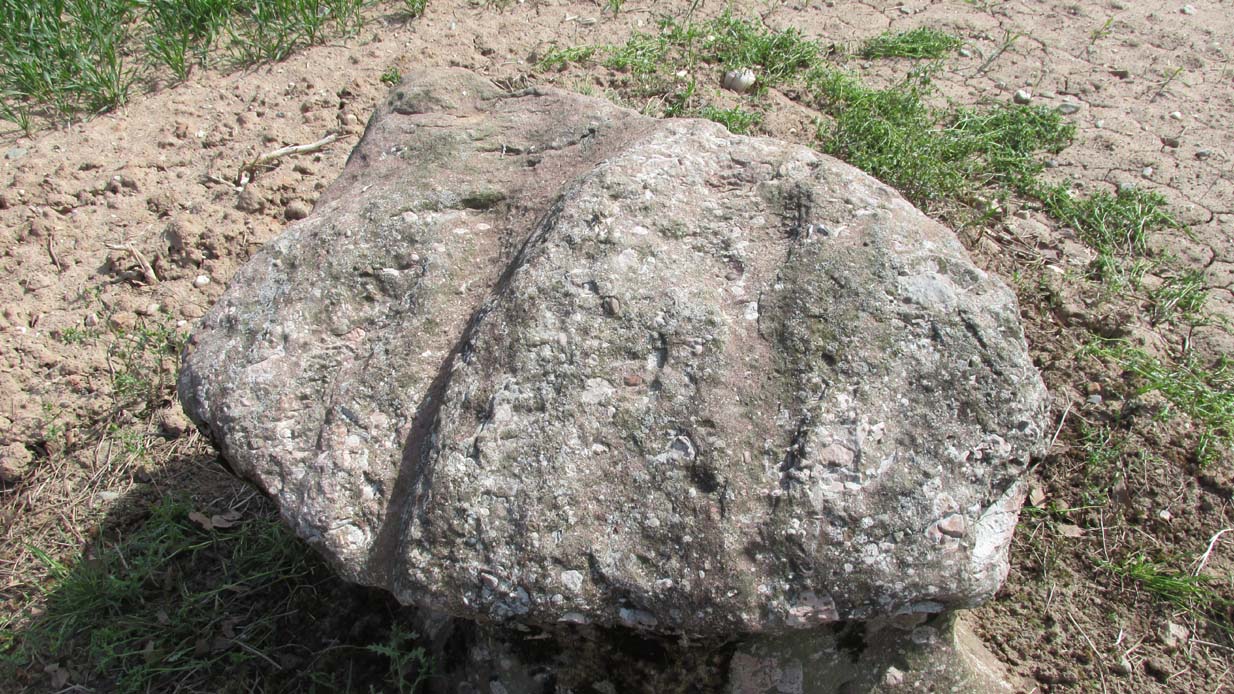
Deep grooves atop of the stone

The top of the stone has some very distinct and deep-cut lines running across it at angles, and has the appearance of being cut into at some time in the dim and distant past.  By whom, and for what reason, we cannot say.

Folklore

William Richie (1845) told us that in the 11th Century when Scotland was having to deal with the english disease of stealing land and spreading its violence, King MacBeth—whose castle stood within this parish at Cairnbeddie (NO 1498 3082)—took that advice of two witches, and that

“they met him one night at a place still called ‘the Witch Stane’ (where a remarkable stone still stands), about a mile from his old residence, and warned him to beware, ‘Till Birnam forest come to Dunsinane.’”

The 1860 Name Book told us that,

“The Moor where the witches met, which is in St. Martins Parish is yet pointed out by the country people, and there is a stone still preserved, which is called the Witches Stone.”

References:

  1. Scott, Aleander, St. Martin’s and Cambusmichael, Perth 1911.
  2. Richie, William, “St. Martins and Cambusmichael,” in New Statistical Account of Scotland – volume 10: Perthshire, William Blackwood: Edinburgh 1845.

Acknowledgements:  Huge thanks to Prof Paul Hornby for showing me this site. Cheers matey!

© Paul BennettThe Northern Antiquarian

Borland, Blacklunans, Alyth, Perthshire

Standing Stone: OS Grid Reference – NO 15361 60677

Also Known as:

  1. Borland Stone
  2. Canmore ID 29401

Getting Here

The Borland Stone, looking NE

The Borland Stone, looking NE

From Blairgowrie, take the A93 north road, ensuring that when you reach the Bridge of Cally after 5½ miles (9km), you take the right-turn up Glenshee (the Valley of the Faerie folk) and not the A924 Strathardle road. After about 5 miles, turn right up the small lane to Blacklunans after, once you’ve weaved past the River Shee and started uphill, a few hundred yards on keep yer eyes peeled on the fields to your left. If you hit the Glenshee EcoCamp, you’ve gone too far.

Archaeology & History

Borland Stone, looking west

Borland Stone, looking west

This small, out-of-the-way standing stone is set amidst a small mass of rounded stones—as if once part of a cairn—at the top of a small hillock that can easily be passed by if your nose isn’t working properly.  Curiously isolated, the monolith seems more of an outlier to the Mount Blair hills immediately north and east; or perhaps the large settlement less than a mile south.

Very little seems to have been said about the stone, in literary terms at least.  The Royal Commission (1990) lads merely told us that,

“This stone, which stands on the summit of a prominent knoll 300m SE of Borland farmhouse, measures 0.7m by 0.3m at the base and 1m in height.”

Stone aligned NNE to Tom Bealaidh

Stone aligned NNE to Tom Bealaidh

Nowt else!  Although the stone was marked on the early 1900 OS-map, the small mass of loose stones at its base are more recently-worked than anything prehistoric and may simply be field clearance.  The monolith itself could do with assessment to positively ensure its prehistoric veracity.

References:

  1. Meikle, James, Places and Place-Names around Alyth, Alexander Gardner: Paisley 1925.
  2. Royal Commission on the Ancient & Historical Monuments of Scotland, North-East Perth: An Archaeological Landscape, HMSO: Edinburgh 1990.

© Paul BennettThe Northern Antiquarian

The Bhacain, Cashlie, Glen Lyon, Perthshire

Standing Stone:  OS Grid Reference – NN 48367 41706

Also Known as:

  1. The Bhacan
  2. Canmore ID 23977
  3. Cona Bhacain
  4. Testing Stone of the Fianna

Getting Here

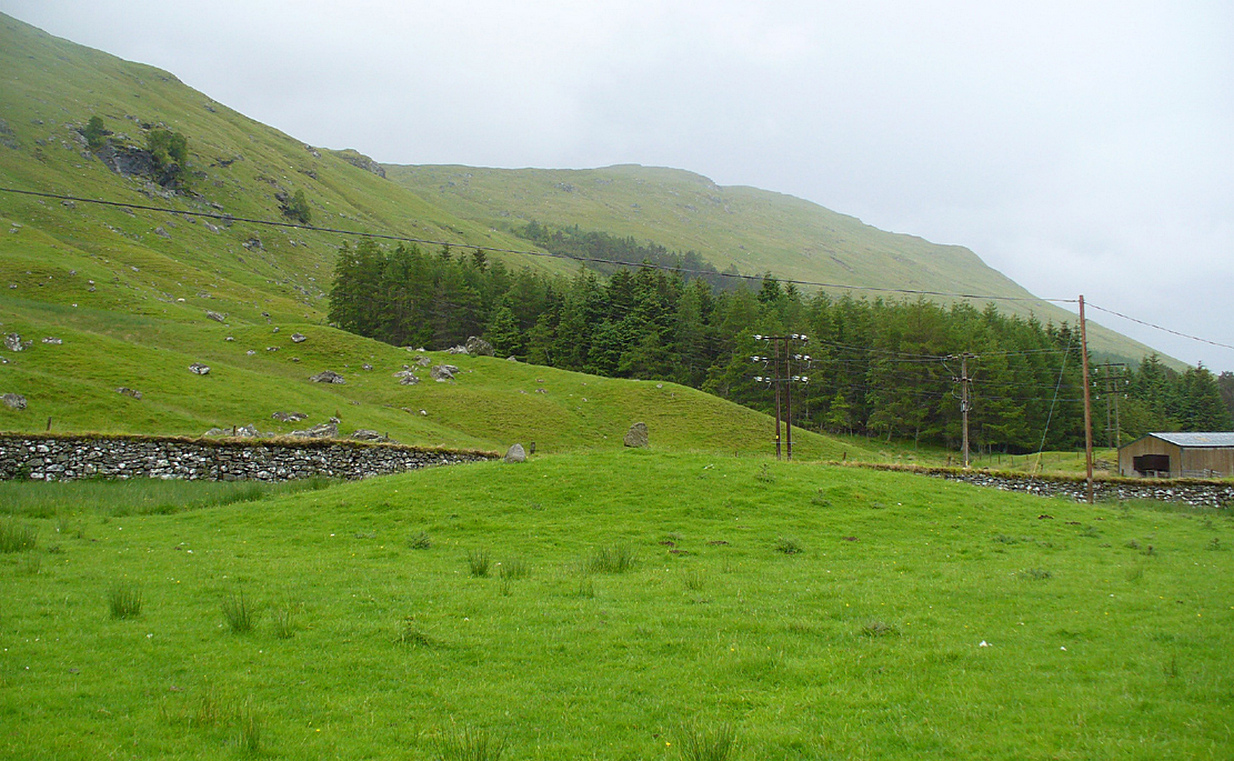
The Bhacain in its setting

Whether you take the road west from Fortingall, or over the heights from Loch Tay, when you reach Meggernie Castle just keep going west for a few more miles.  Keep going past the large Stronuich reservoir on your left and you’re getting close.  Go past Caisteal Mhic Neill and the trees at Cashlie House for another 5-600 yards and where the track crosses the river Lyon, park up just past it.  Ahead of you in the field on the left of the road, nearer the riverside, is where you need to look.

Archaeology & History

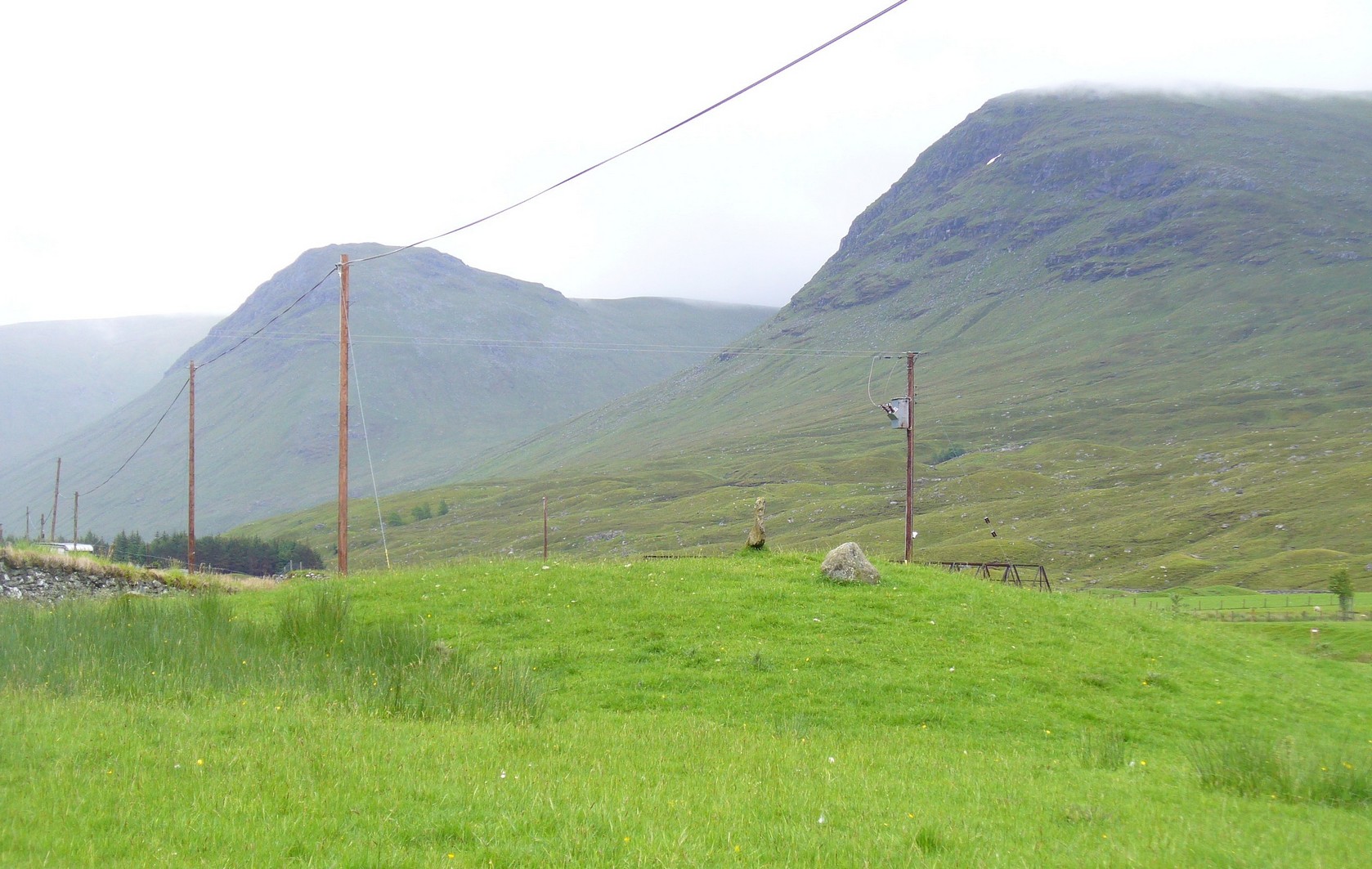
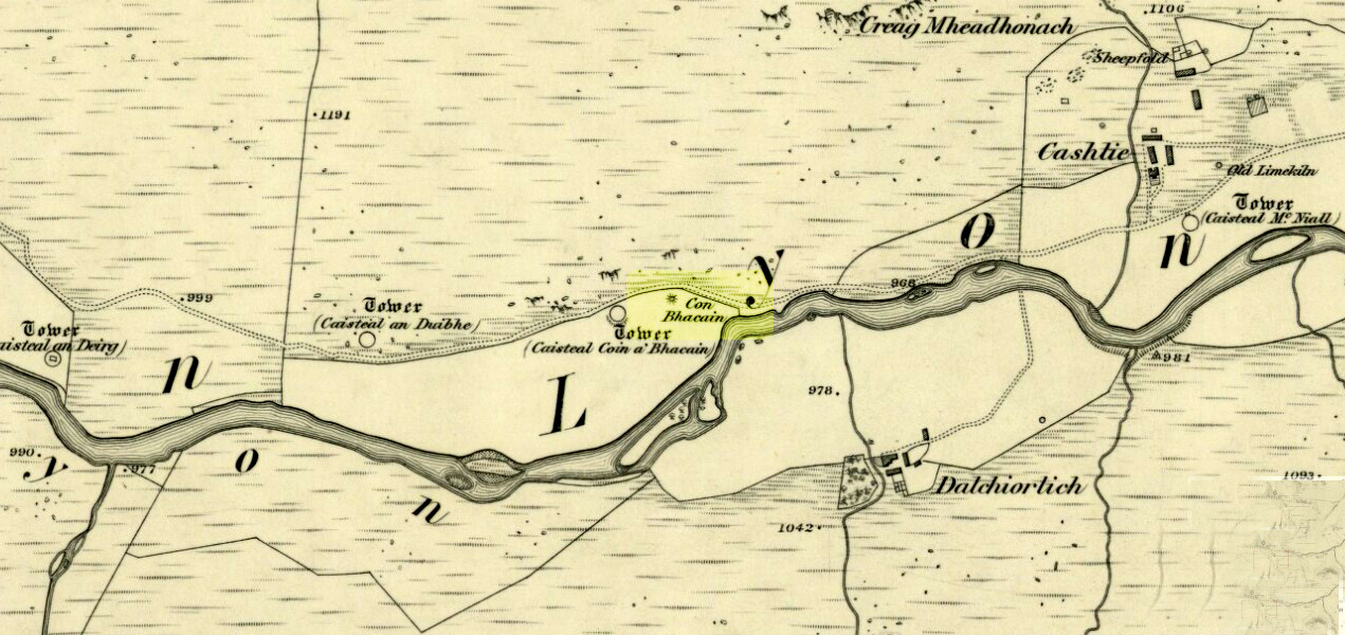
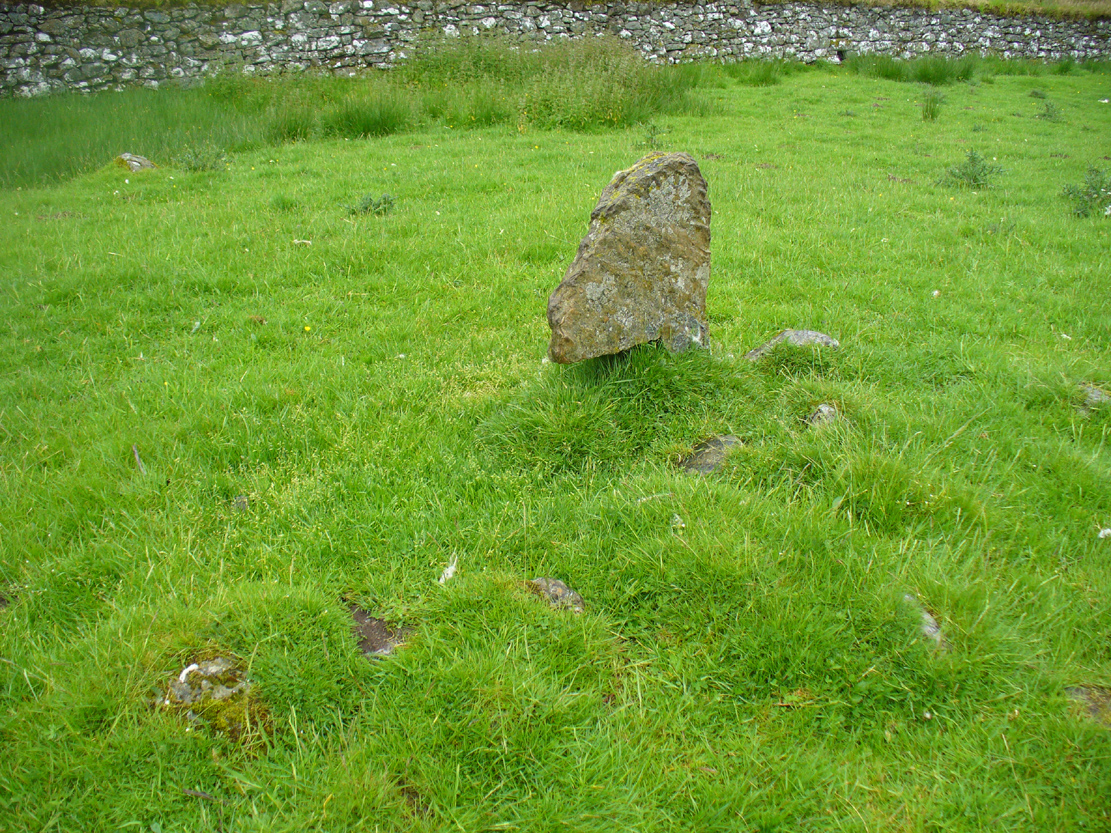
One of the most peculiar and unique sites in the British Isles is this remote small upright stone, known locally as The Bhacain.  Standing upon a small mound in the field immediately east of one of Finn’s legendary ‘forts’ (a dun or a broch) called Caisteal Cona Bhacain, this curious monolith, less than two feet tall, has a thin upright stem with a much enlarged rounded end to it.  Some might even ascribe it as phallic—although local traditions of the stone relate it as a truth-sayer of a young girl’s virginity!

The Bhacain on 1867 map
Mound of The Bhacain

Its position on top of the small mound is intriguing, giving it the impression of being atop of a tumulus; and there is also the scatter of small stones surrounding the upright just beneath the surface (as evidenced in one of the photos), making it possible that the stone is an ancient burial marker.  If this is ever shown to be true, the likelihood is that the stone marks the grave of a hound, as the tradition of this spot implies.  No excavation has ever occurred here, so the precise nature of the stone (and the mound) has yet to be ascertained; but knowing the longevity of some oral traditions in these Highland glens, the idea of it being the burial-place of a dog is anything but far-fetched.

If the stone is contemporaneous with the associated ‘duns’ close by, this would be a late standing stone, probably erected in the Iron Age.  We can certainly see, quite plainly from the erosion on the stone, that this is not neolithic or Bronze Age in origin.  A decent examination of the important sites hereby is long overdue…

Folklore

The Bhacain & its stony pile

The folklore and traditions attached to this site are numerous when you consider how small it is.  Much of this relates to the fact that animistic cosmologies in the Highlands were retained until very recently, stretching way back.  Accounts from the 19th and 20th centuries tell of people still frequenting this and other sites, at sunrise, or full moons, as such things were still very much integral parts of rural life.  When the local historian Duncan Fraser (1973) wrote about The Bhacain in his fine work on this area, he told much about the traditions of the great warrior King Fionn and his activities hereby:

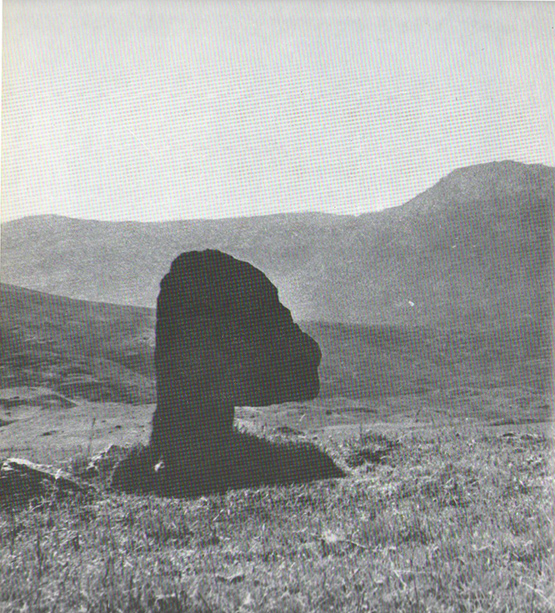
Duncan Fraser’s old photo
The Bhacain, looking S

“Another traditional link with the warrior King is the Bhacain, on a mound beside the road, far up the glen.  Only a stone’s throw from one of the forts, it is about two feet high and shaped like the head of a dog.  This is said to have been the stake to which the Fians tethered their staghounds with leather thongs, when they returned from the chase.  And there were times, no doubt, when Fionn’s own dog, Bran was among them, with its yellow paws and its black flanks and its chain of pure gold.  It was the best hunting dog that ever lived.  And there was its brother, the dreaded Grey Hound, that used to roam on its own in the Great Glen, tearing its victims limb from limb, until it too abandoned its wildness and became one of the hounds of the Fians.  They say that the dogs’ food was thrown to them from the top of Caisteal Coin-a-bhacain, the castle of the dog’s stake, upwards of seventy yards to the west.  And any dog that failed to catch its supper was turned out of the pack.

“Time did not allow the Bhacain to become inanimate like other stones.  Even in comparatively recent times it was still regarded with superstitious awe.  A retired schoolmaster of Fortingall recorded eighty years ago that it was said to have a mysterious effect on those who crept under its head.  And old folk in the glen will tell you that those who did so were girls.  It had become the glen folk’s yardstick of virginity.  In the late eighteenth century, when the girls returned from gathering the harvest in the ungodly Lowlands, under the stone they went.  It was better than all your modern pills.”

In Hilary Wheater’s (1981) fine work on the history of the region, he told that “no youth was permitted into the fighting body of the Clan until he could lift the Bodach Stone onto the boulder beside it.”  This tradition gave the Bhacain another name, the Testing Stone of the Fianna.

References:

  1. Burke, Peter, Popular Culture in Early Modern Europe, Scolar Press: Aldershot 1994.
  2. Fraser, Duncan, Highland Perthshire, Standard Press: Montrose 1973.
  3. McKerracher, Archie, Perthshire in History and Legend, John Donald: Edinburgh 1988.
  4. Stewart, Alexander, A Highland Parish; or, The History of Fortingall, Alex MacLaren: Glasgow 1928.
  5. Wheater, Hilary, Aberfeldy to Glenlyon, Appin Publications: Aberfeldy 1981.

© Paul BennettThe Northern Antiquarian

Balnabroich, Kirkmichael, Perthshire

Standing Stone:  OS Grid Reference – NO 09175 56752

Also Known as:

  1. Canmore ID 27267

Getting Here

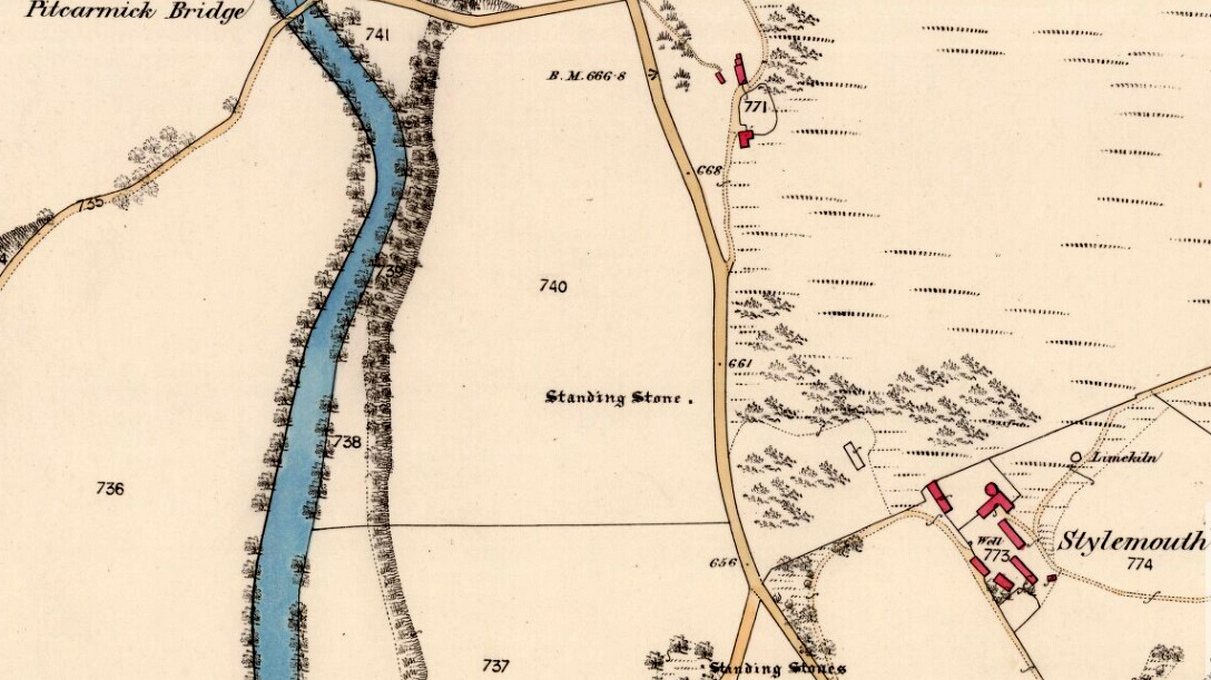
Stone shown on 1867 map

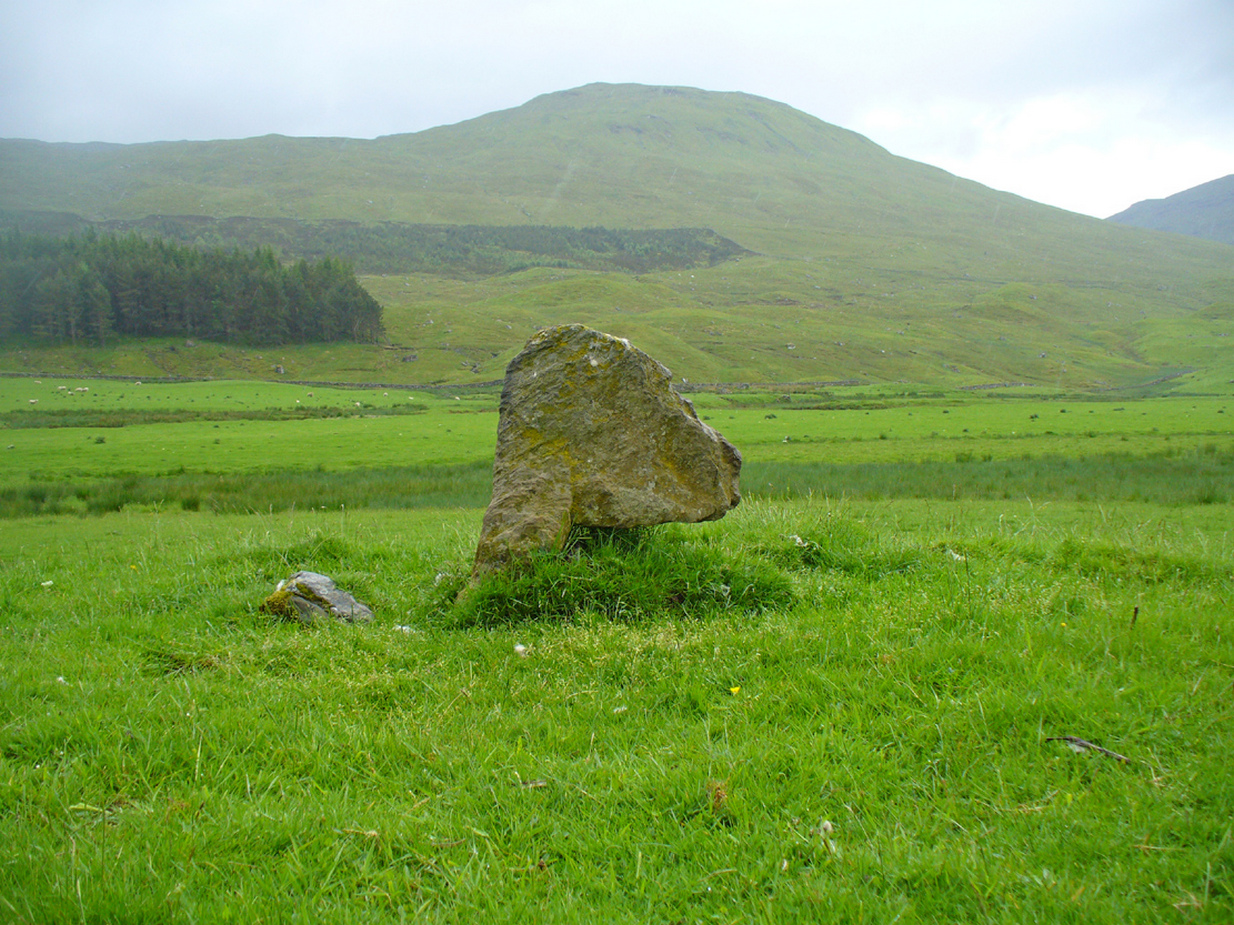
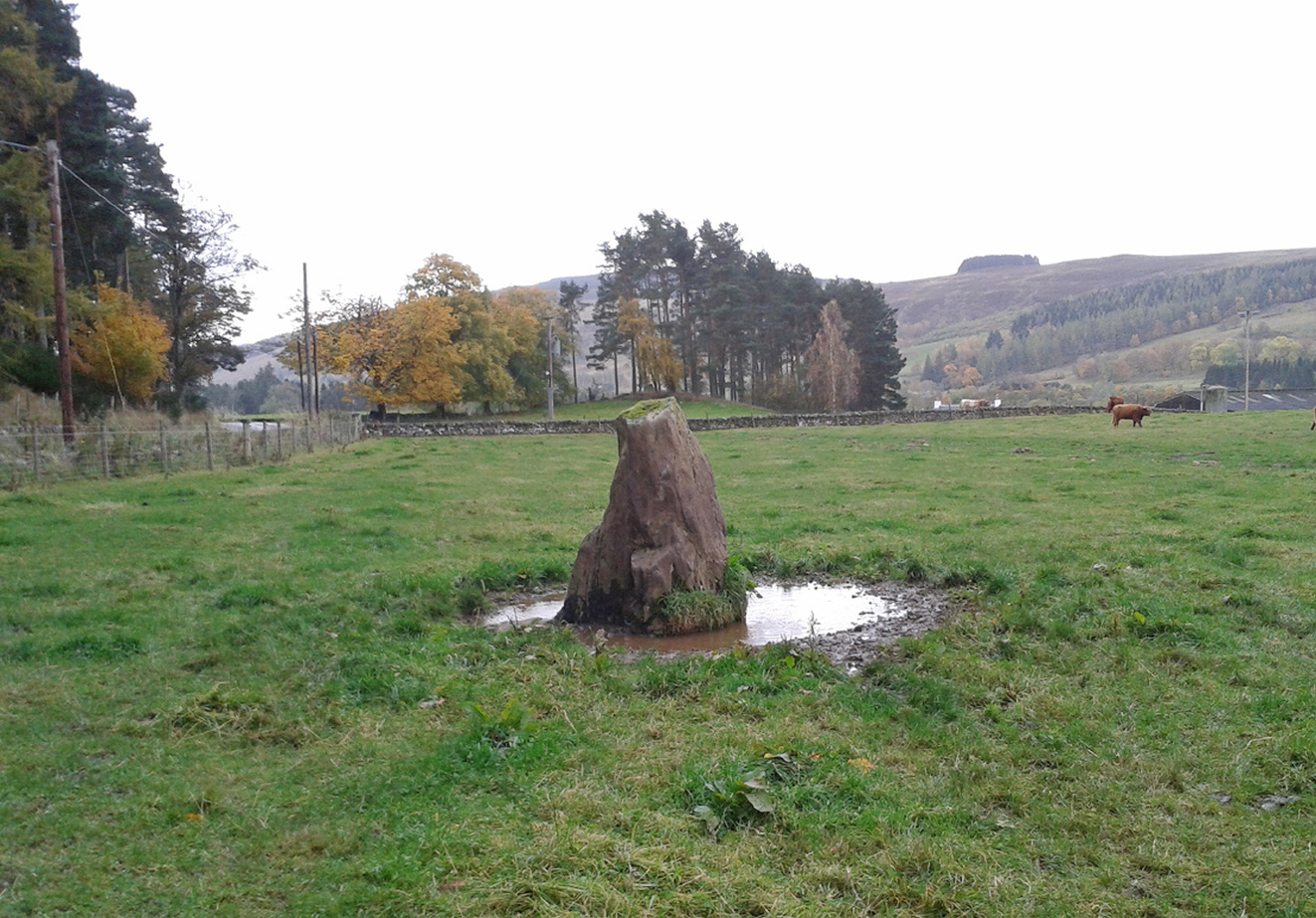
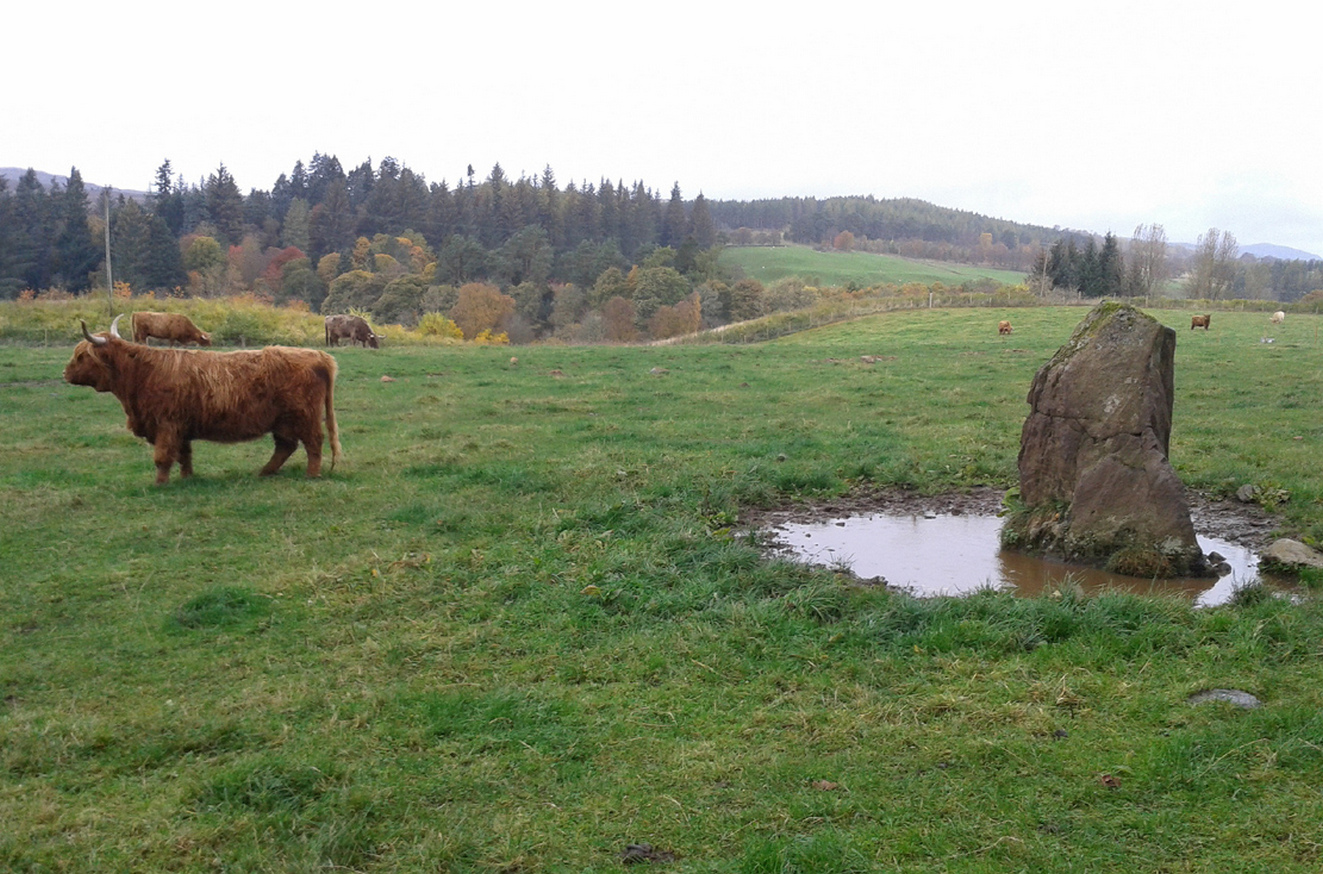
Take the A924 road north of Blairgowrie, between Pitlochry and Bridge of Cally and, about 4.6 miles (7.5km) along, roughly halfway between Ballintuim and Kirkmichael, in the field by the roadside immediately west, you’ll see this conspicuous upright stone standing all alone – unless the cattle are meandering slowly around it! Y’ can’t really miss it.

Archaeology & History

This single monolith that stands today as a cattle rubbing post, may at one time in its distant past have been related to the present pair of standing stones hiding in the small remain of trees 148 yards (135.5m) to the south; although neither Aubrey Burl (1993) nor Alexander Thom (1990) ascribe the stone such an association in their relative tomes on aligned stone rows.

When the great standing stone lover Fred Coles (1908) came here, he was as reliable as ever in his subsequent exposition of the place – and despite getting his measurements slightly out he told us, almost liltingly, like an antiquarian Uncle Monty stroking his megaliths, that

Balnabroich stone, looking S
The old stone, looking NW

“At a point almost 176 yards due north of (the) two stones is a tallish and unshapely monolith standing but a few yards west of the main road.  Its most notable feature is the extreme irregularity of its shape.  If any proof were needed to show how uncritical were the people who raised such stones, how totally devoid of any regard for symmetry or neatness of contour in the monoliths they set up, surely the ground-plan of this block of rent and riven quartz-veined whinstone, fissured and uncouth in all its parts, would supply it.

“The contour here shown was measured by laying down an irregular rhomboidal figure, and from each of its sides measuring by offsets to the depths 0f the curves which are so prominent on the north, the northwest and the southeast sides.  The ground-plan this obtained shows that, taken between their prominent angles, the four sides measure almost exactly 3 feet each, and the main long axis of the stone which lies due east and west and measures 4 feet 6 inches.  The monolith stands 5 feet 8 inches above the ground and…appear to have been unconnected with circles, so far at least as it was possible to glean any information.”

References:

  1. Coles, Fred, “Report on Stone Circles Surveyed in Perthshire – Northeastern Section,” in Proceedings of the Society of Antiquaries of Scotland, volume 42, 1908.
  2. Royal Commission on the Ancient & Historical Monuments of Scotland, North-East Perth: An Archaeological Landscape, HMSO: Edinburgh 1990.

Acknowledgements:  Huge thanks for use of the Ordnance Survey map in this site profile, reproduced with the kind permission of the National Library of Scotland

© Paul BennettThe Northern Antiquarian

Auchnafree, Glen Almond, Perthshire

Standing Stone:  OS Grid Reference – NN 8225 3336 

Getting Here

Auchnafree Stones, looking east

Auchnafree Stones, looking E

Walk up the long track of beautiful Glen Almond, past the East Conichan circle and past the giant tomb of Clach na Tiompan.  After about 4.2 miles (6.8km), the track diverges: take the one directly west, over the old bridge, and less than 100 yards past here, note the gate on your right.  Go into the field and start walking uphill until you’re at the highest point a few hundred yards up.  You’ll find the stones in front of you.

Archaeology & History

Auchnafree Stones, looking NW

Auchnafree Stones, looking NW

Somewhat reminiscent in style and form to the standing stones at Dumgoyach, north of Glasgow, this one upright monolith and its seemingly fallen companion have not previously been recorded by archaeologists—but it is quite a distance away from anywhere. The upright stone is about one metre tall and its lumbered companion about four feet long.  The remains of a small stone, probably broken from the larger mass, extended beyond the long stone.  Another unrecorded standing stone can be found on another hillock a few hundred yards from here.

© Paul BennettThe Northern Antiquarian

Auchingarroch, Muthill, Perthshire

Standing Stone:  OS Grid Reference – NN 78732 19579

Also Known as:

  1. Canmore ID 24795
  2. Roman Stone

Getting Here

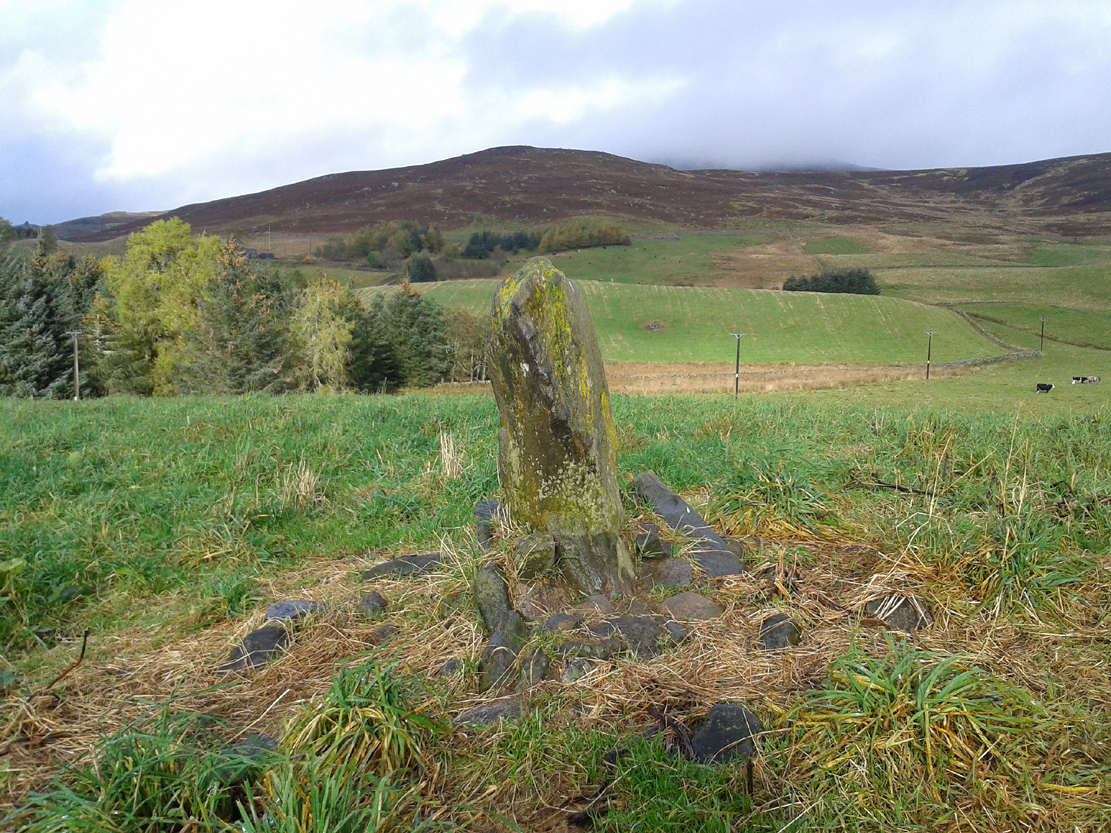
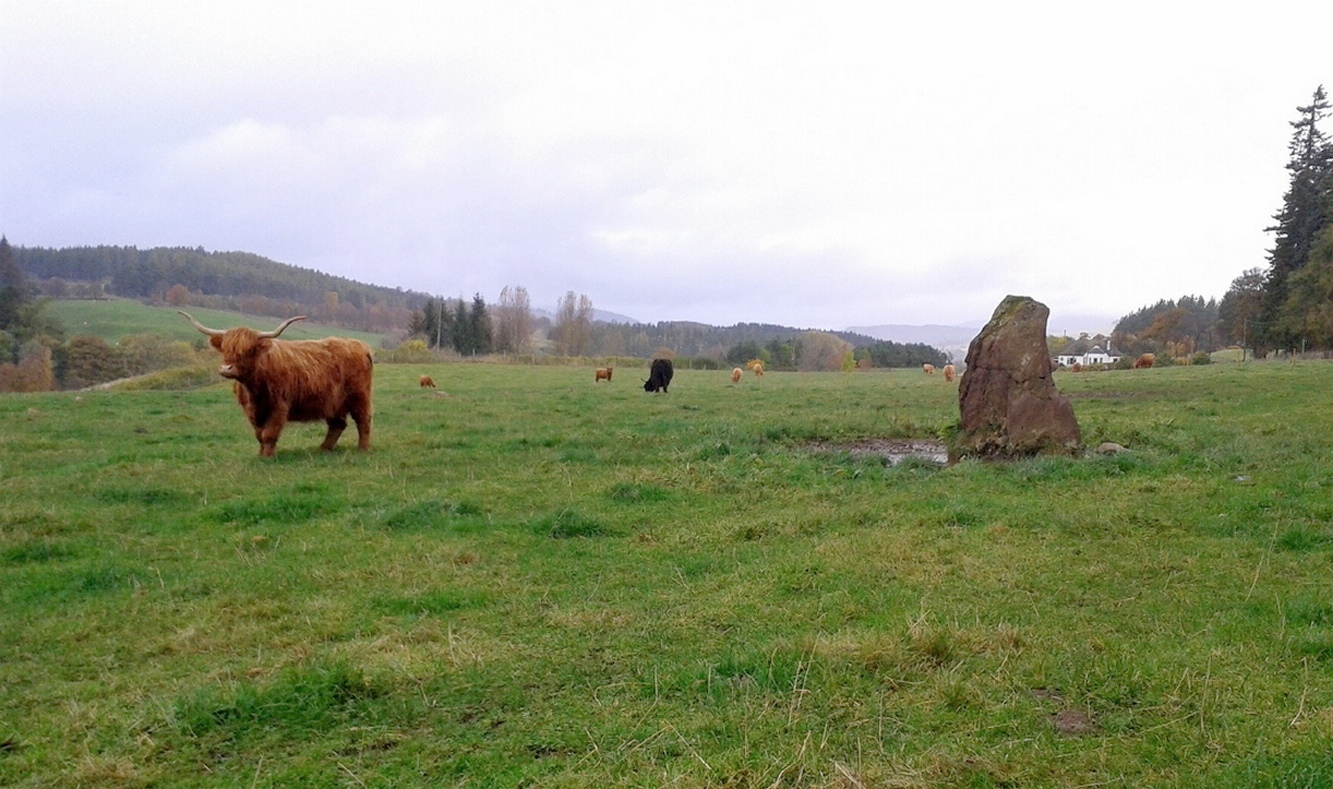
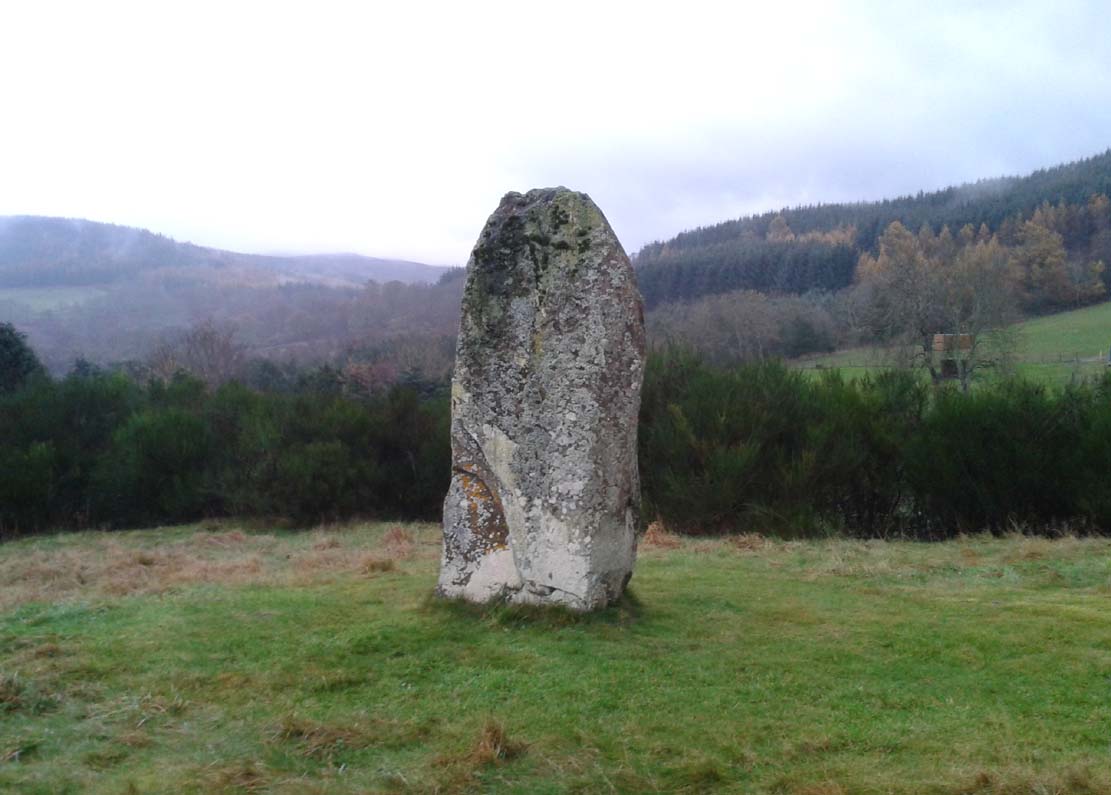
Auchingarroch stone

The Auchingarroch stone

Take the B827 road south out of Comrie as if you’re heading towards Braco, and after a mile or so, as you start going uphill, turn left to go to the Wildlife Centre.  Go along the track and park up at the buildings.  The monolith is round the back of the first building (ask at the Centre, where the people there are very helpful).

Archaeology & History

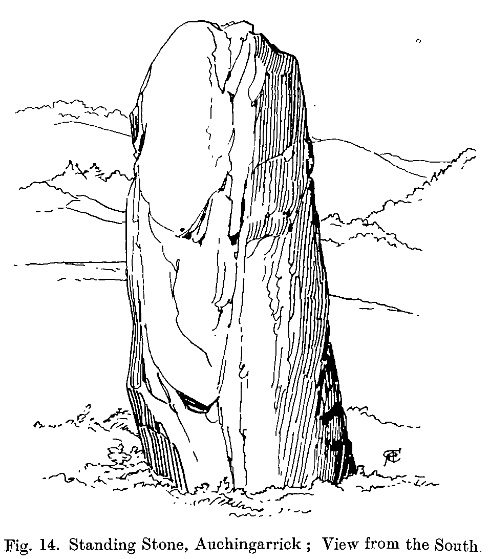
F. Coles 19l1 sketch

F. Coles 19l1 sketch

Shown on the earliest Ordnance Survey map of the region as one of several ‘Roman Stone’ sites, this prehistoric upright is similar in size and feel to the other standing stones in the highly impressive Dunruchan complex close by.  The big fella stands on a raised piece of ground more than 8½ feet tall and, said Fred Coles (1911) has “a basal girth of 12ft 8ins.”  Quite a big stone!  A dubious large cup-mark is visible on the thin western face and three faint ones on its east.

The monolith is surrounded all along the southern landscape arc with forested moorland and low mountains, with the primary extended views reaching mainly into the north and western arc.  Although a rounded hillock immediately southwest of the stone looks promising, no calendrical or astronomical alignments have been found here.

Folklore

Auchingarroch, looking SW

Auchingarroch, looking SW

As with the other standing stones in this region, legend ascribes it as marking the resting place of a Roman soldier who fell in a great battle close by with our local heathens, in what was known as “battle of Mons Grampius.”

References:

  1. Coles, F.R., “Report on stone circles in Perthshire principally Strathearn,” in Proceedings of the Society of Antiquaries, Scotland, volume 45, 1911.
  2. Finlayson, Andrew, The Stones of Strathearn, One Tree Island: Comrie 2010.
  3. Hunter, John, Chronicles of Strathearn, David Phillips: Crieff 1896.

Acknowledgements:  Thanks to Paul Hornby for the journey here; and more especially a different sorta thanks to Linzi Mitchell for her influence whilst the site profile of this megalithic erection was being written. Who sez that men can’t do two things at the same time?!

© Paul BennettThe Northern Antiquarian

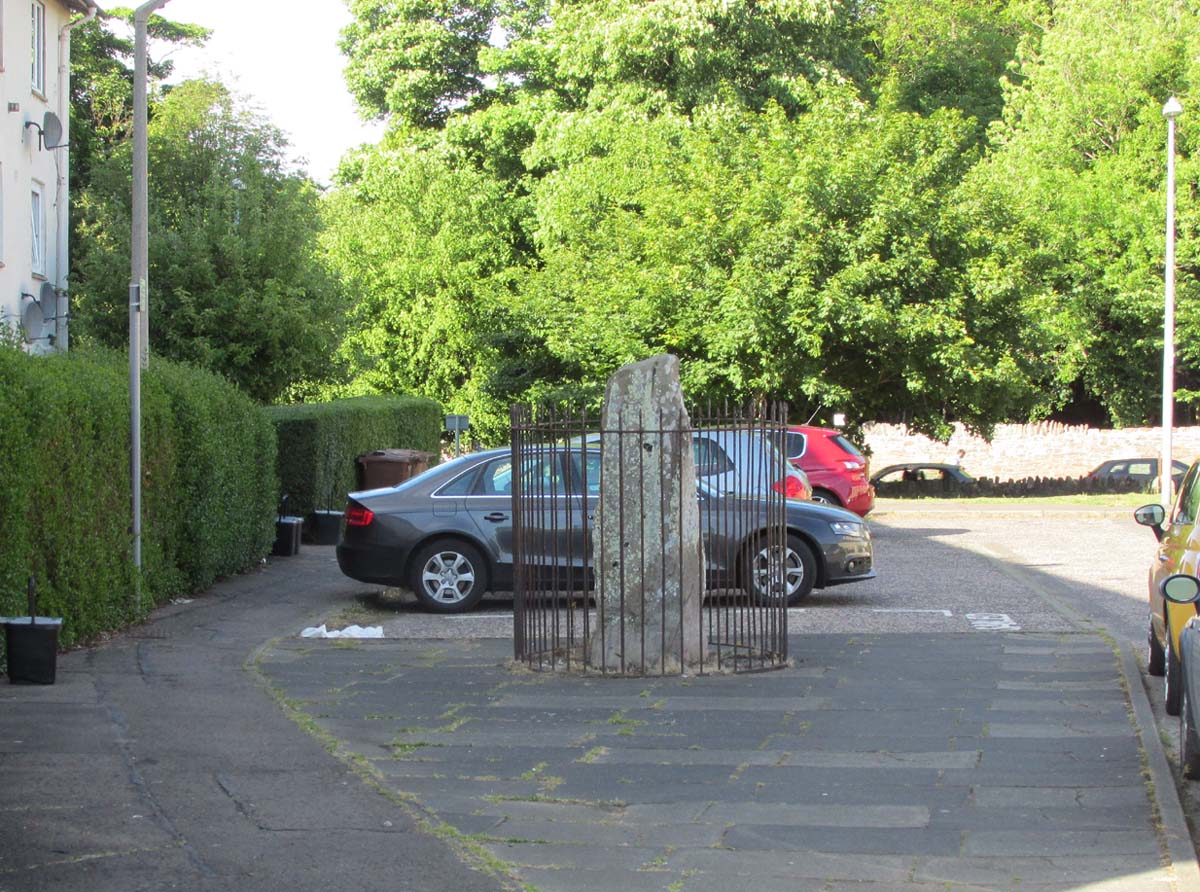
Ravenswood Avenue, Liberton, Edinburgh, Midlothian

Standing Stone:  OS Grid Reference – NT 28282 70502

Also Known as:

  1. Canmore ID 52108
  2. Craigend
  3. Greenend

Getting Here

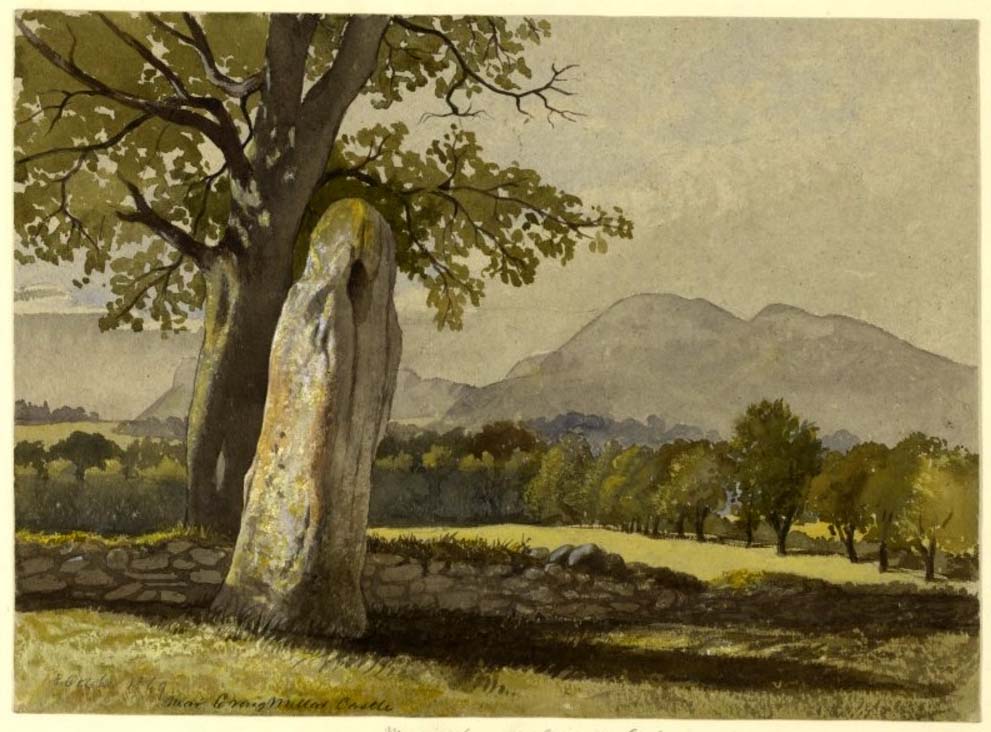
The stone in the 19th century

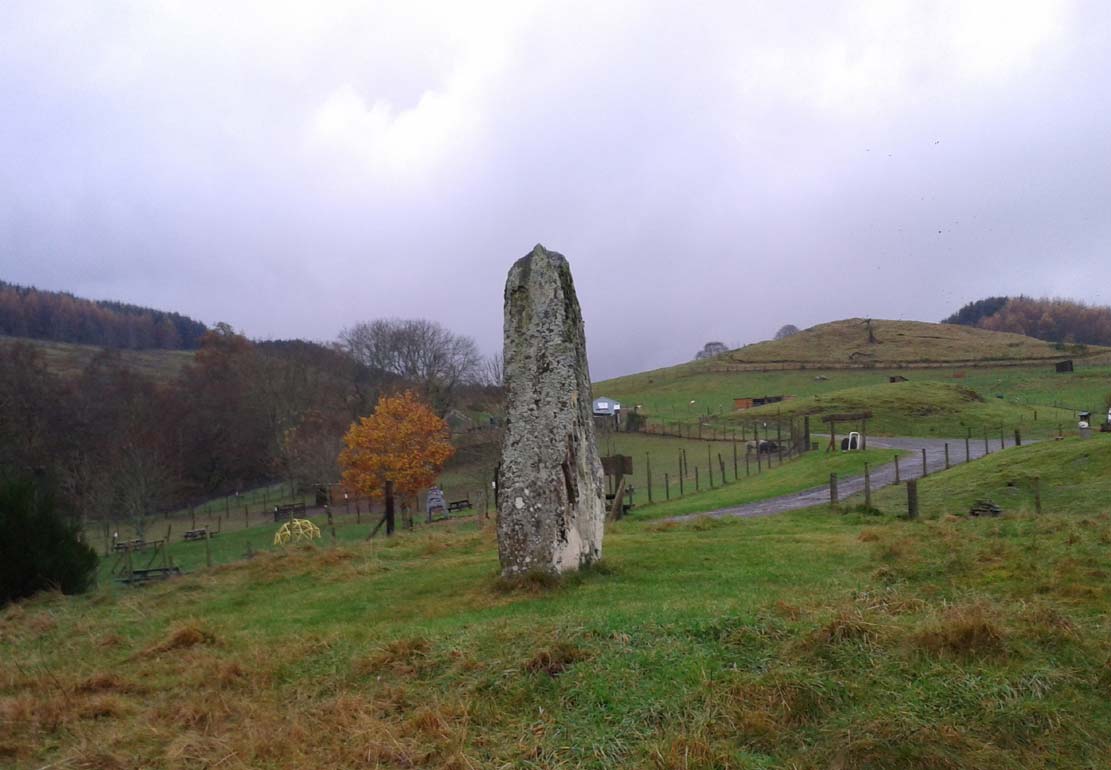
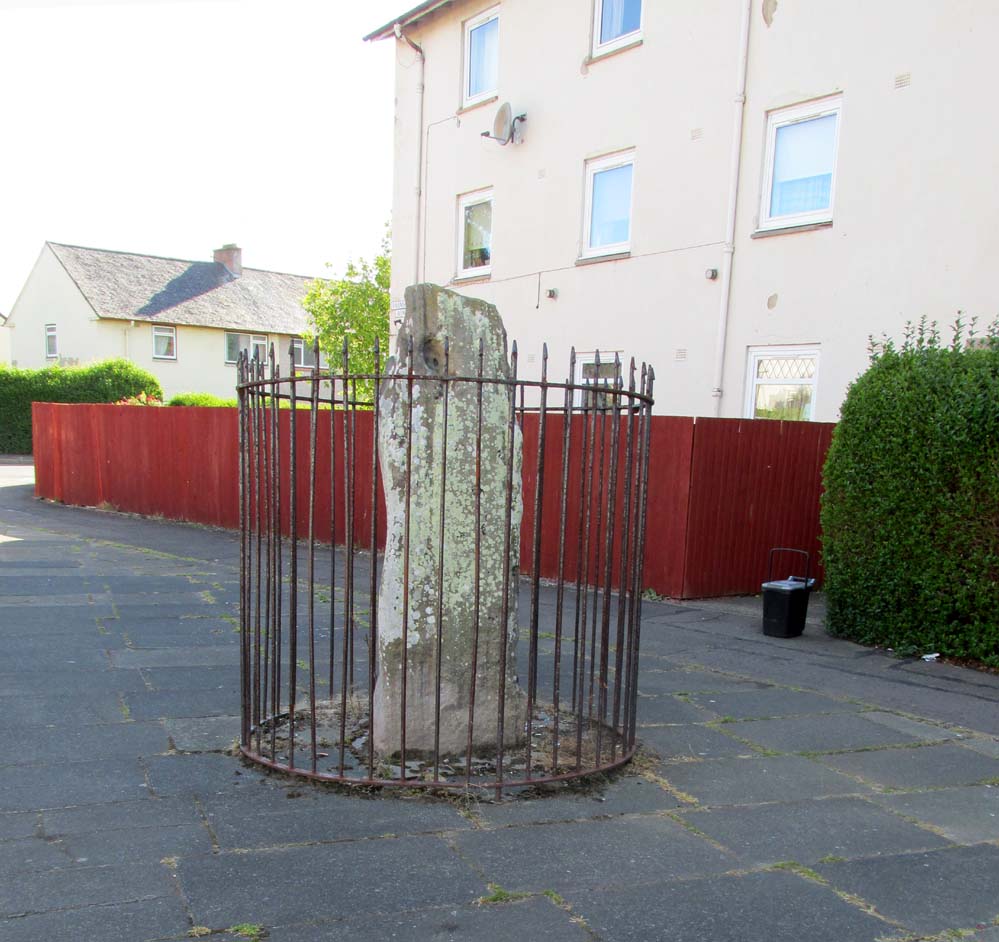
Take the A7 road south from Edinburgh central (off Princes Street) for several miles.  It becomes known as the Old Dalkeith Road eventually, just as it passes the huge wooded ground of Craigmillar Castle on your left (east) and the Inch estate on your right. Walk along here, keeping your eyes peeled for the small path that takes you onto Ravenswood Avenue.  Barely 30-40 yards from the main A7 road, the standing stone is there surrounded by railings.

Archaeology & History

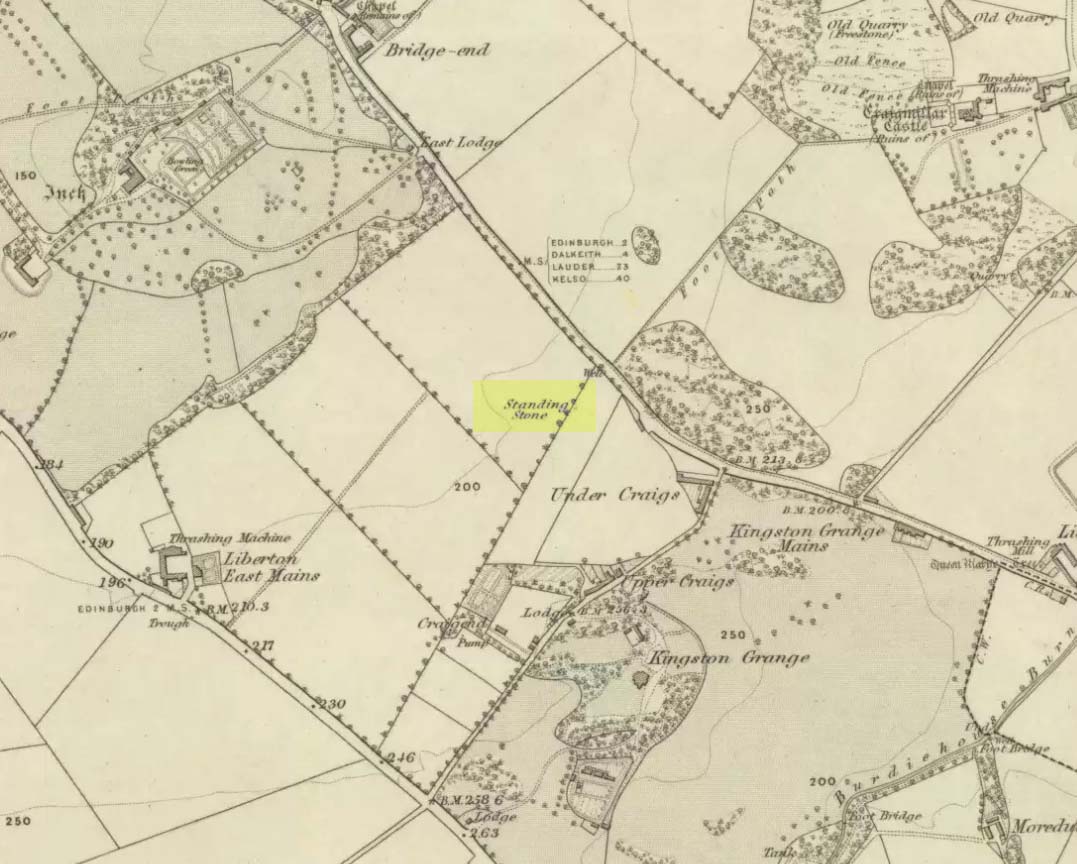
A curious place to find a standing stone – especially one that’s still alive!  But that’s what we find on the Inch housing estate, thankfully.  Highlighted on the 1855 Ordnance Survey map, it was one of a number of standing stones described in George Good’s (1893) fine survey on Liberton parish, which he thought commemorated ancient battles.  When he wrote about it, the monolith was “built into the wall on the public road to Greenend”, just as shown on the OS-map.  He told how the

“stone was taken down in the beginning of the present century (c.1801), when the road was widened, and it long lay in the field opposite, but was restored to its original place in 1891.”

When the Royal Commission (1929) lads came here many years later, they gave their own archaeocentric description, telling:

Site shown on 1855 map
The old stone in its cage

“About 40 yards from the main road near Little France…is a standing stone, which is set up without packing, with its main axis almost due north and south, but with a slight inclination towards the east. It stands 6¾ feet above ground, and has a girth of 6 feet 5 inches at 3 feet from the base.  It is of grey sandstone, badly weathered on two sides and without traces of any artificial markings or design.”

The monolith was included in Adam McLean’s (1977) megalithic survey of the area, where he rightly said how the iron fence that surrounds the stone destroys any atmosphere that might once be had here.  Still, at least it’s still standing and is worth checking out if you’re in the area.

Folklore

The Ravenswood Stone

An old footpath that runs dead straight from Craigmillar Castle towards the stone was long ago said to be the pathway taken by the ghost of a white lady.

In days prior to the housing estate being built, local folk had annual bonfires here between Samhain (Halloween) and Guy Fawkes Night (Oct 31 – Nov 5).

References:

  1. Good, George, Liberton in Ancient and Modern Times, Andrew Elliot: Edinburgh 1893.
  2. McLean, Adam, The Standing Stones of the Lothians, Megalithic Research Publications: Edinburgh 1977.
  3. Royal Commission on the Ancient & Historical Monuments of Scotland, Inventory of Monuments and Constructions in the Counties of Midlothian and West Lothian, HMSO: Edinburgh 1929.

© Paul BennettThe Northern Antiquarian