Fairy Mine, Bingley Moor, West Yorkshire

Miscellaneous:  OS Grid Reference – SE 12 43

Archaeology & History

Fairy Mine, Bingley Moor
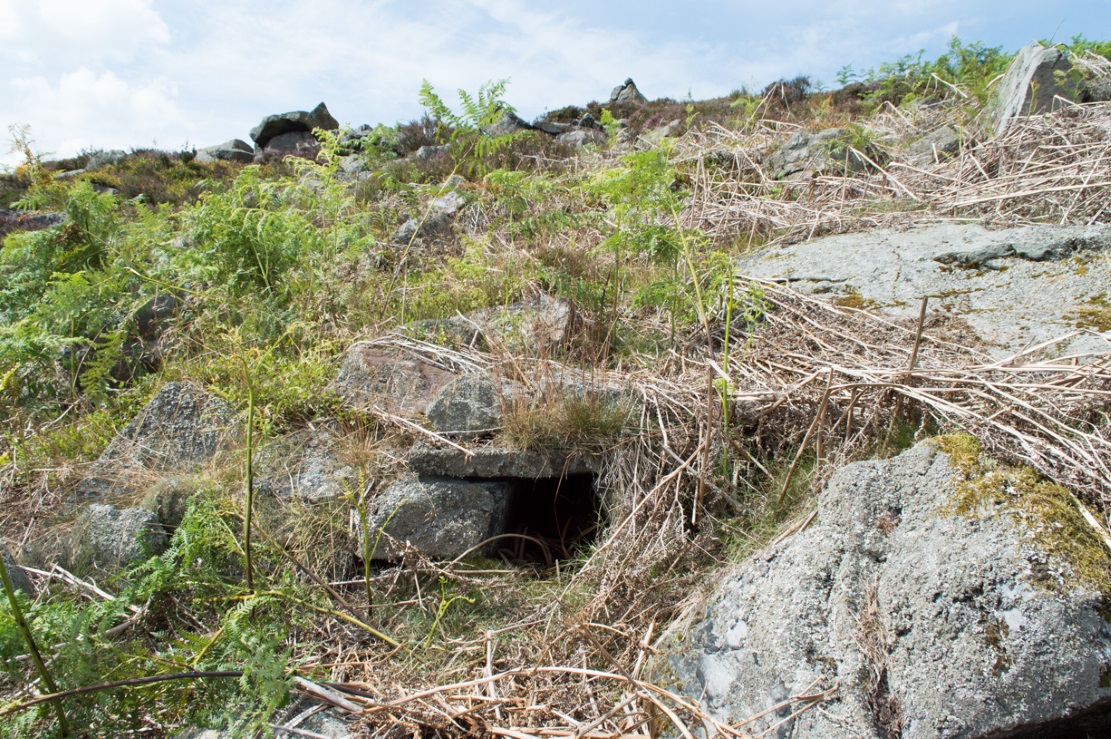
Fairy Mine, Bingley Moor (photo by James Elkington)

This is a strange one.  A really strange one…..  The site would not have even been written about had it not been for James Elkington pushing me to make its existence visible to a wide audience.  As with many sites that I’ve rediscovered, this is one of many that I never seem to write about, for various reasons…although I did do a short piece on it (Bennett 2001) many years back in a little earth mysteries mag, but kept the location quiet.  But now, James has got me to change my mind about it.  If anyone can throw any light onto what they think this site might be, feel free to let us know. With the exception of is early history, this is its story…

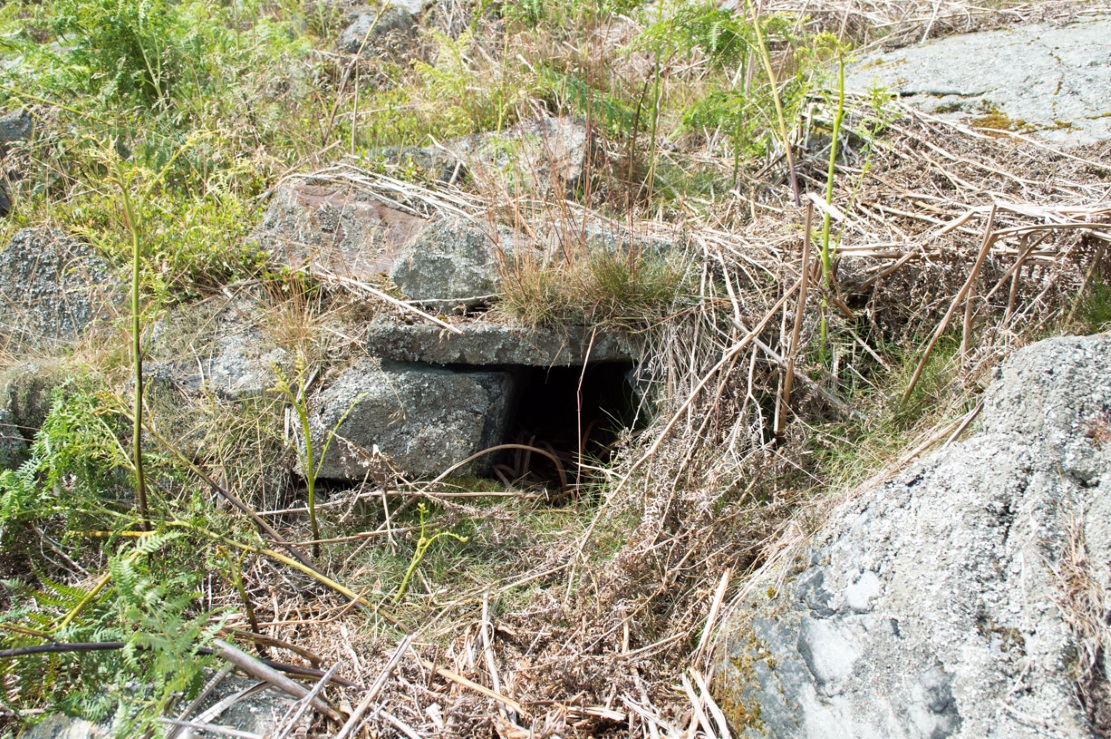
Close-up of the entrance (photo by James Elkington)

One weekend in the early Spring of 1977, Jon Tilleard and I made our weekly wander onto the southern edges of Rombalds Moor, doing little as usual apart from maybe seeking out the curious cup-and-ring stones and other ancient remains, along with walking through the obligatory bogs and wetlands, getting filthy and wet through as healthy kids do at that age.  After making our way to Horncliffe Well (generally our first point of call most weeks), we decided to head straight west, off-path as always, and eventually sat ourselves down for something to eat near Wicking Crags on Bingley Moor.

As we packed up again, readying ourselves to walk further onto the moor, John stood upright.  In doing so, he dislodged a stone by his feet—right where I was still sitting on the ground!

“Watch out!” he exclaimed loudly—and I quickly rolled forward to get out of the way of the impending stone.  Thankfully it wasn’t too big.  But then as I turned round to see what had happened, I saw John stood on the small rocky rise he’d been sitting upon—and right beneath his feet, the stone that he’d dislodged had been hiding a very curious secret indeed…

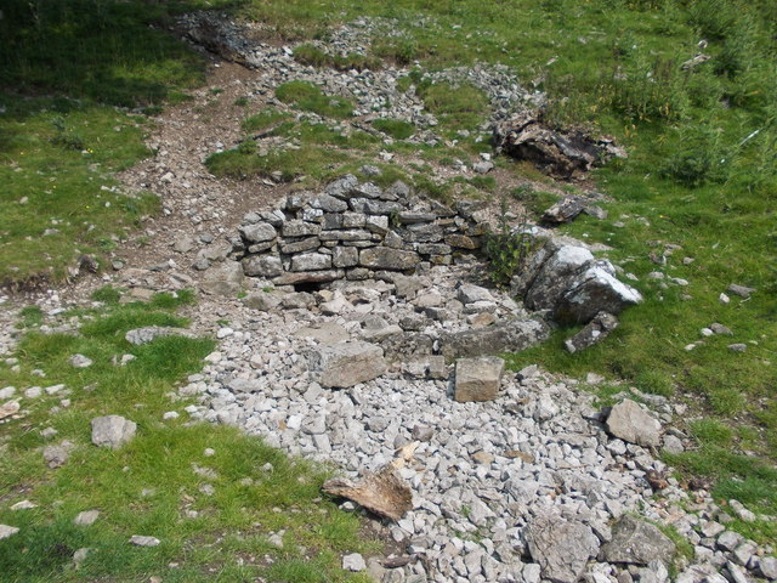
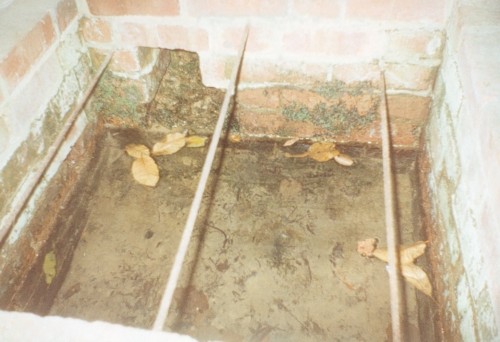
As the photos show, a small opening led into the Earth right underneath where Jon had been sitting.  The stone he’d accidentally kicked away had covered and sealed a previously unrecorded entrance.  Now, after however many centuries it had been closed and secret, he’d uncovered it again.  For us two fourteen-year-old lads gazing into this passageway, our imaginations started running riot!

“What the hell izzit!?”—we must have exclaimed a dozen times or more to each other!  To this day, we still don’t know.

I’m not sure how long we stayed here after we’d first found it, but before we left we made sure that the covering stone which had sealed the entrance was propped back upright, securely, so that no one else could find it.  The site was quite a way off-path, at the head of a very large boggy area where—to this day—people very rarely walk (in all my years of walking these moors, I’ve yet to see another human walking in this area).

In looking into the tunnel for the very first time, the ground on the outside was of course covered by the usual moorland vegetation; but an inch behind where the stone had sealed this tunnel, the floor was grey dust, all the way in.  There were no animal tracks, neither mice nor others, no droppings, no nothing (which we thought was rather unusual).  No plants of any form were evident.  This ‘door’ had been closed for a very long time it seemed.  …Today if you visit the site, ferns and other small plants have encroached several feet into the tunnel.

The entrance itself is about 14 inches across, and from the ground to the top covering stone the entrance is less than 12 inches high, showing quite clearly that no humans can walk in or out of it.  Which added to the puzzle: what the hell is it?  And why was it sealed with a covering stone?  But the more we looked (it became our regular port of call each time we were on the moors) the more obvious it became that a huge amount of work had gone into creating this antiquarian oddity.

As Winter came and cleared all the vegetation surrounding the site, we got an increasingly clear picture of it.  But this wasn’t before we tried to get inside!  Jon and I failed, but our torches showed that it went in for about 20-30 feet or so and then appeared to be stop, blocked by another stone.  Thankfully I had a younger brother, Phil, who was seven-year old at the time—so we took him up to have a look at the place.  We figured that only a small person could get inside the tunnel, but we didn’t tell him this (nor my parents!) until we arrived.

With torch in hand, Phil slithered into the entrance and, eventually, his little feet disappeared into the ground.  He didn’t seem too happy about it as I remember—but I was his big brother! (cruel – cruel – cruel!)  Shouting back down to us as he slithered further and further in, when he reached the blocking stone in the tunnel he exclaimed—”You can go round it!”

“What!? Really!?”

We were excited.

“Keep going Phil,” we urged.  But he wouldn’t.

“I’m scared Paul,” he said.  “I won’t be able to get back out”—or something along those lines.  And he was probably right.

But he managed to get his young tiny body slightly round the blocking stone that he’d reached and shone the torch-light down the extended tunnel.  He told that the it just kept going into the hill still further, keeping the same size and dimensions and straightness for about the same distance again—but then it started to curve very slightly, bending to the left (northwest) until it disappeared underneath the entire hillside, stretching out of sight. It seemed from his description, subsequently, that the tunnel went on for another 50 feet at least.

Once he was safely back out, he reiterated how far in it seemed to go.  We walked up the hill under which it had been built and Phil bimbled to roughly where he thought the tunnel was as he saw it with the torchlight.  Standing on the hilltop, this was obviously an extraordinary feat as there are thousands of tons of rock and earth covering it!  Curiously, years later, a dowser who visited the place walked the same route that Phil had described when he went inside it (we told the dowser nothing of Phil’s venture until afterwards).

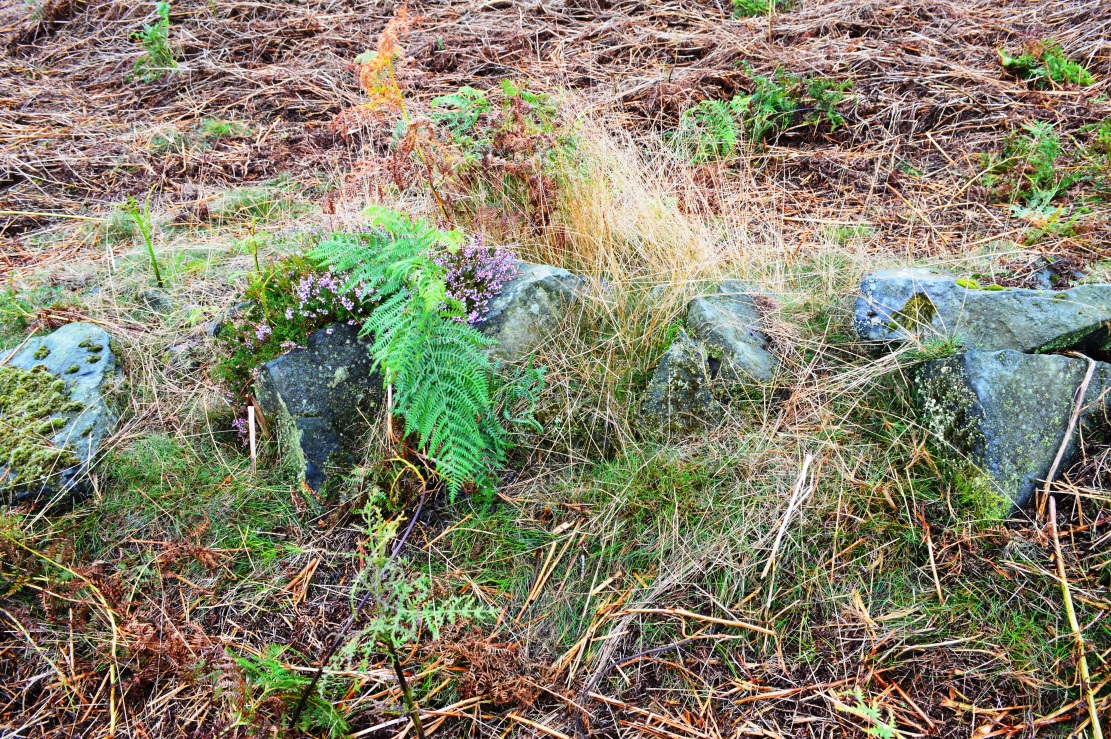
Denuded walling leading to entrance
Denuded walling leading to entrance (photo by James Elkington)
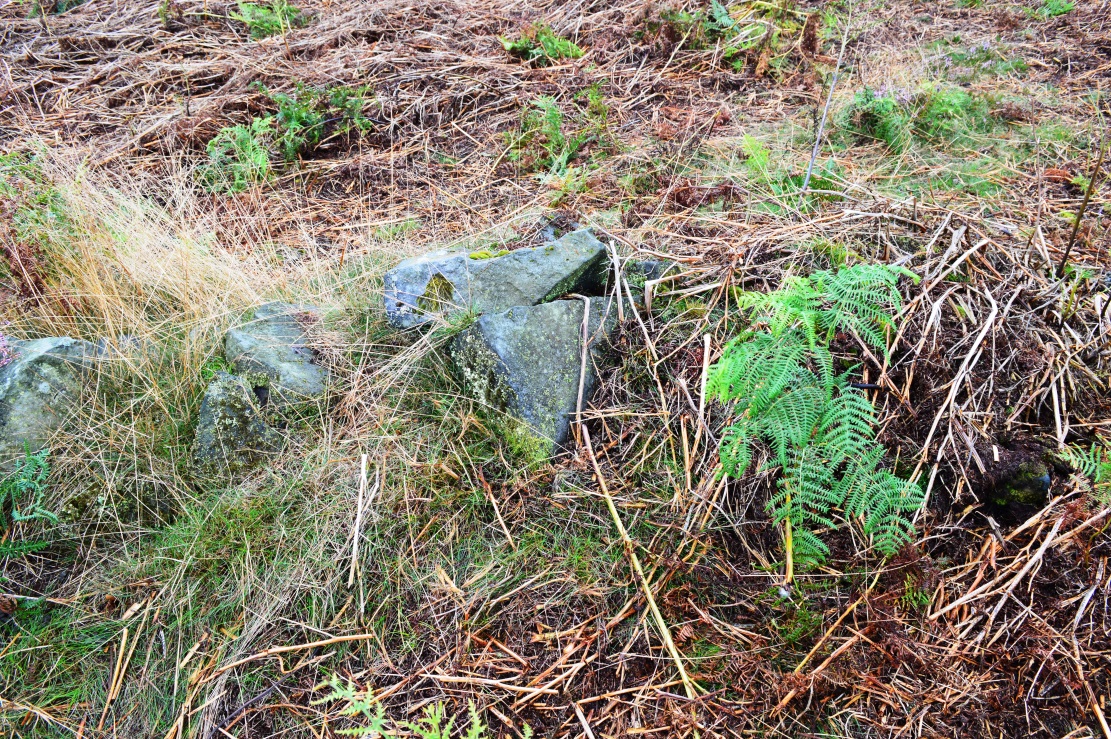
Low walling leading to the 'Mine'
Low walling leading to the ‘Mine’ (photo by James Elkington)

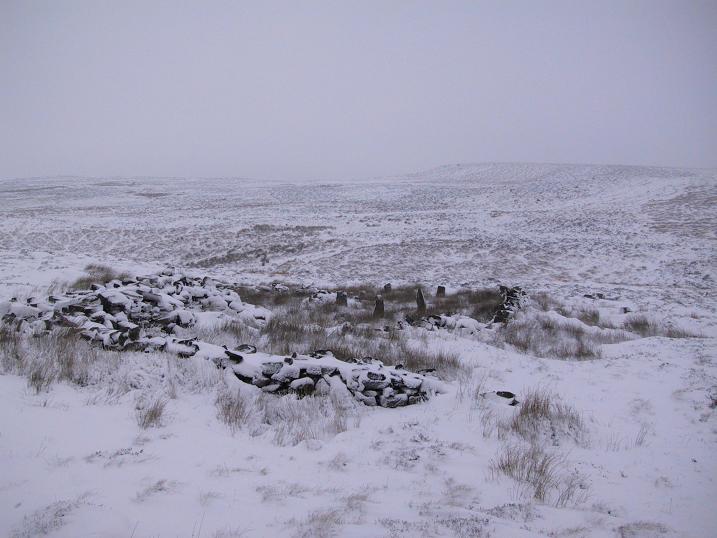
When all the moorland vegetation has died back, you can clearly see how the tunnel has been built upon by a large mass of earth and rocks, some of them loose.  All round it is an extended collapse of what seems to be quarried stone tumbling down the hillside.  At the top of the hill are the remains of old walling and at least two walled structures—although they appear to be post-medieval in nature, not prehistoric.  At the entrance itself is evidence of continued walling of some form.  It seems as if a wider man-made chamber of some sort may once have stood here, right in front of the present-day entrance.  Even if this proves not to be the case, there is very clear evidence that the tunnel which goes into the hillside was once longer, as low walling continues outside away from the entrance, bending away some 50 yards to the southeast, before ending with no indication of additional structural remains.  This walled structure swerving out from the entrance is equally perplexing.

The closest prehistoric feature is an unrecorded cairn and petroglyph a few hundred yards away.  As far as I’m concerned, this tiny little entrance into the ground isn’t prehistoric.  But I’m nonetheless still very intrigued by it, not least because of a few very strange things that subsequently occurred here after we’d discovered it.

Whoever did this, went to a helluva lot of trouble and immense effort to build it.  And for what?  …Since being opened nearly 40 years ago, very few people have been to see this curious entrance into the Earth.  I’ve kept its location hidden.  But amongst the visitors has been an archaeologist, a historian, antiquarian authors, occultists and friends.  None have been able to say what this site might be.  From souterrains to mine-shafts, probably the best suggestion so far was by Mr Paul Hornby who suggested it might have been some sort of kiln, as there seems evidence of fire against one of the stones.  But there are anomalies with the site that don’t quite fit the glove of a normal kiln.  The extended collapsed ‘tunnel’ which reaches way out, past the entrance which Jon broke in the 1970s, doesn’t make sense; nor the fact that the tunnel goes way into the natural hillside.  Indeed, many things here don’t make sense, simply—I presume—because we haven’t asked the right question yet.

But one thing seems obvious: there may be something at the end of this tunnel, deep inside the hill, which someone many centuries ago, for some odd reason, wanted to keep hidden for a long long time.  What’s at the end of this tunnel?  And if it’s valuable treasure deep in there—it is NOT going to some museum which then, in later years, will be sold off cheaply to some wealthy dood when the museum runs out of money.  It should be kept within the safe holdings of The Northern Antiquarian.  If this becomes an issue, whatever lies at the end will simply be re-buried elsewhere.

Fortean History

On that fine Spring morning when we first discovered this “mine shaft for little people” as we called it, before we went on our way, we placed the stone that Jon had dislodged that had covered the entrance back into position so that no one could see the opening leading into the ground and under the hill.  It was firm and secure when we left—we made sure of it.

The following Sunday morning we made our way back up past Horncliffe Well again and onto this little mine-shaft to sit and have summat to eat.  The rocky arena here made it difficult to locate, even though we knew where it was.  But when we eventually did find it again, the covering-stone was missing.  In fact it had been rolled a good 5 yards away from the entrance.  This was odd, we thought—considering that no one even knew of its existence.  We wondered if an animal had taken up residence inside, but there were no tracks or remains consistent with this initial idea.  We puzzled about it, ate our food, and said our au revoirs.  Before we left, we repositioned the covering stone again to block the entrance.  This time we made it a little more secure than previously.

The following Sunday morning we visited the site again—and the covering stone had been removed, again!  So we replaced it, securely, and visited the place a week later—and the same thing had happened again.  This occurred time after time, month after month, year after year.  Every single time we covered the entrance, something came and removed it.  Yet no one ever comes on this section of the moorland—and even if they did, the site is very difficult to locate.  Until now, the site has never been added to any archaeology or history records anywhere—so no one knew of its existence (in asking two of the moorland rangers who’ve worked here over the decades, neither of them knew what we were talking about).

When Andrew Hammond and I left school at 18 (in 1981), we decided as a ritual to bring our school books onto the moor and burn them as the sun was setting in the northwest.  We sat near the little mine-shaft and sang our songs of joys at being out of school at last—and as the darkness began to fall over the moor, we replaced the entrance-stone again.  Within 30 minutes Nature had cast pitch black across the moor and we fell asleep.

Awaking at sunrise the following day, we wandered down the slope to the little mine-shaft where we’d repositioned the stone only hours previously.  It had been moved again, several yards away from the entrance.  No animal could have moved it.  Whatever it was, it kept doing it every time we repositioned the covering stone.  No animal tracks, droppings, or any evidence whatsoever of Nature’s creatures being responsible for the constant removal of the covering stone has ever been found.  The constant removal of the covering stone remains a complete mystery.

When a dowser came and tried tracing the underground route of the tunnel in the early 1990s, his rods took him to the top of the rocky hill above, then led him in a small curve to the northwest for more than 100 yards before stopping.

Note:

In the event that archaeologists ever get round to excavating or assessing this site, I would appreciate being contacted before anything is done and would love to be involved in any work performed at the site.  I’ll be a good boy!  Other remains nearby (usually covered by heather) need appraising to enable a more complete analysis, otherwise all subsequent reports would lack wider archaeocentric contextualization.  Thanks, in advance. 🙂

References:

  1. Bennett, Paul., ‘Into a Mythic Domain – a Passage into the Ilkley Underworld,’ in Northern Earth, 87, Autumn 2001.

Acknowledgements:  Huge thanks to James Elkington for use of his photos to illustrate this site profile.

© Paul Bennett, The Northern Antiquarian

St Bertram’s Well, Ilam, Staffordshire

Holy Well:  OS Grid Refence — SK 1371  5141

Getting Here

St Bertram’s Well, north of Ilam © Copyright Neil Theasby & licensed for reuse under Creative Commons Licence
St Bertram’s Well, Ilam © Neil Theasby, reused under Creative Commons Licence

The genuine St. Bertram’s well is not easy to find and I recommend using the OS map carefully. It is reached by taking the footpath that leads off at the left passing the cross out of the village. Follow this until the end of the dry stone walling on the right and then divert from the footpath to the right where the well can be seen. The second well is easily found in the field between the church and the Hall.

Archaeology and History

Bertram is an interesting local saint, dating from around the 7th-8th century. Briefly, he is said to be of Royal Irish lineage but after making a princess pregnant, escaped to England where he sheltered in the woods around Ilam.  The story is told by Alexander, a monk, in the 13th century who notes:

“They were in hiding in a dense forest when lo ! the time of her childbirth came upon them suddenly ; born of pain and river of sorrow!  A pitiful child bed indeed!  While Bertellinus went out to get the necessary help of a midwife the woman and her child breathed their last amid the fangs of wolves. Bertellinus on his return imagined that this calamity had befallen because of his own sin, and spent three days in mourning rites”.

As a result he became a hermit living in a cave in the valley near Ilam.  Despite the earliest mention being Plot, the local geography is suggestive that this is the site of an early Christian hermitage site, although no mention of a well is noted in his legends it can be noted.  Currently, the well is surrounded on four sides by varying low stone walling, about two feet or so at its highest (although it appears to have been built up and down over the time I have visited the well).  The spring flows from a small, less than a foot square chamber, enclosed in stone and set into the bank through a channel in the rubble flow and out along the path towards it.

Since the 1990s, on the first Saturday in August, the Orthodox Church makes a pilgrimage to the site and blesses the well.  Interestingly, literature available from the National Trust shop fails to mention this well, but notes a more substantial second St Bertram’s Well close by the church and surrounded by a rectangular stone wall with steps down, the water arises here at greater speed and flows into the nearby River Manifold. Visually it is more impressive and more accessible but whether there is any long tradition of this second well is unclear, but authors such as the Thompsons’s (2004) The Water of Life: Springs and Wells of Mainland Britain and Bord (2008) Holy Wells of Britain appear to have fostered its reputation.

Incidentally, the church boasts the remains of St Bertram’s shrine with foramina and the church yard has two Saxon crosses, making a visit to the village a must for those interested in early medieval history.

Folklore

“St Bertram’s Ash… grows over a spring which bears the name of the same Saint… The common people superstitiously believe, that tis very dangerous to break a bough from it: so great a care has St Bertram of his Ash to this very day.  And yet they have not so much as a Legend amongst them, either of this Saint’s miracles, or what he was; onely that he was Founder of their Church”

Such notes Plot (1686) The Natural History of Stafford-Shire, the earliest reference of this fascinating site.  By Browne (1888) in his An Account of the Three Ancient Cross Shafts, the Font, and St Bertram’s Shrine, at Ilam, noted that the ash had gone, but the water was still being used.  He states that:

“The late Mrs Watts Russell always had her drinking water from it.”

Extracted and amended from the forthcoming Holy wells and healing springs of Staffordshire by R. B. Parish (2008)

http://insearchofholywellsandhealingsprings.wordpress.com


Becket’s Well, Otford, Kent

Holy Well:  OS Grid Reference – TQ 531 592

Getting Here

Becket's Well, Kent
Becket’s Well, Otford

The well now lies on private land and feds a trout farm (Beckets Well Trout Farm at The Castle House, Sevenoaks Rd, Otford in Sevenoaks). To find Becket’s Well go along the A225 to the centre of Otford, park in the car park ( in front of the row of terraced shops ) near the Bishop’s Palace. Take a small private road to Castle farm, now as said, a trout farm. Inquire here, if you are able to visit the well, which lies  within a complex of fish pools to the east of the farm house.

Archaeology & History

The site has been well recorded in recent centuries, for example an account of 1876, describes the site as, “endorsed within a wall, forming a chamber 15 ft across and 10 ft  deep.”  Both the chamber’s appearance and shape suggests that is would be ideal for immersions, of which Harper and Kershaw (1923) notes that bath and steps are defied annually by the hop pickers.  It is interesting to note that Thorne (1876), with no apparent reference, gives another connection with the saint, suggesting that, “to have used by the saint as a bath.”  No subsequent or previous work draws notice to this, so it is likely to be antiquarian fancy.  Another more plausible possibility is that it was used by the leper hospital found on this site around 1228.  They would have clearly made use of the pure water for medicinal purposes and perhaps indeed used it as a bath.

Kirkham (1948) notes it was suffering from neglect being “now said to be choked up and half full of tins.”  This decline would appear to have started a long time ago, as a folly tower, now demolished, was built on Otford Mount (a nearby earthwork), from the well’s stone work.  Consequently, this degraded condition prompted excavation in the 1950s by the Otford and District Historical Society; of which the following details of their findings are briefly described.

The report noted that the well consisted of two chambers, with water emerging from two arched outlets into the first of these. This chamber is surrounded on three sides by walls, thirty-five feet by thirteen feet (east end), the walls are eight feet high, and at the same level of the ground.  Six steps at the south-east end give access to the well chamber.  The sluice wall is five feet high, eight feet wide, and is substantially buttressed on the western front.  Water runs through this sluice wall, between steep banks westward, through a lower chamber, twenty-seven feet (north sides), and thirty-five feet (west side).  The water then flowed through watercress and finally through an underground, probably Tudor conduit.  This conduit then passes through the site of the Palace. This stream once fed a moat, but now discharges into the Bubblestone Brook, a Darenth tributary.

Local common thought was that the well is the remains of a Roman bath house, a belief echoed by its present owner; and a view endorsed by both Ward (1932) and Harper and Kershaw (1923), who note that it “is really a Roman Bath.”  This view is further supported by the two surrounding Roman villas, and hence one aim of the excavation was to evaluate this long held claim. Yet, although they showed that the well had gone through considerable renovation and rebuilding over the centuries, no remains could be positively be dated to this period.  This renovation, of course, resulted in a rarity of deposits, and hence with a lack of artefacts, the subsequent interpretation was thus difficult.

The excavation was further handicapped by the waterlogged conditions. Both may have influenced the results.  Consequently, there are still doubts, and the concept of a Roman origin has not been satisfactorily disproved.  The earliest written record is from Otford Ministers accounts of 1440-1, indicating that by then a stone structure existed here, but how old that was again is not clear. It states:

“To a carpenter for two days to make 2 gutters to bring water from the pool of the garden to the moat and for working on and laying another gutter beyond the water course and coming from the fountain of St. Thomas to old garden, 12d; and to a carpenter for one day covering a gutter with timber and cresting it, 6d.  And for two masons for 2 days for placing and laying and making a new stone wall of the fountain of St. Thomas, broken for the pipe of the water conduit, 3s, taking between them daily 12d.  To five labourers 10 days digging the soil between the said fountain and moat to lay in the leaden pipe of said conduit16s 8d taking each daily 4d.”

The present floor may be ascribed to that period; although it would seem to cover an earlier lower flint floor (again possibly Roman). Between 1520-1520, Archbishop Warkham, pulled down the then existing Manor house and built the Palace, covering four acres. This consequently required a better water supply, and hence the well was improved: the original lower chamber is said to originate from this period. The full purpose of the lower chamber is not clear, but it is believed that it may have housed cisterns giving a greater flow of water. When Henry VIII acquired the Palace from Archbishop Crammer in 1537, he spent money on improvements to the estate, and probably the well.  The sluice gate, strengthened by Warham, was now supported by buttresses.  These may have supported a conduit house. This was recorded in 1573:

“The condiyte house or well conteyning in length XXXVI foote and in breadth XIX fote to be taken downe and newe sett upp will coste XXX pounds. The pypes conveyinge the water from hence to the offyces and small sesterns to be amended will coste Xiii.”

By the 1600s, the Palace was in disrepair and the well was only used for private consumption by Castle farm.  Despite this, restoration still continued and the north, east and south wall saw upper improvements by the 1700s.  In the lower chamber a stone west wall was erected on Warham’s brick foundations. By this time, the south wall was beginning to collapse and was rebuilt in the 1800s.

By 1954 repairs were again needed, as the north wall was collapsing.  Goodsall (1968) reported that even after its excavation in the late 1950s, the site then enclosed in railings was forlorn and overgrown with weeds.  Forty years on, the present condition is similar to that illustrated in the contemporary photo, taken during the excavation: the intervening decades have seen the inevitable degradation, through time, of its infrastructure. Fortunately, the hideous railings have been removed, obviously to erect the trout farm infrastructure, whose water is supplied by the well.  The walls appear now comparably greatly overgrown, which has probably preserved them, and the sluice wall, north, south and west walls appear the most ruinous, with the walling falling away towards the sluice wall.  The walling was best preserved at the east end.

The clear spring appears to flow rapidly from its source, and has the appearance of being deeper.  As stated, it now has now a commercial function, providing good quality water for the raising of trout flowing through a series of fish ponds replacing the cress beds.  The owner in the 1990s, a Mrs. Burrows, believed that the well was originally roofed.  The results of the excavation did not indicate this although it may be a mix-up with the possibility of a conduit house over the well.  She also stated the water stayed the same temperature through the winter and summer, a constant 500 C, certainly beneficial to bathers.

Folklore

One of the best known holy wells among Kent antiquarians no doubt due to the colourful legend associated with it. This tells that whilst living here in the old manor—the ruins of which called the Bishop’s Palace still stand—St. Thomas bemoaned the lack of good water. As a remedy he struck his staff into the ground and clear water gushed forth.  This is a familiar folklore motif and we shall see it again referred to at other Kent sites.  Perhaps it recalls the saint ordering well digging to provide fresh water and marked the position with his staff!  The legends earliest reference  is made by Lambard (1571):

“..stake his staffe into the drie ground ( in a place thereof now called Sainte Thomas Well) and immediately the same water appeared, which running plentifully, serveth the offices of the new house to the present day.”

The well was said to be curative, but the exact nature of its curative powers are unknown, and although belief in them was waning by 1800s, rumours of its use continued to the last world war.  The Gentlemen’s Magazine of June 1820 gives the only recorded account of a cure and states that:

“an old man, who, crippled by rheumatism, was completely renovated by this bath to health and action of circumstance witnessed by the late Lord Stanhope and several of the neighbouring gentry.”

(Extracted and amended from original blog page, which includes and addition holy well – Colet’s Well –
http://insearchofholywellsandhealingsprings.wordpress.com/2012/01/12/the-holy-wells-of-otford-kent/ – and from the forthcoming Holy Wells and Healing Springs of Kent – references quoted in the piece can be found therein.)


Trysting Stone, Doune, Perthshire

Standing Stone:  OS Grid Reference – NN 7256 0182

Also Known as:

  1. Canmore ID 24761
  2. Deil’s Head
  3. Devil’s Head
  4. Fairy Stone
  5. Gold Stone

Getting Here

Trysting Stone of Doune

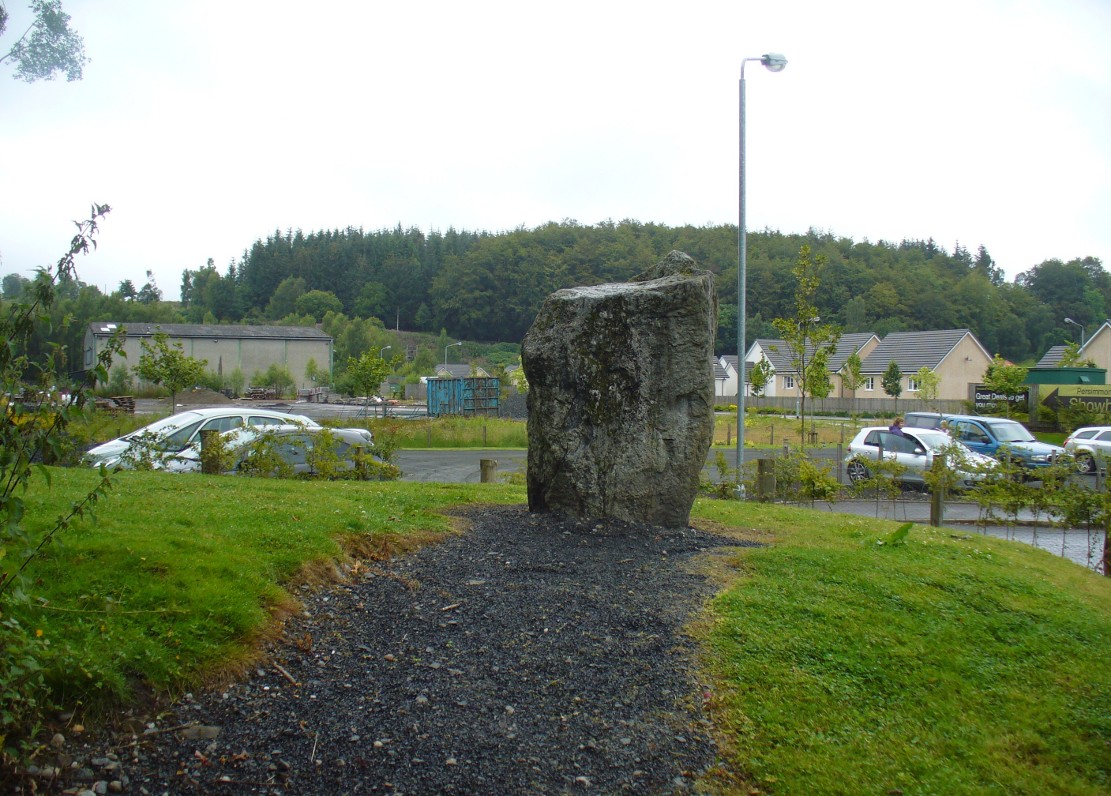
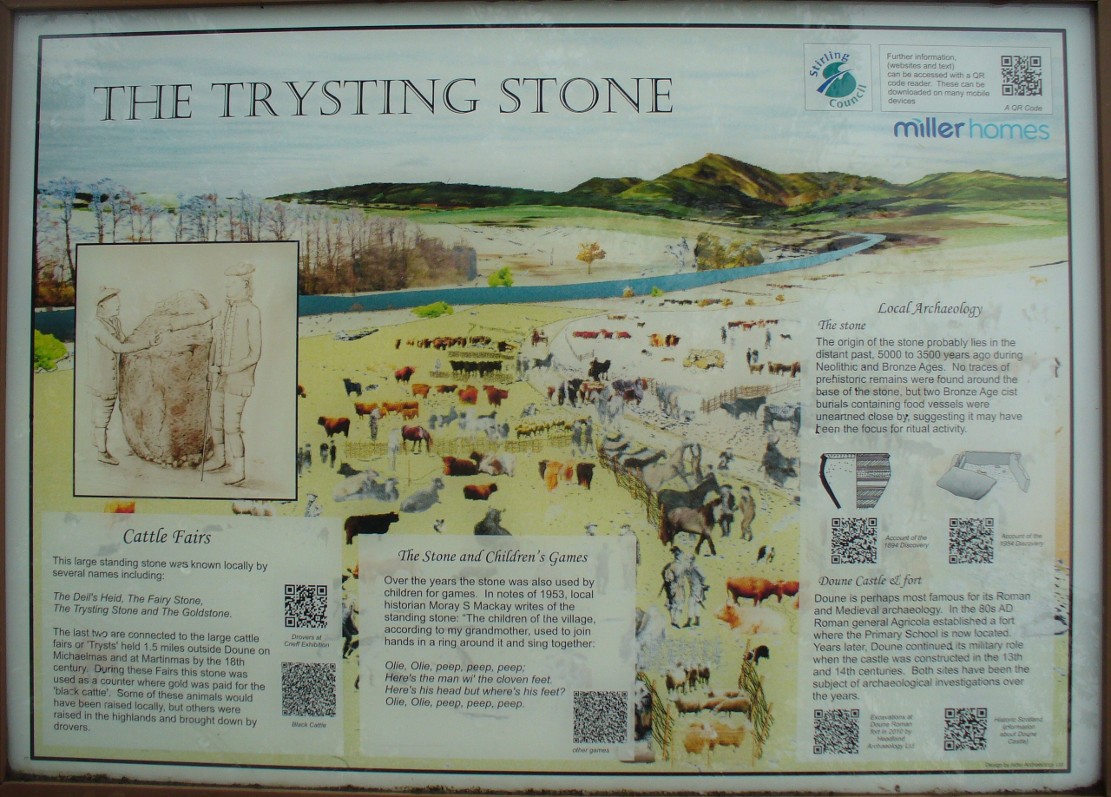
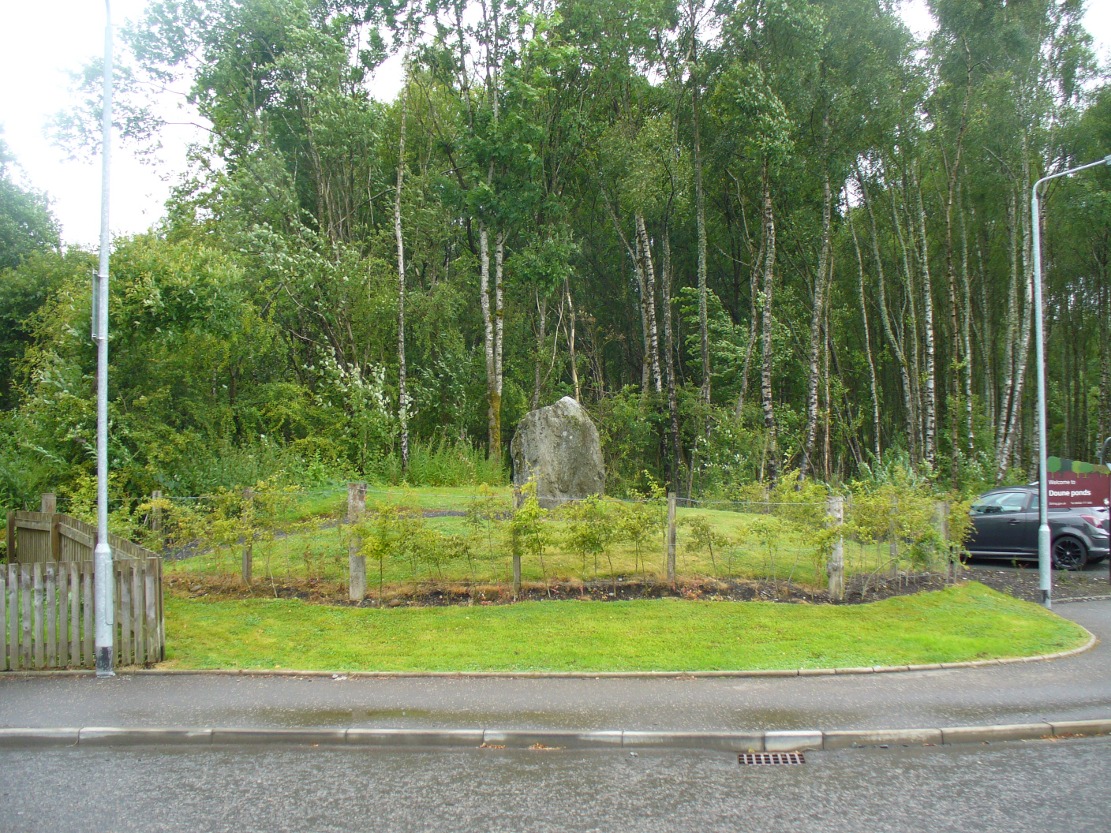
From the old cross in the middle of the village, walk along the A820 Balkerach Street main road (NOT down George Street) until you reach Station Wynd on your right.  Walk up here for 100 yards towards the new housing estate (don’t buy these places – they’re dreadful quality beneath the veneers) and there, on a small grassy rise on the left just before the car park, stands our stone!

Archaeology & History

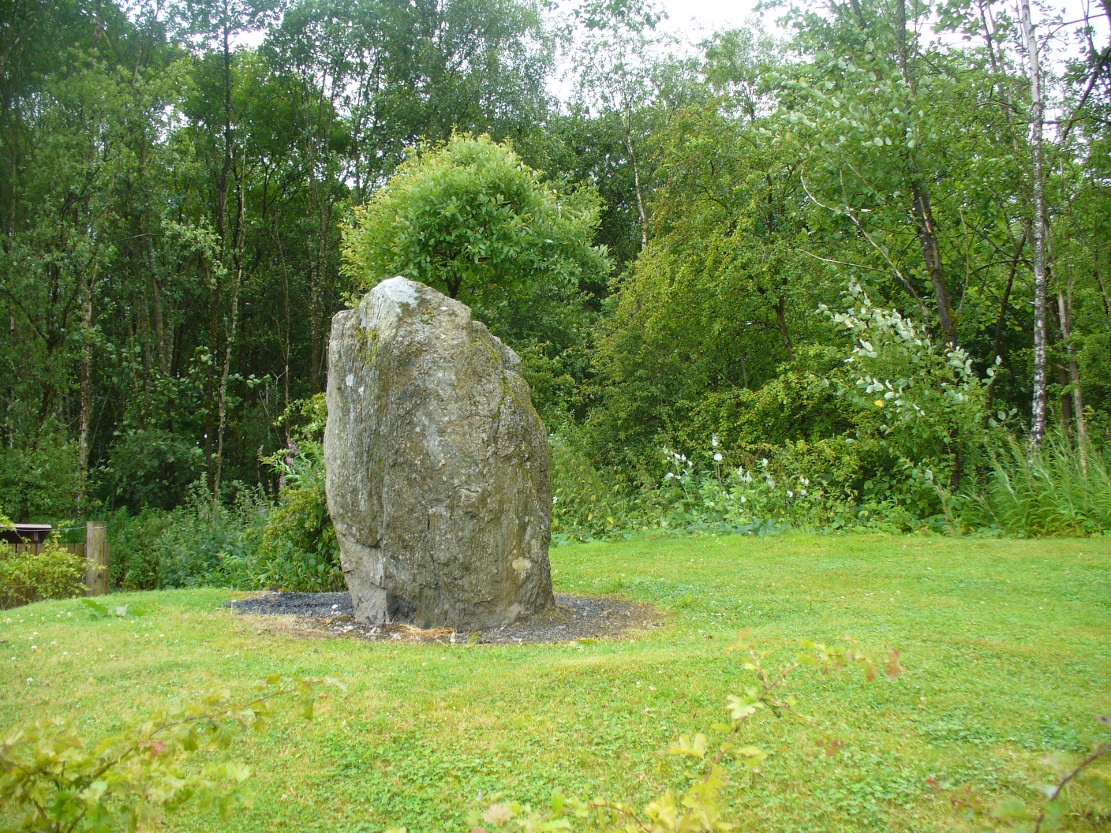
This little-known monolith on the northern edge of little Doune village, was recently moved a short distance from its original position thanks to another one of those sad Barratt housing estates being built here; but at least it has received protection with the surrounding fence and notice board telling its brief history and folklore (better than being destroyed I s’ppose).

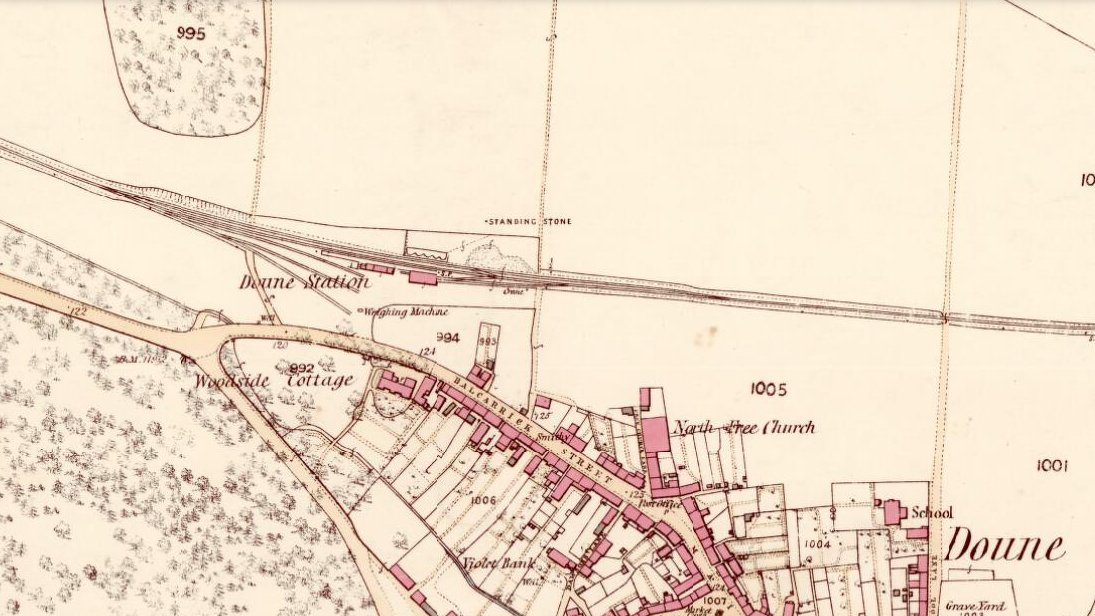
Stone marked on 1866 OS map

Standing less than five feet tall, local lore tells that it has been moved around close to this spot several times in the last couple of centuries.  Although not mentioned in Hutchinson’s (1893) essay on local megaliths, the stone was highlighted on the 1866 Ordnance Survey of Doune, where the non-antiquated lettering showed how it was thought to be Roman in origin, not prehistoric.

Folklore

Trysting Stane, looking NE

The name of the stone comes from it being used as a place where deeds were sworn, with the stone as witness to the words proclaimed by both parties (implying a living presence, or animistic formula of great age).  This activity was continued in the local ‘trysts’ or cattle fairs held a mile away, where buyers swore the sale of cattle at this stone—again with the stone being ‘witness’ to the spoken deals.  It was also used as a counter where gold was exchanged for cattle bought and sold during the Michaelmas and Martinmas Fairs.  Sue Harvey (2006) told that this standing stone,

“was called the Devil’s Head and was used during past Doune fairs to count gold on when cattle were being bought and sold.”

In local newspaper accounts from the 1950s, local historian Moray S. Mackay (1984) told how the children of the village used to gather round the stone, holding hands, and sing,

Olie Olie, peep, peep, peep,
Here’s the man with the cloven feet,
Here’s his head, but where’s his feet?
Olie Olie, peep, peep, peep.

Notice board telling its tale...
Notice board telling its tale…
Looking at the stone on its rise

This implies the stone once possessed a myth relating to a petrified ancestral deity of animistic (pre-christian) origin, but as yet we have found no additional information allowing us a confirmation of this probability.  A correlate of this theme—i.e., of the stone being the head of a deity—is found in West Yorkshire (amongst many other places), where one of the little known Cuckoo Stones was once known to be a local giant until a hero-figure appeared and cut off his head, leaving only his body which was then turned to stone.  Mircea Eliade (1958; 1963) cites examples of animistic religious rites and events explaining this early petrification formula via creation myths, etc. (we find very clear evidences of animistic worldviews and practices still prevailing in the mountains just a few miles north and west, still enacted by local people)

Folklore also alleged that the stone was Roman in nature, but neither archaeology nor the architectural form of the stone implies this.  Roman stones were cut and dressed—unlike the traditional looking Bronze Age, rough, uncut fella standing here.

References:

  1. Eliade, Mircea, Patterns in Comparative Religion, Sheed & Ward: London 1958.
  2. Eliade, Mircea, Myth and Reality, Harper & Row: San Francisco 1963.
  3. Harvey, Sue, Doune and Deanston, Kilmadock Development Centre 2006.
  4. Hutchinson, A.F., “The Standing Stones of Stirling District,” in The Stirling Antiquary, volume 1, 1893.
  5. Mackay, Moray S., Doune – Historical Notes, Forth Naturalist: Stirling 1984.

© Paul Bennett, The Northern Antiquarian
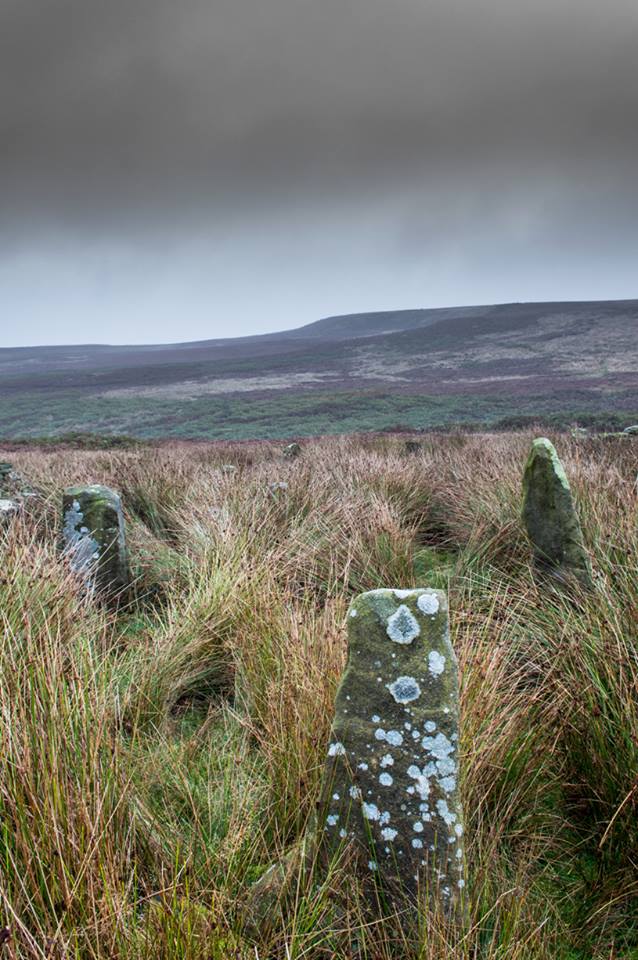

Fingal’s Cauldron Seat, Machrie Moor, Kilmory, Arran

Stone Circle:  OS Grid Reference – NR 90878 32353

Fingal's Cauldron, on 1864 OS map
Fingal’s Cauldron, on 1864 OS map

Also Known as:

  1. Canmore ID 39705
  2. Machrie Moor 5
  3. Moss Farm Stone Circle
  4. Suidhe Coire Fhionn
  5. Tormore Stones

Getting Here

The stone circle of Fingal's Cauldron Seat, Machrie Moor, Arran <c>(photo by Aisha Domleo)</c>
The stone circle of Fingal’s Cauldron Seat, Machrie Moor, Arran (photo by Aisha Domleo)

By whichever way you come (be it from Brodick on the east, Lochranza to the north) ask any local the way to Machrie and they’ll point you the road onto the west side of the island, roughly halfway.  You’re after the hamlets of Blackwaterfoot or Auchagallon. From either of these spots, take the road to Tormore.  From here, the dirt-track east close to the Machrie Water is where you need to walk.  About a mile along this well-defined track you’ll see the large barn ahead of you.  Hereabouts you’ll begin to notice some very tall standing stones. Keep walking on the track, and the first double-ring of smaller stones to your right is the place yer after!

Archaeology & History

Approaching the ring (photo by Aisha Domleo)

This is one well-preserved stone circle in a superb setting with other large megalithic rings all close by—at least 12 of them!—set upon the flat open moorlands on the west side of Arran, with views in all directions sending the enquiring nose tasting for more wherever the eyes gaze….  It has been written about by many many writers over the last few centuries—which aint surprising!  But it was in recent times that the place was said by Aubrey Burl (1981) to be “holy ground,” because although there are many prehistoric settlement sites and other remains scattered across this landscape,

“it is noticeable that the dozens of huts whose ruins litter the moor were built well away to the west, none of them near these powerful and lonely stones.”

1832 sketch of Fingal's Cauldron by James Skene
1832 sketch of Fingal’s Cauldron by James Skene

It’s a fair point.

Fingal’s Cauldron was first defined in an archaeological context by James Bryce in 1863, who named it the ‘Machrie Moor 5’ stone circle (MM5)—and it was he and several others who dug into the ring, to see what it might be hiding!

“Excavating at the centre we found a small cist at less than a foot in depth, and lying about north-east.  It was covered by a small lid, and the dimensions were 2 feet 2 inches in length, 10½ inches in depth, and 11 inches in width.  Inside there were several bone fragments and black earth.  A flint implement was found in the stony soil above, and three other flint fragments, but nothing of this kind in the cist itself.  This was of much ruder structure than any we had seen before (Ed. – i.e., in the other Machrie circles); it was cut out of the sold sandstone rock, but with little care or exactness; the sides however, were nearly perpendicular.  The difficulty of excavating without iron tools may account for the smaller size and ruder form of this cist.  No other cist was found, nor remains of any kind, though a trial was made at several points around the centre.  A deep opening was also made on both sides of the upright stone, but nothing was met with worthy of being recorded.”

A.E. Roy's 1967 site-plan
A.E. Roy’s 1967 site-plan

Described thereafter a number of times by different historians and antiquarians, Fingal’s Cauldron (and its associates) was then recounted in the Machrie Moor survey of Mr Balfour (1910) in his magnum opus on the Isle of Arran.  Although he gave more attention to the other stone circles in this multiple megalithic complex, he did thankfully make note that,

“upon higher ground free of peat, and immediately to the south of the farmhouse, is the celebrated double circle of granite blocks known popularly as Fingal’s Cauldron Seat. The inner ring consists of eight and the outer of fourteen blocks. The diameter of the inner circle is 36 feet and of the outer 57 feet. The largest stones are in the inner series; they are more or less round-topped blocks, about 4 feet high. One of the stones of the outer ring has a ledge which is perforated by a round hole, with the edges worn smooth.

“In the centre of the inner ring, only a foot from the surface, a ruined cist was laid bare. It had been previously disturbed, and was represented by two stones only, lying parallel to one another. There was no capstone, and no relics were discovered.”

More recently in the 1960s, another survey of Fingal’s Cauldron was undertaken by A.E. Roy and other archaeologists.  They found nothing new of any value, but gave us the ground-plan we see here (sadly it seems that Alexander Thom didn’t bless this site with his theodolite and survey).  Aubrey Burl re-examined the site again during his own survey in the 1980s.

An elemental called Lara sat seated on one of the uprights! (photo by Aisha Domleo)
Small section of inner & outer rings (photo by Aisha Domleo)

There are other curious features to this ring that aint generally talked about amongst the archaeo-fraternity, out of fear of sounding inspiring perhaps…  In the 1980s, a chap called Paul Devereux and a number of physicists organized volunteers from across the country to monitor electromagnetic anomalies at many megalithic rings, in order to explore the validity, or otherwise, of the idea that there were ‘energies’ at stone circles.  The study was called The Dragon Project and went on for many years.  The Machrie Moor complex was one of the places where examinations of electromagnetic fields were undertaken—Fingal’s Cauldron being one of them.  Devereux (1990) tells us a small part of the story:

“In May 1983 Dave and Lynn Patrick monitored several of the Machrie Moor circles, including MM5, with a geiger counter for the Gaia Programme.  They also took background control readings and monitored a non-megalithic ‘dummy site’ for comparisons.

“Five of the circles…gave average site readings 2 to 13 per cent higher than background, but MM5 gave a site average of 33 per cent above background.  A non-megalithic ‘dummy site’ was 5 per cent above background.  The Patricks had taken 20 readings within MM5—one hour of monitoring time—plotted onto the ground-plan.  There was no mystery about why the site gave a higher average than anywhere else, and a third higher than background—the stones are radioactive granite, and there are 23 of them.  But one stone, the tallest, and the most westerly of the upright stones in the inner ring, is particularly energetic, giving readings 16 per cent above the next most radioactive stone in the double ring, and more than that for the other 58 stones monitored in the Patrick’s study on Machrie Moor.

“I took measurements at the site myself in April 1988, using new equipment, and confirmed that the MM5 stone did indeed give a moderately high naturally radiation count (about 33 per cent above normal).”

This rather hot “Cauldron of Finn” certainly does throw off more heat than its compatriots nearby, as scientific analysis has shown!  It turned out to be the type of stone which our ancestors used in constructing the site.  Fascinating…

Folklore

1861 drawing of the site

Although this is one of the smallest of the megalithic rings on the moor, it’s the one that has the main legend.  In line with its folk-title, twas said to have been the place where the Irish giant and hero-figure, Finn, “assigning to the encircling stones the purpose of supporting the cauldron of the giant,” with the inner ring being where it was placed and he cooked. Finn also used another part of the circle, as James Bryce (1863) said:

“A block on the southeast side of the outer circle has a ledge perforated by a round hole, which is well worn on the edges, and said to have been formed for the purpose of fastening the favourite dog Bran.”

Shortly after this, John McArthur (1873) wrote his work on the ancient remains of the island, giving additional elements to the myths of this ring; firstly telling that the perforated hole which Bran was tied to,

“was probably associated with some old superstition or religious ceremony, now forgotten. The hole is sufficiently large to admit the two fingers, and runs perpendicularly through the side of the column…

“The perforated column of “Fiongal’s Cauldron Seat,” on the Mauchrie Moor, was believed to contain a fairy or brownie, who could only be propitiated by the pouring of milk through the hole bored in the side of the stone.”

The animistic tradition of pouring milk into stones is more usually found at bullauns and some cup-and-ring carvings, so we need to look closely in good weather conditions at the uprights in the circle just to make sure we aint missed anything here… Carvings are found on some of the other Machrie stones.

Regarding the small hole through the stone which Bran was tied to, Gareth Weston (2007), in his otherwise terrible book, tells that,

“The middle of the perforated stone and the geometric centre (of the ring) are in line with the sharp summit of Goat Fell, Arran’s loftiest peak and the highest point in southeast Scotland.”

Geomancy anyone…?

Forteana

Over the years I have slept at many prehistoric sites in Britain—stone circles, chambered tombs and cup-and-ring stones all—hundreds of times, in all weathers.  Sadly in recent years I’ve been neglecting this duty.  However, during the winter of 1986 I spent a few nights in the snow on the Machrie plain, between this circle and the taller uprights a short distance away.  On one dark freezing February night, shortly before we hit the sack,

“a bright orange glow was seen on the summit of the mountain (Ard Bheinn), three miles away.  A second or two later a ball of light rose up from the snow-clad hills and into the clouds, a hundred feet above.  A few minutes later we saw the same ball of light again; on both occasions the ball of light was visible for two seconds at the most.”

Several times when sleeping rough at Machrie I got talking with an old farmer who had grown up round here.  He told that he’d “seen strange lights around the moors a few times” down the years.  With the moorland scent and feel of the place round here, that surprises me not one bit!

…to be continued…

References:

  1. Armit, Ian, Scotland’s Hidden History, Tempus: Stroud 1998.
  2. Balfour, J.A., The Book of Arran – volume 1, Arran Society of Glasgow 1910.
  3. Bennett, Paul, “Events in the Annals of Arran,” in UFO Brigantia, March 1986.
  4. Bryce, James, “Account of excavations within the stone circle of Arran“, in Proceedings of the Society of Antiquaries, Scotland, volume 4, 1863.
  5. Burl, Aubrey, A Guide to the Stone Circles of Britain, Ireland and Brittany, New Haven & London 1995.
  6. Burl, Aubrey, The Stone Circles of Britain, Ireland and Brittany, Yale University Press 2000.
  7. Devereux, Paul, Places of Power, Blandford: London 1990.
  8. Ewart, G. & Sharman, P., “Moss Farm stone circle, Arran (Kilmory parish),” in Discovery & Excavation Scotland, 1997.
  9. Fairhurst, Horace, Exploring Arran’s Past, Kilbrannan: Brodick 1988.
  10. McArthur, John, The Antiquities of Arran, Adam & Charles Black: Edinburgh 1873 (2nd edition).
  11. MacLellan, Robert, The Ancient Monuments of Arran, HMSO: Edinburgh 1989.
  12. Roy, A.E., “A New Survey of the Tormore Circles,” in Transactions of the Glasgow Archaeological Society, 51, 1963.
  13. Weston, Garth, Monuments and Mountains, Ashridge Press: Bakewell 2007.

AcknowledgementsHUGE thanks to Aisha Domleo—and Her brilliant clan!—not only for kicking my arse to write this up, but for the photos of the site too!  More to come. 

© Paul Bennett, The Northern Antiquarian
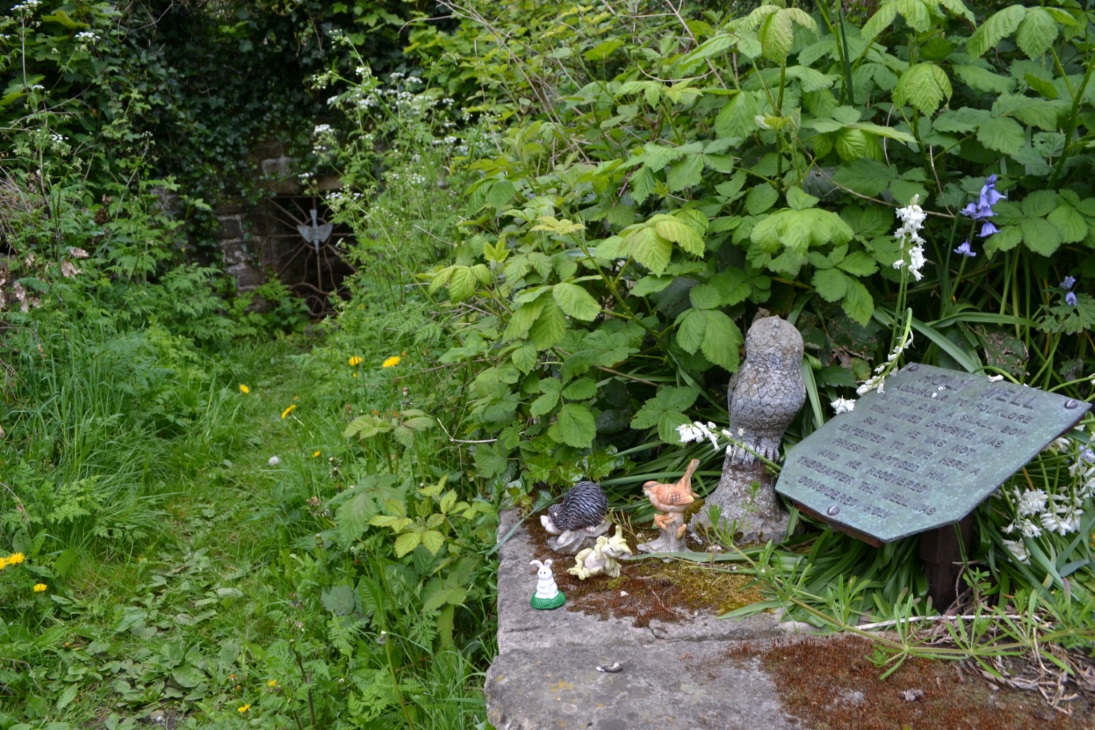

Adam’s Well, Speldhurst, Kent

Holy Well:  OS Grid Reference – TQ 556 382

Getting Here

Adam's Well, Speldhurst
Adam’s Well, Speldhurst

To find Adam’s Well take the footpath from near the High Rocks Inn, leading up under the railway, continuing along the edge of a copse and into open area. Where the path turns sharp right one can see, looking ahead at this junction, a large pond and above this the black and white cottage.  Beside this an arch where the spring arises. To gain access, go through the gate ahead and turn into the drive of the house called Adam’s Well and ask permission to see the well as it lives on private land.

Archaeology & History

The earliest reference to the site is found in Thomas Burr’s (1766) History of Tunbridge Wells:

“on forest a little beyond the Rocks, a spring of water was discovered, which was palled in and called Adam’s well. For what particular reason this spring was taken such notice of, it is not now very easy to determine.”

Burr (1766)  perhaps implies that the well was discovered within living memory, and its fame being established before that of Tunbridge.

MacKinnon (1934) in his History of Speldhurst, perhaps drawing upon an earlier source as well as describing it in greater detail, clearly indicates it origins as a holy well, in the use of the words holy water below:

“Adam’s Well is situated in this Manor, it was famous long before the Tunbridge Wells waters were discovered, and issue from high ground at Langton. In much repute in ancient times, it is impregnated with no mineral, saline, nitrous or earthy matter, whatever, it is quite free of sediment, and was called in old times a ‘holy water.’ In 1765, the owner of this well, on digging into the rock to enlarge the pool or bath came upon an ancient stone arch, whose date could but mere matter of conjecture. This arch can be seen at the present day.”

Combined with the traces of medieval stonework, the medieval origin is supported by its name: Adam, being taken from a local fourteenth century landowner, John Adam.  Fortunately, Adam’s Well still exists, much as MacKinnon (1934) describes, now enclosed in the private grounds of Adam’s Well House: a bungalow, built in the nineteenth century, after a bout of vandalism, to house a caretaker for the well. The well itself arises in a shallow, square brick-lined chamber.  Enclosing this is a large stone alcove, built to allow a sheltered access to the well during inclement weather. The back wall of this shelter is of a crude nature, indicating that it may indeed be of considerable age. A stone set in its arch notes: ‘ADAMS WELL 1868.’

The waters of the Well

This date presumably refers to when the well was repaired, and the house built.  In front of this is a much larger and deeper rectangular stone chamber. I was informed by the then owner in the mid-1990s, Mrs Wolf, that dogs and horses were washed within this.  Over this chamber is an iron grill with the letters ‘AW’ in its centre.  Mrs Wolf also told me that the quality of the water was so good that it was bottled and stored on ships for long periods. Much of the popularity of the water came from the fact that it lay along the busy old road from Peacehaven to London.

Folklore

Burr (1766) implies that its powers, to cure human ailments, were largely forgotten and:

 “…at present it is only famous for the cure of mangy dogs, in which case it is esteemed an infallible remedy.”

Yet, John Britton (1836) in the Descriptive sketches of Tunbridge Wells and the Calverley estate; with brief notices of the picturesque scenery, seats, and antiquities in the vicinity describes it as being noted for:

“its transparency of its waters, and for its efficacy in some cutaneous disorders.”

Recent analysis showed that the water contains copper, which perhaps explains its lower popularity compared to Tunbridge, as copper salts were not as efficacious as iron salts. This is supported by Mrs. Wolf who noted that it had not cured her rheumatism!

Extracted from the forthcoming Holy wells and healing springs of Kent

References:

  1. Britton, John, (1836) Descriptive sketches of Tunbridge Wells and the Calverley estate; with brief notices of the picturesque scenery, seats, and antiquities in the vicinity
  2. Burr, T., (1766) History of Tunbridge Wells
  3. MacKinnon, Donald D., (1934) History of Speldhurst 

© R.B. Parish, The Northern Antiquarian


Holy Well, King’s Newton, Derbyshire

Holy Well:  OS Grid Reference – SK 386 262

Getting Here

The well depicted in Hope’s (1893) Legendary lore of holy wells, sadly he says nothing about it!

The Holy Well is signposted off the road to Castle Donington on the left hand side as you near a small brook, past new bridge and it will be seen down the track. It can be muddy, so bring some boots!

Archaeology & History

It is first noted in 1366 as ‘Halywalsiche.’  The purchase of the lands of St Catherine’s Chantry, lately dissolved, in 1564, refers to lands here at ‘Holy well hedge’ and ‘Hollywell siche.’  A carved inscription over the well read:

Fons sacer hic strvitvr Roberto Nominus Hardinge 16xx

translating as:

this Holy well was built by Robert named Hardinge 16xx“.

Briggs suggested the date of 1660, which is quite likely, as it coincides with the Restoration of Charles II as the family at the nearby hall.  The aforementioned Hardinge, were staunch Royalists, and of course puritans disliked holy wells as many other so called ‘popish’ things. However, its restoration may have been for little more than to maintain a good water supply. Later depictions such as pre-war postcards show the date to be quite clearly 1662.

The restored holy well today, original stonework to rear with newer stone at the front

The present condition of the well is tribute to its local community.  The arch survived for nearly 300 years but a combination of vandals and the roots of the nearby ash tree caused the arch fall down and it lay in pieces in the 1950s. Sadly the original inscription appears to have been stolen or entirely broken to pieces. However, unlike many similar sites, this was not the final fate of the well. In the 1980s it was restored using as many of the old stones as possible. The landowner was happy to sell the land and Melbourne Civic Society donated money for its restoration. No artifacts were found, apart from 17th century Ticknall ware pottery, later tiles, and drainpipes fragments. Most of the original stones were recovered, but the job of reconstructing them appeared to be a large task and new stone was required. The arch over the well was left blank as it was thought misleading to re-inscribe it. Usher (1985) notes that on the first Sunday after Ascension Day, May 19th 1985, over a hundred people gathered for the opening ceremony when the plaque was unveiled by the Society’s President, the Marquees of Lothian, of Melbourne Hall. It is delightful to see it restored and celebrated by the community.

Folklore

There appears to be no records regarding its properties baring its ‘superior excellence of its waters‘, and being noted as a mineral spring. Interestingly, its waters are said to flow towards the rising sun.

Extracted from R.B.Parish’s (2011) Holy wells and healing springs of Derbyshire

References:

  1. Usher, H., (1984) The Holy Well at King’s Newton, Derbyshire. Old Series Source

© R.B. Parish, The Northern Antiquarian


Billy Hobby’s Well, Chester, Cheshire

Holy Well:  OS Grid Reference — SJ 413 662

Getting Here

The well is found on the south-east corner edge of Grovesnor Park, which is the south-east of the city beside the River Dee.

Archaeology & History

Billy Hobbys Well, Chester

An early reference to this site is in the place-name of Billy Obbies Field, marked in 1745, with an accompanying spring marked at 1791. This would appear to suggest that the spring gained its name from the field and not vice versa, with the name possibly representing a local person.  Yet the name may hide a much earlier origin. The name ‘Hobby’ derives from hobb, a name for a devil or demon – and where the name hobgoblin derives from. It may be possible that the area was a marshy waste and to warn people away a legend of a demon was introduced. More interesting is the idea that as the name ‘Hobb’ is synonymous with Puck, and Puck possibly having a Roman origin, that the site could be a much earlier Pagan site. This might explain the fertility ritual found here (see Folklore, below) if it has a greater age.  It may be significant that when the park was developed, a long line of Roman earthenware water pipes were found.  Did they draw water from the spring?

Internal Structure
Internal Structure

Whatever the origin, when the garden was developed in the 1860s by the 2nd Earl of Westminster, Richard Grosvenor, a rather grand and impressive red and buff sandstone ashlar well house was erected. This was designed by John Douglas, a local Chester architect, who was not forthcoming in making this well grand with canted corners, pointed arches flanked by a granite columns with wrought iron bars. At each corner is a small carved circle containing carved sheafs and portcullis and the voussoirs contain carved roses. A tiled spired roof sits upon the structure with an apex surmounted by a copper fish weathervane. All in all, rather ostentatious for a well – especially as access to the well chamber has not been made very easy by the enclosure.  Whether the improvements were done to develop some sort of spa well is unclear, but it is known that the when Canniff Haight (1904) visited for his United Empire, the spring was still flowing and noted, for he records:

“Billy Hobby’s Well,” a spring of excellent water, where we have a drink.”

Folklore

This was a local wishing well.  A local anonymous rhyme records:

“I lov’d the tales that idle maids do tell,
Of wonders wrought at Billy Hobby’s Well,
Where love-sick girls with leg immured would stand,
The right leg ’twas – the other on dry land,
With face so simple – stocking in the hand –
Wishing for husbands half a winter’s day.
With ninety times the zeal they used to pray”

Billy Hobbys-well-8This old rhyme despite some pedigree suggested I have been able to date only to 1823. It appears to record a ritual undertaken at the well, a similar ‘one part of the body in, one out’ was done at Walsingham by lovelorn maidens, but it does look to be Victorian in origin there (or at least post Reformation). The only problem with the practice being undertaken then is that the present structure dates from that period.

From the forthcoming work on Holy wells and healing springs of Cheshire

References:

  1. Dodgson, J.M., The Place-Names of Cheshire – Part 5, English Place-Name Society: Cambridge 1981.
  2. Haight, Canniff, A United Empire Loyalist in Great Britain, William Briggs: Toronto 1904.
  3. Hole, Christina, Traditions and Customs of Cheshire, Williams & Norgate: London 1937.

Links:

  1. Holy and Healing Wells

© R.B. Parish, The Northern Antiquarian


St. Thenew’s Well, Glasgow, Lanarkshire

Holy Well (destroyed):  OS Grid Reference – NS 589 648

Also Known as:

  1. Canmore ID 44288
  2. St. Tenew’s Well
  3. St. Theneu’s Well

Archaeology & History

St Thenew’s on early map

Whilst I’m in Glasgow (big thanks to Aisha!) I thought I’d check out any remaining heathen sites that might still be visible.  Many have perished of course, beneath the weight of religious industrialism—this one included.  Even when the Ordnance Survey lads came here in 1858, it had already been destroyed.  All that we now know of it comes from the writings of the earlier historians like Walker (1883), Renwick (1921) and co.

Known in early records as St. Theneu (mother of the legendary St. Mungo, who also had sacred wells dedicated to him in Glasgow, Gleneagles and much further afield), trackways and burns hereby were also named after this curious character, and a chapel was also commemorated to her, which fell into ruin several centuries ago.  Its position was highlighted on a late-16th century sketch of Glasgow village—as it was then—immediately south of the chapel, just north of the River Clyde.  The best description we have of it comes from a detailed paper on the holy wells of Glasgow by a Mr Brotchie (1920), who told:

“Where the subway station of St. Enoch’s Square stands…there was at one time the well of St. Tenew, the mother of St. Kentigern or Mungo.  It is thus described by a writer in 1750, “The ruins of a small chapel stood beside the well whose waters were sheltered by a bush, on which were to be seen, especially in early summer, bits of rags of all kinds and colours, while in the well itself enterprising boys were wont to get small coins.  The rags and the coins were the offerings of people, principally women, who came to drink of the waters of St. Tenew’s Well, and left these trifles as thank offerings.”

“This ancient well of St. Tenew stood near a chapel erected over the tomb of St. Tenew, and the ground in its vicinity remained sacred in the eyes of the faithful as the last resting place of the holy woman who had watched the infant steps of the great apostle of the Cambrian Britons, St. Mungo, the patron saint of Glasgow.  The Trongate and Argyle Street, which now stretch westwards from the cross, were in old times a country road leading to St. Tenew’s chapel, kirkyard and holy well.  In a deed of 1498 mention is made of “the blessed chapel where the bones of the beloved Tenew, mother of the blessed confessor, Kentigern, rest.”  When M’Ure wrote his History of Glasgow in  1736, the remains of this old chapel and kirkyard were described as standing “in a solitary spot in the country surrounded by cornfields.”  Looking westwards from St. Tenew’s Well in 1750, a writer describes the scene as “open country, pastures and cornfields, rude-looking country homesteads, barns and other farm buildings, and enclosed kailyards,” where now stand the busy arteries of Jamaica Street, the Caledonian Railway Station, and the miles of tenements that stretch westward to Anderston, Finnieston and Partick.

“We have a comparatively recent record of the holy well of St. Tenew in the statement of the late Mr Robert Hart, who told M’George that he had been informed by an old man, a Mr Thomson, who had resided in the neighbourhood of St. Enoch’s Square, that in the beginning of the last century, say 1800, he recollected the well being cleaned out, and of seeing picked from the debris at the bottom many old coins and votive offerings.  St. Tenew’s Well was a holy well.  For centuries it was a place of pilgrimage and was much resorted to for cures, especially in pre-Reformation days.  In 1586, James VI, addressed a letter to Mr Andrew Hay, commissioner for the west of Scotland, condemning the practice of people making pilgrimages to wells and chapels, but the royal edict was powerless to stop the practice and St. Tenew’s Well was resorted to by people in trouble as long as it was in existence.  The road that led to it was known up to the 15th century as St. Tenew’s Gait or path.  Indeed, it was so named till 1540, when the name of Trongate begins to make its appearance in old city deeds.  This name, of course, owes its origin to the granting in 1490 by James IV, to the Bishop of Glasgow of the privileges of a free tron in the city—hence our Trongate of today.”

References:

  1. Bennett, Paul, Ancient and Holy Wells of Glasgow, TNA 2017.
  2. Brotchie, T.C.F., “Holy Wells in and Around Glasgow,” in Old Glasgow Club Transactions, volume 4, 1920.
  3. Eyre-Todd, George, History of Glasgow – volume 2, Jackson Wylie: Glasgow 1931
  4. MacGeorge, Andrew, Old Glasgow, Blackie & Son: Glasgow 1880.
  5. Renwick, Robert & Lindsay, John, History of Glasgow – volume 1, Maclehose Jackson: Glasgow 1921.
  6. Walker, J.R., ‘”Holy Wells” in Scotland”, in Proceedings of the Society of Antiquaries, Scotland, volume17, 1883.

© Paul Bennett, The Northern Antiquarian

Our Lady’s Well, Runwell, Essex

Holy Well:  OS Grid Reference — TQ 7510 9658

Also Known as:

  1. Running Well

Getting Here

The runwell. copyright with permission http://www.spiritrealms.co.uk/gallery.htm
The Runwell (copyright with permission http://www.spiritrealms.co.uk/gallery.htm )

It can be found by taking a road off the A132 (Wickford Road) which leads to Stock (directly opposite the Parish Church), continuing until you reach another minor road to Rettendon. A short way up this road it forks. Take the road to the right & continue until one reaches a minor drive to Poplars Farm (distinctive with its trees each side of the drive). Continue up here until one passes the house to a small piece of tarmac. Here a footpath continues directly in front, continue until one reaches on the left a gate. Enter through here, and head across the field towards a notable tree, and a gap in the hedge. To the left, follow the edge of the field, until one sees another opening into the well. The approach from the south is the only route worth considering as northerly access is blocked by a fence. It can be extremely muddy, so good footwear is advisable.

Archaeology & History

Philip Morant (1763-8) is the first to mention it, suggesting that the settlement is named:

“..from a considerable Running well in the Parish.”

Again, Chandler (1896)—noted in Collins (1986)—emphasises:

“a remarkable spring of water on Poplars Farm, which is always running and has never been known to fail.”

Despite this obvious assumption, Ekwall (1936) suggested that the prefix originates from O.E rune for ‘mystery’ or implying a well possessing a secret of some religious observance. This is suggestive of the strange legends and traditions involved with the site.  Alternatively it could derive from hruna referring to the tree trunk—and it does arise in a copse. A roman road runs by here.

The only reference to a religious site appears to be in 1602 when the parish register records ‘Shrine of the Bl. Virgin of RunnyngeWelle’.  However, stone remains found over the years around the well may support the idea of a well chapel; these remains were two pieces of limestone window mullion and a piece which appears to be part of a step as well as pieces of Kentish ragstone.

Folklore

According to Bazille-Corbin (1940), Runwell is steeped in lore and legend. One must take these stories as possible antiquarian fancy as there does not appear to be any concrete evidence for them.  Doubtless some of it is true, other bits not. He states that in the Sixth Century AD, Christian missionaries Lucus and Lucilus visited Essex and found a scene of paganism here, built a chapel, and rededicated the well to “Our Lady St Mary.”  The floor of this chapel had a unique designed cross, with black flint and red strawberry stone, to show the teachings of the tenets of the Christian Faith.
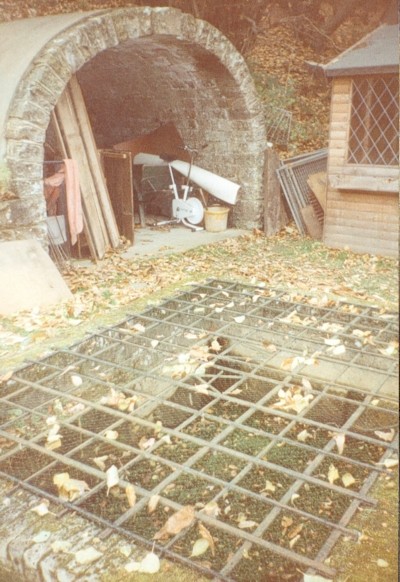
To protect this and collect subsequent devotional gifts, a nunnery, of six members, was developed around the site. They tended to the shrine, well head and the statue of Our Lady, to which many miracles were attributed. Little evidence exists concerning this foundation, but it is believed to have been dissolved in the 16th Century. Locally it is said parts of the nunnery were incorporated into the nearby farm-house ‘The Poplars’. In the 1980s, Andrew Collins, searched for records of this local priory, but found none.

Another legend connected with the well accords that a young nun, Sister Lucy, after renouncing her vows, found the outside world not to her liking and returned in repentance, one snowy night, to the chapel for forgiveness. Yet, upon reaching the chapel steps, she slipped and fell into the icy waters of the well. (cf. The Single or St. Thomas’ Well at Ifield, Kent)

Her ghost is said to haunt the area, preserving perhaps the memories of these past water deities. This is enforced by the belief by some authorities that the well’s dedication indicates a Christianisation of the Iceni goddess Epona. This is supported by these horseshoe-shaped motifs, and that the approach to the well being haunted by a horse.

Andy Collins (1986) was informed that a concrete water tank was installed over the spring.  This proved to be inaccurate, but the well was defined by a concrete chamber.  Collins thought that this may be the remains of some adaptation for a spa bath, but no hard evidence was forthcoming regarding this.

It certainly had passed through considerable years of neglect, as noted by the Runwell Rector John Edward Bazille-Corbin (1942), who said it was “in much need of dredging and cleaning out.”

The photo shown in Collins’s (1986) work shows a concrete lined rectangular pond, defined by corrugated iron. He was thus responsible for its repair and clearing away the years of neglect, also revealing the concrete rectangular pond, which was reached by a series of steps from its north side. A flight of steps appear to enter the well itself from the front. The body of water is of considerable size and depth and one could easily immerse oneself in it. When I last visited here, the water appeared murky but a sample revealed (apart from the pond fauna) a remarkable clarity.

Within recent years the well appears to have attracted a ‘cult following’, clearly manifesting itself in two ways. One is a seasonal Boxing Day walk to the well started in 1975, which is still undertaken (see link, below). The other more traditionally is the attachment of rags or cloutties to the surrounding shrubbery. Such activity, although probably done by those ‘in the know’ rather than any continuation of any local tradition, is the only such example I have come across in East Anglia—although recent photographs fail to show this and it appears that the tree has been cut down where these have been placed and the area opened up.

References:

  1. Bazille-Corbin, J. E., Runwell St. Mary: A farrago of History, Archaeology, Legend and Folk-lore, 1940. 
  2. Collins, Andrew, “Devilish Mysteries at Runwell,” in Essex Countryside Vol. 33 no.431, p38-39, 1985.
  3. Collins, Andrew, The Running Well Mystery, 1986.
  4. Ekwall, Eilert, Studies in English Place and Personal Names, Lund 1931.
  5. Ekwall, Eilert, The Concise Oxford Dictionary of English Place-Names, Oxford 1936.
  6. Morant, Philip, The History and Antiquities of the County of Essex – 3 volumes, London 1763-8 (reprinted by EP: Wakefield 1978).
  7. Parish, R.B., Holy Wells and Healing Springs of Essex, Pixy Led Publications 2008.
  8. Reaney, Paul, The Place-Names of Essex, Cambridge University Press 1935.

Links:

  1. Runwell Boxing Day History Walk – Wickford History
  2. Runwell History Walk – Photo Guide

This site profile is an edited extract from the book Holy wells and healing springs of Essex

© R.B. Parish, The Northern Antiquarian