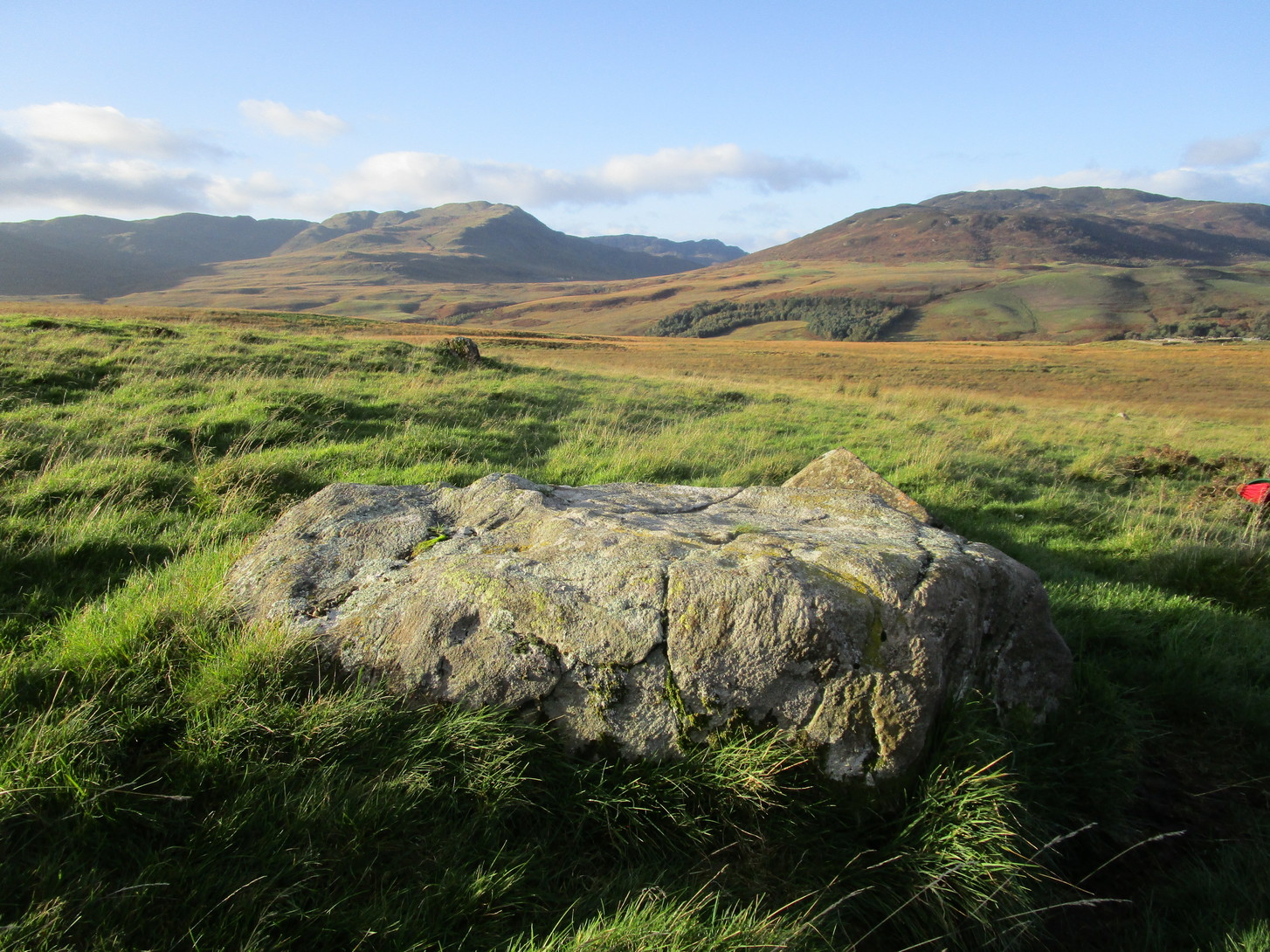
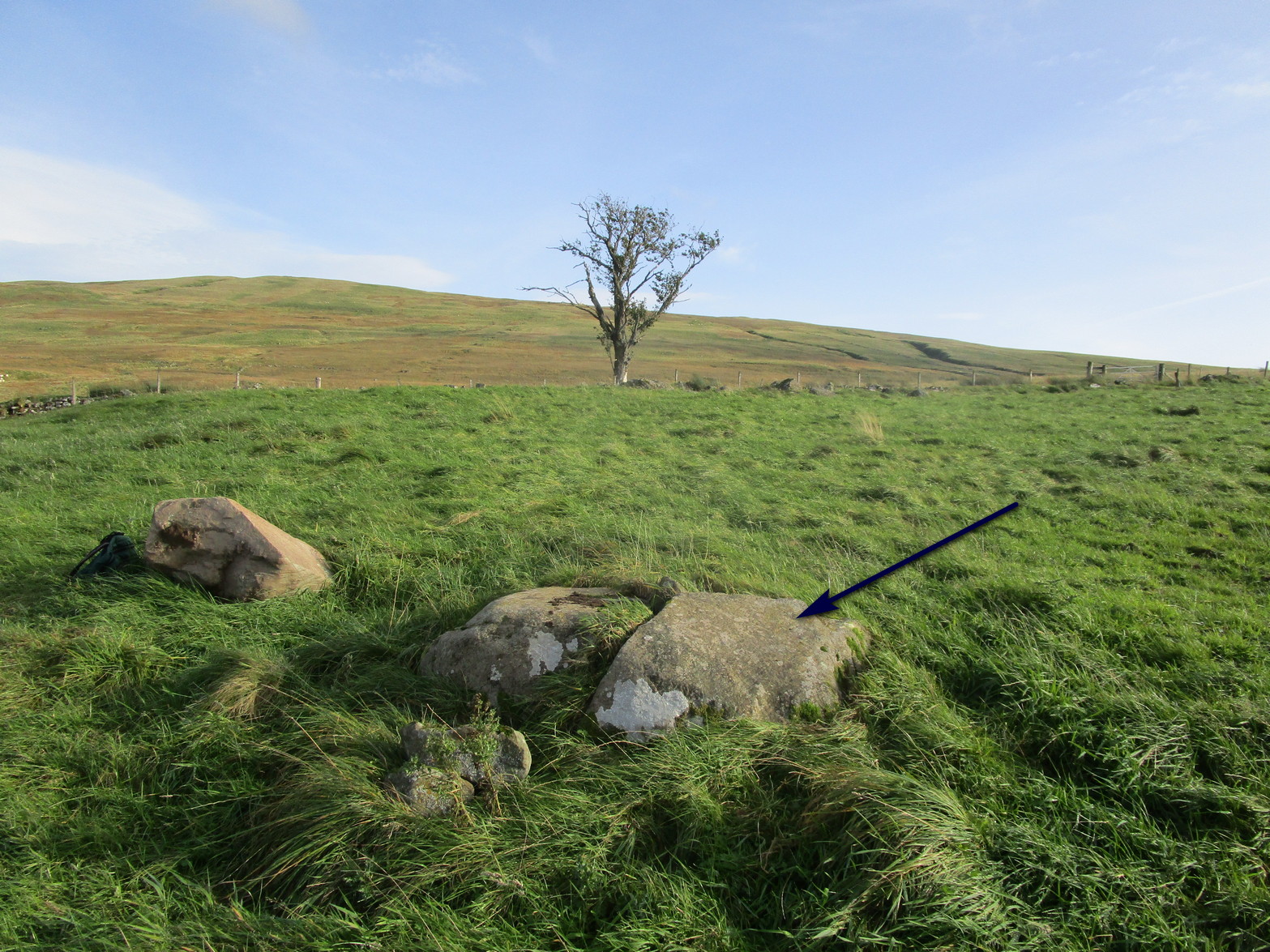
From Holymoorside, take the long straight Loads Road running west out of the town into Longside Road. ¾-mile along, past Home View and just before Well Lane (on the right), there’s a public footpath sign pointing into the fields on your left. Walk dead straight, dead south along the wallside for 450 yards, then walk straight left again along the other wall until you reach the tiny bit of moorland less than 150 yards away. The carved rock is just on the other side of the stile at the edge of the old walling. You’ll find it.
Archaeology & History
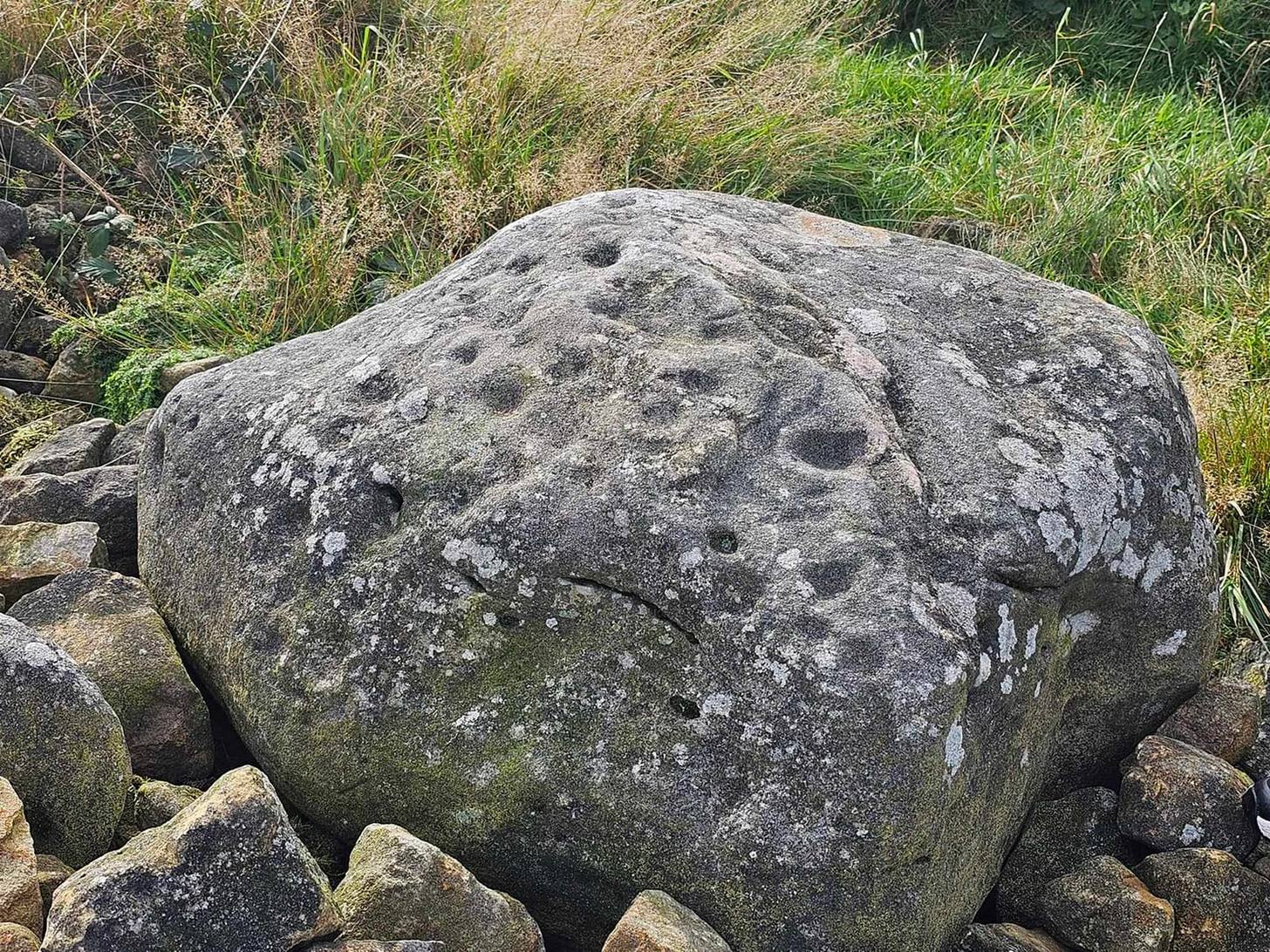
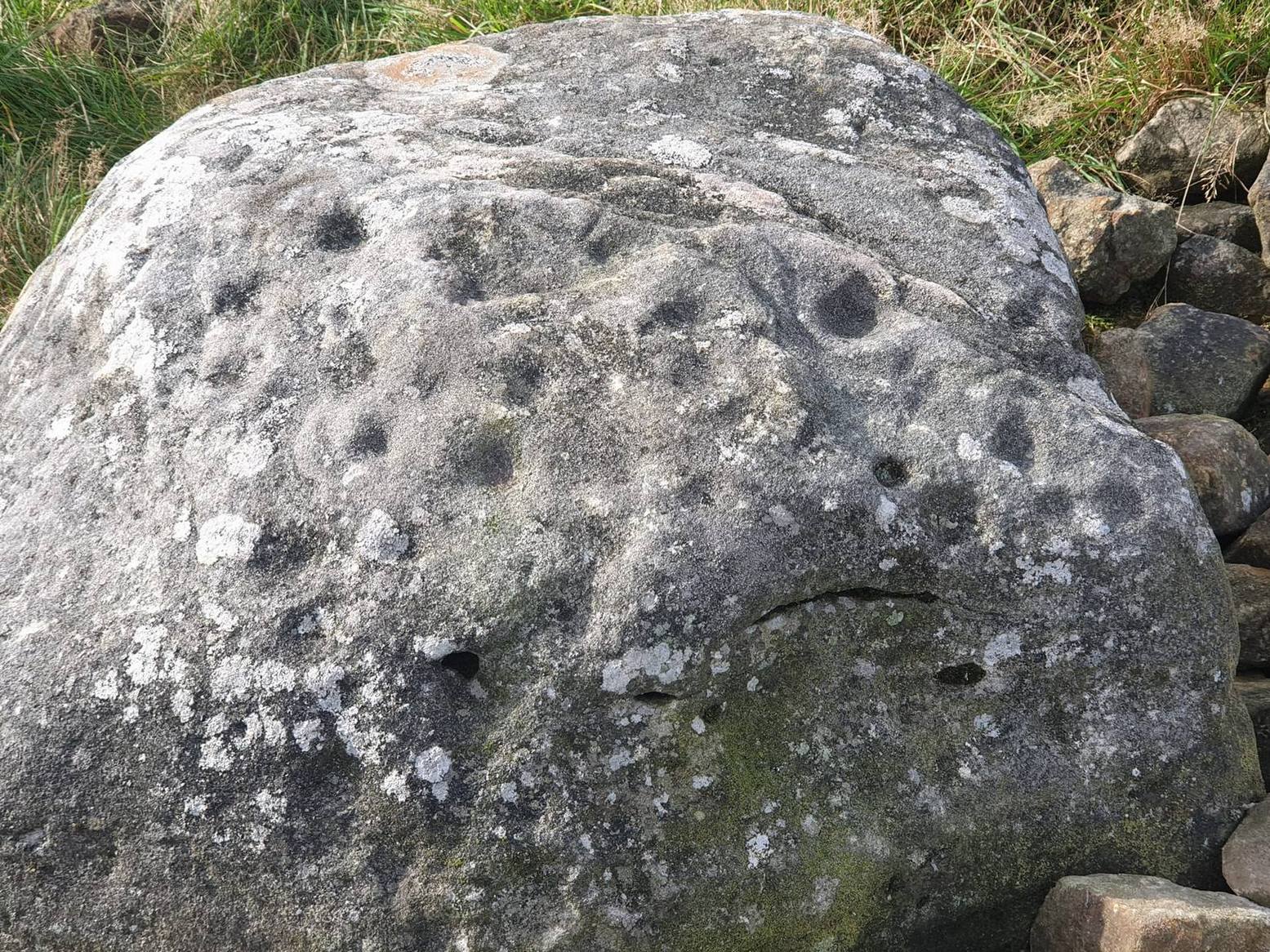
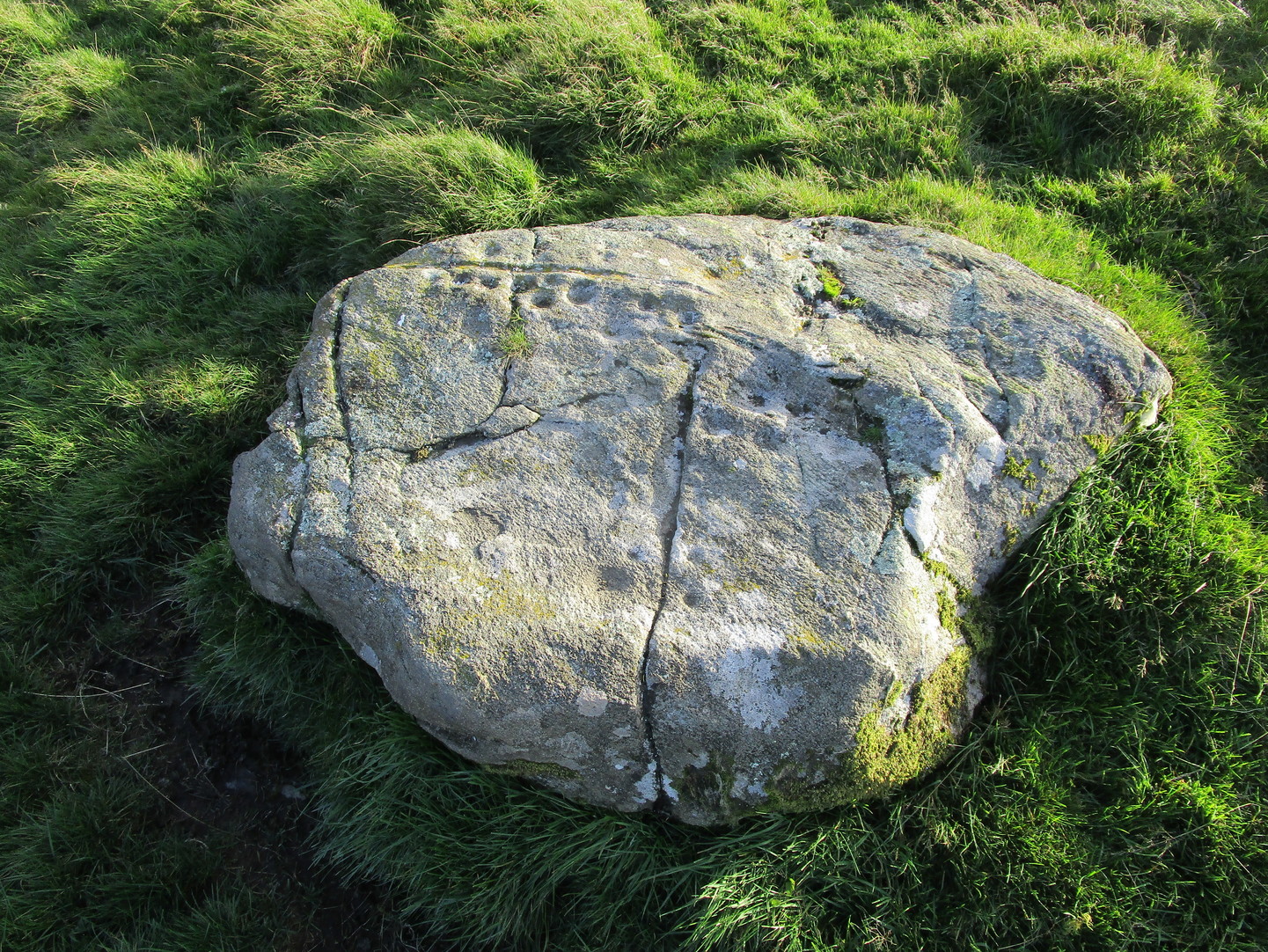
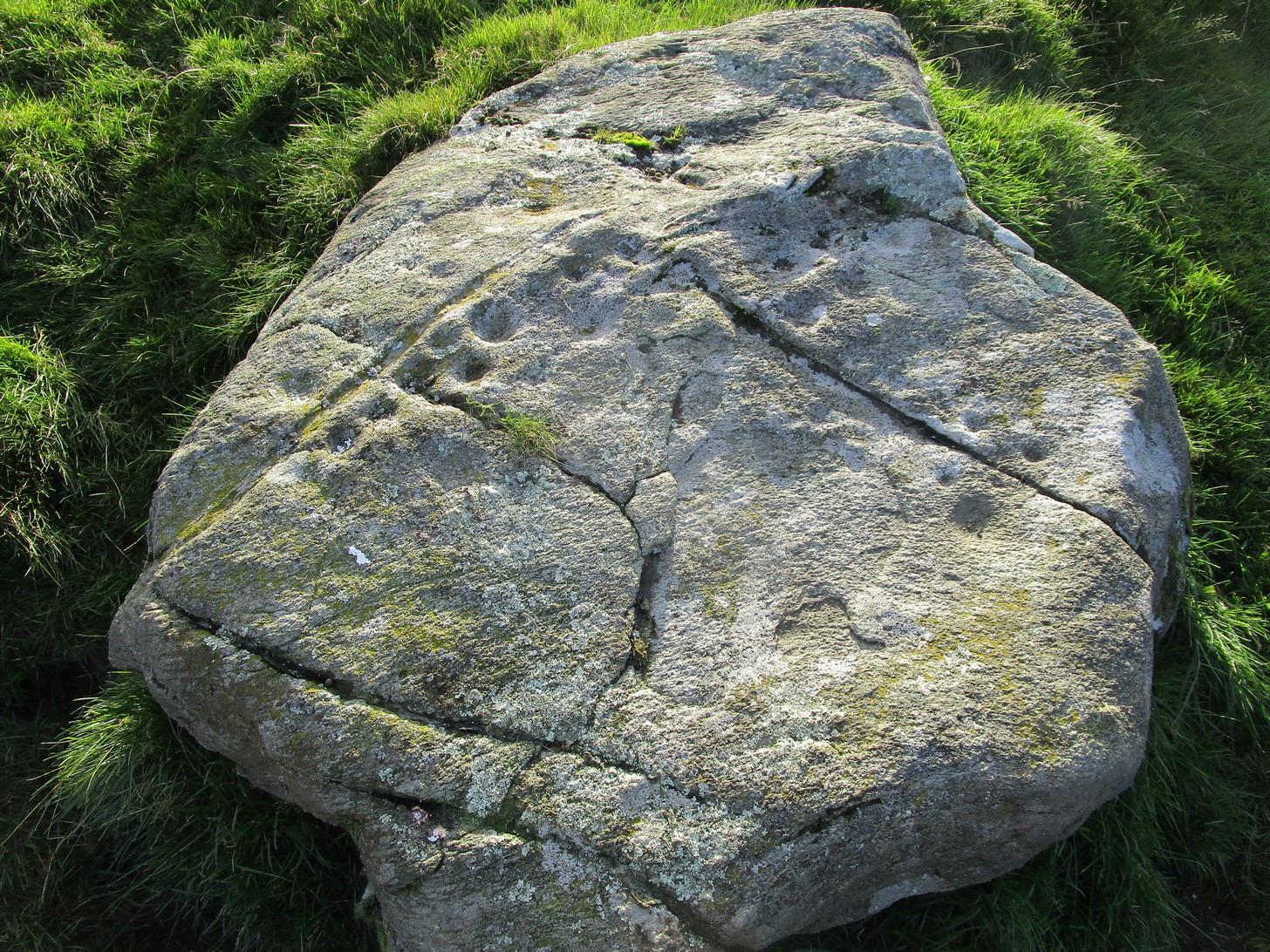
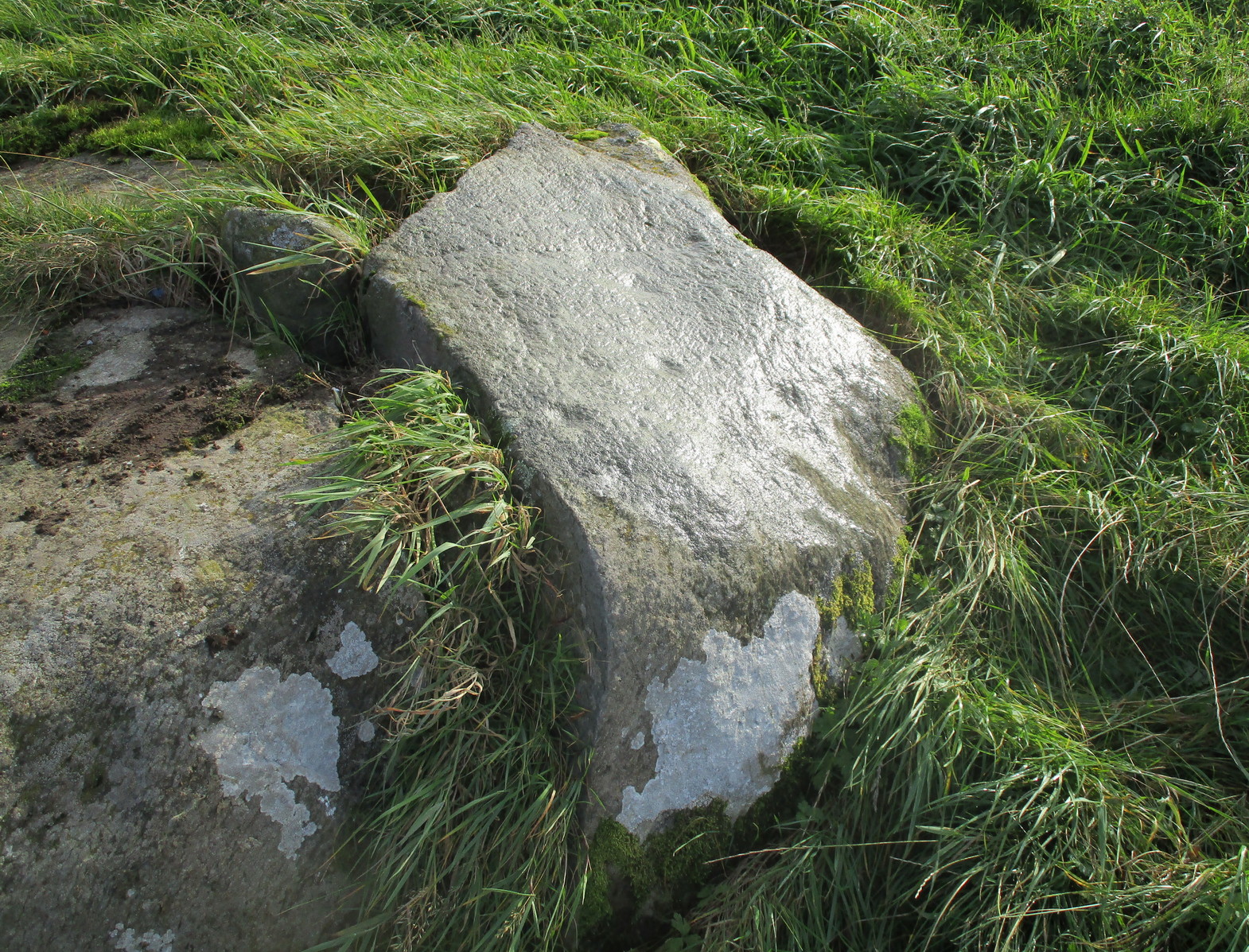
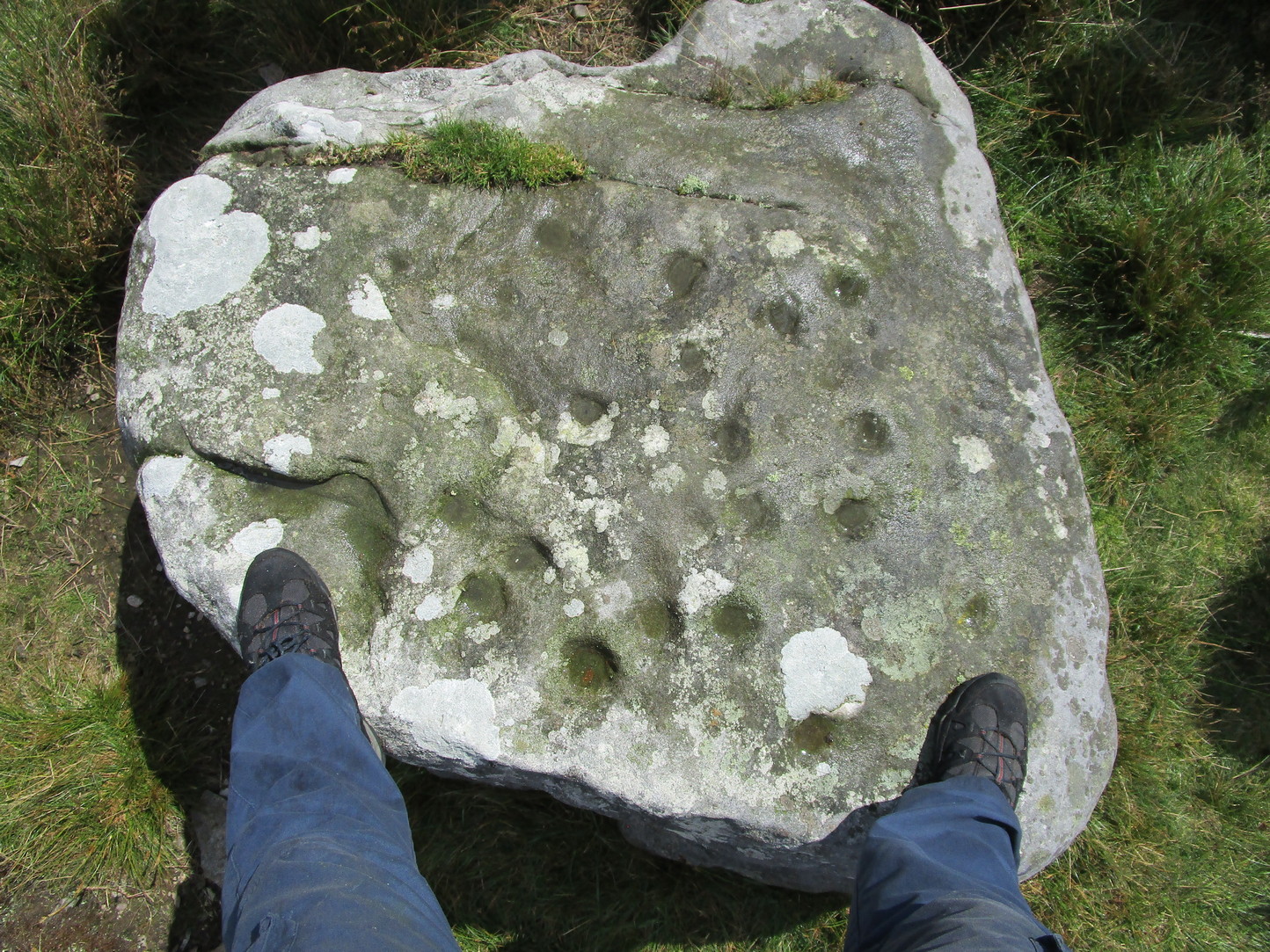
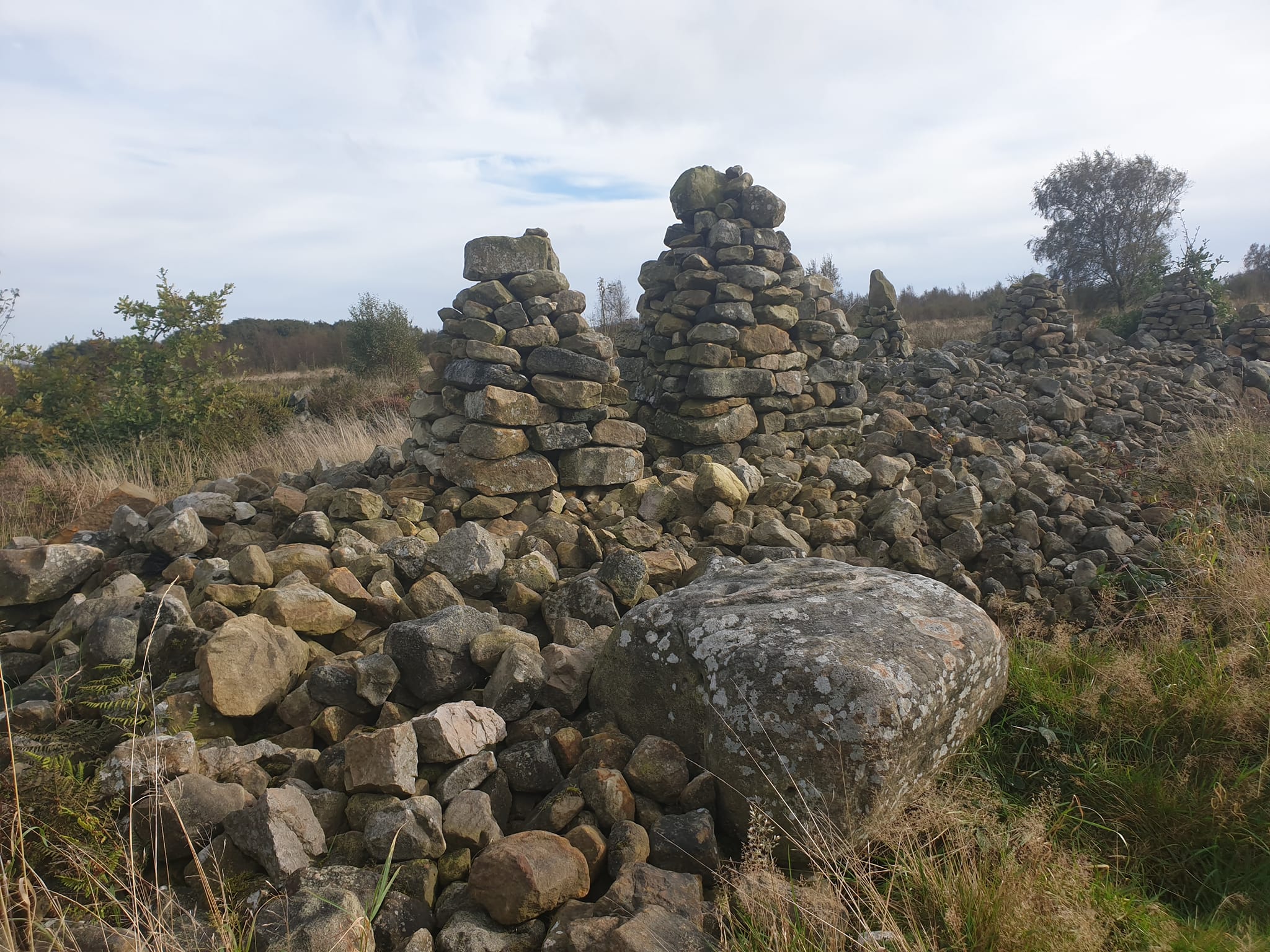
Rediscovered sometime in 2002, this would seem to be an isolated cup-and-ring stone. It was first mentioned in John Barnatt’s (2003) short gazetteer of Peakland petroglyphs, where he wrote,
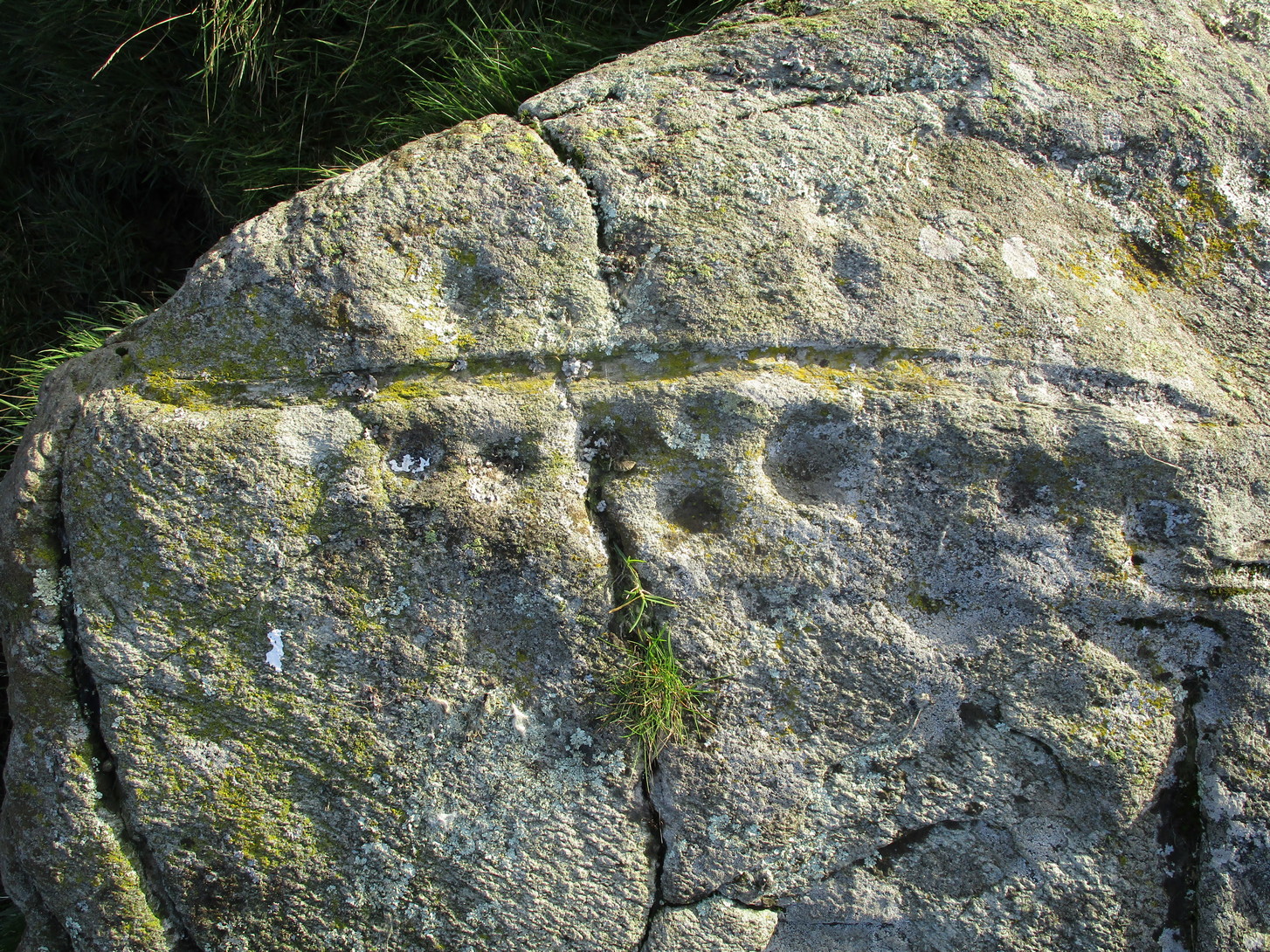
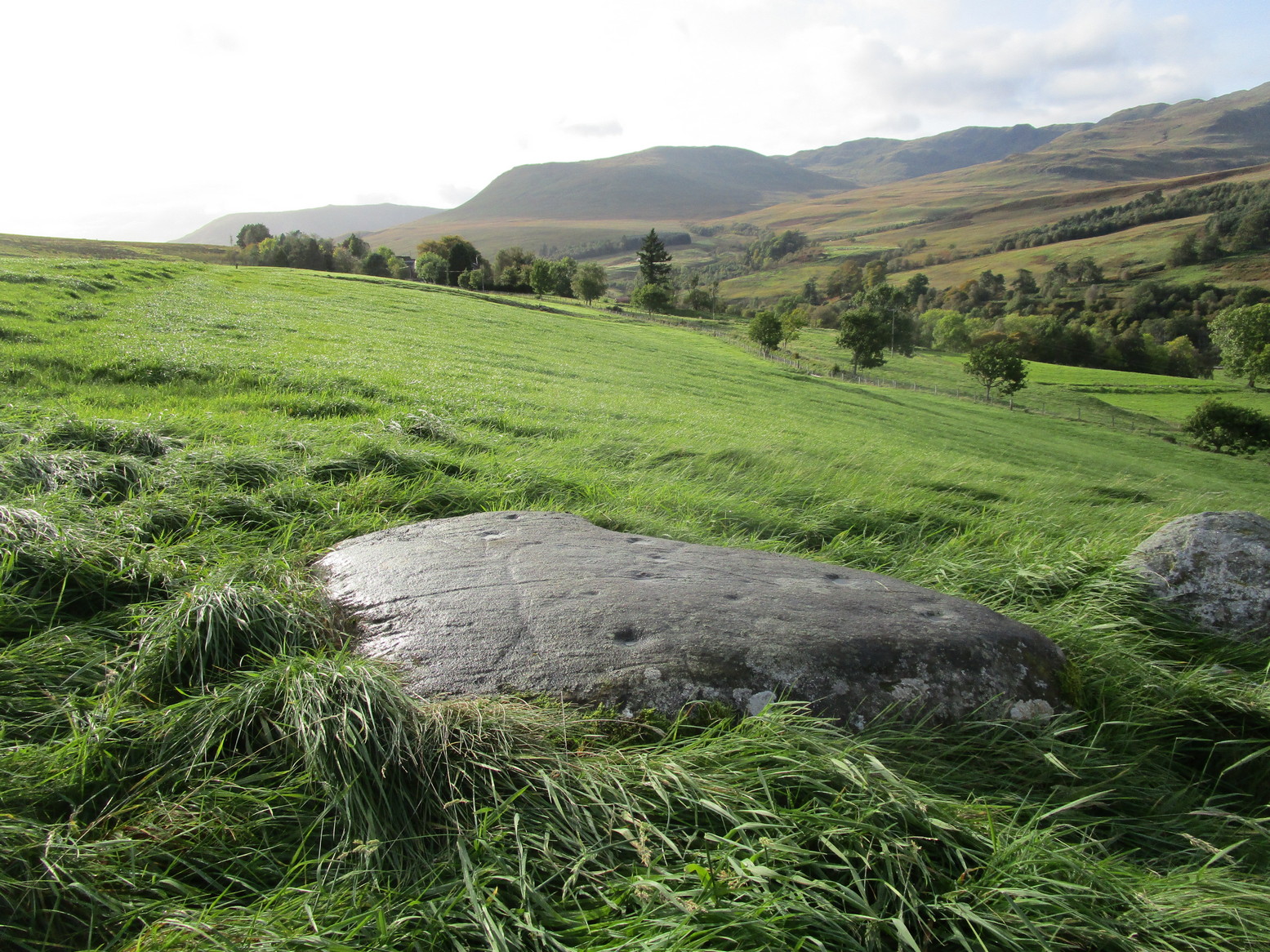
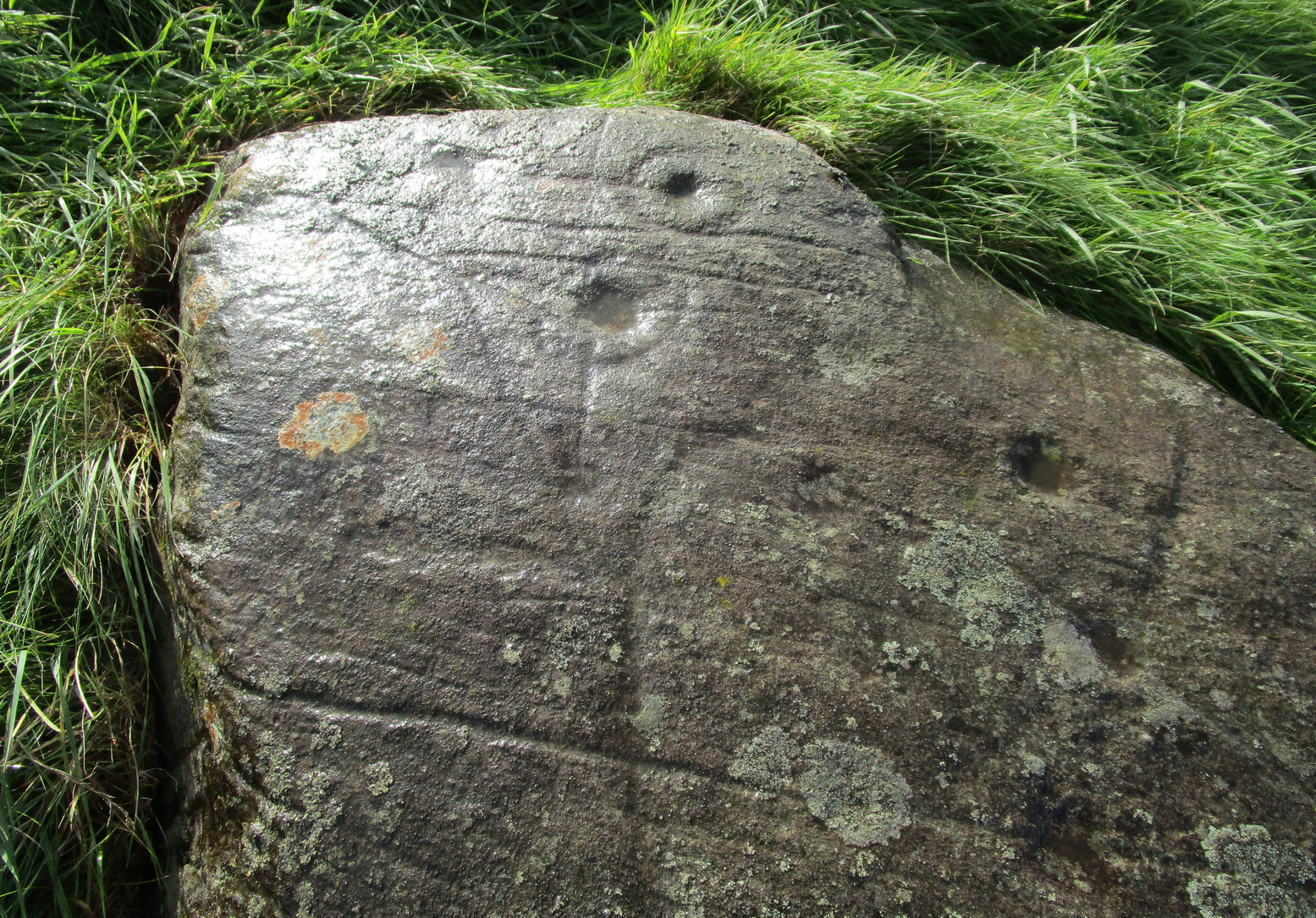
“This irregularly-shaped small boulder was identified recently lying amongst post-medieval field clearance adjacent to a field corner and footpath… Its upper parts ar covered with 40-46 cupmarks. On the exposed irregular top they are badly worn and sometimes uncertainly identified. In one instance a cup is partly encircled by a worn ring, while a second partial ring nearby may be fortuituous. On a ledge near one edge of the boulder preservation is better and the cups are clearly defined and densely arranged.”
The stone looks as if it’s been moved into its present location, obviously for use in the walling. It’s original position would have been somewhere close by, but we know not where that might be.
References:
Barnatt, John & Robinson, F., “Prehistoric Rock Art in Ashover School and Further New Discoveries Elsewhere in the Peak District,” in Derbyshire Archaeological Journal, 123, 2003.
Make a day out of this one, visiting several old places on the way. From Comrie take the B827 road to Braco, turning right at the tiny Glen Artney road a half-mile along (easy to miss). 3 miles along, pass the derelict Dalness cottage, you can follow the directions to get to the Mailer Fuar (2) cup-and-ring stone; and from here go up the field past the Mailer Fuar (1) carving, through the gate and follow the fence to your right. Keep going till your reach the Allt na Drochaide cup-and-ring stone. From here you’re heading (south) towards the rounded crags of Cnoc Brannan. It’s boggy as fuck in parts so cautiously zigzag through this section up towards the small grassy rise about 350 yards from the cup-and-ring stone. You’ll find it!
Archaeology & History
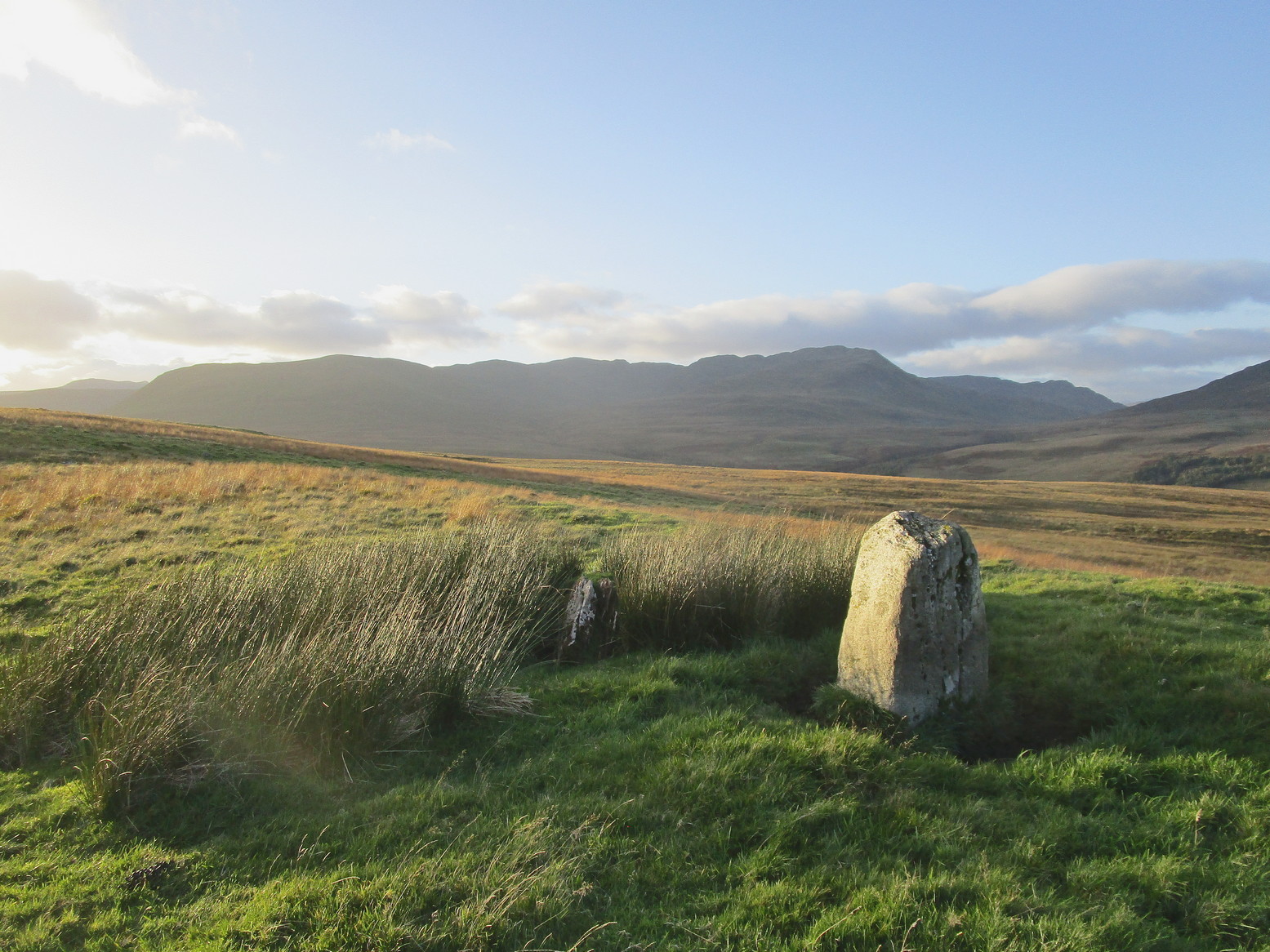
From the old stone, gazing S
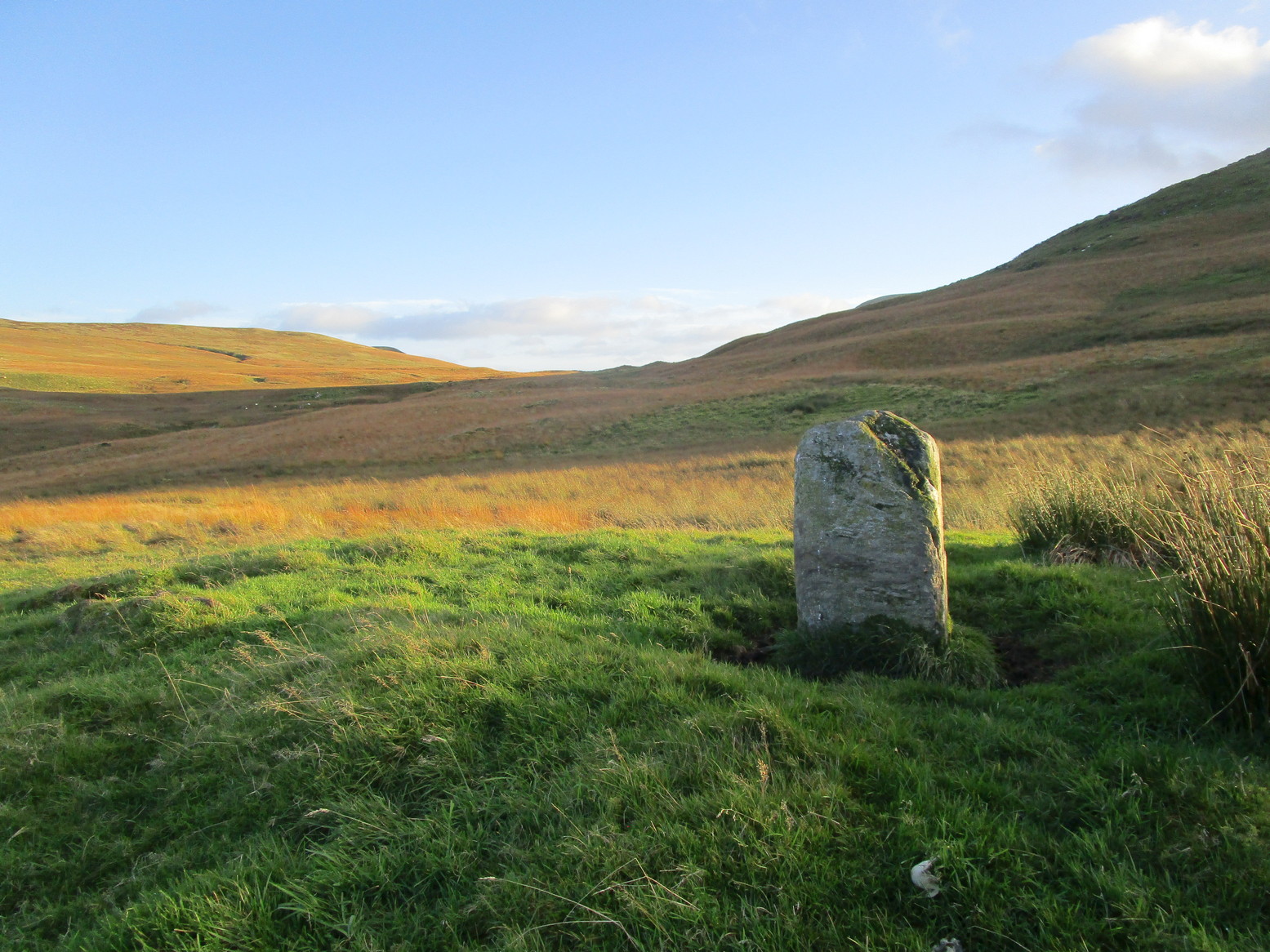
On one of the gentle rises below the northern slope of Cnoc Brannan we find this sturdy old fella, 3-4 feet tall (I didn’t measure it), looking across the stunning landscapes north, east and west along Glen Artney. Not previously recorded and seemingly isolated from other prehistoric remains, he looks all alone at first sight, but laid down in the grassy rushes (Juncus conglomeratus) to his side, is a slender seven-foot long stone which may have stood upright in the not-too-distant past, giving us another double stone setting in this area (at least two others existed in this area—the closest being at Craggish, 3.7 miles northeast). I have little doubt that other undiscovered prehistoric remains are hiding in the area. (there are a number of single cup-marked stones in the locale, although I tend to leave such examples off the catalogues as they can be somewhat dubious [and many are]. I mention this just in case any rock art students want to forage the area.)
From Comrie take the B827 road to Braco, passing the large Roman Stone monolith, turning right at the tiny Glen Artney road a half-mile along (easy to miss). 3 miles on, pass the derelict Dalness cottage, you can follow the directions to get to the Mailer Fuar (2) cup-and-ring stone; and from here go up the field past the Mailer Fuar (1) carving, through the gate and follow the fence to your right, then drop down into the great boggy reeds, over the burn and up as if you’re heading to the rounded hill of Cnoc Brannan. On a grassy knoll a hundred yards or so up the slope, you’ll see a rock or two. It’s thereby!
Archaeology & History
The stone in its setting
I came across this petroglyph not too long ago on the same day I found the Cnoc Brannan standing stone a little further up the slope from here. Covered in cup-markings over all except the northeastern portion of its surface, a faint ring seems to be around one of them on its northern side. Of the twenty-two cups on the stone, the majority of them, as the photos show, are clustered alongside a curved natural scar that runs across the topmost section of the rock. There are less pronounced faded cups on the more northern and western portions of the rock, with what looks like one on its near-vertical southern face. Despite its lack of complexity, it has an impressive feel to it.
Main cluster of cups
The home of this carving in its natural setting is what stands out when you’re up here and is certainly what gives it that vibe! The wooded greenery of Glen Artney stretches ahead of you to the east and west, with the craggish mountains of Beinn Dearg, Halton and their compatriots drawing you to the northern side. Tis a gorgeous arena indeed! So, if you’re going to visit its near neighbors at Mailer Fuar a half-mile below, stick this one on your itinerary and, if you’re the roving type, get your feet wet and look around for some more of them. There’ll be others, as yet unknown, hiding away nearby…
From Comrie take the B827 road to Braco and less than a mile out of town take the tiny Glen Artney road on your right. Past the derelict Dalness cottage 3 miles on, a half-mile further, there’s a gated road veering downhill on your right. Park in the small parking-spot at the left. Walk along 100 yards to the gate on your left and walk up the old path which bends back on itself before leveling out. As it does so, just where the Mailer Fuar (2) carving lives, head uphill to the derelict house and, before reaching the fence, check out the several isolated stones on your right. You’ll find it!
Archaeology & History
Several faint cupmarks
This is nowt special to look at and, as I always tend to say with carvings such as this, it’s probably only gonna be of interest to the petroglyphic puritans amongst you. It was described by George Currie (2006) as possessing just one cup-mark, but there are in fact at least three of them on this sloping rock face, possibly four. One of them may—may—have a half-ring around it, but this is very hard to see and might be little more than a trick of the light and just a forlorn hope of something better… It’s worth a brief look before you venture further uphill to the much more impressive Allt na Drochaide carving.
From Comrie take the B827 road to Braco and less than a mile out of town keep your eyes peeled for the tiny Glen Artney road on your right. Past the derelict Dalness cottage 3 miles on, a half-mile further, just where you hit a track-road veering downhill on your right, you need to park up in the small parking-spot on your left. Walk along the road 100 yards, keeping your eyes peeled again for the gate set back on your left (easy to miss!); go thru here, walk up the old path which bends back on itself before leveling out and, as it does, two or three small boulders lie just off the pathway on your right, one with its own petroglyph.
Archaeology & History
There are cups, rings and lines on this old stone, with the lines in particular being somewhat troublesome when it comes to working out their origin: some are natural, some made by modern farming implements (about a hundred years back), and some that were carved thousands of years ago—and it’s not that easy to work out which is which. You’ll be able to see what I mean by looking at the photos.
Rediscovered, it would seem, by M.D. King in 1991, he described it plainly as a simple
“recumbent cup-marked stone 1900mm by 1200mm by 300mm…found in a stone dyke running down the hill from the deserted farm of Mailer Fuar. The stone may have been moved down from its original position for inclusion in the now ruinous stone dyke. Fourteen cup-marks were visible on the stone.”
Complete cup-and-ringsCnRs and various lines
But there’s much more to it than that! There are rings around the cups for starters. Four of them. Two cup-and-rings next to each other at the southeast portion of the stone are just about complete, as you can see (right); the various lines that run either side and into them seem to be a mix of early and more recent scratches—although I think we’re best asking a petromorphologist to tell us which is which! We have a similar problem for another cup-and-ring near the centre of the stone, for it has two lines going right through its centre: one of them running almost the full north-south length of the stone giving the impression it was carved a long time back, yet looking much less ancient when it comes to its form and erosion; whilst the other line—almost at right-angles to the first—has a decidedly more archaic worn appearance.
General design in low lightLong line, curving at top
One of the more assured “ancient” carved lines is on the eastern section of the stone. (left) It’s an odd looking thing, not very clear on the photo, comprising an elongated curved line, with a fork at the bottom, almost like short legs on an elongated stick-man like the ones we drew as kids. The long line seems to eventually curve over and into one of the cup-marks. Adjacent to the bottom of this forked curve is a cup and faint incomplete ring with a faint line running out of its centre to a smaller faint cup to its west. You can see this reasonably well in the lower photo (right)
The carving needs a lot of attention if we’re to work out its original design, as the photos show. Even the millionaire computer-tech work of the Scottish rock art club didn’t really suss out the differences regarding chronological elements in this carving (I don’t think they even mentioned it), which shows how difficult some of these buggers can be! Personally, I’d love to see the impression of some good artists at this stone when the light’s just right and see what their mind’s eye brings to the fore.
After all this I’ve not even mentioned its position in the landscape. Go check it out and see for y’selves. It’s a bittova beauty! And then wander a little further uphill to look at the Allt na Drochaide (1) carving I found not long ago. The view’s even better from there!
Cup-Marked Stone (lost): OS Grid reference – NN 918 524
Archaeology & History
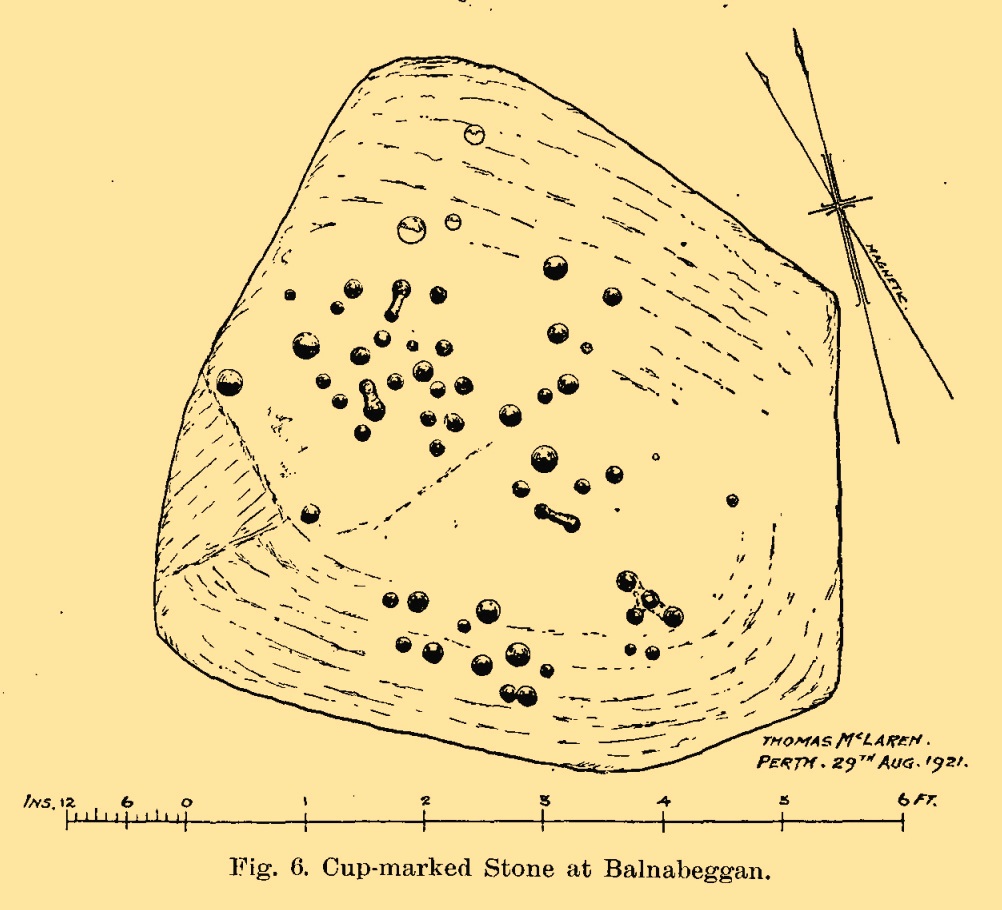
On the hillside a short distance (probably) south of old Balnabeggan farmhouse, up against some walling at the edge of some natural birch wood, could once be seen—some fifty or sixty years ago—a large, ornately inscribed, quartz-enriched cup-marked stone. And, although seemingly lost, it shouldn’t be too hard to uncover with a little bit of bimbling and dedication. It was described in some considerable detail in John Dixon’s (1922) survey of the Strathtay petroglyphs as being,
Balnabeggan stone, c.19201921 sketch of the stone
“roughly hexagonal in shape, but one side is partly hidden by an old dry-stone wall built above it. The greatest width is 7 feet, whilst a diameter at right angles measures 6 feet. The thickness or depth of the stone is at least 2 feet, but it may be more underneath, as the stone stands in a wet place in which it may have settled down.
“On the upper surface of the stone are fifty-nine cups of various sizes, the largest measuring 2½ inches in diameter, and from 1 inch to ½ inch, or less, in depth. A special feature is that four equidistant cups (three in a row and the fourth at a right angle to the centre of the row) are connected by grooves slightly less broad and deep than the cups. Three pairs of cups are also similarly connected. The cups connected as described are discernible, but the group of four cups on the low left side of the stone does not appear in the photograph to have its fourth cup (the lowest) connected, as it really is, with the central cup of the group.”
Mr Dixon’s additional clue as to its whereabouts is that it’s “about 500 feet above sea level.” So what, pray, has become of it…?
References:
Dixon, John H., “Cup-Marked Stones in Strathtay, Perthshire,” in Proceedings Society Antiquaries, Scotland, volume 56, 1922.
Kennedy, James, Folklore and Reminiscences of Strathtay and Grandtully, Munro Press: Perth 1927.
Cup-Marked Stone (lost): OS Grid reference – NN 8866 5320
Also Known as:
Sunday Well
Tobar an Donich
Archaeology & History
Tobairandonaich stone, c.1920
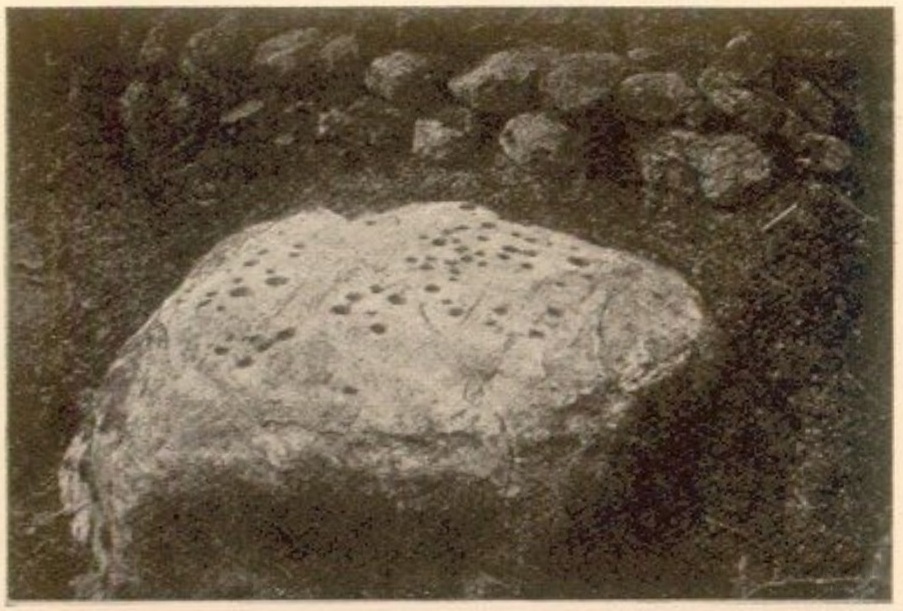
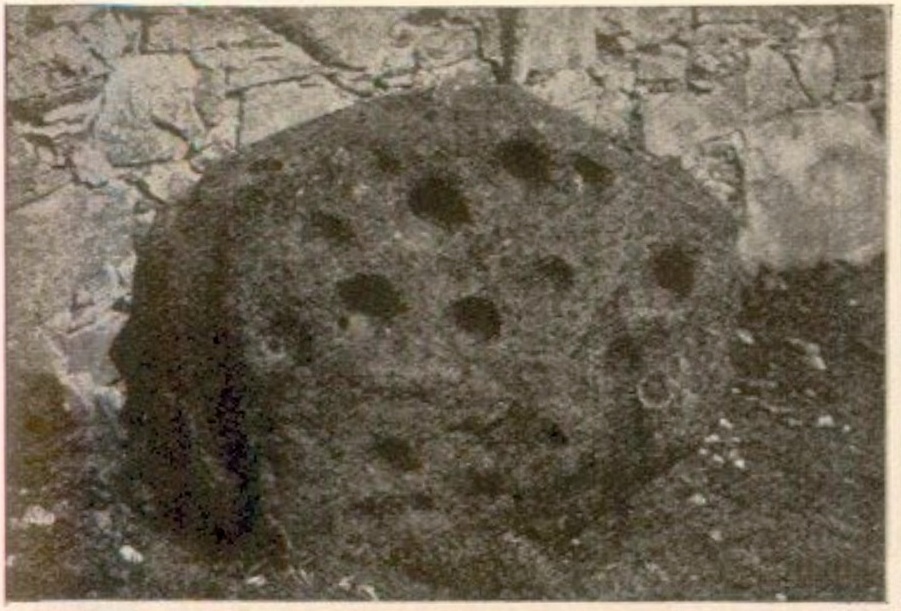
Located some 30 yards south of a holy well known (in English language) as the Sunday Well, this carving was rediscovered shortly before John Dixon (1922) wrote his survey of petroglyphs in the Strathtay region. It would seem to have been a large “portable” cup-marked stone that had been placed, face-downward, into an old doorstep at the stable at Easter Tobairandonaich and forgotten about, long long ago. Then, at the beginning of the 20th century when the people living here had to clear a drain beneath the stable, the stone was moved and the cup-markings were noticed. The carving was a pretty simplistic design, as you can see, which was described by Mr Dixon as follows:
“The stone…has nineteen cups all on the same face. The largest cup is 3¾ inches in diameter and 2 inches deep. The next largest has the same diameter, but is 1½ inch deep. Other five of the cups are very nearly the same size. The smallest cup is 1¾ inch in diameter and ½ inch deep, but weathering has effected much towards almost obliterating some of the smaller cups. The stone is of whinstone with slight veins of quartz. It is oval in form and varies in thickness from 2½ inches to 4 inches. Its greatest diameter is 3 feet 2 inches, and its least diameter 2 feet 8 inches.”
Tom MacLaren’s 1921 sketch
The stone would seem to have disappeared as no one has seen it for fifty years or more. It may (hopefully) be in one of the walls, or perhaps buried somewhere under the soil. Or maybe, tragically, some fuckwit has destroyed it. Twouldst be good to find out one way or the other. The photograph above, taken by Mr Dixon sometime around 1920, is the only thing that remains of the carving.
In this small part of Strathtay we are fortunate in finding a cluster of petroglyphs with folklore about them relating to our faerie and witch folk. Some larger man-made stone “bowls” in the area were also used as “praying stones.” I have little doubt that the people who originally used this carving as a doorstep were fully aware of the cup-marks—and I’d suggest that they even put it here on purpose, probably as a form of protection from the fairies who might have stolen or caused sickness to the horses.
References:
Dixon, John H., “Cup-Marked Stones in Strathtay, Perthshire,” in Proceedings Society Antiquaries, Scotland, volume 56, 1922.
Kennedy, James, Folklore and Reminiscences of Strathtay and Grandtully, Munro Press: Perth 1927.
Yellowlees, Walter, Cupmarked Stones in Strathtay, Scotland Magazine: Edinburgh 2004.
Cup-Marked Stone (missing): OS Grid Reference – SE 1687 3868
Archaeology & History
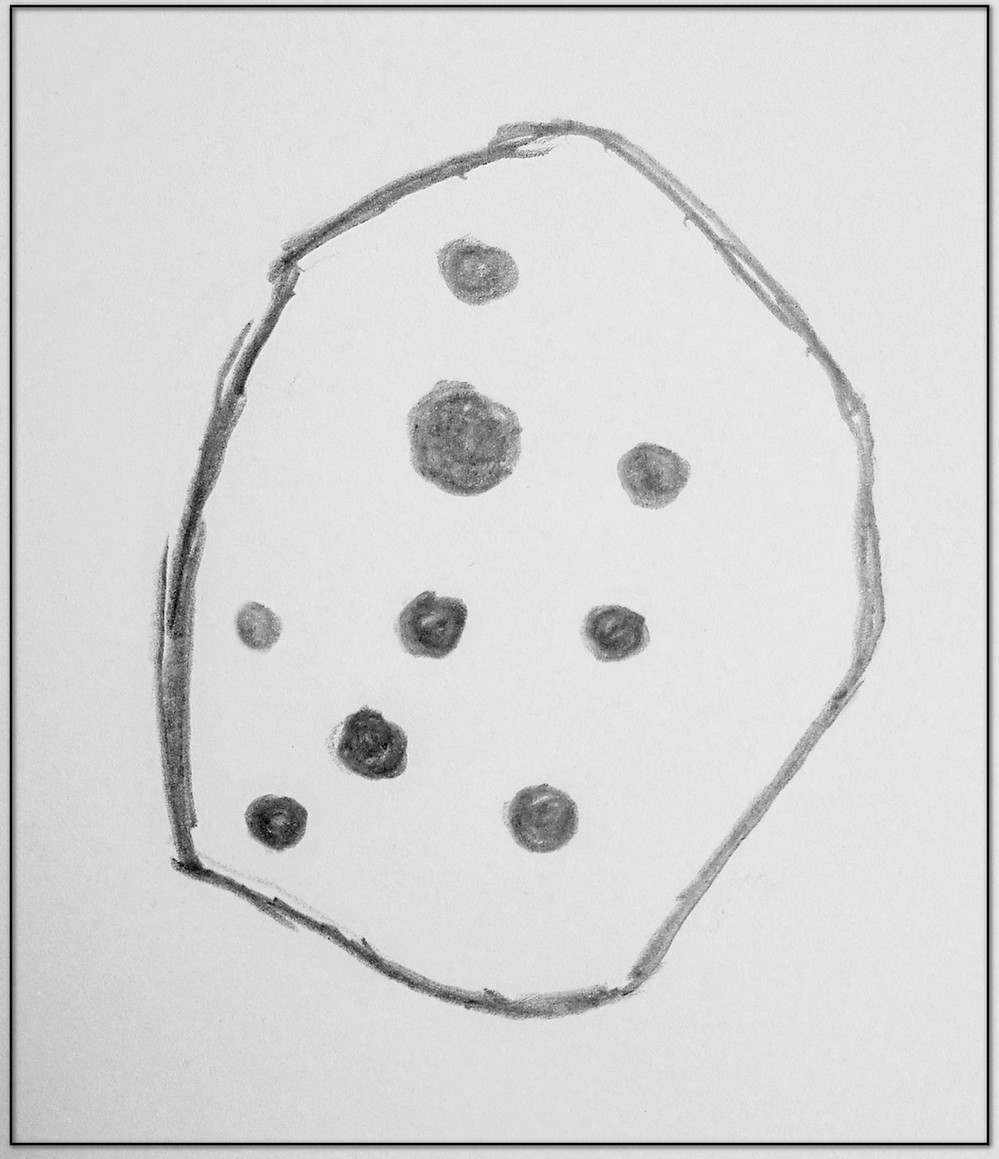
Sketch of the missing cup-marked stone
This carving was originally located somewhere close to the old disused Brackenhall Mills on the edge of Thackley, just before you drop down to Thackley tunnel. It was uprooted sometime in the 1950s and taken several miles away to the Cartwright Hall Museum at Manningham, Bradford, where it sat outdoors behind some fencing for many a-year, accompanied by the large fossil of an ancient tree.
I first saw it there when I lived close by in 1981, in the days before I had such a thing as a camera. Hence I only have this scruffy old sketch of the design, which I did without adding any notes to help remind me which carving it was! So this sketch has sat, all-but-forgotten, on a scrap of paper since then, until I recently sussed out which carving it was!
The stone itself was akin to a very large portable rock, with a simplistic design consisting of at least nine cup-marks cut into one of the rounded faces. One account of the stone suggested there may have been a possible incomplete ring around one of the cups. When I went back to see the stone about 20 years ago, it had gone. So I called into the adjacent museum to inquire what had become of it. The curator (or whoever it was) that I spoke with told me that the stone had been put into a box and placed in the cellars, but refused to let me see it. I asked to make an appointment to see the stone and he refused that too. It has not been seen since. Does anyone know what’s become of it?
References:
Keighley, J.J., “The Prehistoric Period,” in Faull & Moorhouse’s, West Yorkshire: An Archaeological Survey to AD 1500 (WYMCC: Wakefield 1981).
Take the A59 road from Harrogate and Skipton and at the very top of the moors near the Gill Head Enclosures, take the small Kex Ghyll road up past the disused quarry works north for a mile or so. At the junction go left for about 1½ miles where, on your left, is Burnt House farm. A hundred yards past here is a small spot to park on the right-hand side of the road, opposite the gate to Rocking Hall House (make sure you leave enough room for tractors to pass you!). Across the road is the track to Rocking Hall and, 2 miles along the track, look out for the copse of trees ½-mile NE. Head towards it and, as you get close to the wall, walk slowly downhill towards the stream where a single block of stone lives. You’ll find it!
Archaeology & History
Design from above
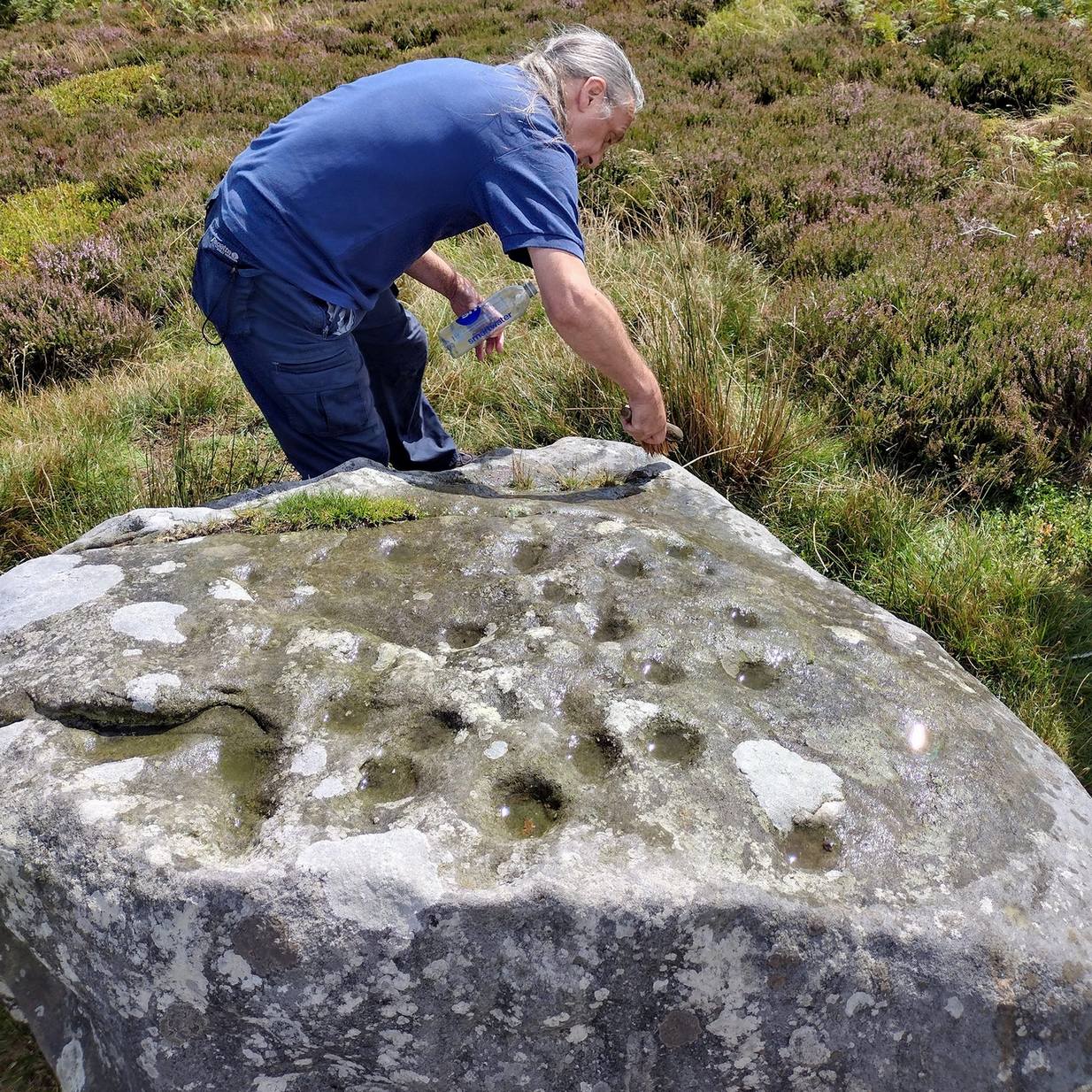
Rediscovered on Rocking Moor by Rod Chambers on August 15, 2023, this reasonably large sloping block of stone has between 21 and 24 cups cut quite deeply and scattered erratically into it, very similar to one some 200 yards to the northwest (Raven Stones carving 559). It seems pretty obvious that some of these cups were Nature’s handiwork, but have been modified by human hands. There’s nothing complex about it, but there may be a semi-circular arc around one of the cups, centre-left of the natural crack that cuts across the top of the stone, but this is very faint and could be just a trick of the eyes. Going there at sunrise and wetting the stone might tell us for sure.
Acknowledgements: Big thanks to Rod Chambers for use of his photo in this site profile.
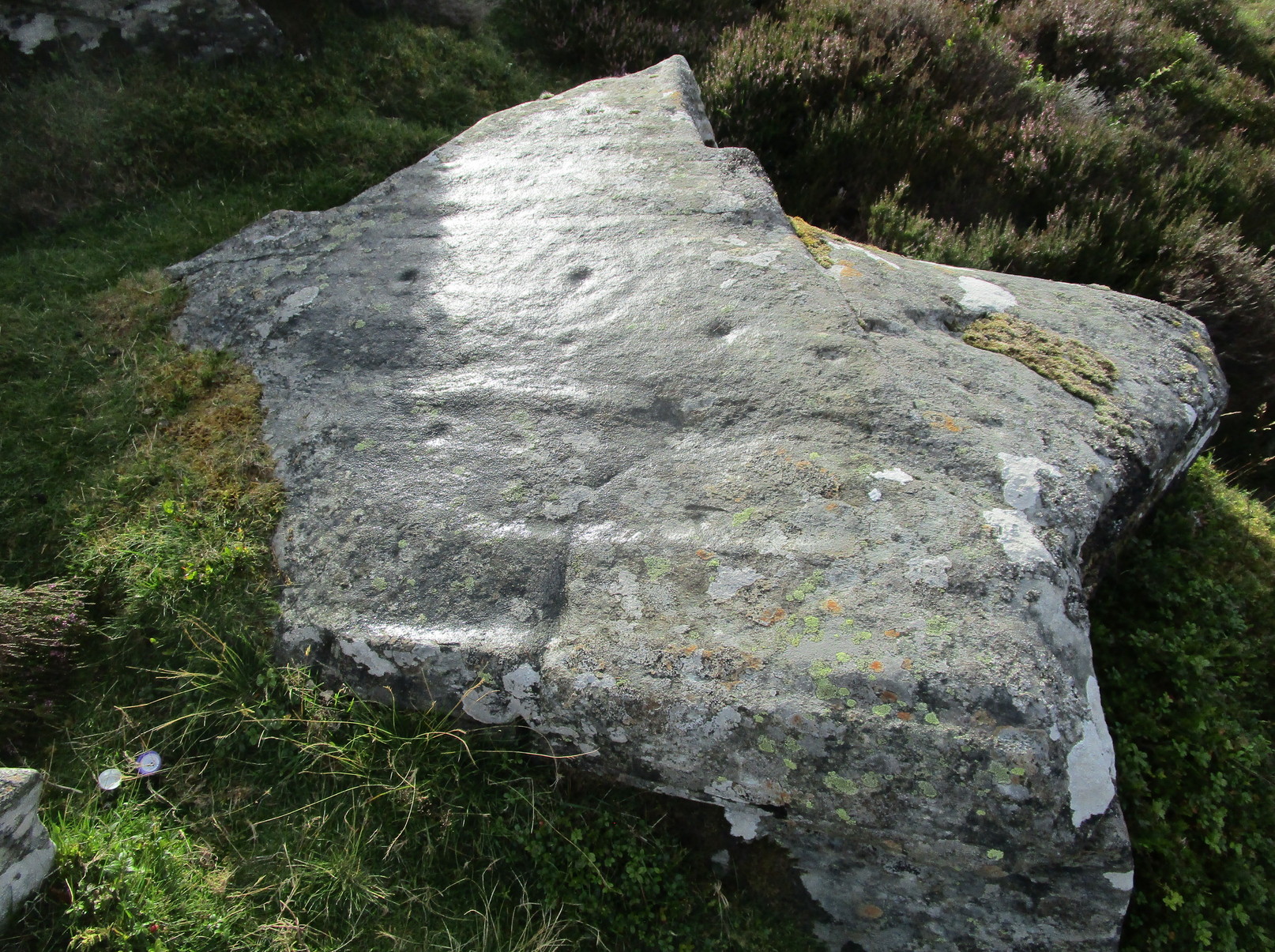
From Kenmore go east up the steep mountain road towards Glen Quaich, or if you’re coming from Amulree, go west along the same glen. After 2½ miles (4km) up the Kenmore route (nearly 9 miles on the Amulree route) you’ll reach a small lochan on your left (you’ve got a very small parking spot a coupla hundred yards before the loch). A gate and stile past the loch takes you east along a track into the moors. More than a mile on, the track splits, but you need to keep to the left and follow the track along the wall-side for another 400 yards or so, where you’ll see a small crag of rocks 100 yards down the slope on your right. Once here, the deformed triangle-shaped stone to the left-side of the cluster is the one you’re looking for.
Archaeology & History
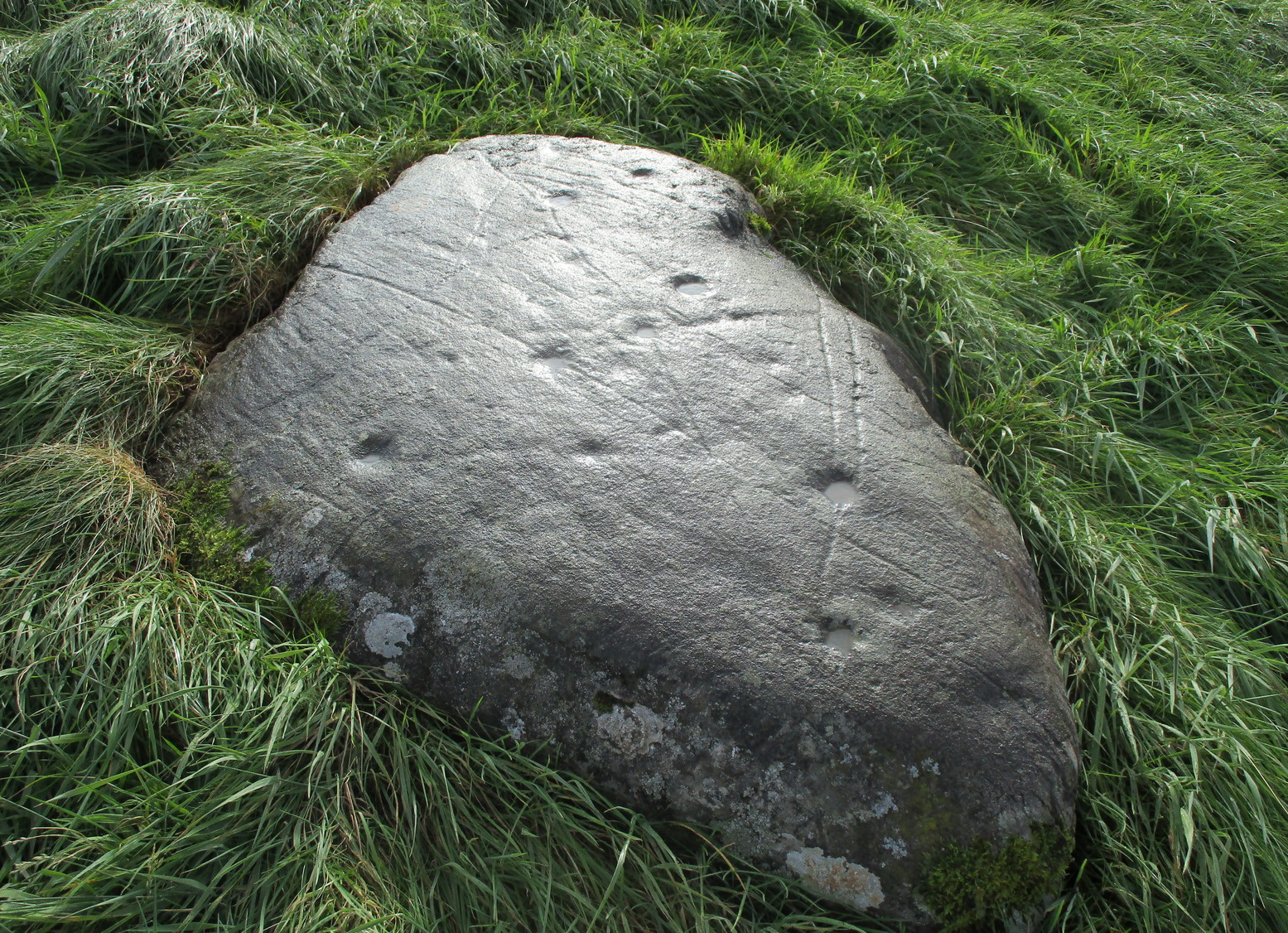
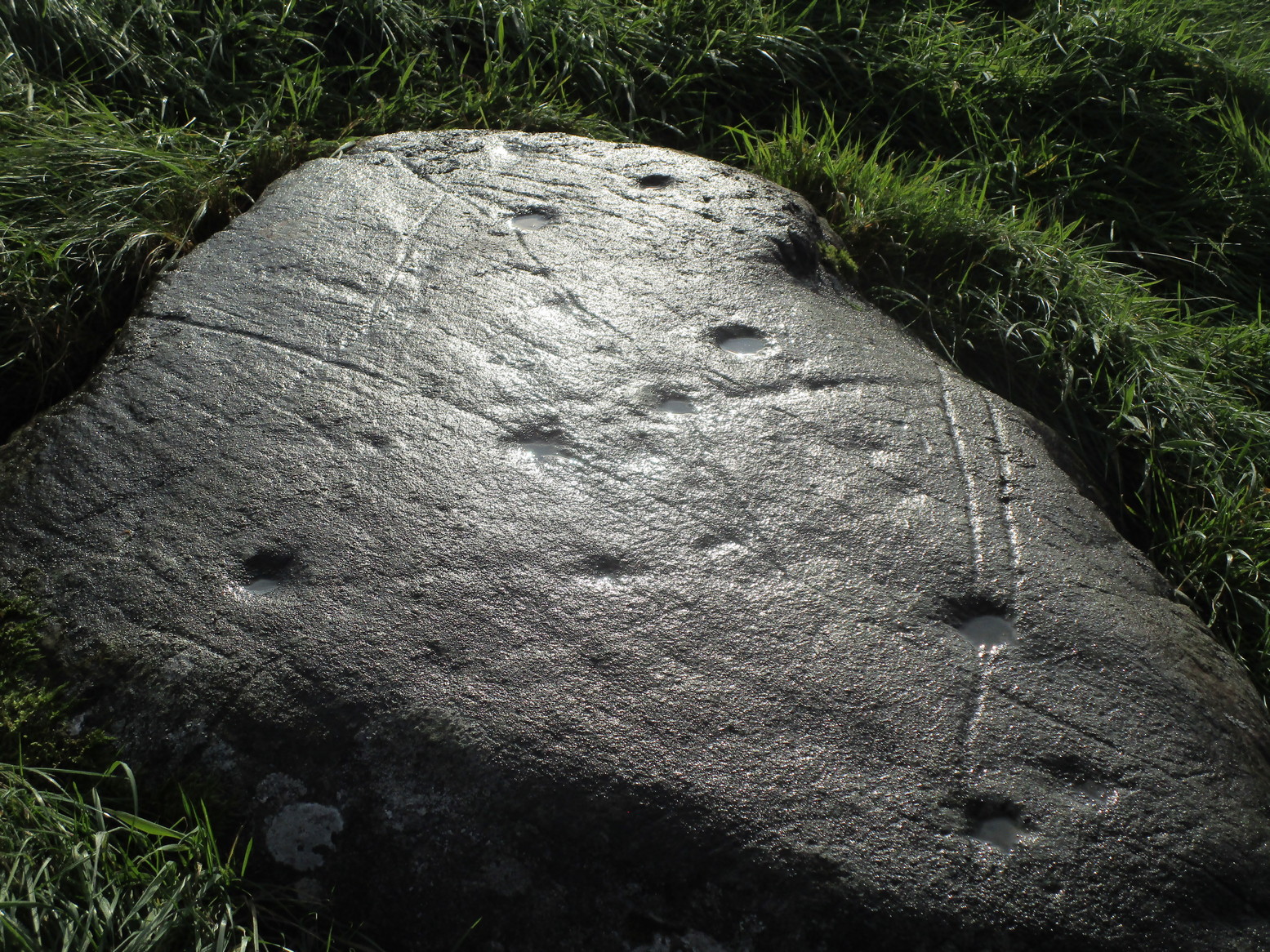
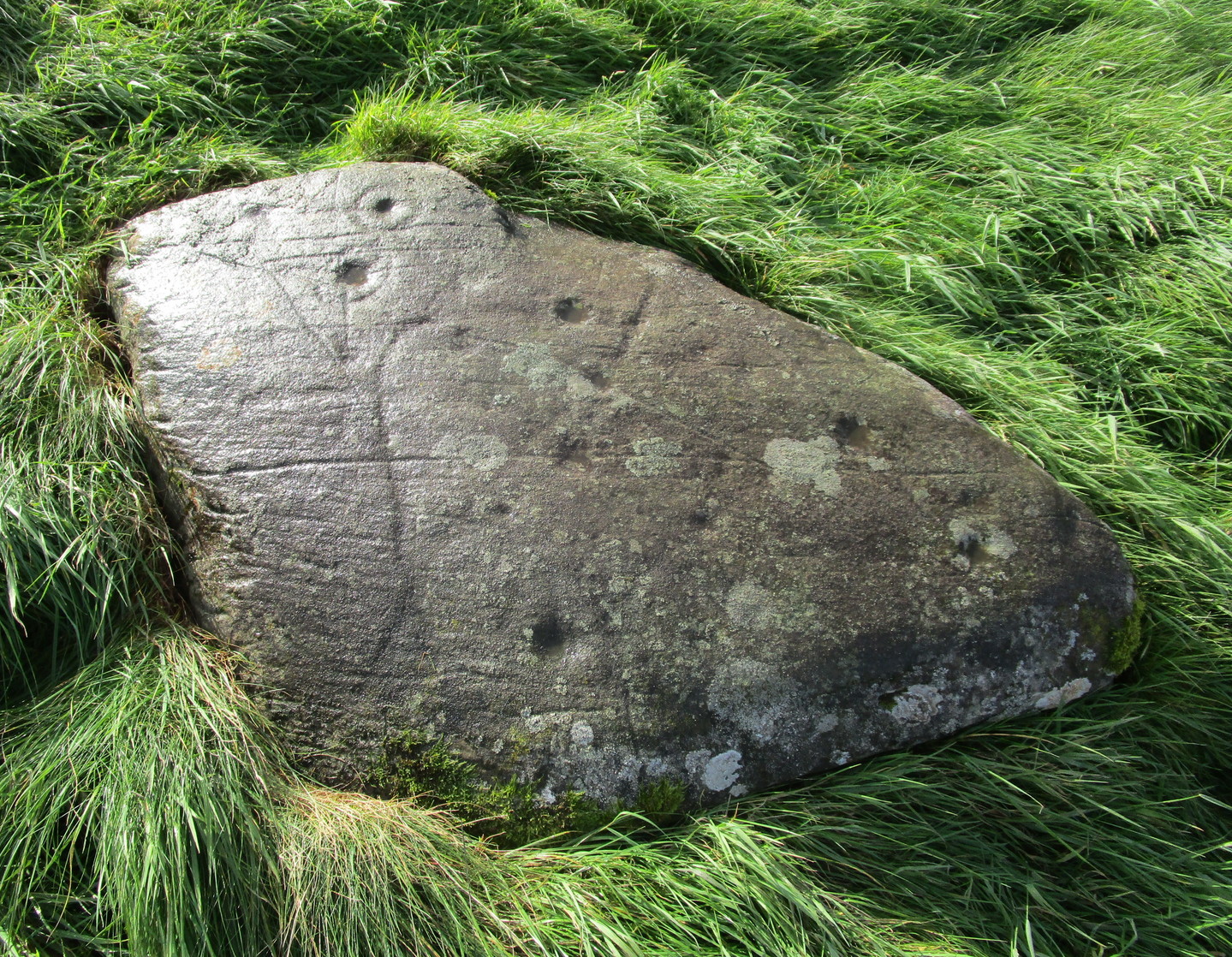
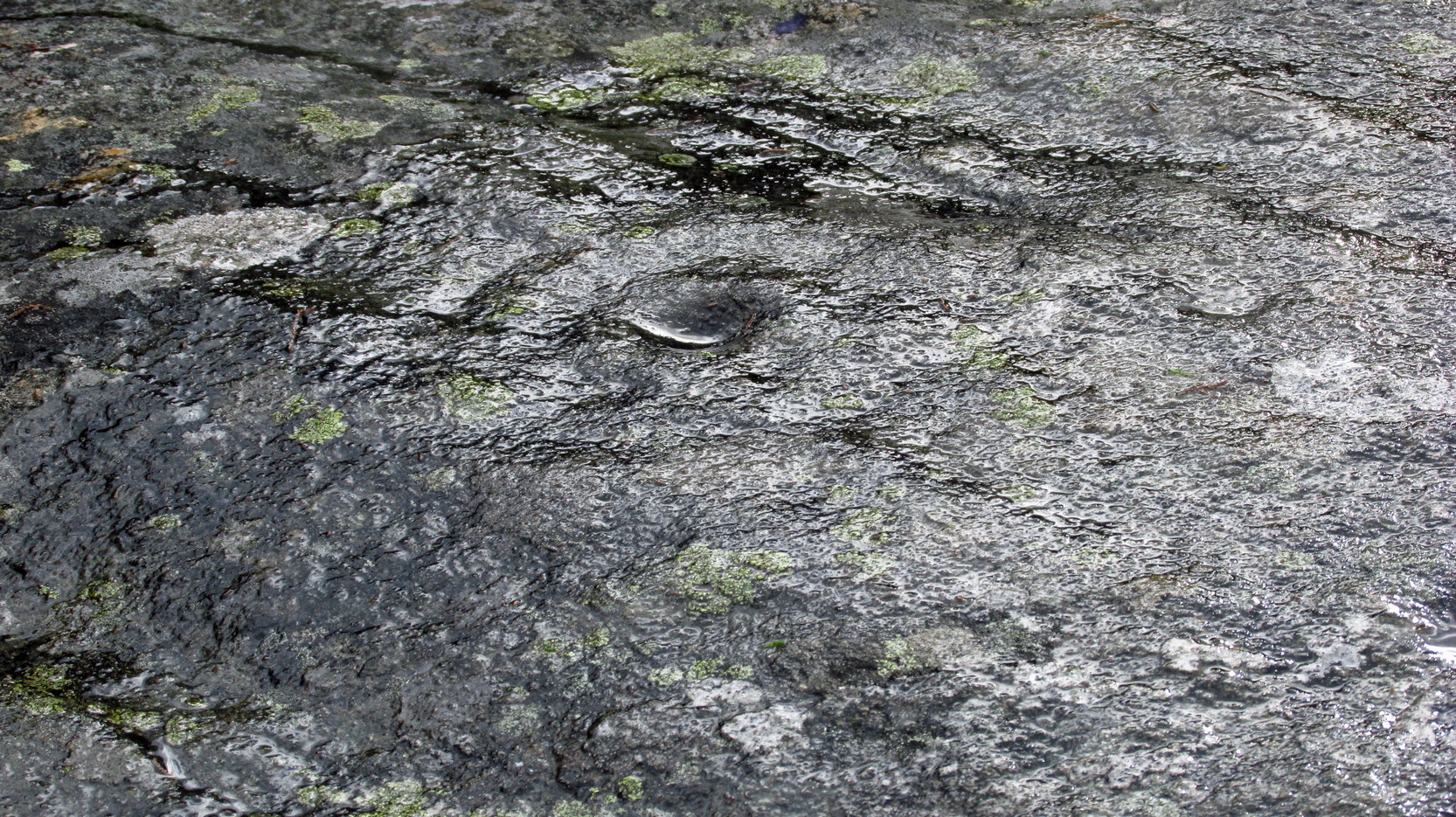
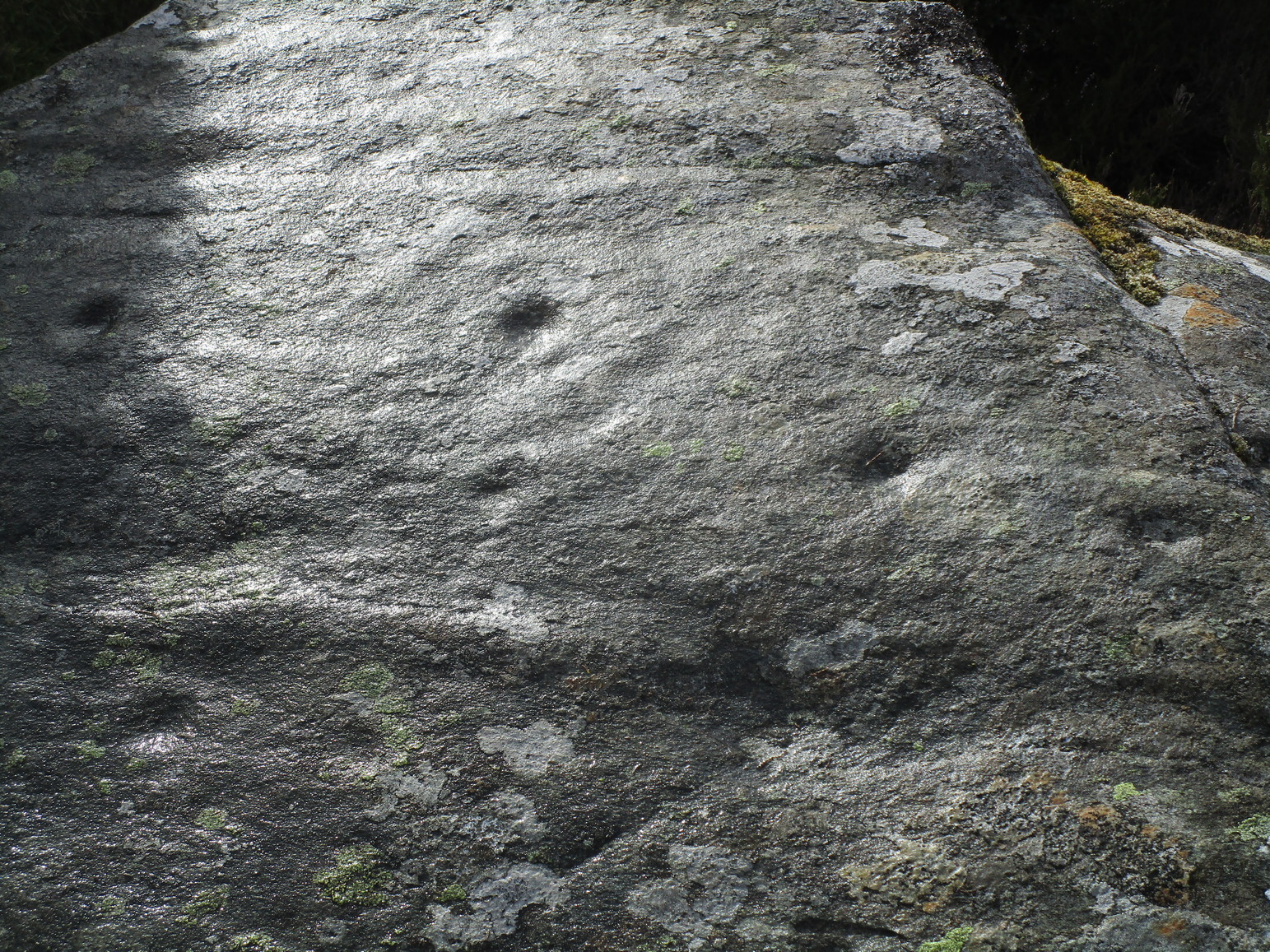
About four yards west of the Craig Hill cluster (3) carving, this gently smooth sloping rock was initially noted to have between six and seven cup-marks on it. Under the grey skies it was difficult to see any of this clearly, and so we wet the surface when Nature gave us some short bursts of light through the clouds which then enabled us to get a much better look at the design—but it’s still far from clear.
Curious eye motifCentral elements of carving
We found at least eight cups on here, two of which had single rings: the one near the top of the stone seems to be complete, whilst the other nearest the bottom of the stone looks to be incomplete. Another cup had a curious double ring; whilst the one nearest the middle of the stone has what may be three rings, with what could be a carved line running from its centre—but it’s very difficult to say with certainty until we’ve made another visit. I have little doubt that there’s more to this petroglyph than we could make out beneath the grey skies. On the west-side of the stone, the “curious” double-ring has, as its outer surround, an “eye” motif, or lozenge, which is also found on the Craig Hill cluster (3) stone a few steps away. The eye motif on both stones have the same levels of erosion and, I would suggest, were carved within a century or two of each other; perhaps even around the same time.
This one’s well worth checking out!
Acknowledgements: Huge thanks to Prof Paul Hornby for use of his photos in this site profile; and to Myrna Hurley for getting us up there. Cheers doods. 😉
“This irregularly-shaped small boulder was identified recently lying amongst post-medieval field clearance adjacent to a field corner and footpath… Its upper parts ar covered with 40-46 cupmarks. On the exposed irregular top they are badly worn and sometimes uncertainly identified. In one instance a cup is partly encircled by a worn ring, while a second partial ring nearby may be fortuituous. On a ledge near one edge of the boulder preservation is better and the cups are clearly defined and densely arranged.”