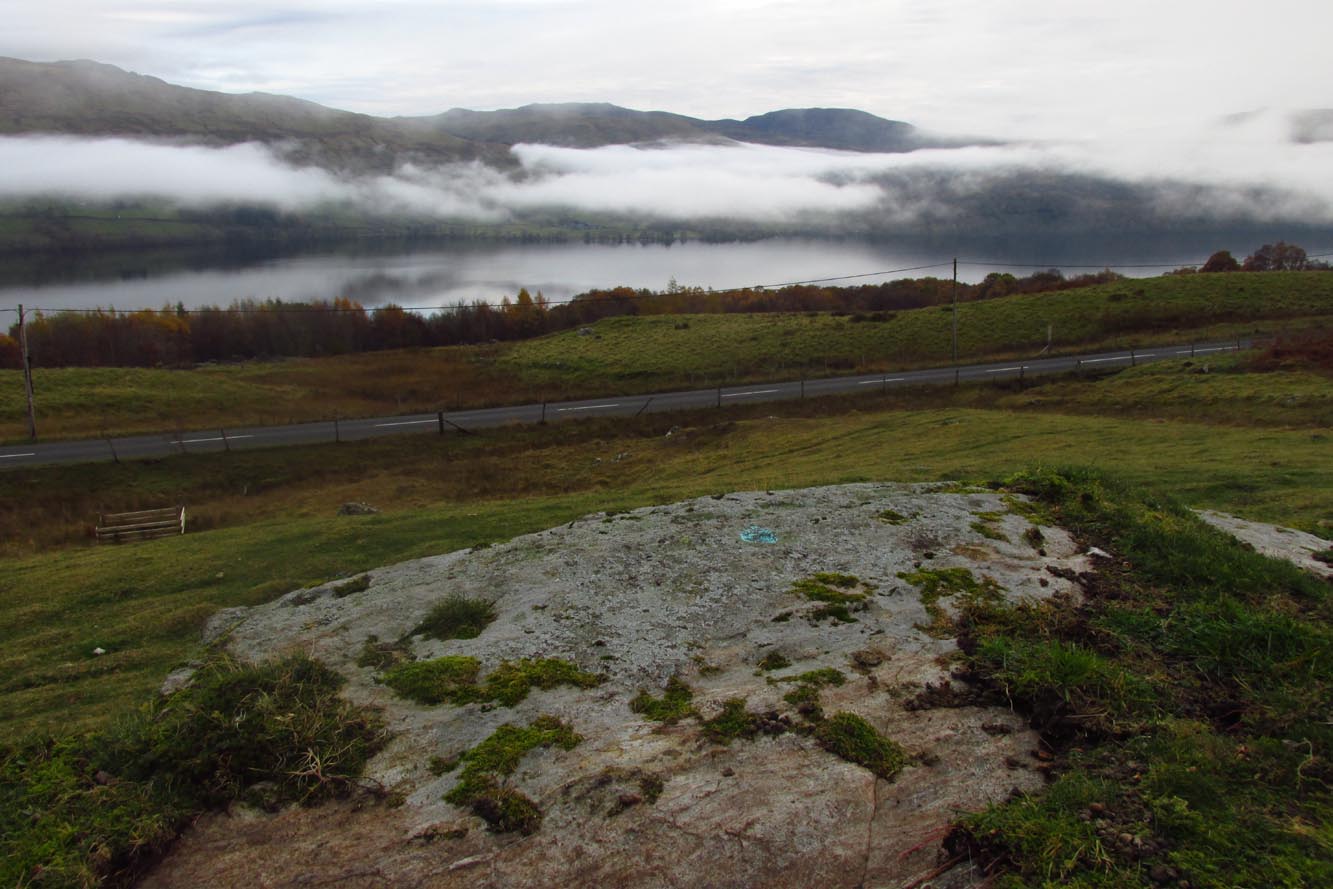
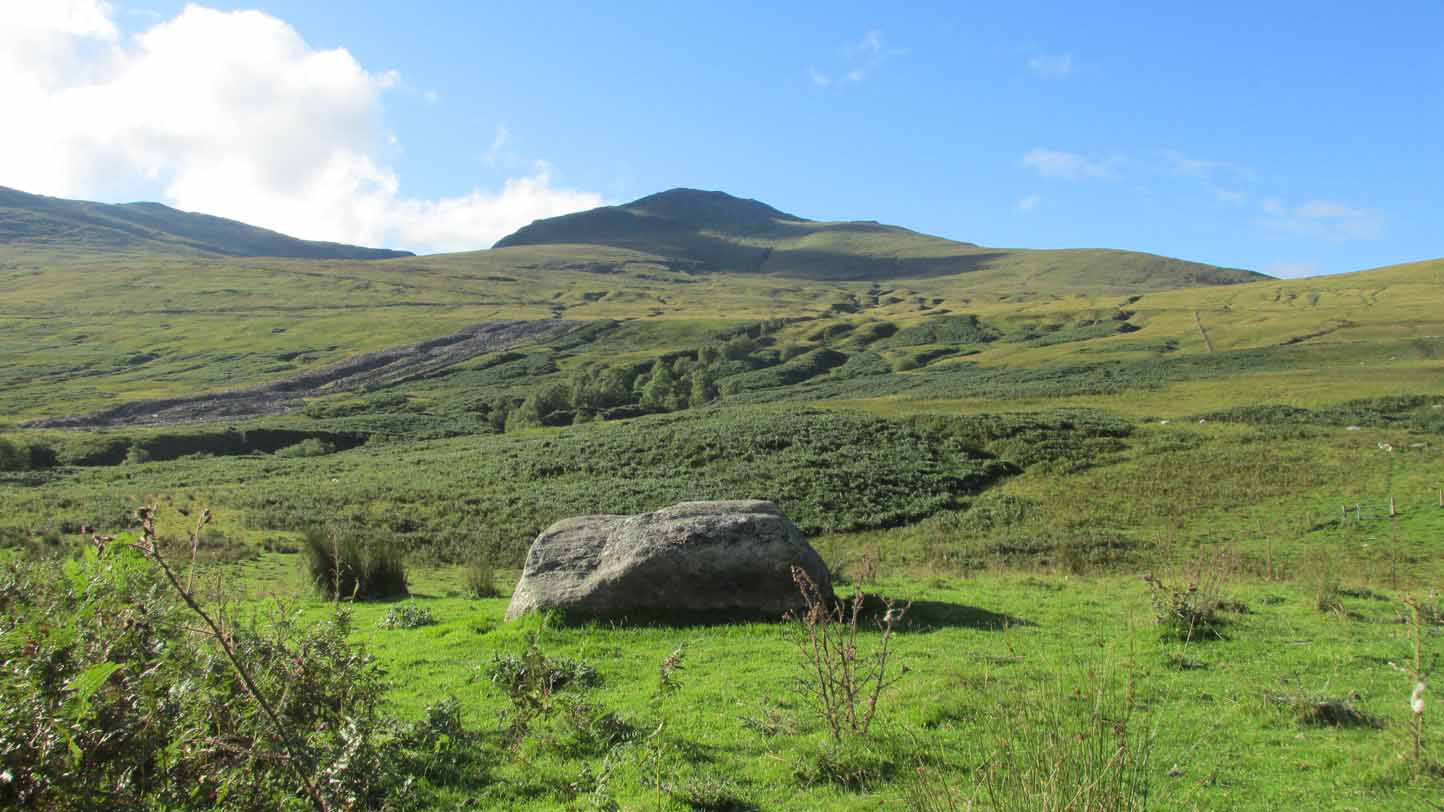
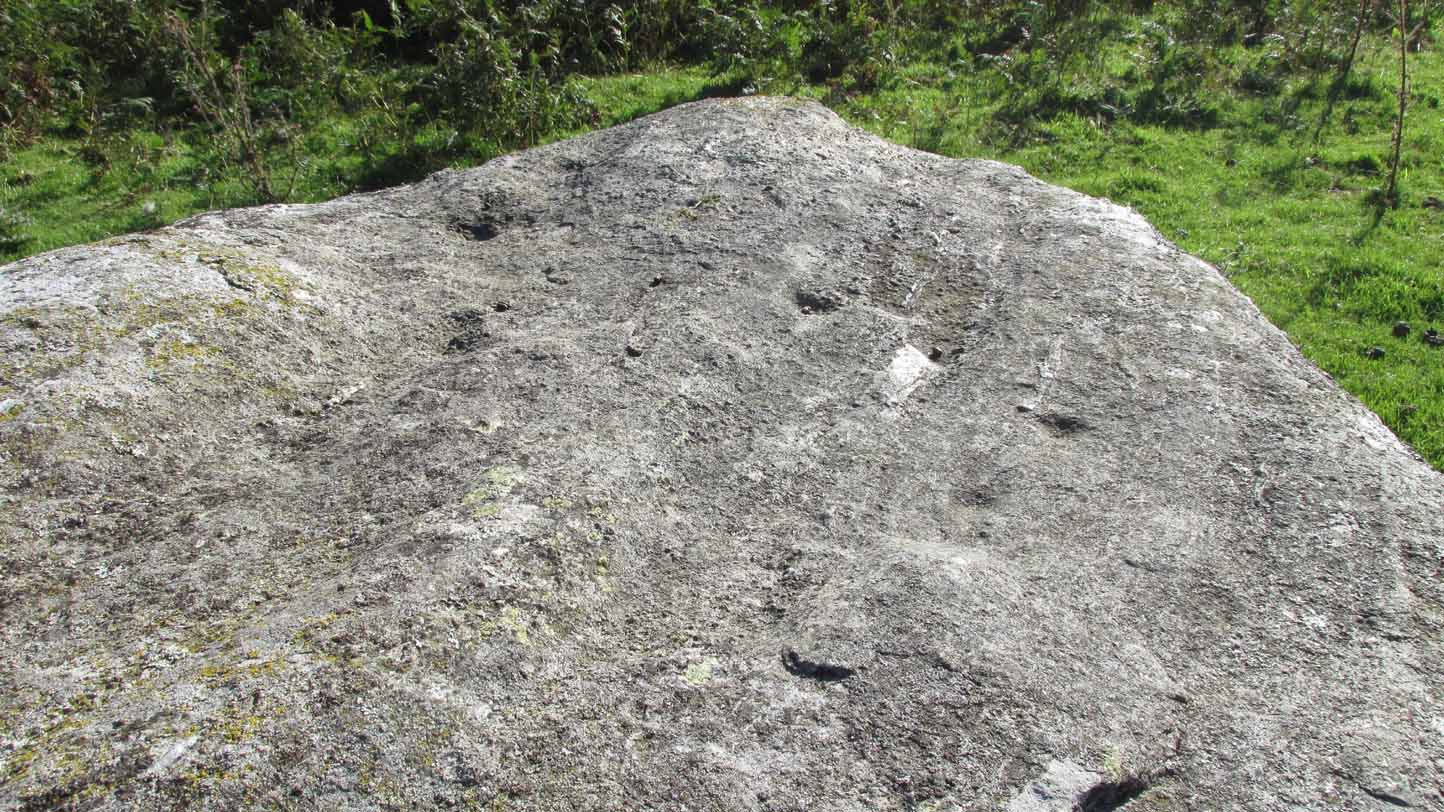
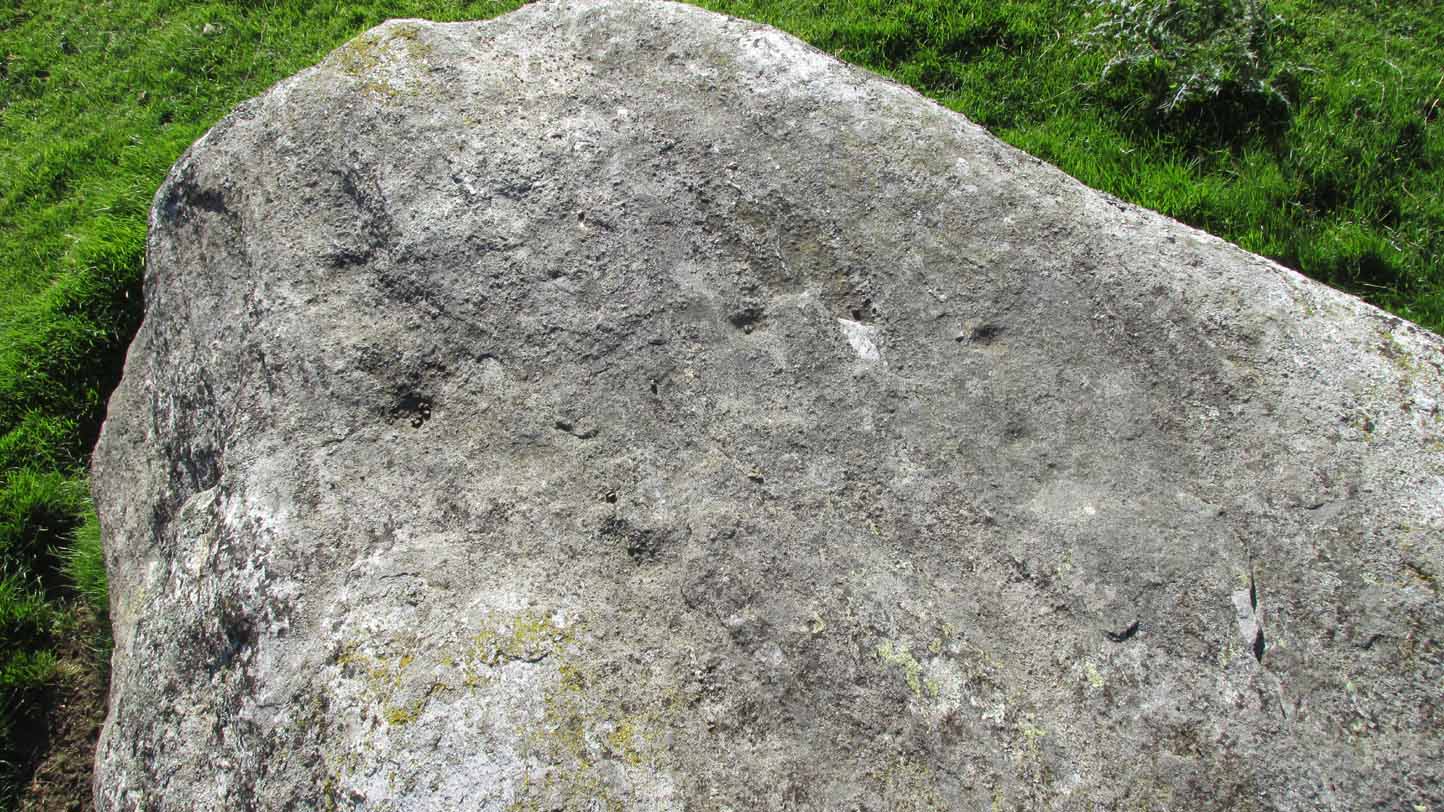
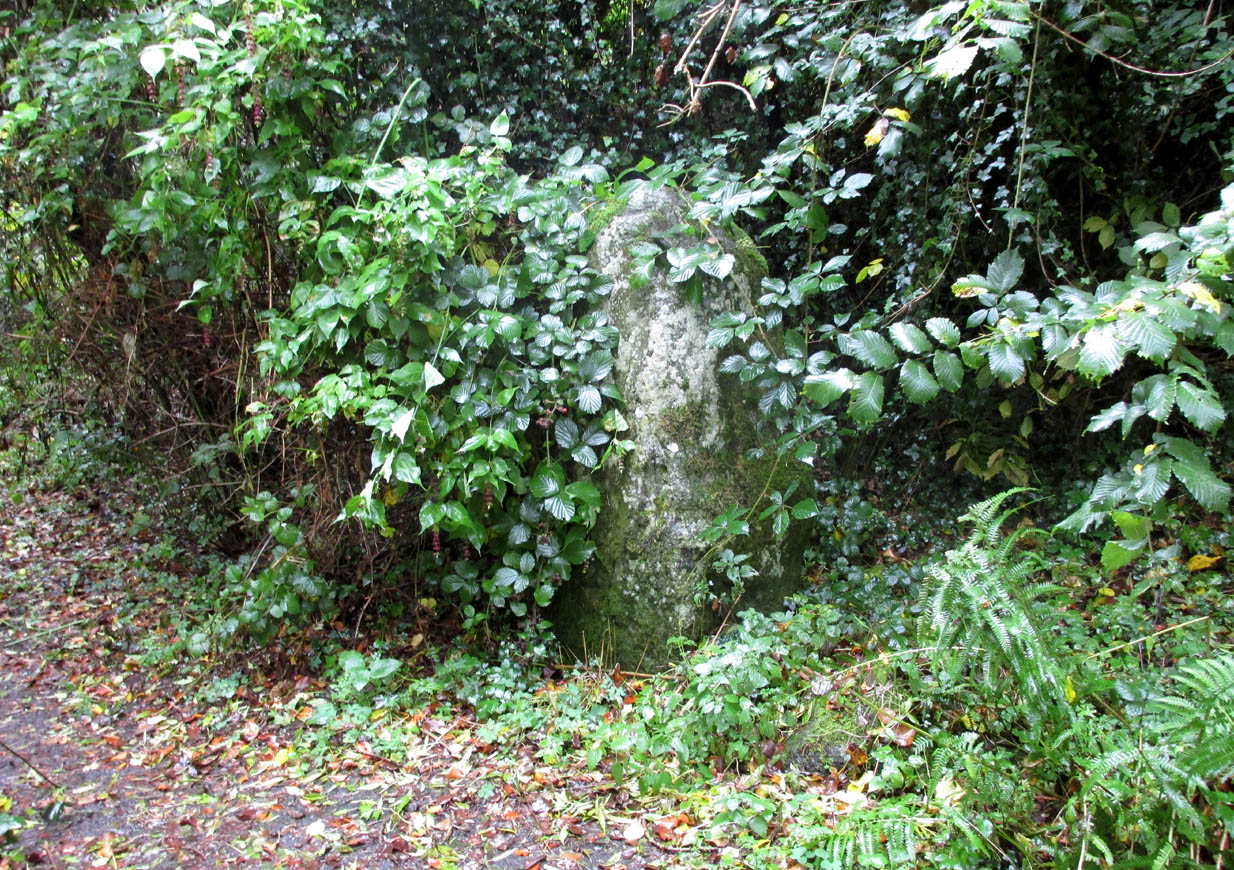
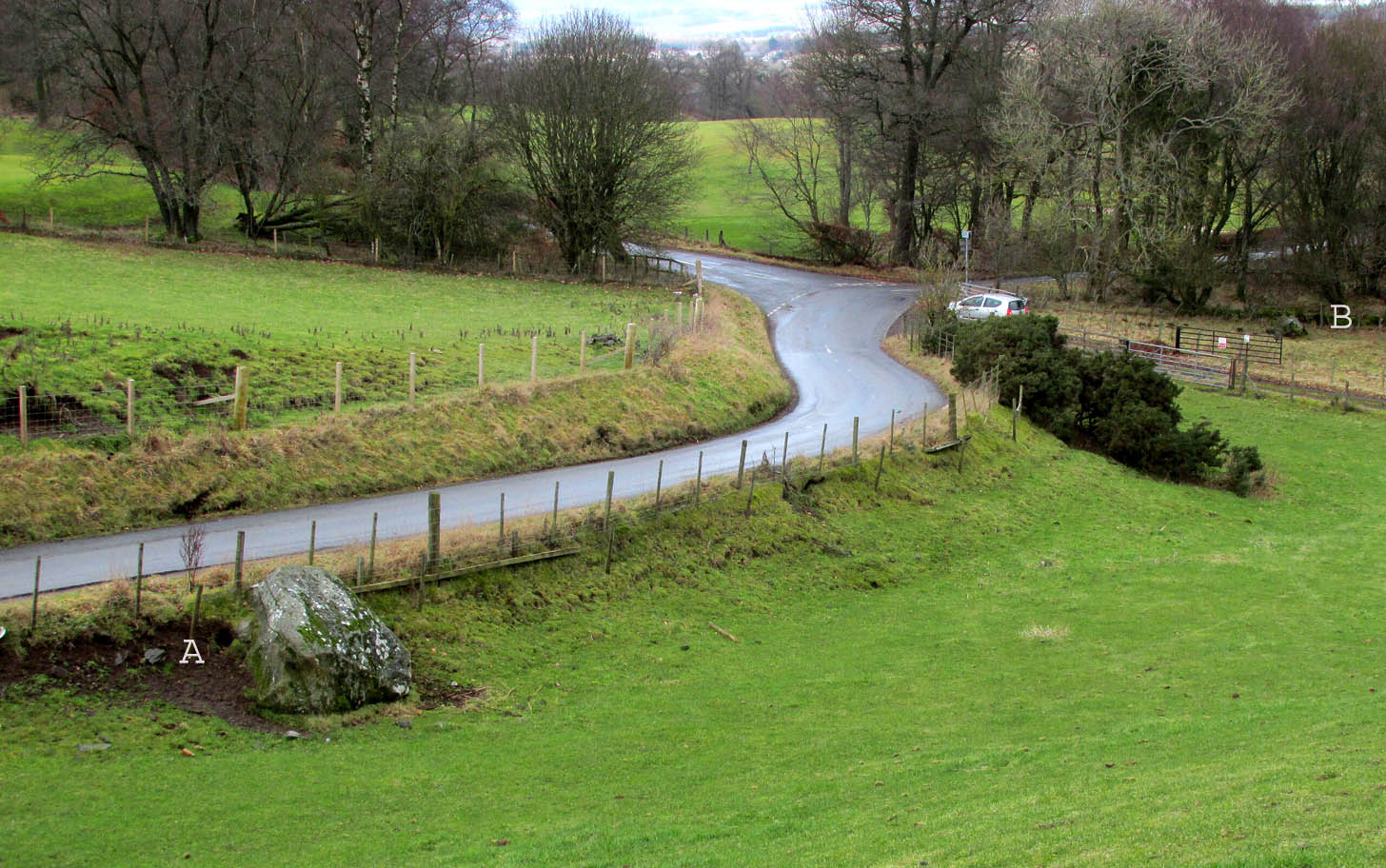
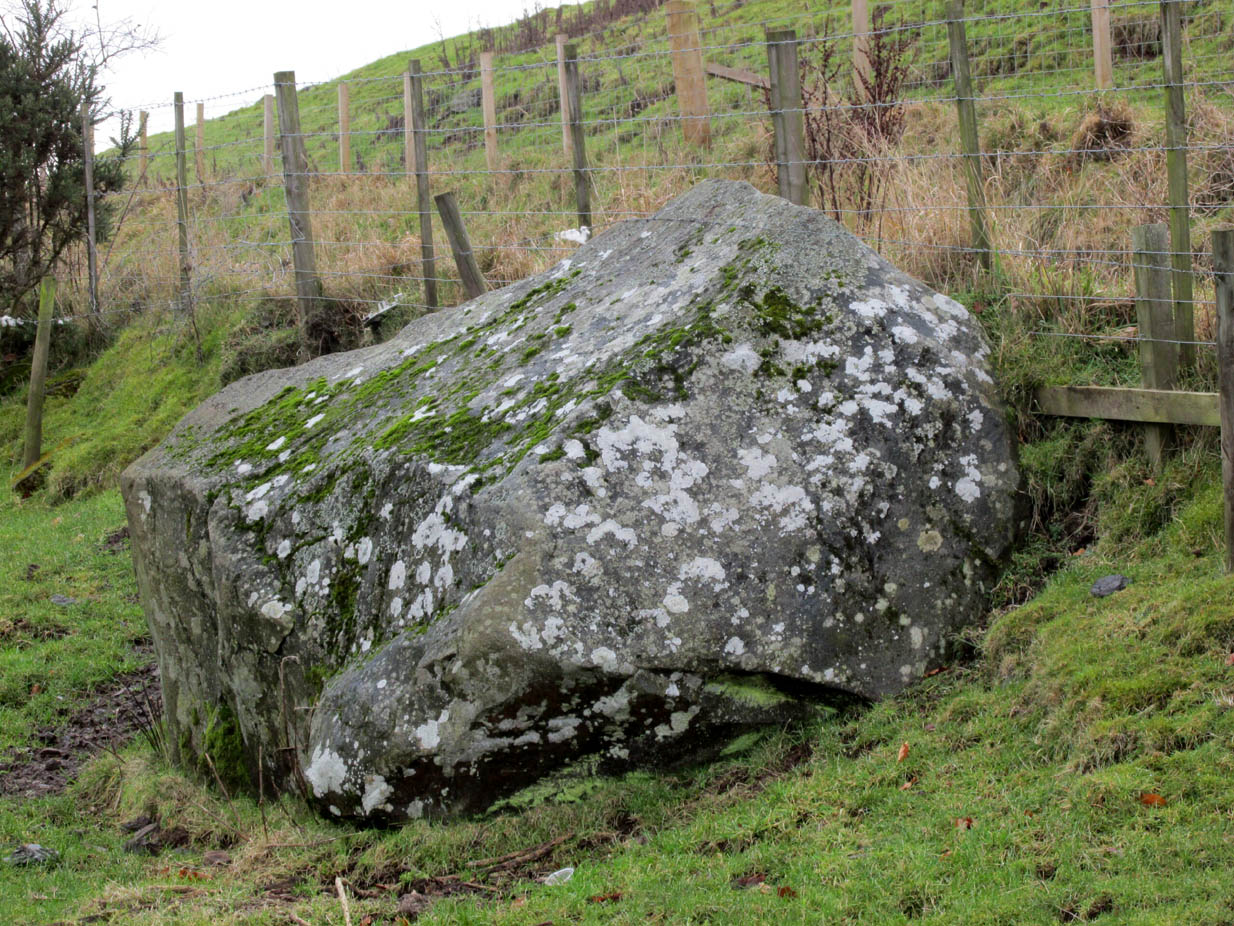
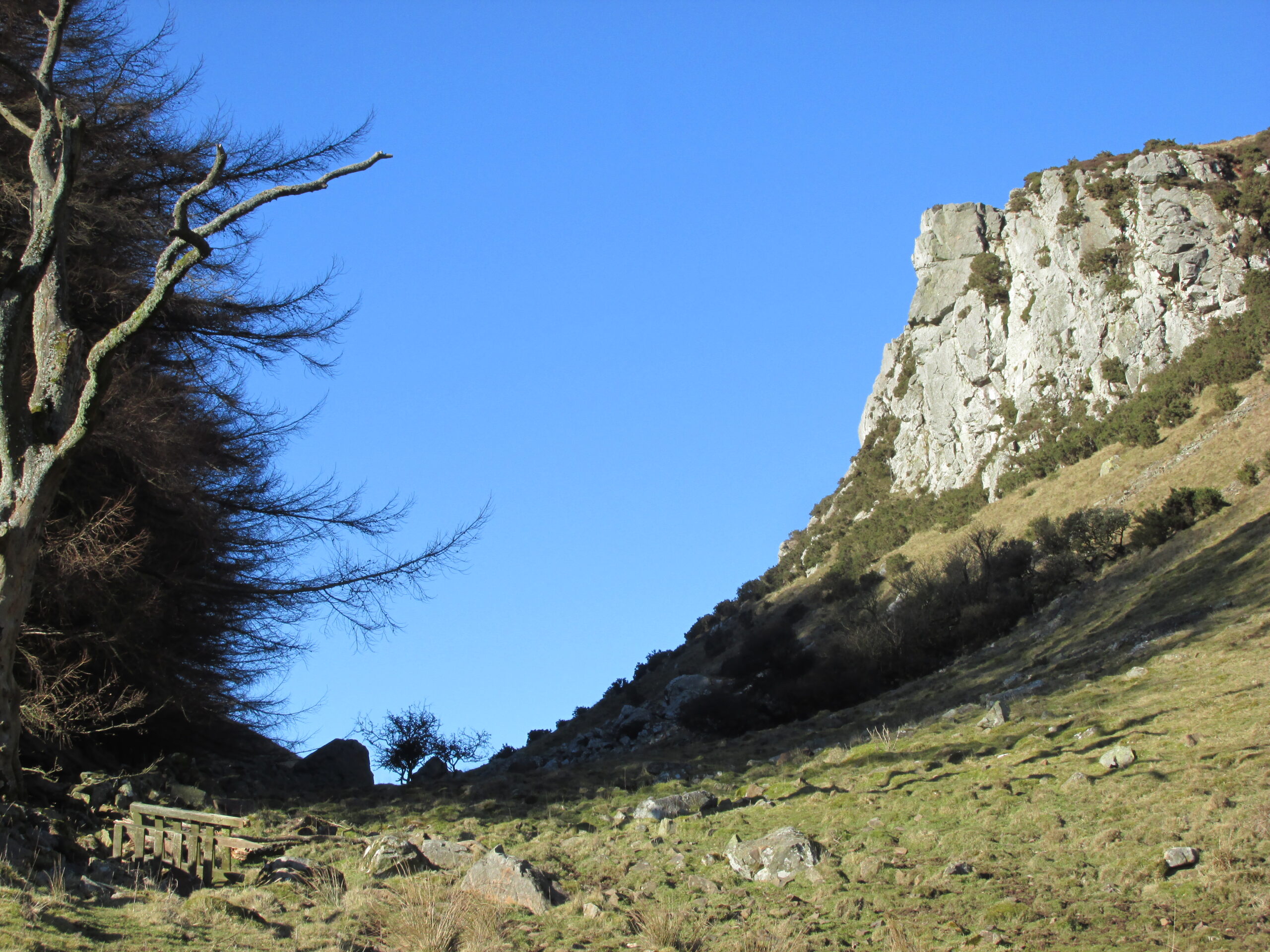
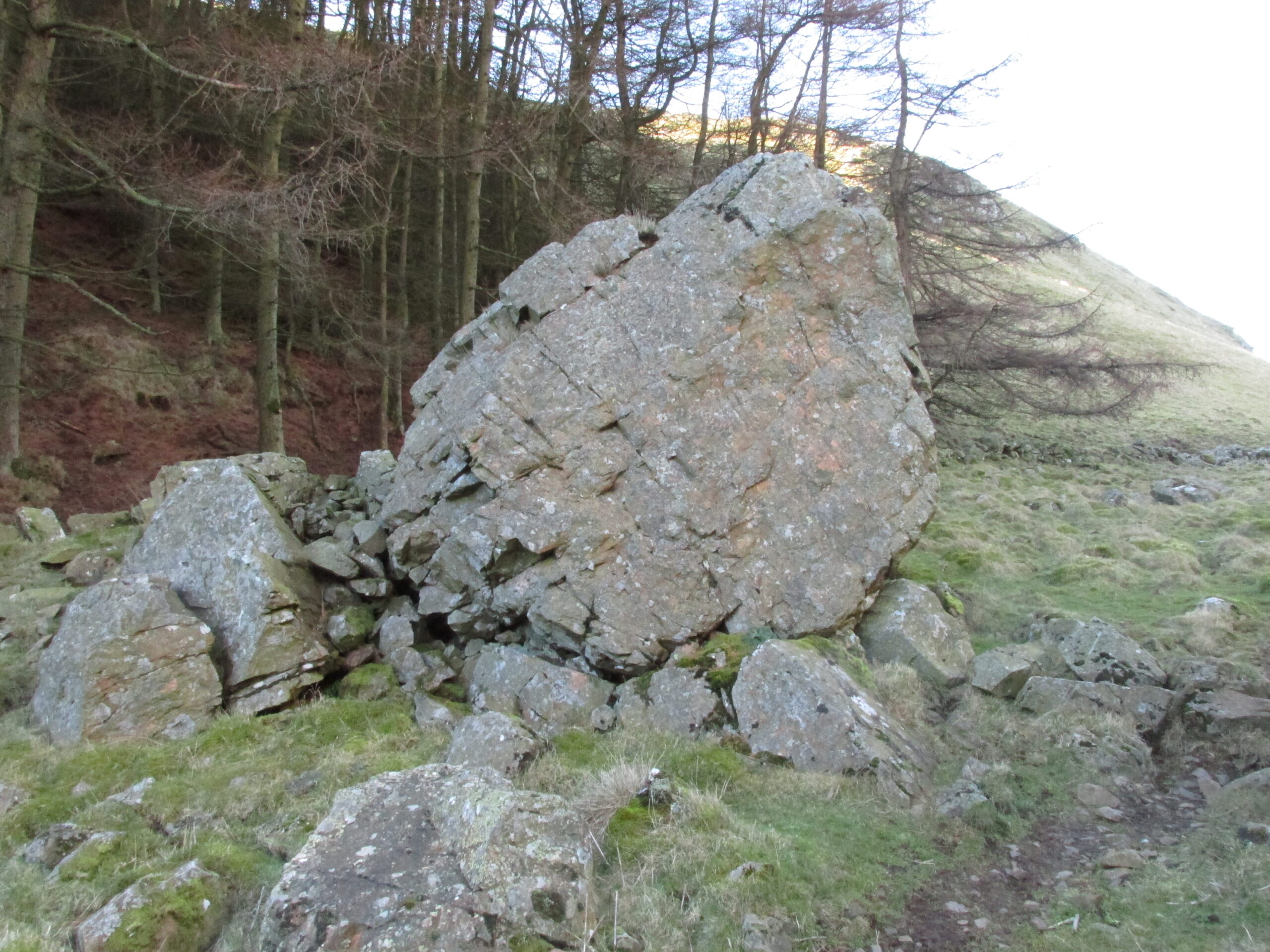
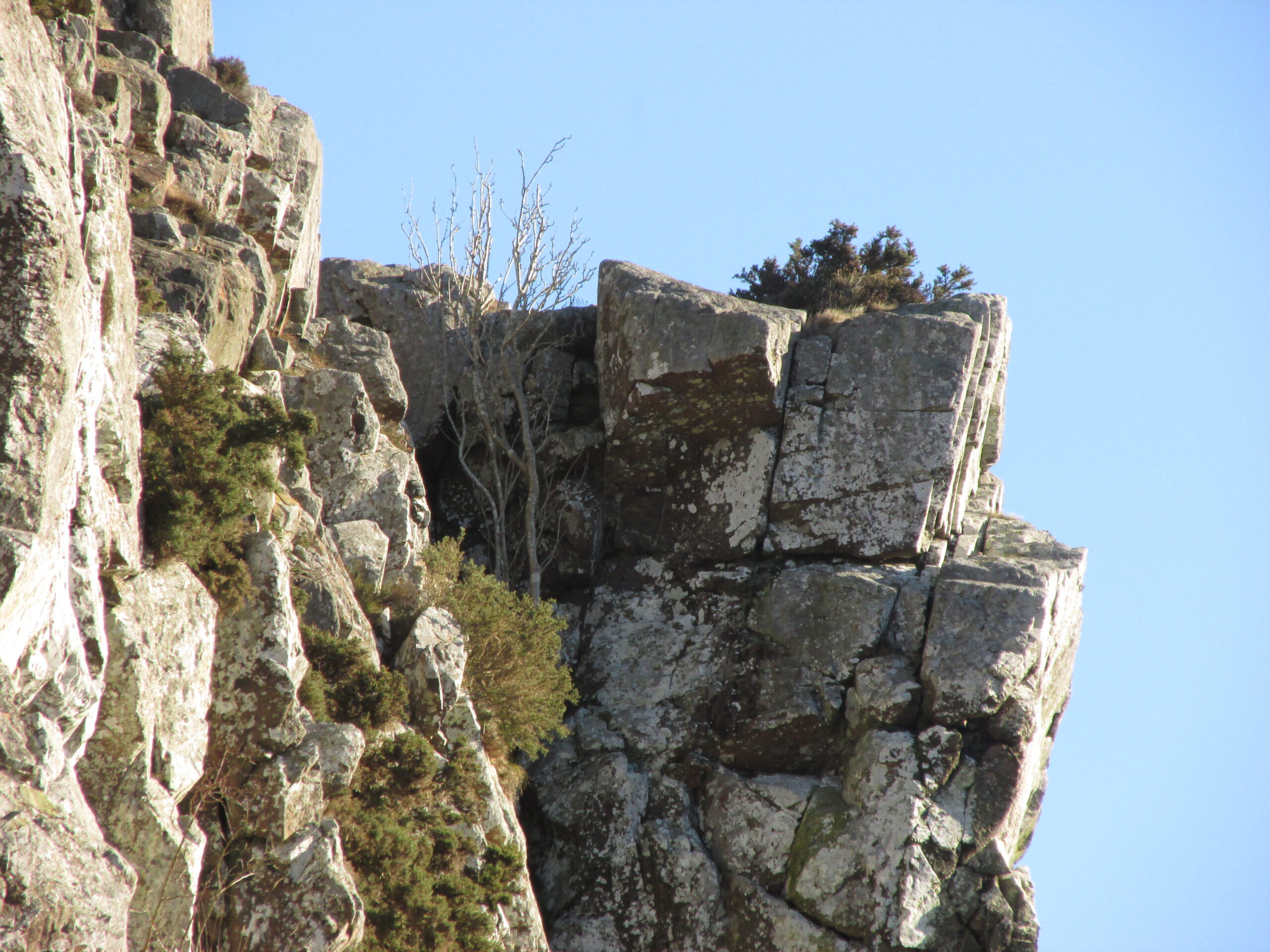
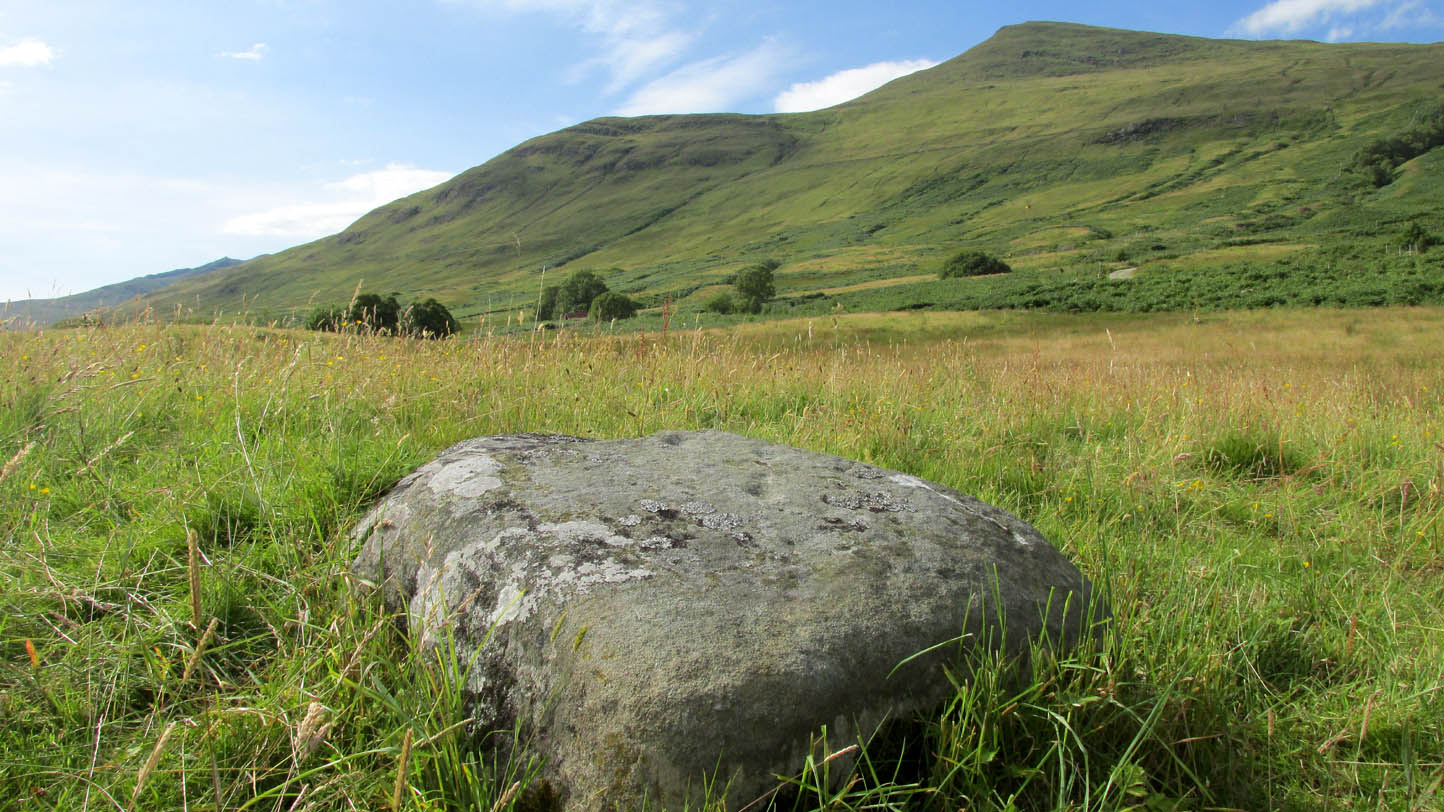
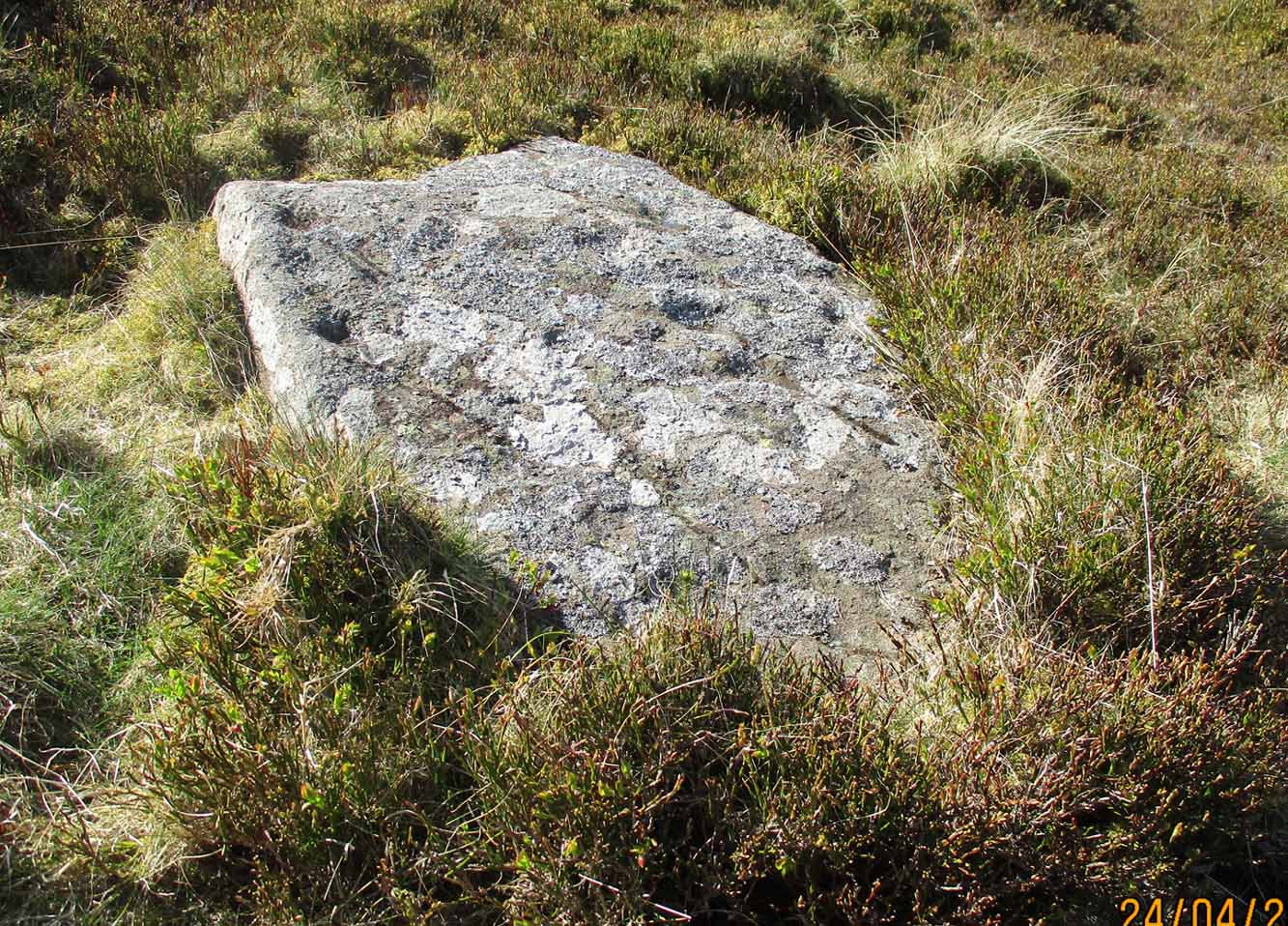
It’s a bittova pain-in-the-arse to reach this and its associated carvings, as there’s little place to park along here. The easiest is to park 600 yards east of Tombreck at the spot just by the small bridge at Craggantoul. Keep your eyes truly peeled! From here, walk along the road for ⅔-mile where you’ll hit a gate taking you onto the boggy hillside. Go diagonally up here for 150 yards where you’ll hit an overgrown track and small disused quarry. Some 50 yards along you’ll see a small rock outcrop on your left (as if you’re going back to the road). That’s the spot!
Archaeology & History
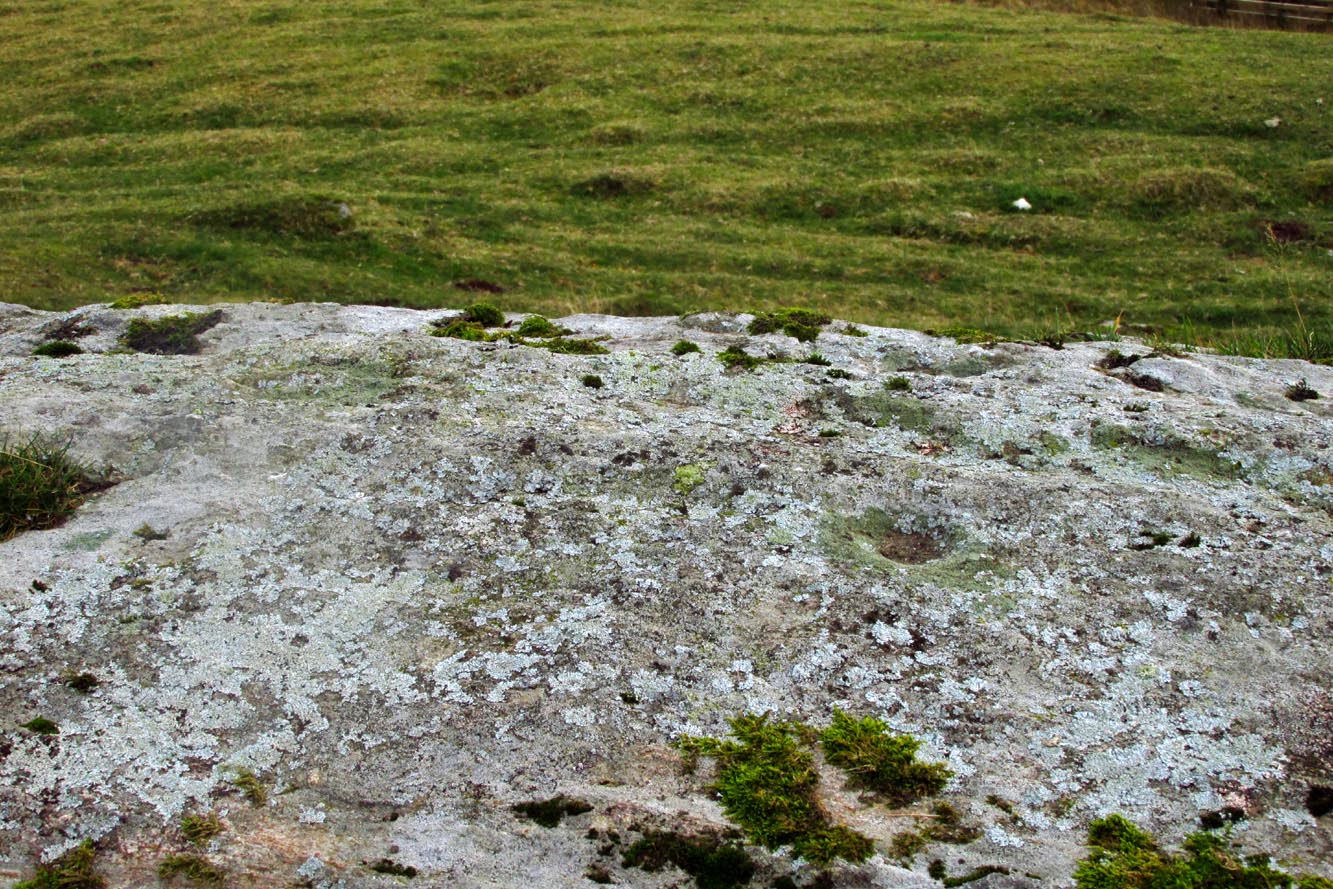
Close-up of cupmark
Not previously recorded, this simple petroglyph on a small rock outcrop—barely 50 yards above the A827 Killin-Kenmore road—comprises of one clear cup-mark prominently etched near the middle of the upper surface; and another possible cup on the left (eastern) section of the rock. Cragganester carvings 19 and 20 are respectively about 100 yards NE and NW of here but, like other carvings nearby, is only gonna be of interest to the fanatic nutters out there!
Take the road to Auchlyne from Killin which follows the north side of the River Dochart, and on the edge of the village the stone will be seen on the left hand side behind a hedge, opposite the entrance to ‘Springburn’.
Archaeology & History
The chair is mentioned in Rev. Gillies’ exemplary work, In Famed Breadalbane (1938):
‘St. Fillan would appear to have had a great liking for stone seats. Besides the one already mentioned…there is..a..flat stone on the top of a knoll about a mile to the west of the village, and on the north side of the river, on which he is said to have sat and taught‘
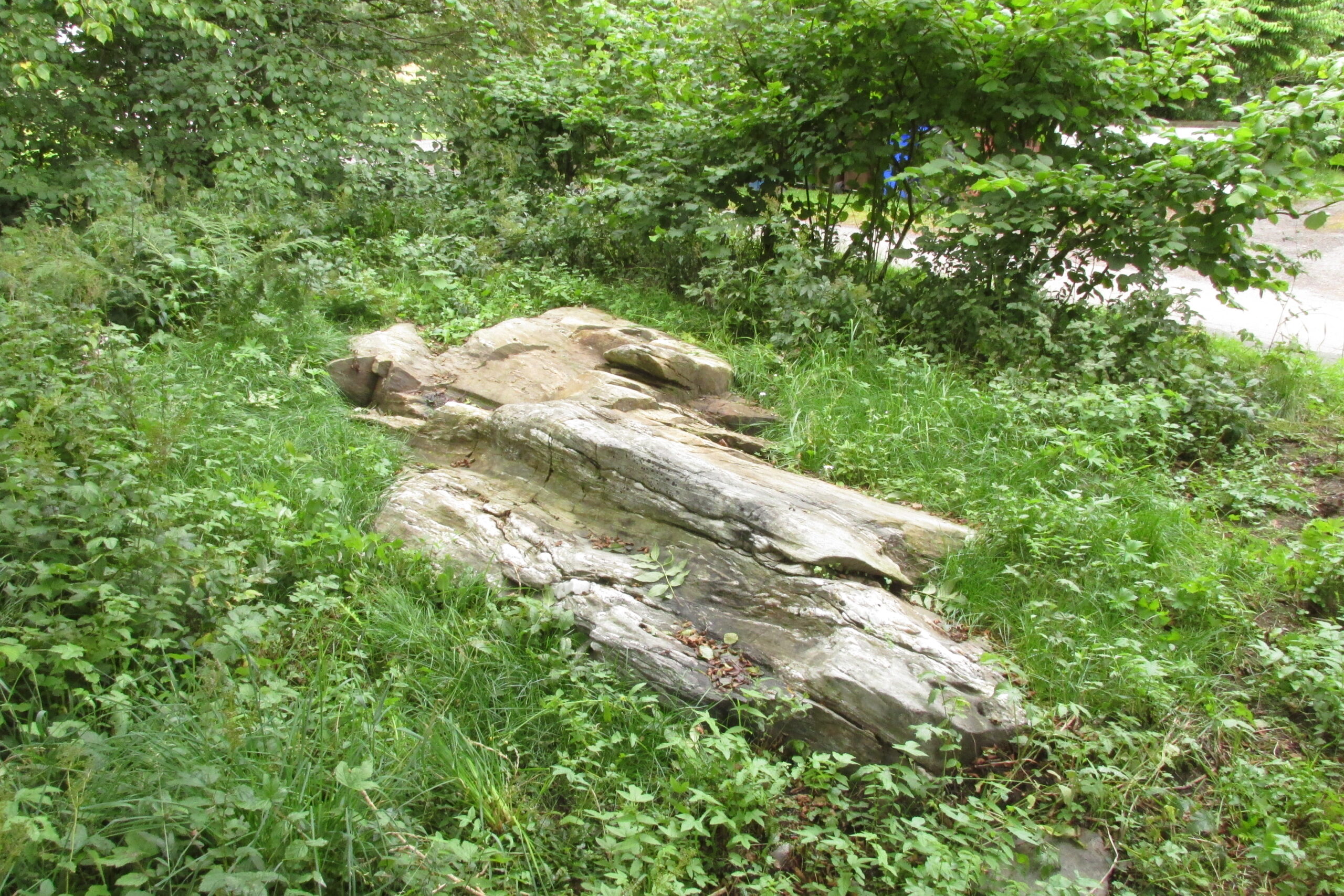
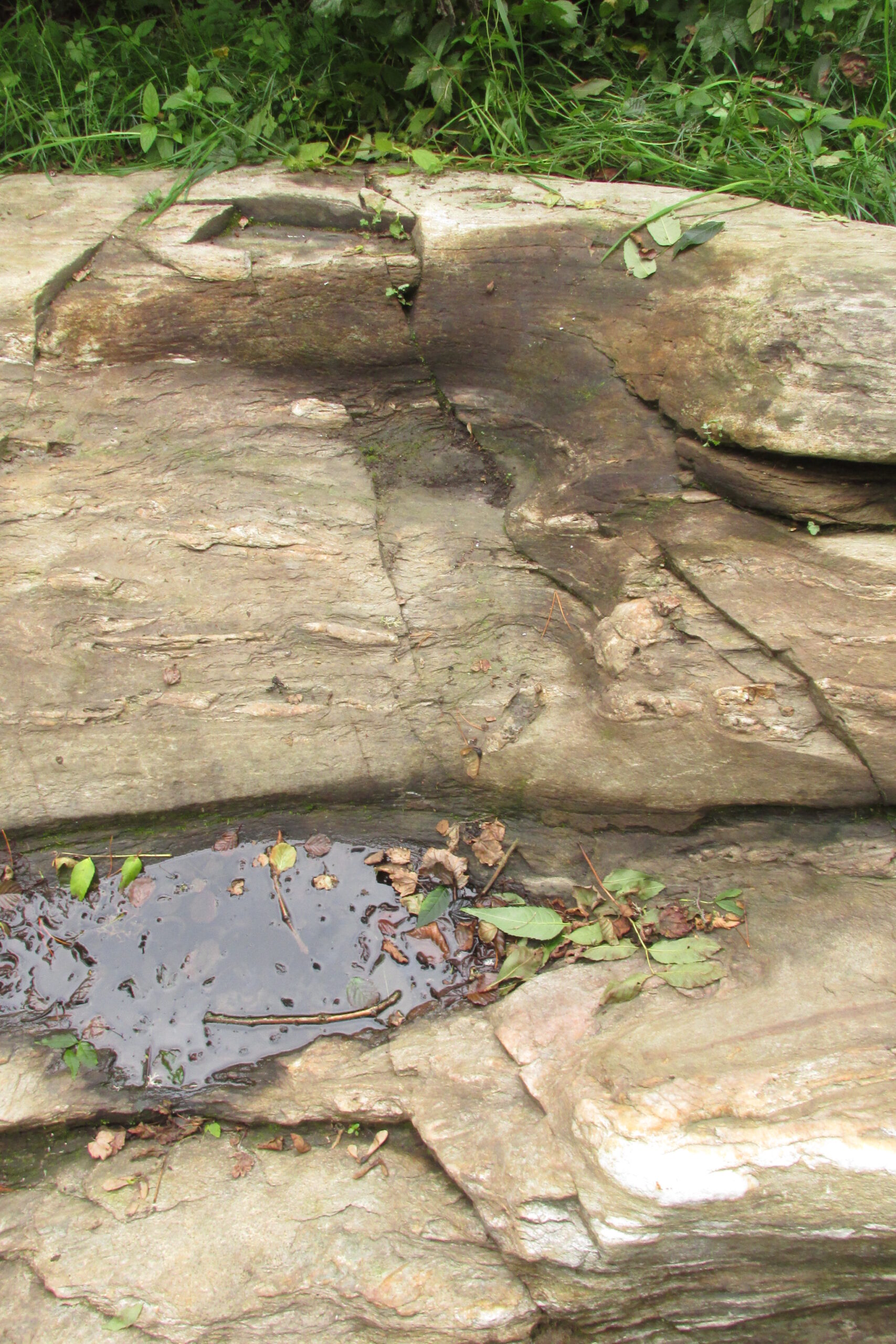
St Fillan’s Chair, ‘twixt road and riverThe ‘seat’, facing the River Dochart
Two local ladies told us that the Chair had recently been uncovered from the vegetation. It is a flattish earth-fast slab of rock, which has on the right hand side a seat indentation, which faces the river bank about 12 feet away. Its proximity to the river bank would seem to limit its use as a preaching pulpit, and yet, well over a millennium after the death of Fillan, his ‘Chair’ is still remembered. Did the Chair serve another purpose, a purpose that long preceded Fillan and Christianity?
Here at Killin we are in an area of Scotland where Christianity was for long a veil worn very lightly over long-held ancient animistic beliefs and customs. Indeed in the early nineteenth century, missionaries were sent in the face of considerable local opposition by the Haldanes into Gaelic speaking Breadalbane to try to convert the locals to Christianity.
St Fillan and other saints had it seems become the named facilitators for healing at ancient places on behalf of the incoming religion from the Middle East. To the west of Killin, there are the St Fillan’s Pools at Auchtertyre near Tyndrum, where he is reputed to have cured madness but which continued to be used for that purpose until the late eighteenth century at least. There are stones for preventing measles and whooping cough near Killin that are still known and pointed out. So what of our chair?
There is a nineteenth century story of a chair of St Fiacre (Irish born like Fillan) at the village church of St Fiacre near Monceaux in France being used to ‘confer fecundity upon women who sit upon it ‘. The shape and proximity to the river may otherwise suggest St Fillan’s Chair was a birthing Chair? Maybe some very old locals still know the true story of this Chair, but would they tell it?
References:
Anon., Phallic Worship – a Description of the Mysteries of the Sex Worship of the Ancients, privately Printed: London 1880.
From Killin, take the A827 road to Kenmore. 6 miles along, on your right, is the track down to the Big Shed at Tombreck. Keep on the A827 for exactly ⅓-mile (0.53km), and opposite the driveway to Craggantoul is a small parking spot. Go through the gate here and walk up the little hill right in front of you until you can see an electricity pylon 200 yards away. Head for, go up the slope behind and along until you drop into a tiny little valley where a long line of very distinct old walling runs east-west. Walk back and forth along it till you see a reasonably large earthfast stone on its own.
Archaeology & History
Close to a long line of what I think is pre-medieval walling—possibly Iron Age—is what can only be described as a truly crap-looking petroglyph which, to be honest, I’d walk past and give not a jot of notice if it wasn’t for the fact that it’s been recorded. When we visited here, three very worn large cup-marks were visible on its sloping west face, with what looked like two more on top of the stone—but these seemed questionable in terms of them being man-made. Apparently there’s another one on it, but in the searing heat and overhead midday sun when we visited, this couldn’t be seen.
From Killin, take the A827 road to Kenmore. 6 miles along, on your right, is the track down to the Big Shed at Tombreck. Keep on the A827 for exactly ⅓-mile (0.53km), and opposite the driveway to Craggantoul is a small parking spot. A few yards on the road, over the burn, go thru the gate on your left. Follow the straight line of walling up for 800 yards where the walling hits the burn, then follow the water up until you cross a fence. Once over this, 50- yards to your right you’ll see a large rounded rock and companion. It’s the rounded rock.
Archaeology & History
As with most the carvings along here, it is the setting that captivates more than the petroglyph. This is another one mainly for the purists amongst you, but there’s a distinct feel of other carvings hiding very close by that remain hidden. Anyhoo…
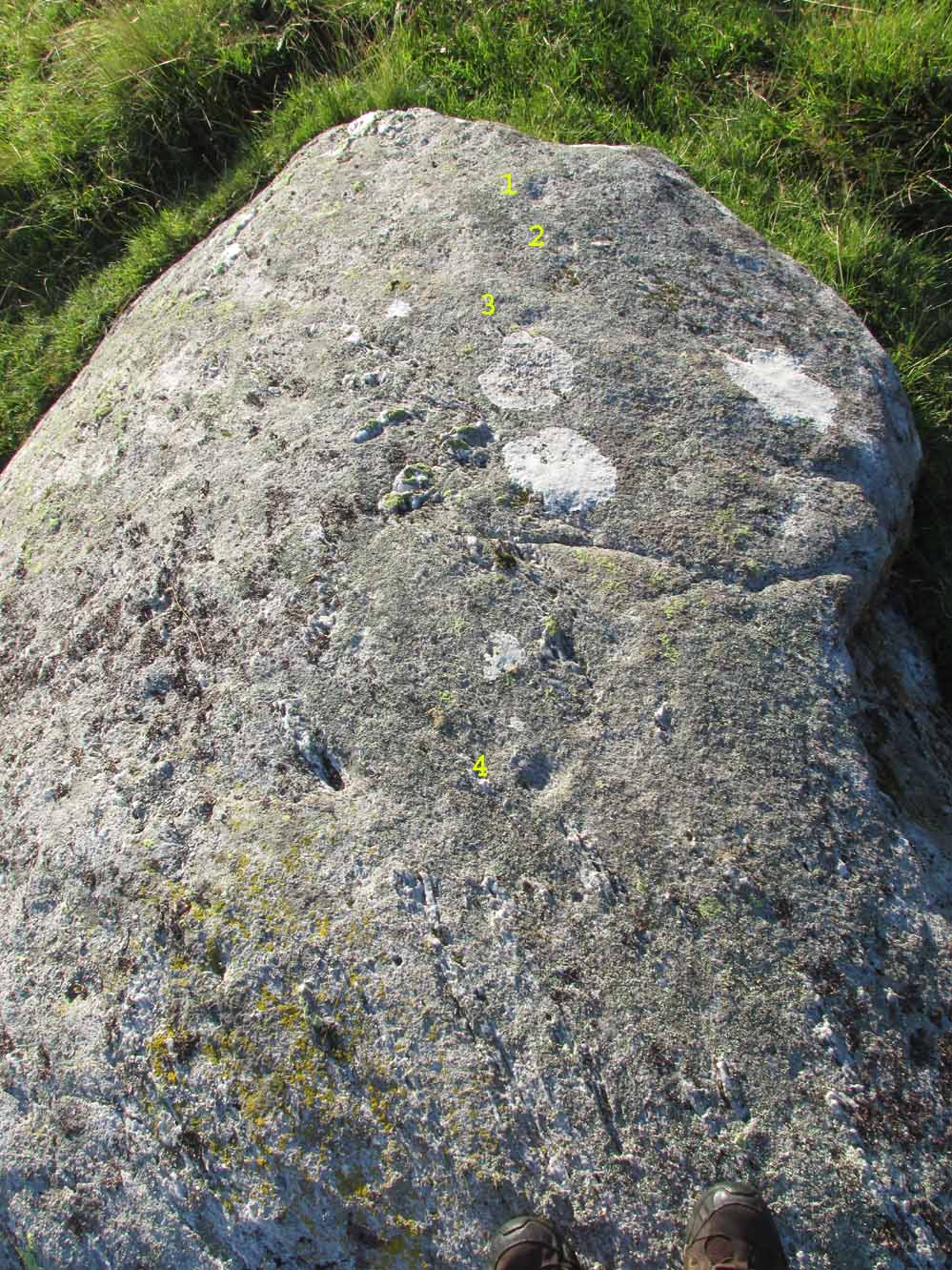
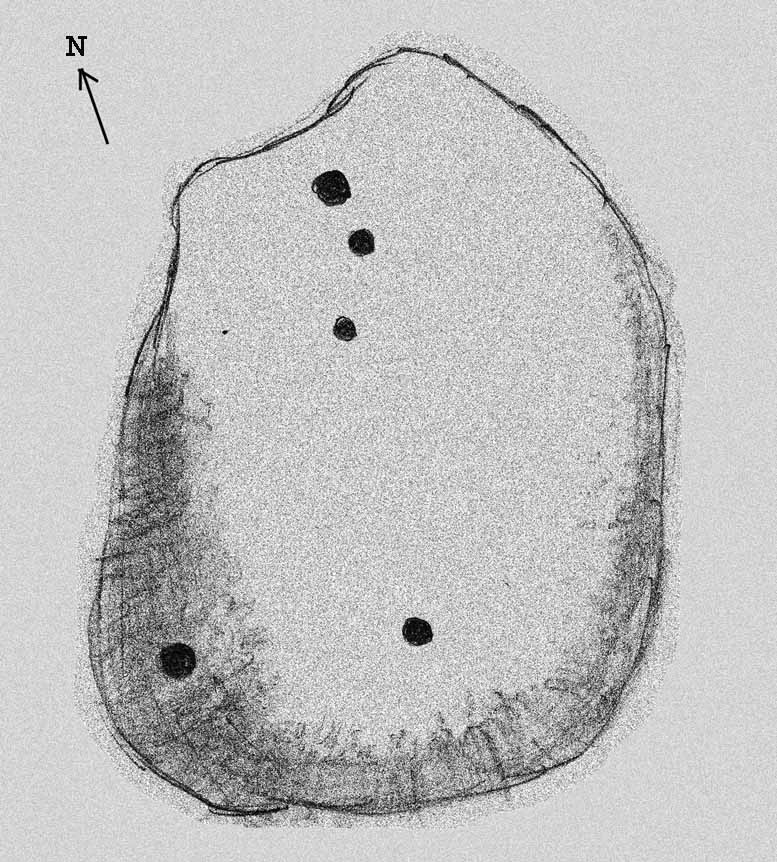
4 of the cups numeratedRough sketch of design
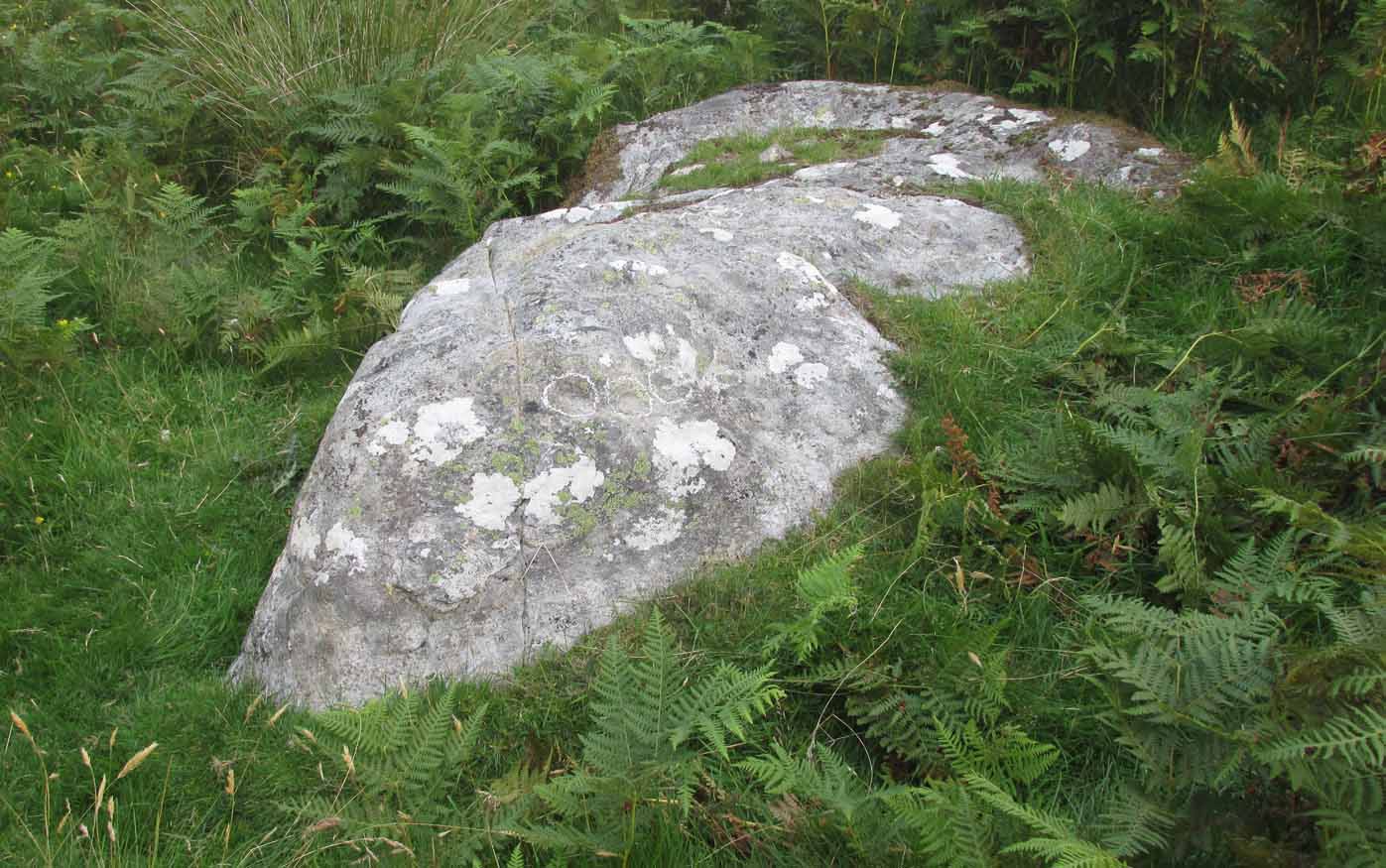
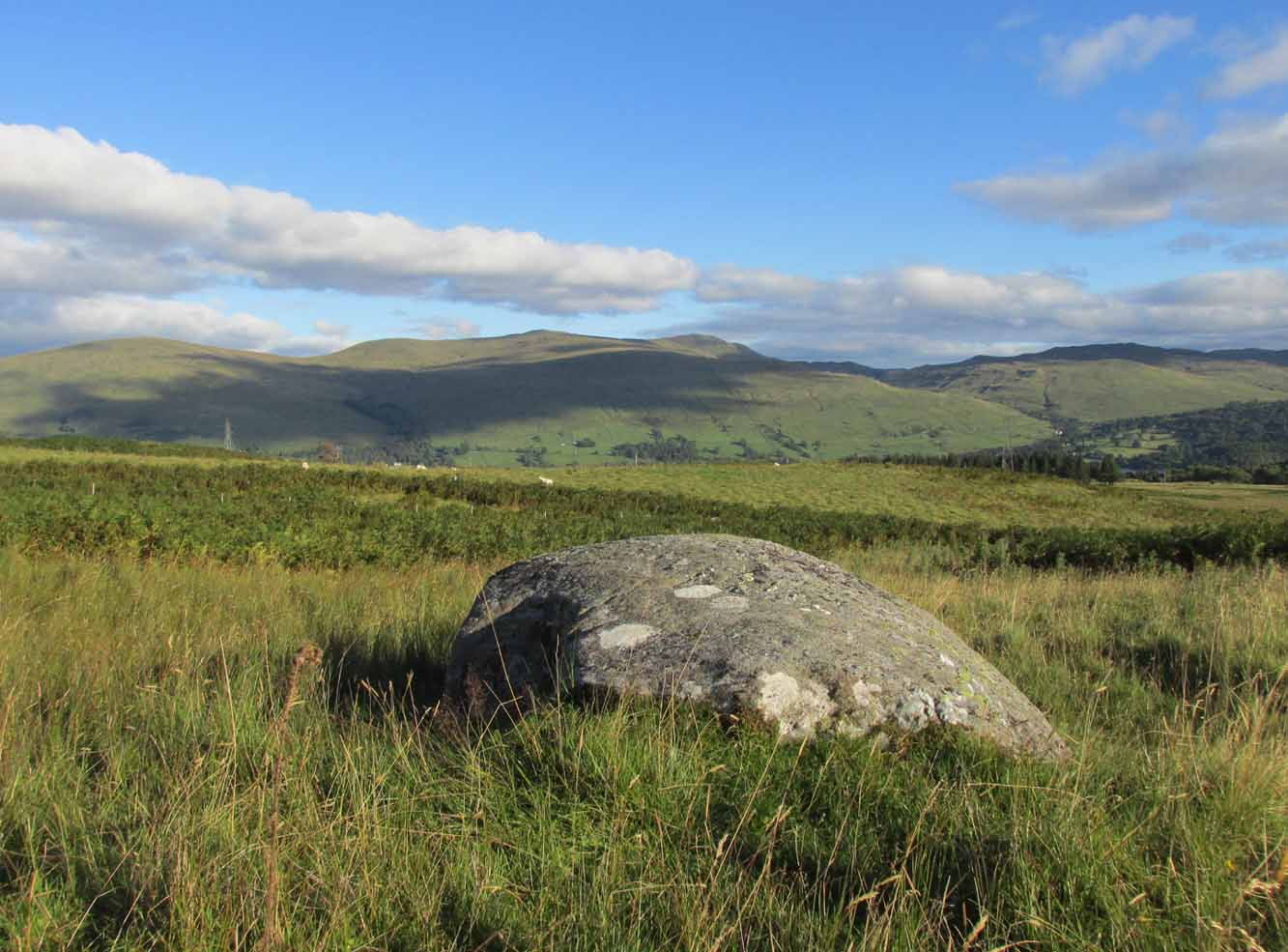
This reasonably large, rounded, female stone has the usual scatter of quartz in its veins, along with at least four cup-marks on its upper sloping surface. Three of them are seen in a slight arc on the more northern slope of the stone with one of them particularly faint; but the most notable of the lot on the very crown of the stone. (see the numerated image, right) A fifth cup-mark is clearly visible on the western face of the boulder, shortly below where the rock begins to level out. You’ll see it. Some 200 yards west of this carving, the prominent rock hosting the Cragganester 10 carving is visible on top of its rounded knoll.
From Killin, take the A827 road to Kenmore. 6 miles along, on your right, is the track down to the Big Shed at Tombreck. Keep on the A827 for exactly ⅓-mile (0.53km), and opposite the driveway to Craggantoul is a small parking spot. A few yards on the road, over the burn, go thru the gate on your left. Follow the straight line of walling up for 7-800 yards and then walk to your right, into the field. About 300 yards into the overgrown meadowland you’ll see a rounded knoll with a very notable boulder on its crown. Y’ can’t really miss it!
Archaeology & History
It’s the setting of this carving that captures you way more than the carving itself—which is probably somewhat of a disappointment to most folk, unless you’re a petroglyph fanatic like myself.
The five cup-marks…and from another angle
Found relatively close to other carvings, this reasonably large boulder has, upon its roughly smooth top, just five simple cup-marks with varying degrees of weathering, from the very noticeable to the somewhat faint—hinting at the unlikely possibility that it might have been carved at different times. A possible sixth cup can be seen in certain daylight conditions on the southwest section of the stone. That’s it!
Along the main A913 Perth Road that runs round the northern edge of Abernethy village, as you approach the village from the western side, go right at the mini-roundabout up the Main Street into the village. However, just where this roundabout is, there’s a footpath into the trees known as the Castlelaw. Walk up here, keeping to the left-side of the burn (don’t cross over onto the right-hand side!) and after about 200 yards or so, keep your eyes peeled for a large upright stone, almost overgrown in dark vegetation on your left.
Archaeology & History
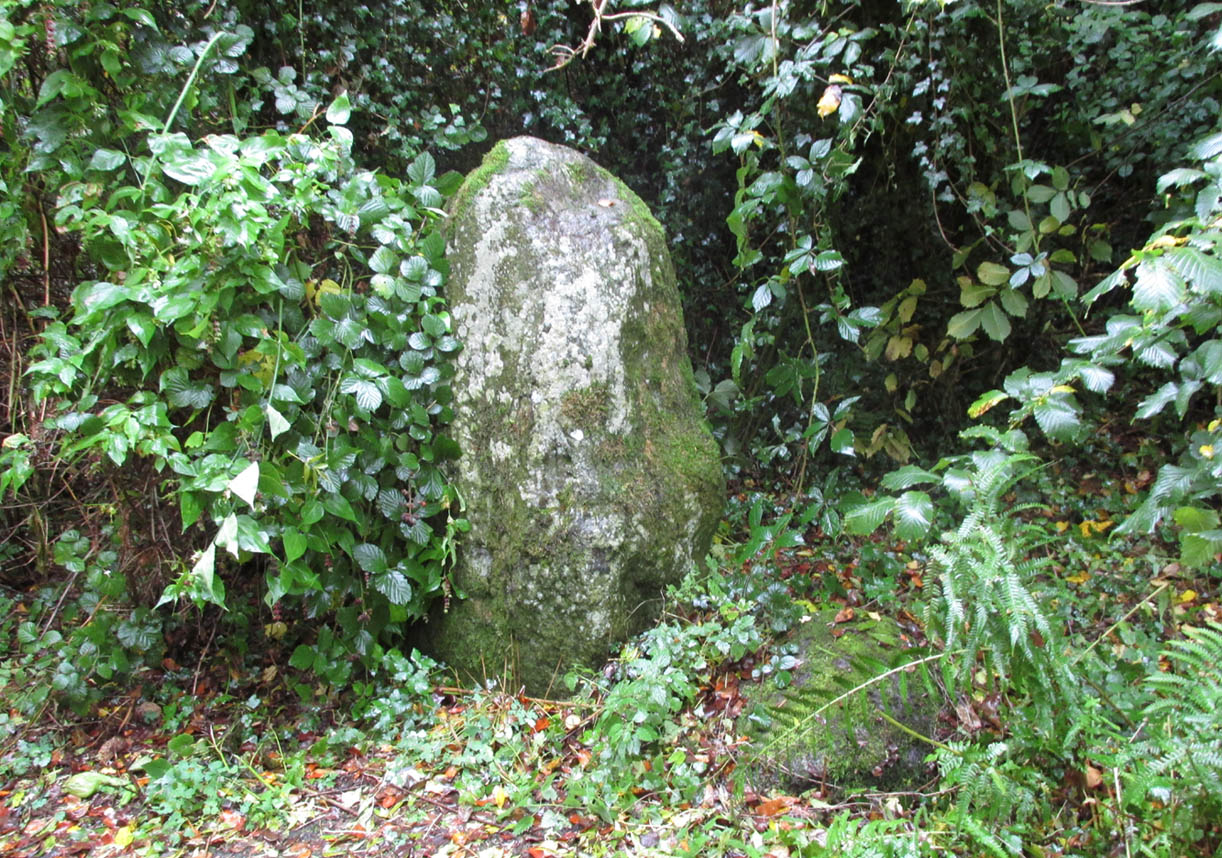
An intriguing standing stone in a most unusual position: a small wooded glen with a steep slope on its immediate eastern side, very enclosed. It’s quite a big thing too, standing some six-feet high with the usual worn rounded crown, typical of olde stones.
The olde stone, unmasked
In the very brief account of this site by Hallyburton & Brown (2000) they describe this “previously unrecorded /lost standing stone and possible ruinous stone circle.” This is also echoed in Canmore’s description. A standing stone we certainly have, but in several visits here there was no evidence of any stone circle either side of the burn. It was suggested that the “circle” may once have been atop of the slope immediately above this stone, but again there is no evidence at all to suggest this and old maps show nothing. I’m extremely doubtful of any megalithic ring here (I’d love to be wrong though).
References:
Hallyburton, I. & Brown, R., “Abernethy Den (Abernethy Parish),” in Discovery & Excavation Scotland, New Series – volume 1, 2000.
Travelling north from Perth on the A94, take the right turning for Murrayshall just before entering Scone, then take the first right and continue up to the road junction, and park up at the trackway opposite. You’ll see the big stone in the field to the right, up against the road embankment; and the small stone is in the paddock to the left of the trackway at the edge of the trees.
Archaeology & History
Two large glacial erratics which have acquired mythic status and picked up a Christian triumphalist message on the way.
Folklore
In Lawrence Melville’s (1939) excellent local history work, he thankfully put to pen an all-but-forgotten tale of oral tradition:
“Where the road from the Muir of Durdie leaves Kilspindie parish, a grass grown road leads north to Boglebee….. A few yards from the highway lie two large stones, said to have been flung from the Giant’s Hill in Collace parish – the flat topped eminence lying due north from the stones, about two or three miles away, better known as “Macbeth’s Hill”, or “Dunsinane Hill”.
The ‘string’ marks of legendThe smaller stone with its ‘string’ marks
“When the church dedicated to St John in Perth was being built and its tower began to appear, a witch living in Collace was enraged to see this proof of the approach of Christianity and determined to destroy it. She had a son, a giant (after whom the hill receives one of its names), whom she sent to the top of the hill, giving him two huge stones with which to destroy the rising church.
“By her incantations she had supernatural power and knew that when Christianity came her power would be destroyed. She gave him her mutch from her head to be used as sling and in it the giant put the two huge stones. Whirling it around his head, he aimed them in a line with the tower, but, just as he let them fly, the string of his mother’s cap broke and the stones only went the length of Boglebee. The marks on the stones are said to be the marks of the witch’s mutch strings.”
Another view of the larger stone
A familiar folkloric message is remembered the length of Britain: a giant, a devil or other supernatural being throwing stones that either spill out of an apron or otherwise miss their mark. And in this case an unsubtle message to anyone trying to take on the might of the church. But what was the original story of these stones as told by the old time oral storytellers before Christian missionaries stalked the land?
If the string hadn’t broken and the stones had followed their original trajectory they would have fallen south of St John’s Kirk, but it was the thought that counted….
Reference:
Melville, Lawrence, The Fair Land of Gowrie, William Culross: Coupar Angus, 1939.
The Rock and Leap may be seen from the B953 Bandirran to Abernyte road. Approach across the fields.
Archaeology & History
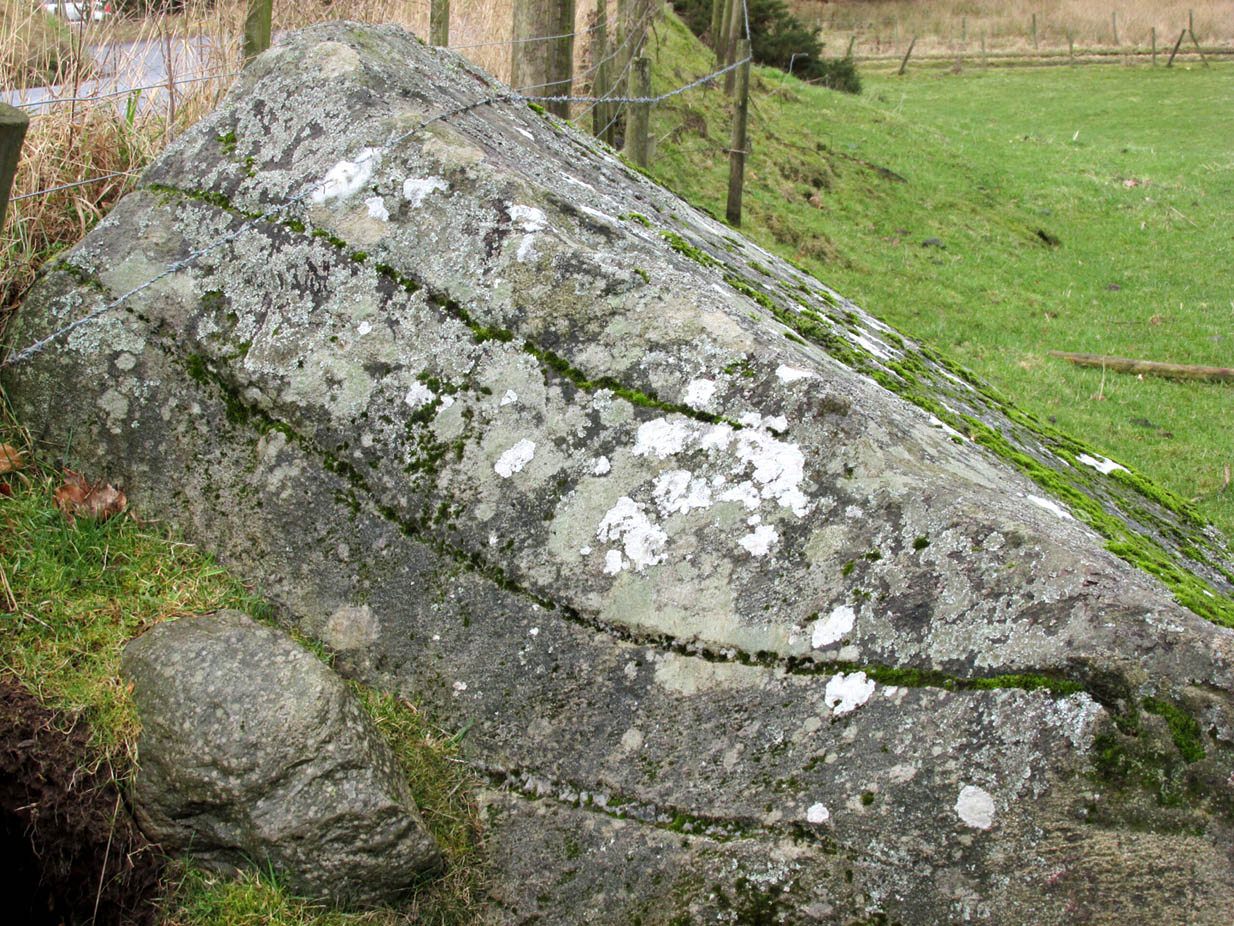
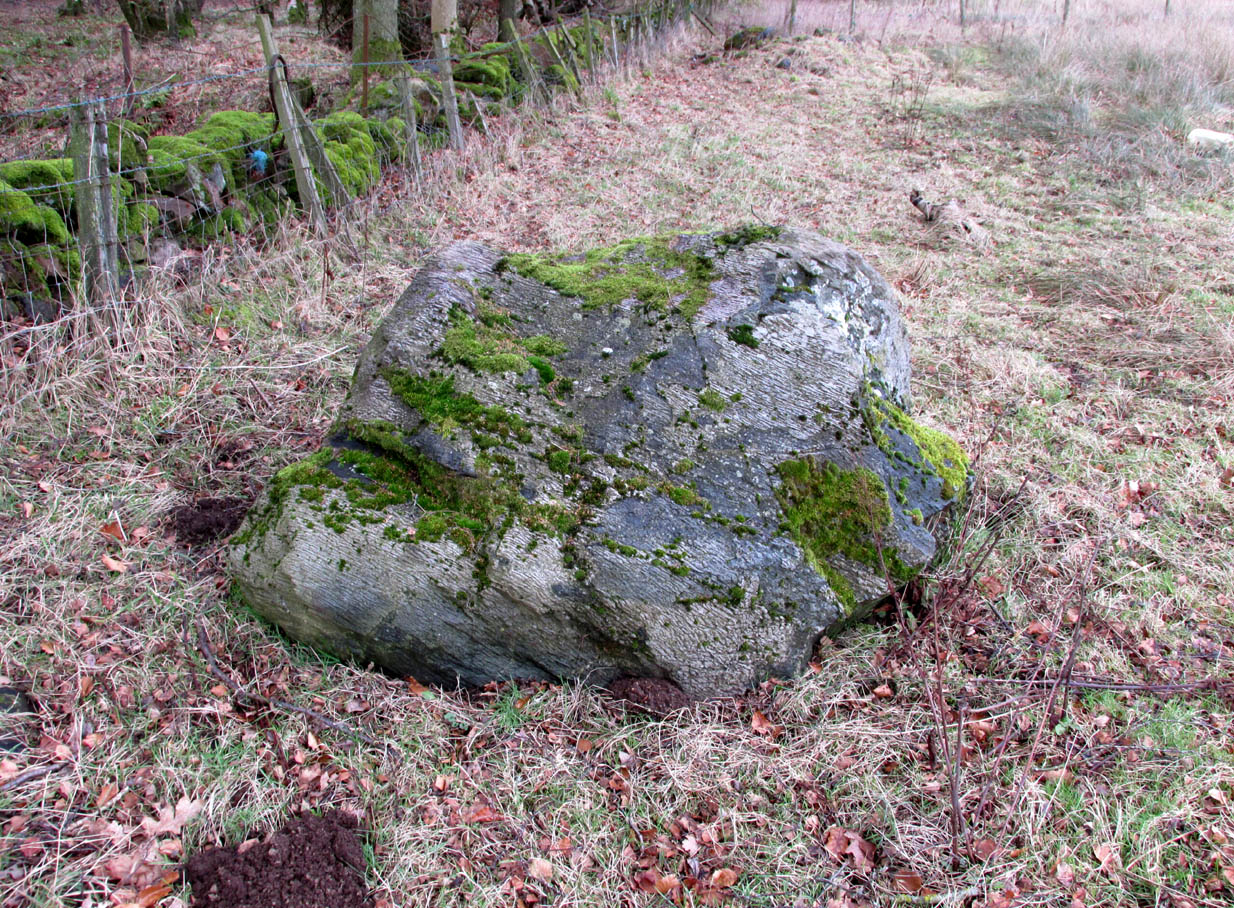
A large boulder perhaps 40 tons in weight lies in a ravine between Dunsinane and Black Hill. The ‘Leap’ is a flat topped ledge jutting out from the west side of Black Hill facing Dunsinane.
Folklore
Melville (1939) in his The Fair Land of Gowrie writes of the simple pleasures of the giant:
“From the farther side of the ravine [between Dunsinane and Black Hill], a precipitous rock juts out, which is called the “Giant’s Leap”. According to the lore of the Sidlaws, a giant, who once lived in these parts, leaped from this rock right on to the top of Dunsinane Hill. The giant also amused himself by tossing about a huge boulder which can be seen lying at the bottom of the ravine.”
And adds:
The Big Fellow’s toyGiant’s Leap from the north
“Fairies haunted the hills here and on summer nights they descended to the meadows, where they danced at a spot called “Fairygreen”. The Black Hill gets its name from the dark heath which covers it. Weird and bleak looking for most of the year, the lower slopes are brightened by glowing patches of purple flowers in late summer.”
Fairygreen Farm lies a mile almost due north of Dunsinane.
Reference:
Melville, Lawrence, The Fair Land of Gowrie, William Culross & Son, Coupar Angus, 1939.
Along the A827 Loch Tay road between Morenish and Lawers, take the track uphill where Carie farmhouse and Tombreck are either side of the road. Walk up this track 2-300 yards till you go through the gate just past the sheep-folds on your left. Ahead of you is a small grassy hillock on your right upon which you’ll find the unimpressive Tombreck-1 carving. Walk down the grassy-slope to the boggy stream and then up the rounded knoll on the other side, where you’ll find a stone that’s been split in two. You’re here!
Archaeology & History
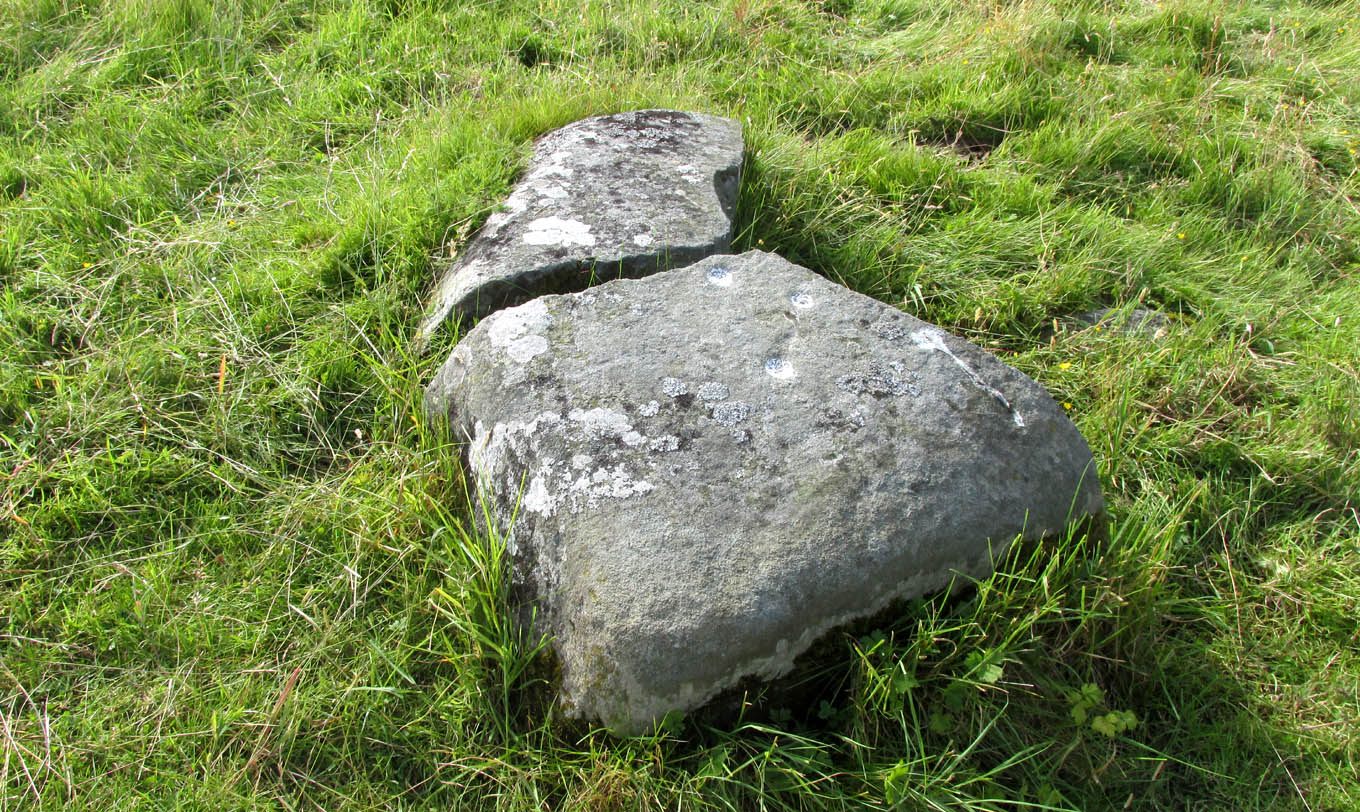
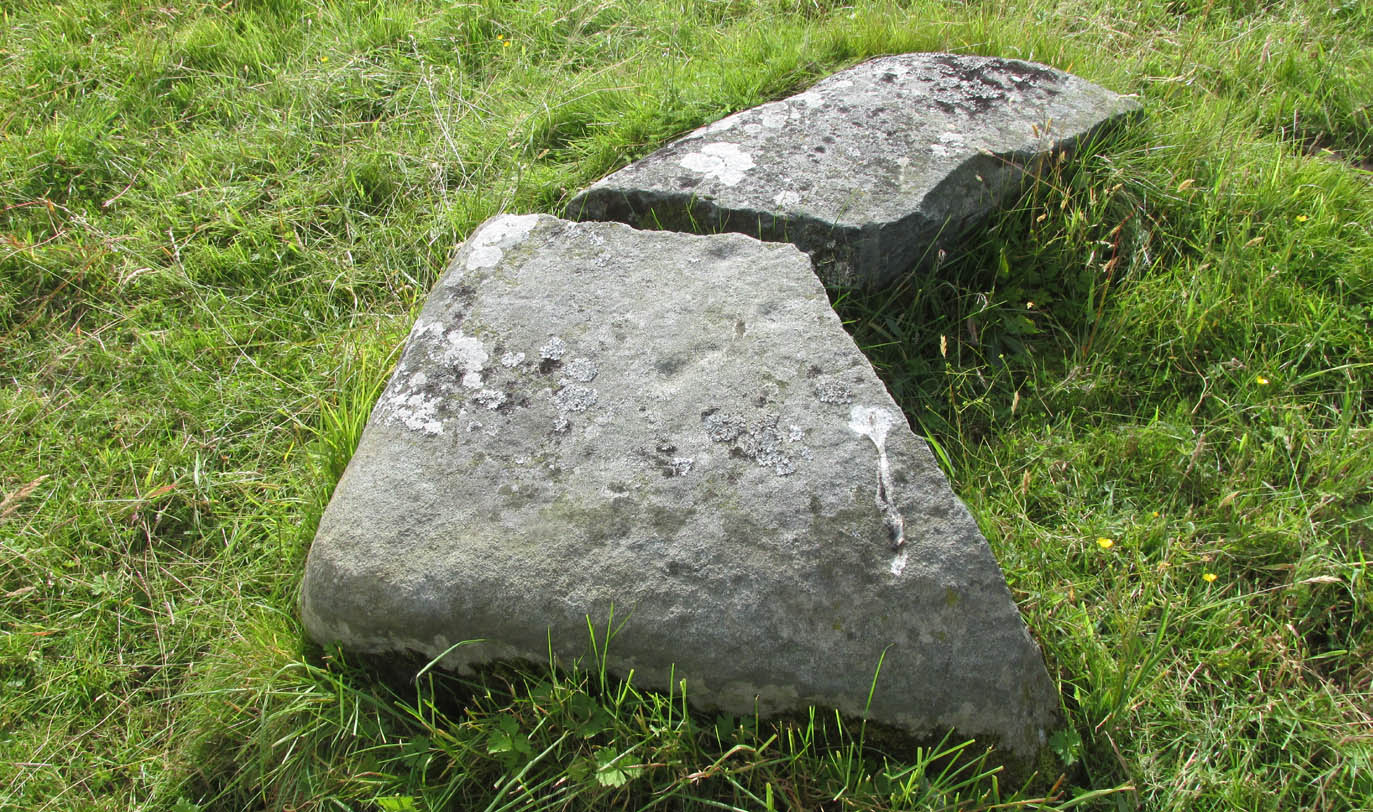
This is another unrecorded carving, found amidst this already large petroglyphic cluster on August 9, 2020. Carved on a stone that’s been spilt in half, three simple cup-marks can be seen on the larger easternmost section, with the lowest of them having a possible short line running towards the cup on the right. It seems that the right-hand (north) side of the stone has also been cut, but there is no trace of this part of the stone on the ground. Additionally, there is the possibility that this stone once stood upright, as evidenced by its very worn rounded top and the larger bottom end of the stone being distinctly lower compared to the ground all round it. But this is speculative.
The 3 cups, highlighted3 cups on the lower stone
Although the rock is close to being on the top of a rounded knoll, giving good visibility both east and west for a few miles along the extensive grassy ridge (where many other petroglyphs exist), the grandeur of Loch Tay in the glen below is not and could never have been visible from this, or indeed many other carvings on this ridge. I mention this due to the fact that some students are positing that the existence of so many carvings along here may relate to some sort of deification of Loch Tay. But here and at many others along this ridge, the idea simply aint valid, unfortunately.
In the middle of Bridge of Earn village, take the Heughfield Road until, ⅓-mile on you hit the T-junction. Turn left along Forgandenny Road and go along the curvaceous road for just over a mile where you need to keep your eyes peeled for the small left turn that takes you up the dead straight road. At the top, turn left at the junction and go ⅔-mile, turning right at the next junction until after 400 yards you reach the houses on your right. Go up the footpath opposite the houses (south) until, after nearly 400 yards, it splits. Bear right and zigzag up the track for nearly a mile till you reach a large opening in the forest. 40 yards up the slope to your left is the stone—at last!
Archaeology & History
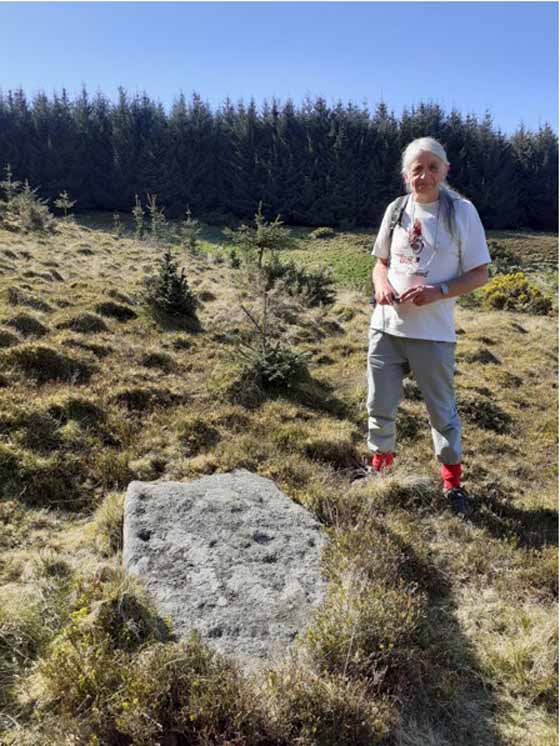
After the trail to get here, you might not be overly impressed by what you see – and it’s nothing special to look at to be honest. But its location is a good one: reasonably high up on a sloping plateau which would have given good views were it not for the surrounding forestry plantations. The only literary description of the site was the brief one in Discovery & Excavation Scotland, shortly after being rediscovered. Mrs Johnson (1960) wrote:
Close-up of the carving
“A cup-marked stone was found by Mr. J. R. Morrison on the N side of West Dron hill. The stone measures approx. 4ft long by 1ft 9in broad.
There are 17 cup-marks: five of which have channels, and two of which are joined in the form of a dumb-bell. The stone lies with its longer axis NE-SW, and its broad face uppermost.”
Its seeming isolation is a peculiarity that I don’t buy. Other carvings are going to be in the locale, probably on the same north- or north-east facing ridges – but due to the dense forestry, any other petroglyphs will remain hidden for quite some time…
References:
Johnson, M., “Dron, Perthshire,” in Discovery & Excavation Scotland, SRG 1960.
Acknowledgements: Huge thanks to Theresa Hughes for the use of her photos of this carving.