Aithernie, Scoonie, Fife

Tumulus (destroyed):  Grid Reference – NO 3769 0339

Also Known as:

  1. Canmore ID 31344

Archaeology & History

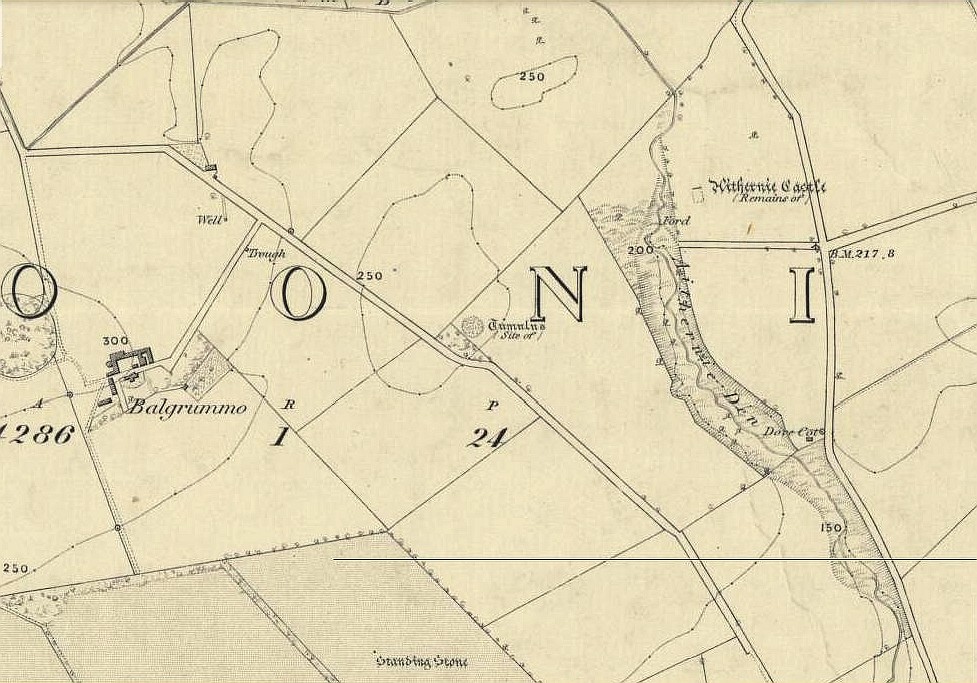
Aithernie tumulus on 1855 OS-map

A mile or so WNW of the fantastic standing stones of Lundin, and just a coupla hundred yards above where the lesser standing stone of Balgrummo lives, we could once see an impressive prehistoric burial mound on the small hilltop of Aithernie.  Sadly, like oh too many prehistoric sites in our landscape, it was vandalised and destroyed in the 19th century by the prevailing stupidity of the period.  Thankfully we have a couple of accounts describing the place.

The site had already passed into memory when the Ordnance Survey fellas got up here in 1854, but an account of it was made in the ‘Object Name Book’ of the parish a decade earlier.  Thankfully the story of the site was known locally and, along with the New Statistical Account describing the olde mound, A.S. Cunningham (1906) told the story of when it was “opened” and then of its subsequent demise. He wrote how,

“…in 1821 a much more interesting relic of antiquity…was opened in a field on the estate of Aithernie.  When digging moulding sand for Leven Foundry, the workmen struck right into the heart of an ancient tumulus.  This cemetery of prehistoric times contained as many as twenty rude stone cists.  These cists were typical of the prehistoric burial places found throughout the country.  They were constructed of slabs placed on edge, with a covering stone, and cemented with clay puddling.  Above the coffins was a covering of stones, the stones having hundreds of years before been so firmly cemented together with clay and sand that the workmen required the aid of picks to enable them to “rifle the tombs.”  Small urns were found in two of the coffins, and five of them contained larger urns, 14 inches in diameter and 24 inches in depth, and in another cist quantities of charred wood beads were discovered. All the coffins, except the five in which were the large urns, contained human bones, and innumerable bones were found outwith the mouths of the cists.”

When the Royal Commission (1933) lads visited the place in 1925, they reported “no existing indication of a tumulus” remained.  Gone!

References:

  1. Cunningham, A.S., Rambles in the Parishes of Scoonie and Wemyss, Purves & Cuningham: Leven 1906.
  2. Royal Commission on the Ancient & Historical Monuments, Scotland, Inventory of Monuments and Constructions in the Counties of Fife, Kinross and Clackmannan, HMSO: Edinburgh 1933.

© Paul Bennett, The Northern Antiquarian


Bandrum, Saline, Fife

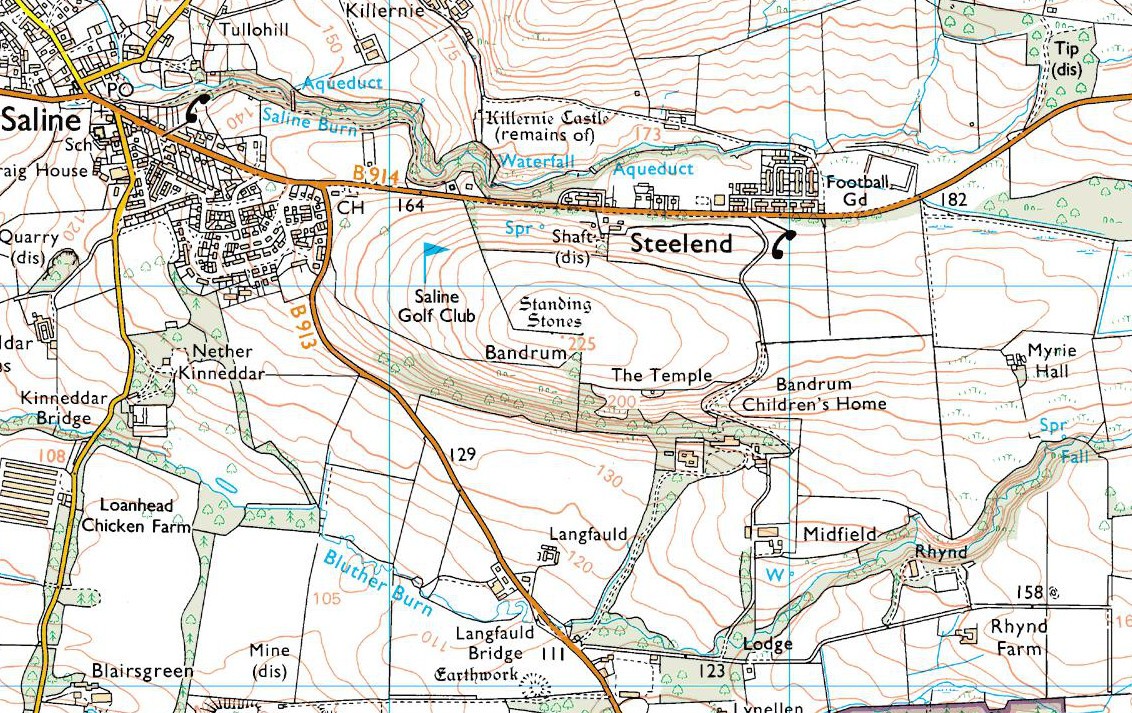
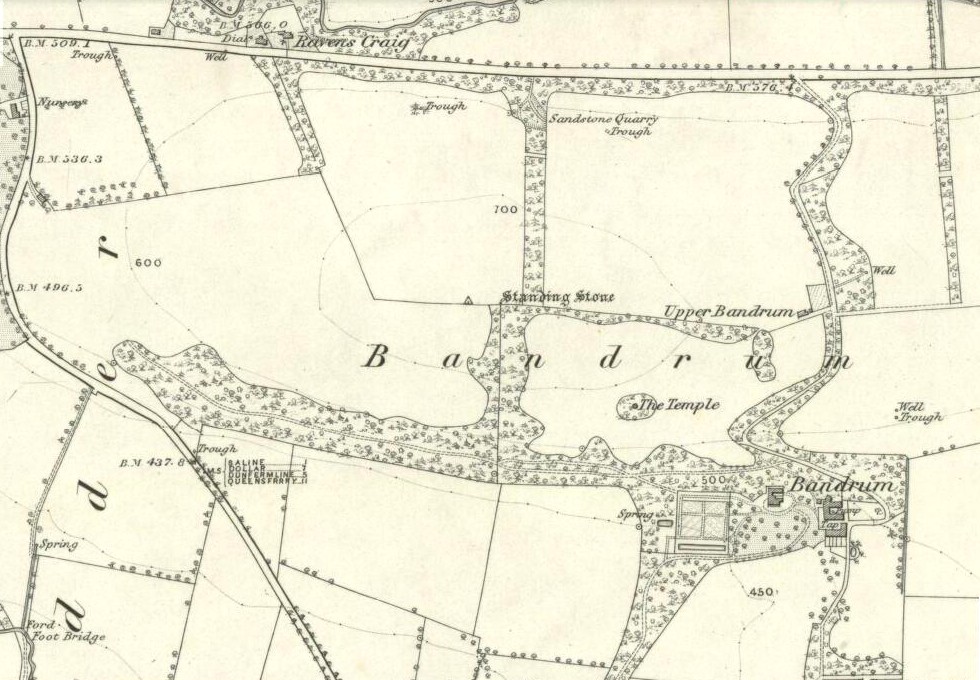
Bandrum OS-mapStanding Stones:  OS Grid Reference – NT 0348 9188

Also Known as:

  1. Canmore ID 49710

Getting Here

Go east on the B913 through Saline for a mile till you reach Steelend.  Across the road from the houses there’s a dirt-track running uphill (south) into the fields.  When you’re near the top, turn west into the fields, following the straight line of fencing towards the small clump of trees on the skyline.  Near the top, a few hundred yards along you’ll see the large fat stone up against the wall.  But keep walking east and another stone appears before your eyes!

Archaeology & History

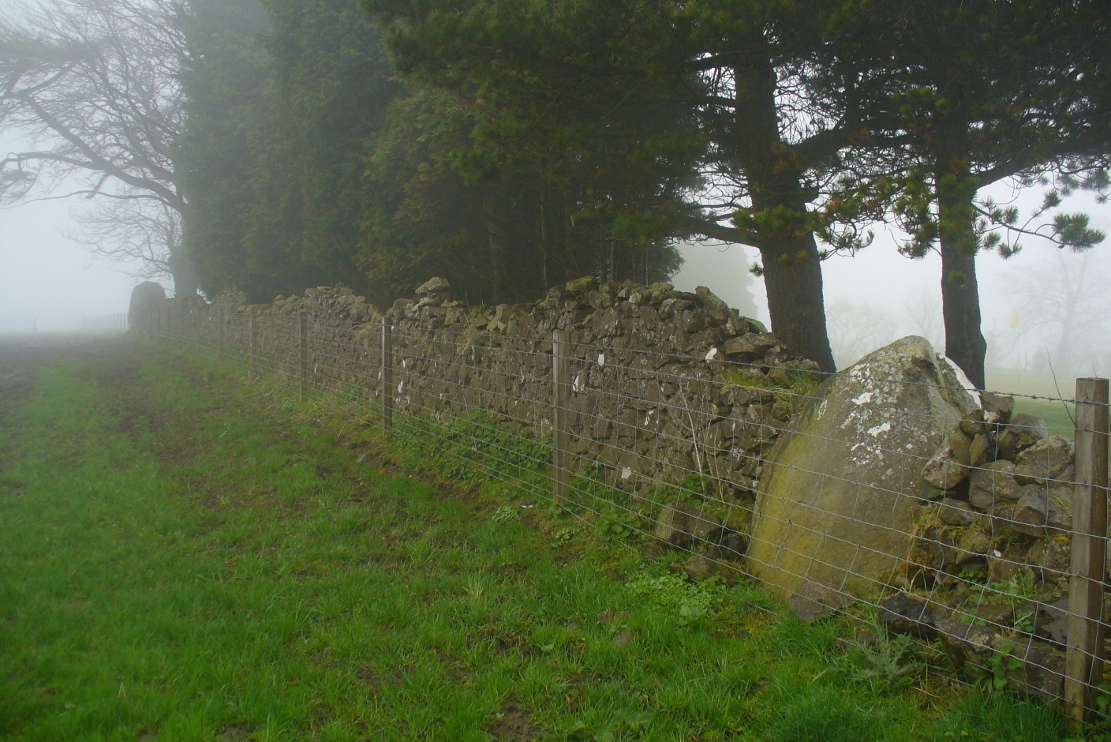
The big fella, by the gate

Near the very crown of this long hill, right by the gate separating the fields, you cannot miss this huge and very heavy-looking standing stone, whose position in the landscape was evidently of some importance to the people who put it here.  It’s in a gorgeous spot. You can see in all directions for some considerable distance particularly to the west, and the eye catches other points on the land where prehistoric monuments of other forms speak to each other. (that’s assuming you visit here on a clear bright day, as opposed to when Paul Hornby and I visited the spot when, for much of the afternoon we could barely see 100 yards as the land all around us was cloaked in fog!)

The big fella, face on
And through the fog, from the little fella to the big fella

The site was included in Alexander Thom’s (1990) magnum opus on megalithic stone rows, in which he cites it as a debatable 2-stone row monument.  For if we walk westwards, along the walling, we find another large, possibly prehistoric upright about 50 yards along.  In Aubrey Burl’s (1993) work on the same subject, he merely copies Thom’s earlier questioning of the second stone in his listings.  But in Mr Beveridge’s (1888) regional history work more than a century earlier, he told clearly that on “the ridge of the hill behind Bandrum House, there are built two standing stones.” Of their origin and purpose, Beveridge could find none; but a few years later, A.S. Cunningham (1902) thought simply that

“of the two standing stones on the march fence behind Bandrum House…it is questionable if they ever served any other purpose than a dividing line for properties.”

Bandrum Stone on 1854 map

The site was highlighted on the earliest OS-maps of the region in 1854—albeit with only the largest of the two stones marked, at the meeting of the gates—and then many decades later those other official doods, the Royal Commission (1933) lads, made their way up here and included the site in their inventory, where they told:

“On the crest of rising ground at an elevation of 700 feet above sea level, at the end of a dole near to the extreme east end of Saline golf course about a quarter of a mile due west of Bandrum farmhouse, stands a huge whinstone boulder of irregular form.  It measures 7 feet 10 inches in height to the highest point of a somewhat rounded top, and has a slight inclination towards the west.  Its girth at the base is 13 feet 7 inches and at the middle 14 feet 10 inches.  The broadest faces are to the north and south… At a distance of 162 feet due west, there is another large boulder measuring 3 feet 10 inches in height and approximately 10 feet in circumference at the middle, set with a marked inclination towards the east and built into a continuation of the same dike.  The two suggest the remains of a stone circle, the rest of which has been swept away by the cultivation of the neighbouring fields.  There is however, no record of other stones having been removed.”

Thom’s (1990) account of the site was simply put:  “Bandrum. NT 036 915. Huge whin boulder, 7ft 10 (2.4m) h. 162ft (49m) W another 3ft 10 (1.2m) h.”  He gave no indication of astroarchaeological alignments.

References:

  1. Beveridge, David, Between the Ochils and Forth, William Blackwood: Edinburgh 1888.
  2. Burl, Aubrey, From Carnac to Callanish, Yale University Press 1993.
  3. Cunningham, A.S., Romantic Culross, Torryburn, Carnock, Cairneyhill, Saline and Pitfirrane, W. Clarke: Dunfermline 1902.
  4. Royal Commission on the Ancient & Historical Monuments, Scotland, Inventory of Monuments and Constructions in the Counties of Fife, Kinross and Clackmannan, HMSO: Edinburgh 1933.
  5. Thom, A., Thom, A.S. & Burl, Aubrey, Stone Rows and Standing Stones – volume 2, BAR: Oxford 1990.

Acknowledgements: Huge thanks to Paul Hornby for his photos of these standing stones. Cheers Paul!

© Paul Bennett, The Northern Antiquarian

Craigkennockie, Burntisland, Fife

Tumulus (destroyed):  OS Grid Reference — NT 237 861

Archaeology & History

Very little is known about a prehistoric tomb that once existed near the coast at Craigkennockie.  Its existence was briefly described in Andrew Young’s (1913) fine history of the township where he told that it had been highlighted on an old Estate Map of the area and marked as, “an artificial cairn, probably a place of sepulture.”  On old maps just below the cited place we find the place-name of ‘Lammerlaws’, which may indicate a name once given to the site, as the element -law is commonly found relating to prehistoric cairns.

Although the modern place-name researchers in central Scotland have opted that the word ‘law’ is primarily “a rounded hill”, they have curiously forgotten or omitted its other derivation.  Throughout northern England and beyond, the English Place-Name Society finds that many ‘law’ place-names derive from the old English and Saxon word, hlaw, which is originally told to be “a mound, a hill.” This has been the reference cited throughout in Taylor & Markus’ (2006-2012) otherwise fine multi-volume analysis of Fife county.  But there’s much more to it than that.  I hope that readers will forgive me reciting A.H. Smith’s (1956) full entry about this simple term, as it can (and many times does) show our history is much richer than initially thought.  Prof Smith told that law, hlaw, hlæw, has the following etymological origin:

“(1) In OE (old English) the common meaning in literary contexts is ‘an artificial mound, a burial mound, a mound in which treasure is hidden’, as in Boethius Metr. 10.43, ‘in what hlæwa do the bones of Weland cover the ground?; Beowulf 2802, ‘Bid them make a hlæaw…on Hronesnæsse’; Guthlac 4 ‘there on the island was made a great hlæw, which through the lust for treasure had been dug up and broken into’; or Gnomic Verses 26, ‘a dragon shall be on hlæw’, an allusion (as in Beowulf 2773) to the Germanic tradition that mounds containing valuable grave-goods were guarded by dragons.  The word glosses Latin, agger, ‘something heaped up, a mound, a rampart’ (Wright’s Anglo-Saxon & Old English Vocabularies 355.4).  This meaning ‘tumulus, artificial mound, burial mound’ is well attested in place-names.  According to Grundy, it always denotes a tumulus in the OE charters and doubtless those place-names in which it is combined with personal names are the burial places of the men so named; at Taplow at least a remarkable burial treasure was discovered and Cuckhamsley, Berkshire, is named from Cwichelm, the West Saxon king who died in 593.  The majority of such places-names belong to the heathen period when this method of disposing of the dead was practised.  Particular compounds also suggest that it could be an artificial mound which formed the centre of a place of assembly; Oswaldslow Hundred (Place-names of Worcestershire, 87), for example, was created in 964 and it was to meet at a place to be henceforth called Oswaldeslaw in honour of Bishop Oswald (Cartularium Saxonica 1135).

“(2) The meaning ‘hill, a conical hill resembling a tumulus’ is also found in OE, as in Leechdoms Vol.3, 52, ‘they rode over the hlæw’, and local topography establishes this meaning as a common one in place-names and dialects in certain parts of the country; it survives as law in Durham and Northumberland and as low in northwest Midlands…

“(3) The two forms hlaw and hlæw are on record, the latter being better evidenced in literary use, especially in West Saxon texts, and the former in place-names; hlæw normally becomes low, north country law, whilst the i-mutated hlæw (found in place-names only in the south and south Midlands) later becomes lew, as in Lew, Oxfordshire, Lewes, Sussex and is more frequent in middle-english spellings; it is often later replaced by –low as in Dragley, Lancs, Cuckhamsley, Berkshire…”

Smith continues with many topographical evidences regarding a ‘burial-mound’ derivation for the place-name ‘law’, finally adding notes on relative linguistic similarities, like the “Gothic hlaiw, ‘grave’; old High German hleo, ‘grave mound, hill’; old Saxon hleo, ‘grave mound’…”  It seems pretty convincing, and so we need to take this into account in our walks over the hills if we are exploring ancient history.

As if to emphasize this derivation—’law’ as prehistoric tombs—we find it is cited in the massive Scottish National Dictionary (6,1:16) where—alongside the ’rounded hill’ aspect—Mr Grant (1962) tells it to be,

“An artificial mound or hillock, specif.: (1) a tumlus or barrow, grave-mound….”

thereafter giving a number of Scottish examples.  The same meaning is echoed again in the modern version of Concise Scots Dictionary (2005), along with the rounded-hill.  Jamieson’s (1885) Scottish Dictionary cites similarly, ‘law’ as both hill, aswell as “a tomb, grave or mound.”

This association of ‘law’ with ancient burial mounds in Scotland should not be that surprising.  Despite it having an Anglo-Saxon origin, we must remember that the Saxon kingdom is known to have stretched all the way up to the Firth of Forth (Edinburgh) and across to Glasgow. So if the linguistic roots have any credibility at all, it doesn’t take much stretch of the imagination to have this simple word travel further north amongst the people.  Perhaps this is why, more recently, Margaret Gelling (2000) has said that the association of hlaw with burial mounds up here lessens in Scotland.  Nonetheless, let us not presuppose one meaningful definition of the word above another, as it can, consciously or otherwise, be seen as more symptomatic of the all too common English attitude of papering over another country’s rich and ancient heritage by depleting its language—again…

(Law has another element attached which has all but fallen out of historical analysis.  Prof Smith touched briefly upon it, mentioning ‘law’ as being a meeting place—otherwise known ‘moots’.   Moots occurred everywhere in early times: in England, in Europe and in Scotland too.  They were originally where local tribal gatherings took place, for the purpose of what we might call council or political decisions, amongst other things.  Some of these moots occurred on burial mounds of great age, aswell as  stone circles—and evidence indicates that some of them originated way back in prehistoric times.  Although written accounts of many such moot spots have fallen from historical texts, the term law or low (and their variants) is again found in Scottish etymological and topographical lore.  Mr Grant again cites it to mean:

“Law cairns, or court cairns…the judicial sites of baronial court of justice…”

Thereafter giving numerous citations of its use in both the common tongue and sites where it is known.  As far north as the Shetland Isles, where such law-courts aer known from the Scandinavian ting of thing, the 18th century Statistical Account of Tingwall states there being “the Law Stone” at the cite of the parish court.)

Folklore

Also in Mr Young’s (1913) work, he told how this old tomb was a place that seemed cursed or should not be disturbed, saying,

“About 50 years ago, any illness in the neighbourhood of Craigholm was ascribed to the influence of this burial place…”

adding that an adjacent spring of water, of high esteem, was close by.

References:

  1. Grant, William (ed.), Scottish National Dictionary – volume 6, SNDA: Edinburgh 1962.
  2. Jamieson, John, Etymological Dictionary of the Scottish Language, W.P. Nimmo: Edinburgh 1885.
  3. Robinson, Mairi (ed.), Concise Scots Dictionary, Aberdeen University Press 2005.
  4. Smith, A.H., English Place-Name Elements – volume 1, Cambridge University Press 1956
  5. Young, Andrew, History of Burntisland, Fifeshire Advertiser: Kirkcaldy 1913.

© Paul Bennett, The Northern Antiquarian

Split Stone, Bridge of Allan, Stirlingshire

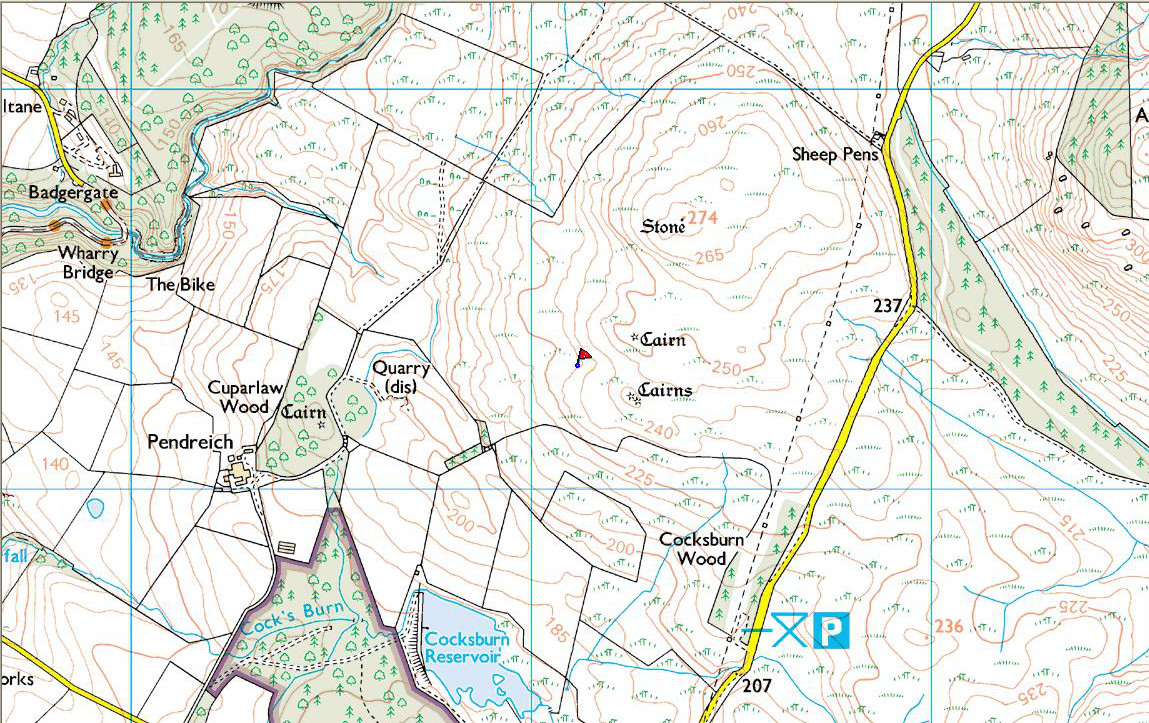
Split Stone mapStanding Stone: OS Grid Reference – NS 81116 99311

Getting Here

Take the same directions as if you’re gonna find the Pendreich Moor cairn up the hills behind and north of Stirling University (there are 2 very close to each other).  Once upon the cairned hill, walk dead straight WNW for 100 yards or so, or down the slope into the small valley, then westwards.  You’ll hit an overgrown length of very old walling.  Keep walking along here and, below it, you’ll find these stones laying down in the shallow grasses on the south-side of the all-but dried stream.  The large Cuparlaw Wood cairn is 0.4 miles west of here.

Archaeology & History

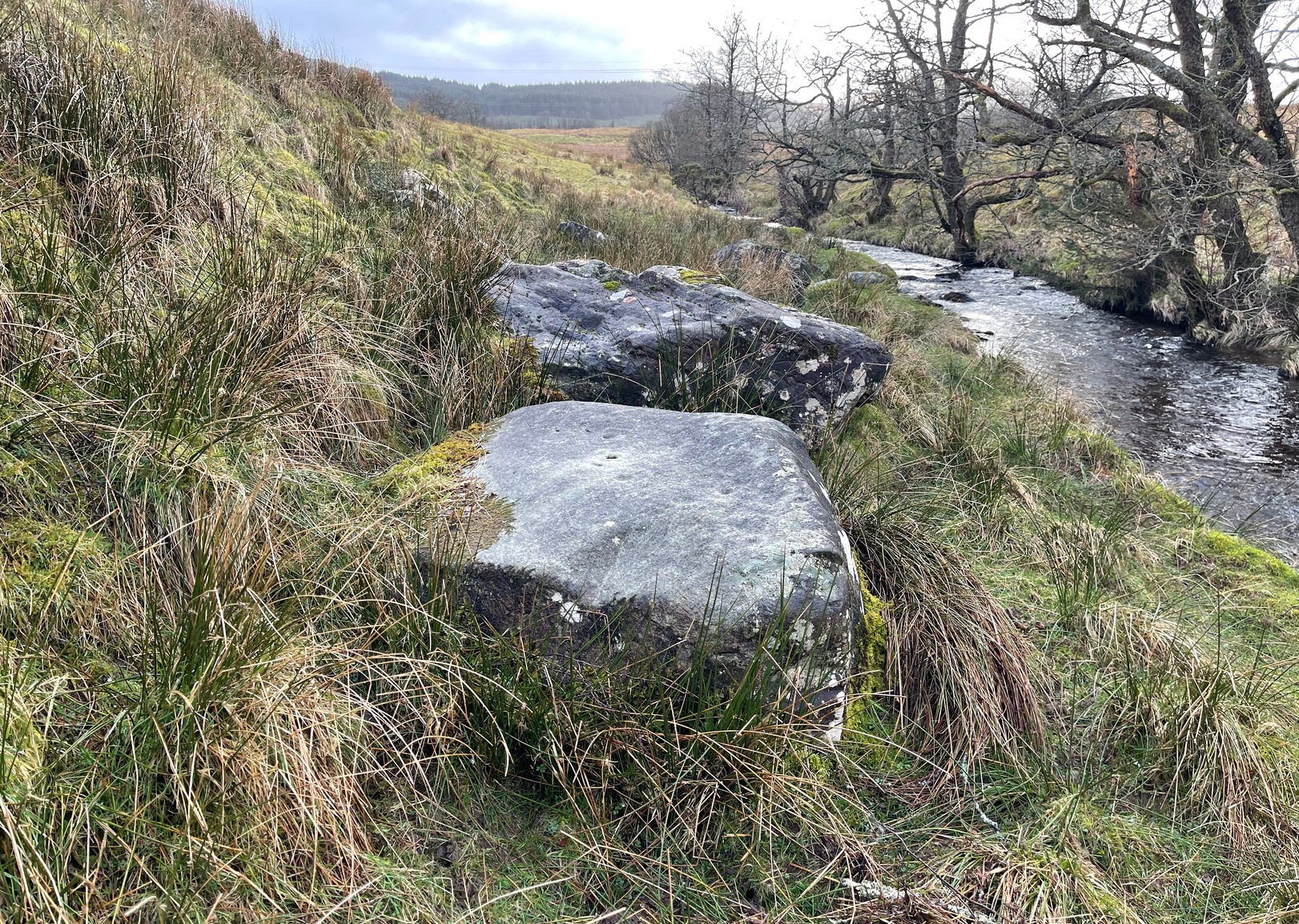
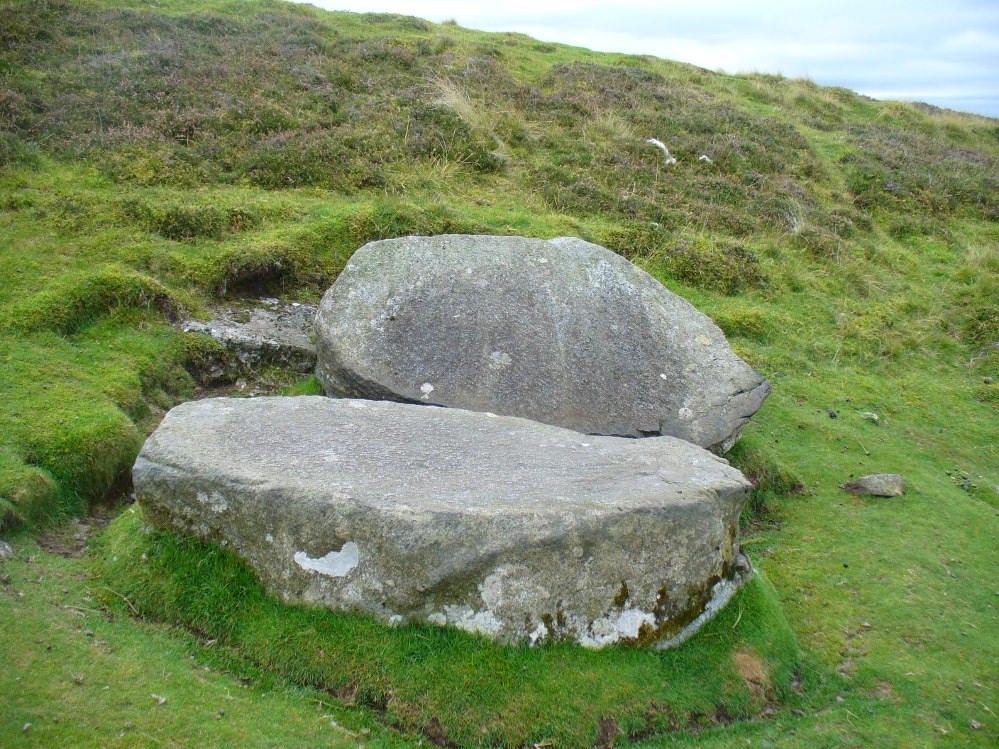
The Split Stone, Pendreich

This is something of an anomaly.  There is no previous written history about the place (that I can find) and archaeologists and historians on The Prehistoric Society and CBA forums can offer no other explanation when asked: is this a standing stone that, many centuries ago, was cut and prepared to be erected, but never made it into the intended monument? (wherever that might have been)  And so, I offer it onto TNA and ask the same of any readers, geologists or archaeo’s who might have an explanation for this curious, large split piece of stone, that lays silently on the western moorland edges of the Ochils, asking the same question.

When I first came across this site I was simply perplexed as to the why’s and wherefore’s of who had cut such a large rock into approximate halves.  I must have walked around it many times, puzzling what the purpose would have been of doing such a thing, and how long ago the ‘split’ had been performed.  About a year later I ventured up again and, when leaving to head back into Stirling, found no resolution to my puzzlement.  It had me truly stumped!

It wasn’t until I visited the prehistoric Witches’ Stone about 15 miles away near Monzie Castle last year, that one of those ‘eureka!’ events occurred.  The last thing on my mind was the curious split rock above Bridge of Allan.  Fellow antiquarian Paul Hornby and I were taking photos of the Witches’ Stone, when one of us remarked how unusually flat and smooth one face of this upright standing stone was – in fact, incredibly flat and smooth – and that’s when it hit me! As I walked round and round the Witches’ Stone, the similarity between this upright example and the one laid on the ground about 15 miles away got stronger and stronger.

The Split Stone, looking east

A week or two later, archaeology student Lisa Samson and I went back to the Split Stone to have another look at it.  Without doubt, the appearance and size and type of rock were one and the same.  The only real difference between the Witches Stone and this Split Stone on the edge of Pendreich Moor, is that one stands upright and the other is laid down.

As you can see from the photos, we have a large rock, 5-6 feet long, which was, at some time many centuries ago, split almost straight down the middle, following a natural line of weakness or mineral deposit running through the stone.  In all probability this was a standing stone prepared and ready to be used in some neolithic or Bronze Age monument not too far way—but for some reason it never made the journey to its intended spot.

The age of this split rock needs assessing correctly by geologists.  Walking around the earthfast halves, it is difficult to see any recent evidence of mason marks that might help us determine when the rock was cut like this.  In looking at erosion marks on cut-and-dressed quarried stone from post-medieval periods, we find no equivalent scars on this Split Stone.  There is what may be faint evidence of some cuts into the stone at the top and side, but these are very debatable; and very probably it seems that the stone must have been cut a very long time ago, thousands of years back, in order to erode all obvious mason marks.  But it would be good to get a geologist to have a look and confirm or deny such things.

…And, as if this isn’t a mystery unto itself:  walk across the dried stream and go up the slope right in front of you immediately north.  There’s a small, almost level ridge you’ll reach after 30 yards up, before the hill then rises further.  If you notice, in the grasses and heather around you, there’s much more of the overgrown ‘walling’ here along this ridge—and some of it, with dips here and there and about three feet tall in places, is in a circle!  It’s man-made, it’s a ring of stones, you can see it on GoogleEarth pretty clearly, and it’s not in any official record books.

Watch this space!

© Paul Bennett, The Northern Antiquarian

Cairnpark, Dollar, Clackmannanshire

Cairn (destroyed):  OS Grid Reference — NS 9618 9802

Also Known as:

  1. Canmore ID 48240

Archaeology & History

The destruction of this site more than two hundred years ago almost beggars belief.  It isn’t merely the fact that the self-righteous Industrialists did such things consistently, but that this particular tomb was more than just a few cartloads of stone being removed.  The site would also have been completely lost to history were it not for the diligent research of local historian William Gibson (1883).  In exploring the local place-names of the village, he asked the old locals as to “the origin of the name of Cairnpark in Dollar.” This is what he found:

“I have just learned, in the course of my present inquiries, that at the beginning of this century Dollar was possessed of an object of very great interest, but which unfortunately was entirely removed about the year 1806 or 1807. This was nothing less than a great pyramid (well, it was not quite so big as the famous one of Egypt, but still it was a great pile) which had evidently been erected to commemorate some great battle, or the death of some celebrated warrior; and it certainly is very much to be regretted that it should have been removed.  This was an immense cairn of stones, some thirty feet high, and as many square at the base; and the park in which it stood took its name from it—Cairnpark; and the street leading up to the Academy also got its name—Cairnpark Street—from its being made through this park.  It will scarcely be believed, yet it is nevertheless true, that this ancient and interesting cairn was removed for the ignoble purpose of being broken into road-metal for the new turnpike road that was then being constructed along the foot of the Ochils.  By whose orders it was removed I cannot say; but the late Mr. William Blackwood, of the New Town, superintended its removal, and kept a correct note of the cart-loads that were in it, and found they amounted to the astonishing number of one thousand! (my emphasis, PB)

“When the bottom was reached, there were found in the centre of it a number of ancient clay urns, showing that this immense cairn was a thing of great antiquity, and connected with some important event, and, had it been allowed to remain, would have been an object of interest second only to Castle Campbell itself, and an additional attraction to the ancient town of Dollar.  The Rev. Mr. Watson got possession of some of the urns, but what became of them is not now known.”

More than fifty years later, A.L. Drummond (1937) mentioned this old tomb, but could add no further details about it.  Does anyone know what became of the burial remains?  And how on earth could a giant tomb nearly 10 metres tall (Newgrange is 12m), consisting of 1000 cartloads of stone, be destroyed with barely any record of its existence? Astonishing!

Folklore

In a field south of the giant tomb, Gibson (1883) reported, “we used to have glorious ‘bonfires’ on the King’s birthday.”  In Simpkins’ (1914) work, we read of an excess of witches nearby; and of a local giant responsible for creating parts of the landscape—akin to those we sometimes find attached to giant tombs—but nothing specifically relating to this tomb.  Surely there must be remains of some traditions of this place, somewhere…?

References:

  1. Drummond, A.L., “The Prehistory and Prehistoric Remains of the Hillfoots and Neighbouring District”, in Transactions Stirling Natural History & Antiquarian Society, volume 59, 1937.
  2. Gibson, William, Reminiscences of Dollar, Tillicoultry and other Districts Adjoining the Ochils, Andrew Elliot 1883.
  3. Royal Commission on Ancient & Historical Monuments of Scotland, The Archaeological Sites and Monuments of Clackmannan District and Falkirk District, Edinburgh 1978.
  4. Simpkins, John Ewart, County Folklore – volume VII: Examples of Printed Folk-Lore Concerning Fife, with some Notes on Clackmannan and Kinross-Shires, Folk-Lore Society: London 1914.

© Paul Bennett, The Northern Antiquarian

Moir’s Well, Dollar, Clackmannanshire

Healing Well:  OS Grid Reference – NS 96535 98711

Getting Here

Moirs Well on 1866 OS-map

Go up the road alongside the Dollar Burn, turning right, up the steep hill as if heading to the Wizard’s Stone and the impressive Castleton monolith, a mile further along.  Before reaching the Wizard’s Stone, keep your eyes peeled on the right for the street-name, ‘Moir’s Well’.  From here, walk up the road less than another 100 yards and till you reach the water-cover.

Archaeology & History

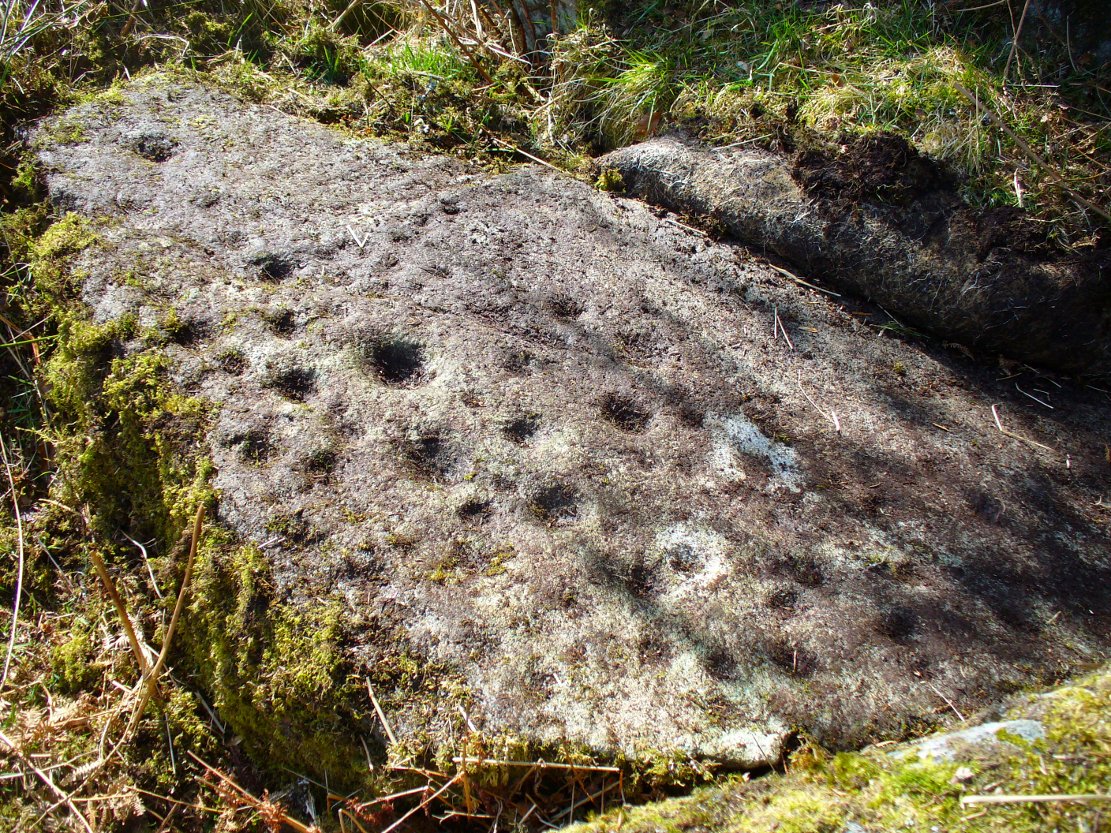
Site of the old Muir's Well
Site of the old Muir’s Well

There is little known about any history of this now-covered old well, halfway up the steep slope towards Lochy Launds.  It was noted by Ordnance Survey in 1861 and subsequently published on the earliest OS-map a few years later. It was obviously a wayside well for those venturing up the steep hill and used to have an old stone trough into which the waters ran.  Although we don’t know for certain, the etymology of the well probably comes from the surname Muir, which according to William Gibson (1883) was common in the old village.

People living in the houses below here, told us that after heavy rains their gardens become very boggy, which is probably due to the sub-surface water from Muir’s Well.  Tis good to know that the waters are still finding their way out!

References:

  1. Gibson, William, Reminiscences of Dollar, Tillicoultry and other Districts Adjoining the Ochils, Andrew Elliot 1883.

© Paul Bennett, The Northern Antiquarian


Ladies Well, Alva, Clackmannanshire

Holy Well:  OS Grid Reference – NS 8857 9788

Also Known as:

  1. Wishing Well

Getting Here

1918 postcard of Ladies Well

From Alva, take the signs to walk up the gorgeous Alva Glen gorge, past the site of the Dwarf’s Tomb, over the bridge past the first waterfall and up the footpath and into the glen proper.  The path runs parallel with the gorge and a few hundred yards along you’ll reach a small footbridge.  Immediately before this, on your right, coming down through the crags by the side of the path, the waters fall from the well in question.  It’s easy enough to see.

Archaeology & History

Waters of the Lady Well on a dark, grey evening

The history of this site is seemingly hidden.  Little has been written of it and its dedication to some ‘Lady’ is an oddity.  I can find no specifics telling who the ‘lady’ in question is.  The other Lady Well at Tillicoultry, a mile or two east, is equally bereft of historical certitude.  Whether it is another dedication to the supposed ‘virgin’ Mary of the christian cult, or a local lady whose name has long since been forgotten, we do not know.  Additional info on this site would be most helpful.

Shown on an early postcard of the Alva Glen and highlighted in Mr Pithie’s (1982) work, the waters here—running down the crag-face from a spring at the top—are fine, fresh and almost sweet-tasting, rich in minerals and healthy nutrients no doubt.  Without doubt, I’d recommend a drink of this every time you walk past here! (apologies for the dark photo – I’ll get a better one next time we’re up there)

References:

  1. Corbett, L., et al., The Ochil Hills, Forth Naturalist & Historian 1994.
  2. Pithie, A., Views of Alloa and the Neighbourhood, Clackmannan District Libraries 1982.

Acknowledgements:  Grateful thanks to Lisa Samson for help with directions.

© Paul Bennett, The Northern Antiquarian

Dwarf’s Tomb, Alva, Clackmannanshire

Tomb:  OS Grid Reference – NS 8848 9754

Also Known as:

  1. Canmore ID 47076

Getting Here

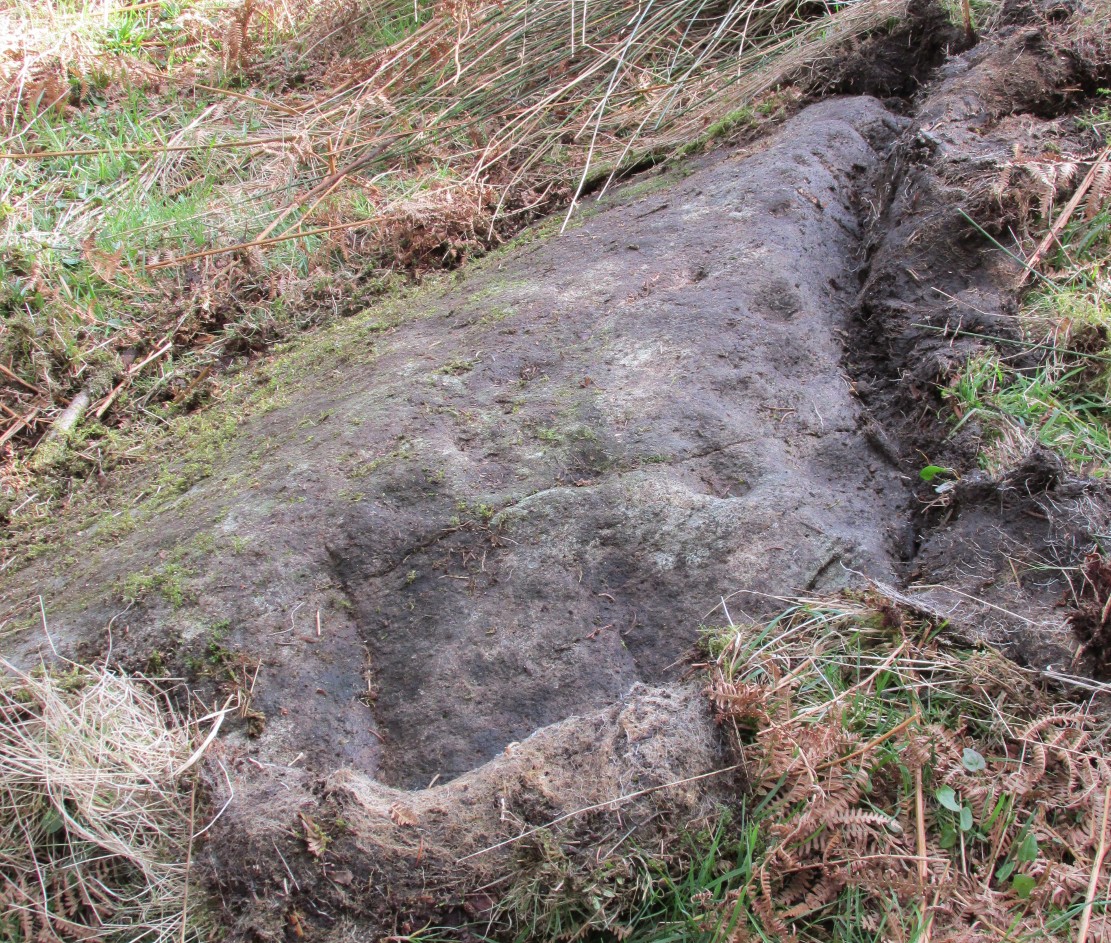
Quarry of the Dwarf's Tomb
Quarry of the Dwarf’s Tomb

From the main street through Alva, between the Co-op and the corner shop, go up the small road at the side of the Johnstone Arms Hotel (Brook Street) and, at the small crossroads, straight across as if following the sign to the golf course. Stay along the track parallel with the Alva Burn waters and as you go into the trees a hundred yards or so along, to your left is a disused quarry, with a couple of plaques telling you its brief history. This is the spot!

Archaeology & History

This is a truly fascinating site for a number of reasons.  Sadly, we can no longer see what had been here for oh so many thousands of years thanks, as usual, to the industrialists destroying the land here.  Although in this case, without them we’d be unaware of its very existence.  Additionally, there is a twist to the industrial’s find, which seems to have stopped further quarrying by some local people….

The tomb was somewhere in the left-middle

Listed in the relative Royal Commission accounts (1933; 1978), without comments, the tale is a simple one, but was narrated in some detail by J.G. Callander (1914) in Scotland’s prodigious Society of Antiquaries journal.  During some quarrying operations over the Christmas period of 1912, James Murdoch “uncovered the remains of a human skeleton which had been buried in a natural cavity in the rock.”  Three weeks later, local police officer George Donald and Dr W.L. Cunningham of Alva, accompanied Mr Callander to the site and made a detailed assessment of what had been found.  He wrote:

“The quarry in which the grave was found is situated at the mouth of Alva Glen, a few yards distant from the right bank of the burn which flows through it.  The body had been placed in a cavity or rock shelter in the face of the cliff, about 40 feet from the base, and about 200 feet above sea-level, and a rough, curved wall of dry-stone building, about 1 foot in thickness, had been built across the opening, which faced the east, the ends of the wall being still in situ when I visited the site. The space enclosed measured about 4 feet 6 inches from north to south, and about 5 feet from east to west.  Subsequent to the burial the whole face of the rock and the walling had been covered, to a thickness of probably some 6 feet, by soil and detritus washed down from the hill face above.  The greater part of the floor of the cavity was formed of clean, broken, angular stones, but the space on which the body was placed had been covered with a thin layer of soil preparatory to the burial.  No charcoal or charred wood, which is so often seen in prehistoric graves, was found in this deposit.  The skull lay in the north end of the grave, on its right side, facing the rock to the west, the vertebrae and ribs followed a line to the south, and the nether limbs were inclined towards the interior of the cavity.  The whole  face, including all the teeth and the lower jaw, was a-wanting.  Apparently the body had been placed in a flexed position, half on its side and half on its back.  Nothing else was found in the grave but a quantity of snail shells, probably twenty or thirty, which were nearly all broken, the few complete examples being in a very fragile condition.

“Elsewhere it has been stated that these formed a necklace, but while they were strewn out in front of the skeleton for a distance of over 3 feet, none of them showed any signs of artificial perforation.  The species of Helixis is probably hortensis, the common garden snail.”

Mr Callander then included a lengthy description of the body itself, some of whose bones were fractured.  He told that a certain

“Professor Bryce states that the skeleton is that of a dwarf of about 4 feet 2 inches in stature.  The epiphyses are all fully united, although the line of union is visible on the surface at some points.  Growth must therefore have been completed, and the person must have been, if the union of the epiphyses of the long bones had pursued its normal course, over twenty-one years of age…”

Regarding the sex of the dwarf, Mr Bryce wasn’t 100% certain, but told:

“The calvaria shows the general characters of a female skull, but it cannot be stated definitely that the individual was a woman, because the cranial characters are such as might have been present in a dwarf of the male sex.  The calvaria is of moderate size, and is well formed.”

Bryce concluded as a whole that this person was in reasonably good health and, from the condition of the bones, showed “there was no evidence of the disease known as rickets.”  In his final remarks he told:

“The general conclusions to which a careful examination of the skeleton leads, is that we have here to do, not with a representative of a dwarfish race, but with an individual who from premature union of the epiphyses was to a remarkable degree stunted in growth.  The condition is a well-known one, and the class of dwarfs, in which this individual must be included, is well recognised.”

Probable spot of the lost tomb

The exact spot of the tomb appears to have been destroyed, or at the very least is certainly covered over and no longer visible.  The section of the quarry looking east, into which the tomb was built, is all-but gone and no initial evidence prevails to show its exact location.  However, it would seem from the description to have been close to the tops of the tree-line, perhaps giving a clear view to the rising sun in the east.  Perhaps… 

The position of this tomb, enclosed high up in the cliffs, hidden away at the entrance to the deeply cut ravine of the Alva Glen, is intriguing in that it is a rarity.  Ravines like this are always peopled by olde spirits in animistic tribal traditions — and this dangerous glen with its fast waters and high falls would have been no different, especially to the Pictish people who we know were still here even after the Romans had buggered off.  Is it possible that this figure was a guardian to the Glen itself, a medicine woman or shaman, whose very Glen was her home?  We know from traditional accounts in many of the North American tribes that dwarves were accessories to the spirit worlds, and some were shamans. (Park 1938)  In northern and central European lore, these small people are “the mysterious craftsmen-priests of early civilizations.” (Motz 1987)  Whilst in Scottish lowland lore, the ‘Brown Man of the Muirs’ was a dwarfish creature described by Briggs (1979) as “a guardian spirit of wild beasts”, or watered-down shaman figure. There is more to this burial than meets the eye of dry academia…

Folklore

The Alva Glen—in addition to being beautiful and home to the Ladies Well—was long known to be one of many places in the Ochils that were peopled by the faerie folk. (Fergusson 1912)  Local people still say this place is haunted by the spirit of a dangerous witch called Jenny Mutton.

It’s worth reiterating the words of Mr Callander (1914) regarding the finding and subsequent death of the man who uncovered this fascinating tomb, as some folk (then as now) think his demise was as inevitable as the man who planned on building turbines in Glen Cailleach:

“On the 24th December last, while quarrying stone for road metal in a quarry at the foot of the Ochils, at Alva, James Murdoch uncovered the remains of a human skeleton which had been buried in a natural cavity in the rock.  Two days later he was killed at the same spot by the fall of a mass of overhanging rock, a tragic sequel, which not long ago would have been considered a judgement on him for disturbing the dead.”

References:

  1. Briggs, Katherine M., A Dictionary of Fairies, Penguin: Harmondsworth 1979.
  2. Callander, J. Graham, “Of a Prehistoric Burial at Alva, Clackmannanshire,” in Proceedings of the Society of Antiquaries, Scotland, volume 48, 1914.
  3. Corbett, L., et al., The Ochil Hills, Forth Naturalist & Historian 1994.
  4. Drummond, A.L., “The Prehistory and Prehistoric Remains of the Hillfoots and Neighbouring District”, in Transactions Stirling Natural History & Antiquarian Society, volume 59, 1937.
  5. Fergusson, R. Menzies, The Ochil Fairy Tales, David Nutt: London 1912.
  6. Gimbutas, Marija, “Slavic Religion,” in Encyclopedia of Religion – volume 13 (editor M. Eliade), MacMillan: New York 1987.
  7. Motz, Lotte, “Dvergar,” in Encyclopedia of Religion – volume 4 (editor M. Eliade), MacMillan: New York 1987.
  8. Park, Willard Z., Shamanism in Western North America: A Study in Cultural Relationships, Evanston: Chicago 1938.
  9. Royal Commission on the Ancient & Historical Monuments, Scotland, Inventory of Monuments and Constructions in the Counties of Fife, Kinross and Clackmannan, HMSO: Edinburgh 1933.
  10. Royal Commission on the Ancient & Historical Monuments, Scotland, The Archaeological Sites and Monuments of Clackmannan District and Falkirk District, Society of Antiquaries of Scotland 1978.

© Paul Bennett, The Northern Antiquarian

Balinshoe, Kirriemuir, Angus

Standing Stone (destroyed):  OS Grid Reference – NO 4164 5219

Also Known as:

  1. Canmore ID 33871
  2. The Stannin Stane of Benshie

Archaeology & History

Site of the standing stone on 1865 OS-map
Stone on the 1865 OS-map

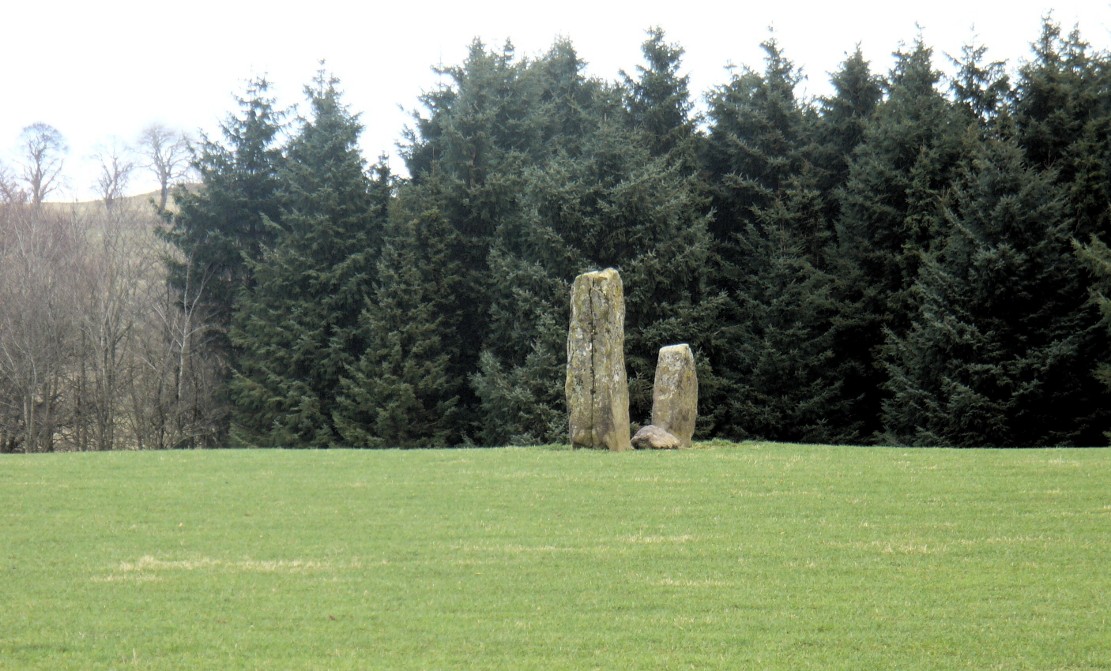
In a region that is full of prehistoric remains, we find here another example of another megalithic site that was sadly destroyed, not too long ago by the scale of things.  Found in association with a large prehistoric urn, we are thankful to have a couple of early local history accounts that describe the place.  The stone was obviously of some considerable height and bulk, though I can find no specific references to the dimensions of the monolith.  It was described effectively in the middle-half of the 19th century by Andrew Jervise (1853), who told us:

“‘The Stannin Stane of Benshie’, which stood for unknown ages…was demolished by gunpowder about half a century ago, and the spot is now covered by luxuriant crops of corn. This rude monument of antiquity is supposed to have been about twenty tons in weight; and at a considerable depth below it, a large clay urn, measuring about three feet in height and of corresponding circumference, was found containing a quantity of human bones and ashes.  Like its rude protector, however, the urn was broken to pieces; and, beyond the mere fact of its discovery, nothing authentic, as to either the style of its manufacture, or the precise nature or state of its contents, is preserved.”

More than 30 years later, A.J. Warden (1884) and then J.G. MacPherson (1885) all but copied Mr Jervise’s words, adding no further information.

From some reason, a small chapel dedicated to St. Ninian (NO 41567 51932) was built about 100 yards or so to the southwest of the old standing stone.  Its ruins are still to be seen. Whether this was an attempt to divert local people away from their animistic ecocentricism at the stone, into the more ecocidal egocentricism of the incoming christian cult (as was/is their common practice), we may never know for sure.

Folklore

The local name of this stone, ‘The Stannin Stane of Benshie’, indicates simply that this was “the standing stone at the hill of the faerie folk” (or variations thereof) and suggest it stood upon or next to a mound. I can find no immediate reference to stories of the little people here, and their whisper may have faded into unconscious memory.  Does anyone know more about this place?

References:

  1. Jervise, Andrew, The History and Traditions of the Land of the Lindsays in Angus and Mearns, Sutherland and Knox: Edinburgh 1853.
  2. MacPherson, J.G., Strathmore: Past and Present, S. Cowan: Perth 1885.
  3. Royal Commission on the Ancient & Historical Monuments of Scotland, The Archaeological Sites and Monuments of Central Angus, Angus District, Tayside Region, Edinburgh 1983.
  4. Warden, Alex J., Angus or Forfarshire: The Land and People – Descriptive and Historical – volume 4, Charles Alexander: Dundee 1884.

© Paul Bennett, The Northern Antiquarian


Lady Well, Clackmannan, Clackmannanshire

Holy Well:  OS Grid Reference – NS 9112 9166

Getting Here

1866 OS-map showing Lady Well

From Clackmannan village centre (with its huge phallic stone), at the crossroads take the south road, Port Street.  Walk on here for 100 yards or so and the aptly named Ladywell Grove appears on the right. Walk past there and take the next right down Craigie Road.  The original well was barely 50 yards along where the garden edges are today, within yards of the OS-grid ref; but walk another 100 yards down and, by the roadside is a waterworks cover.

Archaeology & History

Lady Well overflow?
Lady Well overflow?

One of at least three ‘Lady Wells’ that are known in tiny Clackmannanshire—and, like the others, it has not fared well. Not included in either of the major surveys (MacKinlay 1893; Morris 1981), nor referenced in the St. Bartholomew’s Day celebrations once held in the village.  It is listed only in passing by Walker (1883) and Simpkins’ (1914) and I can find no references to it in the local history works.  Yet it appears in differing place-name forms on the earliest Ordnance Survey maps and its name is still retained in streets-names here.

Whether this old spring of water was dedicated to St. Mary (as the majority of Lady Wells in Britain tend to be), or it was named after a local lady, history records seem quiet on the matter.

The original spot for the well (highlighted on the 1866 OS-map above) is covered in shrubs and seems to be gone. But another 100 yards down the road, a water-cover regularly overflows during heavy rains and this may be where its waters were diverted to.

References:

  1. Simpkins, John Ewart, County Folklore – volume VII: Examples of Printed Folk-Lore Concerning Fife, with some Notes on Clackmannan and Kinross-Shires, Folk-Lore Society: London 1914.
  2. Walker, J. Russel, “‘Holy Wells’ in Scotland,” in Proceedings of the Society of Antiquaries of Scotland, vol.17 (New Series, volume 5), 1883.

© Paul Bennett, The Northern Antiquarian