Bombie, Kirkcudbright, Kirkcudbrightshire

Stone Circle (destroyed):  OS Grid Reference – NX 7079 5018

Archaeology & History

This stone circle was destroyed sometime in the early 1780s by some moron who cared little for our ancient sites.  Its destruction was described by Robert Muter in 1794—the earliest known reference to the site—when he told:

“Near the Roman camp there is a Druidical temple, which was destroyed within these eight years, by the hands of an ignorant Goth, who carried off the stones, split them, and applied them to build a contemptible bridge over an insignificant rivulet, called Buckland Burn.  The stones were seven in number, of round granite, and of unequal sizes.  The smallest at least three feet in diameter.”

In the 1850s, when the Ordnance Survey lads came this way to map and seek out the place-names of the area, the ‘Clownstane’ was one such place they listed.  In seeking an explanation of the word, a local man told them the folk memory from seventy years prior:

“Mr. Bell of Balgreddan says the name Clownstane originated from the Stones of a Druid Circle which stood convenient to this place and which was broken up and removed to build a bridge near by.”

Fred Coles (1895) included the site in his survey of the Kirkcudbright circles, simply reiterating how,

“According to Dr Muter, the stones “were seized by some vandal for the building of Buckland Bridge.””

References:

  1. Coles, Fred R., “The Stone Circles of the Stewarty of Kirkcudbright,” in Proceedings of the Society of Antiquaries Scotland, volume 29, 1895.
  2. Muter, Robert, “The Parish of Kirkcudbright,” in Statistical Account of Scotland – volume 11, William Creech: Edinburgh 1794.

Links:

  1. Canmore notes on Bombie
  2. Ordnance Name Book on the Bombie Circle

© Paul BennettThe Northern Antiquarian

Little Balmae, Kirkcudbright, Kirkcudbrightshire

Stone Circle (destroyed):  OS Grid Reference – NX 691 447

Archaeology & History

In an area littered with neolithic and Bronze Age remains, the great Fred Coles (1895) reported a stone circle that was destroyed sometime roughly between 1890 and 1911.  When he visited the place with his colleague, Mr E.A. Hornel in 1887, the megalithic ring had already been tampered with.  It was, he said,

“found to consist of five granite boulders, all of them large, in situ, and the ridgy grassy hollows of five others—removed, no one can say when.  In the centre of this nearly true circle, 90 feet in diameter, is a slight mound, possibly artificial.”

In 1911, when the Royal Commission lads visited the area, they could find no stone circle and reported how “no information could be obtained concerning it” from the local farmer.  This might have been because he destroyed it.  Some land-owners do such things, as we know; but in this case we may never know.

The site was listed without comment in the Master’s magnum opus (Burl 2000), but he gave it the “uncertain status” category; whilst John Barnatt (1989) questioned whether this was a destroyed stone circle or merely a natural setting that Cole had misinterpreted.

References:

  1. Barnatt, John, Stone Circles of Britain – volume 2, BAR: Oxford 1989.
  2. Burl, Aubrey, The Stone Circles of Britain, Ireland and Brittany, Yale University Press 2000.
  3. Coles, Fred R., “The Stone Circles of the Stewarty of Kirkcudbright,” in Proceedings of the Society of Antiquaries Scotland, volume 29, 1895.
  4. Royal Commission Ancient & Historical Monuments, Scotland, Inventory of Monuments and Constructions in Galloway – volume 2: County of the Stewartry of Kirkcudbright, HMSO: Edinburgh 1914.

Links:

  1. Canmore notes on Little Balmae

© Paul BennettThe Northern Antiquarian

Balmae (2), Kirkcudbright, Kirkcudbrightshire

Cup-and-Ring Stone:  OS Grid Reference – NX 68649 44700

Also Known as:

  1. Balmae House
  2. Balmae 5 (Coles)

Archaeology & History

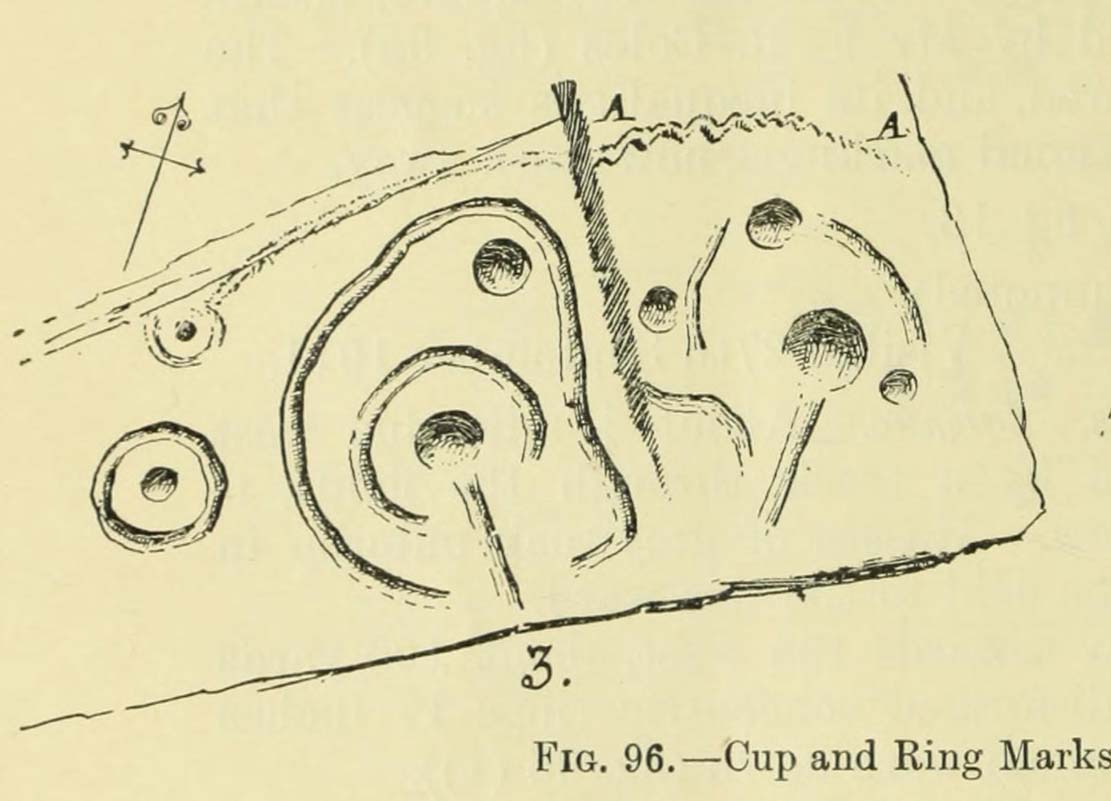
Coles’ 1895 sketch

Amongst a good cluster of petroglyphs, this ornate little fella may have been one visited by George Hamilton (1886) when he visited Balmae and outlying districts, seeking out petroglyphs!  We don’t know for certain though, as his descriptions are somewhat vague.  However, a few years later the great Fred Coles (1895) came a-wandering in search of the same carvings and, as happens in this line of business, uncovered a few new ones during his rummaging.  This was one of them, which he described, very simply, as hiding

“but a few yards from Ross View Cottage, on its N.W. … (with) eight cups being associated with four rings and several grooves, both straight and curved.”

It was only a few years later when the Royal Commission lads (1911) came in search of it and they told how,

“the main design is a central ringed cup with a connected groove, and two outer cups which an outer circle curves eccentrically to enclose.”

But when Ron Morris (1979) explored the area in the 1970s, he was unable to locate this and a number of other carvings that had been reported by Coles.  Since then, the carving has been relocated at the grid reference cited above.  Also since then, a great deal many more carvings have been found in this locale by the experienced petroglyphic fingers of Maarten van Hoek. (1993)

References:

  1. Coles, Fred, “A Record of the Cup-and-Ring Markings in the Stewartry of Kirkcudbright,” in Proceedings Society Antiquaries, Scotland, volume 29, 1895.
  2. Hamilton, George, “Notices of Rock Sculpturings of Cups and Circles in Kirkcudbrightshire,” in Proceedings Society Antiquaries, Scotland, volume 21, 1886.
  3. Morris, Ronald W.B., The Prehistoric Rock Art of Galloway and the Isle of Man, Blandford: Poole 1979.
  4. Royal Commission Ancient & Historical Monuments, Scotland, Inventory of Monuments and Constructions in Galloway – volume 2: County of the Stewartry of Kirkcudbright, HMSO: Edinburgh 1914.
  5. van Hoek, M., “Balmae”, in Discovery & Excavation Scotland, 1993.

Links:

  1. Canmore – short notes on Balmae (2)

© Paul BennettThe Northern Antiquarian

St. Fillan’s Tree, Killin, Perthshire

Sacred Tree:  OS Grid Reference – NN 5708 3249

  1. St Fillan’s Ash

Archaeology & History

Long since gone, this great olde ash tree could once be found on the south side of Killin’s Mill building, close to the bridge at the Falls of Dochart.  It was deemed to be ‘sacred’ by local people – just as all trees were, once upon a long time ago.

In John Shearer’s (1883) wonderful book on the ancient ways of the Perthshire people, he described the tree as being adjacent to the earthfast rock known as St. Fillan’s Seat:

“At the side of it grows a large ash tree which is held sacred by the natives as no person will burn any of the branches although fallen to the ground nor destroy them in any manner.  However, there was one who had the hardihood to take one of the branches for a caber to repair his house.  Strange to tell the first fire that was kindled burned it to the ground as a punishment for this impious sacrilege.  Of course no person since has troubled it or taken any of the wood.  The branches that fall lie till they rot.”

The brilliant Killin historian, W.G. Gillies (1938) reported that the tree was still standing until it was “blown down by a gale in 1893″—but it didn’t quite kill it off for good; for in September 1911, C.G. Cash visited Killin and this was one of the many places he looked for and, despite local folk telling him about the more famous St Fillan Stones (still in existence and found at the Mill), he saw the last remnants of this great Ash, telling simply that,

“the mere dead stump of St Fillan’s Ash-tree still stands against the south post of the mill gate.  And quite near it is a young ash, said to be its descendant.  This younger tree has an out-curving branch that was said to have been the gallows-branch in olden days; but it is obviously too young and too weak.”

…So, does anyone know precisely which is the “descendant” of St. Fillan’s Ash and where happens it to be growing?

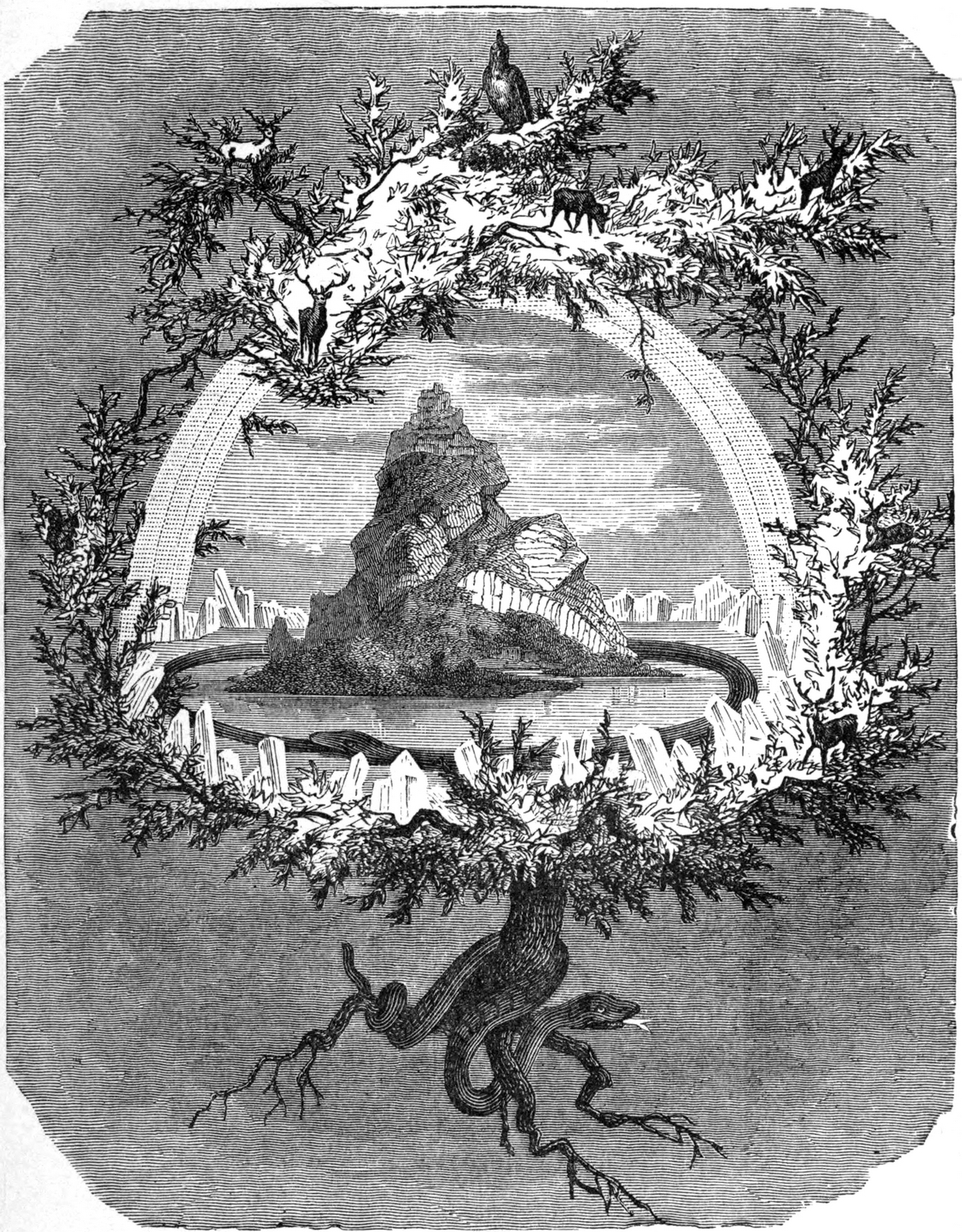
In Norse myth, the ash tree Yggdrasil was the tree of Odin and was one of the primal ingredients in their Creation myths.  It stood at the centre of the cosmos: an axis mundi no less, linking the many worlds and was the abode of the gods.  Its mythologies are extensive.  In Scotland, the myths of the ash are not so well known, but there’s little doubt that it possessed a sanctity and certainly has many traditions of it own, which are unfortunately outside the remit of this site profile.

References:

  1. Cash, C.G., “Archaeological Gleanings from Killin,” in Proceedings of the Society of Antiquaries of Scotland, volume 46, 1912.
  2. Elders, E A., “Saintly stones in a Perthshire village,” in Country Life, December 1962.
  3. Gillies, William A., In Famed Breadalbane, Munro Press: Perth 1938.
  4. Shearer, John, Antiquities of Strathearn, D. Phillips: Crieff 1883.

© Paul BennettThe Northern Antiquarian

Hangie’s Stone, Cargill, Perthshire

Standing Stone: OS Grid Reference – NO 15751 35578 

Also Known as:

  1. Gallowshade
  2. Canmore ID 28479

Getting Here

Turn right off the A93 at Cargill onto the side road by Keepers  Cottage and up the hill to Gladsfield Wood at the top on your right. Park up at the top side of the Wood and walk straight along the narrow track for around 450 yards and what may be the remains of the stone will be seen between a pair of mature trees.

Archaeology & History

In 1862 the stone was described in the Ordnance Survey Name Book for Perthshire:

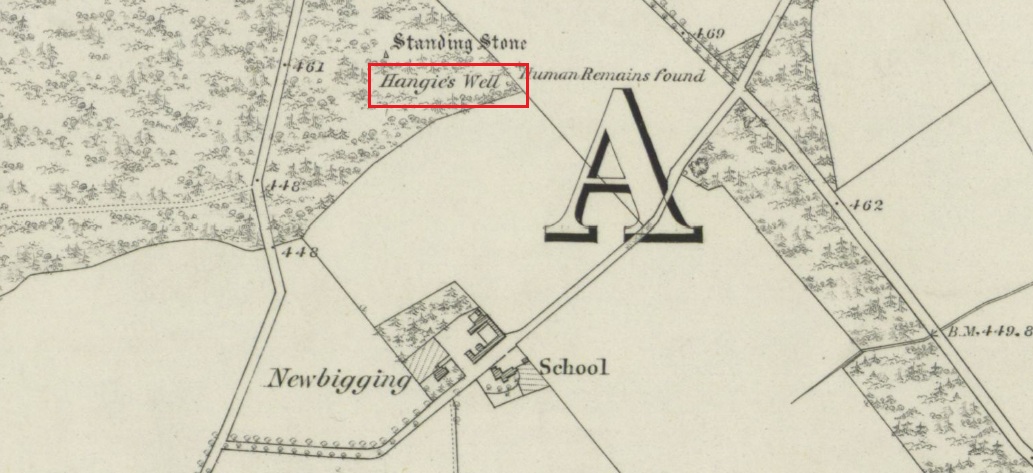
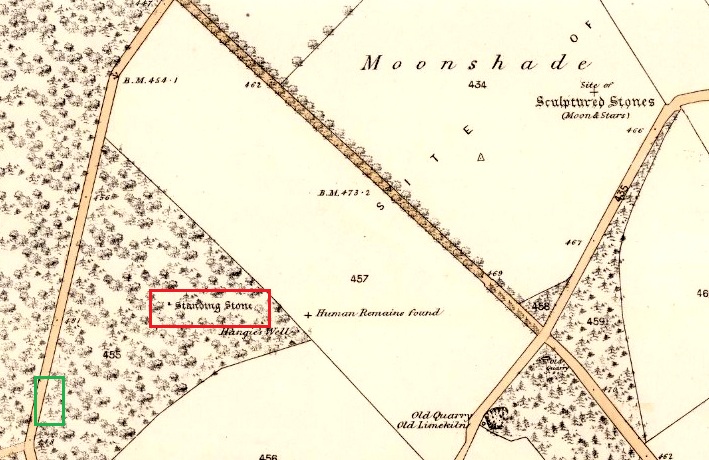
‘And about 150 yards from the same object [Hangie’s Well], in a north-westerly direction, there is a small Standing Stone, having the appearance of the ancient monumental standing stones.’

It seems the stone had been removed by the time Fred Coles (1909) came to see it nearly fifty years later.  He told us:

“On the day of my visit the mist was so abnormally dense and confusing that it was with considerable difficulty the wood itself was identified; and as its interior is an utter wilderness of trees, shrubs, brambles, broom, wild roses and tall grass, besides being a pheasantry, it is just possible that the monolith searched for evaded my zeal.  I think not, however, because, hearing a hedger at work on the Newbigging side of the wood, I made for him; and after plying him with various questions, could get no statement to the effect that he had, though living so near, ever seen any conspicuously tall Stone in the wood.

“On retracing my steps, I searched a fresh portion of the wood, and noticed one biggish block of whinstone lying on the grass in a slight hollow of the ground. It was somewhat cubical, about 2 feet 6 inches square, and fractured.  This may he a portion of the former monolith, possibly; and with this dubious result I had to be content.”

In 1967 the archaeologist O.G.S. Crawford described “a sharp-edged boulder standing near the spot marked on the map,” but was not certain if it was the stone.  It had no markings on it.

25 in OS map of 1866 showing original position of stone outlined red and position of possible remains of stone in green

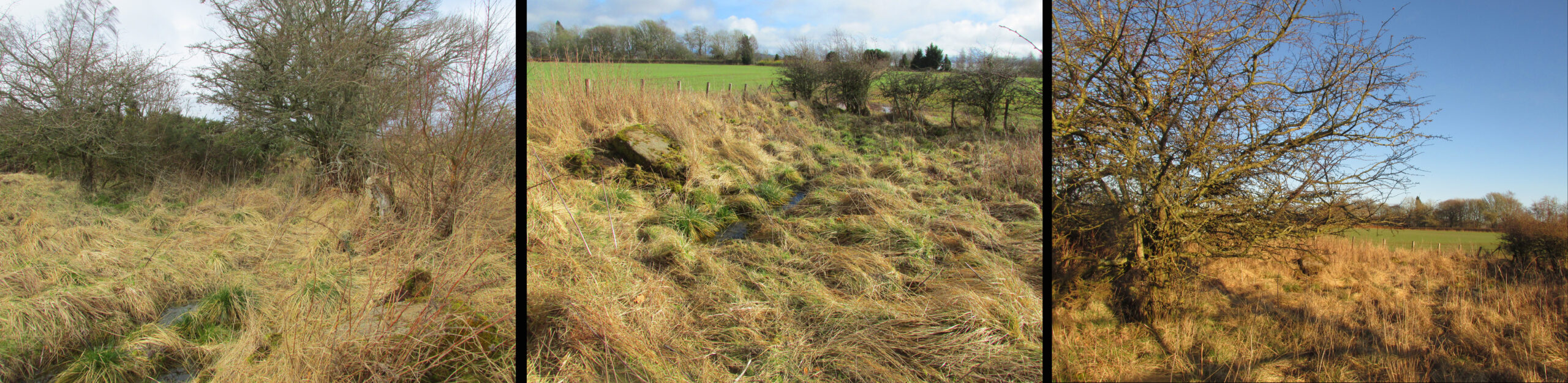
Moving on to 2020, and I found the same impenetrable jungle that Coles described more than a century earlier.  When a site has been destroyed I can normally take a photograph of where it once was, but not in this case.  I continued westward over difficult and potentially ankle snapping terrain that had recently been replanted with conifer saplings, until I got out of the planting area to a line of mature trees next to the track through the wood.

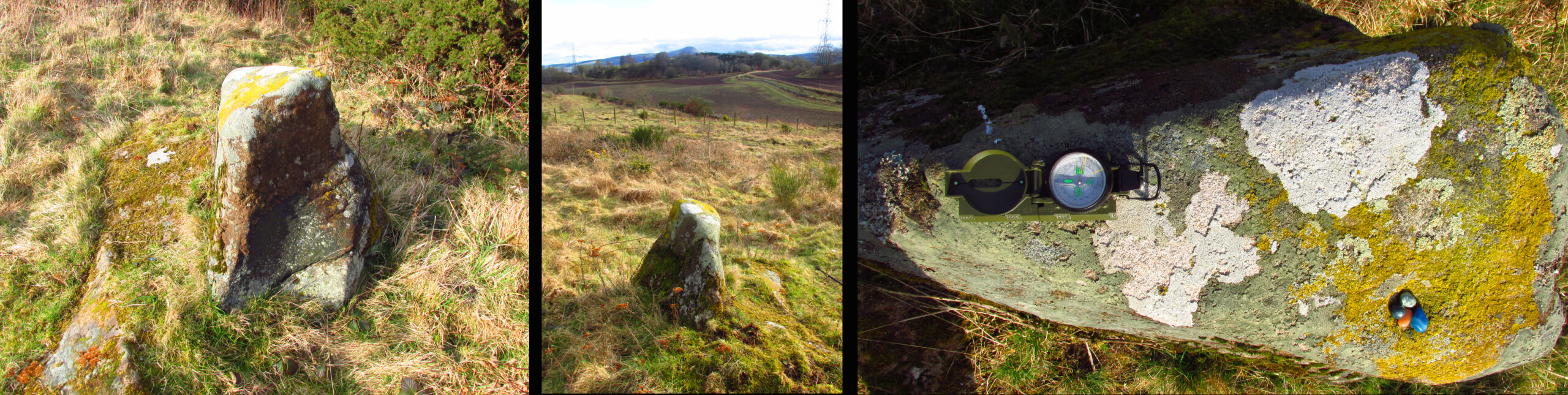
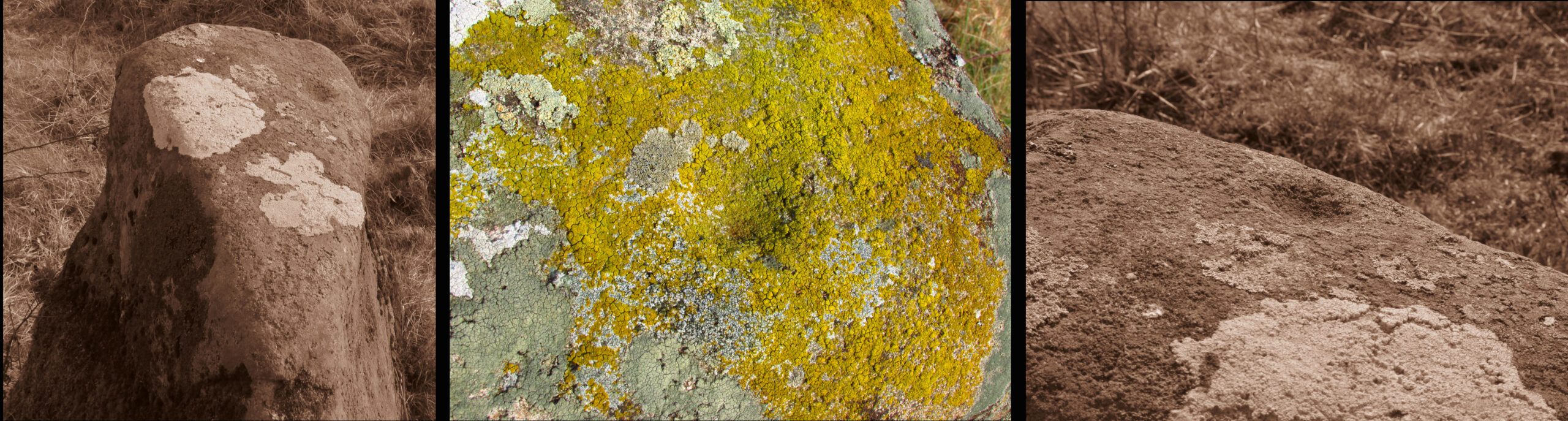
One large elongated stone presented itself that had clearly lain there for many years judging from the moss growth, a short distance away at NO 15641 35478.  Could this be the top part of the standing stone, dragged from its original position some 500 feet to the north-east?  It is of grey whinstone, heavily veined at the base, with white quartz and tapering to a pointed tip.  It has a squarish base measuring approximately 3 feet across by at least 2 feet deep and is some 7 feet in length.  It doesn’t look to be natural, so is it a likely candidate for our missing stone?  Felled by a man with a hammer and chisel and dragged by a heavy horse to the edge of the field as part of the ‘improvements’, so beloved of nineteenth century landowners…

We can’t prove it is the remains of Hangie’s Stone which may, after all, still lie buried in the boscage…

The possible remains of Hangie’s Stone

The stone in its original position was next to the Roman road from Camelon via Stirling and Muthill to Kirriemuir near to the junction of a road to Inchtuthill Roman Fort, so may have once been a way marker, although it is not of Roman origin.

References:

  1. Coles, Fred R., “Stone Circles Surveyed in Perthshire (South-east District),” in Proceedings of the Society of Antiquaries Scotland, volume 43, 1909.
  2. Margary, Ivan D, Roman Roads in Britain, John Baker: London 1973.
  3. Ordnance Survey Name Book
  4. Sedgley, Jeffrey P., The Roman Milestones of Britain, BAR Reports No. 18: Oxford 1975.

© Paul T Hornby 2021

Thistle Brig, Stanley, Perthshire

Legendary Rock: OS Grid Reference – NO 10842 32040

Getting Here

The easiest way to see the site is to stop at the car park at Craighall on the B9099 south of Stanley, and follow the path to the river.  The remains of the Brig will be seen on the other side of the Tay from the riverside walk.

Archaeology & History

The Thistle Brig was described in the nineteenth century Ordnance Survey Name Book as:-

‘A remarkable spot in the River Tay, when the breadth of the river becomes suddenly narrow by the protrusion of a bed of trap rock which crosses it at this place.’

Thistle Brig & the quarries for its hard stone on the 1901 25 in OS-map

According to local historian Alexander Scott, the Thistle Brig formed a convenient place to ford the Tay until  much of it was blasted away by explosives some time in the mid-nineteenth century in order to improve the flow of the river.  Old maps imply that an actual bridge may have spanned the Tay hereabouts at some time in the past.  The seemingly little known folklore of this site relates to an invasion by the Danes in the early mediaeval period. Elsewhere there are similar stories, so the truth or otherwise depends on where you are in Scotland, but this one may have more validity as the tale seems to give its name to the place!

The name ‘Thistle Bridge’ has been applied on old postcards to a stone footbridge over a side channel or lade between the road and the River Tay to the south of the Brig, and is not the subject of this profile.

The remains of the Thistle Brig – a hard basalt dyke on the east bank of the River Tay

Folklore

Alexander Scott, writing of the Brig:-

“…tradition holds that here the thistle received the distinction  of becoming the national emblem of Scotland.  In one of the many invasions the country suffered from foreign armies, the Danes, on one occasion, having landed on the east coast sacked the town of Montrose and continued on their march across the country, burning and pillaging as they went.  While crossing the Tay at this ford at night, the incident occurred of one of the leading soldiers arriving on the opposite side suddenly coming in contact with a thistle with his bare leg, which caused him to emit a shreik of pain.

“The noise was heard by the Scots, who had been encamped nearby, and the alarm thus given was the means of securing a victory over their enemies. The thistle was thereafter honoured as the national badge.”

Reference:

  1. Scott, Alexander, St Martins and Cambusmichael, A Parochial Retrospect, Munro & Scott 1911.

Link:

  1. Ordnance Survey Name Book

© Paul T Hornby 2021

Gladsfield Wood Stone, Cargill, Perthshire

Cup-Marked Stone: OS Grid Reference – NO 15607 35797

Getting Here

Turn right off the A93 at Cargill onto the side road at Keepers Cottage and up the hill. Gladsfield Wood is at the top of the hill on your right. Park up at the top side of the Wood and walk along the narrow track to where it crosses another track, look 45º to your right and you’ll see the stone.

Archaeology & History

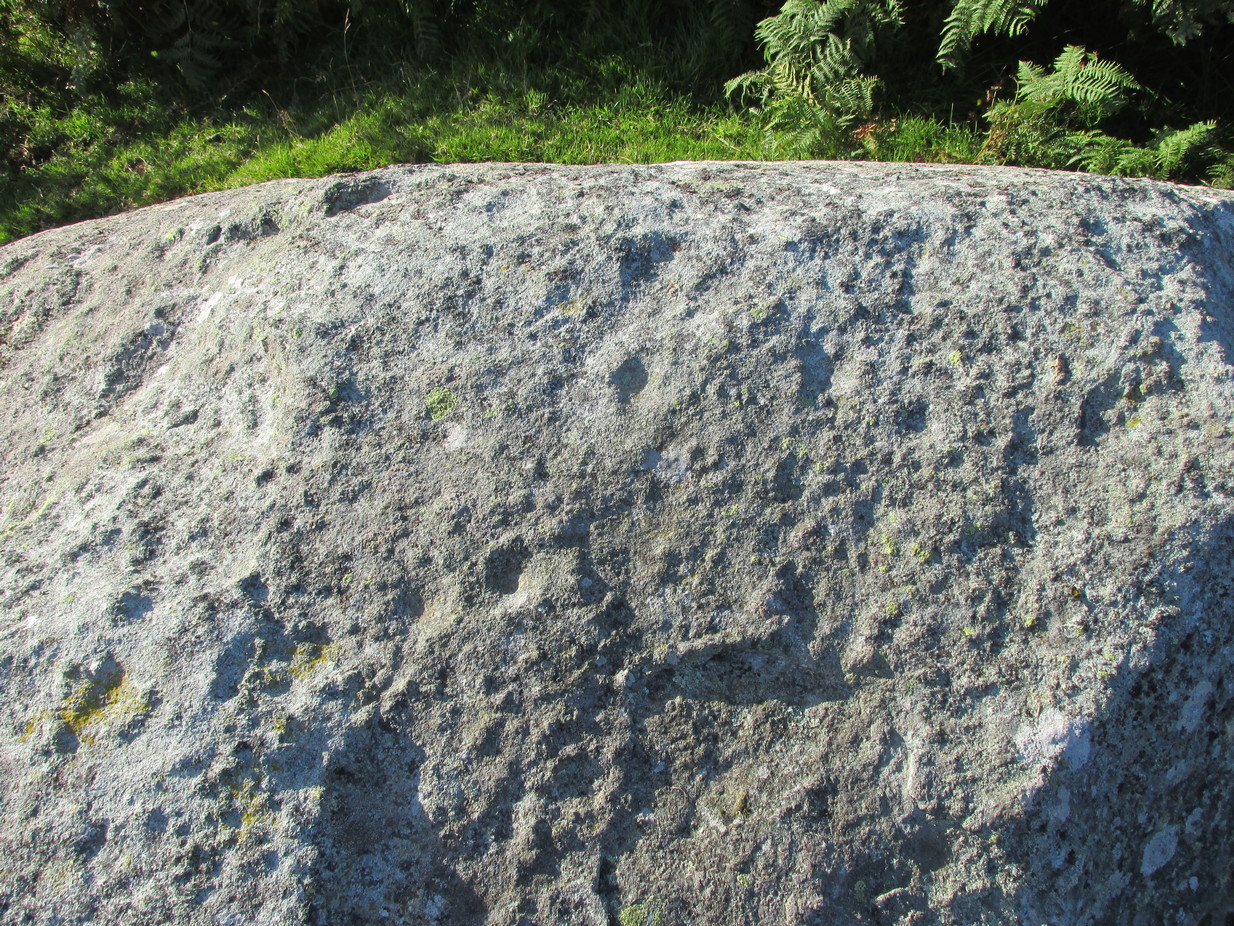
One of those chance finds that turns up when you’re looking for something else.  Recent forestry work had dislodged the stone from its original earthfast position of millenia, only a few feet away. It may have been rotated from its original position.  The grey whinstone rock measures around 5′ 8″ (1·75 m) long, 3′ 9″ wide (1·15 m ), 2′ 9″ (0·85m) high, and the moss shows its original depth in the ground.  Fortunately the cup marks weren’t damaged in what appears to have been a quite brutal move.  On what is now the north east facing side there are three definite and one possible very shallow fourth cup mark.  The top cup is the most prominent, while the possible fourth cup is just to the left of the bottom one.

L-R 1. The original position of the stone 2. The stone showing the possible fourth cup 3. The prominent top cup 4. The three definite cups

One for the enthusiasts really, in an area of Strathmore quite rich in megaliths and rock art; whatever the future holds for this dislodged stone in the savage world of agri-business, it is now recorded for posterity!

© Paul T Hornby 2021

Clach na Sgoltadh, Bridge of Balgie, Perthshire

Legendary Rock:  OS Grid Reference – NN 61080 46501

Also Known as:

  1. Fionn’s Stone
  2. Praying Hands of Mary 

Getting Here

Clach na Sgoltadh, Glen Lyon (photo – Lisa Samson)

From Fortingall take the road into the legendary Glen Lyon.  About 8 miles along, a short distance past the Adamnan’s Cross standing stone, you reach the tiny hamlet of Camusvrachan.  On your left is a singular dirt-track, past some cottages.  Go along here and over the river bridge until you reach the junction on the other side.  From here, turn right and a half-mile on when you reach the farm and manor-house on your right, park up.  From here you’ll see a track going uphill.  Walk straight up and after a half-mile or so, keep your eyes peeled to your right.  You cannot fail to see this impressive giant on the slopes above you!

Archaeology & History

This is a truly mighty monolith! — a beauty no less!  Standing upon a rocky ridge nearly halfway along the glen, the landscape it looks across is, without doubt, some of the finest in the British Isles.  To our ancestors who, until just two hundred years ago peopled this and nearby glens in great numbers, this great stone would have been well known and had old myths told of it.  Today we have only bare fragments.

Clach na Sgoltadh (photo by James Elkington)

To give an ‘archaeological survey’ of any kind to this site would seem somewhat of an anathema, as it is generally deemed to be little other than one of Nature’s incredible creations.  We’ll come to that in a minute.  But what is quite certain is that a line of very old and very low-lying walling runs from up the slope and almost straight down to Clach na Sgoltadh.  You can see it pretty clearly in the photograph below.  The walling stops at the giant stone and continues no further downhill from the other side of the giant upright.

Walk diagonally down the slope about 30 yards south-east from the stone and you’ll find a small but distinctly man-made ring of stones, low to the ground, with an entrance on its northeastern side.  It’s somewhat of a puzzle as it’s too small for a hut circle (I laid down in it in various ways and found you’d have to lie foetal all night if you were to use it as  your own little abode), and it equally too small as an animal pen – unless it was for just one animal, which is most unlikely.  The small circular construction wouldn’t seem to be prehistoric, but it would be good to know what it is.

So, we do have some very slight archaeological association with the site, albeit minimal, with the very ancient walling that leads to the stone being the most intriguing.

Small stone ‘hut’
Low line of walling

The stone is generally attributed to be a geological creation.  I certainly cannot say, as I have no expertise in the subject.  However, in the opinion of just about everyone with whom I’ve visited this stone, I seem to be the only one who doesn’t think it’s man-made.  A number of people have each insisted to me that it’s been stood upright by humans due to the quite distinct ‘squaring’ of the upright stone, particularly at the north-facing base.  —and been seemingly bemused at my own lack of conviction.  It does look as if it could have been cut and squared just as they all say but, let me repeat, I’m no expert at geology, and so all I can say is that I simply don’t know one way or the other. (useless prick that I am!)

“Perhaps a stone mason might know?” someone suggested—which seemed to be a good idea.  Certainly a stone mason would surely be able to tell if it had been cut and dressed at the base, where it fits into the large earthfast rock….

Cue Chris Swales: a reputable stone mason from near Skipton, North Yorkshire.  Chris and his friends took a week long whistle-stop tour in and around the Loch Tay region and thought they’d visit Glen Lyon.  I heard about this and so asked him if he’d have the time to visit this stone giant and, if possible, let us know his opinion: is is a natural obelisk, or does it look to have been erected by humans?  I told him my opinion and that of the geologists who give it an entirely natural provenance.

It was a few weeks later when he got back in touch and I asked him if he’d been up to Clach na Sgoltadh.

“I did,” he said. “it’s bloody impressive Paul.  And what a gorgeous landscape too.  I’d love to go there again.”

“Aye, it is Chris. And what did you think of the giant stone then?  In your opinion is it man-made or natural?”

“Well I don’t know for certain Paul,” he said, “but in my opinion I’m 95% sure that it’s man-made.”  He said it plain as day, just like a typical daan-to-Earth Yorkshireman.  Chris isn’t into any the energy ley-line stuff, so his words carry more weight than those who wanna spice-up a site by projecting their own beliefs onto a place.  As a result, I was somewhat taken aback by his words.

“What—are you sure Chris?!” I asked.

Cut & dressed stone?

“Like I said – I’m not 100% sure Paul.  I can’t really say it 100% – but I’m 95% certain that people cut and dressed the base of that stone and put it there.  If it’s natural, then I’d like to know how they think that’s the case.  I’m willing to be shown otherwise, but in my opinion, on the whole, it’s man-made.  People stuck that stone there!”

It would be great to get another stone mason’s opinion about this site; and it would definitely be good to read a geological viewpoint, but I’m not aware of any papers regarding this stone. (does anyone know of any?)  For my part:  I can only reiterate that I’m ‘unsure’ whether or not this is man-made.  I’m simply not qualified to give an objective opinion.

The curious thing is:  if this is Nature’s handiwork, then it would have been held in greater reverence to our ancestors than if it had been erected by people.  Impressive creations of Nature were always deemed to be inhabited by genius loci of truly archaic potency.  And in these deep impressive mountains, where the names of nature spirits still abound, this—without doubt!—would have been a place of considerable awe and sanctity.  May it remain as such…

Folklore

Looking to the west immediately uphill and behind Clach na Sgoltadh is the rising rounded hill of Creag nan Eildeag.  Legend has it that the great Celtic hero Fionn stood atop of this crag and fired one of his arrows at the stone, splitting it in half and leaving the stone as we see it today.

In a small cleft in the stone, quartz deposits can be seen along with an effigy of the Virgin Mary.  However, the title of the Praying Hands of Mary is a modern attribution and has no historical or mythic veracity.

References:

  1. Stewart, Alexander, A Highland Parish; or, The History of Fortingall, Alex MacLaren: Glasgow 1928.

Links:

  1. Clach na Sgoltadh on The Megalithic Portal

Acknowledgements:   Huge thanks to James Elkington and Lisa Samson for use of their photos.

© Paul BennettThe Northern Antiquarian


St John’s Well, Dunrobin, Golspie, Sutherland

Holy Well:  OS Grid Reference – NC 8505 0081

St Johns Well, 1879 map

Archaeology & History

Very little has been written of this site due to the fact that little seems to known about it.  A few of the usual ‘official’ on-line catalogues mention it but information on the site is truly scant.  It is shown on the earliest Ordnance Survey map of the region and the same cartographers describe it in the Ordnance Name Book (1873), saying briefly how St John’s Well,

“Applied to a very deep pump well situated in the court of the ancient portion of “Dunrobin Castle”.  No information respecting the dedication or origin of this name can be obtained in the District.”

But an earlier reference than this is cited in Fraser’s (1892) work, telling us that,

“In the midst of the court within the castle there is one of the deepest draw-wells in Scotland, all lined with ashlar-work, which was built and finished before the house was begun.  The well was known as that of St. John.  In the year 1512 sasine (i.e. delivery of feudal property) of the earldom and castle was taken at the well.  At other times sasine was taken at the castle, at its gates, or near the well.”

Subsequent to this, we read in Cumming’s (1897) definitive folklore work of the region how,

“(it) looks as if there had been a chapel of St. John on Drumrabyn.  In that case it may have been one dependent upon Kileain (=Kirk of John) on Loch Brora, which was only ½ a mile further than Kilmalin.”

Having not visited the castle, I’m unsure whether or not the well can still be seen.  Does anyone know…?

References:

  1. Cumming, Anna & Bella et al, Golspie – Contributions to its Folklore, David Nutt: London 1897.
  2. Fraser, William, The Sutherland Book – volume 1, Edinburgh 1892.

Acknowledgements:  Big thanks for use of the 1st edition OS-map in this site profile, Reproduced with the kind permission of the National Library of Scotland

© Paul BennettThe Northern Antiquarian

Edmund’s Grave, Dron, Perthshire

Cairn: OS Grid Reference – NO 14676 14519

Also Known as:

  1. Balmanno Hill
  2. Canmore ID 28087

Getting Here

Take the Glenfarg road out of Bridge of Earn, cross the motorway and park at the layby past the bend. Go through the gate opposite and follow the track up to the telecoms mast, you can’t miss it..

Archaeology & History

Shown on the 1866 OS Map

Visible from the lowlands below, it is described in the official listing as a cairn of prehistoric date, a funerary monument dating to the late neolithic to early Bronze Age. It is a broadly round stony mound, partially overgrown with turf on the north eastern (mid-summer sunrise) slope of Balmanno Hill, where it has extensive views over the surrounding country.  It is 1.8m (6′) high, 17m (56′) across on the N-S axis and 16m (52′ ) on the E-W axis.

The top of the cairn has a depression in it: possibly the result of treasure-seeking long ago, but there is no evidence of any burial cist.

So who was ‘Edmund’?  Was this a place of heathen ritual Christianised with the designation of St Edmund during the Anglo-Saxon incursions of the early middle ages, or the name of a local landowner?  It is lost to history. The name ‘Balmanno’ can be interpreted as ‘Place of the Big Man’ – so have we an echo of a lost giant legend here in an area of Scotland where such legends abound, and long pre-date the construction of the cairn?  Did later people name their local mythic giant ‘Edmund’?

An alternative meaning of ‘Balmanno’ is given by David Dow in the Old Statistical Account – the ‘Town of the Monk’.

Left – View from South, Centre – View from west looking towards Firth of Tay, Right – The disturbed summit.
© Paul T. Hornby, 2020

Folklore

The Ordnance Survey inspectors of the early 1860s were told that the cairn is where one of the Roman Generals of Agricola’s time was buried.

References:

  1. Dow, Rev. David, The Statistical Account of Scotland 1791-99, Vol. XI, EP Publishing, Wakefield, 1976
  2. Jamieson,John, An Etymological Dictionary of the Scottish Language, Vols.I & III, Alexander Gardner, Paisley, 1880
  3. Ordnance Survey Name Books Perthshire, Volume 21 OS1/25/21/11, 1859-62
  4. http://portal.historicenvironment.scot/designation/SM9458

© Paul T Hornby 2020