West Agra Plantation 3, Colsterdale, North Yorkshire

Cup-and-Ring Stone:  OS Grid Reference – SE 14236 81675

Also Known as:

  1. WAP 3a & 3b (Brown & Brown)

Getting Here

West Agra 3 Rock

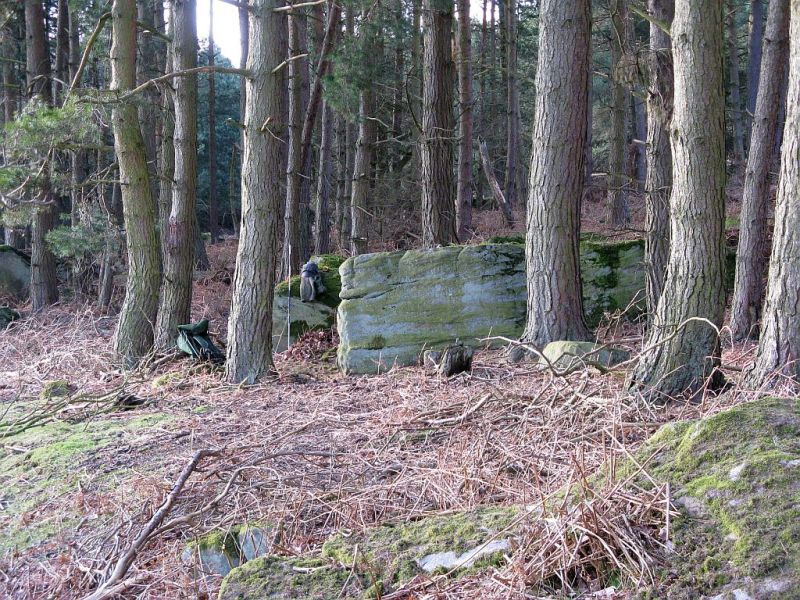
From Masham take the Fearby Road & go through the village, onwards & past Healey village and less than a mile on where the road forks, bear to the right past and go along the gorgeous little-known vale of Colsterdale.  Less than 2 miles on, walk up the notable track veering to your right that goes diagonally uphill and past the bottom of West Agra farm along the wallside till you reach the gate.  Thru the gate, walk immediately uphill on your right following the walling for a coupla hundred yards until you reach another gate into the field on your right.  You’ll see a cluster of large boulders in the first field, which you need to walk past and look at the large boulder up against the walling in the next field.  You can’t miss it!

Archaeology & History
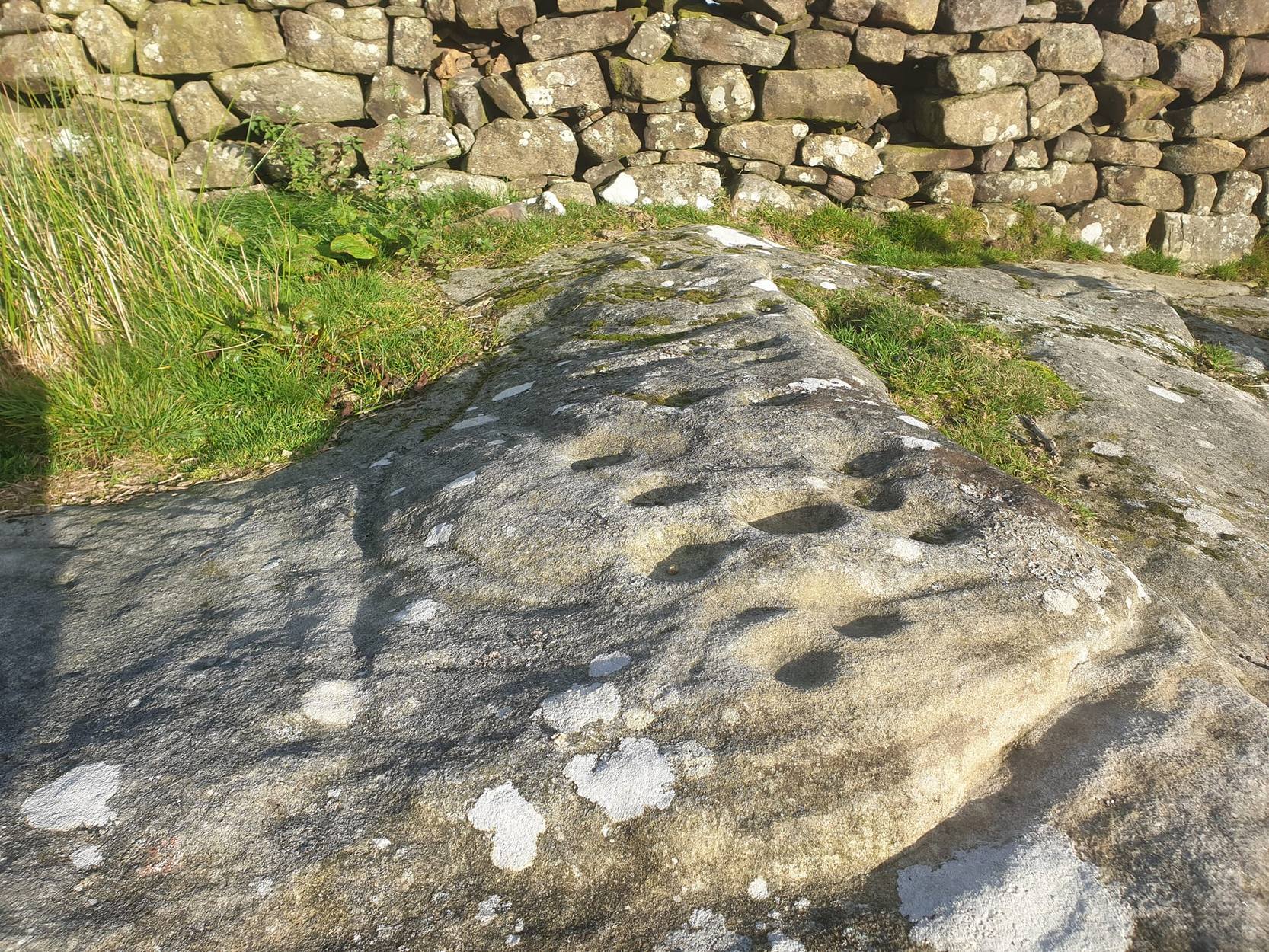
Photo by Geoff Watson

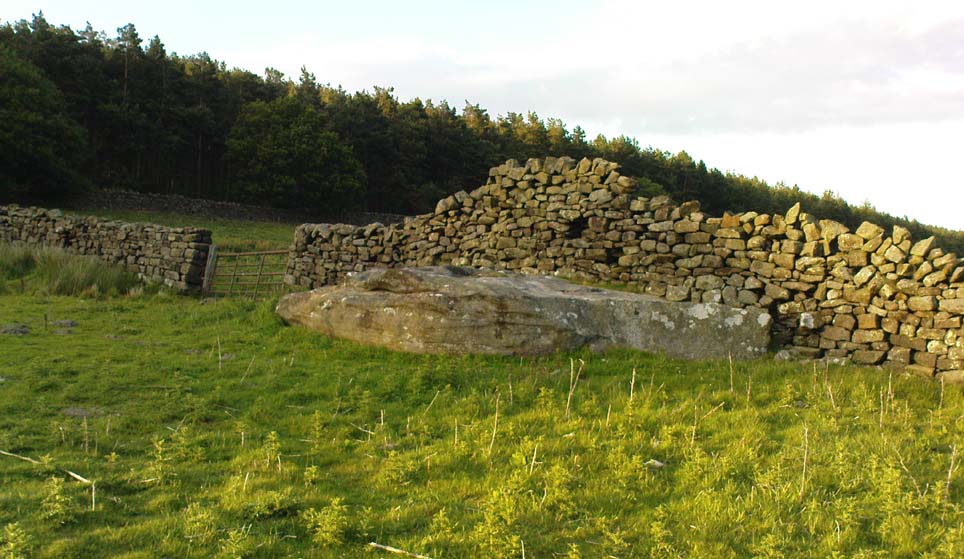
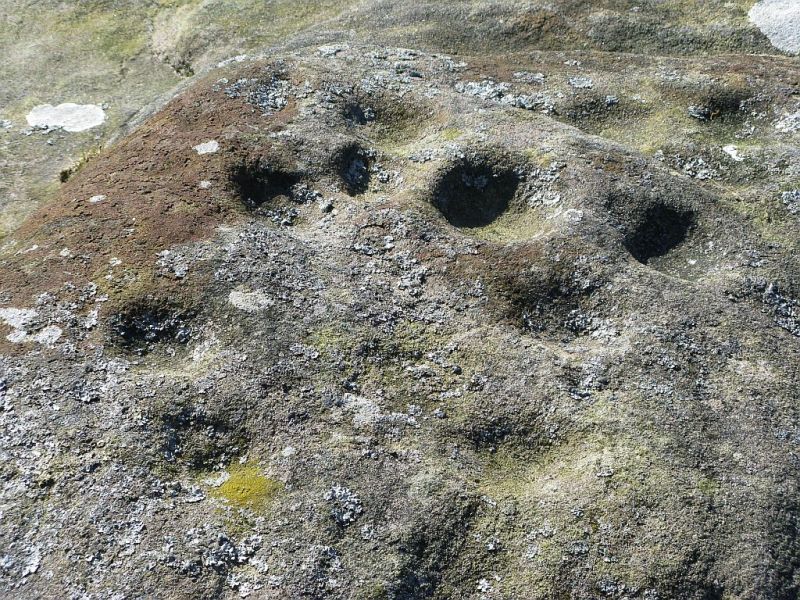
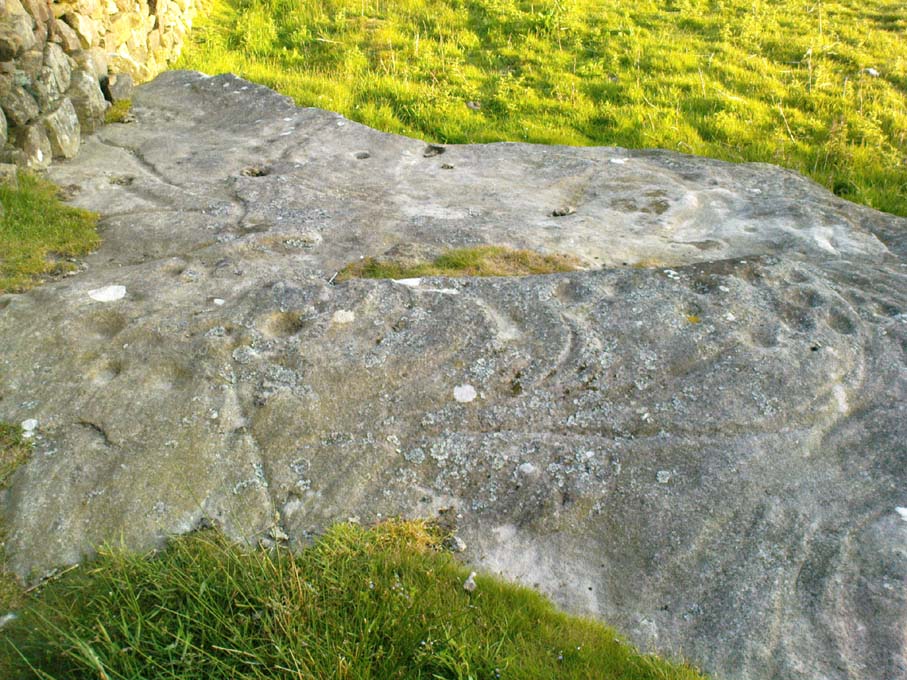
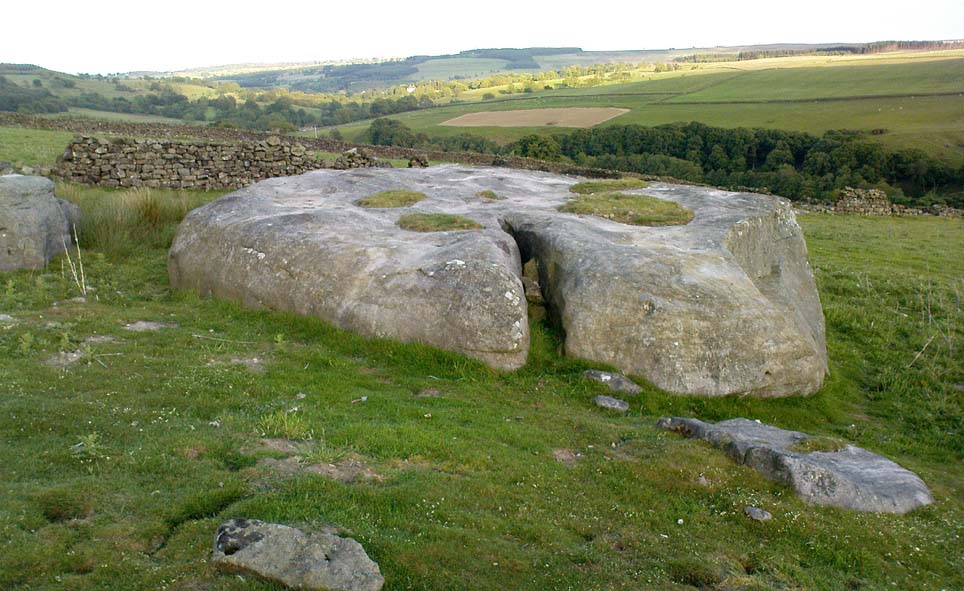
First mentioned — albeit briefly — in Brown’s (2008) work, this large bedrock stone, covered down its eastern side by a line of drystone walling, has a good scattering of cups and lines, mainly on its central and westerly side.  A cluster of them were etched onto a natural rise near the middle of the rock, which itself has a long circuitous line running around its northern and western sides, which you can just see below centre in the photo (below left).  Altogether on this side of the rock surface there appears to be some 56 cup-marks plus a number of long carved grooves curling in differing directions: some of these appear to have been Nature’s handiwork that were subsequently modified by human hands.  It’s an impressive-looking petroglyph.
Main rock surface
Cluster of cups – by QDanT

If we go over to the other side of the walling, we find more cup-markings.  This discovery led Paul & Barbara Brown (2008) to classify the site as being two separate carved rocks — calling them 3a and 3b — thinking that the much smaller carved area on the other side of the wall, “may have originated from WAP 3a’s quarried southern section.”  On this smaller section we find some 7 cup-markings with possible carved lines running off the edge of the stone and some running roughly parallel to the walling.  Whatever the truth of the Browns’ assertion, this is a fine carving well worth looking at!

References:

  1. Brown, Paul & Barbara, Prehistoric Rock Art in the Northern Dales, Tempus: Stroud 2008.

Links:

  1. Agra Wood Rock Art – more notes & images

Acknowledgements:  For use of their photos, many thanks to Geoff Watson; and QDanT and his Teddy!

© Paul Bennett, The Northern Antiquarian

West Agra Plantation 2b, Colsterdale, North Yorkshire

Cup-Marked Stone:  OS Grid Reference – SE 14126 81669

Also Known as:

  1. WAP 2b (Brown & Brown)

Getting Here

West Agra Carving 2b

From Masham, take the Fearby Road to the village, keep going on the same road through Healey village and less than a mile on where the road forks, bear to the right past and go along the gorgeous little-known vale of Colsterdale.  It’s bloody beautiful!  Less than 2 miles on, walk up the notable track veering to your right that goes diagonally uphill and past the bottom of West Agra farm along the wallside till you get to the gate.  Thru the gate, follow the wall immediately uphill to the right for a coupla hundred yards until you reach a gate into the field on your right.  The cluster of large boulders in front of you is where you need to be!

Archaeology & History

Cluster of cups on WAP-2b (image by ‘QDanT’)

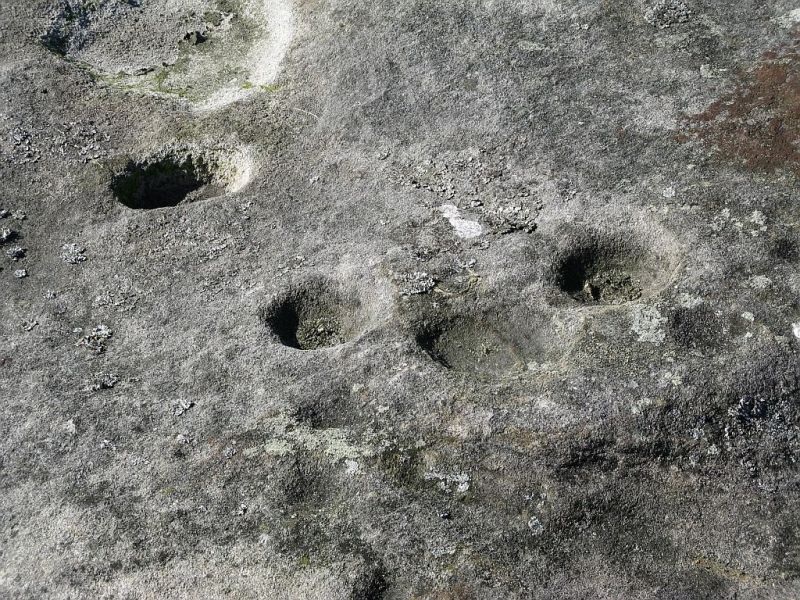
This carving is to be found on the largest of the boulders in this cluster.  It’s a large scattered cluster of cup-markings and natural bowls all over the rolling surface of the rock.  It was first described in the Browns’ (2008) survey, although as they have given this and one of the adjacent stones incorrect grid-references, it made it troublesome to initially work out which carving was which!  But the photos here certainly lets you know which one I’m describing!  In the event that I’ve got the wrong title for this one, someone lemme know and I’ll remedy the situation!

Brown (2008) describes this design as being “cups some linked by grooves, a rectangular feature and eroded cups and depressions.”  We couldn’t work out any further elements on the stone, but the cloudy conditions when we were here prohibited a decent view of the surface.

References:

  1. Brown, Paul & Barbara, Prehistoric Rock Art in the Northern Dales, Tempus: Stroud 2008.

Links:

  1. Agra Wood Rock Art – more notes & images

© Paul Bennett, The Northern Antiquarian


West Agra Carving, Colsterdale, North Yorkshire

Cup-Marked Stone:  OS Grid Reference – SE 14069 81627

Getting Here

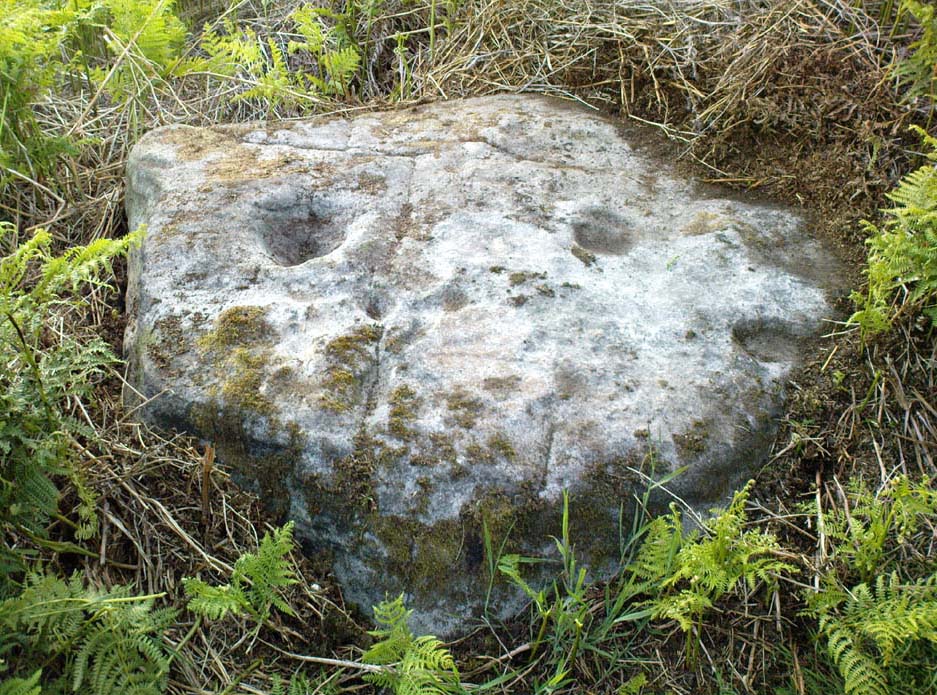
Cup-marked stone near West Agra

From Masham, take the Fearby Road to the village, keep going on the same road through Healey village and less than a mile on where the road forks, bear to the right past and go along the gorgeous little-known vale of Colsterdale.  It’s bloody beautiful!  Less than 2 miles on, walk up the notable track veering to your right that goes diagonally uphill and past the bottom of West Agra farm along the wallside till you get to the gate.  Thru the gate, follow the wall immediately uphill to the right and, about 100 yards up, watch out for the large flat stone by the side of the footpath.  You can’t really miss it.

Archaeology & History

Initially we thought that this carving was one described in Paul Brown’s work as ‘West Agra Plantation no.1’, but this is clearly a different carved stone.  It is found close to WAP-1 (as he called it), but a few yard further up alongside the footpath by the walling.  With two large bowls on the top of the stone and another at the edge, two average-sized cup-markings are several inches away to the bottom-right of the largest bowl.  What seems to be a carved line runs from one of the cups.  We need to visit this stone again and look at it when there’s better lighting conditions so we can get a more accurate assessment of its nature.

References:

  1. Brown, Paul & Barbara, Prehistoric Rock Art in the Northern Dales, Tempus: Stroud 2008.

Links:

  1. Agra Wood Rock Art – more notes & images

© Paul Bennett, The Northern Antiquarian


Brown Beck Stone, Agra Moor, North Yorkshire

Standing Stone:  OS Grid Reference – SE 13499 82440  —  NEW FIND

Also Known as:

  1. Agra Moor Standing Stone

Getting Here

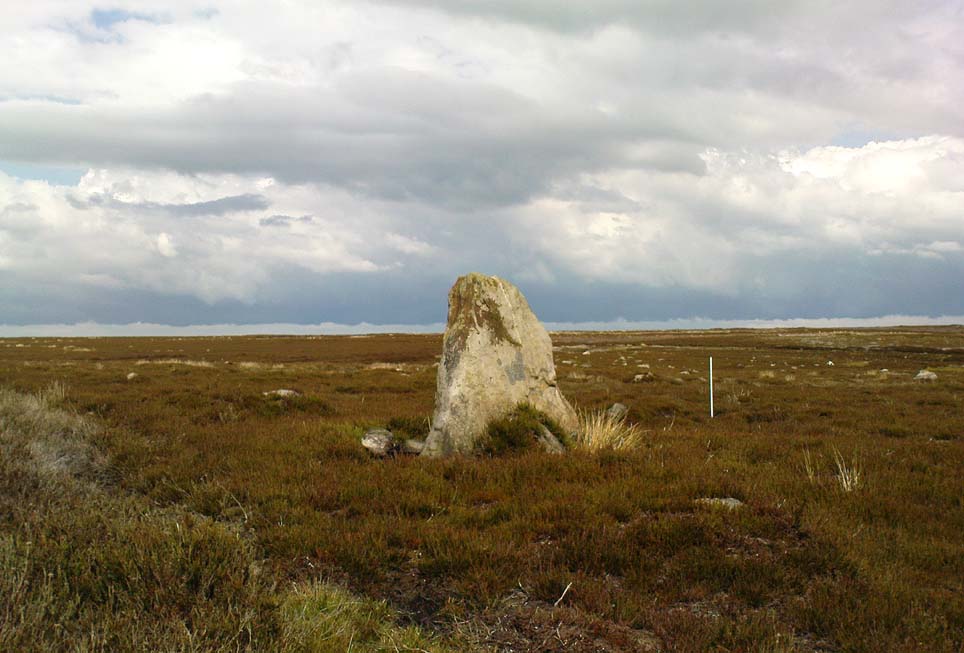
Agra Moor standing stone

From Masham, take the Fearby Road to the village, keep going on the same road through Healey village and less than a mile on where the road forks, bear to the right past and go along the gorgeous little-known vale of Colsterdale.  It’s bloody beautiful!  Less than 2 miles on, walk up the notable track veering to your right, diagonally uphill.  Walk along till you get to the moor edge.  Go thru the gate and follow the swerving uphill path to the bottom of Slipstone Crags.  Once you level out at the Crags top, look across the small valley to your left and, on t’other side, you’ll notice a standing stone upright in the heather, just 100 yards on the flat on the other side of the valley.  Head right for it!

Archaeology & History

Looking west

There are no known written references to this standing stone, which we visited for the first time yesterday, in a brief wander to the nearby Agra Woods cup-and-ring stones a few hundred yards southeast.  The monolith stands some four-and-half-feet tall and, at its base, is more than three feet broad and just one foot wide.  Just to its side and almost completely covered in peat and vegetation is what may have been another once-upright companion asleep in the Earth.  Another possibly fallen stone is less than 10 yards west.  The upright stands on the flat moorland overlooking the confluence of two (once) fast-flowing waters of Brown Beck and Birk Gill; and the landscape that reaches out from here is something to behold!

We found the remains of other old monuments on the moor, but some were obviously related to the industrial mining not far away.  However, two or three other small upright stones and a large stone circular structure were also located which very obviously predated any industrial or medieval workings.  We need to revisit this moorland and spend more time exploring to see what other things are hidden, lost midst the peat and heather.

© Paul Bennett, The Northern Antiquarian 


Dissenters Well, Kelbrook, Earby, Lancashire

Healing Well:  OS Grid Reference – SD 92104 43179

Getting Here

From Kelbrook village head south past Old Stone Trough then continue as far as the lane goes. Then head eastwards for about 1 mile on footpaths to a building called Laycocks. From here continue east along footpaths for another 1 mile or so until you reach Copy House (now called Hawres Farm). Go to the back of the farm where you will see in the wall a cross-incised boundary stone. At the side there is a square-shaped holy well. (You may need to ask permission at the farm).

Archaeology & History

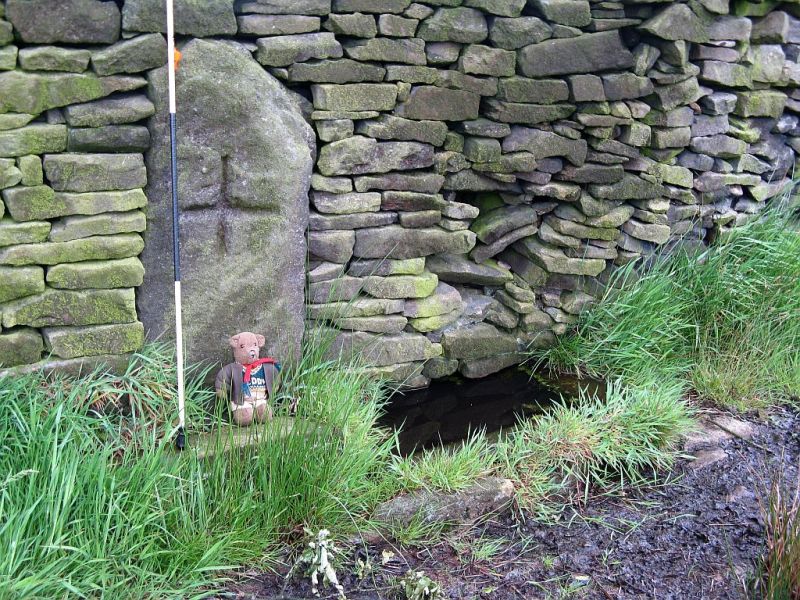
Dissenters Well & Cross (image courtesy ‘QDanT’)

The so-called Dissenters’ Well is a rectangular feature in the ground next to the wall.  It is said locally to date from the 17th-18th century, but is most probably an ancient moorland spring.  The well was in use from the 17th century by Quakers, Baptists, Methodists and possibly Roman Catholics, at a time when there was much animosity towards non-Conformists.  Legislation was passed stopping all illegal gatherings to be held within a 5 mile radius of any church – thus leading to religious gatherings in bleak, remote places on the moorland above towns and villages.  In 1812 an Act of Parliament against non-Conformists was repealed and dissenters were given equality regarding where they could worship. The water in the well no doubt had some medicinal qualities or, was a source of spiritual up-lift at the time.

By the well there is 3 foot high pointed boundary stone or waymarker known as ‘Tom’s Cross’ and it has a thin incised cross carved onto it.  The stone is partly embedded in the wall.  It probably marks the old boundary between Lancashire and Yorkshire.  I don’t know who Tom was though he may have been the person who set up the stone. The age of the stone is not known.

The Bleara Lowe tumulus and its nearby prehistoric companion can be found upon the hilltop a mile north of here.

References:

  1. Oldland, Fay, The Story Of Foulridge, Pendle Heritage Centre Ltd, 1990.

Copyright ©  Ray Spencer 2011


West Agra Plantation (8), Colsterdale, North Yorkshire

Cup-and-Ring Stone:  OS Grid Reference – SE 14250 81756

Also Known as:

  1. WAP 8 (Brown & Brown)

Getting Here

The ‘West Agra 8’ Stone (after ‘QDanT’)

From Masham, head westwards along the country lanes to Fearby village (passing the old cross on the green), through old Healey village (where once stood four stone circles, seemingly destroyed) and onwards to Gollinglith.  From here, keep going up the winding steep lane until you’re at the top where, on the right-hand side of the road, a footpath takes you diagonally northwest over the uphill fields.  When you hit the walling which leads to the woods, follow it up and, once at the corner of the trees, follow the track back eastwards along the wall edge, keeping your eyes peeled when you pass the second line of walling that runs down the slope.  You’re damn close!

Archaeology & History

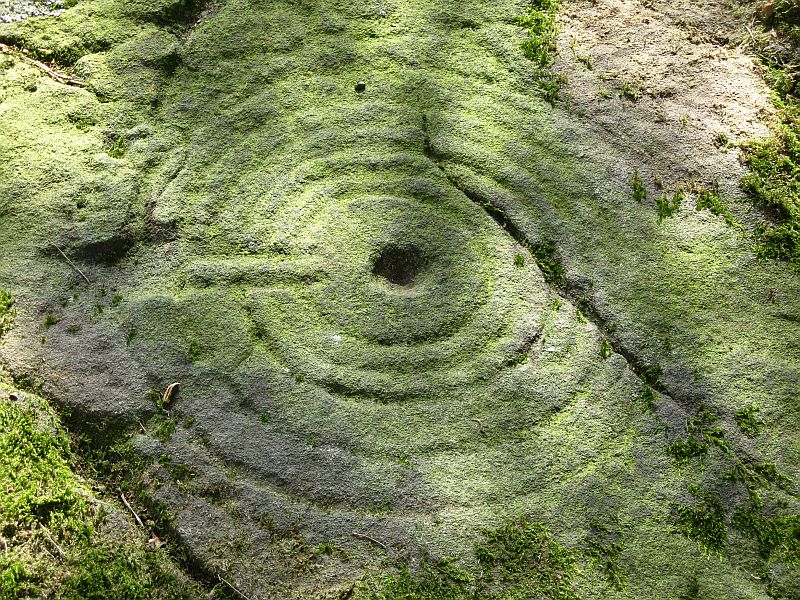
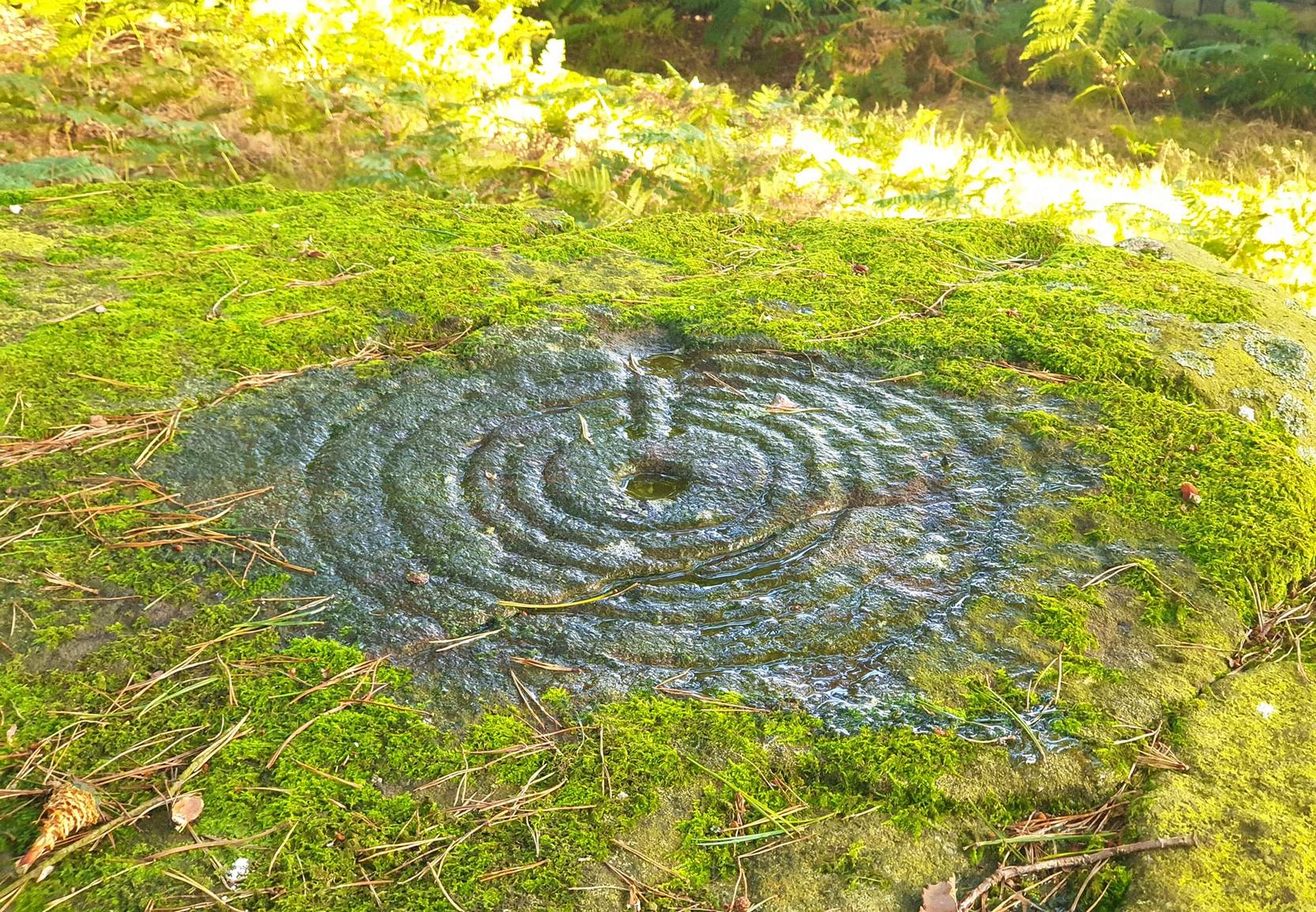
One of a cluster of fascinating carvings in this remote region of the upland Dales, this is perhaps the most impressive multiple-ringed carving of the group, known collectively as the West Agra Plantation group.  The carving was rediscovered sometime in 2002 by Emily McIntosh and was described by Brown & Brown (2008) thus:

“This boulder measures 5.5 x 3.1 x 1.28m and has a multiringed motif 50cm in diameter linked by a number of grooves and isolated cups.”

Teddy with his rings! (after ‘QDanT’)
Primary cup-and-multiple-rings (after ‘QDanT’)

But this barely does the stone justice.  The main focus is on the cup with six surrounding rings, intersected by an intrusive double-line from outside the series of rings then running into the central ring itself — though not touching the focal cup at the very centre.  This double line points to the southeast and is somewhat akin to a sliver of light running to or from old solar designs.  It is a little bit like some aspects of the carved stones found on Ilkley’s Panorama Stones (though Ilkley’s carvings are much fainter).  At the end of the intrusive double-line is a small cluster of cup-marks.  There’s also another curious singular carved line running outwards from the third ring, running out of the concentric rings then heading off further down the stone.  More cups and lines scatter other parts of the stone and there may be another faint line running from near the central cup all the way out of the rings close to the main ‘ray’ of lines.

Photo by Geoff Watson

A large standing stone can be seen if you walk a few hundred yards east along the side of the wall.  It’s quite impressive.

Apparently the woodland in which this carving (and its associates) can be found is supposedly ‘private’ and one is supposed to contact some group calling itself Swinton Estates to set foot in the woods.  Not the sort of practice we usually put up with in Yorkshire.  If anyone has their contact details, please add them below in the event that anyone has need to ask ’em about going for a walk here.

References:

  1. Brown, Paul & Barbara, Prehistoric Rock Art in the Northern Dales, Tempus: Stroud 2008.

Links:

  1. Agra Wood Rock Art – more notes & images

AcknowledgementsFor use of their photos, many thanks to Geoff Watson; and QDanT and his Teddy!

© Paul Bennett, The Northern Antiquarian

Eyam Cross, Eyam, Derbyshire

Cross:  OS Grid Reference — SK 2178 7639

Getting Here

The village of Eyam is located some 9 miles south-east of Chapel-en-le-Frith and about the same from Sheffield, which lies to the north-east. Go to the centre of the village and find the church of St Lawrence standing beside the road to Foolow close to Eyam Hall and just west of the B6521 road to Sheffield.  The Saxon cross stands in the churchyard.

History and Folklore

Eyam Cross, east face (from Wikipedia)

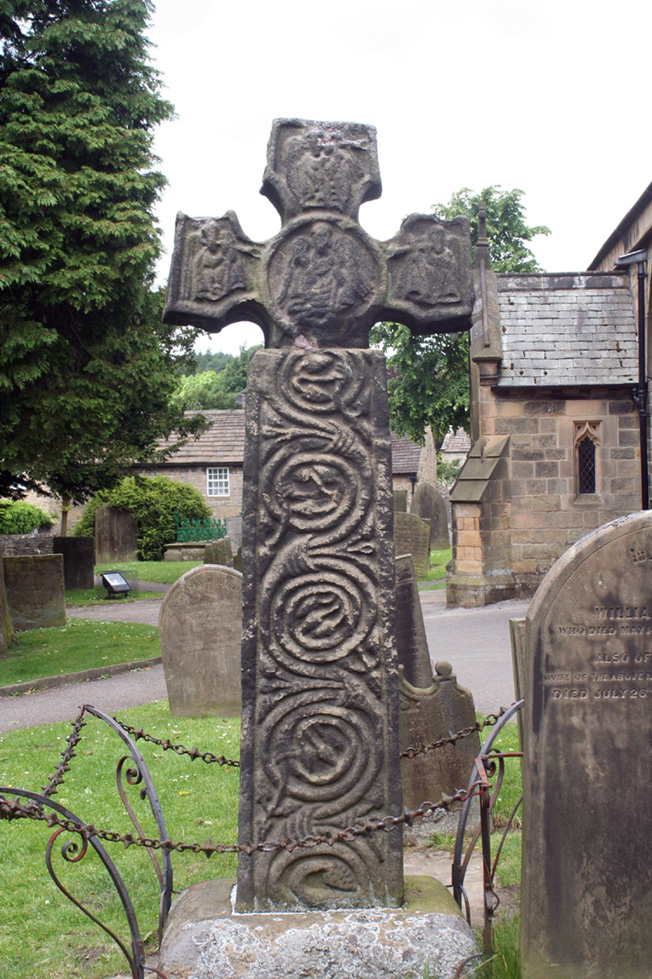
This very fine Anglo-Saxon (Mercian) cross stands 8 foot tall and dates from the 8th-9th centuries. It was apparently set up by missionaries from the north at Cross Low on the moors to the west of Eyam. Originally it was a wayside preaching cross that was 10 feet high and certainly must have looked very spectacular, but now it is only 8 feet high due to it being knocked about a bit in more recent times and losing one of its shaft sections. In the 18th century the cross was discovered beside a trackway on the moors, from whence it was brought to the churchyard of St Lawrence’s church;  but then for a long time it stood abandoned and uncared for in the corner of the churchyard. Eventually  it was restored and placed in the churchyard where it now stands proudly.

The cross is said to be the only one of its type in the Midlands that retains its cross-head. It has some very rich decoration on the west face with fabulous interlacing scroll-work running up the shaft that is typically Mercian in origins. On the west-face, especially the upper section, there are human figures probably St Mary the Virgin with the baby Jesus, angels and Christ in glory, each in their own sections or panels. The cross is grade 1 listed.  St Lawrence’s church houses a Saxon font.

References:

  1. Rev. Arthur, C., Illustrated Notes on English Church History, Society for Promoting Christian Knowledge: London 1901.
  2. Rodgers, Frank, Curiosities of Derbyshire and the Peak District, Derbyshire Countryside Ltd 2000.

Copyright ©  Ray Spencer 2011 


Rocester Church Cross, Staffordshire

Cross:  OS Grid Reference – SK 11170 39394

Getting Here

Rocester Church Cross

The Staffordshire village of Rocester is 4 miles north of Uttoxeter on the B5030 road. It can easily be reached from Stoke on Trent, Leek and Ashbourne. The church of St Michael with its interesting Medieval church-yard cross is located on Dove Lane in the centre of the pretty little, olde-worlde village.

Archaeology & History

The cross stands some 40 yards away from St Michael’s church. It is quite a striking monument standing 20 feet high and dating from the 13th century. It stands on 3 tier circular steps displaying convexed mouldings and a graduated base stone. It’s long, tapering shaft is described as “quadrilobe” which has sunken dog-tooth, or fret-work decoration on two sides. Unfortunately, the head is missing, but it’s collared coronet remains in place.

The Rocester church-yard cross was listed as Grade II in 1966 and the English Heritage Building ID is 407190.

Copyright © Ray Spencer 2011


Tooter Hill, Bacup, Lancashire

Settlement:  OS Grid ReferenceSD 888 237

Getting Here

From Bacup town centre, take the A681 Sharneyford road for about 1½ miles towards Todmorden.  At Sharneyford village take the footpath south for about 1 mile to Parrock Farm.  At the farm, take the footpath in an easterly direction to Tooter Hill. Upon reaching the hill, head around the southern periphery for about ½-mile, or climb the hill to its height of 430 feet.  Here is the former site of a Neolithic or Bronze-Age settlement. From the top of the hill you get fairly spectacular views of the surrounding countryside.

Archaeology & History

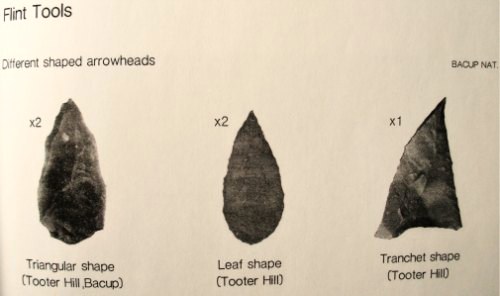
Flints from Tooter Hill

The former (or lost) site of The Tooter Hill prehistoric settlement or enclosure is not marked on any map. It has unfortunately suffered from quarrying on its periphery, but this has long since ceased. There are some small mounds at the southern side of the hill along with traces of earthworks, but I don’t know whether these are part of the former quarry workings.  However, a number of artefacts have been excavated from the peat at this site; these include a tanged and barbed arrowhead with serrated edges — probably from the Neolithic period 4,500BC-2,500BC as well as a Bronze-Age arrow-head 2,500BC-700BC, and also a tranchet-shaped arrow-head of unknown date.  These artefacts are housed in the N.A.T museum in Bacup town centre.  Other finds from Tooter hill on display are some small flint implements such as a flint scraper, flint adze and a flint borer.

References:

  1. Yates, G.C.,  “Stone Implements,” Transactions of the Lancashire & Cheshire Antiquarian Society, 5, 320-331.

Copyright © Ray Spencer 2011


Broadbank Earth Circle, Thursden, Burnley, Lancashire.

Enclosure: OS Grid Reference — SD 9024 3522

Also Known as:

  1. Burwains Enclosure
  2. Burwains Camp

Getting There

From Nelson town centre go north east towards Catlow, turning left near the Shooters Arms public house, then turn right again to the Coldwell Activity Centre.  Carry on towards Thursden Valley till you see the World War 2 pillbox on the right.  Here turn right and after 300 yards a picnic site and carparking area is reached along the Briercliffe road. On the opposite side of the road over a wall and barbed wire is Broadbank Earth Circle, though unfortunately there is not much to see there today. 

Archaeology

First excavated in 1950 by the Archaeology Department of Liverpool University and again in the 1960s, the earthworks here stand at 1,147 feet above sea-level (350m). The site comprises of an earth circle 150 feet (46m) in diameter which encloses an inner ditch 1 foot (30.5cm) deep and 10 inches (25.4cm) across. The bank was composed of boulder clay thrown out from the ditch. A hearth was found below the bank at the eastern end.  Some rough flint and chert flakes were also found together with a stone axe of Langdale origin. This is four-and-half inches or 11.4cm wide.  It has a curved cutting edge and a thin rounded head. Its surface is ground smooth but there is no evidence of polishing.

The earthworks at Broadbank have suffered through farming activity over many centuries and the earthen circle is now difficult to see at ground level, though the inner ditch is still visible. The low hillside or, what look like ramparts, at the northern end by the pillbox are probably not in any way connected, though this low bank may have added to the building of the bank. Archaeologists consider the site to be of Iron Age origin.

References:

  1. Liverpool University Archeology Department, Report and pamphlet, 1950.
  2. Powell, J.G.E., “Excavations of a Circular Enclosure at Broadbank, Briercliffe, Lancs,” in Transactions of the Historical Society of Lancashire & Cheshire, 104, 145-151.

Copyright © Ray Spencer, The Northern Antiquarian 2011