Dunruchan Enclosure, Muthill, Perthshire

Enclosure: OS Grid Reference – NN 7874 1676

Getting Here
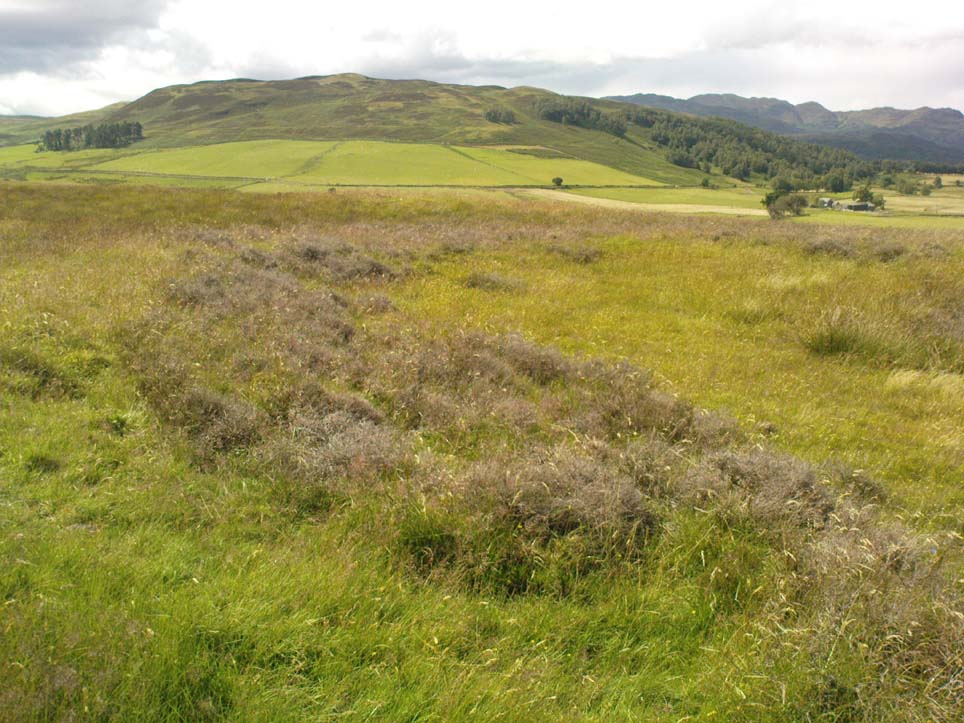
Large arc of vegetation highlighting south section of wall

From Comrie town centre take the road south across Dalginross Bridge over the river, heading towards Braco, up the winding B827 road for 3 miles, past the tiny crossroads that would take you to the Craigneich standing stone, and past the farmhouse of Middleton as you go uphill.  As you go round a bittova large bend in the road, take the next gate uphill, over the field and onto the moor.  Follow the walling up a few hundred yards until it bends round and you see the Dunruchan monoliths ahead of you on the moor. From here, walk east into the heather, up a slight grade for 100 yards or more, keeping your eyes peeled for a large oval change in vegetation, covering a mass of small stones with several large ones at its NW sides.  Your damn close!

Archaeology & History

I can find no previous reference to this large oval walled enclosure, either on the internet, PSAS or other local history texts, so assume for the time being that it is a new find (someone please lemme know if there’s owt written about it). But it’s existence here is not surprising, considering the presence of the giant standing stones of Dunruchan rise a few hundred yards to the east.
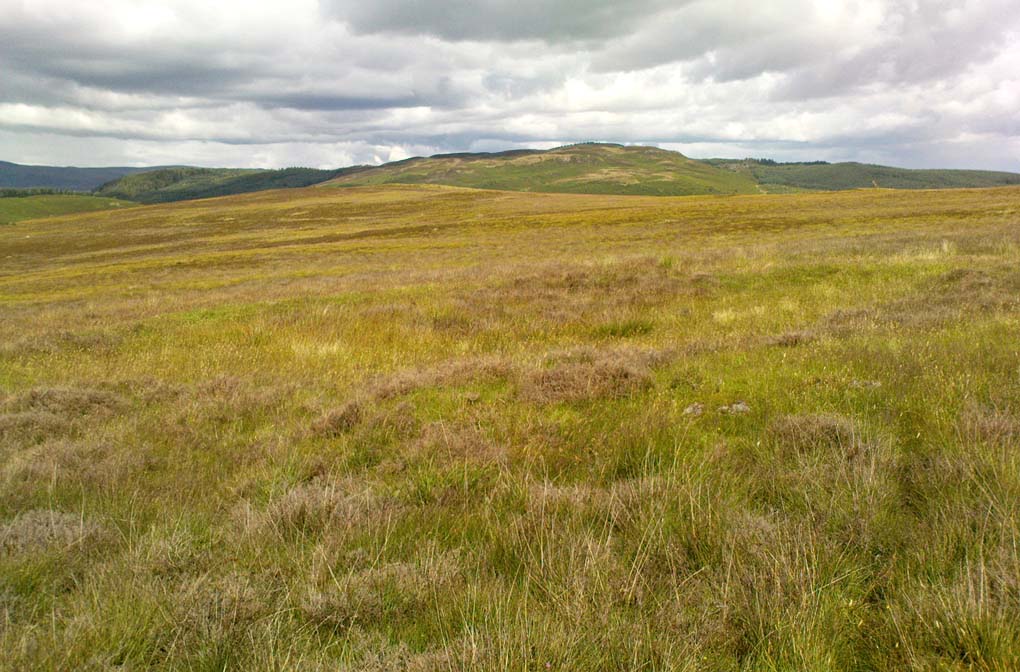
Sloping faint oval of vegetation across the centre of the photo outlines the main enclosure

The ‘enclosure’ is a large one and would seem to be prehistoric at first glance. I’d appreciate someone with greater local knowledge have a look at the place to see if they can contextualize it in relation to other local monuments of similar type. Paul Hornby and I approached it from the Duncruchan megaliths and, as the vegetation here was low, noted an overgrown rocky rise in the heather and moorland grasses. This turned out to be the northern line of walling and is nearly 3 feet high in places, though very overgrown. Typically comprising of many hundreds of small rounded stones and the occasional large ones, the walling took on an elliptical form – giving the impression of an early Iron Age to Bronze Age structure – roughly 79 yards in circumference, 29 yards across at its longer axis and 23 yards wide at the shortest. The average width of the walling itself was 2-3 yards all round the entire structure.

My initial impression was that this may have been a very large robbed-out cairn, and the presence of many small rocks scattering inside the enclosure didn’t help! But the more I walked round the site, the more it seemed obvious that this was a large enclosure, or possible settlement. Unfortunately the site has proved very difficult to photograph due to the excess of vegetation. Further visits are needed to this site by those more competent than I, to ascertain the real nature of these antiquarian remains…

© Paul Bennett, The Northern Antiquarian

Craigneich Farm, Muthill, Perthshire

Standing Stone: OS Grid Reference – NN 79225 17870

Also Known as:

  1. Blar an Rodhar
  2. Blarinroar

Getting Here

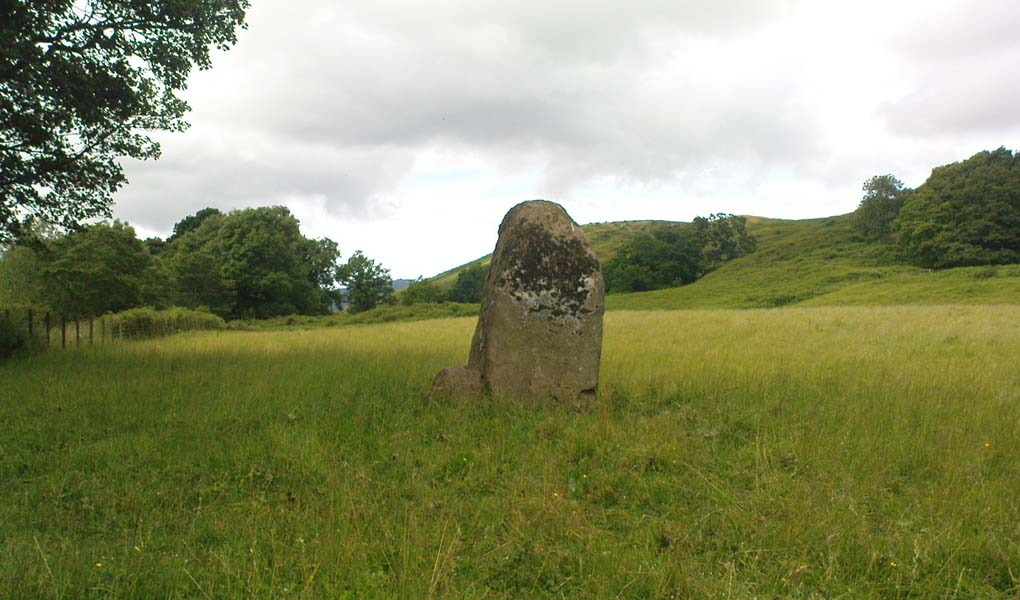
Craigneich standing stone, looking west

From Comrie town centre take the road south across Dalginross Bridge over the river, heading towards Braco, up the winding B827 road for 2-3 miles until you reach a small crossroads (you can easily miss it, so watch out!). Turn left and, about a mile on, keep your eyes peeled – either for the standing stone in the field on your left, or the dirt-track to Craigneich Farm 100 yards further on.

Archaeology & History

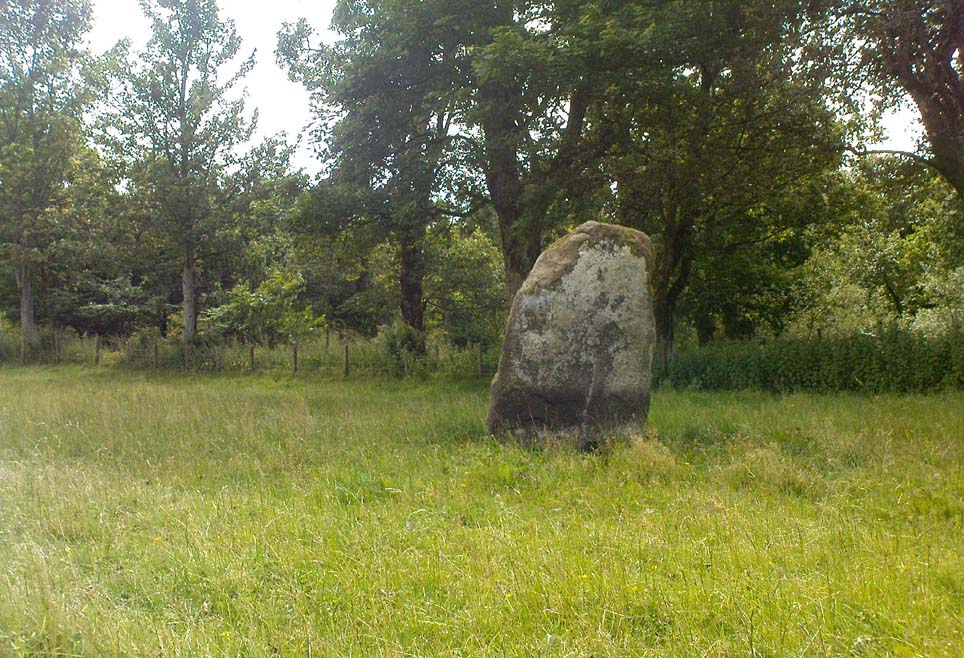
…and again, looking east

This is a large standing stone in a truly beautiful setting.  More than six-feet tall, it stands amidst a gorgeous atmosphere just off the quiet roadside and has been all-but neglected by most archaeological surveys.  Thankfully it was one of the many impressive monoliths in this district that was described in one Fred Coles’ (1911) fine surveys.  Described in conjunction with the even more massive standing stones on the slopes to the south, he told:

“This Stone is one mile and a furlong SSE of the last, on the north side of the road between Straid and Shillinghill, at 514 feet above sea-level. The locality lies to the north of Aodan Mohr, which is the name given to the upper portion of Dunruchan. .. Its base is of an extremely irregular four-sided shape, having a jutting-out ledge on the south (see drawing). In basal girth it measures 15 feet 9 inches, and in height 6 feet 4 inches. The longest axis points N. 33° E.. by S. 33° W .”

Craigneich stone (Coles 1911)

Others may have once stood in close attendance, as the Chronicles of Strathearn (1896) tells how at Blarinroar (the name of the fields here) there were standing stones twenty feet tall! Cole thinks this to be an error based on the megaliths of Dunruchan, half-a-mile to the south. On the other side of the road from here, in the hedgerow, lies a fallen stone covered in ages of moss.

The now singular upright has been linked, albeit tentatively, to the Dunruchan megaliths as part of a possible stone row (Burl 1993; Thom 1990), but this seems very unlikely.

In Edward Peterson’s (1996) survey of Pictish monuments, he thought the Craigneich stone may have been important to the Seal tribe in ages gone by, as he says there are some Pictish carvings on the stone:

“The heads of two seals are relatively clear, positioned near the centre of this stone. Not so clear is the head of a cat at the top right hand corner, and to the immediate left is another seal head.  These are only a few of the animal heads appearing on this sea/seal-god standing stone.”

More antiquarian research is obviously required here.  It’s a truly superb spot!

References:

  1. Burl, Aubrey, From Carnac to Callanish, Yale University Press 1993.
  2. Cole, Fred, “Report on Stone Circles in Perthshire, Principally Strathearn,” in Proceedings of the Society of Antiquaries, Scotland, volume 45, 1911.
  3. Finlayson, Andrew, The Stones of Strathearn, One Tree Island: Comrie 2010.
  4. Hunter, John, Chronicles of Strathearn, David Phillips: Crieff 1896.
  5. Peterson, Edward, The Message of Scotland’s Symbol Stones, PCD Ruthven Books: Aberuthven 1996.
  6. Thom, A., Thom, A.S. & Burl, Aubrey, Stone Rows and Standing Stones – 2 volumes, BAR: Oxford 1990.

© Paul Bennett, The Northern Antiquarian

Caisteal Samhraidh, Glen Lochay, Killin, Perthshire

Standing Stone: OS Grid Reference – NN 519 380

Getting Here

Caisteal Samhraidh stone, looking west down Glen Lochay

Go halfway down Glen Lochay to Dalgirdy house by the cattle-grid, then go up the burn by its side and follow the directions to reach the small standing stone above the shielings of Allt Ghoaordaidh. From here, head east, keeping to roughly the same contour line as you walk along. About half-a-mile on, keep your eyes peeled. If you’re into ambling off-track up mountains, you’ll find it. If you’re not into such things, you could be in trouble!

Archaeology & History

Caisteal Samhraidh stone, looking east to Duncroisk

There are no previous literary references to this standing stone, leaning at an angle, halfway up the southern slope of Mheall Ghaordie. Between 3-4 feet tall, the monolith appears to have had packing stones around it, although when I stumbled across it in a lengthy amble a few weeks ago, the daytime temperature was above 100° F and I’d been out all day with no food, so my investigative faculties weren’t at their best! The stone may have been part of some ancient walling along the edge of the mountain, but if so, it wasn’t obvious. A few yards higher up the slope, a very large overgrown heap of rocks seemed evident – but again, I wasn’t sure whether this was artificial or geological. All along this mountain and up the curve of Allt Ghoaordaidh to the west are such immense clusters of ancient rocks and boulders, that the mound behind here just seemed to merge into the background of all the rest.

Looking SE down Glen Lochay

The ruined Iron Age enclosure of Tullich is less than half-a-mile south of here, and the possible prehistoric standing stones of Tirai another half-mile to the east. Prehistoric rock art scatters the glen east of here and masses of ancient walled structures run up and down hidden ridges and slopes. There is in fact scattered an excess of archaeological remains all along the edges of this long valley, indicating considerable human population in bygone centuries (before the Clearances came) reaching way back into prehistoric times. The old people of Glen Lochay would have been able to furnish us with a mass of important historical tales and myth about so many now-forgotten places, before the carnage of the agriculturalists and capitalists destroyed their way of life. This standing stone, no doubt, would have had tales said of it. Today, only the spirits of the glen are able to whisper such insights…

© Paul Bennett, The Northern Antiquarian


Breadalbane

Hawk Hill, Alloa, Clackmannanshire

Stone Circle (destroyed): OS Grid Reference – NS 906 925

Archaeology & History

Clump of trees near the site of the olde circle…

This is another megalithic ring that appears to have been destroyed, sometime around 1923. It was one of a series of very important Bronze Age monuments that could once be seen along the ridge of Hawk Hill on the eastern outskirts of Alloa. A series of important prehistoric tombs scattered the area, and a tall early medieval cross was erected near the site to try christianize this important heathen arena. Sadly, we have few details available of the circle itself. The Royal Commission (1933) report simply said of it:

“This circle occupied a site immediately behind the lodge at the eastern extremity of the same (ridge) as the cairn (on Hawk Hill). It was, we are informed, entirely removed about ten years ago.”

In the cultivated field there is a curious circular clump of trees which I thought might harbour some of the fallen monoliths, but a scattering of overgrown stones within them did not have that prehistoric pedigree about them.  Perhaps better luck might be had in the trees at the end of the field…  The tall Hawk Hill Cross can be seen just a couple of hundred yards or so immediately to the west.

References:

  1. Royal Commission on Ancient & Historical Monuments, Scotland, Fife, Kinross and Clackmannan, HMSO: Edinburgh 1933.

© Paul Bennett, The Northern Antiquarian 


Gleneagles Stone Circle, Blackford, Perthshire

Stone Circle (lost):  OS Grid Reference – NN 93 08

Also Known as:

  1. Canmore ID 25929

Archaeology & History

Virtually nothing is known of a stone circle that was described in the 18th century old Statistical Account of Scotland, where a ring of stones was seen “in the parks of Gleneagles.”  Its exact whereabouts remains unknown and the grid-reference given for the circle is an approximation.  The writer told that this was “supposed to have been places of Druidical worship,” and it is mentioned alongside the megalithic sites at nearby Sheriffmuir and the Glebe.

The circle is mentioned without further details on the Canmore website.  A number of stones above St. Mungo’s Well looked promising when I was bimbling in the area the other week — and as the landscape levels out above the well towards Glen Devon, we have a promising panorama, but there was nothing there.  It would be good to have a team of us bimbling round here to see what could be found.  However, the site may well have been destroyed.  Any further information about this site would be hugely welcome!

References:

  1. Sinclair, John, The Statistical Account of Scotland, 1791-1799 – volume 3, EP: Wakefield 1979.

© Paul Bennett, The Northern Antiquarian


Gleneagles ‘A’, Blackford, Perthshire

Standing Stone:  OS Grid Reference – NN 9211 0962

Also Known as:

  1. Blackford
  2. Loaninghead
  3. Peterhead Farm

Getting Here

Monolith nr Peterhead Fm

Along the A9 dual carriageway between Blackford and Auchterarder, take the A823 road south, up the Glen Eagles road as if you’re heading towards Pool of Muckhart and Dunfermline.  Less than 100 yards up the road, turn immediately right and go past the standing stone of Gleneagles B for a coupla hundred yards or so, where there’s a left turn (down to Peterhead Farm).  Stop here and look into the field in front of you.  You can’t really miss it!

Archaeology & History

Gleneagles ‘A’, gazing west

This short standing stone, more than 3ft tall, has an elegance about it which megalith lovers alone will understand!  Maybe it’s the setting; maybe the feel of the land; or maybe something else.  I dunno… On my first visit to the site, Nature was wearing a grey overcast cloak, but the site and I didn’t seem to care; and although the view from here doesn’t have the same grandeur of Glen Eagles to view as its companion stone a few hundred yards to the east might have, there felt a greater welcoming at this smaller stone.  Odd, considering this monolith had been knocked over and re-positioned by the farmer in the not-too-distant past.  Anyway…less of this subjective nonsense of feelings from the landscape and megaliths!  Utter drivel all of it!

The earliest measured account of the stone is to be found in Mr Hutchison’s (1893) essay, where he notes this and its companion close by, giving us the dimensions of this monolith:

“This (stone) is roughly columnar in shape, but wider at the base than above. Its height is 3ft above ground; circumference at base 6ft. 5in., diminishing to 4ft. 2in at the top. It is of metamorphic schist.  The line of direction between these two gives a horizontal angle of 260°.”

Since that day, in the mass of archaeology essays that have been scribed, this smoothed upright gets only a minimal description.  Charles Calder’s (1947) account is typical, saying simply that it is,

“Somewhat cylindrical in form with a girth of 7 feet at the base, it rises with a decided tilt towards the west to a height of 3 feet 10 inches above ground-level.”

The stone fares better in Andrew Finlayson’s (2010) fine local survey of megalithic ruins, where he points out that this and its compatriot stone Gleneagles B, are in an alignment with the fallen Boat Stone and the upright White Stone, a few miles to the southwest.  This line works on 1:50,000 map, but when transferred to larger-scale surveys, the alignment misses each outlying site by 20-30 yards here and there.

References:

  1. Calder, Charles S.T., “Notice of Two Standing Stones (one with Pictish Symbols) on the Lands of Peterhead Farm, near Gleneagles, Perthshire,” in Proceedings of the Society of Antiquaries, Scotland, volume 81, 1947.
  2. Feachem, Richard, Guide to Prehistoric Scotland, Batsford 1977.
  3. Finlayson, Andrew, The Stones of Strathearn, One Tree Island: Comrie 2010.
  4. Hutchison, A.F., “The Standing Stones of Stirling District,” in The Stirling Antiquary, volume 1, 1893.

© Paul Bennett, The Northern Antiquarian

Craggish, Comrie, Perthshire

Standing Stones (destroyed):  OS Grid Reference – NN 7643 2086

Archaeology & History

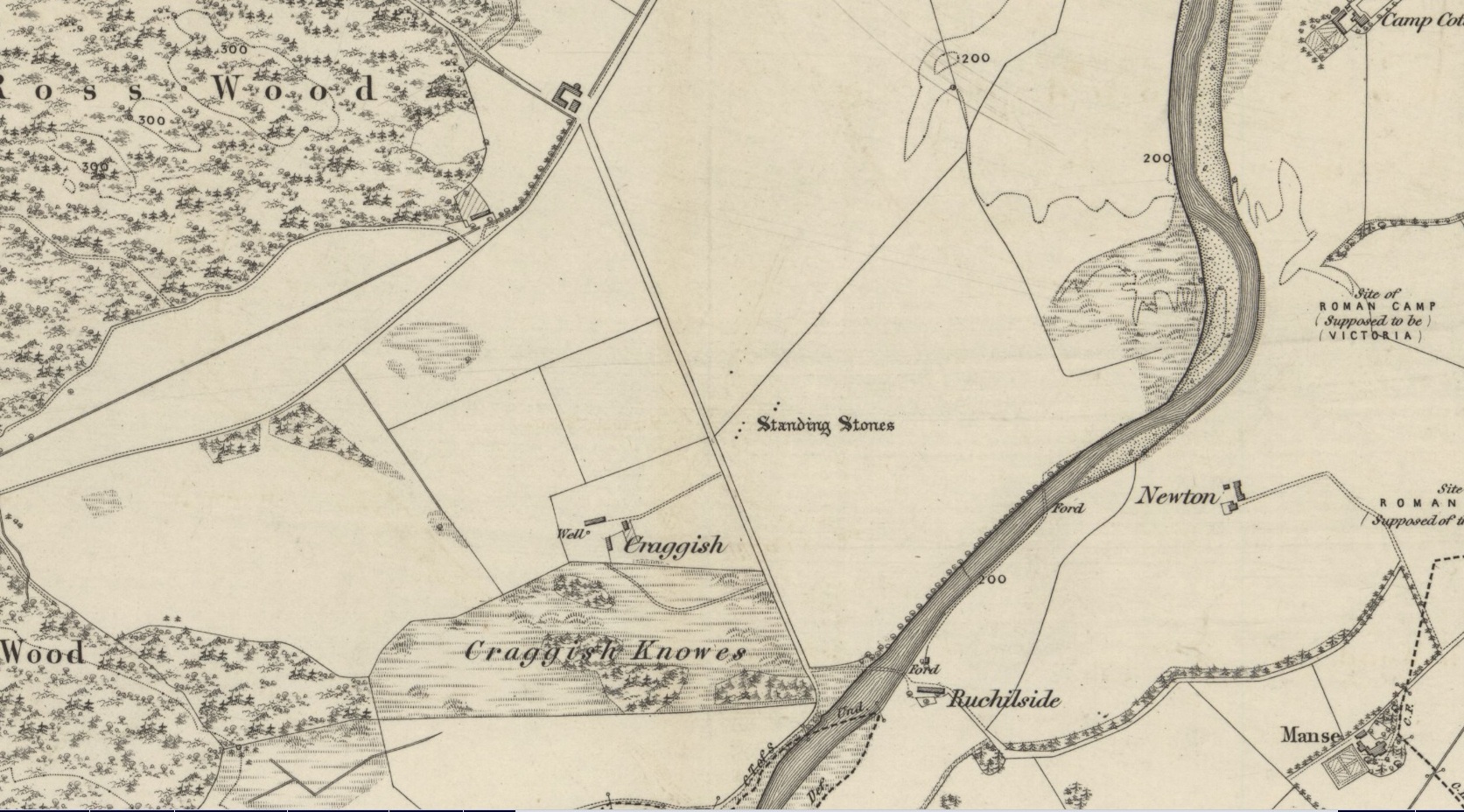
Site shown on 1886 OS-map

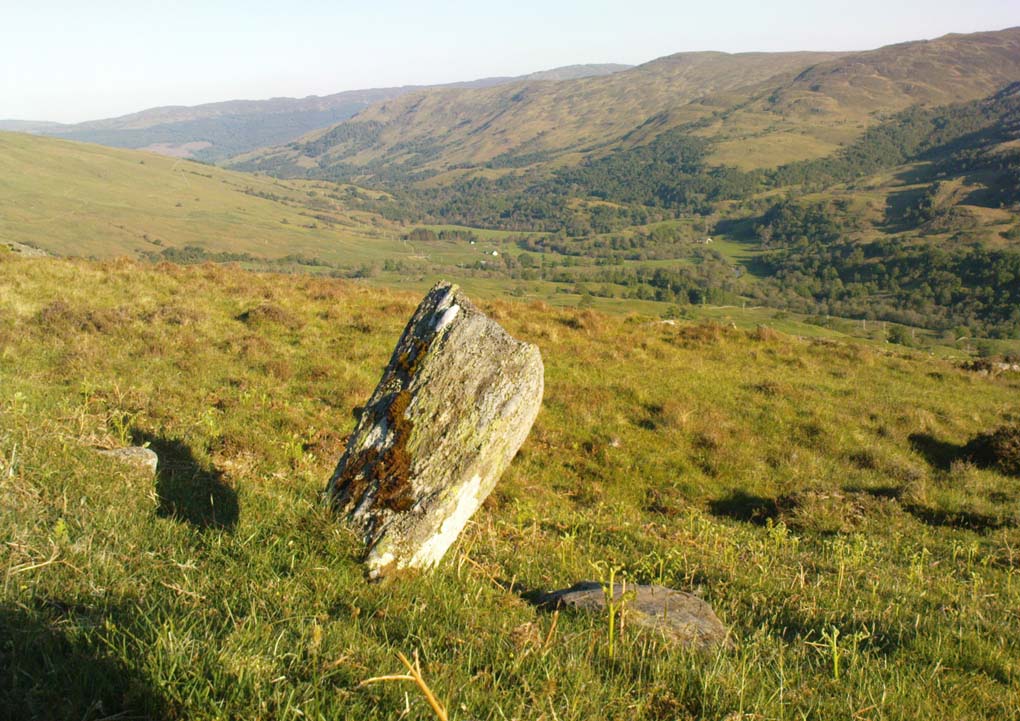
Highlighted on the 1866 OS-map was an impressive cluster of standing stones that sadly met their demise sometime around at the end of the 19th century.  They were mentioned to “still exist” when the local writer Samuel Carment passed them in 1882, but had been destroyed by the time the Ordnance Survey lads resurveyed here in 1899.  Altogether there were at least six of them, standing aligned sharply northeast-southwest and were described in one of Fred Coles’ (1911) essays, who lamented their passing.  Listed in the stone row surveys by Burl (1993) and Thom (1990), the prime description we have of them was by Cole himself, who told:

“This site has also been wantonly bereft of its group of megaliths.  Up to so recent a date as 1891 there were several.  These were shown on the (Ordnance Survey map) as three in one line and two in another, on a field about one furlong NE of Craggish farmhouse, close to the road coming down from Ross, and nearly a quarter-mile NW of the ford across the Ruchil at Ruchilside.”

In Finlayson’s (2010) colourful survey of the local megaliths he told that the stones,

“Stood, by the road, in what is now ‘The Whinney Strip’: a boulder-strewn strip of land 20m wide dividing up otherwise flat and even grazing land.”

References:

  1. Burl, Aubrey, From Carnac to Callanish, Yale University Press 1993.
  2. Cole, Fred, “Report on Stone Circles Surveyed in Perthshire, Principally Strathearn,” in Proceedings of the Society of Antiquaries, Scotland, volume 45, 1911.
  3. Finlayson, Andrew, The Stones of Strathearn, One Tree Island: Comrie 2010.
  4. Thom, A., Thom, A.S. & Burl, Aubrey, Stone Rows and Standing Stones – 2 volumes, BAR: Oxford 1990.

Acknowledgments:  Big thanks for use of the early edition OS-map in this site profile, Reproduced with the kind permission of the National Library of Scotland

© Paul Bennett, The Northern Antiquarian

Carleith, Crook of Devon, Kinross-shire

Cairn:  OS Grid Reference – NT 0404 9877

Getting Here

Carleith Cairn, from roadside

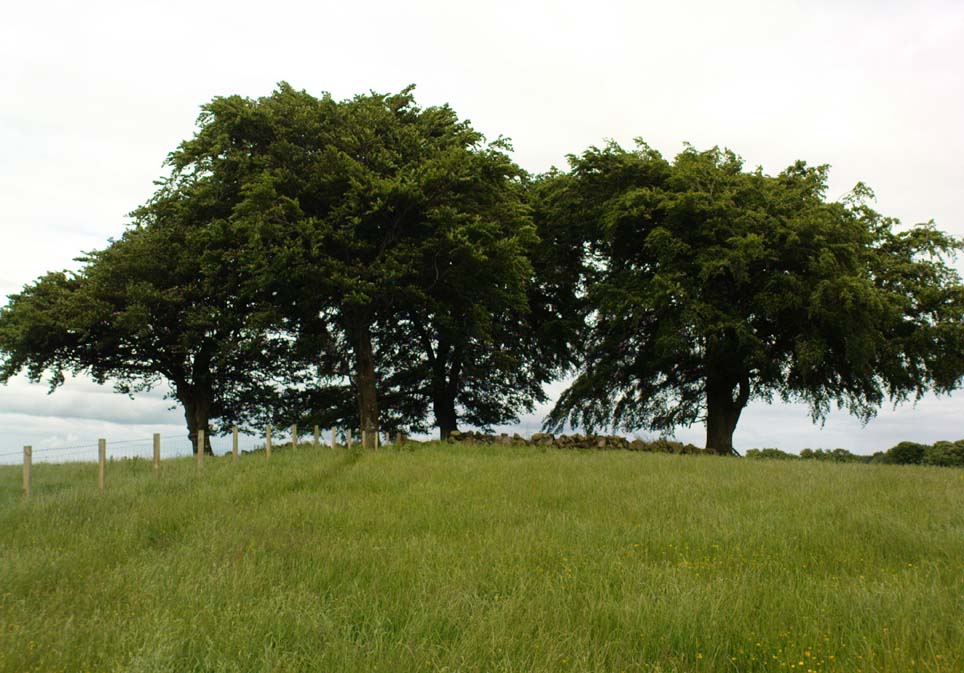
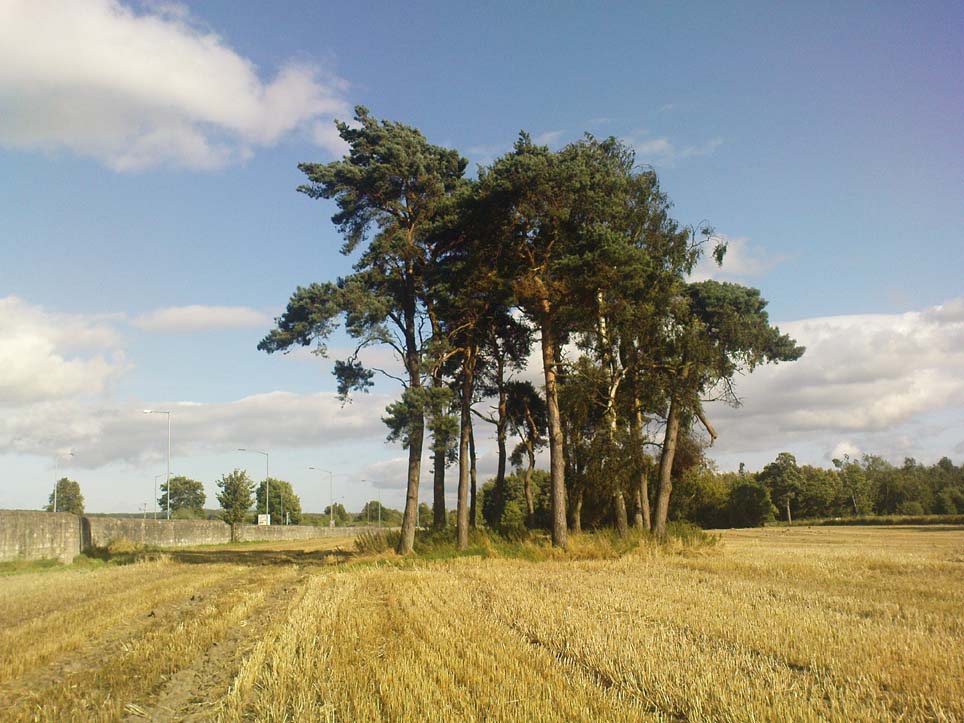
Go along the A977 road out of Powmill village towards Crook of Devon, and as the road swerves uphill, past the Powmill Milk Bar on the right-hand side of the road, take your next right.  Go along this small country lane for a mile or so, past Maidenwells Farm; then as you go uphill, stop at the very top.  Look in the field on your left, where a small round clump of trees are surrounded by circular walling.  The cairn’s inside the protective walling.

Archaeology & History

This Bronze Age tomb sits quietly amidst the ring of trees and walling which give the site cover and protection and, of course, an excellent view of the landscape for the spirit of whichever ancestor lives here.  The place seems to have been described first of all in the Old Statistical Account of the area, in 1796, where they told:

“In the middle of Carleith are the ruins of an old building, perfectly circular, and nearly 24ft in diameter. Not long ago, the proprietor ordered this ground to be planted, and the stones were dug up to make a dyke. Two stone coffins were found each 4 feet long by 3 feet broad, and contained some human bones and teeth.”

The cairn’s within the trees…

Today, the overgrown remains of the cairn measure roughly 10 yards across, with the beeches reaching their great roots into and around the old tomb.  The sides of the stone cist are still visible amidst the undergrowth.  It was measured and described in a letter to the Ordnance Survey by J.S. Nichol in 1959, who thought there may have been more than one tomb here.

Folklore

Although we don’t know for certain, one of the legendary witches known as ‘Meg of Aldie’ was said to frequent an old site close to where she lived – perhaps the Carleith cairn.  The site is a damn good contender for such heathen rites!

References:

  1. Simpkins, Ewart, County Folklore – volume VII: Fife, Folklore Society: London 1914.

© Paul Bennett, The Northern Antiquarian

Cairnwochel, Ardoch, Perthshire

Chambered Cairn (destroyed):  OS Grid Reference – NN 830 127

Archaeology & History

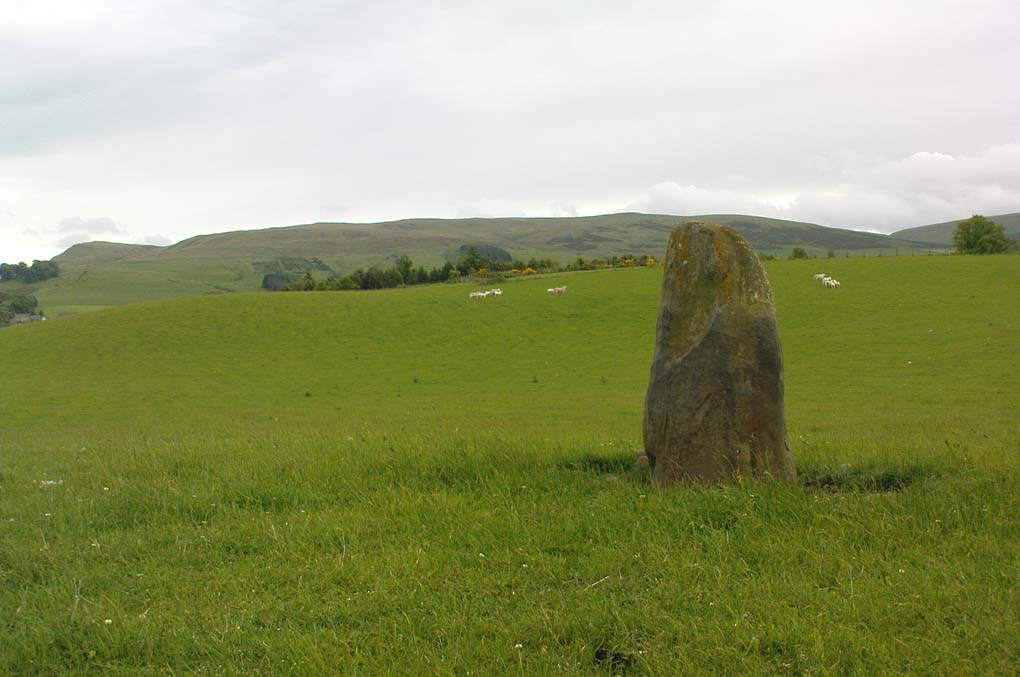
References to this site are few and far between.  I wandered past the place the other day on my way back from the megaliths of Dunruchan and Comrie without knowing anything about the place; but was, for some reason, drawn up the grassy hill slope towards the forestry plantation, where the scattered old walling implied (to me at least) the presence of some old prehistoric ruin… But as the daylight hours were fading, I had to head for home, wondering what it was that was pulling my nose to this place I’d never visited before.

The following day when I was searching for information about the prehistoric archaeology of the area, I came across Audrey Henshall’s (1972) description of some giant cairns that once stood here, upon the hilltop – exactly where my nose had led me!  Sadly however, they have been all-but destroyed.

At least two prominent prehistoric cairns were to be found in relative proximity to each other hereby, each with their own name.  The site was first described in A. Gordon’s 1726 work, Itinerarium Septentrionale, where he wrote the following:

“On the hill above the moor are two great heaps of stones, the one called Cairnwochel, the other Cairnlee: the former of these is the greatest curiosity of its kind that I ever met with; the quantity of great rough stones lying above one another almost surpasses belief, which made me have the curiosity to measure it, and I found the whole heap to be about 182 feet in length, 30 in sloping height, and 45 in breadth at the bottom.  That at Cairnlea is not near so considerable as the former.”

Nearer to the end of the 18th century, Cairnwochel was mentioned again – this time in the Old Statistical Account (1793), where a description was given of some dig into the giant cairn, to see what lay beneath the mass of rocks.  The report told that,

“there was found a stone coffin, in which there was a skeleton 7 feet long.  The cairn lay from north to south and the coffin was nearly in the middle of it, with the head to the east. Most of the stones have been carried away to inclose the neighbouring farms; but the coffin, with a few large stones around it, has, by the order of Sir William Stirling, been preserved.”

When Miss Henshall explored the site in the 1960s, she found very little left of this once superb tomb, simply, “the only sign of any structure (were) a few laid stones on its S side, possibly part of a revetting wall-face.”

The sheer size of the cairn implies that it was probably Neolithic in origin (its description reminded me of the King’s and Queen’s Cairns near Skipton, Yorkshire).   We have hardly any information about the nearby Cairnlea site.  The intrusion of the forestry commission here has probably covered over a number of other important Neolithic and Bronze Age remains, but if anyone has further information on this site it would be hugely welcome.

References:

  1. Henshall, Audrey, The Chambered Tombs of Scotland – volume 2, Edinburgh University Press 1972.

© Paul Bennett, The Northern Antiquarian

Bull Stone, Crook of Devon, Kinross-shire

Legendary Rock:  OS Grid Reference – NT 03326 99712

Getting Here

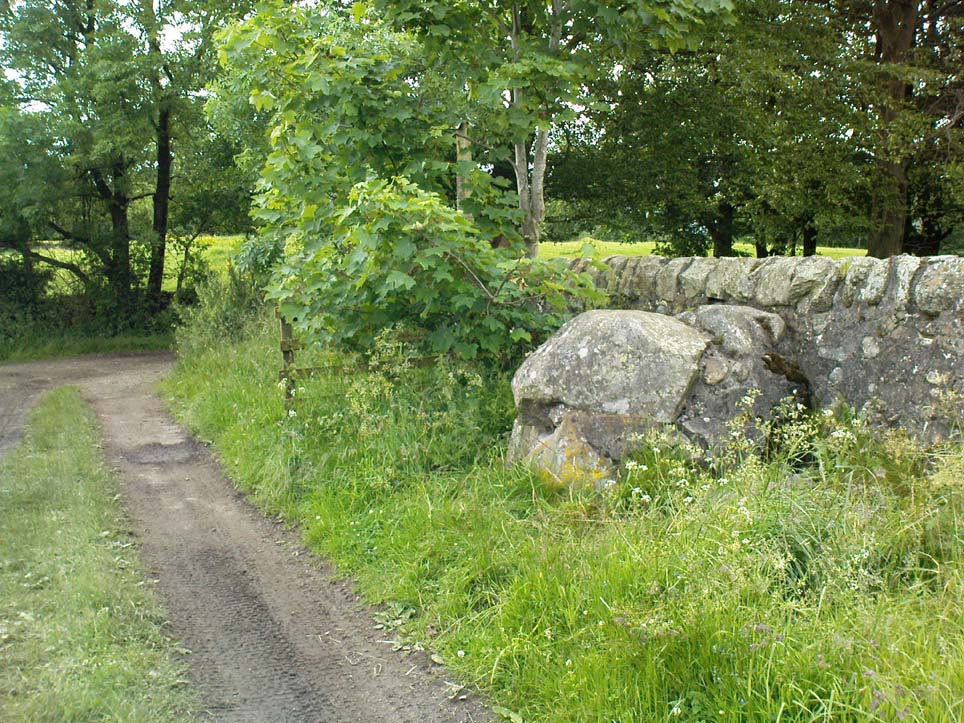
The Bull Stone rock, looking west

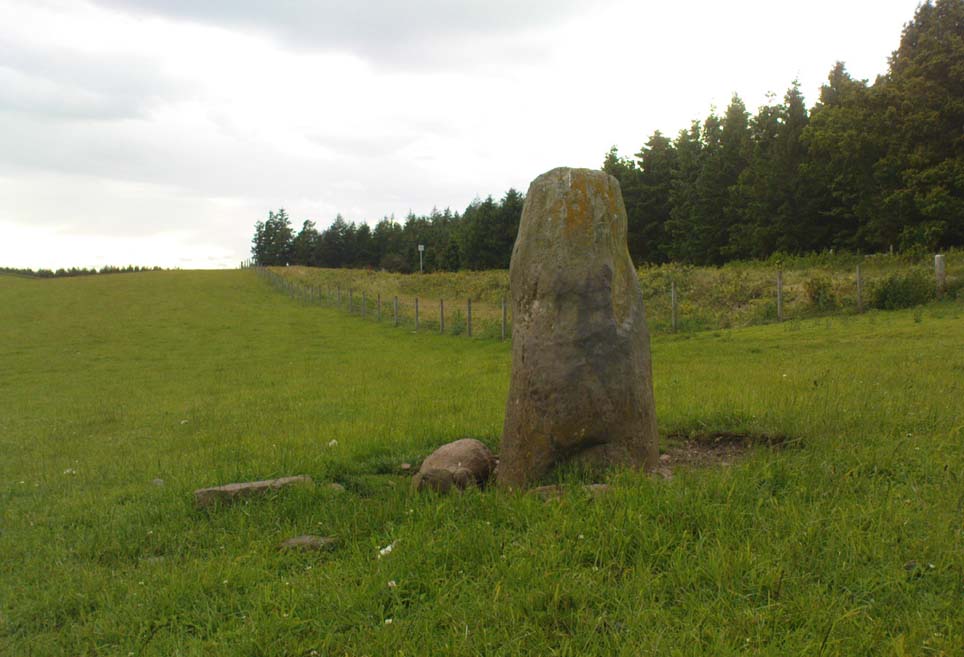
In the lovely village that is the Crook of Devon, go down Church Lane, past the houses, until you meet with the dirt-track on your left that runs straight up beneath a grove of trees heading into the green fields.  Go up here 100 yards until you meet another track that goes sharp left.  Just here, 10 yards along, a solitary tree sits by the wall; and just past it is a large boulder up against the walling.  This is the Bull Stone!

Archaeology & History

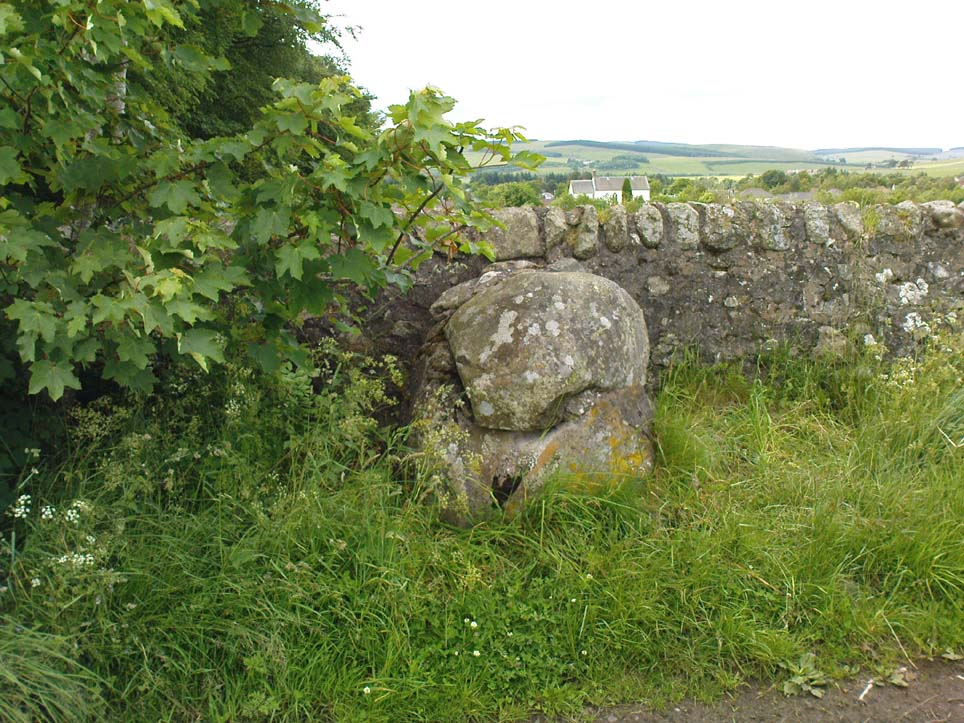
Bull Stone, Crook of Devon

If you didn’t know owt about this place, you wouldn’t even give it a second-thought.  A decent-sized rock, obviously broken-up and then plastered back together again, is innocuously resting up against the wall.  But it appears to have had some significance in bygone centuries, although its full story has yet to be recovered.  It was described in the Royal Commission (1933) report for antiquities, where they told:

“Built against the dike on the north side of an old roadway, half a mile to the south of Crook of Devon, is a huge sandstone boulder known as ‘The Bull Stone.’  It is probably an old boundary mark or, like the Leslie Stone…it may have some association with the old-time pastime of bull-baiting.  The stone was broken up a number of years ago, and the fragments were carted away to be built up in another dike hard by, but, in response to public agitation, they were returned to the original site and cemented together.  The boulder rises 3½ feet above ground and has a girth of about 13 feet at the base.  It is not set up vertically, but lies on its side.”

It may originally have been a standing stone as local lore tells that it once stood as high as a grown man, but is now only half that size.  It may have been one of the meeting places of the legendary witches at the Crook of Devon, but this is guesswork on my behalf (so best ignored!).

References:

  1. Royal Commission on the Ancient & Historical Monuments of Scotland, Fife, Kinross and Clackmannan, HMSO: Edinburgh 1933.

© Paul Bennett, The Northern Antiquarian