Hanging Stones, Ilkley Moor, West Yorkshire

Cup-and-Ring Stones:  OS Grid Reference – SE 12818 46761

Also Known as:

  1. Carving no.126 (Hedges)
  2. Carving no.284 (Boughey & Vickerman)
  3. Fairies Kirk
  4. Hangingstones

Getting Here

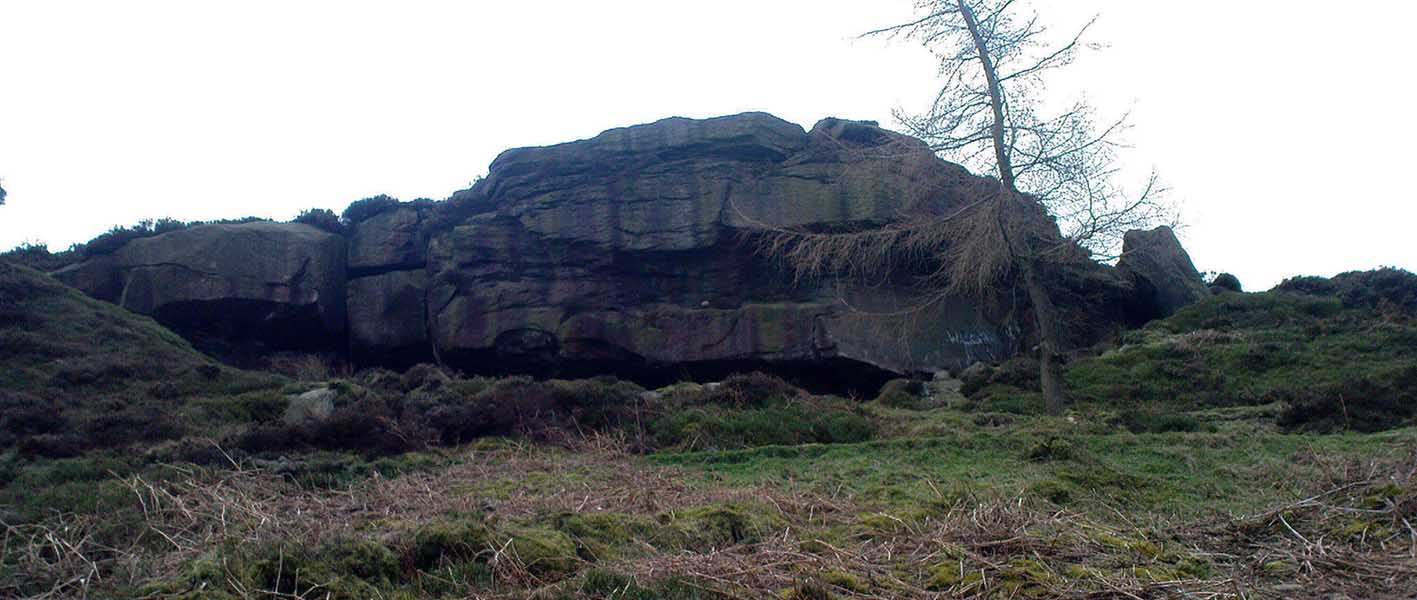
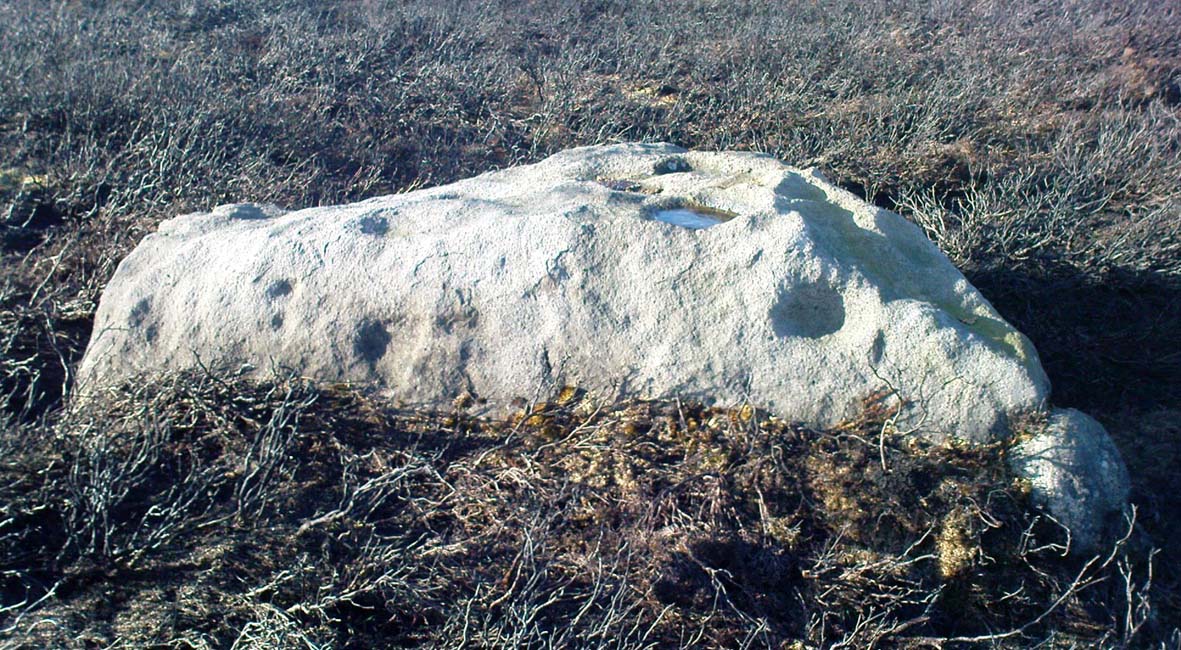
Looking up (south) at the site

Head up to the Cow & Calf Rocks and walk to the large disused quarry round the back (west).  You’ll notice a scattered copse of old pine trees on the edge where the hill slope drops back down towards Ilkley; and there, two raised hillocks (unquarried bits) rise up where the pine trees grow.  The carvings are on the flat rocks atop of one of the two hillocks.  If you’re walking up from Ilkley, once you’ve crossed the cattle-grid in the road and the moorland slope opens up above you, just walk uphill towards the copse of trees and watch out for the rock outcrop in the picture here.

Archaeology & History

Very well-known to locals, folklorists and archaeologists alike, the remains of these old glyphs have caught the attention of artists, historians and Forteans alike for the images and tales surrounding them.  It was obvious that in times past, that the carved remains that we see today would have extended considerably further, but the quarrying destroyed much of it.  Indeed, we’re lucky to have this small section of carved rock still intact!
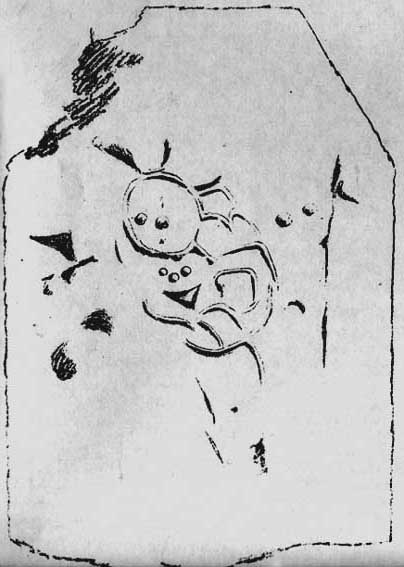
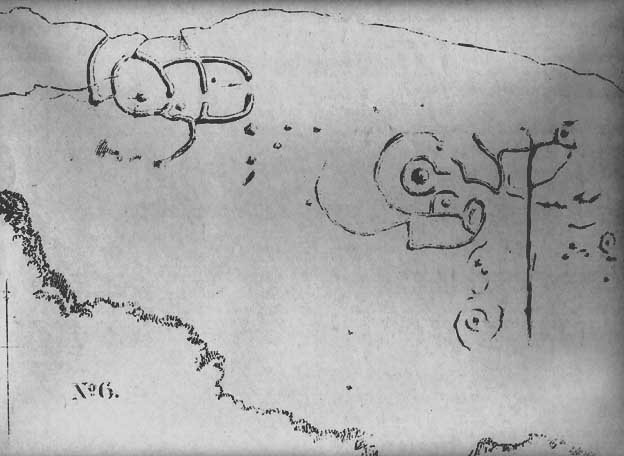
J.Thornton Dale's 1878 drawing
J.Thornton Dale’s 1878 drawing
Different carved section (J.Thornton Dale 1878)

The rocks were first described as the Hanging Stones in the local parish records of 1645, and their name probably derives from the old-english word hangra, meaning ‘a wood on a steep hill-side,’ which is very apt here.  The first known description of the site as possessing cup-and-rings appears to have been in a small article in the local Leeds Mercury newspaper in 1871.  Several years later J. Romilly Allen (1879) wrote a lengthier descripton of the site:

“The crags from which these masses have been detached are known by the name of hanging stones, and at their eastern extremity is a large quarry. Between this quarry and the overhanging edge of the cliff a portion of the horizontal surface of the rock was some years ago bared of turf, thereby disclosing the group of cup and ring sculptures shown on the accompanying drawing. It will be seen that the design consists of twenty-five cups of various sizes, from 1 to 3 inches in diameter. Seven of the cups are surrounded by incomplete rings, many of them being connected by an irregular arrangement of grooves. The pattern and execution are of such a rude nature as almost to suggest the idea of the whole having been left in an unfinished state.  The sides of the grooves are not by any means smooth, and would seem to have been produced by a process of vertical punching, rather than by means of a tool held sideways.”

Allen and other archaeologists from this period saw some considerable relevance in the position of this and the many other cup-and-rings along this geological ridge, telling:

“The views obtained from all points over Wharfedale are exceedingly grand, and this fact should not be lost sight of in studying remains that may have been connected with religious observances, of which Nature worship formed a part.”

J. Romilly Allen’s 1879 drawing of the carvings
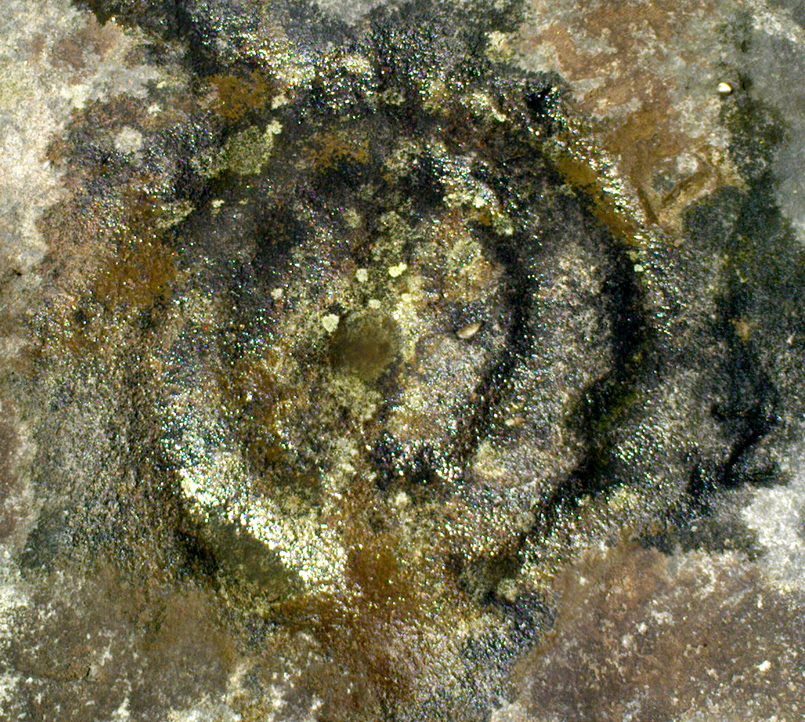
Water-assisted double-ring on eastern rock

A common sense point that seemed long-lost to many archaeologists, adrift as they went in their measurements of lithics and samples of data charts for quite a number of years.  In recent years however, this animistic simplicity has awakened again and they’ve brought this attribute back into their vogue.  Let’s hope they don’t lose sight of it again!

There are tons of other archaeological references to this fine set of carvings, but none add anything significant to anyone’s understanding of the nature of the designs.  We must turn to psychoanthropology, comparative religion and folklore if we want to even begin making any realistic ‘sense’ (if that’s the right word!) of this and other cup-and-rings.  Curiously, the nature of this and other carvings is a remit archaeology has yet to correctly engage itself in.
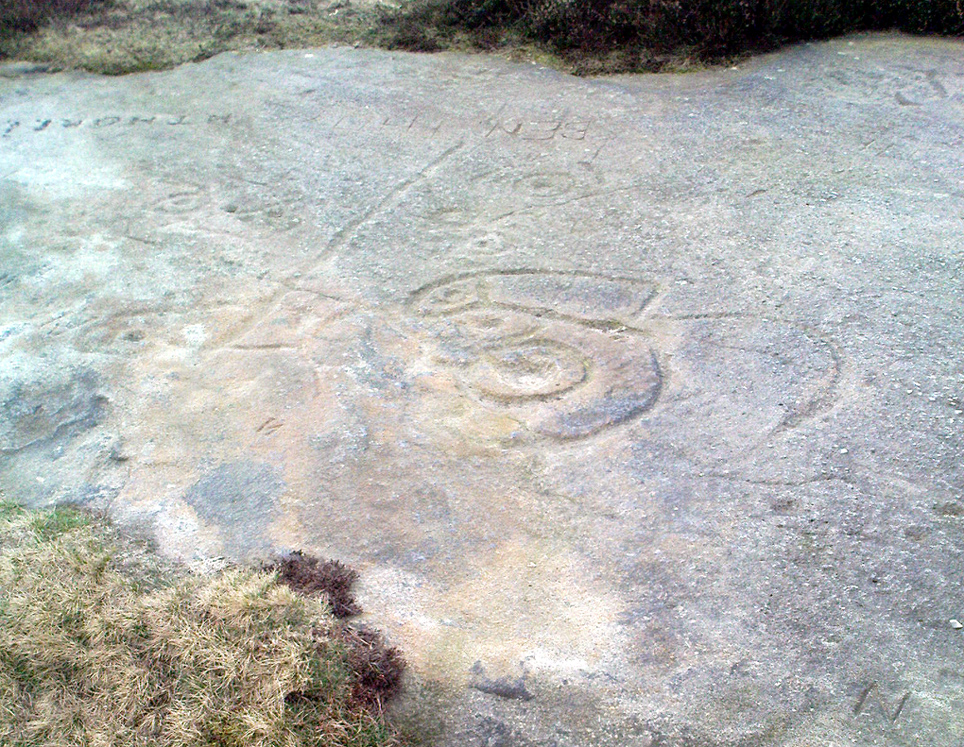
Hanging Stones with “21st century informal unauthorised carvings”

On a very worrying note, we need to draw attention to what amounts to the local Ilkley Parish Council officially sanctioning vandalism on the Hanging Stones, other prehistoric carvings and uncarved rocks across Ilkley Moor.  As we can see on a couple of photos here, recent vandalism has been enacted on this supposedly protected monument.  Certain ‘officials’ occasionally get their headlines in the local Press acting as if they’re concerned about the welfare of the ancient monuments up here, but in all honesty, some of them really don’t give a damn.  The recent vandalism on this stone and others has now been officially recognised as an acceptable “tradition” and a form of — get this! — “twentieth / twenty-first century informal unauthorised carving” and has been deemed acceptable by Ilkley Parish Council as a means to validate more unwanted carving on the moorland “in the name of art”!  Of course, their way of looking at this has been worth quite a lot of money to a small group of already wealthy people. But with Tom Lonsdale and Ilkley Council validating or redesignated ‘vandalism’ as “twenty-first century informal unauthorised carvings”, this legitimizes and encourages others to follow in their shallow-minded ignorant footpath, enabling others with little more than a pretentious ‘care’ for both environment and monuments to add their own form of ‘art’ on cup-and-ring carvings, or other rocks on the moors.
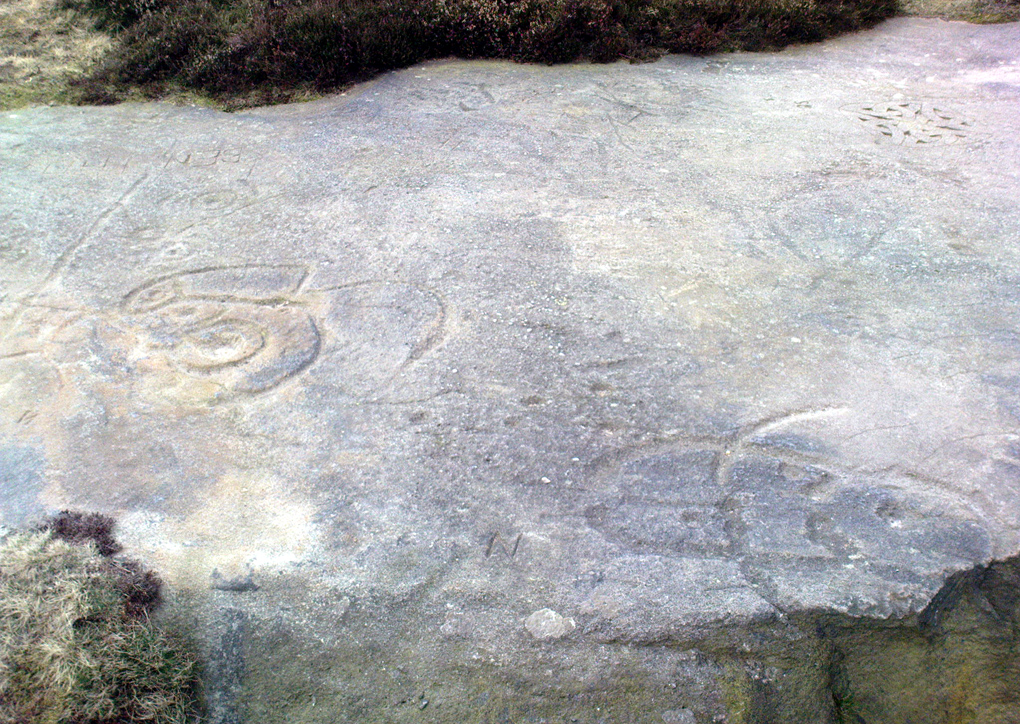
Hanging Stones with more “21st century informal unauthorised carvings”

You can see in some recent vandalism — sorry, traditional “twentieth / twenty-first century informal unauthorised carving”  — at the top-right of the Hanging Stones photo to the side, a very ornate ‘Celtic’-style addition, akin to the quality carved by well-known stone-mason Pip Hall who, coincidentally, has now been granted a lot of money to “officially” carve her own work on another stone further down the valley from here.  With Miss Hall, Mr Lonsdale, poet Simon Armitage and Ilkley Parish Council each playing their individual part in encouraging what is ostensibly vandalism…errr…sorry – I keep getting it wrong – I mean traditional “twentieth / twenty-first century informal unauthorised carving” on the Hanging Stones monument and other cup-and-ring stones on the moor, we can perhaps expect a growth industry in this field…..especially if you’re wanting to make more money for yourself in the name of art or poetry.  And if you apply to Rachel Feldberg of the Ilkley Arts Festival, you may get good money for your work… Seriously! (this is no joke either)

Please contact Ilkley Parish Council and other relevant authorities and express your dismay at their lack of insight and concern for the knock-on effects of their decisions on this matter.  Other plans to infringe even further onto Ilkley Moor are in the business pipeline…

Folklore

Just underneath the carved overhanging rocks (walk off the knoll to the bottom of the rocks, facing the town), is a small recess or sheltered cavity which, told Harry Speight (1900),has

“From time immemorial (been) known as ‘Fairies’ Kirk’, and traditions of it having been tenanted by those tiny sprites, the fairies, still exist among old people in the neighbourhood.”

Tradition goes on to tell that when the Saxons arrived here, they were wont to build a christian church by the Hanging Stones, but the little people strongly resented this and fought hard against the invading forces.  As the Saxons started building the edifice of the new religion, during the night the fairy folk took down the stones and moved them into the valley below.  In the morning when the Saxons found this had happened, they carried the stones back up to begin building again; but each night, the fairy folk emerged and again took the stones to the valley bottom again.  Eventually, after much hardship, the Saxon folk gave up the idea of building on the Fairie’s Kirk, as it was known, and the church that still remains in Ilkley centre was decided as an easier place to build their edifice.

Traditions such as this (of fairies moving stones back to whence they came, or away from ancient archaeological sites) are found throughout Britain and appear to be simple representations of the indigenous peasant hill-folk who strongly objected to their own sacred sites (rocks, trees, wells, etc) being supplanted by the invading religious force.

In more recent years the observation of curious light phenomena over these rocks have been seen, both over here and the Cow & Calf Rocks…

References:

  1. Allen, J.R., ‘The Prehistoric Rock Sculptures of Ilkley,’ in Journal of the British Archaeological Association, vol.35, 1879.
  2. Bennett, Paul, The Old Stones of Elmet, Capall Bann: Milveton 2001.
  3. Bogg, Edmund, Higher Wharfeland, James Miles: Leeds 1904.
  4. Collyer, Robert & Turner, J. Horsfall, Ilkley: Ancient and Modern, William Walker: Otley 1885.
  5. Gelling, Margaret, Place-Names in the Landscape, Phoenix: London 2000.
  6. Hedges, John (ed.), The Carved Rocks of Rombald’s Moor, WYMCC: Wakefield 1986.
  7. Leeds Mercury, ‘Prehistoric Remains at Ilkley’, 20 April, 1871.
  8. Michell, John, The Earth Spirit: Its Ways, Shrines and Mysteries, Thames & Hudson: London 1975.
  9. Size Nicholas, The Haunted Moor, William Walker: Otley 1934.
  10. Smith, A.H., English Place-Name Elements – volume 1, Cambridge University Press 1956.
  11. Speight, Harry, Upper Wharfedale, Elliott Stock: London 1900.

© Paul Bennett, The Northern Antiquarian

Addlebrough (1), Thornton Rust Moor, North Yorkshire

Cup-Marked Stone:  OS Grid Reference – SD 948 879

Getting Here

This takes a bitta getting to and won’t really be worthwhile unless you’re a rock-art nut!  I s’ppose if you’re looking at the other decent cup-and-ring stones on the summit of Addlebrough, it might be worth looking at.  In which case, walk a coupla hundred yards southeast towards where the walling meets and climb over.  The walk a little further in the same direction and once you’ve gone less than 100 yards, look around.  You can’t really miss it if you potter about.

Archaeology & History

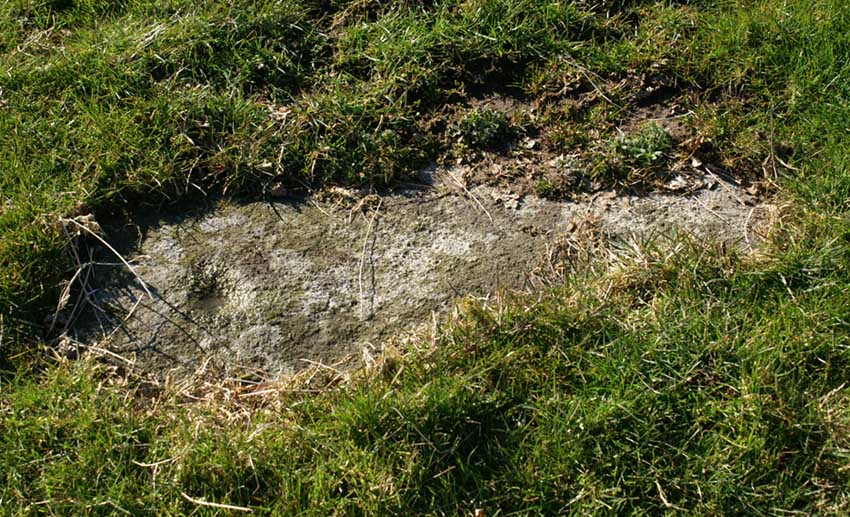
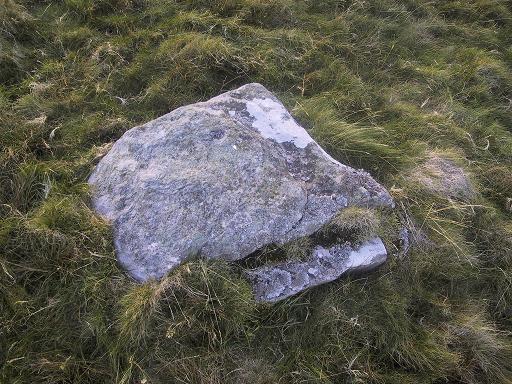
Single cup-marked stone (photo by Richard Stroud)

This possible single cup-marked stone appears to have been discovered before me ‘n Richard Stroud got to the spot, by none other than Stan Beckensall himself — or at least it’s in Stan’s Prehistoric Rock Art of County Durham, Swaledale and Wensleydale book, where he describes it as it only can be done: “a single possible cup-marked stone…SSE of the summit cairn”, which is where you find this. (Another single cup-marked stone found nearby by Barbara Brown aint the same one as this.)

References:

  1. Beckensall, S. & Laurie, T., Prehistoric Rock Art of County Durham, Swaledale and Wensleydale, County Durham Books 1998.

© Paul Bennett, The Northern Antiquarian

Niplet Stone, Rivock, Keighley, West Yorkshire

Cup-Marked Stone:  OS Grid Reference – SE 07481 44452

Also Known as:

  1. Carving no.23 (Hedges)
  2. Carving no.59 (Boughey & Vickerman)

Getting Here

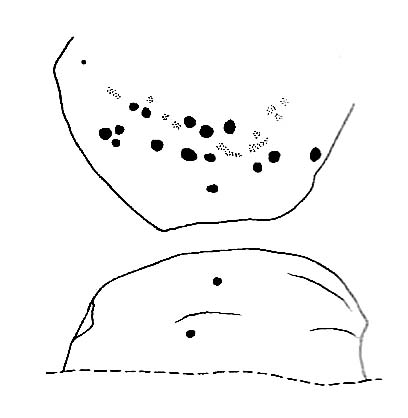
Niplet Stone (after Hedges)

Follow the same directions to reach the nearby Wondjina Stone, but as you reach the trig-point at the top of Rivock Edge, note the smooth rounded boulder 50 yards ESE.  That’s it!

Archaeology & History

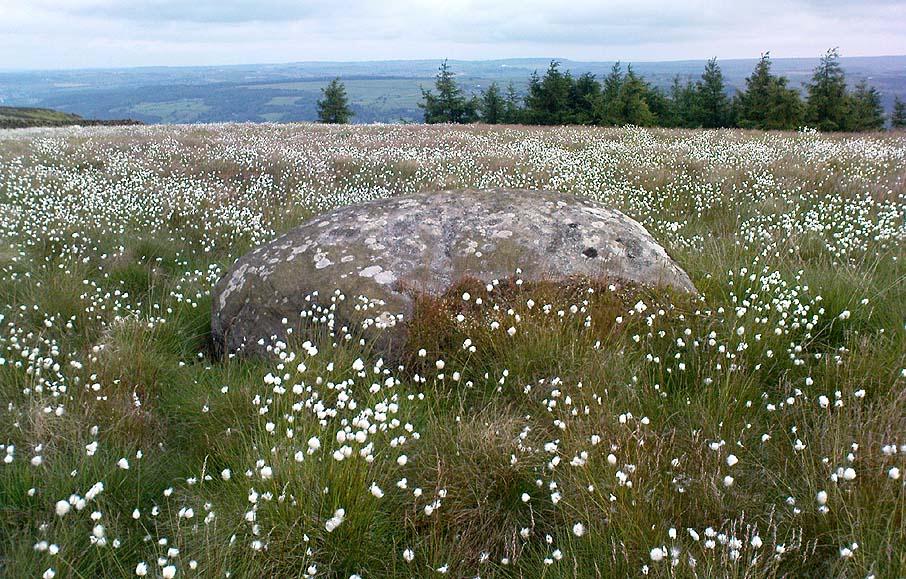
Named after the sea of cotton grasses, or niplets (Eriophorum angustifolium), amidst which it lives for several weeks of the year, the cups-marks that make up this design can be terribly difficult to work out even in the best of lighting.  We have here a lichen-encrusted stone with perhaps as many as 25 cup-marks scattering, mainly, the top and westerly sloping face.  Although some of the cups are quite noticeable, the vegetative growth and simple erosion has made an accurate visual impression of the original carving very difficult — as the images plainly tell!  If I ever manage to capture the stone resting in a good mood, I’ll replace the photos I’ve got here!

Niplet Stone, looking SE
Beautiful fusion of faded cups, lichen & great age...
Beautiful fusion of faded cups, lichen & great age…

Although I remember coming here and seeing this and the nearby carvings when I was a teenager, then a few years later on with Edna Whelan and Graeme Chappell, it seems that the first literary note of this carving after my own initial exploration was in the Ilkley Archaeology Group’s survey (Hedges 1986), where they make note of a flint that was found beside the stone.  Boughey and Vickerman (2003) later include the same stone in their work, but with no additional information.

References:

  1. Bennett, Paul, “The Prehistoric Rock Art and Megalithic Remains of Rivock & District (parts 1 & 2),” in Earth, 3-4, 1986.
  2. Boughey, Keith & Vickerman, E.A., Prehistoric Rock Art of the West Riding, WYAS 2003.
  3. Hedges, John (ed.), The Carved Rocks on Rombald’s Moor, WYMCC: Wakefield 1986.

© Paul Bennett, The Northern Antiquarian

Wondjina Stone, Rivock, Keighley, West Yorkshire

Cup-and-Ring Stone:  OS Grid Reference – SE 07366 44628

Also Known as:

  1. Carving no.10 (Hedges)
  2. Carving no.49 (Boughey & Vickerman)

Getting Here

Wondjina Stone, Rivock

A wonderful site, though a bittova walk for city-minded folk.  Head up the road from Riddlesden, Keighley, towards the southern edge of Rombalds Moor and keep going till you reach the road which surrounds the moor (called Silsden Road).  At the T-junction in front of you is a path which takes you onto the fields and moor.  Go over the stile and walk straight up the steepish field that follows the straight line of the forest, all the way to the top.  Climb over the wall on your left when you reach the top of the tree-line, walk past the triangulation pillar for 100 yards or so till you hit the end of the walling before it drops back into the trees.  The carving’s under your nose!

Archaeology & History

Wondjina Stone01
Rivock Edge’s ‘Wondjina’ carving

The name of this carving is based on a first impression I got of it when I came here as a young lad, still in my teens.  The ‘Wondjina’ is a name given to primal aboriginal spirits whose images are etched and painted on rock surfaces in various parts of Australia (usually rock overhangs or in caves).  Don’t ask me why, but that was the impression I first got of this stone — and it’s something that stays with me.  Some archaeo’s won’t like the association such mythic ancestral beings may have upon people’s notions of cup-and-ring art, but they tend to be the ones who have little educational background regarding the animistic nature of rocks in traditional and peasant societies: ingredients that are integral to these ancient carvings, as research worldwide clearly shows.

The carving was first described by our old Yorkshire historian Arthur Raistrick (1936) in an early essay on Yorkshire rock carvings; and then again in a later article by Stuart Feather. (1961)  The primary design is of a large single cup-and-ring at one end of the rock, with a series of seemingly unbroken lines reaching up (or perhaps moving away) from the cup-and-ring.  A long central line runs through the middle of the Wondjina ‘being’, which initially seems to have been a series of cups linked by this line; though these cups (at least four of them) have eroded over time and are difficult to see without good sunlight.  What seem to be several other very eroded cup-marks are also found on two of the other long lines.  These can be made out in the photograph here.

Close-up of lines & cup-marks

Another carving is on the stone right next to this one (2ft away) and there are several other cup-marked stones to be found along the same ridge (carving numbers 058, 059, 060, etc).  And for those of you into landscape archaeology, take the position of this carving into consideration.  The view from here is  quite superb and on clear days a number of prominent hills and important mythological landscape features stand out.  To those of you who think such things unimportant or of little relevance in the mythography of our ancestors — you’ve a lot to learn!  Otherwise, a visit to this carving and its associates is well worth a trek!

References:

  1. Bennett, Paul, ‘The Prehistoric Rock Art and Megalithic Remains of Rivock & District (2 parts),’ in Earth, 3-4, 1986.
  2. Boughey, Keith & Vickerman, E.A., Prehistoric Rock Art of the West Riding, WYAS 2003.
  3. Feather, Stuart, ‘Mid-Wharfedale Cup-and-Ring Markings: Nos. 7 & 8, Rivock Edge,’ in Cartwright Hall Archaeology Group Bulletin, 6:8, 1961.
  4. Hedges, John (ed.), The Carved Rocks on Rombald’s Moor, WYMCC: Wakefield 1986.
  5. Raistrick, Arthur, “‘Cup-and-Ring’ Marked Rocks of West Yorkshire,’ in Yorkshire Archaeology Journal, 32, 1936.

© Paul Bennett, The Northern Antiquarian
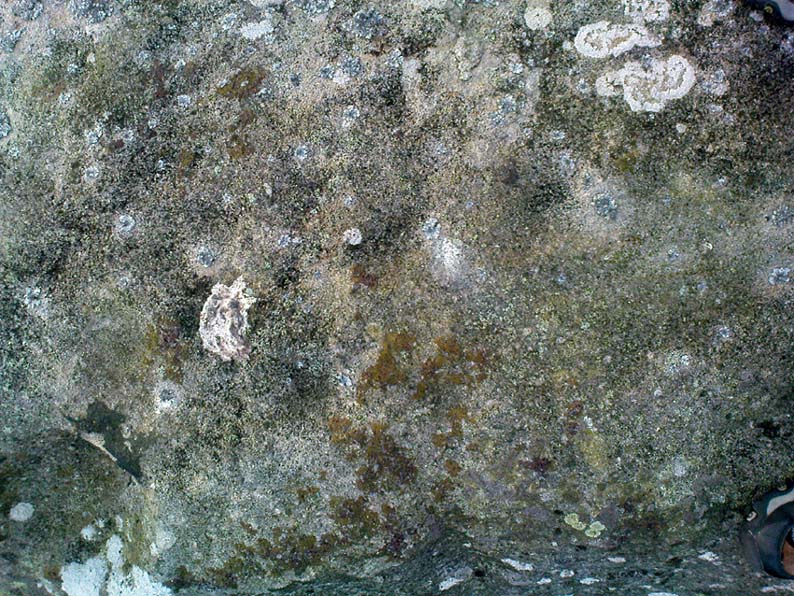

Baldwin Stone, Silsden, West Yorkshire

Cup-Marked Stone:  OS Grid Reference – SE 06453 44658

Getting Here

Baldwin Stone - with its happy discoverer!
Baldwin Stone with its finder

From East Riddlesden, go up the road (over the swing-bridge) that takes you onto the moor-edge (ask a local if you have trouble).  Go all the way up till you hit the road which encircles the moor (it’s called the Silsden Road where you hit it).  Turn left for several hundred yards till you see the microwave tower just on the hillock to your right on Pinfold Hill (not the larger TV towers just below the forest).  Walk up there, then follow the edge of the walling till you hit the old Pinus sylvestris trees of Robin Hood’s Wood where 2 walls meet.  Go over the gate and walk to your right for about 200 yards, following the line of the walling.  You’re there!

Archaeology & History

Cluster of cups on southern edge
Cluster of cups on W edge

A newly-discovered cup-marked stone, located for the first time on Tuesday, June 9, 2009, by Michala Potts, who was out on an amble with some long-haired halfwit whizzing about getting excited about stupid cup-markings on stones, dragging her back and forth and leaving her in the middle of a bog!  On one occasion when this ‘ere fruitbat wandered off (again!), leaving her alone in the middle of the hills, she decided to check out some rocks a bit further up the slope where she’d been left alone.  And there, along the edge of some walling, right on the edge of the much-denuded Robin Hood’s Wood, a short distance west of Rivock, a curious stone popped out and caught her attention!

Was this a cup-marking she saw before her!?  It certainly was!  But she didn’t call out to this halfwit who’d left her to her own devices.  She let him just wander off to his sad heart’s content, whilst she got into the nitty-gritty of checking the stone out, uncovering the essentials of the carving while he bimbled off like a freak!  And what a nice carving it was she found…

Baldwin Stone - looking south
Baldwin Stone – looking west
First sketch of the stone

Although no accurate measurements were made of the stone (it was bigger than 10-inch!), at least 17 cup-markings were counted here: one singular and very well-preserved cup, alone on its southern edge, right by the walling.  But the main feature of the design is a cluster of cup-marks (at least 11) on the western side of the rock — one part of this cluster having the appearance of the figure 5 on a dice!  Several other well-defined cups occur on the central and more northern end of the rock.

Eventually, her sad stone-wandering fella returned, forlorn, having found no new carvings of his own (poor soul!).  And so she took his poor little hand, and took him to see the little prehistoric treasure she’s uncovered — and her sad little man got all smiley and … well, you know what they’re like!

Additionally however, for the archaeo’s amongst you: if you come wandering up here to check this carving out, you’ll notice the remains of many large upright stones in a lot of the old stone walls round here.  Many of these are the remains of Iron Age walling.

© Paul Bennett, The Northern Antiquarian 

Cluster Stone, Ilkley Moor, West Yorkshire

Cup-and-Ring Stone:  OS Grid Reference – SE 13283 45920

Also Known as:

  1. Carving no.160 (Hedges)
  2. Carving no.325 (Boughey & Vickerman)

Getting Here

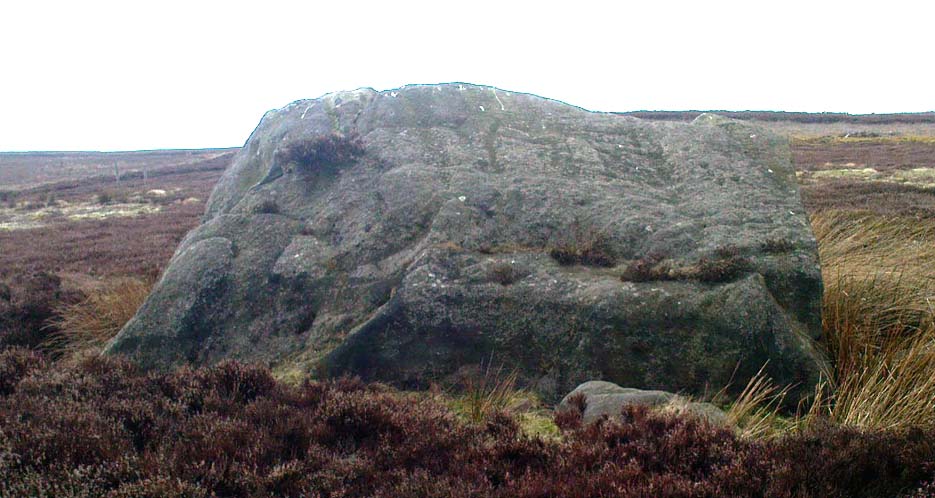
Follow the same directions for getting to the Idol Stone, then walk just 30 yards further up the path and it’s the big rock on your left-hand side.  Y’ can’t miss it!

Archaeology & History

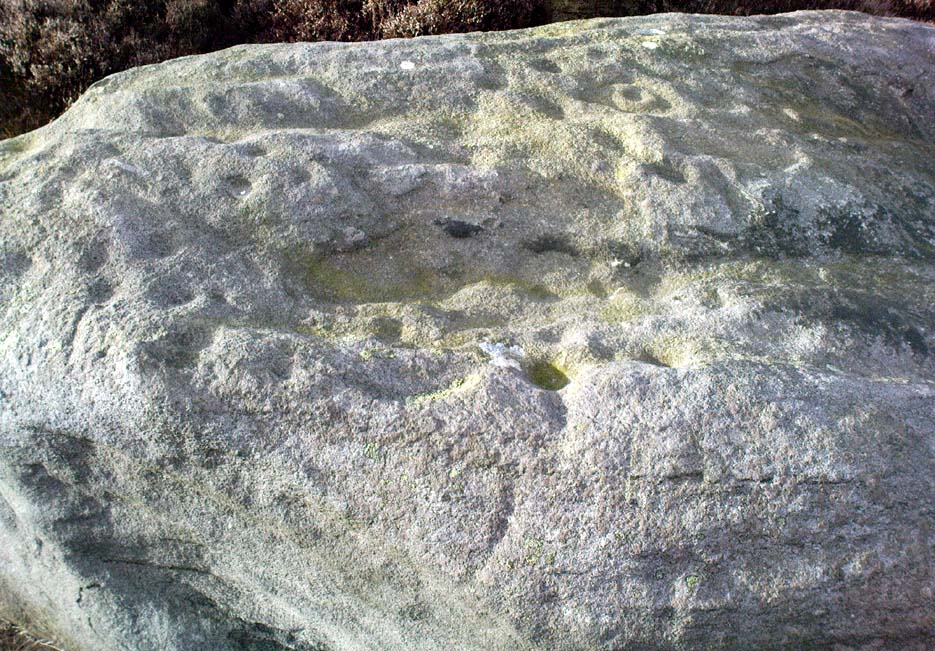
Main section of cup-marks

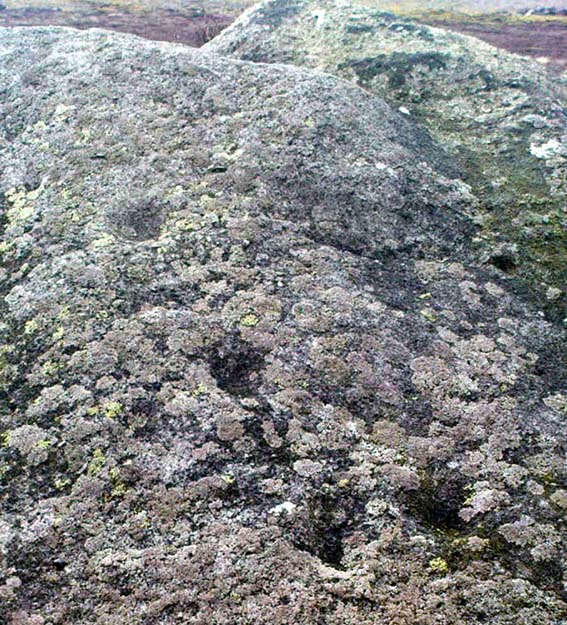
This nice big boulder can be quite a temperamental chap, depending on how the light plays with the rock surface.  I’ve got some photos of this old stone where you can see next to nowt on it; where as others show clearly aspects of the design that aren’t on the archaeo-images.  But such is the nature of cup-and-rings I s’ppose!

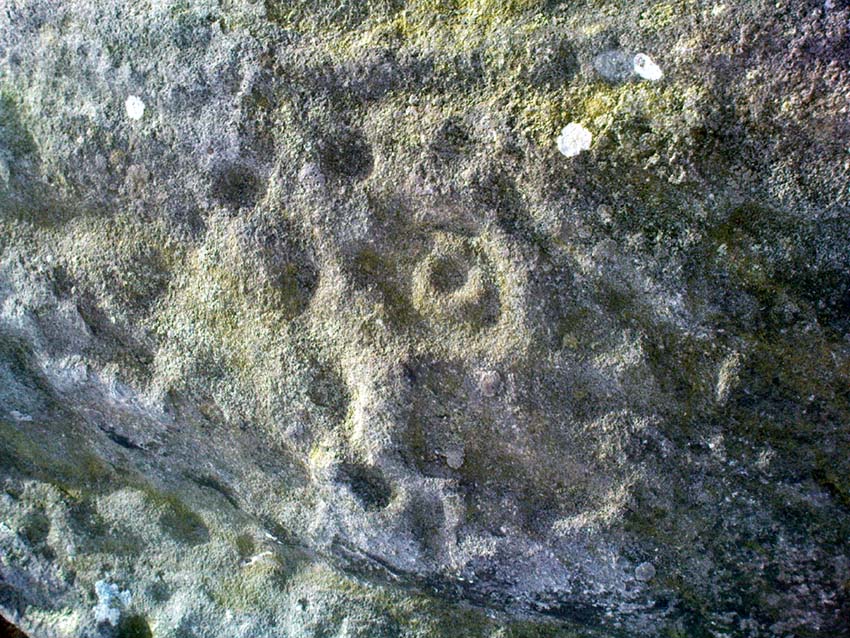
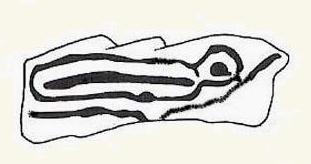
Unlike its rather linear companion a few yards away, this great boulder has the more typical scattering of faded cups, lines and at least one cup-and-ring, etched with seemingly little purpose or structural design.  But as we know, the very notion of structural design in forms consistent to modern mind-sets were anathema to the neolithic people who were etching these patterns on rocks.  Indeed, even the notions of these images as ‘art’ as defined in modern times, has no relationship to the intrinsic reality of either cup-and-rings or reality per se, as experienced by our ancestors.  And I think we find an explicit affirmation of this in the Cluster Stone here.

Close-up of cup-and-ring

Natural cuts in the rock have been heightened, for whatever reason, so that today the division between Nature’s marks and the mark of humans have become ambiguous as time has worn the features.  The clustering of cup-marks on certain parts of the rock was surely indicative of (what we would term) separate events/forms, whose mythic relationship were, however, intrinscially related.  This may be representative of a landscape map, or a series of events – but each would relate to one and other.  But, of course, we truly don’t know, so think I’d best shut up!

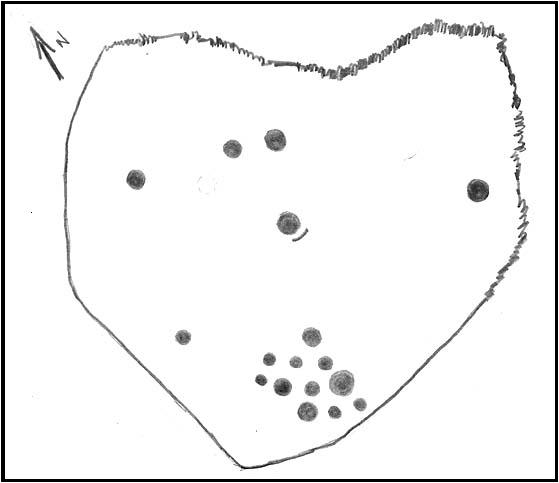
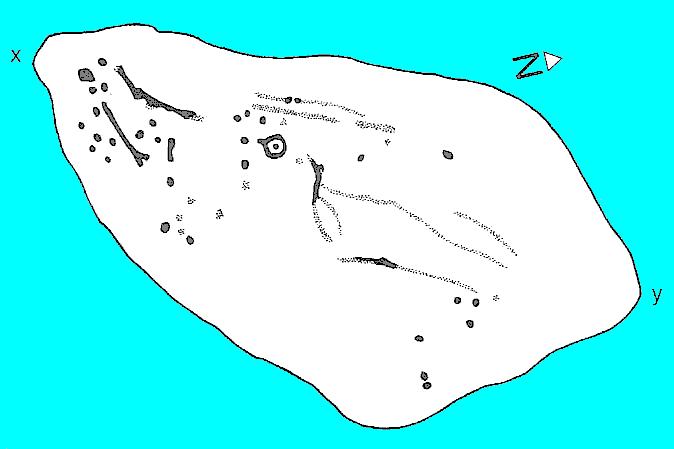
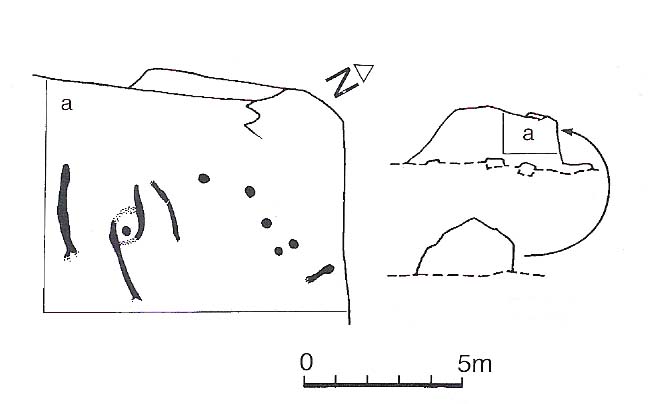
Cluster Stone design (after Hedges 1986)

The carving itself, as we can see today, has perhaps as many as 40 cup-marks on it (Boughey & Vickerman safely vouch for 26), with five or six lines running across the surface, some of which have been modified by ancient peoples.  The cup-and-ring on the stone is quite distinct.  Neolithic or Bronze Age walling runs just a few yards away from here, but the precise line it takes has not been accurately assessed.

References:

  1. Boughey, Keith & Vickerman, E.A., Prehistoric Rock Art of the West Riding, West Yorkshire Archaeology Service 2003.
  2. Hedges, John (ed.), The Carved Rocks on Rombald’s Moor, WYMCC: Wakefield 1986.

© Paul Bennett, The Northern Antiquarian
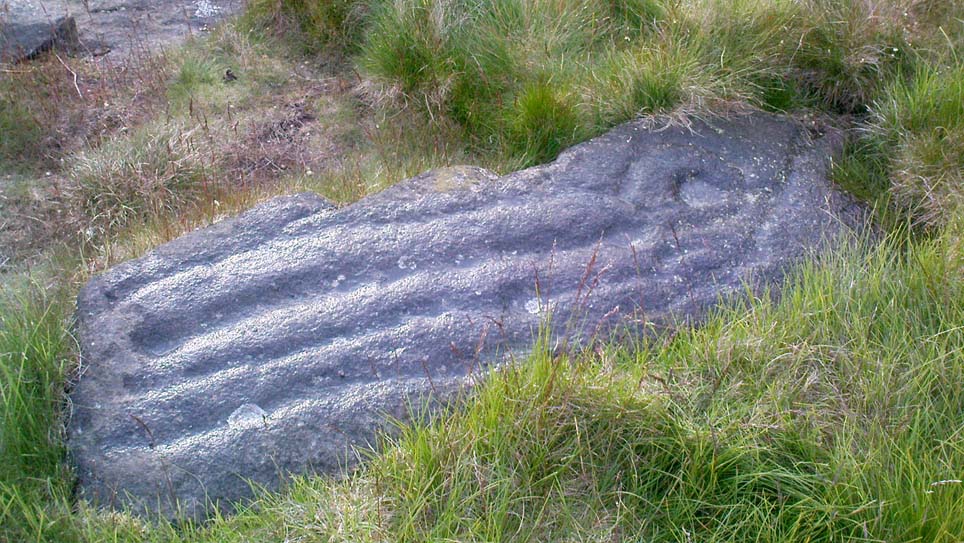

Little Haystack Rock, Ilkley Moor, West Yorkshire

Cup-and-Ring Stone: OS Grid Reference – SE 13654 45936

Also Known as:

  1. Carving no.184 (Hedges)
  2. Carving no.355 (Boughey & Vickerman)
  3. Haystack 2

The Little Haystack - looking west

Getting Here

Follow the same directions to reach the Pancake Stone.  Then walk eastwards along the footpath on the moorland edge.  After about 400 yards, keep your eye out to your right on the moorland proper where you’ll see this large boulder, seemingly isolated, of similar shape to the Haystack Rock, but a bit smaller.  That’s it! If you end up near the stream (Rushy Beck) you’ve gone way past it.

Archaeology & History

Four of the cups
Four of the cups on this lichen-rich surface
Little Haystack (after Hedges 1986)

Found in the middle of the Green Crag Slack Plain, this large Haystack-Rock-shaped boulder stands out.  It sits amidst a cairn-field with other neolithic remains nearby.  The carving itself aint that impressive, and some parts of it seem almost dubious.  But both Hedges, Boughey and Vickerman include it in their surveys, describing the cup-marks and curious lines on its northeastern surface.  It’s nowt special to be honest.  You’d expect a bit more from the size of this old stone; but as those folk who know their rock art well will tell you, size aint everything when it comes the splattering of cups on a rock’s surface. We have four distinct cups pretty close to each other (as the photo shows), with another possible cup-and-ring and accompanying lines nearby.

The stone’s worth looking at though.  It stands out amidst the mass of single- and double-tombs scattered across the moorland plain — sitting amidst a veritable necropolis no less.

References:

  1. Boughey, Keith & Vickerman, E.A., Prehistoric Rock Art of the West Riding, West Yorkshire Archaeology Service 2003.
  2. Hedges, John (ed.), The Carved Rocks on Rombald’s Moor, WYMCC: Wakefield 1986.

© Paul Bennett, The Northern Antiquarian

Eastwoods Farm Cup, Heyshaw, North Yorkshire

Cup-Marked Stone:  OS Grid Reference – SE 1852 6201

Also Known as:

  1. IAG637a (Boughey)

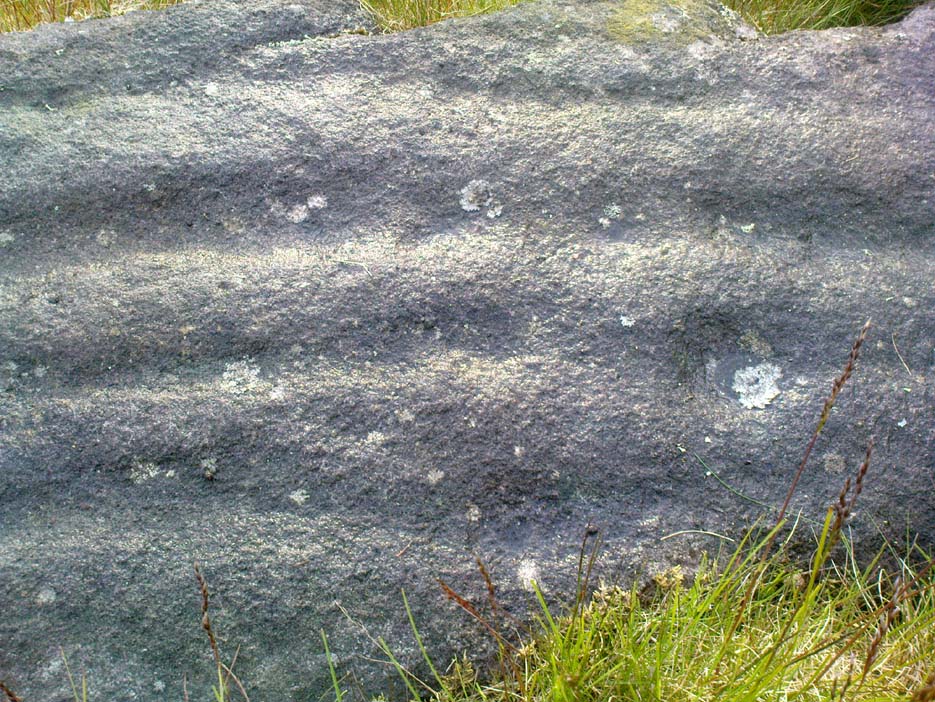
Single cup-marked stone in the field below Eastwoods Farm

Getting Here

From the large village of Summerbridge, go west along the B6541 towards Dacre Banks, where you’ll see the signpost for the Nidderdale Way footpath.  Follow this past the disused quarry and onto the meadows.  When you hit the Monk Ing road, bear right (north) and keep going till you’re 100 yards from Eastwoods Farm.  Go right, down into the fields for 50 yards or so.  Look around!

Archaeology & History

A previously unlisted single cup-marked stone which is likely to become overgrown by the grasses pretty soon.  Several other carvings are in close attendance in this field.  It’s not far from the cup-marked Eastwoods Cross Base (aka CR 637) in the same field, but a little further down.  In all probability there are other carvings yet to be found in this area.  The rock art student Keith Boughey (2007) mentioned it briefly in an article on the other carvings nearby, saying simply:

“A small area of rock (very possibly bedrock) measuring 40cm x 14cm at its greatest extent pokes up through the turf, showing one worn but clear cup-mark on its western edge (Fig 3). On its own, this marking would not be significant were it not for the fact that four other carved rocks are already recorded from this particular locality.”

The hugely impressive Morphing Stone and a prehistoric lightning-carving can be found in the next field, full of rocks, on the other side of the stream.

(NB: In a more recent visit to the site (August 2011), the carving had all but disappeared beneath ever-growing Earth.)

References:

  1. Boughey, K., “Prehistoric Rock Art: Four New Discoveries in Nidderdale,” in Prehistoric Research Section Bulletin, no.44, Yorkshire Archaeological Society 2007.

© Paul Bennett, The Northern Antiquarian


Young Idol Stone, Ilkley Moor, West Yorkshire

Cup-Marked Stone:  OS Grid Reference – SE 13264 45943

Also Known as:

  1. Carving no.158 (Hedges)
  2. Carving no.323 (Boughey & Vickerman)

Getting Here

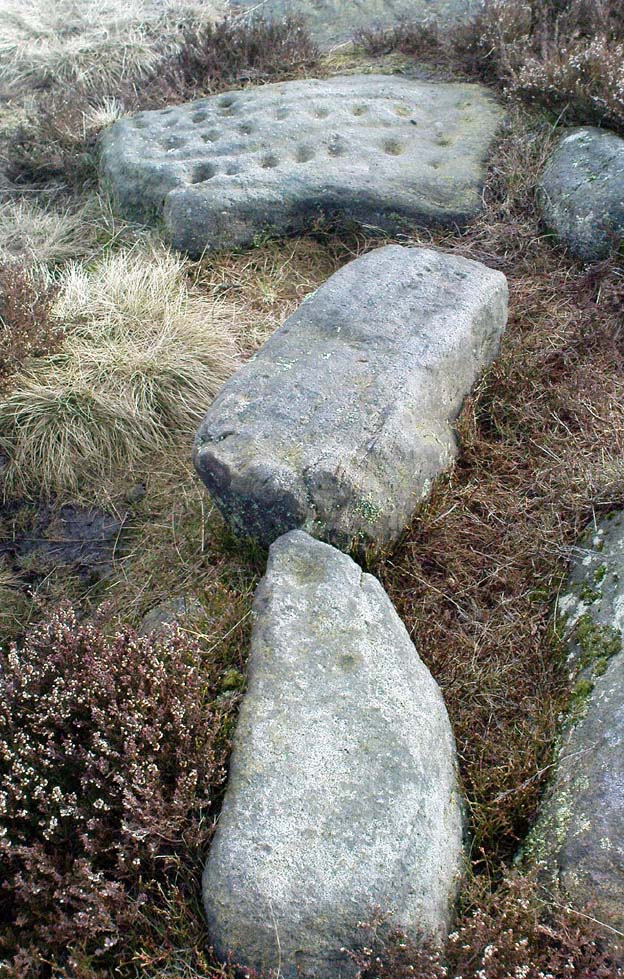
The Young Idol Stone (bottom) & parental Idol Stone above

Take the directions to reach the Haystack Rock, then head onto the moor following the south-east footpath for a few hundred yards, towards where the moor slopes uphill.  20-30 yards before the uphill slope, a yard to the right of the path, a couple of yards below the well-known Idol Stone carving – you’ll find it!

Archaeology & History

Described simply as a “small, rounded, smooth grit rock,” this long-tooth-shaped stone has just two cup-markings on its upper face: one on the more southern tip, and the second smaller cup several inches below it – as shown on the photo.  The adjacent carving seen at the top of the photo is the parent guardian, Idol Stone!  If you visit this, or any adjacent carvings here, please remember that all along this moorland plain are numerous unexcavated prehistoric tombs. You’re effectively stood at the edge of, or within, a huge prehistoric cemetery.

References:

  1. Boughey, Keith & Vickerman, E.A., Prehistoric Rock Art of the West Riding, WYAS 2003.
  2. Hedges, John, The Carved Rocks on Rombalds Moor, WYMCC: Wakefield 1986.

© Paul Bennett, The Northern Antiquarian

Green Crag Top Stone, Ilkley Moor, West Yorkshire

Cup-Marked Stone:  OS Grid Reference – SE 1304 4582

Getting Here

Green Crag Top stone - from above
Green Crag Top stone – from above

Head for the binary-like Idol Stone carving and keep walking on the footpath, up the hill.  Once on top of the ridge, walk along it to your right (west) for about 300 yards, then walk south (left) into the flat heathland plain.  Look around!

Archaeology & History

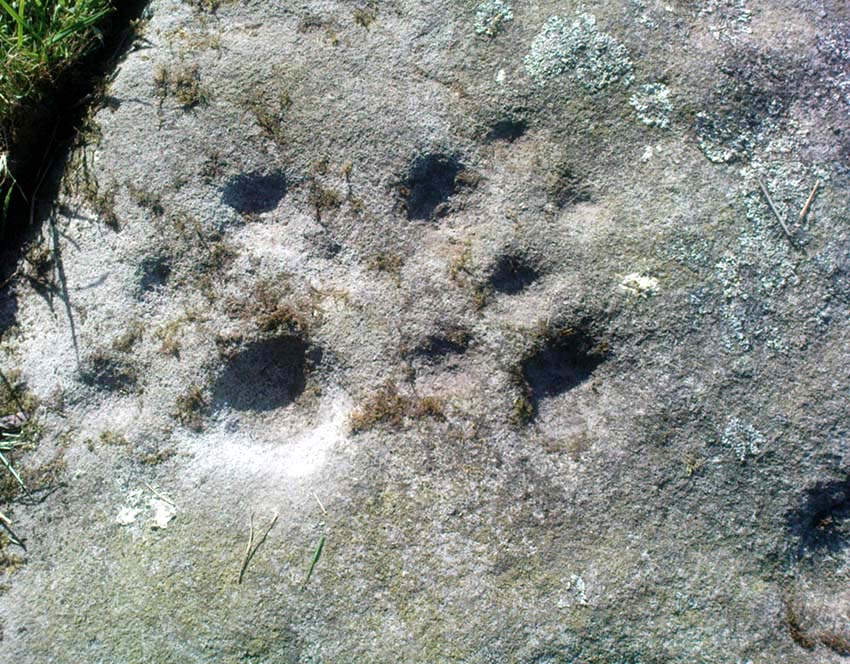
I’m probably not reading it right – but it seems this large stone with several distinct cup-marks on its vertical south-face, isn’t in the surveys of either Hedges (1986) or Boughey & Vickerman (2003).  If someone can correct me on this one – please do!

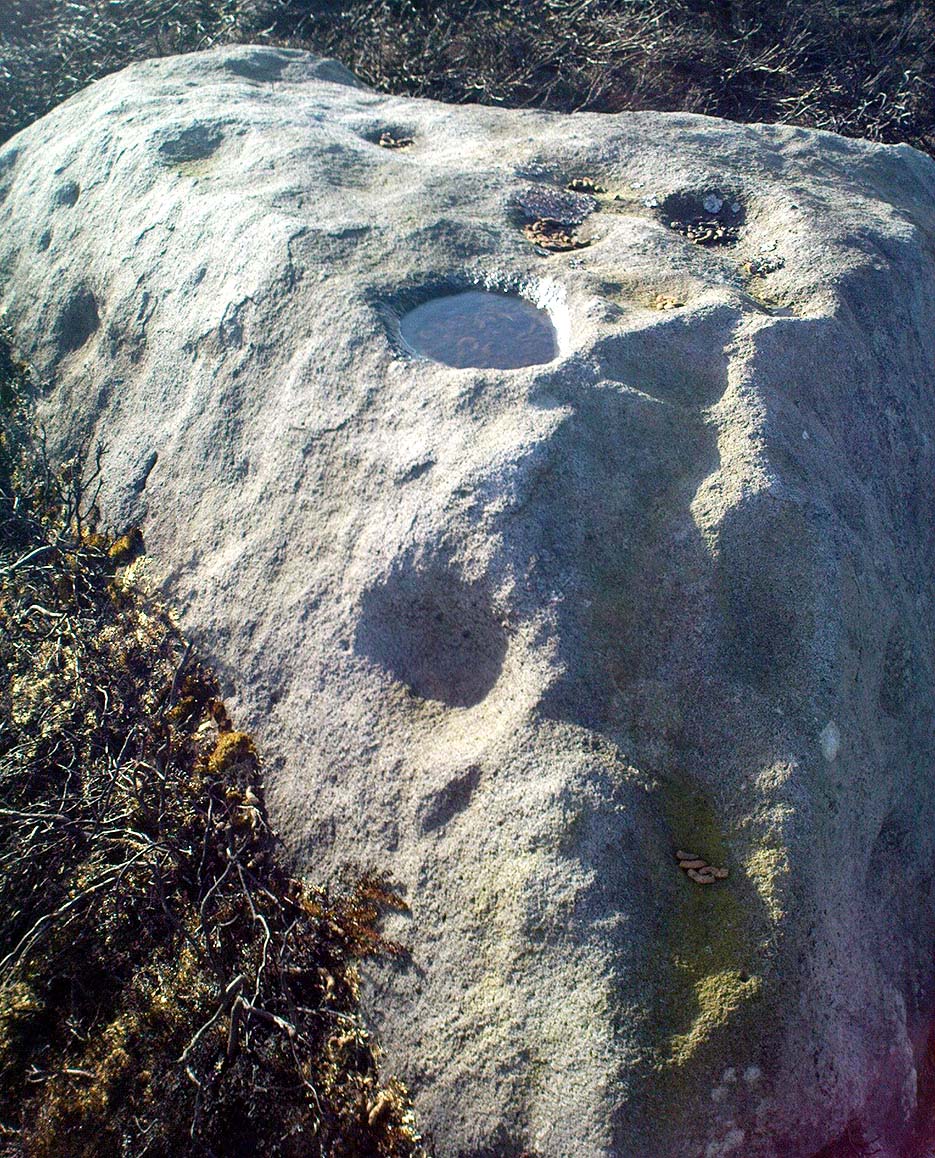
Green Crag Top Stone, looking north

This is quite a large boulder, as the photos here show.  At least two average-sized cup-markings have been etched onto the south face, and two larger ones accompany them on the same edge.  There’s another larger cup-mark on the northeast side of the stone, and a possible companion, which may or may not be artificial.  Then on top of the stone we have several large cups and a ‘bowl’ — though some of these upper markings may be natural, or just well-eroded cup-marks.  It’s hard to tell for sure!

Now I’m gonna have another look in the Hedges, Boughey & Vickerman surveys.  They surely can’t have missed this!

© Paul Bennett, The Northern Antiquarian