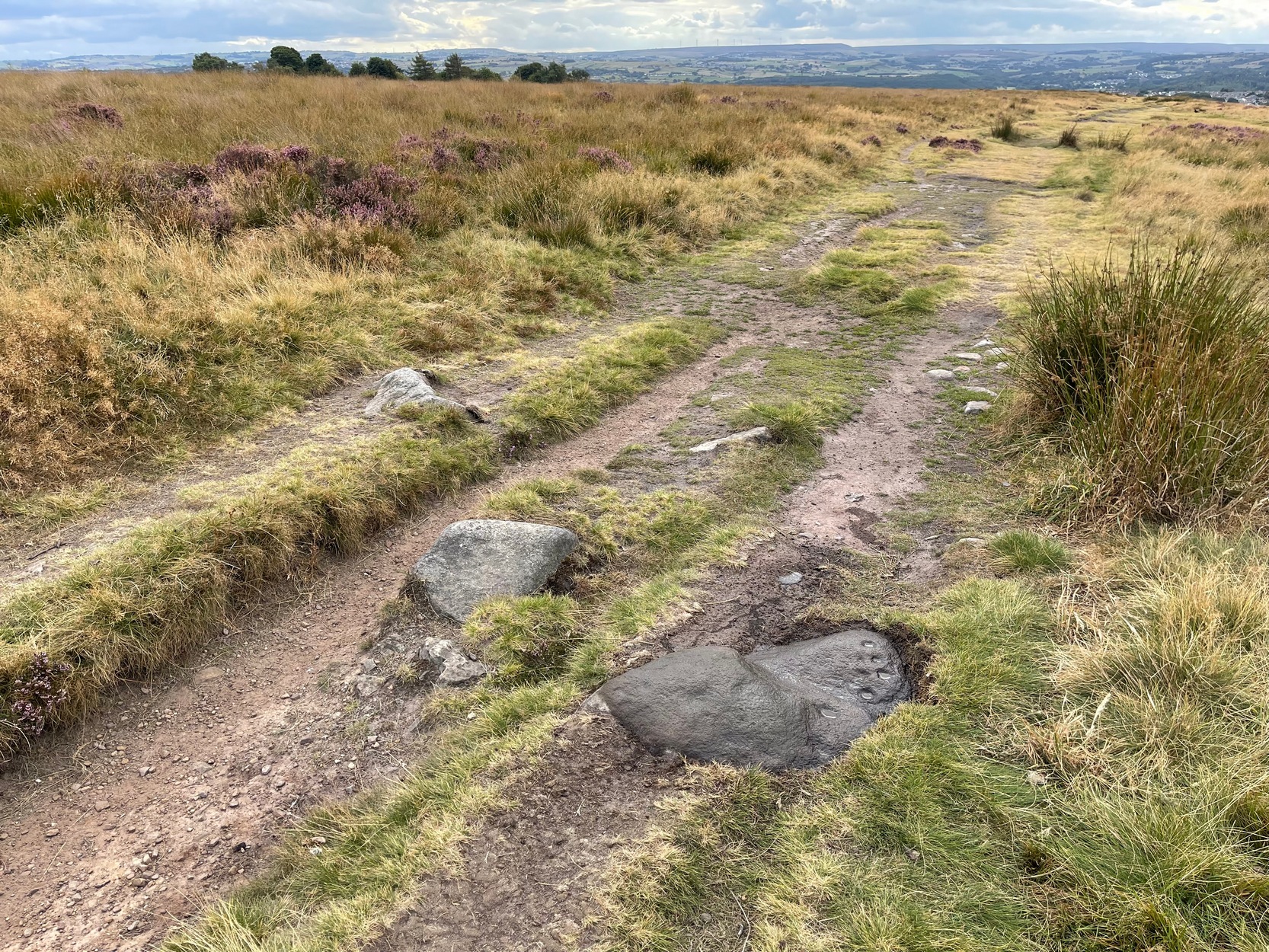
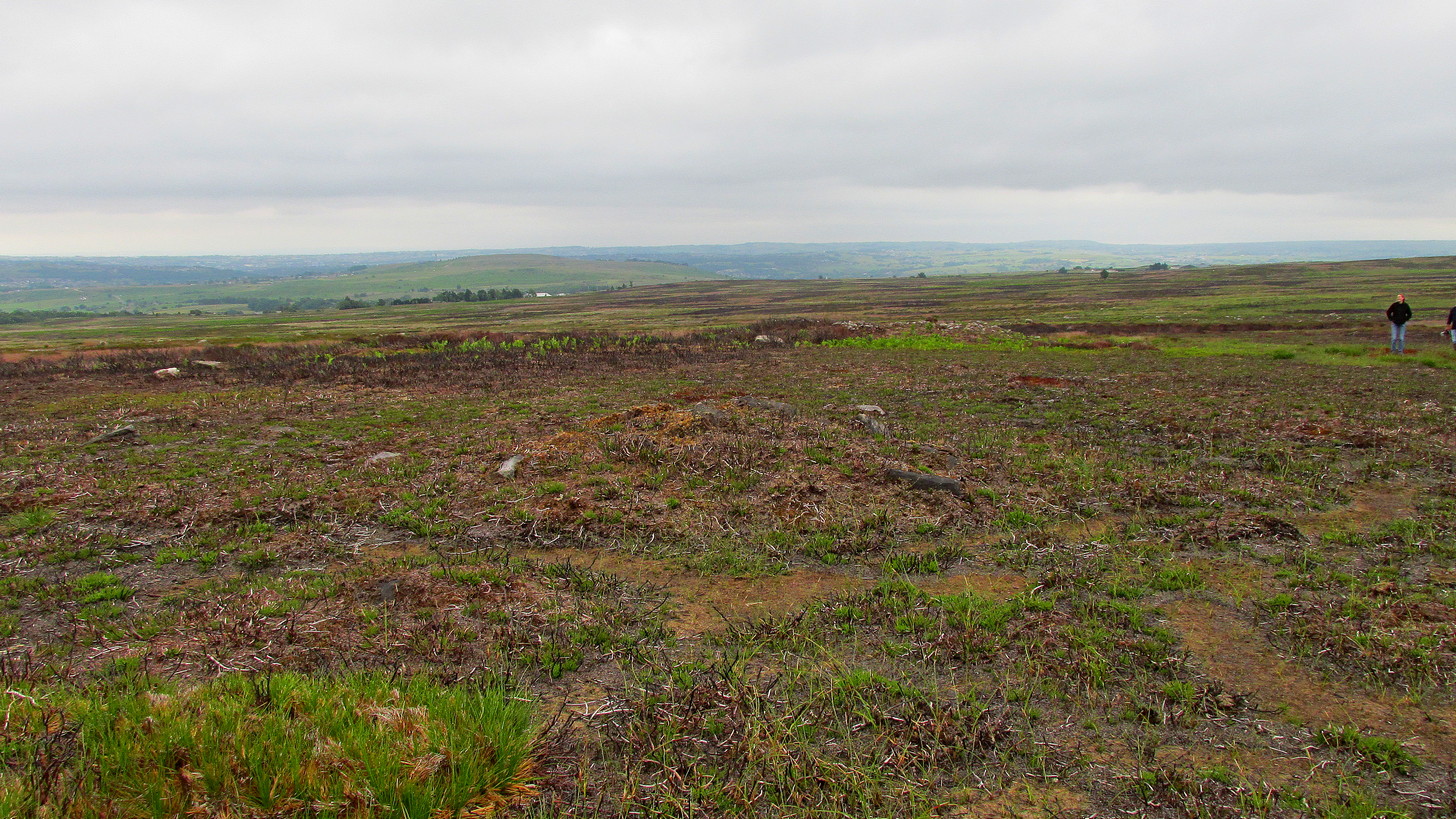
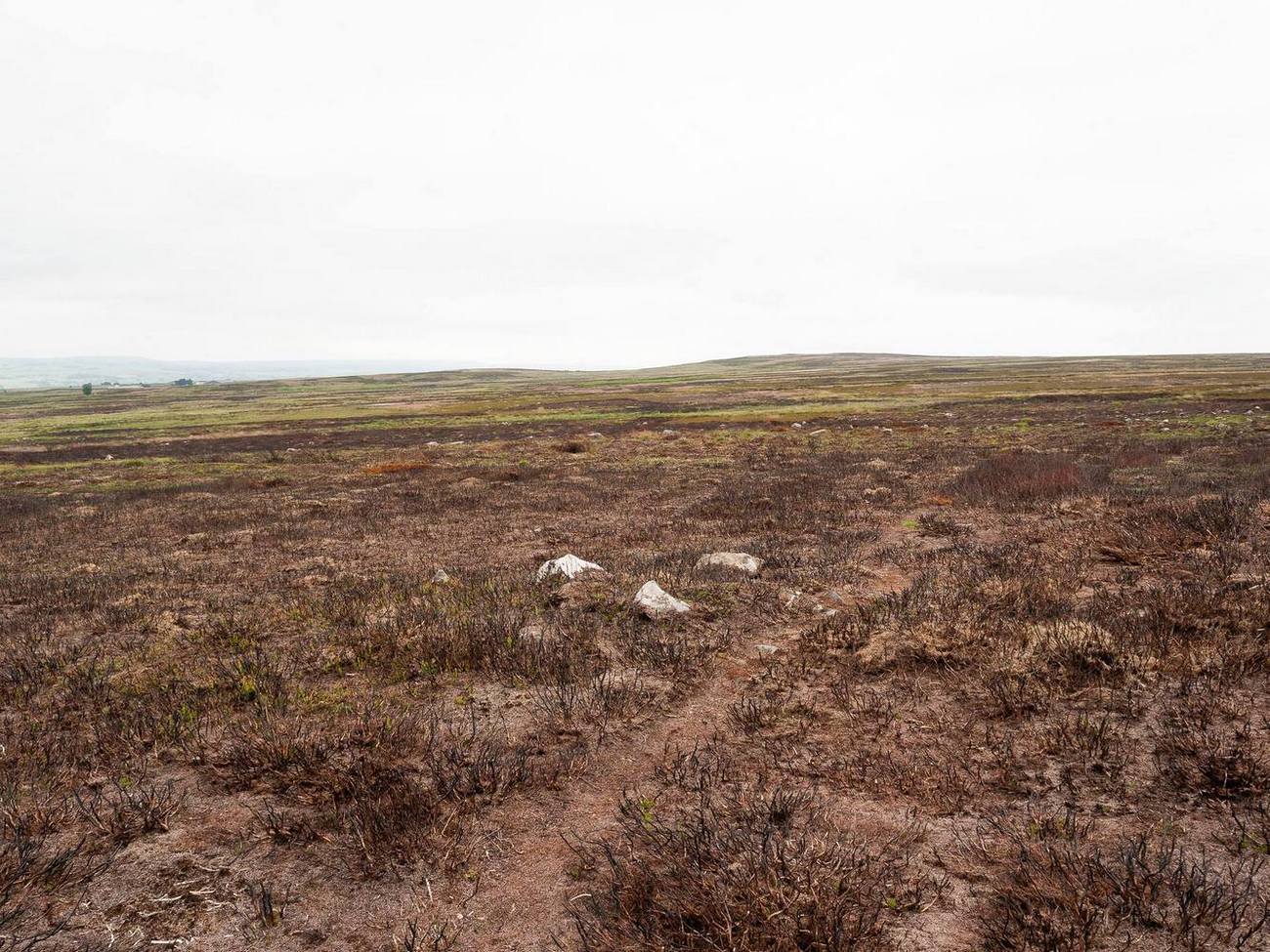
Probably best if you start from the car-parking spot at Acrehowe, by taking the road up through Baildon village, across at the roundabout up Northgate and up onto the moor, then after a few hundred yards turn left on the Bingley Road. The Acrehowe parking spot is a half-mile up on your right. From here, cross the road and bear right to take the footpath that follows the contour at the edge of the hillside, walking past the Baildon Moor (184) carving on the way. About 250 yards past this carving, on the right-side of the track as you’re heading to Dobrudden, is this low-lying almost innocuous stone. Keep your eyes peeled and you’ll see it.
Archaeology & History
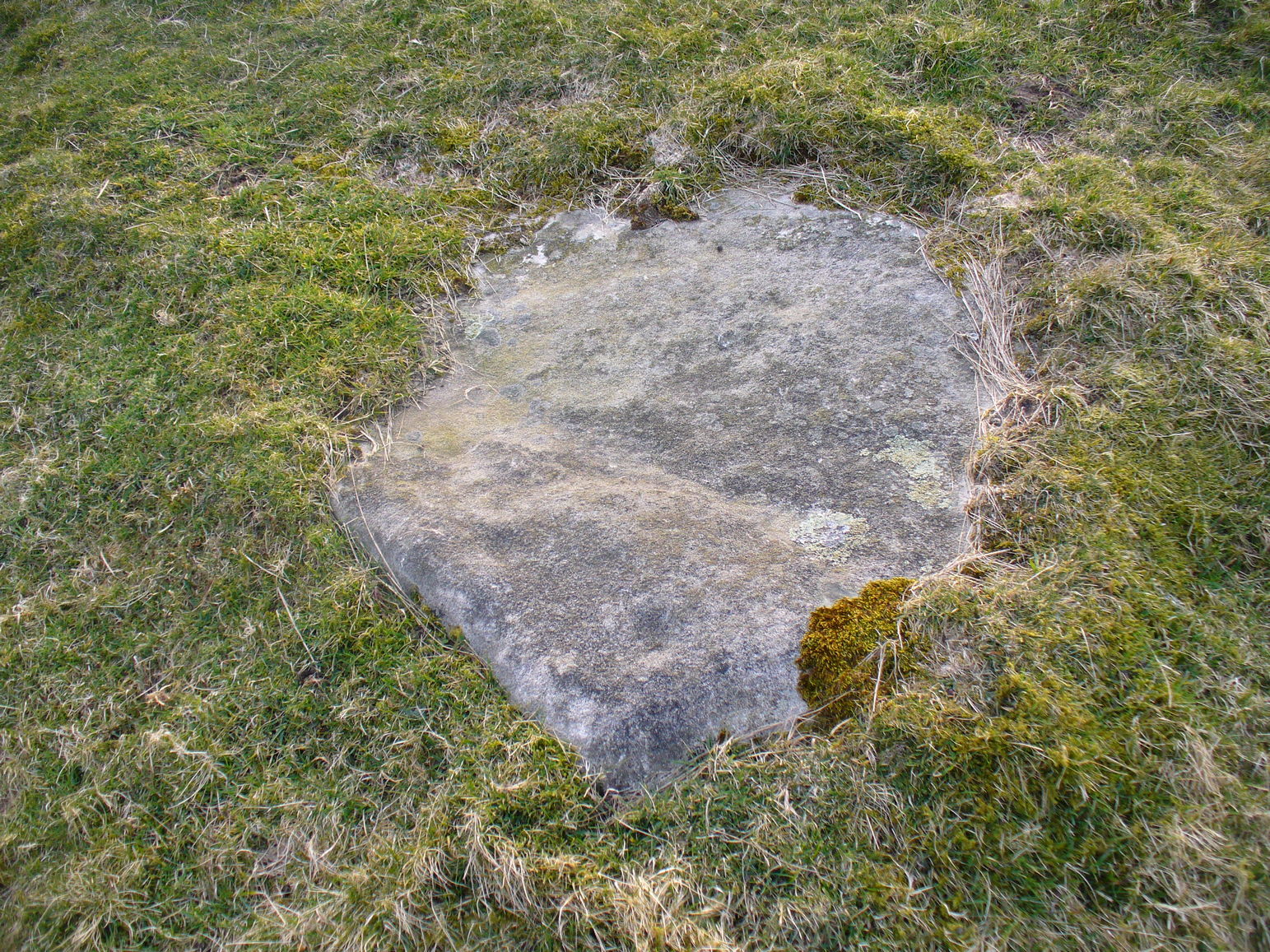
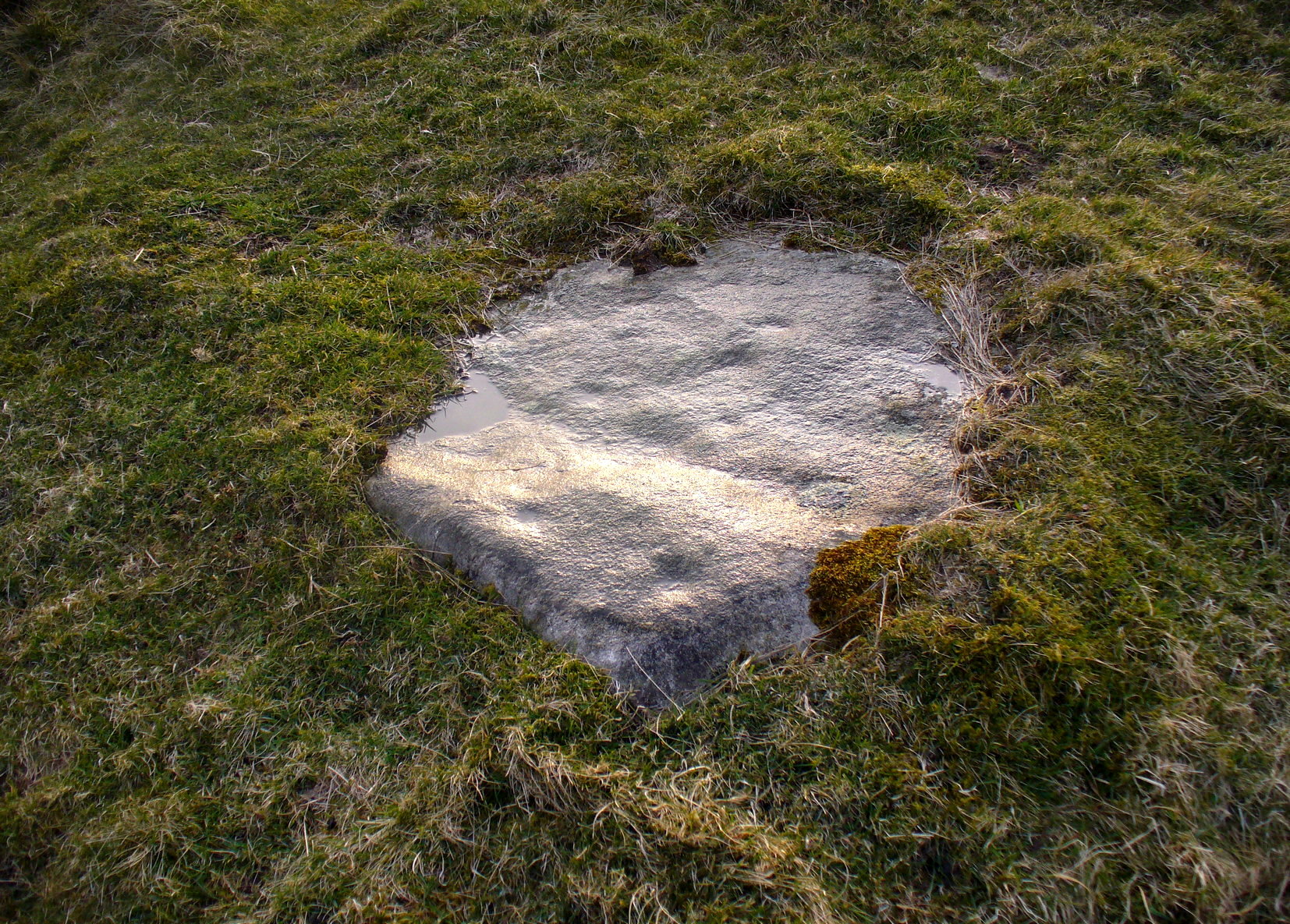
The carving looking WCup-marks clearly visible
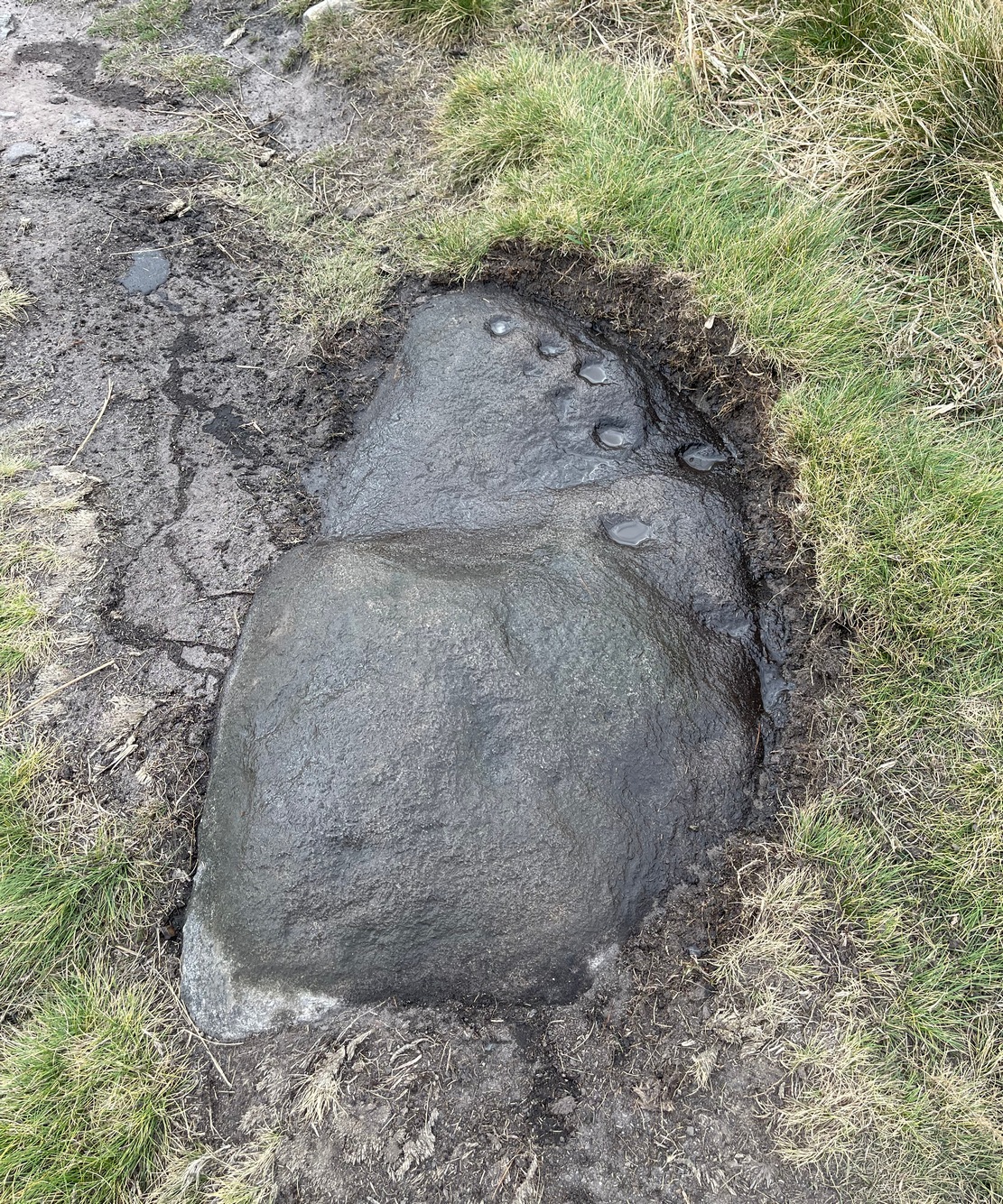
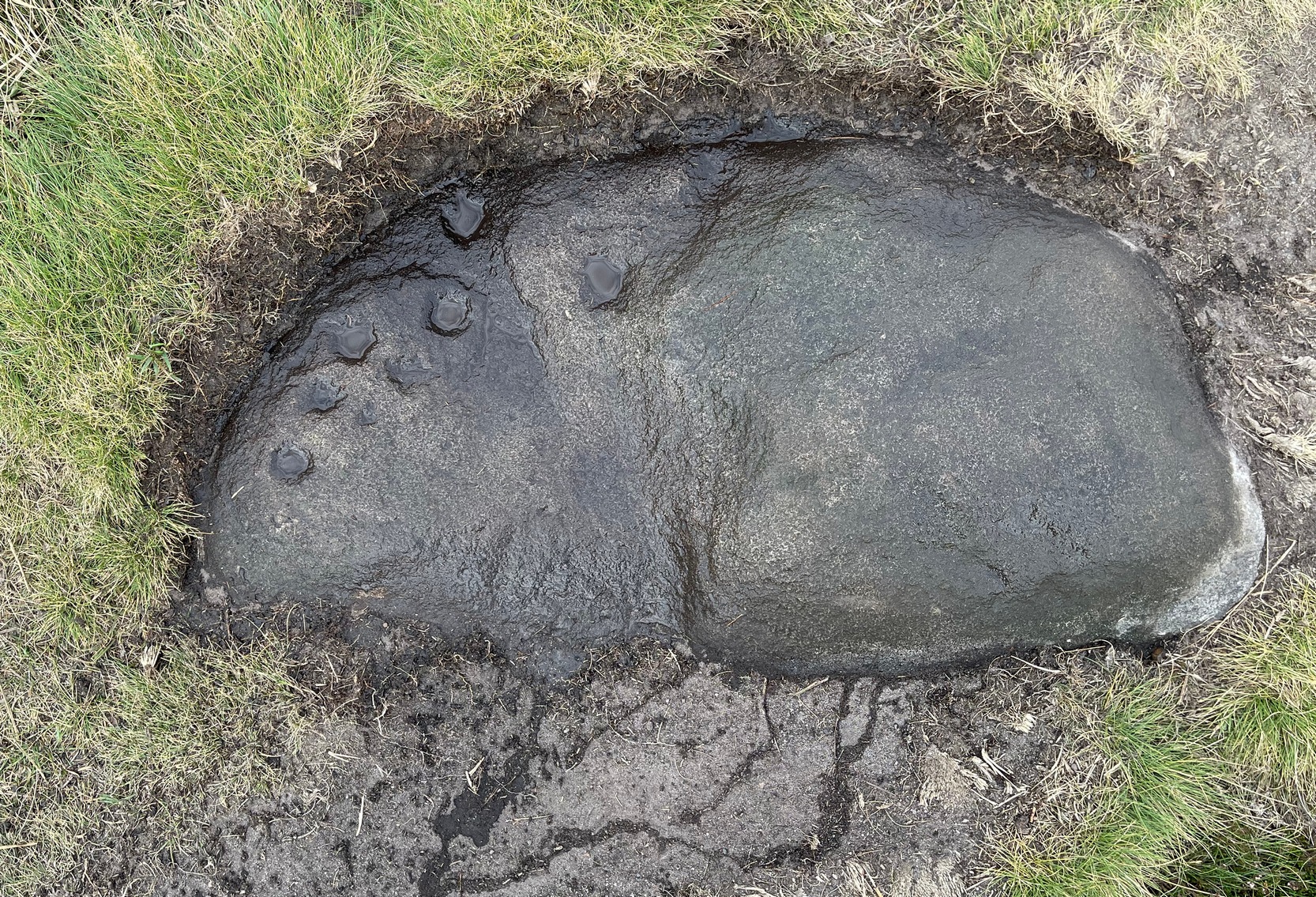
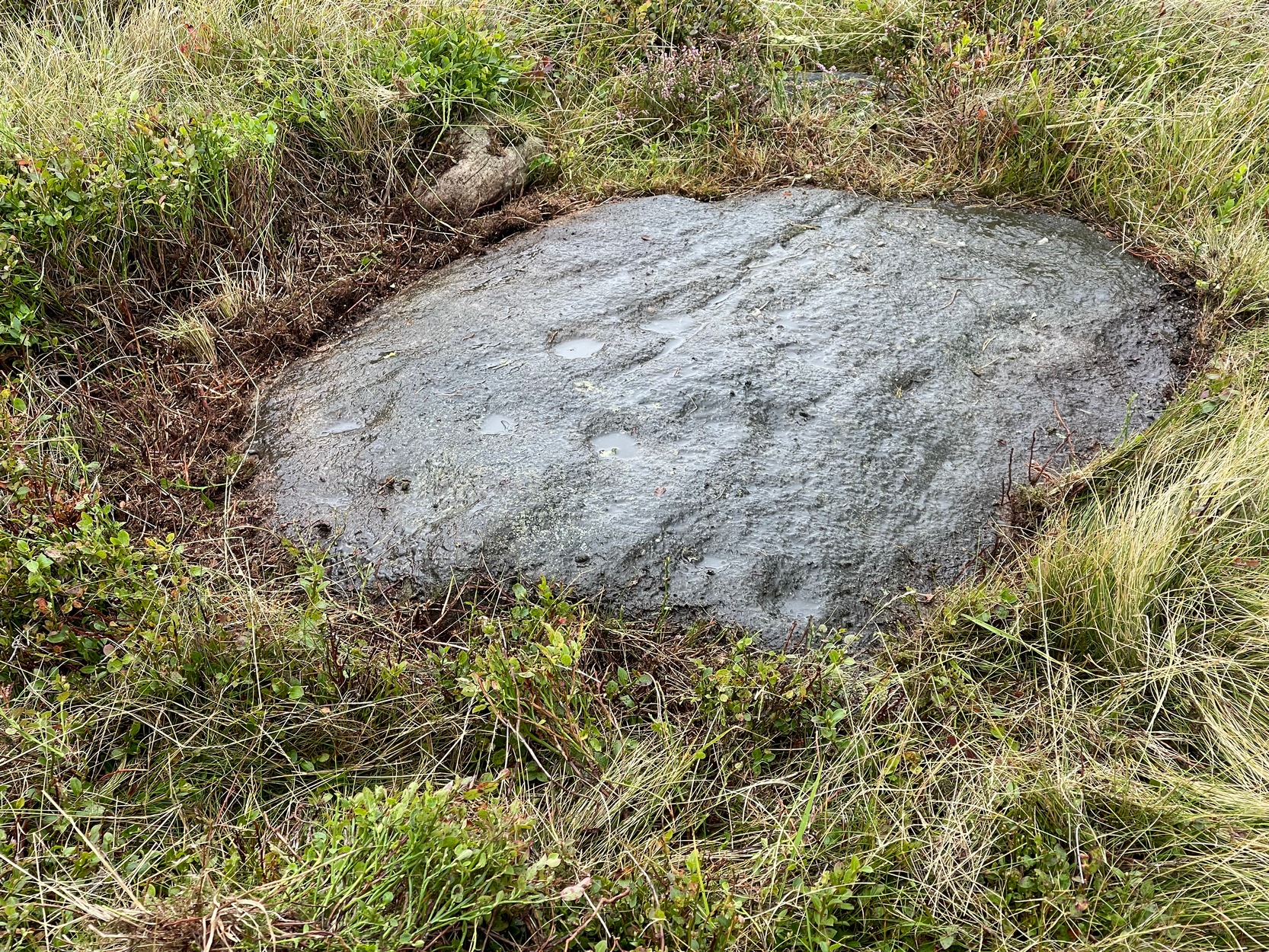
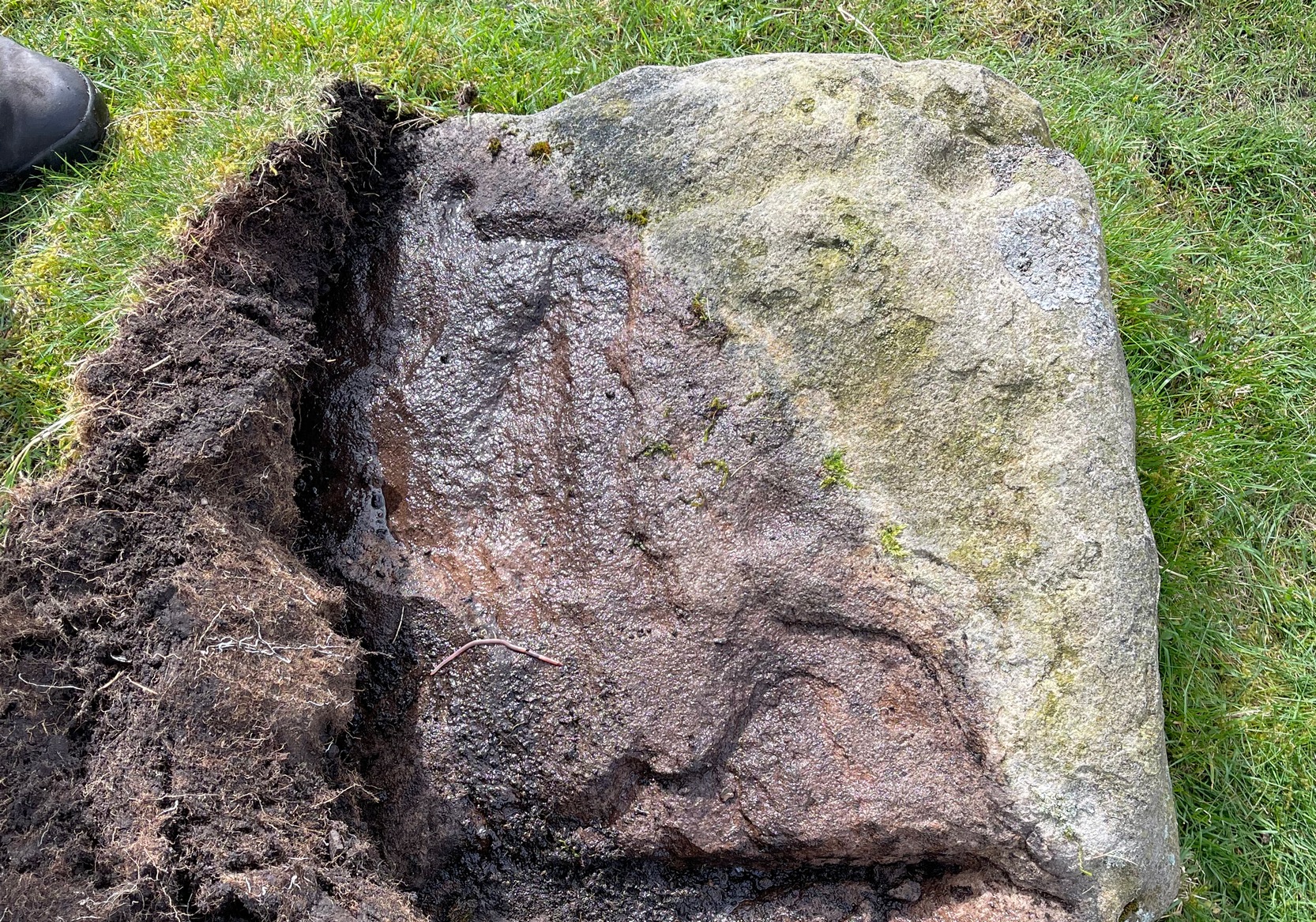
This cup-marked stone was first unearthed by fellow rock art explorers Mike Short and Dave Spencer in 2012 after they’d been looking at some of the other carvings hereby. In peeling back the turf on the stone, otherwise hidden cups—perhaps nine in all—were uncovered that had been hidden for centuries. Most of them are quite distinct, but it seems that a couple of the cups may have been left unfinished, as their size isn’t consistent with the others on this and other carvings close by.
The carved stone—located on the northern edge of the Low Plain prehistoric cemetery—is one in a line of several low earthfast rocks that crosses the track hereby and it’s possible that it was part of some prehistoric walling. Linear remains of walls and ditches were reported here in the 19th century and some of them can still be seen in some places on this part of the hill, but much of it has been destroyed.
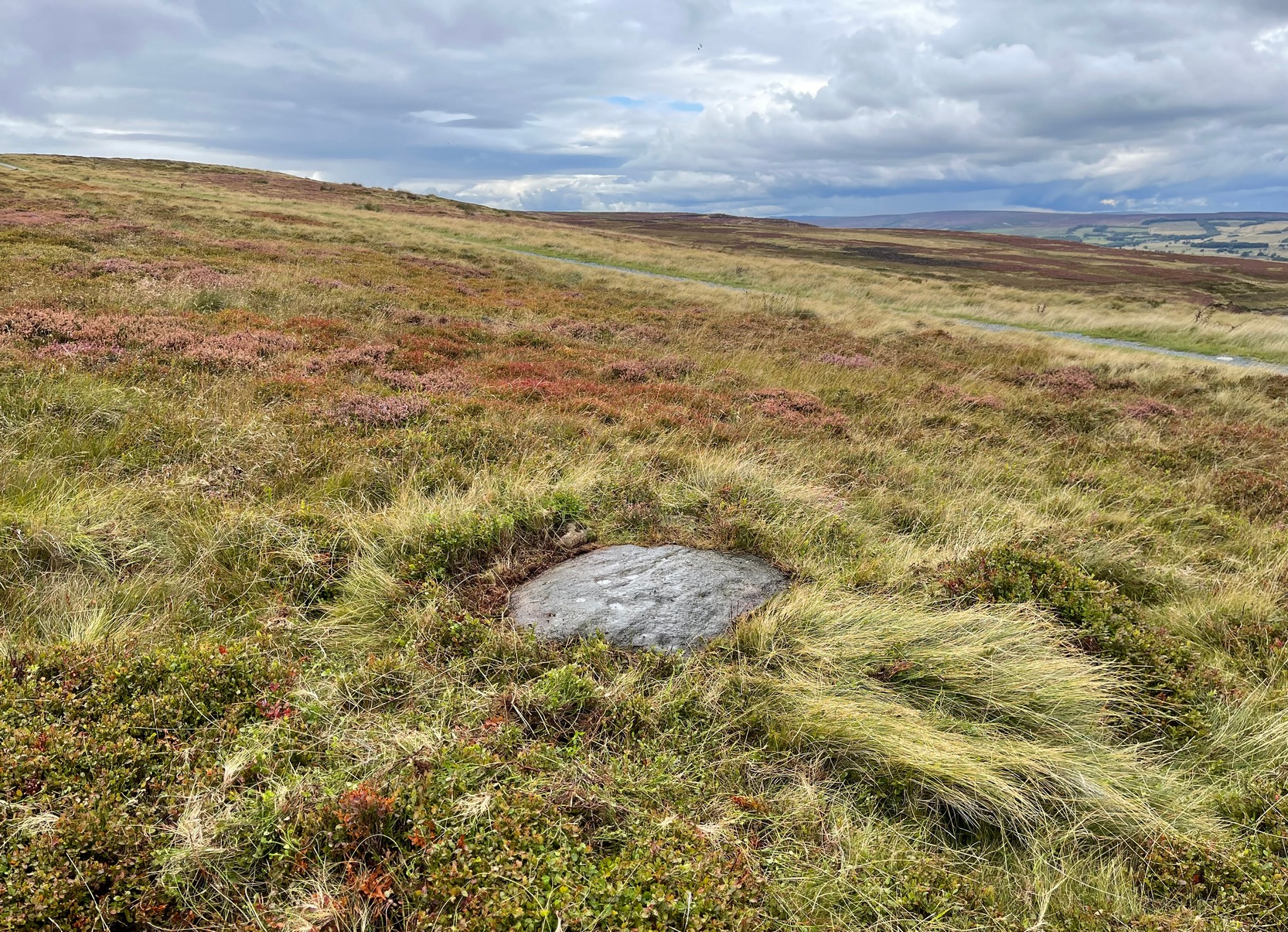
You can walk up from Menston, up Moor Lane north-west towards the moor, then turning left when you hit the moorland road of Hillings Lane. Nearly 350 yards along, turn right up the track known as Occupation lane onto the moor. More than half-a-mile up, past the gate at the Bee Stone, where the track splits, keep to the left and head further uphill, roughly parallel with the fence on your left. Literally ¼-mile (0.4 km) up from the split, you’re looking almost straight down at the reservoir; but to your left, walk towards the fence. Zigzag about! You can also approach it from the Grubstones and Great Skirtful area, by following the Occupation Lane track eastwards down the slope until you’re roughly level with the same reservoir.
Archaeology & History
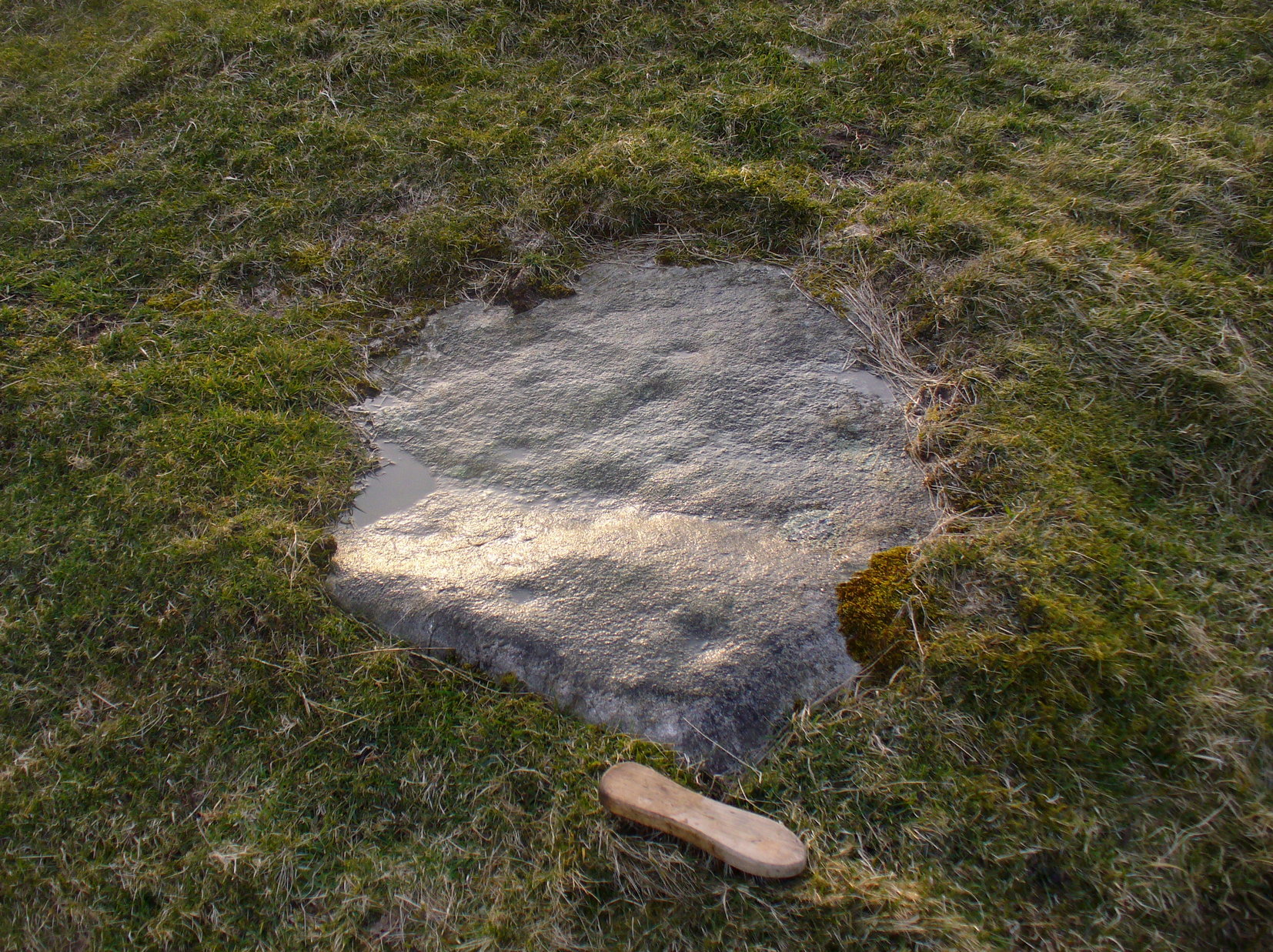
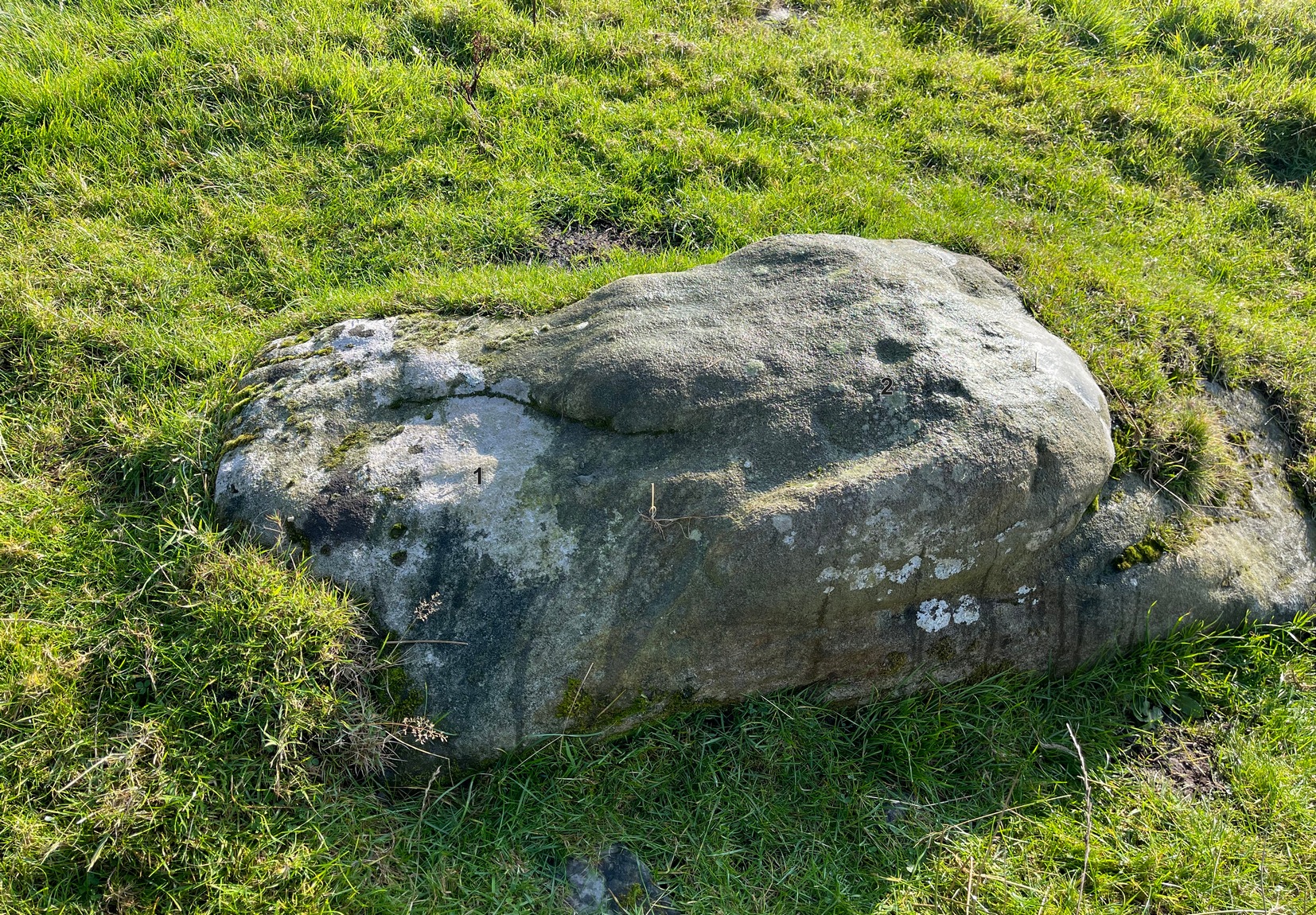
On this somewhat isolated stone on the northern sloping edge of Craven Hall Hill we find a small cluster of shallow cup-marks, first noted in the 1980s and eventually mentioned in a survey by Boughey & Vickerman (2003) where they described it as a,
“Low, medium striated rock lying in slope of hill. SE end carries possibly up to eleven cups, possibly two sets grouped in arcs running into natural striations of rock, one of which may have been artificially enhanced by pecking.”
Shallow cup-marks
The view from here is quite something: gazing east to the heathen hilltop of Otley Chevin (Beltane rites and rock art — albeit not much), north-east to the far uplands of the White Horse of Kilburn, then across the northern panoramas of Askwith and Denton Moors, and beyond. Some archaeologists have started to believe that such vistas may have had relevance with such carvings, sometimes. They’ve caught up at last! 🙂 Anyhow, the carving itself is pretty simplistic and probably only of interest to the real petroglyph nuts amongst you – although it’s mebbe worth checking out if you’re visiting the Great Skirtful giant cairn and its very impressive hengi-form neighbour.
References:
Boughey, Keith & Vickerman, E.A., Prehistoric Rock Art of the West Riding, WYAS: Wakefield 2003.
Boughey, Keith & Vickerman, E.A., Prehistoric Rock Art of the West Riding – Supplement, YAS 2018.
Acknowledgements: With thanks to Tom Cleland for help in relocating the site on a recent visit.
Numerous ways to get here: probably the easiest (direction wise) is if you’re coming from Dick Hudson’s public house on the southern road surrounding Rombalds Moor. From the pub, head left (east) along Otley Road (passing Weecher reservoir) for 1.9 miles (3.1km) until you reach Reva reservoir where a track leads you to the waters. A small parking spot is on the left-side of the road. From here, go through the gate and along the footpath across the field for nearly 300 yards to the next gate. Go through here and immediately follow the walling down to your left for about 135 yards to the edge of the rushes. It’s there!
Archaeology & History
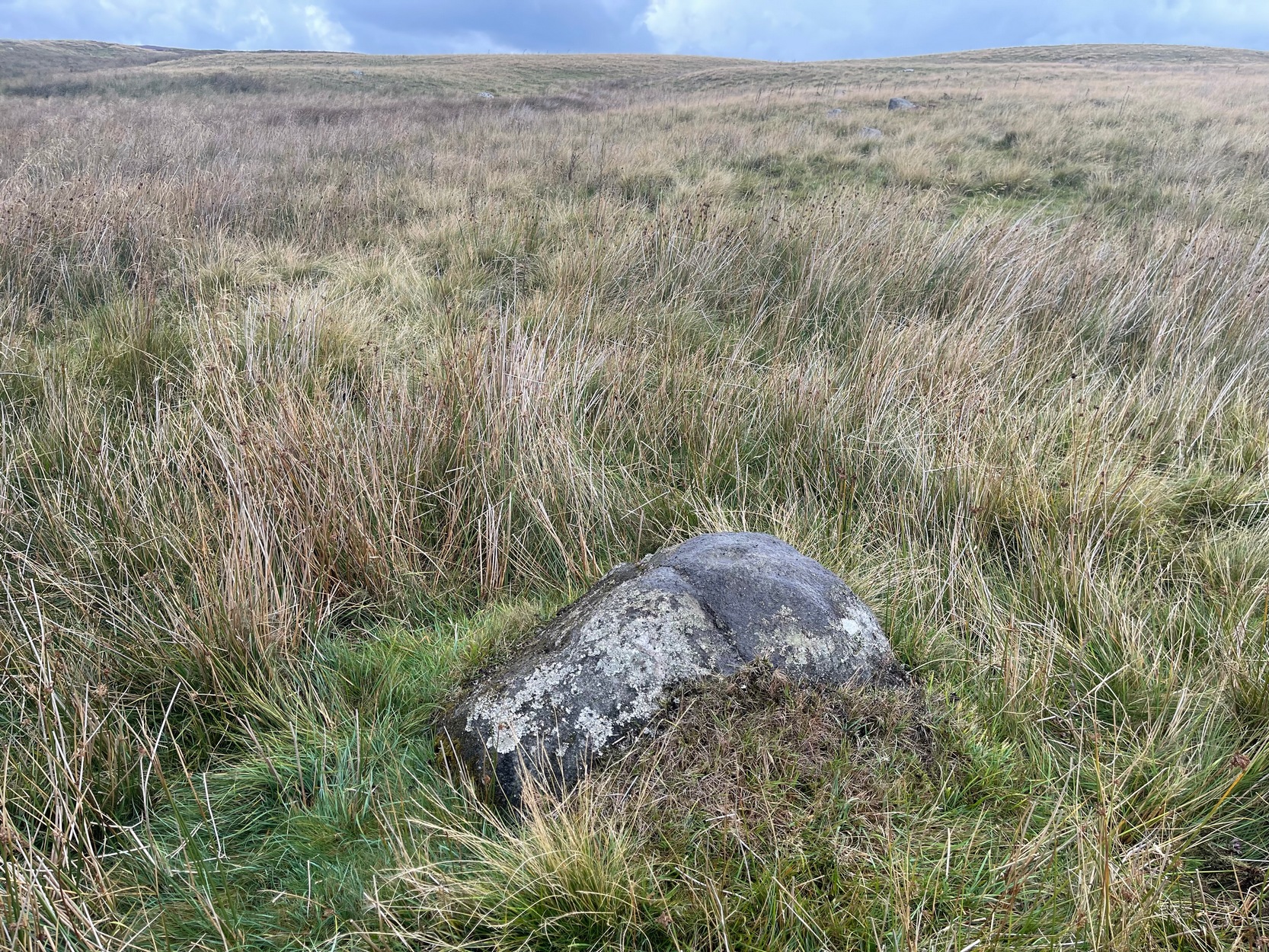
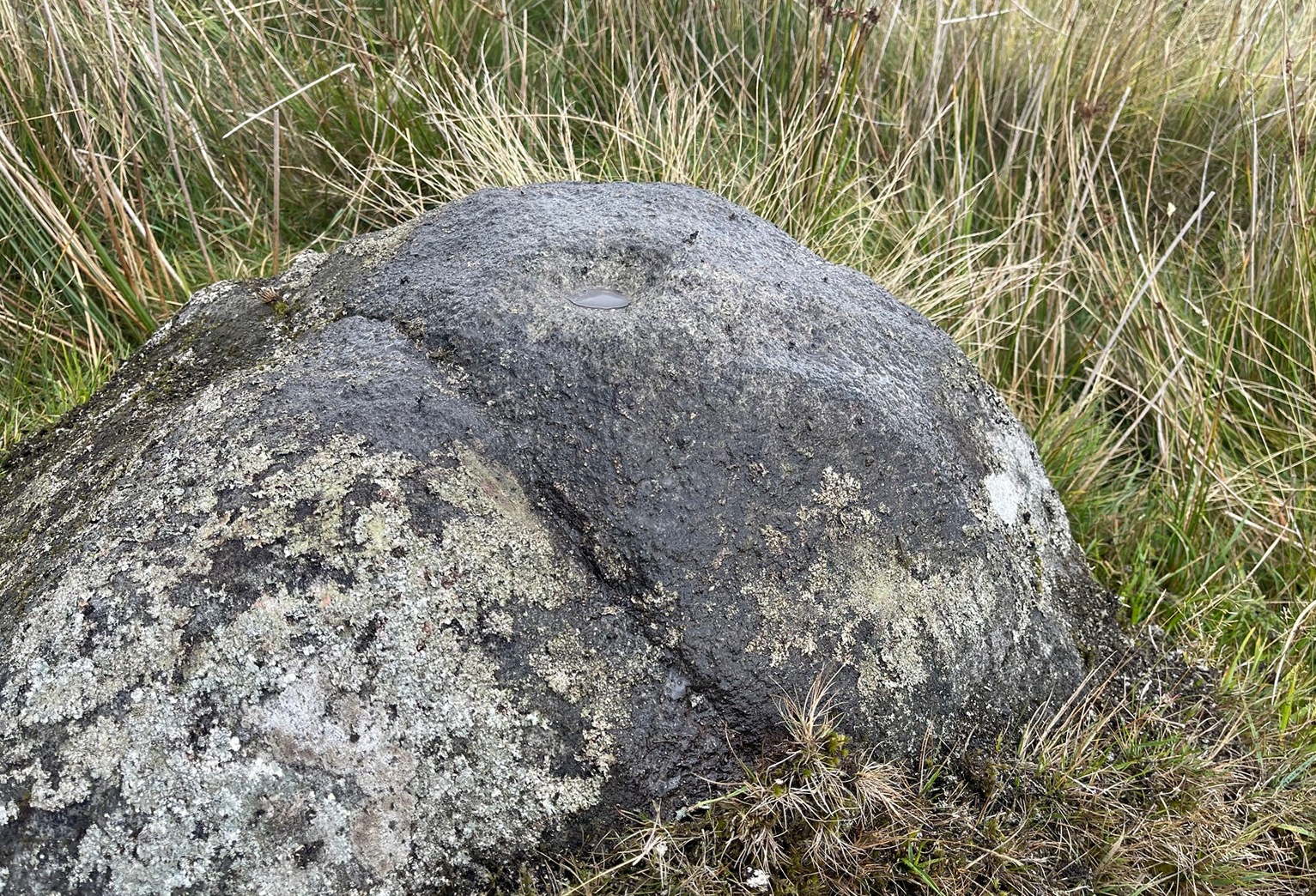
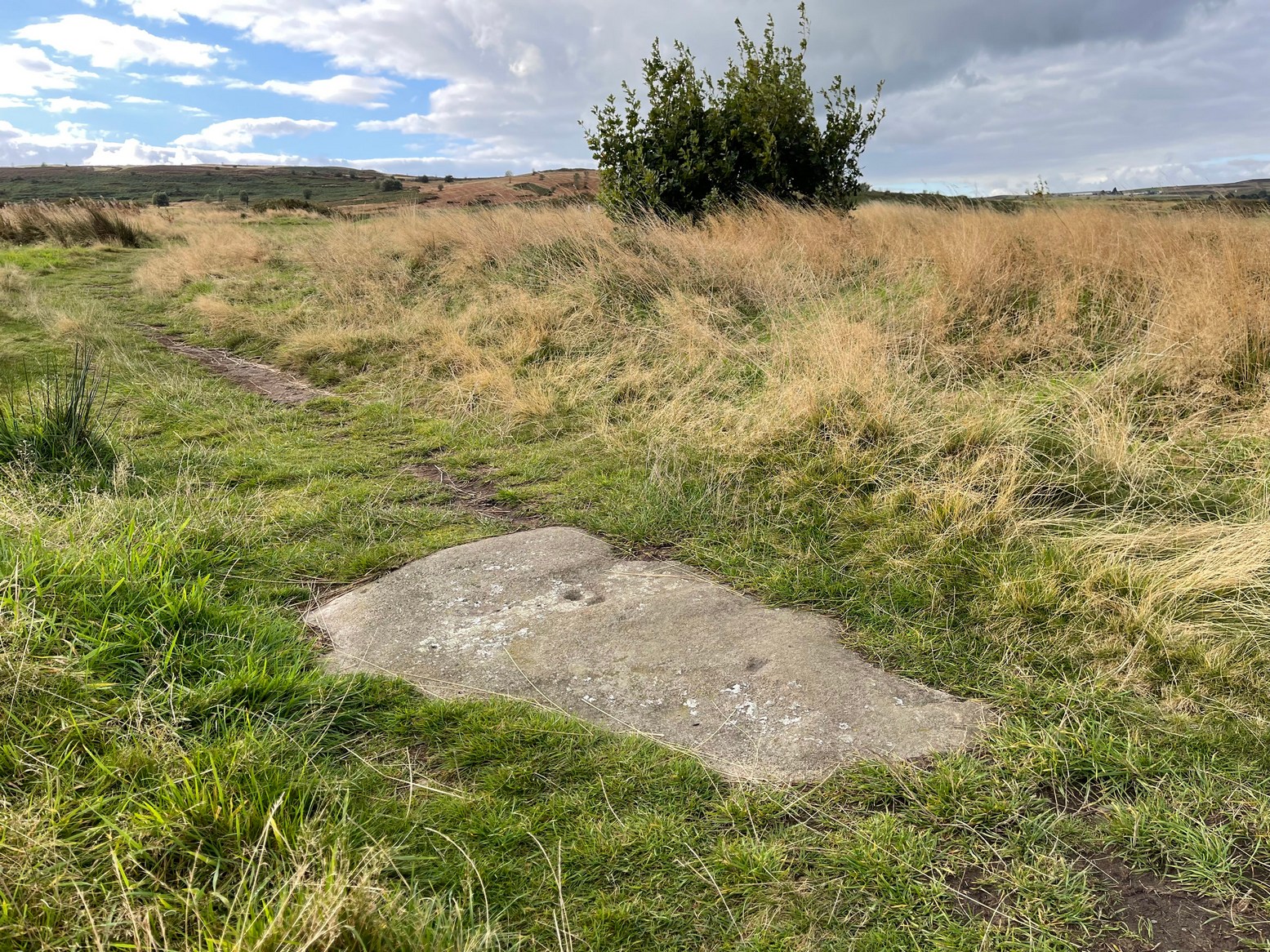
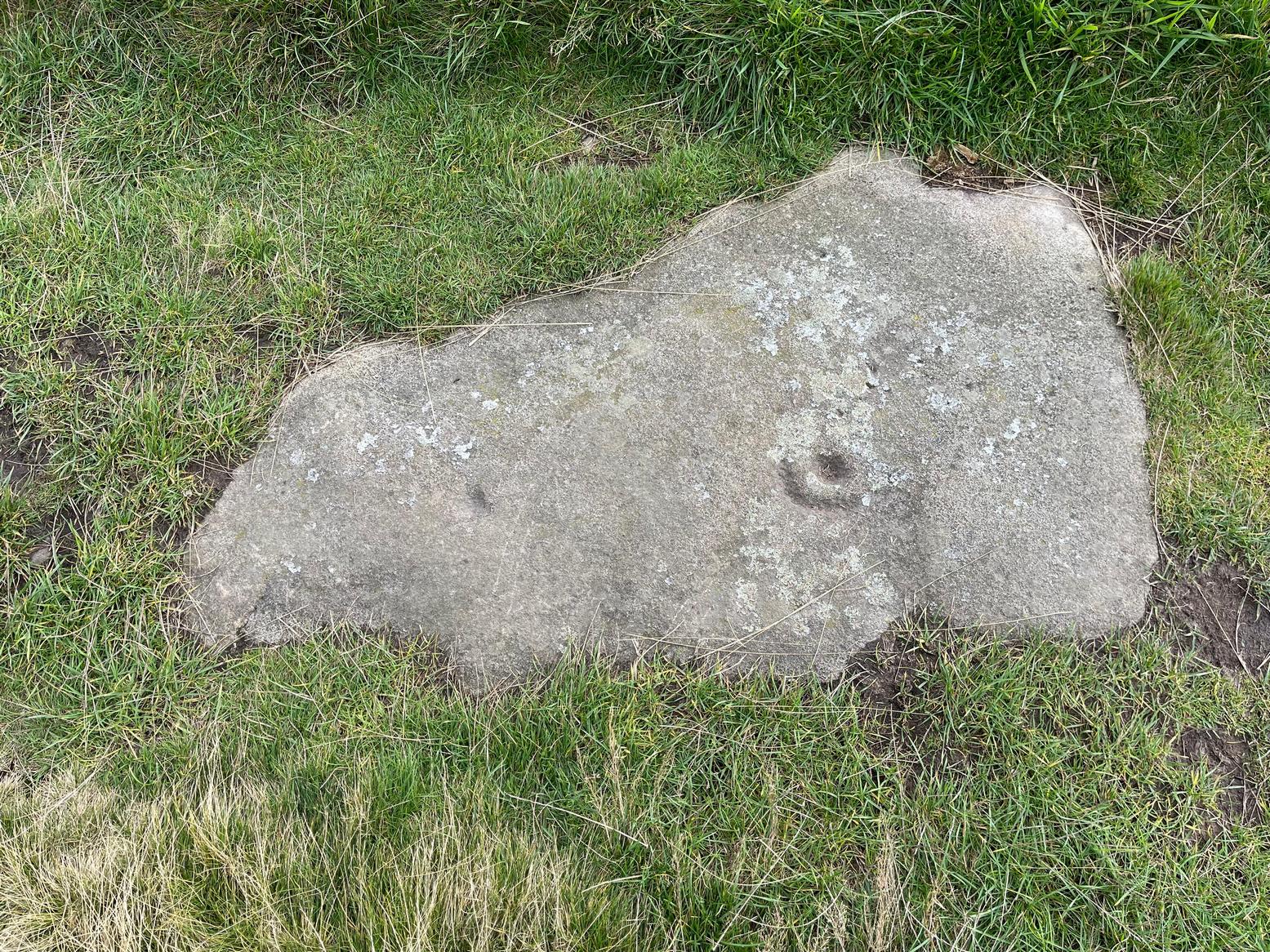
Single cupmark nr the top
On a recent visit to the Fraggle Rock carving, Tom Cleland foraged about at the edge of what was, in centuries gone by, a good flowing stream below the west slope of Reva Hill. An old pathway cut across one section of it near where the walling now runs, covered these days in the mass of Juncus reeds, typical of mashy grounds. And here, just where folk would cross the waters, Tom found a good sized stone with a single deep cup-mark on its crown, calling through a feast of lichens to be seen once more. There may be a second cup-mark by its side, but the light wasn’t good when we were here, so that’ll be worked out some other day. Anyhow, this one’s probably only for the crazy petroglyph hunters out there. It’s the Fraggle Rock and its companios that you’re gonna be looking for, nearby….
Naathen… I’d give you the directions of how to find this stone, but I’m not sure of its precise location. Just get to the top of Reva Hill, on its more westerly side, and it’s somewhere on its upper slopes. I was up here again recently and hoped to find it, but the grasses might have grown back over it. If one of you petroglyph fans manages to locate it, please can you send me its exact grid-reference, so I can update the site profile.
Carving when wetFaint Reva Hill carvingCarving when wet
Archaeology & History
This was one in a cluster of carvings that were rediscovered in 2011 and which I’ve not managed to re-locate (bad boy). It’s very plain and simple, as you can see. Indeed, I was lucky to even notice it, as the central photograph above shows how faint and eroded the cup-marks are in normal light. Thankfully with a bit of water, what I initially thought may have been two cup-marks, turned into three or four of them. So the next time you’re having a look at the Fraggle Rock carving and its companions, remember that this little fella is hiding somewhere close by…
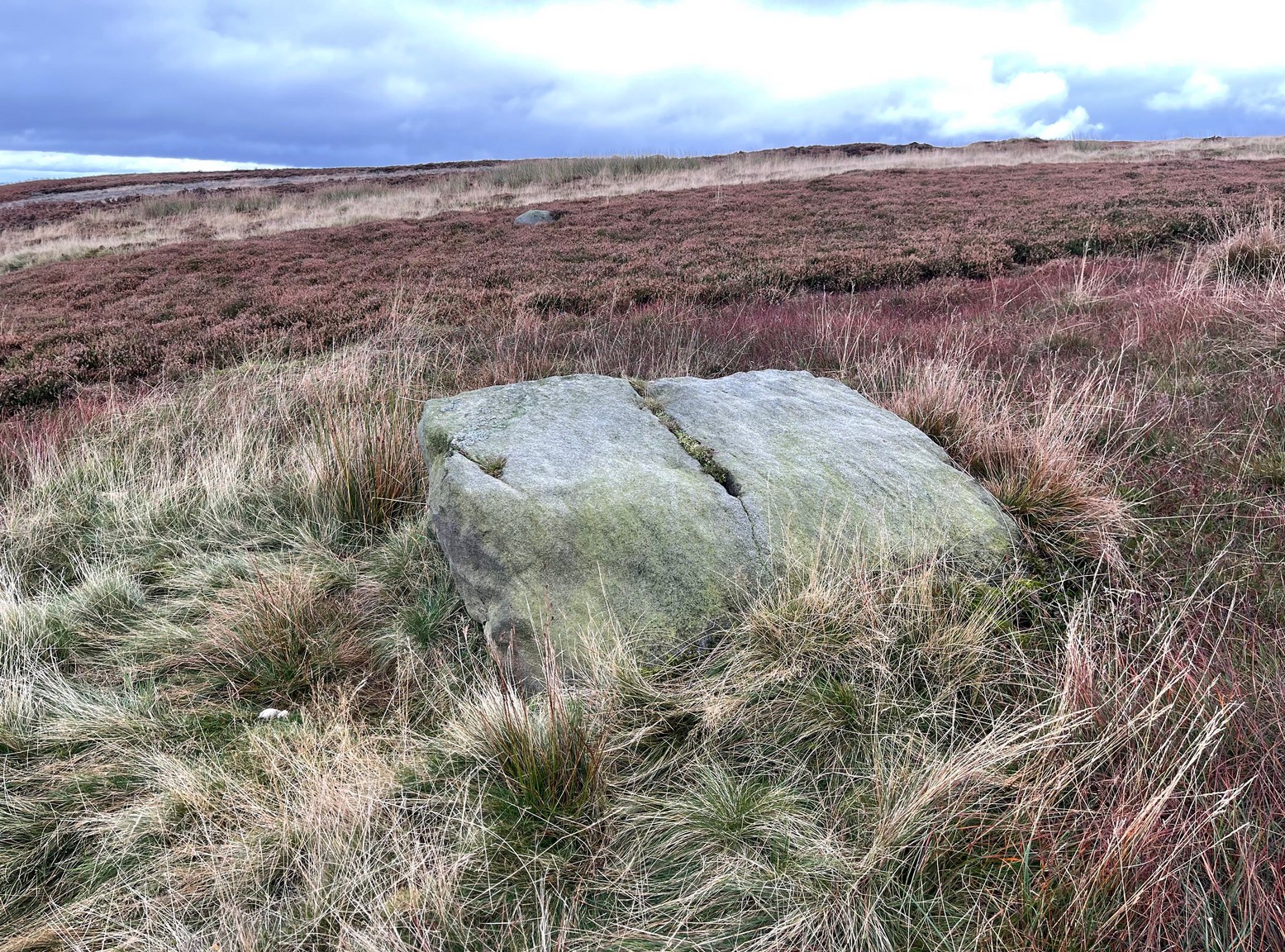
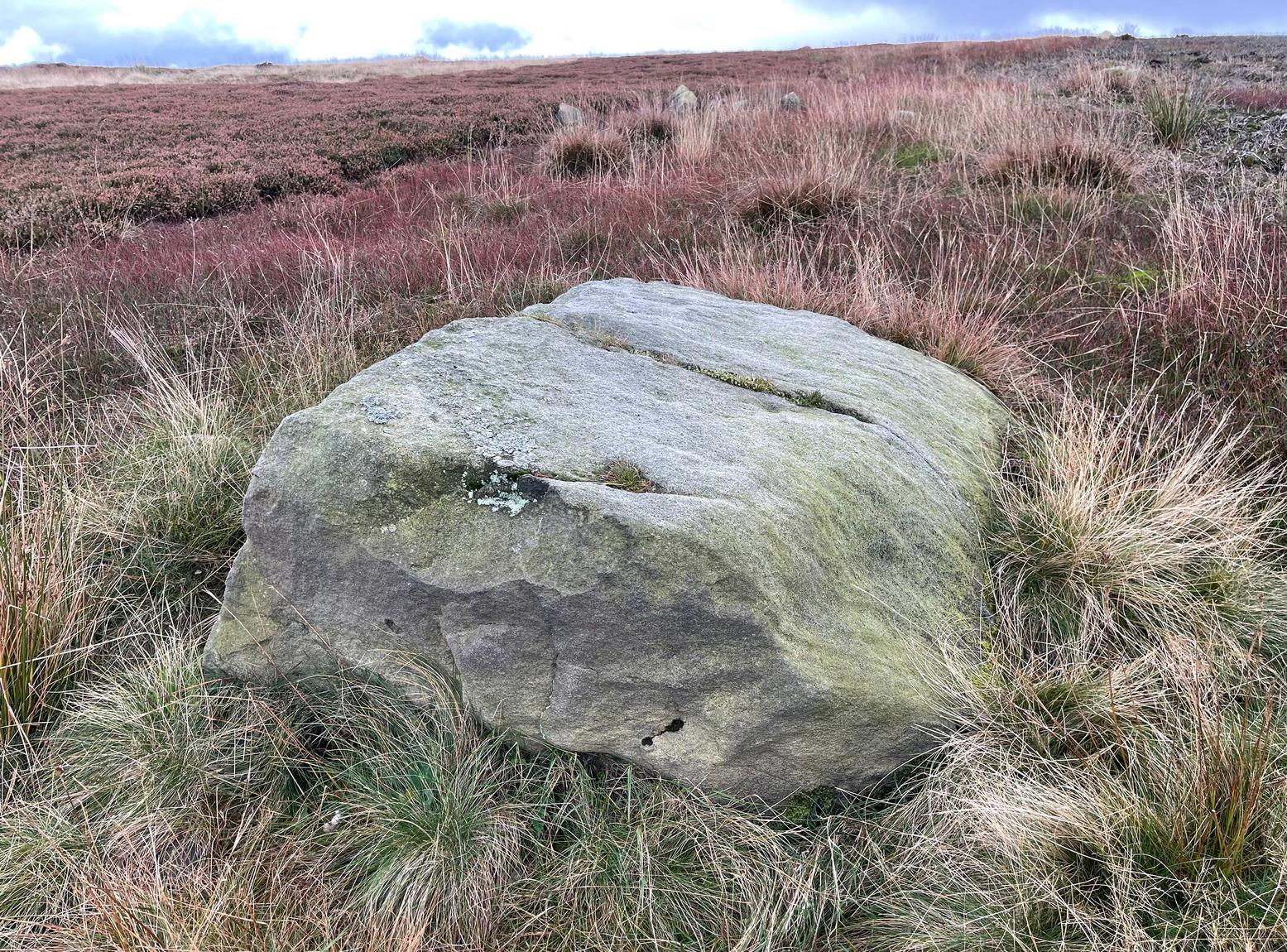
From Cow & Calf Rocks, walk up the steep footpath and turn left (southeast) when it levels out on the edge of the moor. Walk 250 yards along and, where the main path veers down to the road, just keep walking along in the same direction along the footpath that runs gradually uphill until, after 650 yards (595m) you’ll eventually meet up with the footpath that runs along the moorland proper. Where these two paths meet-up, then head upwards (south) into the heather for 55 yards (50m) until you see a good-size sloping block of stone with a crack roughly down the middle. If you hit the Little Haystack Rock (a big conspicuous stone) you’ve gon too far!
Archaeology & History
Shallow cupmarks visible
This is one of the many basic cup-marked stones you’ll find scattered all over these moors possessing (as it does) only two distinct cup-marks on its more northern half, although a possible faint third one needs looking at in better light. When we were kids exploring this and other areas, single and double cup-marked stones like this seemed ten-a-penny and we’d flippantly pass them by after quick perusal, looking for more impressive designs.
The carving here seems to have been missed in the surveys of Hedges (1986) and Boughey & Vickerman (2003), despite the rock standing out quite distinctly. I can only assume that they checked it out when the skies were grey and dull, making the cup-marks difficult to see. A number of other prehistoric remains can be found close to this carving, including cairns and sections of enclosure walling.
Folklore
Tradition tells that the indigenous Britons had a battle with the Romans on the plain where this carving is found.
Take the road up through Baildon village, across at the roundabout up Northgate and up onto the moor, then after a few hundred yards turn left on the Bingley Road. About five hundred yards along, keep your eyes peeled for where the ruined reservoirs are to the left-side of the road. Straight across the road from here (north) you’ll see the small cliffs of Eaves Crag. Walk along the footpath that runs above the cliffs and, about 80 yards past them, keep your eyes peeled on the ground right in the middle of the path. You can’t really miss it!
Archaeology & History
Basic cup-and half-ring
First mentioned in passing in the magnum opus of W. Paley Baildon (1913) and subsequently in one of Sidney Jackson’s (1955) series of profiles on the Baildon Moor carvings, this all but insignificant carving comprises of a simple cup-and-half-ring and another singular cup-mark a little further along the stone. John Hedges (1986) described this carving as being a “well marked cup surrounded by horseshoe groove – also well marked. Possible small cup and incomplete ring.” Whilst the minimalists Boughey & Vickerman (2003) told it to be simply, “two cups, one with incomplete ring.” A peculiarity with this design is that it might have been cut by a metal implement, perhaps in the Bronze Age, perhaps even in the Iron Age. We might never know…
References:
Baildon, W. Paley, Baildon and the Baildons – volume 1, St. Catherines: Adelphi 1913.
Boughey, Keith & Vickerman, E.A., Prehistoric Rock Art of the West Riding, WYAS: Wakefield 2003.
Hedges, John (ed.), The Carved Rocks of Rombald’s Moor, WYMCC: Wakefield 1986.
Jackson, Sidney, ‘Cup and Ring Boulders of Baildon Moor,’ in Bradford’s Cartwright Hall Archaeology Group Bulletin, 1:10, 1955.
Acknowledgements:Huge thanks for use of the Ordnance Survey map in this site profile, reproduced with the kind permission of the National Library of Scotland.
Two main routes to get here: i) from Dick Hudson’s public house, head left (east) along Otley Road (passing Weecher reservoir) for 1.9 miles (3.1km) until you reach Reva reservoir where a track leads you to the waters, and there’s a small parking spot on the left-side of the road. Stop here. (ii) coming from Hawkworth and Guiseley, head west along Hawksworth Lane which runs into Goose Lane and, at the T-junction at the end, turn right and nearly 500 yards along on the left-side of the road is the same small parking spot. From here, walk uphill for nearly 150 yards and then look at the walling to your left.
Archaeology & History
Reva Cross on 1851 map
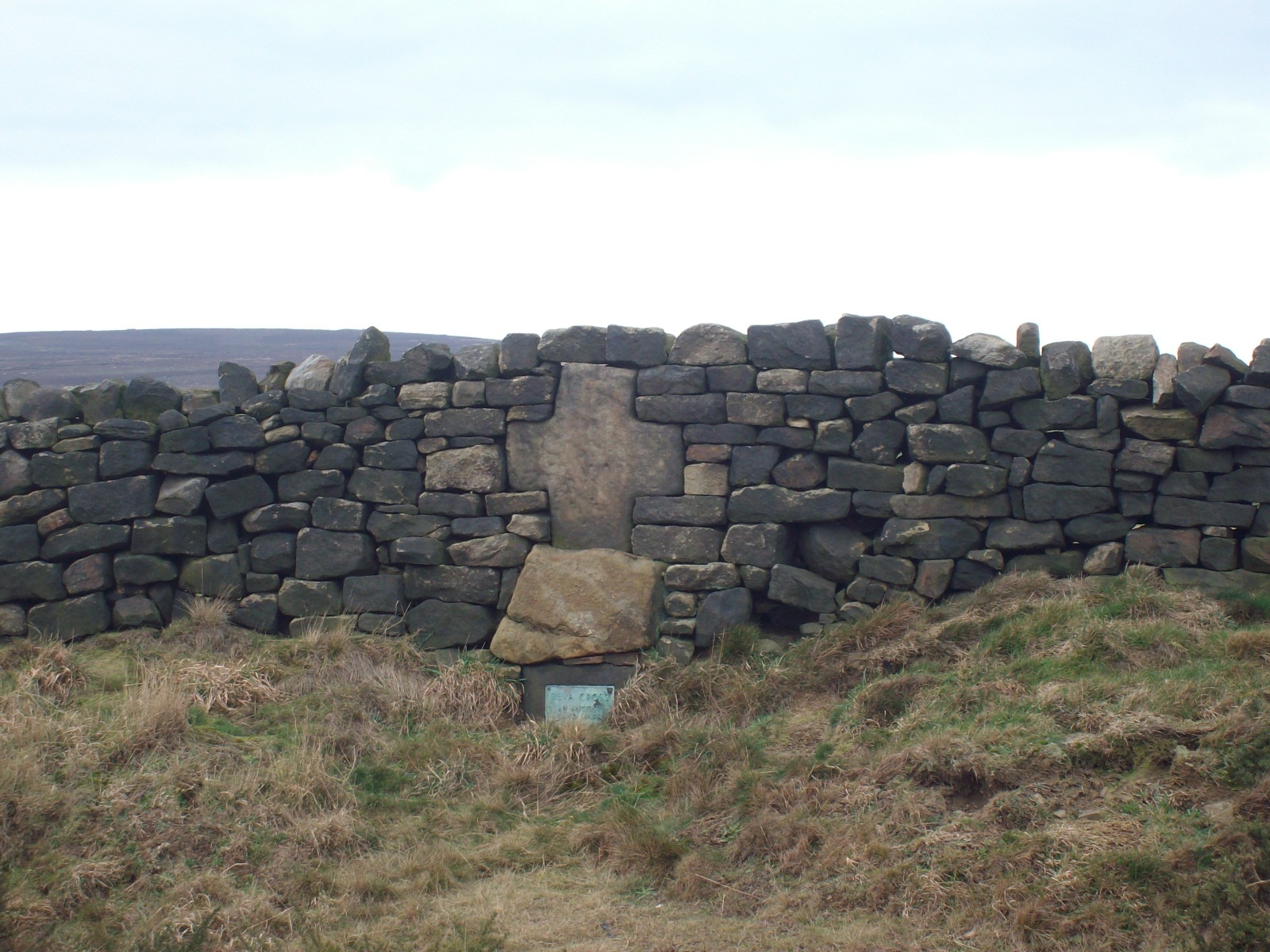
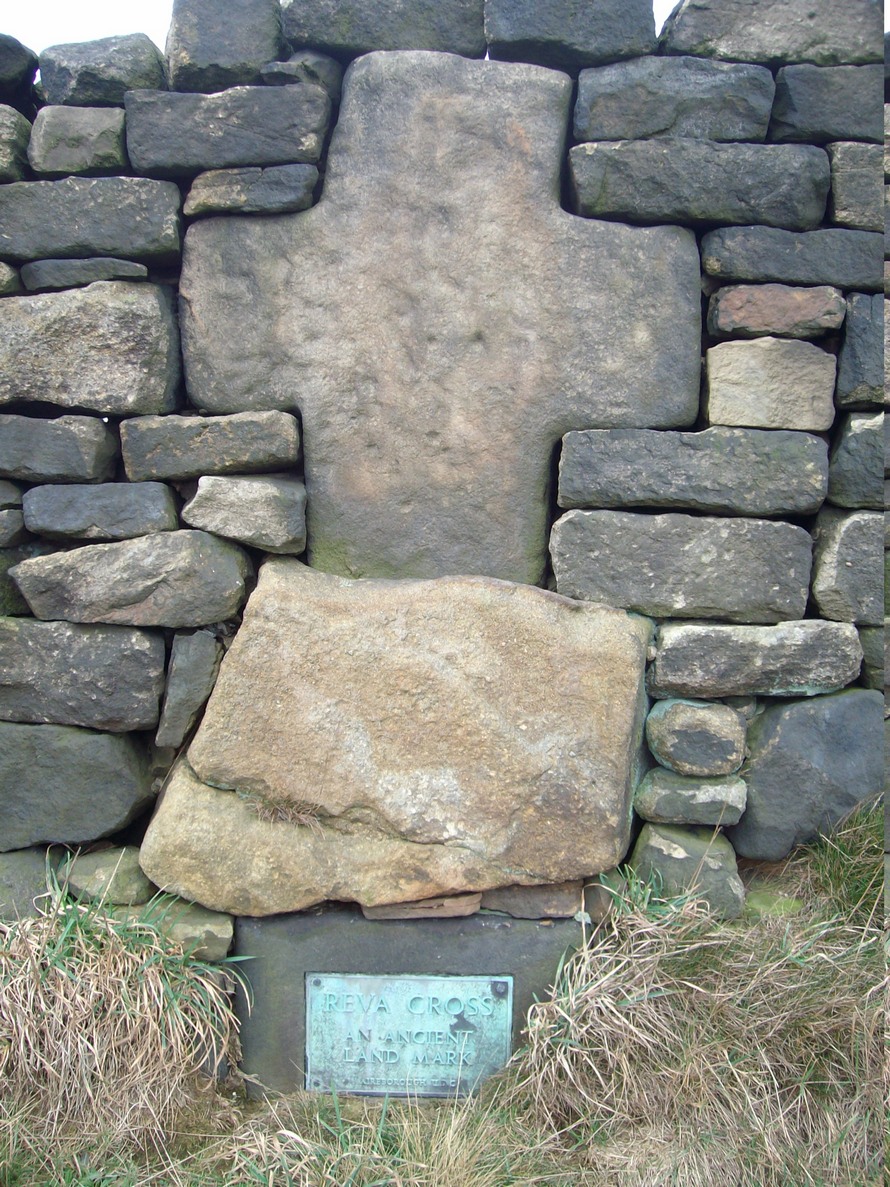
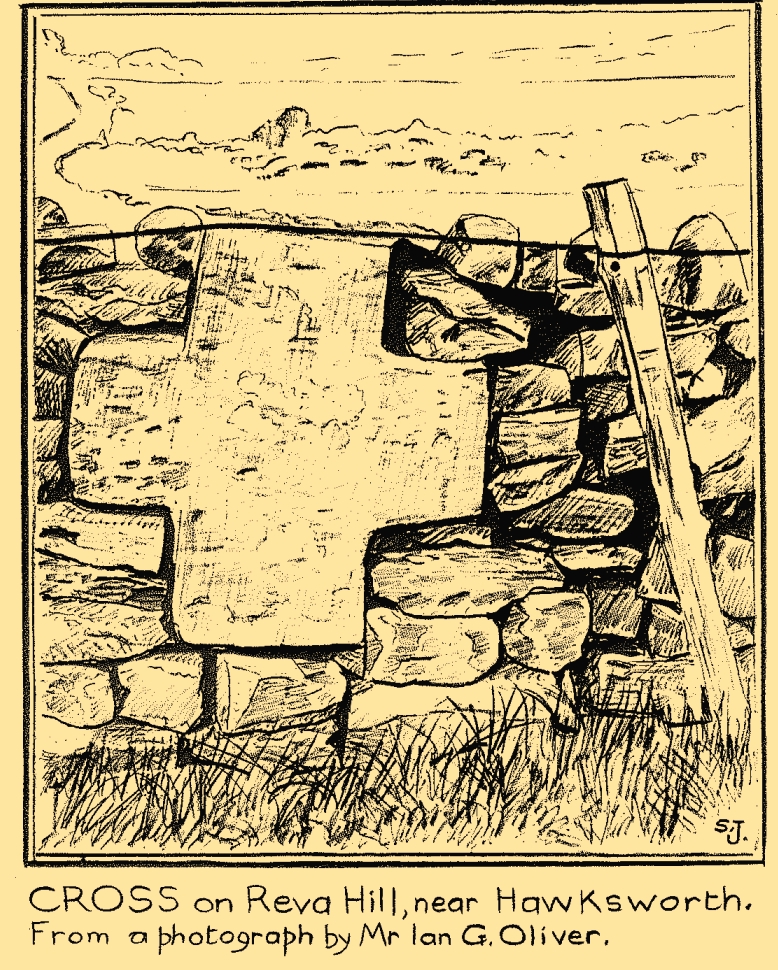
This relic can be found on the far eastern edges of Hawksworth Moor, near Guiseley, and was said by the historian Eric Cowling to have originally stood upon a large rock nearby. It has an odd history. Initially, the cross was an ancient boundary or mark stone, referred to in a 15th Century document and outlined by William Preston in 1911, that marked the limit of the southern township of Burley township. Local historian C.J.F. Atkinson asserted that this cross in fact came from Otley, although his ideas were considered somewhat “fanciful” by archaeologists and other historians.
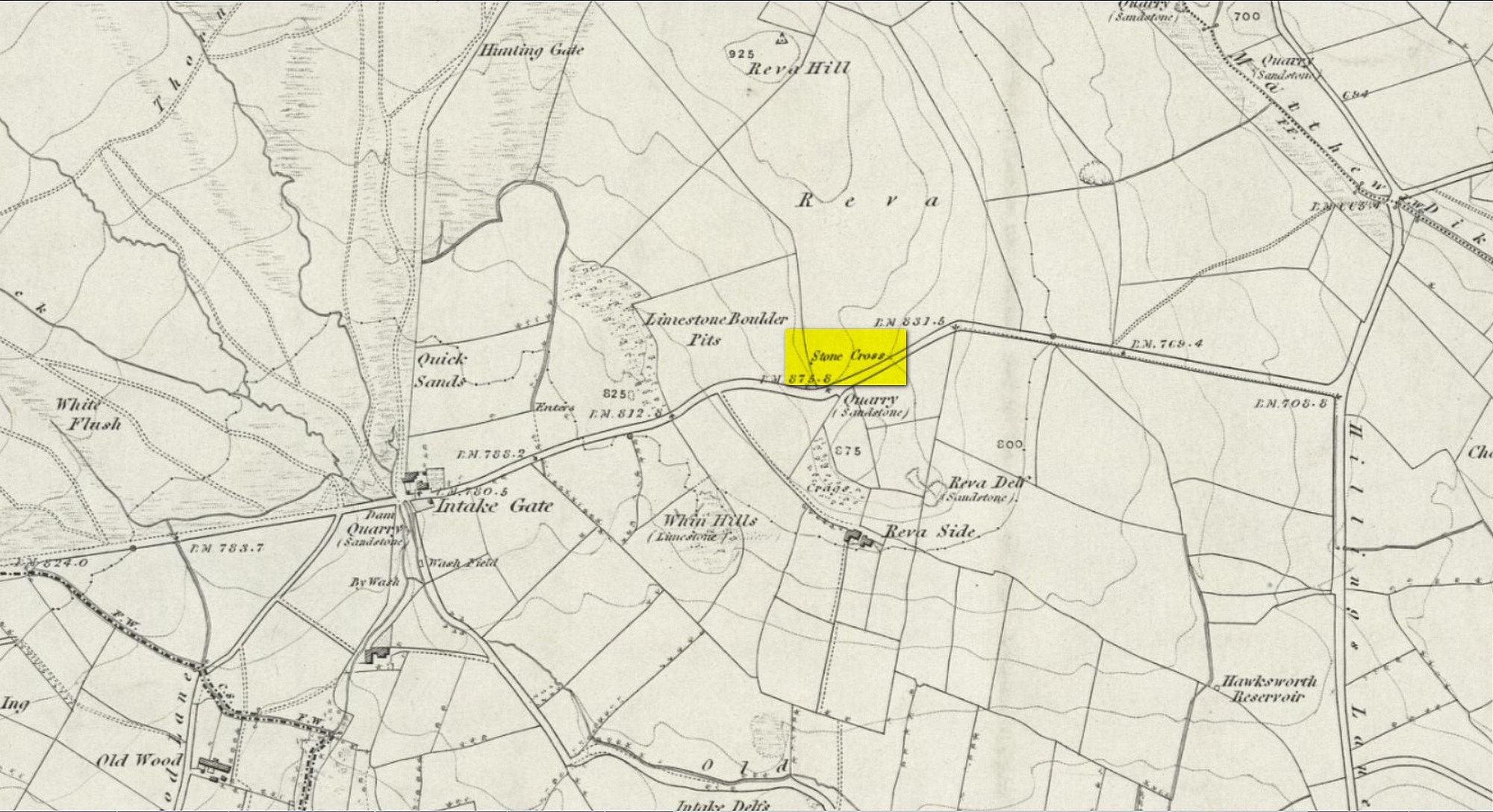
Its present position by the roadside is relatively new as it stood, not too long ago, a short distance away in the field to the rear, as highlighted on the early OS-map of this area. E.C. Waight of the archaeology division to Ordnance Survey wrote:
“Situated at SE 1530 4297 on the western side of the gate from the road into the field containing the remains of Reva Cross is a cross base (apparently in situ) serving as a bolster stone to the wall head at the gate opening.”
He described the dimensions of the base and the remainder of the cross, both of which “are contemporary with one and other,” he told. In the 1960s, the local council moved the cross to its present position.
Tradition told that despite its religious symbolism, it was also used as a market cross in bygone times. A certain Mrs Fletcher (1960), writing to the Cartwright Hall Archaeology Group, narrated that,
“Mrs Turner Greenwood….tells me that her mother, who, if living, would be in her nineties, lived at Gaping Goose Farm on the western side of Reva Hill… Mrs Greenwood’s father.. .remembered the cross erected on this hill, and related seeing the roads black with people climbing to it from Otley and Bingley, for the market held there.”
Despite this, Sidney Jackson was somewhat sceptical of it being the site of a market. Weather conditions and the bleakness of the spot would have made this site somewhat intolerable, he thought. However, people in previous centuries were much hardier than modern people and so it’s not as unlikely as you’d initially think.
Close-up of cross
Sid Jackson’s sketch
A much more interesting tradition of the cross was its use in times gone by as a Plague Stone. However, this name only applied to the cross-base at the time as no cross was stood upon it; merely a natural rock laid upon the moorside with a basin cut into it. It gained this name around the time of the great plague of 1660. During the plague, food was left on this table-like rock and money in return was placed in a basin full of vinegar. This tradition may have originated at the large natural rock bowl on one of the earthfast stones near the very top of Reva Hill a short distance to the west (also a number of cup-marked stones are close by and folklore records show that some cup-marks had healing properties). One account tells that it was Sir Walter Hawksworth (of the legendary Grand Lodge of ALL England masonic lodge) who was responsible for the siting of the cross as a Plague Stone.
References:
Cowling, Eric T., Rombald’s Way, William Walker: Otley 1946.
Cowling, Eric T., ‘Letter,’ in Cartwright Hall Archaeology Group Bulletin, 5:5, May 1960.
Fletcher, Elsie, “Letter,” in Cartwright Hall Archaeology Group Bulletin, 5:5, May 1960.
Jackson, Sidney, “Ancient Crosses,” in Cartwright Hall Archaeology Group Bulletin, 1:12, 1955.
Jackson, Sidney, “Cross on Reva Hill,” in Cartwright Hall Archaeology Group Bulletin, 5:1, p.2, 1960.
Jackson, Sidney, “Reva Hill Cross Base Found,” in Cartwright Hall Archaeology Group Bulletin, 9:9, September 1964.
Jackson, Sidney, “Fresh Site for Reva Cross,” in Cartwright Hall Archaeology Group Bulletin, 11:7, July 1966.
Preston, William Easterbrook, “On an Ancient Stone Cross on Riva Hill,” in Bradford Antiquary, New Series 3, 1911.
Acknowledgements:Huge thanks for use of the Ordnance Survey map in this site profile, reproduced with the kind permission of the National Library of Scotland.
On the moorland road from Dick Hudson’s pub, head east along the Otley Road for more than 1½ miles, past the T-junction right-turn at Intake Gate (to Hawksworth) and just a quarter-mile further on park-up at the roadside (opposite Reva Reservoir). Walk (north) thru the gate into the field and after 300 yards through another gate into the next field. From this gate, walk straight north to the Fraggle Rock cup-and-ring stone, then go down the slope NNW for nearly 50 yards and just above the old track you’ll see the edge of this stone peeking out!
Archaeology & History
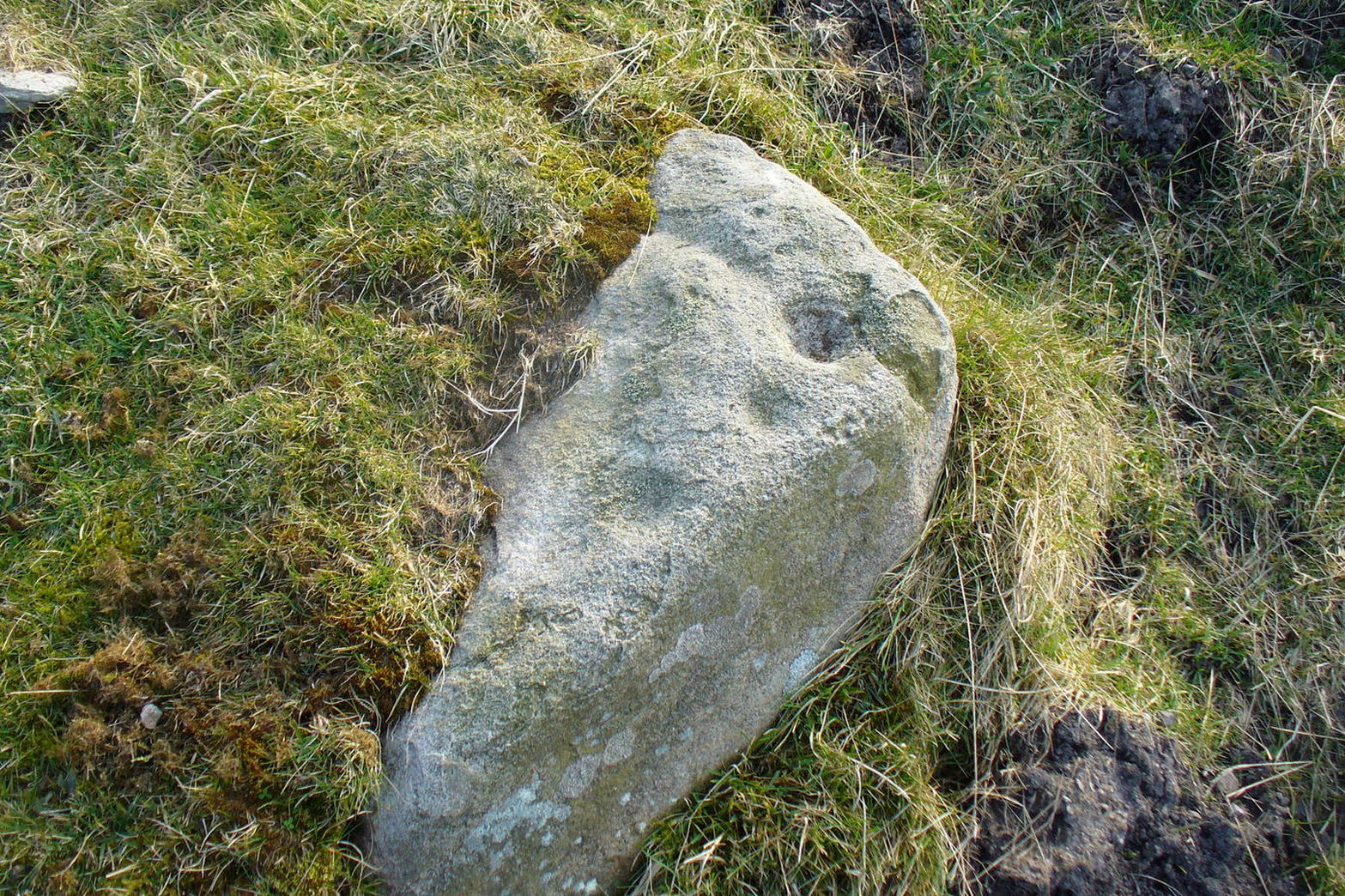
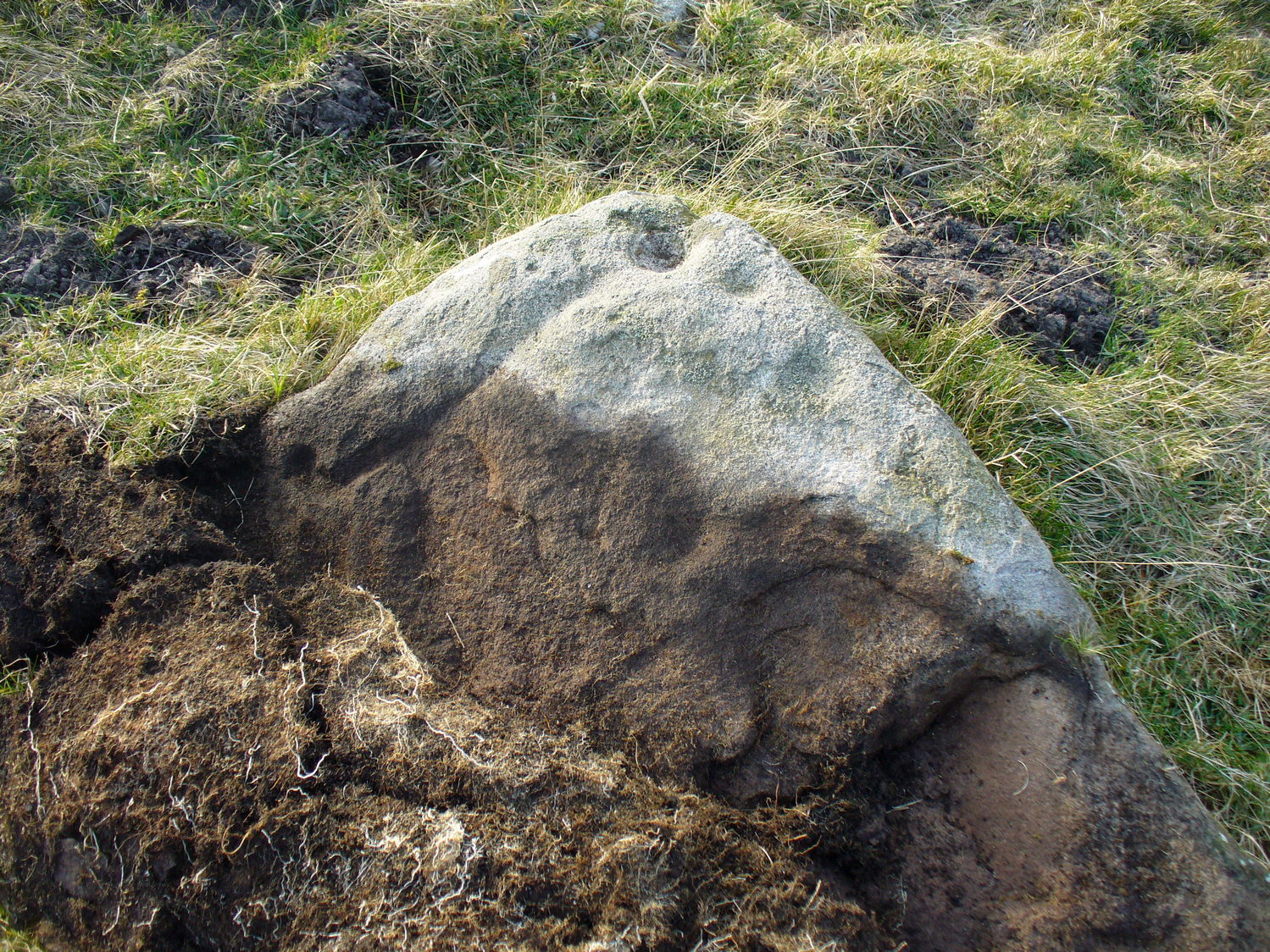
One of a number of previously unrecorded carvings in these fields, this is a pretty simplistic but unique design. The first thing you’ll notice is at the top-corner of the stone where, like many rocks on these moors, a nicely-worn cup stands out. Erosion obviously…. or so it first seems. This cup-mark has another two by its side, along the top edge of the stone which, again, initially suggested them to be little more than natural. But in rolling back the turf this assumption turns out to be wrong; for, along the west-side of the rock you’ll see a notable pecked groove running down to another cup-mark about twelve inches below, kinking slightly just before it reaches that cup. You can see this in the photo. Now, if we return to the prominent cup-mark at the top corner of the stone, in certain light there seems to be a very faint incomplete ring around it – but we can’t say for certain and it needs to be looked at again in better light.
Cups & line clearly visible
Main carved section
The name given to this carving (thanks to Collette Walsh) comes from the wavy lines that go into the middle of the stone from the long pecked line. These wavy lines are natural, although one portion of them might have been artificially enhanced. It’s difficult to tell one way or the other and we’ll have to wait for the computer boys to assess this particular ingredient. Just above these “waves” is a single eroded cup-mark nearly 2-inch across. And that’s that!
Numerous ways to get here, it’s probably the easiest (direction wise) to reach here starting from Dick Hudson’s public house on the southern road surrounding Rombalds Moor. From the pub, head left (east) along Otley Road (passing Weecher reservoir) for 1.9 miles (3.1km) until you reach Reva reservoir where a track leads you to the waters. A small parking spot is on the left-side of the road. From here, go through the gate and up the footpath (north) for about 200 yards then turn right and go up the field towards the wall where, about 20 yards before it, you’ll see find the stone in question.
Archaeology & History
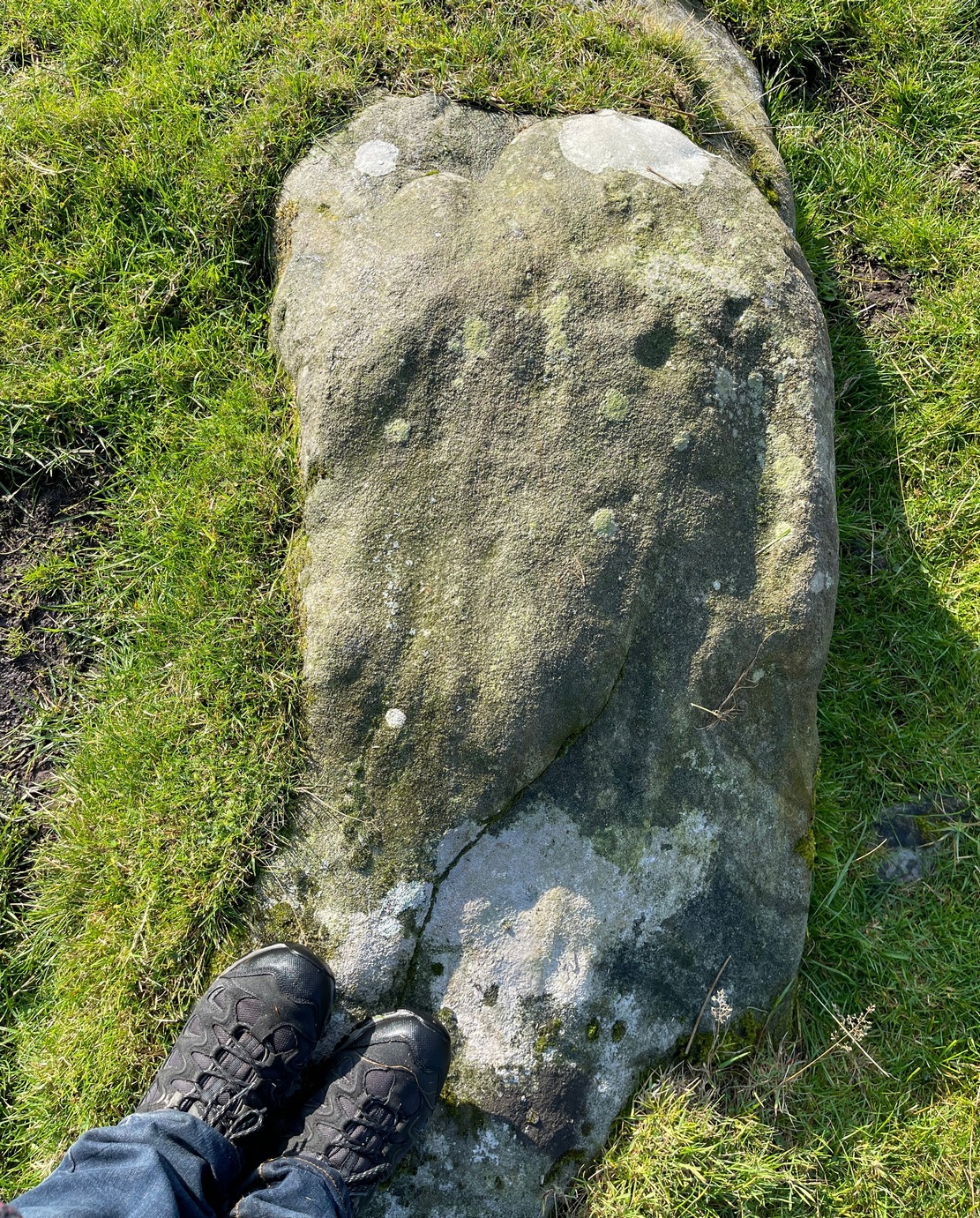
This long earthfast stone has two distinct cup-markings: one near its northern upper end, and the other near the lower southern end, as highlighted on the above photo. (forgive the poor image, but we took it when the sun was pretty high in the sky) It seems as if there are two or three other very faint cup-marks on the upper end of the stone, close to the most distinct one, but none of our photos show them with any clarity.
Acknowledgements: Huge thanks to Sarah Walker and Thomas Cleland for help with location and imagery for this stone.
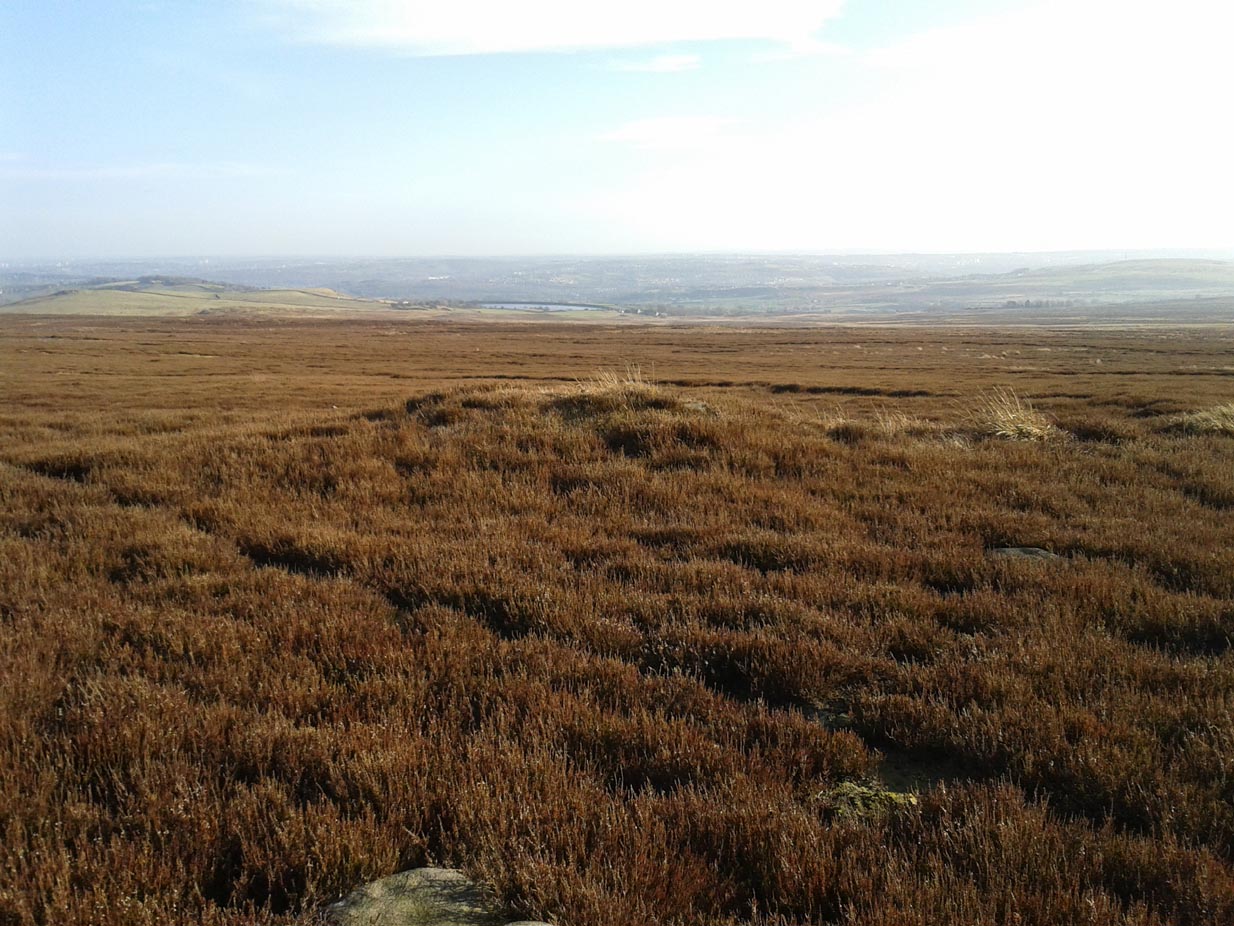
It’s a bittova pain-in-the-arse locating this site unless you’re into walking off-path, through excessive dense heather or burnt coarse ground. You can either follow the directions to the Black Beck tomb, or set off from Horncliffe Circle and walk up parallel to the fencing for nearly 300 yards (275m). From here, walk due east for nearly half a mile through the deep heather until you reach an overgrown track that keeps you eastwards towards a line of grouse butts abaat 275 yards (250m) on. Naathen, walk on the north-side of this path-track and for a few yards and you’ll begin to see either small piles of stones, or heather-covered mounds. Zig-zag about. You’re in the middle of the cemetery!
Archaeology & History
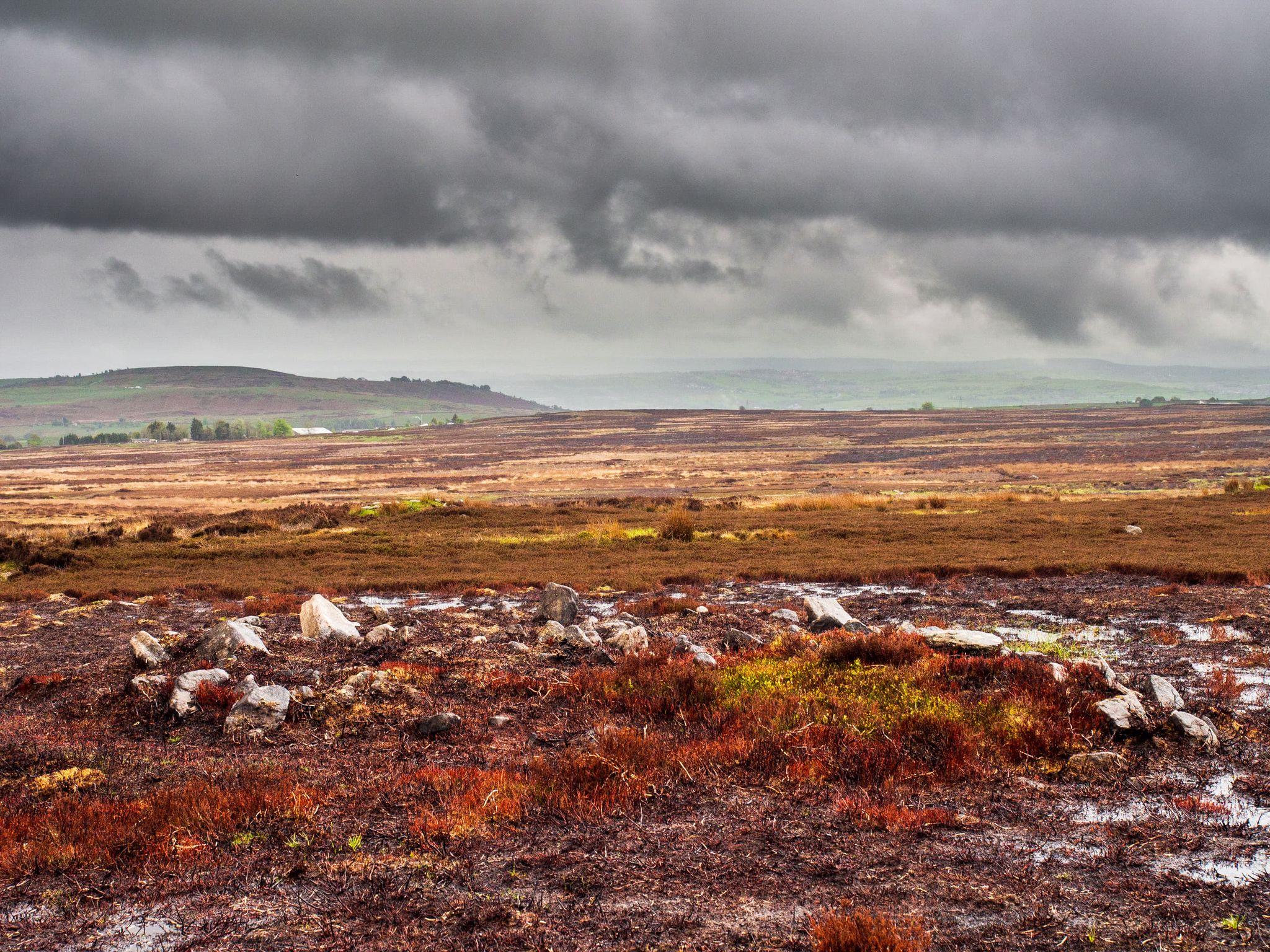
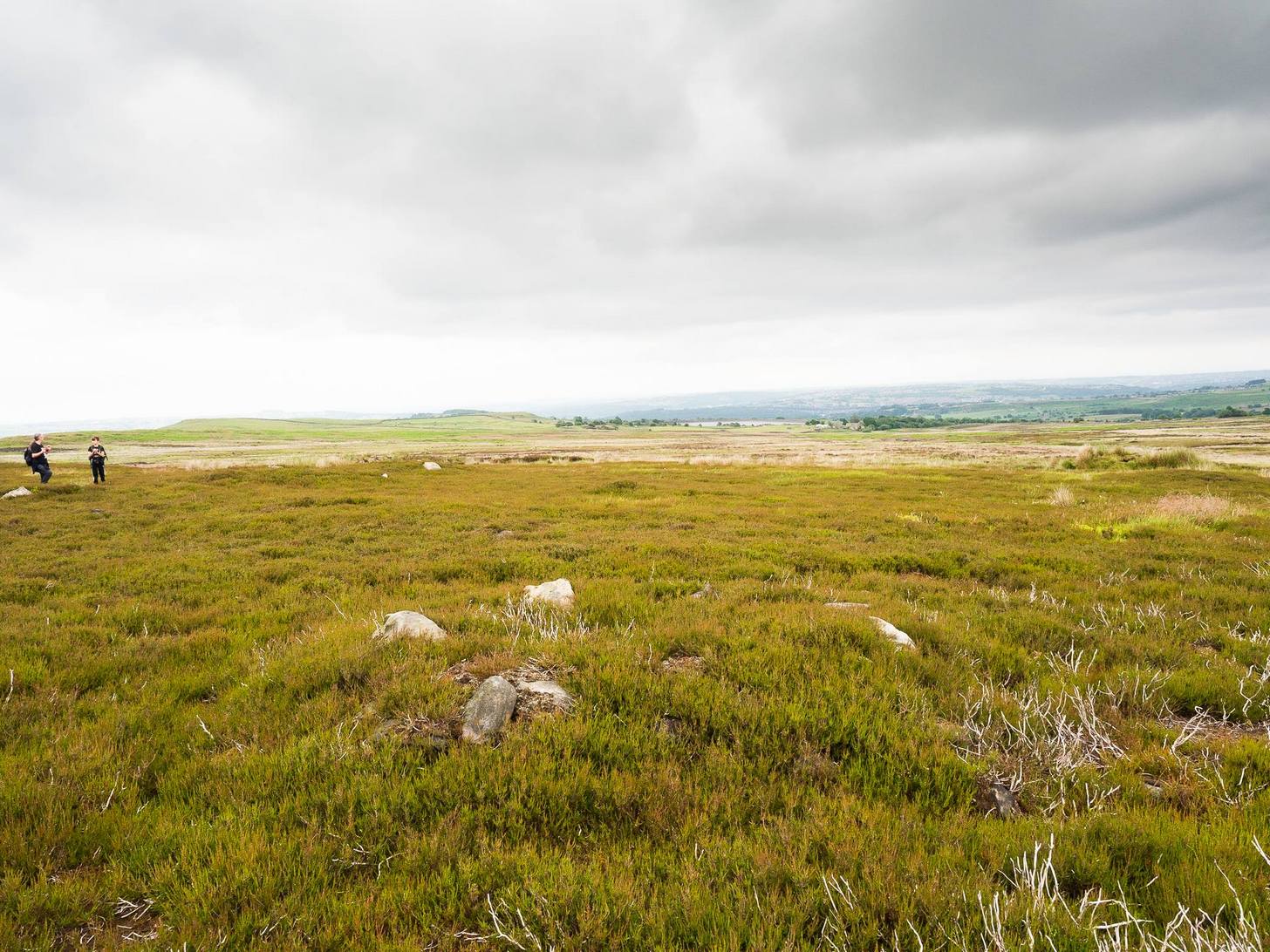
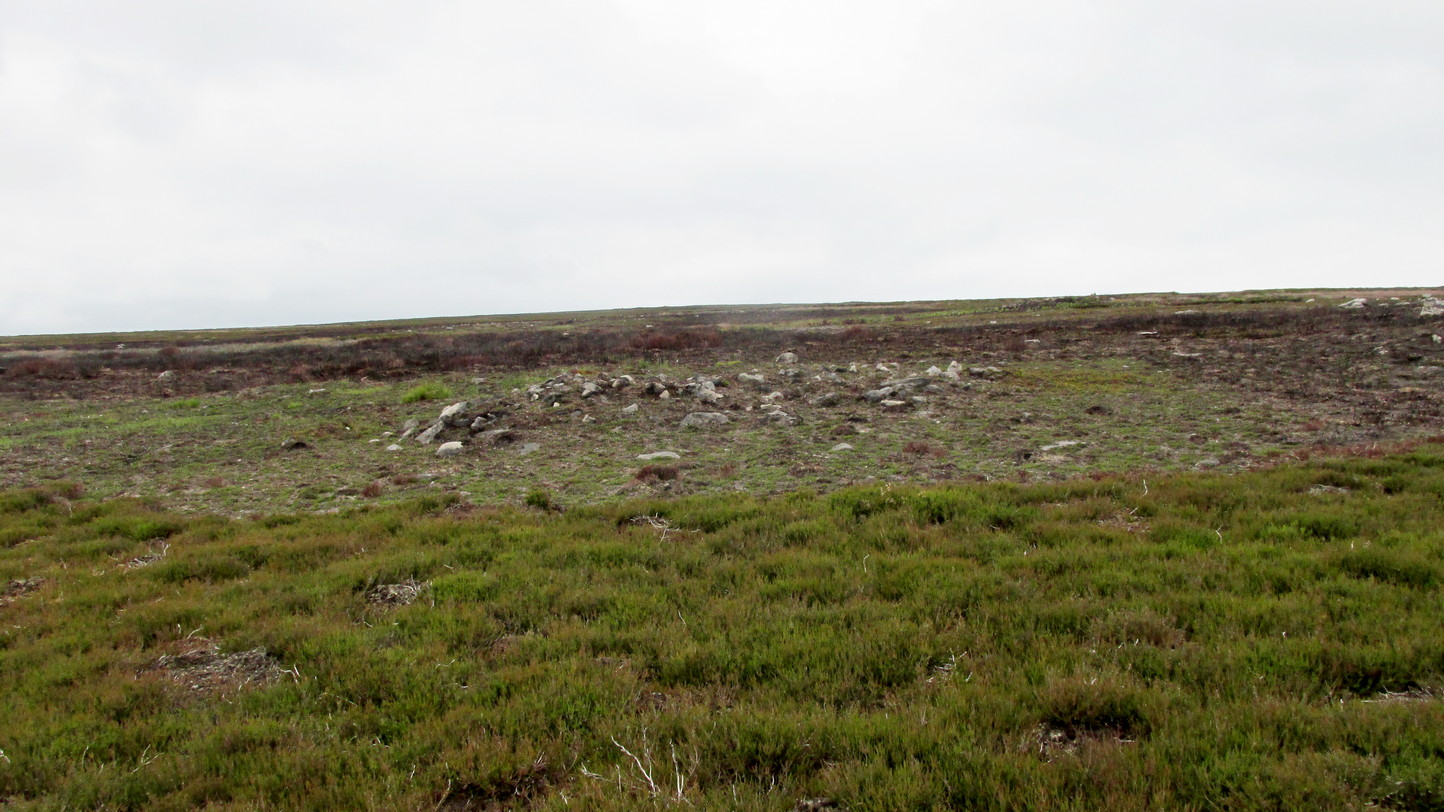
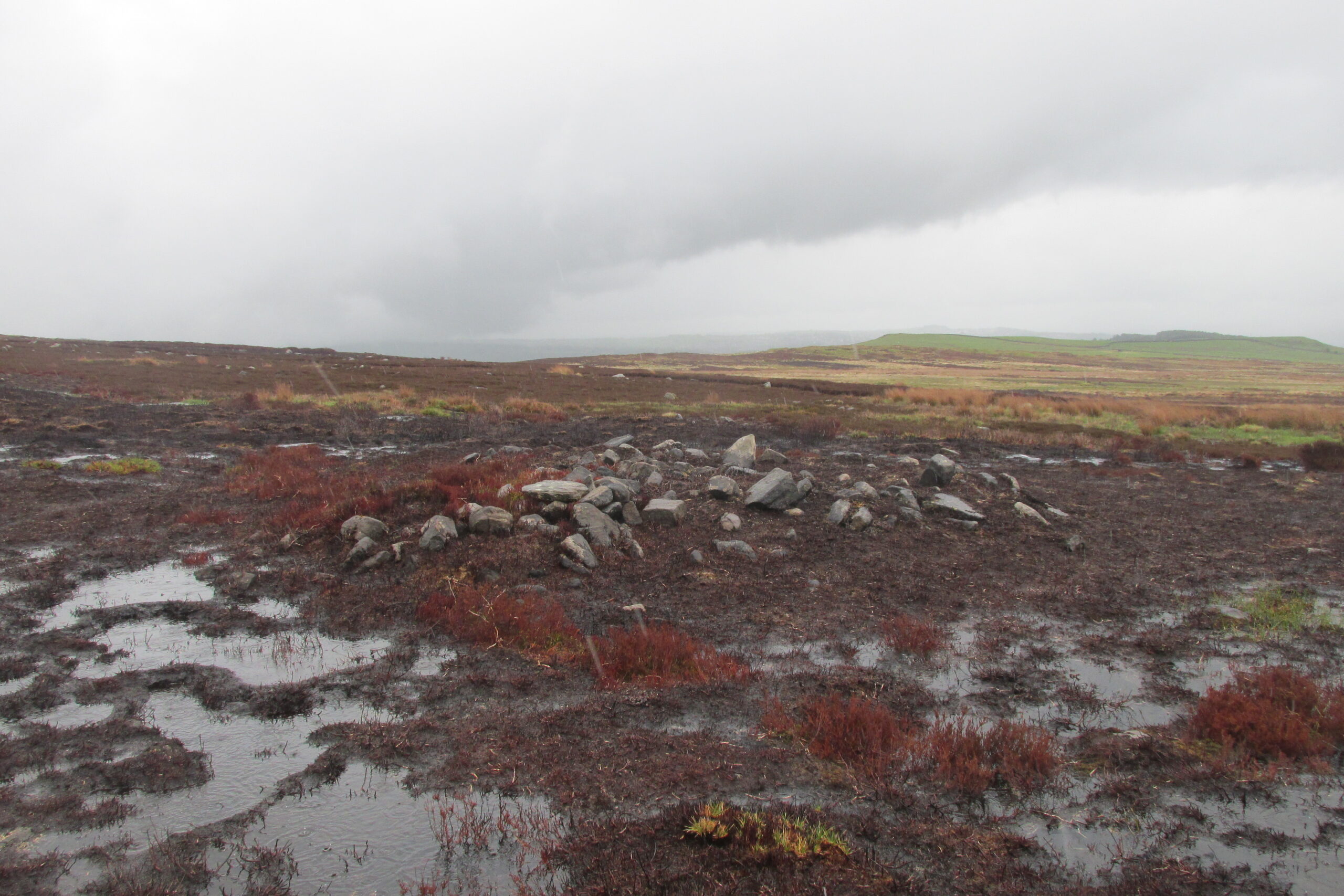
This cairnfield, or burial ground, or necropolis (choose whichever term you prefer) is a bittova beauty! Although some of the tombs here had been ‘officially’ noticed a few years back, the magnitude of it was understated to say the least. On a visit to the place a few months ago in the middle of one fuckova downpour, James Elkington and I found not only the large Black Beck tomb, but scattered clusters of many more cairns. But it wasn’t until a few weeks after that we got a longer time to check it over and, even then, I think the job was only half-done. So this site profile is merely an overview of some of what we found there. Along with the Black Beck tomb, we found more than thirty examples of prehistoric cairns—probably Bronze Age in nature—around the Hawksworth Shaw area near the middle of Hawksworth Moor, scattered around (seemingly) in no particular order.
…and another one…
Round cairn in foreground
Three types of cairns were identified in this large cairnfield. The majority of them are of the standard circular form, averaging 3-4 yards across and rising to about two feet high. They are of the same architectural form as those found in the Hawksworth Moor cairnfield 4-500 yards northwest of here (there is the possibility that the two of them are part of the same necropolis, but unless we can locate an unbroken continuity between the two groups, it’s best to present them as separate clusters). When we looked at them a couple of weeks ago, most cairns of the ’round’ type were overgrown, albeit in low growth, as a couple of the photos here show. The main cluster of the round cairns are just a few yards off the aforementioned track, but there are others scattered here and there at other points on this part of the moorland. A number of these cairns seem to have have been damaged and robbed of stones to build a line of grouse butts close by.
One of the ‘long cairns’
Another ‘long cairn’ during an utter downpour!
The second type of cairn in the necropolis—close to the main cluster of round cairns—are curious small, long cairns. Each one of them measures between 8-10 yards in length, are up to three yards across, and rise to a height of about one yard. They are built of the usual mass of small stones typical of the huge number of other cairns on Rombalds Moor, but have been constructed in an elongated form, in contrast to the more usual circular ones. Four of them are very close to each other with a fifth further away from this main group. A sixth one appears to be under the heather 50-60 yards away to the northeast. Unlike some of the nearby round cairns, this group looks as if it’s barely been touched by the hand of man, with only fallen scatters of stones around the outer edges of them. Tis an interesting group…
The third architectural cairn-types are scattered unevenly across the necropolis and are characterized as smaller, mini-versions of the round cairns, i.e, small piles of stones between 1-2 yards across and and just one or two feet high. Each of this type of cairn are more deeply embedded in the peat with more vegetational growth covering them due to their small size. This makes them much more difficult to see in comparison to their larger compatriots. One example (at SE 1423 4404) can be seen in the photo, above left, some 50-60 yards north of the Black Beck tomb; with another, above right, some 100 yards away to the southeast. There is the possibility they may be so-called ‘clearance cairns’, although I have some doubts about this and believe they are more likely to be individual graves…. but I could be wrong…
There’s little doubt that other tombs are hiding away in this area, waiting for fellow antiquarians to uncover them. Equally probable is the existence of hut circles or similar living-quarters lost beneath the heather. Two such sites have been found on recent ventures here: one a short distance west of the Black Beck tomb and another hiding away nearly 300 yards southwest, right beside the Black Beck. The main thing lacking up here are cup-and-ring stones. Apart from several uninspiring cup-marked rocks it seems few exist hereby; but there are, no doubt, some hiding away that have been hidden for millenia…
One final thing: the grid-reference given for this necropolis is based loosely on where some of the cairns can be found, but there are others whose positions lies slightly beyond that grid-ref, as you’ll find if you potter about.
Acknowledgements: With huge thanks, as always, for James Elkington for use of his photos. Also to the evolving megalith and landscape explorer Mackenzie Erichs; and to Linzi Mitchell, for additional input…