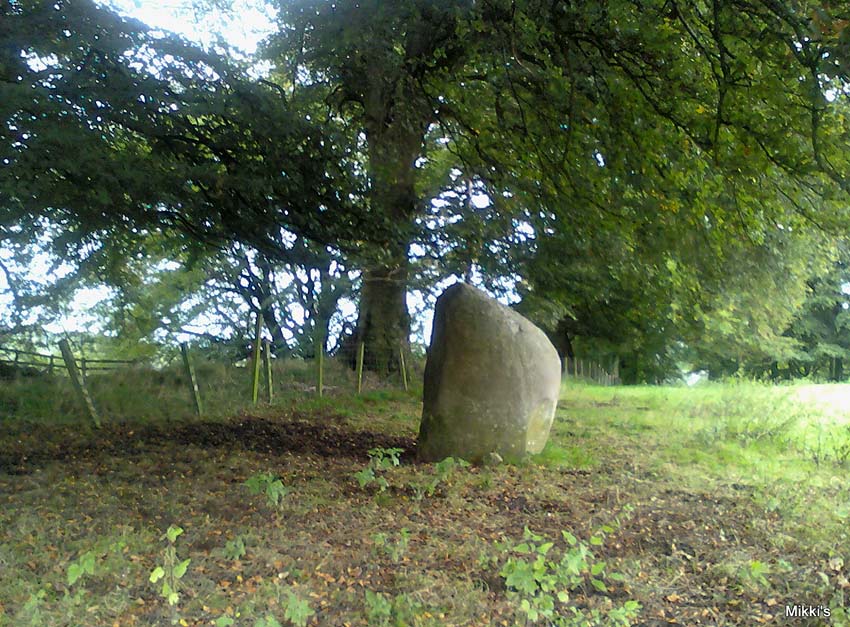
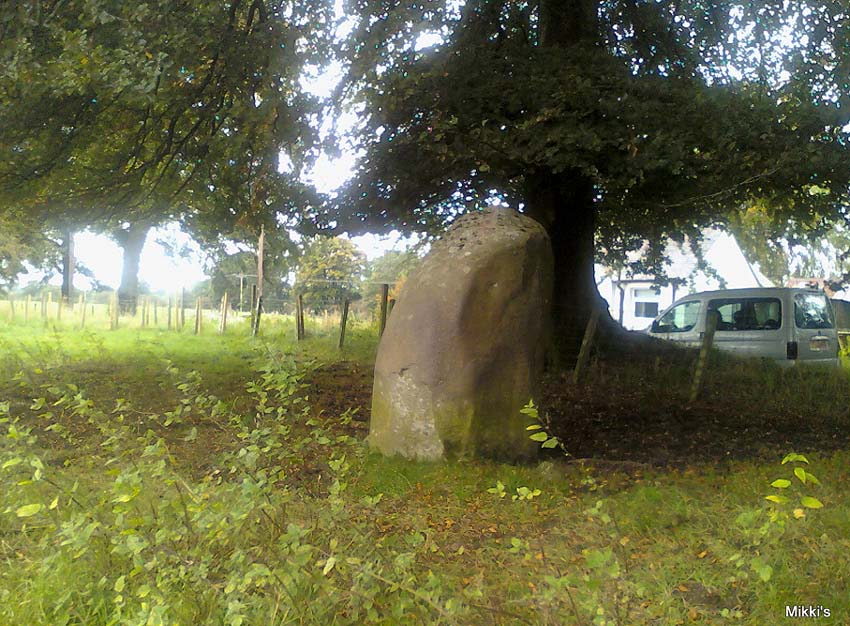
Cow Clout Stone, Parton, Kirkcudbrightshire

Legendary Rock:  OS Grid Reference – NX 6694 7336

Also Known as:

  1. Cowcloot Stone

Getting here

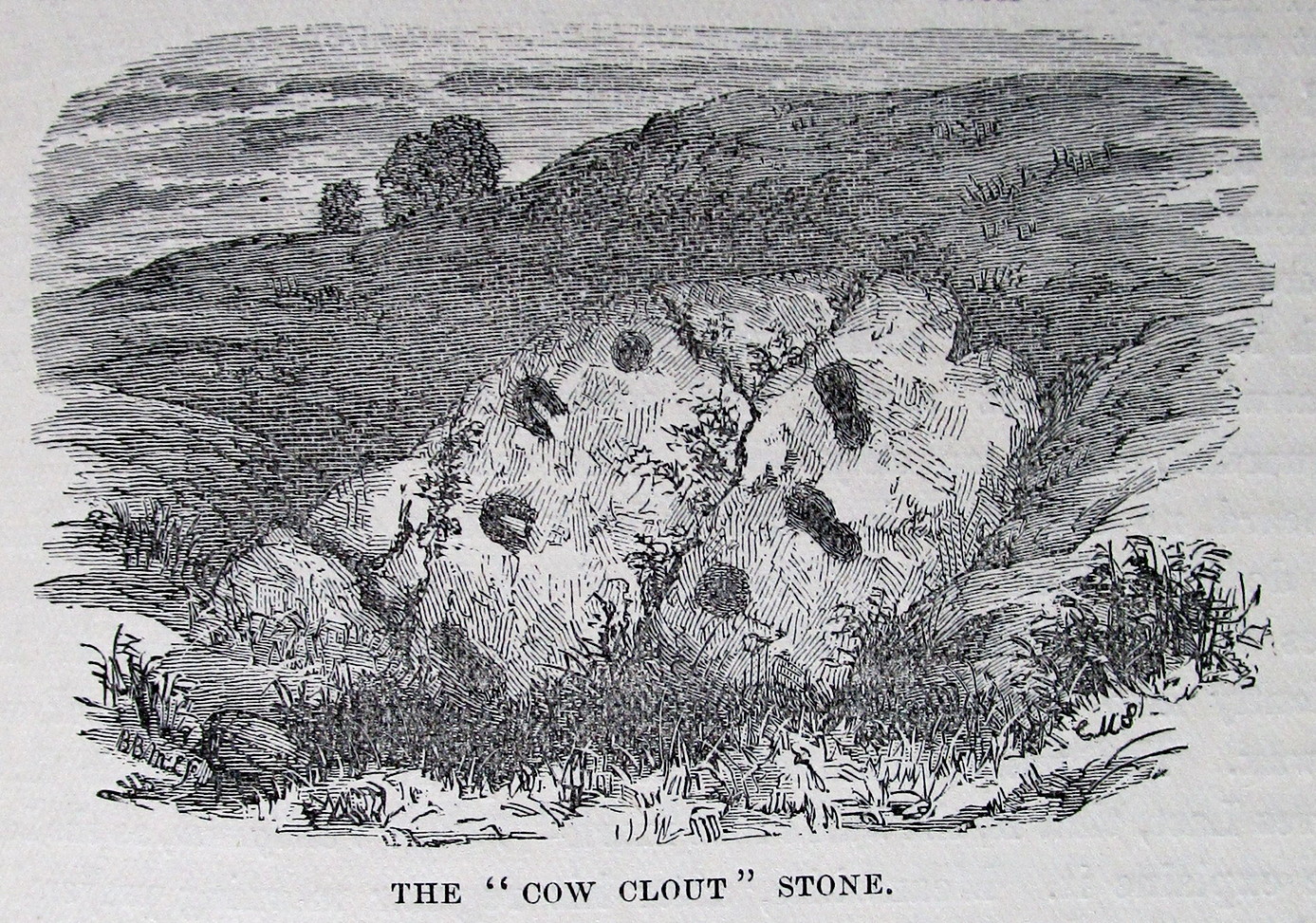
Harper’s 1876 sketch of the Cow Clout Stone

OK—I’m cheating here, as I’ve not visited this site (bad of me!).  The directions given here are from Harper’s 1876 Rambles in this area.  He told that the stone “stands about 100 yards to the north of the march dyke betwixt Upper Ervie, now Ken-Ervie and Nether Ervie. There is little to indicate its whereabouts, but the visitor coming from Kenmure Bridge, and leaving the road on the left, opposite Ringour and Bennan farms, on the opposite side of Loch Ken, would come upon it without much trouble by following the march dyke half a mile up.”  Basically, along the A713 just over 2 miles north of the bridge at Parton (½ mile before reaching the Galloway Activity Centre), 60 yards from the “Farm Access No Parking” spot, in the trees a long straight line of walling runs uphill.  That’d be my route—straight up!

Archaeology & History

This is a curious entry that I’ve added without visiting the site; but as I might never get to see it I thought it should be displayed in the hope that others might check it out.  The earliest literary reference to it is from Crosbie’s (1845) entry in the New Statistical Account, where he implies that the markings on the stone are not of Nature’s handiwork.  In Malcolm Harper’s (1876) fine work exploring the history and folklore of this region, he gave us the first illustration of the stone, which looks suspiciously like elements that we find on cup-and-ring stones.  Many years later when the Royal Commission (1914) lads followed up on Crosbie’s entry, they thought the markings were probably Nature’s handiwork.  They told that:

“It is an irregular mass of outcropping rock about 3 feet in diameter, and bears on its surface certain depressed markings supposed to represent a cow’s foot, a horse-shoe, and impressions which might be made by a man’s foot and knee in the act of kneeling. The markings appear to be natural.”

But it’s the animistic elements and traditions here which are important and which gave the stone its very name…

Folklore

When Rev. W.G. Crosbie (1845) first wrote about this stone, he was narrating the tale told of it by local people, whose traditions were greatly neglected by the majority of writers at that time.  Such stories should be preserved at all times, as they tell us more about the psychocosms of pre-industrial cultures.  Here,

“On the farm of Arvie, there is a flat stone about three feet in diameter, on which are the marks of what might be supposed a cow’s foot, a horse shoe, the four nails on each side being very distinct, and the impression which might be made by a man’s foot and knee while he was in the act of kneeling, the knot of the garter being quite evident.  The tradition connected with this remarkable stone, commonly called the ‘Cow Clout,’ is, that the proprietor, in order to get up arrears of rent, “drave the pun,” or in other words, carried off the hypothecated stock, while a fierce resistance was made by the people, and that over this stone, on which a man had just been praying for relief against his enemies, the cattle passed followed by an officer on horseback, and that it remains as a memorial to posterity of the cruel deed.”

If someone in that neck o’ the woods can find out if the stone’s still there and perhaps send us a photo, or stick it on our Facebook group, that’d be great! 🙂

References:

  1. Coles, Fred, “The Recent Cup and Ring Mark Discoveries in Kirkcudbrightshire”, in Proceedings Dumfriesshire & Galloway Natural History and Antiquarian Society, volume 5, 1888.
  2. Crosbie, W.G., “Parish of Parton,” in New Statistical Account of Scotland – volume 4, William Blackwood: Edinburgh 1845.
  3. Harper, Malcolm M., Rambles in Galloway, Edmonston & Douglas: Edinburgh 1876.
  4. Royal Commission Ancient & Historical Monuments & Constructions of Scotland, Inventory of Monuments and Constructions in Galloway – volume 2: County of the Stewatry of Kirkcudbrightshire , HMSO: Edinburgh 1914.

© Paul BennettThe Northern Antiquarian

Boreland Mote, Parton, Kirkcudbrightshire

Stone Circle (destroyed):  OS Grid Reference – NX 693 709

Archaeology & History

In March 1844, Rev. W.G. Crosbie in his survey of the parish of Parton, mentioned the mediaeval earthworks, or motte, above the west side of the Borland Glen:

“At a short distance from this,” he wrote, “are the remains of a small Druidical circle.”

This “Druidical circle” was subsequently described in Fred Coles’ (1895) megalithic survey of Kirkcudbrightshire, where he added that the circle was “some two hundred yards distant” from the motte—but it had already been destroyed when he wrote about it and its exact location seems to have been forgotten.  Logic suggests that the circle would have been on the lands immediately west of the motte, where the land is relatively level and possesses several small hillocks, which would be perfect for megalithic siting. (the grid-reference cited above is an approximation)

References:

  1. Burl, Aubrey, The Stone Circles of Britain, Ireland and Brittany, Yale University Press 2000.
  2. Coles, Fred, “The Stone Circles of the Stewartry of Kirkcudbright”, in Proceedings Society Antiquaries, Scotland, volume 29, 1895.
  3. Crosbie, W.G., “Parish of Parton,” in New Statistical Account of Scotland – volume 4, William Blackwood: Edinburgh 1845.

© Paul BennettThe Northern Antiquarian

Black Morrow Well, Kirkcudbright, Kirkcudbrightshire

Healing Well:  OS Grid Reference – NX 6843 4940

Archaeology & History

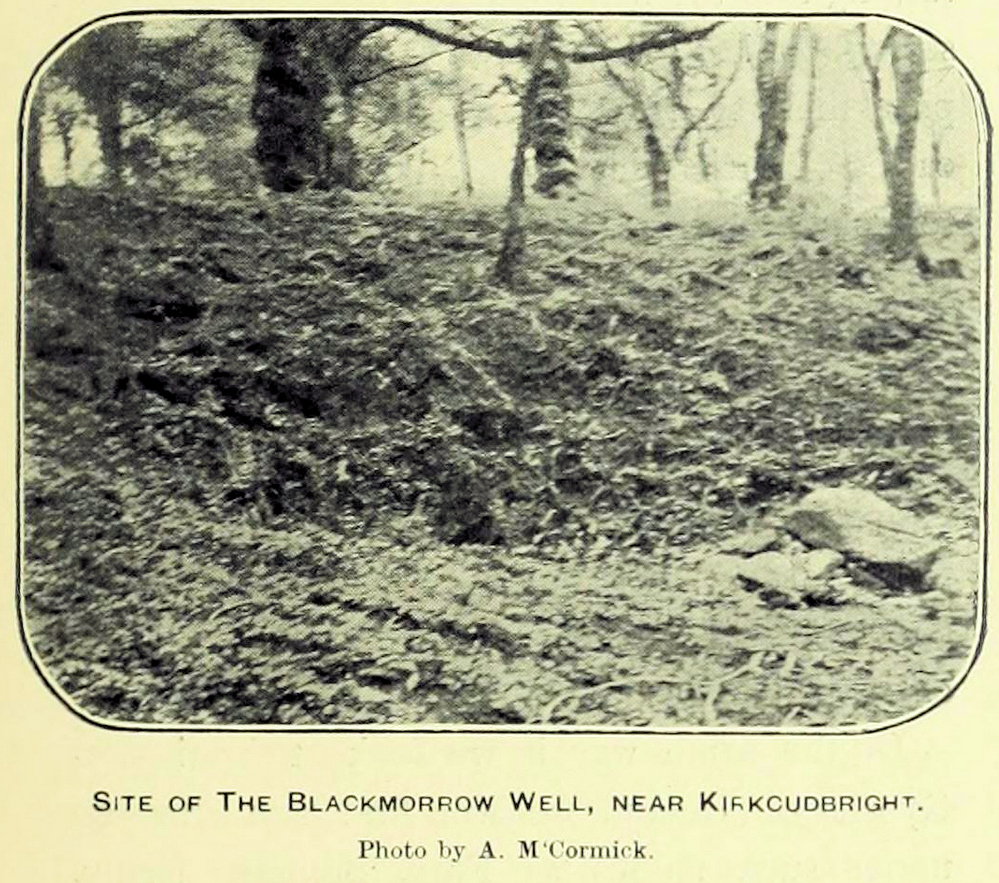
A curious little-known site with more of a Scottish genealogical history behind it.  Mentioned in McCormick’s (1906) fascinating survey of tinkers in the Galloway region, the site was given a more succinct description in the Morris survey (1982), where they told that,

Well shown on 1854 map
Black Morrow Well, c.1905

“a mile from the town in Black Moray (formerly Morrow) Road, a short distance from the road…was this well that the MacLellan family are said to have derived their crest of a Moor’s head impaled on a sword.  The local story is that James II wanted to get rid of some gypsies infesting Galloway and offered the Barony of Bombie to anyone who could do so.  MacLellan filled the well with potent liquor which the gypsy chief drank to excess and while he was in a drunken stupor MacLellan killed him, cut off his head and presented it to the King on the point of his sword, immediately receiving the barony as his reward.”

This story goes way back and was first mentioned in 1680.  According to McCormick (1906), the name Black Morrow derived from the “More”, the title given to the leader of the so-called gypsy clan, “or, as tradition suggests, a man named Black Morrow, of Irish tinkler descent.”

References:

  1. Andrew McCormick, The Tinkler-Gypsies of Galloway, J. Maxwell: Dumfries 1906.
  2. Morris, Ruth & Frank, Scottish Healing Wells, Alethea: Sandy 1982.

© Paul BennettThe Northern Antiquarian

Balmae (2), Kirkcudbright, Kirkcudbrightshire

Cup-and-Ring Stone:  OS Grid Reference – NX 68649 44700

Also Known as:

  1. Balmae House
  2. Balmae 5 (Coles)

Archaeology & History

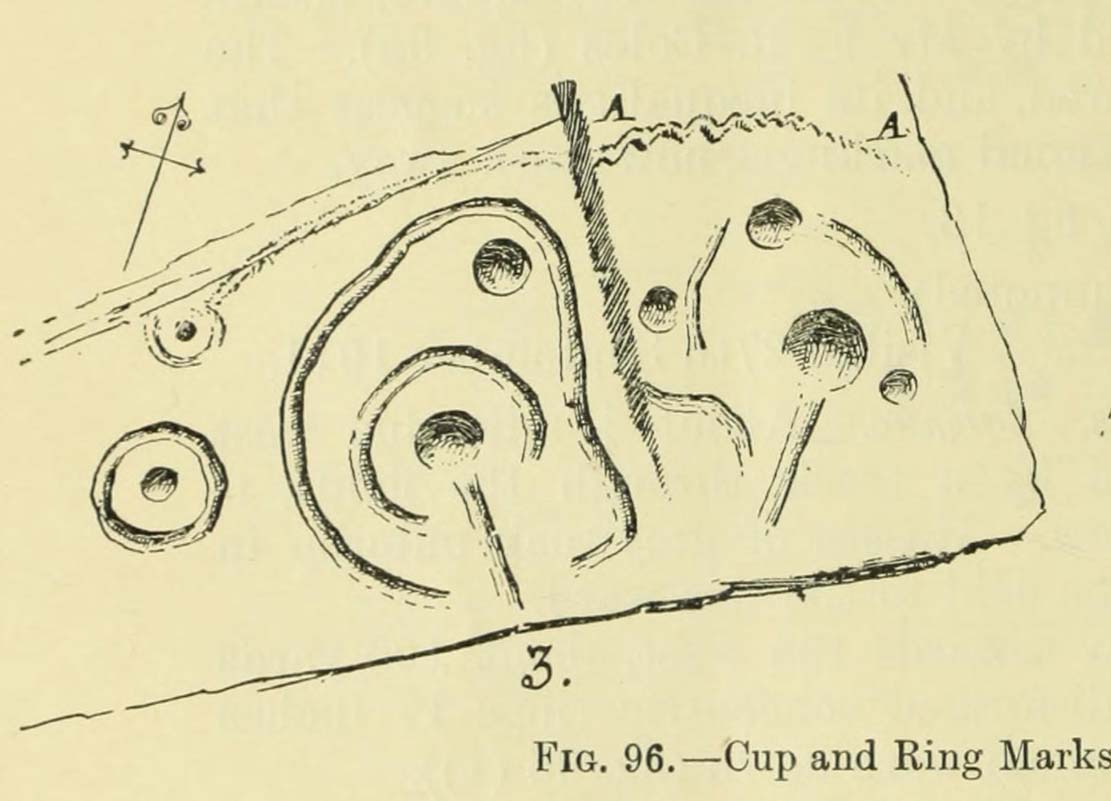
Coles’ 1895 sketch

Amongst a good cluster of petroglyphs, this ornate little fella may have been one visited by George Hamilton (1886) when he visited Balmae and outlying districts, seeking out petroglyphs!  We don’t know for certain though, as his descriptions are somewhat vague.  However, a few years later the great Fred Coles (1895) came a-wandering in search of the same carvings and, as happens in this line of business, uncovered a few new ones during his rummaging.  This was one of them, which he described, very simply, as hiding

“but a few yards from Ross View Cottage, on its N.W. … (with) eight cups being associated with four rings and several grooves, both straight and curved.”

It was only a few years later when the Royal Commission lads (1911) came in search of it and they told how,

“the main design is a central ringed cup with a connected groove, and two outer cups which an outer circle curves eccentrically to enclose.”

But when Ron Morris (1979) explored the area in the 1970s, he was unable to locate this and a number of other carvings that had been reported by Coles.  Since then, the carving has been relocated at the grid reference cited above.  Also since then, a great deal many more carvings have been found in this locale by the experienced petroglyphic fingers of Maarten van Hoek. (1993)

References:

  1. Coles, Fred, “A Record of the Cup-and-Ring Markings in the Stewartry of Kirkcudbright,” in Proceedings Society Antiquaries, Scotland, volume 29, 1895.
  2. Hamilton, George, “Notices of Rock Sculpturings of Cups and Circles in Kirkcudbrightshire,” in Proceedings Society Antiquaries, Scotland, volume 21, 1886.
  3. Morris, Ronald W.B., The Prehistoric Rock Art of Galloway and the Isle of Man, Blandford: Poole 1979.
  4. Royal Commission Ancient & Historical Monuments, Scotland, Inventory of Monuments and Constructions in Galloway – volume 2: County of the Stewartry of Kirkcudbright, HMSO: Edinburgh 1914.
  5. van Hoek, M., “Balmae”, in Discovery & Excavation Scotland, 1993.

Links:

  1. Canmore – short notes on Balmae (2)

© Paul BennettThe Northern Antiquarian

High Banks (03), Kirkcudbright, Kirkcudbrightshire

Cup-and-Ring Stone (lost):  OS Grid Reference – NX 709 489

Archaeology & History

One of the lost High Banks carvings

One of the lost High Banks carvings

The drawing here is another by the legendary Fred Coles, previously unpublished until Maarten van Hoek (1990) brought it out of the dusty archives of the Stewartry Museum, Kirkcudbright, and described it in his article on prehistoric rosette motifs.  As with its fellow carving of High Banks 2, the location of the site remains unknown; and van Hoek wondered whether these two lost carvings “could have been located at the spot where now the little quarry at High Banks site is found.”  Let’s hope not!

References:

  1. Morris, Ronald W.B., The Prehistoric Rock Art of Galloway and the Isle of Man, Blandford: Poole 1979.
  2. van Hoek, M.A.M., “The Rosette in British and Irish Rock Art,” in Glasgow Archaeological Journal, volume 16, 1990.

© Paul BennettThe Northern Antiquarian


High Banks (02), Kirkcudbright, Kirkcudbrightshire

Cup-and-Ring Stone (lost):  OS Grid Reference – NX 709 489

Archaeology & History

One of the lost High Banks carvings

One of the lost High Banks carvings

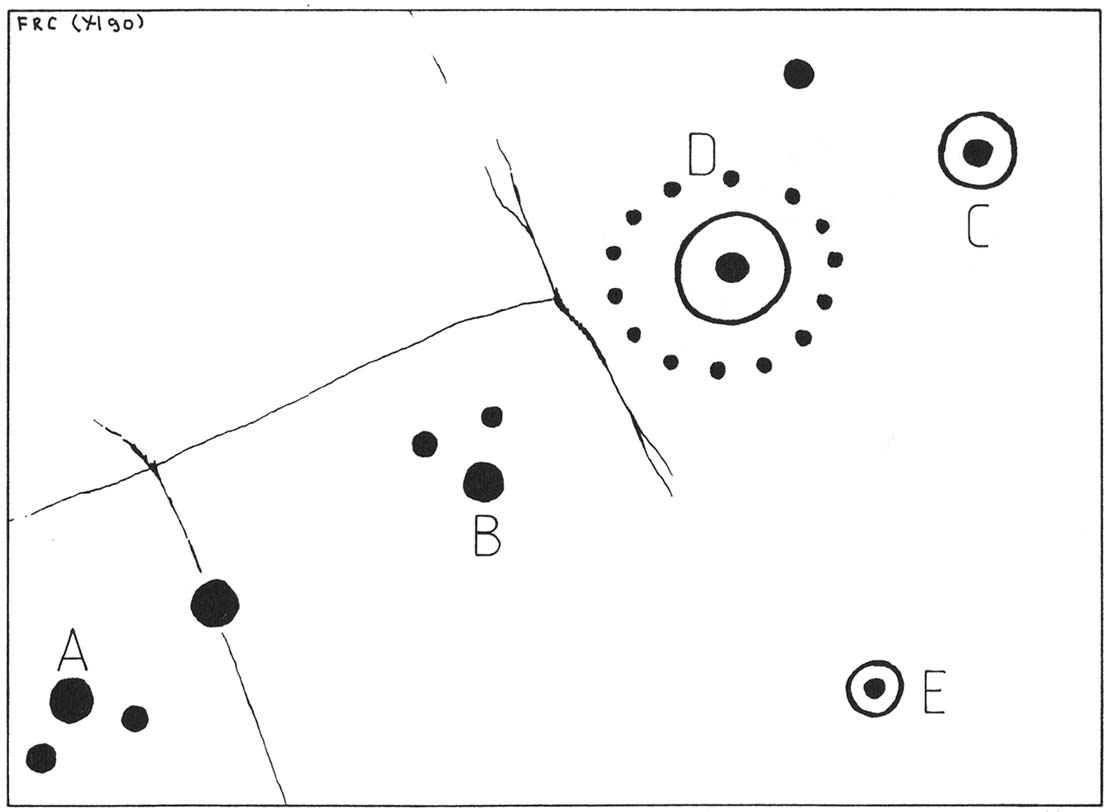
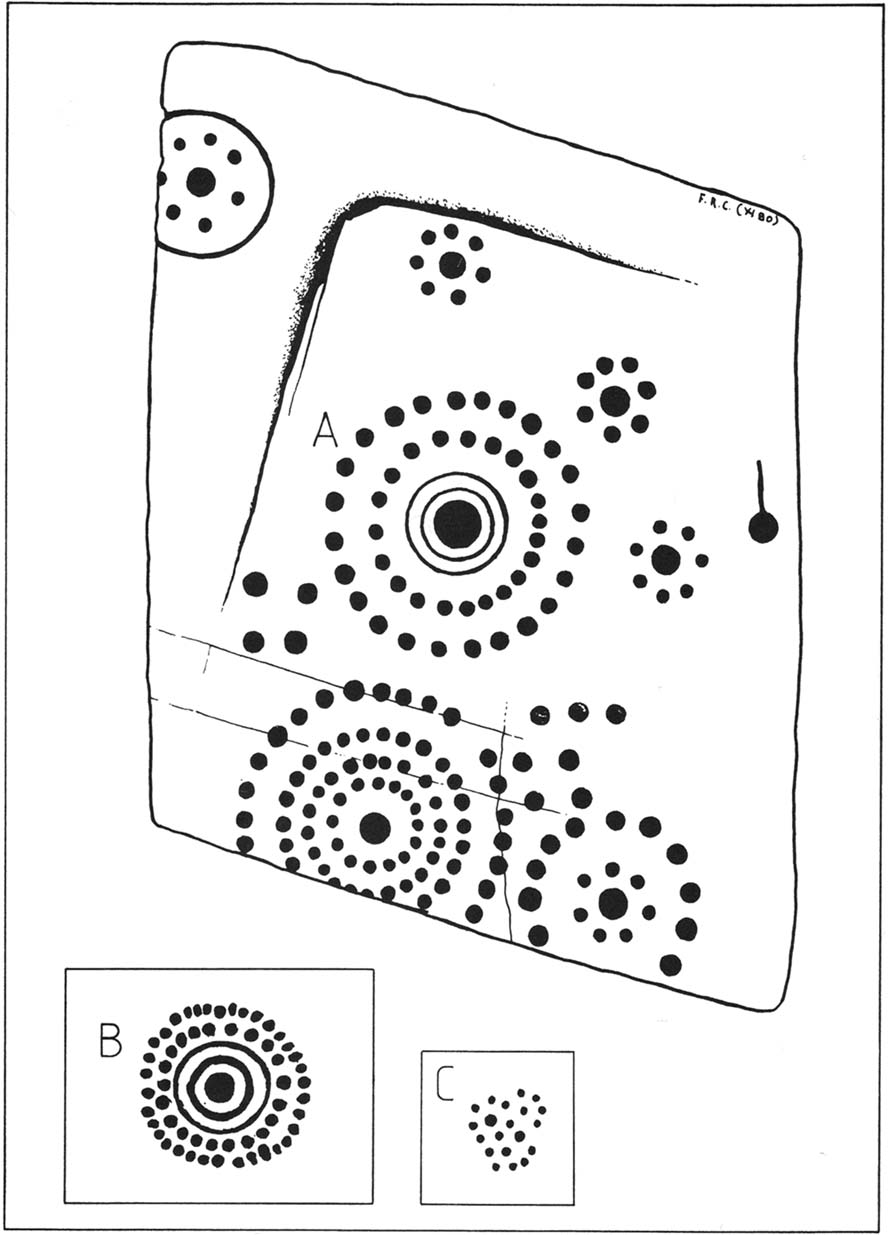
This impressive carving was found somewhere in the vicinity of the well-known High Banks (01) cup-and-ring menagerie, with its clustered mass of cups and multiple rings.  And the carving we see here possesses something of a similarity with its complex neighbour—but it remains lost.

The drawing was done by our old Scottish megalithomaniac Fred Coles, who discovered the carving when he visited the area around the beginning of the 20th century.  It remained unpublished until fellow rock art student Maarten van Hoek (1990) explored the region and found it hiding away in the archives at the Stewartry Museum, Kirkcudbright.  The multiple rings of cups surrounding central cups and cup-and-rings are very rare things indeed and this carving is utterly unique in the British Isles.

In Coles’ drawing, as well as the large carving, we have two other elements below, boxed.  These are taken from a notebook found in the same Stewartry Museum and thought to have been done by a Mr G. Hamilton around 1866.  In the lower-box, the double-ringed cup with its surround of two more rings of cup-marks was suggested at first by van Hoek (1990) to possibly be the same carving as that found by Coles.  But he questioned this, sensibly, as the carved design ‘B’,

“comprises 35 cups (its diameter stated to be 21 inches / 51cm), whereas Coles’ diagram of ‘A’ shows only 24 outer cups.  The unknown artist moreover says that, ‘The above (B) is one of a splendid group on Banks Farm.’  So this rosette (B) might be a completely different specimen altogether.”

I have to agree with him.  In the second smaller box, ‘C’, the drawing of the cluster of cup-marks is taken from the same 19th century notebook in which the author said there was a cluster of

“70 to 100 small cups without any apparent system, except being in a group of 7 with cup in the centre—also 3 or 4 circles.”

No other details were given.  Petroglyph explorers in the area should keep their senses peeled when meandering about here, for this and other missing carvings (High Banks 3).

References:

  1. Morris, Ronald W.B., The Prehistoric Rock Art of Galloway and the Isle of Man, Blandford: Poole 1979.
  2. van Hoek, M.A.M., “The Rosette in British and Irish Rock Art,” in Glasgow Archaeological Journal, volume 16, 1990.

© Paul BennettThe Northern Antiquarian


St. Patrick’s Well, Portpatrick, Wigtownshire

Holy Well (destroyed):  OS Grid Reference – NX 0010 5412

Also Known as:

  1. Canmore ID 60610

Archaeology & History

St Patricks Well on 1849 map

This long-lost  holy well was located on the southeast side of the town.  It was highlighted on the first OS-map in 1849, but its waters were disrupted shortly after this. Daniel Conway (1882) told that,

“It flowed where there was a quarry used for the harbour works. The writer of this notice heard from two men, John Mulholland and Owen Graham, dwelling at Portpatrick in 1860, that they had seen on the rock beside the well what tradition said was the impression of the knees and left hand of St. Patrick.”

When the holy wells writer E.M.H. M’Kerlie (1916) came to visit this site, it was “no longer to be seen.”  He wrote:

“The water which issued from a rock on the south side of the village is now diverted by means of pipes into another course.”

References:

  1. Agnew, Andrew, The Agnews of Lochnaw: The History of the Hereditary Sheriffs of Galloway, A. & C. Black: Edinburgh 1864.
  2. Agnew, Andrew, The Hereditary Sheriffs of Galloway – volume 1, David Douglas: Edinburgh 1893.
  3. Conway, Daniel, “Holy wells in Wigtonshire,” in Archaeological & Historical Collections Relating to Ayr & Wigton, volume 3, 1882.
  4. Harper, Malcolm MacLachan, Rambles in Galloway, Edmonston & Douglas: Edinburgh 1876.
  5. M’Kerlie, E.M.H., Pilgrim Spots in Galloway, Sands: Edinburgh 1916.
  6. MacKinlay, James M., Folklore of Scottish Lochs and Springs, William Hodge: Glasgow 1893.
  7. Morris, Ruth & Frank, Scottish Healing Wells, Alethea: Sandy 1982.
  8. Royal Commission Ancient & Historical Monuments of Scotland, Inventory of Monuments and Constructions in Galloway – County of Wigtown, HMSO: Edinburgh 1912.
  9. Walker, J. Russel, “‘Holy Wells’ in Scotland,” in Proceedings of the Society of Antiquaries of Scotland, vol.17 (New Series, volume 5), 1883.

© Paul Bennett, The Northern Antiquarian 


St. Patrick’s Stone, Portpatrick, Wigtownshire

Cup-Marked Stone (destroyed):  OS Grid Reference – NX 0010 5411

Archaeology & History

Very little is known about this long-lost carving, whose primary information comes from the folklore records.  Apparently it was found on a rock a short distance south of the destroyed St. Patrick’s Well and the two sites seem to have had a traditional relationship with each other.  The carving had a foot-shaped motif on the rock, and a number of other cup-markings; but I can find no account as to whether the ‘foot’ carving possessed ‘toes’, as seen on the impressive Cochno Stone, north of Glasgow.  It may have been little more that the petroglyphic ‘feet’ seen on the recently discovered and aptly-named Footprint Stone, or those on the newly rediscovered Witches Stone; but we cannot discount it being larger, like the Footprint Stone of Dunadd.  If we could locate an early sketch of the stone, all would be revealed!   Sadly, as E.M.H. M’Kerlie (1916) told us,

“this rock was blasted at the time when the government essayed to make the harbour one of great importance”,

several years after the nearby holy well had been re-routed. Fucking idiots!  Any further info on this site would be most welcome.

Folklore

The local story that was told about St. Patrick creating these carvings seems to have been described first of all by Andrew Agnew (1864), who wrote:

“Once, when about to revisit his native land, he crossed the Channel at a stride, leaving the mark of his foot distinctly impressed on one of the rocks of the harbour; unfortunately, in making a new jetty, this interesting memento was destroyed.”

(The mention of the jetty would seem to imply that the carving was closer to the sea than the grid-reference cited above.) In another tale, St. Patrick rested his hand onto the same rock and the marks of his hand and fingers were left there.  This folklore motif is found across the world.  It relates to cosmological creation myths of indigenous spirits and deities in the tribes and cultures who narrate it.  In this instance, the myth of St Patrick replaced a much earlier mythic tale of another giant or deity, whose name we have lost.  Unless, of course, such petroglyphs were still being carved in Galloway by local people in the 4th-5th centuries.

A further tale of St Patrick, at Portpatrick, replaced a quite obvious shamanistic tale. When he journeyed back from Ireland to Galloway, Agnew again told us:

“Having preached to an assembly on the borders of Ayrshire, the barbarous people seized him, and, amidst shouts of savage glee, struck his head from his body in Glenapp.  The good man submitted meekly to the operation; but no sooner was it over than he picked up his own head, and, passing through the crowd, walked back to Portpatrick, but finding no boat ready to sail he boldly breasted the waves and swam across to the opposite shore, where he safely arrived (according to the unanimous testimony of Irishmen innumerable), holding his head between his teeth!”

Legends such this are found in shamanistic pantheons worldwide.  Shamans primary renown is their ability to travel and recover from the Lands of the Dead, always journeying into impossible and inhospitable arenas, with tales of being dismembered, beheaded, dying, and returning to life to help the tribe with whatever it was that required such a task (usually a healing function).  This story of St Patrick – and many other saints – are mere glosses onto the earlier animistic stories, then abridged as being better, more spiritually mature, more egocentric. But their roots are essentially animistic.

References:

  1. Agnew, Andrew, The Agnews of Lochnaw: The History of the Hereditary Sheriffs of Galloway, A. & C. Black: Edinburgh 1864.
  2. Agnew, Andrew, The Hereditary Sheriffs of Galloway – volume 1, David Douglas: Edinburgh 1893.
  3. Conway, Daniel, “Holy wells in Wigtonshire,” in Archaeological & Historical Collections Relating to Ayr & Wigton, volume 3, 1882.
  4. Harper, Malcolm MacLachan, Rambles in Galloway, Edmonston & Douglas: Edinburgh 1876.
  5. M’Kerlie, E.M.H., Pilgrim Spots in Galloway, Sands: Edinburgh 1916.
  6. MacKinlay, James M., Folklore of Scottish Lochs and Springs, William Hodge: Glasgow 1893.
  7. Morris, Ruth & Frank, Scottish Healing Wells, Alethea: Sandy 1982.
  8. Royal Commission Ancient & Historical Monuments of Scotland, Inventory of Monuments and Constructions in Galloway – County of Wigtown, HMSO: Edinburgh 1912.
  9. Walker, J. Russel, “‘Holy Wells’ in Scotland,” in Proceedings of the Society of Antiquaries of Scotland, vol.17 (New Series, volume 5), 1883.

© Paul BennettThe Northern Antiquarian 


Skip Knowe, Newton, Dumfriesshire

Standing Stone:  OS Grid Reference – NY 1118 9443

Also Known as:

  1. Site no.66950 (Canmore ID)
  2. Skipknowe

Getting Here

Skip Knowe stone
Skip Knowe stone

From junction 16 on the A74(M) turn off an go up the B7076 road, roughly parallel with the motorway, for about 2 miles, turning right – over the A74(M) – until you hit the T-junction by the lovely hamlet of Newton.  At the T-junction turn right again and along down the road for just 300 yards or so.  You’ll see the small Skip Cottage, almost overgrown by the tiny roadside on your right.  Stop here and look into the field across the road.  It’s right in front of you!

Archaeology & History

Looking SW

Despite the size and almost romantic setting of this large standing stone, I can find little by way of early descriptions or archaeological reports here.  Nearly six feet tall with its long axis aligned east-west and in seeming isolation, I find it hard to believe that we have no other sites or relevant data here. Echoing the work by Alexander Thom (1990:2), Aubrey Burl (1993) makes mention of it as one in a possible “pair” of standing stones, with its companion being “18ft (5.5m) away…in roadside bank,” but this is debatable.  This second stone seems as much a part of the old walling.  On purely subjective grounds, it gave the impression of once playing a part in a stone circle — an opinion also held by the Scottish Royal Commission (1920) lads after their visit here in August, 1912.  Does anyone know anything more about this place?

References:

  1. Burl, Aubrey, From Carnac to Callanish, Yale University Press 1993.
  2. Royal Commission on Ancient & Historical Monuments, Scotland, Inventory of Monuments and Constructions in the County of Dumfries, HMSO: Edinburgh 1920.
  3. Thom, A., Thom, A.S. & Burl, Aubrey, Stone Rows and Standing Stones – volume 2, BAR 560: Oxford 1990.

© Paul Bennett, The Northern Antiquarian