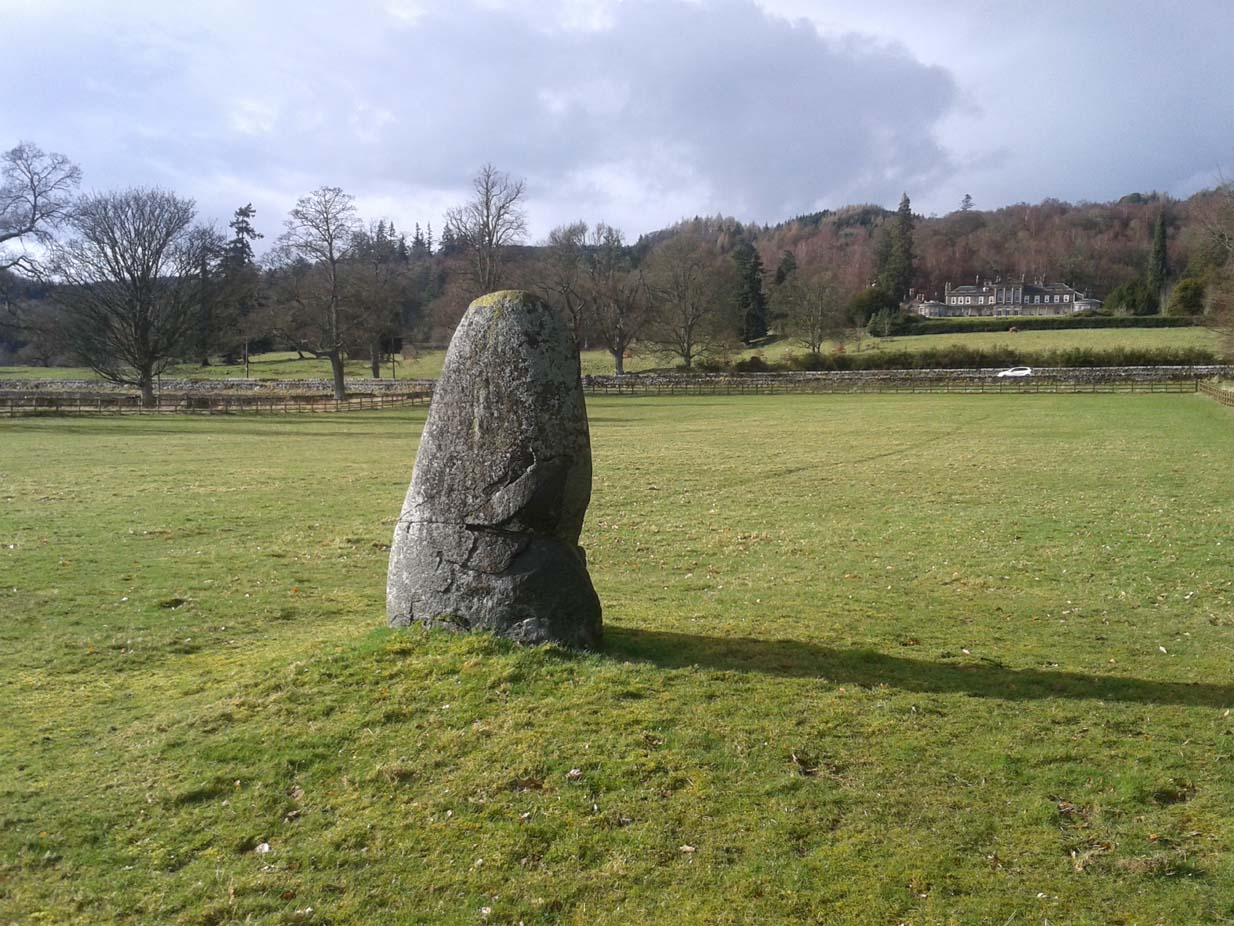
Mailer Fuar (2), Glen Artney, Comrie, Perthshire

Cup-and-Ring Stone:  OS Grid Reference – NN 72936 17198

Getting Here
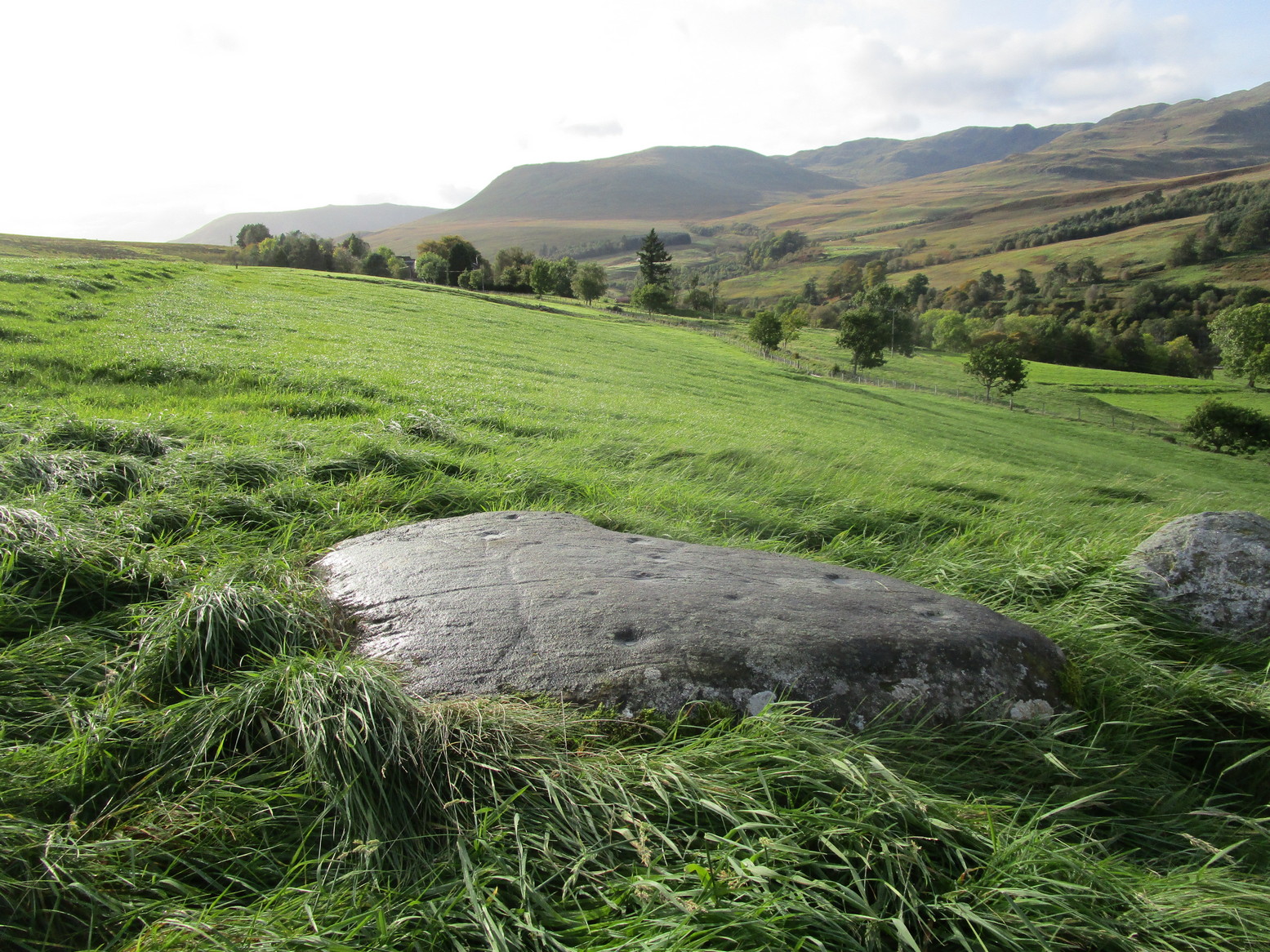
The carving in the landscape

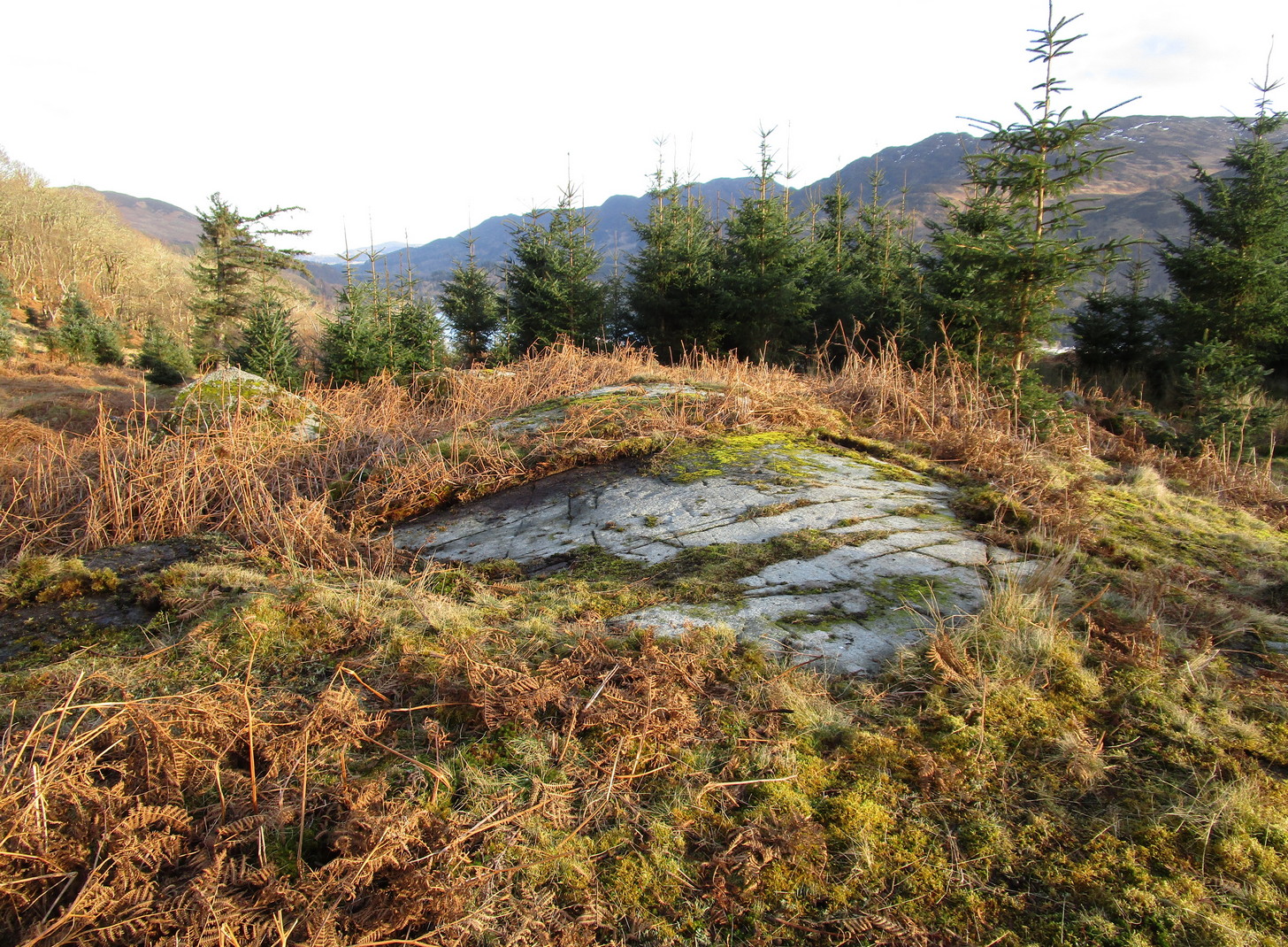
From Comrie take the B827 road to Braco and less than a mile out of town keep your eyes peeled for the tiny Glen Artney road on your right.  Past the derelict Dalness cottage 3 miles on, a half-mile further, just where you hit a track-road veering downhill on your right, you need to park up in the small parking-spot on your left.  Walk along the road 100 yards, keeping your eyes peeled again for the gate set back on your left (easy to miss!); go thru here, walk up the old path which bends back on itself before leveling out and, as it does, two or three small boulders lie just off the pathway on your right, one with its own petroglyph.

Archaeology & History

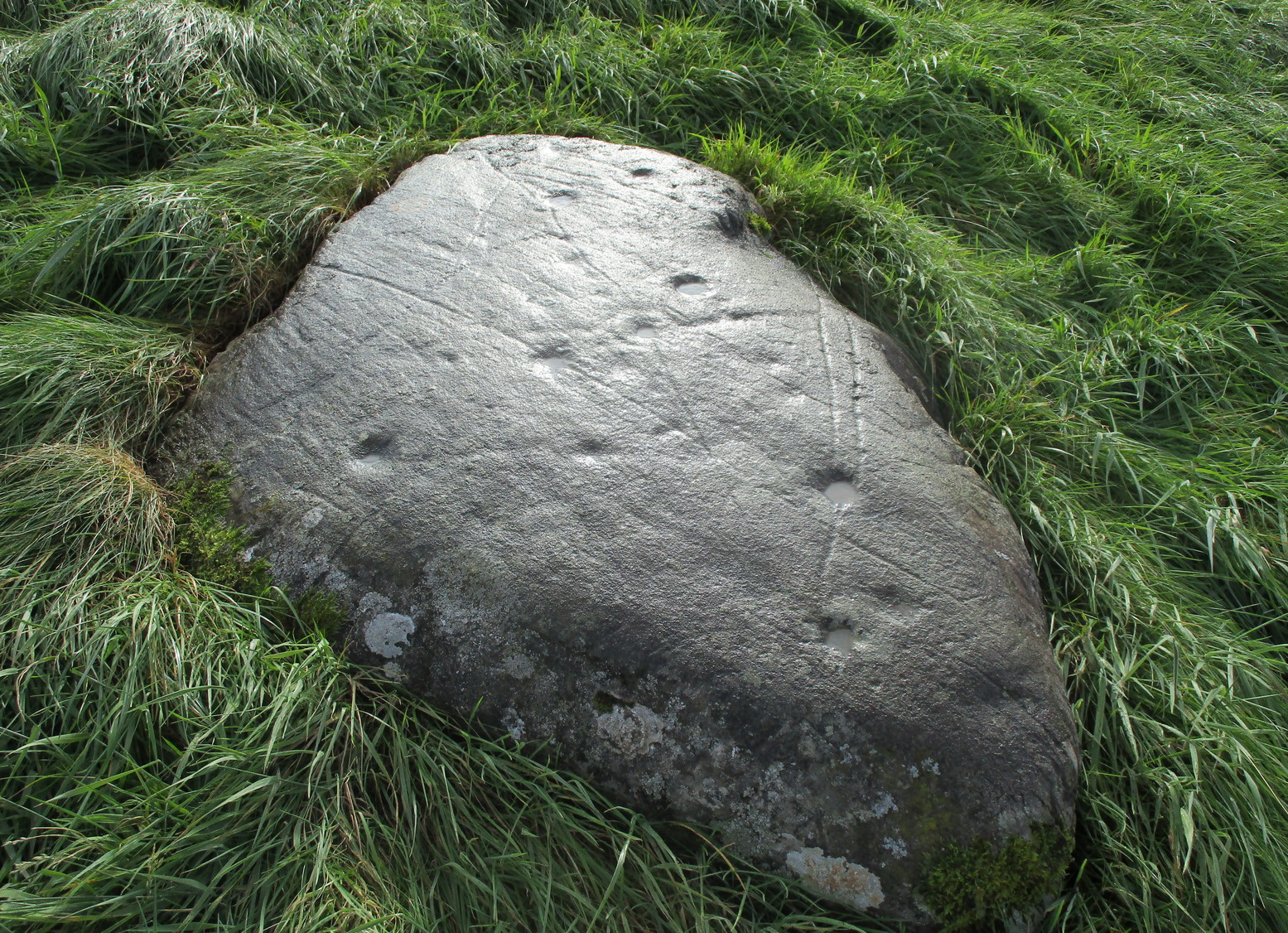
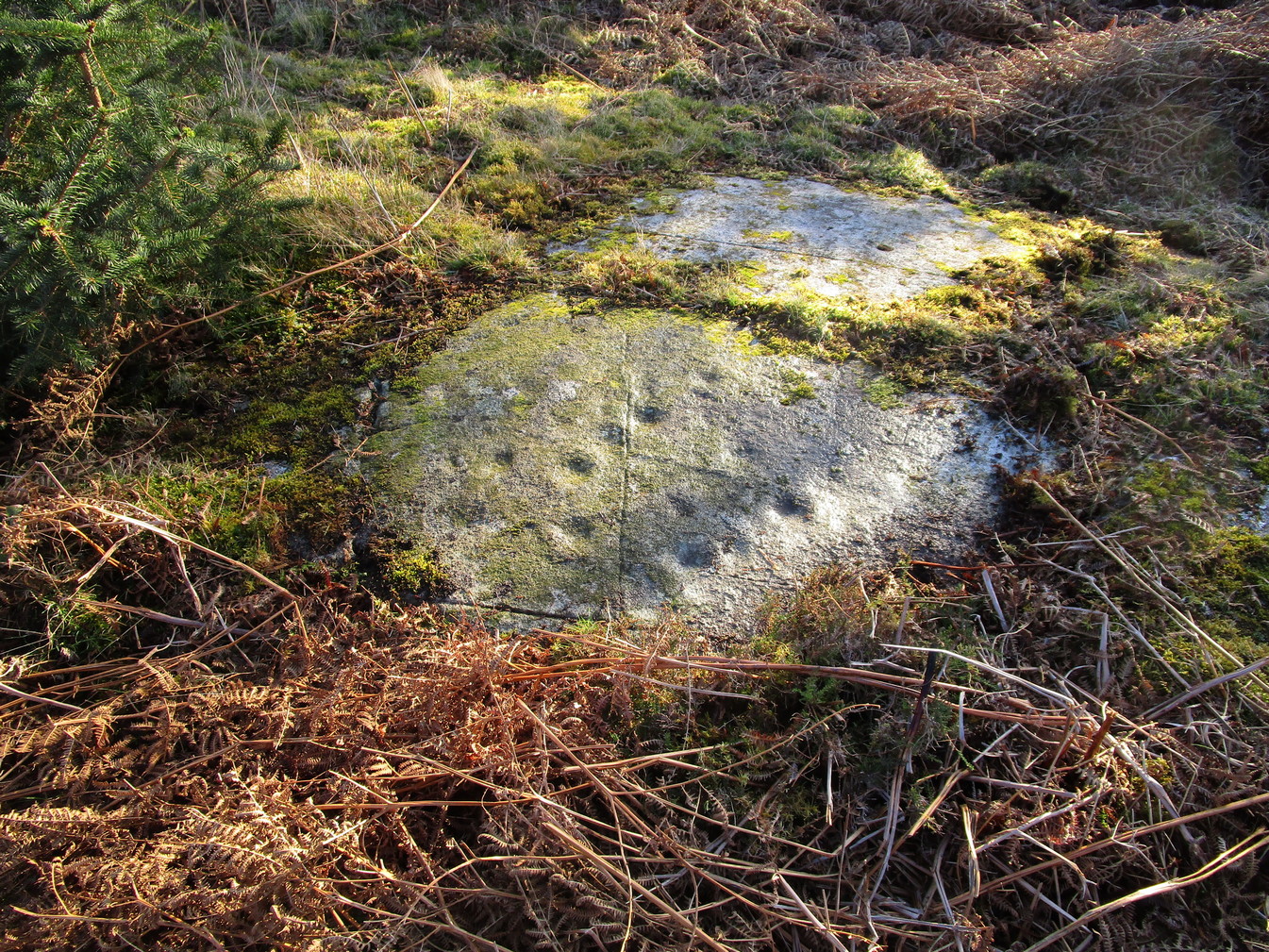
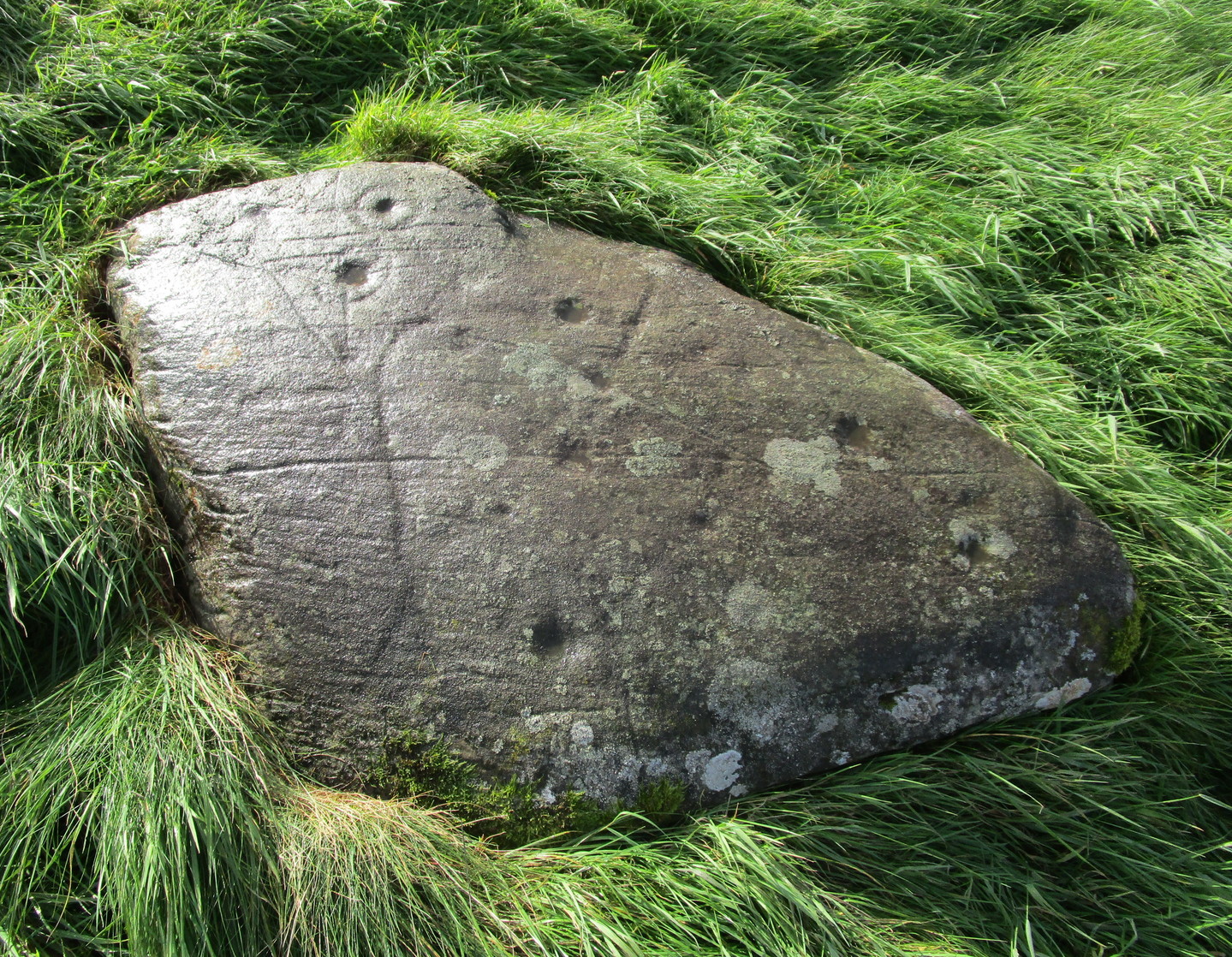
There are cups, rings and lines on this old stone, with the lines in particular being somewhat troublesome when it comes to working out their origin: some are natural, some made by modern farming implements (about a hundred years back), and some that were carved thousands of years ago—and it’s not that easy to work out which is which.  You’ll be able to see what I mean by looking at the photos.

Rediscovered, it would seem, by M.D. King in 1991, he described it plainly as a simple

“recumbent cup-marked stone 1900mm by 1200mm by 300mm…found in a stone dyke running down the hill from the deserted farm of Mailer Fuar.  The stone may have been moved down from its original position for inclusion in the now ruinous stone dyke.  Fourteen cup-marks were visible on the stone.”
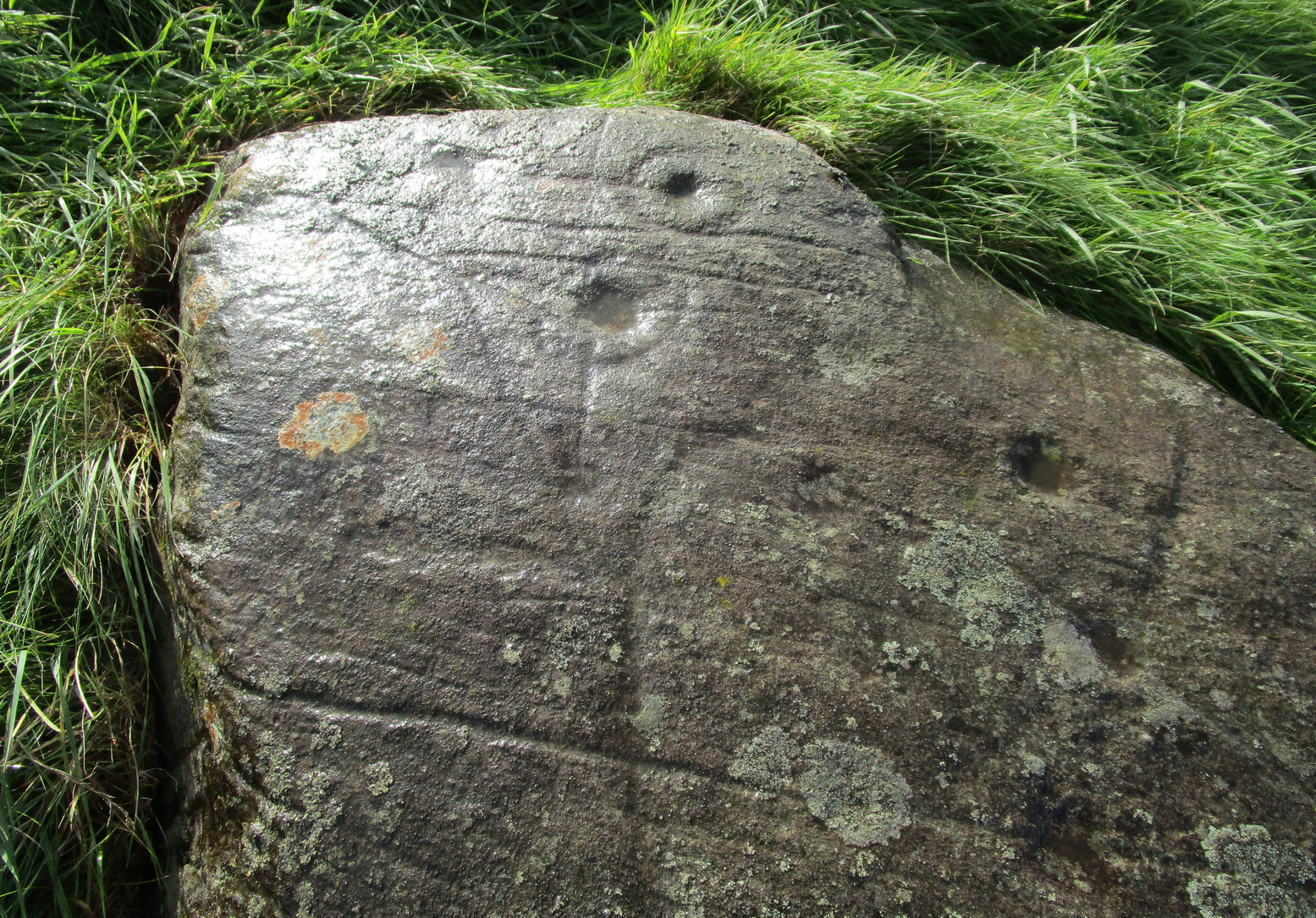
Complete cup-and-rings
CnRs and various lines

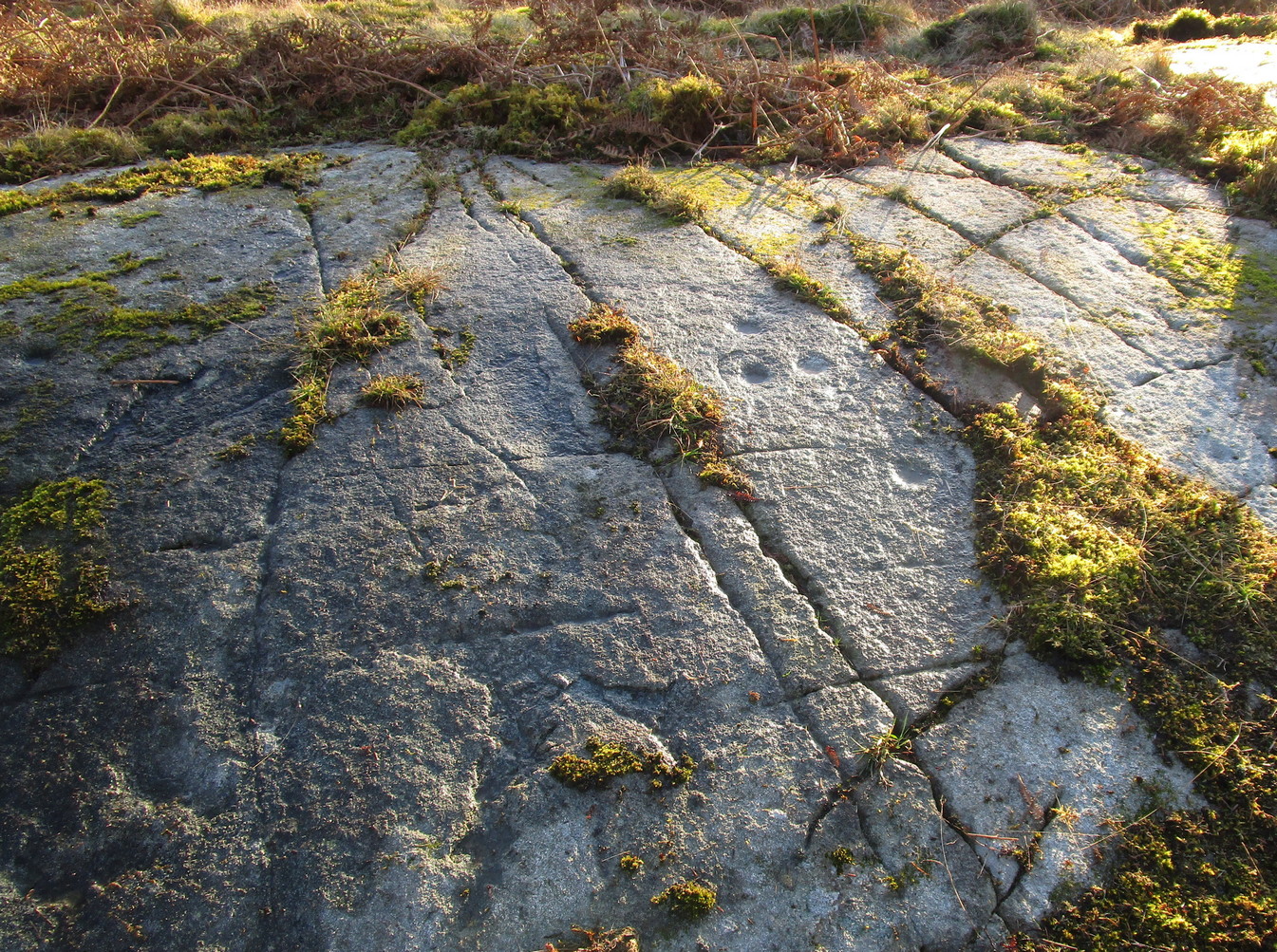
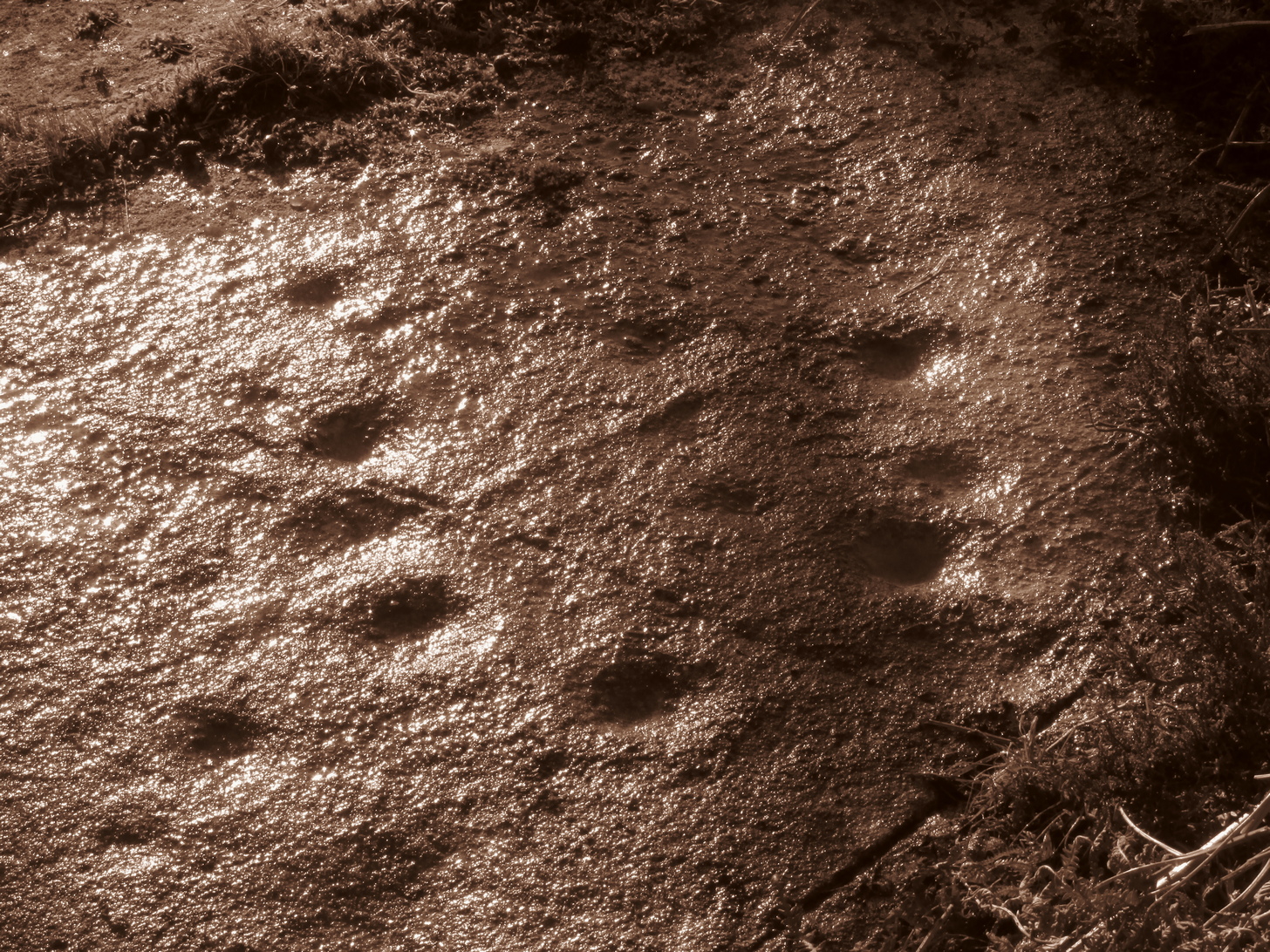
But there’s much more to it than that!  There are rings around the cups for starters.  Four of them.  Two cup-and-rings next to each other at the southeast portion of the stone are just about complete, as you can see (right); the various lines that run either side and into them seem to be a mix of early and more recent scratches—although I think we’re best asking a petromorphologist to tell us which is which!  We have a similar problem for another cup-and-ring near the centre of the stone, for it has two lines going right through its centre: one of them running almost the full north-south length of the stone giving the impression it was carved a long time back, yet looking much less ancient when it comes to its form and erosion; whilst the other line—almost at right-angles to the first—has a decidedly more archaic worn appearance.
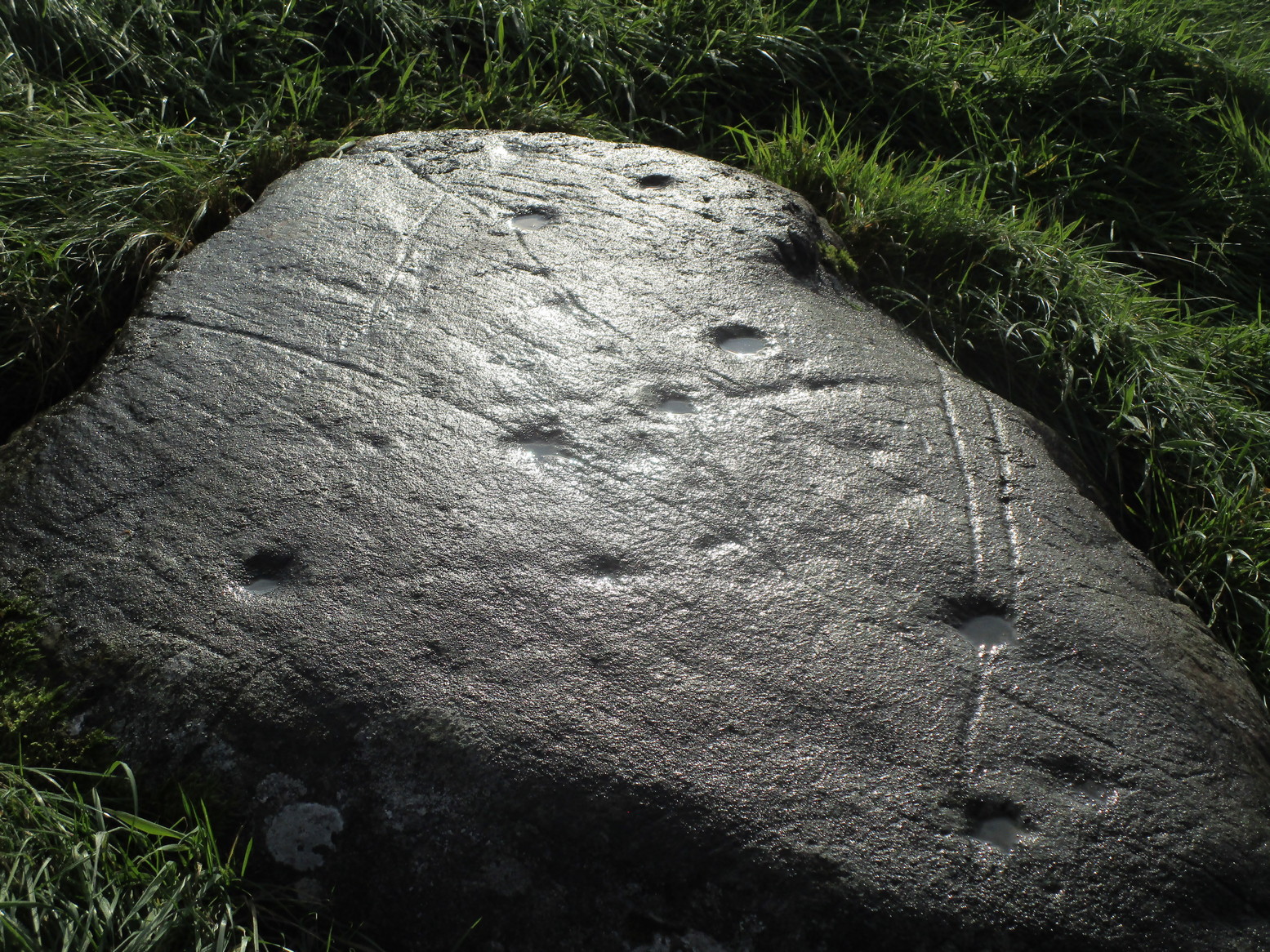
General design in low light
Long line, curving at top

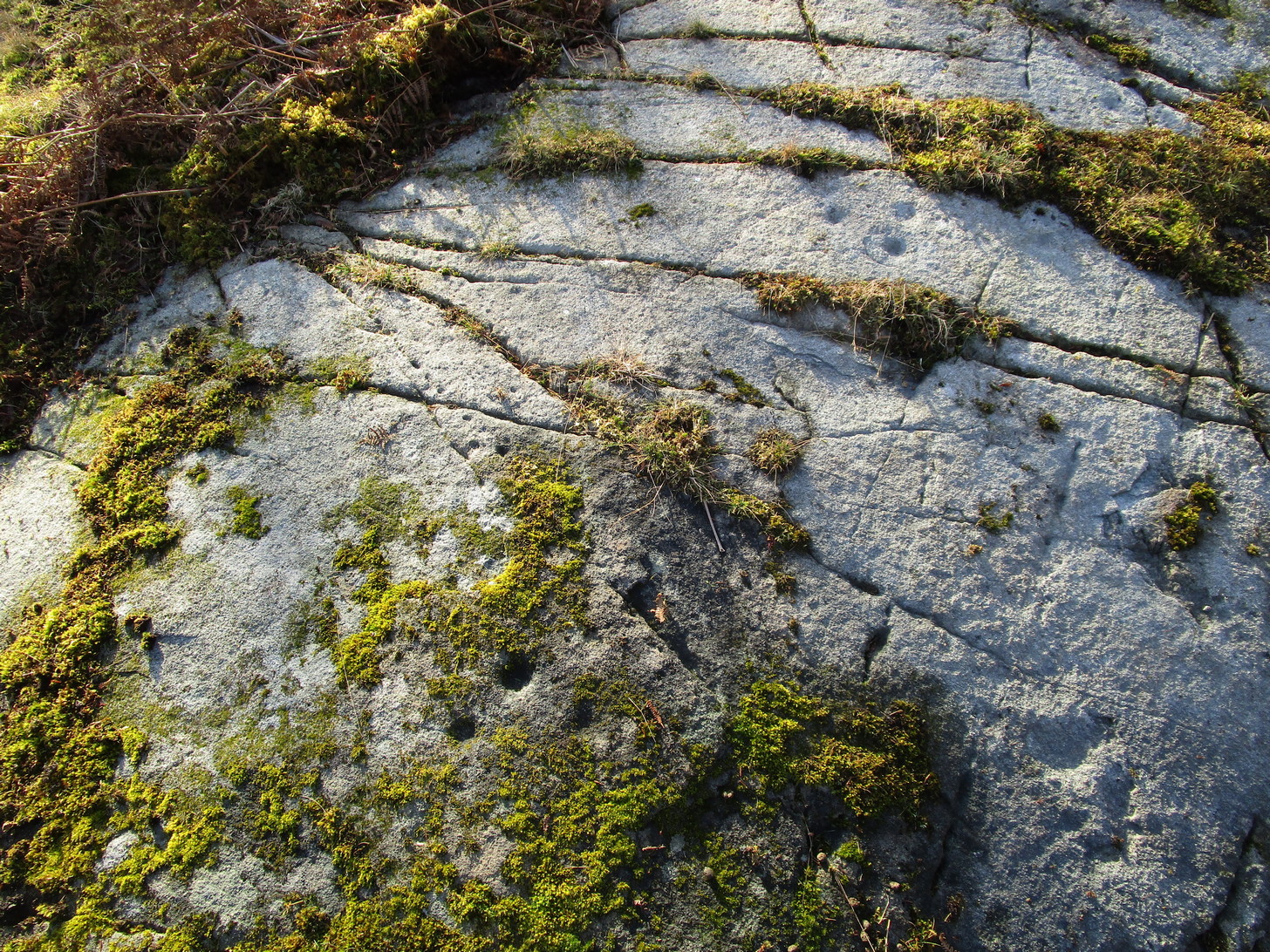
One of the more assured “ancient” carved lines is on the eastern section of the stone. (left)  It’s an odd looking thing, not very clear on the photo, comprising an elongated curved line, with a fork at the bottom, almost like short legs on an elongated stick-man like the ones we drew as kids.  The long line seems to eventually curve over and into one of the cup-marks.  Adjacent to the bottom of this forked curve is a cup and faint incomplete ring with a faint line running out of its centre to a smaller faint cup to its west.  You can see this reasonably well in the lower photo (right)

The carving needs a lot of attention if we’re to work out its original design, as the photos show.  Even the millionaire computer-tech work of the Scottish rock art club didn’t really suss out the differences regarding chronological elements in this carving (I don’t think they even mentioned it), which shows how difficult some of these buggers can be!  Personally, I’d love to see the impression of some good artists at this stone when the light’s just right and see what their mind’s eye brings to the fore.

After all this I’ve not even mentioned its position in the landscape.  Go check it out and see for y’selves.  It’s a bittova beauty!  And then wander a little further uphill to look at the Allt na Drochaide (1) carving I found not long ago.  The view’s even better from there!

References:

  1. King, M.D., “Mailer Fuar (Comrie parish): Cup-marked Stone”, in Discovery Excavation Scotland, 1992.

© Paul BennettThe Northern Antiquarian
Dome Rock, St Fillans, Comrie, Perthshire

Cup-and-Ring Stone:  OS Grid Reference – NN 67511 25028

Getting Here

Dome Rock

On the A85 road from St Fillans to Lochearnhead, about 1½ miles on is the Loch Earn Sailing Club, with a large parking spot thereby.  From here, cross the road and go through the gate up the dirt-track, past the cottages where the track bends right until a few hundred yards further up where the track splits, bear right, along and down across the river, up the other side and past the cottage.  From here, the track becomes a grassy footpath.  Walk along here, east towards the trees 5-600 yards away.  Once you go through the large wooden slip-gate, about 150 yards on the path into the scattered trees, you’ll see a large dome-shaped rise on your right (south).  Y’ can’t really miss it!

Archaeology & History

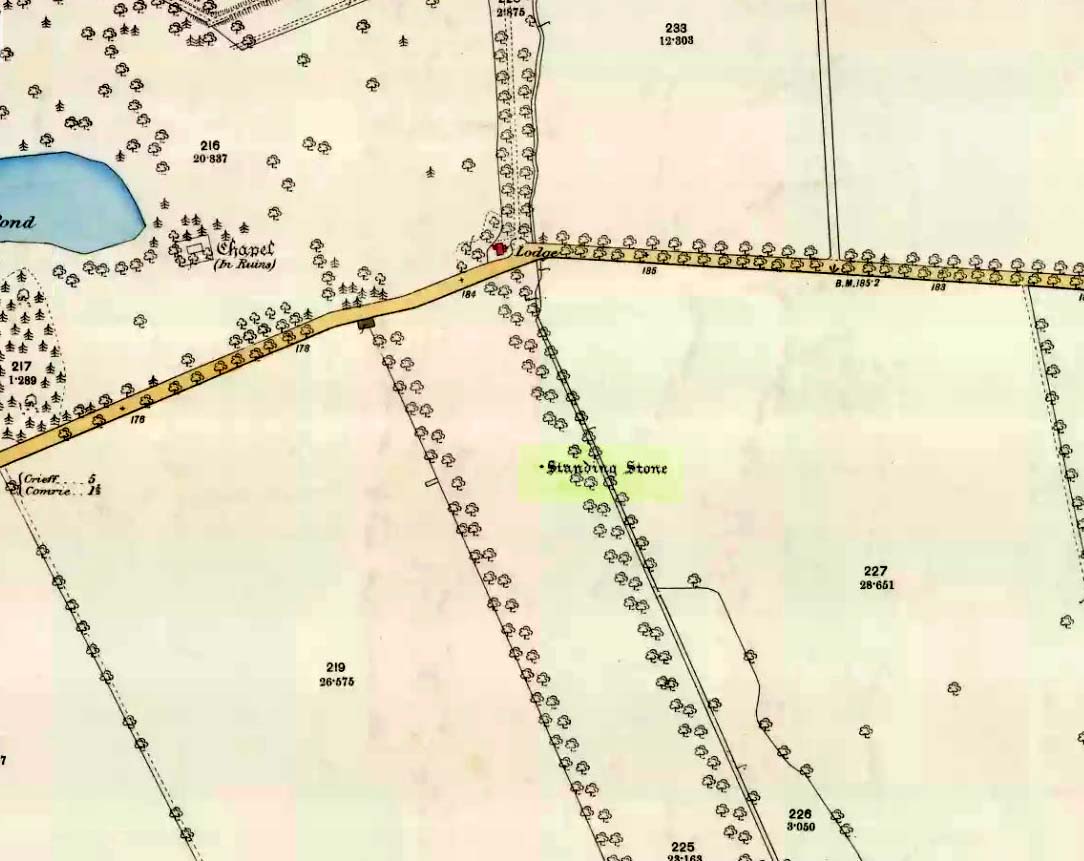
This carving was rediscovered by the great Scottish petroglyph writer Ron Morris in 1968.  He told that, just below the overgrown track, “is a big dome-shaped outcrop with a smooth top.  On a scattered area on this, in 3 main groups, are over 24 cup-marks, up to 3″ diameter, ½” deep.”  But these aren’t mere cup-marks…

Faint, albeit clear cup-and-rings
Cup-marks, top & bottom of photo

It literally is just like a large dome of rock, with carvings on certain sections of it.  Half of the cup-marks are easy to see, especially the ones near to the top of the dome and which exist in three main clusters.  Much more faint is another, larger cluster of cups, on its south-side.

Dealing with those on top of the rock: on the easternmost side a long natural crack separates a faint single cup-mark from a notable triangle of three, clearly visible in the photo (left).  Below this are what may be a couple more cups, but they were difficult to make out and may simply be Nature’s handiwork.  Certainly Nature has a part to play in the next small cluster of cups about six-feet further along the stone.  A shallow natural ‘arc’ has clearly been used to create a ring around one of the cups, clearly visible in the photo (right), with another faint cup-and-ring visible below it.  In between these, both Paul Hornby and I could make out what may be another incredibly faint smaller cup-and-ring (and which seemed evident on a couple of photos), but we need to wait for the computer-tech boys to get their teeth into that one!  Several other single cup-marks exist either side of another moss-covered crack in the rock.  And as we roll over the top western-edge of the stone, another small cluster of three, maybe four single cup-marks greets our attention.

Close-up of southern C&Rs
Southern carved section

It’s on the sloping south-side of the stone where the best cluster is found.  At least ten faint cup-marks—one or two with very faint incomplete rings round them—are arranged in gentle arcs into the rock.  On both sides of this section is a covering of vegetation, beneath which the carved designs probably continue.  In fact if this entire stone dome was completely free of vegetation, it’s likely we’d have a much larger piece of prehistoric rock art.  A job for future antiquarians perhaps…

References:

  1. Morris, Ronald W.B., “Glentarken Wood, Strathyre – Cup-marked Rocks,” in Discovery & Excavation Scotland, 1969.

Acknowledgments:  Big thanks to Paul Hornby for use of his photographs.  Cheers dood. 😉

© Paul BennettThe Northern Antiquarian

Wester Glentarken (2), St Fillans, Comrie, Perthshire

Cup-Marked Stone:  OS Grid Reference – NN 66431 24782

Getting Here

Singe cup-mark, near the middle of the stone

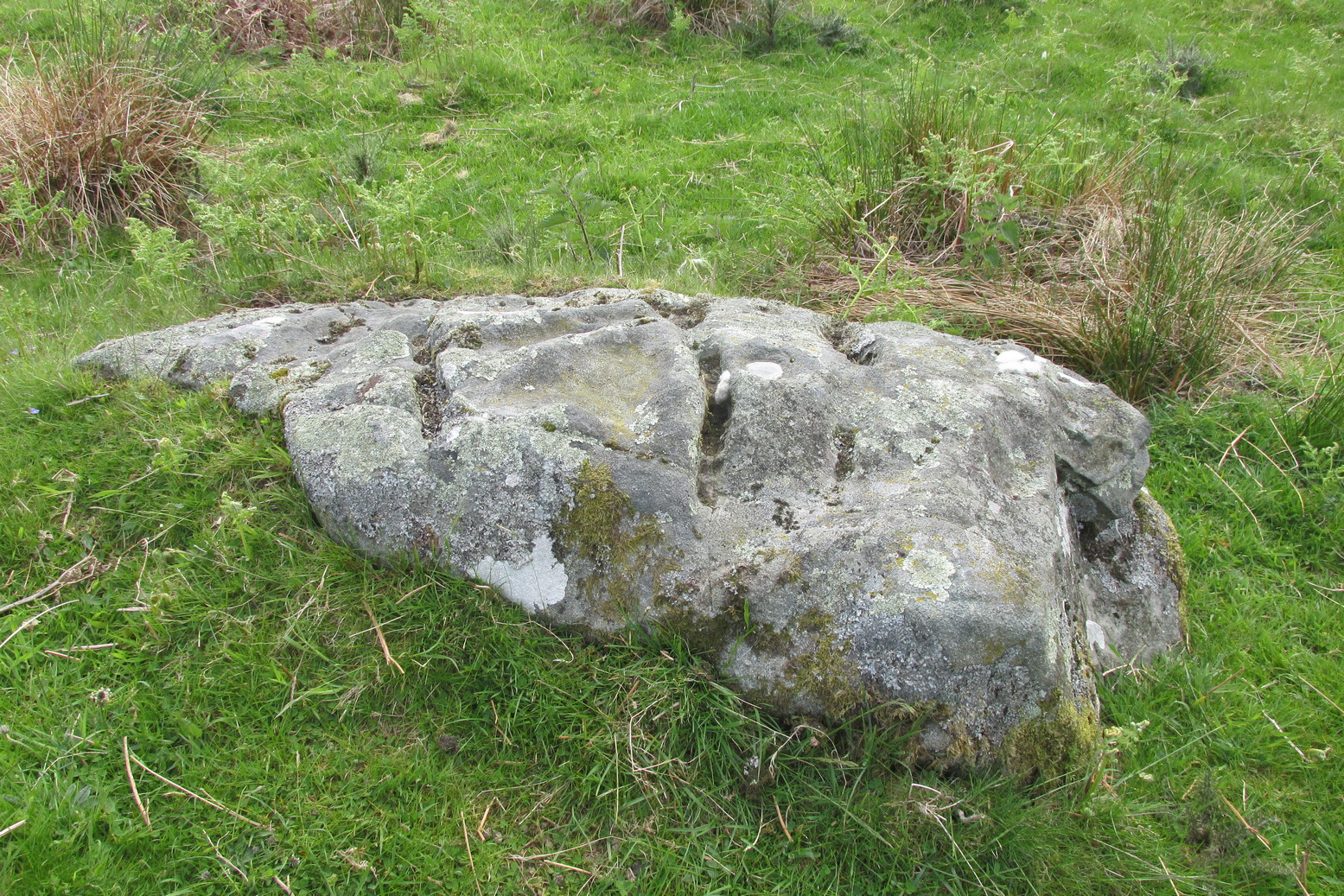
Follow the same directions as if you’re visiting the Wester Glentarken (1) carving, but some 10-15 yards before reaching it, you’ll notice this smaller rock with a series of curious naturally-eroded features on it.

Archaeology & History

This rounded stone has a series of natural deep cracks and undulating geological features on its surface, some of which look like elongated man-made cup-marks—but they’re not!  The only man-made ingredient on this stone is the deep single cup-mark close to the centre of the stone, as you can see in the photo.  That’s it—nowt else!

© Paul BennettThe Northern Antiquarian
Wester Glentarken (1), St Fillans, Comrie, Perthshire

Cup-Marked Stone:  OS Grid Reference – NN 66412 24783

Getting Here

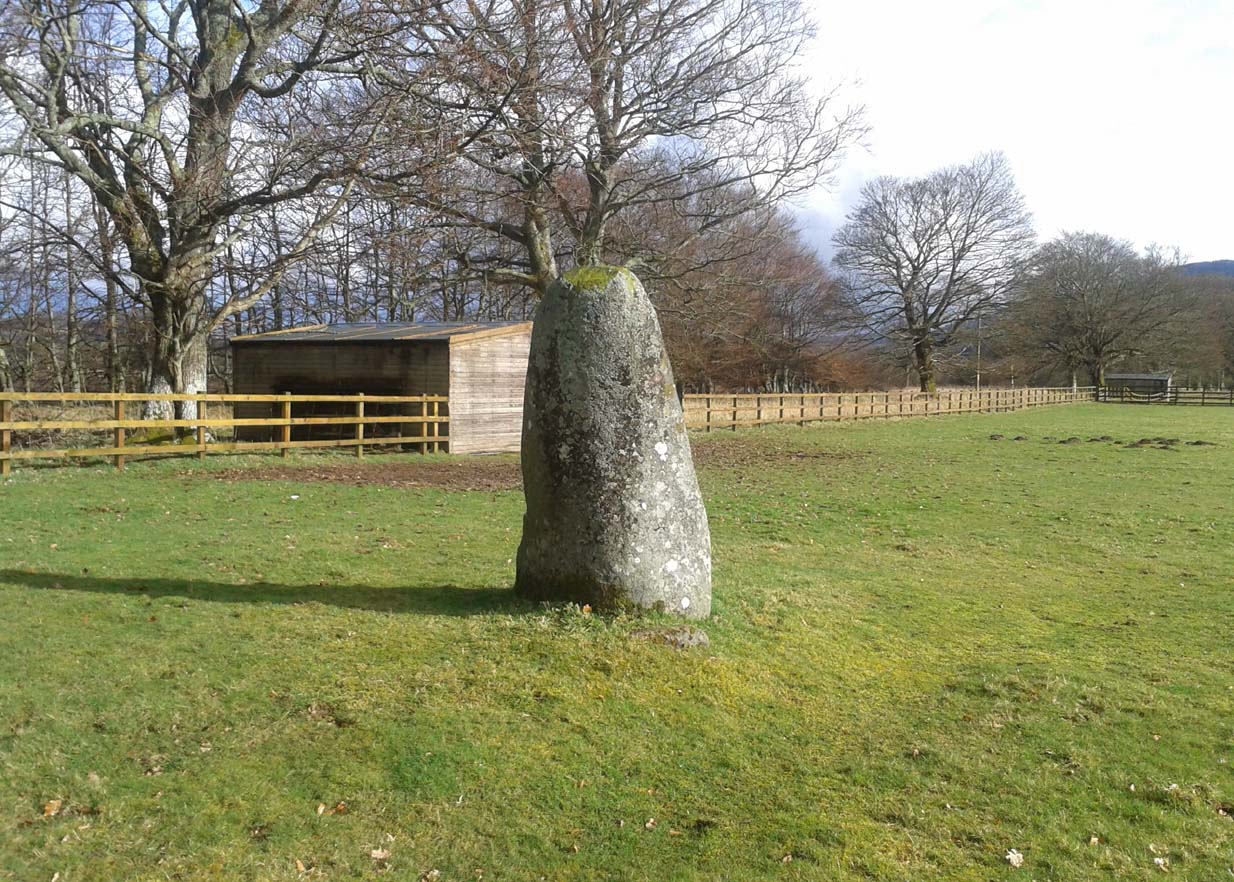
Cupmarked stone in situ

1½ miles out of St Fillans on the A85 road to Lochearnhead you’ll reach the boating marina by the lochside.  A hundred yards or so past this, park up.  Cross the road and walk 50 yards to your right then follow the dirt-track up into the trees.  After ⅓-Mile (0.5km) turn left to the old house on your left and follow the green path around it, then around the right-side of the rocky knoll in front of you.  Once you’re on the level ground around the knoll, walk forward for less than 100 yards.  Y’ can’t really miss it!

Archaeology & History

4 of the 5 main cups

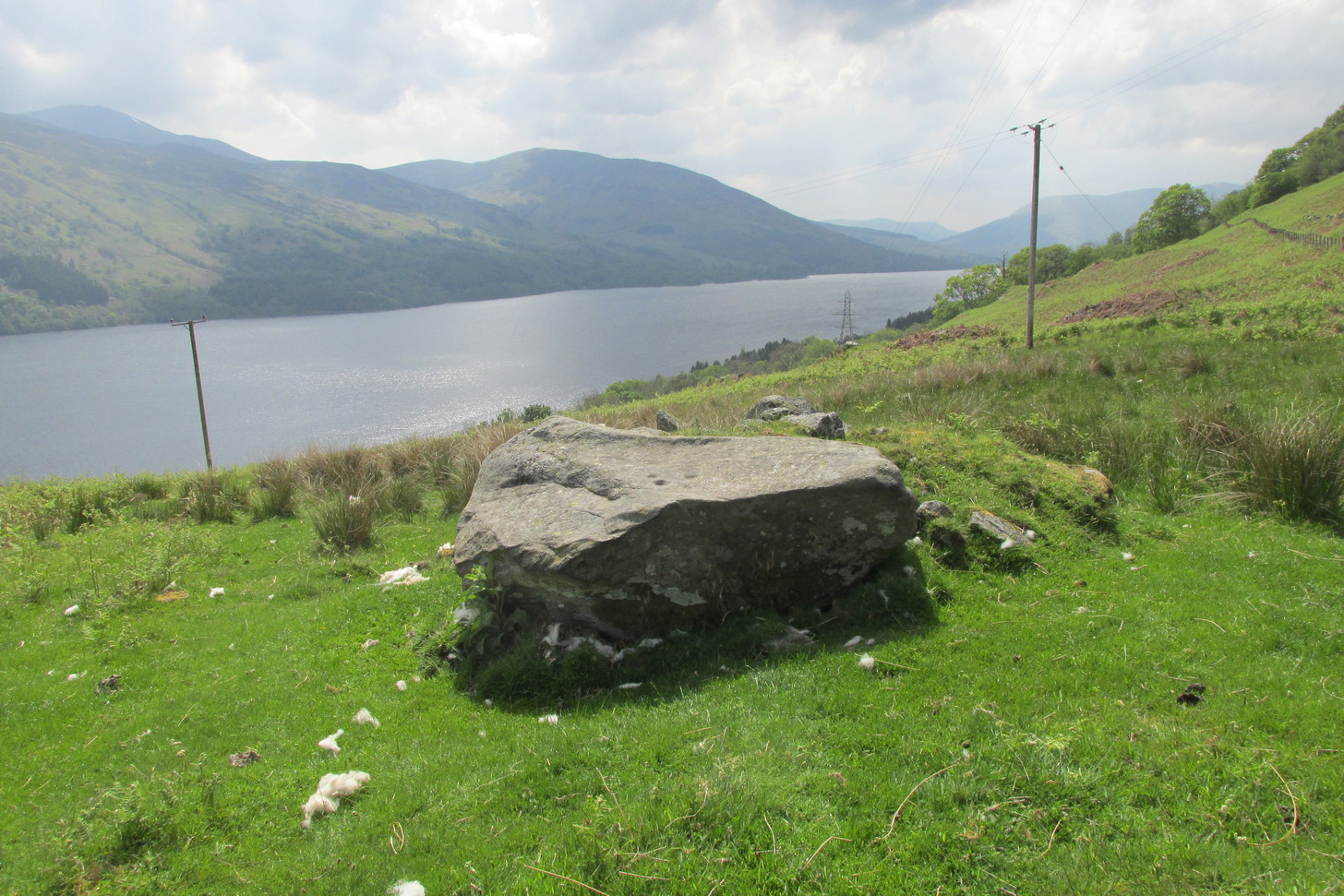
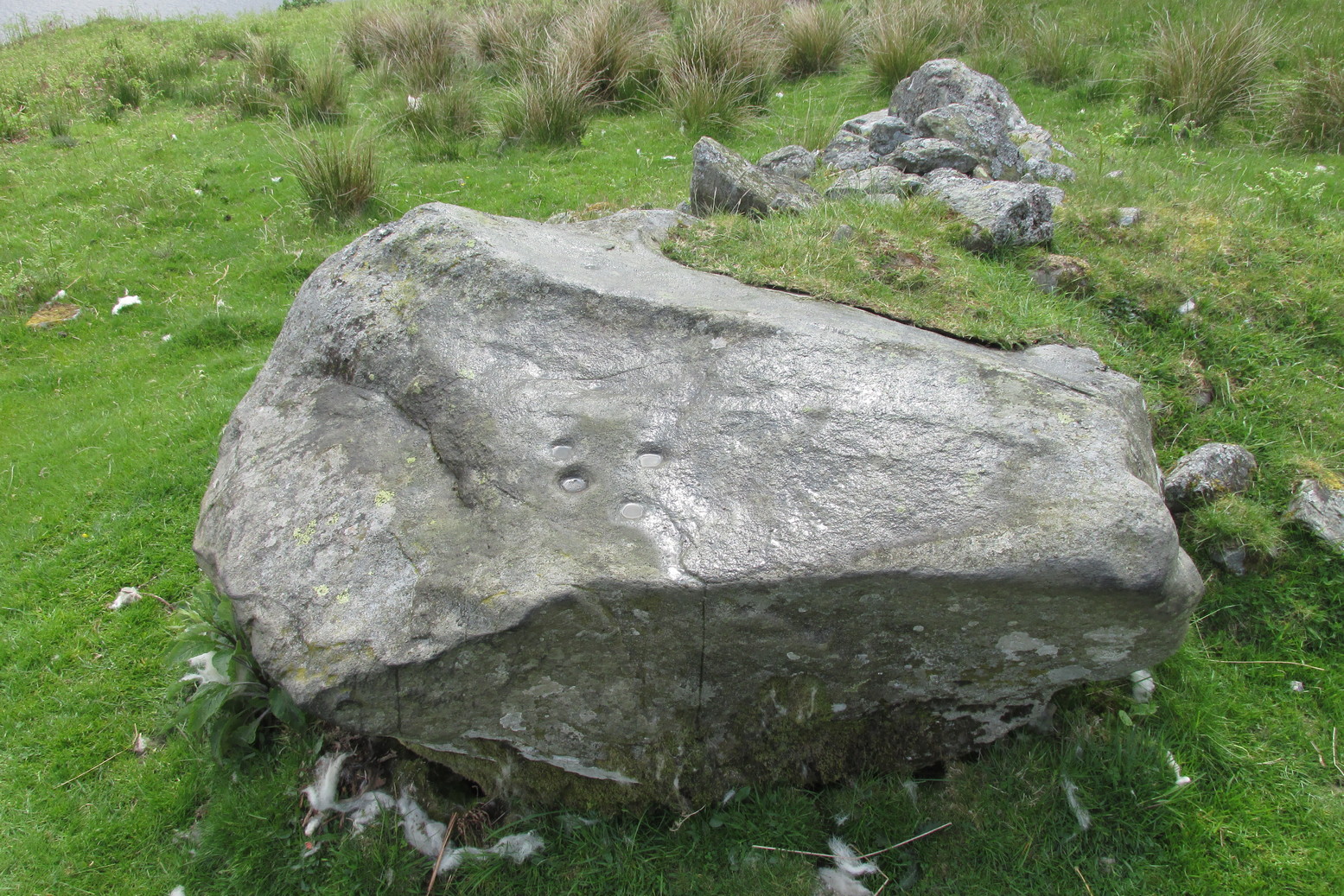
A simple design, but a clear one, of four deep cup-marks which can be seen on the eastern side of the stone, with a solitary one—much more faint—just over the rise on the more western section of the rock.

There are a number of other large sections of rock around the knoll with what appear to be cup-markings of various forms, but apart from perhaps one or two exceptions, the vast majority of them—as Currie (2005) also noted—seem to be natural.

References:

  1. Currie, George, “Wester Glentarken, Perth and Kinross (Comrie parish), cup-marked rocks,” in Discovery & Excavation Scotland, vol. 6, 2005.

© Paul BennettThe Northern Antiquarian
St. Patrick’s Well (1), Dunruchan, Muthill, Perthshire

Holy Well:  OS Grid Reference – NN 77905 17365

Getting Here

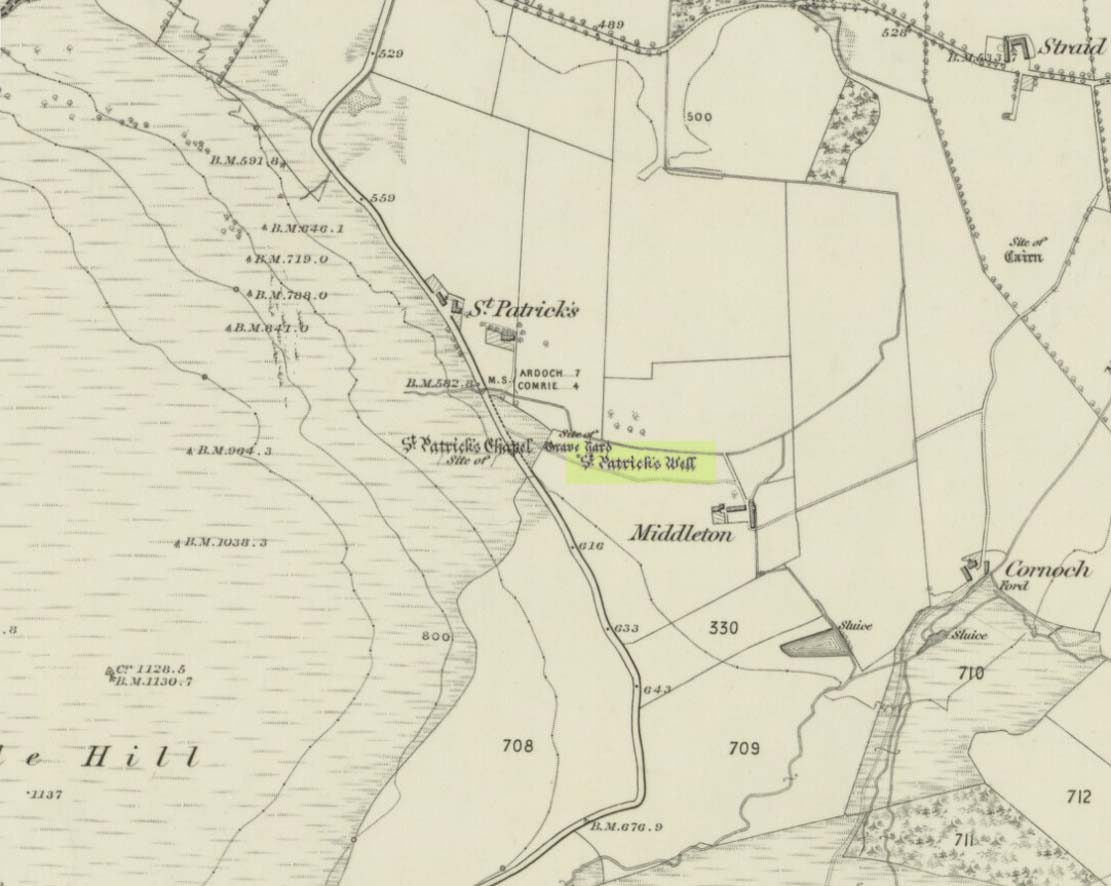
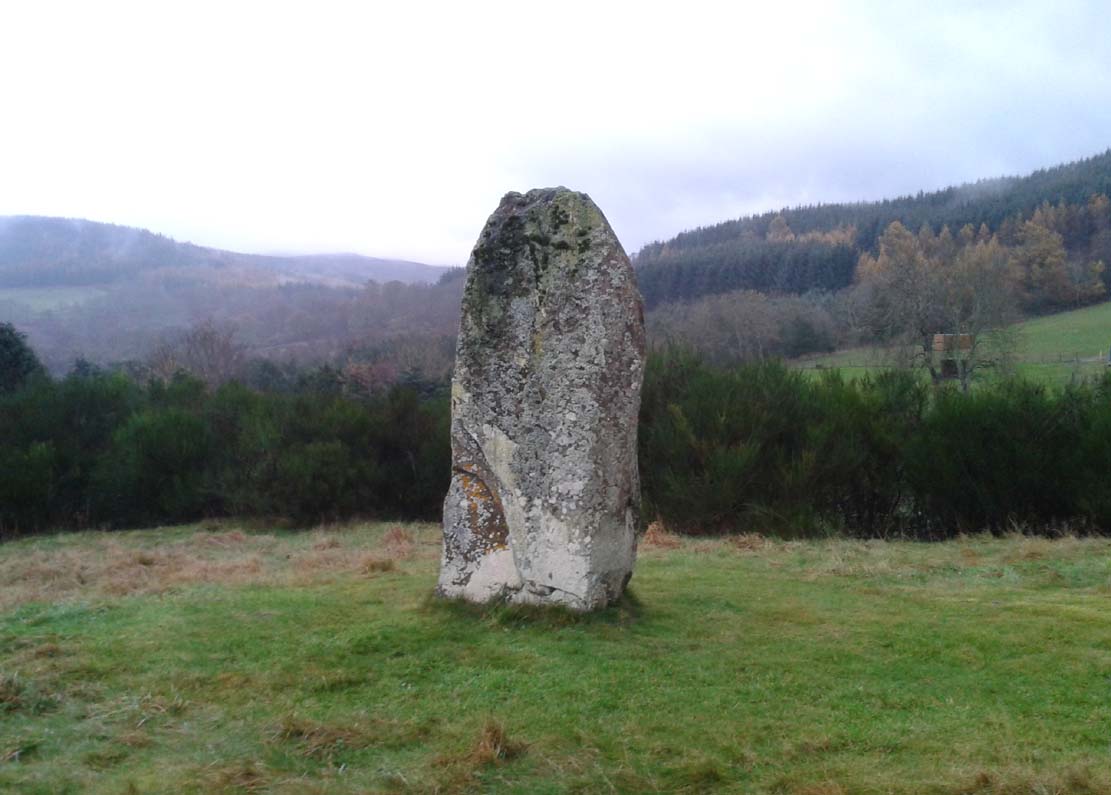
St Patricks Well on 1863 map

Take the B827 road between Comrie and Braco. If you’re coming via Comrie, going uphill for 3.1 miles (5.1km); but if from Braco Roman Camp go along and eventually downhill for 6.6 miles (10.6km), watching out for the track to Middleton Farm by the roadside.  Walk along for 125 yards, keeping your eyes peeled for the boggy ground below on your left. You’re there!

Archaeology & History

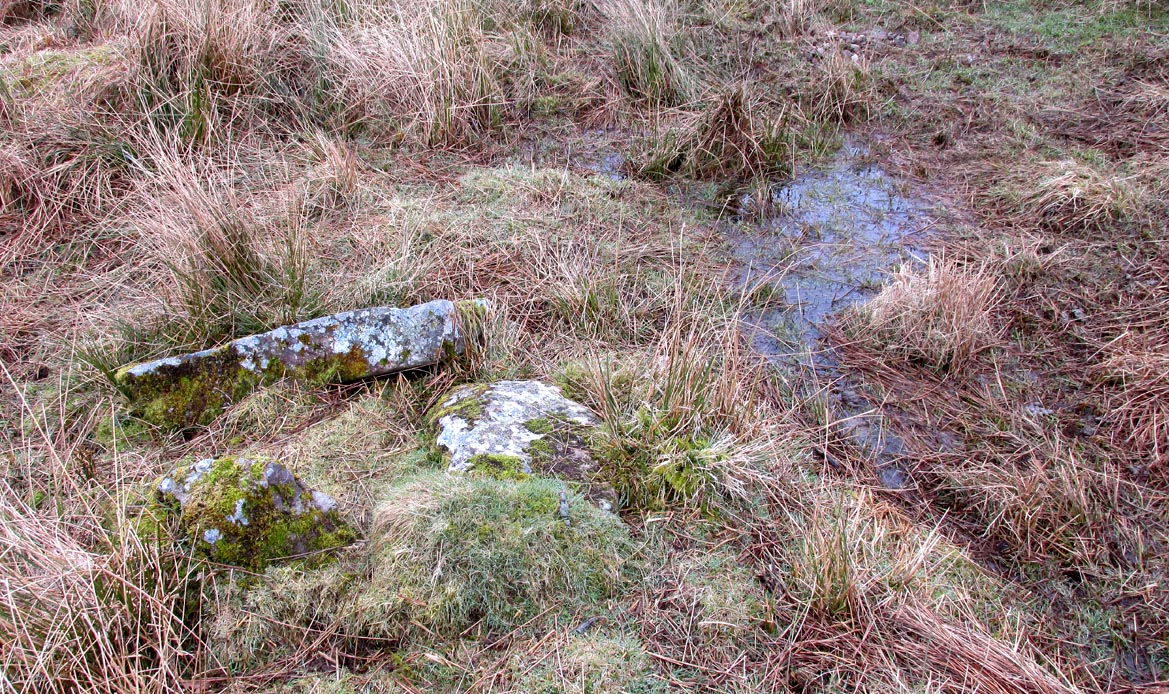
Immediately east of the prodigious megalithic complex of Dunruchan, bubbling up amidst the usual Juncus conglomeratus reeds, are the boggy remnants of St. Patrick’s Well—one of two such sacred wells dedicated to the early Irish saint in Muthill parish. We’re at a loss as to why this Irish dood has such sites in his name in this area.  No doubt some transitional shamanic character was doing the rounds in this glorious landscape, muttering words of some neo-christian animism, eventually settling a mile from the great megalithic complex, perhaps hoping—and failing—to convert our healthy heathen populace into ways unwise.

The shallow boggy waters
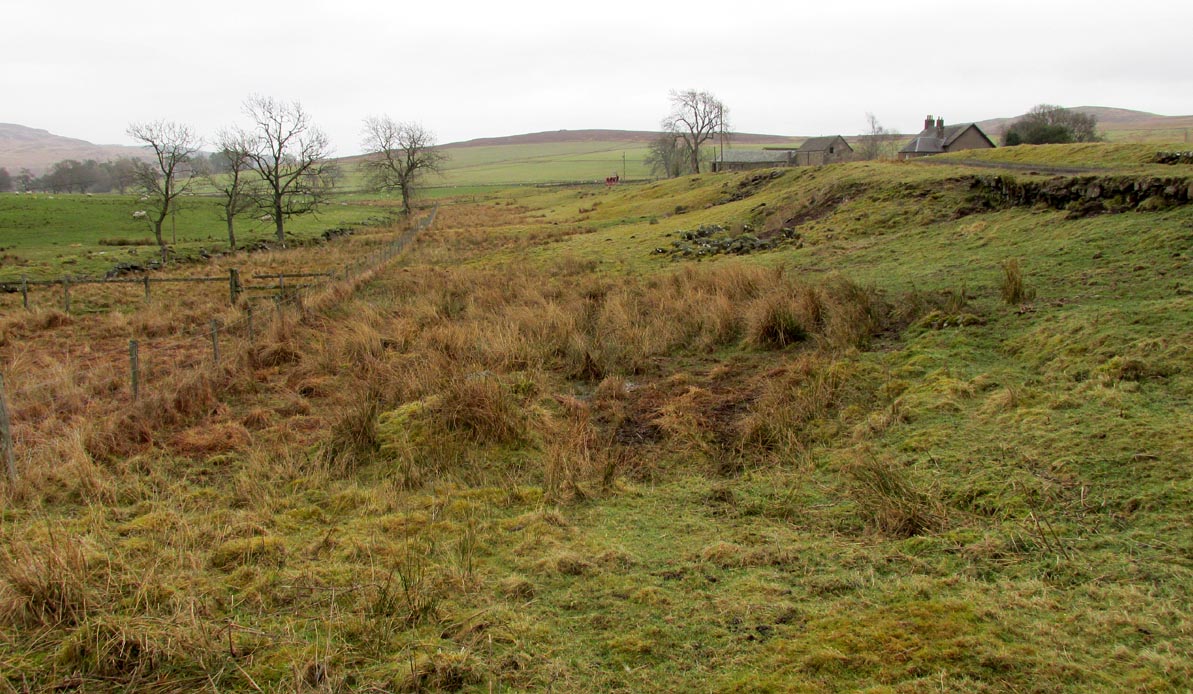
The site of St Patricks Well

Whatever he may have been up to, a small stone chapel was built hereby and, it was said, even a christian graveyard, to tempt folk away from the ancient plain of cairns whence our ancestors had long since buried their dead.  But the christian’s chapel and graveyard has long since gone; and when historians before me had visited the place, St Patrick’s Well had also fallen back to Earth in the drier summers, taking the blood of the Earth back into Her body.  The heathen megaliths still remain however, standing proud on the moorland plain in clear sight from these once healing waters, whose mythic history, on the whole, has long since been disregarded….

Folklore

St Patrick’s day on March 17—”a date very near the Spring Equinox,” as Mrs Banks (1939) reminded us—may have been the dates when the waters here were deemed particularly efficacious, although we have nothing in written accounts to tell us for sure. But in the 19th century Statistical Account we find that the site was “much frequented once, as effectual in curing the hooping cough.”  E.J. Guthrie (1885) told of an ancient rite regarding the drinking of the waters for effect of the cure, saying:

“In the course of this century a family came from Edinburgh, a distance of nearly sixty miles, to have the benefit of the well. The water must be drunk before sunrise or immediately after it sets and that out of a “quick cow’s horn”, or a horn taken from a live cow, and probably dedicated to this saint.”

Also in Muthill parish, Guthrie told, St Patrick’s memory was held in such veneration that farmers and millers did not work on his day.

References:

  1. Banks, M. MacLeod, British Calendar Customs: Scotland – volume 2, Folk-lore Society: Glasgow 1939.
  2. Booth, C. Gordon, “St Patrick’s Well (Muthill Parish),” in Discovery & Excavation, Scotland, New Series volume 1, 2000.
  3. Guthrie, E.J., Old Scottish Customs, Thomas D. Morison: Glasgow 1885.
  4. MacKinlay, James M., Folklore of Scottish Lochs and Springs, William Hodge: Glasgow 1893.
  5. Morris, Ruth & Frank, Scottish Healing Wells, Alethea: Sandy 1982.

© Paul BennettThe Northern Antiquarian

Samson’s Stone, Crieff, Perthshire

Legendary Rock:  OS Grid Reference – NN 82519 22021

Also Known as:

  1. Canmore ID 96866

Getting Here

Samson Stone on 1866 map

Samson Stone on 1866 map

Tale the A85 road between Comrie and Crieff and, roughly halfway between the two towns, take the minor road south to Strowan (it’s easily missed, so be aware!).  A few hundred yards along, stop where the trees begin and walk into the fields immediately east.  Keep walking, below the line of the trees, and you’ll get to it within five minutes.

Archaeology & History

Samson's Stone, looking east

Samson’s Stone, looking east

Mistakenly cited by some as a standing stone, the large boulder which rests here on the hillside just below the woodland is a glacial erratic.  Highlighted on the 1866 OS-map of the region, I hoped that we might find some rock art on the stone, but cup-and-rings there were none.  However, there is a curious ‘footprint’ on top of it, similar to the ones found at Dunnad, at Murlaganmore and other places (see Bord 2004); but I can find no previous reference to this carved footprint.

'Footprint' on top of stone

‘Footprint’ on top of stone

In 1863 the site was described in the local Name Book, where it was reported to be “a large oblong shaped stone lying on the surface, eight feet long, four wide, and three thick”; but, much like today, it was also reported that “There is no tradition respecting it in the neighbourhood. Supposed to have received the name in consequence of its great size.”

Most peculiar…..

References:

  1. Bord, Janet, Footprints in Stone, Heart of Albion Press 2004.

© Paul BennettThe Northern Antiquarian

Lawers, Comrie, Perthshire

Standing Stone:  OS Grid Reference – NN 80102 22666

Also Known as:

  1. Canmore ID 25535

Getting Here

Lawers01 (9)

Lawers standing stone, Comrie

Take the A85 road between Comrie and Crieff.  Nearly 1.7 miles (2.7km) east out of Comrie—or 4 miles (6.44km) west out of Crieff—keep your eyes peeled on the fields to the south-side of the road, below and across the mansion of Lawers House.  Alongside a long but small plantation of trees you’ll see a large upright stone.  You can walk along the track adjacent to the field and through the gate.

Archaeology & History

The stone on 1886 OS-map

The stone on 1886 OS-map

Shown on the early Ordnance Survey maps of the area, this probably neolithic monolith was suggested by Fred Coles (1911) to have once been part of a larger megalithic circle—although Aubrey Burl (2000) didn’t consider it as a good enough contender to be listed as such in his gazetteer; and unless we can have some positive affirmation, either through folklore or excavation, we should maintain its status as a singular monolith.  There is the possibility that it stood as an outlier or had some relationship with a nearby prehistoric tomb—but even this is contentious.  Nevertheless, the stone itself is an impressive one!

Mr Coles curiously got the size of the old stone wrong too (although, we have to give him credit, as he did all of his work without electricity or any of our modern ‘stuff’).  He wrote that:

“This massive boulder of whinstone is rounded at the base, where it girths 10 feet 3 inches, but tapers upwards to its apex of 5 feet 10 inches, with the eastern edge somewhat jagged and broken.  Near its base on the west is a small slab-like fragment of stone, quite earthfast.  The north and south surfaces are smooth and nearly vertical, and the longer axis is ESE 75º by WNW 75º.”

Fred Coles' 1911 sketch

Fred Coles’ 1911 sketch

Lawers monolith, looking SE

Lawers monolith, looking SE

The stone is actually larger than Coles described, being more than 6 feet 6 inches tall.  His sketch (right) “shows the stone from the east”, and is pretty much as we find it today.  A notable crack in the stone along the southern face, about a third of the way up, suggests that the stone was broken at some time in the past.

Local architect Andrew Finlayson (2010) included the stone in his local megalith guide and noted how the axes of the stone, east-west, lines it up with Ben Halton to the west and The Knock to the east.

References:

  1. Burl, Aubrey, The Stone Circles of Britain, Ireland and Brittany, Yale University Press 2000.
  2. Coles, F.R., “Report on stone circles in Perthshire principally Strathearn,” in Proceedings of the Society of Antiquaries, Scotland, volume 45, 1911.
  3. Finlayson, Andrew, The Stones of Strathearn, One Tree Island: Comrie 2010.

© Paul BennettThe Northern Antiquarian

Goose Oaks, St. Fillans, Comrie, Perthshire

Legendary Trees (lost):  OS Grid Reference – NN 693 242

Folklore

A fascinating story of this forgotten site is detailed in Alex Porteous’ (1912) history book on this tiny parish at the eastern end of Loch Earn.  It’s a peculiar tale—and unless the story was little more than the local people ripping the piss out of the patronising incomers, its nature remains a mystery.  Porteous wrote:

“What were known as the Goose Oaks grew by the loch-side about two or three hundred yards west from the hotel.  The story is told of a celebrated goose which attained to the great age of 160 years and finally gave up this life in 1818.  It is solemnly averred by Mr (John) Brown that the history of this goose was well authenticated and that the families and individuals who successively were owners of the goose were highly respectable, and that its history was preserved entire for the period back to 1658, while he naively adds—”How long it was in being prior to that date is uncertain.”  The goose was buried at the spot indicated, and the oaks trees, two in number, of which only one remains now, planted over its grave; but the story, as regards the age, must be looked upon as apocryphal.”

One wonders what on Earth Sir James Frazer might have made of this tale!

References:

  1. Porteous, Alexander, Annals of St. Fillans, Crieff 1912.
  2. Porteous, Alexander, Forest Folklore, Mythology and Romance, George Allen: London 1928.

© Paul BennettThe Northern Antiquarian

Auchingarroch, Muthill, Perthshire

Standing Stone:  OS Grid Reference – NN 78732 19579

Also Known as:

  1. Canmore ID 24795
  2. Roman Stone

Getting Here

Auchingarroch stone

The Auchingarroch stone

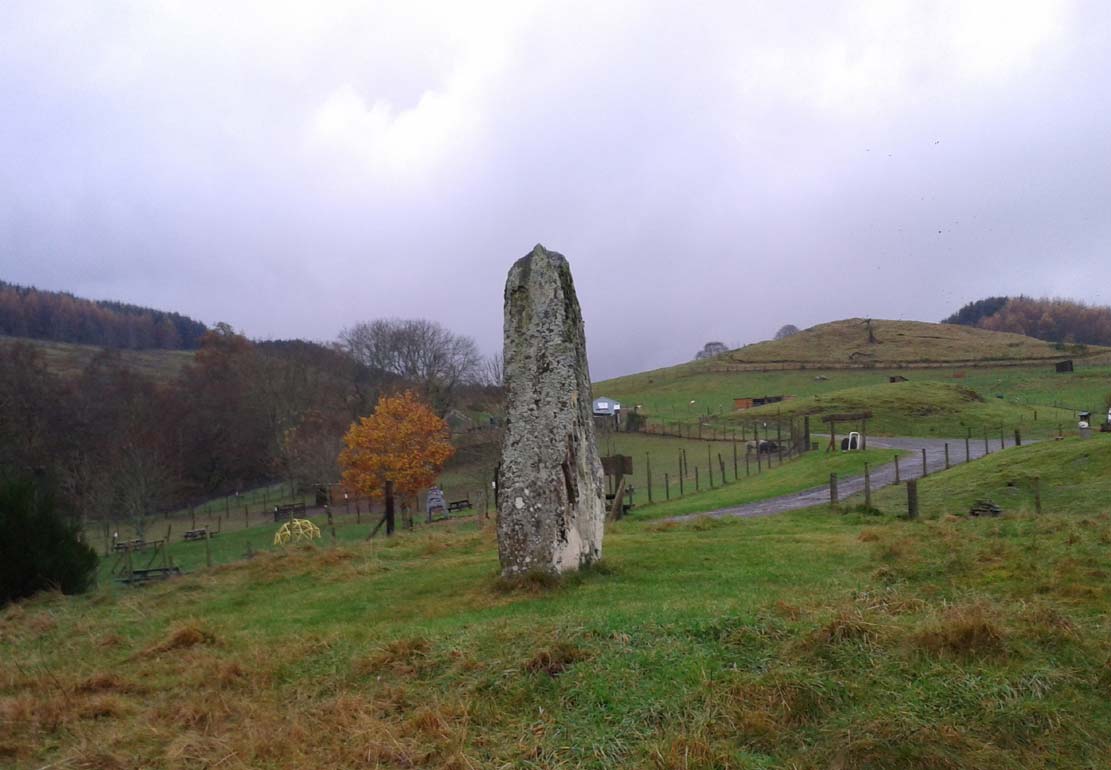
Take the B827 road south out of Comrie as if you’re heading towards Braco, and after a mile or so, as you start going uphill, turn left to go to the Wildlife Centre.  Go along the track and park up at the buildings.  The monolith is round the back of the first building (ask at the Centre, where the people there are very helpful).

Archaeology & History

F. Coles 19l1 sketch

F. Coles 19l1 sketch

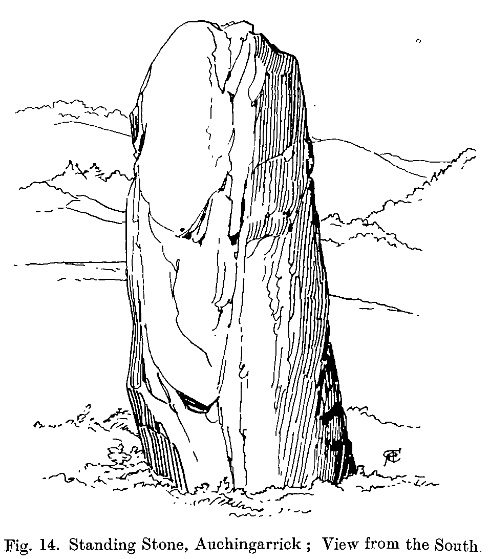
Shown on the earliest Ordnance Survey map of the region as one of several ‘Roman Stone’ sites, this prehistoric upright is similar in size and feel to the other standing stones in the highly impressive Dunruchan complex close by.  The big fella stands on a raised piece of ground more than 8½ feet tall and, said Fred Coles (1911) has “a basal girth of 12ft 8ins.”  Quite a big stone!  A dubious large cup-mark is visible on the thin western face and three faint ones on its east.

The monolith is surrounded all along the southern landscape arc with forested moorland and low mountains, with the primary extended views reaching mainly into the north and western arc.  Although a rounded hillock immediately southwest of the stone looks promising, no calendrical or astronomical alignments have been found here.

Folklore

Auchingarroch, looking SW

Auchingarroch, looking SW

As with the other standing stones in this region, legend ascribes it as marking the resting place of a Roman soldier who fell in a great battle close by with our local heathens, in what was known as “battle of Mons Grampius.”

References:

  1. Coles, F.R., “Report on stone circles in Perthshire principally Strathearn,” in Proceedings of the Society of Antiquaries, Scotland, volume 45, 1911.
  2. Finlayson, Andrew, The Stones of Strathearn, One Tree Island: Comrie 2010.
  3. Hunter, John, Chronicles of Strathearn, David Phillips: Crieff 1896.

Acknowledgements:  Thanks to Paul Hornby for the journey here; and more especially a different sorta thanks to Linzi Mitchell for her influence whilst the site profile of this megalithic erection was being written. Who sez that men can’t do two things at the same time?!

© Paul BennettThe Northern Antiquarian


Clach na Ba, St Fillans, Comrie, Perthshire

Legendary Rock:  OS Grid Reference – NN 70318 24159

Clach na Ba, from roadside

Also Known as:

  1. Stone of the Cattle

Getting Here

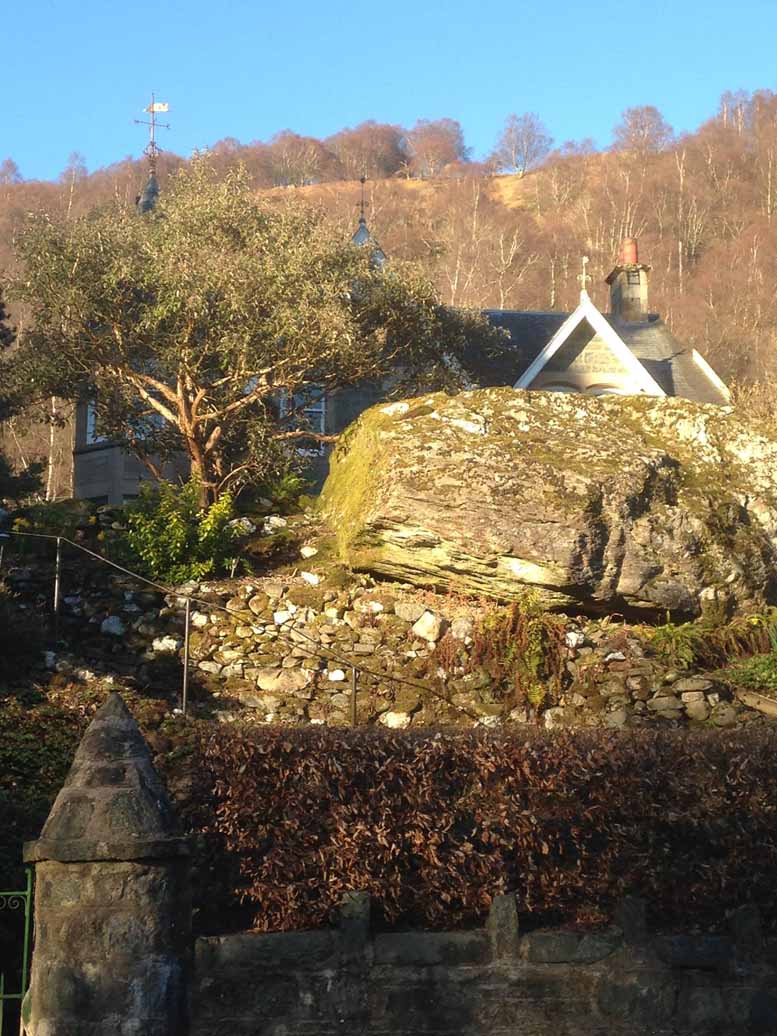
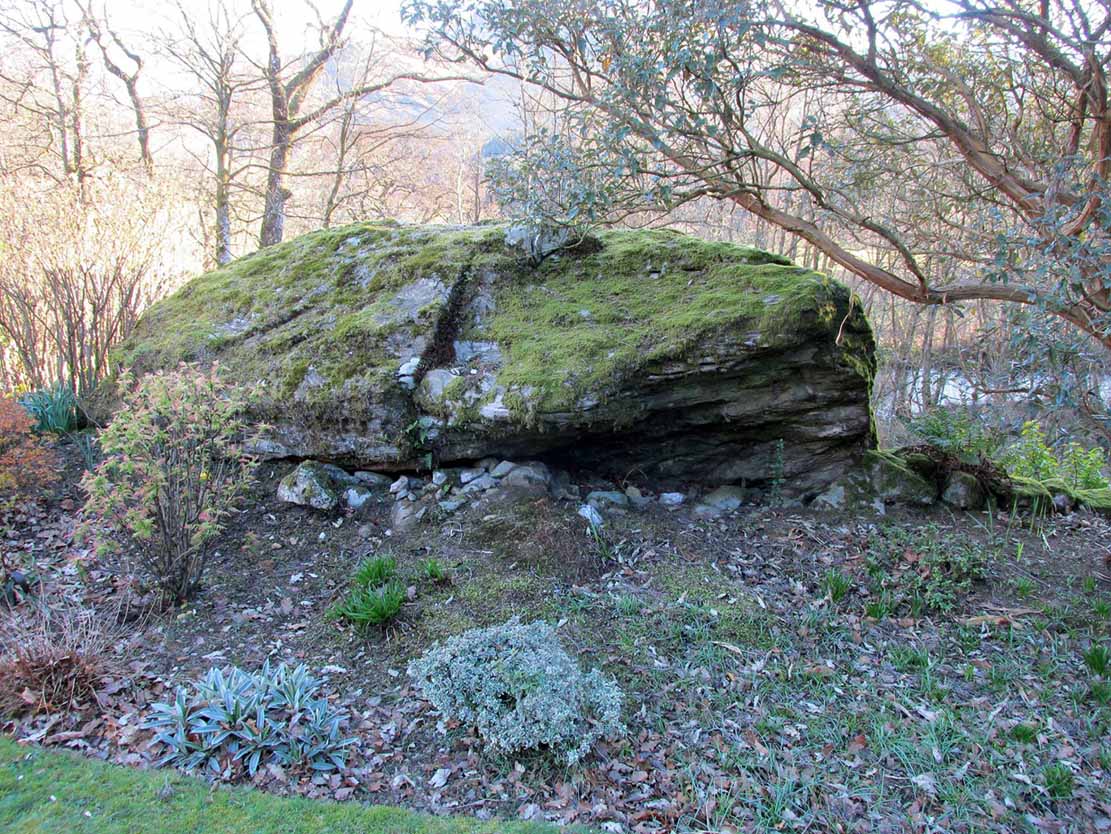
Along the A85 road at the east-end of Lochearnhead, head out of the village east towards Comrie. Just above the main-road, maybe 50 yards after passing the small road to St Fillan’s Golf Club, on the north side of the road you’ll see a huge boulder resting in the edge of the garden of the large detached house that was known as The Oaks.  That’s the fella!

Archaeology & History

Clach na Ba, from the rear

Almost fallen out of history, oral tradition has thankfully kept the name and brief history of this huge boulder alive.  Found in association with the prehistoric standing stones just yards away, the Clach na Ba lives beside the ancient drover’s road (and probable prehistoric route before that) just yards east of the old cottage known as Casetta.  This occupies a site where an old toll-house stood, and the drovers would have to stop and pay a toll before continuing onwards past the Clach na Ba, or Stone of the Cattle.

Folklore

When the drovers passed their highland cattle here, the animals rubbed themselves against the stone to ensure good health and fertility (as well as just having a good scratch, no doubt).

References:

  1. Porteous, Alexander, Annals of St Fillans, David Philips: Crieff 1912.

Acknowledgements:  With huge thanks to Nina Harris and Paul Hornby for the day out and for use of their photos in this site-profile; and to the lovely couple (we didn’t get their names – soz) who live in the house behind the Clach na Ba, for their help with the fascinating local history .

© Paul Bennett, The Northern Antiquarian