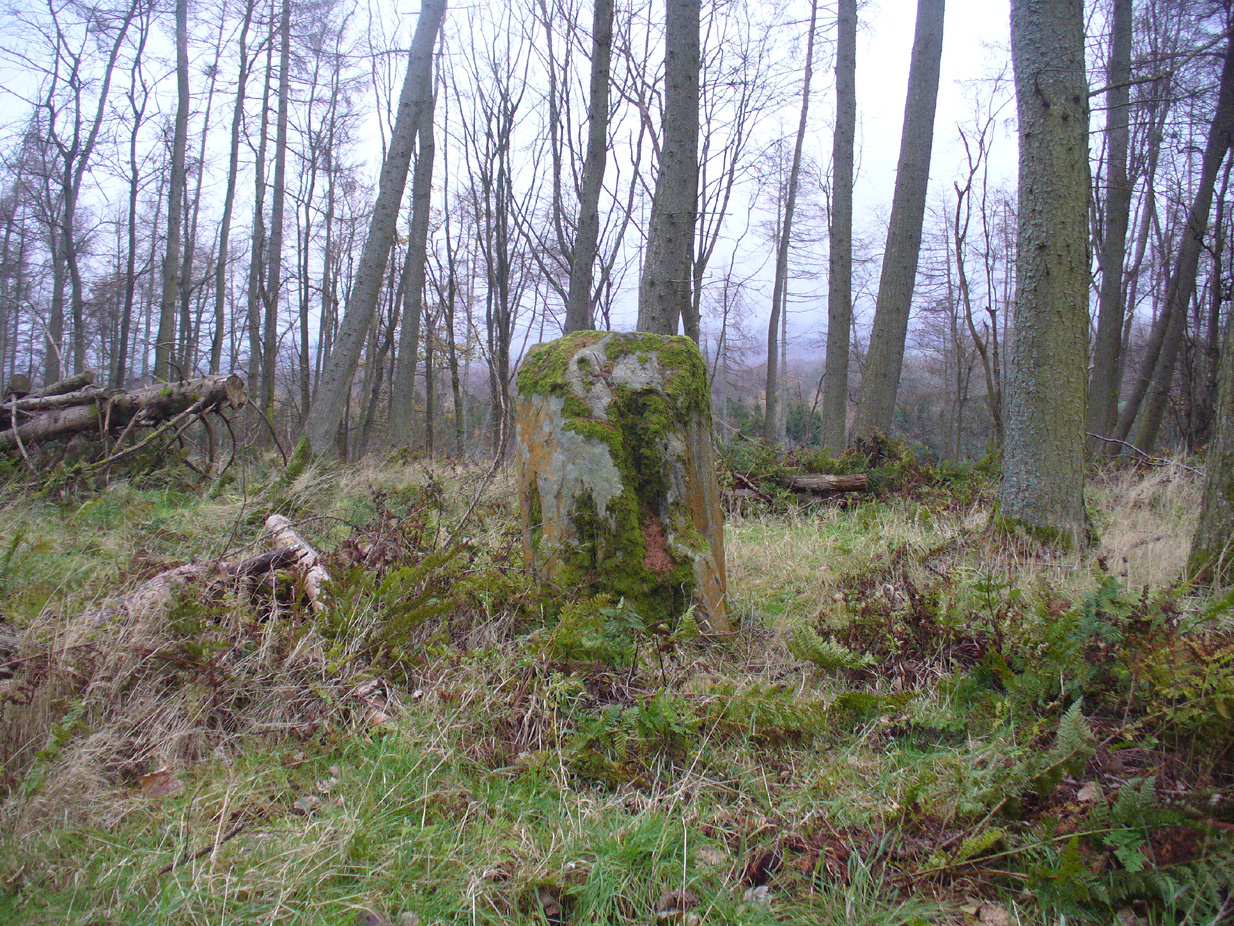
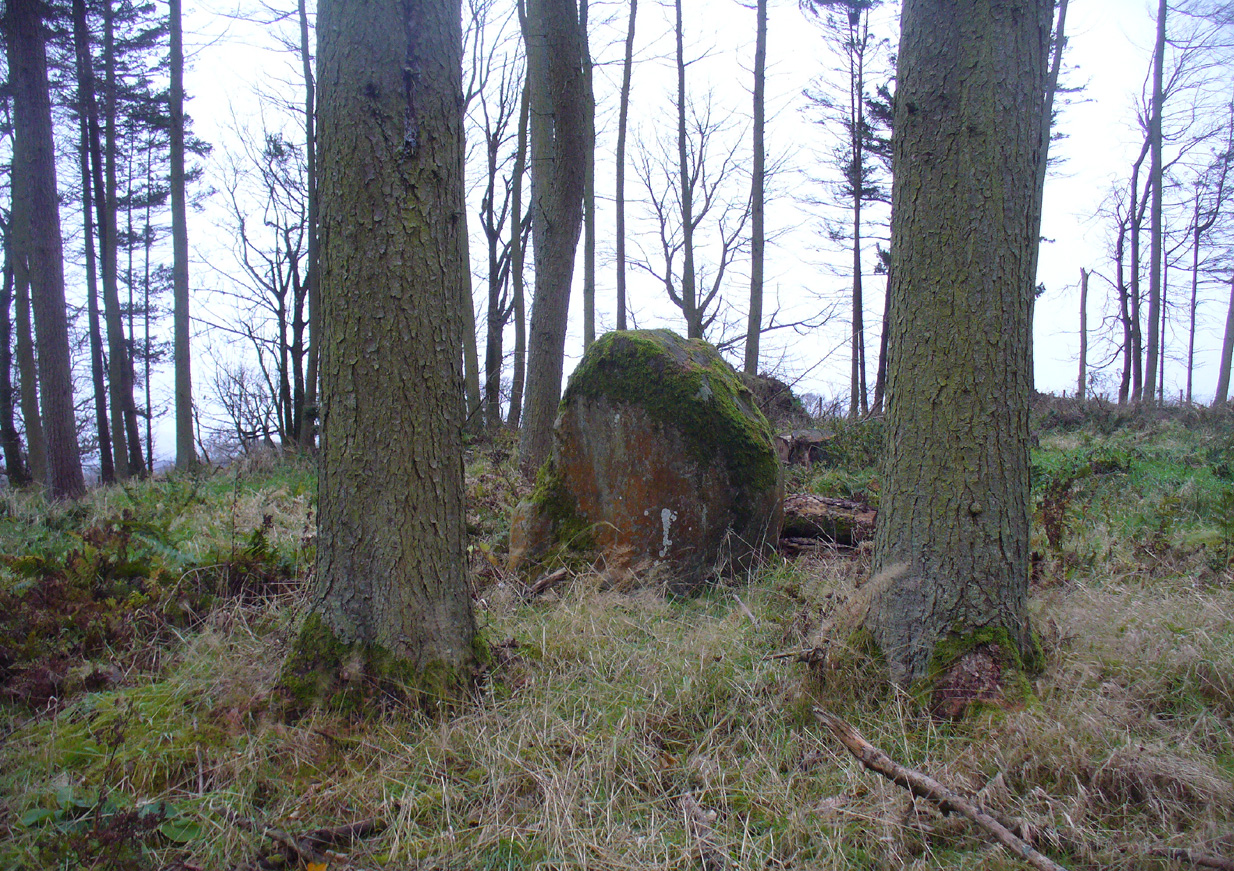
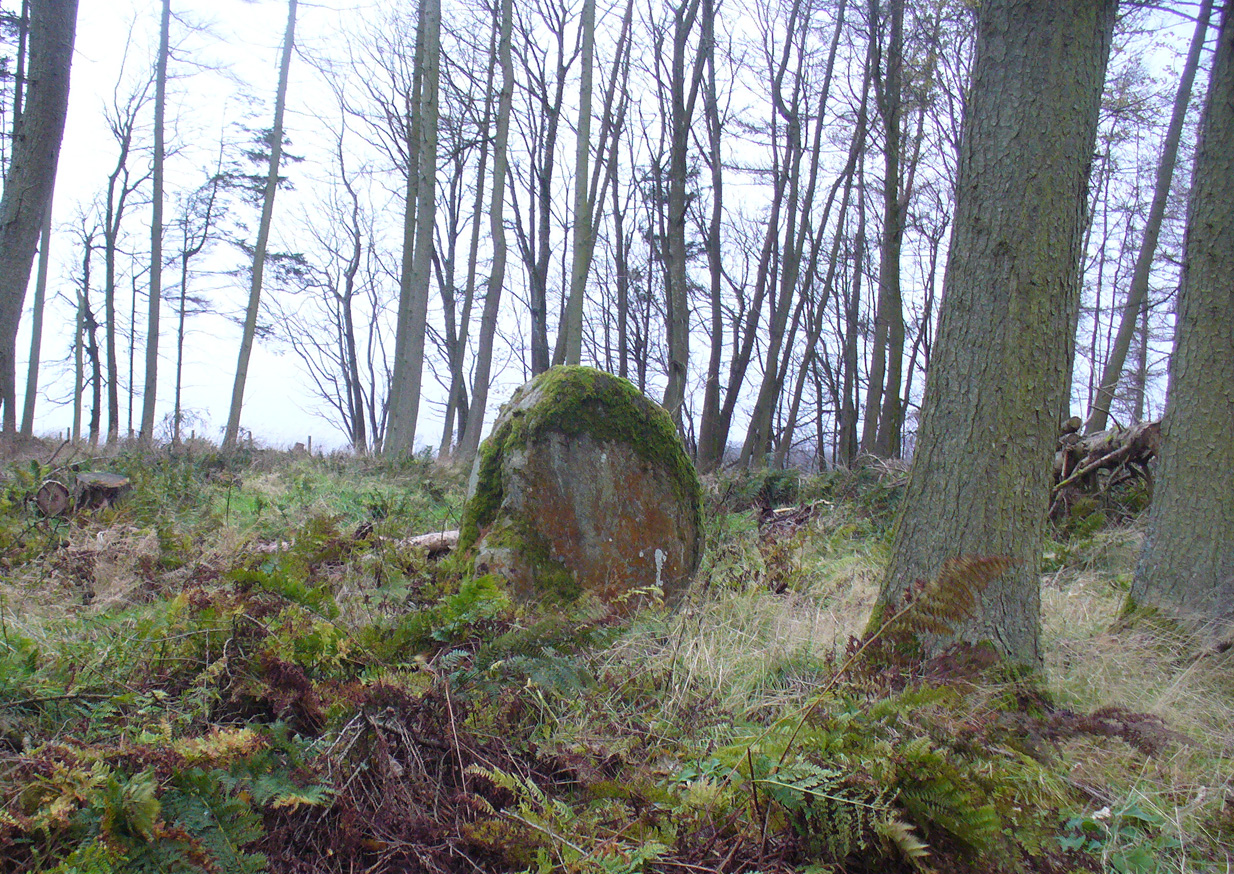
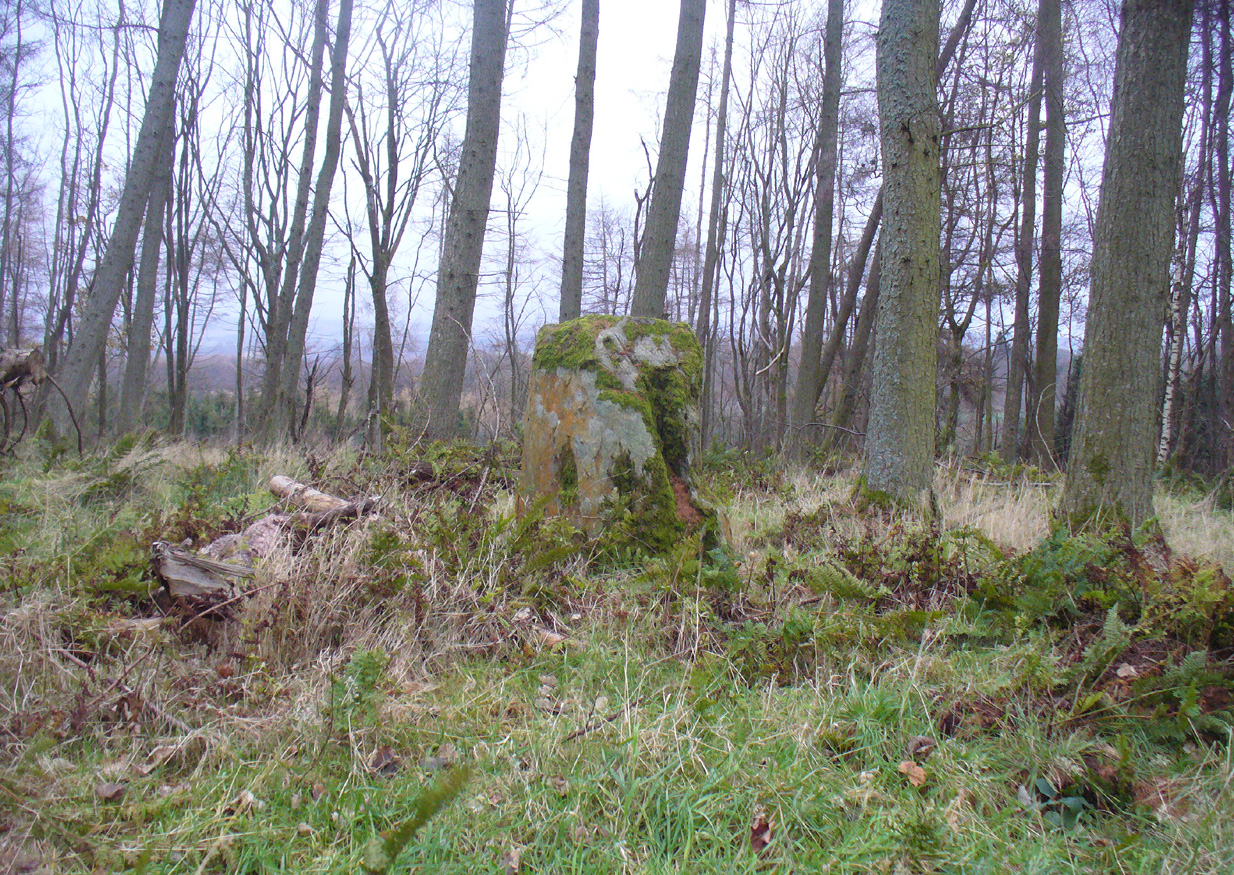
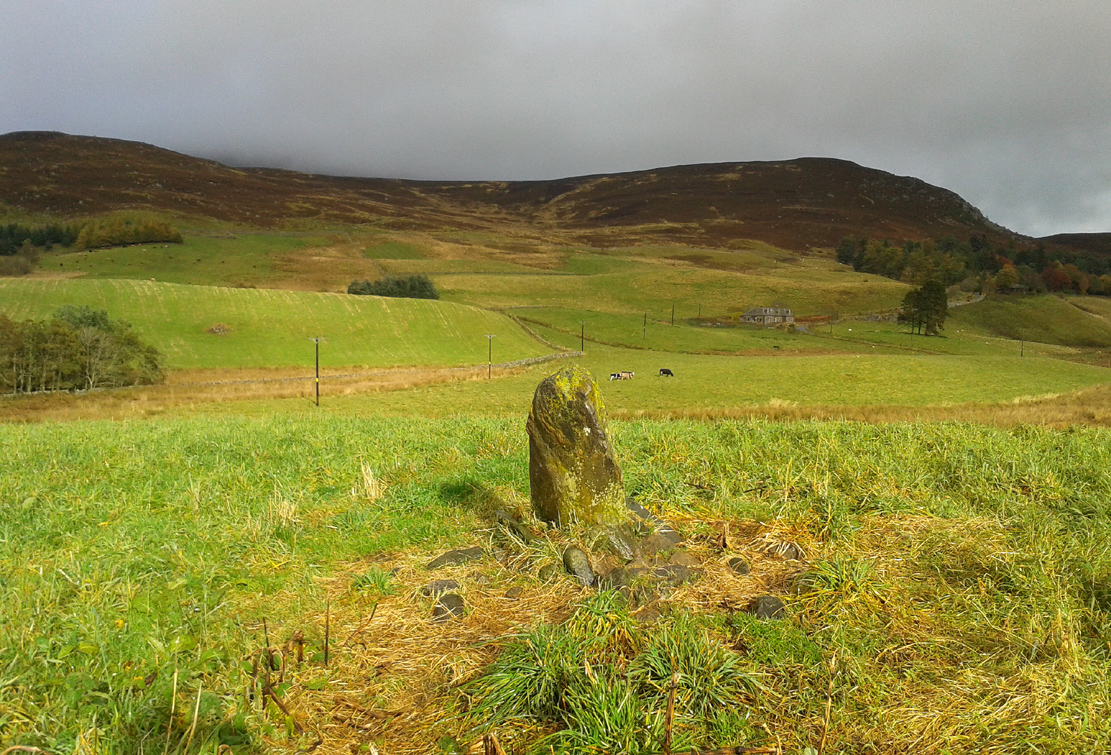
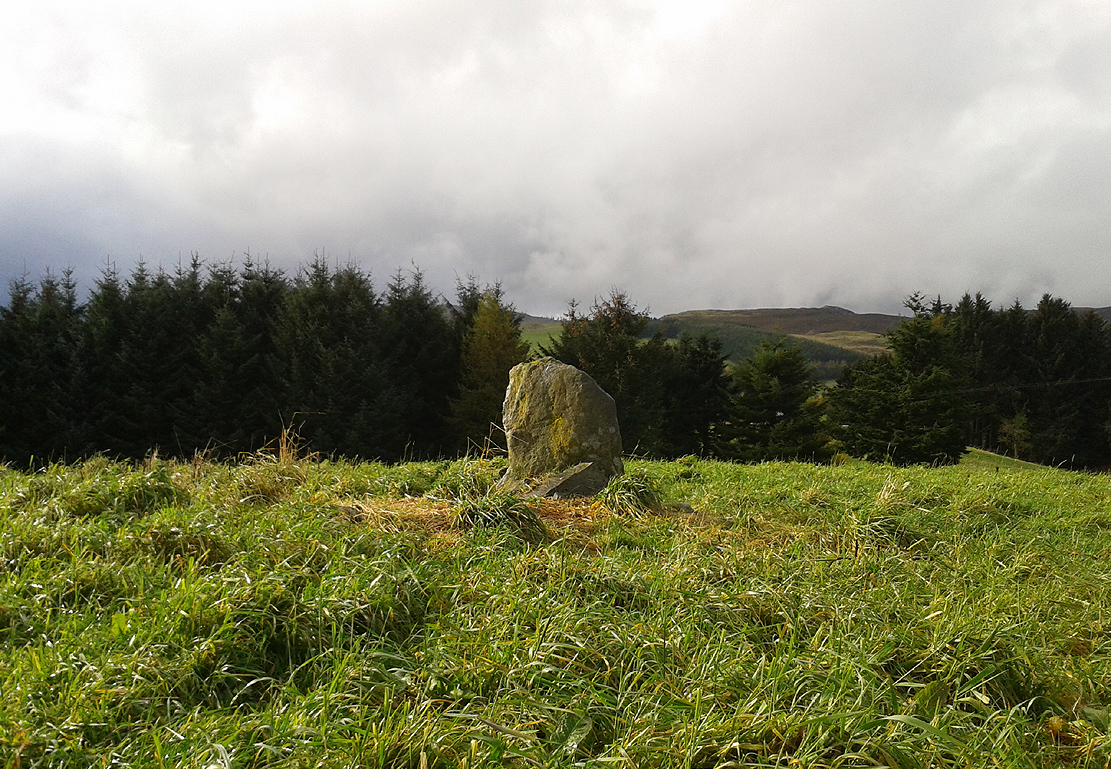
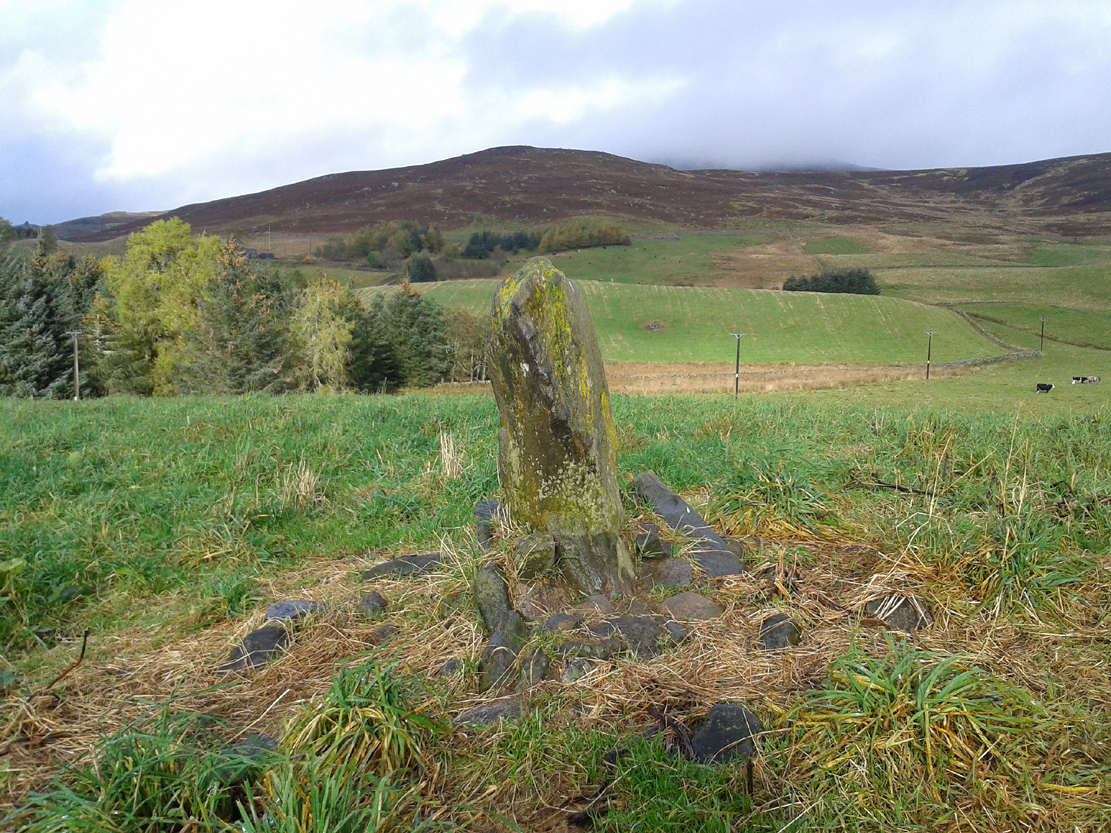
Knockraich, Fintry, Stirlingshire

Standing Stone:  OS Grid Reference – NS 60889 87739

Also Known as:

  1. Canmore ID 45305
  2. Knockcraich

Getting Here

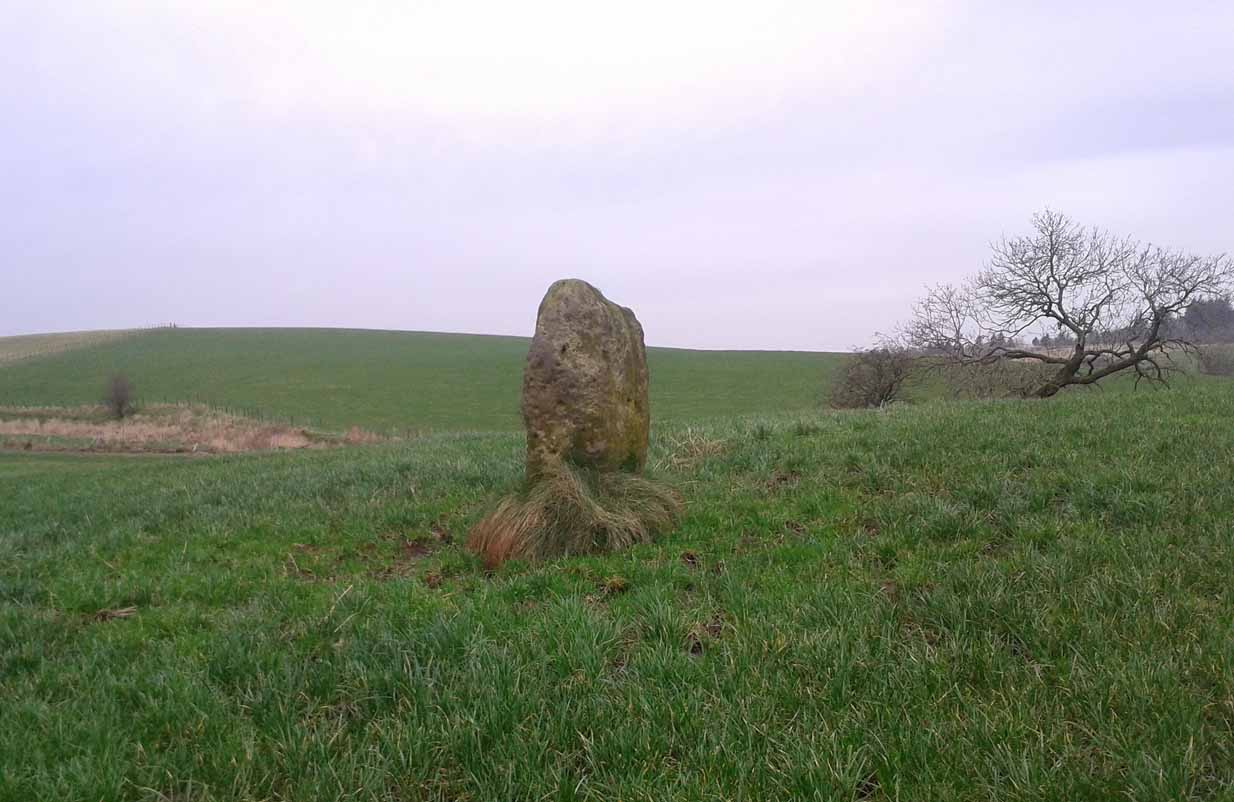
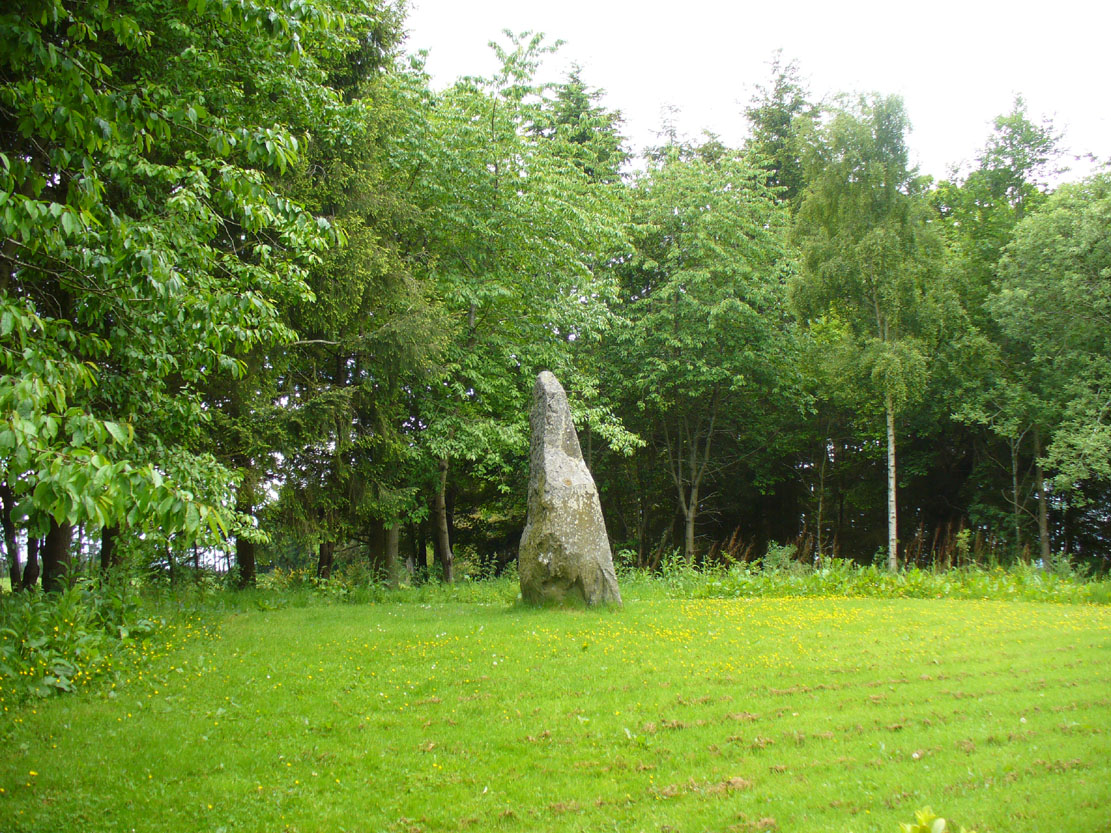
Knockraich standing stone

Knockraich standing stone

From Fintry village take the B822 road towards Kippen.  Only half-a-mile (0.8km) along, take the track on your left to Knockraich Farm and cafe.  Go all the way through the farm along the track and out the other side then follow the fence downhill across the field. At the bottom, go through the gate towards the stone which you’ll already be able to see ahead of you, in the next field. Y’ can’t miss it!

Archaeology & History

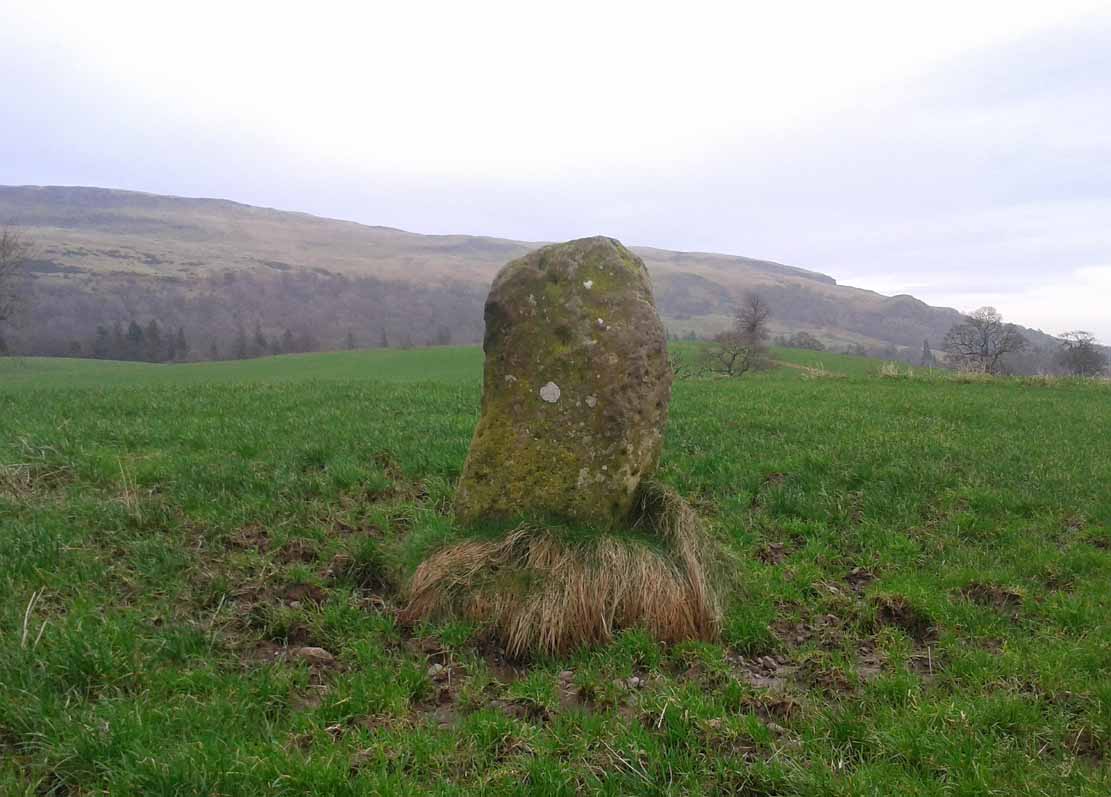
This little-known four-foot tall monolith standing alone in the fields northwest of Fintry, just above the River Endrick, is a fascinating little fella!  It stands at the western end of an elongated rise in the land, almost as if mimicking an ancient long barrow.  But more intriguingly (for me at least) are the cup-markings that adorn each of its four sides.
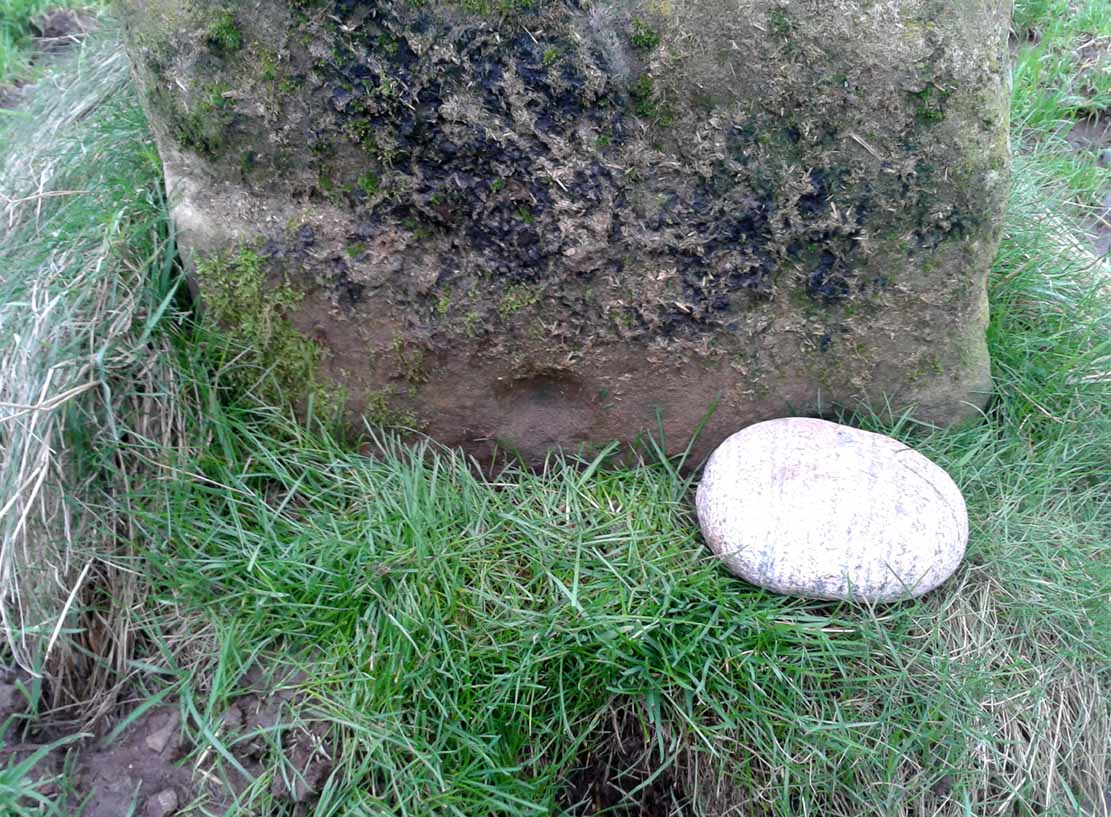
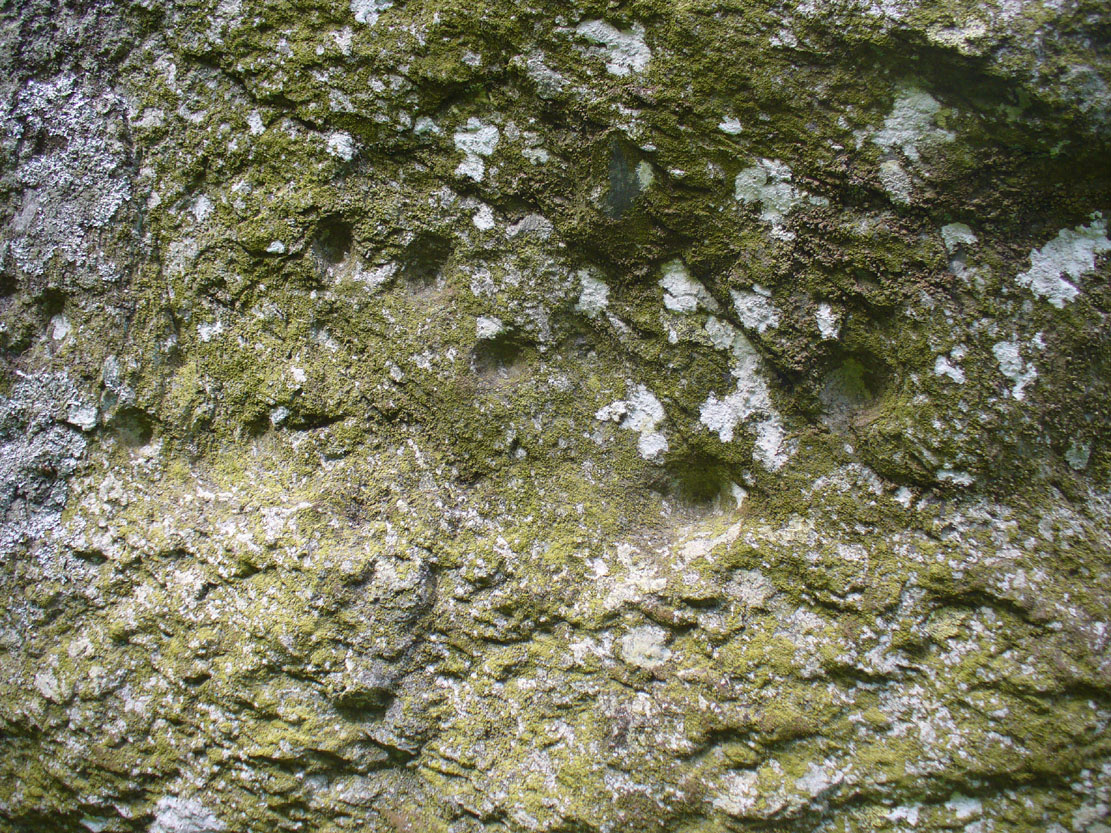
Cup-mark at base of the north side
Cup-mark at base of the north side

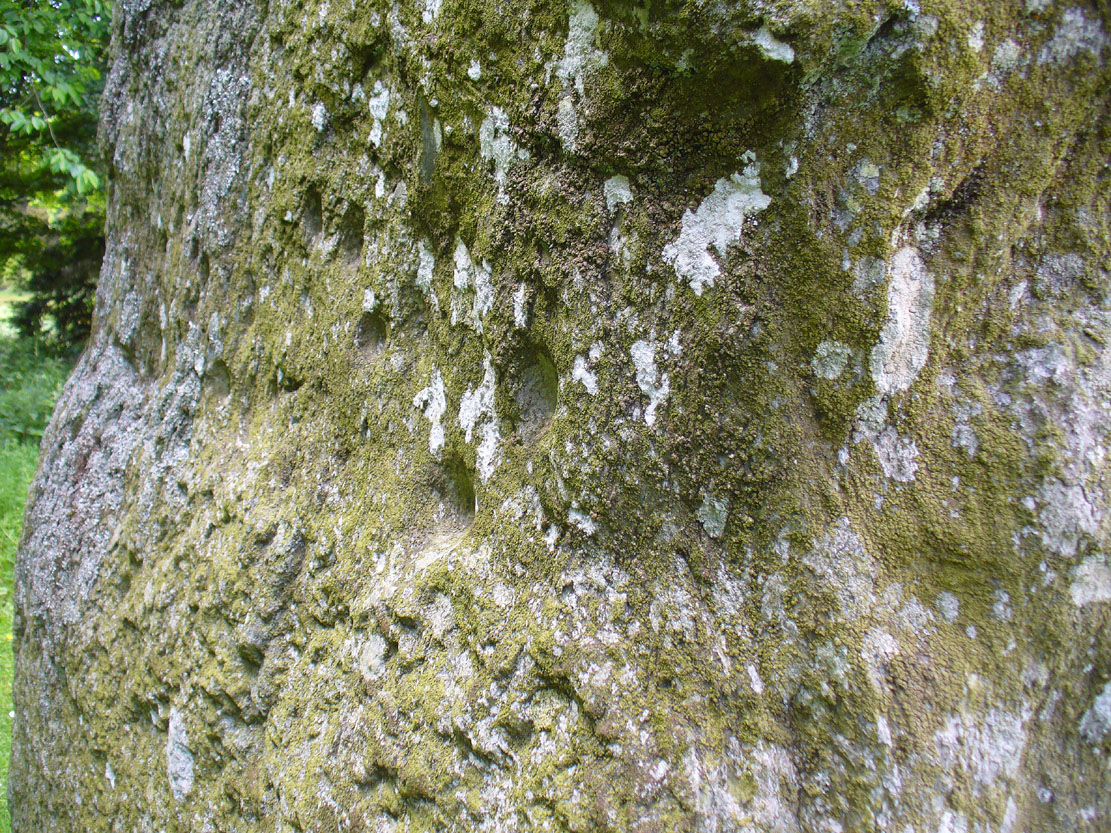
Cup-mark near top of west face

Cup-mark near top of west face

Upon first glance it seems that there are a number of such cup marks on the stone, but further inspection shows that only one occurs on each of the four faces.  Near the very bottom of the stone on its north and south sides a single large cup-mark has been etched; and on its east and western faces, the cup-mark has been carved further up towards the middle of the stone, with the east-facing side having a groove running from near the top and stopping at the cup-mark.  On top of the stone is a large ‘bowl’ (possibly natural, possibly man-made—it is difficult to say with any certainty) and a single cup-mark next to it.  When Nina, Paul and I visited here a few days ago, a palm-sized smooth stone was resting in the large bowl on top, akin to the healing and divination stones found placed in bullauns in Ireland and other parts of the world.

The first description of any length was cited in A.F. Hutchinson’s (1893) paper on the standing stones of Stirlingshire in which he wrote:

“This stone…is placed on the bank rising up from the river.  In shape it is approximately square—the two sides facing nearly east and west, measuring each 1ft 7in, the north face 1ft 6in, and the south 1ft 3in.  These dimensions are uniform from top to bottom.  The total girth is therefore 5ft 11in, while the height is 3ft 8 in.  Orientation 225º.  There are a number of cupmarks both on the top and side, as well as having several incised lines and other markings, some of which, however, give evidence of recent sculpture.”
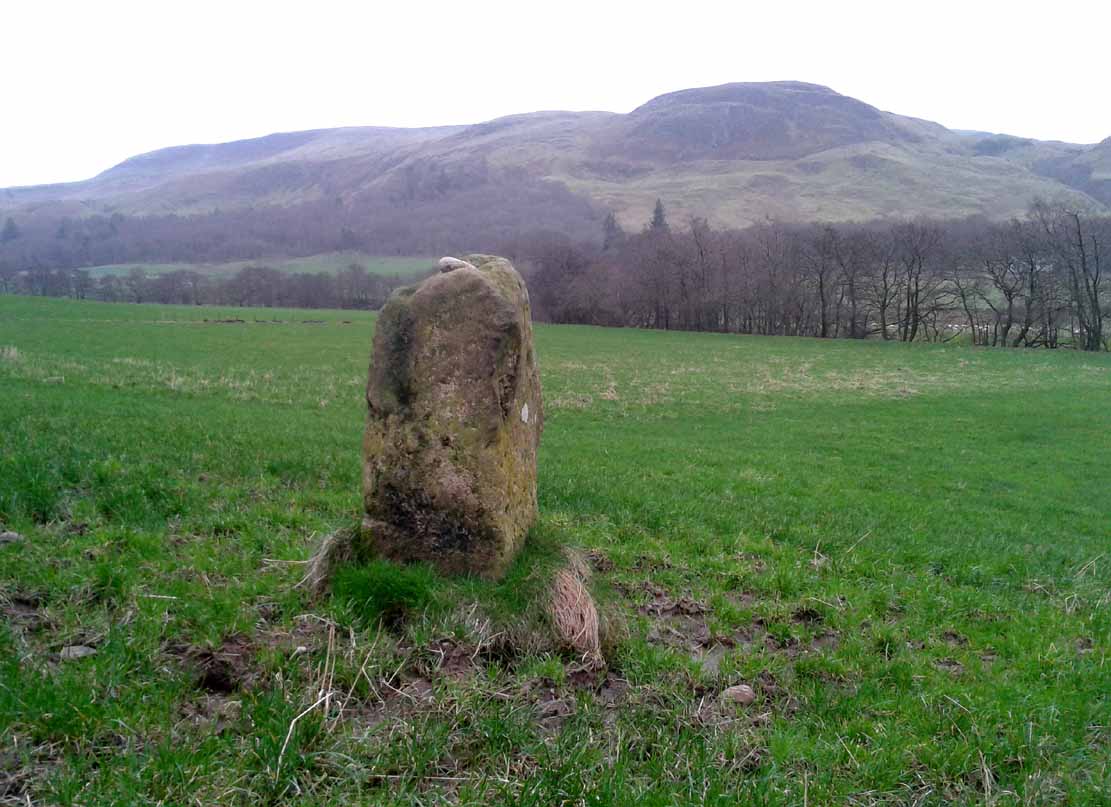
Knockraich stone, looking south at Dunmore hillfort

Knockraich stone, looking south at Dunmore hillfort

Cupmark, hollow & stone on top

Cupmark, hollow & stone on top

The more modern or “recent sculpture” was that of a human figure, now very faint, etched onto the most western face of the stone, beneath a large solitary cup-mark.  When the site was visited and described by the Royal Commission (1963) lads, they gave a lengthier description of the carved elements on the stone, telling us that:

“On the top, which has been brought to an irregularly rounded point, there is an almost circular hollow measuring 5½in to 6in across and 2½in in depth; it is difficult to suppose that this is other than artificial, although its bottom shows differential weathering.  The SE side of the stone shows several natural cavities, and a deep and wide vertical groove which is also presumably natural.  The NW face seems to have been flattened to a certain extent, a slight ridge which is visible along part of either margin probably representing a survival of the original surface.  On this face, 12in above the ground, a human figure has been outlined in pocked technique.  It is in full-face, the features being indicated by pocked marks; the arms are extended jut below the level of the shoulders and the legs are widely spread with the feet turned outwards.  The lower edge of a tunic or short kilt seems to be indicated by a single line between the legs.  The figure is 8in heigh and measures 7in in breadth between the hands and 7½in between the feet.  This face of the stone also shows a number of small natural cavities, together with a shallow cup which has a somewhat artificial appearance; this cup is in the centre of the face and 2ft 4½in above ground level, apparently at the upper margin of the flattened area.  The figure lacks any distinctive characteristics which might afford evidence of date, but it may be relatively modern…”

Folklore

Mr Hutchinson (1893) told that,

“The stone seems to have brought down through the ages a tradition of sanctity in connection with it, as there is a legend to the effect that any attempt to move it is attended by convulsions of Nature and evil consequences to the rash disturber.”

Whether the position of the water-worn smooth rock found in the bowl on top of this standing stone has any ancient tradition, records seem silent on the matter.

References:

  1. Hutchinson, A.F., “The Standing Stones of Stirling District,” in The Stirling Antiquary, volume 1, 1893.
  2. Royal Commission on the Ancient & Historical Monuments Scotland, Stirling – 2 volumes, HMSO: Edinburgh 1963.
  3. Royal Commission on the Ancient & Historical Monuments of Scotland, Archaeological Sites and Monuments of Stirling District, Central Region, Society of Antiquaries of Scotland 1979.
  4. Smith, H. Guthrie, Strathendrick and its Inhabitants from Early Times, James Maclehose: Glasgow 1896.

Acknowledgements:  Many thanks to Nina Harris and Paul Hornby for their help and attendance at this old stone.

© Paul BennettThe Northern Antiquarian
Strathblane Churchyard, Stirlingshire

Standing Stone:  OS Grid Reference – NS 56387 79375

Also Known as:

  1. Canmore ID 44452

Getting Here

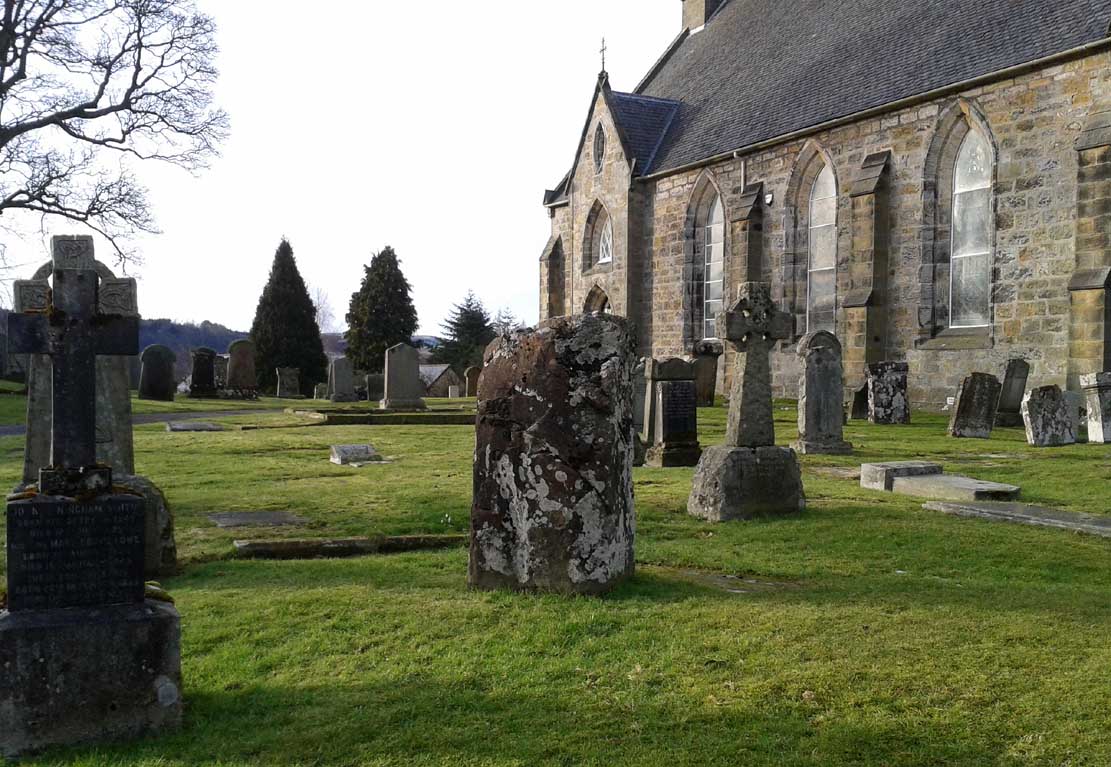
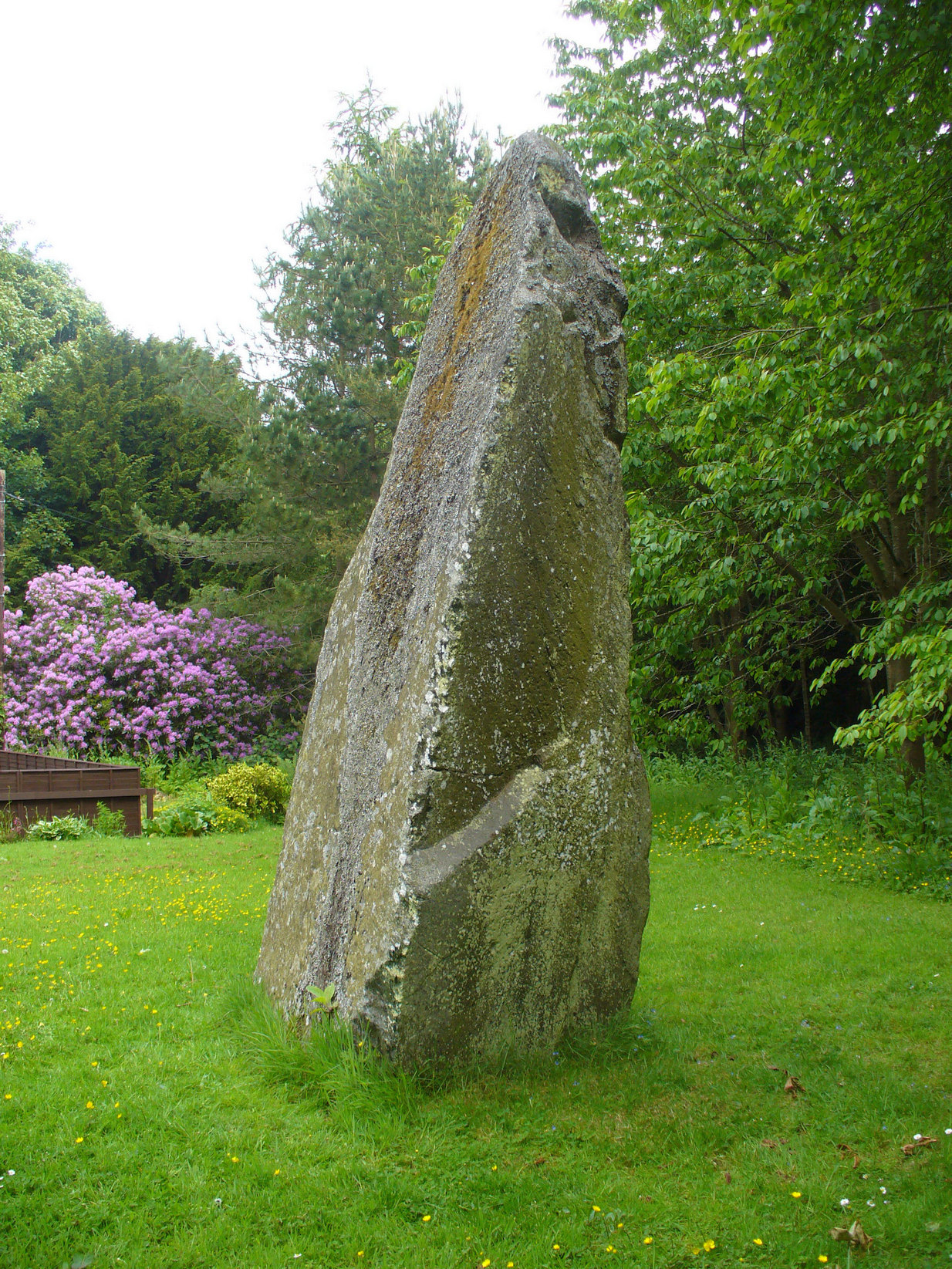
Strathblane church's heathen creator

Strathblane church’s heathen creator

From whichever direction you’re coming from along the A81 into Strathblane, make sure you keep your eyes peeled for where the A891 turns off it to the east.  Go  and along there and barely 100 yards on the church is set back from the road.  Walk into the graveyard, turn left and you can’t really miss it amidst the mass of modern graves.

Archaeology & History

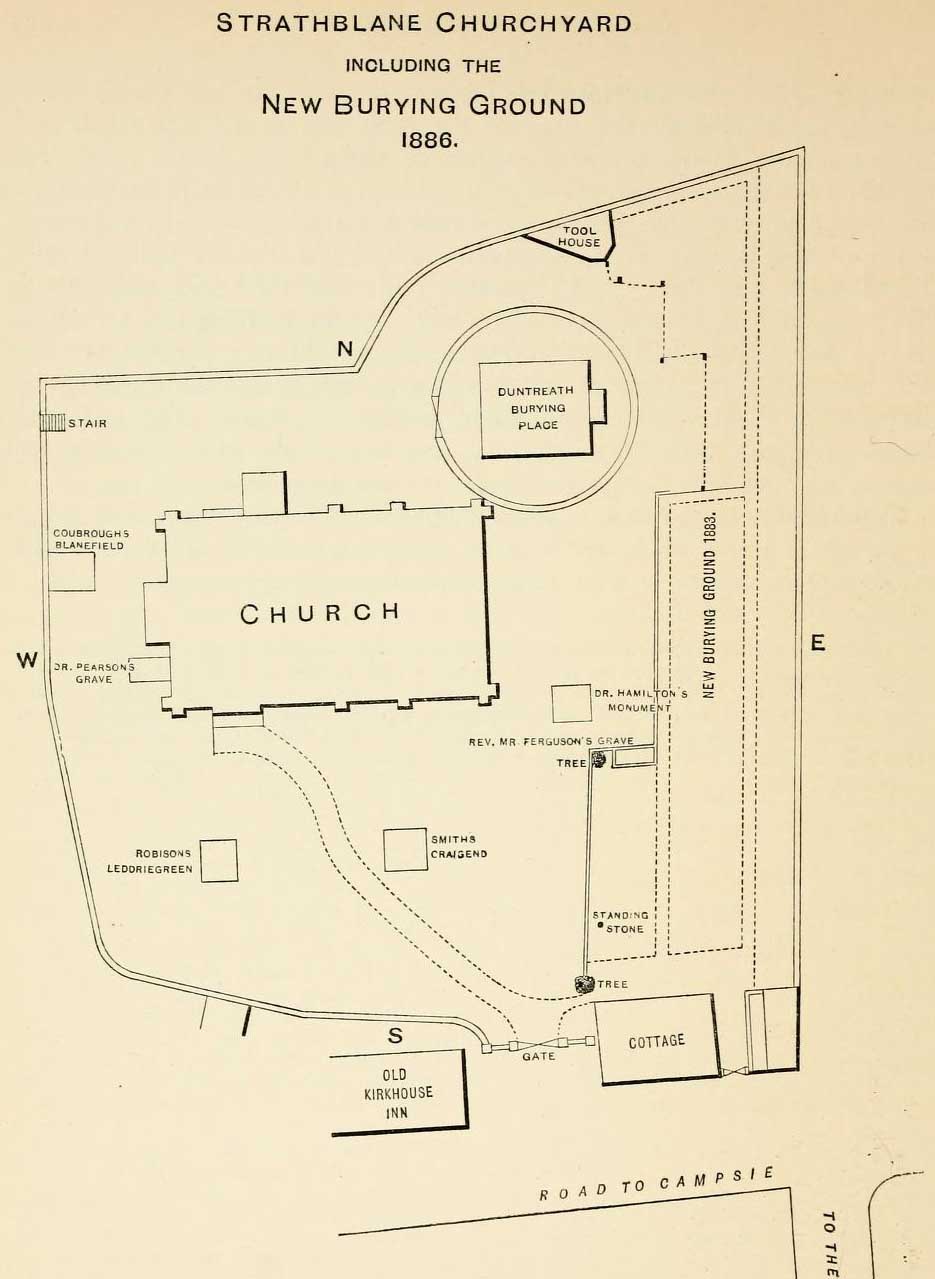
Location of the stone, from Smith 1886

Location of the stone, from Smith 1886

In accordance with the occasional tradition of standing stones in churchyards (such as the Rudston monolith and many others), a short stumpy monolith, less than four feet high, here stands alone in the christian burial ground surrounding Strathblane’s parish church.  The top of the stone is quite flat and it’s possible that this once stood much taller, with the top of the stone being chopped off (such destruction has happened at the Cuckoo Stones and many other megalithic sites).  It’s certainly worth looking at and stands amidst a cluster of other ancient sites—some gone, some still in evidence—in and around this lovely old village.  Not much has been written about the stumpy little fella and its first literary reference seems to be in Mr Smith’s (1886) magnum opus on the area, where he tells:

“There is a very old standing stone in the churchyard, but most probably it was placed there long before there was any church in the parish.”

…Nothing else.  Even the Royal Commission (1963) lads said little about it, merely telling us:

“A few yards within the entrance to the graveyard of Strathblane Parish Church…a standing stone appears among the monuments.  It is a five-sided pillar, 3ft 9in high, with an uneven but flattish top.  At ground level the sides range from 1ft 9ins to 2ft 3in in width.”

The stone, looking south

The stone, looking south

The stone, looking southeast

The stone, looking southeast

The fact that it stands by the church (rebuilt around 1803 out of its more ancient fabric) suggests that the site was a heathen temple or sacred site, redesignated by the invading christian priesthood.  A short distant east and west have been found a number of prehistoric remains in the forms of burials, standing stones and giant cairns, indicating this site to have had particular mythic importance in earlier centuries.  From the standing stone if we look southeast, we see the rise of Dunglass, but the view to the stones and great pyramid of Dumgoyach, northwest, is blocked by the rise of Cuilt Brae, which I found to be a little surprising.

References:

  1. Royal Commission on the Ancient & Historical Monuments Scotland, Stirling – volume 1, HMSO: Edinburgh 1963.
  2. Smith, John G., The Parish of Strathblane, James Maclehose: Glasgow 1886.
  3. Ure, David, The History of Rutherglen and East Kilbride, Glasgow 1793.

© Paul BennettThe Northern Antiquarian

Broadgate Farm, Strathblane, Stirlingshire

Standing Stone:  OS Grid Reference – NS 56929 79402

Also Known as:

  1. Canmore ID 44439

Getting Here

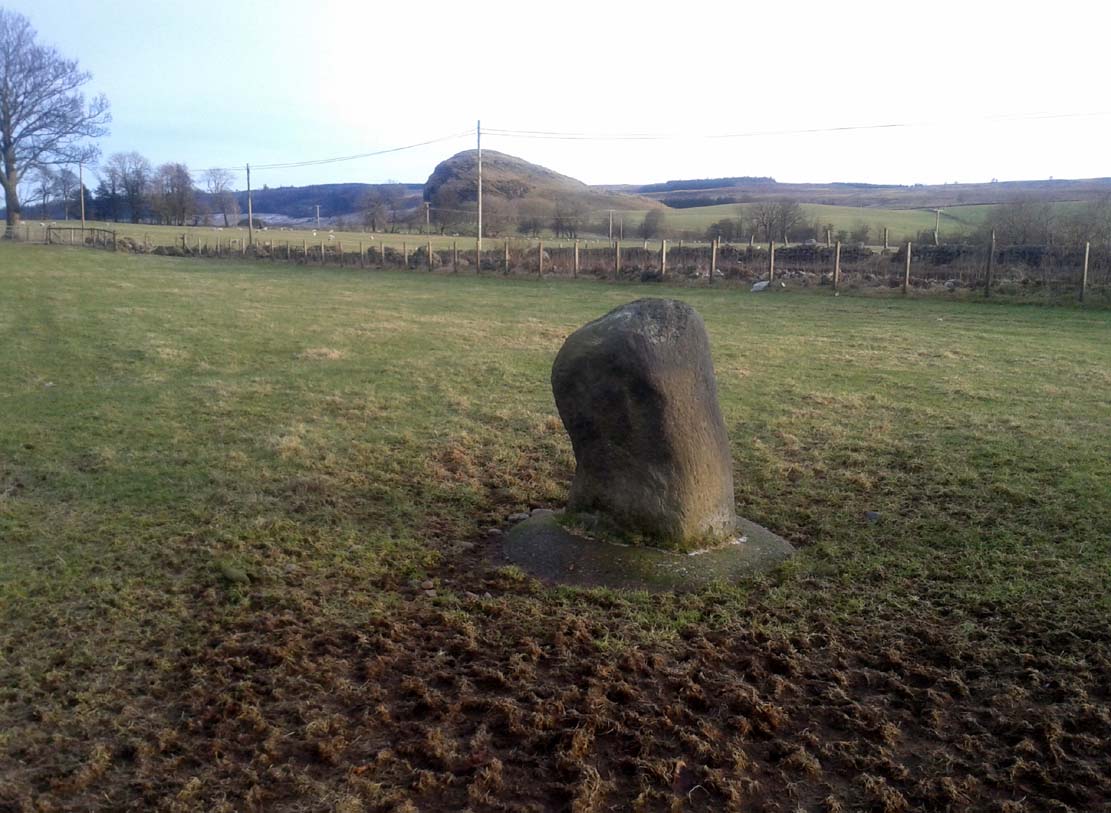
Broadgate Farm standing stone

Broadgate Farm standing stone

From Strathblane, take the A891 road eastwards out of the village, past the standing stone in the churchyard and the row of houses set back off the road until, a few hundred yards along, the fields open up on both sides of you.  In the very first field on the north side of the road, you’ll see the standing stone, all alone, resting quietly.  There’s a gate enabling you access into the field…

Archaeology & History

Broadgate Stone, with Dunglass SE

Broadgate Stone, with Dunglass SE

Found in close proximity to the destroyed chambered tomb of Broadgate, this small standing stone is presently set in a concrete base after an excavation here in 1982 located a cremation urn beneath the stone, confirming an old tradition that told as much.  But there are some who think the stone isn’t a prehistoric one—the Royal Commission (1963) lads for one.  In their brief resumé of the site they wrote:

“This stone stands just N of the road from Campsie to Strathblane, 140 yds E of Broadgate farmhouse.  It is 4ft high and measures 2ft 3inches by 3ft at ground level.  It may well be the stone referred to in the New Statistical Account as marking the spot where Mr Stirling of Ballagan was murdered in the 17th century and should therefore not necessarily be accepted as of prehistoric origin.”

And were it not for an excavation nearly twenty years later, this view may have been maintained.  However, when Lorna Main (1982) told of what was found beneath the monolith, no mention was made of any recent remains.  She wrote:

“Excavation at the base of the fallen standing stone was undertaken prior to its re-erection. A ledge had been cut on the south-west side of the shallow stone hole and fragments of the base survived and the diameter of the base is approximately 17cm.  The urn contained a cremation and a small quantity of charcoal.  It lay only 15cm below the ground surface and is in a poor condition.”

The very fragile state of the urn and the very eroded rounded stature of the rock itself would seem to indicate that this is more a prehistoric upright than a later 17th century one.

Folklore

There are legends of early battles in this region and J.G. Smith (1886) thought that perhaps “this great stone…mark the resting-places of Cymric heroes who did their share of the battle on the north side of the valley.”

References:

  1. Main, Lorna, “Broadgate Farm – Standing Stone and Cinerary Urn,” in Discovery & Excavation Scotland, 1982.
  2. Royal Commission on the Ancient & Historical Monuments Scotland, Stirling – volume 1, HMSO: Edinburgh 1963.
  3. Smith, John G., The Parish of Strathblane, James Maclehose: Glasgow 1886.
  4. Ure, David, The History of Rutherglen and East Kilbride, Glasgow 1793.

© Paul BennettThe Northern Antiquarian

Boreland Hill, Kincardine, Stirlingshire

Standing Stone:  OS Grid Reference – NS 72346 99409

Also Known as:

  1. Blair Drummond Stone
  2. Canmore ID 46064

The standing stone

The standing stone

Getting Here

Along the A84 Stirling-Doune road, watch out for the minor Cuthill Brae road to the caravan park.  A couple of hundred yards before reaching the entrance to the caravan park, note the copse of trees more than 200 yards north, on the left, across the field. Walk into the trees and, near the centre, you’ll see the upright stone.

Archaeology & History

Looking to the west

Looking to the west

On the very top of this flattened tree-covered hill between Doune and Stirling, a single upright monolith more than 5½ feet tall quietly rests, seemingly forgotten by just about everyone.  The stone was marked on the earliest OS-maps in the 1860s, though in non-antiquated lettering, as if to question its archaic veracity—and this has continued to the present day, with the likes of Hutchison (1893) and Canmore upholding it as little more than a geological erratic.  Yet as our photos here show, this stone has much greater credibility as an authentic standing stone than Nature’s handiwork.

In Mr Hutchison’s (1893) article on the megalithic remains of the area he said of this stone:

“This is a very fine boulder of Highland grit, stranded on a gravel mound near the official residences on the Blair Drummond estate.  The knoll is wooded, leaving a clear space in the centre for the stone.  It would thus appear to have been thought worthy of preservation for some reason or other.  It has no appearance however, of having been erected as a standing stone.  It measures about 6 feet in height, and 12 feet at its widest circumference.”

Looking northwest-ish

Looking northwest-ish

Looking northeast-ish

Looking northeast-ish

The position of the stone is intriguing, giving a 360° view through the trees to a much greater vista all round, and this does seems to be quite deliberate.  In all honesty, this does look like an authentic standing stone, contrary to the earlier views cited.  A large prehistoric tumulus occurs only 400 yards to the south (recently damaged and built onto by the present land-owner) and other standing stones are in the area.

There are a number of scratch marks on the upright faces of the stone, no doubt caused by the forestry actions here over the last century.  No modern excavations have occurred here.

Folklore

A couple of centuries ago, the New Statistical Account told that,

“a very vague tradition represents it as having been a place of religious worship in superstitious times. There are no other remains near to confirm this opinion; but whether it be correct or not, it is evident that its site is a very important one, and may have been useful as a signal station, as it commands a view not only of the road across the Moss of Kincardine, but also of the line of Roman stations along the Forth and Teith in the direction of the camp at Ardoch.”

References:

  1. Bennett, Paul, The Standing Stones of Stirling and District, TNA: Stirling 2020.
  2. Hutchison, A.F., “The Standing Stones of Stirling District,” in The Stirling Antiquary, volume 1, 1893.

© Paul BennettThe Northern Antiquarian

MacBeth’s Stone, Belmont, Meigle, Perthshire

Standing Stone / Cup Marked Stone:  OS Grid Reference – NO 27997 43473

Also Known as:

  1. Canmore ID 30824
  2. Siward’s Stone
  3. Witches’ Stone

Getting Here


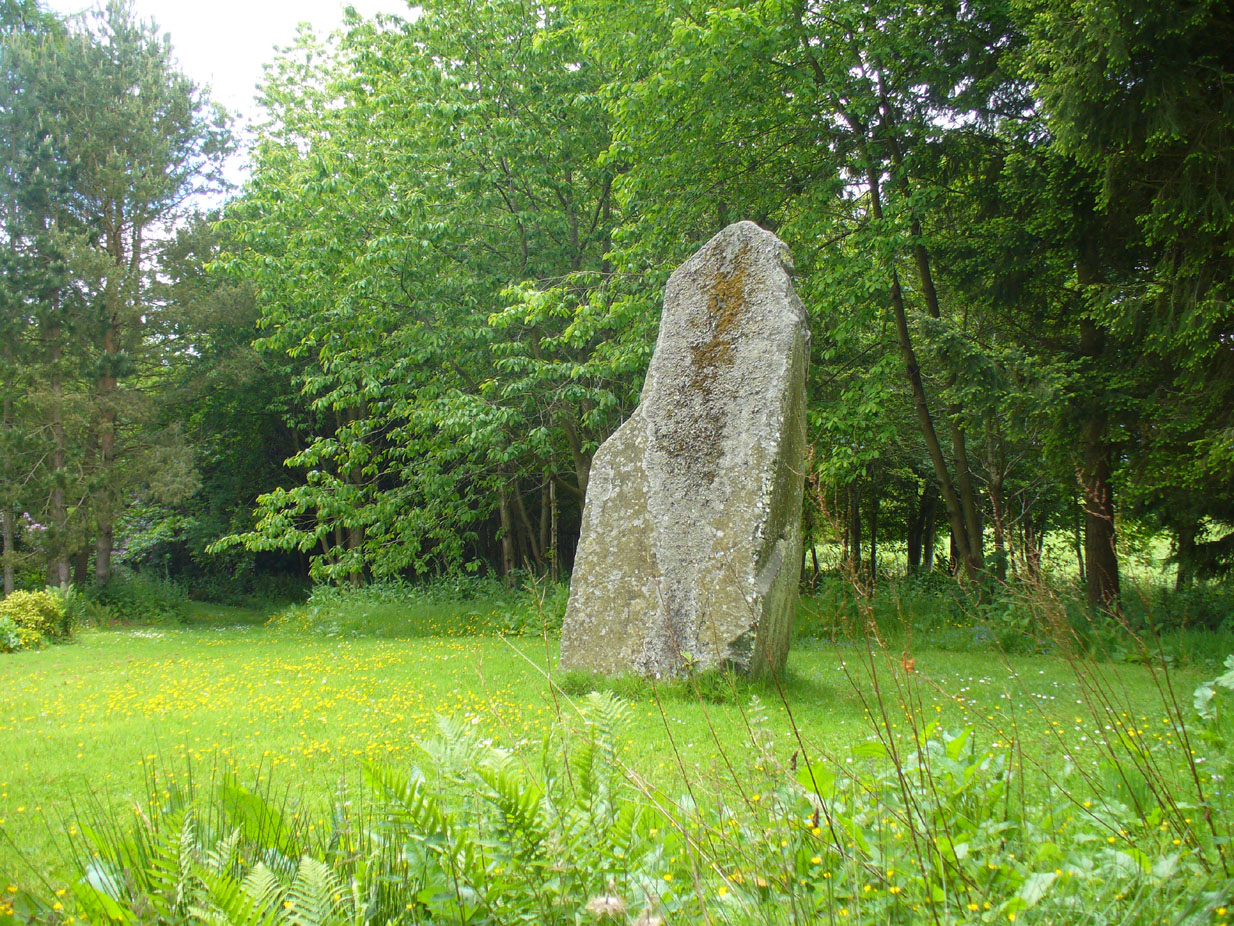
MacBeth’s Stone, Meigle

From the centre of Meigle village, you need to head along the country lane south-west towards the village of Ardler (do not go on the B954 road).  About three-quarter of a mile (1.25km) along—past the entrance to Belmont Castle—you’ll reach a small triangle of grass on your left, where a driveway takes you into the trees.  Walk down the drive and past the very first house—behind which is the stone in question.  A small path takes you through the trees allowing you to get round to it.  You can’t really miss it!

Archaeology & History


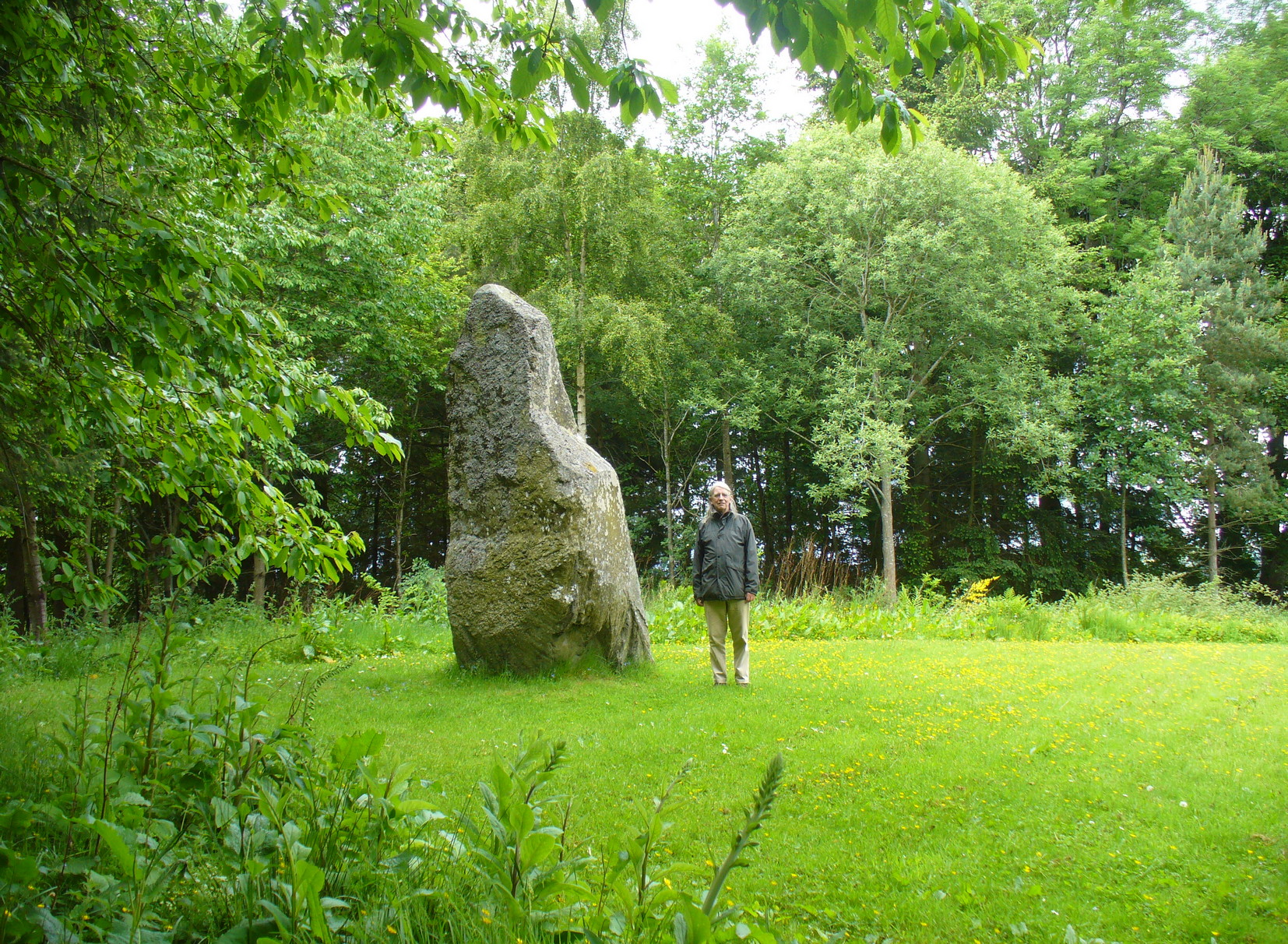
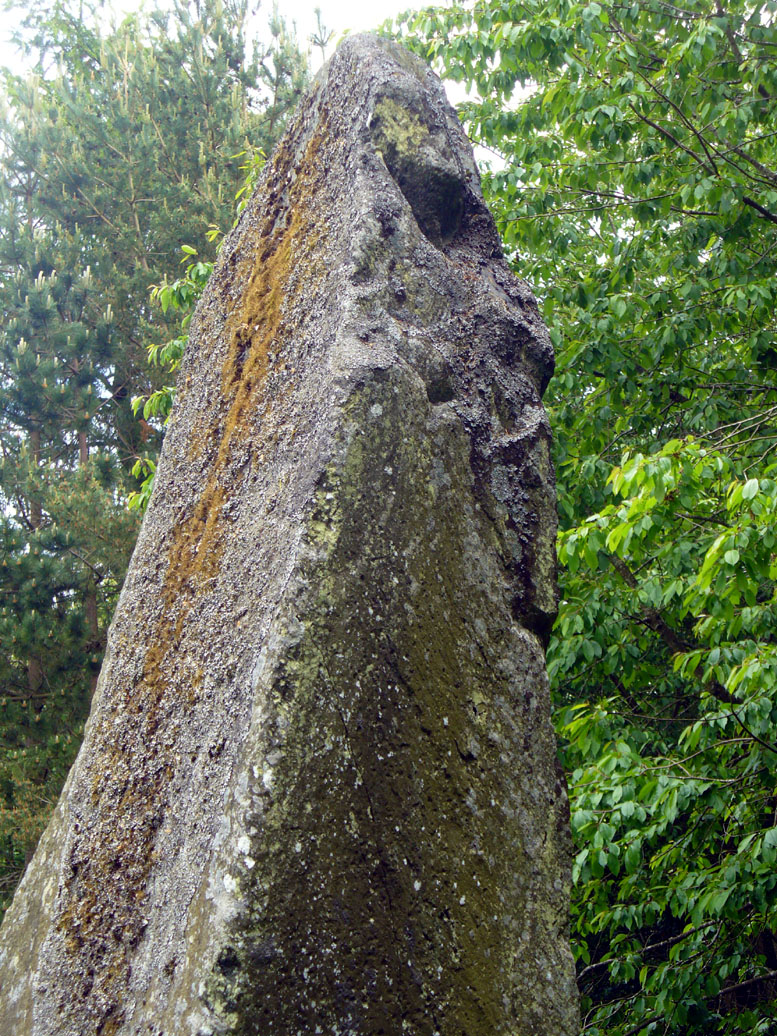
This is a magnificent site.  A giant of a stone.  Almost the effigy of a King, petrified, awaiting one day to awaken and get the people behind him!  It has that feel of awe and curiosity that some of us know very well at these less-visited, quieter megalithic places. Its title has been an interchange between the Scottish King MacBeth and the witches who played so much in his folklore, mixed into more realistic local traditions of other heathen medicine-women of olde…

The first account of this giant standing stone came from the travelling pen of Thomas Pennant (1776) who, in his meanderings to the various historical and legendary sites of Meigle district, wrote that

“In a field on the other side of the house is another monument to a hero of that day, to the memory of the brave young Seward, who fell, slain on the spot by MacBeth.  A stupendous stone marks the place; twelve feet high above ground, and eighteen feet and a half in girth in the thickest place.  The quantity below the surface of the Earth is only two feet eight inches; the weight. on accurate computation amounts to twenty tons; yet I have been assured that no stone of this species is to be found within twenty miles.”

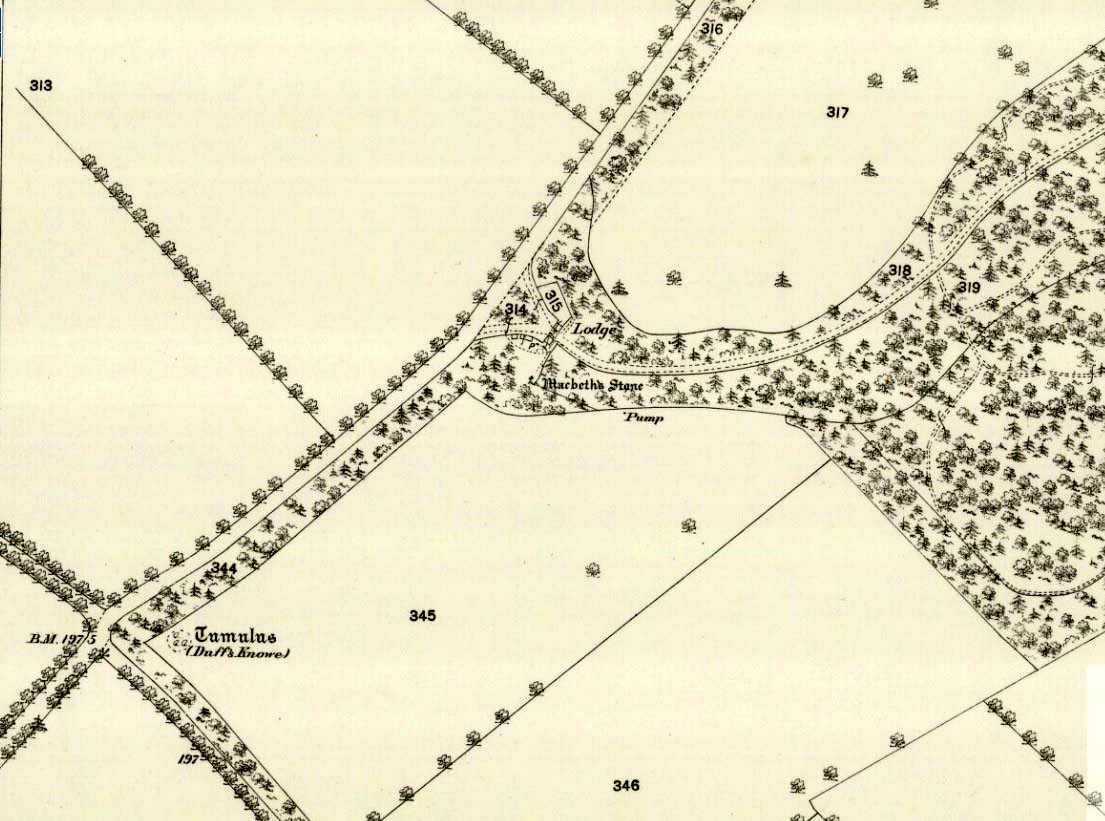
Site shown on 1867 map
A human & MacBeth!

It was visited by the Ordnance Survey lads in 1863, several years after one Thomas Wise (1855) had described the monolith in an article on the nearby hillfort of Dunsinane.  But little of any substance was said of the stone, and this is something that hasn’t changed for 150 years, despite the huge size of this erection!  Local historians make mention of it in their various travelogues, but the archaeologists haven’t really given the site the attention it deserves.  Even the Royal Commission (1994) report was scant; and apart from suggesting it to have a neolithic provenance, they merely wrote:

“Rectangular in cross-section, the stone tapers to a point some 3.6m above the ground; each of its sides is decorated with cupmarks, as many as forty occurring on the east face and twenty-four on the west.”


East face of MacBeth
MacBeth Stone (Wise 1884)

Thankfully, the fact that there are cup-markings on the stone has at least given it the attention it deserves amongst the petroglyph students.  The first account of the cup-markings seem to have come from the pen of Sir James Simpson (1867) who mentions them, albeit in passing, in his seminal work on the subject.  A few years later however, the same Thomas Wise visited MacBeth’s Stone again, and not only described the carvings, but gave us our first known illustration in his fascinating History of Paganism (1884).  He told it to be,

“A large boulder, some 12 tons in weight, situated within the policies of Belmont Castle, in Strathmore, Perthshire…is supposed to have been erected on the spot where MacBeth was slain.  Two feet above the ground this boulder has a belt of cups of different sizes, and in irregular groups.  None of these cups are surrounded by incised circles or gutters.  This boulder was probably intended for some sacred purpose, as it faces the SE.”

Running almost around the middle of the standing stone, on all four sides, are the great majority of the cup-markings (no rings or additional lines are visible).  They were very obviously etched into the stone after it had been erected, not before.  This is in stark contrast to the cup-and-rings found on the standing stones at Machrie, Kilmartin and elsewhere, where we know the carvings were done before the stones were stood upright.

Cup-marks on west side
Cup-marks on west face

On the northern face of the stone is one possible cup-marking, and three of them are etched onto its south face; but the majority of them, forty, are on its western face, and twenty-five on its eastern side.  The great majority of them on the east and west sides occur roughly in the middle of the stone, almost like a ‘belt’ running across its body.  Those on the eastern face are difficult to discern as a thick layer of lichens covers this side, so there may be even more beneath the vegetation.

One of the notable features of the monoliths across this region, and echoed again here, is that one side of the standing stone is smooth and flat—and here in the case of MacBeth’s Stone, the flat face is the eastern one.  Whether this feature was deliberately intended (it seems to have been) and what it might imply, we can only guess.  It might simply relate to the geophysics of the stone, making it easy to crack horizontally….

The ‘face’ in the top of the stone
Close-up of Macbeth’s face

Another fascinating feature at this site was noticed by Nina Harris of Organic Scotland.  Meandering around the stone in and out of the trees, she called our attention to a fascinating simulacra when looking at the upper section of the stone on its southern side.  At first it didn’t seem clear – but then, as usual, the more you looked, the more obvious it became.  A very distinct face, seemingly male, occurs naturally at the top of the stone and it continues as you walk around to its heavily cup-marked western side.  It’s quite unmistakable!  As such, it has to be posited: was this simulacra noticed by the people who erected this stone and seen as the spirit of the rock?  Did it even constitute the reason behind its association with some ancestral figure, whose spirit endured here and was petrified?  Such a query is neither unusual nor outlandish, as every culture on Earth relates to such spirit in stones where faces like this stand out.

But whatever your opinion on such matters, when you visit this site spend some time here, quietly.  Get into the feel of the place.  And above all, see what impression you get from the stony face above the body of the stone. Tis fascinating…..

Folklore

Known locally as being a gathering place of witches, the site is still frequented by old people at certain times of the year, at night.  The stone’s association with MacBeth comes, not from the King himself (whose death occurred many miles to the north), but one of his generals.  In James Guthrie’s (1875) huge work on the folklore of this region, he told that this giant

“erect block of whinstone, of nearly twenty tons in weight…(is) said to be monumental of one of his chief officers”,

which he thought perhaps gave the tale an “air of probability about it.”  But Guthrie didn’t know that this great upright was perhaps four thousand years older than the MacBeth tradition espoused!  However, as Nick Aitchison (1999) pointed out in his singular study of the historical MacBeth,

“another MacBeth was sheriff of Scone in the late twelfth century and it is possible that he, and not MacBeth, King of Scots, is commemorated in the name.”

He may be right.  Or it the name may simply have been grafted onto the stone replacing a more archaic relationship with some long forgotten heathen elder.  We might never know for sure.

When Geoff Holder (2006) wrote about the various MacBeth sites in this area, he remarked that the folklore of the local people was all down to the pen of one Sir John Sinclair, editor of the first Statistical Account of the area—but this is a gross and probably inaccurate generalization.  Nowhere in Holder’s work (or in any of his other tomes) does he outline the foundations of local people’s innate subjective animistic relationship to their landscape and its legends; preferring instead, as many uninformed social historians do, to depersonalise the human/landscape relationships, which were part and parcel of everyday life until the coming of the Industrial Revolution.  Fundamentally differing cultural, cosmological and psychological attributes spawned many of the old myths of our land, its megaliths and other prehistoric sites.  It aint rocket science!  Sadly, increasing numbers of folklore students are taking this “easy option” of denouncement, due to educational inabilities.  It’s about time researchers started taking such misdirected students to task!

References:

  1. Aitchison, Nick, MacBeth – Man and Myth, Sutton: Stroud 1999.
  2. Coutts, Herbert, Ancient Monuments of Tayside, Dundee Museum 1970.
  3. Guthrie, James C., The Vale of Strathmore – Its Scenes and Legends, William Paterson: Edinburgh 1875.
  4. Hazlitt, W.C., Faiths and Folklore: A Dictionary, Reeves & Turner: London 1905.
  5. Holder, Geoff, The Guide to Mysterious Perthshire, History Press 2006.
  6. MacNeill, F. Marian, The Silver Bough – volume 1, William MacLellan: Glasgow 1957.
  7. MacPherson, J.G., Strathmore: Past and Present, S. Cowan: Perth 1885.
  8. Michell, John, Simulacra, Thames & Hudson: London 1979.
  9. Pennant, Thomas, A Tour in Scotland and Voyage to the Hebrides – volume 2, London 1776.
  10. Royal Commission on the Ancient & Historical Monuments of Scotland, South-East Perth: An Archaeological Landscape, HMSO: Edinburgh 1994.
  11. Simpson, James, Archaic Sculpturings of Cups, Circles, etc., Upon Stones and Rocks in Scotland, England and other Countries, Edmonston & Douglas: Edinburgh 1867.
  12. Wise, Thomas A., “Notice of Recent Excavations in the Hill Fort of Dunsinane, Perthshire,” in Proceedings Society of Antiquaries, Scotland, volume 2, 1855.
  13. Wise, Thomas A., History of Paganism in Caledonia, Trubner: London 1884.

Acknowledgements:  With huge thanks to Paul Hornby for his help getting me to this impressive monolith; and to Nina Harris, for prompting some intriguing ideas.

© Paul BennettThe Northern Antiquarian

Lawers, Comrie, Perthshire

Standing Stone:  OS Grid Reference – NN 80102 22666

Also Known as:

  1. Canmore ID 25535

Getting Here

Lawers01 (9)

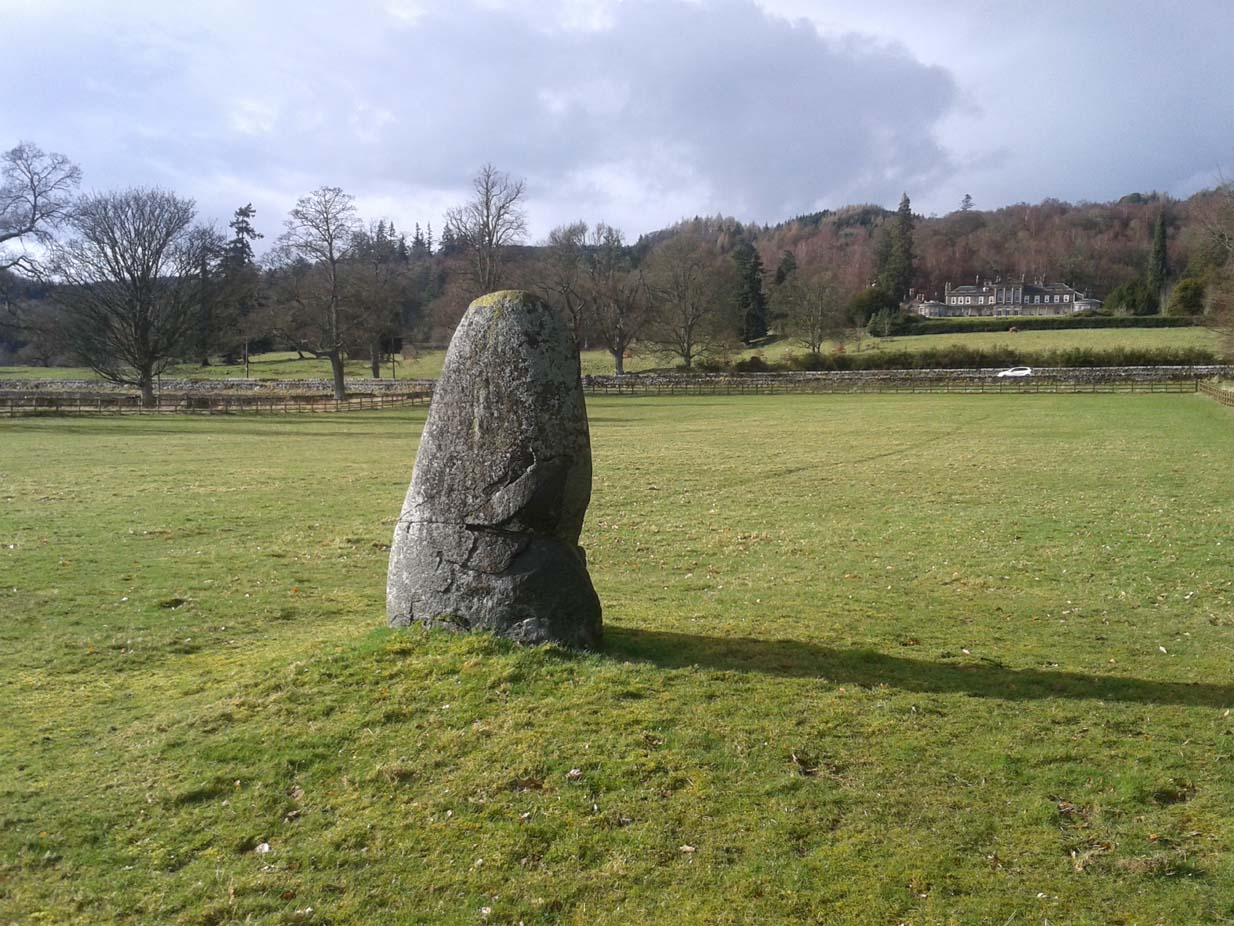
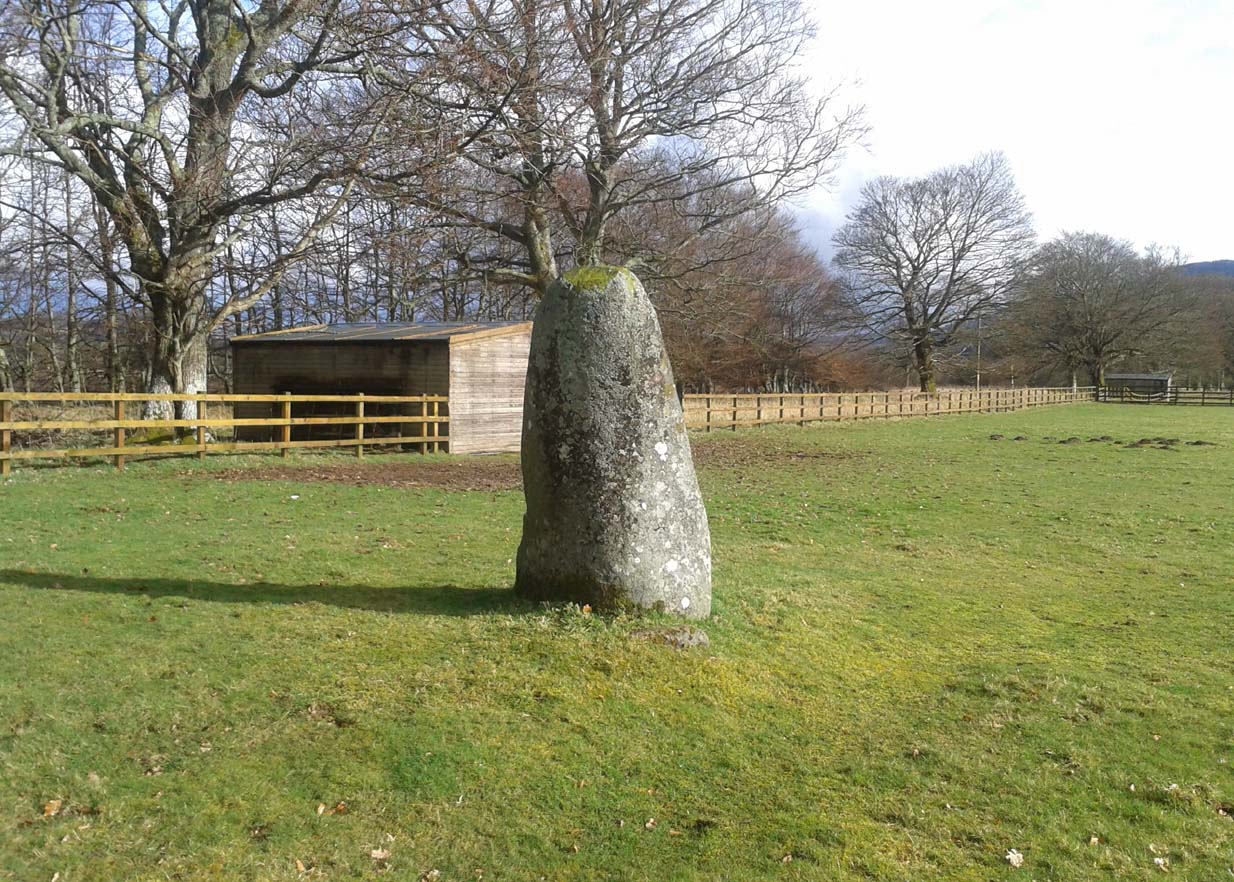
Lawers standing stone, Comrie

Take the A85 road between Comrie and Crieff.  Nearly 1.7 miles (2.7km) east out of Comrie—or 4 miles (6.44km) west out of Crieff—keep your eyes peeled on the fields to the south-side of the road, below and across the mansion of Lawers House.  Alongside a long but small plantation of trees you’ll see a large upright stone.  You can walk along the track adjacent to the field and through the gate.

Archaeology & History

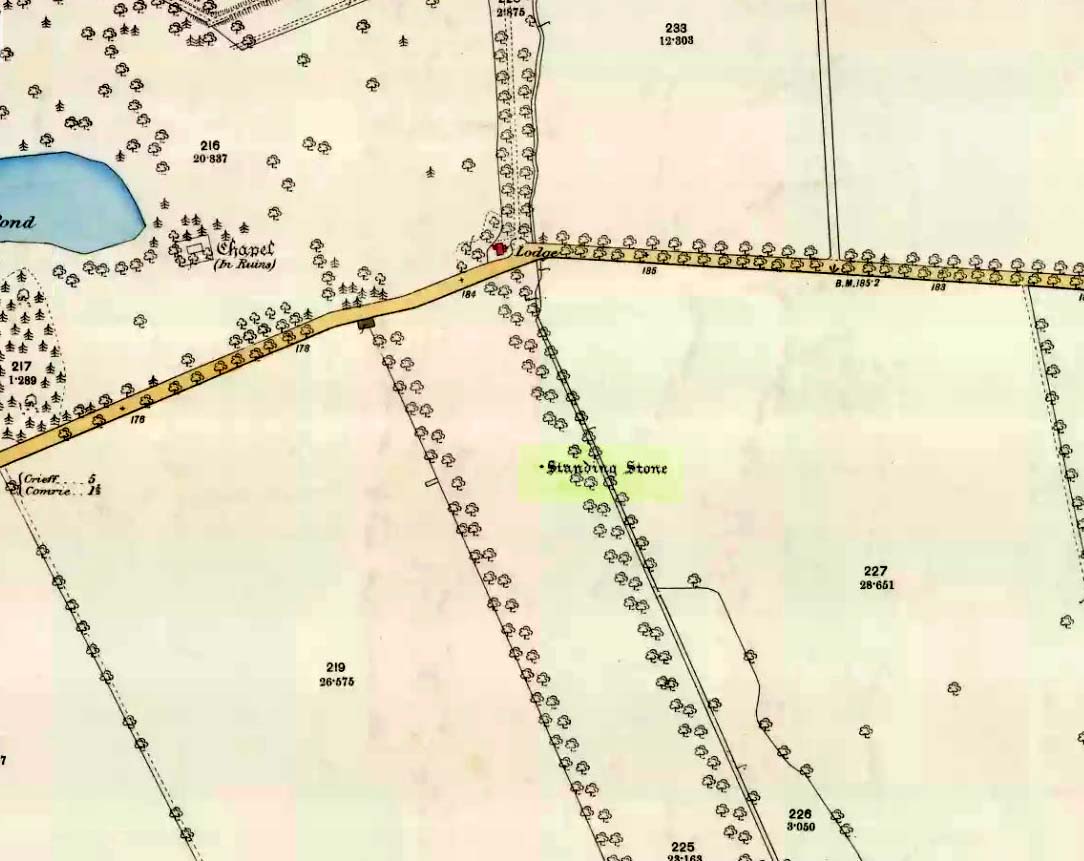
The stone on 1886 OS-map

The stone on 1886 OS-map

Shown on the early Ordnance Survey maps of the area, this probably neolithic monolith was suggested by Fred Coles (1911) to have once been part of a larger megalithic circle—although Aubrey Burl (2000) didn’t consider it as a good enough contender to be listed as such in his gazetteer; and unless we can have some positive affirmation, either through folklore or excavation, we should maintain its status as a singular monolith.  There is the possibility that it stood as an outlier or had some relationship with a nearby prehistoric tomb—but even this is contentious.  Nevertheless, the stone itself is an impressive one!

Mr Coles curiously got the size of the old stone wrong too (although, we have to give him credit, as he did all of his work without electricity or any of our modern ‘stuff’).  He wrote that:

“This massive boulder of whinstone is rounded at the base, where it girths 10 feet 3 inches, but tapers upwards to its apex of 5 feet 10 inches, with the eastern edge somewhat jagged and broken.  Near its base on the west is a small slab-like fragment of stone, quite earthfast.  The north and south surfaces are smooth and nearly vertical, and the longer axis is ESE 75º by WNW 75º.”

Fred Coles' 1911 sketch

Fred Coles’ 1911 sketch

Lawers monolith, looking SE

Lawers monolith, looking SE

The stone is actually larger than Coles described, being more than 6 feet 6 inches tall.  His sketch (right) “shows the stone from the east”, and is pretty much as we find it today.  A notable crack in the stone along the southern face, about a third of the way up, suggests that the stone was broken at some time in the past.

Local architect Andrew Finlayson (2010) included the stone in his local megalith guide and noted how the axes of the stone, east-west, lines it up with Ben Halton to the west and The Knock to the east.

References:

  1. Burl, Aubrey, The Stone Circles of Britain, Ireland and Brittany, Yale University Press 2000.
  2. Coles, F.R., “Report on stone circles in Perthshire principally Strathearn,” in Proceedings of the Society of Antiquaries, Scotland, volume 45, 1911.
  3. Finlayson, Andrew, The Stones of Strathearn, One Tree Island: Comrie 2010.

© Paul BennettThe Northern Antiquarian

Gray Stone, Dunning, Perthshire

Standing Stone:  OS Grid Reference – NO 02182 11809

Also Known as:

  1. Big Stane
  2. Canmore ID 26681
  3. Grey Stone
  4. Maormar‘s Stone

Getting Here

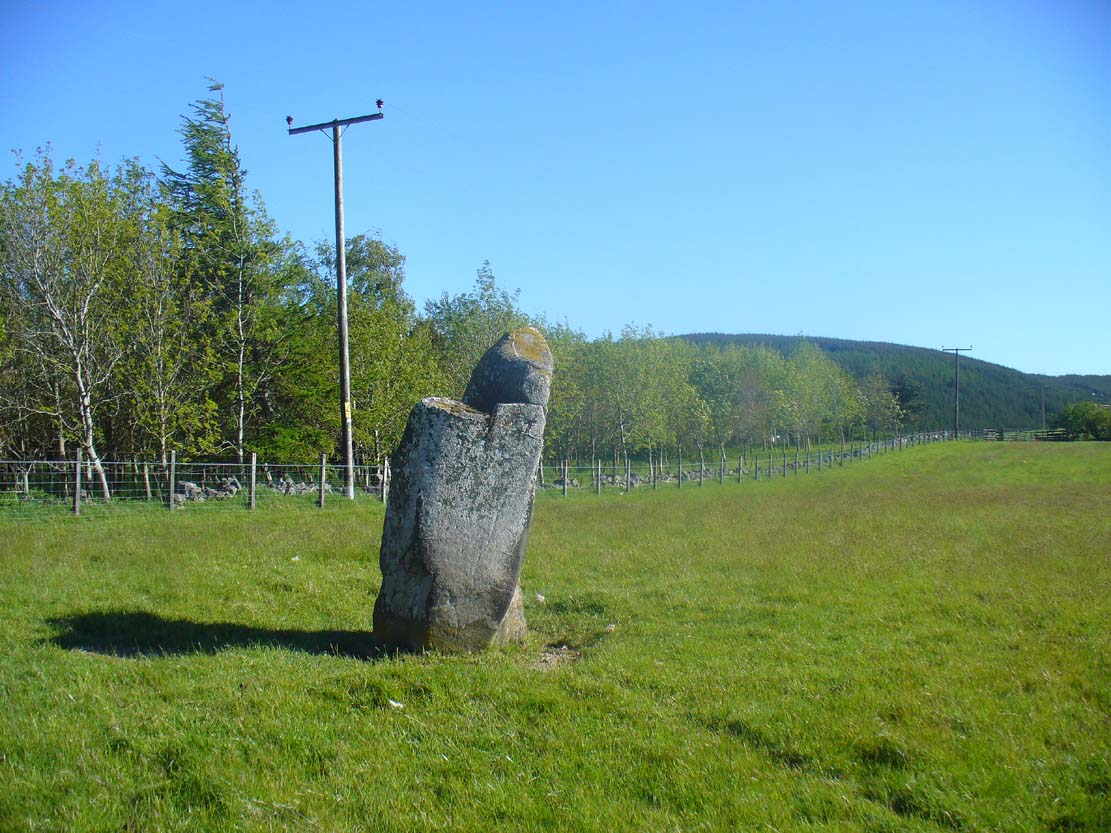
Grey Stone, looking NE

Take the B934 road south, uphill, out of Dunning, for 2.1 miles (3.4km), past Kippen, past Pitmeadow and past Quilts.  It’s the track to Knowes that you’re after!  Along this track, keep to the field-side on your right, following the edge of the fencing until you reach the small copse of trees.  At the far side of the trees a gate takes you into the field with the standing stone, which is just over 100 yards to the north. You can’t miss it!

Archaeology & History

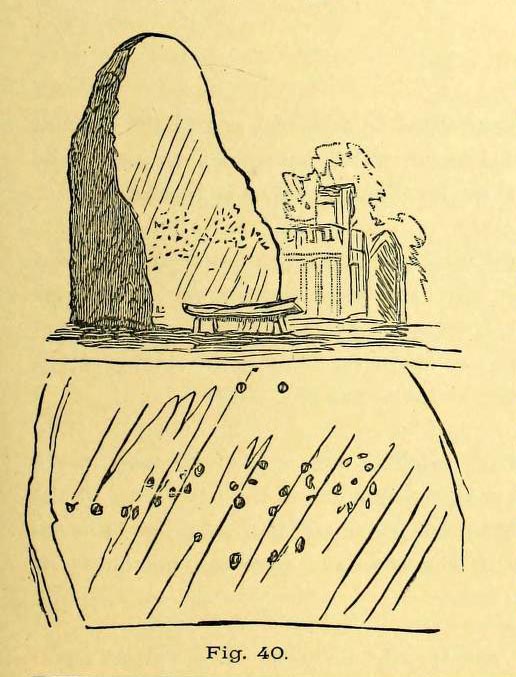
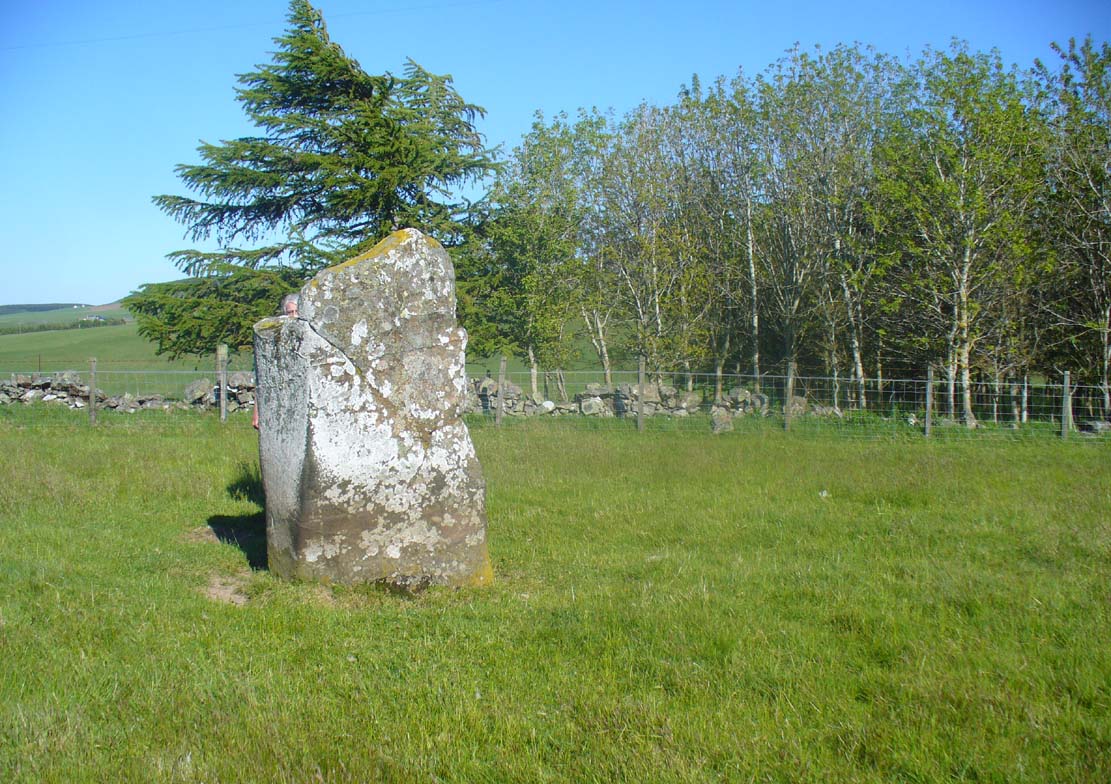
Although mentioned in several folklore works and just a couple of archaeology tomes, almost nothing has been written about this large upright standing stone.  A very bulky stone nearly seven feet tall, it has been broken into pieces at sometime in the recent past but, thankfully, good locals put the stone back together and placed it upright once again.  Its position in the landscape is quite superb, overlooking the lowlands of Tayside below and then far into the rising mountains of Perthshire and beyond, easy fifty miles or more.


Grey Stone, looking south
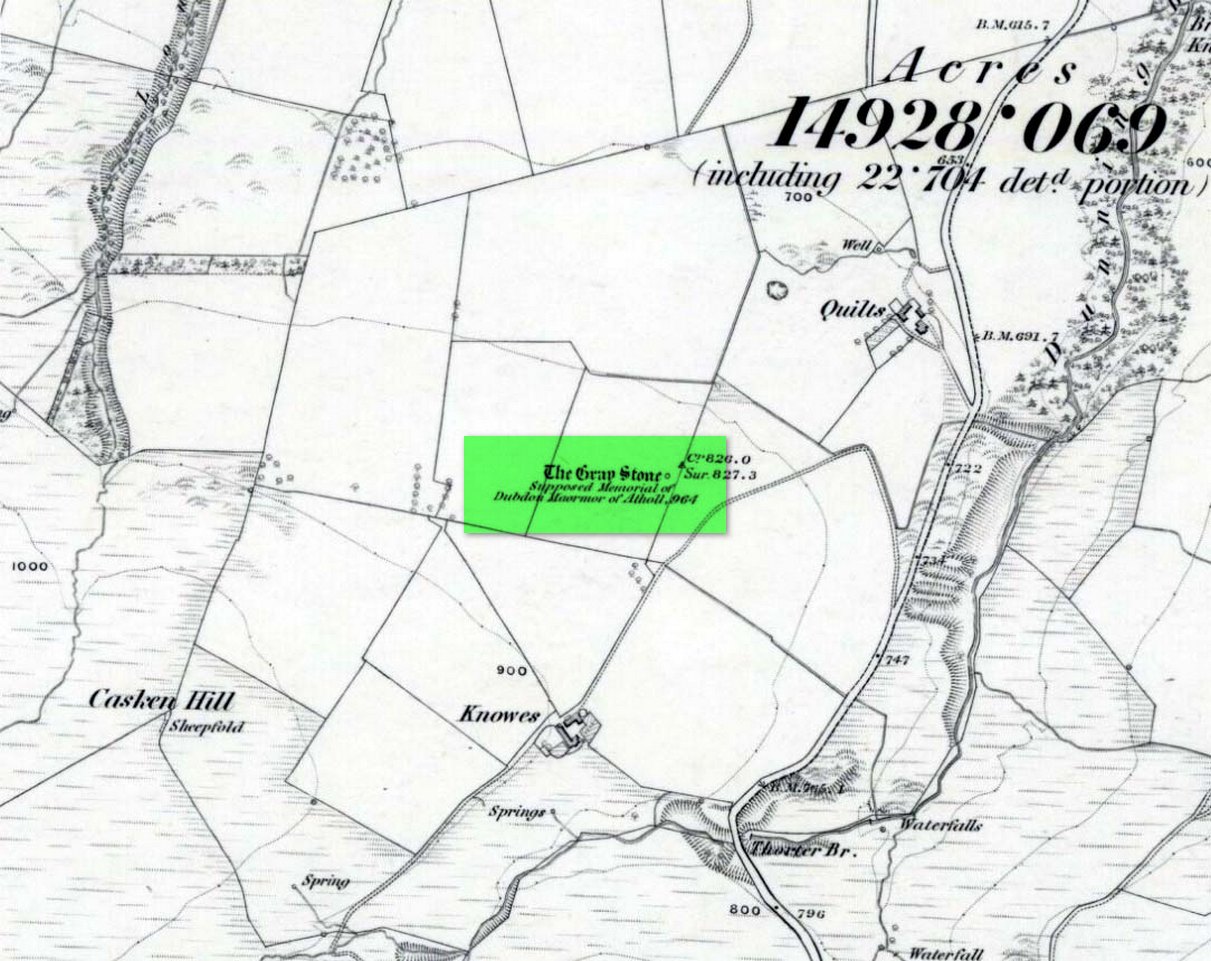
Gray Stone on 1866 map

Shown on the earliest Ordnance Survey map of the area, the name of the stone is somewhat of a puzzle, for in a lot of cases ‘gray’ stones are found on local boundary lines—indeed, the name gray stone and boundary stone are interchangeable in many cases—yet the nearest boundary from here is some distance to the east.  It may simply relate to the colour of the rock (although this is unlikely).  Whatever its reason, it’s an impressive stone and is well worth checking out!

Folklore

Gray Stone, looking east

The local farmer told that the field where the Grey Stone lives was known as the Big Stane Field.  Makes sense!  Legend has it that the Gray Stone was the burial place of Maormor, the Steward of Atholl in the Battle of Duncrub, after dying in Thanes Field (Watson 1995), on land to the north of Dunning village in 964-5 CE.

References:

  1. Holder, Geoff, The Guide to Mysterious Perthshire, History Press 2006.
  2. McKerracher, Archie, Perthshire in History and Legend, John Donald: Edinburgh 1988.
  3. Swarbrick, Olaf, A Gazetteer of Prehistoric Standing Stones in Great Britain, BAR: Oxford 2012.
  4. Watson, Angus, The Ochils: Placenames, History, Tradition, PKDC: Perth 1995.

© Paul BennettThe Northern Antiquarian


Druim Mor, Callander, Perthshire

Standing Stone:  OS Grid Reference – NN 63542 09721

Getting Here

The Druim Mor stone

The small Druim Mor stone

Along the A84 Callander road, just going out on the east side of town, take the signposted road up and up and towards the car-park for the Bracklinn Falls.  Another mile past here, keep your eyes peeled for the Wishing Well sign on the right-hand side of the road.  From here, walk straight up the hillside for 150 yards (137m) and zigzag about.  You’ll see it!

Archaeology & History

This small standing stone (not previously recorded) hides away up on the hillside not far from the old Tobhar na Cailleach (nowadays demoted as a just a Wishing Well), with its history and traditions seemingly long forgotten.  About 3 feet high and barely a foot thick, it may once have had a companion standing just a few yards away by its side, where now lays a moss-covered stone.  It reminded me a little of the stone pairing called the Cuckoo Stones near Wuthering Heights at Haworth, West Yorkshire.

Possible fallen stone

Possible fallen stone

Druim Mor stone, looking N

Druim Mor stone, looking N

Slightly higher up the grassy slope, 15-20 yards away, we find a low line of ancient walling that runs slightly uphill and then across a slightly level piece of land for about 40 yards, before turning back down the hillside and towards the road below.

Folklore

Although we have no recorded traditions of this stone, it needs to be highlighted that the waters, the woods and the slopes below this stone are dedicated to the Cailleach – the great prima Mater of Scottish and Irish traditional history.

Acknowledgements:  Many thanks to Nina Harris and Paul Hornby for their help on the day of this find.

© Paul BennettThe Northern Antiquarian

Borland, Blacklunans, Alyth, Perthshire

Standing Stone: OS Grid Reference – NO 15361 60677

Also Known as:

  1. Borland Stone
  2. Canmore ID 29401

Getting Here

The Borland Stone, looking NE

The Borland Stone, looking NE

From Blairgowrie, take the A93 north road, ensuring that when you reach the Bridge of Cally after 5½ miles (9km), you take the right-turn up Glenshee (the Valley of the Faerie folk) and not the A924 Strathardle road. After about 5 miles, turn right up the small lane to Blacklunans after, once you’ve weaved past the River Shee and started uphill, a few hundred yards on keep yer eyes peeled on the fields to your left. If you hit the Glenshee EcoCamp, you’ve gone too far.

Archaeology & History

Borland Stone, looking west

Borland Stone, looking west

This small, out-of-the-way standing stone is set amidst a small mass of rounded stones—as if once part of a cairn—at the top of a small hillock that can easily be passed by if your nose isn’t working properly.  Curiously isolated, the monolith seems more of an outlier to the Mount Blair hills immediately north and east; or perhaps the large settlement less than a mile south.

Very little seems to have been said about the stone, in literary terms at least.  The Royal Commission (1990) lads merely told us that,

“This stone, which stands on the summit of a prominent knoll 300m SE of Borland farmhouse, measures 0.7m by 0.3m at the base and 1m in height.”

Stone aligned NNE to Tom Bealaidh

Stone aligned NNE to Tom Bealaidh

Nowt else!  Although the stone was marked on the early 1900 OS-map, the small mass of loose stones at its base are more recently-worked than anything prehistoric and may simply be field clearance.  The monolith itself could do with assessment to positively ensure its prehistoric veracity.

References:

  1. Meikle, James, Places and Place-Names around Alyth, Alexander Gardner: Paisley 1925.
  2. Royal Commission on the Ancient & Historical Monuments of Scotland, North-East Perth: An Archaeological Landscape, HMSO: Edinburgh 1990.

© Paul BennettThe Northern Antiquarian

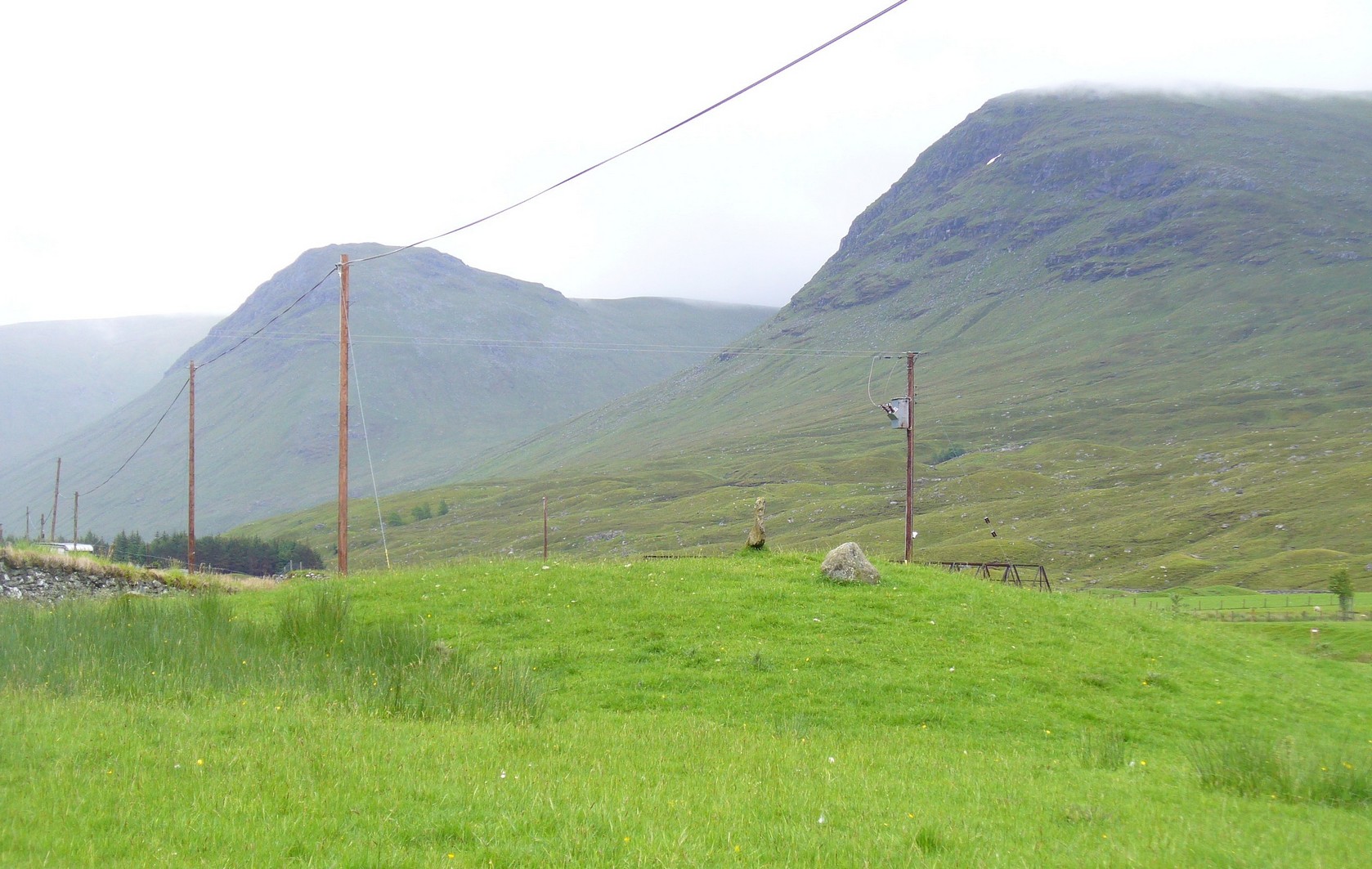
The Bhacain, Cashlie, Glen Lyon, Perthshire

Standing Stone:  OS Grid Reference – NN 48367 41706

Also Known as:

  1. The Bhacan
  2. Canmore ID 23977
  3. Cona Bhacain
  4. Testing Stone of the Fianna

Getting Here

The Bhacain in its setting

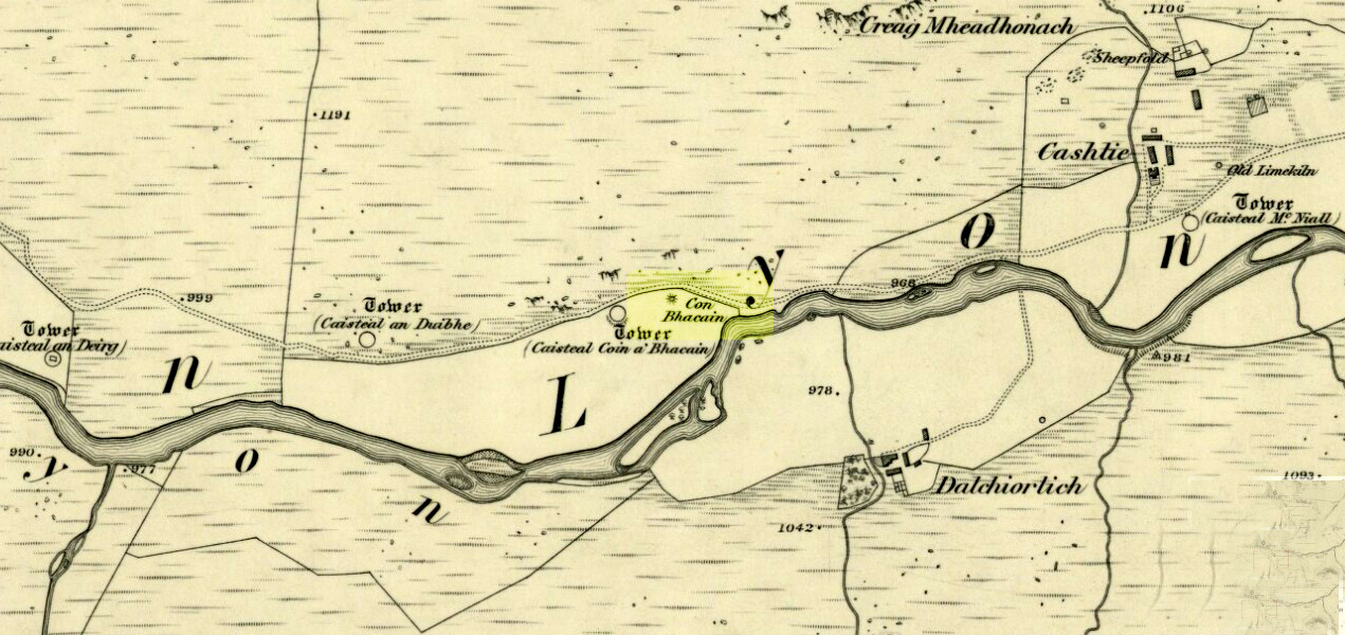
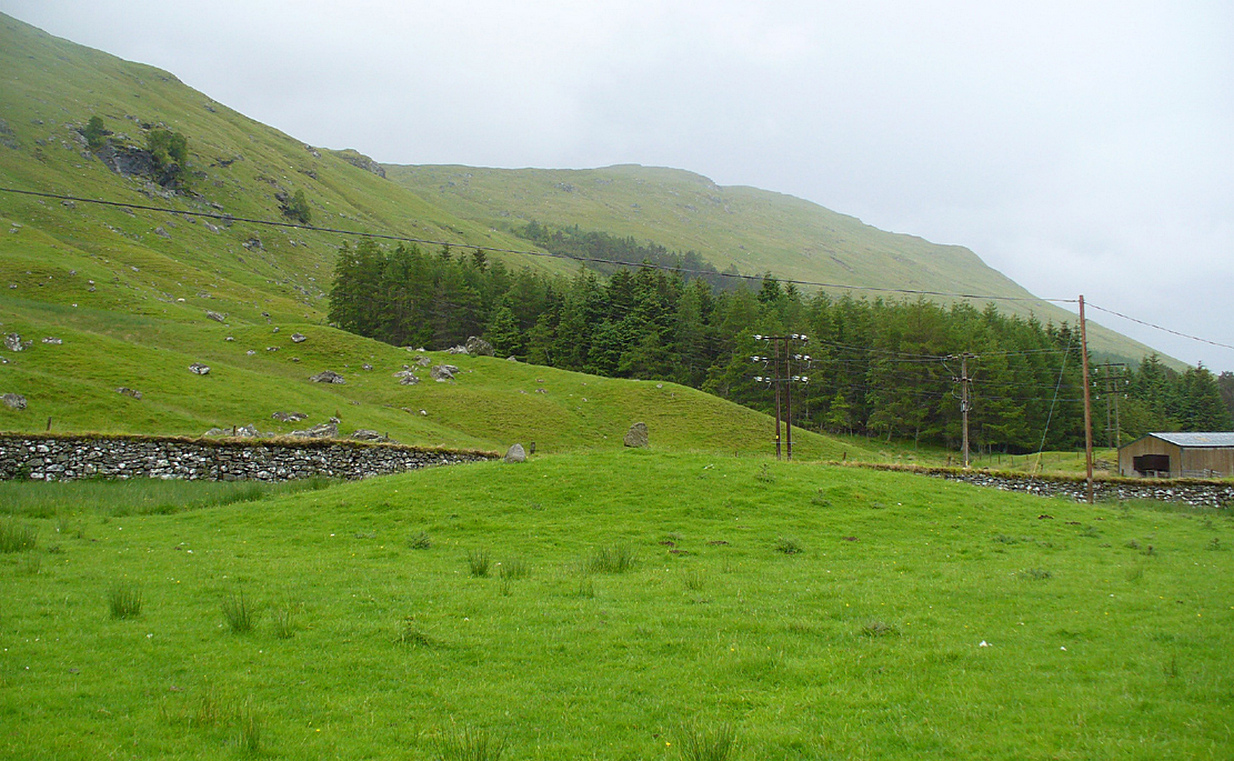
Whether you take the road west from Fortingall, or over the heights from Loch Tay, when you reach Meggernie Castle just keep going west for a few more miles.  Keep going past the large Stronuich reservoir on your left and you’re getting close.  Go past Caisteal Mhic Neill and the trees at Cashlie House for another 5-600 yards and where the track crosses the river Lyon, park up just past it.  Ahead of you in the field on the left of the road, nearer the riverside, is where you need to look.

Archaeology & History

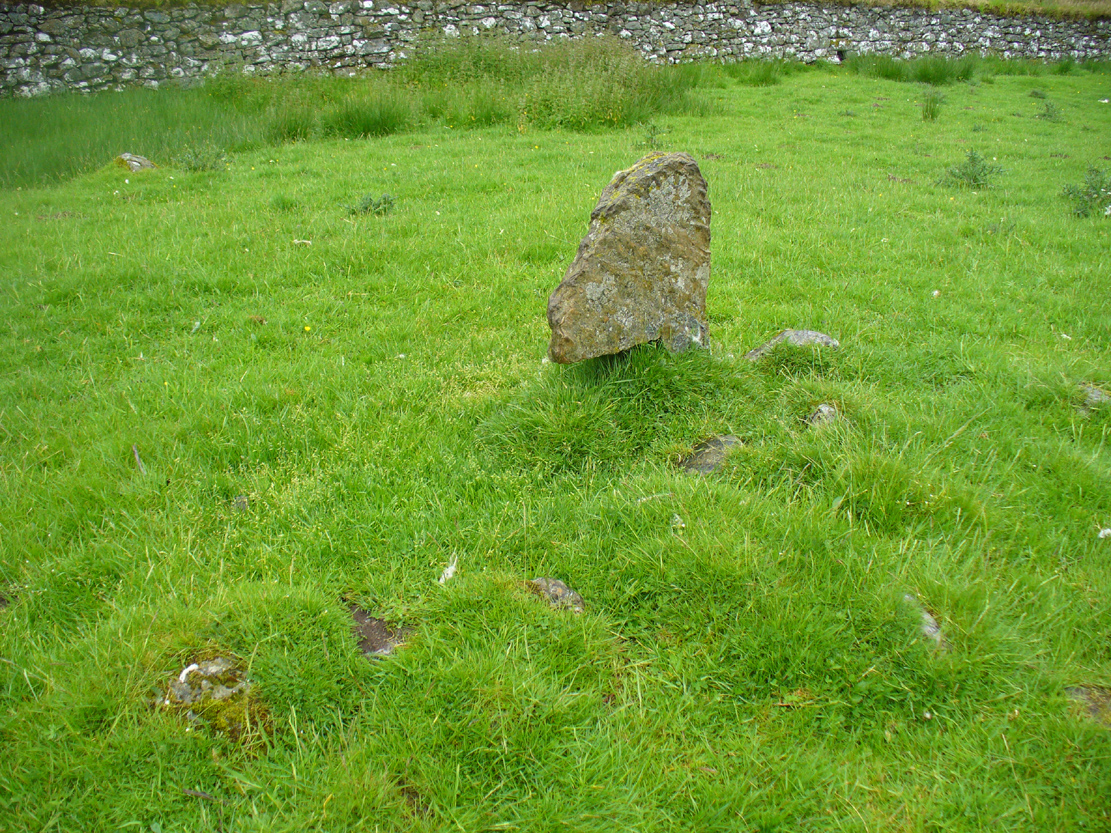
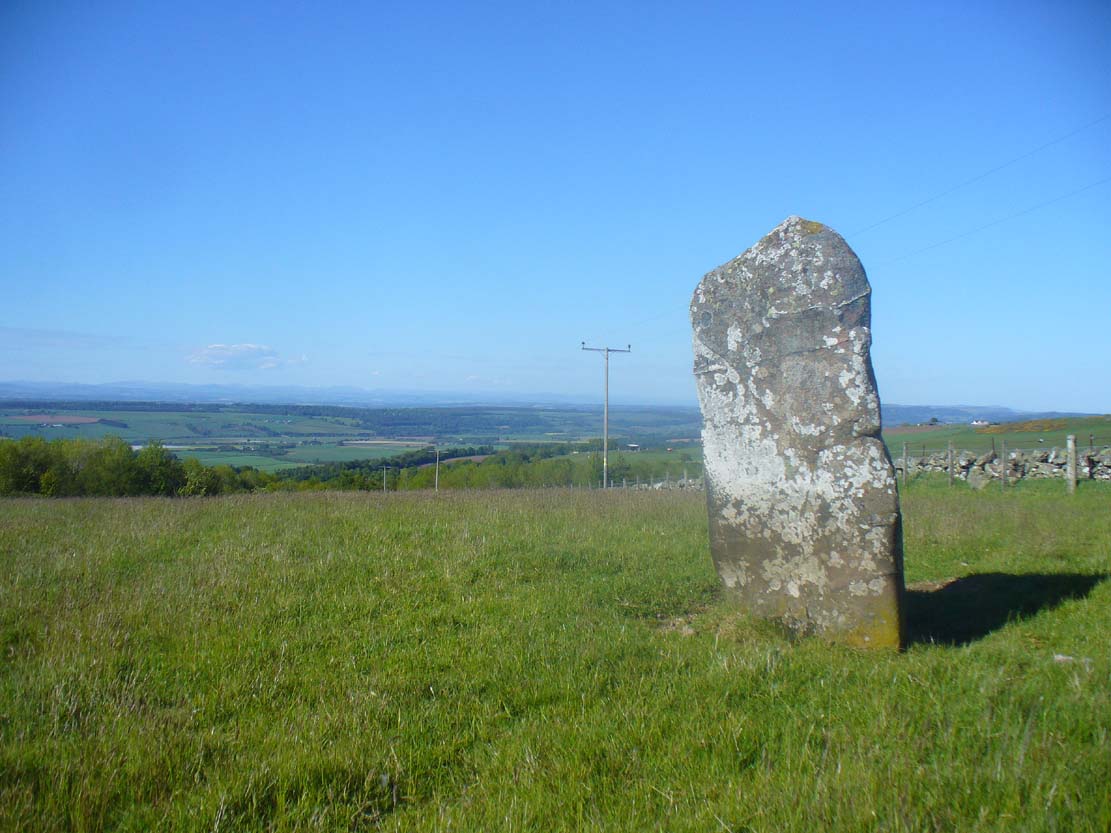
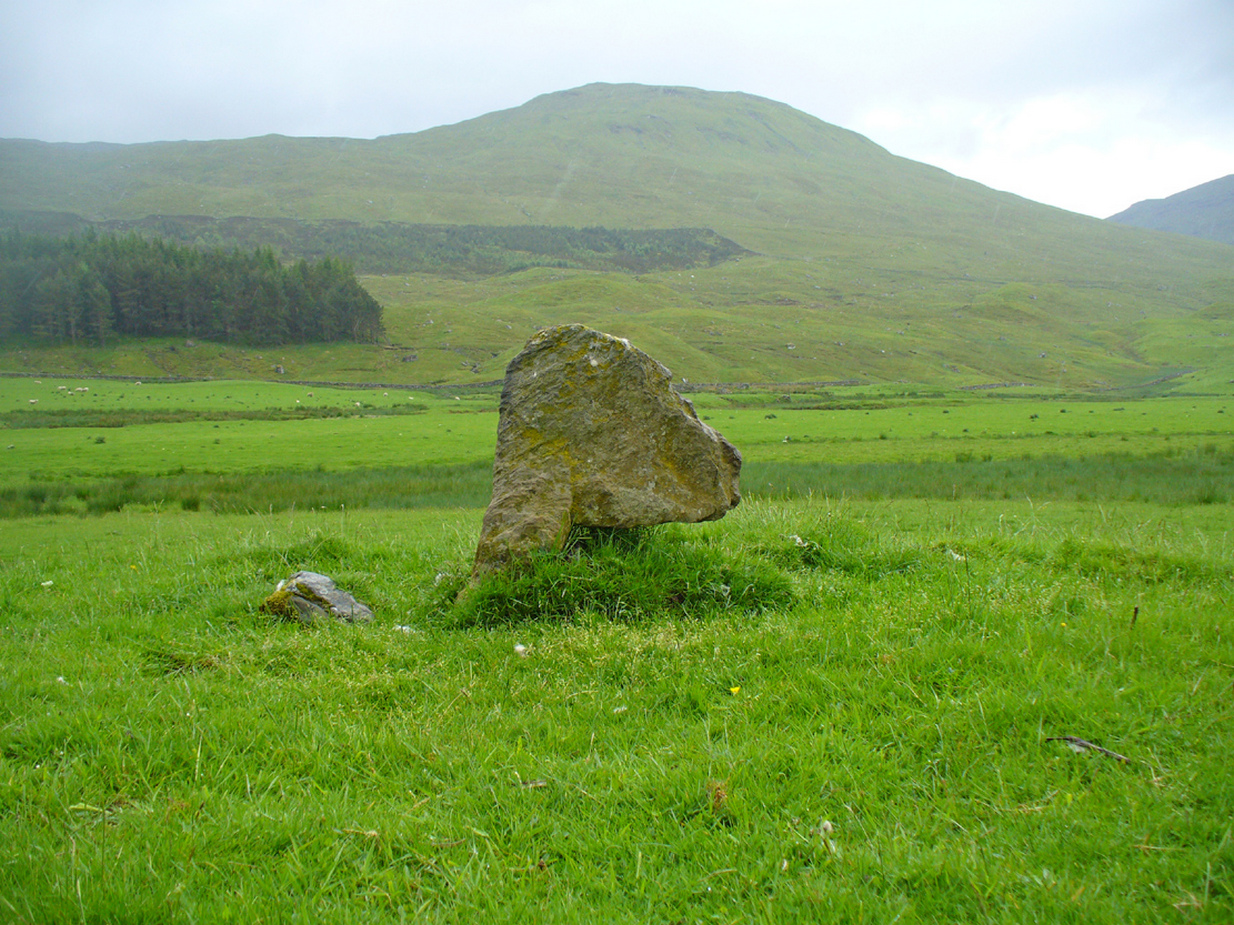
One of the most peculiar and unique sites in the British Isles is this remote small upright stone, known locally as The Bhacain.  Standing upon a small mound in the field immediately east of one of Finn’s legendary ‘forts’ (a dun or a broch) called Caisteal Cona Bhacain, this curious monolith, less than two feet tall, has a thin upright stem with a much enlarged rounded end to it.  Some might even ascribe it as phallic—although local traditions of the stone relate it as a truth-sayer of a young girl’s virginity!

The Bhacain on 1867 map
Mound of The Bhacain

Its position on top of the small mound is intriguing, giving it the impression of being atop of a tumulus; and there is also the scatter of small stones surrounding the upright just beneath the surface (as evidenced in one of the photos), making it possible that the stone is an ancient burial marker.  If this is ever shown to be true, the likelihood is that the stone marks the grave of a hound, as the tradition of this spot implies.  No excavation has ever occurred here, so the precise nature of the stone (and the mound) has yet to be ascertained; but knowing the longevity of some oral traditions in these Highland glens, the idea of it being the burial-place of a dog is anything but far-fetched.

If the stone is contemporaneous with the associated ‘duns’ close by, this would be a late standing stone, probably erected in the Iron Age.  We can certainly see, quite plainly from the erosion on the stone, that this is not neolithic or Bronze Age in origin.  A decent examination of the important sites hereby is long overdue…

Folklore

The Bhacain & its stony pile

The folklore and traditions attached to this site are numerous when you consider how small it is.  Much of this relates to the fact that animistic cosmologies in the Highlands were retained until very recently, stretching way back.  Accounts from the 19th and 20th centuries tell of people still frequenting this and other sites, at sunrise, or full moons, as such things were still very much integral parts of rural life.  When the local historian Duncan Fraser (1973) wrote about The Bhacain in his fine work on this area, he told much about the traditions of the great warrior King Fionn and his activities hereby:
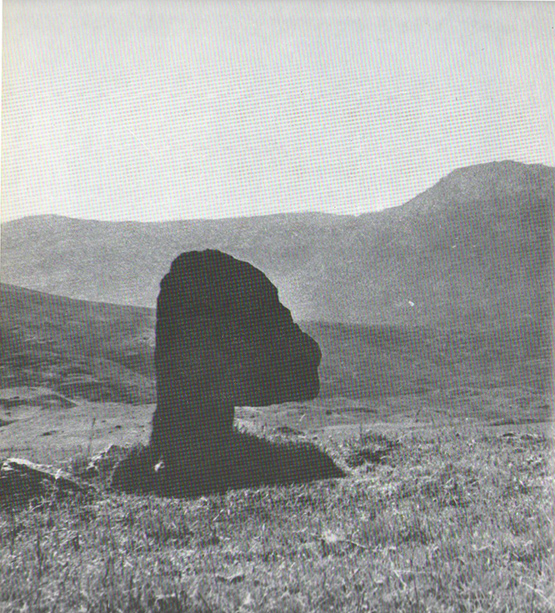
Duncan Fraser’s old photo
The Bhacain, looking S

“Another traditional link with the warrior King is the Bhacain, on a mound beside the road, far up the glen.  Only a stone’s throw from one of the forts, it is about two feet high and shaped like the head of a dog.  This is said to have been the stake to which the Fians tethered their staghounds with leather thongs, when they returned from the chase.  And there were times, no doubt, when Fionn’s own dog, Bran was among them, with its yellow paws and its black flanks and its chain of pure gold.  It was the best hunting dog that ever lived.  And there was its brother, the dreaded Grey Hound, that used to roam on its own in the Great Glen, tearing its victims limb from limb, until it too abandoned its wildness and became one of the hounds of the Fians.  They say that the dogs’ food was thrown to them from the top of Caisteal Coin-a-bhacain, the castle of the dog’s stake, upwards of seventy yards to the west.  And any dog that failed to catch its supper was turned out of the pack.

“Time did not allow the Bhacain to become inanimate like other stones.  Even in comparatively recent times it was still regarded with superstitious awe.  A retired schoolmaster of Fortingall recorded eighty years ago that it was said to have a mysterious effect on those who crept under its head.  And old folk in the glen will tell you that those who did so were girls.  It had become the glen folk’s yardstick of virginity.  In the late eighteenth century, when the girls returned from gathering the harvest in the ungodly Lowlands, under the stone they went.  It was better than all your modern pills.”

In Hilary Wheater’s (1981) fine work on the history of the region, he told that “no youth was permitted into the fighting body of the Clan until he could lift the Bodach Stone onto the boulder beside it.”  This tradition gave the Bhacain another name, the Testing Stone of the Fianna.

References:

  1. Burke, Peter, Popular Culture in Early Modern Europe, Scolar Press: Aldershot 1994.
  2. Fraser, Duncan, Highland Perthshire, Standard Press: Montrose 1973.
  3. McKerracher, Archie, Perthshire in History and Legend, John Donald: Edinburgh 1988.
  4. Stewart, Alexander, A Highland Parish; or, The History of Fortingall, Alex MacLaren: Glasgow 1928.
  5. Wheater, Hilary, Aberfeldy to Glenlyon, Appin Publications: Aberfeldy 1981.

© Paul BennettThe Northern Antiquarian