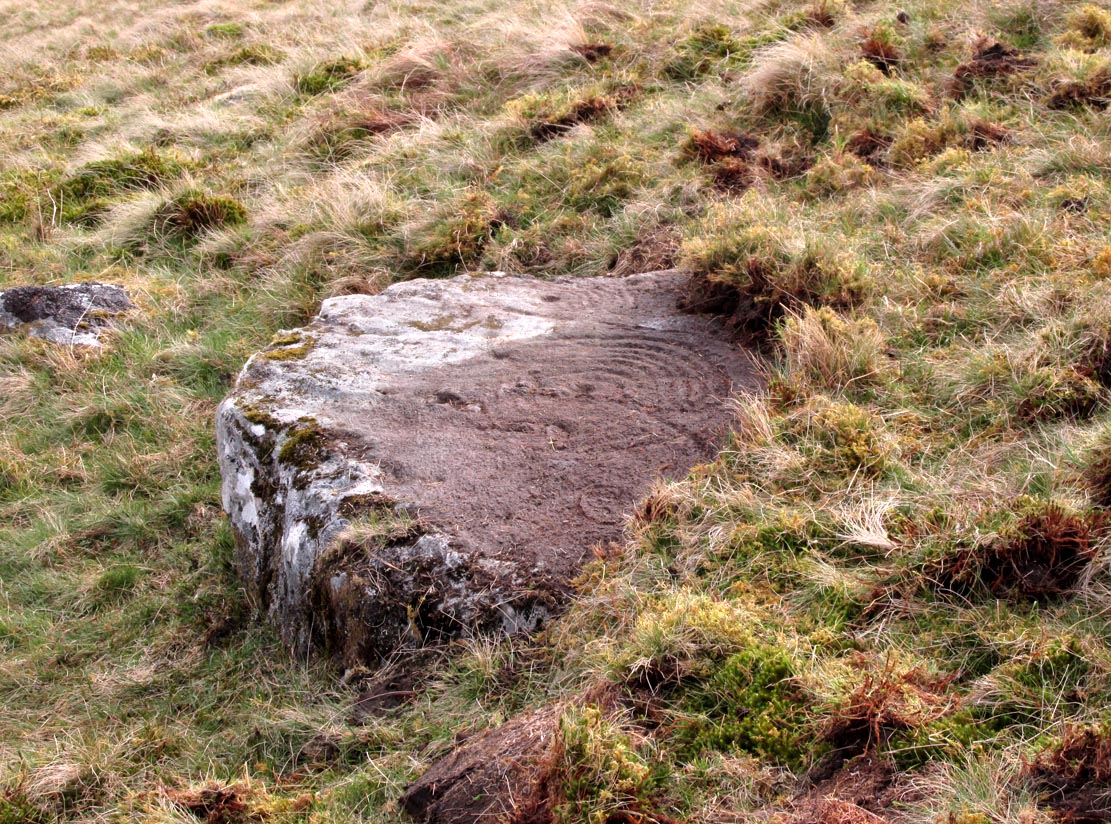
Castleton (2), Cowie, Stirling, Stirlingshire

Cup-and-Ring Stone:  OS Grid Reference – NS 85494 88272

Also Known as:

  1. Castleton 9 (van Hoek)

Getting Here

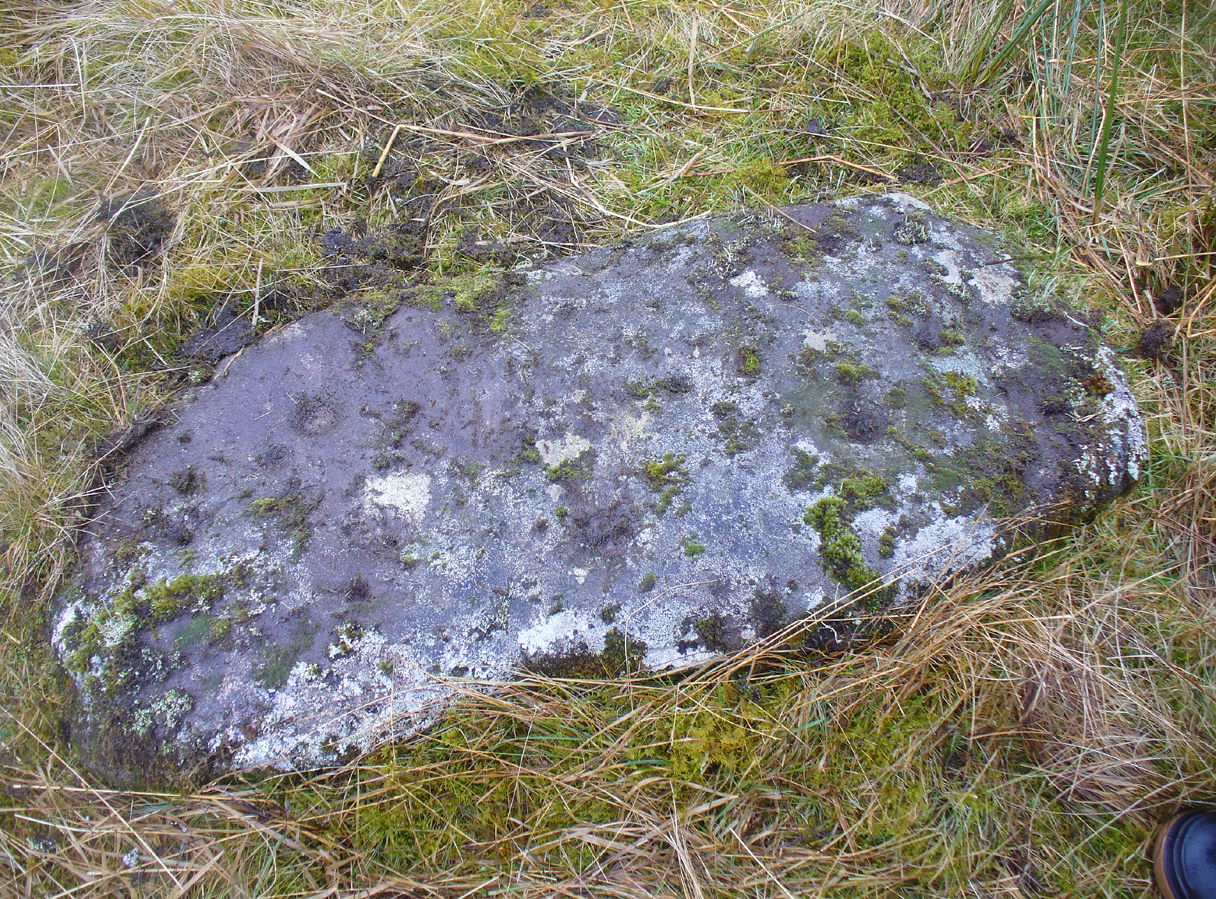
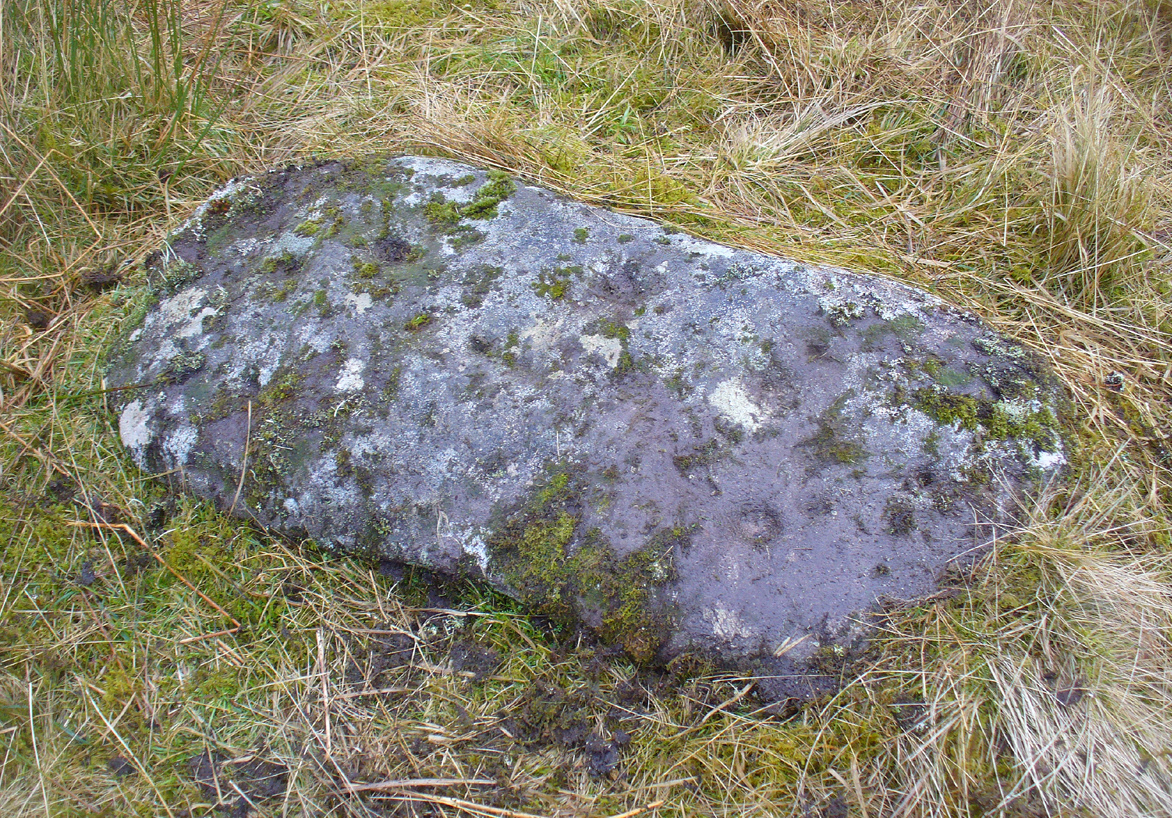
Castleton 2 carving, Airth

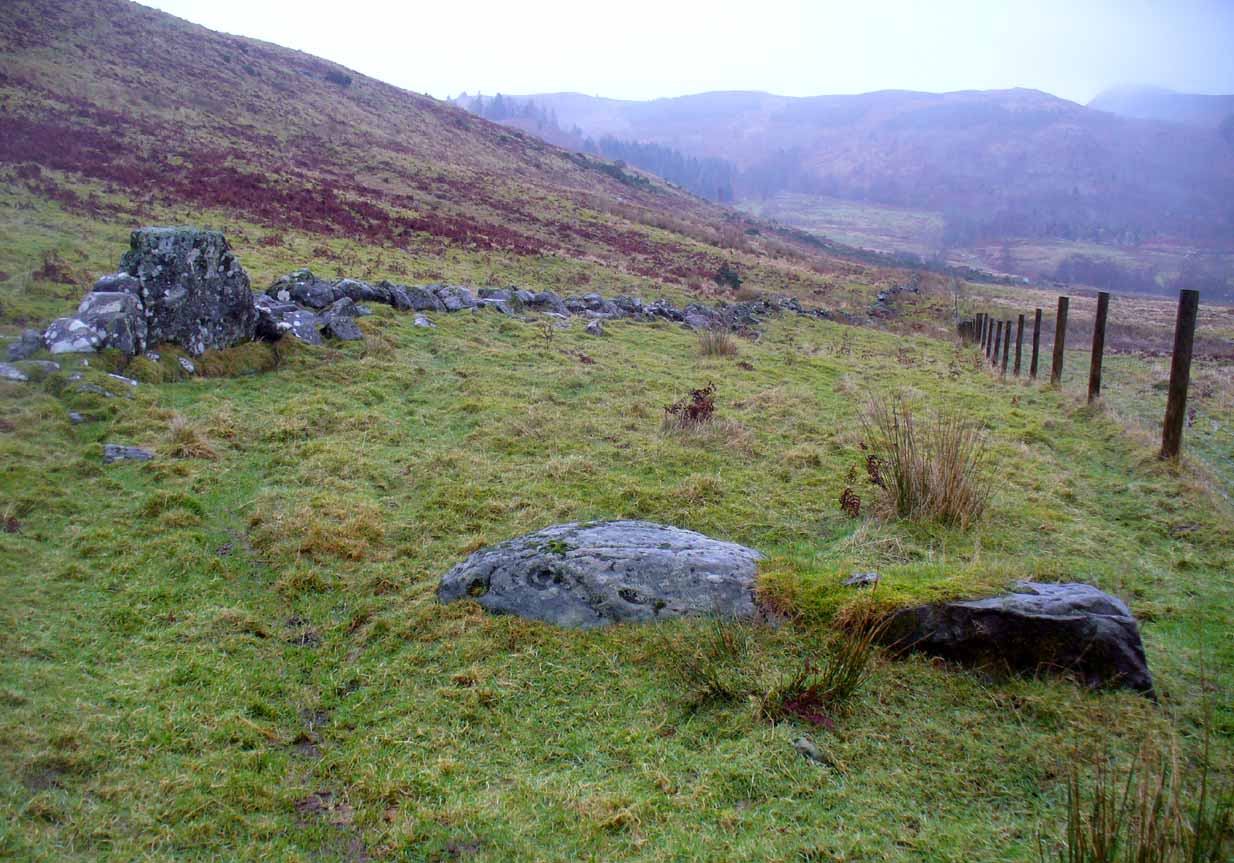
If you’re travelling from Stirling or Bannockburn, take the B9124 east to Cowie (and past it) for 3¾ miles (6km), turning left at the small crossroads; or if you’re coming from Airth, the same B9124 road west for just about 3 miles, turning right at the same minor crossroads up the long straight road. Drive to the dead-end of the road and park up, then walk back up the road 350 yards to the small copse of trees on your left.  Therein, some 50 yards or so, zigzag about!

Archaeology & History

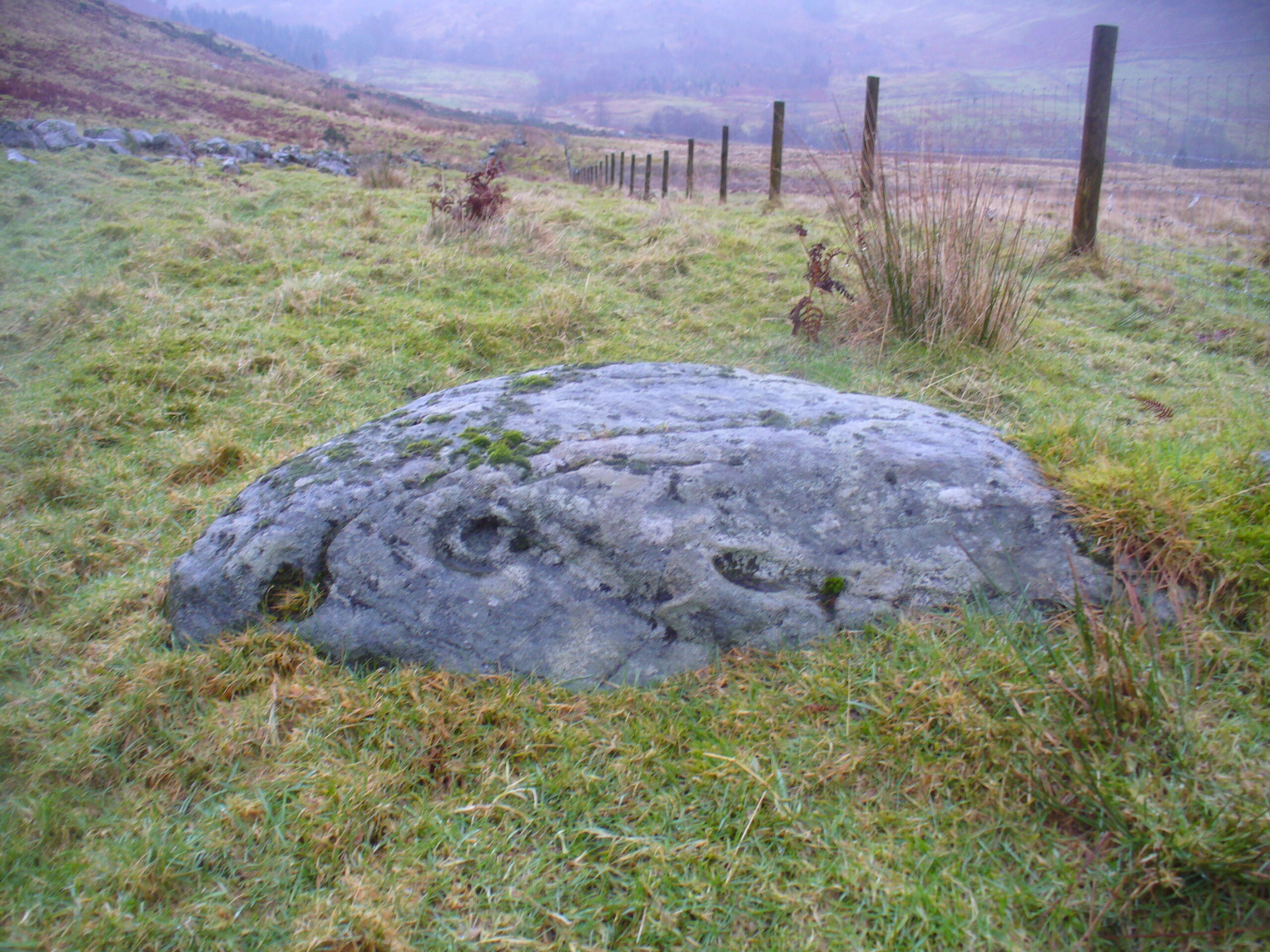
Petroglyphs can be troublesome things at the best of time: not only in their ever-elusive root meanings, but even their appearance is troublesome!  This example to the east of Cowie in the incredible Castleton complex is one such case.  It is undoubtedly a multi-period carving, probably first started in the neolithic period, added onto in the Bronze Age, and maybe even finished in the early christian period.  You’ll see why!

It’s been described several times in the past, with Maarten van Hoek (1996) telling how it was rediscovered,

“by Mrs Margaret Morris in 1986 in the birch-coppice at Castleton Wood. A fragment of outcrop rock with a distinct cup-and-three-rings, rather oval-shaped like others in the area.”
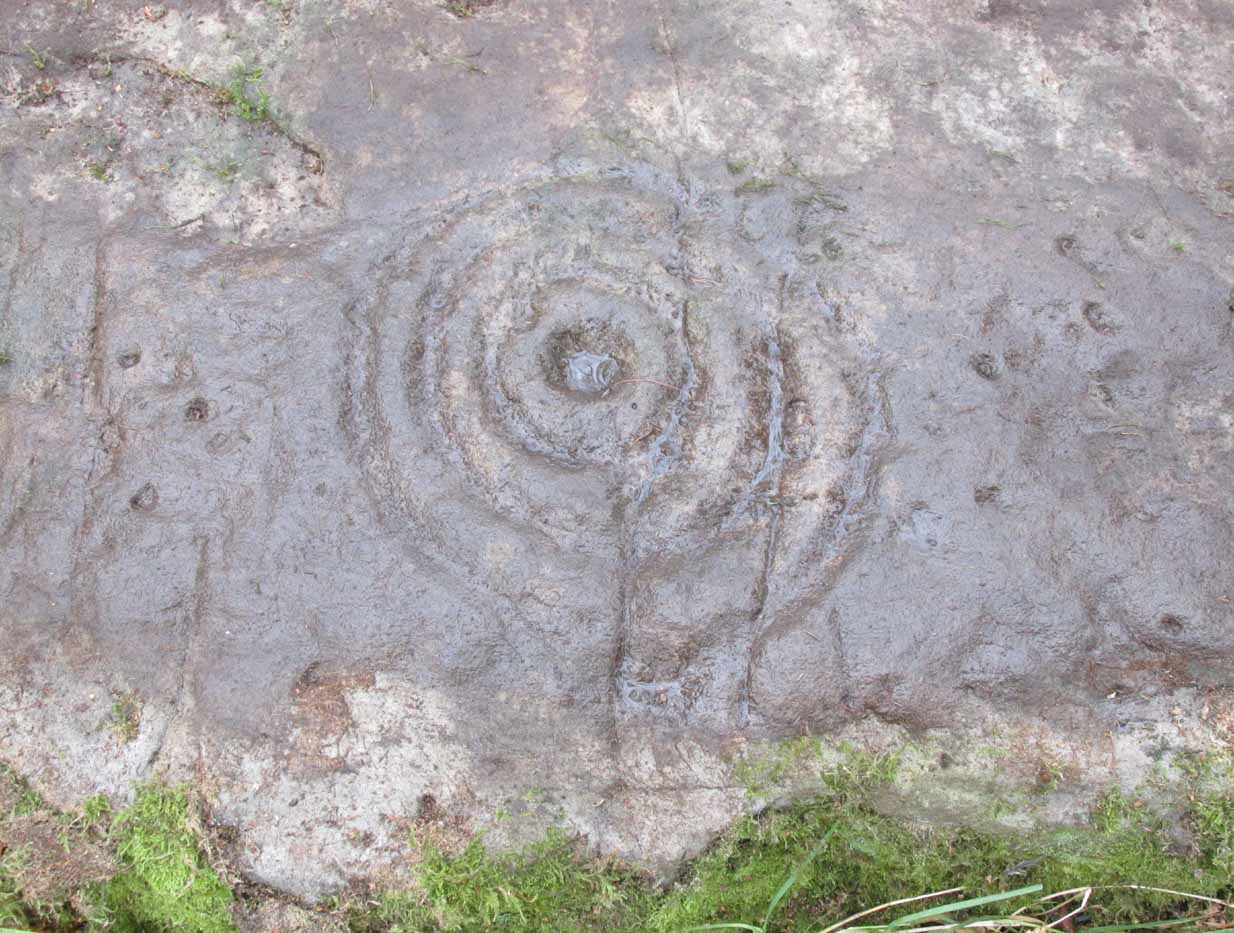
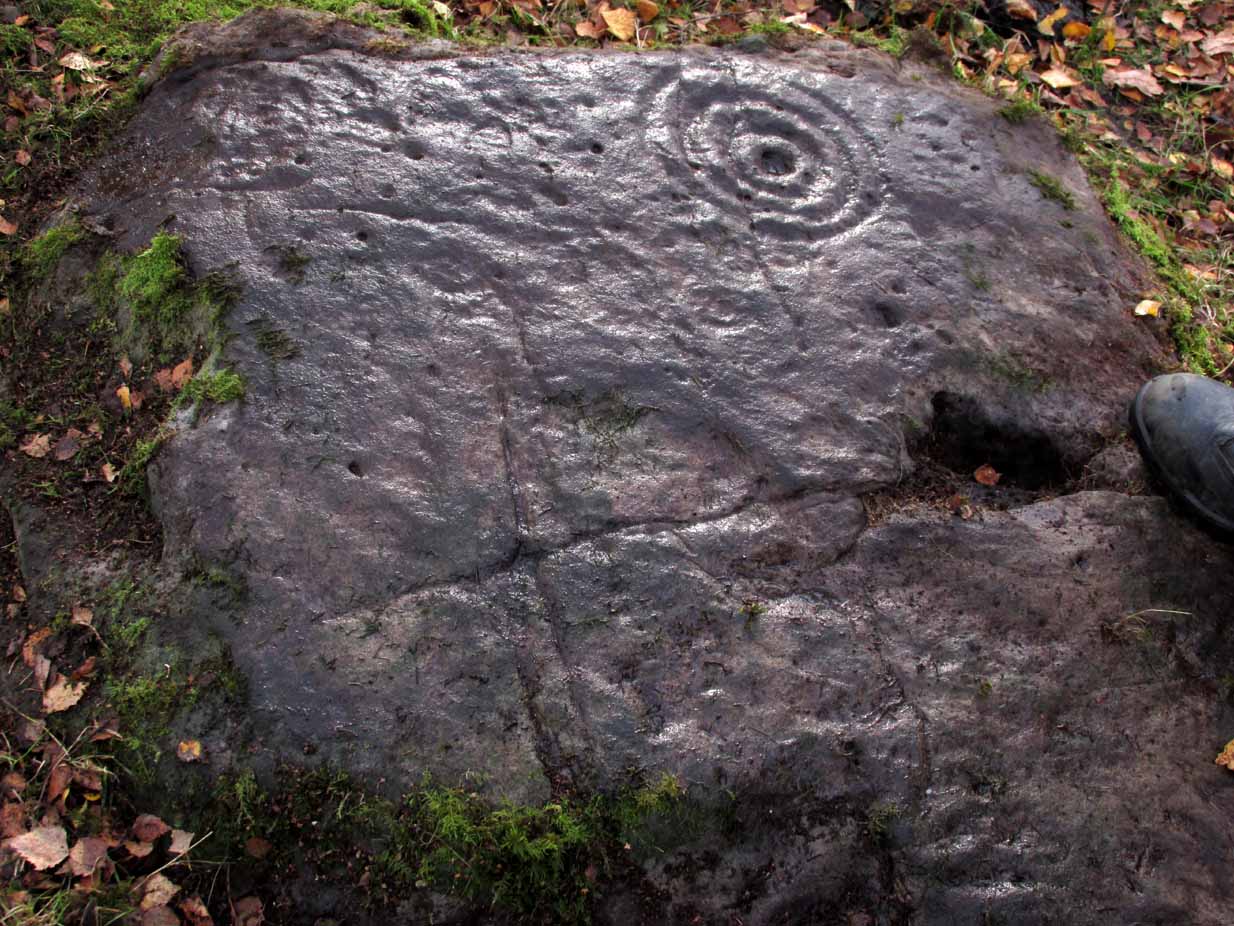
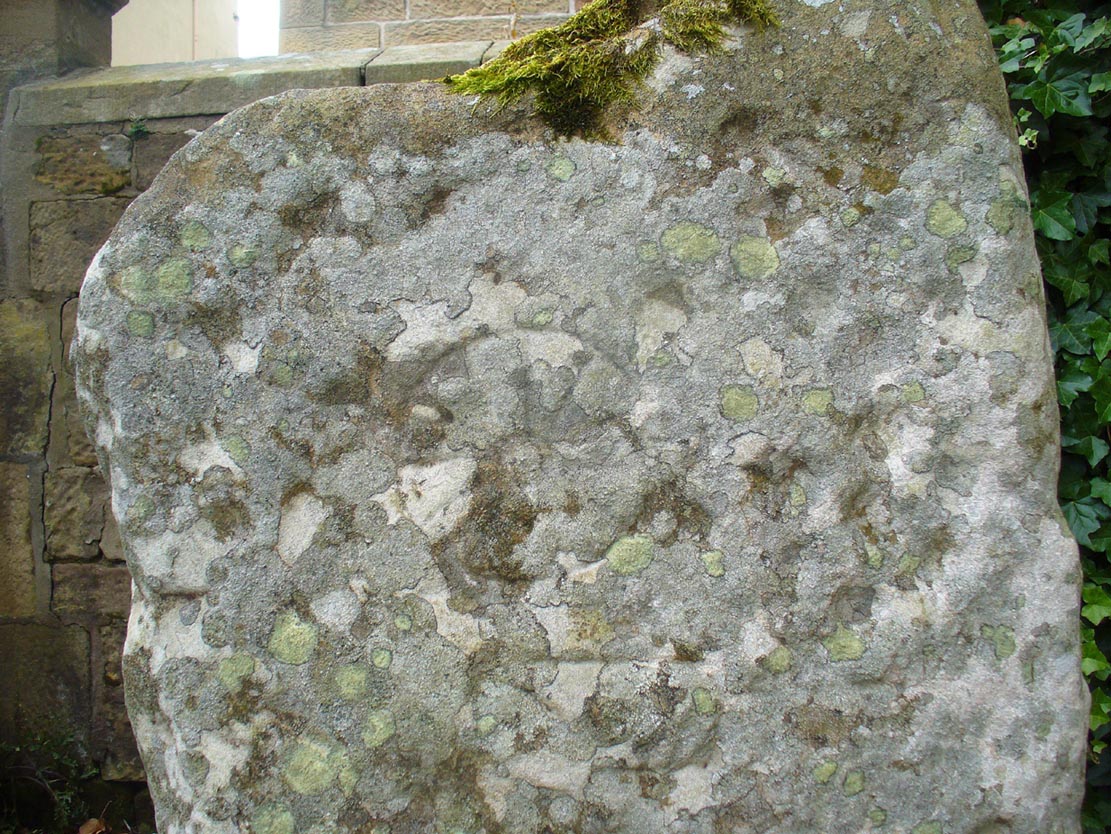
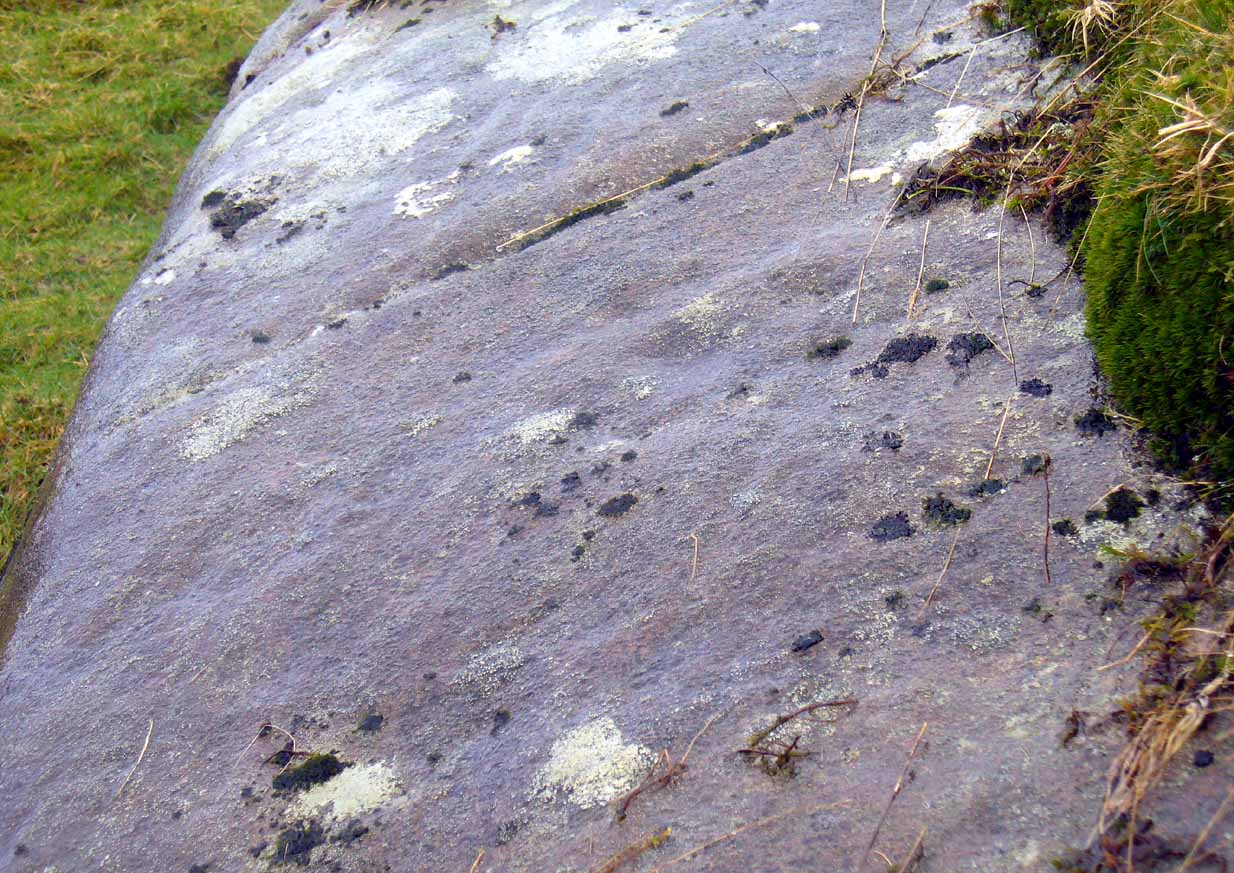
The main cup-and-3-rings (photo, Paul Hornby)

But as our own team found out, there’s more to it than that.  Like many of the Castleton carvings, vital elements have been missed in the previous archaeological assessments.  But it’s an easy thing to do.  The carved design here almost ebbs and flows with daylight, shadows, changes in weather, bringing out what aboriginal and traditional peoples have always told us about rock itself, i.e., it’s alive, with qualities and virtues that can and do befuddle even that great domain of ‘objectivity’—itself an emergent construct of an entirely subjective creature (humans).  But that’s what petroglyphs do!—whether they are part of a living tradition, or lost in our striving modernity, exhibiting once more that implicit terrain of animism.  And this carving exemplifies it very clearly.

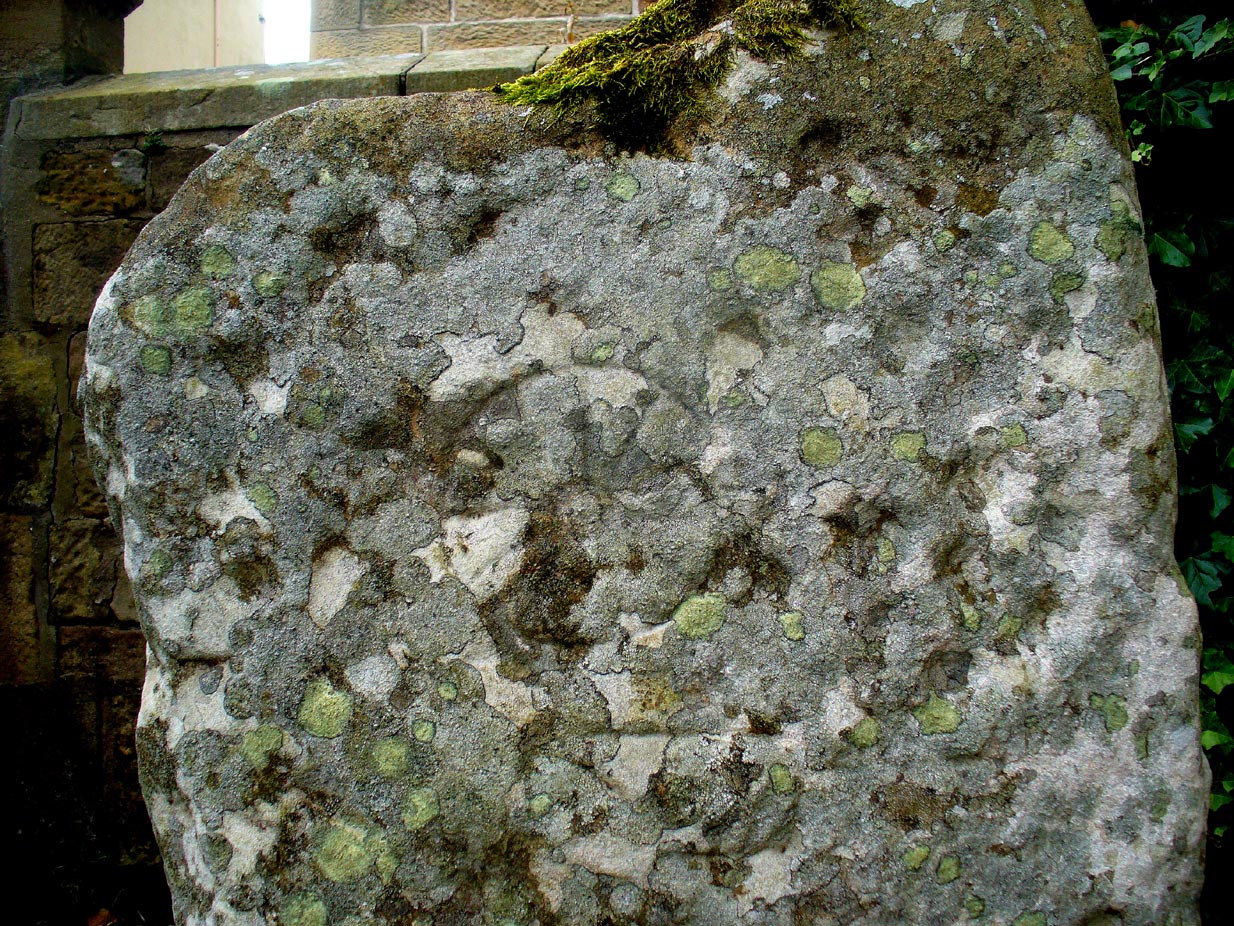
The primary visual design is the odd triple-ring, which isn’t quite as clear-cut as the earlier descriptions would have you think.  In the drawing below by van Hoek (1996), three complete elliptical ‘rings’ are shown; whereas on its northern edge where the outer ring is closest to the rock edge, we find that the ‘ring’ has carved lines that run off and down the slope of the stone towards ground-level.  It also seems that from the inner second-ring, a natural scar in the rock has been heightened by pecking, creating an artificial carved line running from near the centre and ‘out’ of the three rings.  You can make this out in the accompanying photo, above.
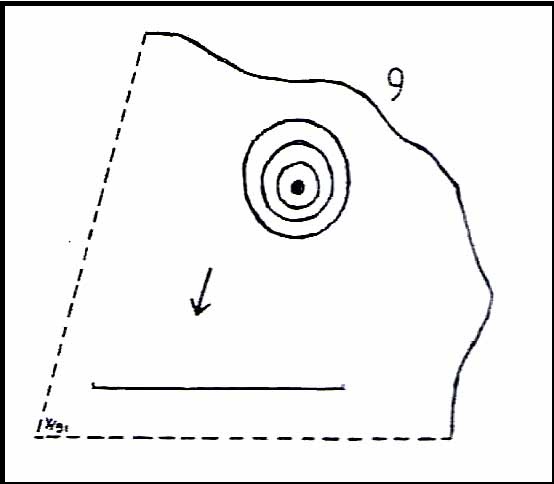
van Hoek’s 1996 sketch
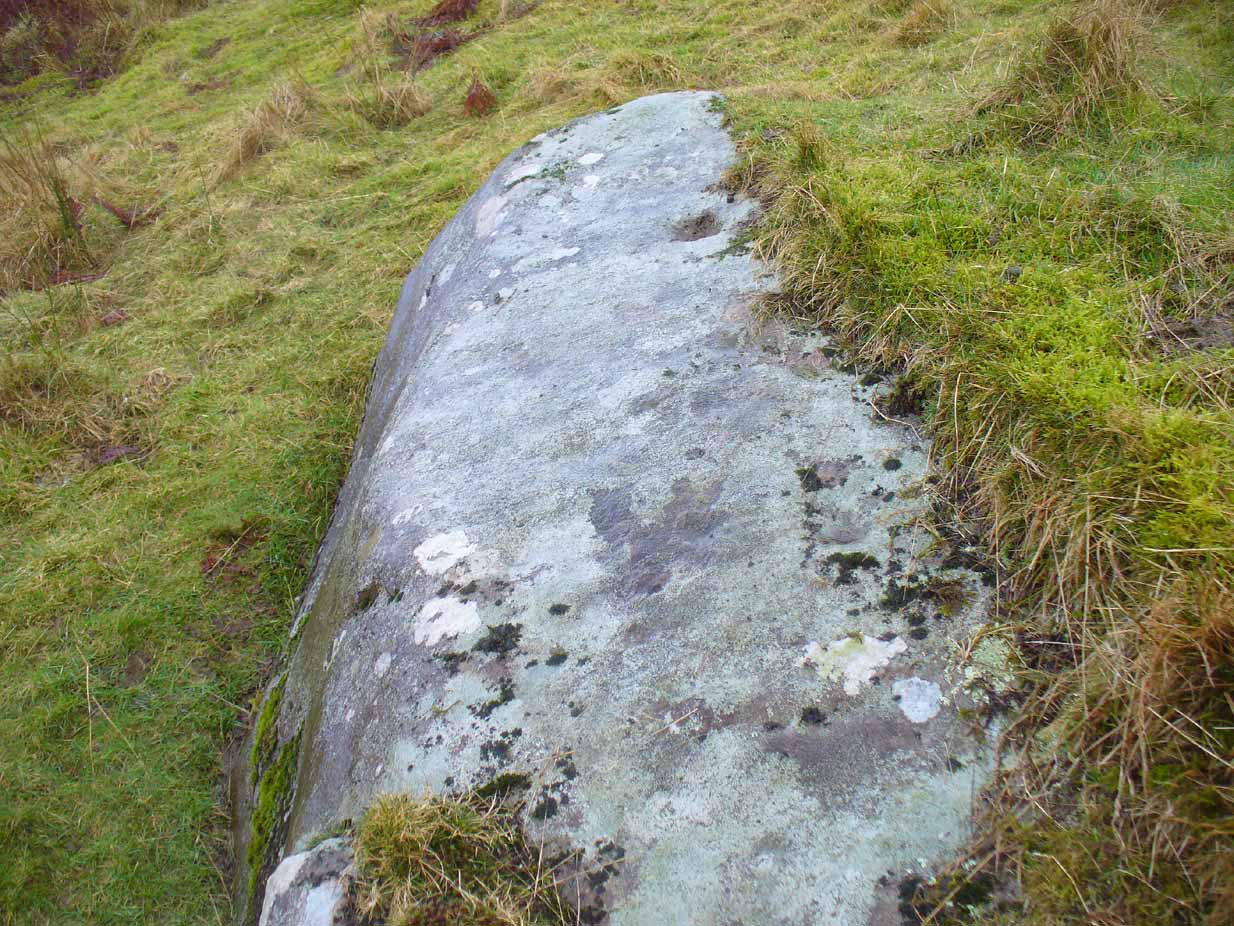
The more complete design

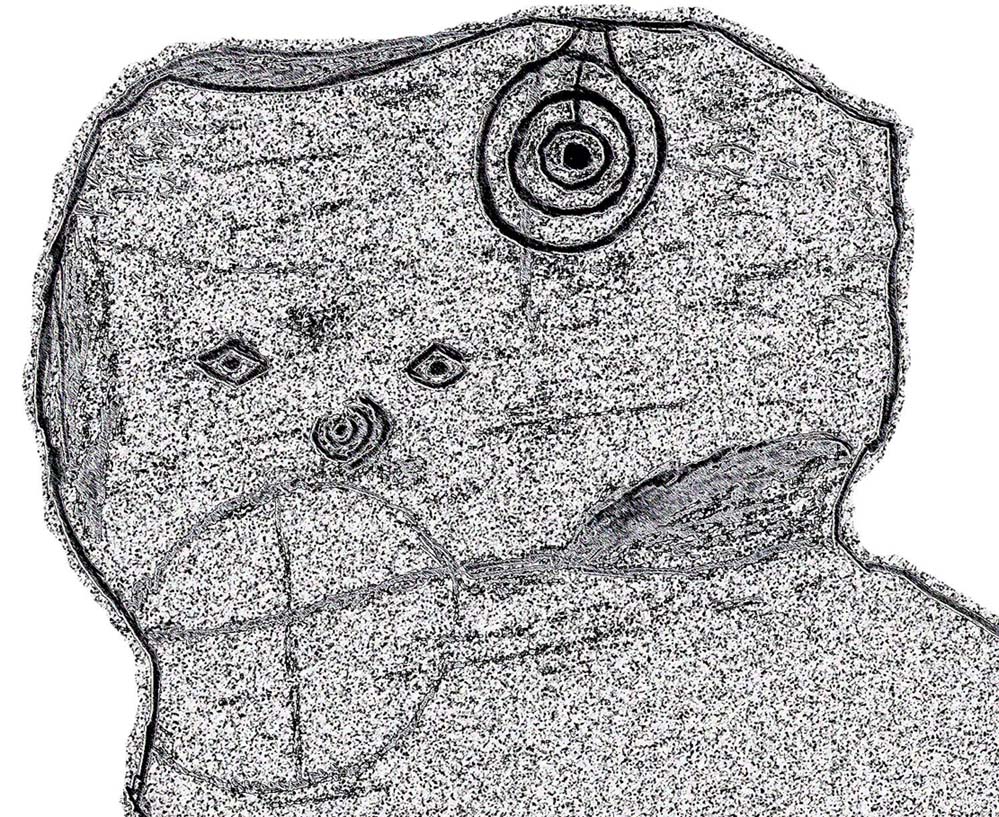
Additionally we found two very faint carved ‘eyes’ or trapezoids pecked onto the stone, obviously at a much earlier date than the notable triple-ring—which could almost be modern!  They would no doubt have excited the old archaeologist O.G.S. Crawford (1957), whose curious theory of petroglyphs was that they were images of some sort of Eye Goddess.  Archaeo’s can come out with some strange ideas sometimes…

Fainter still was another triple-ring—albeit incomplete—with what appears to be a very small central cup-mark, just below and between the two ‘eyes’.  It was first noticed by Paul Hornby when he was playing with the contrast settings on his camera, in the hope of getting clearer photos of any missing elements.
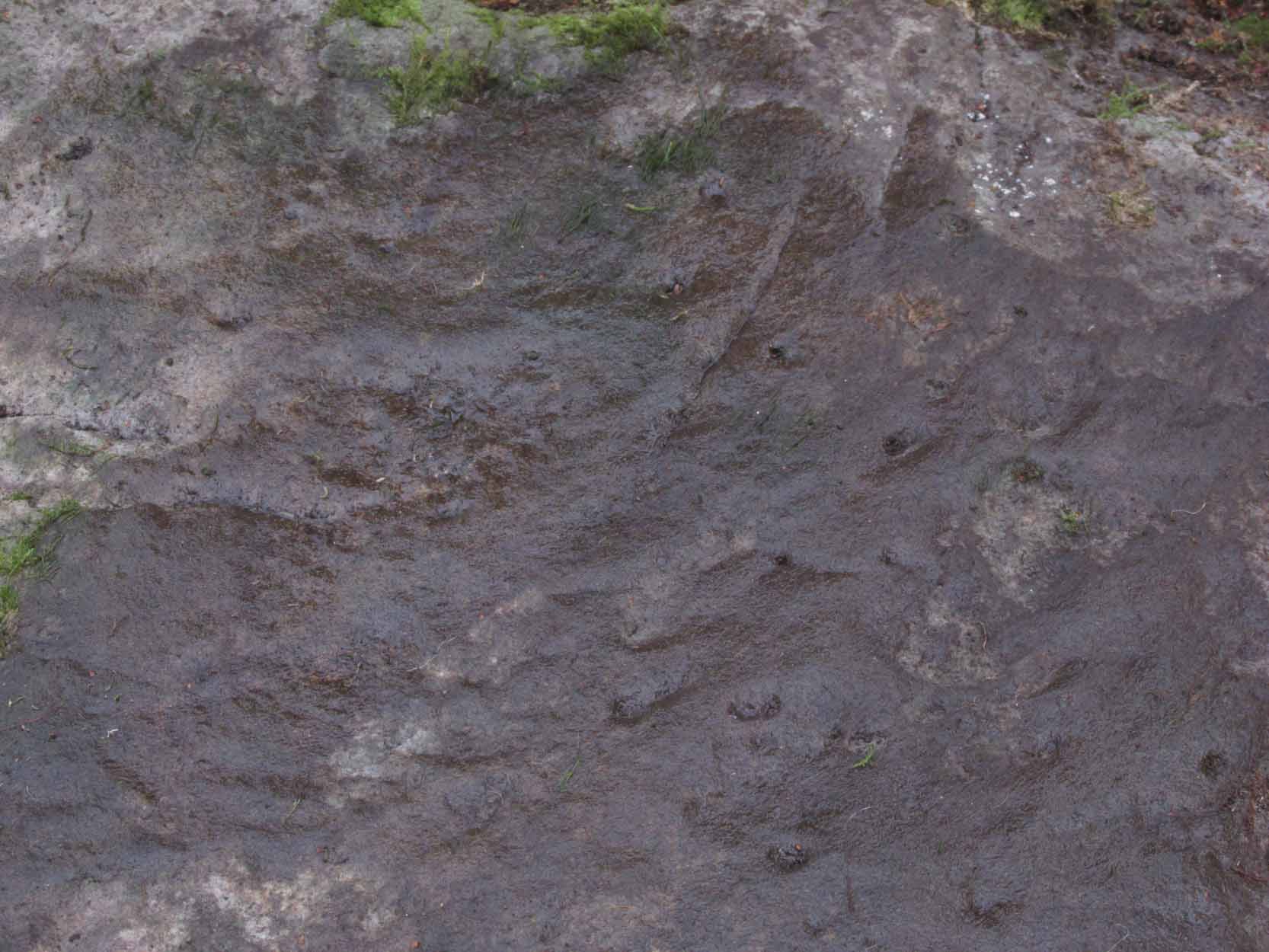
Very faint triple-ring, bottom-left of photo (photo by Paul Hornby)

“Can you see this?” he asked.  And although very faint indeed (on most days you can’t see it at all), it’s undoubtedly there: another multiple-ringer all but lost by the erosion of countless centuries, and older still than the ‘eyes’ above it.  In all the photos we took of this stone, from different angles in different weathers (about 100 in all), this very faint triple-ring can only be seen on a handful of images.  But it’s definitely there and you can see it faintly in the attached image (right) to the bottom-left.

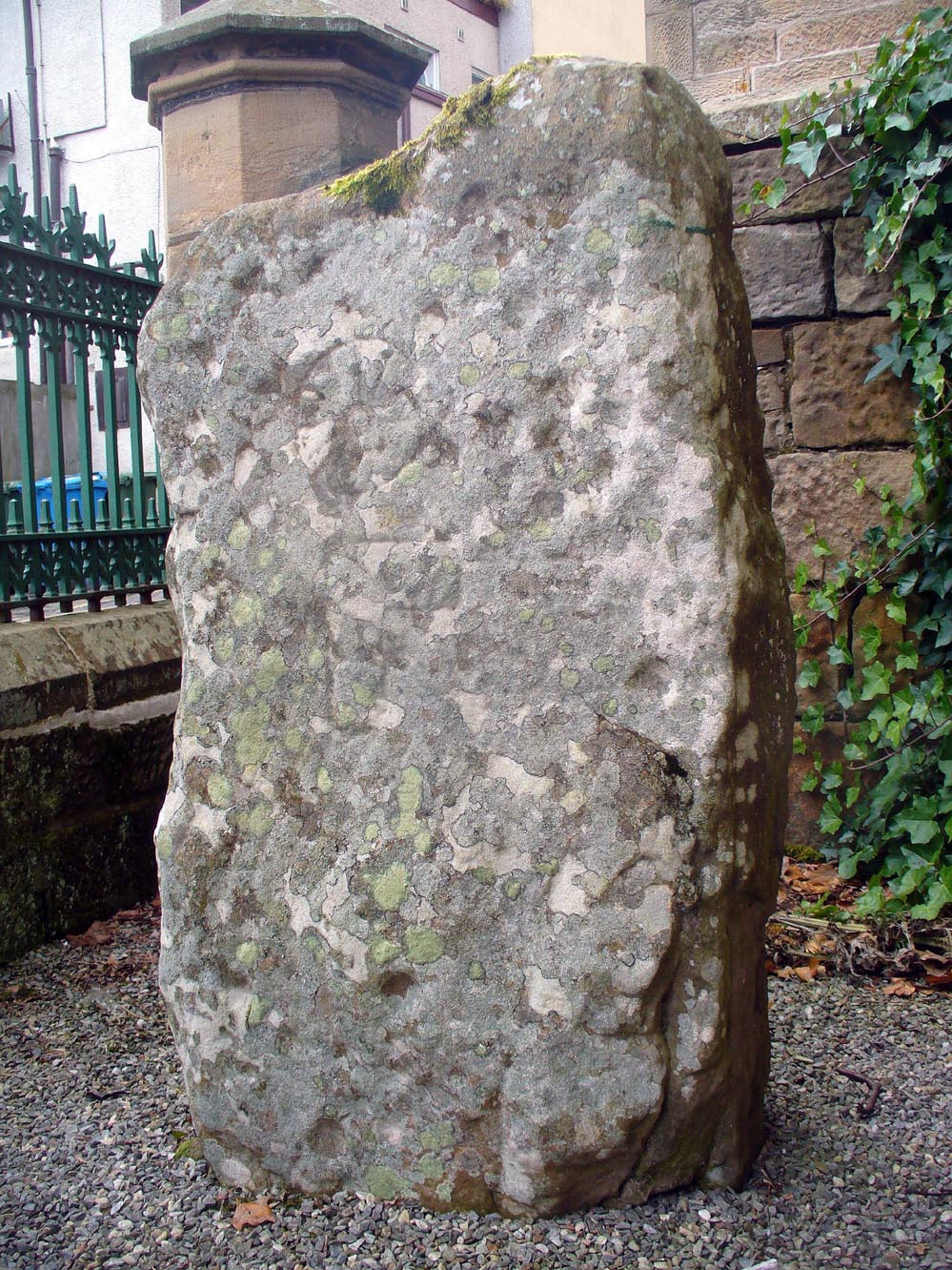
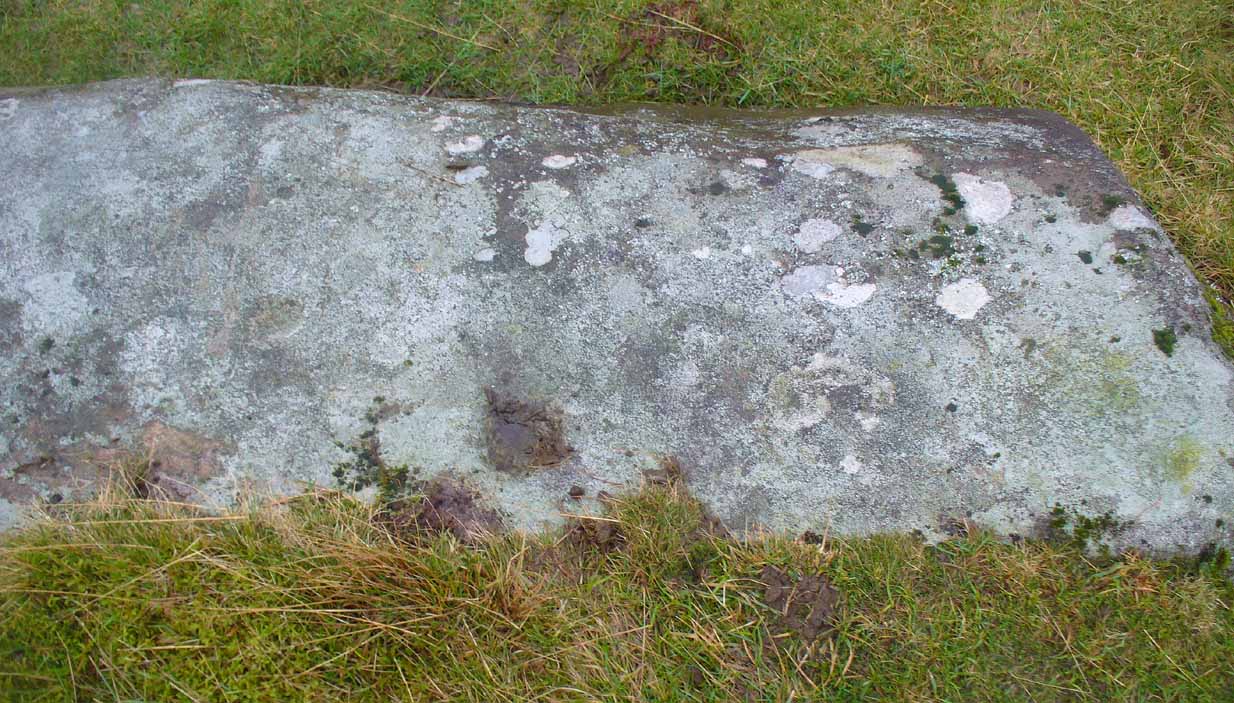
A final note has to be made of a possible unfinished, large circular section with a cross carved into the natural feature of the stone, first noticed by Lisa Samson.  It’s uncertain whether this has been touched by human hands (are there any geologists reading?), but it’s something that we’re noticing increasingly at more and more petroglyph sites.  They’re not common, but it has to be said that we found two more man-made ‘crosses’ attached to multiple cup-and-rings near Killin just a few weeks ago.  Also, folklore tells us that not far from this Castleton cluster, a christian hermit once lived….

References:

  1. Crawford, O.G.S., The Eye Goddess, Phoenix House: London 1957.
  2. Morris, Ronald W.B., The Prehistoric Rock Art of Southern Scotland, BAR: Oxford 1981.
  3. van Hoek, M.A.M.,”Prehistoric Rock Art around Castleton Farm, Airth,” in Forth Naturalist & Historian, volume 19, 1996.

Acknowledgements:  Huge thanks as always to Nina Harris, Fraser & Lisa Harrick, Paul Hornby, Frank Mercer, Penny & Thea Sinclair, for their additional senses and input.

© Paul BennettThe Northern Antiquarian

Ardjachie Farm, Tain, Ross & Cromarty

Cup-Marked Stone:  OS Grid Reference – NH 746 845

Also Known as:

  1. Canmore ID 14736
  2. Tain Museum Stone

Getting Here


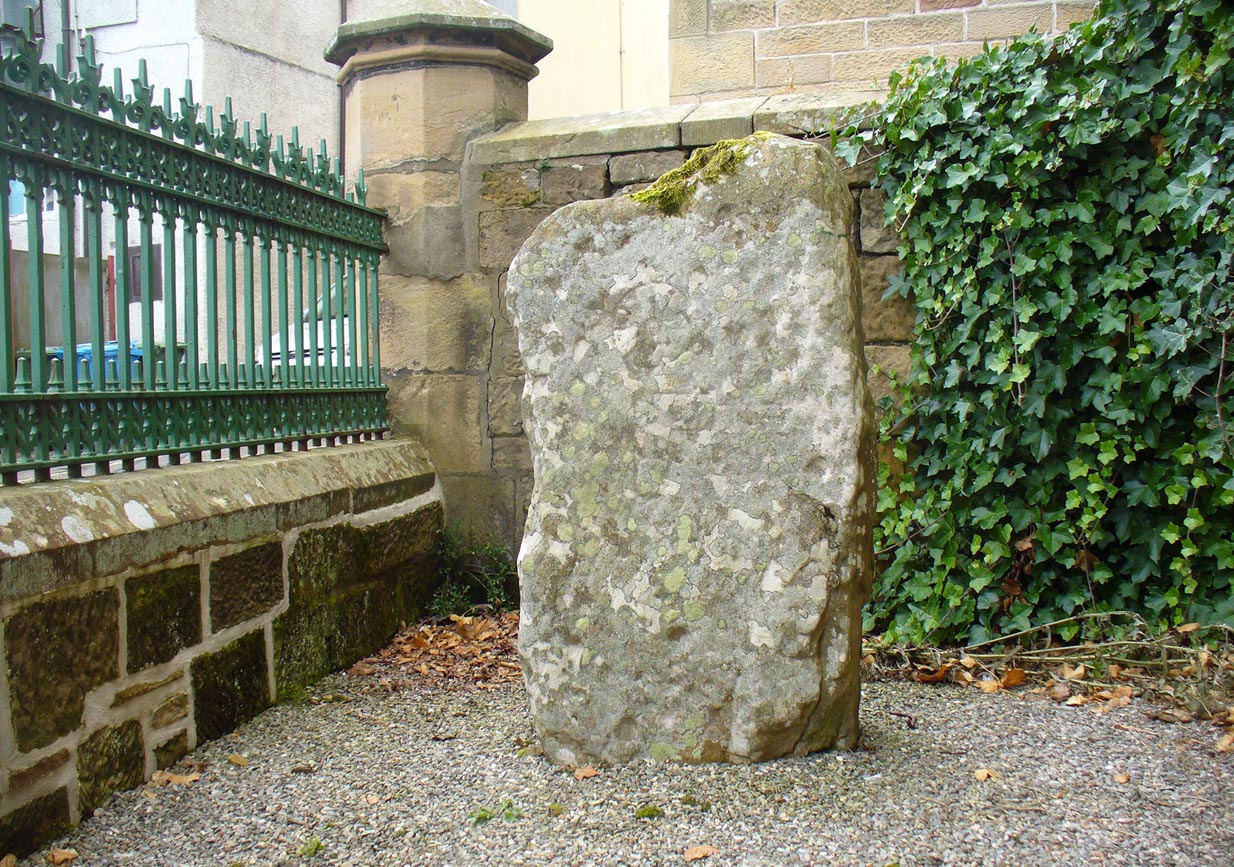
Ardjachie Stone, Tain

The stone is no longer in its original position (a few miles away), but can now be found if you visit the Tain & District Museum, just off Tower Street, in towards St Duthus’ Church.  The stone is upright around the side of the adjacent buildings.  It’s probably easier to access if you walk down Castle Brae, keeping your eyes peeled to your left.  Otherwise, just ask the helpful people at the Museum and they’ll point you to the spot.

Archaeology & History

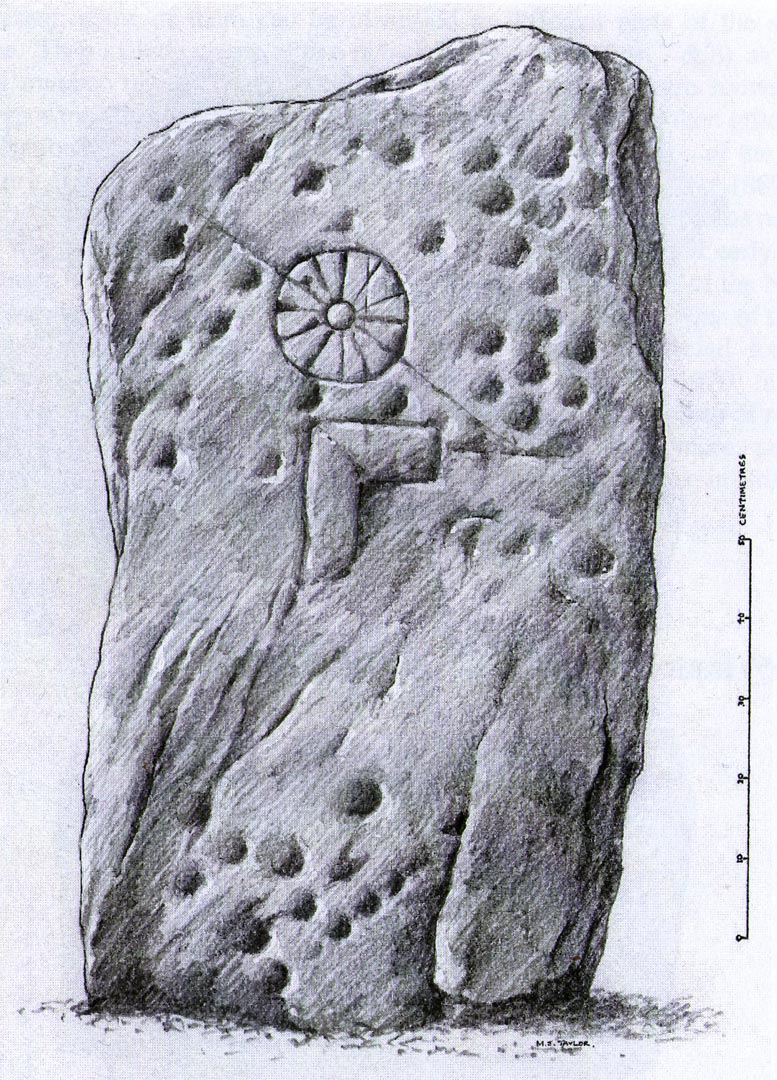
An intriguing stone with what may be a long and fascinating history behind it… It was only rediscovered in the 1960s, when the farmer at Ardjachie (2½ miles northwest of Tain town centre) came across it in one of his fields.  It’s not large or notable in any way, other than it possessing a couple of really peculiar symbols etched amongst a mass of otherwise standard neolithic and Bronze Age cup-marks.  These other symbols are (as seen in Mark Taylor’s drawing, right) a very distinct ‘spoked wheel’ and what looks like a right-angled ‘tool’ or set-square of some sort.  These symbols have brought with them notions from academics who are claim it has Pictish provenance.  However, we must be very cautious of this idea….

The first written account of the stone was by Ellis Macnamara (1971) who gave a detailed description of the carving:

Ardjachie Carving (after Mark Taylor 2004)

“Boulder found on Ardjachie Farm, now in Tain Museum.  The boulder, of probably local old red sandstone, is uncut and very irregular in shape but has two principal faces; the maximum length is 1.7m; maximum width is 0.65m and on the maximum thickness is some 0.35m.  The carvings are all on one face, which is much weathered; the opposing face is conspicuously less smooth so that it is possible that this stone was never set upright.  The weathered face is covered with at least 30 ill-defined cup markings scattered over nearly the whole surface, though grouped towards one end; the average diameter of these cup markings is about 3 to 4cm, depth about 1.5cm.  There are several indistinct lines among the cup markings and there is among the thickest cluster of cup markings a symbol like a ‘wheel’, with the outer ‘rim’ drawn as a fairly perfect circle, with a diameter at the outer edge of some 17cm.  The ‘wheel’ has twelve ‘spokes’ and a single inner circle, or ‘hub’, with a diameter at the outer edges of about 4 or 5cm.”

Subsequent to Macnamara’s description, it’s been suggested that there are cup markings on both sides of the stone; but the ones on the other side are a little less certain.  The stone itself almost typifies the cup-marked cist covers we find scattered all over the country—yet no burial or other structure was noted upon its discovery in the fields.  It’s an oddity on various levels…

Close-up of spoked-wheel

The spoked-wheel symbol and, moreso, the right-angled element, have led some to speculate that the symbol was carved in Pictish times; but there are problems with this on two levels at least.  The cup-marks we know are neolithic or Bronze Age in origin, and their design always inclines to abstract non-linear forms, screwing egocentric analysis. But the ‘spoked wheel’ is more linear in nature. But as acclaimed petroglyph researchers from George Coffey (1912) to Martin Brennan (1983) show, this spoked wheel occurs in neolithic Ireland; and the identical symbol occurs in prehistoric carvings at Petit Mont in France (Twohig 1981), at Cairnbaan in Argyll (Royal Commission 2008) and there’s even a partial spoked-ring on the Badger Stone on Ilkley Moor!  We have no need to jump into Pictish times to account for its origin and unless we have direct archaeological evidence to prove this, the academic Pictish association must be treated with a pinch of salt. It is nevertheless scarce amongst neolithic and Bronze Age carvings in Britain.   Maarten van Hoek (1990) suggested it to be a variant on the ‘rosette’ design, also neolithic in origin.  On the whole the symbol is interpreted as being the sun—which it may well be.

If you look carefully at the images above you can see, to the right of the ‘wheel’, a cup-marking surrounded by a ring of six-cups.  It is possible that this may be an older variant of the spiked-wheel solar symbol.  All speculation of course.  The other peculiar element here is the curious right-angled design, below the ‘sun’.  This symbol in particular is quite different from the early cup-marks and may have been carved at a much later date.  In which case, this raises the potential for a continuity of tradition here… which mightjust bring in the Picts!

A bittova closer look

But the general problem with a Pictish assignment is that of the Picts themselves.  If we ascribe the current anglocentric belief that the Picts only existed between the 3rd and 9th centuries (because we only have written records of them during that period), we are assuming the rather naive philosophy that anything before written history did not exist: a sort of blind-man’s Schrodinger’s Cat ideology, only really accepted by pseudo-historians.  But if the Picts didhave something to do with this carving, we may indeed be talking about a continuity of tradition from the ancient past into the written period.  Such an idea would be no problem in developed tribal cultures with an animistic cosmology—and that’s assuming that this stone was deemed as ‘special’ in some form or another to the local people. But all these are uncertainty principles in themselves and we may never know for sure…

There are no adjacent monuments to where Ardjachie’s stone came from, and apart from a scatter of flints found a hundred yards or so closer to the beach, other archaeological remains are down to a minimal.  Its isolation is peculiar.  There are however, a number of springs of water a few hundred yards away, just across the main A9 road, two of which have left their old names with us as the Cambuscurrie Well and the Fuaran nan Slainte, or fountain/spring of Healing (the modern Glenmorangie whisky gets it waters hereby!).  Although we must be careful not to assign every example of prehistoric rock art with the same material, the mythic association between petroglyphs and water cannot be understated, and although such an association at Ardjachie is conjectural, it cannot go unnoticed.

References:

  1. Brennan, Martin, The Stars and the Stones: Ancient Art and Astronomy in Ireland, Thames & Hudson: London 1983.
  2. Coffey, George, New Grange and other Incised Tumuli in Ireland, Hodges Figgis: Dublin 1912.
  3. McHardy, Stuart, A New History of the Picts, Luath: Edinburgh 2012.
  4. Mack, Alastair, Symbols and Pictures: The Pictish Legacy in Stone, Pinkfoot Press: Brechin 2007.
  5. Macnamara, Ellen, “Tain, Ardjachie Farm: Cup Markings and Incised Symbol”, inDiscovery & Excavation Scotland, 1971.
  6. Macnamara, Ellen, The Pictish Stones of Easter Ross, Tain & District Museum 2010.
  7. Royal Commission on the Ancient & Historical Monuments of Scotland, Pictish Symbol Stones: A Gazetteer, Edinburgh 1999.
  8. Royal Commission on the Ancient & Historical Monuments of Scotland, Kilmartin – Prehistoric and Early Monuments, HMSO: Edinburgh 2008.
  9. Scott, Douglas, The Stones of the Pictish Peninsulas of Easter Ross and the Black Isle, Historic Hilton Trust 2004.
  10. Twohig, Elizabeth Shee, The Megalithic Art of Western Europe, Clarendon: Oxford 1981.
  11. van Hoek, M.A.M., “The Rosette in British and Irish Rock Art,” in Glasgow Archaeological Journal, volume 16, 1990.

Acknowledgements:  Huge thanks to Mark Taylor for use of his fine drawing in this site profile; copies of his work with Ellen Macnamara being available for sale from the Tain Museum.  Many thanks to the staff at Tain Museum for their help; and many thanks again to Prof Paul Hornby in the venture to this curious old petroglyph.

© Paul BennettThe Northern Antiquarian

Nether Glenny (42), Port of Menteith, Perthshire

Cup-Marked Stone:  OS Grid Reference – NN 5643 0229

Also Known as:

  1. Canmore ID 87397

Getting Here

Archaeology & History

The stone in situ

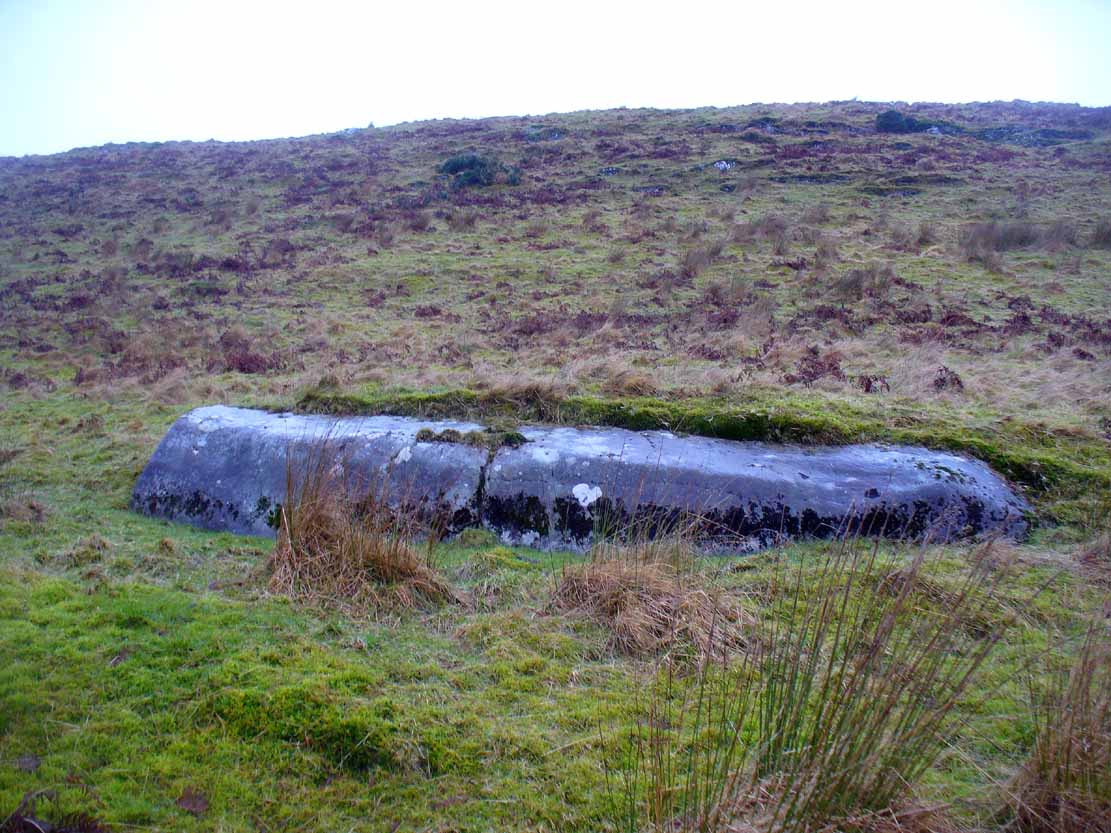
The easiest way to see this is to reach the Nether Glenny 2 Cairn, looking north to the slope a coupla hundred yards away, where you can see a long rock halfway up.  If you can’t see it from here, walk to the impressive Nether Glenny 35 Carving, where the large long slab is much more obvious on the hillside. Walk through the gates to the Nether Glenny 37 carving and then diagonally up to the rock itself.  You can’t really miss it.

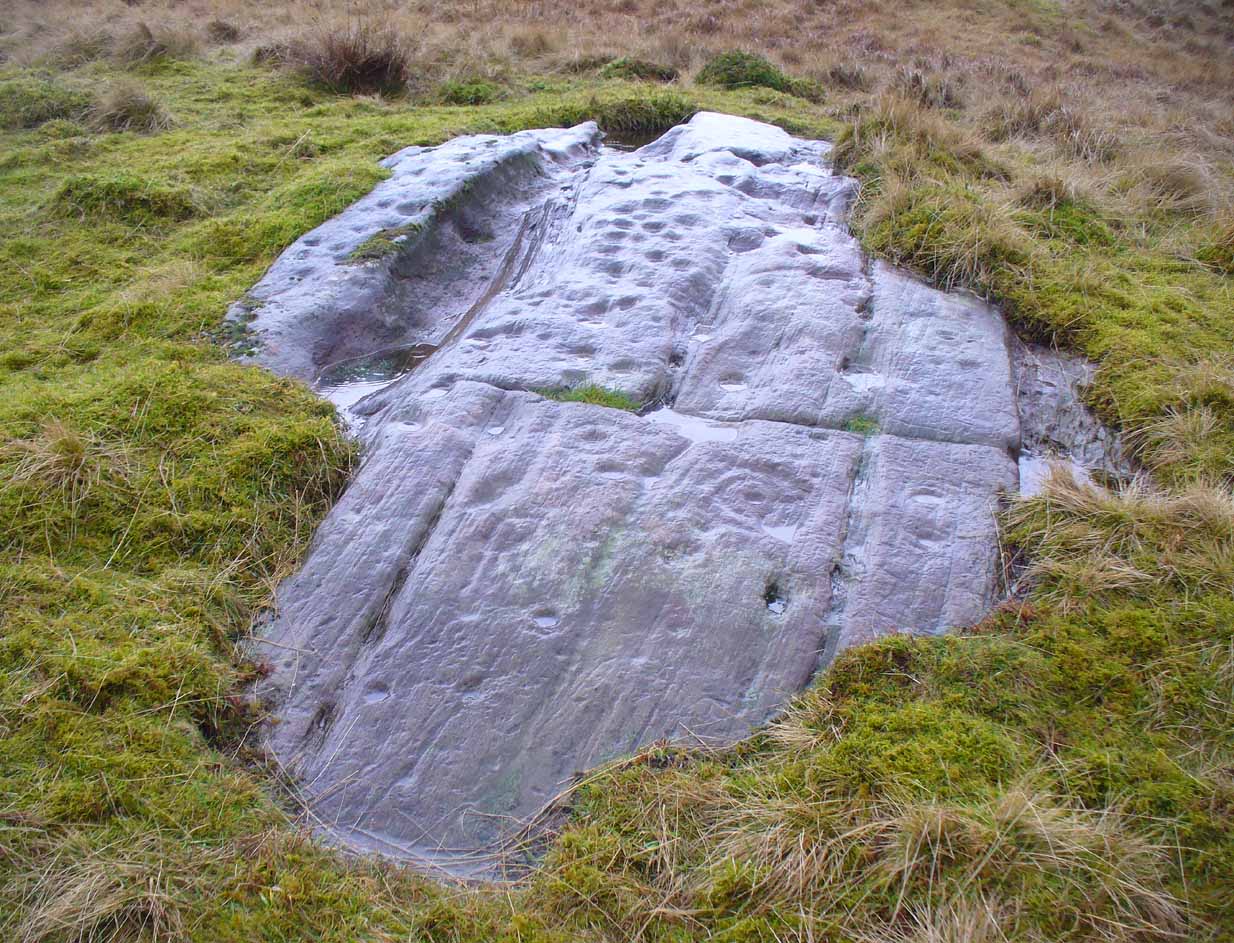
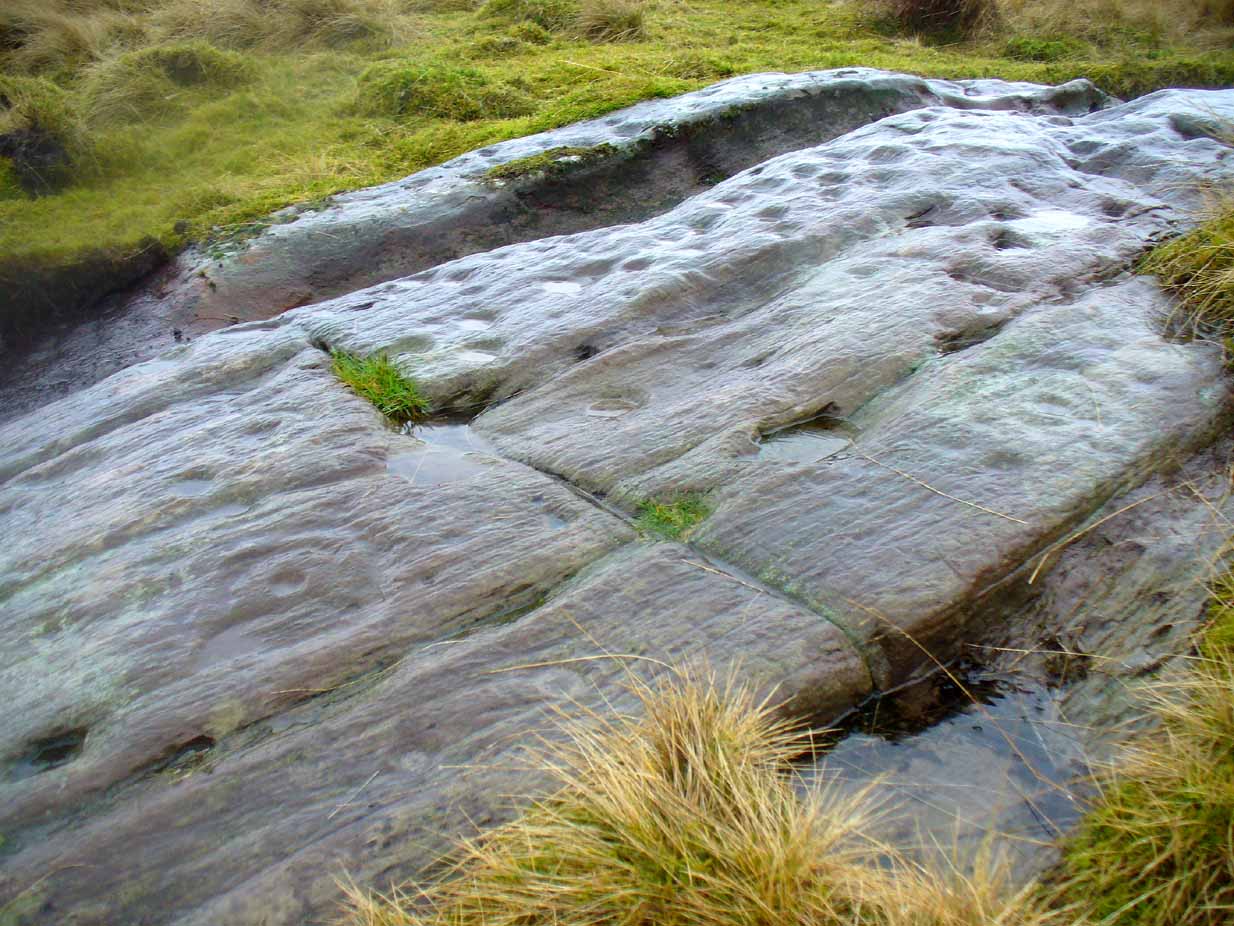
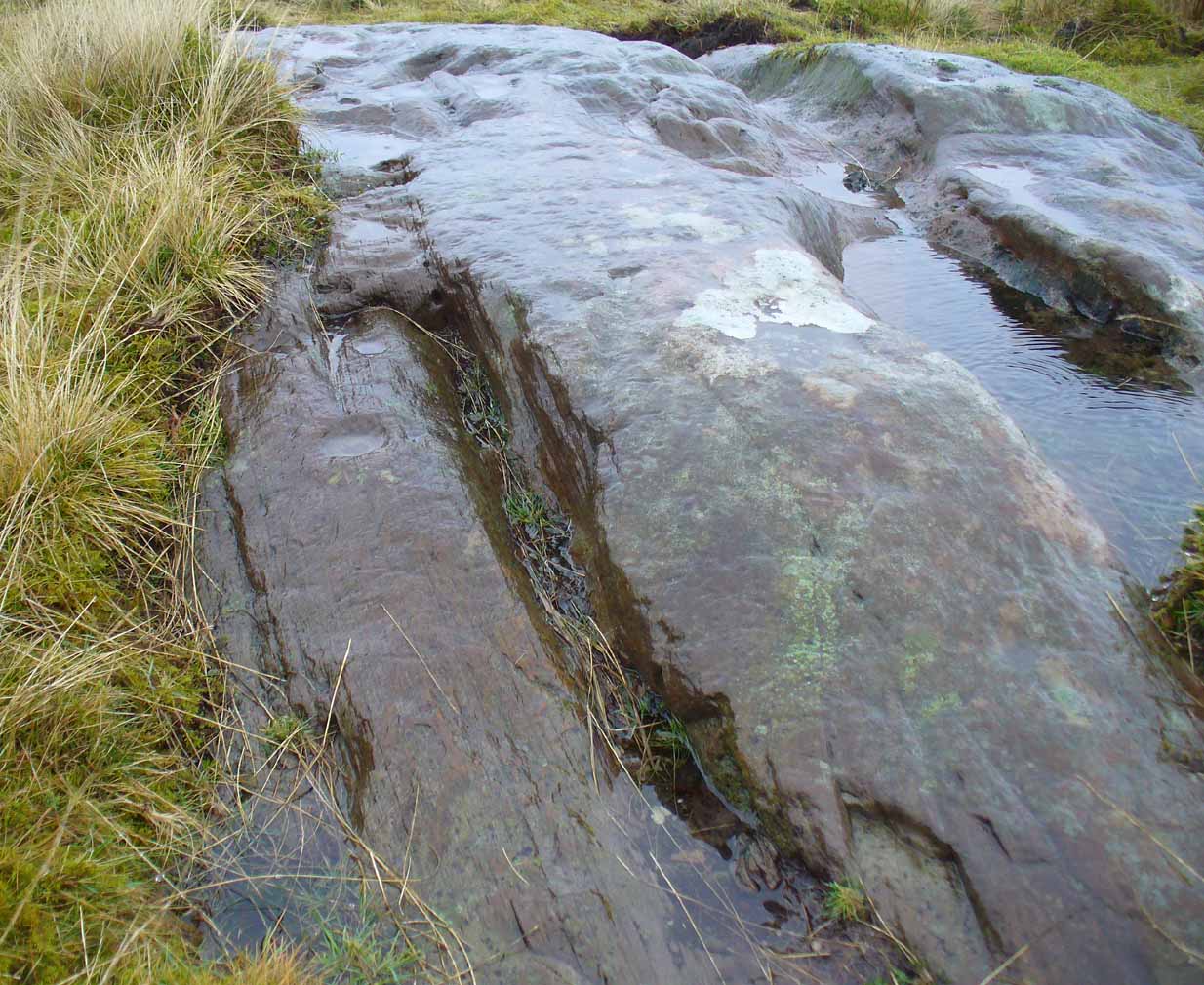
This 15-foot long stone halfway up the slope was said by the Royal Commission lads to have “four possible cup-marks” on it, whereas there are at least nine of them and maybe as many as eleven!  Most of them are dead certs as prehistoric etchings, not just ‘possibles’.

Small faint cluster of cups
Some of the faint cups

The more visible cup-marks here are found on the more western end of the stone, just below the grass-line.  The cups here are quite distinct, measuring some two-inches across and nearly half-an-inch deep in two of them.  The others in this section are a little smaller and further down the slope of the rock.  Seemingly not noticed for a long long time however is a small cluster of very faded cups, gathered like a very faint 4-star Pleiades cluster more than halfway along out in the photo here (I hope!).

The biggest of the cups

This entire area is covered with cup-and-ring stones, possessing one of the greatest densities of carvings anywhere in Scotland.When we visited the place last week, Nature was pouring with rain, so we weren’t able to sketch the design.  Something that we’ll hopefully amend in the near future!

References:

  1. Brouwer, Jan & van Veen, Gus, Rock Art in the Menteith Hills, BRAC 2009.

© Paul BennettThe Northern Antiquarian


Nether Glenny (37), Port of Menteith, Perthshire

Cup-and-Ring Stone:  OS Grid Reference – NN 56322 02162

Getting Here

Another Netherglenny carving

About 1 mile west of where the B8034 meets the A81, between the Port of Menteith and Aberfoyle, a small road on the right (north) at Portend takes you up the single-track road to Upper Glenny.  Go 2-300 yards up past Mondowie Farm and take the next track, left.  Walk up through the gate for nearly 300 yards, going through the gate on your left and onto the fields.  Follow the fence for 300 yards then go through the gate into the next field—past one of the Nether Glenny cairns—and walk across it until you reach an open gate at the far side, just where the hillside goes up.  It’s nearly under your feet!

Archaeology & History

Close-up of the cup&ring

This single cup-and-ring carving, found amidst the massive cluster of both simple and highly complex petroglyphs between Ballochraggan and Upper Glenny, doesn’t seem to have been included in any previous surveys.  It was located during the incredible rains yesterday on Sunday 7 February, wetting this and other rocks, enabling better visibility of otherwise invisible symbols faintly remaining here and on other stones.  The carving appears to have been etched into naturally occurring notches and fissures.  Certainly worth looking at when exploring the other incredible carvings on this hillside.

References:

  1. Brouwer, Jan & van Veen, Gus, Rock Art in the Menteith Hills, BRAC 2009.

© Paul BennettThe Northern Antiquarian


Nether Glenny (35), Port of Menteith, Perthshire

Cup-and-Ring Stone:  OS Grid Reference – NN 56425 02099

Also Known as:

  1. Canmore ID 24041
  2. Menteith 26
  3. Nether Glenny 19

Getting Here

Archaeology & History

Netherglenny 35 stone

Take the same directions as if you’re visiting the nearby Nether Glenny 2 cairn. Once here, walk less than 100 yards further down into the same field, north, roughly parallel with the fencing.  You’ll reach several large rocks, and the elongated one on the slight rise closer to the fence is the one you’re after.  You’ll find it!

This is one in a number of impressive cup-and-ring stones scattered along this grassy ridge overlooking the Lake of Menteith and the Gargunnock Hills to the south.  Petroglyph lovers amongst you will love it!  And it seems that with each and every analysis, the carvings gives up more and more of its ancient symbolism.  When it was first described (in a literary sense) by Maarten van Hoek (1989) he told it to be:

“Irregular outcrop with at least 72 single cups; 3 cups with 2 rings; 6 cups with 1 ring and 2 possible horse-shoe rings only.”

But when Kaledon Naddair (1992) visited the site a few years later he amended this initial description, telling us how,

“Further temporary turf removal extended the total to 124 solo cups, and 9 cups with 1 ring, and 5 cups with 2 rings.”

Cups & rings & cups….
Western side of carving

Naddair’s description is closer to our own inspection, although I think that a small number of the ‘cups’ are natural.  Other features that we’ve found occur on the more western side of the rock.  A faint partial-double-ringed cup is accompanied a few inches away by a carved element that seems to have been unfinished.  An initially indistinct circle, faintly pecked, has internal lines at the quadrants, akin to an early cross form.  A line emerges from this symbol which also seems to have been slightly worked.

Subsequent investigations of this carving has uncovered much more which, to be honest, requires almost an entire re-write of this profile……

…to be continued…

References:

  1. Brouwer, Jan & van Veen, Gus, Rock Art in the Menteith Hills, BRAC 2009.
  2. Naddair, Kaledon, “Menteith (Port of Menteith parish): rock carvings”, in Discovery & Excavation Scotland, 1992.
  3. van Hoek, Maarten, “Menteith (Port of Menteith parish) rock art sites”, in Discovery & Excavation Scotland, 1989.

© Paul BennettThe Northern Antiquarian


Nether Glenny (28), Port of Menteith, Perthshire

Cup-Marked Stone:  OS Grid Reference – NN 5619 0197

Also Known as:

  1. Canmore ID 78348
  2. Menteith 20 (van Hoek)

Getting Here

Netherglenny 28 carving

Take the same directions to reach the Nether Glenny cairn (about 1 mile west of where the B8034 meets the A81, between the Port of Menteith and Aberfoyle, up a small road on the right [north] at Portend) and walk to its companion cairn 100 yards north. From here, walk west across the field towards the nearby forest.  Nearly 20 yards from the wall and about 35 yards from the corner of the field where it meets the forest, this elongated stone lies amidst the grasses and reeds. You’ll find it.

Archaeology & History

…and from another angle

Looking somewhat like a small fallen standing stone (the Royal Commission list just such a stone nearly 200 yards east), this slim elongated rock was first described in Maarten van Hoek’s Menteith (1989) survey where he told it to be a “loose slab north of the…burn, bears at least thirteen cups.”  But of the “thirteen cups”, only five of these (seven at the most) appear to be man-made.  The others are, quite distinctly, geophysical in origin (and in all probability, the other cups were forged from the geological nicks and dimples).  One of them may have the faint remains of a ring around it, but this is uncertain.  When we visited the site yesterday, the light was poor and although this ‘ring’ seems to show up on a couple of photos, I’m erring on the side of caution.

References:

  1. Brouwer, Jan & van Veen, Gus, Rock Art in the Menteith Hills, BRAC 2009.
  2. van Hoek, Maarten, Menteith (Port of Menteith parish) Rock Art Sites,” in Discovery & Excavation Scotland, 1989.

Acknowledgements:  Huge thanks to Paul Hornby and Nina Harris for their help and endurance at this site, amidst healthy inclement Scottish February weather!  Another damn good day!

© Paul BennettThe Northern Antiquarian


Allt a’ Choire Chireinich (04), Ben Lawers, Kenmore, Perthshire

Cup-and-Ring Stone:  OS Grid Reference – NN 65306 39560

Also Known as:

  1. Canmore ID 238575

Getting Here

The petroglyph & its associates

The petroglyph & its associates

Along the A827 road between Killin and Kenmore, park-up at the Tombreck entrance and cross the road, taking the long track which eventually zigzags up the slope of Ben Lawers.  Keep your eyes on the copse of trees a few hundred yards east that runs up the slopes.  Head towards this, past the multiple-ringed Allt a’ Choire Chireinich stone, then AaCC 2 and AaCC3 carvings, then notice on the other side of the stream a couple of large boulders.  That’s the spot!

Archaeology & History

This faint but intricately carved petroglyph is one in a cluster of three carvings, right next to each other—and it’s the best of the bunch by a long way.  A single cup-marking is found on the flat stone beneath this one (AaCC5); whilst the large egg-shaped boulder in front has perhaps a half-dozen cups on it (AaCC6).

Alex Hale's sketch of the carving

Alex Hale’s sketch of the carving

Faint remains of concentric rings

Faint remains of concentric rings

The large flat-topped boulder of AaCC4 however, possesses at least seventeen plain cup markings, along with twenty-four cup-and-rings, six cup-and-double-rings, three cup-and-three rings, three cup-and-four rings, and one cup-and-five rings!  There are some carved lines that emerge from several of the cups, with all of the three cup-and-four rings having a carved pathway emerging from the central cup and going out of the concentric system.  It’s quite a beauty!  And it sits upon the ridge next to the clear drinking waters of the burn, gazing out over Loch Tay and the mountains all around in a quite beautiful landscape.

Immediately above and below the carvings are a number of settlement spots or shielings, known to have been used until recent centuries.  They were quite ideal living quarters and some of the old folk here, in bygone days, would have known old customs and stories of this petroglyph.

References:

  1. Hale, Alex, “Prehistoric Rock Carvings in Strathtay,” in Tayside and Fife Archaeological Journal, 2009.
  2. Yellowlees, Sonia, Cupmarked Stones in Strathtay, Scotland Magazine: Edinburgh 2004.

Acknowledgments: Huge thanks to Lisa Samson, Fraser Harrick and Paul Hornby for their help reaching this site and exploring still further.  Let’s do it again sometime before I vanish forever up into the far North!

© Paul BennettThe Northern Antiquarian


Allt a’ Choire Chireinich (03), Kenmore, Perthshire

Cup-Marked Stone:  OS Grid Reference – NN 65249 39579 

Getting Here

Allt a' Choire Chireinich 03 Stone

Allt a’ Choire Chireinich 03 Stone

Take the same directions to reach the large rounded Allt a’ Choire Chireinich 02 carving.  Walk 65 yards (60m) northwest diagonally uphill to another large rounded stone of similar size.  That’s the one!

Archaeology & History

A large cup-marked boulder, not previously recognised, was rediscovered on the afternoon of May 15, 2015.  The great majority of the rock surface is covered in aged lichens, but at least three well-defined cup-markings were noted on the upper rounded surface of the stone: one near the middle of the stone; one near the centre-north; and another towards the top northwest section of the stone.  The cups are more than an inch in diameter and eighth-of-an-inch deep.  Others may be in evidence beneath the vegetation.

© Paul BennettThe Northern Antiquarian


Allt a’ Choire Chireinich (02), Kenmore, Perthshire

Cup-Marked Stone:  OS Grid Reference – NN 65218 39525

Also Known as:

  1. Canmore ID 291477

Getting Here

Allt a' Choire Chireinich 2 stone

Allt a’ Choire Chireinich 2 stone

Along the A827 road between Killin and Kenmore, park-up at the Tombreck entrance and cross the road, taking the long track which eventually zigzags up the slope of Ben Lawers.  Keep your eyes on the copse of trees a few hundred yards east that runs up the slopes and when you are level with the top of it, walk along the line of walling that heads to it.  Go past the top of the trees and the first big boulder you reach is the fella in question.

Archaeology & History

Adjacent to an ancient trackway that runs across the slopes of the mountain, this large glacial boulder sits proudly on the slopes calling out for attention — and attention it certainly received countless centuries ago, when local people (perhaps) decided to cut at least nine cup-markings onto the top of the rock.

Lichen-encrusted cups

Lichen-encrusted cups

Lichen-encrusted cups

Lichen-encrusted cups

The surface today is encrusted with olde lichens of colourful hues, beneath which may be other cup and ring carvings; but as I’m a great lover of such forgotten medicinal primers, I wasn’t about to scratch beneath their bodies to find out.  This petroglyph is worth looking at when you’re exploring the other, more impressive carvings in this Allt a’ Choire Chireinich cluster.

© Paul BennettThe Northern Antiquarian


Allt a’ Choire Chireinich, Kenmore, Perthshire

Cup-and-Ring Stone:  OS Grid Reference – NN 65096 39442

Getting Here

The stone, uncovered

The stone, uncovered

Take the A827 road between Killin and Kenmore and park-up at the entrance to Tombreck. Cross the road and walk up the track that goes up Ben Lawers.  As it zigzags uphill, watch out for you being level with the top of the copse of trees several hundred yards west, where a straight long overgrown line of walling runs all the way to the top of the copse. Go along here, and just as you reach the trees, walk uphill for about 50 yards.  You’re damn close!

Archaeology & History

Whether you’re into prehistoric carvings or not, this is impressive!  It’s one of several with a very similar multiple-ring design to be found along the southern mountain slopes of Ben Lawers.  Rediscovered on May 13, 2015, several of us were in search of a known cup-and-ring stone just 260 yards (238m) to the northwest in this Allt a’ Choire Chireinich cluster, but one stone amongst many called my nose to have a closer sniff—and as you can see, the results were damn good!

Looking from above

Looking from above

Etched onto a large flat rock perhaps 5-6000 years ago, probably over at least two different seasons, the primary design here is of two sets of multiple-rings: in one case, seven concentric ones emerging from, or surrounding a central cup-marking (more than an inch across); and the other is of at least eight concentric rings emerging from a cup-marking, about half-an-inch across. The largest cup-and-seven-rings is the one near the centre of the stone.  Initially I thought this was simply two concentric seven-rings; but the more that I looked through the many photos we’d taken, the more obvious it became that the residue of an eighth ring (possibly more) exist in the smaller-sized concentric system.  It must however be pointed out that neither of the concentric carved rings seem to be complete – i.e., they were never finished, either purposefully or otherwise.  The largest cup-and-seven-rings is the one near the centre of the stone; with the outer smaller example being half the size of the one in the middle.  At first glance, neither of the concentric rings seem complete – and so it turned out when it was enhanced by rain and sun.

First photo of the double-rings

First photo of the double-rings

The large central cup-and-seven-rings has two additional cup-marks within it: one on the outer fifth ring to the southeast, and the other in the outer sixth ring to the west.  This western cup-mark is also crossed by a carved line that runs from the first ring outwards to the west and to the edge of the rock, crossing another cup-mark along the way.  This particular carved line might be the same one that integrates itself into the first ring, and then re-emerges on is northeastern side, to continue out of the multiple-rings themselves and curve over to the eastern side of the rock.  Running roughly north-south through the middle of this larger seven-ring element, a line scarred by Nature is visible which has been pecked by humans on its northern end, only slightly, and running into the covering soil eventually, with no additional features apparent.  Another possible carved line seems in evidence running from the centre to the southeastern edge – but this is by no means certain.

The carving, looking north

The carving, looking north

This large central seven-ringed symbol has been greatly eroded, mainly on its southern sides, where the rings are incomplete, as illustrated in the photos.  Yet when the light is right, we can see almost a complete concentric system, with perhaps only the second ring from the centre being incomplete on its eastern side.  On the southern sides, the visibility factor is equally troublesome unless lighting conditions are damn good.  The northernmost curves, from west to east, are the deepest and clearest of what remains, due to that section of the stone being covered in soil when it was first discovered, lessening the erosion.

Smallest 7-ring section, with cups

Smallest 7-ring section, with cups

Multiple-ring complex & cups

Multiple-ring complex & cups

Moving onto the second, smaller concentric set of rings: this is roughly half the size of its counterpart in the middle of the stone.  Upon initial investigation you can clearly make out the seven rings, which have faded considerably due to weathering.  It seems that this section was never fully completed.  And the weathering on this smaller concentric system implies one of two things: either that it was left open to the elements much much longer than its larger seven-ring system, or it was carved much earlier than it.  In truth, my feeling on this, is the latter of the two reasons.  Adding to this probability is the fact that even more rings—or at least successive concentric carved ‘arcs’—are faintly visible around this more faint system: at least eight are evident, with perhaps as many as thirteen in all (which I think would put it in the record-books!).  But we need to visit it again under ideal lighting conditions to see whether there are any more than the definite eight.  It is also very obvious that the very edge of the rock here has been broken off at some time, and a section of the carving went with it—probably into the ancient walling below or the derelict village shielings on the mountains slopes above.

Just above the eroded eight-ring section are three archetypal cup-marks close to the very edge of the rock, one above each other in an arc.  Of these, the cup that is closest to the eight-rings possesses the faint remains of at least two other partial rings above it, elements of which may actually extend and move into the concentric rings themselves—but this is difficult to say with any certainty.  However, if this is the case, we can surmise that this small cup-and-two-rings was carved before its larger tree-ring-looking companion.

Below the smaller seven-ringer is the possibility of a wide cup-and-two-rings: very faint and incomplete.  This only seems visible in certain conditions and I’m not 100% convinced of its veracity as yet.

Curious 'eye'-like symbol

Curious ‘eye’-like symbol

'Eye' to the bottom-left

‘Eye’ to the bottom-left

We also found several other singular cup marks inscribed on the rock, all of them beneath the two concentrics, moving closer to the edge of the rock.  But a more curious puzzle is an eye-like symbol, or geological feature, on the more eastern side of the stone.  It gives the impression of being worked very slightly by humans, but as I’m not a geologist, I’ve gotta say that until it is looked at by someone more competent than me, I aint gonna commit myself to its precise nature.  What seems to be a carved line to the left (west) of this geological ‘eye’ may have possible interference patterns pecked towards it.  Tis hard to say with any certainty.

So – what is this complex double-seven-ringer?!  What does it represent?  Sadly we have no ethnological or folklore narratives that can be attributed to the stone since The Clearances occurred.  We only have the very similar concentric six- and seven-ringed petroglyphs further down the mountainside to draw comparisons with.  We could guess that the position of the stone halfway up Ben Lawers, giving us a superb view of the mountains all around Loch Tay might have some relevance to the carving; but this area was probably forested when these carvings were etched—which throws that one out of the window!  We could speculate that the two multiple rings represent the Moon and Sun, with the smaller one being the Moon. They could represent a mythic map of Ben Lawers itself, with the central cup being its peak and outer rings coming down the levels of the mountain.  Mountains are renowned in many old cultures as, literally, cosmic centres, from whence gods and supernal deities emerge and reside; and mountains in some parts of the world have been represented by cup-and-ring designs, so we may have a correlate here at Ben Lawers.  O.G.S. Crawford (1957) and Julian Cope (1998) would be bedfellows together in their view of it being their Eye Goddess.  But it’s all just guesswork.  We do know that people were living up here and were carving other petroglyphs along this ridge, some of which occur inside ancient settlements; but the traditions of the people who lived here were finally destroyed by the English in the 19th century, and so any real hope of hearing any old myths, or possible rites that our peasant ancestors with their animistic worldview possessed, has died with them.

Tis a fascinating carving nonetheless—and one worthy of seeking out amongst the many others all along this beautiful mountainside…

References:

  1. Bernbaum, Edwin, Sacred Mountains of the World, Sierra Club: San Francisco 1990.
  2. Cope, Julian, The Modern Antiquarian, Thorsons 1998.
  3. Crawford, O.G.S., The Eye Goddess, Phoenix House: London 1957.
  4. Eliade, Mircea & Sullivan, Lawrence E., “Center of the World,” in Encyclopedia of Religion – volume 3 (edited by M. Eliade), MacMillan: Farmington Hills 1987.
  5. Evans-Wentz, W.Y., Cuchuma and Sacred Mountains, Ohio University Press 1980.
  6. Gillies, William A., In Famed Breadalbane, Munro Press: Perth 1938.
  7. Michell, John, At the Centre of the World, Thames & Hudson: London 1994.
  8. Yellowlees, Sonia, Cupmarked Stones in Strathtay, Scotland Magazine: Edinburgh 2004.

Acknowledgements:  Huge thanks to Paul Hornby for the use of his photos in this site profile; to Lisa Samson, for her landscape detective work at the site; and to Fraser Harrick, for getting us there again.

© Paul BennettThe Northern Antiquarian