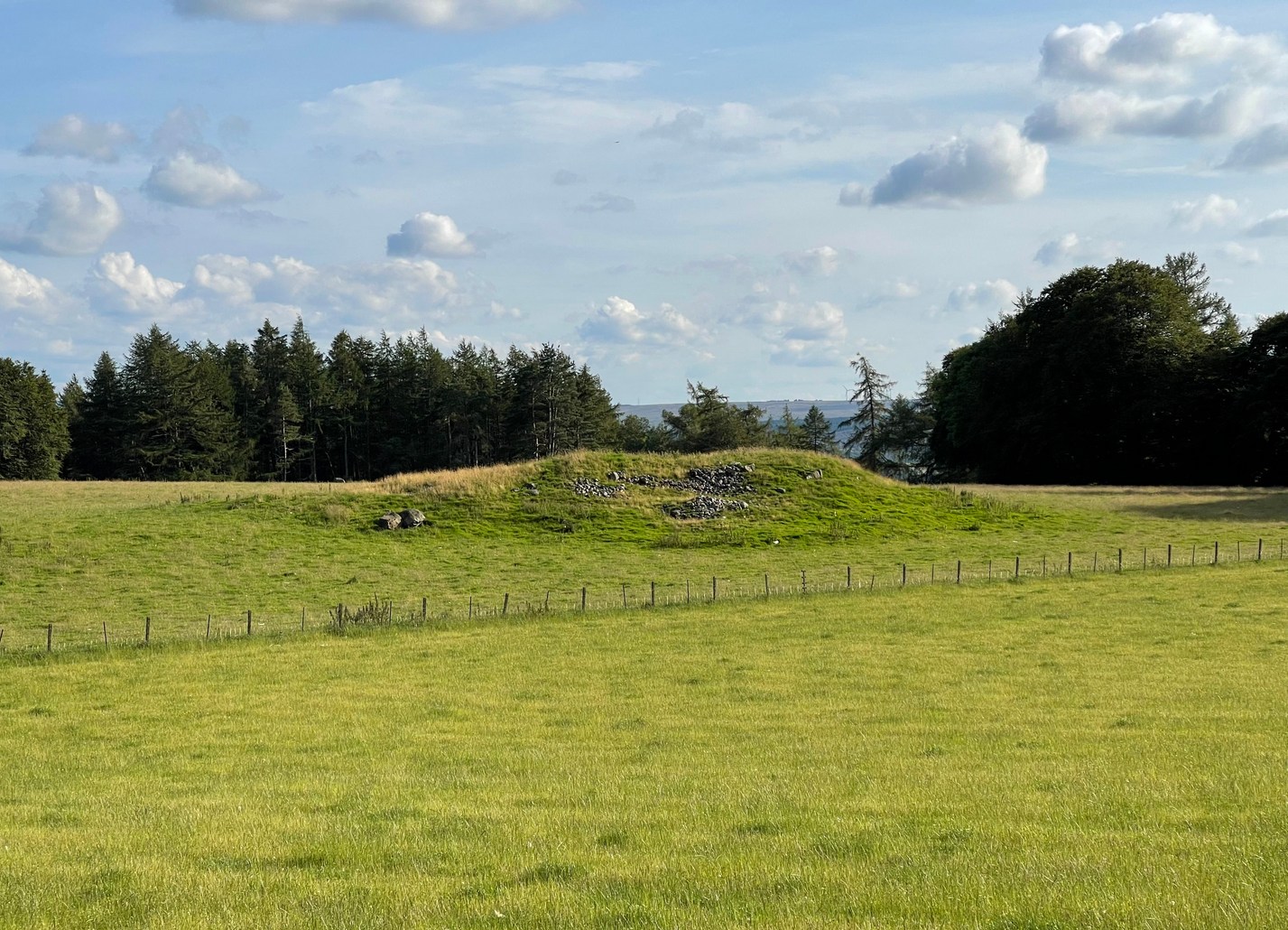
You need to hit the village of Fowlis Wester, which is easiest to approach from both east and west along the A85, between Crieff and Perth: nearly 3 miles east of Gilmerton and about 6½ mile west of Methven. Keep your eyes peeled and take the road up (north) where the large rounded tree-covered tumulus stands and up to the village. Go through the village and uphill for literally ½ a mile (veering sharp left at a junction) where a gate on your right leads into the fields. (a large parking spot is 300 yards further uphill) Walk ¼-mile east and through the other side of the small woodland, over the fence, you’ll see the mound of a typical tumulus. That’s it!
Archaeology & History
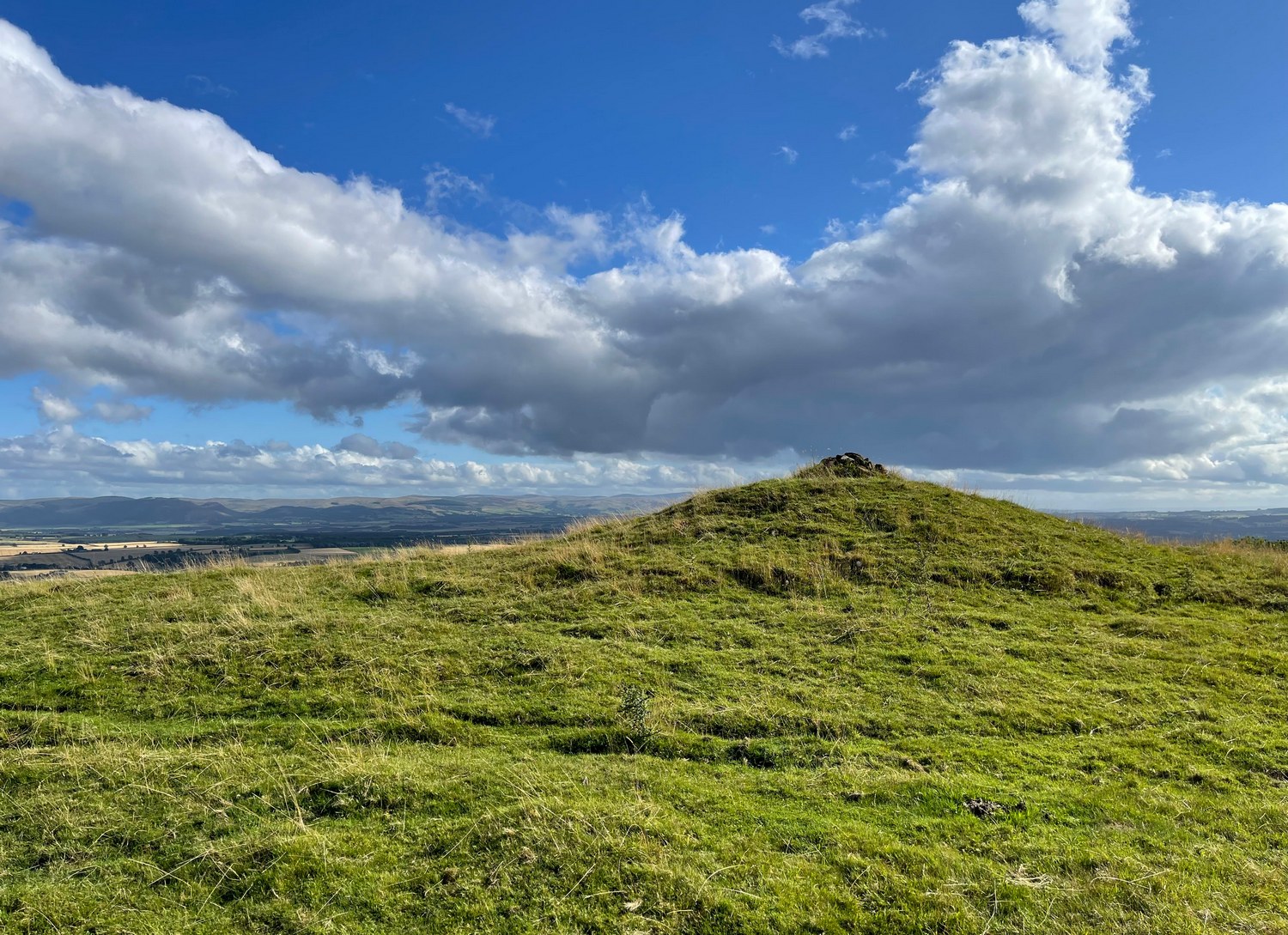
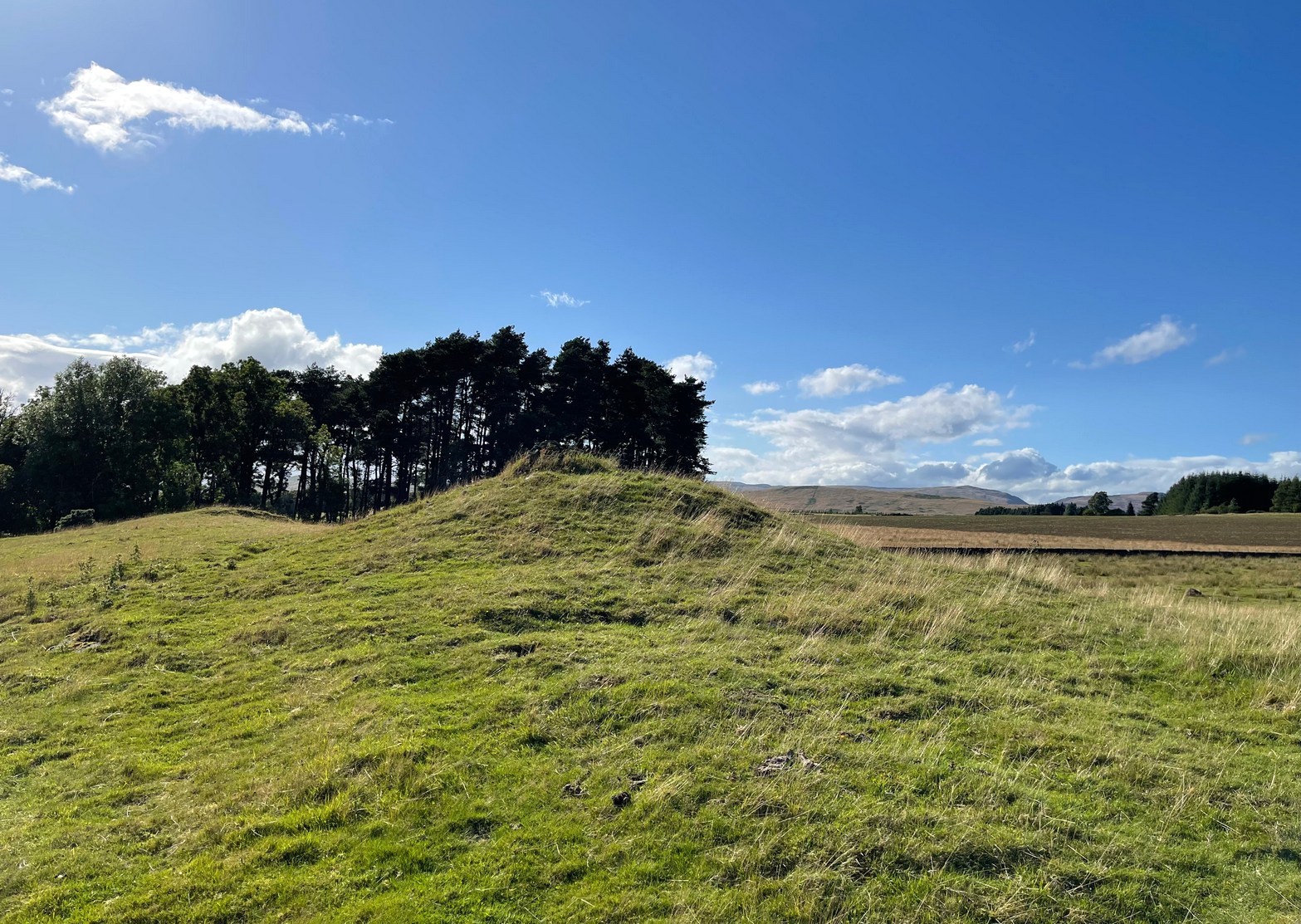
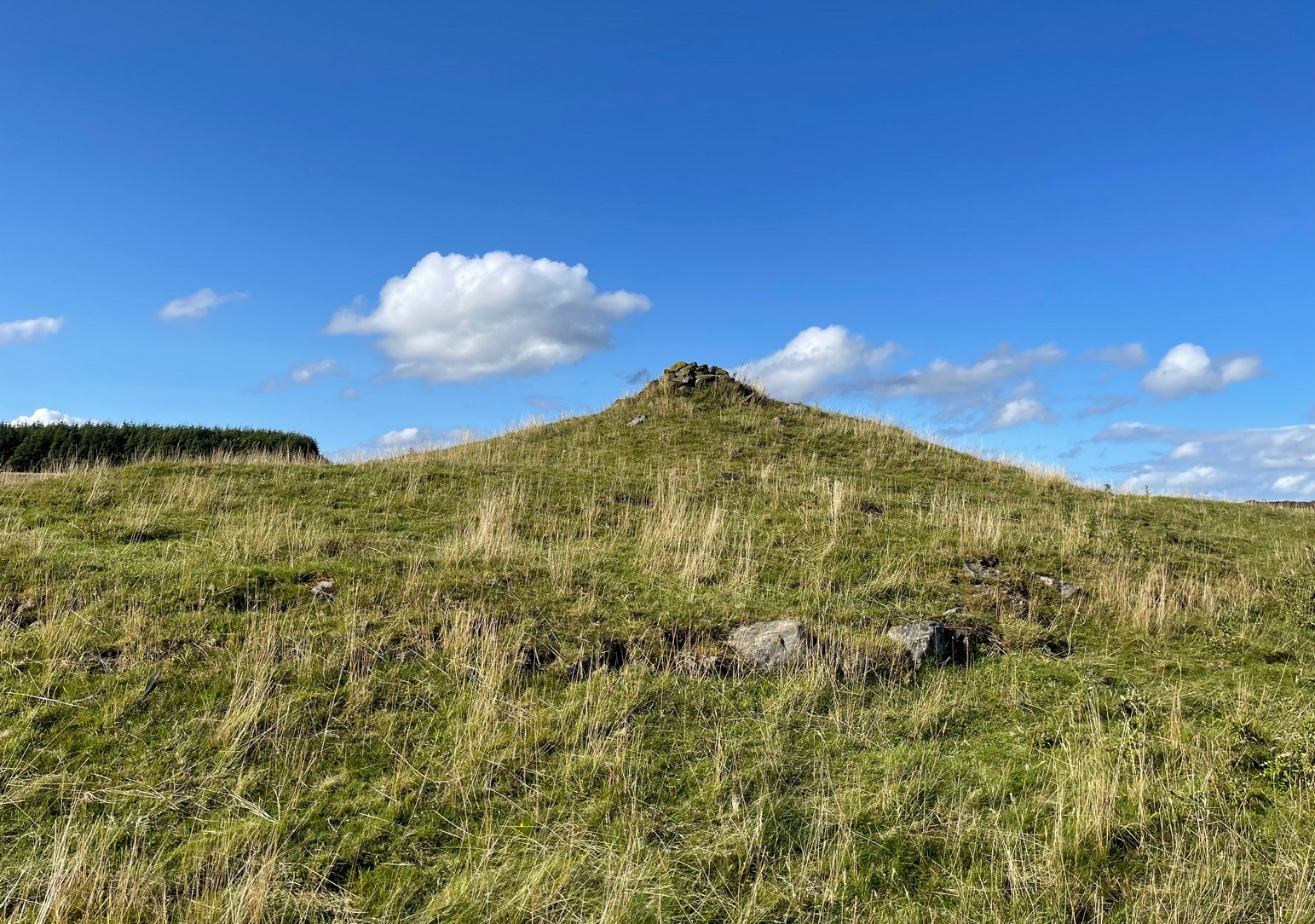
If you’re going to visit the megalithic remains of Fowlis Wester ¾-miles to the west, the antiquarians amongst you might as well give this old burial mound your attention too. It’s not grandiose by any means, but its position in the landscape is quite superb. It’s built upon a long geological promontory with extensive views that reach from south-east to south to south-west for many miles into the distance with the Ochils framing the majority of the southern horizon, but also with the notable pap of the West Lomond hill 20 miles to the south-east mimicking the shape of the tomb itself. It was obviously built here with the extended landscape having some ancestral importance. Visit it and see for yourself!
Despite being a notable mound, this tumulus-cum-cairn only seems to have been written about for the first time as recently as 1998, when archaeologist Ian Armit visited the site. Roughly circular in form, it’s about 12 yards across and more than six feet in height. A small pile of stones crowns the very top, placed here in much more recent times. At ground level on its northern side, an arc of low lying stones define the edge of the tomb. The stones probably continue all the way round the entire structure, but it’s overgrown by centuries of soil and vegetation and we lose sight of it as we walk round. When Mr Armit (1998) wrote about the site, he and colleague wrote:
Seat Knowe, looking NWSeat Knowe, looking north
“A grassed-over stony cairn lies on the highest point of Seat Knowe, a ridge commanding extensive views to the south. The cairn has a diameter of c.10m and is up to 2m high. A modern cairn occupies it summit. The low turf foundations of a rectilinear structure, some 6 x 8m, occupy its south flank, and thee are extensive cultivation and field system remains in the vicinity.”
Check it out! You won’t be disappointed.
Folklore
An interesting piece of relatively recent folklore about Seat Knowe, described in the Perthshire Name Book around 1862, told that,
“One of the Earls of Strathearn, desirous of having a church in the vicinity of his Castle, stood on an eminence, on which he had a summer seat, and resolved to erect it where the sun first shone, which was on the spot where it now stands.”
References:
Armit, Ian & Hall, M., “Seat Knowe (Fowlis Wester parish): Cairn,” in Discovery & Excavation Scotland, 1998.
It’s a helluva zigzag to get here. Just out of Crieff along the A85 road to Comrie, turn right up the minor road to Hosh and Glenturret Distillery. Just past the distillery, over the small river bridge, turn left and go up the tiny road for literally ⅔-mile (1.1km) and park up just before the cattle-grid. Naathen, up the slope into the trees at a diagonal behind where you’re parked, walk up and up for half-a-mile where the land levels out and you reach a gate (and my bath, in the undergrowth to your right). A track goes up above the gate (not the one through it) and bends round where, 100 yards up, you reach a gate. Go over it and look at one of the stones in front of you!
Archaeology & History
Very faint cups
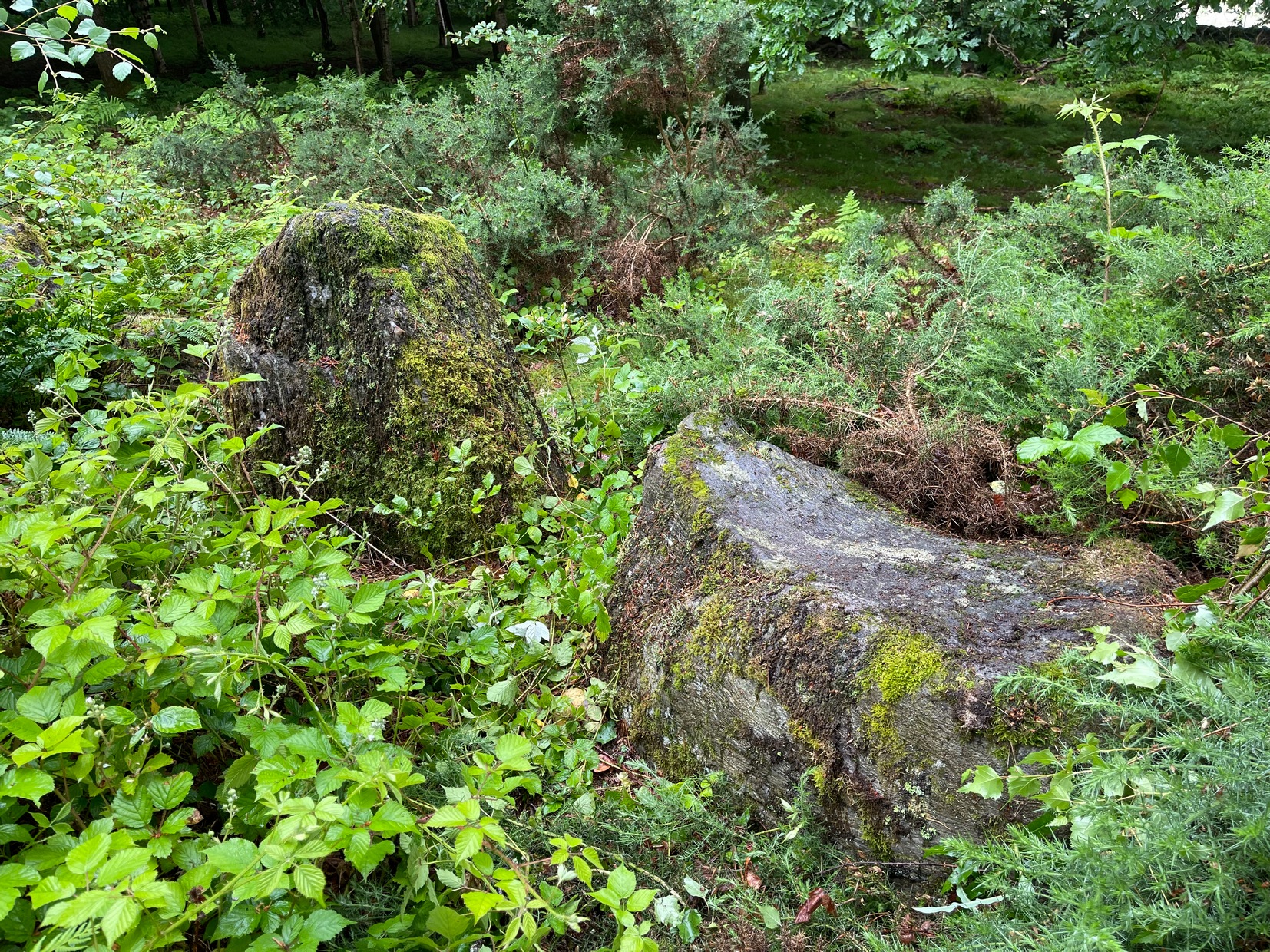
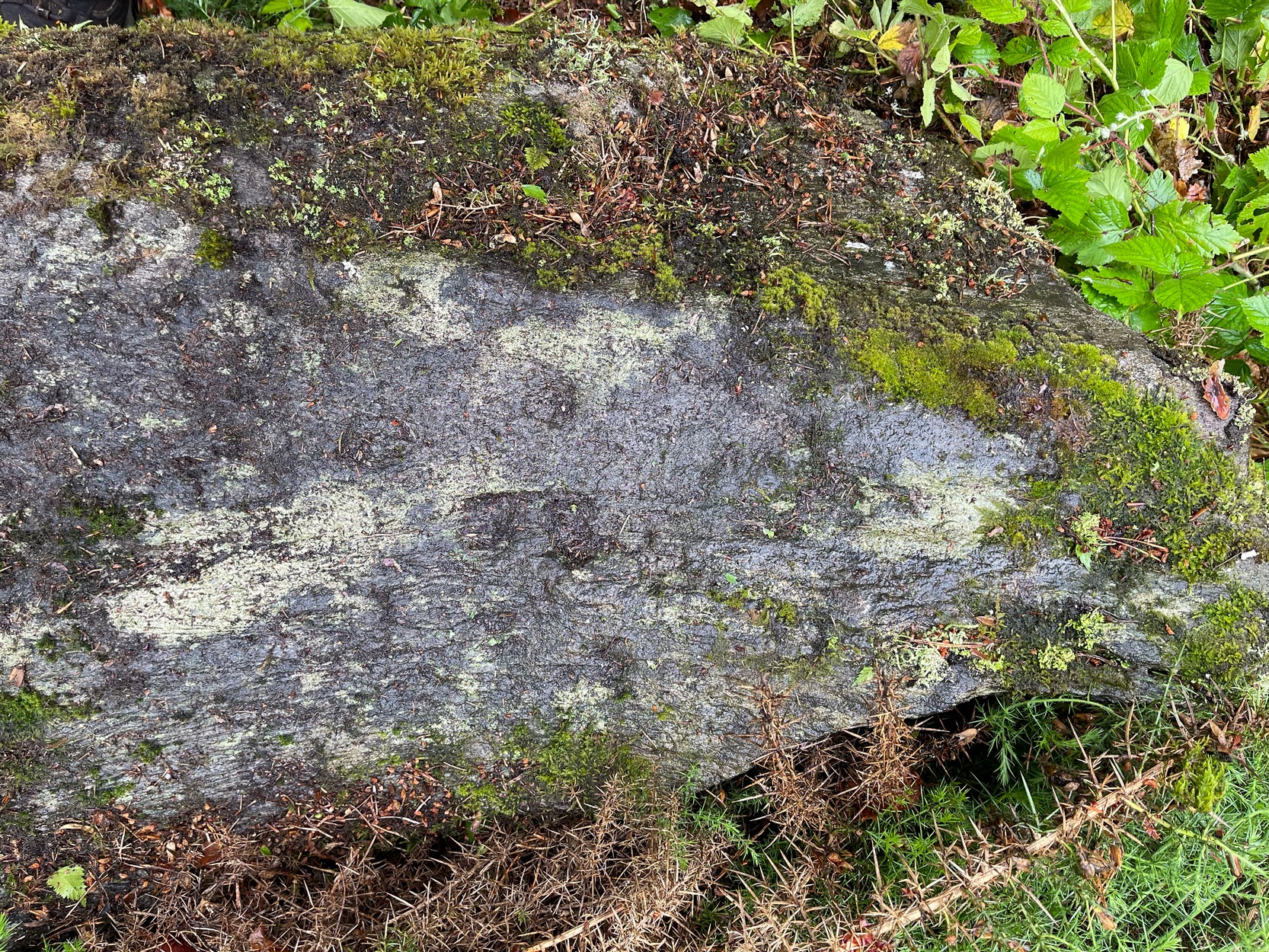
This is another one of those petroglyphs that only the purists amongst you will want to see. On the lower section of this typically smooth female stone, you’ll see a singular cup-mark, half-natural half-carved, a couple of inches across, with a less discernible cup-mark of similar dimensions further up the rock, but entirely man-made. When we visited here yesterday, the shadows of the trees above made it very difficult to get any decent photos of the cups. Give it your eye on the journey up to the impressive standing stone of Stonefield a few hundred yards further up the hill; and if you manage to get any good photos, stick ’em on our Facebook group.
Cup-Marked Stone: OS Grid Reference – NN 8515 2484
Archaeology & History
Site of supposed cupmark
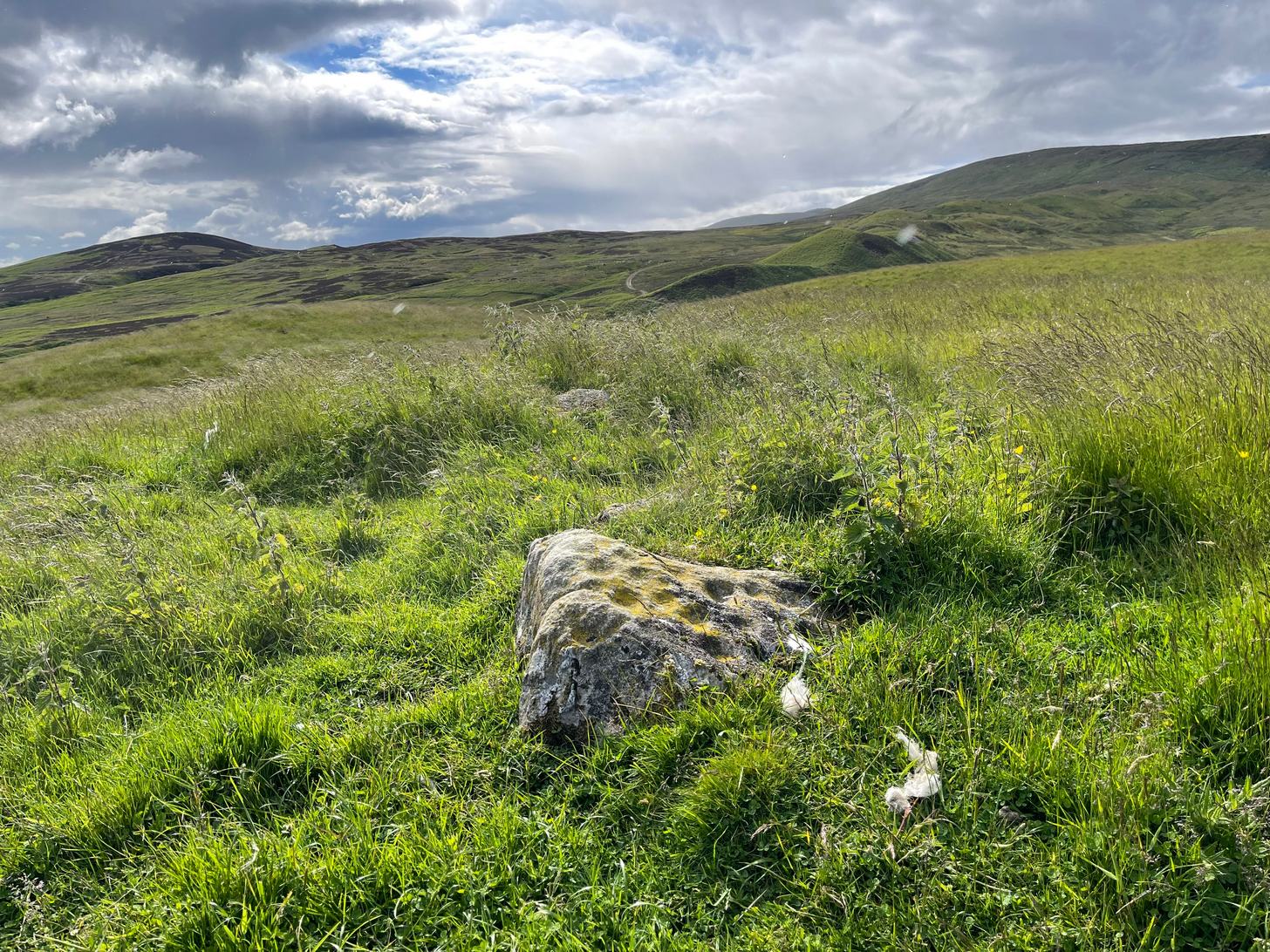
There’s little to see here. In the 1990s, students from the Royal Commission found what they described as “a single cupmark”, 3 inches across by 1 inch deep, on a rock measuring 2-feet by 1½ feet, on the north side of this large (seemingly) natural mound with large scatters of field clearance stones all over its northern face. When I visited the place yesterday (on my way to see the impressive Stonefield monolith 260 yards to the north-east), I zigzagged back and forth over the rocky mound and was unable to find it, although it may have been beneath the summer vegetation. A winter visit may prove more fruitful.
You’re going from Crieff, up the A822 road from the Gilmerton junction and head up towards the Sma’ Glen. And if you’re visiting this stone, you’ve already walked past the carvings of Connachan (2), (4), (5) and (6). So just another 100 yards or so up the dirt-track past Connachan (4), (5) and (6), just where there’s a bend in the track, the land just about levels out (if you’ve reached the gate and fence you’ve gone too far). At this point walk onto the grassland on your right for barely 50 yards, just where the land sweeps back downhill. Look around for a small stone at the edge of some very low indistinct walling. You’ll find it!
Archaeology & History
Cluster of cups
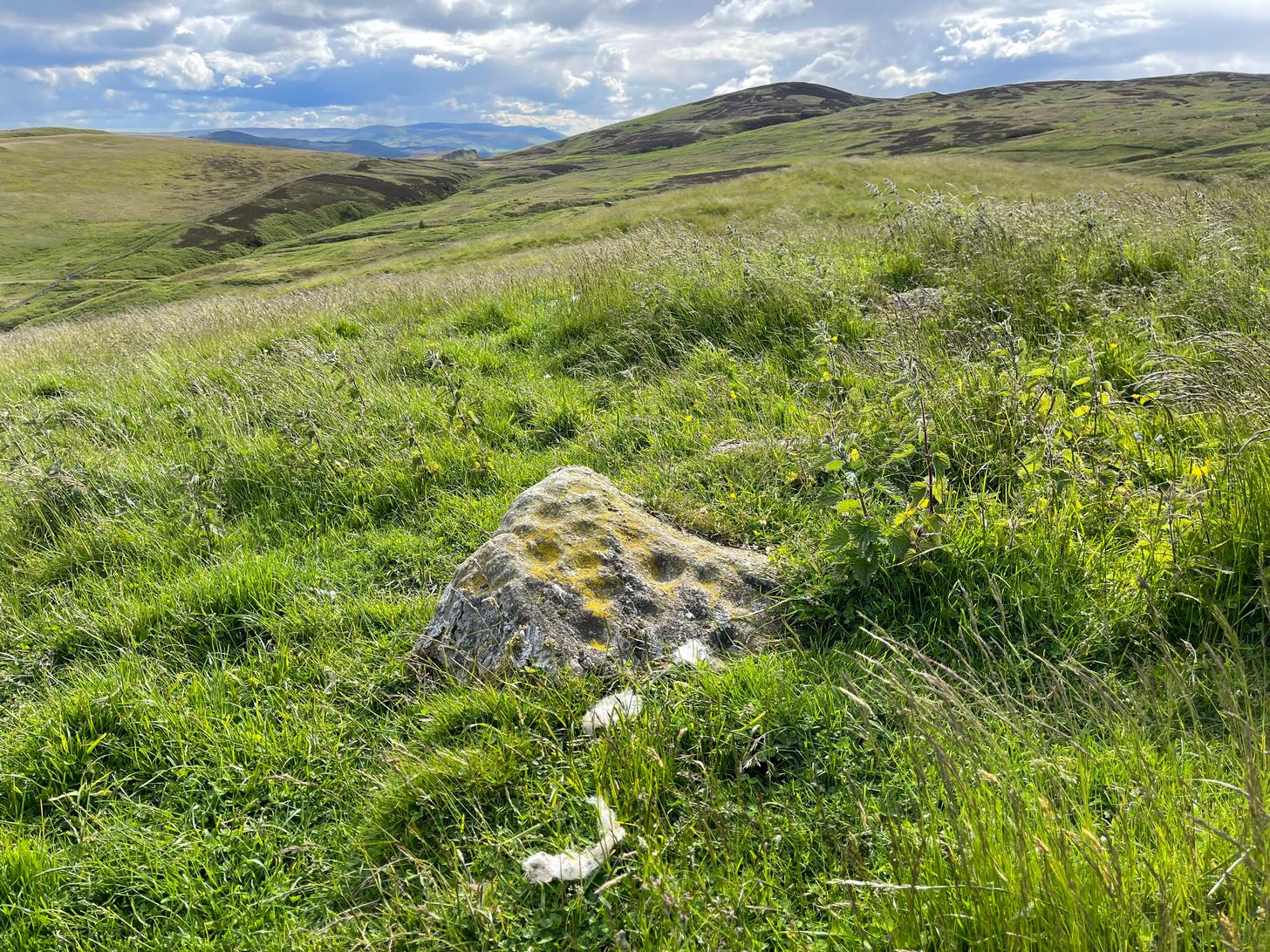
A site that’s shown on the modern OS-map as a “cairn” but which is, by the look of things, actually a hut circle — and a somewhat indistinct hut circle at that! You could very easily walk right through it without even noticing you’d done so. However, the cup-marked stone on the outer edge of its southern wall does grab your attention! Once you’ve found the stone, if you pace round a few times you’ll begin to see the vague outline of this prehistoric, probably Bronze Age abode.
at a slightly different angle
The carving was probably placed here after the hut circle had been built; or perhaps even built deliberately upon the petroglyph itself—but only an excavation would give us the answer. Its incorporation in the hut circle was probably functional, somewhat like the Man Stone carving in North Yorkshire, which is found at the doorway there. But this site is in such a state of neglect (and is somewhat overgrown) that I couldn’t ascertain whether it was at the entrance or not. If it was, then most likely there was a mythic relationship between the design of the cups and the person who lived therein. This relationship was probably a long standing traditional one attached to a particular family, or tribal leader, or even a shaman figure which no doubt stretched over many centuries. (as seems likely with the aforementioned Man Stone)
The carving itself is somewhat basic, as you can see, comprising of a small irregular cluster of between 18 and 20 tightly packed cups on a small stone. The hut circle is about 14 yards across. About 100 yards to the east is a severely robbed-out cairn.
References:
Stewart, Margaret E.C., “Connachan, Crieff – Cup Marks and Hut Circle,” in Discovery & Excavation, Scotland, 1967.
Take the directions to reach the Ninewells ring cairn on the hills east of Dunkeld. Once here, if you can work your way through the dense mass of prickly vegetation in and around the circle, on its western side you’ll find three elongated monoliths (if you stood them upright they’d be taller than all the rest) laid next to each other. On the smallest of these three, next to an upright, almost pyramidal stone, you’ll find what you’re looking for. Persevere! (someone needs to clean up this impressive site and keep it in good condition)
Archaeology & History
Cluster of 4 or 5 cups
This minor-looking petroglyph can be found on the upper surface of the westernmost stone in the cairn circle. It’s nowt much to look at and will only be of interest to the hardcore rock art freaks among you. Carved onto the flattened edge of the stone are at least four shallow cup markings, close to each other. When we visited here, the light wasn’t good, but it seemed that a fifth cupmark was sat amidst the small cluster. You can make them all out (just!) in the photo. Another visit on a better day would tell us one way or the other…
References:
Royal Commission on the Ancient & Historical Monuments of Scotland, South-East Perth: An Archaeological Landscape, HMSO: Edinburgh 1994.
Acknowledgements:Huge thanks for use of the Ordnance Survey map in this site profile, reproduced with the kind permission of the National Library of Scotland.
A couple of miles east of Crieff, take the A822 road from the Gilmerton junction and head up towards the Sma’ Glen. After literally 1¾ miles (2.8km), on the right-side of the road, you can park-up right opposite the dirt-track that leads up to Connachan Farm a half-mile away. Walking up and then past the farm, go past the Connachan (2) petroglyph, keeping on the same track uphill and just past the (Connachan 4) carving the land levels out where the track curves. From here, walk to your right, into the grasses, and about 90 yards along you’ll see a small rise in the ground with two or three fallen stones in the middle.
Archaeology & History
The cairn, looking N
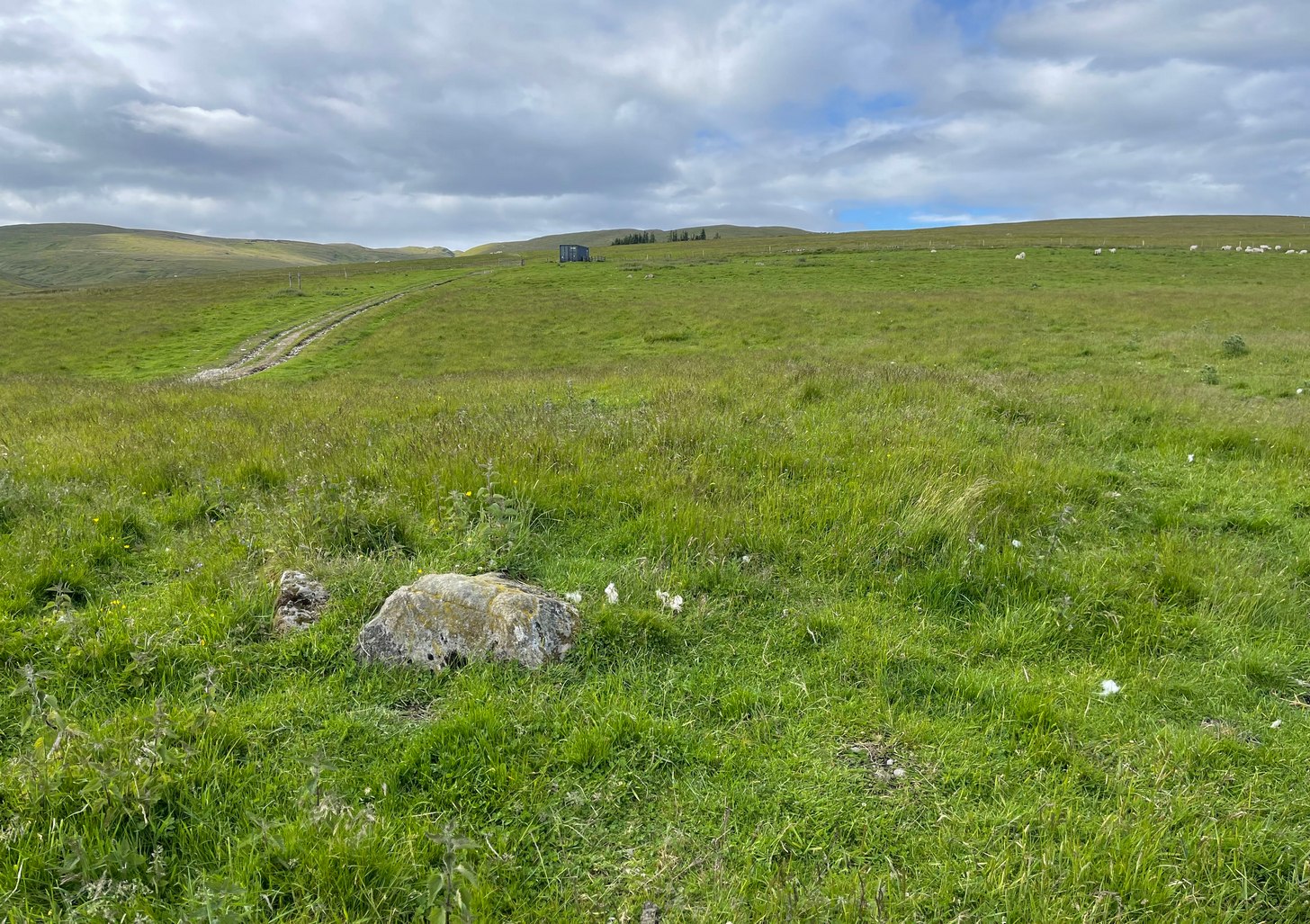
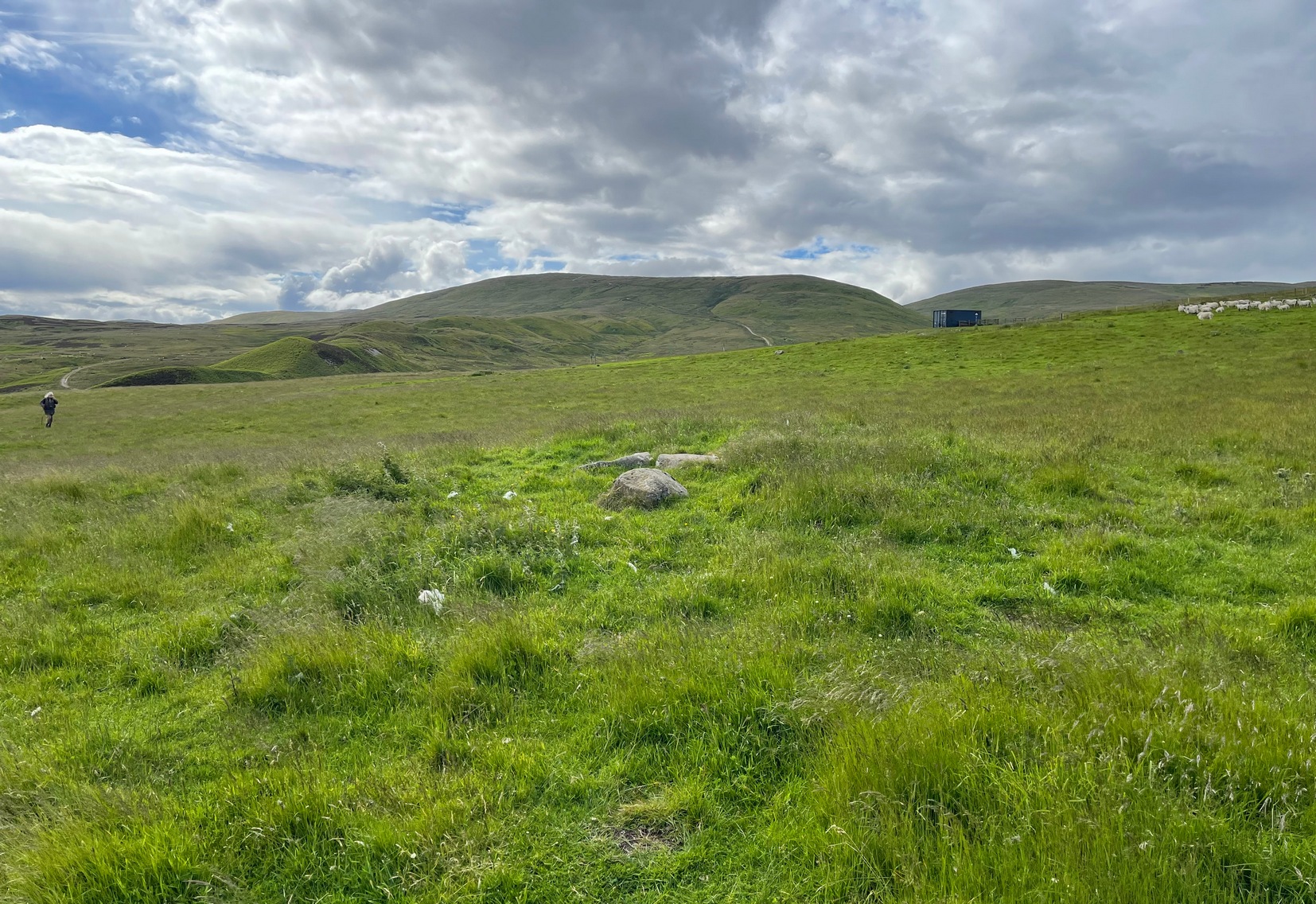
There’s nothing truly notable about this much-overgrown cairn and you could very easily walk past it without noticing it was even there! Much of its original mass has been removed and, no doubt, its stones reused in the old walling a few yards to the north (a long section of that walling appears to have a prehistoric provenance). It measures roughly 10 yards across and its outer edges are clearly visible as a raised grass-covered mound all round, just one or two feet high at the most. Obviously it was much larger when first built, but all that we see now are its final ruins, four or five thousand years after its birth… The one thing of great note here is the view: you’re looking from east to south to west across an awesome landscape for many many miles. Check it out!
References:
Stewart, Margaret E.C., “Connachan, Crieff – Cup Marks and Hut Circle,” in Discovery & Excavation, Scotland, 1967.
Cup-Marked Stone (lost): OS Grid Reference – NO 262 503
Archaeology & History
In an excursion to the Iron Age Hillfort on Barry Hill in the early 1960s by some members of the Perthshire Society of Natural Science, near the very top on its southwestern side they discovered “a small cup marked stone.” (Longworth 1962) It hasn’t been seen since. And whether it was in the walling of the fort, or was a carved earthfast rock, they neglected to tell. When I visited here several years ago I couldn’t find the damn thing and presume that it’s simply been overgrown by the vegetation. In the event that you manage to rediscover the carving, see if you can catch us a good photo or two and stick ’em on our Facebook group.
References:
Longworth, Ian, “Dundee, Angus,” in Discovery & Excavation, Scotland, 1962.
A couple of miles east of Crieff, take the A822 road from the Gilmerton junction and head up towards the Sma’ Glen. After literally 1¾ miles (2.8km), on the right-side of the road, you can park-up right opposite the dirt-track that leads up to Connachan Farm a half-mile away. Keep walking up past the farm to the Connachan (2) petroglyph, and keep to the track uphill for another 600 yards keeping your eyes peeled for a notable singular rock on your left, about 10 yards into the heather. It’s pretty easy to see. If the track’s levelled out, you’ve gone too far!
Archaeology & History
Perhaps the most attractive of the Connachan petroglyphs is this curvaceous stone with its archetypal double-ringed motif. It seems to have been described firstly by Margaret Stewart (1967), whose description (to me at least) doesn’t quite do it justice; but then, they are somewhat troublesome abstract creations most of the time. She told it to it be,
“a boulder 4’10” x 3’10 x 2′ in height with 6 cups and a grooved circle, which incorporates two more cup marks on its outline. The grooved circle encloses a gapped circle with another cup mark at its centre.”
Connachan (4), looking NMain face of the carving
So, nine cups in all: one with the double-ring around it, and two of the cups touching the outer ring. The cup-marks are ostensibly as Stewart described them, but there are another two or three which I was unable to capture in the photos, as the daylight wasn’t good when we came here. They’re shallow but very distinct when you see and feel them in the flesh, so to speak, and are closer to the top- and bottom-centre of the stone in the photos here. Well worth checking out if you’re in the area!
References:
Stewart, Margaret E.C., “Connachan, Crieff – Cup Marks and Hut Circle,” in Discovery & Excavation, Scotland, 1967.
Acknowledgements:Huge thanks for use of the Ordnance Survey map in this site profile, reproduced with the kind permission of the National Library of Scotland.
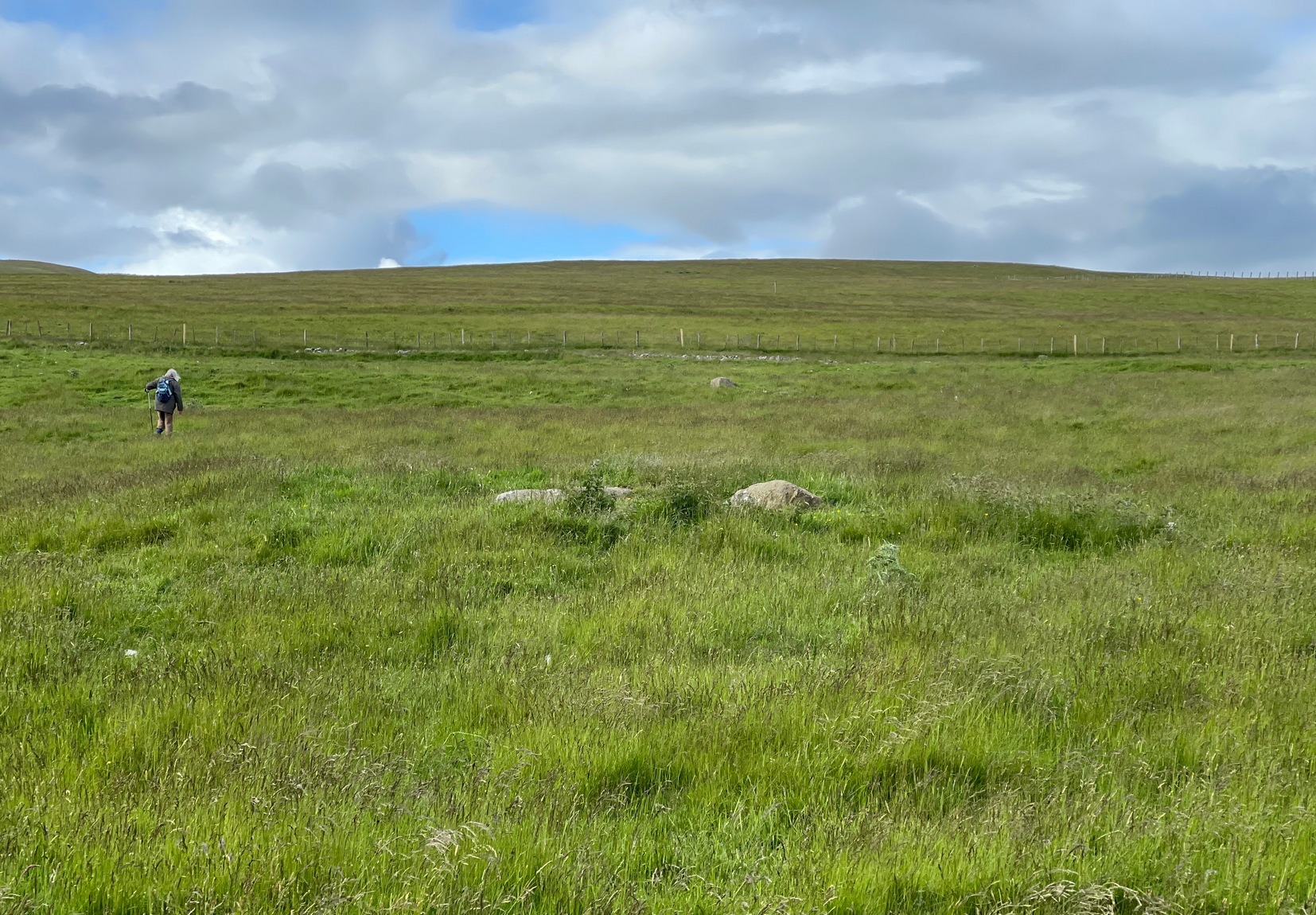
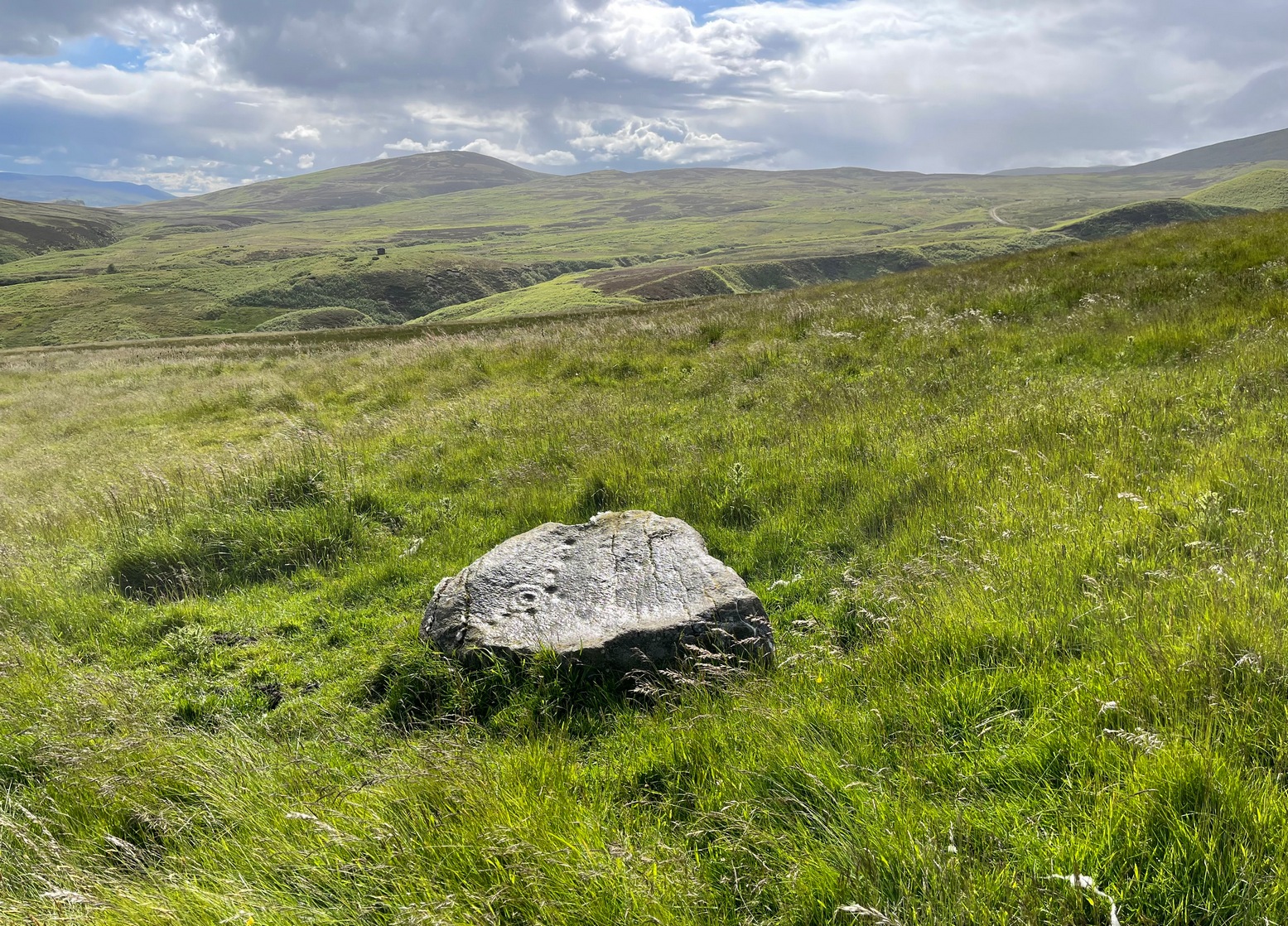
A couple of miles east of Crieff, take the A822 road from the Gilmerton junction and head up towards the Sma’ Glen. After literally 1¾ miles (2.8km), on the right-side of the road, you can park-up right opposite the dirt-track that leads up to Connachan Farm a half-mile away. Keep walking up the track, past the farm and the cottages, and about 300 yards further along, right by the track-side, you’ll see a large stone. Y’ can’t really miss it!
Archaeology & History
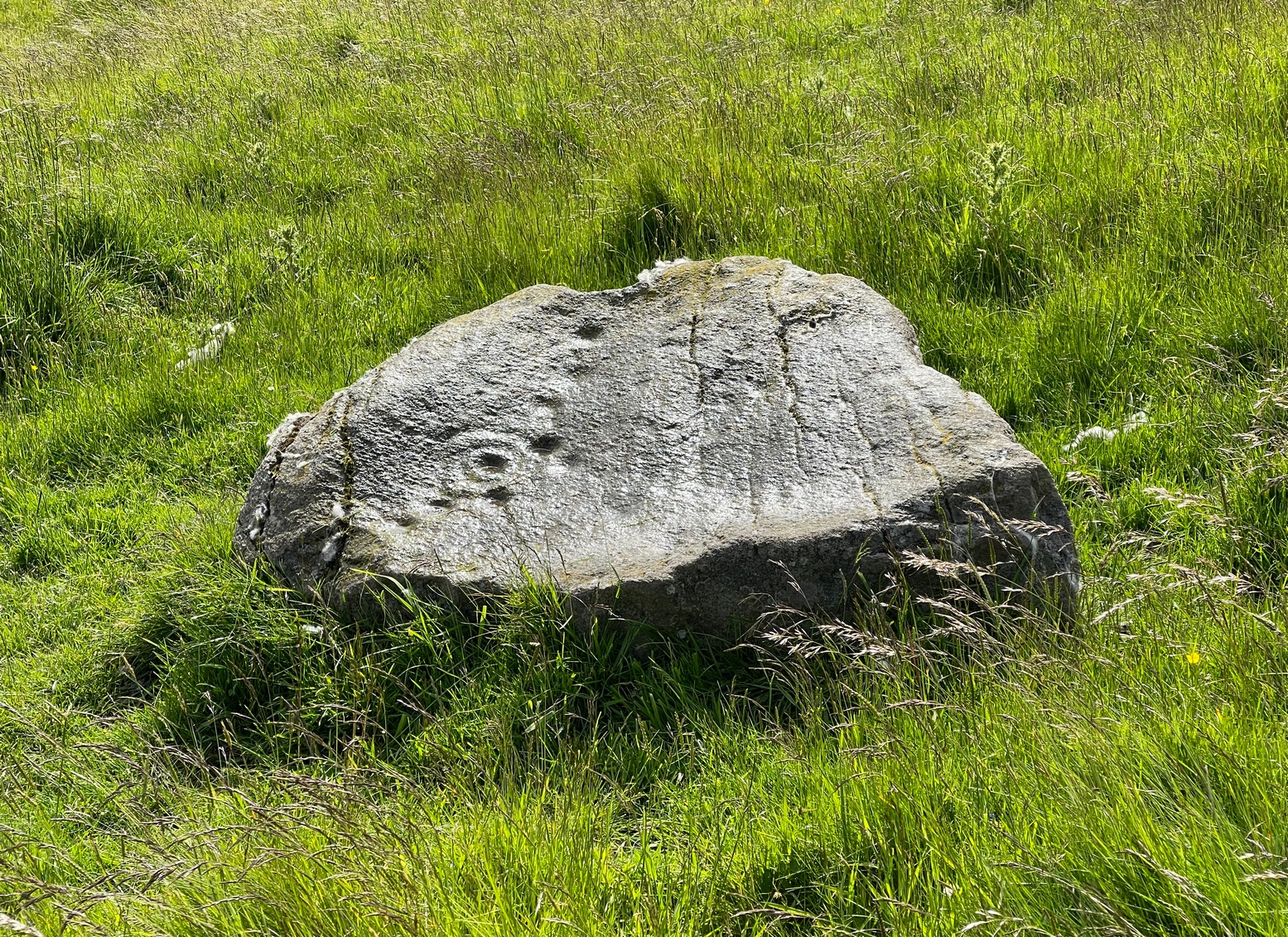
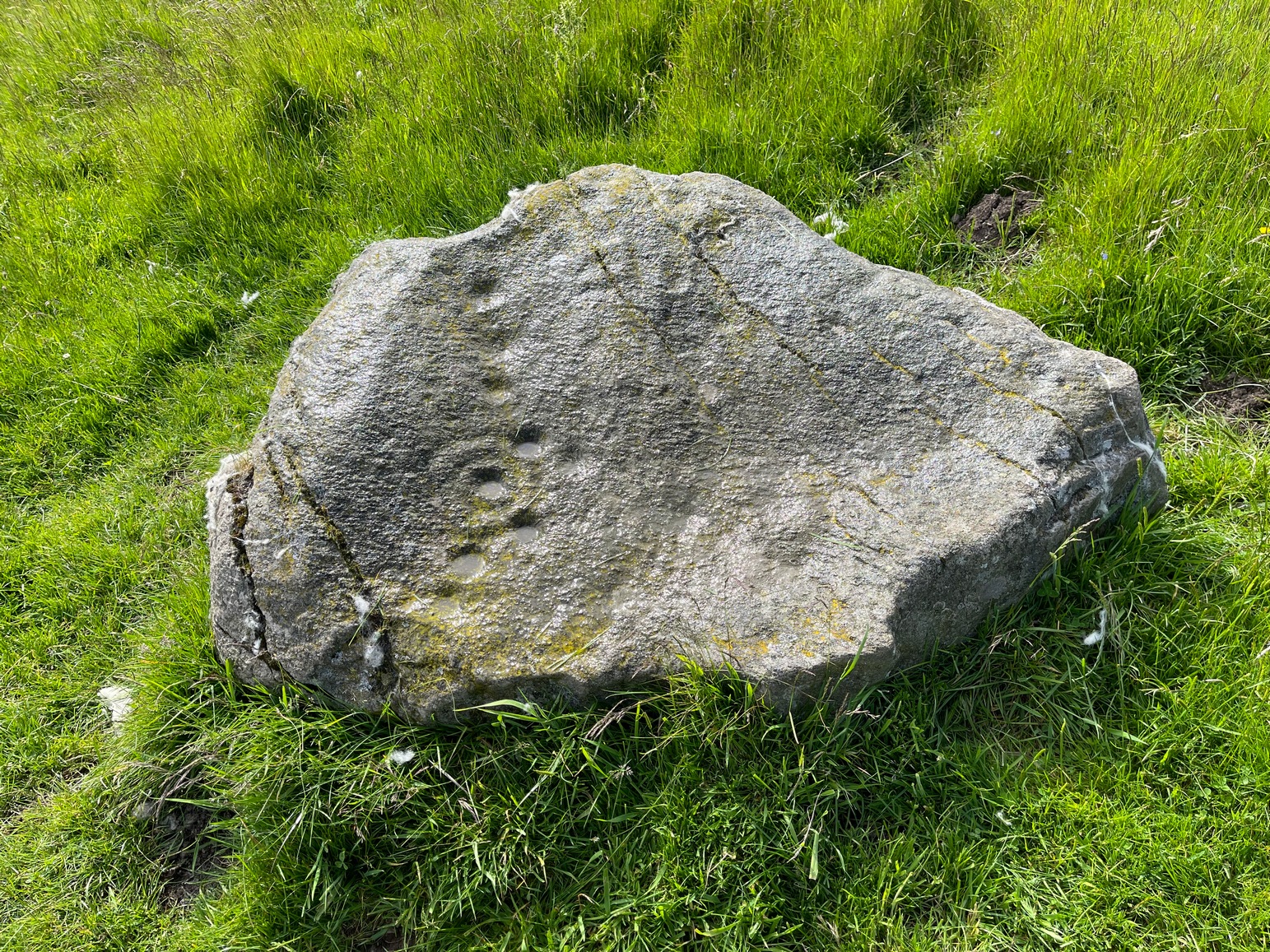
This carving was seemingly rediscovered by J.H. Maxwell of Crieff in the 1960s, but not in the position it presently occupies by the trackside. A large body of field clearance rocks lies scattered 60 yards to the west, which is where it was reportedly first seen; which means that, even then, it wasn’t in its original spot. But at least we can be assured that it came from somewhere very close to its present location, by the trackside.
Close-up of cups & linesThe carving, looking SW
It’s not overly impressive in terms of its design, comprising almost entirely of cup-markings: at least thirty, perhaps as many as thirty-four. When we visited here recently, Nature wasn’t overly concerned about giving us decent daylight, so we couldn’t see the carving clearly, but it did seem that a carved broken “ring” swerves around at least one of the cups near the middle of the stone. You can make it out in the photos here (centre-left). There are what seems to be several other carved lines on different parts of the stone but, again, without decent daylight, we could neither get decent photos, nor do a decent sketch of them. The Scottish Rock Art Project, who got themselves nigh on a million quid to survey all our carvings up here, neither sketched, photographed or visited this or the others in this Connachan petroglyph cluster, so we’re none the wiser as to its original form. If you happen to visit this carving when the daylight is being nice, see if you can catch us a good photo or two and stick ’em on our Facebook group.
References:
Stewart, Margaret E.C., “Connachan, Crieff – Cup Marks and Hut Circle,” in Discovery & Excavation, Scotland, 1967.
Go west out of Perth city centre, along Longcauseway which runs straight into Jeanfield Road, then (keep your eyes peeled) turn left and go along Burghmuir Road to the end where, at the roundabout, go straight across. 100 yards along, a dead straight path starts on the left-side of the road. Walk 400 yards along here, cross the road, keep straight on the path (called Old Gallows Road) into the trees and a half-mile on you reach a large pylon on your right; but walk to your immediate left here and after 25 yards go through the gate on your left. In this field, 100 yards to the south you’ll see a tree inside a large low stone enclosure. You need to find the stone that’s the most northerly one in this enclosure walling.
Archaeology & History
It’s debatable as to whether or not this carving is in its original position as it’s located within the outer walling of an enclosure, deemed by Fred Coles (1903) to have been a large garden, yet which has all the hallmarks of being much earlier structure, possibly even Iron Age. Either way, the cup-and-ring that we see today on the northernmost edge of this old walling, would seem to have been moved into the position it presently occupies.
Close-up of the carvingPosition in line of walling
There’s another oddity about it too, as one (or more) of the cup-markings have been incised and worked upon in much more recent centuries, as evidenced by a small thin almost pencil-like cut into the centre of one of them, perhaps with the intention of smashing the stone to pieces. A geologist or stonemason could perhaps look at this and let us know what they think. Thankfully the stone and the carved design remains intact!
It was described by the great Fred Coles (1903) in a summary essay of numerous antiquities both here and further afield. He told us:
Coles (1903) sketchClose-up of the design
“The cup-and ring-marked stone here was first brought to my notice by Mr David Smith in the summer of 1900. He then reported that the stone appeared to be one of a large number forming a rough circle in a plantation on the west of this farm. On reaching the house, I was fortunate in meeting Mr Douglas the tenant, who at once conducted me to the westmost field and showed me the stone. It is a squarish and not very thick block of ‘bastard whinstone,’ uneven, weathered, and moss-grown. It measures 2 feet 10 inches by 2 feet 8 inches. As far as examination in the gloom of the clump of trees allowed, I believe I am correct in recording…the seven single cups and the two surrounded by rings as all the definitely artificial marks now visible on this stone. The stone at present lies prone upon the curved alignment of many stones which have been set on edge, enclosing an area roughly oval, and measuring in round numbers about 210 feet nearly east and west by 90 or 100 feet north and south.”
There are in fact a few more cups with rings than what Coles described, but they’re difficult to make out. At least five have rings, possibly six of them. If you happen to visit this carving when the daylight is being nice, see if you can catch us a good photo or two and stick ’em on our Facebook group.
References:
Coles, Fred, “Notices of…some Hitherto Undescribed Cup-and-ring-marked Stones,” in Proceedings Society Antiquaries Scotland, volume 37, 1903.
Acknowledgements:Many thanks for use of the Ordnance Survey map in this site profile, reproduced with the kind permission of the National Library of Scotland.