Glenrickard, Brodick, Isle of Arran, Argyll

Chambered Cairn:  OS Grid Reference – NS 00499 34665

Also Known as:
  1. Canmore ID 40204

Getting Here

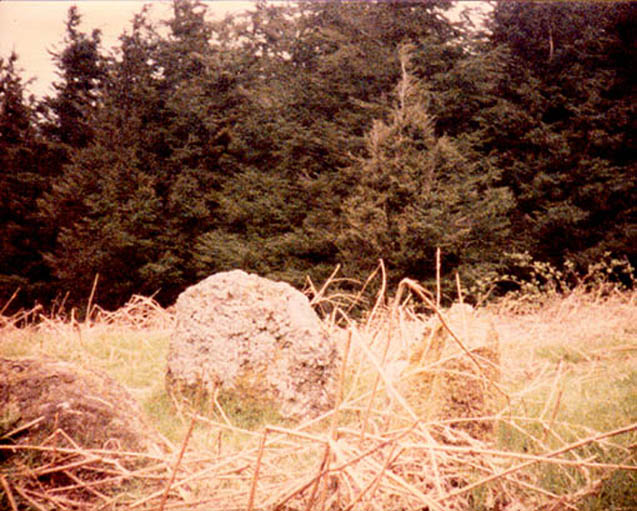
Upright stone at Glenrickard

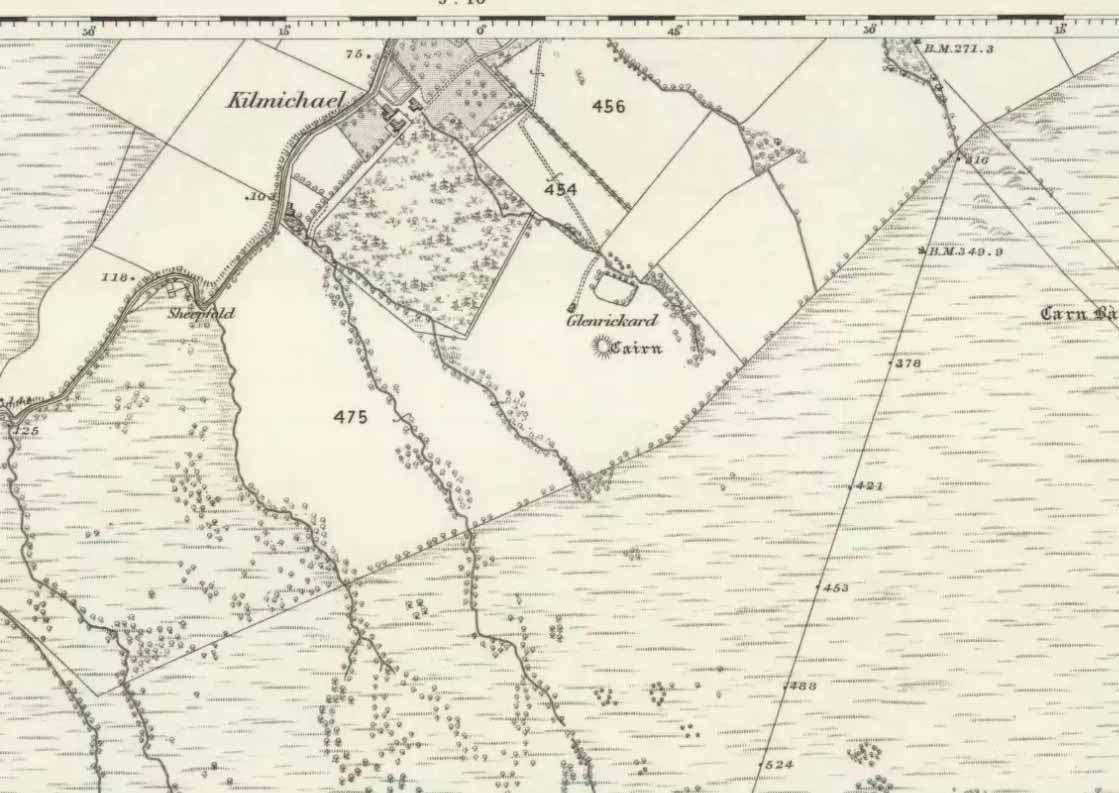
From Brodick, walk up the Glencloy dirt-track towards the friendly Kilmichael Hotel but turn off on the left shortly before hand, up another footpath, crossing the stream until you eventually reach the derelict house which was built into the edges of this old tomb.  Upon the small rise above here, at the edge of the forestry commission trees, you’ll notice the overgrown ruins of the old tomb.

Archaeology & History

The remains here are somewhat overgrown and ramshackled, but I still like this place and in my younger days used to spend a lot of time here.  It can get quite eerie in some conditions and seems to validate some of the folklore said of it.  The site was described in Balfour’s (1910) magnum opus as:

“Situated in Glen Cloy, on the moor above Kilmichael House, close to a cottage called Glenrickard.  There are no traces of a cairn or of a frontal semicircle. The chamber is formed of rather light flags, with their upper edges nearly on the same level, so that the monument is more like a series of cists than a chamber.  The roof and end stone have gone; there are two portal stones, but the gap between them is only 7 inches.  The chamber is directed N and S, with the portal to the south.  There have been three compartments, but they are rather smaller than usual, the third from the portal being only 3 feet 10 inches long by 2 feet 2 inches broad.  Two feet 6 inches from this compartment is another cist, which is possibly a short cist representing a secondary interment, and 10 feet farther north is a second ruined cist placed at a different angle.  This last has the appearance of a short cist, but it is not carefully constructed and differs little from the component compartments of the chamber.   The structure is anomalous, and may perhaps be regarded as representing a phase of degeneration in the transitional period.”
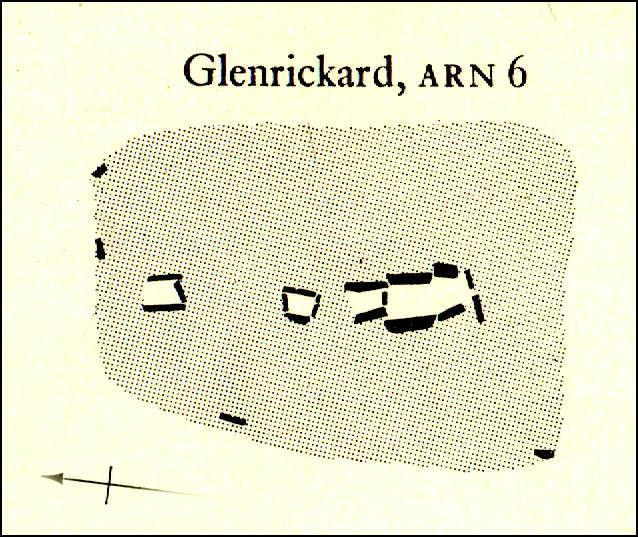
Glenrickard ground-plan (after Henshall 1972)
Glenrickard on 1868 map

Audrey Henshall (1972) later descried the site in greater details in her own magnum opus and told that “two rude clay urns of the primitive flower-pot pattern (were) found in the chamber”, along with “calcined bones, said to have been in the two vessels.”

Folklore

Said by local people to be haunted, the spirit of the tomb was said to have been disturbed upon the building of the derelict house below it.  Ghosts of a middle-aged couple and young child have been seen in the house; whilst the spirit of the site can generate considerable fear to those who visit the place when it is ‘awake.’  To those who may visit this out-of-the-way tomb, treat the site with the utmost respect (and DON’T come here and hang a loada bloody crystals around the place in a screwy attempt to “clean” the psychic atmosphere of the place. If you’re that sort of person, don’t even go here! The spirit of the place certainly wouldn’t want you there).

References:

  1. Balfour, J.A., The Book of Arran: Archaeology, Arran Society: Glasgow 1910.
  2. Henshall, Audrey Shore, The Chambered Tombs of Scotland – volume 2, Edinburgh University Press 1972.

© Paul Bennett, The Northern Antiquarian 

Townhead, Rothesay, Isle of Bute, Argyll

Settlement (destroyed):  OS Grid Reference – NS 086 635

Archaeology & History

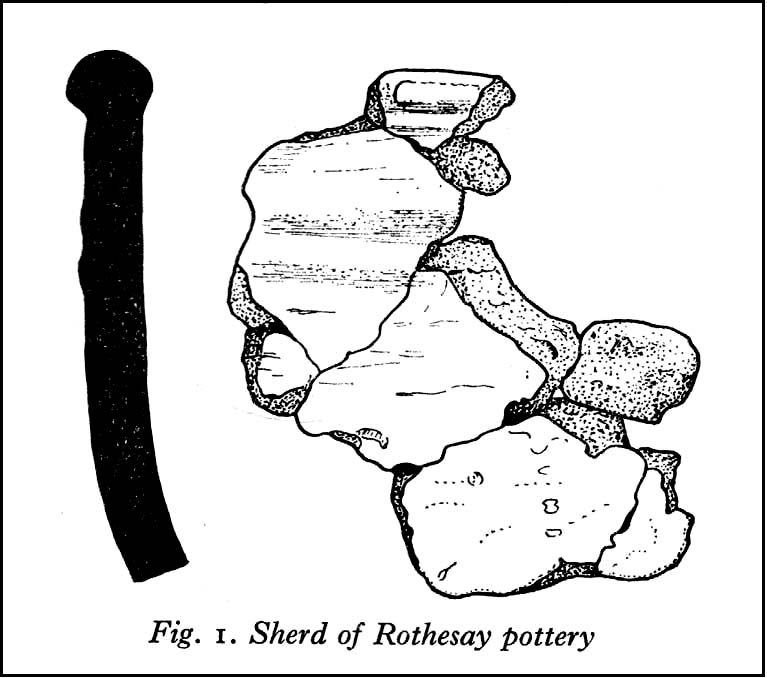
Pottery remnants

Somewhere beneath the modern cemetery and adjacent factory close to St. Mary’s church on the southern outskirts of Rothesay, right by the roadside, was once an important prehistoric settlement.  All remains of the site however, have long since been destroyed.  An axe that was found here was held in the local museum.  There are several scattered accounts of the place, one of which was written by J.G. Scott (1968), who reported that,

“between 1914 and 1929, a series of finds — pottery, a polished stone axehead, a saddle quern, hearths and remains of shallow trenches — was made at Townhead…at a now disused gravel pit.  Excavations in 1929 revealed several slots in the original gravel surface, which suggested the remains of sleeper beams for wooden buildings.  All the pottery recovered was neolithic… Amongst it were sherds of two vessels of Rinyo-Clacton ware.  Most of the rest of the pottery…showed well-developed rims, often thickened and bevelled externally and sometimes everted.  This pottery recalls the Abingdon style of southern Britain, and has been termed Rothesay ware by the writer.

“Sherd from one of these Rothesay vessels were associated with charcoal, possibly from a hearth, with hazel-nut shells and small fragments of bone.”

Scott told that radiocarbon analysis dated the finds  at around 2120 BC.  A couple of hundred yards away are the enclosed remains of St. Mary’s Holy Well, whose waters may well have been of magickal repute all those centuries ago…

References:

  1. Scott, J.G., “A Radiocarbon Date for a West Scottish Neolithic Settlement,” in Antiquity journal, volume 42, no.168, December 1968.

© Paul Bennett, The Northern Antiquarian

Achnacree, Achnacreebeag, Argyll

Chambered Cairn:  OS Grid Reference – NM 9227 3636

Also known as:

  1. Achnacridhe
  2. Canmore ID 23223
  3. Carn Ban
  4. Moss of Achnacree
  5. Ossian’s Cairn

Archaeology & History

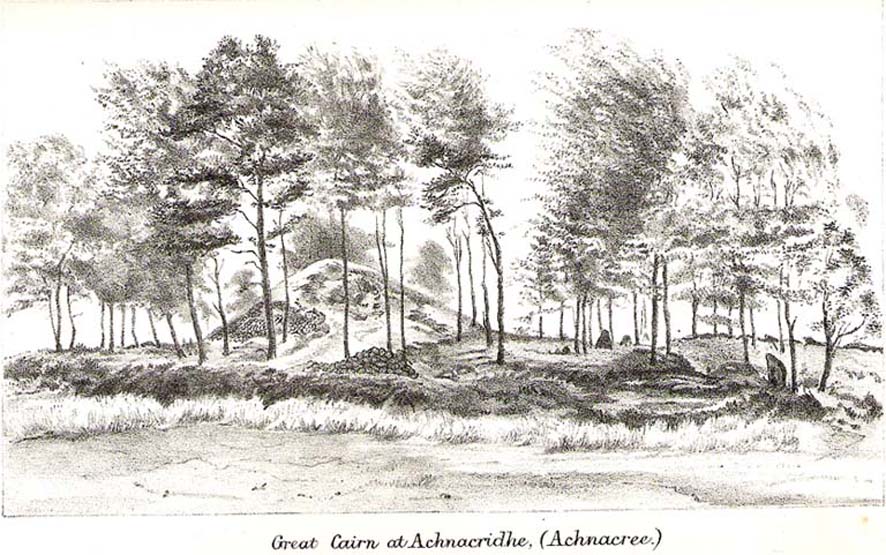
Not to be confused with the Achnacreebeag chambered tomb a short distance to the east, Achnacree is  a site that has been made ruinous over the last 100 years, prior to which — as R.A. Smith’s (1885) illustration here shows — we had a quite grand prehistoric chambered cairn to behold. It’s still worth looking at though!

R.A. Smith’s old drawing
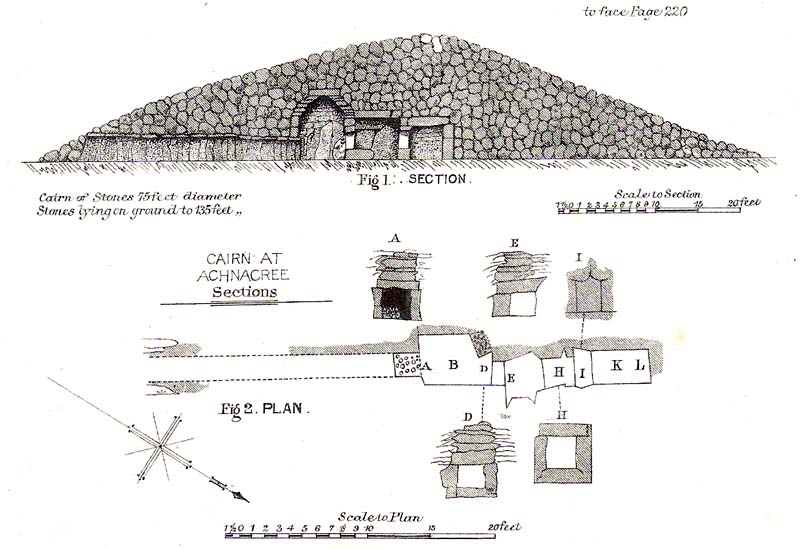
Smith’s early plan of the cairn

The once giant tomb is neolithic in age and nature, and was defined by Audrey Henshall (1972) as a passage grave of the Clyde Cairns group. It appears to have been built over two different periods: the earliest being when the first two internal chambers were done, “which in building technique and plan are comparable to a two-compartment Clyde-chamber and which may have been covered by a small cairn.” (RCAHMS 1974)  Much later, the long passage seems to have been added and built over the original chambers.

Although Smith (1885) and Henshall describe the large cairn, the Scottish Royal Commission (1974) entry gives the most succint archaeocentric summary of the site:

“The cairn is about 24.4m in diameter and now stands to a height of some 3.4m on the S and 4.1m on the NE, although it is said to have been about 4.6m high before excavation; it consists of small and medium-sized stones, interspersed with a few large boulders.  A low platform of cairn material, now grass-covered and about 1m high, extends round the base of the cairn and increases the overall diameter to about 40m.  The entrance to the passage is on the SE side of the cairn and is marked by four upright stones, one of which is now leaning out of position.  The central pair, set about 1.2m apart and protruding 1.3m and 0.4m above the cairn material, are the portal stones on either side of the passage, while the flanking pair may be the remains of a shallow forecourt.  The passage, which measured 6.4m in length and 0.6m in width, was constructed of upright slate slabs about 1m in height, and the roof was composed of similar slabs.  The excavator recorded that the passage was filled with stones, and these seem to indicate a deliberate blocking after the final burial-deposit.  The chamber comprised three compartments.  The outer, measuring 1.8m by 1.2m and about 2.1m in height, was constructed of upright slabs and drystone walling supplemented by corbelling, and was covered by a single capstone.  The central compartment, measuring 2m by 0.7m and 1.6m in height, was entered across a large transverse slab, and the entrance itself appeared to have been deliberately sealed with stones ‘built firmly in after the chamber had been completed.’  The sides of this chamber were formed of blocks of stone supplemented by dry-stone walling, and it was roofed by a singular capstone.  The inner compartment was entered across a sill-stone, and measured 1.4m by 0.9m and 1.7m in height.  A combination of slabs and dry-stone walling had been employed in its construction, and it was roofed by a single massive capstone some 0.4m thick.  Each side-wall was constructed of two slabs set lengthwise one above the other, in such a way that a narrow ledge was formed at their junction.  On these two ledges a number of white quartz pebbles had been deliberately deposited… Three neolithic pottery bowls were discovered in the course of the excavation — a fragmentary vessel from the outer compartment, and one complete and one fragmentary bowl from the inner compartment.”

These bowls were sent to Edinburgh’s National Museum of Antiquities soon after being found.

Folklore

Those of you into earthlights will like this one!  Also known as Carn Ban, or the White Cairn, aswell as Ossian’s Cairn, R. Angus Smith (1885:217) told how,

“it was curious…to listen to the superstitions that came out (about this tomb). One woman who lived here, and might therefore be considered an authority, said that she used to see lights upon it in dark nights.”

Another old local was truly terrified of the place, and said he would not enter this tomb for all the money in Lochnell Estate.

Regarding the various names given to the site, when Mr Smith (1885) wrote about it all those years ago, he told:

“We have often inquired the name of the cairn. The cairn really has had no definite name. Some people have called it Carn Ban or White Cairn, but that is evidently confusing it with the other cairn which we saw over the moss, and which is really whiter. Some people have called it Ossian’s Cairn, but that is not an old name, and even if it had been, we know that it is a common thing to attach this name to anything old.  We call it Achnacree Cairn, from the name of the farm on which it stands.”

References:

  1. Henshall, A.S., The Chambered Tombs of Scotland – volume 2, Edinburgh University Press 1972.
  2. Royal Commission on the Ancient & Historical Monuments of Scotland, Argyll – Volume 2: Lorn, HMSO: Edinburgh 1974.
  3. Smith, R. Angus,”Descriptive List of Antiquities near Loch Etive,” in Proceedings of the Society of Antiquaries, Scotland, volume 9, 1870-72.
  4. Smith, R. Angus, Loch Etive and the Sons of Uisneach, Alexander Gardner: London 1885 (2nd edition).

© Paul Bennett, The Northern Antiquarian 
Kilchiaran, Islay, Argyll

Cup-Marked Stone:  OS Grid Reference – NR 2043 6010

Also Known as:

  1. Canmore ID 37470
  2. Cill Chiarain

Archaeology & History

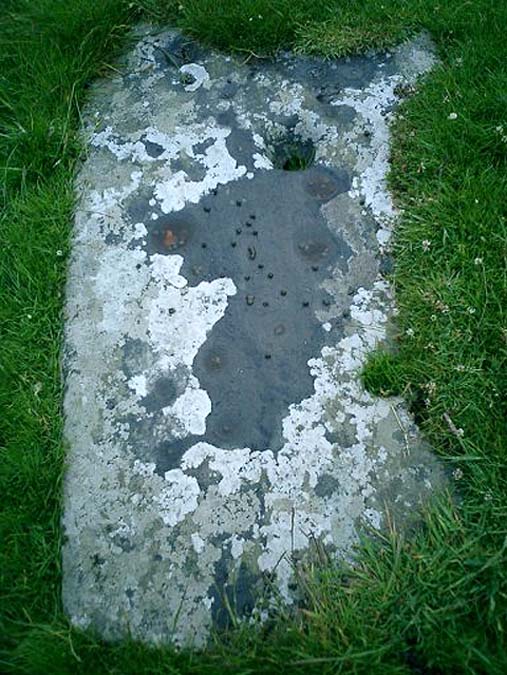
An unusual cup-marked stone — not because it’s found in the grounds of the chapel, but because the design appears carved on a flat slab, as if it might have been used as a grave cover or perhaps stood upright in times gone by.  First described in Rob Graham’s Carved Stones (1895) in the days when a few more cup-markings were visible; nearly a hundred years on it was included in the Royal Commission’s (1984) report as “a prone slab measuring 1.7m by 0.98m and 0.15m in greatest thickness; its upper surface bears at least nineteen plain cups up to 110cm in diameter and 40mm in depth.  In addition, wear has caused a large deep cup, 180mm in diameter and 80mm deep, to penetrate the stone, and there is another circular, vertical-sided, perforation measuring 70mm in average diameter and expanding to 90mm at the upper surface on the stone” — meaning there’s a hole that’s been worn through the rock itself.  This hole would seem to be accounted for by the folklore tradition of the site.

Folklore

It was reported by R.W.B. Morris (1969) that the cups here were “said to have been enlarged by a former ‘wishing’ rite” — a tradition echoed at another carving not far away where a pestle was used on the cup-marks and rotated 3 times, then a wish was made and an offering left to aid the wish.  Morris suggests this could have been a faint relic of solar worship.

References:

  1. Graham, Robert C., The Carved Stones of Islay, James Maclehose & Son: Glasgow 1895.
  2. Morris, Ronald W.B., “The cup-and-ring marks and similar sculptures of Scotland: a survey of the southern Counties – part 2,” in Proceedings of the Society of Antiquaries, Scotland, volume 100, 1969.
  3. Royal Commission on Ancient & Historical Monuments of Scotland, Argyll: volume 5 – Islay, Jura, Colonsay and Oronsay, HMSO: Edinburgh 1984.

Acknowledgements:

With huge thanks to Stuart Holdsworth for use of his photo!

© Paul Bennett, The Northern Antiquarian

Achnancarranan, Islay, Argyll

Standing Stones:  OS Grid Reference – NR 3895 4606

Also Known as:

  1. Canmore ID 37581

Getting Here

From Port Ellen take the A846 road east to Laphroaig, and on the far side of the village, past the small forested part on your left, walk up the slightly sloping hill alongside the small River Kilbride.  Over a couple of walls on your way up, look up the small hill to your right (north) and you’ll see these large standing stones.

Archaeology & History

A triple-stone row no less!  Although only two of these stones are upright, a third central prostrate stone is included in archaeological surveys as an original upright.  And it seems likely. Although passed over in Alexander Thom’s astroarchaeological analyses, Clive Ruggles (1984) looked at this stone row and found the alignment here to possess no solar or lunar function.  But if it aligns north the mythic relationship obviously relates to death, as North “is the place of greatest symbolic darkness” where neither sun nor moon ever rise nor set.   There may have been an early association with Alpha Draconis, or Thuban in the constellation of the Dragon: the Pole Star in early neolithic times around which the heavens were seen to revolve by our ancestors and hold the pillar of the sky in place.  But we may never know.  Perhaps by the time these monoliths were erected, the mythos relating to A.Draconis may have faded…

The stones are found amidst a scatter of other neolithic and Bronze Age remains.  In the Royal Commission (1984) report on the stones they described the respective monoliths as follows:

“The north stone, measuring 1.28m by 0.35m at the base and 2.70m in height, rises with a gradual taper, the top curving gently to its highest point at the top of the south side.  The centre stone, now prone, has fallen onto its E face and lies embedded in the ground with its upper surface (originally the west face) flush with turf; it is 3m long and up to 0.9m broad.  The south stone measures 0.80m by 0.40m at the foot and 2.85m in height.  It leans towards the west and the top slopes down sharply from the south to a shoulder 2.1m above ground level on the north side.”

…to be continued…

References:

  1. Burl, Aubrey, From Carnac to Callanish, Yale University Press 1993.
  2. Royal Commission on the Ancient & Historical Monuments of Scotland, Argyll – volume 5: Islay, Jura, Colonsay and Oronsay, HMSO: Edinburgh 1984.
  3. Ruggles, C.L.N., Megalithic Astronomy: A New Archaeological and Statistical Study of 300 Western Scottish Sites, BAR: Oxford 1984.

© Paul Bennett, The Northern Antiquarian

Clach a’ Choire, Vaul, Tiree

Cup-and-Ring Stone:  OS Grid Reference – NM 027 487

Also Known as:

  1. Kettle Stone
  2. Ringing Stone
  3. Singing Stone

Archaeology & History

This is a fascinating large coastal boulder with around 53 cup-markings on it — but whether these are all man-made is a matter of debate.  Some of them may be natural.  However some of the cups have lines and faint rings around them, showing that at least they’re man-made; and also in one of the large cups are placed small pebbles, similar in form to the well-known Butter Rolls, or bullaun stone at Feaghna, Ireland.

Folklore

This large boulder (suggested to have been dragged and dropped here from the Isle of Rhum in an earlier Ice Age) is known in the modern tongue as the ‘Ringing Stone’ because, allegedly, if you knock the surface hard with another stone it supposedly chimes with a metallic noise.  As one of the links below shows, however, it doesn’t necessarily do the trick!  Local folklore tells that if the stone is ever destroyed, or falls off its present platform of smaller stones, Tiree itself will sink beneath the waves.  Other lore tells that this great rock is hollow; and another that it contains a great treasure. According to Otta Swire (1964),

“Some believe this to be a treasure of gold, others claim it to be the resting place of the Feinn who there await the call to rescue Scotland.”

References:

  1. Royal Commission on the Ancient & Historical Monuments of Scotland, Argyll – volume 3: Mull, Tiree, Coll and Northern Argyll, HMSO: Edinburgh 1980.
  2. Swire, Otta F., Inner Hebrides and their Legends, Collins: London 1964.

Links:

  1. Images of the Clach a’ Choire, from the Images of Tiree website.
  2. Brief video of Tiree’s Ringing Stone (which doesn’t seem to work too well!)

© Paul Bennett, The Northern Antiquarian


North Beachmore, Muasdale, Argyll

Cup-and-Ring Standing Stone:  OS Grid Reference – NR 6928 4184

Also Known as:

  1. Canmore ID 38589
  2. Gaigean

Archaeology & History

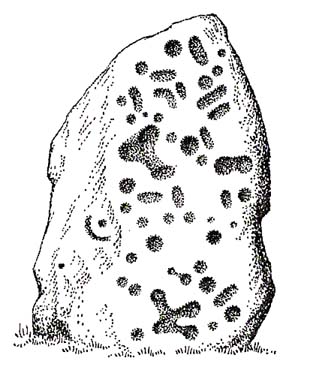
This lovely-looking 5-foot tall standing stone, marking an old boundary line in the Muasdale parish, is a curious one with elongated cups, some of which have the appearance of natural beach-side erosion caused by molluscs — unlikely though it may be.  It first appears to have been described in an early PSAS article by Duncan Colville (1930), who told us:

“The writer was informed by the Rev. D.J. MacDonald, the minister of the parish, of the existence of this cup-marked stone forming a gatepost in the boundary wall between the arable and hill ground on the farm of Gaigean.  The gate referred to is situated on the top of a steep bank on the south side of a small stream, a short distance uphill to the east of the farm steading of Gaigean.  The front of a stone is now set an angle of about 45° to the ground facing almost southwest (105° magnetic across the face).  Underneath the stone is another boulder similar in size, with several smaller stones wedged between the two, thus preventing further inspection.”

The North Beachmore stone

Some years later when the Scottish Royal Commission (1971) lads described the site in their Kintyre survey (monument no.97), they gave a more detailed description of the cup-and-rings, saying:

“The markings consist largely of plain cups, but one cup is accompanied by a partial single ring which measures 0.11m across.  At the foot of the lower half of the stone four cups linked by broad gutters form a curious branched pattern, and a similar combination of three cups and gutters occurs in the upper half, while in two other instances a pair of cups are joined by a short straight channel to form a dumb-bell figure.  The remainder of the markings comprise twelve oblong or kidney-shaped hollows measuring up to 0.15m in length by 0.064m in breadth, and thirty-one plain cups ranging from 0.038m to 0.076m in diameter, the largest being 0.019m deep.”

References:

  1. Colville, Duncan, “Notes on the Standing Stones of Kintyre” in Proceedings of the Society of Antiquaries, Scotland, volume 64, 1929-30.
  2. Royal Commission on the Ancient & Historical Monuments of Scotland, Argyll – volume 1: Kintyre, HMSO: Edinburgh 1971.

© Paul Bennett, The Northern Antiquarian


Bàrr a’ Chuirn, Kilmartin, Argyll

Cairn:  OS Grid References – NR 8122 9782

Also Known as:

  1. Canmore ID 39465
  2. Lady’s Seat Cairn

Getting Here

Many ways to get here, but you’ve gotta amble off-path through the woods to eventually find it — but it’s not difficult. From Kilmartin village head to Slockavullin and walk up the winding track which takes you towards the Ballygowan cup-and-ring stones, but follow it into the woods instead. The OS-map’s gonna be your best guide here. I first visited this spot from the south and ambled about, aimlessly at times for several hours, after I’d first been to the great ruined mansion of Poltalloch. Well worth checking out if you enjoy finding allsorts!

Archaeology & History

The old tomb is actually a few hundred yards beneath the small rocky summit of Barr a’ Chuirn, with the overgrowth of the woods imposing itself upon it. The Scottish Royal Commission report (1988) told that there was a large seat built here in the 19th century called the Lady’s Seat, and actually set up on the cairn itself so giving groovy views all round to those who came here. The Seat was made from large slabs of stone, which may originally have come from the old tomb.  An excavation here in the mid-19th century,

“found the remains of two cists and some burnt bones, with a ‘skeleton of later date, between the two cists, but probably put there by the men who destroyed the cairn.’ In 1929 Craw re-examined the site and found that the central cist had chambered and grooved slabs. This cist is aligned ENE and WSW, and the E end-slab is now missing; the cist measured about 1m by 0.5m and about 0.3m in depth internally. The northern side-slab is grooved at the west end.”

References:

  1. Royal Commission on the Ancient & Historical Monuments of Scotland, Argyll: volume 6 – Mid-Argyll and Cowal, HMSO: Edinburgh 1988.

© Paul Bennett, The Northern Antiquarian


Cultoon, Portnahaven, Islay, Argyll

Stone Circle:  OS Grid Reference – NR 1956 5697

Also Known as:

  1. Cultoun

Archaeology & History

Following excavation work on this denuded megalithic ring in 1974 and 1975 under the joint auspices of the Islay Historical Works Group (IHWG) and the Hunterian Museum of the University of Glasgow, under the direction of archaeologist Dr Euan MacKie (1976), with the intent of actually restoring the site to what they thought was its former glory by resurrecting the fallen monoliths in this ring of stones, some intriguing facts came to light.  Dr MacKie wrote:

“This site stands on a low, shallow knoll about a mile from the sea and with an extensive peat bog to the west.  Before excavation the stone ring consisted of a rough oval of two standing stones and ten fallen ones, the latter being partly or nearly completely buried under the turf.  The dimensions of the ring were about 45 by 40 yards.  The excavations were based on a 6m grid and the ain was to explore as much as possible the perimeter of the ring and part of the interior.  In this way it was hoped to identify the sockets from which the prone monoliths were assumed to have fallen and thus to discover the exact positions at which they were to be re-erected…

“It soon became clear that the prone monoliths had not in fact fallen out of their sockets.  All of them lay on the old ground surface under the peat which had evidently begun to grow — in the 8th century BC according to one C-14 date — after the site had reached its present condition.  Some stones had no socket next to them and a number of sockets were found without adjacent stones.  Several stones lay next to sockets in such a position as to make it clear that they had never been set up.  The site had evidently been abandoned in the middle of construction and those sockets already dug were allowed to fill slowly with rubble and silt.  One socket was discovered which had been deliberately filled up, confirming that some change of plan had occurred before the final abandonment.  Cultoon is the only stone circle apart from two phases of Stonehenge to have revealed evidence of never having been completed. (my italics, Megalithix)

“The finds were few and consisted of mesolithic flint microliths and some larger, presumably neolithic flints.  The former were all on and in the buried topsoil — the circle builders’ ground surface — while the latter were on the land surface and in the lower part of the peat; these last included scrapers and are hollow-based points of Bronze Age type.  Of particular interest was the discovery of caches of flint flakes in the peat next to the two standing stones.  They appear to be deliberate offerings and suggest that the site retained its sanctity for some centuries after its abandonment.”

…to be continued…

References:

  1. MacKie, Euan, “Cultoon, Islay,” in Glasgow Archaeological Society Bulletin, No.2, 1976.

© Paul Bennett, The Northern Antiquarian


Tobar Mor, Tarbert, Gigha, Argyll

Sacred Well:  OS Grid Reference – NR 6564 5190

Also Known as:

  1. Canmore ID 38609
  2. Great Well of the Winds
  3. St Beathag’s Well
  4. Tobar Bheathaig

Folklore

There are a number of sacred and healing wells on this small island, but this site in particular was deemed magickal by folk from far and wide.  Found on the northwest slopes of Cnoc Largie (around which are other heathen spots) this legendary site had an attendant keeper of the well:

“an aged female direach, or guardian, whose uncanny powers could be commanded by a small offering of silver.  Following this the cover of the sacred well would be removed in order that its waters might be ceremonially cleansed with a white clamshell prior to being stirred three times, sunwise, to the accompaniment of ritual incantations.  Then three shell-fulls of the sacred water would be hurled aloft in the direction of the desired wind which, before the day was out, invariably appeared.”

This simple ritual obviously tells that it was a heathen site, seemingly one for divination and magick.  Another piece of folklore (found at other wells) told that if the cover on the well were left unattended, its waters could overflow and flood the entire island.

References:

  1. Anonymous, Exploring Historic Kintyre and the Isle of Gigha, Harlequin Press: Oban n.d.

© Paul Bennett, The Northern Antiquarian