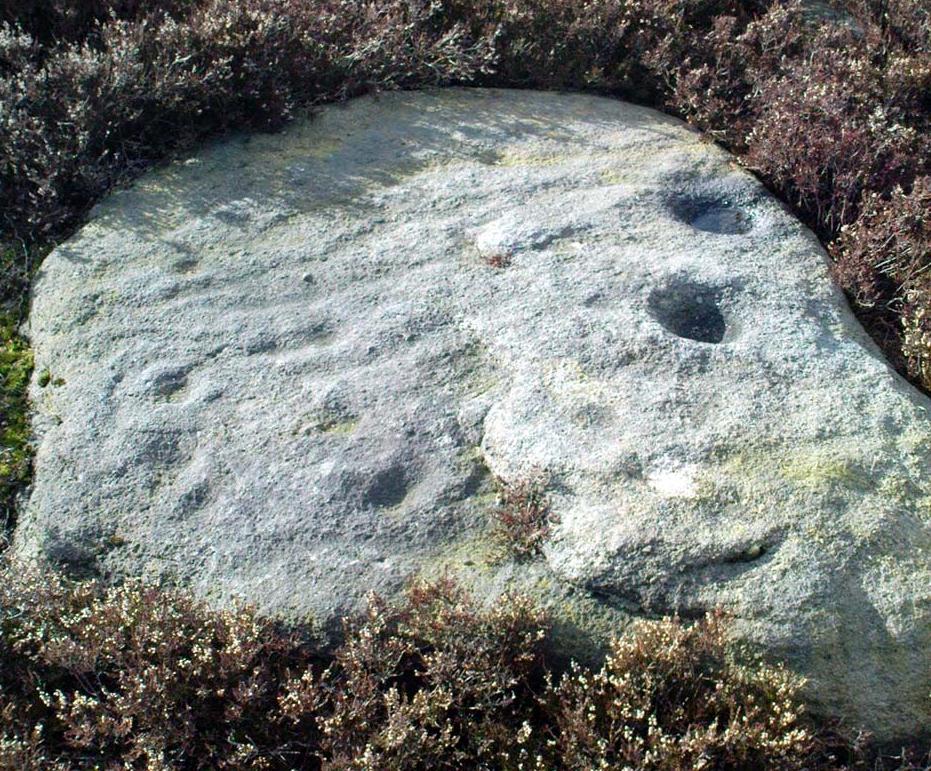
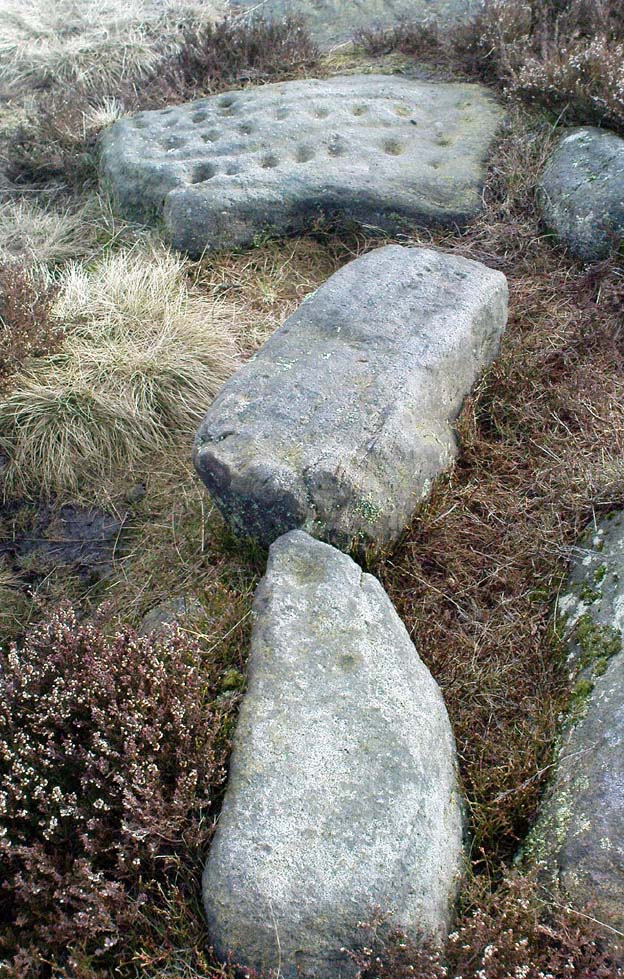
Stinking Stone, Steeton, West Yorkshire

Standing Stone:  OS Grid Reference – SE 01814 42411

Getting Here
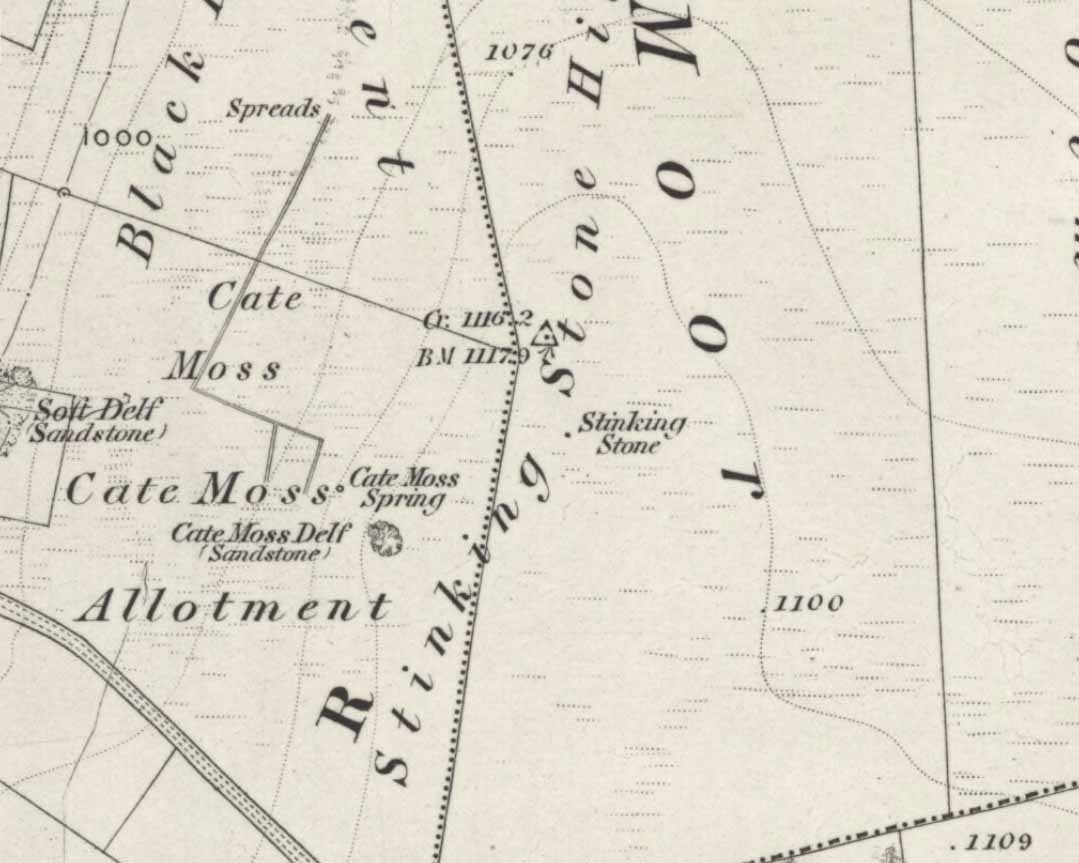
Stinking Stone on 1853 map

One of two ways to get here really.  The easiest is from Sutton-in-Craven: go through the village and up the steep hill (don’t take the right turn as you start up the hill).  Go all the way up until the hill starts to level out and on the left-side of the road you’ll notice a boundary stone stood upright (this is the Sutton Stoop).  Stop here.  Of the 2 gates, climb over the top-most one and walk down the path into the adjacent field, heading over to the gap a couple of hundred yards away where the gate to another field is.  That’s it!

Archaeology & History
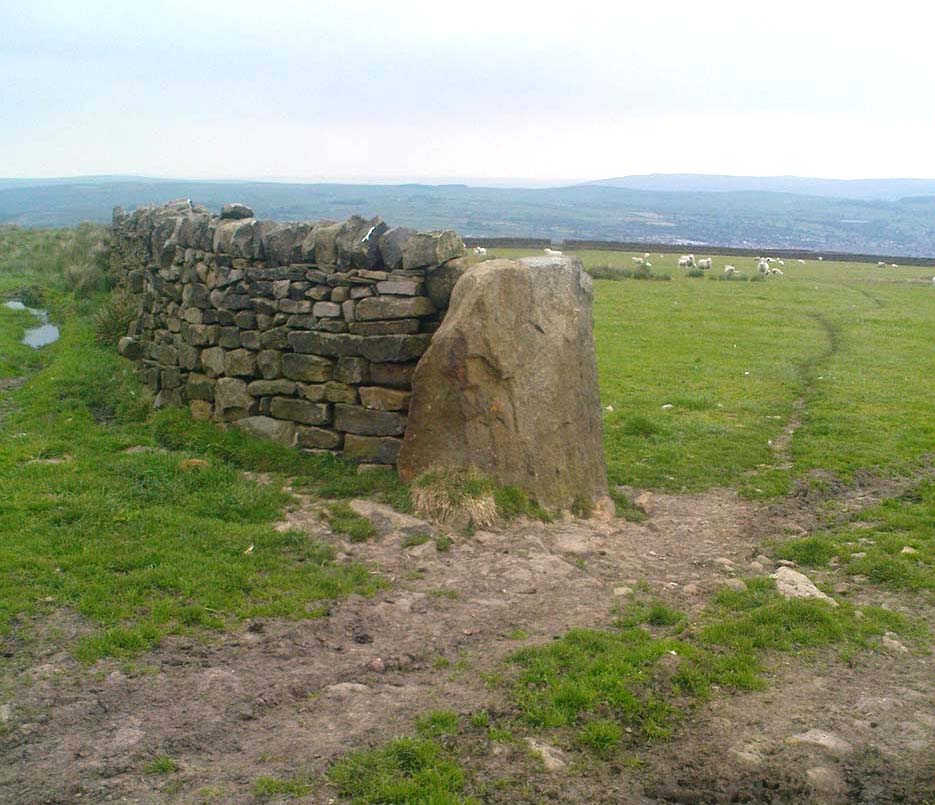
Stinking Stone, Steeton

Now here’s a weird one.  With a name like this you’d expect there to be plenty of info or historical comments.  But despite all the books and journals in my huge library, aswell as visiting town libraries and exploring the resources on-line, there’s nowt written about this ‘ere spot.  Not a jot!  Even the usually satisfactory place-name fellas have a thing-or-two to say about sites with names such as this—but even their old tomes are closed-lipped.  Hmmmmm…..

I visited the place several times to try ascertain what this site was, thinking — perhaps — that it was an old boundary stone whose name had been convoluted from some older, more obvious title.*  The nearby Sutton Stoop boundary stone, right by the roadside, seemed a good indicator to such an assumption, as it was a recognised boundary marker with written history and a meeting point along the local perambulation.  But the curiously-named Stinking Stone was neither on the same line, nor ever had been according to old records, and couldn’t be located either.  There had been obvious quarrying and other industrial destruction along the hilltop where the old stone was marked and it seemed logical to assume that it had been destroyed in bygone years by that usual breed of capitalist industrial halfwits.  Until a psilocybin venture one afternoon, last season…

Twas a lovely sunny day, though windy on the tops as usual.  I was out with a couple of neophytes showing them Psilocybes and various other species, chewing them here and there and talking the way of healthy usage.  We passed by an old well, long forgotten, before heading onto Stinking Stone Hill.  Bimbling somewhat, and ruminating about the moss of colour, we decided to sit by the walling in-field and dream for a short while.  As we hit the old gate the Stinking Stone came up right before us.  Literally!

There in the old walling, blunt as you like, stood this four-and-a-half-foot tall standing stone, smoothed on one side by a short aeon of weathering, upright and proud as if it had been stood there for centuries, awaiting attention!  I exclaimed a few triumphant expletives; rubbed myself here and there over the old thing, then sat for a while behind the wind with the old upright, solidly embedded in old earth — then awaited the dream…

Twas a good day…

And then I returned home and later sought what I could on a possible etymology.  Around the hilltop a hundred yards away were small depressions and the faded remains of industrial workings, like I said; and with this in mind the awesome Mr Wright (1905) told us about the existence of ‘Stinking coals’, “an inferior kind of coal” no less.  Referring us to a work from 1818, we’re told,

“The Stinking-coal is noted for containing a great proportion of sulphuret of iron, thick seams or layers of these pyrites running in it.  In consequence of this it cannot be used for smelting purposes.”

Another account from 1868 telling us that:

“On opening the body, it contains a strong sulphureous smell, characteristic of the disease; hence it is called the stinking ill; and the stomach and bowels are prodigiously distended with air, having the same intolerable foetor.”
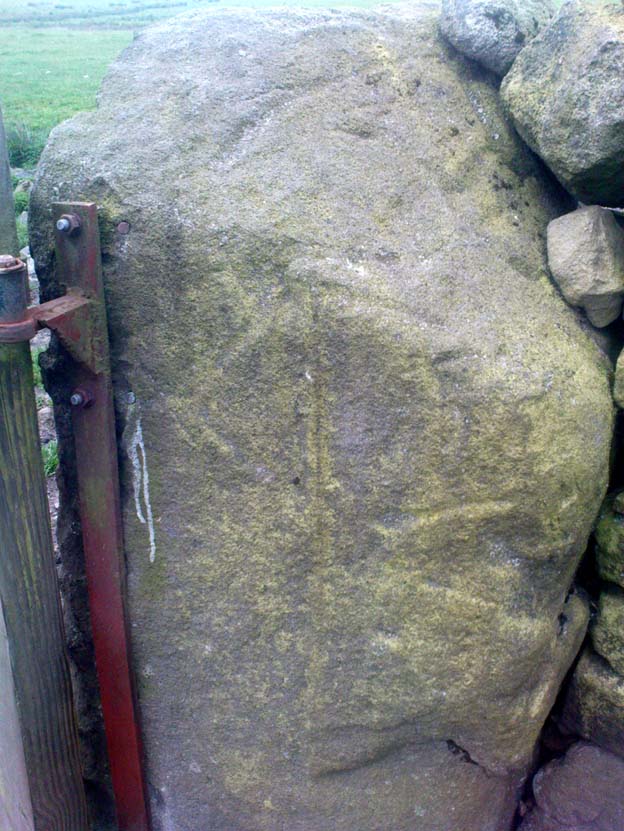
Worn metal scratch-marks caused when dragged here
Worn metal scratches, made when dragged here?

This old worn gatepost however, perhaps has a history that only goes back a few centuries.  It has been cleaved in half, as you’ll see if you visit it; but its western face is old and worn and it’s been embedded in the ground for a long time.  On its northern face are the curious etchings of carvings, which are more akin to wounds from some past offence (perhaps when it was split in half), cleaved by metal toolings and dragged by farmers to be fixed in into present spot.  It’s history may not be truly ancient.  Twouldst be good to know for sure though…

References:

  1. Wright, Joseph, The English Dialect Dictionary – volume 5, Henry Frowde: Oxford 1905.

* ‘Stinking’, stone-king or King Stone?  Unlikely though…

© Paul Bennett, The Northern Antiquarian 

Mini-Skirtful of Stones, Ilkley Moor, West Yorkshire

Cairn:  OS Grid Reference – SE 1346 4606

Getting Here

Follow directions to get to the Pancake Stone.  From here walk SE on the footpath that runs on the edge of the moor.  After about 200 yards you’ll hit a small footpath which heads into the moor (south).  Walk on here for about 200 yards and notice the small rise in the land to your right (if you cross the small stream where the land dips into a very small valley, you’ve gone past).  That’s it!  The Little Haystack Rock is less than 100 yards away down the slope from here.

Mini-Skirtful of Stones, looking north

Archaeology & History

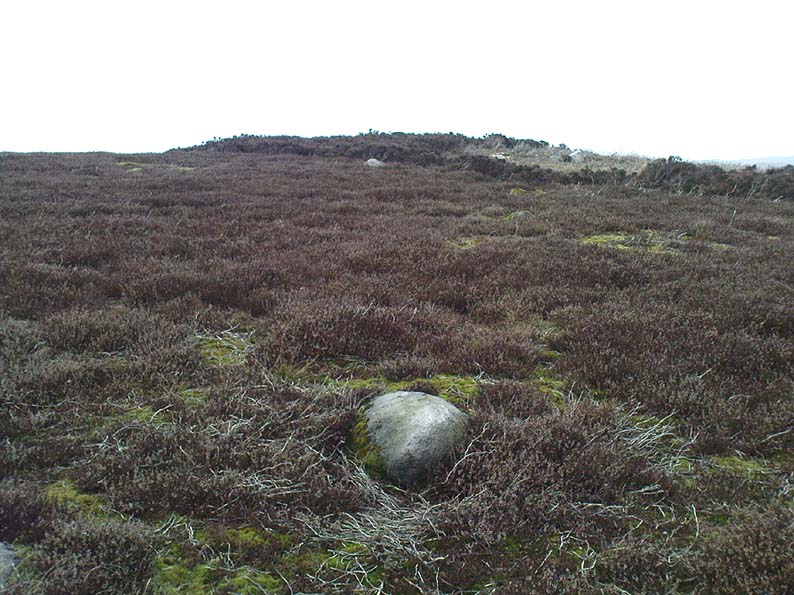
Of approximately eighty prehistoric cairns that have been alleged to exist along the Green Crag Slack ridge on Ilkley Moor, this site in particular is worthy of note, due mainly to its size. As independent archaeological researcher Paul Bowers said of it when he first saw this cairn-spoil, “it seemed too big to have not been discovered in the past.”  Too right!

Mini-Skirtful, looking west

When we tracked across Green Crag Plain a few days ago, it was Michala Potts that called our attention to it.  Half-covered in full heather growth, only the eastern edge was exposed.  At first it seemed that it was loose prehistoric walling, but then I realised it was on the edge of small knoll and the stone work was deeper and wider than walling.  As we explored through the heather atop of the knoll, it was obvious that there was a more extensive gathering of stones scattered all over the top of this small rise, and it seemed that we were looking at the remains of a reasonable sized cairn. Its extent carries about ten yards down the slope from the small hillock, but only a few yards either side of it.  It seems likely that the extended loose stones have, over the centuries, simply slipped further down the slope.  However, not until a decent excavation occurs will we know anything certain.  It is possibile that this is simply the scattered remains of damaged neolithic or Bronze Age walling, but only a more detailed exploration of the site will tell us for sure.

Cowling (1946) mentioned the numerous cairns and scattered walling reaching across this part of Ilkley Moor, but gave no specific information relating to this mini-skirt full of stones! (blame Mikki for the title!)

References:

  1. Cowling, E.T., Rombald’s Way, William Walker: Otley 1946.

© Paul Bennett, The Northern Antiquarian


Eastwoods Cross Base, Summerbridge, North Yorkshire

Cross & Cup-Marked Stone:  OS Grid Reference – SE 18506 62013

Also Known as:

  1. Carving no.637 (Boughey & Vickerman)

Getting Here

Drawing of CR 637 (after Boughey & Vickerman)

The same directions as for the Eastwoods Farm Cup: from Summerbridge, go west on the B6541 towards Dacre Banks, where there’s the signpost for the Nidderdale Way footpath.  Follow this past the disused quarry and into the meadows.  When you hit the Monk Ing road, bear right (north) and keep going till you’re 100 yards from Eastwoods Farm.  Go right, down into the field for about 30 yards or so.  Look around!

Archaeology & History

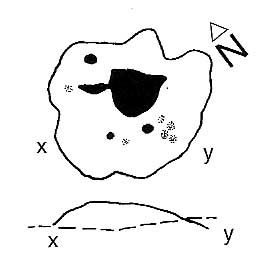
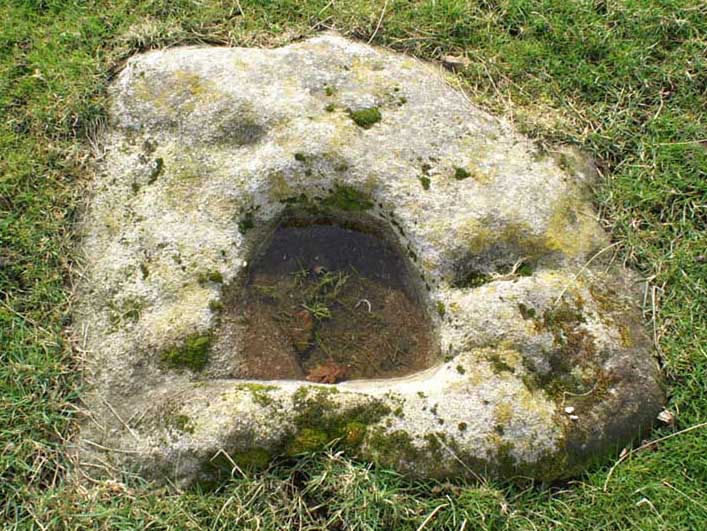
Described in Boughey & Vickerman’s (2003) survey as a “low, medium-sized, quadrant-shaped rock standing up from surroundings, with hollowed out central area.”  This hollowed-out central area is, in all likelihood, the remains of a previously unrecognized old cross-base, although investigating archaeologists have somehow missed this.  The stone’s proximity to the old Monk’s Way — a medieval trade route used by the local monastic Order — would give added weight to this assertion.  A perusal of field-name records here may prove fruitful.

Eastwoods Farm Cross-base & Cup-Marks (courtesy Richard Stroud)
Eastwoods Farm Cross-base & Cup-Marks (© Richard Stroud)

Our authors counted “eight possible small, badly worn cups, (with) three grooves running from central basin, all possibly natural.” The grooves may well be natural, but I’d say that one or two of the cups appear to be genuine.  The large hollow in the middle of the stone may originally have been a cup-marking (or maybe even a cup-and-ring — but we’ll never know), before it became used as a site to erect a primitive cross.

Several other cup-and-ring carvings can be found around here — the Eastwoods Farm Cup is in the same field nearby— with the great likelihood of there being others hidden amidst trees or grasses, waiting to be re-awakened!  The hugely impressive Morphing Stone and a prehistoric lightning-carving can be found in the next field, full of rocks, on the other side of the stream.

References:

  1. Boughey, Keith & Vickerman, E.A., Prehistoric Rock Art of the West Riding, West Yorkshire Archaeology Service 2003.

© Paul Bennett, The Northern Antiquarian

Eastwoods Farm Cup, Heyshaw, North Yorkshire

Cup-Marked Stone:  OS Grid Reference – SE 1852 6201

Also Known as:

  1. IAG637a (Boughey)

Single cup-marked stone in the field below Eastwoods Farm

Getting Here

From the large village of Summerbridge, go west along the B6541 towards Dacre Banks, where you’ll see the signpost for the Nidderdale Way footpath.  Follow this past the disused quarry and onto the meadows.  When you hit the Monk Ing road, bear right (north) and keep going till you’re 100 yards from Eastwoods Farm.  Go right, down into the fields for 50 yards or so.  Look around!

Archaeology & History

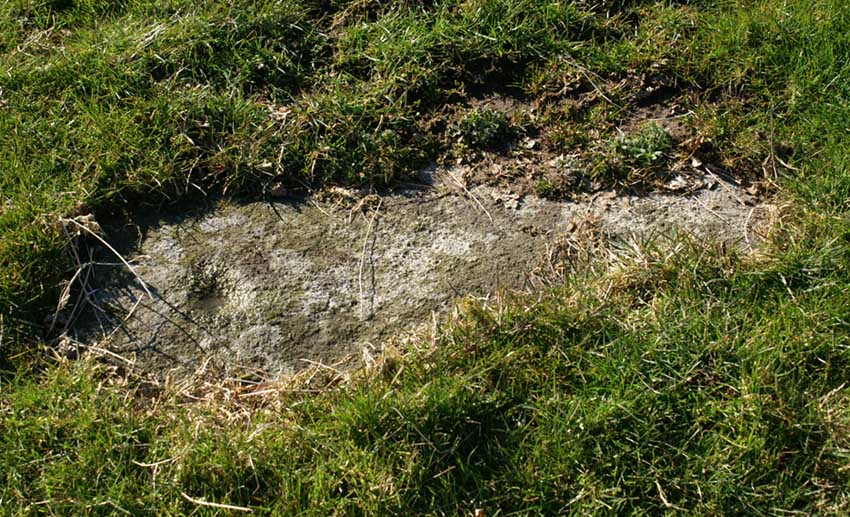
A previously unlisted single cup-marked stone which is likely to become overgrown by the grasses pretty soon.  Several other carvings are in close attendance in this field.  It’s not far from the cup-marked Eastwoods Cross Base (aka CR 637) in the same field, but a little further down.  In all probability there are other carvings yet to be found in this area.  The rock art student Keith Boughey (2007) mentioned it briefly in an article on the other carvings nearby, saying simply:

“A small area of rock (very possibly bedrock) measuring 40cm x 14cm at its greatest extent pokes up through the turf, showing one worn but clear cup-mark on its western edge (Fig 3). On its own, this marking would not be significant were it not for the fact that four other carved rocks are already recorded from this particular locality.”

The hugely impressive Morphing Stone and a prehistoric lightning-carving can be found in the next field, full of rocks, on the other side of the stream.

(NB: In a more recent visit to the site (August 2011), the carving had all but disappeared beneath ever-growing Earth.)

References:

  1. Boughey, K., “Prehistoric Rock Art: Four New Discoveries in Nidderdale,” in Prehistoric Research Section Bulletin, no.44, Yorkshire Archaeological Society 2007.

© Paul Bennett, The Northern Antiquarian

Green Crag Top Cairns, Ilkley Moor, West Yorkshire

Cairns:  OS Grid Reference – SE 131 458

green-crag-top-cairn02-sm
Larger of the Green Crag Top cairns – with blizzard in background!

Getting Here

Follow directions for getting to the Haystack Rock.  Once here, walk dead straight south onto the moor and go up the slope you see a few hundred yards ahead of you.  Once you’re at the top of the slope, a few yards onto the ridge itself, look around!  If there’s deep heather growth when you arrive, you’ve no chance!

Archaeology & History

To my limited knowledge, it appears there’s no previous references to the cairns here.  We found at least two of them, with a probable third not far away; but we were lucky inasmuch that the heather had all been burnt away, allowing a clearer inspection of the sites.  The larger of the two is nearly four yards across and nearly a yard high.  It’s somewhat larger than the majority of what are thought to be single-person cairns along Green Crag Slack ridge, down the slope.

Much denuded cairn
Much denuded cairn

A smaller cairn less than 100 yards west on the same ridge (near the large boulder with a couple of cup-markings on top) looks as if it was robbed of stone sometime in the past.  About six-feet across, this one is more typical of the cairns found on the Ridge below.

There are what seems to be other remains along this ridge, including a very distinct thin, six-foot-long stone, which looks very much as if it could have stood upright in the not-too-distant past.  We could do with more heather-burning on this part of the moor to help us out!

© Paul Bennett, The Northern Antiquarian

Three Cups Stone, Ilkley Moor, West Yorkshire

Cup-Marked Stone:  OS Grid Reference – SE 12998 46314

Also Known as:

  1. Carving no.138 (Hedges)
  2. Carving no.298 (Boughey & Vickerman)

Getting Here

Dead easy!  Follow the directions to the unmissable Haystack Rock, then look at the small upright stone about 40 yards west, just off the footpath.

The Three Cup Stone

Archaeology & History

This is another one of the many carvings I first saw when I was a small lad, about 12 years old, in one of my countless walkabouts over these moors.  It’s thought by some to be a small cup-marked standing stone (it’s possible I s’ppose, but improbable); whether that’s the case or not, it certainly has three distinct cup-markings on its east-facing vertical face.  There are also what appears to be lines cutting through the cups and running out to near the edge of the stone which may or may not be natural.  A small, cute little thing!  Boughey and Vickerman (2003) make a note that this carving may be recent — but if so, it was done some considerable time before 1975, when I first clapped eyes on it!

References:

  1. Boughey, Keith & Vickerman, E.A., Prehistoric Rock art of the West Riding, WYAS: Wakefield 2003.
  2. Hedges, John, The Carved Rocks on Rombalds Moor, WYMCC: Wakefield 1986.

© Paul Bennett, The Northern Antiquarian


Urn Stone, Green Crag, Ilkley Moor, West Yorkshire

Cup-and-Ring Stone: OS Grid Reference – SE 12832 46163

Also Known as:

  1. Carving no.130 (Hedges)
  2. Carving no.287 (Boughey & Vickerman)

Getting Here

Drawing of the Urn Stone (after Hedges 1986)

Follow the directions for getting to the Haystack Rock, then bear right (west) along the footpath, past the little Three Cups Stone, until the path bends and goes up onto the moor.  A hundred yards or so, walk left into the heather (you’re straddling the remains of considerable prehistoric walling and enclosure remains by now) and look around.  You’ll find it!

Archaeology & History

I was only about 12-years old when I first saw this and the nearby prehistoric carvings — but when I came to look for any references to it as a boy, there were none I could find at the time.  Then, ten years later when John Hedges (1986) brought out his fine work on the cup-and-ring art of Ilkley Moor, its presence was shown in pen-and-ink at last.  Found amidst the remains of an extensive settlement or series of walled enclosures, the carving’s name comes from the curious urn-like element that Hedges showed faintly.   There is also an additional ring around one of the cups above the ‘urn’.

Excavations that were done on the prehistoric ‘enclosure’ close to this petroglyph in the 1990s, uncovered the remains of a decent amount of ‘grooved ware’ pottery and worked flint (Edwards & Bradley 1999), dated between 2900 and 2600 BC.  As such pottery has been found elsewhere in Britain within and/or near earthworks and other prehistoric remains (obviously!), its incidence here isn’t really too much of a surprise.  However, Edwards & Bradley (1999) speculate — albeit vaguely — that there may be a link between the cup-and-rings here and the pottery, saying, “if so, the rock carvings (here) might be indicating a place of special significance.”

This may be so: considering the prevalence of rock-art along the geological ridge and its close association with the large number of burial cairns.  If it can be ascertained that the charred remains of humans were kept inside the pottery or vases, the relationship between death and the carvings (well established on this part of Ilkley Moor) would be reinforced.

References:

  1. Boughey, Keith & Vickerman, E.A., Prehistoric Rock Art of the West Riding, West Yorkshire Archaeology Service 2003.
  2. Edwards, Gavin & Bradley, Richard, ‘Rock Carvings and Neolithic Artefacts on Ilkley Moor, West Yorkshire,’ in Grooved Ware in Britain and Ireland (edited by Cleal, R. & MacSween, A.), Oxbow: Oxford 1999.
  3. Hedges, John, The Carved Rocks on Rombald’s Moor, WYMCC: Wakefield 1986.

© Paul Bennett, The Northern Antiquarian


Young Idol Stone, Ilkley Moor, West Yorkshire

Cup-Marked Stone:  OS Grid Reference – SE 13264 45943

Also Known as:

  1. Carving no.158 (Hedges)
  2. Carving no.323 (Boughey & Vickerman)

Getting Here

The Young Idol Stone (bottom) & parental Idol Stone above

Take the directions to reach the Haystack Rock, then head onto the moor following the south-east footpath for a few hundred yards, towards where the moor slopes uphill.  20-30 yards before the uphill slope, a yard to the right of the path, a couple of yards below the well-known Idol Stone carving – you’ll find it!

Archaeology & History

Described simply as a “small, rounded, smooth grit rock,” this long-tooth-shaped stone has just two cup-markings on its upper face: one on the more southern tip, and the second smaller cup several inches below it – as shown on the photo.  The adjacent carving seen at the top of the photo is the parent guardian, Idol Stone!  If you visit this, or any adjacent carvings here, please remember that all along this moorland plain are numerous unexcavated prehistoric tombs. You’re effectively stood at the edge of, or within, a huge prehistoric cemetery.

References:

  1. Boughey, Keith & Vickerman, E.A., Prehistoric Rock Art of the West Riding, WYAS 2003.
  2. Hedges, John, The Carved Rocks on Rombalds Moor, WYMCC: Wakefield 1986.

© Paul Bennett, The Northern Antiquarian

Green Crag Top Stone, Ilkley Moor, West Yorkshire

Cup-Marked Stone:  OS Grid Reference – SE 1304 4582

Getting Here

Green Crag Top stone - from above
Green Crag Top stone – from above

Head for the binary-like Idol Stone carving and keep walking on the footpath, up the hill.  Once on top of the ridge, walk along it to your right (west) for about 300 yards, then walk south (left) into the flat heathland plain.  Look around!

Archaeology & History

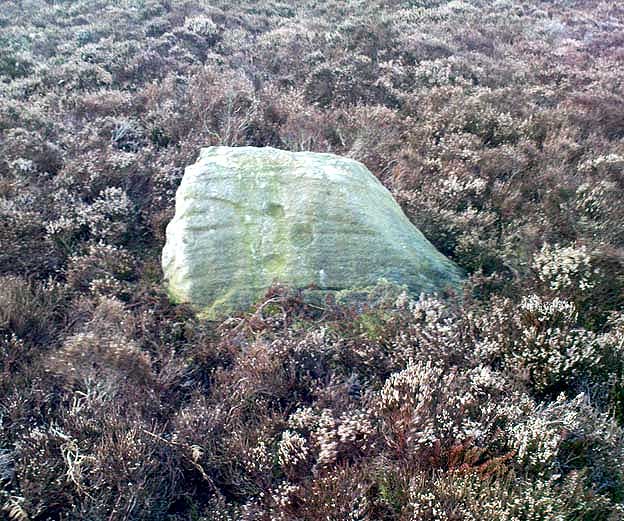
I’m probably not reading it right – but it seems this large stone with several distinct cup-marks on its vertical south-face, isn’t in the surveys of either Hedges (1986) or Boughey & Vickerman (2003).  If someone can correct me on this one – please do!

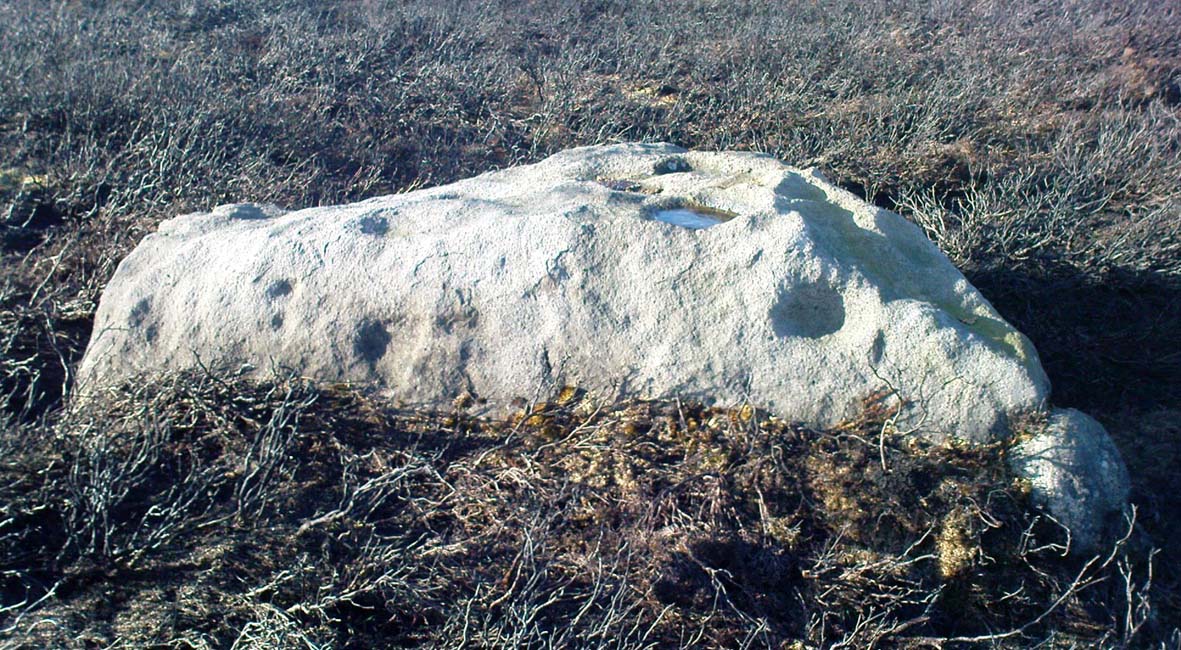
Green Crag Top Stone, looking north

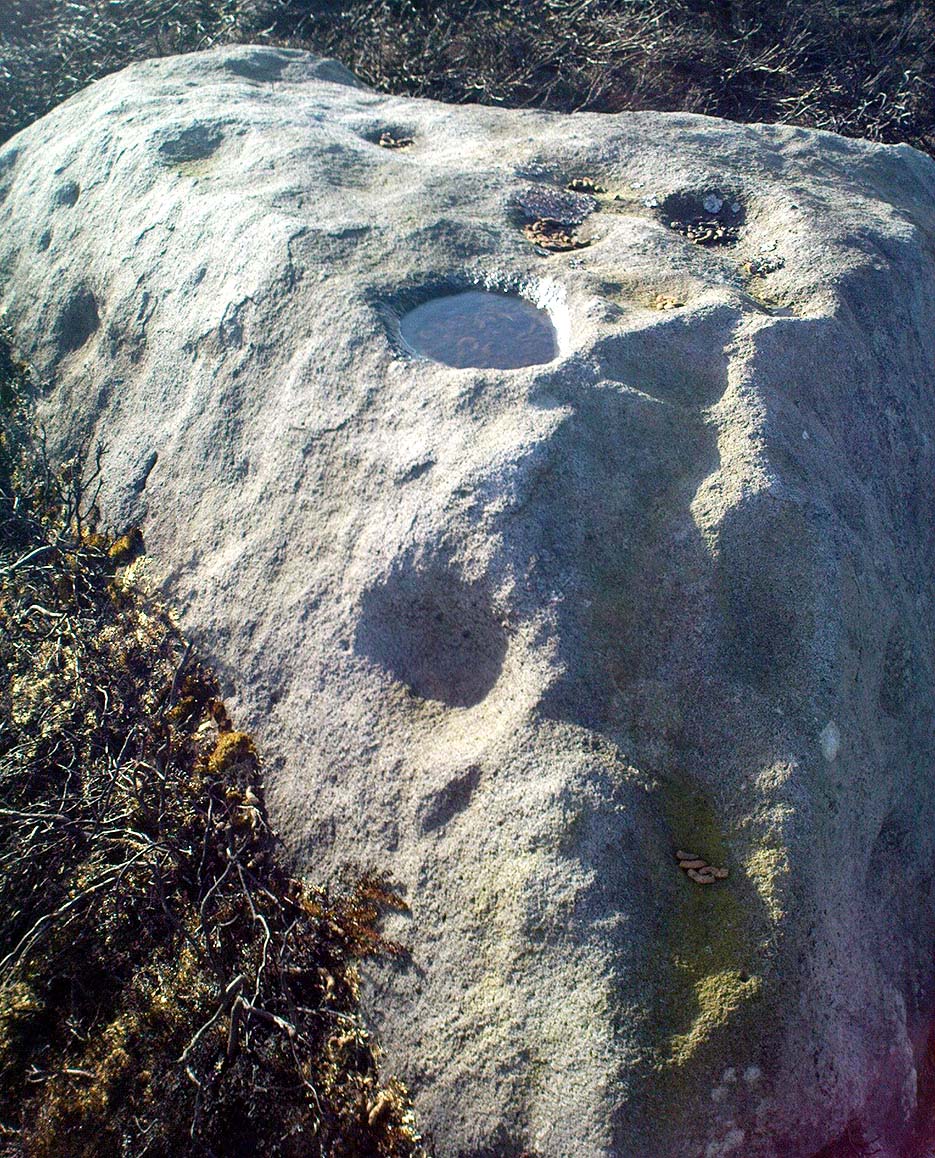
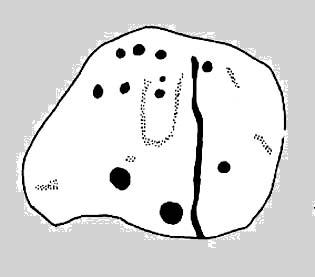
This is quite a large boulder, as the photos here show.  At least two average-sized cup-markings have been etched onto the south face, and two larger ones accompany them on the same edge.  There’s another larger cup-mark on the northeast side of the stone, and a possible companion, which may or may not be artificial.  Then on top of the stone we have several large cups and a ‘bowl’ — though some of these upper markings may be natural, or just well-eroded cup-marks.  It’s hard to tell for sure!

Now I’m gonna have another look in the Hedges, Boughey & Vickerman surveys.  They surely can’t have missed this!

© Paul Bennett, The Northern Antiquarian

Minning Low, Ballidon, Derbyshire

Cairns:  OS Grid Reference – SK 2091 5731

Also Known as:

  1. Minninglow
  2. Roystone Cairn

Getting Here

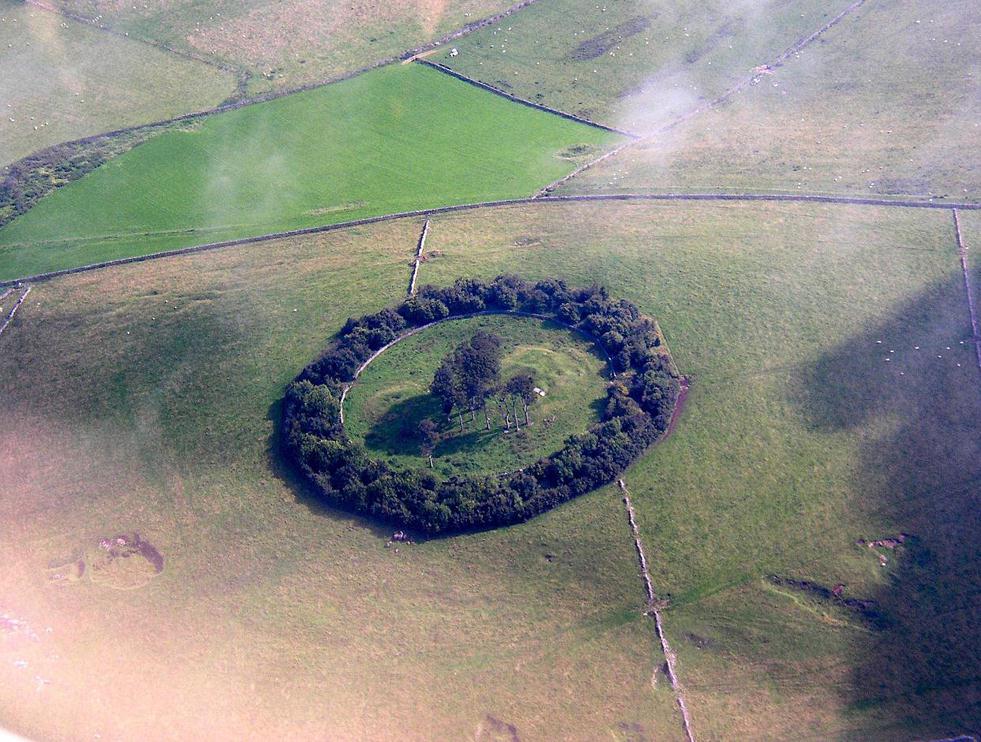
Minning Low from the air, looking NE (photo © Pete Glastonbury)

You can see the copse of trees here from all directions it seems, and there seem various ways in.  Don’t think there’s a direct footpath, but from all accounts the locals are friendly and you can cross the fields from various directions.  From either Pikehall to the north, Aldwark to the east, or Brassington from the south, head towards the distinct wooded copse atop of the hill and you’ll get there!

Archaeology & History

This superb-looking view catches the remains of at least two prehistoric tombs.  In Marsden’s (1977) brief notes of the site he describes,

“Disturbed mound in plantation with exposed limestone cist.  Primary cist rifled.  Secondary cremation.  A second barrow had been raised against the earlier cairn, containing a primary cremation in situ., with a burnt bronze razor, 2 flint knives and a bone tool.”

Barnatt & Collis (1986) give more detailed descriptions of the respective tombs.  The first is categorized as a passage grave chambered cairn:

“This large but mutilated barrow measures c.45 x 38m and in parts is over 2m high.  It had been much robbed for stone before the site was first recorded in the late 18th century.  The ruined remains of four chambers can be seen.  In 1843 Bateman located a fifth partially-collapsed chamber passage, now lost somewhere within the mound.  Rooke recorded a further one of two structures to the north and possibly west sides of the mound (Douglas 1793), that had gone or been reburied in Bateman’s day.  Small excavations by Marsden in 1973-4 clarified the design of the four visible chambers.  Each originally had tall portals, back stone, side slabs, low septal slabs and short entrance passages.  Drystone walling had been used to fill gaps between orthostats and in places to increase the heights of the sides.”

Although human remains were found here, the authors tell how the site was initially plundered as far back as the Romano-British period.  It had once been a long cairn, aligned ENE-WSW, but they give no notice of any potential astronomical orientation (does anyone know?).

References:

  1. Barnatt, John & Collis, John, Barrows in the Peak District, J.R. Collis: Sheffield 1986.
  2. Bateman, Thomas, Vestiges of the Antiquities of Derbyshire, London 1848.
  3. Douglas, J., Naenia Britannica, London 1793.
  4. Marsden, Barry M., The Burial Mounds of Derbyshire, privately printed: Bingley 1977.

© Paul Bennett, The Northern Antiquarian