St. Bride’s Well, Traquair, Peeblesshire

Holy Well (destroyed):  OS Grid Reference – NT 3190 3339

Also Known as:

  1. St Bryde’s Well

Archaeology & History

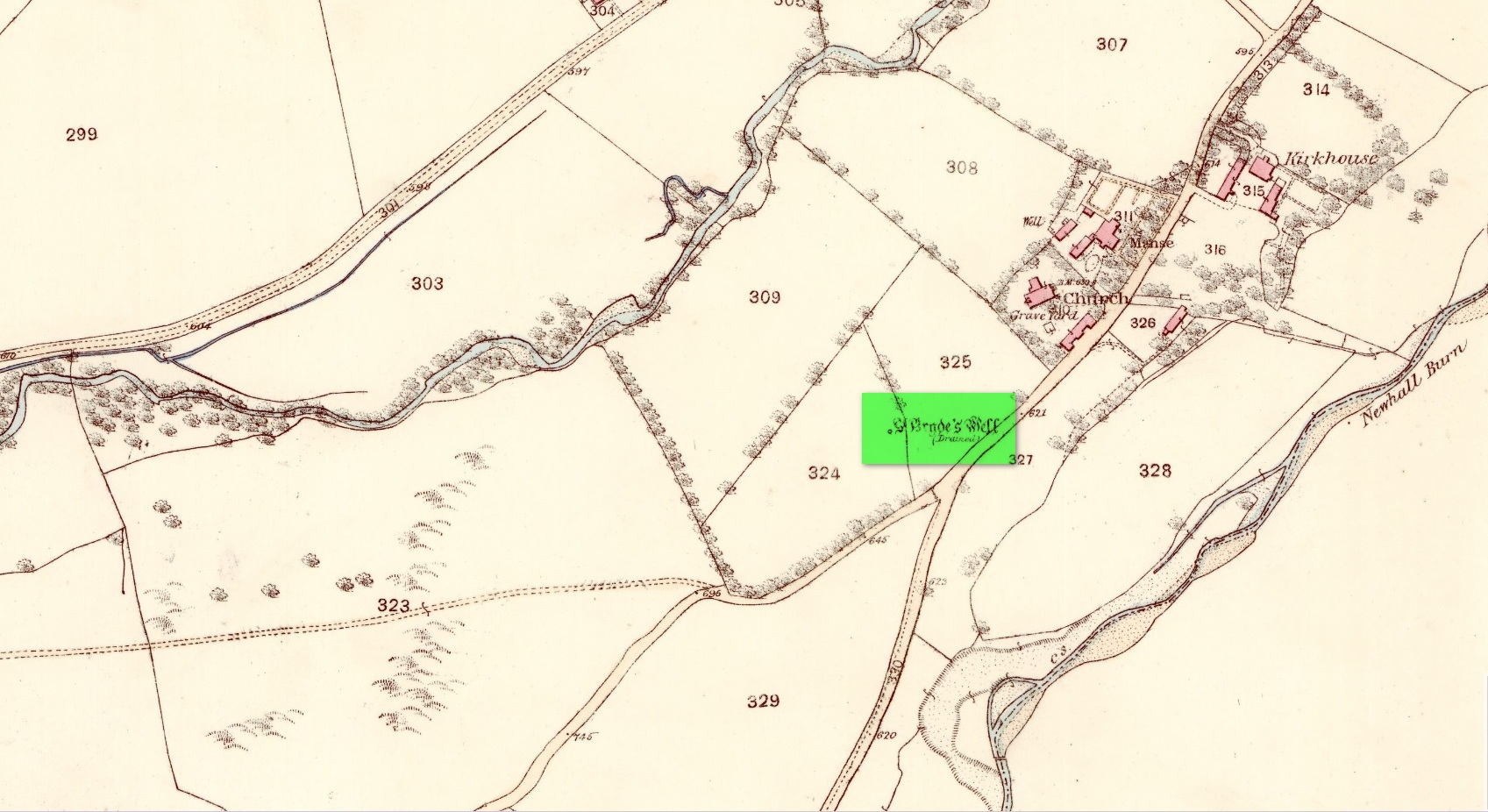
Site shown on 1858 map

Two hundred years ago, located halfway between Traquair’s present parish church and that of the demolished (apparently) 12th century church of St. Bride to the southwest, were the flowing waters of this once sacred water source.  But it’s long since been destroyed.  It was drained sometime prior to when the Ordnance Survey lads came here in 1856 and its water taken to supply the nearby manse.  Subsequent surveys by the Royal Commission (1967) and Mr & Mrs Morris (1982) affirmed its demise.  It was listed in the early Scottish holy well surveys, without comment, and I can find no local history accounts of the place.

References:

  1. Hallen, A.W. Cornelius, “Holy Wells in Scotland,” in The Scottish Antiquary, volume 9, 1895.
  2. Morris, Ruth & Frank, Scottish Healing Wells, Alethea: Sandy 1982.
  3. Royal Commission on the Ancient & Historical Monuments, Scotland, Peeblesshire – volume 2, Aberdeen University Press 1967.
  4. Walker, J. Russel, “‘Holy Wells’ in Scotland,” in Proceedings of the Society of Antiquaries of Scotland, volume 17,, 1883.

Acknowledgements:  Huge thanks for use of the Ordnance Survey map in this site profile, reproduced with the kind permission of the National Library of Scotland

© Paul BennettThe Northern Antiquarian

Traquair Churchyard, Traquair, Peeblesshire

Cup-Marked Stone (lost):  OS Grid Reference – NT 3202 3347

Archaeology & History

In 1974, Ordnance Survey reported the existence of “a large piece of sandstone containing two depressions resembling cup marks” in the churchyard wall which, tradition told, originally came from the ruined 12th century parish church (long gone) more than 300 yards to the southwest (at NT 3185 3328).  However, in recent years the cup-marks seem to have disappeared and may be hiding behind the overgrowth of ivy in the boundary wall.  It needs to be recovered.

Halfway between the location of the original church and the present one, waters from the heathen St Bryde’s Well used to flow, but it had already been drained by 1856.

© Paul BennettThe Northern Antiquarian

Bu of Orphir, Orphir, Orkney Isles

Standing Stone (destroyed?):  OS Grid Reference – HY 3347 0450

Archaeology & History

Very little seems to be known of this long lost standing stone, that appears to have been described just once in 19th century notebooks of the Orcadian lawyer and antiquarian, George Petrie.  Therein he told how,

“Mr Balfour of Balfour and Trenabie described to me a ball of freestone found close to a Standing Stone on the farm of the Bu of Orphir and near to the churchyard.”

Despite being reported as “destroyed” by the Royal Commission (1946) lads, recently a local man claims to have found what he thinks might be the missing stone, about 400 yards to the southwest, very close to the coast and standing some six feet tall.  We await a secondary local report on this.

References:

  1. Royal Commission Ancient & Historical Monuments, Scotland, Inventory of the Ancient Monuments of Orkney and Shetland – volume 2, HMSO: Edinburgh 1946.

© Paul BennettThe Northern Antiquarian

Kethesgeo Stone, Stenness, Orkney Isles

Standing Stone (destroyed):  OS Grid Reference – HY 3035 1136

Archaeology & History

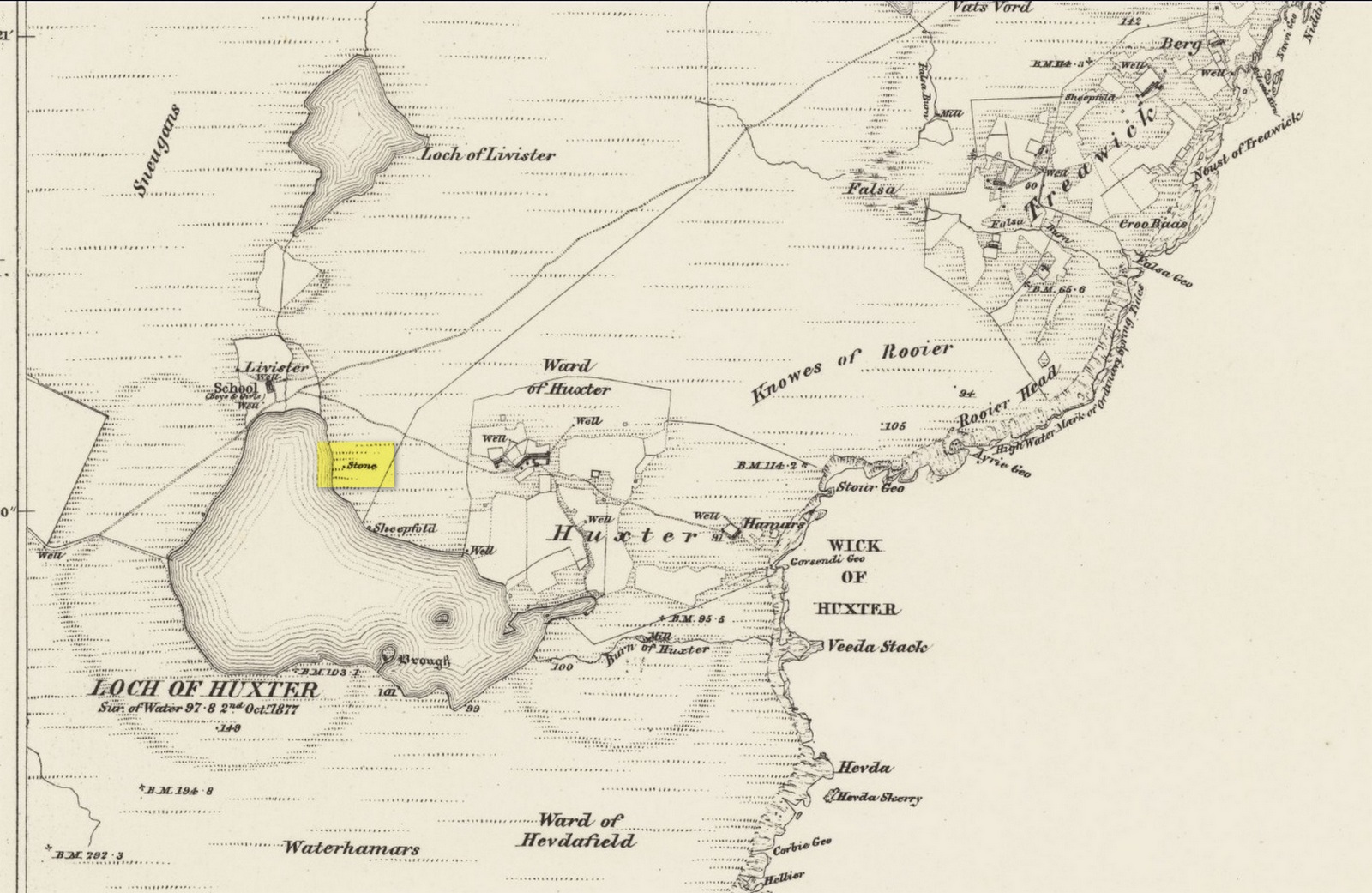
Very little is known of this standing stone that existed just a half-mile south of the major Stones of Stenness (to which it may have had some archaeo-linear relationship; or perhaps with the Brodgar circle a further half-mile away).  It was destroyed sometime around 1860, with no description of its dimensions or appearance.  When it was mentioned briefly by J. Fraser (1926), he told us that the position of the stone had subsequently been marked “by a wooden stake in the boggy land close to and north-east of Kethesgeo.”

References:

  1. Fraser, J. “Antiquities of Stenness Parish”, in Proceedings Orkney Antiquarian Society, volume 4, 1926.
  2. Royal Commission Ancient & Historical Monuments, Scotland, Inventory of the Ancient Monuments of Orkney and Shetland – volume 2, HMSO: Edinburgh 1946.

© Paul BennettThe Northern Antiquarian

Papil, Yell, Shetland Isles

Standing Stone (destroyed):  OS Grid Reference – HP 5378 0425

Also Known as:

  1. The Brough

Archaeology & History

This standing stone formerly stood close to the Burn of Forse, otherwise known as the Garth of Papal in the far north of the island.  Described briefly in J.T. Irving’s (1887) essay on the prehistoric remains of the area, the upright was obviously of local stone being,

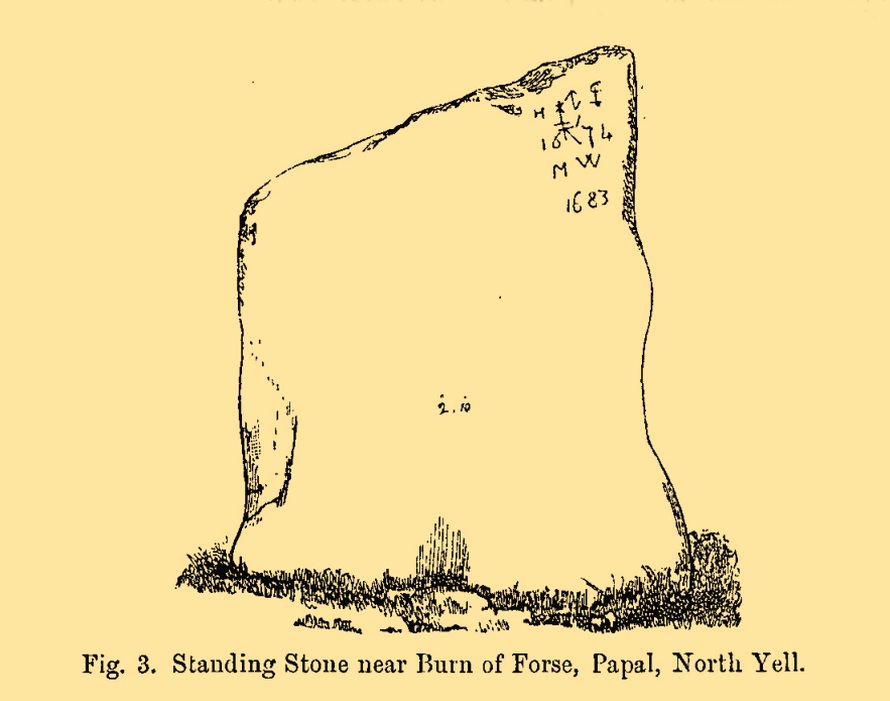
Papil stone (PSAS 1887)

“a broad flat slab, slightly lower at one side than the other and measuring 4 feet 2 inches in greatest height by 2 feet 10 inches in width, and varying from 18 inches to 6 inches in thickness.  In one corner were the initials H I 1674 and M W 1683, with an old merchant’s mark, or something of that description… The late Dr Hunt of the Anthropological Society, dug under it in 1865, with the result that it was left to fall down, and be eventually broken up for building material to be used in the walls of a new school-house.”

Folklore

Irving (1887) told us that, “there is a tradition that a queen who came in a ship to Papal died there, and was buried beneath this stone.”

References:

  1. Irving, J.T., “Notes on some Prehistoric Burial-places and Standing Stones in the Island of Yell, Shetland”, in Proceedings Society Antiquaries, Scotland, volume 21, 1887.
  2. Royal Commission Ancient & Historical Monuments, Scotland, Inventory of the Ancient Monuments of Orkney and Shetland – volume 3, HMSO: Edinburgh 1946.

© Paul BennettThe Northern Antiquarian

The Wartie Stone, Yell, Shetland

Legendary Rock (destroyed):  OS Grid Reference – HP 5223 0467

Archaeology & History

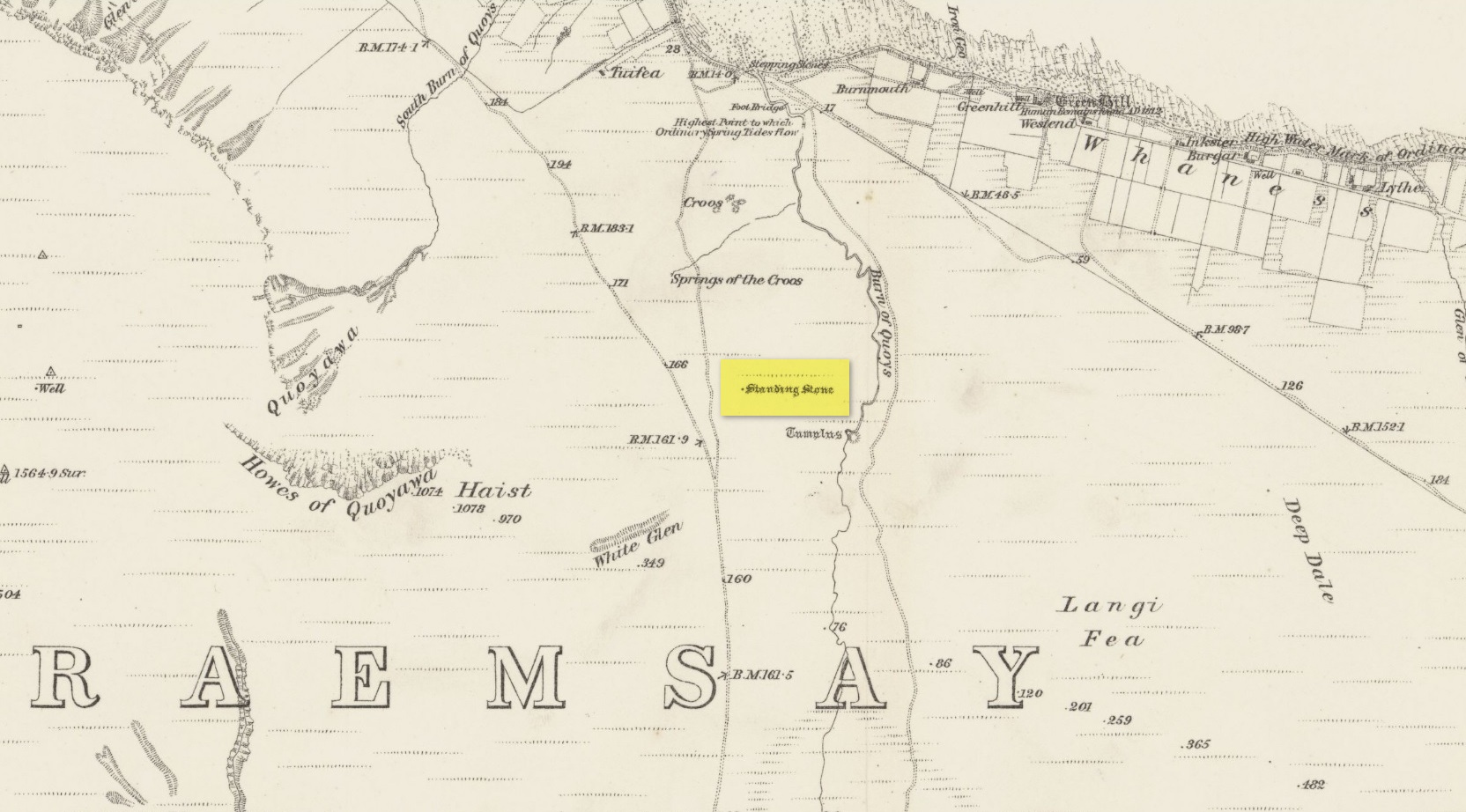
Whilst classifying this as a “legendary” rock, it was as much a functional stone that played an integral part of local village life in the 19th century and, most probably, way before that.  This large stone possessed a large cavity in the shape of a giant human footprint, measuring 12 inch by 4 inch.  It could be seen “above the Deeks of Bracon, North Yell, up Hena”, but when first described in 1865, it was said to be “no longer in existence.”  Despite this, when an Ordnance Survey dood came looking for it in 1969, he reported it as “still in existence” and known of by local people.  Is there anyone in the far far north who can tell us?

Folklore

The impression of the large footprint was natural, but the use to which local people made of it is valuable when we seek to understand pre-industrial customs.  The Royal Commission (1946) lads echoed the folklore handed down by J.T. Irvine from 1865, telling that,

“Formerly the people used to wash in dew or rain-water that had gathered in the cavity and stand in it to get rid of warts.  The tradition was that a giant had planted one foot here and the other on a stone on the Westing of Unst.”

Healing stones with such properties can be found everywhere on Earth.

References:

  1.  Royal Commission Ancient & Historical Monuments, Scotland, Inventory of the Ancient Monuments of Orkney and Shetland – volume 3, HMSO: Edinburgh 1946.

© Paul BennettThe Northern Antiquarian

Craig Hill cluster (6), Kenmore, Perthshire

Cup-and-Ring Stone:  OS Grid Reference – NN 81307 44422

Getting Here

Craig Hill cluster (6) stone

Follow the same directions to reach either the Craig Hill cluster (3), no.4 or no.5 carvings.  Once here, looking at the sloping moorland ahead of you, the elongated stone that’s closest to where the moorland slopes downhill is the one you’re after.  Y’ can’t really miss it!

Archaeology & History

The sixth carving in this small close-knit cluster and, design-wise, the least impressive of the bunch.  There are three distinct cup-marks on the rock: two on its more southern side and one near the middle of the stone.  There may be another two cups, but these may have been part of the curious long, naturally-eroded line running along the length of the stone.  Other man-made elements may have been cut into the stone, but it needs to be seen in perfect low light to tell us one way or the other.

References:

  1. Currie, George, “Craig Hill (Dull parish): Cup-and-Ring Marked Rocks,”in Discovery & Excavation Scotland, NS Volume 6, 2005.

© Paul BennettThe Northern Antiquarian

Goose Rigg, Newcastleton, Roxburghshire

Standing Stone (destroyed):  OS Grid Reference – NY 546 889

Archaeology & History

Stone shown on 1863 map

Once found living on the high moors four miles to the east of Newcastleton, close to the English border, all trace of the stone has gone.  Highlighted on the 1863 OS-map, the stone was three feet high and was located at the highest end of Goose Rig.  It was deemed by local people “to be of ancient origin,” but we know little else about it.  A place immediately to the northwest is known as the Queen o’ Fairies Hole, whose history and folklore has also been forgotten…

References:

  1. Royal Commission on the Ancient & Historical Monuments of Scotland, Roxburghshire – volume 1, HMSO: Edinburgh 1956, p.95

© Paul BennettThe Northern Antiquarian

Jedburgh Abbey, Roxburghshire

Cup-and-Ring Stone:  OS Grid Reference – NT 6504 2045

Archaeology & History

A little-known cup-and-ring stone that was uncovered in the forecourt of Jedburgh Abbey by Walter Laidlow in 1903, now lies all but forgotten in the abbey grounds.  Laidlow’s original description of his find was very basic indeed: “a sculptured stone, with incised ring-and cup-symbols… of yellow sandstone, 1 foot 8 inches long, 9½ inches broad, 4 inches thick.”  The Royal Commission (1956) lads did slightly better, saying:

“A slab of stone… measures 1ft 8½in by 9½in by 4in, and bears on one face six cup-marks ranging from 1in to 2½in in diameter.  The largest of these is encircled by a ring 5in in diameter, in “pocked” technique; while slight traces of what may have been a similar ring can be seen around another cup, which is fractured.”

Laidlow’s 1903 photo

You can see from the photograph how the stone has been broken from a larger piece, strongly suggestive of a greater prehistoric design on the original slab—but there have been no subsequent finds that might show us its original form.  In all likelihood, the stone originally came from a prehistoric tomb, but we know not where that might have been—much like the Mathewson’s Garden carving, also in Jedburgh.

The carving apparently still lies somewhere in the Abbey grounds, sleeping, but I’ve not visited the olde stone so I don’t know its exact position.  If any local folk can tell us more, that would be great!

References:

  1. Laidlaw, Walter, “Sculptured and Inscribed Stones in Jedburgh and Vicinity,” in Proceedings Society Antiquaries, Scotland, volume 39, 1905.
  2. Morris, Ronald W.B., “The Cup-and-Ring Marks and Similar Sculptures of South-West Scotland,” in Transactions of the Ancient Monuments Society, volume 14, 1967.
  3. Morris, Ronald W.B., “The cup-and-ring marks and similar sculptures of Scotland: a survey of the southern Counties – part 2,” in Proceedings of the Society of Antiquaries, Scotland, volume 100, 1969.
  4. Morris, Ronald W.B., The Prehistoric Rock Art of Southern Scotland, BAR: Oxford 1981.
  5. Royal Commission on the Ancient & Historical Monuments of Scotland, Roxburghshire – volume 1, HMSO: Edinburgh 1956.

© Paul BennettThe Northern Antiquarian

Mathewson’s Garden, Jedburgh, Roxburghshire

Cup-and-Ring Stone:  OS Grid Reference – c. NT 65 20

Archaeology & History

Apart from the petroglyph found at Jedburgh Abbey in 1903, there’s a distinct lack of known cup-and-ring stones in this area; so when the petroglyph pioneer George Tate was in town in 1860, he was fortunate to find a small “portable” stone with a rather impressive design on it.  We don’t (yet) know the exact position of where the stone was located, as Tate simply told how,

“Lying among a heap of stones in Mr. Adam Mathewson’s garden, I detected, on a much weather-worn block, defaced sculpturing of the same family character as those in Northumberland.  …There are five concentric circles, central cup, radial grooves, and a string of cups around the outer circle.  Forty years ago this stone was built into the wall of a house; but whence it originally came is not known.  Doubtless it belongs to the district, and probably had been connected with an interment.”

His final remark would seem most likely and has subsequently been echoed by several other rock art students.  A few years after Tate’s initial find, the carving was mentioned in Sir James Simpson’s (1867) classic work, who told us:

Dr Falla’s 1866 sketch

“Sometime ago Mr Tate, of Alnwick, discovered in the garden of Mr Matthewson at Jedburgh a stone cut with concentric circles, possibly a sepulchral cist, but peculiar in some respects.  The stone is roundish, but broken off at one side, and about eighteen inches broad.  Its face is covered by five incised concentric rings, and through the central cup pass at right angles two straight lines, which completely bisect all the circles.  The outermost circle is about fourteen inches in diameter.  Some inches to the left of the central cup is a second, with one incised circle around it.  Arranged circularly outside of the outermost circle is a series or ring of points or stars, each cut out—so Dr Falla writes me—”as with a single stroke of a pick, rather than hewn out.” I am indebted to the same gentleman for the sketch of this stone.”

Subsequently all other written accounts repeat the same basic description—and each account remained (as we still are) perplexed as to its original location, wondering where on Earth the Rev Adam Mathewson’s garden was in Jedburgh (surely someone must be able to find out?!).  Thankfully the carving itself has been saved and presently lives in the Kelvingrove Art Gallery and Museum, Glasgow.  Whether it ever had any relationship with the petroglyph at Jedburgh Abbey, we don’t yet know.

References:

  1. Laidlaw, Walter, “Sculptured and Inscribed Stones in Jedburgh and Vicinity,” in Proceedings Society Antiquaries, Scotland, volume 39, 1895.
  2. Morris, Ronald W.B., “The Cup-and-Ring Marks and Similar Sculptures of South-West Scotland,” in Transactions of the Ancient Monuments Society, volume 14, 1967.
  3. Morris, Ronald W.B., “The Cup-and-Ring and Similar Early Sculptures of Scotland; Part 2 – The Rest of Scotland except Kintyre,” in Transactions of the Ancient Monuments Society, volume 16, 1969.
  4. Morris, Ronald W.B., “The cup-and-ring marks and similar sculptures of Scotland: a survey of the southern Counties – part 2,” in Proceedings of the Society of Antiquaries, Scotland, volume 100, 1969.
  5. Morris, Ronald W.B., The Prehistoric Rock Art of Southern Scotland, BAR: Oxford 1981.
  6. Royal Commission on the Ancient & Historical Monuments of Scotland, Roxburghshire – volume 1, HMSO: Edinburgh 1956.
  7. Simpson, J.Y., “On Ancient Sculpturings of Cups and Concentric Rings,” in Proceedings of the Society of Antiquaries, Scotland, volume 6, 1866.
  8. Simpson, James, Archaic Sculpturings of Cups, Circles, etc., Upon Stones and Rocks in Scotland, England and other Countries, Edmonston & Douglas: Edinburgh 1867.
  9. Tate, George, “The Ancient British Sculptured Rocks of Northumberland and the Eastern Borders,” in Transactions of the Berwickshire Naturalists Club, volume 5, 1864.

© Paul BennettThe Northern Antiquarian