Dunruchan (B), Muthill, Perthshire

Standing Stone: OS Grid Reference – NN 79164 17375

Also Known as:

  1. Aodann Mhor
  2. Canmore ID 24790
  3. Cornoch
  4. Shillinghill

Getting Here

The smallest of Dunruchan’s stones

Take the same directions as if you’re visiting the Dunruchan A standing stone, taking the small track up across the other side of the road from the Craigneich standing stone. As you walk up the field from the roadside, don’t go through the gate, but just walk straight uphill, following the fence through boggy & overgrown vegetation. When you get to where the hill starts to level out and the fence cuts across in front of you, notice the small standing stone on the other side of the fence, about one hundred yards up. That’s it!

Archaeology & History
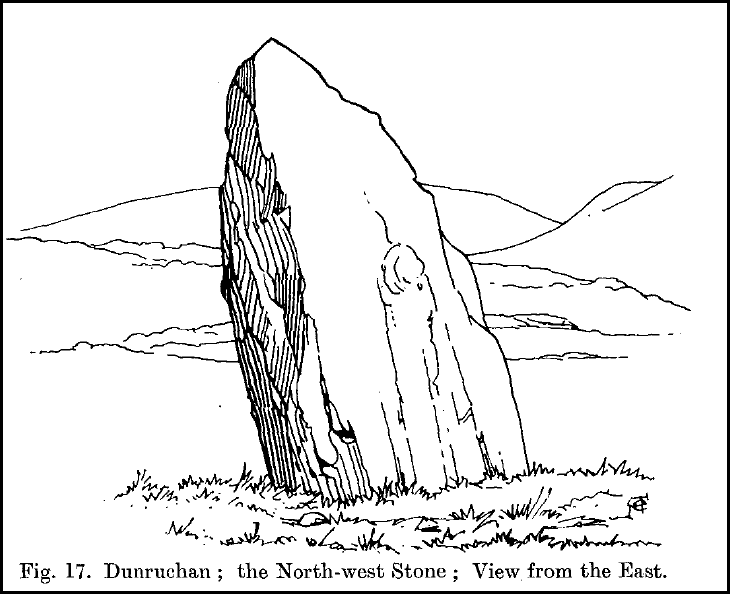
Fred Coles’ 1911 drawing

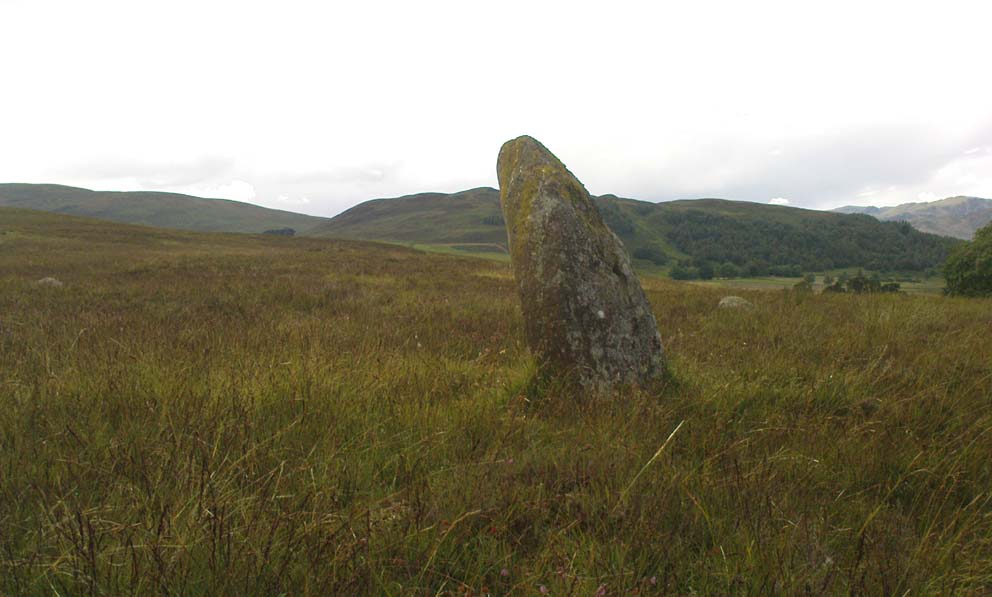
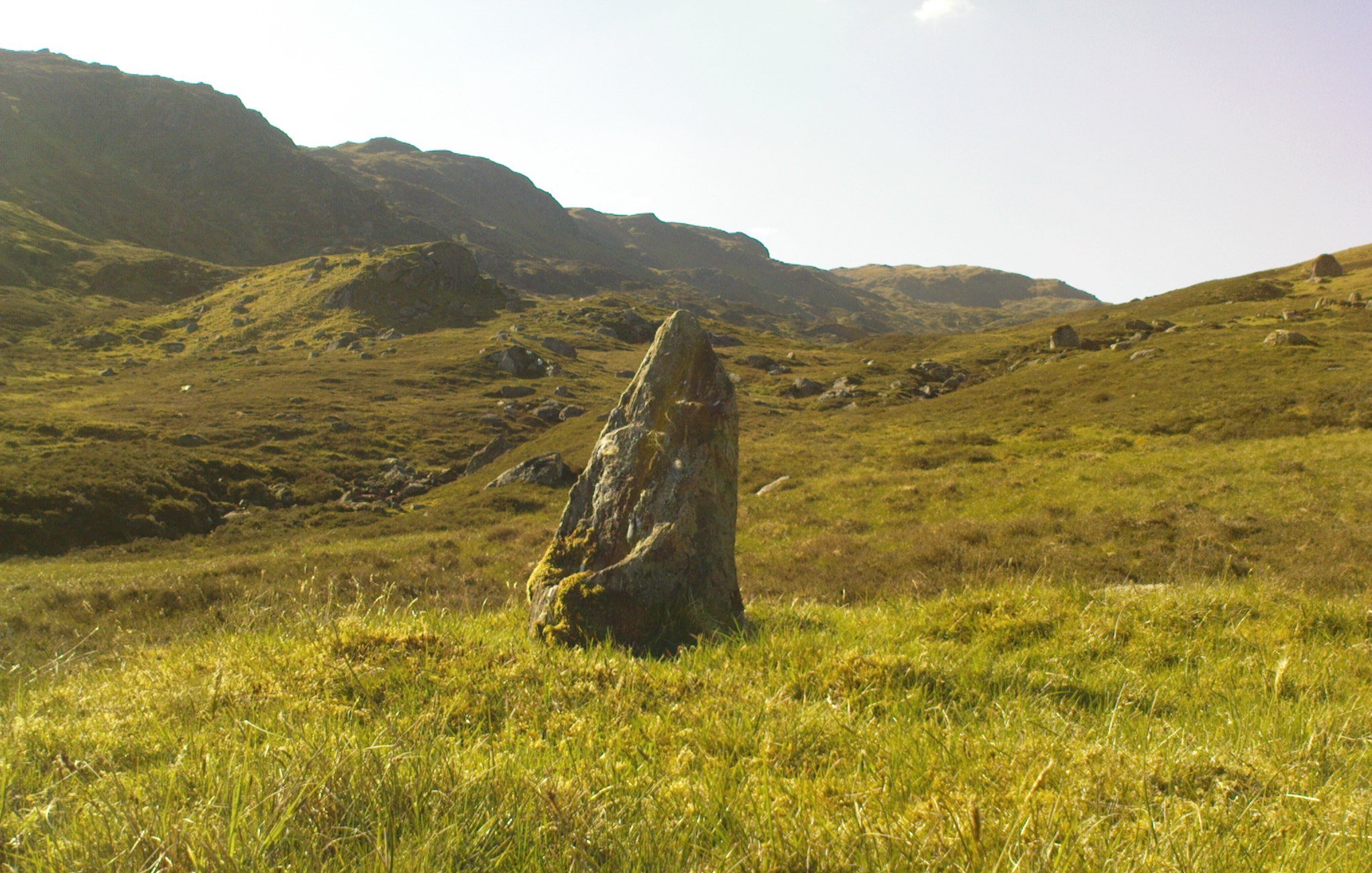
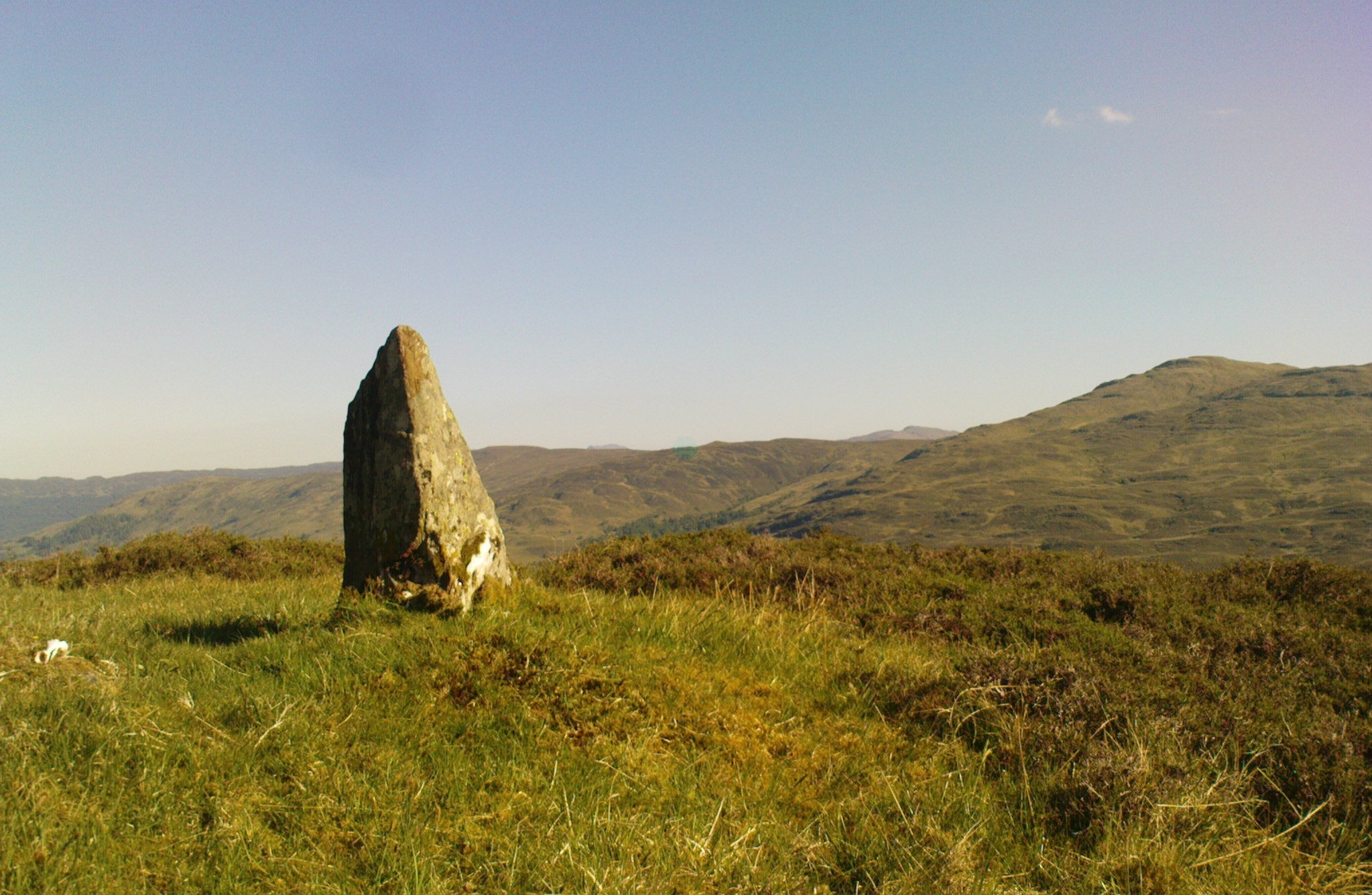
This, the smallest of the six Dunruchan standing stones, is what Fred Coles (1911) described as “the North-West Stone,” or Dunruchan B.  In size alone it has a very different character to the others on the hillside immediately above and almost seems out of character when compared to the rest.  Standing amidst typical moorland vegetation, this pointed upright is more than five feet tall, and from here its huge companions can be seen rising from the Earth to both east and south.  Coles’ description of this monolith was as follows:

“This block of conglomerate, not half the height of (Dunruchan A)…occupies a rather lower position 385 yards to the west. Its basal girth is 8 feet 10 inches and its height 5 feet 1 inch, the south being the smoothest of its four sides. It is not now quite vertical, having a lean to the south. Like the great North-east Stone, this one tapers to a rather fine point… From this Stone the other four in the group as well as that at Craigneich are visible. ”
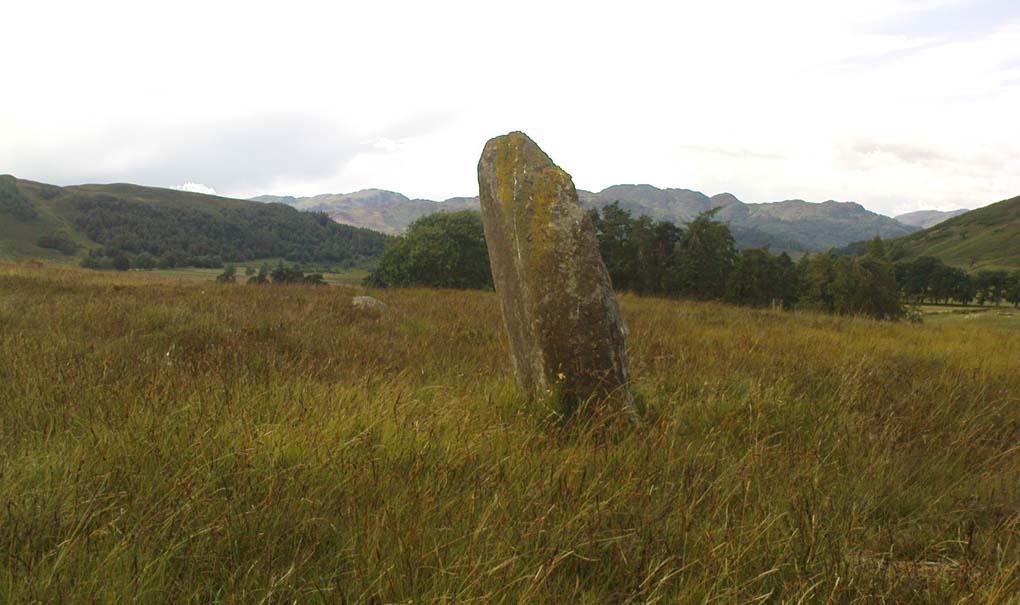
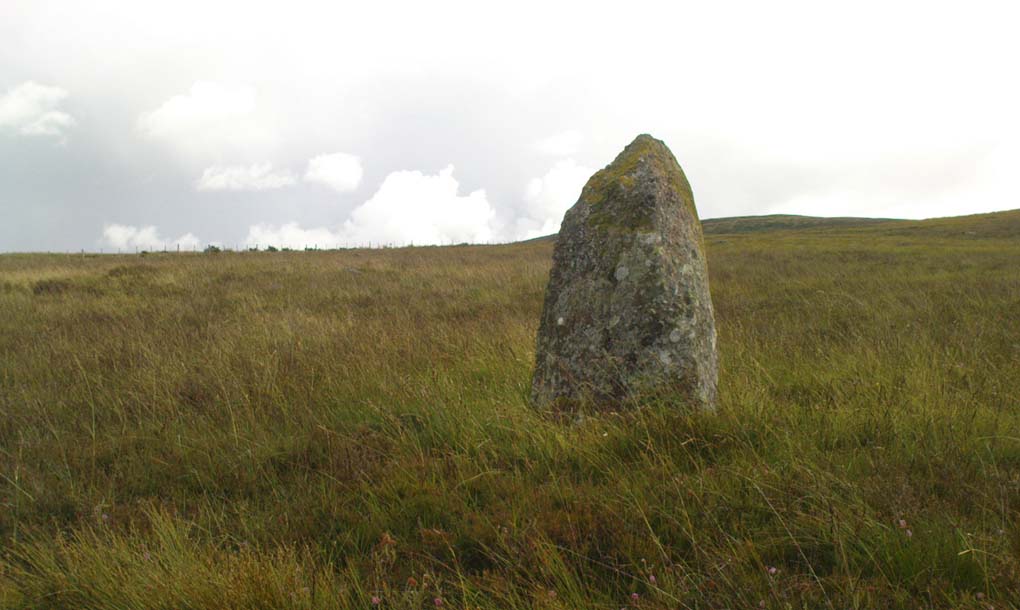
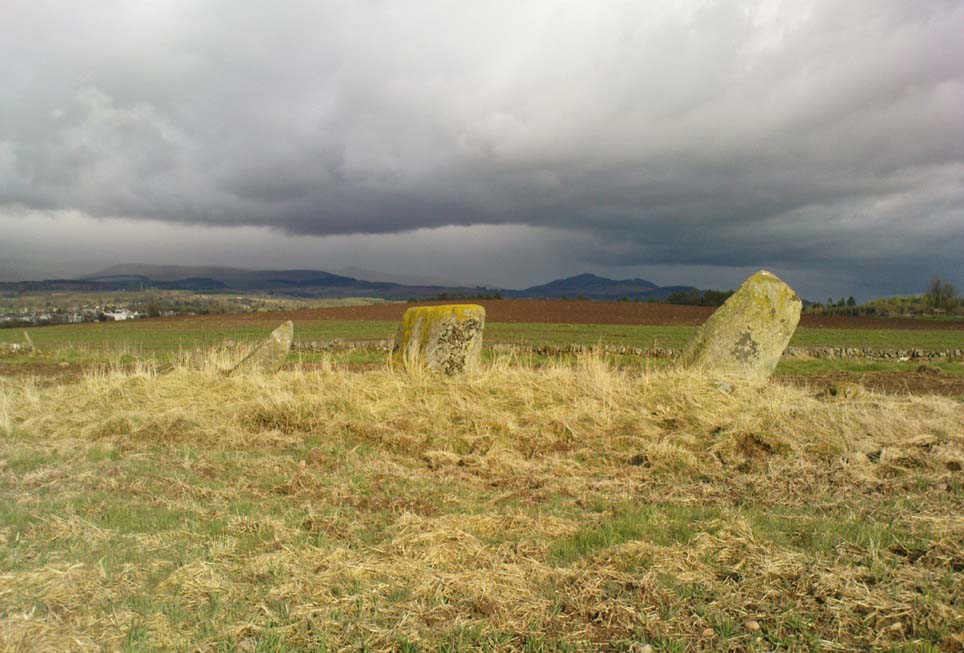
Dunruchan B, looking NW
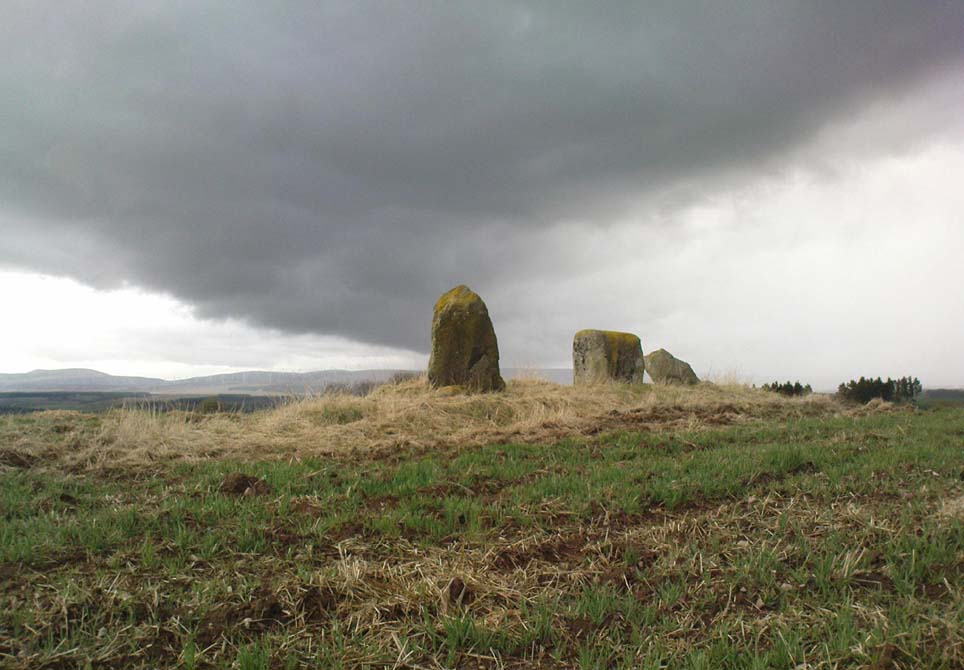
Dunruchan B, looking S

However, we couldn’t make out all the standing stones in this complex like Coles reported. The huge leaning monolith of Dunruchan C is the closest of the others from here and, perhaps, would be the reason the cluster have been added to the lists of megalithic stone rows by Burl (1993) and Thom (1990), as a spacious curved row geometrically links them together – but I’ve gotta say, I’m sceptical about this as a deliberate megalithic alignment. However, I’ve no doubt that Alfred Watkins and his fellow ley hunters would add this to their inventory of Perthshire ley lines.

Folklore

According to an account in the Ordnance Survey Name Book of 1860, “these stones are believed to mark the graves or commemorate the death of Roman soldiers who fell in a battle fought here between the Romans and the Caledonians.”

References:

  1. Burl, Aubrey, From Carnac to Callanish, Yale University Press 1993.
  2. Cole, Fred, “Report on Stone Circles in Perthshire, Principally Strathearn,” in Proceedings of the Society of Antiquaries, Scotland, volume 45, 1911.
  3. Finlayson, Andrew, The Stones of Strathearn, One Tree Island: Comrie 2010.
  4. Hunter, John, Chronicles of Strathearn, David Phillips: Crieff 1896.
  5. Thom, A., Thom, A.S. & Burl, Aubrey, Stone Rows and Standing Stones – 2 volumes, BAR: Oxford 1990.

© Paul Bennett, The Northern Antiquarian
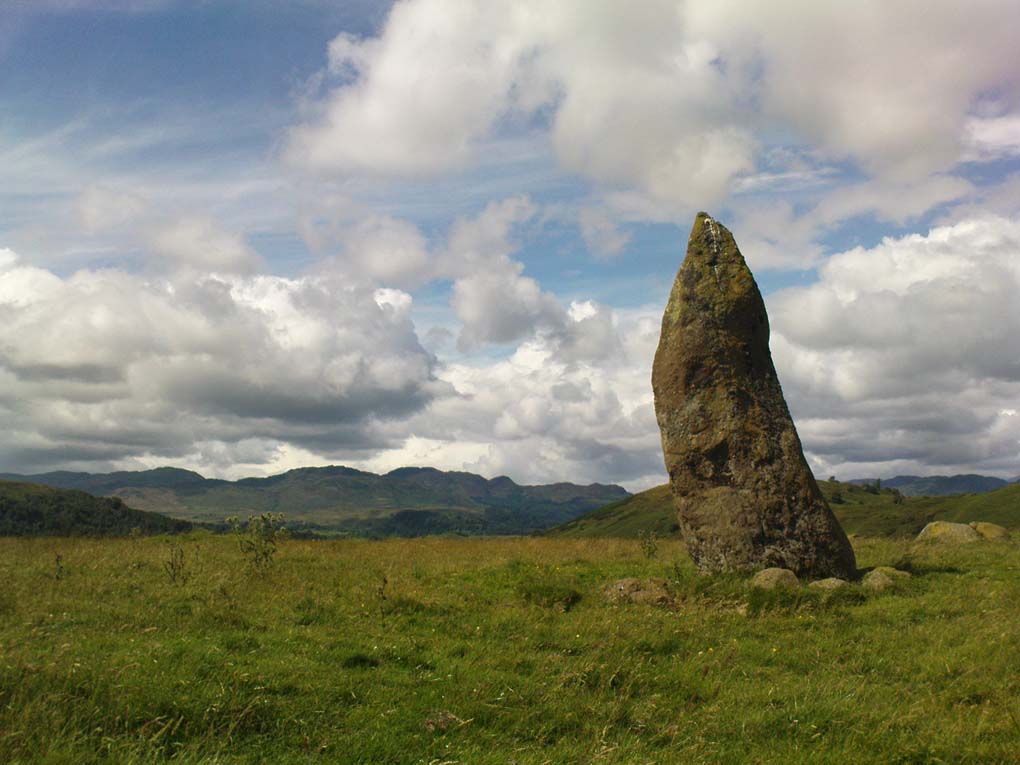

Dunruchan ‘A’ Standing Stone, Muthill, Perthshire

Standing Stone: OS Grid Reference – NN 79555 17388

Also Known as:

  1. Aodann Mhor
  2. Cornoch
  3. Shillinghill

Getting Here

The giant Dunruchan A stone

From Comrie town centre take the road south across Dalginross Bridge over the river, heading towards Braco, up the winding B827 road for 2-3 miles until you reach a small crossroads (you can easily miss it, so watch out!). Turn left and, about a mile on, 100 yards or so before Craigneich Farm (near its lovely standing stone), go up the track on your right up the hills. Follow the track up and through the gate, then walk straight uphill. A coupla hundred yards up you’ll see a large standing stone on the flat grassy plain to your left. That’s Dunruchan A.

Archaeology & History

Dunruchan A, looking east

This is a magnificent stone in a magnificent landscape, no doubt of considerable mythic importance to the people who lived and erected it several thousand years ago. It is the tallest of at least six standing stones to be seen on this section of moorland and  stands out on the hillside from various angles as you walk the hills and glens around here: an element that was, no doubt, intended by those who built it.  It’s probably a very old standing stone, more likely neolithic in origin than the generally ascribed Bronze Age.

The great stone in the sky
Dunruchan A, and its heathen onlooker

Standing on the flat grassy plain above Shillinghill and Craigneich, it is surrounded by many small cairns and, it would seem, was once accompanied by a cairn of its own if the scatter of small rocks around its base is anything to go by (though I’m not aware of any detailed excavations here by antiquarians, so this initial assumption may be wrong). Indeed, it seems the Dunruchan A stone stands in the middle of a scattered prehistoric cemetery if the many small overgrown piles of rocks are anything to go by: though I know of no detailed account of these many scatterings of stones (anyone know if they’re ancient, or field clearances?).  However, the great megalith hunter Fred Coles (1911) did comment on how this and the other giant standing stones nearby may “commemorate burials,” but didn’t explore the idea any further.

Approaching twelve feet tall, it was Cole (1911) who described this huge standing stone in one of his essays on the Perthshire megaliths, telling:

“Dunruchan Moor stretches, at a general height of about 700 feet above sea-level, for nearly two miles towards the south and south-west of Craigneich. At its northern extremity, and distant from the Craigneich Stone about 610 yards, stands the first and the tallest of the group (A on the plan), a huge pointed mass of conglomerate schist, its apex being 11 feet 4 inches above ground. Its base is a somewhat regular oblong, measuring along the north and south faces 4 feet 2 inches, and across the edges 3 feet 10 inches and 2 feet 2 inches, the wider of these being on the east. Small and insignificant boulders lie loosely around it. The smoothest and most vertical side faces the north. The illustration (fig. 16A) was drawn from the east, with the Aberuchil Hills as a background.”

Fred Coles’ 1911 drawing

From this great stone, looking west across the moors the giant standing stone of Dunruchan C and its companions can be noticed just a few hundred yards away.  A cup-marked stone can also be seen about 200 yards west of here. It has been suggested that this and the other standing stones were part of some curious megalithic stone row (Burl 1993; Thom 1990), but this seems most unlikely.  Thom made no notes of the archaeoastronomical potential at Dunruchan A, nor its associates.

As a megalithic complex, this area is outstanding.  The other large standing stones of Dunruchan D and Dunruchan E are on the moorland plain a few hundred yards to the southwest and must be visited if you explore the area.  This is serious megalith country!

Folklore

According to an account in the Ordnance Survey Name Book of 1860, “these stones are believed to mark the graves or commemorate the death of Roman soldiers who fell in a battle fought here between the Romans and the Caledonians.”

References:

  1. Burl, Aubrey, From Carnac to Callanish, Yale University Press 1993.
  2. Cole, Fred, “Report on Stone Circles in Perthshire, Principally Strathearn,” in Proceedings of the Society of Antiquaries, Scotland, volume 45, 1911.
  3. Finlayson, Andrew, The Stones of Strathearn, One Tree Island: Comrie 2010.
  4. Hunter, John, Chronicles of Strathearn, David Phillips: Crieff 1896.
  5. Thom, A., Thom, A.S. & Burl, Aubrey, Stone Rows and Standing Stones – 2 volumes, BAR: Oxford 1990.

ACKNOWLEDGEMENTS: Many thanks to Paul Hornby for use of his photos!

© Paul Bennett, The Northern Antiquarian


Craigneich Farm, Muthill, Perthshire

Standing Stone: OS Grid Reference – NN 79225 17870

Also Known as:

  1. Blar an Rodhar
  2. Blarinroar

Getting Here

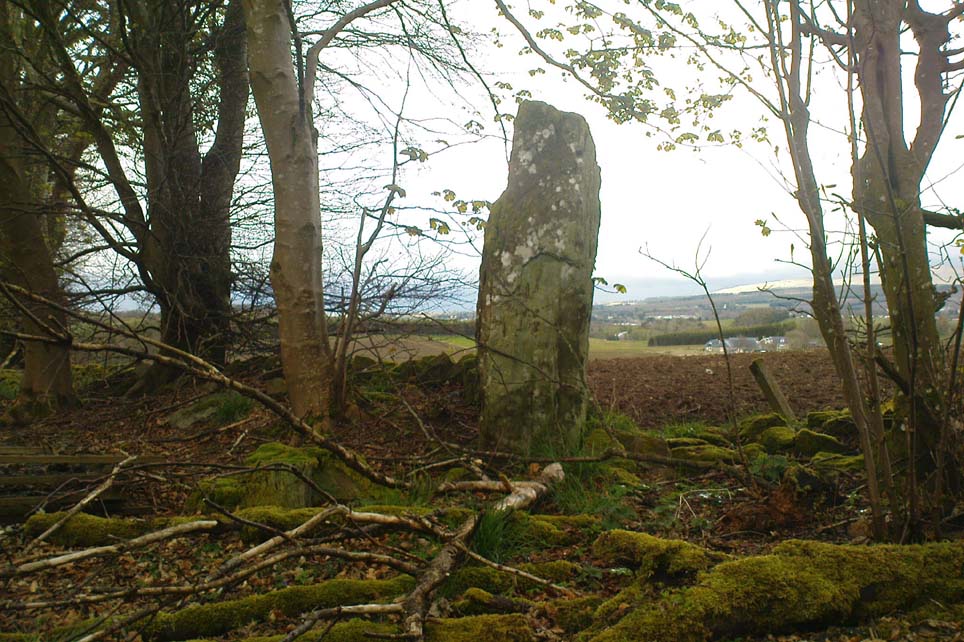
Craigneich standing stone, looking west

From Comrie town centre take the road south across Dalginross Bridge over the river, heading towards Braco, up the winding B827 road for 2-3 miles until you reach a small crossroads (you can easily miss it, so watch out!). Turn left and, about a mile on, keep your eyes peeled – either for the standing stone in the field on your left, or the dirt-track to Craigneich Farm 100 yards further on.

Archaeology & History

…and again, looking east

This is a large standing stone in a truly beautiful setting.  More than six-feet tall, it stands amidst a gorgeous atmosphere just off the quiet roadside and has been all-but neglected by most archaeological surveys.  Thankfully it was one of the many impressive monoliths in this district that was described in one Fred Coles’ (1911) fine surveys.  Described in conjunction with the even more massive standing stones on the slopes to the south, he told:

“This Stone is one mile and a furlong SSE of the last, on the north side of the road between Straid and Shillinghill, at 514 feet above sea-level. The locality lies to the north of Aodan Mohr, which is the name given to the upper portion of Dunruchan. .. Its base is of an extremely irregular four-sided shape, having a jutting-out ledge on the south (see drawing). In basal girth it measures 15 feet 9 inches, and in height 6 feet 4 inches. The longest axis points N. 33° E.. by S. 33° W .”

Craigneich stone (Coles 1911)

Others may have once stood in close attendance, as the Chronicles of Strathearn (1896) tells how at Blarinroar (the name of the fields here) there were standing stones twenty feet tall! Cole thinks this to be an error based on the megaliths of Dunruchan, half-a-mile to the south. On the other side of the road from here, in the hedgerow, lies a fallen stone covered in ages of moss.

The now singular upright has been linked, albeit tentatively, to the Dunruchan megaliths as part of a possible stone row (Burl 1993; Thom 1990), but this seems very unlikely.

In Edward Peterson’s (1996) survey of Pictish monuments, he thought the Craigneich stone may have been important to the Seal tribe in ages gone by, as he says there are some Pictish carvings on the stone:

“The heads of two seals are relatively clear, positioned near the centre of this stone. Not so clear is the head of a cat at the top right hand corner, and to the immediate left is another seal head.  These are only a few of the animal heads appearing on this sea/seal-god standing stone.”

More antiquarian research is obviously required here.  It’s a truly superb spot!

References:

  1. Burl, Aubrey, From Carnac to Callanish, Yale University Press 1993.
  2. Cole, Fred, “Report on Stone Circles in Perthshire, Principally Strathearn,” in Proceedings of the Society of Antiquaries, Scotland, volume 45, 1911.
  3. Finlayson, Andrew, The Stones of Strathearn, One Tree Island: Comrie 2010.
  4. Hunter, John, Chronicles of Strathearn, David Phillips: Crieff 1896.
  5. Peterson, Edward, The Message of Scotland’s Symbol Stones, PCD Ruthven Books: Aberuthven 1996.
  6. Thom, A., Thom, A.S. & Burl, Aubrey, Stone Rows and Standing Stones – 2 volumes, BAR: Oxford 1990.

© Paul Bennett, The Northern Antiquarian
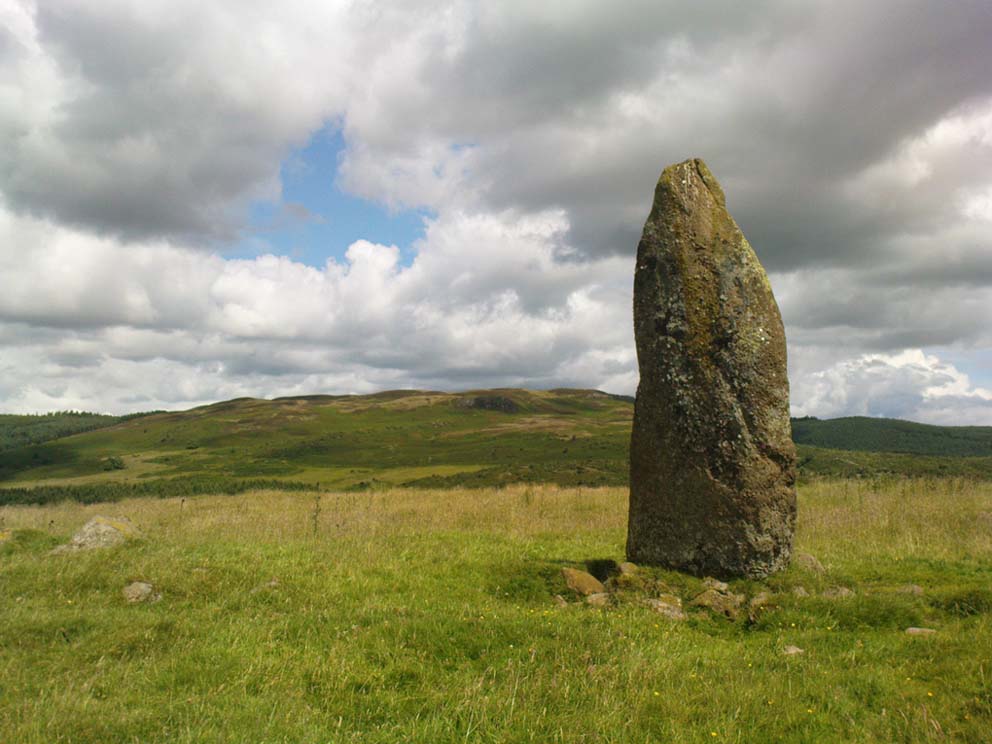

Caisteal Samhraidh, Glen Lochay, Killin, Perthshire

Standing Stone: OS Grid Reference – NN 519 380

Getting Here

Caisteal Samhraidh stone, looking west down Glen Lochay

Go halfway down Glen Lochay to Dalgirdy house by the cattle-grid, then go up the burn by its side and follow the directions to reach the small standing stone above the shielings of Allt Ghoaordaidh. From here, head east, keeping to roughly the same contour line as you walk along. About half-a-mile on, keep your eyes peeled. If you’re into ambling off-track up mountains, you’ll find it. If you’re not into such things, you could be in trouble!

Archaeology & History

Caisteal Samhraidh stone, looking east to Duncroisk

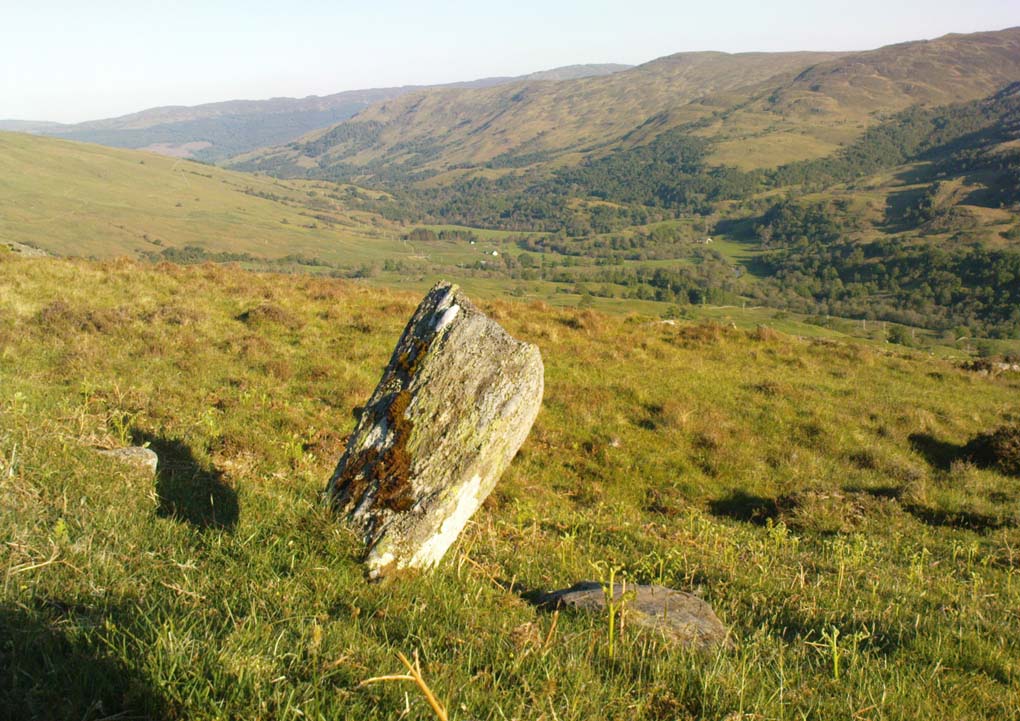
There are no previous literary references to this standing stone, leaning at an angle, halfway up the southern slope of Mheall Ghaordie. Between 3-4 feet tall, the monolith appears to have had packing stones around it, although when I stumbled across it in a lengthy amble a few weeks ago, the daytime temperature was above 100° F and I’d been out all day with no food, so my investigative faculties weren’t at their best! The stone may have been part of some ancient walling along the edge of the mountain, but if so, it wasn’t obvious. A few yards higher up the slope, a very large overgrown heap of rocks seemed evident – but again, I wasn’t sure whether this was artificial or geological. All along this mountain and up the curve of Allt Ghoaordaidh to the west are such immense clusters of ancient rocks and boulders, that the mound behind here just seemed to merge into the background of all the rest.

Looking SE down Glen Lochay

The ruined Iron Age enclosure of Tullich is less than half-a-mile south of here, and the possible prehistoric standing stones of Tirai another half-mile to the east. Prehistoric rock art scatters the glen east of here and masses of ancient walled structures run up and down hidden ridges and slopes. There is in fact scattered an excess of archaeological remains all along the edges of this long valley, indicating considerable human population in bygone centuries (before the Clearances came) reaching way back into prehistoric times. The old people of Glen Lochay would have been able to furnish us with a mass of important historical tales and myth about so many now-forgotten places, before the carnage of the agriculturalists and capitalists destroyed their way of life. This standing stone, no doubt, would have had tales said of it. Today, only the spirits of the glen are able to whisper such insights…

© Paul Bennett, The Northern Antiquarian
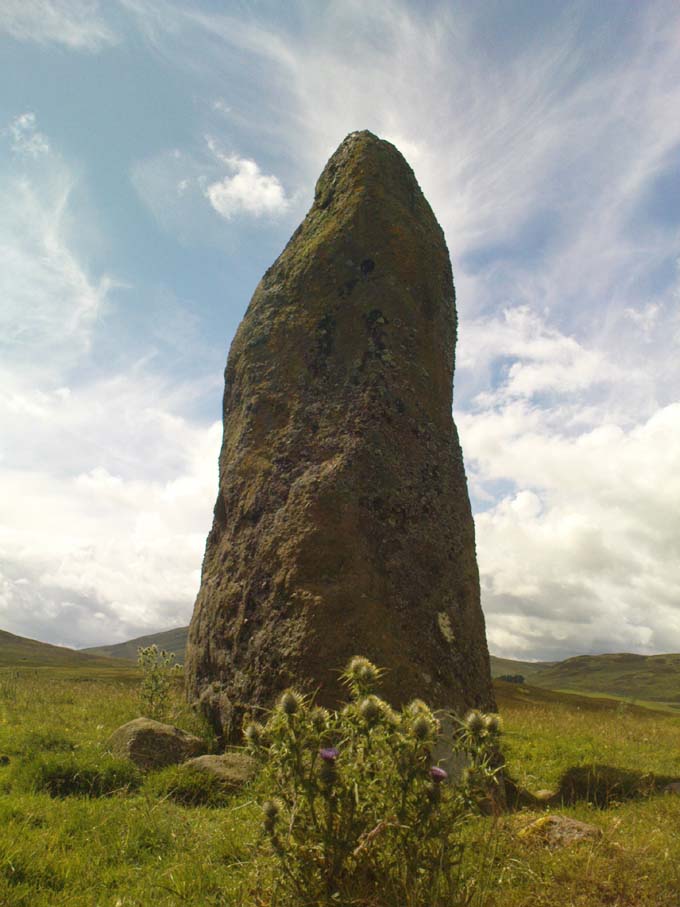

Breadalbane

Gleneagles Stone Circle, Blackford, Perthshire

Stone Circle (lost):  OS Grid Reference – NN 93 08

Also Known as:

  1. Canmore ID 25929

Archaeology & History

Virtually nothing is known of a stone circle that was described in the 18th century old Statistical Account of Scotland, where a ring of stones was seen “in the parks of Gleneagles.”  Its exact whereabouts remains unknown and the grid-reference given for the circle is an approximation.  The writer told that this was “supposed to have been places of Druidical worship,” and it is mentioned alongside the megalithic sites at nearby Sheriffmuir and the Glebe.

The circle is mentioned without further details on the Canmore website.  A number of stones above St. Mungo’s Well looked promising when I was bimbling in the area the other week — and as the landscape levels out above the well towards Glen Devon, we have a promising panorama, but there was nothing there.  It would be good to have a team of us bimbling round here to see what could be found.  However, the site may well have been destroyed.  Any further information about this site would be hugely welcome!

References:

  1. Sinclair, John, The Statistical Account of Scotland, 1791-1799 – volume 3, EP: Wakefield 1979.

© Paul Bennett, The Northern Antiquarian

Gleneagles ‘A’, Blackford, Perthshire

Standing Stone:  OS Grid Reference – NN 9211 0962

Also Known as:

  1. Blackford
  2. Loaninghead
  3. Peterhead Farm

Getting Here

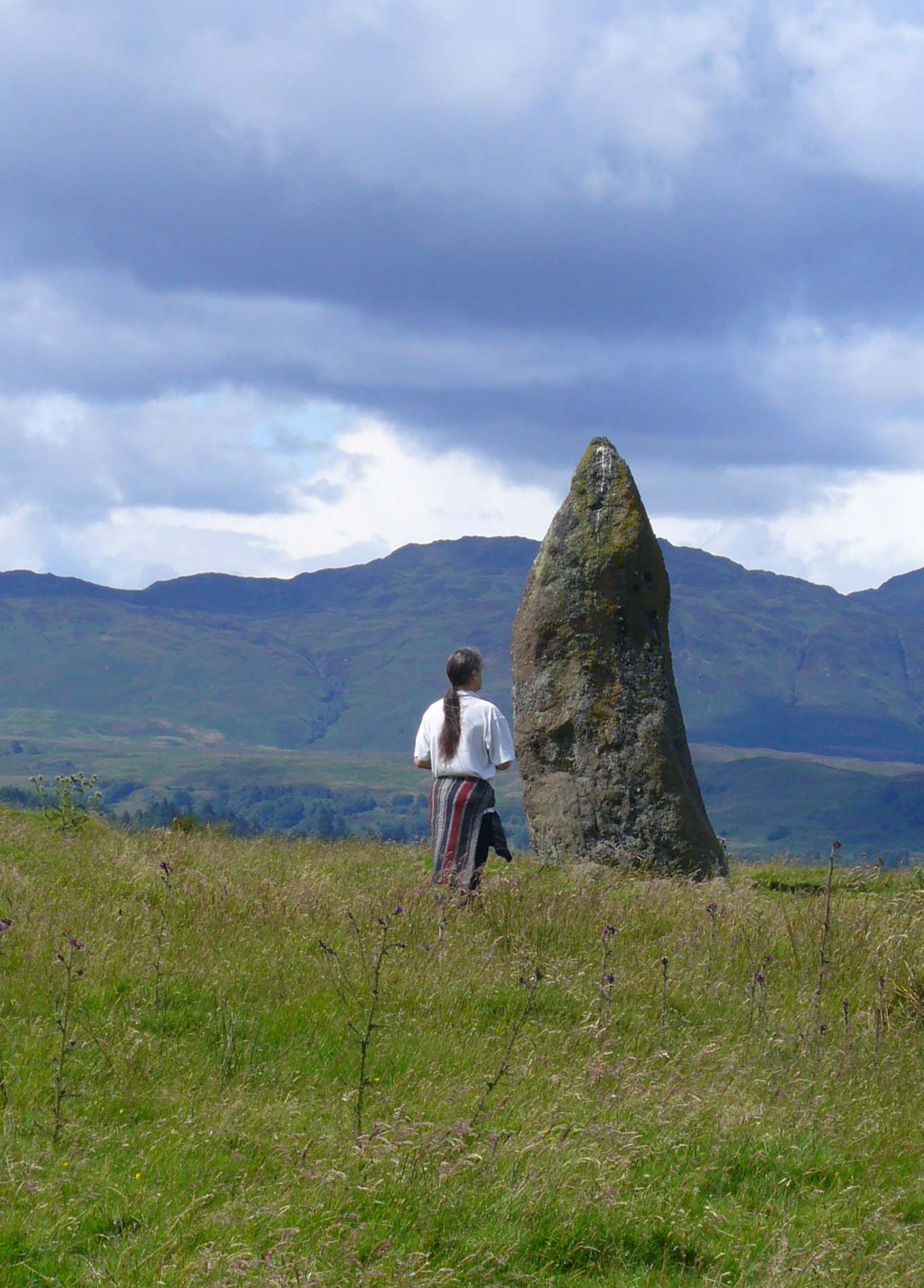
Monolith nr Peterhead Fm

Along the A9 dual carriageway between Blackford and Auchterarder, take the A823 road south, up the Glen Eagles road as if you’re heading towards Pool of Muckhart and Dunfermline.  Less than 100 yards up the road, turn immediately right and go past the standing stone of Gleneagles B for a coupla hundred yards or so, where there’s a left turn (down to Peterhead Farm).  Stop here and look into the field in front of you.  You can’t really miss it!

Archaeology & History

Gleneagles ‘A’, gazing west

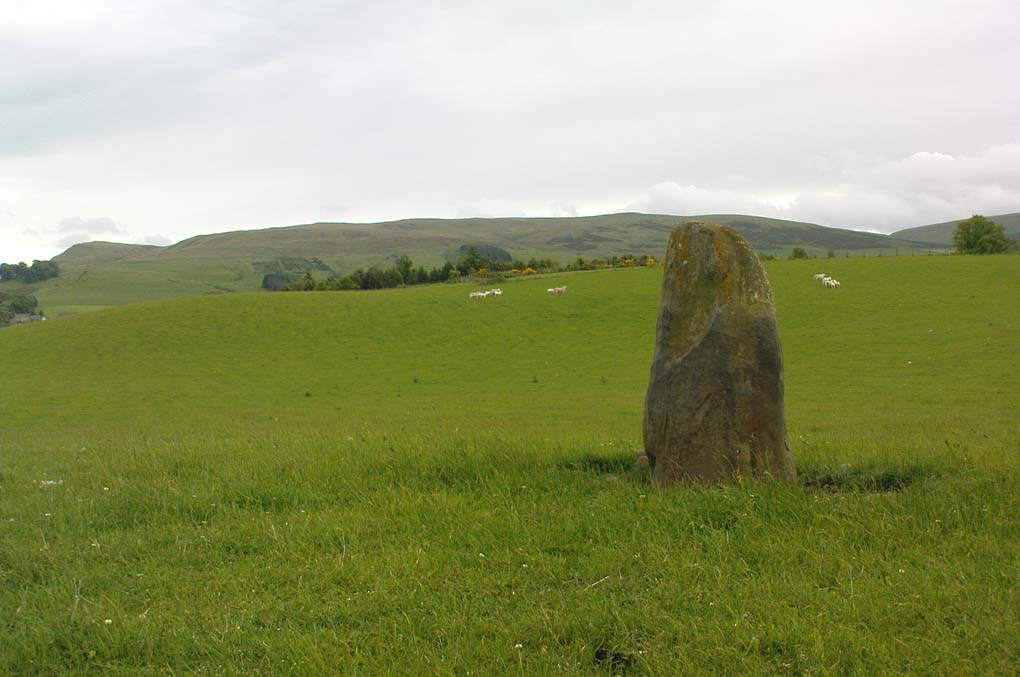
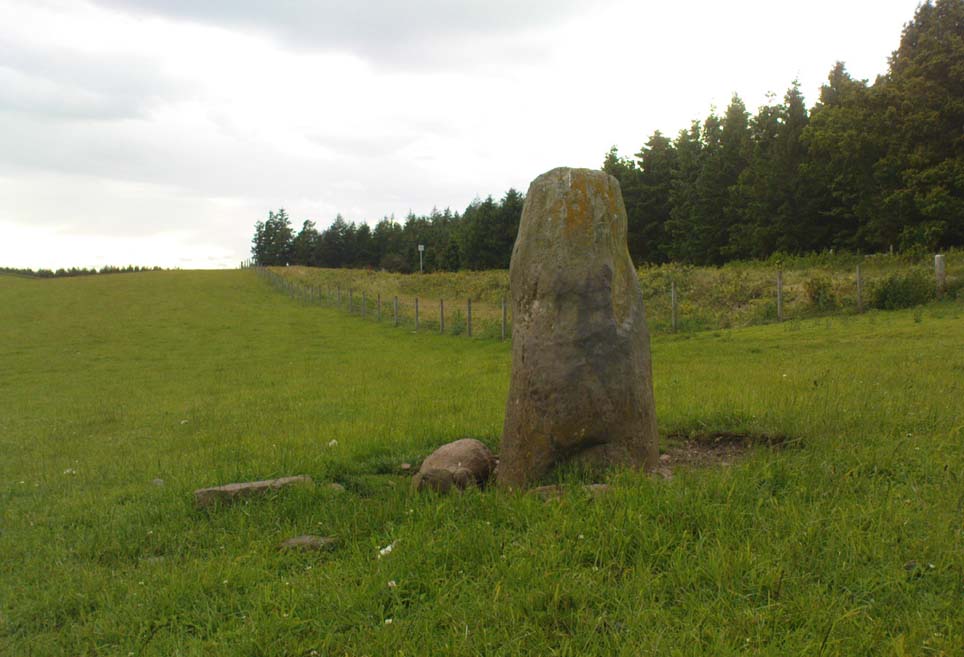
This short standing stone, more than 3ft tall, has an elegance about it which megalith lovers alone will understand!  Maybe it’s the setting; maybe the feel of the land; or maybe something else.  I dunno… On my first visit to the site, Nature was wearing a grey overcast cloak, but the site and I didn’t seem to care; and although the view from here doesn’t have the same grandeur of Glen Eagles to view as its companion stone a few hundred yards to the east might have, there felt a greater welcoming at this smaller stone.  Odd, considering this monolith had been knocked over and re-positioned by the farmer in the not-too-distant past.  Anyway…less of this subjective nonsense of feelings from the landscape and megaliths!  Utter drivel all of it!

The earliest measured account of the stone is to be found in Mr Hutchison’s (1893) essay, where he notes this and its companion close by, giving us the dimensions of this monolith:

“This (stone) is roughly columnar in shape, but wider at the base than above. Its height is 3ft above ground; circumference at base 6ft. 5in., diminishing to 4ft. 2in at the top. It is of metamorphic schist.  The line of direction between these two gives a horizontal angle of 260°.”

Since that day, in the mass of archaeology essays that have been scribed, this smoothed upright gets only a minimal description.  Charles Calder’s (1947) account is typical, saying simply that it is,

“Somewhat cylindrical in form with a girth of 7 feet at the base, it rises with a decided tilt towards the west to a height of 3 feet 10 inches above ground-level.”

The stone fares better in Andrew Finlayson’s (2010) fine local survey of megalithic ruins, where he points out that this and its compatriot stone Gleneagles B, are in an alignment with the fallen Boat Stone and the upright White Stone, a few miles to the southwest.  This line works on 1:50,000 map, but when transferred to larger-scale surveys, the alignment misses each outlying site by 20-30 yards here and there.

References:

  1. Calder, Charles S.T., “Notice of Two Standing Stones (one with Pictish Symbols) on the Lands of Peterhead Farm, near Gleneagles, Perthshire,” in Proceedings of the Society of Antiquaries, Scotland, volume 81, 1947.
  2. Feachem, Richard, Guide to Prehistoric Scotland, Batsford 1977.
  3. Finlayson, Andrew, The Stones of Strathearn, One Tree Island: Comrie 2010.
  4. Hutchison, A.F., “The Standing Stones of Stirling District,” in The Stirling Antiquary, volume 1, 1893.

© Paul Bennett, The Northern Antiquarian

Craggish, Comrie, Perthshire

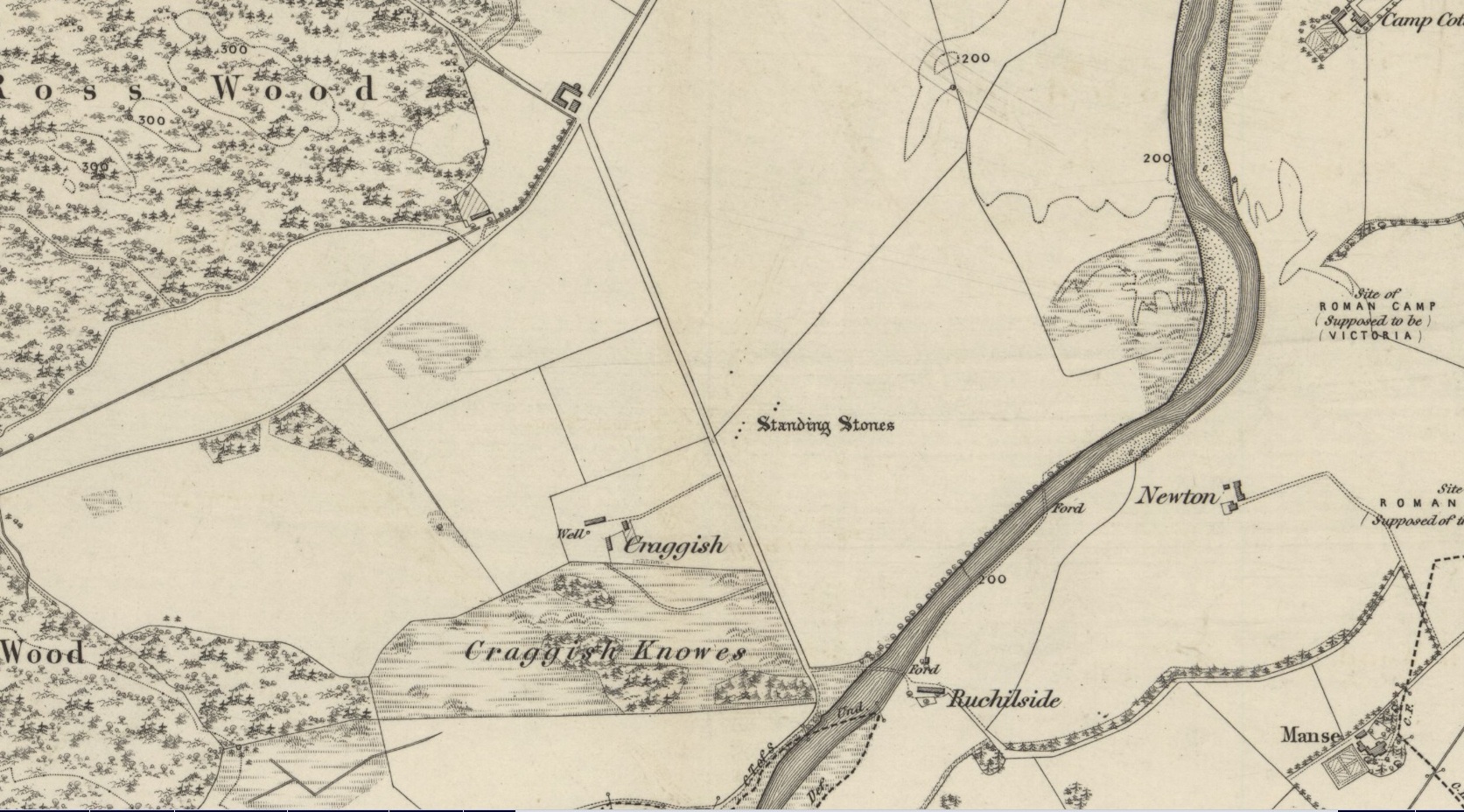
Standing Stones (destroyed):  OS Grid Reference – NN 7643 2086

Archaeology & History

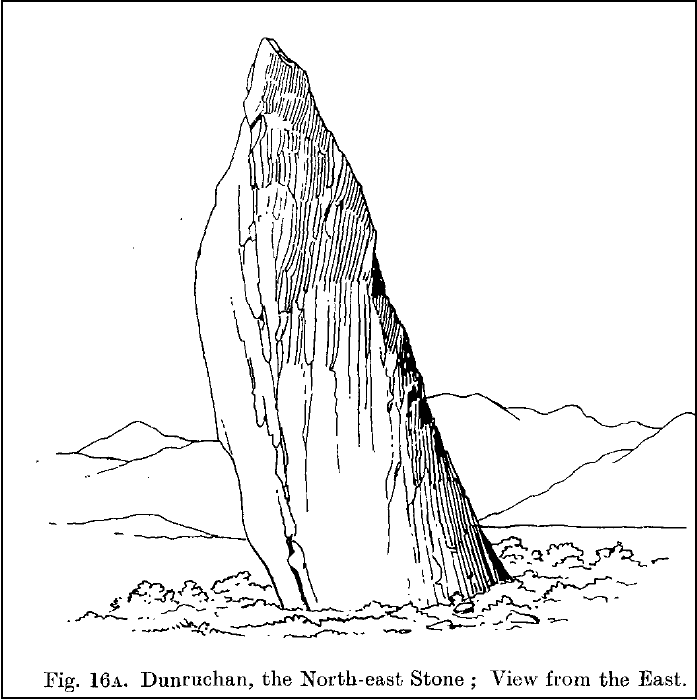
Site shown on 1886 OS-map

Highlighted on the 1866 OS-map was an impressive cluster of standing stones that sadly met their demise sometime around at the end of the 19th century.  They were mentioned to “still exist” when the local writer Samuel Carment passed them in 1882, but had been destroyed by the time the Ordnance Survey lads resurveyed here in 1899.  Altogether there were at least six of them, standing aligned sharply northeast-southwest and were described in one of Fred Coles’ (1911) essays, who lamented their passing.  Listed in the stone row surveys by Burl (1993) and Thom (1990), the prime description we have of them was by Cole himself, who told:

“This site has also been wantonly bereft of its group of megaliths.  Up to so recent a date as 1891 there were several.  These were shown on the (Ordnance Survey map) as three in one line and two in another, on a field about one furlong NE of Craggish farmhouse, close to the road coming down from Ross, and nearly a quarter-mile NW of the ford across the Ruchil at Ruchilside.”

In Finlayson’s (2010) colourful survey of the local megaliths he told that the stones,

“Stood, by the road, in what is now ‘The Whinney Strip’: a boulder-strewn strip of land 20m wide dividing up otherwise flat and even grazing land.”

References:

  1. Burl, Aubrey, From Carnac to Callanish, Yale University Press 1993.
  2. Cole, Fred, “Report on Stone Circles Surveyed in Perthshire, Principally Strathearn,” in Proceedings of the Society of Antiquaries, Scotland, volume 45, 1911.
  3. Finlayson, Andrew, The Stones of Strathearn, One Tree Island: Comrie 2010.
  4. Thom, A., Thom, A.S. & Burl, Aubrey, Stone Rows and Standing Stones – 2 volumes, BAR: Oxford 1990.

Acknowledgments:  Big thanks for use of the early edition OS-map in this site profile, Reproduced with the kind permission of the National Library of Scotland

© Paul Bennett, The Northern Antiquarian

Glenhead Stone Row, Doune, Stirlingshire

Standing Stones: OS Grid Reference – NN 75491 00455

Also Known as:

  1. Canmore ID 24689

Getting Here

Take the B824 road that runs between Dunblane and Doune and, whichever direction you’re coming from, watch out for the large statue of David Stirling by the roadside (y’ can’t really miss it!).  Stop here. Then, walk along the dirt-track into the field by the side of the statue, keeping your eyes peeled 50 yards along, for the upright stones in the field on your right, at the top of the brow of the hill.

Archaeology & History

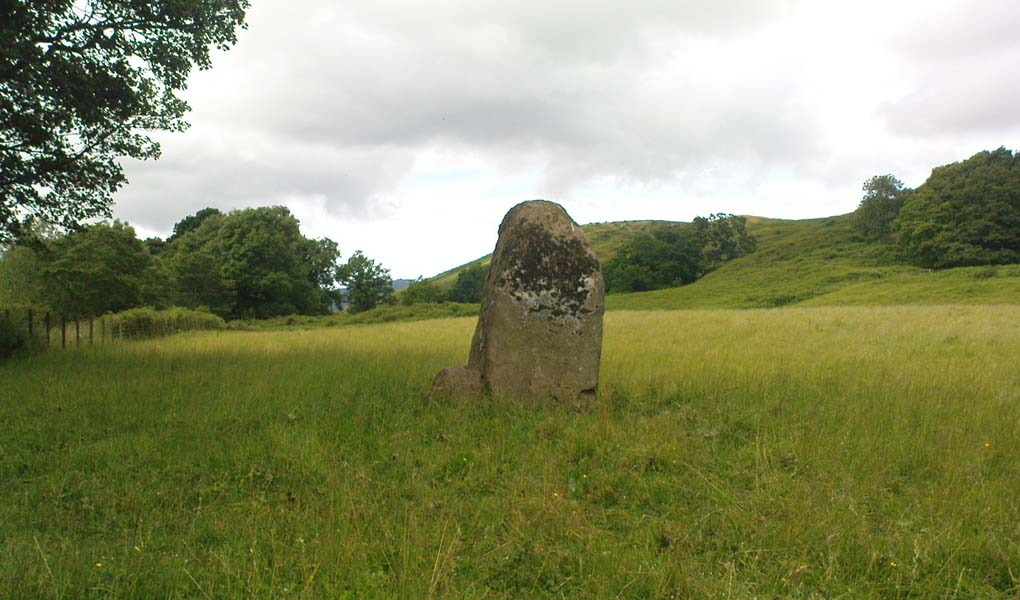
Glenhead Farm standing stones

A few hundred yards south of the large Glenhead Standing Stone, we come across this curious small row of three reasonably large standing stones which — the more you look at them — give the distinct impression that they may be the remains of a large prehistoric tomb.  But archaeology records are silent on this matter and we must contend with what we can see.  At the northernmost end of the row, a fourth stone lays amongst the vegetation: it may have once stood alone, or maybe  been snapped from  its fellow monolith.  20 yards south is a large mass of stone; perhaps from an old building, perhaps cairn spoil (does anyone know?)

The local historian Moray Mackay (1984) thought that the line of stones here were once a part of something larger, saying:

“Originally it was probably a circle of six stones, with a seventh in the middle, and this central stone can still be identified by its flat top on which are the mysterious and well known cup-marks, much weathered but plainly visible.  Close to the site, urns and stone hammers were unearthed last century.”

Glenhead stone row, looking north

Of the three remaining upright stones, it is the central one which has the cup-markings visible on its top and side (Allen 1882), with a lovely covering of almost luminous lichen giving it extra effect! (a separate TNA Site Entry for the cup-marked stone will be written in due course)

The famous astroarchaeologist Alexander Thom and his son (1990) described the place as,

“A three stone alignment showing about 33° N declination in one direction and 31° S in the other, but the azimuth comes from the stones only and so cannot be accurate. Perhaps the line is lunar to the hill in the SW…”

In Thom’s (1967) earlier work he posited that the alignment may relate to the rising of the star Capella around 1760 BC, but this is untrue. Thom’s error however, was not of his making, but due to the false dates that archaeologists ascribed to megalithic ruins at the time – dates which Thom used in his research, believing that the archaeological fraternity would know what they were talking about!  In their collaborated text, Aubrey Burl added how,

“these stones stand on a hill summit at 360ft (110m) OD. The row is on a north-facing slope. Three stones stand. A fourth, prostrate, 6ft 6 in (2m) long, lies against the NE pillar. The row has a NNE-SSW axis. The northernmost stone is 3ft 6in high, the centre 4ft, and the SSW, characteristically the tallest, 6ft 6in… The line is about 27 feet (8.3m) long. The central stone has 23 cupmarks on its top and 4 more on its western side.”

…to be continued…

References:

  1. Allen, J. Romilly, “Notes on some Undescribed Stones with some Cup-Markings in Scotland,” in PSAS 16, 1882.
  2. Burl, Aubrey, From Carnac to Callanish, Yale University Press 1993.
  3. Mackay, Moray S., Doune: Historical Notes, Forth Naturalist: Stirling 1984.
  4. Thom, Alexander, Megalithic Sites in Britain, Oxford University Press 1967.
  5. Thom, A., Thom, A.S. & Burl, A., Stone Rows and Standing Stones – volume 2, BAR Oxford 1990.

© Paul Bennett, The Northern Antiquarian

Glenhead Standing Stone, Doune, Perthshire

Standing Stone:  OS Grid Reference – NN 7552 0103

Getting Here

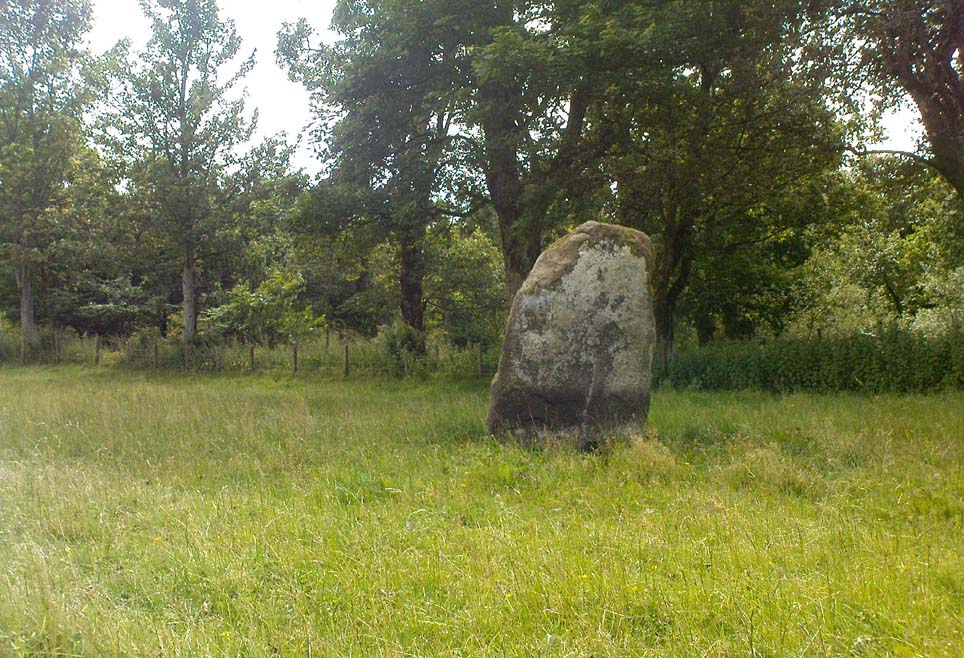
The huge Glenhead stone

Take the A820 road from Dunblane to Doune.  About a mile west of the motorway, keep your eyes peeled for where the small road on your right is signposted to Argaty and Kilbryde.  Stop here and walk up the footpath on the left-hand side of the road.  A couple of hundred yards up, take the right turn on the track and where the small copse of trees is, go through the gateway, keeping yourself to the left edge of the trees running parallel to the field.  About 100 yards or so up, you can’t miss him!

Archaeology & History

Quite a huge fella this one!  Standing more than 6 feet high, the monolith is nearly as broad, giving an impression of great size to the old stone.  The stone’s nature and date is troublesome: although ostensibly labelled as Bronze Age, alongside the walling which runs down from here we see a great number of other large stones, some of which give the distinct impression of being length of Iron Age walling — but without excavation, its nature remains a puzzle.  The monolith stands close to being on top of a rise in the land, which geomancers understand as being important sites of spirit, or places where the dead were rested — but we have no record of any tombs here, so are left with the options of walling or a spirit site.

…and from another angle

On its east-face, the stone has a number of what appear to be curious large cup-markings, but they appear to be little more than the effect of weathering and erosion.  There’s also a solid piece of long metal sticking out of the same side, which was obviously done by someone in recent centuries — so maybe a local farmer and his mates stood this one up?  Or they were planning on using it as a gatepost…

The site is well worth looking at, best in the winter months when access is easier.  It has the feel of other sites close by, hidden from the record books, though probably long gone.

References:

  1. Royal Commission on the Ancient & Historical Monuments Scotland, Stirling – 2 volumes, HMSO: Edinburgh 1963.
  2. Royal Commission on the Ancient & Historical Monuments of Scotland, Archaeological Sites and Monuments of Stirling District, Central Region, Society of Antiquaries of Scotland 1979.

© Paul Bennett, The Northern Antiquarian


Allt Ghaordaidh, Glen Lochay, Killin, Perthshire

Standing Stone:  OS Grid Reference – NN 5101 3807

Getting Here

Allt Ghaordaidh, looking north

One helluva climb to reach this little fella.  I simply started at Dalgirdy cottage, some 5 miles along Glen Lochay, on the right-hand side of the road.  Then, walk right up the burnside, all the way up until it begins to level out and the old shielings appear.  When you’ve got to where they just about finish, about 50-70 yards on the east side of the burn, you’ll see the small stone standing upright, all alone. You can’t really miss it!

Archaeology & History

Allt Ghaordaidh, looking south-ish!

No previous written records exist that describe this small standing stone, whose nature and age may be akin to that at nearby Tirai, found amidst the derelict village a couple of miles east, lower down the slopes — i.e., it may have simply been part of some of the ancient village remains and shielings found close by, either side of the rushing burn.  But whether it’s only medieval or much more ancient than that, its position in the landscape alone (much like Tirai’s uprights), deserves to be known about.

There are considerable amounts of ancient remains scattering the mountains slopes all round here: some have been catalogued, but a lot of it has not.  This little standing stone is at last alive again! (take good food and kit when visiting here)

© Paul Bennett, The Northern Antiquarian